Search Results: "storm"

28 October 2014

Keith Packard: Goodbye-Barnes-and-Noble

Goodbye Barnes & Noble I've read books on electronic devices for many years now; the convenience of having a huge library with me while traveling makes up for the lower quality of the presentation. I've read books on a selection of Palm devices, an old OpenInkpot compatible ereader, my phone and, most recently, on my Kobo Aura. To get reading material, I've used a variety of sources, including the venerable Project Gutenberg, the Internet Archive, directly from authors like Cory Doctorow and even our local Multnomah County Public Library. I like to have books in epub format; it's a published standard, based on HTML and CSS. My recent devices have all happily supported that, and it allows for editing when I feel the need to correct typos or formatting problems. Purchasing Books When I wanted to actually purchase a book, I bought from Barnes & Noble; they have a good selection, and reasonable automatic recommendations. According to their web site, since I started shopping there, I've purchased 51 books. I can't tell how much I've spent, but probably in excess of $500. Not knowing which device I'd be reading on at any one time, and liking to have the assurance of ongoing access to my library, I would always download the epub files to my laptop and then transfer them to whichever device I wanted to read on. This ensured that my books would be available even when I didn't have a network connection (as happened yesterday during a wind storm which cut the power to the DSLAM which connects me to the internet). I'd created a simple shell script which captured the file after it was downloaded on my laptop and prepared it for my reader. A bit of browser configuration and it really was as simple as clicking the 'download' button to get a book onto both my laptop and my reading device. Barnes & Noble Disables Downloading I was traveling in Bordeaux a couple of weeks ago and wanted to get the latest volume in a series I was reading. My library didn't have it available, and so I decided that it was worth a few dollars to purchase it for the flight home. After clicking through the Barnes & Noble store, I was ready to download the book so that I could transfer it to my reader. Going to 'My Library', I found my new purchases but the usual 'Download' button was missing. I was a bit surprised as I'd purchased and downloaded the previous volume just before leaving without any troubles. At first, I assumed there was some kind of region restriction on the distribution of this book. I'm familiar with that from DVD region locking of movies, and supposed that the same could be done with books for some reason. However, after setting up a VPN back to home and browsing through that (to ensure that my browser would appear with an Oregon address), the download button was still not present. The unhelpful Barnes & Noble representative that I accessed through the 'help' button disclosed that the 'download' "feature" had been disabled for "security" reasons. Not really having any alternative, I requested a refund for the new book. Barnes & Noble Loses a Customer With no way to actually use ebooks purchased through the Barnes & Noble store, I won't be spending any more money with them. I'm not sure how that helps their "security" issues, although if they lose enough customers and they close their doors, I guess that would make them about as secure as imaginable. Kobo Makes a Sale Having purchased a Kobo Aura, it had built-in access to their book store, which made it easy to download the book that I wanted. Then, I simply connected my reader to my laptop and copied the file over for safe keeping. Buying Books under Linux After I got home, I had to figure out how to get Adobe Digital Editions installed on my laptop. Fortunately, I discovered that version 2.0.1 runs fine under wine. Now, purchasing books can be done with my laptop (a vastly superior browsing experience). The .acsm file can be dragged straight from the iceweasel download menu to Adobe Digital Editions, which happily downloads the actual .epub file and makes it available for transferring to my reader. Of course, now that I've got Adobe Digital Editions working, I can also get digitally restricted books from all over the net, greatly expanding my options for purchasing (or borrowing) books. It's a bit less convenient, and requires that I run an icky Windows binary under wine, but at least I have choices, which is some consolation.

31 August 2014

Lucas Nussbaum: Debian trivia

After an intensive evening of brainstorming by the 5th floor cabal, I am happy to release the very first version of the Debian Trivia, modeled after the famous TCP/IP Drinking Game. Only the questions are listed here maybe they should go (with the answers) into a package? Anyone willing to co-maintain? Any suggestions for additional questions?

8 July 2014

Joey Hess: laptop death

So I was at Ocracoke island, camping with family, and I brought my laptop along as I've done probably half a dozen times before. An enormous thuderstorm came up. It rained for 8 hours and thundered for 3 of those. Some lightning cracks quite close by as we crouched in the food tent, our feet up off the increasingly wet ground "just in case". The campground flooded. Luckily we were camped in the dunes and tents mostly avoided being flooded with 2-3 inches of water. (That was just the warmup; a hurricane hit a week after we left.) My laptop was in my tent when this started, and I got soaked to the skin just running over there and throwing it up on the thermarest to keep it out of any flooding and away from any drips. It seemed ok, so best not to try to move it to the car in that downpour. Next time I checked, it turned out the top vent of the tent was slightly open and dripping. The laptop bag was damp. But inside it seemed ok. Rain had slackened to just heavy, so I ran it down to the car. Laptop appeared barely damp, but it was hard to tell as I had quite forgotten what "dry" was. Turned it on for 10 seconds to check the time. It was 7:30 and we still had to cook dinner in this mess. Transferred it to a dry bag. (By the way, in some situations, discovering you have a single dry towel you didn't know you had is the best gift in the world!) Next morning, the laptop was dead. When powered on, the fan came on full, the screen stayed black, and after a few seconds it turned itself back off. I need this for work, so it was a crash priority to get it fixed or a replacement. Before I even got home, I had logged onto Lenovo's website to check warantee status and found 2 things:
  1. They needed some number from a sticker on the bottom of my laptop. Which was no longer there.
  2. The process required some stange login on an entirely different IBM website.
At this point, I had a premonition of how the beuracracy would go. Reading Sesse's Blehnovo, I see I was right. I didn't even try. I ordered a replacement with priority shipping. When I got home, I pulled the laptop apart to try to debug it. I still don't know what's wrong with it. The SSD may be damaged; it seems to cause anything I put it into to fail to work. New laptop arrived in 2 days. Since this model is now a year old, it was a few hundred dollars cheaper this time around. And now I have an extra power supply, and a replacment keyboard, and a replacement fan etc. And I've escaped the dead USB port and broken rocker switch of the old laptop too. The only weird thing is that, while my old laptop had no problem with my Toshiba passport USB drive, this new one refuses to recognize it unless I plug it into a USB 1.0 hub. Oh well..
Update: Ocracode for this trip: OBX1.1 P6 L7 SA3d+++b+c++ U2(rearended,laptop death) T4f2b1 R2T Bb+m++++n++
F+++u++ SC+s-g6 H+f0i3 V+++s++m0 E++r+

28 May 2014

John Goerzen: Review: The Wheel of Time

Five years ago, I opened The Eye of the World, the first book in the Wheel of Time series, and read:
Lord of the Morning, he said, I have come for you.

On the island, the air shimmered and coalesced. The black-clad man stood staring at the fiery mountain rising out of the plain. His face twisted in rage and contempt. You cannot escape so easily, Dragon. It is not done between us. It will not be done until the end of time. Then he was gone, and the mountain and the island stood alone. Waiting.
And then, as often, Robert Jordan began books citing some of the prophecy he invented:
And it came to pass in those days, as it had come before and would come again, that the Dark lay heavy on the land and weighed down the hearts of men, and the green things failed, and hope died. And men cried out to the Creator, saying, O Light of the Heavens, Light of the World, let the Promised One be born of the mountain, according to the prophecies, as he was in ages past and will be in ages to come. Let the Prince of the Morning sing to the land that green things will grow and the valleys give forth lambs. Let the arm of the Lord of the Dawn shelter us from the Dark, and the great sword of justice defend us. Let the Dragon ride again on the winds of time. from Charal Drianaan to Calamon,
The Cycle of the Dragon.
Author unknown, the Fourth Age
And then, the grand opening to each of the books in the 11,000-page series, something like this:
The Wheel of Time turns, and Ages come and pass, leaving memories that become legend. Legend fades to myth, and even myth is long forgotten when the Age that gave it birth comes again. In one Age, called the Third Age by some, an Age yet to come, an Age long past, a wind rose in the Mountains of Mist. The wind was not the beginning. There are neither beginnings nor endings to the turning of the Wheel of Time. But it was a beginning. Born below the ever cloud-capped peaks that gave the mountains their name, the wind blew east, out across the Sand Hills, once the shore of a great ocean, before the Breaking of the World. Down it flailed into the Two Rivers, into the tangled forest called the Westwood, and beat at two men walking with a cart and horse down the rock-strewn track called the Quarry Road.
And yesterday, 11,000 pages later, I have completed the series. Really, how could I have put down a book with such a majestic beginning as that? It hinted at the epic that was to come, the amazing literature I was going to read. I didn t read it straight through; I enjoyed books like War and Peace along the way. But what a trip the Wheel of Time series was. The characters were so detailed, so deep, the setting so elaborate, the plots so grand and also so small everyone from servants to queens were well-represented in the books. Not every section was a page-turner; in fact, around the 4th or 5th book, the series started to plod for a thousand pages or two, reading more like a history book than a novel. Sometimes the prejudices and stereotypes of the characters, particularly the sexism that both the men and women displayed, were frustrating to read. I never quite figured out of this was brilliant writing (making the reader feel frustrated at the plodding pace of the book when it was describing characters being frustrated at the plodding pace of events), or if it could have been trimmed down by 2/3 in some places. But really, the number of brilliant endings, laugh-out-loud situations, and page-turning suspense that somehow managed to build over hundreds, and then even thousands of pages, outweighed the flaws.
Politics is a foggy mire full of snakes. - The Eye of the World
Ah. Furlan washed his hands in one direction, then rubbed them in the other. Ah. Forgive me, Master Andra, but Lady Alys is a fierce sounding woman. Only with those who displease her, Lan said blandly. Her bite is far worse than her bark. Ah. Ah. Ah. Your rooms are this way. . . - The Dragon Reborn
One of the marks of truly good writing is that I leave a book or series with a sense of sadness or nostalgia, leaving characters that seem almost like friends. I felt that after finishing the last book in the series, A Memory of Light. The ending was deep, and satisfying, but ultimately left me wanting even more even more than 11,000 pages, somehow.
Elienda and Briain woke from the dream. She might have been speaking of the weather rather than two deaths among women she knew. We all must wake eventually. - Knife of Dreams
I was often touched by the way the Aiel referred to each other. A desert people, their fond farewall was may you always find water and shade. A fitting metaphor for anyone s life, I think. And they referred to their spouse as shade of my heart. Jordan touched on quite a few themes of religion and philosophy. In that quote above, he has the Aiel referring to death as waking from a dream. An intriguing metaphor, isn t it? He even writes conflicts of philosophy, religion, and culture into the series. I was particularly impressed with his treatment of theodicy and the problem of evil (the argument and religious response relating to the presence of evil in the world in the face of a loving God.) It is the most impressive treatment I have seen in fiction, and does a better job of advancing the theodistic argument than many philosophers have, I suspect. It is hard to really go into that one here because of the length and potential for spoilers. I can, however, comment on his treatment of existential nihilism the theory that life and the universe is without meaning, and the sometimes-related comment that what does anything matter then anyway? Here are a couple of quotes:
In Maradon, I saw what had been done to men who followed me. I saw Light in them, Min. Defying the Dark One no matter the length of his shadow. We will live, that defiance said. We will love and we will hope. And I saw him trying so hard to destroy that. He knows that if he could break them, it would mean something. Something much more than Maradon. Breaking the spirit of men he thirsts for that. He struck far harder than he otherwise would have because he wanted to break my spirit. His voice grew softer and he opened his eyes, looking down at her. And so I stood against him. - Towers of Midnight
What if I think it s all meaningless? he demanded with the loud voice of a king. What if I don t want it to keep turning? We live our lives by the blood of others! And those others become forgotten. What good is it if everything we know will fade? Great deeds or great tragedies, neither means anything! They will become legends, then those legends will be forgotten, then it will all start over again!

Why? Rand thought with wonder. Because each time we live, we get to love again.

It felt relaxing to stare out at that distant light, so welcoming and noble. Storms will soon come, it seemed to say. But for now, I am here. I am here. - The Gathering Storm
I unfortunately can t put in in its proper context due to spoilers, but it is a pivotal turning point in the series, relating to the preservation of the world. By giving what we might normally call a characteristic or behavior evil an almost-human voice and character, it can be discussed in interesting ways.
We are always more afraid than we wish to be, but we can always be braver than we expect. Hold on to your heart, and the Aes Sedai cannot harm what is really you, your heart. They are not nearly so far above us as we believed. May you always find water and shade, Egwene. And always remember your heart. - Lord of Chaos
Eben is dead. Would you want to forget your pain if you lost that hulking giant of yours? Have your feelings for him cut away like some spoiled chunk of flesh in an otherwise good roast? - The Gathering Storm
These quotes are examples of characters in the series dealing with difficult situations. In one, a character is yelled at for offering to use her special powers to numb the pain of another person over a death. It brings up a question that those of us that have known pain might find interesting: would we really have wanted our pain erased? And suggests perhaps not. That there is a benefit to it. That we get through it by embracing it by embracing it while still being true to our heart.
He had four rules concerning action and information. Never make a plan without knowing as much as you can of the enemy. Never be afraid to change your plans when you receive new information. Never believe you know everything. And never wait to know everything. - Lord of Chaos
Sometimes the series treats us to logical thinkers, whether they are generals or innkeepers, and gives us little tidbits like this one.
Androl brushed off his hands, smiling. Children were so adaptable. Before them, centuries of tradition, terror and superstition could melt away like butter left too long in the sun. - Towers of Midnight
And sometimes, things to chew over. Isn t that an interesting comment on prejudice? Children aren t born prejudiced; we can see how easily they make friends with anyone. It is sad that we teach them to be, isn t it? Wheel of Time is a fine story, expertly woven. But it is not just a story. It is true, in the sense that it illuminates truths, just like Romeo and Juliet can. In it, I see lessons and echoes of the civil rights era, comments on what makes good leaders, characters wrestling with decisions without adequate data, people putting on a mask of emotions, sacrifice, and the overall theme of the entire series: the power of love and compassion. The inspiration of the series for me well, it is there, but it may take a few more days to figure it out. I think it has something to do with this: The wind rose high and free, to soar in an open sky with no clouds.

27 May 2014

Jon Dowland: Nine Inch Nails, Manchester, 2014

I spent the bank holiday weekend mostly in Manchester with my brother and a couple of friends, mostly to see Nine Inch Nails perform, but also to enjoy the pleasures of the city.
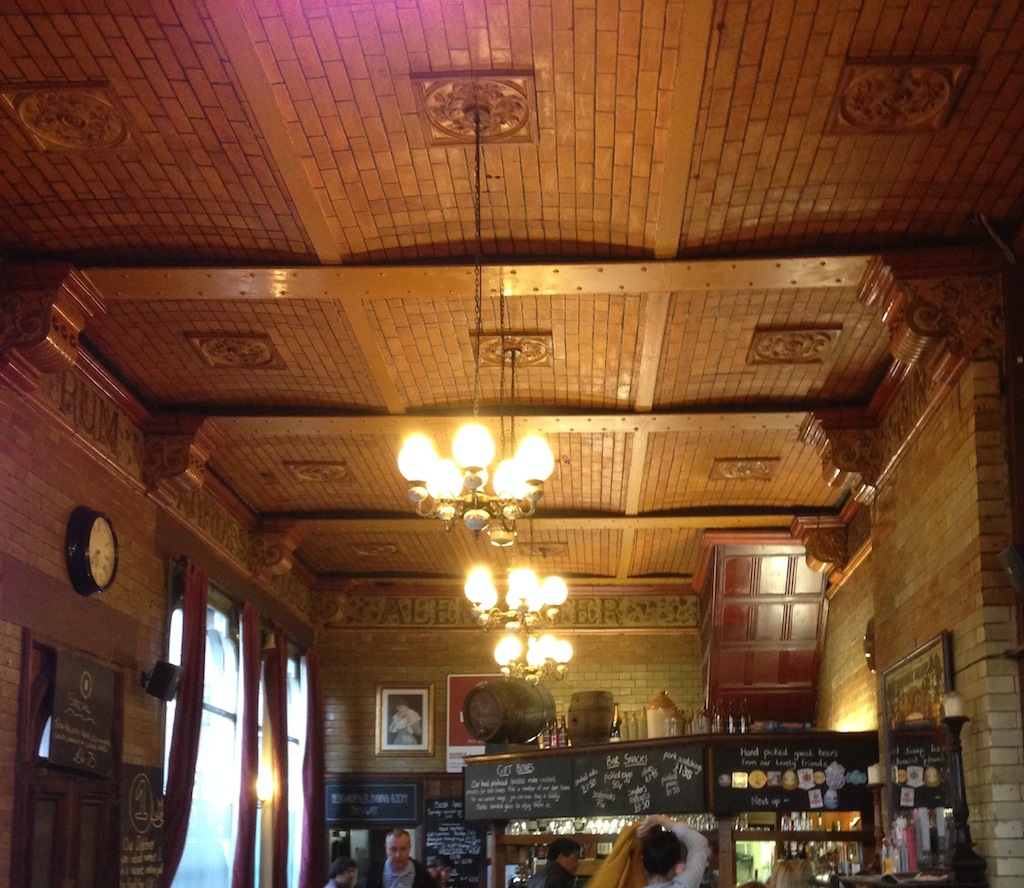
the Marble Arch's ceiling the Marble Arch's ceiling
We arrived on the Sunday and after checking in headed out to get some food. I'd booked us a table at the historic Marble Arch - the pub which gives its name to the parent company Marble Beers - and produce my most favourite ales. Whenever a Marble beer ends up as a guest at one of the Newcastle real ale pubs a friend of mine (who is much more on top of this stuff than I am) lets me know and we stop off for a few. Invariably there's a crowd of a dozen or so Manchester expats in bar when we do. I reserved our table over twitter, which is a bit of a novelty for me. My two friends are ale skeptics but - due to lack of choice - we all ended up sampling the Chocolate Marble and the Ginger 5.1, which went down a storm. They are possibly converts now. There was an Earl Grey IPA too, which was nice but a bit on the strong side for sessioning.
copyright   Jonathan Dowland 2014, http://creativecommons.org/licenses/by/4.0/ click for the animated version
The gig was great - I prefer club gigs to arena gigs but the sound techs for NIN know what they are doing and the mix was great. The visuals were stunning too. Highlights for me were "The Great Destroyer" - in particular the extended, improvised 5 minute glitch-meltdown coda; the slow build of "Eraser" and "The Day The World Went Away" - played faithfully to the CD mix rather than the traditional extended live arrangement. I miss the former live arrangement, which includes a drawn out drum-backed finish, but this arrangement had a lot of force, with all four of the band bashing guitars into a pummelling wall of sound. I've heard that at least one person has taped the show and it turns out recordings have just recently surfaced for the two club gigs my brother and I attended back in 2005 and 2007 - meaning there are now widely available, high quality ROIO copies for every NIN gig I've ever been to. Afterwards we tried to find a decent club. Manchester is a lot larger than my native city and there's plenty of places to go, if you know where they are. We had originally planned to visit The Factory on Charles Street, but we didn't believe it was open on the Sunday. The Factory is Peter Hook's (formerly of Joy Division/New Order) club - occupying the former office spaces of Factory records. I've chanced in there once before as it's right across the road from the Lass O' Gowrie pub, which is the haunt of choice for HE/tech people whenever we're in Manchester for conferences.
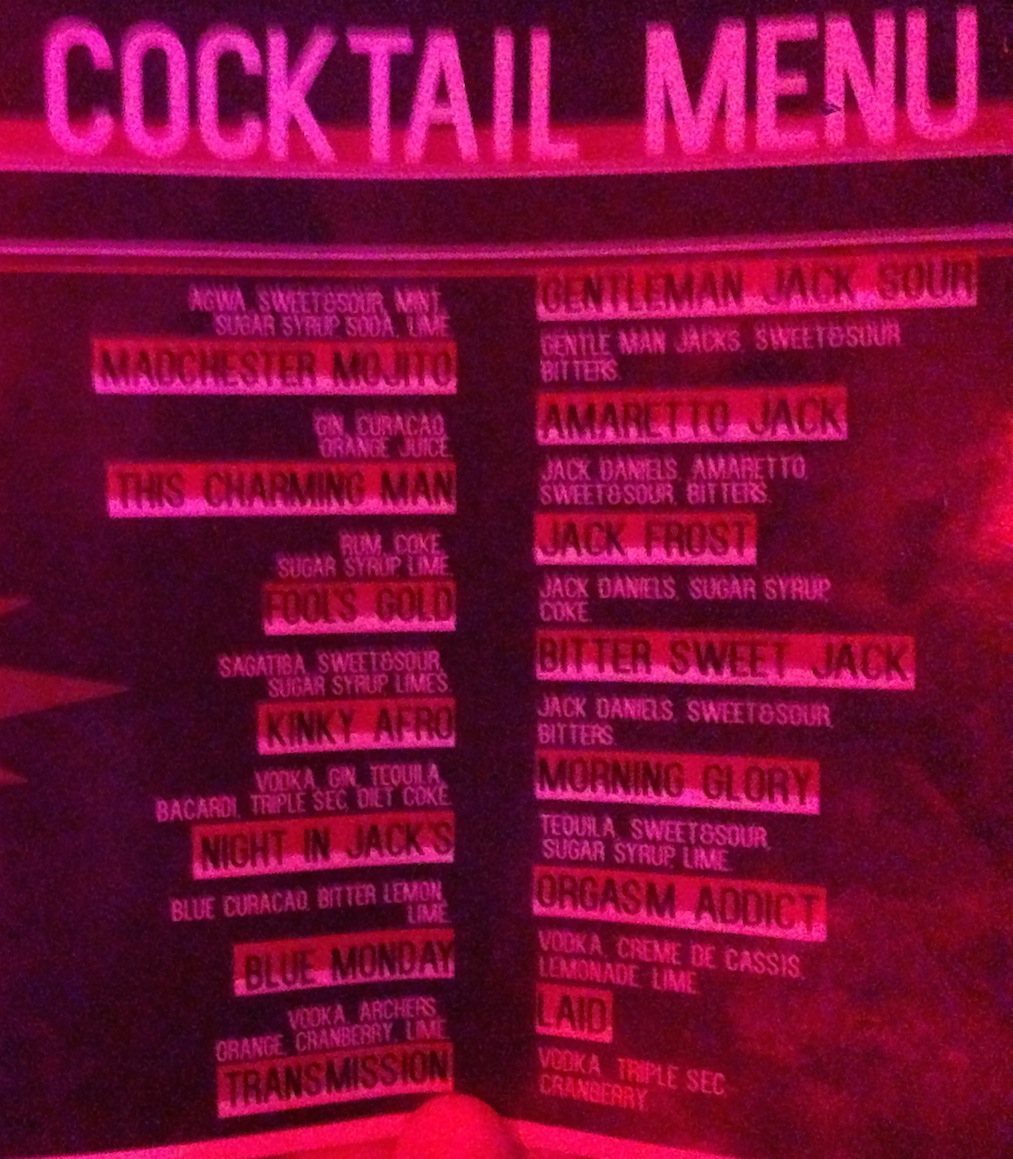
cheesy cocktail names cheesy cocktail names
Instead we gravitated towards Dry Bar on Oldham street. By coincidence this place also has historic ties to Factory Records. However the doormen wouldn't let us in! Finally we landed at a place which had one name on the door and a different name on the inside (Jack's). Like the aformentioned Lass O' Gowrie and perhaps half of all pubs and clubs in Manchester, the place is decked out as a shrine to the former musical giants of the City, with framed pictures of Mark E Smith, the Ha ienda again, the Stone Roses in their boy-band-looks hay day, John Peel (champion of many of them) and of course Tony Wilson. I can't help but wonder whether people who live here get royally sick of that. This place served some delicious albeit clich -titled Cocktails and played a pretty good set - the obligatory Madchester throwback interlude was followed by a chunk of Northern Soul and a couple of early Rap classics. Setlist wise it was pretty much identical to that of Foundation in Newcastle, 12 years ago, no doubt because Foundation was cribbing heavily from the Ha ienda in the first place.
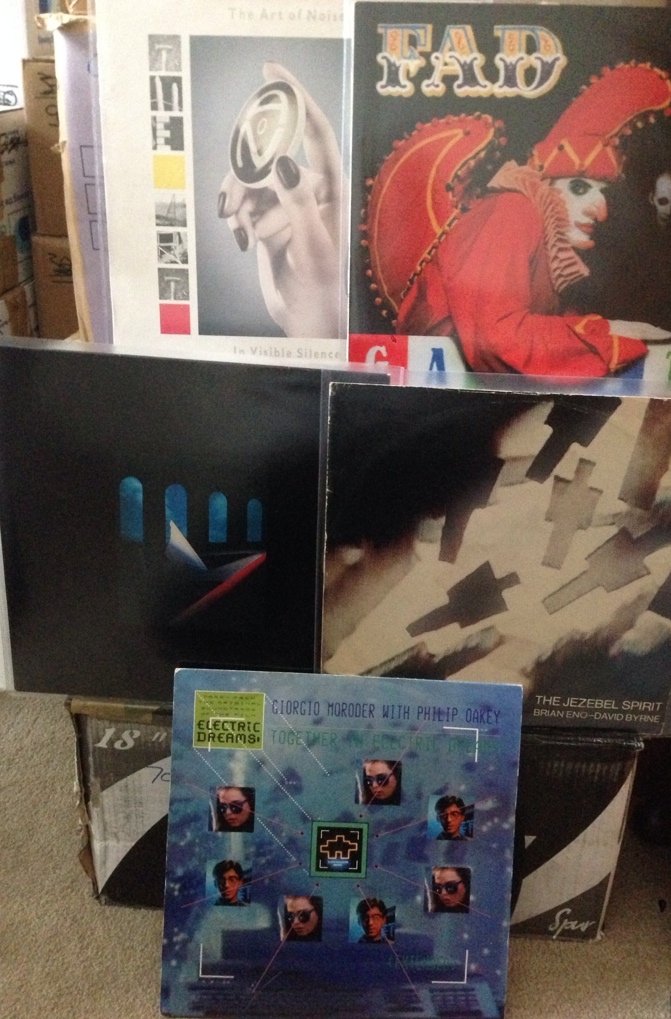
Record haul Record haul
Monday was dedicated to exploring and shopping. Top of my list of places to go was my pilgrimage venue Vinyl Exchange. Whilst waiting for it to open we rolled around in Affleck's Palace, which turned out to have a small record stall within. After Vinyl Exchange we chanced across another record store right across the road - Picadilly Records - which happens to be larger and focuses more on new releases. It didn't take long before we found another small, DIY record shop, then another. We tried out the Fopp branch here - more Vinyl; then Urban Outfitters - more; then an Oxfam branch - even more. I actually got Vinyl snow blind at this point. I've been controlling myself admirably and only picked up a couple of bits and pieces. My best find was Fad Gadget's sophmore album "Incontinent".

11 May 2014

Daniel Pocock: Is Uber on your side?

Crowdsourcing ventures with disruptive business models are a regular point of contention these days. In London, taxi drivers are threatening to create gridlock as part of an anti-Uber protest. In Melbourne, Uber drivers have been issued with $1,700 fines for operating without a taxi license. San Francisco city officials, despite being the birthplace of many of these ventures, are debating whether AirBNB should be regulated. An orderly society or an old-school protection racket? Just what exactly is it that established players in these industries are trying to achieve through their protests and lobbying efforts? In the case of apartment rentals, many people have sympathy for respecting the wishes of neighbourhoods over those of individual landlords. In the case of car pooling schemes, the arguments tend to come not from motorists at large but from those who are afraid of competition. Without competition, could things be any worse? Melbourne actually provides the perfect backdrop for this debate. Only a couple of years before Uber came on the scene, the government had made a detailed study into the taxi industry. One of Australia's most prominent economic experts, a former chairman of the Australian Competition and Consumer Commission spent 18 months studying the industry. One of the highlights of the incumbent system (and the reason I suggest Melbourne is the perfect backdrop for this debate) is the way licenses are issued to taxi drivers. There are a fixed number of licenses issued by the government. The licenses are traded on the open market so prices can go up and down just like real-estate. Under the rules of Australia's pension scheme, people have even been able to use money from their pension fund to purchase a taxi license as an investment. It goes without saying that this has helped rampant speculation and the price of a license is now comparable to the price of a house. The end result is that no real taxi driver can afford a license: most of them have to rent their license from one of the speculators who bought the license. These fixed rental fees have to be paid every month whether the driver uses their car or not. Consequently, taxi drivers have cut back on other expenses, they are often criticised for failing to keep their cars clean and the industry as a whole is criticised due to the poor quality of drivers who don't even know their way around the city. The reason, of course, is simple: by the time some newly arrived immigrant has learnt his way around Melbourne he has also figured out that the economics of driving a taxi are not in his favor. Realizing there is no way to break even, they take other jobs instead. It was originally speculated that the government review would dramatically reduce or abolish these speculative practices but ultimately lower license charges have only been used for the issue of 60 new licenses, barely 1% of the taxi fleet in the city today. Furthermore, the new licenses were only available to existing players in the industry. Uber to the rescue? Uber drove into the perfect storm as they launched their service in Melbourne in 2013. Uber drivers get a significant benefit over their competitors in traditional taxis. In particular, as they don't have the fixed monthly payment to rent a taxi license, they don't have to work every day and can even take holidays or take time to clean the cars. These things may simultaneously benefit road safety and passenger comfort. Meanwhile, those people who speculated on the old taxi licenses have tried hunger strikes and all kinds of other desperate tactics to defer the inevitable loss of their "investment". The reality is that crowdsourcing is here to stay. Even if Uber is stopped by bullying and intimidation, the inefficiency of Melbourne's taxi system is plain for all to see and both customers and drivers will continue looking for alternatives. Other car-pooling apps based on barter or cost sharing will continue to find ways to operate even if the Uber model is prohibited. It is interesting to note that the last great reform of Melbourne taxis, under Premier Jeff Kennett in the 1990s, simply resulted in a change of paint with the aim of making them look like those in New York City. Disruptive services like Uber (with their numerous technology-powered innovations to save time and money) appear to be doing far more to improve the lives of passengers and drivers. The hidden cost That said, large scale schemes like Uber do also have a down side for customer privacy. Hailing cabs in the street leaves no records of your movements. This new model, however, is leaving a very detailed trail of breadcrumbs that can be used for both marketing purposes or extracted (lawfully or otherwise) by some third party who wishes to monitor a particular customer's past or future movements. This is the trade-off that arises when we benefit from the efficiencies of any cloud-based service.
1 May 2014

Siri Reiter: Last minute proposal

I've been asked to make another design proposal for the Minidebconf. People have been brainstorming. I could have asked them to do that months ago. I didn't, because I was working with my own ideas. We need to know who and what we are aiming at with the graphic communication, as well as with the conference. Who is the design for? What should they do? Why? Who is the conference for? Who should be interested? Is the design for people in Barcelona only? Is it for women only? Is it for current developers? Or is it for local politicians? Male or female? Students? - only? Does the communication have other goals than getting people at the venue? Should the design reflect the organizers - or rather not? Does the geography have to play a role in the visual imagery? These are questions that should always be asked. I made the mistake to answer a lot of the questions myself, based on my second hand knowledge and guesses. A common mistake, I've made before and will probably make again. I'm used to working on my own, that's my poor excuse. To my mind, the gathering, the meeting in the flesh and the communication and sharing of knowledge, is far more important than local landmarks. I don't feel that strongly for a location oriented identity design. La Sagrada Familia doesn't have anything to do with a gathering for free software development, does it. How? Oh, that was the minidebconf in Barcelona
Oh, that was the minidebconf arranged by Debian Women
Oh, that was the minidebconf that made a point out of being inclusive
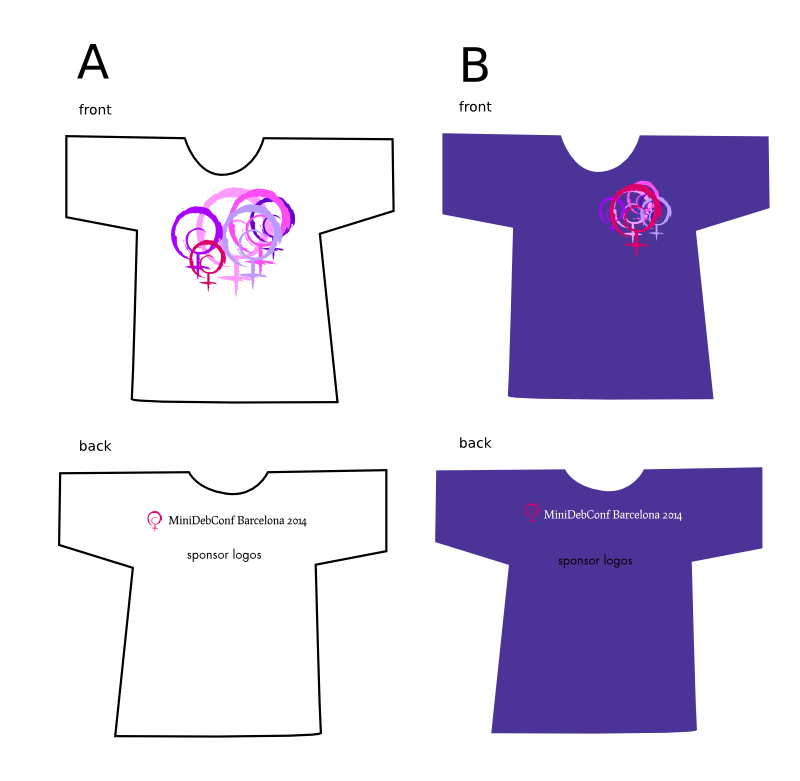
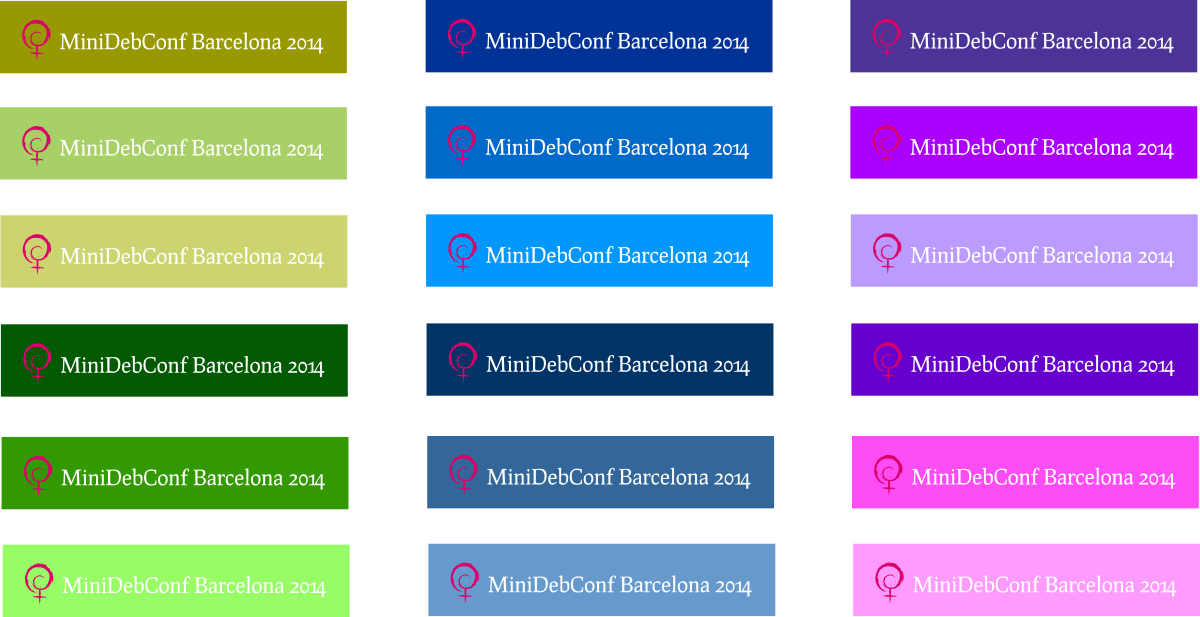
Oh, that was the minidebconf that The identity design might have more to do with support to the local group than with any of the other aspects of the conference. Interesting. This table of colors shows different ways a blue and a purple could go. I put the green colors there to have more options covered for the discussion today. You can see how the different hues interacts with the red of the logo. The colors can be referred to like this: B3, C6, A4 etc. Click on the image for full size version. Here is an idea based on all the purple colors. Fun, uplifting, feels like many voices. Too many colors for T-shirt print, maybe: Here is some ideas of how to implement a minimalistic solution that I recommend for minidebconfs: My suggestion is that the banner (and everything else displaying the event) has the logo of the organizers placed on it. The font used for headlines etc is semantically of another nature than the logo, though it could be the same. I prefer neutral fonts, that can be reused by the next minidebconf, and I suggest a sans serif font. A condensed font makes huge display easier to fit. Don't be confused by displayfonts, I aim to show you that type alone speaks loudly, and if this typography should be recycled, we should not choose one of them, but go with the "neutral" sans serif. I need suggestions of free and good sans serif fonts.

3 April 2014

Matthew Garrett: Mozilla and leadership

A post I wrote back in 2012 got linked from a couple of the discussions relating to Brendan Eich being appointed Mozilla CEO. The tldr version is "If members of your community doesn't trust their leader socially, the leader's technical competence is irrelevant". That seems to have played out here.

In terms of background[1]: in 2008, Brendan donated money to the campaign for Proposition 8, a Californian constitutional amendment that expressly defined marriage as being between one man and one woman[2]. Both before and after that he had donated money to a variety of politicians who shared many political positions, including the definition of marriage as being between one man and one woman[3].

Mozilla is an interesting organisation. It consists of the for-profit Mozilla Corporation, which is wholly owned by the non-profit Mozilla Foundation. The Corporation's bylaws require it to work to further the Foundation's goals, and any profit is reinvested in Mozilla. Mozilla developers are employed by the Corporation rather than the Foundation, and as such the CEO is responsible for ensuring that those developers are able to achieve those goals.

The Mozilla Manifesto discusses individual liberty in the context of use of the internet, not in a wider social context. Brendan's appointment was very much in line with the explicit aims of both the Foundation and the Corporation - whatever his views on marriage equality, nobody has seriously argued about his commitment to improving internet freedom. So, from that perspective, he should have been a fine choice.

But that ignores the effect on the wider community. People don't attach themselves to communities merely because of explicitly stated goals - they do so because they feel that the community is aligned with their overall aims. The Mozilla community is one of the most diverse in free software, at least in part because Mozilla's stated goals and behaviour are fairly inspirational. People who identify themselves with other movements backing individual liberties are likely to identify with Mozilla. So, unsurprisingly, there's a large number of socially progressive individuals (LGBT or otherwise) in the Mozilla community, both inside and outside the Corporation.

A CEO who's donated money to strip rights[4] from a set of humans will not be trusted by many who believe that all humans should have those rights. It's not just limited to individuals directly affected by his actions - if someone's shown that they're willing to strip rights from another minority for political or religious reasons, what's to stop them attempting to do the same to you? Even if you personally feel safe, do you trust someone who's willing to do that to your friends? In a community that's made up of many who are either LGBT or identify themselves as allies, that loss of trust is inevitably going to cause community discomfort.

The first role of a leader should be to manage that. Instead, in the first few days of Brendan's leadership, we heard nothing of substance - at best, an apology for pain being caused rather than an apology for the act that caused the pain. And then there was an interview which demonstrated remarkable tone deafness. He made no attempt to alleviate the concerns of the community. There were repeated non-sequiturs about Indonesia. It sounded like he had no idea at all why the community that he was now leading was unhappy.

And, today, he resigned. It's easy to get into hypotheticals - could he have compromised his principles for the sake of Mozilla? Would an initial discussion of the distinction between the goals of members of the Mozilla community and the goals of Mozilla itself have made this more palatable? If the board had known this would happen, would they have made the same choice - and if they didn't know, why not?

But that's not the real point. The point is that the community didn't trust Brendan, and Brendan chose to leave rather than do further harm to the community. Trustworthy leadership is important. Communities should reflect on whether their leadership reflects not only their beliefs, but the beliefs of those that they would like to join the community. Fail to do so and you'll drive them away instead.

[1] For people who've been living under a rock
[2] Proposition 8 itself was a response to an ongoing court case that, at the point of Proposition 8 being proposed, appeared likely to support the overturning of Proposition 22, an earlier Californian ballot measure that legally (rather than constitutionally) defined marriage as being between one man and one woman. Proposition 22 was overturned, and for a few months before Proposition 8 passed, gay marriage was legal in California.
[3] http://www.theguardian.com/technology/2014/apr/02/controversial-mozilla-ceo-made-donations-right-wing-candidates-brendan-eich
[4] Brendan made a donation on October 25th, 2008. This postdates the overturning of Proposition 22, and as such gay marriage was legal in California at the time of this donation. Donating to Proposition 8 at that point was not about supporting the status quo, it was about changing the constitution to forbid something that courts had found was protected by the state constitution.

comment count unavailable comments

1 April 2014

Petter Reinholdtsen: ReactOS Windows clone - nice free software

Microsoft have announced that Windows XP reaches its end of life 2014-04-08, in 7 days. But there are heaps of machines still running Windows XP, and depending on Windows XP to run their applications, and upgrading will be expensive, both when it comes to money and when it comes to the amount of effort needed to migrate from Windows XP to a new operating system. Some obvious options (buy new a Windows machine, buy a MacOSX machine, install Linux on the existing machine) are already well known and covered elsewhere. Most of them involve leaving the user applications installed on Windows XP behind and trying out replacements or updated versions. In this blog post I want to mention one strange bird that allow people to keep the hardware and the existing Windows XP applications and run them on a free software operating system that is Windows XP compatible. ReactOS is a free software operating system (GNU GPL licensed) working on providing a operating system that is binary compatible with Windows, able to run windows programs directly and to use Windows drivers for hardware directly. The project goal is for Windows user to keep their existing machines, drivers and software, and gain the advantages from user a operating system without usage limitations caused by non-free licensing. It is a Windows clone running directly on the hardware, so quite different from the approach taken by the Wine project, which make it possible to run Windows binaries on Linux. The ReactOS project share code with the Wine project, so most shared libraries available on Windows are already implemented already. There is also a software manager like the one we are used to on Linux, allowing the user to install free software applications with a simple click directly from the Internet. Check out the screen shots on the project web site for an idea what it look like (it looks just like Windows before metro). I do not use ReactOS myself, preferring Linux and Unix like operating systems. I've tested it, and it work fine in a virt-manager virtual machine. The browser, minesweeper, notepad etc is working fine as far as I can tell. Unfortunately, my main test application is the software included on a CD with the Lego Mindstorms NXT, which seem to install just fine from CD but fail to leave any binaries on the disk after the installation. So no luck with that test software. No idea why, but hope someone else figure out and fix the problem. I've tried the ReactOS Live ISO on a physical machine, and it seemed to work just fine. If you like Windows and want to keep running your old Windows binaries, check it out by downloading the installation CD, the live CD or the preinstalled virtual machine image.

Russ Allbery: Review: Asimov's, September 2011

Review: Asimov's Science Fiction, September 2011
Editor: Sheila Williams
Issue: Volume 35, No. 9
ISSN: 1065-2698
Pages: 112
Due to various other life priorities, it's been quite a while since I read this magazine. Let's see if I can remember the contents well enough to review it properly. The editorial this issue was about the Readers' Awards. Vaguely interesting, but Williams didn't have much to add beyond announcing the winners. I'm very happy to see Rusch's "Becoming One with the Ghosts" win best novella, though. The Silverberg column was more interesting: some musings and pop history about the Japanese convention of a retired emperor and how that fit into national politics. Di Filippo's book review column is all about short story collections, continuing the trend of Di Filippo mostly being interested in things I don't care about. "The Observation Post" by Allen M. Steele: A bit of alternate history set during the Cuban Missile Crisis, but with airships. The protagonist was a radioman aboard a blimp that was patrolling the ocean for Russian vessels sailing to Cuba. A storm forces them down on an island, resulting in an encounter with some claimed tourists who may be Russian spies. The SFnal twist is unlikely to come as much surprise to an experienced reader, and the barb at the end of the story suffers from the same problem. I appreciate the ethical dilemma, but I've also seen it in lots of stories and have a hard time getting fully invested in another version of it. But the story is otherwise competently written. (6) "D.O.C.S." by Neal Barrett, Jr.: Everyone has an author or two that they just don't get. Barrett is one of mine, although this story is a bit less surreal than most of his. I'm fairly sure it's an odd twist on the "death panel" conspiracy theory given a fantastic twist, but it's not entirely forthright about what's going on. Possibly of more interest to those who like Barrett better. (5) "Danilo" by Carol Emshwiller: Emshwiller's stories are always distinctive and not quite like anyone else's, involving odd outsiders and their attempts to make sense of their world. This one involves, as is common, an out-of-the-way village. Lewella claims that she's going to be married to a stranger from the north. No one believes her, although they give her bridal gifts anyway, and then one day she takes her gifts and leaves. The protagonist follows her, to look after her. The rest of the story walks the boundary that Emshwiller often walks, leaving the reader unsure whether the characters are in touch with some deeper reality or insane and suffering, but the ending is even more ambiguous than normal and, at least for me, entirely unsatisfying. (4) "Shadow Angel" by Erick Melton: This is another retread of an old SF idea. This time, it's that piloting through hyperspace involves alternate modes of consciousness and has profound effects on the pilot. The risk of this sort of story is that it turns hallucinatory and a bit incoherent, and I think that happened here. I like the world-building; the glimmers of future politics and trade and the way he weaves alternate timelines into the story caught my interest. But the story wasn't quite coherent enough (although part of this may be reviewing it quite some time after I originally read it). Promising, but not clear, and without quite enough agency for the protagonist. (6) "The Odor of Sanctity" by Ian Creasey: I found this story more memorable. The conceit is that a future society has developed technology that allows the capture and replay of scents, which has created a huge market for special scent experiences and the triggering of memories. The story is set in the Philippines and revolves around a Catholic priest who takes the mission to the poor seriously. He's dying, and several people wonder if it is possible to capture the mythical odor of scantity: the sweet scent said to follow the death of a saint rather than the normal odor of human death. Creasey handles this idea well, blending postulated future technology, the practical and cynical world of the poor streets, and a balance between mystical belief and practical skepticism. Nothing in the story is that surprising, but I was happy with the eventual resolution. (7) "Grandma Said" by R. Neube: This story's protagonist is a cleanser on a frontier planet made extremely dangerous by a virulent alien fungus. It is almost always fatal and very difficult to eradicate. Vic's job is to completely sanitize anything that had been in contact with a victim and maintain the other rules of strict quarantine required to keep the fungal infection from spreading uncontrolled. Nuebe weaves world-building together with Vic's background and adds a twist in the form of deeply unhealthy responses to the constant stress of living near death. Well told, if a bit disturbing. (7) "Stalker" by Robert Reed: Reed has a knack for fascinating and disturbing stories, and this is an excellent example of the type. The protagonist is a manufactured companion who is completely devoted to its owner. Their commercial name is Adorers, but everyone calls them Stalkers. In this case, the protagonist's owner is a serial rapist and murderer; given that, and given how good Reed is at writing these sorts of stories, you can probably imagine how chilling it is. As usual, there is a sharp barb in the ending, and not the one I was expecting. Good if you can handle the graphic violence and disturbing subject material. (7) "Burning Bibles" by Alan Wall: This is an interesting twist on the spy thriller. A three-letter agency in charge of investigating possible terrorist plots becomes suspicious after a warehouse of Bibles burns in mysterious circumstances. The agent they send in is a deaf-mute with special powers of intuition. This prompted some eye-rolling, and there's a lot of magic disability powers here to annoy, but it's played mostly straight after that introduction. The rest is a fairly conventional spy story, despite special empathic powers, but it's one I enjoyed and thought was fairly well-written. (7) Rating: 6 out of 10

10 February 2014

Mario Lang: Neurofunkcasts

I have always loved Drum and Bass. In 2013 I rediscovered my love for Darkstep and Neurofunk, and found that these genres have developed quite a lot in the recent years. Some labels like Black Sun Empire and Evol Intent produce mixes/sets on a regular basis as podcasts these days. This article aggregates some neurofunk podcasts I like a lot, most recent first. Enjoy 33 hours and 57 minutes of fun with dark and energizing beats. Thanks to BSE Contrax and Evol Intent for providing such high quality sets. You can also see the Python source for the program that was used to generate this page.

7 February 2014

Jo Shields: Dear Fake Debian Developers, shoo.

Another post about the Valve/Collabora free games thing. This time, the bad bit people trying to scam free games from us. Before I start, I want to make one thing clear there are people who have requested keys who don t meet the criteria, but are honest and legitimate in their requests. This blogspam is not about them at all. If you re in that category, you re not being complained about. So. Some numbers. At time of writing, I ve assigned keys to 279 Debian Developers or Debian Maintainers almost 25% of the total eligible pool of about 1200. I ve denied 22 requests. Of these 10 were polite requests from people who didn t meet the conditions stated (e.g. Ubuntu developers rather than Debian). These folks weren t at all a problem for us, and I explained politely that they didn t meet the terms we had agreed at the time with Valve. No problem at all with those folks. Next, we have the chancers, 7 of them, who pretended to be eligible when they clearly weren t. For example, two people sent me signed requests pointing to their entry on the Debian New Maintainers page when challenged over the key not being in the keyring. The NM page showed that they had registered as non-uploading Debian Contributors a couple of hours previously. A few just claimed I am a DD, here is my signature when they weren t DDs at all. Those requests were also binned.
Papers, Please screenshot - denied entry application

DENIED

And then we move onto the final category. These people tried identity theft, but did a terrible job of it. There were 5 people in this category:
From: Xxxxxxxx Xxxxxx <xxxxxxxx.xxxxxx@ieee.org>
Subject: free subscription to Debian Developer
8217 A205 5E57 043B 2883 054E 7F55 BB12 A40F 862E
This is not a signature, it s a fingerprint. Amusingly, it s not the fingerprint for the person who sent my mail, but that of Neil McGovern a co-worker at Collabora. Neil assured me he knew how to sign a mail properly, so I shitcanned that entry.
From: "Xxxxx, Xxxxxxxxx" <x.xxxxx@bbw-bremen.de>
Subject: Incoming!
Hey dude,
I want to have the redemption code you are offering for the Valve Games
mQGiBEVhrscRBAD4M5+qxhZUD67PIz0JeoJ0vB0hsLE6QPV144PLjLZOzHbl4H3N
...snip...
Lz8An1TEmmq7fltTpQ+Y1oWhnE8WhVeQAKCzh3MBoNd4AIGHcVDzv0N0k+bKZQ=3D=3D
=3Du/4R
Wat? Learn to GPG!
From: Xxxxxx-Xxxx Le Xxxxxxx Xxxx <xx.xxxxxxxxx@gmail.com>
Subject: pass steam
Hey me voila
Merci beaucoup
valve
2069 1DFC C2C9 8C47 9529 84EE 0001 8C22 381A 7594
Like the first one, a fingerprint. This one is for S bastien Villemot. Don t scammers know how to GPG sign?
From: "Xxxxxxxxx Xxxxxxx" <xxxxxxxx@web.de>
Subject: thanks /DD/Steam gifts us finally something back
0x6864730DF095E5E4
Yet again, a fingerprint. This one is for Marco Nenciarini. I found this request particularly offensive due to the subject line the haughty tone from an identity thief struck me as astonishingly impertinent. Still, when will scammers learn to GPG?
From: Sven Hoexter <svenhoexter@gmail.com>
Subject: Valve produced games
I'm would like to get the valve produced games
My keyring: 0xA6DC24D9DA2493D1 Sven Hoexter <hoexter> sig:6
Easily the best scam effort, since this is the only one which both a) registered an email address under the name of a DD, and b) used a fingerprint which actually corresponds to that human. Sadly for the scammer, I m a suspicious kind of person, so my instinct was to verify the claim via IRC.
31-01-2014 16:52:48 > directhex: Hoaxter, have you started using gmail without updating your GPG key? (note: significantly more likely is someone trying to steal your identity a little to steal valve keys from collabora)
31-01-2014 16:54:51 < Hoaxter!~sh@duckpond6.stormbind.net: directhex: I do not use any Google services and did not change my key
So yeah. Nice try, scammer. I m not listing, in all of this, the mails which Neil received from people who didn t actually read his mail to d-d-a. I m also not listing a story which I ve only heard second ha actually no, this one is too good not to share. Someone went onto db.debian.org, did a search for every DD in France, and emailed every Jabber JID (since they look like email addresses) asking them to forward unwanted keys. All in all, the number of evildoers is quite low, relative to the number of legitimate claims 12 baddies to 279 legitimate keys issued. But still, this is why the whole key issuing thing has been taking me so long and why I have the convoluted signature-based validation system in place. Enjoy your keys, all 279 of you (or more by the time some of you read this). The offer has no explicit expiry on it Valve will keep issuing keys as long as there is reason to, and Collabora will continue to administer their allocation as long as they remain our clients. It s a joint gift to the community thousands of dollars worth of games from Valve, and a significant amount of my time to administer them from Collabora.

18 December 2013

Antoine Beaupr : Password reset of Speedstream 5200 modems

After an extended downtime on my ADSL uplink at home during a nice snowstorm, I got curious and wanted to find out the SNR (Signal to Noise Ratio) I had on my line, to try to explain why it was down. It turned out it was more complicated than I thought, because the modem was locked down by Bell Canada (even though I am not a customer). There was a Windows utility, but since I haven't been running this pathetic operating system in years, I had to find an alternative. Fortunately, the author of that utility posted a description of the packet format used for the password reset, and here I was trying to send raw ethernet frames using Linux (for testing and, why not!) and FreeBSD (because I use FreeBSD for routing, because I dislike iptables). The result is this somewhat poorly written C program, available in this git repository. It uses raw sockets in Linux but the BPF (Berkeley Packet Filter) in FreeBSD, as their interface is a little broken for raw sockets. See the README file for more information. Enjoy.

5 December 2013

Steve Kemp: Belated updates

Today I should have been heading down to York, to attend the Bytemark Christmas party. Instead I'm here in Edinburgh, because wind/storms basically shutdown the rail network in Scotland for the morning. Technically I could have probably made it, but only belatedly and only at a huge cost to my sanity. The train-station was insane with stranded people, and there seemed no guarantee the recently-revived service would continue. So instead I'm sulking at home. I had a lot of other things scheduled to do in York/London today/tomorrow, for reasons that will become apparent next week, so to say I'm annoyed is an understatement. In happier news I'm not dead.
Walking to work this morning was horrific, there was so much wind 70-100mph, that I counldn't actually cross a bridge, on Ocean Drive, because I just kept getting blown into the road. (Yeah, that's a road that is very close to the coast. Driving wind. Horrible rain. Storming sea. Fun.)
I ended up retracing my steps, and taking a detour. (PS. My boots leaked.) Not a good day. Enjoy some software instead - a trivial HTTP / XMPP bridge.

25 September 2013

Lucas Nussbaum: Software for brainstorm / ideas sharing and voting?

Some time ago, Ubuntu had Ubuntu Brainstorm, a website where non-developers could submit ideas of improvements, and other people could comment and vote on them. I was wondering if there was existing software to deploy a similar service, e.g. as a plugin to popular forum software. I ve found ideascale.com, but relying on the Cloud for that is not acceptable for my planned use. (For clarification: my immediate interest for that is unrelated to Debian work)

22 July 2013

Riku Voipio: ACPI on ARM storm in teacup

A recent google+ post by Jon Masters caused some stormy and some less stormy responses. A lot of BIOS/UEFI/ACPI hate comes X86, where ACPI is used from everything from suspending devices to reading buttons and setting leds. So when X86 kernel suspends, it does magic calls to ACPI and prays that the firmware vendor did not screw it up. Now vendors do screw up, hence lots of cursing and ugly workarounds in the kernel follows. My Lenovo has a firwmare bug where the FN-buttons and Fan stops working if the laptop is attached on AC adapter for too long. The fan is probably a simple i2c device the kernel could control directly without jumping through ACPI hiding layer hoops. But the X86 people hold the view it is better to trust the firmware engineer to control devices instead of having the kernel folk to write device drivers to ... control devices! Now on ARM(64) the idea of using ACPI is to have none of that. Instead the idea is to use ACPI only to provide tables for enumerating what devices are available in the platform. Just like what device tree does. Now if this is the same as device tree, why bother? The main reason is to allow the distribution installer behave same on X86 / ARM / ARM64. This is crucial for distributions like fedora and RHEL where a cabal holds the point of view that X86 distribution development must not be constrained by ARM support. But it also important for everyone that the method of installing your favorite distribution to an ARM64 server is standard and works the same for any server from any vendor. Now while UEFI and ACPI are definitely not my preferred solutions, I can accept them as necessary evil for having a more standard platform.

1 July 2013

Russ Allbery: Review: Dark Lies the Island

Review: Dark Lies the Island, by Kevin Barry
Publisher: Greywolf
Copyright: 2012
Printing: 2013
ISBN: 1-55597-651-4
Format: ARC
Pages: 185
This is a literary short story collection by a mainstream Irish writer, rather far from my normal fare. It was the second book in a shipment of Powell's Indiespensable, which is generally (when there is one) a proof or Advanced Reading Copy of something relatively obscure. I'm not really the target audience, not being much of a short story aficionado, but the whole point of doing this Indiespensable experiment is to stretch my reading range. First off, as I would generally expect by mainstream fiction, the quality of the writing is excellent. One thing I particularly like about Barry is that he's refreshingly and unhesitatingly profane. His characters curse like I expect people to curse, some of them at the drop of a hat, and for me it gives a feel of solid realism to his dialogue. He's also very good with eye dialect, giving the impression of accents without making the text hard to read. Some of these stories I liked a great deal, rather more than I had expected. But if there was a general undermining flaw for me, it was that I prefer stories that go somewhere, that have a plot or lead up to a definite point. Some of Barry's do, but a lot of them seem more vignettes or just scenes, sketches of characters, that drift off without resolution. I can admire those as writing exercises, but for me they don't fill the desire I have when I sit down with a story. I'm not sure how useful these reviews will be, given that I don't have a lot of mainstream fiction background to compare them with, but here are some reactions, for whatever they're worth. "Across the Rooftops": This is one of those sketches, but it's one of the best of them. It's a single moment on the rooftops, an attempt to capture the moment of possibility around the first romantic overture. It's sadly quite conventional in gender roles (nervous man initiating, woman as relationship gatekeeper), but apart from that it's very well-written. This kind of thing is normally not to my taste, but Barry does such a great job capturing the sense of uncertainty and the sharp focus on detail that I couldn't help but like it. (7) "Wifey Redux": This is by far my favorite story of this book. I think it's both hilarious and brilliant, right from the starting line.
This is the story of a happy marriage but before you throw up and turn the page let me say that it will end with my face pressed hard into the cold metal of the Volvo's bonnet, my hands cuffed behind my back, and my rights droned into my ear this will occur in the car park of a big-box retail unit on the Naas Road in Dublin.
It's the story of a marriage and how it changes over time, but also the story of being a father and his baffled, flailing reactions to his daughter's sexual explorations. But that's not what makes the story. What makes the story is what leads up to the arrest at the end, which had me laughing out-loud in delight. Barry is great at writing a sort of devilish humor; I wish more of the collection was like this. (9) "Fjord of Killary": This is another one of the ones I enjoyed. It's about an author who buys a hotel (with a bar) on the fjord of Killary thinking that the local culture and contact along with the wild beauty would inspire his poetry. At the start of the story, he's thoroughly sick of both the climate and the people, and the collision between his idyllic dreams and the reality, as well as his acerbic first-person complaints, is quite entertaining. A huge storm and resulting flood provides the conflict and impetus for change, and a few moments of humor in the understated local reactions. I thought the closing epiphany was a bit too obvious and expected, and the ending didn't quite work for me, but it has some good moments. (7) "A Cruelty": Here's where the collection started losing me. This is still well-written and closely observed, but in the case of this story, I wish it weren't, since I found it extremely uncomfortable. The viewpoint character is vulnerable to an encounter of unalloyed nastiness. I'm sure that's the point, but, similar to how I avoid horror, it's the sort of story I'd rather not read. (3) "Beer Trip to Llandudno": This was my second-favorite story of the collection. It's about a group of men who take periodic beer-tasting trips and rate beers. They're just normal men, from a variety of backgrounds and professions, and I thought Barry did a great job capturing the sort of camaraderie that comes from long association with a hobby. That includes, here, the awkward limits on what one talks about and the tendency to use the hobby as a shield from anything that drifts into less certain territory. I thought the story suffered somewhat from not having much of a plot or conclusion, but that's also necessary from the setup. This group of people isn't actually going to solve problems, but will be there for each other in their own way. (8) "Ernestine and Kit": Another very dark story, although that's not quite as obvious at the start. As with "A Cruelty," it's well-written but disturbing and lacks any sort of positive resolution. Here, I think Barry went a bit far into portraying people who are a large part of the popular imagination but who are exceptionally rare in reality. It's the kind of story that, at least for me, plays badly with my brain's threat analysis: too memorable for the level of actual risk, and feeling like it was playing a bit too much with popular boogeymen. (4) "The Mainland Campaign": This one was just too subtle for me. Some of the summaries for this book hint at a meaning for the story that I didn't pick up at all on my first reading. On re-reading, I suspect that analysis is right, but even re-reading the story with that interpretation in mind (this is the sort of story where I'm not sure the average American would pick it up on first reading, but others might), I still don't understand exactly what happened. I think some mainstream writing, and some short stories, tends to err on the side of subtle. (4) "Wistful England": Another one that's way over on the sketch of a moment side of stories. Unlike "Across the Rooftops," it failed to make any impression on me whatsoever; I had to skim it just now to remind myself of any details at all, and by the time I edited this review for posting, I'd forgotten it again. I think it was aiming at capturing a mood, but the mopey viewpoint character didn't mean anything to me. (3) "Doctor Sot": This is another odd one, and I'm not quite sure what I think of it. Either it's another character sketch without much of a plot, or the plot was too subtle. The protagonist is a rather unlikable drunk who doubles as a small town's incompetent doctor. The story involves his encounter with a local sort of hippie encampment, which is moderately interesting even though I couldn't stand the man. Then it leads to an encounter that clearly meant something, but which was entirely lost on me. (4) "The Girls and the Dogs": And from an absence of plot back to the deeply disturbing. This story is about a moderately unlikable drug dealer who gets refuge from an extremely unlikable crazy person in a weird relationship with a woman and her sister. (As is sadly typical, polyamory only makes an appearance when the author wants to paint a scenario that's utterly fucked up and psychotic.) There's a pseudo-fantasy element here in that the characters talk about spells, but I think the only spell involved is authorial fiat to create a deeply broken and sick game that plays into a host of negative stereotypes. Despite myself, I did get drawn into the suspense of the story (Barry's undoubtedly a good writer), but it left me feeling dirty on several levels. (4) "White Hitachi": Finally, another story that I liked, although not as good as the ones earlier in the collection. This one follows a con man and two-bit thief as he gets his brother out of lockup and tries to resolve, or at least stay ahead of, various problems in his life. Again, no real ending, but I thought Barry did a good job at taking a snapshot of a life from a perspective that I don't read much in literature (along with all the sexism and racism that comes along with it). It sort of drifts off rather than ends (although the last sentence is a great bit of characterization), but I found it oddly enjoyable. (6) "Dark Lies the Island": I'm not sure what to make of this. It's another character sketch, a moment of deep psychological significance for a character, floating somewhat alone but described in detail. But the character is a girl struggling with cutting, from a male author whose other stories did not fill me with confidence in his handling of female characters. Barry makes this psychologically believable, but I'm a little nervous about trusting his portrayal of that mindset. It's also, again, just a bit too subtle; I had a hard time getting an emotional feel for how the events of the story connect. (5) "Berlin Arkonaplatz My Lesbian Summer": The final story of the collection is fairly typical of the problem I had with most of it. It seems reasonably well-written, I had a hard time connecting with the protagonist or understanding his motivations. It looks at a slice of life with which I have no familiarity at all (and is interesting for that reason), but I don't quite trust the story enough to submerge in it. Barry seems to write a lot of protagonists who seem aimless, befuddled, or just largely out of control, and I like a bit more agency in the primary character. Silvija is an interesting character, even shown from another's perspective, but the story is almost purely observational: showing her without comment, without obvious motive, and mostly without plot. It's strangely compelling, but not quite compelling enough that I'd actually seek it out. Which, really, is the whole book in a nutshell. (6) Rating: 6 out of 10

25 June 2013

Joey Hess: git annex and my mom

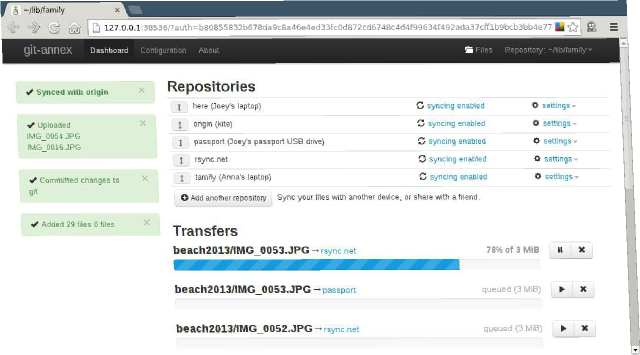
[I'm encouraging git-annex users to post their success stories, and this one is my own.] I set up git-annex on my mom's and sisters' computers a couple of months ago. I noticed this was the first software I've written that I didn't have to really explain how to use. All I told them was, put files in this folder, and the rest of us will be able to see them. Don't put anything too big in there, or anything you don't want others to see. I paired the computers using XMPP, and set up an encrypted transfer repository using a free account rsync.net gave me for beta testing. I also added a repository on my server, which made things more robust. (XMPP has since improved, but it's still a good idea to have a git repository to suppliment XMPP.) I also have two removable drives that are used to back up our files. This was all set up using the webapp. And adding a computer takes just a couple of minutes that way. I set it up at my sister's in a spare moment during a visit, and it all just worked. Our shared git annex contains a couple of hundred files, and is a couple of gigabytes in size. And growing pretty fast as we find things we want to share. Mostly photos and videos so far but I won't be surprised to find poems and books pop up in there from the family's poets and authors. And it'll grow further as I add people who've so far been left out. Coming home from a week at the beach with my grand nephew and niece, was the first time I really used git-annex without thinking about it. Collapsed on a hotel bed, I plugged in my camera and loaded in the trip's photos. Only to see the hotel wifi cost extra. Urk, no! Later, in the lobby, I found an open wifi network, and watched it automatically sync up. screenshot By the time I was home, the video of cute kids playing weathermen and reporting on our near miss by a tropical storm had been enjoyed by the folks who didn't make that family gathering.

16 June 2013

Joey Hess: little disasters

Interesting times.. While the big disasters are ongoing, little ones have been spicing up my life lately. A pleasant week by the beach ended with a tropical storm passing over the beach house. I've never experienced this before, and though Andrea was diminished by passing over land, it was still more wind than I've ever seen. I love wind, and this was thrilling, right on the edge of danger but not quite there. At least, if you have sense to stay out of the water. Leaving the beach, I heard of someone who tried to go surfing that day, and drowned. The night before last, I was startled to find nearly an inch of water seeping up from underneath the tile floor of the kitchen. Probably it has something to do with the pressure tank pumping system, which was repaired while I was away, and means I actually have indoor running water here. (Overrated.) This saw me scrambling to close every water valve, and out with a flashlight at 2 am closing the cutoff at the 1000 gallon water reservoir before it all drained into the house. While sopping up dozens of gallons of water from the floor at 3 am probably doesn't sound like fun, I found myself going through the motions elatedly.. Because this means I finally am coming to understand the source of the damp that infests the most earth-sheltered corner of this house. It's not condensation. It's bad plumbing! Then yesterday, I went out to try a dip in the river, stopped by the neighborhood eatery and bait shop, and ended up sitting out on the back deck eating ribs and listening to a band with "possum playboys" in their name (which makes the full name fairly irrelevant), while looking out over the river and the old-timey green metal bridge. Which was unexpected fun, and the kind of thing you have to take in when it happens, but getting stuck in a newly installed hole in my driveway was not. My car was spinning, and I gave up and called it a night. Here's the thing. I could feel my brain working on this stupid "underpowered car is stuck in a small rut" issue all night long. Same mental pathways activating that chew over bugs and design issues. Got up this morning with a set of plans and contingency plans all ready to go. The first one, of jacking it up and putting something under the tire was stymied; it seems I am missing a jack. But the second, of digging out all around the tire, and then filling in with gravel and cat litter (a tip from some offroading website I blearily surfed last night), and then riding the gas while releasing the bake, worked great. All of which is to say, bring em on! But I still prefer my disasters in the form of software bugs.

11 May 2013

Petter Reinholdtsen: Debian, the Linux distribution of choice for LEGO designers?

In January, I announced a new IRC channel #debian-lego, for those of us in the Debian and Linux community interested in LEGO, the marvellous construction system from Denmark. We also created a wiki page to have a place to take notes and write down our plans and hopes. And several people showed up to help. I was very happy to see the effect of my call. Since the small start, we have a debtags tag hardware::hobby:lego tag for LEGO related packages, and now count 10 packages related to LEGO and Mindstorms:
brickosalternative OS for LEGO Mindstorms RCX. Supports development in C/C++
leocadvirtual brick CAD software
libnxtutility library for talking to the LEGO Mindstorms NX
lnpddaemon for LNP communication with BrickOS
nbccompiler for LEGO Mindstorms NXT bricks
nqcNot Quite C compiler for LEGO Mindstorms RCX
python-nxtpython driver/interface/wrapper for the Lego Mindstorms NXT robot
python-nxt-filersimple GUI to manage files on a LEGO Mindstorms NXT
scratcheasy to use programming environment for ages 8 and up
t2nsimple command-line tool for Lego NXT
Some of these are available in Wheezy, and all but one are currently available in Jessie/testing. leocad is so far only available in experimental. If you care about LEGO in Debian, please join us on IRC and help adding the rest of the great free software tools available on Linux for LEGO designers.

Next.

Previous.