Search Results: "stone"

10 March 2016

Michal Čihař: Weblate 2.5

After almost six months of development Weblate 2.5 has been released. It brings lot of improvements and it's quite hard to point few ones. The most important ones include support for Python 3, reports generators, placeables highlighting, extended keyboard shortcuts, configurable dashboard or group based ACLs. Full list of changes for 2.5: If you are upgrading from older version, please follow our upgrading instructions. You can find more information about Weblate on https://weblate.org, the code is hosted on Github. If you are curious how it looks, you can try it out on demo server. You can login there with demo account using demo password or register your own user. Weblate is also being used https://hosted.weblate.org/ as official translating service for phpMyAdmin, OsmAnd, Aptoide, FreedomBox, Weblate itself and many other projects. Should you be looking for hosting of translations for your project, I'm happy to host them for you or help with setting it up on your infrastructure. Further development of Weblate would not be possible without people providing donations, thanks to everybody who have helped so far! The roadmap for next release is just being prepared, you can influence this by expressing support for individual issues either by comments or by providing bounty for them.

Filed under: English Weblate 0 comments

4 March 2016

Arturo Borrero Gonz lez: How are we training to climb Mulhacen

Alcazaba, Punta de la Cornisa and Mulhac n 3.479 m

I have been in some adventures with a group of friends for a couple of years now. We call ourselves Los Extraviaos (a quick translation to english is perhaps The Wanderers).

We like nature adventures. During summer we use to do water adventures (like rivers trekking, waterfall climbing, snorkeling, canyoning, rafting, kayaking and so on). During winter and spring, we use to do trekking, hiking and mountaineering (low altitudes, keep reading).

For this sport season, one of our main milestones is to climb the second most prominent mountain in Spain: Mulhacen, with 3.479 m over sea level, during summer (June).
From an alpinist point of view, this isn't a very big deal, since most of the mountain's snow and ice is completely melted and the altitude is not that high.
However, from our amateur mountaineering point of view we will be taking a lot of kilometres to walk and a lot of elevation gain uphill (almost 1.600 m), which is in fact a thing to take into account.
Anyway, Mulhacen is considered 'high mountaineering' and all cautions should be taken both during preparation/training and during the climbing of the mountain itself.

To train our bodies and minds we are climbing lower mountains. We have climbed 3 or 4 already, and will continue to climb more in upcoming moths until we go to Mulhacen.
Also, it's important to climb mountains in different weather conditions. We need to train how to overcome wind, snow, storm, cold, night situations. The way we learn most is facing new, challenging situations.

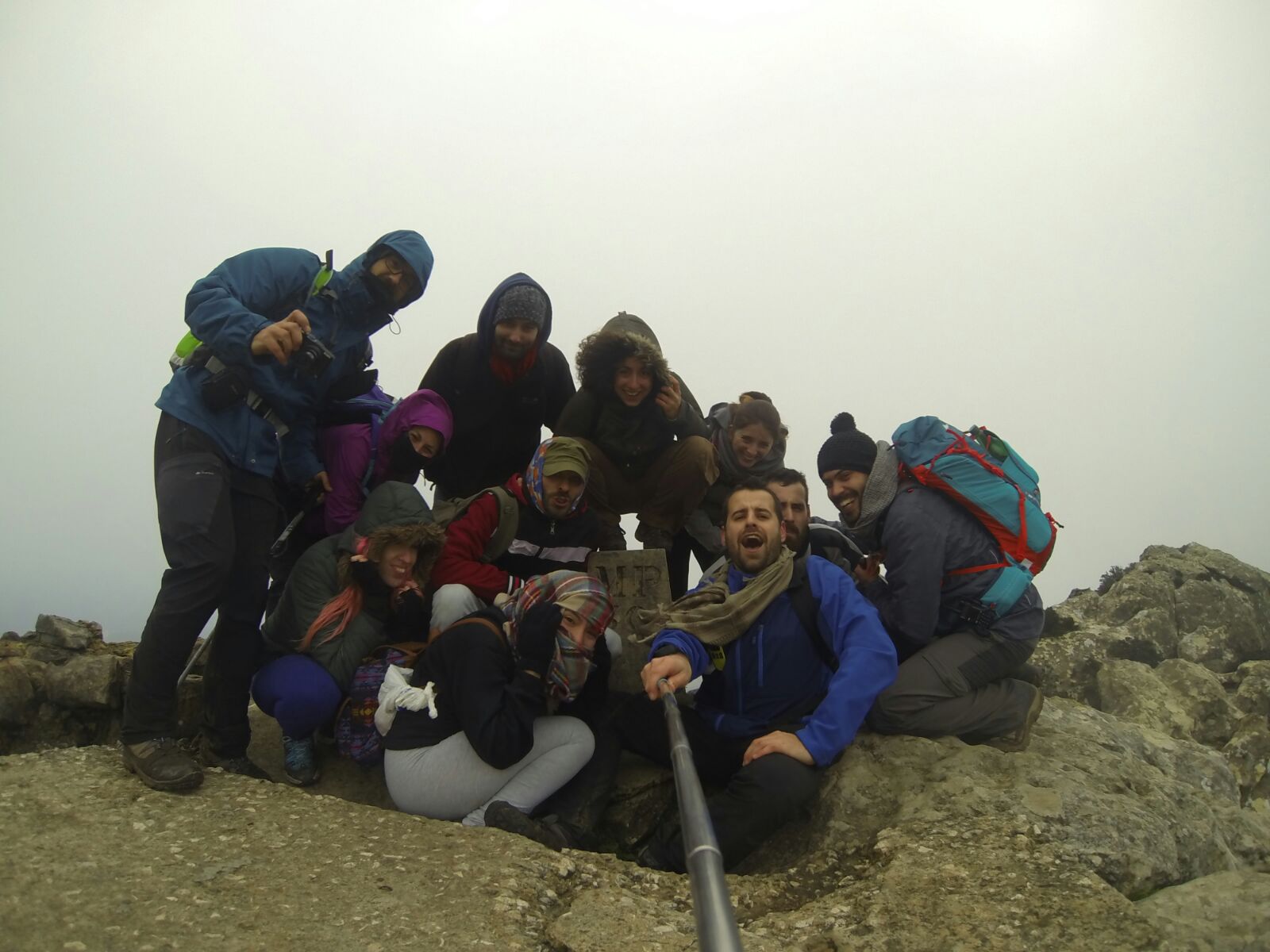
We started by going to the summit of 'El Aljibe', 1.094 m over sea level, with about 500 m elevation gain uphill during 13 km.
This time, the weather was very windy. A video of the summit moment:


A pic of the group:


Next was the 'Torrecilla' peak. The summit is at 1.919 m over sea level, with about 900 m elevation gain uphill during 15 km.
This time we faced a snowy trekking.
Here a music video of that day:


The Torrecilla peak is in fact challenging with snow, so we went a second time, with even more snow and wind:


This second time we faced winds of 70km/h which, due to wind-chill, resulted in a very cold day.

We also went to Sierra de Grazalema Natural Park, in a hard trekking under snowfall:


This time we walked about 15 km with about 500m elevation gain uphill, while enjoying this kind of environment:


What's next: more mountains! We plan to reach 2.069 m over sea level next week in 'La Maroma' and keep doing steep trekking in upcoming months until we go in June to Mulhacen.

It should be very funny to do some FLOSS contribution from the summit of a mountain. Do you know of someone who did that?

3 March 2016

Antonio Terceiro: Debian Ruby Sprint 2016 - day 3: Ruby 2.3 in unstable, Reproducible Builds, and Data Structures for Dinner Booths

Day 3 was again a full of useful work. Since the beginning of the sprint, we were able to fix more than 50 FTBFS bugs, alongside general quality improvements in the packages.
in the Debian jargon, FTBFS means that a package fails to build from source , which in Debian is a critical bug because users need to be able to produce binary packages from their source code to fully exercise the free software principles.
An important milestone that was also achieved on day 3 was the upload of ruby-defaults 1:2.3.0+1, making ruby2.3 the new default version of Ruby. That is the version that will shipped in the next Debian release, codenamed stretch. This is the culmination of a joint effort between the Ruby team and Debian Release Team that involves rebuilding a little more than 130 packages that use the Ruby C API to make sure everything will just work on upgrades, both from the previous stable release, and from earlier snapshots of the current development release. Another small change that will have a big impact for Debian and for free software was an improvement to gem2deb that fixes a reproducibility issue in Ruby packages and will help currently more than 100 Ruby packages become reproducible. The full list of items that have been worked on is this: The day ended at Outback, where we had an amount of beer that led us to formulate what we will now call the One-Sided Dinner Booth Problem. In a party arranged like above, when the people closest to wall need to go alleviate themselves of some beer, you basically have to perform a removal from the bottom of a stack, which requires popping all the elements at the top. When they come back, you have to options: The One-Sided Dinner Booth Problem is finding the optimal data structure and algorithm for this situation. It is postulated that this is an NP-complete problem, and that only probabilistic solutions are cost-effective.

29 February 2016

Daniel Silverstone: Kicad hacking - Intra-sheet links and ERC

This is a bit of an odd posting since it's about something I've done but is also here to help me explain why I did it and thus perhaps encourage some discussion around the topic within the Kicad community...
Recently (as you will know if you follow this blog anywhere it is syndicated) I have started playing with Kicad for the development of some hardware projects I've had a desire for. In addition, some of you may be aware that I used to work for a hardware/software consultancy called Simtec, and there I got to play for a while with an EDA tool called Mentor Designview. Mentor was an expensive, slow, clunky, old-school EDA tool, but I grew to understand and like the workflow. I spent time looking at gEDA and Eagle when I wanted to get back into hardware hacking for my own ends; but neither did I really click with. On the other hand, a mere 10 minutes with Kicad and I knew I had found the tool I wanted to work with long-term. I designed the beer'o'meter project (a flow meter for the pub we are somehow intimately involved with) and then started on my first personal surface-mount project -- SamDAC which is a DAC designed to work with our HiFi in our study at home. As I worked on the SamDAC project, I realised that I was missing a very particular thing from Mentor, something which I had low-level been annoyed by while looking at other EDA tools -- Kicad lacks a mechanism to mark a wire as being linked to somewhere else on the same sheet. Almost all of the EDA tools I've looked at seem to lack this nicety, and honestly I miss it greatly, so I figured it was time to see if I could successfully hack on Kicad. Kicad is written in C++, and it has been mumble mumble years since I last did any C++, either for personal hacking or professionally, so it took a little while for that part of my brain to kick back in enough for me to grok the codebase. Kicad is not a small project, taking around ten minutes to build on my not-inconsiderable computer. And while it beavered away building, I spent time looking around the source code, particularly the schematic editor eeschema. To skip ahead a bit, after a couple of days of hacking around, I had a proof-of-concept for the intra-sheet links which I had been missing from my days with Mentor, and some ERC (electrical rules checking) to go alongside that to help produce schematics without unwanted "sharp corners". In total, I added: I forked the Kicad mirror on Github and pushed my own branch with this work to my Kicad fork. All of this is meant to allow schematic capture engineers to more clearly state their intentions regarding what they are drawing. The intra-sheet link could be thought of like a no-connect element, except instead of saying "this explicitly goes nowhere" we're saying "this explicitly goes somewhere else on this sheet, you can go look for it". Obviously, people who dislike (or simply don't want to use) such intra-sheet link elements can just disable that ERC tickybox and not be bothered by them in the least (well except for the toolbar button and menu item I suppose). Whether this work gets accepted into Kicad, or festers and dies on the vine, it was good fun developing it and I'd like to illustrate how it could help you, and why I wrote it in the first place:

A contrived story
Note, while this story is meant to be taken seriously, it is somewhat contrived, the examples are likely electrical madness, but please just think about the purpose of the checks etc.
To help to illustrate the feature and why it exists, I'd like to tell you a somewhat contrived story about Fred. Fred is a schematic capture engineer and his main job is to review schematics generated by his colleagues. Fred and his colleagues work with Kicad (hurrah) but of late they've been having a few issues with being able to cleanly review schematics. Fred's colleagues are not the neatest of engineers. In particular they tend to be quite lazy when it comes to running busses, which are not (for example) address and data busses, around their designs and they tend to simply have wires which end in mid-space and pick up somewhere else on the sheet. All this is perfectly reasonable of course, and Kicad handles it with aplomb. Sadly it seems quite error prone for Fred's workplace. As an example, Fred's colleague Ben has been designing the power supply for a particular board. As with most power supplies, plenty of capacitors are needed to stabilise the regulators and smooth the output. In the example below, the intent is that all of the capacitors are on the FOO net. Contrived problem example 1 Sadly there's a missing junction and/or slightly misplaced label in the upper section which means that C2 and C3 simply don't join to the FOO net. This could easily be missed, but the ERC can't spot it at all since there's more than one thing on each net, so the pins of the capacitors are connected to something. Fred is very sad that this kind of problem can sometimes escape notice by the schematic designer Ben, Fred himself, and the layout engineer, resulting in boards which simply do not work. Fred takes it upon himself to request that the strict wiring checks ERC is made mandatory for all designs, and that the design engineers be required to use intra-sheet link symbols when they have signals which wander off to other parts of the sheet like FOO does in the example. Without any further schematic changes, strict wiring checks enabled gives the following points of ERC concern for Ben to think about: Contrived problem example 2 As you can see, the ERC is pointing at the wire ends and the warnings are simply that the wires are dangling and that this is not acceptable. This warning is very like the pin-not-connected warnings which can be silenced with an explicit no-connect schematic element. Ben, being a well behaved and gentle soul, obeys the design edicts from Fred and seeks out the intra-sheet link symbols, clearing off the ERC markers and then adding intra-sheet links to his design: Contrived problem example 3 This silences the dangling end ERC check, which is good, however it results in another ERC warning: Contrived problem example 4 This time, the warning for Ben to deal with is that the intra-sheet links are pointless. Each exists without a companion to link to because of the net name hiccough in the top section. It takes Ben a moment to realise that the mistake which has been made is that a junction is missing in the top section. He adds the junction and bingo the ERC is clean once more: Contrived problem example 5 Now, this might not seem like much gain for so much effort, but Ben can now be more confident that the FOO net is properly linked across his design and Fred can know, when he looks at the top part of the design, that Ben intended for the FOO net to go somewhere else on the sheet and he can look for it.

Why do this at all? Okay, dropping out of our story now, let's discuss why these ERC checks are worthwhile and why the intra-sheet link schematic element is needed.
Note: This bit is here to remind me of why I did the work, and to hopefully explain a little more about why I think it's worth adding to Kicad...
Designers are (one assumes) human beings. As humans we (and I count myself here too) are prone to mistakes. Sadly mistakes are often subtle and could easily be thought of as deliberate if the right thought processes are not followed carefully when reviewing. Anyone who has ever done code review, proofread a document, or performed any such activity, will be quite familiar with the problems which can be introduced by a syntactically and semantically valid construct which simply turns out to be wrong in the greater context. When drawing designs, I often end up with bits of wire sticking out of schematic sections which are not yet complete. Sadly if I sleep between design sessions, I often lose track of whether such a dangling wire is meant to be attached to more stuff, or is simply left because the net is picked up elsewhere on the sheet. With intra-sheet link elements available, if I had intended the latter, I'd have just dropped such an element on the end of the wire before I stopped for the day. Also, when drawing designs, I sometimes forget to label a wire, especially if it has just passed through a filter or current-limiting resistor or similar. As such, even with intra-sheet link elements to show me when I mean for a net to go bimbling off across the sheet, I can sometimes end up with unnamed nets whose capacitors end up not used for anything useful. This is where the ERC comes in. By having the ERC complain if a wire dangles -- the design engineer won't forget to add links (or check more explicitly if the wire is meant to be attached to something else). By having junctions which don't actually link anything warned about, the engineer can't just slap a junction blob down on the end of a wire to silence that warning, since that doesn't mean anything to a reviewer later down the line. By having the ERC warn if a net has exactly one intra-sheet link attached to it, missing net names and errors such as that shown in my contrived example above can be spotted and corrected. Ultimately this entire piece of work is about ensuring that the intent of the design engineer is captured clearly in the schematic. If the design engineer meant to leave that wire dangling because it's joining to another bit of wire elsewhere on the sheet, they can put the intra-sheet links in to show this. The associated ERC checks are there purely to ensure that the validation of this intent is not bypassed accidentally, or deliberately, in order to make the use of this more worthwhile and to increase the usefulness of the ERC on designs where signals jump around on sheets where wiring them up directly would just create a mess.

1 February 2016

Lunar: Reproducible builds: week 40 in Stretch cycle

What happened in the reproducible builds effort between January 24th and January 30th:

Media coverage Holger Levsen was interviewed by the FOSDEM team to introduce his talk on Sunday 31st.

Toolchain fixes Jonas Smedegaard uploaded d-shlibs/0.63 which makes the order of dependencies generated by d-devlibdeps stable accross locales. Original patch by Reiner Herrmann.

Packages fixed The following 53 packages have become reproducible due to changes in their build dependencies: appstream-glib, aptitude, arbtt, btrfs-tools, cinnamon-settings-daemon, cppcheck, debian-security-support, easytag, gitit, gnash, gnome-control-center, gnome-keyring, gnome-shell, gnome-software, graphite2, gtk+2.0, gupnp, gvfs, gyp, hgview, htmlcxx, i3status, imms, irker, jmapviewer, katarakt, kmod, lastpass-cli, libaccounts-glib, libam7xxx, libldm, libopenobex, libsecret, linthesia, mate-session-manager, mpris-remote, network-manager, paprefs, php-opencloud, pisa, pyacidobasic, python-pymzml, python-pyscss, qtquick1-opensource-src, rdkit, ruby-rails-html-sanitizer, shellex, slony1-2, spacezero, spamprobe, sugar-toolkit-gtk3, tachyon, tgt. The following packages became reproducible after getting fixed: Some uploads fixed some reproducibility issues, but not all of them:
  • gnubg/1.05.000-4 by Russ Allbery.
  • grcompiler/4.2-6 by Hideki Yamane.
  • sdlgfx/2.0.25-5 fix by Felix Geyer, uploaded by Gianfranco Costamagna.
Patches submitted which have not made their way to the archive yet:
  • #812876 on glib2.0 by Lunar: ensure that functions are sorted using the C locale when giotypefuncs.c is generated.

diffoscope development diffoscope 48 was released on January 26th. It fixes several issues introduced by the retrieval of extra symbols from Debian debug packages. It also restores compatibility with older versions of binutils which does not support readelf --decompress.

strip-nondeterminism development strip-nondeterminism 0.015-1 was uploaded on January 27th. It fixes handling of signed JAR files which are now going to be ignored to keep the signatures intact.

Package reviews 54 reviews have been removed, 36 added and 17 updated in the previous week. 30 new FTBFS bugs have been submitted by Chris Lamb, Michael Tautschnig, Mattia Rizzolo, Tobias Frost.

Misc. Alexander Couzens and Bryan Newbold have been busy fixing more issues in OpenWrt. Version 1.6.3 of FreeBSD's package manager pkg(8) now supports SOURCE_DATE_EPOCH. Ross Karchner did a lightning talk about reproducible builds at his work place and shared the slides.

31 January 2016

Thorsten Alteholz: My Debian Activities in January 2016

FTP assistant This month I marked 281 package for accept and rejected 58, so almost back to normal processing. I also sent 19 emails to maintainers asking questions. As mentioned in October the accept-number has reached another milestone. I accepted package 6666 on 20151221, it was python-skbio_0.4.1-1. The winner of a fast processed package with the best guess of this date is: *tata* Javi. Ok, he was the only participant :-) . So, who can guess the date of 7777? Squeeze LTS This was my nineteenth month that I did some work for the Squeeze LTS initiative, started by Raphael Hertzog at Freexian. This month several people had to reduce their contribution, so all in all I got a workload of 30h. Altogether I uploaded those DLAs: For the first time this month, I was also involved in three embargoed uploads. Ben and I were informed about some security issues before they got published and I prepared the DLAs. Although the real upload for all suites were still done by the security team, it was really exciting. I also spent some time on #796095 and prepared another patch for review. Further I am almost done with the next upload of PHP 5.3. Just before starting dupload, another issue appeared. As I think that this will be the last upload of PHP for Squeeze LTS, I also want to take care of this latecomer. The upload of krb5 is waiting in the pipeline, I am just waiting for a confirmation that everything is fine. This month I also had another term of doing frontdesk work and looked for CVEs that are important for Squeeze LTS or could be ignored. As Wheezy LTS is just before the start, I already prepared the new build environment. So either now or later in April, I am ready Other stuff Due to the high LTS workload, there was no time for other stuff :-( .

Daniel Silverstone: The Beer'o'Meter project

As some of you may know, I have been working on a small hardware project called the Beer'o'Meter whose purpose is to allow us to extend Ye Olde Vic's beer board to indicate the approximate fullness of each cask. For some time now, we've been operating an electronic beer board at the Vic which you may see tweeted out from time to time. The pumpotron has become very popular with the visitors to the pub, especially that it can be viewed online in a basic textual form. Of course, as many of you who visit pubs know only too well. That a beer is "on" is no indication of whether or not you need to get there sharpish to have a pint, or if you can take your time and have a curry first. As a result, some of us have noticed a particular beer on, come to the pub after dinner, and then been very sad that if only we'd come 30 minutes previously, we'd have had a chance at the very beer we were excited about. Combine this kind of sadness with a two week break at Christmas, and I started to develop a Beer'o'Meter to extend the pumpotron with an indication of how much of a given beer had already been served. Recently my boards came back from Elecrow along with various bits and bobs, and I have spent some time today building one up for test purposes. As always, it's important to start with some prep work to collect all the necessary components. I like to use cake cases as you may have noticed on the posting yesterday about the oscilloscope I built. Component prep for the Beer'o'Meter Naturally, after prep comes the various stages of assembly. You start with the lowest-height components, so here's the board after I fitted the ceramic capacitors: Step 1, ceramic capacitors And here's after I fitted the lying-down electrolytic decoupling capacitor for the 3.3 volt line: Step 2, capacitors which lie down Next I should have fitted the six transitors from the middle cake case, but I discovered that I'd used the wrong pinout for them. Even after weeks of verification by myself and others, I'd made a mistake. My good friend Vincent Sanders recently posted about how creativity is allowing yourself to make mistakes and here I had made a doozy I hadn't spotted until I tried to assemble the board. Fortunately TO-92 transistors have nice long legs and I have a pair of tweezers and some electrical tape. As such I soon had six transistors doing the river dance: Transistors doing the river-dance With that done, I noticed that the transistors now stood taller than the pins (previously I had been intending to fit the transistors before the pins) so I had to shuffle things around and fit all my 0.1" pins and sockets next: Step 3, pins and sockets Then I could fit my dancing transistors: Step 4, transistors We're almost finished now, just one more capacitor to provide some input decoupling on the 9v power supply: Finished -- decoupling fitted Of course, it wouldn't be complete without the ESP8266Huzzah I acquired from AdaFruit though I have to say that I'm unlikely to use these again, but rather I might design in the surface-mount version of the module instead. Fitted with the module And since this is the very first Beer'o'Meter to be made, I had to go and put a 1 on the serial-number space on the back of the board. I then tried to sign my name in the box, made a hash of it, so scribbled in the gap :-) The back of the finished module Finally I got to fit all six of my flow meters ready for some testing. I may post again about testing the unit, but for now, here's a big spider of a flow meter for beer: The Beer'o'Meter spider This has been quite a learning experience for me, and I hope in the future to be able to share more of my hardware projects, perhaps from an earlier stage. I have plans for a DAC board, and perhaps some other things.

Daniel Silverstone: Building an Oscilloscope

I recently ordered some PCBs from Elecrow for the Vic's beer-measurement system I've been designing with Rob. While on the site, I noticed that they have a single-channel digital oscilloscope kit based on an STM32. This is a JYE Tech DSO138 which arrives as a PCB whose surface-mount stuff has been fitted, along with a whole bunch of pin-through components for you to solder up the scope yourself. There's a non-trivial number of kinds of components, so first you should prep by splitting them all up and double-checking them all. Preparing the components Once you've done that, the instructions start you off fitting a whole bunch of resistors... Step 1, fitting resistors Then some diodes, RF chokes, and the 8MHz crystal for the STM32. Step 2, fitting diodes, a crystal, and chokes The single most-difficult bit for me to solder was the USB socket. Fine pitch leads, coupled with high-thermal-density socket. Step 3, the USB socket There is a veritable mountain of ceramic capacitors to fit... Step 4, all the ceramic capacitors And then buttons, inductors, trimming capacitors and much more... Step 5, buttons, inductors, trimming capacitors, etc THe switches were the next hardest things to solder, after the USB socket... Step 6, Switches, connectors, etc Finally you have to solder a test loop and close some jumpers before you power-test the board. Step 7, Test loop and jumper soldering The last bit of soldering is to solder pins to the LCD panel board... Step 8, LCD panel Before you finally have a working oscilloscope Working oscilloscope! I followed the included instructions to trim the scope using the test point and the trimming capacitors, before having a break to write this up for you all. I'd say that it was a fun day because I enjoyed getting a lot of soldering practice (before I have to solder up the beer'o'meter for the pub) and at the end of it I got a working oscilloscope. For 40 USD, I'd recommend this to anyone who fancies a go.

29 January 2016

Jan Wagner: Oxidized - silly attempt at (Really Awesome New Cisco confIg Differ)

Since ages I wanted have replaced this freaking backup solution of our Network Equipment based on some hacky shell scripts and expect uploading the configs on a TFTP server. Years ago I stumbled upon RANCID (Really Awesome New Cisco confIg Differ) but had no time to implement it. Now I returned to my idea to get rid of all our old crap.
I don't know where, I think it was at DENOG2, I saw RANCID coupled with a VCS, where the NOC was notified about configuration (and inventory) changes by mailing the configuration diff and the history was indeed in the VCS.
The good old RANCID seems not to support to write into a VCS out of the box. But for the rescue there is rancid-git, a fork that promises git extensions and support for colorized emails. So far so good. While I was searching for a VCS capable RANCID, somewhere under a stone I found Oxidized, a 'silly attempt at rancid'. Looking at it, it seems more sophisticated, so I thought this might be the right attempt. Unfortunately there is no Debian package available, but I found an ITP created by Jonas. Anyway, for just looking into it, I thought the Docker path for a testbed might be a good idea, as no Debian package ist available (yet). For oxidized configuration is only a configfile needed and as nodes source a rancid compatible router.db file can be used (beside SQLite and http backend). A migration into a production environment seems pretty easy. So I gave it a go. I assume Docker is installed already. There seems to be a Docker image on Docker Hub, that looks official, but it seems not maintained (actually). An issue is open for automated building the image.

Creating Oxidized container image The official documentation describes the procedure. I used a slightly different approach.
docking-station:~# mkdir -p /srv/docker/oxidized/  
docking-station:~# git clone https://github.com/ytti/oxidized \  
 /srv/docker/oxidized/oxidized.git
docking-station:~# docker build -q -t oxidized/oxidized:latest \  
 /srv/docker/oxidized/oxidized.git
I thought it might be a good idea to also tag the image with the actual version of the gem.
docking-station:~# docker tag oxidized/oxidized:latest \  
 oxidized/oxidized:0.11.0
docking-station:~# docker images   grep oxidized  
oxidized/oxidized   latest    35a325792078  15 seconds ago  496.1 MB  
oxidized/oxidized   0.11.0    35a325792078  15 seconds ago  496.1 MB  
Create initial default configuration like described in the documentation.
docking-station:~# mkir -p /srv/docker/oxidized/.config/  
docking-station:~# docker run -e CONFIG_RELOAD_INTERVAL=600 \  
 -v /srv/docker/oxidized/.config/:/root/.config/oxidized \
 -p 8888:8888/tcp -t oxidized/oxidized:latest oxidized

Adjusting configuration After this I adjusted the default configuration for writing a log, the nodes config into a bare git, having nodes secrets in router.db and some hooks for debugging.

Creating node configuration
docking-station:~# echo "7204vxr.lab.cyconet.org:cisco:admin:password:enable" >> \  
 /srv/docker/oxidized/.config/router.db
docking-station:~# echo "ccr1036.lab.cyconet.org:routeros:admin:password" >> \  
 /srv/docker/oxidized/.config/router.db

Starting the oxidized beast
docking-station:~# docker run -e CONFIG_RELOAD_INTERVAL=600 \  
 -v /srv/docker/oxidized/.config/:/root/.config/oxidized \
 -p 8888:8888/tcp -t oxidized/oxidized:latest oxidized
Puma 2.16.0 starting...  
* Min threads: 0, max threads: 16
* Environment: development
* Listening on tcp://127.0.0.1:8888
If you want to have the container get started with the docker daemon automatically, you can start the container with --restart always and docker will take care of it. If I wanted to make it running permanent, I would use a systemd unitfile.

Reload configuration immediately If you don't want to wait to automatically reload of the configuration, you can trigger it.
docking-station:~# curl -s http://localhost:8888/reload?format=json \  
 -O /dev/null
docking-station:~# tail -2 /srv/docker/oxidized/.config/log/oxidized.log  
I, [2016-01-29T16:50:46.971904 #1]  INFO -- : Oxidized starting, running as pid 1  
I, [2016-01-29T16:50:47.073307 #1]  INFO -- : Loaded 2 nodes  

Writing nodes configuration
docking-station:/srv/docker/oxidized/.config/oxidized.git# git shortlog  
Oxidizied (2):  
      update 7204vxr.lab.cyconet.org
      update ccr1036.lab.cyconet.org
Writing the nodes configurations into a local bare git repository is neat but far from perfect. It would be cool to have all the stuff in a central VCS. So I'm pushing it every 5 minutes into one with a cron job.
docking-station:~# cat /etc/cron.d/doxidized  
# m h dom mon dow user  command                                                 
*/5 * * * *    root    $(/srv/docker/oxidized/bin/oxidized_cron_git_push.sh)
docking-station:~# cat /srv/docker/oxidized/bin/oxidized_cron_git_push.sh  
#!/bin/bash
DOCKER_OXIDIZED_BASE="/srv/docker/oxidized/"  
OXIDIZED_GIT_DIR=".config/oxidized.git"
cd $ DOCKER_OXIDIZED_BASE /$ OXIDIZED_GIT_DIR   
git push origin master --quiet  
Now having all the nodes configurations in a source code hosting system, we can browse the configurations, changes, history and even establish notifications for changes. Mission accomplished! Now I can test the coverage of our equipment. The last thing that would make me super happy, a oxidized Debian package!

13 January 2016

Norbert Preining: Ian Buruma: Wages of Guilt

Since moving to Japan, I got more and more interested in history, especially the recent history of the 20th century. The book I just finished, Ian Buruma (Wiki, home page) Wages of Guilt Memories of War in Germany and Japan (Independent, NYRB), has been a revelation for me. As an Austrian living in Japan, I am experiencing the discrepancy between these two countries with respect to their treatment of war legacy practically daily, and many of my blog entries revolve around the topic of Japanese non-reconciliation.
Willy Brandt went down on his knees in the Warsaw ghetto, after a functioning democracy had been established in the Federal Republic of Germany, not before. But Japan, shielded from the evil world, has grown into an Oskar Matzerath: opportunistic, stunted, and haunted by demons, which it tries to ignore by burying them in the sand, like Oskar s drum.
Ian Buruma, Wages of Guilt, Clearing Up the Ruins
Buruma-Wages_of_Guilt The comparison of Germany and Japan with respect to their recent history as laid out in Buruma s book throws a spotlight on various aspects of the psychology of German and Japanese population, while at the same time not falling into the easy trap of explaining everything with difference in the guilt culture. A book of great depth and broad insights everyone having even the slightest interest in these topics should read.
This difference between (West) German and Japanese textbooks is not just a matter of detail; it shows a gap in perception.
Ian Buruma, Wages of Guilt, Romance of the Ruins
Only thinking about giving a halfway full account of this book is something impossible for me. The sheer amount of information, both on the German and Japanese side, is impressive. His incredible background (studies of Chinese literature and Japanese movie!) and long years as journalist, editor, etc, enriches the book with facets normally not available: In particular his knowledge of both the German and Japanese movie history, and the reflection of history in movies, were complete new aspects for me (see my recent post (in Japanese)). The book is comprised of four parts: The first with the chapters War Against the West and Romance of the Ruins; the second with the chapters Auschwitz, Hiroshima, and Nanking; the third with History on Trial, Textbook Resistance, and Memorials, Museums, and Monuments; and the last part with A Normal Country, Two Normal Towns, and Clearing Up the Ruins. Let us look at the chapters in turn: The boook somehow left me with a bleak impression of Japanese post-war times as well as Japanese future. Having read other books about the political ignorance in Japan (Norma Field s In the realm of a dying emperor, or the Chibana history), Buruma s characterization of Japanese politics is striking. He couldn t foresee the recent changes in legislation pushed through by the Abe government actually breaking the constitution, or the rewriting of history currently going on with respect to comfort women and Nanking. But reading his statement about Article Nine of the constitution and looking at the changes in political attitude, I am scared about where Japan is heading to:
The Nanking Massacre, for leftists and many liberals too, is the main symbol of Japanese militarism, supported by the imperial (and imperialist) cult. Which is why it is a keystone of postwar pacifism. Article Nine of the constitution is necessary to avoid another Nanking Massacre. The nationalist right takes the opposite view. To restore the true identity of Japan, the emperor must be reinstated as a religious head of state, and Article Nine must be revised to make Japan a legitimate military power again. For this reason, the Nanking Massacre, or any other example of extreme Japanese aggression, has to be ignored, softened, or denied.
Ian Buruma, Wages of Guilt, Nanking
While there are signs of resistance in the streets of Japan (Okinawa and the Hanako bay, the demonstrations against secrecy law and reversion of the constitution), we are still to see a change influenced by the people in a country ruled and distributed by oligarchs. I don t think there will be another Nanking Massacre in the near future, but Buruma s books shows that we are heading back to a nationalistic regime similar to pre-war times, just covered with a democratic veil to distract critics.
I close with several other quotes from the book that caught my attention: In the preface and introduction:
[ ] mainstream conservatives made a deliberate attempt to distract people s attention from war and politics by concentrating on economic growth.
The curious thing was that much of what attracted Japanese to Germany before the war Prussian authoritarianism, romantic nationalism, pseudo-scientific racialism had lingered in Japan while becoming distinctly unfashionable in Germany.
In Romance of the Ruins:
The point of all this is that Ikeda s promise of riches was the final stage of what came to be known as the reverse course, the turn away from a leftist, pacifist, neutral Japan a Japan that would never again be involved in any wars, that would resist any form of imperialism, that had, in short, turned its back for good on its bloody past. The Double Your Incomes policy was a deliberate ploy to draw public attention away from constitutional issues.
In Hiroshima:
The citizens of Hiroshima were indeed victims, primarily of their own military rulers. But when a local group of peace activists petitioned the city of Hiroshima in 1987 to incorporate the history of Japanese aggression into the Peace Memorial Museum, the request was turned down. The petition for an Aggressors Corner was prompted by junior high school students from Osaka, who had embarrassed Peace Museum officials by asking for an explanation about Japanese responsibility for the war.
The history of the war, or indeed any history, is indeed not what the Hiroshima spirit is about. This is why Auschwitz is the only comparison that is officially condoned. Anything else is too controversial, too much part of the flow of history .
In Nanking, by the governmental pseudo-historian Tanaka:
Unlike in Europe or China, writes Tanaka, you won t find one instance of planned, systematic murder in the entire history of Japan. This is because the Japanese have a different sense of values from the Chinese or the Westerners.
In History on Trial:
In 1950, Becker wrote that few things have done more to hinder true historical self-knowledge in Germany than the war crimes trials. He stuck to this belief. Becker must be taken seriously, for he is not a right-wing apologist for the Nazi past, but an eminent liberal.
There never were any Japanese war crimes trials, nor is there a Japanese Ludwigsburg. This is partly because there was no exact equivalent of the Holocaust. Even though the behavior of Japanese troops was often barbarous, and the psychological consequences of State Shinto and emperor worship were frequently as hysterical as Nazism, Japanese atrocities were part of a military campaign, not a planned genocide of a people that included the country s own citizens. And besides, those aspects of the war that were most revolting and furthest removed from actual combat, such as the medical experiments on human guinea pigs (known as logs ) carried out by Unit 731 in Manchuria, were passed over during the Tokyo trial. The knowledge compiled by the doctors of Unit 731 of freezing experiments, injection of deadly diseases, vivisections, among other things was considered so valuable by the Americans in 1945 that the doctors responsible were allowed to go free in exchange for their data.
Some Japanese have suggested that they should have conducted their own war crimes trials. The historian Hata Ikuhiko thought the Japanese leaders should have been tried according to existing Japanese laws, either in military or in civil courts. The Japanese judges, he believed, might well have been more severe than the Allied tribunal in Tokyo. And the consequences would have been healthier. If found guilty, the spirits of the defendants would not have ended up being enshrined at Yasukuni. The Tokyo trial, he said, purified the crimes of the accused and turned them into martyrs. If they had been tried in domestic courts, there is a good chance the real criminals would have been flushed out.
After it was over, the Nippon Times pointed out the flaws of the trial, but added that the Japanese people must ponder over why it is that there has been such a discrepancy between what they thought and what the rest of the world accepted almost as common knowledge. This is at the root of the tragedy which Japan brought upon herself.
Emperor Hirohito was not Hitler; Hitler was no mere Shrine. But the lethal consequences of the emperor-worshipping system of irresponsibilities did emerge during the Tokyo trial. The savagery of Japanese troops was legitimized, if not driven, by an ideology that did not include a Final Solution but was as racialist as Hider s National Socialism. The Japanese were the Asian Herrenvolk, descended from the gods.
Emperor Hirohito, the shadowy figure who changed after the war from navy uniforms to gray suits, was not personally comparable to Hitler, but his psychological role was remarkably similar.
In fact, MacArthur behaved like a traditional Japanese strongman (and was admired for doing so by many Japanese), using the imperial symbol to enhance his own power. As a result, he hurt the chances of a working Japanese democracy and seriously distorted history. For to keep the emperor in place (he could at least have been made to resign), Hirohito s past had to be freed from any blemish; the symbol had to be, so to speak, cleansed from what had been done in its name.
In Memorials, Museums, and Monuments:
If one disregards, for a moment, the differences in style between Shinto and Christianity, the Yasukuni Shrine, with its relics, its sacred ground, its bronze paeans to noble sacrifice, is not so very different from many European memorials after World War I. By and large, World War II memorials in Europe and the United States (though not the Soviet Union) no longer glorify the sacrifice of the fallen soldier. The sacrificial cult and the romantic elevation of war to a higher spiritual plane no longer seemed appropriate after Auschwitz. The Christian knight, bearing the cross of king and country, was not resurrected. But in Japan, where the war was still truly a war (not a Holocaust), and the symbolism still redolent of religious exultation, such shrines as Yasukuni still carry the torch of nineteenth-century nationalism. Hence the image of the nation owing its restoration to the sacrifice of fallen soldiers.
In A Normal Country:
The mayor received a letter from a Shinto priest in which the priest pointed out that it was un-Japanese to demand any more moral responsibility from the emperor than he had already taken. Had the emperor not demonstrated his deep sorrow every year, on the anniversary of Japan s surrender? Besides, he wrote, it was wrong to have spoken about the emperor in such a manner, even as the entire nation was deeply worried about his health. Then he came to the main point: It is a common error among Christians and people with Western inclinations, including so-called intellectuals, to fail to grasp that Western societies and Japanese society are based on fundamentally different religious concepts . . . Forgetting this premise, they attempt to place a Western structure on a Japanese foundation. I think this kind of mistake explains the demand for the emperor to bear full responsibility.
In Two Normal Towns:
The bust of the man caught my attention, but not because it was in any way unusual; such busts of prominent local figures can be seen everywhere in Japan. This one, however, was particularly grandiose. Smiling across the yard, with a look of deep satisfaction over his many achievements, was Hatazawa Kyoichi. His various functions and titles were inscribed below his bust. He had been an important provincial bureaucrat, a pillar of the sumo wrestling establishment, a member of various Olympic committees, and the recipient of some of the highest honors in Japan. The song engraved on the smooth stone was composed in praise of his rich life. There was just one small gap in Hatazawa s life story as related on his monument: the years from 1941 to 1945 were missing. Yet he had not been idle then, for he was the man in charge of labor at the Hanaoka mines.
In Clearing Up the Ruins:
But the question in American minds was understandable: could one trust a nation whose official spokesmen still refused to admit that their country had been responsible for starting a war? In these Japanese evasions there was something of the petulant child, stamping its foot, shouting that it had done nothing wrong, because everybody did it.
Japan seems at times not so much a nation of twelve-year-olds, to repeat General MacArthur s phrase, as a nation of people longing to be twelve-year-olds, or even younger, to be at that golden age when everything was secure and responsibility and conformity were not yet required.
For General MacArthur was right: in 1945, the Japanese people were political children. Until then, they had been forced into a position of complete submission to a state run by authoritarian bureaucrats and military men, and to a religious cult whose high priest was also formally chief of the armed forces and supreme monarch of the empire.
I saw Jew S ss that same year, at a screening for students of the film academy in Berlin. This showing, too, was followed by a discussion. The students, mostly from western Germany, but some from the east, were in their early twenties. They were dressed in the international uniform of jeans, anoraks, and work shirts. The professor was a man in his forties, a 68er named Karsten Witte. He began the discussion by saying that he wanted the students to concentrate on the aesthetics of the film more than the story. To describe the propaganda, he said, would simply be banal: We all know the what, so let s talk about the how. I thought of my fellow students at the film school in Tokyo more than fifteen years before. How many of them knew the what of the Japanese war in Asia.

2 January 2016

Lunar: Reproducible builds: week 33 in Stretch cycle

What happened in the reproducible builds effort between December 6th and December 12th: Toolchain fixes Reiner Herrmann rebased our experimental version of doxygen on version 1.8.9.1-6. Chris Lamb submitted a patch to make the manpages generated by ruby-ronn reproducible by using the locale-agnostic %Y-%m-%d for the dates. Daniel Kahn Gillmor took another shot at the issue of source path captured in DWARF symbols. A patch has been sent for review by GCC upstream to add the ability to read an environment variable with -fdebug-prefix-map. Packages fixed The following 24 packages have become reproducible due to changes in their build dependencies: gkeyfile-sharp, gprbuild, graphmonkey, gthumb, haskell-yi-language, ion, jackson-databind, jackson-dataformat-smile, jackson-dataformat-xml, jnr-ffi, libcommons-net-java, libproxy, maven-shared-utils, monodevelop-database, mydumper, ndesk-dbus, nini, notify-sharp, pixz, protozero, python-rtslib-fb, slurm-llnl, taglib-sharp, tomboy-latex. The following packages became reproducible after getting fixed: Some uploads fixed some reproducibility issues, but not all of them: These uploads might have fixed reproducibility issues but could not be tested yet: Patches submitted which have not made their way to the archive yet: reproducible.debian.net Files created with diffoscope now have diffoscope in their name instead debbindiff. (h01ger) Hostnames of first and second build node are now recorded and shown in the build history. (Mattia Rizzolo) Exchanges have started with F-Droid developers to better understand what would be required to test F-Droid applications. (h01ger) A first small set of Fedora 23 packages is now also being tested while development on a new framework for testing RPMs in general has begun. A new Jenkins job has been added to set up to mock, the build system used by Fedora. Another new job takes care of testing RPMs from Fedora 23 on x86_64. So far only 151 packages from the buildsys-build group are tested (currently all unreproducible), but the plan is to build all 17,000 source packages in Fedora 23 and rawhide. The page presenting the results should also soon be improved. (h01ger, Dhiru Kholia) For Arch Linux, all 2223 packages from the extra repository will also be tested from now on. Packages in extra" are tested every four weeks, while those from core every week. Statistics are now displayed alongside the results. (h01ger) jenkins.debian.net has been updated to jenkins-job-builder version 1.3.0. Many job configurations have been simplified and refactored using features of the new version. This was another milestone for the jenkins.debian.org migration. (Phil Hands, h01ger) diffoscope development Chris Lamb announced try.diffoscope.org: an online service that runs diffoscope on user provided files. Screenshot of try.diffoscope.org Improvements are welcome. The application is licensed under the AGPLv3. On diffoscope itself, most pending patches have now been merged. Expect a release soon! Most of the code implementing parallel processing has been polished. Sadly, unpacking archive is CPU-bound in most cases, so the current thread-only implementation does not offer much gain on big packages. More work is still require to also add concurrent processes. Documentation update Ximin Luo has started to write a specification for buildinfo files that could become a larger platform than the limited set of features that were thought so far for Debian .buildinfo. Package reviews 113 reviews have been removed, 111 added and 56 updated in the previous week. 42 new FTBFS bugs were opened by Chris Lamb and Niko Tyni. New issues identified this week: timestamps_in_documentation_generated_by_docbook_dbtimestamp, timestamps_in_sym_l_files_generated_by_malaga, timestamps_in_edj_files_generated_by_edje_cc. Misc. Chris Lamb presented reproducible builds at skroutz.gr.

31 December 2015

Chris Lamb: Free software activities in December 2015

Here is my monthly update covering a large part of what I have been doing in the free software world (previously):
Debian My work in the Reproducible Builds project was also covered in more depth in Lunar's weekly reports (#31, #32, #33, #34).
LTS

This month I have been paid to work 12 hours on Debian Long Term Support (LTS). In that time I did the following:
  • Issued DLA 363-1 for libphp-phpmailer fixing a header injection vulnerability.
  • Issued DLA 365-1 for foomatic-filters correcting a shell injection vulnerability.
  • Issued DLA 369-1 for pygments fixing an issue shell injection vulnerability.
  • Issued DLA 374-1 for cacti to fix an SQL injection vulnerability.
  • Did some futher investigation of CVE-2011-5325 in busybox.

Uploads
  • python-django (1.9) New upstream release.
  • redis (3.0.6) New upstream stable release. I additionally backported this package to Debian stable.
  • redis (3.2~rc1) Uploaded upstream's "testing/next" branch to experimental for testing.
  • gunicorn (19.4.1) New upstream release.


Patches contributed

I also filed FTBFS bugs against acpid, android-platform-frameworks-base, antlr3, artemis, beignet, bisonc++, bobcat, bustle, cargo, checkbox-ng, code2html, cplay, datanommer.commands, dcmtkpp, debci, diffutils, diod, django-restricted-resource, docker-libkv, doomsday, dvdauthor, dwww, elasticsearch, elki, flask-script, freeipa, fso-frameworkd, funny-manpages, ggcov, ghc-mod, gmpc-plugins, gparted, gs-collections, guacamole-server, guncat, haskell-concrete-typerep, haskell-geniplate, haskell-nats, haskell-x509-util, hawtbuf, heimdal, htsjdk, inspircd, jboss-xnio, jenkins-winstone, jpeginfo, jruby-openssl, kaffeine, kdbg, ktp-accounts-kcm, kuser, libcommons-cli-java, libcommons-openpgp-java, libconfig-model-lcdproc-perl, libdata-faker-perl, libexplain, libgettext-commons-java, libgtk2-ex-printdialog-perl, libmoops-perl, libnet-frame-perl, libsendmail-milter-perl, libupnp, libuv, libvpx, liwc, m4, maven2, meep-mpich2, nagios-plugin-check-multi, natlog, netpipe, ocserv, ogre-1.8, orthanc-dicomweb, perspectives-extension, php-mail, php-pinba, phpseclib, pkg-haskell-tools, plastimatch, plexus-compiler, plexus-compiler-1.0, python-acme, python-crontab, python-cs, python-csscompressor, python-debian, python-distutils-extra, python-django-compressor, python-django-openstack-auth, python-django-tagging, python-pygit2, python-pyramid, python-pywcs, python-releases, python-shade, python-statsd, python-tasklib, python-tasklib, python-webm, python-websockets, regina-normal, rinetd, roboptim-core, rpm2html, rpm2html, ruby-factory-girl, ruby-fogbugz, ruby-i18n-inflector, ruby-loofah, ruby-protected-attributes, ruby-rack-contrib, ruby-rufus-scheduler, ruby-sanitize, ruby-sidetiq, ruby-sinatra, scsh-0.6, shogun, sleekxmpp, slugimage, spatial4j, sqwebmail-de, trac-announcer, ttt, txaws, umbrello, wine-gecko-2.21, xboxdrv, xfonts-wqy, xserver-xorg-video-openchrome, yorick & yoshimi.

15 December 2015

Thomas Goirand: OpenStack: Mitaka beta 1 packages available, Liberty uploaded to Jessie Backports

OpenStack Mitaka beta 1 Debian packages available I didn t find the time to announce it until today, though I have finished last Friday to package Mitaka Beta 1. It is available, as usual, on the Jenkins server Debian repository: deb http://mitaka-jessie.pkgs.mirantis.com/debian jessie-mitaka-backports main
deb-src http://mitaka-jessie.pkgs.mirantis.com/debian jessie-mitaka-backports main
deb http://mitaka-jessie.pkgs.mirantis.com/debian jessie-mitaka-backports-nochange main
deb-src http://mitaka-jessie.pkgs.mirantis.com/debian jessie-mitaka-backports-nochange main Not all of the updated packages avialable above has been uploaded to Debian Experimental, mostly those needing to pass the FTP master NEW queue did. I will upload the rest as I find enough time to do so, which unfortunately may not happen before Mitaka b2 (which will be in the middle of January). OpenStack Liberty uploaded to jessie-backports Also, as python-repoze.who 2.x finally could migrate to Debian testing (after filed to be removed dependencies got removed by the FTP masters), python-pysaml2 3.0, and then Keystone also did. So this week-end, all of OpenStack Liberty reached testing. So today, I could finally upload all of OpenStack liberty in the official jessie-backports repository. This is 165 packages that I uploaded, out of which 135 are going through the backports NEW queue. I m sorry to give that much work to the FTP masters, but most OpenStack users do want to use the latest release of OpenStack on top of the latest stable distributions. So this upload really is what OpenStack Debian user will prefer (until we have PPA^Wbikesheds for Debian).

30 November 2015

Michael Vogt: APT 1.1 released

After 1.5 years of work we released APT 1.1 this week! I m very excited about this milestone. The new 1.1 has some nice new features but it also improves a lot of stuff under the hood. With APT 1.0 we did add a lot of UI improvements, this time the focus is on the reliability of the acquire system and the library. Some of the UI highlights include: Under the hood: Whats also very nice is that apt is now the exact same version on Ubuntu and Debian (no more delta between the packages)! If you want to know more, there is nice video from David Kalnischkies Debconf 2015 talk about apt at https://summit.debconf.org/debconf15/meeting/216/this-apt-has-super-cow-powers/. Julian Andres Klode also wrote about the new apt some weeks ago here. The (impressive) full changelog is available at http://metadata.ftp-master.debian.org/changelogs/main/a/apt/apt_1.1.3_changelog. And git has an even more detailed log if you are even more curious :) Enjoy the new apt!

23 November 2015

Thomas Goirand: OpenStack Liberty and Debian

Long over due post It s been a long time I haven t written here. And lots of things happened in the OpenStack planet. As a full time employee with the mission to package OpenStack in Debian, it feels like it is kind of my duty to tell everyone about what s going on. Liberty is out, uploaded to Debian Since my last post, OpenStack Liberty, the 12th release of OpenStack, was released. In late August, Debian was the first platform which included Liberty, as I proudly outran both RDO and Canonical. So I was the first to make the announcement that Liberty passed most of the Tempest tests with the beta 3 release of Liberty (the Beta 3 is always kind of the first pre-release, as this is when feature freeze happens). Though I never made the announcement that Liberty final was uploaded to Debian, it was done just a single day after the official release. Before the release, all of Liberty was living in Debian Experimental. Following the upload of the final packages in Experimental, I uploaded all of it to Sid. This represented 102 packages, so it took me about 3 days to do it all. Tokyo summit I had the pleasure to be in Tokyo for the Mitaka summit. I was very pleased with the cross-project sessions during the first day. Lots of these sessions were very interesting for me. In fact, I wish I could have attended them all, but of course, I can t split myself in 3 to follow all of the 3 tracks. Then there was the 2 sessions about Debian packaging on upstream OpenStack infra. The goal is to setup the OpenStack upstream infrastructure to allow packaging using Gerrit, and gating each git commit using the usual tools: building the package and checking there s no FTBFS, running checks like lintian, piuparts and such. I knew already the overview of what was needed to make it happen. What I didn t know was the implementation details, which I hoped we could figure out during the 1:30 slot. Unfortunately, this didn t happen as I expected, and we discussed more general things than I wished. I was told that just reading the docs from the infra team was enough, but in reality, it was not. What currently needs to happen is building a Debian based image, using disk-image-builder, which would include the usual tools to build packages: git-buildpackage, sbuild, and so on. I m still stuck at this stage, which would be trivial if I knew a bit more about how upstream infra works, since I already know how to setup all of that on a local machine. I ve been told by Monty Tailor that he would help. Though he s always a very busy man, and to date, he still didn t find enough time to give me a hand. Nobody replied to my request for help in the openstack-dev list either. Hopefully, with a bit of insistence, someone will help. Keystone migration to Testing (aka: Debian Stretch) blocked by python-repoze.who Absolutely all of OpenStack Liberty, as of today, has migrated to Stretch. All? No. Keystone is blocked by a chain of dependency. Keystone depends on python-pysaml2, itself blocked by python-repoze.who. The later, I upgraded it to version 2.2. Though python-repoze.what depends on version <= 1.9, which is blocking the migration. Since python-repoze.who-plugins, python-repoze.what and python-repoze.what-plugins aren t used by any package anymore, I asked for them to be removed from Debian (see #805407). Until this request is processed by the FTP masters, Keystone, which is the most important piece of OpenStack (it does the authentication) will be blocked for migration to Stretch. New OpenStack server packages available On my presentation at Debconf 15, I quickly introduced new services which were released upstream. I have since packaged them all: Congress, unfortunately, was not accepted to Sid yet, because of some licensing issues, especially with the doc of python-pulp. I will correct this (remove the non-free files) and reattempt an upload. I hope to make them all available in jessie-backports (see below). For the previous release of OpenStack (ie: Kilo), I skipped the uploads of services which I thought were not really critical (like Ironic, Designate and more). But from the feedback of users, they would really like to have them all available. So this time, I will upload them all to the official jessie-backports repository. Keystone v3 support For those who don t know about it, Keystone API v3 means that, on top of the users and tenant, there s a new entity called a domain . All of the Liberty is now coming with Keystone v3 support. This includes the automated Keystone catalog registration done using debconf for all *-api packages. As much as I could tell by running tempest on my CI, everything still works pretty well. In fact, Liberty is, to my experience, the first release of OpenStack to support Keystone API v3. Uploading Liberty to jessie-backports I have rebuilt all of Liberty for jessie-backports on my laptop using sbuild. This is more than 150 packages (166 packages currently). It took me about 3 days to rebuild them all, including unit tests run at build time. As soon as #805407 is closed by the FTP masters, all what s remaining will be available in Stretch (mostly Keystone), and the upload will be possible. As there will be a lot of NEW packages (from the point of view of backports), I do expect that the approval will take some time. Also, I have to warn the original maintainers of the packages that I don t maintain (for example, those maintained within the DPMT), that because of the big number of packages, I will not be able to process the usual communication to tell that I m uploading to backports. However, here s the list of package. If you see one that you maintain, and that you wish to upload the backport by yourself, please let me know. Here s the list of packages, hopefully, exhaustive, that I will upload to jessie-backports, and that I don t maintain myself: alabaster contextlib2 kazoo python-cachetools python-cffi python-cliff python-crank python-ddt python-docker python-eventlet python-git python-gitdb python-hypothesis python-ldap3 python-mock python-mysqldb python-pathlib python-repoze.who python-setuptools python-smmap python-unicodecsv python-urllib3 requests routes ryu sphinx sqlalchemy turbogears2 unittest2 zzzeeksphinx. More than ever, I wish I could just upload these to a PPA^W Bikeshed, to minimize the disruption for both the backports FTP masters, other maintainers, and our OpenStack users. Hopefully, Bikesheds will be available soon. I am sorry to give that much approval work to the backports FTP masters, however, using the latest stable system with the latest release, is what most OpenStack users really want to do. All other major distributions have specific repositories too (ie: RDO for CentOS / Red Hat, and cloud archive for Ubuntu), and stable-backports is currently the only place where I can upload support for the Stable release. Debian listed as supported distribution on openstack.org Good news! If you go at http://www.openstack.org/marketplace/distros/ you will see a list of supported distributions. I am proud to be able to tell that, after 6 months of lobbying from my side, Debian is also listed there. The process of having Debian there included talking with folks from the OpenStack foundation, and having Bdale to sign an agreement so that the Debian logo could be reproduced on openstack.org. Thanks to Bdale Garbee, Neil McGovern, Jonathan Brice, and Danny Carreno, without who this wouldn t have happen.

8 November 2015

Daniel Pocock: Problems observed during Cambridge mini-DebConf RTC demo

A few problems were observed during the demo of RTC services at the Cambridge mini-DebConf yesterday. As it turns out, many of them are already documented and solutions are available for some of them. Multiple concurrent SIP registrations I had made some test calls on Friday using rtc.debian.org and I still had the site open in another tab in another browser window. When people tried to call me during the demo, both tabs were actually ringing but only one was visible. When a SIP client registers, the SIP registration server sends it a list of all other concurrent registrations in the response message. We simply need to extend JSCommunicator to inspect the response message and give some visual feedback about other concurrent registrations. Issue #69. SIP also provides a mechanism to clear concurrent registrations and that could be made available with a button or configuration option too (Issue #9). Callee hears ringing before connectivity checks completed The second issue during the WebRTC demo was that the callee (myself) was alerted about the call before the ICE checks had been performed. The optimal procedure to provide a slick user experience is to run the connectivity checks before alerting the callee. If the connectivity checks fail, the callee should never be alerted with a ringing sound and would never know somebody had tried to call. The caller would be told that the call was unable to be attempted and encouraged to consider trying again on another wifi network. RFC 5245 recommends that connectivity checks should be done first but it is not mandatory. One reason this is problematic with WebRTC is the need to display the pop-up asking the user for permission to share their microphone and webcam: the popup must appear before connectivity checks can commence. This has been discussed in the JsSIP issue tracker. Non-WebRTC softphones, such as Lumicall, do the connectivity checks before alerting the callee. Dealing with UDP blocking It appears the corporate wifi network in the venue was blocking the UDP packets so the connectivity checks could never complete, not even using a TURN server to relay the packets. People trying to use the service on home wifi networks, in small offices and mobile tethering should not have this problem as these services generally permit UDP by default. Some corporate networks, student accommodation and wifi networks in some larger hotels have blocked UDP and in these cases, additional effort must be made to get through the firewall. The TURN server we are running for rtc.debian.org also supports a TLS transport but it simply isn't configured yet. At the time we originally launched the WebRTC service in 2013, the browsers didn't support TURN over TLS at all but now they do. This is probably the biggest problem encountered during the demo but it does not require any code change to resolve this, just configuration, so a solution is well within reach. During the demo, we worked around the issue by turning off the wifi on my laptop and using tethering with a 4G mobile network. All the calls made successfully during the demo used the tethering solution. Add a connectivity check timeout The ICE connectivity checks appeared to keep running for a long time. Usually, if UDP is not blocked, the ICE checks would complete in less than two seconds. Therefore, the JavaScript needs to set a timeout between two and five seconds when it starts the checks and give the user a helpful warning about their network problems if the timeout is exceeded. Issue #73 in JSCommunicator. While these lengthy connectivity checks appear disappointing, it is worth remembering that this is an improvement over the first generation of softphones: none of them made these checks at all, they would simply tell the user the call had been answered but audio and video would only be working in one direction or not at all. Microphone issues One of the users calling into the demo, Juliana, was visible on the screen but we couldn't hear her. This was a local audio hardware issue with her laptop or headset. It would be useful if the JavaScript could provide visual feedback when it detects a voice (issue #74) and even better, integrating with the sound settings so that the user can see if the microphone is muted or the gain is very low (issue #75). Thanks to participants in the demo I'd like to thank all the participants in the demo, including Juliana Louback who called us from New York, Laura Arjona who called us from Madrid, Daniel Silverstone who called from about three meters away in the front row and Iain Learmonth who helped co-ordinate the test calls over IRC. Thanks are also due to Steve McIntyre, the local Debian community, ARM and the other sponsors for making another mini-DebConf in the UK this year.

7 November 2015

Andrew Cater: Debian miniconf, Cambridge - ARM, 1430 7 November

A couple of good quick lightning talks from Dmitri Ledkovs, Daniel Silverstone and Phil Hands

A good talk on mass-deployment of Debian for Durham University's workstations. Cue a small huddle of people talking similar topics and exchanging useful information

Lars Wirzenius is now talking about how to speed up Obnam, his backup program.

Auditorium in silence - some of us heads down, hunched over laptops, but laptop keyboards are silent these days.

Andrew Cater: Mini Debconf ARM Cambridge 1115 7 November

Between talks - coding and testing going on in the row infront of me - vmdebootstrap rework for Debian Live CD still going on.

Beaglebone SBC hanging from a Thinkpad in the row behind

Others talking - most getting coffee

Next up - Daniel Silverstone on Lua

4 November 2015

Vincent Sanders: I am not a number I am a free man

Once more the NetSurf developers tried to escape from a mysterious village by writing web browser code.

Michael Drake, Daniel Silverstone, Dave Higton and Vincent Sanders at NetSurf Developer workshop
The sixth developer workshop was an opportunity for us to gather together in person to contribute to NetSurf.

We were hosted by Codethink in their Manchester offices which provided a comfortable and pleasant space to work in.

Four developers managed to attend in person from around the UK: Michael Drake, Daniel Silverstone, Dave Higton and Vincent Sanders.

The main focus of the weekends activities was to work on improving our JavaScript implementation. At the previous workshop we had laid the groundwork for a shift to the Duktape JavaScript engine and since then put several hundred hours of time into completing this transition.

During this weekend Daniel built upon this previous work and managed to get DOM events working. This was a major missing piece of implementation which will mean NetSurf will be capable of interpreting JavaScript based web content in a more complete fashion. This work revealed several issues with our DOM library which were also resolved.

We were also able to merge several improvements provided by the Duktape upstream maintainer Sami Vaarala which addressed performance problems with regular expressions which were causing reports of "hangs" on slow processors.

The responsiveness of Sami and the Ducktape project has been a pleasant surprise making our switch to the library look like an increasingly worthwhile effort.

Overall some good solid progress was made on JavaScript support. Around half of the DOM interfaces in the specifications have now been implemented leaving around fifteen hundred methods and properties remaining. There is an aim to have this under the thousand mark before the new year which should result in a generally useful implementation of the basic interfaces.

Once the DOM interfaces have been addressed our focus will move onto the dynamic layout engine necessary to allow rendering of the changing content.

The 3.4 release is proposed to occur sometime early in the new year and depends on getting the JavaScript work to a suitable stable state.

Dave joined us for the first time, he was principally concerned with dealing with bugs and the bug tracker. It was agreeable to have a new face at the meeting and some enthusiasm for the RISC OS port which has been lacking an active maintainer for some time.

The turnout for this workshop was the same as the previous one and the issues raised then are still true. We still have a very small active core team who can commit only limited time which is making progress very slow and are lacking significant maintenance for several frontends.

Overall we managed to pack 16 hours of work into the weekend and addressed several significant problems.

Julien Danjou: Gnocchi 1.3.0 release

Finally, Gnocchi 1.3.0 is out. This is our final release, more or less matching the OpenStack 6 months schedule, that concludes the Liberty development cycle.
This release was supposed to be released a few weeks earlier, but our integration test got completely blocked for several days just the week before the OpenStack Mitaka summit. New website We build a new dedicated website for Gnocchi at gnocchi.xyz. We want to promote Gnocchi outside of the OpenStack bubble, as it a useful timeseries database on its own that can work without the rest of the stack. We'll try to improve the documentation. If you're curious, feel free to check it out and report anything you miss! The speed bump Obviously, if it was a bug in Gnocchi that we have hit, it would have been quick to fix. However, we found a nasty bug in Swift caused by the evil monkey-patching of Eventlet (once again) blended with a mixed usage of native threads and Eventlet threads in Swift. Shake all of that, and you got yourself pretty race conditions when using the Keystone middleware authentication. In the meantime, we disabled Swift multi-threading by using mod_wsgi instead of Eventlet in devstack. New features So what's new in this new shiny release? A few interesting things: And that's all we did in the last couple of months. We have a lot of things on the roadmap that are pretty exciting, and I'll sure talk about them in the next weeks.

Next.

Previous.