Search Results: "robert"

22 January 2013

Russ Allbery: Review: Fantasy & Science Fiction, March/April 2011

Review: Fantasy & Science Fiction, March/April 2011
Editor: Gordon van Gelder
Issue: Volume 120, No. 3 & 4
ISSN: 1095-8258
Pages: 258
Charles de Lint's book review column sticks with the sorts of things he normally reviews: urban and contemporary fantasy and young adult. Predictably, I didn't find that much of interest. But I was happy to see that not all the reviews were positive, and he talked some about how a few books didn't work. I do prefer seeing a mix of positive and negative (or at least critical) reviews. James Sallis's review column focuses entirely on Henry Kuttner and C.L. Moore (by way of reviewing a collection). I'm always happy to see this sort of review. But between that and de Lint's normal subject matter, this issue of F&SF was left without any current science fiction reviews, which was disappointing. Lucius Shepard's movie review column features stunning amounts of whining, even by Shepard's standards. The topic du jour is how indie films aren't indie enough, mixed with large amounts of cane-shaking and decrying of all popular art. I find it entertaining that the F&SF film review column regularly contains exactly the sort of analysis that one expects from literary gatekeepers who are reviewing science fiction and fantasy. Perhaps David Langford should consider adding an "As We See Others" feature to Ansible cataloging the things genre fiction fans say about popular movies. "Scatter My Ashes" by Albert E. Cowdrey: The protagonist of this story is an itinerant author who has been contracted to write a family history (for $100K, which I suspect is a bit of tongue-in-cheek wish fulfillment) and has promptly tumbled into bed with his employer. But he is somewhat serious about the writing as well, and is poking around in family archives and asking relatives about past details. There is a murder (maybe) in the family history, not to mention some supernatural connections. Those familiar with Cowdrey's writing will recognize the mix of historical drama, investigation, and the supernatural. Puzzles are, of course, untangled, not without a bit of physical danger. Experienced fantasy readers will probably guess at some of the explanation long before the protagonist does. Like most Cowdrey, it's reliably entertaining, but I found it a bit thin. (6) "A Pocketful of Faces" by Paul Di Filippo: Here's a bit of science fiction, and another mystery, this time following the basic model of a police procedural. The police in this case are enforcing laws around acceptable use of "faces" in a future world where one can clone someone's appearance from their DNA and then mount it on a programmable android. As you might expect from that setup, the possibilities are lurid, occasionally disgusting, and inclined to give the police nightmares. After some scene-setting, the story kicks in with the discovery of the face of a dead woman who, at least on the surface, no one should have any motive to clone. There were a few elements of the story that were a bit too disgusting for me, but the basic mystery plot was satisfying. I thought the ending was a let-down, however. Di Filippo tries to complicate the story and, I thought, went just a little too far, leaving motives and intent more confusing than illuminating. (6) "The Paper Menagerie" by Ken Liu: Back to fantasy, this time using a small bit of magic to illustrate the emotional conflicts and difficulties of allegiance for second-generation immigrants. Jack is the son of an American farther and a Chinese mother who was a mail-order bride. He's young at the start of the story and struggling with the embarassment and humiliation that he feels at his mother's history and the difficulties he has blending in with other kids, leading to the sort of breathtaking cruelty that comes so easily from teenagers who are too self-focused and haven't yet developed adult empathy. I found this very hard to read. The magic is beautiful, personal, and very badly damaged by the cruelty in ways that can never really be fixed. It's a sharp reminder of the importance of being open-hearted, but it's also a devastating reminder that the lesson is normally learned too late. Not the story to read if you're prone to worrying about how you might have hurt other people. (6) "The Evening and the Morning" by Sheila Finch: This long novella is about a third of the issue and is, for once, straight science fiction, a somewhat rare beast in F&SF these days. It's set in the far future, among humans who are members of the Guild of Xenolinguists and among aliens called the Venatixi, and it's about an expedition back to the long-abandoned planet of Earth. I had a lot of suspension of disbelief problems with the setup here. While Earth has mostly dropped out of memory, there's a startling lack of curiosity about its current condition among the humans. Finch plays some with transportation systems and leaves humanity largely dependent on other races to explain the failure to return to Earth, but I never quite bought it. It was necessary to set up the plot, which is an exploration story with touches of first contact set on an Earth that's become alien to the characters, but it seemed remarkably artificial to me. But, putting that aside, I did get pulled into the story. Its emotional focus is one of decline and senescence, a growing sense of futility, that's halted by exploration, mystery, and analysis. The question of what's happened on Earth is inherently interesting and engaging, and the slow movement of the story provides opportunities to build up to some eerie moments. The problem, continuing a theme for this issue, is the ending. Some of the reader's questions are answered, but most of the answers are old, well-worn paths in science fiction. The emotional arc of the story is decidedly unsatisfying, at least to me. I think I see what Finch was trying to do: there's an attempted undermining of the normal conclusion of this sort of investigation to make a broader point about how to stay engaged in the world. But it lacked triumph and catharsis for me, partly because the revelations that we get are too pedestrian for the build-up they received. It's still an interesting story, but I don't think it entirely worked. (6) "Night Gauntlet" by Walter C. DeBill, Jr., et al.: The full list of authors for this story (Walter C. DeBill, Jr., Richard Gavin, Robert M. Price, W.H. Pugmire, Jeffrey Thomas, and Don Webb) provides one with the first clue that it's gone off the rails. Collaborative storytelling, where each author tries to riff off the work of the previous author while spinning the story in a different direction, is something that I think works much better orally, particularly if you can watch facial expressions while the authors try to stump each other. In written form, it's a recipe for a poorly-told story. That's indeed what we get here. The setup is typical Cthulhu mythos stuff: a strange scientist obsessed with conspiracy theories goes insane, leaving behind an office with a map of linkages between apparently unrelated places. The characters in the story also start going insane for similar reasons, leading up to a typical confrontation with things man was not meant to know, or at least pay attention to. If you like that sort of thing, you may like this story better than I did, but I thought it was shallow and predictable. (3) "Happy Ending 2.0" by James Patrick Kelly: More fantasy, this time of the time travel variety. (I call it fantasy since there's no scientific explanation for the time travel and it plays a pure fantasy role in the story.) That's about as much as I can say without giving away the plot entirely (it's rather short). I can see what Kelly was going for, and I think he was largely successful, but I'm not sure how to react to it. The story felt like it reinforced some rather uncomfortable stereotypes about romantic relationships, and the so-called happy ending struck me as the sort of situation that was going to turn very nasty and very uncomfortable about five or ten pages past where Kelly ended the story. (5) "The Second Kalandar's Tale" by Francis Marion Soty: The main question I have about this story is one that I can't answer without doing more research than I feel like doing right now: how much of this is original to Soty and how much if it is straight from Burton's translation of One Thousand and One Nights. Burton is credited for the story, so I suspect quite a lot of this is from the original. Whether one would be better off just reading the original, or if Soty's retelling adds anything substantial, are good questions that I don't have the background to answer. Taken as a stand-alone story, it's not a bad one. It's a twisting magical adventure involving a djinn, a captive woman, some rather predictable fighting over the woman, and then a subsequent adventure involving physical transformation and a magical battle reminiscent of T.H. White. (Although I have quite likely reversed the order of inspiration if as much of this is straight from Burton as I suspect.) Gender roles, however, are kind of appalling, despite the presence of a stunningly powerful princess, due to the amount of self-sacrifice expected from every woman in the story. Personally, I don't think any of the men in the story are worth anywhere near the amount of loyalty and bravery that the women show. Still, it was reasonably entertaining throughout, in exactly the way that I would expect a One Thousand and One Nights tale to be. Whether there's any point in reading it instead of the original is a question I'll leave to others. (7) "Bodyguard" by Karl Bunker: This is probably the best science fiction of the issue. The first person protagonist is an explorer living with an alien race, partly in order to flee the post-singularity world of uploaded minds and apparent stagnation that Earth has become. It's a personal story that uses his analysis of alien mindsets (and his interaction with his assigned alien bodyguard) to flesh out his own desires, emotional background, and reactions to the world. There are some neat linguistic bits here that I quite enjoyed, although I wish they'd been developed at even more length. (The alien language is more realistic than it might sound; there are some human languages that construct sentences in a vaguely similar way.) It's a sad, elegiac story, but it grew on me. (7) "Botanical Exercises for Curious Girls" by Kali Wallace: One has to count this story as science fiction as well, although for me it had a fantasy tone because the scientific world seems to play by fantasy rules from the perspective of the protagonist. Unpacking that perspective is part of the enjoyment of the story. At the start, she seems to be a disabled girl who is being cared for by a strange succession of nurses who vary by the time of day, but as the story progresses, it becomes clear that something much stranger is going on. There are moments that capture a sense of wonder, reinforced by the persistantly curious and happy narrative voice, but both are undercut by a pervasive sense of danger and dread. This is a light story written about rather dark actions. My biggest complaint with the story is that it doesn't so much end as wander off into the sunset. It set up conflict within a claustrophobic frame, so I can understand the thematic intent of breaking free of that frame, but in the process I felt like the story walked away from all of the questions and structure that it created and ended in a place that felt less alive with potential than formless and oddly pointless. I think I wanted it to stay involved and engaged with the environment it had created. (6) "Ping" by Dixon Wragg: I probably should just skip this, since despite the table of contents billing and the full title introduction, it's not a story. It's a two-line joke. But it's such a bad two-line joke that I had to complain about it. I have no idea why F&SF bothered to reprint it. (1) "The Ifs of Time" by James Stoddard: This certainly fits with the Arabian Nights story in this issue. The timekeeper of a vast and rambling castle (think Gormenghast taken to the extreme) wanders into a story-telling session in a distant part of the castle. The reader gets to listen to four (fairly good) short stories about time, knowledge, and memory, told in four very different genres. All of this does relate to why the timekeeper is there, and the frame story is resolved by the end, but the embedded stories are the best part; each of them is interesting in a different way, and none of them outlast their welcome. This was probably the strongest story of this issue. (7) Rating: 6 out of 10

14 January 2013

Robert Collins: Multi-machine parallel testing of nova with testrepository

I recently added a formal interface to testrepository to enable cross-machine scaling of test runs. As testrepository is still a static scheduler, this isn t perfect, but its quite a minimal interface, which makes it easy to implement. I will likely evolve it in reaction to feedback and experience. In the long term I d love to have a super generic tool that matches that interface, so the project VCS copy of .testr.conf can just call out to it. However I don t yet have that, but I do have a simple by-hand implementation that I use to run nova s tests across my personal laptop, desktop and work laptop. Testr models this by assuming each test running process can be mapped to a single instance id (which could be a chroot, vm, cloud instances, ) and then running one or more commands in the instance, before disposing of it. This by hand implementation consists of 4 things:
  1. A tiny script to rsync my source directory to the relevant places before I run tests. (This takes <2seconds on my home wifi).
  2. A script to allocate instance ids (I just use ints)
  3. A script to discard them
  4. And a script to copy tempfiles onto the target machine and run a given command.
I do my testing in lxc containers, because I like my primary environment to be free of project-specific quirks and workarounds. lxc is not needed though, if you don t want it. So, to set this up for yourself:
  1. on each host, make an lxc container (e.g. following) http://wiki.openstack.org/DependsOnUbuntu
  2. start them all (lxc-start -n nova -d)
  3. Make SSH config entries for the lxc containers, so you can get at them remotely. (make sure your host * rules are at the end of the file otherwise the master overrides won t work [and you might not notice for some time...]):
    Host desktop-nova.lxc
    # lxc addresses may be present on localhost too, so namespace the control
    # path to avoid connecting to the wrong container.
      ControlPath ~/.ssh/master-lxc-%r@%h:%p
      hostname 10.0.3.19
      ProxyCommand ssh 192.168.1.106 nc -q0 %h %p
    Host hplaptop-nova.lxc
    # lxc addresses may be present on localhost too, so namespace the control
    # path to avoid connecting to the wrong container.
      ControlPath ~/.ssh/master-lxc-%r@%h:%p
      hostname 10.0.3.244
      ProxyCommand ssh 192.168.1.116 nc -q0 %h %p
  4. make a script to copy your nova source tree to each test location. I called mine sync
    #!/bin/bash           
    cd $(dirname $0)
    echo syncing in $(pwd) 
    (rsync -a . desktop-nova.lxc:source/openstack/nova --delete-after && echo dell done) &
    (rsync -a . hplaptop-nova.lxc:source/openstack/nova --delete-after && echo hp done)
  5. Make sure you have the base directory on each location
    ssh desktop-nova.lxc mkdir -p source/openstack
    ssh hplaptop-nova.lxc mkdir -p source/openstack
  6. Sync your code over.
    ./sync
  7. And check tests run by running a few.
    ssh hplaptop-nova.lxc "cd source/openstack/nova && ./run_tests.sh compute"
    ssh hplaptop-nova.lxc "cd source/openstack/nova && ./run_tests.sh compute"
    This will check the test environment: we re not going to be running tests on each node via run-tests or even testr (because it gets immediately meta), but if this fails, later attempts won t work. Your test virtualenv is inside the source tree, so it is copied implicitly by the sync.
  8. Decide what concurrency you want. For me, I picked 12: I have a desktop i7 with 4 cores, and two laptops with 2 cores each, and hyperthreads are on on all of them I m going to set a concurrency figure of 12 between the cores (8) and threads (16) counts, and possibly balance it more in future. A higher number assumes less contention between ALU s and other elements of the core pipeline, and I expect quite some contention because most of nova s unittests are CPU bound not I/O. If the test servers are not busy, I can always raise it later.
  9. Create scripts to create / dispose / execute logical worker threads.
  10. Creation. I call this instance-provision and all it does is find the lowest ints not currently allocated and return them.
    #!/usr/bin/env python
    import os.path
    import sys
    if not os.path.isdir('.instances'):
        os.mkdir('.instances')
    running_ids = os.listdir('.instances')
    count = int(sys.argv[1])
    top = count + len(running_ids)
    ids = [str(i) for i in range(top)]
    new = set(ids) - set(running_ids)
    for id in new:
        file('.instances/%s' % id, 'w').close()
    print(' '.join(new))
  11. Disposal is easy: remove the file marking the instance as in-use.
    #!/bin/bash
    echo freeing $@
    cd .instances
    rm $@
  12. Execution is a little trickier. We need to run some commands locally, and other ones by copying in temp files that testr has setup to the machine sshing to the remote machine, cd ing to the right directory, sourcing the virtual env, and finally running the command.
    #!/bin/bash
    instance="$(($1 % 4))"
    case $instance in
    [0]) node=
         local="true"
         ;;
    [1]) node=hplaptop-nova.lxc
         local=""
         ;;
    [2-3]) node=desktop-nova.lxc
         local=""
         ;;
    *)   echo "Unknown instance $instance" >&2
         exit 1
         ;;
    esac
    shift
    files=
    # accumulate files to copy
    while [ "--" != "$1" ]; do 
    files="$files $1"
    shift ; done 
    shift   
    if [ -n "$files" -a -z "$local" ]; then
        echo copying $files to node.
        for f in $files; do
            rsync $f $node:$(dirname $f) ;
        done
    fi  
    if [ -n "$local" ]; then
        eval $@
    else
        echo ssh to $node
        ssh $node "cd source/openstack/nova && . .venv/bin/activate && $@"
    fi
  13. Finally, tell testr how to use this. (Don t commit this change to nova, as it would break other people). Add this to your .testr.conf.
    test_run_concurrency=echo 12
    instance_provision=./instance-provision $INSTANCE_COUNT
    instance_execute=./instance-execute $INSTANCE_ID $FILES -- $COMMAND
    instance_dispose=./instance-dispose $INSTANCE_IDS
Now, when you run testr run parallel, it will run across your machines. Just do a ./sync before running tests to get the code out there. It is possible to wrap all of this up via automation (or to include just-in-time provisioned cloud instances), but I like the results of still rough scripts here it strikes a good balance between effort, reliability and performance.

17 November 2012

Sylvestre Ledru: Mini Debconf & merchandising

Next week end, November 24th and 25th, the mini Debconf will take place at EPITA in Paris. Mehdi Dogguy and I worked hard on the organization and on building a great program for this 2012 conference. This mini debconf will cover many subjects like Gnome (both as upstream and downstream), the Release team, how the Linux is packaged in Debian, etc.
The keynote will be "Free software and Debian, 20 years after" by Roberto Di Cosmo. Also, some merchandising will be proposed during the event by the association Debian France. Here is a quick list: Polos
long-sleeved polo
Long-sleeved polo

40 euros - 10 pieces Sleeveless polo
Sleeveless polo

25 euros - 100 pieces Thanks to Tanguy Ortolo for taking take of the order. Buff
Buff Debian
Buff Debian

18 euros - 75 pieces. It is described as Original Multifunctional Headwear. Real life example in video.
I love them! Finally, we will sell two kinds of Debian branded Sticker Portable:
Sticker Debian
Sticker Debian

1 euro - 100 pieces. They can be also ordered on the it2l website. Thanks to J r me Lemaire for providing these great products. If these products are successful, we will probably produce more for FOSDEM! For more information about the conference:
The official website
Wiki page for subscription

3 November 2012

Russ Allbery: Welcome, Planet Debian

As part of a discussion about something else on debian-project, it seemed clear that people were interested in more than just Debian-relevant posts on the Planet Debian aggregator. I'd previously only pushed Debian-related posts there, but I asked explicitly and people want the full feed. So this is the first untagged post going there (and something of a test). The difference, for Planet Debian readers, is that you'll get a lot more book reviews (of non-technical books), and a smattering of software announcements. You'll also get posts like the below whenever I buy more books. I got into the habit of making haul posts from enjoying a friend's version of that, and now I use them as a way of keeping track of what I've already bought until I get around to putting stuff into a real book database. (I'm currently leaning towards Tellico, for what it's worth.) I'll try to add at least a bit of commentary so that it won't just be a list of books. If I can get back into the habit, you'll also get regular postings of photographs. I've been out of the habit for about a year, though, so we'll see how that goes. Anyway, a small haul: Kevin Barry Dark Lies the Island (mainstream)
J. Robert Lennon Familiar (mainstream)
Ken & Jo Walton GURPS: Celtic Myth (RPG) This is notable because it's my first Indiespensible shipment. Powell's Books, from which I buy nearly all of my books, has a subscription club called Indiespensible, which sends a new novel, usually from independent presses, every six weeks. I've been eyeing this for a long time and finally decided to go ahead and try it for a while. I mostly read science fiction and fantasy, so this is a good way to try to read more mainstream fiction, and since I know absolutely nothing about what's good in mainstream fiction, something curated is a good idea. I haven't cracked open either of the books yet, but I quite enjoyed the chocolate toffee. GURPS: Celtic Myth was because I discovered that there was a role-playing supplement by one of my favorite authors, so that had to be acquired, even if I'm not a GURPS player.

14 October 2012

Pietro Abate: dose has a new git repository and mailing list !

Recently we did a bit of clean up of our git repositories and now thanks to roberto's efforts we have a new shiny git repository on the inria forge and two mailing lists to discuss development and user questions. If you are a user, or interested in dose development, please sign up to these mailing lists: if you already have a copy of the latest git repository, you can change the upstream repository issuing the following command :
git config remote.origin.url git://gforge.inria.fr/dose/dose.git
If you are curious, you can clone dose git clone git://gforge.inria.fr/dose/dose.git and let us know what you think about it. The API documentation is available here. The man pages or various applications developed on top of the dose library are available here. We are still actively working on the documentation and any contribution is very much welcome. I'm working on a nice homepage... You can get the latest tar ball release here : https://gforge.inria.fr/frs/?group_id=4395 Old releases will be left on the old forge.

Update And now we are even social ! follow us on identi.ca : http://identi.ca/group/dose3

28 September 2012

Johannes Schauer: visit at Paris IRILL

Last week, I was invited to give a talk about my Debian bootstrapping efforts at IRILL in Paris. The slides of my talk are online as pdf. The time I spent in Paris with Pietro Abate was very fruitful. I have to thank him and Roberto di Cosmo for inviting me and even compensating for my travel expenses. The things we actually managed to implement during my visit: The two most important things (in my opinion) that we came up with for future implementation, were the idea to harvest reduced build dependency information from Gentoo as well as finding a flaw in the way the current dependency graph relates to binary packages and their installation sets. I am still busy with evaluating output from my trials with Gentoo, so I will cover this topic in a later blog post once I generated the actual impact on the dependency graph. The current status is, that Gentoo USE flags allow me to find possibly droppable build dependencies for 250 out of the 350 interesting Debian source packages that are part of the main scc. Pietro also found a current flaw in how the dependency graph is generated. While source package A and B might both depend on binary package C (and its installation set), it is wrong to add a dependency to C from both source packages without further verification. Due to virtual packages and disjunctive dependencies, C might have many possible installation sets. Only one of them is chosen in the current code. The problem is, that this one chosen set might conflict with the other build dependencies of source packages depending on C. Therefor, there must exist multiple binary package nodes C, each with a different installation set, dynamically generated as they are needed. Source packages must point to the node for C that possesses an installation set that doesnt conflict with its own build dependencies. Other TODO notes that we came up with and that I will be implementing are: As I cannot always depend on new dose3 versions being pushed to Debian Sid right after their release, I will do the dose3 git submodule integration over the weekend. This will allow me to evaluate the results I got from my evaluation of Gentoo USE flags that I gathered over the past week.

18 September 2012

Bdale Garbee: Igniter Continuity over Radio

When Keith and I released a new version of AltOS, the open source firmware and software system associated with our Altus Metrum hobby rocket avionics systems last week, we forgot to mention one small but really neat new feature Keith spontaneously added a few months ago. When a rocket is on the rail waiting to launch, we now beep out the igniter continuity status over the radio link instead of just sending periodic audio beeps. This is particularly useful when flying TeleMini, which is just too small to include an on-board beeper. Previously, you had to check the ground station computer to see if the board powered up correctly and was ready to fly. Now all you need is an HT tuned to the right frequency, which is easy to have in your pocket or clipped on your belt while preparing a rocket for flight! Son Robert and I made heavy use of this last weekend flying at the Tripoli Colorado Fall Frenzy 2012 launch, where 4 of our 5 flights were in TeleMini-equipped rockets set up for apogee-only electronic recovery deployment with motor backup. I also found it really handy when setting up YikStik3 on the flight line at Airfest 18. It was hard to hear the altimeter beepers on the two TeleMetrum boards buried deep in the airframe, but they were loud and clear through the HT in my back pocket! Thanks, Keith! So much improvement in flight-line experience from so little code...

8 September 2012

Robert Collins: Launchpads page performance report now reusable

Thanks to Corey Goldberg, one of my colleagues @ Canonical, the page performance report can now be used on regular Apache log files, rather than just the zserver trace log files that Launchpad s middle tier generates. We use this report to identify poorly performing pages and get insight into the timing patterns of bad pages. The code lives in the Launchpad dev-utils project instructions for checking it out and configuring it are on the wiki. If you don t have aggregate data for your web application, I highly recommend grabbing PPR and checking it out its very lightweight, and data is extremely useful.

5 September 2012

Rapha&#235;l Hertzog: My Debian Activities in August 2012

This is my monthly summary of my Debian related activities. If you re among the people who made a donation to support my work (88.41 , thanks everybody!), then you can learn how I spent your money. Otherwise it s just an interesting status update on my various projects. This month has again been a short one since I have mostly been in vacation during the last 2 weeks. Dpkg Things are relatively quiet during the freeze. I only took care of fixing 3 bugs: a regression of 3.0 (quilt) (#683547), a segfault of dpkg-query -W -f (commit) and a bad auto-completion for French users (#685863). Testing the upgrade to wheezy We got several reports of wheezy upgrade that failed because dpkg ran the trigger while the dependencies of the package with pending triggers are not satisfied. Unfortunately fixing this in dpkg is not without problems (see #671711 for details) so Guillem decided to defer this fix for Jessie. My suggestion of an intermediary solution has fallen in limbo. Instead we now have to find solutions for each case where this can fail (example of failure: 680626). Another way to avoid those errors is to ensure that triggers are run as late as possible. We can improve this in multiple ways. The first way is to modify most triggers so that they use the interest-noawait directive. In that case, the packages activating the trigger will be immediately marked as configured (instead of triggers-awaited ) and the trigger will thus not need to be run as part of further dependency solving logic. But as of today, there s no package using this new feature yet despite a nudge on debian-devel-announce. :-( The second way is to modify APT to use dpkg no-triggers, and to let the trigger processing for the end (with a last dpkg configure -a call). I requested this early in the wheezy timeframe but for various reasons, the APT maintainers did not act on it. I pinged them again in #626599 but it s now too late for wheezy. I find this a bit sad because I have been using those options for the entire wheezy cycle and it worked fine for me (and I used them for a dist-upgrade on my wife s laptop too). It would have been good to have all this in place for wheezy so that we don t have to suffer from the same problems during the jessie upgrade, but unless someone steps up to steer those changes, it seems unlikely to happen. Instead, we re back to finding klumsy work-arounds in individual packages. Packaging I prepared security updates for python-django (1.4.1 for unstable,
1.2.3-3+squeeze3 for stable). I packaged a new upstream version for cpputest (3.2-1). I reviewed ledgersmb 1.3.21-1 prepared by Robert James Clay and asked him to prepare another version with further fixes. I released nautilus-dropbox 1.4.0-2 with supplementary changes of my own to support https_proxy and to display better diagnostic information when the download fails. With the help of Paul van der Vlis and Michael Ziegler, we did what was required to be able to migrate python-django-registration 0.8 to Wheezy even though it s a new upstream version with backwards incompatible changes. Thanks to Adam D. Barratt who unblocked the package, we now have the right version in Wheezy despite the fact that I missed the freeze deadline. Debian France Julien Cristau reminded the board of Debian France that we have to elect officers (President, Secretary, Treasurer) as the current officers have withdrawn. I was somewhat afraid that nobody would take over so I pinged each member to try to get new volunteers. We now have volunteers (me, Julien Danjou and Sylvestre Ledru) and we re waiting until Julien finds some time to run the election. Misc With the help of DSA, I setup antispam rules for the owner@packages.qa.debian.org alias because I was getting tired by the amount of spam. In the process, they asked me to write a wiki page for dsa.debian.org to document everything so that they can refer to it for future queries. I did it but it looks like that they did not apply my patch yet. I also tested an upstream patch for gnome-keyring (see bugzilla #681081) that reintroduces the support of forgetting GPG passphrases after a specified amount of time. Thanks See you next month for a new summary of my activities.

No comment Liked this article? Click here. My blog is Flattr-enabled.

27 August 2012

Robert Collins: Why platform specific package systems exist and won t go away

A while back mdz blogged about challenges facing Ubuntu and other Linux distributions. He raises the point that runtime libraries for Python / Ruby etc have a unique set of issues because they tend to have their own packaging systems. Merely a month later he attended Debconf 2010 where a presentation was given on the issues that Java packages have on Dpkg based systems. Since then the conversation seems to have dried up. I ve been reminded of it recently in discussions within Canonical looking at how we deploy web services. Matt suggested some ways forward, including: I think its time we revisit and expand on those points. Nothing much has changed in how Ubuntu or other distributions approach integration with other packaging systems but the world has kept evolving. Internet access is growing ever more ubiquitous, more platforms are building packaging systems clojure, scala, node.js, to name but three, and a substantial and ever growing number of products expect to operate in a hybrid fashion with an evolving web service plus a local client which is kept up to date via package updates. Twitter, Facebook and Google Plus are three such products. Android has demonstrated a large scale app store on top of Linux, with its own custom packaging format. In order to expand them, we need some background context on the use cases that these different packaging systems need to support. Platforms such as antivirus scanners, node.js, Python, Clojure and so forth care a great deal about getting their software out to their users. They care about making it extremely easy to get the latest and greatest versions of their libraries. I say this because the evidence is all around us: every successful development community / product has built a targeted package management system which layers on top of Windows, and Mac OSX, and *nux. The only rational explanation I can come up for this behaviour is that the lower level operating system package management tools don t deliver what they need. E.g. this isn t as shallow as wanting a packaging system written in their own language, which would be easy to write off as parochialism rather than a thoughtful solution to their problems. In general packaging systems provide a language for shipping source or binary form, from one or more repositories, to users machines. They may support replications, and they may support multiple operating systems. They generally end up as graph traversal engines, pulling in dependencies of various sorts you can see the DOAP specification for an attempt at generic modelling of this. One problem that turns up rapidly when dealing with Linux distribution package managers is that the versions upstream packages have, and the versions a package has in e.g. Debian, differ. They differ because at some stage, someone will need to do a new package for the distribution when no upstream change has been made. This might be to apply a local patch, or it might be to correct a defect caused by a broken build server. Whatever the cause, there is a many to one relationship between the package versions that end users see via dpkg / rpm etc, and those that upstream ship. It is a near certainty that once this happens to a library package, that comparing package versions across different distribution packages becomes hard. You cannot reliably infer whether a given package version is sufficient as a dependency or not, when comparing binary packages between Red Hat and Debian. Or Debian and Ubuntu. The result of this is that even when the software (e.g. rpm) is available on multiple distributions (say Ubuntu and RHEL), or even on multiple operating systems (say Ubuntu and Windows), that many packages will /have/ to be targeted specifically to build and execute properly. (Obviously, compilation has to proceed separately for different architectures, its more the depedency metadata that says and build with version X of dependency Y that has to be customised). The result of this is that there is to the best of my knowledge no distribution of binary packages that targets Debian/Ubuntu and RHEL and Suse and Windows and Mac OS X, although there are vibrant communities building distributions of and for each in isolation. Some of the ports systems come close, but they are still focused on delivering to a small number of platforms. There s nothing that gives 99% coverage of users. And that means that to reach all their users, they have to write or adopt a new system. For any platform X, there is a strong pressure to have the platform be maintainable by folk that primarily work with X itself, or with the language that X is written in. Consider Python there is strong pressure to use C, or Python, and nothing else, for any tools that is somewhat parochial, but also just good engineering reducing variables and making the system more likely to be well maintained. The closest system I know of Steam is just now porting to Ubuntu (and perhaps Linux in general), and has reached its massive popularity by focusing entirely on applications for Windows, with Mac OSX a recent addition. Systems like pypi which have multi platform eggs do target the wide range of platforms I listed above, but they do so both narrowly and haphazardly: whether a binary or source package is available for a given platform is up to the maintainer of the package, and the packages themselves are dealing with a very narrow subset of the platforms complexity: Python provides compilation logic, they don t create generic C libraries with stable ABI s for use by other programs, they don t have turing complete scripts for dealing with configuration file management and so forth. Anti virus updaters similarly narrow the problem they deal with, and add constraints on latency- updates of anti virus signatures are time sensitive when a new rapidly spreading threat is detected. A minor point, but it adds to the friction of considering a single packaging tool for all needs is the different use cases of low level package management tools like dpkg or rpm vs the use cases that e.g. pypi has. A primary use case for packages on pypi is for them to be used by people that are not machine administrators. They don t have root, and don t want it. Contrast that with dpkg or rpm where the primary use case (to date) is the installation of system wide libraries and tools. Things like man page installation don t make any sense for non-system-wide package systems, whereas they are a primary feature for e.g. dpkg. In short, the per-platform/language tools are (generally):
  1. Written in languages that are familiar to the consumers of the tools.
  2. Targeted at use on top of existing platforms, by non-privileged users, and where temporary breakage is fine.
  3. Intended to get the software packaged in them onto widely disparate operating systems.
  4. Very narrow they make huge assumptions about how things can fit together, which their specific language/toolchain permits, and don t generalise beyond that.
  5. Don t provide for security updates in any specific form: that is left up to folk that ship individual things within the manager.
operating system package managers:
  1. Are written in languages which are very easy to bootstrap onto an architecture, and to deploy onto bare metal (as part of installation).
  2. Designed for delivering system components, and to avoid be able to upgrade the toolchain itself safely.
  3. Originally built to install onto one operating system, ports to other operating systems are usually fragile and only adopted in niche.
  4. Are hugely broad they install data, scripts, binaries, and need to know about late binding, system caches etc for every binary and runtime format the operating system supports
  5. Make special provision to allow security updates to be installed in a low latency fashion, without requiring anything consuming the package that is updated to change [but usually force-uninstalling anything that is super-tightly coupled to a library version].
Anti virus package managers:
  1. Exist to update daemons that run with system wide escalated privileges, or even file system layer drivers.
  2. Update datasets in realtime.
  3. Without permitting updates that are produced by third parties.
Given that, lets look at the routes Matt suggested Decoupling applications from the core as a strategy makes an assumption that the core and applications are partitionable. If they are not, then applications and the core will share common elements that need to be updated together. Consider, for instance, a Python application. If you run with a system installed Python, and it is built without zlib for some reason, but the Python application requires zlib, you have a problem. A classic example of this problem is facing Ubuntu today, with all the system provided tools moving to Python 3, but vast swathes of Python applications still being unported to Python 3 at all. Currently, the Python packaging system virtualenv/buildout + distribute don t provide a way to install the Python runtime itself, but will happily install their own components for everything up the stack from the runtime. Ubuntu makes extensive use of Python for its own tools, so the system Python has a lot of packages installed which buildout etc cannot ignore this often leads to issues with e.g. buildout, when the bootstrap environment has (say) zope.interfaces, but its then not accessible from the built-out environment that disables the standard sys.path (to achieve more robust separation). If we want to pursue decoupling, whether we build a new package manager or use e.g. virtualenv (or gem or npm or ), we ll need to be aware of this issue and perhaps offer, for an extended time, a dedicated no-frills, no-distro-packages install, to avoid it, and to allow an extended supported period for application authors without committing to a massive, distro sponsored porting effort. While its tempting to say we should install pip/npm/lein/maven and other external package systems, this is actually risky: they often evolve sufficiently fast that Ubuntu will be delivering an old, incompatible version of the tool to users well before Ubuntu goes out of support, or even befor the next release of Ubuntu. Treating data as a service. All the cases I ve seen so far of applications grabbing datasets from the web have depended on web infrastructure for validating the dataset. E.g. SSL certificates, or SSL + content checksums. Basically, small self-rolled distribution systems. I m likely ignorant of details here, and I depend on you, dear reader, to edumacate me. There is potential value in having data repackaged, when our packaging system has behind-firewall support, and the adhoc system that (for instance) a virus scanner system has does not. In this case, I specifically mean the problem of updated a machine which has no internet access, not even via a proxy. The challenge I see it is again the cross platform issue: The vendor will be supporting Ubuntu + Debian + RHEL + Suse, and from their perspective its probably cheaper to roll their own solution than to directly support dpkg + rpm + whatever Apple offer + Windows the skills to roll an adhoc distribution tool are more common than the skills to integrate closely with dpkg or rpm What about creating a set of interfaces for talking to dpkg / rpm / the system packagers on Windows and Mac OSX ? Here I think there is some promise, but it needs as Matt said careful thought. PackageKit isn t sufficient, at least today. There are, I think, two specific cases to cater to:
  1. The anti-virus / fresh data set case.
  2. The egg/gem/npm/ specific case.
For the egg/gem/npm case, we would need to support a pretty large set of common functionality, on Windows/Mac OSX / *nux (because otherwise upstream won t adopt what we create: losing 90% of their users (windows) or 5% (mac) isn t going to be well accepted :) . We d need to support multiple installations (because of mutually incompatible dependencies between applications), and we d need to support multiple language bindings in some fashion some approachable fashion where the upstream will feel capable of fixing and tweaking what we offer. We re going to need to support offline updates, replication, local builds, local repositories, and various signing strategies to match the various tradeoffs made by the upstream tools. For the anti-virus / fresh data case, we d need to support a similar set of operating systems, though I strongly suspect that there would be more tolerance for limited support in that most things in that space either have very platform specific code, or they are just a large-scale form of the egg/gem/npm problem, which also wants easy updates. What next? We should validate this discussion with at least two or three upstreams. Find out whats missing I suspect a lot and whats wrong I hope not much :) . Then we ll be in a position to decide if there is a tractable, widespread solution *possible*. Separately, we should stop fighting with upstreams that have their own packaging systems. They are satisfying different use cases than our core distro packaging systems are designed to solve. We should stop mindlessly repackaging things from e.g. eggs to debs, unless we need that specific thing as part of the transitive runtime or buildtime dependencies for the distribution itself. In particular, if us folk that build system packaging tools adopt and use the upstream application packaging tools, we can learn in a deep way the (real) advantages they have, and become more able to reason about how to unify the various engineering efforts going into them and perhaps even eventually satisfy them using dpkg/rpm on our machines.

13 August 2012

Robert Collins: minimising downtime for schema changes with postgresql

Two years ago Launchpad did schema changes once a month. Everyone would cross their fingers and hope while the system administrators took all the application servers offline, patched the database with a months worth of work and brought up the servers again running the new QA d codebase. This had two problems:
  1. due to the complexity of the system something like 300 processes have to be stopped or inhibited to take everything offline the downtime duration was often about 90 minutes long irrespective of the schema patch duration. [Some of the processes don't like being interrupted at all].
  2. We simply could not deliver any change in less than 1 week, with the on average latency for something that jumped all the queues still being 2 weeks.
About a year ago we wanted to increase the rate at which schema changes could be carried out the efforts to speed Launchpad up had consumed most low hanging fruit and more and more schema patches were required. We didn t want to introduce additional 90 minute downtime windows though. Adopting incremental migrations the sort of change process described in various places on the internet seemed like a good way to make it possible to apply the schema changes without this slow shutdown-and-restart step, which was required because the pre-patch codebase couldn t speak to the new schema. We could optimise each patch to be very fast by avoiding anything that causes a full table scan or table rewrite (such as adding indices, adding columns with a non-NULL default value). That would let us avoid the 90 minutes of downtime caused by stopping and restarting everything. However, that wasn t sufficient the reason Launchpad ended up doing monthly downtime is that previous attempts to do more frequent schema changes had too high a failure rate. A key reason for patch deployment time blowing out when everything wasn t shut down was due to Launchpad being a very busy system with the use of Slony, schema changes require an exclusive lock on all tables. [More recent versions of Slony only lock some tables, but it still requires very widespread locks for most DDL operations]. We re doing nearly 10 thousand transactions per minute, at any point in time there are always locks open on some table in the system: it was highly improbably and effectively impossible for slonik to get an exclusive lock on all tables in a reasonable timeframe. Background tasks that take many minutes to complete exacerbate this we can t just block new transactions long enough to deliver all the in-flight web pages and let locks clear that way. PGBouncer turns out to be an ideal tool here. If you route all your connections through PGBouncer, you have a single point you can deliberately interrupt to clear all database locks in a second or so (it takes time for backends to all notice that their clients have gone). So we combined these things to get what we called Fast Down Time or FDT. We set the following rules for developers:
  1. Any schema patch had to complete in <= 15 seconds in our schema staging environment (which has a full copy of the production DB), or we d roll it back and redesign.
  2. Any patch could change either code or schema, never both. schema patches were to land on a separate branch and would be promoted to trunk only after deployment. That branch also receives automated merges from trunk after every commit to trunk, so its running the latest code.
This meant that we could be confident in QA: we would QA the new schema and the application process with the current live code (we deploy trunk multiple times a day). We published some documentation about how to write fast schema patches to help socialise the approach. Then we wrote an automated tool that would:
  1. Check for known fragile processes and abort if any were found.
  2. Check for very long transactions and abort if any were found.
  3. Shutdown pgbouncer, disconnecting all clients instantly.
  4. Use slonik to apply one or more schema patches.
  5. Start pgbouncer back up again.
The code for this (call it FDTv1) is in the Launchpad source code history its pretty entangled but its there for grabbing if you need it. Read on to see why its only available in the history :) The result was wonderful we immediately were able to deploy schema changes with <= 90 seconds of downtime, which was significantly less than the 5 minutes our stakeholders had agreed to as a benchmark if we were under 5 minutes, we could schedule downtime once a day rather than once a month. We had to fix some API client code to retry more reliably, and likewise fix a few minor bugs in the database connection handling logic in the appservers, but all in all it was a pretty smooth project. Along the way we spun off a small python helper to run and control pgbouncer, which let us write effective tests for the connection handling code paths. In This gave us the following workflow for making schema changes:
  1. Land and deploy an incremental schema change.
  2. Land and deploy any indices that need to be added these are deployed live using CREATE INDEX CONCURRENTLY.
  3. Land and deploy code changes to populate any additional fields/tables from both application servers, and from cron we do a bulk backfill that does many small transactions while walking over the entire dataset that needs to be updated / populated.
  4. Land and deploy code changes to drop references to the old schema, whatever it was.
  5. Land and deploy an incremental schema change to finalise the change such as making a new column NOT NULL once the backfill is complete.
This looks long and unwieldy but its worth noting that its actually just repeated applications of a smaller primitive:
  1. Make a schema change that is fast and compatible with existing code.
  2. Change code to take advantage of the changed schema
Pretty much any change that is desired can be done using this single primitive. We wanted to go further though the multiple stages required for complex migrations became a burden with one change a day. Fortunately PostgreSQL now includes its own replication engine, which replicates the WAL logs rather than installing triggers on all tables like Slony. Stuart, our intrepid DBA migrated Launchpad to PostreSQL 9.1, updated the FDT tool to work with native replication, and migrated Launchpad off of Slony. The result is again wonderful the overhead in doing a schema patch, with all the protection I described above, is now ~5 seconds. We can do incremental changes in less time than it takes your browser to figure out that a given server is offline. We re now negotiating with the Launchpad stakeholders to get multiple downtime windows each day, with this almost unnoticable, super reliable process in place. Reliability wise, FDT has been superb. We ve had 2 failures: one where we believe we encountered a bug in Slony when dropping two tables at once, and one where we landed a patch that worked on staging but led to lock contention in production so the patch applied, but the system was very unhealthy after that until we fixed it. Thats after doing approximately 60 patches over a 1 year period. We re partway through extracting the patching logic from Launchpad s code base into a reusable tool, but the basic principles will apply to any PostgreSQL environment.

6 August 2012

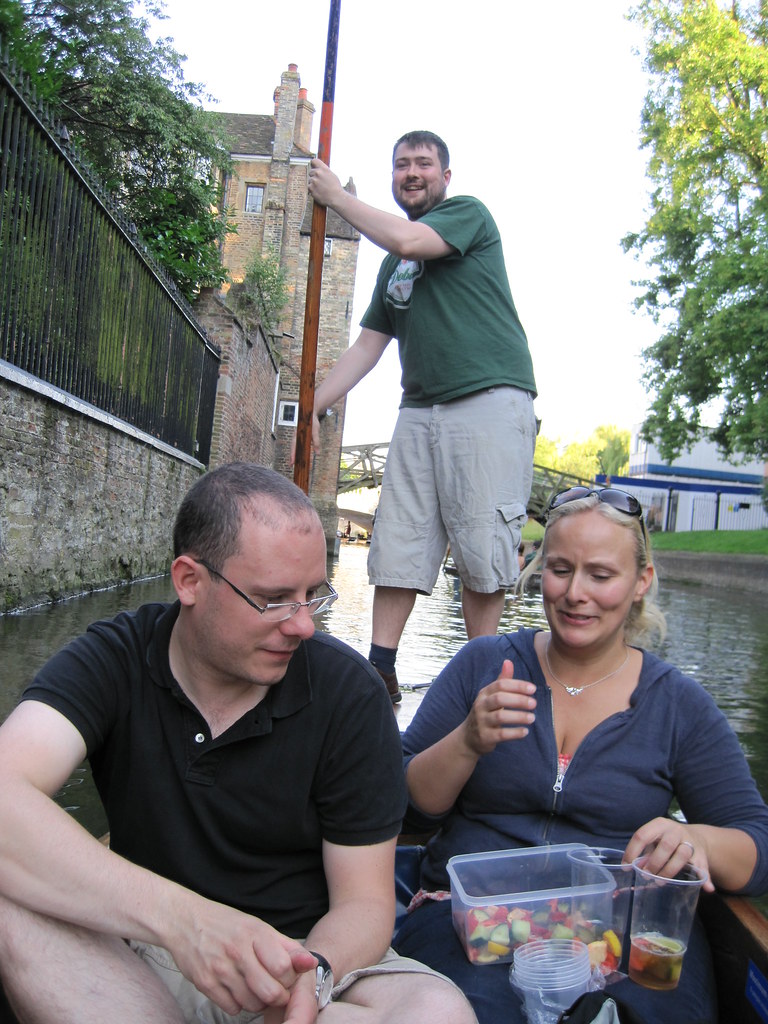
Vincent Sanders: Pimm's and Punting

The Sun came out in Cambridge the other week (yes I know, a rare occurrence) and because Robert is a generous soul he decided the office should go punting on the cam.

I had not previously been out on the river but Robert proved to be the consummate punter.

We even got fruit based drinks and some serenading, although perhaps that was not a benefit.


I took many photos of the event including the rather nice meal afterwards, some were even in focus and not blurry.

5 August 2012

Stefano Zacchiroli: bits from the DPL for July 2012

Monthly DPL bits, fresh from the oven.
Tip to feel good about the release #476: before reading this, grab and fix one of the RC bugs affecting Wheezy. Done? Now you're ready for a slightly less exciting report of DPL activities. Highlights Assets Logo & trademark Note that the actual logo relicensing should be done by SPI, via their board, upon request of mine (as Debian Project liaison). We won't make it for the next SPI board meeting, as it is on 4 days away. But we can aim for the subsequent meeting, on September 13th. If all goes well (big "if"), we will enjoy a DFSG-free logo after that date. Internal organization Recent flurry of re-organization in the tech-ctte --- which I somewhat triggered pushing for periodic meetings --- seems to be proceeding well. I'm very happy about it, as we all need to trust that tech-ctte decisions will be not only sound, but also prompt. If you're interested into this topic, some recent evidence of the ongoing reorganization and its result can be found in their DebConf12 BoF, minutes of the last meeting, a set of forthcoming GRs, and the recent great decision of posting decisions results to d-d-a (as it happened for node/nodejs). Kudos to tech-ctte members for the recent activism! I haven't worked on it myself directly, but I highlight Enrico's work on server side archival of NM conversations. It has the potential of enabling automatic detection of stuck NM processes. I'm a bit rusty as AM now, but I think missing that ability is one of the main remaining causes of frustration when joining Debian. So, if you are an AM, please opt-in and use this feature with your appicants. If you are not an AM why not? :-) Miscellanea Some misc legal stuff: and some misc "political" stuff: Happy RC bug squashing,
Cheers.
PS the boring day-to-day activity log for July 2012 is available at master:/srv/leader/news/bits-from-the-DPL.txt.201207

9 July 2012

DebConf team: Many thanks and kudos to the videoteam! (Posted by Holger Levsen)

Thanks to the awesome work of a lot of people (some not even here), this time we did the setup in one day less then previous years, and IMHO it was mostly rather very relaxed and efficient as well!
As you probably will know already, the streams are linked on the DebConf12 webpage and the recordings will be linked there, too, when they are ready. The scheduled release for that is tomorrow evening localtime, we ll see if we can deliver :-)
To make this happen, there will be a video training session tomorrow morning at 11:00 in talkroom 2, Roberto Ter n. The training will cover both the live session setup and the reviewing workflow and is definitly still open for new members!
So once again (one cannot say it enough, so please express your thanks as well) muchisimas gracias to all members of the dc12 videoteam! As Biella once said, you re ninjas!
Last and definitly not least, many thanks to our equipment sponsors too (HP, IRILL, Debian and individuals)!
cheers, a very happy h01ger!

7 July 2012

Robert Collins: Reprap driver pinouts

This is largely a memo-to-my-future self, but it may save some time for someone else facing what I was last weekend. I ve been putting together a Reprap recently, seeded by the purchase of a partially assembled one from someone local who was leaving town and didn t want to take it with them. One of the issues it had was that 2 of the stepstick driver boards it uses were burnt out, and in NZ there are no local suppliers that I could find. There is however a supplier of Easydriver driver boards, which are apparently compatible. (The Reprap electronics is a sanguinololu, which has a fitted strip that exactly matches stepstick (or pololu) driver boards. The Easydrivers are not physically compatible, but they should be pin compatible.. no? I mapped across all the pins carefully, and the only issues were: there are three GND s on the Easydriver vs 2 on the stepstick, and the PFD pin isn t exposed on the stepstick board so it can t be mapped across. I ended up with this mapping (I m not sure where pin 1 is *meant* to be on the stepstick, so I m starting with VMOT, the anti-clockwise corner pin on the same side as the 2B/2A/1A/1B pins, when looking down on an installed board pin 1, and going clockwise from there). Stepstick Easydriver VMOT M+
GND GND
2B B2
2A A2
1A A1
1B B1
VDD +5V
GND GND
Dir Dir
Step Step
Slp Slp
Rst Rst
Ms3 Nothing
Ms2 Ms2
Ms1 Ms1
En Enable But, when I tried to use this, the motor just jammed up solid. A bit of debugging and trial and error later and I figured it out. The right mapping for the motor pins: 2B B2
2A B1
1A A1
1B A2 Thats right, the two boards have chosen opposed elements for labelling of motors coils pins on the step stick 1/2 refers to the coil and A/B the two ends that need to have voltage put across them, on the easydriver A/B refer to the coil and 1/2 the two ends Super confusing, especially as I haven t been doing much electronics for oh, a decade or so. I m reminded very strongly of Rusty s scale of interface usability here.

28 June 2012

DebConf team: DebConf12 schedule ready! (Posted by Gunnar Wolf)

The DebConf12 schedule is finally available! As usual, the DebConf conference can only be finalized a couple of days before DebConf itself starts. But hey Take a look at it, and start planning your activities! Not final, never final Remember that, even now that the conference schedule is announced, you can still submit talks to DebConf, following what we call ad-hoc talks. What are the steps to do it?
  1. Check the schedule and find the timeslot (day, hour and room) you want to talk in
  2. Register your event in Pentabarf, and note the generated event ID (the last number in the URL after the submission is accepted)
  3. Send a mail to schedule@debconf.org detailing the event ID, title (just to confirm it), and the requested timeslot
  4. All requests _must_ be received at least 24hr before the requested event for the scheduling team to act accordingly and for the video team to be able to plan on resources to cover the requested session
  5. Video team coverage (event recording plus streaming on a best-effort basis) will be given to activities scheduled on the Aula Magna and Roberto Ter n auditoriums.
  6. We will try to grant requests on a first-come-first-serve basis. If two events are requested for the same timeslot, the first will have precedence, and we will schedule the second as close as possible to it. We will notify the submitters if this happens, of course.
Conference tracks In DebConf12, many talks are organized around the following tracks:
DebianDay
This track is meant for the local (Nicaraguan/Central American) community to be attracted to Debian. It does not usually have technically minded talks; the DebConf general audience is, of course, invited to take part in it, as there will surely be interesting angles on how Debian is used in different use-cases, and there will be interesting Q&A session with the audience.
Getting involved in Debian
Central America is a very special region. It has vibrant Free Software user groups and communities, among which there is an important interest to get involved in Debian.
This track will have some talks in Spanish, some talks in English, explaining different Debian processes and tools, aiming at attracting locals to contribute to Debian.
Debian for the cloud
All about virtualization. Management infrastructure, details on virtual machine engines, insight on how to tweak your kernel for optimum virtualized performance, and of course how to get it all humming perfectly with your Debian packages.
Building and porting
With an every day stronger transit to mobile computing, we are seeing a renaissance of porting. At the same time, we finally have multiarch as part of Debian. And were that not to be enough, we finally have more than one compiler that can be used for most of the software in the archive. Put all this together, and you will have a very interesting track.
Social activities
DebConf is as much about technical stuff as it is about building closer ties within the members of its community. Eating cheese+wine, going on a trip to the guts of a volcano, having a nice banquet Do you want to add an activity to this pseudo-track?
Skills exchange
Knowledge can also be built by all of us putting our grain of sand. We first had explicit skills exchange sessions in Bosnia last year, and they were very well received. Feel free to propose similar sessions!
And Well, three days to DebCamp and counting. See you Real Soon Now in Managua!

25 June 2012

Robert Collins: Running juju against a private openstack instance.

My laptop has somewhat less than 1/2 the grunt of my desktop at home, but I prefer to work on it as I can go sit in the sun etc, very hard to do that with a mini tower case :) However, running everything through ssh to another machine makes editing and iterating more clumsy; I need to do agent forwarding etc not terribly hard, but not free either, particularly when I travel, I need to remember to sync my source trees back to my laptop. So I prefer to live on my laptop and use my desktop for compute power. I had a couple of Juju charms I wanted to investigate, but I needed enough compute power to make my laptop really quite warm so I thought, its time to update my local cloud provider from Eucalyptus to Openstack. This was easy enough, until I came to run Juju. Turns out that Juju s commands really want to talk to the public DNS name of the instance (in order to SSH tunnel a connection to Zookeeper). But! Openstack returns DNS names like Server-3 , and if you think about a home network, its fairly rare to have a local DNS server *anyway*, so putting a suffix on names like that won t help at all: you either need to use a DNS naming provider (openstack ships with an LDAP provider, which adds even more complexity), and configure your clients to know how to find it, or you need to use the public IP addresses (which default to the FlatNetwork, which is routable within a home LAN by simply adding a route to 10.0.0.0/8 to your wifi interface). Adding to confusion, some wifi routers fail to forward avahi messages, which is a) terrible and b) breaks the only obvious way of doing no-config local DNS :( . So, I did some yak shaving this morning. Turns out other folk have already run into this and filed a Juju bug and a supporting txaws bug. The txaws bug was fixed, but just missed the release of Precise. Clint Byrum is going to SRU it this week though, so we ll have it soon. I ve put a patch up to address the Juju side, which is now pending review. Running the two together works very happily for me. \o/

1 June 2012

Pietro Abate: apt-get with external solvers : call for testers

Last year we invited David to work with us for a few days to add a generic interface to apt to call external solvers. After a few iterations, this patch finally landed in master and recently (about 3 months ago), in debian unstable.
  [ David Kalnischkies ]
  * [ABI-Break] Implement EDSP in libapt-pkg so that all front-ends which
    use the internal resolver can now be used also with external
    ones as the usage is hidden in between the old API
  * provide two edsp solvers in apt-utils:
    - 'dump' to quickly output a complete scenario and
    - 'apt' to use the internal as an external resolver
Today the new version of apt-cudf was upload in unstable and with it the latest bug fixes that makes it ready for daily use. I've used it quite a lot myself to upgrade my machine and it seems working pretty well so far... The most important difference with the old version is the support for multi-arch enabled machines. This marks an important milestone in our efforts to integrate external solvers, built using different technologies, directly into apt. From a user prospective, this means that (s)he will have the possibility to check if there exists a better (best ?) solution to an installation problem then what proposed by the internal apt solver. Moreover, even if apt-get gives very satisfactory answers, there are occasions where it fails miserably, leaving the user wondering how to unravel the complex web of dependencies to accomplish his task. Available cudf solvers in debian are at the moment : aspcud, mccs and packup. From an architectural point of view this is accomplished by abstracting the installation problem via a simple textual protocol (EDSP) and using an external tool to do the heavy duty translation. Since all solvers now available in debian are not meant to be debian-specific, using them involve a two step translation. The EDSP protocol specification is for the moment "hidden" in the apt documentation. I hope to find a better place for it soon : it would be cool if other package managers as smart or cupt could add an implementation on EDSP in their code so to automatically benefit of this technology. To make it happen, Apt first creates an EDSP file that is then handled to apt-cudf that takes care of the translation to cudf and back into EDSP that is then read back by apt. Apt-cudf is the bridge between edsp and the external solvers and takes care of doing the book keeping and to select the right optimization criteria. Roberto recently wrote a very nice article explaining how to use apt-get with an external solver. In a nutshell, if you want to try this out you just need to install apt-cudf, one external solver like aspcud from the university of Pasdam and then call apt-get using the --solver option (that is not yet documented #67442 ). For example :
apt-get install -s gnome --solver aspcud
This will install gnome while using the a optimization criteria that tries to minimizing the changes on the system. Various other optimization criteria for all apt-get default actions can be specified in the apt-cudf configuration file /etc/apt-cudf.conf I hope the new release of apt-cudf make it into testing before the freeze. Time to test !!!

27 April 2012

Pietro Abate: Learning from the Future of Component Repositories - CBSE 2012

Learning from the Future of Component Repositories ( Pietro Abate, Roberto Di Cosmo, Ralf Treinen and Stefano Zacchiroli ) has been accepted to be presented at CBSE 2012 (26-28 June, Bertinoro, Italy)

Abstract
  An important aspect of the quality assurance of large component repositories
  is the logical coherence of component metadata. We argue that it is possible
  to identify certain classes of such problems by checking relevant properties
  of the possible future repositories into which the current
  repository may evolve. In order to make a complete analysis of all possible
  futures effective however, one needs a way to construct a finite set of
  representatives of this infinite set of potential futures. We define a class
  of properties for which this can be done.
  We illustrate the practical usefulness of the approach with two quality
  assurance applications: (i) establishing the amount of  forced upgrades''
  induced by introducing new versions of existing components in a repository,
  and (ii) identifying outdated components that need to be upgraded in order to
  ever be installable in the future. For both applications we provide
  experience reports obtained on the Debian distribution.
The tools presented in this paper (outdated and challenges) are already in Debian as part of the 'dose-extra' package.

24 April 2012

Robert Collins: Less SPOFs: pyjunitxml, testscenarios

I ve made the Testtools committers team own both the project and the trunk branch for both pyjunitxml and testscenarios. This removes me as a SPOF if anything needs doing in those projects any Testtools committer can now do it. (Including code review and landing). If you are a testtools committer and need PyPI release rights, ping me and I ll add you. (I wish PyPI had group management).

Next.

Previous.