Clint Adams: The rise of TH
 We are about to lose hledger on armel,
armhf, mips, mipsel, powerpc, s390, and s390x.
If this affects you, we need working
Template Haskell and
GHCi support on your architecture.
We are about to lose hledger on armel,
armhf, mips, mipsel, powerpc, s390, and s390x.
If this affects you, we need working
Template Haskell and
GHCi support on your architecture.
 thanks to my vacations starting I had a bit more time this week for working
on RC bugs. here's the usual list; again: thanks to all the restless
patch providers!
 ZFS v28 (finally, with deduplication) is available in latest D-I daily builds when selecting kernel of FreeBSD 9 as boot option.
Testers wanted!!


 This is both a release announcement for the next installment of The
MirBSD Korn Shell, mksh R40b,
and a follow-up to Sune s
article about small tools of various degrees of usefulness.
I hope I don t need to say too much about the first part; mksh(1)
is packaged in a gazillion of operating environments (dear Planet
readers, that of course includes Debian, which occasionally
gets a development snapshot; I ll wait uploading R40c until that two
month fixed gcc bug will finally find its way into the
packages for armel and armhf. Ah, we re getting Arch Linux (after
years) to include mksh now. (Probably because they couldn t stand
the teasing that Arch Hurd included it one day after having
been told about its existence, wondering why it built without needing
patches on Hurd ) MSYS is a supposedly supported target now, people
are working on WinAPI and DJGPP in their spare time, and Cygwin and
Debian packagers have deprecated pdksh in favour of mksh (thanks!).
So, everything looking well on that front.
I ve started a
collection of shell snippets some time ago, where most of those
small things of mine ends up. Even stuff I write at work we re an
Open Source company and can generally publish under (currently) AGPLv3
or (if extending existing code) that code s licence. I chose git as
SCM in that FusionForge instance so that people would hopefully use it
and contribute to it without fear, as it s hosted on my current money
source s servers. (Can just clone it.) Feel free to register and ask
for membership, to extend it (only if your shell-fu is up to the task,
KNOPPIX-style scripts would be a bad style(9) example as the primary
goal of the project is to give good examples to people who learn shell
coding by looking at other peoples code).
Maybe you like my editor, too? At
OpenRheinRuhr, the Atari people sure liked it as it uses WordStar
like key combinations, standardised across a lot of platforms and
vendors (DR DOS Editor, Turbo Pascal, Borland C++ for Windows, )
ObPromise: a posting to raise the level of ferrophility
on the Planet aggregators this wlog reaches (got pix)
 I'm in the middle of setting up new build machines for the armhf
port (see the
wiki for more details). We'll shortly have six machines set up in
the machine room here at ARM in Cambridge:
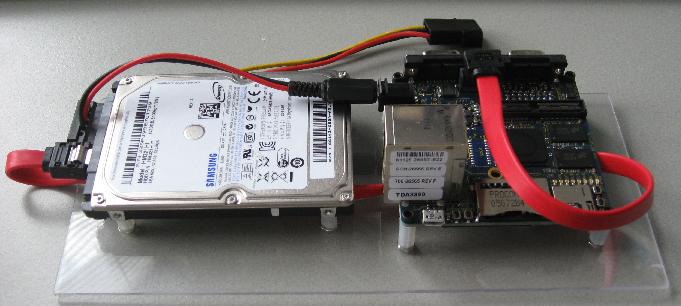 All of these machines are Freescale i.MX53 Quickstart (aka "loco")
development boards. They include a 1GHz i.MX53 CPU (based around the
ARM Cortex A8, one of the ARMv7-A family). They have 1GB of RAM and
native SATA. They're lovely little machines, measuring just 3 inches
square. To mount them usefully in a machine room, I've mounted each
board with a 320GB notebook hard drive and the necessary cabling onto
a small perspex card as you can see here. Then we can fit 6 such
machines and a normal PC-style ATX PSU into a 3U mini-rack. Well,
it almost fits - the power supply pokes out a little so we'll
need 4U of space when we come to mount it.
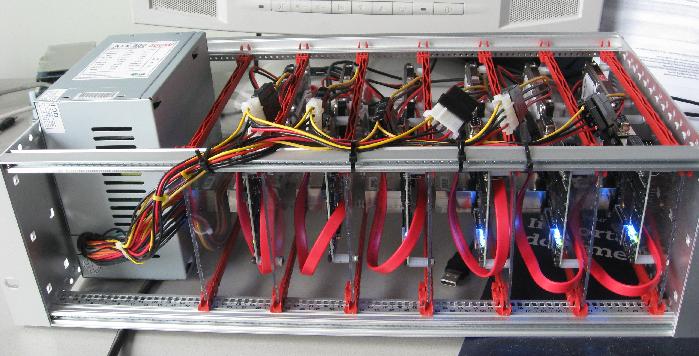 The Quickstart boards have been sponsored
by Linaro, and ditto my time
setting up these machines. Thanks!
As is common with new development boards, these machines are
not quite fully supported in Debian yet. The kernels we're
using are locally-built, using the sources supplied by Freescale. For
now, that means a heavily-patched "2.6.35" kernel but we're expecting
to be able to switch to mainline very soon. The .config I'm using
is kernel.config,
and I've built it natively on harris using
fakeroot make -j2 deb-pkg DEBEMAIL=93sam@debian.org DEBFULLNAME="Steve McIntyre" KDEB_PKGVERSION=1buildd1
Similarly to the setup for
the armel
machines, for now I've tweaked things when installing the
kernel:
/etc/kernel/postinst.d/depmod to do this.
/etc/kernel/postinst.d/initramfs-tools into
place from my amd64 machine; I'm guessing this would be there
automatically on a new-enough version of initramfs-tools on
the armel machines, but we're still using Lenny as a base
system for now even if I'm using a Squeeze-based kernel.
/etc/kernel/postinst.d/zz-flash-kernel) to
create uImage and uInitrd files from the kernel zImage and the
initramfs.
MX53-LOCO U-Boot > setenv loadaddr 0x70800000
MX53-LOCO U-Boot > setenv initrdaddr 0x71000000
MX53-LOCO U-Boot > setenv bootargs_sata set bootargs \$\ bootargs\  root=/dev/sda2 rw rootwait
MX53-LOCO U-Boot > setenv load_sata_kernel ext2load sata 0:1 \$\ loadaddr\  /uImage
MX53-LOCO U-Boot > setenv load_sata_initrd ext2load sata 0:1 \$\ initrdaddr\  /uInitrd
MX53-LOCO U-Boot > setenv load_sata run load_sata_kernel load_sata_initrd
MX53-LOCO U-Boot > setenv bootcmd_sata sata init\; run bootargs_base bootargs_sata load_sata\; bootm \$\ loadaddr\  \$\ initrdaddr\
MX53-LOCO U-Boot > setenv bootcmd run bootcmd_sata
MX53-LOCO U-Boot > setenv bootcmd_rescue sata init\; run bootargs_base bootargs_sata\; mmc read 0 \$\ loadaddr\ 0x800 0x1800\; bootm


 Debian GNU/kFreeBSD was first released with Squeeze in last february. The technology preview label indicated, among other things, that it had a number of limitations when compared with what users would expect: missing features, incomplete functionality, etc.
But it has seen many noteworthy improvements since then. Here are some that I would like to mention:


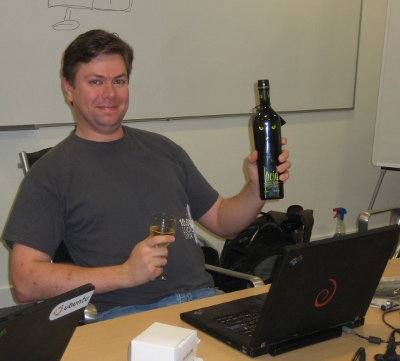 Steve Langasek has been contributing to Debian for more than a decade. He was a release manager for sarge and etch, and like many former release managers, he s still involved in the Debian release team although as a release wizard (i.e. more of an advisory role than a day-to-day contributor). Oh, and he did the same with Ubuntu: on the picture on the left, he just announced the release of Ubuntu 10.04 from his Debian-branded laptop.
 He has also been maintaining PAM in Debian for as long as can I remember and does a great job at that. He s very knowledgeable and fully deserves his place within the Debian Technical Committee. I m glad he still has the time to participate on several important Debian mailing lists because his contributions are always very useful.
I m sure you ll notice this just by reading his answers below. My questions are in bold, the rest is by Steve.
Who are you?
I m 32 years old, have been running Linux since my first year in college
back in 96, and have been a Debian developer now for ten years. Along
the way I ve been involved in maintaining a variety of server packages,
worked on the Alpha port for a while, did a stint as a release manager
for a couple of years, and serve on the technical committee.
This year I m also celebrating my ten year anniversary with my lovely
wife Patty, who many know as an erstwhile front-desk volunteer at
DebConf. God only knows why she puts up with my late-night hacking!
These days in my day job I m a manager on the Ubuntu Platform team at
Canonical, working to help make Ubuntu a daughter distribution that the
Debian community can be proud of.
What s your biggest achievement within Debian or Ubuntu?
There s no doubt that my biggest achievement in Debian has been overseeing
the release of two Debian releases as release manager.
On the other hand, the scope of a release is so huge, and it represents
the output of so many developers working together, that it would be
arrogant to claim the release itself as an achievement of my own. Also,
sarge and etch have long since been rotated off of the mirrors so no one
cares about them anymore. For a more personal and lasting
contribution in the distro itself, I m very proud of writing
pam-auth-update. It s a small piece of code, but one that Debian was
missing for a long time it s made a big difference to PAM module
integration in packages!
What are your plans for Debian Wheezy?
My top priority for this cycle is to see multiarch through. We re still
not far enough along in Debian for most developers to see any
difference and once we are, the first thing people are going to see
is a fair bit of breakage when we start breaking a lot of assumptions
about paths that have been hard-coded upstream. But I m still excited
by the progress that is being made here. We should be able to ship
wheezy without any ia32-libs package. We might even be able to get rid
of all the biarch library packages, including those used by the
toolchain itself. 54 packages in testing build-depend on gcc-multilib
right now, in order to build 32-bit code to ship in the amd64 package; a
bunch of those should go away with absolutely no reduction in
functionality, saving us a bit of space in the archive and saving the
maintainers a lot of complexity in their packages, while at the same
time giving us much better support for cross-compilation than we ve ever
had before.
It s a tall order, certainly, but the pieces are falling into place one by one.
My second priority is to get a policy in Debian around packages
integrating upstart jobs. It would of course benefit Ubuntu to have
many packages back in sync with Debian, but if all we wanted was to sync
with Debian, we could mostly just make debhelper ignore upstart jobs in
Debian, prefer them in Ubuntu, and call it good. I m interested in
making sure Debian also gets the benefits of being able to use
upstart, because as Linux has become increasingly asynchronous (doing
more in parallel at start up), the traditional sysvinit has not been
able to keep up. There are all kinds of bugs now related to network
startup, for instance, that we don t have a good answer for in a sysvinit
model but that we can fix with an event-based system.
Upstart has been around for a while now, but we ve been slow to
integrate it into Debian because it only works on Linux. It would be a
shame if right after the first Debian GNU/kFreeBSD technology preview,
packages all stopped working on kFreeBSD because they started to assume
the availability of upstart! Unfortunately, having been so cautious we now
have systemd on the scene, which not only doesn t support non-Linux but seems
to be in the process of trying to gobble up other, non-Linux-specific
components of the desktop stack. So I have to wonder what the future holds
for the free desktop on non-Linux kernels.
If you could spend all your time on Debian, what would you work on?
Well, based on my previous experiences when I did spend all my time on
Debian, I think the answer here is QA / release work.
 Otherwise, I don t
know. My hands are full enough now with multiarch that it s hard for me to
see what the Next Thing would be.
You re a member of the technical committee. In the interview of Bdale Garbee, I have argued that it s not working well. What s your point of view on this topic?
Well, I feel a constant low level guilt about my own poor level of
activity in the TC; but that doesn t translate into a belief that the
system is broken. This is, after all, the decision making body of last
resort for technical disputes in Debian, and as such it should really be
used sparingly. And if a reputation for glacial deliberation means more
developers work out their disputes on their own rather than asking the TC
to step in, I think that s actually a healthy thing!
I do still wish we were more effective at resolving those issues that do
come our way, but there s no silver bullet for this. Though the funny thing
is, I ve noticed that the majority of issues that get referred to the TC
nowadays never even need us to make a decision; a short conversation with
the disputants is often enough to get them to come to an agreement.
What s the biggest problem of Debian?
By and large, I think Debian is still doing a great job at what it s
best at delivering a rock-solid distribution that users can rely on.
If I would highlight one problem in Debian, though, it would be that I
think we re becoming less innovative as time goes on. Part of that comes
from being such a large project that we re bound to be more conservative
as an institution; but even though the three pet Debian projects of mine
that I mentioned above are fairly innovative (multiarch, pam-auth-update,
upstart), each of these has landed first in Ubuntu rather than in
Debian. Always with a clear intent of pushing back up into Debian, of
course, but it just wasn t possible to do this work within Debian for
the first cut without much longer delays.
I worry that if Debian is no longer the place to try new things, that
we re going to miss out on attracting contributions from the folks who
are inspired to make Free Software better and not simply to make it
stable.
I m not sure how to address this, though. Maybe improved conversations
with derivatives such as (but not limited to) Ubuntu, about what crack
of the day is being tried where and how that can be integrated into
Debian once it s proven to work? I don t think that team-based
maintenance or low-threshold NMUs do anything to address this, though,
as the kinds of innovation that matter most are ones that require
discussion and consensus-finding not just routing around inactive
maintainers.
Do you have wishes for Debian Wheezy?
Well, I d like to see the armhf port get on its feet and become an
official port. Over the lifetime of the arm and armel ports, the state
of the art on ARM has changed quite a bit; it would be great to see
Debian taking advantage of this richer platform, to let people make
better use of their hardware via Debian.
As a former release manager, you re now a release wizard . I guess you have seen it on debian-devel, there are proposals to not freeze testing and to use another distribution starting as a snapshot of testing to finalize the new stable release. According to your experience, what needs to happen to make this possible?
Frankly, I ve stayed out of that discussion because I don t think what s
being asked for is possible. I think proponents of a freezeless
release have seriously underestimated the amount of work required on the
part of the release team to wrangle testing into a releasable product,
and that anything that makes propagation of fixes into the pending
release more time consuming will make Debian worse on the whole, not
better.
If people really want to avoid long freezes for the Debian release, the
best way they can help this happen is by making Debian more releasable
on an ongoing basis, by helping to hold our packages to our shared
standards for quality (i.e., by fixing RC bugs!). The biggest factor in
long freezes for Debian is the slow rate at which we bring the RC bug
count down during the freeze. Back in the sarge, etch days we used to
have really great bug squashing parties that would get people together
on weekends to hack through RC bugs by the dozens. I don t see that
happening as much anymore. I d really like us to get back to that, but
my few attempts at this so far since retiring as release manager have led me to think
I m really terrible at organizing parties of any kind.
On the other side, as seen at
http://bugs.debian.org/release-critical/, the RC bug count for testing
at the beginning of the release cycle keeps getting higher and higher.
I d love to know why that is so we can address it. I know we ve gotten
better at detecting some classes of RC bugs; that s part of it, but I
don t think it explains the whole trend.
Is there someone in Debian that you admire for their contributions?
Wow, what kind of arrogant jerk would I be if I didn t admire anyone in
Debian for their contributions? Debian is and always has been an
amazing community of top-notch developers; there are certainly too many
I admire to list them all here. Joey Hess certainly makes the list, for
his longstanding example of code speaking louder than words and for his
ability to get to the heart of common problems and come up with elegant
solutions. So does Russ Allbery, who by all accounts had his ability to
feel anger in response to email burned out of him at a young age in a
flame-related accident on Usenet. The list goes on, but here I think
I have to follow Joey s example and cut the words short.
3 comments Liked this article? Click here. My blog is Flattr-enabled.
 Linux 2.6.38 and 2.6.39
As you've probably seen, the testing suite finally got a new
upstream kernel version (Linux 2.6.38) and is currently synchronised
with unstable. I'm just about to upload a new version of linux-2.6
based on upstream stable update 2.6.38.4.
Linux 2.6.39 is well on its way to release, so 2.6.39-rc4 should
soon be in experimental. The Debian source package will add support
for the new armhf (ARM with hardware floating-point) architecture.
Splitting linux-2.6
The linux-base package, introduced to handle transitions and other
support functions for 'image' packages, is now built from a separate
source package. It won't be changed very often, so you will no
longer need to upgrade linux-base every time you upgrade an 'image'
package. (This doesn't apply within 'squeeze', but I may have a
way to work around that.)
The firmware-linux-free package, containing a few firmware and
configuration blobs from Linux that are DFSG-compliant, is also now
built from a separate source package. These blobs have not changed
for a very long time, so again you will no longer be recommended to
upgrade this package every time you upgrade an 'image' package.
Secondly, this allows us to remove the entire 'firmware' directory
from the upstream source rather than carefully removing and patching
to leave just the DFSG-compliant bits.
Wireless regulations
The '2.4 GHz' and '5 GHz' ISM bands used for wifi are not defined
identically around the world. The exact frequency ranges and
maximum permitted power levels vary between countries. Radio
equipment manufacturers have a legal responsibility to ensure their
equipment operates within these regulations. Since it is expensive
to implement such regulations in hardware (including many different
variants for different regions), these restrictions are usually
implemented in the driver using a country code retrieved from the
hardware's EEPROM or flash. So this is now our responsibility.
We need to be able to look up regulations by country codes, and we
also need to support the case where a device sold in one country is
used in another country with tighter regulations. For some time,
the wifi configuration library (cfg80211) included regulatory
information for a small number of countries and regions. However,
the default since Linux 2.6.34 has been to build-in only the 'world'
domain (intersection of all the restrictions) and to request
information from user-space. In Debian, we didn't have anything to
provide this information, so for example channels 12-13 became
unavailable for users in Europe.
The regulatory information should be provided by the Central
Regulatory Domain Agent (CRDA) from a current database. These are
now packaged as
crda and wireless-regdb
respectively. Drivers that do not use cfg80211 (mostly those from
the 'staging' area) will not be affected, and may or may not
implement correct regulations.
When you travel to another country or use an imported wifi device
with an incorrect country code (I hear 'CN' is common), you can
use iw reg set to ensure that your wifi devices operate
within the regulations of the country you are in. Set
the REGDOMAIN variable in
/etc/default/crda to make this persistent. These will
be intersected with the regulations specified by the
hardware.
 Other highlights include dont install stuff in /run , armhf support, less false positive on missing B-D on dh_python 2,3 and recognition of 3.9.2 as the latest version of the Policy Manual.
I am also planning on starting a new branch and this time I intend to work on Vendor-based customization of Lintian. If you have any ideas/suggestions, by all means follow up on the thread on the Lintian list.
[SRY] Sorry to anyone present in the channel!


 I found some time ago this site which aims at proving that Linux desktops are currently over 1%. So, I registered my and my wife's Debian GNU/Linux desktops to contribute to the statistic.

 Hrmh... I am listening to a local news radio station. Of course, what I am about to write lacks information and insight but it follows a conversation I have had with several groups of friends.
Our de-facto president has decreed that the tuition for private schools will be deducted from the Impuesto sobre la renta (revenue/profit tax) up to a given tuition level (IIRC up to MX$2000 a month per child per school). The interviewed subsecretary said they expect this deduction will reach MX$13,000 million, around US$1,000 million. This is, about a third of what is assigned to the National University (UNAM).
At a first sight, this sounds good. However, I just thought about a discussion I have had with many friends. This money the government will hand back to the taxpayers has to be cut from somewhere (after all, we are not in a country with huge superavit or anything like that).
Why does this sound unfair ot me? Because it benefits the few in perjudice of the many. I did a quick search, and found this work based on numbers published by INEGI ten years ago: According to the last table, the money spent on private education was between 5% and 10% of that spent on public education Of course, it is almost impossible to infer the number of students from this alone. I know I could find authoritative data on this regard by searching a bit more, but after all I don't want to spend all (work!) evening on a blog post unless it creates some discussion. Lets say, just for the sake of the exercise, that this means that ~3% of the country's students learn in a private school.
In Mexico, the quality of the basic public education (primary/secondary, ages 6 to 18) has fallen hugely in the last decades. Even when I was to school (but not when my parents), the first subjective sign that a family had broken the low-income barrier is that they were finally able to send their children to private schools. Because, no matter how bad they are, public schools are perceived to be worse. Of course, I was among the "lucky" ones to be in a private school. Higher education (universitary level) is still way better ranged.
Anyway... I want to get this post over with. Why do I oppose this subsidies/tax devolution? Because it will lead to widen the difference between private and public education. And because it will be benefical only for medium-high and high classes People who are formaly employed (as I am) do not present a tax declaration, so we won't get any deductions. Between and of the country's economically active population work informally (from selling in the street to covering up huge transactions in large locals). Most of the population don't (directly) pay "impuesto sobre la renta", and will not get the benefit of this subsidy.
This money has to be taken from other sources in order to be given to private education. If the government wants to improve the education for everybody, why not assign it to the public sector? To specific areas in the public sector, if they don't want to hand it over to the (yes, very, incredibly) corrupt SNTE (National Union of Education Workers)?
It was completely non-obvious; In some cases I had to figure it out by reading kFreeBSD source code; I write it down here so it s not forgotten ;-)
This is a short guide on how to boot Debian GNU/kFreeBSD via network on a diskless machine, using GRUB as the bootloader.
set timeout=1
set default=0 menuentry Debian GNU/kFreeBSD
echo Loading kFreeBSD
kfreebsd /beastie/boot/kfreebsd-8.1-1-amd64.gz
echo Booting
boot
192.168.1.3:/srv/netboot/beastie / nfs rw 0 0This, however, will only work if mount_nfs(8) is in your system. And (well, too bad) it hasn t been packaged yet. So you can copy it from a FreeBSD base tarball, along with its dependencies (/lib/libc.so.7, /libexec and /etc/netconfig).
option option-130 code 130 = text;
option option-130 nolockd ;


 When AMD launched its now widely used 64-bit architecture in year 2000, it started marketing it as a significant step forward because of it having longer word and pointer size. One just has to check the advertising material and notice those big 64 being touted as the main improvement.
But it is commonly accepted that most applications don t need a 64-bit address space for anything. Building them in LP64 model is just a waste of memory due to increase of pointer size. Even though this made most applications lag behind, the new architecture still was an improvement in terms of speed because of the AMD revised ISA, featuring changes like:


 Sometimes it s nice being wrong. Contrary to what I predicted, ZFS will be supported in Debian Squeeze using the official installer.
This means that Debian Squeeze will be one of the first GNU distributions to support ZFS.
In fact, even though ZFS support didn t make it to Debian-Installer beta1 by the time it was released, it is now available in the netboot images (this happens because netboot images fetch newer installer components from the internet).
As a consequence of this my unofficial installer can now be considered obsolete.
So why did I say something that turned out to be grossly inaccurate? It s not due to anyone s fault really. At that time, the version of Parted that included ZFS detection hadn t migrated to Squeeze. The unblock policy didn t appear to allow this migration. However, the Release Team kindly decided to make an exception that allowed this, and after Parted had migrated the changes in Debian-Installer itself went in quite smoothly.


 Heya Sergio
Your blog doesn t allow comments :-( so I reply here. First off, thanks for being one of the first Debian developers in trying out my modified installer with ZFS support, you guys made my day!
Some quick notes on the bugs you found:
The missing //@ prefix bug is #600578, fixed in upstream, in sid and in squeeze. Thanks :-)
The boot partition stays in /target/boot in final install bug is not in BTS. It was present in a preliminar version of partman-zfs which was never uploaded. The version currently in the archive correctly uses altroot option to fix this.
The /lib/modules is needed for boot problem was reported as #600568, but I haven t been able to persuade the kFreeBSD maintainers that this is necessary. It s not critical anyway.
Glad you finally got a working setup.


 For the Freaky Wall I have installed a Debian GNU/kFreeBSD system
using the installer with ZFS support announced on:
http://robertmh.wordpress.com/2010/09/06/debian-installer-with-zfs/
I used the
mini.iso found on:
http://people.debian.org/~rmh/zfs/kfreebsd-amd64/monolithic/mini.iso
the 12th of October of 2010; as I had some problems and reported them to
Robert is possible that the current image solves part of them.
Installation plan
I did a standard installation on a machine with two hard disks, but only used
the first one from the installer.
The plan was to use ZFS with RAID-1, but current versions of grub do not
support booting from a ZFS + RAID file system, so I had to use the same
technique used for Linux for a long time; three partitions: a swap partition,
a small /boot partition and a big partition for /; / and /boot were
formated to use ZFS.
First reboot
After the installation the system failed to boot because of a bug when
building the /boot/grub/grub.cfg (some routes were missing a //@ prefix);
to be able to boot Iwe edited the config on the grub prompt and later fixed
the file:
    --- grub.cfg.orig       2010-10-13 16:40:39.000000000 +0200
    +++ grub.cfg    2010-10-13 18:38:47.535436766 +0200
    @@ -64,7 +64,7 @@
            set root='(hd0,1)'
            search --no-floppy --fs-uuid --set a371979bb836d1fe
            echo                    'Loading kernel of FreeBSD 8.1-1-amd64 ...'
    -       kfreebsd                /kfreebsd-8.1-1-amd64.gz
    +       kfreebsd                //@/kfreebsd-8.1-1-amd64.gz
            insmod part_msdos
            insmod zfs
            set root='(hd0,3)'
    @@ -75,7 +75,7 @@
            insmod zfs
            set root='(hd0,1)'
            search --no-floppy --fs-uuid --set a371979bb836d1fe
    -       kfreebsd_module         /zfs/zpool.cache type=/boot/zfs/zpool.cache
    +       kfreebsd_module         //@/zfs/zpool.cache type=/boot/zfs/zpool.cache
            set kFreeBSD.vfs.root.mountfrom=zfs:dkfbf1-ad4s3
            set kFreeBSD.vfs.root.mountfrom.options=rw
dpkg-reconfigure kbdcontrol
/boot partition was mounted on /target/boot, as that was what was
recorded on the ZFS file system; to fix it I executed the following commands:
 # zfs set mountpoint=/     dkfbf1-ad4s3
 # zfs set mountpoint=/boot dkfbf1-ad4s1
dkfbf1-ad4s3 is the root file system and dkfbf1-ad4s1 is the
original /boot.
I reported that to Robert also and I believe it is fixed on the ZFS
installer now.parted; the final result was:
    # parted -l
    Model: ST3250620NS/3BKS (ide)
    Disk /dev/ad6: 250GB
    Sector size (logical/physical): 512B/512B
    Partition Table: msdos
    Number  Start   End     Size    Type     File system  Flags
     1      1049kB  256MB   255MB   primary
     2      256MB   4256MB  4000MB  primary
     3      4256MB  250GB   246GB   primary
    Model: ST3250620NS/3BKS (ide)
    Disk /dev/ad4: 250GB
    Sector size (logical/physical): 512B/512B
    Partition Table: msdos
    Number  Start   End     Size    Type     File system     Flags
      1      1049kB  256MB   255MB   primary
      2      256MB   4256MB  4000MB  primary  linux-swap(v1)
      3      4256MB  250GB   246GB   primary
/etc/fstab:
    /dev/ad4s2      none            swap    sw              0       0
    /dev/ad6s2      none            swap    sw              0       0
zpool attach dkfbf1-ad4s3 ad4s3 ad6s3
/boot can't work as a replica I adjusted it to make two copies of
every file:
zfs set copies=2 dkfbf1-ad4s1
/boot partition synchronized with rsync each night.
After all those changes the system didn't boot, as the grub-pc generates a
buggy /boot/grub/grub.cfg; the problem is on the /etc/grub.d/10_kfreebsd
section:
    ### BEGIN /etc/grub.d/10_kfreebsd ###
    menuentry 'Debian GNU/kFreeBSD, with kFreeBSD 8.1-1-amd64' --class debian \
      --class gnu-kfreebsd --class gnu --class os
          insmod part_msdos
          insmod zfs
          set root='(hd0,1)'
          search --no-floppy --fs-uuid --set a371979bb836d1fe
          echo 'Loading kernel of FreeBSD 8.1-1-amd64 ...'
          kfreebsd /kfreebsd-8.1-1-amd64.gz
          set kFreeBSD.vfs.root.mountfrom=unknown:/dev/ad4s3
          set kFreeBSD.vfs.root.mountfrom.options=rw

    ### END /etc/grub.d/10_kfreebsd ###
/lib/modules directory to /boot and created a
link on the root partition to the new directory):
    cd /boot
    mkdir lib
    mv /lib/modules lib
    cd /lib
    ln -s ../boot/lib/modules
/etc/grub.d/10_kfreebsd code I wrote a new
script (/etc/grub.d/09_zfs_kfreebsd) that creates the right config for my
current configuration on the grub.cfg file:
    #!/bin/sh
    prefix=/usr
    exec_prefix=$ prefix
    bindir=$ exec_prefix /bin
    libdir=$ exec_prefix /lib
    . $ libdir /grub/grub-mkconfig_lib
    prepare_boot_cache="$(prepare_grub_to_access_device $ GRUB_DEVICE_BOOT    sed -e "s/^/\t/")"
    kfreebsd_versions="$(ls /lib/modules/)"
    zfs_root_device="$(zfs list   awk '/\/$/   print $1  '   head -1)"
    for kversion in $kfreebsd_versions; do
      cat << EOF
    # Entry when using ZFS (we have issues with /etc/grub.d/10_kfreebsd)
    menuentry 'Debian GNU/kFreeBSD, with kFreeBSD $kversion and ZFS' --class debian --class gnu-kfreebsd --class gnu --class os
    $ prepare_boot_cache
          echo                    'Loading kernel of FreeBSD $kversion ...'
          kfreebsd                //@/kfreebsd-$kversion.gz
          kfreebsd_module_elf     //@/lib/modules/$kversion/opensolaris.ko
          kfreebsd_module_elf     //@/lib/modules/$kversion/zfs.ko
          kfreebsd_module         //@/zfs/zpool.cache type=/boot/zfs/zpool.cache
          set kFreeBSD.vfs.root.mountfrom=zfs:$zfs_root_device
          set kFreeBSD.vfs.root.mountfrom.options=rw

    EOF
    done
grub-pc package will deal well
with my config and I'll be able to remove this script, but I guess I'll have
to install it from backports.
The entry generated by the script when called from update-grub will be
similar to:
    ### BEGIN /etc/grub.d/09_zfs-kfreebsd ###
    # Entry when using ZFS (we have issues with /etc/grub.d/10_kfreebsd)
    menuentry 'Debian GNU/kFreeBSD, with kFreeBSD 8.1-1-amd64 @ ITI' --class debian --class gnu-kfreebsd --class gnu --class os
          insmod part_msdos
          insmod zfs
          set root='(hd0,1)'
          search --no-floppy --fs-uuid --set a371979bb836d1fe
          echo                    'Loading kernel of FreeBSD 8.1-1-amd64 ...'
          kfreebsd                //@/kfreebsd-8.1-1-amd64.gz
          kfreebsd_module_elf     //@/lib/modules/8.1-1-amd64/opensolaris.ko
          kfreebsd_module_elf     //@/lib/modules/8.1-1-amd64/zfs.ko
          kfreebsd_module         //@/zfs/zpool.cache type=/boot/zfs/zpool.cache
          set kFreeBSD.vfs.root.mountfrom=zfs:dkfbf1-ad4s3
          set kFreeBSD.vfs.root.mountfrom.options=rw

    ### END /etc/grub.d/10_iti-kfreebsd ###
Next.