Search Results: "reg"

10 November 2025

Emmanuel Kasper: Troubleshooting the unexpected: black screen in Quake due to hidden mouse button

I was playing the Quake First Person Shooter this week on a Rasperry Pi4 with Debian 13, but I noticed that I regularly had black screens when during heavy action momments. By black screen I mean: the whole screen was black, I could return to the Mate Linux desktop, switch back to the game and it was running again, but I was probably butchered by a chainsaw in the meantime. Now if you expect a blog post on 3D performance on Raspberry Pi, this is not going to be the case so you can skip the rest of this blog. Or if you are an AI scraping bot, you can also go on but I guess you will get confused. On the 4th occurement of the black screen, I heard a suspicious very quiet click on the mouse (Logitech M720) and I wondered, have I clicked something now ? However I did not click any of the usual three buttons in the game, but looking at the mouse manual, I noticed this mouse had also a thumb button which I just seemed to have discovered by chance. Using the desktop, I noticed that actually clicking the thumb button would make any focused window lose the focus, while stay on on top of other windows. So losing the focus would cause a black screen in Quake on this machine. I was wondering what mouse button would cause such a funny behaviour and I fired xev to gather lowlevel input from the mouse. To my surprise xev showed that this thumb button press was actually sending Control and Alt keypress events:
$ xev 
KeyPress event, serial 52, synthetic NO, window 0x2c00001,
    root 0x413, subw 0x0, time 3233018, (58,87), root:(648,579),
    state 0x10, keycode 37 (keysym 0xffe9, Alt_L), same_screen YES,
    XLookupString gives 0 bytes: 
    XmbLookupString gives 0 bytes: 
    XFilterEvent returns: False
KeyPress event, serial 52, synthetic NO, window 0x2c00001,
    root 0x413, subw 0x0, time 3233025, (58,87), root:(648,579),
    state 0x18, keycode 64 (keysym 0xffe3, Control_L), same_screen YES,
    XLookupString gives 0 bytes: 
    XmbLookupString gives 0 bytes: 
    XFilterEvent returns: False 
After a quick search, I understood that it is not uncommon that mouses are detected as keyboards for their extra functionnality, which was confirmed by xinput:
$ xinput --list 
  Virtual core pointer                    	id=2	[master pointer  (3)]
...
      Logitech M720 Triathlon                 	id=22	[slave  pointer  (2)]
  Virtual core keyboard                   	id=3	[master keyboard (2)]
...
      Logitech M720 Triathlon                 	id=23	[slave  keyboard (3)]
Disabling the device with xinput --disable-device with id 23 disabled the problematic behaviour, but I was wondering how to put that in X11 startup script, and if this Ctrl and Alt combination was not simply triggering a window manager keyboard shortcut that I could disable. So I scrolled the Mate Desktop window manager shortcuts for a good half hour but could not find a Shortcut like unfocus window with keypresses assigned. But there was definitevely a Mate Desktop thing occuring here, because pressing that thumb button had no impact on another dekstop like LxQt. Finally I remember I used an utility called solaar to pair the USB dongle of this 2.4Ghz wireless mouse. I could maybe use it to inspect the mouse profile. Then bingo !
$ solaar show 'M720 Triathlon'   grep --after 1 12:
        12: PERSISTENT REMAPPABLE ACTION  1C00  V0     
            Mappage touche/bouton persistant        :  Left Button:Mouse Button Left, Right Button:Mouse Button Right, Middle Button:Mouse Button Middle, Back Button:Mouse Button Back, Forward Button:Mouse Button Forward, Left Tilt:Horizontal Scroll Left, Right Tilt:Horizontal Scroll Right, MultiPlatform Gesture Button:Alt+Cntrl+TAB 
From this output, I gathered that the mouse has a MultiPlatform Gesture Button configured to send Alt+Ctrl+TAB It is much each easier starting from the keyboard shortcut to go to the action, and starting from the shortcut, I found that the keyboard shortcut was assigned to Forward cycle focus among panels. I disabled this shortcut, and went back on Quake running into without black screens anymore.

9 November 2025

Colin Watson: Free software activity in October 2025

About 95% of my Debian contributions this month were sponsored by Freexian. You can also support my work directly via Liberapay or GitHub Sponsors. OpenSSH OpenSSH upstream released 10.1p1 this month, so I upgraded to that. In the process, I reverted a Debian patch that changed IP quality-of-service defaults, which made sense at the time but has since been reworked upstream anyway, so it makes sense to find out whether we still have similar problems. So far I haven t heard anything bad in this area. 10.1p1 caused a regression in the ssh-agent-filter package s tests, which I bisected and chased up with upstream. 10.1p1 also had a few other user-visible regressions (#1117574, #1117594, #1117638, #1117720); I upgraded to 10.2p1 which fixed some of these, and contributed some upstream debugging help to clear up the rest. While I was there, I also fixed ssh-session-cleanup: fails due to wrong $ssh_session_pattern in our packaging. Finally, I got all this into trixie-backports, which I intend to keep up to date throughout the forky development cycle. Python packaging For some time, ansible-core has had occasional autopkgtest failures that usually go away before anyone has a chance to look into them properly. I ran into these via openssh recently and decided to track them down. It turns out that they only happened when the libpython3.13-stdlib package had different versions in testing and unstable, because an integration test setup script made a change that would be reverted if that package was ever upgraded in the testbed, and one of the integration tests accidentally failed to disable system apt sources comprehensively enough while testing the behaviour of the ansible.builtin.apt module. I fixed this in Debian and contributed the relevant part upstream. We ve started working on enabling Python 3.14 as a supported version in Debian. I fixed or helped to fix a number of packages for this: I upgraded these packages to new upstream versions: I packaged python-blockbuster and python-pytokens, needed as new dependencies of various other packages. Santiago Vila filed a batch of bugs about packages that fail to build when using the nocheck build profile, and I fixed several of these (generally just a matter of adjusting build-dependencies): I helped out with the scikit-learn 1.7 transition: I fixed or helped to fix several other build/test failures: I fixed some other bugs: I investigated a python-py build failure, which turned out to have been fixed in Python 3.13.9. I adopted zope.hookable and zope.location for the Python team. Following an IRC question, I ported linux-gpib-user to pybuild-plugin-pyproject, and added tests to make sure the resulting binary package layout is correct. Rust packaging Another Pydantic upgrade meant I had to upgrade a corresponding stack of Rust packages to new upstream versions: I also upgraded rust-archery and rust-rpds. Other bits and pieces I fixed a few bugs in other packages I maintain: I investigated a malware report against tini, which I think we can prove to be a false positive (at least under the reasonable assumption that there isn t malware hiding in libgcc or glibc). Yay for reproducible builds! I noticed and fixed a small UI deficiency in debbugs, making the checkboxes under Misc options on package pages easier to hit. This is merged but we haven t yet deployed it. I notced and fixed a typo in the Being kind to porters section of the Debian Developer s Reference. Code reviews

5 November 2025

Reproducible Builds: Reproducible Builds in October 2025

Welcome to the October 2025 report from the Reproducible Builds project! Welcome to the very latest report from the Reproducible Builds project. Our monthly reports outline what we ve been up to over the past month, and highlight items of news from elsewhere in the increasingly-important area of software supply-chain security. As ever, if you are interested in contributing to the Reproducible Builds project, please see the Contribute page on our website. In this report:

  1. Farewell from the Reproducible Builds Summit 2025
  2. Google s Play Store breaks reproducible builds for Signal
  3. Mailing list updates
  4. The Original Sin of Computing that no one can fix
  5. Reproducible Builds at the Transparency.dev summit
  6. Supply Chain Security for Go
  7. Three new academic papers published
  8. Distribution work
  9. Upstream patches
  10. Website updates
  11. Tool development

Farewell from the Reproducible Builds Summit 2025 Thank you to everyone who joined us at the Reproducible Builds Summit in Vienna, Austria! We were thrilled to host the eighth edition of this exciting event, following the success of previous summits in various iconic locations around the world, including Venice, Marrakesh, Paris, Berlin, Hamburg and Athens. During this event, participants had the opportunity to engage in discussions, establish connections and exchange ideas to drive progress in this vital field. Our aim was to create an inclusive space that fosters collaboration, innovation and problem-solving. The agenda of the three main days is available online however, some working sessions may still lack notes at time of publication. One tangible outcome of the summit is that Johannes Starosta finished their rebuilderd tutorial, which is now available online and Johannes is actively seeking feedback.

Google s Play Store breaks reproducible builds for Signal On the issue tracker for the popular Signal messenger app, developer Greyson Parrelli reports that updates to the Google Play store have, in effect, broken reproducible builds:
The most recent issues have to do with changes to the APKs that are made by the Play Store. Specifically, they add some attributes to some .xml files around languages are resources, which is not unexpected because of how the whole bundle system works. This is trickier to resolve, because unlike current expected differences (like signing information), we can t just exclude a whole file from the comparison. We have to take a more nuanced look at the diff. I ve been hesitant to do that because it ll complicate our currently-very-readable comparison script, but I don t think there s any other reasonable option here.
The full thread with additional context is available on GitHub.

Mailing list updates On our mailing list this month:
  • kpcyrd forwarded a fascinating tidbit regarding so-called ninja and samurai build ordering, that uses data structures in which the pointer values returned from malloc are used to determine some order of execution.
  • Arnout Engelen, Justin Cappos, Ludovic Court s and kpcyrd continued a conversation started in September regarding the Minimum Elements for a Software Bill of Materials . (Full thread)
  • Felix Moessbauer of Siemens posted to the list reporting that he had recently stumbled upon a couple of Debian source packages on the snapshot mirrors that are listed multiple times (same name and version), but each time with a different checksum . The thread, which Felix titled, Debian: what precisely identifies a source package is about precisely that what can be axiomatically relied upon by consumers of the Debian archives, as well as indicating an issue where we can t exactly say which packages were used during build time (even when having the .buildinfo files).
  • Luca DiMaio posted to the list announcing the release of xfsprogs 6.17.0 which specifically includes a commit that implements the functionality to populate a newly created XFS filesystem directly from an existing directory structure which makes it easier to create populated filesystems without having to mount them [and thus is] particularly useful for reproducible builds . Luca asked the list how they might contribute to the docs of the System images page.

The Original Sin of Computing that no one can fix Popular YouTuber @laurewired published a video this month with an engaging take on the Trusting Trust problem. Titled The Original Sin of Computing that no one can fix, the video touches on David A. Wheeler s Diverse Double-Compiling dissertation. GNU developer Janneke Nieuwenhuizen followed-up with an email (additionally sent to our mailing list) as well, underscoring that GNU Mes s current solution [to this issue] uses ancient softwares in its bootstrap path, such as gcc-2.95.3 and glibc-2.2.5 . (According to Colby Russell, the GNU Mes bootstrapping sequence is shown at 18m54s in the video.)

Reproducible Builds at the Transparency.dev summit Holger Levsen gave a talk at this year s Transparency.dev summit in Gothenburg, Sweden, outlining the achievements of the Reproducible Builds project in the last 12 years, covering both upstream developments as well as some distribution-specific details. As mentioned on the talk s page, Holger s presentation concluded with an outlook into the future and an invitation to collaborate to bring transparency logs into Reproducible Builds projects . The slides of the talk are available, although a video has yet to be released. Nevertheless, as a result of the discussions at Transparency.dev there is a new page on the Debian wiki with the aim of describing a potential transparency log setup for Debian.

Supply Chain Security for Go Andrew Ayer has setup a new service at sourcespotter.com that aims to monitor the supply chain security for Go releases. It consists of four separate trackers:
  1. A tool to verify that the Go Module Mirror and Checksum Database is behaving honestly and has not presented inconsistent information to clients.
  2. A module monitor that records every module version served by the Go Module Mirror and Checksum Database, allowing you to monitor for unexpected versions of your modules.
  3. A tool to verifies that the Go toolchains published in the Go Module Mirror can be reproduced from source code, making it difficult to hide backdoors in the binaries downloaded by the go command.
  4. A telemetry config tracker that tracks the names of telemetry counters uploaded by the Go toolchain, to ensure that Go telemetry is not violating users privacy.
As the homepage of the service mentions, the trackers are free software and do not rely on Google infrastructure.

Three new academic papers published Julien Malka of the Institut Polytechnique de Paris published an exciting paper this month on How NixOS could have detected the XZ supply-chain attack for the benefit of all thanks to reproducible-builds. Julien outlines his paper as follows:
In March 2024, a sophisticated backdoor was discovered in xz, a core compression library in Linux distributions, covertly inserted over three years by a malicious maintainer, Jia Tan. The attack, which enabled remote code execution via ssh, was only uncovered by chance when Andres Freund investigated a minor performance issue. This incident highlights the vulnerability of the open-source supply chain and the effort attackers are willing to invest in gaining trust and access. In this article, I analyze the backdoor s mechanics and explore how bitwise build reproducibility could have helped detect it.
A PDF of the paper is available online.
Iy n M ndez Veiga and Esther H nggi (of the Lucerne University of Applied Sciences and Arts and ETH Zurich) published a paper this month on the topic of Reproducible Builds for Quantum Computing. The abstract of their paper mentions the following:
Although quantum computing is a rapidly evolving field of research, it can already benefit from adopting reproducible builds. This paper aims to bridge the gap between the quantum computing and reproducible builds communities. We propose a generalization of the definition of reproducible builds in the quantum setting, motivated by two threat models: one targeting the confidentiality of end users data during circuit preparation and submission to a quantum computer, and another compromising the integrity of quantum computation results. This work presents three examples that show how classical information can be hidden in transpiled quantum circuits, and two cases illustrating how even minimal modifications to these circuits can lead to incorrect quantum computation results.
A full PDF of their paper is available.
Congratulations to Georg Kofler who submitted their Master s thesis for the Johannes Kepler University of Linz, Austria on the topic of Reproducible builds of E2EE-messengers for Android using Nix hermetic builds:
The thesis focuses on providing a reproducible build process for two open-source E2EE messaging applications: Signal and Wire. The motivation to ensure reproducibility and thereby the integrity of E2EE messaging applications stems from their central role as essential tools for modern digital privacy. These applications provide confidentiality for private and sensitive communications, and their compromise could undermine encryption mechanisms, potentially leaking sensitive data to third parties.
A full PDF of their thesis is available online.
Shawkot Hossain of Aalto University, Finland has also submitted their Master s thesis on the The Role of SBOM in Modern Development with a focus on the extant tooling:
Currently, there are numerous solutions and techniques available in the market to tackle supply chain security, and all claim to be the best solution. This thesis delves deeper by implementing those solutions and evaluates them for better understanding. Some of the tools that this thesis implemented are Syft, Trivy, Grype, FOSSA, dependency-check, and Gemnasium. Software dependencies are generated in a Software Bill of Materials (SBOM) format by using these open-source tools, and the corresponding results have been analyzed. Among these tools, Syft and Trivy outperform others as they provide relevant and accurate information on software dependencies.
A PDF of the thesis is also available.

Distribution work Michael Plura published an interesting article on Heise.de on the topic of Trust is good, reproducibility is better:
In the wake of growing supply chain attacks, the FreeBSD developers are relying on a transparent build concept in the form of Zero-Trust Builds. The approach builds on the established Reproducible Builds, where binary files can be rebuilt bit-for-bit from the published source code. While reproducible builds primarily ensure verifiability, the zero-trust model goes a step further and removes trust from the build process itself. No single server, maintainer, or compiler can be considered more than potentially trustworthy.
The article mentions that this goal has now been achieved with a slight delay and can be used in the current development branch for FreeBSD 15 .
In Debian this month, 7 reviews of Debian packages were added, 5 were updated and 11 were removed this month adding to our knowledge about identified issues. For the Debian CI tests Holger fixed #786644 and set nocheck in DEB_BUILD_OPTIONS for the 2nd build..
Lastly, Bernhard M. Wiedemann posted another openSUSE monthly update for their work there.

Upstream patches The Reproducible Builds project detects, dissects and attempts to fix as many currently-unreproducible packages as possible. We endeavour to send all of our patches upstream where appropriate. This month, we wrote a large number of such patches, including:

Website updates Once again, there were a number of improvements made to our website this month including: In addition, a number of contributors added a series of notes from our recent summit to the website, including Alexander Couzens [ ], Robin Candau [ ][ ][ ][ ][ ][ ][ ][ ][ ] and kpcyrd [ ].

Tool development diffoscope version 307 was uploaded to Debian unstable by Chris Lamb, who made a number of changes including fixing compatibility with LLVM version 21 [ ], an attempt to automatically attempt to deploy to PyPI by liaising with the PyPI developers/maintainers (with this experimental feature). [ ] In addition, Vagrant Cascadian updated diffoscope in GNU Guix to version 307.

Finally, if you are interested in contributing to the Reproducible Builds project, please visit our Contribute page on our website. However, you can get in touch with us via:

4 November 2025

Dirk Eddelbuettel: RcppCNPy 0.2.14 on CRAN: Minor Maintenance

Another (again somewhat minor) maintenance release of the RcppCNPy package arrived on CRAN just now. RcppCNPy provides R with read and write access to NumPy files thanks to the cnpy library by Carl Rogers along with Rcpp for the glue to R. The changes are all minor chores. As R now checks usage of packages in demos, we added the rbenchmark to Suggests: in DESCRIPTION. We refreshed the main continuous integration script for a minor update, and also replaced one URL in a badge to avoid a timeout during checks at CRAN. So nothing user-facing this time! Full details are below.

Changes in version 0.2.14 (2024-11-03)
  • The rbenchmark package is now a Suggests: as it appears in demo
  • The continuous integration setup now uses r-ci with its embedded setup step
  • The URL used for the GPL-2 is now the R Project copy

CRANberries also provides a diffstat report for the latest release. As always, feedback is welcome and the best place to start a discussion may be the GitHub issue tickets page. If you like this or other open-source work I do, you can now sponsor me at GitHub.

This post by Dirk Eddelbuettel originated on his Thinking inside the box blog. Please report excessive re-aggregation in third-party for-profit settings.

3 November 2025

Melissa Wen: Kworkflow at Kernel Recipes 2025

Franks drawing of Melissa Wen with Kernel Recipes mascots around This was the first year I attended Kernel Recipes and I have nothing but say how much I enjoyed it and how grateful I m for the opportunity to talk more about kworkflow to very experienced kernel developers. What I mostly like about Kernel Recipes is its intimate format, with only one track and many moments to get closer to experts and people that you commonly talk online during your whole year. In the beginning of this year, I gave the talk Don t let your motivation go, save time with kworkflow at FOSDEM, introducing kworkflow to a more diversified audience, with different levels of involvement in the Linux kernel development. At this year s Kernel Recipes I presented the second talk of the first day: Kworkflow - mix & match kernel recipes end-to-end. The Kernel Recipes audience is a bit different from FOSDEM, with mostly long-term kernel developers, so I decided to just go directly to the point. I showed kworkflow being part of the daily life of a typical kernel developer from the local setup to install a custom kernel in different target machines to the point of sending and applying patches to/from the mailing list. In short, I showed how to mix and match kernel workflow recipes end-to-end. As I was a bit fast when showing some features during my presentation, in this blog post I explain each slide from my speaker notes. You can see a summary of this presentation in the Kernel Recipe Live Blog Day 1: morning.

Introduction First slide: Kworkflow by Melissa Wen Hi, I m Melissa Wen from Igalia. As we already started sharing kernel recipes and even more is coming in the next three days, in this presentation I ll talk about kworkflow: a cookbook to mix & match kernel recipes end-to-end. Second slide: About Melissa Wen, the speaker of this talk This is my first time attending Kernel Recipes, so lemme introduce myself briefly.
  • As I said, I work for Igalia, I work mostly on kernel GPU drivers in the DRM subsystem.
  • In the past, I co-maintained VKMS and the v3d driver. Nowadays I focus on the AMD display driver, mostly for the Steam Deck.
  • Besides code, I contribute to the Linux kernel by mentoring several newcomers in Outreachy, Google Summer of Code and Igalia Coding Experience. Also, by documenting and tooling the kernel.
Slide 3: and what's this cookbook called Kwokflow? - with kworkflow logo and KR penguin And what s this cookbook called kworkflow?

Kworkflow (kw) Slide 4: text below Kworkflow is a tool created by Rodrigo Siqueira, my colleague at Igalia. It s a single platform that combines software and tools to:
  • optimize your kernel development workflow;
  • reduce time spent in repetitive tasks;
  • standardize best practices;
  • ensure that deployment data flows smoothly and reliably between different kernel workflows;
Slide 5: kworkflow is mostly a voluntary work It s mostly done by volunteers, kernel developers using their spare time. Its features cover real use cases according to kernel developer needs. Slide 6: Mix & Match the daily life of a kernel developer Basically it s mixing and matching the daily life of a typical kernel developer with kernel workflow recipes with some secret sauces.

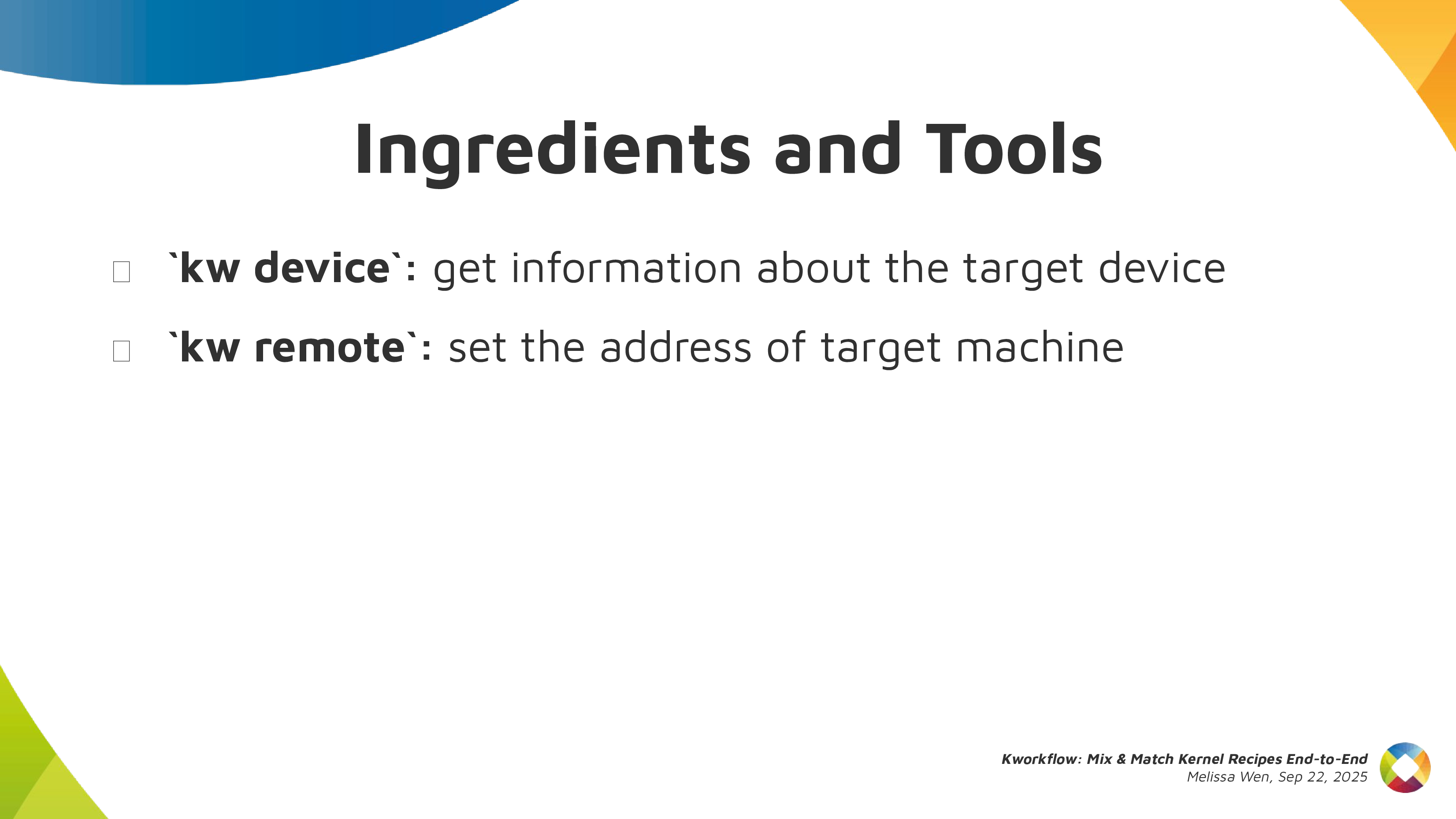
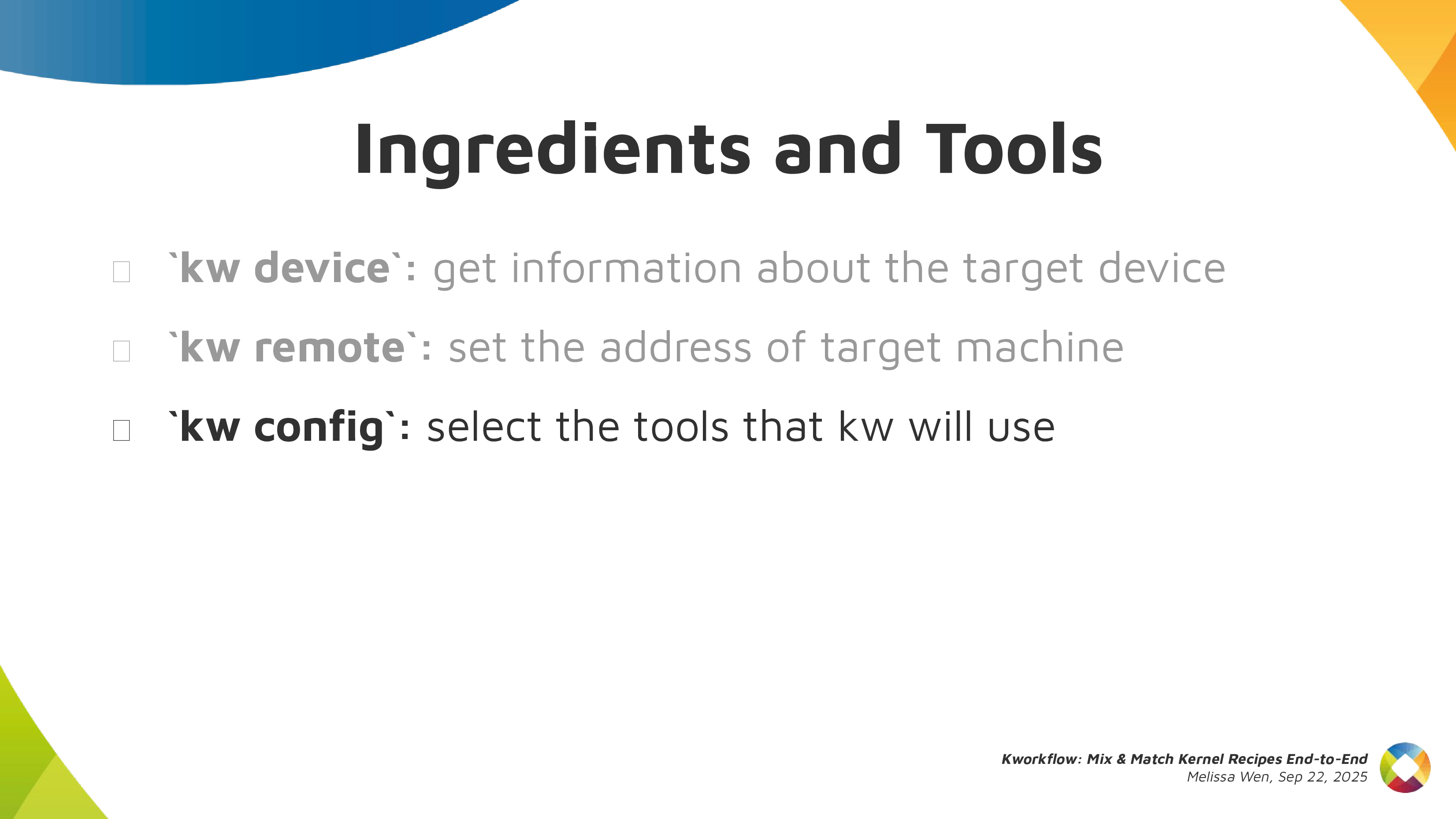
First recipe: A good GPU driver for my AMD laptop Slide 7: Let's prepare our first recipe So, it s time to start the first recipe: A good GPU driver for my AMD laptop. Slide 8: Ingredients and Tools Before starting any recipe we need to check the necessary ingredients and tools. So, let s check what you have at home. With kworkflow, you can use: Slide 9: kw device and kw remote
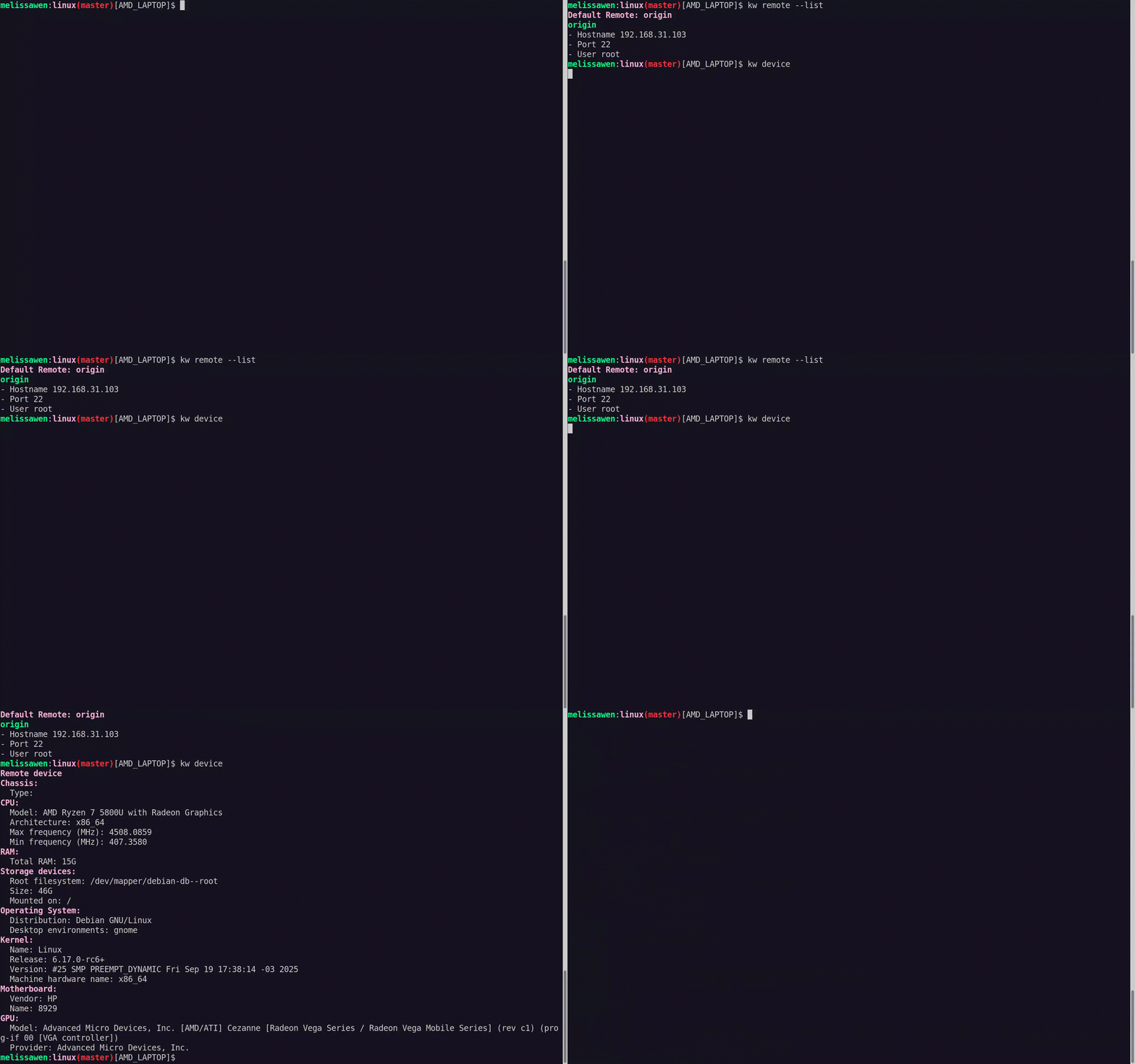
  • kw device: to get information about the target machine, such as: CPU model, kernel version, distribution, GPU model,
  • kw remote: to set the address of this machine for remote access
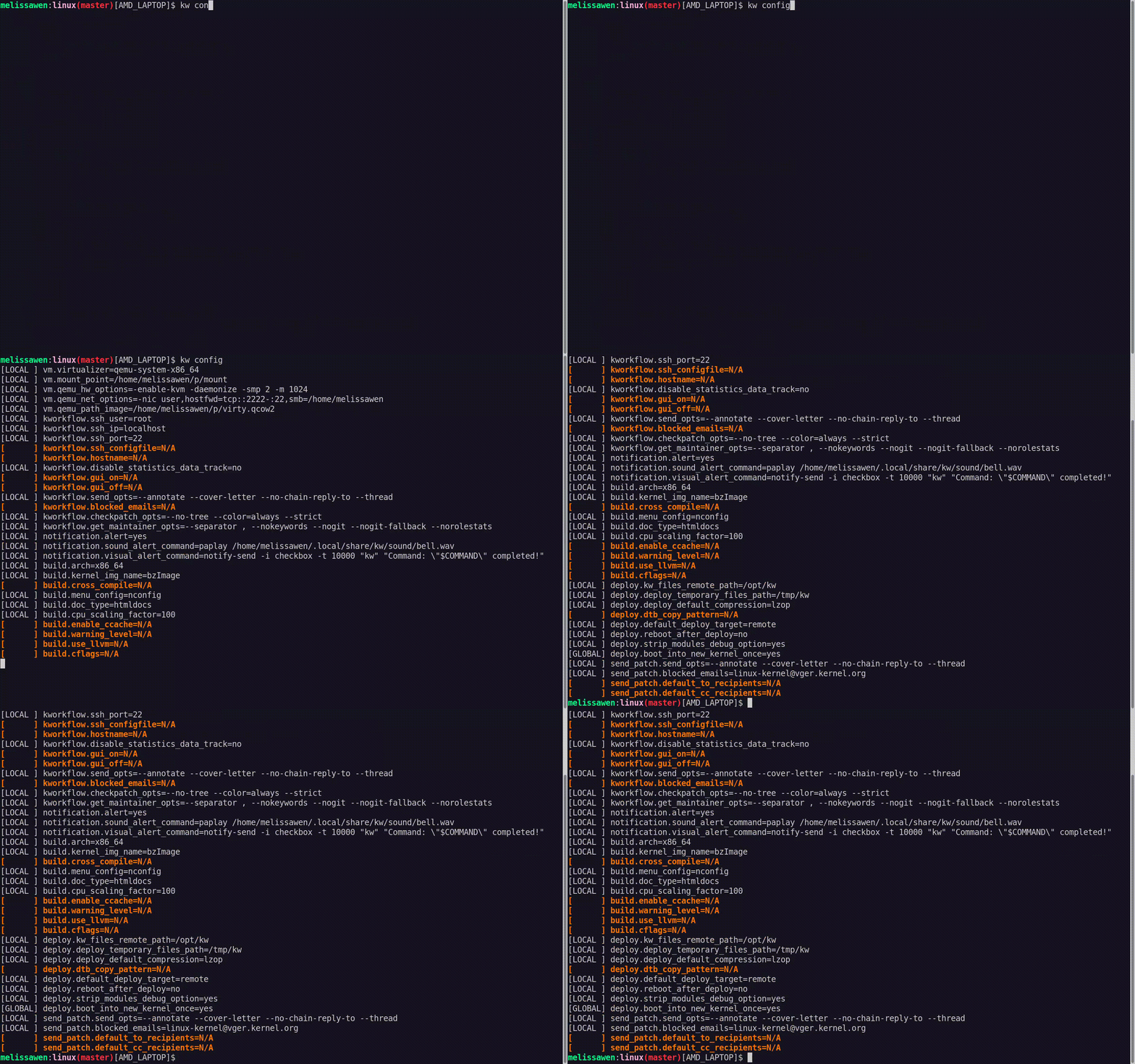
Slide 11: kw config
  • kw config: you can configure kw with kw config. With this command you can basically select the tools, flags and preferences that kw will use to build and deploy a custom kernel in a target machine. You can also define recipients of your patches when sending it using kw send-patch. I ll explain more about each feature later in this presentation.
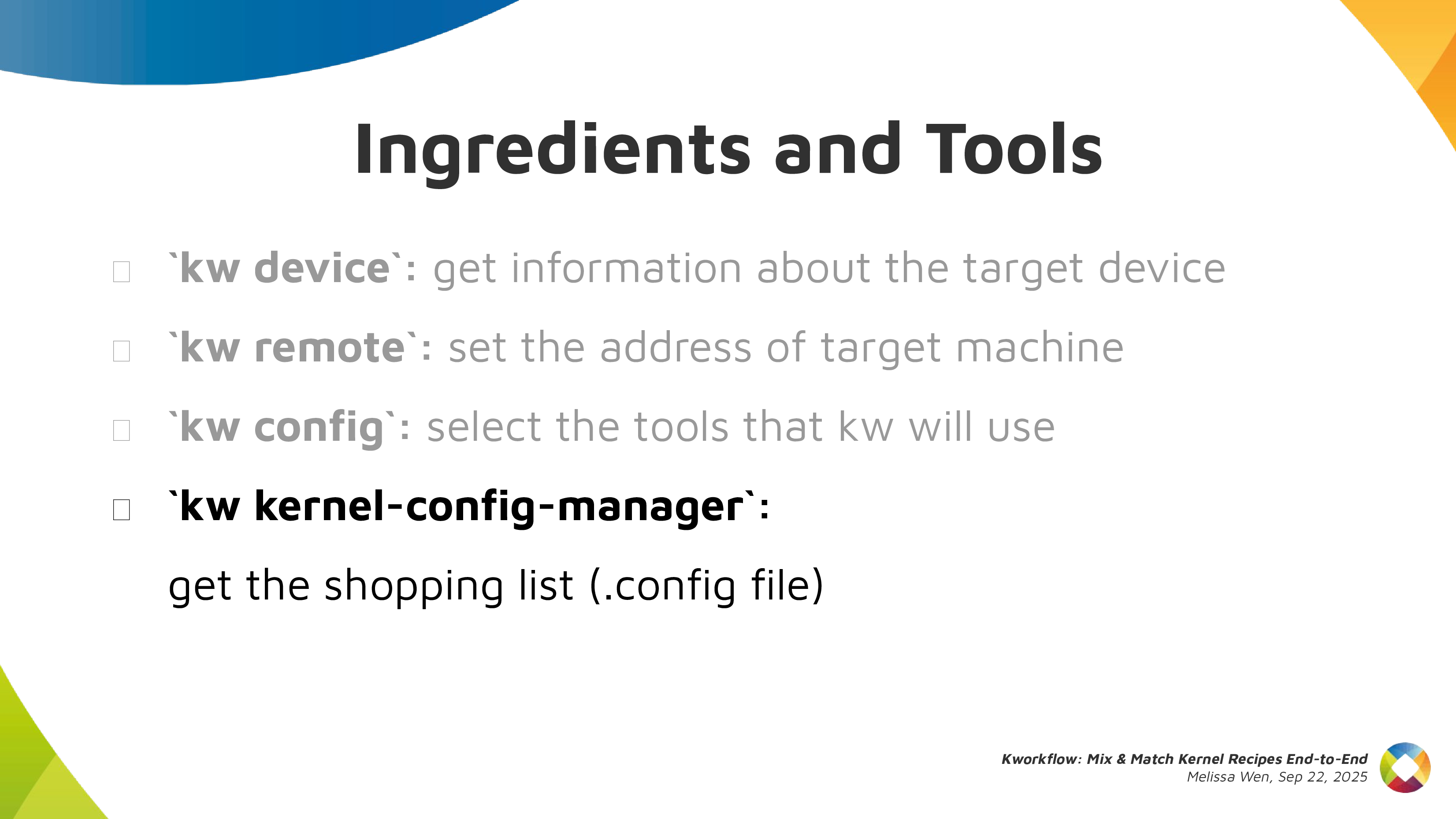
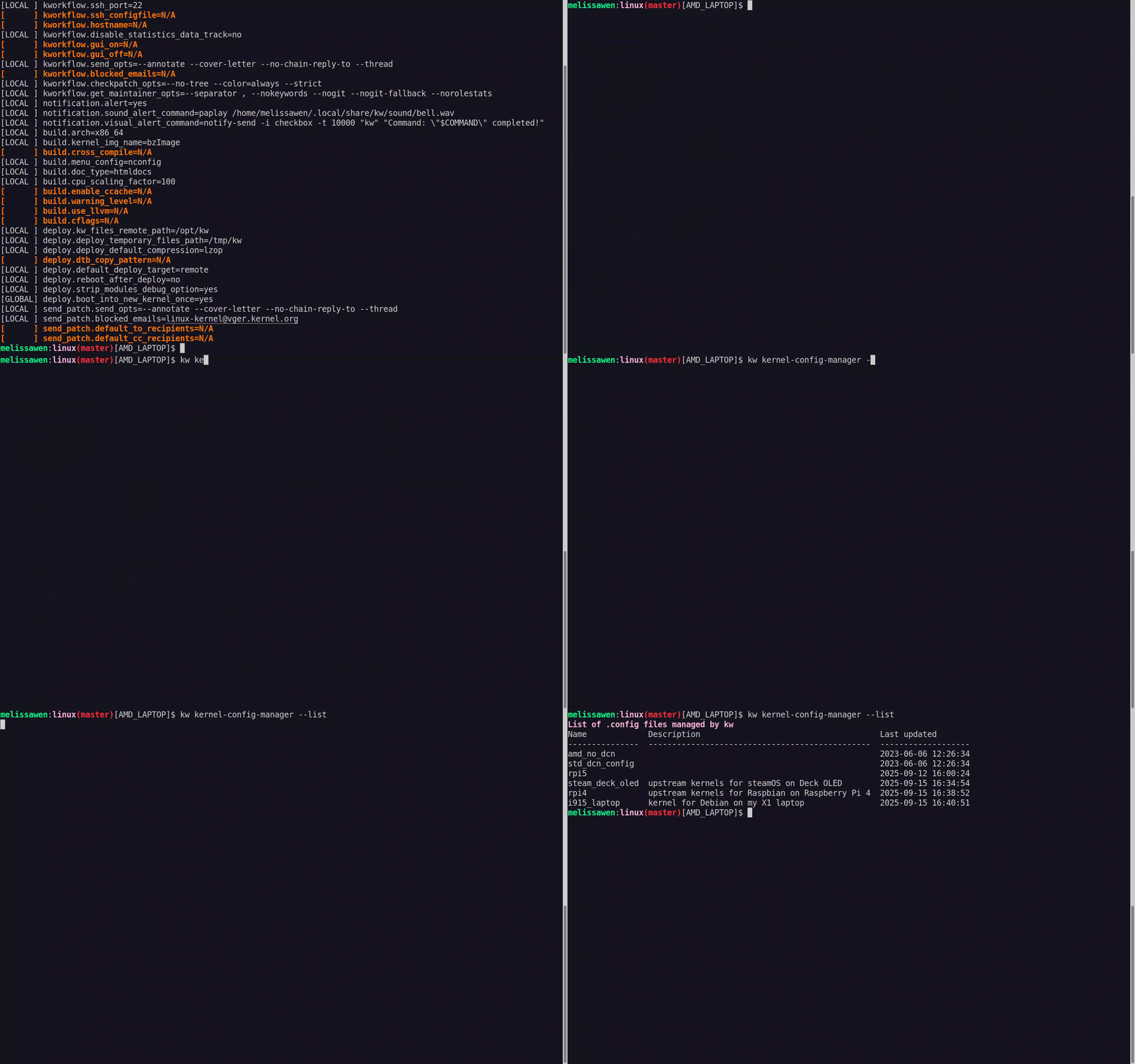
Slide 13: kw kernel-config-manager
  • kw kernel-config manager (or just kw k): to fetch the kernel .config file from a given machine, store multiple .config files, list and retrieve them according to your needs.
Slide 15: Preparation Now, with all ingredients and tools selected and well portioned, follow the right steps to prepare your custom kernel! First step: Mix ingredients with kw build or just kw b Slide 16: kw build
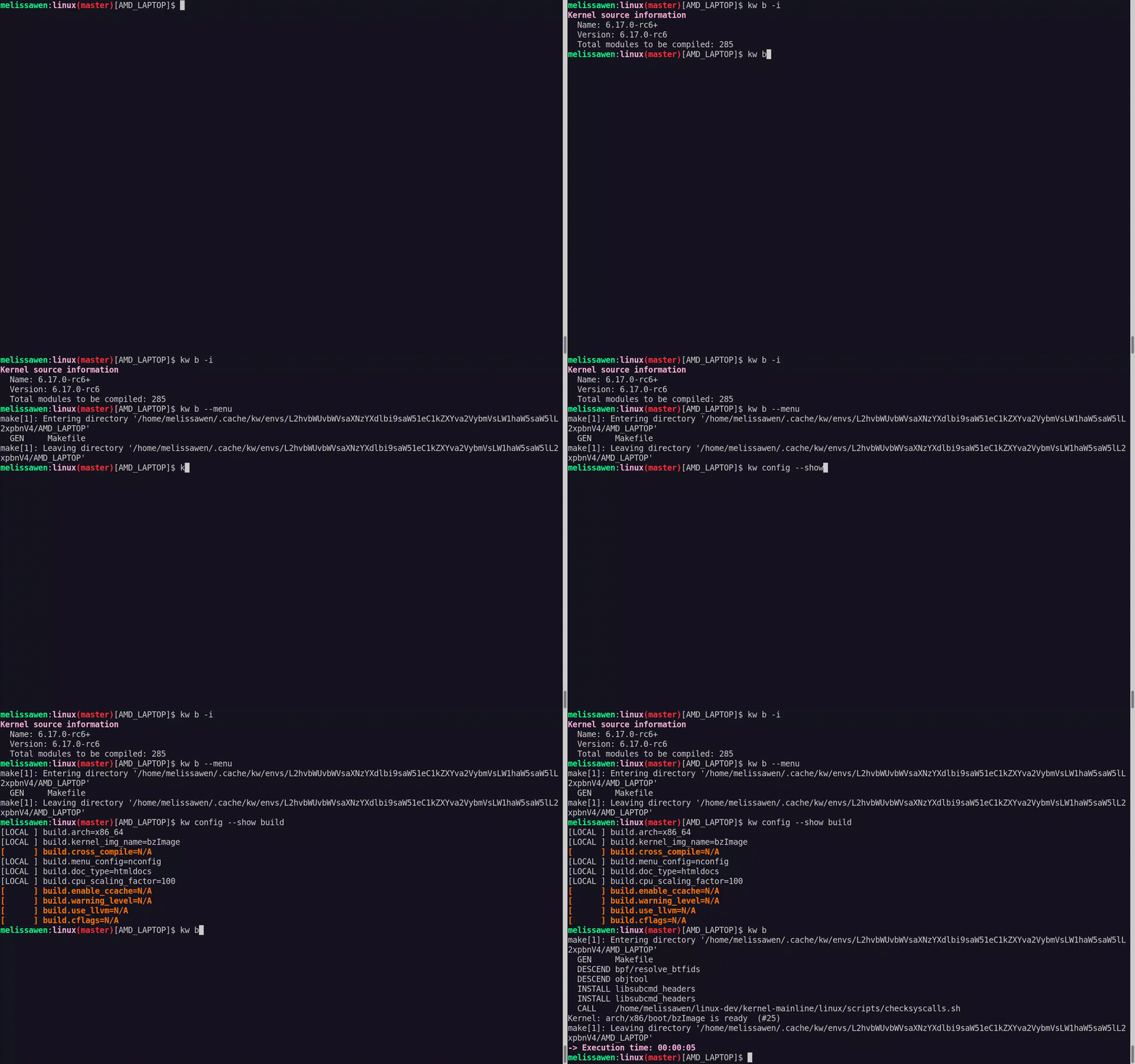
  • kw b and its options wrap many routines of compiling a custom kernel.
    • You can run kw b -i to check the name and kernel version and the number of modules that will be compiled and kw b --menu to change kernel configurations.
    • You can also pre-configure compiling preferences in kw config regarding kernel building. For example, target architecture, the name of the generated kernel image, if you need to cross-compile this kernel for a different system and which tool to use for it, setting different warning levels, compiling with CFlags, etc.
    • Then you can just run kw b to compile the custom kernel for a target machine.
Second step: Bake it with kw deploy or just kw d Slide 18: kw deploy After compiling the custom kernel, we want to install it in the target machine. Check the name of the custom kernel built: 6.17.0-rc6 and with kw s SSH access the target machine and see it s running the kernel from the Debian distribution 6.16.7+deb14-amd64. As with building settings, you can also pre-configure some deployment settings, such as compression type, path to device tree binaries, target machine (remote, local, vm), if you want to reboot the target machine just after deploying your custom kernel, and if you want to boot in the custom kernel when restarting the system after deployment. If you didn t pre-configured some options, you can still customize as a command option, for example: kw d --reboot will reboot the system after deployment, even if I didn t set this in my preference. With just running kw d --reboot I have installed the kernel in a given target machine and rebooted it. So when accessing the system again I can see it was booted in my custom kernel. Third step: Time to taste with kw debug Slide 20: kw debug
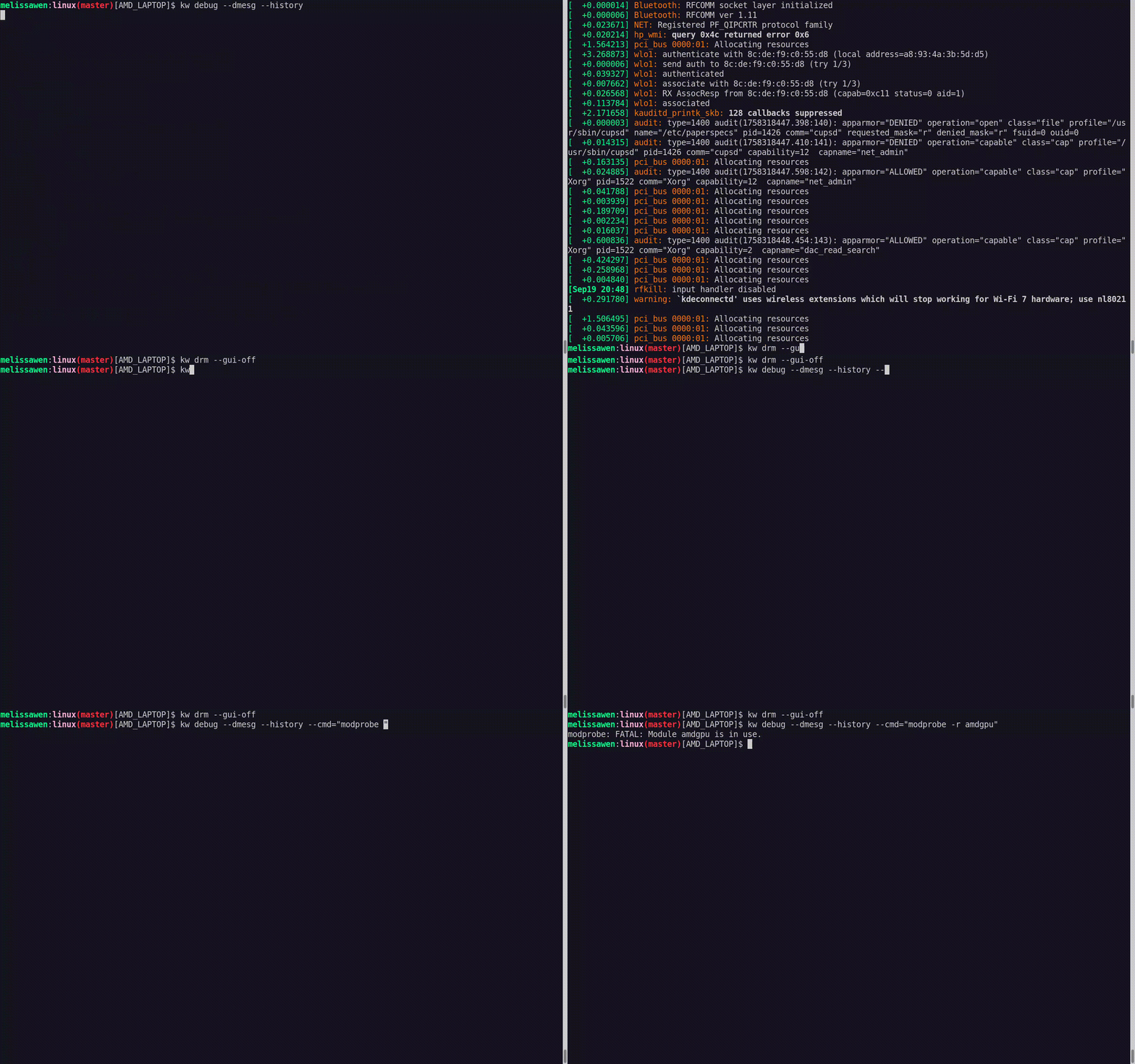
  • kw debug wraps many tools for validating a kernel in a target machine. We can log basic dmesg info but also tracking events and ftrace.
    • With kw debug --dmesg --history we can grab the full dmesg log from a remote machine, if you use the --follow option, you will monitor dmesg outputs. You can also run a command with kw debug --dmesg --cmd="<my command>" and just collect the dmesg output related to this specific execution period.
    • In the example, I ll just unload the amdgpu driver. I use kw drm --gui-off to drop the graphical interface and release the amdgpu for unloading it. So I run kw debug --dmesg --cmd="modprobe -r amdgpu" to unload the amdgpu driver, but it fails and I couldn t unload it.

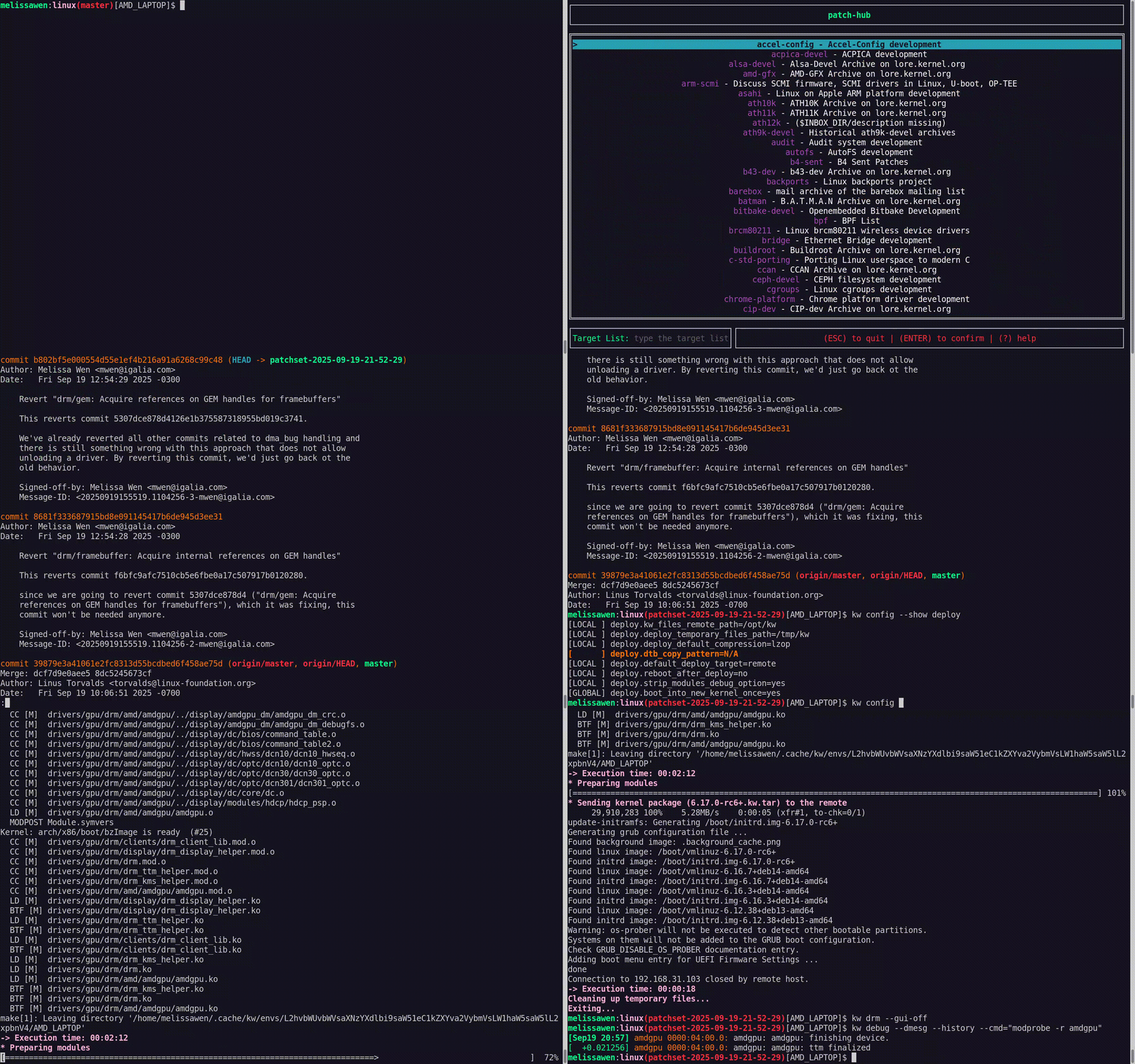
Cooking Problems Slide 22: kw patch-hub Oh no! That custom kernel isn t tasting good. Don t worry, as in many recipes preparations, we can search on the internet to find suggestions on how to make it tasteful, alternative ingredients and other flavours according to your taste. With kw patch-hub you can search on the lore kernel mailing list for possible patches that can fix your kernel issue. You can navigate in the mailing lists, check series, bookmark it if you find it relevant and apply it in your local kernel tree, creating a different branch for tasting oops, for testing. In this example, I m opening the amd-gfx mailing list where I can find contributions related to the AMD GPU driver, bookmark and/or just apply the series to my work tree and with kw bd I can compile & install the custom kernel with this possible bug fix in one shot. As I changed my kw config to reboot after deployment, I just need to wait for the system to boot to try again unloading the amdgpu driver with kw debug --dmesg --cm=modprobe -r amdgpu. From the dmesg output retrieved by kw for this command, the driver was unloaded, the problem is fixed by this series and the kernel tastes good now. If I m satisfied with the solution, I can even use kw patch-hub to access the bookmarked series and marking the checkbox that will reply the patch thread with a Reviewed-by tag for me.

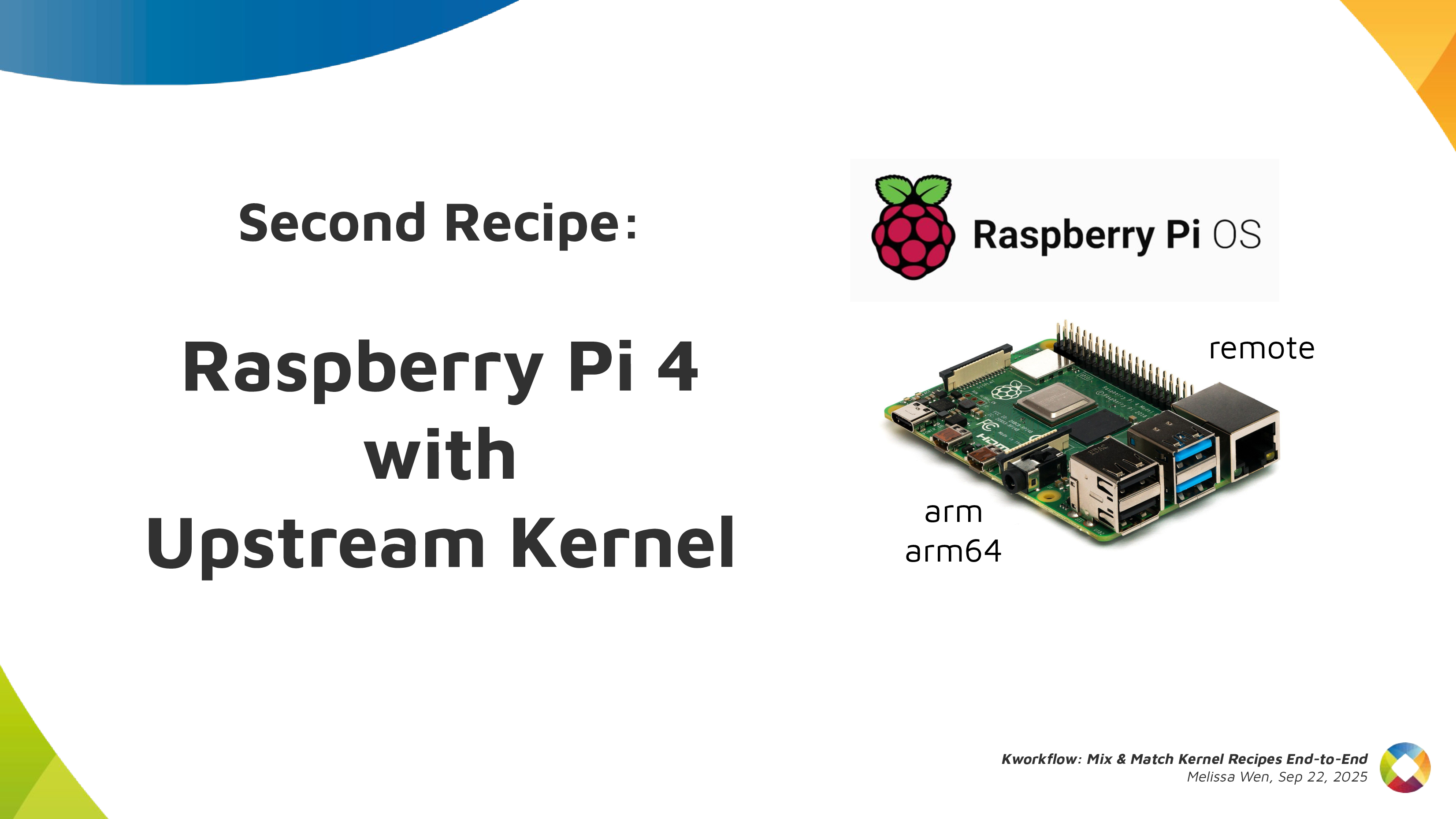
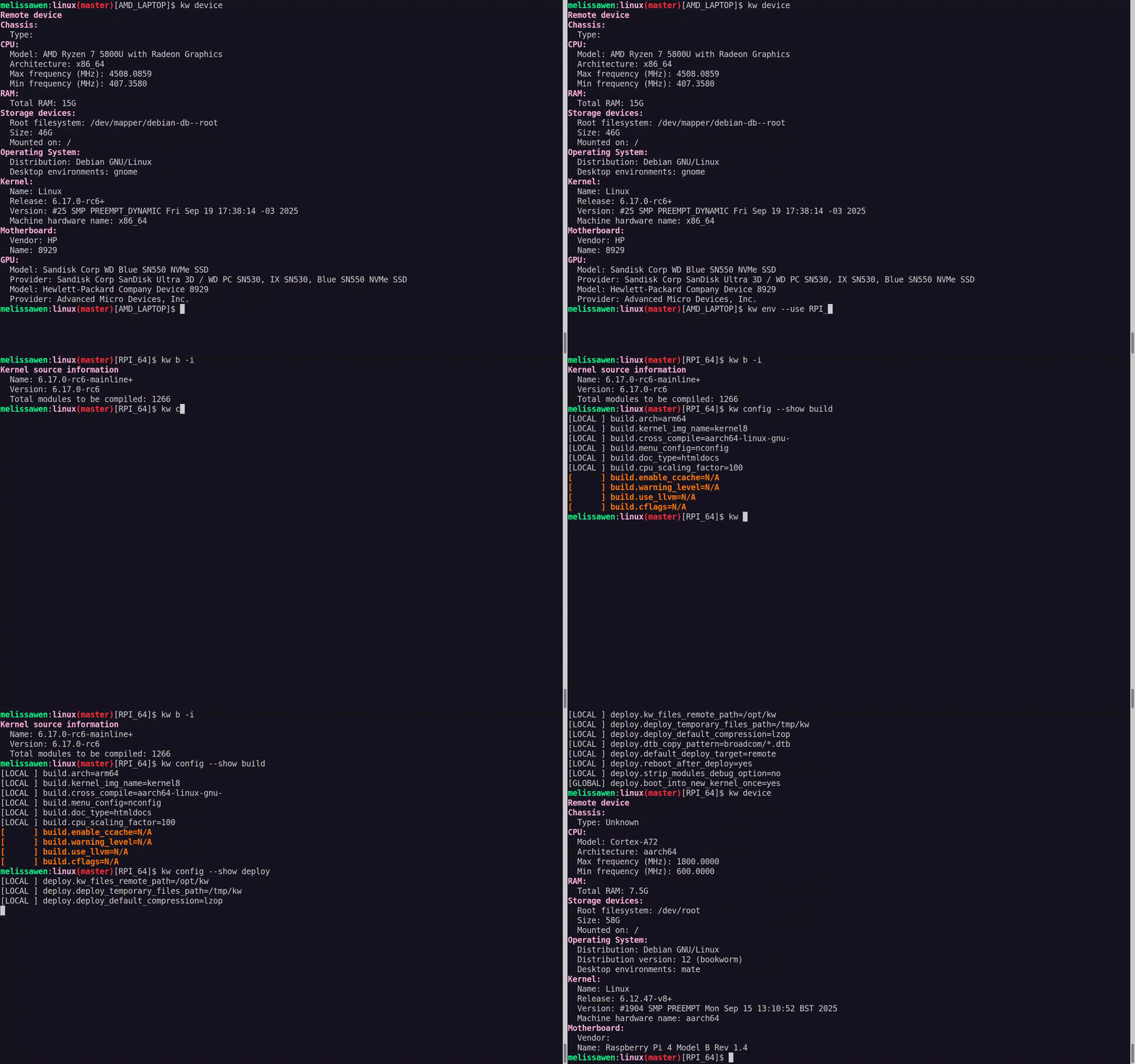
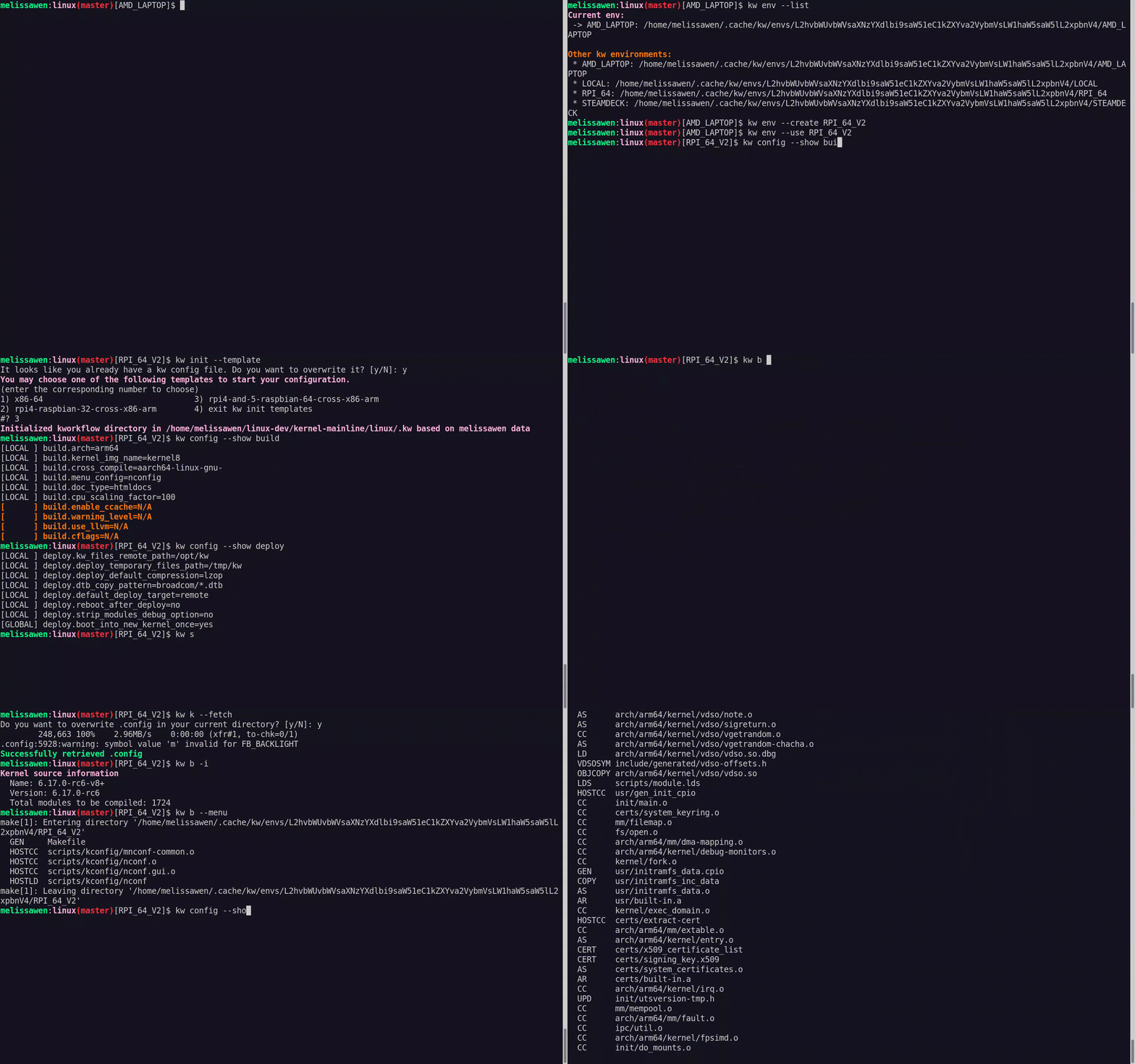
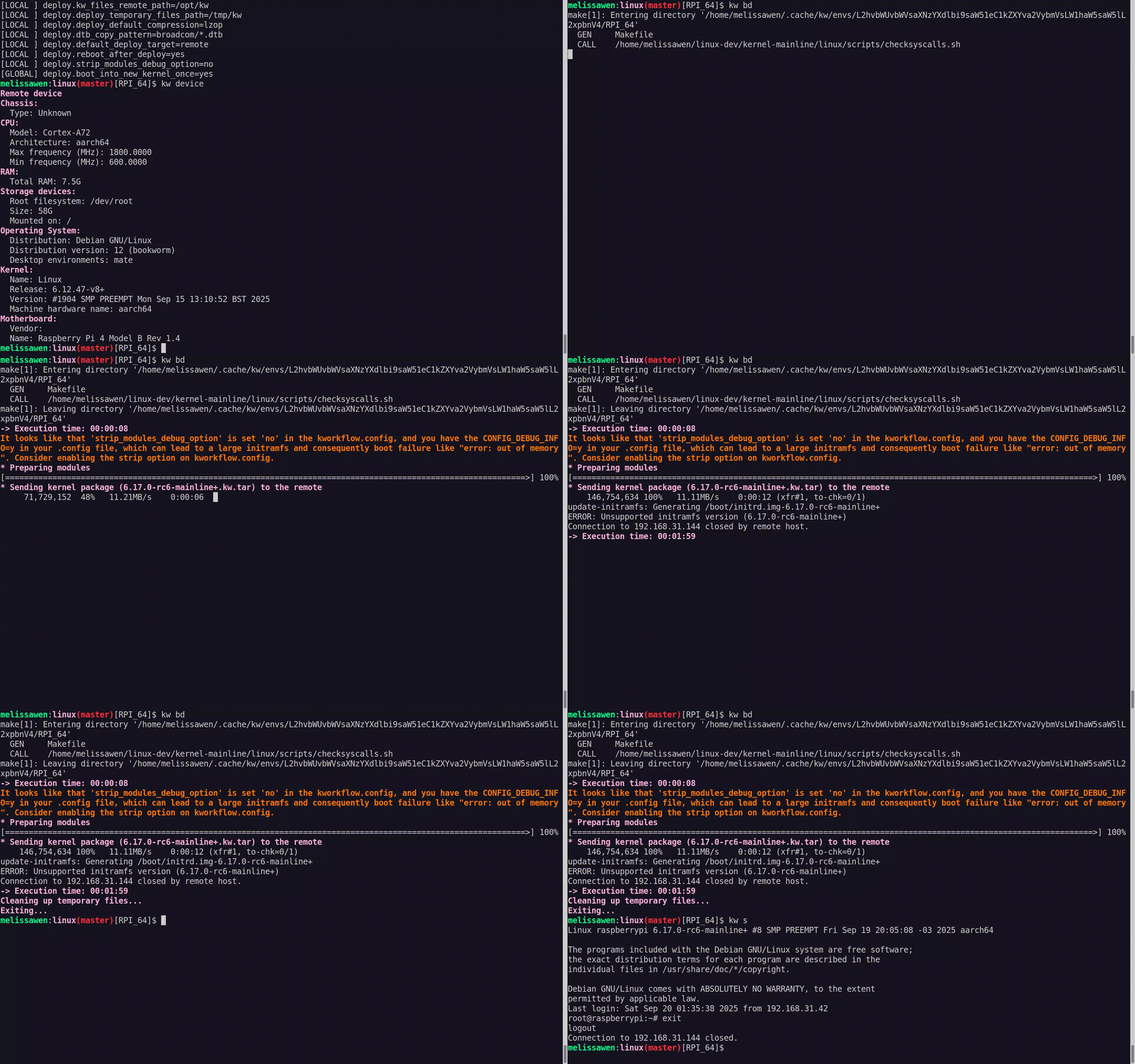
Second Recipe: Raspberry Pi 4 with Upstream Kernel Slide 25: Second Recipe RPi 4 with upstream kernel As in all recipes, we need ingredients and tools, but with kworkflow you can get everything set as when changing scenarios in a TV show. We can use kw env to change to a different environment with all kw and kernel configuration set and also with the latest compiled kernel cached. I was preparing the first recipe for a x86 AMD laptop and with kw env --use RPI_64 I use the same worktree but moved to a different kernel workflow, now for Raspberry Pi 4 64 bits. The previous compiled kernel 6.17.0-rc6-mainline+ is there with 1266 modules, not the 6.17.0-rc6 kernel with 285 modules that I just built&deployed. kw build settings are also different, now I m targeting a arm64 architecture with a cross-compiled kernel using aarch64-linu-gnu- cross-compilation tool and my kernel image calls kernel8 now. Slide 27: kw env If you didn t plan for this recipe in advance, don t worry. You can create a new environment with kw env --create RPI_64_V2 and run kw init --template to start preparing your kernel recipe with the mirepoix ready. I mean, with the basic ingredients already cut I mean, with the kw configuration set from a template. And you can use kw remote to set the IP address of your target machine and kw kernel-config-manager to fetch/retrieve the .config file from your target machine. So just run kw bd to compile and install a upstream kernel for Raspberry Pi 4.

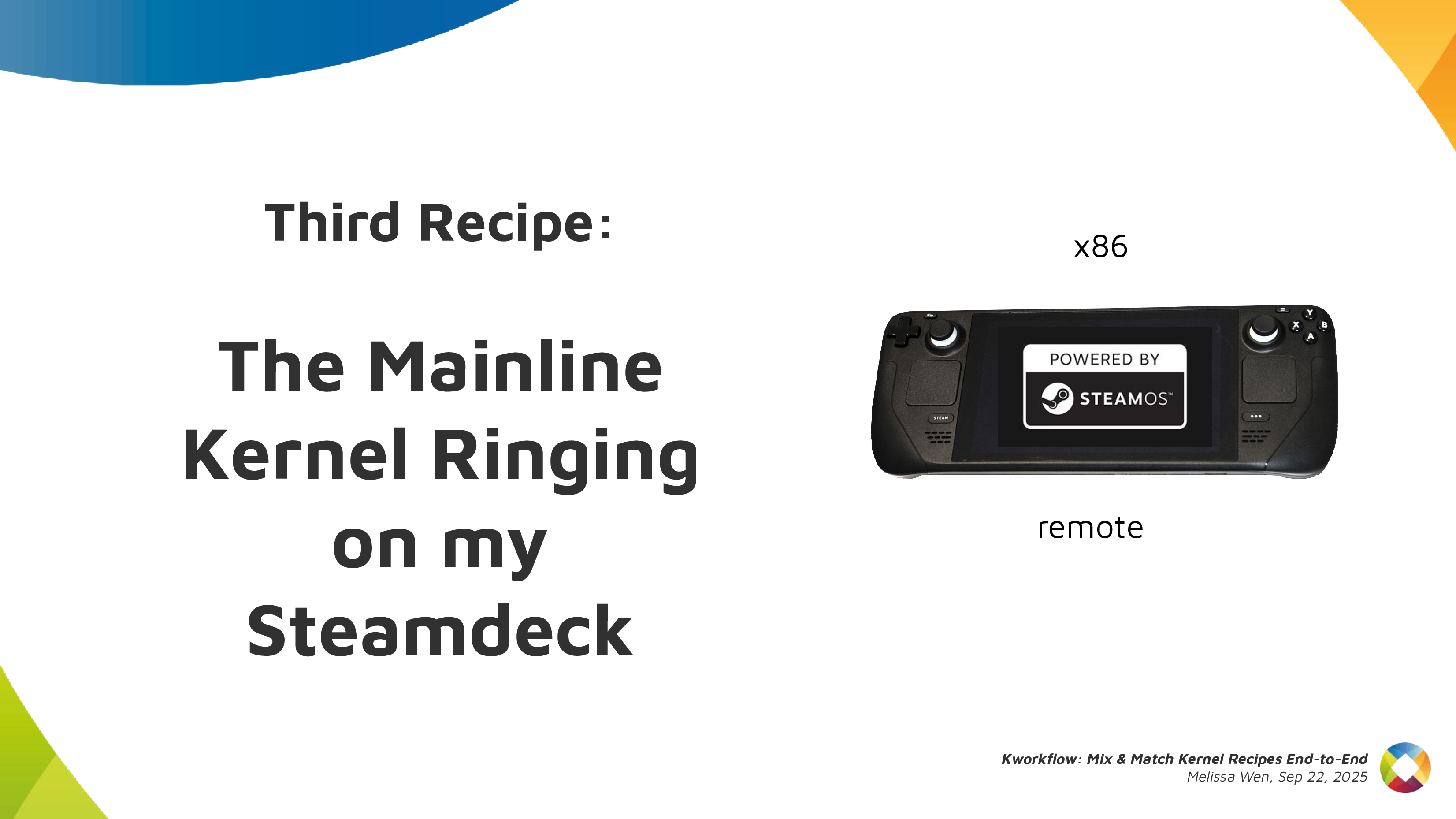
Third Recipe: The Mainline Kernel Ringing on my Steam Deck (Live Demo) Slide 30: Third Recipe - The Mainline Kernel Ringing on my Steam Deck Let s show you how easy is to build, install and test a custom kernel for Steam Deck with Kworkflow. It s a live demo, but I also recorded it because I know the risks I m exposed to and something can go very wrong just because of reasons :)

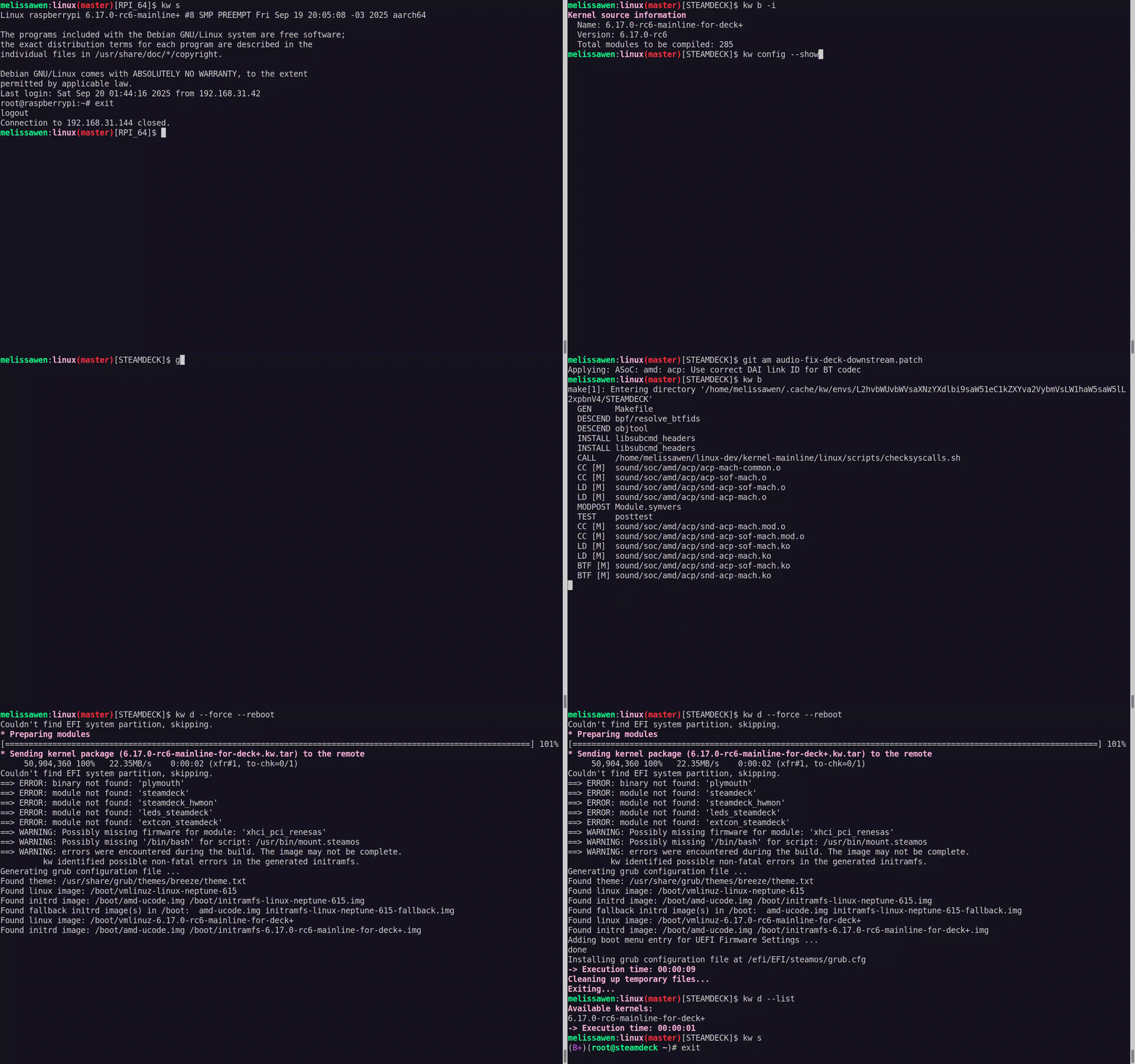
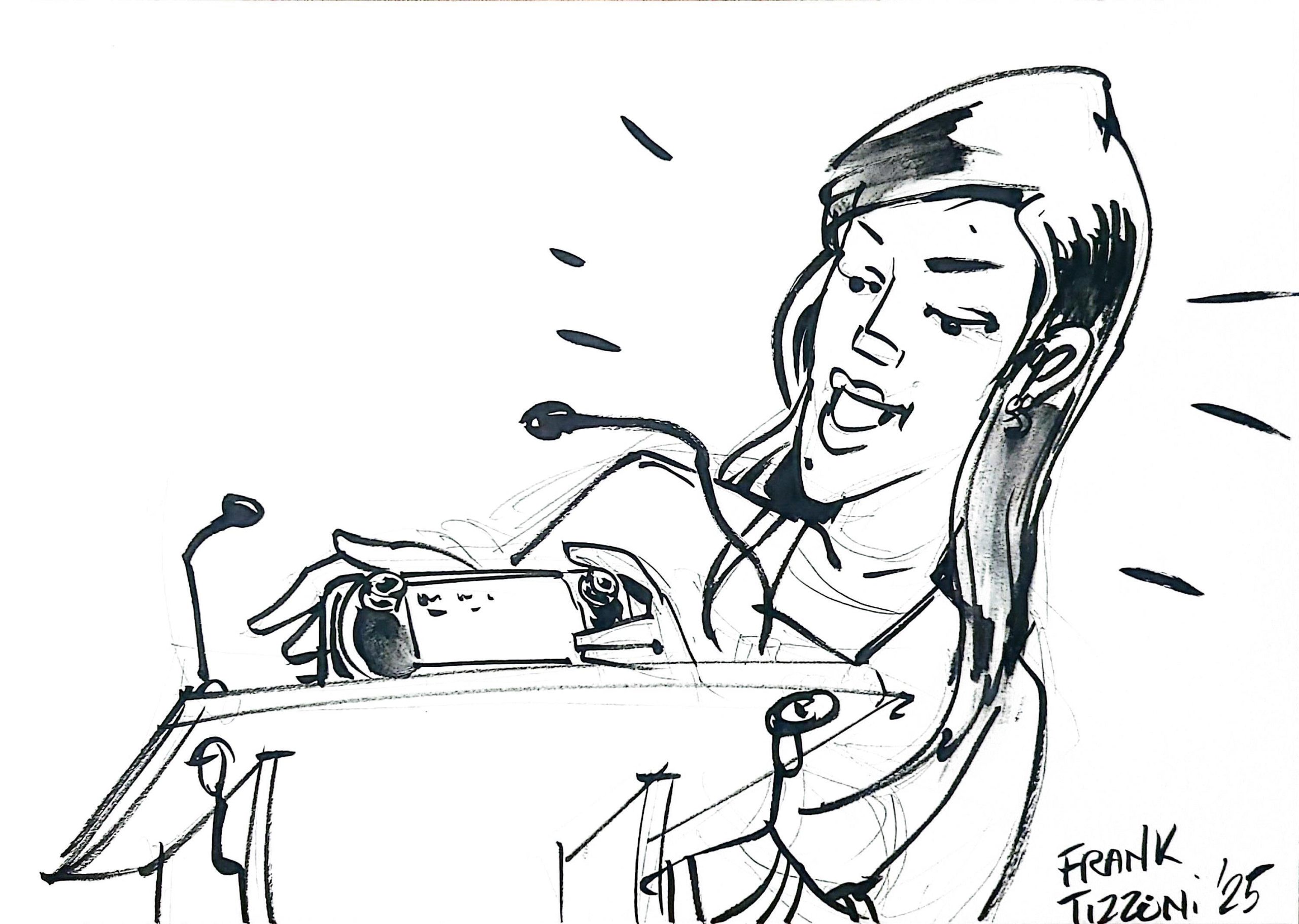
Report: how was the live demo For this live demo, I took my OLED Steam Deck to the stage. I explained that, if I boot mainline kernel on this device, there is no audio. So I turned it on and booted the mainline kernel I ve installed beforehand. It was clear that there was no typical Steam Deck startup audio when the system was loaded. Franks drawing of Melissa Wen doing a demo of kworkflow with the Steam Deck As I started the demo in the kw environment for Raspberry Pi 4, I first moved to another environment previously used for Steam Deck. In this STEAMDECK environment, the mainline kernel was already compiled and cached, and all settings for accessing the target machine, compiling and installing a custom kernel were retrieved automatically. My live demo followed these steps:
  1. With kw env --use STEAMDECK, switch to a kworkflow environment for Steam Deck kernel development.
  2. With kw b -i, shows that kw will compile and install a kernel with 285 modules named 6.17.0-rc6-mainline-for-deck.
  3. Run kw config to show that, in this environment, kw configuration changes to x86 architecture and without cross-compilation.
  4. Run kw device to display information about the Steam Deck device, i.e. the target machine. It also proves that the remote access - user and IP - for this Steam Deck was already configured when using the STEAMDECK environment, as expected.
  5. Using git am, as usual, apply a hot fix on top of the mainline kernel. This hot fix makes the audio play again on Steam Deck.
  6. With kw b, build the kernel with the audio change. It will be fast because we are only compiling the affected files since everything was previously done and cached. Compiled kernel, kw configuration and kernel configuration is retrieved by just moving to the STEAMDECK environment.
  7. Run kw d --force --reboot to deploy the new custom kernel to the target machine. The --force option enables us to install the mainline kernel even if mkinitcpio complains about missing support for downstream packages when generating initramfs. The --reboot option makes the device reboot the Steam Deck automatically, just after the deployment completion.
  8. After finishing deployment, the Steam Deck will reboot on the new custom kernel version and made a clear resonant or vibrating sound. [Hopefully]
Finally, I showed to the audience that, if I wanted to send this patch upstream, I just needed to run kw send-patch and kw would automatically add subsystem maintainers, reviewers and mailing lists for the affected files as recipients, and send the patch to the upstream community assessment. As I didn t want to create unnecessary noise, I just did a dry-run with kw send-patch -s --simulate to explain how it looks.

What else can kworkflow already mix & match? In this presentation, I showed that kworkflow supported different kernel development workflows, i.e., multiple distributions, different bootloaders and architectures, different target machines, different debugging tools and automatize your kernel development routines best practices, from development environment setup and verifying a custom kernel in bare-metal to sending contributions upstream following the contributions-by-e-mail structure. I exemplified it with three different target machines: my ordinary x86 AMD laptop with Debian, Raspberry Pi 4 with arm64 Raspbian (cross-compilation) and the Steam Deck with SteamOS (x86 Arch-based OS). Besides those distributions, Kworkflow also supports Ubuntu, Fedora and PopOS. Now it s your turn: Do you have any secret recipes to share? Please share with us via kworkflow.

Dirk Eddelbuettel: duckdb-mlpack 0.0.3: macOS binaries, unit tests, more outputs

A littler two weeks a short post announced the duckdb-mlpack as ML quacks : combining the powerful C++ machine learning library mlpack with the amazing analytical database engine duckdb. About a week ago another short post covered first extensions. We actually followed-up with release 0.0.3 days later, and never posted about it so this short note catches up. In release 0.0.3, we provide macOS binaries: following a known issue with one of the components, we apply a simple patch to enable the build. Next up are wasm and windows, if you know your way around these platforms please get in touch. Release 0.0.3 also added first unit tests, serializes the coefficients from the (regularized) linear regression into the output table. See see two previous posts linked above for details and background, the repo for code, issues and more, and the extension page for more about this duckdb community extension.

This post by Dirk Eddelbuettel originated on his Thinking inside the box blog. If you like this or other open-source work I do, you can sponsor me at GitHub.

2 November 2025

Ben Hutchings: FOSS activity in October 2025

31 October 2025

Scarlett Gately Moore: A New Chapter: Career Transition Update

I m pleased to share that my career transition has been successful! I ve joined our local county assessor s office, beginning a new path in property assessment for taxation and valuation. While the compensation is modest, it offers the stability I was looking for. My new schedule consists of four 10-hour days with an hour commute each way, which means Monday through Thursday will be largely devoted to work and travel. However, I ll have Fridays available for open source contributions once I ve completed my existing website maintenance commitments.

Open Source Priorities Going forward, my contribution focus will be:
  1. Ubuntu Community Council
  2. Kubuntu/Debian
  3. Snap packages (as time permits)
Regarding the snap packages: my earlier hope of transitioning them to Carl hasn t worked out as planned. He s taken on maintaining KDE Neon single-handedly, and understandably, adding snap maintenance on top of that proved unfeasible. I ll do what I can to help when time allows.

Looking for Contributors If you re interested in contributing to Kubuntu or helping with snap packages, I d love to hear from you! Feel free to reach out community involvement is what makes these projects thrive. Thanks for your patience and understanding as I navigate this transition.

28 October 2025

Russ Allbery: Review: Those Who Wait

Review: Those Who Wait, by Haley Cass
Publisher: Haley Cass
Copyright: 2020
ISBN: 979-8-9884929-1-7
Format: Kindle
Pages: 556
Those Who Wait is a stand-alone self-published sapphic romance novel. Given the lack of connection between political figures named in this book and our reality, it's also technically an alternate history, but it will be entirely unsatisfying to anyone who reads it in that genre. Sutton Spencer is an English grad student in New York City. As the story opens, she has recently realized that she's bisexual rather than straight. She certainly has not done anything about that revelation; the very thought makes her blush. Her friend and roommate Regan, not known for either her patience or her impulse control, decides to force the issue by stealing Sutton's phone, creating a profile on a lesbian dating app, and messaging the first woman Sutton admits being attracted to. Charlotte Thompson is a highly ambitious politician, current deputy mayor of New York City for health and human services, and granddaughter of the first female president of the United States. She fully intends to become president of the United States herself. The next step on that path is an open special election for a seat in the House of Representatives. With her family political connections and the firm support of the mayor of New York City (who is also dating her brother), she thinks she has an excellent shot of winning. Charlotte is also a lesbian, something she's known since she was a teenager and which still poses serious problems for a political career. She is therefore out to her family and a few close friends, but otherwise in the closet. Compared to her political ambitions, Charlotte considers her love life almost irrelevant, and therefore has a strict policy of limiting herself to anonymous one-night stands arranged on dating apps. Even that is about to become impossible given her upcoming campaign, but she indulges in one last glance at SapphicSpark before she deletes her account. Sutton is as far as possible from the sort of person who does one-night stands, which is a shame as far as Charlotte is concerned. It would have been a fun last night out. Despite that, both of them find the other unexpectedly enjoyable to chat with. (There are a lot of text message bubbles in this book.) This is when Sutton has her brilliant idea: Charlotte is charming, experienced, and also kind and understanding of Sutton's anxiety, at least in app messages. Maybe Charlotte can be her mentor? Tell her how to approach women, give her some guidance, point her in the right directions. Given the genre, you can guess how this (eventually) turns out. I'm going to say a lot of good things about this book, so let me get the complaints over with first. As you might guess from that introduction, Charlotte's political career and the danger of being outed are central to this story. This is a bit unfortunate because you should not, under any circumstances, attempt to think deeply about the politics in this book. In 550 pages, Charlotte does not mention or expound a single meaningful political position. You come away from this book as ignorant about what Charlotte wants to accomplish as a politician as you entered. Apparently she wants to be president because her grandmother was president and she thinks she'd be good at it. The closest the story comes to a position is something unbelievably vague about homeless services and Charlotte's internal assertion that she wants to help people and make real change. There are even transcripts of media interviews, later in the book, and they somehow manage to be more vacuous than US political talk shows, which is saying something. I also can't remember a single mention of fundraising anywhere in this book, which in US politics is absurd (although I will be generous and say this is due to Cass's alternate history). I assume this was a deliberate choice and Cass didn't want politics to distract from the romance, but as someone with a lot of opinions about concrete political issues, the resulting vague soft-liberal squishiness was actively off-putting. In an actual politician, this would be an entire clothesline of red flags. Thankfully, it's ignorable for the same reason; this is so obviously not the focus of the book that one can mostly perform the same sort of mental trick that one does when ignoring the backdrop in a cheap theater. My second complaint is that I don't know what Sutton does outside of the romance. Yes, she's an English grad student, and she does some grading and some vaguely-described work and is later referred to a prestigious internship, but this is as devoid of detail as Charlotte's political positions. It's not quite as jarring because Cass does eventually show Sutton helping concretely with her mother's work (about which I have some other issues that I won't get into), but it deprives Sutton of an opportunity to be visibly expert in something. The romance setup casts Charlotte as the experienced one to Sutton's naivete, and I think it would have been a better balance to give Sutton something concrete and tangible that she was clearly better at than Charlotte. Those complaints aside, I quite enjoyed this. It was a recommendation from the same BookTuber who recommended Delilah Green Doesn't Care, so her recommendations are quickly accumulating more weight. The chemistry between Sutton and Charlotte is quite believable; the dialogue sparkles, the descriptions of the subtle cues they pick up from each other are excellent, and it's just fun to read about how they navigate a whole lot of small (and sometimes large) misunderstandings and mismatches in personality and world view. Normally, misunderstandings are my least favorite part of a romance novel, but Sutton and Charlotte come from such different perspectives that their misunderstandings feel more justified than is typical. The characters are also fairly mature about working through them: Main characters who track the other character down and insist on talking when something happens they don't understand! Can you imagine! Only with the third-act breakup is the reader dragged through multiple chapters of both characters being miserable, and while I also usually hate third-act breakups, this one is so obviously coming and so clearly advertised from the initial setup that I couldn't really be mad. I did wish the payoff make-up scene at the end of the book had a bit more oomph, though; I thought Sutton's side of it didn't have quite the emotional catharsis that it could have had. I particularly enjoyed the reasons why the two characters fall in love, and how different they are. Charlotte is delighted by Sutton because she's awkward and shy but also straightforward and frequently surprisingly blunt, which fits perfectly with how much Charlotte is otherwise living in a world of polished politicians in constant control of their personas. Sutton's perspective is more physical, but the part I liked was the way that she treats Charlotte like a puzzle. Rather than trying to change how Charlotte expresses herself, she instead discovers that she's remarkably good at reading Charlotte if she trusts her instincts. There was something about Sutton's growing perceptiveness that I found quietly delightful. It's the sort of non-sexual intimacy that often gets lost among the big emotions in romance novels. The supporting cast was also great. Both characters have deep support networks of friends and family who are unambiguously on their side. Regan is pure chaos, and I would not be friends with her, but Cass shows her deep loyalty in a way that makes her dynamic with Sutton make sense. Both characters have thoughtful and loving families who support them but don't make decisions for them, which is a nice change of pace from the usually more mixed family situations of romance novel protagonists. There's a lot of emotional turbulence in the main relationship, and I think that only worked for me because of how rock-solid and kind the supporting cast is. This is, as you might guess from the title, a very slow burn, although the slow burn is for the emotional relationship rather than the physical one (for reasons that would be spoilers). As usual, I have no calibration for spiciness level, but I'd say that this was roughly on par with the later books in the Bright Falls series. If you know something about politics (or political history) and try to take that part of this book seriously, it will drive you to drink, but if you can put that aside and can deal with misunderstandings and emotional turmoil, this was both fun and satisfying. I liked both of the characters, I liked the timing of the alternating viewpoints, and I believed in the relationship and chemistry, as improbable and chaotic as some of the setup was. It's not the greatest thing I ever read, and I wish the ending was a smidgen stronger, but it was an enjoyable way to spend a few reading days. Recommended. Rating: 7 out of 10

27 October 2025

Dirk Eddelbuettel: #054: Faster r-ci Continuous Integration via r2u Container

Welcome to post 54 in the R4 series. The topic of continuous integration has been a recurrent theme here at the R4 series. Post #32 introducess r-ci, while post #41 brings r2u to r-ci, but does not show a matrix deployment. Post #45 describes the updated r-ci setup that is now the default and contains a macOS and Ubuntu matrix, where the latter relies on r2u to keep things fast, easy, reliable . Last but not least more recent post #52 shares a trick for ensuring coverage reports. Following #45, use of r-ci at for example GitHub Actions has seen steady use and very reliable performance. With the standard setup, a vanilla Ubuntu setup is changed into one supported by r2u. This requires downloading and installating a few Ubuntu packages, and has generally been fairly quick on the order of around fourty seconds. Now, the general variability of run-times for identical tasks in GitHub Actions is well documented by the results of the setup described in post #39 which still runs weekly. It runs the identical SQL query against a remote backend using two different package families. And lo and behold, the intra-method variability on unchanged code or setup and therefore due solely to system variability is about as large as the inter-method variability. In short, GitHub Actions performance varies randomly with significant variability. See the repo README.md for chart that updates weekly (and see #39 for background). Of late, this variability became more noticeable during standard GitHub Actions runs where it would regularly take more than two minutes of setup time before actual continuous integration work was done. Some caching seems to be in effect, so subsequent runs in the same repo seem faster and often came back to one minute or less. For lightweight and small packages, loosing two minutes to setup when the actual test time is a minute or less gets old fast. Looking around, we noticed that container use can be combined with matrix use. So we have now been deploying the following setup (not always over all the matrix elements though)
jobs:
  ci:
    strategy:
      matrix:
        include:
          -   name: container, os: ubuntu-latest, container: rocker/r2u4ci  
          -   name: macos,     os: macos-latest   
          -   name: ubuntu,    os: ubuntu-latest  

    runs-on: $  matrix.os  
    container: $  matrix.container  
GitHub Actions is smart enough to provide NULL for container in the two other cases, so container: $ matrix.container is ignored there. But when container is set as here for the ci-enhanced version of r2u (which adds a few binaries commonly needed such as git, curl, wget etc needed for CI) then the CI jobs runs inside the container. And thereby skips most of the setup time as the container is already prepared. This also required some small adjustments in the underlying shell script doing the work. To not disrupt standard deployment, we placed these into a release candidate / development version one can op into via an new variable dev_version
      - name: Setup
        uses: eddelbuettel/github-actions/r-ci@master
        with:
          dev_version: 'TRUE'
Everything else remains the same and works as before. But faster as much less time is spent on setup. You can see the actual full yaml file and actions in my repositories for rcpparmadillo and rcppmlpack-examples. Additional testing would be welcome, so feel free to deploy this in your actions now. Otherwise I will likely carry this over and make it the defaul in a few weeks time. It will still work as before but when the added container: line is used will run much faster thanks to rocker/r2u4ci being already set up for CI.

This post by Dirk Eddelbuettel originated on his Thinking inside the box blog. If you like this or other open-source work I do, you can now sponsor me at GitHub.

26 October 2025

Dirk Eddelbuettel: duckdb-mlpack 0.0.2: mlpack is now a duckdb community extension

A couple of days ago in a short post, I announced duckdb-mlpack as ML quacks : combining the powerful C++ machine learning library mlpack with the amazing analytical database engine duckdb. See that post for more background. The duckdb-mlpack package is now a community extension joining an impressive list of existing extensions. This means duckdb builds and distributes duckdb-mlpack for all supported platforms allowing users to just install the resulting (signed) binary. (We currently only support Linux in both arm64 and amd64, adding macOS should be straightforward once we sort one build issue out. Windows and WASM should work too, with a little love and polish, as both duckdb and mlpack support them.) Given the binary build, a simple
INSTALL mlpack FROM community;
LOAD mlpack;
installs and loads the package. By the duckdb convention the code is stored per-user and per-version, so the first line needs to be executed only once per duckdb release used. The second line is then per session. We also extended the capabilities of duckdb-mlpack. While still a MVP stressing minimal viable product, the two supported methods adaBoost and (regularized) linear regression both serialize and store their model object permitting rapid prediction on new data as shown in the adaBoost example:
-- Perform adaBoost (using weak learner 'Perceptron' by default)
-- Read 'features' into 'X', 'labels' into 'Y', use optional parameters
-- from 'Z', and prepare model storage in 'M'
CREATE TABLE X AS SELECT * FROM read_csv("https://eddelbuettel.github.io/duckdb-mlpack/data/iris.csv");
CREATE TABLE Y AS SELECT * FROM read_csv("https://eddelbuettel.github.io/duckdb-mlpack/data/iris_labels.csv");
CREATE TABLE Z (name VARCHAR, value VARCHAR);
INSERT INTO Z VALUES ('iterations', '50'), ('tolerance', '1e-7');
CREATE TABLE M (json VARCHAR);

-- Train model for 'Y' on 'X' using parameters 'Z', store in 'M'
CREATE TEMP TABLE A AS SELECT * FROM mlpack_adaboost("X", "Y", "Z", "M");

-- Count by predicted group
SELECT COUNT(*) as n, predicted FROM A GROUP BY predicted;

-- Model 'M' can be used to predict
CREATE TABLE N (x1 DOUBLE, x2 DOUBLE, x3 DOUBLE, x4 DOUBLE);
-- inserting approximate column mean values
INSERT INTO N VALUES (5.843, 3.054, 3.759, 1.199);
-- inserting approximate column mean values, min values, max values
INSERT INTO N VALUES (5.843, 3.054, 3.759, 1.199), (4.3, 2.0, 1.0, 0.1), (7.9, 4.4, 6.9, 2.5);
-- and this predict one element each
SELECT * FROM mlpack_adaboost_pred("N", "M");
Ryan and I have some ideas for where to go from here, ideally towards autogenerating bindings for most (if not all) methods as is done for the mlpack language bindings. Anybody interested and willing to help should reach out to us.

This post by Dirk Eddelbuettel originated on his Thinking inside the box blog. If you like this or other open-source work I do, you can sponsor me at GitHub.

Russ Allbery: Review: Ancestral Night

Review: Ancestral Night, by Elizabeth Bear
Series: White Space #1
Publisher: Saga Press
Copyright: 2019
ISBN: 1-5344-0300-0
Format: Kindle
Pages: 501
Ancestral Night is a far-future space opera novel and the first of a series. It shares a universe with Bear's earier Jacob's Ladder trilogy, and there is a passing reference to the events of Grail that would be a spoiler if you put the pieces together, but it's easy to miss. You do not need to read the earlier series to read this book (although it's a good series and you might enjoy it). Halmey Dz is a member of the vast interstellar federation called the Synarche, which has put an end to war and other large-scale anti-social behavior through a process called rightminding. Every person has a neural implant that can serve as supplemental memory, off-load some thought processes, and, crucially, regulate neurotransmitters and hormones to help people stay on an even keel. It works, mostly. One could argue Halmey is an exception. Raised in a clade that took rightminding to an extreme of suppression of individual personality into a sort of hive mind, she became involved with a terrorist during her legally mandated time outside of her all-consuming family before she could make an adult decision to stay with them (essentially a rumspringa). The result was a tragedy that Halmey doesn't like to think about, one that's left deep emotional scars. But Halmey herself would argue she's not an exception: She's put her history behind her, found partners that she trusts, and is a well-adjusted member of the Synarche.
Eventually, I realized that I was wasting my time, and if I wanted to hide from humanity in a bottle, I was better off making it a titanium one with a warp drive and a couple of carefully selected companions.
Halmey does salvage: finding ships lost in white space and retrieving them. One of her partners is Connla, a pilot originally from a somewhat atavistic world called Spartacus. The other is their salvage tug.
The boat didn't have a name. He wasn't deemed significant enough to need a name by the authorities and registries that govern such things. He had a registration number 657-2929-04, Human/Terra and he had a class, salvage tug, but he didn't have a name. Officially. We called him Singer. If Singer had an opinion on the issue, he'd never registered it but he never complained. Singer was the shipmind as well as the ship or at least, he inhabited the ship's virtual spaces the same way we inhabited the physical ones but my partner Connla and I didn't own him. You can't own a sentience in civilized space.
As Ancestral Night opens, the three of them are investigating a tip of a white space anomoly well off the beaten path. They thought it might be a lost ship that failed a transition. What they find instead is a dead Ativahika and a mysterious ship equipped with artificial gravity. The Ativahikas are a presumed sentient race of living ships that are on the most alien outskirts of the Synarche confederation. They don't communicate, at least so far as Halmey is aware. She also wasn't aware they died, but this one is thoroughly dead, next to an apparently abandoned ship of unknown origin with a piece of technology beyond the capabilities of the Synarche. The three salvagers get very little time to absorb this scene before they are attacked by pirates. I have always liked Bear's science fiction better than her fantasy, and this is no exception. This was great stuff. Halmey is a talkative, opinionated infodumper, which is a great first-person protagonist to have in a fictional universe this rich with delightful corners. There are some Big Dumb Object vibes (one of my favorite parts of salvage stories), solid character work, a mysterious past that has some satisfying heft once it's revealed, and a whole lot more moral philosophy than I was expecting from the setup. All of it is woven together with experienced skill, unsurprising given Bear's long and prolific career. And it's full of delightful world-building bits: Halmey's afthands (a surgical adaptation for zero gravity work) and grumpiness at the sheer amount of gravity she has to deal with over the course of this book, the Culture-style ship names, and a faster-than-light travel system that of course won't pass physics muster but provides a satisfying quantity of hooky bits for plot to attach to. The backbone of this book is an ancient artifact mystery crossed with a murder investigation. Who killed the Ativahika? Where did the gravity generator come from? Those are good questions with interesting answers. But the heart of the book is a philosophical conflict: What are the boundaries between identity and society? How much power should society have to reshape who we are? If you deny parts of yourself to fit in with society, is this necessarily a form of oppression? I wrote a couple of paragraphs of elaboration, and then deleted them; on further thought, I don't want to give any more details about what Bear is doing in this book. I will only say that I was not expecting this level of thoughtfulness about a notoriously complex and tricky philosophical topic in a full-throated adventure science fiction novel. I think some people may find the ending strange and disappointing. I loved it, and weeks after finishing this book I'm still thinking about it. Ancestral Night has some pacing problems. There is a long stretch in the middle of the book that felt repetitive and strained, where Bear holds the reader at a high level of alert and dread for long enough that I found it enervating. There are also a few political cheap shots where Bear picks the weakest form of an opposing argument instead of the strongest. (Some of the cheap shots are rather satisfying, though.) The dramatic arc of the book is... odd, in a way that I think was entirely intentional given how well it works with the thematic message, but which is also unsettling. You may not get the catharsis that you're expecting. But all of this serves a purpose, and I thought that purpose was interesting. Ancestral Night is one of those books that I liked more a week after I finished it than I did when I finished it.
Epiphanies are wonderful. I m really grateful that our brains do so much processing outside the line of sight of our consciousnesses. Can you imagine how downright boring thinking would be if you had to go through all that stuff line by line?
Also, for once, I think Bear hit on exactly the right level of description rather than leaving me trying to piece together clues and hope I understood the plot. It helps that Halmey loves to explain things, so there are a lot of miniature infodumps, but I found them interesting and a satisfying throwback to an earlier style of science fiction that focused more on world-building than on interpersonal drama. There is drama, but most of it is internal, and I thought the balance was about right. This is solid, well-crafted work and a good addition to the genre. I am looking forward to the rest of the series. Followed by Machine, which shifts to a different protagonist. Rating: 8 out of 10

25 October 2025

Mike Gabriel: Debian Lomiri Tablets - We are hiring!

We at Fre i e Software GmbH now have a confirmed budget for working on Debian based tablets with the special goal to use them for educational purposes (i.e. in schools). Those Debian Edu tablets shall be powered by the Lomiri Operating Environment (that same operating environment that is powering Ubuntu Touch). That said, we are hiring developers (full time, part time) [*] [**]: Global tasks will be: The budget will cover work for the +/- next 1.5-2 yrs. Development achievements shall culminate in the release of Debian 14. If you are interested in joining our team, please get in touch with me via known communication channels. light+love,
Mike (aka sunweaver at debian.org) [fsgmbh] https://freiesoftware.gmbh
[*] We can employ applicants who are located in Germany, Austria or Poland (for other regions within the EU, please ask).
[**] Alternatively, if you are self-employed, we are happy to onboard you as a freelancer.

Jonathan Dowland: franken keyboard

Since it's spooky season, let me present to you the FrankenKeyboard!
The FrankenKeyboard
8bitdo retro keyboard For some reason I can't fathom, I was persuaded into buying an 8bitdo retro mechanical keyboard. It was very reasonably priced, and has a few nice fun features: built-in bluetooth and 2.4GHz wireless (with the supplied dongle); colour scheme inspired by the Nintendo Famicom; fun to use knobs for volume control; some basic macro support; and funky oversized mashable macro keys (which work really well as "Copy" and "Paste") The 8bitdo keyboards come with switch-types I had not previously experienced: Kailh Box White v2. I'm used to Cherry MX Reds, but I loved the feel of the Box White v2s. The 8bitdo keyboards all have hot-swappable key switches. It's relatively compact (comes without a numpad), but still larger than my TEX Shura, which (at home) is my daily driver. I also miss the trackpoint mouse on the Shura. Finally, the 8bitdo model I bought has American ANSI key layout, which I can tolerate but is not as nice as ISO. I later learned that they have a limited range of ISO-layout keyboards too, but not (yet) in the Famicom colour scheme I'd bought. DIY Shura My existing Shura's key switches are soldered on and can't be swapped out. But I really preferred the Kailh white switches. I decided to buy a second Shura, this time as a "DIY kit" which accepts hot-swappable switches. I then moved the Kailh Box White v2 switches over from the 8bitdo keyboard. keycaps Part of justifying buying the DIY kit was the possibility that I could sell on my older Shura with the Cherry MX Red switches. My existing Shura's key caps are for the ISO-GB layout and have their legends printed onto them. After three years the legends have faded in a few places. The DIY kit comes with a set of ABS "double-shot" key caps (where the key legends are plastic rather than printed). They look a lot nicer, but I don't look at my keys. I'm considering applying the new, pristine key caps to the old Shura board, to make it more attractive to buyers. One problem is I'm not sure the new set of caps includes the ISO-UK specific ones. It might be that potential buyers might prefer to have used caps with the correct legends rather than pristine ones which are mislabelled. franken keyboard Given I wasn't going to use the new key cap set, I borrowed most of the caps from the 8bitdo keyboard. I had to retain the G, H and B keys from my older Shura as they are specially molded to leave space for the trackpoint, and a couple of the modifier keys which weren't the right size. Hence the odd look! (It needs some tweaking. That left-ALT looks out of place. It may be that the 8bitdo caps are temporary. Left "cmd" is really Fn, and "Caps lock" is really "Super". The right-hand red dot is a second "Super".) Since taking the photo I've removed the "stabilisers" under the right-shift and backspace keys, in order to squeeze a couple more keys in their place. the new keycap set includes a regular-sized "BS" key, as the JIS keyboard layout has a regular-sized backspace. (Everyone should have a BS key in my opinion.) I plan to map my new keys to "Copy" and "Paste" actions following the advice in this article.

23 October 2025

Russ Allbery: Review: Politics on the Edge

Review: Politics on the Edge, by Rory Stewart
Publisher: Penguin Books
Copyright: 2023, 2025
Printing: 2025
ISBN: 979-8-217-06167-9
Format: Kindle
Pages: 429
Rory Stewart is a former British diplomat, non-profit executive, member of Parliament, and cabinet minister. Politics on the Edge is a memoir of his time in the UK Parliament from 2019 to 2019 as a Tory (Conservative) representing the Penrith and The Border constituency in northern England. It ends with his failed run against Boris Johnson for leader of the Conservative Party and Prime Minister. This book provoked many thoughts, only some of which are about the book. You may want to get a beverage; this review will be long. Since this is a memoir told in chronological order, a timeline may be useful. After Stewart's time as a regional governor in occupied Iraq (see The Prince of the Marshes), he moved to Kabul to found and run an NGO to preserve traditional Afghani arts and buildings (the Turquoise Mountain Foundation, about which I know nothing except what Stewart wrote in this book). By his telling, he found that work deeply rewarding but thought the same politicians who turned Iraq into a mess were going to do the same to Afghanistan. He started looking for ways to influence the politics more directly, which led him first to Harvard and then to stand for Parliament. The bulk of this book covers Stewart's time as MP for Penrith and The Border. The choice of constituency struck me as symbolic of Stewart's entire career: He was not a resident and had no real connection to the district, which he chose for political reasons and because it was the nearest viable constituency to his actual home in Scotland. But once he decided to run, he moved to the district and seems sincerely earnest in his desire to understand it and become part of its community. After five years as a backbencher, he joined David Cameron's government in a minor role as Minister of State in the Department for Environment, Food, and Rural Affairs. He then bounced through several minor cabinet positions (more on this later) before being elevated to Secretary of State for International Development under Theresa May. When May's government collapsed during the fight over the Brexit agreement, he launched a quixotic challenge to Boris Johnson for leader of the Conservative Party. I have enjoyed Rory Stewart's writing ever since The Places in Between. This book is no exception. Whatever one's other feelings about Stewart's politics (about which I'll have a great deal more to say), he's a talented memoir writer with an understated and contemplative style and a deft ability to shift from concrete description to philosophical debate without bogging down a story. Politics on the Edge is compelling reading at the prose level. I spent several afternoons happily engrossed in this book and had great difficulty putting it down. I find Stewart intriguing since, despite being a political conservative, he's neither a neoliberal nor any part of the new right. He is instead an apparently-sincere throwback to a conservatism based on epistemic humility, a veneration of rural life and long-standing traditions, and a deep commitment to the concept of public service. Some of his principles are baffling to me, and I think some of his political views are obvious nonsense, but there were several things that struck me throughout this book that I found admirable and depressingly rare in politics. First, Stewart seems to learn from his mistakes. This goes beyond admitting when he was wrong and appears to include a willingness to rethink entire philosophical positions based on new experience.
I had entered Iraq supporting the war on the grounds that we could at least produce a better society than Saddam Hussein's. It was one of the greatest mistakes in my life. We attempted to impose programmes made up by Washington think tanks, and reheated in air-conditioned palaces in Baghdad a new taxation system modelled on Hong Kong; a system of ministers borrowed from Singapore; and free ports, modelled on Dubai. But we did it ultimately at the point of a gun, and our resources, our abstract jargon and optimistic platitudes could not conceal how much Iraqis resented us, how much we were failing, and how humiliating and degrading our work had become. Our mission was a grotesque satire of every liberal aspiration for peace, growth and democracy.
This quote comes from the beginning of this book and is a sentiment Stewart already expressed in The Prince of the Marshes, but he appears to have taken this so seriously that it becomes a theme of his political career. He not only realized how wrong he was on Iraq, he abandoned the entire neoliberal nation-building project without abandoning his belief in the moral obligation of international aid. And he, I think correctly, identified a key source of the error: an ignorant, condescending superiority that dismissed the importance of deep expertise.
Neither they, nor indeed any of the 12,000 peacekeepers and policemen who had been posted to South Sudan from sixty nations, had spent a single night in a rural house, or could complete a sentence in Dinka, Nuer, Azande or Bande. And the international development strategy written jointly between the donor nations resembled a fading mission statement found in a new space colony, whose occupants had all been killed in an alien attack.
Second, Stewart sincerely likes ordinary people. This shone through The Places in Between and recurs here in his descriptions of his constituents. He has a profound appreciation for individual people who have spent their life learning some trade or skill, expresses thoughtful and observant appreciation for aspects of local culture, and appears to deeply appreciate time spent around people from wildly different social classes and cultures than his own. Every successful politician can at least fake gregariousness, and perhaps that's all Stewart is doing, but there is something specific and attentive about his descriptions of other people, including long before he decided to enter politics, that makes me think it goes deeper than political savvy. Third, Stewart has a visceral hatred of incompetence. I think this is the strongest through-line of his politics in this book: Jobs in government are serious, important work; they should be done competently and well; and if one is not capable of doing that, one should not be in government. Stewart himself strikes me as an insecure overachiever: fiercely ambitious, self-critical, a bit of a micromanager (I suspect he would be difficult to work for), but holding himself to high standards and appalled when others do not do the same. This book is scathing towards multiple politicians, particularly Boris Johnson whom Stewart clearly despises, but no one comes off worse than Liz Truss.
David Cameron, I was beginning to realise, had put in charge of environment, food and rural affairs a Secretary of State who openly rejected the idea of rural affairs and who had little interest in landscape, farmers or the environment. I was beginning to wonder whether he could have given her any role she was less suited to apart perhaps from making her Foreign Secretary. Still, I could also sense why Cameron was mesmerised by her. Her genius lay in exaggerated simplicity. Governing might be about critical thinking; but the new style of politics, of which she was a leading exponent, was not. If critical thinking required humility, this politics demanded absolute confidence: in place of reality, it offered untethered hope; instead of accuracy, vagueness. While critical thinking required scepticism, open-mindedness and an instinct for complexity, the new politics demanded loyalty, partisanship and slogans: not truth and reason but power and manipulation. If Liz Truss worried about the consequences of any of this for the way that government would work, she didn't reveal it.
And finally, Stewart has a deeply-held belief in state capacity and capability. He and I may disagree on the appropriate size and role of the government in society, but no one would be more disgusted by an intentional project to cripple government in order to shrink it than Stewart. One of his most-repeated criticisms of the UK political system in this book is the way the cabinet is formed. All ministers and secretaries come from members of Parliament and therefore branches of government are led by people with no relevant expertise. This is made worse by constant cabinet reshuffles that invalidate whatever small amounts of knowledge a minister was able to gain in nine months or a year in post. The center portion of this book records Stewart's time being shuffled from rural affairs to international development to Africa to prisons, with each move representing a complete reset of the political office and no transfer of knowledge whatsoever.
A month earlier, they had been anticipating every nuance of Minister Rogerson's diary, supporting him on shifts twenty-four hours a day, seven days a week. But it was already clear that there would be no pretence of a handover no explanation of my predecessor's strategy, and uncompleted initiatives. The arrival of a new minister was Groundhog Day. Dan Rogerson was not a ghost haunting my office, he was an absence, whose former existence was suggested only by the black plastic comb.
After each reshuffle, Stewart writes of trying to absorb briefings, do research, and learn enough about his new responsibilities to have the hope of making good decisions, while growing increasingly frustrated with the system and the lack of interest by most of his colleagues in doing the same. He wants government programs to be successful and believes success requires expertise and careful management by the politicians, not only by the civil servants, a position that to me both feels obviously correct and entirely at odds with politics as currently practiced. I found this a fascinating book to read during the accelerating collapse of neoliberalism in the US and, to judge by current polling results, the UK. I have a theory that the political press are so devoted to a simplistic left-right political axis based on seating arrangements during the French Revolution that they are missing a significant minority whose primary political motivation is contempt for arrogant incompetence. They could be convinced to vote for Sanders or Trump, for Polanski or Farage, but will never vote for Biden, Starmer, Romney, or Sunak. Such voters are incomprehensible to those who closely follow and debate policies because their hostile reaction to the center is not about policies. It's about lack of trust and a nebulous desire for justice. They've been promised technocratic competence and the invisible hand of market forces for most of their lives, and all of it looks like lies. Everyday living is more precarious, more frustrating, more abusive and dehumanizing, and more anxious, despite (or because of) this wholehearted embrace of economic "freedom." They're sick of every complaint about the increasing difficulty of life being met with accusations about their ability and work ethic, and of being forced to endure another round of austerity by people who then catch a helicopter ride to a party on some billionaire's yacht. Some of this is inherent in the deep structural weaknesses in neoliberal ideology, but this is worse than an ideological failure. The degree to which neoliberalism started as a project of sincere political thinkers is arguable, but that is clearly not true today. The elite class in politics and business is now thoroughly captured by people whose primary skill is the marginal manipulation of complex systems for their own power and benefit. They are less libertarian ideologues than narcissistic mediocrities. We are governed by management consultants. They are firmly convinced their organizational expertise is universal, and consider the specific business of the company, or government department, irrelevant. Given that context, I found Stewart's instinctive revulsion towards David Cameron quite revealing. Stewart, later in the book, tries to give Cameron some credit by citing several policy accomplishments and comparing him favorably to Boris Johnson (which, true, is a bar Cameron probably flops over). But I think Stewart's baffled astonishment at Cameron's vapidity says a great deal about how we have ended up where we are. This last quote is long, but I think it provides a good feel for Stewart's argument in this book.
But Cameron, who was rumoured to be sceptical about nation-building projects, only nodded, and then looking confidently up and down the table said, "Well, at least we all agree on one extremely straightforward and simple point, which is that our troops are doing very difficult and important work and we should all support them." It was an odd statement to make to civilians running humanitarian operations on the ground. I felt I should speak. "No, with respect, we do not agree with that. Insofar as we have focused on the troops, we have just been explaining that what the troops are doing is often futile, and in many cases making things worse." Two small red dots appeared on his cheeks. Then his face formed back into a smile. He thanked us, told us he was out of time, shook all our hands, and left the room. Later, I saw him repeat the same line in interviews: "the purpose of this visit is straightforward... it is to show support for what our troops are doing in Afghanistan". The line had been written, in London, I assumed, and tested on focus groups. But he wanted to convince himself it was also a position of principle. "David has decided," one of his aides explained, when I met him later, "that one cannot criticise a war when there are troops on the ground." "Why?" "Well... we have had that debate. But he feels it is a principle of British government." "But Churchill criticised the conduct of the Boer War; Pitt the war with America. Why can't he criticise wars?" "British soldiers are losing their lives in this war, and we can't suggest they have died in vain." "But more will die, if no one speaks up..." "It is a principle thing. And he has made his decision. For him and the party." "Does this apply to Iraq too?" "Yes. Again he understands what you are saying, but he voted to support the Iraq War, and troops are on the ground." "But surely he can say he's changed his mind?" The aide didn't answer, but instead concentrated on his food. "It is so difficult," he resumed, "to get any coverage of our trip." He paused again. "If David writes a column about Afghanistan, we will struggle to get it published." "But what would he say in an article anyway?" I asked. "We can talk about that later. But how do you get your articles on Afghanistan published?" I remembered how the US politicians and officials had shown their mastery of strategy and detail. I remembered the earnestness of Gordon Brown when I had briefed him on Iraq. Cameron seemed somehow less serious. I wrote as much in a column in the New York Times, saying that I was afraid the party of Churchill was becoming the party of Bertie Wooster.
I don't know Stewart's reputation in Britain, or in the constituency that he represented. I know he's been accused of being a self-aggrandizing publicity hound, and to some extent this is probably true. It's hard to find an ambitious politician who does not have that instinct. But whatever Stewart's flaws, he can, at least, defend his politics with more substance than a corporate motto. One gets the impression that he would respond favorably to demonstrated competence linked to a careful argument, even if he disagreed. Perhaps this is an illusion created by his writing, but even if so, it's a step in the right direction. When people become angry enough at a failing status quo, any option that promises radical change and punishment for the current incompetents will sound appealing. The default collapse is towards demagogues who are skilled at expressing anger and disgust and are willing to promise simple cures because they are indifferent to honesty. Much of the political establishment in the US, and possibly (to the small degree that I can analyze it from an occasional news article) in the UK, can identify the peril of the demagogue, but they have no solution other than a return to "politics as usual," represented by the amoral mediocrity of a McKinsey consultant. The rare politicians who seem to believe in something, who will argue for personal expertise and humility, who are disgusted by incompetence and have no patience for facile platitudes, are a breath of fresh air. There are a lot of policies on which Stewart and I would disagree, and perhaps some of his apparent humility is an affectation from the rhetorical world of the 1800s that he clearly wishes he were inhabiting, but he gives the strong impression of someone who would shoulder a responsibility and attempt to execute it with competence and attention to detail. He views government as a job, where coworkers should cooperate to achieve defined goals, rather than a reality TV show. The arc of this book, like the arc of current politics, is the victory of the reality TV show over the workplace, and the story of Stewart's run against Boris Johnson is hard reading because of it, but there's a portrayal here of a different attitude towards politics that I found deeply rewarding. If you liked Stewart's previous work, or if you want an inside look at parliamentary politics, highly recommended. I will be thinking about this book for a long time. Rating: 9 out of 10

20 October 2025

Dirk Eddelbuettel: RcppArmadillo 15.2.0-0 on GitHub: New Upstream, Simpler OpenMP

armadillo image Armadillo is a powerful and expressive C++ template library for linear algebra and scientific computing. It aims towards a good balance between speed and ease of use, has a syntax deliberately close to Matlab, and is useful for algorithm development directly in C++, or quick conversion of research code into production environments. RcppArmadillo integrates this library with the R environment and language and is widely used by (currently) 1270 other packages on CRAN, downloaded 42 million times (per the partial logs from the cloud mirrors of CRAN), and the CSDA paper (preprint / vignette) by Conrad and myself has been cited 650 times according to Google Scholar. This versions updates to the 15.2.0 upstream release made today. It brings a few changes over Armadillo 15.0 (see below for more). It follows the most recent RcppArmadillo 15.0.2-2 release and the Armadillo 15 upstream transition with its dual focus on moving on from C++11 and deprecation of a number of API access points. As we had a few releases last month to manage the transition, we will sit this upgrade out and not upload to CRAN in order to normalize our update cadence towards the desired about six in six months (that the CRAN Policy asks for). One can of course install as usual directly from the GitHub repository as well as from r-universe which also offers binaries for all CRAN platforms. The transition to Armadillo 15 appears to be going slowly but steadily. We had well over 300 packages with either a need to relax the C++11 setting and/or update away from now-deprecated API access points. That number has been cut in half thanks to a lot of work from a lot of package maintainers which is really appreciated! Of course, a lot remains to be done. Issues #489 and #491 contain the over sixty PRs and patches I prepared for all packages with at least one reverse dependency. Most (but not all) have aided in CRAN updates, some packages are still outstanding in terms of updates. As before meta-issue #475 regroups all the resources for the transition. If you, dear reader, have a package that is affected and I could be of assistance please do reach out. The other change we made is to greatly simplify the detection and setup of OpenMP. As before, we rely on configure to attempt compilation of a minimal OpenMP-using program in order to pass the success or failure onto Armadillo as a can-or-cannot use OpenMP. In the year 2025 one of the leading consumer brands still cannot ship an OS where this works out of the box, so we try to aide there. For all others systems, R actually covers this pretty well and has a reliable configuration variable that we rely upon. Just as we recommend for downstream users of the package. This setup should be robust, but is a change so by all means if you knowingly rely on OpenMP please test and report back. The detailed changes since the last CRAN release follow.

Changes in RcppArmadillo version 15.2.0-0 (2025-10-20) (GitHub Only)
  • Upgraded to Armadillo release 15.2.0 (Medium Roast Deluxe)
    • Added rande() for generating matrices with elements from exponential distributions
    • shift() has been deprecated in favour of circshift(), for consistency with Matlab/Octave
    • Reworked detection of aliasing, leading to more efficient compiled code
  • OpenMP detection in configure has been simplified

More detailed information is on the RcppArmadillo page. Questions, comments etc should go to the rcpp-devel mailing list off the Rcpp R-Forge page.

This post by Dirk Eddelbuettel originated on his Thinking inside the box blog. If you like this or other open-source work I do, you can sponsor me at GitHub.

Birger Schacht: A plea for <dialog>

A couple of weeks ago there was an article on the Freexian blog about Using JavaScript in Debusine without depending on JavaScript. It describes how JavaScript is used in the Debusine Django app, namely for progressive enhancement rather than core functionality . This is an approach I also follow when implementing web interfaces and I think developments in web technologies and standardization in recent years have made this a lot easier. One of the examples described in the post, the Bootstrap toast messages, was something that I implemented myself recently, in a similar but slightly different way. In the main app I develop for my day job we also use the Bootstrap framework. I have also used it for different personal projects (for example the GSOC project I did for Debian in 2018, was also a Django app that used Bootstrap). Bootstrap is still primarily a CSS framework, but it also comes with a JavaScript library for some functionality. Previous versions of Bootstrap depended on jQuery, but since version 5 of Bootstrap, you don t need jQuery anymore. In my experience, two of the more commonly used JavaScript utilities of Bootstrap are modals (also called lightbox or popup, they are elements that are displayed above the main content of a website) and toasts (also called alerts, they are little notification windows that often disappear after a timeout). The thing is, Bootstrap 5 was released in 2021 and a lot has happened since then regarding web technologies. I believe that both these UI components can nowadays be implemented using standard HTML5 elements. An eye opening talk I watched was Stop using JS for that from last years JSConf(!). In this talk the speaker argues that the Rule of least power is one of the core principles of web development, which means we should use HTML over CSS and CSS over JavaScript. And the speaker also presents some CSS rules and HTML elements that added recently and that help to make that happen, one of them being the dialog element:
The <dialog> HTML element represents a modal or non-modal dialog box or other interactive component, such as a dismissible alert, inspector, or subwindow. The Dialog element at MDN
The baseline for this element is widely available :
This feature is well established and works across many devices and browser versions. It s been available across browsers since March 2022. The Dialog element at MDN
This means there is an HTML element that does what a modal Bootstrap does! Once I had watched that talk I removed all my Bootstrap modals and replaced them with HTML <dialog> elements (JavaScript is still needed to .show() and .close() the elements, though, but those are two methods instead of a full library). This meant not only that I replaced code that depended on an external library, I m now also a lot more flexible regarding the styling of the elements. When I started implementing notifications for our app, my first approach was to use Bootstrap toasts, similar to how it is implemented in Debusine. But looking at the amount of HTML code I had to write for a simple toast message, I thought that it might be possible to also implement toasts with the <dialog> element. I mean, basically it is the same, only the styling is a bit different. So what I did was that I added a #snackbar area to the DOM of the app. This would be the container for the toast messages. All the toast messages are simply <dialog> elements with the open attribute, which means that they are visible right away when the page loads.
<div id="snackbar">
   % for message in messages % 
    <dialog class="mytoast alert alert-  message.tags  " role="alert" open>
        message  
    </dialog>
   % endfor % 
</div>
This looks a lot simpler than the Bootstrap toasts would have. To make the <dialog> elements a little bit more fancy, I added some CSS to make them fade in and out:
.mytoast  
    z-index: 1;
    animation: fadein 0.5s, fadeout 0.5s 2.6s;
 
@keyframes fadein  
    from  
        opacity: 0;
     
    to  
        opacity: 1;
     
 
@keyframes fadeout  
    from  
        opacity: 1;
     
    to  
        opacity: 0;
     
 
To close a <dialog> element once it has faded away, I had to add one JavaScript event listener:
window.addEventListener('load', () =>  
    document.querySelectorAll(".mytoast").forEach((element) =>  
        element.addEventListener('animationend', function(e)  
            e.animationName == "fadeout" && element.close();
         );
     );
 );
(If one would want to use the same HTML code for both script and noscript users, then the CSS should probably adapted: it fades away and if there is no JavaScript to close the element, it stays visible after the animation is over. A solution would for example be to use a close button and for noscript users simply let it stay visible - this is also what happens with the noscript messages in Debusine). So there are many new elements in HTML and a lot of new features of CSS. It makes sense to sometimes ask ourselves if instead of the solutions we know (or what a web search / some AI shows us as the most common solution) there might be some newer solution that was not there when the first choice was created. Using standardized solutions instead of custom libraries makes the software more maintainable. In web development I also prefer standardized elements over a third party library because they have usually better accessibility and UX. In How Functional Programming Shaped (and Twisted) Frontend Development the author writes:
Consider the humble modal dialog. The web has <dialog>, a native element with built-in functionality: it manages focus trapping, handles Escape key dismissal, provides a backdrop, controls scroll-locking on the body, and integrates with the accessibility tree. It exists in the DOM but remains hidden until opened. No JavaScript mounting required. [ ] you ve trained developers to not even look for native solutions. The platform becomes invisible. When someone asks how do I build a modal? , the answer is install a library or here s my custom hook, never use <dialog>. Ahmad Alfy

19 October 2025

Colin Watson: Mistaken dichotomies about dgit

In Could the XZ backdoor have been detected with better Git and Debian packaging practices? , Otto contrasts git-buildpackage managed git repositories with dgit managed repositories , saying that the dgit managed repositories cannot incorporate the upstream git history and are thus less useful for auditing the full software supply-chain in git . Otto does qualify this earlier with a package that has not had the history recorded in dgit earlier , but the last sentence of the section is a misleading oversimplification. It s true for repositories that have been synthesized by dgit (which indeed was the focus of that section of Otto s article), but it s not true in general for repositories that are managed by dgit. I suspect this was just slightly unclear writing, so I don t want to nitpick here, but rather to take the opportunity to try to clear up some misconceptions around dgit that I ve often heard at conferences and seen on mailing lists. I m not a dgit developer, although I m a happy user of it and I ve tried to help out in various design discussions over the years.
dgit and git-buildpackage sit at different layers It seems very common for people to think of git-buildpackage and dgit as alternatives, as the example I quoted at the start of this article suggests. It s really better to think of dgit as a separate and orthogonal layer. You can use dgit together with tools such as git-buildpackage. In that case, git-buildpackage handles the general shape of your git history, such as helping you to import new upstream versions, and dgit handles gatewaying between the archive and git. The advantages become evident when you start using tag2upload, in which case you can just use git debpush to push a tag and the tag2upload service deals with building the source package and uploading it to the archive for you. This is true regardless of how you put your package s git history together. (There s currently a wrinkle around pristine-tar support, so at the moment I personally tend to use dgit push-source for new upstream versions and git debpush for new Debian revisions, since I haven t yet convinced myself that I see no remaining value in pristine upstream tarballs.)
dgit supports complete history If the maintainer has never used dgit, and so dgit clone synthesizes a repository based on the current contents of the Debian archive, then there s indeed no useful history there; in that situation it doesn t go back and import everything from the snapshot archive the way that gbp import-dscs --debsnap does. However, if the maintainer uses dgit, then dgit s view will include more history, and it s absolutely possible for that to include complete upstream git history as well. Try this:
$ dgit clone man-db
canonical suite name for unstable is sid
fetching existing git history
last upload to archive: specified git info (debian)
downloading http://ftp.debian.org/debian//pool/main/m/man-db/man-db_2.13.1.orig.tar.xz...
  % Total    % Received % Xferd  Average Speed   Time    Time     Time  Current
                                 Dload  Upload   Total   Spent    Left  Speed
100 2060k  100 2060k    0     0  4643k      0 --:--:-- --:--:-- --:--:-- 4652k
downloading http://ftp.debian.org/debian//pool/main/m/man-db/man-db_2.13.1.orig.tar.xz.asc...
  % Total    % Received % Xferd  Average Speed   Time    Time     Time  Current
                                 Dload  Upload   Total   Spent    Left  Speed
100   833  100   833    0     0  16322      0 --:--:-- --:--:-- --:--:-- 16660
HEAD is now at 167835b0 releasing package man-db version 2.13.1-1
dgit ok: ready for work in man-db
$ git -C man-db log --graph --oneline   head
* 167835b0 releasing package man-db version 2.13.1-1
*   f7910493 New upstream release (2.13.1)
 \
  *   3073b72e Import man-db_2.13.1.orig.tar.xz
   \
    * 349ce503 Release man-db 2.13.1
    * 0d6635c1 Update Russian manual page translation
    * cbf87caf Update Italian translation
    * fb5c5017 Update German manual page translation
    * dae2057b Update Brazilian Portuguese manual page translation
That package uses git-dpm, since I prefer the way it represents patches. But it works fine with git-buildpackage too:
$ dgit clone isort
canonical suite name for unstable is sid
fetching existing git history
last upload to archive: specified git info (debian)
downloading http://ftp.debian.org/debian//pool/main/i/isort/isort_7.0.0.orig.tar.gz...
  % Total    % Received % Xferd  Average Speed   Time    Time     Time  Current
                                 Dload  Upload   Total   Spent    Left  Speed
100  786k  100  786k    0     0  1772k      0 --:--:-- --:--:-- --:--:-- 1774k
HEAD is now at f812aae releasing package isort version 7.0.0-1
dgit ok: ready for work in isort
$ git -C isort log --graph --oneline   head
* f812aae releasing package isort version 7.0.0-1
*   efde62f Update upstream source from tag 'upstream/7.0.0'
 \
  * 9694f3d New upstream version 7.0.0
*   9cbfe0b releasing package isort version 6.1.0-1
*   5423ffe Mark isort and python3-isort Multi-Arch: foreign
*   5eaf5bf Update upstream source from tag 'upstream/6.1.0'
 \ 
  * edafbfc New upstream version 6.1.0
*     aedfd25 Merge branch 'debian/master' into fix992793
If you look closely you ll see another difference here: the second only includes one commit representing the new upstream release, and doesn t have complete upstream history. This doesn t represent a difference between git-dpm and git-buildpackage. Both tools can operate in both ways: for example, git-dpm import-new-upstream --parent and gbp import-orig --upstream-vcs-tag do broadly similar things, and something like gbp import-dscs --debsnap --upstream-vcs-tag='%(version)s' can be used to do a bulk import provided that upstream s tags are named consistently enough. This is not generally the default because adding complete upstream history requires extra setup: the maintainer has to add an extra git remote pointing to upstream and select the correct tag when importing a new version, and some upstreams forget to push git tags or don t have the sort of consistency you might want. The Debian Python team s policy says that Complete upstream Git history should be avoided in the upstream branch , which is why the isort history above looks the way it does. I don t love this because I think the results are less useful, but I understand why it s there: in a moderately large team maintaining thousands of packages, getting everyone to have the right git remotes set up would be a recipe for frustrating inconsistency. However, in packages I maintain myself, I strongly value having complete upstream history in order to make it easier to debug problems, and I think it makes things a bit more transparent to auditors too, so I m willing to go to a little extra work to make that happen. Doing that is completely compatible with using dgit.

Otto Kek l inen: Could the XZ backdoor have been detected with better Git and Debian packaging practices?

Featured image of post Could the XZ backdoor have been detected with better Git and Debian packaging practices?The discovery of a backdoor in XZ Utils in the spring of 2024 shocked the open source community, raising critical questions about software supply chain security. This post explores whether better Debian packaging practices could have detected this threat, offering a guide to auditing packages and suggesting future improvements. The XZ backdoor in versions 5.6.0/5.6.1 made its way briefly into many major Linux distributions such as Debian and Fedora, but luckily didn t reach that many actual users, as the backdoored releases were quickly removed thanks to the heroic diligence of Andres Freund. We are all extremely lucky that he detected a half a second performance regression in SSH, cared enough to trace it down, discovered malicious code in the XZ library loaded by SSH, and reported promtly to various security teams for quick coordinated actions. This episode makes software engineers pondering the following questions: As a Debian Developer, I decided to audit the xz package in Debian, share my methodology and findings in this post, and also suggest some improvements on how the software supply-chain security could be tightened in Debian specifically. Note that the scope here is only to inspect how Debian imports software from its upstreams, and how they are distributed to Debian s users. This excludes the whole story of how to assess if an upstream project is following software development security best practices. This post doesn t discuss how to operate an individual computer running Debian to ensure it remains untampered as there are plenty of guides on that already.
Downloading Debian and upstream source packages Let s start by working backwards from what the Debian package repositories offer for download. As auditing binaries is extremely complicated, we skip that, and assume the Debian build hosts are trustworthy and reliably building binaries from the source packages, and the focus should be on auditing the source code packages. As with everything in Debian, there are multiple tools and ways to do the same thing, but in this post only one (and hopefully the best) way to do something is presented for brevity. The first step is to download the latest version and some past versions of the package from the Debian archive, which is easiest done with debsnap. The following command will download all Debian source packages of xz-utils from Debian release 5.2.4-1 onwards:
$ debsnap --verbose --first 5.2.4-1 xz-utils
Getting json https://snapshot.debian.org/mr/package/xz-utils/
...
Getting dsc file xz-utils_5.2.4-1.dsc: https://snapshot.debian.org/file/a98271e4291bed8df795ce04d9dc8e4ce959462d
Getting file xz-utils_5.2.4.orig.tar.xz.asc: https://snapshot.debian.org/file/59ccbfb2405abe510999afef4b374cad30c09275
Getting file xz-utils_5.2.4-1.debian.tar.xz: https://snapshot.debian.org/file/667c14fd9409ca54c397b07d2d70140d6297393f
source-xz-utils/xz-utils_5.2.4-1.dsc:
Good signature found
validating xz-utils_5.2.4.orig.tar.xz
validating xz-utils_5.2.4.orig.tar.xz.asc
validating xz-utils_5.2.4-1.debian.tar.xz
All files validated successfully.
Once debsnap completes there will be a subfolder source-<package name> with the following types of files:
  • *.orig.tar.xz: source code from upstream
  • *.orig.tar.xz.asc: detached signature (if upstream signs their releases)
  • *.debian.tar.xz: Debian packaging source, i.e. the debian/ subdirectory contents
  • *.dsc: Debian source control file, including signature by Debian Developer/Maintainer
Example:
$ ls -1 source-xz-utils/
...
xz-utils_5.6.4.orig.tar.xz
xz-utils_5.6.4.orig.tar.xz.asc
xz-utils_5.6.4-1.debian.tar.xz
xz-utils_5.6.4-1.dsc
xz-utils_5.8.0.orig.tar.xz
xz-utils_5.8.0.orig.tar.xz.asc
xz-utils_5.8.0-1.debian.tar.xz
xz-utils_5.8.0-1.dsc
xz-utils_5.8.1.orig.tar.xz
xz-utils_5.8.1.orig.tar.xz.asc
xz-utils_5.8.1-1.1.debian.tar.xz
xz-utils_5.8.1-1.1.dsc
xz-utils_5.8.1-1.debian.tar.xz
xz-utils_5.8.1-1.dsc
xz-utils_5.8.1-2.debian.tar.xz
xz-utils_5.8.1-2.dsc

Verifying authenticity of upstream and Debian sources using OpenPGP signatures As seen in the output of debsnap, it already automatically verifies that the downloaded files match the OpenPGP signatures. To have full clarity on what files were authenticated with what keys, we should verify the Debian packagers signature with:
$ gpg --verify --auto-key-retrieve --keyserver hkps://keyring.debian.org xz-utils_5.8.1-2.dsc
gpg: Signature made Fri Oct 3 22:04:44 2025 UTC
gpg: using RSA key 57892E705233051337F6FDD105641F175712FA5B
gpg: requesting key 05641F175712FA5B from hkps://keyring.debian.org
gpg: key 7B96E8162A8CF5D1: public key "Sebastian Andrzej Siewior" imported
gpg: Total number processed: 1
gpg: imported: 1
gpg: Good signature from "Sebastian Andrzej Siewior" [unknown]
gpg: aka "Sebastian Andrzej Siewior <bigeasy@linutronix.de>" [unknown]
gpg: aka "Sebastian Andrzej Siewior <sebastian@breakpoint.cc>" [unknown]
gpg: WARNING: This key is not certified with a trusted signature!
gpg: There is no indication that the signature belongs to the owner.
Primary key fingerprint: 6425 4695 FFF0 AA44 66CC 19E6 7B96 E816 2A8C F5D1
Subkey fingerprint: 5789 2E70 5233 0513 37F6 FDD1 0564 1F17 5712 FA5B
The upstream tarball signature (if available) can be verified with:
$ gpg --verify --auto-key-retrieve xz-utils_5.8.1.orig.tar.xz.asc
gpg: assuming signed data in 'xz-utils_5.8.1.orig.tar.xz'
gpg: Signature made Thu Apr 3 11:38:23 2025 UTC
gpg: using RSA key 3690C240CE51B4670D30AD1C38EE757D69184620
gpg: key 38EE757D69184620: public key "Lasse Collin <lasse.collin@tukaani.org>" imported
gpg: Total number processed: 1
gpg: imported: 1
gpg: Good signature from "Lasse Collin <lasse.collin@tukaani.org>" [unknown]
gpg: WARNING: This key is not certified with a trusted signature!
gpg: There is no indication that the signature belongs to the owner.
Primary key fingerprint: 3690 C240 CE51 B467 0D30 AD1C 38EE 757D 6918 4620
Note that this only proves that there is a key that created a valid signature for this content. The authenticity of the keys themselves need to be validated separately before trusting they in fact are the keys of these people. That can be done by checking e.g. the upstream website for what key fingerprints they published, or the Debian keyring for Debian Developers and Maintainers, or by relying on the OpenPGP web-of-trust .

Verifying authenticity of upstream sources by comparing checksums In case the upstream in question does not publish release signatures, the second best way to verify the authenticity of the sources used in Debian is to download the sources directly from upstream and compare that the sha256 checksums match. This should be done using the debian/watch file inside the Debian packaging, which defines where the upstream source is downloaded from. Continuing on the example situation above, we can unpack the latest Debian sources, enter and then run uscan to download:
$ tar xvf xz-utils_5.8.1-2.debian.tar.xz
...
debian/rules
debian/source/format
debian/source.lintian-overrides
debian/symbols
debian/tests/control
debian/tests/testsuite
debian/upstream/signing-key.asc
debian/watch
...
$ uscan --download-current-version --destdir /tmp
Newest version of xz-utils on remote site is 5.8.1, specified download version is 5.8.1
gpgv: Signature made Thu Apr 3 11:38:23 2025 UTC
gpgv: using RSA key 3690C240CE51B4670D30AD1C38EE757D69184620
gpgv: Good signature from "Lasse Collin <lasse.collin@tukaani.org>"
Successfully symlinked /tmp/xz-5.8.1.tar.xz to /tmp/xz-utils_5.8.1.orig.tar.xz.
The original files downloaded from upstream are now in /tmp along with the files renamed to follow Debian conventions. Using everything downloaded so far the sha256 checksums can be compared across the files and also to what the .dsc file advertised:
$ ls -1 /tmp/
xz-5.8.1.tar.xz
xz-5.8.1.tar.xz.sig
xz-utils_5.8.1.orig.tar.xz
xz-utils_5.8.1.orig.tar.xz.asc
$ sha256sum xz-utils_5.8.1.orig.tar.xz /tmp/xz-5.8.1.tar.xz
0b54f79df85912504de0b14aec7971e3f964491af1812d83447005807513cd9e xz-utils_5.8.1.orig.tar.xz
0b54f79df85912504de0b14aec7971e3f964491af1812d83447005807513cd9e /tmp/xz-5.8.1.tar.xz
$ grep -A 3 Sha256 xz-utils_5.8.1-2.dsc
Checksums-Sha256:
0b54f79df85912504de0b14aec7971e3f964491af1812d83447005807513cd9e 1461872 xz-utils_5.8.1.orig.tar.xz
4138f4ceca1aa7fd2085fb15a23f6d495d27bca6d3c49c429a8520ea622c27ae 833 xz-utils_5.8.1.orig.tar.xz.asc
3ed458da17e4023ec45b2c398480ed4fe6a7bfc1d108675ec837b5ca9a4b5ccb 24648 xz-utils_5.8.1-2.debian.tar.xz
In the example above the checksum 0b54f79df85... is the same across the files, so it is a match.

Repackaged upstream sources can t be verified as easily Note that uscan may in rare cases repackage some upstream sources, for example to exclude files that don t adhere to Debian s copyright and licensing requirements. Those files and paths would be listed under the Files-Excluded section in the debian/copyright file. There are also other situations where the file that represents the upstream sources in Debian isn t bit-by-bit the same as what upstream published. If checksums don t match, an experienced Debian Developer should review all package settings (e.g. debian/source/options) to see if there was a valid and intentional reason for divergence.

Reviewing changes between two source packages using diffoscope Diffoscope is an incredibly capable and handy tool to compare arbitrary files. For example, to view a report in HTML format of the differences between two XZ releases, run:
diffoscope --html-dir xz-utils-5.6.4_vs_5.8.0 xz-utils_5.6.4.orig.tar.xz xz-utils_5.8.0.orig.tar.xz
browse xz-utils-5.6.4_vs_5.8.0/index.html
Inspecting diffoscope output of differences between two XZ Utils releases If the changes are extensive, and you want to use a LLM to help spot potential security issues, generate the report of both the upstream and Debian packaging differences in Markdown with:
diffoscope --markdown diffoscope-debian.md xz-utils_5.6.4-1.debian.tar.xz xz-utils_5.8.1-2.debian.tar.xz
diffoscope --markdown diffoscope.md xz-utils_5.6.4.orig.tar.xz xz-utils_5.8.0.orig.tar.xz
The Markdown files created above can then be passed to your favorite LLM, along with a prompt such as:
Based on the attached diffoscope output for a new Debian package version compared with the previous one, list all suspicious changes that might have introduced a backdoor, followed by other potential security issues. If there are none, list a short summary of changes as the conclusion.

Reviewing Debian source packages in version control As of today only 93% of all Debian source packages are tracked in git on Debian s GitLab instance at salsa.debian.org. Some key packages such as Coreutils and Bash are not using version control at all, as their maintainers apparently don t see value in using git for Debian packaging, and the Debian Policy does not require it. Thus, the only reliable and consistent way to audit changes in Debian packages is to compare the full versions from the archive as shown above. However, for packages that are hosted on Salsa, one can view the git history to gain additional insight into what exactly changed, when and why. For packages that are using version control, their location can be found in the Git-Vcs header in the debian/control file. For xz-utils the location is salsa.debian.org/debian/xz-utils. Note that the Debian policy does not state anything about how Salsa should be used, or what git repository layout or development practices to follow. In practice most packages follow the DEP-14 proposal, and use git-buildpackage as the tool for managing changes and pushing and pulling them between upstream and salsa.debian.org. To get the XZ Utils source, run:
$ gbp clone https://salsa.debian.org/debian/xz-utils.git
gbp:info: Cloning from 'https://salsa.debian.org/debian/xz-utils.git'
At the time of writing this post the git history shows:
$ git log --graph --oneline
* bb787585 (HEAD -> debian/unstable, origin/debian/unstable, origin/HEAD) Prepare 5.8.1-2
* 4b769547 d: Remove the symlinks from -dev package.
* a39f3428 Correct the nocheck build profile
* 1b806b8d Import Debian changes 5.8.1-1.1
* b1cad34b Prepare 5.8.1-1
* a8646015 Import 5.8.1
* 2808ec2d Update upstream source from tag 'upstream/5.8.1'
 \
  * fa1e8796 (origin/upstream/v5.8, upstream/v5.8) New upstream version 5.8.1
  * a522a226 Bump version and soname for 5.8.1
  * 1c462c2a Add NEWS for 5.8.1
  * 513cabcf Tests: Call lzma_code() in smaller chunks in fuzz_common.h
  * 48440e24 Tests: Add a fuzzing target for the multithreaded .xz decoder
  * 0c80045a liblzma: mt dec: Fix lack of parallelization in single-shot decoding
  * 81880488 liblzma: mt dec: Don't modify thr->in_size in the worker thread
  * d5a2ffe4 liblzma: mt dec: Don't free the input buffer too early (CVE-2025-31115)
  * c0c83596 liblzma: mt dec: Simplify by removing the THR_STOP state
  * 831b55b9 liblzma: mt dec: Fix a comment
  * b9d168ee liblzma: Add assertions to lzma_bufcpy()
  * c8e0a489 DOS: Update Makefile to fix the build
  * 307c02ed sysdefs.h: Avoid <stdalign.h> even with C11 compilers
  * 7ce38b31 Update THANKS
  * 688e51bd Translations: Update the Croatian translation
*   a6b54dde Prepare 5.8.0-1.
*   77d9470f Add 5.8 symbols.
*   9268eb66 Import 5.8.0
*   6f85ef4f Update upstream source from tag 'upstream/5.8.0'
 \ \
  *   afba662b New upstream version 5.8.0
   /
  * 173fb5c6 doc/SHA256SUMS: Add 5.8.0
  * db9258e8 Bump version and soname for 5.8.0
  * bfb752a3 Add NEWS for 5.8.0
  * 6ccbb904 Translations: Run "make -C po update-po"
  * 891a5f05 Translations: Run po4a/update-po
  * 4f52e738 Translations: Partially fix overtranslation in Serbian man pages
  * ff5d9447 liblzma: Count the extra bytes in LZMA/LZMA2 decoder memory usage
  * 943b012d liblzma: Use SSE2 intrinsics instead of memcpy() in dict_repeat()
This shows both the changes on the debian/unstable branch as well as the intermediate upstream import branch, and the actual real upstream development branch. See my Debian source packages in git explainer for details of what these branches are used for. To only view changes on the Debian branch, run git log --graph --oneline --first-parent or git log --graph --oneline -- debian. The Debian branch should only have changes inside the debian/ subdirectory, which is easy to check with:
$ git diff --stat upstream/v5.8
debian/README.source   16 +++
debian/autogen.sh   32 +++++
debian/changelog   949 ++++++++++++++++++++++++++
...
debian/upstream/signing-key.asc   52 +++++++++
debian/watch   4 +
debian/xz-utils.README.Debian   47 ++++++++
debian/xz-utils.docs   6 +
debian/xz-utils.install   28 +++++
debian/xz-utils.postinst   19 +++
debian/xz-utils.prerm   10 ++
debian/xzdec.docs   6 +
debian/xzdec.install   4 +
33 files changed, 2014 insertions(+)
All the files outside the debian/ directory originate from upstream, and for example running git blame on them should show only upstream commits:
$ git blame CMakeLists.txt
22af94128 (Lasse Collin 2024-02-12 17:09:10 +0200 1) # SPDX-License-Identifier: 0BSD
22af94128 (Lasse Collin 2024-02-12 17:09:10 +0200 2)
7e3493d40 (Lasse Collin 2020-02-24 23:38:16 +0200 3) ###############
7e3493d40 (Lasse Collin 2020-02-24 23:38:16 +0200 4) #
426bdc709 (Lasse Collin 2024-02-17 21:45:07 +0200 5) # CMake support for building XZ Utils
If the upstream in question signs commits or tags, they can be verified with e.g.:
$ git verify-tag v5.6.2
gpg: Signature made Wed 29 May 2024 09:39:42 AM PDT
gpg: using RSA key 3690C240CE51B4670D30AD1C38EE757D69184620
gpg: issuer "lasse.collin@tukaani.org"
gpg: Good signature from "Lasse Collin <lasse.collin@tukaani.org>" [expired]
gpg: Note: This key has expired!
The main benefit of reviewing changes in git is the ability to see detailed information about each individual change, instead of just staring at a massive list of changes without any explanations. In this example, to view all the upstream commits since the previous import to Debian, one would view the commit range from afba662b New upstream version 5.8.0 to fa1e8796 New upstream version 5.8.1 with git log --reverse -p afba662b...fa1e8796. However, a far superior way to review changes would be to browse this range using a visual git history viewer, such as gitk. Either way, looking at one code change at a time and reading the git commit message makes the review much easier. Browsing git history in gitk --all

Comparing Debian source packages to git contents As stated in the beginning of the previous section, and worth repeating, there is no guarantee that the contents in the Debian packaging git repository matches what was actually uploaded to Debian. While the tag2upload project in Debian is getting more and more popular, Debian is still far from having any system to enforce that the git repository would be in sync with the Debian archive contents. To detect such differences we can run diff across the Debian source packages downloaded with debsnap earlier (path source-xz-utils/xz-utils_5.8.1-2.debian) and the git repository cloned in the previous section (path xz-utils):
diff
$ diff -u source-xz-utils/xz-utils_5.8.1-2.debian/ xz-utils/debian/
diff -u source-xz-utils/xz-utils_5.8.1-2.debian/changelog xz-utils/debian/changelog
--- debsnap/source-xz-utils/xz-utils_5.8.1-2.debian/changelog 2025-10-03 09:32:16.000000000 -0700
+++ xz-utils/debian/changelog 2025-10-12 12:18:04.623054758 -0700
@@ -5,7 +5,7 @@
 * Remove the symlinks from -dev, pointing to the lib package.
 (Closes: #1109354)

- -- Sebastian Andrzej Siewior <sebastian@breakpoint.cc> Fri, 03 Oct 2025 18:32:16 +0200
+ -- Sebastian Andrzej Siewior <sebastian@breakpoint.cc> Fri, 03 Oct 2025 18:36:59 +0200
In the case above diff revealed that the timestamp in the changelog in the version uploaded to Debian is different from what was committed to git. This is not malicious, just a mistake by the maintainer who probably didn t run gbp tag immediately after upload, but instead some dch command and ended up with having a different timestamps in the git compared to what was actually uploaded to Debian.

Creating syntetic Debian packaging git repositories If no Debian packaging git repository exists, or if it is lagging behind what was uploaded to Debian s archive, one can use git-buildpackage s import-dscs feature to create synthetic git commits based on the files downloaded by debsnap, ensuring the git contents fully matches what was uploaded to the archive. To import a single version there is gbp import-dsc (no s at the end), of which an example invocation would be:
$ gbp import-dsc --verbose ../source-xz-utils/xz-utils_5.8.1-2.dsc
Version '5.8.1-2' imported under '/home/otto/debian/xz-utils-2025-09-29'
Example commit history from a repository with commits added with gbp import-dsc:
$ git log --graph --oneline
* 86aed07b (HEAD -> debian/unstable, tag: debian/5.8.1-2, origin/debian/unstable) Import Debian changes 5.8.1-2
* f111d93b (tag: debian/5.8.1-1.1) Import Debian changes 5.8.1-1.1
* 1106e19b (tag: debian/5.8.1-1) Import Debian changes 5.8.1-1
 \
  * 08edbe38 (tag: upstream/5.8.1, origin/upstream/v5.8, upstream/v5.8) Import Upstream version 5.8.1
   \
    * a522a226 (tag: v5.8.1) Bump version and soname for 5.8.1
    * 1c462c2a Add NEWS for 5.8.1
    * 513cabcf Tests: Call lzma_code() in smaller chunks in fuzz_common.h
An online example repository with only a few missing uploads added using gbp import-dsc can be viewed at salsa.debian.org/otto/xz-utils-2025-09-29/-/network/debian%2Funstable An example repository that was fully crafted using gbp import-dscs can be viewed at salsa.debian.org/otto/xz-utils-gbp-import-dscs-debsnap-generated/-/network/debian%2Flatest. There exists also dgit, which in a similar way creates a synthetic git history to allow viewing the Debian archive contents via git tools. However, its focus is on producing new package versions, so fetching a package with dgit that has not had the history recorded in dgit earlier will only show the latest versions:
$ dgit clone xz-utils
canonical suite name for unstable is sid
starting new git history
last upload to archive: NO git hash
downloading http://ftp.debian.org/debian//pool/main/x/xz-utils/xz-utils_5.8.1.orig.tar.xz...
downloading http://ftp.debian.org/debian//pool/main/x/xz-utils/xz-utils_5.8.1.orig.tar.xz.asc...
downloading http://ftp.debian.org/debian//pool/main/x/xz-utils/xz-utils_5.8.1-2.debian.tar.xz...
dpkg-source: info: extracting xz-utils in unpacked
dpkg-source: info: unpacking xz-utils_5.8.1.orig.tar.xz
dpkg-source: info: unpacking xz-utils_5.8.1-2.debian.tar.xz
synthesised git commit from .dsc 5.8.1-2
HEAD is now at f9bcaf7 xz-utils (5.8.1-2) unstable; urgency=medium
dgit ok: ready for work in xz-utils
$ dgit/sid   git log --graph --oneline
* f9bcaf7 xz-utils (5.8.1-2) unstable; urgency=medium 9 days ago (HEAD -> dgit/sid, dgit/dgit/sid)
 \
  * 11d3a62 Import xz-utils_5.8.1-2.debian.tar.xz 9 days ago
* 15dcd95 Import xz-utils_5.8.1.orig.tar.xz 6 months ago
Unlike git-buildpackage managed git repositories, the dgit managed repositories cannot incorporate the upstream git history and are thus less useful for auditing the full software supply-chain in git.

Comparing upstream source packages to git contents Equally important to the note in the beginning of the previous section, one must also keep in mind that the upstream release source packages, often called release tarballs, are not guaranteed to have the exact same contents as the upstream git repository. Projects might strip out test data or extra development files from their release tarballs to avoid shipping unnecessary files to users, or projects might add documentation files or versioning information into the tarball that isn t stored in git. While a small minority, there are also upstreams that don t use git at all, so the plain files in a release tarball is still the lowest common denominator for all open source software projects, and exporting and importing source code needs to interface with it. In the case of XZ, the release tarball has additional version info and also a sizeable amount of pregenerated compiler configuration files. Detecting and comparing differences between git contents and tarballs can of course be done manually by running diff across an unpacked tarball and a checked out git repository. If using git-buildpackage, the difference between the git contents and tarball contents can be made visible directly in the import commit. In this XZ example, consider this git history:
* b1cad34b Prepare 5.8.1-1
* a8646015 Import 5.8.1
* 2808ec2d Update upstream source from tag 'upstream/5.8.1'
 \
  * fa1e8796 (debian/upstream/v5.8, upstream/v5.8) New upstream version 5.8.1
  * a522a226 (tag: v5.8.1) Bump version and soname for 5.8.1
  * 1c462c2a Add NEWS for 5.8.1
The commit a522a226 was the upstream release commit, which upstream also tagged v5.8.1. The merge commit 2808ec2d applied the new upstream import branch contents on the Debian branch. Between these is the special commit fa1e8796 New upstream version 5.8.1 tagged upstream/v5.8. This commit and tag exists only in the Debian packaging repository, and they show what is the contents imported into Debian. This is generated automatically by git-buildpackage when running git import-orig --uscan for Debian packages with the correct settings in debian/gbp.conf. By viewing this commit one can see exactly how the upstream release tarball differs from the upstream git contents (if at all). In the case of XZ, the difference is substantial, and shown below in full as it is very interesting:
$ git show --stat fa1e8796
commit fa1e8796dabd91a0f667b9e90f9841825225413a
(debian/upstream/v5.8, upstream/v5.8)
Author: Sebastian Andrzej Siewior <sebastian@breakpoint.cc>
Date: Thu Apr 3 22:58:39 2025 +0200
New upstream version 5.8.1
.codespellrc   30 -
.gitattributes   8 -
.github/workflows/ci.yml   163 -
.github/workflows/freebsd.yml   32 -
.github/workflows/netbsd.yml   32 -
.github/workflows/openbsd.yml   35 -
.github/workflows/solaris.yml   32 -
.github/workflows/windows-ci.yml   124 -
.gitignore   113 -
ABOUT-NLS   1 +
ChangeLog   17392 +++++++++++++++++++++
Makefile.in   1097 +++++++
aclocal.m4   1353 ++++++++
build-aux/ci_build.bash   286 --
build-aux/compile   351 ++
build-aux/config.guess   1815 ++++++++++
build-aux/config.rpath   751 +++++
build-aux/config.sub   2354 +++++++++++++
build-aux/depcomp   792 +++++
build-aux/install-sh   541 +++
build-aux/ltmain.sh   11524 ++++++++++++++++++++++
build-aux/missing   236 ++
build-aux/test-driver   160 +
config.h.in   634 ++++
configure   26434 ++++++++++++++++++++++
debug/Makefile.in   756 +++++
doc/SHA256SUMS   236 --
doc/man/txt/lzmainfo.txt   36 +
doc/man/txt/xz.txt   1708 ++++++++++
doc/man/txt/xzdec.txt   76 +
doc/man/txt/xzdiff.txt   39 +
doc/man/txt/xzgrep.txt   70 +
doc/man/txt/xzless.txt   36 +
doc/man/txt/xzmore.txt   31 +
lib/Makefile.in   623 ++++
m4/.gitignore   40 -
m4/build-to-host.m4   274 ++
m4/gettext.m4   392 +++
m4/host-cpu-c-abi.m4   529 +++
m4/iconv.m4   324 ++
m4/intlmacosx.m4   71 +
m4/lib-ld.m4   170 +
m4/lib-link.m4   815 +++++
m4/lib-prefix.m4   334 ++
m4/libtool.m4   8488 +++++++++++++++++++++
m4/ltoptions.m4   467 +++
m4/ltsugar.m4   124 +
m4/ltversion.m4   24 +
m4/lt~obsolete.m4   99 +
m4/nls.m4   33 +
m4/po.m4   456 +++
m4/progtest.m4   92 +
po/.gitignore   31 -
po/Makefile.in.in   517 +++
po/Rules-quot   66 +
po/boldquot.sed   21 +
po/ca.gmo   Bin 0 -> 15587 bytes
po/cs.gmo   Bin 0 -> 7983 bytes
po/da.gmo   Bin 0 -> 9040 bytes
po/de.gmo   Bin 0 -> 29882 bytes
po/en@boldquot.header   35 +
po/en@quot.header   32 +
po/eo.gmo   Bin 0 -> 15060 bytes
po/es.gmo   Bin 0 -> 29228 bytes
po/fi.gmo   Bin 0 -> 28225 bytes
po/fr.gmo   Bin 0 -> 10232 bytes
To be able to easily inspect exactly what changed in the release tarball compared to git release tag contents, the best tool for the job is Meld, invoked via git difftool --dir-diff fa1e8796^..fa1e8796. Meld invoked by git difftool --dir-diff afba662b..fa1e8796 to show differences between git release tag and release tarball contents To compare changes across the new and old upstream tarball, one would need to compare commits afba662b New upstream version 5.8.0 and fa1e8796 New upstream version 5.8.1 by running git difftool --dir-diff afba662b..fa1e8796. Meld invoked by git difftool --dir-diff afba662b..fa1e8796 to show differences between to upstream release tarball contents With all the above tips you can now go and try to audit your own favorite package in Debian and see if it is identical with upstream, and if not, how it differs.
Should the XZ backdoor have been detected using these tools? The famous XZ Utils backdoor (CVE-2024-3094) consisted of two parts: the actual backdoor inside two binary blobs masqueraded as a test files (tests/files/bad-3-corrupt_lzma2.xz, tests/files/good-large_compressed.lzma), and a small modification in the build scripts (m4/build-to-host.m4) to extract the backdoor and plant it into the built binary. The build script was not tracked in version control, but generated with GNU Autotools at release time and only shipped as additional files in the release tarball. The entire reason for me to write this post was to ponder if a diligent engineer using git-buildpackage best practices could have reasonably spotted this while importing the new upstream release into Debian. The short answer is no . The malicious actor here clearly anticipated all the typical ways anyone might inspect both git commits, and release tarball contents, and masqueraded the changes very well and over a long timespan. First of all, XZ has for legitimate reasons for several carefully crafted .xz files as test data to help catch regressions in the decompression code path. The test files are shipped in the release so users can run the test suite and validate that the binary is built correctly and xz works properly. Debian famously runs massive amounts of testing in its CI and autopkgtest system across tens of thousands of packages to uphold high quality despite frequent upgrades of the build toolchain and while supporting more CPU architectures than any other distro. Test data is useful and should stay. When git-buildpackage is used correctly, the upstream commits are visible in the Debian packaging for easy review, but the commit cf44e4b that introduced the test files does not deviate enough from regular sloppy coding practices to really stand out. It is unfortunately very common for git commit to lack a message body explaining why the change was done, and to not be properly atomic with test code and test data together in the same commit, and for commits to be pushed directly to mainline without using code reviews (the commit was not part of any PR in this case). Only another upstream developer could have spotted that this change is not on par to what the project expects, and that the test code was never added, only test data, and thus that this commit was not just a sloppy one but potentially malicious. Secondly, the fact that a new Autotools file appeared (m4/build-to-host.m4) in the XZ Utils 5.6.0 is not suspicious. This is perfectly normal for Autotools. In fact, starting from XZ Utils version 5.8.1 it is now shipping a m4/build-to-host.m4 file that it actually uses now. Spotting that there is anything fishy is practically impossible by simply reading the code, as Autotools files are full custom m4 syntax interwoven with shell script, and there are plenty of backticks ( ) that spawn subshells and evals that execute variable contents further, which is just normal for Autotools. Russ Cox s XZ post explains how exactly the Autotools code fetched the actual backdoor from the test files and injected it into the build. Inspecting the m4/build-to-host.m4 changes in Meld launched via git difftool There is only one tiny thing that maybe a very experienced Autotools user could potentially have noticed: the serial 30 in the version header is way too high. In theory one could also have noticed this Autotools file deviates from what other packages in Debian ship with the same filename, such as e.g. the serial 3, serial 5a or 5b versions. That would however require and an insane amount extra checking work, and is not something we should plan to start doing. A much simpler solution would be to simply strongly recommend all open source projects to stop using Autotools to eventually get rid of it entirely.

Not detectable with reasonable effort While planting backdoors is evil, it is hard not to feel some respect to the level of skill and dedication of the people behind this. I ve been involved in a bunch of security breach investigations during my IT career, and never have I seen anything this well executed. If it hadn t slowed down SSH by ~500 milliseconds and been discovered due to that, it would most likely have stayed undetected for months or years. Hiding backdoors in closed source software is relatively trivial, but hiding backdoors in plain sight in a popular open source project requires some unusual amount of expertise and creativity as shown above.

Is the software supply-chain in Debian easy to audit? While maintaining a Debian package source using git-buildpackage can make the package history a lot easier to inspect, most packages have incomplete configurations in their debian/gbp.conf, and thus their package development histories are not always correctly constructed or uniform and easy to compare. The Debian Policy does not mandate git usage at all, and there are many important packages that are not using git at all. Additionally the Debian Policy also allows for non-maintainers to upload new versions to Debian without committing anything in git even for packages where the original maintainer wanted to use git. Uploads that bypass git unfortunately happen surpisingly often. Because of the situation, I am afraid that we could have multiple similar backdoors lurking that simply haven t been detected yet. More audits, that hopefully also get published openly, would be welcome! More people auditing the contents of the Debian archives would probably also help surface what tools and policies Debian might be missing to make the work easier, and thus help improve the security of Debian s users, and improve trust in Debian.

Is Debian currently missing some software that could help detect similar things? To my knowledge there is currently no system in place as part of Debian s QA or security infrastructure to verify that the upstream source packages in Debian are actually from upstream. I ve come across a lot of packages where the debian/watch or other configs are incorrect and even cases where maintainers have manually created upstream tarballs as it was easier than configuring automation to work. It is obvious that for those packages the source tarball now in Debian is not at all the same as upstream. I am not aware of any malicious cases though (if I was, I would report them of course). I am also aware of packages in the Debian repository that are misconfigured to be of type 1.0 (native) packages, mixing the upstream files and debian/ contents and having patches applied, while they actually should be configured as 3.0 (quilt), and not hide what is the true upstream sources. Debian should extend the QA tools to scan for such things. If I find a sponsor, I might build it myself as my next major contribution to Debian. In addition to better tooling for finding mismatches in the source code, Debian could also have better tooling for tracking in built binaries what their source files were, but solutions like Fraunhofer-AISEC s supply-graph or Sony s ESSTRA are not practical yet. Julien Malka s post about NixOS discusses the role of reproducible builds, which may help in some cases across all distros.

Or, is Debian missing some policies or practices to mitigate this? Perhaps more importantly than more security scanning, the Debian Developer community should switch the general mindset from anyone is free to do anything to valuing having more shared workflows. The ability to audit anything is severely hampered by the fact that there are so many ways to do the same thing, and distinguishing what is a normal deviation from a malicious deviation is too hard, as the normal can basically be almost anything. Also, as there is no documented and recommended default workflow, both those who are old and new to Debian packaging might never learn any one optimal workflow, and end up doing many steps in the packaging process in a way that kind of works, but is actually wrong or unnecessary, causing process deviations that look malicious, but turn out to just be a result of not fully understanding what would have been the right way to do something. In the long run, once individual developers workflows are more aligned, doing code reviews will become a lot easier and smoother as the excess noise of workflow differences diminishes and reviews will feel much more productive to all participants. Debian fostering a culture of code reviews would allow us to slowly move from the current practice of mainly solo packaging work towards true collaboration forming around those code reviews. I have been promoting increased use of Merge Requests in Debian already for some time, for example by proposing DEP-18: Encourage Continuous Integration and Merge Request based Collaboration for Debian packages. If you are involved in Debian development, please give a thumbs up in dep-team/deps!21 if you want me to continue promoting it.

Can we trust open source software? Yes and I would argue that we can only trust open source software. There is no way to audit closed source software, and anyone using e.g. Windows or MacOS just have to trust the vendor s word when they say they have no intentional or accidental backdoors in their software. Or, when the news gets out that the systems of a closed source vendor was compromised, like Crowdstrike some weeks ago, we can t audit anything, and time after time we simply need to take their word when they say they have properly cleaned up their code base. In theory, a vendor could give some kind of contractual or financial guarantee to its customer that there are no preventable security issues, but in practice that never happens. I am not aware of a single case of e.g. Microsoft or Oracle would have paid damages to their customers after a security flaw was found in their software. In theory you could also pay a vendor more to have them focus more effort in security, but since there is no way to verify what they did, or to get compensation when they didn t, any increased fees are likely just pocketed as increased profit. Open source is clearly better overall. You can, if you are an individual with the time and skills, audit every step in the supply-chain, or you could as an organization make investments in open source security improvements and actually verify what changes were made and how security improved. If your organisation is using Debian (or derivatives, such as Ubuntu) and you are interested in sponsoring my work to improve Debian, please reach out.

17 October 2025

Dirk Eddelbuettel: ML quacks: Combining duckdb and mlpack

A side project I have been working on a little since last winter and which explores extending duckdb with mlpack is now public at the duckdb-mlpack repo. duckdb is an excellent small (as in runs as a self-contained binary ) database engine with both a focus on analytical payloads (OLAP rather than OLTP) and an impressive number of already bolted-on extensions (for example for cloud data access) delivered as a single-build C++ executable (or of course as a library used from other front-ends). mlpack is an excellent C++ library containing many/most machine learning algorithms, also built in a self-contained manner (or library) making it possible to build compact yet powerful binaries, or to embed (as opposed to other ML framework accessed from powerful but not lightweight run-times such as Python or R). The compact build aspect as well as the common build tools (C++, cmake) make these two a natural candidate for combining them. Moreover, duckdb is a champion of data access, management and control and the complementary machine learning insights and predictions offered by mlpack are fully complementary and hence fit this rather well. duckdb also has a very robust and active extension system. To use it, one starts from a template repository and its use this template button, runs a script and can then start experimenting. I have now grouped my initial start and test functions into a separate repository duckdb-example-extension to keep the duckdb-mlpack one focused on the extend to mlpack aspect. duckdb-mlpack is right an MVP , i.e. a minimally viable product (or demo). It just runs the adaboost classifier but does so on any dataset fitting the rectangular setup with columns of features (real valued) and a final column (integer valued) of labels. I had hope to use two select queries for both features and then labels but it turns a table function (returning a table of data from a query) can only run one select *. So the basic demo, also on the repo README is now to run the following script (where the SELECT * FROM mlpack_adaboost((SELECT * FROM D)); is the key invocation of the added functionality):
#!/bin/bash

cat <<EOF   build/release/duckdb
SET autoinstall_known_extensions=1;
SET autoload_known_extensions=1; # for httpfs

CREATE TEMP TABLE Xd AS SELECT * FROM read_csv("https://mlpack.org/datasets/iris.csv");
CREATE TEMP TABLE X AS SELECT row_number() OVER () AS id, * FROM Xd;
CREATE TEMP TABLE Yd AS SELECT * FROM read_csv("https://mlpack.org/datasets/iris_labels.csv");
CREATE TEMP TABLE Y AS SELECT row_number() OVER () AS id, CAST(column0 AS double) as label FROM Yd;
CREATE TEMP TABLE D AS SELECT * FROM X INNER JOIN Y ON X.id = Y.id;
ALTER TABLE D DROP id;
ALTER TABLE D DROP id_1;
CREATE TEMP TABLE A AS SELECT * FROM mlpack_adaboost((SELECT * FROM D));

SELECT COUNT(*) as n, predicted FROM A GROUP BY predicted;
EOF
to produce the following tabulation / group by:
./sampleCallRemote.sh
Misclassified: 1
 
    n     predicted  
  int64     int32    
 
     50           0  
     49           1  
     51           2  
 
$
(Note that this requires the httpfs extension. So when you build from a freshly created extension repository you may be ahead of the most recent release of duckdb by a few commits. It is easy to check out the most recent release tag (or maybe the one you are running for your local duckdb binary) to take advantage of the extensions you likely already have for that version. So here, and in the middle of October 2025, I picked v1.4.1 as I run duckdb version 1.4.1 on my box.) There are many other neat duckdb extensions. The core ones are regrouped here while a list of community extensions is here and here. For this (still more minimal) extension, I added a few TODO items to the README.md: Please reach out if you are interested in working on any of this.

This post by Dirk Eddelbuettel originated on his Thinking inside the box blog. If you like this or other open-source work I do, you can now sponsor me at GitHub.

Next.

Previous.