Search Results: "rak"

2 August 2010

Christine Spang: lolbikeride to debconf

DebConf being in New York City this year, clearly the right way to get there was to bike, together with Molly and Daf. Being touring newbs, there were a few mishaps.

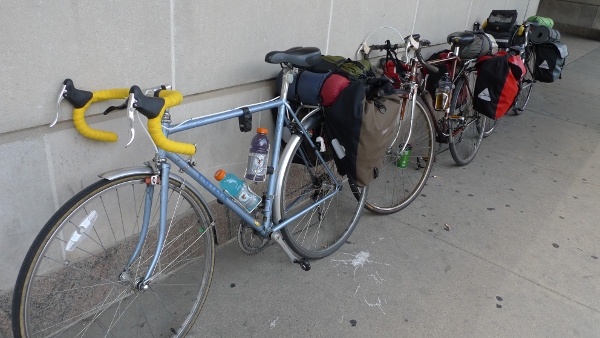
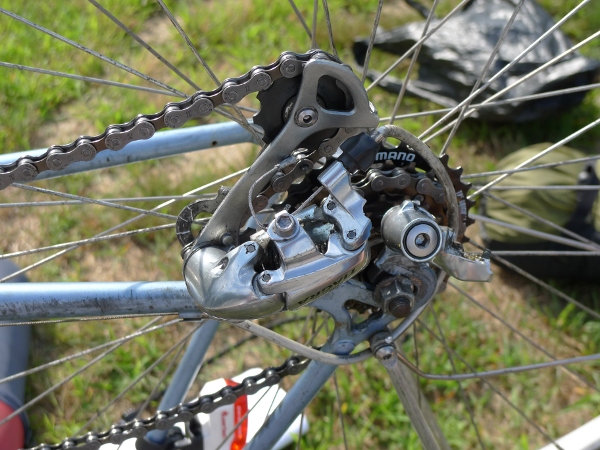
Day 1 We aimed to catch the 10:00 commuter rail train from Boston to Providence, Rhode Island, but we ran late (predictable) and had problems with the bicycle rack for my racing bike, which attaches without frame mounts (also predictable, since Mako and Mika test-rode it earlier in the week), so we didn't make it in to the station until around 10:20. We used the extra time to eat and fix up the bikes, though, so it's not clear how much of a setback that was. Here are our bikes ready to go at the Providence commuter rail station. bikes at Providence We then had some problems with Molly's brakes, and it took a long time to navigate out of the city, but eventually we found ourself on the "Washington Secondary Trail" a wonderful bike path along an old rail line. Every couple miles there'd be an old covered rail bridge over the river, and it was a well-paved straight shot for about ten miles, with no cars and no need to navigate. Molly on a train bridge Just as we were getting into things after the bike trail ended, something completely unexpected happened. This is Daf's derailleur after it sheared off in the middle as we attempted to start after a red light outside Tractor Supply Co. broken derailleur Luckily, John and his son Chris lent us a hand and hauled Daf and his bike to the nearest bicycle shop in the back of their pickup truck. They'd just come from there, where John had bought Chris a new helmet. Greenway Cycles, the only bike shop in a twenty mile radius, was three miles away. We got there an hour before it closed and Rick replaced the derailleur and straightened the hanger in a jiffy. Due to all these things, we didn't get as far as we'd planned in the first day and ended up camping in Seaport Campground in Mystic, Connecticut, rolling in at around 22:00. We did about 65 miles, including six due to the detour to the cycle shop. Carrying camping gear is heavy! Several delicious peanut butter and jelly bagels and some wheatberry and couscous salad later, we were passed out.

Day 2 Molly at the campground The second day included less bike trouble, but was no less eventful, and we were tired from the previous day's riding. The highlights included taking a tiny sidewalk path that I'm baffled how Google knows about up onto a sidewalk alongside the I-95 bridge across the Thames to New London, Connecticut. the Thames bridge The 13:00 ferry from New London to Orient Point, New York, where we got some remarkably good veggie burgers (whole edamame visible!) for lunch. Cross Sound Ferry And a vineyard on the north fork of Long Island, where we stopped for a quick tasting and ended up picking up a bottle of barrel-fermented chardonnay. The vineyard was small 23 acres, with 11 acres of grapes and the proprietors were friendly and extremely interested in our trip. They gave us a dollar off on the bottle due to our method of transport. The Old Field Vineyard It turns out there are only two trains a day on the Long Island rail, and we just barely caught the 18:52 return from Riverhead. We had mere seconds in the station and ended up without enough cash to pay for tickets onboard, but the conductor just took what we had and gave us tickets to Penn Station anyway. Outside Penn, a girl with a mohawk and a messenger bag overheard us talking about biking up Broadway and told us to bike up 8th Avenue instead. "Always bike up 8th and down Broadway because they have bike lanes in those directions." Thus, we didn't die dodging taxis in the dark. So basically, due to various people being extremely nice to us for no good reason, we made it to Columbia University around 22:30, on the correct day. Warm fuzzies for humanity all around. :)

25 July 2010

Thorsten Glaser: FrOSCon 2010 ( Birthday FrOSCon ) approaching

FrOSCon 5 - 21./22. August 2010 is approaching rapidly. I m a bit envious at some of the tracks (I mean, really, geocaching (ok, I did the surrounging caches over the last years but still), learning python by means of game programming, etc. really sounds interesting and I know people who could benefit from a non-kids version of that as well) but this year s FrOSCon is nothing for me to curse about either: I managed to get both a booth for The MirOS Project (MirBSD, mksh and other subprojects) as well as one for Waldemar s FreeWRT (although wbx@ if he comes won t join there since he forked his own fork since its conception). Booth staff are, currently: tg@ and bsiegert@ (Developer), gecko2@ (Staff) for MirOS, tg@ and XTaran abe@ (Developer), kimnotyze (Hacker) for FreeWRT. (XTaran will probably be helping Debian/Grml too.) This year, it ll be my job (after 2 years of aptituz) to keep the Altbier-Fraktion watered, I m thinking one crate of Schl sser Alt and one crate of Hannen Alt? Have a look at the Program and don t tell me you won t come! It will rock! (Except there won t be Formorer s Chilli, but that s no reason, there s enough other stuff in manageable distance.) Besides interesting booths and talks, FrOSCon is still looking for helpers who will not only get free entrance but also catering during operation.

12 July 2010

Matt Zimmerman: Read, listen, or comprehend: choose two

I have noticed that when I am reading, I cannot simultaneously understand spoken words. If someone speaks to me while I am reading, I can pay attention to their voice, or to the text, but not both. It s as if these two functions share the same cognitive facility, and this facility can only handle one task at a time. If someone is talking on the phone nearby, I find it very difficult to focus on reading (or writing). If I m having a conversation with someone about a document, I sometimes have to ask them to pause the conversation for a moment while I read. This phenomenon isn t unique to me. In Richard Feynman s What Do You Care what Other People Think?, there is a chapter entitled It s as Simple as One, Two, Three where he describes his experiments with keeping time in his head. He practiced counting at a steady rate while simultaneously performing various actions, such as running up and down the stairs, reading, writing, even counting objects. He discovered that he could do anything while counting to [himself] except talk out loud . What s interesting is that the pattern varies from person to person. Feynman shared his discovery with a group of people, one of whom (John Tukey) had a curiously different experience: while counting steadily, he could easily speak aloud, but could not read. Through experimenting and comparing their experiences, it seemed to them that they were using different cognitive processes to accomplish the task of counting time. Feynman was hearing the numbers in his head, while Tukey was seeing the numbers go by. Analogously, I ve met people who seem to be able to read and listen to speech at the same time. I attributed this to a similar cognitive effect: presumably some people speak the words to themselves, while others watch them. Feynman found that, although he could write and count at the same time, his counting would be interrupted when he had to stop and search for the right word. Perhaps he used a different mental faculty for that. Some people seem to be able to listen to more than one person talking at the same time, and I wonder if that s related. I was reminded of this years later, when I came across this video on speed reading. In it, the speaker explains that most people read by silently voicing words, which they can do at a rate of only 120-250 words per minute. However, people can learn to read visually instead, and thereby read much more quickly. He describes a training technique which involves reading while continuously voicing arbitrary sounds, like the vowels A-E-I-O-U. The interesting part, for me, was the possibility of learning. I realized that different people read in different ways, but hadn t thought much about whether one could change this. Having learned a cognitive skill, like reading or counting time, apparently one can re-learn it a different way. Visual reading would seem, at first glance, to be superior: not only is it faster, but I have to use my eyes to read anyway, so why tie up my listening facility as well? Perhaps I could use it for something else at the same time. So, I tried the simple technique in the video, and it had a definite effect. I could feel that I wasn t reading in the same way that I had been before. I didn t measure whether I was going any faster or slower, because I quickly noticed something more significant: my reading comprehension was completely shot. I couldn t remember what I had read, as the memory of it faded within seconds. Before reaching the end of a paragraph, I would forget the beginning. It was as if my ability to comprehend the meaning of the text was linked to my reading technique. I found this very unsettling, and it ruined my enjoyment of the book I was reading. I ll probably need to separate this practice from my pleasure reading in order to stick with it. Presumably, over time, my comprehension will improve. I m curious about what net effect this will have, though. Will I still comprehend it in the same way? Will it mean the same thing to me? Will I still feel the same way about it? The many levels of meaning are connected to our senses as well, and the same idea, depending on whether it was read or heard, may not have the same meaning to an individual. Even our tactile senses can influence our judgments and decisions. I also wonder whether, if I learn to read visually, I ll lose the ability to read any other way. When I retrained myself to type using a Dvorak keyboard layout, rather than QWERTY, I lost the ability to type on QWERTY at high speed. I think this has been a good tradeoff for me, but raises interesting questions about how my mind works: Why did this happen? What else changed in the process that might have been less obvious? Have you tried re-training yourself in this way? What kind of cognitive side effects did you notice, if any? If you lost something, do you still miss it? (As a sidenote, I am impressed by Feynman s exuberance and persistence in his personal experiments, as described in his books for laypeople. Although I consider myself a very curious person, I rarely invest that kind of physical and intellectual energy in first-hand experiments. I m much more likely to research what other people have done, and skim the surface of the subject.)

10 July 2010

Jonathan McDowell: SPI 2010 AGM & Board Election

As SPI secretary I announced that nominations for the SPI board were open at the start of the month. The nomination period closes this Tuesday (13th July) with voting opening up on Thursday 15th. This year over half the board is up for election - 5 seats (currently held by Luk Claes, Joshua D. Drake, Bdale Garbee, Joerg Jaspert & Martin Zobel-Helas). So far I've received only 2 nominations, though I'm aware these things are often left to the last minute, so hopefully more will appear in the next few days. All anyone who wants to stand needs to do is drop secretary@spi-inc.org a (preferably PGP signed) email nominating yourself and providing a position statement (which will all be published once the nomination period is over).

Oh, and if you're a contributing SPI member please do remember to vote once voting is open!

30 June 2010

Vincent Sanders: Programmers are suckers for a meme

Many Open Source projects have and IRC # for developers. The NetSurf project is no different. During a discussion someone jokingly suggested that one contributor should be asked to take the FizzBuzz test. Can you guess what happened next?

Ten minutes later Michael Drake posted this solid example in C which is where it all ought to have ended.

<iframe src="http://pastebin.com/embed_iframe.php?i=MesmvSjk" style="border:none;width:100%;height:200px;"></iframe>

Being programmers, of course this had a predictable result. The original question, the reason for asking it and any the serious point being made in the original article were discarded. Just so everyone (including myself) could play silly buggers over our lunch break. Coders, it would seem, simply like to produce a solution even if it is only for fun.

None of these programs took more than ten minutes (except the JAVA monstrosity), are reproduced with permission and I am to blame for none of them (ok maybe just the one ;-).

First up was Rob Kendrick with the classic solution in C (his day job is as a support team lead which seems to make those programmers who cannot do this seem even more scary bad.)

<iframe src="http://pastebin.com/embed_iframe.php?i=EaQ2414U" style="border:none;width:100%;height:200px;"></iframe>

Next was Daniel Silverstone who turned this Lua solution out very quickly and berated the rest of us for not following the rules ;-)

<iframe src="http://pastebin.com/embed_iframe.php?i=cYY0YDYM" style="border:none;width:100%;height:220px;"></iframe>

The final C solution was my own uber silly sieve implementation

<iframe src="http://pastebin.com/embed_iframe.php?i=5w5BhKt3" style="border:none;width:100%;height:200px;"></iframe>

Peter Howkins decided the world required a solution in PHP

<iframe src="http://pastebin.com/embed_iframe.php?i=h2aQ5eXM" style="border:none;width:100%;height:200px;"></iframe>

When pointed out that his solution stopped at 50 he presented this vastly superior and obviously idiomatic solution

<iframe src="http://pastebin.com/embed_iframe.php?i=k8T6VtJu" style="border:none;width:100%;height:200px;"></iframe>

Finally after a long time James Shaw caused mental anguish and wailing with this abomination unto Nuggin.

<iframe src="http://pastebin.com/embed_iframe.php?i=GFeHdJdr" style="border:none;width:100%;height:200px;"></iframe>

With Luck everyone has now got it out of their system and we will never have to put up with this again (yeah right). And now you also know why Open Source projects sometimes take ages to release ;-)

22 June 2010

Joey Hess: longest day

Here on the porch at Dani's, enjoying the chill breeze as a distant storm passes by, and the last half hour of daylight, it seems right to have been awake to see the solstice dawn, and out in the world all day. Though after 16 hours, the part of the day spent napping in a hammock barely seems enough. Such an early start to this day, first visiting a small-town garage with Dad, where skype video calls were being made, and then racing the morning heat north, out of South Carolina. (I can't hear "frakking water" on the radio without snickering. Congratulations to all the news-people who pulled that phrase off today.) A long drive punctuated by picking up my passenger, and my own Goodbye Solo drive up by Blowing Rock, looking in the mirror at passenger dreaming in the backseat. Thinking about how, in the flat lands, cresting a long, slow hill, I often feel as if the road ahead could at any moment vanish, sending the car plunging into nothing; a latent agoraphobia. And in the mountains, as the road narrows and winds, I'm always confident it continues solidly around each blind bend.

31 May 2010

Piotr Galiszewski: Hello Word

Hello Planet Debian readers!

I've never thought that such a thing can ever happen, but I've started blogging ;) So now it is time to introduce myself.

My name is Piotr Galiszewski and I am second year student of computer science at AGH - University of Science and Technology in Krakow (Poland). I have been GNU/Linux user for about 5 years (mostly Debian based distributions).

Thanks for Debian and Google, this summer I will be working on creating Qt-based user interface for aptitude as my Google Summer of Code project. I hope that my mentors Sune Vuorela and Daniel Barrows will be patient with me ;) I am sure I will learn a lot from them. Please look at abstract of my project made by Debian GSoC administrator Obey Arthur Liu:
Qt GUI for aptitude. Currently, KDE users need to use Aptitude via the console interface, or install the newly developed GTK frontend, which does not fit well into KDE desktop. Making Qt frontend to Aptitude would solve this problem and bring an advanced and fully Debian-compliant graphical package manager to KDE.
As I wrote in my proposal I will split my work into three main parts:
  1. writing low level classes which will abstract aptitude signals and slots (which uses sigc++) into Qt slots and signals.
  2. creating and evaluating GUI mockups
  3. implementing GUI on top of classes from the first point
Point 1 and 2 will be made simultaneously and will take all May and half of June. Low level classes should implement all necessary functions for further use in GUI. This classes allow me to avoid direct usage of none Qt code in GUI classes and also give much more time to prepare completed and usability-wise mockups. Every mockups version will be presented and discussed on this blog. First version should be ready in next few days and updates will appear each week (or to weeks).
After finishing this two steps I will start coding GUI. With mockups and finished low level classes this should not be complicated (Yeah, I know that this is only my dream).

Full text of my proposal (including more precise time-line) can be found at Debian wiki.

Currently, project is slightly behind the schedule . It is caused by changes in my studies plan. The Juwanalia students' festival took place earlier, and yesterday it finished. But my first exam will take place one week later on 18 May, so I will have more time to catch up with time-line.

This project is my first direct contribution to Debian, but not first involvement in free software movement. I've been Kadu Instant Messenger developer for more then two year. In last two years I have been second most active developer with more than 700 commits in master branch. During GSoC period my Kadu activities will be limited. If time allows me to do this, I will be still contributing to Kadu. I still can be found at Kadu forum or #kadu channel on irc.freenode.net. I will also continue reviewing patches and fixing low time-consuming bugs.

My plans for the next few days:
If you have any thoughts about this project, please add comment to this post or contact me directly. I will be glad to read all yours opinions

Cheers

PS. As you can see English is not my mother tongue, so please forgive me my mistakes

13 May 2010

John Goerzen: Bicycling Update

I ve been bicycling to work for awhile now. It s become pretty much routine for dry days. I can reliably ride the 10 miles to work in less than an hour, even with heavy winds. My biggest enemy right now: rain. My first few miles are on gravel and sand roads, which aren t maintained to the highest of standards. When it rains, there will be mud. I ride a Trek 7.3FX, which I bought with the idea of just riding when it s dry. It works quite well for that. But its slick tires don t work so well in mud. Plus our mud is sticky, and the tires pick it up, then deposit it on the frame that goes around the wheel and the brake arm. So I have a mess to clean up. My current dilemma is: do I buy a second bike for use when it s wet, or there s a chance of rain? My 7.3FX can t use tires that are very wide, and a different bike of course could. There would be expense involved, obviously, but I would really like to be able to ride more often than I can now. Winter was pretty damp here and I didn t get to ride much at all over the winter months. Or, would different tires plus fenders do the trick on the 7.3FX? (I m thinking not.) If I do get a different bike, then the question would be whether to sell the 7.3FX. I really like that bike, and imagine it would be faster on the 7 miles or so of paved roads that I ride every day. Perhaps I d keep it as a fair weather or long-distance bike. I plan to visit the bike shop tonight and see what my options are.

28 April 2010

Andrew Pollock: [life/americania] TransLink to become Clipper

No sooner do I discover it, and TransLink up and renames itself to Clipper. I wonder how much that exercise is going to cost? I'm also curious as to what they're going to do in terms of a new domain name. Ah, marketing:
Why is the name being changed? Now that the system is fully operational on five transit agencies - Muni, BART, AC Transit, Caltrain and Golden Gate Transit and Ferry - it is available to the majority of Bay Area transit riders. Giving the system a new name and logo helps make it more appealing to potential customers and also takes away any confusion with other local programs such as FasTrak, Fast Pass, as well as several other transportation programs around the world that are also named TransLink.
With Bay Area public transportation being woefully inadequate, I have to wonder if much of any adoption problems (which is what I presume they're trying to solve with this rebranding) are more a function of overall patronage?

16 April 2010

Vincent Sanders: Claudia black makes this look good

OK maybe the title is a bit of a reach, but she is pretty and my topic is dull.

It is the school holidays and between entertaining the kids I have been experimenting with the vala (see there is the link to the title) language. Overall I really like it, building a usable graphical GTK application is a snap and that side of it works well.

Unfortunately, and here comes a a whole pile of fail, the documentation is lacking, not just poor but mostly non-existent. You rapidly discover yourself using the Glib and GTK library documentation to try and infer how things work.

Underneath, the vala compiler is clever, it is really a c code generator. It takes your vala source file converts it to c and compiles it. When it works smoothly it works very well, when something is not quite right you can end up with a large pile of pieces complete with the C compiler spitting out cryptic nonsense.

This is all exasperated to new heights of madness when you want to access a simple c library. I say simple because if you want to access a Glib based library its easy and "there is an app for that". Because vala is object oriented c interfaces must be described as an object. This description is performed using vapi files. The file format is documented by the simple approach of "we already wrapped a load of libs go look at their vapi files"

For my small starter project I wanted to access a tiny c library I had written. The entire interface described in a single header header (excluding copyright) is:
typedef enum motor_dir  
motor_off = 0,
motor_forward = 1,
motor_back = 2,
motor_brake = 3,
motor_dir;

int edgerbtarm_init(void);
int edgerbtarm_close(void);
void edgerbtarm_ctrl_motor(int motorn, motor_dir direction);

Yes that is it! one enum, an initialise a finalise and a single operation function. The vapi file I came up with after a great deal of trial, error and head scratching was.
[CCode(cheader_filename = "libedgerbtarm.h",
lower_case_cprefix = "edgerbtarm_",
cprefix = "")]
namespace edgerbtarm
[CCode(cprefix = "motor_")]
public enum motor_dir
off,
forward,
back,
brake


public int init();
public int close();
public void ctrl_motor(int motorn, motor_dir direction);
This seemed to work until I tried to use the motor_dir type within my vala code at which point the c compiler started throwing errors about undeclared macros
arm.vala.c:297: error:  EDGERBTARM_TYPE_MOTOR_DIR  undeclared (first use in this function)
I struggled for some time and finally ended up asking my friend Enrico for help. He initially suggested I simply use an int instead of the motor_dir type and cast when I needed to. This approch worked and let me compile the program, it did however seem a bit grubby and removed the type safety of the enum.

Then Enrico came up with the "correct" solution. the enum description in the in the vapi file needed an extra parameter so vala would know the enum did not have a Glib type...yeah it was obvious to me too :-/

so by altering the vapi file enum declaration to
[CCode(cprefix = "motor_", has_type_id = false)]
public enum motor_dir
off,
forward,
back,
brake
Everything works as you might expect and the motor_dir enum can be used as a type within the vala program with no more fuss.

So the outcome of all this is that while vala is an interesting language which I may well use again in future, one should be aware that it is still very immature as a solution and has nowhere near enough documentation especially round the awkward stuff where it needs it most.

14 April 2010

Sandro Tosi: select count(bugs) in reportbug where status is open = 91

well, the actual select (against UDD) would be
udd=> select source, all_bugs from bugs_count where source = 'reportbug';
source all_bugs
----------+----------
reportbug 91
but the result is the same: less than 100 bugs against reportbug! Yay!

As you can see from the bugs graph, the Christmas and Easter holidays helped quite a lot to squash those bugs. When I first step into the reportbug world, the bugs count was around 250, and I first imagined in my mind to brake the 200 barrier, than the 150 and finally the less-than-100 one: while the first 2 limits where the hardest one (new to the codebase, other interest) the last one is the one I'm most proud of.
They seem quite nice-to-have stuff but recently I've tried to concentrate on reply fast to new report, fix as many reported crashes as possible and implement some of the long-awaited features.

Additionally, sometimes "No, sorry" is the proper reply to a bug and then it can be closed: it's hypocrite to keep bugs opened while internally you think it's a wontfix but you're not closing them because of a fear of possibly upset the reporters.

There will be more in the future, that's for sure, but I think this is the reportbug we'll see in squeeze, modulo some new crashes or very interesting feature we want it, so expect minor releases from now until squeeze+1

7 April 2010

Biella Coleman: Nameless, Freak, Phreak

So I tend to focus on the cultural present but during grad school it was hammered into my brain that to understand the contemporary moment, history matters, a lot.. The problem with hacking and related activities is that the history is a bit sparse and fragmented. Recently I have been working on a piece that examines some of the aesthetics similarities between phrakers, underground hackers, and trollers and it sort of hit me that I had no idea when the term phreak or freak came into being. So I dropped a note to Phil Lapsely who is writing (finally) a proper history of phreaking and he was thoughtful enough to pen down a genealogy of the term.

29 March 2010

Jon Dowland: There must be a better way of doing this

14:31:33$ rake
(in /home/jon/wd/web/sup)
rake aborted!
no such file to load -- rubygems
/home/jon/wd/web/sup/Rakefile:33:in  require'
(See full trace by running task with --trace)
So I identify which package is necessary and install it. Then:
14:31:52$ rake
(in /home/jon/wd/web/sup)
rake aborted!
no such file to load -- gettext
/home/jon/wd/web/sup/Rakefile:35
(See full trace by running task with --trace)
So I identify which package is necessary and install it. Then:
14:32:11$ rake
(in /home/jon/wd/web/sup)
rake aborted!
no such file to load -- lockfile
/home/jon/wd/web/sup/Rakefile:35
(See full trace by running task with --trace)
So I identify which package is necessary and install it. Then:
14:32:31$ rake
(in /home/jon/wd/web/sup)
rake aborted!
no such file to load -- mime/types
/home/jon/wd/web/sup/Rakefile:35
(See full trace by running task with --trace)
So I identify which package is necessary and install it. Then:
14:32:39$ rake
(in /home/jon/wd/web/sup)
rake aborted!
no such file to load -- ncurses
/home/jon/wd/web/sup/Rakefile:35
(See full trace by running task with --trace)
So I identify which package is necessary and install it. Then:
14:33:08$ rake
(in /home/jon/wd/web/sup)
rake aborted!
no such file to load -- net/ssh
/home/jon/wd/web/sup/Rakefile:35
(See full trace by running task with --trace)
So I identify which package is necessary and install it. Then:
14:33:19$ rake
(in /home/jon/wd/web/sup)
rake aborted!
no such file to load -- ferret
/home/jon/wd/web/sup/Rakefile:35
(See full trace by running task with --trace)
So I identify which package is necessary and install it. Then:
4:33:31$ rake
(in /home/jon/wd/web/sup)
rake aborted!
Don't know how to build task 'default'
(See full trace by running task with --trace)
Well, at least that's the dependencies sorted! This is how I would have preferred things to have worked:
14:31:33$ rake
(in /home/jon/wd/web/sup)
rake aborted!
missing dependencies:
    rubygems
    gettext
    lockfile
    mime/types
    ncurses
    net/ssh
    ferret
Once I've resolved which rake target I want (rake tarball gave me an installation tree I could use), I'm finally in a position to run the thing:
14:38:12$ sup-config
/usr/lib/ruby/1.8/rubygems/custom_require.rb:31:in  gem_original_require': no
such file to load -- highline/import (LoadError)
    from /usr/lib/ruby/1.8/rubygems/custom_require.rb:31:in  require'
        from /home/jon/wd/web/sup/pkg/sup-999/bin/sup-config:4
Ah.

27 March 2010

Christine Spang: Christine Spang: a late Ada Lovelace Day tribute

I meant to participate in Ada Lovelace Day, a day to celebrate and acknowledge the accomplishments of women in science and technology, but I got distracted and then it was late and I fell asleep. Such is my life. Anyway, I'd like to acknowledge a woman who I've only recently met, mostly through the Free Software Foundation's women's outreach events. Marina Zhurakhinskaya works for RedHat, and is a developer for GNOME Shell. She's always enthusiastic about sharing her work with other people in person and inviting others to get involved, and is one of those people who is in there every day getting stuff done. I wish I were as confident about the things that I work on. Marina has also been working on the second incarnation of the GNOME Women's Summer Outreach Program, I believe. And she keeps giving talks all over the place, which is great! Go visibility. Now if only she would blog more. ;) I'd never met Marina before last September, despite living in the same metropolitan area! I'm glad women that I don't know about and who work on free software exist and that I get to meet them and find out that they live nearby.

20 March 2010

Robert Collins: LibrePlanet 2010 Day 2

John Gilmore keynote What do we do next, having produced a free software system for our computers? Perhaps we should aim at Windows? Wine + an extended ndiswrapper to run other hardware drivers + a better system administration interface/resources/manuals. However that means knowing a lot about windows internals something that open source developers don t seem to want to do. We shouldn t just carry on tweaking its not inspiring; whats our stretch goal? Discussion followed reactos, continue integrating software and people with a goal of achieving really close integration: software as human rights issue! Desktop paradigm needs to be replaced : need to move away from a document based desktop to a device based desktop. Concern about the goal of running binary drivers for hardware: encourages manufacturers to sell hardware w/out specs; we shouldn t encourage the idea that that is ok. Lots of concern about cloning, lots of concern about what will bring more freedom to users, and what it will take to have a compelling vision to inspire 50000 free software hackers. Free software in cars lots of safety issues in .e.g brake controllers, accelerators. Eben Moglen We re at the inflection point of free software because any large scale global projects these days are not feasible without free software. Claims that doing something that scales from tiny to huge environment requires us A claim I would (sadly) dispute. Lots of incoming and remaining challenges. Entirely clear that the patent systems relationship to technology is pathological and dangerous that I agree with! Patent muggings are a problem patent holders are unhappy with patents granted to other people :) . Patent pools are helping slowly as they grow. Companies which don t care about the freedom aspect of GPLv3 are adopting it because of the patent protection aspects. Patent system is at the head of the list of causes-of-bad-things affecting free software. SFLC is building coalitions outside the core community to protect the interests of the free software community. We are starting to be taken for granted at the high end of mgmt in companies that build on free software. We face a problem in the erosion of privacy. We need to build a stack, running on commodity hardware that runs federated services rather than folk needing centralised services. Marina Zhurakhinskaya on GNOME Shell: Integrates old and new ideas in an overall comprehensive design. Marina ran through the various goals of the shell growing with users, being delightful, starting simply so new users are not overwhelmed. The activities screen looks pretty nice ;) The workspace rearrangement UI is really good. The notifications thing is interesting; you can respond to a chat message in-line in the notification. Richard Stallman on Software as a Service he presented verbally the case made in the paper. Some key quotes All your data on a server is equivalent to total spyware I think this is a worst-case analogy; it suggests that you can never trust another party: kindof a sad state of paranoia to assume that all network servers are always out to get you all the time. And I have to ask should we get rid of Savannah then (because all the data is stored there) the argument for why Savannah is not SaaS is not convincing: its just file storage, so what makes it different to e.g. Ubuntu One? If there is a server and only a little bit of it is SaaS, perhaps just say don t worry about it because that little bit is often the hardest bit to replace. Lets write systems for collaborative word process that don t involve a central server abiword w/the sharing plugin ? :) RMS seems to be claiming that someone else sysadmining a server for you is better than someone else sysadmining a time-shared server for you: I don t actually see the difference, unless you re also asserting that you ll always have root over your own machine . The argument seems very fuzzy and unclear to me as to why there is really a greater risk in particular when there is a commercial relationship with the operator (as opposed to, say, an advertising supported relationship).

18 March 2010

C.J. Adams-Collier: IronRuby on OS X

We had a visitor on #ironruby today asking for help getting IR running on his mac. I gave him the following directions, and they seemed to work aside from one glitch. I tested them on my wife s mac, and it worked for me, too. Install Mono You can grab the Mono .dmg from go-mono.com. This will install the framework and put the required programs (mono, xbuild) in your PATH. Fetch the IronRuby source Since Jim Deville likes macs, I m sure more recent versions will work, but this is the one we ve recently packaged up for Debian and tested on Ubuntu. If you want to be certain that the IronRuby code you write on Debian works on OS X, then you should probably build from the same version of the source. You should probably also install version 2.4.3 of Mono, but that may be more effort than it s worth ;) http://github.com/mletterle/ironruby/tarball/20090805+git.e6b28d27 Unpack the tarball Open up a terminal and unpack the thing you just downloaded:

$ mkdir ~/src/
$ cd ~/src/
$ tar xfz ~/Desktop/mletterle-ironruby-e6b28d2.tar.gz
$ cd mletterle-ironruby-e6b28d2/
Build IronRuby At this point, you should be able to build the IronRuby assemblies using xbuild. I don t recommend using rake, as it has some dependencies, and I m not a fan of dependencies.

$ xbuild /p:TreatWarningsAsErrors=false Merlin/Main/Languages/Ruby/Ruby.sln
<snip/>
Build succeeded.
	 2817 Warning(s)
	 0 Error(s)
Time Elapsed 00:00:28.8378230
Run the IronRuby interactive interpreter Our guest mentioned that he was using a terminal with a white background. Do note that the font color of the interactive interpreter (aka Read-Eval-Print Loop or REPL) is white, so if you re using a white background, you might want to change it. IIRC, there is a way to change the font color using a configuration setting. Figuring it out is left as an exercise for the reader.

$ mono Merlin/Main/Bin/Debug/ir.exe
IronRuby 0.9.0.0 on 2.6.3 (tarball Wed Mar 10 18:18:12 MST 2010)
Copyright (c) Microsoft Corporation. All rights reserved.
>>> 1+2
=> 3
>>> exit()
Extra credit: IronPython The tarball you downloaded also included the source to IronPython. The procedure to build/run IronPython is pretty similar to IronRuby. Build IronPython Unlike IronRuby s .sln, this version of IronPython s .sln does not have a default configuration parameter, so we need to specify it with the /p:Configuration=Debug argument.

$ xbuild /p:TreatWarningsAsErrors=false /p:Configuration=Debug Merlin/Main/Languages/IronPython/IronPython.sln
<snip/>
	 69 Warning(s)
	 0 Error(s)
Time Elapsed 00:00:38.8057450
Run the IronPython interactive interpreter IronPython has a REPL interface like IronRuby s. Or is it the other way around? Anyway, here s an example.

$ mono .//Merlin/Main/Bin/Debug/ipy.exe
IronPython 2.6 Beta 2 DEBUG (2.6.0.20) on .NET 2.0.50727.1433
Type "help", "copyright", "credits" or "license" for more information.
>>> 1+2
3
>>> ^D

16 March 2010

Tollef Fog Heen: A small explanation about the yubikey

Russell Coker recently reviewed the Yubikey. The article mentions me, so I figured I'd correct a minor thing and respond to one of the comments. First, the yubikey-server-c is my reimplementation of the Yubikey authentication protocol. Yubico provides two implementations, one in PHP and one in Java, neither which I'm particuarly interesting on building my system security on. Any bugs, misfeatures, etc in the C implementation are mine and mine alone. Barak A. Pearlmutter, one of the commenters on Russell's blog writes: i don t understand. isn t this thing vulnerable to eavesdropping and replaying? even if it has a counter which changes etc, the things it is talking to (web sites) can t know that some generated string is being reused. and it doesn t even have a clock, so these things can be old. The way the Yubikey works is you have a central authentication server. This has a secret shared with the key. Setting this secret is the primary function of the personalisation tool. When you press the button, the key takes its internal state (various counters, uid field, etc) and encrypts this using AES-128. This is then sent to the application you are trying to access, be it Wordpress, SSH or something else. Said application then contacts the authentication server which decrypts the ticket, checks the values of the counters to make sure it's not a replay and responds with OK, bad ticket, replay and various other status codes. Based on this, the application grants or denies access. There are really two places you could attack this: in the communication between the web browser and application or between application and authentication server. Both of those can be secured using SSL. There is no way to use a single yubikey in multiple authentication realms without extra software. To do this, you would have a OpenID provider that uses the Yubikey for authentication, or you could have a Kerberos server with cross-realm trust. As for the PAM modules and other tools so far not being packaged, yes, I know, I might fix it, but the current setup has the bits I use, as I use RADIUS authentication to get services to support both Yubikey and passwords.

5 March 2010

David Welton: Books vs "e-books" ?

I've been thinking about something for a while, and to be honest, still haven't reached any firm conclusions: what to think about self-published "e-books"? I'm curious to hear your opinions. For instance: These are all: electronic, in that they aren't distributed as real, paper books, have no ISBN number, and are generally only available via the author's web site (you won't find them on Amazon.com). They aren't simply on-line, PDF versions of real books. They're certainly a departure from the traditional model of having a publisher, editor, and real, physical books that could be purchased from book stores. They don't appear to have been through any kind of formal editing or quality control process. The prices seem to differ quite a bit; the first one is $19, the second one is $12, and the last one is $30.77. For the authors, the appeal is obvious: they get to keep all of the money, and don't have to fool around with a lot of "process". Consumers, on the other hand, have to consider different aspects: with a "real book", the bureacracy and process exist to guarantee some minimum standards of quality. If you buy an O'Reilly book, you know that it's probably like many of the other books they sell: perhaps it won't stand the test of time like something written by Knuth, but it'll be a pretty good guide to the technology it describes, most likely be someone who is indeed an expert in that area. If I buy some random PDF on the internet, it may come from someone who really knows their stuff, or it may be junk. On the other hand, were this market to grow, theoretically prices could come down. Since the people who are authoring the book don't have to fool around with editing, printing, and so on, and get to keep all the money themselves, they could in theory keep their prices significantly lower than someone creating a more 'traditional' book with a lot of overhead. That is, of course, if the book is one where there is competition in its niche. Right now a lot of these books that pop up on my radar are written by domain experts. However, what's to prevent a lot of people from jumping in and attempting to make a quick buck with a flashy looking web site? Buying books based only on reputation? That might lead to people who are really good authors, but perhaps not well known as "doers" (they didn't invent the technology in question) being left out in the cold. Also, there is something of an unknown quantity about "pdf books". For instance, after raking in a bunch of cash with theirs, 37signals put it on their web site, completely for free. That had to leave the guy who bought it the day before it went free feeling like a bit of a chump. At least with a 'real book', even if the contents are posted on the internet, you have a physical object that belongs to you. I wonder how bad piracy is, and how bad it might be were these to become more popular? Another thing worth noting is that, via services like Lulu.com, it *is* possible to print these out. In any case, I think things are likely to change with time, as we aren't dealing with a static situation, but rather one where a changing landscape maylead to different outcomes, as the key variables... vary. I am honestly unsure of what to make of this development. How do you see the market for "home brewed" pdf ebooks evolving?

25 February 2010

Ian Wienand: Building a quiet, cool media/house server

After getting sick of having to underclock my existing home server to get it to remain up for any period of time, along with the horrendous noise, I finally found the time and budget to rebuild. My goals were: In the end I went with The case is really awesome. Very easy to access, and the fan is extremley quiet. It very cleverly holds 3 full-size hard-disks; two mounted vertically on either side, and one horizontally in the middle. The final space is for a DVD -- after that it's pretty cramped inside! It makes claims it is a very efficient power supply. It has a very bright blue LED on the front, and the face-plate over the DVD looks nice but the button doesn't quite reach the eject button on my drive, so it's software eject only. All over, definitely recommend. The motherboard is fairly good. One annoying thing is that it only has 3 SATA ports -- I think it's reasonable to want to have a primary drive, two mirrored large disks plus a DVD for a nice little media server. It also has no parallel-IDE, which is reasonable these days. However, if you wanted to install a wireless card you'd be out of luck if you also wanted to put in another SATA card, as it only has one PCI slot. There are plenty of USB ports for a USB wireless card, however. It also comes with two SATA cables, which isn't mentioned anywhere I could see (hopefully this saves you a trip back to Fry's to return your extra cables :). The CPU fan is a little on the loud side, as mentioned in some other forums. It is also located right where the power supply cables come down in this case, making for a fairly tight fit. Here's a lspci for those interested in such things
00:00.0 Host bridge: nVidia Corporation MCP79 Host Bridge (rev b1)
00:00.1 RAM memory: nVidia Corporation MCP79 Memory Controller (rev b1)
00:03.0 ISA bridge: nVidia Corporation MCP79 LPC Bridge (rev b2)
00:03.1 RAM memory: nVidia Corporation MCP79 Memory Controller (rev b1)
00:03.2 SMBus: nVidia Corporation MCP79 SMBus (rev b1)
00:03.3 RAM memory: nVidia Corporation MCP79 Memory Controller (rev b1)
00:03.5 Co-processor: nVidia Corporation MCP79 Co-processor (rev b1)
00:04.0 USB Controller: nVidia Corporation MCP79 OHCI USB 1.1 Controller (rev b1)
00:04.1 USB Controller: nVidia Corporation MCP79 EHCI USB 2.0 Controller (rev b1)
00:06.0 USB Controller: nVidia Corporation MCP79 OHCI USB 1.1 Controller (rev b1)
00:06.1 USB Controller: nVidia Corporation MCP79 EHCI USB 2.0 Controller (rev b1)
00:08.0 Audio device: nVidia Corporation MCP79 High Definition Audio (rev b1)
00:09.0 PCI bridge: nVidia Corporation MCP79 PCI Bridge (rev b1)
00:0b.0 IDE interface: nVidia Corporation MCP79 SATA Controller (rev b1)
00:10.0 PCI bridge: nVidia Corporation MCP79 PCI Express Bridge (rev b1)
00:15.0 PCI bridge: nVidia Corporation MCP79 PCI Express Bridge (rev b1)
01:05.0 RAID bus controller: Silicon Image, Inc. PCI0680 Ultra ATA-133 Host Controller (rev 02)
02:00.0 VGA compatible controller: nVidia Corporation ION VGA (rev b1)
03:00.0 Ethernet controller: Realtek Semiconductor Co., Ltd. RTL8111/8168B PCI Express Gigabit Ethernet controller (rev 03)
I know there are issues with the controller of the Patriot SSD, which would probably worry me for a general purpose machine. However for the primary disk of a server machine I'm not too fussed. The silence is golden and cool-running and low power consumption really helps too. I wouldn't really say it seems that blazing fast. It comes with a handy mount so it fits in a full-size hard-disk slot. Hard to beat for the price. One concession I made to avoid excessive writes was mounting /tmp on tmpfs; this is where it's nice to have 4GB of RAM. Handbrake seems to do a lot of work in /tmp for example. The two green hard-disks (software mirrored) are also inaudible. I'm hoping different brands should at least not fail at the same time. I'm not sure if they're auto-spinning down, but you can't really tell if they're on or not, even under load. Even when running flat-out re-encoding a DVD in the enclosed cabinet with minimal airflow the CPU temperature hasn't gone above 60C; normal CPU temp is around 40C. Performance is adequate -- running PlayOn in a VMware workstation XP VM almost works. It's kind of hard to take photos inside a case, but here's an attempt: <object height="300" width="400"> <param name="flashvars" value="offsite=true&amp;lang=en-us&amp;page_show_url=%2Fphotos%2Fiwienand%2Fsets%2F72157623509152266%2Fshow%2F&amp;page_show_back_url=%2Fphotos%2Fiwienand%2Fsets%2F72157623509152266%2F&amp;set_id=72157623509152266&amp;jump_to="> <param name="movie" value="http://www.flickr.com/apps/slideshow/show.swf?v=71649"> <param name="allowFullScreen" value="true"><embed allowfullscreen="true" flashvars="offsite=true&amp;lang=en-us&amp;page_show_url=%2Fphotos%2Fiwienand%2Fsets%2F72157623509152266%2Fshow%2F&amp;page_show_back_url=%2Fphotos%2Fiwienand%2Fsets%2F72157623509152266%2F&amp;set_id=72157623509152266&amp;jump_to=" height="300" src="http://www.flickr.com/apps/slideshow/show.swf?v=71649" type="application/x-shockwave-flash" width="400"></embed></object> Debian unstable installed without issues (except for some weird bug with the boot hanging for 60 seconds due to the RTL driver). It is also very strange installing from USB to an SSD no noise!

Next.

Previous.