Search Results: "pollo"

17 December 2010

Andrew Pollock: [tech] Probable solution for Pandora 417 errors on Google TV

This has been bugging me ever since we got our Sony Internet TV, and I think I've finally figured out what's going on. Pandora hasn't been working on the Google TV ever since we got it, it just spits out Unexpected HTTP error occurred code: 417 while StartupAsyncTask and that's the end of that. I have vague recollections seeing this on my phone in the past also, but this doesn't appear to be the case any longer. My phone has version 1.5.2 on it, and the TV has 1.0, so I think I see the problem here. I took a full packet capture while starting up Pandora, and it was a lot more revealing. I could see that it was my Squid proxy (I transparently run all HTTP traffic through Squid) was barfing. That'd explain the errors I was seeing in Squid's cache.log
parseHttpRequest: Unsupported method ''
clientTryParseRequest: FD 153 (172.16.1.5:55001) Invalid Request
Looking at the headers of the HTTP request that the Pandora client is sending out, I see Expect: 100-Continue, and the text that accompanies a HTTP 417 error is "Expectation Failed", so I think this is the culprit. Searching for Expect: 100-Continue squid turns up information for an ignore_expect_100 directive, but this appears to only be available if Squid is compiled with --enable-http-violations, which the Debian Squid package doesn't appear to be compiled with. I may have to adjust my transparent proxying rules to not transparently proxy the TV, but this makes me a bit sad. Update I tried adding ignore_expect_100 on anyway, and Squid took it, and now Pandora isn't barfing. Yay!

5 December 2010

Ben Hutchings: USB serial console

Andrew Pollock writes:
If you're trying to use a USB serial adapter as your Linux kernel console... The kernel needs to be compiled with CONFIG_USB_SERIAL_SERIAL=y
That's CONFIG_USB_SERIAL_CONSOLE.
Debian kernels do not appear to be. Somewhat strangely, the config option doesn't even wind up in the config file in the typical commented-out manner, so you don't even know the option exists until you discover it from random Web searching, and then looking at drivers/usb/serial/Kconfig in the kernel source.
Console drivers need to be built-in, so CONFIG_USB_SERIAL_CONSOLE depends on CONFIG_USB_SERIAL=y. We build the USB serial code as a module so CONFIG_USB_SERIAL_CONSOLE is not an available option. This is unlikely to change, as a built-in feature takes memory from every Debian GNU/Linux installation.

Andrew Pollock: [tech] If you're trying to use a USB serial adapter as your Linux kernel console...

The kernel needs to be compiled with CONFIG_USB_SERIAL_CONSOLE=y Debian kernels do not appear to be. Somewhat strangely, the config option doesn't even wind up in the config file in the typical commented-out manner, so you don't even know the option exists until you discover it from random Web searching, and then looking at drivers/usb/serial/Kconfig in the kernel source.

Andrew Pollock: [tech] A cleaner puppet manifest

Jon Downland is tinkering with Puppet, and wrote a class with a package resource to install a bunch of packages, but didn't quite like the way it was written. The way that I'd achieve the same thing, and be slightly cleaner would be something like this:
class jon-desktop  
	$packages_to_install_by_default = [
		'icedove',
		'git-core',
		'vim-gnome',
		'vinagre',
		'build-essential',
		'devscripts',
		'subversion',
		'git-buildpackage',
		'mutt',
		'offlineimap',
		'ascii',
		'gitk',
		'chromium-browser',
	]
	package   $packages_to_install_by_default:
		ensure => installed,
	 
 
This way your actual package resource definition never needs to change. The variable you choose to use to define the list of packages to install can be abstracted away as much as desired.

Andrew Pollock: [tech] And if only I'd read Planet Debian first...

Argh. So of course there's a difference between CONFIG_USB_SERIAL=y and CONFIG_USB_SERIAL=m, and that would explain the behavior I'm seeing. Thanks Ben Hutchings. I guess I'm recompiling my kernel again. Kill me now.

Andrew Pollock: [tech] If you're trying to use a USB serial adapter as your Linux kernel console, part 2

Seriously, the amount of yak shaving I'm doing these days... So I discover this CONFIG_USB_SERIAL_CONSOLE config option. I proceed to edit my .config, throw it in there and rebuild my kernel. (For the record, I hate building kernels). I'm about to reboot into said new kernel, and I thought I'd just double check the resulting config-2.3.36 file to check that CONFIG_USB_SERIAL_SERIAL did indeed get enabled. It's not there. I spend a few minutes WTFing, and assume I've been an idiot and should have run a make oldconfig or some such thing after hand-editing my .config file. So I try that. The additional line vanishes again afterwards. More WTFing ensues. I fire up make menuconfig, and go looking for the menu entry for the option. It's not there. The plot thickens. I hand-edit drivers/usb/serial/Kconfig and change depends on USB_SERIAL=y to just depends on USB_SERIAL, and rerun make menuconfig, and lo and behold, the option appears! So now I'm off rebuilding the kernel again. Sigh.

19 November 2010

Andrew Pollock: [tech] Finally decided to order something

Okay, I've finally settled on something. I decided to pass on the ASRock box. The price was just too high for my liking, and I've ordered a Zotac ZBOX HD-ID11. Yes, it's going to have a dirty proprietary NVIDIA graphics chipset. The interwebs tell me that it's the only one that will do H.264 decoding in hardware. I'm not sure I particularly care, for my application. It comes with DVI and HDMI, and a DVI-to-VGA dongle, so I should still be able to plug it into whatever floats my boat. What I did did just realise, about 15 minutes after I placed the order and was changing Zoe's diaper, was that I don't have a remote control solution now. The ASRock box included a remote control. I figure I can use one of the 6 USB ports and get some sort of USB infra-red adapter, and probably keep using the Hauppauge remote that came with my PVR-350 card. With the money I've saved buying the ZBOX, I've ordered a 40Gb Intel SSD, so that should make for a nice, no-moving-parts front end (assuming everything works). Everything should arrive before Thanksgiving, so I'll have a few days off work to tinker. Here's hoping I haven't bought a lemon.

18 November 2010

Andrew Pollock: [tech] Avoiding Pouslbo like the plague

I got a fair bit of feedback from my latest post about the Boxee Box, none of it particularly favourable about the GMA500/Poulsbo chipset, so regretfully, I won't be buying a Boxee Box. Too bad, it looked cute, and was cheap. A David H rdeman dropped me an email, and brought to my attention the ASRock Core 100HT-BD I was nearly going to buy the wrong thing off Amazon (there's also an NVIDIA ION-based variant), but I found a non-BluRay variant on NewEgg for about $100 less than the BluRay version. It's certainly more expensive than something like a Boxee Box, but hey, if it's going to work... I think if I had the choice, I'd get an SSD for it, but I can see how this goes with a rotating disk. The current MythTV box has a rotating disk in it (just not for storage of recorded content) and it seems sufficiently quiet. The other nice thing about this box is it has VGA and HDMI, so I can totally try this thing out on the current TV before replacing it. Now the question is, do I place an order today...?

17 November 2010

Andrew Pollock: [tech] More research into the Boxee Box

I received a few emails from my blog post about my MythTV dilemma. Suggestions ranged from using VGA to DVI to HDMI adapters, to getting different TVs that still have VGA connectors, to getting an older NVIDIA card off eBay that has lower power requirements. Firstly, VGA is dead. It's time to make the move. I don't think VGA for a TV the size I'm looking at is ideal for HD anyway. I'm pretty much fixated on the Sony TV as well, because I want to get Google TV. So I need HDMI. Similarly, I suspect that the picture quality of something run through a VGA to HDMI conversion will be similarly shite, so I'm not too keen on that option, although it would tide me over initially, so I'll look into that further. Another suggestion was the fit-PC2, which was something I was already aware of, but I'd heard terrible things about the general Linux support for the graphics adapter. I did some more research into the Boxee Box, (it really is new, it's only been out for 6 days) and it appears to have the same video chipset as the fit-PC2, which seems rather unfortunate. But then, if the Boxee Box is running Linux, then they've obviously got a driver, so the question is how easy is it to transplant this driver from the Boxee distro to, say, Debian? I'm curious enough to place an order soon. Anyone got any interesting Poulsbo-on-Linux war stories they want to share? I know it makes Matthew Garrett sad.

16 November 2010

Andrew Pollock: [tech] The knock-on effects of buying a new TV

I'm considering replacing our 5 year old 32" TV with a 40" Sony Internet TV, largely "just because" it has Google TV. That and I have spousal approval to get a new, bigger TV (it just has to be wall mounted). The dilemma is MythTV. It's currently still running on the Dell Dimension 3100 that I bought years ago, and connected via VGA to the TV. The Sony Internet TV is HDMI or nothing, so at the very least, I need to get a DVI-capable video card in my MythTV box. The more or less natural choice would be an NVIDIA card, despite them having a closed-source driver. At least it's well supported under Linux. The problem is, as far as I can determine, NVIDIA cards require at least a 300 watt power supply, and the Dimension 3100 has only a 230 watt power supply. So now I'm looking at having to replace the MythTV box. I'm currently running the front end and the back end on the same box, so it'd be a fairly simple case of splitting the back end from the front end, and just getting something new to be the front end. So now I'm in the market for something small, low-power, has a HDMI (or DisplayPort) interface, and enough grunt for HD playback. I'm wondering if the Boxee Box is the solution. Interface-wise, it has HDMI, so I'm good there, and I believe the marketing claims it can do HD playback. I just don't know how hackable it is. I think it's running Linux, so in theory this should be doable, so long as there isn't some weird hardware in it with a binary-only driver. For the price, it's probably worth just getting one to see. The annoying thing is, I have nothing in the house that is DVI or HDMI capable, so I have no way of testing this out prior to buying the TV.

4 November 2010

Andrew Pollock: [life] Zoe at six months

Today, Zoe is six months old. The last three months certainly feel like they've taken their time, but a lot has happened. Developmentally, she's doing great. She's now in the 70th percentile for height (up from around the 25th percentile), and 31st percentile for weight (up from the 25th percentile). She cut her bottom front teeth a few days ago. Crawling is imminent, I'd say. She can already scoot around in reverse, and by a combination of shuffling and rolling, doesn't seem to be having problems moving around the floor. We started her on solids at five months, and she's taken like a duck to water to pureed pumpkin, sweet potato, beans, zucchini, apple, pear, banana and avocado. Speaking of water, she's also decided she likes to drink water from our glasses whenever she sees us doing it. Hilarity usually ensues, closely followed by a change of outfit. She's sleeping well, only waking up once a night under normal circumstances, and that wake-up is getting later and later. She loves her baths. She usually lets out a series of loud sighs as soon as we put her in the bath. She got her first cold a couple of weeks ago. It coincided with her first day in ad hoc daycare, but Sarah and I were both sick as well, so I think it's more likely that she caught the cold from us than from daycare. She's still battling it, but it hasn't really bothered her all that much. She's just a bit snotty. The NoseFrida has been very handy for dealing with this. She had her six month shots today, and seems to be tolerating them fairly well. Sarah says she hardly even cried when she got them. She continues to be a remarkably happy baby. She always wakes up with a smile, she really only fusses if we keep here away for more than a couple of hours, or haven't fed her on time. Even with this current cold she has, she's still stayed very happy. We feel incredibly lucky to have such a wonderful baby. The next big adventure is to try a babysitter. Zoe and me in early October

22 October 2010

Andrew Pollock: [debian] Well that's a relief

As readers of my blog (who care about Debian stuff) may know, I've been plugging away at the DHCP 4.x packages for some time now. I first uploaded 4.1.1-P1-7 to unstable in early July, then -8 in mid-July followed by -9 in late July. The main reason for the delay (beyond my lack of spare time) was the coordination with third-party packages that were plonking hooks into /etc/dhcp3/dhclient- enter,exit -hooks.d. Once that got all squared away, the release team gave me the green light to upload to unstable. On the 26th of July, 4.1.1-P1-9 made it into the testing distribution. Rather unfortunately (for me), the release team then declared testing frozen on August 6. I'd been hoping for a few more iterations on the package after getting feedback from the testing user base. Alas, it was not to be. One piece of feedback I did get on August 9 was release critical bug #592361, which made me very sad, because I totally agreed with the severity of it. It was an upstream issue, and I immediately escalated it to upstream. Unfortunately, they did not get back to me particularly quickly (I had to use some back channels to get a response at all). I eventually got the response I was pretty much expecting: I was going to have to directly patch configure.ac to make it stop trying to link with libcrypto. To complicate matters, the LDAP patch also goes and messes with configure.ac, so it required some fiddling with the LDAP patch as well. I figured I could wrap my head around it all, it was just some patch wrangling, but with parenthood and a wife who was trying to be a full-time mother as well as a part-time student-by-correspondence, large chunks of spare time were not in great abundance. So I've had this bug niggling away at the back of my mind for literally months now, when in sails Simon McVittie with a patch. Hallelujah, I said to myself. I could just take this guy's patch, and we'd all be home and hosed. So I spent a bunch of hours yesterday, while I was at home trying to kick a cold, faffing around with his patch and trying to get it to build. Alas, it would not build. I went to bed far too late last night, feeling like I was on the verge of having it work, but it wasn't. I emailed Simon back today, and he quickly got back to me with the (easy) fix, and tonight, I am in business! The much awaited 4.1.1-P1-10 is uploaded to unstable. I'm still not particularly happy with the state of the package though. The supplied dhclient-script doesn't properly support DHCPv6, and I'm in no position to quickly rectify this, unfortunately, especially in light of the freeze. If you are interested in helping test pre-releases of an updated dhclient-script, please feel free to subscribe to pkg-dhcp-devel@lists.alioth.debian.org, and I'll coordinate such activities on that list in the near future.

14 October 2010

Andrew Pollock: [life] Airship ride

I was fortunate to get to take a ride on the airship that has in recent times taken up residence in our back yard. It was a 90 minute flight around the South Bay Area (south over CA-85, then north to Stanford over I-280), over the bay itself to Fremont, over the salt evaporation ponds, and then back to Moffett Field. Visibility was fairly good, but there was a bit of smog around. The airship itself was really cool. It only seats 12 people, and it wasn't quite full. I didn't count the passengers, but there were about 3 or 4 empty seats. Once the airship stopped its initial climb, we were free to leave our seats and roam the gondola. There was an openable window at the front and rear of the gondola, and it was big enough to stick your head out, which made for some good photos. At the back, was a bench seat, and an inclined window, so you could lean right out the back. Even the lavatory had a window. The cockpit was literally just at the end of the gondola, so you could inspect all the controls and instruments, and have a chat with the pilot. Disembarking was a delicate counter-balancing affair. Two people off, two people on. We were the first load of passengers for the day, so they jettisoned a heap of water once we were all on board. Overall, it was a lot of fun, and a very smooth ride. I'm not sure that it's worth $495, though. Photos from the flight are here

9 October 2010

Christian Perrier: Gently kicking my Portuguese friends...

Today, I went through the status page of Portuguese translations for debconf tempaltes and gently pushed my friends from Portugal to do the final bits of work missing. When those translation are sent to the BTS, I'll be able to kick my maintainer friends to fix them and hopefully bring Portuguese to the 100% Grail. Russian, French, Swedish and German teams are nearly touching this Grail.. French should reach it when my NMU of qmail reaches unstable (5 days left in DELAYED). Russian and Swedish should when Andrew Pollock finishes fighting with isc-dhcp. German also needs fts, which I just sent to DELAYED/7-day and mailgraph which I haven't worked on yet (but the maintainer is). Fear my anger if you happen to break this by uploading uncoordinated new debconf templates!

21 August 2010

Andrew Pollock: [debian] Belated happy 17th birthday to Debian

Between work and parenthood, I'm struggling to keep on top of things a bit at the moment, but so I'm a bit late to the party. Debian turned 17 during the week. I think the first thing that brought the fact to my attention was someone sent me a thank you note for maintaining dstat (of all things) via thanks.debian.net, which Marga set up. I've been a Debian Developer for 7 of those 17 years now, and it's been great. I've learned heaps about Linux and Linux software packaging, and been able to give something back to the distro that I love. My time commitment waxes and wanes as real life permits, and my involvement in the community has dropped to almost nothing, again for time reasons, but I hope to be able to get more involved again in the future.

12 August 2010

Andrew Pollock: [life] Citizen Zoe

I'm totally gobsmacked by how fast this happened, but Zoe's certificate of Australian Citizenship arrived today. I only sent off the application on Saturday, and it would have arrived in Washington DC at the Australian Embassy on Monday morning. For us to get it back on Wednesday means they processed it either the same or next day and got it back into the mail on Tuesday. Pretty amazing, given that the form itself sets the expectation of up to 12 weeks, and Embassy-specific web page sets the expectation of 3-4 weeks. Zoe with her Australian Citizenship certificate Next step, get an Australian passport.
10 August 2010

Andrew Pollock: [tech] Farewell, Sonic.net, hello Comcast Business

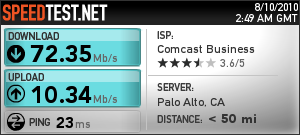
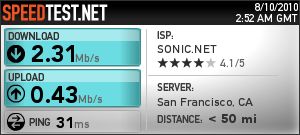
In all my born days, I never thought I'd be saying that. I've been a happy customer of Sonic.net for the entire time I've been in the US, but I recently became aware of an offer through work with Comcast Business that I couldn't refuse. So I've gone from Speedtest.net results for Sonic.net showing 2.31 Mb/s down and 0.43 Mb/s up to this Speedtest.net results for Comcast Business showing 72.35 Mb/s down and 10.34 Mb/s up You really can't beat it. I'll still recommend Sonic to all and sundry, but if you want some real speed (and with baby photos and videos galore to upload, I was really more interested in additional upload capacity), it's time to give DSL the flick.

4 August 2010

Andrew Pollock: [life] Zoe at 3 months

Again, there's been this surreal time warp effect. 3 months has passed, and it feels like both a long time and a blink of an eye. It more feels like a long time though. I've mostly forgotten what it was like before Zoe came along. Zoe is growing well. She weighs around 11 lbs 11 oz (5.3 kg), and I swear she's getting very long. When I'm holding her in my arms, there's legs everywhere. She started being able to roll from her stomach onto her back at 2 months, and her neck strength is pretty good now. I guess her next significant milestone will be being able to sit up properly. When she's on her tummy, she can prop herself up on her elbows and look around. She smiles all the time. We had a few nights of 8 hours of sleep, then everything went completely out the window, and we had about a week of very disrupted sleep at night. I think she's starting to settle into a routine now though, with a few 5 hour stints the last few nights. Her US passport arrived yesterday. We still need to get everything together to lodge her Australian citizenship application, which is the first step towards getting her an Australian passport. Sarah's back studying now (two subjects this semester), which is proving to be a bit of a juggling act. Zoe with her shiny new US passport

24 July 2010

Andrew Pollock: [geek] Cleaning up from 20 years ago

I'm a terrible hoarder. I hang onto old stuff because I think it might be fun to have a look at again later, when I've got nothing to do. The problem is, I never have nothing to do, or when I do, I never think to go through the stuff I've hoarded. As time goes by, the technology becomes more and more obsolete to the point where it becomes impractical to look at it. Today's example: the 3.5" floppy disk. I've got a disk holder thingy with floppies in it dating back to the mid-nineties and earlier. Stuff from high school, which I thought might be a good for a giggle to look at again some time. In the spirit of recording stuff before I throw it out, I present the floppy disks I'm immediately tossing out.
MS-DOS 6.2 and 6.22
Ah the DOS days. I remember excitedly looking forward to new versions of MS-DOS to see what new features they brought. I remember DOS 5.0 being the revolutionary one. The dir command grew a ton of options.
XTreeGold
More from the DOS days, when file management was such a pain in the arse that there was a business model to do it better. ytree seems like a fairly good looking clone of it for Linux.
WinZip for Windows 95, Windows NT and Windows 3.1
Ha. I actually paid money for an official WinZip floppy disk.
Nissan Maxima Electronic Brochure
I'm amazed this fit on a floppy disk
Turbo Pascal 6.0
Excluding GW-BASIC, this was the first "real" language I dabbled in. I learned it in Information Processing & Technology in grades 11 and 12. I never got into the OO stuff that version 6.0 was particularly geared towards.
Where in the World is Carmen Sandiego?
Awesome educational game. I was first introduced to this on the Apple ][, and loved it. This deserves being resurrected for a console.
Captain Comic II
Good sequel to the original, but I never found a version that worked properly (I could never convince it to let me finish it)
HDM IV
Ah, Hard Disk Menu. A necessity from the DOS days when booting up to a C:\> prompt just really didn't cut it. I used to love customising this thing.
ARJ, LHA, PK-ZIP
Of course, you needed a bazillion different decompression programs back in the days of file trading. I guess things haven't changed much with Linux. There's gzip, bzip2, 7zip, etc.
Zeliard
I wasted so many hours playing this. The ending was so hard.
MicroSQL
This was some locally produced software from Brisbane, written in Turbo Pascal (I think). It was a good introduction to SQL, I used it in high school and my first stab at University.
DOOM and DOOM II
Classics. I don't seem to have media for it any more, but I also enjoyed playing Heretic and Hexen. Oooh, Hexen has been ported to Linux? Must check that out...
SimCity 2000
I wasn't a big fan of this game, but I liked the isometric view that 2000 had, compared to the previous version.

6 July 2010

Andrew Pollock: [tech/security] Detecting capabilities with strace

One for the note-to-self file... Linux's maturing support for POSIX.1e capabilities is cool. Here's how to figure out what capabilities a binary needs, using strace.

Next.

Previous.