Search Results: "phil"

3 September 2020

Molly de Blanc: All Animals Are Equal, Peter Singer

I recently read Disability Visibility, which opens with a piece by Harriet McBryde Johnson about debating Peter Singer. When I got my first reading for my first class and saw it was Peter Singer, I was dismayed because of his (heinous) stances in disability. I assumed All Animals Are Equal was one of Singer s pieces about animal rights. While I agree with many of the principles Singer discusses around animal rights, I feel as though his work on this front is significantly diminished by his work around disability. To put it simply, I can t take Peter Singer seriously. Because of this I had a lot of trouble reading All Animals Are Equal and taking it in good faith. I judged everything from his arguments to his writing harshly. While I don t disagree with his basic point (all animals have rights) I disagree with how he made the point and the argument supporting it. One of the things I was told to ask when reading any philosophy paper is What is the argument? or What are they trying to convince you of? In this case, you could frame the answer as: Animals have some of) the same rights people do. I think it would be more accurate though to frame it as All animals (including humans) have (some of) the same rights or even Humans are as equally worthy of consideration as animals are. I think when we usually talk about animal rights, we do it from a perspective of wanting to elevate animals to human status. From one perspective, I don t like this approach because I feel as though it turns the framing of rights as something you deserve or earn, privileges you get for being good enough. The point about rights is that they are inherent you get them because they are. The valuable thing I got out of All Animals Are Equal is that rights are not universal. When we talk about things like abortion, for example, we talk about the right to have an abortion. Singer asks whether people who cannot get pregnant have the right to an abortion? What he doesn t dig into is that the right to an abortion is really just an extension of bodily autonomy turning one facet of bodily autonomy into the legal right to have a medical procedure. I think this is worth thinking about more turning high level human rights into the mundane rights, and acknowledging that not everyone can or needs them.

31 August 2020

Russ Allbery: Review: Men at Arms

Review: Men at Arms, by Terry Pratchett
Series: Discworld #15
Publisher: Harper
Copyright: 1993
Printing: November 2013
ISBN: 0-06-223740-3
Format: Mass market
Pages: 420
Men at Arms is the fifteenth Discworld novel and a direct plot sequel to Guards! Guards!. You could start here without missing too much, but starting with Guards! Guards! would make more sense. And of course there are cameos (and one major appearance) by other characters who are established in previous books. Carrot, the adopted dwarf who joined the watch in Guards! Guards!, has been promoted to corporal. He is now in charge of training new recruits, a role that is more important because of the Night Watch's new Patrician-ordered diversity initiative. The Watch must reflect the ethnic makeup of the city. That means admitting a troll, a dwarf... and a woman? Trolls and dwarfs hate each other because dwarfs mine precious things out of rock and trolls are composed of precious things embedded in rocks, so relations between the new recruits are tense. Captain Vimes is leaving the Watch, and no one is sure who would or could replace him. (The reason for this is a minor spoiler for Guards! Guards!) A magical weapon is stolen from the Assassin's Guild. And a string of murders begins, murders that Vimes is forbidden by Lord Vetinari from investigating and therefore clearly is going to investigate. This is an odd moment at which to read this book. The Night Watch are not precisely a police force, although they are moving in that direction. Their role in Ankh-Morpork is made much stranger by the guild system, in which the Thieves' Guild is responsible for theft and for dealing with people who steal outside of the quota of the guild. But Men at Arms is in part a story about ethics, about what it means to be a police officer, and about what it looks like when someone is very good at that job. Since I live in the United States, that makes it hard to avoid reading Men at Arms in the context of the current upheavals about police racism, use of force, and lack of accountability. Men at Arms can indeed be read that way; community relations, diversity in the police force, the merits of making two groups who hate each other work together, and the allure of violence are all themes Pratchett is working with in this novel. But they're from the perspective of a UK author writing in 1993 about a tiny city guard without any of the machinery of modern police, so I kept seeing a point of clear similarity and then being slightly wrong-footed by the details. It also felt odd to read a book where the cops are the heroes, much in the style of a detective show. This is in no way a problem with the book, and in a way it was helpful perspective, but it was a strange reading experience.
Cuddy had only been a guard for a few days but already he had absorbed one important and basic fact: it is almost impossible for anyone to be in a street without breaking the law.
Vimes and Carrot are both excellent police officers, but in entirely different ways. Vimes treats being a cop as a working-class job and is inclined towards glumness and depression, but is doggedly persistent and unable to leave a problem alone. His ethics are covered by a thick layer of world-weary cynicism. Carrot is his polar opposite in personality: bright, endlessly cheerful, effortlessly charismatic, and determined to get along with everyone. On first appearance, this contrast makes Vimes seem wise and Carrot seem a bit dim. That is exactly what Pratchett is playing with and undermining in Men at Arms. Beneath Vimes's cynicism, he's nearly as idealistic as Carrot, even though he arrives at his ideals through grim contrariness. Carrot, meanwhile, is nowhere near as dim as he appears to be. He's certain about how he wants to interact with others and is willing to stick with that approach no matter how bad of an idea it may appear to be, but he's more self-aware than he appears. He and Vimes are identical in the strength of their internal self-definition. Vimes shows it through the persistent, grumpy stubbornness of a man devoted to doing an often-unpleasant job, whereas Carrot verbally steamrolls people by refusing to believe they won't do the right thing.
Colon thought Carrot was simple. Carrot often struck people as simple. And he was. Where people went wrong was thinking that simple meant the same thing as stupid.
There's a lot going on in this book apart from the profiles of two very different models of cop. Alongside the mystery (which doubles as pointed commentary on the corrupting influence of violence and personal weaponry), there's a lot about dwarf/troll relations, a deeper look at the Ankh-Morpork guilds (including a horribly creepy clown guild), another look at how good Lord Vetinari is at running the city by anticipating how other people will react, a sarcastic dog named Gaspode (originally seen in Moving Pictures), and Pratchett's usual collection of memorable lines. It is also the origin of the now-rightfully-famous Vimes boots theory:
The reason that the rich were so rich, Vimes reasoned, was because they managed to spend less money. Take boots, for example. He earned thirty-eight dollars a month plus allowances. A really good pair of leather boots cost fifty dollars. But an affordable pair of boots, which were sort of OK for a season or two and then leaked like hell when the cardboard gave out, cost about ten dollars. Those were the kind of boots Vimes always bought, and wore until the soles were so thin that he could tell where he was in Ankh-Morpork on a foggy night by the feel of the cobbles. But the thing was that good boots lasted for years and years. A man who could afford fifty dollars had a pair of boots that'd still be keeping his feet dry in ten years' time, while the poor man who could only afford cheap boots would have spent a hundred dollars on boots in the same time and would still have wet feet. This was the Captain Samuel Vimes 'Boots' theory of socioeconomic unfairness.
Men at Arms regularly makes lists of the best Discworld novels, and I can see why. At this point in the series, Pratchett has hit his stride. The plots have gotten deeper and more complex without losing the funny moments, movie and book references, and glorious turns of phrase. There is also a lot of life philosophy and deep characterization when one pays close attention to the characters.
He was one of those people who would recoil from an assault on strength, but attack weakness without mercy.
My one complaint is that I found it a bit overstuffed with both characters and subplots, and as a result had a hard time following the details of the plot. I found myself wanting a timeline of the murders or a better recap from one of the characters. As always with Pratchett, the digressions are wonderful, but they do occasionally come at the cost of plot clarity. I'm not sure I recommend the present moment in the United States as the best time to read this book, although perhaps there is no better time for Carrot and Vimes to remind us what good cops look like. But regardless of when one reads it, it's an excellent book, one of the best in the Discworld series to this point. Followed, in publication order, by Soul Music. The next Watch book is Feet of Clay. Rating: 8 out of 10

23 August 2020

Philipp Kern: Self-service buildd givebacks now use Salsa auth

As client certificates are on the way out and Debian's SSO solution is effectively not maintained any longer, I switched self-service buildd givebacks over to Salsa authentication. It lives again at https://buildd.debian.org/auth/giveback.cgi. For authorization you still need to be in the "debian" group for now, i.e. be a regular Debian member.For convenience the package status web interface now features an additional column "Actions" with generated "giveback" links.Please remember to file bugs if you give builds back because of flakiness of the package rather than the infrastructure and resist the temptation to use this excessively to let your package migrate. We do not want to end up with packages that require multiple givebacks to actually build in stable, as that would hold up both security and stable updates needlessly and complicate development.

5 August 2020

Holger Levsen: 20200805-debconf7

DebConf7 This tshirt is 13 years old and from DebConf7. DebConf7 was my 5th DebConf and took place in Edinburgh, Scotland. And finally I could tell people I was a DD :-D Though as you can guess, that's yet another story to be told. So anyway, Edinburgh. I don't recall exactly whether the video team had to record 6 or 7 talk rooms on 4 floors, but this was probably the most intense set up we ran. And we ran a lot, from floor to floor, and room to room. DebConf7 was also special because it had a very special night venue, which was in an ex-church in a rather normal building, operated as sort of community center or some such, while the old church interior was still very much visible as in everything new was build around the old stuff. And while the night venue was cool, it also ment we (video team) had no access to our machines over night (or for much of the evening), because we had to leave the university over night and the networking situation didn't allow remote access with the bandwidth needed to do anything video. The night venue had some very simple house rules, like don't rearrange stuff, don't break stuff, don't fix stuff and just a few little more and of course we broke them in the best possible way: Toresbe with the help of people I don't remember fixed the organ, which was broken for decades. And so the house sounded in some very nice new old tune and I think everybody was happy we broke that rule. I believe the city is really nice from the little I've seen of it. A very nice old town, a big castle on the hill :) I'm not sure whether I missed the day trip to Glasgow to fix video things or to rest or both... Another thing I missed was getting a kilt, for which Phil Hands made a terrific design (update: the design is called tartan and was made by Phil indeed!), which spelled Debian in morse code. That was pretty cool and the kilts are really nice on DebConf group pictures since then. And if you've been wearing this kilt regularily for the last 13 years it was probably also a sensible investment. ;) It seems I don't have that many more memories of this DebConf, British power plugs and how to hack them comes to my mind and some other stuff here and there, but I remember less than previous years. I'm blaming this on the intense video setup and also on the sheer amount of people, which was the hightest until then and for some years, I believe maybe even until Heidelberg 8 years later. IIRC there were around 470 people there and over my first five years of DebConf I was incredible lucky to make many friends in Debian, so I probably just hung out and had good times.

28 July 2020

Chris Lamb: Pop culture matters

Many people labour under the assumption that pop culture is trivial and useless while only 'high' art can grant us genuine and eternal knowledge about the world. Given that we have a finite time on this planet, we are all permitted to enjoy pop culture up to a certain point, but we should always minimise our interaction with it, and consume more moral and intellectual instruction wherever possible. Or so the theory goes. What these people do not realise is that pop and mass culture can often provide more information about the world, humanity in general and what is even more important ourselves. This is not quite the debate around whether high art is artistically better, simply that pop culture can be equally informative. Jeremy Bentham argued in the 1820s that "prejudice apart, the game of push-pin is of equal value with the arts and sciences of music and poetry", that it didn't matter where our pleasures come from. (John Stuart Mill, Bentham's intellectual rival, disagreed.) This fundamental question of philosophical utilitarianism will not be resolved here. However, what might begin to be resolved is our instinctive push-back against pop culture. We all share an automatic impulse to disregard things we do not like and to pretend they do not exist, but this wishful thinking does not mean that these cultural products do not continue to exist when we aren't thinking about them and, more to our point, continue to influence others and even ourselves. Take, for example, the recent trend for 'millennial pink'. With its empty consumerism, faux nostalgia, reductive generational stereotyping, objectively ugly sthetics and tedious misogyny (photographed with Rose Gold iPhones), the very combination appears to have been deliberately designed to annoy me, curiously providing circumstantial evidence in favour of intelligent design. But if I were to immediately dismiss millennial pink and any of the other countless cultural trends I dislike simply because I find them disagreeable, I would be willingly keeping myself blind to their underlying ideology, their significance and their effect on society at large. If I had any ethical or political reservations I might choose not to engage with them economically or to avoid advertising them to others, but that is a different question altogether. Even if we can't notice this pattern within ourselves we can first observe it in others. We can all recall moments where someone has brushed off a casual reference to pop culture, be it Tiger King, TikTok, team sports or Taylor Swift; if you can't, simply look for the abrupt change of tone and the slightly-too-quick dismissal. I am not suggesting you attempt to dissuade others or even to point out this mental tic, but merely seeing it in action can be highly illustrative in its own way. In summary, we can simultaneously say that pop culture is not worthy of our time relative to other pursuits while consuming however much of it we want, but deliberately dismissing pop culture doesn't mean that a lot of other people are not interacting with it and is therefore undeserving of any inquiry. And if that doesn't convince you, just like the once-unavoidable millennial pink, simply sticking our collective heads in the sand will not mean that wider societal-level ugliness is going to disappear anytime soon. Anyway, that's a very long way of justifying why I plan to re-watch TNG.

16 July 2020

Louis-Philippe V ronneau: DebConf Videoteam Sprint Report -- DebConf20@Home

DebConf20 starts in about 5 weeks, and as always, the DebConf Videoteam is working hard to make sure it'll be a success. As such, we held a sprint from July 9th to 13th to work on our new infrastructure. A remote sprint certainly ain't as fun as an in-person one, but we nonetheless managed to enjoy ourselves. Many thanks to those who participated, namely: We also wish to extend our thanks to Thomas Goirand and Infomaniak for providing us with virtual machines to experiment on and host the video infrastructure for DebConf20. Advice for presenters For DebConf20, we strongly encourage presenters to record their talks in advance and send us the resulting video. We understand this is more work, but we think it'll make for a more agreeable conference for everyone. Video conferencing is still pretty wonky and there is nothing worse than a talk ruined by a flaky internet connection or hardware failures. As such, if you are giving a talk at DebConf this year, we are asking you to read and follow our guide on how to record your presentation. Fear not: we are not getting rid of the Q&A period at the end of talks. Attendees will ask their questions either on IRC or on a collaborative pad and the Talkmeister will relay them to the speaker once the pre-recorded video has finished playing. New infrastructure, who dis? Organising a virtual DebConf implies migrating from our battle-tested on-premise workflow to a completely new remote one. One of the major changes this means for us is the addition of Jitsi Meet to our infrastructure. We normally have 3 different video sources in a room: two cameras and a slides grabber. With the new online workflow, directors will be able to play pre-recorded videos as a source, will get a feed from a Jitsi room and will see the audience questions as a third source. This might seem simple at first, but is in fact a very major change to our workflow and required a lot of work to implement.
               == On-premise ==                                          == Online ==
                                                      
              Camera 1                                                 Jitsi
                                                                          
                 v                 ---> Frontend                         v                 ---> Frontend
                                                                                            
    Slides -> Voctomix -> Backend -+--> Frontend         Questions -> Voctomix -> Backend -+--> Frontend
                                                                                            
                 ^                 ---> Frontend                         ^                 ---> Frontend
                                                                          
              Camera 2                                           Pre-recorded video
In our tests, playing back pre-recorded videos to voctomix worked well, but was sometimes unreliable due to inconsistent encoding settings. Presenters will thus upload their pre-recorded talks to SReview so we can make sure there aren't any obvious errors. Videos will then be re-encoded to ensure a consistent encoding and to normalise audio levels. This process will also let us stitch the Q&As at the end of the pre-recorded videos more easily prior to publication. Reducing the stream latency One of the pitfalls of the streaming infrastructure we have been using since 2016 is high video latency. In a worst case scenario, remote attendees could get up to 45 seconds of latency, making participation in events like BoFs arduous. In preparation for DebConf20, we added a new way to stream our talks: RTMP. Attendees will thus have the option of using either an HLS stream with higher latency or an RTMP stream with lower latency. Here is a comparative table that can help you decide between the two protocols:
HLS RTMP
Pros
  • Can be watched from a browser
  • Auto-selects a stream encoding
  • Single URL to remember
  • Lower latency (~5s)
Cons
  • Higher latency (up to 45s)
  • Requires a dedicated video player (VLC, mpv)
  • Specific URLs for each encoding setting
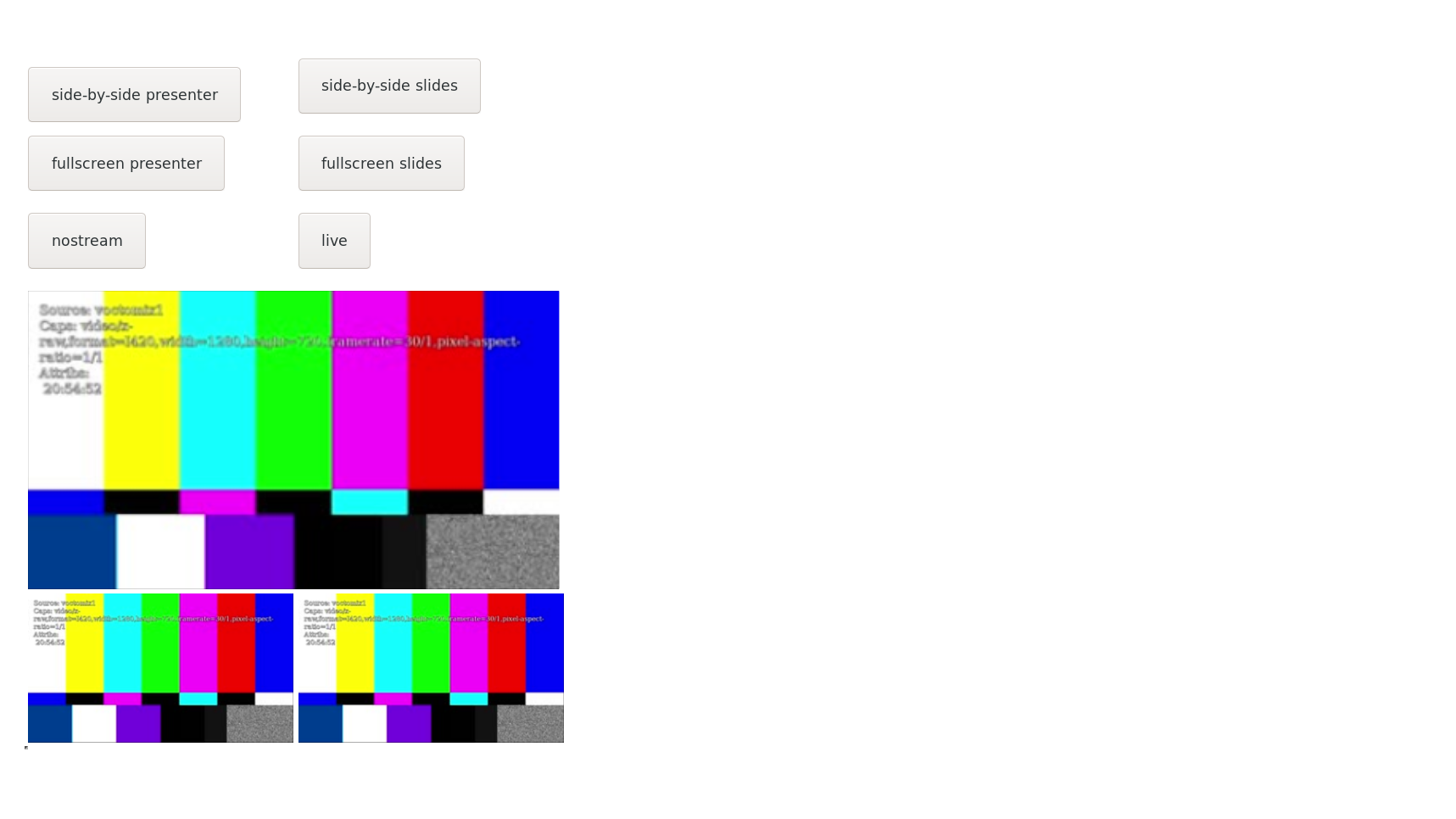
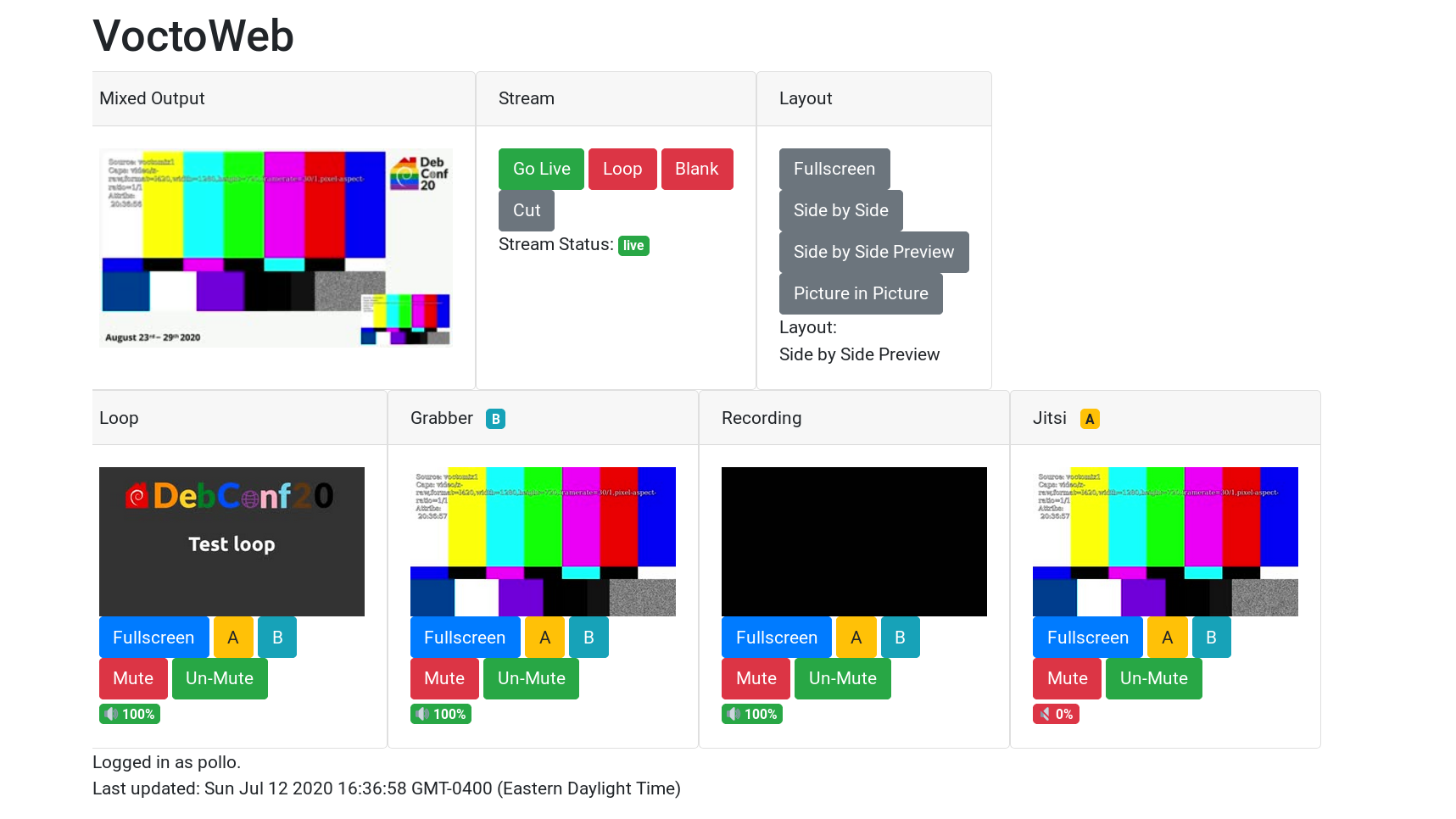
Live mixing from home with VoctoWeb Since DebConf16, we have been using voctomix, a live video mixer developed by the CCC VOC. voctomix is conveniently divided in two: voctocore is the backend server while voctogui is a GTK+ UI frontend directors can use to live-mix. Although voctogui can connect to a remote server, it was primarily designed to run either on the same machine as voctocore or on the same LAN. Trying to use voctogui from a machine at home to connect to a voctocore running in a datacenter proved unreliable, especially for high-latency and low bandwidth connections. Inspired by the setup FOSDEM uses, we instead decided to go with a web frontend for voctocore. We initially used FOSDEM's code as a proof of concept, but quickly reimplemented it in Python, a language we are more familiar with as a team. Compared to the FOSDEM PHP implementation, voctoweb implements A / B source selection (akin to voctogui) as well as audio control, two very useful features. In the following screen captures, you can see the old PHP UI on the left and the new shiny Python one on the right. The old PHP voctowebThe new Python3 voctoweb Voctoweb is still under development and is likely to change quite a bit until DebConf20. Still, the current version seems to works well enough to be used in production if you ever need to. Python GeoIP redirector We run multiple geographically-distributed streaming frontend servers to minimize the load on our streaming backend and to reduce overall latency. Although users can connect to the frontends directly, we typically point them to live.debconf.org and redirect connections to the nearest server. Sadly, 6 months ago MaxMind decided to change the licence on their GeoLite2 database and left us scrambling. To fix this annoying issue, Stefano Rivera wrote a Python program that uses the new database and reworked our ansible frontend server role. Since the new database cannot be redistributed freely, you'll have to get a (free) license key from MaxMind if you to use this role. Ansible & CI improvements Infrastructure as code is a living process and needs constant care to fix bugs, follow changes in DSL and to implement new features. All that to say a large part of the sprint was spent making our ansible roles and continuous integration setup more reliable, less buggy and more featureful. All in all, we merged 26 separate ansible-related merge request during the sprint! As always, if you are good with ansible and wish to help, we accept merge requests on our ansible repository :)

14 July 2020

Ian Jackson: MessagePack vs CBOR (RFC7049)

tl;dr: Use MessagePack, rather than CBOR. Introduction I recently wanted to choose a binary encoding. This was for a project using Rust serde, so I looked at the list of formats there. I ended up reading about CBOR and MessagePack. Both of these are binary formats for a JSON-like data model. Both of them are "schemaless", meaning you can decode them without knowing the structure. (This also provides some forwards compatibility.) They are, in fact, quite similar (although they are totally incompatible). This is no accident: CBOR is, effectively, a fork of MessagePack. Both formats continue to exist and both are being used in new programs. I needed to make a choice but lacked enough information. I thought I would try to examine the reasons and nature of the split, and to make some kind of judgement about the situation. So I did a lot of reading [11]. Here are my conclusions. History and politics Between about 2010 and 2013 there was only MessagePack. Unfortunately, MessagePack had some problems. The biggest of these was that it lacked a separate string type. Strings were to be encoded simply as byte blocks. This caused serious problems for many MessagePack library implementors: for example, when decoding a MessagePack file the Python library wouldn't know whether to produce a Python bytes object, or a string. Straightforward data structures wouldn't round trip through MessagePack. [1] [2] It seems that in late 2012 this came to the attention to someone with an IETF background. According to them, after unsatisfactory conversations with MessagePack upstream, they decided they would have to fork. They submitted an Internet Draft for a partially-incompatible protocol [3] [4]. Little seemed to happen in the IETF until soon before the Orlando in-person IETF meeting in February 2013.[5] These conversations sparked some discussion in the MessagePack issue tracker. There were long threads including about process [1,2,4 ibid]. But there was also a useful technical discussion, about proposed backward compatible improves to the MessagePack spec.[5] The prominent IETF contributor provided some helpful input in these discussions in the MessagePack community - but also pushed quite hard for a "tagging" system, which suggestion was not accepted (see my technical analysis, below). An improved MessagePack spec resulted, with string support, developed largely by the MessagePack community. It seems to have been available in useable form since mid-2013 and was officially published as canonical in August 2013. Meanwhile a parallel process was pursued in the IETF, based on the IETF contributor's fork, with 11 Internet-Drafts from February[7] to September[8]. This seems to have continued even though the original technical reason for the fork - lack of string vs binary distinction - no longer applied. The IETF proponent expressed unhappiness about MessagePack's stewardship and process as much as they did about the technical details [4, ibid]. The IETF process culminated in the CBOR RFC[9]. The discussion on process questions between the IETF proponent and MessagePack upstream, in the MessagePack issue tracker [4, ibid] should make uncomfortable reading for IETF members. The IETF acceptance of CBOR despite clear and fundamental objections from MessagePack upstream[13] and indeed other respected IETF members[14], does not reflect well on the IETF. The much vaunted openness of the IETF process seems to have been rather one-sided. The IETF proponent here was an IETF Chair. Certainly the CBOR author was very well-spoken and constantly talks about politeness and cooperation and process; but what they actually did was very hostile. They accused the MessagePack community of an "us and them" attitude while simultaneously pursuing a forked specification! The CBOR RFC does mention MessagePack in Appendix E.2. But not to acknowledge that CBOR was inspired by MessagePack. Rather, it does so to make a set of tendentious criticisms of MessagePack. Perhaps these criticisms were true when they were first written in an I-D but they were certainly false by the time the RFC was actually published, which occurred after the MessagePack improvement process was completely concluded, with a formal spec issued. Since then both formats have existed in parallel. Occasionally people discuss which one is better, and sometimes it is alleged that "yes CBOR is the successor to MessagePack", which is not really fair.[9][10] Technical differences The two formats have a similar arrangement: initial byte which can encode small integers, or type and length, or type and specify a longer length encoding. But there are important differences. Overall, MessagePack is very significantly simpler. Floating point CBOR supports five floating point formats! Not only three sizes of IEEE754, but also decimal floating point, and bigfloats. This seems astonishing for a supposedly-simple format. (Some of these are supported via the semi-optional tag mechanism - see below.) Indefinite strings and arrays Like MessagePack, CBOR mostly precedes items with their length. But CBOR also supports "indefinite" strings, arrays, and so on, where the length is not specified at the beginning. The object (array, string, whatever) is terminated by a special "break" item. This seems to me to be a mistake. If you wanted the kind of application where MessagePack or CBOR would be useful, streaming sub-objects of unknown length is not that important. This possibility considerably complicates decoders. CBOR tagging system CBOR has a second layer of sort-of-type which can be attached to each data item. The set of possible tags is open-ended and extensible, but the CBOR spec itself gives tag values for: two kinds of date format; positive and negative bignums; decimal floats (see above); binary but expected to be encoded if converted to JSON (in base64url, base64, or base16); nestedly encoded CBOR; URIs; base64 data (two formats); regexps; MIME messages; and a special tag to make file(1) work. In practice it is not clear how many of these are used, but a decoder must be prepared to at least discard them. The amount of additional spec complexity here is quite astonishing. IMO binary formats like this will (just like JSON) be used by a next layer which always has an idea of what the data means, including (where the data is a binary blob) what encoding it is in etc. So these tags are not useful. These tags might look like a middle way between (i) extending the binary protocol with a whole new type such as an extension type (incompatible with old readers) and encoding your new kind data in a existing type (leaving all readers who don't know the schema to print it as just integers or bytes or string). But I think they are more trouble than they are worth. The tags are uncomfortably similar to the ASN.1 tag system, which is widely regarded as one of ASN.1's unfortunate complexities. MessagePack extension mechanism MessagePack explicitly reserves some encoding space for users and for future extensions: there is an "extension type". The payload is an extension type byte plus some more data bytes; the data bytes are in a format to be defined by the extension type byte. Half of the possible extension byte values are reserved for future specification, and half are designated for application use. This is pleasingly straightforward. (There is also one unused primary initial byte value, but that would be rejected by existing decoders and doesn't seem like a likely direction for future expansion.) Minor other differences in integer encoding The encodings of integers differ. In MessagePack, signed and unsigned integers have different typecodes. In CBOR, signed and unsigned positive integers have the same typecodes; negative integers have a different set of typecodes. This means that a CBOR reader which knows it is expecting a signed value will have to do a top-bit-set check on the actual data value! And a CBOR writer must check the value to choose a typecode. MessagePack reserves fewer shortcodes for small negative integers, than for small positive integers. Conclusions and lessons MessagePack seems to have been prompted into fixing the missing string type problem, but only by the threat of a fork. However, this fork went ahead even after MessagePack clearly accepted the need for a string type. MessagePack had a fixed protocol spec before the IETF did. The continued pursuit of the IETF fork was ostensibly been motivated by a disapproval of the development process and in particular a sense that the IETF process was superior. However, it seems to me that the IETF process was abused by CBOR's proponent, who just wanted things their own way. I have seen claims by IETF proponents that the open decisionmaking system inherently produces superior results. However, in this case the IETF process produced a bad specification. To the extent that other IETF contributors had influence over the ultimate CBOR RFC, I don't think they significantly improved it. CBOR has been described as MessagePack bikeshedded by the IETF. That would have been bad enough, but I think it's worse than that. To a large extent CBOR is one person's NIH-induced bad design rubber stamped by the IETF. CBOR's problems are not simply matters of taste: it's significantly overcomplicated. One lesson for the rest of us is that although being the upstream and nominally in charge of a project seems to give us a lot of power, it's wise to listen carefully to one's users and downstreams. Once people are annoyed enough to fork, the fork will have a life of its own. Another lesson is that many of us should be much warier of the supposed moral authority of the IETF. Many IETF standards are awful (Oauth 2 [12]; IKE; DNSSEC; the list goes on). Sometimes (especially when network adoption effects are weak, as with MessagePack vs CBOR) better results can be obtained from a smaller group, or even an individual, who simply need the thing for their own uses. Finally, governance systems of public institutions like the IETF need to be robust in defending the interests of outsiders (and hence of society at large) against eloquent insiders who know how to work the process machinery. Any institution which nominally serves the public good faces a constant risk of devolving into self-servingness. This risk gets worse the more powerful and respected the institution becomes. References
  1. #13: First-class string type in serialization specification (MessagePack issue tracker, June 2010 - August 2013)
  2. #121: Msgpack can't differentiate between raw binary data and text strings (MessagePack issue tracker, November 2012 - February 2013)
  3. draft-bormann-apparea-bpack-00: The binarypack JSON-like representation format (IETF Internet-Draft, October 2012)
  4. #129: MessagePack should be developed in an open process (MessagePack issue tracker, February 2013 - March 2013)
  5. Re: JSON mailing list and BoF (IETF apps-discuss mailing list message from Carsten Bormann, 18 February 2013)
  6. #128: Discussions on the upcoming MessagePack spec that adds the string type to the protocol (MessagePack issue tracker, February 2013 - August 2013)
  7. draft-bormann-apparea-bpack-01: The binarypack JSON-like representation format (IETF Internet-Draft, February 2013)
  8. draft-bormann-cbor: Concise Binary Object Representation (CBOR) (IETF Internet-Drafts, May 2013 - September 2013)
  9. RFC 7049: Concise Binary Object Representation (CBOR) (October 2013)
  10. "MessagePack should be replaced with [CBOR] everywhere ..." (floatboth on Hacker News, 8th April 2017)
  11. Discussion with very useful set of history links (camgunz on Hacker News, 9th April 2017)
  12. OAuth 2.0 and the Road to Hell (Eran Hammer, blog posting from 2012, via Wayback Machine)
  13. Re: [apps-discuss] [Json] msgpack/binarypack (Re: JSON mailing list and BoF) (IETF list message from Sadyuki Furuhashi, 4th March 2013)
  14. "no apologies for complaining about this farce" (IETF list message from Phillip Hallam-Baker, 15th August 2013)
    Edited 2020-07-14 18:55 to fix a minor formatting issue, and 2020-07-14 22:54 to fix two typos


comment count unavailable comments

30 June 2020

Norbert Preining: TeX Live Debian update 20200629

More than a month has passed since the last update of TeX Live packages in Debian, so here is a new checkout!
All arch all packages have been updated to the tlnet state as of 2020-06-29, see the detailed update list below. Enjoy. New packages akshar, beamertheme-pure-minimalistic, biblatex-unified, biblatex-vancouver, bookshelf, commutative-diagrams, conditext, courierten, ektype-tanka, hvarabic, kpfonts-otf, marathi, menucard, namedef, pgf-pie, pwebmac, qrbill, semantex, shtthesis, tikz-lake-fig, tile-graphic, utf8add. Updated packages abnt, achemso, algolrevived, amiri, amscls, animate, antanilipsum, apa7, babel, bangtex, baskervillef, beamerappendixnote, beamerswitch, beamertheme-focus, bengali, bib2gls, biblatex-apa, biblatex-philosophy, biblatex-phys, biblatex-software, biblatex-swiss-legal, bibleref, bookshelf, bxjscls, caption, ccool, cellprops, changes, chemfig, circuitikz, cloze, cnltx, cochineal, commutative-diagrams, comprehensive, context, context-vim, cquthesis, crop, crossword, ctex, cweb, denisbdoc, dijkstra, doclicense, domitian, dps, draftwatermark, dvipdfmx, ebong, ellipsis, emoji, endofproofwd, eqexam, erewhon, erewhon-math, erw-l3, etbb, euflag, examplep, fancyvrb, fbb, fbox, fei, fira, fontools, fontsetup, fontsize, forest-quickstart, gbt7714, genealogytree, haranoaji, haranoaji-extra, hitszthesis, hvarabic, hyperxmp, icon-appr, kpfonts, kpfonts-otf, l3backend, l3build, l3experimental, l3kernel, latex-amsmath-dev, latexbangla, latex-base-dev, latexdemo, latexdiff, latex-graphics-dev, latexindent, latex-make, latexmp, latex-mr, latex-tools-dev, libertinus-fonts, libertinust1math, lion-msc, listings, logix, lshort-czech, lshort-german, lshort-polish, lshort-portuguese, lshort-russian, lshort-slovenian, lshort-thai, lshort-ukr, lshort-vietnamese, luamesh, lua-uca, luavlna, lwarp, marathi, memoir, mnras, moderntimeline, na-position, newcomputermodern, newpx, nicematrix, nodetree, ocgx2, oldstandard, optex, parskip, pdfcrop, pdfpc, pdftexcmds, pdfxup, pgf, pgfornament, pgf-pie, pgf-umlcd, pgf-umlsd, pict2e, plautopatch, poemscol, pst-circ, pst-eucl, pst-func, pstricks, pwebmac, pxjahyper, quran, rec-thy, reledmac, rest-api, sanskrit, sanskrit-t1, scholax, semantex, showexpl, shtthesis, suftesi, svg, tcolorbox, tex4ht, texinfo, thesis-ekf, thuthesis, tkz-doc, tlshell, toptesi, tuda-ci, tudscr, twemoji-colr, univie-ling, updmap-map, vancouver, velthuis, witharrows, wtref, xecjk, xepersian-hm, xetex-itrans, xfakebold, xindex, xindy, xltabular, yathesis, ydoc, yquant, zref.

17 June 2020

Ulrike Uhlig: On Language

Language is a tool of power In school, we read the philologist diary of Victor Klemperer about the changes in the German language during the Third Reich, LTI - Lingua Tertii Imperii, a book which makes it clear that the use of language is political, creates realities, and has reverse repercussions on concepts of an entire society. Language was one of the tools that supported Nazism in insiduously pervading all parts of society. Language shapes our concepts of society Around the same time, a friend of mine proposed to read Egalia's daughters by Gerd Brantenberg, a book in which gendered words were reversed: so that human becomes huwim, for example. This book made me take notice of gendered concepts that often go unnoticed. Language shapes the way we think and feel I spent a large part of my adult life in France, which confronted me with the realization that a language provides its speakers with certain concepts. If a concept does not exist in a language, people cannot easily feel or imagine this concept either. Back then (roughly 20 years ago), even though I was aware of gender inequality, I hated using gender neutral language because in German and French it felt unnatural, and, or so I thought, we were all alike. One day, at a party, we played a game that consisted in guessing people's professions by asking them Yes/No questions. Turns out that we were unable to guess that the woman we were talking with was a doctor, because we could simply not imagine this profession for a young woman. In French, docteur is male and almost nobody would use the word doctoresse, ou femme docteur. Unimaginable are also the concepts of words in German that have no equivalent in French or vice versa: Or, to make all this a bit less serious, Italian has the word gattara (female) or gattaro (male), which one could translate to English roughly as cat person, most often designating old women who feed stray cats. But really, the way language shapes our concepts and ideas goes much further, as well explained by Lera Boroditsky in a talk in which she explains how language influences concepts of space, time, and blame, among other things. Building new models This quote by Buckminster Fuller is pinned on the wall over my desk:
You never change things by fighting the existing reality. To change something, build a new model that makes the existing model obsolete.
A change in language is such a new model: it can make oppression and inequalities visible. Words do not only describe our world, they are a vehicle of ideas, and utopias. Analyzing and criticizing our use of language means paving the way for ideas and concepts of inclusion, equality, and unity. You might be guessing at where am I getting at with this Right: I am in favor of acknowledging past mistakes, and replacing oppressive metaphors in computing. As noted in the IETF draft about Terminology, Power and Oppressive Language, by Niels Ten Oever and Mallory Knodel, the metaphors "master/slave" and "blacklist/whitelist" associate "white with good and black with evil [which] is known as the 'bad is black effect'", all the while being technically inaccurate. I acknowledge that this will take time. There is a lot of work to do.

11 June 2020

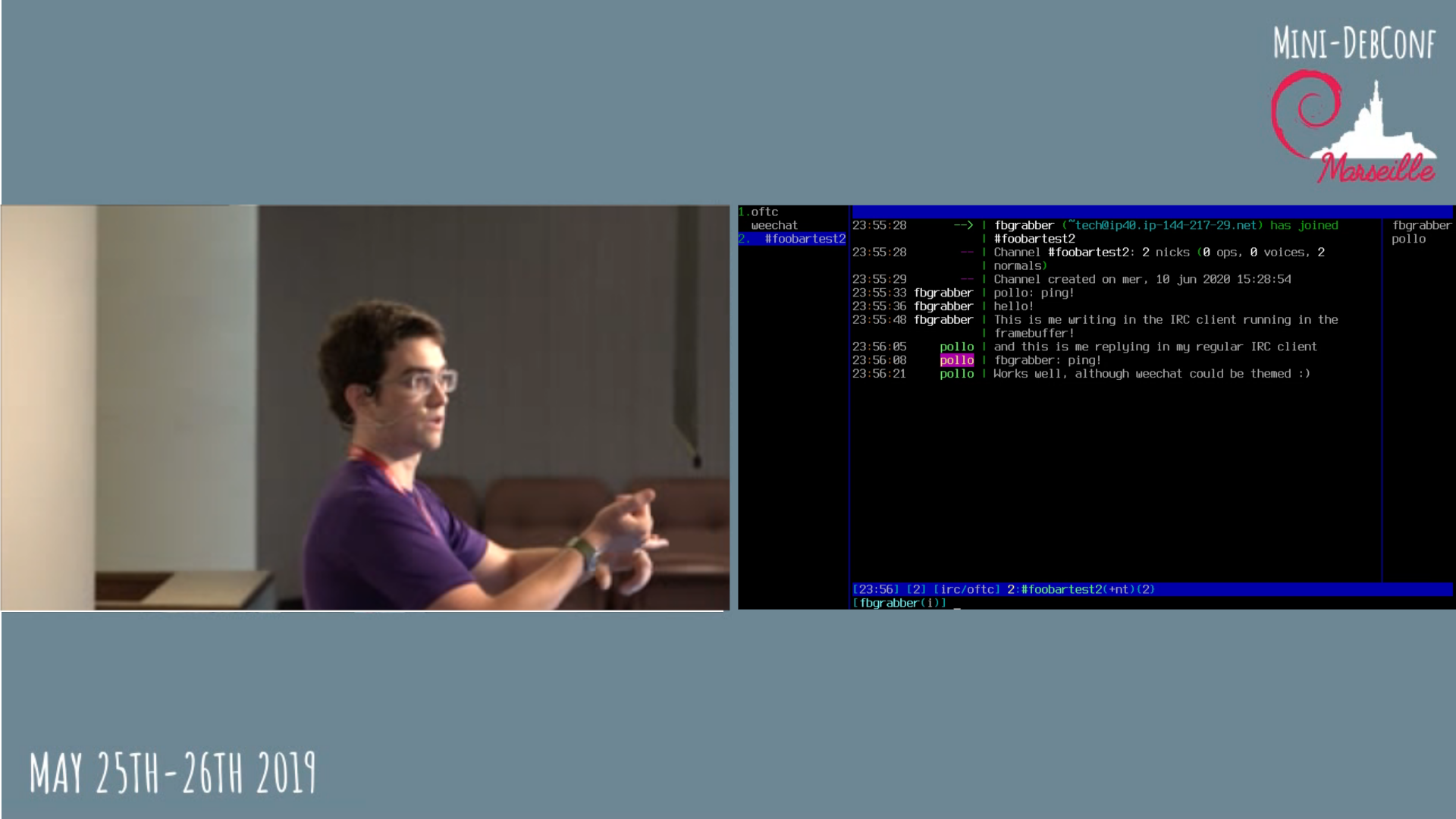
Louis-Philippe V ronneau: How to capture a remote IRC session live

DebConf20 will be held online this year and I've started doing some work for the DebConf videoteam to prepare what's to come. One thing I want us to do is capture a live IRC session and use it as a video input in Voctomix, the live video mixer we use. This way, at the end of a talk we could show both the attendees asking questions on IRC and the presenter replying to them side-by-side. A mockup of a side-by-side voctogui window with someone on the left and a terminal running weechat on the right Capturing a live video of an IRC client on a remote headless server is somewhat more complicated than you might think; as far as I know, neither ffmpeg nor gstreamer support recording a live ssh pseudoterminal1. Worse, neither weechat nor irssi run on X: they use ncurses... Although you can capture an X11 window with ffmpeg -f x11grab, I wasn't able to get them to run with Xvfb. Capturing the framebuffer One thing I dislike with this method is the framebuffer isn't always easy to access on remote machines. If you don't have a serial connection, you can try using a VNC server that can. I did my tests in a VM on an KVM hypervisor and used virt-manager to access the framebuffer. I had a hard time setting the framebuffer resolution to a 16:9 aspect ratio. The winning combination ended up passing the nomodeset kernel parameter at boot and setting up these parameters in /etc/default/grub2:
GRUB_GFXMODE=1280x720
GRUB_GFXPAYLOAD_LINUX=keep
To make the text more readable, this is the /etc/default/console-setup file that seemed to make the most sense:
# CONFIGURATION FILE FOR SETUPCON
# Consult the console-setup(5) manual page.
ACTIVE_CONSOLES="/dev/tty[1-6]"
CHARMAP="UTF-8"
CODESET="Lat15"
FONTFACE="TerminusBold"
FONTSIZE="12x24"
Once that is done, the only thing left is to run the IRC client and launch ffmpeg. The magic command to record the framebuffer seems to be something like:
ffmpeg -f fbdev -framerate 60 -i /dev/fb0 -c:v libvpx -crf 10 -b:v 1M -auto-alt-ref 0 output.webm
Here is what I ended up with:

  1. We need something similarly flexible and featureful that can output to a TCP socket.
  2. Don't forget to run update-grub before rebooting!

31 May 2020

Enrico Zini: Controversial inventors

Paul-F lix Armand-Delille (3 July 1874 in Fourchambault, Ni vre 4 September 1963) was a physician, bacteriologist, professor, and member of the French Academy of Medicine who accidentally brought about the collapse of rabbit populations throughout much of Europe and beyond in the 1950s by infecting them with myxomatosis.
Charles Franklin Kettering (August 29, 1876 November 25, 1958) sometimes known as Charles "Boss" Kettering[1] was an American inventor, engineer, businessman, and the holder of 186 patents.[2] He was a founder of Delco, and was head of research at General Motors from 1920 to 1947. Among his most widely used automotive developments were the electrical starting motor[3] and leaded gasoline.[4][5] In association with the DuPont Chemical Company, he was also responsible for the invention of Freon refrigerant for refrigeration and air conditioning systems. At DuPont he also was responsible for the development of Duco lacquers and enamels, the first practical colored paints for mass-produced automobiles. While working with the Dayton-Wright Company he developed the "Bug" aerial torpedo, considered the world's first aerial missile.[6] He led the advancement of practical, lightweight two-stroke diesel engines, revolutionizing the locomotive and heavy equipment industries. In 1927, he founded the Kettering Foundation, a non-partisan research foundation. He was featured on the cover of Time magazine on January 9, 1933.
John Charles Cutler (June 29, 1915 February 8, 2003) was a senior surgeon, and the acting chief of the venereal disease program in the United States Public Health Service. After his death, his involvement in several controversial and unethical medical studies of syphilis was revealed, including the Guatemala and the Tuskegee syphilis experiments.
Ivy Ledbetter Lee (July 16, 1877 November 9, 1934) was an American publicity expert and a founder of modern public relations. Lee is best known for his public relations work with the Rockefeller family. His first major client was the Pennsylvania Railroad, followed by numerous major railroads such as the New York Central, the Baltimore and Ohio, and the Harriman lines such as the Union Pacific. He established the Association of Railroad Executives, which included providing public relations services to the industry. Lee advised major industrial corporations, including steel, automobile, tobacco, meat packing, and rubber, as well as public utilities, banks, and even foreign governments. Lee pioneered the use of internal magazines to maintain employee morale, as well as management newsletters, stockholder reports, and news releases to the media. He did a great deal of pro bono work, which he knew was important to his own public image, and during World War I, he became the publicity director for the American Red Cross.[1]

4 May 2020

Jonathan Dowland: Amiga floppy recovery project: what next?

This is the ninth part in a series of blog posts. The previous post was Amiga floppy recovery project scope. The whole series is available here: Amiga.
It's been a while since I've reported on my Amiga floppy recovery project. With my bulky Philips CRT attached I slowly ground through the process of importing all my floppy disks, which is now done. The majority of disks were imported without errors. Commercial disks were the most likely to fail to import. Possibly I'd have more success with them if I used a different copying technique than X-COPY's default, but my focus was not on the commercial disks. I have not yet restored the use of my LCD TV with the Amiga. I was waiting to hear back from Amiga Kit about an agreed return, but despite their web store claiming they're still open for business, I haven't been able to get any response to my emails to them since mid-February. I've given up, written off that order and bought an RGB/SCART adaptor elsewhere instead. Meanwhile my bulky CRT has returned to the loft. The next step is pretty boring: time to check over my spreadsheet of disks, the imported copies of them, make sure everything is accounted for and decide whether to make further attempts for any that failed or write them off. For commercial disks it's almost certainly less effort to track down someone else's rip than to try mine again. After that I can return to moving the Gotek floppy adaptor inside the Amiga case, as described in the last entry, and start playing.

26 April 2020

Enrico Zini: Some Italian women

Artemisia Gentileschi - Wikipedia
art history people archive.org
Artemisia Lomi or Artemisia Gentileschi (US: / d nt l ski, -ti -/, Italian: [arte mi zja d enti leski]; July 8, 1593 c. 1656) was an Italian Baroque painter, now considered one of the most accomplished seventeenth-century artists working in the dramatic style of Caravaggio. In an era when women had few opportunities to pursue artistic training or work as professional artists, Artemisia was the first woman to become a member of the Accademia di Arte del Disegno in Florence and had an international clientele.
Maria Pellegrina Amoretti (1756 1787), was an Italian lawyer. She is referred to as the first woman to graduate in law in Italy, and the third woman to earn a degree.
Laura Maria Caterina Bassi (October 1711 20 February 1778) was an Italian physicist and academic. She received a doctoral degree in Philosophy from the University of Bologna in May 1732. She was the first woman to earn a professorship in physics at a university. She is recognized as the first woman in the world to be appointed a university chair in a scientific field of studies. Bassi contributed immensely to the field of science while also helping to spread the study of Newtonian mechanics through Italy.
Maria Gaetana Agnesi (UK: / n je zi/ an-YAY-zee,[1] US: / n -/ ahn-,[2][3] Italian: [ma ri a ae ta na a zi, - e z-];[4] 16 May 1718 9 January 1799) was an Italian mathematician, philosopher, theologian, and humanitarian. She was the first woman to write a mathematics handbook and the first woman appointed as a mathematics professor at a university.[5]
Elena Lucrezia Cornaro Piscopia (US: /k r n ro p sko pi /,[4] Italian: [ lena lu kr ttsja kor na ro pi sk pja]) or Elena Lucrezia Corner (Italian: [kor n r]; 5 June 1646 26 July 1684), also known in English as Helen Cornaro, was a Venetian philosopher of noble descent who in 1678 became one of the first women to receive an academic degree from a university, and the first to receive a Doctor of Philosophy degree.
Maria Tecla Artemisia Montessori (/ m nt s ri/ MON-tiss-OR-ee, Italian: [ma ri a montes s ri]; August 31, 1870 May 6, 1952) was an Italian physician and educator best known for the philosophy of education that bears her name, and her writing on scientific pedagogy. At an early age, Montessori broke gender barriers and expectations when she enrolled in classes at an all-boys technical school, with hopes of becoming an engineer. She soon had a change of heart and began medical school at the Sapienza University of Rome, where she graduated with honors in 1896. Her educational method is still in use today in many public and private schools throughout the world.
Rita Levi-Montalcini OMRI OMCA (US: / le vi mo nt l t i ni, l v-, li vi m nt l -/, Italian: [ ri ta l vi montal t i ni]; 22 April 1909 30 December 2012) was an Italian Nobel laureate, honored for her work in neurobiology. She was awarded the 1986 Nobel Prize in Physiology or Medicine jointly with colleague Stanley Cohen for the discovery of nerve growth factor (NGF). From 2001 until her death, she also served in the Italian Senate as a Senator for Life. This honor was given due to her significant scientific contributions. On 22 April 2009, she became the first Nobel laureate ever to reach the age of 100, and the event was feted with a party at Rome's City Hall. At the time of her death, she was the oldest living Nobel laureate.
Margherita Hack Knight Grand Cross OMRI (Italian: [mar e ri ta (h)ak]; 12 June 1922 29 June 2013) was an Italian astrophysicist and scientific disseminator. The asteroid 8558 Hack, discovered in 1995, was named in her honour.
Samantha Cristoforetti (Italian pronunciation: [sa manta kristofo retti]; born 26 April 1977, in Milan) is an Italian European Space Agency astronaut, former Italian Air Force pilot and engineer. She holds the record for the longest uninterrupted spaceflight by a European astronaut (199 days, 16 hours), and until June 2017 held the record for the longest single space flight by a woman until this was broken by Peggy Whitson and later by Christina Koch. She is also the first Italian woman in space. Samantha Cristoforetti is also known as the first person who brewed an espresso in space.

12 April 2020

Enrico Zini: Some inventors links

Cleopatra the Alchemist - Wikipedia
history people archive.org
Cleopatra the Alchemist who likely lived during the 3rd century AD, was a Greek alchemist, author, and philosopher. She experimented with practical alchemy but is also credited as one of the four female alchemists that could produce the Philosopher's stone. Some writers consider her to be the inventor of the alembic, a distillation apparatus.
Hedy Lamarr (/ he di/), born Hedwig Eva Maria Kiesler (November 9, 1914[a] January 19, 2000), was an Austrian-born American film actress and inventor who was posthumously inducted into the National Inventors Hall of Fame.[1]
Radia Joy Perlman (born December 18, 1951) is an American computer programmer and network engineer. She is most famous for her invention of the spanning-tree protocol (STP), which is fundamental to the operation of network bridges, while working for Digital Equipment Corporation. She also made large contributions to many other areas of network design and standardization, such as link-state routing protocols.
Stephanie Louise Kwolek (July 31, 1923 June 18, 2014) was an American chemist who is known for inventing Kevlar. She was of Polish heritage and her career at the DuPont company spanned more than 40 years.[1] She discovered the first of a family of synthetic fibres of exceptional strength and stiffness: poly-paraphenylene terephthalamide.
This page aims to list inventions and discoveries in which women played a major role.

8 April 2020

Louis-Philippe V ronneau: Using Jitsi Meet with Puppet for self-hosted video conferencing

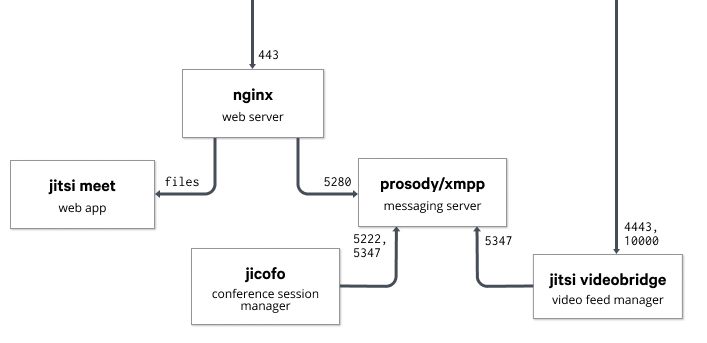
Here's a blog post I wrote for the puppet.com blog. Many thanks to Ben Ford and all their team!. With everything that is currently happening around the world, many of us IT folks have had to solve complex problems in a very short amount of time. Pretty quickly at work, I was tasked with finding a way to make virtual meetings easy, private and secure. Whereas many would have turned to a SaaS offering, we decided to use Jitsi Meet, a modern and fully on-premise FOSS videoconferencing solution. Jitsi works on all platforms by running in a browser and comes with nifty Android and iOS applications. We've been using our instance quite a bit, and so far everyone from technical to non-technical users have been pretty happy with it. Jitsi Meet is powered by WebRTC and can be broken into multiple parts across multiple machines if needed. In addition to the webserver running the Jitsi Meet JavaScript code, the base configuration uses the Videobridge to manage users' video feeds, Jicofo as a conference focus to manage media sessions and the Prosody XMPP server to tie it all together. Here's a network diagram I took from their documentation to show how those applications interact: A network diagram that shows how the different bits of jitsi meet work together Getting started with the Jitsi Puppet module First of all, you'll need a valid domain name and a server with decent bandwidth. Jitsi has published a performance evaluation of the Videobridge to help you spec your instance appropriately. You will also need to open TCP ports 443, 4443 and UDP port 10000 in your firewall. The puppetlabs/firewall module could come in handy here. Once that is done, you can use the smash/jitsimeet Puppet module on a Debian 10 (Buster) server to spin up an instance. A basic configuration would look like this:
  class   'jitsimeet':
    fqdn                 => 'jitsi.example.com',
    repo_key             => puppet:///files/apt/jitsimeet.gpg,
    manage_certs         => true,
    jitsi_vhost_ssl_key  => '/etc/letsencrypt/live/jitsi.example.com/privkey.pem'
    jitsi_vhost_ssl_cert => '/etc/letsencrypt/live/jitsi.example.com/cert.pem'
    auth_vhost_ssl_key   => '/etc/letsencrypt/live/auth.jitsi.example.com/privkey.pem'
    auth_vhost_ssl_cert  => '/etc/letsencrypt/live/auth.jitsi.example.com/cert.pem'
    jvb_secret           => 'mysupersecretstring',
    focus_secret         => 'anothersupersecretstring',
    focus_user_password  => 'yetanothersecret',
    meet_custom_options  =>  
      'enableWelcomePage'         => true,
      'disableThirdPartyRequests' => true,
     ;
   
The jitsimeet module is still pretty young: it clearly isn't perfect and some external help would be very appreciated. If you have some time, here are a few things that would be nice to work on: If you use this module to manage your Jitsi Meet instance, please send patches and bug reports our way! Learn more

31 March 2020

Chris Lamb: Free software activities in March 2020

Here is my monthly update covering what I have been doing in the free software world during March 2020 (previous month): In addition, I did even more hacking on the Lintian static analysis tool for Debian packages, including:
Reproducible builds One of the original promises of open source software is that distributed peer review and transparency of process results in enhanced end-user security. However, whilst anyone may inspect the source code of free and open source software for malicious flaws, almost all software today is distributed as pre-compiled binaries. This allows nefarious third-parties to compromise systems by injecting malicious code into ostensibly secure software during the various compilation and distribution processes. The motivation behind the Reproducible Builds effort is to ensure no flaws have been introduced during this compilation process by promising identical results are always generated from a given source, thus allowing multiple third-parties to come to a consensus on whether a build was compromised. The initiative is proud to be a member project of the Software Freedom Conservancy, a not-for-profit 501(c)(3) charity focused on ethical technology and user freedom. Conservancy acts as a corporate umbrella allowing projects to operate as non-profit initiatives without managing their own corporate structure. If you like the work of the Conservancy or the Reproducible Builds project, please consider becoming an official supporter. This month, I: In our tooling, I also made the following changes to diffoscope, our in-depth and content-aware diff utility that can locate and diagnose reproducibility issues, including preparing and uploading version 138 to Debian: The Reproducible Builds project also operates a fully-featured and comprehensive Jenkins-based testing framework that powers tests.reproducible-builds.org. This month, I reworked the web-based package rescheduling tool to:
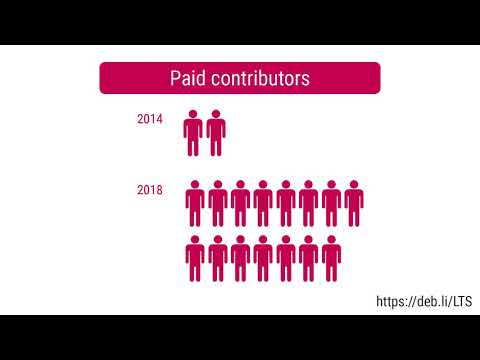
Debian LTS This month I have worked 18 hours on Debian Long Term Support (LTS) and 8 hours on its sister Extended LTS project. You can find out more about the Debian LTS project via the following video:
Debian Uploads For the Debian Privacy Maintainers team I requested that the pyptlib package be removed from the archive (#953429) as well as uploading onionbalance (0.1.8-6) to fix test failures under Pytest 3.x (#953535) and a new upstream release of nautilus-wipe. Finally, I sponsored an upload of bilibop (0.6.1) on behalf of Yann Amar.

30 March 2020

Louis-Philippe V ronneau: Using Zoom's web client on Linux

TL;DR: The zoom meeting link you have probably look like this:
https://zoom.us/j/123456789
To use the web client, use this instead:
https://zoom.us/wc/join/123456789
Avant-propos Like too many institutions, the school where I teach chose to partner up with Zoom. I wasn't expecting anything else, as my school's IT department is a Windows shop. Well, I guess I'm still a little disappointed. Although I had vaguely heard of Zoom before, I had never thought I'd be forced to use it. Lucky for me, my employer decided not to force us to use it. To finish the semester, I plan to record myself and talk with my students on a Jitsi Meet instance. I will still have to attend meetings on Zoom though. I'm well aware of Zoom's bad privacy record and I will not install their desktop application. Zoom does offer a web client. Sadly, on Linux you need to jump through hoops to be able to use it. Using Zoom's web client on Linux Zoom's web client apparently works better on Chrome, so I decided to use Chromium. Without already having the desktop client installed on your machine, the standard procedure to use the web client would be:
  1. Open the link to the meeting in Chromium
  2. Click on the "download & run Zoom" link showed on the page
  3. Click on the "join from your browser" link that then shows up
Sadly, that's not what happens on Linux. When you click on the "download & run Zoom" link, it brings you to a page with instructions on how to install the desktop client on Linux. You can thwart that stupid behavior by changing your browser's user agent to make it look like you are using Windows. This is the UA string I've been using:
Mozilla/5.0 (Windows NT 10.0; Win64; x64) AppleWebKit/537.36 (KHTML, like Gecko) Chrome/80.0.3987.149 Safari/537.36
With that, when you click on the "download & run Zoom" link, it will try to download a .exe file. Cancel the download and you should now see the infamous "join from your browser" link. Upon closer inspection, it seem you can get to the web client by changing the meeting's URL. The zoom meeting link you have probably look like this:
https://zoom.us/j/123456789
To use the web client, use this instead:
https://zoom.us/wc/join/123456789
Jitsi Meet Puppet Module I've been playing around with Jitsi Meet quite a bit recently and I've written a Puppet module to install and configure an instance! The module certainly isn't perfect, but should wield a working Jitsi instance. If you already have a Puppet setup, please give it a go! I'm looking forward receiving feedback (and patches) to improve it.

22 March 2020

Enrico Zini: Notable people

Lotte Reiniger. The Unsung Heroine of Early Animation
history people wikipedia
Lotte Reiniger pioneered early animation, yet her name remains largely unknown. We pay homage to her life and work, and reflect on why she never received the recognition she deserves.
Stephen Wolfram shares what he learned in researching Ada Lovelace's life, writings about the Analytical Engine, and computation of Bernoulli numbers.
Elizabeth Cochran Seaman[1] (May 5, 1864[2] January 27, 1922), better known by her pen name Nellie Bly, was an American journalist who was widely known for her record-breaking trip around the world in 72 days, in emulation of Jules Verne's fictional character Phileas Fogg, and an expos in which she worked undercover to report on a mental institution from within.[3] She was a pioneer in her field, and launched a new kind of investigative journalism.[4] Bly was also a writer, inventor, and industrialist.
Delia Ann Derbyshire (5 May 1937 3 July 2001)[1] was an English musician and composer of electronic music.[2] She carried out pioneering work with the BBC Radiophonic Workshop during the 1960s, including her electronic arrangement of the theme music to the British science-fiction television series Doctor Who.[3][4] She has been referred to as "the unsung heroine of British electronic music,"[3] having influenced musicians including Aphex Twin, the Chemical Brothers and Paul Hartnoll of Orbital.[5]
Charity Adams Earley (5 December 1918 13 January 2002) was the first African-American woman to be an officer in the Women's Army Auxiliary Corps (later WACS) and was the commanding officer of the first battalion of African-American women to serve overseas during World War II. Adams was the highest ranking African-American woman in the army by the completion of the war.

20 March 2020

Louis-Philippe V ronneau: Today (March 20th 2020) is the day to buy music on Bandcamp

Hey folks, This is a quick blog post to tell you Bandcamp is waiving all their fees on March 20th 2020 (PST). Spread the word, as every penny spent on the platform that day will go back to the artists. COVID-19 is throwing us all a mean curveball and artists have it especially rough, particularly those who were in the middle of tours and had to cancel them. If you like Metal, Angry Metal Guy posted a very nice list of artists you might know and want to help out. If you are lucky enough to have a little coin around, now is the time to show support for the artists you like. Buy an album you liked and copied from a friend or get some merch to wear to your next virtual beer night with your (remote) friends! Stay safe and don't forget to wash your hands regularly.

22 November 2017

Louis-Philippe V ronneau: DebConf Videoteam sprint report - day 3

Erf, I'm tired and it is late so this report will be short and won't include dank memes or funny cat pictures. Come back tomorrow for that. tumbleweed Stefano worked all day long on the metadata project and on YouTube uploads. I think the DebConf7 videos have just finished being uploaded, check them out! RattusRattus Apart from the wonderful lasagna he baked for us, Andy continued working on the scraping scheme, helping tumbleweed. nattie Nattie has been with us for a few days now, but today she did some great QA work on our metadata scraping of the video archive. ivodd More tests, more bugs! Ivo worked quite a bit on the Opsis board today and it seems everything is ready for the mini-conf. \0/ olasd Nicolas built the streaming network today and wrote some Ansible roles to manage TLS cert creation through Let's Encrypt. He also talked with DSA some more about our long term requirements. wouter I forgot to mention it yesterday because he could not come to Cambridge, but Wouter has been sprinting remotely, working on the reviewing system. Everything with regards to reviewing should be in place for the mini-conf. He also generated the intro and outro slides for the videos for us. KiBi and Julien KiBi and Julien arrived late in the evening, but were nonetheless of great assistance. Neither are technically part of the videoteam, but their respective experience with Debian-Installer and general DSA systems helped us a great deal. pollo I'm about 3/4 done documenting our ansible roles. Once I'm done, I'll try to polish some obvious hacks I've seen while documenting.

Next.

Previous.