Here s my monthly but brief update about the activities I ve done in the FOSS world.
Debian
Whilst I didn t get a chance to do much, here are still a few things that I worked on:
A quick exchange with Xavier about node-lodash fixes for stable releases.
Uploaded ruby-rack to CVE-2026-25500 & CVE-2026-22860 to sid, trixie, and bookworm.
Started to work on the DebConf Bursary team along with PEB.
Assited a few folks in getting their patches submitted via Salsa.
Mentoring for newcomers.
Moderation of -project mailing list.
Ubuntu
I joined Canonical to work on Ubuntu full-time back in February 2021.
Whilst I can t give a full, detailed list of things I did, here s a quick TL;DR of what I did:
node-lodash: Affected by CVE-2025-13465, prototype pollution in the baseUnset function.
[stable]: Xavier from the JS team ACK d the patch. The trixie and bookworm uploads will follow.
[LTS]: The bullseye test and upload will follow in April once the stable uploads are in and ACK d by the SRMs.
vlc: Affected by CVE-2025-51602, an out-of-bounds read and denial of service via a crafted 0x01 response from an MMS server.
[LTS]: 3.0.23 backport is ready but not tested. I ll get this over the line in March.
[ELTS]: 3.0.23 backport is ready but not very clean. Would like to complete LTS and get back to this.
Other Activities
[ELTS] Continued to review ruby-rack for ELTS it has since received about 13 new CVEs, making it even more chaotic. Might consider releasing in batches.
[E/LTS] Monitored discussions on mailing lists, IRC, and all the documentation updates.
[E/LTS] Attended the monthly LTS meeting on IRC. Summary here.
[Other] Spent quite some time debugging a bug in debusine. Filed https://salsa.debian.org/freexian-team/debusine/-/issues/1412 for the same. Have worked on a preliminary patch but would like to submit something for Colin to review. Will follow up in April.
The Cloak and Its Wizard is a standalone (at least so far) urban
fantasy superhero (sort of) novel. R.Z. Nicolet is the marketing pseudonym
for Rachel Reddick. This is her first novel.
I'm picky about wizards.
The wizards themselves will complain about that, but of course I'm
picky. When I choose a wizard, barring utter abandonment of moral
scruples, it's a till-death-do-us-part situation. (Their death, not
mine. I'm the next best thing to indestructible.)
The Cloak of Sunset and Starlight is a major artifact, meaning that it has
its own preferences and is capable of independent action. It has been
sitting in a glass case in the wizards' library for about a hundred years,
waiting for someone interesting. (Well, mostly sitting. Occasionally it
sneaks out to eavesdrop or move the books around.)
Veronica Noble is interesting. She's older than most initiates,
thoughtful, observant, and clearly had some mundane career before joining
the Order. Her aura is appealing, and her mental shields and resistance to
influence are intriguing. Normally, the Cloak would take its time
investigating a new potential wizard, but the Sword was making thoughtful
rattling sounds, and no way is the Cloak going to let the Sword claim her
first. Time to choose a new wizard!
It was nice, being draped over warm shoulders, and feeling a heartbeat
again.
I could tell she closed her eyes without even looking.
She sighed. "I just got picked by the intransigent one, didn't I?"
The last time I picked a book from the Big Idea feature in Scalzi's
Whatever blog, it
didn't go that well, but if you're going to
write a book specifically for me, I'm going to read it. There are very few
tropes of SFF that I love more than intelligent companion objects, and
Nicolet's
introduction to the story was compelling. So I gave this book discovery
method another chance.
I'm glad I did, because this was exactly what I was in the mood for and a
delight from cover to cover.
Veronica Noble is not a typical wizard. She's a surgeon and was quite
happy to be a surgeon until an unexpected encounter with a magical
creature killed her brother. The forgetting spell cast by the wizards who
came to handle the Cassandra wyrm didn't work on her, so she was dragged
reluctantly into the secret magical world of the Order. This long-lived
society of wizards quietly defends the world against magical intrusions
from other planes of existence. Now she's a wizard with a magical cloak,
which she is not at all sure she wants.
Veronica is not the protagonist, though. The Cloak of Sunset and Starlight
is. As far as it is concerned, its job is to assist its wizard, enjoy
watching interesting feats of magic, and look fabulous doing so. It's
protective, dramatic, rather vain, endlessly curious, easily bored, and
intensely loyal. When it becomes clear that the Order has some serious
problems, the Cloak knows what side it's on.
This sounds a bit like urban fantasy, so I was surprised when the first
superheroes showed up, although given the explicit Doctor Strange
inspiration I probably should have expected them. The Order and the
superheroes do not mix, at least at the start of the novel. The wizards
view the superheroes as a loud and irritating intrusion and hide magical
activities from them the same as they do the rest of the world. Veronica's
opening opinion on superheroes is based on being a trauma surgeon in a
hospital dealing with the aftermath of their fights (which makes me wonder
if the author has read Hench, although
the idea is older than that book). As with the Order, the role of
superheroes in this world gets more complicated as the plot develops.
There is a surprising amount of plot and some very nice world-building
here, including multiple twists that I was not expecting. Veronica is the
sort of stubborn and deeply ethical person who will not leave a problem
alone if she has the ability to fix it, which is a good recipe for getting
deeper and deeper into a complex plot. She's believable as a surgeon:
somewhat taciturn, calm in emergencies, detail-oriented, methodical, and
not at all dramatic. This makes the Cloak a perfect foil and complement.
Watching their partnership develop was very satisfying.
This is a sidekick novel, and like the best sidekick novels it makes the
not-protagonist more interesting and more relatable by showing them from
an outside and skewed perspective. Piecing together what Veronica must be
thinking is part of the fun, as is sharing the Cloak's protectiveness
towards her as it becomes clear how much she's been through and how good
of a person she is. The Cloak's personality was a little too much like a
cat for me I would have preferred a more unique viewpoint, fewer
cat-coded shenanigans, and a bit less of the running laundry machine joke.
But that's a quibble. Its endless curiosity drives the plot forward and
uncovers more of the world-building, and I just love reading stories from
the perspective of this sort of loyal and protective magical creature.
I had so much fun with this book. It's a popcorn sort of book, and I
thought the ending sputtered a little, but overall it was great. Parts of
it could have been designed in a lab to appeal to me specifically, so I'm
not sure if other people will enjoy it as much, but its hit rate with my
friends so far has been good.
Highly recommended, and I will be watching for any further novels from
Nicolet.
The Cloak and Its Wizard reaches a satisfying conclusion and
doesn't advertise itself as part of a series, but there is room for a
sequel. If Nicolet ever writes one, I'd read it.
Rating: 8 out of 10
MiniDebConf Kanpur 2026 was held on 14th and 15th March 2026 at the Indian Institute of Technology Kanpur.
Having a Debian conference in the North was something many folks wanted. Ravi started the discussion (with IIT Kanpur folks) almost 7 months before the conference. Lots of folks from Debian India joined in organizing the conference, which was nice. All the meeting notes and discussions were posted on the Debian India mailing list, a first.
Despite all the efforts, the conference start was delayed due to logistical issues. Things went fine post Day 1 lunch. We had two days of almost full schedules. disaster s Decentralising Indian Communication was an interesting talk, diving into decentralised communication.
IIT Kanpur is a huge campus with nice footpaths and greenery. We got the opportunity to explore their HPC at the Computer Center post conference.
Work has already started for MiniDebCamp Kochi. More details can be found on the wiki.
Working to make this conference happen was different with all the challenges involved, but overall, everyone was happy with the outcome.
tl;dr
This is not an official package, it's good enough for me and it might be good
enough for you, confirmed as working in Debian Testing but I don't have a
Stable machine to test there.
You can use my custom repo to install the latest NVIDIA drivers on Debian
Stable, Testing or Unstable (install from Sid repository):
https://deb.debusine.debian.net/debian/r-samueloph-nvidia-ai/
The page above contains the APT sources you need, just add the one for your
release to /etc/apt/sources.list.d/r-samueloph-nvidia-ai.sources, run sudo apt update and install the packages, you might need to disable Secure Boot.
This is not about AI
Discussions about AI are quite divisive in the Free Software communities, and
there's so much to be said about it that I'm not willing to go into in this
blog post. This is rather just me telling people that if they need up-to-date
NVIDIA packages for Debian, they could check if my custom repository gets the
job done.
The AI part is a means to an end, I've been careful to note in the repository
names that the packages were produced with AI to respect people who do not want
to run it for any reason.
RTX 5000 series support
Back in May 2025 I opened a bug
report asking for
the NVIDIA drivers on Debian to be updated to support the RTX 5000 series. The
Nouveau drivers might be good enough for some people, but I need the NVIDIA
drivers because I want to play games and do experiments with open weight
models.
Opening a bug report doesn't guarantee anything, at the end of the day Debian
Developers are volunteers, so if I really wanted the newer drivers, I would
have to do something about it, ideally submitting a merge request.
I briefly looked into the NVIDIA packaging, which involves 3 source packages
(and one extra git repo for tarballs), unfortunately this was going to take
more time and effort than what I was willing to spend.
What I Did
After a few weeks of lamenting that I wasn't running the NVIDIA drivers, I
figured I was willing to put in more effort than I originally thought, just
enough to instruct the Claude Code agent to package the latest releases. I'm
skilled enough with agentic tools that I knew how to use it to save time;
providing a clear instruction on how to build the package and explaining the
packaging layout, then letting the agent iterate until it gets a working build.
The agent was running inside a VM that didn't have any of my credentials.
After a little bit of back and forth, where I was reviewing the changes guiding
the agent into how to fix certain issues, I ended up with a working set of
packages.
Once I installed it on my machine and confirmed they worked, I set up a
debusine repository to make it easier to
install future updates, and let others test it out.
Debusine is analogous to Ubuntu's famous PPA, or Fedora's EPEL, it's a
relatively new project but it has been working fine for this.
Matheus Polkorny helped me test the packages and did spot a few issues which
are fixed now. The Debusine developers were also always quick to respond to my
questions and bug
reports.
How Good Is It?
Short answer: good enough for daily use, but not a substitute for an official Debian package.
The whole point of doing this is because I don't have enough free time to
maintain the package myself. All of this work was done as a volunteer, on my
personal time.
This means I'm trusting the agent to some degree; I review its commits but I
don't go too deep into it, the quality will be dictated by the fact that I'm
a Debian Developer and so by how easily I can spot issues without double checking
everything.
I only have a single machine with an NVIDIA GPU, this machine runs Debian
Testing and so I don't have a way to test the Stable packages. I can do my best
to address problems but at this point there is a risk that new updates break
something.
Installing NVIDIA drivers has always been a bit risky regardless, if you're
comfortable with reverting updates and handling a system without a graphical
interface (in case you end up in a tty), you will be fine.
You will likely need to disable Secure Boot in order to use them, or set up your
BIOS so that a MOK can be used to sign the DKMS modules.
When choosing the version strings for the packages, I was careful enough to
pick something that would sort lower than an official Debian package, meaning
that whenever that same version is packaged in Debian, your system will see it
as an upgrade.
If you have any other methods of installing the NVIDIA drivers on your Debian
system that is working for you, you should likely stick to that.
I have a strong preference for installing them through .deb packages, making
the package sort out configuration changes and dependency updates, besides
handling the DKMS modules.
Ultimately I'm not happy with the amount of difficulty that Debian users have in
installing up-to-date NVIDIA drivers, and I hope this makes it easier for some.
How To Install
Head over to the Debusine page that contains both repos for Trixie (Debian
Stable) and Sid (for Debian Testing and Unstable):
https://deb.debusine.debian.net/debian/r-samueloph-nvidia-ai/
If you are running Debian Testing, then pick the Sid repository.
That page contains the contents of the apt .sources file you need, create the
file /etc/apt/sources.list.d/r-samueloph-nvidia-ai.sources with the sources for your release.
Run sudo apt update and install the packages you need, if you already have a
previous version installed, sudo apt upgrade --update would update them.
If there are no upgrades, meaning you don't have a previous version installed,
then you need to explicitly install them.
If you run into issues in Debian Stable, consider using the Linux kernel package
from the backports repository, if you need an up-to-date NVIDIA driver, you
likely should also be running the backports kernel package (if you can't
upgrade to Debian Testing).
Future Plans
I currently have no means of measuring how many people are using the debusine
repositories, so if you do end up using it feel free to let me know somehow.
I don't know for how long I will keep managing this repository, and how much
effort I will spend, but my machine needs it and for now I will keep it
up-to-date with the latest production-grade NVIDIA drivers.
I finally upgraded my mail server to Debian 13 and, as expected, the Dovecot part was quite a ride.
The configuration syntax changed between Dovecot 2.3 (Debian 12) and Dovecot 2.4 (Debian 13),
so I started first with diffing my configuration against a vanilla Debian 12 one (this setup is slightly old) and then applied the same (logical) changes to a vanilla Debian 13 one.
This mostly went well.
Mostly because my user database is stored in SQL and while the Dovecot Configuration Upgrader says it can convert old dovecot-auth-sql.conf.ext files to the new syntax,
it only does so for the structure, not the SQL queries themselves.
While I don't expect it to be able to parse the queries and adopt them correctly,
at least a hint that the field names in userdb changed and might require adjustment would've been cool.
Once I got that all sorted, Dovecot would still refuse to let me in:
Error: sql: Invalid password in passdb: Weak password scheme 'MD5-CRYPT' used and refused
Yeah, right.
Did I mention that this setup is old?
The quick cure against this is a auth_allow_weak_schemes = yes in /etc/dovecot/conf.d/10-auth.conf,
but long term I really should upgrade the password hashes in the database to something more modern.
And this is what this post is about.
My database only contains hashed (and salted) passwords,
so I can't just update them without changing the password.
And while there are only 9 users in total,
I wanted to play nice and professional.
(LOL)
There is a Converting Password Schemes howto in the Dovecot documentation,
but it uses a rather odd looking PHP script, wrapped in a shell script which leaks the plaintext password to the process list,
and I really didn't want to remember how to write PHP to complete this task.
Luckily, I know Python.
The general idea is:
As we're using plaintext authentication (auth_mechanisms = plain login),
the plaintext password is available during login.
After Dovecot's imap-login has verified the password against the old (insecure) hash in the database,
we can execute a post-login script,
which will connect to the database and update it with a new hash of the plaintext password.
To make the plaintext password available to the post-login script,
we add '% password ' as userdb_plain_pass to the SELECT statement of our passdb query.
The original howto also says to add a prefetchuserdb, which we do.
The sqluserdb remains, as otherwise Postfix can't use Dovecot to deliver mail.
Now comes the interesting part.
We need to write a script that is executed by Dovecot's script-login and that will update the database for us.
Thanks to Python's passlib and mysqlclient,
the database and hashing parts are relatively straight forward:
#!/usr/bin/env python3importosimportMySQLdbimportpasslib.hashDB_SETTINGS="host":"127.0.0.1","user":"user","password":"password","database":"mail"SELECT_QUERY="SELECT password_enc FROM mail_users WHERE username=%(username)s"UPDATE_QUERY="UPDATE mail_users SET password_enc=%(pwhash)s WHERE username=%(username)s"SCHEME="bcrypt"EXPECTED_PREFIX="$2b$"defmain():# https://doc.dovecot.org/2.4.3/core/config/post_login_scripting.html# https://doc.dovecot.org/2.4.3/howto/convert_password_schemes.htmluser=os.environ.get("USER")plain_pass=os.environ.get("PLAIN_PASS")ifplain_passisnotNone:db=MySQLdb.connect(**DB_SETTINGS)cursor=db.cursor()cursor.execute(SELECT_QUERY,"username":user )result=cursor.fetchone()current_pwhash=result[0]ifnotcurrent_pwhash.startswith(EXPECTED_PREFIX):hash_module=getattr(passlib.hash,SCHEME)pwhash=hash_module.hash(plain_pass)data="pwhash":pwhash,"username":usercursor.execute(UPDATE_QUERY,data)cursor.close()db.close()if__name__=="__main__":main()
But if we add that as executable = script-login /etc/dovecot/dpsu.py to our imap-postloginservice,
as the howto suggests, the users won't be able to login anymore:
Error: Post-login script denied access to user
WAT?
Remember that shell script I wanted to avoid?
It ends with exec "$@".
Turns out the script-login "API" is rather interesting.
It's not "pass in a list of scripts to call and I'll call all of them".
It's "pass a list of scripts, I'll execv the first item and pass the rest as args, and every item is expected to execv the next one again".
With that (cursed) knowledge, the script becomes:
#!/usr/bin/env python3importosimportsysimportMySQLdbimportpasslib.hashDB_SETTINGS="host":"127.0.0.1","user":"user","password":"password","database":"mail"SELECT_QUERY="SELECT password_enc FROM mail_users WHERE username=%(username)s"UPDATE_QUERY="UPDATE mail_users SET password_enc=%(pwhash)s WHERE username=%(username)s"SCHEME="bcrypt"EXPECTED_PREFIX="$2b$"defmain():# https://doc.dovecot.org/2.4.3/core/config/post_login_scripting.html# https://doc.dovecot.org/2.4.3/howto/convert_password_schemes.htmluser=os.environ.get("USER")plain_pass=os.environ.get("PLAIN_PASS")ifplain_passisnotNone:db=MySQLdb.connect(**DB_SETTINGS)cursor=db.cursor()cursor.execute(SELECT_QUERY,"username":user )result=cursor.fetchone()current_pwhash=result[0]ifnotcurrent_pwhash.startswith(EXPECTED_PREFIX):hash_module=getattr(passlib.hash,SCHEME)pwhash=hash_module.hash(plain_pass)data="pwhash":pwhash,"username":usercursor.execute(UPDATE_QUERY,data)cursor.close()db.close()os.execv(sys.argv[1],sys.argv[1:])if__name__=="__main__":main()
And the passwords are getting gradually updated as the users log in.
Once all are updated, we can remove the post-login script and drop the auth_allow_weak_schemes = yes.
We seem to be entering an AI apocalypse of sorts, they aren t going to kill us or even take our jobs. What they are doing is destroying the Internet commons by filling it with rubbish. This isn t even real AI, just pattern matching and prediction systems, mostly LLMs.
The Problem
Scott Shambaugh s saga of being attacked and defamed by an OpenClaw AI bot is interesting and raises some disturbing possibilities for future online discussion [1]. Imagine what it would be like if everyone who was in any way notable for free software work had 100 such bots going after them.
Dania Dumas wrote an insightful blog post about why OpenClaw is impossible to secure and why it won t go away [2].
Bruce Schneier and Nathan E. Sanders wrote an insightful article about the AI generated text arms race [3] primarily concentrating on situations in which text that was assumed to be written by humans but was actually written in bulk by bots was performing a DOS attack on people who were reviewing it. There are many situations such as book publishing and publishing letters to the editor of newspapers where getting new material from unknown people is an important part of the job but where there are also people making low quality submissions that are almost a DOS attack at the best of times.
Currently the email spam problem continues to get worse and when LLM use increases it will get significantly worse. Email encryption isn t viable [4]. The PGP web of trust never really worked well as it s too difficult for most users.
The amount of AI generated content that s being recommended to users on platforms like YouTube and Facebook is steadily increasing and the amount of LLM generated commentary that purports to be from real people on Twitter and Facebook is also increasing. Here s an informative blog post by Erich Schubert about this [5].
Potential Solutions
Surrender?
One option and possibly the default option is to surrender to this and just let everything we built on the Internet over decades get destroyed. Whether to surrender is a decision that can be made on a per-service basis.
Twitter is pretty much useless anyway, I quit Twitter because Elon deliberately made it suck [6]. In my opinion this is not surrendering to what s being done there, I m just stopping wasting time on it and using better options. I used to have about 300 followers on Twitter and I don t think that many of them would ever choose to stop following me, so I presume that about 1/3 of the people following me have decided to totally quit Twitter and delete their accounts. I also presume that some of the remainder have done the same as me and just kept a mostly inactive account. If Elon suddenly stopped being a stupid asshole it probably wouldn t change anything as the value of the system was connections to others. Some people will consider my abandonment of Twitter as surrender and I accept that it s not an unreasonable opinion. I think that the possibly 100 Twitter followers of mine who deleted their accounts surrendered.
Facebook has been becoming a worse service, it s business model is becoming increasingly exploitative and it s interface is designed to be addictive. It s probably best avoided unless you really need it. The only good thing about Facebook at the moment is that Facebook Marketplace doesn t take a cut on sales and there are some really good deals on computers if you know what to look for. Unfortunately Facebook has a large number of users who are from marginalised communities and have no other alternatives for communication. It would be good to get them migrated to other platforms.
We could just give up on a lot of general communications services and have everyone accept that good content is drowned out by rubbish and have the Internet become divided between people who accept the rubbish and those who cease using large portions of the Internet environment to avoid it.
Using Non Commercial Services
Lemmy is a good FOSS federated alternative to Reddit which also covers some of the uses of Facebook. It needs more users to get critical mass but is still quite usable. A post that might get a dozen comments on Reddit may get 1 comment on Lemmy but that one comment will be a good one. Reddit doesn t appear to be attacked much by LLM generated content at least not yet. Even if the Reddit model proves to be resilient to LLM attack the Lemmy software can be used to replace some things that are done on Facebook,
Mastodon is a good FOSS federated replacement for Twitter, it has a decent user-base including some VIPs. While it is aimed at the Twitter use case it can also cover a significant part of the Facebook use case.
There are some other FOSS social media programs which could take over other parts of the commercial social media environment.
Generally commercially run Internet services will have a financial incentive to allow the problems to get worse so we need to rely on FOSS software, non-commercial implementations, and government services.
Web Search
For a long time Google has had a monopoly on web search, but now they default to including an AI Overview at the start of the results which is sometimes useful but also sometimes very wrong. You can use the search URL https://www.google.com/search?q=%s&udm=web to get google results without rubbish. But I presume that they will break that if it gets too popular.
Searxng is a AGPL licensed metasearch engine that aggregates results from other engines, here s the Searxng source [7] and here s a list of Searxng instances if you want to try one [8].
Even using meta search engines like Searxng won t help if the original data is overloaded with spam, but alleviating the problem is a good temporary measure.
Web of Trust for the Web?
I ve idly considered the possibility of having some sort of rating system for web pages that uses a web of trust so that you can securely use trust ratings of friends of friends etc. But given all the difficulties in using a web of trust for signing GPG key for software developers (the demographic that is most skilled at doing such things) it doesn t seem viable.
Should we surrender the idea of having a usable public web?
In the early days of the web (before Google) it was standard practice to rely on recommendations from other people or from trusted sites to find other sites, that could be considered to be an informal web of trust. We could go back to that sort of usage pattern if Google and many of the big sites get overwhelmed by LLM generated spam.
Wikipedia
I believe that Wikipedia will be at the front lines of this battle. It s model has always included anonymous contributions. Benjamin Mako Hill wrote an interesting blog post about research he did with Kaylea Champion into Wikipedia pages on taboo topics which have a larger portion of contributors choosing to be anonymous than non-taboo pages [9]. Wikipedia also has a long history of being abused for various reasons, one that I witnessed was someone putting false content into Wikipedia pages to immediately cite them in support of their facebook arguments. That sort of thing can be dealt with at human scale but a large scale attack by bots is a different problem to solve. Also with the recent developments in AI developing multiple web sites entirely populated for the purpose of supporting one fake entry in Wikipedia is plausible.
The upside of these attacks that I predict is that they will attract the attention of all the people who have skills related to developing counter-measures. While LLM bots are filling the inboxes of publishers with rubbish and messing up the stackoverflow comments section not a lot of people are bothered, but once the attacks on Wikipedia get serious everyone will take notice.
National AI
Bruce Schneier and Nathan E. Sanders wrote an interesting blog post about nationalised public AI [10]. While that won t directly address this issue it will get the right technology in the hands of people who can use it in the right way.
Conclusion
This is going to be a difficult problem to solve, more difficult than the email spam problem we have been unable to solve after 30 years of working on it.
This is also a very important problem, we are currently in an age where we have access to information that most people couldn t even dream of 30 years ago. We also have disinformation that combines some of the worst aspects of authoritarian regimes throughout history combined with the worst aspects of cult brainwashing. If we lose access to the information but the disinformation remains (or get worse) then the result will be terrible.
I don t have great ideas for solving this. I have outlined some small ideas to mitigate things and I hope that others can expand on them.
Please write comments with any good ideas you have, or even ideas that don t totally suck. A problem this difficult is not going to be solved in a blog comment, but a blog comment might point in the right direction.
This post will be updated in the next weeks with the test results as
they become available.
Note
Most of the images in this post have no real alt-text: they are all
scans of the test sheet at various stages through the test, and the
results visible on them are described in detail at the end of the
post.
Most of the time, what people write by hand will either end up inside a
notebook in a drawer or cupboard where it s well protected, or thrown in
the recycling where it doesn t matter.
There are times, however, when things will be exposed to light: it
doesn t matter whether it s a work of artistic calligraphy that you want
to frame or a passive-aggressive notice left in the atrium of a
building; it is useful to know whether the work will remain legible or
it will fade into nothing in a short time.
A few inks are tested by the producers for lightfastness according to
some established standard, a few others are declared lightfast in a
generic way, but a lot come with no indication at all.
Proper testing according to the standard scales requires significant
equipment to precisely control the exposure, but it s significantly
easier and fun to do a simple test to divide the inks into three
categories:
suitable for framed calligraphy, i.e. it looks the same after 3 months
of direct sun exposure;
suitable for complaining about the way your neighbours deal with the
trash, i.e. still readable after 3 months of exposure;
not suitable for either, i.e. has faded significantly in the same time.
In the past I ve done some such tests by taping some sheets to a
south-east facing window, and I ve noticed that most of the results were
already apparent after a month, and there was basically no difference
between two and three months of exposure, but spring equinox to summer
solstice is a nice timeframe to use for such a test (and it leaves time
for a second test of different materials from summer solstice to autumn
equinox), so this is what I ve chosen to do this year.
Rather than a window, now I have access to a south-facing covered
balcony that is protected from rain but receives quite a bit of direct
sun, so instead of taping sheets to the windows1 I ve prepared a
sturdy cardboard panel that I can leave on a table on the balcony,
hopefully safe from the rain, but well exposed to the sun.
And then made a quick test, and realized that without the window glass
in front, the black strip used to cover the unexposed half of the sample
doesn t lay flat and lets some sun in, so I used an old cheap2
glass frame instead of the panel.
The next step, already in January, was mentioning in a fountain-pen
enthusiasts forum that I planned such a test, and asking if people were
interested in having me buy a few samples of more inks when I was
buying my next pen.
The word enthusiasts is probably a hint of the reason why soon
afterwards I received a package with the pen I had planned to buy, its
converter, and a couple dozens ink samples.
And then a couple envelopes with additional samples of inks that weren t
available on the shops, from said enthusiasts.
Added to the inks I already had acquired since the last lightfastness
test, it meant that they couldn t all fit in one single page, and thus I
had some room to add some inks I had already tested: some were requests,
and for others I tried to select ones that felt relevant.
Since I m changing the test setup, I ve decided I should probably keep
doing this until I ve tested again all of the inks I still have
available.
For the paper, I ve used A4 sheets of Clairefontaine Dessin Croquis
160 g/m ,
one of my staples that I m sure I will have available in the next years,
printed with a dot pattern with a laser printer, using this pdf.
And as for the pen I ve used a fresh Brause n 361 nib: loading a fountain pen
with all of these inks wouldn t be a reasonable effort, and the 361 is
one of the writing implements I use most anyway. I also used a glass pen
to fill a couple of squares on the paper with more ink.
One side of each sheet was then covered with a strip of 300 g/m black
paper (also from Clairefontaine), kept in place with three dots of
non-permanent two sided tape, put in the frame and set out in the sun on
the morning of 2026-03-20, the day of the spring equinox.
While I was filling the sheet for the lightfastness tests, I decided to
also prepare a second set of sheet, for a liquid resistance drop test.
On each line, beside the name of the ink, I added five sets of crossing
parallel lines, and let everything dry for a few days.
Then I used a syringe to put a drop of a liquid on each set of lines,
waited for it to be absorbed into the paper and to dry, at least
overnight, but sometimes also for a day or two (life happened), and then
looked at the results and did the next test.
The first liquid was water, with the usual wild difference between
washable and permanent inks, and all of the intermediate possibilities.
The second liquid was isopropyl alcohol, and I was surprised to see
that, with very few exceptions, most inks didn t change at all. I
wonder whether that s related to the fact that instead of forming a drop
it was absorbed almost immediately into the paper, and dried in a very
short time.
The third liquid was hydrogen peroxide: beside the individual results I
noticed that its column yellowed visibly; I wonder whether that means
that the paper I used has optical brighteners, and it will also yellow
under the sun: that wouldn t be ideal, but it would also be a surprise,
for paper that is acid free and sold for arts.
The fourth liquid was citric acid, by mixing a bit less than a teaspoon
of citric acid granules in just enough very warm water (heated to 70 C,
i.e. the lowest temperature available on my kettle) to dissolve most of
the acid. I forgot that I had some old PH strips until one hour after
I ve put the drop on the paper, and I don t know whether something had
changed, but when I did remember about them it showed a deep red between
1 and 2. I don t think I can trust those strips too much, however.
This backfired badly: the drop of citric acid never dried out, but
formed a sticky paste that prevented me from scanning the results,
and I m not sure whether I ll do the last test, which was supposed to be
household bleach.
Luckily I had scanned the partial results, and they are shown here.
After one full day with plenty of sun, nothing really had changed,
except possibly for a vague hint that the Herbin Bleu Myosotis may have
have been a bit lighter than it started, but it may also have been a
suggestion.
After three days, however, some results started to show, with the most
fugitive inks starting to be visibly changed, becoming either paler or
in some case duller.
And the full week showed more of that, with a few more inks starting to
show visible change.
After two weeks the paper had significantly yellowed, something I did
not expect from drawing paper (and which means that I will probably use
a different paper when making similar tests in the future).
As for the inks, there were a couple more inks with visible changes, but
mostly it was more of the same as seen in the previous week.
Three weeks started to show changes in the black and most irongall inks, and of course more changes in the even less resistant inks.
Week four saw a bit more clouds and rain than the first few weeks, and
there weren t big changes, but mostly more of what had already started
to happen earlier.
A month didn t change much compared to the four weeks, but I did the
scans for completeness, and from now on I m going to update monthly.
These are the inks I ve tested, and here I ll add notes on the results,
as soon as they will be available, keeping this section updated.
When nothing is mentioned, it means that there were no changes, either
under the light or under the various liquids.
Lamy Sepia
Not resistant to water, the drop becomes an uniform colour spot.
After one week it started to be just slightly paler, more so after
three weeks.
Sheaffer Skrip Red
Not resistant to water, the drop becomes an uniform colour spot.
After one week it started to be just slightly paler, more so after
three weeks.
Waterman Audacious Red
Not resistant to water, the drop becomes an uniform colour spot.
After three days it started to be just slightly paler, after a week
visibly so. After four weeks it was very pale.
Waterman Harmonious Green
Not resistant to water, the drop becomes an uniform colour spot; the
hydrogen peroxide drop looks a bit lighter than the one with just
water.
After one week it started to be just slightly paler, more so after
three weeks. After four weeks it was very pale.
Waterman Mysterious Blue
Not resistant to water, the drop becomes an uniform colour spot; the
hydrogen peroxide drop is significantly lighter and tends towards
green.
After two weeks it started to be just slightly paler, after three
weeks it was more gray. After four weeks it was very pale.
Waterman Serenity Blue
Not resistant to water, the drop becomes an uniform colour spot; the
hydrogen peroxide drop is almost completely bleached to a light yellow.
After one week it started to be a bit duller. After four weeks it was
paler and duller.
Visconti Blue
Not resistant to water, the drop becomes an uniform colour spot.
After one week it was visibly duller, looking darker than the
original. After three weeks it was duller, and lighter. After a month
it was just a pale gray.
Montblanc Royal Blue
Not resistant to water, the drop becomes an uniform colour spot; the
hydrogen peroxide drop is almost completely bleached to a light
yellow.
After one week it started to be just slightly duller, more so after
two weeks. After three weeks it was also paler. After a month it was
just a pale gray.
Montblanc Mystery Black
Not resistant to water, the drop becomes an uniform colour spot.
After three weeks it started to be a bit paler.
Aurora Nero
Not resistant to water, the drop becomes an uniform colour spot.
After three weeks it started to be a bit more brown.
Online Duft Blueberry
Not resistant to water, the drop looks very washed out, although a
hint of the original shape can be guessed; the hydrogen peroxide drop
is almost completely bleached to a light yellow.
After one week it was visibly paler and duller. After three weeks
significantly so. After a month it was a pale grey.
Diamine Forever Ink - Smoky Mauve
After a month it looked a bit more purple.
Diamine Forever Ink - Honey Pot
.
Diamine Forever Ink - Coral Blaze
.
Diamine Forever Ink - Red Ochre
.
Diamine Graphite
Not resistant to water, the drop becomes an uniform colour spot.
Diamine Rustic Brown
Not resistant to water, the drop becomes an uniform colour spot.
After three weeks it started to be very slightely paler.
Diamine China Blue
Not resistant to water, the drop becomes an uniform colour spot; the
hydrogen peroxide drop is almost completely bleached to a light
yellow.
After three weeks it started to be paler and duller.
Diamine Inkvent Purple Edition - Glacier
Not resistant to water, there is a drop of uniform colour, but it
maintains a somewhat recognisable shade of the original shape.
After three weeks it started to be lighter.
Fountainfeder STEVE
Not resistant to water, there is a drop of uniform colour, but it
maintains a somewhat recognisable shade of the original shape.
After two weeks the base colour had changed to a pink rather than
purple.
Pilot Iroshizuku Syo Ro
Not resistant to water, there is a drop of uniform colour, but it
maintains a somewhat recognisable shade of the original shape.
After four weeks it was very slightely paler.
Pilot Iroshizuku Shin-Kai
Not resistant to water, there is a drop of uniform colour, but it
maintains a somewhat recognisable shade of the original shape.
After two weeks it had become lighter and more purple. After four
weeks it was a purple gray.
Rohrer & Klingner IG Ebony
Not resistant to water, there is a drop of uniform colour, but it
maintains a recognisable shade of the original shape; under
hydrogen peroxide the shade is significantly lighter.
After four weeks it was a bit lighter
KWZ IG Orange
Not resistant to water, the drop becomes an uniform colour spot; the
hydrogen peroxide drop is significantly bleached to a light orange.
Kallipos.de Schwarze Eisengallus-Tinte
Water stains the paper, leaving however the original shape quite
visible; is it almost completely bleached by hydrogen peroxide.
After three weeks it started to be very slightely lighter.
Kallipos.de Blaue Eisengallus-Tinte
Water stains the paper, leaving however the original shape quite
visible; is it almost completely bleached by hydrogen peroxide.
After two weeks it had started to become lighter and more gray.
Rohrer & Klingner IG Salix
Water stains the paper, leaving however the original shape quite
visible; is it almost completely bleached by hydrogen peroxide.
After two weeks it had become lighter and significantly more gray.
After a month it was a yellowish gray.
Rohrer & Klingner IG Scabiosa
Water stains the paper with a significant purple spot, leaving
however the original shape quite visible; is is a bit bleached by
hydrogen peroxide, but still quite readable.
Pelikan Edelstein Tanzanite
Not resistant to water, the drop becomes an uniform colour spot, but
there is a visible trace of the original shape.
After three weeks it started to be slightly paler.
Montblanc Burgundy Red
Not resistant to water, the drop becomes an uniform colour spot, with
just a hint of the original shape; slightly bleached by hydrogen
peroxide.
After three weeks it started to be paler.
Cifra inchiostro finissimo verde alla lavanda
Not resistant to water, the drop becomes an uniform colour spot;
quite bleached to a light yellowish green by hydrogen peroxide.
After one week it was visibly paler. After a month it was a still
readable pale trace.
Sennelier Abstract acrylic ink 917 purple
.
The Feather Pen Ink
.
Eloquentia Inchiostro nero
.
DeAtramentis Document Blue
.
DeAtramentis Document BlueGrey
.
DeAtramentis Document Brown
.
DeAtramentis Document Fuchsia
.
DeAtramentis Document Grau
.
DeAtramentis Document Green Grey
.
DeAtramentis Document Light Grey
.
DeAtramentis Document Moosgr n
.
DeAtramentis Document Orange
.
DeAtramentis Document Purpurviolett
.
DeAtramentis Document Urban Sienna
.
KWZ Sheen Machine
Not resistant to water, the drop becomes an uniform colour spot; the
hydrogen peroxide bleached away the red sheen. This was one of the
only two inks to react to isopropyl alcohol, which caused a pale cyan
halo around the lines.
After three days it was still perfectly readable, but had visibly
lost some red sheen, after one week the red had completely gone and
it looked very dark blue (but still shiny)
KWZ Walk over Vistula
Not resistant to water, the drop becomes an uniform colour spot.
After four weeks it looked a bit darker and duller.
KWZ Warsaw Dreaming
Not resistant to water, the drop becomes an uniform colour spot.
After a month it started to be a bit lighter.
Octopus Neon Violett
Water very lightly stains the paper, leaving however the original
shape quite visible. The other ink that reacted to isopropyl alcohol,
with a pale purple halo around the lines.
After two weeks it was paler, more pink.
Octopus Write & Draw Elephant Black
.
Platinum blue black
Water stains the paper, leaving however the original shape quite
visible; it is significantly bleached by hydrogen peroxide.
After three weeks it started to become gray.
Pelikan 4001 Brillant-Schwarz
Not resistant to water, the drop becomes an uniform colour spot.
After three weeks it was a bit more brown than black, after a month
noticeably so.
Pelikan 4001 Blau-Schwarz
Water stains the paper, leaving however the original shape quite
visible; it is significantly bleached by hydrogen peroxide.
After three weeks it started to become gray.
Pelikan 4001 K nigsblau
Not resistant to water, the drop becomes an uniform colour spot, with
just a hint of the original shape; significantly bleached by hydrogen
peroxide.
After three days it had started to be slightly paler.
After three weeks it was significantly desaturated.
Herbin Bleu Myosotis
Not resistant to water, the drop becomes an uniform pink spot,
significantly bleached by hydrogen peroxide.
After three days it was already visibly paler, after one week it was
a pale grey. After a month it was still somehow readable, but as a
trace.
Faber Castell Royal Blue
Not resistant to water, the drop becomes an uniform colour spot, with
just a hint of the original shape; significantly bleached by hydrogen
peroxide.
After three days it was slightly duller, after two weeks definitely
so. After a month it was also quite paler.
Koh-I-Noor Fountain pen ink blue
Not resistant to water, the drop becomes an uniform colour spot, with
just a hint of the original shape; significantly bleached by hydrogen
peroxide.
After three days it had started to be slightly paler, more so after
one week when it had also turned grey. After four weeks it was very
pale.
Koh-I-Noor Document Ink Blue
.
Koh-I-Noor Document Ink Black
Water leaves a very light stain, but the original shape doesn t look
changed.
DeAtramentis Document Black
.
Waterman Intense Black
Not resistant to water, the drop becomes an uniform colour spot, with
a trace of the original shape still visible; very lightly bleached by
hydrogen peroxide.
After three weeks it started to look a bit more brown, noticeably so
after a month.
Herbin Perle Noir
Not resistant to water, the drop becomes an uniform colour spot, with
a trace of the original shape still visible.
After three weeks it started to look a bit more brown, noticeably so
after a month.
Parker Quink black
Not resistant to water, the drop becomes an uniform colour spot.
Platinum Carbon black
.
Rohrer & Klingner Documentus Black
.
Sailor Pigment Kiwaguro
.
Platinum Dyestuff Red
Not resistant to water, the drop becomes an uniform colour spot; very
lightly bleached by hydrogen peroxide.
After three weeks it was a bit paler.
Noodler s Eternal Polar Blue
.
which would be spend the day covered by mostly closed
shutters anyway, because they receive quite a bit of direct sun, and
we don t want that to enter the house during the summer.
Interested in future updates? Follow me on mastodon at
@paul@soylent.green. Posts about
hz.tools will be tagged
#hztools.
It s well known and universally agreed that radios are cool. Among the
contested field of coolest radios, Software Defined Radios (SDRs) are
definitely the most interesting to me. Out of all of my (entirely too many)
SDRs I own, the rtlsdr is still my #1. It s just good. It s a great price,
extremely capable, reliable, well-supported, and compact. Why bother with
anything else? Sure, it can t transmit, uses a (fairly weird) 8 bit unsigned
integer IQ representation,
limited sampling rate, limited frequency range but even with all that, it s
still the radio I will pack first. Don t get me wrong, I love my Ettus radios,
PlutoSDRs, HackRFs, my AirspyHF+ - they re great! I just always find myself
falling back to an rtl-sdr, every time.
Perhaps the best reason to use an rtlsdr is the absolutely mind-boggling
amount of cool stuff people have written for it. The rtlsdr API is super easy
to use, widely supported if you re building on top of existing radio processing
frameworks it s still a shock to me when something omits rtlsdr support.
sparky
Over the last 7 years, I ve been learning about radios I got my ham radio
license (de K3XEC), hackedonsomecoolstuff where I ve
learned how radios work by doing , and even was lucky enough to give my first
rf-centric talk at districtcon.
Embarrassingly, I still haven t gotten around to learning how the fancy stuff
like GNU Radio works. I m sure I m going to love
it when I do.
As part of this, I ve also cooked up some very unprofessional formats and
protocols I use for convenience. Locally, all my on-disk captures are stored in
rfcap or more recently arf,
while direct SDR access at my house is almost entirely a mix of
the widely used rtl-tcp protocol, and my
riq protocol (post on this coming soon). Both rtl-tcp and riq operate
over the network, so I don t have to bother with plugging things into USB ports,
and I can share my radios with my friends.
All of that work sits in my current generation of radio processing code,
sparky (a reference to
spark-gap transmitters),
which is a heap of Rust, supporting everything from no_std for embedded
experiments, conditional support for interfacing with all the radios I
own, and tokio-based async support in addition to blocking i/o
for highly concurrent daemons. This quickly advanced beyond my old Go-based
code (hz.tools/go-sdr), which I archived
so I can focus on learning. I still think Go is a great language to write RF
code in but I can t focus on that tech tree anymore.
Of course, this now poses a new problem no one supports my format(s) or
radio protocol(s), since, well, I m the only one using them. I ve committed a
fair amount of my hardware to this setup, and yanking it from the rack to try
something out does pose a bit of a pickle. This isn t a huge deal for learning,
but it does make it tedious to try out something from the internets.
librtlsdr.so
Thankfully, Rust has robust support for
wrap[ping itself] in a grotesque simulacra of C s skin and mak[ing its] flesh undulate,
which is an attractive nuisance if i ve ever seen one. Naturally, my ability
to restrain myself from engaging in ill-advised rf adventures is basically
zero, so it s time to do the thing any similarly situated person would do
reimplement the API and ABI of librtlsdr.so, backed with sparky instead.
Since enumeration of devices is going to be annoying (specifically, they re
over the network), I decided early-on to rely on an explicit list of
devices via a configuration file. I d rather only load that once so programs
don t get confused, so I opted to use a
CTOR
to run a stub when the ELF is linked at runtime.
Next, it s time to start with the basics. Opening and closing a handle using
rtlsdr_open and rtlsdr_close. Given we don t control the runtime, and the
rtl-sdr device handle is opaque (for good reason!), I opted to smuggle a rust
Box<Device> non-FFI safe heap-allocated struct through the device handle
pointer, and let C take ownership of the Box. No one should be looking in
there anyway.
With that in place, we can chip away at the API surface, translating calls
as best as we can. I won t bother listing it all, since it s not very
interesting but here s an example implementation of rtlsdr_set_sample_rate
and rtlsdr_get_sample_rate. These calls are translating from an rtl-sdr
frequency (which is a u32 containing the value as Hz) into a sparky Frequency
type, and invoking get_sample_rate or set_sample_rate on the device s
rust handle. Since each device implements the sparky Sdr trait, the actual
underlying device doesn t matter much here.
After repeating this process for the rest of the stubs I could (and otherwise
setting error conditions if the functionality is not supported), I was ready to
try it out. Within sparky, I patched my MockSDR (basically a Sdr traited
Mock type) to implement the same testmode IQ protocol that the RTL-SDR has, and
decided to see if rtl_test from apt without any changes could be fooled.
$ rtl_test
No supported devices found.
Great, cool. No devices plugged in. Looks great. Let s try it with my
librtlsdr.soLD_PRELOAD-ed into the binary first:
$ LD_PRELOAD=target/release/librtlsdr.so rtl_test
Found 1 device(s):
 0: hz.tools, mock sdr, SN: totally legit no tricks

Using device 0: sparky mock sdr
Supported gain values (0):
Sampling at 2048000 S/s.

Info: This tool will continuously read from the device, and report if
samples get lost. If you observe no further output, everything is fine.

Reading samples in async mode...
^CSignal caught, exiting!

User cancel, exiting...
Samples per million lost (minimum): 0
$
Outstanding. Even more outstandingly, if I change my testmode implementation to
skip samples, rtl_test correctly reports the errors I think it s showing
promise! On to try the real endgame here let s have our new librtlsdr.so
connect to an rtl-tcp endpoint and see if rtl_fm works:
LD_PRELOAD=target/release/librtlsdr.so \
 rtl_fm -d 1 -s 120k -E deemp -M fm -f 90.9M   \
 ffplay -f s16le -ar 120k -i -
Found 2 device(s):
 0: hz.tools, mock sdr, SN: totally legit no tricks
 1: hz.tools, rtl-tcp, SN: node2.rf.lan:1202

Using device 1: sparky rtltcp node2
Tuner gain set to automatic.
Tuned to 91170000 Hz.
Oversampling input by: 9x.
Oversampling output by: 1x.
Buffer size: 7.59ms
Sampling at 1080000 S/s.
Output at 120000 Hz.
And there it was! Not the best audio quality (mostly due to my inability to
correctly read the rtl_fm manpage to tune the filter and
downsample/oversampling rates to audio), but it s definitely passable.
I figured I d try something that was a bit more interesting next gqrx,
since it s super handy, I use it a ton, and will definitely amuse me to no
end. To my surprise and delight, LD_PRELOAD=target/release/librtlsdr.so gqrx
wound up running, and I saw my devices pop right up in the setting menu:
Huge. Huge. Amazing. It did crash as soon as I tried to actually use the
radio, but after fixing a few dangling bugs in the API surface (and some
assumptions I think some underlying gnuradio driver may be making that I need
to double check in the code), I was able to get a super solid stream of
broadcast fm radio, with gqrx being none the wiser. It thought it was
just talking to the device it knows as rtl=1.
Nice. I can t wait to try this with the rest of the rtl-sdr based tools I like
having around using my riq protocol next. I don t think that ll be worth a
post, but hopefully I ll get around to publishing details on that stack next.
epilogue
Well. That s it. End of story. A bit anti-climatic, sure. While this new shim
will provide me endless minutes of mild amusement, I could see using this to
expose my sparky testing utilities via librtlsdr.so my mock sdr driver
allows for replaying captures off disk, which could be interesting to make sure
that signals are still properly decoded after changes, or instrument
performance changes (via SNR, BER, packets observed, etc) on reference samples
I have on my NAS. Maybe that ll come in handy one day!
Truth be told, I m not sure I actually want to encourage anyone to do this for
real (although I think I ll definitely be using it on my LAN to see what
happens). I also don t have a repo to share I don t particularly feel with
dealing with the secondary effects of publishing sparky (and sparky-rtlsdr)
yet, since i m still getting my feet under me on the radio aspect of all this.
I ll be sure to post updates if anything changes with this here (tagged
sparky) and at
@paul@soylent.green.
I can t wait to post more about some of the odd sidequests (like this one!)
i ve completed over the last few years I ve been waiting to feel
confident that my work has matured and was withstood the new problems i ve
thrown at it, and it largely has.
It s my hope that these projects (and this project in particular) has provided
a glimpse into the world of software defined radio for my systems friends, and
a bit about systems for my radio friends. It s not all magic, and I hope
someone out there feels inclined to have some fun with radios themselves!
A few months ago, in June 2025, I joined Chainguard, a company focused on software supply chain security.
This post is a reflection on how I got here, what I ve been doing, and why this role feels like a natural
fit for my interests in Linux and open source technology.
The company and its mission
Chainguard s mission is to make the software supply chain secure by default. The company is built around
the idea that the software we all depend on from operating system packages to container base images carries
hidden risk in the form of vulnerabilities, unverified provenance, and untrusted build processes.
The company is perhaps best known for Chainguard Images: a catalog of minimal, hardened container
base images that are continuously rebuilt and kept free of known CVEs. Each image is accompanied by a signed
SBOM (Software Bill of Materials) and a verifiable provenance attestation, making it possible
to cryptographically verify what went into a given image and how it was built.
Chainguard has an extensive catalog of software, and maintaining it up-to-date and CVE-free is a significant
engineering challenge.
What I do
I joined the Chainguard Sustaining Engineering team as a Senior Software Engineer. We are responsible
for maintaining packages and images in the software catalog up-to-date and CVE-free. The core of the business, basically.
We focus on the horizontal dimension of the catalog (pretty much all packages and images).
With +30,000 packages and +2,000 images, this is indeed an interesting task.
My role as Debian Developer, and my experiencie in the Debian LTS project was extremely valuable when joning this
new team.
Looking ahead
Software supply chain is truly a deep topic, gaining more and more relevance every day, especially as new technologies emerge
and get adopted everywhere.
Since early in my career, I saw a recurrent problem of how companies, enterprises, or even governments, relate to and consume
open source software, in a reliable, secure way. I believe Chainguard is doing the right things in the ecosystem,
and I m happy to be participating in the effort.
tl;dr
This is an experimental feature that, for the first time, brings full ECH
support to curl on Debian using OpenSSL.
Starting with curl 8.19.0-3+exp2 (Debian Experimental), you can now use
ECH, with HTTPS-RR and DoH for maximum privacy.
curl 8.19.0-3+exp2 is quite fresh at the time of writing, bear in mind that your
repository might not have synced the package yet, all mirrors should have it by
March 27th 14:00 UTC.
# defo.ie is a test server that confirms whether ECH was successfully usedcurl -v --ech hard https://defo.ie/ech-check.php# For Encrypted Client Hello (ECH) + DNS over HTTPS (DoH)curl -v --ech hard --doh-url https://1.1.1.1/dns-query https://defo.ie/ech-check.php
"--ech hard" tells curl to refuse the connection entirely if ECH cannot be negotiated.
Or, if you would like to try it out in a container:
podman run debian:experimental /bin/bash -c 'apt install --update -t experimental -y curl && curl -v --ech hard --doh-url https://1.1.1.1/dns-query https://defo.ie/ech-check.php'
(in case you haven't noticed, apt now has the --update option for the
upgrade and install commands)
For Privacy
CloudFlare calls it "the last puzzle piece to privacy" in their must-read
announcement: https://blog.cloudflare.com/announcing-encrypted-client-hello/.
Encrypted Client Hello (rfc9849) encrypts the
"which website are you connecting to?" part of the TLS handshake that was
previously visible in plaintext.
HTTPS-RR (rfc9460) is a DNS record type that
publishes connection parameters for a service, including the public key clients
need to perform ECH.
DNS Over HTTPS (rfc8484) encrypts DNS queries
by tunneling them over HTTPS, hiding what domains you're looking up from
network observers.
When all three operate together over a CDN with shared IP space, the target
domain name is hidden from passive observers; the HTTPS-RR record is queried
over DoH in order to retrieve the ECH key
(rfc9848) for the TLS handshake.
Seems like quite an important feature, and in fact the major browsers have it
enabled for some time now, the trick is that they do not use OpenSSL (Chrome
uses BoringSSL and Firefox uses NSS).
For everyone else, the only option is to patch OpenSSL or wait until 4.0.0 is
released, and so part of the reason Debian is the first distro to enable it
(curl + OpenSSL + ECH) is that the OpenSSL maintainer (Sebastian Andrzej
Siewior) packaged the alpha release just 3 days after it was published.
Do not forget that ECH support is experimental and currently relies on the
alpha release of OpenSSL.
wcurl Gets It Too
Considering wcurl is just a wrapper on curl, it gets
the feature for free:
wcurl --curl-options="--ech hard --doh-url https://1.1.1.1/dns-query" $URL
If you're using wcurl, you don't want to have to set parameters, this is just
to show that the feature is there and if you have a .curlrc file, it can
enable the feature seamlessly.
Other Debian Releases
Given the ECH feature requires OpenSSL >= 4, it will not make it to Debian 13,
having a small chance of going to Debian 13 Backports (emphasis on small).
It should get to Debian Unstable and Debian Testing within the next couple of
months as the OpenSSL GA release happens and gets packaged, but you should be
able to install the package from Experimental in your Unstable and Testing
systems without issues. It will also be in Debian 14 once it becomes the new Stable.
Shoulders of Giants
Stephen Farrell's presentation from OpenSSL Conference 2025 has a lot of
background on the work involved:
Encrypted Client Hello Lessons learned from trying to do something that was
probably too complicated
They have been working on implementing ECH in open-source projects for years,
something as big as this doesn't happen without lots of people dedicating both
their paid and free times over it.
I ended up being the person who enabled it on Debian, which was pretty much the
least amount of work between everyone involved, but hey it's fun flipping the
switch and telling you about it.
Background
Since 2025, the curl developers started organizing an yearly meeting with all
maintainers of curl in Operating Systems. The 2026 edition happened in March
26th:
https://github.com/curl/curl/wiki/curl-distro-discussion-2026.
Attendance was really good, and as you can imagine one of the topics of
discussion was ECH, in which it was pointed out that having OpenSSL 4 was
the main requirement but besides it nothing unusual was needed.
In Debian Experimental, we have been enabling HTTPS-RR since March 2025, and
OpenSSL 4.0.0 alpha was packaged just recently (2026-03-13) by Sebastian
Andrzej Siewior, it's time for the next step.
The curl distro meeting was just the motivation I needed to go ahead and
enable it in Debian Experimental, so as part of our Debian Brasil Weekly
Meetings I've prepared and uploaded the changes, while Carlos Henrique Lima
Melara worked on addressing a recent test regression for Debian Unstable.
Unfortunately sergiodj couldn't join and I'm sure he's jealous of the hacking
session now.
Appendix
While writing this, I've noticed one of the authors of the CloudFlare blogpost
is the previous curl maintainer on Debian; Alessandro Ghedini let me take over
the maintenance back in 2021 and today curl is maintained by a team of 4
people, it's nice to see Alessandro's involvement.
At the end of last year I uninstalled the Twitter app on my phone.
In the past Twitter used to be very useful for providing feedback to large organisations. I had responses from supermarkets, chain restaurants, online stores, major computer companies, and even the IT department of a court. In recent times I have had less responses from corporations which significantly reduces the value of Twitter to me and to many other users. It seems that Elon s management style has discouraged not only advertising but also all forms of corporate interaction. Messing up the check mark on accounts to make it harder to work out which is a real corporate
Since Elon bought it Twitter has been increasingly pushing conservative Tweets and has done little to stop bot accounts. The incidence of useful discussions has steadily decreased. I know people who have quit Twitter entirely due to opposition to Elon, I am not doing that. I finally decided to stop using Twitter in any serious way when the notifications on my phone about popular Tweets started only being about Tweets from conservative influencers and Elon. This was obviously not any algorithm based on Tweets I was liking, it was based on political decisions. I didn t uninstall the app due to political disagreement, I uninstalled it because it was through deliberate design promoting material that any algorithm would know was something I wouldn t either like or like .
I still announce new blog posts on Twitter for my 198 followers at the same time as announcing them on Mastodon and Facebook. I get the most reactions to such announcements on Mastodon, the second most on Facebook, and hardly any on Twitter. I m wondering how long it will be worth announcing blog posts on Twitter or whether I should stop now.
I am sure that many other people are making similar decisions and this is going to affect Twitter overall.
The web site www.russellcoker.com has information on all the ways of following me.
A Shadow in Summer is a high fantasy novel, the first of (as the
name implies) a completed four-book series. Daniel Abraham is perhaps
better known as half of the writing pair behind James S.A. Corey, author
of the Expanse series. This was his first
novel.
Otah was the sixth son of a Khai, sent like many of the unwanted later
children of the powerful to learn the secrets of the andat and be trained
as a poet. He learned his lessons well enough to reject the school and its
teachings and walk away.
Amat Kyaan has worked her way up from nothing to become the senior
overseer of the foreign Galtic House Wilsin in the sun-drenched port city
of Saraykeht. Liat is her apprentice, distracted by young love. Maati is a
new apprentice poet, having endured his training and sent to learn from
Heshai how to eventually hold the andat Removing-The-Part-That-Continues,
better known as Seedless. None of them know they will find themselves
entangled in a plot to destroy the poet of Saraykeht and, through him, the
city's most potent economic tool.
A poet in this world is not what we would think of a poet. They are, in
essence, magical slave-drivers who capture the essence of an andat, a
spirit embodying an idea that is coerced into the prison of volition and
obedience by the poet. The andat Seedless, the embodiment of the concept
of removing the spark of life, is central to the economic wealth of
Saraykeht in a way that is startling in its simplicity: Seedless can
remove the seeds from a warehouse full of cotton at a thought. This gives
Saraykeht a massive productivity advantage in the cotton trade.
Seedless is also a powerful potential weapon. What he can do to cotton, he
could as easily do to any other crop, or to people. The Galts are not fond
of the independence and power of Saraykeht, but as long as the city
controls a powerful andat, they do not dare to attack it directly.
Indirectly, though... that's another matter.
This is one of those fantasy novels with meticulous and thoughtful
world-building, careful and evocative prose, and a complex ensemble cast
of interesting characters that the novel then attempts to make utterly
miserable and complicit in their own misery. There should be a name for
this style of writing. It's not tragedy because the ending is not tragic,
precisely. It's not magic realism; the andats are openly magical, which
makes this clearly high fantasy. But Abraham approaches the story from the
type of realist frame that considers the pain and desperation of the
characters to be more interesting than their ability to overcome
challenges.
Amat starts the story as an admirable, sharp-witted expert manager, so her
life is destroyed and she's subjected to sexual violence. Heshai loathes
himself and veers between a tragic figure and a wastrel as the story
systematically undermines opportunities for redemption. Maati is young and
idealistic, so of course every character in the book sets out to crush his
idealism under the weight of unforeseen consequences. There is a sad and
depressing love triangle, because this is exactly the sort of book that
has a sad and depressing love triangle. At the end of the novel, everyone
who survives is older and wiser in the sense that some stories seem to
think wisdom comes from the accumulation of trauma.
I find books like this so immensely frustrating because their merits are
so clear. The world-building is careful and detailed in a way that
includes economic systems, unlike so much fantasy. It is full of small,
intriguing touches, such as the use of posture and gesture to communicate
the emotional valence of one's words. Abraham understands the moral
implications of poets and andats and the story tackles them head-on. The
writing flows beautifully and gave me a strong sense of the city. I wanted
to like this book for the obvious skill that went into it, and sometimes I
even managed.
And yet, it's taken me three months to finish A Shadow in Summer
because I simply do not want to spend this much time around miserable
people. I would get through one or two chapters in a night and then wanted
to read something happy or defiant or heroic, rather than watching
slow-motion train wrecks intermixed with desperate attempts to navigate
stifling layers of immoral systems. It's not that the story lacks a moral
compass. The characters are sincerely trying to make the world a better
place, with some success. It even delivers a happy ending of sorts. But so
much of the journey was watching the lives of the characters fall apart.
I am completely unsurprised that some people loved this book. I'm still
intrigued enough by the world-building that I'm half-tempted to try to
read the sequel even after having to drag myself through this one. I had a
similar reaction to Abraham's The
Dragon's Path, though, so I think Abraham is just not for me. I may get
back to the Expanse at some point, but having to drag myself through both
of his solo novels I've tried, in two different series, probably indicates
an incompatibility between author and reader. That's a shame, given the
quality of the writing.
Followed by A Betrayal in Winter.
Content notes: Sexual and reproductive violence as significant plot
elements.
Rating: 6 out of 10
Note: I have not published blog posts about my academic papers over the past few years. To ensure that my blog contains a more comprehensive record of my published papers and to surface them for folks who missed them, I will periodically (re) publish blog posts about some older published projects. This post draws material from a previously published post by Kaylea Champion on the Community Data Science Blog.
Taboo subjects such as sexuality and mental health are as important to discuss as they are difficult to raise in conversation. Although many people turn to online resources for information on taboo subjects, censorship and low-quality information are common in search results. In two papers I recently published at CSCW both led by Kaylea Champion we presented a series of analyses showing how taboo shapes the process of collaborative knowledge building on English Wikipedia.
The first study is a quantitative analysis showing that articles on taboo subjects are much more popular and are the subject of more vandalism than articles on non-taboo topics. In surprising news, we also found that they were edited more often and were of higher quality!
Short video of Kaylea s presentation of the work given at Wikimania in August 2023.
The first challenge we faced in conducting this work was identifying taboo articles. Kaylea had a brilliant idea for a new computational approach to doing so without relying on our individual intuitions about what qualifies as taboo (something we understood would be highly specific to our own culture, class, etc). Her approach was to make use of an insight from linguistics: people develop euphemisms as ways to talk about taboos (i.e., think about all the euphemisms we ve devised for death, or sex, or menstruation, or mental health).
We used this insight to build a new machine-learning classifier based on English Wiktionary definitions. If a sense of a word was tagged as euphemistic, we treated the words in the definition as indicators of taboo. The end result was a series of words and phrases that most powerfully differentiate taboo from non-taboo. We then did a simple match between those words and phrases and the titles of Wikipedia articles. The topics were taboo enough that we were a little uncomfortable discussing them in our meetings! We built a comparison sample of articles whose titles are words that, like our taboo articles, appear in Wiktionary definitions.
In the first paper, we used this new dataset to test a series of hypotheses about how taboo shapes collaborative production in Wikipedia. Our initial hypotheses were based on the idea that taboo information is often in high demand but that Wikipedians might be reluctant to associate their names (or usernames) with taboo topics. The result, we argued, would be articles that were in high demand but of low quality.
We found that taboo articles are thriving on Wikipedia! In summary, we found that in comparison to non-taboo articles:
Taboo articles are more popular (as expected).
Taboo articles receive more contributions (contrary to expectations).
Taboo articles receive more low-quality contributions (as expected).
Taboo articles are higher quality (contrary to expectations).
Taboo article contributors are more likely to contribute without an account (as expected), and have less experience (as expected), but that accountholders are more likely to make themselves more identifiable by having a user page, disclosing their gender, and making themselves emailable (all three of these are contrary to expectation!).
Image of the estimated qualiy of articles of the four articles in the second mixed-methods paper. Extreme dips reflect periods of frequent vandalism.
Kaylea attempted to understand these somewhat confusing results by designing a fantastic mixed-methods analysis that sought to unpack some of the nuance missing in the quantitative analysis by delving deep into the life histories of four articles on English Wikipedia: two on taboo topics related to women s anatomy (Clitoris and Menstration) and two nontaboo articles chosen for comparison (Cell membrance and Philip Pullman).
Although the findings from the analysis can be difficult to summarize succinctly (as with many qualitative studies), we showed how the taboo example articles success was hard-won amid real challenges and attacks. The paper describes how challenges were overcome through resilient leadership, often provided by a single dedicated individual. The paper provides a template for how taboo can be and frequently is overcome by dedicated Wikipedians in ways that provide useful knowledge resources in real demand.
For more details, visualizations, statistics, and more, we hope you ll take a look at our papers, both linked below.
The full citation for the papers are: (1) Champion, Kaylea, and Benjamin Mako Hill. 2023. Taboo and Collaborative Knowledge Production: Evidence from Wikipedia. Proceedings of the ACM on Human-Computer Interaction 7 (CSCW2): 299:1-299:25. https://doi.org/10.1145/3610090. (2) Champion, Kaylea, and Benjamin Mako Hill. 2024. Life Histories of Taboo Knowledge Artifacts. Proceedings of the ACM: Human-Computer Interaction 8 (CSCW2): 505:1-505:32. https://doi.org/10.1145/3687044.
Dark Class is the fifth novel (not counting the
skippable novella) in Michelle Diener's Class 5
romantic science fiction series. As with the previous novels, this follows
romance series conventions: There are new protagonists, but characters
from the previous books make an appearance. It's helpful but not that
necessary to remember the details of the previous books; the necessary
background is explained enough to follow the story.
By now, series readers know the formula. Yet another Earth woman was
secretly abducted by the Tecran, encounters a Class 5 ship, and finds a
way to be surprisingly dangerous and politically destabilizing. This time,
Ellie has been mostly unconscious since her abduction and awakes in a
secret Tecran base after the Tecran have all been murdered. There is a
Class 5 AI involved, but not a full ship; instead, Dark Class picks
up (or, arguably, manufactures) a loose end from Dark Minds. Other than that break from the formula, you know what
to expected by now: a hunky Grih, a tricky political standoff, a
protective Class 5, a slow-burn romance, and a surprisingly capable
protagonist who upends politics through plucky grit and refusal to
tolerate poor treatment. Oh, and a new selection of salvaged clothing and
weapons to make Ellie beautiful and surprisingly dangerous.
If you are this far into the series, you probably like the formula. That's
my position. I don't care about the romance, but something about the
prisoner to threat evolution of the kidnapped protagonists and the growing
friendship with an AI makes me happy. This is not great literature, but it
is reliably entertaining with a guaranteed victorious protagonist and
happy ending, making it a comfortable break from more difficult books with
emotionally wrenching scenes.
Dark Class is one of the better executions of the formula because
it has long stretches of my favorite parts of these books: exploration of
mostly-abandoned surroundings for neat gadgets while the AI and the
protagonist slowly build a relationship of mutual respect. This book has
bonus drones with minds of their own and an enigmatic alien spaceship that
provides a fun mid-novel twist. The Tecran and the Grih repeatedly
underestimate Ellie and are caught by surprise at dramatically satisfying
moments. It's just fun to read, and I save this series for when I need
that type of book.
As with the other books of the series, Diener's writing is serviceable but
not great. She repeats herself, uses way too many paragraph breaks for
emphasis, and is not going to win any literary awards for prose quality.
The series is in the upper half of self-published works, and I've
certainly read worse, but either the formula will click with you or it
won't. If it doesn't, the prose is not going to salvage the book.
There is some development of the series plot, but it's mostly predictable
fallout from Dark Matters. This book is
mostly tactical and smaller in scale. I am a little curious where Diener
is going with political developments, since the accumulated Earth women
and Class 5 ships are in some danger of becoming a sort of shadow
government through sheer military power, but I'm dubious this series will
have enough political sophistication to dig into the implications. It's
best enjoyed as small-scale episodic wish fulfillment for female
protagonists, and that's good enough for me.
If you've read this far in the series, recommended; this is one of the
stronger entries.
Followed by Collision Course, which breaks the title convention for
the series.
Rating: 7 out of 10
When you re looking at source code it can be helpful to have some evidence
indicating who wrote it. Author tags give a surface level indication, but
it turns out you can just
lie
and if someone isn t paying attention when merging stuff there s certainly a
risk that a commit could be merged with an author field that doesn t
represent reality. Account compromise can make this even worse - a PR being
opened by a compromised user is going to be hard to distinguish from the
authentic user. In a world where supply chain security is an increasing
concern, it s easy to understand why people would want more evidence that
code was actually written by the person it s attributed to.
git has support for cryptographically signing
commits and tags. Because git is about choice even if Linux isn t, you can
do this signing with OpenPGP keys, X.509 certificates, or SSH keys. You re
probably going to be unsurprised about my feelings around OpenPGP and the
web of trust, and X.509 certificates are an absolute nightmare. That leaves
SSH keys, but bare cryptographic keys aren t terribly helpful in isolation -
you need some way to make a determination about which keys you trust. If
you re using someting like GitHub you can extract that
information from the set of keys associated with a user account1, but
that means that a compromised GitHub account is now also a way to alter the
set of trusted keys and also when was the last time you audited your keys
and how certain are you that every trusted key there is still 100% under
your control? Surely there s a better way.
SSH Certificates
And, thankfully, there is. OpenSSH supports
certificates, an SSH public key that s been signed by some trusted party and
so now you can assert that it s trustworthy in some form. SSH Certificates
also contain metadata in the form of Principals, a list of identities that
the trusted party included in the certificate. These might simply be
usernames, but they might also provide information about group
membership. There s also, unsurprisingly, native support in SSH for
forwarding them (using the agent forwarding protocol), so you can keep your
keys on your local system, ssh into your actual dev system, and have access
to them without any additional complexity.
And, wonderfully, you can use them in git! Let s find out how.
Local config
There s two main parameters you need to set. First,
1
git config set gpg.format ssh
because unfortunately for historical reasons all the git signing config is
under the gpg namespace even if you re not using OpenPGP. Yes, this makes
me sad. But you re also going to need something else. Either
user.signingkey needs to be set to the path of your certificate, or you
need to set gpg.ssh.defaultKeyCommand to a command that will talk to an
SSH agent and find the certificate for you (this can be helpful if it s
stored on a smartcard or something rather than on disk). Thankfully for you,
I ve written one. It will
talk to an SSH agent (either whatever s pointed at by the SSH_AUTH_SOCK
environment variable or with the -agent argument), find a certificate
signed with the key provided with the -ca argument, and then pass that
back to git. Now you can simply pass -S to git commit and various other
commands, and you ll have a signature.
Validating signatures
This is a bit more annoying. Using native git tooling ends up calling out to
ssh-keygen2, which validates signatures against a file in a format
that looks somewhat like authorized-keys. This lets you add something like:
1
* cert-authority ssh-rsa AAAA
which will match all principals (the wildcard) and succeed if the signature
is made with a certificate that s signed by the key following
cert-authority. I recommend you don t read the code that does this in
git
because I made that mistake myself, but it does work. Unfortunately it
doesn t provide a lot of granularity around things like Does the
certificate need to be valid at this specific time and Should the user
only be able to modify specific files and that kind of thing, but also if
you re using GitHub or GitLab you wouldn t need to do this at all because
they ll just do this magically and put a verified tag against anything
with a valid signature, right?
Haha. No.
Unfortunately while both GitHub and GitLab support using SSH certificates
for authentication (so a user can t push to a repo unless they have a
certificate signed by the configured CA), there s currently no way to say
Trust all commits with an SSH certificate signed by this CA . I am unclear
on why. So, I wrote my
own. It takes a range of
commits, and verifies that each one is signed with either a certificate
signed by the key in CA_PUB_KEY or (optionally) an OpenPGP key provided in
ALLOWED_PGP_KEYS. Why OpenPGP? Because even if you sign all of your own
commits with an SSH certificate, anyone using the API or web interface will
end up with their commits signed by an OpenPGP key, and if you want to have
those commits validate you ll need to handle that.
In any case, this should be easy enough to integrate into whatever CI
pipeline you have. This is currently very much a proof of concept and I
wouldn t recommend deploying it anywhere, but I am interested in merging
support for additional policy around things like expiry dates or group
membership.
Doing it in hardware
Of course, certificates don t buy you any additional security if an attacker
is able to steal your private key material - they can steal the certificate
at the same time. This can be avoided on almost all modern hardware by
storing the private key in a separate cryptographic coprocessor - a Trusted
Platform Module on
PCs, or the Secure
Enclave
on Macs. If you re on a Mac then Secretive has
been around for some time, but things are a little harder on Windows and
Linux - there s various things you can do with
PKCS#11 but you ll hate yourself
even more than you ll hate me for suggesting it in the first place, and
there s ssh-tpm-agent except
it s Linux only and quite tied to Linux.
So, obviously, I wrote my
own. This makes use of the
go-attestation library my team
at Google wrote, and is able to generate TPM-backed keys and export them
over the SSH agent protocol. It s also able to proxy requests back to an
existing agent, so you can just have it take care of your TPM-backed keys
and continue using your existing agent for everything else. In theory it
should also work on Windows3 but this is all in preparation for a
talk I only found out I was giving about two weeks
beforehand, so I haven t actually had time to test anything other than that
it builds.
And, delightfully, because the agent protocol doesn t care about where the
keys are actually stored, this still works just fine with forwarding - you
can ssh into a remote system and sign something using a private key that s
stored in your local TPM or Secure Enclave. Remote use can be as transparent
as local use.
Wait, attestation?
Ah yes you may be wondering why I m using go-attestation and why the term
attestation is in my agent s name. It s because when I m generating the
key I m also generating all the artifacts required to prove that the key was
generated on a particular TPM. I haven t actually implemented the other end
of that yet, but if implemented this would allow you to verify that a key
was generated in hardware before you issue it with an SSH certificate - and
in an age of agentic bots accidentally exfiltrating whatever they find on
disk, that gives you a lot more confidence that a commit was signed on
hardware you own.
Conclusion
Using SSH certificates for git commit signing is great - the tooling is a
bit rough but otherwise they re basically better than every other
alternative, and also if you already have infrastructure for issuing SSH
certificates then you can just reuse it4 and everyone wins.
Did you know you can just download people s SSH pubkeys from github from https://github.com/<username>.keys? Now you do
Yes it is somewhat confusing that the keygen command does things
other than generate keys
The
WWW::Mechanize::Chrome Saga: A Comprehensive Narrative of PR #104
This document synthesizes the extensive work performed from March
13th to March 20th, 2026, to harden, stabilize, and refactor the WWW::Mechanize::Chrome library and its test suite. This
effort involved deep dives into asynchronous programming,
platform-specific bug hunting, and strategic architectural
decisions.
Part I:
The Quest for Cross-Platform Stability (March 13 16)
The initial phase of work focused on achieving a green test suite
across a variety of Linux distributions and preparing for a new release.
This involved significant hardening of the library to account for
different browser versions, OS-level security restrictions, and
filesystem differences.
Key Milestones &
Engineering Decisions:
Fedora & RHEL-family Success: A major effort
was undertaken to achieve a 100% pass rate on modern Fedora 43 and
CentOS Stream 10. This required several key engineering decisions to
handle modern browser behavior:
Decision: Implement Asynchronous DOM Serialization
Fallback. Synchronous fallbacks in an async context are
dangerous. To prevent Resource was not cached errors during saveResources, we implemented a fully asynchronous fallback
in _saveResourceTree. By chaining _cached_document with DOM.getOuterHTML
messages, we can reconstruct document content without blocking the event
loop, even if Chromium has evicted the resource from its cache. This
also proved resilient against Fedora s security policies, which often
block file:// access.
Decision: Truncate Filenames for Cross-Platform
Safety. To avoid File name too long errors,
especially on Windows where the MAX_PATH limit is 260
characters, filenameFromUrl was hardened. The filename
truncation was reduced to a more conservative 150
characters, leaving ample headroom for deeply nested CI
temporary directories. Logic was also added to preserve file extensions
during truncation and to sanitize backslashes from URI paths.
Decision: Expand Browser Discovery Paths. To
support RHEL-based systems out-of-the-box, the default_executable_names was expanded to include headless_shell and search paths were updated to include /usr/lib64/chromium-browser/.
Decision: Mitigate Race Conditions with Stabilization Waits
and Resilient Fetching. On fast systems, DOM.documentUpdated events could invalidate nodeIds immediately after navigation, causing XPath queries
to fail with Could not find node with given id . A small stabilization sleep(0.25s) was added after page loads to ensure the DOM
is settled. Furthermore, the asynchronous DOM fetching loop was hardened
to gracefully handle these errors by catching protocol errors and
returning an empty string for any node that was invalidated during
serialization, ensuring the overall process could complete.
Windows Hardening:
Decision: Adopt Platform-Aware Watchdogs. The test
suite s reliance on ualarm was a blocker for Windows, where
it is not implemented. The t::helper::set_watchdog function
was refactored to use standard alarm() (seconds) on Windows
and ualarm (microseconds) on Unix-like systems, enabling
consistent test-level timeout enforcement.
Version 0.77 Release:
Decision: Adopt SOP for Version Synchronization.
The project maintains duplicate version strings across 24+ files. A
Standard Operating Procedure was adopted to use a batch-replacement tool
to update all sub-modules in lib/ and to always run make clean and perl Makefile.PL to ensure META.json and META.yml reflect the new
version. After achieving stability on Linux, the project version was
bumped to 0.77.
Infrastructure & Strategic Work:
The ad2 Windows Server 2025 instance was restored and
optimized, with Active Directory demoted and disk I/O performance
improved.
A strategic proposal for the Heterogeneous Directory
Replication Protocol (HDRP) was drafted and published.
Part II: The
Great Async Refactor (March 17 18)
Despite success on Linux, tests on the slow ad2 Windows
host were still plagued by intermittent, indefinite hangs. This
triggered a fundamental architectural shift to move the library s core
from a mix of synchronous and asynchronous code to a fully non-blocking
internal API.
Key Milestones &
Engineering Decisions:
Decision: Expose a _future API.
Instead of hardcoding timeouts in the library, the core strategy was to
refactor all blocking methods (xpath, field, get, etc.) into thin wrappers around new non-blocking ..._future counterparts. This moved timeout management to
the test harness, allowing for flexible and explicit handling of
stalls.
# Example library implementationsub xpath($self, $query, %options) return$self->xpath_future($query, %options)->get;sub xpath_future($self, $query, %options) # Async implementation using $self->target->send_message(...)
Decision: Centralize Test Hardening in a Helper.
A dedicated test library, t/lib/t/helper.pm, was created to
contain all stabilization logic. Safe wrappers (safe_get, safe_xpath) were implemented there, using Future->wait_any to race asynchronous operations against
a timeout, preventing tests from hanging.
Decision: Refactor Node Attribute Cache.
Investigations into flaky checkbox tests (t/50-tick.t)
revealed that WWW::Mechanize::Chrome::Node was storing
attributes as a flat list ([key, val, key, val]), which was
inefficient for lookups and individual updates. The cache was refactored
to definitively use a HashRef, providing O(1) lookups
and enabling atomic dual-updates where both the browser property (via
JS) and the internal library attribute are synchronized
simultaneously.
Decision: Implement Self-Cancelling Socket
Watchdog. On Windows, traditional watchdog processes often
failed to detect parent termination, leading to 60-second hangs after
successful tests. We implemented a new socket-based watchdog in t::helper that listens on an ephemeral port; the background
process terminates immediately when the parent socket closes,
eliminating these cumulative delays.
Decision: Deep Recursive Refactoring & Form
Selection. To make the API truly non-blocking, the entire
internal call stack had to be refactored. For example, making get_set_value_future non-blocking required first making its
dependency, _field_by_name, asynchronous. This culminated
in refactoring the entire form selection API (form_name, form_id, etc.) to use the new asynchronous _future lookups, which was a key step in mitigating the
Windows deadlocks.
Evaluation Normalization: Implemented a _process_eval_result helper to centralize the parsing of
results from Runtime.evaluate. This ensures consistent
handling of return values and exceptions between synchronous
(eval_in_page) and asynchronous (eval_future)
calls.
Memory Cycle Mitigation: A significant memory
leak was discovered where closures attached to CDP event futures (like
for asynchronous body retrieval) would capture strong references to $self and the $response object, creating a
circular reference. The established rule is to now always use Scalar::Util::weaken on both $self and any
other relevant objects before they are used inside a ->then block that is stored on an object.
Context Propagation (wantarray): A
major regression was discovered where Perl s wantarray
context, which distinguishes between scalar and list context, was lost
inside asynchronous Future->then blocks. This caused
methods like xpath to return incorrect results (e.g., a
count instead of a list of nodes). The solution was to adopt the Async
Context Pattern : capture wantarray in the synchronous
wrapper, pass it as an option to the _future method, and
then use that captured value inside the future s final resolution
block.
Asynchronous Body Retrieval & Robust Content
Fallbacks: Fixed a bug where decoded_content()
would return empty strings by ensuring it awaited a __body_future. This was implemented by storing the
retrieval future directly on the response object
($response-> __body_future ). To make this more robust,
a tiered strategy was implemented: first try to get the content from the
network response, but if that fails (e.g., for about:blank
or due to cache eviction), fall back to a JavaScript XMLSerializer to get the live DOM content.
Signature Hardening: Fixed Too few arguments
errors when using modern Perl signatures with Future->then. Callbacks were updated to use optional
parameters (sub($result = undef) ... ) to gracefully
handle futures that resolve with no value.
XHTML Split-Brain Bug: Resolved a
long-standing Chromium bug (40130141) where content provided via setDocumentContent is parsed differently than content
loaded from a URL. A workaround was implemented: for XHTML documents,
WMC now uses a JavaScript-based XPath evaluation
(document.evaluate) against the live DOM, bypassing the
broken CDP search mechanism.
Derived Architectural Rules
& SOPs:
Rule: Always provide _future variants.
Every library method that interacts with the browser via CDP must have a
non-blocking asynchronous counterpart.
Rule: Centralize stabilization in the test layer.
All timeout and retry logic should reside in the test harness
(t/lib/t/helper.pm), not in the core library.
Rule: Explicitly propagate wantarray
context. Synchronous wrappers must capture the caller s context
and pass it down the Future chain to ensure correct
scalar/list behavior.
Rule: The entire call chain must be asynchronous.
To enable non-blocking timeouts, even a single hidden blocking call in
an otherwise asynchronous method will cause a stall.
SOP: Reduce Library Noise. Diagnostic messages
(warn, note, diag) should be
removed from library code before commits. All such messages should be
converted to use the internal $self->log('debug', ...)
mechanism, ensuring a clean TAP output for CI systems.
Part III: The MutationObserver Saga (March 19)
With most of the library refactored to be asynchronous, one stubborn
test, t/65-is_visible.t, continued to fail with timeouts.
This led to an ambitious, but ultimately unsuccessful, attempt to
replace the wait_until_visible polling logic with a more
modern MutationObserver.
Key Milestones & Challenges:
The Theory: The goal was to replace an inefficient repeat sleep loop with an event-driven MutationObserver in JavaScript that would notify Perl
immediately when an element s visibility changed.
Implementation & Cascade Failure: The
implementation proved incredibly difficult and introduced a series of
new, hard-to-diagnose bugs:
An incorrect function signature for callFunctionOn_future.
A critical unit mismatch, passing seconds from Perl to JavaScript s setTimeout, which expected milliseconds.
A fundamental hang where the MutationObserver s
JavaScript Promise would never resolve, even after the
underlying DOM element changed.
Debugging Maze: Multiple attempts to fix the checkVisibility JavaScript logic inside the observer
callback, including making it more robust by adding DOM tree traversal
and extensive console.log tracing, failed to resolve the
hang. This highlighted the opacity and difficulty of debugging complex,
cross-language asynchronous interactions, especially when dealing with
low-level browser APIs.
Procedural Learning:
Granular Edits
The effort was plagued by procedural missteps in using automated
file-editing tools. Initial attempts to replace large code blocks in a
single operation led to accidental code loss and match failures.
Decision: Adopt Delete, then Add Workflow.
Following forceful user correction, a new SOP was established for all
future modifications:
Isolate: Break the file into small, manageable
chunks (e.g., 250 lines).
Delete: Perform a delete operation by replacing
the old code block with an empty string.
Add: Perform an add operation by inserting the
new code into the empty space.
Verify: Verifying each atomic step before
proceeding. This granular process, while slower, ensured surgical
precision and regained technical control over the large Chrome.pm module.
The consistent failure of the MutationObserver approach
eventually led to the decision to abandon it in favor of stabilizing the
original, more transparent implementation.
Part IV:
Reversion and Final Stabilization (March 20)
After exhausting all reasonable attempts to fix the MutationObserver, a strategic decision was made to revert
to the simpler, more transparent polling implementation and fix it
correctly. This proved to be the correct path to a stable solution.
Key Milestones &
Engineering Decisions:
Decision: Perform Strategic Reversion. The MutationObserver implementation, when integrated via callFunctionOn_future with awaitPromise,
proved fundamentally unstable. Its JavaScript promise would consistently
fail to resolve, causing indefinite hangs. A decision was made to
revert all MutationObserver code from WWW::Mechanize::Chrome.pm and restore the original repeat sleep polling mechanism. A stable,
understandable solution was prioritized over an elegant but broken
one.
Decision: Correct Timeout Delegation in the
Harness. The root cause of the original timeout failure was
identified as a race condition in the t/lib/t/helper.pm
test harness. The safe_wait_until_* wrappers were
implementing their own timeout (via wait_any and sleep_future) that raced against the underlying polling
function s internal timeout. This led to intermittent failures on slow
machines. The helpers were refactored to delegate all timeout
management to the library s polling functions, ensuring a
single, authoritative timer controlled the operation.
Decision: Optimize Polling Performance. At the
user s request, the polling interval was reduced from 300ms to
150ms. This modest performance improvement reduced the
test suite s wallclock execution time by over a second while maintaining
stability.
Decision: Tune Test Watchdogs. The global watchdog
timeout was adjusted to 12 seconds, specifically calculated as 1.5x the
observed real execution time of the optimized test. This provides a
data-driven safety margin for CI.
Part
V: The Last Bug A Platform-Specific Memory Leak (March 20)
With all other tests passing, a single memory leak failure in t/78-memleak.t persisted, but only on the Windows ad2 environment. This required a different approach than
the timeout fixes.
Key Milestones:
The Bug: A strong reference cycle involving the on_dialog event listener was not being broken on Windows,
despite multiple attempts to fix it. Fixes that worked on Linux (such as
calling on_dialog(undef) in DESTROY) were not
sufficient on the Windows host.
The Diagnosis: The issue was determined to be a
deep, platform-specific interaction between Perl s garbage collector,
the IO::Async event loop implementation on Windows, and the Test::Memory::Cycle module. The cycle report was identical
on both platforms, but the cleanup behavior was different.
Failed Attempts: A series of increasingly
aggressive fixes were attempted to break the cycle, including:
Moving the on_dialog(undef) call from close() to DESTROY().
Explicitly deleteing the listener and callback
properties from the object hash in DESTROY.
Swapping between $self->remove_listener and $self->target->unlisten in a mistaken attempt to find
the correct un-registration method.
Pragmatic Solution: After exhausting all reasonable
code-level fixes without a resolution on Windows, the user opted to mark
the failing test as a known issue for that specific platform.
Final Fix: The single failing test in t/78-memleak.t was wrapped in a conditional TODO block that only executes on Windows
(if ($^O =~ /MSWin32/i)), formally acknowledging the bug
without blocking the build. This allows the test suite to pass in CI
environments while flagging the issue for future, deeper
investigation.
Part VI: CI Hardening (March
20)
A final failure in the GitHub Actions CI environment revealed one
last configuration flaw.
Key Milestones:
The Bug: The CI was running prove --nocount --jobs 3 -I local/ -bl xt t directly. This
command was missing the crucial -It/lib include path, which
is necessary for test files to locate the t::helper module.
This resulted in nearly all tests failing with Can't locate t/helper.pm in @INC.
The Investigation: An analysis of Makefile.PL revealed a custom MY::test block
specifically designed to inject the -It/lib flag into the make test command. This confirmed that make test is the correct, canonical way to run the test
suite for this project.
The Fix: The .github/workflows/linux.yml file was modified to replace
the direct prove call with make test in the Run Tests step. This ensures the CI environment runs the
tests in the exact same way as a local developer, with all necessary
include paths correctly configured by the project s build system.
Final Outcome
After this long and arduous journey, the WWW::Mechanize::Chrome test suite is now stable and
passing on all targeted platforms, with known
platform-specific issues clearly documented in the code. The project is
in a vastly more robust and reliable state.
Linux kernel security modules provide a good additional layer of security around individual programs by restricting what they are allowed to do, and at best block and detect zero-day security vulnerabilities as soon as anyone tries to exploit them, long before they are widely known and reported. However, the challenge is how to create these security profiles without accidentally also blocking legitimate actions. For MariaDB in Debian and Ubuntu, a new AppArmor profile was recently created by leveraging the extensive test suite with 7000+ tests, giving good confidence that AppArmor is unlikely to yield false positive alerts with it.
AppArmor is a Mandatory Access Control (MAC) system, meaning that each process controlled by AppArmor has a sort of an allowlist called profile that defines all capabilities and file paths a program can access. If a program tries to do something not covered by the rules in its AppArmor profile, the action will be denied on the Linux kernel level and a warning logged in the system journal. This additional security layer is valuable because even if a malicious user found a security vulnerability some day in the future, the AppArmor profile severely restricts the ability to exploit it and gain access to the operating system.
AppArmor was originally developed by Novell for use in SUSE Linux, but nowadays the main driver is Canonical and AppArmor is extensively used in Ubuntu and Debian, and many of their derivatives (e.g. Linux Mint, Pop!_OS, Zorin OS) and in Arch. AppArmor s benefit compared to the main alternative SELinux (used mainly in the RedHat/Fedora ecosystem) is that AppArmor is easier to manage. AppArmor continues to be actively developed, with new major version 5.0 expected to arrive soon.
I also have some personal history contributing some notification handler scripts in Python and I also created the website that AppArmor.net still runs.
Regular review of denials in the system log required
Any system administrator using Debian/Ubuntu needs to know how to check for AppArmor denials. The point of using AppArmor is kind of moot if nobody is checking the denials. When AppArmor blocks an action, it logs the event to the system audit or kernel logs. Understanding these logs is crucial for troubleshooting custom configurations or identifying potential security incidents.
To view recent denials, check /var/log/audit/audit.log or run journalctl -ke --grep=apparmor.
A typical denial entry for MariaDB will look like this (split across multiple lines for legibility):
msg=audit( ): The audit timestamp and event serial number.
apparmor= DENIED : Indicates AppArmor blocked the action.
operation: The action being attempted (e.g., open, mknod, file_mmap, file_perm).
profile: The specific AppArmor profile that triggered the denial (in this case the /usr/sbin/mariadbd profile).
name: The file path or resource that was blocked. In the example above, a custom data path was denied access because it wasn t defined in the profile s allowed abstractions.
comm: The command name that triggered the denial (here mariadbd).
requested_mask / denied_mask: Shows the permissions requested (e.g., r for read, w for write).
pid: The process ID.
fsuid: The user ID of the process attempting the action.
ouid: The owner user ID of the target file.
If an action seems legit and should not be denied, the sysadmin needs to update the existing rules at /etc/apparmor.d/ or drop a local customization file in at /etc/apparmor.d/local/. If the denied action looks malicious, the sysadmin should start a security investigation and if needed report a suspected zero-day vulnerability to the upstream software vendor (e.g. Ubuntu customers to Canonical, or MariaDB customers to MariaDB).
AppArmor in MariaDB - not a novel thing, and not easy to implement well
Based on old bug reports, there was an AppArmor profile already back in 2011, but it was removed in MariaDB 5.1.56 due to backlash from users running into various issues. A new profile was created in 2015, but kept opt-in only due to the risk of side effects. It likely had very few users and saw minimal maintenance, getting only a handful of updates in the past 10 years.
The primary challenge in using mandatory access control systems with MariaDB lies in the sheer breadth of MariaDB s operational footprint with diverse storage engines and plugins. Also the code base in MariaDB assumes that system calls to Linux always work which they do under normal circumstances and do not handle errors well if AppArmor suddenly denies a system call. MariaDB is also a large and complex piece of software to run and operate, and it can be very challenging for system administrators to root-cause that a misbehavior in their system was due to AppArmor blocking a single syscall.
Ironically, AppArmor is most beneficial exactly due to the same reasons for MariaDB. The larger and more complex a software is, the larger are the odds of a security vulnerability arising between the various components. And AppArmor profile helps reduce this complexity down to a single access list.
Over the years there has been users requesting to get the AppArmor profile back, such as Debian Bug#875890 since 2017. The need was raised recently again by the Ubuntu security team during the MariaDB Ubuntu main inclusion review in 2025, which prompted a renewed effort by Debian/Ubuntu developers, mainly myself and Aquila Macedo, with upstream MariaDB assistance from Daniel Black.
A fresh approach: leverage the MariaDB test suite for automated testing and the open source community for reviews
The key to creating a robust AppArmor profile is the ability to know in detail what is expected and normal behavior of the system. One could in theory read all of the source code in MariaDB, but with over two million lines, it is of course not feasible in practice. However, MariaDB does have a very extensive 7000+ test suite, and running it should trigger most code paths in MariaDB. Utilizing the test suite was key in creating the new AppArmor profile for MariaDB: we installed MariaDB on a Ubuntu system, enabled AppArmor in complain mode and iterated on the allowlist by running the full mariadb-test-run with all MariaDB plugins and features enabled until we had a comprehensive yet clean list of rules.
To be extra diligent, we also reworked the autopkgtest for MariaDB in Debian and Ubuntu CI systems to run with the AppArmor profile enabled and to print all AppArmor notices at the end of the run, making it easy to detect now and in the future if the MariaDB test suite triggers any AppArmor denials. If any test fails, the release would not get promoted further, protecting users from regressions.
While developing and triggering manual test runs we used the maximal achievable test suite with 7177 tests. The test is however so extensive it takes over two hours to run, and it also has some brittle tests, so the standard test run in Debian and Ubuntu autopkgtest is limited just to MariaDB s main suite with about 1000 tests. Having some tests fail while testing the AppArmor profile was not a problem, because we didn t need all the tests to pass we merely needed them to run as many code paths as possible to see if they run any system calls not accounted for in the AppArmor profile.
Note that extending the profile was not just mechanical copying of log messages to the profile. For example, even though a couple of tests involve running the dash shell, we decided to not allow it, as it opens too much of a path for a potential exploit to access the operating system.
The result of this effort is a modernized, robust profile that is now production-ready. Those interested in the exact technical details can read the Debian Bug#1130272 and the Merge Request discussions at salsa.debian.org, which hosts the Debian packaging source code.
Now available in Debian unstable, soon Ubuntu feedback welcome!
Even though the file is just 200 lines long, the work to craft it spanned several weeks. To minimize risk we also did a gradual rollout by releasing the first new profile version in complain mode, so AppArmor only logs would-be-denials without blocking anything. The AppArmor profile was switched to enforce mode only in the very latest MariaDB revision 1:11.8.6-4 in Debian, and a NEWS item issued to help increase user awareness of this change. It is also slated for the upcoming Ubuntu 26.04 Resolute Raccoon release next month, providing out-of-the-box hardening for the wider ecosystem.
While automated testing is extensive, it cannot simulate everything. Most notably various complicated replication topologies and all Galera setups are likely not covered. Thus, I am calling on the community to deploy this profile and monitor for any audit denials in the kernel logs. If you encounter unexpected behavior or legitimate denials, please submit a bug report via the Debian Bug Tracking System.
To ensure you are running the latest MariaDB version, run apt install --update --yes mariadb-server. To view the latest profile rules, run cat /etc/apparmor.d/mariadbd and to see if it is enforced review the output of aa-status. To quickly check if there were any AppArmor denials, simply run journalctl -k grep -i apparmor grep -i mariadb.
Systemd hardening also adopted as security features keep evolving
For those interested in MariaDB security hardening, note that also new systemd hardening options were rolled out in Debian/Ubuntu recently. Note that Debian and Ubuntu are mainly volunteer-driven open source developer communities, and if you find this topic interesting and you think you have the necessary skills, feel free to submit your improvement ideas as Merge Requests at salsa.debian.org/mariadb-team. If your improvement suggestions are not Debian/Ubuntu specific, please submit them directly to upstream at GitHub.com/MariaDB.
And yet another maintenance release of the tidyCpp
package arrived on CRAN this morning, just days after previous release
which itself came a mere week and a half after its predecessor. It has
been built for r2u as
well. The package offers a clean C++ layer (as well as one small C++
helper class) on top of the C API for R which aims to make use of this
robust (if awkward) C API a little easier and more consistent. See the
vignette for motivating
examples.
This release restores the small CSS file used by the vignette which
we, in a last-second decision, omitted from the previous release. Oddly,
it only failed under the oldrel i.e. the R from now nearly two years
ago. But it was still an unenforced error, and this upload corrects
it.
Changes are summarized in the NEWS entry that follows.
Changes in tidyCpp
version 0.0.11 (2026-03-17)
Keep a CSS file in the package to allow vignette build on r-oldrel
too
Review: The Martian Contingency, by Mary Robinette Kowal
Series:
Lady Astronaut #4
Publisher:
Tor
Copyright:
2025
ISBN:
1-250-23703-3
Format:
Kindle
Pages:
390
The Martian Contingency is the fourth book of the mostly-realistic
science fiction alternate history series that began with the novelette
"The Lady Astronaut of Mars" and the
novel The Calculating Stars. It returns
to Elma York as the main character, covering her second trip to Mars after
the events of The Fated Sky. It's
helpful to remember the events of the previous two books to follow some of
the plot.
Elma is back on Mars, this time as second in command. The immediate goal
of the second Mars mission is to open more domes and land additional crew
currently in orbit, creating the first permanent human settlement on Mars.
The long-term goal is to set up Mars as a refuge in case the greenhouse
effect caused by the meteor strike in The Calculating Stars
continues to spiral out of control. Elma is anxious and not looking
forward to being partly in charge, particularly since her position is
partly due to her fame with the public (and connection with the American
president). She'd rather just be a pilot. But she'll do what the mission
needs from her, and at least this time her husband is with her on Mars.
As one might expect from earlier installments of this series, The
Martian Contingency starts with the details and rhythms of life in a
dangerous, highly technical, and mission-driven scientific environment:
hard science fiction of the type most closely modeled on NASA and real
space missions. Given that this is aimed at permanent Mars colonies that
would theoretically have to be independent of Earth, it requires a huge
amount of suspension of disbelief for the premise, but Kowal at least
tries for verisimilitude in the small details. I am not an expert in early
space program technology (Kowal's alternate history diverges into a
greatly accelerated space program in the 1950s and, for example, uses
female mathematicians for most calculations), so I don't know how
successful this is, but it feels crunchy and believable.
As with the previous books, though, this is not just a day in the life of
an astronaut. There's something wrong, something that happened during the
first Mars expedition while Elma was in orbit and left odd physical clues,
and no one is willing to talk about it. Elma is just starting to poke
around before the politics at home go off the rails (again), exacerbated
by a cringe-worthy social error by Elma herself, and she once again has to
navigate egregious sexism and political meddling in a highly dangerous
environment a long way from home.
It is a little surprising that I like this series as much as I do. I don't
particularly care for pseudo-realistic science fiction, although I admit
there is something deeply satisfying about reading about people following
checklists properly. The idea of permanent Mars colonies as an escape from
a doomed Earth is unbelievable and deeply silly, but Kowal locked herself
into that alternate future with "The Lady Astronaut of Mars," which is
still set in the future of all of the books so far. A primary conflict in
each of the books comes from the egregious sexism and racism of a culture
based on 1950s American attitudes towards both, and the amount of progress
Elma can make against either is limited, contingent, and constantly
compromised.
And yet. At its best, this series is excellent competence porn, both in
the spirit of the Apollo 13 movie and for the navigation of social
and political obstacles and idiocy. Elma is highly competent in a
believable and sympathetic way, with strengths, weaknesses, and an ongoing
struggle with anxiety. There is something rewarding in watching people
solve problems and eventually triumph by being professional, careful,
principled, and creative. It's enough to make a good book, even if I am
not that interested in the setting and technology.
As with the rest of the series, this will not be for everyone. You have to
be up for reading about a lot of truly awful sexism and racism without the
payoff of a complete triumph. This is a system that Elma navigates, not
overthrows, and that's not going to be enough for some readers. You also
have to accept the premise of a Mars colony, which in an otherwise hard
science fiction novel is a bit much despite Kowal's attempts to
acknowledge some of the difficulties. But if you don't mind that
drawbacks, this series continues to be an opportunity to read about people
being quietly and professionally competent.
This is not my favorite entry, mostly because Elma makes a rather
humiliating mistake that's central to the plot and has a lot of
after-effects (and therefore a lot of time in the spotlight), and because
there is rather a lot of discussion of sexuality that felt childish to me.
The intent was to try to capture the way people in the 1950s talked about
sex, and perhaps Kowal was successful in that, but I didn't enjoy the
experience. But I still found myself pulled into the plot and happily
rooting for the characters, even though a reader of "The Lady Astronaut of
Mars" has a pretty good idea of how everything will turn out.
If you liked the series so far, recommended, although I doubt it will be
the favorite entry for most readers. If you did not like the earlier books
of the series, this one will not change your mind.
Content notes: Way, way too much detailed discussion of an injury to a
fingernail than I wanted to read, as well as some other rather explicit
description of physical injury. Reproductive health care through the lens
of the 1950s, so, uh, yeah. A whole lot of sexism, racism, and other forms
of discrimination that is mostly worked around rather than confronted.
Rating: 7 out of 10
Regression Tracking
Debusine is a tool designed for Debian developers and Operating
System developers in general.
Debusine can run QA pipelines to check that Debian packages are ready to
upload.
This blog post describes the regression tracking mechanism that s
recently become available in Debusine QA pipelines.
The debian_pipeline workflow in Debusine can build, test, and upload
a package to the Debian archive (or any other repository, such as a
native Debusine APT repository).
The QA tests involve running the standard Debian QA utilities
(lintian, autopkgtest, piuparts, blhc) on the built artifacts.
In addition we can run the autopkgtests of every other package in the
archive that depends on the built package, like britney does for testing
migration in Debian.
Some of these other packages may have currently-failing autopkgtests
that have nothing to do with the changes in the upload under test.
For example:
Figuring out which of these failures are new (and thus worth
investigating) has been a manual process in Debusine until now.
We have just completed the basic functionality of the
regression_tracking=true feature, and have enabled it in the
upload-to-* workflows on debusine.debian.net.
With this enabled, you ll get a new QA tab on your debian_pipeline
workflows that shows the trend of each test:
This is determined by looking at recent task history for each task in
the debian:qa-results collection.
If there is no recent result for a given <package, version,
architecture>, then tasks are queued under the reference tests
qa workflow tree on the pipeline.
These reference tests are run by using the same tasks as the main qa
workflow, but without the addition of the package under test.
In fact, it uses the same qa workflow that we use to check the package,
but with a few different parameters to populate the regression tracking
results collection.
The debian:qa-results collection used for analyzing regressions is
specified to the debian_pipeline with the
regression_tracking_qa_results lookup parameter.
On debusine.debian.net we have configured a debian:qa-results
collection for sid that can be referenced and added to by tasks in
any workspace.
Regressions can be more subtle than a simple Success Failure.
If the number of autopkgtests that fail increases, or the number of
lintian tags emitted increases, those are also considered a regressions.
Using regression tracking now
It s enabled by default on most of the upload-to-* workflows on
debusine.debian.net.
To disable, pass -O debusine_workflow_data.enable_regression_tracking=false when you dput
an upload to debusine.
To use the regression-tracking in your own workflows, use a
debian_pipeline workflow that is configured with
enable_regression_tracking=true.
This will require a qa_suite to be specified, pointing to the
baseline suite.
We hope this will make it easier to check QA results for packages tested
on debusine.debian.net.



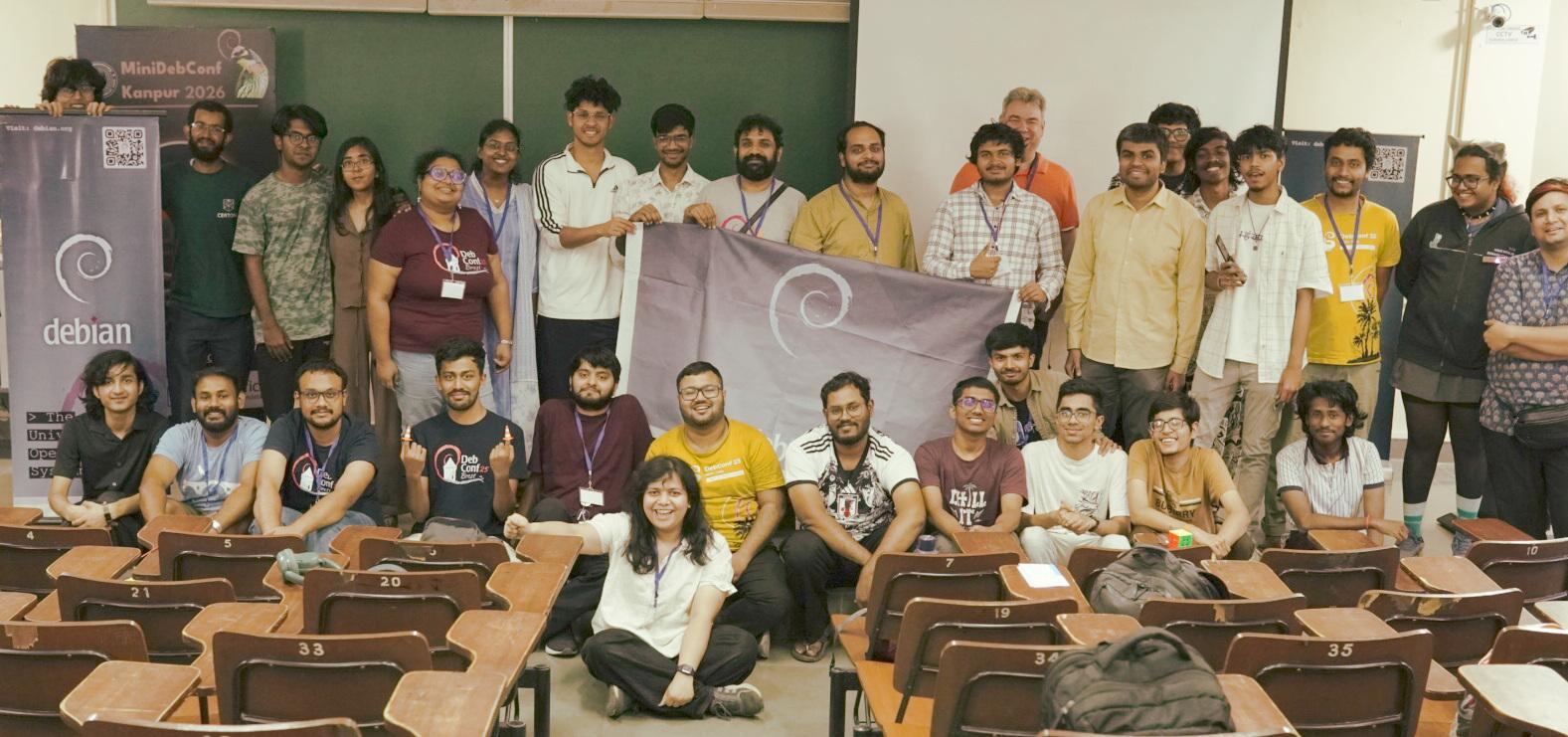

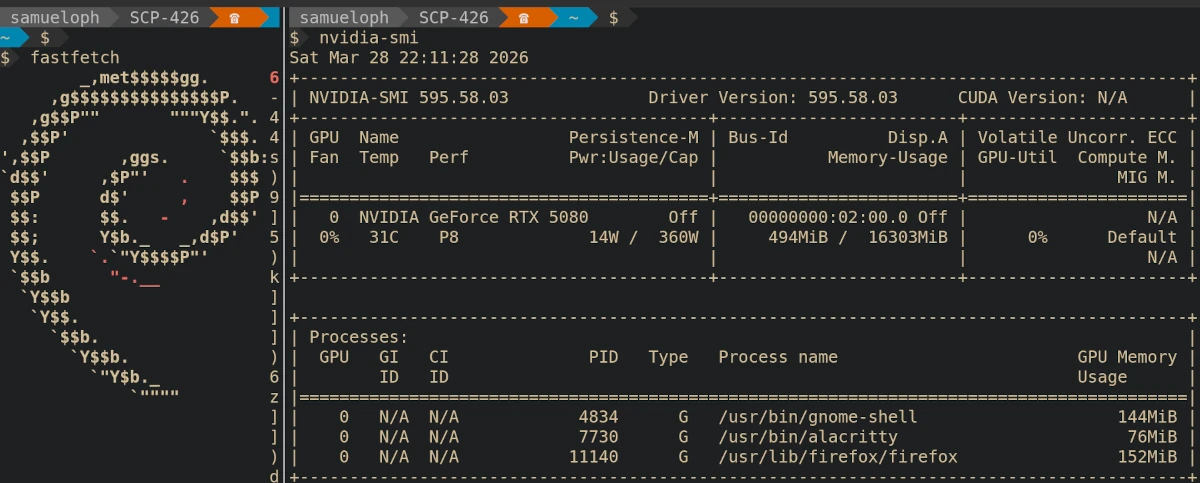
 I finally upgraded my mail server to Debian 13 and, as expected, the Dovecot part was quite a ride.
The configuration syntax changed between Dovecot 2.3 (Debian 12) and Dovecot 2.4 (Debian 13),
so I started first with diffing my configuration against a vanilla Debian 12 one (this setup is slightly old) and then applied the same (logical) changes to a vanilla Debian 13 one.
This mostly went well.
Mostly because my user database is stored in SQL and while the
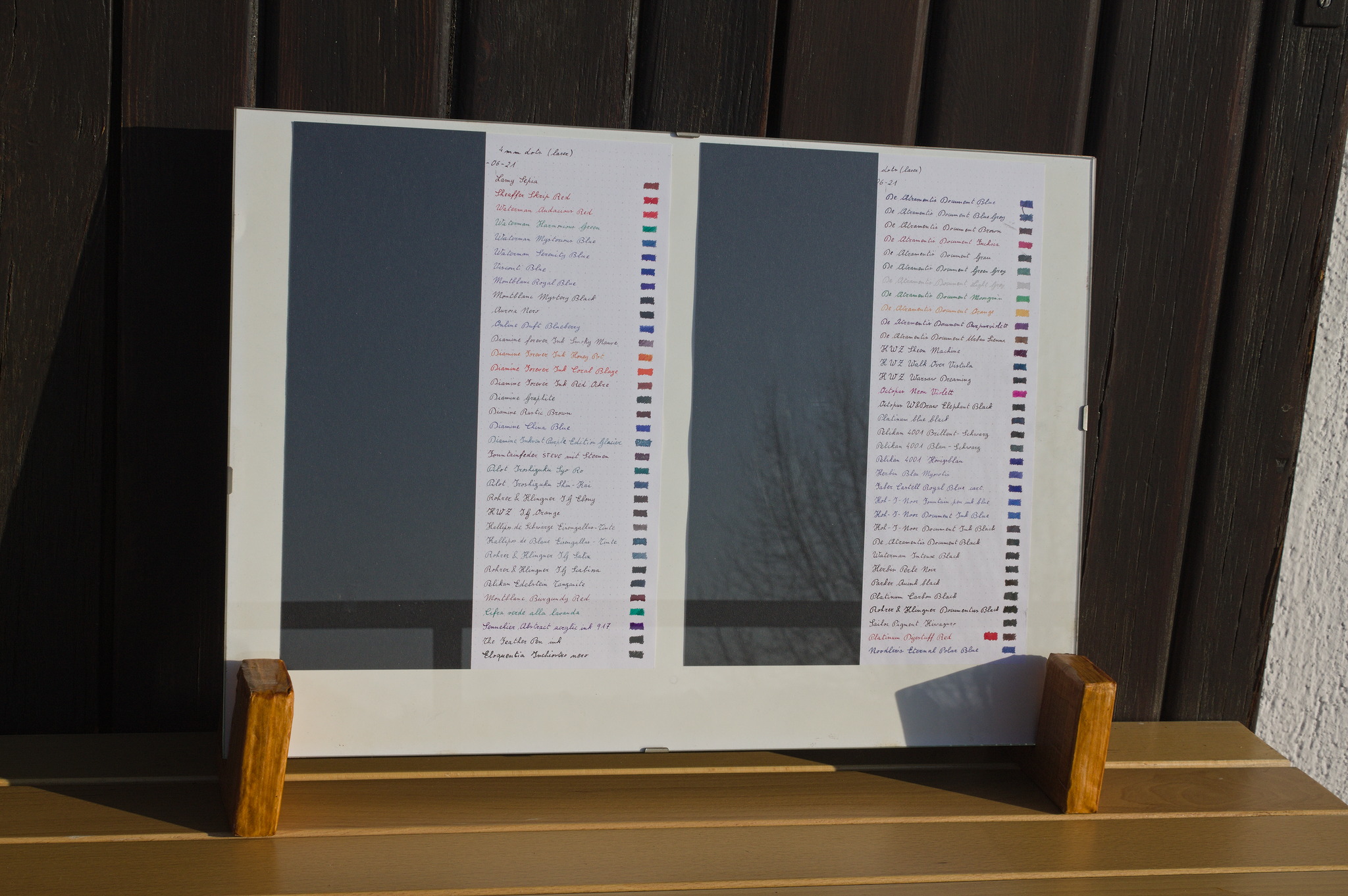
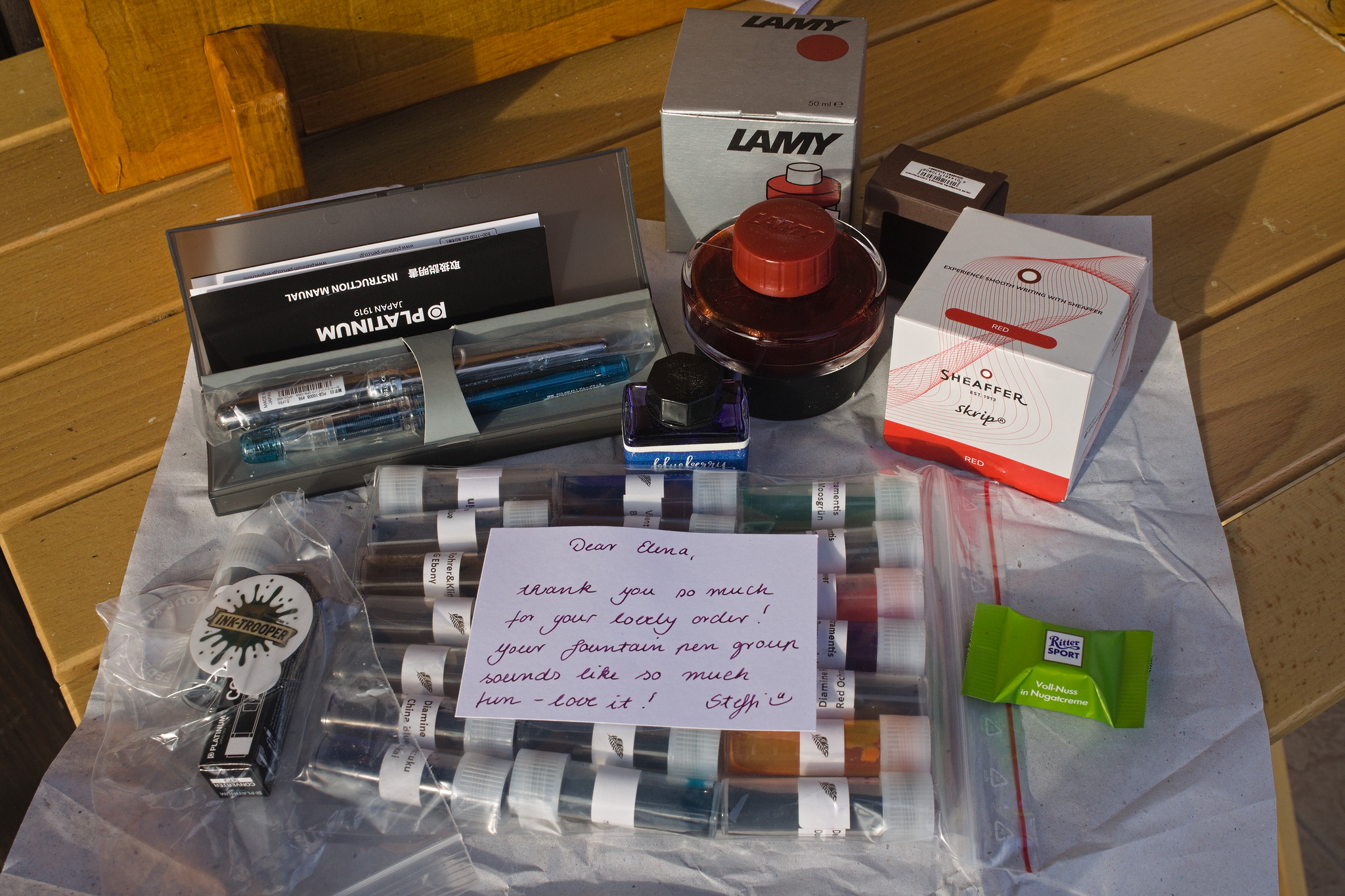 The next step, already in January, was mentioning in a fountain-pen
enthusiasts forum that I planned such a test, and asking if people were
interested in having me buy a few samples of more inks when I was
buying my next pen.
The word enthusiasts is probably a hint of the reason why soon
afterwards I received a package with the pen I had planned to buy, its
converter, and a couple dozens ink samples.
And then a couple envelopes with additional samples of inks that weren t
available on the shops, from said enthusiasts.
Added to the inks I already had acquired since the last lightfastness
test, it meant that they couldn t all fit in one single page, and thus I
had some room to add some inks I had already tested: some were requests,
and for others I tried to select ones that felt relevant.
Since I m changing the test setup, I ve decided I should probably keep
doing this until I ve tested again all of the inks I still have
available.
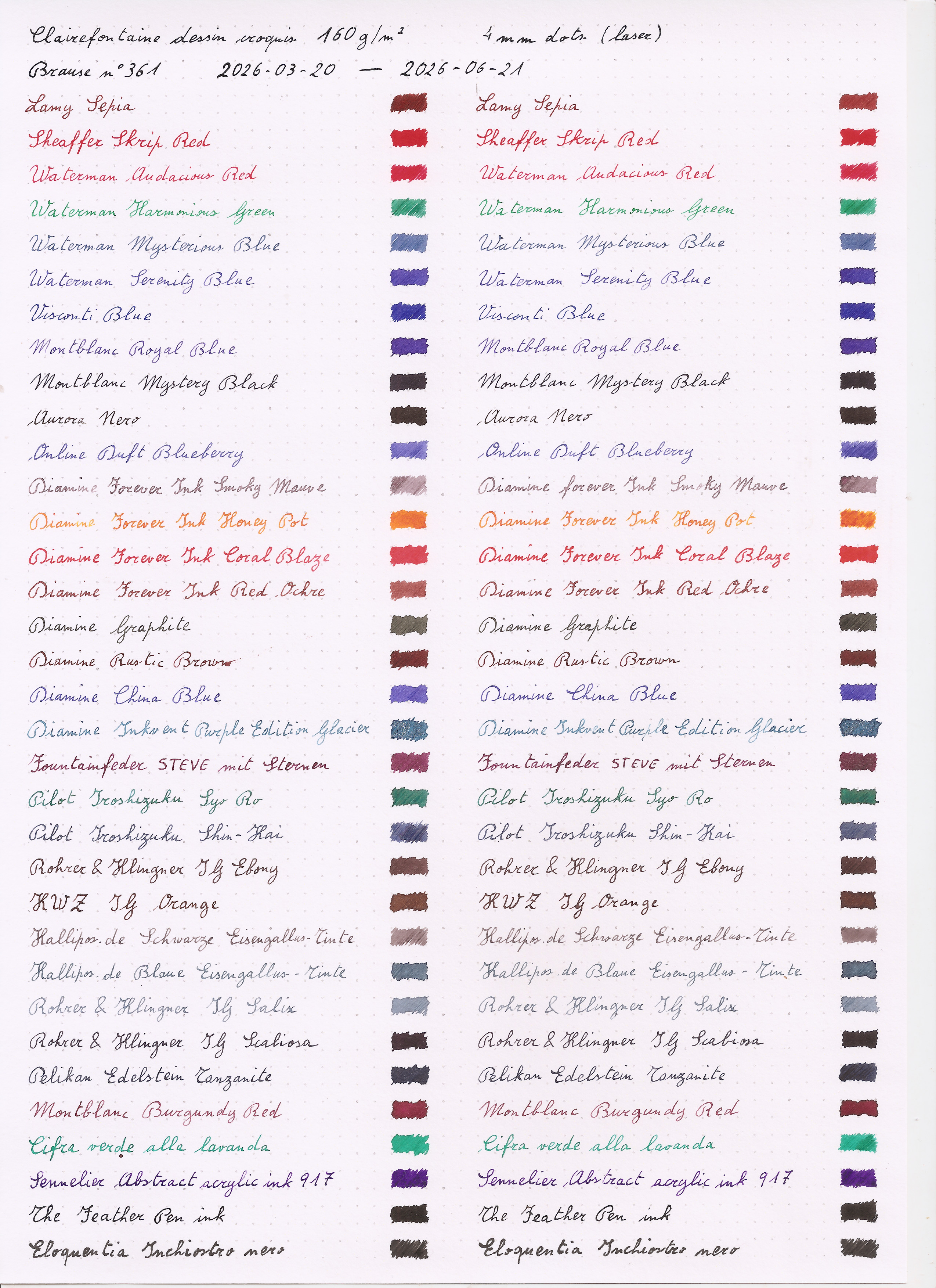
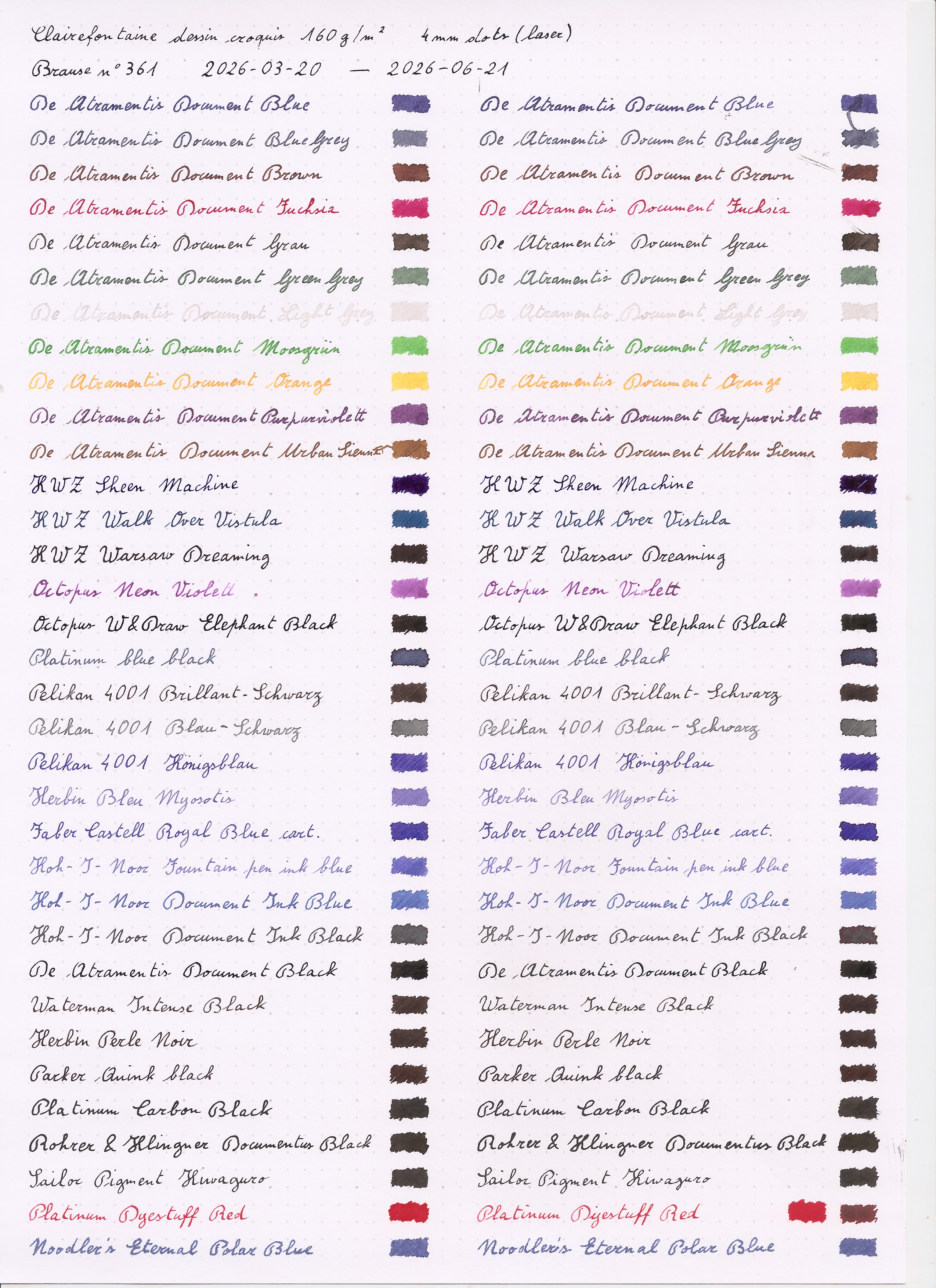 For the paper, I ve used A4 sheets of
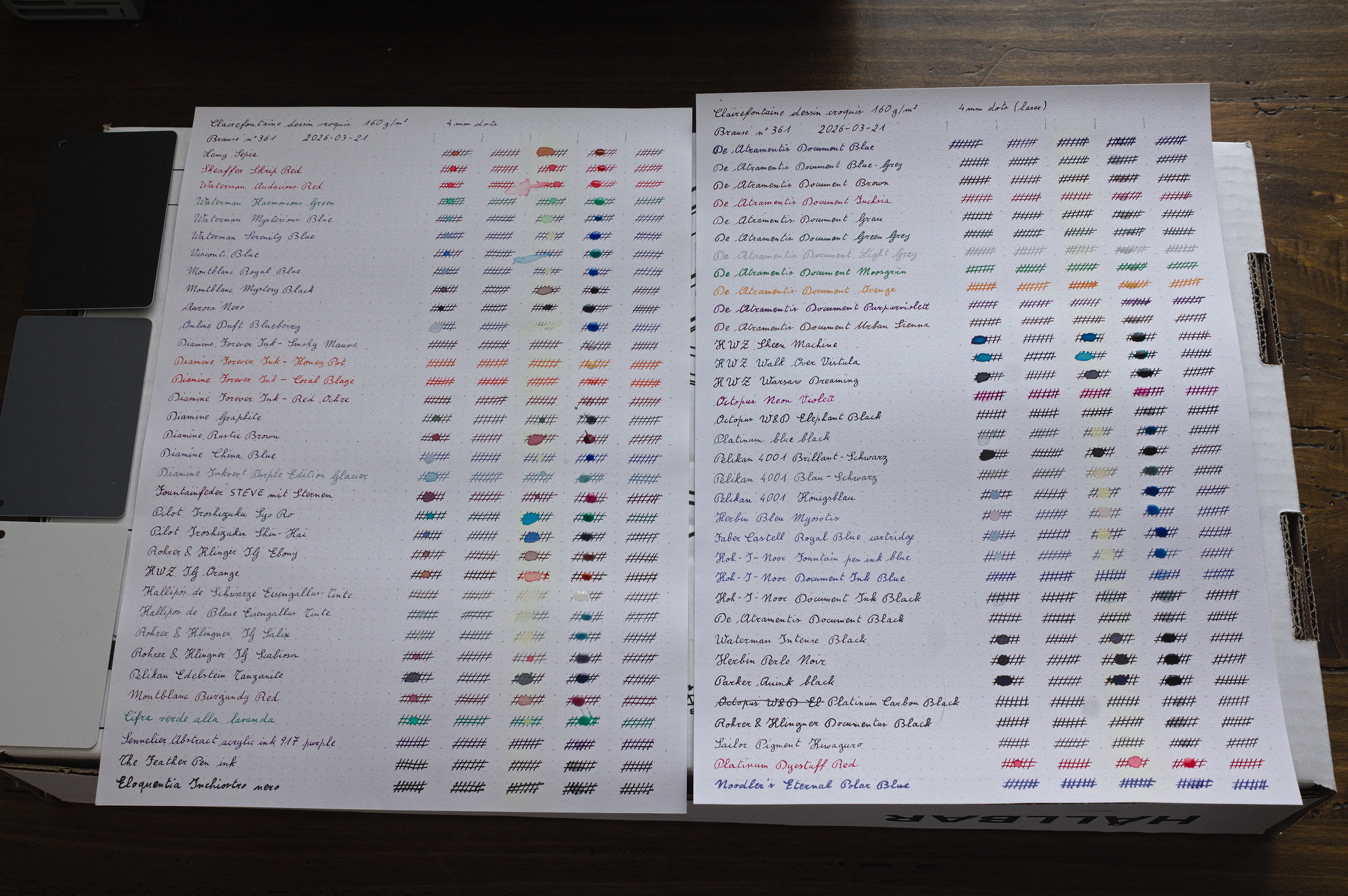 While I was filling the sheet for the lightfastness tests, I decided to
also prepare a second set of sheet, for a liquid resistance drop test.
On each line, beside the name of the ink, I added five sets of crossing
parallel lines, and let everything dry for a few days.
Then I used a syringe to put a drop of a liquid on each set of lines,
waited for it to be absorbed into the paper and to dry, at least
overnight, but sometimes also for a day or two (life happened), and then
looked at the results and did the next test.
The first liquid was water, with the usual wild difference between
washable and permanent inks, and all of the intermediate possibilities.
The second liquid was isopropyl alcohol, and I was surprised to see
that, with very few exceptions, most inks didn t change at all. I
wonder whether that s related to the fact that instead of forming a drop
it was absorbed almost immediately into the paper, and dried in a very
short time.
The third liquid was hydrogen peroxide: beside the individual results I
noticed that its column yellowed visibly; I wonder whether that means
that the paper I used has optical brighteners, and it will also yellow
under the sun: that wouldn t be ideal, but it would also be a surprise,
for paper that is acid free and sold for arts.
The fourth liquid was citric acid, by mixing a bit less than a teaspoon
of citric acid granules in just enough very warm water (heated to 70 C,
i.e. the lowest temperature available on my kettle) to dissolve most of
the acid. I forgot that I had some old PH strips until one hour after
I ve put the drop on the paper, and I don t know whether something had
changed, but when I did remember about them it showed a deep red between
1 and 2. I don t think I can trust those strips too much, however.
This backfired badly: the drop of citric acid never dried out, but
formed a sticky paste that prevented me from scanning the results,
and I m not sure whether I ll do the last test, which was supposed to be
household bleach.
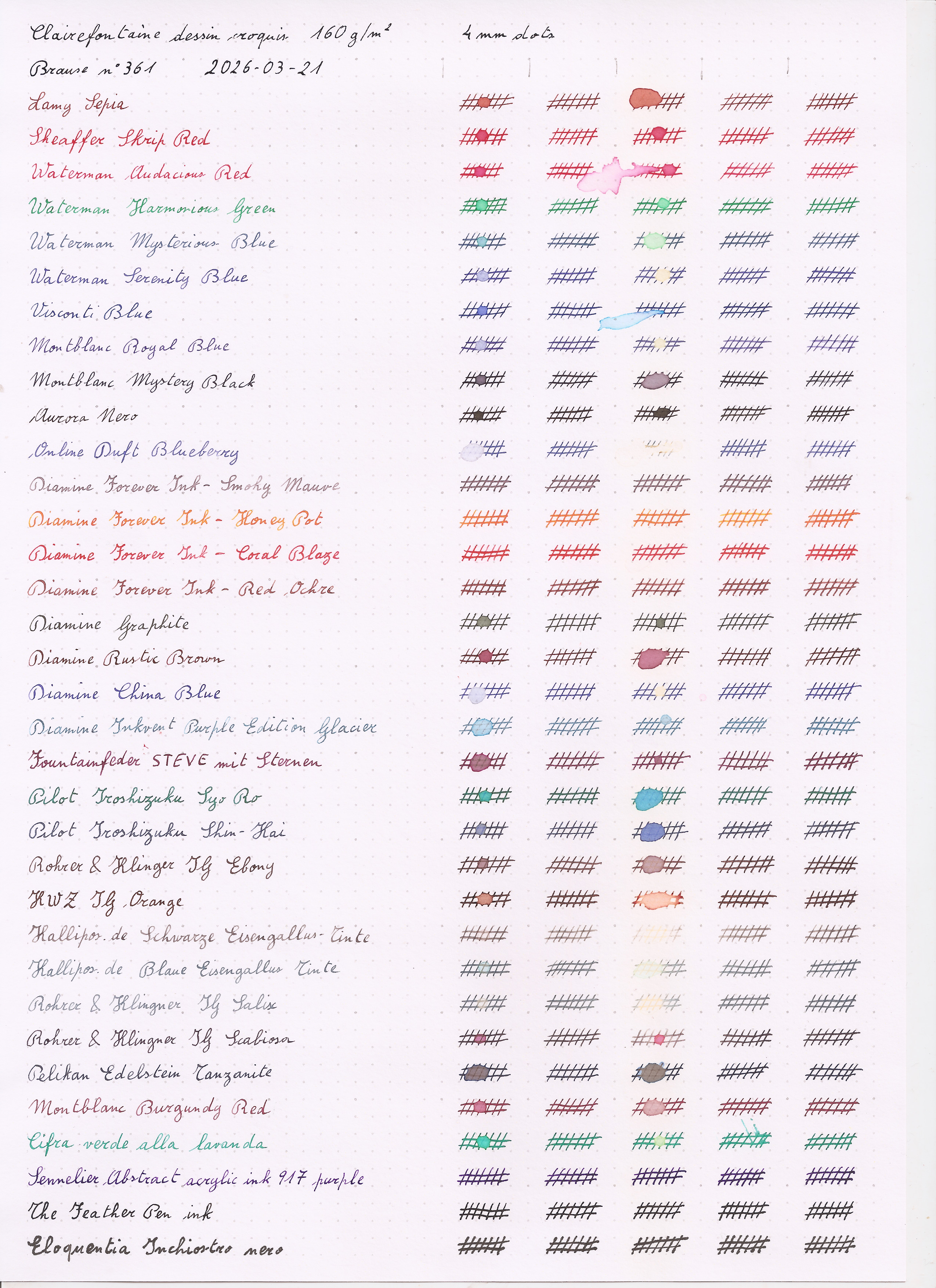
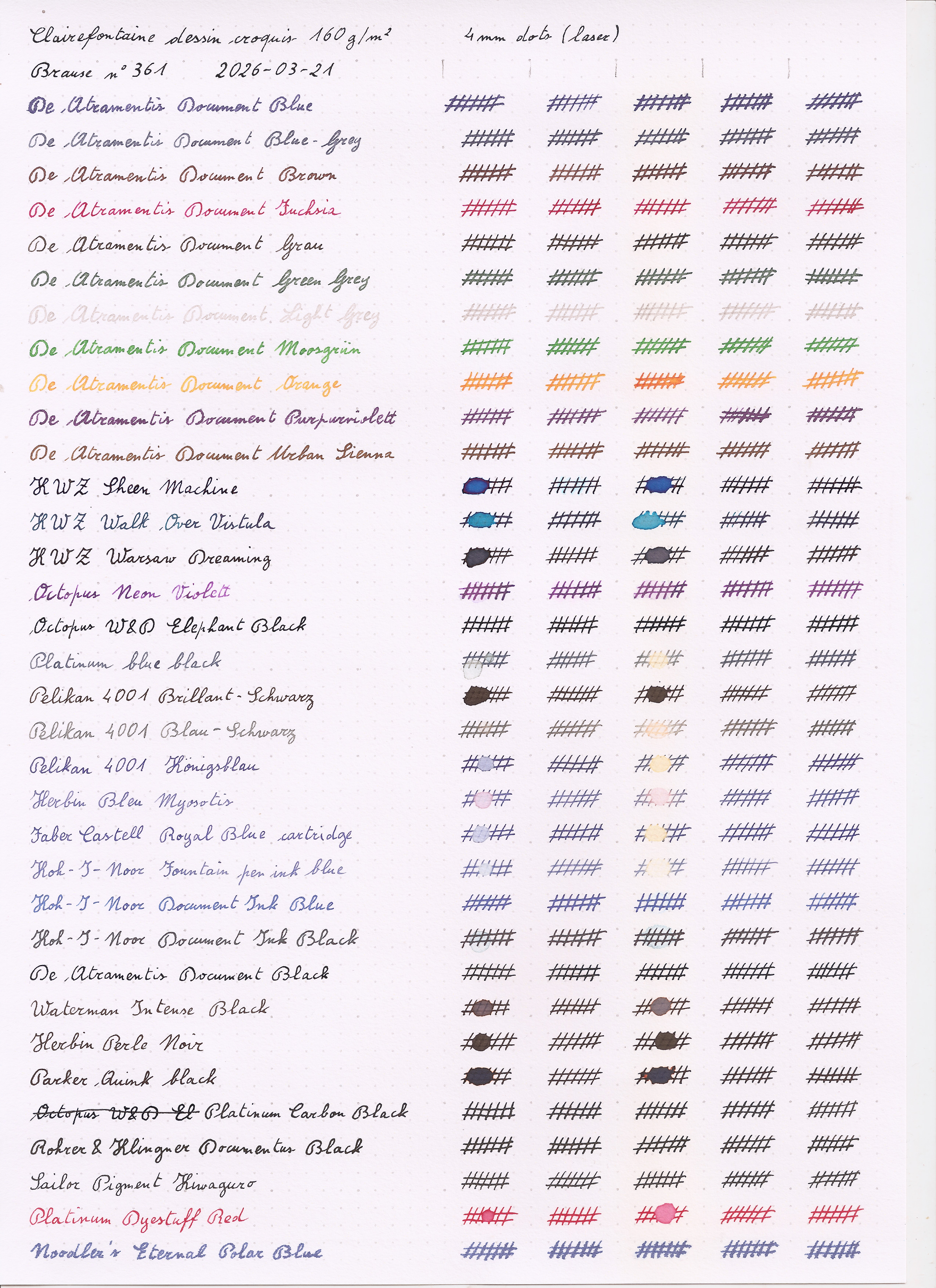 Luckily I had scanned the partial results, and they are shown here.
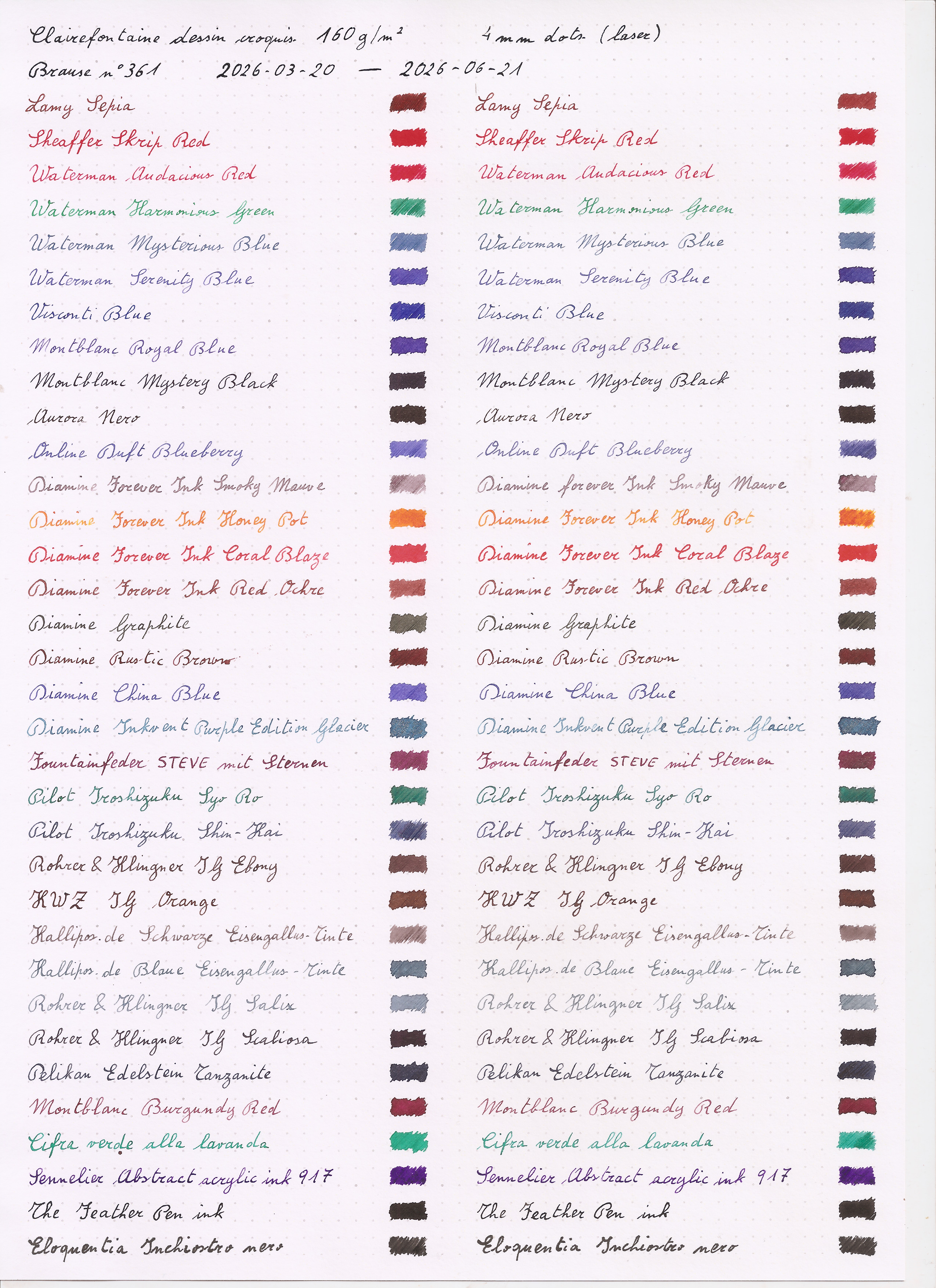
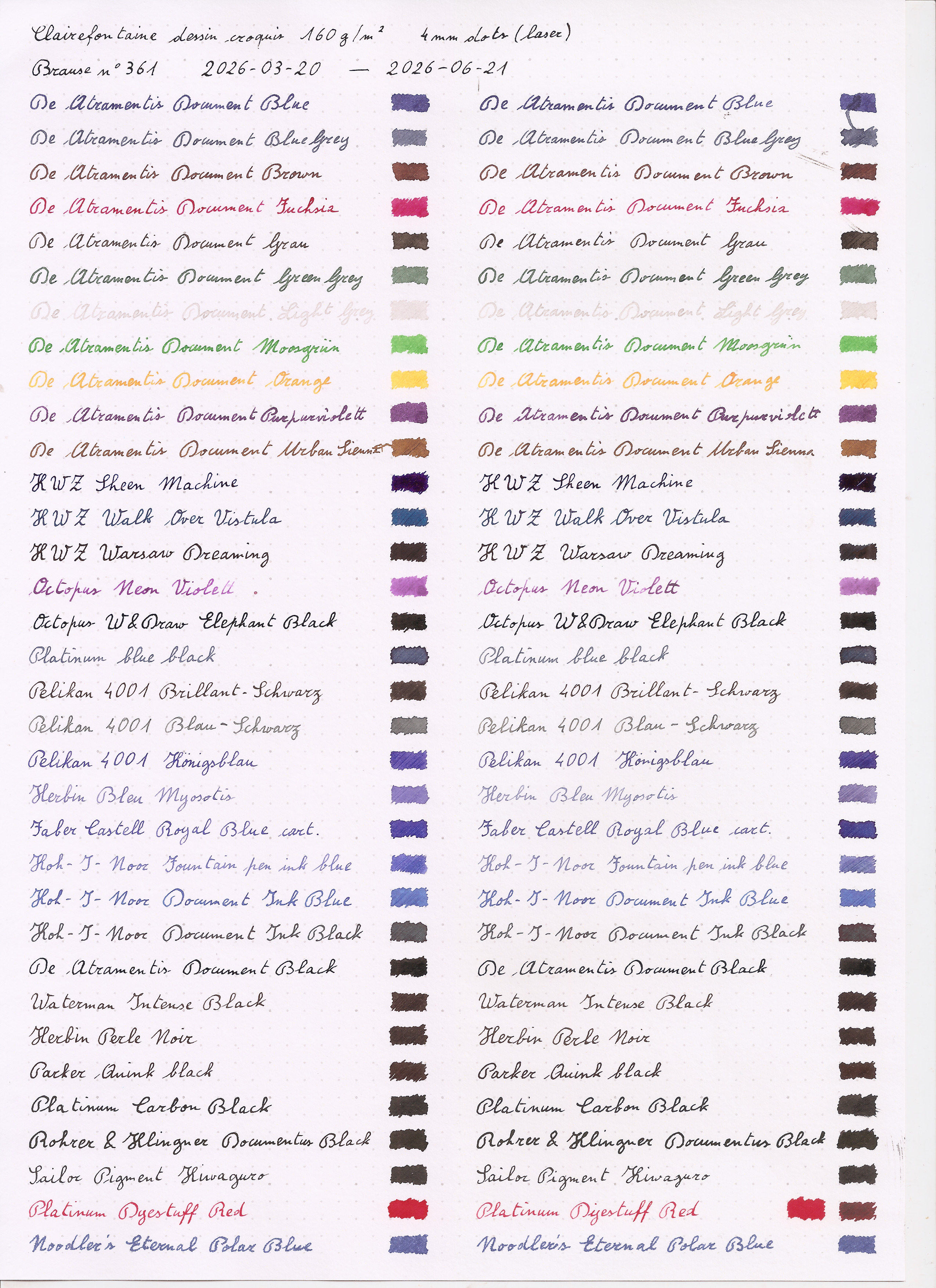 After one full day with plenty of sun, nothing really had changed,
except possibly for a vague hint that the Herbin Bleu Myosotis may have
have been a bit lighter than it started, but it may also have been a
suggestion.
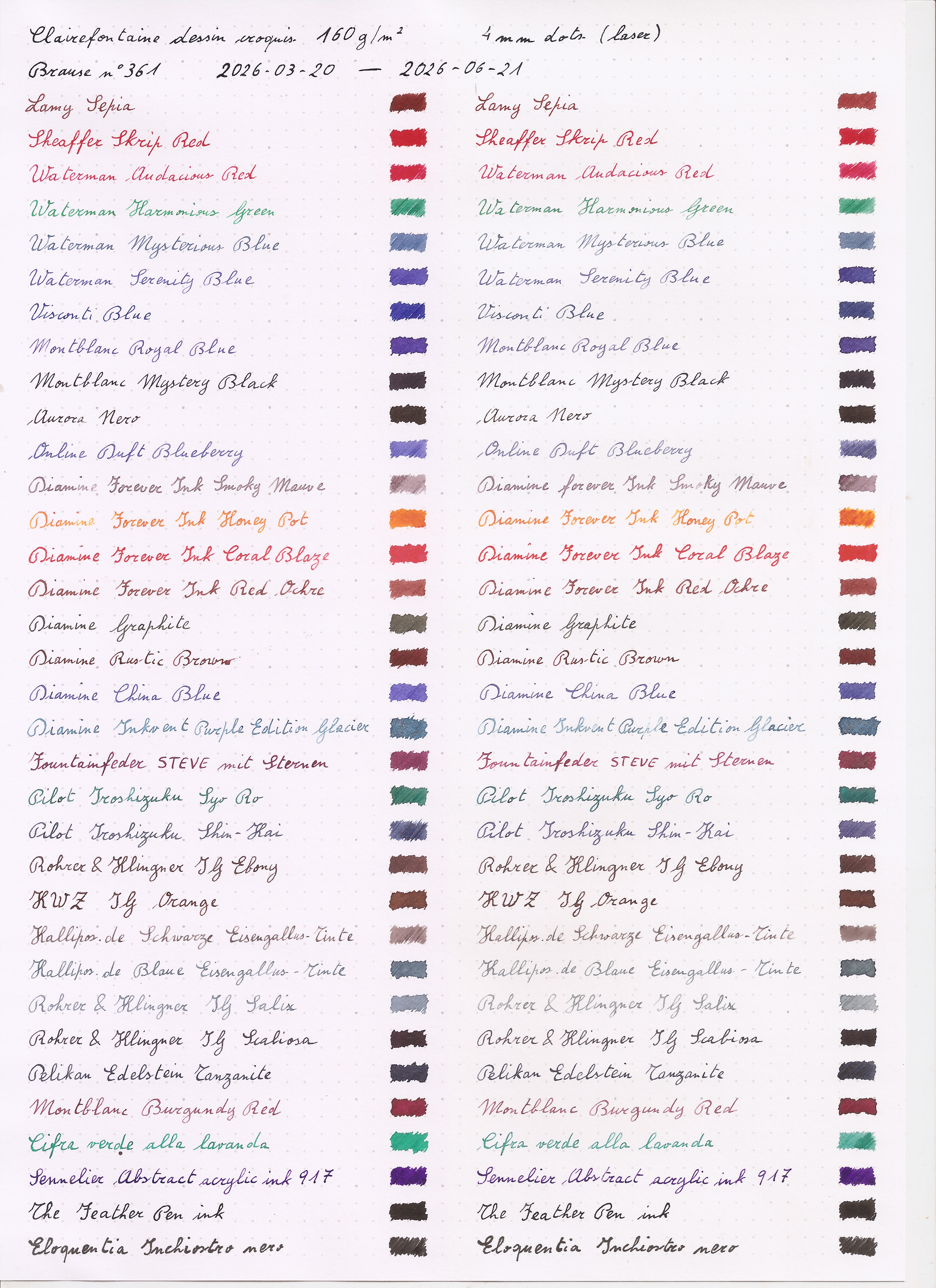
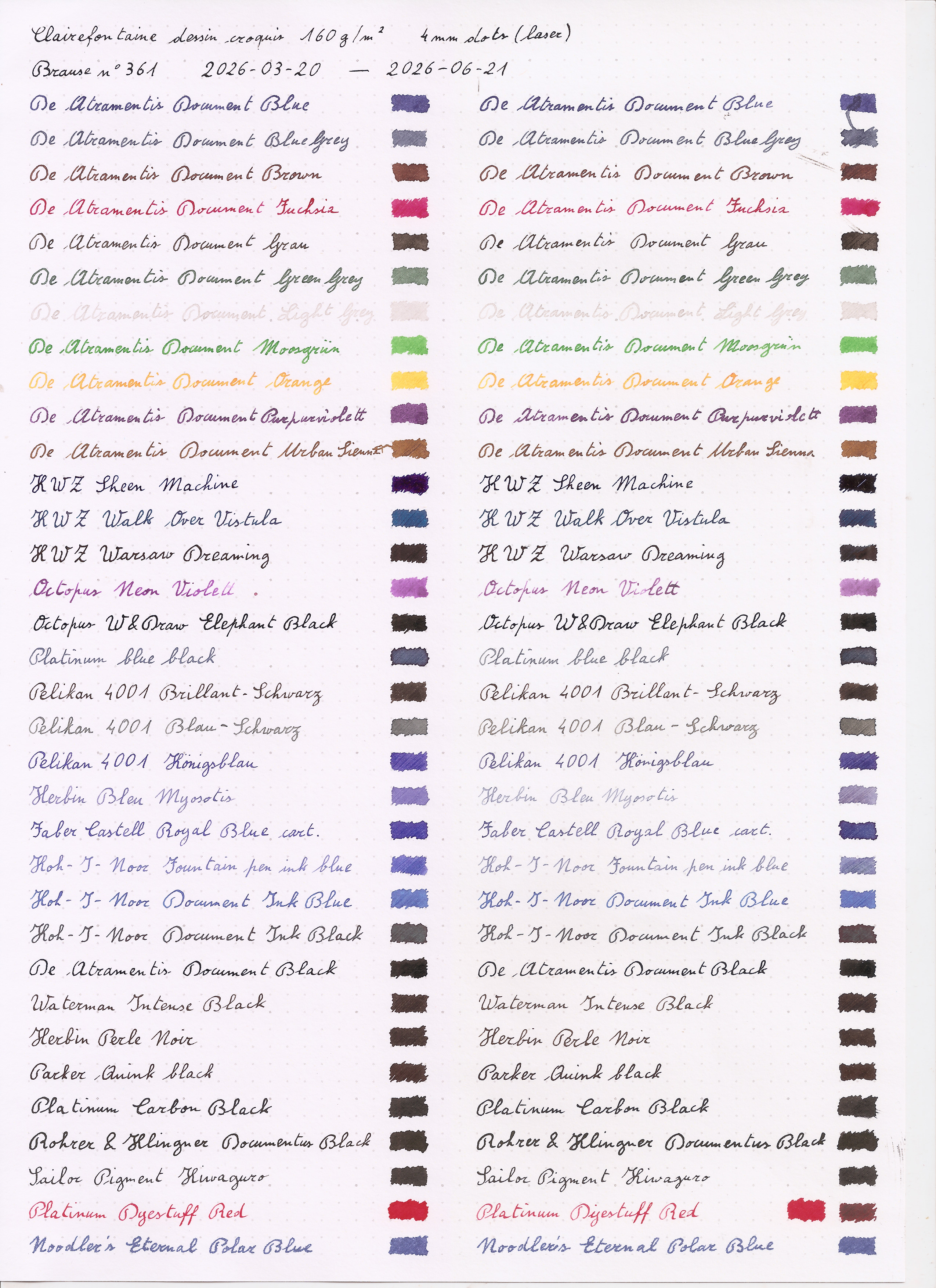 After three days, however, some results started to show, with the most
fugitive inks starting to be visibly changed, becoming either paler or
in some case duller.
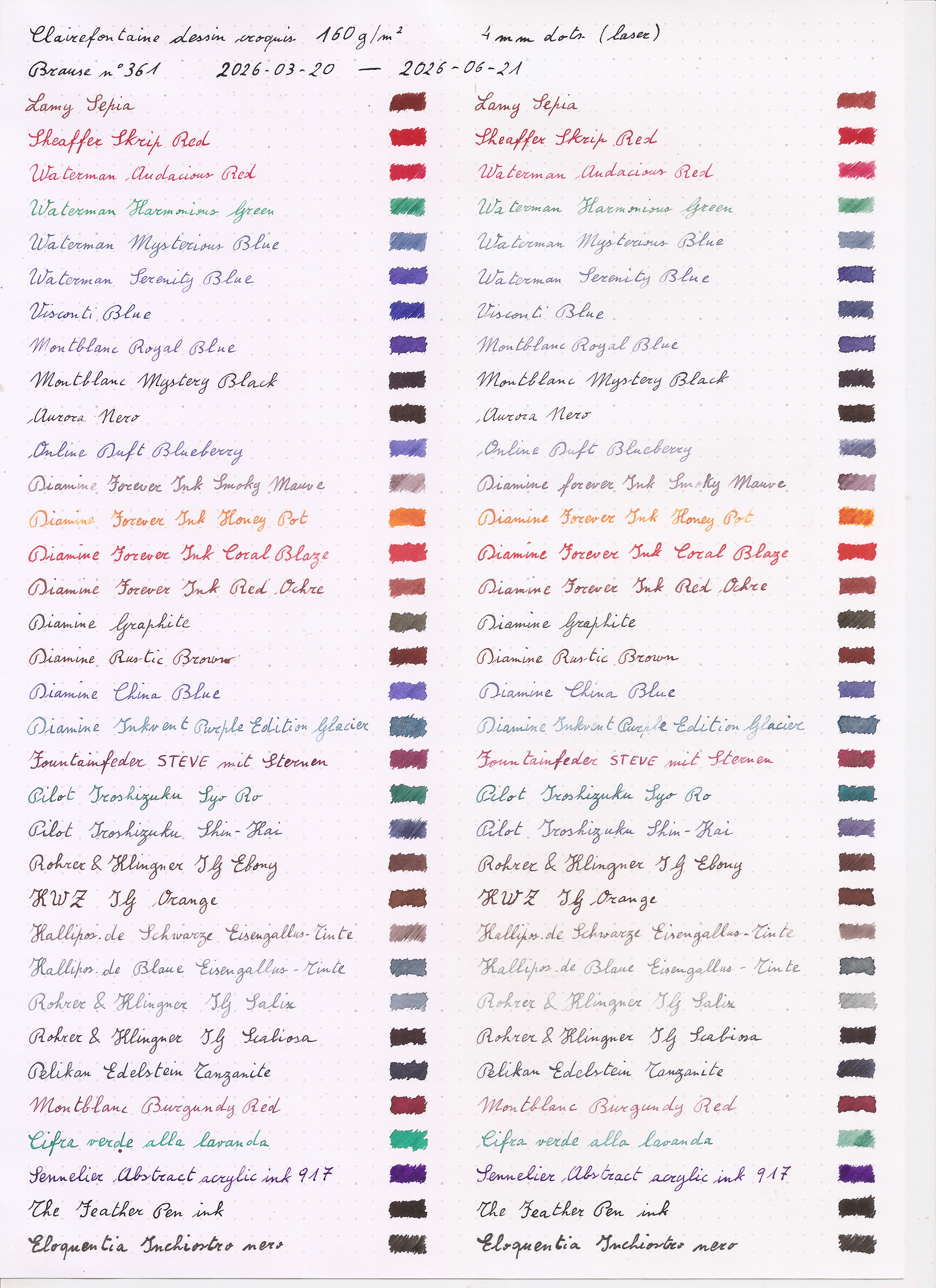
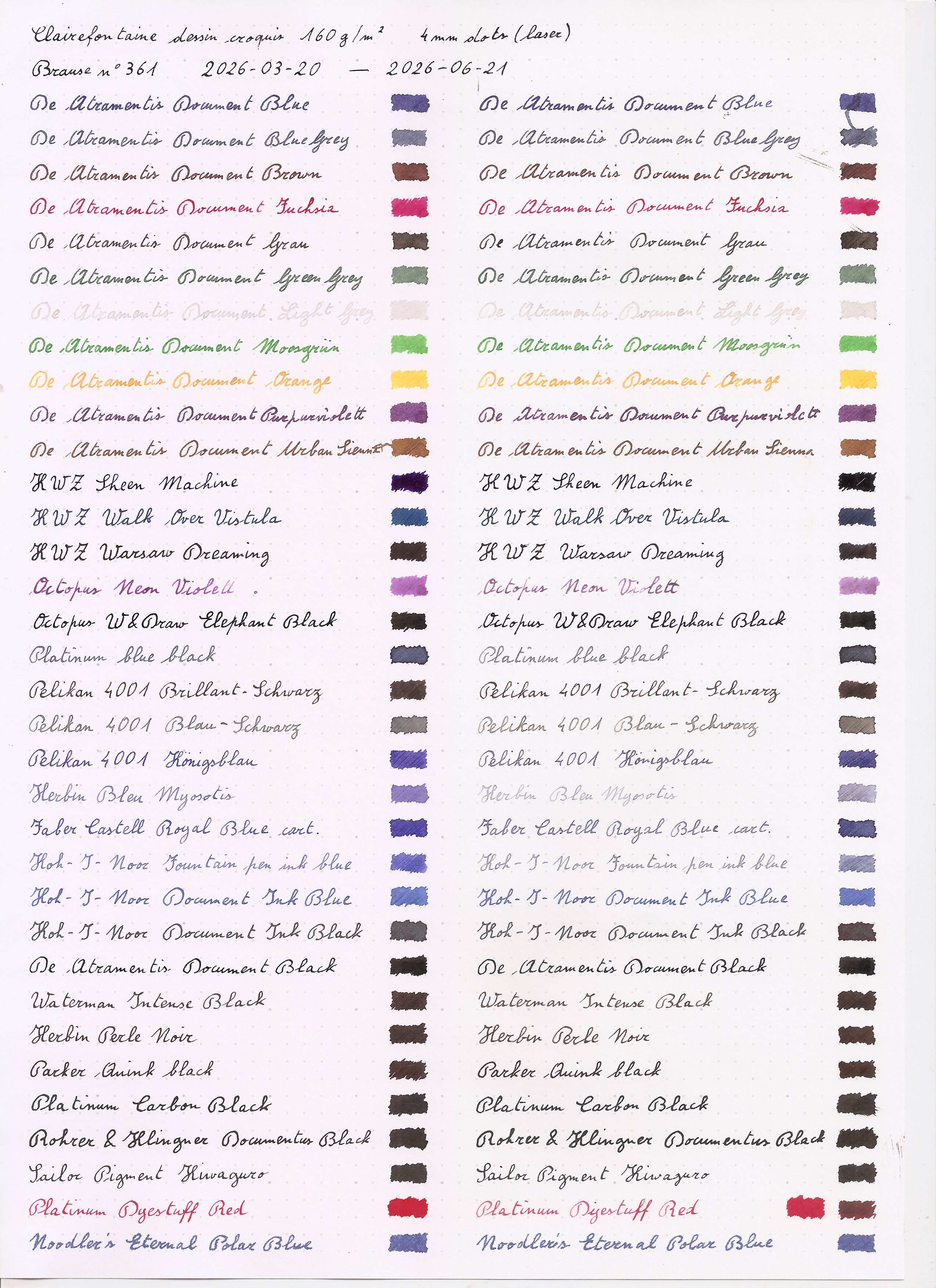 And the full week showed more of that, with a few more inks starting to
show visible change.

 After two weeks the paper had significantly yellowed, something I did
not expect from drawing paper (and which means that I will probably use
a different paper when making similar tests in the future).
As for the inks, there were a couple more inks with visible changes, but
mostly it was more of the same as seen in the previous week.
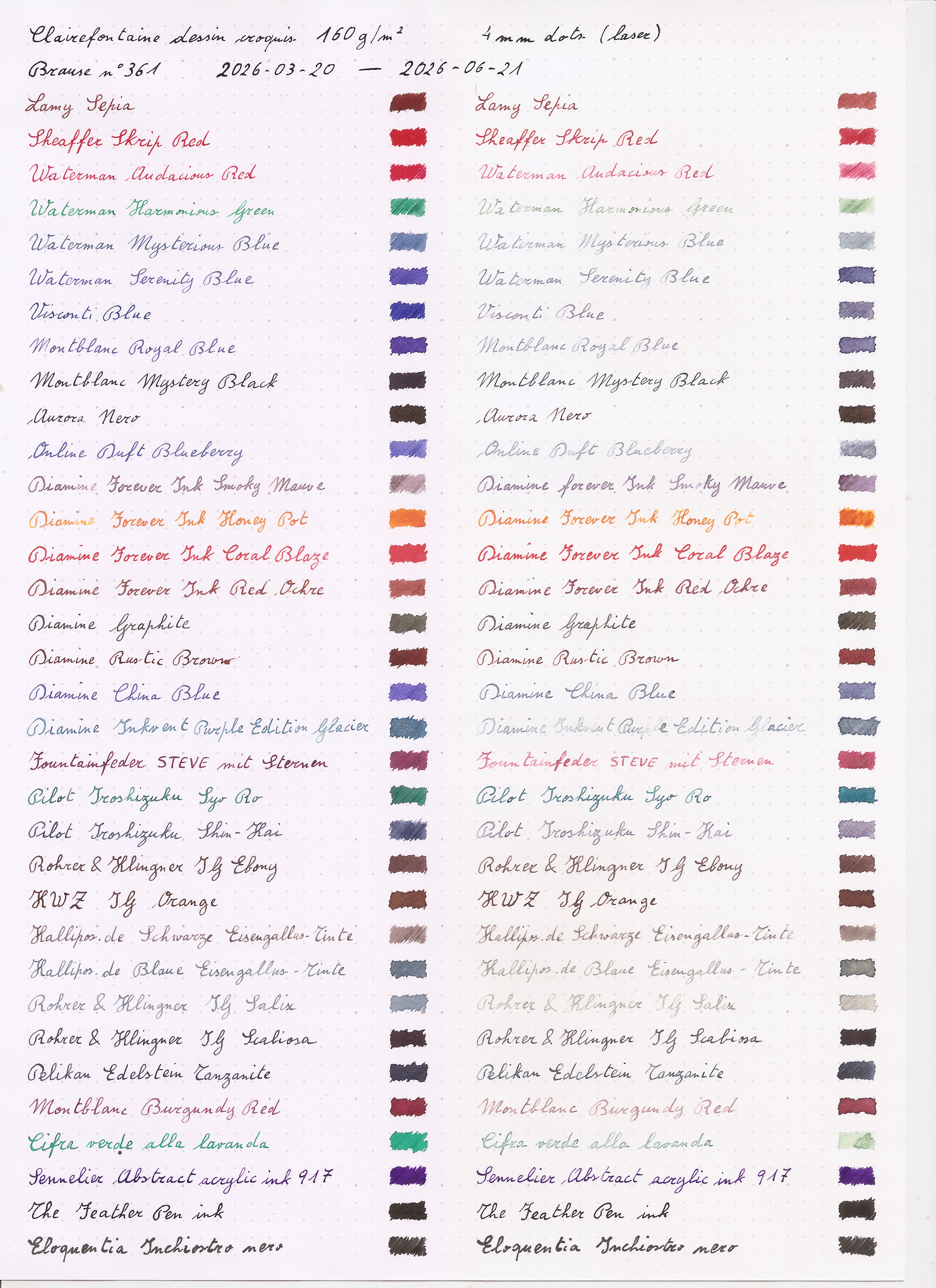
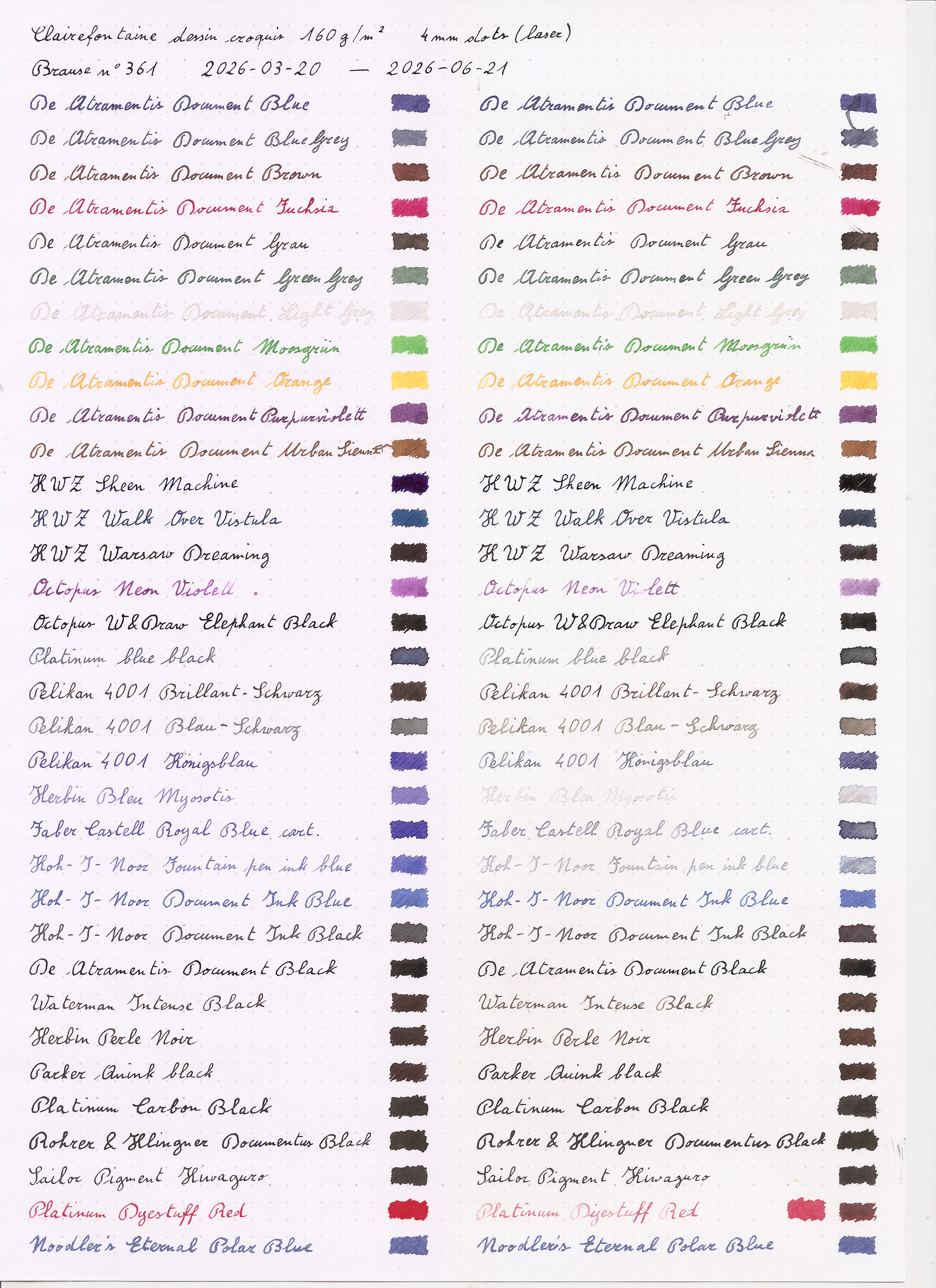 Three weeks started to show changes in the black and most irongall inks, and of course more changes in the even less resistant inks.
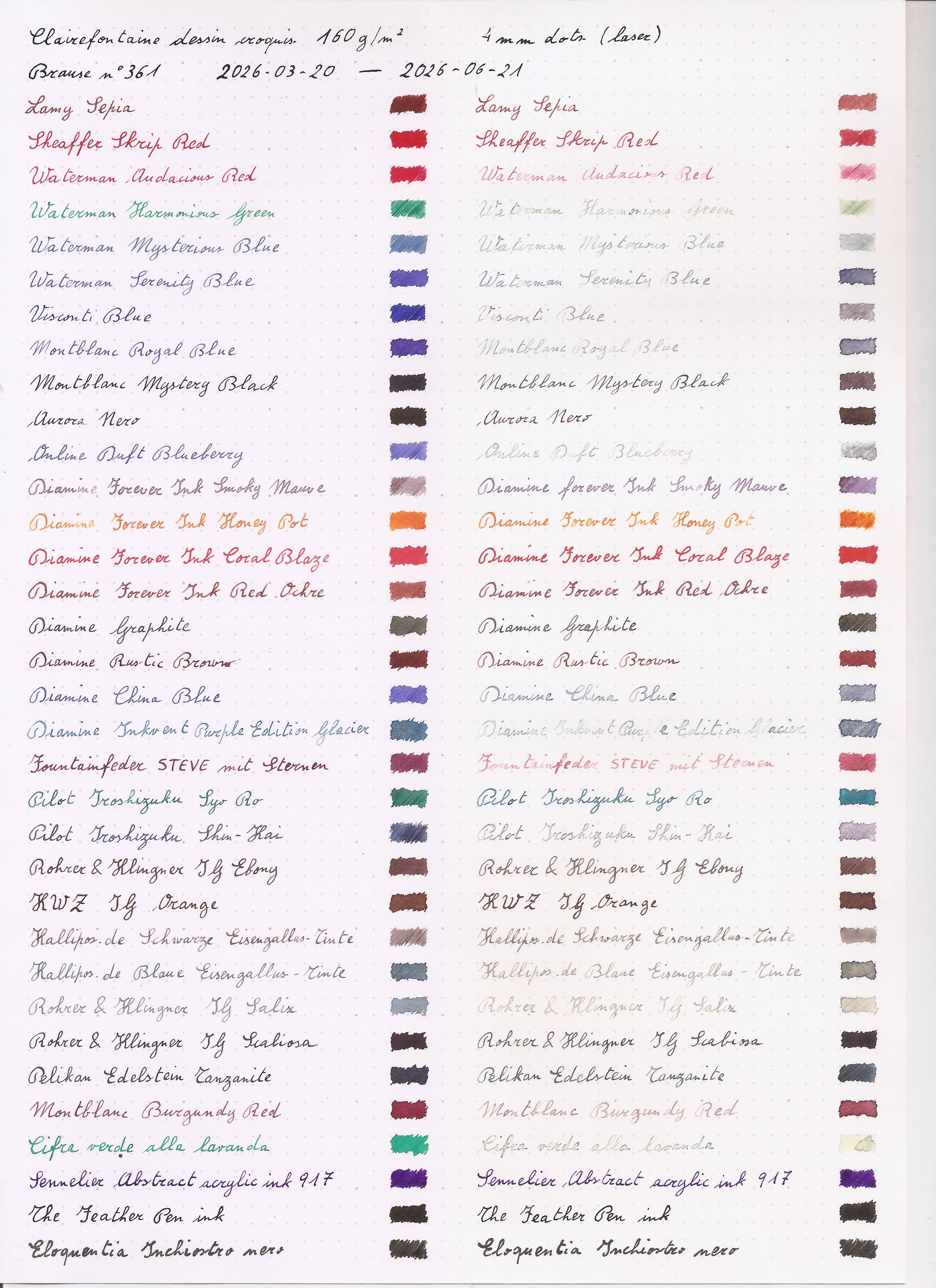
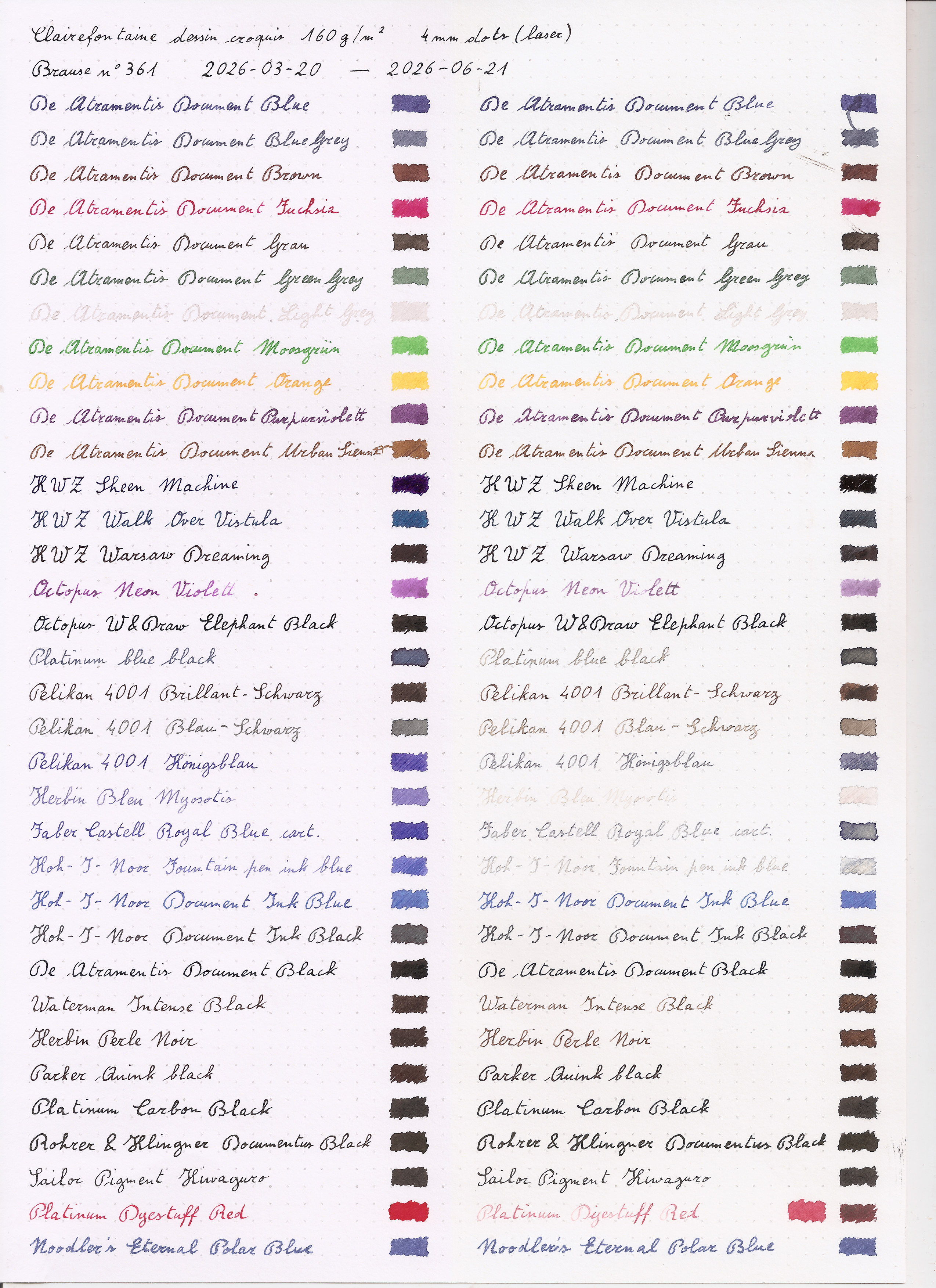 Week four saw a bit more clouds and rain than the first few weeks, and
there weren t big changes, but mostly more of what had already started
to happen earlier.
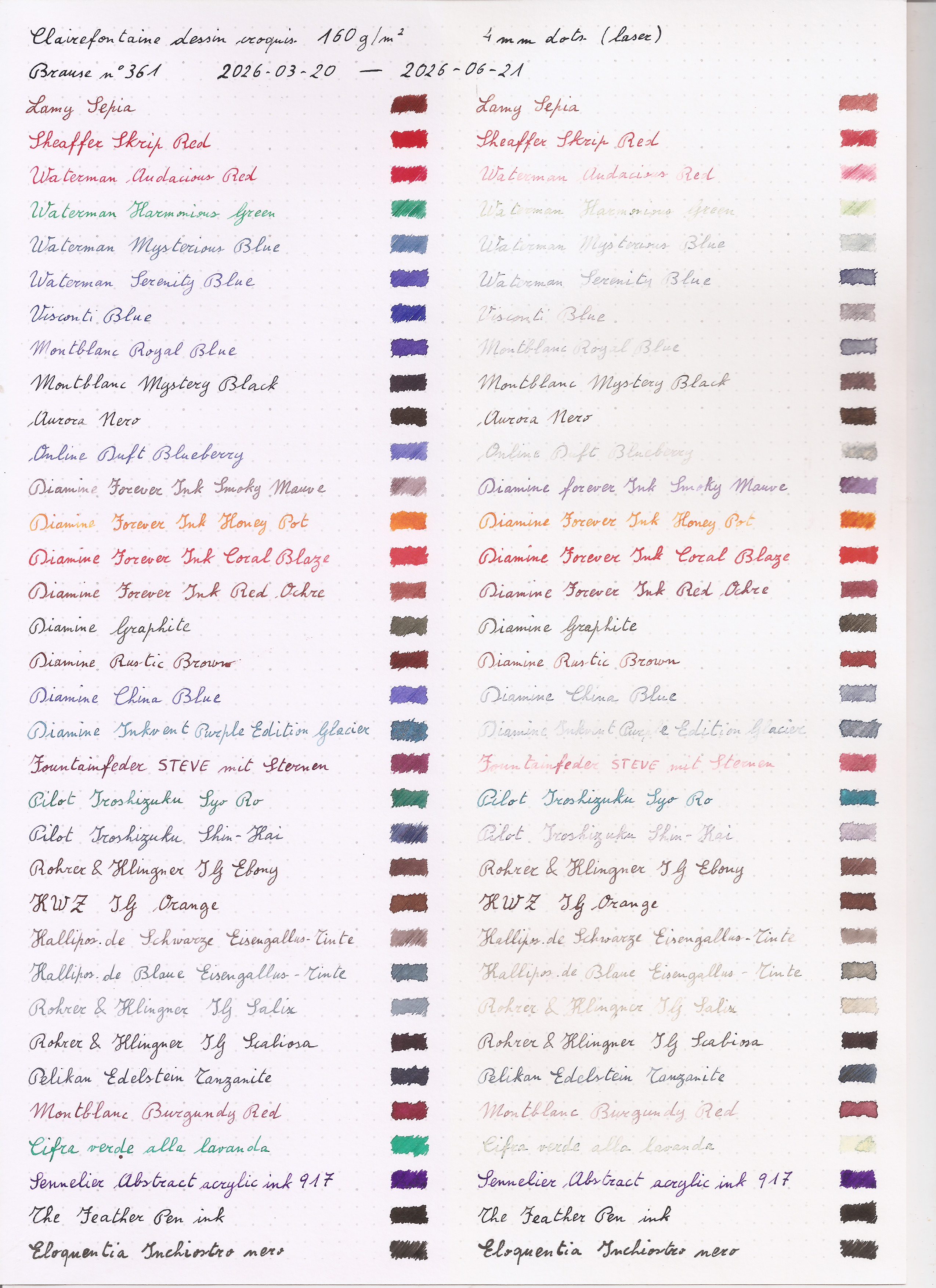
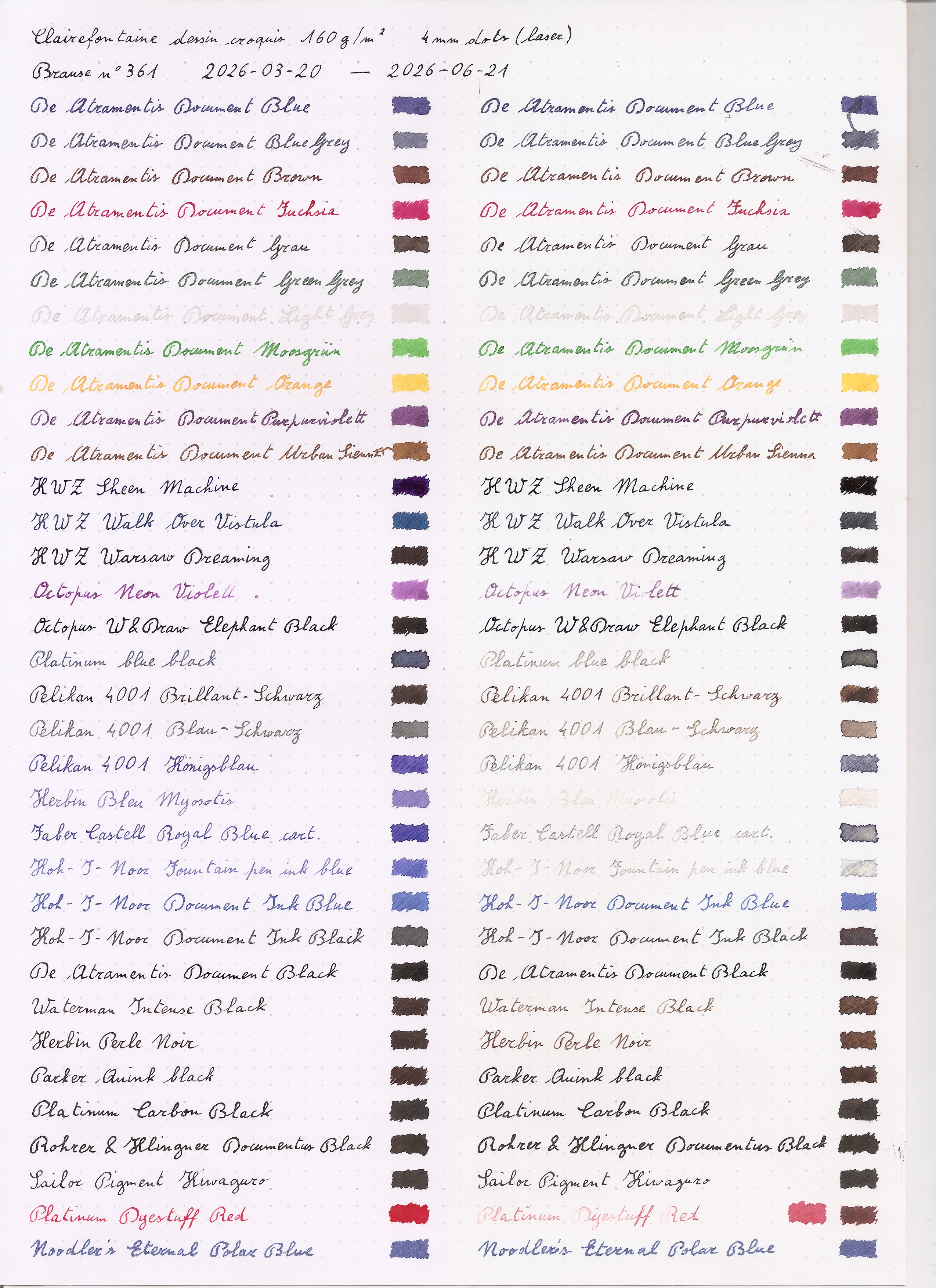 A month didn t change much compared to the four weeks, but I did the
scans for completeness, and from now on I m going to update monthly.

 Huge. Huge. Amazing. It did crash as soon as I tried to actually use the
radio, but after fixing a few dangling bugs in the API surface (and some
assumptions I think some underlying gnuradio driver may be making that I need
to double check in the code), I was able to get a super solid stream of
broadcast fm radio, with gqrx being none the wiser. It thought it was
just talking to the device it knows as
 Nice. I can t wait to try this with the rest of the rtl-sdr based tools I like
having around using my
 A few months ago, in June 2025, I joined

 Image of the estimated qualiy of articles of the four articles in the second mixed-methods paper. Extreme dips reflect periods of frequent vandalism.
 When you re looking at source code it can be helpful to have some evidence
indicating who wrote it. Author tags give a surface level indication,


 Linux kernel security modules provide a good additional layer of security around individual programs by restricting what they are allowed to do, and at best block and detect zero-day security vulnerabilities as soon as anyone tries to exploit them, long before they are widely known and reported. However, the challenge is how to create these security profiles without accidentally also blocking legitimate actions. For MariaDB in Debian and Ubuntu, a new AppArmor profile was recently created by leveraging the extensive test suite with 7000+ tests, giving good confidence that AppArmor is unlikely to yield false positive alerts with it.
 And yet another maintenance release of the

 Figuring out which of these failures are new (and thus worth
investigating) has been a manual process in Debusine until now.
We have just completed the basic functionality of the
 This is determined by looking at recent task history for each task in
the