Search Results: "js"

23 February 2023

Paul Tagliamonte: Announcing hz.tools

Interested in future updates? Follow me on mastodon at @paul@soylent.green. Posts about hz.tools will be tagged #hztools.

If you're on the Fediverse, I'd very much appreciate boosts on my announcement toot!
Ever since 2019, I ve been learning about how radios work, and trying to learn about using them the hard way by writing as much of the stack as is practical (for some value of practical) myself. I wrote my first Hello World in 2018, which was a simple FM radio player, which used librtlsdr to read in an IQ stream, did some filtering, and played the real valued audio stream via pulseaudio. Over 4 years this has slowly grown through persistence, lots of questions to too many friends to thank (although I will try), and the eternal patience of my wife hearing about radios nonstop for years into a number of Go repos that can do quite a bit, and support a handful of radios. I ve resisted making the repos public not out of embarrassment or a desire to keep secrets, but rather, an attempt to keep myself free of any maintenance obligations to users so that I could freely break my own API, add and remove API surface as I saw fit. The worst case was to have this project feel like work, and I can t imagine that will happen if I feel frustrated by PRs that are getting ahead of me solving problems I didn t yet know about, or bugs I didn t understand the fix for. As my rate of changes to the most central dependencies has slowed, i ve begun to entertain the idea of publishing them. After a bit of back and forth, I ve decided it s time to make a number of them public, and to start working on them in the open, as I ve built up a bit of knowledge in the space, and I and feel confident that the repo doesn t contain overt lies. That s not to say it doesn t contain lies, but those lies are likely hidden and lurking in the dark. Beware. That being said, it shouldn t be a surprise to say I ve not published everything yet for the same reasons as above. I plan to open repos as the rate of changes slows and I understand the problems the library solves well enough or if the project dead ends and I ve stopped learning.

Intention behind hz.tools It s my sincere hope that my repos help to make Software Defined Radio (SDR) code a bit easier to understand, and serves as an understandable framework to learn with. It s a large codebase, but one that is possible to sit down and understand because, well, it was written by a single person. Frankly, I m also not productive enough in my free time in the middle of the night and on weekends and holidays to create a codebase that s too large to understand, I hope! I remain wary of this project turning into work, so my goal is to be very upfront about my boundaries, and the limits of what classes of contributions i m interested in seeing. Here s some goals of open sourcing these repos:
  • I do want this library to be used to learn with. Please go through it all and use it to learn about radios and how software can control them!
  • I am interested in bugs if there s a problem you discover. Such bugs are likely a great chance for me to fix something I ve misunderstood or typoed.
  • I am interested in PRs fixing bugs you find. I may need a bit of a back and forth to fully understand the problem if I do not understand the bug and fix yet. I hope you may have some grace if it s taking a long time.
Here s a list of some anti-goals of open sourcing these repos.
  • I do not want this library to become a critical dependency of an important project, since I do not have the time to deal with the maintenance burden. Putting me in that position is going to make me very uncomfortable.
  • I am not interested in feature requests, the features have grown as I ve hit problems, I m not interested in building or maintaining features for features sake. The API surface should be exposed enough to allow others to experiment with such things out-of-tree.
  • I m not interested in clever code replacing clear code without a very compelling reason.
  • I use GNU/Linux (specifically Debian ), and from time-to-time I ve made sure that my code runs on OpenBSD too. Platforms beyond that will likely not be supported at the expense of either of those two. I ll take fixes for bugs that fix a problem on another platform, but not damage the code to work around issues / lack of features on other platforms (like Windows).

I m not saying all this to be a jerk, I do it to make sure I can continue on my journey to learn about how radios work without my full time job becoming maintaining a radio framework single-handedly for other people to use even if it means I need to close PRs or bugs without merging it or fixing the issue. With all that out of the way, I m very happy to announce that the repos are now public under github.com/hztools.

Should you use this? Probably not. The intent here is not to provide a general purpose Go SDR framework for everyone to build on, although I am keenly aware it looks and feels like it, since that what it is to me. This is a learning project, so for any use beyond joining me in learning should use something like GNU Radio or a similar framework that has a community behind it. In fact, I suspect most contributors ought to be contributing to GNU Radio, and not this project. If I can encourage people to do so, contribute to GNU Radio! Nothing makes me happier than seeing GNU Radio continue to be the go-to, and well supported. Consider donating to GNU Radio!

hz.tools/rf - Frequency types The hz.tools/rf library contains the abstract concept of frequency, and some very basic helpers to interact with frequency ranges (such as helpers to deal with frequency ranges, or frequency range math) as well as frequencies and some very basic conversions (to meters, etc) and parsers (to parse values like 10MHz). This ensures that all the hz.tools libraries have a shared understanding of Frequencies, a standard way of representing ranges of Frequencies, and the ability to handle the IO boundary with things like CLI arguments, JSON or YAML. The git repo can be found at github.com/hztools/go-rf, and is importable as hz.tools/rf.
 // Parse a frequency using hz.tools/rf.ParseHz, and print it to stdout.
 freq := rf.MustParseHz("-10kHz")
fmt.Printf("Frequency: %s\n", freq+rf.MHz)
// Prints: 'Frequency: 990kHz'

// Return the Intersection between two RF ranges, and print
 // it to stdout.
 r1 := rf.Range rf.KHz, rf.MHz 
r2 := rf.Range rf.Hz(10), rf.KHz * 100 
fmt.Printf("Range: %s\n", r1.Intersection(r2))
// Prints: Range: 1000Hz->100kHz
These can be used to represent tons of things - ranges can be used for things like the tunable range of an SDR, the bandpass of a filter or the frequencies that correspond to a bin of an FFT, while frequencies can be used for things such as frequency offsets or the tuned center frequency.

hz.tools/sdr - SDR I/O and IQ Types This is the big one. This library represents the majority of the shared types and bindings, and is likely the most useful place to look at when learning about the IO boundary between a program and an SDR. The git repo can be found at github.com/hztools/go-sdr, and is importable as hz.tools/sdr. This library is designed to look (and in some cases, mirror) the Go io idioms so that this library feels as idiomatic as it can, so that Go builtins interact with IQ in a way that s possible to reason about, and to avoid reinventing the wheel by designing new API surface. While some of the API looks (and is even called) the same thing as a similar function in io, the implementation is usually a lot more naive, and may have unexpected sharp edges such as concurrency issues or performance problems. The following IQ types are implemented using the sdr.Samples interface. The hz.tools/sdr package contains helpers for conversion between types, and some basic manipulation of IQ streams.
IQ Format hz.tools Name Underlying Go Type
Interleaved uint8 (rtl-sdr) sdr.SamplesU8 [][2]uint8
Interleaved int8 (hackrf, uhd) sdr.SamplesI8 [][2]int8
Interleaved int16 (pluto, uhd) sdr.SamplesI16 [][2]int16
Interleaved float32 (airspy, uhd) sdr.SamplesC64 []complex64
The following SDRs have implemented drivers in-tree.
SDR Format RX/TX State
rtl u8 RX Good
HackRF i8 RX/TX Good
PlutoSDR i16 RX/TX Good
rtl kerberos u8 RX Old
uhd i16/c64/i8 RX/TX Good
airspyhf c64 RX Exp
The following major packages and subpackages exist at the time of writing:
Import What is it?
hz.tools/sdr Core IQ types, supporting types and implementations that interact with the byte boundary
hz.tools/sdr/rtl sdr.Receiver implementation using librtlsdr.
hz.tools/sdr/rtl/kerberos Helpers to enable coherent RX using the Kerberos SDR.
hz.tools/sdr/rtl/e4k Helpers to interact with the E4000 RTL-SDR dongle.
hz.tools/sdr/fft Interfaces for performing an FFT, which are implemented by other packages.
hz.tools/sdr/rtltcp sdr.Receiver implementation for rtl_tcp servers.
hz.tools/sdr/pluto sdr.Transceiver implementation for the PlutoSDR using libiio.
hz.tools/sdr/uhd sdr.Transceiver implementation for UHD radios, specifically the B210 and B200mini
hz.tools/sdr/hackrf sdr.Transceiver implementation for the HackRF using libhackrf.
hz.tools/sdr/mock Mock SDR for testing purposes.
hz.tools/sdr/airspyhf sdr.Receiver implementation for the AirspyHF+ Discovery with libairspyhf.
hz.tools/sdr/internal/simd SIMD helpers for IQ operations, written in Go ASM. This isn t the best to learn from, and it contains pure go implemtnations alongside.
hz.tools/sdr/stream Common Reader/Writer helpers that operate on IQ streams.

hz.tools/fftw - hz.tools/sdr/fft implementation The hz.tools/fftw package contains bindings to libfftw3 to implement the hz.tools/sdr/fft.Planner type to transform between the time and frequency domain. The git repo can be found at github.com/hztools/go-fftw, and is importable as hz.tools/fftw. This is the default throughout most of my codebase, although that default is only expressed at the leaf package libraries should not be hardcoding the use of this library in favor of taking an fft.Planner, unless it s used as part of testing. There are a bunch of ways to do an FFT out there, things like clFFT or a pure-go FFT implementation could be plugged in depending on what s being solved for.

hz.tools/ fm,am - analog audio demodulation and modulation The hz.tools/fm and hz.tools/am packages contain demodulators for AM analog radio, and FM analog radio. This code is a bit old, so it has a lot of room for cleanup, but it ll do a very basic demodulation of IQ to audio. The git repos can be found at github.com/hztools/go-fm and github.com/hztools/go-am, and are importable as hz.tools/fm and hz.tools/am. As a bonus, the hz.tools/fm package also contains a modulator, which has been tested on the air and with some of my handheld radios. This code is a bit old, since the hz.tools/fm code is effectively the first IQ processing code I d ever written, but it still runs and I run it from time to time.
 // Basic sketch for playing FM radio using a reader stream from
 // an SDR or other IQ stream.

bandwidth := 150*rf.KHz
reader, err = stream.ConvertReader(reader, sdr.SampleFormatC64)
if err != nil  
...
 
demod, err := fm.Demodulate(reader, fm.DemodulatorConfig 
Deviation: bandwidth / 2,
Downsample: 8, // some value here depending on sample rate
 Planner: fftw.Plan,
 )
if err != nil  
...
 
speaker, err := pulseaudio.NewWriter(pulseaudio.Config 
Format: pulseaudio.SampleFormatFloat32NE,
Rate: demod.SampleRate(),
AppName: "rf",
StreamName: "fm",
Channels: 1,
SinkName: "",
 )
if err != nil  
...
 
buf := make([]float32, 1024*64)
for  
i, err := demod.Read(buf)
if err != nil  
...
 
if i == 0  
panic("...")
 
if err := speaker.Write(buf[:i]); err != nil  
...


hz.tools/rfcap - byte serialization for IQ data The hz.tools/rfcap package is the reference implementation of the rfcap spec , and is how I store IQ captures locally, and how I send them across a byte boundary. The git repo can be found at github.com/hztools/go-rfcap, and is importable as hz.tools/rfcap. If you re interested in storing IQ in a way others can use, the better approach is to use SigMF rfcap exists for cases like using UNIX pipes to move IQ around, through APIs, or when I send IQ data through an OS socket, to ensure the sample format (and other metadata) is communicated with it. rfcap has a number of limitations, for instance, it can not express a change in frequency or sample rate during the capture, since the header is fixed at the beginning of the file.

15 February 2023

Lukas M rdian: Netplan v0.106 is now available

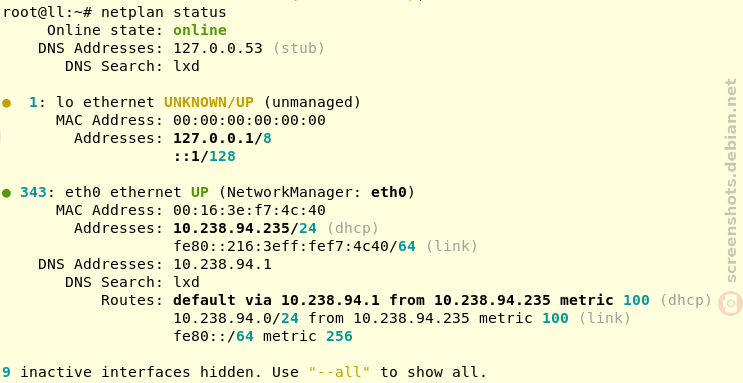
I m happy to announce that Netplan version 0.106 is now available on GitHub and is soon to be deployed into an Ubuntu/Debian/Fedora installation near you! Six months and 65 commits after the previous version, this release is brought to you by 4 free software contributors from around the globe. Highlights Highlights of this release include the new netplan status command, which queries your system for IP addresses, routes, DNS information, etc in addition to the Netplan backend renderer (NetworkManager/networkd) in use and the relevant Netplan YAML configuration ID. It displays all this in a nicely formatted way (or alternatively in machine readable YAML/JSON format).
Furthermore, we implemented a clean libnetplan API which can be used by external tools to parse Netplan configuration, migrated away from non-inclusive language (PR#303) and improved the overall Netplan documentation. Another change that should be noted, is that the match.macaddress stanza now only matches on PermanentMACAddress= on the systemd-networkd backend, as has been the case on the NetworkManager backend ever since (see PR#278 for background information on this slight change in behavior). Changelog Bug fixes:

13 February 2023

Vincent Bernat: Building a SQL-like language to filter flows

Akvorado collects network flows using IPFIX or sFlow. It stores them in a ClickHouse database. A web console allows a user to query the data and plot some graphs. A nice aspect of this console is how we can filter flows with a SQL-like language:
Filter editor in Akvorado console
Often, web interfaces expose a query builder to build such filters. I think combining a SQL-like language with an editor supporting completion, syntax highlighting, and linting is a better approach.1 The language parser is built with pigeon (Go) from a parsing expression grammar or PEG. The editor component is CodeMirror (TypeScript).

Language parser PEG grammars are relatively recent2 and are an alternative to context-free grammars. They are easier to write and they can generate better error messages. Python switched from an LL(1)-based parser to a PEG-based parser in Python 3.9. pigeon generates a parser for Go. A grammar is a set of rules. Each rule is an identifier, with an optional user-friendly label for error messages, an expression, and an action in Go to be executed on match. You can find the complete grammar in parser.peg. Here is a simplified rule:
ConditionIPExpr "condition on IP"  
  column:("ExporterAddress"i   return "ExporterAddress", nil  
        / "SrcAddr"i   return "SrcAddr", nil  
        / "DstAddr"i   return "DstAddr", nil  ) _ 
  operator:("=" / "!=") _ 
  ip:IP  
    return fmt.Sprintf("%s %s IPv6StringToNum(%s)",
      toString(column), toString(operator), quote(ip)), nil
   
The rule identifier is ConditionIPExpr. It case-insensitively matches ExporterAddress, SrcAddr, or DstAddr. The action for each case returns the proper case for the column name. That s what is stored in the column variable. Then, it matches one of the possible operators. As there is no code block, it stores the matched string directly in the operator variable. Then, it tries to match the IP rule, which is defined elsewhere in the grammar. If it succeeds, it stores the result of the match in the ip variable and executes the final action. The action turns the column, operator, and IP into a proper expression for ClickHouse. For example, if we have ExporterAddress = 203.0.113.15, we get ExporterAddress = IPv6StringToNum('203.0.113.15'). The IP rule uses a rudimentary regular expression but checks if the matched address is correct in the action block, thanks to netip.ParseAddr():
IP "IP address"   [0-9A-Fa-f:.]+  
  ip, err := netip.ParseAddr(string(c.text))
  if err != nil  
    return "", errors.New("expecting an IP address")
   
  return ip.String(), nil
 
Our parser safely turns the filter into a WHERE clause accepted by ClickHouse:3
WHERE InIfBoundary = 'external' 
AND ExporterRegion = 'france' 
AND InIfConnectivity = 'transit' 
AND SrcAS = 15169 
AND DstAddr BETWEEN toIPv6('2a01:e0f:ffff::') 
                AND toIPv6('2a01:e0f:ffff:ffff:ffff:ffff:ffff:ffff')

Integration in CodeMirror CodeMirror is a versatile code editor that can be easily integrated into JavaScript projects. In Akvorado, the Vue.js component, InputFilter, uses CodeMirror as its foundation and leverages features such as syntax highlighting, linting, and completion. The source code for these capabilities can be found in the codemirror/lang-filter/ directory.

Syntax highlighting The PEG grammar for Go cannot be utilized directly4 and the requirements for parsers for editors are distinct: they should be error-tolerant and operate incrementally, as code is typically updated character by character. CodeMirror offers a solution through its own parser generator, Lezer. We don t need this additional parser to fully understand the filter language. Only the basic structure is needed: column names, comparison and logic operators, quoted and unquoted values. The grammar is therefore quite short and does not need to be updated often:
@top Filter  
  expression
 
expression  
 Not expression  
 "(" expression ")"  
 "(" expression ")" And expression  
 "(" expression ")" Or expression  
 comparisonExpression And expression  
 comparisonExpression Or expression  
 comparisonExpression
 
comparisonExpression  
 Column Operator Value
 
Value  
  String   Literal   ValueLParen ListOfValues ValueRParen
 
ListOfValues  
  ListOfValues ValueComma (String   Literal)  
  String   Literal
 
// [ ]
@tokens  
  // [ ]
  Column   std.asciiLetter (std.asciiLetter std.digit)*  
  Operator   $[a-zA-Z!=><]+  
  String  
    '"' (![\\\n"]   "\\" _)* '"'?  
    "'" (![\\\n']   "\\" _)* "'"?
   
  Literal   (std.digit   std.asciiLetter   $[.:/])+  
  // [ ]
 
The expression SrcAS = 12322 AND (DstAS = 1299 OR SrcAS = 29447) is parsed to:
Filter(Column, Operator, Value(Literal),
  And, Column, Operator, Value(Literal),
  Or, Column, Operator, Value(Literal))
The last step is to teach CodeMirror how to map each token to a highlighting tag:
export const FilterLanguage = LRLanguage.define( 
  parser: parser.configure( 
    props: [
      styleTags( 
        Column: t.propertyName,
        String: t.string,
        Literal: t.literal,
        LineComment: t.lineComment,
        BlockComment: t.blockComment,
        Or: t.logicOperator,
        And: t.logicOperator,
        Not: t.logicOperator,
        Operator: t.compareOperator,
        "( )": t.paren,
       ),
    ],
   ),
 );

Linting We offload linting to the original parser in Go. The /api/v0/console/filter/validate endpoint accepts a filter and returns a JSON structure with the errors that were found:
 
  "message": "at line 1, position 12: string literal not terminated",
  "errors": [ 
    "line":    1,
    "column":  12,
    "offset":  11,
    "message": "string literal not terminated",
   ]
 
The linter source for CodeMirror queries the API and turns each error into a diagnostic.

Completion The completion system takes a hybrid approach. It splits the work between the frontend and the backend to offer useful suggestions for completing filters. The frontend uses the parser built with Lezer to determine the context of the completion: do we complete a column name, an operator, or a value? It also extracts the column name if we are completing something else. It forwards the result to the backend through the /api/v0/console/filter/complete endpoint. Walking the syntax tree was not as easy as I thought, but unit tests helped a lot. The backend uses the parser generated by pigeon to complete a column name or a comparison operator. For values, the completions are either static or extracted from the ClickHouse database. A user can complete an AS number from an organization name thanks to the following snippet:
results := []struct  
  Label  string  ch:"label" 
  Detail string  ch:"detail" 
 
columnName := "DstAS"
sqlQuery := fmt.Sprintf( 
 SELECT concat('AS', toString(%s)) AS label, dictGet('asns', 'name', %s) AS detail
 FROM flows
 WHERE TimeReceived > date_sub(minute, 1, now())
 AND detail != ''
 AND positionCaseInsensitive(detail, $1) >= 1
 GROUP BY label, detail
 ORDER BY COUNT(*) DESC
 LIMIT 20
 , columnName, columnName)
if err := conn.Select(ctx, &results, sqlQuery, input.Prefix); err != nil  
  c.r.Err(err).Msg("unable to query database")
  break
 
for _, result := range results  
  completions = append(completions, filterCompletion 
    Label:  result.Label,
    Detail: result.Detail,
    Quoted: false,
   )
 
In my opinion, the completion system is a major factor in making the field editor an efficient way to select flows. While a query builder may have been more beginner-friendly, the completion system s ease of use and functionality make it more enjoyable to use once you become familiar.

  1. Moreover, building a query builder did not seem like a fun task for me.
  2. They were introduced in 2004 in Parsing Expression Grammars: A Recognition-Based Syntactic Foundation. LR parsers were introduced in 1965, LALR parsers in 1969, and LL parsers in the 1970s. Yacc, a popular parser generator, was written in 1975.
  3. The parser returns a string. It does not generate an intermediate AST. This makes it simpler and it currently fits our needs.
  4. It could be manually translated to JavaScript with PEG.js.

9 February 2023

Jonathan McDowell: Building a read-only Debian root setup: Part 2

This is the second part of how I build a read-only root setup for my router. You might want to read part 1 first, which covers the initial boot and general overview of how I tie the pieces together. This post will describe how I build the squashfs image that forms the main filesystem. Most of the build is driven from a script, make-router, which I ll dissect below. It s highly tailored to my needs, and this is a fairly lengthy post, but hopefully the steps I describe prove useful to anyone trying to do something similar.

Breakdown of make-router
#!/bin/bash
# Either rb3011 (arm) or rb5009 (arm64)
#HOSTNAME="rb3011"
HOSTNAME="rb5009"
if [ "x$ HOSTNAME " == "xrb3011" ]; then
	ARCH=armhf
elif [ "x$ HOSTNAME " == "xrb5009" ]; then
	ARCH=arm64
else
	echo "Unknown host: $ HOSTNAME "
	exit 1
fi

It s a bash script, and I allow building for either my RB3011 or RB5009, which means a different architecture (32 vs 64 bit). I run this script on my Pi 4 which means I don t have to mess about with QemuUserEmulation.
BASE_DIR=$(dirname $0)
IMAGE_FILE=$(mktemp --tmpdir router.$ ARCH .XXXXXXXXXX.img)
MOUNT_POINT=$(mktemp -p /mnt -d router.$ ARCH .XXXXXXXXXX)
# Build and mount an ext4 image file to put the root file system in
dd if=/dev/zero bs=1 count=0 seek=1G of=$ IMAGE_FILE 
mkfs -t ext4 $ IMAGE_FILE 
mount -o loop $ IMAGE_FILE  $ MOUNT_POINT 

I build the image in a loopback ext4 file on tmpfs (my Pi4 is the 8G model), which makes things a bit faster.
# Add dpkg excludes
mkdir -p $ MOUNT_POINT /etc/dpkg/dpkg.cfg.d/
cat <<EOF > $ MOUNT_POINT /etc/dpkg/dpkg.cfg.d/path-excludes
# Exclude docs
path-exclude=/usr/share/doc/*
# Only locale we want is English
path-exclude=/usr/share/locale/*
path-include=/usr/share/locale/en*/*
path-include=/usr/share/locale/locale.alias
# No man pages
path-exclude=/usr/share/man/*
EOF

Create a dpkg excludes config to drop docs, man pages and most locales before we even start the bootstrap.
# Setup fstab + mtab
echo "# Empty fstab as root is pre-mounted" > $ MOUNT_POINT /etc/fstab
ln -s ../proc/self/mounts $ MOUNT_POINT /etc/mtab
# Setup hostname
echo $ HOSTNAME  > $ MOUNT_POINT /etc/hostname
# Add the root SSH keys
mkdir -p $ MOUNT_POINT /root/.ssh/
cat <<EOF > $ MOUNT_POINT /root/.ssh/authorized_keys
ssh-rsa AAAAB3NzaC1yc2EAAAABIwAAAQEAv8NkUeVdsVdegS+JT9qwFwiHEgcC9sBwnv6RjpH6I4d3im4LOaPOatzneMTZlH8Gird+H4nzluciBr63hxmcFjZVW7dl6mxlNX2t/wKvV0loxtEmHMoI7VMCnrWD0PyvwJ8qqNu9cANoYriZRhRCsBi27qPNvI741zEpXN8QQs7D3sfe4GSft9yQplfJkSldN+2qJHvd0AHKxRdD+XTxv1Ot26+ZoF3MJ9MqtK+FS+fD9/ESLxMlOpHD7ltvCRol3u7YoaUo2HJ+u31l0uwPZTqkPNS9fkmeCYEE0oXlwvUTLIbMnLbc7NKiLgniG8XaT0RYHtOnoc2l2UnTvH5qsQ== noodles@earth.li
ssh-rsa AAAAB3NzaC1yc2EAAAADAQABAAACAQDQb9+qFemcwKhey3+eTh5lxp+3sgZXW2HQQEZMt9hPvVXk+MiiNMx9WUzxPJnwXqlmmVdKsq+AvjA0i505Pp8fIj5DdUBpSqpLghmzpnGuob7SSwXYj+352hjD52UC4S0KMKbIaUpklADgsCbtzhYYc4WoO8F7kK63tS5qa1XSZwwRwPbYOWBcNocfr9oXCVWD9ismO8Y0l75G6EyW8UmwYAohDaV83pvJxQerYyYXBGZGY8FNjqVoOGMRBTUcLj/QTo0CDQvMtsEoWeCd0xKLZ3gjiH3UrknkaPra557/TWymQ8Oh15aPFTr5FvKgAlmZaaM0tP71SOGmx7GpCsP4jZD1Xj/7QMTAkLXb+Ou6yUOVM9J4qebdnmF2RGbf1bwo7xSIX6gAYaYgdnppuxqZX1wyAy+A2Hie4tUjMHKJ6OoFwBsV1sl+3FobrPn6IuulRCzsq2aLqLey+PHxuNAYdSKo7nIDB3qCCPwHlDK52WooSuuMidX4ujTUw7LDTia9FxAawudblxbrvfTbg3DsiDBAOAIdBV37HOAKu3VmvYSPyqT80DEy8KFmUpCEau59DID9VERkG6PWPVMiQnqgW2Agn1miOBZeIQV8PFjenAySxjzrNfb4VY/i/kK9nIhXn92CAu4nl6D+VUlw+IpQ8PZlWlvVxAtLonpjxr9OTw== noodles@yubikey
ssh-rsa AAAAB3NzaC1yc2EAAAADAQABAAABAQC0I8UHj4IpfqUcGE4cTvLB0d2xmATSUzqtxW6ZhGbZxvQDKJesVW6HunrJ4NFTQuQJYgOXY/o82qBpkEKqaJMEFHTCjcaj3M6DIaxpiRfQfs0nhtzDB6zPiZn9Suxb0s5Qr4sTWd6iI9da72z3hp9QHNAu4vpa4MSNE+al3UfUisUf4l8TaBYKwQcduCE0z2n2FTi3QzmlkOgH4MgyqBBEaqx1tq7Zcln0P0TYZXFtrxVyoqBBIoIEqYxmFIQP887W50wQka95dBGqjtV+d8IbrQ4pB55qTxMd91L+F8n8A6nhQe7DckjS0Xdla52b9RXNXoobhtvx9K2prisagsHT noodles@cup
ecdsa-sha2-nistp256 AAAAE2VjZHNhLXNoYTItbmlzdHAyNTYAAAAIbmlzdHAyNTYAAABBBK6iGog3WbNhrmrkglNjVO8/B6m7mN6q1tMm1sXjLxQa+F86ETTLiXNeFQVKCHYrk8f7hK0d2uxwgj6Ixy9k0Cw= noodles@sevai
EOF

Setup fstab, the hostname and SSH keys for root.
# Bootstrap our install
debootstrap \
	--arch=$ ARCH  \
	--include=collectd-core,conntrack,dnsmasq,ethtool,iperf3,kexec-tools,mosquitto,mtd-utils,mtr-tiny,ppp,tcpdump,rng-tools5,ssh,watchdog,wget \
	--exclude=dmidecode,isc-dhcp-client,isc-dhcp-common,makedev,nano \
	bullseye $ MOUNT_POINT  https://deb.debian.org/debian/

Actually do the debootstrap step, including a bunch of extra packages that we want.
# Install mqtt-arp
cp $ BASE_DIR /debs/mqtt-arp_1_$ ARCH .deb $ MOUNT_POINT /tmp
chroot $ MOUNT_POINT  dpkg -i /tmp/mqtt-arp_1_$ ARCH .deb
rm $ MOUNT_POINT /tmp/mqtt-arp_1_$ ARCH .deb
# Frob the mqtt-arp config so it starts after mosquitto
sed -i -e 's/After=.*/After=mosquitto.service/' $ MOUNT_POINT /lib/systemd/system/mqtt-arp.service

I haven t uploaded mqtt-arp to Debian, so I install a locally built package, and ensure it starts after mosquitto (the MQTT broker), given they re running on the same host.
# Frob watchdog so it starts earlier than multi-user
sed -i -e 's/After=.*/After=basic.target/' $ MOUNT_POINT /lib/systemd/system/watchdog.service
# Make sure the watchdog is poking the device file
sed -i -e 's/^#watchdog-device/watchdog-device/' $ MOUNT_POINT /etc/watchdog.conf

watchdog timeouts were particularly an issue on the RB3011, where the default timeout didn t give enough time to reach multiuser mode before it would reset the router. Not helpful, so alter the config to start it earlier (and make sure it s configured to actually kick the device file).
# Clean up docs + locales
rm -r $ MOUNT_POINT /usr/share/doc/*
rm -r $ MOUNT_POINT /usr/share/man/*
for dir in $ MOUNT_POINT /usr/share/locale/*/; do
	if [ "$ dir " != "$ MOUNT_POINT /usr/share/locale/en/" ]; then
		rm -r $ dir 
	fi
done

Clean up any docs etc that ended up installed.
# Set root password to root
echo "root:root"   chroot $ MOUNT_POINT  chpasswd

The only login method is ssh key to the root account though I suppose this allows for someone to execute a privilege escalation from a daemon user so I should probably randomise this. Does need to be known though so it s possible to login via the serial console for debugging.
# Add security to sources.list + update
echo "deb https://security.debian.org/debian-security bullseye-security main" >> $ MOUNT_POINT /etc/apt/sources.list
chroot $ MOUNT_POINT  apt update
chroot $ MOUNT_POINT  apt -y full-upgrade
chroot $ MOUNT_POINT  apt clean
# Cleanup the APT lists
rm $ MOUNT_POINT /var/lib/apt/lists/www.*
rm $ MOUNT_POINT /var/lib/apt/lists/security.*

Pull in any security updates, then clean out the APT lists rather than polluting the image with them.
# Disable the daily APT timer
rm $ MOUNT_POINT /etc/systemd/system/timers.target.wants/apt-daily.timer
# Disable daily dpkg backup
cat <<EOF > $ MOUNT_POINT /etc/cron.daily/dpkg
#!/bin/sh
# Don't do the daily dpkg backup
exit 0
EOF
# We don't want a persistent systemd journal
rmdir $ MOUNT_POINT /var/log/journal

None of these make sense on a router.
# Enable nftables
ln -s /lib/systemd/system/nftables.service \
	$ MOUNT_POINT /etc/systemd/system/sysinit.target.wants/nftables.service

Ensure we have firewalling enabled automatically.
# Add systemd-coredump + systemd-timesync user / group
echo "systemd-timesync:x:998:" >> $ MOUNT_POINT /etc/group
echo "systemd-coredump:x:999:" >> $ MOUNT_POINT /etc/group
echo "systemd-timesync:!*::" >> $ MOUNT_POINT /etc/gshadow
echo "systemd-coredump:!*::" >> $ MOUNT_POINT /etc/gshadow
echo "systemd-timesync:x:998:998:systemd Time Synchronization:/:/usr/sbin/nologin" >> $ MOUNT_POINT /etc/passwd
echo "systemd-coredump:x:999:999:systemd Core Dumper:/:/usr/sbin/nologin" >> $ MOUNT_POINT /etc/passwd
echo "systemd-timesync:!*:47358::::::" >> $ MOUNT_POINT /etc/shadow
echo "systemd-coredump:!*:47358::::::" >> $ MOUNT_POINT /etc/shadow
# Create /etc/.pwd.lock, otherwise it'll end up in the overlay
touch $ MOUNT_POINT /etc/.pwd.lock
chmod 600 $ MOUNT_POINT /etc/.pwd.lock

Create a number of users that will otherwise get created at boot, and a lock file that will otherwise get created anyway.
# Copy config files
cp --recursive --preserve=mode,timestamps $ BASE_DIR /etc/* $ MOUNT_POINT /etc/
cp --recursive --preserve=mode,timestamps $ BASE_DIR /etc-$ ARCH /* $ MOUNT_POINT /etc/
chroot $ MOUNT_POINT  chown mosquitto /etc/mosquitto/mosquitto.users
chroot $ MOUNT_POINT  chown mosquitto /etc/ssl/mqtt.home.key

There are config files that are easier to replace wholesale, some of which are specific to the hardware (e.g. related to network interfaces). See below for some more details.
# Build symlinks into flash for boot / modules
ln -s /mnt/flash/lib/modules $ MOUNT_POINT /lib/modules
rmdir $ MOUNT_POINT /boot
ln -s /mnt/flash/boot $ MOUNT_POINT /boot

The kernel + its modules live outside the squashfs image, on the USB flash drive that the image lives on. That makes for easier kernel upgrades.
# Put our git revision into os-release
echo -n "GIT_VERSION=" >> $ MOUNT_POINT /etc/os-release
(cd $ BASE_DIR  ; git describe --tags) >> $ MOUNT_POINT /etc/os-release

Always helpful to be able to check the image itself for what it was built from.
# Add some stuff to root's .bashrc
cat << EOF >> $ MOUNT_POINT /root/.bashrc
alias ls='ls -F --color=auto'
eval "\$(dircolors)"
case "\$TERM" in
xterm* rxvt*)
	PS1="\\[\\e]0;\\u@\\h: \\w\a\\]\$PS1"
	;;
*)
	;;
esac
EOF

Just some niceties for when I do end up logging in.
# Build the squashfs
mksquashfs $ MOUNT_POINT  /tmp/router.$ ARCH .squashfs \
	-comp xz

Actually build the squashfs image.
# Save the installed package list off
chroot $ MOUNT_POINT  dpkg --get-selections > /tmp/wip-installed-packages

Save off the installed package list. This was particularly useful when trying to replicate the existing router setup and making sure I had all the important packages installed. It doesn t really serve a purpose now.
In terms of the config files I copy into /etc, shared across both routers are the following:
Breakdown of shared config
  • apt config (disable recommends, periodic updates):
    • apt/apt.conf.d/10periodic, apt/apt.conf.d/local-recommends
  • Adding a default, empty, locale:
    • default/locale
  • DNS/DHCP:
    • dnsmasq.conf, dnsmasq.d/dhcp-ranges, dnsmasq.d/static-ips
    • hosts, resolv.conf
  • Enabling IP forwarding:
    • sysctl.conf
  • Logs related:
    • logrotate.conf, rsyslog.conf
  • MQTT related:
    • mosquitto/mosquitto.users, mosquitto/conf.d/ssl.conf, mosquitto/conf.d/users.conf, mosquitto/mosquitto.acl, mosquitto/mosquitto.conf
    • mqtt-arp.conf
    • ssl/lets-encrypt-r3.crt, ssl/mqtt.home.key, ssl/mqtt.home.crt
  • PPP configuration:
    • ppp/ip-up.d/0000usepeerdns, ppp/ipv6-up.d/defaultroute, ppp/pap-secrets, ppp/chap-secrets
    • network/interfaces.d/pppoe-wan
The router specific config is mostly related to networking:
Breakdown of router specific config
  • Firewalling:
    • nftables.conf
  • Interfaces:
    • dnsmasq.d/interfaces
    • network/interfaces.d/eth0, network/interfaces.d/p1, network/interfaces.d/p2, network/interfaces.d/p7, network/interfaces.d/p8
  • PPP config (network interface piece):
    • ppp/peers/aquiss
  • SSH keys:
    • ssh/ssh_host_ecdsa_key, ssh/ssh_host_ed25519_key, ssh/ssh_host_rsa_key, ssh/ssh_host_ecdsa_key.pub, ssh/ssh_host_ed25519_key.pub, ssh/ssh_host_rsa_key.pub
  • Monitoring:
    • collectd/collectd.conf, collectd/collectd.conf.d/network.conf

8 February 2023

Thorsten Alteholz: My Debian Activities in January 2023

FTP master This month I accepted 419 and rejected 46 packages. The overall number of packages that got accepted was 429. Looking at these numbers and comparing them to the previous month, one can see: the freeze is near. Everybody wants to get some packages into the archive and I hope nobody is disappointed. Debian LTS This was my hundred-third month that I did some work for the Debian LTS initiative, started by Raphael Hertzog at Freexian. This month my all in all workload has been 14h. During that time I uploaded: I also attended the monthly LTS meeting and did some days of frontdesk duties. Debian ELTS This month was the fifty fourth ELTS month. Last but not least I did some days of frontdesk duties. Debian Astro This month I uploaded improved packages or new versions of: I also uploaded new packages: Debian IoT This month I uploaded improved packages of: Debian Printing This month I uploaded new versions or improved packages of: I also uploaded new packages:

6 February 2023

Reproducible Builds: Reproducible Builds in January 2023

Welcome to the first report for 2023 from the Reproducible Builds project! In these reports we try and outline the most important things that we have been up to over the past month, as well as the most important things in/around the community. As a quick recap, the motivation behind the reproducible builds effort is to ensure no malicious flaws can be deliberately introduced during compilation and distribution of the software that we run on our devices. As ever, if you are interested in contributing to the project, please visit our Contribute page on our website.


News In a curious turn of events, GitHub first announced this month that the checksums of various Git archives may be subject to change, specifically that because:
the default compression for Git archives has recently changed. As result, archives downloaded from GitHub may have different checksums even though the contents are completely unchanged.
This change (which was brought up on our mailing list last October) would have had quite wide-ranging implications for anyone wishing to validate and verify downloaded archives using cryptographic signatures. However, GitHub reversed this decision, updating their original announcement with a message that We are reverting this change for now. More details to follow. It appears that this was informed in part by an in-depth discussion in the GitHub Community issue tracker.
The Bundesamt f r Sicherheit in der Informationstechnik (BSI) (trans: The Federal Office for Information Security ) is the agency in charge of managing computer and communication security for the German federal government. They recently produced a report that touches on attacks on software supply-chains (Supply-Chain-Angriff). (German PDF)
Contributor Seb35 updated our website to fix broken links to Tails Git repository [ ][ ], and Holger updated a large number of pages around our recent summit in Venice [ ][ ][ ][ ].
Noak J nsson has written an interesting paper entitled The State of Software Diversity in the Software Supply Chain of Ethereum Clients. As the paper outlines:
In this report, the software supply chains of the most popular Ethereum clients are cataloged and analyzed. The dependency graphs of Ethereum clients developed in Go, Rust, and Java, are studied. These client are Geth, Prysm, OpenEthereum, Lighthouse, Besu, and Teku. To do so, their dependency graphs are transformed into a unified format. Quantitative metrics are used to depict the software supply chain of the blockchain. The results show a clear difference in the size of the software supply chain required for the execution layer and consensus layer of Ethereum.

Yongkui Han posted to our mailing list discussing making reproducible builds & GitBOM work together without gitBOM-ID embedding. GitBOM (now renamed to OmniBOR) is a project to enable automatic, verifiable artifact resolution across today s diverse software supply-chains [ ]. In addition, Fabian Keil wrote to us asking whether anyone in the community would be at Chemnitz Linux Days 2023, which is due to take place on 11th and 12th March (event info). Separate to this, Akihiro Suda posted to our mailing list just after the end of the month with a status report of bit-for-bit reproducible Docker/OCI images. As Akihiro mentions in their post, they will be giving a talk at FOSDEM in the Containers devroom titled Bit-for-bit reproducible builds with Dockerfile and that my talk will also mention how to pin the apt/dnf/apk/pacman packages with my repro-get tool.
The extremely popular Signal messenger app added upstream support for the SOURCE_DATE_EPOCH environment variable this month. This means that release tarballs of the Signal desktop client do not embed nondeterministic release information. [ ][ ]

Distribution work

F-Droid & Android There was a very large number of changes in the F-Droid and wider Android ecosystem this month: On January 15th, a blog post entitled Towards a reproducible F-Droid was published on the F-Droid website, outlining the reasons why F-Droid signs published APKs with its own keys and how reproducible builds allow using upstream developers keys instead. In particular:
In response to [ ] criticisms, we started encouraging new apps to enable reproducible builds. It turns out that reproducible builds are not so difficult to achieve for many apps. In the past few months we ve gotten many more reproducible apps in F-Droid than before. Currently we can t highlight which apps are reproducible in the client, so maybe you haven t noticed that there are many new apps signed with upstream developers keys.
(There was a discussion about this post on Hacker News.) In addition:
  • F-Droid added 13 apps published with reproducible builds this month. [ ]
  • FC Stegerman outlined a bug where baseline.profm files are nondeterministic, developed a workaround, and provided all the details required for a fix. As they note, this issue has now been fixed but the fix is not yet part of an official Android Gradle plugin release.
  • GitLab user Parwor discovered that the number of CPU cores can affect the reproducibility of .dex files. [ ]
  • FC Stegerman also announced the 0.2.0 and 0.2.1 releases of reproducible-apk-tools, a suite of tools to help make .apk files reproducible. Several new subcommands and scripts were added, and a number of bugs were fixed as well [ ][ ]. They also updated the F-Droid website to improve the reproducibility-related documentation. [ ][ ]
  • On the F-Droid issue tracker, FC Stegerman discussed reproducible builds with one of the developers of the Threema messenger app and reported that Android SDK build-tools 31.0.0 and 32.0.0 (unlike earlier and later versions) have a zipalign command that produces incorrect padding.
  • A number of bugs related to reproducibility were discovered in Android itself. Firstly, the non-deterministic order of .zip entries in .apk files [ ] and then newline differences between building on Windows versus Linux that can make builds not reproducible as well. [ ] (Note that these links may require a Google account to view.)
  • And just before the end of the month, FC Stegerman started a thread on our mailing list on the topic of hiding data/code in APK embedded signatures which has been made possible by the Android APK Signature Scheme v2/v3. As part of this, they made an Android app that reads the APK Signing block of its own APK and extracts a payload in order to alter its behaviour called sigblock-code-poc.

Debian As mentioned in last month s report, Vagrant Cascadian has been organising a series of online sprints in order to clear the huge backlog of reproducible builds patches submitted by performing NMUs (Non-Maintainer Uploads). During January, a sprint took place on the 10th, resulting in the following uploads: During this sprint, Holger Levsen filed Debian bug #1028615 to request that the tracker.debian.org service display results of reproducible rebuilds, not just reproducible CI results. Elsewhere in Debian, strip-nondeterminism is our tool to remove specific non-deterministic results from a completed build. This month, version 1.13.1-1 was uploaded to Debian unstable by Holger Levsen, including a fix by FC Stegerman (obfusk) to update a regular expression for the latest version of file(1) [ ]. (#1028892) Lastly, 65 reviews of Debian packages were added, 21 were updated and 35 were removed this month adding to our knowledge about identified issues.

Other distributions In other distributions:

diffoscope diffoscope is our in-depth and content-aware diff utility. Not only can it locate and diagnose reproducibility issues, it can provide human-readable diffs from many kinds of binary formats. This month, Chris Lamb made the following changes to diffoscope, including preparing and uploading versions 231, 232, 233 and 234 to Debian:
  • No need for from __future__ import print_function import anymore. [ ]
  • Comment and tidy the extras_require.json handling. [ ]
  • Split inline Python code to generate test Recommends into a separate Python script. [ ]
  • Update debian/tests/control after merging support for PyPDF support. [ ]
  • Correctly catch segfaulting cd-iccdump binary. [ ]
  • Drop some old debugging code. [ ]
  • Allow ICC tests to (temporarily) fail. [ ]
In addition, FC Stegerman (obfusk) made a number of changes, including:
  • Updating the test_text_proper_indentation test to support the latest version(s) of file(1). [ ]
  • Use an extras_require.json file to store some build/release metadata, instead of accessing the internet. [ ]
  • Updating an APK-related file(1) regular expression. [ ]
  • On the diffoscope.org website, de-duplicate contributors by e-mail. [ ]
Lastly, Sam James added support for PyPDF version 3 [ ] and Vagrant Cascadian updated a handful of tool references for GNU Guix. [ ][ ]

Upstream patches The Reproducible Builds project attempts to fix as many currently-unreproducible packages as possible. This month, we wrote a large number of such patches, including:

Testing framework The Reproducible Builds project operates a comprehensive testing framework at tests.reproducible-builds.org in order to check packages and other artifacts for reproducibility. In January, the following changes were made by Holger Levsen:
  • Node changes:
  • Debian-related changes:
    • Only keep diffoscope s HTML output (ie. no .json or .txt) for LTS suites and older in order to save diskspace on the Jenkins host. [ ]
    • Re-create pbuilder base less frequently for the stretch, bookworm and experimental suites. [ ]
  • OpenWrt-related changes:
    • Add gcc-multilib to OPENWRT_HOST_PACKAGES and install it on the nodes that need it. [ ]
    • Detect more problems in the health check when failing to build OpenWrt. [ ]
  • Misc changes:
    • Update the chroot-run script to correctly manage /dev and /dev/pts. [ ][ ][ ]
    • Update the Jenkins shell monitor script to collect disk stats less frequently [ ] and to include various directory stats. [ ][ ]
    • Update the real year in the configuration in order to be able to detect whether a node is running in the future or not. [ ]
    • Bump copyright years in the default page footer. [ ]
In addition, Christian Marangi submitted a patch to build OpenWrt packages with the V=s flag to enable debugging. [ ]
If you are interested in contributing to the Reproducible Builds project, please visit the Contribute page on our website. You can get in touch with us via:

2 February 2023

Dirk Eddelbuettel: RInside 0.2.18 on CRAN: Maintenance

A new release 0.2.18 of RInside arrived on CRAN and in Debian today. This is the first release in ten months since the 0.2.17 release. RInside provides a set of convenience classes which facilitate embedding of R inside of C++ applications and programs, using the classes and functions provided by Rcpp. This release brings a contributed change to how the internal REPL is called: Dominick found the current form more reliable when embedding R on Windows. We also updated a few other things around the package. The list of changes since the last release:

Changes in RInside version 0.2.18 (2023-02-01)
  • The random number initialization was updated as in R.
  • The main REPL is now running via 'run_Rmainloop()'.
  • Small routine update to package and continuous integration.

My CRANberries also provides a short report with changes from the previous release. More information is on the RInside page. Questions, comments etc should go to the rcpp-devel mailing list off the Rcpp R-Forge page, or to issues tickets at the GitHub repo. If you like this or other open-source work I do, you can now sponsor me at GitHub.

This post by Dirk Eddelbuettel originated on his Thinking inside the box blog. Please report excessive re-aggregation in third-party for-profit settings.

1 February 2023

Simon Josefsson: Apt Archive Transparency: debdistdiff & apt-canary

I ve always found the operation of apt software package repositories to be a mystery. There appears to be a lack of transparency into which people have access to important apt package repositories out there, how the automatic non-human update mechanism is implemented, and what changes are published. I m thinking of big distributions like Ubuntu and Debian, but also the free GNU/Linux distributions like Trisquel and PureOS that are derived from the more well-known distributions. As far as I can tell, anyone who has the OpenPGP private key trusted by a apt-based GNU/Linux distribution can sign a modified Release/InRelease file and if my machine somehow downloads that version of the release file, my machine could be made to download and install packages that the distribution didn t intend me to install. Further, it seems that anyone who has access to the main HTTP server, or any of its mirrors, or is anywhere on the network between them and my machine (when plaintext HTTP is used), can either stall security updates on my machine (on a per-IP basis), or use it to send my machine (again, on a per-IP basis to avoid detection) a modified Release/InRelease file if they had been able to obtain the private signing key for the archive. These are mighty powers that warrant overview. I ve always put off learning about the processes to protect the apt infrastructure, mentally filing it under so many people rely on this infrastructure that enough people are likely to have invested time reviewing and improving these processes . Simultaneous, I ve always followed the more free-software friendly Debian-derived distributions such as gNewSense and have run it on some machines. I ve never put them into serious production use, because the trust issues with their apt package repositories has been a big question mark for me. The enough people part of my rationale for deferring this is not convincing. Even the simple question of is someone updating the apt repository is not easy to understand on a running gNewSense system. At some point in time the gNewSense cron job to pull in security updates from Debian must have stopped working, and I wouldn t have had any good mechanism to notice that. Most likely it happened without any public announcement. I ve recently switched to Trisquel on production machines, and these questions has come back to haunt me. The situation is unsatisfying and I looked into what could be done to improve it. I could try to understand who are the key people involved in each project, and may even learn what hardware component is used, or what software is involved to update and sign apt repositories. Is the server running non-free software? Proprietary BIOS or NIC firmware? Are the GnuPG private keys on disk? Smartcard? TPM? YubiKey? HSM? Where is the server co-located, and who has access to it? I tried to do a bit of this, and discovered things like Trisquel having a DSA1024 key in its default apt trust store (although for fairness, it seems that apt by default does not trust such signatures). However, I m not certain understanding this more would scale to securing my machines against attacks on this infrastructure. Even people with the best intentions, and the state of the art hardware and software, will have problems. To increase my trust in Trisquel I set out to understand how it worked. To make it easier to sort out what the interesting parts of the Trisquel archive to audit further were, I created debdistdiff to produce human readable text output comparing one apt archive with another apt archive. There is a GitLab CI/CD cron job that runs this every day, producing output comparing Trisquel vs Ubuntu and PureOS vs Debian. Working with these output files has made me learn more about how the process works, and I even stumbled upon something that is likely a bug where Trisquel aramo was imported from Ubuntu jammy while it contained a couple of package (e.g., gcc-8, python3.9) that were removed for the final Ubuntu jammy release. After working on auditing the Trisquel archive manually that way, I realized that whatever I could tell from comparing Trisquel with Ubuntu, it would only be something based on a current snapshot of the archives. Tomorrow it may look completely different. What felt necessary was to audit the differences of the Trisquel archive continously. I was quite happy to have developed debdistdiff for one purpose (comparing two different archives like Trisquel and Ubuntu) and discovered that the tool could be used for another purpose (comparing the Trisquel archive at two different points in time). At this time I realized that I needed a log of all different apt archive metadata to be able to produce an audit log of the differences in time for the archive. I create manually curated git-repositories with the Release/InRelease and the Packages files for each architecture/component of the well-known distributions Trisquel, Ubuntu, Debian and PureOS. Eventually I wrote scripts to automate this, which are now published in the debdistget project. At this point, one of the early question about per-IP substitution of Release files were lingering in my mind. However with the tooling I now had available, coming up with a way to resolve this was simple! Merely have apt compute a SHA256 checksum of the just downloaded InRelease file, and see if my git repository had the same file. At this point I started reading the Apt source code, and now I had more doubts about the security of my systems than I ever had before. Oh boy how the name Apt has never before felt more Apt?! Oh well, we must leave some exercises for the students. Eventually I realized I wanted to touch as little of apt code basis as possible, and noticed the SigVerify::CopyAndVerify function called ExecGPGV which called apt-key verify which called GnuPG s gpgv. By setting Apt::Key::gpgvcommand I could get apt-key verify to call another tool than gpgv. See where I m going? I thought wrapping this up would now be trivial but for some reason the hash checksum I computed locally never matched what was on my server. I gave up and started working on other things instead. Today I came back to this idea, and started to debug exactly how the local files looked that I got from apt and how they differed from what I had in my git repositories, that came straight from the apt archives. Eventually I traced this back to SplitClearSignedFile which takes an InRelease file and splits it into two files, probably mimicking the (old?) way of distributing both Release and Release.gpg. So the clearsigned InRelease file is split into one cleartext file (similar to the Release file) and one OpenPGP signature file (similar to the Release.gpg file). But why didn t the cleartext variant of the InRelease file hash to the same value as the hash of the Release file? Sadly they differ by the final newline. Having solved this technicality, wrapping the pieces up was easy, and I came up with a project apt-canary that provides a script apt-canary-gpgv that verify the local apt release files against something I call a apt canary witness file stored at a URL somewhere. I m now running apt-canary on my Trisquel aramo laptop, a Trisquel nabia server, and Talos II ppc64el Debian machine. This means I have solved the per-IP substitution worries (or at least made them less likely to occur, having to send the same malicious release files to both GitLab and my system), and allow me to have an audit log of all release files that I actually use for installing and downloading packages. What do you think? There are clearly a lot of work and improvements to be made. This is a proof-of-concept implementation of an idea, but instead of refining it until perfection and delaying feedback, I wanted to publish this to get others to think about the problems and various ways to resolve them. Btw, I m going to be at FOSDEM 23 this weekend, helping to manage the Security Devroom. Catch me if you want to chat about this or other things. Happy Hacking!

29 January 2023

Dirk Eddelbuettel: RcppTOML 0.2.2 on CRAN: Now with macOS-on-Intel Builds

Just days after a build-fix release (for aarch64) and still only a few weeks after the 0.2.0 release of RcppTOML and its switch to toml++, we have another bugfix release 0.2.2 on CRAN also bringing release 3.3.0 of toml++ (even if we had large chunks of 3.3.0 already incorporated). TOML is a file format that is most suitable for configurations, as it is meant to be edited by humans but read by computers. It emphasizes strong readability for humans while at the same time supporting strong typing as well as immediate and clear error reports. On small typos you get parse errors, rather than silently corrupted garbage. Much preferable to any and all of XML, JSON or YAML though sadly these may be too ubiquitous now. TOML is frequently being used with the projects such as the Hugo static blog compiler, or the Cargo system of Crates (aka packages ) for the Rust language. The package was building fine on Intel-based macOS provided the versions were recent enough. CRAN, however, aims for the broadest possibly reach of binaries and builds on a fairly ancient macOS 10.13 with clang version 10. This confused toml++ into (wrongly) concluding it could not build when it in fact can. After a hint from Simon that Apple in their infinite wisdom redefines clang version ids, this has been reflected in version 3.3.0 of toml++ by Mark so we should now build everywhere. Big thanks to everybody for the help. The short summary of changes follows.

Changes in version 0.2.2 (2023-01-29)
  • New toml++ version 3.3.0 with fix to permit compilation on ancient macOS systems as used by CRAN for the Intel-based builds.

Courtesy of my CRANberries, there is a diffstat report for this release. More information is on the RcppTOML page page. Please use the GitHub issue tracker for issues and bugreports. If you like this or other open-source work I do, you can sponsor me at GitHub.

This post by Dirk Eddelbuettel originated on his Thinking inside the box blog. Please report excessive re-aggregation in third-party for-profit settings.

28 January 2023

Craig Small: Fixing iCalendar feeds

The local government here has all the schools use an iCalendar feed for things like when school terms start and stop and other school events occur. The department s website also has events like public holidays. The issue is that all of them don t make it an all-day event but one that happens at midnight, or one past midnight. The events synchronise fine, though Google s calendar is known for synchronising when it feels like it, not at any particular time you would like it to.
Screenshot of Android Calendar showing a tiny bar at midnight which is the event.
Even though a public holiday is all day, they are sent as appointments for midnight. That means on my phone all the events are these tiny bars that appear right up the top of the screen and are easily missed, especially when the focus of the calendar is during the day. On the phone, you can see the tiny purple bar at midnight. This is how the events appear. It s not the calendar s fault, as far as it knows the school events are happening at midnight. You can also see Lunar New Year and Australia Day appear in the all-day part of the calendar and don t scroll away. That s where these events should be.
Why are all the events appearing at midnight? The reason is the feed is incorrectly set up and has the time. The events are sent in an iCalendar format and a typical event looks like this:
BEGIN:VEVENT
DTSTART;TZID=Australia/Sydney:20230206T000000
DTEND;TZID=Australia/Sydney:20230206T000000
SUMMARY:School Term starts
END:VEVENT
The event starting and stopping date and time are the DTSTART and DTEND lines. Both of them have the date of 2023/02/06 or 6th February 2023 and a time of 00:00:00 or midnight. So the calendar is doing the right thing, we need to fix the feed! The Fix I wrote a quick and dirty PHP script to download the feed from the real site, change the DTSTART and DTEND lines to all-day events and leave the rest of it alone.
<?php
$site = $_GET['s'];
if ($site == 'site1')  
    $REMOTE_URL='https://site1.example.net/ical_feed';
  elseif ($site == 'site2')  
    $REMOTE_URL='https://site2.example.net/ical_feed';
  else  
    http_response_code(400);
    die();
 
$fp = fopen($REMOTE_URL, "r");
if (!$fp)  
    die("fopen");
 
header('Content-Type: text/calendar');
while (( $line = fgets($fp, 1024)) !== false)  
    $line = preg_replace(
        '/^(DTSTART DTEND);[^:]+:([0-9] 8 )T000[01]00/',
        '$ 1 ;VALUE=DATE:$ 2 ',
        $line);
    echo $line;
 
?>
It s pretty quick and nasty but gets the job done. So what is it doing? You need to save the script on your web server somewhere, possibly with an alias command. The whole point of this is to change the type from a date/time to a date-only event and only print the date part of it for the start and end of it. The resulting iCalendar event looks like this:
BEGIN:VEVENT
DTSTART;VALUE=DATE:20230206
DTEND;VALUE=DATE:20230206
SUMMARY:School Term starts
END:VEVENT
The calendar then shows it properly as an all-day event. I would check the script works before doing the next step. You can use things like curl or wget to download it. If you use a normal browser, it will probably just download the translated file. If you re not seeing the right thing then it s probably the PCRE failing. You can check it online with a regex checker such as https://regex101.com. The site has saved my PCRE and match so you got something to start with. Calendar settings The last thing to do is to change the URL in your calendar settings. Each calendar system has a different way of doing it. For Google Calendar they provide instructions and you want to follow the section titled Use a link to add a public Calendar . The URL here is not the actual site s URL (which you would have put into the REMOTE_URL variable before) but the URL of your script plus the ?s=site1 part. So if you put your script aliased to /myical.php and the site ID was site1 and your website is www.example.com the URL would be https://www.example.com/myical.php?s=site1 . You should then see the events appear as all-day events on your calendar.

26 January 2023

B lint R czey: How to speed up your next build 5-20x with Firebuild?

Firebuild logo
TL;DR: Just prefix your build command (or any command) with firebuild:
firebuild <build command>
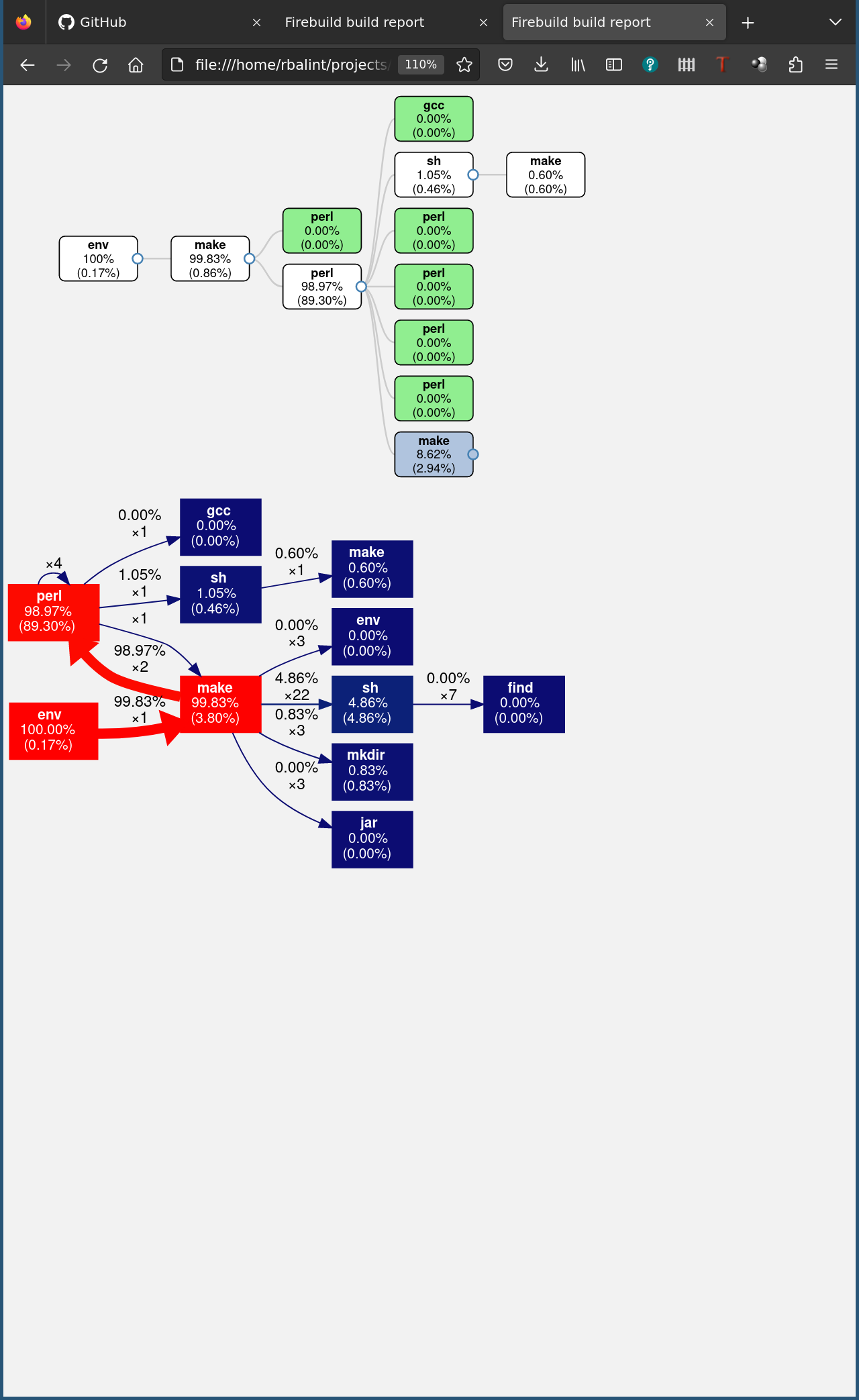
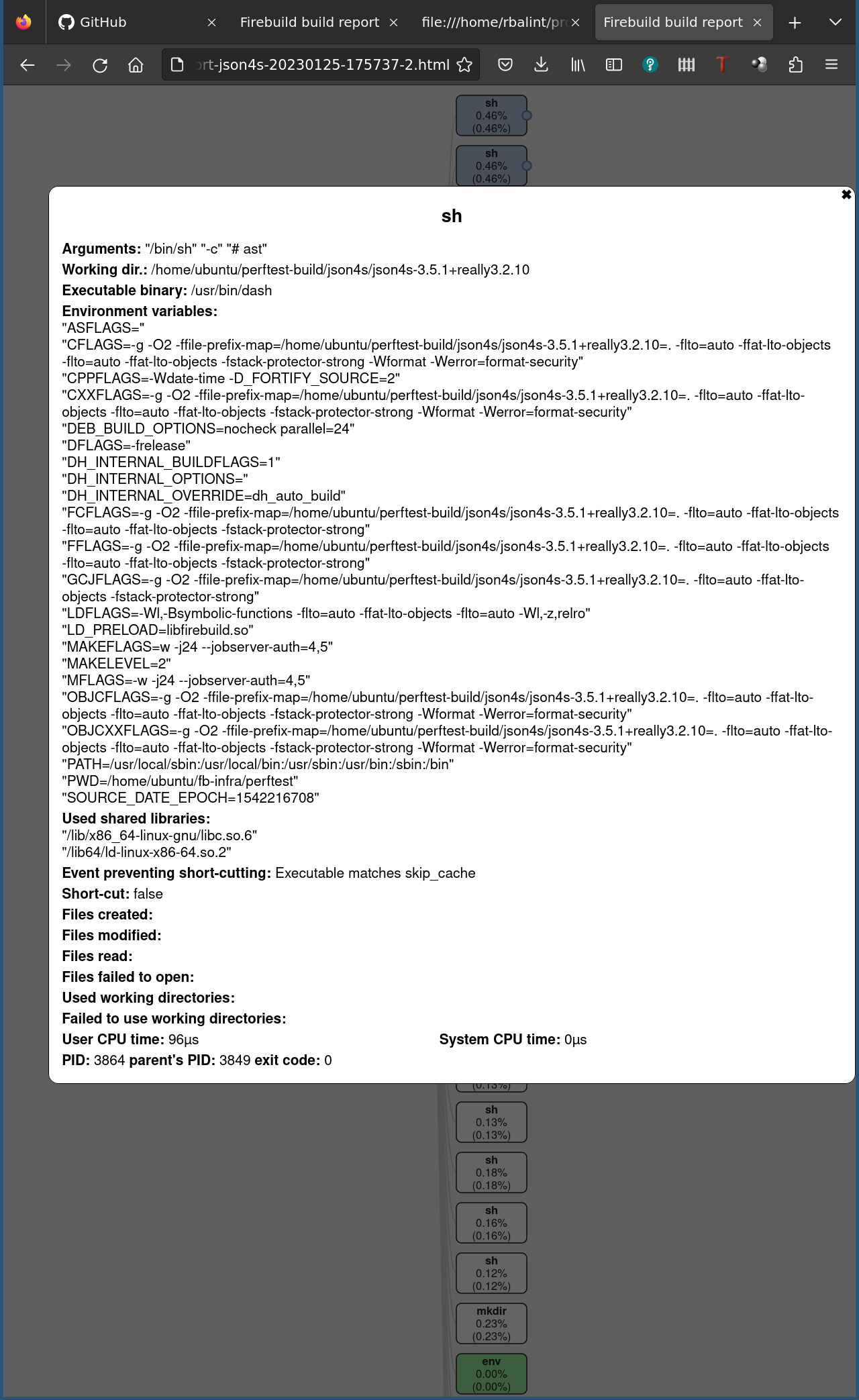
OK, but how does it work? Firebuild intercepts all processes started by the command to cache their outputs. Next time when the command or any of its descendant commands is executed with the same parameters, inputs and environment, the outputs are replayed (the command is shortcut) from the cache instead of running the command again. This is similar to how ccache and other compiler-specific caches work, but firebuild can shortcut any deterministic command, not only a specific list of compilers. Since the inputs of each command is determined at run time firebuild does not need a maintained complete dependency graph in the source like Bazel. It can work with any build system that does not implement its own caching mechanism. Determinism of commands is detected at run-time by preloading libfirebuild.so and interposing standard library calls and syscalls. If the command and all its descendants inputs are available when the command starts and all outputs can be calculated from the inputs then the command can be shortcut, otherwise it will be executed again. The interception comes with a 5-10% overhead, but rebuilds can be 5-20 times, or even faster depending on the changes between the builds. Can I try it? It is already available in Debian Unstable and Testing, Ubuntu s development release and the latest stable version is back-ported to supported Ubuntu releases via a PPA. How can I analyze my builds with firebuild? Firebuild can generate an HTML report showing each command s contribution to the build time. Below are the before and after reports of json4s, a Scala project. The command call graphs (lower ones) show that java (scalac) took 99% of the original build. Since the scalac invocations are shortcut (cutting the second build s time to less than 2% of the first one) they don t even show up in the accelerated second build s call graph. What s left to be executed again in the second run are env, perl, make and a few simple commands. The upper graphs are the process trees, with expandable nodes (in blue) also showing which command invocations were shortcut (green). Clicking on a node shows details of the command and the reason if it was not shortcut. Could I accelerate my project more? Firebuild works best for builds with CPU-intensive processes and comes with defaults to not cache very quick commands, such as sh, grep, sed, etc., because caching those would take cache space and shortcutting them may not speed up the build that much. They can still be shortcut with their parent command. Firebuild s strength is that it can find shortcutting points in the process tree automatically, e.g. from sh -c 'bash -c "sh -c echo Hello World!"' bash would be shortcut, but none of the sh commands would be cached. In typical builds there are many such commands from the skip_cache list. Caching those commands with firebuild -o 'processes.skip_cache = []' can improve acceleration and make the reports smaller. Firebuild also supports several debug flags and -d proc helps finding reasons for not shortcutting some commands:
...
FIREBUILD: Command "/usr/bin/make" can't be short-cut due to: Executable set to be not shortcut,  ExecedProcess 1329.2, running, "make -f debian/rules build", fds=[ FileFD fd=0  FileOFD ...
FIREBUILD: Command "/usr/bin/sort" can't be short-cut due to: Process read from inherited fd ,  ExecedProcess 4161.1, running, "sort", fds=[ FileFD fd=0  FileOFD ...
FIREBUILD: Command "/usr/bin/find" can't be short-cut due to: fstatfs() family operating on fds is not supported,  ExecedProcess 1360.1, running, "find -mindepth 1 ...
...
make, ninja and other incremental build tool binaries are not shortcut because they compare the timestamp of files, but they are fast at least and every build step they perform can still be shortcut. Ideally the slower build steps that could not be shortcut can be re-implemented in ways that can be shortcut by avoiding tools performing unsupported operations. I hope those tools help speeding up your build with very little effort, but if not and you find something to fix or improve in firebuild itself, please report it or just leave a feedback! Happy speeding, but not on public roads!

Dirk Eddelbuettel: RcppTOML 0.2.1 on CRAN: Small Build Fix for Some Arches

Two weeks after the release of RcppTOML 0.2.0 and the switch to toml++, we have a quick bugfix release 0.2.1. TOML is a file format that is most suitable for configurations, as it is meant to be edited by humans but read by computers. It emphasizes strong readability for humans while at the same time supporting strong typing as well as immediate and clear error reports. On small typos you get parse errors, rather than silently corrupted garbage. Much preferable to any and all of XML, JSON or YAML though sadly these may be too ubiquitous now. TOML is frequently being used with the projects such as the Hugo static blog compiler, or the Cargo system of Crates (aka packages ) for the Rust language. Some architectures, aarch64 included, got confused over float16 which is of course a tiny two-byte type nobody should need. After consulting with Mark we concluded to (at least for now) simply override this excluding the use of float16 . The short summary of changes follows.

Changes in version 0.2.1 (2023-01-25)
  • Explicitly set -DTOML_ENABLE_FLOAT16=0 to permit compilation on some architectures stumbling of the type.

Courtesy of my CRANberries, there is a diffstat report for this release. More information is on the RcppTOML page page. Please use the GitHub issue tracker for issues and bugreports. If you like this or other open-source work I do, you can sponsor me at GitHub.

This post by Dirk Eddelbuettel originated on his Thinking inside the box blog. Please report excessive re-aggregation in third-party for-profit settings.

21 January 2023

Dirk Eddelbuettel: RcppSimdJson 0.1.9 on CRAN: New Upstream

The RcppSimdJson package was just updated to release 0.1.9. RcppSimdJson wraps the fantastic and genuinely impressive simdjson library by Daniel Lemire and collaborators. Via very clever algorithmic engineering to obtain largely branch-free code, coupled with modern C++ and newer compiler instructions, it results in parsing gigabytes of JSON parsed per second which is quite mindboggling. The best-case performance is faster than CPU speed as use of parallel SIMD instructions and careful branch avoidance can lead to less than one cpu cycle per byte parsed; see the video of the talk by Daniel Lemire at QCon. This release updates the underlying simdjson library to version 3.0.1, settles on C++17 as the language standard, exports a worker function for direct C(++) access, and polishes a few small things around the package and tests. The NEWS entry for this release follows.

Changes in version 0.1.9 (2023-01-21)
  • The internal function deseralize_json is now exported at the C++ level as well as in R (Dirk in #81 closing #80).
  • simdjson was upgraded to version 3.0.1 (Dirk in #83).
  • The package now defaults to C++17 compilation; configure has been retired (Dirk closing #82).
  • The three main R access functions now use a more compact argument check via stopifnot (Dirk).

Courtesy of my CRANberries, there is also a diffstat report for this release. For questions, suggestions, or issues please use the issue tracker at the GitHub repo. If you like this or other open-source work I do, you can now sponsor me at GitHub.

This post by Dirk Eddelbuettel originated on his Thinking inside the box blog. Please report excessive re-aggregation in third-party for-profit settings.

20 January 2023

Reproducible Builds (diffoscope): diffoscope 233 released

The diffoscope maintainers are pleased to announce the release of diffoscope version 233. This version includes the following changes:
[ FC Stegerman ]
* Split packaging metadata into an extras_require.json file instead of using
  the pep517 and the pip modules directly. This was causing build failures if
  not using a virtualenv and/or building without internet access.
  (Closes: #1029066, reproducible-builds/diffoscope#325)
[ Vagrant Cascadian ]
* Add an external tool reference for GNU Guix (lzip).
* Drop an external tool reference for GNU Guix (pedump).
[ Chris Lamb ]
* Split inline Python code in shell script to generate test dependencies to a
  separate Python script.
* No need for "from __future__ import print_function" import in setup.py
  anymore.
* Comment and tidy the new extras_require.json handling.
You find out more by visiting the project homepage.

10 January 2023

Dirk Eddelbuettel: RcppTOML 0.2.0: TOML 1.0.0 rewrite with toml++

A few years since the last release in late 2020, the RcppTOML package is now back with a new and shiny CRAN release 0.2.0. It is now based on the wonderful toml++ C++17 library by Mark Gillard and gets us (at long last!) full TOML v1.0.0 compliance for use with R. TOML is a file format that is most suitable for configurations, as it is meant to be edited by humans but read by computers. It emphasizes strong readability for humans while at the same time supporting strong typing as well as immediate and clear error reports. On small typos you get parse errors, rather than silently corrupted garbage. Much preferable to any and all of XML, JSON or YAML though sadly these may be too ubiquitous now. TOML is frequently being used with the projects such as the Hugo static blog compiler, or the Cargo system of Crates (aka packages ) for the Rust language. This package is a rewrite of the internals interfacing the library, and updates the package to using toml++ and C++17. The R interface is unchanged, and a full run of reverse dependencies passed. This involved finding one sole test failure which turned to have been driven by a non-conforming TOML input file which Jianfeng Li kindly fixed at the source making his (extensive) set of tests in package configr pass too. The actual rewrite was mostly done in a one-off repo RcppTomlPlusPlus which can now be considered frozen. The short summary of changes follows.

Changes in version 0.2.0 (2023-01-10)
  • Rewritten in C++17 using toml++ for TOML v1.0.0 compliance
  • Unchanged interface from R, unchanged (and expanded tests)
  • Several small continuous integration upgrades since last release

Courtesy of my CRANberries, there is a diffstat report for this release. More information is on the RcppTOML page page. Please use the GitHub issue tracker for issues and bugreports. If you like this or other open-source work I do, you can sponsor me at GitHub.

This post by Dirk Eddelbuettel originated on his Thinking inside the box blog. Please report excessive re-aggregation in third-party for-profit settings.

Matthew Garrett: Integrating Linux with Okta Device Trust

I've written about bearer tokens and how much pain they cause me before, but sadly wishing for a better world doesn't make it happen so I'm making do with what's available. Okta has a feature called Device Trust which allows to you configure access control policies that prevent people obtaining tokens unless they're using a trusted device. This doesn't actually bind the tokens to the hardware in any way, so if a device is compromised or if a user is untrustworthy this doesn't prevent the token ending up on an unmonitored system with no security policies. But it's an incremental improvement, other than the fact that for desktop it's only supported on Windows and MacOS, which really doesn't line up well with my interests.

Obviously there's nothing fundamentally magic about these platforms, so it seemed fairly likely that it would be possible to make this work elsewhere. I spent a while staring at the implementation using Charles Proxy and the Chrome developer tools network tab and had worked out a lot, and then Okta published a paper describing a lot of what I'd just laboriously figured out. But it did also help clear up some points of confusion and clarified some design choices. I'm not going to give a full description of the details (with luck there'll be code shared for that before too long), but here's an outline of how all of this works. Also, to be clear, I'm only going to talk about the desktop support here - mobile is a bunch of related but distinct things that I haven't looked at in detail yet.

Okta's Device Trust (as officially supported) relies on Okta Verify, a local agent. When initially installed, Verify authenticates as the user, obtains a token with a scope that allows it to manage devices, and then registers the user's computer as an additional MFA factor. This involves it generating a JWT that embeds a number of custom claims about the device and its state, including things like the serial number. This JWT is signed with a locally generated (and hardware-backed, using a TPM or Secure Enclave) key, which allows Okta to determine that any future updates from a device claiming the same identity are genuinely from the same device (you could construct an update with a spoofed serial number, but you can't copy the key out of a TPM so you can't sign it appropriately). This is sufficient to get a device registered with Okta, at which point it can be used with Fastpass, Okta's hardware-backed MFA mechanism.

As outlined in the aforementioned deep dive paper, Fastpass is implemented via multiple mechanisms. I'm going to focus on the loopback one, since it's the one that has the strongest security properties. In this mode, Verify listens on one of a list of 10 or so ports on localhost. When you hit the Okta signin widget, choosing Fastpass triggers the widget into hitting each of these ports in turn until it finds one that speaks Fastpass and then submits a challenge to it (along with the URL that's making the request). Verify then constructs a response that includes the challenge and signs it with the hardware-backed key, along with information about whether this was done automatically or whether it included forcing the user to prove their presence. Verify then submits this back to Okta, and if that checks out Okta completes the authentication.

Doing this via loopback from the browser has a bunch of nice properties, primarily around the browser providing information about which site triggered the request. This means the Verify agent can make a decision about whether to submit something there (ie, if a fake login widget requests your creds, the agent will ignore it), and also allows the issued token to be cross-checked against the site that requested it (eg, if g1thub.com requests a token that's valid for github.com, that's a red flag). It's not quite at the same level as a hardware WebAuthn token, but it has many of the anti-phishing properties.

But none of this actually validates the device identity! The entire registration process is up to the client, and clients are in a position to lie. Someone could simply reimplement Verify to lie about, say, a device serial number when registering, and there'd be no proof to the contrary. Thankfully there's another level to this to provide stronger assurances. Okta allows you to provide a CA root[1]. When Okta issues a Fastpass challenge to a device the challenge includes a list of the trusted CAs. If a client has a certificate that chains back to that, it can embed an additional JWT in the auth JWT, this one containing the certificate and signed with the certificate's private key. This binds the CA-issued identity to the Fastpass validation, and causes the device to start appearing as "Managed" in the Okta device management UI. At that point you can configure policy to restrict various apps to managed devices, ensuring that users are only able to get tokens if they're using a device you've previously issued a certificate to.

I've managed to get Linux tooling working with this, though there's still a few drawbacks. The main issue is that the API only allows you to register devices that declare themselves as Windows or MacOS, followed by the login system sniffing browser user agent and only offering Fastpass if you're on one of the officially supported platforms. This can be worked around with an extension that spoofs user agent specifically on the login page, but that's still going to result in devices being logged as a non-Linux OS which makes interpreting the logs more difficult. There's also no ability to choose which bits of device state you log: there's a couple of existing integrations, and otherwise a fixed set of parameters that are reported. It'd be lovely to be able to log arbitrary material and make policy decisions based on that.

This also doesn't help with ChromeOS. There's no real way to automatically launch something that's bound to localhost (you could probably make this work using Crostini but there's no way to launch a Crostini app at login), and access to hardware-backed keys is kind of a complicated topic in ChromeOS for privacy reasons. I haven't tried this yet, but I think using an enterprise force-installed extension and the chrome.enterprise.platformKeys API to obtain a device identity cert and then intercepting requests to the appropriate port range on localhost ought to be enough to do that? But I've literally never written any Javascript so I don't know. Okta supports falling back from the loopback protocol to calling a custom URI scheme, but once you allow that you're also losing a bunch of the phishing protection, so I'd prefer not to take that approach.

Like I said, none of this prevents exfiltration of bearer tokens once they've been issued, and there's still a lot of ecosystem work to do there. But ensuring that tokens can't be issued to unmanaged machines in the first place is still a step forwards, and with luck we'll be able to make use of this on Linux systems without relying on proprietary client-side tooling.

(Time taken to code this implementation: about two days, and under 1000 lines of new code. Time taken to figure out what the fuck to write: rather a lot longer)

[1] There's also support for having Okta issue certificates, but then you're kind of back to the "How do I know this is my device" situation

comment count unavailable comments

7 January 2023

Reproducible Builds: Reproducible Builds in December 2022

Welcome to the December 2022 report from the Reproducible Builds project.
We are extremely pleased to announce that the dates for the Reproducible Builds Summit in 2023 have been announced in 2022 already: We plan to spend three days continuing to the grow of the Reproducible Builds effort. As in previous events, the exact content of the meeting will be shaped by the participants. And, as mentioned in Holger Levsen s post to our mailing list, the dates have been booked and confirmed with the venue, so if you are considering attending, please reserve these dates in your calendar today.
R my Gr nblatt, an associate professor in the T l com Sud-Paris engineering school wrote up his pain points of using Nix and NixOS. Although some of the points do not touch on reproducible builds, R my touches on problems he has encountered with the different kinds of reproducibility that these distributions appear to promise including configuration files affecting the behaviour of systems, the fragility of upstream sources as well as the conventional idea of binary reproducibility.
Morten Linderud reported that he is quietly optimistic that if Go programming language resolves all of its issues with reproducible builds (tracking issue) then the Go binaries distributed from Google and by Arch Linux may be bit-for-bit identical. It s just a bit early to sorta figure out what roadblocks there are. [But] Go bootstraps itself every build, so in theory I think it should be possible.
On December 15th, Holger Levsen published an in-depth interview he performed with David A. Wheeler on supply-chain security and reproducible builds, but it also touches on the biggest challenges in computing as well. This is part of a larger series of posts featuring the projects, companies and individuals who support the Reproducible Builds project. Other instalments include an article featuring the Civil Infrastructure Platform project and followed this up with a post about the Ford Foundation as well as a recent ones about ARDC, the Google Open Source Security Team (GOSST), Jan Nieuwenhuizen on Bootstrappable Builds, GNU Mes and GNU Guix and Hans-Christoph Steiner of the F-Droid project.
A number of changes were made to the Reproducible Builds website and documentation this month, including FC Stegerman adding an F-Droid/apksigcopier example to our embedded signatures page [ ], Holger Levsen making a large number of changes related to the 2022 summit in Venice as well as 2023 s summit in Hamburg [ ][ ][ ][ ] and Simon Butler updated our publications page [ ][ ].
On our mailing list this month, James Addison asked a question about whether there has been any effort to trace the files used by a build system in order to identify the corresponding build-dependency packages. [ ] In addition, Bernhard M. Wiedemann then posed a thought-provoking question asking How to talk to skeptics? , which was occasioned by a colleague who had published a blog post in May 2021 skeptical of reproducible builds. The thread generated a number of replies.

Android news obfusk (FC Stegerman) performed a thought-provoking review of tools designed to determine the difference between two different .apk files shipped by a number of free-software instant messenger applications. These scripts are often necessary in the Android/APK ecosystem due to these files containing embedded signatures so the conventional bit-for-bit comparison cannot be used. After detailing a litany of issues with these tools, they come to the conclusion that:
It s quite possible these messengers actually have reproducible builds, but the verification scripts they use don t actually allow us to verify whether they do.
This reflects the consensus view within the Reproducible Builds project: pursuing a situation in language or package ecosystems where binaries are bit-for-bit identical (over requiring a bespoke ecosystem-specific tool) is not a luxury demanded by purist engineers, but rather the only practical way to demonstrate reproducibility. obfusk also announced the first release of their own set of tools on our mailing list. Related to this, obfusk also posted to an issue filed against Mastodon regarding the difficulties of creating bit-by-bit identical APKs, especially with respect to copying v2/v3 APK signatures created by different tools; they also reported that some APK ordering differences were not caused by building on macOS after all, but by using Android Studio [ ] and that F-Droid added 16 more apps published with Reproducible Builds in December.

Debian As mentioned in last months report, Vagrant Cascadian has been organising a series of online sprints in order to clear the huge backlog of reproducible builds patches submitted by performing NMUs (Non-Maintainer Uploads). During December, meetings were held on the 1st, 8th, 15th, 22nd and 29th, resulting in a large number of uploads and bugs being addressed: The next sprint is due to take place this coming Tuesday, January 10th at 16:00 UTC.

Upstream patches The Reproducible Builds project attempts to fix as many currently-unreproducible packages as possible. This month, we wrote a large number of such patches, including:

Testing framework The Reproducible Builds project operates a comprehensive testing framework at tests.reproducible-builds.org in order to check packages and other artifacts for reproducibility. In October, the following changes were made by Holger Levsen:
  • The osuosl167 machine is no longer a openqa-worker node anymore. [ ][ ]
  • Detect problems with APT repository signatures [ ] and update a repository signing key [ ].
  • reproducible Debian builtin-pho: improve job output. [ ]
  • Only install the foot-terminfo package on Debian systems. [ ]
In addition, Mattia Rizzolo added support for the version of diffoscope in Debian stretch which doesn t support the --timeout flag. [ ][ ]

diffoscope diffoscope is our in-depth and content-aware diff utility. Not only can it locate and diagnose reproducibility issues, it can provide human-readable diffs from many kinds of binary formats. This month, Chris Lamb made the following changes to diffoscope, including preparing and uploading versions 228, 229 and 230 to Debian:
  • Fix compatibility with file(1) version 5.43, with thanks to Christoph Biedl. [ ]
  • Skip the test_html.py::test_diff test if html2text is not installed. (#1026034)
  • Update copyright years. [ ]
In addition, Jelle van der Waa added support for Berkeley DB version 6. [ ] Orthogonal to this, Holger Levsen bumped the Debian Standards-Version on all of our packages, including diffoscope [ ], strip-nondeterminism [ ], disorderfs [ ] and reprotest [ ].
If you are interested in contributing to the Reproducible Builds project, please visit our Contribute page on our website. You can get in touch with us via:

30 December 2022

Utkarsh Gupta: FOSS Activites in December 2022

Here s my (thirty-ninth) monthly but brief update about the activities I ve done in the F/L/OSS world.

Debian
This was my 48th month of actively contributing to Debian. I became a DM in late March 2019 and a DD on Christmas 19! \o/ There s a bunch of things I do, both, technical and non-technical. Here are the things I did this month:
  • Some DebConf work.
  • Sponsoring stuff for non-DDs.
  • Mentoring for newcomers.
  • Moderation of -project mailing list.

Ubuntu
This was my 23rd month of actively contributing to Ubuntu. Now that I joined Canonical to work on Ubuntu full-time, there s a bunch of things I do! \o/ I mostly worked on different things, I guess. I was too lazy to maintain a list of things I worked on so there s no concrete list atm. Maybe I ll get back to this section later or will start to list stuff from the fall, as I was doing before. :D

Debian (E)LTS
Debian Long Term Support (LTS) is a project to extend the lifetime of all Debian stable releases to (at least) 5 years. Debian LTS is not handled by the Debian security team, but by a separate group of volunteers and companies interested in making it a success. And Debian Extended LTS (ELTS) is its sister project, extending support to the stretch and jessie release (+2 years after LTS support). This was my thirty-ninth month as a Debian LTS and thirtieth month as a Debian ELTS paid contributor.
I worked for 51.50 hours for LTS and 22.50 hours for ELTS.

LTS CVE Fixes and Announcements:

ELTS CVE Fixes and Announcements:
  • Issued ELA 752-1, fixing CVE-2021-41182, CVE-2021-41183, CVE-2021-41184, and CVE-2022-31160, for jqueryui.
    For Debian 9 stretch, these problems have been fixed in version 1.12.1+dfsg-4+deb9u1.
  • Helped facilitate Erlang s and RabbitMQ s update; cf: ELA 754-1.
  • Looked through python3.4 s FTBFS on armhf. Even diff d with Ubuntu. No luck. Inspected the traces, doesn t give a lot of hint either. Will continue to look later next month or so but it s a rabbit hole. (:
  • Inspected joblib s security update upon Helmut s investigation and see what went wrong there.
  • Started to look at other set of packages: dropbear, tiff, et al.

Other (E)LTS Work:
Until next time.
:wq for today.

26 December 2022

Vincent Bernat: Managing infrastructure with Terraform, CDKTF, and NixOS

A few years ago, I downsized my personal infrastructure. Until 2018, there were a dozen containers running on a single Hetzner server.1 I migrated my emails to Fastmail and my DNS zones to Gandi. It left me with only my blog to self-host. As of today, my low-scale infrastructure is composed of 4 virtual machines running NixOS on Hetzner Cloud and Vultr, a handful of DNS zones on Gandi and Route 53, and a couple of Cloudfront distributions. It is managed by CDK for Terraform (CDKTF), while NixOS deployments are handled by NixOps. In this article, I provide a brief introduction to Terraform, CDKTF, and the Nix ecosystem. I also explain how to use Nix to access these tools within your shell, so you can quickly start using them.

CDKTF: infrastructure as code Terraform is an infrastructure-as-code tool. You can define your infrastructure by declaring resources with the HCL language. This language has some additional features like loops to declare several resources from a list, built-in functions you can call in expressions, and string templates. Terraform relies on a large set of providers to manage resources.

Managing servers Here is a short example using the Hetzner Cloud provider to spawn a virtual machine:
variable "hcloud_token"  
  sensitive = true
 
provider "hcloud"  
  token = var.hcloud_token
 
resource "hcloud_server" "web03"  
  name = "web03"
  server_type = "cpx11"
  image = "debian-11"
  datacenter = "nbg1-dc3"
 
resource "hcloud_rdns" "rdns4-web03"  
  server_id = hcloud_server.web03.id
  ip_address = hcloud_server.web03.ipv4_address
  dns_ptr = "web03.luffy.cx"
 
resource "hcloud_rdns" "rdns6-web03"  
  server_id = hcloud_server.web03.id
  ip_address = hcloud_server.web03.ipv6_address
  dns_ptr = "web03.luffy.cx"
 
HCL expressiveness is quite limited and I find a general-purpose language more convenient to describe all the resources. This is where CDK for Terraform comes in: you can manage your infrastructure using your preferred programming language, including TypeScript, Go, and Python. Here is the previous example using CDKTF and TypeScript:
import   App, TerraformStack, Fn   from "cdktf";
import   HcloudProvider   from "./.gen/providers/hcloud/provider";
import * as hcloud from "./.gen/providers/hcloud";
class MyStack extends TerraformStack  
  constructor(scope: Construct, name: string)  
    super(scope, name);
    const hcloudToken = new TerraformVariable(this, "hcloudToken",  
      type: "string",
      sensitive: true,
     );
    const hcloudProvider = new HcloudProvider(this, "hcloud",  
      token: hcloudToken.value,
     );
    const web03 = new hcloud.server.Server(this, "web03",  
      name: "web03",
      serverType: "cpx11",
      image: "debian-11",
      datacenter: "nbg1-dc3",
      provider: hcloudProvider,
     );
    new hcloud.rdns.Rdns(this, "rdns4-web03",  
      serverId: Fn.tonumber(web03.id),
      ipAddress: web03.ipv4Address,
      dnsPtr: "web03.luffy.cx",
      provider: hcloudProvider,
     );
    new hcloud.rdns.Rdns(this, "rdns6-web03",  
      serverId: Fn.tonumber(web03.id),
      ipAddress: web03.ipv6Address,
      dnsPtr: "web03.luffy.cx",
      provider: hcloudProvider,
     );
   
 
const app = new App();
new MyStack(app, "cdktf-take1");
app.synth();
Running cdktf synth generates a configuration file for Terraform, terraform plan previews the changes, and terraform apply applies them. Now that you have a general-purpose language, you can use functions.

Managing DNS records While using CDKTF for 4 web servers may seem a tad overkill, this is quite different when it comes to managing a few DNS zones. With DNSControl, which is using JavaScript as a domain-specific language, I was able to define the bernat.ch zone with this snippet of code:
D("bernat.ch", REG_NONE, DnsProvider(DNS_BIND, 0), DnsProvider(DNS_GANDI),
  DefaultTTL('2h'),
  FastMailMX('bernat.ch',  subdomains: ['vincent'] ),
  WebServers('@'),
  WebServers('vincent');
This generated 38 records. With CDKTF, I use:
new Route53Zone(this, "bernat.ch", providers.aws)
  .sign(dnsCMK)
  .registrar(providers.gandiVB)
  .www("@", servers)
  .www("vincent", servers)
  .www("media", servers)
  .fastmailMX(["vincent"]);
All the magic is in the code that I did not show you. You can check the dns.ts file in the cdktf-take1 repository to see how it works. Here is a quick explanation:
  • Route53Zone() creates a new zone hosted by Route 53,
  • sign() signs the zone with the provided master key,
  • registrar() registers the zone to the registrar of the domain and sets up DNSSEC,
  • www() creates A and AAAA records for the provided name pointing to the web servers,
  • fastmailMX() creates the MX records and other support records to direct emails to Fastmail.
Here is the content of the fastmailMX() function. It generates a few records and returns the current zone for chaining:
fastmailMX(subdomains?: string[])  
  (subdomains ?? [])
    .concat(["@", "*"])
    .forEach((subdomain) =>
      this.MX(subdomain, [
        "10 in1-smtp.messagingengine.com.",
        "20 in2-smtp.messagingengine.com.",
      ])
    );
  this.TXT("@", "v=spf1 include:spf.messagingengine.com ~all");
  ["mesmtp", "fm1", "fm2", "fm3"].forEach((dk) =>
    this.CNAME( $ dk ._domainkey ,  $ dk .$ this.name .dkim.fmhosted.com. )
  );
  this.TXT("_dmarc", "v=DMARC1; p=none; sp=none");
  return this;
 
I encourage you to browse the repository if you need more information.

About Pulumi My first tentative around Terraform was to use Pulumi. You can find this attempt on GitHub. This is quite similar to what I currently do with CDKTF. The main difference is that I am using Python instead of TypeScript because I was not familiar with TypeScript at the time.2 Pulumi predates CDKTF and it uses a slightly different approach. CDKTF generates a Terraform configuration (in JSON format instead of HCL), delegating planning, state management, and deployment to Terraform. It is therefore bound to the limitations of what can be expressed by Terraform, notably when you need to transform data obtained from one resource to another.3 Pulumi needs specific providers for each resource. Many Pulumi providers are thin wrappers encapsulating Terraform providers. While Pulumi provides a good user experience, I switched to CDKTF because writing providers for Pulumi is a chore. CDKTF does not require such a step. Outside the big players (AWS, Azure and Google Cloud), the existence, quality, and freshness of the Pulumi providers are inconsistent. Most providers rely on a Terraform provider and they may lag a few versions behind, miss a few resources, or have a few bugs of their own. When a provider does not exist, you can write one with the help of the pulumi-terraform-bridge library. The Pulumi project provides a boilerplate for this purpose. I had a bad experience with it when writing providers for Gandi and Vultr: the Makefile automatically installs Pulumi using a curl sh pattern and does not work with /bin/sh. There is a lack of interest for community-based contributions4 or even for providers for smaller players.

NixOS & NixOps Nix is a functional, purely-functional programming language. Nix is also the name of the package manager that is built on top of the Nix language. It allows users to declaratively install packages. nixpkgs is a repository of packages. You can install Nix on top of a regular Linux distribution. If you want more details, a good resource is the official website, and notably the learn section. There is a steep learning curve, but the reward is tremendous.

NixOS: declarative Linux distribution NixOS is a Linux distribution built on top of the Nix package manager. Here is a configuration snippet to add some packages:
environment.systemPackages = with pkgs;
  [
    bat
    htop
    liboping
    mg
    mtr
    ncdu
    tmux
  ];
It is possible to alter an existing derivation5 to use a different version, enable a specific feature, or apply a patch. Here is how I enable and configure Nginx to disable the stream module, add the Brotli compression module, and add the IP address anonymizer module. Moreover, instead of using OpenSSL 3, I keep using OpenSSL 1.1.6
services.nginx =  
  enable = true;
  package = (pkgs.nginxStable.override  
    withStream = false;
    modules = with pkgs.nginxModules; [
      brotli
      ipscrub
    ];
    openssl = pkgs.openssl_1_1;
   );
If you need to add some patches, it is also possible. Here are the patches I added in 2019 to circumvent the DoS vulnerabilities in Nginx until they were fixed in NixOS:7
services.nginx.package = pkgs.nginxStable.overrideAttrs (old:  
  patches = oldAttrs.patches ++ [
    # HTTP/2: reject zero length headers with PROTOCOL_ERROR.
    (pkgs.fetchpatch  
      url = https://github.com/nginx/nginx/commit/dbdd[ ].patch;
      sha256 = "a48190[ ]";
     )
    # HTTP/2: limited number of DATA frames.
    (pkgs.fetchpatch  
      url = https://github.com/nginx/nginx/commit/94c5[ ].patch;
      sha256 = "af591a[ ]";
     )
    #  HTTP/2: limited number of PRIORITY frames.
    (pkgs.fetchpatch  
      url = https://github.com/nginx/nginx/commit/39bb[ ].patch;
      sha256 = "1ad8fe[ ]";
     )
  ];
 );
If you are interested, have a look at my relatively small configuration: common.nix contains the configuration to be applied to any host (SSH, users, common software packages), web.nix contains the configuration for the web servers, isso.nix runs Isso into a systemd container.

NixOps: NixOS deployment tool On a single node, NixOS configuration is in the /etc/nixos/configuration.nix file. After modifying it, you have to run nixos-rebuild switch. Nix fetches all possible dependencies from the binary cache and builds the remaining packages. It creates a new entry in the boot loader menu and activates the new configuration. To manage several nodes, there exists several options, including NixOps, deploy-rs, Colmena, and morph. I do not know all of them, but from my point of view, the differences are not that important. It is also possible to build such a tool yourself as Nix provides the most important building blocks: nix build and nix copy. NixOps is one of the first tools available but I encourage you to explore the alternatives. NixOps configuration is written in Nix. Here is a simplified configuration to deploy znc01.luffy.cx, web01.luffy.cx, and web02.luffy.cx, with the help of the server and web functions:
let
  server = hardware: name: imports:  
    deployment.targetHost = "$ name .luffy.cx";
    networking.hostName = name;
    networking.domain = "luffy.cx";
    imports = [ (./hardware/. + "/$ hardware .nix") ] ++ imports;
   ;
  web = hardware: idx: imports:
    server hardware "web$ lib.fixedWidthNumber 2 idx " ([ ./web.nix ] ++ imports);
in  
  network.description = "Luffy infrastructure";
  network.enableRollback = true;
  defaults = import ./common.nix;
  znc01 = server "exoscale" [ ./znc.nix ];
  web01 = web "hetzner" 1 [ ./isso.nix ];
  web02 = web "hetzner" 2 [];
 

Tying everything together with Nix The Nix ecosystem is a unified solution to the various problems around software and configuration management. A very interesting feature is the declarative and reproducible developer environments. This is similar to Python virtual environments, except it is not language-specific.

Brief introduction to Nix flakes I am using flakes, a new Nix feature improving reproducibility by pinning all dependencies and making the build hermetic. While the feature is marked as experimental,8 it is widely used and you may see flake.nix and flake.lock at the root of some repositories. As a short example, here is the flake.nix content shipped with Snimpy, an interactive SNMP tool for Python relying on libsmi, a C library:
 
  inputs =  
    nixpkgs.url = "nixpkgs";
    flake-utils.url = "github:numtide/flake-utils";
   ;
  outputs =   self, ...  @inputs:
    inputs.flake-utils.lib.eachDefaultSystem (system:
      let
        pkgs = inputs.nixpkgs.legacyPackages."$ system ";
      in
       
        # nix build
        packages.default = pkgs.python3Packages.buildPythonPackage  
          name = "snimpy";
          src = self;
          preConfigure = ''echo "1.0.0-0-000000000000" > version.txt'';
          checkPhase = "pytest";
          checkInputs = with pkgs.python3Packages; [ pytest mock coverage ];
          propagatedBuildInputs = with pkgs.python3Packages; [ cffi pysnmp ipython ];
          buildInputs = [ pkgs.libsmi ];
         ;
        # nix run + nix shell
        apps.default =   
          type = "app";
          program = "$ self.packages."$ system ".default /bin/snimpy";
         ;
        # nix develop
        devShells.default = pkgs.mkShell  
          name = "snimpy-dev";
          buildInputs = [
            self.packages."$ system ".default.inputDerivation
            pkgs.python3Packages.ipython
          ];
         ;
       );
 
If you have Nix installed on your system:
  • nix run github:vincentbernat/snimpy runs Snimpy,
  • nix shell github:vincentbernat/snimpy provides a shell with Snimpy ready-to-use,
  • nix build github:vincentbernat/snimpy builds the Python package, tests included, and
  • nix develop . provides a shell to hack around Snimpy when run from a fresh checkout.9
For more information about Nix flakes, have a look at the tutorial from Tweag.

Nix and CDKTF At the root of the repository I use for CDKTF, there is a flake.nix file to set up a shell with Terraform and CDKTF installed and with the appropriate environment variables to automate my infrastructure. Terraform is already packaged in nixpkgs. However, I need to apply a patch on top of the Gandi provider. Not a problem with Nix!
terraform = pkgs.terraform.withPlugins (p: [
  p.aws
  p.hcloud
  p.vultr
  (p.gandi.overrideAttrs
    (old:  
      src = pkgs.fetchFromGitHub  
        owner = "vincentbernat";
        repo = "terraform-provider-gandi";
        rev = "feature/livedns-key";
        hash = "sha256-V16BIjo5/rloQ1xTQrdd0snoq1OPuDh3fQNW7kiv/kQ=";
       ;
     ))
]);
CDKTF is written in TypeScript. I have a package.json file with all the dependencies needed, including the ones to use TypeScript as the language to define infrastructure:
 
  "name": "cdktf-take1",
  "version": "1.0.0",
  "main": "main.js",
  "types": "main.ts",
  "private": true,
  "dependencies":  
    "@types/node": "^14.18.30",
    "cdktf": "^0.13.3",
    "cdktf-cli": "^0.13.3",
    "constructs": "^10.1.151",
    "eslint": "^8.27.0",
    "prettier": "^2.7.1",
    "ts-node": "^10.9.1",
    "typescript": "^3.9.10",
    "typescript-language-server": "^2.1.0"
   
 
I use Yarn to get a yarn.lock file that can be used directly to declare a derivation containing all the dependencies:
nodeEnv = pkgs.mkYarnModules  
  pname = "cdktf-take1-js-modules";
  version = "1.0.0";
  packageJSON = ./package.json;
  yarnLock = ./yarn.lock;
 ;
The next step is to generate the CDKTF providers from the Terraform providers and turn them into a derivation:
cdktfProviders = pkgs.stdenvNoCC.mkDerivation  
  name = "cdktf-providers";
  nativeBuildInputs = [
    pkgs.nodejs
    terraform
  ];
  src = nix-filter  
    root = ./.;
    include = [ ./cdktf.json ./tsconfig.json ];
   ;
  buildPhase = ''
    export HOME=$(mktemp -d)
    export CHECKPOINT_DISABLE=1
    export DISABLE_VERSION_CHECK=1
    export PATH=$ nodeEnv /node_modules/.bin:$PATH
    ln -nsf $ nodeEnv /node_modules node_modules
    # Build all providers we have in terraform
    for provider in $(cd $ terraform /libexec/terraform-providers; echo */*/*/*); do
      version=''$ provider##*/ 
      provider=''$ provider%/* 
      echo "Build $provider@$version"
      cdktf provider add --force-local $provider@$version   cat
    done
    echo "Compile TS   JS"
    tsc
  '';
  installPhase = ''
    mv .gen $out
    ln -nsf $ nodeEnv /node_modules $out/node_modules
  '';
 ;
Finally, we can define the development environment:
devShells.default = pkgs.mkShell  
  name = "cdktf-take1";
  buildInputs = [
    pkgs.nodejs
    pkgs.yarn
    terraform
  ];
  shellHook = ''
    # No telemetry
    export CHECKPOINT_DISABLE=1
    # No autoinstall of plugins
    export CDKTF_DISABLE_PLUGIN_CACHE_ENV=1
    # Do not check version
    export DISABLE_VERSION_CHECK=1
    # Access to node modules
    export PATH=$PWD/node_modules/.bin:$PATH
    ln -nsf $ nodeEnv /node_modules node_modules
    ln -nsf $ cdktfProviders  .gen
    # Credentials
    for p in \
      njf.nznmba.pbz/Nqzvavfgengbe \
      urgmare.pbz/ivaprag@oreang.pu \
      ihyge.pbz/ihyge@ivaprag.oreang.pu; do
        eval $(pass show $(echo $p   tr 'A-Za-z' 'N-ZA-Mn-za-m')   grep '^export')
    done
    eval $(pass show personal/cdktf/secrets   grep '^export')
    export TF_VAR_hcloudToken="$HCLOUD_TOKEN"
    export TF_VAR_vultrApiKey="$VULTR_API_KEY"
    unset VULTR_API_KEY HCLOUD_TOKEN
  '';
 ;
The derivations listed in buildInputs are available in the provided shell. The content of shellHook is sourced when starting the shell. It sets up some symbolic links to make the JavaScript environment built at an earlier step available, as well as the generated CDKTF providers. It also exports all the credentials.10 I am also using direnv with an .envrc to automatically load the development environment. This also enables the environment to be available from inside Emacs, notably when using lsp-mode to get TypeScript completions. Without direnv, nix develop . can activate the environment. I use the following commands to deploy the infrastructure:11
$ cdktf synth
$ cd cdktf.out/stacks/cdktf-take1
$ terraform plan --out plan
$ terraform apply plan
$ terraform output -json > ~-automation/nixops-take1/cdktf.json
The last command generates a JSON file containing various data to complete the deployment with NixOps.

NixOps The JSON file exported by Terraform contains the list of servers with various attributes:
 
  "hardware": "hetzner",
  "ipv4Address": "5.161.44.145",
  "ipv6Address": "2a01:4ff:f0:b91::1",
  "name": "web05.luffy.cx",
  "tags": [
    "web",
    "continent:NA",
    "continent:SA"
  ]
 
In network.nix, this list is imported and transformed into an attribute set describing the servers. A simplified version looks like this:
let
  lib = inputs.nixpkgs.lib;
  shortName = name: builtins.elemAt (lib.splitString "." name) 0;
  domainName = name: lib.concatStringsSep "." (builtins.tail (lib.splitString "." name));
  server = hardware: name: imports:  
    networking =  
      hostName = shortName name;
      domain = domainName name;
     ;
    deployment.targetHost = name;
    imports = [ (./hardware/. + "/$ hardware .nix") ] ++ imports;
   ;
  cdktf-servers-json = (lib.importJSON ./cdktf.json).servers.value;
  cdktf-servers = map
    (s:
      let
        tags-maybe-import = map (t: ./. + "/$ t .nix") s.tags;
        tags-import = builtins.filter (t: builtins.pathExists t) tags-maybe-import;
      in
       
        name = shortName s.name;
        value = server s.hardware s.name tags-import;
       )
    cdktf-servers-json;
in
 
  // [ ]
  // builtins.listToAttrs cdktf-servers
For web05, this expands to:
web05 =  
  networking =  
    hostName = "web05";
    domainName = "luffy.cx";
   ;
  deployment.targetHost = "web05.luffy.cx";
  imports = [ ./hardware/hetzner.nix ./web.nix ];
 ;
As for CDKTF, at the root of the repository I use for NixOps, there is a flake.nix file to set up a shell with NixOps configured. Because NixOps do not support rollouts, I usually use the following commands to deploy on a single server:12
$ nix flake update
$ nixops deploy --include=web04
$ ./tests web04.luffy.cx
If the tests are OK, I deploy the remaining nodes gradually with the following command:
$ (set -e; for h in web 03..06 ; do nixops deploy --include=$h; done)
nixops deploy rolls out all servers in parallel and therefore could cause a short outage where all Nginx are down at the same time.
This post has been a work-in-progress for the past three years, with the content being updated and refined as I experimented with different solutions. There is still much to explore13 but I feel there is enough content to publish now.

  1. It was an AMD Athlon 64 X2 5600+ with 2 GB of RAM and 2 400 GB disks with software RAID. I was paying something around 59 per month for it. While it was a good deal in 2008, by 2018 it was no longer cost-effective. It was running on Debian Wheezy with Linux-VServer for isolation, both of which were outdated in 2018.
  2. I also did not use Python because Poetry support in Nix was a bit broken around the time I started hacking around CDKTF.
  3. Pulumi can apply arbitrary functions with the apply() method on an output. It makes it easy to transform data that are not known during the planning stage. Terraform has functions to serve a similar purpose, but they are more limited.
  4. The two mentioned pull requests are not merged yet. The second one is superseded by PR #61, submitted two months later, which enforces the use of /bin/bash. I also submitted PR #56, which was merged 4 months later and quickly reverted without an explanation.
  5. You may consider packages and derivations to be synonyms in the Nix ecosystem.
  6. OpenSSL 3 has outstanding performance regressions.
  7. NixOS can be a bit slow to integrate patches since they need to rebuild parts of the binary cache before releasing the fixes. In this specific case, they were fast: the vulnerability and patches were released on August 13th 2019 and available in NixOS on August 15th. As a comparison, Debian only released the fixed version on August 22nd, which is unusually late.
  8. Because flakes are experimental, many documentations do not use them and it is an additional aspect to learn.
  9. It is possible to replace . with github:vincentbernat/snimpy, like in the other commands, but having Snimpy dependencies without Snimpy source code is less interesting.
  10. I am using pass as a password manager. The password names are only obfuscated to avoid spam.
  11. The cdktf command can wrap the terraform commands, but I prefer to use them directly as they are more flexible.
  12. If the change is risky, I disable the server with CDKTF. This removes it from the web service DNS records.
  13. I would like to replace NixOps with an alternative handling progressive rollouts and checks. I am also considering switching to Nomad or Kubernetes to deploy workloads.

10 December 2022

Timo Jyrinki: Running Cockpit inside ALP

(quoted from my other blog at since a new OS might be interesting for many and this is published in separate planets)
ALP - The Adaptable Linux Platform is a new operating system from SUSE to run containerized and virtualized workloads. It is in early prototype phase, but the development is done completely openly so it s easy to jump in to try it.For this trying out, I used the latest encrypted build as of the writing, 22.1 from ALP images. I imported it in virt-manager as a Generic Linux 2022 image, using UEFI instead of BIOS, added a TPM device (which I m interested in otherwise) and referring to an Ignition JSON file in the XML config in virt-manager.The Ignition part is pretty much fully thanks to Paolo Stivanin who studied the secrets of it before me. But here it goes - and this is required for password login in Cockpit to work in addition to SSH key based login to the VM from host - first, create config.ign file:
 
"ignition": "version": "3.3.0" ,
"passwd":
"users": [

"name": "root",
"passwordHash": "YOURHASH",
"sshAuthorizedKeys": [
"ssh-... YOURKEY"
]

]
,
"systemd":
"units": [
"name": "sshd.service",
"enabled": true
]
,
"storage":
"files": [

"overwrite": true,
"path": "/etc/ssh/sshd_config.d/20-enable-passwords.conf",
"contents":
"source": "data:,PasswordAuthentication%20yes%0APermitRootLogin%20yes%0A"
,
"mode": 420

]


where password SHA512 hash can be obtained using openssl passwd -6 and the ssh key is your public ssh key.That file is put to eg /tmp and referred in the virt-manager s XML like follows:
  <sysinfo type="fwcfg">
<entry name="opt/com.coreos/config" file="/tmp/config.ign"/>
</sysinfo>
Now we can boot up the VM and ssh in - or you could log in directly too but it s easier to copy-paste commands when using ssh.Inside the VM, we can follow the ALP documentation to install and start Cockpit:
podman container runlabel install registry.opensuse.org/suse/alp/workloads/tumbleweed_containerfiles/suse/alp/workloads/cockpit-ws:latest
podman container runlabel --name cockpit-ws run registry.opensuse.org/suse/alp/workloads/tumbleweed_containerfiles/suse/alp/workloads/cockpit-ws:latest
systemctl enable --now cockpit.service
Check your host s IP address with ip -a, and open IP:9090 in your host s browser:Cockpit login screenLogin with root / your password and you shall get the front page:Cockpit front page and many other pages where you can manage your ALP deployment via browser:Cockpit podman pageAll in all, ALP is in early phases but I m really happy there s up-to-date documentation provided and people can start experimenting it whenever they want. The images from the linked directory should be fairly good, and test automation with openQA has been started upon as well.You can try out the other example workloads that are available just as well.

Next.

Previous.