Search Results: "jan"

1 February 2023

Julian Andres Klode: Ubuntu 2022v1 secure boot key rotation and friends

This is the story of the currently progressing changes to secure boot on Ubuntu and the history of how we got to where we are.

taking a step back: how does secure boot on Ubuntu work? Booting on Ubuntu involves three components after the firmware:
  1. shim
  2. grub
  3. linux
Each of these is a PE binary signed with a key. The shim is signed by Microsoft s 3rd party key and embeds a self-signed Canonical CA certificate, and optionally a vendor dbx (a list of revoked certificates or binaries). grub and linux (and fwupd) are then signed by a certificate issued by that CA In Ubuntu s case, the CA certificate is sharded: Multiple people each have a part of the key and they need to meet to be able to combine it and sign things, such as new code signing certificates.

BootHole When BootHole happened in 2020, travel was suspended and we hence could not rotate to a new signing certificate. So when it came to updating our shim for the CVEs, we had to revoke all previously signed kernels, grubs, shims, fwupds by their hashes. This generated a very large vendor dbx which caused lots of issues as shim exported them to a UEFI variable, and not everyone had enough space for such large variables. Sigh. We decided we want to rotate our signing key next time. This was also when upstream added SBAT metadata to shim and grub. This gives a simple versioning scheme for security updates and easy revocation using a simple EFI variable that shim writes to and reads from.

Spring 2022 CVEs We still were not ready for travel in 2021, but during BootHole we developed the SBAT mechanism, so one could revoke a grub or shim by setting a single EFI variable. We actually missed rotating the shim this cycle as a new vulnerability was reported immediately after it, and we decided to hold on to it.

2022 key rotation and the fall CVEs This caused some problems when the 2nd CVE round came, as we did not have a shim with the latest SBAT level, and neither did a lot of others, so we ended up deciding upstream to not bump the shim SBAT requirements just yet. Sigh. Anyway, in October we were meeting again for the first time at a Canonical sprint, and the shardholders got together and created three new signing keys: 2022v1, 2022v2, and 2022v3. It took us until January before they were installed into the signing service and PPAs setup to sign with them. We also submitted a shim 15.7 with the old keys revoked which came back at around the same time. Now we were in a hurry. The 22.04.2 point release was scheduled for around middle of February, and we had nothing signed with the new keys yet, but our new shim which we need for the point release (so the point release media remains bootable after the next round of CVEs), required new keys. So how do we ensure that users have kernels, grubs, and fwupd signed with the new key before we install the new shim?

upgrade ordering grub and fwupd are simple cases: For grub, we depend on the new version. We decided to backport grub 2.06 to all releases (which moved focal and bionic up from 2.04), and kept the versioning of the -signed packages the same across all releases, so we were able to simply bump the Depends for grub to specify the new minimum version. For fwupd-efi, we added Breaks. (Actually, we also had a backport of the CVEs for 2.04 based grub, and we did publish that for 20.04 signed with the old keys before backporting 2.06 to it.) Kernels are a different story: There are about 60 kernels out there. My initial idea was that we could just add Breaks for all of them. So our meta package linux-image-generic which depends on linux-image-$(uname -r)-generic, we d simply add Breaks: linux-image-generic ( 5.19.0-31) and then adjust those breaks for each series. This would have been super annoying, but ultimately I figured this would be the safest option. This however caused concern, because it could be that apt decides to remove the kernel metapackage. I explored checking the kernels at runtime and aborting if we don t have a trusted kernel in preinst. This ensures that if you try to upgrade shim without having a kernel, it would fail to install. But this ultimately has a couple of issues:
  1. It aborts the entire transaction at that point, so users will be unable to run apt upgrade until they have a recent kernel.
  2. We cannot even guarantee that a kernel would be unpacked first. So even if you got a new kernel, apt/dpkg might attempt to unpack it first and then the preinst would fail because no kernel is present yet.
Ultimately we believed the danger to be too large given that no kernels had yet been released to users. If we had kernels pushed out for 1-2 months already, this would have been a viable choice. So in the end, I ended up modifying the shim packaging to install both the latest shim and the previous one, and an update-alternatives alternative to select between the two: In it s post-installation maintainer script, shim-signed checks whether all kernels with a version greater or equal to the running one are not revoked, and if so, it will setup the latest alternative with priority 100 and the previous with a priority of 50. If one or more of those kernels was signed with a revoked key, it will swap the priorities around, so that the previous version is preferred. Now this is fairly static, and we do want you to switch to the latest shim eventually, so I also added hooks to the kernel install to trigger the shim-signed postinst script when a new kernel is being installed. It will then update the alternatives based on the current set of kernels, and if it now points to the latest shim, reinstall shim and grub to the ESP. Ultimately this means that once you install your 2nd non-revoked kernel, or you install a non-revoked kernel and then reconfigure shim or the kernel, you will get the latest shim. When you install your first non-revoked kernel, your currently booted kernel is still revoked, so it s not upgraded immediately. This has a benefit in that you will most likely have two kernels you can boot without disabling secure boot.

regressions Of course, the first version I uploaded had still some remaining hardcoded shimx64 in the scripts and so failed to install on arm64 where shimaa64 is used. And if that were not enough, I also forgot to include support for gzip compressed kernels there. Sigh, I need better testing infrastructure to be able to easily run arm64 tests as well (I only tested the actual booting there, not the scripts). shim-signed migrated to the release pocket in lunar fairly quickly, but this caused images to stop working, because the new shim was installed into images, but no kernel was available yet, so we had to demote it to proposed and block migration. Despite all the work done for end users, we need to be careful to roll this out for image building.

another grub update for OOM issues. We had two grubs to release: First there was the security update for the recent set of CVEs, then there also was an OOM issue for large initrds which was blocking critical OEM work. We fixed the OOM issue by cherry-picking all 2.12 memory management patches, as well as the red hat patches to the loader we take from there. This ended up a fairly large patch set and I was hesitant to tie the security update to that, so I ended up pushing the security update everywhere first, and then pushed the OOM fixes this week. With the OOM patches, you should be able to boot initrds of between 400M and 1GB, it also depends on the memory layout of your machine and your screen resolution and background images. So OEM team had success testing 400MB irl, and I tested up to I think it was 1.2GB in qemu, I ran out of FAT space then and stopped going higher :D

other features in this round
  • Intel TDX support in grub and shim
  • Kernels are allocated as CODE now not DATA as per the upstream mm changes, might fix boot on X13s

am I using this yet? The new signing keys are used in:
  • shim-signed 1.54 on 22.10+, 1.51.3 on 22.04, 1.40.9 on 20.04, 1.37~18.04.13 on 18.04
  • grub2-signed 1.187.2~ or newer (binary packages grub-efi-amd64-signed or grub-efi-arm64-signed), 1.192 on 23.04.
  • fwupd-signed 1.51~ or newer
  • various linux updates. Check apt changelog linux-image-unsigned-$(uname -r) to see if Revoke & rotate to new signing key (LP: #2002812) is mentioned in there to see if it signed with the new key.
If you were able to install shim-signed, your grub and fwupd-efi will have the correct version as that is ensured by packaging. However your shim may still point to the old one. To check which shim will be used by grub-install, you can check the status of the shimx64.efi.signed or (on arm64) shimaa64.efi.signed alternative. The best link needs to point to the file ending in latest:
$ update-alternatives --display shimx64.efi.signed
shimx64.efi.signed - auto mode
  link best version is /usr/lib/shim/shimx64.efi.signed.latest
  link currently points to /usr/lib/shim/shimx64.efi.signed.latest
  link shimx64.efi.signed is /usr/lib/shim/shimx64.efi.signed
/usr/lib/shim/shimx64.efi.signed.latest - priority 100
/usr/lib/shim/shimx64.efi.signed.previous - priority 50
If it does not, but you have installed a new kernel compatible with the new shim, you can switch immediately to the new shim after rebooting into the kernel by running dpkg-reconfigure shim-signed. You ll see in the output if the shim was updated, or you can check the output of update-alternatives as you did above after the reconfiguration has finished. For the out of memory issues in grub, you need grub2-signed 1.187.3~ (same binaries as above).

how do I test this (while it s in proposed)?
  1. upgrade your kernel to proposed and reboot into that
  2. upgrade your grub-efi-amd64-signed, shim-signed, fwupd-signed to proposed.
If you already upgraded your shim before your kernel, don t worry:
  1. upgrade your kernel and reboot
  2. run dpkg-reconfigure shim-signed
And you ll be all good to go.

deep dive: uploading signed boot assets to Ubuntu For each signed boot asset, we build one version in the latest stable release and the development release. We then binary copy the built binaries from the latest stable release to older stable releases. This process ensures two things: We know the next stable release is able to build the assets and we also minimize the number of signed assets. OK, I lied. For shim, we actually do not build in the development release but copy the binaries upward from the latest stable, as each shim needs to go through external signing. The entire workflow looks something like this:
  1. Upload the unsigned package to one of the following build PPAs:
  2. Upload the signed package to the same PPA
  3. For stable release uploads:
    • Copy the unsigned package back across all stable releases in the PPA
    • Upload the signed package for stable releases to the same PPA with ~<release>.1 appended to the version
  4. Submit a request to canonical-signing-jobs to sign the uploads. The signing job helper copies the binary -unsigned packages to the primary-2022v1 PPA where they are signed, creating a signing tarball, then it copies the source package for the -signed package to the same PPA which then downloads the signing tarball during build and places the signed assets into the -signed deb. Resulting binaries will be placed into the proposed PPA: https://launchpad.net/~ubuntu-uefi-team/+archive/ubuntu/proposed
  5. Review the binaries themselves
  6. Unembargo and binary copy the binaries from the proposed PPA to the proposed-public PPA: https://launchpad.net/~ubuntu-uefi-team/+archive/ubuntu/proposed-public. This step is not strictly necessary, but it enables tools like sru-review to work, as they cannot access the packages from the normal private proposed PPA.
  7. Binary copy from proposed-public to the proposed queue(s) in the primary archive
Lots of steps!

WIP As of writing, only the grub updates have been released, other updates are still being verified in proposed. An update for fwupd in bionic will be issued at a later point, removing the EFI bits from the fwupd 1.2 packaging and using the separate fwupd-efi project instead like later release series.

Paul Wise: FLOSS Activities January 2023

Focus This month I didn't have any particular focus. I just worked on issues in my info bubble.

Changes

Issues

Review

Administration
  • Debian BTS: unarchive/reopen/triage bugs for reintroduced packages cycle/pygopherd and ask about guile-2.2 reintroduction bugs
  • Debian IRC: fix topic/info of obsolete channel
  • Debian wiki: unblock IP addresses, approve accounts, approve domains.

Communication
  • Respond to queries from Debian users and contributors on the mailing lists and IRC

Sponsors The celery, docutils, pyemd work was sponsored. All other work was done on a volunteer basis.

30 January 2023

Russell Coker: Links January 2023

The Intercept has an amusing and interesting article about senior Facebook employees testifying that they don t know where Facebook stores all it s data on users [1]. One lesson all programmers can learn from this is to document all these things in an orderly manner. Cory Doctorow wrote a short informative article about inflation from a modern monetary theory perspective [2]. Russ Allbery wrote an insightful blog post about effecive altruism and respect for disadvantaged people [3]. GiveDirectly sounds good. The Conversation has an interesting article about the Google and Apple app stores providing different versions of apps for users in different regions [4]. Apparently there are specific versions to comply with GDPR and versions that differ in adverts. The hope that GDPR would affect enough people to become essentially a world-wide standard was apparently overly optimistic. We need political lobbying in all countries for laws like the GDPR to force the app stores to give us the better versions of apps. Arya Voronova wrote an informative article about USB-C and extension or data blocker cables [5]. USB just keeps getting more horrible in technology while getting more useful in functionality. Laptops and phones catching fire will probably become more common in future. John McBride wrote an insightful article about the problems in the security of the software supply chain [6]. His main suggestion for addressing problems is If you are on a team that relies on some piece of open source software, allocate real engineering time to contributing , the problem with this is that real engineering time means real money and companies don t want to do that. Maybe having companies contribute moderate amounts of money to a foundation that hires people would be a viable option. Toms Guide has an interesting article describing problems with the Tesla [7]. It doesn t cover things like autopilot driving over children and bikers but instead covers issues of the user interface that make it less pleasant to drive and also remove concentration from the road. The BBC has an interesting article about the way mathematical skill is correlated with the way language is used to express numbers [8]. Every country with a lesser way of expressing numbers should switch to some variation of the East-Asian way. Science 2.0 has an interesting blog post about the JP Aerospace plans to use airships to get most of the way through the atmosphere and then a plane to get to orbit [9]. It s a wild idea but seems plausible. The idea of going to space in balloons seems considerably scarier to me than the current space craft. Interesting list of red team and physical entry gear with links to YouTube videos showing how to use them [10]. The Verge has an informative summary of the way Elon mismanaged Twitter after taking it over [11].

29 January 2023

Valhalla's Things: Hello World!

Posted on January 29, 2023
Welcome to my new blog! Or rather, strictly speaking, welcome to my first blog! Back when everybody had a blog, I had an old-fashioned personal website where pages were organized by topic rather than by date, so now that blogs are dead (or so they say), I guess it s time for me to have one :) . The old website is still online, but updating it is getting harder, both for organizational reasons and because the static generator I ve used is no longer supported and requires python 2; lately I ve started publish some specific categories of material such as sewing patterns into their own website (you can find a list in the about page), but I was missing a place to post about the history and experiences of the things I publish elsewhere, as well as more uncategorized things. Of course I ve chosen to use a static site generator, but since I m picky I ve discarded most of the common ones mostly because they enforce assumptions I don t agree with. On the other hand, one day I wouldn t mind learning a bit of Haskell, so I decided to look for trouble and use Hakyll, hoping that nobody will add a level 20 wandering monster to it. Right now I m using mostly the default theme, because I know that if I start fiddling with it I m not going to start posting content ever; maybe one day I ll decide to completely change the look. As for contents, on the bits side of things you can expect me to talk about Debian, the Fediverse, Python, my inventory manging program and a bit of arduino-level electronics; on the atom side you should definitely expect sewing, modern and mostly historically inspired, some fiber crafts (spinning, knitting, crochet), maybe some bad attempts at painting (watercolours and acrilics), printing (screen and linocut), things that are written on paper and, well, any other craft I will happen to collect. Before the blog gets too full I plan to add tag management to help people who are only interested in some of these contents. This being a blog, of course it has an atom feed you can add to your favourite (and ideally self-hosted) rss reader, and since this is a personal blog there will be no periodicity, posts will happen when I ll have something to say on some topic. Until next time

26 January 2023

Shirish Agarwal: Minidebconf Tamilnadu 2023, Tinnitus, Cooking, Books and Series.

First up is Minidebconf Tamilnadu 2023 that would be held on 28-29 January 2023. You can find rest of the details here. I do hope we get to see/hear some good stuff from the Minidebconf. Best of luck to all those who are applying.

Tinnitus During the lock-down of March 2020, I became aware of noise in ears and subsequently major hearing loss. It took me quite a while to know that Tinnitus happens to both those who have hearing loss as well as not. I keep running into threads like this and as shared by someone nobody knows what really causes it. I did try some of the apps (an app. called Resound on Android) that is supposed to tackle Tinnitus but it hasn t helped much. There is this but at least for me, right now pretty speculative. Also this, and again highly speculative.

Cooking After mum passed away, I haven t cooked anything. This used to give me pleasure but now just doesn t feel right. Cooking is something you enjoy when you are doing for somebody else and not just for yourself, at least that s how I feel and with that the curiosity to know more recipes. I do wanna buy a wok at sometime but when, how I just don t know.

Books Have been reading books quite a bit. And due to that had to again revisit and understand ISBN. Perhaps I might have shared it before. It really is something, the history of ISBN. And that co-relates with the book I read, Raising Steam by Terry Pratchett. Raising Steam is the 40th Book in the Discworld Series and it basically romanticizes and reminisces how the idea of an engine was born, and then a steam engine and how actually Railways started. There has been a lot of history and experiences from the early years of Steam Railway that have been taken and transplanted into the book. Also how Railways is and can be successful if only it is invested wisely and maintenance is done. This is only where imagination and reality come apart as maintenance isn t done and then you have issues. While this is and was in the UK, similar situation exists in India and many other places around the world and doesn t matter whether it is private or public. Exceptions are German, French but then that maybe due to Labor movements that happened and were successful unlike in other places. I could go on but then it will become a different article in itself. Suffice to say there is much to learn and you need serious people to look after it. Both in UK and India we lack that. And not just in Railways but Civil Aviation too, but again that is a story in itself.

Web-series Apart from books, have been seeing web-series that Willow is a good one that I enjoyed even though I hadn t seen the earlier movie. While there has been a flurry of movies and web-series both due to end of year and beginning of 2023 and yet have tried to be a bit partial on what I wanna watch or not. If it has crime, fantasy, drama then usually I like it. For e.g. I saw Blackout and pretty much was engrossed in what will happen next. It also does lead you to ask questions about centralization vs de-centralization for both power and other utilities and does make a case for communities to have their utilities apart from the grid as a fallback. How do we do over decades or centuries about it is a different question perhaps altogether. There were two books that kinda stood out for me, the first was Ian Rankin s Naming of the Dead . The book is about a cynical John Rebus, a man after my own heart. I am probably going to buy a few more of his series. In a way it also tells you why UK is the way it is right now. Another book that I liked was Shades of Grey by Jasper Fforde. This is one of the books that Mum would have clearly liked. It is pretty unusual while at the same time very close to 1984 and other such dystopian novels. The main trope of the book is what color you can see and how much you can see. The main character is somebody who can see Red, around the age of 20. One of the interesting aspects of the book is de-facting which closely resembles the Post-Truth world where alternative facts can be made out of air and they don t need any scientific evidence to back them up. In Jasper s world, they don t care about how things work and most of the technology is banned and curiosity is considered harmful and those who show that are murdered one way or the other. Interestingly, the author has just last year decided to start book 2 in the 3 book series that is supposed to be. This also tells why the U.S. is such a precarious situation in a way. A part of it is also due to the media which is in hands of chosen few, the same goes for UK and India, almost an oligopoly.

The Great Escape This is also a book but also about experiences of people, not in 19th-20th century but today that tells you slavery is alive and well and human-trafficking as well. This piece from NPR tells you about an MNC and Indian workers. What I found interesting is that there barely is an mention of the Indian Embassy that is supposed to help Indian people. I do know for a fact that the embassies of India has seen a drastic shortage of both people and materials even since the new Govt. came in place that was nine years ago. Incidentally, BBC shared about the Gujarat riots 2002 and that has been censored in India. They keep quiet about the UK Govt. who did find out that the Chief Minister was directly responsible for the killings and in facts his number 2, Amit Shah had shared that we would do 2002 again in the election cycle barely a month ago. But sadly, no hate speech FIR or any action was taken against Mr. Shah. There have been attempts by people to showcase the documentary. For e.g. JNU tried it and the rowdies from ABVP (arm of BJP) created violence. Even the questions that has been asked by the Wire, GOI will not acknowledge them. Interestingly, all India s edtechs have taken a beating in the last 6-8 months including the biggest BJYU s. Sharing a story from 2021 where things were best and today all of them are at bottom. In fact, the public has been wary as the prices of the courses has kept on increasing and most case studies have been found to be fake. Also the general outlook on jobs and growth has been pessimistic. In fact, most companies have been shedding jobs truckloads, most in the I.T. sector but other sectors as well. Hospitality and other related sectors have taken a huge beating, part of it post-pandemic, part of it Govt s refusal to either spend money or do any positive policies for either infrastructure, education, medical, you name it, they think private sector has all the answers which has been proven to be wrong again and again. I did not want to end on a discordant note but things are the way they are

22 January 2023

Junichi Uekawa: Working through crosvm dependencies in Debian.

Working through crosvm dependencies in Debian. intrusive-collections Debian package went in. Next up is argh. I think most of them is there now and the next challenge is getting crosvm to build with the newer dependencies.


11 January 2023

Junichi Uekawa: Reading through intrusive-collections.

Reading through intrusive-collections. My eyes are not quite used to reading macro packages and they don't quite make sense to me yet. Error messages look strange too.

9 January 2023

Junichi Uekawa: Uploaded Debian packages, since a long time.

Uploaded Debian packages, since a long time. enumn and remain are rust packages, and needed for crosvm. Working slowly through the dependency chain.

7 January 2023

Reproducible Builds: Reproducible Builds in December 2022

Welcome to the December 2022 report from the Reproducible Builds project.
We are extremely pleased to announce that the dates for the Reproducible Builds Summit in 2023 have been announced in 2022 already: We plan to spend three days continuing to the grow of the Reproducible Builds effort. As in previous events, the exact content of the meeting will be shaped by the participants. And, as mentioned in Holger Levsen s post to our mailing list, the dates have been booked and confirmed with the venue, so if you are considering attending, please reserve these dates in your calendar today.
R my Gr nblatt, an associate professor in the T l com Sud-Paris engineering school wrote up his pain points of using Nix and NixOS. Although some of the points do not touch on reproducible builds, R my touches on problems he has encountered with the different kinds of reproducibility that these distributions appear to promise including configuration files affecting the behaviour of systems, the fragility of upstream sources as well as the conventional idea of binary reproducibility.
Morten Linderud reported that he is quietly optimistic that if Go programming language resolves all of its issues with reproducible builds (tracking issue) then the Go binaries distributed from Google and by Arch Linux may be bit-for-bit identical. It s just a bit early to sorta figure out what roadblocks there are. [But] Go bootstraps itself every build, so in theory I think it should be possible.
On December 15th, Holger Levsen published an in-depth interview he performed with David A. Wheeler on supply-chain security and reproducible builds, but it also touches on the biggest challenges in computing as well. This is part of a larger series of posts featuring the projects, companies and individuals who support the Reproducible Builds project. Other instalments include an article featuring the Civil Infrastructure Platform project and followed this up with a post about the Ford Foundation as well as a recent ones about ARDC, the Google Open Source Security Team (GOSST), Jan Nieuwenhuizen on Bootstrappable Builds, GNU Mes and GNU Guix and Hans-Christoph Steiner of the F-Droid project.
A number of changes were made to the Reproducible Builds website and documentation this month, including FC Stegerman adding an F-Droid/apksigcopier example to our embedded signatures page [ ], Holger Levsen making a large number of changes related to the 2022 summit in Venice as well as 2023 s summit in Hamburg [ ][ ][ ][ ] and Simon Butler updated our publications page [ ][ ].
On our mailing list this month, James Addison asked a question about whether there has been any effort to trace the files used by a build system in order to identify the corresponding build-dependency packages. [ ] In addition, Bernhard M. Wiedemann then posed a thought-provoking question asking How to talk to skeptics? , which was occasioned by a colleague who had published a blog post in May 2021 skeptical of reproducible builds. The thread generated a number of replies.

Android news obfusk (FC Stegerman) performed a thought-provoking review of tools designed to determine the difference between two different .apk files shipped by a number of free-software instant messenger applications. These scripts are often necessary in the Android/APK ecosystem due to these files containing embedded signatures so the conventional bit-for-bit comparison cannot be used. After detailing a litany of issues with these tools, they come to the conclusion that:
It s quite possible these messengers actually have reproducible builds, but the verification scripts they use don t actually allow us to verify whether they do.
This reflects the consensus view within the Reproducible Builds project: pursuing a situation in language or package ecosystems where binaries are bit-for-bit identical (over requiring a bespoke ecosystem-specific tool) is not a luxury demanded by purist engineers, but rather the only practical way to demonstrate reproducibility. obfusk also announced the first release of their own set of tools on our mailing list. Related to this, obfusk also posted to an issue filed against Mastodon regarding the difficulties of creating bit-by-bit identical APKs, especially with respect to copying v2/v3 APK signatures created by different tools; they also reported that some APK ordering differences were not caused by building on macOS after all, but by using Android Studio [ ] and that F-Droid added 16 more apps published with Reproducible Builds in December.

Debian As mentioned in last months report, Vagrant Cascadian has been organising a series of online sprints in order to clear the huge backlog of reproducible builds patches submitted by performing NMUs (Non-Maintainer Uploads). During December, meetings were held on the 1st, 8th, 15th, 22nd and 29th, resulting in a large number of uploads and bugs being addressed: The next sprint is due to take place this coming Tuesday, January 10th at 16:00 UTC.

Upstream patches The Reproducible Builds project attempts to fix as many currently-unreproducible packages as possible. This month, we wrote a large number of such patches, including:

Testing framework The Reproducible Builds project operates a comprehensive testing framework at tests.reproducible-builds.org in order to check packages and other artifacts for reproducibility. In October, the following changes were made by Holger Levsen:
  • The osuosl167 machine is no longer a openqa-worker node anymore. [ ][ ]
  • Detect problems with APT repository signatures [ ] and update a repository signing key [ ].
  • reproducible Debian builtin-pho: improve job output. [ ]
  • Only install the foot-terminfo package on Debian systems. [ ]
In addition, Mattia Rizzolo added support for the version of diffoscope in Debian stretch which doesn t support the --timeout flag. [ ][ ]

diffoscope diffoscope is our in-depth and content-aware diff utility. Not only can it locate and diagnose reproducibility issues, it can provide human-readable diffs from many kinds of binary formats. This month, Chris Lamb made the following changes to diffoscope, including preparing and uploading versions 228, 229 and 230 to Debian:
  • Fix compatibility with file(1) version 5.43, with thanks to Christoph Biedl. [ ]
  • Skip the test_html.py::test_diff test if html2text is not installed. (#1026034)
  • Update copyright years. [ ]
In addition, Jelle van der Waa added support for Berkeley DB version 6. [ ] Orthogonal to this, Holger Levsen bumped the Debian Standards-Version on all of our packages, including diffoscope [ ], strip-nondeterminism [ ], disorderfs [ ] and reprotest [ ].
If you are interested in contributing to the Reproducible Builds project, please visit our Contribute page on our website. You can get in touch with us via:

4 January 2023

Junichi Uekawa: debcargo rust repository and some observations.

debcargo rust repository and some observations. It's been about a week since I first started looking at Debian rust packages and adding some packages in preparation for crosvm. Some things that don't work quite well right now yet. My local branches disappeared. I don't have access and everything is through a merge request, presumably that is not a generally supported workflow and the team members are using branches to manage pending works. ./release.sh is optimized for updates and for new packages, they only build source packages and then I need to rebuild a binary-full package for the NEW queue. Maybe I will figure out. I haven't quite gotten the right IRC client. I was using the web UI but that seemed to disconnect without any warnings, and didn't tell me even when it is disconnected, it just can't post more messages and doesn't receive messages. That's not very useful. I started using Emacs IRC (rcirc) client. Not sure how useful that is.

1 January 2023

Junichi Uekawa: Challenges in getting a Debian package.

Challenges in getting a Debian package. Debian Rust packaging team has a great collection of scripts for maintaining Debian Rust packages, but that depended on schroot and other tools that I haven't used usually. Getting that working first was a challenging. I had to get out of my podman container running sid inside user namespace, because schroot didn't work due to not being able to create devices files. That was okay, and I went back to my old chroot script which was doing something similar to schroot. Had to fix up /etc/passwd and /etc/group to match inside and outside. I broke gpg on the way, I had to fix the chroot script not to break PTTY by keeping /dev/pts. This I could probably have ignored if I had used schroot myself as well. Anyway, some maintenance of old scripts to get back up to speed...

Junichi Uekawa: 2023 started.

2023 started. I'm still stuck at home due to COVID-19 and therefore I have more than usual time on hacking on Debian stuff. I've learnt schroot does most of what I have been doing with my home grown tools.

28 December 2022

Russell Coker: Links December 2022

Charles Stross wrote an informative summary of the problems with the UK monarchy [1], conveniently before the queen died. The blog post To The Next Mass Shooter, A Modest Proposal is a well written suggestion to potential mass murderers [2]. The New Yorker has an interesting and amusing article about the former CIA employee who released the Vault 7 collection of CIA attack software [3]. This exposes the ridiculously poor hiring practices of the CIA which involved far less background checks than the reporter writing the story did. Wired has an interesting 6 part series about the hunt for Alpha02 the admin of the Alphabay dark web marketplace [4]. The Atlantic has an interesting and informative article about Marjorie Taylor Greene, one of the most horrible politicians in the world [5]. Anarcat wrote a long and detailed blog post about Matrix [6]. It s mostly about comparing Matrix to other services and analysing the overall environment of IM systms. I recommend using Matrix, it is quite good although having a server with SSD storage is required for the database. Edent wrote an interesting thought experiment on how one might try to regain access to all their digital data if a lightning strike destroyed everything in their home [7]. Cory Doctorow wrote an interesting article about the crapification of literary contracts [8]. A lot of this applies to most contracts between corporations and individuals. We need legislation to restrict corporations from such abuse. Jared A Brock wrote an insightful article about why AirBNB is horrible and how it will fail [9]. Habr has an interesting article on circumventing UEFI secure boot [10]. This doesn t make secure boot worthless but does expose some weaknesses in it. Matthew Garrett wrote an interesting blog post about stewartship of the UEFI boot ecosystem and how Microsoft has made some strange and possibly hypocritical decisions about it [11]. It also has a lot of background information on how UEFI can be used and misused. Cory Doctorow wrote an interesting article Let s Make Amazon Into a Dumb Pipe [12]. The idea is to use the Amazon search and reviews to find a product and then buy it elsewhere, a reverse of the showrooming practice where people look at products in stores and buy them online. There is already a browser plugin to search local libraries for Amazon books. Charles Stross wrote an interesting blog post about the UK Tory plan to destroy higher education [13]. There s a lot of similarities to what conservatives are doing in other countries. Antoine Beaupr wrote an insightful blog post How to nationalize the internet in Canada [14]. They cover the technical issues to be addressed as well as some social justice points that are often missed when discussing such issues. Internet is not a luxuary nowadays, it s an important part of daily life and the governments need to treat it the same way as roads and other national infrastructure.

20 December 2022

Freexian Collaborators: Recent improvements to Tryton's Debian Packaging (by Mathias Behrle and Rapha l Hertzog)

Foreword Freexian has been using Tryton for a few years to handle its invoicing and accounting. We have thus also been using the Debian packages maintained by Mathias Behrle and we have been funding some of his work because maintaining an ERP with more than 50 source packages was too much for him to handle alone on his free time. When Mathias discovered our Project Funding initiative, it was quite natural for him to consider applying to be able to bring some much needed improvements to Tryton s Debian packaging. He s running his own consulting company (MBSolutions) so it s easy for him to invoice Freexian to get the money for the funded projects. What follows is Mathias Behrle s description of the projects that he submitted and of the work that he achieved. If you want to contact him, you can reach out to mathiasb@m9s.biz or mbehrle@debian.org. You can also follow him on Mastodon.

Report In January 2022 I applied for two projects in the Freexian Project Funding Initiative.
  • Tryton Project 1
    • The starting point of this project was Debian Bug #998319: tryton-server should provide a ready-to-use production-grade server config. To address this problem instead of only providing configuration snippets the idea was to provide a full featured guided setup of a Tryton production environment, thus eliminating the risks of trial and error for the system administrator.
  • Tryton Project 2
    • The goal of this project was to complete the available Tryton modules in Debian main with the latest set available from tryton.org and to automate the task of creating new Debian packages from Tryton modules as much as possible.

Accomplishments As the result of Task 1, several new packages emerged:
  • tryton-server-postgresql provides the guided setup of a PostgreSQL database backend.
  • tryton-server-uwsgi provides the installation and configuration of a robust WSGI server on top of tryton-server.
  • tryton-server-nginx provides the configuration of a scalable web frontend to the uwsgi server, including the optional setup of secure access by Letsencrypt certificates.
  • tryton-server-all-in-one puts it all together to provide a fully functional Tryton production environment, including a database filled with basic static data. With the installation of this package a robust and secure production grade setup is possible from scratch, all configuration leg work is done in the background.
The work was thoroughly reviewed by Neil Williams. Thanks go to him for his detailed feedback providing very valuable information from the view of a fresh Tryton user getting in first contact with the software. A cordial thank you as well goes to the translation teams providing initial reviews and translations for the configuration questions. The efforts of Task 1 were completed with Task 2:
  • A Tryton specific version of PyPi2deb was created to help in the preparation of new Debian packages for new Tryton modules.
  • All missing Tryton modules for the current series were packaged for Debian.
On top of those two planned projects, I completed an additional task: the packaging of the Tryton Web Client. The Web Client is a quite important feature to access a Tryton server with the browser and even a crucial requirement for some companies. Unfortunately the packaging of the Web Client for Debian was problematic from the beginning. tryton-sao requires exact versions of JavaScript libraries that are almost never guaranteed to be available in the different targeted Debian releases. Therefore a package with vendored libraries has been created and will hopefully soon hit the Debian main archive. The package is already available from the Tryton Backport Mirror for the usually supported Debian releases.

Summary I am very pleased that the Tryton suite in Debian has gained full coverage of Tryton modules and a user-friendly installation. The completion of the project represents a huge step forward in the state-of-the-art deployment of a production grade Tryton environment. Without the monetary support of Freexian s project funding the realization of this project wouldn t have been possible in this way and to this extent.

15 December 2022

Reproducible Builds: Supporter spotlight: David A. Wheeler on supply chain security

The Reproducible Builds project relies on several projects, supporters and sponsors for financial support, but they are also valued as ambassadors who spread the word about our project and the work that we do. This is the sixth instalment in a series featuring the projects, companies and individuals who support the Reproducible Builds project. We started this series by featuring the Civil Infrastructure Platform project and followed this up with a post about the Ford Foundation as well as a recent ones about ARDC, the Google Open Source Security Team (GOSST), Jan Nieuwenhuizen on Bootstrappable Builds, GNU Mes and GNU Guix and Hans-Christoph Steiner of the F-Droid project. Today, however, we will be talking with David A. Wheeler, the Director of Open Source Supply Chain Security at the Linux Foundation.

Holger Levsen: Welcome, David, thanks for taking the time to talk with us today. First, could you briefly tell me about yourself? David: Sure! I m David A. Wheeler and I work for the Linux Foundation as the Director of Open Source Supply Chain Security. That just means that my job is to help open source software projects improve their security, including its development, build, distribution, and incorporation in larger works, all the way out to its eventual use by end-users. In my copious free time I also teach at George Mason University (GMU); in particular, I teach a graduate course on how to design and implement secure software. My background is technical. I have a Bachelor s in Electronics Engineering, a Master s in Computer Science and a PhD in Information Technology. My PhD dissertation is connected to reproducible builds. My PhD dissertation was on countering the Trusting Trust attack, an attack that subverts fundamental build system tools such as compilers. The attack was discovered by Karger & Schell in the 1970s, and later demonstrated & popularized by Ken Thompson. In my dissertation on trusting trust I showed that a process called Diverse Double-Compiling (DDC) could detect trusting trust attacks. That process is a specialized kind of reproducible build specifically designed to detect trusting trust style attacks. In addition, countering the trusting trust attack primarily becomes more important only when reproducible builds become more common. Reproducible builds enable detection of build-time subversions. Most attackers wouldn t bother with a trusting trust attack if they could just directly use a build-time subversion of the software they actually want to subvert.
Holger: Thanks for taking the time to introduce yourself to us. What do you think are the biggest challenges today in computing? There are many big challenges in computing today. For example:
Holger: Do you think reproducible builds are an important part in secure computing today already? David: Yes, but first let s put things in context. Today, when attackers exploit software vulnerabilities, they re primarily exploiting unintentional vulnerabilities that were created by the software developers. There are a lot of efforts to counter this: We re just starting to get better at this, which is good. However, attackers always try to attack the easiest target. As our deployed software has started to be hardened against attack, attackers have dramatically increased their attacks on the software supply chain (Sonatype found in 2022 that there s been a 742% increase year-over-year). The software supply chain hasn t historically gotten much attention, making it the easy target. There are simple supply chain attacks with simple solutions: Unfortunately, attackers know there are other lines of attack. One of the most dangerous is subverted build systems, as demonstrated by the subversion of SolarWinds Orion system. In a subverted build system, developers can review the software source code all day and see no problem, because there is no problem there. Instead, the process to convert source code into the code people run, called the build system , is subverted by an attacker. One solution for countering subverted build systems is to make the build systems harder to attack. That s a good thing to do, but you can never be confident that it was good enough . How can you be sure it s not subverted, if there s no way to know? A stronger defense against subverted build systems is the idea of verified reproducible builds. A build is reproducible if given the same source code, build environment and build instructions, any party can recreate bit-by-bit identical copies of all specified artifacts. A build is verified if multiple different parties verify that they get the same result for that situation. When you have a verified reproducible build, either all the parties colluded (and you could always double-check it yourself), or the build process isn t subverted. There is one last turtle: What if the build system tools or machines are subverted themselves? This is not a common attack today, but it s important to know if we can address them when the time comes. The good news is that we can address this. For some situations reproducible builds can also counter such attacks. If there s a loop (that is, a compiler is used to generate itself), that s called the trusting trust attack, and that is more challenging. Thankfully, the trusting trust attack has been known about for decades and there are known solutions. The diverse double-compiling (DDC) process that I explained in my PhD dissertation, as well as the bootstrappable builds process, can both counter trusting trust attacks in the software space. So there is no reason to lose hope: there is a bottom turtle , as it were.
Holger: Thankfully, this has all slowly started to change and supply chain issues are now widely discussed, as evident by efforts like Securing the Software Supply Chain: Recommended Practices Guide for Developers which you shared on our mailing list. In there, Reproducible Builds are mentioned as recommended advanced practice, which is both pretty cool (we ve come a long way!), but to me it also sounds like this will take another decade until it s become standard normal procedure. Do you agree on that timeline? David: I don t think there will be any particular timeframe. Different projects and ecosystems will move at different speeds. I wouldn t be surprised if it took a decade or so for them to become relatively common there are good reasons for that. Today the most common kinds of attacks based on software vulnerabilities still involve unintentional vulnerabilities in operational systems. Attackers are starting to apply supply chain attacks, but the top such attacks today are typosquatting (creating packages with similar names) and dependency confusion) (convincing projects to download packages from the wrong repositories). Reproducible builds don t counter those kinds of attacks, they counter subverted builds. It s important to eventually have verified reproducible builds, but understandably other issues are currently getting prioritized first. That said, reproducible builds are important long term. Many people are working on countering unintentional vulnerabilities and the most common kinds of supply chain attacks. As these other threats are countered, attackers will increasingly target build systems. Attackers always go for the weakest link. We will eventually need verified reproducible builds in many situations, and it ll take a while to get build systems able to widely perform reproducible builds, so we need to start that work now. That s true for anything where you know you ll need it but it will take a long time to get ready you need to start now.
Holger: What are your suggestions to accelerate adoption? David: Reproducible builds need to be: I think there s a snowball effect. Once many projects packages are reproducible, it will be easier to convince other projects to make their packages reproducible. I also think there should be some prioritization. If a package is in wide use (e.g., part of minimum set of packages for a widely-used Linux distribution or framework), its reproducibility should be a special focus. If a package is vital for supporting some societally important critical infrastructure (e.g., running dams), it should also be considered important. You can then work on the ones that are less important over time.
Holger: How is the Best Practices Badge going? How many projects are participating and how many are missing? David: It s going very well. You can see some automatically-generated statistics, showing we have over 5,000 projects, adding more than 1/day on average. We have more than 900 projects that have earned at least the passing badge level.
Holger: How many of the projects participating in the Best Practices badge engaging with reproducible builds? David: As of this writing there are 168 projects that report meeting the reproducible builds criterion. That s a relatively small percentage of projects. However, note that this criterion (labelled build_reproducible) is only required for the gold badge. It s not required for the passing or silver level badge. Currently we ve been strategically focused on getting projects to at least earn a passing badge, and less on earning silver or gold badges. We would love for all projects to get earn a silver or gold badge, of course, but our theory is that projects that can t even earn a passing badge present the most risk to their users. That said, there are some projects we especially want to see implementing higher badge levels. Those include projects that are very widely used, so that vulnerabilities in them can impact many systems. Examples of such projects include the Linux kernel and curl. In addition, some projects are used within systems where it s important to society that they not have serious security vulnerabilities. Examples include projects used by chemical manufacturers, financial systems and weapons. We definitely encourage any of those kinds of projects to earn higher badge levels.
Holger: Many thanks for this interview, David, and for all of your work at the Linux Foundation and elsewhere!


For more information about the Reproducible Builds project, please see our website at reproducible-builds.org. If you are interested in ensuring the ongoing security of the software that underpins our civilisation and wish to sponsor the Reproducible Builds project, please reach out to the project by emailing contact@reproducible-builds.org.

9 December 2022

Matthew Garrett: End-to-end encrypted messages need more than libsignal

(Disclaimer: I'm not a cryptographer, and I do not claim to be an expert in Signal. I've had this read over by a couple of people who are so with luck there's no egregious errors, but any mistakes here are mine)

There are indications that Twitter is working on end-to-end encrypted DMs, likely building on work that was done back in 2018. This made use of libsignal, the reference implementation of the protocol used by the Signal encrypted messaging app. There seems to be a fairly widespread perception that, since libsignal is widely deployed (it's also the basis for WhatsApp's e2e encryption) and open source and has been worked on by a whole bunch of cryptography experts, choosing to use libsignal means that 90% of the work has already been done. And in some ways this is true - the security of the protocol is probably just fine. But there's rather more to producing a secure and usable client than just sprinkling on some libsignal.

(Aside: To be clear, I have no reason to believe that the people who were working on this feature in 2018 were unaware of this. This thread kind of implies that the practical problems are why it didn't ship at the time. Given the reduction in Twitter's engineering headcount, and given the new leadership's espousal of political and social perspectives that don't line up terribly well with the bulk of the cryptography community, I have doubts that any implementation deployed in the near future will get all of these details right)

I was musing about this last night and someone pointed out some prior art. Bridgefy is a messaging app that uses Bluetooth as its transport layer, allowing messaging even in the absence of data services. The initial implementation involved a bunch of custom cryptography, enabling a range of attacks ranging from denial of service to extracting plaintext from encrypted messages. In response to criticism Bridgefy replaced their custom cryptographic protocol with libsignal, but that didn't fix everything. One issue is the potential for MITMing - keys are shared on first communication, but the client provided no mechanism to verify those keys, so a hostile actor could pretend to be a user, receive messages intended for that user, and then reencrypt them with the user's actual key. This isn't a weakness in libsignal, in the same way that the ability to add a custom certificate authority to a browser's trust store isn't a weakness in TLS. In Signal the app key distribution is all handled via Signal's servers, so if you're just using libsignal you need to implement the equivalent yourself.

The other issue was more subtle. libsignal has no awareness at all of the Bluetooth transport layer. Deciding where to send a message is up to the client, and these routing messages were spoofable. Any phone in the mesh could say "Send messages for Bob here", and other phones would do so. This should have been a denial of service at worst, since the messages for Bob would still be encrypted with Bob's key, so the attacker would be able to prevent Bob from receiving the messages but wouldn't be able to decrypt them. However, the code to decide where to send the message and the code to decide which key to encrypt the message with were separate, and the routing decision was made before the encryption key decision. An attacker could send a message saying "Route messages for Bob to me", and then another saying "Actually lol no I'm Mallory". If a message was sent between those two messages, the message intended for Bob would be delivered to Mallory's phone and encrypted with Mallory's key.

Again, this isn't a libsignal issue. libsignal encrypted the message using the key bundle it was told to encrypt it with, but the client code gave it a key bundle corresponding to the wrong user. A race condition in the client logic allowed messages intended for one person to be delivered to and readable by another.

This isn't the only case where client code has used libsignal poorly. The Bond Touch is a Bluetooth-connected bracelet that you wear. Tapping it or drawing gestures sends a signal to your phone, which culminates in a message being sent to someone else's phone which sends a signal to their bracelet, which then vibrates and glows in order to indicate a specific sentiment. The idea is that you can send brief indications of your feelings to someone you care about by simply tapping on your wrist, and they can know what you're thinking without having to interrupt whatever they're doing at the time. It's kind of sweet in a way that I'm not, but it also advertised "Private Spaces", a supposedly secure way to send chat messages and pictures, and that seemed more interesting. I grabbed the app and disassembled it, and found it was using libsignal. So I bought one and played with it, including dumping the traffic from the app. One important thing to realise is that libsignal is just the protocol library - it doesn't implement a server, and so you still need some way to get information between clients. And one of the bits of information you have to get between clients is the public key material.

Back when I played with this earlier this year, key distribution was implemented by uploading the public key to a database. The other end would download the public key, and everything works out fine. And this doesn't sound like a problem, given that the entire point of a public key is to be, well, public. Except that there was no access control on this database, and the filenames were simply phone numbers, so you could overwrite anyone's public key with one of your choosing. This didn't let you cause messages intended for them to be delivered to you, so exploiting this for anything other than a DoS would require another vulnerability somewhere, but there are contrived situations where this would potentially allow the privacy expectations to be broken.

Another issue with this app was its handling of one-time prekeys. When you send someone new a message via Signal, it's encrypted with a key derived from not only the recipient's identity key, but also from what's referred to as a "one-time prekey". Users generate a bunch of keypairs and upload the public half to the server. When you want to send a message to someone, you ask the server for one of their one-time prekeys and use that. Decrypting this message requires using the private half of the one-time prekey, and the recipient deletes it afterwards. This means that an attacker who intercepts a bunch of encrypted messages over the network and then later somehow obtains the long-term keys still won't be able to decrypt the messages, since they depended on keys that no longer exist. Since these one-time prekeys are only supposed to be used once (it's in the name!) there's a risk that they can all be consumed before they're replenished. The spec regarding pre-keys says that servers should consider rate-limiting this, but the protocol also supports falling back to just not using one-time prekeys if they're exhausted (you lose the forward secrecy benefits, but it's still end-to-end encrypted). This implementation not only implemented no rate-limiting, making it easy to exhaust the one-time prekeys, it then also failed to fall back to running without them. Another easy way to force DoS.

(And, remember, a successful DoS on an encrypted communications channel potentially results in the users falling back to an unencrypted communications channel instead. DoS may not break the encrypted protocol, but it may be sufficient to obtain plaintext anyway)

And finally, there's ClearSignal. I looked at this earlier this year - it's avoided many of these pitfalls by literally just being a modified version of the official Signal client and using the existing Signal servers (it's even interoperable with Actual Signal), but it's then got a bunch of other weirdness. The Signal database (I /think/ including the keys, but I haven't completely verified that) gets backed up to an AWS S3 bucket, identified using something derived from a key using KERI, and I've seen no external review of that whatsoever. So, who knows. It also has crash reporting enabled, and it's unclear how much internal state it sends on crashes, and it's also based on an extremely old version of Signal with the "You need to upgrade Signal" functionality disabled.

Three clients all using libsignal in one form or another, and three clients that do things wrong in ways that potentially have a privacy impact. Again, none of these issues are down to issues with libsignal, they're all in the code that surrounds it. And remember that Twitter probably has to worry about other issues as well! If I lose my phone I'm probably not going to worry too much about whether the messages sent through my weird bracelet app being gone forever, but losing all my Twitter DMs would be a significant change in behaviour from the status quo. But that's not an easy thing to do when you're not supposed to have access to any keys! Group chats? That's another significant problem to deal with. And making the messages readable through the web UI as well as on mobile means dealing with another set of key distribution issues. Get any of this wrong in one way and the user experience doesn't line up with expectations, get it wrong in another way and the worst case involves some of your users in countries with poor human rights records being executed.

Simply building something on top of libsignal doesn't mean it's secure. If you want meaningful functionality you need to build a lot of infrastructure around libsignal, and doing that well involves not just competent development and UX design, but also a strong understanding of security and cryptography. Given Twitter's lost most of their engineering and is led by someone who's alienated all the cryptographers I know, I wouldn't be optimistic.

comment count unavailable comments

8 December 2022

Reproducible Builds: Reproducible Builds in November 2022

Welcome to yet another report from the Reproducible Builds project, this time for November 2022. In all of these reports (which we have been publishing regularly since May 2015) we attempt to outline the most important things that we have been up to over the past month. As always, if you interested in contributing to the project, please visit our Contribute page on our website.

Reproducible Builds Summit 2022 Following-up from last month s report about our recent summit in Venice, Italy, a comprehensive report from the meeting has not been finalised yet watch this space! As a very small preview, however, we can link to several issues that were filed about the website during the summit (#38, #39, #40, #41, #42, #43, etc.) and collectively learned about Software Bill of Materials (SBOM) s and how .buildinfo files can be seen/used as SBOMs. And, no less importantly, the Reproducible Builds t-shirt design has been updated

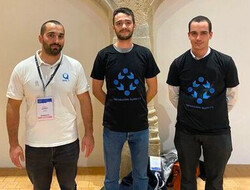
Reproducible Builds at European Cyber Week 2022 During the European Cyber Week 2022, a Capture The Flag (CTF) cybersecurity challenge was created by Fr d ric Pierret on the subject of Reproducible Builds. The challenge consisted in a pedagogical sense based on how to make a software release reproducible. To progress through the challenge issues that affect the reproducibility of build (such as build path, timestamps, file ordering, etc.) were to be fixed in steps in order to get the final flag in order to win the challenge. At the end of the competition, five people succeeded in solving the challenge, all of whom were awarded with a shirt. Fr d ric Pierret intends to create similar challenge in the form of a how to in the Reproducible Builds documentation, but two of the 2022 winners are shown here:

On business adoption and use of reproducible builds Simon Butler announced on the rb-general mailing list that the Software Quality Journal published an article called On business adoption and use of reproducible builds for open and closed source software. This article is an interview-based study which focuses on the adoption and uses of Reproducible Builds in industry, with a focus on investigating the reasons why organisations might not have adopted them:
[ ] industry application of R-Bs appears limited, and we seek to understand whether awareness is low or if significant technical and business reasons prevent wider adoption.
This is achieved through interviews with software practitioners and business managers, and touches on both the business and technical reasons supporting the adoption (or not) of Reproducible Builds. The article also begins with an excellent explanation and literature review, and even introduces a new helpful analogy for reproducible builds:
[Users are] able to perform a bitwise comparison of the two binaries to verify that they are identical and that the distributed binary is indeed built from the source code in the way the provider claims. Applied in this manner, R-Bs function as a canary, a mechanism that indicates when something might be wrong, and offer an improvement in security over running unverified binaries on computer systems.
The full paper is available to download on an open access basis. Elsewhere in academia, Beatriz Michelson Reichert and Rafael R. Obelheiro have published a paper proposing a systematic threat model for a generic software development pipeline identifying possible mitigations for each threat (PDF). Under the Tampering rubric of their paper, various attacks against Continuous Integration (CI) processes:
An attacker may insert a backdoor into a CI or build tool and thus introduce vulnerabilities into the software (resulting in an improper build). To avoid this threat, it is the developer s responsibility to take due care when making use of third-party build tools. Tampered compilers can be mitigated using diversity, as in the diverse double compiling (DDC) technique. Reproducible builds, a recent research topic, can also provide mitigation for this problem. (PDF)

Misc news
On our mailing list this month:

Debian & other Linux distributions Over 50 reviews of Debian packages were added this month, another 48 were updated and almost 30 were removed, all of which adds to our knowledge about identified issues. Two new issue types were added as well. [ ][ ]. Vagrant Cascadian announced on our mailing list another online sprint to help clear the huge backlog of reproducible builds patches submitted by performing NMUs (Non-Maintainer Uploads). The first such sprint took place on September 22nd, but others were held on October 6th and October 20th. There were two additional sprints that occurred in November, however, which resulted in the following progress: Lastly, Roland Clobus posted his latest update of the status of reproducible Debian ISO images on our mailing list. This reports that all major desktops build reproducibly with bullseye, bookworm and sid as well as that no custom patches needed to applied to Debian unstable for this result to occur. During November, however, Roland proposed some modifications to live-setup and the rebuild script has been adjusted to fix the failing Jenkins tests for Debian bullseye [ ][ ].
In other news, Miro Hron ok proposed a change to clamp build modification times to the value of SOURCE_DATE_EPOCH. This was initially suggested and discussed on a devel@ mailing list post but was later written up on the Fedora Wiki as well as being officially proposed to Fedora Engineering Steering Committee (FESCo).

Upstream patches The Reproducible Builds project detects, dissects and attempts to fix as many currently-unreproducible packages as possible. We endeavour to send all of our patches upstream where appropriate. This month, we wrote a large number of such patches, including:

diffoscope diffoscope is our in-depth and content-aware diff utility. Not only can it locate and diagnose reproducibility issues, it can provide human-readable diffs from many kinds of binary formats. This month, Chris Lamb prepared and uploaded versions 226 and 227 to Debian:
  • Support both python3-progressbar and python3-progressbar2, two modules providing the progressbar Python module. [ ]
  • Don t run Python decompiling tests on Python bytecode that file(1) cannot detect yet and Python 3.11 cannot unmarshal. (#1024335)
  • Don t attempt to attach text-only differences notice if there are no differences to begin with. (#1024171)
  • Make sure we recommend apksigcopier. [ ]
  • Tidy generation of os_list. [ ]
  • Make the code clearer around generating the Debian substvars . [ ]
  • Use our assert_diff helper in test_lzip.py. [ ]
  • Drop other copyright notices from lzip.py and test_lzip.py. [ ]
In addition to this, Christopher Baines added lzip support [ ], and FC Stegerman added an optimisation whereby we don t run apktool if no differences are detected before the signing block [ ].
A significant number of changes were made to the Reproducible Builds website and documentation this month, including Chris Lamb ensuring the openEuler logo is correctly visible with a white background [ ], FC Stegerman de-duplicated by email address to avoid listing some contributors twice [ ], Herv Boutemy added Apache Maven to the list of affiliated projects [ ] and boyska updated our Contribute page to remark that the Reproducible Builds presence on salsa.debian.org is not just the Git repository but is also for creating issues [ ][ ]. In addition to all this, however, Holger Levsen made the following changes:
  • Add a number of existing publications [ ][ ] and update metadata for some existing publications as well [ ].
  • Hide draft posts on the website homepage. [ ]
  • Add the Warpforge build tool as a participating project of the summit. [ ]
  • Clarify in the footer that we welcome patches to the website repository. [ ]

Testing framework The Reproducible Builds project operates a comprehensive testing framework at tests.reproducible-builds.org in order to check packages and other artifacts for reproducibility. In October, the following changes were made by Holger Levsen:
  • Improve the generation of meta package sets (used in grouping packages for reporting/statistical purposes) to treat Debian bookworm as equivalent to Debian unstable in this specific case [ ] and to parse the list of packages used in the Debian cloud images [ ][ ][ ].
  • Temporarily allow Frederic to ssh(1) into our snapshot server as the jenkins user. [ ]
  • Keep some reproducible jobs Jenkins logs much longer [ ] (later reverted).
  • Improve the node health checks to detect failures to update the Debian cloud image package set [ ][ ] and to improve prioritisation of some kernel warnings [ ].
  • Always echo any IRC output to Jenkins output as well. [ ]
  • Deal gracefully with problems related to processing the cloud image package set. [ ]
Finally, Roland Clobus continued his work on testing Live Debian images, including adding support for specifying the origin of the Debian installer [ ] and to warn when the image has unmet dependencies in the package list (e.g. due to a transition) [ ].
If you are interested in contributing to the Reproducible Builds project, please visit our Contribute page on our website. You can get in touch with us via:

Louis-Philippe V ronneau: Debian Python Team 2022 Sprint Report

This is the report for the Debian Python Team remote sprint that took place on December 2-3-4 2022. Many thanks to those who participated, namely: Here is a list of issues we worked on: pybuild autodep8 feature About a year ago, Antonio Terceiro contributed code to pybuild to make it possible to automatically run the upstream test suite as autopkgtests. This feature has now been merged and uploaded to unstable. Although you can find out more about it in the pybuild-autopkgtest manpage, an email providing more details should be sent to the debian-python mailing list relatively soon. Fixing packages that run tests via python3 setup.py test Last August, Stefano Rivera poked the team about the deprecation of the python3 setup.py test command to run tests in pybuild. Although this feature has been deprecated upstream for 6 years now, many packages in the archive still use it to run the upstream test suite during build. Around 29 of the 67 packages that are team-maintained by the Debian Python Team were fixed during the sprint. Ideally, all of them would be before the feature is removed from pybuild. if a package you maintain still runs this command, please consider fixing it! Fixing packages that use nose nose, provided by the python3-nose package, is an obsolete testing framework for Python and has been unmaintained since 2015. During the sprint, people worked on fixing some of the many bugs filled against packages still running tests via nose, but there are still around 240 packages affected by this issue in the archive. Again, if a package you maintain still runs this command, please consider fixing it! Removal of the remaining Python2 packages With the upload of dh-python 5.20221202, Stefano Rivera officially removed support for dh_python2 and dh_pypy, thus closing the "Python2 removal in sid/bullseye" bug. It seems some work still needs to be done for complete Python2 removal from Sid, but I expect this will be done in time for the Bookworm release. Working on Lintian tags for the Team During the sprint, I managed to work on some Lintian issues that we had targeted, namely: I also worked on a few other Lintian tags, but they were unrelated to the Debian Python Team itself. I'm also happy to report many of the tags I wrote for the team in the past few months were merged by the awesome Russ Allbery and should land in unstable as soon as a new release is made. I'm particularly looking forward the new "uses-python-distutils" tag that should help us flag packages that still use the deprecated distutils library. Patching distro-tracker (tracker.debian.org) to show pending team MRs It's often hard to have a good overview of pending merge requests when working with team-maintained packages, as by default, Salsa doesn't notify anyone when a MR is opened. Although our workflow typically does not involve creating merge requests, some people still do and they end up sitting there, unnoticed. During the sprint, Kurt Kremitzki worked on solving this issue by having distro-tracker show the pending MRs on our team's tracker page. Sadly, it seems little progress was made, as the removal of python3-django-jsonfield from the archive and breaking changes in python3-selenium has broken the test suite. Migrate packages building with the flit plugin to the generic pyproject one pybuild has been supporting building with PEP-517 style pyproject.toml files via a generic plugin (pybuild-plugin-pyproject) for a while now. As this plugin supersedes the old flit plugin, we've been thinking of deprecating it in time for the Bookworm release. To make this possible, most of the packages in the archive that still used this plugin were migrated to the generic one and I opened bugs on the last handful of packages that were not team-maintained. Other work Many other things were done during the sprint, such as: Thanks Thanks again to everyone who joined the sprint, and three big cheers for all the folks who donate to Debian and made it possible for us to have a food budget for the event.
3 December 2022

Vincent Bernat: Broken commit diff on Cisco IOS XR

TL;DR Never trust show commit changes diff on Cisco IOS XR.

Cisco IOS XR is the operating system running for the Cisco ASR, NCS, and 8000 routers. Compared to Cisco IOS, it features a candidate configuration and a running configuration. In configuration mode, you can modify the first one and issue the commit command to apply it to the running configuration.1 This is a common concept for many NOS. Before committing the candidate configuration to the running configuration, you may want to check the changes that have accumulated until now. That s where the show commit changes diff command2 comes up. Its goal is to show the difference between the running configuration (show running-configuration) and the candidate configuration (show configuration merge). How hard can it be? Let s put an interface down on IOS XR 7.6.2 (released in August 2022):
RP/0/RP0/CPU0:router(config)#int Hu0/1/0/1 shut
RP/0/RP0/CPU0:router(config)#show commit changes diff
Wed Nov 23 11:08:30.275 CET
Building configuration...
!! IOS XR Configuration 7.6.2
+  interface HundredGigE0/1/0/1
+   shutdown
   !
end
The + sign before interface HundredGigE0/1/0/1 makes it look like you did create a new interface. Maybe there was a typo? No, the diff is just broken. If you look at the candidate configuration, everything is like you expect:
RP/0/RP0/CPU0:router(config)#show configuration merge int Hu0/1/0/1
Wed Nov 23 11:08:43.360 CET
interface HundredGigE0/1/0/1
 description PNI: (some description)
 bundle id 4000 mode active
 lldp
  receive disable
  transmit disable
 !
 shutdown
 load-interval 30
Here is a more problematic example on IOS XR 7.2.2 (released in January 2021). We want to unconfigure three interfaces:
RP/0/RP0/CPU0:router(config)#no int GigabitEthernet 0/0/0/5
RP/0/RP0/CPU0:router(config)#int TenGigE 0/0/0/5 shut
RP/0/RP0/CPU0:router(config)#no int TenGigE 0/0/0/28
RP/0/RP0/CPU0:router(config)#int TenGigE 0/0/0/28 shut
RP/0/RP0/CPU0:router(config)#no int TenGigE 0/0/0/29
RP/0/RP0/CPU0:router(config)#int TenGigE 0/0/0/29 shut
RP/0/RP0/CPU0:router(config)#show commit changes diff
Mon Nov  7 15:07:22.990 CET
Building configuration...
!! IOS XR Configuration 7.2.2
-  interface GigabitEthernet0/0/0/5
-   shutdown
   !
+  interface TenGigE0/0/0/5
+   shutdown
   !
   interface TenGigE0/0/0/28
-   description Trunk (some description)
-   bundle id 2 mode active
   !
end
The two first commands are correctly represented by the first two chunks of the diff: we remove GigabitEthernet0/0/0/5 and create TenGigE0/0/0/5. The two next commands are also correctly represented by the last chunk of the diff. TenGigE0/0/0/28 was already shut down, so it is expected that only description and bundle id are removed. However, the diff command forgets about the modifications for TenGigE0/0/0/29. The diff should include a chunk similar to the last one.
RP/0/RP0/CPU0:router(config)#show run int TenGigE 0/0/0/29
Mon Nov  7 15:07:43.571 CET
interface TenGigE0/0/0/29
 description Trunk to other router
 bundle id 2 mode active
 shutdown
!
RP/0/RP0/CPU0:router(config)#show configuration merge int TenGigE 0/0/0/29
Mon Nov  7 15:07:53.584 CET
interface TenGigE0/0/0/29
 shutdown
!
How can the diff be correct for TenGigE0/0/0/28 but incorrect for TenGigE0/0/0/29 while they have the same configuration? How can you trust the diff command if it forgets part of the configuration? Do you remember the last time you ran an Ansible playbook and discovered the whole router ospf block disappeared without a warning? If you use automation tools, you should check how the diff is assembled. Automation tools should build it from the result of show running-config and show configuration merge. This is what NAPALM does. This is not what cisco.iosxr collection for Ansible does. The problem is not limited to the interface directives. You can get similar issues for other parts of the configuration. For example, here is what we get when removing inactive BGP neighbors on IOS XR 7.2.2:
RP/0/RP0/CPU0:router(config)#router bgp 65400
RP/0/RP0/CPU0:router(config-bgp)#vrf public
RP/0/RP0/CPU0:router(config-bgp-vrf)#no neighbor 217.29.66.1
RP/0/RP0/CPU0:router(config-bgp-vrf)#no neighbor 217.29.66.75
RP/0/RP0/CPU0:router(config-bgp-vrf)#no neighbor 217.29.66.110
RP/0/RP0/CPU0:router(config-bgp-vrf)#no neighbor 217.29.66.112
RP/0/RP0/CPU0:router(config-bgp-vrf)#no neighbor 217.29.66.158
RP/0/RP0/CPU0:router(config-bgp-vrf)#show commit changes diff
Tue Aug  2 13:58:02.536 CEST
Building configuration...
!! IOS XR Configuration 7.2.2
   router bgp 65400
    vrf public
-    neighbor 217.29.66.1
-     remote-as 16004
-     use neighbor-group MIX_IPV4_PUBLIC
-     description MIX: MIX-IT
     !
-    neighbor 217.29.66.75
-     remote-as 49367
-     use neighbor-group MIX_IPV4_PUBLIC
     !
-    neighbor 217.29.67.10
-     remote-as 19679
     !
-    neighbor 217.29.67.15
-    neighbor 217.29.66.112
-     remote-as 8075
-     use neighbor-group MIX_IPV4_PUBLIC
-     description MIX: Microsoft
-     address-family ipv4 unicast
-      maximum-prefix 1500 95 restart 5
      !
     !
-    neighbor 217.29.66.158
-     remote-as 24482
-     use neighbor-group MIX_IPV4_PUBLIC
-     description MIX: SG.GS
-     address-family ipv4 unicast
     !
     !
    !
   !
end
The only correct chunk is for neighbor 217.29.66.112. All the others are missing some of the removed lines. 217.29.67.15 is even missing all of them. How bad is the code providing such a diff? I could go all day with examples such as these. Cisco TAC is happy to open a case in DDTS, their bug tracker, to fix specific occurrences of this bug.3 However, I fail to understand why the XR team is not just providing the diff between show run and show configuration merge. The output would always be correct!

  1. IOS XR has several limitations. The most inconvenient one is the inability to change the AS number in the router bgp directive. Such a limitation is a great pain for both operations and automation.
  2. This command could have been just show commit, as show commit changes diff is the only valid command you can execute from this point. Starting from IOS XR 7.5.1, show commit changes diff precise is also a valid command. However, I have failed to find any documentation about it and it seems to provide the same output as show commit changes diff. That s how clunky IOS XR can be.
  3. See CSCwa26251 as an example of a fix for something I reported earlier this year. You need a valid Cisco support contract to be able to see its content.

16 November 2022

Antoine Beaupr : Wayland: i3 to Sway migration

I started migrating my graphical workstations to Wayland, specifically migrating from i3 to Sway. This is mostly to address serious graphics bugs in the latest Framwork laptop, but also something I felt was inevitable. The current status is that I've been able to convert my i3 configuration to Sway, and adapt my systemd startup sequence to the new environment. Screen sharing only works with Pipewire, so I also did that migration, which basically requires an upgrade to Debian bookworm to get a nice enough Pipewire release. I'm testing Wayland on my laptop, but I'm not using it as a daily driver because I first need to upgrade to Debian bookworm on my main workstation. Most irritants have been solved one way or the other. My main problem with Wayland right now is that I spent a frigging week doing the conversion: it's exciting and new, but it basically sucked the life out of all my other projects and it's distracting, and I want it to stop. The rest of this page documents why I made the switch, how it happened, and what's left to do. Hopefully it will keep you from spending as much time as I did in fixing this. TL;DR: Wayland is mostly ready. Main blockers you might find are that you need to do manual configurations, DisplayLink (multiple monitors on a single cable) doesn't work in Sway, HDR and color management are still in development. I had to install the following packages:
apt install \
    brightnessctl \
    foot \
    gammastep \
    gdm3 \
    grim slurp \
    pipewire-pulse \
    sway \
    swayidle \
    swaylock \
    wdisplays \
    wev \
    wireplumber \
    wlr-randr \
    xdg-desktop-portal-wlr
And did some of tweaks in my $HOME, mostly dealing with my esoteric systemd startup sequence, which you won't have to deal with if you are not a fan.

Why switch? I originally held back from migrating to Wayland: it seemed like a complicated endeavor hardly worth the cost. It also didn't seem actually ready. But after reading this blurb on LWN, I decided to at least document the situation here. The actual quote that convinced me it might be worth it was:
It s amazing. I have never experienced gaming on Linux that looked this smooth in my life.
... I'm not a gamer, but I do care about latency. The longer version is worth a read as well. The point here is not to bash one side or the other, or even do a thorough comparison. I start with the premise that Xorg is likely going away in the future and that I will need to adapt some day. In fact, the last major Xorg release (21.1, October 2021) is rumored to be the last ("just like the previous release...", that said, minor releases are still coming out, e.g. 21.1.4). Indeed, it seems even core Xorg people have moved on to developing Wayland, or at least Xwayland, which was spun off it its own source tree. X, or at least Xorg, in in maintenance mode and has been for years. Granted, the X Window System is getting close to forty years old at this point: it got us amazingly far for something that was designed around the time the first graphical interface. Since Mac and (especially?) Windows released theirs, they have rebuilt their graphical backends numerous times, but UNIX derivatives have stuck on Xorg this entire time, which is a testament to the design and reliability of X. (Or our incapacity at developing meaningful architectural change across the entire ecosystem, take your pick I guess.) What pushed me over the edge is that I had some pretty bad driver crashes with Xorg while screen sharing under Firefox, in Debian bookworm (around November 2022). The symptom would be that the UI would completely crash, reverting to a text-only console, while Firefox would keep running, audio and everything still working. People could still see my screen, but I couldn't, of course, let alone interact with it. All processes still running, including Xorg. (And no, sorry, I haven't reported that bug, maybe I should have, and it's actually possible it comes up again in Wayland, of course. But at first, screen sharing didn't work of course, so it's coming a much further way. After making screen sharing work, though, the bug didn't occur again, so I consider this a Xorg-specific problem until further notice.) There were also frustrating glitches in the UI, in general. I actually had to setup a compositor alongside i3 to make things bearable at all. Video playback in a window was laggy, sluggish, and out of sync. Wayland fixed all of this.

Wayland equivalents This section documents each tool I have picked as an alternative to the current Xorg tool I am using for the task at hand. It also touches on other alternatives and how the tool was configured. Note that this list is based on the series of tools I use in desktop. TODO: update desktop with the following when done, possibly moving old configs to a ?xorg archive.

Window manager: i3 sway This seems like kind of a no-brainer. Sway is around, it's feature-complete, and it's in Debian. I'm a bit worried about the "Drew DeVault community", to be honest. There's a certain aggressiveness in the community I don't like so much; at least an open hostility towards more modern UNIX tools like containers and systemd that make it hard to do my work while interacting with that community. I'm also concern about the lack of unit tests and user manual for Sway. The i3 window manager has been designed by a fellow (ex-)Debian developer I have a lot of respect for (Michael Stapelberg), partly because of i3 itself, but also working with him on other projects. Beyond the characters, i3 has a user guide, a code of conduct, and lots more documentation. It has a test suite. Sway has... manual pages, with the homepage just telling users to use man -k sway to find what they need. I don't think we need that kind of elitism in our communities, to put this bluntly. But let's put that aside: Sway is still a no-brainer. It's the easiest thing to migrate to, because it's mostly compatible with i3. I had to immediately fix those resources to get a minimal session going:
i3 Sway note
set_from_resources set no support for X resources, naturally
new_window pixel 1 default_border pixel 1 actually supported in i3 as well
That's it. All of the other changes I had to do (and there were actually a lot) were all Wayland-specific changes, not Sway-specific changes. For example, use brightnessctl instead of xbacklight to change the backlight levels. See a copy of my full sway/config for details. Other options include:
  • dwl: tiling, minimalist, dwm for Wayland, not in Debian
  • Hyprland: tiling, fancy animations, not in Debian
  • Qtile: tiling, extensible, in Python, not in Debian (1015267)
  • river: Zig, stackable, tagging, not in Debian (1006593)
  • velox: inspired by xmonad and dwm, not in Debian
  • vivarium: inspired by xmonad, not in Debian

Status bar: py3status waybar I have invested quite a bit of effort in setting up my status bar with py3status. It supports Sway directly, and did not actually require any change when migrating to Wayland. Unfortunately, I had trouble making nm-applet work. Based on this nm-applet.service, I found that you need to pass --indicator for it to show up at all. In theory, tray icon support was merged in 1.5, but in practice there are still several limitations, like icons not clickable. Also, on startup, nm-applet --indicator triggers this error in the Sway logs:
nov 11 22:34:12 angela sway[298938]: 00:49:42.325 [INFO] [swaybar/tray/host.c:24] Registering Status Notifier Item ':1.47/org/ayatana/NotificationItem/nm_applet'
nov 11 22:34:12 angela sway[298938]: 00:49:42.327 [ERROR] [swaybar/tray/item.c:127] :1.47/org/ayatana/NotificationItem/nm_applet IconPixmap: No such property  IconPixmap 
nov 11 22:34:12 angela sway[298938]: 00:49:42.327 [ERROR] [swaybar/tray/item.c:127] :1.47/org/ayatana/NotificationItem/nm_applet AttentionIconPixmap: No such property  AttentionIconPixmap 
nov 11 22:34:12 angela sway[298938]: 00:49:42.327 [ERROR] [swaybar/tray/item.c:127] :1.47/org/ayatana/NotificationItem/nm_applet ItemIsMenu: No such property  ItemIsMenu 
nov 11 22:36:10 angela sway[313419]: info: fcft.c:838: /usr/share/fonts/truetype/dejavu/DejaVuSans.ttf: size=24.00pt/32px, dpi=96.00
... but that seems innocuous. The tray icon displays but is not clickable. Note that there is currently (November 2022) a pull request to hook up a "Tray D-Bus Menu" which, according to Reddit might fix this, or at least be somewhat relevant. If you don't see the icon, check the bar.tray_output property in the Sway config, try: tray_output *. The non-working tray was the biggest irritant in my migration. I have used nmtui to connect to new Wifi hotspots or change connection settings, but that doesn't support actions like "turn off WiFi". I eventually fixed this by switching from py3status to waybar, which was another yak horde shaving session, but ultimately, it worked.

Web browser: Firefox Firefox has had support for Wayland for a while now, with the team enabling it by default in nightlies around January 2022. It's actually not easy to figure out the state of the port, the meta bug report is still open and it's huge: it currently (Sept 2022) depends on 76 open bugs, it was opened twelve (2010) years ago, and it's still getting daily updates (mostly linking to other tickets). Firefox 106 presumably shipped with "Better screen sharing for Windows and Linux Wayland users", but I couldn't quite figure out what those were. TL;DR: echo MOZ_ENABLE_WAYLAND=1 >> ~/.config/environment.d/firefox.conf && apt install xdg-desktop-portal-wlr

How to enable it Firefox depends on this silly variable to start correctly under Wayland (otherwise it starts inside Xwayland and looks fuzzy and fails to screen share):
MOZ_ENABLE_WAYLAND=1 firefox
To make the change permanent, many recipes recommend adding this to an environment startup script:
if [ "$XDG_SESSION_TYPE" == "wayland" ]; then
    export MOZ_ENABLE_WAYLAND=1
fi
At least that's the theory. In practice, Sway doesn't actually run any startup shell script, so that can't possibly work. Furthermore, XDG_SESSION_TYPE is not actually set when starting Sway from gdm3 which I find really confusing, and I'm not the only one. So the above trick doesn't actually work, even if the environment (XDG_SESSION_TYPE) is set correctly, because we don't have conditionals in environment.d(5). (Note that systemd.environment-generator(7) do support running arbitrary commands to generate environment, but for some some do not support user-specific configuration files... Even then it may be a solution to have a conditional MOZ_ENABLE_WAYLAND environment, but I'm not sure it would work because ordering between those two isn't clear: maybe the XDG_SESSION_TYPE wouldn't be set just yet...) At first, I made this ridiculous script to workaround those issues. Really, it seems to me Firefox should just parse the XDG_SESSION_TYPE variable here... but then I realized that Firefox works fine in Xorg when the MOZ_ENABLE_WAYLAND is set. So now I just set that variable in environment.d and It Just Works :
MOZ_ENABLE_WAYLAND=1

Screen sharing Out of the box, screen sharing doesn't work until you install xdg-desktop-portal-wlr or similar (e.g. xdg-desktop-portal-gnome on GNOME). I had to reboot for the change to take effect. Without those tools, it shows the usual permission prompt with "Use operating system settings" as the only choice, but when we accept... nothing happens. After installing the portals, it actualyl works, and works well! This was tested in Debian bookworm/testing with Firefox ESR 102 and Firefox 106. Major caveat: we can only share a full screen, we can't currently share just a window. The major upside to that is that, by default, it streams only one output which is actually what I want most of the time! See the screencast compatibility for more information on what is supposed to work. This is actually a huge improvement over the situation in Xorg, where Firefox can only share a window or all monitors, which led me to use Chromium a lot for video-conferencing. With this change, in other words, I will not need Chromium for anything anymore, whoohoo! If slurp, wofi, or bemenu are installed, one of them will be used to pick the monitor to share, which effectively acts as some minimal security measure. See xdg-desktop-portal-wlr(1) for how to configure that.

Side note: Chrome fails to share a full screen I was still using Google Chrome (or, more accurately, Debian's Chromium package) for some videoconferencing. It's mainly because Chromium was the only browser which will allow me to share only one of my two monitors, which is extremely useful. To start chrome with the Wayland backend, you need to use:
chromium  -enable-features=UseOzonePlatform -ozone-platform=wayland
If it shows an ugly gray border, check the Use system title bar and borders setting. It can do some screensharing. Sharing a window and a tab seems to work, but sharing a full screen doesn't: it's all black. Maybe not ready for prime time. And since Firefox can do what I need under Wayland now, I will not need to fight with Chromium to work under Wayland:
apt purge chromium
Note that a similar fix was necessary for Signal Desktop, see this commit. Basically you need to figure out a way to pass those same flags to signal:
--enable-features=WaylandWindowDecorations --ozone-platform-hint=auto

Email: notmuch See Emacs, below.

File manager: thunar Unchanged.

News: feed2exec, gnus See Email, above, or Emacs in Editor, below.

Editor: Emacs okay-ish Emacs is being actively ported to Wayland. According to this LWN article, the first (partial, to Cairo) port was done in 2014 and a working port (to GTK3) was completed in 2021, but wasn't merged until late 2021. That is: after Emacs 28 was released (April 2022). So we'll probably need to wait for Emacs 29 to have native Wayland support in Emacs, which, in turn, is unlikely to arrive in time for the Debian bookworm freeze. There are, however, unofficial builds for both Emacs 28 and 29 provided by spwhitton which may provide native Wayland support. I tested the snapshot packages and they do not quite work well enough. First off, they completely take over the builtin Emacs they hijack the $PATH in /etc! and certain things are simply not working in my setup. For example, this hook never gets ran on startup:
(add-hook 'after-init-hook 'server-start t) 
Still, like many X11 applications, Emacs mostly works fine under Xwayland. The clipboard works as expected, for example. Scaling is a bit of an issue: fonts look fuzzy. I have heard anecdotal evidence of hard lockups with Emacs running under Xwayland as well, but haven't experienced any problem so far. I did experience a Wayland crash with the snapshot version however. TODO: look again at Wayland in Emacs 29.

Backups: borg Mostly irrelevant, as I do not use a GUI.

Color theme: srcery, redshift gammastep I am keeping Srcery as a color theme, in general. Redshift is another story: it has no support for Wayland out of the box, but it's apparently possible to apply a hack on the TTY before starting Wayland, with:
redshift -m drm -PO 3000
This tip is from the arch wiki which also has other suggestions for Wayland-based alternatives. Both KDE and GNOME have their own "red shifters", and for wlroots-based compositors, they (currently, Sept. 2022) list the following alternatives: I configured gammastep with a simple gammastep.service file associated with the sway-session.target.

Display manager: lightdm gdm3 Switched because lightdm failed to start sway:
nov 16 16:41:43 angela sway[843121]: 00:00:00.002 [ERROR] [wlr] [libseat] [common/terminal.c:162] Could not open target tty: Permission denied
Possible alternatives:

Terminal: xterm foot One of the biggest question mark in this transition was what to do about Xterm. After writing two articles about terminal emulators as a professional journalist, decades of working on the terminal, and probably using dozens of different terminal emulators, I'm still not happy with any of them. This is such a big topic that I actually have an entire blog post specifically about this. For starters, using xterm under Xwayland works well enough, although the font scaling makes things look a bit too fuzzy. I have also tried foot: it ... just works! Fonts are much crisper than Xterm and Emacs. URLs are not clickable but the URL selector (control-shift-u) is just plain awesome (think "vimperator" for the terminal). There's cool hack to jump between prompts. Copy-paste works. True colors work. The word-wrapping is excellent: it doesn't lose one byte. Emojis are nicely sized and colored. Font resize works. There's even scroll back search (control-shift-r). Foot went from a question mark to being a reason to switch to Wayland, just for this little goodie, which says a lot about the quality of that software. The selection clicks are a not quite what I would expect though. In rxvt and others, you have the following patterns:
  • single click: reset selection, or drag to select
  • double: select word
  • triple: select quotes or line
  • quadruple: select line
I particularly find the "select quotes" bit useful. It seems like foot just supports double and triple clicks, with word and line selected. You can select a rectangle with control,. It correctly extends the selection word-wise with right click if double-click was first used. One major problem with Foot is that it's a new terminal, with its own termcap entry. Support for foot was added to ncurses in the 20210731 release, which was shipped after the current Debian stable release (Debian bullseye, which ships 6.2+20201114-2). A workaround for this problem is to install the foot-terminfo package on the remote host, which is available in Debian stable. This should eventually resolve itself, as Debian bookworm has a newer version. Note that some corrections were also shipped in the 20211113 release, but that is also shipped in Debian bookworm. That said, I am almost certain I will have to revert back to xterm under Xwayland at some point in the future. Back when I was using GNOME Terminal, it would mostly work for everything until I had to use the serial console on a (HP ProCurve) network switch, which have a fancy TUI that was basically unusable there. I fully expect such problems with foot, or any other terminal than xterm, for that matter. The foot wiki has good troubleshooting instructions as well. Update: I did find one tiny thing to improve with foot, and it's the default logging level which I found pretty verbose. After discussing it with the maintainer on IRC, I submitted this patch to tweak it, which I described like this on Mastodon:
today's reason why i will go to hell when i die (TRWIWGTHWID?): a 600-word, 63 lines commit log for a one line change: https://codeberg.org/dnkl/foot/pulls/1215
It's Friday.

Launcher: rofi rofi?? rofi does not support Wayland. There was a rather disgraceful battle in the pull request that led to the creation of a fork (lbonn/rofi), so it's unclear how that will turn out. Given how relatively trivial problem space is, there is of course a profusion of options:
Tool In Debian Notes
alfred yes general launcher/assistant tool
bemenu yes, bookworm+ inspired by dmenu
cerebro no Javascript ... uh... thing
dmenu-wl no fork of dmenu, straight port to Wayland
Fuzzel ITP 982140 dmenu/drun replacement, app icon overlay
gmenu no drun replacement, with app icons
kickoff no dmenu/run replacement, fuzzy search, "snappy", history, copy-paste, Rust
krunner yes KDE's runner
mauncher no dmenu/drun replacement, math
nwg-launchers no dmenu/drun replacement, JSON config, app icons, nwg-shell project
Onagre no rofi/alfred inspired, multiple plugins, Rust
menu no dmenu/drun rewrite
Rofi (lbonn's fork) no see above
sirula no .desktop based app launcher
Ulauncher ITP 949358 generic launcher like Onagre/rofi/alfred, might be overkill
tofi yes, bookworm+ dmenu/drun replacement, C
wmenu no fork of dmenu-wl, but mostly a rewrite
Wofi yes dmenu/drun replacement, not actively maintained
yofi no dmenu/drun replacement, Rust
The above list comes partly from https://arewewaylandyet.com/ and awesome-wayland. It is likely incomplete. I have read some good things about bemenu, fuzzel, and wofi. A particularly tricky option is that my rofi password management depends on xdotool for some operations. At first, I thought this was just going to be (thankfully?) impossible, because we actually like the idea that one app cannot send keystrokes to another. But it seems there are actually alternatives to this, like wtype or ydotool, the latter which requires root access. wl-ime-type does that through the input-method-unstable-v2 protocol (sample emoji picker, but is not packaged in Debian. As it turns out, wtype just works as expected, and fixing this was basically a two-line patch. Another alternative, not in Debian, is wofi-pass. The other problem is that I actually heavily modified rofi. I use "modis" which are not actually implemented in wofi or tofi, so I'm left with reinventing those wheels from scratch or using the rofi + wayland fork... It's really too bad that fork isn't being reintegrated... For now, I'm actually still using rofi under Xwayland. The main downside is that fonts are fuzzy, but it otherwise just works. Note that wlogout could be a partial replacement (just for the "power menu").

Image viewers: geeqie ? I'm not very happy with geeqie in the first place, and I suspect the Wayland switch will just make add impossible things on top of the things I already find irritating (Geeqie doesn't support copy-pasting images). In practice, Geeqie doesn't seem to work so well under Wayland. The fonts are fuzzy and the thumbnail preview just doesn't work anymore (filed as Debian bug 1024092). It seems it also has problems with scaling. Alternatives: See also this list and that list for other list of image viewers, not necessarily ported to Wayland. TODO: pick an alternative to geeqie, nomacs would be gorgeous if it wouldn't be basically abandoned upstream (no release since 2020), has an unpatched CVE-2020-23884 since July 2020, does bad vendoring, and is in bad shape in Debian (4 minor releases behind). So for now I'm still grumpily using Geeqie.

Media player: mpv, gmpc / sublime This is basically unchanged. mpv seems to work fine under Wayland, better than Xorg on my new laptop (as mentioned in the introduction), and that before the version which improves Wayland support significantly, by bringing native Pipewire support and DMA-BUF support. gmpc is more of a problem, mainly because it is abandoned. See 2022-08-22-gmpc-alternatives for the full discussion, one of the alternatives there will likely support Wayland. Finally, I might just switch to sublime-music instead... In any case, not many changes here, thankfully.

Screensaver: xsecurelock swaylock I was previously using xss-lock and xsecurelock as a screensaver, with xscreensaver "hacks" as a backend for xsecurelock. The basic screensaver in Sway seems to be built with swayidle and swaylock. It's interesting because it's the same "split" design as xss-lock and xsecurelock. That, unfortunately, does not include the fancy "hacks" provided by xscreensaver, and that is unlikely to be implemented upstream. Other alternatives include gtklock and waylock (zig), which do not solve that problem either. It looks like swaylock-plugin, a swaylock fork, which at least attempts to solve this problem, although not directly using the real xscreensaver hacks. swaylock-effects is another attempt at this, but it only adds more effects, it doesn't delegate the image display. Other than that, maybe it's time to just let go of those funky animations and just let swaylock do it's thing, which is display a static image or just a black screen, which is fine by me. In the end, I am just using swayidle with a configuration based on the systemd integration wiki page but with additional tweaks from this service, see the resulting swayidle.service file. Interestingly, damjan also has a service for swaylock itself, although it's not clear to me what its purpose is...

Screenshot: maim grim, pubpaste I'm a heavy user of maim (and a package uploader in Debian). It looks like the direct replacement to maim (and slop) is grim (and slurp). There's also swappy which goes on top of grim and allows preview/edit of the resulting image, nice touch (not in Debian though). See also awesome-wayland screenshots for other alternatives: there are many, including X11 tools like Flameshot that also support Wayland. One key problem here was that I have my own screenshot / pastebin software which will needed an update for Wayland as well. That, thankfully, meant actually cleaning up a lot of horrible code that involved calling xterm and xmessage for user interaction. Now, pubpaste uses GTK for prompts and looks much better. (And before anyone freaks out, I already had to use GTK for proper clipboard support, so this isn't much of a stretch...)

Screen recorder: simplescreenrecorder wf-recorder In Xorg, I have used both peek or simplescreenrecorder for screen recordings. The former will work in Wayland, but has no sound support. The latter has a fork with Wayland support but it is limited and buggy ("doesn't support recording area selection and has issues with multiple screens"). It looks like wf-recorder will just do everything correctly out of the box, including audio support (with --audio, duh). It's also packaged in Debian. One has to wonder how this works while keeping the "between app security" that Wayland promises, however... Would installing such a program make my system less secure? Many other options are available, see the awesome Wayland screencasting list.

RSI: workrave nothing? Workrave has no support for Wayland. activity watch is a time tracker alternative, but is not a RSI watcher. KDE has rsiwatcher, but that's a bit too much on the heavy side for my taste. SafeEyes looks like an alternative at first, but it has many issues under Wayland (escape doesn't work, idle doesn't work, it just doesn't work really). timekpr-next could be an alternative as well, and has support for Wayland. I am also considering just abandoning workrave, even if I stick with Xorg, because it apparently introduces significant latency in the input pipeline. And besides, I've developed a pretty unhealthy alert fatigue with Workrave. I have used the program for so long that my fingers know exactly where to click to dismiss those warnings very effectively. It makes my work just more irritating, and doesn't fix the fundamental problem I have with computers.

Other apps This is a constantly changing list, of course. There's a bit of a "death by a thousand cuts" in migrating to Wayland because you realize how many things you were using are tightly bound to X.
  • .Xresources - just say goodbye to that old resource system, it was used, in my case, only for rofi, xterm, and ... Xboard!?
  • keyboard layout switcher: built-in to Sway since 2017 (PR 1505, 1.5rc2+), requires a small configuration change, see this answer as well, looks something like this command:
     swaymsg input 0:0:X11_keyboard xkb_layout de
    
    or using this config:
     input *  
         xkb_layout "ca,us"
         xkb_options "grp:sclk_toggle"
      
    
    That works refreshingly well, even better than in Xorg, I must say. swaykbdd is an alternative that supports per-window layouts (in Debian).
  • wallpaper: currently using feh, will need a replacement, TODO: figure out something that does, like feh, a random shuffle. swaybg just loads a single image, duh. oguri might be a solution, but unmaintained, used here, not in Debian. wallutils is another option, also not in Debian. For now I just don't have a wallpaper, the background is a solid gray, which is better than Xorg's default (which is whatever crap was left around a buffer by the previous collection of programs, basically)
  • notifications: currently using dunst in some places, which works well in both Xorg and Wayland, not a blocker, salut a possible alternative (not in Debian), damjan uses mako. TODO: install dunst everywhere
  • notification area: I had trouble making nm-applet work. based on this nm-applet.service, I found that you need to pass --indicator. In theory, tray icon support was merged in 1.5, but in practice there are still several limitations, like icons not clickable. On startup, nm-applet --indicator triggers this error in the Sway logs:
     nov 11 22:34:12 angela sway[298938]: 00:49:42.325 [INFO] [swaybar/tray/host.c:24] Registering Status Notifier Item ':1.47/org/ayatana/NotificationItem/nm_applet'
     nov 11 22:34:12 angela sway[298938]: 00:49:42.327 [ERROR] [swaybar/tray/item.c:127] :1.47/org/ayatana/NotificationItem/nm_applet IconPixmap: No such property  IconPixmap 
     nov 11 22:34:12 angela sway[298938]: 00:49:42.327 [ERROR] [swaybar/tray/item.c:127] :1.47/org/ayatana/NotificationItem/nm_applet AttentionIconPixmap: No such property  AttentionIconPixmap 
     nov 11 22:34:12 angela sway[298938]: 00:49:42.327 [ERROR] [swaybar/tray/item.c:127] :1.47/org/ayatana/NotificationItem/nm_applet ItemIsMenu: No such property  ItemIsMenu 
     nov 11 22:36:10 angela sway[313419]: info: fcft.c:838: /usr/share/fonts/truetype/dejavu/DejaVuSans.ttf: size=24.00pt/32px, dpi=96.00
    
    ... but it seems innocuous. The tray icon displays but, as stated above, is not clickable. If you don't see the icon, check the bar.tray_output property in the Sway config, try: tray_output *. Note that there is currently (November 2022) a pull request to hook up a "Tray D-Bus Menu" which, according to Reddit might fix this, or at least be somewhat relevant. This was the biggest irritant in my migration. I have used nmtui to connect to new Wifi hotspots or change connection settings, but that doesn't support actions like "turn off WiFi". I eventually fixed this by switching from py3status to waybar.
  • window switcher: in i3 I was using this bespoke i3-focus script, which doesn't work under Sway, swayr an option, not in Debian. So I put together this other bespoke hack from multiple sources, which works.
  • PDF viewer: currently using atril (which supports Wayland), could also just switch to zatura/mupdf permanently, see also calibre for a discussion on document viewers
See also this list of useful addons and this other list for other app alternatives.

More X11 / Wayland equivalents For all the tools above, it's not exactly clear what options exist in Wayland, or when they do, which one should be used. But for some basic tools, it seems the options are actually quite clear. If that's the case, they should be listed here:
X11 Wayland In Debian
arandr wdisplays yes
autorandr kanshi yes
xdotool wtype yes
xev wev yes
xlsclients swaymsg -t get_tree yes
xrandr wlr-randr yes
lswt is a more direct replacement for xlsclients but is not packaged in Debian. See also: Note that arandr and autorandr are not directly part of X. arewewaylandyet.com refers to a few alternatives. We suggest wdisplays and kanshi above (see also this service file) but wallutils can also do the autorandr stuff, apparently, and nwg-displays can do the arandr part. Neither are packaged in Debian yet. So I have tried wdisplays and it Just Works, and well. The UI even looks better and more usable than arandr, so another clean win from Wayland here. TODO: test kanshi as a autorandr replacement

Other issues

systemd integration I've had trouble getting session startup to work. This is partly because I had a kind of funky system to start my session in the first place. I used to have my whole session started from .xsession like this:
#!/bin/sh
. ~/.shenv
systemctl --user import-environment
exec systemctl --user start --wait xsession.target
But obviously, the xsession.target is not started by the Sway session. It seems to just start a default.target, which is really not what we want because we want to associate the services directly with the graphical-session.target, so that they don't start when logging in over (say) SSH. damjan on #debian-systemd showed me his sway-setup which features systemd integration. It involves starting a different session in a completely new .desktop file. That work was submitted upstream but refused on the grounds that "I'd rather not give a preference to any particular init system." Another PR was abandoned because "restarting sway does not makes sense: that kills everything". The work was therefore moved to the wiki. So. Not a great situation. The upstream wiki systemd integration suggests starting the systemd target from within Sway, which has all sorts of problems:
  • you don't get Sway logs anywhere
  • control groups are all messed up
I have done a lot of work trying to figure this out, but I remember that starting systemd from Sway didn't actually work for me: my previously configured systemd units didn't correctly start, and especially not with the right $PATH and environment. So I went down that rabbit hole and managed to correctly configure Sway to be started from the systemd --user session. I have partly followed the wiki but also picked ideas from damjan's sway-setup and xdbob's sway-services. Another option is uwsm (not in Debian). This is the config I have in .config/systemd/user/: I have also configured those services, but that's somewhat optional: You will also need at least part of my sway/config, which sends the systemd notification (because, no, Sway doesn't support any sort of readiness notification, that would be too easy). And you might like to see my swayidle-config while you're there. Finally, you need to hook this up somehow to the login manager. This is typically done with a desktop file, so drop sway-session.desktop in /usr/share/wayland-sessions and sway-user-service somewhere in your $PATH (typically /usr/bin/sway-user-service). The session then looks something like this:
$ systemd-cgls   head -101
Control group /:
-.slice
 user.slice (#472)
    user.invocation_id: bc405c6341de4e93a545bde6d7abbeec
    trusted.invocation_id: bc405c6341de4e93a545bde6d7abbeec
   user-1000.slice (#10072)
      user.invocation_id: 08f40f5c4bcd4fd6adfd27bec24e4827
      trusted.invocation_id: 08f40f5c4bcd4fd6adfd27bec24e4827
     user@1000.service   (#10156)
        user.delegate: 1
        trusted.delegate: 1
        user.invocation_id: 76bed72a1ffb41dca9bfda7bb174ef6b
        trusted.invocation_id: 76bed72a1ffb41dca9bfda7bb174ef6b
       session.slice (#10282)
         xdg-document-portal.service (#12248)
           9533 /usr/libexec/xdg-document-portal
           9542 fusermount3 -o rw,nosuid,nodev,fsname=portal,auto_unmount,subt 
         xdg-desktop-portal.service (#12211)
           9529 /usr/libexec/xdg-desktop-portal
         pipewire-pulse.service (#10778)
           6002 /usr/bin/pipewire-pulse
         wireplumber.service (#10519)
           5944 /usr/bin/wireplumber
         gvfs-daemon.service (#10667)
           5960 /usr/libexec/gvfsd
         gvfs-udisks2-volume-monitor.service (#10852)
           6021 /usr/libexec/gvfs-udisks2-volume-monitor
         at-spi-dbus-bus.service (#11481)
           6210 /usr/libexec/at-spi-bus-launcher
           6216 /usr/bin/dbus-daemon --config-file=/usr/share/defaults/at-spi2 
           6450 /usr/libexec/at-spi2-registryd --use-gnome-session
         pipewire.service (#10403)
           5940 /usr/bin/pipewire
         dbus.service (#10593)
           5946 /usr/bin/dbus-daemon --session --address=systemd: --nofork --n 
       background.slice (#10324)
         tracker-miner-fs-3.service (#10741)
           6001 /usr/libexec/tracker-miner-fs-3
       app.slice (#10240)
         xdg-permission-store.service (#12285)
           9536 /usr/libexec/xdg-permission-store
         gammastep.service (#11370)
           6197 gammastep
         dunst.service (#11958)
           7460 /usr/bin/dunst
         wterminal.service (#13980)
           69100 foot --title pop-up
           69101 /bin/bash
           77660 sudo systemd-cgls
           77661 head -101
           77662 wl-copy
           77663 sudo systemd-cgls
           77664 systemd-cgls
         syncthing.service (#11995)
           7529 /usr/bin/syncthing -no-browser -no-restart -logflags=0 --verbo 
           7537 /usr/bin/syncthing -no-browser -no-restart -logflags=0 --verbo 
         dconf.service (#10704)
           5967 /usr/libexec/dconf-service
         gnome-keyring-daemon.service (#10630)
           5951 /usr/bin/gnome-keyring-daemon --foreground --components=pkcs11 
         gcr-ssh-agent.service (#10963)
           6035 /usr/libexec/gcr-ssh-agent /run/user/1000/gcr
         swayidle.service (#11444)
           6199 /usr/bin/swayidle -w
         nm-applet.service (#11407)
           6198 /usr/bin/nm-applet --indicator
         wcolortaillog.service (#11518)
           6226 foot colortaillog
           6228 /bin/sh /home/anarcat/bin/colortaillog
           6230 sudo journalctl -f
           6233 ccze -m ansi
           6235 sudo journalctl -f
           6236 journalctl -f
         afuse.service (#10889)
           6051 /usr/bin/afuse -o mount_template=sshfs -o transform_symlinks - 
         gpg-agent.service (#13547)
           51662 /usr/bin/gpg-agent --supervised
           51719 scdaemon --multi-server
         emacs.service (#10926)
            6034 /usr/bin/emacs --fg-daemon
           33203 /usr/bin/aspell -a -m -d en --encoding=utf-8
         xdg-desktop-portal-gtk.service (#12322)
           9546 /usr/libexec/xdg-desktop-portal-gtk
         xdg-desktop-portal-wlr.service (#12359)
           9555 /usr/libexec/xdg-desktop-portal-wlr
         sway.service (#11037)
           6037 /usr/bin/sway
           6181 swaybar -b bar-0
           6209 py3status
           6309 /usr/bin/i3status -c /tmp/py3status_oy4ntfnq
           6969 Xwayland :0 -rootless -terminate -core -listen 29 -listen 30 - 
       init.scope (#10198)
         5909 /lib/systemd/systemd --user
         5911 (sd-pam)
     session-7.scope (#10440)
       5895 gdm-session-worker [pam/gdm-password]
       6028 /usr/libexec/gdm-wayland-session --register-session sway-user-serv 
[...]
I think that's pretty neat.

Environment propagation At first, my terminals and rofi didn't have the right $PATH, which broke a lot of my workflow. It's hard to tell exactly how Wayland gets started or where to inject environment. This discussion suggests a few alternatives and this Debian bug report discusses this issue as well. I eventually picked environment.d(5) since I already manage my user session with systemd, and it fixes a bunch of other problems. I used to have a .shenv that I had to manually source everywhere. The only problem with that approach is that it doesn't support conditionals, but that's something that's rarely needed.

Pipewire This is a whole topic onto itself, but migrating to Wayland also involves using Pipewire if you want screen sharing to work. You can actually keep using Pulseaudio for audio, that said, but that migration is actually something I've wanted to do anyways: Pipewire's design seems much better than Pulseaudio, as it folds in JACK features which allows for pretty neat tricks. (Which I should probably show in a separate post, because this one is getting rather long.) I first tried this migration in Debian bullseye, and it didn't work very well. Ardour would fail to export tracks and I would get into weird situations where streams would just drop mid-way. A particularly funny incident is when I was in a meeting and I couldn't hear my colleagues speak anymore (but they could) and I went on blabbering on my own for a solid 5 minutes until I realized what was going on. By then, people had tried numerous ways of letting me know that something was off, including (apparently) coughing, saying "hello?", chat messages, IRC, and so on, until they just gave up and left. I suspect that was also a Pipewire bug, but it could also have been that I muted the tab by error, as I recently learned that clicking on the little tiny speaker icon on a tab mutes that tab. Since the tab itself can get pretty small when you have lots of them, it's actually quite frequently that I mistakenly mute tabs. Anyways. Point is: I already knew how to make the migration, and I had already documented how to make the change in Puppet. It's basically:
apt install pipewire pipewire-audio-client-libraries pipewire-pulse wireplumber 
Then, as a regular user:
systemctl --user daemon-reload
systemctl --user --now disable pulseaudio.service pulseaudio.socket
systemctl --user --now enable pipewire pipewire-pulse
systemctl --user mask pulseaudio
An optional (but key, IMHO) configuration you should also make is to "switch on connect", which will make your Bluetooth or USB headset automatically be the default route for audio, when connected. In ~/.config/pipewire/pipewire-pulse.conf.d/autoconnect.conf:
context.exec = [
      path = "pactl"        args = "load-module module-always-sink"  
      path = "pactl"        args = "load-module module-switch-on-connect"  
    #  path = "/usr/bin/sh"  args = "~/.config/pipewire/default.pw"  
]
See the excellent as usual Arch wiki page about Pipewire for that trick and more information about Pipewire. Note that you must not put the file in ~/.config/pipewire/pipewire.conf (or pipewire-pulse.conf, maybe) directly, as that will break your setup. If you want to add to that file, first copy the template from /usr/share/pipewire/pipewire-pulse.conf first. So far I'm happy with Pipewire in bookworm, but I've heard mixed reports from it. I have high hopes it will become the standard media server for Linux in the coming months or years, which is great because I've been (rather boldly, I admit) on the record saying I don't like PulseAudio. Rereading this now, I feel it might have been a little unfair, as "over-engineered and tries to do too many things at once" applies probably even more to Pipewire than PulseAudio (since it also handles video dispatching). That said, I think Pipewire took the right approach by implementing existing interfaces like Pulseaudio and JACK. That way we're not adding a third (or fourth?) way of doing audio in Linux; we're just making the server better.

Keypress drops Sometimes I lose keyboard presses. This correlates with the following warning from Sway:
d c 06 10:36:31 curie sway[343384]: 23:32:14.034 [ERROR] [wlr] [libinput] event5  - SONiX USB Keyboard: client bug: event processing lagging behind by 37ms, your system is too slow 
... and corresponds to an open bug report in Sway. It seems the "system is too slow" should really be "your compositor is too slow" which seems to be the case here on this older system (curie). It doesn't happen often, but it does happen, particularly when a bunch of busy processes start in parallel (in my case: a linter running inside a container and notmuch new). The proposed fix for this in Sway is to gain real time privileges and add the CAP_SYS_NICE capability to the binary. We'll see how that goes in Debian once 1.8 gets released and shipped.

Improvements over i3

Tiling improvements There's a lot of improvements Sway could bring over using plain i3. There are pretty neat auto-tilers that could replicate the configurations I used to have in Xmonad or Awesome, see:

Display latency tweaks TODO: You can tweak the display latency in wlroots compositors with the max_render_time parameter, possibly getting lower latency than X11 in the end.

Sound/brightness changes notifications TODO: Avizo can display a pop-up to give feedback on volume and brightness changes. Not in Debian. Other alternatives include SwayOSD and sway-nc, also not in Debian.

Debugging tricks The xeyes (in the x11-apps package) will run in Wayland, and can actually be used to easily see if a given window is also in Wayland. If the "eyes" follow the cursor, the app is actually running in xwayland, so not natively in Wayland. Another way to see what is using Wayland in Sway is with the command:
swaymsg -t get_tree

Other documentation

Conclusion In general, this took me a long time, but it mostly works. The tray icon situation is pretty frustrating, but there's a workaround and I have high hopes it will eventually fix itself. I'm also actually worried about the DisplayLink support because I eventually want to be using this, but hopefully that's another thing that will hopefully fix itself before I need it.

A word on the security model I'm kind of worried about all the hacks that have been added to Wayland just to make things work. Pretty much everywhere we need to, we punched a hole in the security model: Wikipedia describes the security properties of Wayland as it "isolates the input and output of every window, achieving confidentiality, integrity and availability for both." I'm not sure those are actually realized in the actual implementation, because of all those holes punched in the design, at least in Sway. For example, apparently the GNOME compositor doesn't have the virtual-keyboard protocol, but they do have (another?!) text input protocol. Wayland does offer a better basis to implement such a system, however. It feels like the Linux applications security model lacks critical decision points in the UI, like the user approving "yes, this application can share my screen now". Applications themselves might have some of those prompts, but it's not mandatory, and that is worrisome.

Next.

Previous.