Version 0.0.29 of RcppSpdlog arrived
on CRAN today, has been
uploaded to Debian and built for r2u. The (nice) documentation site
has been refreshed too. RcppSpdlog
bundles spdlog, a
wonderful header-only C++ logging library with all the bells and
whistles you would want that was written by Gabi Melman, and also includes fmt by Victor Zverovich. You can learn
more at the nice package
documention site.
This release features a rewritten internal routine unpacking the R
variadic arguments into C++ variadic template arguments. This in turn
allows to turn back to std::format in C++ mode when C++20
is used. We also adjust for the not-quite-ready-for-this state of the
x86-64 based macOS machine at CRAN. It is running a compiler and SDK
choice that cannot fully deal with C++20, so we dial compilation on it
down to C++17. Similarly, and as we found out after the release, Ubuntu
jammy is also too old to default to std::format so we need
to add a better detection here too so that we can also fall back to the
included fmt there.
The NEWS entry for this release follows.
Changes in
RcppSpdlog version 0.0.29 (2026-05-08)
Some small continuous integration updates
The internal formatter was rewritten as a recursive generator of
variadic templates.
Switch back to std::format with C++20, but force
inferior macos-release-x86_64 to use C++17 rather than default C++20
which fails
deb-scrub-obsolete is a tool in the debian-codemods suite that tries to
identify and remove cruft automatically. It knows about dummy
transitional packages, superseded alternatives, and similar patterns it can
detect by querying the archive. But some workarounds are too
project-specific for a generic tool to recognise on its own.
Developers can leave structured comments in their packaging files that tell
deb-scrub-obsolete when a particular line or block can be removed.
The Debian Janitor regularly
runs various codemods like deb-scrub-obsolete on all
vcs-accessible Debian packages. This means that if you
leave a remove-after: trixie annotation in your package, you will
automatically get a pull request to remove the annotated code once trixie has
been released, without needing to remember to do it yourself.
The Comment Format
The annotations take the form of specially-formatted comments. For shell files
(and by extension most maintainer scripts), a line-level annotation looks like this:
When trixie has been released, deb-scrub-obsolete will remove that line
entirely. The comment can appear anywhere on the line before or after other
comments and additional explanatory text can follow:
blah # Trixie comes with blah built in # remove-after: trixie
For larger sections, block-level annotations bracket the code to remove:
These blocks can be nested, which is useful when one outer condition wraps
several inner ones with finer-grained timing.
Expressions
The initial set of supported expressions is deliberately small. The main one
is a Debian release name: remove-after: trixie means once trixie has
been released . The condition is checked against distro-info <https://manpages.debian.org/trixie/distro-info/distro-info.1.en.html>_, the same data
source that other Debian tooling uses to track release status.
The expression language is designed to be monotonic conditions should only
ever go from false to true, not back. A workaround that needs to be
re-introduced after removal belongs in a new commit, not in an annotation. If
deb-scrub-obsolete cannot parse an annotation it finds in a file, it
leaves all annotations in that file untouched, to avoid a situation where
related blocks are only partially removed.
Annotations can also carry a marker name an arbitrary label with no spaces,
commas, or the word after which can then be passed to
deb-scrub-obsolete on the command line. This makes it possible to trigger
removal of a named set of annotations together, useful for coordinated
transitions where several packages need to be cleaned up at the same time.
Future Extensions
The initial expression set is minimal; the design leaves room for richer
conditions. Some candidates under consideration:
Whether a particular suite has a new enough version of a package (removing
a Build-Depends version constraint once it is satisfied everywhere)
Whether a package has been removed from the archive
Whether all currently-supported releases contain a new enough version
Compound expressions using and / or are also on the list, for cases where
removal depends on multiple conditions being true simultaneously.
Status
The annotation format is specified but not yet implemented in
deb-scrub-obsolete - it is planned for a future release. If you maintain
Debian packages and have opinions on the annotation format or the expression
language, feedback is welcome. The specification lives in
scrub-obsolete/doc/scrub-annotations.md
in the lintian-brush repository. Many thanks to Helmut Grohne for the initial
suggestion and feedback on the design.
I have done some packaging work on Amazfish (the smart-watch software that works with the PineTime among others) for Debian. Here is my Git repository for libnemodbus (a dependency for Amazfish that isn t in Debian) [1]. Here is my Git repository for Amazfish itself [2].
These packages are currently using QT5 which is a good reason to not upload them now as the transition to QT6 is in progress. Patching them to work with QT6 (as the libnemodbus upstream is apparently not migrating to QT6 yet) shouldn t be that difficult but is something that needs some care and communication to get it right.
Running this package on my laptop with my PineTime (which worked very reliably when run by GadgetBridge on Android) wasn t reliable and the PineTime would disconnect and refuse to connect again. Doing it on the Furilabs FLX1s gave a similar result. If Amazfish was the only Bluetooth program having problems on my laptop and on my FLX1s then I d blame it, but both those systems have some other Bluetooth issues.
Running this on my laptop Amazfish would send it s own test notifications to my watch but system notifications (from notify-send among others) wouldn t get sent. Running this on my FLX1s I got ONE notification from my network monitoring system sent to my watch before my phone and watch stopped talking to each other.
To make things even more difficult for me the harbour-amazfish-ui program doesn t work correctly with the libraries installed on my FLX1s and doesn t display the content of many screens but it works correctly when running in a container environment with stock Debian/Testing.
Below is the script that I m currently using to launch apps in a Debian/Testing container on my FLX1s. The comment about unshare-user doesn t apply to this version of the script but I left it in to avoid the potential for future confusion. The Furilabs people diverted the bwrap binary and have a wrapper that removes a set of parameters that they think will cause problems.
#!/bin/bash
set -e
BUILDBASE=/chroot/testing
# bwrap: Can't mount proc on /newroot/proc: Device or resource busy
# get the above with --unshare-user and --unshare-pid
exec bwrap.real --bind /tmp /tmp --bind /run /run --bind $HOME $HOME --ro-bind $BUILDBASE/etc /etc --ro-bind $BUILDBASE/usr /usr --ro-bind $BUILDBASE/var/lib /var/lib --symlink usr/bin /bin --symlink usr/sbin /sbin --symlink usr/lib /lib --proc /proc --dev-bind /dev /dev --die-with-parent --new-session "$@"
Due to the range of problems I m having I think it would be best to pass this package on to someone else who has a different test setup. It could be that further testing will reveal that my issues are related to bugs in Amazfish but I can t prove it either way at this time. Maybe when using a smart watch other than a Pine Time it will work more reliably but it seems most likely that my laptop and phone are to blame. I can t make more progress on this now.
Discussion of AI systems seems to be dominated by fears of uncommon and unlikely threats. I think that we should be focusing more on real issues with LLMs and with society in general and put the most effort towards the biggest problems.
It s Not AI
True Artificial Intelligence [1] (IE a computer that has the mental capacity of a household pet) is something that I think can be developed, but it hasn t been developed and we don t have good plans for developing it. We seem to be a lot further away from achieving that goal than we were from landing on the moon in 1962 when JFK gave his historic speech.
What we have is a variety of pattern recognition systems that can predict what fits into a pattern. The most well known type of Machine Learning (ML) is the Large Language Model (LLM) which means ChatGPT and similar systems which predict which text would be likely to come next and can make an essay from it. They can give interesting and useful output, but there is no thought behind it, it s just a better form of Eliza (the famous program from 1964 that simulates conversation by pattern matching) [2]. By analysing billions of documents, storing the data in a condensed mathematical way, and then using computation to extract from that record LLMs can produce output that is unfortunately considered by some people to be good enough to include in legal documents submitted to courts, university assignments, and many other documents. But they do so without even having the thinking ability of a mouse.
To call current systems AIs without any significant qualifiers when criticising them is to concede the debate about the worth of such things.
If we develop AIs that can actually think we will have to deal with the issues in the SciFi horror short story Lena by qntm [3].
The Bad Arguments
Here is a list of some of the most unreasonable arguments I ve seen against AI which distract attention from real problems both related to AI and other problems in society.
Suicide and Homicide
Wikipedia has a page listing Deaths Linked to Chatbots [4] which right now has 16 entries from 2023 to Feb 2026. They are all tragedies and as a society we should try to prevent such things. But what I would like to see from the media is some analysis of overall trends, yes it gets people s attention when someone dies in an unusual way but we need to have attention paid to the more numerous deaths which are preventable. It has become a standard practice to give information on Lifeline in media referencing suicide, it would be good if they also developed a practice of mentioning the relative incidence of a problem when publishing an article about it.
One of the many factors that cause more suicides than chatbots is school, Scientific American has an informative article from 2022 about the correlation between child suicide and school [5]. It is based on US statistics and shows that the lowest suicide rate is in July (a no-school month in the US) which has a rate of 2.3 per 100,000 person years. So if kids had a quality of life equivalent to July all year around then there would be 2.3 suicides per 100,000 kids every year while if they had a quality of life equivalent to a Monday in January or November it would be 3.9 suicides per 100,000 kids every year. The article states Any time I present these data to teachers, parents, principals or school administrators, they are shocked. This should be common knowledge. It is common knowledge to anyone who takes any notice of what happens in schools, but paying attention to serious problems is unpleasant, it s more fun to pretend that school is good for everyone. No parent wants to think that they sent their child to a place that was horrible, no teacher wants to think that they are part of a system that harms kids.
The US CDC has an informative article about youth suicide [6] which documents it as the 3rd largest cause of death in the 14-18 age range fro 2021. This article was published in 2024 and based on statistics from 2023 and earlier. It notes significant differences in suicides, attempts, and persistent feelings of sadness or hopelessness which had girls at more than twice the rate of boys and LGBQ+ kids at more than twice the rate of heterosexual students. It seems obvious that misogyny and homophobia is correlated with suicide and that s something that could and should be addressed in schools. My state has a Safer Schools program [7] to try and alleviate the problems related to homophobia, but I expect that things are getting worse in the US in that regard. 39.7% of kids in US high schools had persistent feelings of sadness or hopelessness before LLMs became popular, school could and should be a happy time for the vast majority of kids but instead almost half of the kids don t enjoy it and a majority of girls and LGBQ+ kids don t. Having no mention of trans kids is a significant omission from that article, based on everything I ve heard from trans people I expect that their statistics would be even worse.
One could argue that the small number of deaths inspired by use or misuse of LLMs is an indication of a larger number of people suffering in ways that don t result in death and don t get noticed. But I don t think that can compare to the fact that the majority of girls and LGBQ+ kids have persistent feelings of sadness or hopelessness in the current school system.
Regarding homicide, the Australian Institute of Criminology has an article showing that in the 2003-2004 time period 49% of women who were killed were listed as a domestic argument [8], that s something that could and should be addressed. That article claimed 308 homicide victims in that time period which is larger than the world-wide death toll from LLMs but also less than 1/3 the death toll from car accidents in Australia. Australia has less than 0.4% of the world population, a fairly low homicide rate, and a number of homicides that vastly outnumbers all world homicides related to LLMs.
I think it s great to address any cause of suicide or homicide, but devoting government resources and legislation towards very uncommon causes instead of things that happen every day is not a good strategy. It would be fine to address all factors leading to suicide, but problems with the school system have been a major factor for decades with little effort applied to fix it.
Fraud and Other Crime
There is evidence of criminals using LLMs to help prepare for crimes, the ability to generate large amounts of text quickly can be used for fraud and extortion. This is going to be a serious problem and we need structural changes to society to deal with it. There is an ongoing issue of scammers convincing older people that their child or other young relative is in trouble and a large amount of cash is required to address it. This sort of scam as well as the more well known Nigerian scams will probably become more common as the cost of running them decreases. This may be more of a problem for people in developing countries as currently a common scam business model is to have people in regions where wages are low (such as Pakistan for one who I spoke to) scamming people in relatively wealthy countries like Australia so an attack with a low probability of success is financially viable. Cheaper attacks will make less affluent victims financially viable to the scammers.
While writing this post I received a financial scam phone call trying to get me to invest in SpaceX that was run by an AI chat system, I expect to receive more of them and this is something that needs to be dealt with via both technical measures and legislation.
Do we have to accept less freedom and less anonymity in finances as a cost of reducing financial crime? Greater restrictions on the use of cash would make some crimes more difficult or less profitable for criminals. As a society I think we need to have a discussion about a balance between financial freedom and freedom from criminal exploitation, failing to have such a discussion is likely to lead to policies which don t work well.
Also one thing that ML systems are good at is recognising patterns in data. Banks could scan all their transactions and look for patterns that correlate with fraud. They currently do this badly and do things like locking credit cards when someone goes to another country and spends money. They could do a better job of that and involve the police in cases of obvious fraud even when the customer doesn t realise that they are a victim.
This isn t a reason to criticise AIs , it s a reason to plan defensive technology that matches the capabilities of attackers.
As an aside I used to work for a company that was developing AI software to scan bank phone calls and allow banks to recognise employees who acted illegally. Unfortunately the Royal Commission into banking misconduct [9] didn t impose any penalties that gave the banks a financial reason to avoid criminal activity.
Unemployment and Inequality
There are many claims about AI systems making large numbers of jobs obsolete, some of them are outlandish such as the claims that all white-collar jobs will be obsolete in the near future. There are some reasonable claims like the ability to replace some mundane jobs.
Replacing jobs that suck with computers, robots, and other machinery is a good thing! Very few people wish that they were working on a farm without a tractor. In 1900 it s estimated that between 60% and 70% of the world labour force worked in agriculture and 40% of the US labour force did so. Now it s something like 27% globally and between 1% and 3% in developed countries. Automated factories are also a good thing, it s best to avoid boring and dangerous work.
The most plausible claims about job replacement from AI is jobs that involve analysing and summarising documents. One example that comes to mind is the worst kind of journalism where press releases from companies are massaged into the format of a feature article. I don t think anyone wants that sort of job and doing it with AI hopefully means no human has to sign their name to it.
For work like programming few people will be directly replaced by AI but if people can do their work more efficiently while using it then less people are required. I don t think that any programmer likes the part of their job where they have to skim read long documents looking for a clue about how to solve a problem with a library or protocol. A LLM processing the document and finding the potentially useful things will take away the drudgery from the work and allow greater productivity.
The trend in replacing people has been making people work longer. If you force all employees to work 60 hour weeks then that can theoretically allow hiring fewer people than having 40 hour weeks. For some work that applies but for skilled work it mostly doesn t as productivity and work quality on average drops when people work more than 40 hours in a week.
Another trend for exploiting people is having a low minimum wage and making accommodation expensive so that many people need to work two jobs. What we need is legislation to restore the situation in the 70s where a single full time job was sufficient to provide for a family. The low minimum wage and high expenses for many things is a problem that s been slowly developing over the course of decades while being mostly ignored by journalists. If they could concentrate on the real issues that are hurting workers today they could incite political action to fix these problems.
Academic Cheating
There is no shortage of ways of cheating in school and university. There are people who are paid to write essays, mobile phones are used for cheating in exams, etc. Getting an AI to write essays makes it easier to cheat for the essay writing part but does so with lower quality and in a less stealthy way.
What s the worst case scenario? That we have to change to oral exams for all university subjects?
In the US the average annual price for tuition at a university is apparently $25,000, if each student had individually supervised assessment for their exams at a cost of $100 per hour it would make the degree cost 4% more. The cost of university in the US is unreasonably high and that s a problem that needs to be fixed, but a hypothetical case of increasing the price by 4% isn t going to be a major part of it.
Weak Arguments Against AI
Computer Security Attacks
There have been many claims made that AI will break the security of all systems and cause the type of disruption that was previously predicted for year 2000. Bruce Schneier has written a good analysis of the issues including how AI can be used by both attackers and defenders [10], he doesn t have a strong conclusion on whether the net result will be good or bad but his article does make it clear that the result is not going to be a total disaster.
While I was working on this post I read another post by Bruce Schneier that was significantly more negative about this issue [11]. While I still don t think this will destroy civilisation I found his other post convincing enough to move computer security from the bad argument section to the weak argument section.
Spidering the Web to Death
There are issues of bots from AI companies doing a bad job of trying to download all the Internet s content and using a lot of resources. When it was just the major search engines and the Wayback Machine doing it the load was small due to having a small number of organisations that were very good at the way they did it having evolved practices over many years. Now we have a lot of idiots doing it badly and repeatedly hitting generated content.
This is really annoying but is something that we can deal with. Currently my blog and many other sites are hosted on a Hetzner server with a E3-1271 v3 CPU with 32G of RAM and there are occasions where more than half the CPU power is being used to service web requests from such systems. Even on the server bidding (renting servers previously used by other customers) Hetzner isn t offering systems so slow nowadays, the slowest they offer is about 20% faster than that. This is something that can be dealt with by spending a little more on hosting until the companies doing that go bankrupt.
I m sure this is a serious problem for some people, but for most people it s not a big deal. Also hostile traffic on the Internet is something we have all had to deal with as a part of life since the mid to late 90s.
RAM Prices
The unreasonably high prices for RAM are annoying and hurt the development of useful computer projects. Big companies can afford it, even with current high prices and large quantities of RAM used for some servers it s still not significant. But it is a major issue for hobbyists and small projects. Things like setting up a dozen test VMs for FOSS development are now too expensive for many people who develop software in their spare time.
But this is a temporary thing, if AI companies were to keep buying RAM at high rates for a few years companies would just manufacture more of it to meet demand. In some situations capitalism can work.
Environmental Damage
There are many people claiming that power used by data centers for AI will lead to environmental damage, using power and water when there isn t enough.
The trend of computer hardware is to get smaller and faster. It hasn t been going as fast as it used to in many areas but it hasn t stopped either and it s an exponential trend. There has been an increase in data centers (DCs) for AI use as the use has been increasing faster than the hardware gets smaller. Eventually they will stop increasing faster than advances in hardware and software can match and the size of DCs will decrease.
As the production of renewable energy is increases the environmental cost of energy hungry industries decreases. In a few years this won t be an issue anyone is bothered about.
False Claims About Danger as PR
Jamie McClelland makes an interesting claim that the AI companies are pushing dangers of AI as a method of PR [12]. That seems plausible and combined with the tendency of many journalists to just massage press releases from companies into articles could be the reason for a lot of the bad arguments against AI.
Good Arguments Against AI
Spam Everywhere
I ve previously written about Communication and Hostile AIs [13]. I think that filling all communication channels with rubbish is a denial of service attack against society.
In the past communication took some effort, even the simplest email that was directly targeted at the recipient took some human effort and that reduced it s frequency. I get a lot of spam saying something like I see your web site doesn t rank in the top for Google searches while my web site in fact rates well and the actor named Russell Coker is ranking below me, so I know that such spam hasn t had the minimum of human involvement. Now a spammer who wanted to do a better job could get an LLM written spam for every target so the message was specifically aimed at them and would take much longer to be recognised by a human as spam and would also avoid most anti-spam software.
Searching for businesses used to be easy, the phone book had listings for them and there was a real cost to being in the book as well as humans actively trying to stop fraud. Creating fake web sites to get business isn t too difficult but it s also not trivial at the moment and such fake sites won t look complete. Now with LLMs it s possible to create hundreds of sites that have content and look reasonable without human involvement. Instead of the small number of suicides and homicides inspired by AI chat systems we should probably be concerned about people who need psychological or medical advice being misled by bogus web sites created as part of fraud campaigns. Imagine people searching for mental health assistance finding web sites run by cults who oppose psychology as a profession. Imagine people searching for basic medical advice such as how to cook a healthy meal getting sucked in to web sites that start sane and then lead people to Ivermectin as a universal medicine.
LLMs have the potential to take spam from quick and simple attacks to large scale targeted fraud aimed at people and organisations that don t have the resources to defend against it. There have been many reports of CEO impersonation fraud against major corporations aiming to steal hundreds of thousands of dollars and fraud against individuals who are persuaded to get amounts like $50,000 to help a relative who is allegedly in a difficult situation. But if every corner store experienced the same type of attack that CEOs experience and if every child had someone trying to steal the pocket money in the same way that relatively wealthy people are being targeted now it would really change things.
David Brin wrote an insightful and informative blog post about this focusing on how AI generated content is being allowed to destroy YouTube [14].
Deep Fakes
There is some overlap between filling all communications channels with rubbish (fake news etc) and deep fake. Making a fake photo of a politician or celebrity to lobby for legislative changes is a real issue but it s not what most people think of when the term deep fake is used.
Using photo and video faking targeting non-consenting people is a serious issue. It s not just fake porn (which is a major issue and will cause some suicides) as there are many other possibilities. Fake videos showing behaviour that justifies sacking people from their jobs is going to become an issue, for people in public facing positions even proof that the videos are fake won t necessarily help them.
Will we find ourselves in a situation where every politician gets deep-fake porn made of them and the only people who run for public office are ones who are cool with that? Will positions of leadership in the technology industry be restricted to people who aren t bothered by having the most depraved fake porn made of them?
The Justice System
We have seen a lot of evidence of law enforcement and the court system based on bias leading to bad results. The Innocence Project attempts to correct that and it s web site documents some of the things that have gone wrong [15]. Using AI systems to do some of the work of law enforcement by training computers on the flawed results of current systems can entrench bias and also make it harder to spot.
When determining whether someone should be considered a suspect or whether a prisoner should be eligible for parole the number of factors that a human can use is limited. But a computer can take many more factors into account so the issues of whether inappropriate factors are being used can be masked. Computers are also unable to explain decisions that they made and are also able to come up with better fake reasons.
In the past there have been racist policies in the US about banks not lending to people living in suburbs where most houses were owned by non-white people, these policies were documented and the documents have become part of the historical record showing racist policies. If a LLM decides not to lend money to people based on mathematical correlations it determined based on historical banking practices it could assign negative weights to factors such as non-English names and implement the racism in a large array of numbers with no proof.
The current cases of lawyers getting LLM systems to do some of their work and having their incompetence revealed when the computer generated work is shown to be ridiculously bad are amusing. But that is not the real problem. The real problems will start when the computers in police cars start flagging every car owned by a non-write person as having a probable cause for a drug stop.
Technically Not Financial Fraud
The majority of the ecosystem around AI is a financial scam [16]. There are companies and individuals doing good things with machine learning some of which is based on hardware and software developed as part of this ecosystem. But the majority of it has no plausible path to profits and a the future of it inevitably ends with some bankruptcies. There are circular flows of money that have the major cloud providers and NVidia looped in, when the values of these companies correct it will become apparent that they have all burned a lot of money keeping this running and all the senior people have got a share of it (the entire purpose of stock options is to allow senior people to suck money out of the company). Then every cloud provider will increase costs while under chapter 11 and all the companies that depend on them will pay whatever it takes. That includes all major companies and most governments. Unlike the dot-com boom and crash and the housing crash the coming financial crash will impact every company that we deal with and most governments. So the people in first-world countries will effectively be taxed to pay for this scam while the executives go party in Monaco. This may seem like an extreme claim but it all happened before with the dot com crash and the housing market crash.
The CEO class has an ongoing practice of doing things that aren t crimes because they lobby (bribe) politicians to make them legal. So the current stock market shenanigans around AI don t seem to involve things that governments consider to be crimes. But any normal person might be surprised to learn that such things are legal and most people would vote for such things to be crimes if they had the opportunity.
A global financial crisis is the least of the problems that seem likely to afflict society from AI systems. But it will be more immediately obvious when it happens which could be this year!
Propaganda
Creating art requires skills that the type of people who want to create propaganda tend to lack. AI technologies allow creating art that is based on mathematical models of actual art to the requirements of the person running the program.
I have seen the term AI Fascism used to describe the use of AI to help authoritarian governments. I am dubious about whether it deserves that term and while every article I ve read about the topic has had some good points I thought that they were all weak points.
But there are lots of ways that governments can abuse their populations without going full fascist. In the last century there were lots of truly terrible governments that didn t even make the top 10 of fascism.
AI Sycophants
Bruce Schneier wrote an informative blog post about AI Chatbots and Trust which focused on sycophantic chatbots [17]. We have seen a lot of evidence of terrible behaviour and stupid decisions from rich people due to having no negative consequences for bad choices. The vast majority of the history of kings concerns bad decisions made by such people. A future where middle class and poor people can make the same bad decisions as rich people wouldn t be good.
Good Things About ML
Machine Learning (abbreviated as ML) can do useful things. It s not just Large Language Models (LLMs) such as ChatGPT etc. There are also ML systems that can analyse images and other data sets.
I have found ChatGPT to be very useful for making suggestions for improving blog posts. I don t get it to write anything just ask for suggestions. It has pointed out things that I missed such as when I didn t include the price when reviewing a car because the car in question was much more expensive than I will ever pay, the price wasn t relevant to me but would be to some readers. It has also made useful suggestions about structure of blog posts, repeating points, and having a good conclusion. It has some downsides which include trying to erase my voice from my writing, suggesting that the rhetorical question does email suck? is unprofessional.
I have worked for a company that used ML systems to analyse driver performance and alert people if a driver is falling asleep, using a phone, or otherwise seems unable to drive safely. Their business model involved a human reviewing the images from the drivers the computer flagged and then determining who is actually doing the wrong thing. This seems a good use of the technology.
I have also worked for a company that used ML systems to analyse the performance of bank employees and detect potentially fraudulent behaviour. Preventing crime seems to be clearly a good thing and in this case the manager of the employee in question would review the evidence to make sure that they weren t being falsely accused.
Conclusion
I don t think that the problems with managing the changes that so called AI is introducing are particularly new. An example of how society handles change that s worth considering is car safety. The seat belt first became mandatory for aeroplanes in some jurisdictions in 1928. The Model T Ford is widely regarded as the first vehicle to start a mass market for cars and it was released in 1925. So if society acted in a reasonable way then for the majority of mass market cars seat belts would have been a standard feature. However seat belts were first made compulsory in 1970 in Victoria Australia and there are still people who think that they are safer without seat belts! The delay in adoption of car seat belts is only one example of needless deaths caused by not taking reasonable measures for car safety but it s one that s easy to demonstrate and measure.
The difference between past problems like car safety and the current problems of AI is that the AI problems will be more pervasive. Most of my history as a car driver and car passenger was in cars that are much less safe than cars made in the last 10 years. But partly through luck I ve never been in a serious crash so being in cars that wouldn t have given me a low probability of surviving a freeway speed crash didn t affect me. There is no possibility that through any combination of luck and skill someone could avoid the downsides of AI . If nothing else the results of elections will be affected and no-one can avoid that.
As a society we really need to address the real issues related to AI which in some cases requires legislation.
I ve had some problems running apps I want on my Furilabs FLX1s [1], so I decided to install some container environments to test various versions. I started with Debian/Testing so I can test the build process for some packages I m about to upload to Unstable.
Systemd Issues
When running debootstrap testing testing to setup the chroot the process aborted with errors including the following from the systemd postinst:
Failed to enable units: Protocol driver not attached.
Cannot open '/etc/machine-id': Protocol driver not attached
This turned out to be from trying to run systemctl in the postinst, I just removed the set -e line from /chroot/testing/var/lib/dpkg/info/systemd.postinst and kept on going (I m not planning to actually use systemd so it s failure to setup wasn t a problem).
Then I installed a bunch of -dev packages needed to build my package which had a dependency chain that included udev leading to the following error:
Setting up udev (260.1-1) ...
Failed to chase and open directory '/etc/udev/hwdb.d', ignoring: Protocol driver not attached
Failed to chase and open directory '/usr/lib/udev/hwdb.d', ignoring: Protocol driver not attached
Udev is also a part of systemd.
Googling for this turned up a closed systemd bug about this indicating that it has a minimum kernel version of 5.10 [2]. The Furiphone has kernel 4.19.325-furiphone-radon due to being based on Android.
Checking the kernel version isn t that hard to do, if the systemd programs in question checked the version and reported can t run on kernels prior to 5.10 then it would avoid a lot of confusion and also bug reports that the systemd developers don t want.
Some Debian package dependencies can probably do with revision. Installing the packages libkdb3-dev libkf5archive-dev qtdeclarative5-dev qtpositioning5-dev qttools5-dev ideally wouldn t have a dependency chain leading to udev.
The Furilabs people appear to have patched the latest Debian version of systemd to work with the older kernels, the version is currently 260.1-1+furios0+git20260425023744.8401044.forky.production.
Compile Times
I got this working by just editing every postinst script and either removing the set -e or adding an exit 0 at the top, I don t need things to be configured properly for a running OS I just need the files in the right locations for a container.
One issue I discovered when I started compiling is that it was only running on 1 core and the nprocs program was returning 1 . The lscpu program showed that only 1 of the 8 cores was online, it was a single Cortex-A78 core. Some combination of putting it in caffeine mode and having the screen on enabled all 6*Cortex-A55 and 2*Cortex-A78 cores.
The below table compares compiling Harbour-Amazfish on the Furiphone with all 8 CPU cores active, my E5-2696 v4 workstation (almost the fastest socket 2011-3 CPU ever made), running ARM64 software emulation on a system with two E5-2699A v4 CPUs, and a Radxa 8 core ARM SBC (which I will review in a future blog post).
Given that the source apparently limits the parallelism to less than 7 cores on average it s pretty impressive for the elapsed time to be only 2.5* longer on the phone. Emulating the ARM64 build at about 4* the system CPU time is impressive too, as the system has 4.5* as many CPU cores it could theoretically compile ARM code faster than the native ARM hardware I own for any project that uses enough cores.
In the recent weeks I've been engaging Prot as an Emacs coach to help
with doing review passes over my upcoming ffs package as I work on
polishing and documenting it in preparation for offering it for
inclusion in GNU ELPA.
Yesterday we had our second session focused on ffs, which I recorded
and share publicly with everyone with Prot's permission, so that
others can also benefit from Prot's insights and experience as we
discuss various aspects of Emacs package development with the concrete
example of ffs.
Here is the video recording of our session:
You can view or download the full-resolution video from the Internet
Archive.
I addressed most of Prot's feedback about ffs from our first
session, and I'll be working on the changes we discussed in this
session in the next days.
In the last third of the video we switched topics to discuss a few
Emacs-related tangents including adding a 'padding' effect for the
mode line and its constructs, and distilling and separating the
easily-reusable package-like parts of one's Emacs configuration from
the actual configuration of those parts (e.g. the distinction of
prot-lisp and prot-emacs-modules in Prot's Emacs configuration).
For mode line padding, here is the snippet I'm using with Prot's
doric-themes:
Welcome to our April 2026 report from the Reproducible Builds project!
Our reports outline what we ve been up to over the past month, highlighting items of news from elsewhere in the increasingly-important area of software supply-chain security. As ever, if you are interested in contributing to the Reproducible Builds project, please see the Contribute page on our website.
In this month s report, we cover:
For relay operators, this approach raises the security bar by enforcing better behaviors by design:
[ ]
Reproducibility. A system that doesn t change between reboots is easier to verify and, eventually, to reproduce and audit.
Furthermore, using a Trusted Platform Module (TPM), could allow for greater integrity in the future:
Transparency logs. Once you have a measured boot chain, you can publish it. A relay operator provides a recipe for a reproducible build; anyone can recompute the expected hash and verify it matches what the TPM reports. An append-only transparency log can make these attestations publicly auditable. The Tor community could run an independent monitor to track this across the relay fleet.
Civil Infrastructure Platform celebrates 10 years of supporting industrial grade Linux
Congratulations to the Civil Infrastructure Platform (CIP) for reaching their 10-year anniversary last month. CIP has been a supporter of Reproducible Builds for many years, and we have collaborated on a number of technical issues that overlap. As Chris Lamb mentions in CIP s press release:
The collaboration between the Reproducible Builds project and CIP highlights a critical shift in how we approach industrial software. Through verifiability, CIP ensures that the open source foundation of our critical infrastructure is not only sustainable but also demonstrably secure. This commitment to transparency is vital for the trust and resilience required by critical systems over decades of operation.
Reproducible Builds at LinuxFest NorthWest
Vagrant Cascadian and Chris Lamb hosted a table in the exposition hall at LinuxFest NorthWest 2026 this month in Bellingham, WA, USA, introducing many people to Reproducible Builds and answering questions both days of the conference.
In addition, Vagrant presented Beyond Trusting Open Source Software on Sunday afternoon, exploring the intersection of Free/Open Source Software, Reproducible Builds and Bootstrappable builds, and how they all reinforce each other. Vagrant s slides are available online, including source code to build them reproducibly.
Reproducibility issues in Rust binaries that embed random bytes
Reproducible Builds developer kpcyrdopened a ticket on the Rustsec issue tracker regarding binaries that deliberately inject random bytes into their binaries as a secret seed for a Hash Collision DoS mitigation.
As kpcyrd notes in his message, this causes issues for reproducibility, and because the relevant end-user binaries are mostly distributed pre-compiled through package managers, those binaries (and by extension the secret seed) are public knowledge . kpcyrd goes on to note:
This is somewhat unique to Rust because Python/JavaScript doesn t compile binaries, and Go (to my knowledge) is too restrictive during build for any library to pull something like this.
to ensure reproducibility, the pacman [package manager] keys have to be stripped from the image, meaning that pacman is not usable out of the box in this image. While waiting to find a suitable solution to this technical constraint, we are therefore providing this reproducible image under a dedicated tag as a first milestone. []
Patches
The Reproducible Builds project detects, dissects and attempts to fix as many currently-unreproducible packages as possible. We endeavour to send all of our patches upstream where applicable or possible. This month, we wrote a large number of such patches, including:
binutils (consider SOURCE_DATE_EPOCH when emitting static library archive header)
diffoscope development
diffoscope is our in-depth and content-aware diff utility that can locate and diagnose reproducibility issues. This month, Chris Lamb made a number of changes, including preparing and uploading versions, 316, 317 and 318 to Debian.
Chris Lamb:
Bump Standards-Version to 4.7.4. []
Correct ordering of python3-guestfs architecture restrictions. []
Limit python3-guestfs Build-Dependency to architectures that are not i386. []
Try to fix PYPI_ID_TOKEN debugging. []
Holger Levsen:
Add ppc64el to the list of python3-guestfs architecture whitelist. (Closes: #1132974). []
Documentation updates
Yet again, there were a number of improvements made to our website this month including:
Manuel Jacob:
Fix some minor wording issues on the Stable inputs page, and update information about the sorting behavior of GNU Make [].
On the Archives page, remove information about deterministic archives in historical Fedora versions [], add a note about .tar file portability [] and correct a section about .tar PAX headers [].
Timo Pohl posted our list inviting people to online group discussions with 4-6 participants each to talk about your perception of terms and
requirements for reproducibility. As Timo notes:
During our research of the existing literature, as well as my experience
at the Reproducible Builds Summit 2025 in Vienna,
we noticed that some of the terminology in the field is not used
consistently across different groups of people, and that the precise
meaning of some core terms like reproducibility of an artifact in
itself is not uniform.
As Timo mentions, the sessions will last roughly 90 minutes and will be rewarded with 50 per participant.
kpcyrd posted to the list asking for assistance with fixing an issue after updating the flake.lock file for their repro-env project.
The goal of the project is to assess whether
GitHub Actions can be reproduced.
Currently, it focuses on two types of Actions: JavaScript-based actions
and Docker-based actions (composite actions are
not considered). For JavaScript actions, the project rebuilds the
distributed files and compares them bit-by-bit with the repository
contents. For Docker actions, it rebuilds
images from the Dockerfile and checks for semantic equivalence, using
diffoci, across
builds.
Finally, if you are interested in contributing to the Reproducible Builds project, please visit our Contribute page on our website. However, you can get in touch with us via:
A feature on modern PCIe implementations is Resizable BAR AKA REBAR . This basically means that instead of allocating 256MB of address space for a PCIe device to have it s memory mapped the device can ask for more, the limit can be 4G with some hardware or the combination of motherboard and expansion card can support 64bit addressing to allow the entire memory space of a GPU to be mapped in one region. Directly mapping all the memory will be faster no matter how things work, but a combination of algorithms optimised for a flat memory layout and overheads from remapping can cause 90% of performance to be lost without REBAR support. Some GPUs (or maybe the software driving them) will even refuse to work without it.
I believe that almost all hardware supporting DDR4 will support REBAR at a hardware level, but in many cases the BIOS doesn t support it. There are people who have reflashed a system BIOS to add REBAR support and there are options to use a modified UEFI boot loader to replace the code that is used for mapping the GPU memory.
The systems I like to use are server grade tower systems with registered ECC RAM, after a few years they become quite cheap and still give decent performance while supporting large amounts of RAM. But many such systems that could support REBAR don t, presumably because the vendor doesn t have a great interest in supporting new uses of old hardware.
Comparing the Name Brand Servers
The HP Z640 and Z840 systems I m running date from 2014 and give good performance with replacement CPUs that are cheap on ebay, but they don t support REBAR without a flashed BIOS. The next release of those HP servers are the HP Z6 and Z8 Gen 4 systems from 2017 that have BIOS support for enabling REBAR.
The Lenovo Thinkstation Px20 (P520, P920, etc) don t support REBAR which is especially disappointing as they were on sale from 2017 to 2022 and have decently fast CPUs. The replacement for the Px20 systems are the ones that are still on sale now and they seem likely to have REBAR support but won t be affordable on ebay.
The Dell PowerEdge T440 and R740 systems (and presumably all their servers from 2017) don t support REBAR. There are no google hits for T550 and R750 systems from 2021, so presumably no complaints means that Dell servers from that era support it. But the T350 servers are junk and only take slow CPUs, and the T550 systems are brutally expensive. The Precision 5520 systems don t support it and newer Precision workstations will get expensive.
It seems that HP is best for this.
Which HP Workstation
The Z2 G4 only supports 64G of RAM so isn t worth considering.
The Z4 G4 is low end and comes in two variants. The one with i5/i7/i9 CPUs doesn t support ECC RAM so isn t suitable for me, and that probably means most Z4 G4 systems on the market. The upside is that apparently 2*6pin PCIe power cables is standard so any size GPU should work and there are 8 DIMM slots supporting up to 512G of RAM. There are 3 options for PSU, 490w for 0 GPUs, 750W for 2 (small) GPUs, and 1000W for up to 4 GPUs.
The Z6 G4 has an option for a second CPU that almost no-one selects, that reduces the space for RAM so there s only 6 DIMM slots. But as there is no option for a Z6 without ECC RAM every one on offer will be good.
The Z8 G4 is a nice dual socket system that I would not use for a serious GPU after my experience of my Z840 having a motherboard problem from a big GPU.
The Z4 G4 is going for about $500 on ebay with the 750W PSU, that is more than I want to pay but not a lot more. In 6 months they could be going for $350 or so. There are hardly any Z6 G4 systems on offer and they are all well over $1000 so I m not considering them.
Conclusion
I need to poll the second hand sites for Z4 G4 systems and find one going cheap. One of those could be a good ML test machine for a while and then become a workstation once the faster CPUs (which are currently around $900) become cheap.
Review: Full Speed to a Crash Landing, by Beth Revis
Series:
Chaotic Orbits #1
Publisher:
DAW
Copyright:
August 2024
ISBN:
0-7564-1947-6
Format:
Kindle
Pages:
153
Full Speed to a Crash Landing is a science fiction novella and the
first of a series. Beth Revis made the New York Times bestseller list for
an earlier series of young adult science fiction novels, but somehow I had
not heard of her before this series.
Ada Lamarr is a salvager. She picks up material from crashed or dead ships
for resale. As the story opens, she has a large hole in the side of her
ship, she's running out of oxygen, and the other ship nearby is refusing
to answer her distress call. By the time they finally respond, there is
barely enough time to get aboard before she is entirely out of air.
Ada's first-person narration drops hints that she may not be entirely what
she seems. But then, neither is the Halifax, so it's only fair.
The captain of the Halifax treats Ada with a great deal of
suspicion and wants her out of the way of their ongoing salvage operation.
However, the captain does not appear to be entirely in charge. Ada is
immediately struck by the mysterious Rian White, who seems to have some
authority over their mission and is more thoughtful and calculating than
the rest of the crew. He's also handsome, which doesn't hurt.
I was tempted to keep writing about the plot, but given the short length
of this book, I should stop there and let you enjoy the twists and turns
for yourself. This is a fun science fiction action romp: lots of banter,
lots of tense moments, and a cagey first-person protagonist with an
irrepressible sense of humor and a knack for brazening her way through
conversations. It's not long on world-building (there isn't enough room),
but Revis works in enough details to be intriguing and to set up some
interesting motivations.
This is the sort of book that lives and dies by how much you like the
protagonist, something that you will easily figure out by the end of an
ebook sample if you're the sort of reader who uses those. Ada is
irreverent, talkative, and very adroit at diverting attention
(entertainingly) onto anything other than the critical piece of
information other people are missing. If you want to, I suspect you could
easily figure out most of what Ada is up to before the book reveals it
explicitly. It's not that complicated, and the book isn't really trying to
hide, although it doesn't give you all the necessary information in
advance. Personally, I was happy to sit back and enjoy the ride.
There is no romance in this book beyond frequent comments from Ada that
she would have liked there to be a romance in this book under different
circumstances, but I will be surprised if that romance doesn't show up
later in the series. Ada and Rian are clearly being set up as a pair. I
didn't like Rian as much, mostly because he's less memorable as a
character, but he comes into his own in the appendices after the plot
proper.
I thought those concluding appendices were the best part of the novella
and question the Kindle formatting decision to treat them like
supplemental material. They purport to be a series of government memos,
fill in a lot more of the backstory and world building, and have the best
footnotes. Don't skip them!
This isn't the sort of book that I am inspired to immediately push into
everyone's hands, but it's a fast, well-paced story that delivered a few
reading sessions of entertainment. I'm not sure the political philosophy
in the background makes a lot of sense, but at least not a standard
stereotype of current politics seen in so much science fiction. It's going
to set up some interesting character conflict in later books. I'm
certainly intrigued enough to keep reading.
Recommended when you're in the mood for some fast-paced fun that's short
and undemanding.
Followed by How to Steal a Galaxy.
Rating: 7 out of 10
So I am using Debian on a System76 Arm64 (aarch64) workstation since 9 months, and I can say: everything works. It should be noted that I use very few proprietary software, so I rely mostly on Debian packages for what I am doing.
What I can say is basically all open source software which exists today, takes care to build on aarch64 or is available as a binary, either in the Debian archive, in a Flatpak or Snap, or in a Github Artefact. From 3D games, to Kubernetes tooling, practically everything open source is compiled for aarch64 Linux as well. Same thing for server software, every container image built is also proposing an aarch64 binary today.
I could also add a standard PCI Express Soundblaster sound card, and the kernel recognized it without issues.
The major downside I had was that Wayland is not working on my Nvidia GPU, whether with Nouveau or the proprietary drivers, thus I am using Gnome with X11.
Also on the proprietary side, I missed the Discourse client, but I am not using that much, and those video meetings tool which popped up in the COVID time are perfectly usable in the browser.
The situation is for me much better than in the 2000s when I used a Mac Mini (powerpc) with Debian, where the need for a Flash player at that time really limited the amount of online content I could access.
What do I get using aarch64 you ask ? The main reason for me was the curiosity to use a non x86 arch, and to have a 80 core / 128 GB RAM machine to do a Lab in a Box with OpenShift running on OpenStack, with Ceph and a bit of local LLM inference thrown in.
In the end I have enough labs at work, so that need disappeared, but I still enjoy having that amount of power in a rather quiet machine for a standard 80W consumption.
testrepository
For a long time I ve used Robert Collins testrepository (testr) to
run tests in many of the projects I work on. It s a small, focused tool
built around a simple idea: decouple the running of tests from the
recording and querying of their results.
The way it works is straightforward. A test runner emits a subunit
stream a compact binary protocol for test results and testrepository
stores those streams in a per-project .testrepository/ directory.
Once results are in the repository, you can ask questions like which
tests failed in the last run? , re-run only the failures , what are the
slowest tests? , or what changed between this run and the previous one? .
The killer feature, for me, has always been the failing-test loop. When a
big test suite breaks, you don t want to re-run the whole thing after every
fix you want to iterate on just the failures, and only re-run the full
suite once they re all green. testrepository made that workflow ergonomic
long before most language-specific test runners had anything comparable,
and many of them still don t have a good answer for it.
testrepository has served me well for over a decade, but it has been
largely unmaintained for a while, and I had some ideas of improvements that I
wanted to try out. So I wrote a Rust port, which has since grown a number of
features of its own.
Inquest
Inquest is a Rust port of testrepository that has since grown a
number of features of its own. The binary is called inq.
Goals
The goals are deliberately modest:
a single static binary, no Python runtime required
no need to write a dedicated config file for most projects
compatible enough with testrepository s workflow that I can switch projects
over without retraining my fingers
a richer on-disk format that captures more about each run (git commit,
command line, duration, exit code, concurrency)
good support for the languages I actually use day-to-day: Rust, Python,
Go, and Node.js
mostly Do What I Mean (DWIM), e.g. getting me to know as quickly
as possible what tests are failing and why, and being clever
about doing this
Inquest reads and writes subunit v2 streams, so anything that can produce
subunit (directly or via one of the many converters) can feed into it.
Quick start
Inquest can usually figure out how to run your tests on its own. In a Rust,
Python, Go or Node.js project:
$ cdmy-project
$ inq
Or if the auto-detection doesn t work, you can ask it to generate a config file and
then run the tests:
$ inqauto
$ inqrun
inq auto writes an inquest.toml describing how to invoke the test
runner; inq run runs the tests, captures the subunit stream, and stores
the results in a .inquest/ directory.
For a Rust project the generated config looks like:
$ inqstats# repository-wide statistics $ inqlast# results of the most recent run $ inqfailing# only the failing tests $ inqslowest# the slowest tests in the last run $ inqrun--failing# re-run only what failed last time
The last one is the workflow I use most often: run the full suite once, fix
the obvious failures, then iterate on inq run --failing until the list
is empty.
A few things that aren t in testrepository
Some of the features that have grown in inquest beyond the original
testrepository functionality:
Timeouts. --test-timeout, --max-duration, and
--no-output-timeout will kill a test process that is hanging or has
stopped producing output. --test-timeout auto derives a per-test
timeout from the historical duration of that test, which is handy for
catching tests that hang.
Once the test runner is killed, the test is marked as failed and the next
test is started, so a broken test doesn t hold up the whole suite.
Ordering --order can be used to run tests in a specific order, e.g.
to run the slowest tests first, to run the tests that failed most recently
first, or to run the widest variety of tests first to maximize the chance of
finding a failure early on.
Live progress. inq running tails the in-progress subunit stream
on disk and reports observed/expected test counts, percent complete,
elapsed wall-clock time, and an ETA derived from each test s historical
duration. Useful when a CI run is taking longer than you d like.
Flakiness ranking. inq flaky ranks tests by pass fail transitions
in consecutive runs in which the test was recorded, so chronically broken
tests rank low and genuinely flapping tests rank high.
Comparing runs. inq diff <A> <B> shows what changed between two
test runs newly failing, newly passing, and tests that flipped state
which makes it easy to see whether your last change actually fixed (or
broke) anything.
Bisecting git history. inq bisect <TEST> drives git bisect
to find the commit that broke a given test. It defaults the
known-good and known-bad commits from the recorded run history (the
most recent run where the test passed, and the most recent where it
failed), so in the common case there is no need to remember either
just point it at the test name and let it work.
Richer run metadata. inq info shows the git commit, command
line, duration, exit code, and concurrency for a run, with a flag for
whether the working tree was dirty when the run started. Combined with
inq diff this makes it much easier to triangulate when a regression
was introduced.
Rerun a previous run verbatim. inq rerun <ID> re-runs exactly the
tests of a previous run, in the same order, forwarding the same --
arguments that the original run used. inq rerun -1 repeats the latest.
Web based view. inq web serves a web-based view of the repository,
with a dashboard of recent runs and detailed views of individual runs and tests.
Web UI
Most of the time I drive inquest from the command line, but for browsing
historical results of a large suite spotting flapping tests, drilling
into a single test s run history, or just getting a visual sense of which
parts of the suite are hurting a web view is more pleasant. inq web
starts a local server with exactly that:
$ inqweb
The repository overview shows totals and a per-test history grid where
each cell is one run, coloured by outcome. Bands of red make it easy to
pick out tests that have been broken for a long time, and isolated red
cells in an otherwise green column point at flaky tests.
Drilling into an individual test gives you its full run history, a
duration sparkline, and per-run pass/fail status:
Migrating from testrepository
If you already have a .testrepository/ directory full of historical
runs, inq upgrade will migrate it into the new .inquest/ format,
with a progress bar for the impatient.
The legacy .testr.conf (INI) format is still understood, so existing
projects don t have to be converted to inquest.toml immediately
though the TOML format is preferred for new projects.
Trying it
The source is on GitHub at jelmer/inquest. To install from source:
$ cargoinstallinquest
In a project with a Rust, Python, Go or Node.js test suite:
Due to health reasons I did not have the energy to write individual status
updates for February & March, so I ll just combine them with the April update:
In February I cleaned out my GitHub account and moved all remaining
projects to Codeberg. I archived the
repositories on GitHub and added links to the new repositories on Codeberg.
GitHub is a platform that is more and more frustrating to use. I still have to
use it for my dayjob, though. The number of pull requests and issues that are
written either by bots or by users that use bots increased in the last two
years. Combined with that, GitHub provides a very low barrier for entitled
users who do not want to contribute to a productive environment. GitHub now
feels like the Twitter/X of git forges. Codeberg on the other hand is a
community project. I feel a lot more at home there and the platform itself
feels a lot more responsive than GitHub.
Debian Related Work
Uploaded wayback 0.3-1 to experimental
Uploaded slurp 1.6.0-1 to unstable
Uploaded first a prerelease of sway to experimental to be able to test
wlroots 0.20.0 and then uploaded rc1, rc2 and rc3 of the upcoming 1.12
release
Uploaded waybar 0.15.0-1 to unstable
Uploaded kanshi 1.9.0-1 to unstable, which was possible because the dependency libscfg finally went through NEW
Uploaded libscfg 0.2.0-1 to unstable
Uploaded swaybg 1.2.2-1 to unstable
Uploaded labwc 0.9.4-1, 0.9.5 & 0.9.6 to unstable
Fixed the packaging of vali and uploaded version 0.1.1-1 to unstable; then
added vali to the build dependencies of kanshi and reuploaded 1.9.0-2 thereof
Uploaded swaylock 1.8.5-1 to unstable
Uploaded fcft 3.3.3-1 to unstable
Uploaded foot 1.26.1-1 to unstable
Uploaded swayimg 5.0-1 and 5.1-1 to unstable
Fixed some packaging metadata in libsfdo and uploaded 0.1.4-2 to unstable
Reverted the upload of slurp from 1.6.0-1 to 1.6.0really1.5.0-1 because the
upstream release of 1.6.0 was made by mistake and yanked a week later. Maybe
I should add a cooldown period before uploading new releases ;)
Uploaded mako-notifier 1.11.0-1 to unstable
Uploaded cage 0.3.0-1 to experimental which uses wlroots 0.20.0
Uploaded xdg-desktop-portal-wlr 0.8.2-1 to unstable
Voted
DH Related Work
I took part in the DHD 2026 Conference
in Vienna, including a hands-on
workshop
of the dhinfra project.
I released 0.60.0, 0.61.0 and 0.62.0 of apis-core-rdf. We rewrote the
configuration format for the importer. We previously used TOML files, but that
does not give us inheritance. So we now use simply Python classes as
configuration format.
I implemented a new backend for our apis-bibsonomy Django package. The package
is meant to provide a datamodel for storing reference data that links to
Bibsonomy or Zotero. Given that we don t use Bibsonomy anymore we now dropped
the Bibsonomy backend but added a Zotero backend that allows to cache the
entries locally.
The eight release of the binb package,
and first in two years, is now on CRAN and in r2u. binb regroups
four rather nice themes for writing LaTeX Beamer
presentations much more easily in (R)Markdown. As a teaser,
a quick demo combining all four themes is
available; documentation and examples are in the package.
This release contains regular internal updates to continuous
integration, URLs reference and switch to Authors@R. The trigger for the
release, though, was a small updated need when very recent
pandoc versions (as shipped with RStudio) are used which
require a new variable declaration in the LaTeX template files in order
to process uncaptioned tables. The summary of changes follows.
Changes in binb
version 0.0.8 (2026-05-01)
Small updates to documentation URLs and continuous
integration
The package now uses Authors@R in DESCRIPTION
Newer pandoc versions are accommodated by adding a required
counter variable in the latex template file
How to build
reverse dependencies using Salsa CI
Last week, I attended MiniDebConf Campinas, and one of my favorites
talks was "Salsa CI,
showing features that almost nobody knows" by Aquila Macedo.
One of the things I learned is that we can easily build reverse
dependencies using:
If I had been patient, it would have saved me time. One such instance
is following.
From my early blogs, you might know I am using mutt to do email. Just
after I get along with mutt, I started using notmuch. Because limit
search in mutt is always a pain when you have multiple folders. And
what better tool out there than notmuch-mutt to bind both these.
notmuch-mutt provide three macros by default.
One for search, one for reconstructing threads and one for
manipulating tags, which I missed.
Now my impatient part. I have already mapped f6 for my folder
movements and in my initial days of notmuch, I only use just search.
So I never cared about the f6 macro provided by notmuch-mutt. As time
goes by I got very comfortable with notmuch. I was stretching my
notmuch legs. I started to live more on notmuch search results
date:today tag:unread than more on the mutt index. To the problem,
since notmuch-mutt dump all results to a temp maildir location, can t
perform flag changes back to the original maildir which was annoying,
because we need to distinguish what mail you read and what not when
you subscribed to most of all debian mailing list.
I was under the impression that, the notmuch-mutt is not capable of
doing so and I just went like that without checking docs. I started
doing all crazy hack to sync these maildirs.
I even started reading notmuch-mutt codebase.
Later, I settled on notmuch-vim. Cause I can manipulate flags sync
back from notmuch to maildir.
And while searching for something, I accidentally revisited the the
the notmuch-mutt macro page and saw the tag manipulation. I was like
:( .
If I read about the third macro patiently when added that to config,
I could ve saved time by not doing ugly hacks around it.
I think I learned my lesson.
On the 7th of September 2025, my friend Dione and I had a day trip to Vienna the capital of Austria. We were attending a conference in Budapest, Hungary, which is 250 km from Vienna. So, it was a good opportunity to visit Vienna.
We took a morning train from Budapest to Vienna and got back to Budapest by night. However, booking these tickets turned out to be a bit complicated. There were many websites to book the train ticket Hungarian Railways, Austrian Railways, and third-party sites such as Omio. All these websites had different prices for the same ticket.
I booked the tickets from the Hungarian Railways website as it was the cheapest. The train from Budapest to Vienna was 13, operated by Eurocity. Also, I had to pay 2 for the seat reservation on top. The train from Vienna to Budapest operated by Railjet was 21, along with 2 extra for reservation again making it 23. The tickets for the two-way journey added up to 38.
The cost of these tickets varied depending on when one purchses them: the sooner you purchase, the lower the price. I bought my tickets 15 days ahead of the date of journey and paid just 38. In contrast, Dione booked just one day before her trip and paid around 100 for her tickets.
As for the seat reservation, long-distance trains in Europe usually require paying extra for the seat reservation. This ensures that you get your preferred seat, such as a window seat or an aisle seat. Nevertheless, you will get a seat on long-distance trains because they do not sell more tickets than there are seats. Therefore, you will get a seat without reservation as well. However, we reserved our seats so that we can sit together. This helped us more in the return part of the journey from Vienna to Budapest which was more crowded than the train we took from Budapest to Vienna in the morning.
On another note, reservation is mandatory on some trains in Europe, but ours wasn t one of them. In addition, people also use rail passes, so an extra charge is required on top for reserving the seats for pass holders. On the other hand, local trains do not require seat reservations in general.
Our train s scheduled departure was at 08:55 from the Budapest Kelenfold station. We reached the train station 40 minutes before the train s scheduled departure. The Kelenfold station had free Wi-Fi, which was handy because I didn t have a local SIM.
A departures board at Budapest Kelenfold station. Photo by Ravi Dwivedi, released under CC-BY-SA 4.0.
This is platform number 15 of Budapest Kelenfold station where we boarded our train. Photo by Ravi Dwivedi, released under CC-BY-SA 4.0.
Our train arrived on time. I tried to find our coach number but could not find the numbers written anywhere on the side of the coach. Luckily, we were helped by a fellow passenger who directed me to look at the doors, where the numbers were mentioned clearly!
Then we got into our compartment and took our respective seats. Our tickets were checked twice - once while the train was in Hungary and the other when in Austria. Showing the PDF of the train ticket on our mobile to the ticket inspector was good enough for the purpose. Austria and Hungary are a part of the open transit Schengen area, which means this was the extent of the border control checks we had to go through.
Interior of our Budapest to Vienna train. Photo by Ravi Dwivedi, released under CC-BY-SA 4.0.
The train also had free Wi-Fi, albeit with poor connection at times. There were no eatery options inside the train.
We deboarded at the Wien Hauptbahnhof station in Vienna. The journey was 250 km and took 2.5 hours, reaching Vienna at 11:25, which was the scheduled time.
This blue colored train was the one we took for our Budapest to Vienna journey. Photo by Ravi Dwivedi, released under CC-BY-SA 4.0.
An BB train standing at a platform of Vienna train station. BB is the national carrier of Austria. Photo by Ravi Dwivedi, released under CC-BY-SA 4.0.
Wien Hauptbahnhof train station. Photo by Ravi Dwivedi, released under CC-BY-SA 4.0.
At the station, we bought a 24-hour public transport pass from a ticket machine for 8. The pass includes unlimited access to all the public transport in Vienna for 24 hours. My pass was valid from the 7th of September at 11:34 to the 8th of September at 11:33. A single public transport ticket (from anywhere to anywhere) costs 2.4. A single ticket of 2.4 can be used once on any public transport in Vienna trams, metros, and buses.
Therefore, the pass is a good deal if you are going to take at least four public transport trips in a day. Unlike the public transport pass I got in Budapest, the pass in Vienna was anonymous and not tied to the rider s name.
My public transport pass in Vienna.
We wanted to visit the Sch nbrunn Palace. The palace was reachable by subway. In order to get to the subway station, we started by going outside the station. But it was not outside. So we came back inside the station building and realized that the subway was underground.
We took the subway and deboarded at the Sch nbrunn subway station the closest one to the palace. The ride was smooth; the train was pretty silent.
By the way, like Budapest, there were no AFC gates for boarding the subway in Vienna. The stations had ticket validators instead, where you are supposed to validate your tickets before getting into the subway.
Instead of AFC gates, Vienna has ticket validators as in the picture. You need to tap your ticket in the validator before boarding the subway. Photo by Ravi Dwivedi, released under CC-BY-SA 4.0.
These validators are in place to ensure that you use your ticket only once. Unlike AFC gates, which are present in metros of most of the countries I have been to, the ticket validators don t act as a physical barrier to enter the boarding area.
If you board the metro without validating your ticket, you will be facing hefty fines upon getting caught. I have heard that the fine is around 100. On the other hand, if you have a public transport pass like we did, then you don t need to validate it before boarding.
In addition, there were no annoying security checks either, unlike in Indian cities. In the Delhi metro, for example, you would need to scan your bags and pass through a security check before getting to the AFC gates.
Vienna subway. Photo by Ravi Dwivedi, released under CC-BY-SA 4.0.
Now back to the story, after alighting at the Sch nbrunn subway station, we walked to the Sch nbrunn Palace. One can roam around outside the palace and click pictures for free. To go inside, however, requires buying tickets. The tickets for the palace can be booked in advance on the internet. We didn t take the tickets in advance, as we decided to visit the palace at the last moment.
So we went to the ticket counter and found out that we needed to wait for 1 hour 40 minutes before going inside if we took the tickets at that moment. In addition, one ticket costs 44 (around 4000 Indian rupees). Since we had to return to Budapest in the evening and only had a few hours in the city, we decided not to go inside the palace. Instead, we clicked a few pictures outside the palace.
Sch nbrunn Palace. Photo by Ravi Dwivedi, released under CC-BY-SA 4.0.
The Sch nbrunn Palace is a UNESCO World Heritage Site and is a historically significant place. It servedas one of the residences of the powerful Habsburg dynasty. The palace looked so good that my friend Dione said, It seemed like the palace was built yesterday . This remark applied to other parts of Vienna we went to. For example, the subway stations also seemed like they were built yesterday.
A street near Sch nbrunn Palace. Photo by Ravi Dwivedi, released under CC-BY-SA 4.0.
Now, we wanted to go someplace to grab a bite. I asked my friend Urbec for suggestions on where to go. They suggested we visit the steps named Strudlhofstiege, which had the added benefit of being in a neighborhood with good bakeries and buildings.
So, we took the subway and deboarded at the Ro auer L nde station, followed by walking around a kilometer to reach the stairs.
Ro auer L nde subway station. Photo by Ravi Dwivedi, released under CC-BY-SA 4.0.
Platform of the Ro auer L nde subway station. Photo by Ravi Dwivedi, released under CC-BY-SA 4.0.
The The Strudlhofstiege steps. Photo by Ravi Dwivedi, released under CC-BY-SA 4.0.
On the way, we were also looking for a place to eat. Unfortunately, it was Sunday, and Vienna closes on Sunday. That means most of the shops including bakeries and caf s are closed. Only places like railway stations have shops open on Sundays.
By the way, walking around in the streets of Vienna was a treat. The streets were not crowded (as it was not exactly a touristy neighborhood) and had good pedestrian infrastructure, with clean streets and separate cycling tracks. The buildings were also beautiful.
A random street in Vienna.
Another street in Vienna.
After some walking, we found a restaurant open. I grabbed the menu to check the prices. A lady at the shop asked me what I was doing, and I told her that I was browsing the menu. She said that the menu was in German. I don t know how she knew that we didn t know German, but it seemed like a racist thing to be told.
We roamed around further and found a caf by the name of Blue Orange, where we ordered coffee and croissants. When we got our order, the waiter told us that they were having some issues, so they wouldn t charge us for the croissant if it wasn t good.
A picture of Blue Orange caf . Photo by Ravi Dwivedi, released under CC-BY-SA 4.0.
My friend and I took a bite, and both of us didn t like the croissant. After some time, the waiter came to us and asked whether the croissant was okay, to which we said no. Therefore, they didn t charge us for the croissant. This was the first time something like this happened to me. It felt like I was in a different world. I added a small tip at the end for this gesture, which I had to put in a jar at the counter.
The cappuccino I ordered was 4.50, while the espresso that Dione ordered was 3.60. The croissant would have been 3.60. I remember Paris having cheaper croissants!
Then when the waiter brought our drinks out, they automatically gave me the espresso and Dione the cappuccino. Dione found this funny because there is a stereotype in her country (Australia) that men drink strong black coffee, and women drink milky drinks like cappuccinos. She found it interesting that this stereotype seems to exist in Austrian culture too.
We hopped on a tram to reach the nearest subway station and went to the Wien Hauptbahnhof station to have something before we caught our return train to Budapest.
Trams in Vienna. Photo by Ravi Dwivedi, released under CC-BY-SA 4.0.
At the station, I had Esterhazyschnitten and Punschkrapfen (thanks, Urbec, for the suggestion). The lady at the shop warned me that punschkrapfen had alcohol in it, to which I said okay.
Esterhazyschnitten was a cake made of almonds, while punschkrapfen was a jam-filled sponge cake, soaked in rum. Esterhazyschnitten was my favorite out of the two. The punschkrapfen was too sweet for my taste.
Punschkrapfen. Photo by Ravi Dwivedi, released under CC-BY-SA 4.0.
Esterhazyschnitten. Photo by Ravi Dwivedi, released under CC-BY-SA 4.0.
While the station was well-built, there were a couple of things about the Wien Hauptbahnhof station that we didn t like. There were no seats inside the station, so we had to eat outside the building. Also, the toilets needed to be paid for. It costs 50 cents to use the toilets at this station.
The Vienna train station had departure boards all over the place. So, we went to the platform our train was to arrive on.
Departure boards in Vienna displaying information about the trains. Photo by Ravi Dwivedi, released under CC-BY-SA 4.0.
Platform and tracks at Wien Hauptbahnhof station. Photo by Ravi Dwivedi, released under CC-BY-SA 4.0.
When our train arrived, we had some difficulty locating our compartment. This train was operated by a different company (Railjet) than the one we took in the morning (Eurocity) from Budapest to Vienna, and we were able to locate the coach numbers using the digital board at the station. Each compartment had a digital board next to it on the station displaying the coach number. However, that wasn t the problem. Even after reading the coach numbers and trying to find ours, it didn t appear where we expected in the sequence.
When we were not able to find our coach for a while, we asked a ticket inspector of the train who was standing on the platform. He directed us towards the front side of the train. So we started running to the front side as we didn t know how long the train stops.
As we ran toward our coach, we found out that the engine of the back train was connected with the last compartment of the train at the front. At that point, we realized that the train was a combination of two trains. At a later station, the train on the back side parted ways and went towards Vienna Airport.
Interior of the train we took from Vienna to Budapest. Photo by Ravi Dwivedi, released under CC-BY-SA 4.0.
This is the train we took for our return journey from Vienna to Budapest. It is standing on a platform in Budapest Kelenfold station. Photo by Ravi Dwivedi, released under CC-BY-SA 4.0.
We had a smooth journey and reached Budapest a couple of hours later.
Vienna is a beautiful city; we enjoyed being there, and we would like to visit the city again!
That s it for now. Signing off. See you in the next one!
Credits: Thanks to Dione and Badri for proofreading.
What We Are Seeking is a bit hard to classify beyond science
fiction. I think I would call it anthropological science fiction, but it's
also a first contact story and a planetary colony story. It is a
standalone novel (well, so far as I know; see later in the review for
caveats). This is Cameron Reed's second novel after the excellent and
memorable cyberpunk novel The Fortunate
Fall, first published in 1996 under Reed's former name of Raphael
Carter.
John Maraintha is a doctor from the world of Essius. He took what he
thought was a temporary job on the Free Ship Edgar's Folly, where
he's endured considerable culture shock. As the novel opens, John learns
that the colonists on Scythia have requested a translator to talk to one
of the native life forms, and a doctor since they're down to only one.
John will be that doctor. The captain has decided, and by the rules of the
free ships, John does not get a choice in the matter.
The Scythian colony is about four hundred people, now located in a desert
climate since the complex native life forms destroyed their previous
settlement. The colonists are a split between Ischnurans and Zandaheans,
two other human civilizations from the scatter of colony worlds left after
Earth embraced AIs (aiyis here) and turned inward. Both of those groups
marry, something John considers a moral abomination. Neither of them seem
likely to understand Essian sexual ethics. More devastatingly, John had
intended to spend some time as a ship doctor and then return home to a new
place in Essian society. Once he lands on Scythia, the chances of that are
gone; it is highly unlikely any ship would pick him up again and take him
home.
I have been trying to find the right books to compare What We Are
Seeking with ever since I read it. The best I've come up with are Ursula
K. Le Guin (particularly The
Dispossessed), Eleanor Arnason's A Woman
of the Iron People, and Becky Chambers's To Be Taught, If Fortunate. The start of the book felt like an
intentional revisiting of an earlier era of science fiction, with somewhat
updated science and politics, but the last half of the book, where the
action picks up considerably, is a meditation on gender, social systems,
religion, and small-group politics. All of that is mixed with biological
exploration and a first-contact story with some quite-alien aliens.
This is the sort of novel where the protagonist's culture is as foreign to
the reader as any of the other cultures he counters, so the reader is
assembling several jigsaw puzzles at once. John is dropped into an
established colony with its own social norms and established hierarchies.
The one other outsider, the translator Sudharma Jain, is, as his name
implies, a Jain who keeps very strict religious observances. Half of the
colony is from something akin to a fundamentalist Christian religious sect
that practices patriarchy and strict marriage codes. The other half is
more gently sexist (but still sexist) and has its own tradition of a third
gender that becomes central to the story. John, meanwhile, is a strong
believer in the Essian approach to social organization: Any two partners
of any gender freely have sex by mutual consent and without obligation,
and family is based solely on blood relations. These beliefs do not fit
comfortably together, even when people are trying (as they mostly do) to
be welcoming.
The first half of this book is very slow. This gives all of the characters
space to breathe and become comfortable, and the characterization is
superb, but it is a book to start when you're in the mood for something
slow and observational. There is a plot that gradually becomes apparent,
or rather there are several plots that are intertwined, but tension and
urgency are mostly reserved for the second half of the book. Instead, the
book opens with a lot of close observation of alien flora and fauna and
the untangling of subtle social dynamics among the Scythians.
There is also a visitor from earth, much to the distress of the Scythians.
Earth presence means the ships will not return and the colony may be cut
off from any sort of technological resupply. Despite speaking a common
language, that visitor is as mutually alien to the other groups as they
are to the native flora. Her life is fully integrated with aiyis, giving
her essentially godlike powers and the ability to turn off inconvenient
emotions and disregard anything she doesn't want to see. What she and the
Earth aiyis are doing on the planet is one of the early mysteries.
The dialogue in this book is truly excellent. Each characters has their
own voice, there are fascinating digressions on different words that lead
to tidbits of world-building, and some of the culture-specific idioms are
delightful.
"I'm making a mess of this. None of that matters. Let me fall out the
window and come in the door again. This is how my story ought to
start:"
The challenges for the characters in this story are slow but deep ones:
belonging and self-definition, the conflict between cultural tradition and
personal circumstance, and the sacrifices required to live with small
groups in situations where civil war is viscerally attractive. It has one
of the most comprehensive and fascinating treatments of transgender issues
that I've read in science fiction. Its commentary on current politics is
subtle and estranged in the way that science fiction does best, but still
pointed and satisfying. And, well, there are passages like this that I
absolutely adore:
"I wouldn't go that far. It could be they are right, the universe we
see exists because a mind like ours created it at least, a mind
enough like ours that we can say it wants one thing and not another,
and when it acts it does so with intent. That's as good an idea as
any. But it is certainly not plausible that such a being believes that
people everywhere should marry, or that men should never visit men, or
no one should become a jess. Look at what they have created. The
universe could have been nothing at all, or one atom of hydrogen
floating in a void, or a diamond crystal infinite in all directions,
if their mind cared for simplicity or tidiness. Instead we have stars
and planets and black holes and nebulas. It could have all been cold
and dead, but there is life. They could have made one species for each
world, or just a few, which could have stayed the same forever, but
instead we have millions and millions, all of which are changing every
moment, varying among themselves and boiling off in all directions.
Such a god is like an artist who fills up a library of sketchbooks
with their drawings of strange creatures, and when every scrap of
paper in the place is used up, goes back with a different color ink
and scribbles over them again. They are obsessed with variation they
gorge themselves with it and never grow full. Do you really think a
mind like that could want us all to live in the same way?"
I had one problem with this book, though, and for me it was a big one:
There is no ending. Reed effectively builds tension, gets me caring about
all of the characters, sets up several problems, starts down a path
towards resolution, and then the book just... ends.
Long-time readers of my reviews will know that I'm a denouement fanatic. I
want the scouring of the shire, I want the chapter set in the happily ever
after, I want the catharsis of an ending. This made me so grumpy!
To be clear, this is not sequel bait (at least so far as I can tell). I
can write a philosophical defense of the ending. The types of problems and
lives that Reed set up don't have clear endings; this is, to some extent,
the point. We muddle through, and then those who come after us muddle
through some more, and the cumulative effect is called human civilization.
And there is some denouement; Reed doesn't leave the reader at a
cliffhanger or anything that egregious.
But still, I wanted the happy ending, even though that was unrealistic for
the style of story this is, because I'm a happy ending reader. This is not
an ending sort of book; it's the sort of book where I get a sinking
feeling at the 95% mark because there aren't enough pages left for the
number of remaining unresolved problems. I've gotten less annoyed in the
days since I finished the book, and I can appreciate the thematic point
made by how the book ends, but I still feel like it's worth an advance
warning if you're a reader like I am.
I would be delighted by a sequel, but it didn't feel like that was the
intent.
Apart from that, this was both excellent and rather unlike a lot of
current science fiction. I think the closest comparison I can make among
recent novels I've read is Sue Burke's Semiosis. What We Are Seeking has a similar sort of
world-building, but I liked these characters so much more. It felt like a
classic literary science fiction novel, but very much written in 2026.
Highly recommended, just beware of the lack of closure.
Content notes: Sexism, homophobia, stomach illness, and some religious
abuse.
Rating: 8 out of 10
A new maintenance release 0.4.27 of RProtoBuf
arrived on CRAN today. RProtoBuf
provides R with bindings for the
Google Protocol Buffers
( ProtoBuf ) data encoding and serialization library used and
released by Google, and deployed very widely in numerous projects as a
language and operating-system agnostic protocol. The new release is also
already as a binary via r2u.
This release adjusts to a change upstream. Luca Billi noticed that upstream
removed some fields from FieldDescriptor, filed and issue
and followed up with a spotless PR. No other changes.
The following section from the NEWS.Rd file has all details and
links.
Changes in
RProtoBuf version 0.4.27 (2026-04-26)
Adjust to FieldDescriptor API changes in ProtoBuf 3.4
(Luca Billi in #114
fixing #113)
The SpacemiT K1 is a rather
interesting RISC-V SoC, found for instance on boards like the Banana Pi
BPI-F3 board. It's one
of those platforms that looked promising on paper, but took a bit of time
before things really started to move upstream. Things have clearly accelerated
over the last few months.
Linux 7.0 brings, among other things PCIe support, making the board quite
capable as a development board. SD card,
CPU thermal sensor
and cpufreq
support are already in the pipe.
Unfortunately the situation is less advanced on the firmware side. There is
only very basic support
for the SpacemiT K1 in U-Boot for the second stage,
and initial SPL support has been
posted on the
mailing list, but has not yet been merged. In practice, this means you still
have to rely on the vendor U-Boot,
which is based on the rather old 2022.10 release.
On the other hand, OpenSBI
does have upstream support for the SpacemiT K1, however it is not compatible
with the vendor U-Boot, mostly due to device tree differences.
This can be addressed by applying a few patches to the vendor U-Boot, which I have
published in a git tree in the
k1-bl-v2.2.y-opensbi branch (technically this can also be handled on the
OpenSBI side, but I prefer using a vanilla upstream OpenSBI version). The first
two patches update the configuration to get closer to the upstream U-Boot
defaults, and to enable some configuration options for the Milk-V Jupiter board,
which stores its firmware in SPI NOR flash, instead of eMMC for the Banana Pi
BPI-F3. The following patches update the device tree by adding extra compatible
entries to several devices, as expected by the upstream kernel and OpenSBI
(thanks to Troy Mitchell for the hint about the UART change) and update the CPU
riscv,isa properties. Finally an additional patch adds the
SpacemiT P1 PMIC to the device
tree, which is required for the OpenSBI reboot patchset I recently
posted
(this is currently done only for the Banana Pi BPI-F3 and Milk-V Jupiter boards, but
extending it to other boards should be straightforward).
Building this U-Boot version is as simple as running this command in the source directory:
makek1_defconfig&&make
On a Banana Pi BPI-F3 board, the resulting U-Boot can be flashed with:
Building upstream OpenSBI is also fairly simple, and can be done by running this command in the source directory:
makePLATFORM=generic
On a Banana Pi BPI-F3 board, the resulting OpenSBI can be flashed with:
ddif=fw_dynamic.itbof=/dev/mmcblk0p2
Note that the vendor U-Boot version is patched to install OpenSBI in a separate
partition instead of embedding, as the upstream U-Boot does. While this works
well on the Banana Pi BPI-F3, the corresponding partition in the Milk-V Jupiter
SPI NOR flash is too small for the upstream OpenSBI version, and can't be
easily resized without breaking compatibility. To address this, the branch
k1-bl-v2.2.y-opensbi-embedded contains an additional patch (a bit hackish I
admit) to somehow restore the upstream approach. The build process remains
simple, first build OpenSBI with the following command:
makePLATFORM=generic
Then build U-Boot, specifying the patch to the just built OpenSBI firmware:
This combined U-Boot/OpenSBI can also be used on a Banana Pi BPI-F3, using the
same flashing procedure as above, while skipping the OpenSBI part (although
running it won't cause any issue, it will simply be unused).
All of this is admittedly a bit hackish, but enabling the use of upstream
OpenSBI is already one step forward. Hopefully, in a few months, we will be
able to rely entirely on upstream U-Boot.
 Version 0.0.29 of RcppSpdlog arrived
on CRAN today, has been
uploaded to Debian and built for r2u. The (nice) documentation site
has been refreshed too. RcppSpdlog
bundles spdlog, a
wonderful header-only C++ logging library with all the bells and
whistles you would want that was written by Gabi Melman, and also includes fmt by Victor Zverovich. You can learn
more at the nice package
documention site.
This release features a rewritten internal routine unpacking the R
variadic arguments into C++ variadic template arguments. This in turn
allows to turn back to











 Drilling into an individual test gives you its full run history, a
duration sparkline, and per-run pass/fail status:


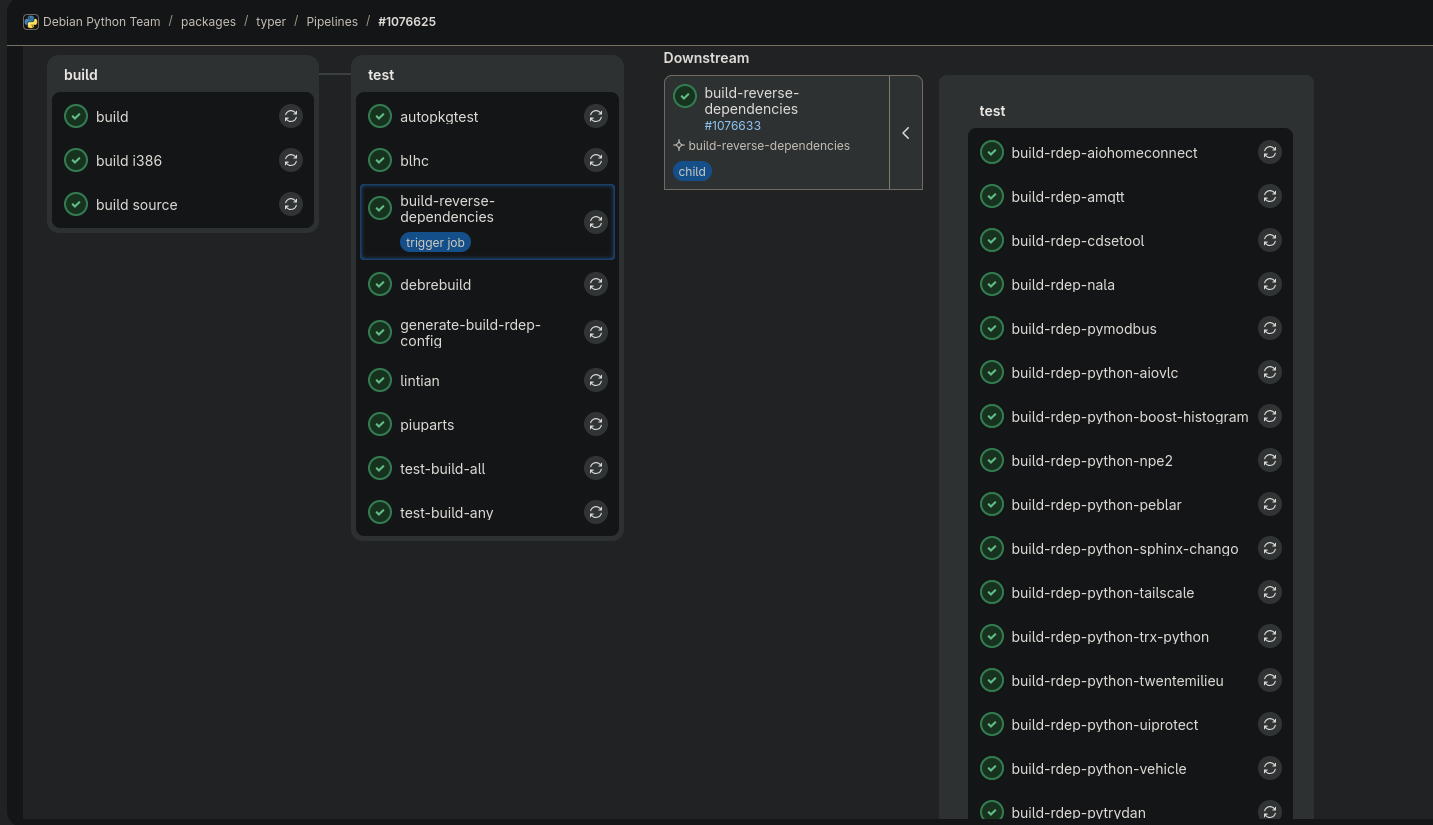 This is an amazing feature. Thanks to everyone involved in making it
happen!
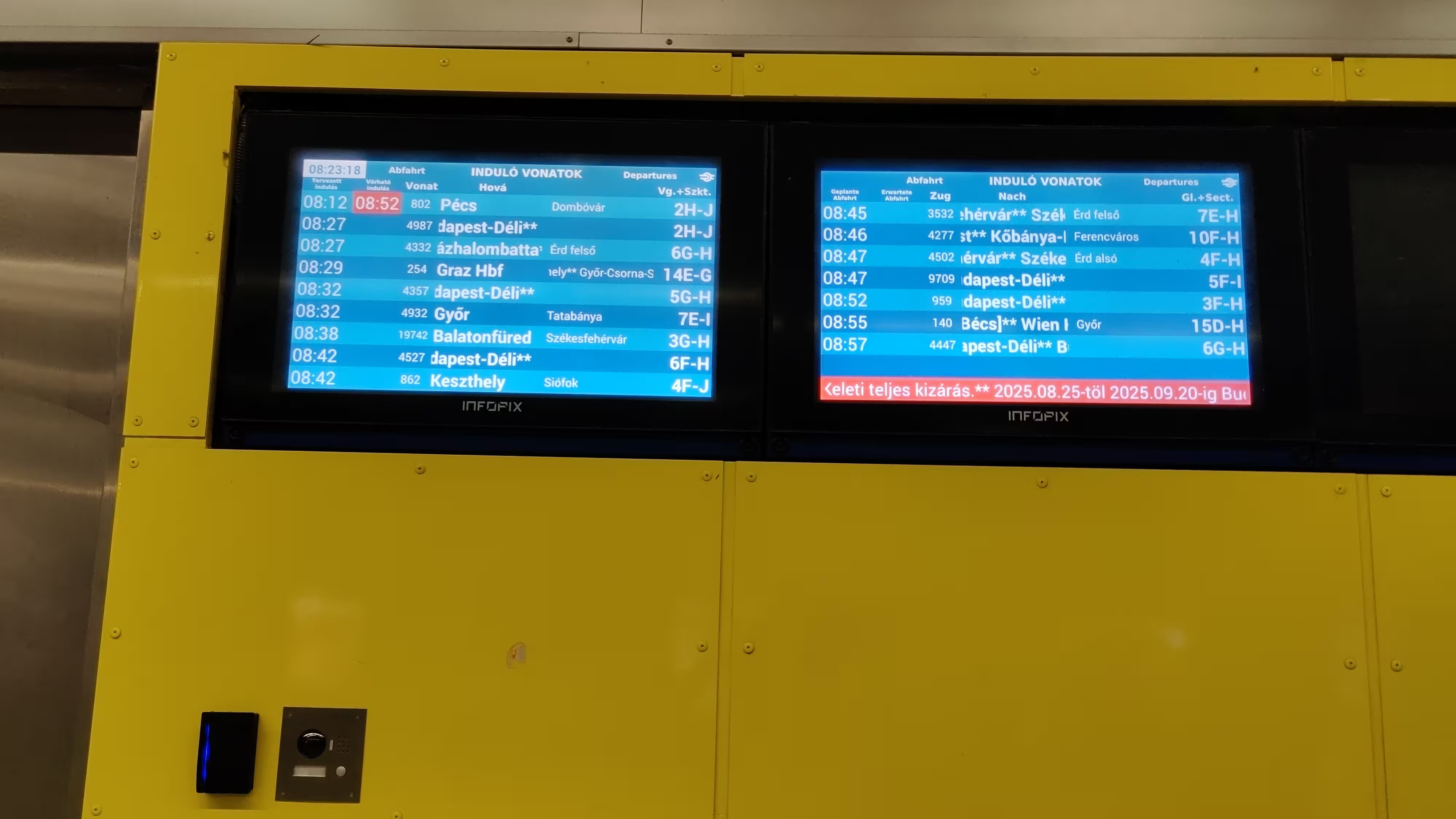 A departures board at Budapest Kelenfold station. Photo by Ravi Dwivedi, released under CC-BY-SA 4.0.
 This is platform number 15 of Budapest Kelenfold station where we boarded our train. Photo by Ravi Dwivedi, released under CC-BY-SA 4.0.
 Interior of our Budapest to Vienna train. Photo by Ravi Dwivedi, released under CC-BY-SA 4.0.
 This blue colored train was the one we took for our Budapest to Vienna journey. Photo by Ravi Dwivedi, released under CC-BY-SA 4.0.
 An BB train standing at a platform of Vienna train station. BB is the national carrier of Austria. Photo by Ravi Dwivedi, released under CC-BY-SA 4.0.
 Wien Hauptbahnhof train station. Photo by Ravi Dwivedi, released under CC-BY-SA 4.0.
 My public transport pass in Vienna.
 Instead of AFC gates, Vienna has ticket validators as in the picture. You need to tap your ticket in the validator before boarding the subway. Photo by Ravi Dwivedi, released under CC-BY-SA 4.0.
 Vienna subway. Photo by Ravi Dwivedi, released under CC-BY-SA 4.0.
 Sch nbrunn Palace. Photo by Ravi Dwivedi, released under CC-BY-SA 4.0.
 A street near Sch nbrunn Palace. Photo by Ravi Dwivedi, released under CC-BY-SA 4.0.
 Ro auer L nde subway station. Photo by Ravi Dwivedi, released under CC-BY-SA 4.0.
 Platform of the Ro auer L nde subway station. Photo by Ravi Dwivedi, released under CC-BY-SA 4.0.
 The The Strudlhofstiege steps. Photo by Ravi Dwivedi, released under CC-BY-SA 4.0.
 A random street in Vienna.
 Another street in Vienna.
 A picture of Blue Orange caf . Photo by Ravi Dwivedi, released under CC-BY-SA 4.0.
 Trams in Vienna. Photo by Ravi Dwivedi, released under CC-BY-SA 4.0.
 Punschkrapfen. Photo by Ravi Dwivedi, released under CC-BY-SA 4.0.
 Esterhazyschnitten. Photo by Ravi Dwivedi, released under CC-BY-SA 4.0.
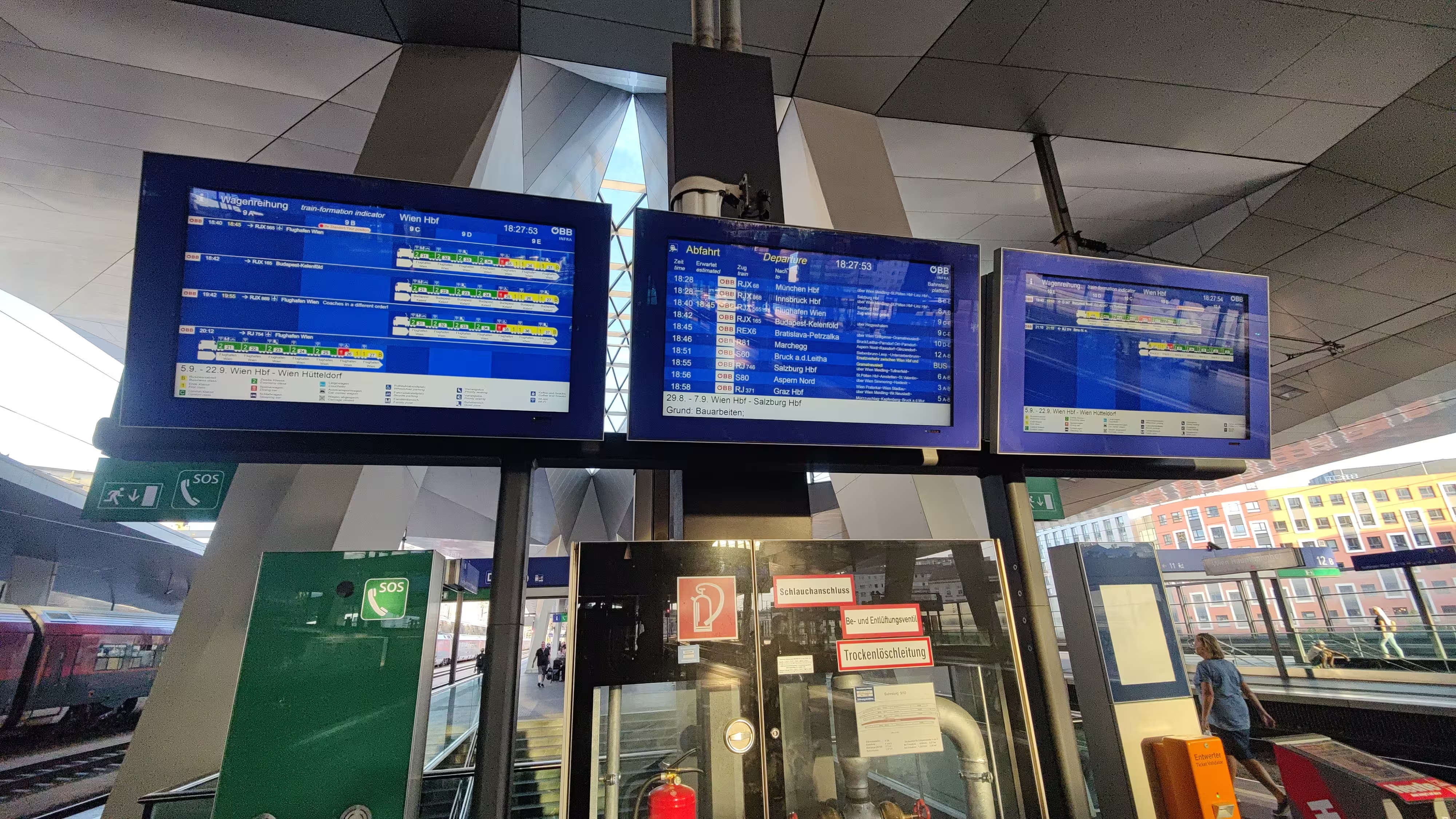 Departure boards in Vienna displaying information about the trains. Photo by Ravi Dwivedi, released under CC-BY-SA 4.0.
 Platform and tracks at Wien Hauptbahnhof station. Photo by Ravi Dwivedi, released under CC-BY-SA 4.0.
 Interior of the train we took from Vienna to Budapest. Photo by Ravi Dwivedi, released under CC-BY-SA 4.0.
 This is the train we took for our return journey from Vienna to Budapest. It is standing on a platform in Budapest Kelenfold station. Photo by Ravi Dwivedi, released under CC-BY-SA 4.0.
 The