Search Results: "hug"

12 November 2022

Debian Brasil: About Debian Brasil at Latinoware 2022

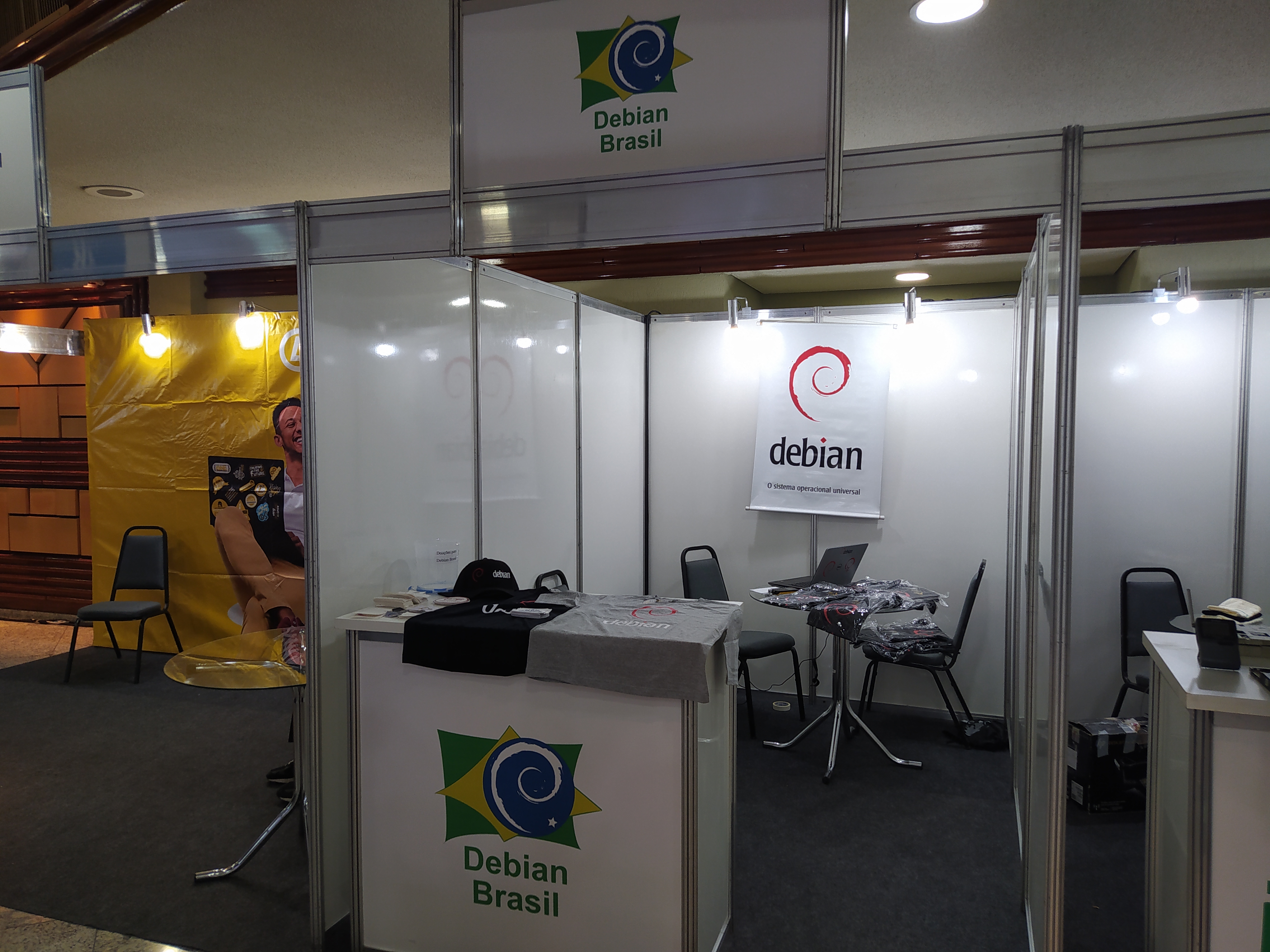
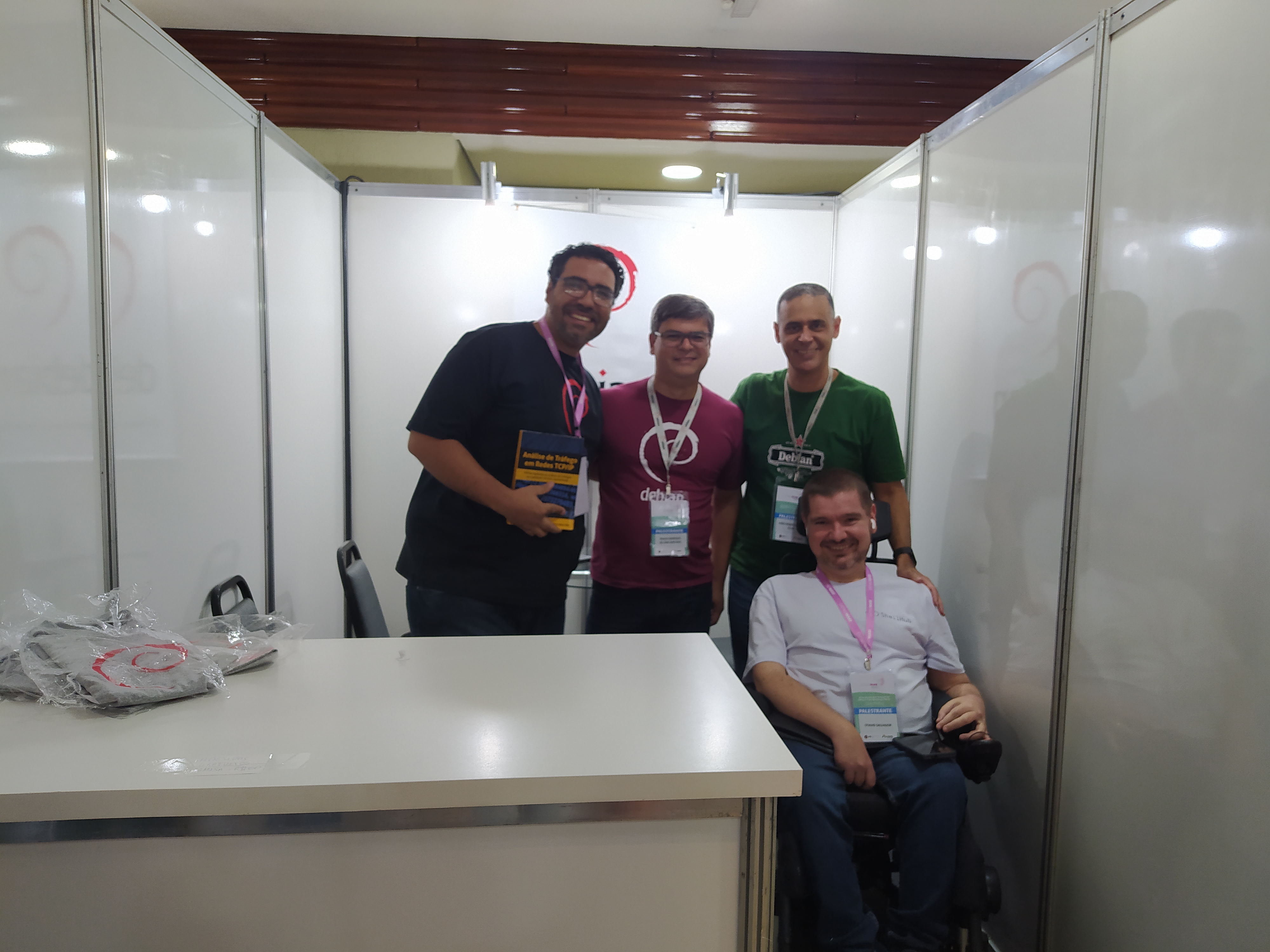
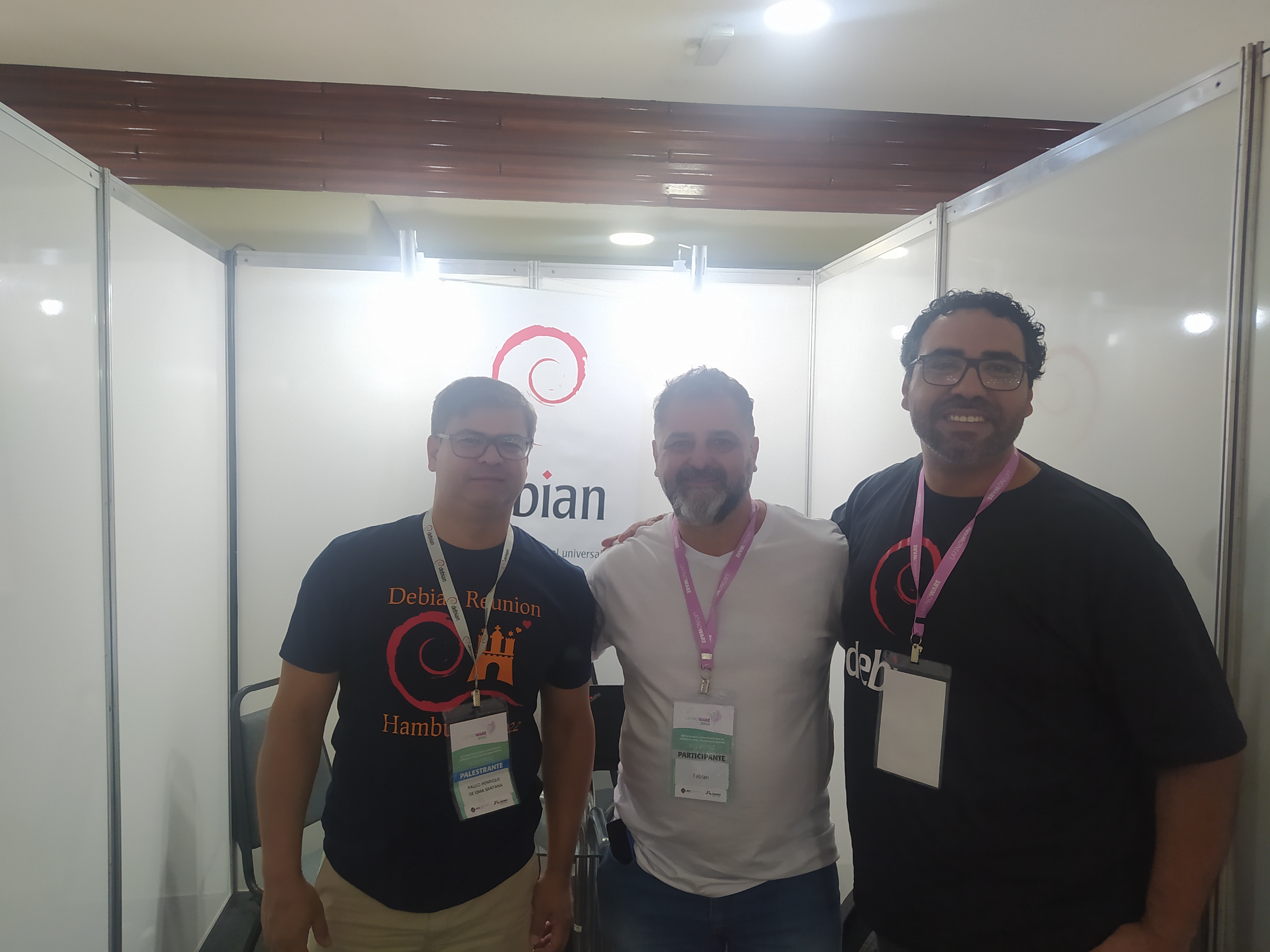
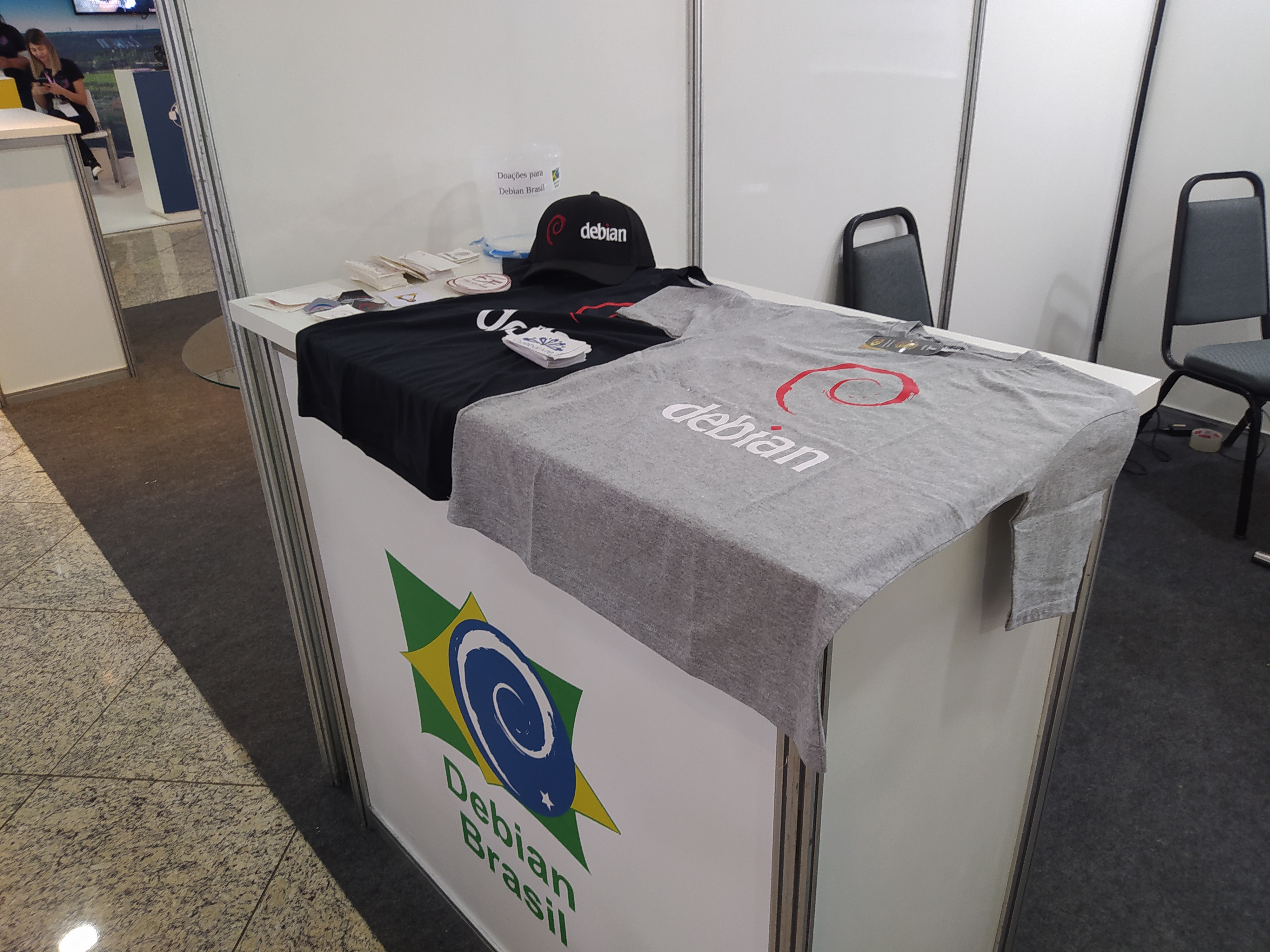
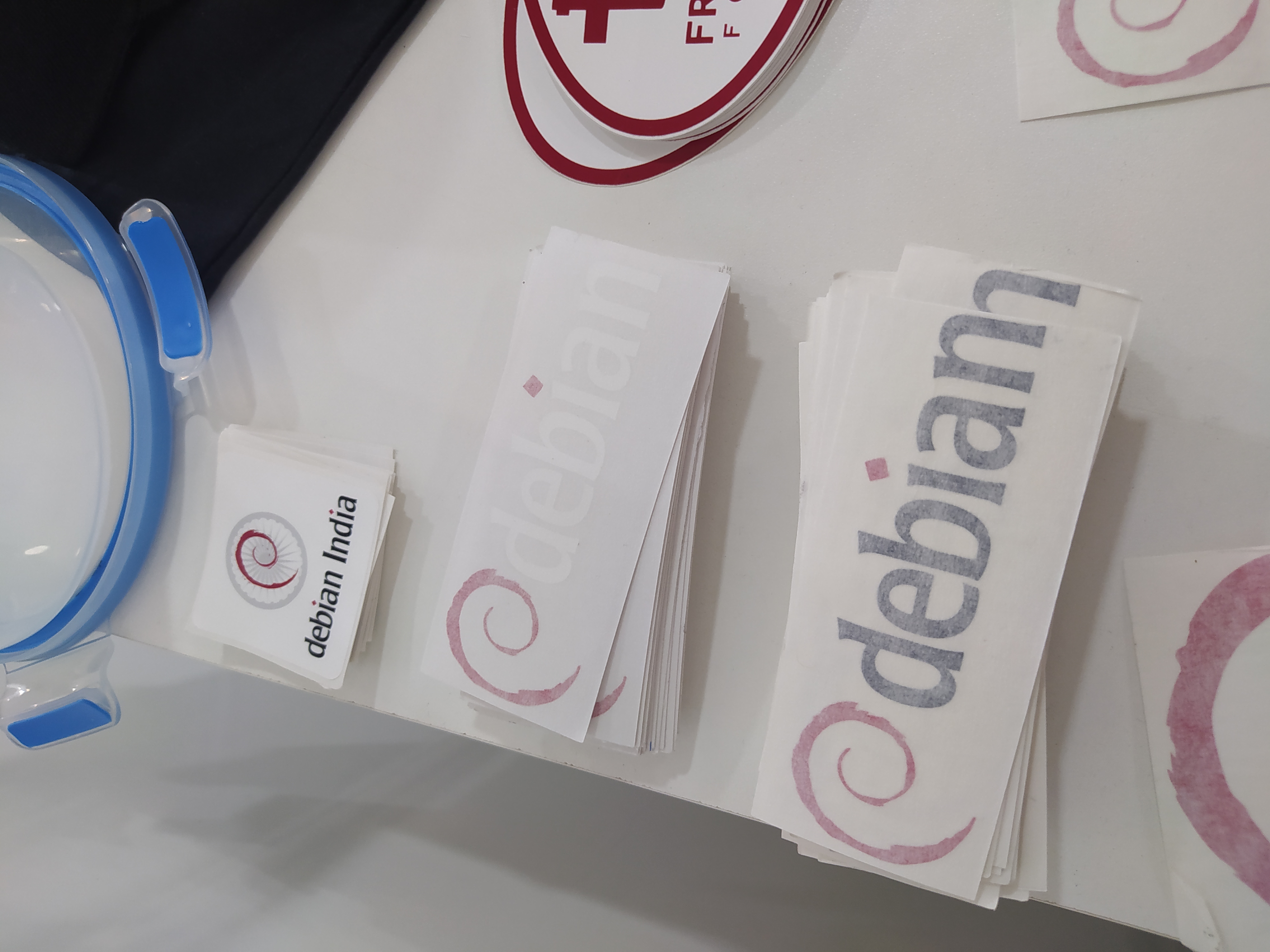
From November 2nd to 4th, 2022, the 19th edition of Latinoware - Latin American Congress of Free Software and Open Technologies took place in Foz do Igua u. After 2 years happening online due to the COVID-19 pandemic, the event was back in person and we felt Debian Brasil community should be there. Out last time at Latinoware was in 2016 The Latinoware organization provided the Debian Brazil community with a booth so that we could have contact with people visiting the open exhibition area and thus publicize the Debian project. During the 3 days of the event, the booth was organized by me (Paulo Henrique Santana) as Debian Developer, and by Leonardo Rodrigues as Debian contributor. Unfortunately Daniel Lenharo had an issue and could not travel to Foz do Igua u (we miss you there!). Latinoware 2022 booth 1 A huge number of people visited the booth, and the beginners (mainly students) who didn't know Debian, asked what our group was about and we explained various concepts such as what Free Software is, GNU/Linux distribution and Debian itself. We also received people from the Brazilian Free Software community and from other Latin American countries who were already using a GNU/Linux distribution and, of course, many people who were already using Debian. We had some special visitors as Jon maddog Hall, Debian Developer Emeritus Ot vio Salvador, Debian Developer Eriberto Mota, and Debian Maintainers Guilherme de Paula Segundo and Paulo Kretcheu. Latinoware 2022 booth 4 Photo from left to right: Leonardo, Paulo, Eriberto and Ot vio. Latinoware 2022 estande 5 Photo from left to right: Paulo, Fabian (Argentina) and Leonardo. In addition to talking a lot, we distributed Debian stickers that were produced a few months ago with Debian's sponsorship to be distributed at DebConf22 (and that were left over), and we sold several Debian t-shirts) produced by Curitiba Livre community). Latinoware 2022 booth 2 Latinoware 2022 booth 3 We also had 3 talks included in Latinoware official schedule. I) talked about: "how to become a Debian contributor by doing translations" and "how the SysAdmins of a global company use Debian". And Leonardo) talked about: "advantages of Open Source telephony in companies". Latinoware 2022 booth 6 Photo Paulo in his talk. Many thanks to Latinoware organization for once again welcoming the Debian community and kindly providing spaces for our participation, and we congratulate all the people involved in the organization for the success of this important event for our community. We hope to be present again in 2023. We also thank Jonathan Carter for approving financial support from Debian for our participation at Latinoware. Portuguese version

Bastian Venthur: Mastodon

Due to recent events around Twitter, I finally decided to give Mastodon a try. Naturally, I find the idea of an open and decentralized platform much more appealing than the privately owned walled gardens that became so hugely popular in the past two decades. I m curious whether Mastodon can keep up the momentum of the last two weeks and eventually establish itself as an alternative to Twitter. On that note, I think it will be interesting to see how well moderation of hate speech etc. works- and scales on Mastodon. I believe that Twitter, Facebook and the likes, spend a significant amount of resources on content moderation, so this may become a huge headache for Mastodon instance admins when it gets more popular. Choosing an Instance For no particular reason, I went with the mastodon.social instance, so my handle is @venthur@mastodon.social. After my first steps, I realized that choosing the instance does have an impact, particularly if you follow the local timeline. mastodon.social is currently one of the biggest instances and therefore the local timeline is very busy and the topics naturally very random. Maybe I ll try out a more specialized instance such as fosstodon at some point one of the awesome features of Mastodon is that it actually supports the migration of accounts between instances! I wonder if there are plans to have an official Debian instance? First Impressions So far I m quite happy with Mastodon. There s good quality content and I already found a few people that I was following on Twitter here on Mastodon too. Interestingly, some of them actually are more active on Mastodon than on Twitter. But truth to be told: many of them do cross-post on both mediums, and most of the people I follow on Twitter are not on Mastodon yet. I do like the concepts of the local- and federated timelines, although they are quite busy. I like that you can set the language of your (individual) toots which allows users to filter their timelines for languages. In practice, this does not work so well yet, and I still see a lot of different languages in my local and federated timelines. I assume the problem is that people just forget to set the language of their toots so the default language is used. This problem should be easily solvable in the frontend by guessing the language once a few words have been typed. I also like the idea that you can follow hashtags, although for me the results were mixed. I tried to follow #debian and #python and got a lot of toots that were not really relevant for me in the case of #python I got quite spammed with job ads so I had to unfollow it again. Unfollwing a hashtag is not very intuitive, as the tags are not in your list of people you follow, so you have to find the page of the hashtag itself (e.g. #debian) and unfollow from there. You see, there are some rough edges here and there, but I find the overall experience much more enjoyable than Twitter. Debian Folks in the Fediverse? Which brings me to: are there any Debian Developers or -Maintainers out there to follow in the fediverse? I found most of the ones I m following on Twitter, but I m sure there s more hiding out there.

11 November 2022

Debian Brasil: About Debian Brasil at Latinoware 2022

From November 2nd to 4th, 2022, the 19th edition of Latinoware - Latin American Congress of Free Software and Open Technologies took place in Foz do Igua u. After 2 years happening online due to the COVID-19 pandemic, the event was back in person and we felt Debian Brasil community should be there. Out last time at Latinoware was in 2016 The Latinoware organization provided the Debian Brazil community with a booth so that we could have contact with people visiting the open exhibition area and thus publicize the Debian project. During the 3 days of the event, the booth was organized by me (Paulo Henrique Santana) as Debian Developer, and by Leonardo Rodrigues as Debian contributor. Unfortunately Daniel Lenharo had an issue and could not travel to Foz do Igua u (we miss you there!). Latinoware 2022 booth 1 A huge number of people visited the booth, and the beginners (mainly students) who didn't know Debian, asked what our group was about and we explained various concepts such as what Free Software is, GNU/Linux distribution and Debian itself. We also received people from the Brazilian Free Software community and from other Latin American countries who were already using a GNU/Linux distribution and, of course, many people who were already using Debian. We had some special visitors as Jon maddog Hall, Debian Developer Emeritus Ot vio Salvador, Debian Developer Eriberto Mota, and Debian Maintainers Guilherme de Paula Segundo and Paulo Kretcheu. Latinoware 2022 booth 4 Photo from left to right: Leonardo, Paulo, Eriberto and Ot vio. Latinoware 2022 estande 5 Photo from left to right: Paulo, Fabian (Argentina) and Leonardo. In addition to talking a lot, we distributed Debian stickers that were produced a few months ago with Debian's sponsorship to be distributed at DebConf22 (and that were left over), and we sold several Debian t-shirts) produced by Curitiba Livre community). Latinoware 2022 booth 2 Latinoware 2022 booth 3 We also had 3 talks included in Latinoware official schedule. I) talked about: "how to become a Debian contributor by doing translations" and "how the SysAdmins of a global company use Debian". And Leonardo) talked about: "advantages of Open Source telephony in companies". Latinoware 2022 booth 6 Photo Paulo in his talk. Many thanks to Latinoware organization for once again welcoming the Debian community and kindly providing spaces for our participation, and we congratulate all the people involved in the organization for the success of this important event for our community. We hope to be present again in 2023. We also thank Jonathan Carter for approving financial support from Debian for our participation at Latinoware. Portuguese version

Reproducible Builds: Reproducible Builds in October 2022

Welcome to the Reproducible Builds report for October 2022! In these reports we attempt to outline the most important things that we have been up to over the past month. As ever, if you are interested in contributing to the project, please visit our Contribute page on our website.

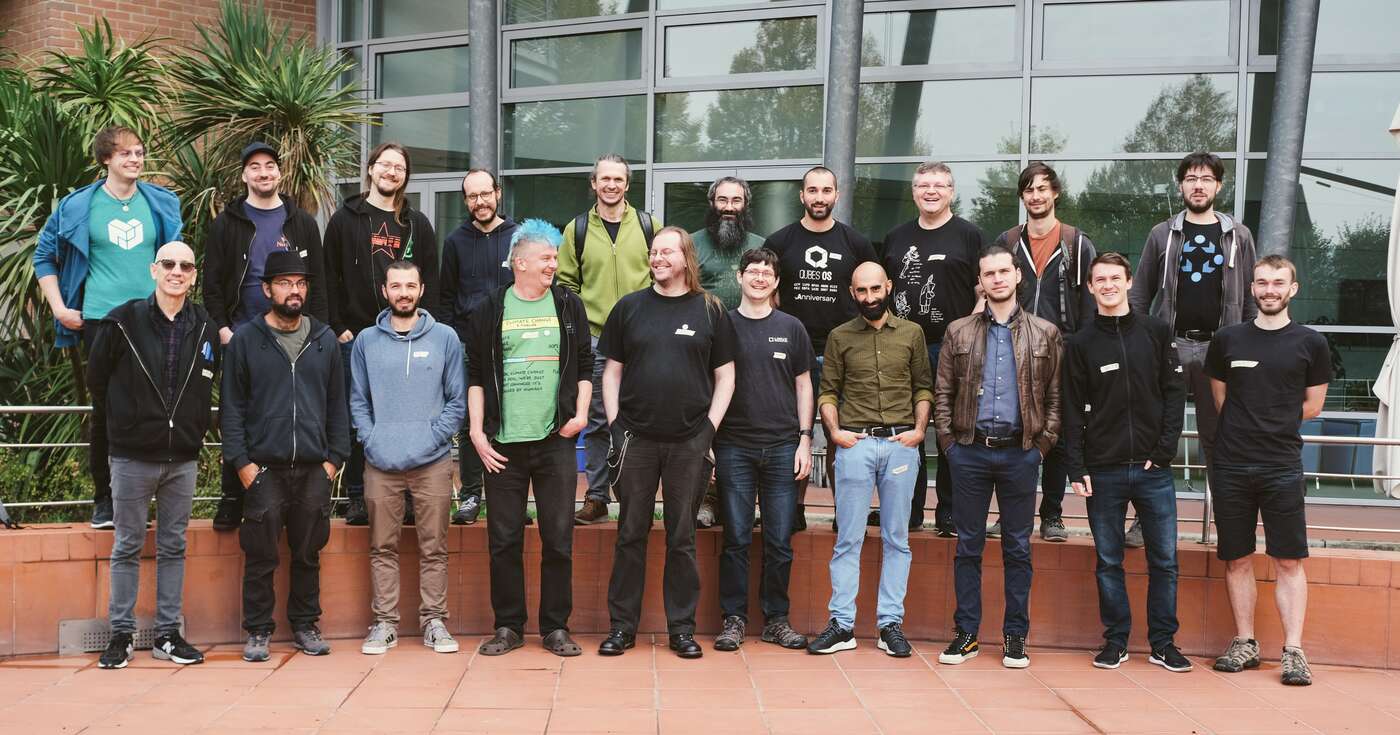
Our in-person summit this year was held in the past few days in Venice, Italy. Activity and news from the summit will therefore be covered in next month s report!
A new article related to reproducible builds was recently published in the 2023 IEEE Symposium on Security and Privacy. Titled Taxonomy of Attacks on Open-Source Software Supply Chains and authored by Piergiorgio Ladisa, Henrik Plate, Matias Martinez and Olivier Barais, their paper:
[ ] proposes a general taxonomy for attacks on opensource supply chains, independent of specific programming languages or ecosystems, and covering all supply chain stages from code contributions to package distribution.
Taking the form of an attack tree, the paper covers 107 unique vectors linked to 94 real world supply-chain incidents which is then mapped to 33 mitigating safeguards including, of course, reproducible builds:
Reproducible Builds received a very high utility rating (5) from 10 participants (58.8%), but also a high-cost rating (4 or 5) from 12 (70.6%). One expert commented that a reproducible build like used by Solarwinds now, is a good measure against tampering with a single build system and another claimed this is going to be the single, biggest barrier .

It was noticed this month that Solarwinds published a whitepaper back in December 2021 in order to:
[ ] illustrate a concerning new reality for the software industry and illuminates the increasingly sophisticated threats made by outside nation-states to the supply chains and infrastructure on which we all rely.
The 12-month anniversary of the 2020 Solarwinds attack (which SolarWinds Worldwide LLC itself calls the SUNBURST attack) was, of course, the likely impetus for publication.
Whilst collaborating on making the Cyrus IMAP server reproducible, Ellie Timoney asked why the Reproducible Builds testing framework uses two remarkably distinctive build paths when attempting to flush out builds that vary on the absolute system path in which they were built. In the case of the Cyrus IMAP server, these happened to be: Asked why they vary in three different ways, Chris Lamb listed in detail the motivation behind to each difference.
On our mailing list this month:
The Reproducible Builds project is delighted to welcome openEuler to the Involved projects page [ ]. openEuler is Linux distribution developed by Huawei, a counterpart to it s more commercially-oriented EulerOS.

Debian Colin Watson wrote about his experience towards making the databases generated by the man-db UNIX manual page indexing tool:
One of the people working on [reproducible builds] noticed that man-db s database files were an obstacle to [reproducibility]: in particular, the exact contents of the database seemed to depend on the order in which files were scanned when building it. The reporter proposed solving this by processing files in sorted order, but I wasn t keen on that approach: firstly because it would mean we could no longer process files in an order that makes it more efficient to read them all from disk (still valuable on rotational disks), but mostly because the differences seemed to point to other bugs.
Colin goes on to describe his approach to solving the problem, including fixing various fits of internal caching, and he ends his post with None of this is particularly glamorous work, but it paid off .
Vagrant Cascadian announced on our mailing list another online sprint to help clear the huge backlog of reproducible builds patches submitted by performing NMUs (Non-Maintainer Uploads). The first such sprint took place on September 22nd, but another was held on October 6th, and another small one on October 20th. This resulted in the following progress:
41 reviews of Debian packages were added, 62 were updated and 12 were removed this month adding to our knowledge about identified issues. A number of issue types were updated too. [1][ ]
Lastly, Luca Boccassi submitted a patch to debhelper, a set of tools used in the packaging of the majority of Debian packages. The patch addressed an issue in the dh_installsysusers utility so that the postinst post-installation script that debhelper generates the same data regardless of the underlying filesystem ordering.

Other distributions F-Droid is a community-run app store that provides free software applications for Android phones. This month, F-Droid changed their documentation and guidance to now explicitly encourage RB for new apps [ ][ ], and FC Stegerman created an extremely in-depth issue on GitLab concerning the APK signing block. You can read more about F-Droid s approach to reproducibility in our July 2022 interview with Hans-Christoph Steiner of the F-Droid Project. In openSUSE, Bernhard M. Wiedemann published his usual openSUSE monthly report.

Upstream patches The Reproducible Builds project detects, dissects and attempts to fix as many currently-unreproducible packages as possible. We endeavour to send all of our patches upstream where appropriate. This month, we wrote a large number of such patches, including:

diffoscope diffoscope is our in-depth and content-aware diff utility. Not only can it locate and diagnose reproducibility issues, it can provide human-readable diffs from many kinds of binary formats. This month, Chris Lamb prepared and uploaded versions 224 and 225 to Debian:
  • Add support for comparing the text content of HTML files using html2text. [ ]
  • Add support for detecting ordering-only differences in XML files. [ ]
  • Fix an issue with detecting ordering differences. [ ]
  • Use the capitalised version of Ordering consistently everywhere in output. [ ]
  • Add support for displaying font metadata using ttx(1) from the fonttools suite. [ ]
  • Testsuite improvements:
    • Temporarily allow the stable-po pipeline to fail in the CI. [ ]
    • Rename the order1.diff test fixture to json_expected_ordering_diff. [ ]
    • Tidy the JSON tests. [ ]
    • Use assert_diff over get_data and an manual assert within the XML tests. [ ]
    • Drop the ALLOWED_TEST_FILES test; it was mostly just annoying. [ ]
    • Tidy the tests/test_source.py file. [ ]
Chris Lamb also added a link to diffoscope s OpenBSD packaging on the diffoscope.org homepage [ ] and Mattia Rizzolo fix an test failure that was occurring under with LLVM 15 [ ].

Testing framework The Reproducible Builds project operates a comprehensive testing framework at tests.reproducible-builds.org in order to check packages and other artifacts for reproducibility. In October, the following changes were made by Holger Levsen:
  • Run the logparse tool to analyse results on the Debian Edu build logs. [ ]
  • Install btop(1) on all nodes running Debian. [ ]
  • Switch Arch Linux from using SHA1 to SHA256. [ ]
  • When checking Debian debstrap jobs, correctly log the tool usage. [ ]
  • Cleanup more task-related temporary directory names when testing Debian packages. [ ][ ]
  • Use the cdebootstrap-static binary for the 2nd runs of the cdebootstrap tests. [ ]
  • Drop a workaround when testing OpenWrt and coreboot as the issue in diffoscope has now been fixed. [ ]
  • Turn on an rm(1) warning into an info -level message. [ ]
  • Special case the osuosl168 node for running Debian bookworm already. [ ][ ]
  • Use the new non-free-firmware suite on the o168 node. [ ]
In addition, Mattia Rizzolo made the following changes:
  • Ensure that 2nd build has a merged /usr. [ ]
  • Only reconfigure the usrmerge package on Debian bookworm and above. [ ]
  • Fix bc(1) syntax in the computation of the percentage of unreproducible packages in the dashboard. [ ][ ][ ]
  • In the index_suite_ pages, order the package status to be the same order of the menu. [ ]
  • Pass the --distribution parameter to the pbuilder utility. [ ]
Finally, Roland Clobus continued his work on testing Live Debian images. In particular, he extended the maintenance script to warn when workspace directories cannot be deleted. [ ]
If you are interested in contributing to the Reproducible Builds project, please visit our Contribute page on our website. However, you can get in touch with us via:

4 November 2022

Alastair McKinstry: 1.3 billion announced for new Forestry Support

1.3 billion announced for new Forestry Support Funds to be delivered through new Forestry Programme Premiums for planting trees to be increased by between 46% and 66% and extended to 20 years for farmers #GreensInGovernment The Taoiseach, Miche l Martin TD, Minister of State with responsibility for Forestry, Senator Pippa Hackett, and Minister for Agriculture, Food and the Marine, Charlie McConalogue T.D today announced a proposed investment by the Government of 1.3 billion in Irish forestry. The funding will be for the next national Forestry Programme and represents the largest ever investment by an Irish Government in tree-planting. The programme will now be the subject of state-aid approval by the European Commission. The Taoiseach said: This commitment by the Government to such a substantial financial package reflects the seriousness with which we view the climate change and biodiversity challenges, which affect all of society. Forestry is at the heart of delivering on our sustainability goals and strong support is needed to encourage engagement from all our stakeholders in reaching our objectives. Minister Hackett said: I m delighted to have secured a package of 1.318 billion for forestry. This will support the biggest and best-funded Forestry Programme ever in Ireland. It comes at an appropriate time, given the urgency of taking climate mitigation measures. Planting trees is one of the most effective methods of tackling climate change as well as contributing to improved biodiversity and water quality. One of my main aims is to re-engage farmers in afforestation. I m delighted therefore to be proposing a new 20-year premium term exclusively for farmers, as well as introducing a new small-scale native woodland scheme which will allow farmers to plant up to 1 hectare of native woodland on farmland and along watercourses outside of the forestry licensing process. Minister McConalogue said: Today we commit to providing unprecedented incentives to encourage the planting of trees that can provide a valuable addition to farm income and help to meet national climate and biodiversity objectives. This funding guarantees continued payments to those forest owners who planted under the current scheme and who are still in receipt of premiums. It also offers new and improved financial supports to those who undertake planting and sustainable forest management under the new Programme. We intend to increase premiums for planting trees by between 46% and 66% and to extend the premium period from 15 to 20 years for farmers. "We are approaching a new and exciting period for forestry in Ireland. The new Forestry Programme will drive a new and brighter future for forestry, for farmers and for our climate. The proposed new Forestry Programme is currently out to public consultation as part of the Strategic Environmental Assessment and Appropriate Assessment process. The Programme is the main implementation mechanism for the new Forest Strategy (2023 -2030) which reflects the ambitions contained in the recently published Shared National Vision for Trees, Woods and Forests in Ireland until 2050. The public consultation closes on 29th November, 2022 and any changes which result from this process will be incorporated into the Programme and the Forest Strategy. Minister Hackett commented: The draft Forestry Programme and Forest Strategy are the product of extensive stakeholder consultation and feedback, and both documents are open to public consultation for the next number of weeks. I would strongly encourage all interested parties to engage with the consultation in advance of the Strategy and Programme being finalised. The new Programme is built around the principle of right trees in the right places for the right reasons with the right management. It aims to deliver more diverse forest which will meet multiple societal objectives, economic, social and environmental. Higher grant rates for forest establishment are also proposed with increases of approximately 20% to reflect rising living costs. The new one hectare native tree area scheme will also make it easier for landowners who wish to plant small areas of trees on their farm. The Taoiseach concluded I welcome this milestone and I believe that this funding injection will be an important catalyst in delivering on the ambition outlined in the new Forest Strategy. Our environmental challenges are huge but so is our commitment to overcoming them and this Forestry Programme is key to delivering so many of our priorities. The new Programme will be 100% Exchequer funded and is subject to State Aid approval from the EU Commission. The Department is in contact with the Commission in relation to this approval which is a rigorous process.

3 November 2022

Arturo Borrero Gonz lez: New OpenPGP key and new email

Post logo I m trying to replace my old OpenPGP key with a new one. The old key wasn t compromised or lost or anything bad. Is still valid, but I plan to get rid of it soon. It was created in 2013. The new key id fingerprint is: AA66280D4EF0BFCC6BFC2104DA5ECB231C8F04C4 I plan to use the new key for things like encrypted emails, uploads to the Debian archive, and more. Also, the new key includes an identity with a newer personal email address I plan to use soon: arturo.bg@arturo.bg The new key has been uploaded to some public keyservers. If you would like to sign the new key, please follow the steps in the Debian wiki.
-----BEGIN PGP PUBLIC KEY BLOCK-----
mQINBGNjvX4BEADE4w5x0SQmxWLAI1R17RCC98ngTkD/FMyos0GF5xmv0VJeLYhw
x6oJRmiNGHY8+gjq7SyVCWmlwbLKBEPFNI1k5WcrTB+ClgGkWB5KBnbLKm6CSP4N
ccSbrUQrZW+zxk3Q5h3CJljZpmflB2dvRfnDMSSaw8zOc37EtszW3AVVKNYAu3wj
mXpfwI72/OSELhSvhkr51L+ZlEYUMCITeO+jpiWsnU+sA8oKKPjW4+X8cjrN4eFa
1PAPILDf+Omst5SKM2aV5LGZ8rBzb5wNJF6yDexDw2XmfbFWLOfYzFRY6GTXJz/p
8Fh6O1wkHM9RnwmesCXTtkaGQsVFiVsoqGFyzrkIdWPUruB3RG5EzOkapWi/cnbD
1sy7yrUgy99Ew5yzmLaZ40hmRyq/gBBw4yRkdQaddbkErx+9hT+2tJELa5wrmWkb
FtaVZ38xC6gacOZqRjp0Xqtr0jobI0vED8vzIyY0zJwWM0Hu6qqq4hkLWZHjCy8a
T5Oe/Cb78Kqwa2mzJfncDahPxcgxpnbkYdvKokRtNBDftLVEz+Do8Dczw7Me4BoK
HmU8wLyeGeDTmeoBXpxKH90T+rQokgsiiD13bWZ+nBxILun1tjOTVVONG6SHdP3f
unolq8SU3K+m67lLa+pWjyYcNRS2OTWGOz/1zsH2R39ZOyfGD09/10aAKwARAQAB
tC1BcnR1cm8gQm9ycmVybyBHb256YWxleiA8YXJ0dXJvLmJnQGFydHVyby5iZz6J
AlQEEwEKAD4WIQSqZigNTvC/zGv8IQTaXssjHI8ExAUCY2O9fgIbAwUJA8JnAAUL
CQgHAwUVCgkICwUWAgMBAAIeAQIXgAAKCRDaXssjHI8ExCZdD/9Z3vR4sV7vBED4
+mCjdNWWf/mw5YlkZo+XQiMVVss4HfQLdt7VxXgGdcOz5Hond9ax3+qeCEo4DdXq
TC0ACpSCu/TPil6vzbE/kO6i6a4oZjFyteAbbcMXP35stbtDM0U5EZH0adIKknfF
msIPTIdJ/dpkcshtBJIoPqjuuTEBa7bF3OYCajHVqwP4Wsgjy4TvDOwl3hy7bhrQ
ZZHqbh7kW40+alQYaJ8jDvbDh/jhN1/pEiZS9ETu0JfBAF3PYPRLW6XedvwZiPWd
jTXwJd0E+vN5LE1Go8OaYvZb9iitZ21UaYOUnFuhw7SEOSQGfEUBs39+41gBj6vW
05HKCEA6kda9NpfptMbUoSSU+hwRfNA5TdnlxtcRv4NqUigzqa1LoXLdxTsyus+K
BL7dRpKXc72JCrEA3vClisD2FgsxLLRCCSDVM8UM/it/YW7tv42XuhQkTW+okQX4
c5laMzTL+ZV8UOoshseTDOsQsdXhskdnWbnuSwAez2/Dd1gHczuN/+lPiiEnyaTF
XgH17K/F25+92MmwPQcFRVPQcYcbyx1VylA6aCgK6gOEqHCejlZv5XLouzbQh1j1
k6MjUR1ncz8vPV5xSuOMAISqozJ9GxUZT2O3o9Vc9pNg5UEzqTvyURgLOdie8yM4
T93S3nKuHVZ++ZVxEOlPnfEfbFP+xbQrQXJ0dXJvIEJvcnJlcm8gR29uemFsZXog
PGFydHVyb0BkZWJpYW4ub3JnPokCVAQTAQoAPhYhBKpmKA1O8L/Ma/whBNpeyyMc
jwTEBQJjY73LAhsDBQkDwmcABQsJCAcDBRUKCQgLBRYCAwEAAh4BAheAAAoJENpe
yyMcjwTEMKQQAIe18Np+jdhwxHEFZNppBQ69BtyrnPQg4K5VngZ0NUZdVi+/FU7q
Tc9Z1qNydnXgmav3dafL2/l5zDX9wz7mQD2F0a6luOxZwl1PE6iP5f3cUD7uC9zb
148i1bZGEJbO4iNZKTlJKlbNR9m1PG47pv964CHZnNGp6lsnEspxe2G8DJD48Pje
gbhYukgOtIhQ1CaB1fc8aVwZvXZVSbNBLAqp7pAGhTFJqzHE8/U0sn1/V/wPzFAd
TZtWzKfYAkIIFJI5Rr6LVApIwIe7nWymTdgH4crCd2GZkGR+d6ihPKVSxUAUfoAx
EJQUSJY8rYi39gSDhPuEoK8BYXS1nWFGJiNV1o8xaljQo8rNT9myCaeZuQBLX41/
LRzK4XrxYPvjZpKNucc7fSK+UFriQGzdcAaWtW45Kp/8GmAoLVyCD0DPZNWNJdxp
IORhB33aWakhvDKgaLQa16MJ8fSc3ytn/1lxWzDXA1j05i81y/AOKPtCwBKzQWPF
biuZs3kJgZagLq6L6VOQDHlKqf+jqfl1fWeo04iDg98e0TYKABUfiTz8/MdQcV/X
8VkCgtuZ8BcPPyYzBjvuXWZTvdu0n2pikqAPL4u2cbWfD8JIP2AVCJp9HMGKvENo
XcJgY4h6T3rrC/9EidxECfXlsDbUJxLq0WfJLik84+LRtde3kZiReaIRtC5BcnR1
cm8gQm9ycmVybyBHb256YWxleiA8YXJ0dXJvQG5ldGZpbHRlci5vcmc+iQJUBBMB
CgA+FiEEqmYoDU7wv8xr/CEE2l7LIxyPBMQFAmNjvd8CGwMFCQPCZwAFCwkIBwMF
FQoJCAsFFgIDAQACHgECF4AACgkQ2l7LIxyPBMSP/g/+MHmxCAi/X+NMHodg9Qou
wEG4Vf1uluAE6c+c1QECCdtSsRjBs1dZoJzGsA23t4LWqluyaptuLDWJQEz+EVKR
mG0bvvropNaoOEShnY069pg7lUHuO/GLeDRhfEH3KT45sIVbLly8QkoGaINSCDLe
RBNaHC6feIC8NfQzQEt72nbi4SgdSQUg0F3lj4WxxECVhXsw/YCqh1d3QYqwRVEE
lCGQ4EbavjtRhO8U7dcL1VwHemKHNq3XvM3PJf1OoPgxWqFW5rHbAdlXdN3WAI6u
DAy7kY+qihz3w6rIDTFq6I3YBTrZ44J+5mN21ZC2iDXAsa/C3Uam0vFsjs/pizuq
WgGI9Vmsyap+bOOjuRSX4hemZoOT4a2GC723fS1dFresYWo3MmwfA3sjgV5tK3ZN
XIpxYIvi6HAHLOAarDaE8Sha1GHvrmPwfZ+cEgTL0mqW3efSF3AFmGHduMB+agzK
rM9sksrRQhbY2fHnBLo1t06SQx3rmhlz5mD1ljQEIzna9D6QKleRu4hgImRLHnCB
CN3o+mZa1MHhaIFzViaD2i3Fv2+bYgT7vnS4QAneLW8O/ZgpAc2MUxMoci5JNyfJ
mWdae7Kbs4Z8rrt/mH2gYyioSB0po4VtVwKWEUW9cLtZusA6mFnMviFpfjakb9TX
MimBAv9hAYpxd+HdfHinmqS0MEFydHVybyBCb3JyZXJvIEdvbnphbGV6IDxhYm9y
cmVyb0B3aWtpbWVkaWEub3JnPokCVAQTAQoAPhYhBKpmKA1O8L/Ma/whBNpeyyMc
jwTEBQJjY735AhsDBQkDwmcABQsJCAcDBRUKCQgLBRYCAwEAAh4BAheAAAoJENpe
yyMcjwTEGooP/20PR5N34m7CNtyaO96H5W0ULuAuSNuoXaKWDo5LGU6zzDriXbIu
ryYtR66vWF5suf7fHZYX8Ufq4PEsG1UNYEGA9hnjPg3oVwGzBJI7f6Rl2P5Pc8wJ
Eq2kN/xKmfUKIrvgh1f5xgFqC4hzcLDkVlLsPowZWfep8dLY4mtVrsrCD1URhelw
zRDGZ3rTVHWXmfXbSHWR2bgZIIrCtVF8BHStg5b6HuAWpj4Oa0eMfBde0N2RZkLE
ye/r2y/lraHfpT7MXnRMcEmltrv8fic7yvj/Nh4ESWr7UmfbV+GiSw9dc/AlVMXM
ihaW0eXv4F5uMtLJOiqI7bv3UfWSvoqwf2a8EPnzOeBBHhQOOJN7O4UzKBK5GAO8
C3k0I1AV3cTmrXrqT/5yoYAHSekDFCIPES//6Y/pO0ITtCbXkA5e8vaulJbtyXpE
g0Z7I7M1kikL6reZ2PuzsR0psEb/x81bWXODIegyOJolPXMRAY7n9J0xpCnSW9yr
CN4j6YT3Oame04JslwX5Xg1cyheuiusotETYNSKRaGaYBCxYffOWoTLNIBa+RCGc
SVOzJq5pd8fVRM1h2ZZFnfpPJBUb62qPsbk6VwmesGoGevB70zcNQYEI+c35kRfM
IOuJWRIN3Wxx0rpxb5E3i/3TASHM86Dix1VW9vsC/atGU/cgaoTOiNVztDdBcnR1
cm8gQm9ycmVybyBHb256YWxleiA8YXJ0dXJvLmJvcnJlcm8uZ2xlekBnbWFpbC5j
b20+iQJUBBMBCgA+FiEEqmYoDU7wv8xr/CEE2l7LIxyPBMQFAmNjvg8CGwMFCQPC
ZwAFCwkIBwMFFQoJCAsFFgIDAQACHgECF4AACgkQ2l7LIxyPBMS7NA/9F7OL/j7a
xnTDjxAHEiyrCzrBQc/DEAM/yim8E+0UBeTJSZR/bShtbvLbSukeL43tKksPhN/X
skjRF8sJ8KWUnpmSWjv1DQTh7AtkJqACnq7+VtQZq3yuKUCNRNpM8lSFxtmYDUqE
XXD4eMXKoJfdphQ+qpViba+RGXg6sd69Dq739zT/OFMuKZ33z8h7hVNXmoWGcBz6
txvN3cWVJhTLdiBvtn38/0dX7IupQLypLOtP0oZdjoUjkRxTo5biOxt3hUGnxS4x
97PPeRGc4j7lv5ADwFV8bo+g54ZMGRjOcyZmA7dlWFN51JrTx3udW2jgXkYqm7UM
xP4lNwDs9TmT3jan6wR08uwlDakOXfDm3gCQEviN+350sJs2tY+JKBN4QR7NpqeU
2aDFOo0G/0ggf0QbFsMkaTSozerVHRGXMdAi+pbYA6pPWPu8lHIkvvdoj4xUu+Ko
cHX0DCRxmL9mylTbZEanrp5gSpne79McrkbQX2/Yc8lWykCtL5/jHVTD4iNiO5Rf
IJYPAVmC2nlj2URfzwGjjoL5apTStZfng4H2Ccq+3cmhwOXI7pb+PsGeI5PND00A
qHFxe590HFhPxLHoftMIlspstoCvHYGcWQxHNbXW6ccmhHdNYT8Pn4ecKgfr6pCt
0ysilOD2ppPJ88hffKA4nTdtX2Tz2ZwOYwG5Ag0EY2O9fgEQALrapVuv1IcLDit8
9gejdA/Dtlufb2/baImVaQD+dTx2QdMxxEiNKl00a5OhMzXDj9tFrB1Lv4z0t8cY
iDJ+NuydDGgz3MlJgWW0GlpAz8yiul2iqTnkWl3cWeiI+VaX8wzL+acmmkPvlrN8
hM7I55BPr8uBWVIQ7VDmI+ts8gi73xE+Etzzrh13GSSnnYnezfGUQrNfYFcip7D0
hB3bpUIGiPdQ45vSZqXUQx/B6FlabiIGRau8Rt4vaEBGXGFZ9rIR+rMJWx6GqYX4
uY1KM2JZ3SKHk++MWGYdzHdM2oaP6xckZq+u/WiwutkYLLO2hnr03lcAu1IDT1C1
YNPrbTKfqUt+3r0oUK5BrG1Cjdc1mZqcXzYcexOLp79FJLb0t5wPdfgU8dT10kjE
uQxeSYiS4oSpikVQkKoFk++/U95d/z/y/81A6v+cfRus6mW+wRSFSwks7Q5ct7zW
UyKELLC4i4EDgnJXmavVcBD0TWzhH/rZpz9FsO4Mb18IYwbV1/144019/RjiPk5Z
MMNdsjorjV2MtrCIoeAGRgZhbFP2P7CcZOp6ZWzjj40ENlElbLp3VCfkYcTiPHJv
2iaiDz2Mhfmhb1Q/5d/a9tYTYINPmv2QVo+m5Zf+1/U29d2HZMRhD4aqDsivvgtd
GpAnKeus6ePSMqpwjO6v2bmQhjpbABEBAAGJAjwEGAEKACYWIQSqZigNTvC/zGv8
IQTaXssjHI8ExAUCY2O9fgIbDAUJA8JnAAAKCRDaXssjHI8ExA5AD/9VWS1/jHM9
aE3HKCDL4CpiXQPc4ds+3/ft6LXwuCMA/tkt8I4svKZGCCi/X5NfiQetVD+cSzVO
nmloctMt/24yjnGNNSFsDozkn/RqzZIhLJBI69gX4JWR4wpeh4kXMItNM5ZlYw3H
DmuLrf/ey8E2NzbFdzj1VQNoENuwtL2pIJrvK92AcS7acvP0FpiS8riLc5a933SW
oPgelQ1j/04WAH8cyKXB/pruq3OhtK0/b8ylIeI0f7a57dxQj5wysyBVKl+EJd/n
UhypVqMDRWL7N0FttGb9gZ6OVvQnt7iwbtS3tYqAK479+GZwi/Wh/RB2dCDyz8jk
zE0j6y7huP4XzpbBbPVntLDdVAYmpW6iIaTWYxlu79FEUw4JmZdY7hJoEDpHuDIz
ylo0YQgjnRfRfWSdnGCosFrY5UgThPVTaQAILCPtdVyWY4/6s1UaeNs3H0PRA5mz
UT4vDKxGq9gXHnE+qg3dfwMcLR3cDPPWUFVeTfNitZ3Y9eV7SdbQXt5NeOXzFadz
DBc9ZzNx3rBEyUUooU0MEmbltyUFM7R/hVcdpFxs12SgHrvgh13tuxVVVNBXTwwo
pSxmap42vHJERQ8ZJQ4lrvnxNZcuwLHSZK7xVzb0b/1wMooNnhw18vlStMWQJwKl
DiXs/L/ifab2amg9jshULAPgVSw7QeP2OQ==
=UABf
-----END PGP PUBLIC KEY BLOCK-----
If you are curious about what that long code block contains, check this https://cirw.in/gpg-decoder/ For the record, the old key fingerprint is: DD9861AB23DC3333892E07A968E713981D1515F8 Cheers!

2 November 2022

Antoine Beaupr : A typical yak shaving session

Someone recently asked what yak shaving means and, because I am a professional at this pastime, I figured I would share my most recent excursion in the field. As a reminder, "yak shaving" describes a (anti?) pattern by which you engage in more and more (possibly useless) tasks that lead you further and further away from your original objective. The path I took through the yak heard is this:
  1. i wondered if i can use my home network to experiment with another VPN software (e.g. Wireguard instead of IPsec)
  2. then i tried Tailscale because I heard good things about it, and they have an interesting approach to opensource
  3. I wasn't happy with that, so i tried an IPv6 tunnel
  4. that broke after a few minutes, so i went on to try deploying Wireguard with Puppet), which involved reviewing about 4 different Puppet modules
  5. while I was there, I might as well share those findings with the community, so I publish that as a blog post
  6. someone else mentions that Nebula (from Slack) is a thing, but after investigation, it's not well packaged in Debian, so didn't test it, but add it to the blog post
  7. now that I found the right Puppet module, I tried to deploy it with Puppet's g10k, which requires me to input a checksum
  8. I got lazy and figured if i would put the checksum wrong, it would tell me what the right checksum was, but it didn't: instead it silently succeeded instead of failing, which seemed really bad
  9. then I looked upstream for such a bug report and saw that the Debian package was many versions behind and, because I'm on the Golang packaging team, I figured I would just do the upgrade myself
  10. then there were problems with the Debian-specific patch trying to disable network tests, so i rewrote the patch
  11. ... but ended up realizing basically all tests require the network, so I just disabled the build-time tests
  12. ... but then tried to readd it to Debian CI instead, which didn't work
At that point, I had given up, after shaving a 12th yak. Thankfully, a kind soul provided a working test suite and I was able to roll back all those parenthesis and:
  1. test the g10k package and confirm it works (and checks the checksums)
  2. upload the package to the Debian archive
  3. deploy the package in my Puppet manifests
  4. deploy a first tunnel
You'll also notice the work is not complete at all. I still need to: Also notice the 8th yak, above, which might be a security issue. I wasn't able to confirm it, because g10k does some pretty aggressive caching, and I could "reproduce" it in the sense that the checksum wasn't checked if it exists in the cache. So it might have just been that I had actually already deployed the module before adding the checksum... but I still had that distressing sentiment:
<anarcat> there's a huge yak breathing down my neck with "CVE" written in large red letters on the side
<anarcat> i'm trying to ignore it, it stinks like hell
Hopefully it's nothing to worry about. Right? Riiight. Oh. And obviously, writing this blog post is the sugar on top, the one last yak that is self-documented here.

Robert McQueen: Many thanks & good luck to Neil McGovern

As President of the GNOME Foundation, I wanted to post a quick note to pass on the thanks from the Board, the Foundation staff team and membership to our outgoing Executive Director, Neil McGovern. I had the pleasure of passing on GNOME s thanks in person at the Casa Bariachi this summer at GUADEC in Guadelajara, at the most exellent mariachi celebration of GNOME s 25th Anniversary.  Kindly they stopped the music and handed me the microphone for the whole place, although I think many of the other guests celebrating their own birthdays were less excited about Neil s tenure as Executive Director and the Free and Open Source desktop in general.

Neil s 6-month handover period came to an end last month and he handed over the reins to myself and Thibault Martin on the Executive Committee, and Director of Operations Rosanna Yuen has stepped up to act as Chief of Staff and interface between the Board and the staff team for the time being. Our recruitment is ongoing for a new Executive Director although the search is a little behind schedule (mostly down to me!), and we re hugely grateful to a few volunteers who have joined our search committee to help us source, screen and interview applicants.

I have really enjoyed working closely with Neil in my time on the GNOME board, and we are hugely grateful for his contributions and achievements over the past 5 years which I posted about earlier in the year. Neil is this month starting a new role as the Executive Director of Ruby Central. Our very best wishes from the GNOME community and good luck with your new role. See you soon! (also posted to Discourse if you wish to add any thanks or comments of your own)

1 November 2022

Russ Allbery: Review: What Makes This Book So Great

Review: What Makes This Book So Great, by Jo Walton
Publisher: Tor
Copyright: January 2014
ISBN: 0-7653-3193-4
Format: Hardcover
Pages: 447
Jo Walton, in addition to being an excellent science fiction and fantasy writer, is a prodigious reader and frequent participant in on-line SFF book discussion going back to the Usenet days. This book is a collection of short essays previously published on Tor.com between July 2008 and February 2011. The unifying theme is that Walton regularly re-reads her favorite books, and each essay (apart from some general essays on related topics) is about why this specific book is one that she re-reads, and (as the title says) what makes it so great. Searching for the title of one of the essays turns it up on Tor.com still, so this is one of those collections that you don't have to buy since you can read its contents on-line for free. That said, it looks like these essays were from before Tor.com started classifying posts into series, so it's going to be challenging to track them down in the huge number of other articles Walton has written for the site. (That said, you can't go far wrong by reading any of her essays at random.) I read these essays as they were originally published, so this was also a re-read for me, but it had been a while. I'm happy to report that they were just as much fun the second time. In the introduction and in the final essay of this collection, Walton draws a distinction between what she's doing, criticism, and reviewing. As someone else who writes about books (in a far more amateur fashion), I liked this distinction. The way I'd characterize it is that criticism is primarily about the work: taking it apart to see what makes it tick, looking for symbolism and hidden meanings, and comparing and contrasting other works that are tackling similar themes. I've often finished a work of criticism and still had no idea if the author enjoyed reading the work being criticized or not, since that isn't the point. Reviewing is assistance to consumers and focuses more on the reader: would you enjoy this book? Is it enjoyable to read? Does it say something new? What genre and style is it in, so that you can match that to your tastes? Talking about books is neither of those things, although it's a bit closer to reviewing. But the emphasis is on one's personal enjoyment instead of attempting to review a product for others. When I talk about books with friends, I talk primarily about what bits I liked, what bits I didn't like, where the emotional beats were for me, and what interesting things the book did that surprised me or caught my attention. One can find a review in there, and sometimes even criticism, but the focus and the formality is different. (And, to be honest, my reviews are more on the "talking about the book" side than fully proper reviews.) These essays are indeed talking about books. They're all re-reads; in some cases the first re-read, but more frequently the latest of many re-reads. There are lots of spoilers, which makes for bad reviews (the target audience of a review hasn't read the book yet) but good fodder for conversations about books. (The spoilers are mostly marked, but if you're particularly averse to spoilers, you'll need to read carefully.) Most of the essays are about a single book, but there are a few on more general topics, such as Walton's bafflement that anyone would skim a novel. Since these are re-reads, and the essays collected here are more than a decade old, the focus is on older books. Some of them are famous: Vinge's A Fire Upon the Deep and A Deepness in the Sky, early Le Guin, Samuel Delaney's SF novels, Salmon Rushdie's Midnight's Children. Some of them are more obscure. C.J. Cherryh, for example, is a writer who never seems to get much on-line attention, but who is one of Walton's favorites. Most of the essays stand alone or come in small clusters about a writer, often sprinkled through the book instead of clumped together. (The book publishes the essays in the same order they originally appeared on Tor.com.) The two largest groups of essays are re-readings of every book in Steven Brust's Vlad Taltos universe (including Brokedown Palace and the Paarfi books) up to Jhegaala, and every book in Lois McMaster Bujold's Miles Vorkosigan series up to Diplomatic Immunity. This is fitting: those are two of the great series of science fiction, but don't seem to be written about nearly as much as I would expect. There are over 130 essays in a 447 page book, so there's a lot of material here and none of them outlive their welcome. Walton has a comfortable, approachable style that bubbles with delight and appreciation for books. I think it's impossible to read this collection without wanting to read more, and without adding several more books to the ever-teetering to-read pile. This is perhaps not the best source of reading recommendations if you dislike spoilers, although it can be used for that if you read carefully. But if you love listening to conversations about the genre and talking about how books bounce off each other, and particularly if you have read most of these books already or don't mind spoilers, this collection is a delight. If you're the type of SFF reader who likes reading the reviews in Locus or is already reading Tor.com, highly recommended. Rating: 8 out of 10

29 October 2022

Russ Allbery: California general election

As usual with these every-two-year posts, probably of direct interest only to California residents. Maybe the more obscure things we're voting on will be a minor curiosity to people elsewhere. Apologies to Planet Debian readers for the explicitly political post because I'm too lazy to change my blog software to do more fine-grained post classification. For what it's worth, most of the discussion here will be about the more fiddly and nuanced things we vote on, not on the major hot-button proposition. As in 2020, I'm only going to cover the ballot propositions, as all of the state-wide and most of the district races are both obvious to me and boring to talk about. The hyperlocal races are more interesting this year, but the number of people who would care and who are also reading this blog is essentially nonexistent, so I won't bother writing them up. This year, everything except Proposition 1 is an initiative (not put on the ballot by the legislature), which means I default to voting against them because they're usually poorly-written. Proposition 1: YES. Adds reproductive rights to the California state constitution. I'm fairly sure everyone reading this has already made up their mind on this topic and certainly nothing will ever change my mind, so I'll leave it at that. Proposition 26: YES. This mushes two different things together in an unhelpful way: allowing sports betting at some racetracks, and allowing a wider variety of gambling on tribal lands. I have no strong opinion about the former (I'll get into that more with the next proposition). For the latter, my starting point is that Native American tribes are and should be treated like independent governments with their own laws (which is what we promised them by treaty and then have systematically and maliciously betrayed ever since). I am not a citizen of any of the tribes and therefore fundamentally I should not get a say on this. I'm not a big fan of gambling or of the companies they're likely to hire to run casinos, but it should be their land and their decision. Proposition 27: NO. This, on the other hand, is about on-line sports betting outside of tribal lands, and looks to be a lot more about corruption and corporate greed. I am fairly dubious that outlawing gambling in general is that good of an idea. I think the harms are overstated given the existence of even wilder forms of gambling (crypto and financial derivatives) that are perfectly legal, and I'm always suspicious of attempting to solve social problems with police and prohibition systems. If there were a ballot proposition to simply legalize gambling in California, I'd have to think hard about that. But this is not that. This requires companies that want to offer on-line gambling to pay substantial up-front costs (which will restrict this to only huge gambling companies). In return, they are allowed entry into what is essentially a state-constructed partial monopoly. As usual, there's a typical vice tax deal attached where those companies are taxed to fund some program (in this case, homeless services and mental health treatment), but these sorts of taxes tend to be regressive in effect. We could just tax richer people like me to pay for those services instead. I'm also dubious that the money for homelessness will be used to build housing, which is what we need to do to address the problem. Proposition 28: YES. Sets aside money for art and music funding in public and charter schools. This is a reluctant yes because this sort of law should not be done via proposition; it should be done through a normal legislative process that balances all of the priorities for school funding. But despite the broken process by which this was put forward, it seems like a reasonable law and no one is opposing it, so okay, fine. Proposition 29: NO. The attempt to force all dialysis clinics to have licensed doctors on site is back again. Everything about the way dialysis health care is provided in California makes me angry. We should have a state health care system similar to the NHS. We should open dialysis clinics based on the number of people requiring dialysis in that area. Every one of them should be unionized. We absolutely should not allow for-profit companies to have primary responsibility for basic life-saving medical care like dialysis. But this proposition does not solve any of those problems, and what it claims to do is false. It claims that by setting credential requirements on who has to be on-site at a dialysis clinic, the clinics will become safer. This is simply not true, for all of the reasons discussed in Still Not Safe. This is not how safety works. The safest person to do dialysis is someone with extensive experience in performing dialysis, who has seen all the problems and has an intuition for what to watch out for. That has less to do with credentials than with good training specifically in dialysis, apprenticeship, and practice, not to mention reasonable hours and good pay so that the workers are not stressed. Do I think the private dialysis clinics are likely doing a good job with this? Hah. (Do I think dialysis clinics run by large medical non-profits would do a good job with this? Also hah.) But this would enshrine into law a fundamentally incorrect solution to the problem that makes dialysis more expensive without addressing any of the other problems with the system. It's the same tactic that was used on abortion clinics, with the same bogus argument that having people with specific credentials on-site would make them safer. It was false then and it's still false now. I would agree with better regulation of dialysis clinics, but this specific regulation is entirely wrong-headed. Also, while this isn't an overriding factor, I get annoyed when the same proposition shows up again without substantial changes. For matters of fundamental rights, okay, sure. But for technical regulation fixes like this one, the proponents should consider taking no for an answer and trying a different approach. Like going to the legislature, which is where this kind of regulation should be designed anyway. Proposition 30: YES. Raises taxes on the personal income of extremely rich Californians (over $2 million in income in one year) to fund various climate change mitigation programs. This is another reluctant yes vote, because once again this shouldn't be done by initiative and should be written properly by the legislature. I also don't like restricting tax revenue to particular programs, which reduce budget flexibilty to no real purpose. It's not important to me that these revenues go to these specific programs, although the programs seem like good ones to fund. But the reality remains that wealthy Silicon Valley executives are undertaxed and the only way we can ever manage to raise taxes is through voting for things like this, so fine. Proposition 31: NO. The Calfornia legislature banned the sale of flavored vape products. If NO beats YES on this proposition, that ban will be overturned. Drug prohibition has never, ever worked, and yet we keep trying it over and over again in the hope that this time we'll get a different outcome. As usual, the pitch in favor of this is all about the children, specifically the claim that flavored tobacco products are only about increasing their appeal to kids because... kids like candy? Or something? I am extremely dubious of this argument; it's obvious to me from walking around city streets that adults prefer the flavored products as well and sale to kids is already prohibited and unchanged by this proposition. I don't like vaping. I wish people would stop, at least around me, because the scent is obnoxious and the flavored stuff is even more obnoxious, even apart from whatever health problems it causes. But I'm never going to vote for drug prohibition because drug prohibition doesn't work. It just creates a black market and organized crime and makes society overall worse. Yes, the tobacco companies are some of the worst corporations on the planet, and I hope they get sued into oblivion (and ideally prosecuted) for all the lying they do, but I'm still not going to vote for prohibition. Even the best kind of prohibition that only outlaws sale and not possession. Also, secondarily but still significant, bans like this just frustrate a bunch of people and burn good will and political capital, which we should be trying to preserve to tackle far more important problems. The politics of outlawing people's pleasures for their own good are not great. We have a lot of serious problems to deal with; maybe let's not pick fights we don't have to.

17 October 2022

Jeremy Bicha: Ubuntu bug fix anniversary

I first installed Ubuntu when Ubuntu 6.06 LTS Dapper Drake was released. I was brand new to Linux. This was Ubuntu s first LTS release; the very first release of Ubuntu was only a year and a half before. I was impressed by how usable and useful the system was. It soon became my primary home operating system and I wanted to help make it better. On October 15, 2009, I was helping test the release candidates ISOs for the Ubuntu 9.10 release. Specifically, I tested Edubuntu. Edubuntu has since been discontinued but at the time it was an official Ubuntu flavor preloaded with lots of education apps. One of those education apps was Moodle, an e-learning platform. When testing Moodle, I found that a default installation would make Moodle impossible to use locally. I figured out how to fix this issue. This was really exciting: I finally found an Ubuntu bug I knew how to fix. I filed the bug report. This was very late in the Ubuntu 9.10 release process and Ubuntu was in the Final Freeze state. In Final Freeze, every upload to packages included in the default install need to be individually approved by a member of the Ubuntu Release Team. Also, I didn t have upload rights to Ubuntu. Jordan Mantha (LaserJock), an Edubuntu maintainer, sponsored my bug fix upload. I also forwarded my patch to Debian. While trying to figure out what wasn t working with Moodle, I stumbled across a packaging bug. Edubuntu provided a choice of MySQL or PostgreSQL for the system default database. MySQL was the default, but if PostgreSQL were chosen instead, Moodle wouldn t work. I figured out how to fix this bug too a week later. Jordan sponsored this upload and Steve Langasek from the Release Team approved it so it also was able to be fixed before 9.10 was released. Although the first bug was new to 9.10 because of a behavior change in a low-level dependency, this PostgreSQL bug existed in stable Ubuntu releases. Therefore, I prepared Stable Release Updates for Ubuntu 9.04 and Ubuntu 8.04 LTS. Afterwards Six months later, I was able to attend my first Ubuntu Developer Summit. I was living in Bahrain (in the Middle East) at the time and a trip to Belgium seemed easier to me than if I were living in the United States where I usually live. This was the Ubuntu Developer Summit where planning for Ubuntu 10.10 took place. I like to believe that I helped with the naming since I added Maverick to the wiki page where people contribute suggestions. I did not apply for financial sponsorship to attend and I stayed in a budget hotel on the other side of Brussels. The event venue was on the outskirts of Brussels so there wasn t a direct bus or metro line to get there. I rented a car. I didn t yet have a smartphone and I had a LOT of trouble navigating to and from the site every day. I learned then that it s best to stay close to the conference site since a lot of the event is actually in the unstructured time in the evenings. Fortunately, I managed to arrive in time for Mark Shuttleworth s keynote where the Unity desktop was first announced. This was released in Ubuntu 10.10 in the Ubuntu Netbook Remix and became the default for Ubuntu Desktop in Ubuntu 11.04. Ubuntu s switch to Unity provided me with a huge opportunity. In April 2011, GNOME 3.0 was released. I wanted to try it but it wasn t yet packaged in Ubuntu or Debian. It was suggested that I could help work on packaging the major new version in a PPA. The PPA was convenient because I was able to get permission to upload there easier than being able to upload directly to Ubuntu. My contributions there then enabled me to get upload rights to the Ubuntu Desktop packages later that year. At a later Ubuntu Developer Summit, it was suggested that I start an official Ubuntu flavor for GNOME. So along with Tim Lunn (darkxst), I co-founded Ubuntu GNOME. Years later, Canonical stopped actively developing Unity; instead, Ubuntu GNOME was merged into Ubuntu Desktop. Along the way, I became an Ubuntu Core Developer and a Debian Developer. And in January 2022, I joined Canonical on the Desktop Team. This all still feels amazing to me. It took me a long time to be comfortable calling myself a developer! Conclusion My first Ubuntu bugfix was 13 years ago this week. Because Ubuntu historically uses alphabetical adjective animal release names, 13 years means that we have rolled around to the letter K again! Later today, we begin release candidate ISO testing for Ubuntu 22.10 Kinetic Kudu . I encourage you to help us test the release candidates and report bugs that you find. If you figure out how to fix a bug, we still sponsor bug fixes. If you are an Ubuntu contributor, I highly encourage you to attend an Ubuntu Summit if you can. The first Ubuntu Summit in years will be in 3 weeks in Prague, but the intent is for the Ubuntu Summits to be recurring events again.

7 October 2022

Reproducible Builds: Reproducible Builds in September 2022

Welcome to the September 2022 report from the Reproducible Builds project! In our reports we try to outline the most important things that we have been up to over the past month. As a quick recap, whilst anyone may inspect the source code of free software for malicious flaws, almost all software is distributed to end users as pre-compiled binaries. If you are interested in contributing to the project, please visit our Contribute page on our website.
David A. Wheeler reported to us that the US National Security Agency (NSA), Cybersecurity and Infrastructure Security Agency (CISA) and the Office of the Director of National Intelligence (ODNI) have released a document called Securing the Software Supply Chain: Recommended Practices Guide for Developers (PDF). As David remarked in his post to our mailing list, it expressly recommends having reproducible builds as part of advanced recommended mitigations . The publication of this document has been accompanied by a press release.
Holger Levsen was made aware of a small Microsoft project called oss-reproducible. Part of, OSSGadget, a larger collection of tools for analyzing open source packages , the purpose of oss-reproducible is to:
analyze open source packages for reproducibility. We start with an existing package (for example, the NPM left-pad package, version 1.3.0), and we try to answer the question, Do the package contents authentically reflect the purported source code?
More details can be found in the README.md file within the code repository.
David A. Wheeler also pointed out that there are some potential upcoming changes to the OpenSSF Best Practices badge for open source software in relation to reproducibility. Whilst the badge programme has three certification levels ( passing , silver and gold ), the gold level includes the criterion that The project MUST have a reproducible build . David reported that some projects have argued that this reproducibility criterion should be slightly relaxed as outlined in an issue on the best-practices-badge GitHub project. Essentially, though, the claim is that the reproducibility requirement doesn t make sense for projects that do not release built software, and that timestamp differences by themselves don t necessarily indicate malicious changes. Numerous pragmatic problems around excluding timestamps were raised in the discussion of the issue.
Sonatype, a pioneer of software supply chain management , issued a press release month to report that they had found:
[ ] a massive year-over-year increase in cyberattacks aimed at open source project ecosystems. According to early data from Sonatype s 8th annual State of the Software Supply Chain Report, which will be released in full this October, Sonatype has recorded an average 700% jump in repository attacks over the last three years.
More information is available in the press release.
A number of changes were made to the Reproducible Builds website and documentation this month, including Chris Lamb adding a redirect from /projects/ to /who/ in order to keep old or archived links working [ ], Jelle van der Waa added a Rust programming language example for SOURCE_DATE_EPOCH [ ][ ] and Mattia Rizzolo included Protocol Labs amongst our project-level sponsors [ ].

Debian There was a large amount of reproducibility work taking place within Debian this month:
  • The nfft source package was removed from the archive, and now all packages in Debian bookworm now have a corresponding .buildinfo file. This can be confirmed and tracked on the associated page on the tests.reproducible-builds.org site.
  • Vagrant Cascadian announced on our mailing list an informal online sprint to help clear the huge backlog of reproducible builds patches submitted by performing NMU (Non-Maintainer Uploads). The first such sprint took place on September 22nd with the following results:
    • Holger Levsen:
      • Mailed #1010957 in man-db asking for an update and whether to remove the patch tag for now. This was subsequently removed and the maintainer started to address the issue.
      • Uploaded gmp to DELAYED/15, fixing #1009931.
      • Emailed #1017372 in plymouth and asked for the maintainer s opinion on the patch. This resulted in the maintainer improving Vagrant s original patch (and uploading it) as well as filing an issue upstream.
      • Uploaded time to DELAYED/15, fixing #983202.
    • Vagrant Cascadian:
      • Verify and updated patch for mylvmbackup (#782318)
      • Verified/updated patches for libranlip. (#788000, #846975 & #1007137)
      • Uploaded libranlip to DELAYED/10.
      • Verified patch for cclive. (#824501)
      • Uploaded cclive to DELAYED/10.
      • Vagrant was unable to reproduce the underlying issue within #791423 (linuxtv-dvb-apps) and so the bug was marked as done .
      • Researched #794398 (in clhep).
    The plan is to repeat these sprints every two weeks, with the next taking place on Thursday October 6th at 16:00 UTC on the #debian-reproducible IRC channel.
  • Roland Clobus posted his 13th update of the status of reproducible Debian ISO images on our mailing list. During the last month, Roland ensured that the live images are now automatically fed to openQA for automated testing after they have been shown to be reproducible. Additionally Roland asked on the debian-devel mailing list about a way to determine the canonical timestamp of the Debian archive. [ ]
  • Following up on last month s work on reproducible bootstrapping, Holger Levsen filed two bugs against the debootstrap and cdebootstrap utilities. (#1019697 & #1019698)
Lastly, 44 reviews of Debian packages were added, 91 were updated and 17 were removed this month adding to our knowledge about identified issues. A number of issue types have been updated too, including the descriptions of cmake_rpath_contains_build_path [ ], nondeterministic_version_generated_by_python_param [ ] and timestamps_in_documentation_generated_by_org_mode [ ]. Furthermore, two new issue types were created: build_path_used_to_determine_version_or_package_name [ ] and captures_build_path_via_cmake_variables [ ].

Other distributions In openSUSE, Bernhard M. Wiedemann published his usual openSUSE monthly report.

diffoscope diffoscope is our in-depth and content-aware diff utility. Not only can it locate and diagnose reproducibility issues, it can provide human-readable diffs from many kinds of binary formats. This month, Chris Lamb prepared and uploaded versions 222 and 223 to Debian, as well as made the following changes:
  • The cbfstools utility is now provided in Debian via the coreboot-utils package so we can enable that functionality within Debian. [ ]
  • Looked into Mach-O support.
  • Fixed the try.diffoscope.org service by addressing a compatibility issue between glibc/seccomp that was preventing the Docker-contained diffoscope instance from spawning any external processes whatsoever [ ]. I also updated the requirements.txt file, as some of the specified packages were no longer available [ ][ ].
In addition Jelle van der Waa added support for file version 5.43 [ ] and Mattia Rizzolo updated the packaging:
  • Also include coreboot-utils in the Build-Depends and Test-Depends fields so that it is available for tests. [ ]
  • Use pep517 and pip to load the requirements. [ ]
  • Remove packages in Breaks/Replaces that have been obsoleted since the release of Debian bullseye. [ ]

Reprotest reprotest is our end-user tool to build the same source code twice in widely and deliberate different environments, and checking whether the binaries produced by the builds have any differences. This month, reprotest version 0.7.22 was uploaded to Debian unstable by Holger Levsen, which included the following changes by Philip Hands:
  • Actually ensure that the setarch(8) utility can actually execute before including an architecture to test. [ ]
  • Include all files matching *.*deb in the default artifact_pattern in order to archive all results of the build. [ ]
  • Emit an error when building the Debian package if the Debian packaging version does not patch the Python version of reprotest. [ ]
  • Remove an unneeded invocation of the head(1) utility. [ ]

Upstream patches The Reproducible Builds project detects, dissects and attempts to fix as many currently-unreproducible packages as possible. We endeavour to send all of our patches upstream where appropriate. This month, we wrote a large number of such patches, including:

Testing framework The Reproducible Builds project runs a significant testing framework at tests.reproducible-builds.org in order to check packages and other artifacts for reproducibility. This month, however, the following changes were made:
  • Holger Levsen:
    • Add a job to build reprotest from Git [ ] and use the correct Git branch when building it [ ].
  • Mattia Rizzolo:
    • Enable syncing of results from building live Debian ISO images. [ ]
    • Use scp -p in order to preserve modification times when syncing live ISO images. [ ]
    • Apply the shellcheck shell script analysis tool. [ ]
    • In a build node wrapper script, remove some debugging code which was messing up calling scp(1) correctly [ ] and consquently add support to use both scp -p and regular scp [ ].
  • Roland Clobus:
    • Track and handle the case where the Debian archive gets updated between two live image builds. [ ]
    • Remove a call to sudo(1) as it is not (or no longer) required to delete old live-build results. [ ]

Contact As ever, if you are interested in contributing to the Reproducible Builds project, please visit our Contribute page on our website. However, you can get in touch with us via:

6 October 2022

Matthew Garrett: Cloud desktops aren't as good as you'd think

Fast laptops are expensive, cheap laptops are slow. But even a fast laptop is slower than a decent workstation, and if your developers want a local build environment they're probably going to want a decent workstation. They'll want a fast (and expensive) laptop as well, though, because they're not going to carry their workstation home with them and obviously you expect them to be able to work from home. And in two or three years they'll probably want a new laptop and a new workstation, and that's even more money. Not to mention the risks associated with them doing development work on their laptop and then drunkenly leaving it in a bar or having it stolen or the contents being copied off it while they're passing through immigration at an airport. Surely there's a better way?

This is the thinking that leads to "Let's give developers a Chromebook and a VM running in the cloud". And it's an appealing option! You spend far less on the laptop, and the VM is probably cheaper than the workstation - you can shut it down when it's idle, you can upgrade it to have more CPUs and RAM as necessary, and you get to impose all sorts of additional neat security policies because you have full control over the network. You can run a full desktop environment on the VM, stream it to a cheap laptop, and get the fast workstation experience on something that weighs about a kilogram. Your developers get the benefit of a fast machine wherever they are, and everyone's happy.

But having worked at more than one company that's tried this approach, my experience is that very few people end up happy. I'm going to give a few reasons here, but I can't guarantee that they cover everything - and, to be clear, many (possibly most) of the reasons I'm going to describe aren't impossible to fix, they're simply not priorities. I'm also going to restrict this discussion to the case of "We run a full graphical environment on the VM, and stream that to the laptop" - an approach that only offers SSH access is much more manageable, but also significantly more restricted in certain ways. With those details mentioned, let's begin.

The first thing to note is that the overall experience is heavily tied to the protocol you use for the remote display. Chrome Remote Desktop is extremely appealing from a simplicity perspective, but is also lacking some extremely key features (eg, letting you use multiple displays on the local system), so from a developer perspective it's suboptimal. If you read the rest of this post and want to try this anyway, spend some time working with your users to find out what their requirements are and figure out which technology best suits them.

Second, let's talk about GPUs. Trying to run a modern desktop environment without any GPU acceleration is going to be a miserable experience. Sure, throwing enough CPU at the problem will get you past the worst of this, but you're still going to end up with users who need to do 3D visualisation, or who are doing VR development, or who expect WebGL to work without burning up every single one of the CPU cores you so graciously allocated to their VM. Cloud providers will happily give you GPU instances, but that's going to cost more and you're going to need to re-run your numbers to verify that this is still a financial win. "But most of my users don't need that!" you might say, and we'll get to that later on.

Next! Video quality! This seems like a trivial point, but if you're giving your users a VM as their primary interface, then they're going to do things like try to use Youtube inside it because there's a conference presentation that's relevant to their interests. The obvious solution here is "Do your video streaming in a browser on the local system, not on the VM" but from personal experience that's a super awkward pain point! If I click on a link inside the VM it's going to open a browser there, and now I have a browser in the VM and a local browser and which of them contains the tab I'm looking for WHO CAN SAY. So your users are going to watch stuff inside their VM, and re-compressing decompressed video is going to look like shit unless you're throwing a huge amount of bandwidth at the problem. And this is ignoring the additional irritation of your browser being unreadable while you're rapidly scrolling through pages, or terminal output from build processes being a muddy blur of artifacts, or the corner case of "I work for Youtube and I need to be able to examine 4K streams to determine whether changes have resulted in a degraded experience" which is a very real job and one that becomes impossible when you pass their lovingly crafted optimisations through whatever codec your remote desktop protocol has decided to pick based on some random guesses about the local network, and look everyone is going to have a bad time.

The browser experience. As mentioned before, you'll have local browsers and remote browsers. Do they have the same security policy? Who knows! Are all the third party services you depend on going to be ok with the same user being logged in from two different IPs simultaneously because they lost track of which browser they had an open session in? Who knows! Are your users going to become frustrated? Who knows oh wait no I know the answer to this one, it's "yes".

Accessibility! More of your users than you expect rely on various accessibility interfaces, be those mechanisms for increasing contrast, screen magnifiers, text-to-speech, speech-to-text, alternative input mechanisms and so on. And you probably don't know this, but most of these mechanisms involve having accessibility software be able to introspect the UI of applications in order to provide appropriate input or expose available options and the like. So, I'm running a local text-to-speech agent. How does it know what's happening in the remote VM? It doesn't because it's just getting an a/v stream, so you need to run another accessibility stack inside the remote VM and the two of them are unaware of each others existence and this works just as badly as you'd think. Alternative input mechanism? Good fucking luck with that, you're at best going to fall back to "Send synthesized keyboard inputs" and that is nowhere near as good as "Set the contents of this text box to this unicode string" and yeah I used to work on accessibility software maybe you can tell. And how is the VM going to send data to a braille output device? Anyway, good luck with the lawsuits over arbitrarily making life harder for a bunch of members of a protected class.

One of the benefits here is supposed to be a security improvement, so let's talk about WebAuthn. I'm a big fan of WebAuthn, given that it's a multi-factor authentication mechanism that actually does a good job of protecting against phishing, but if my users are running stuff inside a VM, how do I use it? If you work at Google there's a solution, but that does mean limiting yourself to Chrome Remote Desktop (there are extremely good reasons why this isn't generally available). Microsoft have apparently just specced a mechanism for doing this over RDP, but otherwise you're left doing stuff like forwarding USB over IP, and that means that your USB WebAuthn no longer works locally. It also doesn't work for any other type of WebAuthn token, such as a bluetooth device, or an Apple TouchID sensor, or any of the Windows Hello support. If you're planning on moving to WebAuthn and also planning on moving to remote VM desktops, you're going to have a bad time.

That's the stuff that comes to mind immediately. And sure, maybe each of these issues is irrelevant to most of your users. But the actual question you need to ask is what percentage of your users will hit one or more of these, because if that's more than an insignificant percentage you'll still be staffing all the teams that dealt with hardware, handling local OS installs, worrying about lost or stolen devices, and the glorious future of just being able to stop worrying about this is going to be gone and the financial benefits you promised would appear are probably not going to work out in the same way.

A lot of this falls back to the usual story of corporate IT - understand the needs of your users and whether what you're proposing actually meets them. Almost everything I've described here is a corner case, but if your company is larger than about 20 people there's a high probability that at least one person is going to fall into at least one of these corner cases. You're going to need to spend a lot of time understanding your user population to have a real understanding of what the actual costs are here, and I haven't seen anyone do that work before trying to launch this and (inevitably) going back to just giving people actual computers.

There are alternatives! Modern IDEs tend to support SSHing out to remote hosts to perform builds there, so as long as you're ok with source code being visible on laptops you can at least shift the "I need a workstation with a bunch of CPU" problem out to the cloud. The laptops are going to need to be more expensive because they're also going to need to run more software locally, but it wouldn't surprise me if this ends up being cheaper than the full-on cloud desktop experience in most cases.

Overall, the most important thing to take into account here is that your users almost certainly have more use cases than you expect, and this sort of change is going to have direct impact on the workflow of every single one of your users. Make sure you know how much that's going to be, and take that into consideration when suggesting it'll save you money.

comment count unavailable comments

3 October 2022

Shirish Agarwal: Death Certificate, Legal Heir, Succession Certificate, and Indian Bureaucracy.

Death Certificate After waiting for almost two, two, and a half months, I finally got mum s death certificate last week. A part of me was saddened as it felt like I was nailing her or putting nails to the coffin or whatever it is, (even though I m an Agarwal) I just felt sad and awful. I was told just get a death certificate and your problems will be over. Some people wanted me to give some amount under the table or something which I didn t want to party of and because of that perhaps it took a month, month and a half more as I came to know later that it had been issued almost a month and a half back. The inflation over the last 8 years of the present Govt. has made the corrupt even more corrupt, all the while projecting and telling others that the others are corrupt. There had been also a few politicians who were caught red-handed but then pieces of evidence & witnesses vanish overnight. I don t really wanna go in that direction as it would make for an unpleasant reading with no solutions at all unless the present Central Govt. goes out.

Intestate and Will I came to know the word Intestate. This was a new word/term for me. A lookup told me that intestate means a person dying without putting a will. That legal term comes from U.K. law. I had read a long long time back that almost all our laws have and were made or taken from U.K. law. IIRC, massive sections of the CRPC Act even today have that colonial legacy. While in its (BJP) manifesto that had been shared with the public at the time of the election, they had shared that they will remove a whole swathe of laws that don t make sense in today s environment. But when hard and good questions were asked, they trimmed a few, modified a few, and left most of them as it is. Sadly, most of the laws that they did modify increased Government control over people instead of decreasing, It s been 8 years and yet we still don t have a Privacy law. They had made something but it was too vague and would have invited suits from day 1 so pretty much on backburner :(. A good insight into what I mean is an article in the Hindu I read a few days back. Once you read that article, I am sure you will have as many questions as I have but sadly no answers. Law is not supposed to be partisan but today it is. I could cite examples from both the U.S. and UK courts about progressive judgments or the way they go about it, but then again when our people think they know better  But this again does not help me apart from setting some kind of background of where we are.) I have on this blog also shared how Africans have been setting new records in transparency and they did it almost 5 years back. For those new to the blog, African countries have been now broadcasting proceedings of their SC for almost 5 years now. I noticed it when privacy law was being debated and a few handles that I follow on Twitter and elsewhere had gone and given their submission in their SC. It was fascinating to not only hear but also read about the case from multiple viewpoints. And just to remind people, I am sharing all of this from Pune, Maharashtra which is the second-biggest city in Maharashtra that has something like six million people and probably a million or more transitory students, and casual laborers but then again that doesn t help me other than providing a kind of context to what I m sharing.. Now a couple of years back or more I had asked mum to make a will. If she wanted to bequeath something to somebody else she could do that, had shared about that. There was some article in Indian Express or elsewhere that told people what they should be doing, especially if they had cost the barrier of age 60. Now for reasons best known to her, she refused and now I have to figure out what is the right way to go about doing things.

Twitter Experiences Now before Twitter, a few people had been asking me about having a legal heir certificate, while others are asking about a succession certificate and some claim a Death Certificate is enough. Now I asked the same question on Twitter hoping at the max of 5-10 responses but was overwhelmed by the response. I got something like 50-60 odd replies. Probably, one of the better responses was given by Dr. Paras Jain who shared the following

Answer is qualified Movable assets nothing required Bank LIC flat with society nomination done nothing required except death certificate. However, each will insist on a notarized indemnity bond If the nomination is not done. Depends on whims & fancy of each mind legal heir certificate,+ all Dr. Paras Jain. (cleared up the grammar a little, otherwise, views are of Dr. Paras.) What was interesting for me is that most people just didn t give me advice, many of them also shared their own experiences or what they did or went through. I was surprised to learn e.g. that a succession certificate can take up to 6 months or more. Part of me isn t surprised to learn that as do know we have a huge pendency of cases in High Courts, District Courts leading all the way to the Supreme Court. India Today shared a brief article sharing the same and similar issues. Such delays have become far too common now

Supertech Demolition and Others Over the last couple of months, a number of high-profile demolitions have taken place and in most cases, the loss has been of homebuyers. See for e.g. the case of Supertech. A much more detailed article was penned by Moneylife. There were a few Muslims whose homes were demolished just a couple of months back that were being celebrated, but now just 2-3 days back a politician by the name of Shrikant Tyagi, a BJP leader, his flat was partly demolished and there was a lot of hue and cry. Although we shouldn t be discussing on the basis of religion but legality, somehow the idea has been put that there are two kinds of laws, one for the majority, the other for the minority. And this has been going on for the last 8 odd years, hence you see different reactions to the same incidents instead of similar reactions. In all the cases, no strictures are passed either against the Municipality or against lenders. The most obvious question, let s say for argument s sake, I was a homeowner in Supertech. I bought a flat for say 10 lakhs in 2012. According to the courts, today I am supposed to get 22 lakhs at 12% simple interest for 10 years. Let s say even if the builder was in a position and does honor the order, the homeowner will not get a house in the same area as the circle rate would probably have quadrupled by then at the very least. The circle rate alone might be the above amount. The reason is very simple, a builder buys land on the cheap when there is no development around. His/her/their whole idea is once development happens due to other builders also building flats, the whole area gets developed and they are able to sell the flats at a premium. Even Circle rates get affected as the builder pays below the table and asks the officers of the municipal authority to hike the circle rate every few months. Again, wouldn t go into much depth as the whole thing is rotten to the core. There are many such projects. I have shared Krishnaraj Rao s videos on this blog a few times. I am sure there are a few good men like him. At the end, sadly this is where we are  P.S. I haven t shared any book reviews this week as this post itself has become too long. I probably may blog about a couple of books in the next couple of days, till later.

29 September 2022

Antoine Beaupr : Detecting manual (and optimizing large) package installs in Puppet

Well this is a mouthful. I recently worked on a neat hack called puppet-package-check. It is designed to warn about manually installed packages, to make sure "everything is in Puppet". But it turns out it can (probably?) dramatically decrease the bootstrap time of Puppet bootstrap when it needs to install a large number of packages.

Detecting manual packages On a cleanly filed workstation, it looks like this:
root@emma:/home/anarcat/bin# ./puppet-package-check -v
listing puppet packages...
listing apt packages...
loading apt cache...
0 unmanaged packages found
A messy workstation will look like this:
root@curie:/home/anarcat/bin# ./puppet-package-check -v
listing puppet packages...
listing apt packages...
loading apt cache...
288 unmanaged packages found
apparmor-utils beignet-opencl-icd bridge-utils clustershell cups-pk-helper davfs2 dconf-cli dconf-editor dconf-gsettings-backend ddccontrol ddrescueview debmake debootstrap decopy dict-devil dict-freedict-eng-fra dict-freedict-eng-spa dict-freedict-fra-eng dict-freedict-spa-eng diffoscope dnsdiag dropbear-initramfs ebtables efibootmgr elpa-lua-mode entr eog evince figlet file file-roller fio flac flex font-manager fonts-cantarell fonts-inconsolata fonts-ipafont-gothic fonts-ipafont-mincho fonts-liberation fonts-monoid fonts-monoid-tight fonts-noto fonts-powerline fonts-symbola freeipmi freetype2-demos ftp fwupd-amd64-signed gallery-dl gcc-arm-linux-gnueabihf gcolor3 gcp gdisk gdm3 gdu gedit gedit-plugins gettext-base git-debrebase gnome-boxes gnote gnupg2 golang-any golang-docker-credential-helpers golang-golang-x-tools grub-efi-amd64-signed gsettings-desktop-schemas gsfonts gstreamer1.0-libav gstreamer1.0-plugins-base gstreamer1.0-plugins-good gstreamer1.0-plugins-ugly gstreamer1.0-pulseaudio gtypist gvfs-backends hackrf hashcat html2text httpie httping hugo humanfriendly iamerican-huge ibus ibus-gtk3 ibus-libpinyin ibus-pinyin im-config imediff img2pdf imv initramfs-tools input-utils installation-birthday internetarchive ipmitool iptables iptraf-ng jackd2 jupyter jupyter-nbextension-jupyter-js-widgets jupyter-qtconsole k3b kbtin kdialog keditbookmarks keepassxc kexec-tools keyboard-configuration kfind konsole krb5-locales kwin-x11 leiningen lightdm lintian linux-image-amd64 linux-perf lmodern lsb-base lvm2 lynx lz4json magic-wormhole mailscripts mailutils manuskript mat2 mate-notification-daemon mate-themes mime-support mktorrent mp3splt mpdris2 msitools mtp-tools mtree-netbsd mupdf nautilus nautilus-sendto ncal nd ndisc6 neomutt net-tools nethogs nghttp2-client nocache npm2deb ntfs-3g ntpdate nvme-cli nwipe obs-studio okular-extra-backends openstack-clients openstack-pkg-tools paprefs pass-extension-audit pcmanfm pdf-presenter-console pdf2svg percol pipenv playerctl plymouth plymouth-themes popularity-contest progress prometheus-node-exporter psensor pubpaste pulseaudio python3-ldap qjackctl qpdfview qrencode r-cran-ggplot2 r-cran-reshape2 rake restic rhash rpl rpm2cpio rs ruby ruby-dev ruby-feedparser ruby-magic ruby-mocha ruby-ronn rygel-playbin rygel-tracker s-tui sanoid saytime scrcpy scrcpy-server screenfetch scrot sdate sddm seahorse shim-signed sigil smartmontools smem smplayer sng sound-juicer sound-theme-freedesktop spectre-meltdown-checker sq ssh-audit sshuttle stress-ng strongswan strongswan-swanctl syncthing system-config-printer system-config-printer-common system-config-printer-udev systemd-bootchart systemd-container tardiff task-desktop task-english task-ssh-server tasksel tellico texinfo texlive-fonts-extra texlive-lang-cyrillic texlive-lang-french texlive-lang-german texlive-lang-italian texlive-xetex tftp-hpa thunar-archive-plugin tidy tikzit tint2 tintin++ tipa tpm2-tools traceroute tree trocla ucf udisks2 unifont unrar-free upower usbguard uuid-runtime vagrant-cachier vagrant-libvirt virt-manager vmtouch vorbis-tools w3m wamerican wamerican-huge wfrench whipper whohas wireshark xapian-tools xclip xdg-user-dirs-gtk xlax xmlto xsensors xserver-xorg xsltproc xxd xz-utils yubioath-desktop zathura zathura-pdf-poppler zenity zfs-dkms zfs-initramfs zfsutils-linux zip zlib1g zlib1g-dev
157 old: apparmor-utils clustershell davfs2 dconf-cli dconf-editor ddccontrol ddrescueview decopy dnsdiag ebtables efibootmgr elpa-lua-mode entr figlet file-roller fio flac flex font-manager freetype2-demos ftp gallery-dl gcc-arm-linux-gnueabihf gcolor3 gcp gdu gedit git-debrebase gnote golang-docker-credential-helpers golang-golang-x-tools gtypist hackrf hashcat html2text httpie httping hugo humanfriendly iamerican-huge ibus ibus-pinyin imediff input-utils internetarchive ipmitool iptraf-ng jackd2 jupyter-qtconsole k3b kbtin kdialog keditbookmarks keepassxc kexec-tools kfind konsole leiningen lightdm lynx lz4json magic-wormhole manuskript mat2 mate-notification-daemon mktorrent mp3splt msitools mtp-tools mtree-netbsd nautilus nautilus-sendto nd ndisc6 neomutt net-tools nethogs nghttp2-client nocache ntpdate nwipe obs-studio openstack-pkg-tools paprefs pass-extension-audit pcmanfm pdf-presenter-console pdf2svg percol pipenv playerctl qjackctl qpdfview qrencode r-cran-ggplot2 r-cran-reshape2 rake restic rhash rpl rpm2cpio rs ruby-feedparser ruby-magic ruby-mocha ruby-ronn s-tui saytime scrcpy screenfetch scrot sdate seahorse shim-signed sigil smem smplayer sng sound-juicer spectre-meltdown-checker sq ssh-audit sshuttle stress-ng system-config-printer system-config-printer-common tardiff tasksel tellico texlive-lang-cyrillic texlive-lang-french tftp-hpa tikzit tint2 tintin++ tpm2-tools traceroute tree unrar-free vagrant-cachier vagrant-libvirt vmtouch vorbis-tools w3m wamerican wamerican-huge wfrench whipper whohas xdg-user-dirs-gtk xlax xmlto xsensors xxd yubioath-desktop zenity zip
131 new: beignet-opencl-icd bridge-utils cups-pk-helper dconf-gsettings-backend debmake debootstrap dict-devil dict-freedict-eng-fra dict-freedict-eng-spa dict-freedict-fra-eng dict-freedict-spa-eng diffoscope dropbear-initramfs eog evince file fonts-cantarell fonts-inconsolata fonts-ipafont-gothic fonts-ipafont-mincho fonts-liberation fonts-monoid fonts-monoid-tight fonts-noto fonts-powerline fonts-symbola freeipmi fwupd-amd64-signed gdisk gdm3 gedit-plugins gettext-base gnome-boxes gnupg2 golang-any grub-efi-amd64-signed gsettings-desktop-schemas gsfonts gstreamer1.0-libav gstreamer1.0-plugins-base gstreamer1.0-plugins-good gstreamer1.0-plugins-ugly gstreamer1.0-pulseaudio gvfs-backends ibus-gtk3 ibus-libpinyin im-config img2pdf imv initramfs-tools installation-birthday iptables jupyter jupyter-nbextension-jupyter-js-widgets keyboard-configuration krb5-locales kwin-x11 lintian linux-image-amd64 linux-perf lmodern lsb-base lvm2 mailscripts mailutils mate-themes mime-support mpdris2 mupdf ncal npm2deb ntfs-3g nvme-cli okular-extra-backends openstack-clients plymouth plymouth-themes popularity-contest progress prometheus-node-exporter psensor pubpaste pulseaudio python3-ldap ruby ruby-dev rygel-playbin rygel-tracker sanoid scrcpy-server sddm smartmontools sound-theme-freedesktop strongswan strongswan-swanctl syncthing system-config-printer-udev systemd-bootchart systemd-container task-desktop task-english task-ssh-server texinfo texlive-fonts-extra texlive-lang-german texlive-lang-italian texlive-xetex thunar-archive-plugin tidy tipa trocla ucf udisks2 unifont upower usbguard uuid-runtime virt-manager wireshark xapian-tools xclip xserver-xorg xsltproc xz-utils zathura zathura-pdf-poppler zfs-dkms zfs-initramfs zfsutils-linux zlib1g zlib1g-dev
Yuck! That's a lot of shit to go through. Notice how the packages get sorted between "old" and "new" packages. This is because popcon is used as a tool to mark which packages are "old". If you have unmanaged packages, the "old" ones are likely things that you can uninstall, for example. If you don't have popcon installed, you'll also get this warning:
popcon stats not available: [Errno 2] No such file or directory: '/var/log/popularity-contest'
The error can otherwise be safely ignored, but you won't get "help" prioritizing the packages to add to your manifests. Note that the tool ignores packages that were "marked" (see apt-mark(8)) as automatically installed. This implies that you might have to do a little bit of cleanup the first time you run this, as Debian doesn't necessarily mark all of those packages correctly on first install. For example, here's how it looks like on a clean install, after Puppet ran:
root@angela:/home/anarcat# ./bin/puppet-package-check -v
listing puppet packages...
listing apt packages...
loading apt cache...
127 unmanaged packages found
ca-certificates console-setup cryptsetup-initramfs dbus file gcc-12-base gettext-base grub-common grub-efi-amd64 i3lock initramfs-tools iw keyboard-configuration krb5-locales laptop-detect libacl1 libapparmor1 libapt-pkg6.0 libargon2-1 libattr1 libaudit-common libaudit1 libblkid1 libbpf0 libbsd0 libbz2-1.0 libc6 libcap-ng0 libcap2 libcap2-bin libcom-err2 libcrypt1 libcryptsetup12 libdb5.3 libdebconfclient0 libdevmapper1.02.1 libedit2 libelf1 libext2fs2 libfdisk1 libffi8 libgcc-s1 libgcrypt20 libgmp10 libgnutls30 libgpg-error0 libgssapi-krb5-2 libhogweed6 libidn2-0 libip4tc2 libiw30 libjansson4 libjson-c5 libk5crypto3 libkeyutils1 libkmod2 libkrb5-3 libkrb5support0 liblocale-gettext-perl liblockfile-bin liblz4-1 liblzma5 libmd0 libmnl0 libmount1 libncurses6 libncursesw6 libnettle8 libnewt0.52 libnftables1 libnftnl11 libnl-3-200 libnl-genl-3-200 libnl-route-3-200 libnss-systemd libp11-kit0 libpam-systemd libpam0g libpcre2-8-0 libpcre3 libpcsclite1 libpopt0 libprocps8 libreadline8 libselinux1 libsemanage-common libsemanage2 libsepol2 libslang2 libsmartcols1 libss2 libssl1.1 libssl3 libstdc++6 libsystemd-shared libsystemd0 libtasn1-6 libtext-charwidth-perl libtext-iconv-perl libtext-wrapi18n-perl libtinfo6 libtirpc-common libtirpc3 libudev1 libunistring2 libuuid1 libxtables12 libxxhash0 libzstd1 linux-image-amd64 logsave lsb-base lvm2 media-types mlocate ncurses-term pass-extension-otp puppet python3-reportbug shim-signed tasksel ucf usr-is-merged util-linux-extra wpasupplicant xorg zlib1g
popcon stats not available: [Errno 2] No such file or directory: '/var/log/popularity-contest'
Normally, there should be unmanaged packages here. But because of the way Debian is installed, a lot of libraries and some core packages are marked as manually installed, and are of course not managed through Puppet. There are two solutions to this problem:
  • really manage everything in Puppet (argh)
  • mark packages as automatically installed
I typically chose the second path and mark a ton of stuff as automatic. Then either they will be auto-removed, or will stop being listed. In the above scenario, one could mark all libraries as automatically installed with:
apt-mark auto $(./bin/puppet-package-check   grep -o 'lib[^ ]*')
... but if you trust that most of that stuff is actually garbage that you don't really want installed anyways, you could just mark it all as automatically installed:
apt-mark auto $(./bin/puppet-package-check)
In my case, that ended up keeping basically all libraries (because of course they're installed for some reason) and auto-removing this:
dh-dkms discover-data dkms libdiscover2 libjsoncpp25 libssl1.1 linux-headers-amd64 mlocate pass-extension-otp pass-otp plocate x11-apps x11-session-utils xinit xorg
You'll notice xorg in there: yep, that's bad. Not what I wanted. But for some reason, on other workstations, I did not actually have xorg installed. Turns out having xserver-xorg is enough, and that one has dependencies. So now I guess I just learned to stop worrying and live without X(org).

Optimizing large package installs But that, of course, is not all. Why make things simple when you can have an unreadable title that is trying to be both syntactically correct and click-baity enough to flatter my vain ego? Right. One of the challenges in bootstrapping Puppet with large package lists is that it's slow. Puppet lists packages as individual resources and will basically run apt install $PKG on every package in the manifest, one at a time. While the overhead of apt is generally small, when you add things like apt-listbugs, apt-listchanges, needrestart, triggers and so on, it can take forever setting up a new host. So for initial installs, it can actually makes sense to skip the queue and just install everything in one big batch. And because the above tool inspects the packages installed by Puppet, you can run it against a catalog and have a full lists of all the packages Puppet would install, even before I even had Puppet running. So when reinstalling my laptop, I basically did this:
apt install puppet-agent/experimental
puppet agent --test --noop
apt install $(./puppet-package-check --debug \
    2>&1   grep ^puppet\ packages 
      sed 's/puppet packages://;s/ /\n/g'
      grep -v -e onionshare -e golint -e git-sizer -e github-backup -e hledger -e xsane -e audacity -e chirp -e elpa-flycheck -e elpa-lsp-ui -e yubikey-manager -e git-annex -e hopenpgp-tools -e puppet
) puppet-agent/experimental
That massive grep was because there are currently a lot of packages missing from bookworm. Those are all packages that I have in my catalog but that still haven't made it to bookworm. Sad, I know. I eventually worked around that by adding bullseye sources so that the Puppet manifest actually ran. The point here is that this improves the Puppet run time a lot. All packages get installed at once, and you get a nice progress bar. Then you actually run Puppet to deploy configurations and all the other goodies:
puppet agent --test
I wish I could tell you how much faster that ran. I don't know, and I will not go through a full reinstall just to please your curiosity. The only hard number I have is that it installed 444 packages (which exploded in 10,191 packages with dependencies) in a mere 10 minutes. That might also be with the packages already downloaded. In any case, I have that gut feeling it's faster, so you'll have to just trust my gut. It is, after all, much more important than you might think.

Similar work The blueprint system is something similar to this:
It figures out what you ve done manually, stores it locally in a Git repository, generates code that s able to recreate your efforts, and helps you deploy those changes to production
That tool has unfortunately been abandoned for a decade at this point. Also note that the AutoRemove::RecommendsImportant and AutoRemove::SuggestsImportant are relevant here. If it is set to true (the default), a package will not be removed if it is (respectively) a Recommends or Suggests of another package (as opposed to the normal Depends). In other words, if you want to also auto-remove packages that are only Suggests, you would, for example, add this to apt.conf:
AutoRemove::SuggestsImportant false;
Paul Wise has tried to make the Debian installer and debootstrap properly mark packages as automatically installed in the past, but his bug reports were rejected. The other suggestions in this section are also from Paul, thanks!

25 September 2022

Shirish Agarwal: Rama II, Arthur C. Clarke, Aliens

Rama II This would be more of a short post about the current book I am reading. Now people who have seen Arrival would probably be more at home. People who have also seen Avatar would also be familiar to the theme or concept I am sharing about. Now before I go into detail, it seems that Arthur C. Clarke wanted to use a powerful god or mythological character for the name and that is somehow the RAMA series started. Now the first book in the series explores an extraterrestrial spaceship that earth people see/connect with. The spaceship is going somewhere and is doing an Earth flyby so humans don t have much time to explore the spaceship and it is difficult to figure out how the spaceship worked. The spaceship is around 40 km. long. They don t meet any living Ramans but mostly automated systems and something called biots. As I m still reading it, I can t really say what happens next. Although in Rama or Rama I, the powers that be want to destroy it while in the end last they don t. Whether they could have destroyed it or not would be whole another argument. What people need to realize is that the book is a giant What IF scenario.

Aliens If there were any intelligent life in the Universe, I don t think they will take the pain of visiting Earth. And the reasons are far more mundane than anything else. Look at how we treat each other. One of the largest democracies on Earth, The U.S. has been so divided. While the progressives have made some good policies, the Republicans are into political stunts, consider the political stunt of sending Refugees to Martha s Vineyard. The ex-president also made a statement that he can declassify anything just by thinking about it. Now understand this, a refugee is a legal migrant whose papers would be looked into by the American Govt. and till the time he/she/their application is approved or declined they can work, have a house, or do whatever to support themselves. There is a huge difference between having refugee status and being an undocumented migrant. And it isn t as if the Republicans don t know this, they did it because they thought they will be able to get away with it. Both the above episodes don t throw us in a good light. If we treat others like the above, how can we expect to be treated? And refugees always have a hard time, not just in the U.S, , the UK you name it. The UK just some months ago announced a controversial deal where they will send Refugees to Rwanda while their refugee application is accepted or denied, most of them would be denied. The Indian Government is more of the same. A friend, a casual acquaintance Nishant Shah shared the same issues as I had shared a few weeks back even though he s an NRI. So, it seems we are incapable of helping ourselves as well as helping others. On top of it, we have the temerity of using the word alien for them. Now, just for a moment, imagine you are an intelligent life form. An intelligent life-form that could coax energy from the stars, why would you come to Earth, where the people at large have already destroyed more than half of the atmosphere and still arguing about it with the other half. On top of it, we see a list of authoritarian figures like Putin, Xi Jinping whose whole idea is to hold on to power for as long as they can, damn the consequences. Mr. Modi is no different, he is the dumbest of the lot and that s saying something. Most of the projects made by him are in disarray, Pune Metro, my city giving an example. And this is when Pune was the first applicant to apply for a Metro. Just like the UK, India too has tanked the economy under his guidance. Every time they come closer to target dates, the targets are put far into the future, for e.g. now they have said 2040 for a good economy. And just like in other countries, he has some following even though he has a record of failure in every sector of the economy, education, and defense, the list is endless. There isn t a single accomplishment by him other than screwing with other religions. Most of my countrymen also don t really care or have a bother to see how the economy grows and how exports play a crucial part otherwise they would be more alert. Also, just like the UK, India too gave tax cuts to the wealthy, most people don t understand how economies function and the PM doesn t care. The media too is subservient and because nobody asks the questions, nobody seems to be accountable :(.

Religion There is another aspect that also has been to the fore, just like in medieval times, I see a great fervor for religion happening here, especially since the pandemic and people are much more insecure than ever before. Before, I used to think that insecurity and religious appeal only happen in the uneducated, and I was wrong. I have friends who are highly educated and yet still are blinded by religion. In many such cases or situations, I find their faith to be a sham. If you have faith, then there shouldn t be any room for doubt or insecurity. And if you are not in doubt or insecure, you won t need to talk about your religion. The difference between the two is that a person is satiated himself/herself/themselves with thirst and hunger. That person would be in a relaxed mode while the other person would continue to create drama as there is no peace in their heart. Another fact is none of the major religions, whether it is Christianity, Islam, Buddhism or even Hinduism has allowed for the existence of extraterrestrials. We have already labeled them as aliens even before meeting them & just our imagination. And more often than not, we end up killing them. There are and have been scores of movies that have explored the idea. Independence day, Aliens, Arrival, the list goes on and on. And because our religions have never thought about the idea of ET s and how they will affect us, if ET s do come, all the religions and religious practices would panic and die. That is the possibility why even the 1947 Roswell Incident has been covered up . If the above was not enough, the bombing of Hiroshima and Nagasaki by the Americans would always be a black mark against humanity. From the alien perspective, if you look at the technology that they have vis-a-vis what we have, they will probably think of us as spoilt babies and they wouldn t be wrong. Spoilt babies with nuclear weapons are not exactly a healthy mix

Earth To add to our fragile ego, we didn t even leave earth even though we have made sure we exploit it as much as we can. We even made the anthropocentric or homocentric view that makes man the apex animal and to top it we have this weird idea that extraterrestrials come here or will invade for water. A species that knows how to get energy out of stars but cannot make a little of H2O. The idea belies logic and again has been done to death. Why we as humans are so insecure even though we have been given so much I fail to understand. I have shared on numerous times the Kardeshev Scale on this blog itself. The above are some of the reasons why Arthur C. Clarke s works are so controversial and this is when I haven t even read the whole book. It forces us to ask questions that we normally would never think about. And I have to repeat that when these books were published for the first time, they were new ideas. All the movies, from Stanley Kubrick s 2001: Space Odyssey, Aliens, Arrival, and Avatar, somewhere or the other reference some aspect of this work. It is highly possible that I may read and re-read the book couple of times before beginning the next one. There is also quite a bit of human drama, but then that is to be expected. I have to admit I did have some nice dreams after reading just the first few pages, imagining being given the opportunity to experience an Extraterrestrial spaceship that is beyond our wildest dreams. While the Governments may try to cover up or something, the ones who get to experience that spacecraft would be unimaginable. And if they were able to share the pictures or a Livestream, it would be nothing short of amazing. For those who want to, there is a lot going on with the New James Webb Telescope. I am sure it would give rise to more questions than answers.

19 September 2022

Antoine Beaupr : Looking at Wayland terminal emulators

Back in 2018, I made a two part series about terminal emulators that was actually pretty painful to write. So I'm not going to retry this here, not at all. Especially since I'm not submitting this to the excellent LWN editors so I can get away with not being very good at writing. Phew. Still, it seems my future self will thank me for collecting my thoughts on the terminal emulators I have found out about since I wrote that article. Back then, Wayland was not quite at the level where it is now, being the default in Fedora (2016), Debian (2019), RedHat (2019), and Ubuntu (2021). Also, a bunch of folks thought they would solve everything by using OpenGL for rendering. Let's see how things stack up.

Recap In the previous article, I touched on those projects:
Terminal Changes since review
Alacritty releases! scrollback, better latency, URL launcher, clipboard support, still not in Debian, but close
GNOME Terminal not much? couldn't find a changelog
Konsole outdated changelog, color, image previews, clickable files, multi-input, SSH plugin, sixel images
mlterm long changelog but: supports console mode (like GNU screen?!), Wayland support through libvte, sixel graphics, zmodem, mosh (!)
pterm changes: Wayland support
st unparseable changelog, suggests scroll(1) or scrollback.patch for scrollback now
Terminator moved to GitHub, Python 3 support, not being dead
urxvt no significant changes, a single release, still in CVS!
Xfce Terminal hard to parse changelog, presumably some improvements to paste safety?
xterm notoriously hard to parse changelog, improvements to paste safety (disallowedPasteControls), fonts, clipboard improvements?
After writing those articles, bizarrely, I was still using rxvt even though it did not come up as shiny as I would have liked. The colors problems were especially irritating. I briefly played around with Konsole and xterm, and eventually switched to XTerm as my default x-terminal-emulator "alternative" in my Debian system, while writing this. I quickly noticed why I had stopped using it: clickable links are a huge limitation. I ended up adding keybindings to open URLs in a command. There's another keybinding to dump the history into a command. Neither are as satisfactory as just clicking a damn link.

Requirements Figuring out my requirements is actually a pretty hard thing to do. In my last reviews, I just tried a bunch of stuff and collected everything, but a lot of things (like tab support) I don't actually care about. So here's a set of things I actually do care about:
  • latency
  • resource usage
  • proper clipboard support, that is:
    • mouse selection and middle button uses PRIMARY
    • control-shift-c and control-shift-v for CLIPBOARD
  • true color support
  • no known security issues
  • active project
  • paste protection
  • clickable URLs
  • scrollback
  • font resize
  • non-destructive text-wrapping (ie. resizing a window doesn't drop scrollback history)
  • proper unicode support (at least latin-1, ideally "everything")
  • good emoji support (at least showing them, ideally "nicely"), which involves font fallback
Latency is particularly something I wonder about in Wayland. Kitty seem to have been pretty dilligent at doing latency tests, claiming 35ms with a hardware-based latency tester and 7ms with typometer, but it's unclear how those would come up in Wayland because, as far as I know, typometer does not support Wayland.

Candidates Those are the projects I am considering.
  • darktile - GPU rendering, Unicode support, themable, ligatures (optional), Sixel, window transparency, clickable URLs, true color support, not in Debian
  • foot - Wayland only, daemon-mode, sixel images, scrollback search, true color, font resize, URLs not clickable, but keyboard-driven selection, proper clipboard support, in Debian
  • havoc - minimal, scrollback, configurable keybindings, not in Debian
  • sakura - libvte, Wayland support, tabs, no menu bar, original libvte gangster, dynamic font size, probably supports Wayland, in Debian
  • termonad - Haskell? in Debian
  • wez - Rust, Wayland, multiplexer, ligatures, scrollback search, clipboard support, bracketed paste, panes, tabs, serial port support, Sixel, Kitty, iTerm graphics, built-in SSH client (!?), not in Debian
  • XTerm - status quo, no Wayland port obviously
  • zutty: OpenGL rendering, true color, clipboard support, small codebase, no Wayland support, crashes on bremner's, in Debian

Candidates not considered

Alacritty I would really, really like to use Alacritty, but it's still not packaged in Debian, and they haven't fully addressed the latency issues although, to be fair, maybe it's just an impossible task. Once it's packaged in Debian, maybe I'll reconsider.

Kitty Kitty is a "fast, feature-rich, GPU based", with ligatures, emojis, hyperlinks, pluggable, scriptable, tabs, layouts, history, file transfer over SSH, its own graphics system, and probably much more I'm forgetting. It's packaged in Debian. So I immediately got two people commenting (on IRC) that they use Kitty and are pretty happy with it. I've been hesitant in directly talking about Kitty publicly, but since it's likely there will be a pile-up of similar comments, I'll just say why it's not the first in my list, even if it might, considering it's packaged in Debian and otherwise checks all the boxes. I don't trust the Kitty code. Kitty was written by the same author as Calibre, which has a horrible security history and generally really messy source code. I have tried to do LTS work on Calibre, and have mostly given up on the idea of making that program secure in any way. See calibre for the details on that. Now it's possible Kitty is different: it's quite likely the author has gotten some experience writing (and maintaining for so long!) Calibre over the years. But I would be more optimistic if the author's reaction to the security issues were more open and proactive. I've also seen the same reaction play out on Kitty's side of things. As anyone who worked on writing or playing with non-XTerm terminal emulators, it's quite a struggle to make something (bug-for-bug) compatible with everything out there. And Kitty is in that uncomfortable place right now where it diverges from the canon and needs its own entry in the ncurses database. I don't remember the specifics, but the author also managed to get into fights with those people as well, which I don't feel is reassuring for the project going forward. If security and compatibility wasn't such big of a deal for me, I wouldn't mind so much, but I'll need a lot of convincing before I consider Kitty more seriously at this point.

Next steps It seems like Arch Linux defaults to foot in Sway, and I keep seeing it everywhere, so it is probably my next thing to try, if/when I switch to Wayland. One major problem with foot is that it's yet another terminfo entry. They did make it into ncurses (patch 2021-07-31) but only after Debian bullseye stable was released. So expect some weird compatibility issues when connecting to any other system that is older or the same as stable (!). One question mark with all Wayland terminals, and Foot in particular, is how much latency they introduce in the rendering pipeline. The foot performance and benchmarks look excellent, but do not include latency benchmarks.

No conclusion So I guess that's all I've got so far, I may try alacritty if it hits Debian, or foot if I switch to Wayland, but for now I'm hacking in xterm still. Happy to hear ideas in the comments. Stay tuned for more happy days.

Matthew Garrett: Bring Your Own Disaster

After my last post, someone suggested that having employers be able to restrict keys to machines they control is a bad thing. So here's why I think Bring Your Own Device (BYOD) scenarios are bad not only for employers, but also for users.

There's obvious mutual appeal to having developers use their own hardware rather than rely on employer-provided hardware. The user gets to use hardware they're familiar with, and which matches their ergonomic desires. The employer gets to save on the money required to buy new hardware for the employee. From this perspective, there's a clear win-win outcome.

But once you start thinking about security, it gets more complicated. If I, as an employer, want to ensure that any systems that can access my resources meet a certain security baseline (eg, I don't want my developers using unpatched Windows ME), I need some of my own software installed on there. And that software doesn't magically go away when the user is doing their own thing. If a user lends their machine to their partner, is the partner fully informed about what level of access I have? Are they going to feel that their privacy has been violated if they find out afterwards?

But it's not just about monitoring. If an employee's machine is compromised and the compromise is detected, what happens next? If the employer owns the system then it's easy - you pick up the device for forensic analysis and give the employee a new machine to use while that's going on. If the employee owns the system, they're probably not going to be super enthusiastic about handing over a machine that also contains a bunch of their personal data. In much of the world the law is probably on their side, and even if it isn't then telling the employee that they have a choice between handing over their laptop or getting fired probably isn't going to end well.

But obviously this is all predicated on the idea that an employer needs visibility into what's happening on systems that have access to their systems, or which are used to develop code that they'll be deploying. And I think it's fair to say that not everyone needs that! But if you hold any sort of personal data (including passwords) for any external users, I really do think you need to protect against compromised employee machines, and that does mean having some degree of insight into what's happening on those machines. If you don't want to deal with the complicated consequences of allowing employees to use their own hardware, it's rational to ensure that only employer-owned hardware can be used.

But what about the employers that don't currently need that? If there's no plausible future where you'll host user data, or where you'll sell products to others who'll host user data, then sure! But if that might happen in future (even if it doesn't right now), what's your transition plan? How are you going to deal with employees who are happily using their personal systems right now? At what point are you going to buy new laptops for everyone? BYOD might work for you now, but will it always?

And if your employer insists on employees using their own hardware, those employees should ask what happens in the event of a security breach. Whose responsibility is it to ensure that hardware is kept up to date? Is there an expectation that security can insist on the hardware being handed over for investigation? What information about the employee's use of their own hardware is going to be logged, who has access to those logs, and how long are those logs going to be kept for? If those questions can't be answered in a reasonable way, it's a huge red flag. You shouldn't have to give up your privacy and (potentially) your hardware for a job.

Using technical mechanisms to ensure that employees only use employer-provided hardware is understandably icky, but it's something that allows employers to impose appropriate security policies without violating employee privacy.

comment count unavailable comments

17 September 2022

Shirish Agarwal: Books and Indian Tourism

Fiction A few days ago somebody asked me and I think it is an often requested to perhaps all fiction readers as to why we like fiction? First of all, reading in itself is told as food for the soul. Because, whenever you write or read anything you don t just read it, you also visualize it. And that visualization is and would be far greater than any attempt in cinema as there are no budget constraints and it takes no more than a minute to visualize a scenario if the writer is any good. You just close your eyes and in a moment you are transported to a different world. This is also what is known as world building . Something fantasy writers are especially gifted in. Also, with the whole parallel Universes being a reality, it is just so much fertile land for imagination that I just cannot believe that it hasn t been worked to death to date. And you do need a lot of patience to make a world, to make characters, to make characters a bit eccentric one way or the other. And you have to know to put into a three, five, or whatever number of acts you want to put in. And then, of course, they have readers like us who dream and add more color to the story than the author did. As we take his, her, or their story and weave countless stories depending on where we are, where we are and who we are. What people need to understand is that not just readers want escapism but writers too want to escape from the human condition. And they find solace in whatever they write. The well-known example of J.R.R. Tolkien is always there. How he must have felt each day coming after war, to somehow find the strength and just dream away, transport himself to a world of hobbits, elves, and other mysterious beings. It surely must have taken a lot of pain from him that otherwise, he would have felt. There are many others. What also does happen now and then, is authors believe in their own intelligence so much, that they commit crimes, but that s par for the course.

Dean Koontz, Odd Apocalypse Currently, I am reading the above title. It is perhaps one of the first horror title books that I have read which has so much fun. The hero has a great sense of wit, humor, and sarcasm that you can cut butter with it. Now if you got that, this is par for the wordplay happening every second paragraph and I m just 100 pages in of the 500-page Novel. Now, while I haven t read the whole book and I m just speculating, what if at the end we realize that the hero all along was or is the villain. Sadly, we don t have many such twisted stories and that too is perhaps because most people used to have black and white rather than grey characters. From all my reading, and even watching web series and whatnot, it is only the Europeans who seem to have a taste for exploring grey characters and giving twists at the end that people cannot anticipate. Even their heroes or heroines are grey characters. and they can really take you for a ride. It is also perhaps how we humans are, neither black nor white but more greyish. Having grey characters also frees the author quite a bit as she doesn t have to use so-called tropes and just led the characters to lead themselves.

Indian Book publishing Industry I do know Bengali stories do have a lot of grey characters, but sadly most of the good works are still in Bengali and not widely published compared to say European or American authors. While there is huge potential in the Indian publishing market for English books and there is also hunger, getting good and cheap publishers is the issue. Just recently SAGE publishing division shut down and this does not augur well for the Indian market. In the past few years, I and other readers have seen some very good publishing houses quit India for one reason or the other. GST has also made the sector more expensive. The only thing that works now and has been for some time is the seconds and thirds market. For e.g. I just bought today about 15-20 books @INR 125/- a kind of belated present for the self. That would be what, at the most 2 USD or 2 Euros per book. I bet even a burger costs more than that, but again India being a price-sensitive market, at these prices the seconds book sells. And these are all my favorite authors, Lee Child, Tom Clancy, Dean Koontz, and so on and so forth. I also saw a lot of fantasy books but they would have to wait for another day.

Tourism in India for Debconf 23 I had shared a while back that I would write a bit about tourism as Debconf or Annual Debian Conference will happen in India next year around this time. I was supposed to write it in the FAQ but couldn t find a place or a corner where I could write it. There are actually two things that people need to be aware of. The one thing that people need to be very aware of is food poisoning or Delhi Belly. This is a far too common sight that I have witnessed especially with westerners when they come to visit India. I am somewhat shocked that it hasn t been shared in the FAQ but then perhaps we cannot cover all the bases therein. I did find this interesting article and would recommend the suggestions given in it wholeheartedly. I would suggest people coming to India to buy and have purifying water tablets with them if they decide to stay back and explore India. Now the problem with tourism is, that one can have as much tourism as one wants. One of the unique ways I found some westerners having the time of their life is buying an Indian Rickshaw or Tuk-Tuk and traveling with it. A few years ago, when I was more adventourous-spirited I was able to meet a few of them. There is also the Race with Rickshaws that happens in Rajasthan and you get to see about 10 odd cities in and around Rajasthan state and get to see the vibrancy in the North. If somebody really wants to explore India, then I would suggest getting down to Goa, specifically, South Goa, meeting with the hippie crowd, and getting one of the hippie guidebooks to India. Most people forget that the Hippies came to India in the 1960s and many of them just never left. Tap water in Pune is ok, have seen and experienced the same in Himachal, Garwhal, and Uttarakhand, although it has been a few years since I have been to those places. North-East is a place I have yet to venture into. India does have a lot of beauty but most people are not clean-conscious so if you go to common tourist destinations, you will find a lot of garbage. Most cities in India do give you an option of homestays and some even offer food, so if you are on a budget as well as wanna experience life with an Indian family, that could be something you could look into. So you can see and share about India with different eyes. There is casteism, racism, and all that. Generally speaking, you would see it wielded a lot more in your face in North India than in South India where it is there but far more subtle. About food, what has been shared in the India BOF. Have to say, it doesn t even scratch the surface. If you stay with an Indian family, there is probably a much better chance of exploring the variety of food that India has to offer. From the western perspective, we tend to overcook stuff and make food with Masalas but that s the way most people like it. People who have had hot sauces or whatnot would probably find India much easier to adjust to as tastes might be similar to some extent. If you want to socialize with young people, while discos are an option, meetup.com also is a good place. You can share your passions and many people have taken to it with gusto. We also have been hosting Comiccons in India, but I haven t had the opportunity to attend them so far. India has a rich oral culture reach going back a few thousand years, but many of those who are practicing those reside more in villages rather than in cities. And while there have been attempts in the past to record them, most of those have come to naught as money runs out as there is no commercial viability to such projects, but that probably is for another day. In the end, what I have shared is barely a drop in the ocean that is India. Come, have fun, explore, enjoy and invigorate yourself and others

30 August 2022

John Goerzen: The PC & Internet Revolution in Rural America

Inspired by several others (such as Alex Schroeder s post and Szcze uja s prompt), as well as a desire to get this down for my kids, I figure it s time to write a bit about living through the PC and Internet revolution where I did: outside a tiny town in rural Kansas. And, as I ve been back in that same area for the past 15 years, I reflect some on the challenges that continue to play out. Although the stories from the others were primarily about getting online, I want to start by setting some background. Those of you that didn t grow up in the same era as I did probably never realized that a typical business PC setup might cost $10,000 in today s dollars, for instance. So let me start with the background.

Nothing was easy This story begins in the 1980s. Somewhere around my Kindergarten year of school, around 1985, my parents bought a TRS-80 Color Computer 2 (aka CoCo II). It had 64K of RAM and used a TV for display and sound. This got you the computer. It didn t get you any disk drive or anything, no joysticks (required by a number of games). So whenever the system powered down, or it hung and you had to power cycle it a frequent event you d lose whatever you were doing and would have to re-enter the program, literally by typing it in. The floppy drive for the CoCo II cost more than the computer, and it was quite common for people to buy the computer first and then the floppy drive later when they d saved up the money for that. I particularly want to mention that computers then didn t come with a modem. What would be like buying a laptop or a tablet without wifi today. A modem, which I ll talk about in a bit, was another expensive accessory. To cobble together a system in the 80s that was capable of talking to others with persistent storage (floppy, or hard drive), screen, keyboard, and modem would be quite expensive. Adjusted for inflation, if you re talking a PC-style device (a clone of the IBM PC that ran DOS), this would easily be more expensive than the Macbook Pros of today. Few people back in the 80s had a computer at home. And the portion of those that had even the capability to get online in a meaningful way was even smaller. Eventually my parents bought a PC clone with 640K RAM and dual floppy drives. This was primarily used for my mom s work, but I did my best to take it over whenever possible. It ran DOS and, despite its monochrome screen, was generally a more capable machine than the CoCo II. For instance, it supported lowercase. (I m not even kidding; the CoCo II pretty much didn t.) A while later, they purchased a 32MB hard drive for it what luxury! Just getting a machine to work wasn t easy. Say you d bought a PC, and then bought a hard drive, and a modem. You didn t just plug in the hard drive and it would work. You would have to fight it every step of the way. The BIOS and DOS partition tables of the day used a cylinder/head/sector method of addressing the drive, and various parts of that those addresses had too few bits to work with the big drives of the day above 20MB. So you would have to lie to the BIOS and fdisk in various ways, and sort of work out how to do it for each drive. For each peripheral serial port, sound card (in later years), etc., you d have to set jumpers for DMA and IRQs, hoping not to conflict with anything already in the system. Perhaps you can now start to see why USB and PCI were so welcomed.

Sharing and finding resources Despite the two computers in our home, it wasn t as if software written on one machine just ran on another. A lot of software for PC clones assumed a CGA color display. The monochrome HGC in our PC wasn t particularly compatible. You could find a TSR program to emulate the CGA on the HGC, but it wasn t particularly stable, and there s only so much you can do when a program that assumes color displays on a monitor that can only show black, dark amber, or light amber. So I d periodically get to use other computers most commonly at an office in the evening when it wasn t being used. There were some local computer clubs that my dad took me to periodically. Software was swapped back then; disks copied, shareware exchanged, and so forth. For me, at least, there was no online to download software from, and selling software over the Internet wasn t a thing at all.

Three Different Worlds There were sort of three different worlds of computing experience in the 80s:
  1. Home users. Initially using a wide variety of software from Apple, Commodore, Tandy/RadioShack, etc., but eventually coming to be mostly dominated by IBM PC clones
  2. Small and mid-sized business users. Some of them had larger minicomputers or small mainframes, but most that I had contact with by the early 90s were standardized on DOS-based PCs. More advanced ones had a network running Netware, most commonly. Networking hardware and software was generally too expensive for home users to use in the early days.
  3. Universities and large institutions. These are the places that had the mainframes, the earliest implementations of TCP/IP, the earliest users of UUCP, and so forth.
The difference between the home computing experience and the large institution experience were vast. Not only in terms of dollars the large institution hardware could easily cost anywhere from tens of thousands to millions of dollars but also in terms of sheer resources required (large rooms, enormous power circuits, support staff, etc). Nothing was in common between them; not operating systems, not software, not experience. I was never much aware of the third category until the differences started to collapse in the mid-90s, and even then I only was exposed to it once the collapse was well underway. You might say to me, Well, Google certainly isn t running what I m running at home! And, yes of course, it s different. But fundamentally, most large datacenters are running on x86_64 hardware, with Linux as the operating system, and a TCP/IP network. It s a different scale, obviously, but at a fundamental level, the hardware and operating system stack are pretty similar to what you can readily run at home. Back in the 80s and 90s, this wasn t the case. TCP/IP wasn t even available for DOS or Windows until much later, and when it was, it was a clunky beast that was difficult. One of the things Kevin Driscoll highlights in his book called Modem World see my short post about it is that the history of the Internet we usually receive is focused on case 3: the large institutions. In reality, the Internet was and is literally a network of networks. Gateways to and from Internet existed from all three kinds of users for years, and while TCP/IP ultimately won the battle of the internetworking protocol, the other two streams of users also shaped the Internet as we now know it. Like many, I had no access to the large institution networks, but as I ve been reflecting on my experiences, I ve found a new appreciation for the way that those of us that grew up with primarily home PCs shaped the evolution of today s online world also.

An Era of Scarcity I should take a moment to comment about the cost of software back then. A newspaper article from 1985 comments that WordPerfect, then the most powerful word processing program, sold for $495 (or $219 if you could score a mail order discount). That s $1360/$600 in 2022 money. Other popular software, such as Lotus 1-2-3, was up there as well. If you were to buy a new PC clone in the mid to late 80s, it would often cost $2000 in 1980s dollars. Now add a printer a low-end dot matrix for $300 or a laser for $1500 or even more. A modem: another $300. So the basic system would be $3600, or $9900 in 2022 dollars. If you wanted a nice printer, you re now pushing well over $10,000 in 2022 dollars. You start to see one barrier here, and also why things like shareware and piracy if it was indeed even recognized as such were common in those days. So you can see, from a home computer setup (TRS-80, Commodore C64, Apple ][, etc) to a business-class PC setup was an order of magnitude increase in cost. From there to the high-end minis/mainframes was another order of magnitude (at least!) increase. Eventually there was price pressure on the higher end and things all got better, which is probably why the non-DOS PCs lasted until the early 90s.

Increasing Capabilities My first exposure to computers in school was in the 4th grade, when I would have been about 9. There was a single Apple ][ machine in that room. I primarily remember playing Oregon Trail on it. The next year, the school added a computer lab. Remember, this is a small rural area, so each graduating class might have about 25 people in it; this lab was shared by everyone in the K-8 building. It was full of some flavor of IBM PS/2 machines running DOS and Netware. There was a dedicated computer teacher too, though I think she was a regular teacher that was given somewhat minimal training on computers. We were going to learn typing that year, but I did so well on the very first typing program that we soon worked out that I could do programming instead. I started going to school early these machines were far more powerful than the XT at home and worked on programming projects there. Eventually my parents bought me a Gateway 486SX/25 with a VGA monitor and hard drive. Wow! This was a whole different world. It may have come with Windows 3.0 or 3.1 on it, but I mainly remember running OS/2 on that machine. More on that below.

Programming That CoCo II came with a BASIC interpreter in ROM. It came with a large manual, which served as a BASIC tutorial as well. The BASIC interpreter was also the shell, so literally you could not use the computer without at least a bit of BASIC. Once I had access to a DOS machine, it also had a basic interpreter: GW-BASIC. There was a fair bit of software written in BASIC at the time, but most of the more advanced software wasn t. I wondered how these .EXE and .COM programs were written. I could find vague references to DEBUG.EXE, assemblers, and such. But it wasn t until I got a copy of Turbo Pascal that I was able to do that sort of thing myself. Eventually I got Borland C++ and taught myself C as well. A few years later, I wanted to try writing GUI programs for Windows, and bought Watcom C++ much cheaper than the competition, and it could target Windows, DOS (and I think even OS/2). Notice that, aside from BASIC, none of this was free, and none of it was bundled. You couldn t just download a C compiler, or Python interpreter, or whatnot back then. You had to pay for the ability to write any kind of serious code on the computer you already owned.

The Microsoft Domination Microsoft came to dominate the PC landscape, and then even the computing landscape as a whole. IBM very quickly lost control over the hardware side of PCs as Compaq and others made clones, but Microsoft has managed in varying degrees even to this day to keep a stranglehold on the software, and especially the operating system, side. Yes, there was occasional talk of things like DR-DOS, but by and large the dominant platform came to be the PC, and if you had a PC, you ran DOS (and later Windows) from Microsoft. For awhile, it looked like IBM was going to challenge Microsoft on the operating system front; they had OS/2, and when I switched to it sometime around the version 2.1 era in 1993, it was unquestionably more advanced technically than the consumer-grade Windows from Microsoft at the time. It had Internet support baked in, could run most DOS and Windows programs, and had introduced a replacement for the by-then terrible FAT filesystem: HPFS, in 1988. Microsoft wouldn t introduce a better filesystem for its consumer operating systems until Windows XP in 2001, 13 years later. But more on that story later.

Free Software, Shareware, and Commercial Software I ve covered the high cost of software already. Obviously $500 software wasn t going to sell in the home market. So what did we have? Mainly, these things:
  1. Public domain software. It was free to use, and if implemented in BASIC, probably had source code with it too.
  2. Shareware
  3. Commercial software (some of it from small publishers was a lot cheaper than $500)
Let s talk about shareware. The idea with shareware was that a company would release a useful program, sometimes limited. You were encouraged to register , or pay for, it if you liked it and used it. And, regardless of whether you registered it or not, were told please copy! Sometimes shareware was fully functional, and registering it got you nothing more than printed manuals and an easy conscience (guilt trips for not registering weren t necessarily very subtle). Sometimes unregistered shareware would have a nag screen a delay of a few seconds while they told you to register. Sometimes they d be limited in some way; you d get more features if you registered. With games, it was popular to have a trilogy, and release the first episode inevitably ending with a cliffhanger as shareware, and the subsequent episodes would require registration. In any event, a lot of software people used in the 80s and 90s was shareware. Also pirated commercial software, though in the earlier days of computing, I think some people didn t even know the difference. Notice what s missing: Free Software / FLOSS in the Richard Stallman sense of the word. Stallman lived in the big institution world after all, he worked at MIT and what he was doing with the Free Software Foundation and GNU project beginning in 1983 never really filtered into the DOS/Windows world at the time. I had no awareness of it even existing until into the 90s, when I first started getting some hints of it as a port of gcc became available for OS/2. The Internet was what really brought this home, but I m getting ahead of myself. I want to say again: FLOSS never really entered the DOS and Windows 3.x ecosystems. You d see it make a few inroads here and there in later versions of Windows, and moreso now that Microsoft has been sort of forced to accept it, but still, reflect on its legacy. What is the software market like in Windows compared to Linux, even today? Now it is, finally, time to talk about connectivity!

Getting On-Line What does it even mean to get on line? Certainly not connecting to a wifi access point. The answer is, unsurprisingly, complex. But for everyone except the large institutional users, it begins with a telephone.

The telephone system By the 80s, there was one communication network that already reached into nearly every home in America: the phone system. Virtually every household (note I don t say every person) was uniquely identified by a 10-digit phone number. You could, at least in theory, call up virtually any other phone in the country and be connected in less than a minute. But I ve got to talk about cost. The way things worked in the USA, you paid a monthly fee for a phone line. Included in that monthly fee was unlimited local calling. What is a local call? That was an extremely complex question. Generally it meant, roughly, calling within your city. But of course, as you deal with things like suburbs and cities growing into each other (eg, the Dallas-Ft. Worth metroplex), things got complicated fast. But let s just say for simplicity you could call others in your city. What about calling people not in your city? That was long distance , and you paid often hugely by the minute for it. Long distance rates were difficult to figure out, but were generally most expensive during business hours and cheapest at night or on weekends. Prices eventually started to come down when competition was introduced for long distance carriers, but even then you often were stuck with a single carrier for long distance calls outside your city but within your state. Anyhow, let s just leave it at this: local calls were virtually free, and long distance calls were extremely expensive.

Getting a modem I remember getting a modem that ran at either 1200bps or 2400bps. Either way, quite slow; you could often read even plain text faster than the modem could display it. But what was a modem? A modem hooked up to a computer with a serial cable, and to the phone system. By the time I got one, modems could automatically dial and answer. You would send a command like ATDT5551212 and it would dial 555-1212. Modems had speakers, because often things wouldn t work right, and the telephone system was oriented around speech, so you could hear what was happening. You d hear it wait for dial tone, then dial, then hopefully the remote end would ring, a modem there would answer, you d hear the screeching of a handshake, and eventually your terminal would say CONNECT 2400. Now your computer was bridged to the other; anything going out your serial port was encoded as sound by your modem and decoded at the other end, and vice-versa. But what, exactly, was the other end? It might have been another person at their computer. Turn on local echo, and you can see what they did. Maybe you d send files to each other. But in my case, the answer was different: PC Magazine.

PC Magazine and CompuServe Starting around 1986 (so I would have been about 6 years old), I got to read PC Magazine. My dad would bring copies that were being discarded at his office home for me to read, and I think eventually bought me a subscription directly. This was not just a standard magazine; it ran something like 350-400 pages an issue, and came out every other week. This thing was a monster. It had reviews of hardware and software, descriptions of upcoming technologies, pages and pages of ads (that often had some degree of being informative to them). And they had sections on programming. Many issues would talk about BASIC or Pascal programming, and there d be a utility in most issues. What do I mean by a utility in most issues ? Did they include a floppy disk with software? No, of course not. There was a literal program listing printed in the magazine. If you wanted the utility, you had to type it in. And a lot of them were written in assembler, so you had to have an assembler. An assembler, of course, was not free and I didn t have one. Or maybe they wrote it in Microsoft C, and I had Borland C, and (of course) they weren t compatible. Sometimes they would list the program sort of in binary: line after line of a BASIC program, with lines like 64, 193, 253, 0, 53, 0, 87 that you would type in for hours, hopefully correctly. Running the BASIC program would, if you got it correct, emit a .COM file that you could then run. They did have a rudimentary checksum system built in, but it wasn t even a CRC, so something like swapping two numbers you d never notice except when the program would mysteriously hang. Eventually they teamed up with CompuServe to offer a limited slice of CompuServe for the purpose of downloading PC Magazine utilities. This was called PC MagNet. I am foggy on the details, but I believe that for a time you could connect to the limited PC MagNet part of CompuServe for free (after the cost of the long-distance call, that is) rather than paying for CompuServe itself (because, OF COURSE, that also charged you per the minute.) So in the early days, I would get special permission from my parents to place a long distance call, and after some nerve-wracking minutes in which we were aware every minute was racking up charges, I could navigate the menus, download what I wanted, and log off immediately. I still, incidentally, mourn what PC Magazine became. As with computing generally, it followed the mass market. It lost its deep technical chops, cut its programming columns, stopped talking about things like how SCSI worked, and so forth. By the time it stopped printing in 2009, it was no longer a square-bound 400-page beheamoth, but rather looked more like a copy of Newsweek, but with less depth.

Continuing with CompuServe CompuServe was a much larger service than just PC MagNet. Eventually, our family got a subscription. It was still an expensive and scarce resource; I d call it only after hours when the long-distance rates were cheapest. Everyone had a numerical username separated by commas; mine was 71510,1421. CompuServe had forums, and files. Eventually I would use TapCIS to queue up things I wanted to do offline, to minimize phone usage online. CompuServe eventually added a gateway to the Internet. For the sum of somewhere around $1 a message, you could send or receive an email from someone with an Internet email address! I remember the thrill of one time, as a kid of probably 11 years, sending a message to one of the editors of PC Magazine and getting a kind, if brief, reply back! But inevitably I had

The Godzilla Phone Bill Yes, one month I became lax in tracking my time online. I ran up my parents phone bill. I don t remember how high, but I remember it was hundreds of dollars, a hefty sum at the time. As I watched Jason Scott s BBS Documentary, I realized how common an experience this was. I think this was the end of CompuServe for me for awhile.

Toll-Free Numbers I lived near a town with a population of 500. Not even IN town, but near town. The calling area included another town with a population of maybe 1500, so all told, there were maybe 2000 people total I could talk to with a local call though far fewer numbers, because remember, telephones were allocated by the household. There was, as far as I know, zero modems that were a local call (aside from one that belonged to a friend I met in around 1992). So basically everything was long-distance. But there was a special feature of the telephone network: toll-free numbers. Normally when calling long-distance, you, the caller, paid the bill. But with a toll-free number, beginning with 1-800, the recipient paid the bill. These numbers almost inevitably belonged to corporations that wanted to make it easy for people to call. Sales and ordering lines, for instance. Some of these companies started to set up modems on toll-free numbers. There were few of these, but they existed, so of course I had to try them! One of them was a company called PennyWise that sold office supplies. They had a toll-free line you could call with a modem to order stuff. Yes, online ordering before the web! I loved office supplies. And, because I lived far from a big city, if the local K-Mart didn t have it, I probably couldn t get it. Of course, the interface was entirely text, but you could search for products and place orders with the modem. I had loads of fun exploring the system, and actually ordered things from them and probably actually saved money doing so. With the first order they shipped a monster full-color catalog. That thing must have been 500 pages, like the Sears catalogs of the day. Every item had a part number, which streamlined ordering through the modem.

Inbound FAXes By the 90s, a number of modems became able to send and receive FAXes as well. For those that don t know, a FAX machine was essentially a special modem. It would scan a page and digitally transmit it over the phone system, where it would at least in the early days be printed out in real time (because the machines didn t have the memory to store an entire page as an image). Eventually, PC modems integrated FAX capabilities. There still wasn t anything useful I could do locally, but there were ways I could get other companies to FAX something to me. I remember two of them. One was for US Robotics. They had an on demand FAX system. You d call up a toll-free number, which was an automated IVR system. You could navigate through it and select various documents of interest to you: spec sheets and the like. You d key in your FAX number, hang up, and US Robotics would call YOU and FAX you the documents you wanted. Yes! I was talking to a computer (of a sorts) at no cost to me! The New York Times also ran a service for awhile called TimesFax. Every day, they would FAX out a page or two of summaries of the day s top stories. This was pretty cool in an era in which I had no other way to access anything from the New York Times. I managed to sign up for TimesFax I have no idea how, anymore and for awhile I would get a daily FAX of their top stories. When my family got its first laser printer, I could them even print these FAXes complete with the gothic New York Times masthead. Wow! (OK, so technically I could print it on a dot-matrix printer also, but graphics on a 9-pin dot matrix is a kind of pain that is a whole other article.)

My own phone line Remember how I discussed that phone lines were allocated per household? This was a problem for a lot of reasons:
  1. Anybody that tried to call my family while I was using my modem would get a busy signal (unable to complete the call)
  2. If anybody in the house picked up the phone while I was using it, that would degrade the quality of the ongoing call and either mess up or disconnect the call in progress. In many cases, that could cancel a file transfer (which wasn t necessarily easy or possible to resume), prompting howls of annoyance from me.
  3. Generally we all had to work around each other
So eventually I found various small jobs and used the money I made to pay for my own phone line and my own long distance costs. Eventually I upgraded to a 28.8Kbps US Robotics Courier modem even! Yes, you heard it right: I got a job and a bank account so I could have a phone line and a faster modem. Uh, isn t that why every teenager gets a job? Now my local friend and I could call each other freely at least on my end (I can t remember if he had his own phone line too). We could exchange files using HS/Link, which had the added benefit of allowing split-screen chat even while a file transfer is in progress. I m sure we spent hours chatting to each other keyboard-to-keyboard while sharing files with each other.

Technology in Schools By this point in the story, we re in the late 80s and early 90s. I m still using PC-style OSs at home; OS/2 in the later years of this period, DOS or maybe a bit of Windows in the earlier years. I mentioned that they let me work on programming at school starting in 5th grade. It was soon apparent that I knew more about computers than anybody on staff, and I started getting pulled out of class to help teachers or administrators with vexing school problems. This continued until I graduated from high school, incidentally often to my enjoyment, and the annoyance of one particular teacher who, I must say, I was fine with annoying in this way. That s not to say that there was institutional support for what I was doing. It was, after all, a small school. Larger schools might have introduced BASIC or maybe Logo in high school. But I had already taught myself BASIC, Pascal, and C by the time I was somewhere around 12 years old. So I wouldn t have had any use for that anyhow. There were programming contests occasionally held in the area. Schools would send teams. My school didn t really send anybody, but I went as an individual. One of them was run by a local college (but for jr. high or high school students. Years later, I met one of the professors that ran it. He remembered me, and that day, better than I did. The programming contest had problems one could solve in BASIC or Logo. I knew nothing about what to expect going into it, but I had lugged my computer and screen along, and asked him, Can I write my solutions in C? He was, apparently, stunned, but said sure, go for it. I took first place that day, leading to some rather confused teams from much larger schools. The Netware network that the school had was, as these generally were, itself isolated. There was no link to the Internet or anything like it. Several schools across three local counties eventually invested in a fiber-optic network linking them together. This built a larger, but still closed, network. Its primary purpose was to allow students to be exposed to a wider variety of classes at high schools. Participating schools had an ITV room , outfitted with cameras and mics. So students at any school could take classes offered over ITV at other schools. For instance, only my school taught German classes, so people at any of those participating schools could take German. It was an early Zoom room. But alongside the TV signal, there was enough bandwidth to run some Netware frames. By about 1995 or so, this let one of the schools purchase some CD-ROM software that was made available on a file server and could be accessed by any participating school. Nice! But Netware was mainly about file and printer sharing; there wasn t even a facility like email, at least not on our deployment.

BBSs My last hop before the Internet was the BBS. A BBS was a computer program, usually ran by a hobbyist like me, on a computer with a modem connected. Callers would call it up, and they d interact with the BBS. Most BBSs had discussion groups like forums and file areas. Some also had games. I, of course, continued to have that most vexing of problems: they were all long-distance. There were some ways to help with that, chiefly QWK and BlueWave. These, somewhat like TapCIS in the CompuServe days, let me download new message posts for reading offline, and queue up my own messages to send later. QWK and BlueWave didn t help with file downloading, though.

BBSs get networked BBSs were an interesting thing. You d call up one, and inevitably somewhere in the file area would be a BBS list. Download the BBS list and you ve suddenly got a list of phone numbers to try calling. All of them were long distance, of course. You d try calling them at random and have a success rate of maybe 20%. The other 80% would be defunct; you might get the dreaded this number is no longer in service or the even more dreaded angry human answering the phone (and of course a modem can t talk to a human, so they d just get silence for probably the nth time that week). The phone company cared nothing about BBSs and recycled their numbers just as fast as any others. To talk to various people, or participate in certain discussion groups, you d have to call specific BBSs. That s annoying enough in the general case, but even more so for someone paying long distance for it all, because it takes a few minutes to establish a connection to a BBS: handshaking, logging in, menu navigation, etc. But BBSs started talking to each other. The earliest successful such effort was FidoNet, and for the duration of the BBS era, it remained by far the largest. FidoNet was analogous to the UUCP that the institutional users had, but ran on the much cheaper PC hardware. Basically, BBSs that participated in FidoNet would relay email, forum posts, and files between themselves overnight. Eventually, as with UUCP, by hopping through this network, messages could reach around the globe, and forums could have worldwide participation asynchronously, long before they could link to each other directly via the Internet. It was almost entirely volunteer-run.

Running my own BBS At age 13, I eventually chose to set up my own BBS. It ran on my single phone line, so of course when I was dialing up something else, nobody could dial up me. Not that this was a huge problem; in my town of 500, I probably had a good 1 or 2 regular callers in the beginning. In the PC era, there was a big difference between a server and a client. Server-class software was expensive and rare. Maybe in later years you had an email client, but an email server would be completely unavailable to you as a home user. But with a BBS, I could effectively run a server. I even ran serial lines in our house so that the BBS could be connected from other rooms! Since I was running OS/2, the BBS didn t tie up the computer; I could continue using it for other things. FidoNet had an Internet email gateway. This one, unlike CompuServe s, was free. Once I had a BBS on FidoNet, you could reach me from the Internet using the FidoNet address. This didn t support attachments, but then email of the day didn t really, either. Various others outside Kansas ran FidoNet distribution points. I believe one of them was mgmtsys; my memory is quite vague, but I think they offered a direct gateway and I would call them to pick up Internet mail via FidoNet protocols, but I m not at all certain of this.

Pros and Cons of the Non-Microsoft World As mentioned, Microsoft was and is the dominant operating system vendor for PCs. But I left that world in 1993, and here, nearly 30 years later, have never really returned. I got an operating system with more technical capabilities than the DOS and Windows of the day, but the tradeoff was a much smaller software ecosystem. OS/2 could run DOS programs, but it ran OS/2 programs a lot better. So if I were to run a BBS, I wanted one that had a native OS/2 version limiting me to a small fraction of available BBS server software. On the other hand, as a fully 32-bit operating system, there started to be OS/2 ports of certain software with a Unix heritage; most notably for me at the time, gcc. At some point, I eventually came across the RMS essays and started to be hooked.

Internet: The Hunt Begins I certainly was aware that the Internet was out there and interesting. But the first problem was: how the heck do I get connected to the Internet?

Computer labs There was one place that tended to have Internet access: colleges and universities. In 7th grade, I participated in a program that resulted in me being invited to visit Duke University, and in 8th grade, I participated in National History Day, resulting in a trip to visit the University of Maryland. I probably sought out computer labs at both of those. My most distinct memory was finding my way into a computer lab at one of those universities, and it was full of NeXT workstations. I had never seen or used NeXT before, and had no idea how to operate it. I had brought a box of floppy disks, unaware that the DOS disks probably weren t compatible with NeXT. Closer to home, a small college had a computer lab that I could also visit. I would go there in summer or when it wasn t used with my stack of floppies. I remember downloading disk images of FLOSS operating systems: FreeBSD, Slackware, or Debian, at the time. The hash marks from the DOS-based FTP client would creep across the screen as the 1.44MB disk images would slowly download. telnet was also available on those machines, so I could telnet to things like public-access Archie servers and libraries though not Gopher. Still, FTP and telnet access opened up a lot, and I learned quite a bit in those years.

Continuing the Journey At some point, I got a copy of the Whole Internet User s Guide and Catalog, published in 1994. I still have it. If it hadn t already figured it out by then, I certainly became aware from it that Unix was the dominant operating system on the Internet. The examples in Whole Internet covered FTP, telnet, gopher all assuming the user somehow got to a Unix prompt. The web was introduced about 300 pages in; clearly viewed as something that wasn t page 1 material. And it covered the command-line www client before introducing the graphical Mosaic. Even then, though, the book highlighted Mosaic s utility as a front-end for Gopher and FTP, and even the ability to launch telnet sessions by clicking on links. But having a copy of the book didn t equate to having any way to run Mosaic. The machines in the computer lab I mentioned above all ran DOS and were incapable of running a graphical browser. I had no SLIP or PPP (both ways to run Internet traffic over a modem) connectivity at home. In short, the Web was something for the large institutional users at the time.

CD-ROMs As CD-ROMs came out, with their huge (for the day) 650MB capacity, various companies started collecting software that could be downloaded on the Internet and selling it on CD-ROM. The two most popular ones were Walnut Creek CD-ROM and Infomagic. One could buy extensive Shareware and gaming collections, and then even entire Linux and BSD distributions. Although not exactly an Internet service per se, it was a way of bringing what may ordinarily only be accessible to institutional users into the home computer realm.

Free Software Jumps In As I mentioned, by the mid 90s, I had come across RMS s writings about free software most probably his 1992 essay Why Software Should Be Free. (Please note, this is not a commentary on the more recently-revealed issues surrounding RMS, but rather his writings and work as I encountered them in the 90s.) The notion of a Free operating system not just in cost but in openness was incredibly appealing. Not only could I tinker with it to a much greater extent due to having source for everything, but it included so much software that I d otherwise have to pay for. Compilers! Interpreters! Editors! Terminal emulators! And, especially, server software of all sorts. There d be no way I could afford or run Netware, but with a Free Unixy operating system, I could do all that. My interest was obviously piqued. Add to that the fact that I could actually participate and contribute I was about to become hooked on something that I ve stayed hooked on for decades. But then the question was: which Free operating system? Eventually I chose FreeBSD to begin with; that would have been sometime in 1995. I don t recall the exact reasons for that. I remember downloading Slackware install floppies, and probably the fact that Debian wasn t yet at 1.0 scared me off for a time. FreeBSD s fantastic Handbook far better than anything I could find for Linux at the time was no doubt also a factor.

The de Raadt Factor Why not NetBSD or OpenBSD? The short answer is Theo de Raadt. Somewhere in this time, when I was somewhere between 14 and 16 years old, I asked some questions comparing NetBSD to the other two free BSDs. This was on a NetBSD mailing list, but for some reason Theo saw it and got a flame war going, which CC d me. Now keep in mind that even if NetBSD had a web presence at the time, it would have been minimal, and I would have not all that unusually for the time had no way to access it. I was certainly not aware of the, shall we say, acrimony between Theo and NetBSD. While I had certainly seen an online flamewar before, this took on a different and more disturbing tone; months later, Theo randomly emailed me under the subject SLIME saying that I was, well, SLIME . I seem to recall periodic emails from him thereafter reminding me that he hates me and that he had blocked me. (Disclaimer: I have poor email archives from this period, so the full details are lost to me, but I believe I am accurately conveying these events from over 25 years ago) This was a surprise, and an unpleasant one. I was trying to learn, and while it is possible I didn t understand some aspect or other of netiquette (or Theo s personal hatred of NetBSD) at the time, still that is not a reason to flame a 16-year-old (though he would have had no way to know my age). This didn t leave any kind of scar, but did leave a lasting impression; to this day, I am particularly concerned with how FLOSS projects handle poisonous people. Debian, for instance, has come a long way in this over the years, and even Linus Torvalds has turned over a new leaf. I don t know if Theo has. In any case, I didn t use NetBSD then. I did try it periodically in the years since, but never found it compelling enough to justify a large switch from Debian. I never tried OpenBSD for various reasons, but one of them was that I didn t want to join a community that tolerates behavior such as Theo s from its leader.

Moving to FreeBSD Moving from OS/2 to FreeBSD was final. That is, I didn t have enough hard drive space to keep both. I also didn t have the backup capacity to back up OS/2 completely. My BBS, which ran Virtual BBS (and at some point also AdeptXBBS) was deleted and reincarnated in a different form. My BBS was a member of both FidoNet and VirtualNet; the latter was specific to VBBS, and had to be dropped. I believe I may have also had to drop the FidoNet link for a time. This was the biggest change of computing in my life to that point. The earlier experiences hadn t literally destroyed what came before. OS/2 could still run my DOS programs. Its command shell was quite DOS-like. It ran Windows programs. I was going to throw all that away and leap into the unknown. I wish I had saved a copy of my BBS; I would love to see the messages I exchanged back then, or see its menu screens again. I have little memory of what it looked like. But other than that, I have no regrets. Pursuing Free, Unixy operating systems brought me a lot of enjoyment and a good career. That s not to say it was easy. All the problems of not being in the Microsoft ecosystem were magnified under FreeBSD and Linux. In a day before EDID, monitor timings had to be calculated manually and you risked destroying your monitor if you got them wrong. Word processing and spreadsheet software was pretty much not there for FreeBSD or Linux at the time; I was therefore forced to learn LaTeX and actually appreciated that. Software like PageMaker or CorelDraw was certainly nowhere to be found for those free operating systems either. But I got a ton of new capabilities. I mentioned the BBS didn t shut down, and indeed it didn t. I ran what was surely a supremely unique oddity: a free, dialin Unix shell server in the middle of a small town in Kansas. I m sure I provided things such as pine for email and some help text and maybe even printouts for how to use it. The set of callers slowly grew over the time period, in fact. And then I got UUCP.

Enter UUCP Even throughout all this, there was no local Internet provider and things were still long distance. I had Internet Email access via assorted strange routes, but they were all strange. And, I wanted access to Usenet. In 1995, it happened. The local ISP I mentioned offered UUCP access. Though I couldn t afford the dialup shell (or later, SLIP/PPP) that they offered due to long-distance costs, UUCP s very efficient batched processes looked doable. I believe I established that link when I was 15, so in 1995. I worked to register my domain, complete.org, as well. At the time, the process was a bit lengthy and involved downloading a text file form, filling it out in a precise way, sending it to InterNIC, and probably mailing them a check. Well I did that, and in September of 1995, complete.org became mine. I set up sendmail on my local system, as well as INN to handle the limited Usenet newsfeed I requested from the ISP. I even ran Majordomo to host some mailing lists, including some that were surprisingly high-traffic for a few-times-a-day long-distance modem UUCP link! The modem client programs for FreeBSD were somewhat less advanced than for OS/2, but I believe I wound up using Minicom or Seyon to continue to dial out to BBSs and, I believe, continue to use Learning Link. So all the while I was setting up my local BBS, I continued to have access to the text Internet, consisting of chiefly Gopher for me.

Switching to Debian I switched to Debian sometime in 1995 or 1996, and have been using Debian as my primary OS ever since. I continued to offer shell access, but added the WorldVU Atlantis menuing BBS system. This provided a return of a more BBS-like interface (by default; shell was still an uption) as well as some BBS door games such as LoRD and TradeWars 2002, running under DOS emulation. I also continued to run INN, and ran ifgate to allow FidoNet echomail to be presented into INN Usenet-like newsgroups, and netmail to be gated to Unix email. This worked pretty well. The BBS continued to grow in these days, peaking at about two dozen total user accounts, and maybe a dozen regular users.

Dial-up access availability I believe it was in 1996 that dial up PPP access finally became available in my small town. What a thrill! FINALLY! I could now FTP, use Gopher, telnet, and the web all from home. Of course, it was at modem speeds, but still. (Strangely, I have a memory of accessing the Web using WebExplorer from OS/2. I don t know exactly why; it s possible that by this time, I had upgraded to a 486 DX2/66 and was able to reinstall OS/2 on the old 25MHz 486, or maybe something was wrong with the timeline from my memories from 25 years ago above. Or perhaps I made the occasional long-distance call somewhere before I ditched OS/2.) Gopher sites still existed at this point, and I could access them using Netscape Navigator which likely became my standard Gopher client at that point. I don t recall using UMN text-mode gopher client locally at that time, though it s certainly possible I did.

The city Starting when I was 15, I took computer science classes at Wichita State University. The first one was a class in the summer of 1995 on C++. I remember being worried about being good enough for it I was, after all, just after my HS freshman year and had never taken the prerequisite C class. I loved it and got an A! By 1996, I was taking more classes. In 1996 or 1997 I stayed in Wichita during the day due to having more than one class. So, what would I do then but enjoy the computer lab? The CS dept. had two of them: one that had NCD X terminals connected to a pair of SunOS servers, and another one running Windows. I spent most of the time in the Unix lab with the NCDs; I d use Netscape or pine, write code, enjoy the University s fast Internet connection, and so forth. In 1997 I had graduated high school and that summer I moved to Wichita to attend college. As was so often the case, I shut down the BBS at that time. It would be 5 years until I again dealt with Internet at home in a rural community. By the time I moved to my apartment in Wichita, I had stopped using OS/2 entirely. I have no memory of ever having OS/2 there. Along the way, I had bought a Pentium 166, and then the most expensive piece of computing equipment I have ever owned: a DEC Alpha, which, of course, ran Linux.

ISDN I must have used dialup PPP for a time, but I eventually got a job working for the ISP I had used for UUCP, and then PPP. While there, I got a 128Kbps ISDN line installed in my apartment, and they gave me a discount on the service for it. That was around 3x the speed of a modem, and crucially was always on and gave me a public IP. No longer did I have to use UUCP; now I got to host my own things! By at least 1998, I was running a web server on www.complete.org, and I had an FTP server going as well.

Even Bigger Cities In 1999 I moved to Dallas, and there got my first broadband connection: an ADSL link at, I think, 1.5Mbps! Now that was something! But it had some reliability problems. I eventually put together a server and had it hosted at an acquantaince s place who had SDSL in his apartment. Within a couple of years, I had switched to various kinds of proper hosting for it, but that is a whole other article. In Indianapolis, I got a cable modem for the first time, with even tighter speeds but prohibitions on running servers on it. Yuck.

Challenges Being non-Microsoft continued to have challenges. Until the advent of Firefox, a web browser was one of the biggest. While Netscape supported Linux on i386, it didn t support Linux on Alpha. I hobbled along with various attempts at emulators, old versions of Mosaic, and so forth. And, until StarOffice was open-sourced as Open Office, reading Microsoft file formats was also a challenge, though WordPerfect was briefly available for Linux. Over the years, I have become used to the Linux ecosystem. Perhaps I use Gimp instead of Photoshop and digikam instead of well, whatever somebody would use on Windows. But I get ZFS, and containers, and so much that isn t available there. Yes, I know Apple never went away and is a thing, but for most of the time period I discuss in this article, at least after the rise of DOS, it was niche compared to the PC market.

Back to Kansas In 2002, I moved back to Kansas, to a rural home near a different small town in the county next to where I grew up. Over there, it was back to dialup at home, but I had faster access at work. I didn t much care for this, and thus began a 20+-year effort to get broadband in the country. At first, I got a wireless link, which worked well enough in the winter, but had serious problems in the summer when the trees leafed out. Eventually DSL became available locally highly unreliable, but still, it was something. Then I moved back to the community I grew up in, a few miles from where I grew up. Again I got DSL a bit better. But after some years, being at the end of the run of DSL meant I had poor speeds and reliability problems. I eventually switched to various wireless ISPs, which continues to the present day; while people in cities can get Gbps service, I can get, at best, about 50Mbps. Long-distance fees are gone, but the speed disparity remains.

Concluding Reflections I am glad I grew up where I did; the strong community has a lot of advantages I don t have room to discuss here. In a number of very real senses, having no local services made things a lot more difficult than they otherwise would have been. However, perhaps I could say that I also learned a lot through the need to come up with inventive solutions to those challenges. To this day, I think a lot about computing in remote environments: partially because I live in one, and partially because I enjoy visiting places that are remote enough that they have no Internet, phone, or cell service whatsoever. I have written articles like Tools for Communicating Offline and in Difficult Circumstances based on my own personal experience. I instinctively think about making protocols robust in the face of various kinds of connectivity failures because I experience various kinds of connectivity failures myself.

(Almost) Everything Lives On In 2002, Gopher turned 10 years old. It had probably been about 9 or 10 years since I had first used Gopher, which was the first way I got on live Internet from my house. It was hard to believe. By that point, I had an always-on Internet link at home and at work. I had my Alpha, and probably also at least PCMCIA Ethernet for a laptop (many laptops had modems by the 90s also). Despite its popularity in the early 90s, less than 10 years after it came on the scene and started to unify the Internet, it was mostly forgotten. And it was at that moment that I decided to try to resurrect it. The University of Minnesota finally released it under an Open Source license. I wrote the first new gopher server in years, pygopherd, and introduced gopher to Debian. Gopher lives on; there are now quite a few Gopher clients and servers out there, newly started post-2002. The Gemini protocol can be thought of as something akin to Gopher 2.0, and it too has a small but blossoming ecosystem. Archie, the old FTP search tool, is dead though. Same for WAIS and a number of the other pre-web search tools. But still, even FTP lives on today. And BBSs? Well, they didn t go away either. Jason Scott s fabulous BBS documentary looks back at the history of the BBS, while Back to the BBS from last year talks about the modern BBS scene. FidoNet somehow is still alive and kicking. UUCP still has its place and has inspired a whole string of successors. Some, like NNCP, are clearly direct descendents of UUCP. Filespooler lives in that ecosystem, and you can even see UUCP concepts in projects as far afield as Syncthing and Meshtastic. Usenet still exists, and you can now run Usenet over NNCP just as I ran Usenet over UUCP back in the day (which you can still do as well). Telnet, of course, has been largely supplanted by ssh, but the concept is more popular now than ever, as Linux has made ssh be available on everything from Raspberry Pi to Android. And I still run a Gopher server, looking pretty much like it did in 2002. This post also has a permanent home on my website, where it may be periodically updated.

Next.

Previous.