Search Results: "hle"

18 November 2011

Alexander Reichle-Schmehl: Release Critical Bug report for Week 46

The bug webinterface of the Ultimate Debian Database currently knows about the following release critical bugs:
In Total:1812
Affecting Wheezy:1161
Wheezy only:163
Remaining to be fixed in Wheezy:998
Of these 998 bugs, the following tags are set:
Pending in Wheezy:47
Patched in Wheezy:191
Duplicates in Wheezy:47
Can be fixed in a security Update:31
Contrib or non-free in Wheezy:16
Claimed in Wheezy:0
Delayed in Wheezy:4
Otherwise fixed in Wheezy:89
Ignoring all the above (multiple tags possible) 631 bugs need to be fixed by Debian Contributors to get Debian 7.0 Wheezy released. However, with the view of the Release Managers, 1053 need to be dealt with for the release to happen. Please see Interpreting the release critical bug statistics for an explanation of the different numbers.

Meike Reichle: Reminder: BSP in Hildesheim, Germany, 2-4 Dec 2011

We still have some free spaces in the Hildesheim BSP, which is scheduled in two weeks. (Friday 2nd to Sunday 4th of December). If you need any additional information or want to come by please check the wiki page.

11 November 2011

Alexander Reichle-Schmehl: Release Critical Bug report for Week 45

The bug webinterface of the Ultimate Debian Database currently knows about the following release critical bugs:
In Total:1869
Affecting Wheezy:1211
Wheezy only:155
Remaining to be fixed in Wheezy:1056
Of these 1056 bugs, the following tags are set:
Pending in Wheezy:54
Patched in Wheezy:197
Duplicates in Wheezy:48
Can be fixed in a security Update:33
Contrib or non-free in Wheezy:12
Claimed in Wheezy:0
Delayed in Wheezy:10
Otherwise fixed in Wheezy:87
Ignoring all the above (multiple tags possible) 684 bugs need to be fixed by Debian Contributors to get Debian 7.0 Wheezy released. However, with the view of the Release Managers, 1105 need to be dealt with for the release to happen. Please see Interpreting the release critical bug statistics for an explanation of the different numbers.

7 November 2011

Alexander Reichle-Schmehl: Release Critical Bug report for Week 45

The bug webinterface of the Ultimate Debian Database currently knows about the following release critical bugs:
In Total:1893
Affecting Wheezy:1250
Wheezy only:180
Remaining to be fixed in Wheezy:1070
Of these 1070 bugs, the following tags are set:
Pending in Wheezy:47
Patched in Wheezy:190
Duplicates in Wheezy:51
Can be fixed in a security Update:33
Contrib or non-free in Wheezy:10
Claimed in Wheezy:0
Delayed in Wheezy:3
Otherwise fixed in Wheezy:87
Ignoring all the above (multiple tags possible) 709 bugs need to be fixed by Debian Contributors to get Debian 7.0 Wheezy released. However, with the view of the Release Managers, 1144 need to be dealt with for the release to happen. Please see Interpreting the release critical bug statistics for an explanation of the different numbers.

Alexander Reichle-Schmehl: Weekly RC Bug Statistics enabled again

Friday David Pr vot reminded me about the statistics for release critical bugs I used to publish during the squeeze release cycle, and asked if I could enable them again. After tweaking the script generating the statistics a bit (mainly a s/squeeze/wheezy/g) the stats will be again published weekly, every Friday at 13:05 CET. The first report is already available, and it seems it is about time, that we got the Wheezy Bug Squashing Party Marathon started! So, see you at the first BSP in Hildesheim.

31 October 2011

Eddy Petrișor: Speechless...

No words can express how grateful I am to the genius of this man.

<iframe allowfullscreen="allowfullscreen" frameborder="0" height="315" src="http://www.youtube.com/embed/gCfemmxqaRg" width="560"></iframe>

Thank you Dr. Sagan!

24 October 2011

Meike Reichle: BSP in Hildesheim, Germany, 2-4 Dec 2011

My generous employer has kindly offered to host the first Bug Squashing Party of the now commencing Wheezy Release BSP Marathon. Yay! We'll meet during the first weekend in December (Friday 2nd to Sunday 4th) in Hildesheim, Germany. There's a wiki page listing all important information. Please also use this page to sign up if you want to join us.

14 October 2011

Martin F. Krafft: Deutsche Bahn frequent traveller: a joke!

It has been a while since I last ranted about the Deutsche Bahn, our national train service monopoly. Out of necessity, I ve since become one of their frequent travellers. Together with the spiffy, silver card, I received a pamphlet, in which the advantages of frequent travellers are listed. When I compare those advantages to what was promised, I cannot help but notice quite a few differences to my disadvantage. Since I refused to believe that the Deutsche Bahn could be this stupid, I double-checked with the service hotline, and I now have the information to report:
  1. While the website promises free access to DB lounges for two , the pamphlet clarifies this: free access to DB lounges for you and your partner, provided each of you owns a first-class, long-distance ticket. What they left out: Oh, you don t need the frequent traveller status for that, the ticket suffices. Or, put differently: the frequent traveller status does not give you any access to the lounges. False advertising, anyone?
  2. The pamphlet explains that there are special seat areas reserved for frequent travellers. However, one must not be a frequent traveller to use them. So should I expect people to prompt me to show my card or clear my seat. And should I be expected to prompt people to flash the card or leave? Not feasible, anyone?
  3. I am told that I get priority treatment at the counter, except there is only one counter (in Munich), usually with a line of people for 1st-class and frequent travellers. All other travellers get delegated to 12 counters by an efficient number system, which means one is better off picking a number and standing in line. The other day, a lady came and flashed her frequent traveller card, expecting people to make way, but obviously noone did. Did they actually think about this, anyone?
I don t need to go into detail on the other benefits : they claim that there is special, reserved parking, but that s probably only on paper. They claim reductions in hotels and rental cars, but probably limited to availability, they claim exclusive events, but those are likely the ones noone goes to anyway. And they claim a service hotline, but it s a premium-rate number. So all in all, Deutsche Bahn have once again managed to disappoint. The frequent traveller card does not give any benefits. It rather makes me regret having spent so much money on this company. Scratch frequent traveller , make it repeat idiot . NP: Steven Wilson: Grace for Drowning

11 October 2011

Thomas Koch: Gemeinsam f r globalen Wandel

english abstract: call to assembly on October 15th in Constance (Germany).

ATTAC Konstanz und www.echte-demokratie-jetzt.de laden ein zur Versammlung "Gemeinsam f r globalen Wandel" am 15. Oktober 2011 um 15:10 Uhr auf die Marktst tte (in Bankenn he)
  • United for global change
  • Wir sind die 99%!
  • Wir zahlen nicht f r Eure Krise!
  • Echte Demokratie jetzt!
Weltweit gehen an diesem Tag Menschen auf die Stra e, um dar ber ins Gespr ch zu kommen, in welcher Gesellschaft sie leben wollen. Mit ihnen gemeinsam emp ren wir uns dar ber, dass heute die Interessen von Banken und Konzernen vielfach ber die Interessen der Menschen gestellt werden, und die Kluft zwischen Arm und Reich immer gr er wird. Wir sehen uns durch Politik und Wirtschaft nicht mehr repr sentiert und wollen selbst f r grundlegende Ver nderungen eintreten. Wir engagieren uns f r neue Wege aus der Krise, jenseits von Parteien, Gewerkschaften und anderen Gruppeninteressen.Dar ber wollen wir auch in Konstanz auf der Marktst tte miteinander reden. Zur Information, wie sich Menschen in anderen L ndern f r ihre Anliegen einsetzen, wird es einen Informationsstand ber die Protestbewegungen in Spanien, Griechenland, Israel, Chile und den USA geben.Weitere Informationen:

28 September 2011

Alexander Reichle-Schmehl: How to properly route packages on hosts with multiple NICs?

Dear lazyweb, I'm encountering a routing problem on one of my Linux machine, for which I haven't found a solution so far. I have a machine which has several network interfaces in different network (it's our monitoring system). So I have eth0 with 192.168.1.2 and eth1 with 10.0.0.2, and an dns entry pointing from myname to 192.168.1.2. Problems occur, if hosts in the 10.x.x.x network try to access the hosts. Accessing it via it's IP address in that network works, however if they try to access him via his other IP address 192.168.1.2 (e.g. because they resolve it via dns), it leads to some problems: The host send their packet to his IP address (which works), however when my machine sends the answer, it takes a shortcut, and sends them directly via eth1 and with 10.0.0.2 as source IP. This however gets filtered by a (stateful) firewall somewhere in between, as packet send to 192.168.1.2 are suddenly answered by 10.0.0.2. So far I found two solutions: Adjust the DNS to resolve to different IPs depending on the source of the request (ugly) or tell all firewalls to always let packet from my host pass, despite the changes source IP (also ugly, and probably quite some work). Is there anything else I can do? What I would really like, would be a way to tell my linux box to always respond with the IP it was talked to, even if there would be a shorter way to the origin according to the routing rable. So, if a host 10.0.0.42 contacts my host via the IP 192.168.1.2, the answer packet should come from 192.168.1.2 via eth0 instead of instead of having a source IP set to 10.0.0.2, it should be send via eth1. Is that somehow possible? Update: Wow, that was fast! The ink of my blog is still fresh, and I already got the answer! The solution to my problem is policy based routing. Thanks to weasel, Peter and Dale for their pointers! More information available at http://lartc.org/howto/lartc.rpdb.html, http://www.itbuzzer.net/corner/2007/09/how-to-implement-source-routing-with.asp or http://wiki.georgweiss.de/Linux/source_routing.

25 September 2011

Clint Adams: Yesod in Debian

Thanks to the tireless efforts of the Debian Haskell Group, Yesod has been updated to version 0.9.2.2 in unstable. Yesod is a Haskell web framework for productive development of type-safe, RESTful, high performance web applications. It is the foundation for hledger-web. It is an alternative to Happstack, the framework used by gitit.

2 September 2011

Wouter Verhelst: Mind reading

As a spectator to sporting events, there are times when the ability to read a sport(wo)man's mind would be... interesting. For instance. Yesterday's woman's 1500m final at the world athletics championships in Daegu was won by Jennifer Simpson. This was a surprise to many, including (apparently) Jennifer herself, as evidenced by the look on her face after the finish. See, for instance, this youtube clip (interesting bits around the 4 minute mark) Alternatively, I'd love to know what went through Carlos Berlocq when he won his first game in the match against Novak Djokovic in the third set. I mean, obviously nobody expected the world number one to lose from a relatively unknown 74-ranked argentine player, but that doesn't make it less painful.

31 August 2011

Axel Beckert: Useful but Unknown Unix Tools: How wdiff and colordiff help to choose the right Swiss Army Knife

In light of the fact that it seems possible to fit the plastic caps of a Debian branded Swiss Army Knife (Last orders today!) on an existing Swiss Army Knife (German written howto as PDF), I started to think about which Victorinox Cybertool would be the best fitting for me. And because the Victorinox comparison page doesn t really show diffs, just columns with floating text which are not very helpful for generating diffs in your head, I used command line tools for that purpose: wdiff Because the floating texts are not line- but just whitespace-based, the tool of choice is not diff but wdiff, a word-based diff. It encloses additions and removals in + + and [- -] blocks. (No, those aren t Japanese smileys although they look a lot like some. ^^). The easiest and clearest way is to copy and paste the texts from Victorinox comparison page into some text files and compare them with wdiff:
$ wdiff cybertool34.txt cybertool41.txt
+Schraubendreher 2.5mm,+ Pinzette, N hahle mit Nadel hr, +Holzs ge,+ Bit-Schl ssel( 5 mm Innensechskant f r die D-SUB Steckverbinder, 4 mm Innensechskant f r Bits, Bit Phillips 0, Bit Phillips 1, Bit-Schlitzschrauben 4 mm, Bit Phillips 2, Bit Hex 4 mm, Bit Torx 8, Bit Torx 10, Bit Torx 15 ), Kombizange( H lsenpresser, Drahtschneider ), Stech-Bohrahle, Kugelschreiber( auch zum DIP-Switch verstellen ), Mehrzweckhaken (Pakettr ger), +Metalls ge( Metallfeile, Nagelfeile, Nagelreiniger ),+ Dosen ffner( kleiner Schraubendreher ), Kleine Klinge, Grosse Klinge, Ring, inox, Mini-Schraubendreher, Kapselheber( Schraubendreher, Drahtabisolierer ), +Holzmeissel / Schaber,+ Bit-Halter, Stecknadel, inox, Schere, Korkenzieher, Zahnstocher
So this already extracted the information which are the seven tools which are in the Cybertool 41, but not in the Cybertool 34. Nevertheless the diff is still not easily recognizable on the first glance. There are several ways to help here. First wdiff has an option --no-common (the according short option is -3) which just shows added and removed words:
$ wdiff -3 cybertool34.txt cybertool41.txt
======================================================================
 +Schraubendreher 2.5mm,+ 
======================================================================
  +Holzs ge,+ 
======================================================================
  +Metalls ge( Metallfeile, Nagelfeile, Nagelreiniger ),+ 
======================================================================
  +Holzmeissel / Schaber,+ 
======================================================================
This is already way better to quickly recognize the actual differences. But if you still also want to see the common tools of the two knifes you need some visual help: One option is to use wdiff s --terminal (or short -t) option. Added words are then displayed inverse and removed words are shown underlined (background and foreground colors hardcoded as there is no invert colors style in CSS or HTML):

$ wdiff -t cybertool34.txt cybertool41.txt
Schraubendreher 2.5mm, Pinzette, N hahle mit Nadel hr, Holzs ge, Bit-Schl ssel( 5 mm Innensechskant f r die D-SUB Steckverbinder, 4 mm Innensechskant f r Bits, Bit Phillips 0, Bit Phillips 1, Bit-Schlitzschrauben 4 mm, Bit Phillips 2, Bit Hex 4 mm, Bit Torx 8, Bit Torx 10, Bit Torx 15 ), Kombizange( H lsenpresser, Drahtschneider ), Stech-Bohrahle, Kugelschreiber( auch zum DIP-Switch verstellen ), Mehrzweckhaken (Pakettr ger), Metalls ge( Metallfeile, Nagelfeile, Nagelreiniger ), Dosen ffner( kleiner Schraubendreher ), Kleine Klinge, Druckkugelschreiber, Grosse Klinge, Ring, inox, Mini-Schraubendreher, Kapselheber( Schraubendreher, Drahtabisolierer ), Holzmeissel / Schaber, Bit-Halter, Stecknadel, inox, Schere, Korkenzieher, Zahnstocher

But some still like to to use color instead of the contrast-rich inverse and the easily to oversee underlining. This is where colordiff comes into play: colordiff colordiff is like syntax highlighting for diffs on the command line. I works with classic and unified diffs as well as with wdiffs and debdiffs (the debdiff command is part of the devscripts package).
$ wdiff cybertool34.txt cybertool41.txt colordiff
+Schraubendreher 2.5mm,+ Pinzette, N hahle mit Nadel hr, +Holzs ge,+ Bit-Schl ssel( 5 mm Innensechskant f r die D-SUB Steckverbinder, 4 mm Innensechskant f r Bits, Bit Phillips 0, Bit Phillips 1, Bit-Schlitzschrauben 4 mm, Bit Phillips 2, Bit Hex 4 mm, Bit Torx 8, Bit Torx 10, Bit Torx 15 ), Kombizange( H lsenpresser, Drahtschneider ), Stech-Bohrahle, Kugelschreiber( auch zum DIP-Switch verstellen ), Mehrzweckhaken (Pakettr ger), +Metalls ge( Metallfeile, Nagelfeile, Nagelreiniger ),+ Dosen ffner( kleiner Schraubendreher ), Kleine Klinge, Grosse Klinge, Ring, inox, Mini-Schraubendreher, Kapselheber( Schraubendreher, Drahtabisolierer ), +Holzmeissel / Schaber,+ Bit-Halter, Stecknadel, inox, Schere, Korkenzieher, Zahnstocher
$ wdiff cybertool29.txt cybertool41.txt colordiff
+Schraubendreher 2.5mm,+ Pinzette, N hahle mit Nadel hr, +Holzs ge,+ Bit-Schl ssel( 5 mm Innensechskant f r die D-SUB Steckverbinder, 4 mm Innensechskant f r Bits, Bit Phillips 0, Bit Phillips 1, Bit-Schlitzschrauben 4 mm, Bit Phillips 2, Bit Hex 4 mm, Bit Torx 8, Bit Torx 10, Bit Torx 15 ), +Kombizange( H lsenpresser, Drahtschneider ),+ Stech-Bohrahle, +Kugelschreiber( auch zum DIP-Switch verstellen ), Mehrzweckhaken (Pakettr ger), Metalls ge( Metallfeile, Nagelfeile, Nagelreiniger ),+ Dosen ffner( kleiner Schraubendreher ), Kleine Klinge, [-Druckkugelschreiber,-] Grosse Klinge, Ring, inox, Mini-Schraubendreher, Kapselheber( Schraubendreher, Drahtabisolierer ), +Holzmeissel / Schaber,+ Bit-Halter, Stecknadel, inox, +Schere,+ Korkenzieher, Zahnstocher
(Coloured Screenshots done with ANSI HTML Adapter from the package aha.) Some, especially those who are used to git, are probably confused by the default choice of diff colors. This is easily fixable by writing the following into you ~/.colordiffrc:
newtext=green
oldtext=red
diffstuff=darkblue
cvsstuff=darkyellow
(See also /etc/colordiff for the defaults and hints.) colordiff has by the way two operating modes: So now let us compare the Cybertool 29 with Cybertool 34 in a normal diff (by using the texts from above and replacing all commata with newline characters) with git-like colors:
$ colordiff cybertool29-lines.txt cybertool34-lines.txt
12a13,14
> Kombizange( H lsenpresser
> Drahtschneider )
13a16,17
> Kugelschreiber( auch zum DIP-Switch verstellen )
> Mehrzweckhaken (Pakettr ger)
16d19
< Druckkugelschreiber
25a29
> Schere
Or as unifed diff with some context:
$ colordiff -u cybertool29-lines.txt cybertool34-lines.txt
--- cybertool29-lines.txt     2011-08-31 20:55:37.195546238 +0200
+++ cybertool34-lines.txt   2011-08-31 20:55:11.667710504 +0200
@@ -10,10 +10,13 @@
 Bit Torx 8
 Bit Torx 10
 Bit Torx 15 )
+Kombizange( H lsenpresser
+Drahtschneider )
 Stech-Bohrahle
+Kugelschreiber( auch zum DIP-Switch verstellen )
+Mehrzweckhaken (Pakettr ger)
 Dosen ffner( kleiner Schraubendreher )
 Kleine Klinge
-Druckkugelschreiber
 Grosse Klinge
 Ring
 inox
@@ -23,5 +26,6 @@
 Bit-Halter
 Stecknadel
 inox
+Schere
 Korkenzieher
 Zahnstocher
So if you want nicely colored diffs with Subversion like you re used to with git, you can use svn diff colordiff.

19 August 2011

Alexander Reichle-Schmehl: How to read ftp-masters package numbers table

In my previous blog about Debian's growing archive size I pointed as reference to an hard to read table on the ftp-master server, and missed that the table is not self explanatory and on the first glance hard to read. The table currently looks like the following:
                  e      s     p-u     t      u    t-p-u   l-r    s-u     o    o-p-u   s-r   
---------------------------------------------------------------------------------------------
     all         1096  12034     70  14442  15784     20      1     12   8910    230      0  
    alpha           -      -      -      -      -      -      -      -  13183    297      -  
    amd64        1164  16997    242  18581  19605     39      -     21  13964    342      -  
     arm            -      -      -      -      -      -      -      -  13251    291      -  
    armel         988  16401    239  17879  18680     39      -     21  13411    327      -  
     hppa           -      -      -      -      -      -      -      -  13227    264      -  
  hurd-i386       445      -      -      -  12622      -      -      -      -      -      -  
     i386        1178  17188    242  18727  19751     39      -     21  14377    350      -  
     ia64         951  16036    239  17303  18045     39      -     21  13554    329      -  
kfreebsd-amd64    807  14499    231  15905  16480     39      -     21      -      -      -  
kfreebsd-i386     826  14491    231  15881  16498     39      -     21      -      -      -  
     mips         974  16269    241  17730  18504     39      -     21  13638    323      -  
    mipsel        984  16291    239  17807  18558     39      -     21  13600    319      -  
   powerpc       1078  16677    239  18156  19036     39      -     21  13872    332      -  
     s390        1030  16252    239  17678  18469     39      -     21  13331    327      -  
    source        522  14974     51  16376  17405      1     19      6  12519     75    151  
    sparc         992  16423    239  17895  18673     39      -     21  13542    329      -  
The lines represent different hardware architectures Debian supports, like amd64 (for 64-Bit PCs), i386 (for 32-Bit PCs), etc. Two lines are kind of special, the one marked source and the one marked all. Let's start with the source line: That counts the number of source packages. Those are rarely seen by end users. Source packages contain the actual source needed to build a package, as well as Debian specific changes and a blue print on how to create an actual installable binary package from the source. As you can see Debian supports quite some architectures, which leads to a small problem on the mirrors: Quite a lot shipped in Debian is actually architecture independent. For example documentation, most sound and graphic files, or level data for a game. To avoid storing the very same date multiple times, Debian makes haeavy use of so called arch: all packages. You might have noticed them already while installing them:
Hole:5 ftp://ftp.rrzn.uni-hannover.de/debian/debian/ squeeze/main extremetuxracer-data all 0.4-4 [28,1 MB]
Hole:6 ftp://ftp.rrzn.uni-hannover.de/debian/debian/ squeeze/main extremetuxracer amd64 0.4-4 [273 kB]
In this example I installed a quite small game on the amd64 architecture, which depends on a quite big architecture independent package (notice the all between package name and version) containing it's data.So, to get the actual number of packages a user can install on a specific architecture, one has to add the number in the all line to the number in the specific architecture line. But what column to pick? The columns represent so called suites. The s is for stable, currently Debian 6.0 aka Squeeze and o for oldstable, aka Debian 5.0 Lenny. The t is for testing, aka Wheezy or the upcoming Debian 7.0. The u is for unstable aka sid. The e is for experimental, used for stuff probably not yet ready to be part of a stable release and therefore not uploaded to unstable. The rest is not that interesting (as you see it's mostly empty anyway), like s-u for stable updates, several p-u suites for proposed-updates (that is stuff that might end up in the next point release, and should be tested). And then we have s-r and l-r which I forgot what they are about... Sorry. But back to topic: As I explained briefly a source package is mostly used internally, but may create several binary packages, which a user can install. So the most interesting number for users is the number of binary packages on an arch. So we usually publish this number. So for example, using squeeze on i386 you can install: 17'188 (architecture dependent packages, column s row i386) + 12'034 (architecture independent packages columns s row all) = 29'222 packages. And for completeness: They are build from 14'974 source packages (row source column s). So if look that up for unstable on amd64 you should get to the result 35'389 binary packages build from 17'405 source packages. Slightly less than I reported yesterday, because we removed some old stuff e.g. obsolete libraries in the meantime. Update: J rg just explained me, that the s-r and l-r are there to ensure Debian complies with the GPL. They hold the sources of everything shipped in the original lenny and squeeze releases. Update 2: J rg explained it to me again: s-r and l-r contains sources used without being referenced by a package, and so might get lost otherwise. One example is the kernel used by the debian installation system. You have to boot a kernel somehow, so it can't be packaged. But we still need to save the sources, so it is referenced in these suites and won't get lost.

18 August 2011

Alexander Reichle-Schmehl: The Debian archive is getting bigger every day

When Debian squeeze was released in February, it was shipped with slightly less than 30'000 packages. So it was just a matter of time till we also break that border. However, I was quite surprised when I checked the numbers lately and noticed that by now we not only broke the 30'000 packages border but also the 35'000 package! Right now there are 35403 packages available for installation in Debian's unstable branch for the amd64 / 64-Bit-PC architecture! Wow!

16 August 2011

Alexander Reichle-Schmehl: Happy Birthday!

birthday card Happy Birthday, Debian! Should you have the time, take a look at http://thank-you.debian.net/ and thank some package maintainers or other teams. Also it's not to late to organise a spontaneous DebianDay Party in your city! Picture by Valessio Brito licensed under the terms of the GPLv2. Source available at http://valessiobrito.info/d18th/.

29 July 2011

Meike Reichle: Slides of my talks

I attached the slides of my talks to penta but they don't seem to show up so here are a couple links:

26 July 2011

Alexander Reichle-Schmehl: -273,15, aka Absolute Zero

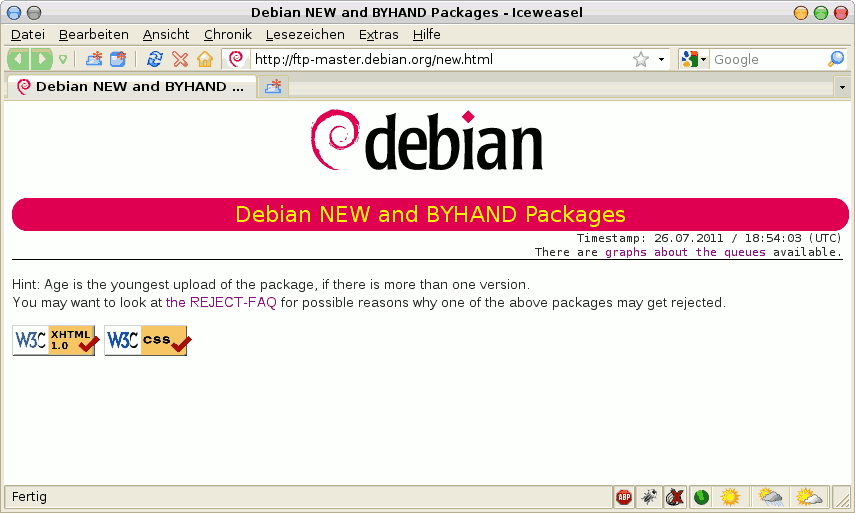
Continuing the shameless self-praise from our ftp-team talk, I'm now pleased to present you on behalf of the entire FTP-Team the following: As you can clearly see, you can see nothing. Yes, nothing! As of 18:55:52 UTC+2 the NEW queue, which at some times was well over 500, sometimes even 600 packages is now empty. Completely empty. To the best of my (and Ganneff's knowledge) the last time the NEW queue was empty was at least five years ago. Interesting enough, that triggered an yet undiscovered bug in dak, which refused to scan an empty directory...

Alexander Reichle-Schmehl: Slides of the How to contribute and get involved

The slides for our How to contribute and get involved are now available at http://people.debian.org/~tolimar/talks/debconf-11/. Feel free to ask any questions we might have left unanswered via e-mail or irc chat (I'm Tolimar on irc.debian.org).

24 July 2011

DebConf team: How to contribute via irc (Posted by Alexander Reichle-Schmehl)

If you would like to contribute to a session while watching the live stream, please join the respective IRC channels. These are: #debconf-auditorium and #debconf-roundroom on irc.debian.org. The Web 2.0 thingy at http://debconf11.debconf.org/watch.xhtml will be updated soonish.

Next.

Previous.