Search Results: "ean"

22 December 2025

Jonathan McDowell: NanoKVM: I like it

I bought a NanoKVM. I d heard some of the stories about how terrible it was beforehand, and some I didn t learn about until afterwards, but at 52, including VAT + P&P, that seemed like an excellent bargain for something I was planning to use in my home network environment. Let s cover the bad press first. apalrd did a video, entitled NanoKVM: The S stands for Security (Armen Barsegyan has a write up recommending a PiKVM instead that lists the objections raised in the video). Matej Kova i wrote an article about the hidden microphone on a Chinese NanoKVM. Various other places have picked up both of these and still seem to be running with them, 10 months later. Next, let me explain where I m coming from here. I have over 2 decades of experience with terrible out-of-band access devices. I still wince when I think of the Sun Opteron servers that shipped with an iLOM that needed a 32-bit Windows browser in order to access it (IIRC some 32 bit binary JNI blob). It was a 64 bit x86 server from a company who, at the time, still had a major non-Windows OS. Sheesh. I do not assume these devices are fit for exposure to the public internet, even if they come from reputable vendors. Add into that the fact the NanoKVM is very much based on a development board (the LicheeRV Nano), and I felt I knew what I was getting into here. And, as a TL;DR, I am perfectly happy with my purchase. Sipeed have actually dealt with a bunch of apalrd s concerns (GitHub ticket), which I consider to be an impressive level of support for this price point. Equally the microphone is explained by the fact this is a 52 device based on a development board. You re giving it USB + HDMI access to a host on your network, if you re worried about the microphone then you re concentrating on the wrong bit here. I started out by hooking the NanoKVM up to my Raspberry Pi classic, which I use as a serial console / network boot tool for working on random bits of hardware. That meant the NanoKVM had no access to the outside world (the Pi is not configured to route, or NAT, for the test network interface), and I could observe what went on. As it happens you can do an SSH port forward of port 80 with this sort of setup and it all works fine - no need for the NanoKVM to have any external access, and it copes happily with being accessed as http://localhost:8000/ (though you do need to choose MJPEG as the video mode, more forwarding or enabling HTTPS is needed for an H.264 WebRTC session). IPv6 is enabled in the kernel. My test setup doesn t have a router advertisements configured, but I could connect to the web application over the v6 link-local address that came up automatically. My device reports:
Image version:              v1.4.1
Application version:        2.2.9
That s recent, but the GitHub releases page has 2.3.0 listed as more recent. Out of the box it s listening on TCP port 80. SSH is not running, but there s a toggle to turn it on and the web interface offers a web based shell (with no extra authentication over the normal login). On first use I was asked to set a username + password. Default access, as you d expect from port 80, is HTTP, but there s a toggle to enable HTTPS. It generates a self signed certificate - for me it had the CN localhost but that might have been due to my use of port forwarding. Enabling HTTPS does not disable HTTP, but HTTP just redirects to the HTTPS URL. As others have discussed it does a bunch of DNS lookups, primarily for NTP servers but also for cdn.sipeed.com. The DNS servers are hard coded:
~ # cat /etc/resolv.conf
nameserver 192.168.0.1
nameserver 8.8.4.4
nameserver 8.8.8.8
nameserver 114.114.114.114
nameserver 119.29.29.29
nameserver 223.5.5.5
This is actually restored on boot from /boot/resolv.conf, so if you want changes to persist you can just edit that file. NTP is configured with a standard set of pool.ntp.org services in /etc/ntp.conf (this does not get restored on reboot, so can just be edited in place). I had dnsmasq on the Pi setup to hand out DNS + NTP servers, but both were ignored (though actually udhcpc does write the DNS details to /etc/resolv.conf.dhcp). My assumption is the lookup to cdn.sipeed.com is for firmware updates (as I bought the NanoKVM cube it came fully installed, so no need for a .so download to make things work); when working DNS was provided I witness attempts to connect to HTTPS. I ve not bothered digging further into this. I did go grab the latest.zip being served from the URL, which turned out to be v2.2.9, matching what I have installed, not the latest on GitHub. I note there s an iptables setup (with nftables underneath) that s not fully realised - it seems to be trying to allow inbound HTTP + WebRTC, as well as outbound SSH, but everything is default accept so none of it gets hit. Setting up a default deny outbound and tweaking a little should provide a bit more reassurance it s not going to try and connect out somewhere it shouldn t. It looks like updates focus solely on the KVM application, so I wanted to take a look at the underlying OS. This is buildroot based:
~ # cat /etc/os-release
NAME=Buildroot
VERSION=-g98d17d2c0-dirty
ID=buildroot
VERSION_ID=2023.11.2
PRETTY_NAME="Buildroot 2023.11.2"
The kernel reports itself as 5.10.4-tag-. Somewhat ancient, but actually an LTS kernel. Except we re now up to 5.10.247, so it obviously hasn t been updated in some time. TBH, this is what I expect (and fear) from embedded devices. They end up with some ancient base OS revision and a kernel with a bunch of hacks that mean it s not easily updated. I get that the margins on this stuff are tiny, but I do wish folk would spend more time upstreaming. Or at least updating to the latest LTS point release for their kernel. The SSH client/daemon is full-fat OpenSSH:
~ # sshd -V
OpenSSH_9.6p1, OpenSSL 3.1.4 24 Oct 2023
There are a number of CVEs fixed in later OpenSSL 3.1 versions, though at present nothing that looks too concerning from the server side. Yes, the image has tcpdump + aircrack installed. I m a little surprised at aircrack (the device has no WiFi and even though I know there s a variant that does, it s not a standard debug tool the way tcpdump is), but there s a copy of GNU Chess in there too, so it s obvious this is just a kitchen-sink image. FWIW it looks like the buildroot config is here. Sadly the UART that I believe the bootloader/kernel are talking to is not exposed externally - the UART pin headers are for UART1 + 2, and I d have to open up the device to get to UART0. I ve not yet done this (but doing so would also allow access to the SD card, which would make trying to compile + test my own kernel easier). In terms of actual functionality it did what I d expect. 1080p HDMI capture was fine. I d have gone for a lower resolution, but I think that would have required tweaking on the client side. It looks like the 2.3.0 release allows EDID tweaking, so I might have to investigate that. The keyboard defaults to a US layout, which caused some problems with the symbol until I reconfigured the target machine not to expect a GB layout. There s also the potential to share out images via USB. I copied a Debian trixie netinst image to /data on the NanoKVM and was able to select it in the web interface and have it appear on the target machine easily. There s also the option to fetch direct from a URL in the web interface, but I was still testing without routable network access, so didn t try that. There s plenty of room for images:
~ # df -h
Filesystem                Size      Used Available Use% Mounted on
/dev/mmcblk0p2            7.6G    823.3M      6.4G  11% /
devtmpfs                 77.7M         0     77.7M   0% /dev
tmpfs                    79.0M         0     79.0M   0% /dev/shm
tmpfs                    79.0M     30.2M     48.8M  38% /tmp
tmpfs                    79.0M    124.0K     78.9M   0% /run
/dev/mmcblk0p1           16.0M     11.5M      4.5M  72% /boot
/dev/mmcblk0p3           22.2G    160.0K     22.2G   0% /data
The NanoKVM also appears as an RNDIS USB network device, with udhcpd running on the interface. IP forwarding is not enabled, and there s no masquerading rules setup, so this doesn t give the target host access to the management LAN by default. I guess it could be useful for copying things over to the target host, as a more flexible approach than a virtual disk image. One thing to note is this makes for a bunch of devices over the composite USB interface. There are 3 HID devices (keyboard, absolute mouse, relative mouse), the RNDIS interface, and the USB mass storage. I had a few occasions where the keyboard input got stuck after I d been playing about with big data copies over the network and using the USB mass storage emulation. There is a HID-only mode (no network/mass storage) to try and help with this, and a restart of the NanoKVM generally brought things back, but something to watch out for. Again I see that the 2.3.0 application update mentions resetting the USB hardware on a HID reset, which might well help. As I stated at the start, I m happy with this purchase. Would I leave it exposed to the internet without suitable firewalling? No, but then I wouldn t do so for any KVM. I wanted a lightweight KVM suitable for use in my home network, something unlikely to see heavy use but that would save me hooking up an actual monitor + keyboard when things were misbehaving. So far everything I ve seen says I ve got my money s worth from it.

Hellen Chemtai: Overcoming Challenges in OpenQA Images Testing: My Internship Journey

Hello there  . Today will be an in depth review on my work with the Debian OpenQA images testing team. I will highlight the struggles that I have had so far during my Outreachy internship. The OpenQA images testing team uses OpenQA to automatically install images e.g. Gnome Images. The images are then tested using tests written in Perl. My current tasks include speech install and capture all audio. I am also installing Live Gnome image to Windows using BalenaEtcher then testing it. A set of similar tasks will also be collaborated on. While working on tasks, I have to go through the guides. I also learn how Perl works so as to edit and create tests. For every change made, I have to re-run the job in developer mode. I have to create needles that have matches and click co-ordinates. I have been stuck on some of these instances:
  1. During installation, my job would not process a second HDD I had added. Roland Clobus , one of my mentors from the team gave me a variable to work with. The solution was adding NUMDISKS=2 as part of the command.
  2. While working on a file, one of the needles would only work after file edits. Afterwards it would fail to assert_and_click . What kept bugging me was why it was passing after the first instance then failing after. The solution was adding a wait_still_screen to the code. This would ensure any screen changes loaded first before clicking happened.
  3. I was stuck on finding the keys that would be needed for a context menu. I added button => right in the assert_and_click code.
  4. Windows 11 installation was constantly failing. Roland pointed out he was working on it so I had to use Windows 10.
  5. Windows 10 Virtual Machine does not connect to the internet because of update restrictions. I had to switch to Linux Virtual Machine for a download job.
When I get stuck, at times I seek guidance from the mentors. I still look for solutions in the documentation. Here are some of the documentation that have helped me get through some of these challenges.
  1. Installation and creating tests guide https://salsa.debian.org/qa/openqa/openqa-tests-debian/-/tree/debian/documentation . These guides help in installation and creating of tests.
  2. OpenQA official documentation https://open.qa/docs/ . This documentation is very comprehensive. I used it recently to read about PUBLISH_HDD_n to save the updated version of a HDD_n I am using.
  3. OpenQA test API documentation https://open.qa/api/testapi/ . This documentation shows me which parameters to use. I have used it recently to find how to right click on a mouse and special characters.
  4. OpenQA variables file in Gitlab https://salsa.debian.org/qa/openqa/openqa-tests-debian/-/blob/debian/VARIABLES.md . This has explanations of the most commonly used variables .
  5. OpenQA repository in Gitlab https://salsa.debian.org/qa/openqa/openqa-tests-debian . I go through the Perl tests. Understand how they work . Then integrate my tests using the a similar manner so that it would look uniform.
  6. OpenQa tests https://openqa.debian.net/tests. I use these tests to find machine settings. I also find test sequences and the assets I would need to create similar tests. I used it recently to look at how graphical login was being implemented then shutdown.
The list above are the documentation that are supposed to be used for these tests and finding solutions. If I don t find anything within these, I then ask Roland for help. I try to go through the autoinst documentation that are from the links provided in the Gitlab README.md file : https://salsa.debian.org/qa/openqa/openqa-tests-debian/-/blob/debian/README.md . They are also comprehensive but are very technical . In general, I get challenges but there is always a means to solve them through documentation provided. The mentors are also very helpful whenever we get challenges. I have gained team contribution skills , upgraded my git skills, learned Perl and how to test using OpenQA. I am still polishing on how to make my needles better. My current progress is thus good. We learn one day at a time.

C.J. Collier: I m learning about perlguts today.


im-learning-about-perlguts-today.png


## 0.23	2025-12-20
commit be15aa25dea40aea66a8534143fb81b29d2e6c08
Author: C.J. Collier 
Date:   Sat Dec 20 22:40:44 2025 +0000
    Fixes C-level test infrastructure and adds more test cases for upb_to_sv conversions.
    
    - **Makefile.PL:**
        - Allow  extra_src  in  c_test_config.json  to be an array.
        - Add ASan flags to CCFLAGS and LDDLFLAGS for better debugging.
        - Corrected echo newlines in  test_c  target.
    - **c_test_config.json:**
        - Added missing type test files to  deps  and  extra_src  for  convert/sv_to_upb  and  convert/upb_to_sv  test runners.
    - **t/c/convert/upb_to_sv.c:**
        - Fixed a double free of  test_pool .
        - Added missing includes for type test headers.
        - Updated test plan counts.
    - **t/c/convert/sv_to_upb.c:**
        - Added missing includes for type test headers.
        - Updated test plan counts.
        - Corrected Perl interpreter initialization.
    - **t/c/convert/types/**:
        - Added missing  test_util.h  include in new type test headers.
        - Completed the set of  upb_to_sv  test cases for all scalar types by adding optional and repeated tests for  sfixed32 ,  sfixed64 ,  sint32 , and  sint64 , and adding repeated tests to the remaining scalar type files.
    - **Documentation:**
        - Updated  01-xs-testing.md  with more debugging tips, including ASan usage and checking for double frees and typos.
        - Updated  xs_learnings.md  with details from the recent segfault.
        - Updated  llm-plan-execution-instructions.md  to emphasize debugging steps.
## 0.22	2025-12-19
commit 2c171d9a5027e0150eae629729c9104e7f6b9d2b
Author: C.J. Collier 
Date:   Fri Dec 19 23:41:02 2025 +0000
    feat(perl,testing): Initialize C test framework and build system
    
    This commit sets up the foundation for the C-level tests and the build system for the Perl Protobuf module:
    
    1.  **Makefile.PL Enhancements:**
        *   Integrates  Devel::PPPort  to generate  ppport.h  for better portability.
        *   Object files now retain their path structure (e.g.,  xs/convert/sv_to_upb.o ) instead of being flattened, improving build clarity.
        *   The  MY::postamble  is significantly revamped to dynamically generate build rules for all C tests located in  t/c/  based on the  t/c/c_test_config.json  file.
        *   C tests are linked against  libprotobuf_common.a  and use  ExtUtils::Embed  flags.
        *   Added  JSON::MaybeXS  to  PREREQ_PM .
        *   The  test  target now also depends on the  test_c  target.
    
    2.  **C Test Infrastructure ( t/c/ ):
        *   Introduced  t/c/c_test_config.json  to configure individual C test builds, specifying dependencies and extra source files.
        *   Created  t/c/convert/test_util.c  and  .h  for shared test functions like loading descriptors.
        *   Initial  t/c/convert/upb_to_sv.c  and  t/c/convert/sv_to_upb.c  test runners.
        *   Basic  t/c/integration/030_protobuf_coro.c  for Coro safety testing on core utils using  libcoro .
        *   Basic  t/c/integration/035_croak_test.c  for testing exception handling.
        *   Basic  t/c/integration/050_convert.c  for integration testing conversions.
    
    3.  **Test Proto:** Updated  t/data/test.proto  with more field types for conversion testing and regenerated  test_descriptor.bin .
    
    4.  **XS Test Harness ( t/c/upb-perl-test.h ):** Added  like_n  macro for length-aware regex matching.
    
    5.  **Documentation:** Updated architecture and plan documents to reflect the C test structure.
    6.  **ERRSV Testing:** Note that the C tests ( t/c/ ) will primarily check *if* a  croak  occurs (i.e., that the exception path is taken), but will not assert on the string content of  ERRSV . Reliably testing  $@  content requires the full Perl test environment with  Test::More , which will be done in the  .t  files when testing the Perl API.
    
    This provides a solid base for developing and testing the XS and C components of the module.
## 0.21	2025-12-18
commit a8b6b6100b2cf29c6df1358adddb291537d979bc
Author: C.J. Collier 
Date:   Thu Dec 18 04:20:47 2025 +0000
    test(C): Add integration tests for Milestone 2 components
    
    - Created t/c/integration/030_protobuf.c to test interactions
      between obj_cache, arena, and utils.
    - Added this test to t/c/c_test_config.json.
    - Verified that all C tests for Milestones 2 and 3 pass,
      including the libcoro-based stress test.
## 0.20	2025-12-18
commit 0fcad68680b1f700a83972a7c1c48bf3a6958695
Author: C.J. Collier 
Date:   Thu Dec 18 04:14:04 2025 +0000
    docs(plan): Add guideline review reminders to milestones
    
    - Added a "[ ] REFRESH: Review all documents in @perl/doc/guidelines/**"
      checklist item to the start of each component implementation
      milestone (C and Perl layers).
    - This excludes Integration Test milestones.
## 0.19	2025-12-18
commit 987126c4b09fcdf06967a98fa3adb63d7de59a34
Author: C.J. Collier 
Date:   Thu Dec 18 04:05:53 2025 +0000
    docs(plan): Add C-level and Perl-level Coro tests to milestones
    
    - Added checklist items for  libcoro -based C tests
      (e.g.,  t/c/integration/050_convert_coro.c ) to all C layer
      integration milestones (050 through 220).
    - Updated  030_Integration_Protobuf.md  to standardise checklist
      items for the existing  030_protobuf_coro.c  test.
    - Removed the single  xt/author/coro-safe.t  item from
       010_Build.md .
    - Added checklist items for Perl-level  Coro  tests
      (e.g.,  xt/coro/240_arena.t ) to each Perl layer
      integration milestone (240 through 400).
    - Created  perl/t/c/c_test_config.json  to manage C test
      configurations externally.
    - Updated  perl/doc/architecture/testing/01-xs-testing.md  to describe
      both C-level  libcoro  and Perl-level  Coro  testing strategies.
## 0.18	2025-12-18
commit 6095a5a610401a6035a81429d0ccb9884d53687b
Author: C.J. Collier 
Date:   Thu Dec 18 02:34:31 2025 +0000
    added coro testing to c layer milestones
## 0.17	2025-12-18
commit cc0aae78b1f7f675fc8a1e99aa876c0764ea1cce
Author: C.J. Collier 
Date:   Thu Dec 18 02:26:59 2025 +0000
    docs(plan): Refine test coverage checklist items for SMARTness
    
    - Updated the "Tests provide full coverage" checklist items in
      C layer plan files (020, 040, 060, 080, 100, 120, 140, 160, 180, 200)
      to explicitly mention testing all public functions in the
      corresponding header files.
    - Expanded placeholder checklists in 140, 160, 180, 200.
    - Updated the "Tests provide full coverage" and "Add coverage checks"
      checklist items in Perl layer plan files (230, 250, 270, 290, 310, 330,
      350, 370, 390) to be more specific about the scope of testing
      and the use of  Test::TestCoverage .
    - Expanded Well-Known Types milestone (350) to detail each type.
## 0.16	2025-12-18
commit e4b601f14e3817a17b0f4a38698d981dd4cb2818
Author: C.J. Collier 
Date:   Thu Dec 18 02:07:35 2025 +0000
    docs(plan): Full refactoring of C and Perl plan files
    
    - Split both ProtobufPlan-C.md and ProtobufPlan-Perl.md into
      per-milestone files under the  perl/doc/plan/  directory.
    - Introduced Integration Test milestones after each component
      milestone in both C and Perl plans.
    - Numbered milestone files sequentially (e.g., 010_Build.md,
      230_Perl_Arena.md).
    - Updated main ProtobufPlan-C.md and ProtobufPlan-Perl.md to
      act as Tables of Contents.
    - Ensured consistent naming for integration test files
      (e.g.,  t/c/integration/030_protobuf.c ,  t/integration/260_descriptor_pool.t ).
    - Added architecture review steps to the end of all milestones.
    - Moved Coro safety test to C layer Milestone 1.
    - Updated Makefile.PL to support new test structure and added Coro.
    - Moved and split t/c/convert.c into t/c/convert/*.c.
    - Moved other t/c/*.c tests into t/c/protobuf/*.c.
    - Deleted old t/c/convert.c.
## 0.15	2025-12-17
commit 649cbacf03abb5e7293e3038bb451c0406e9d0ce
Author: C.J. Collier 
Date:   Wed Dec 17 23:51:22 2025 +0000
    docs(plan): Refactor and reset ProtobufPlan.md
    
    - Split the plan into ProtobufPlan-C.md and ProtobufPlan-Perl.md.
    - Reorganized milestones to clearly separate C layer and Perl layer development.
    - Added more granular checkboxes for each component:
      - C Layer: Create test, Test coverage, Implement, Tests pass.
      - Perl Layer: Create test, Test coverage, Implement Module/XS, Tests pass, C-Layer adjustments.
    - Reset all checkboxes to  [ ]  to prepare for a full audit.
    - Updated status in architecture/api and architecture/core documents to "Not Started".
    
    feat(obj_cache): Add unregister function and enhance tests
    
    - Added  protobuf_unregister_object  to  xs/protobuf/obj_cache.c .
    - Updated  xs/protobuf/obj_cache.h  with the new function declaration.
    - Expanded tests in  t/c/protobuf_obj_cache.c  to cover unregistering,
      overwriting keys, and unregistering non-existent keys.
    - Corrected the test plan count in  t/c/protobuf_obj_cache.c  to 17.
## 0.14	2025-12-17
commit 40b6ad14ca32cf16958d490bb575962f88d868a1
Author: C.J. Collier 
Date:   Wed Dec 17 23:18:27 2025 +0000
    feat(arena): Complete C layer for Arena wrapper
    
    This commit finalizes the C-level implementation for the Protobuf::Arena wrapper.
    
    - Adds  PerlUpb_Arena_Destroy  for proper cleanup from Perl's DEMOLISH.
    - Enhances error checking in  PerlUpb_Arena_Get .
    - Expands C-level tests in  t/c/protobuf_arena.c  to cover memory allocation
      on the arena and lifecycle through  PerlUpb_Arena_Destroy .
    - Corrects embedded Perl initialization in the C test.
    
    docs(plan): Refactor ProtobufPlan.md
    
    - Restructures the development plan to clearly separate "C Layer" and
      "Perl Layer" tasks within each milestone.
    - This aligns the plan with the "C-First Implementation Strategy" and improves progress tracking.
## 0.13	2025-12-17
commit c1e566c25f62d0ae9f195a6df43b895682652c71
Author: C.J. Collier 
Date:   Wed Dec 17 22:00:40 2025 +0000
    refactor(perl): Rename C tests and enhance Makefile.PL
    
    - Renamed test files in  t/c/  to better match the  xs  module structure:
        -  01-cache.c  ->  protobuf_obj_cache.c 
        -  02-arena.c  ->  protobuf_arena.c 
        -  03-utils.c  ->  protobuf_utils.c 
        -  04-convert.c  ->  convert.c 
        -  load_test.c  ->  upb_descriptor_load.c 
    - Updated  perl/Makefile.PL  to reflect the new test names in  MY::postamble 's  $c_test_config .
    - Refactored the  $c_test_config  generation in  Makefile.PL  to reduce repetition by using a default flags hash and common dependencies array.
    - Added a  fail()  macro to  perl/t/c/upb-perl-test.h  for consistency.
    - Modified  t/c/upb_descriptor_load.c  to use the  t/c/upb-perl-test.h  macros, making its output consistent with other C tests.
    - Added a skeleton for  t/c/convert.c  to test the conversion functions.
    - Updated documentation in  ProtobufPlan.md  and  architecture/testing/01-xs-testing.md  to reflect new test names.
## 0.12	2025-12-17
commit d8cb5dd415c6c129e71cd452f78e29de398a82c9
Author: C.J. Collier 
Date:   Wed Dec 17 20:47:38 2025 +0000
    feat(perl): Refactor XS code into subdirectories
    
    This commit reorganizes the C code in the  perl/xs/  directory into subdirectories, mirroring the structure of the Python UPB extension. This enhances modularity and maintainability.
    
    - Created subdirectories for each major component:  convert ,  descriptor ,  descriptor_containers ,  descriptor_pool ,  extension_dict ,  map ,  message ,  protobuf ,  repeated , and  unknown_fields .
    - Created skeleton  .h  and  .c  files within each subdirectory to house the component-specific logic.
    - Updated top-level component headers (e.g.,  perl/xs/descriptor.h ) to include the new sub-headers.
    - Updated top-level component source files (e.g.,  perl/xs/descriptor.c ) to include their main header and added stub initialization functions (e.g.,  PerlUpb_InitDescriptor ).
    - Moved code from the original  perl/xs/protobuf.c  to new files in  perl/xs/protobuf/  (arena, obj_cache, utils).
    - Moved code from the original  perl/xs/convert.c  to new files in  perl/xs/convert/  (upb_to_sv, sv_to_upb).
    - Updated  perl/Makefile.PL  to use a glob ( xs/*/*.c ) to find the new C source files in the subdirectories.
    - Added  perl/doc/architecture/core/07-xs-file-organization.md  to document the new structure.
    - Updated  perl/doc/ProtobufPlan.md  and other architecture documents to reference the new organization.
    - Corrected self-referential includes in the newly created .c files.
    
    This restructuring provides a solid foundation for further development and makes it easier to port logic from the Python implementation.
## 0.11	2025-12-17
commit cdedcd13ded4511b0464f5d3bdd72ce6d34e73fc
Author: C.J. Collier 
Date:   Wed Dec 17 19:57:52 2025 +0000
    feat(perl): Implement C-first testing and core XS infrastructure
    
    This commit introduces a significant refactoring of the Perl XS extension, adopting a C-first development approach to ensure a robust foundation.
    
    Key changes include:
    
    -   **C-Level Testing Framework:** Established a C-level testing system in  t/c/  with a dedicated Makefile, using an embedded Perl interpreter. Initial tests cover the object cache ( 01-cache.c ), arena wrapper ( 02-arena.c ), and utility functions ( 03-utils.c ).
    -   **Core XS Infrastructure:**
        -   Implemented a global object cache ( xs/protobuf.c ) to manage Perl wrappers for UPB objects, using weak references.
        -   Created an  upb_Arena  wrapper ( xs/protobuf.c ).
        -   Consolidated common XS helper functions into  xs/protobuf.h  and  xs/protobuf.c .
    -   **Makefile.PL Enhancements:** Updated to support building and linking C tests, incorporating flags from  ExtUtils::Embed , and handling both  .c  and  .cc  source files.
    -   **XS File Reorganization:** Restructured XS files to mirror the Python UPB extension's layout (e.g.,  message.c ,  descriptor.c ). Removed older, monolithic  .xs  files.
    -   **Typemap Expansion:** Added extensive typemap entries in  perl/typemap  to handle conversions between Perl objects and various  const upb_*Def*  pointers.
    -   **Descriptor Tests:** Added a new test suite  t/02-descriptor.t  to validate descriptor loading and accessor methods.
    -   **Documentation:** Updated development plans and guidelines ( ProtobufPlan.md ,  xs_learnings.md , etc.) to reflect the C-first strategy, new testing methods, and lessons learned.
    -   **Build Cleanup:** Removed  ppport.h  from  .gitignore  as it's no longer used, due to  -DPERL_NO_PPPORT  being set in  Makefile.PL .
    
    This C-first approach allows for more isolated and reliable testing of the core logic interacting with the UPB library before higher-level Perl APIs are built upon it.
## 0.10	2025-12-17
commit 1ef20ade24603573905cb0376670945f1ab5d829
Author: C.J. Collier 
Date:   Wed Dec 17 07:08:29 2025 +0000
    feat(perl): Implement C-level tests and core XS utils
    
    This commit introduces a C-level testing framework for the XS layer and implements key components:
    
    1.  **C-Level Tests ( t/c/ )**:
        *   Added  t/c/Makefile  to build standalone C tests.
        *   Created  t/c/upb-perl-test.h  with macros for TAP-compliant C tests ( plan ,  ok ,  is ,  is_string ,  diag ).
        *   Implemented  t/c/01-cache.c  to test the object cache.
        *   Implemented  t/c/02-arena.c  to test  Protobuf::Arena  wrappers.
        *   Implemented  t/c/03-utils.c  to test string utility functions.
        *   Corrected include paths and diagnostic messages in C tests.
    
    2.  **XS Object Cache ( xs/protobuf.c )**:
        *   Switched to using stringified pointers ( %p ) as hash keys for stability.
        *   Fixed a critical double-free bug in  PerlUpb_ObjCache_Delete  by removing an extra  SvREFCNT_dec  on the lookup key.
    
    3.  **XS Arena Wrapper ( xs/protobuf.c )**:
        *   Corrected  PerlUpb_Arena_New  to use  newSVrv  and  PTR2IV  for opaque object wrapping.
        *   Corrected  PerlUpb_Arena_Get  to safely unwrap the arena pointer.
    
    4.  **Makefile.PL ( perl/Makefile.PL )**:
        *   Added  -Ixs  to  INC  to allow C tests to find  t/c/upb-perl-test.h  and  xs/protobuf.h .
        *   Added  LIBS  to link  libprotobuf_common.a  into the main  Protobuf.so .
        *   Added C test targets  01-cache ,  02-arena ,  03-utils  to the test config in  MY::postamble .
    
    5.  **Protobuf.pm ( perl/lib/Protobuf.pm )**:
        *   Added  use XSLoader;  to load the compiled XS code.
    
    6.  **New files  xs/util.h **:
        *   Added initial type conversion function.
    
    These changes establish a foundation for testing the C-level interface with UPB and fix crucial bugs in the object cache implementation.
## 0.09	2025-12-17
commit 07d61652b032b32790ca2d3848243f9d75ea98f4
Author: C.J. Collier 
Date:   Wed Dec 17 04:53:34 2025 +0000
    feat(perl): Build system and C cache test for Perl XS
    
    This commit introduces the foundational pieces for the Perl XS implementation, focusing on the build system and a C-level test for the object cache.
    
    -   **Makefile.PL:**
        -   Refactored C test compilation rules in  MY::postamble  to use a hash ( $c_test_config ) for better organization and test-specific flags.
        -   Integrated  ExtUtils::Embed  to provide necessary compiler and linker flags for embedding the Perl interpreter, specifically for the  t/c/01-cache.c  test.
        -   Correctly constructs the path to the versioned Perl library ( libperl.so.X.Y.Z ) using  $Config archlib  and  $Config libperl  to ensure portability.
        -   Removed  VERSION_FROM  and  ABSTRACT_FROM  to avoid dependency on  .pm  files for now.
    
    -   **C Cache Test (t/c/01-cache.c):**
        -   Added a C test to exercise the object cache functions implemented in  xs/protobuf.c .
        -   Includes tests for adding, getting, deleting, and weak reference behavior.
    
    -   **XS Cache Implementation (xs/protobuf.c, xs/protobuf.h):**
        -   Implemented  PerlUpb_ObjCache_Init ,  PerlUpb_ObjCache_Add ,  PerlUpb_ObjCache_Get ,  PerlUpb_ObjCache_Delete , and  PerlUpb_ObjCache_Destroy .
        -   Uses a Perl hash ( HV* ) for the cache.
        -   Keys are string representations of the C pointers, created using  snprintf  with  "%llx" .
        -   Values are weak references ( sv_rvweaken ) to the Perl objects ( SV* ).
        -    PerlUpb_ObjCache_Get  now correctly returns an incremented reference to the original SV, not a copy.
        -    PerlUpb_ObjCache_Destroy  now clears the hash before decrementing its refcount.
    
    -   **t/c/upb-perl-test.h:**
        -   Updated  is_sv  to perform direct pointer comparison ( got == expected ).
    
    -   **Minor:** Added  util.h  (currently empty), updated  typemap .
    
    These changes establish a working C-level test environment for the XS components.
## 0.08	2025-12-17
commit d131fd22ea3ed8158acb9b0b1fe6efd856dc380e
Author: C.J. Collier 
Date:   Wed Dec 17 02:57:48 2025 +0000
    feat(perl): Update docs and core XS files
    
    - Explicitly add TDD cycle to ProtobufPlan.md.
    - Clarify mirroring of Python implementation in upb-interfacing.md for both C and Perl layers.
    - Branch and adapt python/protobuf.h and python/protobuf.c to perl/xs/protobuf.h and perl/xs/protobuf.c, including the object cache implementation. Removed old cache.* files.
    - Create initial C test for the object cache in t/c/01-cache.c.
## 0.07	2025-12-17
commit 56fd6862732c423736a2f9a9fb1a2816fc59e9b0
Author: C.J. Collier 
Date:   Wed Dec 17 01:09:18 2025 +0000
    feat(perl): Align Perl UPB architecture docs with Python
    
    Updates the Perl Protobuf architecture documents to more closely align with the design and implementation strategies used in the Python UPB extension.
    
    Key changes:
    
    -   **Object Caching:** Mandates a global, per-interpreter cache using weak references for all UPB-derived objects, mirroring Python's  PyUpb_ObjCache .
    -   **Descriptor Containers:** Introduces a new document outlining the plan to use generic XS container types (Sequence, ByNameMap, ByNumberMap) with vtables to handle collections of descriptors, similar to Python's  descriptor_containers.c .
    -   **Testing:** Adds a note to the testing strategy to port relevant test cases from the Python implementation to ensure feature parity.
## 0.06	2025-12-17
commit 6009ce6ab64eccce5c48729128e5adf3ef98e9ae
Author: C.J. Collier 
Date:   Wed Dec 17 00:28:20 2025 +0000
    feat(perl): Implement object caching and fix build
    
    This commit introduces several key improvements to the Perl XS build system and core functionality:
    
    1.  **Object Caching:**
        *   Introduces  xs/protobuf.c  and  xs/protobuf.h  to implement a caching mechanism ( protobuf_c_to_perl_obj ) for wrapping UPB C pointers into Perl objects. This uses a hash and weak references to ensure object identity and prevent memory leaks.
        *   Updates the  typemap  to use  protobuf_c_to_perl_obj  for  upb_MessageDef *  output, ensuring descriptor objects are cached.
        *   Corrected  sv_weaken  to the correct  sv_rvweaken  function.
    
    2.  **Makefile.PL Enhancements:**
        *   Switched to using the Bazel-generated UPB descriptor sources from  bazel-bin/src/google/protobuf/_virtual_imports/descriptor_proto/google/protobuf/ .
        *   Updated  INC  paths to correctly locate the generated headers.
        *   Refactored  MY::dynamic_lib  to ensure the static library  libprotobuf_common.a  is correctly linked into each generated  .so  module, resolving undefined symbol errors.
        *   Overrode  MY::test  to use  prove -b -j$(nproc) t/*.t xt/*.t  for running tests.
        *   Cleaned up  LIBS  and  LDDLFLAGS  usage.
    
    3.  **Documentation:**
        *   Updated  ProtobufPlan.md  to reflect the current status and design decisions.
        *   Reorganized architecture documents into subdirectories.
        *   Added  object-caching.md  and  c-perl-interface.md .
        *   Updated  llm-guidance.md  with notes on  upb/upb.h  and  sv_rvweaken .
    
    4.  **Testing:**
        *   Fixed  xt/03-moo_immutable.t  to skip tests if no Moo modules are found.
    
    This resolves the build issues and makes the core test suite pass.
## 0.05	2025-12-16
commit 177d2f3b2608b9d9c415994e076a77d8560423b8
Author: C.J. Collier 
Date:   Tue Dec 16 19:51:36 2025 +0000
    Refactor: Rename namespace to Protobuf, build system and doc updates
    
    This commit refactors the primary namespace from  ProtoBuf  to  Protobuf 
    to align with the style guide. This involves renaming files, directories,
    and updating package names within all Perl and XS files.
    
    **Namespace Changes:**
    
    *   Renamed  perl/lib/ProtoBuf  to  perl/lib/Protobuf .
    *   Moved and updated  ProtoBuf.pm  to  Protobuf.pm .
    *   Moved and updated  ProtoBuf::Descriptor  to  Protobuf::Descriptor  (.pm & .xs).
    *   Removed other  ProtoBuf::*  stubs (Arena, DescriptorPool, Message).
    *   Updated  MODULE  and  PACKAGE  in  Descriptor.xs .
    *   Updated  NAME ,  *_FROM  in  perl/Makefile.PL .
    *   Replaced  ProtoBuf  with  Protobuf  throughout  perl/typemap .
    *   Updated namespaces in test files  t/01-load-protobuf-descriptor.t  and  t/02-descriptor.t .
    *   Updated namespaces in all documentation files under  perl/doc/ .
    *   Updated paths in  perl/.gitignore .
    
    **Build System Enhancements (Makefile.PL):**
    
    *   Included  xs/*.c  files in the common object files list.
    *   Added  -I.  to the  INC  paths.
    *   Switched from  MYEXTLIB  to  LIBS => ['-L$(CURDIR) -lprotobuf_common']  for linking.
    *   Removed custom keys passed to  WriteMakefile  for postamble.
    *    MY::postamble  now sources variables directly from the main script scope.
    *   Added  all :: $ common_lib  dependency in  MY::postamble .
    *   Added  t/c/load_test.c  compilation rule in  MY::postamble .
    *   Updated  clean  target to include  blib .
    *   Added more modules to  TEST_REQUIRES .
    *   Removed the explicit  PM  and  XS  keys from  WriteMakefile , relying on  XSMULTI => 1 .
    
    **New Files:**
    
    *    perl/lib/Protobuf.pm 
    *    perl/lib/Protobuf/Descriptor.pm 
    *    perl/lib/Protobuf/Descriptor.xs 
    *    perl/t/01-load-protobuf-descriptor.t 
    *    perl/t/02-descriptor.t 
    *    perl/t/c/load_test.c : Standalone C test for UPB.
    *    perl/xs/types.c  &  perl/xs/types.h : For Perl/C type conversions.
    *    perl/doc/architecture/upb-interfacing.md 
    *    perl/xt/03-moo_immutable.t : Test for Moo immutability.
    
    **Deletions:**
    
    *   Old test files:  t/00_load.t ,  t/01_basic.t ,  t/02_serialize.t ,  t/03_message.t ,  t/04_descriptor_pool.t ,  t/05_arena.t ,  t/05_message.t .
    *   Removed  lib/ProtoBuf.xs  as it's not needed with  XSMULTI .
    
    **Other:**
    
    *   Updated  test_descriptor.bin  (binary change).
    *   Significant content updates to markdown documentation files in  perl/doc/architecture  and  perl/doc/internal  reflecting the new architecture and learnings.
## 0.04	2025-12-14
commit 92de5d482c8deb9af228f4b5ce31715d3664d6ee
Author: C.J. Collier 
Date:   Sun Dec 14 21:28:19 2025 +0000
    feat(perl): Implement Message object creation and fix lifecycles
    
    This commit introduces the basic structure for  ProtoBuf::Message  object
    creation, linking it with  ProtoBuf::Descriptor  and  ProtoBuf::DescriptorPool ,
    and crucially resolves a SEGV by fixing object lifecycle management.
    
    Key Changes:
    
    1.  ** ProtoBuf::Descriptor :** Added  _pool  attribute to hold a strong
        reference to the parent  ProtoBuf::DescriptorPool . This is essential to
        prevent the pool and its C  upb_DefPool  from being garbage collected
        while a descriptor is still in use.
    
    2.  ** ProtoBuf::DescriptorPool :**
        *    find_message_by_name : Now passes the  $self  (the pool object) to the
             ProtoBuf::Descriptor  constructor to establish the lifecycle link.
        *   XSUB  pb_dp_find_message_by_name : Updated to accept the pool  SV*  and
            store it in the descriptor's  _pool  attribute.
        *   XSUB  _load_serialized_descriptor_set : Renamed to avoid clashing with the
            Perl method name. The Perl wrapper now correctly calls this internal XSUB.
        *    DEMOLISH : Made safer by checking for attribute existence.
    
    3.  ** ProtoBuf::Message :**
        *   Implemented using Moo with lazy builders for  _upb_arena  and
             _upb_message .
        *    _descriptor  is a required argument to  new() .
        *   XS functions added for creating the arena ( pb_msg_create_arena ) and
            the  upb_Message  ( pb_msg_create_upb_message ).
        *    pb_msg_create_upb_message  now extracts the  upb_MessageDef*  from the
            descriptor and uses  upb_MessageDef_MiniTable()  to get the minitable
            for  upb_Message_New() .
        *    DEMOLISH : Added to free the message's arena.
    
    4.  ** Makefile.PL :**
        *   Added  -g  to  CCFLAGS  for debugging symbols.
        *   Added Perl CORE include path to  MY::postamble 's  base_flags .
    
    5.  **Tests:**
        *    t/04_descriptor_pool.t : Updated to check the structure of the
            returned  ProtoBuf::Descriptor .
        *    t/05_message.t : Now uses a descriptor obtained from a real pool to
            test  ProtoBuf::Message->new() .
    
    6.  **Documentation:**
        *   Updated  ProtobufPlan.md  to reflect progress.
        *   Updated several files in  doc/architecture/  to match the current
            implementation details, especially regarding arena management and object
            lifecycles.
        *   Added  doc/internal/development_cycle.md  and  doc/internal/xs_learnings.md .
    
    With these changes, the SEGV is resolved, and message objects can be successfully
    created from descriptors.
## 0.03	2025-12-14
commit 6537ad23e93680c2385e1b571d84ed8dbe2f68e8
Author: C.J. Collier 
Date:   Sun Dec 14 20:23:41 2025 +0000
    Refactor(perl): Object-Oriented DescriptorPool with Moo
    
    This commit refactors the  ProtoBuf::DescriptorPool  to be fully object-oriented using Moo, and resolves several issues related to XS, typemaps, and test data.
    
    Key Changes:
    
    1.  **Moo Object:**  ProtoBuf::DescriptorPool.pm  now uses  Moo  to define the class. The  upb_DefPool  pointer is stored as a lazy attribute  _upb_defpool .
    2.  **XS Lifecycle:**  DescriptorPool.xs  now has  pb_dp_create_pool  called by the Moo builder and  pb_dp_free_pool  called from  DEMOLISH  to manage the  upb_DefPool  lifecycle per object.
    3.  **Typemap:** The  perl/typemap  file has been significantly updated to handle the conversion between the  ProtoBuf::DescriptorPool  Perl object and the  upb_DefPool *  C pointer. This includes:
        *   Mapping  upb_DefPool *  to  T_PTR .
        *   An  INPUT  section for  ProtoBuf::DescriptorPool  to extract the pointer from the object's hash, triggering the lazy builder if needed via  call_method .
        *   An  OUTPUT  section for  upb_DefPool *  to convert the pointer back to a Perl integer, used by the builder.
    4.  **Method Renaming:**  add_file_descriptor_set_binary  is now  load_serialized_descriptor_set .
    5.  **Test Data:**
        *   Added  perl/t/data/test.proto  with a sample message and enum.
        *   Generated  perl/t/data/test_descriptor.bin  using  protoc .
        *   Removed  t/data/  from  .gitignore  to ensure test data is versioned.
    6.  **Test Update:**  t/04_descriptor_pool.t  is updated to use the new OO interface, load the generated descriptor set, and check for message definitions.
    7.  **Build Fixes:**
        *   Corrected  #include  paths in  DescriptorPool.xs  to be relative to the  upb/  directory (e.g.,  upb/wire/decode.h ).
        *   Added  -I../upb  to  CCFLAGS  in  Makefile.PL .
        *   Reordered  INC  paths in  Makefile.PL  to prioritize local headers.
    
    **Note:** While tests now pass in some environments, a SEGV issue persists in  make test  runs, indicating a potential memory or lifecycle issue within the XS layer that needs further investigation.
## 0.02	2025-12-14
commit 6c9a6f1a5f774dae176beff02219f504ea3a6e07
Author: C.J. Collier 
Date:   Sun Dec 14 20:13:09 2025 +0000
    Fix(perl): Correct UPB build integration and generated file handling
    
    This commit resolves several issues to achieve a successful build of the Perl extension:
    
    1.  **Use Bazel Generated Files:** Switched from compiling UPB's stage0 descriptor.upb.c to using the Bazel-generated  descriptor.upb.c  and  descriptor.upb_minitable.c  located in  bazel-bin/src/google/protobuf/_virtual_imports/descriptor_proto/google/protobuf/ .
    2.  **Updated Include Paths:** Added the  bazel-bin  path to  INC  in  WriteMakefile  and to  base_flags  in  MY::postamble  to ensure the generated headers are found during both XS and static library compilation.
    3.  **Removed Stage0:** Removed references to  UPB_STAGE0_DIR  and no longer include headers or source files from  upb/reflection/stage0/ .
    4.  **-fPIC:** Explicitly added  -fPIC  to  CCFLAGS  in  WriteMakefile  and ensured  $(CCFLAGS)  is used in the custom compilation rules in  MY::postamble . This guarantees all object files in the static library are compiled with position-independent code, resolving linker errors when creating the shared objects for the XS modules.
    5.  **Refined UPB Sources:** Used  File::Find  to recursively find UPB C sources, excluding  /conformance/  and  /reflection/stage0/  to avoid conflicts and unnecessary compilations.
    6.  **Arena Constructor:** Modified  ProtoBuf::Arena::pb_arena_new  XSUB to accept the class name argument passed from Perl, making it a proper constructor.
    7.  **.gitignore:** Added patterns to  perl/.gitignore  to ignore generated C files from XS ( lib/*.c ,  lib/ProtoBuf/*.c ), the copied  src_google_protobuf_descriptor.pb.cc , and the  t/data  directory.
    8.  **Build Documentation:** Updated  perl/doc/architecture/upb-build-integration.md  to reflect the new build process, including the Bazel prerequisite, include paths,  -fPIC  usage, and  File::Find .
    
    Build Steps:
    1.   bazel build //src/google/protobuf:descriptor_upb_proto  (from repo root)
    2.   cd perl 
    3.   perl Makefile.PL 
    4.   make 
    5.   make test  (Currently has expected failures due to missing test data implementation).
## 0.01	2025-12-14
commit 3e237e8a26442558c94075766e0d4456daaeb71d
Author: C.J. Collier 
Date:   Sun Dec 14 19:34:28 2025 +0000
    feat(perl): Initialize Perl extension scaffold and build system
    
    This commit introduces the  perl/  directory, laying the groundwork for the Perl Protocol Buffers extension. It includes the essential build files, linters, formatter configurations, and a vendored Devel::PPPort for XS portability.
    
    Key components added:
    
    *   ** Makefile.PL **: The core  ExtUtils::MakeMaker  build script. It's configured to:
        *   Build a static library ( libprotobuf_common.a ) from UPB, UTF8_Range, and generated protobuf C/C++ sources.
        *   Utilize  XSMULTI => 1  to create separate shared objects for  ProtoBuf ,  ProtoBuf::Arena , and  ProtoBuf::DescriptorPool .
        *   Link each XS module against the common static library.
        *   Define custom compilation rules in  MY::postamble  to handle C vs. C++ flags and build the static library.
        *   Set up include paths for the project root, UPB, and other dependencies.
    
    *   **XS Stubs ( .xs  files)**:
        *    lib/ProtoBuf.xs : Placeholder for the main module's XS functions.
        *    lib/ProtoBuf/Arena.xs : XS interface for  upb_Arena  management.
        *    lib/ProtoBuf/DescriptorPool.xs : XS interface for  upb_DefPool  management.
    
    *   **Perl Module Stubs ( .pm  files)**:
        *    lib/ProtoBuf.pm : Main module, loads XS.
        *    lib/ProtoBuf/Arena.pm : Perl class for Arenas.
        *    lib/ProtoBuf/DescriptorPool.pm : Perl class for Descriptor Pools.
        *    lib/ProtoBuf/Message.pm : Base class for messages (TBD).
    
    *   **Configuration Files**:
        *    .gitignore : Ignores build artifacts, editor files, etc.
        *    .perlcriticrc : Configures Perl::Critic for static analysis.
        *    .perltidyrc : Configures perltidy for code formatting.
    
    *   ** Devel::PPPort **: Vendored version 3.72 to generate  ppport.h  for XS compatibility across different Perl versions.
    
    *   ** typemap **: Custom typemap for XS argument/result conversion.
    
    *   **Documentation ( doc/ )**: Initial architecture and plan documents.
    
    This provides a solid foundation for developing the UPB-based Perl extension.

21 December 2025

Ian Jackson: Debian s git transition

tl;dr: There is a Debian git transition plan. It s going OK so far but we need help, especially with outreach and updating Debian s documentation. Goals of the Debian git transition project
  1. Everyone who interacts with Debian source code should be able to do so entirely in git.
That means, more specifically:
  1. All examination and edits to the source should be performed via normal git operations.
  2. Source code should be transferred and exchanged as git data, not tarballs. git should be the canonical form everywhere.
  3. Upstream git histories should be re-published, traceably, as part of formal git releases published by Debian.
  4. No-one should have to learn about Debian Source Packages, which are bizarre, and have been obsoleted by modern version control.
This is very ambitious, but we have come a long way! Achievements so far, and current status We have come a very long way. But, there is still much to do - especially, the git transition team needs your help with adoption, developer outreach, and developer documentation overhaul. We ve made big strides towards goals 1 and 4. Goal 2 is partially achieved: we currently have dual running. Goal 3 is within our reach but depends on widespread adoption of tag2upload (and/or dgit push). Downstreams and users can obtain the source code of any Debian package in git form. (dgit clone, 2013). They can then work with this source code completely in git, including building binaries, merging new versions, even automatically (eg Raspbian, 2016), and all without having to deal with source packages at all (eg Wikimedia 2025). A Debian maintainer can maintain their own package entirely in git. They can obtain upstream source code from git, and do their packaging work in git (git-buildpackage, 2006). Every Debian maintainer can (and should!) release their package from git reliably and in a standard form (dgit push, 2013; tag2upload, 2025). This is not only more principled, but also more convenient, and with better UX, than pre-dgit tooling like dput. Indeed a Debian maintainer can now often release their changes to Debian, from git, using only git branches (so no tarballs). Releasing to Debian can be simply pushing a signed tag (tag2upload, 2025). A Debian maintainer can maintain a stack of changes to upstream source code in git (gbp pq 2009). They can even maintain such a delta series as a rebasing git branch, directly buildable, and use normal git rebase style operations to edit their changes, (git-dpm, 2010; git-debrebase, 2018) An authorised Debian developer can do a modest update to any package in Debian, even one maintained by someone else, working entirely in git in a standard and convenient way (dgit, 2013). Debian contributors can share their work-in-progress on git forges and collaborate using merge requests, git based code review, and so on. (Alioth, 2003; Salsa, 2018.) Core engineering principle The Debian git transition project is based on one core engineering principle: Every Debian Source Package can be losslessly converted to and from git. In order to transition away from Debian Source Packages, we need to gateway between the old dsc approach, and the new git approach. This gateway obviously needs to be bidirectional: source packages uploaded with legacy tooling like dput need to be imported into a canonical git representation; and of course git branches prepared by developers need to be converted to source packages for the benefit of legacy downstream systems (such as the Debian Archive and apt source). This bidirectional gateway is implemented in src:dgit, and is allowing us to gradually replace dsc-based parts of the Debian system with git-based ones. Correspondence between dsc and git A faithful bidirectional gateway must define an invariant: The canonical git tree, corresponding to a .dsc, is the tree resulting from dpkg-source -x. This canonical form is sometimes called the dgit view . It s sometimes not the same as the maintainer s git branch, because many maintainers are still working with patches-unapplied git branches. More on this below. (For 3.0 (quilt) .dscs, the canonical git tree doesn t include the quilt .pc directory.) Patches-applied vs patches-unapplied The canonical git format is patches applied . That is: If Debian has modified the upstream source code, a normal git clone of the canonical branch gives the modified source tree, ready for reading and building. Many Debian maintainers keep their packages in a different git branch format, where the changes made by Debian, to the upstream source code, are in actual patch files in a debian/patches/ subdirectory. Patches-applied has a number of important advantages over patches-unapplied: The downside is that, with the (bizarre) 3.0 (quilt) source format, the patch files files in debian/patches/ must somehow be kept up to date. Nowadays though, tools like git-debrebase and git-dpm (and dgit for NMUs) make it very easy to work with patches-applied git branches. git-debrebase can deal very ergonomically even with big patch stacks. (For smaller packages which usually have no patches, plain git merge with an upstream git branch, and a much simpler dsc format, sidesteps the problem entirely.) Prioritising Debian s users (and other outsiders) We want everyone to be able to share and modify the software that they interact with. That means we should make source code truly accessible, on the user s terms. Many of Debian s processes assume everyone is an insider. It s okay that there are Debian insiders and that people feel part of something that they worked hard to become involved with. But lack of perspective can lead to software which fails to uphold our values. Our source code practices in particular, our determination to share properly (and systematically) are a key part of what makes Debian worthwhile at all. Like Debian s installer, we want our source code to be useable by Debian outsiders. This is why we have chosen to privilege a git branch format which is more familiar to the world at large, even if it s less popular in Debian. Consequences, some of which are annoying The requirement that the conversion be bidirectional, lossless, and context-free can be inconvenient. For example, we cannot support .gitattributes which modify files during git checkin and checkout. .gitattributes cause the meaning of a git tree to depend on the context, in possibly arbitrary ways, so the conversion from git to source package wouldn t be stable. And, worse, some source packages might not to be representable in git at all. Another example: Maintainers often have existing git branches for their packages, generated with pre-dgit tooling which is less careful and less principled than ours. That can result in discrepancies between git and dsc, which need to be resolved before a proper git-based upload can succeed. That some maintainers use patches-unapplied, and some patches-unapplied, means that there has to be some kind of conversion to a standard git representation. Choosing the less-popular patches-applied format as the canonical form, means that many packages need their git representation converted. It also means that user- and outsider-facing branches from browse,git .dgit.d.o and dgit clone are not always compatible with maintainer branches on Salsa. User-contributed changes need cherry-picking rather than merging, or conversion back to the maintainer format. The good news is that dgit can automate much of this, and the manual parts are usually easy git operations. Distributing the source code as git Our source code management should be normal, modern, and based on git. That means the Debian Archive is obsolete and needs to be replaced with a set of git repositories. The replacement repository for source code formally released to Debian is *.dgit.debian.org. This contains all the git objects for every git-based upload since 2013, including the signed tag for each released package version. The plan is that it will contain a git view of every uploaded Debian package, by centrally importing all legacy uploads into git. Tracking the relevant git data, when changes are made in the legacy Archive Currently, many critical source code management tasks are done by changes to the legacy Debian Archive, which works entirely with dsc files (and the associated tarballs etc). The contents of the Archive are therefore still an important source of truth. But, the Archive s architecture means it cannot sensibly directly contain git data. To track changes made in the Archive, we added the Dgit: field to the .dsc of a git-based upload (2013). This declares which git commit this package was converted from. and where those git objects can be obtained. Thus, given a Debian Source Package from a git-based upload, it is possible for the new git tooling to obtain the equivalent git objects. If the user is going to work in git, there is no need for any tarballs to be downloaded: the git data could be obtained from the depository using the git protocol. The signed tags, available from the git depository, have standardised metdata which gives traceability back to the uploading Debian contributor. Why *.dgit.debian.org is not Salsa We need a git depository - a formal, reliable and permanent git repository of source code actually released to Debian. Git forges like Gitlab can be very convenient. But Gitlab is not sufficiently secure, and too full of bugs, to be the principal and only archive of all our source code. (The open core business model of the Gitlab corporation, and the constant-churn development approach, are critical underlying problems.) Our git depository lacks forge features like Merge Requests. But: The dgit git depository outlasted Alioth and it may well outlast Salsa. We need both a good forge, and the *.dgit.debian.org formal git depository. Roadmap In progress Right now we are quite focused on tag2upload. We are working hard on eliminating the remaining issues that we feel need to be addressed before declaring the service out of beta. Future Technology Whole-archive dsc importer Currently, the git depository only has git data for git-based package updates (tag2upload and dgit push). Legacy dput-based uploads are not currently present there. This means that the git-based and legacy uploads must be resolved client-side, by dgit clone. We will want to start importing legacy uploads to git. Then downstreams and users will be able to get the source code for any package simply with git clone, even if the maintainer is using legacy upload tools like dput. Support for git-based uploads to security.debian.org Security patching is a task which would particularly benefit from better and more formal use of git. git-based approaches to applying and backporting security patches are much more convenient than messing about with actual patch files. Currently, one can use git to help prepare a security upload, but it often involves starting with a dsc import (which lacks the proper git history) or figuring out a package maintainer s unstandardised git usage conventions on Salsa. And it is not possible to properly perform the security release as git. Internal Debian consumers switch to getting source from git Buildds, QA work such as lintian checks, and so on, could be simpler if they don t need to deal with source packages. And since git is actually the canonical form, we want them to use it directly. Problems for the distant future For decades, Debian has been built around source packages. Replacing them is a long and complex process. Certainly source packages are going to continue to be supported for the foreseeable future. There are no doubt going to be unanticipated problems. There are also foreseeable issues: for example, perhaps there are packages that work very badly when represented in git. We think we can rise to these challenges as they come up. Mindshare and adoption - please help! We and our users are very pleased with our technology. It is convenient and highly dependable. dgit in particular is superb, even if we say so ourselves. As technologists, we have been very focused on building good software, but it seems we have fallen short in the marketing department. A rant about publishing the source code git is the preferred form for modification. Our upstreams are overwhelmingly using git. We are overwhelmingly using git. It is a scandal that for many packages, Debian does not properly, formally and officially publish the git history. Properly publishing the source code as git means publishing it in a way that means that anyone can automatically and reliably obtain and build the exact source code corresponding to the binaries. The test is: could you use that to build a derivative? Putting a package in git on Salsa is often a good idea, but it is not sufficient. No standard branch structure git on Salsa is enforced, nor should it be (so it can t be automatically and reliably obtained), the tree is not in a standard form (so it can t be automatically built), and is not necessarily identical to the source package. So Vcs-Git fields, and git from Salsa, will never be sufficient to make a derivative. Debian is not publishing the source code! The time has come for proper publication of source code by Debian to no longer be a minority sport. Every maintainer of a package whose upstream is using git (which is nearly all packages nowadays) should be basing their work on upstream git, and properly publishing that via tag2upload or dgit. And it s not even difficult! The modern git-based tooling provides a far superior upload experience. A common misunderstanding dgit push is not an alternative to gbp pq or quilt. Nor is tag2upload. These upload tools complement your existing git workflow. They replace and improve source package building/signing and the subsequent dput. If you are using one of the usual git layouts on salsa, and your package is in good shape, you can adopt tag2upload and/or dgit push right away. git-debrebase is distinct and does provides an alternative way to manage your git packaging, do your upstream rebases, etc. Documentation Debian s documentation all needs to be updated, including particularly instructions for packaging, to recommend use of git-first workflows. Debian should not be importing git-using upstreams release tarballs into git. (Debian outsiders who discover this practice are typically horrified.) We should use only upstream git, work only in git, and properly release (and publish) in git form. We, the git transition team, are experts in the technology, and can provide good suggestions. But we do not have the bandwidth to also engage in the massive campaigns of education and documentation updates that are necessary especially given that (as with any programme for change) many people will be sceptical or even hostile. So we would greatly appreciate help with writing and outreach. Personnel We consider ourselves the Debian git transition team. Currently we are: We wear the following hats related to the git transition: You can contact us: We do most of our heavy-duty development on Salsa. Thanks Particular thanks are due to Joey Hess, who, in the now-famous design session in Vaumarcus in 2013, helped invent dgit. Since then we have had a lot of support: most recently political support to help get tag2upload deployed, but also, over the years, helpful bug reports and kind words from our users, as well as translations and code contributions. Many other people have contributed more generally to support for working with Debian source code in git. We particularly want to mention Guido G nther (git-buildpackage); and of course Alexander Wirt, Joerg Jaspert, Thomas Goirand and Antonio Terceiro (Salsa administrators); and before them the Alioth administrators.

comment count unavailable comments

Russell Coker: Links December 2025

Russ Allbery wrote an interesting review of Politics on the Edge, by Rory Stewart who sems like one of the few conservative politicians I could respect and possibly even like [1]. It has some good insights about the problems with our current political environment. The NY Times has an amusing article about the attempt to sell the solution to the CIA s encrypted artwork [2]. Wired has an interesting article about computer face recognition systems failing on people with facial disabilities or scars [3]. This is a major accessibility issue potentially violating disability legislation and a demonstration of the problems of fully automating systems when there should be a human in the loop. The October 2025 report from the Debian Reproducible Builds team is particularly interesting [4]. kpcyrd forwarded a fascinating tidbit regarding so-called ninja and samurai build ordering, that uses data structures in which the pointer values returned from malloc are used to determine some order of execution LOL Louis Rossmann made an insightful youtube video about the moral case for piracy of software and media [5]. Louis Rossman made an insightful video about the way that Hyundai is circumventing Right to Repair laws to make repairs needlessly expensive [6]. Korean cars aren t much good nowadays. Their prices keep increasing and the quality doesn t. Brian Krebs wrote an interesting article about how Google is taking legal action against SMS phishing crime groups [7]. We need more of this! Josh Griffiths wrote an informative blog post about how YouTube is awful [8]. I really should investigate Peertube. Louis Rossman made an informative YouTube video about Right to Repair and the US military, if even the US military is getting ripped off by this it s a bigger problem than most people realise [9]. He also asks the rhetorical question of whether politicians are bought or whether it s a subscription model . Brian Krebs wrote an informative article about the US plans to ban TP Link devices, OpenWRT seems like a good option [10]. Brian Krebs wrote an informative article about free streaming Android TV boxes that act as hidden residential VPN proxies [11]. Also the free streaming violates copyright law. Bruce Schneier and Nathan E. Sanders wrote an interesting article about ways that AI is being used to strengthen democracy [12]. Cory Doctorow wrote an insightful article about the incentives for making shitty goods and services and why we need legislation to protect consumers [13]. Linus Tech Tips has an interesting interview with Linus Torvalds [14]. Interesting video about the Kowloon Walled City [15]. It would be nice if a government deliberately created a hive city like that, the only example I know of is the Alaskan town in a single building. David Brin wrote an insightful set of 3 blog posts about a Democratic American deal that could improve the situation there [16].

20 December 2025

Sahil Dhiman: MiniDebConf Navi Mumbai 2025

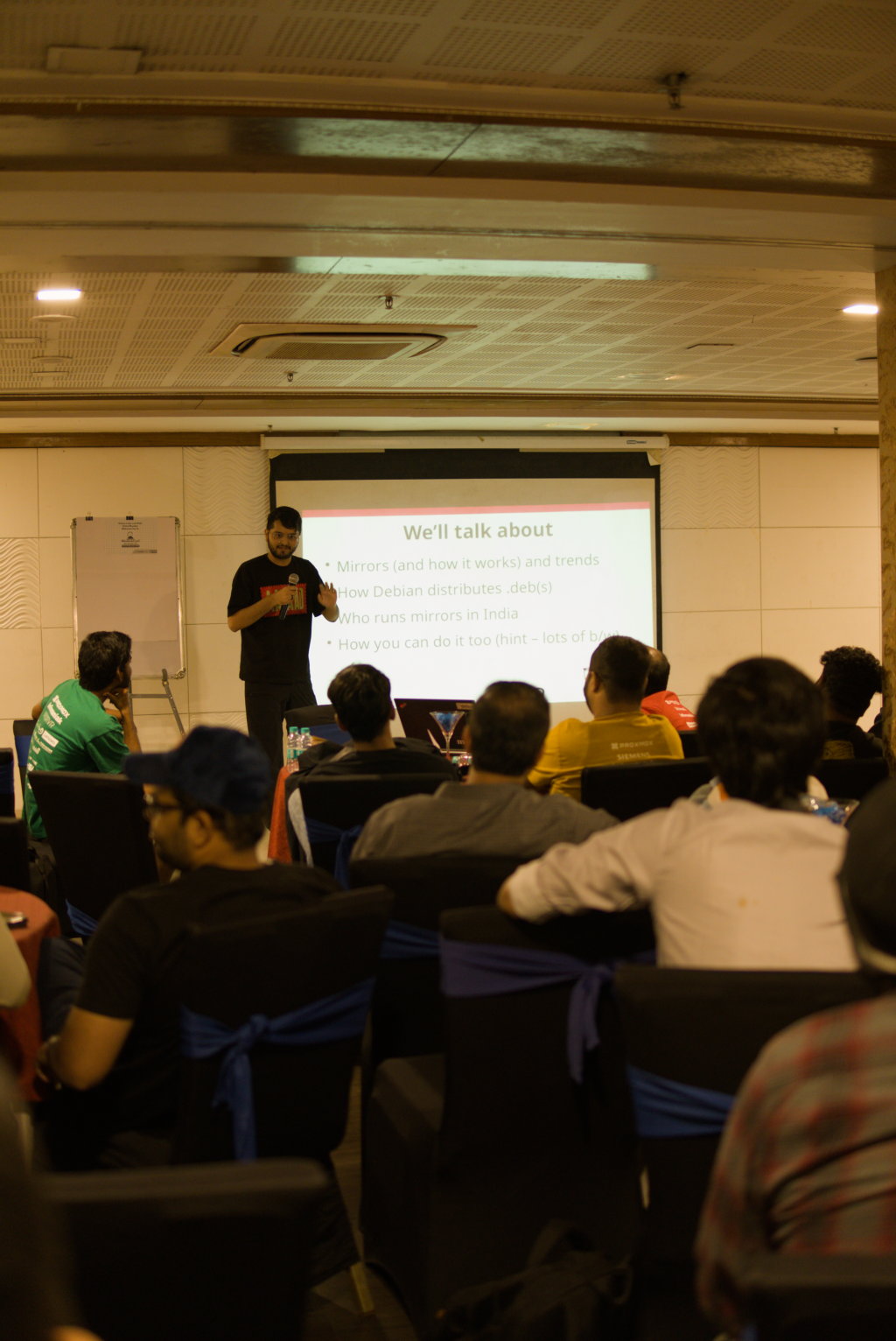
MiniDebConf Navi Mumbai 2025 which was MiniDebConf Mumbai, which in turn was FOSSMumbai x MiniDebian Conference, happened on 13th and 14th December, 2025, with a hotel as Day 1 venue and a college on Day 2. Originally planned for the 8th of November, it got postponed to December due to operational reasons. Most of the on-ground logistics and other heavy lifting was done by Arya, Vidhya, MumbaiFOSS, and the Remigies Technologies team, so we didn t had to worry much. This time, I gave a talk on Basics of a Free Software Mirror (and how Debian does it) (Presentation URL). I had the idea for this talk for a while and gave a KDE version of it during KDE India Conf 2025. The gist was to explain how Free Software is delivered to users and how one can help. For MDC, I focused a bit on Debian mirror network(s) and who else host mirrors in India and trends.
Me during mirror talk
Credits - niyabits. Thanks for the pictures
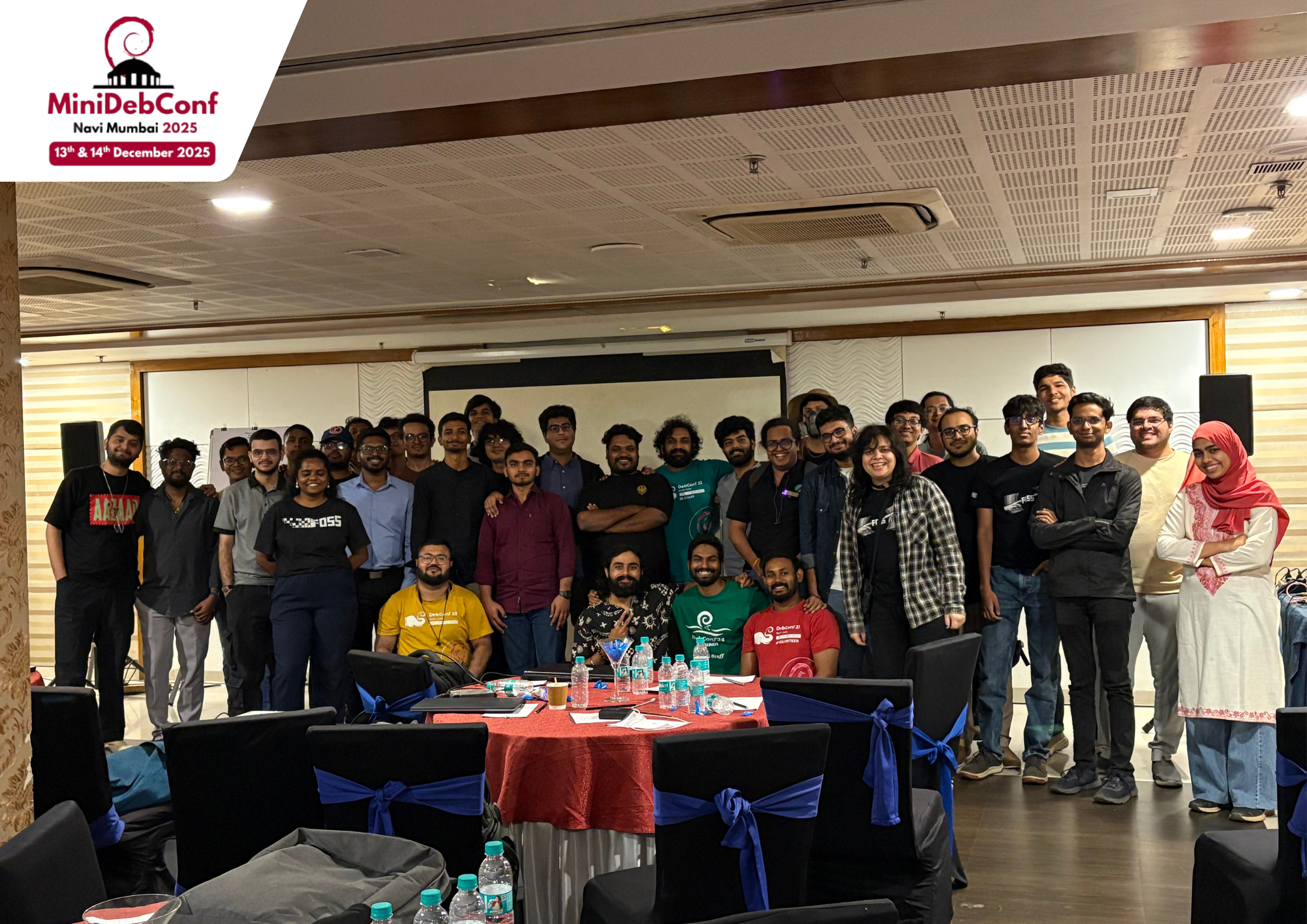
At the onset someone mentioned my Termux mirror. Termux is a good project to get into mirror hosting with. I got into mirroring with it. It has low traffic (usually less than 20 GB/day) demands with a high request count and can be done on an existing 6 USD Digital Ocean nodes. Q&A time turned out more interesting than I anticipated. Folks touched upon commercial CDNs instead of community mirrors, supply chain security issues, and a bit of other stuff. We had quite a number of interesting talks and I remember when Arya was telling me during CFP time, bro we have too many talks now :D. Now, preparations have already started for MiniDebConf Kanpur 2026, scheduled for March 14th and 15th at the IIT campus. If you want to help, see the following thread. See you in the next one. A group photo
Day 1 group photo. Click to enlarge

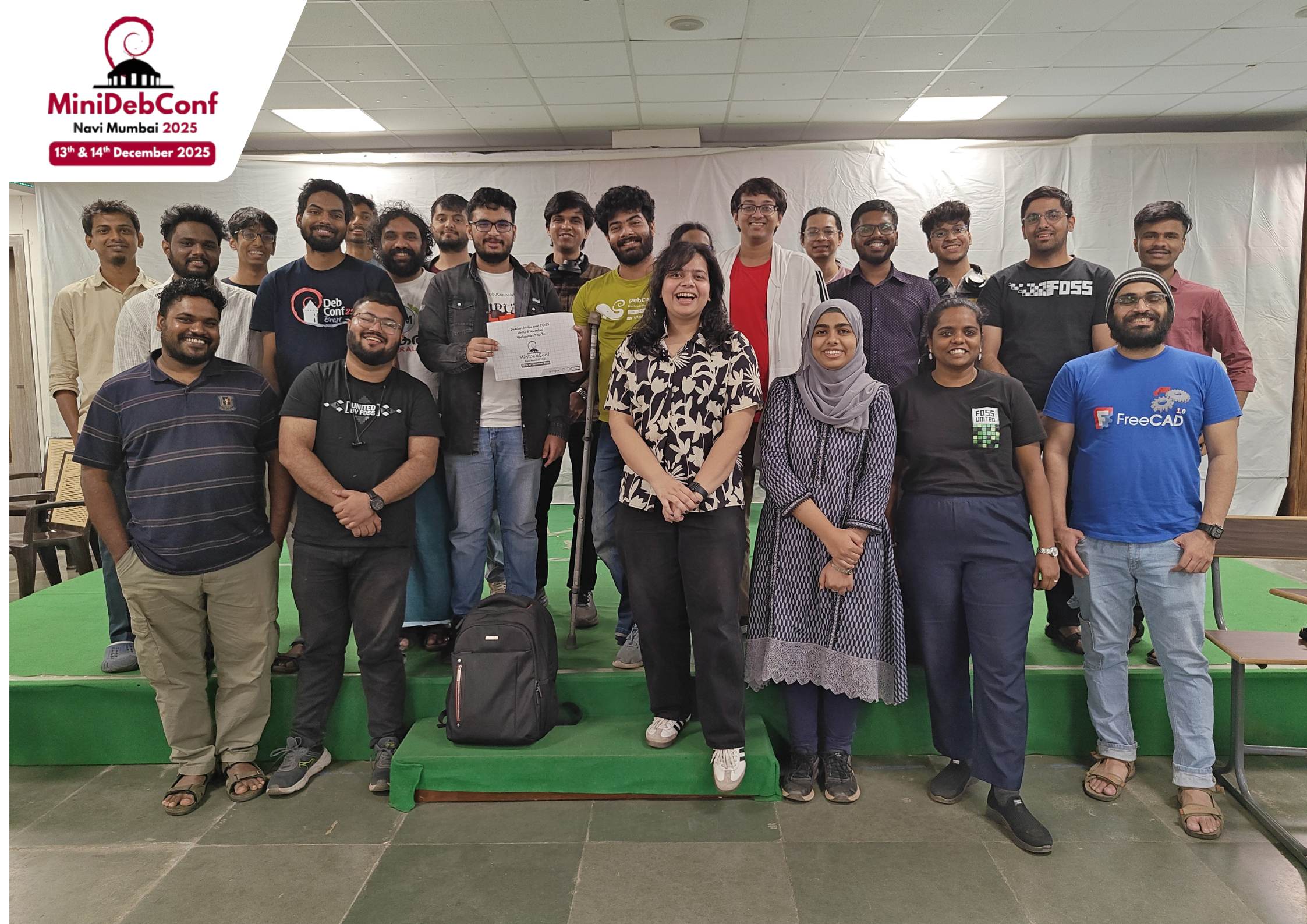
A group photo
Day 2 group photo. Click to enlarge

17 December 2025

Matthew Garrett: How did IRC ping timeouts end up in a lawsuit?

I recently won a lawsuit against Roy and Rianne Schestowitz, the authors and publishers of the Techrights and Tuxmachines websites. The short version of events is that they were subject to an online harassment campaign, which they incorrectly blamed me for. They responded with a large number of defamatory online posts about me, which the judge described as unsubstantiated character assassination and consequently awarded me significant damages. That's not what this post is about, as such. It's about the sole meaningful claim made that tied me to the abuse.

In the defendants' defence and counterclaim[1], 15.27 asserts in part The facts linking the Claimant to the sock puppet accounts include, on the IRC network: simultaneous dropped connections to the mjg59_ and elusive_woman accounts. This is so unlikely to be coincidental that the natural inference is that the same person posted under both names. "elusive_woman" here is an account linked to the harassment, and "mjg59_" is me. This is actually a surprisingly interesting claim to make, and it's worth going into in some more detail.

The event in question occurred on the 28th of April, 2023. You can see a line reading *elusive_woman has quit (Ping timeout: 2m30s), followed by one reading *mjg59_ has quit (Ping timeout: 2m30s). The timestamp listed for the first is 09:52, and for the second 09:53. Is that actually simultaneous? We can actually gain some more information - if you hover over the timestamp links on the right hand side you can see that the link is actually accurate to the second even if that's not displayed. The first event took place at 09:52:52, and the second at 09:53:03. That's 11 seconds apart, which is clearly not simultaneous, but maybe it's close enough. Figuring out more requires knowing what a "ping timeout" actually means here.

The IRC server in question is running Ergo (link to source code), and the relevant function is handleIdleTimeout(). The logic here is fairly simple - track the time since activity was last seen from the client. If that time is longer than DefaultIdleTimeout (which defaults to 90 seconds) and a ping hasn't been sent yet, send a ping to the client. If a ping has been sent and the timeout is greater than DefaultTotalTimeout (which defaults to 150 seconds), disconnect the client with a "Ping timeout" message. There's no special logic for handling the ping reply - a pong simply counts as any other client activity and resets the "last activity" value and timeout.

What does this mean? Well, for a start, two clients running on the same system will only have simultaneous ping timeouts if their last activity was simultaneous. Let's imagine a machine with two clients, A and B. A sends a message at 02:22:59. B sends a message 2 seconds later, at 02:23:01. The idle timeout for A will fire at 02:24:29, and for B at 02:24:31. A ping is sent for A at 02:24:29 and is responded to immediately - the idle timeout for A is now reset to 02:25:59, 90 seconds later. The machine hosting A and B has its network cable pulled out at 02:24:30. The ping to B is sent at 02:24:31, but receives no reply. A minute later, at 02:25:31, B quits with a "Ping timeout" message. A ping is sent to A at 02:25:59, but receives no reply. A minute later, at 02:26:59, A quits with a "Ping timeout" message. Despite both clients having their network interrupted simultaneously, the ping timeouts occur 88 seconds apart.

So, two clients disconnecting with ping timeouts 11 seconds apart is not incompatible with the network connection being interrupted simultaneously - depending on activity, simultaneous network interruption may result in disconnections up to 90 seconds apart. But another way of looking at this is that network interruptions may occur up to 90 seconds apart and generate simultaneous disconnections[2]. Without additional information it's impossible to determine which is the case.

This already casts doubt over the assertion that the disconnection was simultaneous, but if this is unusual enough it's still potentially significant. Unfortunately for the Schestowitzes, even looking just at the elusive_woman account, there were several cases where elusive_woman and another user had a ping timeout within 90 seconds of each other - including one case where elusive_woman and schestowitz[TR] disconnect 40 seconds apart. By the Schestowitzes argument, it's also a natural inference that elusive_woman and schestowitz[TR] (one of Roy Schestowitz's accounts) are the same person.

We didn't actually need to make this argument, though. In England it's necessary to file a witness statement describing the evidence that you're going to present in advance of the actual court hearing. Despite being warned of the consequences on multiple occasions the Schestowitzes never provided any witness statements, and as a result weren't allowed to provide any evidence in court, which made for a fairly foregone conclusion.

[1] As well as defending themselves against my claim, the Schestowitzes made a counterclaim on the basis that I had engaged in a campaign of harassment against them. This counterclaim failed.

[2] Client A and client B both send messages at 02:22:59. A falls off the network at 02:23:00, has a ping sent at 02:24:29, and has a ping timeout at 02:25:29. B falls off the network at 02:24:28, has a ping sent at 02:24:29, and has a ping timeout at 02:25:29. Simultaneous disconnects despite over a minute of difference in the network interruption.

comment count unavailable comments

16 December 2025

Christian Kastner: Simple-PPA, a minimalistic PPA implementation

Today, the Debusine developers launched Debusine repositories, a beta implementation of PPAs. In the announcement, Colin remarks that "[d]iscussions about this have been happening for long enough that people started referring to PPAs for Debian as 'bikesheds'"; a characterization that I'm sure most will agree with. So it is with great amusement that on this same day, I launch a second PPA implementation for Debian: Simple-PPA. Simple-PPA was never meant to compete with Debusine, though. In fact, it's entirely the opposite: from discussions at DebConf, I knew that it was only a matter of time until Debusine gained a PPA-like feature, but I needed a stop-gap solution earlier, and with some polish, what was once by Python script already doing APT processing for apt.ai.debian.net, recently became Simple-PPA. Consequently, Simple-PPA lacks (and will always lack) all of the features that Debusine offers: there is no auto-building, no CI, nor any other type of QA. It's the simplest possible type of APT repository: you just upload packages, they get imported into an archive, and the archive is exposed via a web server. Under the hood, reprepro does all the heavy lifting. However, this also means it's trivial to set up. The following is the entire configuration that simple-ppa.debian.net started with:
# simple-ppa.conf
[CORE]
SignWith = 2906D748B7551BC8
ExportDir = /srv/www/simple-ppa
MailFrom: Simple-PPA <admin@simple-ppa.debian.net>
Codenames = sid forky trixie trixie-backports bookworm bookworm-backports
AlsoAllow = forky: unstable
            trixie: unstable
            bookworm: unstable
[simple-ppa-dev]
Label = Simple-PPA's self-hosted development repository
# ckk's key
Uploaders = allow * by key E76004C5CEF0C94C+
[ckk]
Label = Christian Kastner at Simple-PPA
Uploaders = allow * by key E76004C5CEF0C94C+
The CORE section just sets some defaults and sensible rules. Two PPAs are defined, simple-ppa-dev and ckk, which accept packages signed by the key with the ID E76004C5CEF0C94C. These PPAs use the global defaults, but individual PPAs can override Architectures, Suites, and Components, and of course allow an arbitrary number of users. Users upload to this archive using SFTP (e.g.: with dput-ng). Every 15 minutes, uploads get processed, with ACCEPTED or REJECTED mails sent to the Maintainer address. The APT archive of all PPAs is signed with a single global key. I myself intend to use Debusine repositories soon, as the autobuilding and the QA tasks Debusine offers are something I need. However, I do still see a niche use case for Simple-PPA: when you need an APT archive, but don't want to do a deep dive into reprepro (which is extremely powerful). If you'd like to give Simple-PPA a try, head over to simple-ppa.debian.net and follow the instructions for users.

Freexian Collaborators: Monthly report about Debian Long Term Support, November 2025 (by Santiago Ruano Rinc n)

The Debian LTS Team, funded by [Freexian s Debian LTS offering] (https://www.freexian.com/lts/debian/), is pleased to report its activities for November.

Activity summary During the month of November, 18 contributors have been paid to work on Debian LTS (links to individual contributor reports are located below). The team released 33 DLAs fixing 219 CVEs. The LTS Team kept going with the usual cadence of preparing security updates for Debian 11 bullseye , but also for Debian 12 bookworm , Debian 13 trixie and even Debian unstable. As in previous months, we are pleased to say that there have been multiple contributions of LTS uploads by Debian Fellows outside the regular LTS Team. Notable security updates:
  • Guilhem Moulin prepared DLA 4365-1 for unbound, a caching DNS resolver, fixing a cache poisoning vulnerability that could lead to domain hijacking.
  • Another update related to DNS software was made by Andreas Henriksson. Andreas completed the work on bind9, released as DLA 4364-1 to fix cache poisoning and Denial of Service (DoS) vulnerabilities.
  • Chris Lamb released DLA 4374-1 to fix a potential arbitrary code execution vulnerability in pdfminer, a tool for extracting information from PDF documents.
  • Ben Hutchings published a regular security update for the linux 6.1 bullseye backport, as DLA 4379-1.
  • A couple of other important recurrent updates were prepared by Emilio Pozuelo, who handled firefox-esr and thunderbird (in collaboration with Christoph Goehre), published as DLAs DLA 4370-1 and DLA 4372-1, respectively.
Contributions from fellows outside the LTS Team:
  • Thomas Goirand uploaded a bullseye update for keystone and swift
  • Jeremy B cha prepared the bullseye update for gst-plugins-base1.0
  • As mentioned above, Christoph Goehre prepared the bullseye update for thunderbird.
  • Mathias Behrle provided feedback about the tryton-server and tryton-sao vulnerabilities that were disclosed last month, and helped to review the bullseye patches for tryton-server.
Other than the regular LTS updates for bullseye, the LTS Team has also contributed updates to the latest Debian releases:
  • Bastien Roucari s prepared a bookworm update for squid, the web proxy cache server.
  • Carlos Henrique Lima Melara filed a bookworm point update request for gdk-pixbuf to fix CVE-2025-7345, a heap buffer overflow vulnerability that could lead to arbitrary code execution.
  • Daniel Leidert prepared bookworm and trixie updates for r-cran-gh to fix CVE-2025-54956, an issue that may expose user credentials in HTTP responses.
  • Along with the bullseye updates for unbound mentioned above, Guilhem helped to prepare the trixie update for unbound.
  • In collaboration with Lukas M rdian, Tobias Frost prepared trixie and bookworm updates for log4cxx, the C++ port of the logging framework for JAVA.
  • Jochen Sprickerhof prepared a bookworm update for syslog-ng.
  • Utkarsh completed the bookworm update for wordpress, addressing multiple security issues in the popular blogging tool.
Beyond security updates, there has been a significant effort in revamping our documentation, aiming to make the processes more clear and consistent for all the members of the team. This work was mainly carried out by Sylvain, Jochen and Roberto. We would like to express our gratitude to the sponsors for making the Debian LTS project possible. Also, special thanks to the fellows outside the LTS team for their valuable help.

Individual Debian LTS contributor reports

Thanks to our sponsors Sponsors that joined recently are in bold.

15 December 2025

Gunnar Wolf: Unique security and privacy threats of large language models a comprehensive survey

This post is an unpublished review for Unique security and privacy threats of large language models a comprehensive survey
Much has been written about large language models (LLMs) being a risk to user security and privacy, including the issue that, being trained with datasets whose provenance and licensing are not always clear, they can be tricked into producing bits of data that should not be divulgated. I took on reading this article as means to gain a better understanding of this area. The article completely fulfilled my expectations. This is a review article, which is not a common format for me to follow: instead of digging deep into a given topic, including an experiment or some way of proofing the authors claims, a review article will contain a brief explanation and taxonomy of the issues at hand, and a large number of references covering the field. And, at 36 pages and 151 references, that s exactly what we get. The article is roughly split in two parts: The first three sections present the issue of security and privacy threats as seen by the authors, as well as the taxonomy within which the review will be performed, and sections 4 through 7 cover the different moments in the life cycle of a LLM model (at pre-training, during fine-tuning, when deploying systems that will interact with end-users, and when deploying LLM-based agents), detailing their relevant publications. For each of said moments, the authors first explore the nature of the relevant risks, then present relevant attacks, and finally close outlining countermeasures to said attacks. The text is accompanied all throughout its development with tables, pipeline diagrams and attack examples that visually guide the reader. While the examples presented are sometimes a bit simplistic, they are a welcome guide and aid to follow the explanations; the explanations for each of the attack models are necessarily not very deep, and I was often left wondering I correctly understood a given topic, or wanting to dig deeper but being this a review article, it is absolutely understandable. The authors present an easy to read prose, and this article covers an important spot in understanding this large, important, and emerging area of LLM-related study.

14 December 2025

Dirk Eddelbuettel: BH 1.90.0-1 on CRAN: New Upstream

Boost Boost is a very large and comprehensive set of (peer-reviewed) libraries for the C++ programming language, containing well over one hundred individual libraries. The BH package provides a sizeable subset of header-only libraries for (easier, no linking required) use by R. It is fairly widely used: the (partial) CRAN mirror logs (aggregated from the cloud mirrors) show over 41.5 million package downloads. Version 1.90.0 of Boost was released a few days ago following the regular Boost release schedule of April, August and December releases. As before, we packaged it almost immediately and started testing following our annual update cycle which strives to balance being close enough to upstream and not stressing CRAN and the user base too much. The reverse depends check revealed only one really minor issue among the over three hundred direct reverse dependencies. And that issue was addressed yesterday within hours by a truly responsove maintainer (and it helped that a related issue had been addressed months earlier with version 1.89.). So big thanks to Jean-Romain Roussel for the prompt fix, and to Andrew Johnson for the earlier test with 1.89.0. As last year with 1.87.0, no new Boost libraries were added to BH so the (considerable) size is more or less unchanged. It lead to CRAN doing a manual inspection but as there were no other issues it sailed through as is now in the CRAN repository. The short NEWS entry follows.

Changes in version 1.90.0-1 (2025-12-13)
  • Upgrade to Boost 1.90.0, patched as usual to comment-out diagnostic suppression messages per the request of CRAN
  • Minor upgrades to continuous integration

Via my CRANberries, there is a diffstat report relative to the previous release. Comments and suggestions about BH are welcome via the issue tracker at the GitHub repo.

This post by Dirk Eddelbuettel originated on his Thinking inside the box blog. If you like this or other open-source work I do, you can now sponsor me at GitHub.

12 December 2025

Freexian Collaborators: Debian Contributions: Updates about DebConf Video Team Sprint, rebootstrap, SBOM tooling in Debian and more! (by Anupa Ann Joseph)

Debian Contributions: 2025-11 Contributing to Debian is part of Freexian s mission. This article covers the latest achievements of Freexian and their collaborators. All of this is made possible by organizations subscribing to our Long Term Support contracts and consulting services.

DebConf Video Team Sprint The DebConf Video Team records, streams, and publishes talks from DebConf and many miniDebConfs. A lot of the infrastructure development happens during setup for these events, but we also try to organize a sprint once a year to work on infrastructure, when there isn t a DebConf about to happen. Stefano attended the sprint in Herefordshire this year and wrote up a report.

rebootstrap, by Helmut Grohne A number of jobs were stuck in architecture-specific failures. gcc-15 and dpkg still disagree about whether PIE is enabled occasionally and big endian mipsen needed fixes in systemd. Beyond this regular uploads of libxml2 and gcc-15 required fixes and rebasing of pending patches. Earlier, Loongson used rebootstrap to create the initial package set for loong64 and Miao Wang now submitted their changes. Therefore, there is now initial support for suites other than unstable and use with derivatives.

Building the support for Software Bill Of Materials tooling in Debian, by Santiago Ruano Rinc n Vendors of Debian-based products may/should be paying attention to the evolution of different jurisdictions (such as the CRA or updates on CISA s Minimum Elements for a Software Bill of Materials) that require to make available Software Bill of Materials (SBOM) of their products. It is important then to have tools in Debian to make it easier to produce such SBOMs. In this context, Santiago continued the work on packaging libraries related to SBOMs. This includes the packaging of the SPDX python library (python-spdx-tools), and its dependencies rdflib and mkdocs-include-markdown-plugin. System Package Data Exchange (SPDX), defined by ISO/IEC 5962:2021, is an open standard capable of representing systems with software components as SBOMs and other data and security references. SPDX and CycloneDX (whose python library python3-cyclonedx-lib was packaged by prior efforts this year), encompass the two main SBOM standards available today.

Miscellaneous contributions
  • Carles improved po-debconf-manager: added checking status of bug reports automatically via python-debianbts; changed some command line options naming or output based on user feedback; finished refactoring user interaction to rich; codebase is now flake8-compliant; added type safety with mypy.
  • Carles, using po-debconf-manager, created 19 bug reports for translations where the merge requests were pending; reviewed and created merge requests for 4 packages.
  • Carles planned a second version of the tool that detects packages that Recommends or Suggests packages which are not in Debian. He is taking ideas from dumat.
  • Carles submitted a pull request to python-unidiff2 (adapted from the original pull request to python-unidiff). He also started preparing a qnetload update.
  • Stefano did miscellaneous python package updates: mkdocs-macros-plugin, python-confuse, python-pip, python-mitogen.
  • Stefano reviewed a beets upload for a new maintainer who is taking it over.
  • Stefano handled some debian.net infrastructure requests.
  • Stefano updated debian.social infrastructure for the trixie point release.
  • The update broke jitsi.debian.social, Stefano put some time into debugging it and eventually enlisted upstream assistance, who solved the problem!
  • Stefano worked on some patches for Python that help Debian:
    • GH-139914: The main HP PA-RISC support patch for 3.14.
    • GH-141930: We observed an unhelpful error when failing to write a .pyc file during package installation. We may have fixed the problem, and at least made the error better.
    • GH-141011: Ignore missing ifunc support on HP PA-RISC.
  • Stefano spun up a website for hamburg2026.mini.debconf.org.
  • Rapha l reviewed a merge request updating tracker.debian.org to rely on bootstrap
    version 5.
  • Emilio coordinated various transitions.
  • Helmut sent patches for 26 cross build failures.
  • Helmut officially handed over the cleanup of the /usr-move transition.
  • Helmut monitored the transition moving libcrypt-dev out of build-essential and bumped the remaining bugs to rc-severity in coordination with the release team.
  • Helmut updated the Build-Profiles patch for debian-policy incorporating feedback from Sean Whitton with a lot of help from Nattie Mayer-Hutchings and Freexian colleagues.
  • Helmut discovered that the way mmdebstrap deals with start-stop-daemon may result in broken output and sent a patch.
  • As a result of armel being removed from sid , but not from forky , the multiarch hinter broke. Helmut fixed it.
  • Helmut uploaded debvm accepting a patch from Luca Boccassi to fix it for newer
    systemd.
  • Colin began preparing for the second stage of the OpenSSH GSS-API key exchange package split.
  • Colin caught and fixed a devscripts regression due to it breaking part of Debusine.
  • Colin packaged django-pgtransaction and backported it to trixie , since it looks useful for Debusine.
  • Thorsten uploaded the packages lprng, cpdb-backend-cups, cpdb-libs and ippsample to fix some RC bugs as well as other bugs that accumulated over time. He also uploaded cups-filters to all Debian releases to fix three CVEs.

11 December 2025

Dirk Eddelbuettel: #056: Running r-ci with R-devel

Welcome to post 56 in the R4 series. The recent post #54 reviewed a number of earlier posts on r-ci, our small (but very versatile) runner for continunous integration (CI) with R. The post also introduced the notion of using a container in the matrix of jobs defined and running in parallel. The initial motivation was the (still ongoing, and still puzzling) variation in run-times of GitHub Actions. So when running CI and relying on r2u for the fast, easy, reliable: pick all three! provision of CRAN packages as Ubuntu binaries, a small amount of time is spent prepping a basic Ubuntu instance with the necessary setup. This can be as fast as maybe 20 to 30 seconds, but it can also stretch to almost two minutes when GitHub is busier or out of sorts for other reasons. When the CI job itself is short, that is a nuisance. We presented relying on a pre-made r2u4ci container that adds just a few commands to the standard r2u container to be complete for CI. And with that setup CI runs tend to be reliably faster. This situation is still evolving. I have not converted any of my existing CI scripts (apart from a test instance or two), but I keep monitoring the situation. However, this also offered another perspective: why not rely on a different container for a different CI aspect? When discussing the CI approach with Jeff the other day (and helping add CI to his mmap repo), it occurred to me we could also use on of the Rocker containers for R-devel. A minimal change to the underlying run.sh script later, this was accomplished. An example is provided as both a test and an illustration in the repo for package RcppInt64 in its script ci.yaml:
    strategy:
      matrix:
        include:
          -   name: container, os: ubuntu-latest, container: rocker/r2u4ci  
          -   name: r-devel,   os: ubuntu-latest, container: rocker/drd  
          -   name: macos,     os: macos-latest  
          -   name: ubuntu,    os: ubuntu-latest  

    runs-on: $  matrix.os  
    container: $  matrix.container  
This runs both a standard Ubuntu setup (fourth entry) and the alternate just described relying on the container (first entry) along with the (usually commented-out) optional macOS setup (third entry). And line two brings the drd container from Rocker. The CI runner script now checks for a possible Rdevel binary as provided inside drd (along with alias RD) and uses it when present. And that is all that there is: no other change on the user side; tests now run under R-devel. You can see some of the initial runs at the rcppint64 repo actions log. Another example is now also at Jeff s mmap repo. It should be noted that this relies on R-devel running packages made with R-release. Every few years this breaks when R needs to break its binary API. If and when that happens this option will be costlier as the R-devel instance will then have to (re-)install its R package dependencies. This can be accomodated easily as a step in the yaml file. And under normal circumstances it is not needed. Having easy access to recent builds of R-devel (the container refreshes weekly on a schedule) with the convenience of r2u gives another option for package testing. I may continue to test locally with R-devel as my primary option, and most likely keep my CI small and lean (usually just one R-relase run on Ubuntu) but having another option at GitHub Actions is also a good thing.

This post by Dirk Eddelbuettel originated on his Thinking inside the box blog. If you like this or other open-source work I do, you can now sponsor me at GitHub.

6 December 2025

Taavi V n nen: How to import a new Wikipedia language edition (in hard mode)

I created the latest Wikipedia language edition, the Toki Pona Wikipedia, last month. Unlike most other wikis which start their lives in the Wikimedia Incubator before the full wiki is created, in this case the community had been using a completely external MediaWiki site to build the wiki before it was approved as a "proper" Wikipedia wiki,1 and now that external wiki needed to be imported to the newly created Wikimedia-hosted wiki. (As far as I'm aware, the last and previously only time an external wiki has been imported to a Wikimedia project was in 2013 when Wikitravel was forked as Wikivoyage.) Creating a Wikimedia wiki these days is actually pretty straightforward, at least when compared to what it used to be like a couple of years ago. Today the process mostly involves using a script to generate two configuration changes, one to add the basic configuration for a wiki to operate and an another to add the wiki to the list of all wikis that exist, and then running a script to create the wiki database in between of deploying those two configuration changes. And then you wait half an hour while the script to tell all Wikidata client wikis about the new wiki runs on one wiki at a time. The primary technical challenge in importing a third-party wiki is that there's no SUL making sure that a single username maps to the same account on both wikis. This means that the usual strategy of using the functionality I wrote in CentralAuth to manually create local accounts can't be used as is, and so we needed to come up with a new way of matching everyone's contributions to their existing Wikimedia accounts. (Side note: While the user-facing interface tries to present a single "global" user account that can be used on all public Wikimedia wikis, in reality the account management layer in CentralAuth is mostly just a glue layer to link together individual "local" accounts on each wiki that the user has ever visited. These local accounts have independent user ID numbers for example I am user #35938993 on the English Wikipedia but #4 on the new Toki Pona Wikipedia and are what most of MediaWiki code interacts with except for a few features specifically designed with cross-wiki usage in mind. This distinction is also still very much present and visible in the various administrative and anti-abuse workflows.) The approach we ended up choosing was to re-write the dump file before importing, so that a hypothetical account called $Name would be turned $Name~wikipesija.org after the import.2 We also created empty user accounts that would take ownership of the edits to be imported so that we could use the standard account management tools on them later on. MediaWiki supports importing contributions without a local account to attribute them to, but it doesn't seem to be possible to convert an imported actor3 to a regular user later on which we wanted to keep as a possibility, even with the minor downside of creating a few hundred users that'll likely never get touched again later. We also made specific decisions to add the username suffix to everyone, not to just those names that'd conflicted with existing SUL accounts, and to deal with renaming users that wanted their contributions linked to an existing SUL account only after the import. This both reduced complexity and thus risk from the import phase, which already had much more unknowns compared to the rest of the process, but also were much better options ethically as well: suffixing all names meant we would not imply that those people chose to be Wikimedians with those specific usernames (when in reality it was us choosing to import those edits to the Wikimedia universe), and doing renames using the standard MediaWiki account management tooling meant that it produced the normal public log entries that all other MediaWiki administrative actions create. With all of the edits imported, the only major thing remaining was doing those merges I mentioned earlier to attribute imported edits to people's existing SUL accounts. Thankfully, the local account -based system makes it actually pretty simple. Usually CentralAuth prevents renaming individual local accounts that are attached to a global account, but that check can be bypassed with a maintenance script or a privileged enough account. Renaming the user automatically detached it from the previous global account, after which an another maintenance script could be used to attach the user to the correct global account.

  1. That external site was a fork of a fork of the original Toki Pona Wikipedia that was closed in 2005. And because cool URIs don't change, we made the the URLs that the old Wikipedia was using work again. Try it: https://art-tokipona.wikipedia.org.
  2. wikipesija.org was the domain where the old third-party wiki was hosted on, and ~ was used as a separator character in usernames during the SUL finalization in the early 2010s so using it here felt appropriate as well.
  3. An actor is a MediaWiki term and a database table referring to anything that can do edits or logged actions. Usually an actor is a user account or an IP address, but an imported user name in a specific format can also be represented as an actor.

4 December 2025

Colin Watson: Free software activity in November 2025

My Debian contributions this month were all sponsored by Freexian. I had a bit less time than usual, because Freexian collaborators gathered in Marseille this month for our yearly sprint, doing some planning for next year. You can also support my work directly via Liberapay or GitHub Sponsors. OpenSSH I began preparing for the second stage of the GSS-API key exchange package split (some details have changed since that message). It seems that we ll need to wait until Ubuntu 26.04 LTS has been released, but that s close enough that it s worth making sure we re ready. This month I just did some packaging cleanups that would otherwise have been annoying to copy, such as removing support for direct upgrades from pre-bookworm. I m considering some other package rearrangements to make the split easier to manage, but haven t made any decisions here yet. This also led me to start on a long-overdue bug triage pass, mainly consisting of applying usertags to lots of our open bugs to sort them by which program they apply to, and also closing a few that have been fixed, since some bugs will eventually need to be reassigned to GSS-API packages and it would be helpful to make them easier to find. At the time of writing, about 30% of the bug list remains to be categorized this way. Python packaging I upgraded these packages to new upstream versions: I packaged django-pgtransaction and backported it to trixie, since we plan to use it in Debusine; and I adopted python-certifi for the Python team. I fixed or helped to fix several other build/test failures: I fixed a couple of other bugs: Other bits and pieces Code reviews

3 December 2025

Reproducible Builds: Reproducible Builds in November 2025

Welcome to the report for November 2025 from the Reproducible Builds project! These monthly reports outline what we ve been up to over the past month, highlighting items of news from elsewhere in the increasingly-important area of software supply-chain security. As always, if you are interested in contributing to the Reproducible Builds project, please see the Contribute page on our website. In this report:

  1. 10 years of Reproducible Build at SeaGL
  2. Distribution work
  3. Tool development
  4. Website updates
  5. Miscellaneous news
  6. Software Supply Chain Security of Web3
  7. Upstream patches

10 years of Reproducible Builds at SeaGL 2025 On Friday 8th November, Chris Lamb gave a talk called 10 years of Reproducible Builds at SeaGL in Seattle, WA. Founded in 2013, SeaGL is a free, grassroots technical summit dedicated to spreading awareness and knowledge about free source software, hardware and culture. Chris talk:
[ ] introduces the concept of reproducible builds, its technical underpinnings and its potentially transformative impact on software security and transparency. It is aimed at developers, security professionals and policy-makers who are concerned with enhancing trust and accountability in our software. It also provides a history of the Reproducible Builds project, which is approximately ten years old. How are we getting on? What have we got left to do? Aren t all the builds reproducible now?

Distribution work In Debian this month, Jochen Sprickerhof created a merge request to replace the use of reprotest in Debian s Salsa Continuous Integration (CI) pipeline with debrebuild. Jochen cites the advantages as being threefold: firstly, that only one extra build needed ; it uses the same sbuild and ccache tooling as the normal build ; and works for any Debian release . The merge request was merged by Emmanuel Arias and is now active. kpcyrd posted to our mailing list announcing the initial release of repro-threshold, which implements an APT transport that defines a threshold of at least X of my N trusted rebuilders need to confirm they reproduced the binary before installing Debian packages. Configuration can be done through a config file, or through a curses-like user interface. Holger then merged two commits by Jochen Sprickerhof in order to address a fakeroot-related reproducibility issue in the debian-installer, and J rg Jaspert deployed a patch by Ivo De Decker for a bug originally filed by Holger in February 2025 related to some Debian packages not being archived on snapshot.debian.org. Elsewhere, Roland Clobus performed some analysis on the live Debian trixie images, which he determined were not reproducible. However, in a follow-up post, Roland happily reports that the issues have been handled. In addition, 145 reviews of Debian packages were added, 12 were updated and 15 were removed this month adding to our knowledge about identified issues. Lastly, Jochen Sprickerhof filed a bug announcing their intention to binary NMU a very large number of the R programming language after a reproducibility-related toolchain bug was fixed.
Bernhard M. Wiedemann posted another openSUSE monthly update for their work there.
Julien Malka and Arnout Engelen launched the new hash collection server for NixOS. Aside from improved reporting to help focus reproducible builds efforts within NixOS, it collects build hashes as individually-signed attestations from independent builders, laying the groundwork for further tooling.

Tool development diffoscope version 307 was uploaded to Debian unstable (as well as version 309). These changes included further attempts to automatically attempt to deploy to PyPI by liaising with the PyPI developers/maintainers (with this experimental feature). [ ][ ][ ] In addition, reprotest versions 0.7.31 and 0.7.32 were uploaded to Debian unstable by Holger Levsen, who also made the following changes:
  • Do not vary the architecture personality if the kernel is not varied. (Thanks to Ra l Cumplido). [ ]
  • Drop the debian/watch file, as Lintian now flags this as error for native Debian packages. [ ][ ]
  • Bump Standards-Version to 4.7.2, with no changes needed. [ ]
  • Drop the Rules-Requires-Root header as it is no longer required.. [ ]
In addition, however, Vagrant Cascadian fixed a build failure by removing some extra whitespace from an older changelog entry. [ ]

Website updates Once again, there were a number of improvements made to our website this month including:

Miscellaneous news

Software Supply Chain Security of Web3 Via our mailing list, Martin Monperrus let us know about their recently-published page on the Software Supply Chain Security of Web3. The abstract of their paper is as follows:
Web3 applications, built on blockchain technology, manage billions of dollars in digital assets through decentralized applications (dApps) and smart contracts. These systems rely on complex, software supply chains that introduce significant security vulnerabilities. This paper examines the software supply chain security challenges unique to the Web3 ecosystem, where traditional Web2 software supply chain problems intersect with the immutable and high-stakes nature of blockchain technology. We analyze the threat landscape and propose mitigation strategies to strengthen the security posture of Web3 systems.
Their paper lists reproducible builds as one of the mitigating strategies. A PDF of the full text is available to download.

Upstream patches The Reproducible Builds project detects, dissects and attempts to fix as many currently-unreproducible packages as possible. We endeavour to send all of our patches upstream where appropriate. This month, we wrote a large number of such patches, including:

Finally, if you are interested in contributing to the Reproducible Builds project, please visit our Contribute page on our website. However, you can get in touch with us via:

2 December 2025

Dirk Eddelbuettel: duckdb-mlpack 0.0.5: Added kmeans, version helpers, documentation

A new release of the still-recent duckdb extension for mlpack, the C++ header-only library for machine learning, was merged into the duckdb community extensions repo today, and has been updated at its duckdb mlpack extension page. This release 0.0.5 adds one new method: kmeans clustering. We also added two version accessors for both mlpack and armadillo. We found during the work on random forests (added in 0.0.4) that the multithreaded random number generation was not quite right in the respective upstream codes. This has by now been corrected in armadillo 15.2.2 as well as the trunk version of mlpack so if you build with those, and set a seed, then your forests and classification will be stable across reruns. We added a second state variable mlpack_silent that can be used to suppress even the minimal prediction quality summary some methods show, and expanded the documentation. For more details, see the repo for code, issues and more, and the extension page for more about this duckdb community extension.

This post by Dirk Eddelbuettel originated on his Thinking inside the box blog. If you like this or other open-source work I do, you can sponsor me at GitHub.

Fran ois Marier: Recovering from a broken update on the Turris Omnia

The recent Turris OS update from 7.2.3 to 9.0.0 took down my WiFi entirely. The wired network still works fine, but wireless is completely broken.

Factory reset It turns out the Omnia has an extensive (and fast) factory reset / recovery mode via the hardware reset button. Unfortunately, the factory image didn't work for me, possibly because I don't use the stock WiFi radios anymore.

Rolling back with schnapps Thanks to the fact that the Omnia uses a btrfs root filesystem, and the liberal use of snapshots around updates, I was able to rollback to the pre-9.0.0 state. First, I connected to the router using ssh:
ssh root@192.168.1.1
Then I listed the available snapshots:
$ schnapps list
#   Type        Size          Date                          Description
------+-----------+-------------+-----------------------------+------------------------------------
  500   post           15.98MiB   2025-08-09 11:27:48 -0700     Automatic post-update snapshot (TurrisOS 7.2.2 - hbs)
  506   pre            17.92MiB   2025-09-12 03:44:32 -0700     Automatic pre-update snapshot (TurrisOS 7.2.2 - hbs)
  507   post           17.88MiB   2025-09-12 03:45:14 -0700     Automatic post-update snapshot (TurrisOS 7.2.3 - hbs)
  515   time           20.03MiB   2025-11-02 01:05:01 -0700     Snapshot created by cron
  516   time           20.05MiB   2025-11-09 01:05:01 -0800     Snapshot created by cron
  517   time           20.29MiB   2025-11-16 01:05:00 -0800     Snapshot created by cron
  518   time           20.64MiB   2025-11-23 01:05:01 -0800     Snapshot created by cron
  519   time           20.83MiB   2025-11-30 01:05:00 -0800     Snapshot created by cron
  520   pre            87.91MiB   2025-11-30 07:41:10 -0800     Automatic pre-update snapshot (TurrisOS 7.2.3 - hbs)
  521   post          196.32MiB   2025-11-30 07:48:11 -0800     Automatic post-update snapshot (TurrisOS 9.0.0 - hbs)
  523   pre             4.44MiB   2025-11-30 20:47:31 -0800     Automatic pre-update snapshot
  524   post          224.00KiB   2025-11-30 20:47:43 -0800     Automatic post-update snapshot
  525   rollback      224.00KiB   2025-12-01 04:56:32 +0000     Rollback to snapshot factory
  526   pre             4.44MiB   2025-11-30 21:04:19 -0800     Automatic pre-update snapshot
  527   post          272.00KiB   2025-11-30 21:04:31 -0800     Automatic post-update snapshot
  528   rollback      272.00KiB   2025-12-01 05:13:38 +0000     Rollback to snapshot factory
  529   pre             4.52MiB   2025-11-30 21:28:44 -0800     Automatic pre-update snapshot
  530   single        208.00KiB                                 
  531   rollback      224.00KiB   2025-12-01 05:29:47 +0000     Rollback to snapshot factory
Finally, I rolled back to the exact state I was on before the 9.0.0 update:
$ schnapps rollback 520
Current state saved as snapshot number 532
Rolled back to snapshot 520

Full wipe As an aside, it turns out that the factory reset functionality is implemented as a brtfs rollback to a special factory snapshot. This is why is so fast, but it also means that doing a simple factory reset doesn't wipe the data on your router. If you are planning to sell your device or otherwise dispose of it, you also need to delete all btrfs snapshots

Conclusion While this update was very disappointing, especially since it's never happened before with major updates on Turris OS, it made me discover just how great the recovery tools are. It would be pretty tricky to fully brick one of these devices.

1 December 2025

Guido G nther: Free Software Activities November 2025

Another short status update of what happened on my side last month. Hand holding the release machinery for Phosh 0.51.0 but there's more: See below for details on the above and more: phosh phoc phosh-mobile-settings stevia xdg-desktop-portal-phosh pfs Phrog gmobile feedbackd feedbackd-device-themes libcall-ui wirepumber Chatty mobile-broadband-povider-info Debian Mobian wlroots libqrtr-glib libadwaits-rs phosh-site bengalos-debs gtk Reviews This is not code by me but reviews on other peoples code. The list is (as usual) slightly incomplete. Thanks for the contributions! Help Development If you want to support my work see donations. Comments? Join the Fediverse thread

Russ Allbery: Review: Forever and a Day

Review: Forever and a Day, by Haley Cass
Series: Those Who Wait #1.5
Publisher: Haley Cass
Copyright: 2020
ISBN: 979-8-5902-5966-3
Format: Kindle
Pages: 101
Forever and a Day is a coda to Haley Cass's self-published sapphic romance novel Those Who Wait. There is no point in reading it unless you have already read and enjoyed the full book and wanted more of a denouement. Given that Those Who Wait is a romance novel, it is definitionally not a spoiler to reveal that Sutton and Charlotte ended up together. This novella is seven scenes sketching out the next few years of their lives, interspersed with press clippings and social media commentary. These tie up loose ends, give the characters a bit more time together, throw in one more conflict and resolution, add one more sex scene, and stick a few exclamation points after the happily ever after. I am the sort of person who likes long denouements in stories, so I'm the target audience for this sort of sequel that's essentially additional chapters to the book. (The funniest version of this I've read is Jacqueline Carey's Saints Astray.) They are usually not great literature, since there are good reasons for not including these chapters in the book. That is exactly what this is: a few more chapters of the characters being happy, entirely forgettable, and of interest only to people who want that. Cass does try to introduce a bit of a plot via some light family conflict, which was sweet and mostly worked, and some conflict over having children, which was very stereotyped and which I did not enjoy as much. I thought the earlier chapters of this novella were the stronger ones, although I do have to give the characters credit in the later chapters for working through conflict in a mature and fairly reasonable way. It does help, though, when the conflict is entirely resolved by one character being right and the other character being happily wrong. That's character conflict on easy mode. I was happy to see that Sutton got a career, although as in the novel I wish Cass had put some more effort into describing Sutton's efforts in building that career. The details are maddeningly vague, which admittedly matches the maddeningly vague description of Charlotte's politics but which left me unsatisfied. Charlotte's political career continues to be pure wish fulfillment in the most utterly superficial and trivialized way, and it bothered me even more in the novella than it did in the novel. We still have absolutely no idea what she stands for, what she wants to accomplish, and why anyone would vote for her, and yet we get endless soft-focus paeans to how wonderful she will be for the country. Her opponents are similarly vague to the point that the stereotypes Cass uses to signal their inferiority to Charlotte are a little suspect. I'm more critical of this in 2025 than I would have been in 2015 because the last ten years have made clear the amount of damage an absolute refusal to stand for anything except hazy bromides causes, and I probably shouldn't be this annoyed that Cass chose to vaguely gesture towards progressive liberalism without muddying her romance denouement with a concrete political debate. But, just, gah. I found the last chapter intensely annoying, in part because the narrative of that chapter was too cliched and trite to sufficiently distract me from the bad taste of the cotton-candy politics. Other than that, this was minor, sweet, and forgettable. If you want another few chapters of an already long novel, this delivers exactly what you would expect. If the novel was plenty, nothing about this novella is going to change your mind and you can safely skip it. I really liked the scene between Charlotte and Sutton's mom, though, and I'm glad I read the novella just for that. Rating: 6 out of 10

Next.

Previous.