Search Results: "cts"

14 December 2025

Evgeni Golov: Home Assistant, Govee Lights Local, VLANs, Oh my!

We recently bought some Govee Glide Hexa Light Panels, because they have a local LAN API that is well integrated into Home Assistant. Or so we thought. Our network is not that complicated, but there is a dedicated VLAN for IOT devices. Home Assistant runs in a container (with network=host) on a box in the basement, and that box has a NIC in the IOT VLAN so it can reach devices there easily. So far, this has never been a problem. Enter the Govee LAN API. Or maybe its Python implementation. Not exactly sure who's to blame here. The API involves sending JSON over multicast, which the Govee device will answer to.
No devices found on the network
After turning logging for homeassistant.components.govee_light_local to 11, erm debug, we see:
DEBUG (MainThread) [homeassistant.components.govee_light_local.config_flow] Starting discovery with IP 192.168.42.2
DEBUG (MainThread) [homeassistant.components.govee_light_local.config_flow] No devices found with IP 192.168.42.2
That's not the IP address in the IOT VLAN! Turns out the integration recently got support for multiple NICs, but Home Assistant doesn't just use all the interfaces it sees by default. You need to go to Settings Network Network adapter and deselect "Autoconfigure", which will allow your to select individual interfaces. Once you've done that, you'll see Starting discovery with IP messages for all selected interfaces and adding of Govee Lights Local will work.

12 December 2025

Freexian Collaborators: Debian Contributions: Updates about DebConf Video Team Sprint, rebootstrap, SBOM tooling in Debian and more! (by Anupa Ann Joseph)

Debian Contributions: 2025-11 Contributing to Debian is part of Freexian s mission. This article covers the latest achievements of Freexian and their collaborators. All of this is made possible by organizations subscribing to our Long Term Support contracts and consulting services.

DebConf Video Team Sprint The DebConf Video Team records, streams, and publishes talks from DebConf and many miniDebConfs. A lot of the infrastructure development happens during setup for these events, but we also try to organize a sprint once a year to work on infrastructure, when there isn t a DebConf about to happen. Stefano attended the sprint in Herefordshire this year and wrote up a report.

rebootstrap, by Helmut Grohne A number of jobs were stuck in architecture-specific failures. gcc-15 and dpkg still disagree about whether PIE is enabled occasionally and big endian mipsen needed fixes in systemd. Beyond this regular uploads of libxml2 and gcc-15 required fixes and rebasing of pending patches. Earlier, Loongson used rebootstrap to create the initial package set for loong64 and Miao Wang now submitted their changes. Therefore, there is now initial support for suites other than unstable and use with derivatives.

Building the support for Software Bill Of Materials tooling in Debian, by Santiago Ruano Rinc n Vendors of Debian-based products may/should be paying attention to the evolution of different jurisdictions (such as the CRA or updates on CISA s Minimum Elements for a Software Bill of Materials) that require to make available Software Bill of Materials (SBOM) of their products. It is important then to have tools in Debian to make it easier to produce such SBOMs. In this context, Santiago continued the work on packaging libraries related to SBOMs. This includes the packaging of the SPDX python library (python-spdx-tools), and its dependencies rdflib and mkdocs-include-markdown-plugin. System Package Data Exchange (SPDX), defined by ISO/IEC 5962:2021, is an open standard capable of representing systems with software components as SBOMs and other data and security references. SPDX and CycloneDX (whose python library python3-cyclonedx-lib was packaged by prior efforts this year), encompass the two main SBOM standards available today.

Miscellaneous contributions
  • Carles improved po-debconf-manager: added checking status of bug reports automatically via python-debianbts; changed some command line options naming or output based on user feedback; finished refactoring user interaction to rich; codebase is now flake8-compliant; added type safety with mypy.
  • Carles, using po-debconf-manager, created 19 bug reports for translations where the merge requests were pending; reviewed and created merge requests for 4 packages.
  • Carles planned a second version of the tool that detects packages that Recommends or Suggests packages which are not in Debian. He is taking ideas from dumat.
  • Carles submitted a pull request to python-unidiff2 (adapted from the original pull request to python-unidiff). He also started preparing a qnetload update.
  • Stefano did miscellaneous python package updates: mkdocs-macros-plugin, python-confuse, python-pip, python-mitogen.
  • Stefano reviewed a beets upload for a new maintainer who is taking it over.
  • Stefano handled some debian.net infrastructure requests.
  • Stefano updated debian.social infrastructure for the trixie point release.
  • The update broke jitsi.debian.social, Stefano put some time into debugging it and eventually enlisted upstream assistance, who solved the problem!
  • Stefano worked on some patches for Python that help Debian:
    • GH-139914: The main HP PA-RISC support patch for 3.14.
    • GH-141930: We observed an unhelpful error when failing to write a .pyc file during package installation. We may have fixed the problem, and at least made the error better.
    • GH-141011: Ignore missing ifunc support on HP PA-RISC.
  • Stefano spun up a website for hamburg2026.mini.debconf.org.
  • Rapha l reviewed a merge request updating tracker.debian.org to rely on bootstrap
    version 5.
  • Emilio coordinated various transitions.
  • Helmut sent patches for 26 cross build failures.
  • Helmut officially handed over the cleanup of the /usr-move transition.
  • Helmut monitored the transition moving libcrypt-dev out of build-essential and bumped the remaining bugs to rc-severity in coordination with the release team.
  • Helmut updated the Build-Profiles patch for debian-policy incorporating feedback from Sean Whitton with a lot of help from Nattie Mayer-Hutchings and Freexian colleagues.
  • Helmut discovered that the way mmdebstrap deals with start-stop-daemon may result in broken output and sent a patch.
  • As a result of armel being removed from sid , but not from forky , the multiarch hinter broke. Helmut fixed it.
  • Helmut uploaded debvm accepting a patch from Luca Boccassi to fix it for newer
    systemd.
  • Colin began preparing for the second stage of the OpenSSH GSS-API key exchange package split.
  • Colin caught and fixed a devscripts regression due to it breaking part of Debusine.
  • Colin packaged django-pgtransaction and backported it to trixie , since it looks useful for Debusine.
  • Thorsten uploaded the packages lprng, cpdb-backend-cups, cpdb-libs and ippsample to fix some RC bugs as well as other bugs that accumulated over time. He also uploaded cups-filters to all Debian releases to fix three CVEs.

8 December 2025

Freexian Collaborators: Debian's /usr-move transition has been completed (by Helmut Grohne)

By now, the /usr-merge is an old transition. Effectively, it turns top-level directories such as /bin into symbolic links pointing below /usr. That way the entire operating system can be contained below the /usr hierarchy enabling e.g. image based update mechanisms. It was first supported in Debian 9, which is no longer in active use at this point (except for users of Freexian s ELTS offer). When it became mandatory in Debian 12, it wasn t really done though, because Debian s package manager was not prepared to handle file system objects being referred to via two different paths. With nobody interested in handling the resulting issues, Freexian stepped in and funded a project lead by Helmut Grohne to resolve the remaining issues. While the initial idea was to enhance the package manager, Debian s members disagreed. They preferred an approach where files were simply tracked with their physical location while handling the resulting misbehavior of the package manager using package-specific workarounds. This has been recorded in the DEP17 document. During the Debian 13 release cycle, the plan has been implemented. A tool for detecting possible problems was developed specifically for this transition. Since all files are now tracked with their physical location and necessary workarounds have been added, problematic behavior is no longer triggered. An upgrade from Debian 12 to Debian 13 is unlikely to run into aliasing problems as a result. This whole project probably consumed more than 1500 hours of work from Debian contributors, of which 700 were sponsored by Freexian through the work of Helmut Grohne. What remains is eventually removing the workarounds.

6 December 2025

Simon Josefsson: Reproducible Guix Container Images

Around a year ago I wrote about Guix Container Images for GitLab CI/CD and these images have served the community well. Besides continous use in CI/CD, these Guix container images are used to confirm reproducibility of the source tarball artifacts in the releases of Libtasn1 v4.20, InetUtils v2.6, Libidn2 v2.3.8, Libidn v1.43, SASL v2.2.2, Guile-GnuTLS v5.0.1, and OATH Toolkit v2.6.13. See how all those release announcements mention a Guix commit? That s the essential supply-chain information about the Guix build environment that allows the artifacts to be re-created. To make sure this is repeatable, the release tarball artifacts are re-created from source code every week in the verify-reproducible-artifacts project, that I wrote about earlier. Guix s time travelling feature make this sustainable to maintain, and hopefully will continue to be able to reproduce the exact same tarball artifacts for years to come. During the last year, unfortunately Guix was removed from Debian stable. My Guix container images were created from Debian with that Guix package. My setup continued to work since the old stage0 Debian+Guix containers were still available. Such a setup is not sustainable, as there will be bit-rot and we don t want to rely on old containers forever, which (after the removal of Guix in Debian) could not be re-produced any more. Let this be a reminder how user-empowering features such as Guix time-travelling is! I have reworked my Guix container image setup, and this post is an update on the current status of this effort. The first step was to re-engineer Debian container images with Guix, and I realized these were useful on their own, and warrant a separate project. A more narrowly scoped project makes will hopefully make it easier to keep them working. Now instead of apt-get install guix they use the official Guix guix-install.sh approach. Read more about that effort in the announcement of Debian with Guix. The second step was to reconsider my approach to generate the Guix images. The earlier design had several stages. First, Debian+Guix containers were created. Then from those containers, a pure Guix container was created. Finally, using the pure Guix container another pure Guix container was created. The idea behind that GCC-like approach was to get to reproducible images that were created from an image that had no Debian left on it. However, I never managed to finish this. Partially because I hadn t realized that every time you build a Guix container image from Guix, you effectively go back in time. When using Guix version X to build a container with Guix on it, it will not put Guix version X into the container but will put whatever version of Guix is available in its package archive, which will be an earlier version, such as version X-N. I had hope to overcome this somehow (running a guix pull in newly generated images may work), but never finished this before Guix was removed from Debian. So what could a better design look like? For efficiency, I had already started experimenting with generating the final images directly from the Debian+Guix images, and after reproducibility bugs were fixed I was able to get to reproducible images. However, I was still concerned that the Debian container could taint the process somehow, and was also concerned about the implied dependency on non-free software in Debian. I ve been using comparative rebuilds using similar distributions to confirm artifact reproducibility for my software projects, comparing builds on Trisquel 11 with Ubuntu 22.04, and AlmaLinux 9 with RockyLinux 9 for example. This works surprisingly well. Including one freedom-respecting distribution like Trisquel will detect if any non-free software has bearing on artifacts. Using different architectures, such as amd64 vs arm64 also help with deeper supply-chain concerns. My conclusion was that I wanted containers with the same Guix commit for both Trisquel and Ubuntu. Given the similarity with Debian, adapting and launching the Guix on Trisquel/Debian project was straight forward. So we now have Trisquel 11/12 and Ubuntu 22.04/24.04 images with the same Guix on them. Do you see where the debian-with-guix and guix-on-dpkg projects are leading to? We are now ready to look at the modernized Guix Container Images project. The tags are the same as before:
registry.gitlab.com/debdistutils/guix/container:latest
registry.gitlab.com/debdistutils/guix/container:slim
registry.gitlab.com/debdistutils/guix/container:extra
registry.gitlab.com/debdistutils/guix/container:gash
The method to create them is different. Now there is a build job that uses the earlier Guix+Trisquel container (for amd64) or Guix+Debian (for arm64, pending Trisquel arm64 containers). The build job create the final containers directly. Next a Ubuntu reproduce job is launched that runs the same commands, failing if it cannot generate the bit-by-bit identical container. Then single-arch images are tested (installing/building GNU hello and building libksba), and then pushed to the GitLab registry, adding multi-arch images in the process. Then the final multi-arch containers are tested by building Guile-GnuTLS and, on success, uploaded to the Docker Hub. How would you use them? A small way to start the container is like this:
jas@kaka:~$ podman run -it --privileged --entrypoint=/bin/sh registry.gitlab.com/debdistutils/guix/container:latest
sh-5.2# env HOME=/ guix describe # https://issues.guix.gnu.org/74949
  guix 21ce6b3
    repository URL: https://git.guix.gnu.org/guix.git
    branch: master
    commit: 21ce6b392ace4c4d22543abc41bd7c22596cd6d2
sh-5.2# 
The need for --entrypoint=/bin/sh is because Guix s pack command sets up the entry point differently than most other containers. This could probably be fixed if people want that, and there may be open bug reports about this. The need for --privileged is more problematic, but is discussed upstream. The above example works fine without it, but running anything more elaborate with guix-daemon installing packages will trigger a fatal error. Speaking of that, here is a snippet of commands that allow you to install Guix packages in the container.
cp -rL /gnu/store/*profile/etc/* /etc/
echo 'root:x:0:0:root:/:/bin/sh' > /etc/passwd
echo 'root:x:0:' > /etc/group
groupadd --system guixbuild
for i in $(seq -w 1 10); do useradd -g guixbuild -G guixbuild -d /var/empty -s $(command -v nologin) -c "Guix build user $i" --system guixbuilder$i; done
env LANG=C.UTF-8 guix-daemon --build-users-group=guixbuild &
guix archive --authorize < /share/guix/ci.guix.gnu.org.pub
guix archive --authorize < /share/guix/bordeaux.guix.gnu.org.pub
guix install hello
GUIX_PROFILE="/var/guix/profiles/per-user/root/guix-profile"
. "$GUIX_PROFILE/etc/profile"
hello
This could be simplified, but we chose to not hard-code in our containers because some of these are things that probably shouldn t be papered over but fixed properly somehow. In some execution environments, you may need to pass --disable-chroot to guix-daemon. To use the containers to build something in a GitLab pipeline, here is an example snippet:
test-amd64-latest-wget-configure-make-libksba:
  image: registry.gitlab.com/debdistutils/guix/container:latest
  before_script:
  - cp -rL /gnu/store/*profile/etc/* /etc/
  - echo 'root:x:0:0:root:/:/bin/sh' > /etc/passwd
  - echo 'root:x:0:' > /etc/group
  - groupadd --system guixbuild
  - for i in $(seq -w 1 10); do useradd -g guixbuild -G guixbuild -d /var/empty -s $(command -v nologin) -c "Guix build user $i" --system guixbuilder$i; done
  - export HOME=/
  - env LANG=C.UTF-8 guix-daemon --build-users-group=guixbuild &
  - guix archive --authorize < /share/guix/ci.guix.gnu.org.pub
  - guix archive --authorize < /share/guix/bordeaux.guix.gnu.org.pub
  - guix describe
  - guix install libgpg-error
  - GUIX_PROFILE="//.guix-profile"
  - . "$GUIX_PROFILE/etc/profile"
  script:
  - wget https://www.gnupg.org/ftp/gcrypt/libksba/libksba-1.6.7.tar.bz2
  - tar xfa libksba-1.6.7.tar.bz2
  - cd libksba-1.6.7
  - ./configure
  - make V=1
  - make check VERBOSE=t V=1
More help on the project page for the Guix Container Images. That s it for tonight folks, and remember, Happy Hacking!

Taavi V n nen: How to import a new Wikipedia language edition (in hard mode)

I created the latest Wikipedia language edition, the Toki Pona Wikipedia, last month. Unlike most other wikis which start their lives in the Wikimedia Incubator before the full wiki is created, in this case the community had been using a completely external MediaWiki site to build the wiki before it was approved as a "proper" Wikipedia wiki,1 and now that external wiki needed to be imported to the newly created Wikimedia-hosted wiki. (As far as I'm aware, the last and previously only time an external wiki has been imported to a Wikimedia project was in 2013 when Wikitravel was forked as Wikivoyage.) Creating a Wikimedia wiki these days is actually pretty straightforward, at least when compared to what it used to be like a couple of years ago. Today the process mostly involves using a script to generate two configuration changes, one to add the basic configuration for a wiki to operate and an another to add the wiki to the list of all wikis that exist, and then running a script to create the wiki database in between of deploying those two configuration changes. And then you wait half an hour while the script to tell all Wikidata client wikis about the new wiki runs on one wiki at a time. The primary technical challenge in importing a third-party wiki is that there's no SUL making sure that a single username maps to the same account on both wikis. This means that the usual strategy of using the functionality I wrote in CentralAuth to manually create local accounts can't be used as is, and so we needed to come up with a new way of matching everyone's contributions to their existing Wikimedia accounts. (Side note: While the user-facing interface tries to present a single "global" user account that can be used on all public Wikimedia wikis, in reality the account management layer in CentralAuth is mostly just a glue layer to link together individual "local" accounts on each wiki that the user has ever visited. These local accounts have independent user ID numbers for example I am user #35938993 on the English Wikipedia but #4 on the new Toki Pona Wikipedia and are what most of MediaWiki code interacts with except for a few features specifically designed with cross-wiki usage in mind. This distinction is also still very much present and visible in the various administrative and anti-abuse workflows.) The approach we ended up choosing was to re-write the dump file before importing, so that a hypothetical account called $Name would be turned $Name~wikipesija.org after the import.2 We also created empty user accounts that would take ownership of the edits to be imported so that we could use the standard account management tools on them later on. MediaWiki supports importing contributions without a local account to attribute them to, but it doesn't seem to be possible to convert an imported actor3 to a regular user later on which we wanted to keep as a possibility, even with the minor downside of creating a few hundred users that'll likely never get touched again later. We also made specific decisions to add the username suffix to everyone, not to just those names that'd conflicted with existing SUL accounts, and to deal with renaming users that wanted their contributions linked to an existing SUL account only after the import. This both reduced complexity and thus risk from the import phase, which already had much more unknowns compared to the rest of the process, but also were much better options ethically as well: suffixing all names meant we would not imply that those people chose to be Wikimedians with those specific usernames (when in reality it was us choosing to import those edits to the Wikimedia universe), and doing renames using the standard MediaWiki account management tooling meant that it produced the normal public log entries that all other MediaWiki administrative actions create. With all of the edits imported, the only major thing remaining was doing those merges I mentioned earlier to attribute imported edits to people's existing SUL accounts. Thankfully, the local account -based system makes it actually pretty simple. Usually CentralAuth prevents renaming individual local accounts that are attached to a global account, but that check can be bypassed with a maintenance script or a privileged enough account. Renaming the user automatically detached it from the previous global account, after which an another maintenance script could be used to attach the user to the correct global account.

  1. That external site was a fork of a fork of the original Toki Pona Wikipedia that was closed in 2005. And because cool URIs don't change, we made the the URLs that the old Wikipedia was using work again. Try it: https://art-tokipona.wikipedia.org.
  2. wikipesija.org was the domain where the old third-party wiki was hosted on, and ~ was used as a separator character in usernames during the SUL finalization in the early 2010s so using it here felt appropriate as well.
  3. An actor is a MediaWiki term and a database table referring to anything that can do edits or logged actions. Usually an actor is a user account or an IP address, but an imported user name in a specific format can also be represented as an actor.

4 December 2025

Ben Hutchings: FOSS activity in November 2025

3 December 2025

Reproducible Builds: Reproducible Builds in November 2025

Welcome to the report for November 2025 from the Reproducible Builds project! These monthly reports outline what we ve been up to over the past month, highlighting items of news from elsewhere in the increasingly-important area of software supply-chain security. As always, if you are interested in contributing to the Reproducible Builds project, please see the Contribute page on our website. In this report:

  1. 10 years of Reproducible Build at SeaGL
  2. Distribution work
  3. Tool development
  4. Website updates
  5. Miscellaneous news
  6. Software Supply Chain Security of Web3
  7. Upstream patches

10 years of Reproducible Builds at SeaGL 2025 On Friday 8th November, Chris Lamb gave a talk called 10 years of Reproducible Builds at SeaGL in Seattle, WA. Founded in 2013, SeaGL is a free, grassroots technical summit dedicated to spreading awareness and knowledge about free source software, hardware and culture. Chris talk:
[ ] introduces the concept of reproducible builds, its technical underpinnings and its potentially transformative impact on software security and transparency. It is aimed at developers, security professionals and policy-makers who are concerned with enhancing trust and accountability in our software. It also provides a history of the Reproducible Builds project, which is approximately ten years old. How are we getting on? What have we got left to do? Aren t all the builds reproducible now?

Distribution work In Debian this month, Jochen Sprickerhof created a merge request to replace the use of reprotest in Debian s Salsa Continuous Integration (CI) pipeline with debrebuild. Jochen cites the advantages as being threefold: firstly, that only one extra build needed ; it uses the same sbuild and ccache tooling as the normal build ; and works for any Debian release . The merge request was merged by Emmanuel Arias and is now active. kpcyrd posted to our mailing list announcing the initial release of repro-threshold, which implements an APT transport that defines a threshold of at least X of my N trusted rebuilders need to confirm they reproduced the binary before installing Debian packages. Configuration can be done through a config file, or through a curses-like user interface. Holger then merged two commits by Jochen Sprickerhof in order to address a fakeroot-related reproducibility issue in the debian-installer, and J rg Jaspert deployed a patch by Ivo De Decker for a bug originally filed by Holger in February 2025 related to some Debian packages not being archived on snapshot.debian.org. Elsewhere, Roland Clobus performed some analysis on the live Debian trixie images, which he determined were not reproducible. However, in a follow-up post, Roland happily reports that the issues have been handled. In addition, 145 reviews of Debian packages were added, 12 were updated and 15 were removed this month adding to our knowledge about identified issues. Lastly, Jochen Sprickerhof filed a bug announcing their intention to binary NMU a very large number of the R programming language after a reproducibility-related toolchain bug was fixed.
Bernhard M. Wiedemann posted another openSUSE monthly update for their work there.
Julien Malka and Arnout Engelen launched the new hash collection server for NixOS. Aside from improved reporting to help focus reproducible builds efforts within NixOS, it collects build hashes as individually-signed attestations from independent builders, laying the groundwork for further tooling.

Tool development diffoscope version 307 was uploaded to Debian unstable (as well as version 309). These changes included further attempts to automatically attempt to deploy to PyPI by liaising with the PyPI developers/maintainers (with this experimental feature). [ ][ ][ ] In addition, reprotest versions 0.7.31 and 0.7.32 were uploaded to Debian unstable by Holger Levsen, who also made the following changes:
  • Do not vary the architecture personality if the kernel is not varied. (Thanks to Ra l Cumplido). [ ]
  • Drop the debian/watch file, as Lintian now flags this as error for native Debian packages. [ ][ ]
  • Bump Standards-Version to 4.7.2, with no changes needed. [ ]
  • Drop the Rules-Requires-Root header as it is no longer required.. [ ]
In addition, however, Vagrant Cascadian fixed a build failure by removing some extra whitespace from an older changelog entry. [ ]

Website updates Once again, there were a number of improvements made to our website this month including:

Miscellaneous news

Software Supply Chain Security of Web3 Via our mailing list, Martin Monperrus let us know about their recently-published page on the Software Supply Chain Security of Web3. The abstract of their paper is as follows:
Web3 applications, built on blockchain technology, manage billions of dollars in digital assets through decentralized applications (dApps) and smart contracts. These systems rely on complex, software supply chains that introduce significant security vulnerabilities. This paper examines the software supply chain security challenges unique to the Web3 ecosystem, where traditional Web2 software supply chain problems intersect with the immutable and high-stakes nature of blockchain technology. We analyze the threat landscape and propose mitigation strategies to strengthen the security posture of Web3 systems.
Their paper lists reproducible builds as one of the mitigating strategies. A PDF of the full text is available to download.

Upstream patches The Reproducible Builds project detects, dissects and attempts to fix as many currently-unreproducible packages as possible. We endeavour to send all of our patches upstream where appropriate. This month, we wrote a large number of such patches, including:

Finally, if you are interested in contributing to the Reproducible Builds project, please visit our Contribute page on our website. However, you can get in touch with us via:

Michael Ablassmeier: libvirt 11.10 VIR_DOMAIN_BACKUP_BEGIN_PRESERVE_SHUTDOWN_DOMAIN

As with libvirt 11.10 a new flag for backup operation has been inroduced: VIR_DOMAIN_BACKUP_BEGIN_PRESERVE_SHUTDOWN_DOMAIN. According to the documentation It instructs libvirt to avoid termination of the VM if the guest OS shuts down while the backup is still running. The VM is in that scenario reset and paused instead of terminated allowing the backup to finish. Once the backup finishes the VM process is terminated. Added support for this in virtnbdbackup 2.40.

2 December 2025

Simon Josefsson: Guix on Trisquel & Ubuntu for Reproducible CI/CD Artifacts

Last week I published Guix on Debian container images that prepared for today s announcement of Guix on Trisquel/Ubuntu container images. I have published images with reasonably modern Guix for Trisquel 11 aramo, Trisquel 12 ecne, Ubuntu 22.04 and Ubuntu 24.04. The Ubuntu images are available for both amd64 and arm64, but unfortunately Trisquel arm64 containers aren t available yet so they are only for amd64. Images for ppc64el and riscv64 are work in progress. The currently supported container names:
registry.gitlab.com/debdistutils/guix/guix-on-dpkg:trisquel11-guix
registry.gitlab.com/debdistutils/guix/guix-on-dpkg:trisquel12-guix
registry.gitlab.com/debdistutils/guix/guix-on-dpkg:ubuntu22.04-guix
registry.gitlab.com/debdistutils/guix/guix-on-dpkg:ubuntu24.04-guix
Or you prefer guix-on-dpkg on Docker Hub:
docker.io/jas4711/guix-on-dpkg:trisquel11-guix
docker.io/jas4711/guix-on-dpkg:trisquel12-guix
docker.io/jas4711/guix-on-dpkg:ubuntu22.04-guix
docker.io/jas4711/guix-on-dpkg:ubuntu24.04-guix
You may use them as follows. See the guix-on-dpkg README for how to start guix-daemon and installing packages.
jas@kaka:~$ podman run -it --hostname guix --rm registry.gitlab.com/debdistutils/guix/guix-on-dpkg:trisquel11-guix
root@guix:/# head -1 /etc/os-release 
NAME="Trisquel GNU/Linux"
root@guix:/# guix describe
  guix 136fc8b
    repository URL: https://gitlab.com/debdistutils/guix/mirror.git
    branch: master
    commit: 136fc8bfe91a64d28b6c54cf8f5930ffe787c16e
root@guix:/# 
You may now be asking yourself: why? Fear not, gentle reader, because having two container images of roughly similar software is a great tool for attempting to build software artifacts reproducible, and comparing the result to spot differences. Obviously. I have been using this pattern to get reproducible tarball artifacts of several software releases for around a year and half, since libntlm 1.8. Let s walk through how to setup a CI/CD pipeline that will build a piece of software, in four different jobs for Trisquel 11/12 and Ubuntu 22.04/24.04. I am in the process of learning Codeberg/Forgejo CI/CD, so I am still using GitLab CI/CD here, but the concepts should be the same regardless of platform. Let s start by defining a job skeleton:
.guile-gnutls: &guile-gnutls
  before_script:
  - /root/.config/guix/current/bin/guix-daemon --version
  - env LC_ALL=C.UTF-8 /root/.config/guix/current/bin/guix-daemon --build-users-group=guixbuild $GUIX_DAEMON_ARGS &
  - GUIX_PROFILE=/root/.config/guix/current; . "$GUIX_PROFILE/etc/profile"
  - type guix
  - guix --version
  - guix describe
  - time guix install --verbosity=0 wget gcc-toolchain autoconf automake libtool gnutls guile pkg-config
  - time apt-get update
  - time apt-get install -y make git texinfo
  - GUIX_PROFILE="/root/.guix-profile"; . "$GUIX_PROFILE/etc/profile"
  script:
  - git clone https://codeberg.org/guile-gnutls/guile-gnutls.git
  - cd guile-gnutls
  - git checkout v5.0.1
  - ./bootstrap
  - ./configure
  - make V=1
  - make V=1 check VERBOSE=t
  - make V=1 dist
  after_script:
  - mkdir -pv out/$CI_JOB_NAME_SLUG/src
  - mv -v guile-gnutls/*-src.tar.* out/$CI_JOB_NAME_SLUG/src/
  - mv -v guile-gnutls/*.tar.* out/$CI_JOB_NAME_SLUG/
  artifacts:
    paths:
    - out/**
This installs some packages, clones guile-gnutls (it could be any project, that s just an example), build it and return tarball artifacts. The artifacts are the git-archive and make dist tarballs. Let s instantiate the skeleton into four jobs, running the Trisquel 11/12 jobs on amd64 and the Ubuntu 22.04/24.04 jobs on arm64 for fun.
guile-gnutls-trisquel11-amd64:
  tags: [ saas-linux-medium-amd64 ]
  image: registry.gitlab.com/debdistutils/guix/guix-on-dpkg:trisquel11-guix
  extends: .guile-gnutls
guile-gnutls-ubuntu22.04-arm64:
  tags: [ saas-linux-medium-arm64 ]
  image: registry.gitlab.com/debdistutils/guix/guix-on-dpkg:ubuntu22.04-guix
  extends: .guile-gnutls
guile-gnutls-trisquel12-amd64:
  tags: [ saas-linux-medium-amd64 ]
  image: registry.gitlab.com/debdistutils/guix/guix-on-dpkg:trisquel12-guix
  extends: .guile-gnutls
guile-gnutls-ubuntu24.04-arm64:
  tags: [ saas-linux-medium-arm64 ]
  image: registry.gitlab.com/debdistutils/guix/guix-on-dpkg:ubuntu24.04-guix
  extends: .guile-gnutls
Running this pipeline will result in artifacts that you want to confirm for reproducibility. Let s add a pipeline job to do the comparison:
guile-gnutls-compare:
  image: alpine:latest
  needs: [ guile-gnutls-trisquel11-amd64,
           guile-gnutls-trisquel12-amd64,
           guile-gnutls-ubuntu22.04-arm64,
           guile-gnutls-ubuntu24.04-arm64 ]
  script:
  - cd out
  - sha256sum */*.tar.* */*/*.tar.*   sort   grep    -- -src.tar.
  - sha256sum */*.tar.* */*/*.tar.*   sort   grep -v -- -src.tar.
  - sha256sum */*.tar.* */*/*.tar.*   sort   uniq -c -w64   sort -rn
  - sha256sum */*.tar.* */*/*.tar.*   grep    -- -src.tar.   sort   uniq -c -w64   grep -v '^      1 '
  - sha256sum */*.tar.* */*/*.tar.*   grep -v -- -src.tar.   sort   uniq -c -w64   grep -v '^      1 '
# Confirm modern git-archive tarball reproducibility
  - cmp guile-gnutls-trisquel12-amd64/src/*.tar.gz guile-gnutls-ubuntu24-04-arm64/src/*.tar.gz
# Confirm old git-archive (export-subst but long git describe) tarball reproducibility
  - cmp guile-gnutls-trisquel11-amd64/src/*.tar.gz guile-gnutls-ubuntu22-04-arm64/src/*.tar.gz
# Confirm 'make dist' generated tarball reproducibility
  - cmp guile-gnutls-trisquel11-amd64/*.tar.gz guile-gnutls-ubuntu22-04-arm64/*.tar.gz
  - cmp guile-gnutls-trisquel12-amd64/*.tar.gz guile-gnutls-ubuntu24-04-arm64/*.tar.gz
  artifacts:
    when: always
    paths:
    - ./out/**
Look how beautiful, almost like ASCII art! The commands print SHA256 checksums of the artifacts, sorted in a couple of ways, and then proceeds to compare relevant artifacts. What would the output of such a run be, you may wonder? You can look for yourself in the guix-on-dpkg pipeline but here is the gist of it:
$ cd out
$ sha256sum */*.tar.* */*/*.tar.*   sort   grep    -- -src.tar.
79bc24143ba083819b36822eacb8f9e15a15a543e1257c53d30204e9ffec7aca  guile-gnutls-trisquel11-amd64/src/guile-gnutls-v5.0.1-src.tar.gz
79bc24143ba083819b36822eacb8f9e15a15a543e1257c53d30204e9ffec7aca  guile-gnutls-ubuntu22-04-arm64/src/guile-gnutls-v5.0.1-src.tar.gz
b190047cee068f6b22a5e8d49ca49a2425ad4593901b9ac8940f8842ba7f164f  guile-gnutls-trisquel12-amd64/src/guile-gnutls-v5.0.1-src.tar.gz
b190047cee068f6b22a5e8d49ca49a2425ad4593901b9ac8940f8842ba7f164f  guile-gnutls-ubuntu24-04-arm64/src/guile-gnutls-v5.0.1-src.tar.gz
$ sha256sum */*.tar.* */*/*.tar.*   sort   grep -v -- -src.tar.
1e8d107ad534b85f30e432d5c98bf599aab5d8db5f996c2530aabe91f203018a  guile-gnutls-trisquel11-amd64/guile-gnutls-5.0.1.tar.gz
1e8d107ad534b85f30e432d5c98bf599aab5d8db5f996c2530aabe91f203018a  guile-gnutls-ubuntu22-04-arm64/guile-gnutls-5.0.1.tar.gz
bc2df2d868f141bca5f3625aa146aa0f24871f6dcf0b48ff497eba3bb5219b84  guile-gnutls-trisquel12-amd64/guile-gnutls-5.0.1.tar.gz
bc2df2d868f141bca5f3625aa146aa0f24871f6dcf0b48ff497eba3bb5219b84  guile-gnutls-ubuntu24-04-arm64/guile-gnutls-5.0.1.tar.gz
$ sha256sum */*.tar.* */*/*.tar.*   sort   uniq -c -w64   sort -rn
      2 bc2df2d868f141bca5f3625aa146aa0f24871f6dcf0b48ff497eba3bb5219b84  guile-gnutls-trisquel12-amd64/guile-gnutls-5.0.1.tar.gz
      2 b190047cee068f6b22a5e8d49ca49a2425ad4593901b9ac8940f8842ba7f164f  guile-gnutls-trisquel12-amd64/src/guile-gnutls-v5.0.1-src.tar.gz
      2 79bc24143ba083819b36822eacb8f9e15a15a543e1257c53d30204e9ffec7aca  guile-gnutls-trisquel11-amd64/src/guile-gnutls-v5.0.1-src.tar.gz
      2 1e8d107ad534b85f30e432d5c98bf599aab5d8db5f996c2530aabe91f203018a  guile-gnutls-trisquel11-amd64/guile-gnutls-5.0.1.tar.gz
$ sha256sum */*.tar.* */*/*.tar.*   grep    -- -src.tar.   sort   uniq -c -w64   grep -v '^      1 '
      2 79bc24143ba083819b36822eacb8f9e15a15a543e1257c53d30204e9ffec7aca  guile-gnutls-trisquel11-amd64/src/guile-gnutls-v5.0.1-src.tar.gz
      2 b190047cee068f6b22a5e8d49ca49a2425ad4593901b9ac8940f8842ba7f164f  guile-gnutls-trisquel12-amd64/src/guile-gnutls-v5.0.1-src.tar.gz
$ sha256sum */*.tar.* */*/*.tar.*   grep -v -- -src.tar.   sort   uniq -c -w64   grep -v '^      1 '
      2 1e8d107ad534b85f30e432d5c98bf599aab5d8db5f996c2530aabe91f203018a  guile-gnutls-trisquel11-amd64/guile-gnutls-5.0.1.tar.gz
      2 bc2df2d868f141bca5f3625aa146aa0f24871f6dcf0b48ff497eba3bb5219b84  guile-gnutls-trisquel12-amd64/guile-gnutls-5.0.1.tar.gz
$ cmp guile-gnutls-trisquel12-amd64/src/*.tar.gz guile-gnutls-ubuntu24-04-arm64/src/*.tar.gz
$ cmp guile-gnutls-trisquel11-amd64/src/*.tar.gz guile-gnutls-ubuntu22-04-arm64/src/*.tar.gz
$ cmp guile-gnutls-trisquel11-amd64/*.tar.gz guile-gnutls-ubuntu22-04-arm64/*.tar.gz
$ cmp guile-gnutls-trisquel12-amd64/*.tar.gz guile-gnutls-ubuntu24-04-arm64/*.tar.gz
That s it for today, but stay tuned for more updates on using Guix in containers, and remember; Happy Hacking!

Birger Schacht: Status update, November 2025

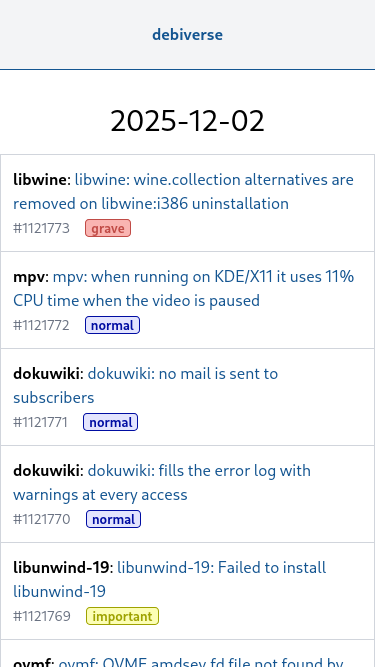
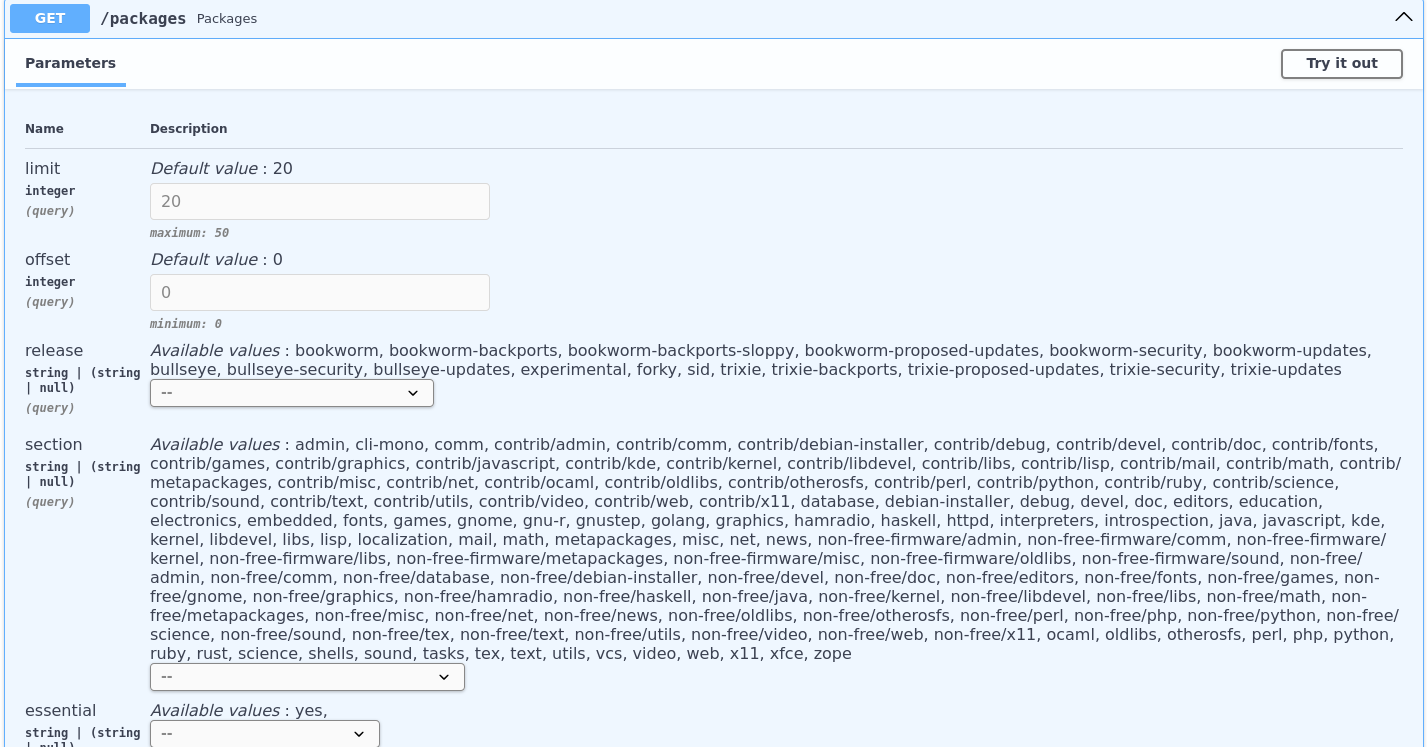
I started this month with a week of vacation which was followed by a small planned surgery and two weeks of sick leave. Nonetheless, I packaged and uploaded new releases of a couple of packages: Besides that I reactivated I project I started in summer 2024: debiverse.org. The idea of that was to have interfaces to Debian bugs and packages that are usable on mobile devices (I know, ludicrous!). Back then I started with Flask and Sqlalchemy, but that soon got out of hand. I now switched the whole stack to FastAPI and SQLModel which makes it a lot easier to manage. And the upside is that it comes with an API and OpenAPI docs. For the rendered HTML pages I use Jinja2 with Tailwind as CSS framework. I am currently using udd-mirror as database backend, which works pretty good (for this single user project). It would be nice to have some of the data in a faster index, like Typesense or Meilisearch. This way it would be possible to have faceted search or more performant full text search. But I haven t found any software that could provide this that is packaged in Debian.
Screenshot of the debiverse bug report list Screenshot of the debiverse swagger API

30 November 2025

Otto Kek l inen: DEP-18: A proposal for Git-based collaboration in Debian

Featured image of post DEP-18: A proposal for Git-based collaboration in DebianI am a huge fan of Git, as I have witnessed how it has made software development so much more productive compared to the pre-2010s era. I wish all Debian source code were in Git to reap the full benefits. Git is not perfect, as it requires significant effort to learn properly, and the ecosystem is complex with even more things to learn ranging from cryptographic signatures and commit hooks to Git-assisted code review best practices, forge websites, and CI systems. Sure, there is still room to optimize its use, but Git certainly has proven itself and is now the industry standard. Thus, some readers might be surprised to learn that Debian development in 2025 is not actually based on Git. In Debian, the version control is done by the Debian archive itself. Each commit is a new upload to the archive, and the commit message is the debian/changelog entry. The commit log is available at snapshots.debian.org. In practice, most Debian Developers (people who have the credentials to upload to the Debian archive) do use Git and host their packaging source code on salsa.debian.org the GitLab instance of Debian. This is, however, based on each DD s personal preferences. The Debian project does not have any policy requiring that packages be hosted on salsa.debian.org or be in version control at all.

Is collaborative software development possible without git and version control software? Debian, however, has some peculiarities that may be surprising to people who have grown accustomed to GitHub, GitLab or various company-internal code review systems. In Debian:
  • The source code of the next upload is not public but resides only on the developer s laptop.
  • Code contributions are plain patch files, based on the latest revision released in the Debian archive (where the unstable area is equivalent to the main development branch).
  • These patches are submitted by email to a bug tracker that does no validation or testing whatsoever.
  • Developers applying these patches typically have elaborate Mutt or Emacs setups to facilitate fetching patches from email.
  • There is no public staging area, no concept of rebasing patches or withdrawing a patch and replacing it with a better version.
  • The submitter won t see any progress information until a notification email arrives after a new version has been uploaded to the Debian archive.
This system has served Debian for three decades. It is not broken, but using the package archive just feels well, archaic. There is a more efficient way, and indeed the majority of Debian packages have a metadata field Vcs-Git that advertises which version control repository the maintainer uses. However, newcomers to Debian are surprised to notice that not all packages are hosted on salsa.debian.org but at various random places with their own account and code submission systems, and there is nothing enforcing or even warning if the code there is out of sync with what was uploaded to Debian. Any Debian Developer can at any time upload a new package with whatever changes, bypassing the Git repository, even when the package advertised a Git repository. All PGP signed commits, Git tags and other information in the Git repository are just extras currently, as the Debian archive does not enforce or validate anything about them. This also makes contributing to multiple packages in parallel hard. One can t just go on salsa.debian.org and fork a bunch of repositories and submit Merge Requests. Currently, the only reliable way is to download source packages from Debian unstable, develop patches on top of them, and send the final version as a plain patch file by email to the Debian bug tracker. To my knowledge, no system exists to facilitate working with the patches in the bug tracker, such as rebasing patches 6 months later to detect if they or equivalent changes were applied or if sending refreshed versions is needed. To newcomers in Debian, it is even more surprising that there are packages that are on salsa.debian.org but have the Merge Requests feature disabled. This is often because the maintainer does not want to receive notification emails about new Merge Requests, but rather just emails from bugs.debian.org. This may sound arrogant, but keep in mind that these developers put in the effort to set up their Mutt/Emacs workflow for the existing Debian process, and extending it to work with GitLab notifications is not trivial. There are also purists who want to do everything via the command-line (without having to open a browser, run JavaScript and maintain a live Internet connection), and tools like glab are not convenient enough for the full workflow.

Inefficient ways of working prevent Debian from flourishing I would claim, based on my personal experiences from the past 10+ years as a Debian Developer, that the lack of high-quality and productive tooling is seriously harming Debian. The current methods of collaboration are cumbersome for aspiring contributors to learn and suboptimal to use for both new and seasoned contributors. There are no exit interviews for contributors who left Debian, no comprehensive data on reasons to contribute or stop contributing, nor are there any metrics tracking how many people tried but failed to contribute to Debian. Some data points to support my concerns do exist:
  • The contributor database shows that the number of contributors is growing slower than Debian s popularity.
  • Most packages are maintained by one person working alone (just pick any package at random and look at the upload history).

Debian should embrace git, but decision-making is slow Debian is all about community and collaboration. One would assume that Debian prioritized above all making collaboration tools and processes simpler, faster and less error-prone, as it would help both current and future package maintainers. Yet, it isn t so, due to some reasons unique to Debian. There is no single company or entity running Debian, and it has managed to operate as a pure meritocracy and do-cracy for over 30 years. This is impressive and admirable. Unfortunately, some of the infrastructure and technical processes are also nearly 30 years old and very difficult to change for the same reason: the nature of Debian s distributed decision-making process. As a software developer and manager with 25+ years of experience, I strongly feel that developing software collaboratively using Git is a major step forward that Debian needs to take, in one form or another, and I hope to see other DDs voice their support if they agree.

Debian Enhancement Proposal 18 Following how consensus is achieved in Debian, I started drafting DEP-18 in 2024, and it is currently awaiting enough thumbs up at https://salsa.debian.org/dep-team/deps/-/merge_requests/21 to get into CANDIDATE status next. In summary, the DEP-18 proposes that everyone keen on collaborating should:
  1. Maintain Debian packaging sources in Git on Salsa.
  2. Use Merge Requests to show your work and to get reviews.
  3. Run Salsa CI before upload.
The principles above are not novel. According to stats at e.g. trends.debian.net, and UDD, ~93% of all Debian source packages are already hosted on salsa.debian.org. As of June 1st, 2025, only 1640 source packages remain that are not hosted on Salsa. The purpose of DEP-18 is to state in writing what Debian is currently doing for most packages, and thus express what among others new contributors should be learning and doing, so basic collaboration is smooth and free from structural obstacles. Most packages are also already allowing Merge Requests and using Salsa CI, but there hasn t been any written recommendation anywhere in Debian to do so. The Debian Policy (v.4.7.2) does not even mention the word Salsa a single time. The current process documentation on how to do non-maintainer uploads or salvaging packages are all based on uploading packages to the archive, without any consideration of using git-based collaboration such as posting a Merge Request first. Personally I feel posting a Merge Request would be a better approach, as it would invite collaborators to discuss and provide code reviews. If there are no responses, the submitter can proceed to merge, but compared to direct uploads to the Debian archive, the Merge Request practice at least tries to offer a time and place for discussions and reviews to happen. It could very well be that in the future somebody comes up with a new packaging format that makes upstream source package management easier, or a monorepo with all packages, or some other future structures or processes. Having a DEP to state how to do things now does not prevent people from experimenting and innovating if they intentionally want to do that. The DEP is merely an expression of the minimal common denominators in the packaging workflow that maintainers and contributors should follow, unless they know better.

Transparency and collaboration Among the DEP-18 recommendations is:
The recommended first step in contributing to a package is to use the built-in Fork feature on Salsa. This serves two purposes. Primarily, it allows any contributor to publish their Git branches and submit them as Merge Requests. Additionally, the mere existence of a list of Forks enables contributors to discover each other, and in rare cases when the original package is not accepting improvements, collaboration could arise among the contributors and potentially lead to permanent forks in the general meaning. Forking is a fundamental part of the dynamics in open source that helps drive quality and agreement. The ability to fork ultimately serves as the last line of defense of users rights. Git supports this by making both temporary and permanent forks easy to create and maintain.
Further, it states:
Debian packaging work should be reasonably transparent and public to allow contributors to participate. A maintainer should push their pending changes to Salsa at regular intervals, so that a potential contributor can discover if a particular change has already been made or a bug has been fixed in version control, and thus avoid duplicate work. Debian maintainers should make reasonable efforts to publish planned changes as Merge Requests on Salsa and solicit feedback and reviews. While pushing changes directly on the main Git branch is the fastest workflow, second only to uploading all changes directly to Debian repositories, it is not an inclusive way to develop software. Even packages that are maintained by a single maintainer should at least occasionally publish Merge Requests to allow new contributors to step up and participate.
I think these are key aspects leading to transparency and true open source collaboration. Even though this talks about Salsa which is based on GitLab the concepts are universal and will work also on other forges, like Forgejo or GitHub. The point is that sharing work-in-progress on a real-time platform, with CI and other supporting features, empowers and motivates people to iterate on code collaboratively. As an example of an anti-pattern, Oracle MySQL publishes the source code for all their releases and is license-compliant, but as they don t publish their Git commits in real-time, it does not feel like a real open source project. Non-Oracle employees are not motivated to participate as second-class developers who are kept in the dark. Debian should embrace git and sharing work in real-time, embodying a true open source spirit.

Recommend, not force Note that the Debian Enhancement Proposals are not binding. Only the Debian Policy and Technical Committee decisions carry that weight. The nature of collaboration is voluntary anyway, so the DEP does not need to force anything on people who don t want to use salsa.debian.org. The DEP-18 is also not a guide for package maintainers. I have my own views and have written detailed guides in blog articles if you want to read more on, for example, how to do code reviews efficiently. Within DEP-18, there is plenty of room to work in many different ways, and it does not try to force one single workflow. The goal here is to simply have agreed-upon minimal common denominators among those who are keen to collaborate using salsa.debian.org, not to dictate a complete code submission workflow. Once we reach this, there will hopefully be less friction in the most basic and recurring collaboration tasks, giving DDs more energy to improve other processes or just invest in having more and newer packages for Debian users to enjoy.

Next steps In addition to lengthy online discussions on mailing lists and DEP reviews, I also presented on this topic at DebConf 2025 in Brest, France. Unfortunately the recording is not yet up on Peertube. The feedback has been overwhelmingly positive. However, there are a few loud and very negative voices that cannot be ignored. Maintaining a Linux distribution at the scale and complexity of Debian requires extraordinary talent and dedication, and people doing this kind of work often have strong views, most of the time for good reasons. We do not want to alienate existing key contributors with new processes, so maximum consensus is desirable. We also need more data on what the 1000+ current Debian Developers view as a good process to avoid being skewed by a loud minority. If you are a current or aspiring Debian Developer, please add a thumbs up if you think I should continue with this effort (or a thumbs down if not) on the Merge Request that would make DEP-18 have candidate status. There is also technical work to do. Increased Git use will obviously lead to growing adoption of the new tag2upload feature, which will need to get full git-buildpackage support so it can integrate into salsa.debian.org without turning off Debian packaging security features. The git-buildpackage tool itself also needs various improvements, such as making contributing to multiple different packages with various levels of diligence in debian/gbp.conf maintenance less error-prone. Eventually, if it starts looking like all Debian packages might get hosted on salsa.debian.org, I would also start building a review.debian.org website to facilitate code review aspects that are unique to Debian, such as tracking Merge Requests across GitLab projects in ways GitLab can t do, highlighting which submissions need review most urgently, feeding code reviews and approvals into the contributors.debian.org database for better attribution, and so forth. Details on this vision will be in a later blog post, so subscribe to updates!

27 November 2025

Russell Coker: PineTime Band

I ve had a Pine Time for just over 2 years [1]. About a year ago I had a band break and replaced it from a spare PineTime and now I just had another break. Having the band only last one year isn t that great, but it s fortunate that the break only affects the inner layer of plastic so there is no risk of the watch suddenly falling off and being broken or lost. The Pine64 web site has a page about this with bad options, one broken link and a few Amazon items that are have ridiculous postage [2]. I started writing this post while using the band from a Colmi P80 [3]. I bought one for a relative who wanted the metal band and the way the Aliexpress seller does it is to sell the package with the plastic band and include the metal band in the package so I had a spare band. It fits quite well and none of the reported problems of the PineTime having insufficient space between the spring bar and the watch. The Colmi band in question is described as rose gold but is more like pinkish beige and doesn t match the style of the black PineTime. I ordered a couple of cheap bands from AliExpress which cost $9.77 and $13.55 including postage while the ones that Pine64 recommend have over $15 postage from Amazon! The 20mm Silicone Magnetic Buckle Watch Strap Band For Huawei GT2 Smart Watch Connected Bracelet Black Watchband Man [4] cost $13.55 including postage. It has a magnetic unfold mechanism which I find a bit annoying and it doesn t allow easily changing the length. I don t think I ll choose that again. But it basically works and is comfortable. The 20mm Metal Strap for Huawei Watch GT2 3 Quick Release Stainless Steel Watch Band for Samsung Galaxy Watch Bracelet [5] cost $9.77 including postage. I found this unreasonably difficult to put on and not particularly comfortable. But opinion will vary on that, it is cheap and will appeal to some people s style. Conclusion There are claims that getting a replacement band for a PineTime is difficult. My experience is that every band with a 20mm attachment works as long as it s designed for a square watch, some of the bands are designed to partly go around a round face and wouldn t fit. I expect that some bands won t fit, but I don t think that it s enough of a problem to be worried about buying a random band from AliExpress. The incidence of bands not fitting will probably be lower than the incidence of other AliExpress products not doing quite what you want (while meeting the legal criteria of doing what they are claimed to do) and not being used. I m now wearing the PineTime with the Magnetic Buckle Watch Strap Band and plan to wear it for the next year or so.

22 November 2025

Dirk Eddelbuettel: RcppArmadillo 15.2.2-1 on CRAN: Upstream Update, OpenMP Updates

armadillo image Armadillo is a powerful and expressive C++ template library for linear algebra and scientific computing. It aims towards a good balance between speed and ease of use, has a syntax deliberately close to Matlab, and is useful for algorithm development directly in C++, or quick conversion of research code into production environments. RcppArmadillo integrates this library with the R environment and language and is widely used by (currently) 1286 other packages on CRAN, downloaded 42.6 million times (per the partial logs from the cloud mirrors of CRAN), and the CSDA paper (preprint / vignette) by Conrad and myself has been cited 659 times according to Google Scholar. This versions updates to the 15.2.2 upstream Armadillo release made two days ago. It brings a few changes over the RcppArmadillo 15.2.0 release made only to GitHub (and described in this post), and of course even more changes relative to the last CRAN release described in this earlier post. As described previously, and due to both the upstream transition to C++14 coupled with the CRAN move away from C++11, the package offers a transition by allowing packages to remain with the older, pre-15.0.0 legacy Armadillo yet offering the current version as the default. During the transition we did not make any releases to CRAN allowing both the upload cadence to settle back to the desired about six in six months that the CRAN Policy asks for, and for packages to adjust to any potential changes. Most affected packages have done so (as can be seen in the GitHub issues #489 and #491) which is good to see. We appreciate all the work done by the respective package maintainers. A number of packages are still under a (now formally expired) deadline at CRAN and may get removed. Our offer to help where we can still stands, so please get in touch if we can be of assistance. As a reminder, the meta-issue #475 regroups all the resources for the transition. With respect to changes in the package, we once more overhauled the OpenMP detection and setup, following the approach take by package data.table but sticking with an autoconf-based configure. The detailed changes since the last CRAN release follow.

Changes in RcppArmadillo version 15.2.2-1 (2025-11-21)
  • Upgraded to Armadillo release 15.2.2 (Medium Roast Deluxe)
    • Improved reproducibility of random number generation when using OpenMP
  • Skip a unit test file under macOS as complex algebra seems to fail under newer macOS LAPACK setting
  • Further OpenMP detection rework for macOS (Dirk in #497, #499)
  • Define ARMA_CRIPPLED_LAPACK on Windows only if 'LEGACY' Armadillo selected

Changes in RcppArmadillo version 15.2.1-0 (2025-10-28) (GitHub Only)
  • Upgraded to Armadillo release 15.2.1 (Medium Roast Deluxe)
    • Faster handling of submatrices with one row
  • Improve OpenMP detection (Dirk in #495 fixing #493)

Changes in RcppArmadillo version 15.2.0-0 (2025-10-20) (GitHub Only)
  • Upgraded to Armadillo release 15.2.0 (Medium Roast Deluxe)
    • Added rande() for generating matrices with elements from exponential distributions
    • shift() has been deprecated in favour of circshift(), for consistency with Matlab/Octave
    • Reworked detection of aliasing, leading to more efficient compiled code
  • OpenMP detection in configure has been simplified

Courtesy of my CRANberries, there is a diffstat report relative to previous release. More detailed information is on the RcppArmadillo page. Questions, comments etc should go to the rcpp-devel mailing list off the Rcpp R-Forge page.

This post by Dirk Eddelbuettel originated on his Thinking inside the box blog. If you like this or other open-source work I do, you can sponsor me at GitHub.

21 November 2025

Daniel Kahn Gillmor: Transferring Signal on Android

Transferring a Signal account between two Android devices I spent far too much time recently trying to get a Signal Private Messenger account to transfer from one device to another. What I eventually found worked was a very finicky path to enable functioning "Wi-Fi Direct", which I go into below. I also offer some troubleshooting and recovery-from-failure guidance. All of this blogpost uses "original device" to refer to the Android pocket supercomputer that already has Signal installed and set up, and "new device" to mean the Android device that doesn't yet have Signal on it.

Why Transfer? Signal Private Messenger is designed with the expectation that the user has a "primary device", which is either an iPhone or an Android pocket supercomputer. If you have an existing Signal account, and try to change your primary device by backing up and restoring from backup, it looks to me like Signal will cause your long-term identity keys to be changed. This in turn causes your peers to see a message like "Your safety number with Alice has changed." These warning messages are the same messages that they would get if an adversary were to take over your account. So it's a good idea to minimize them when there isn't an account takeover false alarms train people to ignore real alarms. You can avoid "safety number changed" warnings by using signal's "account transfer" process during setup, at least if you're transferring between two Android devices. However, my experience was that the transfer between two Android devices was very difficult to get to happen at all. I ran into many errors trying to do this, until I finally found a path that worked.

Dealing with Failure After each failed attempt at a transfer, my original device's Signal installation would need to be re-registered. Having set a PIN meant that i could re-register the device without needing to receive a text message or phone call. Set a PIN before you transfer! Also, after a failure, you need to re-link any "linked device" (i.e. any Signal Desktop or iPad installation). If any message came in during the aborted transfer, the linked device won't get a copy of that message. Finally, after a failed transfer, i recommend completely uninstalling Signal from the new device, and starting over with a fresh install on the new device.

Permissions My understanding is that Signal on Android uses Wi-Fi Direct to accomplish the transfer. But to use Wi-Fi Direct, Signal needs to have the right permissions. On each device:
  • Entirely stop the Signal app
  • Go to Settings Apps Signal Permissions
  • Ensure that the following permissions are all enabled whenever the app is running:
  • Location
  • Nearby Devices
  • Network

Preparing for Wi-Fi Direct The transfer process depends on "Wi-Fi Direct", which is a bit of a disaster on its own. I found that if i couldn't get Wi-Fi Direct to work between the two devices, then the Signal transfer was guaranteed to fail. So, for clearer debugging, i first tried to establish a Wi-Fi Direct link on Android, without Signal being involved at all. Setting up a Wi-Fi Direct connection directly failed, multiple times, until i found the following combination of steps, to be done on each device:
  • Turn off Bluetooth
  • Ensure Wi-Fi is enabled
  • Disconnect from any Wi-Fi network you are connected to (go to the "Internet" or "Wi-Fi" settings page, long-press on the currently connected network, and choose "Disconnect"). If your device knows how to connect to multiple local Wi-Fi networks, disconnct from each of them in turn until you are in a stable state where Wi-Fi is enabled, but no network is connected.
  • Close to the bottom of the "Inteernet" or "Wi-Fi" settings page, choose "Network Preferences" and then "Wi-Fi Direct"
  • if there are any entries listed under "Remembered groups", tap them and choose to "Forget this group"
  • If there are Peer devices that say "Invited", tap them and choose to "Cancel invitation"
I found that this configuration is the most likely to enable a successful Wi-Fi Direct connection, where clicking "invite" on one device would pop up an alert on the other asking to accept the connection, and result in a "Connected" state between the two devices.

Actually Transferring Start with both devices fully powered up and physically close to one another (on the same desk should be fine). On the new device:
  • Reboot the device, and log into the profile you want to use
  • Enable Internet access via Wi-Fi.
  • Remove any old version of Signal.
  • Install Signal, but DO NOT OPEN IT!
  • Set up the permissions for the Signal app as described above
  • Open Signal, and choose "restore or transfer" -- you still need to be connected to the network at this point.
  • The new device should display a QR code.
On the original device:
  • Reboot the device, and log into the profile that has the Signal account you're looking to transfer
  • Enable Internet access via Wi-Fi, using the same network that the old device is using.
  • Make sure the permissions for Signal are set up as described above
  • Open Signal, and tap the camera button
  • Point the camera at the new device's QR code
Now tap the "continue" choices on both devices until they both display a message that they are searching for each other. You might see the location indicator (a green dot) turn on during this process. If you see an immediate warning of failure on either device, you probably don't have the permissions set up right. You might see an alert (a "toast") on one of the devices that the other one is trying to connect. You should click OK on that alert. In my experience, both devices are likely to get stuck "searching" for each other. Wait for both devices to show Signal's warning that the search has timed out. At this point, leave Signal open on both devices, and go through all the steps described above to prepare for Wi-Fi Direct. Your Internet access will be disabled. Now, tap "Try again" in Signal on both devices, pressing the buttons within a few seconds of each other. You should see another alert that one device is trying to connect to the other. Press OK there. At this point, the transfer should start happening! The old device will indicate what percentag has been transferred, and the new device will indicate how many messages hav been transferred. When this is all done, re-connect to Wi-Fi on the new device.

Temporal gap for Linked Devices Note that during this process, if new messages are arriving, they will be queuing up for you. When you reconnect to wi-fi, the queued messages will flow to your new device. But the process of transferring automatically unlinks any linked devices. So if you want to keep your instance of Signal Desktop with as short a gap as possible, you should re-link that installation promptly after the transfer completes.

Clean-up After all this is done successfully, you probably want to go into the Permissions settings and turn off the Location and Nearby Devices permissions for Signal on both devices. I recommend also going into Wi-Fi Direct and removing any connected devices and forgetting any existing connections.

Conclusion This is an abysmally clunky user experience, and I'm glad I don't have to do it often. It would have been much simpler to make a backup and restore from it, but I didn't want to freak out my contacts with a safety number change. By contrast, when i wanted extend a DeltaChat account across two devices, the transfer was prompt and entirely painless -- i just had to make sure the devices were on the same network, and then scanned a QR code from one to the other. And there was no temporal gap for any other deviees. And i could use Delta on both devices simultaneously until i was convinced that it would work on the new device -- Delta doesn't have the concept of a primary account. I wish Signal made it that easy! Until it's that easy, i hope the processes described here are useful to someone.

20 November 2025

B lint R czey: Think you can t interpose static binaries with LD_PRELOAD? Think again!

Well, you are right, you can t. At least not directly. This is well documented in many projects relying on interposing binaries, like faketime.
But what if we could write something that would take a static binary, replace at least the direct syscalls with ones going through libc and load it with the dynamic linker? We are in luck, because the excellent QEMU project has a user space emulator! It can be compiled as a dynamically linked executable, honors LD_PRELOAD and uses the host libc s syscall well, at least sometimes. Sometimes syscalls just bypass libc. The missing piece was a way to make QEMU always take the interposable path and call the host libc instead of using an arch-specifix assembly routine ( safe_syscall_base ) to construct the syscall and going directly to the kernel. Luckily, this turned out to be doable. A small patch later, QEMU gained a switch that forces all syscalls through libc. Suddenly, our static binaries started looking a lot more dynamic!
$ faketime '2008-12-24 08:15:42'  qemu-x86_64 ./test_static_clock_gettime
2008-12-24 08:15:42.725404654
$ file test_static_clock_gettime 
test_clock_gettime: ELF 64-bit LSB executable, x86-64, version 1 (GNU/Linux), statically linked, ...
With this in place, Firebuild can finally wrap even those secretive statically linked tools. QEMU runs them, libc catches their syscalls, LD_PRELOAD injects libfirebuild.so, and from there the usual interposition magic happens. The result: previously uncachable build steps can now be traced, cached, and shortcut just like their dynamic friends. There is one more problem though. Why would the static binaries deep in the build be run by QEMU? Firebuild also intercepts the exec() calls and now it rewrites them on the fly whenever the executed binary would be statically linked!
$ firebuild -d comm bash -c ./test_static
...
FIREBUILD: fd 9.1: ( ExecedProcess 161077.1, running, "bash -c ./test_static", fds=[0:  FileFD ofd= FileO
FD #0 type=FD_PIPE_IN r  cloexec=false , 1:  FileFD ofd= FileOFD #3 type=FD_PIPE_OUT w   Pipe #0  close_o
n_popen=false cloexec=false , 2:  FileFD ofd= FileOFD #4 type=FD_PIPE_OUT w   Pipe #1  close_on_popen=fal
se cloexec=false , 3:  FileFD NULL  /* times 2 */] )
 
    "[FBBCOMM_TAG]": "exec",
    "file": "test_static",
    "// fd": null,
    "// dirfd": null,
    "arg": [
        "./test_static"
    ],
    "env": [
        "SHELL=/bin/bash",
 ...
        "FB_SOCKET=/tmp/firebuild.cpMn75/socket",
        "_=./test_static"
    ],
    "with_p": false,
    "// path": null,
    "utime_u": 0,
    "stime_u": 1017
 
FIREBUILD: -> proc_ic_msg()  (message_processor.cc:782)  proc= ExecedProcess 161077.1, running, "bash -c 
./test_static", fds=[0:  FileFD ofd= FileOFD #0 type=FD_PIPE_IN r  cloexec=false , 1:  FileFD ofd= FileOF
D #3 type=FD_PIPE_OUT w   Pipe #0  close_on_popen=false cloexec=false , 2:  FileFD ofd= FileOFD #4 type=F
D_PIPE_OUT w   Pipe #1  close_on_popen=false cloexec=false , 3:  FileFD NULL  /* times 2 */] , fd_conn=9.
1, tag=exec, ack_num=0
FIREBUILD:   -> send_fbb()  (utils.cc:292)  conn=9.1, ack_num=0 fd_count=0
Sending message with ancillary fds []:
 
    "[FBBCOMM_TAG]": "rewritten_args",
    "arg": [
        "/usr/bin/qemu-user-interposable",
        "-libc-syscalls",
        "./test_static"
    ],
    "path": "/usr/bin/qemu-user-interposable"
 
...
FIREBUILD: -> accept_ic_conn()  (firebuild.cc:139)  listener=6
...
FIREBUILD: fd 9.2: ( Process NULL )
 
    "[FBBCOMM_TAG]": "scproc_query",
    "pid": 161077,
    "ppid": 161073,
    "cwd": "/home/rbalint/projects/firebuild/test",
    "arg": [
        "/usr/bin/qemu-user-interposable",
        "-libc-syscalls",
        "./test_static"
    ],
    "env_var": [
        "CCACHE_DISABLE=1",
...
        "SHELL=/bin/bash",
        "SHLVL=0",
        "_=./test_static"
    ],
    "umask": "0002",
    "jobserver_fds": [],
    "// jobserver_fifo": null,
    "executable": "/usr/bin/qemu-user-interposable",
    "// executed_path": null,
    "// original_executed_path": null,
    "libs": [
        "/lib/x86_64-linux-gnu/libatomic.so.1",
        "/lib/x86_64-linux-gnu/libc.so.6",
        "/lib/x86_64-linux-gnu/libglib-2.0.so.0",
        "/lib/x86_64-linux-gnu/libm.so.6",
        "/lib/x86_64-linux-gnu/libpcre2-8.so.0",
        "/lib64/ld-linux-x86-64.so.2"
    ],
    "version": "0.8.5.1"
 
The QEMU patch is forwarded to qemu-devel. If it lands, anyone using QEMU user-mode emulation could benefit not just Firebuild. For Firebuild users, though, the impact is immediate. Toolchains that mix dynamic and static helpers? Cross-builds that pull in odd little statically linked utilities? Previously invisible steps in your builds? All now fair game for caching. Firebuild 0.8.5 ships this new capability out of the box. Just update, make sure you re using a patched QEMU, and enjoy the feeling of watching even static binaries fall neatly into place in your cached build graph. Ubuntu users can get the prebuilt patched QEMU packages from the Firebuild PPA already. Static binaries, welcome to the party!

19 November 2025

Dirk Eddelbuettel: digest 0.6.39 on CRAN: Micro Update

Release 0.6.39 of the digest package arrived at CRAN today and has also been uploaded to Debian. digest creates hash digests of arbitrary R objects. It can use a number different hashing algorithms (md5, sha-1, sha-256, sha-512, crc32, xxhash32, xxhash64, murmur32, spookyhash, blake3,crc32c, xxh3_64 and xxh3_128), and enables easy comparison of (potentially large and nested) R language objects as it relies on the native serialization in R. It is a mature and widely-used package (with 86.8 million downloads just on the partial cloud mirrors of CRAN which keep logs) as many tasks may involve caching of objects for which it provides convenient general-purpose hash key generation to quickly identify the various objects. As noted last week in the 0.6.38 release note, hours after it was admitted to CRAN, I heard from the ever-so-tireless Brian Ripley about an SAN issue on arm64 only (and apparently non-reproducible elsewhere). He kindly provided a fix; it needed a cast. Checking this on amd64 against our Rocker-based ASAN and UBSAN containers (where is remains impossible to replicate, this issue is apparently known for some arm64 issues) another micro-issue (of a missing final argument NULL missing in one .Call()) was detected. Both issues were fixed the same day, and constitute the only change here. I merely waited a week to avoid a mechanical nag triggered when release happen within a week. My CRANberries provides a summary of changes to the previous version. For questions or comments use the issue tracker off the GitHub repo. For documentation (including the changelog) see the documentation site. If you like this or other open-source work I do, you can now sponsor me at GitHub.

This post by Dirk Eddelbuettel originated on his Thinking inside the box blog. Please report excessive re-aggregation in third-party for-profit settings.

Gunnar Wolf: While it is cold-ish season in the North hemisphere...

Last week, our university held a Mega Vaccination Center . Things cannot be small or regular with my university, ever! According to the official information, during last week 31,000 people were given a total of 74,000 vaccine dosis against influenza, COVID-19, pneumococcal disease and measles (specific vaccines for each person selected according to an age profile). I was a tiny blip in said numbers. One person, three shots. Took me three hours, but am quite happy to have been among the huge crowd. Long, long line ( photo credit: La Jornada, 2025.11.14) Really vaccinated! And why am I bringing this up? Because I have long been involved in organizing DebConf, the best conference ever, naturally devoted to improving Debian GNU/Linux. And last year, our COVID reaction procedures ended up hurting people we care about. We, as organizers, are taking it seriously to shape a humane COVID handling policy that is, at the same time, responsible and respectful for people who are (reasonably!) afraid to catch the infection. No, COVID did not disappear in 2022, and its effects are not something we can turn a blind eye to. Next year, DebConf will take place in Santa Fe, Argentina, in July. This means, it will be a Winter DebConf. And while you can catch COVID (or influenza, or just a bad cold) at any time of year, odds are a bit higher. I know not every country still administers free COVID or influenza vaccines to anybody who requests them. And I know that any protection I might have got now will be quite weaker by July. But I feel it necessary to ask of everyone who can get it to get a shot. Most Northern Hemisphere countries will have a vaccination campaign (or at least, higher vaccine availability) before Winter. If you plan to attend DebConf (hell If you plan to attend any massive gathering of people travelling from all over the world to sit at a crowded auditorium) during the next year, please Act responsibly. For yourself and for those surrounding you. Get vaccinated. It won t absolutely save you from catching it, but it will reduce the probability. And if you do catch it, you will probably have a much milder version. And thus, you will spread it less during the first days until (and if!) you start developing symptoms.

Michael Ablassmeier: building SLES 16 vagrant/libvirt images using guestfs tools

SLES 16 has been released. In the past, SUSE offered ready built vagrant images. Unfortunately that s not the case anymore, as with more recent SLES15 releases the official images were gone. In the past, it was possible to clone existing projects on the opensuse build service to build the images by yourself, but i couldn t find any templates for SLES 16. Naturally, there are several ways to build images, and the tooling around involves kiwi-ng, opensuse build service, or packer recipes etc.. (existing packer recipes wont work anymore, as Yast has been replaced by a new installer, called agma). All pretty complicated, So my current take on creating a vagrant image for SLE16 has been the following: Two guestfs-tools that can now be used to modify the created qcow2 image:
 virt-sysprep -a sles16.qcow2
#!/bin/bash
useradd vagrant
mkdir -p /home/vagrant/.ssh/
chmod 0700 /home/vagrant/.ssh/
echo "ssh-rsa AAAAB3NzaC1yc2EAAAABIwAAAQEA6NF8iallvQVp22WDkTkyrtvp9eWW6A8YVr+kz4TjGYe7gHzIw+niNltGEFHzD8+v1I2YJ6oXevct1YeS0o9HZyN1Q9qgCgzUFtdOKLv6IedplqoPkcmF0aYet2PkEDo3MlTBckFXPITAMzF8dJSIF
o9D8HfdOV0IAdx4O7PtixWKn5y2hMNG0zQPyUecp4pzC6kivAIhyfHilFR61RGL+GPXQ2MWZWFYbAGjyiYJnAmCP3NOTd0jMZEnDkbUvxhMmBYSdETk1rRgm+R4LOzFUGaHqHDLKLX+FIPKcF96hrucXzcWyLbIbEgE98OHlnVYCzRdK8jlqm8tehUc9c9W
hQ== vagrant insecure public key" > /home/vagrant/.ssh/authorized_keys
chmod 0600 /home/vagrant/.ssh/authorized_keys
chown -R vagrant:vagrant /home/vagrant/
# apply recommended ssh settings for vagrant boxes
SSHD_CONFIG=/etc/ssh/sshd_config.d/99-vagrant.conf
if [[ ! -d "$(dirname $ SSHD_CONFIG )" ]]; then
    SSHD_CONFIG=/etc/ssh/sshd_config
    # prepend the settings, so that they take precedence
    echo -e "UseDNS no\nGSSAPIAuthentication no\n$(cat $ SSHD_CONFIG )" > $ SSHD_CONFIG 
else
    echo -e "UseDNS no\nGSSAPIAuthentication no" > $ SSHD_CONFIG 
fi
SUDOERS_LINE="vagrant ALL=(ALL) NOPASSWD: ALL"
if [ -d /etc/sudoers.d ]; then
    echo "$SUDOERS_LINE" >  /etc/sudoers.d/vagrant
    visudo -cf /etc/sudoers.d/vagrant
    chmod 0440 /etc/sudoers.d/vagrant
else
    echo "$SUDOERS_LINE" >> /etc/sudoers
    visudo -cf /etc/sudoers
fi
 
mkdir -p /vagrant
chown -R vagrant:vagrant /vagrant
systemctl enable sshd
 virt-customize -a sle16.qcow2 --upload vagrant.sh:/tmp/vagrant.sh
 virt-customize -a sle16.qcow2 --run-command "/tmp/vagrant.sh"
After this, use the create-box.sh from the vagrant-libvirt project to create an box image: https://github.com/vagrant-libvirt/vagrant-libvirt/blob/main/tools/create_box.sh and add the image to your environment:
 create_box.sh sle16.qcow2 sle16.box
 vagrant box add --name my/sles16 test.box
the resulting box is working well within my CI environment as far as i can tell.

18 November 2025

Daniel Kahn Gillmor: App Store Oligopoly

A Call for Public Discussion about App Store Oligopoly Over on the ACLU's Free Future blog, I just published an article titled Your Smartphone, Their Rules: How App Stores Enable Corporate-Government Censorship. Free Software users and developers likely already understand the reasons why it matters who controls what tools you have access to. Hopefully this post can help clarify, even to people typically used to common non-free tooling, that there are real world risks to consolidated, proprietary control over computing and communication tools. Big shout out to the projects out there doing good work in the "pocket supercomputer" space, providing an escape valve for many users and a counter-example to centralized corporate control, including F-Droid, GrapheneOS, and phosh. The screws are tightening on user freedom, in the very place where most computing is happening today. The smartphone is already far too similar to an ankle monitor than it should be. Please, publish your own suggestions on creative forms of mutual technical liberation. These are communications tools, so no person can fix the problems alone. I would love to see a flourishing of non-Android, non-iOS systems in people's pockets, but i also know with the market the way it is, that is a long haul. Until that happens, we should also try to keep Android open, check out keepandroidopen.org for more suggestions.

15 November 2025

Jonathan Dowland: Zoom R8

When I started looking at synths again, I had a feeling I would want to record from them, and ideally not with a computer. To that end, I also bought a second-hand standalone multitrack recorder, the Zoom R8.
Zoom R8
It's a little desktop console with two inputs, a built-in mic, and 8 sliders for adjusting the playback of 8 (ostensibly) independent tracks. It has a USB port to interface with a computer, and features some onboard effects (delay, reverb, that kind-of thing). Look a bit closer, and the USB port is mini-USB, which gives away its age (and I'll never get rid of mini-USB cables, will I?). The two inputs are mono, so to capture stereo output from the minilogue-xd I need to tie up both inputs. Also, the 8 tracks are mono, so it's more like a stereo 4-track. The effects (what little I've played with them) are really pretty cool; and it's great to apply them to a live signal. We had some fun running them over a bass guitar. However you can only use them for 44.1 kHz sample rate. If you ignore the effects the device supports 48 kHz. I've ended up using it as my main USB interface on my computer; It's great for that. The internal mic ended up being too weak to use for video calls. As a USB interface, my computer can receive the signal from the synth (and I've wasted more time than I care to admit trying to wrestle with the Linux audio stack to do something with that). It can also run on batteries, which opens up the possibility of recording piano with my daughter, or field recording or suchlike. Writing this up serves as a reminder to me of why I bought it, and I now intend to spend a little more time using it that way and stop wasting time fighting ALSA/PulseAudio/PipeWire/PortAudio/etc.

Next.

Previous.