Search Results: "bod"

12 December 2024

Matthew Garrett: When should we require that firmware be free?

The distinction between hardware and software has historically been relatively easy to understand - hardware is the physical object that software runs on. This is made more complicated by the existence of programmable logic like FPGAs, but by and large things tend to fall into fairly neat categories if we're drawing that distinction.

Conversations usually become more complicated when we introduce firmware, but should they? According to Wikipedia, Firmware is software that provides low-level control of computing device hardware, and basically anything that's generally described as firmware certainly fits into the "software" side of the above hardware/software binary. From a software freedom perspective, this seems like something where the obvious answer to "Should this be free" is "yes", but it's worth thinking about why the answer is yes - the goal of free software isn't freedom for freedom's sake, but because the freedoms embodied in the Free Software Definition (and by proxy the DFSG) are grounded in real world practicalities.

How do these line up for firmware? Firmware can fit into two main classes - it can be something that's responsible for initialisation of the hardware (such as, historically, BIOS, which is involved in initialisation and boot and then largely irrelevant for runtime[1]) or it can be something that makes the hardware work at runtime (wifi card firmware being an obvious example). The role of free software in the latter case feels fairly intuitive, since the interface and functionality the hardware offers to the operating system is frequently largely defined by the firmware running on it. Your wifi chipset is, these days, largely a software defined radio, and what you can do with it is determined by what the firmware it's running allows you to do. Sometimes those restrictions may be required by law, but other times they're simply because the people writing the firmware aren't interested in supporting a feature - they may see no reason to allow raw radio packets to be provided to the OS, for instance. We also shouldn't ignore the fact that sufficiently complicated firmware exposed to untrusted input (as is the case in most wifi scenarios) may contain exploitable vulnerabilities allowing attackers to gain arbitrary code execution on the wifi chipset - and potentially use that as a way to gain control of the host OS (see this writeup for an example). Vendors being in a unique position to update that firmware means users may never receive security updates, leaving them with a choice between discarding hardware that otherwise works perfectly or leaving themselves vulnerable to known security issues.

But even the cases where firmware does nothing other than initialise the hardware cause problems. A lot of hardware has functionality controlled by registers that can be locked during the boot process. Vendor firmware may choose to disable (or, rather, never to enable) functionality that may be beneficial to a user, and then lock out the ability to reconfigure the hardware later. Without any ability to modify that firmware, the user lacks the freedom to choose what functionality their hardware makes available to them. Again, the ability to inspect this firmware and modify it has a distinct benefit to the user.

So, from a practical perspective, I think there's a strong argument that users would benefit from most (if not all) firmware being free software, and I don't think that's an especially controversial argument. So I think this is less of a philosophical discussion, and more of a strategic one - is spending time focused on ensuring firmware is free worthwhile, and if so what's an appropriate way of achieving this?

I think there's two consistent ways to view this. One is to view free firmware as desirable but not necessary. This approach basically argues that code that's running on hardware that isn't the main CPU would benefit from being free, in the same way that code running on a remote network service would benefit from being free, but that this is much less important than ensuring that all the code running in the context of the OS on the primary CPU is free. The maximalist position is not to compromise at all - all software on a system, whether it's running at boot or during runtime, and whether it's running on the primary CPU or any other component on the board, should be free.

Personally, I lean towards the former and think there's a reasonably coherent argument here. I think users would benefit from the ability to modify the code running on hardware that their OS talks to, in the same way that I think users would benefit from the ability to modify the code running on hardware the other side of a network link that their browser talks to. I also think that there's enough that remains to be done in terms of what's running on the host CPU that it's not worth having that fight yet. But I think the latter is absolutely intellectually consistent, and while I don't agree with it from a pragmatic perspective I think things would undeniably be better if we lived in that world.

This feels like a thing you'd expect the Free Software Foundation to have opinions on, and it does! There are two primarily relevant things - the Respects your Freedoms campaign focused on ensuring that certified hardware meets certain requirements (including around firmware), and the Free System Distribution Guidelines, which define a baseline for an OS to be considered free by the FSF (including requirements around firmware).

RYF requires that all software on a piece of hardware be free other than under one specific set of circumstances. If software runs on (a) a secondary processor and (b) within which software installation is not intended after the user obtains the product, then the software does not need to be free. (b) effectively means that the firmware has to be in ROM, since any runtime interface that allows the firmware to be loaded or updated is intended to allow software installation after the user obtains the product.

The Free System Distribution Guidelines require that all non-free firmware be removed from the OS before it can be considered free. The recommended mechanism to achieve this is via linux-libre, a project that produces tooling to remove anything that looks plausibly like a non-free firmware blob from the Linux source code, along with any incitement to the user to load firmware - including even removing suggestions to update CPU microcode in order to mitigate CPU vulnerabilities.

For hardware that requires non-free firmware to be loaded at runtime in order to work, linux-libre doesn't do anything to work around this - the hardware will simply not work. In this respect, linux-libre reduces the amount of non-free firmware running on a system in the same way that removing the hardware would. This presumably encourages users to purchase RYF compliant hardware.

But does that actually improve things? RYF doesn't require that a piece of hardware have no non-free firmware, it simply requires that any non-free firmware be hidden from the user. CPU microcode is an instructive example here. At the time of writing, every laptop listed here has an Intel CPU. Every Intel CPU has microcode in ROM, typically an early revision that is known to have many bugs. The expectation is that this microcode is updated in the field by either the firmware or the OS at boot time - the updated version is loaded into RAM on the CPU, and vanishes if power is cut. The combination of RYF and linux-libre doesn't reduce the amount of non-free code running inside the CPU, it just means that the user (a) is more likely to hit since-fixed bugs (including security ones!), and (b) has less guidance on how to avoid them.

As long as RYF permits hardware that makes use of non-free firmware I think it hurts more than it helps. In many cases users aren't guided away from non-free firmware - instead it's hidden away from them, leaving them less aware that their freedom is constrained. Linux-libre goes further, refusing to even inform the user that the non-free firmware that their hardware depends on can be upgraded to improve their security.

Out of sight shouldn't mean out of mind. If non-free firmware is a threat to user freedom then allowing it to exist in ROM doesn't do anything to solve that problem. And if it isn't a threat to user freedom, then what's the point of requiring linux-libre for a Linux distribution to be considered free by the FSF? We seem to have ended up in the worst case scenario, where nothing is being done to actually replace any of the non-free firmware running on people's systems and where users may even end up with a reduced awareness that the non-free firmware even exists.

[1] Yes yes SMM

comment count unavailable comments

8 December 2024

Russ Allbery: Review: Why Buildings Fall Down

Review: Why Buildings Fall Down, by Matthys Levy & Mario Salvadori
Illustrator: Kevin Woest
Publisher: W.W. Norton
Copyright: 1992
Printing: 1994
ISBN: 0-393-31152-X
Format: Trade paperback
Pages: 314
Why Buildings Fall Down is a non-fiction survey of the causes of structure collapses, along with some related topics. It is a sequel of sorts to Why Buildings Stand Up by Mario Salvadori, which I have not read. Salvadori was, at the time of writing, Professor Emeritus of Architecture at Columbia University (he died in 1997). Levy is an award-winning architectural engineer, and both authors were principals at the structural engineering firm Weidlinger Associates. There is a revised and updated 2002 edition, but this review is of the original 1992 edition. This is one of those reviews that comes with a small snapshot of how my brain works. I got fascinated by the analysis of the collapse of Champlain Towers South in Surfside, Florida in 2021, thanks largely to a random YouTube series on the tiny channel of a structural engineer. Somewhere in there (I don't remember where, possibly from that channel, possibly not) I saw a recommendation for this book and grabbed a used copy in 2022 with the intent of reading it while my interest was piqued. The book arrived, I didn't read it right away, I got distracted by other things, and it migrated to my shelves and sat there until I picked it up on an "I haven't read nonfiction in a while" whim. Two years is a pretty short time frame for a book to sit on my shelf waiting for me to notice it again. The number of books that have been doing that for several decades is, uh, not small. Why Buildings Fall Down is a non-technical survey of structure failures. These are mostly buildings, but also include dams, bridges, and other structures. It's divided into 18 fairly short chapters, and the discussion of each disaster is brisk and to the point. Most of the structures discussed are relatively recent, but the authors talk about the Meidum Pyramid, the Parthenon (in the chapter on intentional destruction by humans), and the Pavia Civic Tower (in the chapter about building death from old age). If you are someone who has already been down the structural failure rabbit hole, you will find chapters on the expected disasters like the Tacoma Narrows Bridge collapse and the Hyatt Regency walkway collapse, but there are a lot of incidents here, including a short but interesting discussion of the Leaning Tower of Pisa in the chapter on problems caused by soil properties. What you're going to get, in other words, is a tour of ways in which structures can fail, which is precisely what was promised by the title. This wasn't quite what I was expecting, but now I'm not sure why I was expecting something different. There is no real unifying theme here; sometimes the failure was an oversight, sometimes it was a bad design, sometimes it was a last-minute change, and sometimes it was something unanticipated. There are a lot of factors involved in structure design and any of them can fail. The closest there is to a common pattern is a lack of redundancy and sufficient safety factors, but that lack of redundancy was generally not deliberate and therefore this is not a guide to preventing a collapse. The result is a book that feels a bit like a grab-bag of structural trivia that is individually interesting but only occasionally memorable. The writing style I suspect will be a matter of taste, but once I got used to it, I rather enjoyed it. In a co-written book, it's hard to separate the voices of the authors, but Salvadori wrote most of the chapter on the law in the first person and he's clearly a character. (That chapter is largely the story of two trials he testified in, which, from his account, involved him verbally fencing with lawyers who attempted to claim his degrees from the University of Rome didn't count as real degrees.) If this translates to his speaking style, I suspect he was a popular lecturer at Columbia. The explanations of the structural failures are concise and relatively clear, although even with Kevin Woest's diagrams, it's hard to capture the stresses and movement in a written description. (I've found from watching YouTube videos that animations, or even annotations drawn while someone is talking, help a lot.) The framing discussion, well, sometimes that is bombastic in a way that I found amusing:
But we, children of a different era, do not want our lives to be enclosed, to be shielded from the mystery. We are eager to participate in it, to gather with our brothers and sisters in a community of thought that will lift us above the mundane. We need to be together in sorrow and in joy. Thus we rarely build monolithic monuments. Instead, we build domes.
It helps that passages like this are always short and thus don't wear out their welcome. My favorite line in the whole book is a throwaway sentence in a discussion of building failures due to explosions:
With a similar approach, it can be estimated that the chance of an explosion like that at Forty-fifth Street was at most one in thirty million, and probably much less. But this is why life is dangerous and always ends in death.
Going hard, structural engineering book! It's often appealing to learn about things from their failures because the failures are inherently more dramatic and thus more interesting, but if you were hoping for an introduction to structural engineering, this is probably not the book you want. There is an excellent and surprisingly engaging appendix that covers the basics of structural analysis in 45 pages, but you would probably be better off with Why Buildings Stand Up or another architecture or structural engineering textbook (or maybe a video course). The problem with learning by failure case study is that all the case studies tend to blend together, despite the authors' engaging prose, and nearly every collapse introduces a new structural element with new properties and new failure modes and only the briefest of explanations. This book might make you a slightly more informed consumer of the news, but for most readers I suspect it will be a collection of forgettable trivia told in an occasionally entertaining style. I think the book I wanted to read was something that went deeper into the process of forensic engineering, not just the outcomes. It's interesting to know what the cause of a failure was, but I'm more interested in how one goes about investigating a failure. What is the process, how do you organize the investigation, and how does the legal system around engineering failures work? There are tidbits and asides here, but this book is primarily focused on the structural analysis and elides most of the work done to arrive at those conclusions. That said, I was entertained. Why Buildings Fall Down is a bit dated the opening chapter on airplanes hitting buildings reads much differently now than when it was written in 1992, and I'm sure it was updated in the 2002 edition but it succeeds in being clear without being soulless or sounding like a textbook. I appreciate an occasional rant about nuclear weapons in a book about architecture. I'm not sure I really recommend this, but I had a good time with it. Also, I'm now looking for opportunities to say "this is why life is dangerous and always ends in death," so there is that. Rating: 6 out of 10

7 December 2024

Russ Allbery: Review: Dark Minds

Review: Dark Minds, by Michelle Diener
Series: Class 5 #3
Publisher: Eclipse
Copyright: 2016
ISBN: 0-6454658-5-2
Format: Kindle
Pages: 328
Dark Minds is the third book in the self-published Class 5 science-fiction romance series. It is a sequel to Dark Deeds and should not be read out of order, but as with the other books of the series, it follows new protagonists. Imogen, like another Earth woman before her, was kidnapped by a Class 5 for experimentation by the Tecran. She was subsequently transferred to a research facility and has been held in cages and secret military bases for over three months. As the story opens, she had been imprisoned in a Tecran transport for a couple of weeks when the transport is taken by the Krik who kill all of the Tecran crew. Next stop: another Class 5. That same Class 5 is where the Krik are taking Camlar Kalor and his team. Cam is a Grih investigator from the United Council, sent to look into reports of a second Earth woman rescued from a Garmman ship. (The series reader will recognize this as the plot of Dark Deeds.) Now he's trapped with the crews of a bunch of other random ships in the cargo hold of a Class 5 with Krik instead of Tecran roaming the halls, apparently at the behest of the ship's banned AI, and a mysterious third Earth woman already appears to be befriending it. Imogen is the woman Fiona saw signs of in Dark Deeds. She's had a rougher time than the protagonists of the previous two books in this series, and she's been dropped into a less stable situation. The Class 5 she's brought to at the start of the story is far more suspicious (with quite a lot of cause) and somewhat more hostile than the AIs we've encountered previously. The rest of the story formula is roughly the same, though: hunky Grih officer with a personality completely indistinguishable from the hunky Grih officers in the previous two books, an AI with a sketchy concept of morality that desperately needs an ally, the Grih obsession with singing, the eventual discovery of useful armor and weaponry that Imogen can use to surprise people, and more political maneuvering over the Sentient Beings Agreement. This entry in the series mostly abandons the Grih shock and horror at how badly the Earth women have been treated. This makes sense, given how dangerous Earth women have proven over the course of this series, and I like that Diener is changing the political dynamics as the story develops. I do sometimes miss that appalled anger of Dark Horse, but Dark Minds focuses more on the politics and corridor fighting of a tense multi-sided stand-off. I found the action more gripping in Dark Minds than in Dark Deeds, and I liked Imogen more as a character than Fiona. She doesn't have the delightfully calm competence of Rose from Dark Horse, but she's a bit more hardened, a bit more canny, and is better at taking control of situations. I also like that Diener avoids simplistically pairing Earth women off with Class 5s. The series plot is progressing faster than I had expected, and that gives this book a somewhat different shape than the previous ones. Cam is probably the least interesting of the men in this series so far and appears to exist solely to take up the man-shaped hole in the plot. This is not a great series for gender roles; thankfully, the romance is a small part of the plot and largely ignorable. The story is about the women and the AIs, and all of the women and most of the AIs of the previous books make an appearance. It's clear they're forming an alliance whether the Grih like it or not, and that part of the story was very satisfying. Up to this book, this series had been all feel-good happy endings. I will risk the small spoiler and warn that this is not true to the same degree here, so you may not want to read this one if you want something entirely fluffy, light, and positive (inasmuch as a series involving off-screen experimentation on humans can be fluffy, light, and positive). That caught me by surprise in a way I didn't entirely like, and I wish Diener had stuck with the entirely positive tone. Other than that, though, this was fun, light, readable entertainment. It's not going to win any literary awards, it's formulaic, the male protagonist comes from central casting, and the emphasis by paragraph break is still a bit grating in places, but I will probably pick up the next book when I'm in the mood for something light. Dark Minds is an improvement over book two, which bodes well for the rest of the series. Followed by Dark Matters. Rating: 7 out of 10

5 December 2024

Russ Allbery: Review: Paladin's Hope

Review: Paladin's Hope, by T. Kingfisher
Series: The Saint of Steel #3
Publisher: Red Wombat Studio
Copyright: 2021
ISBN: 1-61450-613-2
Format: Kindle
Pages: 303
Paladin's Hope is a fantasy romance novel and the third book of The Saint of Steel series. Each book of that series features different protagonists in closer to the romance series style than the fantasy series style and stands alone reasonably well. There are a few spoilers for the previous books here, so you probably want to read the series in order. Galen is one of the former paladins of the Saint of Steel, left bereft and then adopted by the Temple of the Rat after their god dies. Even more than the paladin protagonists of the previous two books, he reacted very badly to that death and has ongoing problems with nightmares and going into berserker rages when awakened. As the book opens, he's the escort for a lich-doctor named Piper who is examining a corpse found in the river.
The last of the five was the only one who did not share a certain martial quality. He was slim and well-groomed and would be considered handsome, but he was also extraordinarily pale, as if he lived his life underground. It was this fifth man who nudged the corpse with the toe of his boot and said, "Well, if you want my professional opinion, this great goddamn hole in his chest is probably what killed him."
As it turns out, slim and well-groomed and exceedingly pale is Galen's type. This is another paladin romance, this time between two men. It's almost all romance; the plot is barely worth mentioning. About half of the book is an exploration of a puzzle dungeon of the sort that might be fun in a video game or tabletop RPG, but that I found rather boring and monotonous in a novel. This creates a lot more room for the yearning and angst. Kingfisher tends towards slow-burn romances. This romance is a somewhat faster burn than some of her other books, but instead implodes into one of the most egregiously stupid third-act breakups that I've read in a romance plot. Of all the Kingfisher paladin books, I think this one was hurt the most by my basic difference in taste from the author. Kingfisher finds constant worrying and despair over being good enough for the romantic partner to be an enjoyable element, and I find it incredibly annoying. I think your enjoyment of this book will heavily depend on where you fall on that taste divide. The saving grace of this book are the gnoles, who are by far the best part of this world. Earstripe, a gnole constable, is the one who found the body that the book opens with and he drives most of the plot, such that it is. He's also the source of the best banter in the book, which is full of pointed and amused gnole observations about humans and their various stupidities. Given that I was also grumbling about human stupidities for most of the book, the gnole viewpoint and I got along rather well.
"God's stripes." Earstripe shook his head in disbelief. "Bone-doctor would save some gnole, yes? If some gnole was hurt." "Of course," said Piper. "If I could." "And tomato-man would save some gnole?" He swung his muzzle toward Galen. "If some gnome needed big human with sword?" "Yes, of course." Earstripe spread his hands, claws gleaming. "A gnole saves some human. Same thing." He took a deep breath, clearly choosing his words carefully. "A gnole's compassion does not require fur."
We learn a great deal more about gnole culture, all of which I found fascinating, and we get a rather satisfying amount of gnole acerbic commentary. Kingfisher is very good at banter, and dialogue in general, which also smoothes over the paucity of detailed plot. There was no salvaging the romance, at least for me, but I did at least like Piper, and Galen wasn't too bad when he wasn't being annoyingly self-destructive. I had been wondering a little if gay romance would, like sapphic romance, avoid my dislike of heterosexual gender roles. I think the jury is still out, but it did not work in this book because Galen is so committed to being the self-sacrificing protector who is unable to talk about his feelings that he single-handedly introduced a bunch of annoying pieces of the male gender role anyway. I will have to try that experiment with a book that doesn't involve hard-headed paladins. I have yet to read a bad T. Kingfisher novel, but I thought this one was on the weaker side. The gnoles are great and kept me reading, but I wish there had been a more robust plot, a lot less of the romance, and no third-act breakup. As is, I recommend the other Saint of Steel books over this one. Ah well. Followed by Paladin's Faith. Rating: 6 out of 10

3 December 2024

Russ Allbery: Review: Astrid Parker Doesn't Fail

Review: Astrid Parker Doesn't Fail, by Ashley Herring Blake
Series: Bright Falls #2
Publisher: Berkley Romance
Copyright: November 2022
ISBN: 0-593-33644-5
Format: Kindle
Pages: 365
Astrid Parker Doesn't Fail is a sapphic romance novel and a sequel to Delilah Green Doesn't Care. This is a romance style of sequel, which means that it spoils the previous book but involves a different set of protagonists, one of whom was a supporting character in the previous novel. I suppose the title is a minor spoiler for Delilah Green Doesn't Care, but not one that really matters. Astrid Parker's interior design business is in trouble. The small town of Bright Falls doesn't generate a lot of business, and there are limits to how many dentist office renovations that she's willing to do. The Everwood Inn is her big break: Pru Everwood has finally agreed to remodel and, even better, Innside America wants to feature the project. The show always works with local designers, and that means Astrid. National TV exposure is just what she needs to turn her business around and avoid an unpleasant confrontation with her domineering, perfectionist mother. Jordan Everwood is an out-of-work carpenter and professional fuck-up. Ever since she lost her wife, nothing has gone right either inside or outside of her head. Now her grandmother is renovating the favorite place of her childhood, and her novelist brother had the bright idea of bringing her to Bright Falls to help with the carpentry work. The remodel and the HGTV show are the last chance for the inn to stay in business and stay in the family, and Jordan is terrified that she's going to fuck that up too. And then she dumps coffee all over the expensive dress of a furious woman in a designer dress because she wasn't watching where she was going, and that woman turns out to be the designer of the Everwood Inn renovation. A design that Jordan absolutely loathes. The reader met Astrid in Delilah Green Doesn't Care (which you definitely want to read first). She's a bit better than she was there, but she's still uptight and unhappy and determined not to think too hard about why. When Jordan spills coffee down her favorite dress in their first encounter, shattering her fragile professional calm, it's not a meet-cute. Astrid is awful to her. Her subsequent regret, combined with immediately having to work with her and the degree to which she finds Jordan surprisingly attractive (surprising in part because Astrid thinks she's straight), slowly crack open Astrid's too-controlled life. This book was, once again, just compulsively readable. I read most of it the same day that I started it, staying up much too late, and then finished it the next day. It also once again made me laugh in delight at multiple points. I am a sucker for stories about someone learning how to become a better person, particularly when it involves a release of anxiety, and oh my does Blake ever deliver on that. Jordan's arc is more straightforward than Astrid's she just needs to get her confidence back but her backstory is a lot more complex than it first appears, including a morally ambiguous character who I would hate in person but who I admired as a deft and tricky bit of characterization. The characters from Delilah Green Doesn't Care of course play a significant role. Delilah in particular is just as much of a delight here as she was in the first book, and I enjoyed seeing the development of her relationship with her step-sister. But the new characters, both the HGTV film crew and the Everwoods, are also great. I think Blake has a real knack for memorable, distinct supporting characters that add a lot of depth to the main romance plot. I thought this book was substantially more sex-forward than Delilah Green Doesn't Care, with some lust at first or second sight, a bit more physical description of bodies, and an extended section in the middle of the book that's mostly about sex. If this is or is not your thing in romance novels, you may have a different reaction to this book than the previous one. There is, unfortunately, another third-act break-up, and this one annoyed me more than the one in Delilah Green Doesn't Care because it felt more unnecessary and openly self-destructive. The characters felt like they were headed towards a more sensible and less dramatic resolution, and then that plot twist caught me by surprise in an unpleasant way. After two books, I'm getting the sense that Blake has a preferred plot arc, at least in this series, and I wish she'd varied the story structure a bit more. Still, the third-act conflict was somewhat believable and the resolution was satisfying enough to salvage it. If it weren't for some sour feelings about the shape of that plot climax, I would have said that I liked this book even better than Delilah Green Doesn't Care, and that's a high bar. This series is great, and I will definitely be reading the third one. I'm going to be curious how that goes since it's about Iris, who so far has worked better for me as a supporting character than a protagonist. But Blake has delivered compulsively readable and thoroughly enjoyable books twice now, so I'm definitely here for the duration. If you like this sort of thing, I highly recommend this whole series. Followed by Iris Kelly Doesn't Date in the romance series sense, but as before this book is a complete story with a satisfying ending. Rating: 9 out of 10

2 December 2024

Russ Allbery: Review: Long Live Evil

Review: Long Live Evil, by Sarah Rees Brennan
Series: Time of Iron #1
Publisher: Orbit
Copyright: July 2024
ISBN: 0-316-56872-4
Format: Kindle
Pages: 433
Long Live Evil is a portal fantasy (or, arguably more precisely, a western take on an isekai villainess fantasy) and the first book of a series. If the author's name sounds familiar, it's possibly because of In Other Lands, which got a bunch of award nominations in 2018, She has also written a lot of other YA fantasy, but this is her first adult epic fantasy novel. Rae is in the hospital, dying of cancer. Everything about that experience, from the obvious to the collapse of her friendships, absolutely fucking sucks. One of the few bright points is her sister's favorite fantasy series, Time of Iron, which her sister started reading to her during chemo sessions. Rae mostly failed to pay attention until the end of the first book and the rise of the Emperor. She fell in love with the brooding, dangerous anti-hero and devoured the next two books. The first book was still a bit hazy, though, even with the help of a second dramatic reading after she was too sick to read on her own. This will be important later. After one of those reading sessions, Rae wakes up to a strange woman in her hospital room who offers her an option. Rather than die a miserable death that bankrupts her family, she can go through a door to Eyam, the world of Time of Iron, and become the character who suits her best. If she can steal the Flower of Life and Death from the imperial greenhouse on the one day a year that it blooms, she will wake up, cured. If not, she will die. Rae of course goes through, and wakes in the body of Lady Rahela, the Beauty Dipped in Blood, the evil stepsister. One of the villains, on the night before she is scheduled to be executed. Rae's initial panic slowly turns to a desperate glee. She knows all of these characters. She knows how the story will turn out. And she has a healthy body that's not racked with pain. Maybe she's not the heroine, but who cares, the villains are always more interesting anyway. If she's going to be cast as the villain, she's going to play it to the hilt. It's not like any of these characters are real. Stories in which the protagonists are the villains are not new (Nimona and Hench come to mind just among books I've reviewed), but they are having a moment. Assistant to the Villain by Hannah Nicole Maehrer came out last year, and this book and Django Wexler's How to Become the Dark Lord and Die Trying both came out this year. This batch of villain books all take different angles on the idea, but they lean heavily on humor. In Long Live Evil, that takes the form of Rae's giddy embrace of villainous scheming, flouncing, and blatant plot manipulation, along with her running commentary on the various characters and their in-story fates. The setup here is great. Rae is not only aware that she's in a story, she knows it's full of cliches and tropes. Some of them she loves, some of them she thinks are ridiculous, and she isn't shy about expressing both of those opinions. Rae is a naturally dramatic person, and it doesn't take her long to lean into the opportunities for making dramatic monologues and villainous quips, most of which involve modern language and pop culture references that the story characters find baffling and disconcerting. Unfortunately, the base Time of Iron story is, well, bad. It's absurd grimdark epic fantasy with paper-thin characters and angst as a central character trait. This is clearly intentional for both in-story and structural reasons. Rae enjoys it precisely because it's full of blood and battles and over-the-top brooding, malevolent anti-heroes, and Rae's sister likes the impossibly pure heroes who suffer horrible fates while refusing to compromise their ideals. Rae is also about to turn the story on its head and start smashing its structure to try to get herself into position to steal the Flower of Life and Death, and the story has to have a simple enough structure that it doesn't get horribly confusing once smashed. But the original story is such a grimdark parody, and so not my style of fantasy, that I struggled with it at the start of the book. This does get better eventually, as Rae introduces more and more complications and discovers some surprising things about the other characters. There are several delightful twists concerning the impossibly pure heroine of the original story that I will not spoil but that I thought retroactively made the story far more interesting. But that leads to the other problem: Rae is both not very good at scheming, and is flippant and dismissive of the characters around her. These are both realistic; Rae is a young woman with cancer, not some sort of genius mastermind, and her whole frame for interacting with the story is fandom discussions and arguments with her sister. Early in the book, it's rather funny. But as the characters around her start becoming more fleshed out and complex, Rae's inability to take them seriously starts to grate. The grand revelation to Rae that these people have their own independent existence comes so late in the book that it's arguably a spoiler, but it was painfully obvious to everyone except Rae for hundreds of pages before it got through Rae's skull. Those are my main complaints, but there was a lot about this book that I liked. The Cobra, who starts off as a minor villain in the story, is by far the best character of the book. He's not only more interesting than Rae, he makes everyone else in the book, including Rae, more interesting characters through their interactions. The twists around the putative heroine, Lady Rahela's stepsister, are a bit too long in coming but are an absolute delight. And Key, the palace guard that Rae befriends at the start of the story, is the one place where Rae's character dynamic unquestionably works. Key anchors a lot of Rae's scenes, giving them a sense of emotional heft that Rae herself would otherwise undermine. The narrator in this book does not stick with Rae. We also get viewpoint chapters from the Cobra, the Last Hope, and Emer, Lady Rahela's maid. The viewpoints from the Time of Iron characters can be a bit eye-roll-inducing at the start because of how deeply they follow the grimdark aesthetic of the original story, but by the middle of the book I was really enjoying the viewpoint shifts. This story benefited immensely from being seen from more angles than Rae's chaotic manipulation. By the end of the book, I was fully invested in the plot line following Cobra and the Last Hope, to the extent that I was a bit disappointed when the story would switch back to Rae. I'm not sure this was a great book, but it was fun. It's funny in places, but I ended up preferring the heartfelt parts to the funny parts. It is a fascinating merger of gleeful fandom chaos and rather heavy emotional portrayals of both inequality and the experience of terminal illness. Rees Brennan is a stage four cancer survivor and that really shows; there's a depth, nuance, and internal complexity to Rae's reactions to illness, health, and hope that feels very real. It is the kind of book that can give you emotional whiplash; sometimes it doesn't work, but sometimes it does. One major warning: this book ends on a ridiculous cliffhanger and does not in any sense resolve its main plot arc. I found this annoying, not so much because of the wait for the second volume, but because I thought this book was about the right length for the amount of time I wanted to spend in this world and wish Rees Brennan had found a way to wrap up the story in one book. Instead, it looks like there will be three books. I'm in for at least one more, since the story was steadily getting better towards the end of Long Live Evil, but I hope the narrative arc survives being stretched out across that many words. This one's hard to classify, since it's humorous fantasy on the cover and in the marketing, and that element is definitely present, but I thought the best parts of the book were when it finally started taking itself seriously. It's metafictional, trope-subverting portal fantasy full of intentional anachronisms that sometimes fall flat and sometimes work brilliantly. I thought the main appeal of it would be watching Rae embrace being a proper villain, but then the apparent side characters stole the show. Recommended, but you may have to be in just the right mood. Content notes: Cancer, terminal illness, resurrected corpses, wasting disease, lots of fantasy violence and gore, and a general grimdark aesthetic. Rating: 7 out of 10

1 December 2024

Russ Allbery: Review: Unexploded Remnants

Review: Unexploded Remnants, by Elaine Gallagher
Publisher: Tordotcom
Copyright: 2024
ISBN: 1-250-32522-6
Format: Kindle
Pages: 111
Unexploded Remnants is a science fiction adventure novella. The protagonist and world background would support an episodic series, but as of this writing it stands alone. It is Elaine Gallagher's first professional publication. Alice is the last survivor of Earth: an explorer, information trader, and occasional associate of the Archive. She scouts interesting places, looks for inconsistencies in the stories the galactic civilizations tell themselves, and pokes around ruins for treasure. As this story opens, she finds a supposedly broken computer core in the Alta Sidoie bazaar that is definitely not what the trader thinks it is. Very shortly thereafter, she's being hunted by a clan of dangerous Delosi while trying to decide what to do with a possibly malevolent AI with frightening intrusion abilities. This is one of those stories where all the individual pieces sounded great, but the way they were assembled didn't click for me. Unusually, I'm not entirely sure why. Often it's the characters, but I liked Alice well enough. The Lewis Carroll allusions were there but not overdone, her computer agent Bugs is a little too much of a Warner Brothers cartoon but still interesting, and the world building has plenty of interesting hooks. I certainly can't complain about the pacing: the plot moves briskly along to a somewhat predictable but still adequate conclusion. The writing is smooth and competent, and the world is memorable enough that I'm still thinking about it. And yet, I never connected with this story. I think it may be because both Alice and the tight third-person narrator tend towards breezy confidence and matter-of-fact descriptions. Alice does, at times, get scared or angry, but I never felt those emotions. They were just events that were described to me. There wasn't an emotional hook, a place where the character grabbed me, and so it felt like everything was happening at an odd remove. The advantage of this approach is that there are no overwrought emotional meltdowns or brooding angstful protagonists, just an adventure story about a competent and thoughtful character, but I think I wanted a bit more emotional involvement than I got. The world background is the best part and feels like it could be part of a larger series. The Milky Way is connected by an old, vast, and only partly understood network of teleportation portals, which had cut off Earth for unknown reasons and then just as mysteriously reactivated when Alice, then Andrew, drunkenly poked at a standing stone while muttering an old prayer in Gaelic. The Archive spent a year sorting out her intellectual diseases (capitalism was particularly alarming) and giving her a fresh start with a new body. Humanity subsequently destroyed itself in a paroxysm of reactionary violence, leaving Alice a free agent, one of a kind in a galaxy of dizzying variety and forgotten history. Gallagher makes great use of the weirdness of the portal network to create a Star Wars style of universe: the focus is more on the diversity of the planets and alien species than on a coherent unifying structure. The settings of this book are not prone to Planet of the Hats problems. They instead have the contrasts that one would get if one dropped portals near current or former Earth population centers and then took a random walk through them (or, in other words, what playing GeoGuessr on a world map feels like). I liked this effect, but I have to admit that it also added to that sense of sliding off the surface of the story. The place descriptions were great bits of atmosphere, but I never cared about them. There isn't enough emotional coherence to make them memorable. One of the more notable quirks of this story is the description of ideologies and prejudices as viral memes that can be cataloged, cured, and deployed like weapons. This is a theme of the world-building as well: this society, or at least the Archive-affiliated parts of it, classifies some patterns of thought as potentially dangerous but treatable contagious diseases. I'm not going to object too much to this as a bit of background and characterization in a fairly short novella stuffed with a lot of other world-building and plot, but there's was something about treating ethical systems like diseases that bugged me in much the same way that medicalization of neurodiversity bugs me. I think some people will find that sense of moral clarity relaxing and others will find it vaguely irritating, and I seem to have ended up in the second group. Overall, I would classify this as an interesting not-quite-success. It felt like a side story in a larger universe, like a story that would work better if I already knew Alice from other novels and had an established emotional connection with her. As is, I would not really recommend it, but there are enough good pieces here that I would be interested to see what Gallagher does next. Rating: 6 out of 10

Sandro Knau : QML Dependency tracking in Debian

Tracking library dependencies work in Debian to resolve from symbols usage to a library and add this to the list of dependencies. That is working for years now. The KDE community nowadays create more and more QML based applications. Unfortunately QML is a interpreted language, this means missing QML dependencies will only be an issue at runtime. To fix this I created dh_qmldeps, that searches for QML dependencies at build time and will fail if it can't resolve the QML dependency. Me didn't create an own QML interpreter, just using qmlimportscanner behind the scenes and process the output further to resolve the QML modules to Debian packages. The workflow is like follows: The package compiles normally and split to the binary packages. Than dh_qmldeps scans through the package content to find QML content ( .qml files, or qmldirfor QML modules). All founded files will be scanned by qmlimportscanner, the output is a list of depended QML modules. As QML modules have a standardized file path, we can ask the Debian system, which packages ship this file path. We end up with a list of Debian packages in the variable $ qml6:Depends . This variable can be attached to the list of dependencies of the scanned package. A maintainer can also lower some dependencies to Recommends or Suggest, if needed. You can find the source code on salsa and usage documentation you can find on https://qt-kde-team.pages.debian.net/dh_qmldeps.html. The last weeks I now enabled dh_qmldeps for newly every package, that creates a QML6 module package. So the first bugs are solved and it should be usable for more packages. By scanning with qmlimportscanner trough all code, I found several non-existing QML modules: YEAH - the first milestone is reached. We are able to simply handle QML modules. But QML applications there is still room for improvement. In apps the QML files are inside the executable. Additionally applications create internal QML modules, that are shipped directly in the same executable. I still search for a good way to analyse an executable to get a list of internal QML modules and a list of included QML files. Any ideas are welcomed :) As workaround dh_qmldeps scans currently all QML files inside the application source code.
30 November 2024

Dima Kogan: Strava track filtering validation

After years of seeing people's strava tracks, I became convinced that they insufficiently filter the data, resulting in over-estimating the effort. Today I did a bit of lazy analysis, and half-confirmed this: in the one case I looked at, strava reported reasonable elevation gain numbers, but greatly overestimated the distance traveled. I looked at a single gps track of a long bike ride. This was uploaded to strava manually, as a .gpx file. I can imagine that different things happen if you use the strava app or some device that integrates with the service (the filtering might happen before the data hits the server, and the server could decide to not apply any more filtering). I processed the data with a simple hysteretic filter, ignoring small changes in position and elevation, trying out different thresholds in the process. I completely ignore the timestamps, and only look at the differences between successive points. This handles the usual GPS noise; it does not handle GPS jumps, which I completely ignore in this analysis. Ignoring these would produce inflated elevation/gain numbers, but I'm working with a looong track, so hopefully this is a small effect. Clearly this is not scientific, but it's something.

The code
Parsing .gpx is slow (this is a big file), so I cache that into a .vnl:
import sys
import gpxpy
filename_in  = 'INPUT.gpx'
filename_out = 'OUTPUT.gpx'
with open(filename_in, 'r') as f:
    gpx = gpxpy.parse(f)
f_out = open(filename_out, 'w')
tracks = gpx.tracks
if len(tracks) != 1:
    print("I want just one track", file=sys.stderr)
    sys.exit(1)
track = tracks[0]
segments = track.segments
if len(segments) != 1:
    print("I want just one segment", file=sys.stderr)
    sys.exit(1)
segment = segments[0]
time0 = segment.points[0].time
print("# time lat lon ele_m")
for p in segment.points:
    print(f" (p.time - time0).seconds   p.latitude   p.longitude   p.elevation ",
          file = f_out)
And I process this data with the different filters (this is a silly Python loop, and is slow):
#!/usr/bin/python3
import sys
import numpy as np
import numpysane as nps
import gnuplotlib as gp
import vnlog
import pyproj
geod = None
def dist_ft(lat0,lon0, lat1,lon1):
    global geod
    if geod is None:
        geod = pyproj.Geod(ellps='WGS84')
    return \
        geod.inv(lon0,lat0, lon1,lat1)[2] * 100./2.54/12.
f = 'OUTPUT.gpx'
track,list_keys,dict_key_index = \
    vnlog.slurp(f)
t      = track[:,dict_key_index['time' ]]
lat    = track[:,dict_key_index['lat'  ]]
lon    = track[:,dict_key_index['lon'  ]]
ele_ft = track[:,dict_key_index['ele_m']] * 100./2.54/12.
@nps.broadcast_define( ( (), ()),
                       (2,))
def filter_track(ele_hysteresis_ft,
                 dxy_hysteresis_ft):
    dist        = 0.0
    ele_gain_ft = 0.0
    lon_accepted = None
    lat_accepted = None
    ele_accepted = None
    for i in range(len(lat)):
        if ele_accepted is not None:
            dxy_here  = dist_ft(lat_accepted,lon_accepted, lat[i],lon[i])
            dele_here = np.abs( ele_ft[i] - ele_accepted )
            if dxy_here < dxy_hysteresis_ft and dele_here < ele_hysteresis_ft:
                continue
            if ele_ft[i] > ele_accepted:
                ele_gain_ft += dele_here;
            dist += np.sqrt(dele_here * dele_here +
                            dxy_here  * dxy_here)
        lon_accepted = lon[i]
        lat_accepted = lat[i]
        ele_accepted = ele_ft[i]
    # lose the last point. It simply doesn't matter
    dist_mi = dist / 5280.
    return np.array((ele_gain_ft, dist_mi))
Nele_hysteresis_ft    = 20
ele_hysteresis0_ft    = 5
ele_hysteresis1_ft    = 100
ele_hysteresis_ft_all = np.linspace(ele_hysteresis0_ft,
                                    ele_hysteresis1_ft,
                                    Nele_hysteresis_ft)
Ndxy_hysteresis_ft = 20
dxy_hysteresis0_ft = 5
dxy_hysteresis1_ft = 1000
dxy_hysteresis_ft  = np.linspace(dxy_hysteresis0_ft,
                                 dxy_hysteresis1_ft,
                                 Ndxy_hysteresis_ft)
# shape (Nele,Ndxy,2)
gain,distance = \
    nps.mv( filter_track( nps.dummy(ele_hysteresis_ft_all,-1),
                          dxy_hysteresis_ft),
            -1,0 )
# Stolen from mrcal
def options_heatmap_with_contours( plotoptions, # we update this on output
                                   *,
                                   contour_min           = 0,
                                   contour_max,
                                   contour_increment     = None,
                                   do_contours           = True,
                                   contour_labels_styles = 'boxed',
                                   contour_labels_font   = None):
    r'''Update plotoptions, return curveoptions for a contoured heat map'''
    gp.add_plot_option(plotoptions,
                       'set',
                       ('view equal xy',
                        'view map'))
    if do_contours:
        if contour_increment is None:
            # Compute a "nice" contour increment. I pick a round number that gives
            # me a reasonable number of contours
            Nwant = 10
            increment = (contour_max - contour_min)/Nwant
            # I find the nearest 1eX or 2eX or 5eX
            base10_floor = np.power(10., np.floor(np.log10(increment)))
            # Look through the options, and pick the best one
            m   = np.array((1., 2., 5., 10.))
            err = np.abs(m * base10_floor - increment)
            contour_increment = -m[ np.argmin(err) ] * base10_floor
        gp.add_plot_option(plotoptions,
                           'set',
                           ('key box opaque',
                            'style textbox opaque',
                            'contour base',
                            f'cntrparam levels incremental  contour_max , contour_increment , contour_min '))
        if contour_labels_font is not None:
            gp.add_plot_option(plotoptions,
                               'set',
                               f'cntrlabel format "%d" font " contour_labels_font "' )
        else:
            gp.add_plot_option(plotoptions,
                               'set',
                               f'cntrlabel format "%.0f"' )
        plotoptions['cbrange'] = [contour_min, contour_max]
        # I plot 3 times:
        # - to make the heat map
        # - to make the contours
        # - to make the contour labels
        _with = np.array(('image',
                          'lines nosurface',
                          f'labels  contour_labels_styles  nosurface'))
    else:
        gp.add_plot_option(plotoptions, 'unset', 'key')
        _with = 'image'
    using = \
        f'( dxy_hysteresis0_ft +$1* float(dxy_hysteresis1_ft-dxy_hysteresis0_ft)/(Ndxy_hysteresis_ft-1) ):' + \
        f'( ele_hysteresis0_ft +$2* float(ele_hysteresis1_ft-ele_hysteresis0_ft)/(Nele_hysteresis_ft-1) ):3'
    plotoptions['_3d']     = True
    plotoptions['_xrange'] = [dxy_hysteresis0_ft,dxy_hysteresis1_ft]
    plotoptions['_yrange'] = [ele_hysteresis0_ft,ele_hysteresis1_ft]
    plotoptions['ascii']   = True # needed for using to work
    gp.add_plot_option(plotoptions, 'unset', 'grid')
    return \
        dict( tuplesize=3,
              legend = "", # needed to force contour labels
              using = using,
              _with=_with)
contour_granularity = 1000
plotoptions = dict()
curveoptions = \
    options_heatmap_with_contours( plotoptions, # we update this on output
                                   # round down to the nearest contour_granularity
                                   contour_min = (np.min(gain) // contour_granularity)*contour_granularity,
                                   # round up to the nearest contour_granularity
                                   contour_max = ((np.max(gain) + (contour_granularity-1)) // contour_granularity) * contour_granularity,
                                   do_contours = True)
gp.add_plot_option(plotoptions, 'unset', 'key')
gp.add_plot_option(plotoptions, 'set', 'size square')
gp.plot(gain,
        xlabel  = "Distance hysteresis (ft)",
        ylabel  = "Elevation hysteresis (ft)",
        cblabel = "Elevation gain (ft)",
        wait = True,
        **curveoptions,
        **plotoptions,
        title    = 'Computed gain vs filtering parameters')
contour_granularity = 10
plotoptions = dict()
curveoptions = \
    options_heatmap_with_contours( plotoptions, # we update this on output
                                   # round down to the nearest contour_granularity
                                   contour_min = (np.min(distance) // contour_granularity)*contour_granularity,
                                   # round up to the nearest contour_granularity
                                   contour_max = ((np.max(distance) + (contour_granularity-1)) // contour_granularity) * contour_granularity,
                                   do_contours = True)
gp.add_plot_option(plotoptions, 'unset', 'key')
gp.add_plot_option(plotoptions, 'set', 'size square')
gp.plot(distance,
        xlabel  = "Distance hysteresis (ft)",
        ylabel  = "Elevation hysteresis (ft)",
        cblabel = "Distance (miles)",
        wait = True,
        **curveoptions,
        **plotoptions,
        title    = 'Computed distance vs filtering parameters')

Results: gain
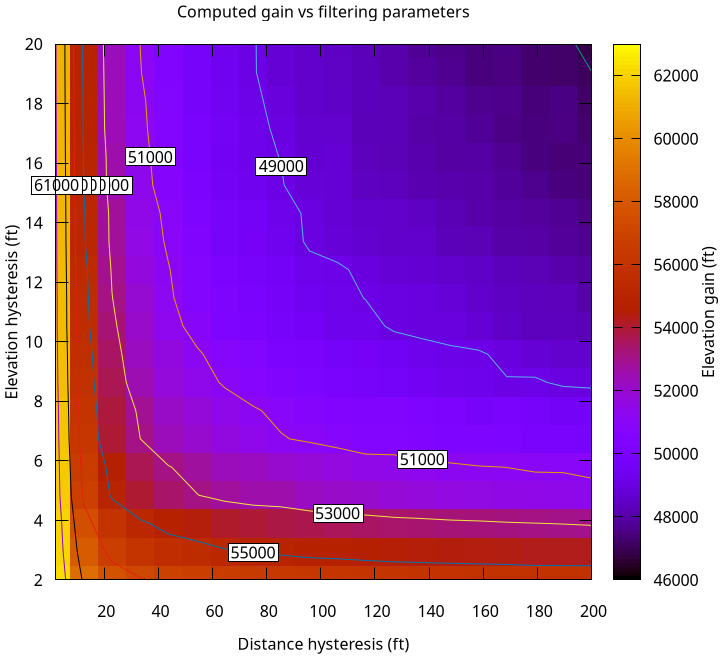
Strava says the gain was 46307ft. The analysis says:
strava-gain.png
strava-gain-zoom.png
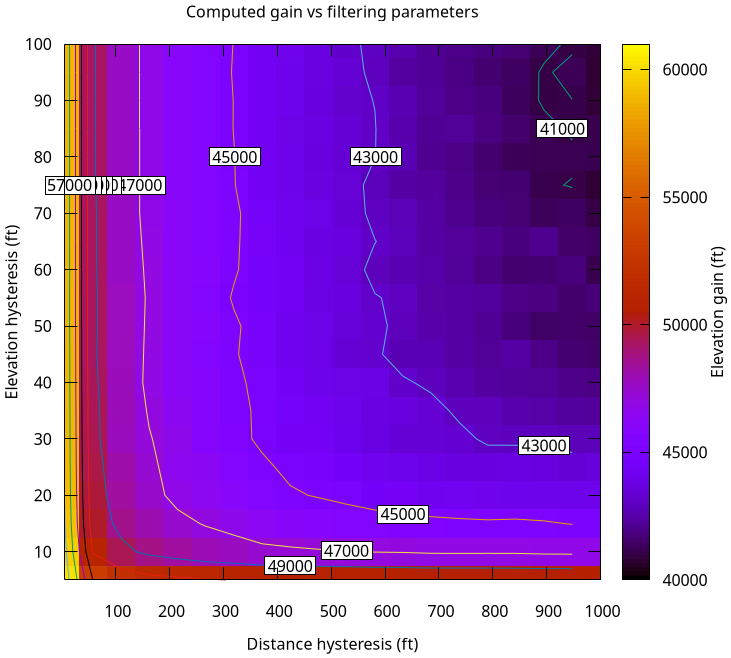
These show the filtered gain for different values of the distance and gain hysteresis thresholds. The same data is shown at diffent zoom levels. There's no sweet spot, but we get 46307ft with a reasonable amount of filtering. Maybe 46307ft is a bit low even.

Results: distance
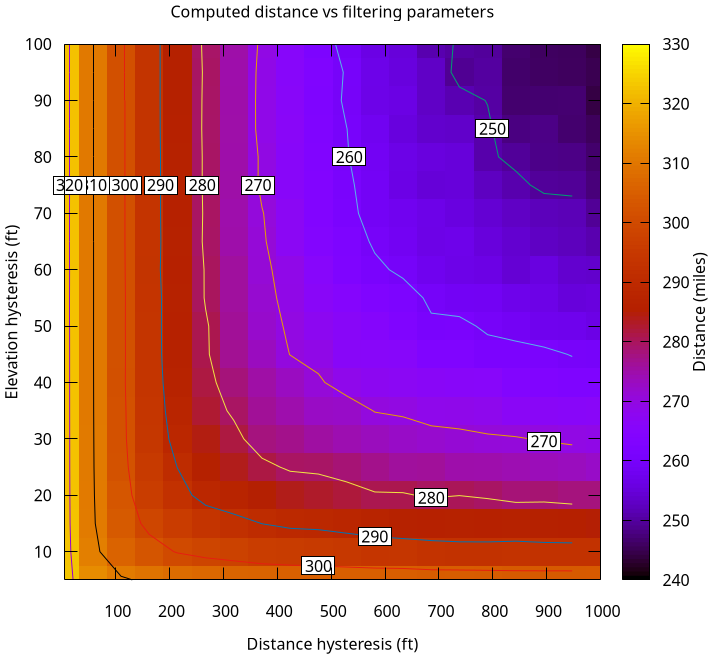
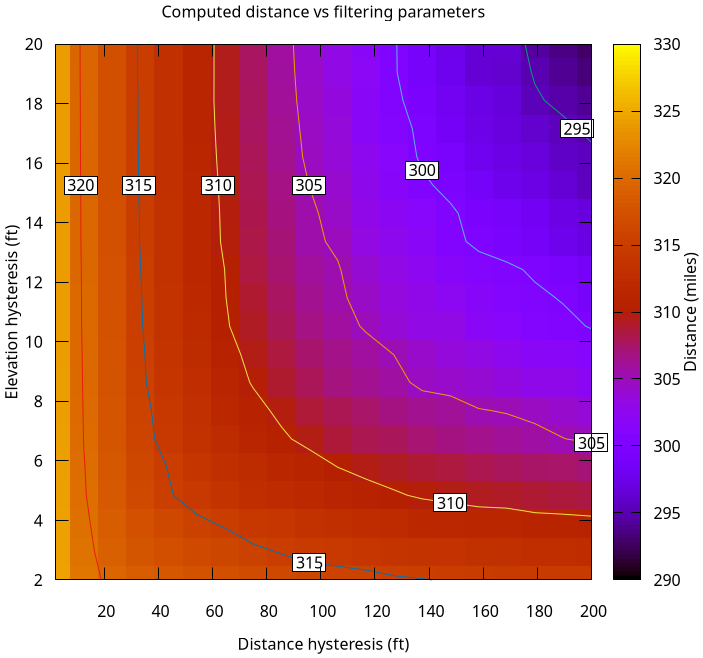
Strava says the distance covered was 322 miles. The analysis says:
strava-distance.png
strava-distance-zoom.png
Once again, there's no sweet spot, but we get 322 miles only if we apply no filtering at all. That's clearly too high, and is not reasonable. From the map (and from other people's strava routes) the true distance is closer to 305 miles. Why those people's strava numbers are more believable is anybody's guess.

29 November 2024

Russ Allbery: Review: The Duke Who Didn't

Review: The Duke Who Didn't, by Courtney Milan
Series: Wedgeford Trials #1
Publisher: Femtopress
Copyright: September 2020
ASIN: B08G4QC3JC
Format: Kindle
Pages: 334
The Duke Who Didn't is a Victorian romance novel, the first of a loosely-connected trilogy in the romance sense of switching protagonists between books. It's self-published, but by Courtney Milan, so the quality of the editing and publishing is about as high as you will see for a self-published novel. Chloe Fong has a goal: to make her father's sauce the success that it should be. His previous version of the recipe was stolen by White and Whistler and is now wildly popular as Pure English Sauce. His current version is much better. In a few days, tourists will come from all over England to the annual festival of the Wedgeford Trials, and this will be Chloe's opportunity to give the sauce a proper debut and marketing push. There is only the small matter of making enough sauce and coming up with a good name. Chloe is very busy and absolutely does not have time for nonsense. Particularly nonsense in the form of Jeremy Yu. Jeremy started coming to the Wedgeford Trials at the age of twelve. He was obviously from money and society, obviously enough that the villagers gave him the nickname Posh Jim after his participation in the central game of the trials. Exactly how wealthy and exactly which society, however, is something that he never quite explained, at first because he was having too much fun and then because he felt he'd waited too long. The village of Wedgeford was thriving under the benevolent neglect of its absent duke and uncollected taxes, and no one who loved it had any desire for that to change. Including Jeremy, the absent duke in question. Jeremy had been in love with Chloe for years, but the last time he came to the Trials, Chloe told him to stop pursuing her unless he could be serious. That was three years and three Trials ago, and Chloe was certain Jeremy had made his choice by his absence. But Jeremy never forgot her, and despite his utter failure to become a more serious person, he is determined to convince her that he is serious about her. And also determined to finally reveal his identity without breaking everything he loves about the village. Somehow. I have mentioned in other reviews that I mostly read sapphic instead of heterosexual romance because the gender roles in heterosexual romance are much more likely to irritate me. It occurred to me that I was probably being unfair to the heterosexual romance genre, I hadn't read nearly widely enough to draw any real conclusions, and I needed to find better examples. I've followed Courtney Milan occasionally on social media (for reasons unrelated to her novels) for long enough to know that she was unlikely to go for gender essentialism, and I'd been meaning to try one of her books for a while. Hence this novel. It is indeed not gender-essentialist. Neither Chloe nor Jeremy fit into obvious gender boxes. Chloe is the motivating force in the novel and many of their interactions were utterly charming. But, despite that, the gender roles still annoyed me in ways that are entirely not the fault of this book. I'm not sure I can even put a finger on something specific. It's a low-grade, pervasive feeling that men do one type of thing and women do a different type of thing, and even if these characters don't stick to that closely, it saturates the vibes. (Admittedly, a Victorian romance was probably not the best choice when I knew this was my biggest problem with genre heterosexual romance. It was just what I had on hand.) The conceit of the Wedgeford Trials series is that the small village of Wedgeford in England, through historical accident, ended up with an unusually large number of residents with Chinese ancestry. This is what I would call a "believable outlier": there was not such a village so far as I know, but there could well have been. At the least, there were way more people with non-English ancestry, including east Asian ancestry, in Victorian England than modern readers might think. There is quite a lot in this novel about family history, cultural traditions, immigration, and colonialism that I'm wholly unqualified to comment on but that was fascinating to read about and seemed (as one would expect from Milan) adroitly written. As for the rest of the story, The Duke Who Didn't is absolutely full of banter. If your idea of a good time with a romance novel is teasing, word play, mock irritation, and endless verbal fencing as a way to avoid directly confronting difficult topics, you will be in heaven. Jeremy is one of those people who is way too much in his own head and has turned his problems into a giant ball of anxiety, but who is good at being the class clown, and therefore leans heavily on banter and making people laugh (or blush) as a way of avoiding whatever he's anxious about. I thought the characterization was quite good, but I admit I still got a bit tired of it. 350 pages is a lot of banter, particularly when the characters have some serious communication problems they need to resolve, and to fully enjoy this book you have to have a lot of patience for Jeremy's near-pathological inability to be forthright with Chloe. Chloe's most charming characteristic is that she makes lists, particularly to-do lists. Her ideal days proceed as an orderly process of crossing things off of lists, and her way to approach any problem is to make a list. This is a great hook, and extremely relatable, but if you're going to talk this much about her lists, I want to see the lists! Chloe is all about details; show me the details! This book does not contain anywhere close to enough of Chloe's lists. I'm not sure there was a single list in this book that the reader both got to see the details of and that made it to more than three items. I think Chloe would agree that it's pointless to talk about the concept of lists; one needs to commit oneself to making an actual list. This book I would unquestioningly classify as romantic comedy (which given my utter lack of familiarity with romance subgenres probably means that it isn't). Jeremy's standard interaction style with anyone is self-deprecating humor, and Chloe is the sort of character who is extremely serious in ways that strike other people as funny. Towards the end of the book, there is a hilarious self-aware subversion of a major romance novel trope that even I caught, despite my general lack of familiarity with the genre. The eventual resolution of Jeremy's problem of hidden identity caught me by surprise in that way where I should have seen it all along, and was both beautifully handled and quite entertaining. All the pieces are here for a great time, and I think a lot of people would love this book. Somehow, it still wasn't quite my thing; I thoroughly enjoyed parts of it, but I don't find myself eager to read another. I'm kind of annoyed at myself that it didn't pull me in, since if I'd liked this I know where to find lots more like it. But ah well. If you like banter-heavy heterosexual romance that is very self-aware about its genre without devolving into metafiction, this is at least worth a try. Followed in the romance series way by The Marquis Who Mustn't, but this is a complete story with a satisfying ending. Rating: 7 out of 10

18 November 2024

Russ Allbery: Review: Delilah Green Doesn't Care

Review: Delilah Green Doesn't Care, by Ashley Herring Blake
Series: Bright Falls #1
Publisher: Jove
Copyright: February 2022
ISBN: 0-593-33641-0
Format: Kindle
Pages: 374
Delilah Green Doesn't Care is a sapphic romance novel. It's the first of a trilogy, although in the normal romance series fashion each book follows a different protagonist and has its own happy ending. It is apparently classified as romantic comedy, which did not occur to me while reading but which I suppose I can see in retrospect. Delilah Green got the hell out of Bright Falls as soon as she could and tried not to look back. After her father died, her step-mother lavished all of her perfectionist attention on her overachiever step-sister, leaving Delilah feeling like an unwanted ghost. She escaped to New York where there was space for a queer woman with an acerbic personality and a burgeoning career in photography. Her estranged step-sister's upcoming wedding was not a good enough reason to return to the stifling small town of her childhood. The pay for photographing the wedding was, since it amounted to three months of rent and trying to sell photographs in galleries was not exactly a steady living. So back to Bright Falls Delilah goes. Claire never left Bright Falls. She got pregnant young and ended up with a different life than she expected, although not a bad one. Now she's raising her daughter as a single mom, running the town bookstore, and dealing with her unreliable ex. She and Iris are Astrid Parker's best friends and have been since fifth grade, which means she wants to be happy for Astrid's upcoming wedding. There's only one problem: the groom. He's a controlling, boorish ass, but worse, Astrid seems to turn into a different person around him. Someone Claire doesn't like. Then, to make life even more complicated, Claire tries to pick up Astrid's estranged step-sister in Bright Falls's bar without recognizing her. I have a lot of things to say about this novel, but here's the core of my review: I started this book at 4pm on a Saturday because I hadn't read anything so far that day and wanted to at least start a book. I finished it at 11pm, having blown off everything else I had intended to do that evening, completely unable to put it down. It turns out there is a specific type of romance novel protagonist that I absolutely adore: the sarcastic, confident, no-bullshit character who is willing to pick the fights and say the things that the other overly polite and anxious characters aren't able to get out. Astrid does not react well to criticism, for reasons that are far more complicated than it may first appear, and Claire and Iris have been dancing around the obvious problems with her surprise engagement. As the title says, Delilah thinks she doesn't care: she's here to do a job and get out, and maybe she'll get to tweak her annoying step-sister a bit in the process. But that also means that she is unwilling to play along with Astrid's obsessively controlling mother or her obnoxious fiance, and thus, to the barely disguised glee of Claire and Iris, is a direct threat to the tidy life that Astrid's mother is trying to shoehorn her daughter into. This book is a great example of why I prefer sapphic romances: I think this character setup would not work, at least for me, in a heterosexual romance. Delilah's role only works if she's a woman; if a male character were the sarcastic conversational bulldozer, it would be almost impossible to avoid falling into the gender stereotype of a male rescuer. If this were a heterosexual romance trying to avoid that trap, the long-time friend who doesn't know how to directly confront Astrid would have to be the male protagonist. That could work, but it would be a tricky book to write without turning it into a story focused primarily on the subversion of gender roles. Making both protagonists women dodges the problem entirely and gives them so much narrative and conceptual space to simply be themselves, rather than characters obscured by the shadows of societal gender rules. This is also, at it's core, a book about friendship. Claire, Astrid, and Iris have the sort of close-knit friend group that looks exclusive and unapproachable from the outside. Delilah was the stereotypical outsider, mocked and excluded when they thought of her at all. This, at least, is how the dynamics look at the start of the book, but Blake did an impressive job of shifting my understanding of those relationships without changing their essential nature. She fleshes out all of the characters, not just the romantic leads, and adds complexity, nuance, and perspective. And, yes, past misunderstanding, but it's mostly not the cheap sort that sometimes drives romance plots. It's the misunderstanding rooted in remembered teenage social dynamics, the sort of misunderstanding that happens because communication is incredibly difficult, even more difficult when one has no practice or life experience, and requires knowing oneself well enough to even know what to communicate. The encounter between Delilah and Claire in the bar near the start of the book is cornerstone of the plot, but the moment that grabbed me and pulled me in was Delilah's first interaction with Claire's daughter Ruby. That was the point when I knew these were characters I could trust, and Blake never let me down. I love how Ruby is handled throughout this book, with all of the messy complexity of a kid of divorced parents with her own life and her own personality and complicated relationships with both parents that are independent of the relationship their parents have with each other. This is not a perfect book. There's one prank scene that I thought was excessively juvenile and should have been counter-productive, and there's one tricky question of (nonsexual) consent that the book raises and then later seems to ignore in a way that bugged me after I finished it. There is a third-act breakup, which is not my favorite plot structure, but I think Blake handles it reasonably well. I would probably find more niggles and nitpicks if I re-read it more slowly. But it was utterly engrossing reading that exactly matched my mood the day that I picked it up, and that was a fantastic reading experience. I'm not much of a romance reader and am not the traditional audience for sapphic romance, so I'm probably not the person you should be looking to for recommendations, but this is the sort of book that got me to immediately buy all of the sequels and start thinking about a re-read. It's also the sort of book that dragged me back in for several chapters when I was fact-checking bits of my review. Take that recommendation for whatever it's worth. Content note: Reviews of Delilah Green Doesn't Care tend to call it steamy or spicy. I have no calibration for this for romance novels. I did not find it very sex-focused (I have read genre fantasy novels with more sex), but there are several on-page sex scenes if that's something you care about one way or the other. Followed by Astrid Parker Doesn't Fail. Rating: 9 out of 10

17 November 2024

Russ Allbery: Review: Dark Deeds

Review: Dark Deeds, by Michelle Diener
Series: Class 5 #2
Publisher: Eclipse
Copyright: January 2016
ISBN: 0-6454658-4-4
Format: Kindle
Pages: 340
Dark Deeds is the second book of the self-published Class 5 science fiction romance series. It is a sequel to Dark Horse and will spoil the plot of that book, but it follows the romance series convention of switching to a new protagonist in the same universe and telling a loosely-connected story. Fiona, like Rose in the previous book, was kidnapped by the Tecran in one of their Class 5 ships, although that's not entirely obvious at the start of the story. The book opens with her working as a slave on a Garmman trading ship while its captain works up the nerve to have her killed. She's spared this fate when the ship is raided by Krik pirates. Some brave fast-talking, and a touch of honor among thieves, lets her survive the raid and be rescued by a pursuing Grih battleship, with a useful electronic gadget as a bonus. The author uses the nickname "Fee" for Fiona throughout this book and it was like nails on a chalkboard every time. I had to complain about that before getting into the review. If you've read Dark Horse, you know the formula: lone kidnapped human woman, major violations of the laws against mistreatment of sentient beings that have the Grih furious on her behalf, hunky Grih starship captain who looks like a space elf, all the Grih are fascinated by her musical voice, she makes friends with a secret AI... Diener found a formula that worked well enough that she tried it again, and it would not surprise me if the formula repeated through the series. You should not go into this book expecting to be surprised. That said, the formula did work the first time, and it largely does work again. I thoroughly enjoyed Dark Horse and wanted more, and this is more, delivered on cue. There are worse things, particularly if you're a Kindle Unlimited reader (I am not) and are therefore getting new installments for free. The Tecran fascination with kidnapping human women is explained sufficiently in Fiona's case, but I am mildly curious how Diener will keep justifying it through the rest of the series. (Maybe the formula will change, but I doubt it.) To give Diener credit, this is not a straight repeat of the first book. Fiona is similar to Rose but not identical; Rose had an unshakable ethical calm, and Fiona is more of a scrapper. The Grih are not stupid and, given the amount of chaos Rose unleashed in the previous book, treat the sudden appearance of another human woman with a great deal more caution and suspicion. Unfortunately, this also means far less of my favorite plot element of the first book: the Grih being constantly scandalized and furious at behavior the protagonist finds sadly unsurprising. Instead, this book has quite a bit more action. Dark Horse was mostly character interactions and tense negotiations, with most of the action saved for the end. Dark Deeds replaces a lot of the character work with political plots and infiltrating secret military bases and enemy ships. The AI (named Eazi this time) doesn't show up until well into the book and isn't as much of a presence as Sazo. Instead, there's a lot more of Fiona being drafted into other people's fights, which is entertaining enough while it's happening but which wasn't as delightful or memorable as Rose's story. The writing continues to be serviceable but not great. It's a bit cliched and a bit awkward. Also, Diener uses paragraph breaks for emphasis. It's hard to stop noticing it once you see it. Thankfully, once the story gets going and there's more dialogue, she tones that down, or perhaps I stopped noticing. It's that kind of book (and that kind of series): it's a bit rough to get started, but then there's always something happening, the characters involve a whole lot of wish-fulfillment but are still people I like reading about, and it's the sort of unapologetic "good guys win" type of light science fiction that is just the thing when one simply wants to be entertained. Once I get into the book, it's easy to overlook its shortcomings. I spent Dark Horse knowing roughly what would happen but wondering about the details. I spent Dark Deeds fairly sure of the details and wondering when they would happen. This wasn't as fun of an experience, but the details were still enjoyable and I don't regret reading it. I am hoping that the next book will be more of a twist, or will have a character more like Rose (or at least a character with a better nickname). Sort of recommended if you liked Dark Horse and really want more of the same. Followed by Dark Minds, which I have already purchased. Rating: 6 out of 10

11 November 2024

Gunnar Wolf: Why academics under-share research data - A social relational theory

This post is a review for Computing Reviews for Why academics under-share research data - A social relational theory , a article published in Journal of the Association for Information Science and Technology
As an academic, I have cheered for and welcomed the open access (OA) mandates that, slowly but steadily, have been accepted in one way or another throughout academia. It is now often accepted that public funds means public research. Many of our universities or funding bodies will demand that, with varying intensities sometimes they demand research to be published in an OA venue, sometimes a mandate will only prefer it. Lately, some journals and funder bodies have expanded this mandate toward open science, requiring not only research outputs (that is, articles and books) to be published openly but for the data backing the results to be made public as well. As a person who has been involved with free software promotion since the mid 1990s, it was natural for me to join the OA movement and to celebrate when various universities adopt such mandates. Now, what happens after a university or funder body adopts such a mandate? Many individual academics cheer, as it is the right thing to do. However, the authors observe that this is not really followed thoroughly by academics. What can be observed, rather, is the slow pace or feet dragging of academics when they are compelled to comply with OA mandates, or even an outright refusal to do so. If OA and open science are close to the ethos of academia, why aren t more academics enthusiastically sharing the data used for their research? This paper finds a subversive practice embodied in the refusal to comply with such mandates, and explores an hypothesis based on Karl Marx s productive worker theory and Pierre Bourdieu s ideas of symbolic capital. The paper explains that academics, as productive workers, become targets for exploitation: given that it s not only the academics sharing ethos, but private industry s push for data collection and industry-aligned research, they adapt to technological changes and jump through all kinds of hurdles to create more products, in a result that can be understood as a neoliberal productivity measurement strategy. Neoliberalism assumes that mechanisms that produce more profit for academic institutions will result in better research; it also leads to the disempowerment of academics as a class, although they are rewarded as individuals due to the specific value they produce. The authors continue by explaining how open science mandates seem to ignore the historical ways of collaboration in different scientific fields, and exploring different angles of how and why data can be seen as under-shared, failing to comply with different aspects of said mandates. This paper, built on the social sciences tradition, is clearly a controversial work that can spark interesting discussions. While it does not specifically touch on computing, it is relevant to Computing Reviews readers due to the relatively high percentage of academics among us.

10 November 2024

Thorsten Alteholz: My Debian Activities in October 2024

FTP master This month I accepted 398 and rejected 22 packages. The overall number of packages that got accepted was 441. In case your RM bug is not closed within a month, you can assume that either the conversion of the subject of the bug email to the corresponding dak command did not work or you still need to take care of reverse dependencies. The dak command related to your removal bug can be found here. Unfortunately the bahavior of some project members caused a decline of motivation of team members to work on these bugs. When I look at these bugs, I just copy and paste the above mentioned dak commands. If they don t work, I don t have the time to debug what is going wrong. So please read the docs and take care of it yourself. Please also keep in mind that you need to close the bug or set a moreinfo tag if you don t want anybody to act on your removal bug. Debian LTS This was my hundred-twenty-fourth month that I did some work for the Debian LTS initiative, started by Raphael Hertzog at Freexian. During my allocated time I uploaded or worked on: Last but not least I did a week of FD this month and attended the monthly LTS/ELTS meeting. Debian ELTS This month was the seventy-fifth ELTS month. During my allocated time I uploaded or worked on: I also did a week of FD and attended the monthly LTS/ELTS meeting. Debian Printing Unfortunately I didn t found any time to work on this topic. Debian Matomo Unfortunately I didn t found any time to work on this topic. Debian Astro Unfortunately I didn t found any time to work on this topic. Debian IoT This month I uploaded new upstream or bugfix versions of: Debian Mobcom This month I uploaded new packages or new upstream or bugfix versions of: misc This month I uploaded new upstream or bugfix versions of:

4 November 2024

Ravi Dwivedi: Asante Kenya for a Good Time

In September of this year, I visited Kenya to attend the State of the Map conference. I spent six nights in the capital Nairobi, two nights in Mombasa, and one night on a train. I was very happy with the visa process being smooth and quick. Furthermore, I stayed at the Nairobi Transit Hotel with other attendees, with Ibtehal from Bangladesh as my roommate. One of the memorable moments was the time I spent at a local coffee shop nearby. We used to go there at midnight, despite the grating in the shops suggesting such adventures were unsafe. Fortunately, nothing bad happened, and we were rewarded with a fun time with the locals.
The coffee shop Ibtehal and me used to visit during the midnight
Grating at a chemist shop in Mombasa, Kenya
The country lies on the equator, which might give the impression of extremely hot temperatures. However, Nairobi was on the cooler side (10 25 degrees Celsius), and I found myself needing a hoodie, which I bought the next day. It also served as a nice souvenir, as it had an outline of the African map printed on it. I also bought a Safaricom SIM card for 100 shillings and recharged it with 1000 shillings for 8 GB internet with 5G speeds and 400 minutes talk time.

A visit to Nairobi s Historic Cricket Ground On this trip, I got a unique souvenir that can t be purchased from the market a cricket jersey worn in an ODI match by a player. The story goes as follows: I was roaming around the market with my friend Benson from Nairobi to buy a Kenyan cricket jersey for myself, but we couldn t find any. So, Benson had the idea of visiting the Nairobi Gymkhana Club, which used to be Kenya s main cricket ground. It has hosted some historic matches, including the 2003 World Cup match in which Kenya beat the mighty Sri Lankans and the record for the fastest ODI century by Shahid Afridi in just 37 balls in 1996. Although entry to the club was exclusively for members, I was warmly welcomed by the staff. Upon reaching the cricket ground, I met some Indian players who played in Kenyan leagues, as well as Lucas Oluoch and Dominic Wesonga, who have represented Kenya in ODIs. When I expressed interest in getting a jersey, Dominic agreed to send me pictures of his jersey. I liked his jersey and collected it from him. I gave him 2000 shillings, an amount suggested by those Indian players.
Me with players at the Nairobi Gymkhana Club
Cricket pitch at the Nairobi Gymkhana Club
A view of the cricket ground inside the Nairobi Gymkhana Club
Scoreboard at the Nairobi Gymkhana cricket ground

Giraffe Center in Nairobi Kenya is known for its safaris and has no shortage of national parks. In fact, Nairobi is the only capital in the world with a national park. I decided not to visit one, as most of them were expensive and offered multi-day tours, and I didn t want to spend that much time in the wildlife. Instead, I went to the Giraffe Center in Nairobi with Pragya and Rabina. The ticket cost 1500 Kenyan shillings (1000 Indian rupees). In Kenya, matatus - shared vans, usually decorated with portraits of famous people and play rap songs - are the most popular means of public transport. Reaching the Giraffe Center from our hotel required taking five matatus, which cost a total of 150 shillings, and a 2 km walk. The journey back was 90 shillings, suggesting that we didn t find the most efficient route to get there. At the Giraffe Center, we fed giraffes and took photos.
A matatu with a Notorious BIG portrait.
Inside the Giraffe Center

Train ride from Nairobi to Mombasa I took a train from Nairobi to Mombasa. The train is known as the SGR Train, where SGR refers to Standard Gauge Railway. The journey was around 500 km. M-Pesa was the only way to make payment for pre-booking the train ticket, and I didn t have an M-Pesa account. Pragya s friend Mary helped facilitate the payment. I booked a second-class ticket, which cost 1500 shillings (1000 Indian rupees). The train was scheduled to depart from Nairobi at 08:00 hours in the morning and arrive in Mombasa at 14:00 hours. The security check at the station required scanning our bags and having them sniffed by sniffer dogs. I also fell victim to a scam by a security official who offered to help me get my ticket printed, only to later ask me to get him some coffee, which I politely declined. Before boarding the train, I was treated to some stunning views at the Nairobi Terminus station. It was a seating train, but I wished it were a sleeper train, as I was sleep-deprived. The train was neat and clean, with good toilets. The train reached Mombasa on time at around 14:00 hours.
SGR train at Nairobi Terminus.
Interior of the SGR train

Arrival in Mombasa
Mombasa Terminus station.
Mombasa was a bit hotter than Nairobi, with temperatures reaching around 30 degrees Celsius. However, that s not too hot for me, as I am used to higher temperatures in India. I had booked a hostel in the Old Town and was searching for a hitchhike from the Mombasa Terminus station. After trying for more than half an hour, I took a matatu that dropped me 3 km from my hostel for 200 shillings (140 Indian rupees). I tried to hitchhike again but couldn t find a ride. I think I know why I couldn t get a ride in both the cases. In the first case, the Mombasa Terminus was in an isolated place, so most of the vehicles were taxis or matatus while any noncommercial cars were there to pick up friends and family. If the station were in the middle of the city, there would be many more car/truck drivers passing by, thus increasing my possibilities of getting a ride. In the second case, my hostel was at the end of the city, and nobody was going towards that side. In fact, many drivers told me they would love to give me a ride, but they were going in some other direction. Finally, I took a tuktuk for 70 shillings to reach my hostel, Tulia Backpackers. It was 11 USD (1400 shillings) for one night. The balcony gave a nice view of the Indian Ocean. The rooms had fans, but there was no air conditioning. Each bed also had mosquito nets. The place was walking distance of the famous Fort Jesus. Mombasa has had more Islamic influence compared to Nairobi and also has many Hindu temples.
The balcony at Tulia Backpackers Hostel had a nice view of the ocean.
A room inside the hostel with fans and mosquito nets on the beds

Visiting White Sandy Beaches and Getting a Hitchhike Visiting Nyali beach marked my first time ever at a white sand beach. It was like 10 km from the hostel. The next day, I visited Diani Beach, which was 30 km from the hostel. Going to Diani Beach required crossing a river, for which there s a free ferry service every few minutes, followed by taking a matatu to Ukunda and then a tuk-tuk. The journey gave me a glimpse of the beautiful countryside of Kenya.
Nyali beach is a white sand beach
This is the ferry service for crossing the river.

During my return from Diani Beach to the hostel, I was successful in hitchhiking. However, it was only a 4 km ride and not sufficient to reach Ukunda, so I tried to get another ride. When a truck stopped for me, I asked for a ride to Ukunda. Later, I learned that they were going in the same direction as me, so I got off within walking distance from my hostel. The ride was around 30 km. I also learned the difference between a truck ride and a matatu or car ride. For instance, matatus and cars are much faster and cooler due to air conditioning, while trucks tend to be warmer because they lack it. Further, the truck was stopped at many checkpoints by the police for inspections as it carried goods, which is not the case with matatus. Anyways, it was a nice experience, and I am grateful for the ride. I had a nice conversation with the truck drivers about Indian movies and my experiences in Kenya.
Diani beach is a popular beach in Kenya. It is a white sand beach.
Selfie with truck drivers who gave me the free ride
Back to Nairobi I took the SGR train from Mombasa back to Nairobi. This time I took the night train, which departs at 22:00 hours, reaching Nairobi at around 04:00 in the morning. I could not sleep comfortably since the train only had seater seats. I had booked the Zarita Hotel in Nairobi and had already confirmed if they allowed early morning check-in. Usually, hotels have a fixed checkout time, say 11:00 in the morning, and you are not allowed to stay beyond that regardless of the time you checked in. But this hotel checked me in for 24 hours. Here, I paid in US dollars, and the cost was 12 USD.

Almost Got Stuck in Kenya Two days before my scheduled flight from Nairobi back to India, I heard the news that the airports in Kenya were closed due to the strikes. Rabina and Pragya had their flight back to Nepal canceled that day, which left them stuck in Nairobi for two additional days. I called Sahil in India and found out during the conversation that the strike was called off in the evening. It was a big relief for me, and I was fortunate to be able to fly back to India without any changes to my plans.
Newspapers at a stand in Kenya covering news on the airport closure

Experience with locals I had no problems communicating with Kenyans, as everyone I met knew English to an extent that could easily surpass that of big cities in India. Additionally, I learned a few words from Kenya s most popular local language, Swahili, such as Asante, meaning thank you, Jambo for hello, and Karibu for welcome. Knowing a few words in the local language went a long way. I am not sure what s up with haggling in Kenya. It wasn t easy to bring the price of souvenirs down. I bought a fridge magnet for 200 shillings, which was the quoted price. On the other hand, it was much easier to bargain with taxis/tuktuks/motorbikes. I stayed at three hotels/hostels in Kenya. None of them had air conditioners. Two of the places were in Nairobi, and they didn t even have fans in the rooms, while the one in Mombasa had only fans. All of them had good Wi-Fi, except Tulia where the internet overall was a bit shaky. My experience with the hotel staff was great. For instance, we requested that the Nairobi Transit Hotel cancel the included breakfast in order to reduce the room costs, but later realized that it was not a good idea. The hotel allowed us to revert and even offered one of our missing breakfasts during dinner. The staff at Tulia Backpackers in Mombasa facilitated the ticket payment for my train from Mombasa to Nairobi. One of the staff members also gave me a lift to the place where I could catch a matatu to Nyali Beach. They even added an extra tea bag to my tea when I requested it to be stronger.

Food At the Nairobi Transit Hotel, a Spanish omelet with tea was served for breakfast. I noticed that Spanish omelette appeared on the menus of many restaurants, suggesting that it is popular in Kenya. This was my first time having this dish. The milk tea in Kenya, referred to by locals as white tea, is lighter than Indian tea (they don t put a lot of tea leaves).
Spanish Omelette served in breakfast at Nairobi Transit Hotel
I also sampled ugali with eggs. In Mombasa, I visited an Indian restaurant called New Chetna and had a buffet thali there twice.
Ugali with eggs.

Tips for Exchanging Money In Kenya, I exchanged my money at forex shops a couple of times. I received good exchange rates for bills larger than 50 USD. For instance, 1 USD on xe.com was 129 shillings, and I got 128.3 shillings per USD (a total of 12,830 shillings) for two 50 USD notes at an exchange in Nairobi, while 127 shillings, which was the highest rate at the banks. On the other hand, for smaller bills such as a one US dollar note, I would have got 125 shillings. A passport was the only document required for the exchange, and they also provided a receipt. A good piece of advice for travelers is to keep 50 USD or larger bills for exchanging into the local currency while saving the smaller US dollar bills for accommodation, as many hotels and hostels accept payment in US dollars (in addition to Kenyan shillings).

Missed Malindi and Lamu There were more places on my to-visit list in Kenya. But I simply didn t have time to cover them, as I don t like rushing through places, especially in a foreign country where there is a chance of me underestimating the amount of time it takes during transit. I would have liked to visit at least one of Kilifi, Watamu or Malindi beaches. Further, Lamu seemed like a unique place to visit as it has no cars or motorized transport; the only options for transport are boats and donkeys. That s it for now. Meet you in the next one :)

1 November 2024

Russ Allbery: Review: Overdue and Returns

Review: Overdue and Returns, by Mark Lawrence
Publisher: Mark Lawrence
Copyright: June 2023
Copyright: February 2024
ASIN: B0C9N51M6Y
ASIN: B0CTYNQGBX
Format: Kindle
Pages: 99
Overdue is a stand-alone novelette in the Library Trilogy universe. Returns is a collection of two stories, the novelette "Returns" and the short story "About Pain." All of them together are about the length of a novella, so I'm combining them into a single review. These are ancillary stories in the same universe as the novels, but not necessarily in the same timeline. (Trying to fit "About Pain" into the novel timeline will give you a headache and I am choosing to read it as author's fan fiction.) I'm guessing they're part of the new fad for releasing short fiction on Amazon to tide readers over and maintain interest between books in a series, a fad about which I have mixed feelings. Given the total lack of publisher metadata in either the stories or on Amazon, I'm assuming they were self-published even though the novels are published by Ace, but I don't know that for certain. There are spoilers for The Book That Wouldn't Burn, so don't read these before that novel. There are no spoilers for The Book That Broke the World, and I don't think the reading order would matter. I found all three of these stories irritating and thuddingly trite. "Returns" is probably the best of the lot in terms of quality of storytelling, but I intensely dislike the structural implications of the nature of the book at its center and am therefore hoping that it's non-canonical. I would not waste your time with these even if you are enjoying the novels. "Overdue": Three owners of the same bookstore at different points in time have encounters with an albino man named Yute who is on a quest. One of the owners is trying to write a book, one of them is older, depressed, and closed off, and one of them has regular conversations with her sister's ghost. The nature of the relationship between the three is too much of a spoiler, but it involves similar shenanigans as The Book That Wouldn't Burn. Lawrence uses my least favorite resolution of benign ghost stories. The story tries very hard to sell it as a good thing, but I thought it was cruel and prefer fantasy that rejects both branches of that dilemma. Other than that, it was fine, I guess, although the moral was delivered with all of the subtlety of the last two minutes of a Saturday morning cartoon. (5) "Returns": Livira returns a book deep inside the library and finds that she can decipher it, which leads her to a story about Yute going on a trip to recover another library book. This had a lot of great Yute lines, plus I always like seeing Livira in exploration mode. The book itself is paradoxical in a causality-destroying way, which is handwaved away as literal magic. I liked this one the best of the three stories, but I hope the world-building of the main series does not go in this direction and I'm a little afraid it might. (6) "About Pain": A man named Holden runs into a woman named Clovis at the gym while carrying a book titled Catcher that his dog found and that he's returning to the library. I thoroughly enjoy Clovis and was happy to read a few more scenes about her. Other than that, this was fine, I guess, although it is a story designed to deliver a point and that point is one that appears in every discussion of classics and re-reading that has ever happened on the Internet. Also, I know I'm being grumpy, but Lawrence's puns with authors and character names are chapter-epigraph amusing but not short-story-length funny. Yes, yes, his name is Holden, we get it. (5) Rating: 5 out of 10

28 October 2024

Thomas Lange: 30.000 FAIme jobs created in 7 years

The number of FAIme jobs has reached 30.000. Yeah!
At the end of this November the FAIme web service for building customized ISOs turns 7 years old. It had reached 10.000 jobs in March 2021 and 20.000 jobs were reached in June 2023. A nice increase of the usage. Here are some statistics for the jobs processed in 2024: Type of jobs
3% cloud image
11% live ISO
86% install ISO
Distribution
2% bullseye
8% trixie
12% ubuntu 24.04
78% bookworm
Misc Execution Times The cloud and live ISOs need more time for their creation because the FAIme server needs to unpack and install all packages. For the install ISO the packages are only downloaded. The amount of software packages also affects the build time. Every ISO is build in a VM on an old 6-core E5-1650 v2. Times given are calculated from the jobs of the past two weeks.
Job type Avg Max
install no desktop 1 min 2 min
install GNOME 2 min 5 min
The times for Ubuntu without and with desktop are one minute higher than those mentioned above.
Job type Avg Max
live no desktop 4 min 6 min
live GNOME 8 min 11 min
The times for cloud images are similar to live images. A New Feature For a few weeks now, the system has been showing the number of jobs ahead of you in the queue when you submit a job that cannot be processed immediately. The Next Milestone At the end of this years the FAI project will be 25 years old. If you have a success story of your FAI usage to share please post it to the linux-fai mailing list or send it to me. Do you know the FAI questionnaire ? A lot of reports are already available. Here's an overview what happened in the past 20 years in the FAI project. About FAIme FAIme is the service for building your own customized ISO via a web interface. You can create an installation or live ISO or a cloud image. Several Debian releases can be selected and also Ubuntu server or Ubuntu desktop installation ISOs can be customized. Multiple options are available like selecting a desktop and the language, adding your own package list, choosing a partition layout, adding a user, choosing a backports kernel, adding a postinst script and some more.

24 October 2024

Valhalla's Things: Asemic Writing, a Zine

Posted on October 24, 2024
Tags: madeof:atoms, madeof:bits, craft:zine
An open booklet with lines that look like some kind of cursive non-alphabetic script, framed by a border in the same script and four symbols in the corners. I have no idea either. The front of that booklet, with three lines of fake text in different sizes and a circle of the same. Happy Maladay1 to those who celebrate it, I guess.
A template on white paper with pencil lines where text is supposed to go. Multiple A4 sheet of tracing paper with fake text, plus an A6 sheet and a white A6 sheet with a stamp impression. If you care about the how, it started as china ink on tracing paper, with the help of a template (and a correction sheet for one page where I used the wrong line on the template). alt A rubber stamp was carved with the author s signature and stamped on white paper because the ink from the pad wasn t working well on tracing paper. Then everything was scanned (with the correction on top of the wrong page) asemic_zine_scans.tar. Imported in Inkscape and traced asemic_zine_svg.tar. Printed, cut in half, folded and stapled. The magenta lines weren t by design, but are there because my printer is currently2 cursed. And finally, asemic_zine.pdf was created, joining the pages together with pdfjam, for convenience in case somebody wants to download the full thing. All the .tar and .pdf downloads from this page are released under the WTFPL, or All Rites Reversed..

  1. it s still technically Maladay when I write this, even if by the time you ll get this it s probably the 6th of The Aftermath.
  2. I mean, all printers are always cursed, but at different times they can be cursed in different and novel ways.

10 October 2024

Freexian Collaborators: Debian Contributions: Packaging Pydantic v2, Reworking of glib2.0 for cross bootstrap, Python archive rebuilds and more! (by Anupa Ann Joseph)

Debian Contributions: 2024-09 Contributing to Debian is part of Freexian s mission. This article covers the latest achievements of Freexian and their collaborators. All of this is made possible by organizations subscribing to our Long Term Support contracts and consulting services.

Pydantic v2, by Colin Watson Pydantic is a useful library for validating data in Python using type hints: Freexian uses it in a number of projects, including Debusine. Its Debian packaging had been stalled at 1.10.17 in testing for some time, partly due to needing to make sure everything else could cope with the breaking changes introduced in 2.x, but mostly due to needing to sort out packaging of its new Rust dependencies. Several other people (notably Alexandre Detiste, Andreas Tille, Drew Parsons, and Timo R hling) had made some good progress on this, but nobody had quite got it over the line and it seemed a bit stuck. Colin upgraded a few Rust libraries to new upstream versions, packaged rust-jiter, and chased various failures in other packages. This eventually allowed getting current versions of both pydantic-core and pydantic into testing. It should now be much easier for us to stay up to date routinely.

Reworking of glib2.0 for cross bootstrap, by Helmut Grohne Simon McVittie (not affiliated with Freexian) earlier restructured the libglib2.0-dev such that it would absorb more functionality and in particular provide tools for working with .gir files. Those tools practically require being run for their host architecture (practically this means running under qemu-user) which is at odds with the requirements of architecture cross bootstrap. The qemu requirement was expressed in package dependencies and also made people unhappy attempting to use libglib2.0-dev for i386 on amd64 without resorting to qemu. The use of qemu in architecture bootstrap is particularly problematic as it tends to not be ready at the time bootstrapping is needed. As a result, Simon proposed and implemented the introduction of a libgio-2.0-dev package providing a subset of libglib2.0-dev that does not require qemu. Packages should continue to use libglib2.0-dev in their Build-Depends unless involved in architecture bootstrap. Helmut reviewed and tested the implementation and integrated the necessary changes into rebootstrap. He also prepared a patch for libverto to use the new package and proposed adding forward compatibility to glib2.0. Helmut continued working on adding cross-exe-wrapper to architecture-properties and implemented autopkgtests later improved by Simon. The cross-exe-wrapper package now provides a generic mechanism to a program on a different architecture by using qemu when needed only. For instance, a dependency on cross-exe-wrapper:i386 provides a i686-linux-gnu-cross-exe-wrapper program that can be used to wrap an ELF executable for the i386 architecture. When installed on amd64 or i386 it will skip installing or running qemu, but for other architectures qemu will be used automatically. This facility can be used to support cross building with targeted use of qemu in cases where running host code is unavoidable as is the case for GObject introspection. This concludes the joint work with Simon and Niels Thykier on glib2.0 and architecture-properties resolving known architecture bootstrap regressions arising from the glib2.0 refactoring earlier this year.

Analyzing binary package metadata, by Helmut Grohne As Guillem Jover (not affiliated with Freexian) continues to work on adding metadata tracking to dpkg, the question arises how this affects existing packages. The dedup.debian.net infrastructure provides an easy playground to answer such questions, so Helmut gathered file metadata from all binary packages in unstable and performed an explorative analysis. Some results include: Guillem also performed a cursory analysis and reported other problem categories such as mismatching directory permissions for directories installed by multiple packages and thus gained a better understanding of what consistency checks dpkg can enforce.

Python archive rebuilds, by Stefano Rivera Last month Stefano started to write some tooling to do large-scale rebuilds in debusine, starting with finding packages that had already started to fail to build from source (FTBFS) due to the removal of setup.py test. This month, Stefano did some more rebuilds, starting with experimental versions of dh-python. During the Python 3.12 transition, we had added a dependency on python3-setuptools to dh-python, to ease the transition. Python 3.12 removed distutils from the stdlib, but many packages were expecting it to still be available. Setuptools contains a version of distutils, and dh-python was a convenient place to depend on setuptools for most package builds. This dependency was never meant to be permanent. A rebuild without it resulted in mass-filing about 340 bugs (and around 80 more by mistake). A new feature in Python 3.12, was to have unittest s test runner exit with a non-zero return code, if no tests were run. We added this feature, to be able to detect tests that are not being discovered, by mistake. We are ignoring this failure, as we wouldn t want to suddenly cause hundreds of packages to fail to build, if they have no tests. Stefano did a rebuild to see how many packages were affected, and found that around 1000 were. The Debian Python community has not come to a conclusion on how to move forward with this. As soon as Python 3.13 release candidate 2 was available, Stefano did a rebuild of the Python packages in the archive against it. This was a more complex rebuild than the others, as it had to be done in stages. Many packages need other Python packages at build time, typically to run tests. So transitions like this involve some manual bootstrapping, followed by several rounds of builds. Not all packages could be tested, as not all their dependencies support 3.13 yet. The result was around 100 bugs in packages that need work to support Python 3.13. Many other packages will need additional work to properly support Python 3.13, but being able to build (and run tests) is an important first step.

Miscellaneous contributions
  • Carles prepared the update of python-pyaarlo package to a new upstream release.
  • Carles worked on updating python-ring-doorbell to a new upstream release. Unfinished, pending to package a new dependency python3-firebase-messaging RFP #1082958 and its dependency python3-http-ece RFP #1083020.
  • Carles improved po-debconf-manager. Main new feature is that it can open Salsa merge requests. Aiming for a lightning talk in MiniDebConf Toulouse (November) to be functional end to end and get feedback from the wider public for this proof of concept.
  • Carles helped one translator to use po-debconf-manager (added compatibility for bullseye, fixed other issues) and reviewed 17 package templates.
  • Colin upgraded the OpenSSH packaging to 9.9p1.
  • Colin upgraded the various YubiHSM packages to new upstream versions, enabled more tests, fixed yubihsm-shell build failures on some 32-bit architectures, made yubihsm-shell build reproducibly, and fixed yubihsm-connector to apply udev rules to existing devices when the package is installed. As usual, bookworm-backports is up to date with all these changes.
  • Colin fixed quite a bit of fallout from setuptools 72.0.0 removing setup.py test, backported a large upstream patch set to make buildbot work with SQLAlchemy 2.0, and upgraded 25 other Python packages to new upstream versions.
  • Enrico worked with Jakob Haufe to get him up to speed for managing sso.debian.org
  • Rapha l did remove spam entries in the list of teams on tracker.debian.org (see #1080446), and he applied a few external contributions, fixing a rendering issue and replacing the DDPO link with a more useful alternative. He also gave feedback on a couple of merge requests that required more work. As part of the analysis of the underlying problem, he suggested to the ftpmasters (via #1083068) to auto-reject packages having the too-many-contacts lintian error, and he raised the severity of #1076048 to serious to actually have that 4 year old bug fixed.
  • Rapha l uploaded zim and hamster-time-tracker to fix issues with Python 3.12 getting rid of setuptools. He also uploaded a new gnome-shell-extension-hamster to cope with the upcoming transition to GNOME 47.
  • Helmut sent seven patches and sponsored one upload for cross build failures.
  • Helmut uploaded a Nagios/Icinga plugin check-smart-attributes for monitoring the health of physical disks.
  • Helmut collaborated on sbuild reviewing and improving a MR for refactoring the unshare backend.
  • Helmut sent a patch fixing coinstallability of gcc-defaults.
  • Helmut continued to monitor the evolution of the /usr-move. With more and more key packages such as libvirt or fuse3 fixed. We re moving into the boring long-tail of the transition.
  • Helmut proposed updating the meson buildsystem in debhelper to use env2mfile.
  • Helmut continued to update patches maintained in rebootstrap. Due to the work on glib2.0 above, rebootstrap moves a lot further, but still fails for any architecture.
  • Santiago reviewed some Merge Request in Salsa CI, such as: !478, proposed by Otto to extend the information about how to use additional runners in the pipeline and !518, proposed by Ahmed to add support for Ubuntu images, that will help to test how some debian packages, including the complex MariaDB are built on Ubuntu. Santiago also prepared !545, which will make the reprotest job more consistent with the result seen on reproducible-builds.
  • Santiago worked on different tasks related to DebConf 25. Especially he drafted the fundraising brochure (which is almost ready).
  • Thorsten Alteholz uploaded package libcupsfilter to fix the autopkgtest and a dependency problem of this package. After package splix was abandoned by upstream and OpenPrinting.org adopted its maintenance, Thorsten uploaded their first release.
  • Anupa published posts on the Debian Administrators group in LinkedIn and moderated the group, one of the tasks of the Debian Publicity Team.
  • Anupa helped organize DebUtsav 2024. It had over 100 attendees with hand-on sessions on making initial contributions to Linux Kernel, Debian packaging, submitting documentation to Debian wiki and assisting Debian Installations.

1 October 2024

Colin Watson: Free software activity in September 2024

Almost all of my Debian contributions this month were sponsored by Freexian. You can also support my work directly via Liberapay. Pydantic My main Debian project for the month turned out to be getting Pydantic back into a good state in Debian testing. I ve used Pydantic quite a bit in various projects, most recently in Debusine, so I have an interest in making sure it works well in Debian. However, it had been stalled on 1.10.17 for quite a while due to the complexities of getting 2.x packaged. This was partly making sure everything else could cope with the transition, but in practice mostly sorting out packaging of its new Rust dependencies. Several other people (notably Alexandre Detiste, Andreas Tille, Drew Parsons, and Timo R hling) had made some good progress on this, but nobody had quite got it over the line and it seemed a bit stuck. Learning Rust is on my to-do list, but merely not knowing a language hasn t stopped me before. So I learned how the Debian Rust team s packaging works, upgraded a few packages to new upstream versions (including rust-half and upstream rust-idna test fixes), and packaged rust-jiter. After a lot of waiting around for various things and chasing some failures in other packages I was eventually able to get current versions of both pydantic-core and pydantic into testing. I m looking forward to being able to drop our clunky v1 compatibility code once debusine can rely on running on trixie! OpenSSH I upgraded the Debian packaging to OpenSSH 9.9p1. YubiHSM I upgraded python-yubihsm, yubihsm-connector, and yubihsm-shell to new upstream versions. I noticed that I could enable some tests in python-yubihsm and yubihsm-shell; I d previously thought the whole test suite required a real YubiHSM device, but when I looked closer it turned out that this was only true for some tests. I fixed yubihsm-shell build failures on some 32-bit architectures (upstream PRs #431, #432), and also made it build reproducibly. Thanks to Helmut Grohne, I fixed yubihsm-connector to apply udev rules to existing devices when the package is installed. As usual, bookworm-backports is up to date with all these changes. Python team setuptools 72.0.0 removed the venerable setup.py test command. This caused some fallout in Debian, some of which was quite non-obvious as packaging helpers sometimes fell back to different ways of running test suites that didn t quite work. I fixed django-guardian, manuel, python-autopage, python-flask-seeder, python-pgpdump, python-potr, python-precis-i18n, python-stopit, serpent, straight.plugin, supervisor, and zope.i18nmessageid. As usual for new language versions, the addition of Python 3.13 caused some problems. I fixed psycopg2, python-time-machine, and python-traits. I fixed build/autopkgtest failures in keymapper, python-django-test-migrations, python-rosettasciio, routes, transmissionrpc, and twisted. buildbot was in a bit of a mess due to being incompatible with SQLAlchemy 2.0. Fortunately by the time I got to it upstream had committed a workable set of patches, and the main difficulty was figuring out what to cherry-pick since they haven t made a new upstream release with all of that yet. I figured this out and got us up to 4.0.3. Adrian Bunk asked whether python-zipp should be removed from trixie. I spent some time investigating this and concluded that the answer was no, but looking into it was an interesting exercise anyway. On the other hand, I looked into flask-appbuilder, concluded that it should be removed, and filed a removal request. I upgraded some embedded CSS files in nbconvert. I upgraded importlib-resources, ipywidgets, jsonpickle, pydantic-settings, pylint (fixing a test failure), python-aiohttp-session, python-apptools, python-asyncssh, python-django-celery-beat, python-django-rules, python-limits, python-multidict, python-persistent, python-pkginfo, python-rt, python-spur, python-zipp, stravalib, transmissionrpc, vulture, zodbpickle, zope.exceptions (adopting it), zope.i18nmessageid, zope.proxy, and zope.security to new upstream versions. debmirror The experimental and *-proposed-updates suites used to not have Contents-* files, and a long time ago debmirror was changed to just skip those files in those suites. They were added to the Debian archive some time ago, but debmirror carried on skipping them anyway. Once I realized what was going on, I removed these unnecessary special cases (#819925, #1080168).

Next.

Previous.