Search Results: "Lucas Nussbaum"

2 January 2008

Lucas Nussbaum: Ubuntu giving back to Debian: facts and numbers!

I’ve always been annoyed by the discussions about “is Ubuntu really giving back to Debian?”. Debian Developers usually don’t see a lot of “giving back”, and Ubuntu Developers complain about Debian Developers ignoring their bug reports and patches. So, a few months ago, I proposed that Ubuntu developers use a usertag when they report bugs to the Debian BTS, so they can be tracked. Results are available: Comments: If you are an Ubuntu Developer, read wiki.u.c/Bugs/Debian/Usertagging for the details on how to tag the bugs you file. Note that the submittodebian script in the ubuntu-dev-tools package already sets the usertags.

21 December 2007

Lucas Nussbaum: Ubuntu: the Not Universal Operating System?

Debian describes itself as the Universal Operating System, and basically tries to run in the same way everywhere, from an NSLU2 to an s390. I find it funny to see the number of Ubuntu variants. I can understand that for marketing reasons (Debian doesn’t really know about marketing), it is good to advertise Kubuntu, Xubuntu, etc. Even if it’s the same distro and the same packages. But seriously. An Xubuntu EEE now. I’m the happy owner of an Asus EEE PC, running Debian. Installing Debian on it is quite straightforward, and only requires you to install the module for the ethernet NIC (available as Debian package), to compile the madwifi driver (non-free, patched version needed) for Wifi, and hack a few scripts in /etc/acpi if you want to get the hotkeys (volume, etc) working. Nothing impossible, really. And for those not familiar with the command line, some detailed documentation could be written, or a Debian package or a script that does all the tuning could be provided. (I think all of this has been done already anyway) But an new Ubuntu derivative! Just for that! Are we going to see a new Ubuntu derivative for each new laptop that is not perfectly supported yet? Hey, my desktop PC’s keyboard has some hotkeys that don’t work properly without hacking .xmodmaprc. Can I get my Ubuntu derivative? :) Also, GNOME works perfectly on the EEE, and I assume KDE does as well. What about Ubuntu EEE, and Kubuntu EEE? Now, let’s watch the flow of blog posts from Ubuntu fans acclaiming the release of the Xubuntu EEE. Comments closed, trackbacks open.

20 December 2007

Lucas Nussbaum: Re: Is it hard for new contributors to help Debian? Can we improve things a bit?

Andreas Schuldei writes about my blog post about making it easier to contribute to Debian:
It is much more gratifying for a contributor if his effords have
immediate effects.

[…]

So what can people who want to help Debian do to achive more imminent gratification? Pick projects that let you help directly with direct svn/git/whatnot access (Security team, Debian Edu, Debian-Installer…)
While I agree that Instant Gratification is very important, I don’t think that the proposed solutions solve anything. It’s easy to have things sleep in an SVN repository instead of the BTS (lots of teams do that, sometimes for good reasons, like the lack of sponsors - hint: Games team). It doesn’t make things any better. What we need is tasks whose results will be available without too much wait in Debian unstable, for everybody. Also, I must admit that I know very little about the inner workings of the Security Team. But I have the idea that it involves quite a lot of procedures (helping with bugs tagged security probably doesn’t, but going further than that probably does). Contributing to Debian already involves A LOT of procedures. A new contributor, even very good technically, can easily get lost in all the different ways to package stuff and solve common problems. So we should identify tasks that don’t have huge requirements. Ubuntu has the concept of bite-size bugs. I started working on a page explaining the different ways someone can contribute to Debian. The goal is to provide a good entry point (not something that replaces existing documentation) and keep it at a manageable size. Its focus is mainly to replace the emails we write to people asking “I’d like to contribute, but I don’t know what I can do or where I should start!”. The page is available on wiki.d.o/HelpDebian/Start. Don’t hesitate to improve it (see also wiki.d.o/HelpDebian for a TODO list). When it will be good enough, I plan to move it out of the wiki (the content shouldn’t change much anyway) to eg http://help.debian.net/, so we can improve the design (I really like the idea of adding pictures of past Debconfs like Christian Perrier did in his FOSS.in talk).

19 December 2007

Lucas Nussbaum: Is it hard for new contributors to help Debian? Can we improve things a bit?

Debian could use more manpower, but is it actually easy for new contributors who would like to help to do useful things, and get the impression that they actually improved Debian? There are several problems here: I think that other projects are better than us at providing directions to newcomers. Gnome has the whole Gnome Love thing, for example. I’m thinking about building lists of “interesting” bugs. That would include RC bugs without patches, of course, but could also include a list of bugs based on an usertag that would mean “This bug is suitable for new contributors (it’s not too hard, and you could learn things fixing it). If you want to work on this bug, I’ll provide help and feedback and integrate your patch ASAP.” (This is very different from the “help” tag, which usually means “I couldn’t fix this, it’s too hard, I need help.“. It’s a bad idea to direct newcomers to bugs that are too hard for the package’s maintainer!) Additionally, a nice feature would be to be able to filter the list of bugs with the packages that the user has installed. Comments are open, please us them ;)

4 December 2007

Ondřej Čertík: M rida - wrap up

From November 28 till December 2, 2007, I attended a Debian QA and release teams work session in Extremadura, which is an autonomous community of western Spain, that managed to install Debian on 90000 computers in every school (technically a Debian based distribution called gnuLinEx) and Junta de Extremadura also sponsored this meeting.

I took photos of all participants, see my first, second and third posts. When I arrived at the Madrid airport where we first met, I set myself a goal to remember all names and faces, so I used my blog to help me and I think I succeeded in the end. :)

See also our wiki page that we used prior and during the meeting.

So what did we do besides throwing candies?


Lucas Nussbaum will send a summary email soon about the meeting, so I'll just speak for myself:

I worked with Gon ri on svnbuildstat, that is a service for building packages and show statistics about lintian/linda/piuparts checks. It for example contains all packages of the Debian Python Modules Team (that I am a member of) and many others. We discussed and started to work on how to create robust buildbots, that can be installed as a regular Debian package with zero (if possible) configuration, so that many people can just install them without pain, thus providing a huge scalability to the project.

We wrote a preliminary patch to pbuilder for killing the build if it exceeds given memory/disk usage. I had to learn the internals of pbuilder and I lost quite some time squashing some stupid bug I caused while writing the patch.

I spent most of my time with svnbuildstat, mostly learning and discussing things. This will be important for the future, but to also have some real results, I also fixed some packages I comaintain:

Together with Kumar Appaiah we fixed the python-numpy package and I had it uploaded, then I learned how to work with quilt instead of dpatch to handle patches in Debian packages, thanks to Holger's webpage, that contains a nice tutorial. Then I switched from dpatch to quilt in python-scipy and backported a patch from upstream svn to fix a segfault bug and had the package uploaded.

Then I finished the Cython package and had it uploaded. Cython is a marvelous package to speed up Python programs and interface C/C++ programs. I greatly recommend to try. If you don't like it, you can try some of at least 10 other ways to wrap C code in Python. I also used quilt in there to backport a patch from the upstream Mercurial repository to implement parsing @classmethods. Quilt is really a pleasure to work with.

Impressions from the meeting

I've been using Debian since 2001 as my only operating system on all of my computers, so I am not a complete beginner. But it never occured to me I could get involved in Debian more than a user and an occasional bug reporter. What a mistake.

I started packaging new things and fixing packages that I need for my work and that didn't work. This got me involved quite a bit in Debian. But in M rida it was the first time I could dring a beer (well, especially wine) with Debian Developers and I found out they are really cool people. They are all very skilled. Also something, that I love about Debian, is that the people involved in it share two common features, that are very important for them - respect to democracy and personal freedom. When I think about it, those are probably the first two items on my presonal list of values.

Of course, everytime there is a group of 1000+ people, there are good and bad people, more and less skilled, but important is the overall atmosphere - and that is as I described. I think Debian is truly unique. There is Gentoo, that has maybe 40 (?) active developers. There is Ubuntu, that has maybe 100 (?) developers, but it's basically a comercial distribution and there is not so many interesting work for non employees of Canonical. There is opensuse and fedora, where I am not sure about the numbers. The atmosphere in Debian can change in the future, one never knows, but as of the end of 2007, I think it's very cool to get involved.

Maybe it's not for everyone, but it's the right place for me.

Lucas Nussbaum: BLOB

I didn’t know about that movie. Funny. Will try to remember to use the poster in a databases course ;-)

29 November 2007

Ondřej Čertík: Debian meeting in Merida, Spain

Right now, some Debian Developers (and also not yet Developers, like me:), are on
the work sessions in Extremadura, I am on the QA and release teams meeting.

We started in the morning with presentations (see also the schedule). Any comments and suggestions welcomed, please add comments below the post.

Lucas Nussbaum presenting:


Most of us:


And in details, names from left to right. Cyril Brulebois, Gon ri Le Bouder:


Luk Claes, Marc 'HE' Brockschmidt, J rg Jaspert, Lars Wirzenius:


Fabio Tranchitella, Bernd Zeimetz, Mario Iseli, Luk Claes:


Filippo Giunchedi, Stefano Zacchiroli, Tzafrir Cohen, Simon Richter, Faidon Liambotis:


And again, so that Faidon is visible:

28 November 2007

Lucas Nussbaum: Re: Two years of Python

Andrew writes about Python, Perl and Ruby:
Ruby has some nice things (like Perlish regular expression handling), but it brings back all that punctuation noise again.
He gives an example of punctuation noise in Perl:
I go back to Perl and my eyes bleed after trying to dereference a reference to a scalar, or something like that. It’s just ugly in Perl.
I don’t think that’s fair to compare Perl’s ponctuation noise with Ruby. Ruby has a feature that could qualify as punctuation noise, but it’s really a feature: variables are prefixed with their scope. For example, class variables start with @@ (@@var), instance variables start with @ (@var), global variables start with $ ($var), and constants are in CAPS. I don’t know if Ruby “invented” that, or if it comes from another language (it’s probably the case: Ruby takes a lot of good ideas everywhere). Also, Andrew, joining elements of an array in ruby is written myarray.join(” “), and Ruby has =~. So you should definitely give Ruby a try ;) No, seriously, Ruby is a really interesting language. It’s really a shame that it’s still so japanese-centric (most development decisions are taken on a japanese mailing list !!), since it’s not really help a wide adoption.

24 November 2007

Lucas Nussbaum: Where is the NM bottleneck?

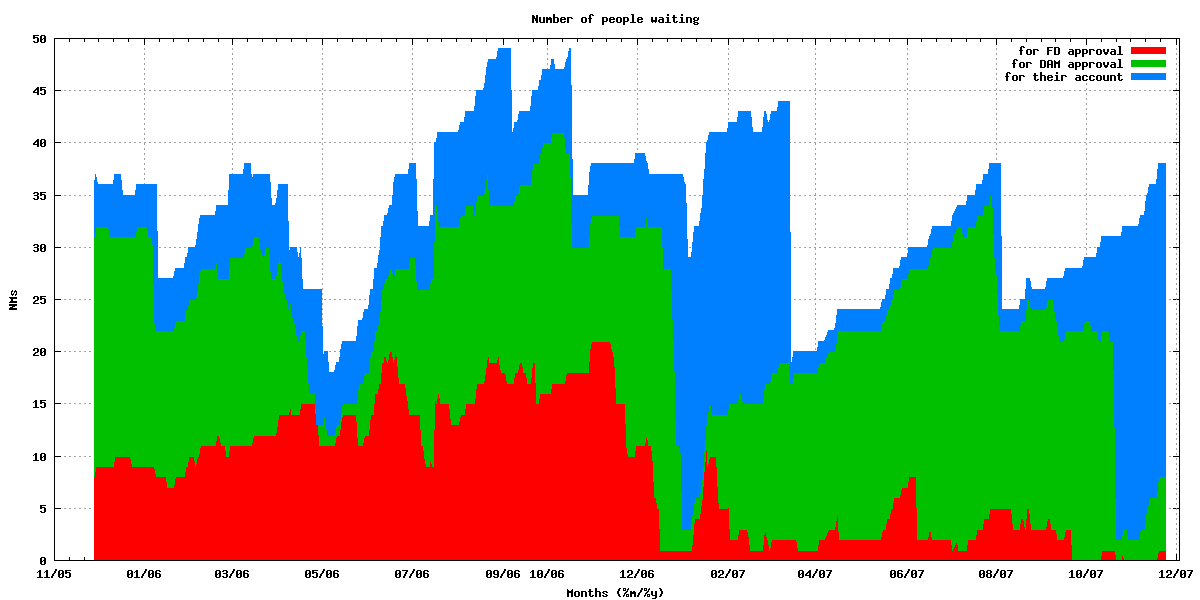
The current status of the NM process, with 1 NM awaiting FD approval, 7 awaiting DAM approval, and 30 waiting for their accounts to be created, leads people to thinking that the big bottleneck is the account creation stage. However, when you look at what happened since december 2005, it’s not that simple. NM queues status See the graph linked above, which shows where people are waiting. While it seems that the FD stage hasn’t been blocking people for nearly a year, it’s the DAM stage which has been the biggest blocker. Indeed, on average, 8.3 NMs have been blocked by FD, 16.2 by DAM, and 9.0 by account creation. I understand that processing NM reports in batch mode makes it more efficient. However, I’m wondering if processing them 20 per 20, is really that more efficient than processing them 5 per 5, which would justify such long queues. The NEW queue, which used to be a problem, is now being processed on a very regular basis, and hasn’t grown widely recently, except after Debconf when the ftpmaster processing NEW was on VAC. Couldn’t we have the same thing for DAM, account creations, and while we are at it, removals from unstable? Having clearly defined human-crontab-jobs would certainly make working on Debian less frustrating.

13 November 2007

Lucas Nussbaum: SC07, MIT Fab labs, and empowering people

This morning’s SuperComputing’07 keynote was a talk by Neil Gershenfeld, director of the Center for Bits and Atoms at the MIT. He mentioned the MIT Fab Labs, a project to bring “Personal Fabrication” to people around the around. At our own level, that’s something I find very exciting with Free Software: it empowers people to do things with their computers that they couldn’t do if they were using proprietary software, simply because proprietary software is built to fit most people’s needs, not very specific goals some people could have. (and this is similar to the Long Tail stuff, in some ways) Also, if you are at SC07 and reading this, feel free to ping me! I haven’t seen a lot of Debian/Ubuntuers here, even if the Free/Proprietary software ratio is very high.

10 November 2007

Christian Perrier: Old pending bugs

A stupid idea that popped up in my head this morning (actually reading the backlog of #debian-devel-fr and a remark by Lucas Nussbaum): it would be interesting to list bugs tagged as "pending" more than, say, one year ago and report them somewhere (-devel or a web page). I think that in the majority of cases, there is probably something broken when a bug is marked pending for more than one year..:-)
6 November 2007

Christian Perrier: See you in BLR

The talks I proposed for FOSS.in, the major FLOSS conference in India, have been accepted for the Project Days, in the Debian-Ubuntu sessions. Thanks to the event organizers who will sponsor my travel to Bangalore, I'll probably leave as of Sunday Dec. 2nd and attend the entire conference from Dec. 4th to Dec. 8th. During earlier weeks, Sam Hocevar, the Debian Project Leader, also agreed to come to the conference and give two talks there. And, this morning, I had the nice surprise to discover that Lucas Nussbaum, one of our most tireless QA animators in Debian, will also come and give a talk about QA in Debian. So, that should make three French DD attending and, therefore, bring a strong Debian representation in this conference, which is something I definitely find interesting as I invested quite a lot of time and energy last years to increase the Debian presence in South Asia. This will certainly be a great occasion for us to give credit to the few people who contribute to Debian (and related projects) in India, and of course meet them in person. Please check the list of talks to get an idea of talks. Now for the challenge: the organizers expect our slides....by 7 days as of now. I don't know for Sam and Lucas but I have just begun working on one of my two talks (the i18n one, of course...you know: the one with the cute maps....). Would someone have a ready "How to contribute to Debian" talk somewhere? :-)

5 November 2007

Lucas Nussbaum: NEW processing

NEW is currently nearly empty (only 3 packages), and there are only 2 NMs waiting for DAM approval. Some people deserve beers (… or milk ;) )!

4 November 2007

Lucas Nussbaum: Some numbers about Debian s history

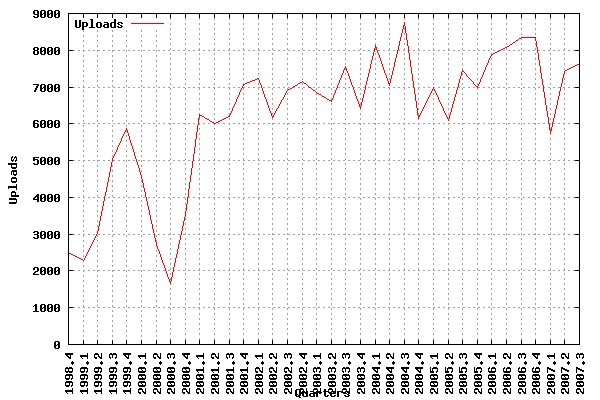
There’s an interesting article on LWN.net about Gentoo: Who made Gentoo Linux, and when? A commit analysis I was wondering how Debian compared, so I made some stats using the debian-devel-changes archives. First, the number of source uploads per quarter:
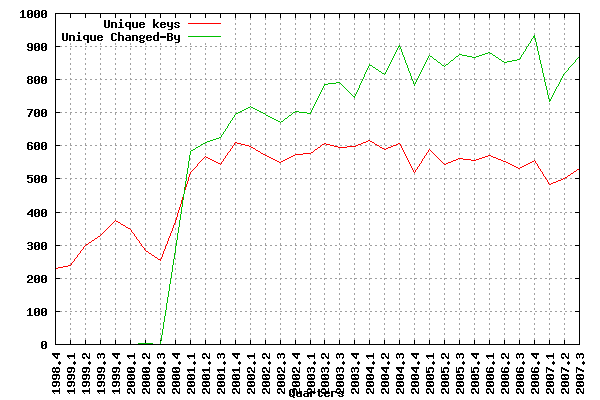
It’s interesting to note that, while the number of packages in Debian increased a lot, the number of uploads basically stayed the same since 2001. Then, I wondered about the number of active developers in Debian. So I counted: I can provide the raw data on demand, if someone else want to work on this. There’s probably a lot of other interesting things to do!

27 October 2007

Christian Perrier: See you in BLR

The talks I proposed for FOSS.in, the major FLOSS conference in India, have been accepted for the Project Days, in the Debian-Ubuntu sessions. Thanks to the event organizers who will sponsor my travel to Bangalore, I'll probably leave as of Sunday Dec. 2nd and attend the entire conference from Dec. 4th to Dec. 8th. During earlier weeks, Sam Hocevar, the Debian Project Leader, also agreed to come to the conference and give two talks there. And, this morning, I had the nice surprise to discover that Lucas Nussbaum, one of our most tireless QA animators in Debian, will also come and give a talk about QA in Debian. So, that should make three French DD attending and, therefore, bring a strong Debian representation in this conference, which is something I definitely find interesting as I invested quite a lot of time and energy last years to increase the Debian presence in South Asia. This will certainly be a great occasion for us to give credit to the few people who contribute to Debian (and related projects) in India, and of course meet them in person. Please check the list of talks to get an idea of talks. Now for the challenge: the organizers expect our slides....by 7 days as of now. I don't know for Sam and Lucas but I have just begun working on one of my two talks (the i18n one, of course...you know: the one with the cute maps....). Would someone have a ready "How to contribute to Debian" talk somewhere? :-)

24 October 2007

Lucas Nussbaum: Better mentors.debian.net/REVU to improve our sponsorship workflow?

I recently sponsored several uploads, and was asked to sponsor even more uploads, and that got me thinking about our sponsorship workflow. It’s a clear bottleneck in Debian, and discourages many new contributors, which obviously sucks. It’s important to note that the same problems exist in Ubuntu (their equivalent to mentors.debian.net is named REVU). The best way to improve the process would be to have packages of better quality when a DD first look at them. They would be more likely to be uploaded right away, which frees time for other packages. I think that there’s a lot of room for improvement in the current mentors.debian.net implementation. Here is a small list of features I would like to see. The good thing with this whole list of features is that everybody can help. So, if you are looking for a sponsor and want to help solve this problem, start coding now ;) And if you need me to create nicenameforyourservice.debian.net, just ping me. There’s probably some code to steal from svnbuildstat.debian.net, so contacting its developers would be a good idea.

18 October 2007

Lucas Nussbaum: Re: Giving credit where due?

Christian Perrier is wondering why the official announcement about the Gutsy release does not even contain the word “Debian”. It’s not new: Debian is virtually nonexistent in Ubuntu’s communication. It seems that the last Ubuntu release to acknowledge its Debian origins was Dapper (June 2006), maybe because that was the “Long Term Support” release. The fact that there’s no “Ubuntu is based on Debian” paragraph on www.ubuntu.com was raised during Debconf, and it was supposed to get fixed, but it seems that it didn’t happen for some reason (there was such a paragraph before the website redesign). In other news, I’ve been trying to install Ubuntu Gutsy inside qemu, but it fails miserably while booting the installer. I removed the “quiet” and “splash” options from the kernel cmdline, and discovered that after trying to “mount the root filesystem”, I get dropped into busybox with no error message to google for. Feisty fails as well, but Dapper boots fine. So much for the Ubuntu is an ancient African word, meaning “I can’t install Debian” joke!

Lucas Nussbaum: Who made Debian GNU/Linux, and when?

Donnie Berkholz wrote an interesting article on Who made Gentoo Linux, and when?. Has someone already done something similar for Debian? It would probably be possible (and easy) to use the debian-devel-changes archives (available since 1998) for that.

4 October 2007

Lucas Nussbaum: Selling Debian tasks

In a lot of talks or blog posts (like Sam’s talk at RMLL, or Rapha l’s blog posts - both in french), people have been talking about what people could do inside Debian, and how it would help Debian. That doesn’t sound like the best approach to me. When describing tasks with the objective of getting potential contributors to pick them up, we should try to make them sexy, to tell users what is exciting about them, what they will learn doing those tasks, where satisfaction will come from. We really need to sell them better. Of course, some Debian tasks are mainly grunt work. And for some of them, people just do them because someone has to do them. But I believe that most tasks inside Debian are actually more interesting than outsiders would expect. For example, I would be very interested in reading why an i18n expert (hint: Christian!) finds i18n sexy … and I should probably try to write about QA myself. (As you might have noticed now, the subject of this blog post was misleading on purpose — chosen so that a lot of people would read the post :P)

28 September 2007

Lucas Nussbaum: ZFS as LVM killer really?

From the ZFS FAQ:
Can devices be removed from a ZFS pool? You can remove a device from a mirrored ZFS configuration by using the zpool detach command. Removal of a top-level vdev, such as an entire RAID-Z group or a disk in an unmirrored configuration, is not currently supported. This feature is planned for a future release.
buzz, buzz, buzz…

Next.

Previous.