Search Results: "John Goerzen"

31 July 2011

John Goerzen: A 4-year-old, Linux command line, and microphone

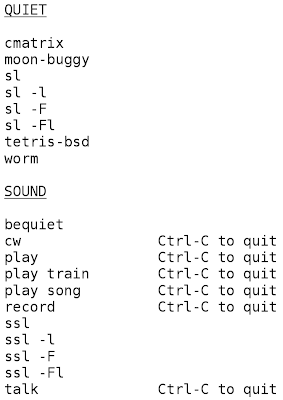
There are certain times when I m really glad that we have Linux on the house for our boys to play with. I ve already written how our 4-year-old Jacob has fun with bash and can chain together commands to draw ASCII animated steam locomotives. Today I thought it might be fun to install cw, a program that can take text on standard input and play it on the console speaker or sound card as Morse code. Just the sort of thing that I could see Jacob eventually getting a kick out of. But his PC was mute. We opened it up and discovered it didn t have a console speaker. So we traipsed downstairs, dug out an external speaker, and I figured out how to enable the on-board audio chipset in the BIOS. So now the cw command worked, but also there were a lot of other possibilities. We also brought up a microphone. While Jacob was busy with other things, I set to work getting things hooked up, volume levels adjusted, and wrote some shell scripts for him. I also printed out this reference sheet for Jacob: He is good at reading but not so good at spelling. I intentionally didn t write down what the commands do, hoping that this would provide some avenue for exploration for him. He already is generally familiar with the ones under the quiet category. I wrote a shell script called record . It simply records from the microphone and drops a timestamped WAV file in a holding directory. He can then type play to simply play back whatever he recorded most recently. Easy enough. But what he really wanted was sound for his ASCII steam locomotive. So with the help of a Google search for steam train mp3 , I wrote a script ssl (sound steam locomotive) that starts playing the sound in the background if it isn t already going, and then runs sl to show the animation. This was a big hit. I also set it up so he can type play train to hear that audio, or play song to play our favorite train song (Always a Train in My Dreams by Steve Gillette). Jacob typed that in and sat still for the entire 3 minutes listening to it. I had to hook up an Ethernet cable to his machine to do all this, and he was very interested that I was hooking his computer up to mine in some way. He thought all the stuff about cables in the walls was quite exciting. The last thing I did was install flite, a speech synthesis program. I wrote a small shell script called talk which reads a line at a time from stdin and invokes flite for each one (to give more instant feedback rather than not starting playback until after having read a large block from stdin). He had some fun hearing it say his name and other favorite words, but predictably the most fun was when he typed gibberish at it, and heard it try to pronounce or spell nonsense words. In all, he was so excited about this new world of computer sound opened up to him. I m sure there will be lots of happy experimentation and discovery going on.

26 July 2011

John Goerzen: Jacob and the Amazing Technicolor Adding Machine

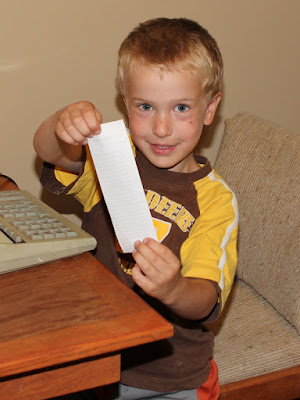
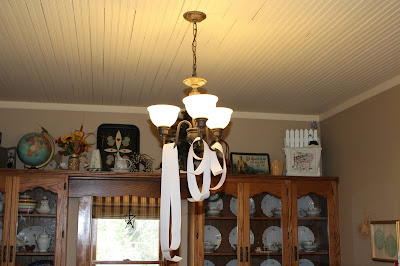
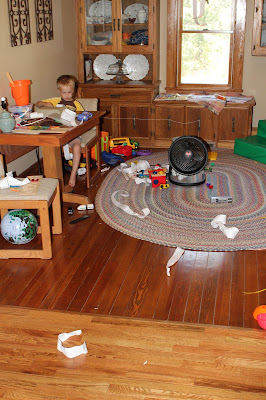
Jacob has been eagerly awaiting this day for at least, well, 2 days now. This morning he started asking questions. All day long he has been wondering how long until the big event. And that event is the arrival of the UPS truck carrying a special $8 package for him. And in that $8 package is not a DVD, or a book, or a toy, but rather 12 rolls of adding machine tape (totaling 1/3 of a mile). Oh yes, our four-year-old can hardly contain his excitement over office supplies. Let me back up a bit to explain. I am always on the lookout for a certain kind of toy. The sort of thing that you don t find in the toy section of a store. The sort of thing that is interesting and engages the curiosity of our boys, that most people would consider would toss, and that usually costs less than $5. Along those lines, Jacob has an old manual typewriter he can use, he and I built a switchbox full of switches and light bulbs that the boys love to play with, we built him a command-line-only PC out of spare parts, the boys have some radios they can use, and one day I salvaged a decades-old adding machine that was going to be thrown out. Jacob liked it he enjoys number and letter games and had some fun, but didn t zealously engage with it until just a few days ago. He sat down at his table and started making cards . He will print out a bunch of numbers, making a strip a couple of feet long, and then say, Dad, I made another card for you! We will then happily accept the card and he will continue making more. Here he is, holding up one of his cards: Jacob had a ton of fun making them, and Oliver wanted in on the action too. Oliver was somewhat interested in the adding machine, but not as much as Jacob, and Jacob didn t want to share. So somehow they decided that Oliver would run and get cards from Jacob and then take them to whatever parent Jacob said. Today Jacob said, Dad, the Oliver delivery service will bring you a card! Saturday morning we had some time to hang around and play, so we played some adding machine tape games. I tucked some long cards under my waistband, and the boys happily chased me all over the house trying to get them back. We also decorated: And here is what the room looked like after some cleanup: That orange bucket on the desk is my card bucket where I can put all the cards he gives me. He even helpfully empties it out into the recycle bin when there are too many old cards in it! But then tragedy struck it was out of paper! I ordered a 12-roll pack off Amazon, and boy was it a long couple of days until it arrived. Today before the UPS truck got here, I showed him how we could feed old paper through and print on the back side an incredible innovation, it seemed! Terah had a conversation with him earlier that went like this: Terah: Jacob, we need to clean up the house. Jacob: Why? Terah: Because some people are coming over. Jacob: Who is OH YES! The UPS delivery man! Yes, let s clean! Terah: Ah, well yes he will be here too, but your great uncle and aunt are coming. Jacob: Oh yay! And the UPS man! It is hard to describe Jacob s excitement when the package arrived. I quickly opened it up, and at his great uncle s prompting, he counted to see if he really did get 12 rolls of paper. IT IS TWELVE ROLLS! YAY! And then we quickly installed it in the machine and off he went. At his great uncle s prompting, he started writing a J on each card . This meant Jacob , or maybe he d put two J s, meaning To John From Jacob , or perhaps the two J s meant To Terah From Jacob he d always have to clue us in. Anyhow, for an $8 investment in paper this has brought hours of joy to our boys. Even though Jacob isn t yet really using it to perform arithmetic, it is setting him up to enjoy that sort of thing and encouraging his curiosity. Both good things.

19 July 2011

John Goerzen: Too Strange for Jon Stewart

I would have probably dismissed as not realistic enough for even The Daily Show this kind of story, had someone suggested it a few months ago: Rupert Murdoch s corporation (owner of FOX News, Wall Street Journal, News of the World, etc) would have been found to have illegally accessed other people s voicemails. These included voicemails from a cellphone belonging to a recently-murdered girl, which interfered with the police. And they had also bribed Scotland Yard officers for information, and actively covered it up. The story would close one of Britain s biggest newspapers, and force the resignation of various government and Scotland Yard officials. That it would lead to the first high-profile investigation under the Foreign Corrupt Practices Act of an American corporation bribing British officials. That one of the central figures in the scandal would suddenly die at a young age. That there was a question of how the former editor of Murdoch s newspaper whom he steadfastly defended until one day he didn t would be taken from jail to testify before Parliament. That CNN would live stream a hearing of a British Parliamentary subcommittee instead of the news conference given by the President of the United States. And that during this committee hearing, some guy would attack Rupert Murdoch who, until then, looked like he had a few drinks too many the night before with a shaving cream pie. And that Rupert Murdoch s newspapers and TV channels would portray News Corp. as a victim of the liberal press in all this, and that they should just be left alone. So maybe the last one was believable, but my goodness. Just when it couldn t get any stranger, a SHAVING CREAM PIE?!

John Goerzen: Trains and Birthdays

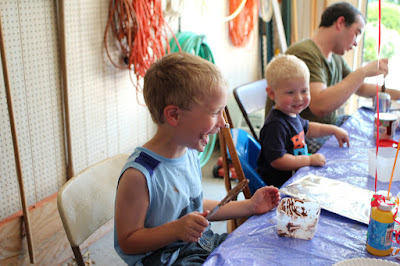
This weekend, the boys got what they ve been waiting for: another trip on Amtrak. For the last week or so, Jacob has had a morning ritual. He ll look at the calendar, figure out what today is, figure out when we ll get on the train, and then figure out how many days it will be. As the number gets lower, the excitement gets higher, of course. Friday morning, we woke the boys at 2:30AM to get to the train station. The only Amtrak trains through our area are middle of the night departures. Jacob is normally hard to wake up, but when I tell him that I m waking him up to go to the train station, he wakes up faster than I ve ever seen him before. It takes about 3 seconds for him to process that in his groggy state, and then he sits up straight, throws off the covers, and is instantly ready to go. Both boys were excited even in the station waiting room. Oliver has been on an Amtrak train before, but it s been awhile and he probably doesn t remember it. He constantly talked about it, jabbering as much as his vocabulary lets him. Once we were on the train, Terah and I would have liked to get some more sleep. The boys, on the other hand, were now wide awake, and didn t fall back asleep until about 5:30. That means Terah and I didn t, either. Here s what it usually looks like: When it came time for breakfast, we went to the dining car as usual. Jacob had already been telling us for days what he would eat for breakfast on the train: I always have French toast on the train, dad. And so he did. A few minutes later, I heard the waitress telling other people they were out of French toast, so I was glad I didn t have to disappoint Jacob over that! But it was Oliver that really came alive on this trip. I don t think I ve ever seen him so excited. It was almost constant. He happily talked about anything he could see or touch. But he also listened to other conversations, and would frequently pick out one word from a sentence and try to say it. He does that at home too, but not nearly so often as on the train. Both boys wanted to go exploring a lot my word for taking them for a walk in the train and seeing what they might find. We walked up and down the train several times, Jacob excited over opening the doors between the cars, and Oliver excited just to be there. Oliver s excitement kept him from sleeping well. He did eventually get a short nap, but that wasn t quite enough to avert a couple of tantrums later in the day. The reason for the trip was the 80th birthday party for Terah s grandpa. And it so happened that Oliver s 2nd birthday would be over the same time. So, Saturday morning, we all went for breakfast at Das Dutchman Essenhaus, one of the favorite local restaurants in northern Indiana. After that, it was over to a relative s place for some birthday festivities. The children got mini cakes to decorate as rail cars. There was frosting and all sorts of toppings. Great fun was had by all, and it was wise that this activity took place in a garage rather than indoors. Yes, that is a marshmallow stuck to Jacob s nose. Then in the evening, it was off to another relative s place for some more family time. Jacob had a great time all day, and was in high spirits. He asked me to sit by him at dinner, and started one of the longest conversations I ve had with him in some time. We just talked about the things that happened in the day, but it was nice when I told him, I like sitting by you, Jacob, and he said, Dad, me too! The big highlight for the day happened in the evening. We were gathered around a fire with a guitar to do some singing. Jacob was happily perched in his lawn chair, but got very excited when he saw some lightweight airplanes flying overhead. These kept flying at some distance, and he kept pointing them out to us. But that wasn t even the most exciting part. That came when the fireflies came out. Jacob ran around, catching them in his hands, and excitedly showing them to whatever person happened to be closest. He was laughing with joy for such a long time. At one point, someone asked him if the bugs were tickling his hands. He said, evidentally just realizing it, Oh yes, they ARE tickling my hands! He was one very happy boy. Sunday I had to leave to get back home, while Terah and the boys will return a couple of days later. Although I do sort of look forward to a train trip that I can relax without having to manage two young boys, I do miss them already and will be happy to have everyone back home in a few days. (This post written during the trip and posted a week later after arriving home)

18 July 2011

John Goerzen: Pooh, Books, and Dads

If I think back to fond memories of being with my dad during my childhood, there s one thing that always comes back first. It s those late summer evenings outside. Dad often had outdoor projects going on of some sort. I d go out there hanging around, maybe chatting, maybe playing with cats, or maybe doing something of my own. Dad often had an old AM radio sitting around and would be listening to a baseball game while working. As it got darker, lights would come on, and the bugs would start flying near them. Sometimes dad would be working just inside the barn, and the bugs would start flying in there, while some light poured out the big front door. There s something about that scratchy AM signal, the evening slowly getting darker, the slow pace of the baseball game, and just being around dad and a peripheral part of whatever he was doing that stirs a wonderfully fond recollection in me. I don t remember the specifics of any one of those times, nor do I really remember how often it happened, but it does stick with me. We ve had a routine in our house, starting early enough that neither of our boys know anything different, where right before bed, I read a book and sing a song to each of them individually. Last November, I was looking for some books to challenge Jacob a little more than what we had been reading. I found The Complete Winnie the Pooh used for $4 on Amazon. This contains the original A. A. Milne stories, not the Disney series. It had a few line drawings, but there were many pages without any. It s 352 pages and written in a rather dated form of British English. So for all these reasons, I wasn t sure if Jacob would like it. But it was $4 so I bought it. And Jacob was hooked. Each evening, we start bedtime with looking at the map of the 100-acre forest, just inside the cover. He gets to pick out 4 things for me to describe, and then we turn to our story. We usually read somewhere between 2 and 5 pages at bedtime, depending on how well he got ready without wasting time. And then we sing. A. A. Milne has his Pooh character make up songs throughout the book. They are printed with words only, no tune, so I make up a tune for them as we go. Jacob has taken to requesting these songs for his bedtime song as well. Jacob always gets to choose his bedtime story, and sometimes he chooses a different one but about 75% of the time, it s been Pooh. A few weeks ago, he started noticing that we were almost to the end. He got very concerned, asking what we d do next. I suggested a different book, which he didn t like. Then I pointed out that we could restart the Pooh stories from the beginning, which was exciting for him. Last night, we finished the book. The very last story was an interesting one, suggesting Christopher Robin growing up and no longer having imaginary adventures with the animals, but making Pooh promise to always be there for him. I don t think Jacob caught onto that meaning, though. When we finished it, we had this conversation: Jacob: Dad, is that the end? Me: Yes. Jacob, getting a big smile: Yay! So can we start back at the beginning tomorrow? Me: Sure! Jacob then gave a clap, shouted Yay! again, and was a very happy boy. Sometimes I wonder what our boys will remember in 25 years of their fun times with me. I don t know if Jacob will remember all the days reading about the animals in the 100-acre wood when he was 4, or maybe he ll remember watching train and combine videos, or playing radio hide-and-seek, or maybe something entirely different. But I have no doubt that I will remember sitting on the couch in his room, holding him on my lap, and reading a 350-page book to a loving 4-year-old. As Pooh aptly put it, Sometimes, the smallest things take up the most room in your heart.

16 July 2011

John Goerzen: Decreasing Time to Eternal September

For those of you that aren t familiar, please read about the Eternal September, which refers to the lasting damage to a community when vast numbers of newbies suddenly enter and dramatically harm the quality and usefulness if discussions.

12 July 2011

Gustavo Franco: Google+ and your data

Let's make it clear: Your data is yours and in Google+ official announcement there's the following "You and over a billion others trust Google, and we don t take this lightly. In fact we ve focused on the user for over a decade: liberating data, ...". John Goerzen is wrong.

I can understand people having problems to use a product during its field trial and demanding features. I won't sit and watch people spreading FUD in bold before asking though.

Last, but not least, the following link is easily visible in the Settings and is also listed in the Help pages:
https://plus.google.com/settings/exportdata


John Goerzen: First Look at Google Plus

Seems like everybody s writing Google+ reviews these days, but most of the ones I ve found seem to be fluff pieces. I haven t used it long, but have some initial impressions to share. First, an analogy. Facebook reminds me of the sleazy guy selling stuff from his car down the street. They do things like change privacy defaults when they think it s good for Facebook, rather than good for you. Google+ reminds me of an Apple product. It s beautiful, easy to learn, but locks everything down and is lacking some critical features. So here goes with the details. The good I think that this can be best summed up by: it s not Facebook. Facebook has, perhaps, set an incredibly low bar but still, this holds. Facebook is the only website I can ever remember using that changes things so much, so often, and so completely that I keep having this feeling of not knowing how to do things. Try maintaining a Facebook page or two and you ll especially feel my pain then. But even the basics: how many times have I accidentally posted a partial comment because I pressed Enter to start a new paragraph (that has only been the button used for that for, hmm, let s see now, decades), and instead it posted the comment. Principle of least surprise, anyone? Google+ has a simple and, on the surface anyway, intuitive interface. However, it does get muddy; more on that below. I m going to spend a lot more space on the bad below, but don t let that diminish my excitement about having a viable alternative to Facebook. I am keen to get rid of that monster. The Bad I ll start of this section with the fact that Google+ is a tightly-controlled walled garden. There is no way to take a copy of your status updates, comments, etc. and back them up with your own devices. If your Google account goes away, so do all your updates about your kids first words. Facebook does have this feature these days. It has broken half the time, but it exists, works, and I use it. Twitter doesn t have the feature built in, but its API makes it pretty easy; you could easily use my twidge program to do this, for instance. But whatever you put in G+ stays in G+. There is no autoposting it to twitter or Facebook, no backups, nothing. I m disappointed in that, given Google s prior attitude about openness to individual data ownership. (Update 7/12/2011: There is a way to get a backup, which I hadn t noticed; see comments below.) Almost as bad, there s also no way to get data in. So I now have identi.ca, twitter, Facebook, and now also G+ accounts. When I post an item in identi.ca, it autoposts to twitter, and then it autoposts from twitter to Facebook. Handy one place to notify people of my public activities. My uploads to Flickr and blog posts also auto-post to Facebook, so people I m friends with there get a picture of what I m doing outside of Facebook without me manually having to link it in. Not so with G+. There is no way to even add an RSS feed for my blog to auto-post to G+ as there is with Facebook. If you use G+, the only way to get stuff into it is with a keyboard. Poor integration with other Google apps is also an issue. G+ is nowhere near Google s first social app. They also have Blogger, Google Reader, Buzz, Gmail, etc. So here s the rub. These aren t integrated well, and when they have tried to integrate them, they ve done an exceedingly poor job of it. As an example: Buzz is a twitter-like service for posting updates. Very similar to what G+ does, right? Well, the best you can do is link your Buzz account to a separate tab on your profile. You can t even have your Buzz updates flow straight into G+, from what I can see. You have a separate list of followers in Buzz from G+. Reader is even worse; it has a sharing feature, but it s not G+ aware, so it goes to a reader inbox. But what takes the cake is the integration with Gmail Contacts. Sounds easy? Not entirely. When you add someone to G+, apparently it sometimes links the record with their entry in Contacts. And the help gives you the handy warning that when you remove them from G+, you have the option of removing them from Contacts, which could impact what you see on a mobile device. It is unclear what happens when it doesn t link the record, or how it decides which record to link (some people have more than one person in a family sharing phone numbers and email addresses, for instance.) One very nice feature of G+ is you can add email addresses, even if they aren t G+ members. Then when you post updates to the circle you ve added them to, G+ offers to send them an email with an update. Very handy. Except the undocumented part is that if you select Your circles (meaning all your circles), rather than individually ticking the box by each circle, they don t get the email. And they also don t get it if you set it Public. You have to select their specific circle, which is a significant difference from how people with G+ accounts are treated. And that s just an example. There are a ton of things that work one way 95% of the time, but have non-obvious exceptions. Some of these exceptions are documented in the help, and some aren t. I m still confused about the integration with Picasa. G+ help says that you can upload unlimited numbers of photos for free (though they will be downscaled at a certain point). Picasa has definite storage limits. But G+ uploads are showing up in Picasa. Do I really get free storage by uploading to the same place via a different tool? Very odd. And finally, a gripe about web standards. I ve been using Firefox/Iceweasel 3.5, which came out in Debian squeeze and is still supported there. It is also pretty darn new by corporate IT standards. And Google Plus refuses to let me log in with it, saying it s incompatible. Perhaps it can t do some fancy animation, but then again I don t really care. Seems Google has forgotten the old RFC adage: be liberal in what you accept and conservative in what you generate. If you can detect that my browser won t animate something right, then you could give me a stripped-down version of the page rather than an error message.

6 July 2011

John Goerzen: Geeks, Hobbies, and Free/Open Source: Feedback Wanted

I ve been thinking lately about ways to improve ways in which I interact with Free Software projects, and ways in which they interact with me. Before I proceed to take steps or make suggestions, I d like to see if others share my traits and observations. Here are some questions I have been thinking of. If you d like to help give me anecdotal evidence, please post a comment below this post. Identify the question numbers you are answering. It helps me if you can give specific examples, but if you don t have the time or memory for that, no problem. I will post my own answers in a day or two, but the point of this post is listening, not talking, so I ll not post them immediately. Hobbies (General any geeks) Examples: video games might be a challenging hobby (depending on the person) but in most cases aren t educational. A hobby might be video game playing or being a Debian developer. A sub-hobby might be playing GTA IV , playing RPGs , or maintaining mutt . Free/Open Source Hobbies Examples on F9: If, say, you are a long-time Perl user and have gone to Perl conferences, but now you are interested in Ruby, would your involvement with the Perl community cause you to avoid taking up the Ruby programming hobby? Or would it cause you to cut your ties with Perl less quickly than your changing interest might dictate? (This is a completely arbitrary example and isn t meant to start a $LANGUAGE thread.) Changes over time

5 July 2011

John Goerzen: The Lives of Others

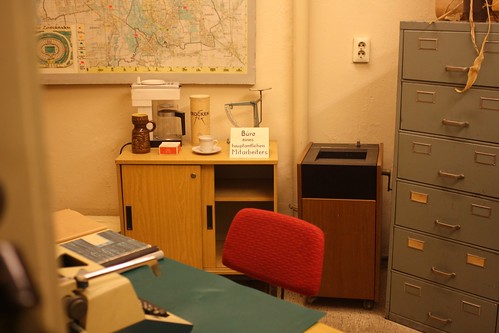
It s not very often that I watch a movie anymore. It s been a few years since I ve actually purchased one (normally I see them from Netflix). But yesterday I saw one that may change that. The Lives of Others is an incredible film set in the former East Germany (GDR/DDR) mostly in 1984. The authenticity of it is incredible and so is the story. It s subtitled, but if you re an American wary of subtitled European films, don t be wary of this one. It is easy to watch and worth every minute. The story revolves around the Stasi, the GDR Ministry for State Security ( secret police ). It is an incredible picture of what living in a police state was like, and how many of the informants were victims of the regime too. My breath caught near the beginning of the film, showing the inside of a Stasi building. A prisoner was being interrogated for helping someone attempt to escape to the west. But the reason my breath caught was this incredible feeling of I was there . Last year, Terah and I were in Leipzig and visited the Stasi museum there, Museum in der Runden Ecke . I always have an incredible sense of history when being in a preserved place, and this building was literally the Stasi headquarters for Leipzig. Much of it was preserved intact, and seeing it in the film brought home even more vividly the terrible things that happened in that building, and others like it, not so very long ago. IMG_2717 We watched the special features on the Blu-Ray disc, and one of them was an interview with director Florian Henckel von Donnersmarck. He described how he spent a lot of time interviewing both victims of the Stasi, as well as ex-Stasi officers. One of the most disturbing things to me was his almost offhand comment that most of the former Stasi officers still had some pride in performing their jobs well. Even now, freed of the state s ideology, they were proud of the work they did which could be put most charitably as ruining people s lives. What leads a person to view life that way? How can we try to make sure it doesn t happen again elsewhere? I am happy to say that most of us have never experienced anything like the Stasi. And yet, small reflections of that mindset can be seen almost everywhere. Societies at wartime or feeling under threat, even Western democracies, can drum up those feelings. In the USA, for instance, the McCarthyism era saw people s careers ruined for alleged anti-state behavior. Contemporary examples include the indefinite detention (I hate that word; shouldn t we say imprisonment ?) of terrorism suspects at Guantanamo Bay, and the terrible treatment of Bradley Manning, who revealed some true but embarrassing things about the US military which really needed to be revealed. Even tobacco farmers and companies are selling a product they know ruins lives, but somehow keep doing it. And there are still members of the public that try to make life difficult for people that don t think like they do. From organizing campaigns of telephone harassment of colleges that don t perform the American national anthem before sporting events, to tossing about the term un-American (a loaded McCarthyist one, which many may not even be aware) at an inflated rate, we are not immune from attempts at forcing conformity or silence in others, and blind loyalty to state. I am never in a particularly celebratory mood on July 4, the biggest day for American boasting, faux patriotism, militarism, and general flag-waving. We do have a lot to be proud of and thankful for, but it seems that we celebrate all the wrong things on July 4, and see it as an occasion to proclaim American exceptionalism rather than as one to see how far we ve come and bolster hope for how far we can, and should, yet go. No, I don t think that the land of the free ought to have operated secret prisons in Europe (nor the Europeans to have been complicit in it), or that the American military was defending our freedom 100% of the time they were deployed, or that it is right for governments to mandate daily recitation of an untrue document (the pledge of allegiance) in schools. And yet, I am mindful that I have a lot to be thankful for stability, lack of much internal violent conflict, etc. And this particular day I am happy that a post like this is not something that gets the attention of some government agency and mostly that I will have a handful of angry emails to delete.

18 June 2011

John Goerzen: Music Powerful and Fun

Sometimes there s nothing quite so heartwarming as hearing a 4-year-old that doesn t think anybody is listening. When Jacob is all alone in his room, sometimes he will sing. Maybe it s a song he knows, or fragments of a song he knows. Or maybe it s something he just made up on the fly. It might be about trains, cats, letters, or who knows what. Maybe it will crack him up and he ll keep singing and then laugh. Or maybe it will stop in 30 seconds and he ll go on to something else. Brief and out of tune though it may be, it is still one of the most beautiful sounds I know and I love to hear it. Jacob loves to have other people sing, too. Sometimes I will make up songs while we drive: We are driving, we are driving, we are driving down the road; we are driving down the old country road and we re making some dust, yes a lot of dust Or Jacob likes me to sing the songs in the Winnie the Pooh book he has (the original, pre-Disney version, which has the words for the songs but not a tune, so I make up a little bit different one each time). Very occasionally he will sing with me, but if he does, he doesn t want anybody to comment about it. I sing with the Kansas Mennonite Men s Chorus. We re a group of about 300 singers (all men, though not all Kansan and not all Mennonite) that sing for charity. We ve raised over $600,000 for charity so far. I still remember the first time I went to a KMMC practice 3 years ago. It was my first year singing, and the first practice of the season. We started singing the first song, and wow what a powerful moment. Even at its imperfect first practice state, hearing 300 people sing quietly is a powerful sound and when they get to the top of their lungs, it s indescribable. No CD can ever quite do that justice. Jacob and Oliver come to KMMC concerts sometimes, but this year they took a special interest. Oliver pointed to, hm, perhaps 300 men and said dad for each one. (He was quite far away and probably couldn t pick me out specifically.) Jacob, for the first time, sat quietly engrossed in the concert until we got to Dry Bones (a song involving surprise and lots of homemade instruments) which made him laugh out loud. Then he would hide under his seat from the applause. Last week, KMMC went on tour. This was my first choir tour, and Terah came along while the boys spent time with grandparents in Kansas. We sang in Bloomington, IL, and then in Goshen, IN at the fairly new Sauder Concert Hall. That hall is a few years old, and has been reviewed as once of the best concert halls in the world acoustically. It seats 1100 people and was perfect for this. The 85 or so singers from KMMC that went on tour joined the Indiana and Ohio Men s Choruses to make a combined group of about 200 singers. And what an experience that was. I learned later this was the first event to completely pack Sauder Concert Hall. We ended the concert singing the Mennonite Anthem a souped-up version of the doxology. (You can see a video of a different group singing it to get an idea of what it was). This is often joked about as being part of Mennonite DNA. You can gather a random group of Mennonites and ask to hear 606 (its number in, well, an old hymnbook that we don t use anymore) and you can probably get a fairly well-sounding rendition, from memory, a cappella, complete with 4-part harmony, at the drop of the hat. Mennonite youth have been known to sing it in train stations, airports, soccer stadiums, and with kazoos. At Goshen, we had 200 men on stage, plus a brass band, plus 1100 people in the audience facing us. They were, of course, invited to sing along. (That s one of the rules of 606: you can t exclude anybody because even if you tried, they d still sing, because how can you resist?) So I was up there on stage, singing a song I love, and hearing the 1100 people in the audience sing it to me. I could glance out over the front rows and saw the smiles on so many faces as they sang, and what a moving moment that was. The excitement and thrill of it all hit me so much that I could barely finish the song. The numbers aren t all in yet, but I m guessing that we raised over $15,000 for charity last weekend (the choir members paid their own expenses in advance, so 100% of the money raised goes to international relief efforts.) A 4-year-old singing alone in his room is really heartwarming. I have to say that 1300 people singing a song that touches each one of them is a pretty close second.

17 June 2011

John Goerzen: APRS: World s Best Social Mapping and Wide-Area Ad-Hoc Wireless Mesh Network

That was quite a headline, and I m going to try to back it up below. APRS is the Automatic Packet Reporting System. It s a system for exchanging brief packets of information. It is most frequently used for mapping applications, but it really does a lot more than that. It has its biggest home in the amateur radio world, but isn t limited to that, either. The most common way to use APRS is to have some device hooked up to a GPS transmit packets with the GPS information in them. These packets can then be plotted on a map in real-time or with history. That in itself isn t particularly newsworthy these days. An interesting thing about APRS is that it s not just positioning. Let s say that there was a search-and-rescue operation. A person could draw a rectangle on the map indicating the search area, and within about 3 seconds everyone else s map also shows that rectangle. People have even been known to play chess by sharing and moving objects on APRS! The next piece that makes this interesting is that APRS is an ad-hoc mesh network. In its traditional implementation, VHF amateur radio, a radio emits a packet with a geolocation in it (a beacon ) and any other radio within direct range of that can receive it. Radios can display basic information (such as distance to the other radio, heading, etc.) or hooked up to a laptop or mapping device for a better display. So if everyone is within a few miles, APRS works without any pre-existing infrastructure at all. This makes it wonderful for use in disaster areas, and was put to heavy use in Joplin after the tornado there. But what about radios that are too far away? Any APRS station could also be a digipeater. When a packet is transmitted, it has a maximum hop count. A digipeater hears the packet, decrements the maximum hop count, and re-transmits it. With this mechanism, packets can travel hundreds of miles. It creates a highly resilient network, one that can route around trouble without even having to have an explicit backup route. I could bring in a digipeater in my car it can be small enough to hold in my hand and instantly improve APRS reception in an area. One interesting aspect is that packets can be digipeated more than the maximum hop count. For instance, if a packet leaves my radio and is picked up by a digipeater to my west and one to my east, it can keep on traveling in both directions. This is part of what leads to resiliency. APRS also functions over the Internet. There is a large network of interconnected Internet servers that exchange all global APRS traffic amongst themselves. Gateways between the radio (RF) and Internet (APRS-IS) services exist, and are called iGates. They are not generally required, but make useful websites like aprs.fi and email gateways possible. As long as an iGate is within a reasonable number of hops from you, you re effectively linked. And again, if one iGate drops off, another iGate is probably monitoring your traffic too and you never notice. It s an ad-hoc mesh network that is actually reliable how about that? On the PC side, there are many programs for using APRS. The most common one for Windows is called UI-View, but I don t use Windows so I can t comment. On Linux, there are programs (such as aprx) for running your digipeater, but the best-known program is Xastir. Xastir lets you download map files to your local disk, and can interface with the APRS-IS Internet service, radios, weather stations, or simply other arbitrary machines to exchange information. Xastir is a very nice program and is well worth the install, despite its somewhat dated-looking interface. APRS clients, such as APRSDroid, exist for Android and iOS platforms as well. So let s say you re doing something like helping handle food/water stations for a long bike ride. Even if you don t have anybody with an amateur radio license, you can use APRS to great effect. At your headquarters, you can run Xastir and turn on its server mode . This puts everyone on a map. Then you can have everyone turn on APRS on their phone, and have it report to your custom server instead of APRS-IS. Now you have instant visibility into your entire team s location and status. If you have transport people driving supplies between locations, that s especially helpful. In an amateur radio scenario, you would instead have people with radios at each location, and one laptop hooked up to a radio at HQ. This provides an added bonus of not relying on third-party infrastructure such as cellphone towers. APRS also has a messaging system, similar in concept to text messaging. It works the same as other things. If I want to send a message to Jane, my radio simply emits a packet that lists the message and Jane as a recipient. It s digipeated up to its maximum hop count. If Jane is within RF range of one of those digipeaters, she gets the message and her radio ACKs it. Otherwise, it s delivered into the APRS-IS network probably several times, which isn t a problem and the APRS-IS network delivers it to the iGate closest to her, and from there it gets digipeated the rest of the way to her. Here s an example of something created with APRS. While I was on a bus choir tour last weekend, I had a radio with me that was beaconing all the while. Now it was a small handheld radio inside a large metal bus, so it didn t always have a digipeater in range. But still, you can go see a detailed map with the trail and even see exactly what path each packet took before it hit the Internet. If you want to try out Xastir, please grab at least version 2.0 the version in squeeze has some bugs.

7 June 2011

John Goerzen: Back from Joplin

I m just back from spending a few days volunteering with the tornado recovery effort in Joplin, MO. The biggest image that remains in my mind is of the first time I saw a person picking through a large pile of rubble. The person was standing on top of what used to be a house. Now it was a pile of wood, glass, carpet, siding, and roofing material. I m sure there was hope for finding some treasure or other maybe a photo album or videos of children. In any case, it made me feel so lucky, even unfairly lucky, to have not had to go through that. This scene was repeated several times, but mostly the houses that devastated appeared abandoned by the time we were there, now two weeks after the event. But I heard stories, and lots of them. The victims of the storm, who were perhaps trying to rebuild that part of their house that got smashed by a tree or a pickup, or trying to get their intact belongings out before abandoning the house, or whatever, were mostly surprisingly upbeat. They were working out in 95-degree heat, many without electricity, running water, or sewer service. Almost every person I met that suffered a loss from the tornado wanted to tell their story. Many also told of their plans for the future, which were full of hope and even upbeat. These were people doing a hard job in terrible conditions and still showing hope. Another testament to the disaster was the most unusual set of vehicles you ve ever seen parked at any hotel you can care to think of, for at least an hour-and-a-half radius in the direction I came from. Besides the usual cars and minivans, there might be FEMA vehicles, electric company trucks, Red Cross vans, construction trucks of every kind, police and law enforcement from all over, etc. There was quite obviously an influx of people helping out in Joplin. My primary task there was to provide communications support for the effort as an amateur radio operator. Amateurs (or hams ) are something of a volunteer first responder of sorts during times of crisis; most of us own and are very familiar with operating equipment that can communicate over very long distances without the need for any on-site infrastructure. Amateur radio was the only method of communication for some Joplin hospitals in the immediate aftermath. The communications emergency is over, but the response isn t. I was assigned to work with the Salvation Army. They were doing a lot of things in Joplin, and had hundreds of volunteers working with them. I don t think I even know what many of them were doing I do know they had set up several warehouses across the city working with donating clothing, food, etc. The part I was involved with was primarily the canteen operation. The SA sent in food service trucks from several parts of the country. These trucks would roam up and down the streets in the damaged area, trying to get past every single street several times a day. Anybody that we could see would be offered food and water. No strings attached, no questions asked. This included homeowners, electric line workers, construction crews, sanitation workers, and quite a few nonprofit groups that sent well-meaning and useful volunteers into the area but didn t think to provide them with a large supply of water due to sending them into an area without any. Oops. In any case, with extreme heat and no running water, conditions were dangerous. The canteens also knew of certain at-risk families that were living in homes that were mostly intact in the disaster areas, and made a special point to check in on them. They also generally looked to make sure that people looked like they were healthy. Each canteen also had a counselor on board that would visit with people while we quickly prepared their meal they all seemed to welcome that. Amateur Radio s Role The operation of this size had quite a logistics challenge. I d hear of things like an unexpected need of 70 lunches, or a semi showing up with donations before there was space, or an unexpected but very welcome donation of a large quantity of ice cream without a place to store it (so the canteen trucks, which have freezers, needed to pick it up quickly). That s where us hams came in. Each canteen had an amateur radio operator on board. Each major location also had a ham stationed there, and the head of operations also often had a shadow a ham that would follow him around wherever he went to relay messages back and forth. We also had hams with pickups (with radios in them, of course) that could transport things around the city to places that needed them, hams at headquarters managing all the communication and generally investigating questions that didn t have immediately obvious answers, etc. Radios were used instead of cellphones for a few reasons. One big one is that everybody on the operation can hear what everyone else s needs are, since it s a group communications situation rather than one-to-one. It s easy to give a general alert to everyone ( come get your ice cream now please! ) and people that have suggestions can chime in. This came in extremely handy more than once. Also, it frees the people doing other jobs from having to spend time chasing someone s voicemail, finding phone numbers, etc; that gets delegated to us in some cases. I heard from the head of canteen operations, for whom this was the first disaster he d worked that had amateur radio support, how wonderful it was to have this going on. I also heard a secondhand report that some police officers that were also amateurs had listened to our operation and reported that we sound more professional than 911 dispatch and do a better job. On Sunday I was assigned to a canteen. This meant I didn t have a lot of radio traffic to pass, so although I had it in my ear all day, I wasn t actively talking on the radio very much. So I rode in back, helping hand out water, carry meals to people, and so forth. On Saturday, I was the shadow for the head of operations. That was a difficult task, because he barely ever moved at a pace slower than a run, sometimes would abruptly zip out somewhere, etc. But it was also enlightening and vital. He was a real get it done sort of guy, and was the key to quite a few things. Having someone available to relay questions to and from him was a good thing. And today I worked as a transport person and at headquarters. Due to not having a pickup there, I didn t actually get called on much to transport things, but in general between jobs the whole time I d act as a runner if needed, or simply try to figure out the details of how things were run for next time. I wound up taking net control (being the control operator at headquarters, and generally managing communications so that people don t talk over each other and such) for about an hour. So I got to do a little of just about every amateur radio task. Thoughts I am thankful for the opportunity to go, and the good feeling of helping people in need the first I ve ever had the chance to do that in a disaster. It s a good feeling to have a skill that is useful and appreciated. Sometimes it felt like handing out food and water is something pretty small in the scheme of things. But on the other hand, it gives people a chance to have contact with someone that cares, an opportunity to have people that can notice problems drive by a few times a day, and an opportunity to help meet people s basic needs. And sometimes in a fluid situation, there might be more volunteers than are needed, so I did spend some time sitting waiting for the next task. But overall, I m convinced that the work I helped facilitate was a good thing and provided a good and needed service in Joplin. This has been quite the experience and I m sure it s changed me too, though I don t yet know how.

30 May 2011

John Goerzen: War and Peace

I doubt I have ever read a book that had as significant an impact on me, and my act of reading it had on others, as this one. Conversations like this were frequent: Someone, upon seeing me reading my Kindle, would ask what I am reading. War and Peace. Oh. . . uhm, wow. Yeah, it s great. I m reading it for fun. Uhm, OK then, see you later. . . It seems to be so revered, and also so loathed, that I had to read it. At 1400 pages, it took me 8 months to finish, though I read several other entire books in that time. I feel rather unequal to the task of expressing how this book impacted me, let alone a review of it. And nonetheless, I also feel I would be remiss if I let it go past saying nothing. I was struck by so many things as I read War and Peace. Some of them I won t mention here and hope to turn into their own blog posts. Of the others, I felt I gained some sense of how the nobility and serfs in Russia (and, to a certain extent, Europe) thought about life, their position, and how things ran. Being a modern Kansan, this thought process was not familiar to me, and though I head read about it in history texts before, felt far more informed having read it in Tolstoy s novel. Although much of the novel centers around Napoleon s invasion of Russia in 1812, the work as a whole spans nearly two decades of time. Tolstoy s characters aren t static; they change over time. Some, yes, die; others go through hardships and triumphs that change them to their core. It evoked a feeling of nostalgia in me at times for the younger, childlike Natasha who was so full of simple delight in life. But then, a thousand pages later, the older Pierre finally was able to find simple delight in life too. Sometimes I have missed on the simple joy of being, and Jacob or Oliver or Terah remind me of that. Today Oliver and I read a book together, one that we read often, and we discovered an illustration of a tiny worm we had never noticed before. And the worm had a red hat ( hat is one of Oliver s favorite words right now.) The happy laughter as he pointed at the tiny hat, saying hat over and over, reminds me that sometimes children know how to live better than adults. Jacob later asked me how my day was, and I told him how I read a book on my Kindle, where I sat, and how I even read it lying down on the couch for a bit. At that he too laughed. As with some other wonderful, engrossing books, I was sad to reach the end of this one. I felt as if I was leaving a conversation early; fictional characters, yes, but their story wasn t over. And really, that was part of Tolstoy s point: things don t happen in isolation, and stories don t have clearly-defined start and end points. The novel touched on politics, religion, philosophy, free will, and just about every topic imaginable. It is, really, unfair to call it a just a novel. Here are some random quotes from the book, which I highlighted:
his heart was now overflowing with love, and by loving people without cause he discovered indubitable causes for loving them. How often we sin, how much we deceive, and all for what? All will end in death, all! A pleasant humming and whistling of bullets were often heard. Looking into Napoleon s eyes Prince Andrew thought of the insignificance of greatness, the unimportance of life which no one could understand, and the still greater unimportance of death, the meaning of which no one alive could understand or explain. If there is a God and future life, there is truth and good, and man s highest happiness consists in striving to attain them. We must live, we must love, and we must believe that we live not only today on this scrap of earth, but have lived and shall live forever, there, in the Whole, said Pierre, and he pointed to the sky. Prince Andrew stood leaning on the railing of the raft listening to Pierre, and he gazed with his eyes fixed on the red reflection of the sun gleaming on the blue waters. There was perfect stillness. Pierre became silent. The raft had long since stopped and only the waves of the current beat softly against it below. Prince Andrew felt as if the sound of the waves kept up a refrain to Pierre s words, whispering: It is true, believe it. He sighed, and glanced with a radiant, childlike, tender look at Pierre s face, flushed and rapturous, but yet shy before his superior friend. In Natasha Prince Andrew was conscious of a strange world completely alien to him and brimful of joys unknown to him, a different world, that in the Otradnoe avenue and at the window that moonlight night had already begun to disconcert him. Now this world disconcerted him no longer and was no longer alien to him, but he himself having entered it found in it a new enjoyment. All the kings, except the Chinese, wear military uniforms, and he who kills most people receives the highest rewards. But what is war? What is needed for success in warfare? What are the habits of the military? The aim of war is murder; the methods of war are spying, treachery, and their encouragement, the ruin of a country s inhabitants, robbing them or stealing to provision the army, and fraud and falsehood termed military craft. The habits of the military class are the absence of freedom, that is, discipline, idleness, ignorance, cruelty, debauchery, and drunkenness. And in spite of all this it is the highest class, respected by everyone. From the moment Pierre had witnessed those terrible murders committed by men who did not wish to commit them, it was as if the mainspring of his life, on which everything depended and which made everything appear alive, had suddenly been wrenched out and everything had collapsed into a heap of meaningless rubbish. Though he did not acknowledge it to himself, his faith in the right ordering of the universe, in humanity, in his own soul, and in God, had been destroyed. He had experienced this before, but never so strongly as now. When similar doubts had assailed him before, they had been the result of his own wrongdoing, and at the bottom of his heart he had felt that relief from his despair and from those doubts was to be found within himself. But now he felt that the universe had crumbled before his eyes and only meaningless ruins remained, and this not by any fault of his own. He felt that it was not in his power to regain faith in the meaning of life. When Princess Mary began to cry, he understood that she was crying at the thought that little Nicholas would be left without a father. With a great effort he tried to return to life and to see things from their point of view. Yes, to them it must seem sad! he thought. But how simple it is. The fowls of the air sow not, neither do they reap, yet your Father feedeth them, he said to himself and wished to say to Princess Mary; but no, they will take it their own way, they won t understand! They can t understand that all those feelings they prize so all our feelings, all those ideas that seem so important to us, are unnecessary. We cannot understand one another, and he remained silent. Love hinders death. Love is life. All, everything that I understand, I understand only because I love. Everything is, everything exists, only because I love. Everything is united by it alone. Love is God, and to die means that I, a particle of love, shall return to the general and eternal source. These thoughts seemed to him comforting. People speak of misfortunes and sufferings, remarked Pierre, but if at this moment I were asked: Would you rather be what you were before you were taken prisoner, or go through all this again? then for heaven s sake let me again have captivity and horseflesh! We imagine that when we are thrown out of our usual ruts all is lost, but it is only then that what is new and good begins. While there is life there is happiness. There is much, much before us. I say this to you, he added, turning to Natasha. During that twenty-year period an immense number of fields were left untilled, houses were burned, trade changed its direction, millions of men migrated, were impoverished, or were enriched, and millions of Christian men professing the law of love of their fellows slew one another. What does all this mean? Why did it happen? What made those people burn houses and slay their fellow men? What were the causes of these events? What force made men act so? These are the instinctive, plain, and most legitimate questions humanity asks itself when it encounters the monuments and tradition of that period.

23 May 2011

John Goerzen: Baptism

Today I was baptized and joined the Mennonite Church. I imagine this might surprise some of you for various reasons, so let me provide a bit of background. I ve had a lot of people, both in person and in comments responding to my blog post, express surprise with statements I have made. The view of Christianity that many people have is of a group that devalues scientific inquiry and places a lot of emphasis on things like opposition to gay marriage, evolution, and abortion, and enjoys political leaders that say bring it on. While I know some Christians that fall into that mold, there are quite a few that don t as well. Some churches, such as the one we attend, have a surprisingly diverse set of people and yet still function and get along well. Today they accepted me with joy. Nobody was concerned that I started my statement with a reference to ancient Greek philosophy, wound up suggesting that the church ought to make sure to make illegal immigrants, gays and lesbians, and prostitutes feel welcome, and embraced both religion and scientific inquiry, feeling them complimentary. Mennonites practice adult baptism rather than infant baptism. A traditional age for people to be baptized is during high school, though emphasis is placed more on the individual than their age, so it s not unheard-of for someone to do so a bit later in life as I have. Part of the baptism involves the candidate sharing their faith story. These are typically intensely personal, widely varied, heartfelt, and honest. Some people s stories involve struggles with depression, physical disabilities, or the place of religion in their lives, while others reflect little struggle at all. Mine involves letting go of a lot of things, and also seeing some things, such as serious intellectual inquiry or existential questions about God (such as is there a god? ), as a positive rather than a negative feature of a Christian life. But it also involves a recognition and deep respect for those that don t approach things in this way. Though given publicly in a church, baptism testimonies are rarely published or shared more broadly. But I m going to share mine here. I have edited it only very lightly to remove a few local references that wouldn t make sense out of the context of this community. This was delivered in front of a rather different audience than is likely to be reading this post, so if you have questions, do feel free to ask in the comments. But before I begin, I just have to pass along a joke a friend told me: John, you picked quite a day for your baptism the day after the rapture. Baptism Testimony John Goerzen May 22, 2011 Those of you that know me well will probably not be surprised that I will begin my Christian baptism testimony with a story about an ancient Greek philosopher, and also touch on the philosophical nature of truth. These are key parts of my story. As legend goes, Socrates famously said, I know that I know nothing in other words, he believed that nothing could be known with absolute certainty. The Greek Oracle thought to be infallibly wise said that Socrates, the man that thought he knew nothing, was the wisest man in all Athens. An interesting paradox, and one that sheds light on my own religious story. My story involves coming to grips with the understanding that I know very little, that no person can ultimately know much about God, and finding a way to make peace with that situation. Growing up in this community, I thought I knew some things about faith and Christianity. At a certain age, it all seemed so simple. We took the Bible to be literally true. We marveled in Sunday School at how the apostles could sometimes appear so blind. And, modeled both implicitly and explicitly, was this notion: the stronger our faith, the fewer inner questions or doubt we have about the nature of God, the literal accuracy of the entire Bible, or our relationship to God. Those I perceived held up as examples never seemed to question any of these things, and showed outwardly, at least complete certainty about them. Moreover, holding certain intellectual beliefs was key to Christian identity, and even more importantly, to eternal life. This model has quite obviously worked well for many people for many years. The good that has happened, and continues to happen, from people that have that kind of certainty is manifest all around us. And yet, it didn t seem to work out for me. I m not the kind of person that accepts a lot of things at face value. It is helpful to be able to examine and challenge ideas and even more helpful to have other people challenge my ideas. From well before I was in high school, I was questioning some things about the Bible, God, and religion in general. My thoughts ranged from the impact of evolution on religion to the apparently vengeful God of the Old Testament to the very existence of God. In the Christian context, I perceived having these questions as a personal failing, something that I ought to repress. The more I tried to repress them, the more troublesome they became. Why, for instance, should a loving merciful God decide whether to let us into heaven based on whether we hold certain intellectual beliefs? In high school, I participated in the catechism class here at this church, and was frustrated because it didn t tackle deeper meanings or the kinds of questions I had. I wasn t yet able to articulate all my thoughts and questions very well, and I probably had an overactive case of teenage cynicism. As a result, I didn t get baptized like most others my age did. As I learned more about the early history of Judaism and Christianity, I only found more reasons to question the model of faith I thought I had received the one in which Biblical literalism and a divine guarantee of sorts was key. More recently, I gradually became aware that the model of Christianity I had in mind was one of many views. Christians, Mennonites, and even this church are incredibly diverse groups, and in retrospect, I am surprised that it took me so long to realize this. Three major steps led me to baptism. The first step was the realization that, whatever our understanding of the literal accuracy of the Bible, literal truth is often inferior to metaphorical truth. As an example, many of us have read the works of Shakespeare. They are fictional, but the reason they have been revered for so many centuries is that they are true. They teach us things about ourselves and our world in a way that no history book can. By placing such an emphasis on literal truth in the Bible, I was missing out on the message right there for me. By concerning myself with creationism or evolution, I missed out on thinking about what the story in Genesis meant for the Jews, and what it could mean for me. Evolution ceased to be a threat to religion; it became simply a tool for learning about a different sort of truth than we get from religion. N. T. Wright mentions an incident that illustrates this point. A woman attending a religious conference asked the speaker, a prominent theologian, Is it true that the serpent in Genesis actually spoke like you and I speak? The theologian answered, It doesn t matter whether the serpent could speak. What matters is what the serpent said. The second step I took towards being baptized was realizing where the real core of Christianity lies. It s not some debate about Genesis, but rather the death to one s old self, and the rebirth and continual remaking of oneself in the example of Jesus. Given that, a lot of questions seem unimportant or even irrelevant. Good can be expressed in many ways, and if one person achieves a remarkably Christian life via a literal understanding of the Bible, and another via a more metaphorical reading, then it is my place only to affirm both and say that they both got it right. If we say that the task of remaking ourselves is like climbing a mountain, then what matters is not how we are climbing the mountain, but simply that we are climbing it. I used to equate faith with an intellectual belief. I have come to see that was a narrow view. Faith, to me now, is more about vision: do we see the world like Christ did? Where do our loyalties and our trust lie in God or in human institutions? What are our goals in life? We humans have failed to understand God, and probably always will. I too share in that incomplete understanding, but I have come to accept that it is OK. I know enough to know that I want my loyalty to lie in Jesus, to know what kind of vision of the world I want to have, and I have learned to accept that intellectual questions can even be a form of meditation, enlightenment, and prayer. The third step toward baptism was moving past my own shortcomings. For a long time, I thought I didn t believe the right things, didn t believe them strong enough, wasn t certain enough about God, didn t pray enough, didn t read enough, didn t understand enough, didn t love enough and ultimately, that I wasn t good enough. I request baptism today understanding that, despite the various imperfections I still have, and we all have, everyone is good enough and deserving of love and peace. God s love is for everyone. No exceptions! Following Jesus boils down to this: I too must be an agent of love and peace to everyone, without exception. My vision must be centered around the fact that we are to emulate the God that loves the entire world, sinners all, and therefore I should as well. I hope I can show others the kind of love that has been shown me. I hope, too, to share with this congregation and the global church in the vision of love. I hope that we can continually strive to re-focus on Christ s vision. As an example, we all know that many different viewpoints about whether homosexuality is sinful exist in Mennonite Church USA. These opinions are deeply held and personal for many, and have been discussed over and over and over. But ultimately, they aren t terribly relevant to the church s mission. The example of Jesus unites us all: he embraced everyone. He accepted criminals and prostitutes and showed them love and kindness. Our difficult task, which is also my difficult task, is to show this same love to absolutely everyone, regardless of our varying opinions about them and their conduct. The forgotten and repressed of our day perhaps criminals, homeless, Muslims, addicts, gays and lesbians, illegal immigrants, ethnic minorities, and still prostitutes deserve the love of Christ s church and all its members. My hope is that any one of the earth s 7 billion people could step through the doors of our church, or any church, and immediately feel Christ s love, and the unconditional, non-judgmental, welcome and love of Christ s followers, no matter what. This prayer from Ephesians 3 sums up my hope and my vision, for myself and everyone:
I pray that out of his glorious riches he may strengthen you with power through his Spirit in your inner being. I pray that Christ may dwell in your hearts through faith. And I pray that you, being rooted and established in love, may have power, together with all the Lord s people, to grasp how wide and long and high and deep is the love of Christ. And I pray that you will know this love that surpasses knowledge that you may be filled to the measure of all the fullness of God. (3.16-19)
15 May 2011

John Goerzen: Napoleon, Winter in May, and Silly String

This is just a diary of a random day sort of post. Nothing all that particularly unusual, but then perhaps if I only blog about the unusual, the typical gets lost. This week started out with temperatures as high at 99F. Today we didn t even reach 60, and tonight will be cold almost to freezing. It s Kansas, so while we remark on the strange weather, we re not particularly surprised by it. This morning, Jacob and Oliver went over to play across the street. Jacob then went with Terah to a birthday party for one of his classmates, while Oliver helped plant some trees with his grandparents. I was at home this morning, which gave me a small but welcome break from the past week: we had something going on 6 out of the last 7 evenings, and little time to do anything else. So I got out the Kindle and read from War and Peace. I started at the kitchen table while eating some granola, and then sat on the couch. The day was cold, windy, and overcast, and I like to use natural light, so there were only a few places to sit with enough light. I sat there reading the account of Napoleon s capture of Moscow in 1812, the characters lives uprooted by those events, and stories of violent mobs forming. And, of course, Tolstoy s essays on the mistake of overstating the importance of famous figures in history were common. I am now about 3/4 through War and Peace, which means I ve read 1,044 pages and have (only) 348 to go. As I got up to try to find slippers or a blanket for my cold feet at one point, I remembered a conversation I had while eating lunch this week. I was reading on the Kindle while reading, and a person I knew happened to walk past. She asked what I was reading. I said simply, War and Peace. There was this stunned silence, so I added, for fun. It s great! Which is true. She said, Oooookay, John, you just enjoy that then and went on her way. This isn t the first time I ve had a conversation like that about this book. It seems to be held up as some example of long, dry, literature that people are made to read but don t want to. I think that only long is accurate here. Anyhow, pretty soon Oliver arrived and, much to my surprise, said Doh! (meaning no ) when I asked him if he was ready for lunch. Instead he stood there looking at me sweetly. Taking a guess, I said, Oliver, would you like to watch train videos? Yeah yeah yeah yeah! So we did. He particularly enjoyed the steam engines today, and eventually was ready for lunch at 12:30. Jacob and Terah got home just as he was finishing. Oliver got his nap, and I played with Jacob for a bit. Ever since he had heard of the British wedding in preschool, he s been interested in weddings, so I showed him pictures from Terah and me at our wedding. This was a big hit. Then he went with Terah to decorate a Sunday School room at church, so I read a bit more Tolstoy. Tolstoy s characters sometimes are prone to not just changes in mood but changes in outlook and worldview changing from cold, logical, and uncaring to warm and loving, or from despair at the vanity and shallowness of humanity to elation at the simple honesty of a peasant and renewed trust in the human spirit. At first I marveled at this tendency in certain characters, but on reflection, and in consideration of the timeline of the novel, which spans several years, it didn t seem quite so strange. Things can happen to change the mood of individuals, or even a country; I can remember the national mood changing after 9/11, and again after Obama s election, for instance. I also felt a contrast with some of the characters who, due to their decisions or circumstances, lost things that mattered while chasing things that weren t as important. I felt fortunate to be at this place, with Jacob, Oliver, and Terah, and decided that we all ought to do something fun in the evening, but hadn t quite figured out what. And about that, the clouds started to break and Oliver woke up from his nap. I went up to his room, and much to his delight, played peekaboo with him for quite awhile. Eventually he was done with that game, but spotted my phone, so I helped guide his finger to launch Youtube and watch a train video over the wifi. This was certainly a Big Deal to him. After Terah and Jacob got back, I figured it was time figure out something fun to do. And what could be more fun, I decided on the spur of the moment, than a drive into town to pick up some cans of Silly String for the boys, neither of which had ever used it before. So we went to a restaurant, then bought the surprise toy (I hadn t told them what it would be beforehand), then went to an ice cream place, and finally back home. Oliver loved it. He needed my help to press the nozzle to make it come out, but still had a great time and shrieked with delight. Jacob then tried out his can, and stood in one place spraying his bright green strings all over the place. Then he took to running around the yard spraying string randomly in every direction until he finally completely emptied out the can. And after that, he gathered up some of the different colors of string and rolled them up into a ball which he was very proud of. A nice day.

3 May 2011

John Goerzen: The death of one

I mourn the loss of thousands of precious lives, but I will not rejoice in the death of one, not even an enemy. Returning hate for hate multiplies hate, adding deeper darkness to a night already devoid of stars. Darkness cannot drive out darkness: only light can do that. Hate cannot drive out hate: only love can do that. anonymous (often attributed to Martin Luther King, Jr.)
Seen many times today.

29 April 2011

John Goerzen: Anniversary: Europe Ideas?

Terah and I have our 10th wedding anniversary coming up this fall. We ve discussed a bit what we d like to do. Terah said that she d enjoy a relaxing resort on a beach somewhere with a reasonable hotel room so there isn t really anything we have to do just relax. I said that I d love to go back to Europe enjoy some more history, have a fun adventure together, see more of the countryside perhaps. This didn t sound all that relaxing to Terah. So I commented that Europe also has plenty of water, beaches, and resorts and perhaps we could find a place in Europe with history and adventure, plus also a relaxing beach so we can have some adventure but not too much <grin> We ll probably be looking to travel in September or October and would hope for reasonably warm weather though if we need to go at a different time of year, that option is still open. I m at a loss for where to start looking here, so I m hoping readers of this blog can give a suggestion. I very much appreciated the great tips last time I asked. Our first trip to Europe last year was great it was nice to stay with some old friends and make some new ones, to see some amazing cities and buildings, and live for a few days someplace with a culture different from home. Our boys would not be coming with us on this trip. We did get passports for them recently and are looking at some options for a trip with them, but that wouldn t be this one.

24 April 2011

John Goerzen: Adventure: 1 dad, 2 boys, and lots of trains

Terah and I recently decided that each of us could use a day off of not having to do work or supervise boys. Yesterday I had the day off work so that was mine. I took my Kindle, along with its Gutenberg copy of War and Peace, which yes, I m reading for fun. I slept in a bit, then got breakfast and sat down at Botanica, the Wichita Gardens with the Kindle for awhile. That was a nice way to spend the morning. Today was Terah s day off. Initially I thought of taking the boys to The Cosmosphere, one of the world s premier space museums, or to the Kansas Aviation Museum. But then I realized that the Midland Railway, a historic excursion line in Baldwin City, KS, was having their first train trip of the year. And it s the Easter special: you take the train a few miles out of town, get off, the kids do an Easter egg hunt, then also get to get their picture taken with the Easter bunny. Kid paradise, right? What could be better? So this is how my alarm came to be set for 5:15 on a Saturday morning. Oliver woke up early, but I had to get Jacob up. He was groggy, trying to cover his face and ears, and annoyed at me for trying to wake him up. Until I said, Jacob, it s time to get ready for the car trip to the train ride. Can you go get dressed for the day? Silence. Then about 5 seconds later, he jumped up, said, OK dad, I will do it, and he did. We drove our 2.5 hours. I had set out a non-dirty breakfast in the car for them the night before, so they munched while we drove. Then had to wait in a huge line for our tickets. An hour later we had them got the last 3 tickets for the first departure of the day, 10AM and ran to get on the train before it left. Jacob and Oliver both got very quiet. Sometimes Jacob especially does that when he s very excited about things. He doesn t always look it right then, but I knew I d be hearing about it later. He had his face almost pressed to the window the whole way. IMG_5685.JPG Oh, and yes, he dressed himself and I didn t check to make sure he had the correct shirt, or that it wasn t on inside-out, until it was too late. Oops. We rode in an ex-CP car built in 1936. One of the cars on the train was built in the 1890s quite some neat equipment. Anyhow, next came the hunt. There were two large lawns covered in eggs, separated by age group. Jacob and Oliver were in the younger group, but still only got a few eggs (there were lots of other parents, uhm, helping their kids by picking up eggs the kids were too slow to get and putting them in baskets ) But they were thrilled with the experience so that s what counts. They moved the locomotive to the other end of the train for the trip back using an adjacent track. Lots of the kids watched them couple it back on. Jacob and Oliver were particularly interested nothing could have distracted them from watching that train though they didn t particularly like the noise of the horn. IMG_5655.JPG On the way back, someone in an Easter bunny suit was on the train for pictures. I took the boys there. They usually refuse to sit on laps of Santa and such, so I didn t figure much success. They actually agreed to do it. And despite their expressions in this photo, Jacob later told me over and over how much fun it was to be with the Easter bunny. IMG_5671.JPG After we got back, we headed for the car. Jacob insisted on carrying his own Easter bag, and predictably wound up carrying it upside down for awhile. So his bag had some grass in it from picking the candy back up. Oliver discovered some rocks by a ditch and had fun throwing them in to make a splash, so we paused for that for awhile. By this point it was about noon. So at this point, what does a dad who has managed to keep two active boys in line for an hour, help them with an egg hunt and giant rabbit, and keep them from falling into the ditch they re throwing rocks into, do? Say that it s time to eat lunch and then head for home so we can be there in time for supper? Or go for MORE ADVENTURE? I said, Jacob, how would you like to eat lunch inside a big train station in Kansas City? Pause for a couple of seconds to think. YEAH! I have never had lunch in a train station before! Let s go! Shall we go NOW? So I gave them the leftover breakfast to eat during the hour drive on towards the beautiful Kansas City Union Station. It s one of the few grand American train stations that survives intact, and is just stunning. Jacob and Oliver both fell asleep on the way there. We parked, walked inside, and Jacob just froze. Dad WOW! That ceiling is SO HIGH! I can t even reach it! He then raised his hand as high as it would go and said, See dad, it is so high I can t touch it! (Most ceilings are, but this one is indeed much, much taller than most.) We ate lunch in the second level of a restaurant right in the Grand Hall, which Jacob really enjoyed. Here s Jacob, annoyed that I pulled out the camera again: IMG_5693.JPG Then we went exploring for an hour. Jacob talked about his adventure . We went up the elevators and checked out the balconies. Then we found the Model Railroad Experience. And oh my. The boys were visibly the most excited they had been all day. Oliver just froze at the spot he walked through the door, not caring to move and see the rest of the exhibit because he was so fascinated by what he already saw. There was a huge layout in the middle of the room, and smaller ones in adjacent rooms. We finally made our way there, and Oliver just ran round and round one of them, following a train, excitedly yelling There it is! There it is! There it is! Here s a photo from the big layout: IMG_5706.JPG Jacob cried when it was time to go, but I had promised them some dessert before we left, so after a bite of ice cream we were on our way. On the way home, every 15 minutes or so, Jacob would make a remark like this: Dad, the train ride was SO fun! or Dad, I really liked Kansas City Union Station! and so forth, naming every highlight of the day for him several times over: the Easter bunny, the egg hunt, train ride, and everything about Union Station. On the way home, we stopped at our favorite restaurant in Emporia: BobbyD s Merchant St. BBQ. This is always a hit for everyone in the family. A down-home place that has excellent food, is not far off our path, and never seems to have a wait. Yum.

16 April 2011

John Goerzen: The Boys

Jacob really enjoys his pajamas. By this point, he can mostly get himself ready for bed. He still wants help brushing his teeth but that s about it. His favorite pajamas are his rocket ship pajamas , which also cover his feet and have a white pad underneath the feet. That s his favorite part. They have rockets all over them, and he sometimes will run out of a room and inform me with delight, I m all rocket ships! Oliver has really started to form up words. We can pick out words like lettuce, truck, book, look, and dad John . He also has a way of saying there it is , most particularly when looking at trains. Jacob still loves trains. In church, he will take his markers, connect them end to end, and have a marker train that will keep him entertained for quite a long while. He will slide it back and forth on the pew, and eventually it will slide in a tunnel (behind my back). This actually started with hymnbook trains get a few books in a row, and it s a train. Anything can be a train to Jacob. Driving down the road, we might see what he calls tree trains, which are just trees in a row. Last Sunday, the Kansas Mennonite Men s Chorus had its first concert of the season. I sing with this group, which has nearly 300 men in it. It s a lot of fun to be a part of that group, and the music is wonderful. Jacob and Oliver were there on Sunday, and both started to take more of an interest in the music that before. Jacob particularly loved the song Dry Bones, which had a number of odd percussion instruments in it. He was laughing at spots, and wanted to hear me sing it for the next several days. He even wanted Terah to read the program from the concert to him before his nap one day. Oliver enjoyed it too, and kept saying dad John (his word for me) whenever there was a soloist. I didn t sing a solo, but apparently to 1-year-old eyes, 300 guys all dressed alike all look like dad. Jacob and I recently have been reading Winnie the Pooh stories at his bedtime. Not the Disney books, but the original A. A. Milne stories. We read a few pages every night, and have made it to page 214 by now. Jacob loves it. And he s becoming increasingly interested in reading things. Sometimes we ve been unsure if he s reading something or just had it memorized. Last night, I got out the book, and we were on a page he had never seen or heard before. He pointed to a word, and said, It says Roo there! And indeed it did. Then he added, It says said Roo. . Yep. And then he read me the whole sentence:
I love jumping, said Roo.
I believe that s the first time I ve been certain Jacob has read me an entire sentence without having memorized any of it beforehand. And he won t be old enough to start Kindergarten for another year and a half. We then read the story, and when I came to the sentence Jacob had read to me, he interrupted, saying, No, dad, I will read that one! And he did.

Next.

Previous.