Search Results: "zed"

19 January 2011

Gunnar Wolf: Mandate for what?

I lived in Israel between 1994 and 1996 This was just after the signature of the Oslo agreements, the Rabin-Arafat signature. 1994-95 was a beautiful time to be in Israel; there was the excitement of a prospect of real peace with the Palestinians, something that had been just seen as unattainable for the past 50 years. But we also saw the buildup of a huge tension, of real hatred. And the dream of the end of the conflict, of two people living in peace side by side was heavily shattered on November 4 1995, when prime minister Rabin was assassinated. But for the sake of where I'm trying to get to (this post is meant to be about current Mexico, not of Israel 15 years ago), lets go a couple of months back. The Israeli society is a deeply democratic one (although I understand many people feel it is losing that trait). Lots of political propaganda of all sorts, many of it very creative, are posted on the streets And not by the government or by political parties, but by citizen movements. I tried to follow it... I remember a particular sticker that I started seeing very often: Rabin has no mandate over the Golan . At first, I understod that the Golan residents rejected Rabin's authority (but, why was it posted all over the country? And what specifically was it about?), until a friend explained to me that it meant that it rather meant that the right wing all over the country felt that Rabin had no right to push for negotiations involving in any way the Golan heights return to Syria because that was not his electoral platform. So, fast-forward in time, and 12500Km to the west. If you have followed my ramblings for the past ~five years, you are aware of what I think about Mexico's government It is an illegitimate government, which got the power thanks to a dirty and illegal (as per Mexico's legal system) campaign and to voting fraud. And, according to what I have read, around 30% of the population still believe firmly the elections were stolen. But even if they were legal, valid and legitimate What has happened since 2006 should not be seen as valid. In Mexico, we don't have such a democratic culture. The society is not used to demanding anything from the politicians. We often see, as an example, that when talking about political organs, there is a divide everybody understands although makes no sense: We talk about citizens as people unaffiliated to political parties (v.gr. the 1996 Federal Electoral Institute was very well regarded as it was "el IFE ciudadano", and has since then been overtaken by the parties). Why are the parties' members not seen as citizens? Well, maybe because of the same distortion field that makes us believe our de-facto president when he stated that, from the (then) over 28000 people killed in the war campaign against crime (he oficially declared he never used the term war... Of course, he was proved wrong), only ~10% were civilians. In my book, that would mean that ~25000 soldiers have been killed But no, he means mostly drug trafficants. So, as they are not innocent bystanders, they somehow stopped being civilians? But again, I'm straying off the topic. Let us assume for a minute that the 2006 elections were clean legal, and that the campaigns were not diffamatory, and all that. And tha we had a modern government, with the stated separation between the three powers and all that. By today, the Legislative power would have surely called for the government's disolution. Why? Again, we Mexicans are not used to what a democratic system means. We can see over and over examples of people who have been voted to power and forgot/betrayed everything they campaigned for. And we are used to that being... Normal. But, who did we vote for? Given the suposition of this last paragraphs (clean elections led to our current government), did the majority of the population vote for Felipe Calder n, the person? Or did it vote for Partido Acci n Nacional, the abstract entity organized as a party? No. The vote was (should have been) for the political campaign, for the things he promised he would work for, the priorities in the direction he would give the nation. Not too long ago, we took pride of living in a peaceful country. Yes, everybody feared the crime rate in the streets, everybody knew big cities such as the one I live in (and love living in) have deep problems. But the country had good relations and good respect from the international players, and it was mostly safe. And, I don't think any of the few readers that have read this far (regardless of where they live or how much they know me) has that opinion of Mexico anymore. What is now heard inside and outside is that we have a huge organized crime (mostly due to drug traffic), and that it's taking over the country. Why did this happen? The fact is, Calder n lacked legitimacy when he reached the presidency in December 2006. And although his campaign was centered on pushing work generation (his slogan was El presidente del empleo, The president of the jobs), lifting restrictions to entreprises, opening borders, getting more money in our economy... He knew he had to please the people that would protect him from any (then, probable) insurrection: Military and police. Our army has always been more a joke than an army... But they still have their guns. So, contrary to everything he promised, the first things he signed was a salary increase to all order-keeping forces in the country, and an all-out attack against drug traffic cartels. He had to make the order-keeping forces protagonist, useful and loyal. Now, fast-forward again to 2011. The country is living the worst violence since the end of the 1910-1920 revolution. Over 30,000 people have been killed. Economy has fallen as it had not for many years (this was the worst-performing country in America in 2009). Work generation was said to be high, but then corrected to indicate it was mediocre (just about the baseline of population growth). So, the balance so far of four years of... Government? Economic disaster. Social disaster. Promises unachieved. Starting actions he had no mandate to do. Felipe Calder n has no mandate to get us in this war. Even if he had been democratically elected, he would have to step down.

Benjamin Mako Hill: An Only Slightly Fictionalized Story

Before heading back to graduate school, my brother worked full-time as a personal fitness and strength trainer. Like many trainers, he started out in an established gym and then struck out on his own once he had established an clientele base. Working on his own, he got almost all of his new business from referrals. Although one might think that a trainer's trusted long-term clients would be the source of most new business, it was mostly the newer, less established clients who referred new trainees. The established clients had already referred everyone in their social network that might be interested. That's how I learned about the weak ties of strength.

18 January 2011

John Goerzen: Backing Up to the Cloud

I m recently taking some big-picture looks at how we do things, and one thing that I think could be useful would be for us to back up a limited set of data to an offsite location states away. Prices are cheap enough for this to make it useful. Services such as Amazon S3 and Rackspace Cloud Files (I ve heard particularly good things about that one) seem to be perfect for this. I m not quite finding software that does what I want, though. Here are my general criteria:
  1. Storage fees of $0.15 per gigabyte-month or less
  2. Free or cheap ($0.20 per gigabyte or less) bandwidth fees
  3. rsync-like protocol to avoid having to re-send those 20GB files that have 20MB of changes in their entirety every night
  4. Open Source and cross-platform (Linux, Windows, Mac, Solaris ideally; Linux and Windows at a minimum)
  5. Compression and encryption
  6. Easy way to restore the entire backup set or individual files
  7. Versatile include/exclude rules
  8. Must be runnable from scripts, cron, etc. without a GUI
  9. Nice to have: block or file-level de-duplication
  10. Nice to have: support for accurately backing up POSIX (user, group, permission bits, symlink, hard links, sparse files) and Windows filesystem attributes
  11. Nice to have: a point-and-click interface for the non-Unix folks to use to restore Windows files and routine restore requests
So far, here s what I ve found. I should note that not a single one of these solutions appears to handle hard links or sparse files correctly, meaning I can t rely on them for complete system-level backups. That doesn t mean they re useless I could still use them to back up critical user data just less useful. Of the Free Software solutions, Duplicity is a leading contender. It has built-in support for Amazon S3 and Rackspace Cloud Files storage. It uses rdiff, which is a standalone implementation of the rsync binary delta algorithm. So you send up a full backup, then binary deltas from that for incrementals. That makes it bandwidth-efficient for incremental backups, and storage-efficient. However, periodic full backups will have to be run, which will make it less bandwidth-efficient. (Perhaps not incredibly *often*, but they will still be needed.) Duplicity doesn t offer block-level de-deuplication or a GUI for the point-and-click folks. But it DOES offer the most Unixy approach and feels like a decent match for the task overall. The other service relying on Free Software is rsync.net, which supports rsync, sftp, scp, etc. protocols directly. That would be great, as it could preserve hard links and be compatible with any number of rsync-based backup systems. The downside is that it s expensive really expensive. Their cheapest rate is $0.32 per GB-month and that s only realized if you store more than 2TB with them. The base rate is $0.80 per GB-month. They promise premium support and such, but I just don t think I can justify that for what is, essentially, secondary backup. On the non-Open Source side, there s JungleDisk, which has a Server Edition that looks like a good fit. The files are stored on either S3 or Rackspace, and it seems to be a very slick and full-featured solution. The client, however, is proprietary though it does seem to offer a non-GUI command-line interface. They claim to offer block-level de-duplication which could be very nice. The other nice thing is that the server management is centralized, which presumably lets you easily automate things like not running more than one backup at a time in order to not monopolize an Internet link. This can, of course, be managed with something like duplicity with appropriate ssh jobs kicked off from appropriate places, but it would be easier if the agent just handled it automatically. What are people s thoughts about this sort of thing?

16 January 2011

John Goerzen: 24 hours with Jacob

Friday, I wrote about the train trip Jacob and I were planning to take. Here s the story about it. Friday night, Jacob was super excited. He was running around the house, talking about trains. I had him pack his own backpack with toys this time, which were you guessed it trains. Plus train track. His usual bedtime is around 7. He was still awake in his room at about 11, too excited to sleep. The train was an hour late into Newton, so got up, got ready, and then went into Jacob s room at 3:15AM. I put my arm around him and said his name softly. No response. I said, just a little louder, Jacob, it s time to wake up to go to the train station. There was about a 2-second pause and then he sat bolt upright rubbing his eyes. A couple seconds later, in a very tired but clear voice, OK dad, let s go! That is, I believe, a record for waking up speed for Jacob. We went downstairs, got coats, mittens, hats, etc. on, made sure we had the stuffed butterfly he always sleeps with, and went out the door. As usual, Jacob chattered happily during the entire 15-minute drive to the Amtrak station. One of these days I need to remember to record it because it s unique. He described things to me ranging from the difference between freight and passenger trains, to what the dining car is all about, to tractors and how to ride them safely. Newton has some winter lights , and a few places still had Christmas lights, which were of course big hits. We had to wait a few minutes at the Amtrak station, and Jacob hadn t shown any signs of slowing down yet. He wanted to look at every Amtrak poster, picture, logo, or sign in the building. This generally meant me holding him up high while he leaned over to touch it and make out a few words. Then, of course, he would pick out minute details about the trains, such as how many coach cars he thought they had, and we d visit about that for awhile. We got on at about 4:20. We found our seats, and Jacob showed no signs of calming down, despite having had only 4 hours of sleep (instead of his usual 11) so far. We checked out the buttons for lights. And, of course, he excitedly yelled out, Dad, the train is moving! He spent the next while mostly watching out his window, but also still exploring his space. Finally at about 5, I said, Jacob, I am really tired. I am going to sleep now. Will you sleep too? His response: Oh sure dad, I will sleep with my eyes open! As a result, no sleep was had for Jacob, and only a little for me. The dining car opens for breakfast at 6:30, which is normally a rather foreign time for breakfast on the train for us. But we were both awake so I figured might as well go. So Jacob and I went to the dining car. We sat with a woman going from New Mexico to Lawrence for her grandpa s funeral, though it was expected and she was having a good time on the train. Jacob turned completely shy, and refused to say a word, except maybe a few whispered into my ear. He got his favorite railroad French toast, and had me drizzle some syrup on it. I used the word drizzle for syrup the first time he had French toast on the train, and if I fail to use that word in the dining car, I will hear about it in no uncertain terms from Jacob. He loved his dining car breakfast, but we spent about an hour and a half there. He was really slow at eating because his face was pressed up against the window so much. But that was just fine; we had nowhere else to be, the person eating breakfast with us enjoyed visiting (and, apparently, scaring the dining car staff with tales of bears in the New Mexico mountains). This was what the train trip was all about, after all. We played in the lounge car for awhile. The almost floor-to-ceiling wrap-around windows provided a great view for him, and more opportunities to press his face against a window. We talked about freight trains that he saw, noticed the snow on some of them. Then we found the back of the train and he got to look out the back window. Back at our seat, he played with his toys for about 10 minutes, which was all he used them on the entire trip. There was just too much else to enjoy. When we used the restroom on the train, he d comment on how much he liked the Amtrak soap. It smells SO very very good! He wanted to wash his hands on the train. By late morning, he had decided: Dad, I LOVE this Amtrak soap. It smells like peaches! Shall your hands smell like peaches too? And, when we d get back up to our seats, he d put his hands in my face, saying, Dad, smell that! My hands smell like peaches! It was from the AMTRAK SOAP! At some point, he discovered the airline-style safety brochures in the seat back pockets. These were filled with diagrams of the train car, a few photos, and lots of icons with descriptions. I don t know how many times I read the thing to him, or really how many times he then recited it to me from memory. It was a lot. He spent hours with those brochures. Jacob had already told me that he wanted pizza for lunch, so I got him the kid-sized pizza. It wasn t all that big, and he could have devoured at least half of it when hungry. But he was getting really tired and ate only a few bites of pizza and a few chips. Pretty soon he was leaning up against me, the window, and eventually had his head on the table in some tomato sauce. But he didn t quite fall asleep by the time we went back to our seats, and of course was wide awake by that point. Jacob loves spotting the word Amtrak on things. It was very exciting when he noticed his orange juice at breakfast, and milk at lunch, were Amtrak juice and Amtrak milk due to the logo on the cups. At dinner he noticed we had Amtrak plates, and when I pointed out that his metal fork had the Amtrak logo on it, he got very excited and had to check every piece of silverware within reach. Dad, I have an Amtrak fork too! . And dad, YOU also have an Amtrak fork! We ALL have Amtrak forks! *cackling laughter* I finally insisted that Jacob lay down for some quiet time. I closed the curtains, and he finally did fall asleep less than an hour before our arrival into Galesburg. So by 2:15 he was up to 4.75 hours of sleep, I guess. We stopped in the train station briefly, then started our walk to the Discovery Depot Children s Museum, which was right nearby. Although I made no comment about it, Jacob said, Dad, there is a train museum RIGHT HERE! Yes, you re right Jacob. I can see a steam engine and some cars here. Let s go in! I don t think it s open today. It IS open shall we go check? It wasn t, and that was mighty sad though when he spotted another old caboose sitting outside the children s museum, the day suddenly seemed brighter. He complained of how cold he was, although my suggestion that he stop walking through the big piles of snowdrifts was met with a whiny, But dad, I WANT to do that! We went inside the museum (having to walk right buy the locked caboose thankfully the people at the desk promised to unlock it for us when we were ready) and Jacob started to explore. There was some wooden play trains big enough for children to climb in which he enjoyed, but in general he went from one thing to the next every minute or two as he does when he s really tired or overstimulated. Until, that is, he discovered the giant toy train table. It had a multi-level wooden track setup, and many toy trains with magnetic hitches. It was like what we have at home, only much bigger and fancier. He spent a LONG time with that. We then briefly explored the rest of the museum and went out into the caboose. It wasn t the hit it might have been, possibly because there are several at the Great Plains Transportation Museum that he gets to go in on a somewhat regular basis. After that, he was ready to go back into the museum, but I was feeling rather over-stimulated. On a day when the highs were still well below freezing, it seemed just about every family in Galesburg was crowded into the children s museum, making it loud and crowded which I don t enjoy at all. So I suggested maybe it was snack time instead. A moment s thought, then he started to pull me out of the caboose before I could get my gloves back on Yes dad, I think it IS snack time. Let s go. Let s go NOW! We walked over to Uncle Billy s Bakery (Google link or minimal website). Jacob spotted some sugar cookies shaped like mittens. Despite my reluctance to get him more sugar, he was so excited plus I had barely prevented a meltdown at lunch by promising him that he would get dessert later in the day so he picked two red mitten cookies. I got myself a wonderful peach muffin and a croissant and we sat down at one of the tables by the window. I taught Jacob how to hang his coat on his chair and he lit into those cookies. I spotted a guy at the next table over wearing a BNSF jacket, and asked him if he worked for the railroad. He had retired as an engineer a couple of years ago, and had worked various jobs before that. He grew up in Manhattan, KS and so was interested in our trip and very friendly. While we visited, Jacob devoured his cookies and increasing portions of my snack as well. He told us about a new shop The Stray Cat just two stores down that was having a grand opening event today. They make decorations and art out of basically discarded items, and had some really nifty things that I may have bought had I not been wanting for space in our backpack. Then I spotted Sweets Old-Fashioned Ice Cream, Candy, and Soda Shop across the road. I figured he d love it and I was already in for the sugar so might as well. He picked out some birthday cake flavor ice cream for himself. I got huckleberry ice cream, which he insisted on calling purpleberry and managed to get some tastes of as well. After that, we went to the train station. It was about an hour until our train would be there. I wasn t sure if we d find enough to do, but I shouldn t have worried. Earlier, we had made the happy discovery that the station s restroom featured the Amtrak soap, so there was that. Then there was the model Amtrak train in the ticket window, which Jacob kept wanting to look at while I d hold him. And also, the California Zephyr came in. We watched it arrive from the station window, saw people get off and on, and saw it leave maybe the first time Jacob has witnessed all that in person. And, of course, we looked at the pictures in that train station. The ticketmaster gave Jacob a paper conductor s hat with puzzles and mazes on the back side. And then it was time to get onto our train back home. We ate dinner Jacob again ate little and almost fell asleep and got back to our seats. I let Jacob stay awake until about 8, when he was starting to get a bit fragile. It took him awhile to fall asleep, but he finally did at about 8:30. Today he s still been all excited. He will randomly tell us about bits of the trip, that the man at supper called his grilled cheese sandwich piece little when it was really big, what we did at the ice cream store, etc. And I do think that he is now a train safety expert. All in all, I think that is probably the most excitement he s ever had in 24 hours and it was a lot of fun to be with him for it!

John Sullivan: Vegan dinner tonight

I made smoky grilled tofu (based on the recipe in Veganomicon) on a bed of collard greens and maple-glazed roasted beets and carrots. Bigger pictures are here.

15 January 2011

Biella Coleman: Gazed deeply into the abyss

Someone by the name of lobster described my recent work in terms of its potential and damaging psychological effects (on me):
As for Ms. Coleman, I appreciate the work she s doing but I would not want to be locked in a room with her. She has gazed deeply into the abyss. Who knows what horrors have taken root in her mind, and lie sleeping, waiting to unleash unfathomable nightmares for the lulz?
(Yes I loled; captures beautifully a bit of the trauma that can ensue from working on the abyss)

12 January 2011

Mike Hommey: Attempting to track I/O with systemtap

There are several ways a program can hit the disk, and it can be hard to know exactly what s going on, especially when you want to take into account the kernel caches. This includes, but is not limited to: There are various ways to track system calls (e.g. strace) allowing to track what a program is doing with files and directories, but that doesn t tell you if you re actually hitting the disk or not. There are also various ways to track block I/O (e.g. blktrace) allowing to track actual I/O on the block devices, but it is then hard to back-track what part of which files or directories these I/O relate to. To the best of my knowledge, there are unfortunately no tools to do such tracking easily. Systemtap, however, allows to access the kernel s internals and to gather almost any kind of information from any place in a running kernel. The downside is that it means you need to know how the kernel works internally to gather the data you need ; that will limit the focus of this post. I had been playing, in the past, with Taras script, which he used a while ago to track I/O during startup. Unfortunately, it became clear something was missing in the picture, so I had to investigate what s going on in the kernel. Setting up systemtap On Debian systems, you need to install the following packages: That should be enough to pull all the required dependencies. You may want to add yourself to the stapdev and stapusr groups, if you don t want to run systemtap as root. If, like in my case, you don t have enough space left for all the files in /usr/lib/debug, you can trick dpkg into not unpacking files you don t need:
# echo path-exclude /usr/lib/debug/lib/modules/*/kernel/drivers/* > /etc/dpkg/dpkg.cfg.d/kernel-dbg
The file in /etc/dpkg/dpkg.cfg.d can obviously be named as you like, and you can adjust the path-exclude pattern to what you (don t) want. In the above case, kernel drivers debugging symbols will be ignored. Please note that this feature requires dpkg version 1.15.8 or greater. Small digression One of the first problems I had with Taras script is that systemtap would complain that it doesn t know the kernel.function("ext4_get_block") probe. It is due to a very unfortunate misfeature of systemtap, where the kernel.* probes refer to whatever is in the vmlinux image. Modules probes have a separate namespace, namely module("name").*. So for the ext4_get_block() function, this means you need to set a probe for either kernel.function("ext4_get_block") or module("ext4").function("ext4_get_block"), depending how your kernel was compiled. And you can t even use both in your script, because systemtap will complain about either being an unknown probe Tracking the right thing I was very recently pointed to a Red Hat document containing 4 useful systemtap scripts ported from dtrace, which gives me a good occasion to explain the issue at hand with the first of these scripts. This script attempts to track I/O by following read() and write() system calls. Which is not tracking I/O, it is merely tracking some system calls (Taras script had the same kind of problem with read()/write() induced I/O). You could just do the very same with existing tools like strace, and that wouldn t even require some system privileges. To demonstrate the script doesn t actually track the use of storage devices as the document claims, consider the following source code:
#include <fcntl.h>
#include <sys/stat.h>
#include <unistd.h>
/* Ensure the resulting binary is decently sized */
const char dummy[1024 * 1024] = "a";
int main(int argc, char *argv[])  
  struct stat st;
  char buf[65536];
  int i, fd = open(argv[0], O_RDONLY);
  for (i = 0; i < 100000; i++)  
    read(fd, buf, 65536);
    lseek(fd, 0, SEEK_SET);
    read(fd, buf, 65536);
    lseek(fd, 512 * 1024, SEEK_SET);
   
  close(fd);
  return 0;
 
All it does is reading some parts of the executable a lot of times (notice the trick to make the executable size at least 1MB). Not a lot of programs will actually do something as bold as reading the same data again and again (though we could probably be surprised), but this easily points the problem. Here is what the output of the systemtap script looks like for this program (stripping other unrelevant processes):
         process     read   KB tot    write   KB tot
            test   400002 25600001        0        0
Now, do you really believe 25MB have actually been read from the disk? (Note that the read() count seems odd as well, as there should only be around 200000 calls) Read-ahead, page cache and mmap() What the kernel actually does is that a read() on a file is going to check the page cache first. If there is nothing corresponding to the read() request in the page cache, then it goes down to the disk, and fills page cache. But as loading only a few bytes or kilobytes from the disk could be wasteful, the kernel also reads a few more blocks ahead, apparently with some heuristic. But read() and write() aren t the sole way a program may hit the disk. On UNIX systems, a file can be mapped in memory with the mmap() system call, and all accesses in the memory range corresponding to this mapping will be reflected on the file. There are exceptions, depending on how the mapping is established, but let s keep it simple. There is a lot of litterature on the subject if you want to document yourself on mmap(). The way the kernel will read from the file, however, is quite similar to that of read(), and uses page cache and read ahead. The systemtap script debunked above doesn t track these. I ll skip write accesses, because for now, they haven t been in my scope. Tracking some I/O with systemtap What I ve been trying to track so far has been limited to disk reads, which happen to be the only accesses occurring on shared library files. Programs and shared libraries are first being read() from, so that the dynamic linker gets the ELF headers and knows what to load, and then are mmap()ed following PT_LOAD entries in these headers. As far as my investigation in the Linux kernel code goes, fortunately, both accesses, before they end up actually hitting the disk, go through the __do_page_cache_readahead kernel function (this function was tracked in Taras script). Unfortunately, while it is called with an offset and a number of pages to read for a given file, it turns out the last pages in that number are not necessarily being read from the disk. I don t know for sure, because the latter had an effect on my observations, but some might even already be in the page cache. Going further down, we reach the VFS layer, which ends up being file-system specific. But fortunately, a bunch of (common) file-systems actually share page mapping code, and commonly use the mpage_readpage and mpage_readpages functions, both calling do_mpage_readpage to do the actual work. And this function seems to be properly called only once for each page not in the page cache already. If my reading of the kernel source is right, this however is not really where it ends, and do_mpage_readpage doesn t actually hit the disk. It seems to only gather some information (basically, a mapping between storage blocks and memory) that is going to be submitted to the block I/O layer, which itself may do some fancy stuff with it, such as reordering the I/Os depending on other requests it got from other processes, the position of the disk heads, etc. And when I say do_mpage_readpage doesn t actually hit the disk, I m again simplifying the issue, because it actually might, as there might be a need to read some metadata from the disk to know where some blocks are located. But tracking metadata reads is much harder, and I haven t investigated it. Anyways, skipping metadata, going further down after do_mpage_readpage is hard because it s difficult to back-track which block I/O is related to which read-ahead, corresponding to what read at what position in which file. do_mpage_readpage already has part of this problem because it is not called with any reference to the corresponding file. But __do_page_cache_readahead is. So knowing all the above, here is my script, the one I used to get the most recent Firefox startup data you can find in my last posts:
global targetpid;
global file_path;
probe begin  
  targetpid = target();
 
probe kernel.function("__do_page_cache_readahead")  
  if (targetpid == pid())
    file_path[tid()] = d_path(&$filp->f_path);
 
probe kernel.function("do_mpage_readpage")  
  if (targetpid == pid() && (tid() in file_path))  
    now = gettimeofday_us();
    printf("%d %s %d\n", now, file_path[tid()], $page->index*4096);
   
 
probe kernel.function("__do_page_cache_readahead").return  
  if (targetpid == pid())
    delete file_path[tid()];
 
This script needs to be used with a command given to systemtap, with the -c option, such as in the following command line:
# stap readpage.stp -c firefox
Each line of output represents a page (i.e. 4,096 bytes) being read, and contains a timestamp, the name of the file being read, and the offset in the file. As discussed above, do_mpage_readpage is not really the place the I/O actually occurs, so the timestamps are not entirely accurate, and the actual read order from disk might be slightly different, but it still is a quite reliable view in that the result should be reproducible with the same files even when they re not located on the same blocks on disk, and provided their page cache status is the same when starting the program. This systemtap script ignores writes, as well as metadata accesses (including but not limited to inodes, dentries, bitmap blocks and indirect blocks). It also doesn t account accesses to files opened with the O_DIRECT flag or similar constructs (raw devices, etc.) Read-ahead in action Back to the small example program, my systemtap script records 102 page accesses, that is, 417,792 bytes, much less than the actual binary size on my system (1,055,747 bytes). We are still far from the 25MB figure from the other systemtap script. But we are also far from the 128KiB the program actively reads (64KiB twice, leaving a hole between the two blocks). At this point, it is important to note that the ELF headers and program code all fit within a single page (4 KiB), and following the 1MiB section corresponding to the dummy variable, there are only 5,219 bytes of other ELF sections, including the .dynamic section. So even counting everything the dynamic linker needs to read, and the program code itself, we re still far from what my systemtap script records. Grouping consecutive blocks with consecutive timestamps, here is what can be observed:
Offset Length
0 16,384
983,040 73,728
16,384 262,144
524,288 65,536
(By now, you should have guessed why I wanted that big hole between the read()s ; if you want to reproduce at home, I suggest you also use my page cache flush helper) As earlier investigations showed, the first accesses by the dynamic loader are to read the ELF headers and .dynamic section. As mentioned above, these are really small. Yet, the kernel actually reads much more: 16KiB at the beginning of the file when reading the ELF headers, and 72KiB at the end when reading the .dynamic section. Subsequent accesses from the dynamic loader are obviously already covered by these accesses. Next accesses are those due to the program itself. The program actively reads 64KiB at the beginning of the file, then 64KiB starting at offset 524,288. For the first read, the kernel already had 16KiB in the page cache, so it didn t read them again, but instead of reading the remainder, it reads 256KiB. For the second read, however, it only reads the requested 64KiB. As you can see, this is far from being something like you wanted n KiB, I ll read that fixed amount now . Further testing with different read patterns (e.g. changing the hole size, read size, or reading from the dummy variable directly instead of read()ing the binary) is left as an exercise to the reader.

10 January 2011

Wouter Verhelst: Going

I'm going to FOSDEM, the Free and Open Source Software Developers' European Meeting Obviously. In contrast to what I claimed a few years ago, I am now also part of the FOSDEM info team, the central team that organizes this great meeting that happens every year in Brussels, Belgium. Currently, my involvement is limited to doing the same things that I did last year (except then by actually being part of the team rather than talking to them through mail), but this might change for future editions. These "things" involve organizing the cross-distro development room. The schedule isn't finalized yet (that'll happen sometime later this week), but interested parties can go have a look at the list of proposed talks for the cross-distro devroom. There's an interesting lot, IMO.

7 January 2011

Rapha&#235;l Hertzog: How to create custom RSS feeds with WordPress

WordPress has many alternate built-in feeds: per category, per tag, per author, per search-keyword. But in some cases, you want feeds built with some more advanced logic. Let s look at the available options. WordPress advanced built-in feeds You can create feeds for unions or intersections of tags, you just have to use a URL like /tag/foo,bar/feed/ (all articles tagged with foo or bar) or /tag/foo+bar/feed/ (all articles tagged with foo and bar). You can also have feeds excluding a category, although that requires you to know the category identifier (and hardcode it in the URL like this: /?feed=rss2&cat=-123 where 123 is the category id that you want to exclude). But there s no simple way to have a feed that excludes articles with a given tag. The best solution found involves creating a custom feed. I ll show you a variation of this below. Creating a custom feed
  1. First of, install the Feed Wrangler plugin, it will take care of registering our custom feeds with wordpress.
  2. Go to Settings > Feed Wrangler in your WordPress administrative interface and create a new feed, let s call it myfeed .
  3. You should now create a feed-myfeed.php file and put it in your current theme s directory. The initial content of that file should be this:
    <?php
    include('wp-includes/feed-rss2.php');
    ?>
  4. At this point, you already have a new feed that you can access at /feed/myfeed/ (or /?feed=myfeed). It s a complete feed like the main one.
Now, we re going to look at ways to customize this feed. We re going to do this by changing/overriding the default query that feed-rss2.php s loop will use. A feed excluding articles with a tag If you want to create a feed that excludes the tag foo , you could use this:
<?php
global $wp_query;
$tag = get_term_by("slug", "foo", "post_tag");
$args = array_merge(
        $wp_query->query,
        array('tag__not_in' => array($tag->term_id))
);
query_posts($args);
include('wp-includes/feed-rss2.php');
?>
That was relatively easy, thanks to the tag__not_in query parameter. Now you can further customize the feed by adding supplementary query parameters to the $args array. The documentation of query_posts details the various parameters that you can use. A feed excluding articles with a custom field (meta-data) I went further because I did not want to use a tag to exclude some posts: that tag would have been public even if it was only meaningful to me. So I decided to use a custom field to mark the posts to exclude from my new feed. I named the field no_syndication and I always give it the value 1 . This time it s not so easy because we have no query parameter that can be used to exclude posts based on custom fields. We re going to use the post__not_in parameter that can be used to exclude a list of posts. But we must first generate the list of posts that we want to exclude. Here we go:
<?php
global $wp_query;
$excluded = array();
$args_excluded = array(
    'numberposts'     => -1,
    'meta_key'        => 'no_syndication',
    'meta_value'      => 1,
    'post_type'       => 'post',
    'post_status'     => 'published'
);
foreach (get_posts($args_excluded) as $item)  
        $excluded[] = $item->ID;
 
$args = array_merge(
        $wp_query->query,
        array('post__not_in' => $excluded)
);
query_posts($args);
include('wp-includes/feed-rss2.php');
?>
A feed with modified content You might want to add a footer to the articles that are syndicated. I use the Ozh Better Feed plugin for this but it applies to all your feeds. You could do that sort of transformation only in your customized feed by using the WordPress filter named the_content_feed. Here s a simple example:
<?php
function myfeed_add_footer($content)  
        return $content . "<hr/>My footer here";
 
add_filter('the_content_feed', 'myfeed_add_footer');
include('wp-includes/feed-rss2.php');
?>
I ll stop here but obviously you have lots of options and many ways to tweak all the snippets above. They have been tested with WordPress 3.0.4. Note that in all those examples, I took care to not duplicate the code from feed-rss2.php, instead I used include() to execute it. That way my custom feeds will automatically benefit from all the future enhancements and fixes made by the WordPress developers. But if you have to modify the XML structure of your custom feeds, you can paste the content of feed-rss2.php in your file and change it like you want

One comment Liked this article? Click here. My blog is Flattr-enabled.

6 January 2011

Michael Prokop: Booting ISO images from within GRUB2

You might be aware of GRUB s loopback option for booting an ISO, I wrote about it in Boot an ISO via Grub2 more than a year ago. A few months ago Goswin von Brederlow came up with this idea:
grml functions great as rescue system. So it would be nice to have a boot entry for it in grub instead of having to go look for the CD when needed. To make installing and updating simple it would be great if one could install this as a normal debian package which would register itself in grub (and maybe lilo too).
What a lovely idea: no need for a CD or USB stick as long as the bootloader and the harddisk are still working. Minimal manual intervention needed to keep it up2date and working sounds like the perfect rescue system. 8-) Now since end of 2010 a new stable version of sysadmin s favorite live system (AKA Grml 2010.12) is available and the great news is that we came up with two independent solutions known as grml-rescueboot and grub-imageboot. Having shipped them to one of my customers already I d like to write some words about it and why you should also consider using it on all your systems where GRUB2 is available. grml-rescueboot uses GRUB2 and its loopback feature for booting. Grml as well as Ubuntu provide all what s needed out-of-the-box. If you re interested in the details check out Jordan Uggla s excellent Loopback.cfg webpage in the supergrubdisk wiki. The best about it: you can provide custom bootoptions automatically when booting Grml. For example just set CUSTOM_BOOTOPTIONS= ssh=grml2011 in /etc/default/grml-rescueboot and the Grml rescue system will automatically start the OpenSSH server with the specified argument as password for user grml. Of course you can use all the other nifty bootoptions like scripts/netscript/ to further customize your Grml rescue system. [A note to other distributions like Ubuntu: I'd be interested to establish a mechanism to pass kernel options for loopback boot in a standardized way, drop me a note if you're interested in this.] grub-imageboot uses GRUB2 and syslinux memdisk to boot ISOs and floppy images. It doesn t rely on the loopback feature but instead maps the ISO into the memory directly. This is great for Linux ISOs that can t and won t support the the loopback feature (and have everything inside their initrd so the ISO doesn t have to find itself during booting), like BIOS or firmware updates. Also for example FreeDOS and Alpharev are known to work just fine. But sadly memdisk ISO emulation doesn t work with all Linux systems, as documented in the syslinux wiki. The good news is that Grml supports the memdiskfind/phram/mtdblock approach out-of-the-box. As far as I know therefore Grml is the first Debian based live system supporting memdisk ISO boot, though my patches already went to the Debian-Live project so if you re using live-boot >=2.0.14-1 or >=2.0.12-1+grml.04 your live system should be able to boot via memdisk ISO emulation as well. Summary: If you want to boot a Linux system which supports loopback.cfg use grml-rescueboot as its a more powerful tool to boot Linux live systems like Grml and Ubuntu. If you want to boot non-Linux systems (BIOS-/Firmware-Updates/FreeDOS/ .) use grub-imageboot. Alright how do you deploy this solution? Just grab and install grml-rescueboot and/or grub-imageboot. To deploy grml-rescueboot (adjust $VERSION if you want to use another flavour):
# choose Grml version:
VERSION=grml64-medium_2010.12
# create directory
mkdir -p /boot/grml
# download and verify ISO
cd /boot/grml
wget download.grml.org/$ VERSION .iso ,.md5 
md5sum -c $ VERSION .iso.md5
To deploy grub-imageboot:
# choose Grml version:
VERSION=grml64-medium_2010.12
# create directory
mkdir -p /boot/images
# download and verify ISO
cd /boot/images
wget download.grml.org/$ VERSION .iso ,.md5 
md5sum -c $ VERSION .iso.md5
That s it! Now when running update-grub you should get something like:
# update-grub
Generating grub.cfg ...
Found linux image: /boot/vmlinuz-2.6.36-grml64
Found initrd image: /boot/initrd.img-2.6.36-grml64
Found memtest86+ image: /boot/memtest86+.bin
Found memtest86+ multiboot image: /boot/memtest86+_multiboot.bin
  No volume groups found
Found Grml ISO image: /boot/grml/grml64-medium_2010.12.iso
Found memdisk: /boot/memdisk
Found iso image: /boot/images/grml64-medium_2010.12.iso
done
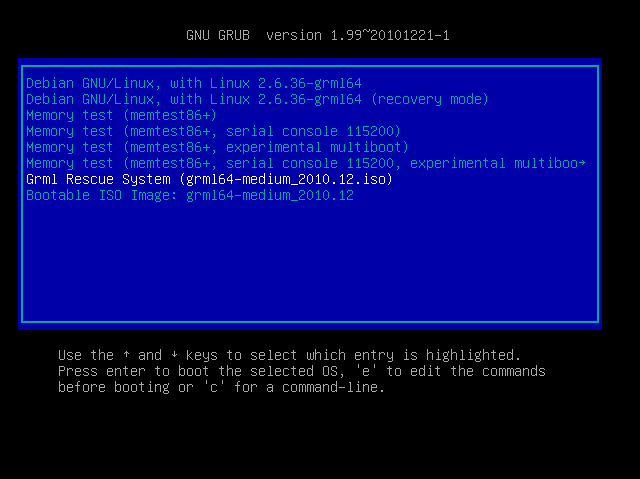
Voil , when rebooting your system you should see something like: Screenshot: grml-rescueboot The Grml Rescue System entry is what grml-rescueboot provides and Bootable ISO Image is what s provided by grub-imageboot. Just select the entry you d like to use, press enter and and you should get the bootsplash of the according ISO. BTW: I ve tested this with Ubuntu 10.10 too, grml-rescueboot works out-of-the-box with the Ubuntu ISO as well, it just doesn t support the memdisk ISO boot by grub-imageboot (yet). Tip: if you want to use grml-rescueboot and grub-imageboot with the same ISOs without having them twice on the disk just point the configuration option IMAGES in /etc/default/grub-imageboot to the according directory (like /boot/grml). Note: if you re using the ext 2,3,4 filesystem on the partition that s being used for /boot please be aware that you need GRUB >=1.98+20100804-12 (newer version is already available in Debian/unstable and hopefully migrates to squeeze in time) or GRUB >=1.99~20101122-1 because of the INDIRECT_BLOCKS support, see #543924 for the details. PS: We think about providing grml-rescueboot and grub-imageboot within official Debian. If you re interested in seeing integration support for other distributions as well please help and drop us a note.

Christian Perrier: [life] [running] 2010 summary and early 2011 plans

So, 2010 ended and it's now time for me to make a small summary for my running activities. At first, it's more and more obvious that running became an increasing part of my life. Sometimes eating the free time I was using for Debian work....and sometimes just filling holes in my daily activities, where I was just doing nothing..:-) According to my running watch(es) records, I ran for 2172km this year in about 196 hours (8.25 days) at an average speed of 11.1km/h. Indeed, the speed ranges from 10km/h in the hardest trail runs up to 13.5km/h in the fastest (and shortest) asphalt runs. I actually never run at "slow" paces, which is probably not the best for training as all official training plans do include slow runs. But, eh, this is how it works for me..:) I ran 12 official or semi official races, ranging from 5km cross-country races up to marathons. More proeminently speaking, I ran 3 half-marathons, 2 marathons and one long distance trail race (33km) that is worth being counted as a marathon..:). I also broke my personal best times for 10km (48'05", ran alone), half-marathon (1h37') and marathon (3h40'). Quite a good year, indeed..:-) I'm currently busy building my plans for 2011. Some are already decided: In general, I'll probably put more focus on trail and ultra (above martahon) runs. 2012 could then be the year of my first 100km race..:-) What will be fun will be reading this in January 2012 and see what I have completed among all these goals..:-)

Gunnar Wolf: Back with Ruby on Debian polemics

Once again, a polemic regarding how to properly integrate the Ruby language and libraries with the Debian distribution has been ignited. Similar arguments were presented in November and December 2008 and September 2010 And excuse me for just refering to my own blog, but there are links to some other posts from there... and there will surely be many others I just missed. There were even nice collaboration attempts (such as DebGem, announced in January 2009... But which apparently never stuck on, as it is still listed as in its public Beta period and lists only support for Debian 4.0 and Ubuntu 8.04 and 8.10). Some days ago, while I was on vacation, I received a mail from Lucas Nussbaum expressing the burnout he had been suffering from this situation. Some days after that, he posted a corresponding blog post - Giving up on Ruby packaging. The comments following his post are most interesting The one comment I'd like to highlight (noting I skimmed a whole deal of them) is by Paul Brannan, one of the original RubyGems authors. Yes, possibly the design criteria for Gems included some mutually-conflicting goals, and they cover some of Debian's goals. Unfortunately, this conflicting criteria... Was resolved to the opposite way we would have wanted (specifically, that a sysadmin should be able to install software with the same tools he was already familiar with). And of course, there are deeper disagreements, which are rightly stemmed from different priorities: Debian (+derivatives) is meant to make user's and sysadmin's lifes simpler. Gems are meant to make developers' lifes simpler. And while all developers are some sort of users, and sysadminsthe reverse is (obviously) not so. A developer maintaining several different codebases will surely suffer (well, this particular developer has surely suffered) if he has to maintain them all using coherent versions of system libraries. When a system is programmed, its developers want to use the greatest, latest tools to offer the best experience and functionality. And it's natural for libraries to evolve over time. However, any sysadmin will grind their teeth at the prospect of having many different versions of libraries, as the Gem model proposes. Why? Well, I was bitten by a minor example of it Bug fixes do not get backported. Of course, if simple bugs are not backported, security and stability of the system as a whole suffers. Often, new software versions will not only add functionality, but improve on how things are done. Not only bugs get corrected, but we get better response times, better memory handling, etc. It might sound harsh to say this, and even more, as a developer it feels I am talking against myself But while development time should be minimized during the system design/implementation, once systems are in production, it should be used to allow for friendlier sysadmin relations. I have to wear both hats at my real-life job. So, what is my take on this? Of course, blaming myself for choosing the wrong version is a no-go. When evaluating a library before using it in my projects, I try to look at its history and API-stability. APIs that change often speak about immature libraries which are still trying to get the right way to implement their functionality; just-started projects might be great and revolutionary, but they do not yet show any kind of long-term committment... And can lead (and have often led me) to painful rewrites when the Next Big Thing is reached. As for the users: Even if your favorite language has the best and friendliest distribution method, users just do not care about what language was a particular piece of software implemented in. Users want to be able to install and uninstall with their system's usual tools. Directly using Gems, CPAN, PEAR and whatnot is just unnatural for users, however convenient they are for developers. Distributions offer a non-technical advantage in this regard as well: A human filter. As an example, as I write this there are 19392 Ruby Gems and 19092 Perl modules in CPAN (note that CPAN stores some older versions but discourages authors from keeping too many - So no, they are still very different in size). Debian has around 30,000 packages. Why is that? Because all Debian packages _must_ be human-generated, human-reviewed, human-submitted. This means, a person must think each packaged piece of code is worth packaging, is stable enough and provides value to users as it is, and is fit for being part of a stable release. I am not saying with this that 90% of CPAN and Gems are crap I am saying that they are probably early implementations, to be installed, tested and improved by developers, and still not apt for general public use. Or maybe not interesting enough to be packaged as a service for the non-techie public at large. Oh, and one last point: Ruby is not a new language anymore. It is a mature, powerful language with different implementations, every time more stable... But it is a language deeply affected by the (not so new anymore either) the appearance of Rails. Why do I say this? Because although the language is in no way tied to Web development, many of its strongest uses are Web-oriented. How does this affect the current discussion? Well, because many people argue that users are no longer needed to install the software. Web systems are installed by sysadmins and used via a Web browser, and sysadmins are expected be more skilled than casual users. Still, in Debian (and in other distributions, surely) we try to make sysadmin's lives simpler I have (again, talking out of personal experience) installed several webapps (and system tools, and whatnot) for which I never followed any instructions besides aptitude install foo Using different languages, frameworks, and so on. Can I troubleshoot their installs? Probably, as there is a common logic for how the distribution I have chosen and specialized in works. Can I find causes for bugs in them? Possibly, although there are some languages and frameworks I dare not touch. Can I get help on getting them out of a tight spot? Surely, as there is a central bug tracking system for my distribution And one of the maintainer's tasks is to separate the problems related to the distribution (packaging, installing, simple user questions and misconceptions) to those derived from real bugs upstream. Anyway I am not saying that our way is the best way. No, by a long shot. Again, developers should have an easy, convenient way for installing whatever they want to play with. And to publish it without jumping through hoops. With this post, I'm only trying to express again why Debian works the way it does. And hope for better cooperation in the future. And as for several comments of what I read in Lucas' post, I think that there is interest for this synergy among some of the most committed Ruby people.

4 January 2011

Luke Faraone: Google Cr-48 first impressions

On a lark, I signed up for the pilot program of the Google Cr-48 about a week ago. To my surprise, I found the distinctive box on my doorstep a week later. After initially mistaking it for an overpacked, late-model OLPC XO-1 I would have to repair, I sort of did a double-take as I realized what I had received. Using Chrome OS

My Cr-48 and a Kindle

Wow, they weren t kidding about the boot time. Chrome OS responds (to suspend / resume and boot / power-off) very quickly. Responsiveness elsewhere in the OS of course varies on system load and other factors. On the terms page, there is a system security setting which tells me I have a Trusted Platform Module, and that my TPM has a randomly generated password. The dialog could use some rewording; I m pretty familiar with the idea of a TPM, but I m still not sure what I m to do with that information. Cloud print is really a problem for me, right now. I use school printers for the majority of my work, which I was previously able to use by adding them by IP address. Unless there s some magic I m missing here, I can t do that with Chrome OS, and such a feature will not be supported. (except by connectors on Windows and Mac computers) General thoughts I can t imagine using a system running Chrome OS as a primary computer. The biggest missing feature is PGP (or any sort of encryption) support for email. This is probably not terribly difficult to implement as an extension, but the idea of my cryptographic software being automatically updated is rather unsettling. I think I ll have to agree with Paul Buchheit that ChromeOS will have to merge with Android; there is a utility for local apps, even if they re becoming less and less critical.

3 January 2011

Rapha&#235;l Hertzog: 16 Debian contributors that you can thank

I put 5 EUR in Flattr each month and I like to spend those among other Debian contributors. That s why I keep a list of Debian people that I have seen on Flattr (for most of them I noticed through an article on Planet Debian). Directory of Debian contributors that you can thank I thought this list could be useful for others so I put it on a web page. Then I realized that limiting this to Flattr was not a good idea, and indeed several developers already propose multiple ways to be thanked. I went back through my list and looked up each developer s website to identify a Thank me page (it can be Donate , Support me , Amazon Wishlist , etc.). Obviously this means that Debian contributors who are not on Flattr do not appear on the initial list even if they have some Thank me page please help me fix this and send me the missing entries if you know of any. Click here to view the directory. The initial listing contains 16 developers and 8 of them have an additional (non-Flattr) Thank me link. Please note the warning I put on the page: the inclusion in the directory should not be taken as an endorsement of the amount or quality of the work done for Debian. You are supposed to make up your own judgment when deciding who you want to thank (but the links can help you learn more about what each contributor is doing). Flattr subscriptions explained Since this article replaces the traditional Flattr FOSS issue for this month, I wanted to introduce a new Flattr feature I recently discovered. With Flattr you have to click on some things every month or your monthly fee is given to a random charity. Now you can avoid this pitfall by subscribing to some things that you like. A subscription acts like an automatic click during a period of 3/6/12 months. If you want to subscribe to something, you just have to click a second time on the Flattr button and you will see this:
Screenshot with Flattr subscription choices Once you clicked on the desired duration, the subscription is recorded and the button will appear like this:

Screenshot with a subscribed flattr button Easy, isn t it? PS: I installed a WordPress plugin to make it super easy to share my articles on the most common social networks.

One comment Liked this article? Click here. My blog is Flattr-enabled.

30 December 2010

Bastian Venthur: Canon IXUS 130

Dear Lazyweb, Today I bought me a Canon IXUS 130 and was quite disappointed to see that it couldn t properly connect to my Debian/Sid machine via USB. Apparenty the camera is not recognized as a USB Mass Storage Device but utilizes PTP. I upgraded to libgphoto2 (2.4.10.1-3) from experimental and added a proper udev rule with vendor- and product-id but it did not help. Is there anything more I can try? Update: Accessing the camera actually works, even with ligbphoto2 (2.4.6) from unstable. I can access the camera with gphoto2 and download pictures (but not with KDE s filemanager). My problem was that I had rhythmbox running and the camera was automatically mounted by it as a media device. When KDE s filemanager or gphoto2 tried to access the camera I got an error like: ( Could not lock the device ): Camera is already in use., which is probably also a bug. Closing rhythmbox solved the issue and I was able to download images with gphoto2.

25 December 2010

Petter Reinholdtsen: The reply from Edgar Villanueva to Microsoft in Peru

A few days ago an article in the Norwegian Computerworld magazine about how version 2.0 of European Interoperability Framework has been successfully lobbied by the proprietary software industry to remove the focus on free software. Nothing very surprising there, given earlier reports on how Microsoft and others have stacked the committees in this work. But I find this very sad. The definition of an open standard from version 1 was very good, and something I believe should be used also in the future, alongside the definition from Digistan. Version 2 have removed the open standard definition from its content. Anyway, the news reminded me of the great reply sent by Dr. Edgar Villanueva, congressman in Peru at the time, to Microsoft as a reply to Microsofts attack on his proposal regarding the use of free software in the public sector in Peru. As the text was not available from a few of the URLs where it used to be available, I copy it here from my source to ensure it is available also in the future. Some background information about that story is available in an article from Linux Journal in 2002.
Lima, 8th of April, 2002
To: Se or JUAN ALBERTO GONZ LEZ
General Manager of Microsoft Per Dear Sir: First of all, I thank you for your letter of March 25, 2002 in which you state the official position of Microsoft relative to Bill Number 1609, Free Software in Public Administration, which is indubitably inspired by the desire for Peru to find a suitable place in the global technological context. In the same spirit, and convinced that we will find the best solutions through an exchange of clear and open ideas, I will take this opportunity to reply to the commentaries included in your letter. While acknowledging that opinions such as yours constitute a significant contribution, it would have been even more worthwhile for me if, rather than formulating objections of a general nature (which we will analyze in detail later) you had gathered solid arguments for the advantages that proprietary software could bring to the Peruvian State, and to its citizens in general, since this would have allowed a more enlightening exchange in respect of each of our positions. With the aim of creating an orderly debate, we will assume that what you call "open source software" is what the Bill defines as "free software", since there exists software for which the source code is distributed together with the program, but which does not fall within the definition established by the Bill; and that what you call "commercial software" is what the Bill defines as "proprietary" or "unfree", given that there exists free software which is sold in the market for a price like any other good or service. It is also necessary to make it clear that the aim of the Bill we are discussing is not directly related to the amount of direct savings that can by made by using free software in state institutions. That is in any case a marginal aggregate value, but in no way is it the chief focus of the Bill. The basic principles which inspire the Bill are linked to the basic guarantees of a state of law, such as:
  • Free access to public information by the citizen.
  • Permanence of public data.
  • Security of the State and citizens.
To guarantee the free access of citizens to public information, it is indispensable that the encoding of data is not tied to a single provider. The use of standard and open formats gives a guarantee of this free access, if necessary through the creation of compatible free software. To guarantee the permanence of public data, it is necessary that the usability and maintenance of the software does not depend on the goodwill of the suppliers, or on the monopoly conditions imposed by them. For this reason the State needs systems the development of which can be guaranteed due to the availability of the source code. To guarantee national security or the security of the State, it is indispensable to be able to rely on systems without elements which allow control from a distance or the undesired transmission of information to third parties. Systems with source code freely accessible to the public are required to allow their inspection by the State itself, by the citizens, and by a large number of independent experts throughout the world. Our proposal brings further security, since the knowledge of the source code will eliminate the growing number of programs with *spy code*. In the same way, our proposal strengthens the security of the citizens, both in their role as legitimate owners of information managed by the state, and in their role as consumers. In this second case, by allowing the growth of a widespread availability of free software not containing *spy code* able to put at risk privacy and individual freedoms. In this sense, the Bill is limited to establishing the conditions under which the state bodies will obtain software in the future, that is, in a way compatible with these basic principles. From reading the Bill it will be clear that once passed:
  • the law does not forbid the production of proprietary software
  • the law does not forbid the sale of proprietary software
  • the law does not specify which concrete software to use
  • the law does not dictate the supplier from whom software will be bought
  • the law does not limit the terms under which a software product can be licensed.
  • What the Bill does express clearly, is that, for software to be acceptable for the state it is not enough that it is technically capable of fulfilling a task, but that further the contractual conditions must satisfy a series of requirements regarding the license, without which the State cannot guarantee the citizen adequate processing of his data, watching over its integrity, confidentiality, and accessibility throughout time, as these are very critical aspects for its normal functioning. We agree, Mr. Gonzalez, that information and communication technology have a significant impact on the quality of life of the citizens (whether it be positive or negative). We surely also agree that the basic values I have pointed out above are fundamental in a democratic state like Peru. So we are very interested to know of any other way of guaranteeing these principles, other than through the use of free software in the terms defined by the Bill. As for the observations you have made, we will now go on to analyze them in detail: Firstly, you point out that: "1. The bill makes it compulsory for all public bodies to use only free software, that is to say open source software, which breaches the principles of equality before the law, that of non-discrimination and the right of free private enterprise, freedom of industry and of contract, protected by the constitution." This understanding is in error. The Bill in no way affects the rights you list; it limits itself entirely to establishing conditions for the use of software on the part of state institutions, without in any way meddling in private sector transactions. It is a well established principle that the State does not enjoy the wide spectrum of contractual freedom of the private sector, as it is limited in its actions precisely by the requirement for transparency of public acts; and in this sense, the preservation of the greater common interest must prevail when legislating on the matter. The Bill protects equality under the law, since no natural or legal person is excluded from the right of offering these goods to the State under the conditions defined in the Bill and without more limitations than those established by the Law of State Contracts and Purchasing (T.U.O. by Supreme Decree No. 012-2001-PCM). The Bill does not introduce any discrimination whatever, since it only establishes *how* the goods have to be provided (which is a state power) and not *who* has to provide them (which would effectively be discriminatory, if restrictions based on national origin, race religion, ideology, sexual preference etc. were imposed). On the contrary, the Bill is decidedly antidiscriminatory. This is so because by defining with no room for doubt the conditions for the provision of software, it prevents state bodies from using software which has a license including discriminatory conditions. It should be obvious from the preceding two paragraphs that the Bill does not harm free private enterprise, since the latter can always choose under what conditions it will produce software; some of these will be acceptable to the State, and others will not be since they contradict the guarantee of the basic principles listed above. This free initiative is of course compatible with the freedom of industry and freedom of contract (in the limited form in which the State can exercise the latter). Any private subject can produce software under the conditions which the State requires, or can refrain from doing so. Nobody is forced to adopt a model of production, but if they wish to provide software to the State, they must provide the mechanisms which guarantee the basic principles, and which are those described in the Bill. By way of an example: nothing in the text of the Bill would prevent your company offering the State bodies an office "suite", under the conditions defined in the Bill and setting the price that you consider satisfactory. If you did not, it would not be due to restrictions imposed by the law, but to business decisions relative to the method of commercializing your products, decisions with which the State is not involved. To continue; you note that:" 2. The bill, by making the use of open source software compulsory, would establish discriminatory and non competitive practices in the contracting and purchasing by public bodies..." This statement is just a reiteration of the previous one, and so the response can be found above. However, let us concern ourselves for a moment with your comment regarding "non-competitive ... practices." Of course, in defining any kind of purchase, the buyer sets conditions which relate to the proposed use of the good or service. From the start, this excludes certain manufacturers from the possibility of competing, but does not exclude them "a priori", but rather based on a series of principles determined by the autonomous will of the purchaser, and so the process takes place in conformance with the law. And in the Bill it is established that *no one* is excluded from competing as far as he guarantees the fulfillment of the basic principles. Furthermore, the Bill *stimulates* competition, since it tends to generate a supply of software with better conditions of usability, and to better existing work, in a model of continuous improvement. On the other hand, the central aspect of competivity is the chance to provide better choices to the consumer. Now, it is impossible to ignore the fact that marketing does not play a neutral role when the product is offered on the market (since accepting the opposite would lead one to suppose that firms' expenses in marketing lack any sense), and that therefore a significant expense under this heading can influence the decisions of the purchaser. This influence of marketing is in large measure reduced by the bill that we are backing, since the choice within the framework proposed is based on the *technical merits* of the product and not on the effort put into commercialization by the producer; in this sense, competitiveness is increased, since the smallest software producer can compete on equal terms with the most powerful corporations. It is necessary to stress that there is no position more anti-competitive than that of the big software producers, which frequently abuse their dominant position, since in innumerable cases they propose as a solution to problems raised by users: "update your software to the new version" (at the user's expense, naturally); furthermore, it is common to find arbitrary cessation of technical help for products, which, in the provider's judgment alone, are "old"; and so, to receive any kind of technical assistance, the user finds himself forced to migrate to new versions (with non-trivial costs, especially as changes in hardware platform are often involved). And as the whole infrastructure is based on proprietary data formats, the user stays "trapped" in the need to continue using products from the same supplier, or to make the huge effort to change to another environment (probably also proprietary). You add: "3. So, by compelling the State to favor a business model based entirely on open source, the bill would only discourage the local and international manufacturing companies, which are the ones which really undertake important expenditures, create a significant number of direct and indirect jobs, as well as contributing to the GNP, as opposed to a model of open source software which tends to have an ever weaker economic impact, since it mainly creates jobs in the service sector." I do not agree with your statement. Partly because of what you yourself point out in paragraph 6 of your letter, regarding the relative weight of services in the context of software use. This contradiction alone would invalidate your position. The service model, adopted by a large number of companies in the software industry, is much larger in economic terms, and with a tendency to increase, than the licensing of programs. On the other hand, the private sector of the economy has the widest possible freedom to choose the economic model which best suits its interests, even if this freedom of choice is often obscured subliminally by the disproportionate expenditure on marketing by the producers of proprietary software. In addition, a reading of your opinion would lead to the conclusion that the State market is crucial and essential for the proprietary software industry, to such a point that the choice made by the State in this bill would completely eliminate the market for these firms. If that is true, we can deduce that the State must be subsidizing the proprietary software industry. In the unlikely event that this were true, the State would have the right to apply the subsidies in the area it considered of greatest social value; it is undeniable, in this improbable hypothesis, that if the State decided to subsidize software, it would have to do so choosing the free over the proprietary, considering its social effect and the rational use of taxpayers money. In respect of the jobs generated by proprietary software in countries like ours, these mainly concern technical tasks of little aggregate value; at the local level, the technicians who provide support for proprietary software produced by transnational companies do not have the possibility of fixing bugs, not necessarily for lack of technical capability or of talent, but because they do not have access to the source code to fix it. With free software one creates more technically qualified employment and a framework of free competence where success is only tied to the ability to offer good technical support and quality of service, one stimulates the market, and one increases the shared fund of knowledge, opening up alternatives to generate services of greater total value and a higher quality level, to the benefit of all involved: producers, service organizations, and consumers. It is a common phenomenon in developing countries that local software industries obtain the majority of their takings in the service sector, or in the creation of "ad hoc" software. Therefore, any negative impact that the application of the Bill might have in this sector will be more than compensated by a growth in demand for services (as long as these are carried out to high quality standards). If the transnational software companies decide not to compete under these new rules of the game, it is likely that they will undergo some decrease in takings in terms of payment for licenses; however, considering that these firms continue to allege that much of the software used by the State has been illegally copied, one can see that the impact will not be very serious. Certainly, in any case their fortune will be determined by market laws, changes in which cannot be avoided; many firms traditionally associated with proprietary software have already set out on the road (supported by copious expense) of providing services associated with free software, which shows that the models are not mutually exclusive. With this bill the State is deciding that it needs to preserve certain fundamental values. And it is deciding this based on its sovereign power, without affecting any of the constitutional guarantees. If these values could be guaranteed without having to choose a particular economic model, the effects of the law would be even more beneficial. In any case, it should be clear that the State does not choose an economic model; if it happens that there only exists one economic model capable of providing software which provides the basic guarantee of these principles, this is because of historical circumstances, not because of an arbitrary choice of a given model. Your letter continues: "4. The bill imposes the use of open source software without considering the dangers that this can bring from the point of view of security, guarantee, and possible violation of the intellectual property rights of third parties." Alluding in an abstract way to "the dangers this can bring", without specifically mentioning a single one of these supposed dangers, shows at the least some lack of knowledge of the topic. So, allow me to enlighten you on these points. On security: National security has already been mentioned in general terms in the initial discussion of the basic principles of the bill. In more specific terms, relative to the security of the software itself, it is well known that all software (whether proprietary or free) contains errors or "bugs" (in programmers' slang). But it is also well known that the bugs in free software are fewer, and are fixed much more quickly, than in proprietary software. It is not in vain that numerous public bodies responsible for the IT security of state systems in developed countries require the use of free software for the same conditions of security and efficiency. What is impossible to prove is that proprietary software is more secure than free, without the public and open inspection of the scientific community and users in general. This demonstration is impossible because the model of proprietary software itself prevents this analysis, so that any guarantee of security is based only on promises of good intentions (biased, by any reckoning) made by the producer itself, or its contractors. It should be remembered that in many cases, the licensing conditions include Non-Disclosure clauses which prevent the user from publicly revealing security flaws found in the licensed proprietary product. In respect of the guarantee: As you know perfectly well, or could find out by reading the "End User License Agreement" of the products you license, in the great majority of cases the guarantees are limited to replacement of the storage medium in case of defects, but in no case is compensation given for direct or indirect damages, loss of profits, etc... If as a result of a security bug in one of your products, not fixed in time by yourselves, an attacker managed to compromise crucial State systems, what guarantees, reparations and compensation would your company make in accordance with your licensing conditions? The guarantees of proprietary software, inasmuch as programs are delivered AS IS'', that is, in the state in which they are, with no additional responsibility of the provider in respect of function, in no way differ from those normal with free software. On Intellectual Property: Questions of intellectual property fall outside the scope of this bill, since they are covered by specific other laws. The model of free software in no way implies ignorance of these laws, and in fact the great majority of free software is covered by copyright. In reality, the inclusion of this question in your observations shows your confusion in respect of the legal framework in which free software is developed. The inclusion of the intellectual property of others in works claimed as one's own is not a practice that has been noted in the free software community; whereas, unfortunately, it has been in the area of proprietary software. As an example, the condemnation by the Commercial Court of Nanterre, France, on 27th September 2001 of Microsoft Corp. to a penalty of 3 million francs in damages and interest, for violation of intellectual property (piracy, to use the unfortunate term that your firm commonly uses in its publicity). You go on to say that: "The bill uses the concept of open source software incorrectly, since it does not necessarily imply that the software is free or of zero cost, and so arrives at mistaken conclusions regarding State savings, with no cost-benefit analysis to validate its position." This observation is wrong; in principle, freedom and lack of cost are orthogonal concepts: there is software which is proprietary and charged for (for example, MS Office), software which is proprietary and free of charge (MS Internet Explorer), software which is free and charged for (Red Hat, SuSE etc GNU/Linux distributions), software which is free and not charged for (Apache, Open Office, Mozilla), and even software which can be licensed in a range of combinations (MySQL). Certainly free software is not necessarily free of charge. And the text of the bill does not state that it has to be so, as you will have noted after reading it. The definitions included in the Bill state clearly *what* should be considered free software, at no point referring to freedom from charges. Although the possibility of savings in payments for proprietary software licenses are mentioned, the foundations of the bill clearly refer to the fundamental guarantees to be preserved and to the stimulus to local technological development. Given that a democratic State must support these principles, it has no other choice than to use software with publicly available source code, and to exchange information only in standard formats. If the State does not use software with these characteristics, it will be weakening basic republican principles. Luckily, free software also implies lower total costs; however, even given the hypothesis (easily disproved) that it was more expensive than proprietary software, the simple existence of an effective free software tool for a particular IT function would oblige the State to use it; not by command of this Bill, but because of the basic principles we enumerated at the start, and which arise from the very essence of the lawful democratic State. You continue: "6. It is wrong to think that Open Source Software is free of charge. Research by the Gartner Group (an important investigator of the technological market recognized at world level) has shown that the cost of purchase of software (operating system and applications) is only 8% of the total cost which firms and institutions take on for a rational and truly beneficial use of the technology. The other 92% consists of: installation costs, enabling, support, maintenance, administration, and down-time." This argument repeats that already given in paragraph 5 and partly contradicts paragraph 3. For the sake of brevity we refer to the comments on those paragraphs. However, allow me to point out that your conclusion is logically false: even if according to Gartner Group the cost of software is on average only 8% of the total cost of use, this does not in any way deny the existence of software which is free of charge, that is, with a licensing cost of zero. In addition, in this paragraph you correctly point out that the service components and losses due to down-time make up the largest part of the total cost of software use, which, as you will note, contradicts your statement regarding the small value of services suggested in paragraph 3. Now the use of free software contributes significantly to reduce the remaining life-cycle costs. This reduction in the costs of installation, support etc. can be noted in several areas: in the first place, the competitive service model of free software, support and maintenance for which can be freely contracted out to a range of suppliers competing on the grounds of quality and low cost. This is true for installation, enabling, and support, and in large part for maintenance. In the second place, due to the reproductive characteristics of the model, maintenance carried out for an application is easily replicable, without incurring large costs (that is, without paying more than once for the same thing) since modifications, if one wishes, can be incorporated in the common fund of knowledge. Thirdly, the huge costs caused by non-functioning software ("blue screens of death", malicious code such as virus, worms, and trojans, exceptions, general protection faults and other well-known problems) are reduced considerably by using more stable software; and it is well known that one of the most notable virtues of free software is its stability. You further state that: "7. One of the arguments behind the bill is the supposed freedom from costs of open-source software, compared with the costs of commercial software, without taking into account the fact that there exist types of volume licensing which can be highly advantageous for the State, as has happened in other countries." I have already pointed out that what is in question is not the cost of the software but the principles of freedom of information, accessibility, and security. These arguments have been covered extensively in the preceding paragraphs to which I would refer you. On the other hand, there certainly exist types of volume licensing (although unfortunately proprietary software does not satisfy the basic principles). But as you correctly pointed out in the immediately preceding paragraph of your letter, they only manage to reduce the impact of a component which makes up no more than 8% of the total. You continue: "8. In addition, the alternative adopted by the bill (I) is clearly more expensive, due to the high costs of software migration, and (II) puts at risk compatibility and interoperability of the IT platforms within the State, and between the State and the private sector, given the hundreds of versions of open source software on the market." Let us analyze your statement in two parts. Your first argument, that migration implies high costs, is in reality an argument in favor of the Bill. Because the more time goes by, the more difficult migration to another technology will become; and at the same time, the security risks associated with proprietary software will continue to increase. In this way, the use of proprietary systems and formats will make the State ever more dependent on specific suppliers. Once a policy of using free software has been established (which certainly, does imply some cost) then on the contrary migration from one system to another becomes very simple, since all data is stored in open formats. On the other hand, migration to an open software context implies no more costs than migration between two different proprietary software contexts, which invalidates your argument completely. The second argument refers to "problems in interoperability of the IT platforms within the State, and between the State and the private sector" This statement implies a certain lack of knowledge of the way in which free software is built, which does not maximize the dependence of the user on a particular platform, as normally happens in the realm of proprietary software. Even when there are multiple free software distributions, and numerous programs which can be used for the same function, interoperability is guaranteed as much by the use of standard formats, as required by the bill, as by the possibility of creating interoperable software given the availability of the source code. You then say that: "9. The majority of open source code does not offer adequate levels of service nor the guarantee from recognized manufacturers of high productivity on the part of the users, which has led various public organizations to retract their decision to go with an open source software solution and to use commercial software in its place." This observation is without foundation. In respect of the guarantee, your argument was rebutted in the response to paragraph 4. In respect of support services, it is possible to use free software without them (just as also happens with proprietary software), but anyone who does need them can obtain support separately, whether from local firms or from international corporations, again just as in the case of proprietary software. On the other hand, it would contribute greatly to our analysis if you could inform us about free software projects *established* in public bodies which have already been abandoned in favor of proprietary software. We know of a good number of cases where the opposite has taken place, but not know of any where what you describe has taken place. You continue by observing that: "10. The bill discourages the creativity of the Peruvian software industry, which invoices 40 million US$/year, exports 4 million US$ (10th in ranking among non-traditional exports, more than handicrafts) and is a source of highly qualified employment. With a law that encourages the use of open source, software programmers lose their intellectual property rights and their main source of payment." It is clear enough that nobody is forced to commercialize their code as free software. The only thing to take into account is that if it is not free software, it cannot be sold to the public sector. This is not in any case the main market for the national software industry. We covered some questions referring to the influence of the Bill on the generation of employment which would be both highly technically qualified and in better conditions for competition above, so it seems unnecessary to insist on this point. What follows in your statement is incorrect. On the one hand, no author of free software loses his intellectual property rights, unless he expressly wishes to place his work in the public domain. The free software movement has always been very respectful of intellectual property, and has generated widespread public recognition of its authors. Names like those of Richard Stallman, Linus Torvalds, Guido van Rossum, Larry Wall, Miguel de Icaza, Andrew Tridgell, Theo de Raadt, Andrea Arcangeli, Bruce Perens, Darren Reed, Alan Cox, Eric Raymond, and many others, are recognized world-wide for their contributions to the development of software that is used today by millions of people throughout the world. On the other hand, to say that the rewards for authors rights make up the main source of payment of Peruvian programmers is in any case a guess, in particular since there is no proof to this effect, nor a demonstration of how the use of free software by the State would influence these payments. You go on to say that: "11. Open source software, since it can be distributed without charge, does not allow the generation of income for its developers through exports. In this way, the multiplier effect of the sale of software to other countries is weakened, and so in turn is the growth of the industry, while Government rules ought on the contrary to stimulate local industry." This statement shows once again complete ignorance of the mechanisms of and market for free software. It tries to claim that the market of sale of non- exclusive rights for use (sale of licenses) is the only possible one for the software industry, when you yourself pointed out several paragraphs above that it is not even the most important one. The incentives that the bill offers for the growth of a supply of better qualified professionals, together with the increase in experience that working on a large scale with free software within the State will bring for Peruvian technicians, will place them in a highly competitive position to offer their services abroad. You then state that: "12. In the Forum, the use of open source software in education was discussed, without mentioning the complete collapse of this initiative in a country like Mexico, where precisely the State employees who founded the project now state that open source software did not make it possible to offer a learning experience to pupils in the schools, did not take into account the capability at a national level to give adequate support to the platform, and that the software did not and does not allow for the levels of platform integration that now exist in schools." In fact Mexico has gone into reverse with the Red Escolar (Schools Network) project. This is due precisely to the fact that the driving forces behind the Mexican project used license costs as their main argument, instead of the other reasons specified in our project, which are far more essential. Because of this conceptual mistake, and as a result of the lack of effective support from the SEP (Secretary of State for Public Education), the assumption was made that to implant free software in schools it would be enough to drop their software budget and send them a CD ROM with Gnu/Linux instead. Of course this failed, and it couldn't have been otherwise, just as school laboratories fail when they use proprietary software and have no budget for implementation and maintenance. That's exactly why our bill is not limited to making the use of free software mandatory, but recognizes the need to create a viable migration plan, in which the State undertakes the technical transition in an orderly way in order to then enjoy the advantages of free software. You end with a rhetorical question: "13. If open source software satisfies all the requirements of State bodies, why do you need a law to adopt it? Shouldn't it be the market which decides freely which products give most benefits or value?" We agree that in the private sector of the economy, it must be the market that decides which products to use, and no state interference is permissible there. However, in the case of the public sector, the reasoning is not the same: as we have already established, the state archives, handles, and transmits information which does not belong to it, but which is entrusted to it by citizens, who have no alternative under the rule of law. As a counterpart to this legal requirement, the State must take extreme measures to safeguard the integrity, confidentiality, and accessibility of this information. The use of proprietary software raises serious doubts as to whether these requirements can be fulfilled, lacks conclusive evidence in this respect, and so is not suitable for use in the public sector. The need for a law is based, firstly, on the realization of the fundamental principles listed above in the specific area of software; secondly, on the fact that the State is not an ideal homogeneous entity, but made up of multiple bodies with varying degrees of autonomy in decision making. Given that it is inappropriate to use proprietary software, the fact of establishing these rules in law will prevent the personal discretion of any state employee from putting at risk the information which belongs to citizens. And above all, because it constitutes an up-to-date reaffirmation in relation to the means of management and communication of information used today, it is based on the republican principle of openness to the public. In conformance with this universally accepted principle, the citizen has the right to know all information held by the State and not covered by well- founded declarations of secrecy based on law. Now, software deals with information and is itself information. Information in a special form, capable of being interpreted by a machine in order to execute actions, but crucial information all the same because the citizen has a legitimate right to know, for example, how his vote is computed or his taxes calculated. And for that he must have free access to the source code and be able to prove to his satisfaction the programs used for electoral computations or calculation of his taxes. I wish you the greatest respect, and would like to repeat that my office will always be open for you to expound your point of view to whatever level of detail you consider suitable. Cordially,
    DR. EDGAR DAVID VILLANUEVA NU EZ
    Congressman of the Republic of Per .

    22 December 2010

    Petter Reinholdtsen: How to test if a laptop is working with Linux

    The last few days I have spent at work here at the University of oslo testing if the new batch of computers will work with Linux. Every year for the last few years the university have organized shared bid of a few thousand computers, and this year HP won the bid. Two different desktops and five different laptops are on the list this year. We in the UNIX group want to know which one of these computers work well with RHEL and Ubuntu, the two Linux distributions we currently handle at the university. My test method is simple, and I share it here to get feedback and perhaps inspire others to test hardware as well. To test, I PXE install the OS version of choice, and log in as my normal user and run a few applications and plug in selected pieces of hardware. When something fail, I make a note about this in the test matrix and move on. If I have some spare time I try to report the bug to the OS vendor, but as I only have the machines for a short time, I rarely have the time to do this for all the problems I find. Anyway, to get to the point of this post. Here is the simple tests I perform on a new model. By now I suspect you are really curious what the test results are for the HP machines I am testing. I'm not done yet, so I will report the test results later. For now I can report that HP 8100 Elite work fine, and hibernation fail with HP EliteBook 8440p on Ubuntu Lucid, and audio fail on RHEL6. Ubuntu Maverik worked with 8440p. As you can see, I have most machines left to test. One interesting observation is that Ubuntu Lucid has almost twice the framerate than RHEL6 with glxgears. No idea why.

    20 December 2010

    Dirk Eddelbuettel: Rcpp 0.9.0 and RcppClassic 0.9.0

    A new release 0.9.0 of Rcpp is now available at CRAN and has just been uploaded to Debian. As always, sources are also available from my local directory here. With this release, the older API which we have been referring to as the classic Rcpp API has been split off into its own new package RcppClassic to ensure backwards compatibility. Rcpp will now contain only the new API. We also fixes a number a minor bugs and applied a few contributed patches which extended functionality or documentation as detailed below in the NEWS entry:
    0.9.0   2010-12-19
        o   The classic API was factored out into its own package RcppClassic which
            is released concurrently with this version.
        o   If an object is created but not initialized, attempting to use
            it now gives a more sensible error message (by forwarding an
            Rcpp::not_initialized exception to R).
        o   SubMatrix fixed, and Matrix types now have a nested ::Sub typedef.
      
        o   New unexported function SHLIB() to aid in creating a shared library on
            the command-line or in Makefile (similar to CxxFlags() / LdFlags()).
        o   Module gets a seven-argument ctor thanks to a patch from Tama Ma.
        o   The (still incomplete) QuickRef vignette has grown thanks to a patch
            by Christian Gunning.
        o   Added a sprintf template intended for logging and error messages.
        o   Date::getYear() corrected (where addition of 1900 was not called for); 
            corresponding change in constructor from three ints made as well.
        o   Date() and Datetime() constructors from string received a missing
            conversion to int and double following strptime. The default format
            string for the Datetime() strptime call was also corrected.
        o   A few minor fixes throughout, see ChangeLog.
    
    Thanks to CRANberries, there is also a diff to the previous release 0.8.9. As always, even fuller details are on the Rcpp Changelog page and the Rcpp page which also leads to the downloads, the browseable doxygen docs and zip files of doxygen output for the standard formats. A local directory has source and documentation too. Questions, comments etc should go to the rcpp-devel mailing list off the R-Forge page

    19 December 2010

    Gintautas Miliauskas: Mobile App Camp

    On the last weekend my team and I participated in the Mobile App Camp (link in Lithuanian) organized by Omnitel, which is one of the dominant mobile operators in Lithuania. The event seems to be part of Omnitel's push for increasing the share of smartphones in the Lithuanian market, which has been lagging behind the European trends.

    Our team consisted of Povilas Kytra, who is behind the TV.LT project, Mantas Kanaporis from A-Gain and me. In the weekend we built an app that shows the TV programme for the coming day for all the Lithuanian TV channels. (The app is not yet available on the Android Market, but we are working on it.)

    Here's a screenshot of the main screen of the application:


    The app was built using the standard Android Development Toolkit on Eclipse. The app gets the content from a Rails-based server containing a simple database and couple JSON views.

    I had some experience of developing for Android before, but it was mostly about working with graphics on canvas, while in this app we used some standard GUI controls (with some nifty styling).

    For the source control, we used a private repository on bitbucket.org. That one was a huge letdown: a 'hg push' or 'hg pull' would take ages (or at least that's how it seemed to me in comparison to GitHub), and we had no end of trouble with merging, partly due to the number of commands needed to get the repositories in sync (hg pull; hg update; hg merge; hg commit; hg push). Even Subversion would probably have worked better.

    The event itself was great fun. It had been a while since I had last coded intensively for the entire weekend. There were quite a few decent ideas presented by the participants, and some of them were successfully implemented.

    The rating system was somewhat disappointing though. The event was supposed to be a contest, with four predefined criteria for winning apps (still available on the website): uniqueness in the Lithuanian market, magnitude of the target group, value provided to the user and creativity. In the end, however, the jury nominated apps for three different awards (best app built on an existing database, best app built anew, and the "hope" nomination) with one app awarded from each category. Our app scored second in the first nomination, so we did not get an award, even though we would probably have been in the global top three, were the original criteria upheld.

    To be fair, we did not stand much chance against the winner in our category, an app based on vaistai.lt, which sported a database of pharmaceuticals with detailed usage instructions, information about drug stores in Lithuania with maps and inventory status, and even a barcode scanner. Hats off to them. Another winner was "Alaus radaras" ("Beer radar") with locations of local beer bars and inventory info. The third one was "3 milijonai teis j " (Three million judges"), which, as far as I understood, was a conception for a basketball-throwing game (basketball is very big in Lithuania, it is a second national religion).

    To conclude, it was a fun event and I wish we will be having more of those in Vilnius, even though the Monday after the long weekend was very unproductive.

    Next.

    Previous.