Tiago Bortoletto Vaz: Live installer (pre-alpha-almost-tested) just released

yeahhhh!!!otavio
Wow, it even works!daniel

Daniel and Otavio releasing Debian live installer in Debconf 10


yeahhhh!!!otavio
Wow, it even works!daniel
Daniel and Otavio releasing Debian live installer in Debconf 10
 A new release (now at version 0.8.5) of
Rcpp
is now on CRAN and in
Debian.
This release constitutes a quick
follow-up to the last release
0.8.4
which we got out just before
CRAN closed for summer vacations.
Some fixes were made right after last release:
two harmless warnings from the help file parser of the
development version of R are now addressed, and we stopped using shell
expansions in the Makefile snippets. We also added to some internal speedups
we discovered while prepapring the talk about
RProtoBuf for
last
week's useR! meeting.
The NEWS entry follows below:
0.8.5   2010-07-25
    o   speed improvements. Vector::names, RObject::slot have been improved
        to take advantage of R API functions instead of callbacks to R
    o   Some small updates to the Rd-based documentation which now points to
        content in the vignettes.  Also a small formatting change to suppress
        a warning from the development version of R.
    o   Minor changes to Date() code which may reenable SunStudio builds
As always, even fuller details are in
Rcpp Changelog page and the
Rcpp page which also
leads to the downloads, the
browseable
doxygen docs and zip files of doxygen output for the standard formats.
A local directory has
source and documentation too.
Questions, comments etc should go to the
rcpp-devel mailing list
off the R-Forge page
 The web offers a compelling platform for developing modern applications. How can free software benefit more from web technology, and at the same time promote more software freedom on the web? What would the world be like if FLOSS web applications were as plentiful and successful as traditional FLOSS applications are today?
Web architecture
The web, as a collection of interlinked hypertext documents available on the Internet, has been well established for over a decade. However, the web as an application architecture is only just hitting its stride. With modern tools and frameworks, it s relatively straightforward to build rich applications with browser-oriented frontends and HTTP-accessible backends.
This architecture has its limitations, of course: browser compatibility nightmares, limited offline capabilities, network latency, performance challenges, server-side scalability, complicated multimedia story, and so on. Most of these are slowly but surely being addressed or ameliorated as web technology improves.
However, for a large class of applications, these limitations are easily outweighed by the advantages: cross-platform support, instantaneous upgrades, global availability, etc. The web enables developers to reach the largest audience of users with the most compelling functionality, and simplifies users lives by giving them immediate access to their digital lives from anywhere.
Some web advocates would go so far as to say that if an application can be built for the web, it should be built for the web because it will be more successful. It s no surprise that new web applications are being developed at a staggering rate, and I expect this trend to continue.
So what?
This trend represents a significant threat, and a corresponding opportunity, to free software. Relatively few web applications are free software, and relatively few free software applications are built for the web. Therefore, the momentum which is leading developers and users to the web is also leading them (further) away from free software.
Traditionally, pragmatists have adopted free software applications because they offered immediate gratification: it s much faster and easier to install a free software application than to buy a proprietary one. The SaaS model of web applications offers the same (and better) immediacy, so free software has lost some of its appeal among pragmatists, who instead turn to proprietary web applications. Why install and run a heavyweight client application when you can just click a link?
Many web applications perhaps even a majority are built using free software, but are not themselves free. A new generation of developers share an appreciation for free software tools and frameworks, but see little value in sharing their own software. To these developers, free software is something you use, not something you make.
Free software cannot afford to ignore the web. Instead, we should embrace the web more completely, more powerfully, and more effectively than proprietary systems do.
What would that look like?
In my view, a FLOSS client platform which fully embraced the web would:


 This past week, the annual R user conference
useR! 2010 took place at the
National Institute of Standards and Technology (NIST) in Gaithersburg, MD
(which is a tad northwest of Washington, DC).
Kate Mullen and her team of local organizers did a truly tremendous job in putting
together a very smooth conference attended by almost 500 people. It is
always nice to meet so many other R contributors and users in person. And
needless to say it's also just plain fun to hang out with these folks.
As at the preceding
useR! 2008 in Dortmund and
useR! 2009 in Rennes, I presented a three-hour
tutorial on high-performance computing with R. This covers
scripting/automation, profiling, vectorisation, interfacing compiled code,
parallel computing and large-memory approaches. The slides, as well as a condensed 2-up version, are now on my
presentations
page.
On Wednesday, Romain and I had a chance
to talk about recent work on Rcpp,
our R and C++ integration. Thursday, we followed up with a presentation on
RProtoBuf --
a project integrating Google's
Protocol Buffers with R which much to our
delight already seems to be in use at Google itself! It was quite fun to do
these two talks jointly with Romain. But my other coauthor Khanh had to be at a
conference related to his actual PhD work. So on Friday it was just me to give
a presentation about
RQuantLib
which brings QuantLib to R.
Slides from all these talks have now been added to my presentations
page. I will also upload them via the conference form so that they can be part
of the conference's collection of presentations which should be forthcoming.
 Lightspark, the modern and efficient open source Flash player, just landed in experimental!
Few days have passed since 0.4.2 release, and thanks to the great packaging efforts made by Didier Raboud, package is ready to be widely tested.
Don t expect a fully functional Flash player, though. Some features aren t implemented yet, and it s still buggy, but it looks very promising. Stay tuned for updates!


 Dpkg got rid of Perl
Let s start with the interesting part and the great news: dpkg 1.15.8 (to be uploaded soon) will no longer need perl! After my changes to rewrite update-alternatives in C, Guillem recently pushed the rewrite of dpkg-divert/mksplit in C. Please test it out (binary package for i386 or .dsc).
This is rather exciting news for those who would like to use dpkg in embedded contexts. And it s great to see this completed in time for Squeeze. In Squeeze+1, we might go one step further and merge cdebconf, the C replacement for debconf.
I got rid of some recurring administrative tasks
I have been administrating the Alioth server since its inception (see the announce I sent in 2003) but I m no longer enjoying the day-to-day administrative work that it represents. That s why I just retired from the team. We recently recruited Tollef Fog Heen so the number of admins is still the same (that said, Alioth could benefit from some more help, if you re a DD and interested, drop a mail to admin@alioth.debian.org or come to #alioth).
Same goes for the collab-maint project. I have dealt with hundreds of requests to add new contributors to the project since it s the central repository where all Debian developers have write access and where they put the VCS for their packages that do not belong to a more specialized team. The new administrator that will approve the requests is Xavier Oswald and he s doing the work under the umbrella of the New Maintainer s Front Desk.
The future
I will continue to spend the same amount of time on Debian, the time freed will quickly be reallocated to other Debian and free software related projects. In fact, I even anticipated a bit by launching Flattr FOSS last week but that s a relatively simple project.
 The other projects that will never all fit in the freed time: I want to spend more time working on dpkg. I do plan to blog more often too, but I m sure you ll notice that yourself soon. I would like to see my Debian book translated into English (another post coming on the topic sometimes soon). In my dreams, I could even start yet another software project, I have some ideas that I really would like to see implemented but I don t see how that could fit in this year s planning unless I can convince someone else to implement them! Maybe I should blog about them.

 5 comments Support my work
 * Testing needed from more people. Feel free to break your working gwibber with, http://people.debian.org/~kartik/packages/gwibber/ and let me know at usual address.
Known issues:
+ Read README.Debian after installing package (Thanks to Dionisio E Alonso (Baco))
+ Facebook updates seems broken and also pidgin integration.
+ Tray icon is missing (It use indicator now!)
+ Lots of hidden issues!!
Dionisio E Alonso (Baco)


 My project.
This post assumes that the reader has read my last post.
This weekly report is late, because I was too interested in the project to stop working on it to write. Next week it have to be earlier, since I m going to New York on Sunday, and will have to take a time from the project.
First of all, I need to say that I thought all problems were gone in my last post, but I noticed after a lot of testing that there is a segfault (or memory corruption or etc) that happens about one of five times I ran the real/maillist benchmark. I tried a lot of combinations of parameters to the RTS (-C0 -A4k -i0 -DS and others) to make it behave deterministically, and it did, without segfaults. I could not reproduce the segfault deterministically, because all of these parameters made the segfault disappear. My old debugging technique, of printing a log to see where the program has went before the segfault happened, also is causing the segfault to disappear, so this one is being much harder to debug than the last ones. I m still looking at it.
In a moment of this week I thought of pulling the latests patches from GHC, which created the need of rebuilding the whole system. I probably rebuilt with a different mk/build.mk, so I got some very distorted benchmark results when comparing before executions from before this build and after them. Because this distortion only made itself visible in a benchmark where I ve introduced some improvements which I was very positive about, I naively thought that the -46% results were actually real. After a reasonable disbelief of my mentor, I remembered the complete rebuild and thought that was the cause. I reran the pre-rebuild benchmarks, and got the updated results.
This whole week I kept on benchmarking. At first I was using my usual system, but I noticed some very unexpected results, so I decided to run them in single-user mode, running nothing in parallel. In this condition, I belive the distortions are minimized. I organized my changes in sequential patches to the repository, to make it easier to measure. It takes a long time to run nofib, specially gc/gc_bench. While I organized the code, I notice the segfault was gone. I don t know still what was causing it, but I m not worrying very much, since it s gone.
I m planning to write a bigger report next week with the complete results of the benchmarks.


In Debian Edu/Lenny, the PowerDNS tree mode is used with ou=hosts,dc=skole,dc=skolelinux,dc=no as the base, and these are two example LDAP objects used there. In addition to these objects, the parent objects all th way up to ou=hosts,dc=skole,dc=skolelinux,dc=no also exist.ldapsearch -h ldap \ -b dc=tjener,dc=intern,ou=hosts,dc=skole,dc=skolelinux,dc=no \ -s base -x '(associateddomain=tjener.intern)' dNSTTL aRecord nSRecord \ cNAMERecord sOARecord pTRRecord hInfoRecord mXRecord tXTRecord \ rPRecord aFSDBRecord KeyRecord aAAARecord lOCRecord sRVRecord \ nAPTRRecord kXRecord certRecord dSRecord sSHFPRecord iPSecKeyRecord \ rRSIGRecord nSECRecord dNSKeyRecord dHCIDRecord sPFRecord modifyTimestamp ldapsearch -h ldap \ -b dc=2,dc=2,dc=0,dc=10,dc=in-addr,dc=arpa,ou=hosts,dc=skole,dc=skolelinux,dc=no \ -s base -x '(associateddomain=2.2.0.10.in-addr.arpa)' dnsttl, arecord, nsrecord, cnamerecord soarecord ptrrecord \ hinforecord mxrecord txtrecord rprecord aaaarecord locrecord \ srvrecord naptrrecord modifytimestamp
In strict mode, the server behaves differently. When looking for forward DNS entries, it is doing a "subtree" scoped search with the same base as in the tree mode for a object with filter "(associateddomain=tjener.intern)" and requests the attributes dnsttl, arecord, nsrecord, cnamerecord, soarecord, ptrrecord, hinforecord, mxrecord, txtrecord, rprecord, aaaarecord, locrecord, srvrecord, naptrrecord and modifytimestamp. For reverse entires it also do a subtree scoped search but this time the filter is "(arecord=10.0.2.2)" and the requested attributes are associateddomain, dnsttl and modifytimestamp. In short, in strict mode the objects with ptrrecord go away, and the arecord attribute in the forward object is used instead. The forward and reverse searches can be simulated using ldapsearch like this:dn: dc=tjener,dc=intern,ou=hosts,dc=skole,dc=skolelinux,dc=no objectclass: top objectclass: dnsdomain objectclass: domainrelatedobject dc: tjener arecord: 10.0.2.2 associateddomain: tjener.intern dn: dc=2,dc=2,dc=0,dc=10,dc=in-addr,dc=arpa,ou=hosts,dc=skole,dc=skolelinux,dc=no objectclass: top objectclass: dnsdomain2 objectclass: domainrelatedobject dc: 2 ptrrecord: tjener.intern associateddomain: 2.2.0.10.in-addr.arpa
In addition to the forward and reverse searches , there is also a search for SOA records, which behave similar to the forward and reverse lookups. A thing to note with the PowerDNS behaviour is that it do not specify any objectclass names, and instead look for the attributes it need to generate a DNS reply. This make it able to work with any objectclass that provide the needed attributes. The attributes are normally provided in the cosine (RFC 1274) and dnsdomain2 schemas. The latter is used for reverse entries like ptrrecord and recent DNS additions like aaaarecord and srvrecord. In Debian Edu, we have created DNS objects using the object classes dcobject (for dc), dnsdomain or dnsdomain2 (structural, for the DNS attributes) and domainrelatedobject (for associatedDomain). The use of structural object classes make it impossible to combine these classes with the object classes used by DHCP. There are other schemas that could be used too, for example the dnszone structural object class used by Gosa and bind-sdb for the DNS attributes combined with the domainrelatedobject object class, but in this case some unused attributes would have to be included as well (zonename and relativedomainname). My proposal for Debian Edu would be to switch PowerDNS to strict mode and not use any of the existing objectclasses (dnsdomain, dnsdomain2 and dnszone) when one want to combine the DNS information with DHCP information, and instead create a auxiliary object class defined something like this (using the attributes defined for dnsdomain and dnsdomain2 or dnszone):ldapsearch -h ldap -b ou=hosts,dc=skole,dc=skolelinux,dc=no -s sub -x \ '(associateddomain=tjener.intern)' dNSTTL aRecord nSRecord \ cNAMERecord sOARecord pTRRecord hInfoRecord mXRecord tXTRecord \ rPRecord aFSDBRecord KeyRecord aAAARecord lOCRecord sRVRecord \ nAPTRRecord kXRecord certRecord dSRecord sSHFPRecord iPSecKeyRecord \ rRSIGRecord nSECRecord dNSKeyRecord dHCIDRecord sPFRecord modifyTimestamp ldapsearch -h ldap -b ou=hosts,dc=skole,dc=skolelinux,dc=no -s sub -x \ '(arecord=10.0.2.2)' associateddomain dnsttl modifytimestamp
objectclass ( some-oid NAME 'dnsDomainAux'
    SUP top
    AUXILIARY
    MAY ( ARecord $ MDRecord $ MXRecord $ NSRecord $ SOARecord $ CNAMERecord $
          DNSTTL $ DNSClass $ PTRRecord $ HINFORecord $ MINFORecord $
          TXTRecord $ SIGRecord $ KEYRecord $ AAAARecord $ LOCRecord $
          NXTRecord $ SRVRecord $ NAPTRRecord $ KXRecord $ CERTRecord $
          A6Record $ DNAMERecord
    ))
The DHCP server uses this information to nest all the DHCP configuration it need. The cn "dhcp" is located using the given LDAP base and the filter "(&(objectClass=dhcpServer)(cn=dhcp))". The search result is this entry:ldap-base-dn "dc=skole,dc=skolelinux,dc=no"; ldap-dhcp-server-cn "dhcp";
The content of the dhcpServiceDN attribute is next used to locate the subtree with DHCP configuration. The DHCP configuration subtree base is located using a base scope search with base "cn=DHCP Config,dc=skole,dc=skolelinux,dc=no" and filter "(&(objectClass=dhcpService)( (dhcpPrimaryDN=cn=dhcp,dc=skole,dc=skolelinux,dc=no)(dhcpSecondaryDN=cn=dhcp,dc=skole,dc=skolelinux,dc=no)))". The search result is this entry:dn: cn=dhcp,dc=skole,dc=skolelinux,dc=no cn: dhcp objectClass: top objectClass: dhcpServer dhcpServiceDN: cn=DHCP Config,dc=skole,dc=skolelinux,dc=no
Next, the entire subtree is processed, one level at the time. When all the DHCP configuration is loaded, it is ready to receive requests. The subtree in Debian Edu contain objects with object classes top/dhcpService/dhcpOptions, top/dhcpSharedNetwork/dhcpOptions, top/dhcpSubnet, top/dhcpGroup and top/dhcpHost. These provide options and information about netmasks, dynamic range etc. Leaving out the details here because it is not relevant for the focus of my investigation, which is to see if it is possible to merge dns and dhcp related computer objects. When a DHCP request come in, LDAP is searched for the MAC address of the client (00:00:00:00:00:00 in this example), using a subtree scoped search with "cn=DHCP Config,dc=skole,dc=skolelinux,dc=no" as the base and "(&(objectClass=dhcpHost)(dhcpHWAddress=ethernet 00:00:00:00:00:00))" as the filter. This is what a host object look like:dn: cn=DHCP Config,dc=skole,dc=skolelinux,dc=no cn: DHCP Config objectClass: top objectClass: dhcpService objectClass: dhcpOptions dhcpPrimaryDN: cn=dhcp, dc=skole,dc=skolelinux,dc=no dhcpStatements: ddns-update-style none dhcpStatements: authoritative dhcpOption: smtp-server code 69 = array of ip-address dhcpOption: www-server code 72 = array of ip-address dhcpOption: wpad-url code 252 = text
There is less flexiblity in the way LDAP searches are done here. The object classes need to have fixed names, and the configuration need to be stored in a fairly specific LDAP structure. On the positive side, the invidiual dhcpHost entires can be anywhere without the DN pointed to by the dhcpServer entries. The latter should make it possible to group all host entries in a subtree next to the configuration entries, and this subtree can also be shared with the DNS server if the schema proposed above is combined with the dhcpHost structural object class. Conclusion The PowerDNS implementation seem to be very flexible when it come to which LDAP schemas to use. While its "tree" mode is rigid when it come to the the LDAP structure, the "strict" mode is very flexible, allowing DNS objects to be stored anywhere under the base cn specified in the configuration. The DHCP implementation on the other hand is very inflexible, both regarding which LDAP schemas to use and which LDAP structure to use. I guess one could implement ones own schema, as long as the objectclasses and attributes have the names used, but this do not really help when the DHCP subtree need to have a fairly fixed structure. Based on the observed behaviour, I suspect a LDAP structure like this might work for Debian Edu:dn: cn=hostname,cn=group1,cn=THINCLIENTS,cn=DHCP Config,dc=skole,dc=skolelinux,dc=no cn: hostname objectClass: top objectClass: dhcpHost dhcpHWAddress: ethernet 00:00:00:00:00:00 dhcpStatements: fixed-address hostname
ou=services
  cn=machine-info (dhcpService) - dhcpServiceDN points here
    cn=dhcp (dhcpServer)
    cn=dhcp-internal (dhcpSharedNetwork/dhcpOptions)
      cn=10.0.2.0 (dhcpSubnet)
        cn=group1 (dhcpGroup/dhcpOptions)
    cn=dhcp-thinclients (dhcpSharedNetwork/dhcpOptions)
      cn=192.168.0.0 (dhcpSubnet)
        cn=group1 (dhcpGroup/dhcpOptions)
    ou=machines - PowerDNS base points here
      cn=hostname (dhcpHost/domainrelatedobject/dnsDomainAux)
One could even add the LTSP configuration associated with a given machine, as long as the required attributes are available in a auxiliary object class.dn: dc=hostname,ou=machines,cn=machine-info,dc=skole,dc=skolelinux,dc=no dc: hostname objectClass: top objectClass: dhcpHost objectclass: domainrelatedobject objectclass: dnsDomainAux associateddomain: hostname.intern arecord: 10.11.12.13 dhcpHWAddress: ethernet 00:00:00:00:00:00 dhcpStatements: fixed-address hostname.intern
 )
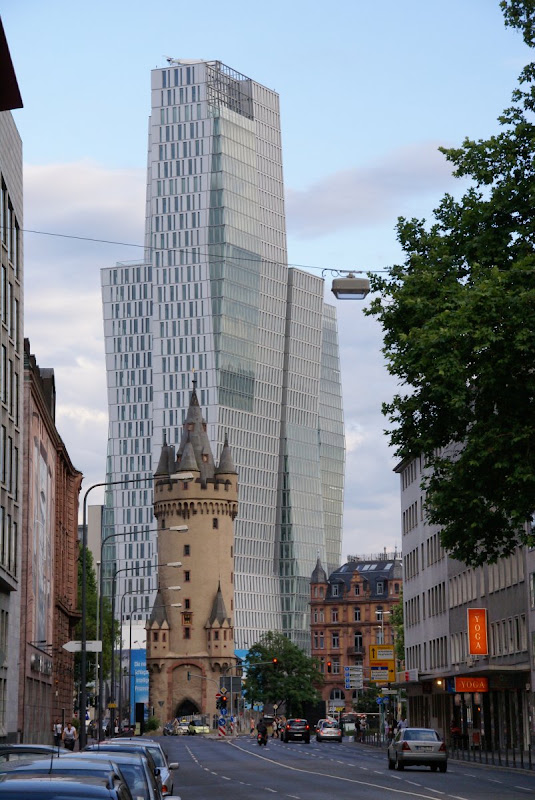 I was lucky enough that Frankfurt-pm monthly meeting occurred on one free evening during my trip. So I looked for the agenda (good, they welcome presentations), subscribed to their mailing list (mostly German, but English is accepted) and proposed a presentation similar to the one I gave in Fosdem.
So here I am, Tuesday evening, after a long meeting day for business, ready to give this presentation in a Japanese restaurant in Frankfurt. Since the audience was different from FOSDEM s, I offered to tune the presentation with more Perl related details. Thanks to LyX, Beamer and some evil red TeX, I quickly re-inserted some Perlish slides, and off we go.
Well almost. Food came in just after the first slide. So we interrupted the session for excellent japanese plates :-p
Among the audience, one guy was following the presentation with acute concentration. Max was already thinking on how to use Config::Model for Padre s configuration.
After the presentations, We discussed a bit on the work needed to use Config::Model with Padre. Roughly and not necessarily in that order:


 Romain and I
wrapped up release 0.8.4 of
Rcpp
last Friday. However, given the time of year, it only
appeared on CRAN this morning, and
then only after some prodding as CRAN processing is more or less closed this
week and probably next.
This release builds upon
release 0.8.3.
Highlights include changes to the sugar framework for highly expressive
C++ constructs which gained new vector function as well as a first set of
matrix function. As well, unit tests have been reorganised in such a way that
we end up with a lot fewer compilations (but of several files at once) which reaps
significant speed gains. Date calculation now use the same mktime()
function R itself uses (and which comes from Arthur Olson's tzone library).
The NEWS entry follows below:
0.8.4   2010-07-09
    o   new sugar vector functions: rep, rep_len, rep_each, rev, head, tail,
        diag

    o   sugar has been extended to matrices: The Matrix class now extends the
        Matrix_Base template that implements CRTP. Currently sugar functions
        for matrices are: outer, col, row, lower_tri, upper_tri, diag
    o   The unit tests have been reorganised into fewer files with one call
        each to cxxfunction() (covering multiple tests) resulting in a
        significant speedup
    o   The Date class now uses the same mktime() replacement that R uses
        (based on original code from the timezone library by Arthur Olson)
        permitting wide dates ranges on all operating systems
    o   The FastLM example has been updated, a new benchmark based on the
        historical Longley data set has been added
    o   RcppStringVector now uses std::vector<std::string> internally

    o   setting the .Data slot of S4 objects did not work properly
As always, even fuller details are in
Rcpp Changelog page and the
Rcpp page which also
leads to the downloads, the
browseable
doxygen docs and zip files of doxygen output for the standard formats.
A local directory has
source and documentation too.
Questions, comments etc should go to the
rcpp-devel mailing list
off the R-Forge page
* Yes. $subject is true!!
We re going to have Mini DebConf here in India. (You may call it Micro too!) If you re not going to DebConf10 and/or nearby Pune, India (or even far!) you re most welcome! Many many thanks to Praveen for taking lead & organizing event. We plan to focus on getting <more> people into the Debian. Good thing is that many Ubuntu contributors will be there and that will probably bring both distribution much more closer! (Hello, Onkar!)
Many thanks to Nexenta for traveling support. And, since Sham is also attending We can have MiniNexenta Meet also! Anil and Garrett are meeting on the other end of the world at the same time  Be there!!
Stay tuned at Wiki page for more update. My blogging frequency is not better nowadays..


The DNS server uses the associateddomain and arecord entries, while the DHCP server uses the dhcphwaddress and dhcpstatements entries before asking DNS to resolve the fixed-adddress. LTSP will use dhcphwaddress or associateddomain and the ldapconfig* attributes. I am not yet sure if I can get the DHCP server to look for its dhcphost in a different location, to allow us to put the objects outside the "DHCP Config" subtree, but hope to figure out a way to do that. If I can't figure out a way to do that, we can still get rid of the hosts subtree and move all its content into the DHCP Config tree (which probably should be renamed to be more related to the new content. I suspect cn=dnsdhcp,ou=services or something like that might be a good place to put it. If you want to help out with implementing this for Debian Edu, please contact us on debian-edu@lists.debian.org.dn: cn=hostname,cn=group1,cn=THINCLIENTS,cn=DHCP Config,dc=skole,dc=skolelinux,dc=no cn: hostname objectClass: dhcphost objectclass: domainrelatedobject objectclass: dnsdomainaux associateddomain: hostname.intern arecord: 10.11.12.13 dhcphwaddress: ethernet 00:00:00:00:00:00 dhcpstatements: fixed-address hostname ldapconfigsound: Y


 I have noticed that when I am reading, I cannot simultaneously understand spoken words. If someone speaks to me while I am reading, I can pay attention to their voice, or to the text, but not both. It s as if these two functions share the same cognitive facility, and this facility can only handle one task at a time. If someone is talking on the phone nearby, I find it very difficult to focus on reading (or writing). If I m having a conversation with someone about a document, I sometimes have to ask them to pause the conversation for a moment while I read.
This phenomenon isn t unique to me. In Richard Feynman s What Do You Care what Other People Think?, there is a chapter entitled It s as Simple as One, Two, Three where he describes his experiments with keeping time in his head. He practiced counting at a steady rate while simultaneously performing various actions, such as running up and down the stairs, reading, writing, even counting objects. He discovered that he could do anything while counting to [himself] except talk out loud .
What s interesting is that the pattern varies from person to person. Feynman shared his discovery with a group of people, one of whom (John Tukey) had a curiously different experience: while counting steadily, he could easily speak aloud, but could not read. Through experimenting and comparing their experiences, it seemed to them that they were using different cognitive processes to accomplish the task of counting time. Feynman was hearing the numbers in his head, while Tukey was seeing the numbers go by.
Analogously, I ve met people who seem to be able to read and listen to speech at the same time. I attributed this to a similar cognitive effect: presumably some people speak the words to themselves, while others watch them. Feynman found that, although he could write and count at the same time, his counting would be interrupted when he had to stop and search for the right word. Perhaps he used a different mental faculty for that. Some people seem to be able to listen to more than one person talking at the same time, and I wonder if that s related.
I was reminded of this years later, when I came across this video on speed reading. In it, the speaker explains that most people read by silently voicing words, which they can do at a rate of only 120-250 words per minute. However, people can learn to read visually instead, and thereby read much more quickly. He describes a training technique which involves reading while continuously voicing arbitrary sounds, like the vowels A-E-I-O-U.
The interesting part, for me, was the possibility of learning. I realized that different people read in different ways, but hadn t thought much about whether one could change this. Having learned a cognitive skill, like reading or counting time, apparently one can re-learn it a different way. Visual reading would seem, at first glance, to be superior: not only is it faster, but I have to use my eyes to read anyway, so why tie up my listening facility as well? Perhaps I could use it for something else at the same time.
So, I tried the simple technique in the video, and it had a definite effect. I could feel that I wasn t reading in the same way that I had been before. I didn t measure whether I was going any faster or slower, because I quickly noticed something more significant: my reading comprehension was completely shot. I couldn t remember what I had read, as the memory of it faded within seconds. Before reaching the end of a paragraph, I would forget the beginning. It was as if my ability to comprehend the meaning of the text was linked to my reading technique. I found this very unsettling, and it ruined my enjoyment of the book I was reading.
I ll probably need to separate this practice from my pleasure reading in order to stick with it. Presumably, over time, my comprehension will improve. I m curious about what net effect this will have, though. Will I still comprehend it in the same way? Will it mean the same thing to me? Will I still feel the same way about it? The many levels of meaning are connected to our senses as well, and the same idea, depending on whether it was read or heard, may not have the same meaning to an individual. Even our tactile senses can influence our judgments and decisions.
I also wonder whether, if I learn to read visually, I ll lose the ability to read any other way. When I retrained myself to type using a Dvorak keyboard layout, rather than QWERTY, I lost the ability to type on QWERTY at high speed. I think this has been a good tradeoff for me, but raises interesting questions about how my mind works: Why did this happen? What else changed in the process that might have been less obvious?
Have you tried re-training yourself in this way? What kind of cognitive side effects did you notice, if any? If you lost something, do you still miss it?
(As a sidenote, I am impressed by Feynman s exuberance and persistence in his personal experiments, as described in his books for laypeople. Although I consider myself a very curious person, I rarely invest that kind of physical and intellectual energy in first-hand experiments. I m much more likely to research what other people have done, and skim the surface of the subject.)


-geosync and -geotag
options. So it's just a matter of creating a little tool that shows a photo and
asks you to type the GPS time you see in it.
Apparently there are no bindings or GIR files for
gtkimageview
in Debian, so I'll have to use C.
Here is a C prototype:
/*
 * gpsoffset - Compute EXIF time offset from a photo of a gps display
 *
 * Use with exiftool -geosync=... -geotag trace.gpx DIR
 *
 * Copyright (C) 2009--2010  Enrico Zini <enrico@enricozini.org>
 *
 * This program is free software; you can redistribute it and/or modify
 * it under the terms of the GNU General Public License as published by
 * the Free Software Foundation; either version 2 of the License, or
 * (at your option) any later version.
 *
 * This program is distributed in the hope that it will be useful,
 * but WITHOUT ANY WARRANTY; without even the implied warranty of
 * MERCHANTABILITY or FITNESS FOR A PARTICULAR PURPOSE.  See the
 * GNU General Public License for more details.
 *
 * You should have received a copy of the GNU General Public License
 * along with this program; if not, write to the Free Software
 * Foundation, Inc., 59 Temple Place, Suite 330, Boston, MA  02111-1307  USA
 */
#define _XOPEN_SOURCE /* glibc2 needs this */
#include <time.h>
#include <gtkimageview/gtkimageview.h>
#include <libexif/exif-data.h>
#include <stdio.h>
#include <stdlib.h>
static int load_time(const char* fname, struct tm* tm)

    ExifData* exif_data = exif_data_new_from_file(fname);
    ExifEntry* exif_time = exif_data_get_entry(exif_data, EXIF_TAG_DATE_TIME);
    if (exif_time == NULL)

        fprintf(stderr, "Cannot find EXIF timetamp\n");
        return -1;

    char buf[1024];
    exif_entry_get_value(exif_time, buf, 1024);
    //printf("val2: %s\n", exif_entry_get_value(t2, buf, 1024));
    if (strptime(buf, "%Y:%m:%d %H:%M:%S", tm) == NULL)

        fprintf(stderr, "Cannot match EXIF timetamp\n");
        return -1;

    return 0;

static time_t exif_ts;
static GtkWidget* res_lbl;
void date_entry_changed(GtkEditable *editable, gpointer user_data)

    const gchar* text = gtk_entry_get_text(GTK_ENTRY(editable));
    struct tm parsed;
    if (strptime(text, "%Y-%m-%d %H:%M:%S", &parsed) == NULL)

        gtk_label_set_text(GTK_LABEL(res_lbl), "Please enter a date as YYYY-MM-DD HH:MM:SS");
      else
        time_t img_ts = mktime(&parsed);
        int c;
        int res;
        if (exif_ts < img_ts)

            c = '+';
            res = img_ts - exif_ts;

        else

            c = '-';
            res = exif_ts - img_ts;

        char buf[1024];
        if (res > 3600)
            snprintf(buf, 1024, "Result: %c%ds -geosync=%c%d:%02d:%02d",
                    c, res, c, res / 3600, (res / 60) % 60, res % 60);
        else if (res > 60)
            snprintf(buf, 1024, "Result: %c%ds -geosync=%c%02d:%02d",
                    c, res, c, (res / 60) % 60, res % 60);
        else
            snprintf(buf, 1024, "Result: %c%ds -geosync=%c%d",
                    c, res, c, res);
        gtk_label_set_text(GTK_LABEL(res_lbl), buf);


int main (int argc, char *argv[])

    // Work in UTC to avoid mktime applying DST or timezones
    setenv("TZ", "UTC");
    const char* filename = "/home/enrico/web-eddie/galleries/2010/04-05-Uppermill/P1080932.jpg";
    gtk_init (&argc, &argv);
    struct tm exif_time;
    if (load_time(filename, &exif_time) != 0)
        return 1;
    printf("EXIF time: %s\n", asctime(&exif_time));
    exif_ts = mktime(&exif_time);
    GtkWidget* window = gtk_window_new(GTK_WINDOW_TOPLEVEL);
    GtkWidget* vb = gtk_vbox_new(FALSE, 0);
    GtkWidget* hb = gtk_hbox_new(FALSE, 0);
    GtkWidget* lbl = gtk_label_new("Timestamp:");
    GtkWidget* exif_lbl;

        char buf[1024];
        strftime(buf, 1024, "EXIF time: %Y-%m-%d %H:%M:%S", &exif_time);
        exif_lbl = gtk_label_new(buf);

    GtkWidget* date_ent = gtk_entry_new();
    res_lbl = gtk_label_new("Result:");
    GtkWidget* view = gtk_image_view_new();
    GdkPixbuf* pixbuf = gdk_pixbuf_new_from_file(filename, NULL);
    gtk_box_pack_start(GTK_BOX(hb), lbl, FALSE, TRUE, 0);
    gtk_box_pack_start(GTK_BOX(hb), date_ent, TRUE, TRUE, 0);
    gtk_signal_connect(GTK_OBJECT(date_ent), "changed", (GCallback)date_entry_changed, NULL);

        char buf[1024];
        strftime(buf, 1024, "%Y-%m-%d %H:%M:%S", &exif_time);
        gtk_entry_set_text(GTK_ENTRY(date_ent), buf);

    gtk_widget_set_size_request(view, 500, 400);
    gtk_image_view_set_pixbuf(GTK_IMAGE_VIEW(view), pixbuf, TRUE);
    gtk_container_add(GTK_CONTAINER(window), vb);
    gtk_box_pack_start(GTK_BOX(vb), view, TRUE, TRUE, 0);
    gtk_box_pack_start(GTK_BOX(vb), hb, FALSE, TRUE, 0);
    gtk_box_pack_start(GTK_BOX(vb), exif_lbl, FALSE, TRUE, 0);
    gtk_box_pack_start(GTK_BOX(vb), res_lbl, FALSE, TRUE, 0);
    gtk_widget_show_all(window);
    gtk_main ();
    return 0;
And here is its simple makefile:
CFLAGS=$(shell pkg-config --cflags gtkimageview libexif)
LDFLAGS=$(shell pkg-config --libs gtkimageview libexif)
gpsoffset: gpsoffset.c
It's a simple prototype but it's a working prototype and seems to do the job for me. I currently cannot find out why after I click on the text box, there seems to be no way to give the focus back to the image viewer so I can control it with keys. There is another nice algorithm to compute time offsets to be implemented: you choose a photo taken from a known place and drag it on that place on a map: you can then look for the nearest point on your GPX trace and compute the time offset from that. I have seen that there are programs for geotagging photos that implement all such algorithms, and have a nice UI, but I haven't seen any in Debian. Are there any such softwares that can be packaged? If not, the interpolation and annotation tasks can now already be performed by exiftool, so it's just a matter of building a good UI, and I would love to see someone picking up the task.


Next.