Search Results: "cas"

3 December 2016

Ben Hutchings: Linux Kernel Summit 2016, part 1

I attended this year's Linux Kernel Summit in Santa Fe, NM, USA and made notes on some of the sessions that were relevant to Debian. LWN also reported many of the discussions. This is the first of two parts of my notes; part 2 is here. Stable process Jiri Kosina, in his role as a distribution maintainer, sees too many unsuitable patches being backported - e.g. a fix for a bug that wasn't present or a change that depends on an earlier semantic change so that when cherry-picked it still compiles but isn't quite right. He thinks the current review process is insufficient to catch them. As an example, a recent fix for a minor information leak (CVE-2016-9178) depended on an earlier change to page fault handling. When backported by itself, it introduced a much more serious security flaw (CVE-2016-9644). This could have been caught very quickly by a system call fuzzer. Possible solutions: require 'Fixes' field, not just 'Cc: stable'. Deals with 'bug wasn't present', but not semantic changes. There was some disagreement whether 'Fixes' without 'Cc: stable' should be sufficient for inclusion in stable. Ted Ts'o said he specifically does that in some cases where he thinks backporting is risky. Greg Kroah-Hartman said he takes it as a weaker hint for inclusion in stable. Is it a good idea to keep 'Cc: stable' given the risk of breaking embargo? On balance, yes, it only happened once. Sometimes it's hard to know exactly how/when the bug was introduced. Linus doesn't want people to guess and add incorrect 'Fixes' fields. There is still the option to give some explanation and hints for stable maintainers in the commit message. Ideally the upstream developer should provide a test case for the bug. Is Linus happy? Linus complained about minor fixes coming later in the release cycle. After rc2, all fixes should either be for new code introduced in the current release cycle or for important bugs. However, new, production-ready drivers without new infrastructure dependencies are welcome at almost any point in the release cycle. He was unhappy about some big changes in RDMA, but I'm not sure what those were. Bugzilla and bug tracking Laura Abbott started a discussion of bugzilla.kernel.org, talking about subsystems where maintainers ignore it and any responses come from random people giving bad advice. This is a terrible experience for users. Several maintainers are actively opposed to using it, and the email bridge no longer works (or not well?). She no longer recommends Fedora bug submitters to submit reports there. Are there any alternatives? None were proposed. Someone asked whether Bugzilla could tell reporters to use email for certain products/components instead of continuing with the bug entry process. Konstantin Ryabitsev talked about the difficulty of upgrading a customised instance of Bugzilla. Much customisation requires patches which don't apply to next version (maybe due to limitations of the extension mechanism?). He has had to drop many such patches. Email is hard to track when a bug is handed over from one maintainer to another. Email archives are very unreliable. Linus: I'll take Bugzilla over mail-archive. No-one is currently keeping track of bugs across the kernel and making sure they get addressed by an appropriate maintainer. It's (at least) a full-time job but no individual company has business case for paying for this. Konstantin suggested (I think) that CII might pay for this. There was some discussion of what information should be included in a bug report. The Cut here line in oops messages was said to be a mistake because there are often relevant messages before it. The model of computer is often important. Beyond that, there was not much interest in the automated information gathering that distributions do. Distribution maintainers should curate bugs before forwarding upstream. There was a request for custom fields per component in Bugzilla. Konstantin says this is doable (possibly after upgrade to version 5); it doesn't require patches. The future of the Kernel Summit The kernel community is growing, and the invitation list for the core day is too small to include all the right people for technical subjects. For 2017, the core half-day will have an even smaller invitation list, only ~30 subsystem maintainers that Linus pulls from. The entire technical track will be open (I think). Kernel Summit 2017 and some mini-summits will be held in Prague alongside Open Source Summit Europe (formerly LinuxCon Europe) and Embedded Linux Conference Europe. There were some complaints that LinuxCon is not that interesting to kernel developers, compared to Linux Plumbers Conference (which followed this year's Kernel Summit). However, the Linux Foundation is apparently soliciting more hardcore technical sessions. Kernel Summit and Linux Plumbers Conference are quite small, and it's apparently hard to find venues for them in cities that also have major airports. It might be more practical to co-locate them both with Open Source Summit in future. time_t and 2038 On 32-bit architectures the kernel's representation of real time (time_t etc.) will break in early 2038. Fixing this in a backward-compatible way is a complex problem. Arnd Bergmann presented the current status of this process. There has not yet been much progress in mainline, but more fixes have been prepared. The changes to struct inode and to input events are proving to be particularly problematic. There is a need to add new system calls, and he intends to add these for all (32-bit) achitectures at once. Copyright retention James Bottomley talked about how developers can retain copyright on their contributions. It's hard to renegotiate within an existing employment; much easier to do this when preparing to sign a new contract. Some employers expect you to fill in a document disclosing 'prior inventions' you have worked on. Depending on how it's worded, this may require the employer to negotiate with you again whenever they want you to work on that same software. It's much easier for contractors to retain copyright on their work - customers expect to have a custom agreement and don't expect to get copyright on contractor's software.

Vincent Bernat: Build-time dependency patching for Android

This post shows how to patch an external dependency for an Android project at build-time with Gradle. This leverages the Transform API and Javassist, a Java bytecode manipulation tool.
buildscript  
    dependencies  
        classpath 'com.android.tools.build:gradle:2.2.+'
        classpath 'com.android.tools.build:transform-api:1.5.+'
        classpath 'org.javassist:javassist:3.21.+'
        classpath 'commons-io:commons-io:2.4'
     
 
Disclaimer: I am not a seasoned Android programmer, so take this with a grain of salt.

Context This section adds some context to the example. Feel free to skip it. Dashkiosk is an application to manage dashboards on many displays. It provides an Android application you can install on one of those cheap Android sticks. Under the table, the application is an embedded webview backed by the Crosswalk Project web runtime which brings an up-to-date web engine, even for older versions of Android1. Recently, a security vulnerability has been spotted in how invalid certificates were handled. When a certificate cannot be verified, the webview defers the decision to the host application by calling the onReceivedSslError() method:
Notify the host application that an SSL error occurred while loading a resource. The host application must call either callback.onReceiveValue(true) or callback.onReceiveValue(false). Note that the decision may be retained for use in response to future SSL errors. The default behavior is to pop up a dialog.
The default behavior is specific to Crosswalk webview: the Android builtin one just cancels the load. Unfortunately, the fix applied by Crosswalk is different and, as a side effect, the onReceivedSslError() method is not invoked anymore2. Dashkiosk comes with an option to ignore TLS errors3. The mentioned security fix breaks this feature. The following example will demonstrate how to patch Crosswalk to recover the previous behavior4.

Simple method replacement Let s replace the shouldDenyRequest() method from the org.xwalk.core.internal.SslUtil class with this version:
// In SslUtil class
public static boolean shouldDenyRequest(int error)  
    return false;
 

Transform registration Gradle Transform API enables the manipulation of compiled class files before they are converted to DEX files. To declare a transform and register it, include the following code in your build.gradle:
import com.android.build.api.transform.Context
import com.android.build.api.transform.QualifiedContent
import com.android.build.api.transform.Transform
import com.android.build.api.transform.TransformException
import com.android.build.api.transform.TransformInput
import com.android.build.api.transform.TransformOutputProvider
import org.gradle.api.logging.Logger
class PatchXWalkTransform extends Transform  
    Logger logger = null;
    public PatchXWalkTransform(Logger logger)  
        this.logger = logger
     
    @Override
    String getName()  
        return "PatchXWalk"
     
    @Override
    Set<QualifiedContent.ContentType> getInputTypes()  
        return Collections.singleton(QualifiedContent.DefaultContentType.CLASSES)
     
    @Override
    Set<QualifiedContent.Scope> getScopes()  
        return Collections.singleton(QualifiedContent.Scope.EXTERNAL_LIBRARIES)
     
    @Override
    boolean isIncremental()  
        return true
     
    @Override
    void transform(Context context,
                   Collection<TransformInput> inputs,
                   Collection<TransformInput> referencedInputs,
                   TransformOutputProvider outputProvider,
                   boolean isIncremental) throws IOException, TransformException, InterruptedException  
        // We should do something here
     
 
// Register the transform
android.registerTransform(new PatchXWalkTransform(logger))
The getInputTypes() method should return the set of types of data consumed by the transform. In our case, we want to transform classes. Another possibility is to transform resources. The getScopes() method should return a set of scopes for the transform. In our case, we are only interested by the external libraries. It s also possible to transform our own classes. The isIncremental() method returns true because we support incremental builds. The transform() method is expected to take all the provided inputs and copy them (with or without modifications) to the location supplied by the output provider. We didn t implement this method yet. This causes the removal of all external dependencies from the application.

Noop transform To keep all external dependencies unmodified, we must copy them:
@Override
void transform(Context context,
               Collection<TransformInput> inputs,
               Collection<TransformInput> referencedInputs,
               TransformOutputProvider outputProvider,
               boolean isIncremental) throws IOException, TransformException, InterruptedException  
    inputs.each  
        it.jarInputs.each  
            def jarName = it.name
            def src = it.getFile()
            def dest = outputProvider.getContentLocation(jarName, 
                                                         it.contentTypes, it.scopes,
                                                         Format.JAR);
            def status = it.getStatus()
            if (status == Status.REMOVED)   //  
                logger.info("Remove $ src ")
                FileUtils.delete(dest)
              else if (!isIncremental   status != Status.NOTCHANGED)   //  
                logger.info("Copy $ src ")
                FileUtils.copyFile(src, dest)


We also need two additional imports:
import com.android.build.api.transform.Status
import org.apache.commons.io.FileUtils
Since we are handling external dependencies, we only have to manage JAR files. Therefore, we only iterate on jarInputs and not on directoryInputs. There are two cases when handling incremental build: either the file has been removed ( ) or it has been modified ( ). In all other cases, we can safely assume the file is already correctly copied.

JAR patching When the external dependency is the Crosswalk JAR file, we also need to modify it. Here is the first part of the code (replacing ):
if ("$ src " ==~ ".*/org.xwalk/xwalk_core.*/classes.jar")  
    def pool = new ClassPool()
    pool.insertClassPath("$ src ")
    def ctc = pool.get('org.xwalk.core.internal.SslUtil') //  
    def ctm = ctc.getDeclaredMethod('shouldDenyRequest')
    ctc.removeMethod(ctm) //  
    ctc.addMethod(CtNewMethod.make("""
public static boolean shouldDenyRequest(int error)  
    return false;
 
""", ctc)) //  
    def sslUtilBytecode = ctc.toBytecode() //  
    // Write back the JAR file
    //  
  else  
    logger.info("Copy $ src ")
    FileUtils.copyFile(src, dest)
 
We also need the following additional imports to use Javassist:
import javassist.ClassPath
import javassist.ClassPool
import javassist.CtNewMethod
Once we have located the JAR file we want to modify, we add it to our classpath and retrieve the class we are interested in ( ). We locate the appropriate method and delete it ( ). Then, we add our custom method using the same name ( ). The whole operation is done in memory. We retrieve the bytecode of the modified class in . The remaining step is to rebuild the JAR file:
def input = new JarFile(src)
def output = new JarOutputStream(new FileOutputStream(dest))
//  
input.entries().each  
    if (!it.getName().equals("org/xwalk/core/internal/SslUtil.class"))  
        def s = input.getInputStream(it)
        output.putNextEntry(new JarEntry(it.getName()))
        IOUtils.copy(s, output)
        s.close()
     
 
//  
output.putNextEntry(new JarEntry("org/xwalk/core/internal/SslUtil.class"))
output.write(sslUtilBytecode)
output.close()
We need the following additional imports:
import java.util.jar.JarEntry
import java.util.jar.JarFile
import java.util.jar.JarOutputStream
import org.apache.commons.io.IOUtils
There are two steps. In , all classes are copied to the new JAR, except the SslUtil class. In , the modified bytecode for SslUtil is added to the JAR. That s all! You can view the complete example on GitHub.

More complex method replacement In the above example, the new method doesn t use any external dependency. Let s suppose we also want to replace the sslErrorFromNetErrorCode() method from the same class with the following one:
import org.chromium.net.NetError;
import android.net.http.SslCertificate;
import android.net.http.SslError;
// In SslUtil class
public static SslError sslErrorFromNetErrorCode(int error,
                                                SslCertificate cert,
                                                String url)  
    switch(error)  
        case NetError.ERR_CERT_COMMON_NAME_INVALID:
            return new SslError(SslError.SSL_IDMISMATCH, cert, url);
        case NetError.ERR_CERT_DATE_INVALID:
            return new SslError(SslError.SSL_DATE_INVALID, cert, url);
        case NetError.ERR_CERT_AUTHORITY_INVALID:
            return new SslError(SslError.SSL_UNTRUSTED, cert, url);
        default:
            break;
     
    return new SslError(SslError.SSL_INVALID, cert, url);
 
The major difference with the previous example is that we need to import some additional classes.

Android SDK import The classes from the Android SDK are not part of the external dependencies. They need to be imported separately. The full path of the JAR file is:
androidJar = "$ android.getSdkDirectory().getAbsolutePath() /platforms/" +
             "$ android.getCompileSdkVersion() /android.jar"
We need to load it before adding the new method into SslUtil class:
def pool = new ClassPool()
pool.insertClassPath(androidJar)
pool.insertClassPath("$ src ")
def ctc = pool.get('org.xwalk.core.internal.SslUtil')
def ctm = ctc.getDeclaredMethod('sslErrorFromNetErrorCode')
ctc.removeMethod(ctm)
pool.importPackage('android.net.http.SslCertificate');
pool.importPackage('android.net.http.SslError');
//  

External dependency import We must also import org.chromium.net.NetError and therefore, we need to put the appropriate JAR in our classpath. The easiest way is to iterate through all the external dependencies and add them to the classpath.
def pool = new ClassPool()
pool.insertClassPath(androidJar)
inputs.each  
    it.jarInputs.each  
        def jarName = it.name
        def src = it.getFile()
        def status = it.getStatus()
        if (status != Status.REMOVED)  
            pool.insertClassPath("$ src ")


def ctc = pool.get('org.xwalk.core.internal.SslUtil')
def ctm = ctc.getDeclaredMethod('sslErrorFromNetErrorCode')
ctc.removeMethod(ctm)
pool.importPackage('android.net.http.SslCertificate');
pool.importPackage('android.net.http.SslError');
pool.importPackage('org.chromium.net.NetError');
ctc.addMethod(CtNewMethod.make(" "))
// Then, rebuild the JAR...
Happy hacking!

  1. Before Android 4.4, the webview was severely outdated. Starting from Android 5, the webview is shipped as a separate component with updates. Embedding Crosswalk is still convenient as you know exactly which version you can rely on.
  2. I hope to have this fixed in later versions.
  3. This may seem harmful and you are right. However, if you have an internal CA, it is currently not possible to provide its own trust store to a webview. Moreover, the system trust store is not used either. You also may want to use TLS for authentication only with client certificates, a feature supported by Dashkiosk.
  4. Crosswalk being an opensource project, an alternative would have been to patch Crosswalk source code and recompile it. However, Crosswalk embeds Chromium and recompiling the whole stuff consumes a lot of resources.

1 December 2016

Daniel Pocock: Using a fully free OS for devices in the home

There are more and more devices around the home (and in many small offices) running a GNU/Linux-based firmware. Consider routers, entry-level NAS appliances, smart phones and home entertainment boxes. More and more people are coming to realize that there is a lack of security updates for these devices and a big risk that the proprietary parts of the code are either very badly engineered (if you don't plan to release your code, why code it properly?) or deliberately includes spyware that calls home to the vendor, ISP or other third parties. IoT botnet incidents, which are becoming more widely publicized, emphasize some of these risks. On top of this is the frustration of trying to become familiar with numerous different web interfaces (for your own devices and those of any friends and family members you give assistance to) and the fact that many of these devices have very limited feature sets. Many people hail OpenWRT as an example of a free alternative (for routers), but I recently discovered that OpenWRT's web interface won't let me enable both DHCP and DHCPv6 concurrently. The underlying OS and utilities fully support dual stack, but the UI designers haven't encountered that configuration before. Conclusion: move to a device running a full OS, probably Debian-based, but I would consider BSD-based solutions too. For many people, the benefit of this strategy is simple: use the same skills across all the different devices, at home and in a professional capacity. Get rapid access to security updates. Install extra packages or enable extra features if really necessary. For example, I already use Shorewall and strongSwan on various Debian boxes and I find it more convenient to configure firewall zones using Shorewall syntax rather than OpenWRT's UI. Which boxes to start with? There are various considerations when going down this path:
  • Start with existing hardware, or buy new devices that are easier to re-flash? Sometimes there are other reasons to buy new hardware, for example, when upgrading a broadband connection to Gigabit or when an older NAS gets a noisy fan or struggles with SSD performance and in these cases, the decision about what to buy can be limited to those devices that are optimal for replacing the OS.
  • How will the device be supported? Can other non-technical users do troubleshooting? If mixing and matching components, how will faults be identified? If buying a purpose-built NAS box and the CPU board fails, will the vendor provide next day replacement, or could it be gone for a month? Is it better to use generic components that you can replace yourself?
  • Is a completely silent/fanless solution necessary?
  • Is it possibly to completely avoid embedded microcode and firmware?
  • How many other free software developers are using the same box, or will you be first?
Discussing these options I recently started threads on the debian-user mailing list discussing options for routers and home NAS boxes. A range of interesting suggestions have already appeared, it would be great to see any other ideas that people have about these choices.

30 November 2016

Chris Lamb: Free software activities in November 2016

Here is my monthly update covering what I have been doing in the free software world (previous month):
Reproducible builds

Whilst anyone can inspect the source code of free software for malicious flaws, most software is distributed pre-compiled to end users. The motivation behind the Reproducible Builds effort is to permit verification that no flaws have been introduced either maliciously or accidentally during this compilation process by promising identical results are always generated from a given source, thus allowing multiple third-parties to come to a consensus on whether a build was compromised.

This month:

My work in the Reproducible Builds project was also covered in our weekly reports. (#80, #81, #82 #83.

Toolchain issues I submitted the following patches to fix reproducibility-related toolchain issues with Debian:

strip-nondeterminism

strip-nondeterminism is our tool to remove specific non-deterministic results from a completed build.


jenkins.debian.net

jenkins.debian.net runs our comprehensive testing framework.

  • buildinfo.debian.net has moved to SSL. (ac3b9e7)
  • Submit signing keys to keyservers after generation. (bdee6ff)
  • Various cosmetic changes, including
    • Prefer if X not in Y over if not X in Y. (bc23884)
    • No need for a dictionary; let's just use a set. (bf3fb6c)
    • Avoid DRY violation by using a for loop. (4125ec5)

I also submitted 9 patches to fix specific reproducibility issues in apktool, cairo-5c, lava-dispatcher, lava-server, node-rimraf, perlbrew, qsynth, tunnelx & zp.

Debian

Debian LTS This month I have been paid to work 11 hours on Debian Long Term Support (LTS). In that time I did the following:
  • "Frontdesk" duties, triaging CVEs, etc.
  • Issued DLA 697-1 for bsdiff fixing an arbitrary write vulnerability.
  • Issued DLA 705-1 for python-imaging correcting a number of memory overflow issues.
  • Issued DLA 713-1 for sniffit where a buffer overflow allowed a specially-crafted configuration file to provide a root shell.
  • Issued DLA 723-1 for libsoap-lite-perl preventing a Billion Laughs XML expansion attack.
  • Issued DLA 724-1 for mcabber fixing a roster push attack.

Uploads
  • redis:
    • 3.2.5-2 Tighten permissions of /var/ lib,log /redis. (#842987)
    • 3.2.5-3 & 3.2.5-4 Improve autopkgtest tests and install upstream's MANIFESTO and README.md documentation.
  • gunicorn (19.6.0-9) Adding autopkgtest tests.
  • libfiu:
    • 0.94-1 Add autopkgtest tests.
    • 0.95-1, 0.95-2 & 0.95-3 New upstream release and improve autopkgtest coverage.
  • python-django (1.10.3-1) New upstream release.
  • aptfs (0.8-3, 0.8-4 & 0.8-5) Adding and subsequently improving the autopkgtext tests.


I performed the following QA uploads:


Finally, I also made the following non-maintainer uploads:
  • libident (0.22-3.1) Move from obsolete Source-Version substvar to binary:Version. (#833195)
  • libpcl1 (1.6-1.1) Move from obsolete Source-Version substvar to binary:Version. (#833196)
  • pygopherd (2.0.18.4+nmu1) Move from obsolete Source-Version substvar to $ source:Version . (#833202)


RC bugs


I also filed 59 FTBFS bugs against arc-gui-clients, asyncpg, blhc, civicrm, d-feet, dpdk, fbpanel, freeciv, freeplane, gant, golang-github-googleapis-gax-go, golang-github-googleapis-proto-client-go, haskell-cabal-install, haskell-fail, haskell-monadcatchio-transformers, hg-git, htsjdk, hyperscan, jasperreports, json-simple, keystone, koji, libapache-mod-musicindex, libcoap, libdr-tarantool-perl, libmath-bigint-gmp-perl, libpng1.6, link-grammar, lua-sql, mediatomb, mitmproxy, ncrack, net-tools, node-dateformat, node-fuzzaldrin-plus, node-nopt, open-infrastructure-system-images, open-infrastructure-system-images, photofloat, ppp, ptlib, python-mpop, python-mysqldb, python-passlib, python-protobix, python-ttystatus, redland, ros-message-generation, ruby-ethon, ruby-nokogiri, salt-formula-ceilometer, spykeviewer, sssd, suil, torus-trooper, trash-cli, twisted-web2, uftp & wide-dhcpv6.

FTP Team

As a Debian FTP assistant I ACCEPTed 70 packages: bbqsql, coz-profiler, cross-toolchain-base, cross-toolchain-base-ports, dgit-test-dummy, django-anymail, django-hstore, django-html-sanitizer, django-impersonate, django-wkhtmltopdf, gcc-6-cross, gcc-defaults, gnome-shell-extension-dashtodock, golang-defaults, golang-github-btcsuite-fastsha256, golang-github-dnephin-cobra, golang-github-docker-go-events, golang-github-gogits-cron, golang-github-opencontainers-image-spec, haskell-debian, kpmcore, libdancer-logger-syslog-perl, libmoox-buildargs-perl, libmoox-role-cloneset-perl, libreoffice, linux-firmware-raspi3, linux-latest, node-babel-runtime, node-big.js, node-buffer-shims, node-charm, node-cliui, node-core-js, node-cpr, node-difflet, node-doctrine, node-duplexer2, node-emojis-list, node-eslint-plugin-flowtype, node-everything.js, node-execa, node-grunt-contrib-coffee, node-grunt-contrib-concat, node-jquery-textcomplete, node-js-tokens, node-json5, node-jsonfile, node-marked-man, node-os-locale, node-sparkles, node-tap-parser, node-time-stamp, node-wrap-ansi, ooniprobe, policycoreutils, pybind11, pygresql, pysynphot, python-axolotl, python-drizzle, python-geoip2, python-mockupdb, python-pyforge, python-sentinels, python-waiting, pythonmagick, r-cran-isocodes, ruby-unicode-display-width, suricata & voctomix-outcasts. I additionally filed 4 RC bugs against packages that had incomplete debian/copyright files against node-cliui, node-core-js, node-cpr & node-grunt-contrib-concat.

29 November 2016

Shirish Agarwal: The Iziko South African Museum

This would be a bit long on my stay in Cape Town, South Africa after Debconf16. Before I start, let me share the gallery works, you can see some photos that I have been able to upload to my gallery . It seems we are using gallery 2 while upstream had made gallery 3 and then it sort of died. I actually asked in softwarerecs stackexchange site if somebody knows of a drop-in replacement for gallery and was told/shared about Pwigo . I am sure the admin knows about it. There would be costs to probably migrate from gallery to Pwigo with the only benefit that it would be something which would perhaps be more maintainable. The issues I face with the current gallery system are few things a. There is no way to know how much your progress your upload has taken.
b. After it has submit, it gives a fake error message saying some error has occurred. This has happened on every occasion/attempt. Now I don t know whether it is because I have slow upload speeds or something else altogether. I had shared the error page last time in the blog post hence not sharing again. Although, all the pictures which would be shared in this blog post would be from the same gallery Another thing I would like to share is a small beginner article I wrote about why I like Debian. Another interesting/tit-bit of news I came to know few days back that both Singapore and Qatar have given 96 hours visa free stopovers for Indians for select destinations. Now to start with the story/experience due to some unknown miracle/angel looking upon me I got the chance to go to Debconf16, South Africa. I m sure there was lot of backend discussions but in the end I was given the opportunity to be part of Debcamp and Debconf. While I hope to recount my Debcamp and Debconf experience in another or two blog posts, this would be exclusively the Post-Debconf Experiences I had. As such opportunities to visit another country are rare, I wanted to make the most of it. Before starting from Pune, I had talked with Amey about Visas, about Debconf as he had just been to Debconf15 the year before and various things related to travel. He was instrumental in me having a bit more knowledge about how to approach things. I was also lucky to have both Graham and Bernelle who also suggested, advised and made it possible to have a pleasant stay both during Debcamp and Debconf. The only quibble is I didn t know heaters were being made available to us without any cost. Moving on, a day or two before Debconf was about to conclude, I asked Bernelle s help even though she was battling a burn-out I believe as I was totally clueless about Cape Town. She accepted my request and asked me to look at hostels near Longmarket Street. I had two conditions a. It should not be very far from the airport
b. It should be near to all or most cultural experiences the city has to offer. We looked at hostelworld and from the options listed, it looked like Homebasecapetown looked to be a perfect fit. It was one of the cheaper options and they also had breakfast included in the pricing. I booked through hostelworld for a mixed dorm for 2 days as I was unsure how it would be (the first night effect I have shared about previously) . When I reached there, I found it to be as good as the pictures shared were, the dorm was clean (most important), people were friendly (also important) as well as toilets and shower were also clean while the water was hot, so all in all it was a win-win situation for me. Posters I saw at homebasecapetown While I m not much of an adrenaline-junkie it was nice to know the activities that could be done/taken. Brochures and Condoms just left of main hall. This was again interesting. While apologies for the poor shaky quality of the picture, I believe it is easy to figure out. There were Brochures of the city attractions as well as condoms that people could discreetly use if need be. I had seen such condoms in few toilets during and around Debconf and it felt good that the public were aware and prioritizing safety for their guests and students instead of having fake holier than thou attitudes that many places have. For instance, you wouldn t find something like this in toilets of most colleges in India or anywhere else for that matter. There are few vending machines in what are termed as red light areas or where prostitution is known/infamous to happen and even then most times it is empty. I have 2-3 social workers as friends and they are a source of news on such things. While I went to few places and each had an attraction to it, the one which had my literally eyes out of socket was the Iziko South African Museum . I have been lucky to been quite a few museums in India, the best rated science museum in India in my limited experience has been the Visvesvaraya Industrial & Technological Museum, Bengaluru India . A beer from me if a European can get it right. Don t worry if you mispronounce it, I mispronounce it couple of times till I get it right . Looking up the word Iziko the meaning of the word seems to be the hearth and if you look at the range of collections in the museum, you would think it fits. I was lucky to find couple of friends, one of whom was living at homebase and we decided to go to the museum together. Making friends on the road So Eduardo, my friend on the left and his friend, we went to the museum. While viewing the museum, there were no adjectives to describe it other than Wow and Endless . See fossils of fish-whale-shark ? OR Giant fish-whale-dolphin-shark some million years ago. and Reminder of JAWS ;) While I have more than a few pictures, the point is easily made. It seems almost inconceivable that creatures of such masses actually were on earth. While I played with the model of the jaws of a whale/shark in reality if something like that happened, I would have been fighting for my life. The only thing I missed or could have been better if they had some interactive installations to showcase the now universally accepted Charles Darwin s On the Origin of Species I had never seen anything like this. Sadly, there was nobody around to help us figure out things as I had read that most species of fish don t leave a skeleton behind so how were these models made? It just boggles the mind. Apart from the Science Museum I was also introduced to the bloody history that South Africa had. I saw The 1913 native land act which was not honored . I had been under the impression that India had got a raw deal when it was under British rule but looking at South African history I don t know. While we got our freedom in 1947 they got rid of apartheid about 20 years+ . I talked to lot of young African males and there was lot of naked hostility for the Europeans even today. It was a bit depressing but could relate to their point of view as similar sentiments were echoed by our forefathers. I read in the newspapers and it seemed to be a pretty mixed picture. I can t comment as only South Africans can figure out the way forward. For me, it was enough to know and see that we both had similar political histories as nations. It seemed the racial divide and anger was much more highly pronounced towards Europeans and divisive then the caste divisions here between Indians. I also shared with them my limited knowledge and understanding of the Indian history (as history is re-written all the time) and it was clear to them that we had common/similar pasts. As a result, what was surprising (actually not) is that many South Africans have no knowledge of Indian history. as well otherwise the political differences that South Africa and India has in the current scenario wouldn t have been. In the end, the trip proved to be fun, stimulating, educative, thought-provoking as questions about self-identity , national identity, our place in the Universe kinda questions which should be asked all the time. Thank you Bremmer and the team for letting me experience Cape Town, South Africa, I would have been poorer if I hadn t had the experience.
Filed under: Miscellenous Tagged: #Debconf16, #Dinosaur Fishes, #gallery, #Identity, #Iziko South African Museum, #Nation-state Identity, #pwigo

Mike Hommey: Announcing git-cinnabar 0.4.0 release candidate

Git-cinnabar is a git remote helper to interact with mercurial repositories. It allows to clone, pull and push from/to mercurial remote repositories, using git. Get it on github. These release notes are also available on the git-cinnabar wiki. What s new since 0.4.0b3? And since I realize I didn t announce beta 3: What s new since 0.4.0b2?

28 November 2016

Pau Garcia i Quiles: Desktops DevRoom @ FOSDEM 2017: you are still on time to submit a talk

FOSDEM 2016 is going to be great (again!) and you still have the chance to be one of the stars. Have you submitted your talk to the Desktops DevRoom yet? No? Remember: we will only accept proposals until December 5th. After that, the Organization Team will get busy and vote and choose the talks. Here is the full Call for Participation, in case you need to check the details on how to submit: FOSDEM Desktops DevRoom 2017 Call for Participation Topics include anything related to the Desktop: desktop environments, software development for desktop/cross-platform, applications, UI, etc

25 November 2016

Julian Andres Klode: Starting the faster, more secure APT 1.4 series

We just released the first beta of APT 1.4 to Debian unstable (beta here means that we don t know any other big stuff to add to it, but are still open to further extensions). This is the release series that will be released with Debian stretch, Ubuntu zesty, and possibly Ubuntu zesty+1 (if the Debian freeze takes a very long time, even zesty+2 is possible). It should reach the master archive in a few hours, and your mirrors shortly after that. Security changes APT 1.4 by default disables support for repositories signed with SHA1 keys. I announced back in January that it was my intention to do this during the summer for development releases, but I only remembered the Jan 1st deadline for stable releases supporting that (APT 1.2 and 1.3), so better late than never. Around January 1st, the same or a similar change will occur in the APT 1.2 and 1.3 series in Ubuntu 16.04 and 16.10 (subject to approval by Ubuntu s release team). This should mean that repository provides had about one year to fix their repositories, and more than 8 months since the release of 16.04. I believe that 8 months is a reasonable time frame to upgrade a repository signing key, and hope that providers who have not updated their repositories yet will do so as soon as possible. Performance work APT 1.4 provides a 10-20% performance increase in cache generation (and according to callgrind, we went from approx 6.8 billion to 5.3 billion instructions for my laptop s configuration, a reduction of more than 21%). The major improvements are: We switched the parsing of Deb822 files (such as Packages files) to my perfect hash function TrieHash. TrieHash which generates C code from a set of words is about equal or twice as fast as the previously used hash function (and two to three times faster than gperf), and we save an additional 50% of that time as we only have to hash once during parsing now, instead of during look up as well. APT 1.4 marks the first time TrieHash is used in any software. I hope that it will spread to dpkg and other software at a later point in time.vendors. Another important change was to drop normalization of Description-MD5 values, the fields mapping a description in a Packages files to a translated description. We used to parse the hex digits into a native binary stream, and then compared it back to hex digits for comparisons, which cost us about 5% of the run time performance. We also optimized one of our hash functions the VersionHash that hashes the important fields of a package to recognize packages with the same version, but different content to not normalize data to a temporary buffer anymore. This buffer has been the subject of some bugs (overflow, incompleteness) in the recent past, and also caused some slowdown due to the additional writes to the stack. Instead, we now pass the bytes we are interested in directly to our CRC code, one byte at a time. There were also some other micro-optimisations: For example, the hash tables in the cache used to be ordered by standard compare (alphabetical followed by shortest). It is now ordered by size first, meaning we can avoid data comparisons for strings of different lengths. We also got rid of a std::string that cannot use short string optimisation in a hot path of the code. Finally, we also converted our case-insensitive djb hashes to not use a normal tolower_ascii(), but introduced tolower_ascii_unsafe() which just sets the lowercase bit ( 0x20) in the character. Others For a more complete overview of all changes, consult the changelog.
Filed under: Debian, Ubuntu

Petter Reinholdtsen: Quicker Debian installations using eatmydata

Two years ago, I did some experiments with eatmydata and the Debian installation system, observing how using eatmydata could speed up the installation quite a bit. My testing measured speedup around 20-40 percent for Debian Edu, where we install around 1000 packages from within the installer. The eatmydata package provide a way to disable/delay file system flushing. This is a bit risky in the general case, as files that should be stored on disk will stay only in memory a bit longer than expected, causing problems if a machine crashes at an inconvenient time. But for an installation, if the machine crashes during installation the process is normally restarted, and avoiding disk operations as much as possible to speed up the process make perfect sense. I added code in the Debian Edu specific installation code to enable eatmydata, but did not have time to push it any further. But a few months ago I picked it up again and worked with the libeatmydata package maintainer Mattia Rizzolo to make it easier for everyone to get this installation speedup in Debian. Thanks to our cooperation There is now an eatmydata-udeb package in Debian testing and unstable, and simply enabling/installing it in debian-installer (d-i) is enough to get the quicker installations. It can be enabled using preseeding. The following untested kernel argument should do the trick:
preseed/early_command="anna-install eatmydata-udeb"
This should ask d-i to install the package inside the d-i environment early in the installation sequence. Having it installed in d-i in turn will make sure the relevant scripts are called just after debootstrap filled /target/ with the freshly installed Debian system to configure apt to run dpkg with eatmydata. This is enough to speed up the installation process. There is a proposal to extend the idea a bit further by using /etc/ld.so.preload instead of apt.conf, but I have not tested its impact.

Michael Stapelberg: Debian package build tools

Personally, I find the packaging tools which are available in Debian far too complex. To better understand the options we have, I created a diagram of tools which are frequently used, only covering the build step (i.e. no post-build quality assurance checks or packaging-time helpers): debian package build tools When I was first introduced to Debian packaging, people recommended I use pbuilder. Given how complex the toolchain is in the pbuilder case, I don t understand why that is (was?) a common recommendation. Back in August 2015, so well over a year ago, I switched to sbuild, motivated by how much simpler it was to implement ratt (rebuilds reverse build dependencies) using sbuild, and I have not looked back. Are there people who do not use sbuild for reasons other than familiarity? If so, please let me know, I d like to understand. I also made a version of the diagram above, colored by the programming languages in which the tools are implemented. The chosen colors are heavily biased :-). debian package build tools, by language To me, the diagram above means: if you want to make substantial changes to the Debian build tool infrastructure, you need to become an expert in all of Python, Perl, Bash, C and Make. I know that this is not true for every change, but it still irks me that there might be changes for which it is required. I propose to eliminate complexity in Debian by deprecating the pbuilder toolchain in favor of sbuild.

23 November 2016

Joachim Breitner: microG on Jolla

I am a incorrigibly in picking non-mainstream, open smartphones, and then struggling hard. Back then in 2008, I tried to use the OpenMoko FreeRunner, but eventually gave up because of hardware glitches and reverted to my good old Siemens S35. It was not that I would not be willing to put up with inconveniences, but as soon as it makes live more difficult for the people I communicate with, it becomes hard to sustain. Two years ago I tried again, and got myself a Jolla phone, running Sailfish OS. Things are much nicer now: The hardware is mature, battery live is good, and the Android compatibility layer enables me to run many important apps that are hard to replace, especially the Deutsche Bahn Navigator and various messengers, namely Telegram, Facebook Messenger, Threema and GroupMe. Some apps that require Google Play Services, which provides a bunch of common tasks and usually comes with the Google Play store would not run on my phone, as Google Play is not supported on Sailfish OS. So far, the most annoying ones of that sort were Uber and Lyft, making me pay for expensive taxis when others would ride cheaper, but I can live with that. I tried to install Google Play Services from shady sources, but it would regularly crash.

Signal on Jolla Now in Philadelphia, people urged me to use the Signal messenger, and I was convinced by its support for good end-to-end crypto, while still supporting offline messages and allowing me to switch from my phone to my desktop and back during a conversation. The official Signal app uses Google Cloud Messaging (GCM, part of Google Play Services) to get push updates about new posts, and while I do not oppose this use of Google services (it really is just a ping without any metadata), this is a problem on Sailfish OS. Luckily, the Signal client is open source, and someone created a LibreSignal edition that replaced the use of GCM with websockets, and indeed, this worked on my phone, and I could communicate. Things were not ideal, though: I would often have to restart the app to get newly received messages; messages that I send via Signal Desktop would often not show up on the phone and, most severe, basically after every three messages, sending more messages from Desktop would stop working for my correspondents, which freaked them out. (Strangely it continued working from their phone app, so we coped for a while.) So again, my choice of non-standard devices causes inconveniences to others. This, and the fact that the original authors of Signal and the maintainers of LibreSignal got into a fight that ended LibreSignal discontinued, meant that I have to change something about this situation. I was almost ready to give in and get myself a Samsung S7 or something boring of the sort, but then I decided to tackle this issue once more, following some of the more obscure instructions out there, trying to get vanilla Signal working on my phone. About a day later, I got it, and this is how I did it.

microG So I need Google Play Services somehow, but installing the real thing did not seem to be very promising (I tried, and regularly got pop-ups telling me that Play Services has crashed.) But I found some references to a project called microG , which is an independent re-implementation of (some of) of the play services, in particular including GCM. Installing microG itself was easy, as you can add their repository to F-Droid. I installed the core services, the services framework and the fake store apps. If this had been all that was to do, things would be easy!

Play Store detection work arounds But Signal would still complain about the lack of Google Play Services. It asks Android if an app with a certain name is installed, and would refuse to work if this app does not exist. For some reason, the microG apps cannot just have the names of the real Google apps. There seem to be two ways of working around this: Patching Signal, or enabling Signature Spoofing. The initially most promising instructions (which are in a README in a tarball on a fishy file hoster linked from an answer on the Jolla support forum ) suggested patching Signal, and actually came both with a version of an app called Lucky Patcher as well as a patched Android package, but both about two years old. I tried a recent version of the Lucky Patcher, but it failed to patch the current version of Signal.

Signature Spoofing So on to Signature Spoofing. This is a feature of some non-standard Android builds that allow apps (such as microG) to fake the existence of other apps (the Play Store), and is recommended by the microG project. Sailfish OS s Android compatibility layer Alien Dalvik does not support it out of the box, but there is a tool tingle that adds this feature to existing Android systems. One just has to get the /system/framework/framework.jar file, put it into the input folder of this project, run python main.py, select 2, and copy the framework.jar from output/ back. Great.

Deodexing Alien Dalvik Only that it only works on deodexed files. I did not know anything about odexed Android Java classes (and did not really want to know), but there was not way around. Following this explanation I gathered that one finds files foo.odex in the Android system folder, runs some tool on them to create a classes.dex file, and adds that to the corresponding foo.jar or foo.apk file, copies this back to the phone and deletes the foo.odex file. The annoying this is that one does not only have to do it for framework.jar in order to please tingle, because if one does it to one odex file, one has to do to all! It seems that for people using Windows, the Universal Deodexer V5 seems to be a convenient tool, but I had to go more manually. So I first fetched smali , compiled it using ./gradlew build. Then I fetched the folders /opt/alien/system/framework and /opt/alien/system/app from the phone (e.g. using scp). Keep a backup of these in case something breaks. Then I ran these commands (disclaimer: I fetched these from my bash history and slightly cleaned them up. This is not a fire-and-forget script! Use it when you know what it and you are doing):
cd framework
for file in *.odex
do
  java -jar ~/build/smali/baksmali/build/libs/baksmali.jar deodex $file -o out
  java -jar ~/build/smali/smali/build/libs/smali.jar a out -o classes.dex
  zip -u $(basename $file .odex).jar classes.dex
  rm -rf out classes.dex $file
done
cd ..
cd app
for file in *.odex
do
  java -jar ~/build/smali/baksmali/build/libs/baksmali.jar deodex -d ../framework $file -o out
  java -jar ~/build/smali/smali/build/libs/smali.jar a out -o classes.dex
  zip -u $(basename $file .odex).apk classes.dex
  rm -rf out classes.dex $file
done
cd ..
The resulting framework.jar can now be patched with tingle:
mv framework/framework.jar ~/build/tingle/input
cd ~/build/tingle
./main.py
# select 2
cd -
mv ~/build/tingle/output/framework.jar framework/framework.jar
Now I copy these framework and app folders back on my phone, and restart Dalvik:
devel-su systemctl restart aliendalvik.service
It might start a bit slower than usually, but eventually, all the Android apps should work as before. The final bit that was missing in my case was that I had to reinstall Signal: If it is installed before microG is installed, it does not get permission to use GCM, and when it tries (while registering: After generating the keys) it just crashes. I copied /data/data/org.thoughtcrime.secretsms/ before removing Signal and moved it back after (with cp -a to preserve permissions) so that I could keep my history. And now, it seems, vanilla Signal is working just fine on my Jolla phone!

What s missing Am I completely happy with Signal? No! An important feature that it is lacking is a way to get out all data (message history including media files) in a file format that can be read without Signal; e.g. YAML files or clean HTML code. I do want to be able to re-read some of the more interesting conversations when I am 74 or 75, and I doubt that there will be a Signal App, or even Android, then. I hope that this becomes available in time, maybe in the Desktop version. I would also hope that pidgin gets support to the Signal protocol, so that I conveniently use one program for all my messaging needs on the desktop. Finally it would be nice if my Signal identity was less tied to one phone number. I have a German and a US phone number, and would want to be reachable under both on all my clients. (If you want to contact me on Signal, use my US phone number.)

Alternatives Could I have avoided this hassle by simply convincing people to use something other than Signal? Tricky, at the moment. Telegram (which works super reliable for me, and has a pidgin plugin) has dubious crypto and does not support crypto while using multiple clients. Threema has no desktop client that I know of. OTR on top of Jabber does not support offline messages. So nothing great seems to exist right now. In the long run, the best bet seems to be OMEMO (which is, in essence, the Signal protocol) on top of Jabber. It is currently supported by one Android Jabber client (Conversations) and one Desktop application (gajim, via a plugin). I should keep an eye on pidgin support for OMEMO and other development around this.

21 November 2016

Gustavo Noronha Silva: A tale of cylinders and shadows

Like I wrote before, we at Collabora have been working on improving WebKitGTK+ performance for customer projects, such as Apertis. We took the opportunity brought by recent improvements to WebKitGTK+ and GTK+ itself to make the final leg of drawing contents to screen as efficient as possible. And then we went on investigating why so much CPU was still being used in some of our test cases. The first weird thing we noticed is performance was actually degraded on Wayland compared to running under X11. After some investigation we found a lot of time was being spent inside GTK+, painting the window s background. Here s the thing: the problem only showed under Wayland because in that case GTK+ is responsible for painting the window decorations, whereas in the X11 case the window manager does it. That means all of that expensive blurring and rendering of shadows fell on GTK+ s lap. During the web engines hackfest, a couple of months ago, I delved deeper into the problem and noticed, with Carlos Garcia s help, that it was even worse when HiDPI displays were thrown into the mix. The scaling made things unbearably slower. You might also be wondering why would painting of window decorations be such a problem, anyway? They should only be repainted when a window changes size or state anyway, which should be pretty rare, right? Right, that is one of the reasons why we had to make it fast, though: the resizing experience was pretty terrible. But we ll get back to that later. So I dug into that, made a few tries at understanding the issue and came up with a patch showing how applying the blur was being way too expensive. After a bit of discussion with our own Pekka Paalanen and Benjamin Otte we found the root cause: a fast path was not being hit by pixman due to the difference in scale factors on the shadow mask and the target surface. We made the shadow mask scale the same as the surface s and voil , sane performance. I keep talking about this being a performance problem, but how bad was it? In the following video you can see how huge the impact in performance of this problem was on my very recent laptop with a HiDPI display. The video starts with an Epiphany window running with a patched GTK+ showing a nice demo the WebKit folks cooked for CSS animations and 3D transforms. After a few seconds I quickly alt-tab to the version running with unpatched GTK+ I made the window the exact size and position of the other one, so that it is under the same conditions and the difference can be seen more easily. It is massive. Yes, all of that slow down was caused by repainting window shadows! OK, so that solved the problem for HiDPI displays, made resizing saner, great! But why is GTK+ repainting the window even if only the contents are changing, anyway? Well, that turned out to be an off-by-one bug in the code that checks whether the invalidated area includes part of the window decorations. If the area being changed spanned the whole window width, say, it would always cause the shadows to be repainted. By fixing that, we now avoid all of the shadow drawing code when we are running full-window animations such as the CSS poster circle or gtk3-demo s pixbufs demo. As you can see in the video below, the gtk3-demo running with the patched GTK+ (the one on the right) is using a lot less CPU and has smoother animation than the one running with the unpatched GTK+ (left). Pretty much all of the overhead caused by window decorations is gone in the patched version. It is still using quite a bit of CPU to animate those pixbufs, though, so some work still remains. Also, the overhead added to integrate cairo and GL rendering in GTK+ is pretty significant in the WebKitGTK+ CSS animation case. Hopefully that ll get much better from GTK+ 4 onwards.

Reproducible builds folks: Reproducible Builds: week 82 in Stretch cycle

What happened in the Reproducible Builds effort between Sunday November 13 and Saturday November 19 2016: Media coverage Elsewhere in Debian Documentation update Packages reviewed and fixed, and bugs filed Reviews of unreproducible packages 43 package reviews have been added, 4 have been updated and 12 have been removed in this week, adding to our knowledge about identified issues. 2 issue types have been updated: 4 issue types have been added: Weekly QA work During our reproducibility testing, some FTBFS bugs have been detected and reported by: strip-nondeterminism development disorderfs development debrebuild development debrebuild is new tool proposed by HW42 and josch (see #774415: "From srebuild sbuild-wrapper to debrebuild"). debrepatch development debrepatch is a set of scripts that we're currently developing to make it easier to track unapplied patches. We have a lot of those and we're not always sure if they still work. The plan is to set up jobs to automatically apply old reproducibility patches to newer versions of packages and notify the right people if they don't apply and/or no longer make the package reproducible. debpatch is a component of debrepatch that applies debdiffs to Debian source packages. In other words, it is to debdiff(1) what patch(1) is to diff(1). It is a general tool that is not specific to Reproducible Builds. This week, Ximin Luo worked on making it more "production-ready" and will soon submit it for inclusion in devscripts. reprotest development Ximin Luo significantly improved reprotest, adding presets and auto-detection of which preset to use. One can now run e.g. reprotest auto . or reprotest auto $pkg_$ver.dsc instead of the long command lines that were needed before. He also made it easier to set up build dependencies inside the virtual server and made it possible to specify pre-build dependencies that reprotest itself needs to set up the variations. Previously one had to manually edit the virtual server to do that, which was not very usable to humans without an in-depth knowledge of the building process. These changes will be tested some more and then released in the near future as reprotest 0.4. tests.reproducible-builds.org Misc. This week's edition was written by Chris Lamb, Holger Levsen, Ximin Luo and reviewed by a bunch of Reproducible Builds folks on IRC.

17 November 2016

Reproducible builds folks: Reproducible Builds: week 81 in Stretch cycle

What happened in the Reproducible Builds effort between Sunday November 6 and Saturday November 12 2016: Media coverage Matthew Garrett blogged about Tor, TPMs and service integrity attestation and how reproducible builds are the base for systems integrity. The Linux Foundation announced renewed funding for us as part of the Core Infrastructure Initiative. Thank you! Outreachy updates Maria Glukhova has been accepted into the Outreachy winter internship and will work with us the Debian reproducible builds team. To quote her words
siamezzze: I've been accepted to #outreachy winter internship - going to
work with Debian reproducible builds team. So excited about that! <3
Debian
Toolchain development and fixes dpkg: debrebuild: Bugs filed Chris Lamb: Daniel Shahaf: Niko Tyni: Reiner Herrman: Reviews of unreproducible packages 136 package reviews have been added, 5 have been updated and 7 have been removed in this week, adding to our knowledge about identified issues. 3 issue types have been updated: Weekly QA work During of reproducibility testing, some FTBFS bugs have been detected and reported by: diffoscope development A new version of diffoscope 62~bpo8+1 was uploaded to jessie-backports by Mattia Rizzolo. Meanwhile in git, Ximin Luo greatly improved speed by fixing a O(n2) lookup which was causing diffs of large packages such as GCC and glibc to take many more hours than was necessary. When this commit is released, we should hopefully see full diffs for such packages again. Currently we have 197 source packages which - when built - diffoscope fails to analyse. buildinfo.debian.net development tests.reproducible-builds.org Debian: reproducible-builds.org website F-Droid was finally added to our list of partner projects. (This was an oversight and they had already been working with us for some time.) Misc. This week's edition was written by Ximin Luo and Holger Levsen and reviewed by a bunch of Reproducible Builds folks on IRC.

Uwe Kleine-K nig: Installing Debian Stretch on a Turris Omnia

Recently I got "my" Turris Omnia and it didn't take long to replace the original firmware with Debian. If you want to reproduce, here is what you have to do: Open the case of the Turris Omnia, connect the hacker pack (or an RS232-to-TTL adapter) to access the U-Boot prompt (see Turris Omnia: How to use the "Hacker pack"). Then download the installer and device tree:
# cd /srv/tftp
# wget https://d-i.debian.org/daily-images/armhf/daily/netboot/vmlinuz
# wget https://d-i.debian.org/daily-images/armhf/daily/netboot/initrd.gz
# wget https://www.kleine-koenig.org/tmp/armada-385-turris-omnia.dtb
(The latter is not included yet in Debian, but I'm working on that.) and after connecting the Turris Omnia's WAN to a dhcp managed network start it in U-Boot:
dhcp
setenv serverip 192.168.1.17
tftpboot 0x01000000 vmlinuz
tftpboot 0x02000000 armada-385-turris-omnia.dtb
tftpboot 0x03000000 initrd.gz
bootz 0x01000000 0x03000000:$filesize 0x02000000
With 192.168.1.17 being the IPv4 of the machine you have the tftp server running. I suggest to use btrfs as rootfs because that works well with U-Boot. Before finishing the installation put the dtb in the rootfs as /boot/dtb. To then boot into Debian do in U-Boot:
setenv mmcboot=btrload mmc 0 0x01000000 boot/vmlinuz\; btrload mmc 0 0x02000000 boot/dtb\; btrload mmc 0 0x03000000 boot/initrd.img\; bootz 0x01000000 0x03000000:$filesize 0x02000000
setenv bootargs console=ttyS0,115200 rootfstype=btrfs rootdelay=2 root=/dev/mmcblk0p1 rootflags=commit=5 rw
saveenv
boot
Known issues: If you have problems, don't hesitate to contact me. Also check the Debian Wiki for further details.

Mart n Ferrari: Replacing proprietary Play Services with MicroG

For over a year now, I have been using CyanogenMod in my Nexus phone. At first I just installed some bundle that brought all the proprietary Google applications and libraries, but later I decided that I wanted more control over it, so I did a clean install with no proprietary stuff. This was not so great at the beginning, because the base system lacks the geolocation helpers that allow you to get a position in seconds (using GSM antennas and Wifi APs). And so, every time I opened OsmAnd (a great maps application, free software and free maps), I would have to wait minutes for the GPS radio to locate enough satellites. Shortly after, I found about the UnifiedNLP project that provided a drop-in replacement for the location services, using pluggable location providers. This worked great, and you could choose to use the Apple or Mozilla on-line providers, or off-line databases that you could download or build yourself. This worked well for most of my needs, and I was happy about it. I also had F-droid for installing free software applications, DAVdroid for contacts and calendar synchronisation, K9 for reading email, etc. I still needed some proprietary apps, but most of the stuff in my phone was Free Software. But sadly, more and more application developers are buying into the vendor lock-in that is Google Play Services, which is a set of APIs that offer some useful functionality (including the location services), but that require non-free software that is not part of the AOSP (Android Open-Source Project). Mostly, this is because they make push notifications a requirement, or because they want you to be able to buy stuff from the application. This is not limited to proprietary software. Most notably, the Signal project refuses to work without these libraries, or even to distribute the pre-compiled binaries on any platform that is not Google Play! (This is one of many reason why I don't recommend Signal to anybody). And of course, many very useful services that people use every day require you to install proprietary applications, which care much less about your choices of non-standard platforms. For the most part, I had been able to just get the package files for these applications1 from somewhere, and have the functionality I wanted. Some apps would just work perfectly, others would complain about the lack of Play Services, but offer a degraded experience. You would not get notifications unless you re-opened the application, stuff like that. But they worked. Lately, some of the closed-source apps I sometimes use stopped working altogether. So, tired of all this, I decided to give the MicroG project a try.

MicroG MicroG is a direct descendant of UnifiedNLP and the NOGAPPS project. I had known about it for a while, but the installation procedures always put me off. LWN published an article about them recently, and so I decided to spend a good chunk of time making it work. This blog post is to help making this a bit less painful. Some prerequisites:
  • No Gapps installed.
  • Rooted phone (at least for the mechanism I describe here).
  • Working ADB with root access to the phone.
  • UnifiedNLP needs to be uninstalled (MicroG carries its own version of it).

Signature spoofing The main problem with the installation, is that MicroG needs to pretend to be the original Google bundle. It has to show the same name, but most importantly, it has to spoof its cryptographic signatures so other applications do not realise it is not the real thing. OmniROM and MarshROM (other alternative firmwares for Android) provide support for signature spoofing out of the box. If you are running these, go ahead and install MicroG, it will be very easy! Sadly, the CyanogenMod refused allowing signature spoofing, citing security concerns2, so most users will have to go the hard way. The options for enabling this feature are basically two: either patch some core libraries H4xx0r style, or use the "Xposed framework". Since I still don't really understand what this Xposed thing is, and it is one of these projects that distributes files on XDA forums, I decided to go the dirty way.

Patching the ROM Note: this method requires a rooted phone, java, and adb. The MicroG wiki links to three different projects for patching your ROM, but turns out that two of them would not work at all with CyanogenMod 11 and 13 (the two versions I tried), because the system is "odexed" (whatever that means, the Android ecosystem is really annoying). I actually upgraded CM to version 13 just to try this, so a couple of hours went there, with no results. The project that did work is Haystack by Lanchon, which seems to be the cleaner and better developed of the three. Also the one with the most complex documentation. In a nutshell, you need to download a bunch of files from the phone, apply a series of patches to it, and then reupload it. To obtain the files and place them in the maguro (the codename for my phone) directory:
$ ./pull-fileset maguro
Now you need to apply some patches with the patch-fileset script. The patches are located in the patches directory:
$ ls patches
sigspoof-core
sigspoof-hook-1.5-2.3
sigspoof-hook-4.0
sigspoof-hook-4.1-6.0
sigspoof-hook-7.0
sigspoof-ui-global-4.1-6.0
sigspoof-ui-global-7.0
The patch-fileset script takes these parameters:
patch-fileset <patch-dir> <api-level> <input-dir> [ <output-dir> ]
Note that this requires knowing your Android version, and the API level. If you don't specify an output directory, it will append the patch name to the input directory name. Note that you should also check the output of the script for any warnings or errors! First, you need to apply the patch that hooks into your specific version of Android (6.0, API level 23 in my case):
$ ./patch-fileset patches/sigspoof-hook-4.1-6.0 23 maguro
>>> target directory: maguro__sigspoof-hook-4.1-6.0
[...]
*** patch-fileset: success
Now, you need to add the core spoofing module:
$ ./patch-fileset patches/sigspoof-core 23 maguro__sigspoof-hook-4.1-6.0
>>> target directory: maguro__sigspoof-hook-4.1-6.0__sigspoof-core
[...]
*** patch-fileset: success
And finally, add the UI elements that let you enable or disable the signature spoofing:
$ ./patch-fileset patches/sigspoof-ui-global-4.1-6.0 23 maguro__sigspoof-hook-4.1-6.0__sigspoof-core
>>> target directory: maguro__sigspoof-hook-4.1-6.0__sigspoof-core__sigspoof-ui-global-4.1-6.0
[...]
*** patch-fileset: success
Now, you have a bundle ready to upload to your phone, and you do that with the push-fileset script:
$ ./push-fileset maguro__sigspoof-hook-4.1-6.0__sigspoof-core__sigspoof-ui-global-4.1-6.0
After this, reboot your phone, go to settings / developer settings, and at the end you should find a checkbx for "Allow signature spoofing" which you should now enable.

Installing MicroG Now that the difficult part is done, the rest of the installation is pretty easy. You can add the MicroG repository to F-Droid and install the rest of the modules from there. Check the installation guide for all the details. Once all the parts are in place, and after a last reboot, you should find a MicroG settings icon that will check that everything is working correctly, and give you the choice of which components to enable. So far, other applications believe this phone has nothing weird, I get quick GPS fixes, push notifications seem to work... Not bad at all for such a young project! Hope this is useful. I would love to hear your feedback in the comments!

  1. Which is a pretty horrible thing, having to download from fishy sites because Google refuses to let you use the marketplace without their proprietary application. I used to use a chrome extension to trick Google Play into believing your phone was downloading it, and so you could get the APK file, but now that I have no devices running stock Android, that does not work any more.
  2. Actually, I am still a bit concerned about this, because it is not completely clear to me how protected this is against malicious actors (I would love to get feedback on this!).
3 comments

16 November 2016

Russ Allbery: Review: The Philosopher Kings

Review: The Philosopher Kings, by Jo Walton
Series: Thessaly #2
Publisher: Tor
Copyright: June 2015
ISBN: 0-7653-3267-1
Format: Hardcover
Pages: 345
Despite the cliffhanger at the end of The Just City, The Philosopher Kings doesn't pick up immediately afterwards. Argh. It's a great book (as I'm about to describe), but I really wanted to also read that book that happened in between. Still, this is the conclusion to the problem posed in The Just City, and I wouldn't recommend reading this book on its own (or, really, either book separate from the other). Despite the unwanted gap, and another change at the very start of the book that I won't state explicitly since it's a spoiler but that made me quite unhappy (despite driving the rest of the plot), this is much closer to the book that I wanted to read. Walton moves away from the SF philosophical question that drove much of the second half of The Just City in favor of going back to arguments about human organization, the nature of justice, choices between different modes of life, and the nature of human relationships. Those were the best parts of The Just City, and they're elaborated here in some fascinating ways that wouldn't have been possible in the hothouse environment of the previous book. I also thought Apollo was more interesting here than in the previous book. Still somewhat infuriating, particularly near the start, but I felt like I got more of what Walton was trying for, and more of what Apollo was attempting to use this existence to understand. And, once the plot hits its stride towards the center of the book, I started really liking Apollo. I guess it took a book and a half for him to mature enough to be interesting. A new viewpoint character, Arete, gets most of the chapters in this book, rather than following the pattern of The Just City and changing viewpoint characters every chapter. Her identity is a spoiler for The Just City, so I'll leave that a mystery. She's a bit more matter-of-fact and observational than Maia, but she does that thing that I love in Walton's characters: take an unexpected, fantastic situation, analyze and experiment with it, and draw some practical and matter-of-fact conclusions about how to proceed. I think that's the best way to describe this entire series: take a bunch of honest, thoughtful, and mostly good people, put them into a fantastic situation (at first Plato's Republic, a thought experiment made real, and then some additional fantasy complexities), and watch them tackle that situation like reasonable human beings. There is some drama, of course, because humans will disagree and will occasionally do awful, or just hurtful, things to each other. But the characters try to defuse the drama, try to be thoughtful and fair and just in their approach, and encourage change, improvement, and forgiveness in others. I don't like everyone in these books, but the vast majority of them are good people (and the few who aren't stand out), and there's something satisfying in reading about them. And the philosophical debate is wonderful throughout this book (which I'm not saying entirely because the characters have a similar reaction to a newly-introduced philosophical system as I did as a reader, although that certainly helps). I'm not saying much about the plot since so much would spoil the previous book. But Walton adds some well-done complexities and complications, and while I was dubious about them at the start of the book, I definitely came around. I enjoyed watching the characters reinvent some typical human problems, but still come at them from a unique and thoughtful angle and come up with some novel solutions. And the ending took me entirely by surprise, in a very good way. It's better than the best ending I could have imagined for the book, providing some much-needed closure and quite a bit of explanation. (And, thankfully, does not end on another cliffhanger; in fact, I'm quite curious to see what the third book is going to tackle.) Recommended, including the previous book, despite the bits that irritated me. Followed by Necessity. Rating: 9 out of 10

15 November 2016

Antoine Beaupr : The Turris Omnia router: help for the IoT mess?

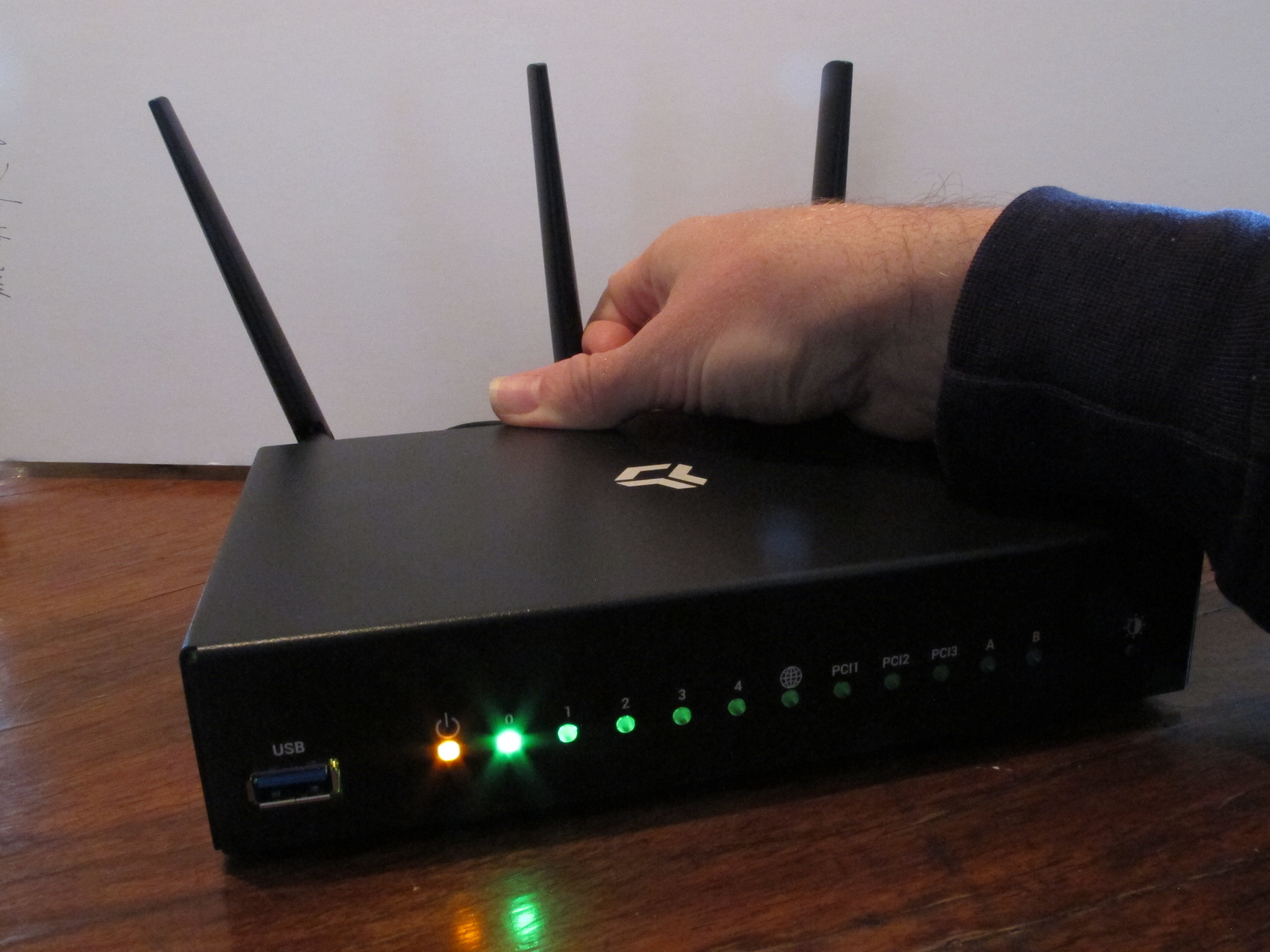
The Turris Omnia router is not the first FLOSS router out there, but it could well be one of the first open hardware routers to be available. As the crowdfunding campaign is coming to a close, it is worth reflecting on the place of the project in the ecosystem. Beyond that, I got my hardware recently, so I was able to give it a try.

A short introduction to the Omnia project The Turris Omnia Router The Omnia router is a followup project on CZ.NIC's original research project, the Turris. The goal of the project was to identify hostile traffic on end-user networks and develop global responses to those attacks across every monitored device. The Omnia is an extension of the original project: more features were added and data collection is now opt-in. Whereas the original Turris was simply a home router, the new Omnia router includes:
  • 1.6GHz ARM CPU
  • 1-2GB RAM
  • 8GB flash storage
  • 6 Gbit Ethernet ports
  • SFP fiber port
  • 2 Mini-PCI express ports
  • mSATA port
  • 3 MIMO 802.11ac and 2 MIMO 802.11bgn radios and antennas
  • SIM card support for backup connectivity
Some models sold had a larger case to accommodate extra hard drives, turning the Omnia router into a NAS device that could actually serve as a multi-purpose home server. Indeed, it is one of the objectives of the project to make "more than just a router". The NAS model is not currently on sale anymore, but there are plans to bring it back along with LTE modem options and new accessories "to expand Omnia towards home automation". Omnia runs a fork of the OpenWRT distribution called TurrisOS that has been customized to support automated live updates, a simpler web interface, and other extra features. The fork also has patches to the Linux kernel, which is based on Linux 4.4.13 (according to uname -a). It is unclear why those patches are necessary since the ARMv7 Armada 385 CPU has been supported in Linux since at least 4.2-rc1, but it is common for OpenWRT ports to ship patches to the kernel, either to backport missing functionality or perform some optimization. There has been some pressure from backers to petition Turris to "speedup the process of upstreaming Omnia support to OpenWrt". It could be that the team is too busy with delivering the devices already ordered to complete that process at this point. The software is available on the CZ-NIC GitHub repository and the actual Linux patches can be found here and here. CZ.NIC also operates a private GitLab instance where more software is available. There is technically no reason why you wouldn't be able to run your own distribution on the Omnia router: OpenWRT development snapshots should be able to run on the Omnia hardware and some people have installed Debian on Omnia. It may require some customization (e.g. the kernel) to make sure the Omnia hardware is correctly supported. Most people seem to prefer to run TurrisOS because of the extra features. The hardware itself is also free and open for the most part. There is a binary blob needed for the 5GHz wireless card, which seems to be the only proprietary component on the board. The schematics of the device are available through the Omnia wiki, but oddly not in the GitHub repository like the rest of the software.

Hands on I received my own router last week, which is about six months late from the original April 2016 delivery date; it allowed me to do some hands-on testing of the device. The first thing I noticed was a known problem with the antenna connectors: I had to open up the case to screw the fittings tight, otherwise the antennas wouldn't screw in correctly. Once that was done, I simply had to go through the usual process of setting up the router, which consisted of connecting the Omnia to my laptop with an Ethernet cable, connecting the Omnia to an uplink (I hooked it into my existing network), and go through a web wizard. I was pleasantly surprised with the interface: it was smooth and easy to use, but at the same time imposed good security practices on the user. Install wizard performing automatic updates For example, the wizard, once connected to the network, goes through a full system upgrade and will, by default, automatically upgrade itself (including reboots) when new updates become available. Users have to opt-in to the automatic updates, and can chose to automate only the downloading and installation of the updates without having the device reboot on its own. Reboots are also performed during user-specified time frames (by default, Omnia applies kernel updates during the night). I also liked the "skip" button that allowed me to completely bypass the wizard and configure the device myself, through the regular OpenWRT systems (like LuCI or SSH) if I needed to. The Omnia router about to rollback to latest snapshot Notwithstanding the antenna connectors themselves, the hardware is nice. I ordered the black metal case, and I must admit I love the many LED lights in the front. It is especially useful to have color changes in the reset procedure: no more guessing what state the device is in or if I pressed the reset button long enough. The LEDs can also be dimmed to reduce the glare that our electronic devices produce. All this comes at a price, however: at \$250 USD, it is a much higher price tag than common home routers, which typically go for around \$50. Furthermore, it may be difficult to actually get the device, because no orders are being accepted on the Indiegogo site after October 31. The Turris team doesn't actually want to deal with retail sales and has now delegated retail sales to other stores, which are currently limited to European deliveries.

A nice device to help fight off the IoT apocalypse It seems there isn't a week that goes by these days without a record-breaking distributed denial-of-service (DDoS) attack. Those attacks are more and more caused by home routers, webcams, and "Internet of Things" (IoT) devices. In that context, the Omnia sets a high bar for how devices should be built but also how they should be operated. Omnia routers are automatically upgraded on a nightly basis and, by default, do not provide telnet or SSH ports to run arbitrary code. There is the password-less wizard that starts up on install, but it forces the user to chose a password in order to complete the configuration. Both the hardware and software of the Omnia are free and open. The automatic update's EULA explicitly states that the software provided by CZ.NIC "will be released under a free software licence" (and it has been, as mentioned earlier). This makes the machine much easier to audit by someone looking for possible flaws, say for example a customs official looking to approve the import in the eventual case where IoT devices end up being regulated. But it also makes the device itself more secure. One of the problems with these kinds of devices is "bit rot": they have known vulnerabilities that are not fixed in a timely manner, if at all. While it would be trivial for an attacker to disable the Omnia's auto-update mechanisms, the point is not to counterattack, but to prevent attacks on known vulnerabilities. The CZ.NIC folks take it a step further and encourage users to actively participate in a monitoring effort to document such attacks. For example, the Omnia can run a honeypot to lure attackers into divulging their presence. The Omnia also runs an elaborate data collection program, where routers report malicious activity to a central server that collects information about traffic flows, blocked packets, bandwidth usage, and activity from a predefined list of malicious addresses. The exact data collected is specified in another EULA that is currently only available to users logged in at the Turris web site. That data can then be turned into tweaked firewall rules to protect the overall network, which the Turris project calls a distributed adaptive firewall. Users need to explicitly opt-in to the monitoring system by registering on a portal using their email address. Turris devices also feature the Majordomo software (not to be confused with the venerable mailing list software) that can also monitor devices in your home and identify hostile traffic, potentially leading users to take responsibility over the actions of their own devices. This, in turn, could lead users to trickle complaints back up to the manufacturers that could change their behavior. It turns out that some companies do care about their reputations and will issue recalls if their devices have significant enough issues. It remains to be seen how effective the latter approach will be, however. In the meantime, the Omnia seems to be an excellent all-around server and router for even the most demanding home or small-office environments that is a great example for future competitors.
Note: this article first appeared in the Linux Weekly News.

Keith Packard: AltOS-Lisp

A Tiny Lisp for AltOS I took a bit of a diversion over the last week or so when I wondered how small a lisp interpreter I could write, and whether I could fit that into one of the processors that AltOS runs on. It turns out, you can write a tiny lisp interpreter that fits in about 25kB of ram with a 3kB heap for dynamic data. I decided to target our ChaosKey boards; they're tiny, and I've got a lot of them. That processor offers 28kB of usable flash space (after the 4kB boot loader) and 6kB of ram with the processor running at a steaming 48MHz. I'm not at all sure this is useful, but I always enjoy doing language implementations, and this one presented some 'interesting' challenges: Iterative Compacting Allocator I'm betting someone has built one of these before, but I couldn't find one, so I wrote my own. The basic strategy is to walk the heap to find a subset of the active objects which are allocated sequentially in memory with only unused storage between them. These objects are then compacted in-place, and then the heap is walked again to update all references to the moved objects. Then, the process is restarted to find another subset and move them. By looking for these subsets starting at the bottom of the heap, and working upwards towards the top, the whole heap can be compacted into a contiguous chunk at the bottom of memory. Allocation involves moving a pointer along at the top of active memory; when it gets to the top of the heap, collect and see if there's space now. As always, the hardest part was to make sure all active memory was tied down. The second hardest part was to make sure that all active pointers were updated after any allocation, in case a collect moved the underlying object. That was just bookkeeping, but did consume much of the development time. One additional trick was to terminate the recursion during heap walking by flagging active cons cell locations in a global bitmap and then walking that separately, iterating until that bitmap is empty. Nested lambdas form another recursion which should probably get the same approach, but I haven't done that yet. An unexpected "benefit" of the tiny heap is that the collector gets called a lot, so any referencing bugs will have a good chance of being uncovered in even a short program execution. ROM-able Lisp Instead of implementing all of the language in C, I wanted to be able to implement various pieces in Lisp itself. Because of the complex nature of the evaluation process, adding things like 'let' or even 'defun' turn out to be dramatically simpler in Lisp. However, I didn't want to consume bunches of precious RAM to hold these basic functions. What I did was to create two heaps, one in ROM and the other in RAM. References are be tagged as to which heap they're in. 16-bit Values Lisp programs use a pile of references. Using a full 32 bits for each one would mean having a lot less effective storage. So, instead, I use an offset from the base of the heap. The top bit of the offset is used to distinguish between the ROM heap and the RAM heap. I needed a place to store type information, so I settled on using the bottom two bits of the references. This allows for four direct type values. One of these values is used to indicate an indirect type, where the type is stored in the first byte of the object. The direct types are:
ValueType
0Cons cell
114-bit int
2String
3Other
With 2 tag bits, the allocator needs to work in 32-bit units as the references couldn't point to individual bytes. Finally, I wanted 0 to be nil, so I add four to the offsets within the heaps. The result is that the ROM and RAM heaps can each cover up to 32k - 4 bytes. Note that ints are not stored in the heap; instead they are immediate values stored in 14 bits, providing a range of -8192 to 8191. One can imagine wanting more range in ints at some point. Heap-based Evaluator A simple lisp implementation uses the fact that eval is re-entrant and do the operation on the C stack:
val eval(val exprs)  
    val vals;
    while (exprs)  
        vals = append(vals, eval(car(exprs)));
        exprs = exprs->cdr;
     
    return execute (car(vals), cdr(vals));
 
This makes things really simple and provides for a clean framework for implementing various bits of lisp, including control flow and macros. However, it rapidly consumes all of the available memory for a stack, while also requiring separate bookkeeping for the in-use memory in each frame. I replaced this design with one which keeps the lisp stack on the heap, and then performs eval with a state machine with all state stored in global variables so that the memory manager can reference them directly. Each eval operation is performed in a separate 'stack' context, which holds the entire eval state except for the current value, which lives in a separate global variable and is used to pass values out of one stack frame and into another. When the last stack context is finished, the evaluation terminates and the value is returned to the caller. There are nine states in the state machine, each of which is implemented in a separate function, making the state machine a simple matter of pulling the current state from the top of the stack and invoking the associated function:
while (ao_lisp_stack)  
    if (!(*evals[ao_lisp_stack->state])()   ao_lisp_exception)  
        ao_lisp_stack_clear();
        return AO_LISP_NIL;
     
 
return ao_lisp_v;
Because there's no C recursion involved, catching exceptions is a simple matter of one test at this level. Primitives like progn, while, cond and eval all take special magic in the state machine to handle; getting all of that working took several attempts before I found the simple loop shown above. Lexical Scoping The last time I did a lisp interpreter, I implemented dynamic scoping. Atoms were all global and had values associated directly with them. Evaluating a lambda started by saving all of the existing global values for the parameter atoms and then binding the new values. When finished, the previous values would be restored. This is almost correct, but provides surprising results for things like:
> (setq baz 1)
> (def foo (lambda (bar) (+ baz bar)))
> (def bletch (lambda (baz) (foo baz)))
> (bletch 2)
4
The value that foo gets for 'baz' is 2 instead of 1 under dynamic scoping, which most people find surprising. This time, I was determined to use lexical scoping, and it turned out to be surprisingly easy. The first trick was to separate the atoms from their 'value'; each atom can have a different value in different lexical scopes. So, each lexical scope gets a 'frame' object, those contain the value for each atom defined in that scope. There's a global scope which holds all of the globally defined values (like baz, foo and bletch above). Each frame points to its enclosing scope, so you can search upwards to find the right value. The second trick was to realize that the lexical scope of a lambda is the scope in which the lambda itself is evaluated, and that the evaluation of a lambda expression results in a 'function' object, which contains the lambda and its enclosing scope:
> (def foo (lambda (bar bletch)
       ((lambda (baz)
          (+ baz bar))
        bletch)))
> (foo 2 3)
5
In this case, the inner lambda in foo can 'see' the value of bar from the enclosing lambda. More subtly, even if the inner lambda were executed multiple times, it would see the same baz, and could even change it. This can be used to implement all kinds of craziness, including generators:
> (defun make-inc (add)
  ((lambda (base)
     (lambda ()
       (progn
     (setq base (+ base add))
     base)))
   0)
  )
> (setq plus2 (make-inc 2))
> (plus2)
2
> (plus2)
4
The current implementation of each frame is a simple array of atom/value pairs, with a reference to the parent frame to form the full scope. There are dramatically faster implementations of this same concept, but the goal here was small and simple. A Tiny Allocator Optimization With eval consuming heap space for stacks, frames and argument lists, the interpreter was spending a lot of time in the collector. As a simple optimization, I added some free lists for stack frames and cons cells. Stack frames are never referenced when they're finished, so they can always go on the free list. Cons cells used to construct argument lists for functions are usually free. Builtin functions have a bit which indicates whether they might hold on to a reference to the argument list. Interpreted lambdas can't get the list while nlambdas, lexprs and macros do. Each lambda execution creates a new frame, and while it would be possible to discover if that frame 'escapes' the lambda, I decided to not attempt to cache free ones yet. Save and Restore To make the lisp interpreter more useful in tiny computers, I added the ability to save and restore the entire heap to flash. This requires leaving enough space in the flash to preserve the heap, further constraining the amount of flash available for the application. Code All of this code is in the 'lisp' branch of my AltOS repository: AltOS The lisp interpreter is independent from the rest of AltOS and could be re-purposed for another embedded operating system. It runs fine on ChaosKey hardware, and also on the STM32F042 Nucleo-32 board There's also a test framework which runs on Linux, and is how I developed almost all of the code. That's in the src/test directory in the above repository, and is called 'ao_lisp_test'. Towers of Hanoi Here's an implementation of the classic recursive Towers of Hanoi game; it shows most of the current features of the language.
;
; Towers of Hanoi
;
; Copyright   2016 Keith Packard <keithp@keithp.com>
;
; This program is free software; you can redistribute it and/or modify
; it under the terms of the GNU General Public License as published by
; the Free Software Foundation, either version 2 of the License, or
; (at your option) any later version.
;
; This program is distributed in the hope that it will be useful, but
; WITHOUT ANY WARRANTY; without even the implied warranty of
; MERCHANTABILITY or FITNESS FOR A PARTICULAR PURPOSE.  See the GNU
; General Public License for more details.
;
; ANSI control sequences
(defun move-to (col row)
  (patom "\033[" row ";" col "H" nil)
  )
(defun clear ()
  (patom "\033[2J" nil)
  )
(defun display-string (x y str)
  (move-to x y)
  (patom str)
  )
; Here's the pieces to display
(setq stack '("*" "**" "***" "****" "*****" "******" "*******"))
(setq top (+ (length stack) 3))
;
; Here's all of the stacks of pieces
; This is generated when the program is run
;
(setq stacks nil)
; Display one stack, clearing any
; space above it
(defun display-stack (x y clear stack)
  (cond ((= 0 clear)
     (cond (stack (progn
            (display-string x y (car stack))
            (display-stack x (1+ y) 0 (cdr stack))
            )
              )
           )
     )
    (t (progn
         (display-string x y "          ")
         (display-stack x (1+ y) (1- clear) stack)
         )
       )
    )
  )
; This should probably be included in the rom image...
(defun length (list)
  (cond (list (1+ (length (cdr list))))
    (0)
    )
  )
; Position of the top of the stack on the screen
; Shorter stacks start further down the screen
(defun stack-pos (y stack)
  (- y (length stack))
  )
; Display all of the stacks, spaced 20 columns apart
(defun display-stacks (x y stacks)
  (cond (stacks (progn
          (display-stack x 0 (stack-pos y (car stacks)) (car stacks))
          (display-stacks (+ x 20) y (cdr stacks)))
        )
    )
  )
; Display all of the stacks, then move the cursor
; out of the way and flush the output
(defun display ()
  (display-stacks 0 top stacks)
  (move-to 1 21)
  (flush)
  )
; Reset stacks to the starting state, with
; all of the pieces in the first stack and the
; other two empty
(defun reset-stacks ()
  (setq stacks (list stack nil nil))
  (length stack)
  )
; more functions which could usefully
; be in the rom image
(defun min (a b)
  (cond ((< a b) a)
    (b)
    )
  )
(defun nth (list n)
  (cond ((= n 0) (car list))
    ((nth (cdr list) (1- n)))
    )
  )
; Replace a stack in the list of stacks
; with a new value
(defun replace (list pos member)
  (cond ((= pos 0) (cons member (cdr list)))
    ((cons (car list) (replace (cdr list) (1- pos) member)))
    )
  )
; Move a piece from the top of one stack
; to the top of another
(defun move-piece (from to)
  (let ((from-stack (nth stacks from))
    (to-stack (nth stacks to))
    (piece (car from-stack)))
    (setq from-stack (cdr from-stack))
    (setq to-stack (cons piece to-stack))
    (setq stacks (replace stacks from from-stack))
    (setq stacks (replace stacks to to-stack))
    (display)
    (delay 100)
    )
  )
; The implementation of the game
(defun _hanoi (n from to use)
  (cond ((= 1 n)
     (progn
      (move-piece from to)
      nil)
     )
    (t
     (progn
      (_hanoi (1- n) from use to)
      (_hanoi 1 from to use)
      (_hanoi (1- n) use to from)
      )
     )
    )
  )
; A pretty interface which
; resets the state of the game,
; clears the screen and runs
; the program
(defun hanoi ()
  (setq len (reset-stacks))
  (clear)
  (_hanoi len 0 1 2)
  )

13 November 2016

Thorsten Glaser: I don t like computers

cnuke@ spotted something on the internet, and shared. Do read this, including the comments. It s so true. (My car is 30 years old, I use computers mostly for sirc, lynx and ssh, and I especially do not buy any product that needs to be online to work.) Nice parts of the internet, to offset this, though, do exist. IRC as a way of cheap (affordable), mostly reliant, communication that s easy enough to do with TELNET.EXE if necessary. Fanfiction; easy proliferation of people s art (literature, in this case). Fast access to documentation and source code; OpenBSD s AnonCVS was a first, nowadays almost everything (not Tom Dickey s projects (lynx, ncurses, xterm, cdk, ), nor GNU bash, though) is on a public version control system repository. (Now people need to learn to not rewrite history, just commit whatever shit they do, to record thought process, not produce the perfect-looking patch.) Livestreams too, I guess, but ever since live365.com went dead due to a USA law change on 2016-01-02, it got bad.

Next.

Previous.