Search Results: "bab"

7 September 2013

Wouter Verhelst: Debconf Mechelen: first meeting (service announcement)

To all who might be interested: The first meeting for organizing Debconf in Mechelen will happen next sunday, at 3:00 PM, in the NixSys offices in the Battelsesteenweg 455e in Mechelen, Belgium. It looks like some of those who were interested might not be able to make it at that that time. If you're one of them, and you would like your availability to be considered for the next meeting, please send me an email with your preferences (that meeting should probably happen in about a month or so). (First point on the agenda: set up a mailinglist, to make this sort of communication somewhat easier ;-)

6 September 2013

Steve Kemp: Dynamically discovering settings for a cluster?

Pretend I run a cluster, for hosting a site. Pretend that I have three-six web-nodes, and each one needs to know which database host to contact. How do I control that? Right now I have a /etc/settings.conf file, more or less, deployed by Slaughter. That works. Another common pattern is to use a hostname - for example pmaster.example.org. However failover isn't considered here. If I wanted to update to point to a secondary database I'd need to either: In short I'm imagining there are several situations where you want to abstract away the configuration in a cluster-wide manner. (A real solution is obviously floating per-service IPs. Via HAProxy, Keepalived, ucarp, etc. People do that quite often for database specifically, but not for redis-servers, etc.) So I'm pondering what is essentially a multi-cast accessible key-value storage system. Have a deamon on the VLAN which will respond to multicast questions like "get db", or "get cache", with a hostname/IP/result. Suddenly your code would read: To me that seems like it should be genuinely useful. But I'm unsure if I'm trading one set of problems for another. I can't find any examples of existing tools/deamons in this area, which either means I'm being novel, innovate, and interesting. Or I'm over thinking...

5 September 2013

Daniel Pocock: Will Baby Boomers strangle Australia's Internet?

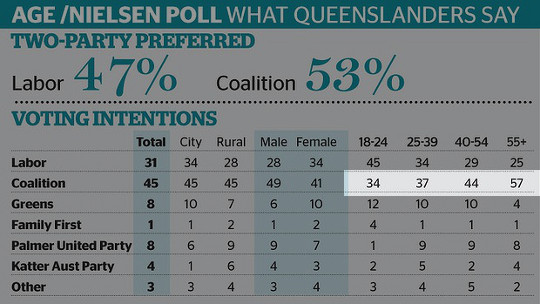
When Labor's Communications Minister Stephen Conroy won the title Internet villain of the year most educated people realised it wasn't something to celebrate. So it might be surprising for some that the title could potentially be returning to Australia so soon... Australia's main opposition party, the deceptively named Liberals (who actually lurk at the Marine Le Pen grade of conservatism) have just announced plans to resurrect the plan by implanting filtering technology in all modems, routers and smartphones. Whether they do or don't, there are serious concerns that they have described Australia's still-under-construction national broadband network as a wasteful project (which is potentially true) but failed to provide any credible alternative: who really thinks the conservative's proposed 25MBps will be a serious technology when they finish deploying it in 2019?. It is interesting to look at the bigger picture to see where this stupidity comes from. A political poll released early this week gives us half the story: Big bad baby boomers It is obvious that older voters prefer the conservative "coalition" parties, 57% of over-55s in particular. It is a huge jump from the 44% of voters in the age group below them. What this table doesn't tell us is that Australia's population is top-heavy with Baby Boomers. In other words, there are actually quite a lot of those over-55-year-old voters. In fact, it is estimated that close to 1 in 3 Australians will be in this category within the next 10 years. People who want the world to be the way it was in the 60s: many have already paid off a mortgage on a home in the suburbs with no access to things like public transport. They grew up under the white Australia policy and are frustrated at the presence of educated hard working foreigners from countries like India and China. Retired, no longer working, expecting the state to provide roads to their poorly located McMansions and free health care but little concern for broadband or anything that smells new. As they are no longer working, many have no commercial demand for broadband but will happily vote for a policy to censor it even if they don't use it themselves, simply because they want to see a Government that is blocking change. Sadly, they are shooting themselves in the foot: younger generations of Australians need to work and pay tax if there is to be any hope of keeping the dream alive for older Australians. However, with the conservatives cutting education to fund an over-dramatised response to immigration that costs billions of dollars every year, cutting corners and dumbing-down essential technology like the Internet, it seems that working-age Australians will struggle to compete in the global marketplace.

4 September 2013

Raphael Geissert: A bashism a week: tilde expansion

Did you know that you can get a user's home directory with the "~username" tilde expansion? You probably do, but how about other tilde expansions?

Thanks to a few bashisms you can make your script even more difficult to read by using "~+" to get $PWD, and "~-" to get $OLDPWD.

Are you using bash and want to access the directories stack created when using the pushd and popd bashisms? The ~i (where i is an integer) expansion can give you that. It gives you forward (~+i) and backward (~-i) access to the directories stack.

But beware, if the directories stack is smaller than the number you used, there won't be any expansion.

When using tildes in shell scripts, make sure you quote to avoid unwanted expansions. Note that the posh shell in wheezy and older do support those non-POSIX expansions.

in the first examples the tilde is quoted for easier reading; the expansion doesn't occur if the tilde is quoted.

3 September 2013

Chris Lamb: Using the Garmin 910XT on Linux

The Garmin 910XT is the premier GPS watch for triathlon training and racing.
  1. You'll probably need a newer version of pyusb:

    $ git clone git://github.com/walac/pyusb
    
    There is no need to install it systemwide - you can simply leave it checked out somewhere.
  2. Get the Garmin-Forerunner-610-Extractor project from GitHub:

    $ git clone git://github.com/Tigge/Garmin-Forerunner-610-Extractor.git
    
  3. Turn your watch on and plug in the USB adaptor.

  4. You can now sync your activities:

    $ sudo env PYTHONPATH=/path/to/pyusb ./garmin.py
    Request basic information...
      ANT version:   AJK1.04RAF
      Capabilities:  array('B', [8, 3, 0, 186, 54, 0])
      Serial number: 3480039
    Starting system...
    Searching...
    Authenticating with Forerunner 910XT (3863343203)
     - Passkey: OK
    Downloading 1 file(s)
    Downloading 2013-09-03_21-09-32-80-19364.fit [..........]
    
    The first time you sync, you will have to authenticate on the watch itself. Downloading the activities will be much slower than you expect.
  5. After the syncing has finished, don't forget to turn the watch off. If you are used to the Garmin Edge 800 (which turns itself off when you insert the USB cable) you will probably not have the habit of turning off the unit.

  6. Rather confusingly, your .FIT files are available in the Xdg configuration folder. For example:

    ls -l ~/.config/garmin-extractor/3863343203/activities/
    -rw-r--r-- 1 root root   2688 Jun  9 15:23 2013-06-08_12-33-24-80-2688.fit
    -rw-r--r-- 1 root root   1171 Jun  9 15:23 2013-06-08_12-37-14-80-1171.fit
    -rw-r--r-- 1 root root   6111 Jun  9 15:23 2013-06-08_22-19-28-80-6111.fit
    -rw-r--r-- 1 root root 170327 Jun  9 15:26 2013-06-09_11-09-44-80-170327.fit
    
  7. Strava supports these .fit files through the From File upload option.

Joachim Breitner: Bachelor Thesis on Monads for Uncertainty

A work-related blog post for a change, but still about Haskell. My student Alexander Kuhnle has submitted his bachelor thesis Modeling Uncertain Data using Monads and an Application to the Sequence Alignment Problem today, in which he explores way to generalize algorithms from bio informatics (in particular suffix tree) to work on data with uncertainties of various kinds (indeterminism, probabilities etc.). He utilizes monads and variations thereof to make the code polymorphic in the particular kind of uncertainty. If this sounds interesting to you, have a look, and feel free to share your optinion with us.

2 September 2013

Daniel Pocock: Australia's Labor Party exposed spying on their own members

Australia's Labor Party claims to represent the little guy, advocating the interests of a wide slice of the population over the interests of those who might supposedly exploit them. In this latest blog I'll look at just how the Victorian state branch of the party is emulating the more sinister elements of monitoring and control that you would typically expect from marketers, spammers and the NSA. It makes you wonder, if they do this to their own members, how can Australia's government ever hope to rein in spammers or other undesirable practices? Europe has tried cookie laws and the right to be forgotten, while the ALP has taken these developments almost as a guide to exploiting their own most valuable resource, their membership. The email version of invisible ink Straight out of an email attempting to recruit party members to the federal election campaign, we find that the ALP's logo itself has been turned into a sinister tracking mechanism. Looking underneath the logo, there is a hidden tracking number attached to every message:
http://gallery.mailchimp.com/3021e68df9a7200135725c633/images/Email_Header_ThisisLabor.jpg
There it is, that big long code 3021e68df9a7200135725c633. On it's own, you may think this number can't do much harm. Think again. After all, as the filename says, "ThisisLabor". Reaching the grass roots by long distance email When a party member sees any of the images in the email or clicks any of the links, their email software or web browser sends a HTTP request to the ALP's outsourced tracking server in the United States. Here is an example of what that request may contain:
TCP Headers:
  SOURCE IP ADDRESS: 198.51.100.56
HTTP headers:
  GET /3021e68df9a7200135725c633/images/Email_Header_ThisisLabor.jpg
  HTTP/1.1
  Host: gallery.mailchimp.com
  User-Agent: Mozilla/5.0 (X11; Linux x86_64; rv:17.0) Gecko/20130515 Firefox/17.0 Iceweasel/17.0.6
  Accept: text/html,application/xhtml+xml,application/xml;q=0.9,*/*;q=0.8
  Accept-Language: en-US,en;q=0.5
  Accept-Encoding: gzip, deflate
  X-Forwarded-For: 192.168.1.54
  Connection: keep-alive
These codes are all transmitted from the recipient of the email back to the ALP. Notice the tracking number is in the very first line of the HTTP request? These codes send many details to the tracking server. Just what is revealed?
  • What time the message was read
  • How many times the message was opened
  • Whether the message was read on multiple computers (perhaps it was forwarded)
  • The IP addresses reveal which network was used.
    • For people reading email at work or on wifi, the IP address reveals the name of the employer, it can be easily looked up in this public database. Here is an example querying one of the ALPs own IP addresses, 203.24.72.2
    • For people using an internet connection at home, the IP address reveals the service provider. There is more to it though: if one party member regularly visits another party member and uses their wifi, they will both appear to be using the same IP address and the party will be able to deduce that there is a connection between these two people.
  • The web browser name and version and the operating system name and version.
  • The language normally used on the computer
Crunching the numbers You may think that nobody would be interested in all that data or that it is even too much data for anybody to easily study. Think again. The ALP has outsourced processing of this data to an offshore firm that specializes in bulk email, MailChimp. After lecturing everybody about the dangers of outsourcing, the ALP has literally sold the farm (their own membership data) - to a foreign marketing company. Here are some of the claims MailChimp make on their web site:
"Dig even deeper with Subscriber Activity Reports, which give you a real time report for every subscriber s email activities: when they opened, what they clicked, and when they came back for more. You can even generate a list of people who didn t open, and send them a modified campaign."
That's right: if ALP members don't read their emails fast enough, they will send even more of them. Just who has access to this data? Well, the scope is quite broad. According to these rules, it is not only the dubious officials in the party's state office, but Labor Party regulations also list a whole lot of other officials who have access to some subset of the data: branch and FEA district committees, policy committees and maybe some trade union officials too. Once you start to contemplate this, it becomes apparent that the probability of somebody profiling members at an individual level is very real. On the other hand, those rules clearly do not permit the state branch to process the member's data offshore. Double whammy In fact, even MailChimp is further outsourcing the data. When receiving an image from the booby-trapped link in the email, we receive a response like this:
HTTP/1.1 200 OK
Content-Type: image/jpeg
Content-Length: 407474
Connection: keep-alive
Date: Wed, 10 Jul 2013 06:25:55 GMT
Last-Modified: Tue,  03 Sep 2013 04:05:37 GMT
ETag: "df9a7200135725c6331369a22"
Accept-Ranges: bytes
Server: AmazonS3
Age: 62097
Via: 1.0 e71fe855f29513f54a41e213fe653fb1.cloudfront.net (CloudFront)
X-Cache: Hit from cloudfront
X-Amz-Cf-Id: S2V2aW4gUnVkZCBpcyBhIGJhZCBib3kuCg==
which contains more tracking numbers and clearly indicates that the data is being processed in the massive AmazonS3 (a.k.a Amazon online bookstore) cloud platform. Thanks to cloud computing, there is considerable scope for cross-referencing records across other web sites. The IP address becomes a magic key, allowing a range of sinister forces to join the dots at the click of a button and profile the whole private and professional identity of any individual ALP member. Googling ALP members It doesn't stop there however, after following these links a victim will eventually end up on one of the ALP's own web pages. Looking through the HTML code underneath http://www.viclabor.com.au is very easy, in most web browsers, you can just press Control-U to see what is hidden away in the shadows. Buried in the code, I found this little gem:
  var _gaq = _gaq   [];
  _gaq.push(['_setAccount', 'UA-35325645-1']);
  _gaq.push(['_trackPageview']);
  (function()  
    var ga = document.createElement('script'); ga.type = 'text/javascript'; ga.async = true;
    ga.src = ('https:' == document.location.protocol ? 'https://ssl' : 'http://www') + '.google-analytics.com/ga.js';
    var s = document.getElementsByTagName('script')[0]; s.parentNode.insertBefore(ga, s);
   )();
This may be even scarier: it's a JavaScript code that channels all access to the ALP web site into an outsourced tracking system provided by Google. Google can now cross-reference ALP members against their Gmail accounts, their friends and the topics they search for to further profile the type of advertising they should be exposed to. Google, like any private company, has a loyalty to its shareholders and the laws of the country where it is domiciled. Will that coincide with the best interests of ALP members in Victoria? Australia's other parties: samples needed Do you have similar communications from Australia's other political parties? Please send them to me and I'll be happy to examine them for similar shortcomings.

1 September 2013

Eddy Petrișor: Integrating Beyond Compare with Semanticmerge

Note: This post will probably not be on the liking of those who think free software is always preferable to closed source software, so if you are such a person, please take this article as an invitation to implement better open source alternatives that can realistically compete with the closed source applications I am mentioning here. I am not going to mention here where the open source alternatives are not up to the same level as the commercial tools, I'll leave that for the readers or for another article.


Semanticmerge is a merge tool that attempts to do the right thing when it comes to merging source code. It is language aware and it currently supports Java and C#. Just today the creators of the software have started working on the support for C.

Recently they added Debian packages, so I installed it on my system. For open source development Codice Software, the creators of Semanticmerge, offers free licenses, so I decided to ask for one today, and, although is Sunday, I received an answer and I will get my license on Monday.

When a method is moved from one place to another and changed in a conflicting way in two parallel development lines, Semanticmerge can isolate the offending method and can pass all its incarnations (base, source and destination or, if you prefer, base, mine and theirs) to a text based merge tool to allow the developer to decide how to resolve the merge. On Linux, the Semanticmerge samples are using kdiff3 as the text-based merge tool, which is nice, but I don't use kdiff3, I use Meld, another open source visual tool for merges and comparisons.


OTOH, Beyond Compare is a merge and compare tool made by Scooter Software which provides a very good text based 3-way merge with a 3 sources + 1 result pane, and can compare both files and directories. Two of its killer features is having the ability split differences into important and non-important ones according to the syntax of the compared/merged files, and the ability to easily change or add to the syntax rules in a very user-friendly way. This allows to easily ignore changes in comments, but also basic refactoring such as variable renaming, or other trivial code-wide changes, which allows the developer to focus on the important changes/differences during merges or code reviews.

Syntax support for usual file formats like C, Java, shell, Perl etc. is built in (but can be modified, which is a good thing) and new file types with their syntaxes can be added via the GUI from scratch or based on existing rules.

I evaluated Beyond Compare at my workplace and we decided it would be a good investment to purchases licenses for it for the people in our department.


Having these two software separate is good, but having them integrated with each other would be even better. So I decided I would try to see how it can be done. I installed Beyond compare on my system, too and looked through the examples


The first thing I discovered is that the main assumption of Semanticmerge developers was that the application would be called via the SCM when merges are to be done, so passing lots of parameters would not be problem. I realised that when I saw how one of the samples' starting script invoked semantic merge:
semanticmergetool -s=$sm_dir/src.java -b=$sm_dir/base.java -d=$sm_dir/dst.java -r=/tmp/semanticmergetoolresult.java -edt="kdiff3 \"#sourcefile\" \"#destinationfile\"" -emt="kdiff3 \"#basefile\" \"#sourcefile\" \"#destinationfile\" --L1 \"#basesymbolic\" --L2 \"#sourcesymbolic\" --L3 \"#destinationsymbolic\" -o \"#output\"" -e2mt="kdiff3 \"#sourcefile\" \"#destinationfile\" -o \"#output\""
Can you see the problem? It seems Semanticmerge has no persistent knowledge of the user preferences with regards to the text-based merge tool and exports the issue to the SCM, at the price of overcomplicating the command line. I already mentioned this issue in my license request mail and added the issue and my fix suggestion in their voting system of features to be implemented.

The upside was that by comparing the command line for kdiff3 invocations, the kdiff3 documentation and, by comparison, the Beyond Compare SCM integration information, I could deduce what is the command line necessary for Semanticmerge to use Beyond Compare as an external merge and diff tool.

The -edt, -emt and -e2mt options are the ones which specify how the external diff tool, external 3-way merge tool and external 2-way merge tool is to be called. Once I understood that, I split the problem in its obvious parts, each invocation had to be mapped, from kdiff3 options to beyond compare options, adding the occasional bell and whistle, if possible.

The parts to figure out, ordered by compexity, were:

  1. -edt="kdiff3 \"#sourcefile\" \"#destinationfile\"

  2. -e2mt="kdiff3 \"#sourcefile\" \"#destinationfile\" -o \"#output\""

  3. -emt="kdiff3 \"#basefile\" \"#sourcefile\" \"#destinationfile\" --L1 \"#basesymbolic\" --L2 \"#sourcesymbolic\" --L3 \"#destinationsymbolic\" -o \"#output\""

Semantic merge integrates with kdiff3 in diff mode via the -edt option. This was easy to map to Beyond Compare, I just replaced kdiff3 with bcompare:
-edt="bcompare \"#sourcefile\" \"#destinationfile\""
Integration for 2-way merges was also quite easy, the mapping to Beyond Compare was:
-e2mt="bcompare \"#sourcefile\" \"#destinationfile\" -savetarget=\"#output\""
For the 3-way merge I was a little confused because the Beyond Compare documentation and options were inconsistent between Windows and Linux. On Windows, for some of the SCMs, the options that set the titles for the panes are '/title1', '/title2', '/title3' and '/title4' (way too descriptive for my taste /sarcasm), but for some others are '/lefttitle', '/centertitle', '/righttitle', '/outputtitle', while on Linux the options are the more explicit kind, but with a '-' instead of a '/'.

The basic things were easy, ordering the parameters in the 'source, destination, base, output' instead of kdiff3's 'base, source, destination, -o ouptut', so I wanted to add the bells and whistles, since it really makes more sense for the developer to see something like 'Destination: [method] readOptions' instead of '/tmp/tmp4327687242.tmp', and because that's exactly what is necessary for Semanticmerge when merging methods, since on conflicts the various versions of the functions are placed in temporary files which don't mean anything.

So, after some digging into the examples from Beyond Compare and kdiff3 documentation, I ended up with:
-emt="bcompare \"#sourcefile\" \"#destinationfile\" \"#basefile\" \"#output\" -lefttitle='#sourcesymbolic' -righttitle='#destinationsymbolic' -centertitle='#basesymbolic' -outputtitle='merge result'"

Sadly, I wasn't able to identify the symbolic name for the output, so I added the hard coded 'merge result'. If Codice people would like to help with with this information (or if it exists), I would be more than willing to do update the information and do the necessary changes.

Then I added the bells and whistles for the -edt and -e2mt options, so I ended up with an even more complicated command line. The end result was this monstrosity:
semanticmergetool -s=$sm_dir/src.java -b=$sm_dir/base.java -d=$sm_dir/dst.java -r=/tmp/semanticmergetoolresult.java -edt="bcompare \"#sourcefile\" \"#destinationfile\" -lefttitle='#sourcesymbolic' -righttitle='#destinationsymbolic'" -emt="bcompare \"#sourcefile\" \"#destinationfile\" \"#basefile\" \"#output\" -lefttitle='#sourcesymbolic' -righttitle='#destinationsymbolic' -centertitle='#basesymbolic' -outputtitle='merge result'" -e2mt="bcompare \"#sourcefile\" \"#destinationfile\" -savetarget=\"#output\" -lefttitle='#sourcesymbolic' -righttitle='#destinationsymbolic'"
So when I 3-way merge a function I get something like this (sorry for high resolution, lower resolutions don't do justice to the tools):


I don't expect this post to remain relevant for too much time, because after sending my feedback to Codice, they were open to my suggestion to have persistent settings for the external tool integration, so, in the future, the command line could probably be as simple as:
semanticmergetool -s=$sm_dir/src.java -b=$sm_dir/base.java -d=$sm_dir/dst.java -r=/tmp/semanticmergetoolresult.java
And the integration could be done via the GUI, while the command line can become a way to override the defaults.

Russ Allbery: Review: An Artificial Night

Review: An Artificial Night, by Seanan McGuire
Series: October Daye #3
Publisher: DAW
Copyright: September 2010
ISBN: 1-101-44276-X
Format: Kindle
Pages: 368
This is the third book of the October Daye series, following A Local Habitation. It could be read out of order, as each chapter of Toby's story so far is somewhat standalone, but I wouldn't recommend it. You'd miss the character development and the background behind several friendships. As with the previous book review, a caveat: I am reviewing this book four months after finishing it, rather than the normal couple of weeks, so apologies in advance for any thinness or inaccuracies. The first sign that something is about to go seriously wrong in Toby's life this time is a visitor. She says her name is May Daye, and apparently she's Toby's Fetch: a duplicate in nearly every respect except personality, manifested to guide someone to their death. Their imminent death. The second sign is that her best friend's children are kidnapped. The children who treat her like an aunt. And the cause of that kidnapping is far, far beyond the level of power that Toby could be expected to deal with. I have profound mixed feelings about this book. On one hand, McGuire further expands Toby's web of connections and shows us more of Toby's friends and their background, and that's becoming my favorite part of this series. She introduces May, who I think is a great character: at first apparently much different than Toby, but with a similarity beneath surface impressions that one notices more over time. And I thought the climax of the story, once we finally got there, was very moving and well-done. Also, I just love the way that McGuire uses children's rhymes and doggerel throughout this series as a magical element, and that's particularly well-handled here. Due to the nature of the antagonist, McGuire has a good excuse to bring that front and center, and the process of familiar rhymes expanding into deep magical rules was a fun intellectual experience. Best of all, the Luidaeg plays a significant role in the story again. The Luidaeg is, hands down, my favorite character in McGuire's constructed universe, and she becomes even more so over the course of this story. Her complex relationship with Toby is clearly blossoming into a friendship that's surprising both of them deeply, but a friendship that has to play by an odd set of rules (like so much else in Toby's life). I loved her here. Seeing someone that difficult and abrupt show unexpected emotional depths is one of the story elements I enjoy the most. The problem, though, is that quite a lot of An Artificial Night is very, very dark. And by that, I don't mean that there is a lot of tension, or that Toby is struggling against monsterous things, although both of those statements are also true. Rather, Toby is not only out of her league but ends up in some viciously nasty situations, and they persist for rather more of this book than I would have preferred. Putting one's protagonist through hell has a long tradition in urban fantasy, but I found the level of sheer helplessness that Toby struggled through to be a bit more than I wanted to read about. It was too reminiscent of events from Toby's background (as discussed in Rosemary and Rue) that I still don't like to think about. There is, of course, an eventual payoff, as dark as the interim events seem. One knows that, given the genre and given that this is an ongoing series, and even just given the nature of stories. But as much as I like the growing cast of this series, and adored the scenes with the Luidaeg, I found parts of this journey to be deeply disturbing, and not in an enjoyable dramatic tension sort of way. I don't mind protagonists being seriously hurt (although it's not my favorite plot), or even some amount of despair, but this went beyond that. I think McGuire was going for a story about sacrifice and self-definition, about trying even when one can't possibly win, and I can appreciate the narrative arc. But parts of the book were simply awful to read for me. I'm therefore not quite sure what to say in terms of a recommendation. I'm still reading the series, and will definitely read the next book. I think my reaction is somewhat idiosyncratic; the events here will probably not bother others as much as they bothered me. And I can't disagree with their dramatic effectiveness, or with the way that McGuire builds conflict out of the rules of fairy and is building Toby into a stronger and more capable person than she ever thought she could be. But there were still spots where I wished I were reading a different book. Hopefully the next book in the series will be that book I wanted to read. Followed by Late Eclipses. Rating: 6 out of 10

30 August 2013

Daniel Pocock: Big decision?

Most people have probably heard that elections are on in Australia. I just received my postal ballot paper the other day and in the spirit of transparency, I'm sharing it here on my blog. Spoilt for choice There are two ballots, one for the Lower House and the other for the Senate. The big one is for the Senate. Our cat is on top of it to help give some perspective on how big it is. Like the columns on a bloated spreadsheet, the parties are designated with symbols from A to AM and then there are some leftover candidates too. Animal instincts With so many candidates to choose from, even our kitty may have found an opportunity in the Animal Justice Party - although that little snack in her claws suggests that she is more interested in the law of the jungle than any political debate. She may want to be wary not to fall under the wheel of the party next to them, Motoring Enthusiasts. The Senate, a place for convicted hackers? The next party in the picture is Wikileaks and their number one candidate, of course, is the first person to successfully claim asylum from Australia, Julian Assange. It's no secret that he has a string of convictions for computer hacking in the 90s and that when US authorities catch up with him, their drone won't just be dropping him a letter demanding a $2,100 penalty fine through the window. So how do they compare? As I contemplate my decision, lets look at the numbers:
Party Seats won in 2010
House of Reps, Senate
Criminal charges against members in last 3 years
Labor Party 72, 31 173, mainly fraud
Liberal/National coalition (conservative) 73, 34 3, including shoplifting and assault
Wikileaks 0 None - Assange is not actually charged with any crime
All of a sudden, in a country that is often the butt of British jokes about convicts, Assange starts to look squeaky clean. He may take further comfort from knowing that out of all those crimes, hacking is the only one that appears to have the presidential seal of approval. Conclusion Whichever way I vote may or may not make so much difference. With so many candidates to choose from though, there is little sign of any quality leadership from any corner of Australian politics. Whether Mr Assange is elected or not, many people will have a chuckle when they realise he almost ended up alongside the Australian Sex Party out of 38 other possible parties randomly distributed across the ballot. Please feel free to comment: which party is the most ridiculous?

Joey Hess: best DebConf ever

For me, DebConf13 in Switzerland was a perfect DebConf, and generally an great developer meeting and conference. I've attended several past DebConfs in Canada, Norway, Brazil, Finland, Mexico, Scotland, Spain, NYC, Bosnia, and Nicaragua. I have special memories of each. DebConf13 was ideal in every way. Let's start with the camping. Only a minority of us did it, and my campsite was located in a small field behind a bar that was often noisy late into the night, when I was trying to rest and preserve my European jetlag remedy of inverted sleeping schedule. Still, I love sleeping cocooned in a tent, and going through the routines of camping and spending time alone there was a good counterpoint to DebConf. I generally find myself retreating for a day or two in the middle of a week-long conference, burnt out with social interactions. That didn't happen this time. I need to find way to camp at future DebConfs. (Also special shout out to wonderful people who lent me a warmer sleeping bag, and bought me a pillow while on a trip to town! Upgraded my first backpacking in Europe experience's comfort level a lot!) The next perfect thing for me were the talks I gave at DebConf. I always enjoy presenting at DebConf, and barely remember when I'd get nervous doing it. But I really felt comfortable giving these talks in a way I've not before. I'm pleased with how the Debian Cosmology talk turned out; I'd worried it would be a downer talk, or too light, or not well received, and none of those problems surfaced. I was especially happy with my dh_busfactor session, which I prepared for all of 10 minutes and was structured entirely to benefit me by talking over my thoughts and getting feedback, and in which I probably drove the camerapeople crazy running my own mic into the audience. Despite all that, I think it succeeded being interesting for the participants as well as for me. Hope to follow up on it soon.. But beyond the two talks I submitted, there were a series of ad-hoc scheduled talks. It seemed that every day I spent at least an hour discussing something I'm deeply involved in. This started with the Ikiwiki bof, and then there was an epic series of (unrecorded) BoFs about git stuff, which basically turned into an unofficial git track at DebConf. Much, much discussion of git-annex and other things I'm involved in. BTW, I really like that DebConf, as well as being a formal conference on top, is really an un-conference underneath, with new BoFs and things popping up on the schedule all week long. You can even have completely unscheduled meetings that somehow get just the right mix of people to make something awesome happen.
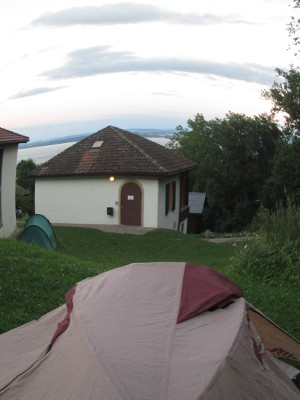
But it wasn't all about talks. Indeed, I only attended 2 or 3 sessions a day. The DebConf13 venue was controversial, but I found it excellent for getting things done. Rather than one or two massive rooms that get too noisy to think in, this venue had many little nooks and crannies suited for different types of work. There were so many I only discovered some while walking down the hill as I was leaving the venue! Anchoring it all was the excellent view, and I particularly enjoyed the "scenic hacklab". I was particularly impressed with the flexability of the venue's management. Someone asked if we could have cheese for breakfast, and every breakfast thereafter had not one but often three excellent cheeses. One day we'd be complaining that there were not enough vegetables in the food, and the next we'd be eating an excellent vegetarian Swiss lunch. They even apparently relaxed stringent Swiss rules on not allowing tents in sightlines visible from people further up the hill. They were clearly happy to welcome our crazy gathering to Le Camp. They let a DD borrow and use a chain saw and build a bonfire! The venue also encouraged getting out and exploring the surrounding countryside. Too often I end up spending the whole DebConf without seeing much of the area around. This time I at least got down the hill to see the castle in Vaumarcus a few times, and enjoyed many evening walks amoung the grape fields. The conference dinner (on a boat!) tied into this well too. And the daytrip to CERN was a great addition. We got to poke around the control center for a massive particle accellerator! My only regret is we didn't get a chance to actually go inside the LHC tunnels. Back to DebConf, another thing I really liked about this one was that its location allowed several upstream authors of software in Debian (other than the usual suspects who are both upstreams and Debian Developers) to attend. I don't know if Lennart Poettering changed any minds about systemd with his talk, but I was happy for the opportunity to buy him a beer. I didn't get to Monty's talk, but it was excellent to see him attend as well. Finally, I got to meet old friends I'd not seen in years, and new ones I've not met in real life before. We're still not sure where this whole DebConf thing is going -- will it be all about the cheese and wine party and greybeards in 20 years time? But one thing we know is we enjoy our little slice of the year where kilts and coding are equally unremarkable, where problems that seem intractable online somehow solve themselves in person, where we come away with ideas for an entire year and memories for a lifetime.

Justus Winter: What will I do next? cgroupfs \o/

With the ifupdown fixes that I published last week I actually reached my initial goal, that is to make Debian/Hurd boot using sysvinit and the initscripts provided by Debian. So on Monday we were discussing in #hurd what I could do next. Michael Banck suggested that I should port Upstart, but we agreed to do something different instead for two reasons:
  1. Upstart and systemd are somewhat competing to be the default init system for Debian, and we felt it might be inappropriate to get involved with this question as porting Upstart to Hurd would probably also enable it to be used on FreeBSD. The Upstart folks could then point out that Upstart is more portable because it runs on all kernels used by Debian.
  2. Upstart uses ptrace(2) to track child processes of servers it monitors. Obviously this is kind of a hack, and it was conjectured that Upstart would eventually use cgroups to do that. Also, the Hurd lacks support for ptrace(2) (that is most likely by choice by the way, ptrace(2) is not a nice interface and the Hurd (Mach actually) has much nicer interfaces to implement a debugger).
So we decided that no matter how the struggle between Upstart and systemd turns out, the Hurd would eventually need to support cgroups. So I started to write a cgroupfs translator, it is in its early stages but it already looks and acts a lot like Linux' cgroups:
% settrans -ac cg ./cgroupfs --release-agent=foobar
% ls cg
release_agent  tasks
% tail -n3 cg/tasks
11395
12869
1266
% mkdir cg/foo
% echo 1266 >> cg/foo/tasks
% tail -n3 cg/tasks cg/foo/tasks
==> cg/tasks <==
215
11395
12869
==> cg/foo/tasks <==
1266
To make this fully functional I will have to modify /hurd/proc and most likely also GNU Mach, but on the bright side this will help make subhurds (Hurds native, by-design-for-free-and-without-overhead container like functionality) work better and more securely (among other things this could enable non-root users to start subhurds). I will also look into porting libcg (I have a hacky patch series ready) so that we can actually test the cgroupfs translator. All current users of the cgroup interface are very Linux specific (surprise!), and libcg looks like the easiest one to port. And they do have a test suite that could help me improve the cgroupfs translator.

29 August 2013

Wouter Verhelst: RIP userdevfs

... and good riddance Just over 10 years ago now (it really has been that long), I had a first stab at adding some code to debian-installer to support m68k machines. As part of that, I invented userdevfs, a d-i module which would grep dmesg to figure out which hardware is detected, and would dynamically generate /dev entries based on that. It made it possible to use debian-installer without too much trouble on kernels that didn't support autoloading of modules (d-i expects the absense of a /dev entry to signal the absense of hardware), while our m68k kernel hadn't gone beyond 2.2 still; but it was always a bit of an ugly hack. At the time, I saw it as a short-time necessary evil. When the m68k port had been kicked from Debian, I would probably have thrown it out. Had it never been kicked from Debian, all else being equal, I would probably still have kicked it given a chance, since 2.6 kernels can now be run on m68k machines. All that is not true, though, since in the mean time my ugly hack had been repurposed to also work on ports that did support 2.6 and more recent kernels, but did not support autodetecting hardware. As such, it's still in recent Debian releases. Today, however, I noticed #717872, signalling that as the one port where it was still needed no longer did, my ugly hack has finally found its demise. That is a good thing.

28 August 2013

Vincent Sanders: Men admire the man who can organize their wishes and thoughts in stone and wood and steel and brass.


I would probably not yet worthy of the admiration Emerson was alluding to but I do like to make things. As anyone who has read previous posts knows I have pretty much embraced the "do things, tell people" idea.

One small wrinkle is doing things needs somewhere to work. Since moving myself and the family to rented accommodation in Cambridge (swampy 3,500 year old English city, not the one in Massachusetts) I have been lacking space to do practical projects.

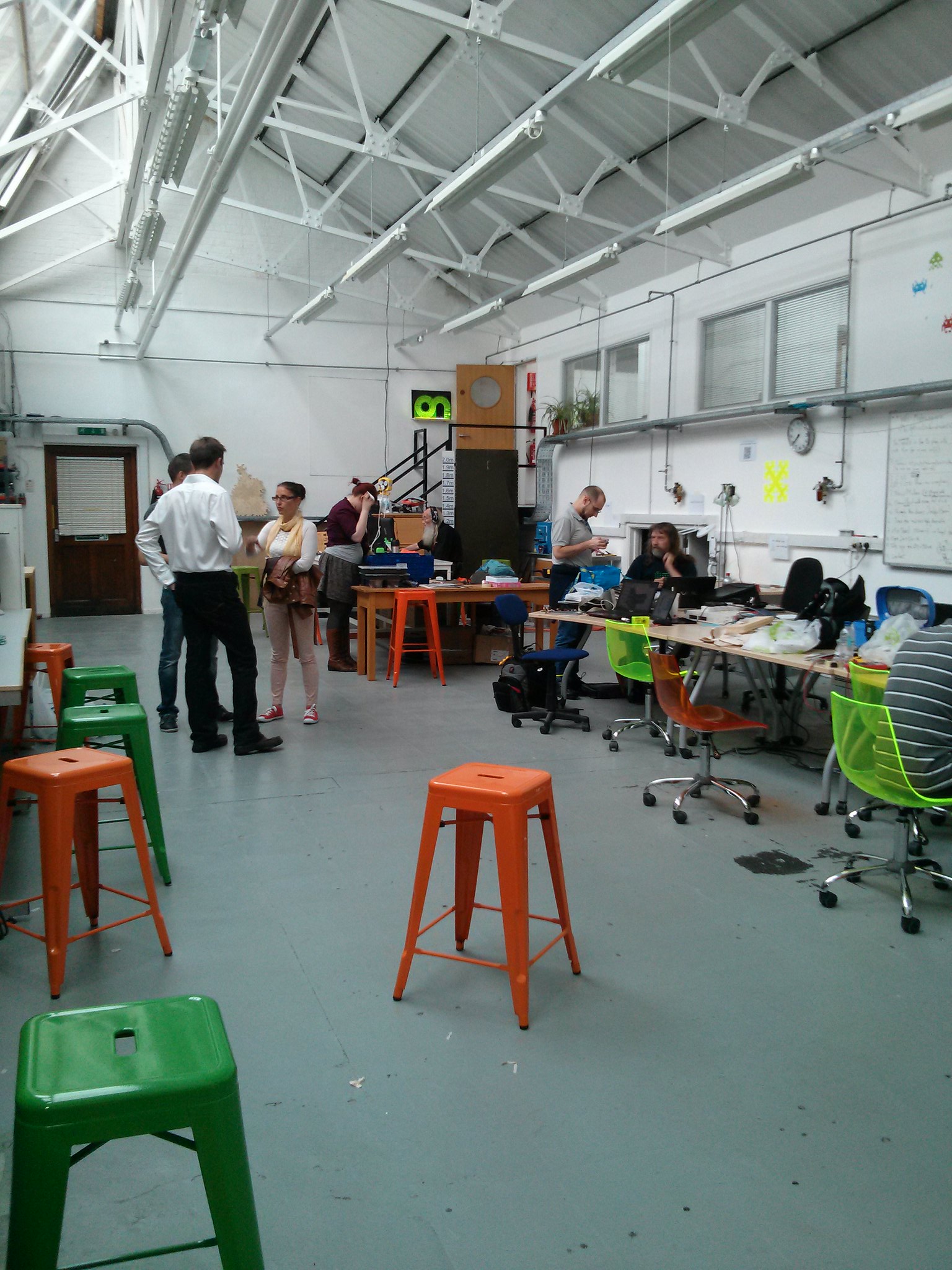
The main space
To fix this lack I have joined the cambridge makespace which, in addition to somewhere I can work gives me access to some tools I was previously unable to afford. The space gives practical training on the more complex machines (any tool can be dangerous if you do not use it correctly) which recently allowed my induction on the CNC router.

My instructor , Mark Mellors, who was good enough to give up some of his valuable making time to train me (and accidentally get his car stuck in a car park overnight by staying late) suggested that it was a good idea to have a design to try.

I decided to use this opportunity to actually create something useful (though now I re-read Marks message it did suggest a simple design...oopsy). I had been working at the electronics bench in previous weeks and been uncomfortable using the existing stools and chairs as they were either a bit high or unable to be adjusted high enough for the 80cm tall benches. I decided to design a 60cm tall stool for use at this workbench.

My initial idea was for a simple three leg stool, round top, three legs, how hard could it be? Initial research showed that showed that above 30cm the legs needed to be braced to each other. This is because the leg to seat joints simply cannot handle the stress caused by leverage which longer legs introduce.

I looked at the structure of several stools online and was initially drawn towards creating something like the IKEA Dalfred bar stool. It was discovered that the design would be easier to realise if it were made from sheet material which give a smaller challenge to a naive operator of a CNC router. Because of this simpler designs were researched and I eventually found a simple design I liked.

The design could not however be used directly as it was for imperial sized material which is not available in europe. I selected the QCAD open source CAD package and recaptured the design adjusting for the available 12mm plywood sheet material. This resulted in an imperial measurement design for metric materials.

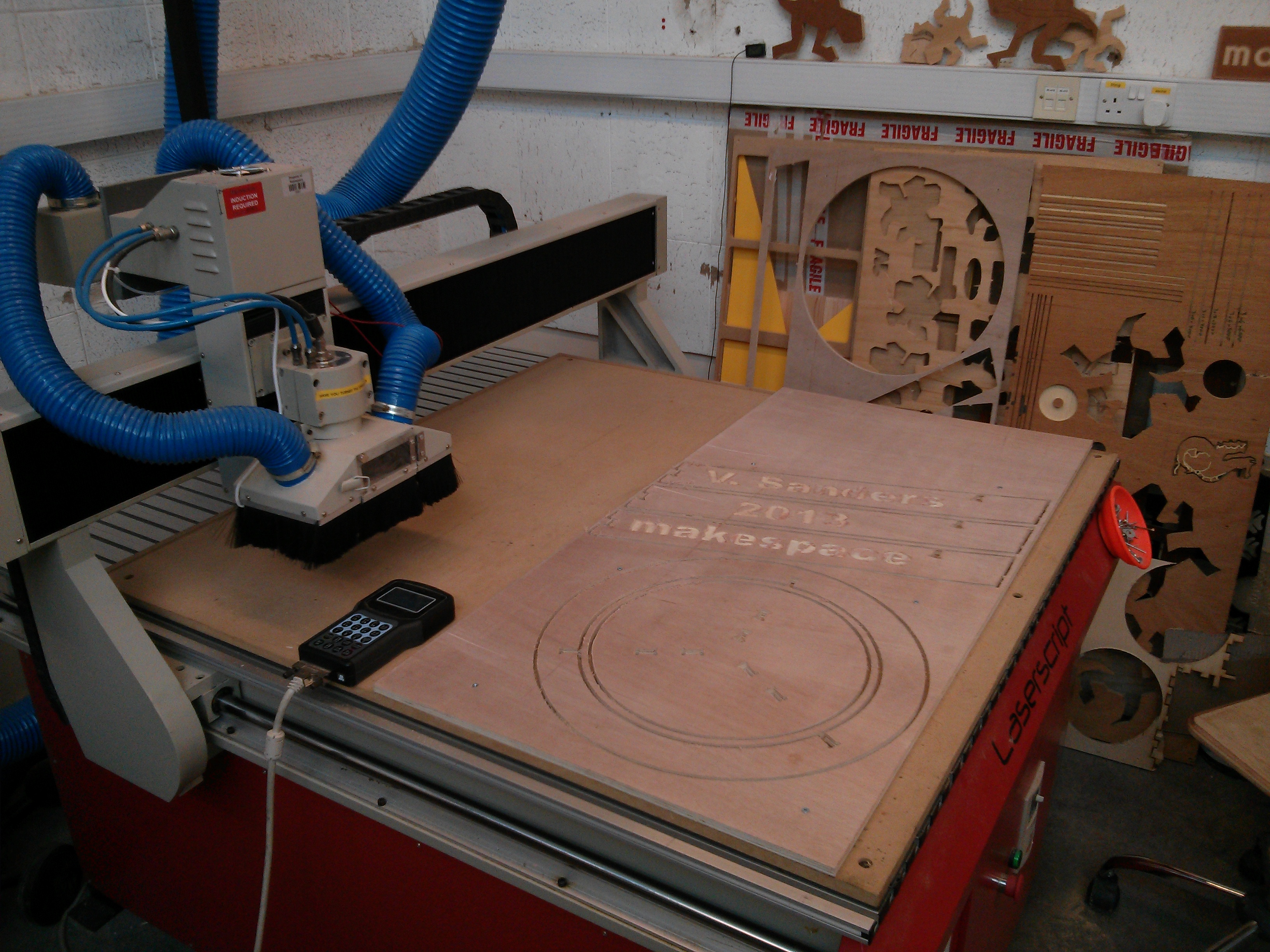
Mark helped me transfer the DXF into the CAM software (vcarve pro 7, after I discovered the demo version of this software generates files which cannot be imported into the full edition!) and generate toolpaths for our machine. Once the toolpaths are saved to a USB stick (no modern conveniences like direct upload here) the job can be run on the machine.

Here I ran into reality, turns out that tolerances in imperial combined with lack of understanding how plywood reacts resulted in excessive play in the joints. This resulted in an unusable stool, which simply tried to rotate around its central axis and become flatpack. I had successfully turned 10 worth of plywood into some sawdust and a selection of useless shapes. On the other hand I did become competent with the router workflow so it was not a complete failure.

I was determined to make the design work so I decided to start from scratch with a similar design but entirely in metric. I performed some material research both online and practically (why yes i did spend an informative hour in several cambridge DIY shops with digital calipers, why do you ask?) it turns out that generally available 12mm thick plywood actually ranges between 11.9 and 12mm thick.

I did some test slot cuts of varying width and determined that the available stock can be "persuaded" to fit into a 11.8mm wide slot. This Interference fit joint is strong and removes the need for adhesive in most cases.

Second cut still attached to the bed. Leftovers of first attempt in the background
The sheet plywood material is readily available with a width of 1220mm and a height of 606mm (a full sheet is 2440mm long which is cut into four with a 4mm wide saw blade) so making the legs fit within a sheet and be close to the 60cm target should be possible.

I selected a suitable seat radius (175mm) and from that determined the minimal gap to the base ring with a 6mm end mill tool (20mm for two toolpaths and some separation) and hence the minimum suitable width of the base ring (50mm) giving a total radius of 245mm.

For the legs allowance was made for two joints of 30mm with 30mm separation between them the legs come out at 90mm width. If a 6mm space and a 6mm toolpath top and bottom of the sheet is accounted for a 582mm height (606 - 24) is available in which to fit the legs. The top of the leg which fits into the seat is 12mm tall leaving 570mm total leg height.

12mm plywood stool design
At this point I selected some arbitrary values for the leg positioning and angle (30mm from seat centre and 15 ) using a right angle triangle triganometry this produced a stool with a base of around 550mm or 100mm outside the radius of the seat. This seemed a pleasing shape and when the values for the holding ring were calculated it is at 104mm height which also seems to work out well.

This design was cut on the machine, lightly finished with some sandpaper and assembled. The legs slotted into the ring first and then the legs eased into the seat slots, the whole thing flipped and the seat hammered home onto the legs.

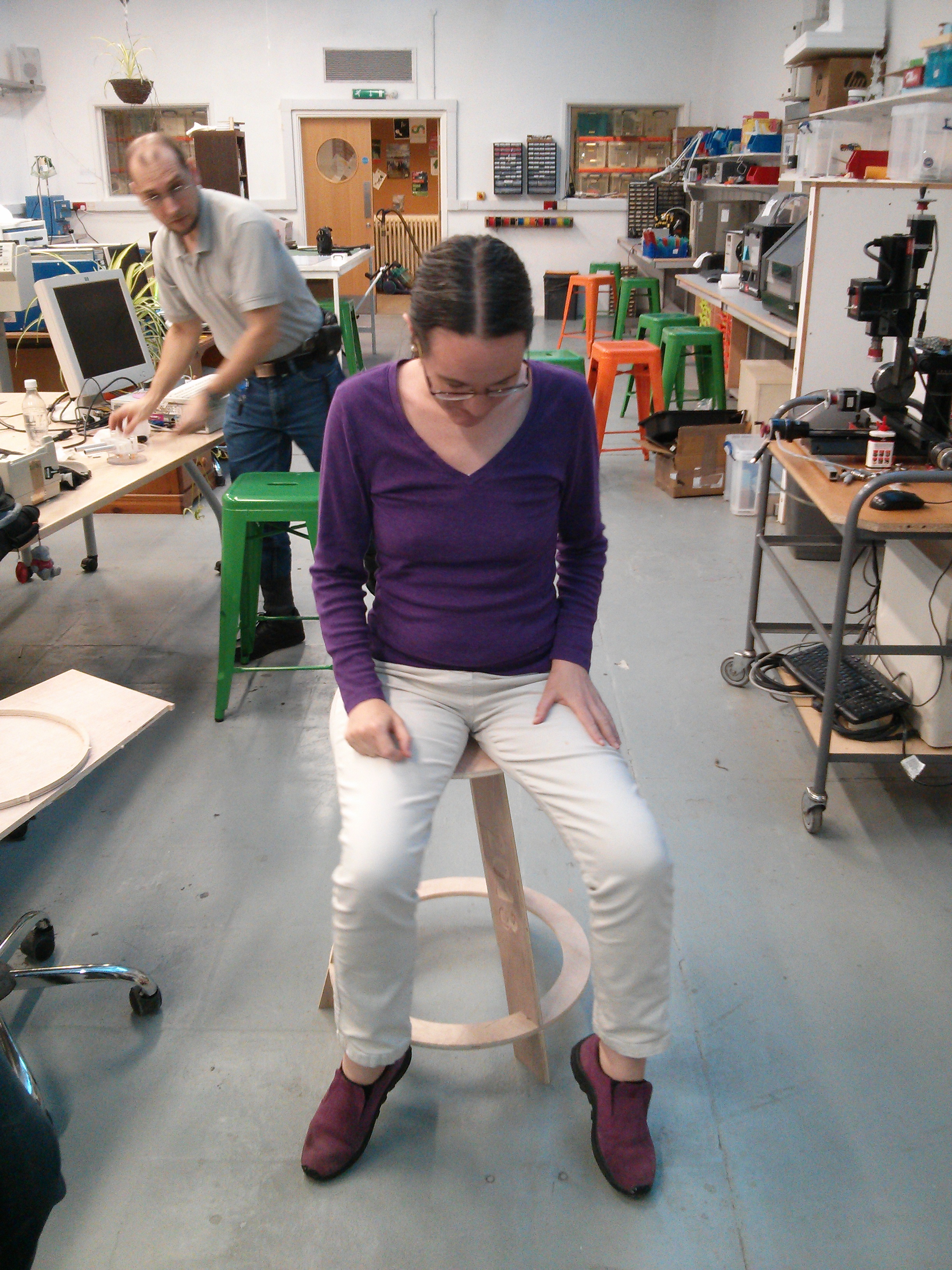
Anne Harrison volunteering to try the wobbly stool of doom
Success! It physically fit together and if you were brave enough you could sit on it. Unfortunately the plywood seemed to flex around the central axis of rotation in a rather alarming way, fine if you are under 70 kilos but not giving the impression of security most people want from their seating.

Ok, lets try with five legs instead of three (at least we can reuse the existing three legs)...nope still not good enough and another 10 gone.

18mm Plywood stool design
The others in the space suggested a few ideas to improve matters and the one I selected was to use 18mm plywood instead of 12mm, this should improve rigidity. There was a brief pause in proceedings to discover 18mm sheet is actually 17.7mm and needs a 17.5mm slot to make the interference fit work.

Completed 18mm stool
A swift redesign later altering the seat radius, gap, ring width and leg height to accommodate the new material and we have version 4 and it works without caveat. Tested up to 150Kg load without trouble, there is a small amount of flex still but nothing that feels worrying.

I finished the stool by rounding the seat top edge with a ball bearing rounding bit in a manual router and applying a couple of coats of gloss acrylic varnish. Finished stool is now doing service at the space.

In conclusion the final design allows someone with a CNC router to create a useful 580mm high fixed stool for 7.50 in timber plus cutter wear and varnish so maybe 8.50 total.

You can actually get five legs and a seat/ring out of a 1220x606 sheet and with intelligent arrangement a single 1220x2440 sheet will probably yield five or possibly six stools in total

I am making the design files of the proven 18mm version available (heck they are all there...but you have been warned, none of the other solutions produce a satisfactory result) under the MIT licence so anyone can reproduce. More pretty pictures are also available.

Matt Zimmerman: Scaling Human Systems: Roles and Responsibilities

This is part 5 in a series on organizational design and growth. What it means

Each of us has a job to do, probably more than one, and our teammates should know what they are. Why it s important

Roles are a kind of standing commitment we make to each other. They re a way of dividing up work which is easy to understand and simple to apply. Utilizing this tool will make it easier for us to coordinate our day to day work, and manage the changes and growth we re going through. Old Status Quo

Roles are vague or nonexistent. Management roles in particular are probably not well understood. Many people juggle multiple roles, all of which are implicit. Moving to a new team means learning from scratch what other people do. People take responsibility for tasks and decisions largely on a case-by-case basis, or based on implicit knowledge of what someone does (or doesn t do). In many cases, there is only one person in the company who knows how to perform a certain function. When someone leaves or goes on vacation, gaps are left behind. New Status Quo

Each individual has a clear understanding of the scope of their job. We have a handful of well defined roles, which are used by multiple teams and have written definitions. People who are new or transfer between teams have a relatively easy time understanding what the people around them are doing. Many day to day responsibilities are defined by roles, and more than one person can fill that role. When someone leaves a team, another person can cover their critical roles. Behaviors that help

Obstacles that stand in our way

27 August 2013

Neil McGovern: Adblock adding ads to block ads

shutterstock_151488752Confused yet? The popular browser extension AdBlock for Chrome/Chromium and Safari has launched a new crowdsourced campaign - to buy up internet advertising space inviting people to download AdBlock, so they can block ads. Additionally, if they raise enough, they'd like to get additional space for a billboard at Times Square, a full page spread in the New York Times, and even a TV slot at the Superbowl (although the target for this is $4.2M, so I'm not entirely confident they'll make it.) However, this does raise an interesting question, which has been under debate for some time. How do you make money on the internet without adverts? Wikipedia has a few interesting suggestions. Firstly, affiliate programmes. These mean that any products or services that are linked or searched via the original site earn a little bit of commission for that site. Founded in the mid-90s, and most famously used by Amazon, it's a possible method for getting money. However, it should be deployed with careful thought. If a blogger or reviewer is recommending a product, is it simply because they are being paid to do so, or is it a genuine endorsement? The BBC ban this practice, and the Society of Professional Journalists also has strong guidelines on taking gifts. Interestingly, a few search engines now offer this to browsers for them sending their default search traffic to them. Secondly, you could engage in (what I consider to be) the shady practice of data monetisation. People visit a website, and they leave data about their visit. By visiting here, you've told me that you're probably interested in technology issues, what country and city you're from, and where you came from. Other programmes and sites will also be able to wrap up what other sites you've visited, and can build up quite a profile of your browsing habits. Add together a rather unscrupulous vendor, and they can also know your contact details. This metadata can then be sold on. Thirdly, you can essentially ask your readers for money. Donations, via a micropayment link (which I use) or larger donation requests. Another method is to have a membership system, where content is locked up behind a paywall. This does, however, risk making your content less valuable as people will just head elsewhere for news and opinion. To counter this, a couple of sites (LWN, Slashdot) simply delay the latest news for a little while. Alternatively, you can just ask like the fantastic C G P Grey has done. Interestingly, he also has a great video on why advertising can be a bad thing for content creators. Lastly, you can sell things. This could be your authorship services on another site as a guest post, writing a book, offering consultancy services, or simple merchandise. In summary though, which is more honest? An advert may well bend your view on what sort of content is being created, but is at least a lot more open than potentially hiding real motives behind affiliate links, and a lot more open than selling data. Asking for money is fairly straightforward, though could easily backfire if it's viewed as begging. Google's advertising income totalled $43.7 billion in 2012 - so it's quite clear that advertising is big business. Websites cost money to run, can the web survive in an ad-free environment? If so, it certainly won't be the same web as we know today.

26 August 2013

Vincent Fourmond: Announcing version 0.5 of ctioga2

I've just released version 0.5 of ctioga2, my plotting program. While there is still quite a lot of improvements I'd like to get in some day, the past few days have seen a lot of activity. Probably the most important change is the new space-separated command file format, much simpler than the old one (which is still supported, although marked clearly as deprecated now). Another important change for the users is the large improvement of error reporting: in most cases, ctioga2 pinpoints the exact location where things go wrong; it also features reporting on LaTeX errors. The last important feature is also the introduction of real contour plots, such as the one below, coming from the documentation:
Now, I feel like ctioga2 is coming close to gnuplot in terms of features and ease of use. Part of my plans for the website is to create a gnuplot mockup gallery, in which I would take as many examples from the gnuplot website as possible (ie all the ones ctioga2 can reproduce) and compare the code and look of both.Among features I'd like to implement for ctioga2, here are the ones that I think are the most important ones:But maybe you have other ideas you'd like to see before that ?

Jose Luis Rivas: MongoDB: $pull from an embedded document array

TL;DR: db.collection.update( _id: 'x' , $pull: embedded_doc: _id: 'y' ) Queries are wrote for the mongo shell Dot based access If you have been using MongoDB for some time, then there are big chances that you will know the "dot-based access" on the find queries. This is the easier way to write those queries and will probably want to keep using that. Like:
db.collection.find( _id: 'x', 'embedded_doc._id': 'y' )
The thing is that does not work with everything, like: Arrays of embedded documents! Little example schema Let's suppose the following little schema (written for Mongoose): A = new Schema( w: String, x: String ); Document = new Schema( embedded_doc: [A] ); The collection of Document is called documents. Updating arrays If the arrays are not embedded documents I can actually just use a regular update like with any other field combined with a $set and change all the array like:
db.documents.update( _id: 'x',  $set:  array: [
   a: 1 , 
   a: 2 , 
   a: 3 
] )
And using conveniently $pull and $addToSet. But when it comes to embedded documents the history is very different. You can't make a simple $set because it will give you an error related to ModId which you can't change. So you really need to use $push, $addToSet, $pull and it's friends. So all those you can do it as in the manual, but what if you want to make a $pull over an array of objects and w and x are not unique? Well, that's why you probably made them an embedded document! Then you have the _id and you try to use the dot notation like:
db.documents.update( _id: 'x' ,  $pull:  "embedded_doc._id": 'y' )
And it looks good, except that it wont work. You have to use the complete syntax like:
db.documents.update( _id: 'x' ,  $pull:  embedded_doc:  _id: 'y' )

25 August 2013

Jonathan Carter: Still Alive

I ve been really quiet on the blogging front the last few months. There s been a lot happening in my life. In short, I moved back to South Africa and started working for another company. I have around 10 blog drafts that I will probably never finish, so I m just declaring post bankruptcy and starting from scratch (who wants read my old notes from Ubuntu VUDS from March anyway?) For what it s worth, I m still alive and doing very well, possibly better than ever. Over the next few months I want to focus my free software time on the Edubuntu project, my Debian ITPs (which I ve neglected so badly they ve been turned into RFPs) and Flashback. Once I ve caught up there s plenty of other projects where I d like to focus some energy as well (LTSP, Debian-Edu, just to name a few). Thanks for reading! More updates coming soon.

Next.

Previous.