Search Results: "ana"

29 January 2017

Sam Hartman: Network Audio Visualization: Network Modeling

Previously, I wrote about my project to create an audio depiction of network traffic. In this second post, I explore how I model aspects of the network that will be captured in the audio representation. Before getting started, I'll pass along a link. This is not the first time someone has tried to put sound to packets flying through the ether: I was pointed at Peep. I haven't looked at Peep, but will do so after I finish my own write up. Not being an academic, I feel no obligation to compare and contrast my work to others:-)
I started with an idea of what I'd like to hear. One of my motivations was to explore some automated updates we run at work. So, I was hoping to capture the initial DNS and ARP traffic as the update discovered the systems it would contact. Then I was hoping to capture the ssh and other traffic of the actual update.
To Packet or Stream
One of the simplest things to do would simply be to model network packets. For DNS I chose that approach. I was dubious that a packet-based model would capture the aspects of TCP streams I typically care about. I care about the source and destination (both address and port) of course. However I also care about how much traffic is being carried over the stream and the condition of the stream. Are there retransmits? Are there a bunch of unanswered SYNs? But I don't care about the actual distribution of packets. Also, a busy TCP stream can generate thousands of packets a second. I doubted my ability to distinguish thousands of sounds a second at all, especially while trying to convey enough information to carry stream characteristics like overall traffic volume.
So, for TCP, I decided to model some characteristics of streams rather than individual packets.
For DNS, I decided to represent individual requests/replies.
I came up with something clever for ARPP. There, I model the request/reply as an outstanding request. A lot of unanswered ARPs can be a sign of a scan or a significant problem. The mornful sound of a TCP stream trailing off into an unanswered ARP as the cache times out on a broken network is certainly something I'd like to capture. So, I track when an ARP request is sent and when/if it is answered.
Sound or Music
I saw two approaches. First, I could use some sound to represent streams. As an example, a running diesel engine could make a great representation of a stream. The engine speed could represent overall traffic flow. There are many opportunities for detuning the engine to represent various problems that can happen with a stream. Perhaps using stereo separation and slightly different fundamental frequencies I could even represent a couple of streams and still be able to track them.
However, at least with me as a listener, that's not going to scale to a busy network. The other option I saw was to try and create melodic music with various musical phrases modified as conditions within the stream or network changed. That seemed a lot harder to do, but humans are good at listening to complicated music.
I ended up deciding that at least for the TCP streams, I was going to try and produce something more musical than sound. I was nervous: I kept having visions of a performance of "Peter and the Wolf" with different instruments representing all the characters that somehow went dreadfully wrong.
As an aside, the decision to approach music rather than sound depended heavily on what I was trying to capture. If I'm modeling more holistic properties of a system--for example, total network traffic without splitting into streams--I think parameterized sounds would be a better approach.
The decision to approach things musically affected the rest of the modeling. Somehow I was going to need to figure out notes to play. I'd already rejected the idea of modeling packets, so I wouldn't simply be able to play notes when a packet arrived.
Energy Decay
As I played with various options, I realized that the critical challenge would be figuring out how to focus the listener's attention on the important aspects of what was going on. Clutter was the great enemy. My job would be figuring out how to spend sound wisely. When something interesting happened, that part of the model should get more focus--more of the listener's energy.
Soon I found myself thinking a lot about managing the energy of network streams. I imagined streams getting energy when something happened, and spending that energy to convey that interesting event to the listener. Energy needed to accumulate fast enough that even low-traffic streams could be noticed. Energy needed to be spent fast enough that old events were not taking listener focus from new, interesting things going on. However, if the energy were spent slow enough, then network events could be smoothed out to give a better picture of the stream rather than individual packets.
This concept of managing some decaying quantity and managing the rate of decay proved useful at multiple levels of the model.
Two Layer Model
I started with a python script that parses tcpdump output. It associates a packet with a stream and batches packets together to avoid overloading other parts of the system.
The output of this script are stream events. Events include a source and destination address, a stream ID, traffic in each direction, and any special events on the stream.
For DNS, the script just outputs packet events. For ARP, the script outputs request start, reply, and timeout events. There's some initial support for UDP, but so far that doesn't make sound.
Right now, FINs are modeled, but SYNs and the interesting TCP conditions aren't directly modeled. If you get retransmissions you'll notice because packet flow will decrease. However, I'd love to explicitly sound retransmissions. I also think a window filling as an application fails to read is important. I imagine either narrowing a band-pass filter to clamp the audio bandwidth available to a stream with a full window. Or perhaps taking it the other direction and adding an echo.
The next layer down tracks the energy of each stream. But that, and how I map energy into music, is the topic of the next post.

Margarita Manterola: Decopy - Yet another debian/copyright helper

As every responsible maintainer should know, having an updated debian/copyright file is very important but can also take a significant amount of work. A lot of copy & pasting, a lot of manual corrections, and a lot of opportunity for human errors. There are several tools that help with this, but they all have their limitations. decopy is a newly uploaded tool (unfortunately too new for stretch) that aims to: How to use it In order to run it, after apt-get installing it, just go to a source package directory and run decopy in it. Depending on the size of the package, it might take a while (the thorough processing means that a lot of checking is going on). This will show you the generated debian/copyright file in stdout. If you want to store it and diff it against your current copyright file, use decopy --output /tmp/copyright. There's more documentation in the README file. Future changes More licenses are coming, the intention is to support all licenses listed in the SPDX License List. Additionally, the analysis will be improved to prioritize looking for the most common licenses first, avoiding unnecessary delays. More modes of operation are also coming. We are planning for a diff mode that shows you only the changes between the current copyright file and what the tool thinks should be there as well as an explain mode that will let the user know what the differences are in a more verbose manner. Credits and source Decopy was mainly written by Maximiliano Curia. I've added testing, documentation and packaging. It's hosted in collab-maint, licensed under the ISC license. We would love to get more contributors for it :)

Elena 'valhalla' Grandi: One Liberated Laptop

One Liberated Laptop

Immagine/fotohttp://social.gl-como.it/photos/valhalla/image/5a480cd2d5842101fc8975d927d030f3

After many days of failed attempts, yesterday @Diego Roversi finally managed to setup SPI on the BeagleBone White , and that means that today at our home it was Laptop Liberation Day!

We took the spare X200, opened it, found the point we were on in the tutorial installing libreboot on x200 https://libreboot.org/docs/install/x200_external.html, connected all of the proper cables on the clip and did some reading tests of the original bios.

Immagine/fotohttp://social.gl-como.it/photos/valhalla/image/77e61745d9c43833b7c0a4a919d17222

While the tutorial mentioned a very conservative setting (512kHz), just for fun we tried to read it at different speed and all results up to 16384 kHz were equal, with the first failure at 32784 kHz, so we settled on using 8192 kHz.

Then it was time to customize our libreboot image with the right MAC address, and that's when we realized that the sheet of paper where we had written it down the last time had been put in a safe place somewhere

Luckily we also had taken a picture, and that was easier to find, so we checked the keyboard map , followed the instructions to customize the image https://libreboot.org/docs/hcl/gm45_remove_me.html#ich9gen, flashed the chip, partially reassembled the laptop, started it up and a black screen, some fan noise and nothing else.

We tried to reflash the chip (nothing was changed), tried the us keyboard image, in case it was the better tested one (same results) and reflashed the original bios, just to check that the laptop was still working (it was).

It was lunchtime, so we stopped our attempts. As soon as we started eating, however, we realized that this laptop came with 3GB of RAM, and that surely meant "no matching pairs of RAM", so just after lunch we reflashed the first image, removed one dimm, rebooted and finally saw a gnu-hugging penguin!

We then tried booting some random live usb key https://tails.boum.org/ we had around (failed the first time, worked the second and further one with no changes), and then proceeded to install Debian.

Running the installer required some attempts and a bit of duckduckgoing: parsing the isolinux / grub configurations from the libreboot menu didn't work, but in the end it was as easy as going to the command line and running:


linux (usb0)/install.amd/vmlinuz
initrd (usb0)/install.amd/initrd.gz
boot


From there on, it was the usual debian installation and a well know environment, and there were no surprises. I've noticed that grub-coreboot is not installed (grub-pc is) and I want to investigate a bit, but rebooting worked out of the box with no issue.

Next step will be liberating my own X200 laptop, and then if you are around the @Gruppo Linux Como area and need a 16 pin clip let us know and we may bring everything to one of the LUG meetings

yes, white, and most of the instructions on the interwebz talk about the black, which is extremely similar to the white except where it isn't

wait? there are keyboard maps? doesn't everybody just use the us one regardless of what is printed on the keys? Do I *live* with somebody who doesn't? :D

the breadboard in the picture is only there for the power supply, the chip on it is a cheap SPI flash used to test SPI on the bone without risking the laptop :)

disclaimer: it worked for us. it may not work on *your* laptop. it may brick it. it may invoke a tentacled monster, it may bind your firstborn son to a life of servitude to some supernatural being. Whatever happens, it's not our fault.

(edit: added tags)

#coreboot #libreboot

28 January 2017

Steve Kemp: So I've been playing with hardware

At the end of December I decided I was going to do hardware "things", and so far that has worked out pretty well. One of the reasons I decided to play with Arduinos is that I assumed I could avoid all forms of soldering. I've done soldering often enough to know I can manage it, but not quite often enough that I feel comfortable doing so. Unfortunately soldering has become a part of my life once again, as too many of the things I've been playing with have required pins soldering to them before I can connect them. Soldering aside I've been having fun, and I have deployed several "real" projects in and around my flat. Perhaps the most interesting project shows the arrival time of the next tram to arrive at the end of my street: That's simple, reliable, and useful. I have another project which needs to be documented which combineds a WeMos D1 and a vibration sensor - no sniggers - to generate an alert when the washing machine is done. Having a newborn baby around the place means that we have a lot of laundry to manage, and we keep forgetting that we've turned the washing machine on. Oops. Anyway. Hardware. More fun than I expected. I've even started ordering more components for bigger projects. I'll continue to document the various projects online, mostly to make sure I remember the basics:

26 January 2017

John Goerzen: What is happening to America?

I still remember vividly my first visit to Europe, back in 2010. I had just barely gotten off a plane in Hamburg and on to a bus to Lubeck, and struck up a conversation with a friendly, well-educated German classical musician next to me. We soon started to discuss politics and religion. Over the course of the conversation, in response to his questions, I explained I had twice voted against George W. Bush, that I opposed the war in Iraq for many reasons, that I did thought there was an ethical imperative to work to defeat climate change, that I viewed health care as an important ethical and religious issue, that I thought evolution was well-established, and that I am a Christian. Finally, without any hint of insult intended, and rather a lot of surprise written all over his face, he said: Wow. You re an American, and a Christian, and you re so . normal! This, it seems to me, has a lot to do with Trump. Ouch It felt like a punch to the gut. The day after the election, having known that a man that appeared to stand for everything that honorable people are against won the election, like people all around the world, I was trying to make sense of how could this happen? As I ve watched since, as he stacks government with wealthy cronies with records nearly as colorful as his own, it is easy to feel even more depressed. Based on how Trump spoke and acted, it would be easy to conclude that the deplorables won the day that he was elected by a contingent of sexists or racists ascendent in power. But that would be too simple an explanation. This is, after all, the same country that elected Barack Obama twice. There are a many people that voted twice for a black man, and then for Trump. Why? Racism, while doubtless a factor, can t explain it all. How Trump could happen Russ Allbery made some excellent points recently:
[Many Americans are] hurt, and they re scared, and they feel like a lot of the United States just slammed the door in their faces. The status quo is not working for people. Technocratic government by political elites is not working for people. Business as usual is not working for people. Minor tweaks to increasingly arcane systems is not working for people. People are feeling lost in bureaucracy, disaffected by elections that do not present a clear alternate vision, and depressed by a slow slide into increasingly dismal circumstances. Government is not doing what we want it to do for us. And people are getting left behind. The left in the United States (of which I m part) has for many years been very concerned about the way blacks and other racial minorities are systematically pushed to the margins of our economy, and how women are pushed out of leadership roles. Those problems are real. But the loss of jobs in the industrial heartland, the inability of a white, rural, working-class man to support his family the way his father supported him, the collapse of once-vibrant communities into poverty and despair: those problems are real too. The status quo is not working for anyone except for a few lucky, highly-educated people on the coasts. People, honestly, like me, and like many of the other (primarily white and male) people who work in tech. We are one of the few beneficiaries of a system that is failing the vast majority of people in this country.
Russ is, of course, right. The Democrats have been either complicit in policies damaging to many, or ineffective in preventing them. They have often appeared unconcerned with the plight of people outside cities (even if that wasn t really the case). And it goes deeper. When s the last time you visited Kansas? I live in Kansas. The nearest paved road is about a 3-mile drive from my home. The nearest town, population 600, is a 6-mile drive. My governor whom I did not vote for cut taxes on the wealthy so much that our excellent local schools have been struggling for years. But my community is amazing, full of loving and caring people, the sort of people who you know you ll be living with for 40 years, and so you make sure you get along well with. I have visited tourist sites in Berlin, enjoyed an opera and a Broadway show in New York, taken a train across the country to Portland, explored San Francisco. I ve enjoyed all of them. Many rural people do get out and experience the world. I have been in so many conversations where I try to explain where I live to people that simply cannot fathom it. I have explained how the 18 acres I own is a very small amount where I am. How, yes, I do actually have electricity and Internet. How a bad traffic day is one where I have to wait for three cars to go past before turning onto the paved road. How I occasionally find a bull in my front yard, how I can walk a quarter mile and be at the creek on the edge of my property, how I can get to an airport faster than most New Yorkers and my kids can walk out the front door and play in a spot more peaceful than Central Park, and how all this is way cheaper than a studio apartment in a bad part of San Francisco. It is rare indeed to see visitors actually traveling to Kansas as a destination. People have no concept of the fact that my mechanic would drop everything and help me get my broken-down car to the shop for no charge, that any number of neighbors or uncles would bring a tractor and come plow the snow off my 1/4-mile driveway out of sheer kindness, that people around here really care for each other in a way you don t see in a city. There are people that I know see politics way differently than me, but I know them to be good people. They would also do anything for a person in need, no matter who they are. I may find the people that they vote for to be repugnant, but I cannot say I ve looked this person in the eyes and they are nothing but deplorable. And so, people in rural areas feel misunderstood. And they are right. Some perspectives on Trump As I ve said, I do find Trump to be deplorable, but not everyone that voted for him is. How, then, do people wind up voting for him? The New Yorker had an excellent story about a man named Mark Frisbie, owner of a welding and fab shop. The recession had been hard on his business. His wife s day-care center also closed. Health care was hard to find, and the long, slow decline had spanned politicians of every stripe. Mark and his wife supposedly did everything they were supposed to: they worked hard, were honest, were entrepreneurial, and yet he had lost his business, his family house, his health coverage, everything. He doesn t want a handout. He wants to be able to earn a living. Asked who he d vote for, he said, Is none of the above an option? The Washington Post had another insightful article, about a professor from Madison, WI interviewing people in rural areas. She said people would often say: All the decisions are made in Madison and Milwaukee and nobody s listening to us. Nobody s paying attention, nobody s coming out here and asking us what we think. Decisions are made in the cities, and we have to abide by them. She pushed back, hard, on the idea that Trump supporters are ignorant, and added that liberals that push that line of thinking are only making the problem worse. I would agree; seeing all the talk about universities dis-inviting speakers that don t hew to certain political views doesn t help either. A related article talks about the lack of empathy for Trump voters. And then we have a more recent CNN article: Where Tump support and Obamacare use soar together, explaining in great detail how it can be logical for someone to be on Obamacare but not like it. We can all argue that the Republicans may have as much to do with that as anything, but the problem exists. And finally, a US News article makes this point:
His supporters realize he s a joke. They do not care. They know he s authoritarian, nationalist, almost un-American, and they love him anyway, because he disrupts a broken political process and beats establishment candidates who ve long ignored their interests. When you re earning $32,000 a year and haven t had a decent vacation in over a decade, it doesn t matter who Trump appoints to the U.N., or if he poisons America s standing in the world, you just want to win again, whoever the victim, whatever the price. According to the Republican Party, the biggest threat to rural America was Islamic terrorism. According to the Democratic Party it was gun violence. In reality it was prescription drug abuse and neither party noticed until it was too late.
Are we leaving people out? All this reminded me of reading about Donald Knuth, the famous computer scientist and something of the father of modern computing, writing about his feelings of trepidation about sharing with his university colleagues that he was working on a project related to the Bible. I am concerned about the complaints about the PC culture , because I think it is good that people aren t making racist or anti-semitic jokes in public anymore. But, as some of these articles point out, in many circles, making fun of Christians and conservatives is still one of the accepted targets. Does that really help anything? (And as a Christian that is liberal, have all of you that aren t Christians so quickly forgotten how churches like the Episcopals blazed the way for marriage equality many years ago already?) But they don t get a free pass I have found a few things, however, absolutely scary. One was an article from December showing that Trump voters actually changed their views on Russia after Trump became the nominee. Another one from just today was a study on how people reacted when showed inauguration crowd photos. NPR ran a story today as well, on how Trump is treating journalists like China does. Chilling stuff indeed. Conclusion So where does this leave us? Heading into uncertain times, for sure, but perhaps just maybe with a greater understanding of our neighbors. Perhaps we will all be able to see past the rhetoric and polarization, and understand that there is something, well, normal about each other. Doing that is going to be the only way we can really take our country back.

25 January 2017

Urvika Gola: Outreachy- Week 4 & 5 Progress

Working with Preferences, AudioManager, RingtoneManager in Android. Sometimes the noise can get too much. Imagine all the people around you at work or in a classroom. All of them have at least one cell phones. Even if they were all to make a tiny blip, the noise would be irritating and disruptive. To avoid devices from interrupting the non-digital life, applications often provide settings that allow users to modify app volumes. My task this week was to enable/disable silent mode in Lumicall. To provide settings for your application, instead of using multiple Views, Preference APIs should be used. Each preference appears as an item in a list and provides the appropriate UI for users to modify the setting. In Lumicall, when settings menu from the menubar is selected, a preference screen is displayed showing various setting options, where I appended a Configure Silent Mode option. The UI for the preference screen is expected to be in Src->xml folder under the name preferences.xml

silentSnippet from Lumicall s preference.xml for Configure Silent Mode preference screen.
In Lumicall, whenever a SIP message comes in, RingtoneManager Class is used to generate a notification sound & AudioManager Class is used to generate sound for incoming encrypted calls. The difference between the two is that, AudioManager provides access to volume and ringer mode control. Ringer modes like, Normal, silent and vibration. Whereas RingtoneManager provides access to ringtones, notification. So to add a simple -disable/enable silent mode- functionality, I decided to use a CheckboxPreference. For the same goal, a better looking widget would be a SwitchPreference, but It does not work properly with DarkThemes which Lumicall uses. So I decided to use a simple Checkbox instead. The result of all the settings are saved as key value pairs in the default SharedPreferences file which can be retrieved to make changes in the app based on the settings modified by the user.
Every preference has a key and the result associated with it.
To fetch the result from the SharedPreferences file-
boolean silentflag=PreferenceManager.getDefaultSharedPreferences(ctx).getBoolean(org.sipdroid.sipua.ui.Settings.PREF_SILENT_MODE, org.sipdroid.sipua.ui.Settings.DEFAULT_SILENT_MODE); Note, the arguments in getBoolean function is (Key, DefaultValue). Don t forget to pass the Context object, ctx in the statement. I wasted a lot of time figuring that one out and created a non-optimal-working way which I eventually had to remove cos I figured out how to retrieve the result value. frustrated
To add a second method of setting silent mode, i.e where the user can enter his work days/time, I wanted to display an activity with required widgets .
To display an activity on a when a preference is selected, intent tags are used. (See the above snippet)
Note that the target package in the intent tags is not the package name of where the java file of the activity is to be found.It s the package name which is your applicationID. Now this activity, like any other activity in android is a combination of an xml and java file.
1. My xml file contains the widgets for user to enter two set of time value in HH:MM format. i.e.the start and end time during which user requires application notifications to be silent it also contains checkboxes for user to select multiple days of the week. 2. The java file associated with this does the following:
2.1 Comparing the Real Time with User s Specified Start and End time
2.2 Checking the current day of the week with the days marked by the user in the checkboxes I have used inbuilt Calendar class and Date class to accomplish this. All done I felt quite proud but this.. this was something that tested my patience and endurance!
As I continue my work, I will keep sharing! Please keep reading!
U


24 January 2017

Jonathan McDowell: Experiments with 1-Wire

As previously mentioned, at the end of last year I got involved with a project involving the use of 1-Wire. In particular a DS28E15 device, intended to be used as a royalty tracker for a licensed piece of hardware IP. I d no previous experience with 1-Wire (other than knowing it s commonly used for driving temperature sensors), so I took it as an opportunity to learn a bit more about it. The primary goal was to program a suitable shared key into the DS28E15 device that would also be present in the corresponding hardware device. A Maxim programmer had been ordered, but wasn t available in stock so had to be back ordered. Of course I turned to my trusty Bus Pirate, which claimed 1-Wire support. However it failed to recognise the presence of the device at all. After much head scratching I finally listened to a co-worker who had suggested it was a clock speed issue - the absence of any option to select the 1-Wire speed in the Bus Pirate or any mention of different speeds in the documentation I had read had made me doubt it was an issue. Turns out that the Bus Pirate was talking standard 1-Wire and the DS28E15 only talks overdrive 1-Wire, to the extent that it won t even announce its presence if the reset pulse conforms to the standard, rather than overdrive, reset time period. Lesson learned: listen to your co-workers sooner. A brief period of yak shaving led to adding support to the Bus Pirate for the overdrive mode (since landed in upstream), and resulted in a search request via the BP interface correctly finding the device and displaying its ROM ID. This allowed exploration of the various commands the authenticator supports, to verify that the programming sequence operated as expected. These allow for setting the shared secret, performing a SHA256 MAC against this secret and a suitable nonce, and retrieving the result. Next problem: the retrieved SHA256 MAC did not match the locally computed value. Initially endianness issues were suspected, but trying the relevant permutations did not help. Some searching found an implementation of SHA256 for the DS28E15 that showed differences between a standard SHA256 computation and what the authenticator performs. In particular SHA256 normally adds the current working state (a-g) to the current hash value (h0-h7) at the end of every block. The authenticator does this for all but the final block, where instead the hash value is set to the working state. I haven t been able to find any documentation from Maxim that this is how things are calculated, nor have I seen any generic implementation of SHA256 which supports this mode. However rolling my own C implementation based on the code I found and using it to compare the results retrieved from the device confirms that this is what s happening. So at this point we re done, right? Wait for the proper programming hardware to turn up, write the key to the devices, profit? Well, no. There was a bit of a saga involving the programmer (actually programmers, one with at least some documentation that allowed the creation of a Python tool to allow setting the key and reading + recording the ROM ID for tracking, and one with no programming documentation that came with a fancy GUI for manually doing the programming), but more importantly it was necessary to confirm that the programmed device interacted with the hardware correctly. Initial testing with the hardware was unsuccessful. Again endianness issues were considered and permutations tried, but without success. A simple key constructed to avoid such issues was tried, and things worked fine. There was a hardware simulation of both components available, so it was decided to run that and obtain a capture of the traffic between them. As the secret key was known this would then allow the random nonce to be captured, and the corresponding (correct) hash value. Tests could then be performed in software to determine what the issue was & how to generate the same hash for verification. Two sets of analyzer software were tried, OpenBench LogicSniffer (OLS) and sigrok. As it happened both failed to correctly decode the bitstream detected as 1-Wire, but were able to show the captured data graphically, allowing for decoding by eye. A slight patch to OLS to relax the timing constraints allowed it to successfully decode the full capture and provided the appropriate data for software reproduction. The end issue? A 256 bit number (as defined in VHDL) is not the same as 32 element byte array Obvious when you know what the issue is! So? What did I learn, other than a lot about 1-Wire? Firstly, don t offhandedly discount suggestions that you don t think make sense. Secondly, having a tool (in this case the Bus Pirate) that lets you easily play with a protocol via a simple interface is invaluable in understanding it. Thirdly, don t trust manufacturers to be doing something in a normal fashion when they claim to be using a well defined technology. Fourthly, be conscious about all of the different ways bitstreams can be actually processed in memory. It s not just endianness. Finally, spending the time to actually understand what s going on up front can really help when things don t work as you d expect later on - without the yak shaving to support Overdrive on the BP I wouldn t have been able to so quickly use the simulation capture to help diagnose the issue.

Shirish Agarwal: Budget and Economics 101

The Budget The story which I wanted to share is there are few friends (from Debian as well as elsewhere) who shared that they didn t get the whole demonetisation play or what the Government is/was trying to do. As budget is just round the corner (India will be presenting its yearly budget on 1st of February), thought it is prudent to share at least some basics, ideas and theories of what goals the Finance Minister would be looking at when presenting his budget. I would NOT talk of Inflation targeting or some such exotica as those topics would require their own blog-posts altogether. I would mainly be talking a bit about Taxation and in that Personal Income Tax. I would also not use words like Receivables and like which thought bit more accurate are not used in everyday language. Just like Private Companies and increasingly public utilities, The Government of the day has two-three different aims when it is presenting a budget a. The first is to give an update about how things went last year. Did all the incomes that were projected, did it happen or was there a short-fall ? If there was a short-fall what were the reasons for the shortfall. Similarly, did all the budgeted expenditure earmarked for the year was spent and were it spent under the heads they were supposed to ? If not what went wrong there ? There is usually a tussle between Planned and Unplanned expenditure and one of the hallmarks of good governance is that unplanned expenditure is kept at minimum, while planned expenditure and projects completion or/and assets coming on-line were within the estimated time-frames. So these updates are given to the Parliament and hence public at large. The second and the more interesting part are the plans for the immediate future, 1 year down-the-line. Based on the performance last year, a bit of crystal-ball gazing of external and internal conditions of the country, the Finance Minister along with her/his colleagues of Finance Ministry. Trivia There hasn t been a female finance minister till date in India. The Finance Ministry as a whole also holds consultations with most sections of the society before sharing/putting his Fiscal Policy (Planned Expenditure) for debate and passage in form of the Budget. While the budget itself is a technical exercise, it is also a Political exercise as both the budget and the finance bill (which contains the taxation proposals) need to be passed in Lok Sabha (Lower house). After passing scrutiny of Lok Sabha (Lower House having people s representatives directly elected) and Rajya Sabha (Upper House, indirectly elected), the taxation proposals becomes the law. It isn t that simple but for our understanding, keeping it simple. This Political model of governance with two houses is modeled under the British (Westminister) model since 1947. The Government, just like any other Organization gives a similar Profit and Loss Account and a Balance Sheet.
How A country's budget is made.

How A country s budget is made. A representational and simplified version of how things flow was made using Graphviz. Click on it to see image in detail.

I am a newbie to graphviz. The graph was made like this
graph Budget
subgraph tier1
node [color="limegreen",style="filled",group="tier1"]
Country_Budget

......
Country_Budget -- Profit_and_Loss_Account [type=s];
It might be possible to make the graph much better than it is currently . The Profit and Loss Account of the Government tells what Incomes it is projected to earn in the upcoming year and whatever Expenditures it hopes to do this year. The Income and Expenditure independently can be bifurcated into two, Revenue Income and Capital Income and Revenue Expenditure and Capital Expenditure.
Indian Railways EMU local train

Indian Railways EMU local train

The simplest example of such planned expenditure which comes to my mind is the Indian Railways Budget which is all planned expenditure. As can be seen even with ample funds Railways were able to spent only 50% of the total amount disbursed last year. Similarly income generation for Railways was far below the target. Examples of Revenue Income include taxes of all sorts, while Capital Income are rare, like divestment/stake sale of a company owned by the Government. These are usually one-off events. Examples of Capital Expenditure is when the Government makes a road, makes a bridge etc. Usually large expenditures come under Capital Expenditure while salaries to Government employees and routine expenditures are known as Revenue Expenditure. There was a statement by the present Government that the last 6-7 years the budgets has been more or less static as far as numbers are concerned. This hampers Government s ability to take up any new work. The Revenue income earned by the Government can again be bifurcated primarily into two Direct Taxes and Indirect Taxes.
INR 2000 Rupees

INR 2000 Rupees

Direct Taxes are those which the Government earns through Personal Income Tax and Corporate Tax. As only 1 percent of Indians pay Personal income tax, the rest Government tries to raise by Hence the Government of the day is in fix. It needs to have more money if it wants to invest into infrastructure, defence spending, social spending such as health and education and so on and so forth. It cannot Another point is that unlike China which is a Large State-backed Enterprises Export-led Economy which has its own problems, India s economy is much more consumption-based, hence any large tinkering upwards may possibly stall whatever little spending the middle-class does, similar to the stall in consumer durables which has been happening over the last few years. There are a couple of short-term solutions that the Government may do While both seem to be attractive ways, but both have their disadvantages also, both have costs associated for them. In the first one, like any other scheme, when any scheme is launched, it needs to be underwritten by GOI which means even if it s not a success they would have to service all and any obligations towards investors. Also they have to be careful how much they are borrowing as excessive borrowing for today could lead to a Greece-like meltdown situation, whether internal or external borrowers. With external borrowers they also usually like to have a guarantee that the Rupee will not slide beyond a point otherwise the Government will have to pay all and any losses but this is going beyond what I wanted to share. Printing excess money in the system could lead to loss in the value of the money itself as well as leading to inflationary pressures which leads to more problems for the poor and greater inequality between the classes among other things. So while the Government may use all of the above ways in varying degrees, the present Government had the idea that if we were to reduce black money or hidden economy (AFAIK no country can claim to completely eliminate it) we would be able to raise the finance we need without a major cost associated to it. For instance, I was reading that even in Canada, it is expected that 20% of black money/shadow economy works and that assessment is by their own taxation authorities. So While doing demonetization, it came out with an equivalent Black Money Declaration Scheme (IDS). The idea is simple, even if 1 percent of the population comes in the traditional tax net the Government of the day would be able to enhance budgets to various expenditure. Now while the idea is good in theory, implementation has been the Achilees heel. While the Government s expected something like 15% of the whole economy was black money or shadow money, almost 95% of the money in circulation came back in Banks during demonetization ( These are unofficial figures, Finance Ministry/RBI would be disclosing the real figures on 1st of February 2017 so we will know). It is suspected that 10% of money in Banks is black money. There are considerable costs to search analyze, prove in the court of law that it is so. There are and would be considerable costs to train new officers as existing Income Tax Officers are already burdened with Advance Tax being paid by Corporates and small business-man paying round the year (every 3 months), The existing Income Tax Officers already have their hands full. Also till Governments don t fix up realty sector/real-estate sector and other places where the black money/shadow economy may prevail. Hence all the training, salary, buildings where new Income Tax Officers could work, infrastructure, new buildings where suspect cases have to be tried and lawyers for those. As have shared a few times on this blog, India has almost 29 million court cases pending in the lower judiciary alone. Unless any such cases are not successfully tried within time by the Government, it would be a waste. Now whether the Government knew of these issues or not would probably be never known. Lastly, there is a voluntary part that the Government hopes, that they will by themselves join the mainstream tax-paying public. This might happen but any such happening will happen over years. People make their own choices. And unless there are not any stick and carrot approach to the Government s Policies people will tend to go back to their old ways. I would share an example from the demonetisation process which would help prove my point During demonetization, there was a great push towards doing digital transaction either via smartphones or greater usage of debit and credit cards etc. For the first 60 days till 31st December 2016, you could do digital transactions without paying any transaction fee. During that period, I used my Debit card to shop, to eat at restaurants or/and even small shops. But come 1st January 2017, the charges for digital transactions are anything between 1.5% to 3% of transactions. Naturally, I stopped using them and use them very sparingly where cash won t work. So at the end, while the Government made the whole demonetization drive to drive out shadow economy, terror financing etc. While terror financing has been hurt quite a bit, the same cannot be said of the shadow/black economy. It seems that the Government would need to close many more doors and windows before people join the mainstream. While Politically it was risky, socially it was also a bit risky move as it was uncertain how and where things will move. Venezuela tried the same thing and fell flat on its face. All said and done, if and when people become part of the tax-paying class/people, The most optimistic idea that the Government has that everybody will go cashless and it would be far easier to find out who s not paying taxes. As shared before, I don t think this will happen unless the charges for cashless is at 0.05% or something similar. Even IF people do join the mainstream, it is very much possible that the present Govt. will not enjoy fruits of this labour as fruits might come in 2018/19 or even later even if they do come. So whether the decision had the right affect or not, we may never come to know. Governments tend to tinker around with the figures as well. But I hope some idea of how things happen is known now.
Filed under: Miscellenous Tagged: #demonetization, #Government Budget, #graphviz, #Limitations, #Profit and Loss Account, #Taxation

23 January 2017

Sam Hartman: Cudos to GDB Contributors

I recently diagnosed a problem in Debian's pam-p11 package. This package allegedly permits logging into a computer using a smart card or USB security token containing an ssh key. If you know the PIN and have the token, then your login attempt is authorized against the ssh authorized keys file. This seems like a great way to permit console logins as root to machines without having a shared password. Unfortunately, the package didn't work very well for me. It worked once, then all future attempts to use it segfaulted. I'm familiar with how PAM works. I understand the basic ideas behind PKCS11 (the API used for this type of smart card), but was completely unfamiliar with this particular PAM module and the PKCS11 library it used. The segfault was in an area of code I didn't even expect that this PAM module would ever call. Back in 1994, that would have been a painful slog. Gdb has improved significantly since then, and I'd really like to thank all the people over the years who made that possible. I was able to isolate the problem in just a couple of hours of debugging. Here are some of the cool features I used: Anyway, with just a couple of hours and no instrumentation of the code, I managed to track down how a bunch of structures were being freed as an unexpected side effect of one of the function calls. Neither I nor the author of the pam-p11 module expected that (although it is documented and does make sense in retrospect). Good tools make life easier.

Matthew Garrett: Android permissions and hypocrisy

I wrote a piece a few days ago about how the Meitu app asked for a bunch of permissions in ways that might concern people, but which were not actually any worse than many other apps. The fact that Android makes it so easy for apps to obtain data that's personally identifiable is of concern, but in the absence of another stable device identifier this is the sort of thing that capitalism is inherently going to end up making use of. Fundamentally, this is Google's problem to fix.

Around the same time, Kaspersky, the Russian anti-virus company, wrote a blog post that warned people about this specific app. It was framed somewhat misleadingly - "reading, deleting and modifying the data in your phone's memory" would probably be interpreted by most people as something other than "the ability to modify data on your phone's external storage", although it ends with some reasonable advice that users should ask why an app requires some permissions.

So, to that end, here are the permissions that Kaspersky request on Android:
Every single permission that Kaspersky mention Meitu having? They require it as well. And a lot more. Why does Kaspersky want the ability to record audio? Why does it want to be able to send SMSes? Why does it want to read my contacts? Why does it need my fine-grained location? Why is it able to modify my settings?

There's no reason to assume that they're being malicious here. The reasons that these permissions exist at all is that there are legitimate reasons to use them, and Kaspersky may well have good reason to request them. But they don't explain that, and they do literally everything that their blog post criticises (including explicitly requesting the phone's IMEI). Why should we trust a Russian company more than a Chinese one?

The moral here isn't that Kaspersky are evil or that Meitu are virtuous. It's that talking about application permissions is difficult and we don't have the language to explain to users what our apps are doing and why they're doing it, and Google are still falling far short of where they should be in terms of making this transparent to users. But the other moral is that you shouldn't complain about the permissions an app requires when you're asking for even more of them because it just makes you look stupid and bad at your job.

comment count unavailable comments

22 January 2017

Shirish Agarwal: Debian contributions and World History

Beware, this would be slightly longish. Debian Contributions In the last couple of weeks, was lucky to put up a patch against debian-policy which had been bothering me for a long-long time. The problem statement is simple, man-pages historically were made by software engineers for software-engineers. The idea, probably then was you give the user some idea of what the software does and the rest the software engineer would garner from reading the source-code. But over period of time, the audience has changed. While there are still software engineers who use GNU/Linux for the technical excellence, the man-pages have not kept up with this new audience who perhaps are either not technically so sound that or they do not want to take the trouble to reading the source-code to understand how things flow. An example or examples in a man-page gives us (the lesser mortals) some insight as how the command works, how the logic flows. A good example of a man-page is the ufw man-page
EXAMPLES
Deny all access to port 53: ufw deny 53 Allow all access to tcp port 80: ufw allow 80/tcp Allow all access from RFC1918 networks to this host: ufw allow from 10.0.0.0/8
ufw allow from 172.16.0.0/12
ufw allow from 192.168.0.0/16 Deny access to udp port 514 from host 1.2.3.4: ufw deny proto udp from 1.2.3.4 to any port 514 Allow access to udp 1.2.3.4 port 5469 from 1.2.3.5 port 5469: ufw allow proto udp from 1.2.3.5 port 5469 to 1.2.3.4 port 5469
Now if we had man-pages like the above which give examples, then the user at least can try to accomplish whatever s/he is trying to do. I truly believe not having examples in a man-page kills 50% of your audience and people who could potentially use your tool. Personal wishlist The only thing (and this might be my failure) is we need a good way to search through a man-page. The only way I know is using / and try to give a pattern. Lots of times it fails because I, the user doesn t know the exact keyword which the documenter was using. What would be nice, great if we do have some sort of parser where I tell it, $this is what I m looking for and the parser tries the pattern + all its synonyms and whatever seems to be most relevant passage from the content, in this case a manpage it tells me. It would make my life a lot easier while at the same time force people to document more and more. I dunno if there has been any research or study of the relationship between good documentation and popularity of a program. I know there are lots of different tiny bits which make or break a program, one of which would definitely be documentation and in that a man-page IF it s a command-line tool. A query on Quora gives some indication https://www.quora.com/How-comprehensible-do-you-find-Unix-Linux-Man-pages although the low response rate tells its own story. there have been projects like man2html and man2pdf and others which try to make the content more accessible to people who are not used to the man-page interface but till you don t have Examples the other things can work only so far. Also if anybody talks about X project which claims to solve this problem they will have to fight manpages who have been around like forever. As can be seen in the patch, did some rookie mistakes as can be seen. I also filed a lintian bug at the same time. Hope the patch does get merged at some point in debian-policy and then a check introduced in lintian in some future release. I do agree with anarcat s assertion that it should be at the level of the manpage missing level. I am no coder but finding 14,000 binary packages without a manpage left me both shocked and surprised. I came to know about manpage-alert from the devscripts package to know which all binary packages that have been installed but not have man-pages. I hope to contribute a manpage or two if I across a package I m somewhat comfortable with. I have made a beginning of sorts by running manpage alert and putting the output in a .txt file which I would grep through manually and see if something interesting jumps at me. The learning garnered from putting the patch to the debian package resulted in another patch but this time for an upstream project altogether. As can be seen all are just baby-steps that even a non-coder can take. Another couple of bugs I filed which were fixed were of a sim called unknown-horizons . A 2D realtime strategy simulation. I had filed three bugs, two of which were fixed in 2 days, the 3rd I hope is also fixed soonish. Lastly, I spent most of the week-end poring over packages who have left files in /etc/bash_completion.d/ . I spent almost 4-5 odd hours as each package in question as well as entries found in /etc/bash-completion.d/$filename I had to find which package it belonged to first

[$] dpkg -S /etc/bash_completion.d/git-prompt
git: /etc/bash_completion.d/git-prompt
I know that dpkg-query also does the same
[$] dpkg-query -S /etc/bash_completion.d/git-prompt
git: /etc/bash_completion.d/git-prompt
But I am used to plain dpkg although do know that dpkg-query can do lot more intimate searching in various ways than dpkg can. Once the package name was established, first simulate the purge [$] sudo aptitude -s purge git

[sudo] password for shirish:
The following packages will be REMOVED:
git p
0 packages upgraded, 0 newly installed, 1 to remove and 14 not upgraded.
Need to get 0 B of archives. After unpacking 29.5 MB will be freed.
The following packages have unmet dependencies:
libgit-wrapper-perl : Depends: git but it is not going to be installed
git-extras : Depends: git (>= 1.7.0) but it is not going to be installed
bup : Depends: git but it is not going to be installed
git-remote-gcrypt : Depends: git but it is not going to be installed
git-svn : Depends: git (> 1:2.11.0) but it is not going to be installed
Depends: git ( 1:2.11.0) but it is not going to be installed
Depends: git (= 1:1.8.1) but it is not going to be installed
git-core : Depends: git (> 1:1.7.0.2) but it is not going to be installed
The following actions will resolve these dependencies:
Remove the following packages:
1) bup [0.29-2 (now, testing, unstable)]
2) fdroidserver [0.7.0-1 (now, testing, unstable)]
3) git-annex [6.20161012-1 (now, testing)]
4) git-core [1:2.11.0-2 (now, testing, unstable)]
5) git-extras [4.2.0-1 (now, testing, unstable)]
6) git-remote-gcrypt [1.0.1-1 (now, testing, unstable)]
7) git-repair [1.20151215-1 (now, unstable)]
8) git-svn [1:2.11.0-2 (now, testing, unstable)]
9) gitk [1:2.11.0-2 (now, testing, unstable)]
10) libgit-wrapper-perl [0.047-1 (now, testing, unstable)]
11) python3-git [2.1.0-1 (now, testing, unstable)]
12) svn2git [2.4.0-1 (now, testing, unstable)] Leave the following dependencies unresolved:
13) devscripts recommends libgit-wrapper-perl
14) dh-make-perl recommends git
15) fdroidserver recommends git
16) git-annex recommends git-remote-gcrypt (>= 0.20130908-6)
17) gplaycli recommends fdroidserver
18) python-rope recommends git-core
Accept this solution? [Y/n/q/?] q
Abandoning all efforts to resolve these dependencies.
Abort.
Then I made a note of all the packages being affected, saw purging all of them wouldn t call others (the Package dependency Hell), made the purge and then reinstalled anew. The reason I did this is that many a times during upgrade, either during update/upgrade sometimes the correct action doesn t happen. To take the git s example itself, there were two files git-extras and git-prompt which were in /etc/bash_completion.d/ both of which were showing their source as git. Purging git and installing git afresh removed git-extras file and git-prompt is the only one remaining. While blogging about the package, did try to grep through changelog.Debian.gz and changelog.gz in git

[shirish@debian] - [/usr/share/doc/git] - [10046]
[$] zless changelog.gz
and similarly

[shirish@debian] - [/usr/share/doc/git] - [10046]
[$] zless changelog.Debian.gz
But failed to find any mention of the now gone git-extras. Doing this with all the packages took considerable time as didn t want to deal with any potential fallout later on. For instance, ufw (uncomplicated firewall) also had an entry in /etc/bash_completion.d/, hence before purging ufw, took backup of all the rules I have made, did a successful simulation

[$] sudo aptitude -s purge ufw gufw


The following packages will be REMOVED:
gufw p ufw p
0 packages upgraded, 0 newly installed, 2 to remove and 14 not upgraded.
Need to get 0 B of archives. After unpacking 4,224 kB will be freed.
Note: Using 'Simulate' mode.
Do you want to continue? [Y/n/?] y
Would download/install/remove packages.
purged the packages, reinstalled it and then re-added all the rules. Doing it all for various sundry packages, had to do it manually as there is no one size fits all solution. A sensitive one was grub which still has an entry in /etc/bash_completion.d/grub. Doing it wrong could have resulted in a non-bootable situation. There are workarounds for that, but it would have taken quite a bit of time, energy, notes and bit of recall factor what I did the last time something like that happened. Doing it manually, being present meant I could do it rightly the first time. So, was it worth it It would be if the package maintainers do the needful and the remaining entries are moved out of /etc/bash_completion.d/ to /usr/share/bash-completions and some to my favourite /usr/share/zsh/vendor-completions/ for instance

[shirish@debian] - [/usr/share/zsh/vendor-completions] - [10064]
[$] ll -h _youtube-dl
-rw-r--r-- 1 root root 3.2K 2016-12-01 08:48 _youtube-dl But trying to get all or even major packages to use zsh-completions would be hard work and would take oodles of time and this concerns upstream stuff, also very much outside what I was sharing. World History Before, during and even after South-African experience, I was left wondering why India and South Africa, two countries who had similar histories at least the last couple of hundred years or more, the final result of Independence was so different for both the countries. It took me quite sometime to articulate that in a form of question , while the answers were interesting, from what little I know of India itself, if I were an Englishman I would never leave Hindustan . What the people answering failed to take into account was that in that era it was Hindustan or un-divided India.
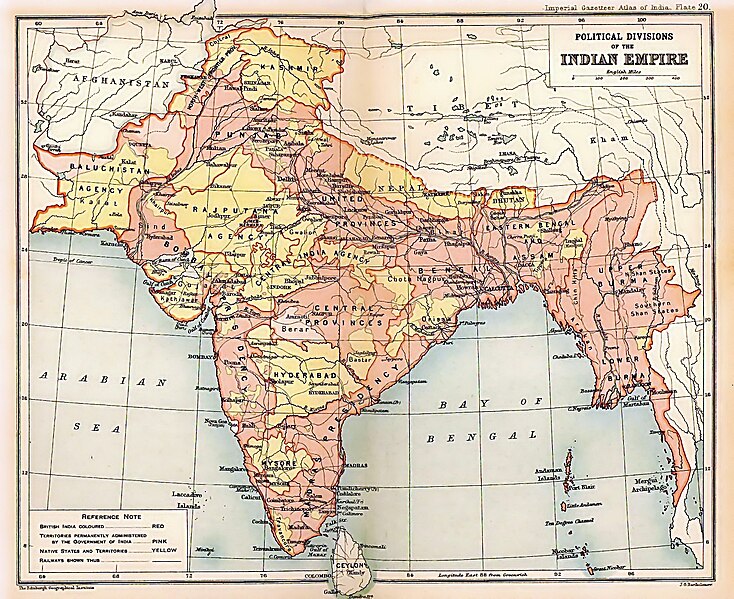
Pre-partition map of India

Pre-partition map of India

This map can be found at https://commons.wikimedia.org/wiki/File:British_Indian_Empire_1909_Imperial_Gazetteer_of_India.jpg and is part of quite a few Indian articles. I would urge people to look at the map in-depth. Except for the Central India Agency and Central India Provinces, most of the other regions were quite comfortable weather-wise. Hence I can t help but feel the assertion that Britishers didn t like India (as to live here) slightly revolting. See the excerpt/take on Dale Kennedy s The Magic Mountains: Hill Stations and the British Raj. Berkeley: University of California Press, 1996. xv + 264 pp. . A look at the list of hill stations of divided India is enough to tell that there were lot of places which either were founded by the Britishers or they chose to live there. And this is not all, there are supposed to lot of beautiful places even in Pakistan, especially in North East Frontier, Swat for instance. While today it s infamous for Taliban and Islamic Terrorism, there was a time it was known for its beauty.
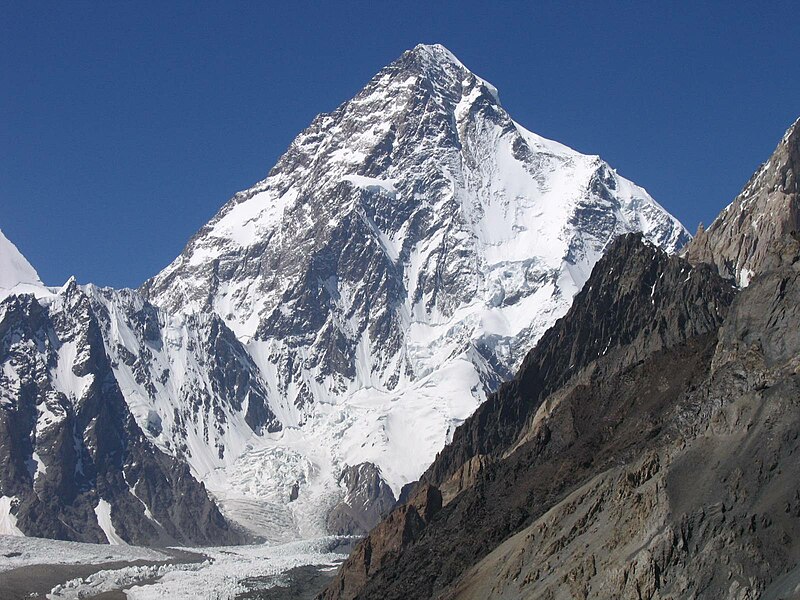
The second most difficult mountain in the world - K2, Pakistan

The second most difficult mountain in the world K2, Pakistan

Trivia After Everest, K2 is the smaller one although whatever I have read of people s accounts, most people who ascended all 14 8,000 metre peaks say K2 is technically more tougher than Everest and after Everest has the highest casualty rate. Also places like the disputed North half of Pakistan Occupied Kashmir, Gilgit Baltistan, Extreme northern Punjab of Pakistan , Northern half of Khyber-Pakhtunkhawa province and Northern Balochistan all of these places would have been more than conducive to the Britishers as it is near to the British climate (snow and pleasant weather all year round). It really is a pity that Pakistan chose to become a terrorist state where it could have become one of the more toured places of Asia. I really feel nauseous and sad at the multiple chances that Pakistan frittered away, it could have been something else.
Filed under: Miscellenous Tagged: #bash-completion, #British Raj, #contributions, #debian, #debian-policy, #Debian-QA, #Hill Stations, #India Independance Movement, #lintian, #obsolete-conffiles, #unknown-horizons, #weather, #World History, adequate, Pakistan, tourism

21 January 2017

Clint Adams: Strangers with candy

This.
Posted on 2017-01-21
Tags: barks

18 January 2017

Jan Wagner: Migrating Gitlab non-packaged PostgreSQL into omnibus-packaged

With the release of Gitlab 8.15 it was announced that PostgreSQL needs to be upgraded. As I migrated from a source installation I used to have an external PostgreSQL database instead of using the one shiped with the omnibus package.
So I decided to do the data migration into the omnibus PostgreSQL database now which I skipped before. Let's have a look into the databases:
$ sudo -u postgres psql -d template1
psql (9.2.18)  
Type "help" for help.
gitlabhq_production=# \l  
                                             List of databases
         Name                  Owner         Encoding   Collate    Ctype           Access privileges
-----------------------+-------------------+----------+---------+---------+---------------------------------
 gitlabhq_production     git                 UTF8       C.UTF-8   C.UTF-8  
 gitlab_mattermost       git                 UTF8       C.UTF-8   C.UTF-8  
gitlabhq_production=# \q  
Dumping the databases and stop PostgreSQL. Maybe you need to adjust database names and users for your needs.
$ su postgres -c "pg_dump gitlabhq_production -f /tmp/gitlabhq_production.sql" && \
su postgres -c "pg_dump gitlab_mattermost -f /tmp/gitlab_mattermost.sql" && \  
/etc/init.d/postgresql stop
Activate PostgreSQL shipped with Gitlab Omnibus
$ sed -i "s/^postgresql\['enable'\] = false/#postgresql\['enable'\] = false/g" /etc/gitlab/gitlab.rb && \
sed -i "s/^#mattermost\['enable'\] = true/mattermost\['enable'\] = true/" /etc/gitlab/gitlab.rb && \  
gitlab-ctl reconfigure  
Testing if the connection to the databases works
$ su - git -c "psql --username=gitlab  --dbname=gitlabhq_production --host=/var/opt/gitlab/postgresql/"
psql (9.2.18)  
Type "help" for help.
gitlabhq_production=# \q  
$ su - git -c "psql --username=gitlab  --dbname=mattermost_production --host=/var/opt/gitlab/postgresql/"
psql (9.2.18)  
Type "help" for help.
mattermost_production=# \q  
Ensure pg_trgm extension is enabled
$ sudo gitlab-psql -d gitlabhq_production -c 'CREATE EXTENSION IF NOT EXISTS "pg_trgm";'
$ sudo gitlab-psql -d mattermost_production -c 'CREATE EXTENSION IF NOT EXISTS "pg_trgm";'
Adjust permissions in the database dumps. Indeed please verify that users and databases might need to be adjusted too.
$ sed -i "s/OWNER TO git;/OWNER TO gitlab;/" /tmp/gitlabhq_production.sql && \
sed -i "s/postgres;$/gitlab-psql;/" /tmp/gitlabhq_production.sql  
$ sed -i "s/OWNER TO git;/OWNER TO gitlab_mattermost;/" /tmp/gitlab_mattermost.sql && \
sed -i "s/postgres;$/gitlab-psql;/" /tmp/gitlab_mattermost.sql  
(Re)import the data
$ sudo gitlab-psql -d gitlabhq_production -f /tmp/gitlabhq_production.sql
$ sudo gitlab-psql -d gitlabhq_production -c 'REVOKE ALL ON SCHEMA public FROM "gitlab-psql";' && \
sudo gitlab-psql -d gitlabhq_production -c 'GRANT ALL ON SCHEMA public TO "gitlab-psql";'  
$ sudo gitlab-psql -d mattermost_production -f /tmp/gitlab_mattermost.sql
$ sudo gitlab-psql -d mattermost_production -c 'REVOKE ALL ON SCHEMA public FROM "gitlab-psql";' && \
sudo gitlab-psql -d mattermost_production -c 'GRANT ALL ON SCHEMA public TO "gitlab-psql";'  
Make use of the shipped PostgreSQL
$ sed -i "s/^gitlab_rails\['db_/#gitlab_rails\['db_/" /etc/gitlab/gitlab.rb && \
sed -i "s/^mattermost\['sql_/#mattermost\['sql_/" /etc/gitlab/gitlab.rb && \  
gitlab-ctl reconfigure  
Now you should be able to connect to all the Gitlab services again. Optionally remove the external database
apt-get remove postgresql postgresql-client postgresql-9.4 postgresql-client-9.4 postgresql-client-common postgresql-common  
Maybe you also want to purge the old database content
apt-get purge postgresql-9.4  

Hideki Yamane: It's all about design

From Arturo's blog
When I asked why not Debian, the answer was that it was very difficult to install and manage.
It's all about design, IMHO.
Installer, website, wiki... It should be "simple", not verbose, not cheap.

17 January 2017

Arturo Borrero Gonz lez: Debian is a puzzle: difficult

Debian is a puzzle Debian is very difficult, a puzzle. This surprising statement was what I got last week when talking with a group of new IT students (and their teachers). I would like to write down here what I was able to obtain from that conversation. From time to time, as part of my job at CICA, we open the doors of our datacenter to IT students from all around Andalusia (our region) who want to learn what we do here and how we do it. All our infraestructure and servers are primarily built using FLOSS software (we have some exceptions, like backbone routers and switches), and the most important servers run Debian. As part of the talk, when I am in such a meeting with a visiting group, I usually ask about which technologies they use and learn in their studies. The other day, they told me they use mostly Ubuntu and a bit of Fedora. When I asked why not Debian, the answer was that it was very difficult to install and manage. I tried to obtain some facts about this but I failed in what seems to be a case of bad fame, a reputation problem which was extended among the teachers and therefore among the students. I didn t detect any branding biasing or the like. I just seems lack of knowledge, and bad Debian reputation. Using my DD powers and responsabilities, I kindly asked for feedback to improve our installer or whatever they may find difficult, but a week later I have received no email so far. Then, what I obtain is nothing new: I myself recently had to use the Ubuntu installer in a laptop, and it didn t seem that different to the Debian one: same steps and choices, like in every other OS installation. Please, spread the word: Debian is not difficult. Certainly not perfect, but I don t think that installing and using Debian is such a puzzle.

Ritesh Raj Sarraf: Linux Tablet-Mode Usability

In my ongoing quest to get Tablet-Mode working on my Hybrid machine, here's how I've been living with it so far. My intent is to continue using Free Software for both use cases. My wishful thought is to use the same software under both use cases.
  • Browser: On the browser front, things are pretty decent. Chromium has good support for Touchscreen input. Most of the Touchscreen use cases work well with Chromium. On the Firefox side, after a huge delay, finally, Firefox seems to be catching up. Hopefully, with Firefox 51/52, we'll have a much more usable Touchscreen browser.
  • Desktop Shell: One of the reason of migrating to GNOME was its touch support. From what I've explored so far, GNOME is the only desktop shell that has touch support natively done. The feature isn't complete yet, but is fairly well usable.
    • Given that GNOME has touchscreen support native, it is obvious to be using GNOME equivalent of tools for common use cases. Most of these tools inherit the touchscreen capabilities from the underneath GNOME libraries.
    • File Manager: Nautilus has decent support for touch, as a file manager. The only annoying bit is a right-click equivalent. Or in touch input sense, a long-press.
    • Movie Player: There's a decent movie player, based on GNOME libs; GNOME MPV. In my limited use so far, this interface seems to have good support. Other contenders are:
      • SMPlayer is based on Qt libs. So initial expectation would be that Qt based apps would have better Touch support. But I'm yet to see any serious Qt application with Touch input support. Back to SMPlayer, the dev is pragmatic enough to recognize tablet-mode users and as such has provided a so called "Tablet Mode" view for SMPlayer (The tooltip did not get captured in the screenshot).
      • MPV doesn't come with a UI but has basic management with OSD. And in my limited usage, the OSD implementation does seem capable to take touch input.
  • Books / Documents: GNOME Documents/Books is very basic in what it has to offer, to the point that it is not much useful. But since it is based on the same GNOME libraries, it enjoys native touch input support. Calibre, on the other hand, is feature rich. But it is based on (Py)Qt. Touch input is told to work for Windows. For Linux, there's no support yet. The good thing about Calibre is that it has its own UI, which is pretty decent in a Tablet-Mode Touch workflow.
  • Photo Management: With compact digital devices commonly available, digital content (Both Photos and Videos) is on the rise. The most obvious names that come to mind are Digikam and Shotwell.
    • Shotwell saw its reincarnation in the recent past. From what I recollect, it does have touch support but was lacking quite a bit in terms of features, as compared to Digikam.
    • Digikam is an impressive tool for digital content management. While Digikam is a KDE project, thankfully it does a great job in keeping its KDE dependencies to a bare minimum. But given that Digikam builds on KDE/Qt libs, I haven't had any much success in getting a good touch input solution for Tablet Mode. To make it barely usable in Table-Mode, one could choose a theme preference with bigger toolbars, labels and scrollbars. This helps in making a touch input workaround use case. As you can see, I've configured the Digikam UI with Text alongside Icons for easy touch input.
  • Email: The most common use case. With Gmail and friends, many believe standalone email clients are no more a need. But there always are users like us who prefer emails offline, encrypted emails and prefer theis own email domains. Many of these are still doable with free services like Gmail, but still.
    • Thunderbird shows its age at times. And given the state of Firefox in getting touch support (and GTK3 port), I see nothing happening with TB.
    • KMail was something I discontinued while still being on KDE. The debacle that KDEPIM was, is something I'd always avoid, in the future. Complete waste of time/resource in building, testing, reporting and follow-ups.
    • Geary is another email client that recently saw its reincarnation. I recently had explored Geary. It enjoys similar benefits like the rest applications using GNOME libraries. There was one touch input bug I found, but otherwise Geary's featureset was limited in comparison to Evolution.
    • Migration to Evolution, when migrating to GNOME, was not easy. GNOME's philosophy is to keep things simple and limited. In doing that, they restrict possible flexibilities that users may find obvious. This design philosophy is easily visible across all applications of the GNOME family. Evolution is no different. Hence, coming from TB to E was a small unlearning + newLearning curve. And since Evolution is using the same GNOME libraries, it enjoys similar benefits. Touch input support in Evolution is fairly good. The missing bit is the new Toolbar and Menu structure that many have noticed in the newer GNOME applications (Photos, Documents, Nautilus etc). If only Evolution (and the GNOME family) had the option of customization beyond the developer/project's view, there wouldn't be any wishful thoughts.
      • Above is a screenshot of 2 windows of Evoluiton. In its current form too, Evolution is a gem at times. For my RSS feeds, they are stored in a VFolder in Evolution, so that I can read them when offline. RSS feeds are something I read up in Tablet-mode. On the right is an Evolution window with larger fonts, while on the left, Evoltuion still retains its default font size. This current behavior helps me get Table-Mode Touch working to an extent. In my wishful thoughts, I wish if Evolution provided flexibility to change Toolbar icon sizes. That'd really help easily touch the delete button when in Tablet Mode. A simple button, Tablet Mode, like what SMPlayer has done, would keep users sticky with Evolution.
My wishful thought is that people write (free) software, thinking more about usability across toolkits and desktop environments. Otherwise, the year of the Linux desktop, laptop, tablet; in my opinion, is yet to come. And please don't rip apart tools, in porting them to newer versions of the toolkits. When you rip a tool, you also rip all its QA, Bug Reporting and Testing, that was done over the years. Here's an example of a tool (Goldendict), so well written. Written in Qt, Running under GNOME, and serving over the Chromium interface. In this whole exercise of getting a hybrid working setup, I also came to realize that there does not seem to be a standardized interface, yet, to determine the current operating mode of a running hybrid machine. From what we explored so far, every product has its own way to doing it. Most hybrids come pre-installed and supported with Windows only. So, their mode detection logic seems to be proprietary too. In case anyone is awaer of a standard interface, please drop a note in the comments.

Categories:

Keywords:

Like:

16 January 2017

Raphaël Hertzog: Freexian s report about Debian Long Term Support, December 2016

A Debian LTS logoLike each month, here comes a report about the work of paid contributors to Debian LTS. Individual reports In December, about 175 work hours have been dispatched among 14 paid contributors. Their reports are available: Evolution of the situation The number of sponsored hours did not increase but a new silver sponsor is in the process of joining. We are only missing another silver sponsor (or two to four bronze sponsors) to reach our objective of funding the equivalent of a full time position. The security tracker currently lists 31 packages with a known CVE and the dla-needed.txt file 27. The situation improved a little bit compared to last month. Thanks to our sponsors New sponsors are in bold.

No comment Liked this article? Click here. My blog is Flattr-enabled.

Maria Glukhova: APK, images and other stuff.

2 more weeks of my awesome Outreachy journey have passed, so it is time to make an update on my progress. I continued my work on improving diffoscope by fixing bugs and completing wishlist items. These include:

Improving APK support I worked on #850501 and #850502 to improve the way diffoscope handles APK files. Thanks to Emanuel Bronshtein for providing clear description on how to reproduce these bugs and ideas on how to fix them. And special thanks to Chris Lamb for insisting on providing tests for these changes! That part actually proved to be little more tricky, and I managed to mess up with these tests (extra thanks to Chris for cleaning up the mess I created). Hope that also means I learned something from my mistakes. Also, I was pleased to see F-droid Verification Server as a sign of F-droid progress on reproducible builds effort - I hope these changes to diffoscope will help them!

Adding support for image metadata That came from #849395 - a request was made to compare image metadata along with image content. Diffoscope has support for three types of images: JPEG, MS Windows Icon (*.ico) and PNG. Among these, PNG already had good image metadata support thanks to sng tool, so I worked on .jpeg and .ico files support. I initially tried to use exiftool for extracting metadata, but then I discovered it does not handle .ico files, so I decided to use a bigger force - ImageMagick s identify - for this task. I was glad to see it had that handy -format option I could use to select only the necessary fields (I found their -verbose, well, too verbose for the task) and presenting them in the defined form, negating the need of filtering its output. What was particulary interesting and important for me in terms of learning: while working on this feature, I discovered that, at the moment, diffoscope could not handle .ico files at all - img2txt tool, that was used for retrieving image content, did not support that type of images. But instead of recognizing this as a bug and resolving it, I started to think of possible workaround, allowing for retrieving image metadata even after retrieving image content failed. Definetely not very good thinking. Thanks Mattia Rizzolo for actually recognizing this as a bug and filing it, and Chris Lamb for fixing it!

Other work

Order-like differences, part 2 In the previous post, I mentioned Lunar s suggestion to use hashing for finding order-like difference in wide variety of input data. I implemented that idea, but after discussion with my mentor, we decided it is probably not worth it - this change would alter quite a lot of things in core modules of diffoscope, and the gain would be not really significant. Still, implementing that was an important experience for me, as I had to hack on deepest and, arguably, most difficult modules of diffoscope and gained some insight on how they work.

Comparing with several tools (work in progress) Although my initial motivation for this idea was flawed (the workaround I mentioned earlier for .ico files), it still might be useful to have a mechanism that would allow to run several commands for finding difference, and then give the output of those that succeed, failing if and only if they all have failed. One possible case when it might happen is when we use commands coming from different tools, and one of them is not installed. It would be nice if we still used the other and not the uninformative binary diff (that is a default fallback option for when something goes wrong with more clever comparison). I am still in process of polishing this change, though, and still in doubt if it is needed at all.

Side note - Outreachy and my university progress In my Outreachy application, I promised that if I am selected into this round, I will do everything I can to unload the required time period from my university time commitements. I did that by moving most of my courses to the first half of the academic year. Now, the main thing that is left for me to do is my Master s thesis. I consulted my scientific advisors from both universities that I am formally attending (SFEDU and LUT - I am in double degree program), and as a result, they agreed to change my Master s thesis topic to match my Outreachy work. Now, that should have sounded like an excellent news - merging these activities together actually mean I can allocate much more time to my work on reproducible builds, even beyond the actual internship time period. That was intended to remove a burden from my shoulders. Still, I feel a bit uneasy. The drawback of this decision lies in fact I have no idea on how to write scientific report based on pure practical work. I know other students from my universities have done such things before, but choosing my own topic means my scientific advisors can t help me much - this is just out of their area of expertise. Well, wish me luck - I m up to the challenge!

15 January 2017

Dirk Eddelbuettel: Rcpp 0.12.9: Next round

Yesterday afternoon, the nineth update in the 0.12.* series of Rcpp made it to the CRAN network for GNU R. Windows binaries have by now been generated; and the package was updated in Debian too. This 0.12.9 release follows the 0.12.0 release from late July, the 0.12.1 release in September, the 0.12.2 release in November, the 0.12.3 release in January, the 0.12.4 release in March, the 0.12.5 release in May, the 0.12.6 release in July, the 0.12.7 release in September, and the 0.12.8 release in November --- making it the thirteenth release at the steady bi-montly release frequency. Rcpp has become the most popular way of enhancing GNU R with C or C++ code. As of today, 906 packages on CRAN depend on Rcpp for making analytical code go faster and further. That is up by sixthythree packages over the two months since the last release -- or about a package a day! Some of the changes in this release are smaller and detail-oriented. We did squash one annoying bug (stemming from the improved exception handling) in Rcpp::stop() that hit a few people. Nathan Russell added a sample() function (similar to the optional one in RcppArmadillo; this required a minor cleanup by for small number of other packages which used both namespaces 'opened'. Date and Datetime objects now have format() methods and << output support. We now have coverage reports via covr as well. Last but not least James "coatless" Balamuta was once more tireless on documentation and API consistency --- see below for more details.

Changes in Rcpp version 0.12.9 (2017-01-14)
  • Changes in Rcpp API:
    • The exception stack message is now correctly demangled on all compiler versions (Jim Hester in #598)
    • Date and Datetime object and vector now have format methods and operator<< support (#599).
    • The size operator in Matrix is explicitly referenced avoiding a g++-6 issues (#607 fixing #605).
    • The underlying date calculation code was updated (#621, #623).
    • Addressed improper diagonal fill for non-symmetric matrices (James Balamuta in #622 addressing #619)
  • Changes in Rcpp Sugar:
    • Added new Sugar function sample() (Nathan Russell in #610 and #616).
    • Added new Sugar function Arg() (James Balamuta in #626 addressing #625).
  • Changes in Rcpp unit tests
    • Added Environment::find unit tests and an Environment::get(Symbol) test (James Balamuta in #595 addressing issue #594).
    • Added diagonal matrix fill tests (James Balamuta in #622 addressing #619)
  • Changes in Rcpp Documentation:
    • Exposed pointers macros were included in the Rcpp Extending vignette (MathurinD; James Balamuta in #592 addressing #418).
    • The file Rcpp.bib move to directory bib which is guaranteed to be present (#631).
  • Changes in Rcpp build system
    • Travis CI now also calls covr for coverage analysis (Jim Hester in PR #591)

Thanks to CRANberries, you can also look at a diff to the previous release. As always, even fuller details are on the Rcpp Changelog page and the Rcpp page which also leads to the downloads page, the browseable doxygen docs and zip files of doxygen output for the standard formats. A local directory has source and documentation too. Questions, comments etc should go to the rcpp-devel mailing list off the R-Forge page.

This post by Dirk Eddelbuettel originated on his Thinking inside the box blog. Please report excessive re-aggregation in third-party for-profit settings.

Next.

Previous.