Search Results: "ag"

27 March 2008

Andrew Pollock: [tech] LugRadio Live USA 2008

LugRadio Live USA 2008 I've never been much of a podcast listener, largely because I haven't gotten my act together and downloaded any on a regular basis, and partly because the iPod is tied to Sarah's iTunes on her laptop, so it's not convenient to go fiddling with the iPod. If I ever manage to get back into the swing of things and get to the gym regularly, I think I'd prefer to listen to a podcast rather than straight music, so I can hopefully expand my brain while I'm slogging my guts out on the treadmill. Kynan and Shona have both talked about LugRadio events from when they lived in the UK, and I've been vaguely aware of it as a podcast (it's probably the first podcast I'd name if you asked me to name one). I vaguely knew that Kynan had been trying to organise something LugRadio related in the Valley for a while now. Well, it turns out he's succeeded, and it's good to see he's gotten some credit for it as well. Onya Kynan! So I got all excited when I went and looked at the schedule and discovered it was going to be something vaguely like a mini-linux.conf.au, I scurried off and bought a couple of tickets. Then Sarah pointed out that it's the weekend that we're going to San Diego for a four-day weekend. Oh well, at least the tickets were pretty cheap. So, if, unlike me, you'll actually be in the Bay Area on April 12th and 13th, check it out, it sounds like it'll be fun.

Andrew Pollock: [tech] Mutt configuration find of the year

I switched from Pine to Mutt as my primary email client around the time I decided to become a Debian developer, because Pine's PGP support was abysmal (it also beat building Pine packages by hand all the time). The other bonus feature was it threaded emails, which made it easier to follow mailing lists. It's been a very gradual learning process since I switched, and I certainly don't consider myself to be a Mutt power user. I initially really hated it, I think largely because of the concept of "old, unseen" messages, versus "new" messages, and the behaviour of the Tab key. Once I unset the mark_old variable, it got a lot more tolerable. I think at some point I either plagiarised someone's .muttrc from the Internet, or sat down with the manual (or possibly a bit of both) and came up with a config that I could live with, and it's been workable ever since. One problem I (more recently) started having was that when I had 200-odd unread emails in my inbox, which has been pretty common occurrence in the last couple of years, and someone replied to an email in an old thread, because I wasn't necessary scrolling through all 200-odd emails (as new, unthreaded emails usually sorted chronologically at the bottom of my inbox), I'd miss the fact that the email had arrived, often for extended periods of time. I was lamenting this problem to Sarah over dinner last night, and saying how I preferred Gmail's behaviour, where the position of a thread in the inbox was determined by the date of the most recent email in the thread. I figured Mutt must have a sort option to be able to deal with this, and so I went rummaging in the manual last night, and discovered the sort_aux configuration variable. I've set that to last-date-received, and now I'm very pleased. I should never miss an email again. Of course, I should really try practising Inbox Zero, then it wouldn't be an issue.

Pierre Habouzit: [RC-Bug-A-Day] Day 12

Today's paid work ate all my time, so my RC/RG bug squashing was only made of uploading other's work. Thanks again to Kartik and Kumar.

Aigars Mahinovs: More of a good thing?

There is one particular aspect of Microsoft’s document format going through ISO process that I had a hard time to find a counter-argument against: “Well it is better to have multiple open formats, isn’t it?”. Last night when I was presenting in a Document Freedom Day event, I finally got one. When multiple standards exist in the same area, two options can exist:
  1. Cooperative standards - providing similar functionality in different ways that can coexist in the same medium without a significant overhead. An example of this are the credit cards - they have multiple ways that the card information can be transferred to the bank: visual writing down of the data, imprint, magnetic strip and the chip. Any of these ways can be used and all of the are equally valid;
  2. Conflicting standards - providing the same functionality in incompatible ways. The example here is the power adaptors - the form of the power plug is an open and public standard (AFAIK), but so many of them exist in different places that it creates all sorts of problems both for companies producing electronic equipment and for frequent travellers.
What Microsoft proposes is much worse than the power plug mess, because the power plug standards are at least restricted by region. But imagine going to another country and having to be ready that you hotel could have any one of 8 power plug types at random. And while electricity is rather easy to convert looselesly, complex documents are far more .. complex. It is like having to buy 8 different power bricks for each of your electrical devices to be prepared for all possible voltages, frequencies, waveforms, polarities and whatnot. Having more than one ISO document standard in a horrifying idea for any programmer that will have to ever work on software that will need to support both of them - twice the work for no etra benefit whatsoever. If Microsoft can prove (in technical terms) that their file formats present capabilities that Open Document can not, then the only sane way to implement those in the ISO format is to add those capabilities as an extension of the existing Open Document format and not to reinvent the wheel. Microsoft also has a habit of pointing to JPEG and PNG being “competing”. Well, they are not - those are complimentary standards, because JPEG is designed for compression of photographic details while PNG is designed for the compression of bitmapped vector images. Something like DejaVu could be seen as a superset of the two formats. So, if you ever need an argument against more standards - remember about the power plugs.

Jan Wagner: security: policyd-weight 0.1.14-beta-6etch1/0.1.14.15-1

This Tuesday Robert Felber released a new upstream version. It is a (local) security bugfix (and some minor fixes) which was reported on Sunday by Chris Howells to the Debian Security Team (as well as to other vendors). Today DSA-1531 was released. Right from the DSA:
“… created its socket in an insecure way, which may be exploited to overwrite or remove arbitary files from the local system.” So please update you systems if you use this package asap. While we are at policyd-weight… there is one bug open (#471645) where I’m unsure if I want to fix it, cause only stable is effected and the problem can be solved by providing a adjusted array of rbl in the config file. Should I ask for inclusion directly into stable? But it’s a really minor issue. Or try to get 0.1.14.15 uploaded to volatile? I’m really unsure and suggestions are welcome.

Jeff Bailey: It's time to place "Guess the cost!"

So for those of you following along, you'll notice that I've just had surgery in the most expensive place in the world. Luckily for me, Google (my employer) has an amazing set of health care packages, so I haven't had to be concerned with total financial destruction.

But how close would it have come?

That's the game we're about to play! I invite you, dear reader, to make a bid on how much you think the 4 days in hospital including the surgery, will cost.

Here's some info to help you along:

* Two days and one night of angiogram, embolism, general anesthetic, and chapstick cost ~$67,000 (The stick of chapstick was $17, apparently. Gotta love itemised billing.)

* One day of prep to make sure that the above day wouldn't kill me was $750

* A friend of mine at a different hospital had aorta replacement surgery for $250,000. She apparently had a longer hospital stay and a longer surgery, but with fewer surgeons.

* I was in the hospital for 4 days.

* The surgery was ~7 hours long (We think they started at 11, they forgot to phone Angie when they started)

* There were at least 3 surgeons involved, plus physicians assistants, etc.

Winner gets one of (next time I see them, and assuming i'm physically able) one of (their choice):

* Back rub
* Reasonably good glass of nicest port available at reasonably-close-by bar (Let's say not to exceed $25 for the glass)
* Dinner at some vegan-friendly place.

Let the bidding begin! Bidding closes when I receive the bill.

Bastian Venthur: Happy Birthday rng!

Hmm, better late then never, I guess. One year and two weeks ago, reportbug-ng was initially uploaded to Debian unstable. Happy birthday rng! I wish you a lot of ponies in the next year!

Jordi Mallach: Interview in El Pa s

Today's edition of El Pa s, the most read Spanish newspaper, celebrates the 10th anniversary of it's weekly technology section Ciberpa s with a special edition which takes a look back at the last 10 years of computing, and also looks forward to what the future will bring us. Merc Molist interviewed Carlos Atar s, my mate at Softcatal Jordi Mas and myself, on what happened during the last 10 years of Free Software and where we are heading. The paper edition features a *gasp* half page picture of me laying on the grass, but is otherwise identical to the online version. I need to add, this feels a bit strange. :) It's the first time I see myself refered to as just Mallach , but I realise I'm getting old...

Jan Wagner: Liquid Sunday 4.1

Liquid Sunday 4.1Like (almost) every year I visited obligatory the event. Since my family^Wreallife is normaly preventing me from such a party, this one left cause it’s in my old homeland and there are good friends forcing me to join them (my wife can’t deny a please of her brother :). (more…)

David Pashley: Installing java non-interactively

Installing the Sun Java packages on Debian or Ubuntu require to you accept Sun's license before you can install them. This means that it's not easy to install non-interactively, for example when using pbuilder. Fortunately the license uses debconf to check to see if you have already accepted the license. This means you can use debconf to accept the license before you install the packages. Create a file containing the following lines:
sun-java5-jdk shared/accepted-sun-dlj-v1-1 select true
sun-java5-jre shared/accepted-sun-dlj-v1-1 select true
sun-java6-jdk shared/accepted-sun-dlj-v1-1 select true
sun-java6-jre shared/accepted-sun-dlj-v1-1 select true
Then run /usr/bin/debconf-set-selections <file> and when you install the java packages, you should find it doesn't prompt for the license any more.
Read Comments (0)

Stefano Zacchiroli: galax 1.1

Galax 1.1: released ... and in Debian/unstable! After a long release cycle, a couple of days ago Galax 1.1 (the first release of the 1.x series) was finally released. Galax is a free (as in freedom) implementation of XQuery, the XML Query language. Galax is Schema-aware, statically typed, and really fast. The release enjoyed a good synergy among the Debian packagers (erm ... /me) and upstream authors which were happy to exchange patches and let me test drive the release before making it public, to check whether everything was fine for Debian or not. Thank you Jerome and Mary! Thanks to these efforts Galax 1.1 is now available in Debian/unstable. Enjoy your XQueries!

Julien Danjou: PHP applications code quality

Ah, Erich, that IS so true. I never found a well written PHP application anyway, or it was only 10 lines long. I guess that's primarily the language fault. It permits to do a lot of stuff and does not simplify, help nor force the simplest implementation methods like MVC which should be the base in Web developement. Well, take as example what we would do with Python and GTK+ if they were like PHP and HTML (I do not have the API reference so it will be somewhat improvised):
#finally we do not need this module I wrote everything myself
#import somemodule
def main():
    # Well we want to do some printing
    window = GtkWindow()
    # Connect to the database without any abstraction, that sucks
    db = mysql.connect()
    data = db.query("select RANDOMLYTYPEDDATA from MYONLYTABLE");
    while data:
        # Ah, we do not have include() so we cannot reuse code
        # I'm a PHP developer, I do not know functions
        import somestuff
    window.print(somestuff.result)
    # Obviously, forgot to close db connection, etc.
    if form.data.field == "hello":
        # The user asked for hello, print hello
        window.print("hello")
    # debug
    print data[0]
    if form.data.anotherfield[0] == "morning":
        data = db.query("select anotherdata from MYONLYDATA")
    else:
        sys.exit(42)
    label = GtkLabel()
    # Yes know we construct the view!
    window.add(label)
    label.print(data)
That is typical PHP code: we just take randomly typed data from our DB eng... no wait, from MySQL (remember that's LAMP!!! Not LAPP or anything else, bitches!), then we print some HTML code with data, and we do tests on environment, forms, etc, and we get back data, reprint them, do not use functions but include() multiple times thousand of files and then do not close/free anything. It's so easy to do bad code that lot of people coming from nowhere and who did not learn anything from other languages are doing it. Another hypothesis coming from my experiment: PHP is a language which can be developed under any OS since it's server-side executed. A link between mostly brain dead "developers" from the Microsoft world and whose from the Free Software world. A clash. I apologize to some of my coworkers doing better PHP all the day. :-)

26 March 2008

Jeff Bailey: Update of the moment

Hey - here's an update:

* I'm off the steroids. Last one was last Friday, spent the weekend enjoying the withdrawal symptoms, and already enjoying the benefits, like my skin is clearing up even more, I'm starting to get my voice back, and I'm less inclined to be angry at the vacuum cleaner when it runs into me. Angie tells me I'm a lot more fun to have around. Which is encouraging when one is totally dependent on another person for food. =)

* I seem to have gotten sick. It took me a bit to figure this one out, but the withdrawal symptoms seemed to be going on longer than expected. Then Angie started showing signs of them, after Leif was fussy for a day. Blech. =( Which explains why I can be cold under covers when the thermostat claims that it's 74 F (No idea in civilised measurements, sorry). Hopefully this passes quickly. Time for lots of breathing and napping. Like I could be sleeping any more during the day.

* My energy levels are getting better. I saw Andrew Pollock at noon today when he returned a CD to me, and he commented that from my walking you can barely tell I had surgery 3 weeks ago. Except for how slowly I'm going. And the full body turn in order to look to see if cars are coming when I cross the road. And the huge production to step up onto the sidewalk. A 5 minute walk no long requires me to sleep for 2 hours. Can't say the same for a 10 minute walk yet, though.

* Staples are out! I have two more days of antibiotics because the incision is still red and giving off more heat than they'd like so I'm back in next Tuesday for another checkup. Last week, the surgeon wasn't surprised by the healing rate given that the steroids are an immunosuppressant, though. So hopefully next Tuesday I get a clean bill of health and then just have to wait 2 weeks before getting some movement restrictions lifted and starting PT. And tomorrow I'll have a shower without fetish^WPlastic Wrap all over the incision. I can't shower unassisted yet, though, since getting most of my body would count as "reaching"

* Short-term disability finally approved my claim. For 6 weeks anyway. Then they want me to return to work or get better justification from my surgeon. I'm sure he'll be all professional, but I'd love it if the letter read "My client takes 10 minutes to get out of bed. He takes vicodin every 4 hours, and my nurse just recommended Oxycodone so that he can sleep more than 2.5 hours at a stretch. What do you think?"

* We have the biopsy results. And like every other biopsy result, we have... Inconclusive! Whee! At least they're no longer using the word "Sarcoma", but instead have settled on Osteoblastoma. But there's a catch - there are two types of Osteoblastoma, Aggressive and not. (I'm sure there's technical terms, but I'm tired and didn't catch them). The inconclusive bit is whether it's aggressive or not. During surgery, however, they treated it as aggressive because they didn't have the information and did what they'd do to minimize the chance of it coming back by taking out lots of extra tissue. I still get to see an Oncologist, in case there's something interesting through all of this still to learn.

* Otherwise, schoolwork extensions are all approved, our new bank likes us and is doing good things. Coworkers are popping in and saying hi, so I'm not feeling totally isolated. Heinlein is less good the fewer drugs I'm on. Or maybe it's because I'm reading "Friday".

Things are still getting better every day, even through all the sickness and such. I'm trying to catch up with people on Jabber. I still can't lift the laptop, so IRCs out until I figure out where I put the charger to the N810. It's somewhere out of reach, so as far away as the moon as far as I'm concerned.

I also want to take a moment to say thanks to Sandy and Jamu for their visits here - We're trying to arrange for people to visit us on the weekends and help us return the place to a clean state, with Kit starting the visits this coming weekend. Angie's got her hands full with Leif, and I get the joy of sitting in the corner wishing I could be useful. The result is that the house slowly falls apart over the course of a week, and hopefully weekend visitors will help us keep some measure of sanity here.

Peace and love, all.

Tks,
Jeff Bailey

Joey Hess: my anti-platform: followup

A year ago I posted an anti-platform with some things I wanted to work on over the next year or three. This is a followup to see what, if anything, has been accomplished. constantly usable testing CUT generated some discussion in the project, but I've done nothing toward it myself. The only real progress in this area over the last year has been increasing improvements in the testing security team, and the release team, both of which I'm not currently active in. deprecating www.debian.org This continues to happen organically, for example, Debian Weekly News stopped and http://wiki.debian.org/DeveloperNews took its place. Aside from pointing out that this is happening, I haven't done much to push it. double the archive sync frequency again Sadly, this has not happened yet. automated whole system testing HP donated a test machine, which I set up to run emulated tests of installations of i386, amd64, s390, mips, and mipsel. (Arm and armel should be added soon.) I don't always manage to keep all the tests working at all times by myself, but they have been valuable. developer (virtual) machines My test machine spits out disk images for 5 architectures that have debian pre-installed on them, but due to hosting issues I have not been able to share those images with others yet. find the next nslu2 I was pretty sure this would be OpenMoko's Neo phone, but I have only briefly had access to one, and it's not clear it will be easy enough to get the hardware to make it worthwhile to target it. Meanwhile, tbm has found a more nslu2-like next nslu2, the QNAP Turbostation NAS device, and there's work underway to fully support it from d-i onwards. Others have also worked on running Debian on various related AP hardware, including the ASUS WL-500g and Linksys WRTSL54GS, using OpenWRT to boot Debian. There's instructions and downloads on a wiki page. It would be good to get this fully supported without the hacks.

Erich Schubert: Measuring code quality by database support...

Do you know why so many (mostly PHP) developers have problems porting their applications to PostgreSQL?Because PostgreSQL actually enforces constraints on the data.MySQL, which can even have values that are NULL and NOT NULL at the same time (yes, this is not a joke, Details are found here), is not particularly good at that. And people get used to all kind of stuff they can throw at MySQL and it will try to make the best out of it, instead of forcing the programmer to correctly specify what he intends to do.That's the reason why I so far have been avoiding any application which only support MySQL: If it only supports MySQL, it probably means they can't get it to work with anything else. And that is a really bad sign.I was looking for some cheap WebCMS. The big names are Typo3, Joomla, Drupal. Joomla is MySQL only. Plus it doesn't support iCalendar. Typo3, I've had had a look on that one before, it was ugly, used things like line numbers for layouting. And Drupal was pretty much the only one I heard not just negative things about (I was mostly talking to tech guys, not "web designers"). So I thought I'd give it a try. With PostgreSQL, since I want a consistent database.Drupal (6.1) installation with PostgreSQL worked fine. Then I tried installing the add-on modules I was most interested in: Date and Event; since the web site I'm considering it for will be mostly around organizing events, so I do need some solid calendaring functions.Apparently, the Date module of Drupal currently does not support PostgreSQL, it failed creating or filling it's timezone table in the database.How come that pretty much all PHP stuff is broken on so many levels? I figure the Drupal people have spent a lot of time in getting their core working well, and I also believe that the cores of the other systems might all be okay. But when it comes to extension modules, it seems to be as bad as ever before with PHP...Some people might just say "well, run MySQL, and it would be working".If a module isn't capable of storing timezone information in other SQL databases, how can it be of good code quality?(Yes, I know that I'm not being entirely fair. Picking on Drupal or even on the not yet finished Date extension is probably not really fair. But you have to admit that an application which can work with multiple databases probably has received more attention to doing database things the proper way, right?The Date module is not yet "released". I'm not saying it's worthless, it just does not work for me yet. And it actually backs my first claim: working support for other SQL databases is a sign of code maturity.And in most (if not all) PHP web applications, extension modules with their varying code quality are known for introducing security issues again and again.)

Filip Van Raemdonck: Lilo LVM fixed root

One annoyance with the lilo bootloader that I've ran into a few times recently, is that it apparently turns any root configuration arguments into a device number. Which is then passed to the kernel at boot.
So if the kernel decides to assign a different device number to the supposed root device, your system may no longer boot.

Yesterday I once again ran into this: when I added an additional disk to a system, the LVM volumes which were on that new disk got assigned device numbers before the existing system LVM volumes.
Giving the problem a little thought, I realized that the solution though silly is really simple: add an append="root=/dev/yournode" directive to lilo.conf, and this boot-time argument will always override the root device set by lilo.

No more changing root devices for me

Nico Golde: streaming from your fileserver using mpd and icecast

My mobile music player is often missing the files I want to hear right now if I'm under way because my music collection is too big to fit on it.
Long time ago I used gnump3d which seems to be unmaintained in Debian for quite some time and then I often listened to some live streams, network connections are available nearly everywhere.
But I always wanted my own live stream with music I want to hear. There are several solutions out there for this task but they all require the creation of a playlist before the streaming starts.

Fortunately mpd provides the possibility to define different output targets and also one for streaming to a shoutcast or compatible server like icecast.

So after apt-get install mpd icecast2 (on a Debian box) you have to edit /etc/mpd.conf
There is not much to do, be sure to set music_directory to the place your music is located and the configure the output part.
Add the following to your mpd.conf and adapt some values:
  1. audio_output {
  2.         type "shout"
  3.         name "foobar stream"
  4.         port "8000"
  5.         host "localhost"
  6.         format  "44100:16:2"
  7.         mount "/stream.ogg"
  8.         password "somepass"
  9.         quality "2"
  10.         user "source"
  11. }

The type defines that this output will be streamed to a shoutcast target. The name will be displayed by the client you use to play your stream. 8000 is the port icecast2 will listen on host "localhost" (in this example the icecast2 server is on the same host). format specifies the audio format of the stream, the first number is the sample rate in Hz, the second number is the number of bits per sample and the last number defines the number of channels (2 is stereo here). Those values should work for most of you. mount specifies the path under which the stream is available later from the server root, in this example http://localhost:8000/stream.ogg.
quality defines the ogg encoding "quality". You can also specify the bitrate instead of it. The user and password values are used to authenticate mpd at the source input for icecast2.

There seems to be a bug in the 0.13 release (which is also in Debian) of mpd that prevents this from working. I don't know the details about this bug but adding
  1. audio_output {
  2.         type "alsa"
  3.         name "fake out"
  4.         driver "null"
  5. }
fixes it.

Make sure to set START_MPD=true in /etc/default/mpd to enable mpd.
That's all that needs to be done for mpd.

The next step is to edit /etc/icecast2/icecast.xml.
The default configuration nearly ready to use. Configure the authentication part:
  1. <authentication>
  2.       <source-password>somepass</source-password>
  3.       <admin-user>admin</admin-user>
  4.       <admin-password>someadminpass</admin-password>
  5. </authentication>

The source password is the one we specified in the mpd configuration. This is needed to authenticate mpd with icecast. source is the default user name icecast uses here. Additionally we define an admin-user that can be used to add users to icecast later because we want to protect the stream by a username and a password.
Then set
  1. <hostname>you.somehost.org</hostname>
.
This hostname is used to generate URLs in icecast that a user receives.

Because we want a very simple authentication for the stream we need to add some options for the mount (/stream.ogg):
  1. <mount>
  2.     <mount-name>/stream.ogg</mount-name>
  3.  
  4.     <max-listeners>1</max-listeners>
  5.     <authentication type="htpasswd">
  6.             <option name="filename" value="/etc/icecast2/htpasswd"/>
  7.             <option name="allow_duplicate_users" value="0"/>
  8.     </authentication>
  9.     <on-connect>/home/icecast/bin/stream-start</on-connect>
  10.     <on-disconnect>/home/icecast/bin/stream-stop</on-disconnect>
  11. </mount>

I think the xml tags are pretty much self-explanatory. Keep in mind to set the filename to a location the icecast daemon has access to, that's why I used /etc/icecast2. Then you can add users with htpasswd or using the web interface on port 8000 and add a user there.

The last thing to do is to adjust the <alias source="/" dest="/status.xsl"/> setting. Change status.xsl to auth.xsl people need to authenticate if they connect to the web interface before seeing the stream information.

Now you can login via ssh on your home server and use your favorite mpd client to configure playlists on the fly, I use ncmpc for this. Of course the authentication is not secure, people who sniff your traffic can see your login data.
One thing to keep in mind is to restart mpd after restarting icecast otherwise mpd will hang and not continue to stream, this seems to be a bug.

After routing through your NAT, you should be able to play your stream via http://you.somehost.org:8000/stream.ogg.

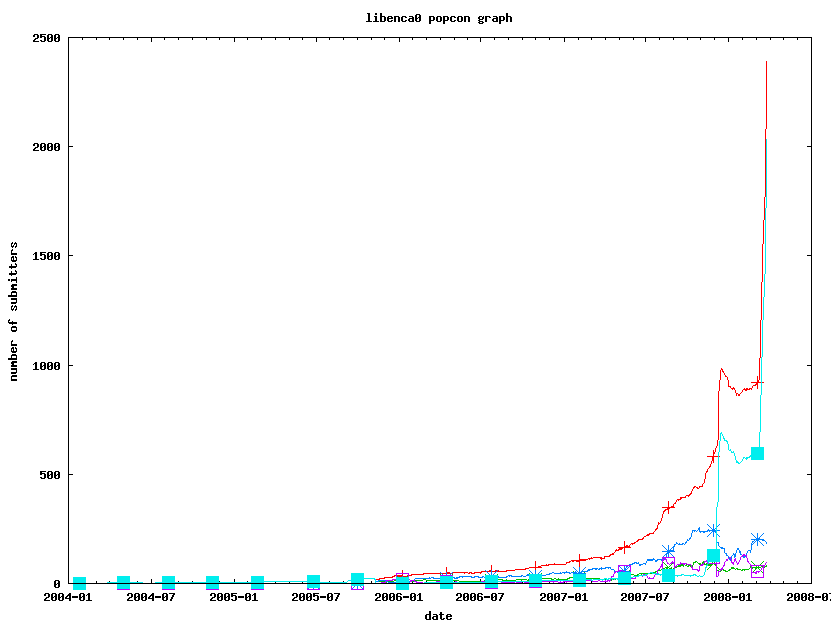
Michal &#268;iha&#345;: Enca popularity boost

Looking time to time to my QA page, I could not miss huge popularity boost for enca. After looking at reverse deps, I quickly found out that Mplayer from debian-multimedia is reason for this: libenca popularity

Benjamin Mako Hill: Unhappy Birthday Interview

Unhappy Birthday -- a website that tries to educate the public and encourage folks to snitch on their friends for singing the (copyrighted!) Happy Birthday song in public places -- is perhaps the most widely read thing I've ever written. It's been seen by millions and I continue to get hate mail several times a week. Last Sunday, the nationally broadcast CBC show WireTap aired an pseudonymous in-character interview with me about the site where I pretended to be a copyright high-protectionist. I think it turned out pretty well. You can listen to it on the unofficial WireTap podcast. My interview starts at a bit more than 10 minutes into the show.

Riku Voipio: Danske bank fiasco

Approximately one year ago danske bank swallowed the second-largest Finnish bank, Sampopankki. Last weekend, the perfectly fine working web-bank was flushed down the toilet and replaced with Danske Banks infrastructure. So far the results are quite horrific:


A surprising number people have dismissed the whole issue as "IT business as usual, why complain?". Sure, we all *know* that most IT projects deliver late, fail to work until the first service pack, fail to import data properly from previous versions or simply fail completely. But is that something we should just accept as part of life? Even for banks that are (were) holding our money?

Next.

Previous.