Search Results: "tb"

18 September 2013

Russell Coker: Advice for Web Editing

A client has recently asked for my advice on web editing software. There are lots of programs out there for editing web sites and according to a quick Google search there are free Windows programs to do most things that you would want to do. The first thing I m wondering about is whether the best option is to just get a Linux PC for web editing. PCs capable of running Linux are almost free nowadays (any system which is too slow for the last couple of Windows versions will do nicely). While some time will have to be spent in learning a new OS someone who uses Linux for such tasks will be able to use fully-featured programs such as the GIMP which are installed as part of the OS. While it is possible to configure a Windows system to run rsync to copy a development site to the production server and to have all the useful tools installed it s much easier to run a few apt-get or yum commands to install the software and then copy some scripts to the user s home directory. The next issue is whether web editing is the best idea. Sites that are manually edited tend to be very simple, inconsistent, or both. Some sort of CMS seems to be the better option. WordPress is a CMS that I m very familiar with so it s easy for me to install it for a client, while I try and resist the temptation to force my favorite software on clients there is the issue that I can install WordPress quickly which therefore saves money for my client. WordPress is a CMS that supports installing different themes (and has a huge repository of free themes). The content that it manages consists of pages and posts , two arbitrary types of document. Supporting two types of document with a common look and feel and common important data in a side-bar seems to describe the core functionality used by most web sites for small businesses. Does anyone have any other ideas for ways of solving this problem? Note that it should be reasonably easy to use for someone who hasn t had much experience at doing such things, it shouldn t take much sysadmin time to install or cost to run.

16 September 2013

Gunnar Wolf: My favorite (or rather, one among my favorite) non-original work Leo Masliah #encirc13

It seems I'm catching up with the pace of this course I'm following and that is compelling me to go back to posting on my blog, Arte y cultura en circulaci n: crear y compartir en tiempos digitales . This week's lesson is (again, in Spanish) Las fronteras del remix (the boundaries of remixes). An interesting text, open to everybody (regardless of whether you are signed up for the course or, I hope, whether time has passed since the course took place). And this week's homework is to find "our favorite" non-original work (I picked one among my favorite works And, yes, this is partly because I am part of the "club" of deniers of true originality: We cannot create anything without being part of a surrounding culture, without a common heritage and language with which we speak to our audience) and to find something about it, anything considered important or significative as to its antecedents. What do I like about this work, what grabs my attention. Do I consider it to be a true new creative work? Why? I am taking as an example Leo Masliah, an Uruguayan writer and musician (writer and interpreter). I have followed and enjoyed Masliah's work since 1996, and although by far I'm most familiar with his musical works, I have two books (a novel and a series of short stories). Among his facets, I most enjoy the acid, nihilistic/dadaistic streaks. I chose three of his songs to talk about I am linking to anonline resource where possible, but uploading the three songs to this blog to make his work better known, so that people understand what I talk about, and with my best intentions. Of course, if there is any request to remove the material, I will do it right away. I hope this can be seen as fair/academic use, although this blog is somewhat widely read.
La recuperaci n del unicornio
This song was in the first Masliah cassette I came across, Although musically it is an original work, the lyrics are a clear, almost line-by-line reply to the ever-repeated Unicornio song, by Silvio Rodr guez. This song (which I'm sure that every Spanish speaker reading this lines knows, like it or not It defines for me a good deal of Rodr guez hyper-sweetness and clicheness) has been analyzed over and over looking for a meaning. Silvio recorded this song in 1981, and by 1987 Masliah published this answer, mocking each of the lines.
So, this song can be seen as an original creation, as it contains no literal copy neither of the music nor of the lyrics of the original, but it cannot be understood without being familiar with Silvio's lost unicornio. It would just be an almost-dadaistic rant. But every person that has tasted Silvio Rodr guez cloying song will surely laugh with this one.
No necesitamos otro h roe Balderrama
I find this to be a very unique piece. It bonds together Argentinian folklore and USA pop.
Masliah sings the famous Argentinian song Zamba de Balderrama, (Castilla / Leguizam n), a song lamenting that the very popular bar and artist stage Balderrama, in Salta (North-Western corner of Argentina), seemed to be on the brink of closing. Of course, when Mart n, Constanza, Regina and me went to Balderrama in July 2010, the danger of closing this place had long been averted. And basically every Argentinian knows this song by heart.
The interesting part is that Masliah sings this song (as he presents it as the closing piece for one of his concerts) being short on time, and decides to present two acts together: Zamba de Balderrama and We don't need another hero, by Tina Turner, from the Mad Max soundtrack. So, of course, even if it's obvious that Masliah had to stretch bits to make them fit together, he achieved a very funny, interesting and unique blend of two completely unrelated works. He derives from one as well as from the other, but creates something unique and new.
Donna Lee
I was thinking what to write for this assignment , and had already chosen the two other songs. Yesterday, we were visiting our friends Octavio and Claudia, in Guanajuato, and I heard for the first time the original(?) version of Donna Lee, by Miles Davis (although often credited to Charlie Parker). That led me to remember Masliah's interpretation, in his Cl sicos album. This album is basically made up with similar excercises: Taking an instrumental piece, with Masliah singing over it. Some of the lyrics follow the story (i.e. the children stories), others just talk nonsense to illustrate a point (i.e. "La voz del medio", "the middle voice") follows the non-protagonist score trying not to grab much attention to the lyrics but to highlight the often ignored melody)... Donna Lee is just a fun excercise on following the melody asking what was in the head of the author that led him to invent such a strange, hard music.
Masliah is a great music performer, although often it seems he tries to hide it (i.e. by abusing the dissonances, ex-profeso singing off-key, etc), and a very funny and crazy author. Most of his works have a deep satirical tone, and it's common to find either simple winks or complete "borrowings" in a clear remix fashion, but nobody will doubt on the originality of his works.
AttachmentSize
07-Donna Lee.MP31.79 MB
16 No necesitamos otro h roe - Balderrama.mp33.49 MB
Leo Masl ah-La Recuperaci n Del Unicornio.mp31.87 MB

Petter Reinholdtsen: Third and probably last beta release of Debian Edu Wheezy

The third wheezy based beta release of Debian Edu was wrapped up today. This is the release announcement from Holger Levsen:
Hi, it is my pleasure to announce the third beta release (beta 2 for short) of Debian Edu / Skolelinux based on Debian Wheezy! Please test these images extensivly, if no new problems are found we plan to do this final Debian Edu Wheezy release this coming weekend. We are not aware of any major problems or blockers in beta2, if you find something, please notify us immediately! (More about the remaining steps for the Edu Wheezy release in another mail to the edu list tonight or tomorrow...) Noteworthy changes and software updates for Debian Edu 7.1+edu0~b2 compared to beta1:
  • The KDE proxy setup has been adjusted to use the provided wpad.dat. This also gets Chromium to use this proxy.
  • Install kdepim-groupware with KDE desktops to make sure korganizer understand ical/dav sources.
  • Increased default maximum size of /var/spool/squid and /skole/backup on the main server.
  • A source DVD image containing all source packages is now available as well.
  • Updates for chromium (29.0.1547.57-1~deb7u1), imagemagick (6.7.7.10-5+deb7u2), php5 (5.4.4-14+deb7u4), libmodplug (0.8.8.4-3+deb7u1+git20130828), tiff (4.0.2-6+deb7u2), linux-image (3.2.0-4-486_3.2.46-1+deb7u1).
Where to get it: To download the multiarch netinstall CD release you can use The SHA1SUM of this image is: 3a1c89f4666df80eebcd46c5bf5fedb866f9472f To download the multiarch USB stick ISO release you can use The SHA1SUM of this image is: 702d1718548f401c74bfa6df9f032cc3ee16597e The Source DVD image has the filename debian-edu-7.1+edu0~b2-source-DVD.iso and the SHA1SUM 089eed8b3f962db47aae1f6a9685e9bb2fa30ca5 and is available the same way as the other isos. How to report bugs For information how to report bugs please see
http://wiki.debian.org/DebianEdu/HowTo/ReportBugs About Debian Edu and Skolelinux Debian Edu, also known as Skolelinux, is a Linux distribution based on Debian providing an out-of-the box environment of a completely configured school network. Immediately after installation a school server running all services needed for a school network is set up just waiting for users and machines being added via GOsa , a comfortable Web-UI. A netbooting environment is prepared using PXE, so after initial installation of the main server from CD or USB stick all other machines can be installed via the network. The provided school server provides LDAP database and Kerberos authentication service, centralized home directories, DHCP server, web proxy and many other services. The desktop contains more than 60 educational software packages and more are available from the Debian archive, and schools can choose between KDE, Gnome, LXDE and Xfce desktop environment. This is the seventh test release based on Debian Wheezy. Basically this is an updated and slightly improved version compared to the Squeeze release. Notes for upgrades from Alpha Prereleases Alpha based installations should reinstall or downgrade the versions of gosa and libpam-mklocaluser to the ones used in this beta release. Both alpha and beta0 based installations should reinstall or deal with gosa.conf manually; there are two options: (1) Keep gosa.conf and edit this file as outlined on the mailing list. (2) Accept the new version of gosa.conf and replace both contained admin password placeholders with the password hashes found in the old one (backup copy!). In both cases all users need to change their password to make sure a password is set for CIFS access to their home directory. cheers,
Holger

14 September 2013

Russell Coker: Is Portslave Still Useful?

Portslave is a project that was started in the 90 s to listen to a serial port and launch a PPP or SLIP session after a user has been authenticated, I describe it as a project not a program because a large part of it s operation is via a shared object that hooks into pppd, so if you connect to a Portslave terminal server and just start sending PPP data then the pppd will be launched and use the Portslave shared object for authentication. This dual mode of operation makes it a little tricky to develop and maintain, every significant update to pppd requires that Portslave be recompiled at the minimum, and sometimes code changes in Portslave have been required to match changes in pppd. CHAP authentication was broken in a pppd update in 2004 and I never fixed it, as an aside the last significant code change I made was to disable CHAP support, so I haven t been actively working on it for 9 years. I took over the Portslave project in 2000, at the time there were three separate forks of the project with different version numbering schemes. I used the release date as the only version number for my Portslave releases so that it would be easy for users to determine which version was the latest. Getting the latest version was very important given the ties to pppd. When I started maintaining Portslave I had a couple of clients that maintained banks of modems for ISP service and for their staff to connect to the Internet. Also multi-port serial devices were quite common and modems where the standard way of connecting to the Internet. Since that time all my clients have ceased running modems. Most people connect to the Internet via ADSL or Cable, and when people travel they use 3G net access via their phone which is usually cheaper, faster, and more convenient than using a modem. The last code changes I made to Portslave were in 2010, since then I ve made one upload to Debian for the sole purpose of compiling against a new version of pppd. I have no real interest in maintaining Portslave, it s no longer a fun project for me, I don t have enough spare time for such things, and no-one is paying me to work on it. Currently Portslave has two Debian bugs, one is from a CMU project to scan programs for crashes that might indicate security flaws, it seems that Portslave crashes if standard input isn t a terminal device [1]. That one shouldn t be difficult to solve. The other Debian bug is due to Portslave being compiled against an obsolete RADIUS client library [2]. It also shouldn t be that difficult to fix, when I made it use libradius1 that wasn t a difficult task and it should be even easier to convert from one RADIUS library to another. But the question is whether it s worth bothering. Is anyone using Portslave? Is anyone prepared to maintain it in Debian? Should I just file a bug report requesting that Portslave be removed from Debian?

9 September 2013

Kurt Roeckx: State of encryption

With all the articles about the NSA going around it seems to be hard to follow what is still safe. After reading various things it boils down to:
I don't think this should really surprise anybody. There is also speculation that maybe the NSA has better algorithms for reducing the complexity of public key cryptography or that maybe RC4 might be broken. Those things clearly are possible, but it's not clear. Nobody has suggested that AES has any problems, and I think that's still safe to use. One of the question becomes what does properly done encryption mean. There are various factors to this and many applications using various protocols. SSL/TLS is the most used, so I'm going to concentrate on the parts in that. Bit sizes As far as I understand it, 80 bit of security is around what is currently the upper practical limit of a brute force attack. In 2003 NIST said to stop using 80 bit by 2015, in 2005 they said to stop using it by 2010. When using something like SSL/TLS you using various things each having it's own size. So it's important to known which is the weakest part. Public key encryption (RSA, DSA, DH) doesn't offer the same amount of security per bit than symmetric keys. The equivalent sizes I find are:
Symmetric Public
80 1024
112 2048
128 3072
256 15360
There are other sources that have other numbers, but they're similar So this basically means you really should stop using 80 bit symmetric and 1024 bit public keys and that your public key really should be at least 2048 bit, and should maybe even consider going to 3072 bit. There seems to be a push to moving Diffie-Hellman (DH) to provide Perfect Forward Secrecy (PFS). There are many variants to this. We want to use ephemeral (temporary) keys. But it basically boils down to 2 variants:
With DHE you first negotiate a temporary DH key for this session (hopefully) using a random number on both sides, and then using that DH key to exchange a normal symmetric key for the session. This temporary DH key is what provides the PFS, assuming that this temporary key is thrown away. The drawback of this is that creating a sessions takes a lot more CPU time. The standard DH has the same security as other public key encryption. So we really also want to stop using 1024 keys for that. With ECDHE the key size needs to be the double of the symmetric size. This is also faster than DHE, so people want to move to this. There are various curves that can be used for this, and some of them are generated the the NSA and people have no trust in them. Some people even don't trust any of the curves. Most people seem to think that ECDH is the way forward, but then limit the curves they support. There are also hashes used for various things including signatures and MACs. Depending on how it's used the properties of the hash are important. They have 2 important properties collision resistance and preimage resistance. For a collision attack the upper limit is a little more than the output size over 2. But there are attacks that are known to give worst results. I found those numbers:
MD5 2^20
SHA-1 2^60
SHA-2 No known attack (so SHA-256 would have 1.2 * 2^128)
For preimage attacks I found:
MD5 2^123
SHA-1 No known attack (2^160)
SHA-256 No known attack (2^256)
So I think that MD5 is still safe when a collision attack isn't possible, but should really be avoided for anything else and SHA-1 should probably be considered the same. So you want to avoid them in things like certificates. SSL/TLS also use MD5 / SHA-1, but as part of a HMAC. I understand that those are not vulnerable to the collision attack but preimage resistance is important then and so are still considered safe. Randomness A lot of the algorithms depend on good random numbers. That is that the attacker can't guess what a (likely) random number you've selected. There have been many cases of bad RNG that then resulted in things getting broken. It's hard to tell from the output of most random number generators that they are secure or not. One important thing is that the RNGs gets seeded with random information (entropy) to begin with. If it gets no random information, very limited amount of possible inputs or information that is guessable as input it can appear to give random numbers, but they end up being predictable There have been many cases where this was broken. Ciphers There are various encryption algorithms. But since the public key algorithms take a lot of time we usually want to limit the amount we do with them and do most with a symmetric key encryption. There are basically 2 types of symmetric ciphers: stream and block ciphers. For block ciphers there are various ways of combining the blocks. The most popular was CBC. But in combination with TLS 1.0 it was vulnerable to the BEAST attack, but there is a workaround for this. An other mode is GCM but it's not yet widely deployed. This resulted in the stream cipher RC4 suddenly getting popular again. Some ciphers have known weaknesses. For instance triple DES has 3*56=168 bits, but only provides for 2*56=112 bits of security. Other attacks make this even less. The algorithms them self might be secure, but they might be attacked by other mechanism known as sidechannel attacks. The most important of that is timing attacks. If the algorithm has branches they might result in different amount of time taking in each branch. This might result in an attacker finding out some information about the secret key that is being used. It's important that the difference should be reduced as much as possible. This is usually not a problem if it's implemented in hardware. SSL/TLS Session A typical SSL/TLS session uses those things:
Important aspects of using certificates:
The client sends it's list of supported ciphers to the server and the server will then pick one. This is usually the first from that list that is supported by the server, but it might also be the order that is configured on the server that is used. Current status in software If you go looking at all of those things, you find problems in most if not all software. Some of that is to be compatible with old clients or servers, but most of it is not. If you want to test web servers for various of those properties you can do that at ssllabs. Based on that there are stats available at SSL-pulse. Apache only supports 1024 bit DHE keys and they don't want to apply a patch to support other bit size. Apache 2.2 doesn't offer ECDHE but 2.4 does. I don't know of any good site has lists which browser supports which ciphers, but you can test your own browser here. It lacks information about EC curves that your client offers. You can of course as look at this with wireshark. Mozilla currently has a proposal to change it's list of supported ciphers here. They currently don't have TLS 1.1 or 1.2 enabled yet, but as far as I understand the NSS library should support it. They should now have support for GCM, but they still have an open bug for a constant time patch. In general Mozilla seems to be moving very slowly with adopting things. Last I heard Apple still didn't patch Safari for the BEAST attack. For XMPP see client to server, server to server, clients.

For TOR see here.

8 September 2013

Gregor Herrmann: RC bugs 2013/36

my tiny last contributions to the perl 5.18 transition around RC bugs, before it hit testing tonight (thanks to the release team for their great work!): there are still quite a few bugs left concerning perl 5.18, unfortunately

7 September 2013

Ben Armstrong: Wifi roaming on the move redux

It has been nearly six years with a netbook and five since I last wrote about wifi roaming from the bus to stay on irc without a costly celluar link during the daily commute. Since then, some readers have asked me to share my refinements to the method in a followup post. So here it is. The software On the server: On the client: Putting it together: on the client Make sure if you have a wireless manager installed (such as NetworkManager) it is configured to skip your wireless interface, disabled entirely, or if possible, removed. Set up /etc/wpa_supplicant/wpa_supplicant.conf and /etc/network/interfaces for roaming, as per the instructions in /usr/share/doc/wpasupplicant/README.modes.gz. Don t forget to add yourself to the netdev group if you are not in it already. In /etc/wpa_supplicant/wpa_supplicant.conf, list common names of open networks. Normally the catch-all network that associates with any essid, i.e. the first stanza below, works well. However, occasionally the strongest signal is neither one of the common networks nor an easily accessible network (e.g. web portals), so having a list of common open networks helps to quickly select from among those instead. The more you travel, the more of these will discover and add. Just use reconfigure from wpa_cli to reload your edited list each time you add a new one.
ctrl_interface=DIR=/var/run/wpa_supplicant GROUP=netdev
network= 
        key_mgmt=NONE
 
network= 
        ssid="default"
        key_mgmt=NONE
 
network= 
        ssid="linksys"
        key_mgmt=NONE
 
...
Since you ll be using ssh repeatedly to connect and it has to be fast, make sure your server is set up to accept your key and use ssh-add so that you only have to enter your ssh key password once. You can tweak isc-dhcp-client to make connections faster. In /etc/dhcp/dhclient.conf, use:
backoff-cutoff 1;
initial-interval 1;
Here are a few scripts I wrote to facilitate quick roaming from one open AP to another and reconnect to irssi running in screen, to break a connection and try the next one, and to recover from occasional lockups (more about that later). ~/bin/screen_reconnect This is a script to reconnect continuously via ssh to a screen session:
#!/bin/sh
reset
while ! ssh -t 10.9.8.7 'screen -UDr' 2>/dev/null ; do echo -n "." ; sleep .1 ; done
Just substitute the IP of your own server here. Using an IP instead of domain name makes the connection faster because a DNS lookup is not required. ~/bin/wifi_reassociate This script closes any open ssh sessions and informs wpa_supplicant to attempt to connect again.
#/bin/sh
/sbin/wpa_cli rea
killall ssh >/dev/null 2>&1
~/bin/wifi_killall This optional, somewhat ugly script addresses an issue I hope you never have. On my ASUS Eee PC 1001PX, occasionally scanning stops. When this happens, and I have never figured out why, apparently ACPI events are blocked. At this point wifi becomes unusable and ACPI sleep is inhibited. By trial and error I found that if you bring down the interface, kill all network-related processes, and bring it up again, ACPI events are unblocked and wifi is usable once more (and any pending request to sleep will finally happen). The script requires sudo, and to use the openbox key binding, gksudo.
#/bin/sh
sudo ifdown wlan0
# in case any of these are hung
sudo killall dhclient3
sudo killall wpa_cli
sudo killall wpa_action
sudo killall wpa_supplicant
# in case any of these are *really* hung
sleep 1
sudo killall -9 dhclient3
sudo killall -9 wpa_cli
sudo killall -9 wpa_action
sudo killall -9 wpa_supplicant
sudo dhclient -r
sudo ifup wlan0
Openbox Since certain actions need to be performed repeatedly and quickly, it is useful to have hotkeys bound in your window manager to the scripts. In ~/.config/openbox/rc.xml, key bindings for <alt>-r to reassociate and <alt>-d to disconnect a hung connection would look like:
  
<keyboard>
  <!-- My keybindings -->
  <keybind key="A-R">
    <action name="Execute">
        <execute>/home/synrg/bin/wifi_reassociate</execute>
    </action>
  </keybind>
  <keybind key="A-D">
    <action name="Execute">
        <execute>gksudo /home/synrg/bin/wifi_killall</execute>
    </action>
  </keybind>
</keyboard>
Putting it together: on the server There is very little to do here. Just start screen, and start irssi in screen. Running screen on the client as well as the server means you should either bind the screen meta keys to a different key sequence on each system, or else learn to press meta twice to pass through meta to the server screen as needed. I use the latter approach. Alternatively, you could use a tabbed terminal on the client, or separate terminals per client process instead of screen. This is a matter of personal taste. Ready to roam Here is a typical setup for roaming on the bus: In a terminal (I use urxvt), first ssh-add, then start screen with these three processes running in separate virtual terminals: March of the dots Most of the commute, just enjoy watching the dots march by, waiting for a new connection. If you estimate a connection is unusable, press <alt>-r to reassociate immediately, giving the next network a chance. If the connection is already firmly established, this might not work on the first try. If the dots don t resume immediately, wait a bit and press it again. This might take a few tries. Changing selected networks on the fly Use wpa_cli when you need to do some fine-tuning of network selections on the fly. While normally you can just watch the march of the dots until a connection is acquired, sometimes you can improve your chances of connecting to a good network by manually controlling the selected candidate networks here. For example, by watching the speed of the bus relative to known good APs, you can predict which networks are more likely to succeed. Rather than connect to any arbitrary network, you might select a specific one by id, and then later when it goes out of range, revert to the original configuration, e.g.
> select_network 5
...
> reconfigure
You can use tab-completion in wpa_cli to type these commands quickly or else just abbreviate the commands. Another common scenario is when you pass through a business area with many captive portal hotspots. These rarely make good choices because they either require a password not known to you or else you can t click through I agree in time before the bus moves on. In this case, you might just disable the catch-all stanza and let the common open network stanzas you listed ( default , linksys , etc.) do the work:
> disable_network 1
Become a type ahead wizard While running, a continuous stream of periods fills the screen, which provides you with a highly visible cue that no available APs are in range. When the movement stops, you know a connection is being attempted. While waiting to connect, you can type ahead any comments you want to make in the current irssi window (taking care to remember which one you are in!) While having periods interspersed in what you type may be disorienting at first, you get used to it. There is a point when a connection is first established and ssh is accepting input, but anything you type can no longer be seen while you re typing. Depending on whether the connection was completely successful or not, what you type now may or may not finally be sent. For best results, only type ahead before the dots stop moving. Eventually you can become skilled enough at this to type ahead a comment in one channel, switch channels with /win # and continue typing ahead in the new channel, all buffered until the next few seconds (or even fraction of a second) of connection time. Fine-tune antenna direction with wavemon When the bus has come to a standstill, you may find wavemon useful to pull in a weak signal. Because wavemon has continuously updated signal level and link quality bars, you can use it to fine-tune the antenna position. Just turn your laptop until the bars are at their maximum. Captive portals I have not figured out how to do any automation for this, so it really is a crapshoot, as it is likely the bus has moved on by the time you ve managed to manually navigate the login through a captive portal. But in rush hour, you may have the luxury of time to connect to these as you pass them. I have recently learned about the CoovaFX Firefox plugin which automates logins to captive portals. I m going to give it a try to see if it helps. Update: I can t recommend this plugin, as it is not compatible with Iceweasel >= 23.0. Also, the standard it is based on, WISPr, appears to have an uncertain future. That, coupled with the fact that the plugin appears to not be open source means I m still looking for alternatives. Summary If all of this sounds a bit nuts to you, well, it probably is. But after half a decade enjoying free access to irc from the bus, it all seems perfectly natural to me! If you try this method and like it, please let me know in the comments. Likewise, if you have any improvements to the process or scripts, please share them!

Russell Coker: The 2013 Federal Election

picture of rubbish left after the federal election Seven hours ago I was handing out how to vote cards for the Greens at the 2013 Australian Federal election. I was hoping that either we would have a Labor/Greens coalition or an outright majority for Labor. Unfortunately we got a Liberal majority in the lower house and it looks like some extreme right wing groups may get into the senate (replacements for Family First the anti-Gay party). For some reason the polling station where I was working only had volunteers from the three major parties (Greens, Labor, and Liberal) while other polling stations in the same electorate had volunteers from smaller parties such as the Sex Party and the Socialist Alliance. The volunteers from the Liberal party ate McDonalds outside the polling station and afterwards McDonalds rubbish was left on the ground, the above picture isn t particularly clear because I took it after 6PM when the polls closed. The Liberals didn t care enough to put their rubbish in a bin, it s an externality for them, if they get enough seats in the senate they will surely take the same approach to governing Australia. The Labor people didn t take the effort to clean up the Liberal mess even though it wasn t particularly difficult to do so, I think that s the type of attitude that led to this election defeat. In the case of the McDonalds rubbish in question I put it in the bin so that when the primary school kids return on Monday their school won t be too messy after the election. But in the case of the mess that is being made in Australian politics it will take many more Greens votes to allow us to clean it up.
6 September 2013

Sylvestre Ledru: About optimization flags in software

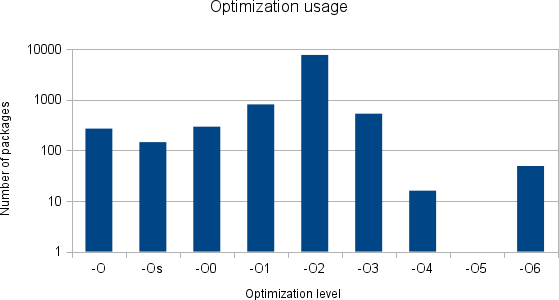
Following a thread on the Clang mailing list, I did a quick analysis of the optimization flags used to build C or C++ code. I used a rebuild result from last mid July of all Debian native packages (meaning that I don't have the log of full Java, Python or other packages without native code) and wrote a small script to count all their occurrences.
By default, deb packages uses the command "dpkg-buildflags --get CFLAGS" which will set the optimization level to -O2. However, many packages and upstream build systems do not respect such flags. On 10320 binary-only packages (in total, Debian has around 19000), the results are the following:
Optimization levelNumber of occurrencesNumber of packages
-O35597269
-Os30849145
-O013993294
-O125494809
-O29958037685
-O3106048531
-O4140216
-O500
-O6693549
Since a graphic talks more than numbers (note that the Y axis is logarithmic):
Disclaimer:
Some packages are using several optimization flags during the same build.
Some packages are not showing the full command line (see jessie release goal: verbose build logs)
The results might be approximate since I am basically grepping "-OX " on the log files.

Vincent Bernat: High availability with ExaBGP

When it comes to provide redundant services, several options are available: A common setup is a combination of those solutions: web servers are behind a couple of load-balancers achieving both redundancy and load-balancing. The load-balancers use VRRP to ensure redundancy. The whole setup is replicated to another datacenter and round-robin DNS is used to ensure both redundancy and load-balacing of the datacenters. There is a fourth option which is similar to VRRP but relies on dynamic routing and therefore is not limited to nodes in the same subnet: We will explore how to implement this fourth option using ExaBGP, the BGP swiss army knife of networking, in a small lab based on KVM. You can grab the complete lab from GitHub. ExaBGP 3.2.5 is needed to run this lab.

Environment We will be working in the following (IPv6-only) environment: Lab with three web nodes

BGP configuration BGP is enabled on ER2 and ER3 to exchange routes with peers and transits (only R1 for this lab). BIRD is used as a BGP daemon. Its configuration is pretty basic. Here is a fragment:
router id 1.1.1.2;
protocol static NETS   #  
  import all;
  export none;
  route 2001:db8::/40 reject;
 
protocol bgp R1   #  
  import all;
  export where proto = "NETS";
  local as 64496;
  neighbor 2001:db8:1000::1 as 64511;
 
protocol bgp ER3   #  
  import all;
  export all;
  next hop self;
  local as 64496;
  neighbor 2001:db8:1::3 as 64496;
 
First, in , we declare the routes that we want to export to our peers. We don t try to summarize them from the IGP. We just unconditonnaly export the networks that we own. Then, in , R1 is defined as a neighbor and we export the static route we declared previously. We import any route that R1 is willing to send us. In , we share everything we know with our pal, ER3, using internal BGP.

OSPF configuration OSPF will distribute routes inside the AS. It is enabled on ER2, ER3, DR6, DR7 and DR8. For example, here is the relevant part of the configuration of DR6:
router id 1.1.1.6;
protocol kernel  
   persist;
   import none;
   export all;
 
protocol ospf INTERNAL  
  import all;
  export none;
  area 0.0.0.0  
    networks  
      2001:db8:1::/64;
      2001:db8:6::/64;
     ;
    interface "eth0";
    interface "eth1"   stub yes;  ;
   ;
 
ER2 and ER3 inject a default route into OSPF:
protocol static DEFAULT  
  import all;
  export none;
  route ::/0 via 2001:db8:1000::1;
 
filter default_route  
  if proto = "DEFAULT" then accept;
  reject;
 
protocol ospf INTERNAL  
  import all;
  export filter default_route;
  area 0.0.0.0  
    networks  
      2001:db8:1::/64;
     ;
    interface "eth1";
   ;
 

Web nodes The web nodes are pretty basic. They have a default static route to the nearest router and that s all. The interesting thing here is that they are each on a separate IP subnet: we cannot share an IP using VRRP2. Why are those web servers on different subnets? Maybe they are not in the same datacenter or maybe your network architecture is using a routed access layer. Let s see how to use BGP to enable redundancy of those web nodes.

Redundancy with ExaBGP ExaBGP is a convenient tool to plug scripts into BGP. They can then receive and advertise routes. ExaBGP does the hard work of speaking BGP with your routers. The scripts just have to read routes from standard input or advertise them on standard output.

The big picture Here is the big picture: Using ExaBGP to advertise web services Let s explain it step by step:
  1. Three IP addresses will be allocated for our web service: 2001:db8:30::1, 2001:db8:30::2 and 2001:db8:30::3. Those are distinct from the real IP addresses of W1, W2 and W3.
  2. Each web node will advertise all of them to the route servers we added in the network. I will talk more about those route servers later.
  3. Each route comes with a metric to help the route server choose where it should be routed. We choose the metrics such that each IP address will be routed to a distinct web node (unless there is a problem).
  4. The route servers (which are not routers) will then advertise the best routes they learned to all the routers in our network. This is still done using BGP.
  5. Now, for a given IP address, each router knows to which web node the traffic should be directed.
Here are the respective metrics announced routes for W1, W2 and W3 when everything works as expected:
Route W1 W2 W3 Best Backup
2001:db8:30::1 102 101 100 W3 W2
2001:db8:30::2 101 100 102 W2 W1
2001:db8:30::3 100 102 101 W1 W3

ExaBGP configuration The configuration of ExaBGP is quite simple:
group rs  
  neighbor 2001:db8:1::4  
    router-id 1.1.1.11;
    local-address 2001:db8:6::11;
    local-as 65001;
    peer-as 65002;
   
  neighbor 2001:db8:8::5  
    router-id 1.1.1.11;
    local-address 2001:db8:6::11;
    local-as 65001;
    peer-as 65002;
   
  process watch-nginx  
      run /usr/bin/python /lab/healthcheck.py -s --config /lab/healthcheck-nginx.conf --start-ip 0;
   
 
A script is entailed to check if the service (an nginx web server) is up and running and advertise the appropriate IP addresses to the two declared route servers. If we run the script manually, we can see the advertised routes:
$ python /lab/healthcheck.py --config /lab/healthcheck-nginx.conf --start-ip 0
INFO[healthcheck] send announces for UP state to ExaBGP
announce route 2001:db8:30::3/128 next-hop self med 100
announce route 2001:db8:30::2/128 next-hop self med 101
announce route 2001:db8:30::1/128 next-hop self med 102
[...]
WARNING[healthcheck] Check command was unsuccessful: 7
INFO[healthcheck] Output of check command:  curl: (7) Failed connect to ip6-localhost:80; Connection refused
WARNING[healthcheck] Check command was unsuccessful: 7
INFO[healthcheck] Output of check command:  curl: (7) Failed connect to ip6-localhost:80; Connection refused
WARNING[healthcheck] Check command was unsuccessful: 7
INFO[healthcheck] Output of check command:  curl: (7) Failed connect to ip6-localhost:80; Connection refused
INFO[healthcheck] send announces for DOWN state to ExaBGP
announce route 2001:db8:30::3/128 next-hop self med 1000
announce route 2001:db8:30::2/128 next-hop self med 1001
announce route 2001:db8:30::1/128 next-hop self med 1002
When the service becomes unresponsive, the healthcheck script detect the situation and retry several times before acknowledging that the service is dead. Then, the IP addresses are advertised with higher metrics and the service will be routed to another node (the one advertising 2001:db8:30::3/128 with metric 101). This healthcheck script is now part of ExaBGP.

Route servers We could have connected our ExaBGP servers directly to each router. However, if you have 20 routers and 10 web servers, you now have to manage a mesh of 200 sessions. The route servers are here for three purposes:
  1. Reduce the number of BGP sessions (from 200 to 60) between equipments (less configuration, less errors).
  2. Avoid modifying the configuration on routers each time a new service is added.
  3. Separate the routing decision (the route servers) from the routing process (the routers).
You may also ask yourself: why not use OSPF? . Good question!
  • OSPF could be enabled on each web node and the IP addresses advertised using this protocol. However, OSPF has several drawbacks: it does not scale, there are restrictions on the allowed topologies, it is difficult to filter routes inside OSPF and a misconfiguration will likely impact the whole network. Therefore, it is considered a good practice to limit OSPF to network equipments.
  • The routes learned by the route servers could be injected into OSPF. On paper, OSPF has a next-hop field to provide an explicit next-hop. This would be handy as we wouldn t have to configure adjacencies with each router. However, I have absolutely no idea how to inject BGP next-hop into OSPF next-hop. What happens is that BGP next-hop is resolved locally using OSPF routes. For example, if we inject BGP routes into OSPF from RS4, RS4 will know the appropriate next-hop but other routers will route the traffic to RS4.
Let s look at how to configure our route servers. RS4 will use BIRD while RS5 will use Quagga. Using two different implementations will help with resiliency by avoiding a bug to hit the two route servers at the same time.

Bird configuration There are two sides for BGP configuration: the BGP sessions with the ExaBGP nodes and the ones with the routers. Here is the configuration for the later:
template bgp INFRABGP  
  export all;
  import none;
  local as 65002;
  rs client;
 
protocol bgp ER2 from INFRABGP  
  neighbor 2001:db8:1::2 as 65003;
 
protocol bgp ER3 from INFRABGP  
  neighbor 2001:db8:1::3 as 65003;
 
protocol bgp DR6 from INFRABGP  
  neighbor 2001:db8:1::6 as 65003;
 
protocol bgp DR7 from INFRABGP  
  neighbor 2001:db8:1::7 as 65003;
 
protocol bgp DR8 from INFRABGP  
  neighbor 2001:db8:1::8 as 65003;
 
The AS number used by our route server is 65002 while the AS number used for routers is 65003 (the AS numbers for web nodes will be 65001). They are reserved for private use by RFC 6996. All routes known by the route server are exported to the routers but no routes are accepted from them. Let s have a look at the other side:
# Only import loopback IPs
filter only_loopbacks   #  
  if net ~ [ 2001:db8:30::/64 128,128  ] then accept;
  reject;
 
# General template for an EXABGP node
template bgp EXABGP  
  local as 65002;
  import filter only_loopbacks; #  
  export none;
  route limit 10; #  
  rs client;
  hold time 6; #  
  multihop 10;
  igp table internal;
 
protocol bgp W1 from EXABGP  
  neighbor 2001:db8:6::11 as 65001;
 
protocol bgp W2 from EXABGP  
  neighbor 2001:db8:7::12 as 65001;
 
protocol bgp W3 from EXABGP  
  neighbor 2001:db8:8::13 as 65001;
 
To ensure separation of concerns, we are being a bit more picky. With and , we only accept loopback addresses and only if they are contained in the subnet that we reserved for this use. No server should be able to inject arbitrary addresses into our network. With , we also limit the number of routes that a server can advertise. With , we reduce the hold time from 240 to 6. It means that after 6 seconds, the peer is considered dead. This is quite important to be able to recover quickly from a dead machine. The minimal value is 3. We could have use a similar setting with the session with the routers.

Quagga configuration Quagga s configuration is a bit more verbose but should be strictly equivalent:
router bgp 65002 view EXABGP
 bgp router-id 1.1.1.5
 bgp log-neighbor-changes
 no bgp default ipv4-unicast
 neighbor R peer-group
 neighbor R remote-as 65003
 neighbor R ebgp-multihop 10
 neighbor EXABGP peer-group
 neighbor EXABGP remote-as 65001
 neighbor EXABGP ebgp-multihop 10
 neighbor EXABGP timers 2 6
!
 address-family ipv6
 neighbor R activate
 neighbor R soft-reconfiguration inbound
 neighbor R route-server-client
 neighbor R route-map R-IMPORT import
 neighbor R route-map R-EXPORT export
 neighbor 2001:db8:1::2 peer-group R
 neighbor 2001:db8:1::3 peer-group R
 neighbor 2001:db8:1::6 peer-group R
 neighbor 2001:db8:1::7 peer-group R
 neighbor 2001:db8:1::8 peer-group R
 neighbor EXABGP activate
 neighbor EXABGP soft-reconfiguration inbound
 neighbor EXABGP maximum-prefix 10
 neighbor EXABGP route-server-client
 neighbor EXABGP route-map RSCLIENT-IMPORT import
 neighbor EXABGP route-map RSCLIENT-EXPORT export
 neighbor 2001:db8:6::11 peer-group EXABGP
 neighbor 2001:db8:7::12 peer-group EXABGP
 neighbor 2001:db8:8::13 peer-group EXABGP
 exit-address-family
!
ipv6 prefix-list LOOPBACKS seq 5 permit 2001:db8:30::/64 ge 128 le 128
ipv6 prefix-list LOOPBACKS seq 10 deny any
!
route-map RSCLIENT-IMPORT deny 10
!
route-map RSCLIENT-EXPORT permit 10
  match ipv6 address prefix-list LOOPBACKS
!
route-map R-IMPORT permit 10
!
route-map R-EXPORT deny 10
!
The view is here to not install routes in the kernel3.

Routers Configuring BIRD to receive routes from route servers is straightforward:
# BGP with route servers
protocol bgp RS4  
  import all;
  export none;
  local as 65003;
  neighbor 2001:db8:1::4 as 65002;
  gateway recursive;
 
protocol bgp RS5  
  import all;
  export none;
  local as 65003;
  neighbor 2001:db8:8::5 as 65002;
  multihop 4;
  gateway recursive;
 
It is important to set gateway recursive because most of the time, the next-hop is not reachable directly. In this case, by default, BIRD will use the IP address of the advertising router (the route servers).

Testing Let s check that everything works as expected. Here is the view from RS5:
# show ipv6  bgp  
BGP table version is 0, local router ID is 1.1.1.5
Status codes: s suppressed, d damped, h history, * valid, > best, i - internal,
              r RIB-failure, S Stale, R Removed
Origin codes: i - IGP, e - EGP, ? - incomplete
   Network          Next Hop            Metric LocPrf Weight Path
*  2001:db8:30::1/128
                    2001:db8:6::11         102             0 65001 i
*>                  2001:db8:8::13         100             0 65001 i
*                   2001:db8:7::12         101             0 65001 i
*  2001:db8:30::2/128
                    2001:db8:6::11         101             0 65001 i
*                   2001:db8:8::13         102             0 65001 i
*>                  2001:db8:7::12         100             0 65001 i
*> 2001:db8:30::3/128
                    2001:db8:6::11         100             0 65001 i
*                   2001:db8:8::13         101             0 65001 i
*                   2001:db8:7::12         102             0 65001 i
Total number of prefixes 3
For example, traffic to 2001:db8:30::2 should be routed through 2001:db8:7::12 (which is W2). Other IP are affected to W1 and W3. RS4 should see the same thing4:
$ birdc6 show route 
BIRD 1.3.11 ready.
2001:db8:30::1/128 [W3 22:07 from 2001:db8:8::13] * (100/20) [AS65001i]
                   [W1 23:34 from 2001:db8:6::11] (100/20) [AS65001i]
                   [W2 22:07 from 2001:db8:7::12] (100/20) [AS65001i]
2001:db8:30::2/128 [W2 22:07 from 2001:db8:7::12] * (100/20) [AS65001i]
                   [W1 23:34 from 2001:db8:6::11] (100/20) [AS65001i]
                   [W3 22:07 from 2001:db8:8::13] (100/20) [AS65001i]
2001:db8:30::3/128 [W1 23:34 from 2001:db8:6::11] * (100/20) [AS65001i]
                   [W3 22:07 from 2001:db8:8::13] (100/20) [AS65001i]
                   [W2 22:07 from 2001:db8:7::12] (100/20) [AS65001i]
Let s have a look at DR6:
$ birdc6 show route
2001:db8:30::1/128 via fe80::5054:56ff:fe6e:98a6 on eth0 * (100/20) [AS65001i]
                   via fe80::5054:56ff:fe6e:98a6 on eth0 (100/20) [AS65001i]
2001:db8:30::2/128 via fe80::5054:60ff:fe02:3681 on eth0 * (100/20) [AS65001i]
                   via fe80::5054:60ff:fe02:3681 on eth0 (100/20) [AS65001i]
2001:db8:30::3/128 via 2001:db8:6::11 on eth1 * (100/10) [AS65001i]
                   via 2001:db8:6::11 on eth1 (100/10) [AS65001i]
So, 2001:db8:30::3 is owned by W1 which is behind DR6 while the two others are in another part of the network and will be reached through the appropriate link-local addresses learned by OSPF. Let s kill W1 by stopping nginx. A few seconds later, DR6 learns the new routes:
$ birdc6 show route
2001:db8:30::1/128 via fe80::5054:56ff:fe6e:98a6 on eth0 * (100/20) [AS65001i]
                   via fe80::5054:56ff:fe6e:98a6 on eth0 (100/20) [AS65001i]
2001:db8:30::2/128 via fe80::5054:60ff:fe02:3681 on eth0 * (100/20) [AS65001i]
                   via fe80::5054:60ff:fe02:3681 on eth0 (100/20) [AS65001i]
2001:db8:30::3/128 via fe80::5054:56ff:fe6e:98a6 on eth0 * (100/20) [AS65001i]
                   via fe80::5054:56ff:fe6e:98a6 on eth0 (100/20) [AS65001i]

Demo For a demo, have a look at the following video (it is also available as an Ogg Theora video).

  1. The primary target of VRRP is to make a default gateway for an IP network highly available by exposing a virtual router which is an abstract representation of multiple routers. The virtual IP address is held by the master router and any backup router can be promoted to master in case of a failure. In practice, VRRP can be used to achieve high availability of services too.
  2. However, you could deploy an L2 overlay network using, for example, VXLAN and use VRRP on it.
  3. I have been told on the Quagga mailing-list that such a setup is quite uncommon and that it would be better to not use views but use --no_kernel flag for bgpd instead. You may want to look at the whole thread for more details.
  4. The output of birdc6 shows both the next-hop as advertised in BGP and the resolved next-hop if the route have to be exported into another protocol. I have simplified the output to avoid confusion.

4 September 2013

Russell Coker: Ownership of a Club

Last night at the Annual General Meeting we had a motion to disincorporate The Linux Users of Victoria (LUV) [1]. The proposal was for LUV to cease being an incorporated society on condition that Linux Australia (LA) [2] accepts us as a sub-committee. As a sub-committee of LA we would elect our own committee to run things locally but have LA hold the finances, deal with all the paperwork that the government demands, and generally do as many of the non-core tasks associated with running a users group as possible. When we discussed this at the LUV committee meetings it didn t seem like a big deal. But as is often the case with political discussions it turned out to be difficult. There was a lot of discussion about LUV supposedly ceasing to exist, people seem to think that LUV is defined by having an incorporated society. My impression was always that it was defined by a mailing list and having meetings and I was involved in both before there was an incorporated society. Lurkers and Ownership During the discussion we had some input from members who were typically lurkers who seemed to feel that their property rights towards LUV were being infringed, this annoys me. I think that if someone chooses not to be involved in running an organisation then they should choose not to concern themselves with the details of how the organisation is to be run. People who attend the meetings should have a say in how the meetings are run and have reason to be concerned about anything that might affect them and the opinions of speakers also matter. People who are involved with mailing list discussions should have a say in how the lists are run. But people who have never volunteered for a position on the committee shouldn t be greatly concerned about the internal issues of how things are run. Finance Some concern was expressed about the financial situation of LUV and whether we would still get enough donations to keep it running when combined with LA. There was even some FUD suggesting that LA would just take our money (they had assured us that all funds and donations would be ear-marked for us). The current LUV financial situation is that Red Hat pays for the venue for the monthly meetings and the rent for the venue comprises about 2/3 of all donations. The remaining 1/3 comes from one company. So in the current situation if Red Hat ceased donating then we would have 18 months to find another donor or cease holding meetings before our bank balance became unreasonably low. If the company which gives the other significant annual donation was to cease doing so then we could operate for a few years on savings but we would need to find some other source of funding. It seems to me that joining LA would give us more financial security. Then if Red Hat ceased paying for the venue then LA could keep things running until we found another donor, I m confident that LA wouldn t allow LUV to just shut down because of a shortage of donations. If people are really concerned about the financial situation of LUV then they should urgently seek further donations such that if any one donor decided to stop giving then we could still operate as normal. To achieve that goal I think we need at least another $1,000 per annum. This issue of redundancy in donations is something I raise every time that LUV finances are discussed. My conclusion is that people aren t really bothered about the financial security of LUV except when they are looking for reasons to avoid change. Doing New Things During the course of discussion about the future of LUV there were a number of requests for improvement. One significant request was for more support for regional Linux users. Some years ago we held a mini-conference in Ballarat which went well. I think it would be good to do such things again, the cost is not particularly great and I m sure it would be accepted by LA for funding, but we need to organise it. Organising such events is something that anyone can do. Any LUV member can plan an event, get costs for everything that is needed (food, accommodation, travel, etc) and then pitch it to the LUV committee in terms of which things should be paid by LUV and which by the members concerned. We could then work on getting additional funding from LA if necessary. But planning an event takes some effort and it s often effort that can only be done by a local. Finding a suitable venue and getting some assurance that a large enough audience will attend is something that can t be done remotely. I think that the problem for LUV in regard to such things isn t a lack of money or independence. I think that the problem is that the committee spends too much volunteer time on administrative tasks and not enough time directly doing things that benefit members and the community in general. In the past I have declined nomination to the LUV committee because I felt that I could contribute more by giving lectures, finding other speakers, and doing other things to directly improve the group. I was on the committee last year and have now been elected to it again, but I m starting to think that I made a mistake. Maybe I should have declined and let others work on the new model rules and other paperwork. One committee member has claimed that the time taken on administrative tasks isn t taking time away from other LUV related tasks, I invite any committee members who feel that way to address some of the services that members are requesting. Speaking for myself my lack of time directly impacts that I can do for the club. I think that ownership of a club should be related to what people do for the club. If you have a feeling of ownership and lack ideas for how to contribute then you can ask the LUV mailing list, there are lots of people with suggestions for things to do.

3 September 2013

Jan Wagner: nagios-plugins: Call for testing

Some of you might have noticed there is a new nagios-plugins version in the row. To support upstream in evaluating bugs and bringing the code to a wider audience, I uploaded the latest development version into Debian unstable. Since this package version contrib/ is dropped by upstream. But we stopped shipping the latest plugins of contrib/ with Debian wheezy. We also removed perlmods/ from the upstream tarball, as this was never used by our package. The packaging changes are:
* New upstream git snapshot (b15adb7762)
  - Adjust debian/copyright
* Droped the following upstream integrated patches
  - 05_fix_gets_undefined_in_iso_c11.dpatch
  - 10_check_apt_perfdata.dpatch
  - 11_check_nt_npe.dpatch
  - 12_check_smtp_double_threshold.dpatch
* Fix removing empty /usr/include
* Add new check_dbi into nagios-plugins-standard
* Remove whois from Recommands, as check_bgpstate is removed
* Cleanup debian/rules from unused stuff
* Provide information about repackaging
  - Extend debian/README.source
  - Add debian/bin/repack.sh
* Updating standards version to 3.9.4 (no changes needed)
* Add libfreeradius-client-dev to build-deps and remove libradiusclient-ng-dev
  (Closes: #721621)
* Remove traces of contrib/ from debian/copyright
* Remove command.cfg from examples in nagios-plugins-common, it was removed
  upstream
The Debian Nagios Maintainer and Upstream Developer are asking you to try out this new package on non production systems. Not that we think there might be a high risk for damage, but you know .. :) The latest version of the plugins are running on several systems already, but it is nearly impossible to test all scenarios even automated. If you find bugs, please report all packaging bugs into the BTS. Upstream bugs you might consider to report in the upstream bugtracker. If you want to give it a try on Debian wheezy, you could install the packages from our wheezy-backports repository:
    # wget "http://ftp.cyconet.org/debian/sources.list.d/wheezy-backports-cyconet.list" \
        -O /etc/apt/sources.list.d/wheezy-backports-cyconet.list
    # aptitude update
    # aptitude -t wheezy-backports install nagios-plugins
For adding our archive key, you can just install the package "debian-cyconet-archive-keyring"

Miriam Ruiz: pySioGame: Educational activities and games for kids

I discovered pySioGame for the first time in the first half of 2012, and even though it was still in a beta state, I liked it a lot. pySioGame is essentially a set of educational activities and games for kids. pySioGame was initially developed by its author -Ireneusz Imiolek- for his son, but he soon decided to make it Free Software. And I m glad that he did, because it s a very cute application. Even though -in it s author s own words- it s hard to put age range on this kind of games, it is primarily targeted to children from as young as 3 years old, up to about 10 years old. The activities included, many of which are grid based, cover topics like maths, reading, writing, painting, and memory activities, among others. I was finally able to upload pySioGame to Debian during the DebConf, and it has very recently hit the archive. I m convinced that pySioGame is soon going to be one of the references among the free programs for small kids, among titles such as GCompris, ChildsPlay, PySyCache, or Bouncy. Or, even though it s not in the archives, Omnitux. Finally, to whet your appetite, here is the link to a video, and there go some screenshots:

2 September 2013

Daniel Pocock: Australia's Labor Party exposed spying on their own members

Australia's Labor Party claims to represent the little guy, advocating the interests of a wide slice of the population over the interests of those who might supposedly exploit them. In this latest blog I'll look at just how the Victorian state branch of the party is emulating the more sinister elements of monitoring and control that you would typically expect from marketers, spammers and the NSA. It makes you wonder, if they do this to their own members, how can Australia's government ever hope to rein in spammers or other undesirable practices? Europe has tried cookie laws and the right to be forgotten, while the ALP has taken these developments almost as a guide to exploiting their own most valuable resource, their membership. The email version of invisible ink Straight out of an email attempting to recruit party members to the federal election campaign, we find that the ALP's logo itself has been turned into a sinister tracking mechanism. Looking underneath the logo, there is a hidden tracking number attached to every message:
http://gallery.mailchimp.com/3021e68df9a7200135725c633/images/Email_Header_ThisisLabor.jpg
There it is, that big long code 3021e68df9a7200135725c633. On it's own, you may think this number can't do much harm. Think again. After all, as the filename says, "ThisisLabor". Reaching the grass roots by long distance email When a party member sees any of the images in the email or clicks any of the links, their email software or web browser sends a HTTP request to the ALP's outsourced tracking server in the United States. Here is an example of what that request may contain:
TCP Headers:
  SOURCE IP ADDRESS: 198.51.100.56
HTTP headers:
  GET /3021e68df9a7200135725c633/images/Email_Header_ThisisLabor.jpg
  HTTP/1.1
  Host: gallery.mailchimp.com
  User-Agent: Mozilla/5.0 (X11; Linux x86_64; rv:17.0) Gecko/20130515 Firefox/17.0 Iceweasel/17.0.6
  Accept: text/html,application/xhtml+xml,application/xml;q=0.9,*/*;q=0.8
  Accept-Language: en-US,en;q=0.5
  Accept-Encoding: gzip, deflate
  X-Forwarded-For: 192.168.1.54
  Connection: keep-alive
These codes are all transmitted from the recipient of the email back to the ALP. Notice the tracking number is in the very first line of the HTTP request? These codes send many details to the tracking server. Just what is revealed?
  • What time the message was read
  • How many times the message was opened
  • Whether the message was read on multiple computers (perhaps it was forwarded)
  • The IP addresses reveal which network was used.
    • For people reading email at work or on wifi, the IP address reveals the name of the employer, it can be easily looked up in this public database. Here is an example querying one of the ALPs own IP addresses, 203.24.72.2
    • For people using an internet connection at home, the IP address reveals the service provider. There is more to it though: if one party member regularly visits another party member and uses their wifi, they will both appear to be using the same IP address and the party will be able to deduce that there is a connection between these two people.
  • The web browser name and version and the operating system name and version.
  • The language normally used on the computer
Crunching the numbers You may think that nobody would be interested in all that data or that it is even too much data for anybody to easily study. Think again. The ALP has outsourced processing of this data to an offshore firm that specializes in bulk email, MailChimp. After lecturing everybody about the dangers of outsourcing, the ALP has literally sold the farm (their own membership data) - to a foreign marketing company. Here are some of the claims MailChimp make on their web site:
"Dig even deeper with Subscriber Activity Reports, which give you a real time report for every subscriber s email activities: when they opened, what they clicked, and when they came back for more. You can even generate a list of people who didn t open, and send them a modified campaign."
That's right: if ALP members don't read their emails fast enough, they will send even more of them. Just who has access to this data? Well, the scope is quite broad. According to these rules, it is not only the dubious officials in the party's state office, but Labor Party regulations also list a whole lot of other officials who have access to some subset of the data: branch and FEA district committees, policy committees and maybe some trade union officials too. Once you start to contemplate this, it becomes apparent that the probability of somebody profiling members at an individual level is very real. On the other hand, those rules clearly do not permit the state branch to process the member's data offshore. Double whammy In fact, even MailChimp is further outsourcing the data. When receiving an image from the booby-trapped link in the email, we receive a response like this:
HTTP/1.1 200 OK
Content-Type: image/jpeg
Content-Length: 407474
Connection: keep-alive
Date: Wed, 10 Jul 2013 06:25:55 GMT
Last-Modified: Tue,  03 Sep 2013 04:05:37 GMT
ETag: "df9a7200135725c6331369a22"
Accept-Ranges: bytes
Server: AmazonS3
Age: 62097
Via: 1.0 e71fe855f29513f54a41e213fe653fb1.cloudfront.net (CloudFront)
X-Cache: Hit from cloudfront
X-Amz-Cf-Id: S2V2aW4gUnVkZCBpcyBhIGJhZCBib3kuCg==
which contains more tracking numbers and clearly indicates that the data is being processed in the massive AmazonS3 (a.k.a Amazon online bookstore) cloud platform. Thanks to cloud computing, there is considerable scope for cross-referencing records across other web sites. The IP address becomes a magic key, allowing a range of sinister forces to join the dots at the click of a button and profile the whole private and professional identity of any individual ALP member. Googling ALP members It doesn't stop there however, after following these links a victim will eventually end up on one of the ALP's own web pages. Looking through the HTML code underneath http://www.viclabor.com.au is very easy, in most web browsers, you can just press Control-U to see what is hidden away in the shadows. Buried in the code, I found this little gem:
  var _gaq = _gaq   [];
  _gaq.push(['_setAccount', 'UA-35325645-1']);
  _gaq.push(['_trackPageview']);
  (function()  
    var ga = document.createElement('script'); ga.type = 'text/javascript'; ga.async = true;
    ga.src = ('https:' == document.location.protocol ? 'https://ssl' : 'http://www') + '.google-analytics.com/ga.js';
    var s = document.getElementsByTagName('script')[0]; s.parentNode.insertBefore(ga, s);
   )();
This may be even scarier: it's a JavaScript code that channels all access to the ALP web site into an outsourced tracking system provided by Google. Google can now cross-reference ALP members against their Gmail accounts, their friends and the topics they search for to further profile the type of advertising they should be exposed to. Google, like any private company, has a loyalty to its shareholders and the laws of the country where it is domiciled. Will that coincide with the best interests of ALP members in Victoria? Australia's other parties: samples needed Do you have similar communications from Australia's other political parties? Please send them to me and I'll be happy to examine them for similar shortcomings.

1 September 2013

Eddy Petri&#537;or: HOWTO add a shell script wrapper and preserve quoting for parameters

If you ever find yourself in the situation where you have to add a shell script wrapper over a command, but the parameters' quoting gets lost and you end up with the wrong parameters in the wrapped command/tool, you might want to read this post.

On my system I have some command line tools which are Windows only and, in order to easily use the same build system as on Windows on my Linux machine I added a wrapper script which invokes wine on the commands and made symlinks to the wrapper with the file names as the tools, but without the '.exe' suffix.

Of course, I wanted to properly pass the parameters through the wrapper to the tools so I wrote (note the bold text):
#!/bin/sh
wine $0.exe "$@"
So the answer is: use $@ and quote like I did in the code above and the parameters will be passed correctly.


Update: stbuehler suggested to use exec to replace the shell process with wine with this construct:
Use:
#!/bin/sh
exec wine $0.exe "$@"

Thanks for the suggestion.

Gregor Herrmann: RC bugs 2013/35

& another week of perl (5.18) related bugs has gone by:

Russ Allbery: Review: An Artificial Night

Review: An Artificial Night, by Seanan McGuire
Series: October Daye #3
Publisher: DAW
Copyright: September 2010
ISBN: 1-101-44276-X
Format: Kindle
Pages: 368
This is the third book of the October Daye series, following A Local Habitation. It could be read out of order, as each chapter of Toby's story so far is somewhat standalone, but I wouldn't recommend it. You'd miss the character development and the background behind several friendships. As with the previous book review, a caveat: I am reviewing this book four months after finishing it, rather than the normal couple of weeks, so apologies in advance for any thinness or inaccuracies. The first sign that something is about to go seriously wrong in Toby's life this time is a visitor. She says her name is May Daye, and apparently she's Toby's Fetch: a duplicate in nearly every respect except personality, manifested to guide someone to their death. Their imminent death. The second sign is that her best friend's children are kidnapped. The children who treat her like an aunt. And the cause of that kidnapping is far, far beyond the level of power that Toby could be expected to deal with. I have profound mixed feelings about this book. On one hand, McGuire further expands Toby's web of connections and shows us more of Toby's friends and their background, and that's becoming my favorite part of this series. She introduces May, who I think is a great character: at first apparently much different than Toby, but with a similarity beneath surface impressions that one notices more over time. And I thought the climax of the story, once we finally got there, was very moving and well-done. Also, I just love the way that McGuire uses children's rhymes and doggerel throughout this series as a magical element, and that's particularly well-handled here. Due to the nature of the antagonist, McGuire has a good excuse to bring that front and center, and the process of familiar rhymes expanding into deep magical rules was a fun intellectual experience. Best of all, the Luidaeg plays a significant role in the story again. The Luidaeg is, hands down, my favorite character in McGuire's constructed universe, and she becomes even more so over the course of this story. Her complex relationship with Toby is clearly blossoming into a friendship that's surprising both of them deeply, but a friendship that has to play by an odd set of rules (like so much else in Toby's life). I loved her here. Seeing someone that difficult and abrupt show unexpected emotional depths is one of the story elements I enjoy the most. The problem, though, is that quite a lot of An Artificial Night is very, very dark. And by that, I don't mean that there is a lot of tension, or that Toby is struggling against monsterous things, although both of those statements are also true. Rather, Toby is not only out of her league but ends up in some viciously nasty situations, and they persist for rather more of this book than I would have preferred. Putting one's protagonist through hell has a long tradition in urban fantasy, but I found the level of sheer helplessness that Toby struggled through to be a bit more than I wanted to read about. It was too reminiscent of events from Toby's background (as discussed in Rosemary and Rue) that I still don't like to think about. There is, of course, an eventual payoff, as dark as the interim events seem. One knows that, given the genre and given that this is an ongoing series, and even just given the nature of stories. But as much as I like the growing cast of this series, and adored the scenes with the Luidaeg, I found parts of this journey to be deeply disturbing, and not in an enjoyable dramatic tension sort of way. I don't mind protagonists being seriously hurt (although it's not my favorite plot), or even some amount of despair, but this went beyond that. I think McGuire was going for a story about sacrifice and self-definition, about trying even when one can't possibly win, and I can appreciate the narrative arc. But parts of the book were simply awful to read for me. I'm therefore not quite sure what to say in terms of a recommendation. I'm still reading the series, and will definitely read the next book. I think my reaction is somewhat idiosyncratic; the events here will probably not bother others as much as they bothered me. And I can't disagree with their dramatic effectiveness, or with the way that McGuire builds conflict out of the rules of fairy and is building Toby into a stronger and more capable person than she ever thought she could be. But there were still spots where I wished I were reading a different book. Hopefully the next book in the series will be that book I wanted to read. Followed by Late Eclipses. Rating: 6 out of 10

Russ Allbery: Review: Redshirts

Review: Redshirts, by John Scalzi
Publisher: Tor
Copyright: June 2012
ISBN: 1-4299-6360-3
Format: Kindle
Pages: 317
The next few reviews deserve a small apology in advance. Normally, I try to write reviews within a few weeks, or at most a month, after reading a book, while it's still fresh in my mind. This is particularly important since I read a lot and sometimes don't have a good memory for specific detail. But this summer has made it completely impossible to keep to any sort of regular writing schedule. As a result, this book, and the subjects of the next few reviews that follow, are books that I read four months ago and am reviewing from memory. Hopefully, I'll still get the details right. Ensign Andrew Dahl is one of the newest crew members of the Universal Union Capital Ship Intrepid. It's his first posting, just out of the Academy. He's one of five new ensigns, expecting a normal tour of duty (albeit with the pride of being on a capital ship of the fleet). But very shortly after arriving on the ship, Andrew and and the other new ensigns discover that something is very... strange. The casualty rate on the ship is surprisingly high (as foreshadowed in a prologue). The other crew members avoid the bridge crew, and particularly away missions, with startling effectiveness (and desperation). And things regularly happen on the ship that, for lack of a better description, simply make no sense. Redshirts starts off as a very obvious Star Trek parody. So obvious, in fact, that it's eyeroll-inducing. The prologue reads exactly like a section of a Star Trek episode written by a third-rate hack, leavened with some of the humor that readers of Scalzi's blog have come to expect. But it's obvious that Scalzi is doing this intentionally, and it doesn't take long before the subject of the book shifts. It's a Star Trek parody that functions much more like a Star Trek parody than any universe should, to the degree that it becomes obvious to the characters. And the characters, despite being straight from central casting, are clearly not expecting their universe to act that way and find this extremely strange. By far the best part of this book is the second quarter: the characters have been introduced, they're starting to figure out what's going on, and they have to do so while dodging away-team duty (or trying to survive it) and participating in the ridiculous plot contrivances that keep occurring. Scalzi mixes a feeling of serious consequences with wry humor and handles the mix deftly. I was both laughing and eagerly reading to see what comes next. The last half of the book, though, has problems. How many problems the reader perceives will, I think, depend on how hard one thinks about the situation Scalzi has set up, or how much one has thought about similar constructs in the past. But I'm afraid the setup does not survive serious scrutiny in ways that, for me at least, seriously damaged my ability to engage with the story. I'm going to avoid saying explicitly where Scalzi goes with this plot, since it is a spoiler (although it's commonly mentioned in discussions of this book on the Internet). But it happens to be an idea that some friends of mine and I pounded on for years in some of our role-playing scenarios, poking at the corners and implications, and subsequently gave up on because it doesn't work for storytelling. The idea is compelling, and on first glance seems like a great story seed. But it's too large. The problem with really big ideas with huge implications is that they can change the nature of a story so much that there's no longer any point of commonality for the reader and the entire nature of story falls apart. And I think that's what happens here. Scalzi handles the deeper implications of the concept by, essentially, ignoring them. He focuses on one narrow set of implications for one specific set of people, largely skips over any discussion of anything larger, and tries a pivot from wry humor (and a bit of slapstick) into serious emotional depth. For me, in part because I'm so familiar with the concept, none of this really worked. The implications of the discovery that drives this story are so much broader and so much more significant than the characters seem to admit that it threw me right out of the story. The ethical implications are absolutely paralyzing, to the point that I don't think you can write a coherent story about them, but ignoring them doesn't work either. It's the kind of discovery that requires action of some kind beyond the attempt by the characters to go back to what they consider a normal life, even if I have a hard time imagining what that action could be. To be fair, he does try to salvage this in the first epilogue, which is all about the implications of his idea and its effects. But it's still too small. That epilogue just barely touches on the implications on a single person, but if one thinks a bit longer, one starts coming up with more and more implications for all of society, for how we talk about story, for how we raise children, for nearly every form of creativity. Implications that involve nasty concepts like slavery and mind control and murder and the nature of consent in ways that are very difficult to avoid. I think Scalzi's attempts at serious emotional connection, including in the other two attached epilogues (which are perspective-shifting close focuses on some of the characters), also suffer from his world setup, but in a different way. The characters are simply too bland to sustain the level of emotional connection he's striving for. They're bland for a very specific reason that is entirely justified by the story that Scalzi is handling, and the implications of that for the primary protagonist were, I thought, one of the best-handled moments of the book. But they're still bland, which undermines the attempted pivot. All that being said, this is not a bad book. Parts of it, particularly the second quarter, are excellent. And even when I wasn't engaging with the characters, Scalzi's writing on a paragraph level is snappy and often quite funny. The first epilogue in particular is hilarious, even if I think it was too limited in the scope of implications that it considers and a bit too meta in where it goes with those implications. And the story is a fun romp, with drama and humor and tension and a fairly satisfying ending. Everyone's a bit too bland and earnest when Scalzi isn't being funny, but he's funny enough that I didn't mind that much. Despite the relatively low rating, I actually recommend this book. If you don't dive into the metaphysical implications, it's a lot of fun, and if you've thought a lot about this particular set of metaphysical implications, it's somewhat satisfying to argue with (and to internally point out all of the hard questions that Scalzi is skipping over). It's particularly fun if you've watched a lot of Star Trek, since Scalzi gets some of the absurdities note-perfect. But be aware that the character reactions to Scalzi's concept don't hold up to much scrutiny. Rating: 7 out of 10

31 August 2013

Chris Lamb: Decrypting the Caesar cipher using shell

In cryptography, a Caesar cipher, also known as Caesar's cipher, the shift cipher, Caesar's code or Caesar shift, is one of the simplest and most widely known encryption techniques. It is a type of substitution cipher in which each letter in the plaintext is replaced by a letter some fixed number of positions down the alphabet. [...]
#!/bin/sh
IN="MJHVIZN ZPIO YJHPN"
for I in $(seq 25); do
    echo $I $IN   tr $(printf %$ I s   tr ' ' '.')\A-Z A-ZA-Z
done
This outputs:
1 NKIWJAO AQJP ZKIQO
2 OLJXKBP BRKQ ALJRP
3 PMKYLCQ CSLR BMKSQ
4 QNLZMDR DTMS CNLTR
5 ROMANES EUNT DOMUS
6 SPNBOFT FVOU EPNVT
7 TQOCPGU GWPV FQOWU
8 URPDQHV HXQW GRPXV
9 VSQERIW IYRX HSQYW
10 WTRFSJX JZSY ITRZX
11 XUSGTKY KATZ JUSAY
12 YVTHULZ LBUA KVTBZ
13 ZWUIVMA MCVB LWUCA
14 AXVJWNB NDWC MXVDB
15 BYWKXOC OEXD NYWEC
16 CZXLYPD PFYE OZXFD
17 DAYMZQE QGZF PAYGE
18 EBZNARF RHAG QBZHF
19 FCAOBSG SIBH RCAIG
20 GDBPCTH TJCI SDBJH
21 HECQDUI UKDJ TECKI
22 IFDREVJ VLEK UFDLJ
23 JGESFWK WMFL VGEMK
24 KHFTGXL XNGM WHFNL
25 LIGUHYM YOHN XIGOM
The only line which makes sense is 5 ROMANES EUNT DOMUS, giving us our solution.

Next.

Previous.