Search Results: "rra"

21 September 2007

Mario Iseli: WesternDigital My Book network harddisk

Hello World, a tape streamer of one of our customers died two days ago and we haven’t anymore warranty on this device, a new infrastructure will be realized soon anyway. So, we needed a cheap temporary solution. We bought a WD network harddisk for home use and “remote access over the internet”, even if we only need local access to it. It’s a 500 GB harddisk and you find several short GPL references in the crappy 5-pages-manual. Ok, this sounded already interesting. I read the manual and see that only Windows 2000 and Windows XP are supported and that you have to install a very proprietary Windows tool to start using the harddisk. Later there would also be a webinterface available, after the initialization. Ok, so I wanted to know if it’s possible to access the drive also with other operating systems. I connected the RJ45 port of the harddisk with my ethernet card with a cross-over cable and started to sniff with ngrep on the interface. After waiting a while I got this message some strange from a APIPA address to a Multicast address. Ok, assigned my local interface an address in the APIPA range and connected with my browser to it: T 169.254.71.58:80 -> 169.254.71.57:56819 [A]
HTTP/1.1 200 OK.
Transfer-Encoding: chunked.
Date: Thu, 30 Nov 2006 23:12:51 GMT.
0: no-cache.
Content-Type: text/html; charset=UTF-8.
Server: lighttpd/1.4.3.
Very interesting… lighttpd :) The device asks for a password, I went to the website of WD to read the “full manual” (as the CDROM isn’t readable with Linux as it seems), in the support part I found something about “admin” and “123456″. With this information I could login on the device and saw that it does nothing else than Samba (3.0.14) and it’s also accessible via smbclient. Without the proprietary tool, without sending personal information to Westerndigital and getting stupid newsletters. Maybe I will remove the harddisk from the case later and install it on my workstation (it isn’t reachable except port 80 and the netbios stuff) to see what exactly is on it. At least I know that it’s an ext3 filesystem. I think vendors who use embedded Linux systems for their devices and use such proprietary clients, give not more information about it are just crap. It’s something like unfair for the free-software community. :( (even if it works unofficially with an uncommon way) [Update] A little codesnippet from the Webinterface… very useful ;) function moveArrow(ycord) // vert cord of layer

// ignore this function
//
// if(document.layers). //NN4+
//
// document.layers[”MenuArrow”].moveToAbsolute(xcord,ycord);
//
// else if(document.getElementById). //gecko(NN6) + IE 5+
//
// var obj = document.getElementById(”MenuArrow”);
//
obj.style.top = ycord;
//
// else if(document.all).// IE 4
//
// document.all[”MenuArrow”].style.top = ycord;
//

Russell Coker: Multiple DNS Names

There are many situations where multiple DNS names for a single IP address that runs a single service are useful. One common example is with business web servers that have both www.example.com and example.com being active, so whichever a customer hits they will get the right content (the last thing you want is for a potential customer to make some trivial mistake and then give up). Having both DNS names be equal and separate is common. One example of this is the way http://planet.ubuntulinux.org/ and http://planet.ubuntu.com/ both have the same content, it seems to me that planet.ubuntu.com is the more official name as the wiki for adding yourself to the Planet is wiki.ubuntu.com. Another example of this is the way http://planet.debian.org/ and http://planet.debian.net/ both have the same content. So far this month I have had 337 referrals to my blog from planet.debian.org and 147 from planet.debian.net. So even though I can’t find any official reason for preferring one over another the fact that more than 2/3 of the referrals from that planet come from the planet.debian.org address indicates that most people regard it as the canonical one. In times past there was no problem with such things, it was quite routine to have web servers with multiple names and no-one cared about this (until of course one name went away and a portion of the user-base had broken links). Now there are three main problems with having two names visible:

  1. Confusion for users. When a post on thedebianuser.org referred to my post about Planet Ubuntu it used a different URL to the one I had used. I was briefly worried that I had missed half (or more) of the content by getting my links from the wrong blog - but it turned out that the same content was on both addresses.

  2. More confusing web stats for the people who run sites that are referenced (primarily the bloggers in the case of a Planet installation). This also means a lower ranking as the counts are split. In my Webalizer logs planet.debian.org is in position #5 and planet.debian.net is in position #14. If they were combined they would get position #3. One thing to keep in mind is that the number of hits that you get has some impact on the content. If someone sees repeated large amounts of traffic coming from planet.debian.org then they are likely to write more content that appeals to those users.

  3. Problems with sites that have strange security policies. Some bloggers configure their servers to only serve images if the referrer field in the HTTP protocol has an acceptable value (to prevent bandwidth theft by unethical people who link to their pictures). My approach to this problem is reactive (I rename the picture to break the links when it happens) because I have not had it happen often enough to do anything else. But I can understand why some people want to do more. If we assume that an increasing number of bloggers do this, it would be good to not make things difficult for them by having the smallest possible number of referrer URLs. It would suck for the readers to find that planet.debian.org has the pictures but planet.debian.net doesn’t.

The solution to this is simple, one name should redirect to the other. Having something like the following in the Apache virtual host configuration (or the .htaccess) file for the least preferred name should redirect all access to the other name. RewriteCond % REQUEST_URI ^(.*$) [NC]
RewriteRule . http://planet.example.com/%1 [R=301,L] In my posts last night I omitted the URLs for the Planet Searches from the email version (by not making them human readable). Here they are:

20 September 2007

Adrian von Bidder: Who'd have thought it?

Who'd have thought it ... Dan Lyons (one of the louder SCO backers) actually published a May Culpa, admitting that he was wrong all the time. A respectful nod in his direction from me, I'd not have expected this. Remains to be said that covering a lawsuit by (judging by the description of what he did before publishing the first article) more or less only talking to one party and, probably, not actually knowing much about the actual topic under discussion still seems to be very bad journalism, but at least he doesn't try to wriggle out of it now. And, IIRC, IBM did not talk much about this lawsuit, while SCO talked to everybody who might listen at length, so you might call that mitigating circumstances. Hmm. Completely unrelated, but ... Konqueror crashes when I try to leave the Forbes web page. Somehow I don't think I'm all too interested in this particular bug being fixed. I still like what the Canberra Times wrote about Forbes Magazine in August 2004:
[Forbes Magazine] looks ... like corporate pornography, giving middle-management dreamers fodder for their fantasies, and this sort of exercise, basically meaningless, hardly seems useful or instructive.

18 September 2007

Roland Mas: Revamping tags

Apparently it's desirable to be able to filter this blog according to language as well as according to subject. So I've decided to kill the geek-fr and geek-en tags I had, and replace them with the generic geek tag. I also created fr and en tags, one of which should be present on all articles. To preserve the existing RSS feeds, geek-fr and geek-en have been redefined as simply the intersection of geek and fr or en, thanks to Ikiwiki. I could also create a photo-fr feed and so on, but so far I don't think it's warranted.

Randall Donald: 100.14.19

Horray! NVIDIA just released 100.14.19 that is Xorg 7.3 compatible and with a rather big changelog. That should make a couple of Debian users happy. I'll work on packages ASAP. Hopefully legacy versions will be updated soon as well

Andrew Pollock: [tech] Double drive failure

In other news, it seems that two out of the four drives in the RAID-10 array for the SAN that provides all of the storage for my MythTV installation have decided to fail. I noticed that the array was acting a bit weird and there were a pile of errors reading from one drive yesterday, so I booted it out of the array. This afternoon, I unplugged it, and was going through Seagate's online RMA procedure, when I noticed another drive had failed as well. Miraculously, it seems to have been the one drive that could fail without any data loss. So I'm hoping the two remaining drives were in a different batch or something, otherwise I'm going to have a really bad time really soon.

Chris Lamb: Graphing the Debhelper Design Pattern

(In case anyone has missed it, Debian Live is a neat framework for creating live Debian distributions on CD, DVD, USB or netboot media.) Debian Live’s primary utility, live-helper, is implemented using what Daniel calls the “Debhelper” design pattern: that is, a number of small shell scripts (or helpers) that are run just below a configuration directory. Each helper should ideally perform a single task, and running a helper is always ’safe’, meaning that any logic for determining whether the helper’s actions should take place is in the helper itself, rather than in the caller. This arrangement results in a somewhat modular design (for shell scripts, anyway) and allows for simple debugging - simply run the helpers manually, or ‘set -x‘ the helper you are interested in and re-run the lot. live-helper currently has a total 69 helpers, and included in this are a number of ‘meta-helpers’ such as lh_build, lh_chroot, etc. whose job it is to simply call other helpers in the correct order. In an attempt to tame this large number, I made this SVG (45KB). Each edge corresponds to a call in the direction of the edge. Source is available in my branch on the master tree.

17 September 2007

Christian Perrier: RWC: Deceptive Samoa-Tonga, France logically back

Sunday's matches featured three interesting games. We didn't watch much of Fidji-Canada because it was scheduled at 14:00 but announced at 21:00 on the schedule I had..:-(.. That's too bad because these two teams are the only two I haven't seen during an entire game yet. Fidji won after being menaced by Canada up to the last minute. So Fidji keep their chances of qualifying, which they'll have to win by beating Wales. Samoa-Tonga (15-19) was very promizing and turned out to be a deception for me. We watched only the first half of it (Eurosport wasn't broadcasting it live... suckers!). The suspense was there, particularly at the end of the game, when Tonga were playing only with 13 players for five minutes, while leading by 4 points only. However, Samoa obviously played quite badly and never really succeeded during that match to push their very physical way to play rugby. Tonga keep their chances to qualify, which they'll have to defend against England. France-Namibia was the last match and was obviously eagerly awaited by most of my fellow French supporters. Seen as "the match of revival" (as if losing to Argentina was a shame....), this was indeed a mor ethan easy match, as one would expected. Anyway, France played it well and played it the way it had to be played, so even if 87-10 doesn't really mean anything (particularly when playing against 14 players most of the time), they used all the strength of the team to build that victory and I believe there are still many strength in the French team. Critical rendez-vous against Ireland on Friday. Today (Monday): no match. Tomorrow, only one (Scotland-Romania in Murrayfield: critical match for the Scots). Everybody, us included, is resting.:)

Ross Burton: Sound Juicer "The Best Blue Is Through The Trees" 2.20.0

Sound Juicer "The Best Blue Is Through The Trees" 2.20.0 is out. Tarballs are available on burtonini.com, or from the GNOME FTP servers. Also thanks to the tireless translation team: Djihed Afifi (ar), Ihar Hrachyshka (be), Alexander Shopov (bg), Runa Bhattacharjee (bn_IN), Jordi Mallach (ca), Ask Hjorth Larsen (da), Hendrik Richter (de), Tshewang Norbu (dz), Kostas Papadimas (el), David Lodge (en_GB), Jorge Gonz lez (es), Ivar Smolin (et), I aki Larra aga Murgoitio (eu), Ilkka Tuohela (fi), Christophe Benz (fr), Ignacio Casal Quinteiro (gl), Ankit Patel (gu), Eyal Mamo (he), Gabor Kelemen (hu), Francesco Marletta (it), Takeshi AIHANA (ja), Young-Ho Cha (ko), Erdal Ronahi (ku), ygimantas Beru ka (lt), Raivis Dejus (lv), Arangel Angov (mk), Kjartan Maraas (nb), Wouter Bolsterlee (nl), Tomasz Dominikowski (pl), Og Maciel (pt_BR), Duarte Loreto (pt), Mugurel Tudor (ro), Nickolay V. Shmyrev (ru), Danishka Navin (si), Matic gur (sl), Elian Myftiu (sq), (sr), Daniel Nylander (sv), Dr.T.Vasudevan (ta), Theppitak Karoonboonyanan (th), Baris Cicek (tr), Maxim Dziumanenko (uk), Clytie Siddall (vi), Funda Wang (zh_CN), Chao-Hsiung Liao (zh_HK, zh_TW).

13 September 2007

Simon Richter: So much for plans

I need to learn about posting plans. As was to be expected, this didn't work out the way I wanted to. Step one of my plan was rearranging everything so I could work without the laptop, which means moving the Pegasos back into my room. Since I still need it as a DSL router until I find a better solution, and there is no cable between the modem and my room, I thought about using the wireless network for that (the AP is right next to the modem). So I switched off VLAN mode everywhere (the AP cannot mix tagged and untagged traffic on one port, and the modem cannot do VLAN tagging either), and plugged a zd1201 USB network adapter into the Pegasos. Worked so far with an Ad-Hoc network, now let's make it talk to the AP. Fire up wpa_suppos^H^Hlicant, see the mess. After some googling I found out the problem: the zd1201 Linux driver does not support WPA. As my flatmate might need the network tonight and cables around the place are bad for moving in, I shall make it work in the most ugly way imaginable: with WEP. This means: if you drive by my place and crack one of the networks with WEP, you only risk a 50% chance of ending up in my honeypot. I wonder if I should write a shell script that occasionally "negotiates" a new key with the AP by setting it over SNMP.

9 September 2007

Neil Williams: GPE updates

OK, gpe-bluetooth updated and migrated to unstable from experimental.
gpe-calendar updated (after getting it into testing finally) so libsoundgen can actually have a useful role.
gpe-shield updated in experimental.
Also begun discussions with GPE upstream about avoiding common names for library names (along the lines of existing policy on application names) and arranged to send all my .desktop file patches upstream too. That should make future updates easier.
gpe-expenses has also been updated in Debian to fix a problem building against the new library. gpe-expenses is already GPL-3+ and now deb-gview and pilot-qof have also migrated and the second pre-release of quicklist in experimental is also GPL-3+.

8 September 2007

Andrew Pollock: [life] Homecoming, part 1

Sarah's Mum arrived this morning. Sarah was discharged from hospital this afternoon. By some freaky coincidence, one of our friends from Australia who's been through the same thing as us happened to be nearby, and rearranged his travel plans to swing by and spend a day with us on the way home. I'm extremely grateful for that. The flowers, emails, and number of visitors we've received in the past four days has been nothing short of overwhelming. We are truly grateful for having so many wonderful friends over here (and all around the world). It's going to take some time, but we'll acknowledge all of them. This afternoon I signed the paperwork to have Joshua cremated. We've decided against having any sort of funeral service. The house looks like a bomb hit it, and then a florist moved in. I've barely been home all week, and the fridge is still overflowing with leftovers from last week's baby shower barbecue that we had. I guess I know what I'm doing tomorrow... Next, we need to pack up the baby's room.

7 September 2007

Mike Hommey: Javascript performance in browsers

Ars Technica has recently posted an article about the new Opera alpha release, with some Javascript benchmark results showing it is quite faster than version 9.23. It also goes to compare with Firefox and IE7, but omits some other not so unimportant browsers. I think the main reason is because they seem to have only tested Windows browsers. Sure, Safari has been released recently on Windows, but it is still quite marginal. Anyways, I was wondering how all this was going under Linux, and also, how (good?) WebKit would perform compared to others. So, I tried the same Javascript speed tests on various browsers under Linux on my laptop, which happens to be a Pentium M 1.5GHz. And the winner is…
Test Iceweasel 2.0.0.6 Epiphany 2.18.3/libxul 1.8.1.6 GdkWebKit Opera 9.23 Opera 9.50 alpha 1
Try/Catch with errors 80 81 41 18 22
Layer movement 250 214 76 53 47
Random number engine 280 190 57 72 68
Math engine 343 274 82 101 91
DOM speed 205 225 18 41 54
Array functions 97 97 72 82 44
String functions 14 12 12 46 52
Ajax declaration 178 127 16 21 17
Total 1447 1220 374 434 395
So, It seems the speed gain Opera got on Windows doesn’t happen much on Linux. An interesting result, is that Iceweasel, with a bunch of extensions installed, is slower than Epiphany, despite both using the same rendering engine and Javascript library. Running Iceweasel in safe mode makes it the same speed as Epiphany, though. So having extensions does not only clutter the UI, but actually has an impact on how fast the Javascript code in web pages is going to run. And well, WebKit is the fastest for this testcase, though it stays behind Opera on some specific tests.

5 September 2007

Ian Wienand: Short review of guarded page-tables

Anyone who has done an operating systems 101 course is familiar with the standard hierarchical page-table structure. This is essentially a radix-tree where bits of the virtual address are taken as indexes into an array of pointers, each pointing to the next level down or, at the leaves, to a physical entry. Hierarchical page-table One potential issue with this style of page-table is with a very large, very sparse address space (such as in a single address-space operating system) there will be many intermediate steps with possibly only a single translation at the end (i.e. lots of single pages scattered all around your address-space). Thus we can add a bit-field guard to each of the entries in the page table (Liedtke, 1994) to help indicate only those paths through the tree which are valid (similar to a Patricia tree). Translation first proceeds as usual; the top bits are used as an index into the top level table. However, each entry now contains extra information about further valid addresses. The guard is masked against the next bits in the virtual address; if it matches (e.g. in our example is 0x2) the next step can proceed directly to the leaf node, bypassing the middle look-up. The entry can be marked as either final (i.e. pointing to a leaf node) or intermediate, in which case the process continues with the next level (which also has its own guard, and so forth). Any entry that does not match the guard is known to be false, and therefore a fault can be raised. Hierarchical page-table with guard To examine this further, consider that we know that each page in our 24-bit address space above is 4KiB, thanks to the 212 = 4KiB offset. Therefore each of the 16 possible values of the top four bits selects 1MiB of the 224 = 16MiB address space; e.g. 0x0 selects the first megabyte, 0x1 the second and so forth. The second 4 bits selects a 64KiB region of this 1MiB, and the last 4 bits selects a 4KiB region of this 64KiB region. This scheme could work quite well if we were using only 16 pages each separated by 1MiB. Each of these pages would only require an entry in the top level with an appropriate guard which could then be marked as final and point directly to a physical frame. Once things become less sparse however, we need to start filling in middle levels. If you have 2 pages within a 16MiB region, you need at least one extra bit of address to tell them apart. If you have 3 or 4 pages, you need at least 2 bits to tell them apart, and so forth. It would therefore be beneficial to have variable level sizes to dynamically adapt and create the most efficient lookup possible given the address space layout of a process. For example, if you knew your process was only going map pages 0x123 (100100011) and 0x124 (100100100) a good option would be to make your top-level only two entries (i.e. check the top bit) with a guard on the entry at index 0x1 of 00100. You then need a second level with 8 pointers to differentiate the remaining 3 bits (each of these would be final and hence point directly to a physical page). The more pages you start mapping, the less bits you can discard with the guard. If you follow this through to a guard of 0 bits you end up with a linear page-table. It has been shown (Elphinstone, 1999) that fixed level sizes with 16 entries tends to work well. For a 32-bit address-space with 4KiB pages (e.g. 12 bits offset) this leaves 20 bits to be mapped by the page-tables; with each level mapping 24 bits this means a 5 level tree. The guard values provide enough path-compression that the table is not constantly walked. The disadvantage is that it may "over-allocate" meaning more space is dedicated to page-tables than strictly required. Deciding where and when to split levels, what size indexes to put at each level and updating all the guard values dynamically to make the smallest, most efficient page-table would create a variable-radix page-table (Szmajda and Heiser, 2003). In summary, a guarded page-table is more useful the more sparse your address space is. A variable-radix guarded page-table is complex, but could offer advantages for implementing variable page-size support and thus having positive effects on TLB coverage.

4 September 2007

Neil Williams: time for quicklist development again

I've found some time for quicklist, finally, to move the port on to a second pre-release. New additions include a Recent Files submenu and GtkHTML report engine but the Sort and Filter options are not complete and adding a new report is problematic.
quicklist is now ready for some translations (the first one identified a problem in pre1 that prevented certain strings from showing up as translated). Also added a prototype manual using docbook that I've made available as HTML for dwww and making the docbook file itself available to yelp.
Currently, I'm undecided just where QuickList will fit between pure-Gtk2 and pure-Gnome2. pre2 uses libgnomeprint and libgnomevfs but yelp would bring in the main gnome libraries so yelp is just a Recommends and only as an alternative to dwww:

Recommends: www-browser, dwww yelp

I hope to find some time to fix the remaining bugs but if anyone fancies helping out, see http://quicklist.sourceforge.net/ and take a look at the current CVS prior to the pre2 upload. CVS provides a method to build the updated code docs for developers (rather than the Manual which is aimed at users) using doxygen - the version on the website is out of date. This includes a list of bugs and ToDo items - most of which are centred on removing the last vestiges of the original QuickList code and refactoring to make full use of libglib2.0-0 functions like GList and GHashTable instead of fixed length multi-dimensional arrays.

Miriam Ruiz: Kenta Cho games, as promised

Peter De Wachter and I have been packaging most of Kenta Cho’s games in the latest weeks. As it might take a while for them to reach Debian repositories, mostly because they’ll have to wait for libbulletml to go through NEW queue, and afterwards they’ll have to go through the NEW queue themselves, I thought it might make sense to have them available online. Some of them will need libbulletml, you might as well download it too if you’re interested. So far, the following games are available: I hope to finish Val & Rick soon too. We probably won’t package Suzuri and Masashikun Hi!, as they’d probably be quite difficult to port to Linux. Noiz2sa is already packaged in Debian (well, so is rRootage, but I will upload the newer version soon, I just don’t want to harass my sponsors too much, so please be patient). The games can be temporarily downloaded here, and libbulletml here. libbulletml has been coded in C++ by shinichiro.h, while BulletML design is Kenta Cho’s. You also have packages available for 360 degree barrages (bulletss) and White barrage (sdmkun) by shinichiro.h. The former is a small demo for libbulletml, while the latter lets you see and experiment the power of the language.

30 August 2007

Chris Lamb: Strawman

We have a somewhat esoteric heating arrangement at my parent’s house. We burn bales of bean straw inside a large combustion chamber (similar to these) which is located in an out-house to the main building. A number of water-filled pipes run through the chamber which is then pumped around the house. Environmentally, it’s really good. Most of the straw would have been burnt anyway (the rest cut into the soil) and the combustion is fan-assisted to minimise incomplete combustion. Very little ash is produced from burning such a bale. Anyway, the delivery and storage of approximately 700 straw bales has become a yearly tradition in our house. As a guide, the trailer in the picture below is holding 160. It’s pretty tough going: even individually these things weigh a considerable amount, and they require removing from the trailer and then stacking in a 3 metre pile inside another shed! You quickly adopt the rules of moving a bale as little as possible vertically (carry them on your back if you’re young enough!), and never, ever, moving a bale twice. There’s also a large amount of dust, and a geek’s delicate palms quickly tire of the string holding the bales together. Anyway, this happened today on a couple of hours notice. The other two males in the house decided to be elsewhere *cough*, leaving it up to me and my poor mum. If anyone was expecting email/code/chat/info today.. sorry.

Pablo S. Torralba: Shell date and time tricks

One of the things I hate the most when programming is dealing with time and date functions and all the special cases which exists. Even more, I have the feeling I'm walking a path many times walked before, so it becomes one of the most unpleasant tasks for me.

Fortunately, it's true, so many others walked before that path so here are some quick tricks for shell programming using the wonderful date UN*X program:
  1. Converting epoch:
    1. From epoch to anything else: date -d @$epoch_value +FORMAT (where FORMAT is of course as described on date(1), and '@' makes the actual undocummented trick).
    2. From anything else to epoch: date +%s
  2. Calculating times
    1. One day forward: date -d "1 day"
    2. One day backwards: date -d "1 day ago"
    3. Just imagine "1 month", "3 months ago" and the like. Not only google is so friendly with human language ;-)
  3. More format conversion: '-d' option accepts several other formats as input, even with calculations:
    1. date -d "1977-08-19 30 years", yeah! my 30th birthday was on sunday. Thanks date, and it was (as epoch): date -d "1977-08-19 30 years" +%s... 1187474400 :-D
    2. Funny ls:

      ls -l while read perms links user group size d t name
      do
      echo $perms $links $user $group $size $( date -d "$d $t 1 day" ) $name
      done
      You can, of course, change the way date is shown. That's because 'YYYY-MM-DD hh:mm' is also a valid input format for date as it is 'YYYY/MM/DD'.
So '@', '1 day' and 'date' saved me the day.

Update: This features and more are indeed described in the coreutils info manual. Thanks mp for pointing it out.

28 August 2007

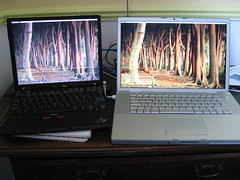
Kai Hendry: MBP versus X40

Thinkpad X40 vs MBP I’ve spent a bit of the bank holiday weekend by probably violating the warranty of a new 15” Macbook Pro (MBP) from work. I also was at the Debian bbq 2007 in Cambridge and met some friendly faces. :) More MBP & X40 porn So now I can boot into MacOSX and run Ubuntu or boot straight into Ubuntu from rEFIt. There are a couple of problems. There are some things I quite like about the MBP compared to the X40: Currently I remain not totally convinced about the Apple MBP. I’ll keep my Debian X40 my personal machine and the MBP for work. Now I can compile Webkit on Apple OSX (Debian can too) and see what’s happening in Ubuntu.

25 August 2007

Martín Ferrari: Last GSoC update

It's been a long time without saying any word, my project completely drained any free time! So it's finished, as long as GSoC goes, but Pancut n still is a work in progress. What happened is that it turned out to be a lot more difficult that what I expected, so during the second part of the program —when I would write all the tests— the schedule ran away. Anyway, the tool is in a fully functional state: you can try it now and it —$DEITY forbids— will not crash on you; but it will not be able to spot many errors yet. So, if you can, please install it and try it out! Bug reports are welcomed, and code will be greatly appreciated. I've set up a debian repository with binaries (i386) and sources where you can grab it from, with all the dependencies, or you can check out the SVN repository. Bear in mind that it depends on a version of libcdio that's still not in the archive, so that can also be found in my private repository. As expected, my work with this tool doesn't end here; I will continue hacking on it as soon as I end my vacations; which brings me to the other subject of this post... Tomorrow I'll be leaving Lisbon, heading north to Porto and then the northern region of Spain: Galiza, Asturias, Euskadi and Catalunya; ending later in Madrid. After Spain I'll visit a friend in Paris and money and time will determine what I'll do after that. I am very excited, I love travelling and I really need some rest. PS: also I moved this blog to blosxom, which I expect to heavy hack on when I get back. Tags: Planet Lugfi, Planet Debian, Programaci n, Debian, Viajes

Next.

Previous.