Search Results: "ron"

19 August 2017

Vasudev Kamath: Writing a UDP Broadcast Receiver as Python Iterator

I had to write a small Python application to listen for some broadcast message and process the message. This broadcast messages are actually sort of discovery messages to find some peers in a network. Writing a simple UDP Server to listen on a particular port was easy; but while designing an application I was wondering how can I plugin this server into my main code. There are 2 possibility
  1. Use threading module of python to send the server code in back ground and give it a callback to communicate the data to main thread.
  2. Periodically read some messages from server code and then dispose of server.
I didn't like first approach because I need to pass a callback function and I some how will end up complicating code. Second approach sounded sane but I did want to make server more like iterator. I searched around to see if some one has attempted to write something similar, but did not find anything useful (may be my Googling skills aren't good enough). Anyway so I thought what is wrong in trying?. If it works then I'll be happy that I did something different :-). The first thing for making iterator in Python is having function __iter__ and __next__ defined in your class. For Python 2 iterator protocol wanted next to be defined instead of __next__. So for portable code you can define a next function which in return calls __next__. So here is my first shot at writing BroadCastReceiver class.
from socket import socket, AF_INET, SOCK_DGRAM
class BroadCastReceiver:
    def __init__(self, port, msg_len=8192):
        self.sock = socket(AF_INET, SOCK_DGRAM)
        self.sock.setsockopt(SOL_SOCKET, SO_REUSEADDR, 1)
        self.sock.bind(('', port))
        self.msg_len = msg_len
    def __iter__(self):
             return self
    def __next__(self):
             try:
                 addr, data = self.sock.recvfrom(self.msg_len)
                 return addr, data
             except Exception as e:
                 print("Got exception trying to recv %s" % e)
                 raise StopIteration
This version of code can be used in a for loop to read from socket UDP broadcasts. One problem will be that if no packet is received which might be due to disconnected network the loop will just block forever. So I had to modify the code slightly to add timeout parameter. So changed portion of code is below.
...
    def __init__(self, port, msg_len=8192, timeout=15):
        self.sock = socket(AF_INET, SOCK_DGRAM)
        self.sock.setsockopt(SOL_SOCKET, SO_REUSEADDR, 1)
        self.sock.settimeout(timeout)
        self.sock.msg_len = msg_len
        self.sock.bind(('', port))
 ...
So now if network is disconnected or no packet was received for timeout period we get a socket.timeout exception due to which StopIteration will be raised causing the for loop using server as iterator to exit. This avoids us just blocking our periodic code run forever when network is disconnected or no messages are received for long time. (may be due to connected to wrong network). Now every thing looks fine but only part is if we create the server object each time our periodic code is called we will have binding issue as we did not properly close the socket once iterator has stopped. So I added socket closing code in __del__ function for the class. __del__ will be called when garbage collector try to recollect object when it goes out of scope.
...
    def __del__(self):
        self.sock.close()
So the server can be used in for loop or by passing the object of server to next built-in function. Here are 2 examples.
r = BroadCastReceiver(5000, timeout=10)
count = 0
for (address, data) in r:
    print('Got packet from %s: %s' % address, data)
    count += 1
    # do whatever you want with data
    if count > 10:
        break
Here we use an counter variable to track iteration and after some iteration we exit for loop. Another way is use for loop with range of iteration like below.
r = BroadCastReceiver(5000,  timeout=10)
for i in range(20):
    try:
        address, data = next(r)
        # do whatever you want with data
    except:
        break
Here an additional try block was needed inside the for loop to card call to next, this is to handle the timeout or other exception and exit the loop. In first case this is not needed as StopIteration is understood by for. Both use cases I described above are mostly useful when it is not critical to handle each and every packet (mostly peer discovery) and packets will always be sent. So if we miss some peers in one iteration we will still catch them in next iteration. We just need to make sure we provide big enough counter to catch most peers in each iteration. If its critical to receive each packet we can safely send this iterating logic to a separate thread which keeps receiving packets and process data as needed. For now I tried this pattern mostly with UDP protocol but I'm sure with some modification this can be used with TCP as well. I'll be happy to get feed back from Pythonistas out there on what you think of this approach. :-)
Update I got a suggestion from Ryan Nowakowski to make the server object as context manager and close the socket in __exit__ as it can't be guaranteed that __del__ will be called for objects which exists during interpreter exits. So I slightly modified the class to add __enter__ and __exit__ method like below and removed __del__
...
    def __enter__(self):
        return self
    def __exit__(self, exc_type, exc_value, traceback):
        self.sock.close()
Usage pattern is slightly modified because of this and we need to use with statement while creating object.
with BroadCastReceiver(2000) as r:
    # use server object as you wish
    ...
It is also possible to cleanly close socket without adding context manager that is adding finally statement to our try and except block in __next__. The modified code without adding context manager looks like below.
def __next__(self):
    try:
        addr, data = self.sock.recvfrom(self.msg_len)
        return addr, data
    except Exception as e:
        print("Got exception trying to recv %s" % e)
        raise StopIteration
    finally:
        self.sock.close()
When we raise StopIteration again from except block, it will be temporarily saved and finally block is executed which will now close the socket.

Olivier Gr goire: Conclusion Google Summer of Code 2017 with GNU

alt text alt text alt text

GNU Ring project with GNU organisation

1. Me Before getting into the thick of my project, let me present myself:
I am Olivier Gr goire (Gasuleg), and I study IT engineering at cole de Technologie Sup rieure in Montreal.
I am a technician in electronics, and I study now computing sciences.
I applied to GSoC because I love the concept of the project that I worked on and I really wanted to be part of it.

2. My Project During this GSoC, I worked on the GNU Ring project.
What is ring?
  • A telephone: a simple tool to connect, communicate and share.
  • A teleconferencing tool: easily join calls to create conferences with multiple participants.
  • A media sharing tool: Ring supports a variety of video input options, including mutliple cameras and image and video files, and the selection of audio inputs and outputs; all this is supported by multiple high quality audio and video codecs.
  • A messenger: send text messeges during calls or out of calls (as long as your peer is connected).
  • A building block for your IoT project: re-use the universal communications technology of Ring with its portable library on your system of choice.
    ring.cx
What I need to do?
This project is, at the moment, unstable due to a lack of automated tests. Only a part of the code is tested. I need to improve this.
To do that, I need to:
  • Research and test automation strategies that integrate the compilation system and Jenkins verification like the SIP tests
  • Implement some unit tests to check the components
See more in my proposal!

3. The Code Links to my work
Here are the links to the code I was working on all throughout the Google Summer of Code:
Patch Status
Black box testing sip Merged
New unit test: smartools Merged
New unit test:account_factory Merged
New unit test: util classes On Review
New unit test: archiver, conference, preferences On Review
New unit test: dring, threadloop On Review
Documentation On Review
Refactoring + video_input unit test Abandoned


How to use the code?
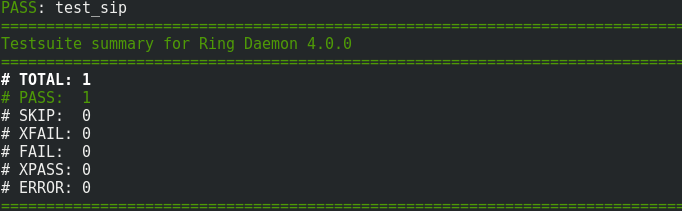
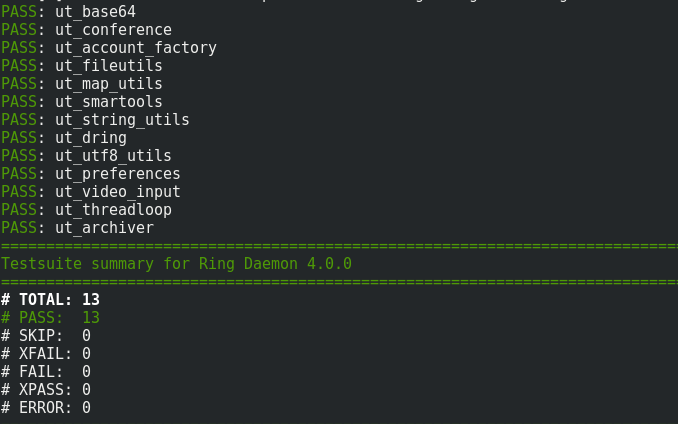
Follow the instructions to build the daemon and instead of doing make , do make check . You will see something composed of:

  • Test automation strategies
    alt text
  • Unit test alt text
Some explanations of the code
The tests are based on CPPunit framework.
I created some Black box testing to do some calls using SIP protocol. To do that, I created scenarios using SIPp .
I also create a lot of unit tests.
Difficulties encountered
My project was a little bit difficult to setup because I never touch autotools before that.
The sip tests were not really difficult to create. SIPp is really easy to use.
The unit test part was more tricky. It s really easier to do the tests before coding like the Test-driven_development said. Here the code is already written and I need to test it. So, I needed to create tests based on the code and not what he needed to do. Also, I got some issues with classes who were really linked together so I couldn t make unit test with it.

4. What s next?
  • Merge all the patchs
  • Add gcov to know the code coverage
  • Increase the code coverage

5. Thanks I would like to thank the following:
  • The Google Summer of Code organisation, for this wonderful experience.
  • GNU, for accepting my project proposal and letting me embark on this fantastic adventure.
  • My mentor, Mr Guillaume Roguez, and all the ring team, for being there to help me.

Arturo Borrero Gonz lez: Running Suricata 4.0 with Debian Stretch

debian-suricata logo Do you know what s happening in the wires of your network? There is a major FLOSS player in the field of real time intrusion detection (IDS), inline intrusion prevention (IPS) and network security monitoring (NSM). I m talking about Suricata, a mature, fast and robust network threat detection engine. Suricata is a community driven project, supported by the Open InfoSec Foundation (OISF). For those who doesn t know how Suricata works, it usually runs by loading a set of pre-defined rules for matching different network protocols and flow behaviours. In this regards, Suricata has been always ruleset-compatible with the other famous IDS: snort. The last major release of Suricata is 4.0.0, and I m uploading the package for Debian stretch-backports as I write this line. This means the updated package should be available for general usage after the usual buildds processing ends inside the Debian archive. You might be wondering, How to start using Suricata 4.0 with Debian Stretch? First, I would recommend reading the docs. Please checkout: My recommendation is to run Suricata from stretch-backports or from testing, and just installing the package should be enough to get the environment up and running:
% sudo aptitude install suricata
You can check that the installation was good:
% sudo systemctl status suricata
  suricata.service - Suricata IDS/IDP daemon
   Loaded: loaded (/lib/systemd/system/suricata.service; enabled; vendor preset: enabled)
   Active: active (running) since Sat 2017-08-19 12:50:49 CEST; 44min ago
     Docs: man:suricata(8)
           man:suricatasc(8)
           https://redmine.openinfosecfoundation.org/projects/suricata/wiki
 Main PID: 1101 (Suricata-Main)
    Tasks: 8 (limit: 4915)
   CGroup: /system.slice/suricata.service
            1101 /usr/bin/suricata -D --af-packet -c /etc/suricata/suricata.yaml --pidfile /var/run/suricata.pid
ago 19 12:50:44 nostromo systemd[1]: Starting Suricata IDS/IDP daemon...
ago 19 12:50:47 nostromo suricata[1032]: 19/8/2017 -- 12:50:47 - <Notice> - This is Suricata version 4.0.0 RELEASE
ago 19 12:50:49 nostromo systemd[1]: Started Suricata IDS/IDP daemon.
You can interact with Suricata using the suricatasc tool:
% sudo suricatasc -c uptime
 "message": 3892, "return": "OK" 
And start inspecting the generated logs at /var/log/suricata/ The default configuration, in file /etc/suricata/suricata.yaml, comes with some preconfigured values. For a proper integration into your enviroment, you should tune the configuration file, define your networks, network interfaces, running modes, and so on (refer to the upstream documentation for this). In my case, I tested suricata by inspecting the traffic of my laptop. After installation, I only had to switch the network interface:
[...]
# Linux high speed capture support
af-packet:
  - interface: wlan0
[...]
After a restart, I started seeing some alerts:
% sudo systemctl restart suricata
% sudo tail -f /var/log/suricata/fast.log
08/19/2017-14:03:04.025898  [**] [1:2012648:3] ET POLICY Dropbox Client Broadcasting [**] \
	[Classification: Potential Corporate Privacy Violation] [Priority: 1]  UDP  192.168.1.36:17500 -> 255.255.255.255:17500
One of the main things when running Suricata is to keep your ruleset up-to-dated. In Debian, we have the suricata-oinkmaster package which comes with some handy options to automate your ruleset updates using the Oinkmaster software. Please note that this is a Debian-specific glue to integrate and automate Suricata with Oinkmaster. To get this funcionality, simply install the package:
% sudo aptitude install suricata-oinkmaster
A daily cron-job will be enabled. Check suricata-oinkmaster-updater(8) for more info. By the way, Did you know that Suricata can easily handle big loads of traffic? (i.e, 10Gbps). And I heard some scaling works are in mind to reach 100Gpbs. I have been in charge of the Suricata package in Debian for a while, several years already, with the help of some other DD hackers: Pierre Chifflier (pollux) and Sascha Steinbiss (satta), among others. Due to this work, I believe the package is really well integrated into Debian, ready to use and with some powerful features. And, of course, we are open to suggestions and bug reports. So, this is it, another great stuff you can do with Debian :-)

18 August 2017

Rapha&#235;l Hertzog: Freexian s report about Debian Long Term Support, July 2017

A Debian LTS logoLike each month, here comes a report about the work of paid contributors to Debian LTS. Individual reports In July, about 181 work hours have been dispatched among 11 paid contributors. Their reports are available: Evolution of the situation The number of sponsored hours increased slightly with two new sponsors: Leibniz Rechenzentrum (silver sponsor) and Catalyst IT Ltd (bronze sponsor). The security tracker currently lists 74 packages with a known CVE and the dla-needed.txt file 64. The number of packages with open issues increased of almost 50% compared to last month. Hopefully this backlog will get cleared up when the unused hours will actually be done. In any case, this evolution is worth watching. Thanks to our sponsors New sponsors are in bold.

No comment Liked this article? Click here. My blog is Flattr-enabled.

Mike Gabriel: @DebConf17: Ad-hoc BoF: Bits from the Debian+Ubuntu MATE Packaging Team

On Tuesday, late afternoon, at DebConf17, I offered an ad-hoc BoF about the current status of the MATE Desktop packaging efforts in Debian and Ubuntu. I need to get this written down, before DebConf17 feels too far away... Unfortunately, I scheduled that BoF with Joey Hess's talk about his post-Debian life, which attracted many people. So, only a small group of people came together to share and discuss about the current status of MATE in Debian and Ubuntu. Ongoing efforts around MATE in Debian and Ubuntu A quick summary of ongoing efforts was provided and also a collection of URLs for reporting bugs, looking up packaging status, etc. was listed: Cross-Distro Packaging Workflow The workflow of Debian and Ubuntu packaging in the MATE Packaging Team was described in detail (basically, all packages go through Debian, only exception being freeze states of this or that distro) and the benefit of the close cooperation between the two projects underlined. We reduce the packaging effort tremendously by working very closely together. In the past, we (Martin Wimpress and myself) also invited the people from Linux Mint to join our cross-distro packaging efforts, but so far to no avail. Also the packaging for the Parrot Security OS has recently been integrated in our packaging Git repository. Requested / Upcoming Improvements From people attending the BoF, I got these main inputs, which I hope to accomplish with the help of all, for Debian buster: Another project that I will also work on for Debian buster is proper Ayatana Indicator support for Debian's MATE Desktop. Credits Thanks to all the people attending the BoF for your sharings and input. Feel invited to contribute to our team's effort in improving the user experience of the MATE Destkop Environment in Debian (and Ubuntu, and ...). Also a big thanks to the people already on the team for bringing MATE in Debian to where it is now. Good work, folks!

Dirk Eddelbuettel: RcppArmadillo 0.7.960.1.0

armadillo image The bi-monthly RcppArmadillo release is out with a new version 0.7.960.1.0 which is now on CRAN, and will get to Debian in due course. And it is a big one. Lots of nice upstream changes from Armadillo, and lots of work on our end as the Google Summer of Code project by Binxiang Ni, plus a few smaller enhancements -- see below for details. Armadillo is a powerful and expressive C++ template library for linear algebra aiming towards a good balance between speed and ease of use with a syntax deliberately close to a Matlab. RcppArmadillo integrates this library with the R environment and language--and is widely used by (currently) 379 other packages on CRAN---an increase of 49 since the last CRAN release in June! Changes in this release relative to the previous CRAN release are as follows:

Changes in RcppArmadillo version 0.7.960.1.0 (2017-08-11)
  • Upgraded to Armadillo release 7.960.1 (Northern Banana Republic Deluxe)
    • faster randn() when using OpenMP (NB: usually omitted when used fromR)
    • faster gmm_diag class, for Gaussian mixture models with diagonal covariance matrices
    • added .sum_log_p() to the gmm_diag class
    • added gmm_full class, for Gaussian mixture models with full covariance matrices
    • expanded .each_slice() to optionally use OpenMP for multi-threaded execution
  • Upgraded to Armadillo release 7.950.0 (Northern Banana Republic)
    • expanded accu() and sum() to use OpenMP for processing expressions with computationally expensive element-wise functions
    • expanded trimatu() and trimatl() to allow specification of the diagonal which delineates the boundary of the triangular part
  • Enhanced support for sparse matrices (Binxiang Ni as part of Google Summer of Code 2017)
    • Add support for dtCMatrix and dsCMatrix (#135)
    • Add conversion and unit tests for dgT, dtT and dsTMatrix (#136)
    • Add conversion and unit tests for dgR, dtR and dsRMatrix (#139)
    • Add conversion and unit tests for pMatrix and ddiMatrix (#140)
    • Rewrite conversion for dgT, dtT and dsTMatrix, and add file-based tests (#142)
    • Add conversion and unit tests for indMatrix (#144)
    • Rewrite conversion for ddiMatrix (#145)
    • Add a warning message for matrices that cannot be converted (#147)
    • Add new vignette for sparse matrix support (#152; Dirk in #153)
    • Add support for sparse matrix conversion from Python SciPy (#158 addressing #141)
  • Optional return of row or column vectors in collapsed form if appropriate #define is set (Serguei Sokol in #151 and #154)
  • Correct speye() for non-symmetric cases (Qiang Kou in #150 closing #149).
  • Ensure tests using Scientific Python and reticulate are properly conditioned on the packages being present.
  • Added .aspell/ directory with small local directory now supported by R-devel.

Courtesy of CRANberries, there is a diffstat report. More detailed information is on the RcppArmadillo page. Questions, comments etc should go to the rcpp-devel mailing list off the R-Forge page.

This post by Dirk Eddelbuettel originated on his Thinking inside the box blog. Please report excessive re-aggregation in third-party for-profit settings.

17 August 2017

Sean Whitton: I went all the way to Montr al for DebConf17, and all I got was a new MUA

This year s group photo (by Aigars Mahinovs). I really like the tagline
On Sunday night I got back from Montr al, where I attended both DebCamp17 and DebConf17. It was a wonderful two weeks. All I really did was work on Debian for roughly eight hours per day, interspersed with getting to know both people I ve been working with since I first began contributing to Debian in late 2015, and people I didn t yet know. But this was all I really needed to be doing. There was no need to engage in distracting myself. I enjoyed the first week more. There were sufficiently few people present that you could know at least all of their faces, and interesting-sounding talks didn t interrupt making progress on one s own work or unblocking other people s work. In the second week it was great to meet people who were only present for the second week, but it felt more like regular Debian, in that I was often waiting on other people or they were waiting on me. While I spent one morning actually writing fresh code, and I did a fair amount of pure packaging work, the majority of my time was poured into (i) Debian Policy; (ii) discussions within the Emacs team; and (iii) discussions about dgit. This was as I expected. During DebConf, it s not that useful to seclude oneself and sufficiently reacquaint oneself with a codebase that one can start producing patches, because that can be done anywhere in the world, without everyone else around. It s far more useful to bring different people together to get projects unblocked. I did some of that for my own work, and also tried to help other people s, including those who weren t able to attend the conference. In my ordinary life, taking a step back from the methods by which I protect my PGP keys and other personal data, I can appear to myself as a paranoid extremist, or some kind of data hoarder. It was comforting to find at DebConf plenty of people who go way further than me: multiple user accounts on their laptop, with separate X servers, for tasks of different security levels; PGP keys on smartcards; refusal to sign my PGP key based on government-issued ID alone; use of Qubes OS. One thing that did surprise me was to find myself in a minority for using the GNOME desktop; I had previously assumed that most people deep in Debian development didn t bother with tiling window managers. Turns out they are enthusiastic to talk about the trade-offs between window managers while riding the subway train back to our accommodation at midnight who knew such people existed? I was pleased to find them. One evening, I received a tag-teamed live tutorial in using i3 s core keybindings, and the next morning GNOME seemed deeply inelegant. The insinuation began, but I was immediately embroiled in inner struggle over the fact that i3 is a very popular tiling window manager, so it wouldn t be very cool if I were to start using it. This difficulty was compounded when I learned that the Haskell team lead still uses xmonad. The struggle continues. I hope that I ve been influenced by the highly non-judgemental and tolerant attitudes of the attendees of the conference. While most people at the conference were pretty ordinary aside from wanting to talk about the details of Debian packaging and processes! there were several people who rather visibly rejected social norms about how to present themselves. Around these people there was nothing of the usual tension. Further, in contrast with my environment as a graduate student, everyone was extremely relaxed about how everyone was spending their time. People drinking beer in the evenings were sitting at tables where other people were continuing to silently work on Debian. It is nice to have my experience in Montr al as a reference to check my own judgemental tendencies. I came away with a lot more than a new MUA: a certainty that I want to try to get to next year s conference; friends; a real life community behind what was hitherto mostly a hobby; a long list of tasks and the belief that I can accomplish them; a list of PGP fingerprints to sign; a new perspective on the arguments that occur on Debian mailing lists; an awareness of the risk of unconsciously manipulating other community members into getting work done. With regard to the MUA, I should say that I did not waste a lot of DebConf time messing with its configuration. I had actually worked out a notmuch configuration some months ago, but couldn t use it because I couldn t figure out how to incorporate my old mail archives into its index. Fortunately notmuch s maintainer is also on the Emacs team he was able to confirm that the crazy solution I d come up with was not likely to break notmuch s operating assumptions, and so I was able to spend about half an hour copying and pasting the configuration and scripts I d previously developed into my homedir, and then start using notmuch for the remainder of the conference. The main reason for wanting to use notmuch was to handle Debian mailing list volume more effectively than I m able to with mutt, so I was very happy to have the opportunity to pester David with newbie questions. Many, many thanks to all the volunteers whose efforts made DebCamp17 and DebConf17 possible.

Julian Andres Klode: Why TUF does not shine (for APT repositories)

In DebConf17 there was a talk about The Update Framework, short TUF. TUF claims to be a plug-in solution to software updates, but while it has the same practical level of security as apt, it also has the same shortcomings, including no way to effectively revoke keys. TUF divides signing responsibilities into roles: A root role, a targets rule (signing stuff to download), a snapshots rule (signing meta data), and a time stamp rule (signing a time stamp file). There also is a mirror role for signing a list of mirrors, but we can ignore that for now. It strongly recommends that all keys except for timestamp and mirrors are kept offline, which is not applicable for APT repositories Ubuntu updates the repository every 30 minutes, imagine doing that with offline keys. An insane proposal. In APT repositories, we effectively only have a snapshots rule the only thing we sign are Release files, and trust is then chained down by hashes (Release files hashes Packages index files, and they have hashes of individual packages). The keys used to sign repositories are online keys, after all, all the metadata files change every 30 minutes (Ubuntu) or 6 hours (Debian) it s impossible to sign them by hand. The timestamp role is replaced by a field in the Release file specifying until when the Release file is considered valid. Let s check the attacks TUF protects again: As we can see, APT addresses all attacks TUF addresses. But both do not handle key revocation. So, if a key & mirror gets compromised (or just key and the mirror is MITMed), we cannot inform the user that the key has been compromised and block updates from the compromised repository. I just wrote up a proposal to allow APT to query for revoked keys from a different host with a key revocation list (KRL) file that is signed by different keys than the repository. This would solve the problem of key revocation easily even if the repository host is MITMed or compromised, we can still revoke the keys signing the repository from a different location.
Filed under: Debian, Ubuntu

16 August 2017

Simon McVittie: DebConf 17: Flatpak and Debian

The indoor garden at Coll ge de Maisonneuve, the DebConf 17 venue
Decorative photo of the indoor garden
I'm currently at DebConf 17 in Montr al, back at DebConf for the first time in 10 years (last time was DebConf 7 in Edinburgh). It's great to put names to faces and meet more of my co-developers in person! On Monday I gave a talk entitled A Debian maintainer's guide to Flatpak , aiming to introduce Debian developers to Flatpak, and show how Flatpak and Debian (and Debian derivatives like SteamOS) can help each other. It seems to have been quite well received, with people generally positive about the idea of using Flatpak to deliver backports and faster-moving leaf packages (games!) onto the stable base platform that Debian is so good at providing. A video of the talk is available from the Debian Meetings Archive. I've also put up my slides in the DebConf git-annex repository, with some small edits to link to more source code: A Debian maintainer's guide to Flatpak. Source code for the slides is also available from Collabora's git server. The next step is to take my proof-of-concept for building Flatpak runtimes and apps from Debian and SteamOS packages, flatdeb, get it a bit more production-ready, and perhaps start publishing some sample runtimes from a cron job on a Debian or Collabora server. (By the way, if you downloaded that source right after my talk, please update - I've now pushed some late changes that were necessary to fix the 3D drivers for my OpenArena demo.) I don't think Debian will be going quite as far as Endless any time soon: as Cosimo outlined in the talk right before mine, they deploy their Debian derivative as an immutable base OS with libOSTree, with all the user-installable modules above that coming from Flatpak. That model is certainly an interesting thing to think about for Debian derivatives, though: at Collabora we work on a lot of appliance-like embedded Debian derivatives, with a lot of flexibility during development but very limited state on deployed systems, and Endless' approach seems a perfect fit for those situations. [Edited 2017-08-16 to fix the link for the slides, and add links for the video]

14 August 2017

Jamie McClelland: Diversity doesn't help the bottom line

A Google software engineer's sexist screed against diversity has been making the rounds lately. Most notable are the offensive and mis-guided statements about gender essentialism, which honestly make the thing hard to read at all. What seems lost in the hype, however, is that his primary point seems quite accurate. In short: If Google successfully diversified it's workforce, racial and gender tensions would increase not decrease, divisiveness would spread and, with all liklihood, Google could be damaged. Imagine what would happen if the thousands of existing, mostly male, white and Asian engineers, the majority of whom are convinced that they play no part in racism and sexism, were confronted with thousands of smart and ambitious women, African Americans and Latinos who were becoming their bosses, telling them to work in different ways, and taking "their" promotions. It would be a revolution! I'd love to see it. Google's bosses definitely do not. That's why none of the diversity programs at Google or any other major tech company are having any impact - because they are not designed to have an impact. They are designed to boost morale and make their existing engineers feel good about what they do. Google has one goal: to make money. And one strategy: to design software that that people want to use. One of their tactics that is highly effective is building tight knit groups of programmers who work well together. If the creation of hostile, racist and sexist environments is a by-product - well, it's not one that affects their bottom line. Would Google make better software with a more diverse group of engineers? Definitely! For one, if African American engineers were working on their facial recognition software, it's doubtful it would have mistaken people with black faces for gorillas. However, if the perceived improvement in software outweighed the risks of diversification, then Google would not waste any time on feel-good programs and trainings - they would simply build a jobs pipeline and change their job outreach programs to recruit substantially more female, African Americans and Latino candidates. In the end, this risk avoidance and failure to perceive the limitations of homogeneity is the achiles heel of corporate software design. Our challenge is to see what we can build outside the confines of corporate culture that prioritizes profits, production efficiency, and stability. What can we do with teams that are willing to embrace racial and gender tension, risk diviseveness and be willing to see benefits beyond releasing version 1.0?

Holger Levsen: 20170812-reproducible-policy

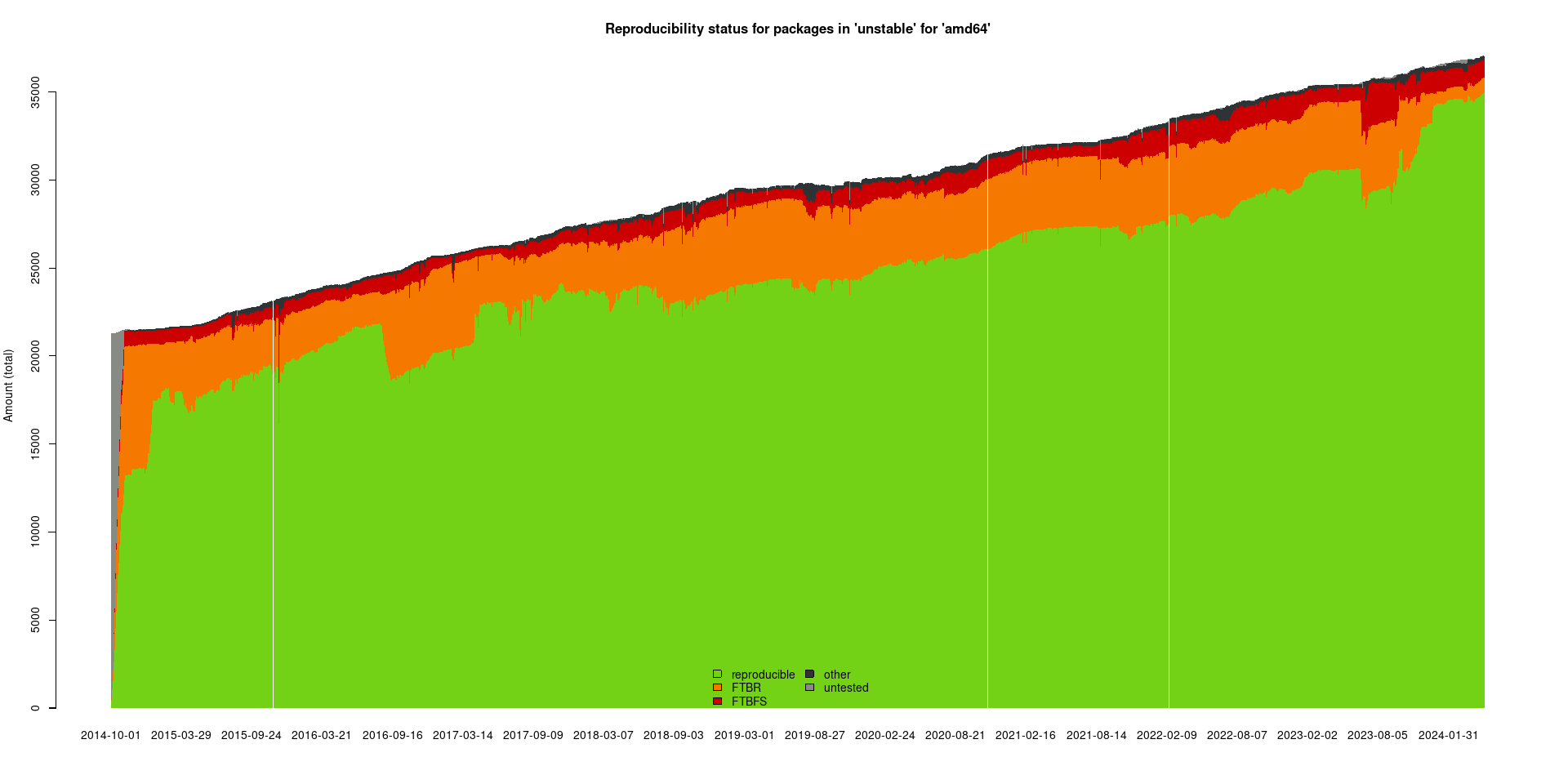
"packages should build reproducibly" - after 4 years this work of many is in debian-policy now This post was written roughly 44h ago and now that the fix for #844431 has been merged into the git master branch, I'm publishing it - hoping you'll enjoy this as much as I do! So today is the last (official) day of DebConf17 and it looks like #844431: "packages should build reproducibly" will be merged into debian-policy today! So I'm super excited, super happy, quite tired and a bit sad (DebConf is ending ) right now! :-) Four years ago Lunar held a BoF at DebConf13 which started the initiative in Debian. I only got involved in September 2014 with setting up continuous tests, rebuilding each package twice with some variations and then comparing the results using diffoscope, which back then was still called debbindiff and which we renamed as part of our efforts to make Reproducible Builds the norm in Free Software. Many people have worked on this, and I'm also very happy how visible this has been in our talk here yesterday. You people rock and I'm very thankful and proud to be part of this team. Thank you everyone! And please understand: we are not 94% done yet (which our reproducibility stats might have made you think), rather more like half done or so. We still need tools and processes to enable anyone to indepently verify that a given binary comes from the sources it is said to be coming, this will involve distributing .buildinfo files and providing user interfaces in APT and elsewhere. And probably also systematic rebuilds by us and other parties. And 6 or 7% of the archive are a lot of packages still, eg in Buster we currently still have 273 unreproducible key packages and for a large part we don't have patches yet. So there is still a lot of work ahead. This is what was added to debian-policy now:
Reproducibility
---------------
Packages should build reproducibly, which for the purposes of this
document [#]_ means that given
- a version of a source package unpacked at a given path;
- a set of versions of installed build dependencies;
- a set of environment variable values;
- a build architecture; and
- a host architecture,
repeatedly building the source package for the build architecture on
any machine of the host architecture with those versions of the build
dependencies installed and exactly those environment variable values
set will produce bit-for-bit identical binary packages.
It is recommended that packages produce bit-for-bit identical binaries
even if most environment variables and build paths are varied.  It is
intended for this stricter standard to replace the above when it is
easier for packages to meet it.
.. [#]
   This is Debian's precisification of the  reproducible-builds.org
   definition  _.
For now violating this part of policy may result in a severity: normal bug, though I think we should still only file them if we have patches, else it's probably better to just take a note in our notes.git, like we did before the policy change. Finally one last comment: we could do reproducible security updates for Stretch now too, for those 94% of the packages which are reproducible. It just needs to be done by someones and the first step would be publishing those .buildinfo files from those builds

13 August 2017

Enrico Zini: Consensually doing things together?

On 2017-08-06 I have a talk at DebConf17 in Montreal titled "Consensually doing things together?" (video). Here are the talk notes. Abstract At DebConf Heidelberg I talked about how Free Software has a lot to do about consensually doing things together. Is that always true, at least in Debian? I d like to explore what motivates one to start a project and what motivates one to keep maintaining it. What are the energy levels required to manage bits of Debian as the project keeps growing. How easy it is to say no. Whether we have roles in Debian that require irreplaceable heroes to keep them going. What could be done to make life easier for heroes, easy enough that mere mortals can help, or take their place. Unhappy is the community that needs heroes, and unhappy is the community that needs martyrs. I d like to try and make sure that now, or in the very near future, Debian is not such an unhappy community. Consensually doing things together I gave a talk in Heidelberg. Valhalla made stickers Debian France distributed many of them. There's one on my laptop. Which reminds me of what we ought to be doing. Of what we have a chance to do, if we play our cards right. I'm going to talk about relationships. Consensual relationships. Relationships in short. Nonconsensual relationships are usually called abuse. I like to see Debian as a relationship between multiple people. And I'd like it to be a consensual one. I'd like it not to be abuse. Consent From wikpedia:
In Canada "consent means the voluntary agreement of the complainant to engage in sexual activity" without abuse or exploitation of "trust, power or authority", coercion or threats.[7] Consent can also be revoked at any moment.[8] There are 3 pillars often included in the description of sexual consent, or "the way we let others know what we're up for, be it a good-night kiss or the moments leading up to sex." They are:
  • Knowing exactly what and how much I'm agreeing to
  • Expressing my intent to participate
  • Deciding freely and voluntarily to participate[20]
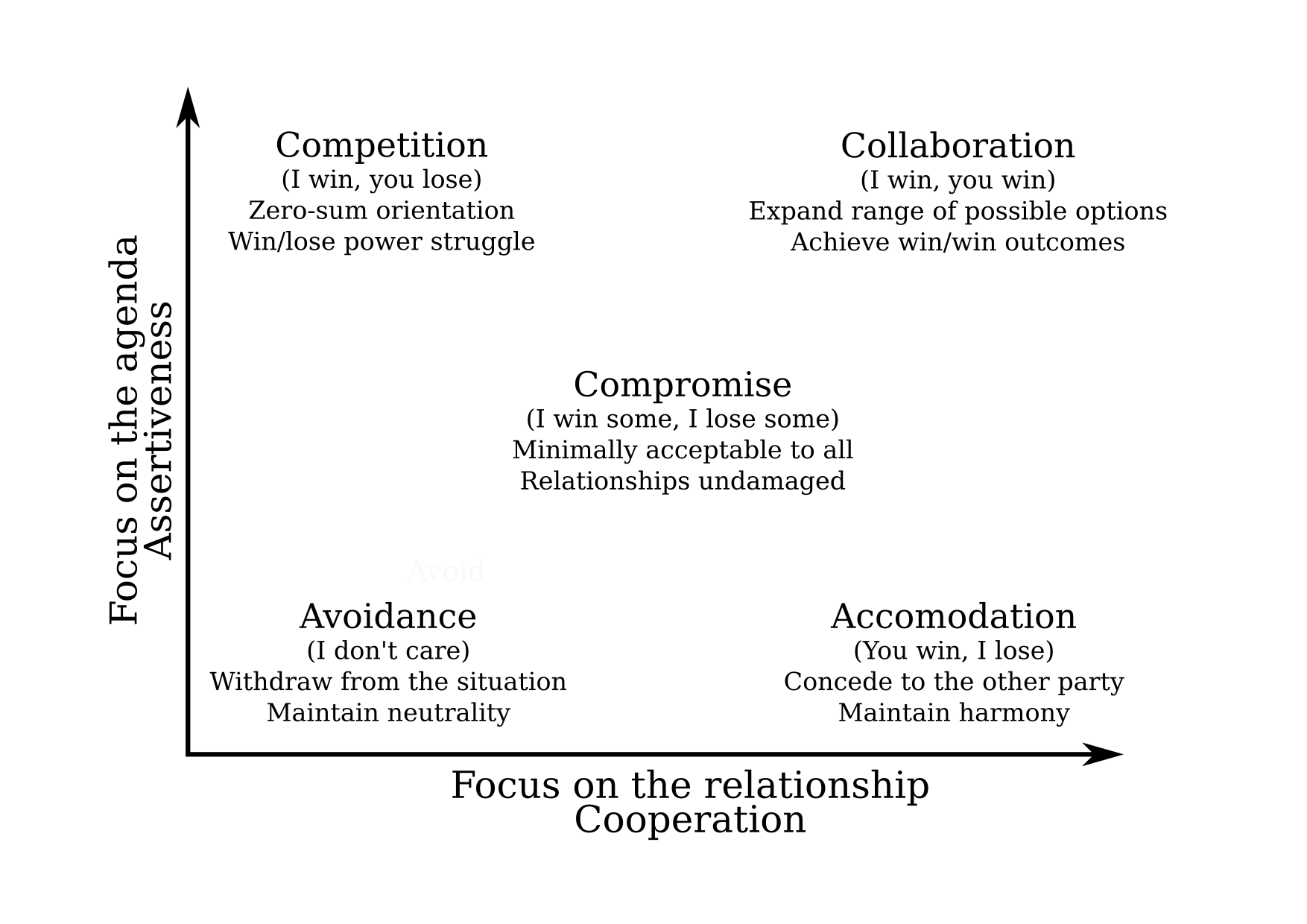
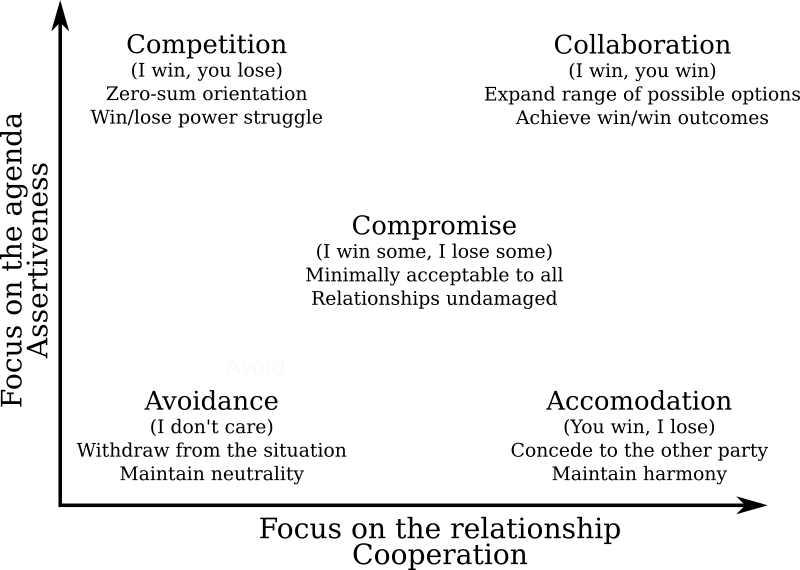
Saying "I've decided I won't do laundry anymore" when the other partner is tired, or busy doing things. Is different than saying "I've decided I won't do laundry anymore" when the other partner has a chance to say "why? tell me more" and take part in negotiation. Resources: Relationships Debian is the Universal Operating System. Debian is made and maintained by people. The long term health of debian is a consequence of the long term health of the relationship between Debian contributors. Debian doesn't need to be technically perfect, it needs to be socially healthy. Technical problems can be fixed by a healty community. graph showing relationship between avoidance, accomodation, compromise, competition, collaboration The Thomas-Kilmann Conflict Mode Instrument: source png. Motivations Quick poll: What are your motivations to be in a relationship? Which of those motivations are healthy/unhealthy? "Galadriel" (noun, by Francesca Ciceri): a task you have to do otherwise Sauron takes over Middle Earth See: http://blog.zouish.org/nonupdd/#/22/1 What motivates me to start a project or pick one up? What motivates me to keep maintaning a project? What motivates you? What's an example of a sustainable motivation? Is it really all consensual in Debian? Energy Energy that thing which is measured in spoons. The metaphore comes from people suffering with chronic health issues:
"Spoons" are a visual representation used as a unit of measure used to quantify how much energy a person has throughout a given day. Each activity requires a given number of spoons, which will only be replaced as the person "recharges" through rest. A person who runs out of spoons has no choice but to rest until their spoons are replenished.
For example, in Debian, I could spend: What is one person capable of doing? Have reasonable expectations, on others: Have reasonable expectations, on yourself: Debian is a shared responsibility When spoons are limited, what takes more energy tends not to get done As the project grows, project-wide tasks become harder Are they still humanly achievable? I don't want Debian to have positions that require hero-types to fill them Dictatorship of who has more spoons: Perfectionism You are in a relationship that is just perfect. All your friends look up to you. You give people relationship advice. You are safe in knowing that You Are Doing It Right. Then one day you have an argument in public. You don't just have to deal with the argument, but also with your reputation and self-perception shattering. One things I hate about Debian: consistent technical excellence. I don't want to be required to always be right. One of my favourite moments in the history of Debian is the openssl bug Debian doesn't need to be technically perfect, it needs to be socially healthy, technical problems can be fixed. I want to remove perfectionism from Debian: if we discover we've been wrong all the time in something important, it's not the end of Debian, it's the beginning of an improved Debian. Too good to be true There comes a point in most people's dating experience where one learns that when some things feel too good to be true, they might indeed be. There are people who cannot say no: There are people who cannot take a no: Note the diversity statement: it's not a problem to have one of those (and many other) tendencies, as long as one manages to keep interacting constructively with the rest of the community Also, it is important to be aware of these patterns, to be able to compensate for one's own tendencies. What happens when an avoidant person meets a narcissistic person, and they are both unaware of the risks? Resources: Note: there are problems with the way these resources are framed: Red flag / green flag http://pervocracy.blogspot.ca/2012/07/green-flags.html Ask for examples of red/green flags in Debian. Green flags: Red flags: Apologies / Dealing with issues I don't see the usefulness of apologies that are about accepting blame, or making a person stop complaining. I see apologies as opportunities to understand the problem I caused, help fix it, and possibly find ways of avoiding causing that problem again in the future. A Better Way to Say Sorry lists a 4 step process, which is basically what we do when in bug reports already: 1, Try to understand and reproduce the exact problem the person had. 2. Try to find the cause of the issue. 3. Try to find a solution for the issue. 4. Verify with the reporter that the solution does indeed fix the issue. This is just to say
My software ate
the files
that where in
your home directory and which
you were probably
needing
for work Forgive me
it was so quick to write
without tests
and it worked so well for me
(inspired by a 1934 poem by William Carlos Williams) Don't be afraid to fail Don't be afraid to fail or drop the ball. I think that anything that has a label attached of "if you don't do it, nobody will", shouldn't fall on anybody's shoulders and should be shared no matter what. Shared or dropped. Share the responsibility for a healthy relationship Don't expect that the more experienced mates will take care of everything. In a project with active people counted by the thousand, it's unlikely that harassment isn't happening. Is anyone writing anti-harassment? Do we have stats? Is having an email address and a CoC giving us a false sense of security?
When you get involved in a new community, such as Debian, find out early where, if that happens, you can find support, understanding, and help to make it stop. If you cannot find any, or if the only thing you can find is people who say "it never happens here", consider whether you really want to be in that community.
(from http://www.enricozini.org/blog/2016/debian/you-ll-thank-me-later/)
There are some nice people in the world. I mean nice people, the sort I couldn t describe myself as. People who are friends with everyone, who are somehow never involved in any argument, who seem content to spend their time drawing pictures of bumblebees on flowers that make everyone happy. Those people are great to have around. You want to hold onto them as much as you can. But people only have so much tolerance for jerkiness, and really nice people often have less tolerance than the rest of us. The trouble with not ejecting a jerk whether their shenanigans are deliberate or incidental is that you allow the average jerkiness of the community to rise slightly. The higher it goes, the more likely it is that those really nice people will come around less often, or stop coming around at all. That, in turn, makes the average jerkiness rise even more, which teaches the original jerk that their behavior is acceptable and makes your community more appealing to other jerks. Meanwhile, more people at the nice end of the scale are drifting away.
(from https://eev.ee/blog/2016/07/22/on-a-technicality/) Give people freedom If someone tries something in Debian, try to acknowledge and accept their work. You can give feedback on what they are doing, and try not to stand in their way, unless what they are doing is actually hurting you. In that case, try to collaborate, so that you all can get what you need. It's ok if you don't like everything that they are doing. I personally don't care if people tell me I'm good when I do something, I perceive it a bit like "good boy" or "good dog". I rather prefer if people show an interest, say "that looks useful" or "how does it work?" or "what do you need to deploy this?" Acknowledge that I've done something. I don't care if it's especially liked, give me the freedom to keep doing it. Don't give me rewards, give me space and dignity. Rather than feeding my ego, feed by freedom, and feed my possibility to create.

12 August 2017

Bits from Debian: DebConf17 closes in Montreal and DebConf18 dates announced

DebConf17 group photo - click to enlarge Today, Saturday 12 August 2017, the annual Debian Developers and Contributors Conference came to a close. With over 405 people attending from all over the world, and 169 events including 89 talks, 61 discussion sessions or BoFs, 6 workshops and 13 other activities, DebConf17 has been hailed as a success. Highlights included DebCamp with 117 participants, the Open Day,
where events of interest to a broader audience were offered, talks from invited speakers (Deb Nicholson, Matthew Garrett and Katheryn Sutter), the traditional Bits from the DPL, lightning talks and live demos and the announcement of next year's DebConf (DebConf18 in Hsinchu, Taiwan). The schedule has been updated every day, including 32 ad-hoc new activities, planned
by attendees during the whole conference. For those not able to attend, talks and sessions were recorded and live streamed, and videos are being made available at the Debian meetings archive website. Many sessions also facilitated remote participation via IRC or a collaborative pad. The DebConf17 website will remain active for archive purposes, and will continue to offer links to the presentations and videos of talks and events. Next year, DebConf18 will be held in Hsinchu, Taiwan, from 29 July 2018 until 5 August 2018. It will be the first DebConf held in Asia. For the days before DebConf the local organisers will again set up DebCamp (21 July - 27 July), a session for some intense work on improving the distribution, and organise the Open Day on 28 July 2018, aimed at the general public. DebConf is committed to a safe and welcome environment for all participants. See the DebConf Code of Conduct and the Debian Code of Conduct for more details on this. Debian thanks the commitment of numerous sponsors to support DebConf17, particularly our Platinum Sponsors Savoir-Faire Linux, Hewlett Packard Enterprise, and Google. About Savoir-faire Linux Savoir-faire Linux is a Montreal-based Free/Open-Source Software company with offices in Quebec City, Toronto, Paris and Lyon. It offers Linux and Free Software integration solutions in order to provide performance, flexibility and independence for its clients. The company actively contributes to many free software projects, and provides mirrors of Debian, Ubuntu, Linux and others. About Hewlett Packard Enterprise Hewlett Packard Enterprise (HPE) is one of the largest computer companies in the world, providing a wide range of products and services, such as servers, storage, networking, consulting and support, software, and financial services. HPE is also a development partner of Debian, and provides hardware for port development, Debian mirrors, and other Debian services. About Google Google is one of the largest technology companies in the world, providing a wide range of Internet-related services and products as online advertising technologies, search, cloud computing, software, and hardware. Google has been supporting Debian by sponsoring DebConf since more than ten years, at gold level since DebConf12, and at platinum level for this DebConf17.

Bastian Blank: Network caps in cloud environments

Providing working network is not easy. All the cloud providers seem to know how to do that most of the time. Providing enough troughput is not easy either. Here it get's interresting as the cloud providers tackle that problem with completely different results. There are essentially three large cloud providers. The oldest and mostly known cloud provider is Amazon Web Services (AWS). Behind that follow Microsoft with Azure and the Google Cloud Platform (GCP). Some public instances of OpenStack exist, but they simply don't count anyway. So we remain with three and they tackle this problem with widely different results. Now, what network troughput is necessary for real world systems anyway? An old friend gives the advice: 1Gbps per Core of uncongested troughput within the complete infrastructure is the minimum. A generalization of this rule estimates around 1bps per clock cycle and core, so a 2GHz core would need 2Gbps. Do you even get a high enough network cap at your selected cloud provider to fill any of these estimates? Our first provider, AWS, publishes a nice list of network caps for some of there instance types. The common theme in this list is: for two cores (all the *.large types) you get 500Mbps, for four cores (*.xlarge) you get 750Mbps and for eight cores (*.2xlarge) you get 1000Mbps. This is way below our estimate shown above and does not even raise linear with the number of cores. But all of this does not really matter anyway, as the performance of AWS is the worst of the three providers. Our second provider, Azure, seems to not publish any real information about network caps at all. From my own knowledge it is 50MBps (500Mbps) per core for at least the smaller instances. At least is scales linear with instance size, but is still way below our estimates. Our third provider, GCP, documents a simple rule for network caps: 2Gbps per core. This matches what we estimated. Now the most important question: does this estimate really work and can we actually fill it. The answer is not easy. A slightly synthetic test of a HTTP server with cached static content showed that it can easily reach 7Gbps on a 2GHz Intel Skylake core. So yes, it gives a good estimate on what network troughput is needed for real world applications. However we still could easily file pipe that is larger by a factor of three.

Sam Hartman: Debian: a Commons of Innovation

I recently returned from Debconf. This year at Debconf, Matthew Garrett gave a talk about the next twenty years in free software. In his talk he raised concerns that Debian might not be relevant in that ecosystem and talked about some of the trends that contribute to his concerns.
I was talking to Marga after the talk and she said that Debian used to be a lot more innovative than it is today.
My initial reaction was doubt; what she said didn't feel right to me. At the time I didn't have a good answer. Since then I've been pondering the issue, and I think I have a partial answer to both Marga and Matthew and so I'll share it here.
In the beginning Debian focused on a lot of technical innovations related to bringing an operating system together. We didn't understand how to approach builds and build dependencies in a uniform manner. Producing packages in a clean environment was hard. We didn't understand what we wanted out of packages in terms of a uniform approach to configuration handling and upgrades. To a large extent we've solved those problems.
However, as the community has grown, our interests are more diverse. Our users and free software (and the operating system we build together) are what bring us together: we still have a central focus. However, no one technical project captures us all. There's still significant technical innovation in the Debian ecosystem. That innovation happens in Debian teams, companies and organizations that interact with the Debian community. We saw several talks about such innovation this year. I found the talk about ostree and flatpak interesting, especially because it focused on people in the broader Debian ecosystem valuing Debian along with some of the same technologies that Matthew is worried will undermine our relevance.
Matthew talked about how Debian ends up being a man-in-the-middle. We're between users and developers. we're between distributions and upstreams. Users are frustrated because we hold back the latest version of software they want from getting to them. Developers are frustrated because we present our users with old versions of their software configured not as they would like, combined with different dependencies than they expect.
All these weaknesses are real.
However, I think Debian-in-the-middle is our greatest strength both on the technical and social front.
I value Debian because I get a relatively uniform interface to the software I use. I can take one approach to reporting bugs whether they are upstream or Debian specific. I expect the software to behave in uniform ways with regard to things covered by policy. I know that I'm not going to have to configure multiple different versions of core dependencies; for the most part system services are shared. When Debian has value it's because our users want those things we provide. Debian has also reviewed every source file in the software we ship to understand the license and license compatibility. As a free software supporter and as someone who consumes software in commercial context, that value alone is enormous.
The world has evolved and we're facing technologies that provide different models. They've been coming for years: Python, Ruby, Java, Perl and others have been putting together their own commons of software. They have all been working to provide virtualization to isolate one program (and its dependencies) from another. Containerization takes that to the next level. Sometimes that's what our users want.
We haven't figured out what the balances are, how we fit into this new world. However, I disagree with the claim that we aren't even discussing the problem. I think we're trying a lot of things off in our own little technical groups. We're just getting to the level of critical mass of understanding where we can take advantage of Debian's modern form of innovation.
Because here's the thing. Debian's innovation now is social, not technical. Just as we're in the middle technically, we're in the middle socially. Upstreams, developers, users, derivatives, and all the other members of our community work together. we're a place where we can share technology, explore solutions, and pull apart common elements. This is the first Debconf where it felt like we'd explored some of these trends enough to start understanding how they might fit together in a whole. Seven years ago, it felt like we were busy being convinced the Java folks were wrong-headed. A couple of years later, it felt like we were starting to understand our users' desires that let to models different than packaging, but we didn't have any thoughts. At least in my part of the hallway it sounded like people were starting to think about how they might fit parts together and what the tradeoffs would be.
Yes, Matthew's talk doubtless sparked some of that. I think he gave us a well deserved and important wake-up call. However, I was excited by the discussion prior to Thursday.
What I'm taking a way is that Debian is valuable when there's a role in the middle. Both socially and technically we should capitalize on situations where something between makes things better and get out of the way where it does not.

11 August 2017

Mike Gabriel: @DebConf 2017: Ayatana Indicators

On last Tuesday, I gave a 20 min talk about Ayatana Indicators at DebConf 17 in Montreal. Ayatana Indicators Talk The talk had video coverage, so big thanks to the DebConf video team for making it possible to send the below video link around to people in the world: http://meetings-archive.debian.net/pub/debian-meetings/2017/debconf17/ay... The document of notes shown in the video is available on Debian's Infinote (Gobby) server:
$ sudo apt-get install gobby
$ sudo gobby infinote://gobby.debian.org/debconf17/talk/ayatana-indicators 
The major outcome of this talk was getting to know Dimitri John Ledkov from the Foundation Team at Canonical Ltd. We agreed on investigating the following actions, targetting the Ubuntu 18.04 LTS release and later on Debian 10 (aka buster): Upstream Todos Debian/Ubuntu Todos Please get in Touch... As this is going to be quite an effort, esp. if we want to get this done until 18.04 LTS, let me say, that this blog post is a call for help. If you are attached to Ubuntu and have used desktops with indicator support until now, please get in touch with the Ayatana Indicators team upstream as well as downstream (Debian/Ubuntu). Contact: Looking forward to meeting you online or on person and possibly working together with you on this transition project.

Mike Gabriel: @DebConf17: Story Telling about Debian Edu in Northern Germany

Last Monday, I gave a 20min talk about our little FLOSS school project "IT-Zukunft Schule" at the Debian Conference 17 in Montreal. The talk had video coverage, so may want to peek in, if you couldn't manage to watch the life stream: http://meetings-archive.debian.net/pub/debian-meetings/2017/debconf17/su... I'd like to share some major outcomes (so far) of this talk.
  1. I realized how attached I am to "IT-Zukunft Schule" and how much it means to me that our kids grow up in a world of freedom and choice. Also and esp. when it comes to choosing your daily communication tools and computer working environment
  2. I met Foteini Tsiami and Alkis Georgopoulos from Greece. They work on LTSP and have deployed 1000+ schools in Greece with LTSP + Debian GNU/Linux + MATE Desktop Environment
  3. I met Vagrant Cascadian who is the maintainer of LTSP in Debian and also a major LTSP upstream contributor
  4. I received a lot of fine feedback that was very encouraging to go on with our local work in Schleswig-Holstein
If you have some more time for watching DebConf talks on video, I dearly recommend the talk given by Alkis and Foteini on their Greek FLOSS success story. If you don't have that much time, please skip through the video until you are at 26:15 and enjoy the map that shows how much Debian + LTSP has spread over all of Greece. http://meetings-archive.debian.net/pub/debian-meetings/2017/debconf17/lt... Unfortunately, the schools in Greece are so much smaller than schools in Germany. Most schools there have between 50 and 300 students. So at the Greek schools, it is possible to have a teacher machine being the server for one computer lab. This teacher / server machine provides the infrastructure for a room full of LTSP fat clients (no hard drive inside) and that's it. For German schools, unfortunately, we need a larger scale setup. German schools often have 800+ students and network services need to be spread over more than one server machine. So, the current approach with one server running LDAP, Kerberos etc. is quite appropriate, but also extendible, possibly on municipality level or on county level. We (from IT-Zukunft Schule) are quite positive that there will be opportunities for introducing FLOSS approaches more on the county level in Schleswig-Holstein in the near future. So stay tuned...

Lucas Nussbaum: systemd services, and queue management?

I ve been increasingly using systemd timers as a replacement for cron jobs. The fact that you get free logging is great, and also the fact that you don t have to care about multiple instances running simultaneously. However, sometimes I would be interested in more complex scenarios, such as: Is this doable with systemd? If not, how do people do that outside of systemd?

10 August 2017

Don Armstrong: Debbugs: 22 Years of Bugs (Debconf 2017)

This is a talk which I presented on August 10th, 2017 at Debconf 17 in Montreal, Canada.
9 August 2017

Petter Reinholdtsen: Simpler recipe on how to make a simple $7 IMSI Catcher using Debian

On friday, I came across an interesting article in the Norwegian web based ICT news magazine digi.no on how to collect the IMSI numbers of nearby cell phones using the cheap DVB-T software defined radios. The article refered to instructions and a recipe by Keld Norman on Youtube on how to make a simple $7 IMSI Catcher, and I decided to test them out. The instructions said to use Ubuntu, install pip using apt (to bypass apt), use pip to install pybombs (to bypass both apt and pip), and the ask pybombs to fetch and build everything you need from scratch. I wanted to see if I could do the same on the most recent Debian packages, but this did not work because pybombs tried to build stuff that no longer build with the most recent openssl library or some other version skew problem. While trying to get this recipe working, I learned that the apt->pip->pybombs route was a long detour, and the only piece of software dependency missing in Debian was the gr-gsm package. I also found out that the lead upstream developer of gr-gsm (the name stand for GNU Radio GSM) project already had a set of Debian packages provided in an Ubuntu PPA repository. All I needed to do was to dget the Debian source package and built it. The IMSI collector is a python script listening for packages on the loopback network device and printing to the terminal some specific GSM packages with IMSI numbers in them. The code is fairly short and easy to understand. The reason this work is because gr-gsm include a tool to read GSM data from a software defined radio like a DVB-T USB stick and other software defined radios, decode them and inject them into a network device on your Linux machine (using the loopback device by default). This proved to work just fine, and I've been testing the collector for a few days now. The updated and simpler recipe is thus to
  1. start with a Debian machine running Stretch or newer,
  2. build and install the gr-gsm package available from http://ppa.launchpad.net/ptrkrysik/gr-gsm/ubuntu/pool/main/g/gr-gsm/,
  3. clone the git repostory from https://github.com/Oros42/IMSI-catcher,
  4. run grgsm_livemon and adjust the frequency until the terminal where it was started is filled with a stream of text (meaning you found a GSM station).
  5. go into the IMSI-catcher directory and run 'sudo python simple_IMSI-catcher.py' to extract the IMSI numbers.
To make it even easier in the future to get this sniffer up and running, I decided to package the gr-gsm project for Debian (WNPP #871055), and the package was uploaded into the NEW queue today. Luckily the gnuradio maintainer has promised to help me, as I do not know much about gnuradio stuff yet. I doubt this "IMSI cacher" is anywhere near as powerfull as commercial tools like The Spy Phone Portable IMSI / IMEI Catcher or the Harris Stingray, but I hope the existance of cheap alternatives can make more people realise how their whereabouts when carrying a cell phone is easily tracked. Seeing the data flow on the screen, realizing that I live close to a police station and knowing that the police is also wearing cell phones, I wonder how hard it would be for criminals to track the position of the police officers to discover when there are police near by, or for foreign military forces to track the location of the Norwegian military forces, or for anyone to track the location of government officials... It is worth noting that the data reported by the IMSI-catcher script mentioned above is only a fraction of the data broadcasted on the GSM network. It will only collect one frequency at the time, while a typical phone will be using several frequencies, and not all phones will be using the frequencies tracked by the grgsm_livemod program. Also, there is a lot of radio chatter being ignored by the simple_IMSI-catcher script, which would be collected by extending the parser code. I wonder if gr-gsm can be set up to listen to more than one frequency?

Next.

Previous.