A new package! A couple of weeks ago folks at Google released CCTZ: a C++ library for translating between absolute and civil times using the rules of a time zone. It requires only a proper C++11 compiler and the standard IANA time zone data base which standard Unix, Linux, OS X, ... computers tend to have in /usr/share/zoneinfo.
And as the world needs nothing more than additional date, time, or timezones libraries, I started to quickly create a basic R wrapper package. This stalled as the original version of CCTZ used an __int128 for extended precision. That is not only not portable, but also prohibits compilation on baby computers still running a 32 OS (such as my trusted X1 laptop merrily plugging along with 4 gb of ram under Linux). Hence I filed an issue ticket which, lo and behold, got resolved two days ago.
And so now we have a shiny new RcppCCTZ package on CRAN in a very basic version 0.0.1. It happily runs all the original examples from CCTZ as e.g. this one:
// from examples/hello.cc//// [[Rcpp::export]]int helloMoon()
cctz::TimeZone syd;
if (!cctz::LoadTimeZone("Australia/Sydney", &syd)) return-1;
// Neil Armstrong first walks on the moonconstauto tp1 = cctz::MakeTime(1969, 7, 21, 12, 56, 0, syd);
const std::string s = cctz::Format("%F %T %z", tp1, syd);
Rcpp::Rcout << s << "\n";
cctz::TimeZone nyc;
cctz::LoadTimeZone("America/New_York", &nyc);
constauto tp2 = cctz::MakeTime(1969, 7, 20, 22, 56, 0, nyc);
return tp2 == tp1 ? 0 : 1;
indicating that the two civil times in fact correspond to the same absolute times when Armstrong walked on the moon.
If you want to learn more about CCTZ, there was a corresponding talk CppCon (Youtube, Slides).
I hope this provides a starting point for some new interesting computation on time from R. Collaboration welcome via the RcppCCTZ GitHub repo.
I think it s important that organizations as Software Freedom Conservancy exist.
They provide a non-profit home, infrastructure, and advice for FLOSS projects. They take care that the will of the project members, choosing free software licenses, is respected by third parties. They care about all the rest so free software contributors can focus in improving the software itself. They have an agreement with the Debian community to protect the freedoms that Debian Developers provide to the Debian end users (and derivative distributions).
So I decided to join as supporter. I m happy that this week there is a matching fund so my donation will count double.
I hope that many others join too, so the organization s voice and action continues loyal to their goals and representative of all the projects (wether big or small) under their umbrella. This way (small donations from many individuals as funding model), no single or few actors can use their big money as pressure to deviate or block Conservancy s action.
We free software/free knowledge contributors know very well the power that many micro actions can provide, when coordinated towards the common good, isn t it? Filed under: My experiences and opinion Tagged: Communities, Contributing to libre software, Debian, Economic Aspects, English, Free Software, licenses, Project Management
My monthly report covers a large part of what I have been doing in the free software world. I write it for my donators (thanks to them!) but also for the wider Debian community because it can give ideas to newcomers and it s one of the best ways to find volunteers to work with me on projects that matter to me.
Debian LTS
This month I have been paid to work 21.25 hours on Debian LTS. During this time I worked on the following things:
From November 2nd to November 8th, I was handling the LTS frontdesk, triaging new CVE, filing bugs, and ensuring timely answers on the mailing list. I pushed 26 commits to the security tracker. While investigating CVE-2015-7183 I discovered more embedded copies of nspr (which resulted in #804058). I also commented on the upstream fix for CVE-2015-5602 which looked like insufficient.
Prepared and released DLA-339-1 on libhtml-scrubber-perl fixing one CVE.
Prepared and released DLA-350-1 on eglibc with a non-trivial backport fixing one CVE.
Prepared and released DLA-353-1 on imagemagick fixing two security issues without CVE yet (and marking one as not-affecting squeeze).
Added a third patch after review by the upstream author on my still pending bouncycastle update. The upstream author asked me to further defer the update as they have some related fixes coming up.
I did preparatory work for DLA-352-1 by identifying the upstream commits that fixed the security issue.
I spent some time checking issues that have been assigned for a long time without any visible progress being made in the hope to unblock them (libvncserver, pound, quassel).
The Debian Administrator s Handbook
Now that the English version has been finalized for Debian 8 Jessie (I uploaded the package to Debian Unstable), I concentrated my efforts on the French version. The book has been fully translated and we re now finalizing the print version that Eyrolles will again edit.
Paris Open Source Summit
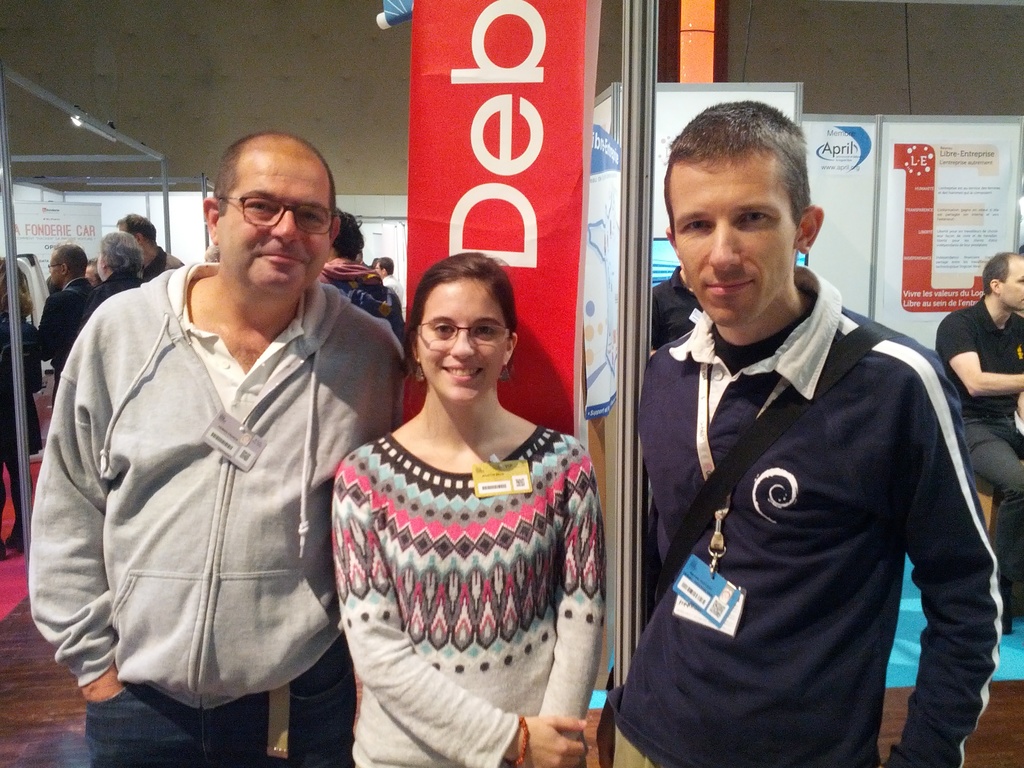
On November 18th and 19th, I was in Paris for the Paris Open Source Summit. I helped to hold a booth for Debian France during two days (with the help of Fran ois-R gis and several others).
Fran ois-R gis Vuillemin, Juliette Belin and Rapha l Hertzog
On the booth, we had the visit of Juliette Belin who created the theme and the artwork of Debian 8 Jessie. We lacked goodies but we organized a lottery to win 12copies of my French book.
Debian packaging work
Django. After two weeks of preparation for revers dependencies, I uploaded Django 1.8 to unstable and raised the severity of remaining bugs. Later I uploaded a new upstream point release (1.8.6). I also handled a release critical bug first by opening a ticket upstream and then by writing a patch and submitting it upstream. I uploaded 1.8.7-2 to Debian with my patch.
I also submittted another small fix which has been rejected because the manual page is generated via Sphinx and I thus had to file a bug against Sphinx (which I did). A work-around has been found in the mean time.
apt-xapian-index NMU. A long time ago, I filed a release critical bug against that package (#793681) but the maintainer did not handle it. Fortunately Sven Joachim prepared an NMU and I just uploaded his work. This resulted in another problem due bash-completion changes that Sven promptly fixed and I uploaded a second NMU a few days later.
Gnome-shell-timer. I forwarded #805347 to gnome-shell-timer issue #29 but gnome-shell-timer is abandoned upstream. On a suggestion of Paul Wise, I tried to get this nice extension integrated into gnome-shell-extensions but the request has been turned down. Is there anyone with javascript skills who would like to adopt this project as an upstream developer? It s a low maintenance project with a decent and loyal user base.
Misc. I fixed bug #804763 in zim which was the result of a bad Debian-specific patch.
I sponsored pylint-plugin-utils_0.2.3-2.dsc for Joseph Herlant to fix a release critical bug. I filed 806237 against lintian. I filed more tickets upstream, related to my Kali packaging work: one against sddm, one against john
Other Debian-related work
Distro-Tracker. I finally merged the work of Orestis Ioannou on bug #756766 which added the possibility to browse old news of each package.
Debian Installer. I implemented two small features that we wanted in Kali: I fixed #647405 to have a way to disable deb-src lines in generated sources.list files. I also filed #805291 to see how to allow kernel command line preseeding to override initrd preseeding the fix is trivial and it works in Kali. I just have to commit it in Debian, I was hoping to get an ack from someone in charge before doing it.
Thanks
See you next month for a new summary of my activities.
It has been seven years since I've joined SUSE (for second time, but that's different story). As everything has to come to the end, I've decided to make a change in my life and leave safety net of being employed and go for new experience with freelancer life.
This will give me more time to spend on free software projects where I'm involved. Of course I need to earn some money to live, so many decisions about where to spend my time will be backed by money...
First of all I will work on phpMyAdmin, where I was chosen as a contractor (of two for this year). This will be half time job for me and you will see weekly reports in my blog, similar to what Madhura is doing.
Second priority will be Weblate, especially the hosting solution. I believe that this is something what can work quite well in the long term, but the tool needs some development to make it as great as I would like to have it. If you want me to extend hosting for free software projects, you can do it by money :-).
And nobody knows what projects come next. There is some work to be done on Gammu and Wammu, but given that I don't have any recent device to use it, it's sometimes hard to fix the bugs there. Of course this can change if I get some money to work on that.
PS: It's not that SUSE would be bad place to work. It's actually pretty great if you're looking for work with free software. You work there on free software, with great people and you get quite some freedom. As bonus once or twice in a year, there is Hackweek which you can spend on anything. And of course they have lot of open positions :-).
Sometime earlier last year, I started to help Philippe Massicotte with his gtrendsR package---which was then still "hiding" in relatively obscurity on BitBucket. I was able to assist with a few things related to internal data handling as well as package setup and package builds--but the package is really largely Philippe's. But then we both got busy, and it wasn't until this summer at the excellent useR! 2015 conference that we met and concluded that we really should finish the package. And we both remained busy...
Lo and behold, following a recent transfer to this GitHub repository, we finalised a number of outstanding issues. And Philippe was even kind enough to label me a co-author. And now the package is on CRAN as of yesterday. So install.packages("gtrendsR") away and enjoy!
Here is a quiick demo:
## load the package, and if options() are set appropriately, connect
## alternatively, also run gconnect("someuser", "somepassword")
library(gtrendsR)
## using the default connection, run a query for three terms
res <-gtrends(c("nhl", "nba", "nfl"))
## plot (in default mode) as time series
plot(res)
## plot via googeVis to browser
## highlighting regions (probably countries) and cities
plot(res, type ="region")
plot(res, type ="cities")
The time series (default) plot for this query came out as follows a couple of days ago:
One really nice feature of the package is the rather rich data structure. The result set for the query above is actually stored in the package and can be accessed. It contains a number of components:
So not only can one look at trends, but also at regions, metropolitan areas, and cities --- even plot this easily via package googleVis which is accessed via options in the default plot method. Furthermore, related searches and rising queries may give leads to dynamics within the search.
Please use the standard GitHub issue system for bug reports, suggestions and alike.
This was updated to use recaptcha on the sign-up page, which is my attempt to cut down on the 400+ spam-registrations it receives every day.
I've purged a few thousand bogus-accounts, which largely existed to point to spam-sites in their profile-pages. I go through phases where I do this, but my heuristics have always been a little weak.
This site offers free dynamic DNS for a few hundred users. I closed fresh signups due to it being abused by spammers, but it does have some users and I sometimes add new people who ask politely.
Unfortunately some users hammer it, trying to update their DNS records every 60 seconds or so. (One user has spent the past few months updating their IP address every 30 seconds, ironically their external IP hadn't changed in all that time!)
So I suspended a few users, and implemented a minimum-update threshold: Nobody can update their IP address more than once every fifteen minutes now.
Literate Emacs Configuration File
Working towards my stateless home-directory I've been tweaking my dotfiles, and the last thing I did today was move my Emacs configuration over to a literate fashion.
My main emacs configuration-file is now a markdown file, which contains inline-code. The inline-code is parsed at runtime, and executed when Emacs launches. The init.el file which parses/evals is pretty simple, and I'm quite pleased with it. Over time I'll extend the documantion and move some of the small snippets into it.
Offsite backups
My home system(s) always had a local backup, maintained on an external 2Tb disk-drive, along with a remote copy of some static files which were maintained using rsync. I've now switched to having a virtual machine host the external backups with proper incrementals - via attic, which beats my previous "only one copy" setup.
Virtual Machine Backups
On a whim a few years ago I registered rsync.io which I use to maintain backups of my personal virtual machines. That still works, though I'll probably drop the domain and use backup.steve.org.uk or similar in the future.
FWIW the external backups are hosted on BigV, which gives me a 2Tb "archive" disk for a 40 a month. Perfect.
In many travel-related web sites for airlines and hotels, there is some attempt to sting the customer with an extra fee by performing a currency conversion at an inflated exchange rate. Sometimes it is only about five percent and this may not appear to be a lot but in one case a hotel was trying to use a rate that increased the cost of my booking by 30%. This scheme/scam is referred to as Dynamic Currency Conversion (DCC). Sometimes the website says that they are making it "easy" for you by giving you a "guaranteed" exchange rate that "might" be better than the rate from your bank. Sometimes a hotel or restaurant in a tourist location insists that you have to pay in a currency that is not the same as the currency on your booking receipt or their menu card, this is also a DCC situation.
Reality check: these DCC rates are universally bad. Last time I checked, my own credit card only has a 0.9% fee for currency conversion. Credit card companies have become a lot more competitive but the travel industry hasn't.
Airbnb often claims that they want to help the little guy and empower people, at least that is the spin they were using when New York city authorities were scrutinizing their business model. Their PR blog tries to boast about the wonderful economic impact of Airbnb.
But when it comes to DCC, the economic impact is universally bad for the customer and good for Airbnb's bosses. Most sites just turn on DCC by default and add some little opt-out link or checkbox that you have to click every time you book. Airbnb, however, is flouting regulations and deceiving people by trying to insist that you can't manually choose the currency you'll use for payment.
Fortunately, Visa and Mastercard have insisted that customers do have the right to know the DCC exchange rate and choose not to use DCC.
What are the rules?
Looking at the Visa system, the Visa Product and Service Rules, page 371, s5.9.7.4 include the statement that the merchant (Airbnb) must "Inform the Cardholder that Dynamic Currency Conversion is optional".
The same section also says that Airbnb must "Not use any language or procedures that may cause the Cardholder to choose Dynamic Currency Conversion by default". When you read the Airbnb help text about currencies, do you think the language and procedures there comply with Visa's regulations?
What does Airbnb have to say about it?
I wrote to Airbnb to ask about this. A woman called Eryn H replied "As it turns out we cannot provide our users with the option to disable currency conversion."
She went on to explain "When it comes to currency converting, we have to make sure that the payments and payouts equal to be the same amount, this is why we convert it as well as offer to convert it for you. We took it upon ourselves to do this for our users as a courtesy, not so that we can inconvenience any users.". That, and the rest of Eryn's email, reads like a patronizing copy-and-paste response that we've all come to dread from some poorly trained customer service staff these days.
Miss H's response also includes this little gem: "Additionally, if you pay in a currency that s different from the denominated currency of your payment method, your payment company (for example, your credit or bank card issuer) or third-party payment processor may apply a currency conversion rate or fees to your payment. Please contact your provider for information on what rates and fees may apply as these are not controlled by or known to Airbnb." and what this really means is that if Airbnb forces you to use a particular currency, with their inflated exchange rate and that is not the currency used by your credit card then you will have another currency conversion fee added by your bank, so you suffer the pain of two currency conversions. This disastrous scenario comes about because some clever person at Airbnb wanted to show users a little "courtesy", as Miss H describes it.
What can users do?
As DCC is optional and as it is not clear on the booking page, there are other things a user can do.
At the bottom of the Airbnb page you can usually find an option to view prices in a different currency. You can also change your country of residence in the settings to ensure you view prices in the host currency. This allows you to see the real price, without the DCC steal.
People have been able to email or call Airbnb and have DCC disabled for their account. Not all their telephone staff seem to understand these requests and apparently it is necessary to persist and call more than once. In the long term, the cost savings outweigh the time it may take even if you spend 20 minutes on the phone getting it fixed.
Whatever you do, with any travel site, print a copy of the information page showing the price in host currency. After doing that for an Airbnb booking and before making any payment, send a message to the host quoting the total price in their currency and stating DCC is not authorized. If Airbnb does wrongly convert the currency, send a letter to the credit card company asking for a full refund/chargeback on the basis that the transaction in the wrong currency was not an authorized transaction. It is important to ensure that you do not agree to the payment using Verified-by-Visa or Mastercard Securecode and do not pay with a debit card as these things can undermine your chances of a successful chargeback.
The chargeback rules are very clear about this. On the Visa website, the Guide for the Lodging Industry describes all the chargeback reason codes. On page 46, reason code 76 is described for cases such as these:
Cardholder was not advised that Dynamic Currency Conversion (DCC) would occur
Cardholder was refused the choice of paying in the merchant s local currency
If you feel that Airbnb's web site was not operating in compliance with these rules, while many other web sites have made the effort to do so, why shouldn't you demand a correction by your bank? Once enough people do this, don't be surprised if Airbnb fixes their site.
I have been using Replicant on the Samsung SIII I9300 for over two years. I have written before on taking a backup of the phone using rsync but recently I automated my setup as described below. This work was prompted by a screen accident with my phone that caused it to die, and I noticed that I hadn t taken regular backups. I did not lose any data this time, since typically all content I create on the device is immediately synchronized to my clouds. Photos are uploaded by the ownCloud app, SMS Backup+ saves SMS and call logs to my IMAP server, and I use DAVDroid for synchronizing contacts, calendar and task lists with my instance of ownCloud. Still, I strongly believe in regular backups of everything, so it was time to automate this.
For my use-case, taking backups of the phone whenever I connect it to one of my laptops is sufficient. I typically connect it to my laptops for charging at least every other day. My laptops are all running Debian, but this should be applicable to most modern GNU/Linux system. This is not Replicant-specific, although you need a rooted phone. I thought that automating this would be simple, but I got to learn the ins and outs of systemd and udev in the process and this ended up taking the better part of an evening.
I started out adding an udev rule and a small script, thinking I could invoke the backup process from the udev rule. However rsync would magically die after running a few seconds. After an embarrassing long debugging session, finally I found someone with a similar problem which led me to a nice writeup on the topic of running long-running services on udev events. I created a file /etc/udev/rules.d/99-android-backup.rules with the following content:
The serial numbers correspond to the device serial numbers of the two devices I wish to backup. The adb devices command will print them for you, and you need to replace my values with the values from your phones. Next I created a systemd service to describe a oneshot service. The file /etc/systemd/system/android-backup@.service have the following content:
The at-sign ( @ ) in the service filename signal that this is a service that takes a parameter. I m not enough of an udev/systemd person to explain these two files using the proper terminology, but at least you can pattern-match and follow the basic idea of them: the udev rule matches the devices that I m interested in (I don t want this to happen to all random Android devices I attach, hence matching against known serial numbers), and it causes a systemd service with a parameter to be started. The systemd service file describe the script to run, and passes on the parameter.
Now for the juicy part, the script. I have /usr/local/sbin/android-backup with the following content.
This script warrant more detailed explanation. Backups are placed under, e.g., /var/backups/android-323048a5ae82918b/ for later off-site backup (you do backup your laptop, right?). You have to manually create this directory, as a safety catch to not wildly rsync data into non-existing directories. The script logs everything using syslog, so run a tail -F /var/log/syslog& when setting this up. You may want to reduce verbosity of rsync if you prefer (replace rsync -av with rsync -a). The script runs adb wait-for-device which you rightly guessed will wait for the device to settle. Next adb root is invoked to get root on the device (reading all files from the system naturally requires root). It takes some time to switch, so another wait-for-device call is needed. Next a small rsyncd configuration file is created in /mnt/secure/rsyncd.conf on the phone. The file tells rsync do listen on localhost, run as root, and use / as the path. By default, rsyncd is read-only so the host will not be able to upload any data over rsync, just read data out. Next rsync is started on the phone. The adb forward command forwards port 6010 on the laptop to port 873 on the phone (873 is the default rsyncd port). Unfortunately, setting up the TCP forward appears to take some time, and adb wait-for-device will not wait for that to complete, hence an ugly sleep 2 at this point. Next is the rsync invocation itself, which just pulls in everything from the phone to the laptop, excluding some usual suspects. The somewhat cryptic : rc $? merely logs the exit code of the rsync process into syslog. Finally we clean up the TCP forward and remove the rsyncd.conf file that was temporarily created.
This setup appears stable to me. I can plug in a phone and a backup will be taken. I can even plug in both my devices at the same time, and they will run at the same time. If I unplug a device, the script or rsync will error out and systemd cleans up.
If anyone has ideas on how to avoid the ugly temporary rsyncd.conf file or the ugly sleep 2, I m interested. It would also be nice to not have to do the adb root dance, and instead have the phone start the rsync daemon when connecting to my laptop somehow. TCP forwarding might be troublesome on a multi-user system, but my laptops aren t. Killing rsync on the phone is probably a good idea too. If you have ideas on how to fix any of this, other feedback, or questions, please let me know!
I just have pushed a new version of the Slick Google Map plugin for WordPress to the servers. There are not many changes, but a crucial fix for parsing coordinates in DMS (degree-minute-second) format.
The documentation described that all kind of DMS formats can be used to specify a location, but these DMS encoded locations were sent to Google for geocoding. Unfortunately it seems Google is incapable of handling DMS formats, and returns slightly of coordinates. By using a library for DMS conversion, which I adapted slightly, it is now possible to use a wide variety of location formats. Practically everything that can reasonably interpreted as a location will be properly converted to decimal coordinates.
Plans for the next release are:
prepare for translation via the WordPress translation team
add html support for the marker text via uuencoding
The St Denis siege last week and the Brussels lockdown this week provides all of us in Europe with an opportunity to reflect on why over ten thousand refugees per day have been coming here from the middle east, especially Syria.
At this moment, French warplanes and American drones are striking cities and villages in Syria, killing whole families in their effort to shortcut the justice system and execute a small number of very bad people without putting them on trial. Some observers estimate air strikes and drones kill twenty innocent people for every one bad guy. Women, children, the sick, elderly and even pets are most vulnerable. The leak of the collateral murder video simultaneously brought Wikileaks into the public eye and demonstrated how the crew of a US attack helicopter had butchered unarmed civilians and journalists like they were playing a video game.
Just imagine that the French president had sent the fighter jets to St Denis and Molenbeek instead of using law enforcement. After all, how are the terrorists there any better or worse than those in Syria, don't they deserve the same fate? Or what if Obama had offered to help out with a few drone strikes on suburban Brussels? After all, if the drones are such a credible solution for Syria's future, why won't they solve Brussels' (perceived) problems too?
If the aerial bombing "solution" had been attempted in a western country, it would have lead to chaos. Half the population of Paris and Brussels would find themselves camping at the migrant camps in Calais, hoping to sneak into the UK in the back of a truck.
Over a hundred years ago, Russian leaders proposed a treaty agreeing never to drop bombs from balloons and the US and UK happily signed it. Sadly, the treaty wasn't updated after the invention of fighter jets, attack helicopters, rockets, inter-continental ballistic missiles, satellites and drones.
The reality is that asymmetric warfare hasn't worked and never will work in the middle east and as long as it is continued, experts warn that Europe may continue to face the consequences of refugees, terrorists and those who sympathize with their methods. By definition, these people can easily move from place to place and it is ordinary citizens and small businesses who will suffer a lot more under lockdowns and other security measures.
In our modern world, people often look to technology for shortcuts. The use of drones in the middle east is a shortcut from a country that spent enormous money on ground invasions of Iraq and Afghanistan and doesn't want to do it again. Unfortunately, technological shortcuts can't always replace the role played by real human beings, whether it is bringing law and order to the streets or in any other domain.
Aerial bombardment - by warplane or by drone - carries an implicitly racist message, that the people abused by these drone attacks are not equivalent to the rest of us, they can't benefit from the normal procedures of justice, they don't have rights, they are not innocent until proven guilty and they are expendable.
The French police deserve significant credit for the relatively low loss of life in the St Denis siege. If their methods and results were replicated in Syria and other middle eastern hotspots, would it be more likely to improve the situation in the long term than drone strikes?
Long over due post
It s been a long time I haven t written here. And lots of things happened in the OpenStack planet. As a full time employee with the mission to package OpenStack in Debian, it feels like it is kind of my duty to tell everyone about what s going on.
Liberty is out, uploaded to Debian
Since my last post, OpenStack Liberty, the 12th release of OpenStack, was released. In late August, Debian was the first platform which included Liberty, as I proudly outran both RDO and Canonical. So I was the first to make the announcement that Liberty passed most of the Tempest tests with the beta 3 release of Liberty (the Beta 3 is always kind of the first pre-release, as this is when feature freeze happens). Though I never made the announcement that Liberty final was uploaded to Debian, it was done just a single day after the official release.
Before the release, all of Liberty was living in Debian Experimental. Following the upload of the final packages in Experimental, I uploaded all of it to Sid. This represented 102 packages, so it took me about 3 days to do it all.
Tokyo summit
I had the pleasure to be in Tokyo for the Mitaka summit. I was very pleased with the cross-project sessions during the first day. Lots of these sessions were very interesting for me. In fact, I wish I could have attended them all, but of course, I can t split myself in 3 to follow all of the 3 tracks.
Then there was the 2 sessions about Debian packaging on upstream OpenStack infra. The goal is to setup the OpenStack upstream infrastructure to allow packaging using Gerrit, and gating each git commit using the usual tools: building the package and checking there s no FTBFS, running checks like lintian, piuparts and such. I knew already the overview of what was needed to make it happen. What I didn t know was the implementation details, which I hoped we could figure out during the 1:30 slot. Unfortunately, this didn t happen as I expected, and we discussed more general things than I wished. I was told that just reading the docs from the infra team was enough, but in reality, it was not. What currently needs to happen is building a Debian based image, using disk-image-builder, which would include the usual tools to build packages: git-buildpackage, sbuild, and so on. I m still stuck at this stage, which would be trivial if I knew a bit more about how upstream infra works, since I already know how to setup all of that on a local machine.
I ve been told by Monty Tailor that he would help. Though he s always a very busy man, and to date, he still didn t find enough time to give me a hand. Nobody replied to my request for help in the openstack-dev list either. Hopefully, with a bit of insistence, someone will help.
Keystone migration to Testing (aka: Debian Stretch) blocked by python-repoze.who
Absolutely all of OpenStack Liberty, as of today, has migrated to Stretch. All? No. Keystone is blocked by a chain of dependency. Keystone depends on python-pysaml2, itself blocked by python-repoze.who. The later, I upgraded it to version 2.2. Though python-repoze.what depends on version <= 1.9, which is blocking the migration. Since python-repoze.who-plugins, python-repoze.what and python-repoze.what-plugins aren t used by any package anymore, I asked for them to be removed from Debian (see #805407). Until this request is processed by the FTP masters, Keystone, which is the most important piece of OpenStack (it does the authentication) will be blocked for migration to Stretch.
New OpenStack server packages available
On my presentation at Debconf 15, I quickly introduced new services which were released upstream. I have since packaged them all:
Barbican (Key management as a Service)
Congress (Policy as a Service)
Magnum (Container as a Service)
Manila (Filesystem share as a Service)
Mistral (Workflow as a Service)
Zaqar (Queuing as a Service)
Congress, unfortunately, was not accepted to Sid yet, because of some licensing issues, especially with the doc of python-pulp. I will correct this (remove the non-free files) and reattempt an upload.
I hope to make them all available in jessie-backports (see below). For the previous release of OpenStack (ie: Kilo), I skipped the uploads of services which I thought were not really critical (like Ironic, Designate and more). But from the feedback of users, they would really like to have them all available. So this time, I will upload them all to the official jessie-backports repository.
Keystone v3 support
For those who don t know about it, Keystone API v3 means that, on top of the users and tenant, there s a new entity called a domain . All of the Liberty is now coming with Keystone v3 support. This includes the automated Keystone catalog registration done using debconf for all *-api packages. As much as I could tell by running tempest on my CI, everything still works pretty well. In fact, Liberty is, to my experience, the first release of OpenStack to support Keystone API v3.
Uploading Liberty to jessie-backports
I have rebuilt all of Liberty for jessie-backports on my laptop using sbuild. This is more than 150 packages (166 packages currently). It took me about 3 days to rebuild them all, including unit tests run at build time. As soon as #805407 is closed by the FTP masters, all what s remaining will be available in Stretch (mostly Keystone), and the upload will be possible. As there will be a lot of NEW packages (from the point of view of backports), I do expect that the approval will take some time. Also, I have to warn the original maintainers of the packages that I don t maintain (for example, those maintained within the DPMT), that because of the big number of packages, I will not be able to process the usual communication to tell that I m uploading to backports. However, here s the list of package. If you see one that you maintain, and that you wish to upload the backport by yourself, please let me know. Here s the list of packages, hopefully, exhaustive, that I will upload to jessie-backports, and that I don t maintain myself:
alabaster contextlib2 kazoo python-cachetools python-cffi python-cliff python-crank python-ddt python-docker python-eventlet python-git python-gitdb python-hypothesis python-ldap3 python-mock python-mysqldb python-pathlib python-repoze.who python-setuptools python-smmap python-unicodecsv python-urllib3 requests routes ryu sphinx sqlalchemy turbogears2 unittest2 zzzeeksphinx.
More than ever, I wish I could just upload these to a PPA^W Bikeshed, to minimize the disruption for both the backports FTP masters, other maintainers, and our OpenStack users. Hopefully, Bikesheds will be available soon. I am sorry to give that much approval work to the backports FTP masters, however, using the latest stable system with the latest release, is what most OpenStack users really want to do. All other major distributions have specific repositories too (ie: RDO for CentOS / Red Hat, and cloud archive for Ubuntu), and stable-backports is currently the only place where I can upload support for the Stable release.
Debian listed as supported distribution on openstack.org
Good news! If you go at http://www.openstack.org/marketplace/distros/ you will see a list of supported distributions. I am proud to be able to tell that, after 6 months of lobbying from my side, Debian is also listed there. The process of having Debian there included talking with folks from the OpenStack foundation, and having Bdale to sign an agreement so that the Debian logo could be reproduced on openstack.org. Thanks to Bdale Garbee, Neil McGovern, Jonathan Brice, and Danny Carreno, without who this wouldn t have happen.
One US presidential candidate has said a lot recently, but the comments about making a database of Muslims may qualify as the most extreme.
Of course, if he really wanted to, somebody with this mindset could find all the Muslims anyway. A quick and easy solution would involve tracing all the mobile phone signals around mosques on a Friday. Mr would-be President could compel Facebook and other social networks to disclose lists of users who identify as Muslim.
Databases are a dangerous side-effect of gay marriage
In 2014 there was significant discussion about Brendan Eich's donation to the campaign against gay marriage.
One fact that never ranked very highly in the debate at the time is that not all gay people actually support gay marriage. Even where these marriages are permitted, not everybody who can marry now is choosing to do so.
The reasons for this are varied, but one key point that has often been missed is that there are two routes to marriage equality: one involves permitting gay couples to visit the register office and fill in a form just as other couples do. The other route to equality is to remove all the legal artifacts around marriage altogether.
When the government does issue a marriage certificate, it is not long before other organizations start asking for confirmation of the marriage. Everybody from banks to letting agents and Facebook wants to know about it. Many companies outsource that data into cloud CRM systems such as Salesforce. Before you know it, there are numerous databases that somebody could mine to make a list of confirmed homosexuals.
Of course, if everybody in the world was going to live happily ever after none of this would be a problem. But the reality is different.
While discrimination: either against Muslims or homosexuals - is prohibited and can even lead to criminal sanctions in some countries, this attitude is not shared globally. Once gay people have their marriage status documented in the frequent flyer or hotel loyalty program, or in the public part of their Facebook profile, there are various countries where they are going to be at much higher risk of prosecution/persecution. The equality to marry in the US or UK may mean they have less equality when choosing travel destinations.
Those places are not as obscure as you might think: even in Australia, regarded as a civilized and laid-back western democracy, the state of Tasmania fought tooth-and-nail to retain the criminalization of virtually all homosexual conduct until 1997 when the combined actions of the federal government and high court compelled the state to reform. Despite the changes, people with some of the most offensive attitudes are able to achieve and retain a position of significant authority. The same Australian senator who infamously linked gay marriage with bestiality has successfully used his position to set up a Senate inquiry as a platform for conspiracy theories linking Halal certification with terrorism.
There are many ways a database can fall into the wrong hands
Ironically, one of the most valuable lessons about the risk of registering Muslims and homosexuals was an injustice against the very same tea-party supporters a certain presidential candidate is trying to woo. In 2013, it was revealed IRS employees had started applying a different process to discriminate against groups with Tea party in their name.
It is not hard to imagine other types of rogue or misinformed behavior by people in positions of authority when they are presented with information that they don't actually need about somebody's religion or sexuality.
Beyond this type of rogue behavior by individual officials and departments, there is also the more sinister proposition that somebody truly unpleasant is elected into power and can immediately use things like a Muslim database, surveillance data or the marriage database for a program of systematic discrimination. France had a close shave with this scenario in the 2002 presidential election when Jean-Marie Le Pen, who has at least six convictions for racism or inciting racial hatred made it to the final round in a two-candidate run-off with Jacques Chirac.
The best data security
The best way to be safe- wherever you go, both now and in the future - is not to have data about yourself on any database. When filling out forms, think need-to-know. If some company doesn't really need your personal mobile number, your date of birth, your religion or your marriage status, don't give it to them.
I've previously written about Canonical's obnoxious IP policy and how Mark Shuttleworth admits it's deliberately vague. After spending some time discussing specific examples with Canonical, I've been explicitly told that while Canonical will gladly give me a cost-free trademark license permitting me to redistribute unmodified Ubuntu binaries, they will not tell me what Any redistribution of modified versions of Ubuntu must be approved, certified or provided by Canonical if you are going to associate it with the Trademarks. Otherwise you must remove and replace the Trademarks and will need to recompile the source code to create your own binaries actually means.
Why does this matter? The free software definition requires that you be able to redistribute software to other people in either unmodified or modified form without needing to ask for permission first. This makes it clear that Ubuntu itself isn't free software - distributing the individual binary packages without permission is forbidden, even if they wouldn't contain any infringing trademarks[1]. This is obnoxious, but not inherently toxic. The source packages for Ubuntu could still be free software, making it fairly straightforward to build a free software equivalent.
Unfortunately, while true in theory, this isn't true in practice. The issue here is the apparently simple phrase you must remove and replace the Trademarks and will need to recompile the source code. "Trademarks" is defined later as being the words "Ubuntu", "Kubuntu", "Juju", "Landscape", "Edubuntu" and "Xubuntu" in either textual or logo form. The naive interpretation of this is that you have to remove trademarks where they'd be infringing - for instance, shipping the Ubuntu bootsplash as part of a modified product would almost certainly be clear trademark infringement, so you shouldn't do that. But that's not what the policy actually says. It insists that all trademarks be removed, whether they would embody an infringement or not. If a README says "To build this software under Ubuntu, install the following packages", a literal reading of Canonical's policy would require you to remove or replace the word "Ubuntu" even though failing to do so wouldn't be a trademark infringement. If an @ubuntu.com email address is present in a changelog, you'd have to change it. You wouldn't be able to ship the juju-core package without renaming it and the application within. If this is what the policy means, it's so impractical to be able to rebuild Ubuntu that it's not free software in any meaningful way.
This seems like a pretty ludicrous interpretation, but it's one that Canonical refuse to explicitly rule out. Compare this to Red Hat's requirements around Fedora - if you replace the fedora-logos, fedora-release and fedora-release-notes packages with your own content, you're good. A policy like this satisfies the concerns that Dustin raised over people misrepresenting their products, but still makes it easy for users to distribute modified code to other users. There's nothing whatsoever stopping Canonical from adopting a similarly unambiguous policy.
Mark has repeatedly asserted that attempts to raise this issue are mere FUD, but he won't answer you if you ask him direct questions about this policy and will insist that it's necessary to protect Ubuntu's brand. The reality is that if Debian had had an identical policy in 2004, Ubuntu wouldn't exist. The effort required to strip all Debian trademarks from the source packages would have been immense[2], and this would have had to be repeated for every release. While this policy is in place, nobody's going to be able to take Ubuntu and build something better. It's grotesquely hypocritical, especially when the Ubuntu website still talks about their belief that people should be able to distribute modifications without licensing fees.
All that's required for Canonical to deal with this problem is to follow Fedora's lead and isolate their trademarks in a small set of packages, then tell users that those packages must be replaced if distributing a modified version of Ubuntu. If they're serious about this being a branding issue, they'll do it. And if I'm right that the policy is deliberately obfuscated so Canonical can encourage people to buy licenses, they won't. It's easy for them to prove me wrong, and I'll be delighted if they do. Let's see what happens.
[1] The policy is quite clear on this. If you want to distribute something other than an unmodified Ubuntu image, you have two choices:
Gain approval or certification from Canonical
Remove all trademarks and recompile the source code
Note that option 2 requires you to rebuild even if there are no trademarks to remove.
[2] Especially when every source package contains a directory called "debian"
A new version of RcppAnnoy, our Rcpp-based R integration of the nifty Annoy library by Erik, is now on CRAN. Annoy is a small, fast, and lightweight C++ template header library for approximate nearest neighbours.
This release mostly just catches up with the Annoy release 1.6.2 of last Friday. No new features were added on our side.
Courtesy of CRANberries, there is also a diffstat report for this release.
Writing programs is fun, but making them fast can be a pain. Python programs
are no exception to that, but the basic profiling toolchain is actually not
that complicated to use. Here, I would like to show you how you can quickly
profile and analyze your Python code to find what part of the code you should
optimize.
What's profiling?
Profiling a Python program is doing a dynamic analysis that measures the
execution time of the program and everything that compose it. That means
measuring the time spent in each of its functions. This will give you data
about where your program is spending time, and what area might be worth
optimizing.
It's a very interesting exercise. Many people focus on local optimizations,
such as determining e.g. which of the Python functions range or xrange is
going to be faster. It turns out that knowing which one is faster may never be
an issue in your program, and that the time gained by one of the functions
above might not be worth the time you spend researching that, or arguing about
it with your colleague.
Trying to blindly optimize a program without measuring where it is actually
spending its time is a useless exercise. Following your guts alone is not
always sufficient.
There are many types of profiling, as there are many things you can measure. In
this exercise, we'll focus on CPU utilization profiling, meaning the time spent
by each function executing instructions. Obviously, we could do many more kind
of profiling and optimizations, such as memory profiling which would measure
the memory used by each piece of code something I talk about in
The Hacker's Guide to Python.
cProfile
Since Python 2.5, Python provides a C module called
cProfile which has a
reasonable overhead and offers a good enough feature set. The basic usage goes
down to:
This prints out all the function called, with the time spend in each and the
number of times they have been called.
Advanced visualization with KCacheGrind
While being useful, the output format is very basic and does not make easy to
grab knowledge for complete programs.
For more advanced visualization, I leverage
KCacheGrind. If you did any C
programming and profiling these last years, you may have used it as it is
primarily designed as front-end for Valgrind generated
call-graphs.
In order to use, you need to generate a cProfile result file, then convert it
to KCacheGrind format. To do that, I use
pyprof2calltree.
And the KCacheGrind window magically appears!
Concrete case: Carbonara optimization
I was curious about the performances of
Carbonara,
the small timeserie library I wrote for
Gnocchi. I decided to do some basic profiling
to see if there was any obvious optimization to do.
In order to profile a program, you need to run it. But running the whole
program in profiling mode can generate a lot of data that you don't care
about, and adds noise to what you're trying to understand. Since Gnocchi has
thousands of unit tests and a few for Carbonara itself, I decided to profile
the code used by these unit tests, as it's a good reflection of basic features
of the library.
Note that this is a good strategy for a curious and naive first-pass profiling.
There's no way that you can make sure that the hotspots you will see in the
unit tests are the actual hotspots you will encounter in production. Therefore,
a profiling in conditions and with a scenario that mimics what's seen in
production is often a necessity if you need to push your program optimization
further and want to achieve perceivable and valuable gain.
I activated cProfile using the method described above, creating a
cProfile.Profile object around my tests (I actually
started to implement that in testtools).
I then run KCacheGrind as described above. Using KCacheGrind, I generated
the following figures.
The test I profiled here is called test_fetch and is pretty easy to
understand: it puts data in a timeserie object, and then fetch the aggregated
result. The above list shows that 88 % of the ticks are spent in set_values
(44 ticks over 50). This function is used to insert values into the timeserie,
not to fetch the values. That means that it's really slow to insert data, and
pretty fast to actually retrieve them.
Reading the rest of the list indicates that several functions share the rest of
the ticks, update, _first_block_timestamp, _truncate, _resample, etc.
Some of the functions in the list are not part of Carbonara, so there's no
point in looking to optimize them. The only thing that can be optimized is,
sometimes, the number of times they're called.
The call graph gives me a bit more insight about what's going on here. Using my
knowledge about how Carbonara works, I don't think that the whole stack on the
left for _first_block_timestamp makes much sense. This function is supposed
to find the first timestamp for an aggregate, e.g. with a timestamp of 13:34:45
and a period of 5 minutes, the function should return 13:30:00. The way it
works currently is by calling the resample function from Pandas on a
timeserie with only one element, but that seems to be very slow. Indeed,
currently this function represents 25 % of the time spent by set_values (11
ticks on 44).
Fortunately, I recently added a small function called _round_timestamp that
does exactly what _first_block_timestamp needs that without calling any
Pandas function, so no resample. So I ended up rewriting that function this
way:
And then I re-run the exact same test to compare the output of cProfile.
The list of function seems quite different this time. The number of time spend
used by set_values dropped from 88 % to 71 %.
The call stack for set_values shows that pretty well: we can't even see the
_first_block_timestamp function as it is so fast that it totally disappeared
from the display. It's now being considered insignificant by the profiler.
So we just speed up the whole insertion process of values into Carbonara by a
nice 25 % in a few minutes. Not that bad for a first naive pass, right?
The second update in the 0.12.* series of Rcpp is now on the CRAN network for GNU R. As usual, I will also push a Debian package. This follows the 0.12.0 release from late July which started to add some serious new features, and builds upon the 0.12.1 release in September. It also marks the sixth release this year where we managed to keep a steady bi-montly release frequency.
Rcpp has become the most popular way of enhancing GNU R with C or C++ code. As of today, 512 packages on CRAN depend on Rcpp for making analytical code go faster and further. That is up by more than fifty package from the last release in September (and we recently blogged about crossing 500 dependents).
This release once again features pull requests from two new contributors with Nathan Russell and Tianqi Chen joining in. As shown below, other recent contributors (such as such as Dan) are keeping at it too. Keep'em coming! Luke Tierney also email about a code smell he spotted and which we took care of. A big Thank You! to everybody helping with code, bug reports or documentation. See below for a detailed list of changes extracted from the NEWS file.
Changes in Rcpp version 0.12.2 (2015-11-14)
Changes in Rcpp API:
Correct return type in product of matrix dimensions (PR #374 by Florian)
Before creating a single String object from a SEXP, ensure that it is from a vector of length one (PR #376 by Dirk, fixing #375).
No longer use STRING_ELT as a left-hand side, thanks to a heads-up by Luke Tierney (PR #378 by Dirk, fixing #377).
Rcpp Module objects are now checked more carefully (PR #381 by Tianqi, fixing #380)
An overflow in Matrix column indexing was corrected (PR #390 by Qiang, fixing a bug reported by Allessandro on the list)
Nullable types can now be assigned R_NilValue in function signatures. (PR #395 by Dan, fixing issue #394)
operator<<() now always shows decimal points (PR #396 by Dan)
Matrix classes now have a transpose() function (PR #397 by Dirk fixing #383)
operator<<() for complex types was added (PRs #398 by Qiang and #399 by Dirk, fixing #187)
Changes in Rcpp Attributes:
Enable export of C++ interface for functions that return void.
Changes in Rcpp Sugar:
Added new Sugar function cummin(), cummax(), cumprod() (PR #389 by Nathan Russell fixing #388)
Enabled sugar math operations for subsets; e.g. x[y] + x[z]. (PR #393 by Kevin and Qiang, implementing #392)
Changes in Rcpp Documentation:
The NEWS file now links to GitHub issue tickets and pull requests.
The Rcpp.bib file with bibliographic references was updated.
Discworld Noir was a
superb adventure game, but is also notoriously unreliable, even in
Windows on real hardware;
using Wine is just not going to work.
After many attempts at bringing it back into working order, I've settled
on an approach that seems to work: now that qemu and libvirt
have made virtualization and emulation easy, I can run it in a version
of Windows that was current at the time of its release. Unfortunately,
Windows 98 doesn't virtualize particularly well either, so this
still became a relatively extensive
yak-shaving
exercise.
These instructions assume that /srv/virt is a suitable place to put
disk images, but you can use anywhere you want.
The emulated PC
After some trial and error, it seems to work if I configure
qemu to emulate the following:
Fully emulated hardware instead of virtualization (qemu-system-i386 -no-kvm)
Intel Pentium III
Intel i440fx-based motherboard with ACPI
Real-time clock in local time
No HPET
256 MiB RAM
IDE primary master: IDE hard disk (I used 30 GiB, which is massively
overkill for this game; qemu can use sparse files so it actually ends
up less than 2 GiB on the host system)
IDE primary slave, secondary master, secondary slave: three CD-ROM drives
PS/2 keyboard and mouse
Realtek AC97 sound card
Cirrus video card with 16 MiB video RAM
A modern laptop CPU is an order of magnitude faster than what Discworld Noir
needs, so full emulation isn't a problem, despite being inefficient.
There is deliberately no networking, because Discworld Noir doesn't need it,
and a 17 year old operating system with no privilege separation is
very much not safe to use on the modern Internet!
Software needed
Windows 98 installation CD-ROM as a .iso file
(cp /dev/cdrom windows98.iso) - in theory you could also use a
real optical drive, but my laptop doesn't usually have one of those.
I used the OEM disc, version 4.10.1998 (that's the original Windows 98,
not the Second Edition), which came with a long-dead PC, and didn't
bother to apply any patches.
A Windows 98 license key. Again, I used an OEM key from a past PC.
A complete set of Discworld Noir (English) CD-ROMs as .iso files.
I used the UK "Sold Out Software" budget release, on 3 CDs.
Don't start the installation immediately. Instead, boot the installation
CD to a DOS prompt with CD-ROM support. From here, run
fdisk
and create a single partition filling the emulated hard disk. When
finished, hard-reboot the virtual machine (press Ctrl+C on the
qemu-system-i386 process and run it again).
The DOS FORMAT.COM utility is on the Windows CD-ROM but not in the root
directory or the default %PATH%, so you'll have to run:
d:\win98\format c:
to create the FAT filesystem. You might have to reboot again at this point.
The reason for doing this the hard way is that the Windows 98 installer
doesn't detect qemu as supporting ACPI. You want ACPI support, so that
Windows will issue IDLE instructions from its idle loop, instead of
occupying a CPU core with a busy-loop. To get that, boot to a DOS
prompt again, and use:
setup /p j /iv
/p j forces ACPI support
(Thanks to "Richard S" on the Virtualbox forums
for this tip.)
/iv is unimportant, but it disables the annoying "billboards" during
installation, which advertised once-exciting features like support for
dial-up modems and JPEG wallpaper.
I used a "Typical" installation; there didn't seem to be much point in
tweaking the installed package set when everything is so small by
modern standards.
Windows 98 has built-in support for the Cirrus VGA card that we're
emulating, so after a few reboots, it should be able to run in a
semi-modern resolution and colour depth. Discworld Noir
apparently prefers a 640 480 16-bit video mode, so right-click
on the desktop background, choose Properties and set that up.
Audio drivers
This is the part that took me the longest to get working. Of the sound
cards that qemu can emulate, Windows 98 only supports the SoundBlaster 16
out of the box. Unfortunately, the Soundblaster 16 emulation in qemu is
incomplete,
and in particular version 2.1 (as shipped in Debian 8) has a tendency to
make Windows lock up during boot.
I've seen advice in various places to emulate an Eqsonic ES1370
(SoundBlaster AWE 64), but that didn't work for me: one of the drivers I
tried caused Windows to lock up at a black screen during boot, and the other
didn't detect the emulated hardware.
The next-oldest sound card that qemu can emulate is a Realtek AC97,
which was often found integrated into motherboards in the late 1990s.
This one seems to work, with the "A400" driver bundle linked above.
For Windows 98 first edition, you need a driver bundle that includes
the old "VXD" drivers, not just the "WDM" drivers supported by
Second Edition and newer.
The easiest way to get that into qemu seems to be to turn it into a CD image:
Run the installer from E:, then reboot with the Windows 98 CD inserted, and
Windows should install the driver.
Installing Discworld Noir
Boot up the virtual machine with CD 1 in the emulated drive:
You might be thinking "... why not insert all three CDs into D:, E: and F:?"
but the installer expects subsequent disks to appear in the same drive
where CD 1 was initially, so that won't work. Instead, when prompted for
a new CD, switch to the qemu monitor with Ctrl+Alt+2 (note that this
is 2, not F2). At the (qemu) prompt,
use info block to see a list of emulated drives, then issue a
command like
change ide0-cd1 /srv/virt/DWN_ENG_2.iso
to swap the CD. Then switch back to Windows' console with Ctrl+Alt+1
and continue installation. I used a Full installation of Discworld Noir.
Transferring the virtual machine to GNOME Boxes
Having finished the "control freak" phase of installation, I wanted a
slightly more user-friendly way to run this game, so I transferred
the virtual machine to be used by libvirtd, which is the backend for
both GNOME Boxes and virt-manager:
virsh create discworldnoir.xml
Here is the configuration I used. It's a mixture
of automatic configuration from virt-manager, and hand-edited configuration
to make it match the qemu-system-i386 command-line.
Running the game
If all goes well, you should now see a discworldnoir virtual machine
in GNOME Boxes, in which you can boot Windows 98 and play the game.
Have fun!
Many of the people who have bought Windows phones seek relief sooner or later. Sometimes this comes about due to peer pressure or the feeling of isolation, in other cases it is the frustration of the user interface or the realization that they can't run cool apps like Lumicall.
Frequently, the user has been given the phone as a complimentary upgrade when extending a contract without perceiving the time, effort and potential cost involved in getting their data out of the phone, especially if they never owned a smartphone before.
When a Windows phone user does decide to cut their losses, they are usually looking to a friend or colleague with technical expertise to help them out. Personally, I'm not sure that anybody I would regard as an IT expert has ever had a Windows phone though, meaning that many experts are probably also going to be scratching their heads when somebody asks them for help. Therefore, I've put together this brief guide to help deal with these phones more expediently when they are encountered.
The Windows phones have really bad support for things like CalDAV and WebDAV so don't get your hopes up about using such methods to backup the data to any arbitrary server. Searching online you can find some hacks that involve creating a Google or iCloud account in the phone and then modifying the advanced settings to send the data to an arbitrary server. These techniques vary a lot between specific versions of the Windows Phone OS and so the techniques I've described below are probably easier.
Identify the Windows Live / Hotmail account
The user may not remember or realize that a Microsoft account was created when they first obtained the phone. It may have been created for them by the phone, a friend or the salesperson in the phone shop.
Look in the settings (Accounts) to find the account ID / email address. If the user hasn't been using this account, they may not recognize it and probably won't know the password for it. It is essential to try and obtain (or reset) the password before going any further, so start with the password recovery process. Microsoft may insist on sending a password reset email to some other email address that the user has previously provided or linked to their phone.
Extracting data from the phone
In many cases, the easiest way to extract the data is to download it from Microsoft live.com rather than extracting it from the phone. Even if the user doesn't realize it, the data is probably all replicated in live.com and so there is no further loss of privacy by logging in there to extract it.
Set up an IMAP mail client
An IMAP client will be used to download the user's emails (from the live.com account they may never have used) and SMS.
Install Mozilla Thunderbird (IceDove on Debian), GNOME Evolution or a similar program on the user's PC.
Configure the IMAP mail client to connect to the live.com account. Some clients, like Thunderbird, will automatically set up all the server details when you enter the live.com account ID. For manual account setup, the details here may help.
Email backup
If the user was not using the live.com account ID for email correspondence, there may not be a lot of mail in it. There may be some billing receipts or other things that are worth keeping though.
Create a new folder (or set of folders) in the user's preferred email account and drag and drop the messages from the live.com Inbox to the new folder(s).
SMS backup
SMS backup can also be done through live.com. It is slightly more complicated than email backup, but similar.
In the live.com Outlook email index page, look for the settings button and click Manage Categories.
Enable the Contacts and Photos categories with a tick in each of them.
Go back to the main Inbox page and look for the categories section on the bottom left-hand side of the screen, under the folder list. Click the Contacts category.
The page may now appear blank. That is normal.
On the top right-hand corner of the page, click the Arrange menu and choose Conversation.
All the SMS messages should now appear on the screen.
Under the mail folders list on the left-hand side of the page, click to create a new folder with a name like SMS.
Select all the SMS messages and look for the option to move them to a folder. Send them to the SMS folder you created.
Now use the IMAP mail client to locate the SMS folder and copy everything from there to a new folder in the user's preferred mail server or local disk.
Contacts backup
On the top left-hand corner of the live.com email page, there is a chooser to select other live.com applications. Select People.
You should now see a list of all the user's contacts. Look for the option to export them to Outlook and other programs. This will export them as a CSV file.
You can now import the CSV file into another application. GNOME Evolution has an import wizard with an option for Outlook file format. To load the contacts into a WebDAV address book, such as DAViCal, configure the address book in Evolution and then select it as the destination when running the CSV import wizard.
WARNING: beware of using the Mozilla Thunderbird address book with contact data from mobile devices and other sources. It can't handle more than two email addresses per contact and this can lead to silent data loss if contacts are not fully saved.
Calendar backup
Now go to the live.com application chooser again and select the calendar application. Microsoft provides instructions to extract the calendar, summarised here:
Look for the Share button at the top somewhere and click it.
On the left-hand side of the page, click Get a link
On the right-hand side, choose Show event details to ensure you get a full calendar and then click Create underneath it.
Look for the link with a webcals prefix. If you are downloading with a tool like wget, change the scheme prefix to https. Fetch the file from this link and save it with an ics extension.
Inspect the ics calendar file to make sure it looks like real iCalendar data.
You can now import the ics file into another application. GNOME Evolution has an import wizard with an option for iCalendar file format. To load the calendar entries into a CalDAV server, such as DAViCal, configure the calendar server in Evolution and then select it as the destination when running the import wizard.
Backup the user's photos, videos and other data files
Hopefully you will be able to do this step without going through live.com. Try enabling the MTP or PTP mode in the phone and attach it to the computer using the USB cable. Hopefully the computer will recognize it in at least one of those modes.
Use the computer's file manager or another tool to simply backup the entire directory structure.
Reset the phone to factory defaults
Once the user has their hands on a real phone, it is likely they will never want to look at that Windows phone again. It is time to erase the Windows phone, there is no going back.
Go to the Settings and About and tap the factory reset option. It is important to do this before obliterating the live.com account, otherwise there are scenarios where you could be locked out of the phone and unable to erase it.
Erasing may take some time. The phone will reboot and then display an animation of some gears spinning around for a few minutes and then reboot again. Wait for it to completely erase.
Permanently close the Microsoft live.com account
Keeping track of multiple accounts and other services is tedious and frustrating for most people, especially with services that try to force the user to receive email in different places.
You can help eliminate user fatigue by helping them permanently close the live.com account so they never have to worry about it again.
Follow the instructions on the Microsoft site.
At some point it will suggest certain actions you should take before closing the account, most can be ignored. One thing you should do is remove the link between the live.com account ID and the phone. It is a good idea to do this as otherwise you may have problems erasing the device, if you haven't already done so. Before completely closing the account, also verify that the factory reset of the phone completed successfully.
Dispose of the Windows phone safely
If you can identify any faults with the phone, the user may be able to return it under the terms of the warranty. Some phone companies may allow the user to exchange it for something more desirable when it fails under warranty.
It may be tempting to sell the phone to a complete stranger on eBay or install a custom ROM on it. In practice, neither option may be worth the time and effort involved. You may be tempted to put it beyond use so nobody else will suffer with it, but please try to do so in a way that is respectful of the environment.
Putting the data into a new phone
Prepare the new phone with a suitable ROM such as Replicant or Cyanogenmod.
Install the F-Droid app on the new phone.
From F-droid, install the DAVdroid app. DAVdroid will allow you to quickly sync the new phone against any arbitrary CalDAV and WebDAV server to populate it with the user's calendar and contact / address book data.
Now is a good time to install other interesting apps like Lumicall, Conversations and K-9 Mail.
October 2015 has been mainly dedicated to contracted/payed work. Only a few issues I could address during the last month:
Fix FTBFS of Arctica Greeter on non-Ubuntu systems
Co-working on renewed Xinerama support in nx-libs
Development of GOsa Password Management Add-on
Improving Debian Edu main server upgrade documentation (from Debian Edu squeeze to Debian Edu jessie)
Fixing my personal Horde Groupware installation for access via mobile devices
Learning Dovecot et al.
Arctica Project
While having a week off from work, I managed to get Arctica Greeter to build on non-Ubuntu systems. The issue was very simple. The build crashed during the test suite run and it was caused by the XDG_DATA_DIRS variable not being set in my clean build environment. Furthermore, I added various more session type icons to Arctica Greeter (XFCE, LXDE, MATE, OpenBox, TWM, Default X11 Session, etc.) and also rebased the Arctica Greeter code base against all recent commits found in Unity Greeter for Ubuntu 15.10 / upcoming 16.04.
Together with Ulrich Sibiller, I continued our work on the new Xinerama implementation for the remote X11 server nxagent (used as x2goagent in X2Go). However, this is unfortunately still work in progress, because various theoretical monitor layout issues became evident that require being handled in the new code before it can get merged into nx-libs's current 3.6.x branch.
Also, I managed to do some little work on https://arctica-project.org, the still too rudimentary project homepage.
read more
For my 11th month working on Debian LTS, I carried over 5.5 hours
from September and was assigned another 13.5 hours of work
by Freexian's
Debian LTS initiative. I worked 14 of a possible 19 hours.
As I mentioned in the report for September, I uploaded binutils and
issued DLA-324-1 early in October.
I fixed a few security issues in the kernel, uploaded and issued
DLA-325-1.
I had some email discussions about long-term support of the Linux
kernel with Willy Tarreau (Linux 2.6.32 maintainer) and Greg
Kroah-Hartman (overall stable maintainer). Greg normally selects
one version per year to maintain as a 'longterm' branch for 2 years,
after which he may hand it over to another maintainer. A few
upstream versions have received long-term support entirely from
another developer. We were in agreement that it's desirable to have
fewer of these branches with more developers and distributions
contributing to each, but didn't come to a conclusion about how to
coordinate this. The topic came up again at the Kernel Summit, and
Greg then agreed to select the first kernel version of each calendar
year, starting with Linux 4.4 (expected in January). This doesn't
fit well with Debian's current release schedule, but I mean to
discuss with the release team whether the freeze date can be set
to allow inclusion of 2017's LTS kernel.
I spent another week in the 'front desk' role, where I triaged new
security issues for squeeze. There was a mixture of serious and
trivial, old and new (not affecting squeeze) issues.
The many ntp issues announced in October were fixed in unstable by a
new upstream release. I spent a long time digging out the specific
commits that fixed them and comparing with the older version in
squeeze. Several of the issues had been introduced in ntp 4.2.7 or
4.2.8 and therefore didn't affect squeeze (or the newer stable
releases). Of the fixes that were needed, most applied with minimal
changes. Having prepared an update, I asked the ntp maintainer,
Kurt Roeckx, to review my work. (The package has a limited test
suite and none of the fixes added new tests.) Following this review
he added a few more patches, uploaded and issued
DLA-335-1.
MySQL 5.1, as shipped in squeeze, no longer receives security support
from upstream, and the security fixes they do issue are mixed with
other changes that make it impractical to backport them. The LTS
team is planning to backport the mysql-5.5 package to squeeze while
avoiding conflicts with the binaries built from mysql-5.1. Santiago
Ruano Rinc n has prepared a backport and I spent some time reviewing
this, but haven't yet sent my review comments.
 A new package! A couple of weeks ago folks at Google released CCTZ: a C++ library for translating between absolute and civil times using the rules of a time zone. It requires only a proper C++11 compiler and the standard IANA time zone data base which standard Unix, Linux, OS X, ... computers tend to have in
 I think it s important that organizations as


 My monthly report covers a large part of what I have been doing in the free software world. I write it for
 It has been seven years since I've joined

 This weekend I've mostly been tidying up some personal projects and things.

 I just have pushed a new version of the Slick Google Map plugin for WordPress to the servers. There are not many changes, but a crucial fix for parsing coordinates in DMS (degree-minute-second) format.
 The documentation described that all kind of DMS formats can be used to specify a location, but these DMS encoded locations were sent to Google for geocoding. Unfortunately it seems Google is incapable of handling DMS formats, and returns slightly of coordinates. By using a
 Over a hundred years ago, Russian leaders proposed a treaty
 Long over due post
It s been a long time I haven t written here. And lots of things happened in the OpenStack planet. As a full time employee with the mission to package OpenStack in Debian, it feels like it is kind of my duty to tell everyone about what s going on.
Liberty is out, uploaded to Debian
Since my last post, OpenStack Liberty, the 12th release of OpenStack, was released. In late August, Debian was the first platform which included Liberty, as I proudly outran both RDO and Canonical. So I was the first to make the announcement that Liberty passed most of the Tempest tests with the beta 3 release of Liberty (the Beta 3 is always kind of the first pre-release, as this is when feature freeze happens). Though I never made the announcement that Liberty final was uploaded to Debian, it was done just a single day after the official release.
Before the release, all of Liberty was living in Debian Experimental. Following the upload of the final packages in Experimental, I uploaded all of it to Sid. This represented 102 packages, so it took me about 3 days to do it all.
Tokyo summit
I had the pleasure to be in Tokyo for the Mitaka summit. I was very pleased with the cross-project sessions during the first day. Lots of these sessions were very interesting for me. In fact, I wish I could have attended them all, but of course, I can t split myself in 3 to follow all of the 3 tracks.
Then there was the 2 sessions about Debian packaging on upstream OpenStack infra. The goal is to setup the OpenStack upstream infrastructure to allow packaging using Gerrit, and gating each git commit using the usual tools: building the package and checking there s no FTBFS, running checks like lintian, piuparts and such. I knew already the overview of what was needed to make it happen. What I didn t know was the implementation details, which I hoped we could figure out during the 1:30 slot. Unfortunately, this didn t happen as I expected, and we discussed more general things than I wished. I was told that just reading the docs from the infra team was enough, but in reality, it was not. What currently needs to happen is building a Debian based image, using disk-image-builder, which would include the usual tools to build packages: git-buildpackage, sbuild, and so on. I m still stuck at this stage, which would be trivial if I knew a bit more about how upstream infra works, since I already know how to setup all of that on a local machine.
I ve been told by Monty Tailor that he would help. Though he s always a very busy man, and to date, he still didn t find enough time to give me a hand. Nobody replied to my request for help in the openstack-dev list either. Hopefully, with a bit of insistence, someone will help.
Keystone migration to Testing (aka: Debian Stretch) blocked by python-repoze.who
Absolutely all of OpenStack Liberty, as of today, has migrated to Stretch. All? No. Keystone is blocked by a chain of dependency. Keystone depends on python-pysaml2, itself blocked by python-repoze.who. The later, I upgraded it to version 2.2. Though python-repoze.what depends on version <= 1.9, which is blocking the migration. Since python-repoze.who-plugins, python-repoze.what and python-repoze.what-plugins aren t used by any package anymore, I asked for them to be removed from Debian (see #805407). Until this request is processed by the FTP masters, Keystone, which is the most important piece of OpenStack (it does the authentication) will be blocked for migration to Stretch.
New OpenStack server packages available
On my presentation at Debconf 15, I quickly introduced new services which were released upstream. I have since packaged them all:
 I've previously written about Canonical's
 Writing programs is fun, but making them fast can be a pain. Python programs
are no exception to that, but the basic profiling toolchain is actually not
that complicated to use. Here, I would like to show you how you can quickly
profile and analyze your Python code to find what part of the code you should
optimize.
What's profiling?
Profiling a Python program is doing a dynamic analysis that measures the
execution time of the program and everything that compose it. That means
measuring the time spent in each of its functions. This will give you data
about where your program is spending time, and what area might be worth
optimizing.
It's a very interesting exercise. Many people focus on local optimizations,
such as determining e.g. which of the Python functions


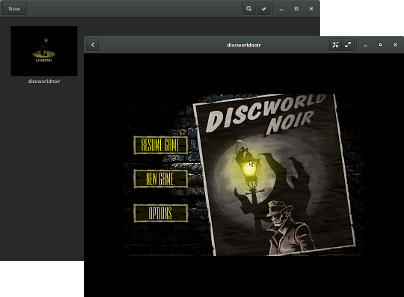 These instructions assume that
 For my 11th month working on Debian LTS, I carried over 5.5 hours
from September and was assigned another 13.5 hours of work
by