Search Results: "ana"

5 February 2017

Iustin Pop: Short rant/review of La La Land

Warning: Spoilers below. Rant below. Much angry, MANY ALL-CAPS. You've been warned! So, today we went to see "La La Land", because I've heard good things about it, and because I do enjoy good musicals. And because of this, I wrote this post, instead of what I originally had in mind (related to kernel configuration). Was it a good movie? Definitely yes. Was it a good musical? So and so. Did I like the ending? HELL NO, over and over NO. The movie itself was much better than I expected. I don't read plot details in advance nor real reviews, so I expected more of a musical, and less of a good plot. But the movie had a very good plot. Two young people, striving to fulfil their artistic dreams, fall in love, and they fight through-sometimes helping, sometimes hindering each other until, finally, each gets their own breakthrough, etc. The choice of actress was spot on halfway through the movie, I was thinking that I can't imagine the same plot played by a different actress. Of course many other actresses could have played the part, but Emma Stone played so well, I have trouble seeing the same character with the same always half-happy, half-sad attitude. The choice of actor was I think OK at first I was in doubt, but he played also well. Or maybe it was just that I couldn't identify with him at first. Not that I identify well with artists in general The dance scenes were OK, and the singing good, but as I said, the musical part was secondary to the actual struggles of the characters. The movie itself was, technically, very well done; a lot of filming was in bars/clubs/locations with difficult lighting, and the shooting was very good. They also had a scene on a pier, looking towards the ocean and the setting sun, and the characters walking towards the beach so heavily back-lighted, and I kept thinking "If I get only one shot this perfectly exposed and colour correct(ed), I'm happy". So high notes here. Back to the plot. The story of how she and him fought their own struggles was very nicely told. Tick-tack, up and down (hope and rejection), leaning on the other to get morale back, is a captivating story. The cliff-hanger at the pre-end with her career, the going back home, the last minute save, all very well told. So at this stage, I would have given the movie a 9/10. And I was happy. Then we have the usual "one character has to go away to a far away country for a long time", except in this case it was just 4 months. And they have the usual discussion "what do we do with our relation, where do we take it", and she says "I will always love you", to which he replies "And I will too" (or equivalent). In my mind, this means they'll have to survive during the break, they'll have to also survive through his touring months/years, but in the end love will be stronger. Because this is what the movie told us until now, that she made it because of him, and he made it because of her. Neither of them would have been this strong without the other (he wouldn't have picked up the invitation from his old pal, she wouldn't have gone to the final audition request nor write the play which got her the audition/recognition). Estimated movie ending: awesome. And then something happens. The timeline jumps 5 years in the future (as expected), and she is famous, married (WITH SOMEONE ELSE) and happy mother of a 3-year old. Through fate, she and her husband enter the club of Sebastian (as he also fulfilled his dream), she and Sebastian see each other, he plays their song, during which we're served a re-run of the movie but in stupid "everything goes well" style (all bad events eliminated), in which it is she and Sebastian who enter the club (which belongs now to somebody else), and then we're back in real time, song ends, she and her husband leave, but before that she and Sebastian exchange one last smile, THE END. And I'm sitting there, not believing my eyes. WHAT THE? So I get home, not write this post for four hours to calm down, but I can't. Because this doesn't make sense. AT ALL. What does the internet say? Quoting from this CNN article, written exactly today. The director says:
"That ending was there from the get-go," [director Damien Chazelle] told CNN in a recent interview. "I think I just have a thing about love stories where the lovers don't wind up together at the end; I find it very romantic."
Huh, excuse me?
"I think there's a reason why most of the greatest love stories in history don't end with happily ever after," Chazelle said. "To me, if you're telling a story about love, love has to be bigger than the characters." Chazelle sees Mia and Sebastian's love as a "third character" and something that "lives on." "[The ending gives] you that sense that even if the relationship itself might be over in practical terms, the love is not over," he said. "The love lasts, and I think that's just a beautiful kind of thing."
OH FOR THE LOVE OF. This is a wishy-washy explanation that tries to approach the thing from the artistic side. No, this is bullshit, because of multiple things. Let me try to roll back and explain what I think was the intention.
  1. An earlier fight between Mia and Sebastian points to the fact that they're both very dedicated to their careers, and this means it's hard for them to stay together if they both chase their dream. He has to be on tour, and she has to rehearse for her play, so they won't see each other for at least two weeks (in this instance). Later, she calls him and leaves a message that she hasn't seen him in a while (complex scene which ends in another fight, which is very well done). So we see the conflict that seems to say "You can't have a relation of equals; one party has to give up their dream". While this might be partially true in the real world, I don't go to movies to see the real world.
  2. After the year-long window into their life, I can't think that either Sebastian or Mia can be really successful without the other; because they are so alike, so passionate about their dreams, that a normal person wouldn't be able to understand and push the other when they need. However, the ending show both Mia and Sebastian quite successful, so one has to wonder: did they make it alone? Sebastian seems so (we don't see a partner for him), Mia unclear, likely not. How did Sebastian get through? What did Mia find in her husband?
  3. This is very one-sided, since I'm a man, so bear with me: Sebastian helped Mia through her tough time. Once she got the breakthrough (and they split), she found somebody else, and I have to wonder in what circumstances they met. In the sense that maybe her husband only knew "successful Mia" and not "struggling/aspiring Mia". Her husband seems completely oblivious to all the eye contact between Mia and Sebastian in the club, seems to know Sebastian/about Sebastian not. How deep is their relation?
  4. This is still one sided, sorry. When they break up (before Mia leaves for Paris), Sebastian asks "so where do we go from here?". Mia says "Nowhere". He asks once more, she rejects him again. So after one year of mad love and cries and happy moments, he gives up over two sentences? He's been following his dream (proper Jazz) in spite of all downturns in life until then, but he gives up on his real love over this? It doesn't make sense; trying to identify my self with the character, I can't reconcile this scene at all, unless he didn't really love her.
So no, I don't see them ending apart as romantic. I see it as the director is saying "You can't have both love and your [career] dreams. Choose either.", and he gives the "love" fake ending in the mini-re-roll of the movie, and the "career" wrong ending in the actual ending. And worse, he does it by negating significant parts of the character development done until now. Moreover, this conclusion is wrong. Wrong because this is a movie, and if movies don't manage to make you dream that you can achieve all, if movies tell you "choose either", then all is lost. Their love is not a separate character; them struggling to find each other in the successful phase of their life, learning to adapt to the new "he" and "she", would be the third thing. As it was shown, their love is simply a young love, that can't really survive the changes in life; they each said "I'll love you forever", but with this ending it sounds more "I'll cherish the memory of young you forever". Or differently said, it sounded like a cheap excuse to use when ending their relationship, in order to not negate the relationship itself. My version of the movie is another half hour long. It explains how Sebastian get over the "only jazz is pure old jazz" and manages to build a successful business around his old-style-but-modern jazz, instead of the pop-style jazz of the touring band (while thinking about her). It explains how Mia becomes a successful actress and gets over her first/second movies (while thinking about him), because one movie doesn't make one really successful (that reminds me: 3 year old child after 5 year forward-jump? when/how did her career go?). Hell, make it even more bitter show how their correspondence starts strong but becomes more and more sporadic over time, dying after the first 2 years. Show how both of them try other relations, and not find the same spark that they had before. And then, after they have matured, they meet again. And, just like the first time, they fall for each other, once again. She for his music, him for her passion for acting/for acting itself. She finds that him naming his club after her suggestion is oh-so-grown-up-and-sweet, he is happy that she finally grew into what he saw in her from the beginning. And he sings their song once more. But no. I'm not an artist, so I can only get the "die hope die die die love because I can" version. I still recommend the movie, but not the "after 5 years" scenes. Also, I didn't get time to bike today nor yesterday, so all you really get here is an ANGRY RANT. Because while I drink the coffee black and the tea without sugar, I like my happy endings, DAMN IT.

Vincent Bernat: A Makefile for your Go project

My most loathed feature of Go is the mandatory use of GOPATH: I do not want to put my own code next to its dependencies. Hopefully, this issue is slowly starting to be accepted by the main authors. In the meantime, you can workaround this problem with more opinionated tools (like gb) or by crafting your own Makefile. For the later, you can have a look at Filippo Valsorda s example or my own take which I describe in more details here. This is not meant to be an universal Makefile but a relatively short one with some batteries included. It comes with a simple Hello World! application.

Project structure For a standalone project, vendoring is a must-have1 as you cannot rely on your dependencies to not introduce backward-incompatible changes. Some packages are using versioned URLs but most of them aren t. There is currently no standard tool to handle vendoring. My personal take is to vendor all dependencies with Glide. It is a good practice to split an application into different packages while the main one stay fairly small. In the hellogopher example, the CLI is handled in the cmd package while the application logic for printing greetings is in the hello package:
.
  cmd/
    hello.go
    root.go
    version.go
  glide.lock (generated)
  glide.yaml
  vendor/ (dependencies will go there)
  hello/
    root.go
    root_test.go
  main.go
  Makefile
  README.md

Down the rabbit hole Let s take a look at the various features of the Makefile.

GOPATH handling Since all dependencies are vendored, only our own project needs to be in the GOPATH:
PACKAGE  = hellogopher
GOPATH   = $(CURDIR)/.gopath
BASE     = $(GOPATH)/src/$(PACKAGE)
$(BASE):
    @mkdir -p $(dir $@)
    @ln -sf $(CURDIR) $@
The base import path is hellogopher, not github.com/vincentbernat/hellogopher: this shortens imports and makes them easily distinguishable from imports of dependency packages. However, your application won t be go get-able. This is a personal choice and can be adjusted with the $(PACKAGE) variable. We just create a symlink from .gopath/src/hellogopher to our root directory. The GOPATH environment variable is automatically exported to the shell commands of the recipes. Any tool should work fine after changing the current directory to $(BASE). For example, this snippet builds the executable:
.PHONY: all
all:   $(BASE)
    cd $(BASE) && $(GO) build -o bin/$(PACKAGE) main.go

Vendoring dependencies Glide is a bit like Ruby s Bundler. In glide.yaml, you specify what packages you need and the constraints you want on them. Glide computes a glide.lock file containing the exact versions for each dependencies (including recursive dependencies) and download them in the vendor/ folder. I choose to check into the VCS both glide.yaml and glide.lock files. It s also possible to only check in the first one or to also check in the vendor/ directory. A work-in-progress is currently ongoing to provide a standard dependency management tool with a similar workflow. We define two rules2:
GLIDE = glide
glide.lock: glide.yaml   $(BASE)
    cd $(BASE) && $(GLIDE) update
    @touch $@
vendor: glide.lock   $(BASE)
    cd $(BASE) && $(GLIDE) --quiet install
    @ln -sf . vendor/src
    @touch $@
We use a variable to invoke glide. This enables a user to easily override it (for example, with make GLIDE=$GOPATH/bin/glide).

Using third-party tools Most projects need some third-party tools. We can either expect them to be already installed or compile them in our private GOPATH. For example, here is the lint rule:
BIN    = $(GOPATH)/bin
GOLINT = $(BIN)/golint
$(BIN)/golint:   $(BASE) #  
    go get github.com/golang/lint/golint
.PHONY: lint
lint: vendor   $(BASE) $(GOLINT) #  
    @cd $(BASE) && ret=0 && for pkg in $(PKGS); do \
        test -z "$$($(GOLINT) $$pkg   tee /dev/stderr)"   ret=1 ; \
     done ; exit $$ret
As for glide, we let the user a chance to override which golint executable to use. By default, it uses a private copy. But a user can use its own copy with make GOLINT=/usr/bin/golint. In , we have the recipe to build the private copy. We simply issue go get3 to download and build golint. In , the lint rule executes golint on each package contained in the $(PKGS) variable. We ll explain this variable in the next section.

Working with non-vendored packages only Some commands need to be provided with a list of packages. Because we use a vendor/ directory, the shortcut ./... is not what we expect as we don t want to run tests on our dependencies4. Therefore, we compose a list of packages we care about:
PKGS = $(or $(PKG), $(shell cd $(BASE) && \
    env GOPATH=$(GOPATH) $(GO) list ./...   grep -v "^$(PACKAGE)/vendor/"))
If the user has provided the $(PKG) variable, we use it. For example, if they want to lint only the cmd package, they can invoke make lint PKG=hellogopher/cmd which is more intuitive than specifying PKGS. Otherwise, we just execute go list ./... but we remove anything from the vendor directory.

Tests Here are some rules to run tests:
TIMEOUT = 20
TEST_TARGETS := test-default test-bench test-short test-verbose test-race
.PHONY: $(TEST_TARGETS) check test tests
test-bench:   ARGS=-run=__absolutelynothing__ -bench=.
test-short:   ARGS=-short
test-verbose: ARGS=-v
test-race:    ARGS=-race
$(TEST_TARGETS): test
check test tests: fmt lint vendor   $(BASE)
    @cd $(BASE) && $(GO) test -timeout $(TIMEOUT)s $(ARGS) $(PKGS)
A user can invoke tests in different ways:
  • make test runs all tests;
  • make test TIMEOUT=10 runs all tests with a timeout of 10 seconds;
  • make test PKG=hellogopher/cmd only runs tests for the cmd package;
  • make test ARGS="-v -short" runs tests with the specified arguments;
  • make test-race runs tests with race detector enabled.

Tests coverage go test includes a test coverage tool. Unfortunately, it only handles one package at a time and you have to explicitely list the packages to be instrumented, otherwise the instrumentation is limited to the currently tested package. If you provide too many packages, the compilation time will skyrocket. Moreover, if you want an output compatible with Jenkins, you ll need some additional tools.
COVERAGE_MODE    = atomic
COVERAGE_PROFILE = $(COVERAGE_DIR)/profile.out
COVERAGE_XML     = $(COVERAGE_DIR)/coverage.xml
COVERAGE_HTML    = $(COVERAGE_DIR)/index.html
.PHONY: test-coverage test-coverage-tools
test-coverage-tools:   $(GOCOVMERGE) $(GOCOV) $(GOCOVXML) #  
test-coverage: COVERAGE_DIR := $(CURDIR)/test/coverage.$(shell date -Iseconds)
test-coverage: fmt lint vendor test-coverage-tools   $(BASE)
    @mkdir -p $(COVERAGE_DIR)/coverage
    @cd $(BASE) && for pkg in $(PKGS); do \ #  
        $(GO) test \
            -coverpkg=$$($(GO) list -f '  join .Deps "\n"  ' $$pkg   \
                    grep '^$(PACKAGE)/'   grep -v '^$(PACKAGE)/vendor/'   \
                    tr '\n' ',')$$pkg \
            -covermode=$(COVERAGE_MODE) \
            -coverprofile="$(COVERAGE_DIR)/coverage/ echo $$pkg   tr "/" "-" .cover" $$pkg ;\
     done
    @$(GOCOVMERGE) $(COVERAGE_DIR)/coverage/*.cover > $(COVERAGE_PROFILE)
    @$(GO) tool cover -html=$(COVERAGE_PROFILE) -o $(COVERAGE_HTML)
    @$(GOCOV) convert $(COVERAGE_PROFILE)   $(GOCOVXML) > $(COVERAGE_XML)
First, we define some variables to let the user override them. We also require the following tools (in ):
  • gocovmerge merges profiles from different runs into a single one;
  • gocov-xml converts a coverage profile to the Cobertura format;
  • gocov is needed to convert a coverage profile to a format handled by gocov-xml.
The rules to build those tools are similar to the rule for golint described a few sections ago. In , for each package to test, we run go test with the -coverprofile argument. We also explicitely provide the list of packages to instrument to -coverpkg by using go list to get a list of dependencies for the tested package and keeping only our owns.

Final result While the main goal of using a Makefile was to work around GOPATH, it s also a good place to hide the complexity of some operations, notably around test coverage. The excerpts provided in this post are a bit simplified. Have a look at the final result for more perks!

  1. In Go, vendoring is about both bundling and dependency management. As the Go ecosystem matures, the bundling part (fixed snapshots of dependencies) may become optional but the vendor/ directory may stay for dependency management (retrieval of the latest versions of dependencies matching a set of constraints).
  2. If you don t want to automatically update glide.lock when a change is detected in glide.yaml, rename the target to deps-update and make it a phony target.
  3. There is some irony for bad mouthing go get and then immediately use it because it is convenient.
  4. I think ./... should not include the vendor/ directory by default. Dependencies should be trusted to have run their own tests in the environment they expect them to succeed. Unfortunately, this is unlikely to change.

Francois Marier: IPv6 and OpenVPN on Linode Debian/Ubuntu VPS

Here is how I managed to extend my OpenVPN setup on my Linode VPS to include IPv6 traffic. This ensures that clients can route all of their traffic through the VPN and avoid leaking IPv6 traffic, for example. It also enables clients on IPv4-only networks to receive a routable IPv6 address and connect to IPv6-only servers (i.e. running your own IPv6 broker).

Request an additional IPv6 block The first thing you need to do is get a new IPv6 address block (or "pool" as Linode calls it) from which you can allocate a single address to each VPN client that connects to the server. If you are using a Linode VPS, there are instructions on how to request a new IPv6 pool. Note that you need to get an address block between /64 and /112. A /116 like Linode offers won't work in OpenVPN. Thankfully, Linode is happy to allocate you an extra /64 for free.

Setup the new IPv6 address If your server only has an single IPv4 address and a single IPv6 address, then a simple DHCP-backed network configuration will work fine. To add the second IPv6 block on the other hand, I had to change my network configuration (/etc/network/interfaces) to this:
auto lo
iface lo inet loopback
allow-hotplug eth0
iface eth0 inet dhcp
    pre-up iptables-restore /etc/network/iptables.up.rules
iface eth0 inet6 static
    address 2600:3c01::xxxx:xxxx:xxxx:939f/64
    gateway fe80::1
    pre-up ip6tables-restore /etc/network/ip6tables.up.rules
iface tun0 inet6 static
    address 2600:3c01:xxxx:xxxx::/64
    pre-up ip6tables-restore /etc/network/ip6tables.up.rules
where 2600:3c01::xxxx:xxxx:xxxx:939f/64 (bound to eth0) is your main IPv6 address and 2600:3c01:xxxx:xxxx::/64 (bound to tun0) is the new block you requested. Once you've setup the new IPv6 block, test it from another IPv6-enabled host using:
ping6 2600:3c01:xxxx:xxxx::1

OpenVPN configuration The only thing I had to change in my OpenVPN configuration (/etc/openvpn/server.conf) was to change:
proto udp
to:
proto udp6
in order to make the VPN server available over both IPv4 and IPv6, and to add the following lines:
server-ipv6 2600:3c01:xxxx:xxxx::/64
push "route-ipv6 2000::/3"
to bind to the right V6 address and to tell clients to tunnel all V6 Internet traffic through the VPN. In addition to updating the OpenVPN config, you will need to add the following line to /etc/sysctl.d/openvpn.conf:
net.ipv6.conf.all.forwarding=1
and the following to your firewall (e.g. /etc/network/ip6tables.up.rules):
# openvpn
-A INPUT -p udp --dport 1194 -j ACCEPT
-A FORWARD -m state --state NEW -i tun0 -o eth0 -s 2600:3c01:xxxx:xxxx::/64 -j ACCEPT
-A FORWARD -m state --state NEW -i eth0 -o tun0 -d 2600:3c01:xxxx:xxxx::/64 -j ACCEPT
-A FORWARD -m state --state ESTABLISHED,RELATED -j ACCEPT
in order to ensure that IPv6 packets are forwarded from the eth0 network interface to tun0 on the VPN server. With all of this done, apply the settings by running:
sysctl -p /etc/sysctl.d/openvpn.conf
ip6tables-apply
systemctl restart openvpn.service

Testing the connection Now connect to the VPN using your desktop client and check that the default IPv6 route is set correctly using ip -6 route. Then you can ping the server's new IP address:
ping6 2600:3c01:xxxx:xxxx::1
and from the server, you can ping the client's IP (which you can see in the network settings):
ping6 2600:3c01:xxxx:xxxx::1002
Once both ends of the tunnel can talk to each other, you can try pinging an IPv6-only server from your client:
ping6 ipv6.google.com
and then pinging your client from an IPv6-enabled host somewhere:
ping6 2600:3c01:xxxx:xxxx::1002
If that works, other online tests should also work.

Bits from Debian: Debian welcomes its Outreachy interns

Outreachy logo Better late than never, we'd like to welcome our three Outreachy interns for this round, lasting from the 6th of December 2016 to the 6th of March 2017. Elizabeth Ferdman is working in the Clean Room for PGP and X.509 (PKI) Key Management. Maria Glukhova is working in Reproducible builds for Debian and free software. Urvika Gola is working in improving voice, video and chat communication with free software. From the official website: Outreachy helps people from groups underrepresented in free and open source software get involved. We provide a supportive community for beginning to contribute any time throughout the year and offer focused internship opportunities twice a year with a number of free software organizations. The Outreachy program is possible in Debian thanks to the effort of Debian developers and contributors that dedicate part of their free time to mentor students and outreach tasks, and the help of the Software Freedom Conservancy, who provides administrative support for Outreachy, as well as the continued support of Debian's donors, who provide funding for the internships. Debian will also participate in the next round for Outreachy, during the summer of 2017. More details will follow in the next weeks. Join us and help extend Debian! You can follow the work of the Outreachy interns reading their blogs (they are syndicated in Planet Debian), and chat with us in the #debian-outreach IRC channel and mailing list. Congratulations, Elizabeth, Maria and Urvika!

Shirish Agarwal: Flights of fancy how to figure trends for Airline tickets.

Google Flights Fees tracking

Google Flights Fees tracking between PNQ and YUL and back, economy fares.

Couple of weeks ago, either on some mailing list, on IRC or somewhere else, somebody mentioned that people always put higher amount of airline expenditure for self when asking for sponsorship. Now last year, between sending the application and getting the approval for sponsorship, there was 3 months of difference between the two. Now if you put up an application for sponsorship like I did last year, I had added 10% to the cost of flight tickets of the cheapest prevailing prices at that point in time on skyscanner or any of the meta-search-engines were showing me at that point in time. I was sceptical whether the amount that I had put for the to and fro tickets would be enough or not. Strangely, I was lucky enough to get my ticket around the new estimated price. I would have to mention though that there were only 2 tickets left at the new price and if I had waited just a few hours more, those tickets would have gone too and all other tickets were around 25% more than before. The only reasons I could fathom are a. Luck, pure and simple. b. Going at the end of the tourism season This was evident as I was able to book my extended stay at any hostel just 2 days before my stay at UCT (University of Cape Town) was over. Was corroborated by hostel staff, shop-owners as well as whatever info. I found on the web before and during my stay in SA. c. South Africa being more lenient than probably Canada is giving and processing visas. While looking at the third point, thought I better check world tourism rankings and saw the Wikipedia page for it. Interestingly, South Africa seems to have a slight edge over Canada when it comes to statistics and hence strengthens my assumptions that probably more people apply for SA than Canada as they know the possibility of more people making through visa processing. It would stand to be logical that more people would apply for a tourist or similar short-term resident visas if they know they have a good chance going through. While researching on the topic I also came across/ hunted to find the hardest places to get a Visa for and was surprised to find India being lasted therein.Coincidentally, that site also has a UK domain.It does burst the bubble in Incredible India a little bit. As a newbie who had no clue I knew I was probably a victim of Information Asymmetry where the airlines have much more information about travel trends, ongoing trends at Airports, Politics and Economics of Countries, Price of Crude Oil, Profit, Competition and probably many more factors that I haven t taken into account which decide fares. While researching on the topic, one of the interesting finds I had while trying to figure the above is that Airlines didn t pass on fuel savings to their customers. Now I don t know whether this was the same around the world or was this only in UK. I am shocked that British (and by definition EU, as UK was part of EU at that time) travellers or consumer groups didn t file a suit in the court of law as reading the above smells of anticompetitive behaviour. The most shocking statement was this Average fares to Spain rose by 10 per cent over the same period. Telegraph, UK. In order to lessen this information asymmetry a bit, I used google flights and its data of the past 2 months to see how the fares have been changing to have some insight of where the fares might end up. I know google is hated by one and all, but in this instance I couldn t find any comparable site which does this kind of thing. As can be seen in the graph, the tickets had started relatively cheap from around INR 65k ish to around 80k ish at this point in time. That is a jump of around 30% in the last couple of months. All of these flights have a layover somewhere in Europe and taking a second flight from there to Canada. The one which didn t show much of action is the direct plan between BOM YUL and back but then this seems to be a premium service . Taking a direct flight from BOM YUL is north of INR 90k/- which doesn t make much sense unless one is fond of spending 13+ hours in flight. Definitely not my cup of tea. With layovers it makes the experience a bit more bearable. While the real action is probably 3 or bit more months away, its interesting to see how things are panning out at least on airline price tickets and the dynamics involved therein. Even with all the above attempts at finding the answer, I m no closer to figuring out to estimate airline ticket prices when window is largish 3 months in making. Any ideas anybody? If the previous jump is any indication, then 10-15% escalation bit might not hack this time around. Any strategies that people could advise while trying to put a ball-park figure.
Filed under: Miscellenous Tagged: #air-travel, #Airfares, #Competition, #Price Estimation, #Sponsorship

4 February 2017

Markus Koschany: My Free Software Activities in January 2017

Welcome to gambaru.de. Here is my monthly report that covers what I have been doing for Debian. If you re interested in Java, Games and LTS topics, this might be interesting for you. Debian Games Debian Java Debian LTS This was my eleventh month as a paid contributor and I have been paid to work 12,75 hours on Debian LTS, a project started by Rapha l Hertzog. In that time I did the following: Misc

Ross Gammon: My Monthly Update for January 2017

It has been a quiet start to the year due to work keeping me very busy. Most of my spare time (when not sitting shattered on the sofa) was spent resurrecting my old website from backups. My son had plenty of visitors coming to visit as well, which prompted me to restart work on my model railway in the basement. Last year I received a whole heap of track, and also a tunnel formation from a friend at work. I managed to finish the supporting structure for the tunnel, and connect one end of it to the existing track layout. The next step (which will be a bit harder) is to connect the other end of the tunnel into the existing layout. The basement is one of the favourite things for me to keep my son and his friends occupied when there is a visit. The railway and music studio are very popular with the little guests. Debian Ubuntu Other Plan status from last month & update for next month Debian Before the 5th February 2017 Debian Stretch hard freeze I hope to: For the Debian Stretch release: Generally: Ubuntu Other

3 February 2017

Holger Levsen: Going to FOSDEM after switching away from Debian

So last weekend I attended Devconf.cz in Brno and together with Dennis Gilmore gave a talk about Reproducible Builds and Fedora (Slides) which was fun and - I think - pretty well received. Then on the following Tuesday, so three days ago, after using Debian as the primary OS on my primary computer for more than two decades, I finally made the long anticipated switch and I must say, so far I'm really happy with my new environment, even though I'm not yet again using a tiled window manager (but instead Xfce), cannot yet do all the things I could do before and even have to reconfigure a VM twice and restart another to get back wireless network after suspend and resume So what have I done? Nothing too dramatic: I've switched to Qubes OS and now I'm running Debian jessie and stretch and Fedora and Whonix on my primary computer, just not as my primary OS :-) IOW: hardware is basically software and while I want the red pill, who knows what's really inside the box? If you have no idea what I'm talking about, this intro about Qubes OS might be helpful. Or you dive directly into this six year old post, where Joanna Rutkowska described how she partitioned her digital life using Qubes. I'm not sure where this journey will lead me to, but I'm confident this is the right direction. And in case you wondered, I'll keep working on Debian, as far as I know now ;-)

Petter Reinholdtsen: A day in court challenging seizure of popcorn-time.no for #domstolkontroll

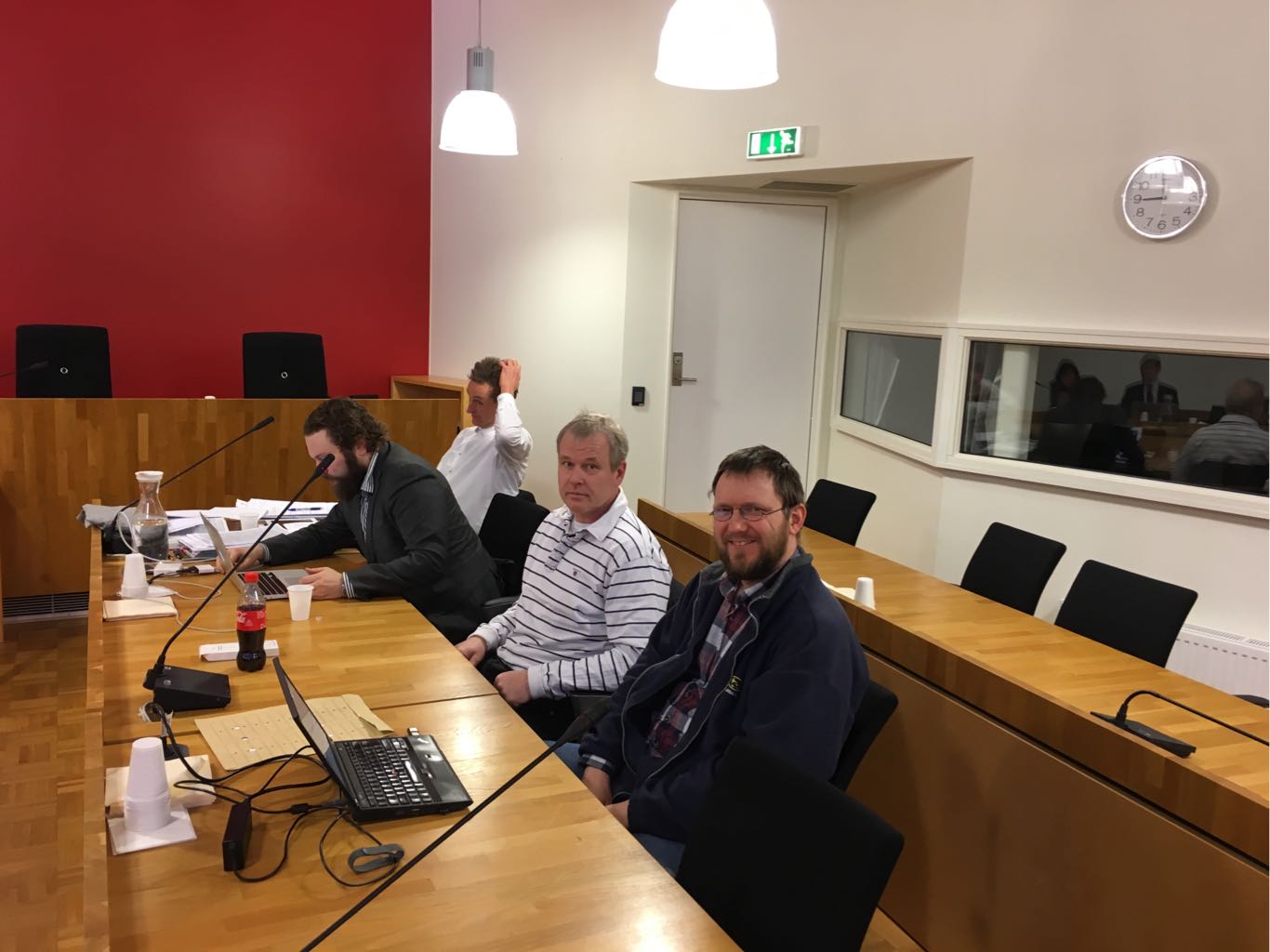
On Wednesday, I spent the entire day in court in Follo Tingrett representing the member association NUUG, alongside the member association EFN and the DNS registrar IMC, challenging the seizure of the DNS name popcorn-time.no. It was interesting to sit in a court of law for the first time in my life. Our team can be seen in the picture above: attorney Ola Tellesb , EFN board member Tom Fredrik Blenning, IMC CEO Morten Emil Eriksen and NUUG board member Petter Reinholdtsen. The case at hand is that the Norwegian National Authority for Investigation and Prosecution of Economic and Environmental Crime (aka kokrim) decided on their own, to seize a DNS domain early last year, without following the official policy of the Norwegian DNS authority which require a court decision. The web site in question was a site covering Popcorn Time. And Popcorn Time is the name of a technology with both legal and illegal applications. Popcorn Time is a client combining searching a Bittorrent directory available on the Internet with downloading/distribute content via Bittorrent and playing the downloaded content on screen. It can be used illegally if it is used to distribute content against the will of the right holder, but it can also be used legally to play a lot of content, for example the millions of movies available from the Internet Archive or the collection available from Vodo. We created a video demonstrating legally use of Popcorn Time and played it in Court. It can of course be downloaded using Bittorrent. I did not quite know what to expect from a day in court. The government held on to their version of the story and we held on to ours, and I hope the judge is able to make sense of it all. We will know in two weeks time. Unfortunately I do not have high hopes, as the Government have the upper hand here with more knowledge about the case, better training in handling criminal law and in general higher standing in the courts than fairly unknown DNS registrar and member associations. It is expensive to be right also in Norway. So far the case have cost more than NOK 70 000,-. To help fund the case, NUUG and EFN have asked for donations, and managed to collect around NOK 25 000,- so far. Given the presentation from the Government, I expect the government to appeal if the case go our way. And if the case do not go our way, I hope we have enough funding to appeal. From the other side came two people from kokrim. On the benches, appearing to be part of the group from the government were two people from the Simonsen Vogt Wiik lawyer office, and three others I am not quite sure who was. kokrim had proposed to present two witnesses from The Motion Picture Association, but this was rejected because they did not speak Norwegian and it was a bit late to bring in a translator, but perhaps the two from MPA were present anyway. All seven appeared to know each other. Good to see the case is take seriously. If you, like me, believe the courts should be involved before a DNS domain is hijacked by the government, or you believe the Popcorn Time technology have a lot of useful and legal applications, I suggest you too donate to the NUUG defense fund. Both Bitcoin and bank transfer are available. If NUUG get more than we need for the legal action (very unlikely), the rest will be spend promoting free software, open standards and unix-like operating systems in Norway, so no matter what happens the money will be put to good use. If you want to lean more about the case, I recommend you check out the blog posts from NUUG covering the case. They cover the legal arguments on both sides.

2 February 2017

Vincent Fourmond: Extended dataset generation possibilities of QSoas

While the main focus of QSoas is the processing of experimental data, it also features commands to generate (calculate) datasets. The command generate-buffer creates a dataset of equally spaced points (you can change their number using the option /samples) between to limiting values, as below:
QSoas> generate-buffer -2 2
By default, the values are taken equal to . However, generate-buffer also takes an optional formula to directly set the values:
QSoas> generate-buffer -10 10 sin(x)
From version 2.0, it is possible to generate several datasets in a row using the /number option, and to color them using the /style option (but only since version 2.1). Each dataset is generated according to the formula, and number is a special number that starts at 0 and increases by 1 for each dataset. Here's what I used to generate the picture on the right:
QSoas> generate-buffer -2 2 sin(PI*x)**(number+1) /number=30 /style=red-to-blue
About QSoasQSoas is an open source data analysis program that focuses on flexibility and powerful fitting capacities. It is described in Fourmond, Anal. Chem., 2016, 88 (10), pp 5050 5052.

Steve Kemp: I've built a product, not a project

The past few days I've been doing more arduino-work. In between dying of sleep-exhaustion. One thing that always annoyed me was that I had to hard-code my WiFi credentials in my projects, with code like this:
//
// Connect to the SCOTLAND network
//
WiFi.mode(WIFI_STA);
WiFi.hostname("tram-clock");
WiFi.begin("SCOTLAND", "highlander1");
//
// Attempt to connect - TODO: Timeout on failure
//
while (WiFi.status() != WL_CONNECTED)
    delay(500);
//
// Now we're connected show the local IP address.
//
lcd.print("WiFi connected  ");
lcd.print(WiFi.localIP());
Whilst looking at another project I found a great solution though. There is a library called WiFiManager which behaves perfectly: The code for this is beautifully simple:
//
// Connect to WiFI with saved credentials, if any.
//
// Otherwise work as an access-point, named TRAM-TIMES, and
// let the user fill out their details.
//
WiFiManager wifiManager;
wifiManager.autoConnect("TRAM-TIMES");
This means my current project, which continues to revolve around tram-times, is so very much more user-friendly. It is a product you could package and take to a friends house, not a project you have to recompile to tweak. For that reason, user-niceness, I reworked the on-board HTTP status-page to use bootstrap, be themed, and look nicer. Other than being housed in a horrid case the project actually looks like a product. Not one I'd buy, but neither one I'm ashamed of sharing.

Paul Wise: FLOSS Activities January 2017

Changes

Issues

Review

Administration
  • Debian: reboot 1 non-responsive VM, redirect 2 users to support channels, redirect 1 contributor to xkb upstream, redirect 1 potential contributor, redirect 1 bug reporter to mirror team, ping 7 folks about restarting processes with upgraded libs, manually restart the sectracker process due to upgraded libs, restart the package tracker process due to upgraded libs, investigate failures connecting to the XMPP service, investigate /dev/shm issue on abel.d.o, clean up after rename of the fedmsg group.
  • Debian mentors: lintian/security updates & reboot
  • Debian packages: deploy 2 contributions to the live server
  • Debian wiki: unblacklist 1 IP address, whitelist 10 email addresses, disable 18 accounts with bouncing email, update email for 2 accounts with bouncing email, reported 1 Debian member as MIA, redirect 1 user to support channels, add 4 domains to the whitelist.
  • Reproducible builds: rescheduled Debian pyxplot:amd64/unstable for themill.
  • Openmoko: security updates & reboots.

Debian derivatives
  • Send the annual activity ping mail.
  • Happy new year messages on IRC, forward to the list.
  • Note that SerbianLinux does not provide source packages.
  • Expand URL shortener on SerbianLinux page.
  • Invite PelicanHPC, Netrunner, DietPi, Hamara Linux (on IRC), BitKey to the census.
  • Add research publications link to the census template
  • Fix Symbiosis sources.list
  • Enquired about SalentOS downtime
  • Fixed and removed some 404 BlankOn links (blog, English homepage)
  • Fixed changes to AstraLinux sources.list
  • Welcome Netrunner to the census

Sponsors I renewed my support of Software Freedom Conservancy. The openchange 1:2.2-6+deb8u1 upload was sponsored by my employer. All other work was done on a volunteer basis.

1 February 2017

Wouter Verhelst: Resetting a Raspberry Pi to default using Ansible

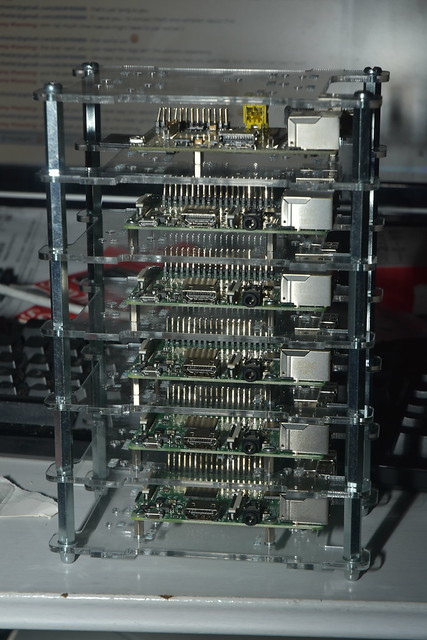
I got myself a bunch of Raspberry Pi 3s a short while ago: Stack of Raspberry Pis ...the idea being that I can use those to run a few experiments on. After the experiment, I would need to be able to somehow remove the stuff that I put on them again. The most obvious way to do that is to reimage them after every experiment; but the one downside of the multi-pi cases that I've put them in is that removing the micro-SD cards from the Pis without removing them from the case, while possible, is somewhat fiddly. That, plus the fact that I cared more about price than about speed when I got the micro-SD cards makes "image all the cards of these Raspberry Pis" something I don't want to do every day. So I needed a different way to reset them to a clean state, and I decided to use ansible to get it done. It required a bit of experimentation, but eventually I came up with this:
---
- name: install package-list fact
  hosts: all
  remote_user: root
  tasks:
  - name: install libjson-perl
    apt:
      pkg: libjson-perl
      state: latest
  - name: create ansible directory
    file:
      path: /etc/ansible
      state: directory
  - name: create facts directory
    file:
      path: /etc/ansible/facts.d
      state: directory
  - name: copy fact into ansible facts directory
    copy:
      dest: /etc/ansible/facts.d/allowclean.fact
      src: allowclean.fact
      mode: 0755
- name: remove extra stuff
  hosts: pis
  remote_user: root
  tasks:
  - apt: pkg=  item   state=absent purge=yes
    with_items: "  ansible_local.allowclean.cleanable_packages  "
- name: remove package facts
  hosts: pis
  remote_user: root
  tasks:
  - file:
      path: /etc/ansible/facts.d
      state: absent
  - apt:
      pkg: libjson-perl
      state: absent
      autoremove: yes
      purge: yes
This ansible playbook has three plays. The first play installs a custom ansible fact (written in perl) that emits a json file which defines cleanable_packages as a list of packages to remove. The second uses that fact to actually remove those packages; and the third removes the fact (and the libjson-perl library we used to produce the JSON). Which means, really, that all the hard work is done inside the allowclean.fact file. That looks like this:
#!/usr/bin/perl
use strict;
use warnings;
use JSON;
open PACKAGES, "dpkg -l ";
my @packages;
my %whitelist = (
    ...
);
while(<PACKAGES>)  
    next unless /^ii\s+(\S+)/;
    my $pack = $1;
    next if(exists($whitelist $pack ));
    if($pack =~ /(.*):armhf/)  
        $pack = $1;
     
    push @packages, $1;
 
my %hash;
$hash cleanable_packages  = \@packages;
print to_json(\%hash);
Basically, we create a whitelist, and compare the output of dpkg -l against that whitelist. If a certain package is in the whitelist, then we don't add it to our "packages" list; if it isn't, we do. The whitelist is just a list of package => 1 tuples. We just need the hash keys and don't care about the data, really; I could equally well have made it package => undef, I suppose, but whatever. Creating the whitelist is not that hard. I did it by setting up one raspberry pi to the minimum that I wanted, running
dpkg -l awk '/^ii/ print "\t\""$2"\" => 1," ' > packagelist
and then adding the contents of that packagelist file in place of the ... in the above perl script. Now whenever we apply the ansible playbook above, all packages (except for those in the whitelist) are removed from the system. Doing the same for things like users and files is left as an exercise to the reader. Side note: ... is a valid perl construct. You can write it, and the compiler won't complain. You can't run it, though.

Daniel Pocock: Going to FOSDEM, Brussels this weekend

This weekend I'm going to FOSDEM, one of the largest gatherings of free software developers in the world. It is an extraordinary event, also preceded by the XSF / XMPP Summit For those who haven't been to FOSDEM before and haven't yet made travel plans, it is not too late. FOSDEM is a free event and no registration is required. Many Brussels hotels don't get a lot of bookings on weekends during the winter so there are plenty of last minute offers available, often cheaper than what is available on AirBNB. I was speaking to somebody in London on Sunday who commutes through St Pancras (the Eurostar terminal) every day and didn't realize it goes to Brussels and only takes 2 hours to get there. One year I booked a mini-van at the last minute and made the drive from the UK with a stop in Lille for dinner on the way back, for 5 people that was a lot cheaper than the train. In other years I've taken trains from Switzerland through Paris or Luxembourg. Real-time Communication (RTC) dev-room on Saturday, 4 February On Saturday, we have a series of 23 talks about RTC topics in the RTC dev-room, including SIP, XMPP, WebRTC, peer-to-peer (with Ring) and presentations from previous GSoC students and developers coming from far and wide. The possibilities of RTC with free software will also be demonstrated and discussed at the RTC lounge in the K building, near the dev-room, over both Saturday and Sunday. Please come and say hello. Please come and subscribe to the Free-RTC-Announce mailing list for important announcements on the RTC theme and join the Free-RTC discussion list if you have any questions about the activities at FOSDEM, dinners for RTC developers on Saturday night or RTC in general. Software Defined Radio (SDR) and the Debian Hams project At 11:30 on Saturday I'll be over at the SDR dev-room to meet other developers of SDR projects such as GNU Radio and give a brief talk about the Debian Hams project and the relationship between our diverse communities. Debian Hams (also on the Debian Ham wiki) provides a ready-to-run solution for ham radio and SDR is just one of its many capabilities. If you've ever wondered about trying the RTL-SDR dongle or similar projects Debian Hams provides a great way to get started quickly. I've previously given talks on this topic at the Vienna and Cambridge mini-DebConfs (video). Ham Radio (also known as amateur radio) offers the possibility to gain exposure to every aspect of technology from the physical antennas and power systems through to software for a range of analog and digital communications purposes. Ham Radio and the huge community around it is a great fit with the principles and philosophy of free software development. In a world where hardware vendors are constantly exploring ways to limit their users with closed and proprietary architectures, such as DRM, a broad-based awareness of the entire technology stack empowers society to remain in control of the technology we are increasingly coming to depend on in our every day lives.

Antoine Beaupr : Testing new hardware with Stressant

I got a new computer and wondered... How can I test it? One of those innocent questions that brings hours and hours of work and questionning...

A new desktop: Intel NUC devices After reading up on Jeff Atwood's blog and especially his article on the scooter computer, I have discovered a whole range of small computers that could answer my need for a faster machine in my office at a low price tag and without taking up too much of my precious desk space. After what now seems like a too short review I ended up buying a new Intel NUC device from NCIX.com, along with 16GB of RAM and an amazing 500GB M.2 hard drive for around 750$. I am very happy with the machine. It's very quiet and takes up zero space on my desk as I was able to screw it to the back of my screen. You can see my review of the hardware compatibility and installation report in the Debian wiki. I wish I had taken more time to review the possible alternatives - for example I found out about the amazing Airtop PC recently and, although that specific brand is a bit too expensive, the space of small computers is far and wide and deserves a more thorough review than just finding the NUC by accident while shopping for laptops on System76.com...

Reviving the Stressant project But this, and Atwood's Is Your Computer Stable? article, got me thinking about how to test new computers. It's one thing to build a machine and fire it up, but how do you know everything is actually really working? It is common practice to do a basic stress test or burn-in when you get a new machine in the industry - how do you proceed with such tests? Back in the days when I was working at Koumbit, I wrote a tool exactly for that purpose called Stressant. Since I am the main author of the project and I didn't see much activity on it since I left, I felt it would be a good idea to bring it under my personal wing again, and I have therefore moved it to my Gitlab where I hope to bring it back to life. Parts of the project's rationale are explained in an "Intent To Package" the "breakin" tool (Debian bug #707178), which, after closer examination, ended up turning into a complete rewrite. The homepage has a bit more information about how the tool works and its objectives, but generally, the idea is to have a live CD or USB stick that you can just plugin into a machine to run a battery of automated tests (memtest86, bonnie++, stress-ng and disk wiping, for example) or allow for interactive rescue missions on broken machines. At Koumbit, we had Debirf-based live images that we could boot off the network fairly easily that we would use for various purposes, although nothing was automated yet. The tool is based on Debian, but since it starts from boot, it should be runnable on any computer. I was able to bring the project back to life, to a certain extent, by switching to vmdebootstrap instead of debirf for builds, but that removed netboot support. Also, I hope that Gitlab could provide with an autobuilder for the images, but unfortunately there's a bug in Docker that makes it impossible to mount loop images in Docker images (which makes it impossible to build Docker in Docker, apparently).

Should I start yet another project? So there's still a lot of work to do in this project to get it off the ground. I am still a bit hesitant in getting into this, however, for a few reasons:
  1. It's yet another volunteer job - which I am trying to reduce for health and obvious economic reasons. That's a purely personal reason and there isn't much you can do about it.
  2. I am not sure the project is useful. It's one thing to build a tool that can do basic tests on a machine - I can probably just build an live image for myself that will do everything I need - it's another completely different thing to build something that will scale to multiple machines and be useful for more various use cases and users.
(A variation of #1 is how everything and everyone is moving to the cloud. It's become a common argument that you shouldn't run your own metal these days, and we seem to be fighting an uphill economic battle when we run our own datacenters, rack or even physical servers these days. I still think it's essential to have some connexion to metal to be autonomous in our communications, but I'm worried that focusing on such a project is another of my precious dead entreprises... ) Part #2 is obviously where you people come in. Here's a few questions I'd like to have feedback on:
  1. (How) do you perform stress-testing of your machines before putting them in production (or when you find issues you suspect to be hardware-related)?
  2. Would a tool like breakin or stressant be useful in your environment?
  3. Which tools do you use now for such purposes?
  4. Would you contribute to such a project? How?
  5. Do you think there is room for such a project in the existing ecology of projects) or should I contribute to an existing project?
Any feedback here would be, of course, greatly appreciated.

Antoine Beaupr : My free software activities, January 2017

manpages.debian.org launched The debmans package I had so lovingly worked on last month is now officially abandoned. It turns out that another developer, Michael Stapelberg wrote his own implementation from scratch, called debiman. Both software share a similar design: they are both static site generators that parse an existing archive and call another tool to convert manpages into HTML. We even both settled on the same converter (mdoc). But while I wrote debmans in Python, debiman is written in Go. debiman also seems much faster, being written with concurrency in mind from the start. Finally, debiman is more feature complete: it properly deals with conflicting packages, localization and all sorts redirections. Heck, it even has a pretty logo, how can I compete? While debmans was written first and was in the process of being deployed, I had to give it up. It was a frustrating experience because I felt I wasted a lot of time working on software that ended up being discarded, especially because I put so much work on it, creating extensive documentation, an almost complete test suite and even filing a detailed core infrastructure best practices report In the end, I think that was the right choice: debiman seemed clearly superior and the best tool should win. Plus, it meant less work for me: Michael and Javier (the previous manpages.debian.org maintainer) did all the work of putting the site online. I also learned a lot about the CII best practices program, flask, click and, ultimately, the Go programming language itself, which I'll refer to as Golang for brievity. debiman definitely brought Golang into the spotlight for me. I had looked at Go before, but it seemed to be yet another language. But seeing Michael beat me to rebuilding the service really made me look at it again more seriously. While I really appreciate Python and I will probably still use it as my language of choice for GUI work and smaller scripts, but for daemons, network programs and servers, I will seriously consider Golang in the future. The site is now online at https://manpages.debian.org/. I even got credited in the about page which makes up for the disappointment.

Wallabako downloads Wallabag articles on my Kobo e-reader This obviously brings me to the latest project I worked on, Wallabako, my first Golang program ever. Wallabako is basically a client for the Wallabag application, which is a free software "read it later" service, an alternative to the likes of Pocket, Pinboard or Evernote. Back in April, I had looked downloading my "unread articles" into my new ebook reader, going through convoluted ways like implementing OPDS support into Wallabag, which turned out to be too difficult. Instead, I used this as an opportunity to learn Golang. After reading the quite readable golang specification over the weekend, I found the language to be quite elegant and simple, yet very powerful. Golang feels like C, but built with concurrency and memory (and to a certain extent, type) safety in mind, along with a novel approach to OO programming. The fact that everything can be compiled in one neat little static binary was also a key feature in selecting golang for this project, as I do not have much control over the platform my E-Reader is running: it is a Linux machine running under the ARM architecture, but beyond that, there isn't much available. I couldn't afford to ship a Python interpreter in there and while there are solutions there like pyinstaller, I felt that it may be so easy to deploy on ARM. The borg team had trouble building a ARM binary, restoring to tricks like building on a Raspberry PI or inside an emulator. In comparison, the native go compiler supports cross-compilation out of the box through a simple environment variable. So far Wallabako works amazingly well: when I "bag" a new article in Wallabag, either from my phone or my web browser, it will show up on my ebook reader then next time I open the wifi. I still need to "tap" the screen to fake the insertion of the USB cable, but we're working on automating that. I also need to make the installation of the software much easier and improve the documentation, because so far it's unlikely that someone unfamiliar with Kobo hardware hacking will be able to install it.

Other work According to Github, I filed a bunch of bugs all over the place (25 issues in 16 repositories), sent patches everywhere (13 pull requests in 6 repositories), and tried to fix everythin (created 38 commits in 7 repositories). Note that excludes most of my work, which happens on Gitlab. January was still a very busy month, especially considering I had an accident which kept me mostly offline for about a week. Here are some details on specific projects.

Stressant and a new computer I revived the stressant project and got a new computer. This is be covered in a separate article.

Linkchecker forked After much discussions, it was decided to fork the linkchecker project, which now lives in its own organization. I still have to write community guidelines and figure out the best way to maintain a stable branch, but I am hopeful that the community will pick up the project as multiple people volunteer to co-maintain the project. There has already been pull requests and issues reported, so that's a good sign.

Feed2tweet refresh I re-rolled my pull requests to the feed2tweet project: last time they were closed before I had time to rebase them. The author was okay with me re-submitting them, but he hasn't commented, reviewed or merged the patches yet so I am worried they will be dropped again. At that point, I would more likely rewrite this from scratch than try to collaborate with someone that is clearly not interested in doing so...

Debian uploads

Debian Long Term Support (LTS) This is my 10th month working on Debian LTS, started by Raphael Hertzog at Freexian. I took two months off last summer, which means it's actually been a year of work on the LTS project. This month I worked on a few issues, but they were big issues, so they took a lot of time. I have done a lot of work trying to backport the heading sanitization patches for CVE-2016-8743. The full report explain all the gritty details, but I ran out of time and couldn't upload the final version either. The issue mostly affects Apache servers in proxy configurations so it's not so severe as to warrant an immediate upload anyways. A lot of my time was spent battling the tiff package. The report mentions fixes for 15 CVEs and I uploaded the result in the DLA-795-1 advisory. I also worked on a small update to graphics magic for CVE-2016-9830 that is still pending because the issue is minor and we're waiting for more to pile up. See the full report for details. Finally, there was a small discussion surrounding tools to use when building and testing update to LTS packages. The resulting conversation was interesting, but it showed that we have a big documentation problem in the Debian project. There are a lot of tools, and the documentation is old and distributed everywhere. Every time I want to contribute something to the documentation, I never know where to start or go. This is why I wrote a separate debian development guide instead of contributing to existing documentation...

31 January 2017

Bdale Garbee: ACLU

When I was younger, and worked in an "old HP" test and measurement division, I sometimes sat at lunch in the cafeteria with a group of older co-workers who I grew to have immense respect for. They told great stories. I learned a lot of practical electronics from them... and other things too. Each carried on their person a copy of the US Constitution and Bill of Rights, and most also had a "concealed carry" permit, which they would refer to as their "redneck license". I quickly learned that they weren't all gun fanatics... at that time, the vetting process for such a permit was a bit daunting, and having one was their way of "proving" that they were honest, law-abiding citizens. Citizens who knew their rights. Who enjoyed debating boundary conditions in those rights inspired by current events at the lunch table. I miss those guys and those conversations. I mention this because it's one of those things that I realize now had a significant formative impact on my adult values and world view. Freedom matters. That's why, despite my long-standing appreciation for and support of the organization's activities, I'm embarrassed to admit that it wasn't until this week that I personally joined the American Civil Liberties Union and sent them a donation.

Benjamin Mako Hill: Supporting children in doing data science

As children use digital media to learn and socialize, others are collecting and analyzing data about these activities. In school and at play, these children find that they are the subjects of data science. As believers in the power of data analysis, we believe that this approach falls short of data science s potential to promote innovation, learning, and power. Motivated by this fact, we have been working over the last three years as part of a team at the MIT Media Lab and the University of Washington to design and build a system that attempts to support an alternative vision: children as data scientists. The system we have built is described in a new paper Scratch Community Blocks: Supporting Children as Data Scientists that will be published in the proceedings of CHI 2017. Our system is built on top of Scratch, a visual, block-based programming language designed for children and youth. Scratch is also an online community with over 15 million registered members who share their Scratch projects, remix each others work, have conversations, provide feedback, bookmark or love projects they like, follow other users, and more. Over the last decade, researchers including us have used the Scratch online community s database to study the youth using Scratch. With Scratch Community Blocks, we attempt to put the power to programmatically analyze these data into the hands of the users themselves. To do so, our new system adds a set of new programming primitives (blocks) to Scratch so that users can access public data from the Scratch website from inside Scratch. Blocks in the new system gives users access to project and user metadata, information about social interaction, and data about what types of code are used in projects. The full palette of blocks to access different categories of data is shown below.

Project metadata
User metadata
Site-wide statistics
The new blocks allow users to programmatically access, filter, and analyze data about their own participation in the community. For example, with the simple script below, we can find whether we have followers in Scratch who report themselves to be from Spain, and what their usernames are.
Simple demonstration of Scratch Community Blocks
In designing the system, we had two primary motivations. First, we wanted to support avenues through which children can engage in curiosity-driven, creative explorations of public Scratch data. Second, we wanted to foster self-reflection with data. As children looked back upon their own participation and coding activity in Scratch through the project they and their peers made, we wanted them to reflect on their own behavior and learning in ways that shaped their future behavior and promoted exploration. After designing and building the system over 2014 and 2015, we invited a group of active Scratch users to beta test the system in early 2016. Over four months, 700 users created more than 1,600 projects. The diversity and depth of users creativity with the new blocks surprised us. Children created projects that gave the viewer of the project a personalized doughnut-chart visualization of their coding vocabulary on Scratch, rendered the viewer s number of followers as scoops of ice-cream on a cone, attempted to find whether love-its for projects are more common on Scratch than favorites , and told users how talkative they were by counting the cumulative string-length of project titles and descriptions. We found that children, rather than making canonical visualizations such as pie-charts or bar-graphs, frequently made information representations that spoke to their own identities and aesthetic sensibilities. A 13-year-old girl had made a virtual doll dress-up game where the player s ability to buy virtual clothes and accessories for the doll was determined by the level of their activity in the Scratch community. When we asked about her motivation for making such a project, she said:
I was trying to think of something that somebody hadn t done yet, and I didn t see that. And also I really like to do art on Scratch and that was a good opportunity to use that and mix the two [art and data] together.
We also found at least some evidence that the system supported self-reflection with data. For example, after seeing a project that showed its viewers a visualization of their past coding vocabulary, a 15-year-old realized that he does not do much programming with the pen-related primitives in Scratch, and wrote in a comment, epic! looks like we need to use more pen blocks. :D.
Doughnut visualization
Ice-cream visualization
Data-driven doll dress up
Additionally, we noted that that as children made and interacted with projects made with Scratch Community Blocks, they started to critically think about the implications of data collection and analysis. These conversations are the subject of another paper (also being published in CHI 2017). In a 1971 article called Teaching Children to be Mathematicians vs. Teaching About Mathematics , Seymour Papert argued for the need for children doing mathematics vs. learning about it. He showed how Logo, the programming language he was developing at that time with his colleagues, could offer children a space to use and engage with mathematical ideas in creative and personally motivated ways. This, he argued, enabled children to go beyond knowing about mathematics to doing mathematics, as a mathematician would. Scratch Community Blocks has not yet been launched for all Scratch users and has several important limitations we discuss in the paper. That said, we feel that the projects created by children in our the beta test demonstrate the real potential for children to do data science, and not just know about it, provide data for it, and to have their behavior nudged and shaped by it.
This blog post and the paper it describes are collaborative work with Sayamindu Dasgupta. We have also received support and feedback from members of the Scratch team at MIT (especially Mitch Resnick and Natalie Rusk), as well as from Hal Abelson. Financial support came from the US National Science Foundation. The paper itself is open access so anyone can read the entire paper here. This blog post was also posted on Sayamindu Dasgupta s blog, on the Community Data Science Collective blog, and in several other places.

30 January 2017

Shirish Agarwal: Different strokes

Delhi Metro - courtesy wikipedia.org Statutory warning It s a long read. I start by sharing I regret, I did not hold onto the Budget and Economics 101 blog post for one more day. I had been holding/thinking on to it for almost couple of weeks before posting, if I had just waited a day more, I would have been able to share an Indian Express story . While I thought that the work for the budget starts around 3 months before the budget, I came to learn from that article that it takes 6 months. As can be seen in the article, it is somewhat of a wasted opportunity, part of it probably due to the Government (irrespective of any political party, dynasty etc.) mismanagement. What has not been stated in the article is what I had shared earlier, reading between the lines, it seems that the Government isn t able to trust what it hears from its advisers and man on the street. Unlike Chanakya and many wise people before him who are credited with advising about good governance, that a good king is one who goes out in disguise, learns how his/er subjects are surviving, seeing what ills them and taking or even not taking corrective steps after seeing the problem from various angles. Of course it s easier said then done, though lot of Indian kings did try and ran successful provinces. There were also some who were more interested in gambling, women and threw/frittered away their kingdoms. The 6-month things while not being said in the Express article is probably more about checking and re-checking figures and sources to make sure they are able to read whatever pattern the various Big Businesses, Industry, Social Welfare schemes and people are saying I guess. And unless mass digitalization as well as overhaul of procedures, Right to Information (RTI) happens, don t see any improvement in the way the information is collected, interpreted and shared with the public at large. It would also require people who are able to figure out how things work sharing the inferences (right or wrong) through various media so there is discussion about figures and policy-making. Such researchers and their findings are sadly missing in Indian public discourses and only found in glossy coffee table books :(. One of the most basic question for instance is, How much of any policy should be based on facts and figures and how much giving fillip to products and services needed in short to medium term ? Also how much morality should play a part in Public Policy ? Surprisingly, or probably not, most Indian budgets are populist by nature with some scientific basis but most of the times there is no dialog about how the FM came to some conclusion or Policy-making. I am guessing a huge part of that has also to do with basic illiteracy as well as Economic and Financial Illiteracy. Just to share a well-known world-over example, one of the policies where the Government of India has been somewhat lethargic is wired broadband penetration. As have shared umpteen times, while superficially broadband penetration is happening, most of the penetration is the unreliable and more expensive mobile broadband penetration. While this may come as a shock to many of the users of technology, BSNL, a Government company who provides broadband for almost 70-80% of the ADSL wired broadband subscribers gives 50:1 contention ratio to its customers. One can now understand the pathetic speeds along with very old copper wiring (20 odd years) on which the network is running. The idea/idiom of running network using duct-tape seems pretty apt in here  Now, the Government couple of years ago introduced FFTH Fiber-to-the-home but because the charges are so high, it s not going anywhere. The Government could say 10% discount in your Income Tax rates if you get FFTH. This would force people to get FFTH and would also force BSNL to clean up its act. It has been documented that a percentage increase in broadband equals a similar percentage rise in GDP. Having higher speeds of broadband would mean better quality of streaming video as well as all sorts of remote teaching and sharing of ideas which will give a lot of fillip to all sorts of IT peripherals in short, medium and long-term as well. Not to mention, all the software that will be invented/coded to take benefit of all that speed. Although, realistically speaking I am cynical that the Government would bring something like this  Moving on Behind a truck - Courtesy TheEconomist.com Another interesting story which I had shared was a bit about World History Now the Economist sort of confirmed how things are in Pakistan. What is and was interesting that the article is made by a politically left-leaning magazine which is for globalization, business among other things . So, there seem to be only three options, either I and the magazine are correct or we both are reading it wrong. The third and last option is that the United States realize that Pakistan can no longer be trusted as Pakistan is siding more and more with Chinese and Russians, hence the article. Atlhough it seems a somewhat far-fetched idea as I don t see the magazine getting any brownie points with President Trump. Unless, The Economist becomes more hawkish, more right-wingish due to the new establishment. I can t claim to have any major political understanding or expertise but it does seem that Pakistan is losing friends. Even UAE have been cautiously building bridges with us. Now how this will play out in the medium to long-term depends much on the personal equations of the two heads of state, happenings in geopolitics around the world and the two countries, decisions they take, it is a welcome opportunity as far they (the Saudis) have funds they want to invest and India can use those investments to make new infrastructure. Now, I need a bit of help of Java and VCS (Version control system) experts . There is a small game project called Mars-Sim. I asked probably a few more questions than I should have and the result was that I was made a member of the game team even though I had shared with them that I m a non-coder. I think such a game is important as it s foss. Both the game itself is foss as well as its build-tools with a basic wiki. Such a game would be useful not only to Debian but all free software distributions. Journeying into the game Unfortunately, the game as it is currently, doesn t work with openjdk8 but private conversations with the devs. have shared they will work on getting it to work on OpenJDK 9 which though is sometime away. Now as it is a game, I knew it would have multiple multimedia assets. It took me quite sometime to figure out where most of the multimedia assets are. I was shocked to find that there aren t any tool/s in Debian as well a GNU/Linux to know about types of content is there inside a directory and its sub-directories. I framed it in a query and found a script as an answer . I renamed the script to file-extension-information.sh (for lack of imagination of better name). After that, I downloaded a snapshot of the head of the project from https://sourceforge.net/p/mars-sim/code/HEAD/tree/ where it shows a link to download the snapshot. https://sourceforge.net/code-snapshots/svn/m/ma/mars-sim/code/mars-sim-code-3847-trunk.zip unzipped it and then ran the script on it [$] bash file-extension-information.sh mars-sim-code-3846-trunk
theme: 1770
dtd: 31915
py: 10815
project: 5627
JPG: 762476
fxml: 59490
vm: 876
dat: 15841044
java: 13052271
store: 1343
gitignore: 8
jpg: 3473416
md: 5156
lua: 57
gz: 1447
desktop: 281
wav: 83278
1: 2340
css: 323739
frag: 471
svg: 8948591
launch: 9404
index: 11520
iml: 27186
png: 3268773
json: 1217
ttf: 2861016
vert: 712
ogg: 12394801
prefs: 11541
properties: 186731
gradle: 611
classpath: 8538
pro: 687
groovy: 2711
form: 5780
txt: 50274
xml: 794365
js: 1465072
dll: 2268672
html: 1676452
gif: 38399
sum: 23040
(none): 1124
jsx: 32070
It gave me some idea of what sort of file were under the repository. I do wish the script defaulted to showing file-sizes in KB if not MB to better assess how the directory is made up but not a big loss . The above listing told me that at the very least theme, JPG, dat, wav, png, ogg and lastly gif files. For lack of better tools and to get an overview of where those multimedia assets used ncdu [shirish@debian] - [~/games/mars-sim-code-3846-trunk] - [10210]
[$] ncdu mars-sim/
--- /home/shirish/games/mars-sim-code-3846-trunk/mars-sim --------------------------------------------------------------------------------------
46.2 MiB [##########] /mars-sim-ui
15.2 MiB [### ] /mars-sim-mapdata
8.3 MiB [# ] /mars-sim-core
2.1 MiB [ ] /mars-sim-service
500.0 KiB [ ] /mars-sim-main
188.0 KiB [ ] /mars-sim-android
72.0 KiB [ ] /mars-sim-network
16.0 KiB [ ] pom.xml
12.0 KiB [ ] /.settings
4.0 KiB [ ] mars-sim.store
4.0 KiB [ ] mars-sim.iml
4.0 KiB [ ] .project
I found that all the media is distributed randomly and posted a ticket about it. As I m not even a java newbie, could somebody look at mokun s comment and help out please ? On the same project, there has been talk of migrating to github.com Now whatever little I know of git, it makes a copy of the whole repository under .git/ folder/directory so having multimedia assets under git is a bad, bad idea, as each multimedia binary format file would be unique and no possibility of diff. between two binary files even though they may be the same file with some addition or subtraction from earlier version. I did file a question but am unhappy with the answers given. Can anybody give some definitive answers if they have been able to do how I am proposing , if yes, how did they go about it ? And lastly Immigrants of the United States in 2000 by country of birth America was founded by immigrants. Everybody knows the story about American Indians, the originals of the land were over-powered by the European settlers. So any claim, then and now that immigration did not help United States is just a lie. This came due to a conversation on #debconf by andrewsh
[18:37:06] I d be more than happy myself to apply for an US tourist not transit visa when I really need it, as a transit visa isn t really useful, is just as costly as a tourist visa, and nearly as difficult to get as a tourist visa
[18:37:40] I m not entirely sure I wish to transit through the US in its Trumplandia incarnation either
[18:38:07] likely to be more difficult and unfun
FWIW I am in complete agreement with Andrew s assessment of how it might be with foreigners. It has been on my mind and thoughts for quite some time although andrewsh put it eloquently. But as always I m getting ahead of myself. The conversation is because debconf this year would be in Canada. For many a cheap flight, one of the likely layovers/stopover can be the United States. I actually would have gone one step further, even if it was cheap transit visa, it would equally be unfun as it would discriminate. About couple of years back, a friend of mine while explaining what visa is, put it rather succinctly the visa officer looks at only 3 things a. Your financial position something which tells that you can take care of your financial needs if things go south b. You are not looking to settle there unlawfully c. You are not a criminal. While costs do matter, what is disturbing more is the form of extremism being displayed therein. While Indians from the South Asian continent in US have been largely successful, love to be in peace (one-off incidents do and will happen anywhere) if I had to take a transit or tourist visa in this atmosphere, it would leave a bad taste in the mouth. When one of my best friends is a Muslim, 20% of the population in India is made of Muslims and 99% of the time both of us co-exist in peace I simply can t take any alternative ideology. Even in Freakonomics 2.0 the authors when they shared that it s less than 0.1 percent of Muslims who are engaged in terrorist activities, if they were even 1 percent than all the world s armed forces couldn t fight them and couldn t keep anyone safe. Which simply means that 99.99% of even all Muslims are good. This resonates strongly with me for number of reasons. One of my uncles in early to late 80 s had an opportunity for work to visit Russia for official work. He went there and there were Secret Police after him all the time. While he didn t know it, I later read it, that it was SOP (Standard Operating Procedure) when all and any foreigners came visiting the country, and not just foreigners, they had spies for their own citizens. Russka a book I read several years ago explained the paranoia beautifully. While U.S. in those days was a more welcoming place for him. I am thankful as well as find it strange that Canada and States have such different visa procedures. While Canada would simply look at the above things, probably discreetly inquire about you if you have been a bad boy/girl in any way and then make a decision which is fine. For United States, even for a transit visa I probably would have to go to Interview where my world view would probably be in conflict with the current American world view. Interestingly, while I was looking at conversations on the web and one thing that is missing there is that nobody has talked about intelligence community. What Mr. Trump is saying in not so many words is that our intelligence even with all the e-mails we monitor and everything we do, we still can t catch you. It almost seems like giving a back-handed compliment to the extremists saying you do a better job than our intelligence community. This doesn t mean that States doesn t have interesting things to give to the world, Star Trek conventions, Grand Canyon (which probably would require me more than a month or more to explore even a little part), NASA, Intel, AMD, SpaceX, CES (when it s held) and LPC (Linux Plumber s conference where whose who come to think of roadmap for GNU/Linux). What I wouldn t give to be a fly in the wall when LPC, CES happens in the States. What I actually found very interesting is that in the current Canadian Government, if what I read and heard is true, then Justin Trudeau, the Prime Minister of Canada made 50 of his cabinet female. Just like in the article, studies even in Indian parliament have shown that when women are in power, questions about social justice, equality, common good get asked and policies made. If I do get the opportunity to be part of debconf, I would like to see, hear, watch, learn how the women cabinet is doing things. I am assuming that reporting and analysis standards of whatever decisions are more transparent and more people are engaged in the political process to know what their elected representatives are doing. Mountain biking in British Columbia, Canada - source wikipedia.org One another interesting point I came to know is that Canada is home to bicycling paths. While I stopped bicycling years ago  as it has been becoming more and more dangerous to bicycle here in Pune as there is no demarcation for cyclists, I am sure lot of Canadians must be using this opportunity fully. Lastly, on the debconf preparation stage, things have started becoming a bit more urgent and hectic. From a monthly IRC meet, it has now become a weekly meet. Both the wiki and the website are slowly taking up shape. http://deb.li/dc17kbp is a nice way to know/see progress of the activities happening . One important decision that would be taken today is where people would stay during debconf. There are options between on-site and two places around the venue, one 1.9 km around, the other 5 km. mark. Each has its own good and bad points. It would be interesting to see which place gets selected and why.
Filed under: Miscellenous Tagged: #budget, #Canada, #debconf organization, #discrimination, #Equal Opportunity, #Fiber, #svn, #United States, #Version Control, Broadband, Git, Pakistan, Subversion

29 January 2017

Jonathan McDowell: BelFOSS 2017

On Friday I attended the second BelFOSS conference. I d spoken about my involvement with Debian at the conference last year, which seemed to be well received. This year I d planned to just be a normal attendee, but ended up roped in at a late stage to be part of a panel discussing various licensing issues. I had a thoroughly enjoyable day - there were many great speakers, and plenty of opportunity for interesting chats with other attendees. The conference largely happens through the tireless efforts of Jonny McCullagh, though of course many people are involved in bringing it together. It s a low budget single day conference which has still managed to fill its single track attendee capacity both years, and attract more than enough speakers. Last year Red Hat and LPI turned up, this year Matt Curry from Allstate s Arizona office appeared, but in general it s local speakers talking to a local audience. This is really good to see - I don t think Jonny would object at all if he managed to score a big name speaker, but one of his aims is to get students interested and aware of Free Software, and I think it helps a lot that the conference allows them to see that it s actively in use in lots of aspects of the industry here in Northern Ireland. Here s hoping that BelFOSS becomes an annual fixture in the NI tech calendar!

Next.

Previous.