Search Results: "ag"

16 April 2008

Wouter Verhelst: Actually, you can

Uwe Hermann and Russell Coker talked about resizing ext3 volumes in several scenarios. While they point out interesting things (i.e., the fact that you can resize stuff without losing data), they both get the important bits wrong. Uwe, you can do online resizing. Just use
resize2fs <device-node>
. The kernel will notice that the device is mounted, and perform an online resize. This takes slightly longer than an offline resize, but (a) you don't need to do the fsck, and (b) you can still write and otherwise use the file system while the resize is in progress, so the net result is that you win time, especially if the file system in question is huge (I've done things like resize a 700+G LVM volume by 50-100G, which takes half a minute or so; an fsck will take seriously longer). Russell, resizing the LVM volume on which the root filesystem lives used to deadlock the kernel in the old days, but that bug has been fixed since around Linux 2.6.13. I've done online resizes of the LVM volume (and ext3 filesystem) of my root filesystem many times since then, both on some of my home systems and on huge customer boxes, and never encountered any problems. I really love LVM, especially on servers. /home is full? lvresize -L +5G /dev/<hostname>/home && resize2fs /dev/<hostname>/home, and we can work again.

Simon McVittie: Implementing D-Bus services with telepathy-glib

16:46 < epmf> tp-glib is made of magic

—#telepathy, 2008-04-15

Rob pointed out today that I'd been promising to blog about telepathy-glib for several months and still haven't done so. I think there's too much to cover in one blog post, so I'll start with the oldest part - implementing a service (typically a Telepathy connection manager).

While telepathy-glib is (obviously) intended for Telepathy implementors, I think the ideas we've been implementing are likely to be useful for any D-Bus API, particularly flexible/complex APIs where an object implements many interfaces.

Introduction to telepathy-glib telepathy-glib started out as a collection of code extracted from our XMPP connection manager, telepathy-gabble, but at some point it grew beyond that into a wrapper around/partial replacement for dbus-glib. We've been quite pleased with it, really :-) My first major round of work on telepathy-glib, during the first half of 2007, was to split it out from telepathy-gabble (versions up to 0.5.9 were released as part of Gabble 0.5.x tarballs, in fact), leading to the release of the 0.6.x stable branch in late September. This was very helpful for implementing connection managers - Salut, Idle and telepathy-sofiasip (our connection managers for link-local XMPP, IRC and SIP) all started off by forking/cargo-culting from Gabble, and achieved huge code reductions by porting to telepathy-glib. Also, Will Thompson used it in his Summer of Code project, telepathy-haze, to go from nothing to a working and useful Telepathy implementation based on libpurple in a matter of a few months. The second major round of work, which I'll discuss in a later article, added client code to telepathy-glib, obsoleting the older/worse libtelepathy and allowing client programs like Empathy and telepathy-stream-engine to be written using telepathy-glib. In the process, I accidentally reinvented DBusGProxy :-) More details to come later!
Some background: service-side code generation
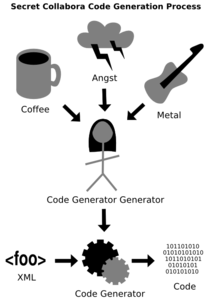
The secret Collabora code-generation process

(credit: daf)

Supporting D-Bus in the GObject world has always involved quite a lot of code generation. The core API of dbus-glib is heavily reliant on varargs functions, which aren't type-safe and are easy to get wrong. dbus-glib contains a program called dbus-binding-tool, which is meant to generate reasonably sane GObject APIs for D-Bus objects. Unfortunately, it seems to be intended to generate a whole GObject at a time. Early versions of telepathy-gabble used dbus-binding-tool plus a script called gengobject.py to generate API stubs for the exported objects; developers then filled in the blanks, and hey presto, we had a GObject on D-Bus. This was fine up to a point, but had a couple of major drawbacks. Whenever we changed the D-Bus API (quite common during the early development of Telepathy), there was a very laborious and error-prone merging process. We ended up with the following process:
  • copy the D-Bus introspection XML from the telepathy-spec repository into a directory xml/pristine (actually, the canonical form for the spec was Python for a while, and we had a script that exported a contrived object onto D-Bus and introspected itself to get the XML - but that's another story!)
  • preprocess the introspection XML to add the dbus-glib CFunctionName annotation, resulting in a directory xml/modified
  • run dbus-binding-tool and a Python script gengobject.py to generate C source in xml/src
  • three-way-diff the old version of xml/src, the new version of xml/src, and the real C code in src to create a new version of src
  • pray that the diff process hadn't randomly exchanged functions' implementations
  • update the resulting code in src so it worked
  • check the whole mess back into darcs
  • hope that nobody else had made changes that would result in darcs conflicts
If you haven't yet gathered, this was a bit of a nightmare. Also, it was very easy to return the wrong thing from a method without noticing - because all the APIs were varargs, the compiler didn't notice, and the first we'd know about it was a mysterious segfault under certain circumstances.
How telepathy-glib fixes code generation telepathy-glib improves on this by taking advantage of this innocuous-looking feature in dbus-glib:
commit 355ef78d98d6fc65715845d56232199162cab12a
Author: Steve Frécinaux <steve istique net>
Date:   Thu Aug 17 11:48:20 2006 +0200
    Interface support for bindings.
Instead of running dbus-binding-tool or creating GObjects with D-Bus interfaces, we put the entire Telepathy spec through glib-ginterface-gen.py, a distant descendant of Gabble's gengobject.py. For each interface in the spec, we generate a GInterface that mirrors the D-Bus interface. Any GObject that implements the GInterface automatically gets the D-Bus interface if it's exported onto D-Bus. There are a few non-obvious refinements, though:
  • The signature of the method implementation is always in the mode that dbus-glib calls "asynchronous", where the method implementation can either send a reply message before or after it returns. For "slow" methods, this is the only thing you can do. For instance, many Telepathy D-Bus methods can't return anything until some TCP round-trips to the server have happened. This is also the only thing you can do if you want to extract extra information, like the sender's unique name, from the method-call message (dbus-glib's "synchronous" API doesn't allow this to be done). For "fast" methods, sending a reply message before returning is just as easy as using the "synchronous" API (it's just a difference of syntax), and has an API consistent with that of the "slow" methods, making it easier for service authors.

  • The layout of the GInterface vtable is private, and (auto-generated) accessor functions are used to fill in implementations. This means our ABI doesn't change just because we re-ordered functions in the spec.

  • If no implementation is provided for a method, we just raise an appropriate error (org.freedesktop.Telepathy.Errors.NotImplemented), rather than suffering an assertion failure. This means we can safely add methods to an interface.

  • While we're generating code anyway, we generate some static inline wrapper functions which wrap dbus_g_method_return(), to have type-safe method returns. You can easily check that a method replies with correct types, by checking that the implementation of Foo() replies by calling tp_svc_some_interface_return_from_foo().

  • Similarly, we generate wrapper functions to emit signals, to get type-safe signal emission.

Not all interfaces are stable enough to be included in telepathy-glib's stable API and ABI, so some of our other projects include a copy of the telepathy-glib code-generation tools, and generate their own "mini-telepathy-glib" (traditionally in a /extensions/ directory) for their implementation-specific (drafts of) interfaces. This isn't yet as polished as it ought to be (mainly because we don't want to freeze the augmented-introspection-XML format that we write the Telepathy spec in, because it's rather ad-hoc and hackish in places) but it works quite well in practice. To see what this looks like in practice, have a look at the examples in telepathy-glib, or at a Telepathy connection manager like telepathy-gabble.
Mixins and base classes Another feature of telepathy-glib which makes life easier for connection manager authors is that it provides "mixins" and base classes which implement some of the GInterfaces. There's absolutely nothing magic about the base classes - they don't have any access to private implementation details of the GInterfaces, they just implement them like everyone else does. The "mixins" are only slightly more magical - they store some extra state inside the structures representing GObjects and their classes, and use it to provide default implementations of some or all of the methods on a particular interface (or two interfaces, in the case of the new TpMessageMixin). I'll leave it up to Rob to explain those in greater detail, since I seem to remember that he invented them :-P The examples and regression tests in telepathy-glib are quite good examples of how these work in practice.

Russell Coker: Motivation and Perspective

Patrick Winnertz writes about the demotivating effect of unreasonable delays on joining the Debian project [1]. While I agree that things need to be improved in terms of getting people in the project in a timely manner (the suggestion of providing assistants seems good), I don’t think that anyone has a good reason for being demotivated because of this. I first applied to join Debian in late 1998 or some time in 1999. At the time part of the process of joining was to receive a phone call. At the time I was living in a hotel and they refused to call me on such a line. I could have easily camped out in the hallway of a hotel (the cheap London hotels often had a pay-phone in the hall and no phones in the rooms) and pretended that it was my own phone with an unlisted number. Unless they refused to allow people with unlisted numbers to join (which seems unlikely) then I could have joined then. So it seems that at the time I could only join Debian if I was prepared to lie about my ownership of a phone line. I wasn’t overly bothered by this - there has never been a shortage of free software projects that need contributions of code. By late 2000 the rules had changed and I joined without needing a phone call. In the mean time I had forked the Bonnie storage benchmark program to form my own project Bonnie++ [2], created Postal - mail server benchmark suite [3] and worked on many other things as well. I have sympathy for the people who apply to become Debian Developers and who have to wait a long time, I’ve been in the same situation myself. But there are plenty of things that you can do in the mean time. Some of the things that you can do are upstream development work, filing bug reports, submiting patches that fix bugs, and writing documentation (all forms including blog posts). Also when projects aren’t yet in Debian it often happens that someone creates unofficial packages, the person who does this doesn’t need to be a DD. Producing back-ported packages for new versions of programs that are in a stable release can also be done by people who are not DDs. Unofficial and back-ported packages provide less benefit for the project as a whole but considerable benefit for the people who want to use them. There is a lot of work that can be done to fulfill clause 4 of the Debian Social Contract [4] (Our priorities are our users and free software) which doesn’t require being a Debian developer. It seems to me that if you have the right approach to this and maintain the perspective that Debian is one part of the free software community (and not necessarily the biggest or most significant) then a delay in your application to become a DD won’t be particularly demotivating.

Steve McIntyre: Final Sarge CDs done and released

Forgot to mention, but some people seem to have spotted anyway. The last (ever!) official set of Sarge CDs and DVDs is available. I'd strongly advise against most people using them, as Etch is a much better bet and Lenny isn't too far away. But for those people that might want them, you can find them in the "archive" area: http://cdimage.debian.org/cdimage/archive/3.1_r8/

Neil McGovern: Be careful what you post

In follow-up to my previous post, in which the phrase "google for gerri bird cambridge" (which turned up a rather poor lack of reply to a survey) was printed on some campain leaflets, I've come across a slightly different example of how traditional PR ideas may not work online if the people who are doing it don't understand the technology.

The Cambridgeshire County Council have placed on their transport page a link inviting people to view some videos of their new mis^WGuided Busway on YouTube. They've even gone so far as to create a YouTube account for the purpose. Unfortunately, the comments on their first video aren't too favourable, with the vast majority of people hating the idea. Not content with this, a second video was also posted, with exactly the same effect. In retaliation, it seems that their PR department has tried to fake some good reviews, but have been caught out.

So, some simple lessons:
  1. Don't trust user generated content to do your job for you
  2. Don't trust sites you have little control over
  3. Don't try and stuff the ballot by writing like a PR person

    Kartik Mistry: Fresh blood, Debian and India


    * We need fresh blood! Yes. Like Lucas mentioned in his last post, along with Debian itself, many small teams and big teams are highly out-numbered and probably dying slowly. Currently, debian-in team has only two active members (jaldhar and if I count myself). We live on #indlinux at moment, which also leads to confusion about actual focus area of team. So, here are some clear text messages: - Debian-IN is team to work for ‘Indic’ packages as well as bringing new and fresh blood to Debian from India. - Its not true that we only work for fonts, we have many other packages: aspell dictionaries and festival-* packages and so on. Update: QA Page for Debian-In-Workers. Thanks Runa. - We aim to provide platform for upcoming DDs from India. Sadly, all DDs in India are highly isolated at moment. - Hopefully, we will get #debian-in at oftc. Update: Recovered ‘dead’ channel now. Thanks to Ganneff and h0lger for help. Come and join us!! Please note that we are considering developers only right now. We have already good numbers of users of Debian in India. kthnx.

    Biella Coleman: My Special Topics Course on Hacking

    So I am nearly done with teaching this year, which is a relief, not because I don’t like it but because after a full year of teaching, one naturally wants a break. But before it is even over, you have to start thinking about your fall courses, mostly so you can order books in time and because developing a syllabus also requires more than a few days or weeks of work. Next fall, I am re-teaching a first year course Introduction to Human Communication and Culture as well as a new course on computer hacking. While I have an old version of the syllabus, I am going to spend the next few weeks revising, reshuffling, and updating. If there is anything you think should be included in this type of course drop me a line. Below is the new description of the course.
    The Culture and Politics of Computer Hacking. This course takes as its object computer hackers to interrogate not only the ethics and practices of hacking, but to examine more broadly how hackers and hacking have transformed the politics of computing and the Internet more generally. We will examine how hacker values are realized and constituted by different legal, technical, and ethical activities of computer hacking for example, free software production, cyberactivism and hactivism, cryptography, and the pranksih games of hacker underground. We will pay close attention to how ethical principles are variably represented and thought of by hackers, journalists, and academics and will use the example of hacking to address various topics on law, order, and politics on the Internet such as: free speech and censorship, computer gaming, privacy and security, and intellectual property. This will allow us to critically 1) problematize thinking on computer hackers as a socio-cultural group guided by a singular ethic and set of practices 2) examine the multiple ways hackers draw on and reconfigure dominant ideas of property, freedom, and privacy through their diverse moral codes and technical activities 3) broaden our understanding of politics of the Internet by evaluating the various political effects and ramifications of hacking.

    MJ Ray: Better Free Software Organisations?

    Another zero-day announcement of a Software in the Public Interest online meeting has been posted. The announcement mentions "one motion has been raised" but the agenda doesn't include any motions, so I'm not sure what. Also, the agenda lists "Debian logo licence" as up for discussion but I thought last month's meeting resolved that. I watch SPI fairly closely and I'm confused. How about the rest of you? SPI isn't alone in this: many software organisations seem to suffer from similar problems. For example, I ranted in passing about Free Software Manchester yesterday, who just posted the notes from their own zero-day meeting and I've suggested possible ways of reforming debian's currently-stalled New Maintainer process more than once. Are free software users particularly bad at the basics of running an interest society (like welcoming and expiring members, calling meetings, publishing routine communications, and so on), have I been spoiled by cooperatives with their friendly Member Services departments or secretariats, or what? Is this why so many free software orgs seem to include self-perpetuating leadership groups? Is this a serious problem if, as reported, Software Development is a Team Sport [etbe]? Are there fully-working free software mass participation groups out there? I feel a lot of these problems are caused by attempting to order our inherently entropy-filled world completely and insisting everything follows petty rules, such as refusing to answer a question because the "wrong" member asked it. The world will not become less random just because hackers try to impose arbitrary rules. Sometimes it's good to put down minimum standards (because calling zero-day meetings is a mostly-avoidable way of excluding some members) but it will always be a poor alternative to trying to do the best you can for others. How do we get past this? My pro-cooperation-and-better-business platform for SPI board went pretty badly and I've had some anti-cooperative flames back from someone starting another free software group this month, so I don't think I can fix these existing organisations any time soon. About 1 in 6 people in the UK are members of a cooperative, so even if that is reflected among hackers (and I think it's lower), all of them would not be enough to reform much. One of the most common memes in free software is "show us the code" and the few other free software cooperatives I've seen have mostly failed, with a few surviving but hitting a size limit. As a result, I'm currently negotiating the start of a new free software cooperative. So far, I'm really happy with how that's going. Many cooperators learn at the feet of large consumer cooperatives like the Cooperative Group who run training courses for new members about putting cooperative values and principles into practice, which we smaller groups couldn't run ourselves. As a result, most cooperators already know how to work well together. Should large software societies like SPI try commissioning similar courses?

    Russell Coker: Resizing the Root Filesystem

    Uwe Hermann has described how to resize a root filesystem after booting from a live-cd or recovery disk [1]. He makes some good points about resizing an LVM PV (which I hadn’t even realised was possible). The following paragraph is outdated, see the update at the end:
    Incidentally it should be noted that if your root filesystem is an LVM logical volume then it can’t be resized without booting from a different device because the way LVM appears to work is that the LV in question is locked, then files under /etc/lvm/ are written, and then the LV is unlocked. If the LV in question contains /etc/lvm then you deadlock your root filesystem and need to press reset. Of course if your root filesystem is on an LV which has been encrypted via cryptsetup (the LV is encrypted not the PV) then a live resize of the root filesystem can work as locking the LV merely means that write-backs from the encryption layer don’t get committed. I’m not sure if this means that data written to an encrypted device is less stable (testing this is on my todo list). If your root filesystem is on a partition of a hard drive (such as /dev/hda2) then it is possible to extend it without booting from different media. There is nothing stopping you from running fdisk and deleting the partition of your root filesystem and recreating it. When you exit fdisk it will call an ioctl() to re-read the partition table, the kernel code counts the number of open file handles related to the device and if the number is greater than 1 (fdisk has one open handle) then it refuses to re-read the table. So you can use fdisk to change the root partition and then reboot to have the change be noticed. After that ext2online can be used to take advantage of the extra space (if the filesystem has a recent enough version of the ext3 disk format). One thing he didn’t mention is that if you do need to boot from another device to manipulate your root filesystem (which should be quite rare if you are bold and know the tricks) then you can always use your swap space. To do this you simply run swapoff and then run mkfs on the device that had been used for swap (incidentally there is nothing really special about the swap space, but it does tend to often be used for such recovery operations simply because it has no data that persists across a reboot). The minimum set of files that need to be copied to a temporary filesystem is usually /bin, /sbin, /dev, /lib (excluding all directories under /lib/modules apart from the one related to the kernel you are using), and /etc. Also you should make directories /proc, /sys, and /selinux (if the machine in question runs SE Linux). The aim is not to copy enough files for the machine to run in a regular manner, merely enough to allow manipulating all filesystems and logical volumes. Often for such recovery I boot with init=/bin/bash as a kernel parameter to skip the regular init and just start with a shell. Note that when you use init=/bin/bash you end up with a shell that has no job control and ^C is not enabled, if you want to run a command that might not terminate of it’s own accord then the command “openvt /bin/bash” can be used to start another session with reasonable terminal settings. I recommend that anyone who wants to work as a sys-admin experiment with such procedures on a test machine. There are lots of interesting things that you can learn and interesting ways that you can break your system when performing such operations. Update: Wouter points out that the LVM bug of deadlocking the root filesystem has been fixed and that you can also use ext2online to resize the mounted filesystem [2].

    Miriam Ruiz: More on OOXML: ISO tries to recover lost credibility through press notes

    After the unfortunate show that Microsoft and ISO provided us recently, ISO’s response is a FAQ note about ISO/IEC 29500 (OOXML, that’s it) in which they threaten Microsoft with the most severe of penalties if they’re tricking on as. Funny. In that statement, they try to answer all the issues that initially were concerns but that now has turned into proven facts about the OOXML standard and it’s approval, and to try to recover some of their lost credibility. It’s sad to be commenting on this, words don’t come easy, as if to say. Microsoft has already proven who’s the one in charge here, who owns the committees, who takes the decisions and in which terms, and nothing happens. It’s gonna take more than to publish a FAQ note saying how well you did it and to threaten Microsoft to behave or else. No one seriously believe you at the moment, you know? A funny thing is that ISO dismisses any responsibility about standardization, and relies on the market taking the decisions for them. Microsoft has said many times that they consider something positive and healthy to have multiple standards for the same, and let the market decide. Now ISO declares to think along the same lines: “After a period of co-existence, it is basically the market that decides which survives”. We don’t really need an organization for standardization for that, do we? We already have the market for that. Will ISO apply the same policy for every standard from now on? Like, say, having a couple of competing standards at least for every need, and let the market decide? ISO tries to recover from their credibility loss with this note (“the standards development process is credible, works well and is delivering the standards needed, and widely implemented, by the market“), without much success at least in what I’m concerned. If they keep trying to convince with press notes instead of with real acts, no one is gonna believe them ever again.

    Patrick Winnertz: Demotivaton of new prospective Developers

    I'm writing this blog entry as a reaction of Lucas Nussbaums one. More or less one year ago I also was a New Maintainer who completed the process after 3 months (Started in February and ended in May). My Intention was to become as fast as possible a Developer and I was very motivated. (I helped Lucas with filling the build twice in a row bugs in this time). The FD approves me quite fast... (I'll guess I was only waiting for two weeks?) but the next to steps (Approval of DAM and creation of the account) took very long. After waiting for 3 months I was quite demotivated and doing only necessary things in order to update my packages... it was very frustrating. But now I'm finally a DD, since 6 months. For those who doesn't want to calculate: I was waiting for DAM about 4 months. When I saw that I was again highly motivated and started again to work on Debian a bit more, because I thought that the account creation can't took long...this was an error: I was approved by DAM in the middle of October... and got my account in Dezember... again waiting for a simple action. I can really understand New Maintainer who are directly MIA after being a DD. Waiting a half year for account creation is much too long. In my eyes there is only one possible solution for this issue: Since DAM and the Account Manager have also many other tasks which consumes there time, I would suggest to give them assistants...every manager needs at least one assistant ;-). This would speed up the process and people who are doing actually a great job doesn't get frustrated by waiting, but can actively work on Debian. I hope that the new DPL will find a solution for this really big issue during his time.

    15 April 2008

    William Pitcock: How NOT to switch from x86 to amd64 Debian

    The following script, or any script like it will not work. Do not waste your time and end up hosing your box like I did today:
    #!/bin/bash
    echo "==> installing cdebootstrap"
    apt-get install cdebootstrap
    echo "==> reticulating splines"
    dpkg -l   cut -f3 -d' ' >> /tmp/packages.installed
    pkg= cat /tmp/packages.installed   xargs 
    pkg= echo $pkg   sed -e 's#bunch of crap elided here##g' 
    echo "==> installing libc6-amd64"
    apt-get install libc6-amd64
    echo "==> installing base system"
    cdebootstrap -a amd64 lenny /
    for pkg in $pkg; do
    echo "==> reinstalling $pkg"
    apt-get install --reinstall --force-yes $pkg
    done
    Don’t let this happen to you. I had the pleasure of discovering that Bacula was not properly backing up my MySQL databases. What an excellent way of finding out.

    John Goerzen: datapacker

    Every so often, I come across some utility that need. I think it must have been written before, but I can't find it.

    Today I needed a tool to take a set of files and split them up into directories in a size that will fit on DVDs. I wanted a tool that could either produce the minimum number of DVDs, or keep the files in order. I couldn't find one. So I wrote datapacker.

    datapacker is a tool to group files by size. It is perhaps most often used to fit a set of files onto the minimum number of CDs or DVDs.

    datapacker is designed to group files such that they fill fixed-size containers (called "bins") using the minimum number of containers. This is useful, for instance, if you want to archive a number of files to CD or DVD, and want to organize them such that you use the minimum possible number of CDs or DVDs.

    In many cases, datapacker executes almost instantaneously. Of particular note, the hardlink action can be used to effectively copy data into bins without having to actually copy the data at all.

    datapacker is a tool in the traditional Unix style; it can be used in pipes and call other tools.

    I have, of course, uploaded it to sid. But while it sits in NEW, you can download the source tarball (with debian/ directory) from the project homepage at http://software.complete.org/datapacker. I've also got an HTML version of the manpage online, so you can see all the cool features of datapacker. It works nicely with find, xargs, mkisofs, and any other Unixy pipe-friendly program.

    Those of you that know me will not be surprised that I wrote datapacker in Haskell. For this project, I added a bin-packing module and support for parsing inputs like 1.5g to MissingH. So everyone else that needs to do that sort of thing can now use library functions for it.

    Update... I should have mentioned the really cool thing about this. After datapacker compiled and ran, I had only one mistake that was not caught by the Haskell compiler: I said < where I should have said <= one place. This is one of the very nice things about Haskell: the language lends itself to compilers that can catch so much. It's not that I'm a perfect programmer, just that my compiler is pretty crafty.

    Dirk Eddelbuettel: London Marathon 2008

    Sunday was the 100th anniversary of the modern marathon: It was during the London 2008 Olympics that the marathon was run for the first time for the 26 miles 385 yard, or 42.185 km, distance. And it so happens that I was there to run the 2008 edition of the London Marathon. Pretty nice weather at the start and finish: sunny, not too hot, occassional clouds. But being London, we still managed to get drenched for about 30 minutes. Overall, the conditions were good -- or else Martin Lel would have had a hard time for a new course record. The course is pretty nice, right from the start in Greenwhich all the way to the spectacular finish in Westminster. Crowd support was good too, if only a little uneven. But the second half of the race, and particularly the last miles in the back from Canary Whard through the City to Westminster past Parliament and Buckingham Palace were awesome. Lots of people, lots of noise. Oh, and I even saw the leaders in a group of five, including Lel and Hall as the course had parallel 'out' and 'back' tracks around miles 13 for me and 22 for them. I had planned to take it easy and not try to run too hard, and aimed for a time of around 3:25 and then finished at 3:24:41. A little less 'even' than I had hoped, but still a very satisfying result. And for once the legs aren't all that shot afterwards :) And the whole weekend was nice as I got to stay with friends in the southwest of London. Staying up late on both ends of the trip suppressed the jet lag fairly well. At least that's what I keep telling myself.

    Pablo Lorenzzoni: fisl9.0: T-48h

    We are at T-48h of fisl9.0, and everything starts to take form. I spent the whole afternoon getting our icecast infrastructure online. We ve got 6 servers, all with different bandwidth and not all with the same architecture The debian boxes were prevalent (4 of them 1 amd64 and 3 i386), all of them etch. We ll be able to follow the statistics at tvstats website (not all the servers are enlisted yet). In this process I found an evil bug in debian s icecast package, I will have to debug to understand it better: when relaying from a master server (which is our set-up), if the source stops feeding the master, the relay segfaults. The strace shows it just segfaults while pooling I got no explanation for it and I ll have to dissect it if I want to build a proper bug report. In the meantime, I installed the sarge-backports version, and it worked so, the bug report will have to wait until after fisl :-) I took some pictures to show how s everything being put together. Take a look: And some of the infrastructure crew: See you all there!

    Russell Coker: Software Development is a Team Sport

    Albert writes about software development and how much teamwork is used [1]. He makes an interesting clash of analogies by suggesting that it’s not a “team sport” because “its not like commercial fishing where many hands are used to pull in the net at the same time“. I think that software development for any non-trivial project is a team sport. You don’t have the same level of direct coordination as required for pulling in a net (or the rugby scrum [2] to use a sporting analogy), but that doesn’t stop it being a team effort. Some parts of team development projects are like a relay event, in corporate environments the work is done in parallel simply because everyone is working the same hours but in free software development projects the work is often serialised. I think that it’s often more effective to serialise some work, if someone is actively working on one sections of code it may save time to avoid working in that area until they are finished. There is little benefit in writing code to old interfaces. Some parts of team projects have specialised skill areas (EG debugging, skills in particular programming languages, and graphical design). Soccer is one sport where different rules apply to different players (the goal keeper can use their hands). In ice-hockey the protective clothing used by the goal keeper is considerably different from that used by other players. In most team sports where the aim is to put a ball through a goal at one end (EG basketball and all versions of football) there seems to be some degree of specialisation, some players are dedicated to scoring goals while others are dedicated to defense. The fielding team in cricket has every player assigned to a different part of the field - with slight differences in the skills required. Then there is the issue of large projects such as Linux distributions. It seems to me that a Linux distribution will always comprise multiple teams as well as some individual projects. Maybe we could consider Linux distributions (and distributions of the other free OSs) to be similar to countries that compete in the Olympics. The culture of the Free Software (or Open Source if that’s your idea) community can be compared to the Olympic Spirit. Of course the Olympic idea that people should come together in peace for the Olympic Games and that it’s about honor not money is pretty much dead. Maybe the Free Software development processes should be compared to an ideal of what sporting contests would be if there weren’t unreasonable amounts of money (and therefore corruption) involved. Of course no analogy is perfect and there are many ways in which this one breaks down. One of which is the cooperation between distributions. There is a lot of private discussion between developers of various distributions and upstream developers about how to plan new features. It’s not uncommon for developers to announce certain development decisions as soon as they are made to help other distributions make decisions - for a developer in a distribution project if there is an issue which doesn’t matter much to you or your users then it’s often good to strive for compatibility with other distributions. When users advocate new features or changes they sometimes try multiple distributions. It’s not uncommon for a feature request to be rejected by one distribution and then accepted by another. Once a feature is included in a major distribution the upstream developer is more likely to accept it due to it’s wide testing. Then when the feature is in upstream it’s almost certain to be included in all other distributions. I often recommend that when someone disagrees with one of their bugs being closed as “not a bug” that they try reproducing it in another distribution and reporting it there. As a side note, the criteria for reporting a bug in any free software distribution is that you can describe it in a way that allows other people to reproduce it - whether it’s a bug that afflicts you every day or whether you installed the distribution for the sole purpose of reporting the bug in a new forum is not relevant. As a general rule I recommend that you not have the same bug report open in more than one distribution at any time (if you notice a bug reported in multiple distributions then please add a note to each bug report so that work can be coordinated). As a general rule the only situation where I will open the same bug in multiple forums is if I have been told that the responsible person or people in one forum are unwilling or unable to fix it. Finally, the people who consider that they don’t need to be a team player because they do their coding alone might want to consider Qmail. Dan Bernstein is a great coder and Qmail is by most metrics a fine piece of software, in terms of security Qmail is as good as it gets! If Dan was more of a team player then I believe that his mail server would have been much more successful (in terms of the number of sites using it). However I do understand his desire to have a great deal of control over his software.

    Bastian Venthur: 4 months and 10 days without any new Debian developer

    I sadly agree with Lucas. Waiting several months after you finished all the tests until your account gets finally created is really frustrating and demotivating. In my opinion this is just a lack of manpower and seemingly no one who dares to step in to solve this problem. Why again don’t we just throw a few more people at this problem?

    Thomas Girard: java-gnome 4.0

    Thanks to Manu Mahajan, java-gnome 4.0 is now available for Debian. To install it, use: apt-get install libjava-gnome-java

    Neil Williams: NM delays still impeding Debian activity

    The delays in granting accounts have other effects on Debian as a whole, besides possibly dissuading people from joining.
    The constant stream of sponsoring requests from people who are stuck in the final stages of NM are impeding sponsoring generally. DM is not a complete solution because a lot of these uploads are QA uploads - very useful they are too. It's just that there is no good reason why the nearly-DD's preparing the QA upload should even need a sponsor when the only thing preventing them making the upload themselves is a bottleneck in Debian that hasn't changed or improved in what seems like years.
    Personally, I don't see evidence of people being dissuaded from joining - I've advocated a couple of new people recently and I know a few more who are prepared to do what is necessary to become a DD. However, I do not think it is right that existing DDs are expected to sponsor uploads from people who have passed all the hurdles of NM and are simply waiting for another DD to do an administrative task.
    To echo Lucas, Debian cannot afford to impede recruitment. Debian also cannot afford to distract the existing manpower with increasing amounts of "workarounds" that fail to fix the problem.
    Creating the accounts for new NMs should be considered in a similar manner to an RC bug - if the regular DD cannot find time to do it within a particular timeframe, then the task must be opened up to others who have the time to get it done. With RC bugs, we have NMUs. With NM, we need assistants to be given whatever access is necessary to step in and prevent backlogs.

    Neil Williams: PS - on keeping interested during the wait

    Something I want to add to a post by Slyvian LeGall - motivation does not have to disappear during the wait.
    I was lucky, my advocate is project-lead for a Debian sub-project (Emdebian in this case) and I was able to contribute to Emdebian before my DD status was completed. This included uploads to Emdebian that Debian people could use. It included policy decisions, infrastructure development and programming of bespoke utilities.
    i.e. my interest was maintained because I had an outlet and an encouraging, supportive, advocate.
    When a DD advocates a particular person in NM, there should be some common ground, some experience of working with that person and it should be possible to find a way to maintain a working relationship within that environment.
    My experience of the end of NM was one of increasing responsibility, increasing activity, increasing motivation and constant affirmation and assistance from my advocate and others in the sub-project.
    So a big thank you to Wookey and debian-embedded in general. It bodes well for the other prospective DD's currently being mentored and encouraged through NM within Emdebian itself.
    (Mind you, my NM timescale shows that I didn't wait anywhere near as long as the current delays.)
    I fully appreciate that the horrendous delays currently being inflicted on people in NM and upon Debian in general are abominable. If there are ways that existing teams in Debian can adopt and encourage these prospective developers, it can only help in keeping these people interested. It may be a more productive way of helping with the NM problems than just carping on a blog.

    Next.

    Previous.