Search Results: "nate"

18 December 2015

Martin Pitt: What s new in autopkgtest: LXD, MaaS, apt pinning, and more

The last two major autopkgtest releases (3.18 from November, and 3.19 fresh from yesterday) bring some new features that are worth spreading. New LXD virtualization backend 3.19 debuts the new adt-virt-lxd virtualization backend. In case you missed it, LXD is an API/CLI layer on top of LXC which introduces proper image management, seamlessly use images and containers on remote locations, intelligently caching them locally, automatically configure performant storage backends like zfs or btrfs, and just generally feels really clean and much simpler to use than the classic LXC. Setting it up is not complicated at all. Install the lxd package (possibly from the backports PPA if you are on 14.04 LTS), and add your user to the lxd group. Then you can add the standard LXD image server with
  lxc remote add lco https://images.linuxcontainers.org:8443
and use the image to run e. g. the libpng test from the archive:
  adt-run libpng --- lxd lco:ubuntu/trusty/i386
  adt-run libpng --- lxd lco:debian/sid/amd64
The adt-virt-lxd.1 manpage explains this in more detail, also how to use this to run tests in a container on a remote host (how cool is that!), and how to build local images with the usual autopkgtest customizations/optimizations using adt-build-lxd. I have btrfs running on my laptop, and LXD/autopkgtest automatically use that, so the performance really rocks. Kudos to St phane, Serge, Tycho, and the other LXD authors! The motivation for writing this was to make it possible to move our armhf testing into the cloud (which for $REASONS requires remote containers), but I now have a feeling that soon this will completely replace the existing adt-virt-lxc virt backend, as its much nicer to use. It is covered by the same regression tests as the LXC runner, and from the perspective of package tests that you run in it it should behave very similar to LXC. The one problem I m aware of is that autopkgtest-reboot-prepare is broken, but hardly anything is using that yet. This is a bit complicated to fix, but I expect it will be in the next few weeks. MaaS setup script While most tests are not particularly sensitive about which kind of hardware/platform they run on, low-level software like the Linux kernel, GL libraries, X.org drivers, or Mir very much are. There is a plan for extending our automatic tests to real hardware for these packages, and being able to run autopkgtests on real iron is one important piece of that puzzle. MaaS (Metal as a Service) provides just that it manages a set of machines and provides an API for installing, talking to, and releasing them. The new maas autopkgtest ssh setup script (for the adt-virt-ssh backend) brings together autopkgtest and real hardware. Once you have a MaaS setup, get your API key from the web UI, then you can run a test like this:
  adt-run libpng --- ssh -s maas -- \
     --acquire "arch=amd64 tags=touchscreen" -r wily \
     http://my.maas.server/MAAS 123DEADBEEF:APIkey
The required arguments are the MaaS URL and the API key. Without any further options you will get any available machine installed with the default release. But usually you want to select a particular one by architecture and/or tags, and install a particular distro release, which you can do with the -r/--release and --acquire options. Note that this is not wired into Ubuntu s production CI environment, but it will be. Selectively using packages from -proposed Up until a few weeks ago, autopkgtest runs in the CI environment were always seeing/using the entirety of -proposed. This often led to lockups where an application foo and one of its dependencies libbar got a new version in -proposed at the same time, and on test regressions it was not clear at all whose fault it was. This often led to perfectly good packages being stuck in -proposed for a long time, and a lot of manual investigation about root causes. . These days we are using a more fine-grained approach: A test run is now specific for a trigger , that is, the new package in -proposed (e. g. a new version of libbar) that caused the test (e. g. for foo ) to run. autopkgtest sets up apt pinning so that only the binary packages for the trigger come from -proposed, the rest from -release. This provides much better isolation between the mush of often hundreds of packages that get synced or uploaded every day. This new behaviour is controlled by an extension of the --apt-pocket option. So you can say
  adt-run --apt-pocket=proposed=src:foo,libbar1,libbar-data ...
and then only the binaries from the foo source, libbar1, and libbar-data will come from -proposed, everything else from -release. Caveat:Unfortunately apt s pinning is rather limited. As soon as any of the explicitly listed packages depends on a package or version that is only available in -proposed, apt falls over and refuses the installation instead of taking the required dependencies from -proposed as well. In that case, adt-run falls back to the previous behaviour of using no pinning at all. (This unfortunately got worse with apt 1.1, bug report to be done). But it s still helpful in many cases that don t involve library transitions or other package sets that need to land in lockstep. Unified testbed setup script There is a number of changes that need to be made to testbeds so that tests can run with maximum performance (like running dpkg through eatmydata, disabling apt translations, or automatically using the host s apt-cacher-ng), reliable apt sources, and in a minimal environment (to detect missing dependencies and avoid interference from unrelated services these days the standard cloud images have a lot of unnecessary fat). There is also a choice whether to apply these only once (every day) to an autopkgtest specific base image, or on the fly to the current ephemeral testbed for every test run (via --setup-commands). Over time this led to quite a lot of code duplication between adt-setup-vm, adt-build-lxc, the new adt-build-lxd, cloud-vm-setup, and create-nova-image-new-release. I now cleaned this up, and there is now just a single setup-commands/setup-testbed script which works for all kinds of testbeds (LXC, LXD, QEMU images, cloud instances) and both for preparing an image with adt-buildvm-ubuntu-cloud, adt-build-lx[cd] or nova, and with preparing just the current ephemeral testbed via --setup-commands. While this is mostly an internal refactorization, it does impact users who previously used the adt-setup-vm script for e. g. building Debian images with vmdebootstrap. This script is now gone, and the generic setup-testbed entirely replaces it. Misc Aside from the above, every new version has a handful of bug fixes and minor improvements, see the git log for details. As always, if you are interested in helping out or contributing a new feature, don t hesitate to contact me or file a bug report.

17 December 2015

Simon Josefsson: Let s Encrypt Clients

As many others, I have been following the launch of Let s Encrypt. Let s Encrypt is a new zero-cost X.509 Certificate Authority that supports the Automated Certificate Management Environment (ACME) protocol. ACME allow you to automate creation and retrieval of HTTPS server certificates. As anyone who has maintained a number of HTTPS servers can attest, this process has unfortunately been manual, error-prone and differ between CAs. On some of my personal domains, such as this blog.josefsson.org, I have been using the CACert authority to sign the HTTPS server certificate. The problem with CACert is that the CACert trust anchors aren t shipped with sufficient many operating systems and web browsers. The user experience is similar to reaching a self-signed server certificate. For organization-internal servers that you don t want to trust external parties for, I continue to believe that running your own CA and distributing it to your users is better than using a public CA (compare my XMPP server certificate setup). But for public servers, availability without prior configuration is more important. Therefor I decided that my public HTTPS servers should use a CA/Browser Forum-approved CA with support for ACME, and as long as Let s Encrypt is trustworthy and zero-cost, they are a good choice. I was in need of a free software ACME client, and set out to research what s out there. Unfortunately, I did not find any web pages that listed the available options and compared them. The Let s Encrypt CA points to the official Let s Encrypt client, written by Jakub Warmuz, James Kasten, Peter Eckersley and several others. The manual contain pointers to two other clients in a seamingly unrelated section. Those clients are letsencrypt-nosudo by Daniel Roesler et al, and simp_le by (again!) Jakub Warmuz. From the letsencrypt.org s client-dev mailing list I also found letsencrypt.sh by Gerhard Heift and LetsEncryptShell by Jan Moj . Is anyone aware of other ACME clients? By comparing these clients, I learned what I did not like in them. I wanted something small so that I can audit it. I want something that doesn t require root access. Preferably, it should be able to run on my laptop, since I wasn t ready to run something on the servers. Generally, it has to be Secure, which implies something about how it approaches private key handling. The letsencrypt official client can do everything, and has plugin for various server software to automate the ACME negotiation. All the cryptographic operations appear to be hidden inside the client, which usually means it is not flexible. I really did not like how it was designed, it looks like your typical monolithic proof-of-concept design. The simp_le client looked much cleaner, and gave me a good feeling. The letsencrypt.sh client is simple and written in /bin/sh shell script, but it appeared a bit too simplistic. The LetsEncryptShell looked decent, but I wanted something more automated. What all of these clients did not have, and that letsencrypt-nosudo client had, was the ability to let me do the private-key operations. All the operations are done interactively on the command-line using OpenSSL. This would allow me to put the ACME user private key, and the HTTPS private key, on a YubiKey, using its PIV applet and techniques similar to what I used to create my SSH host CA. While the HTTPS private key has to be available on the HTTPS server (used to setup TLS connections), I wouldn t want the ACME user private key to be available there. Similarily, I wouldn t want to have the ACME or the HTTPS private key on my laptop. The letsencrypt-nosudo tool is otherwise more rough around the edges than the more cleaner simp_le client. However the private key handling aspect was the deciding matter for me. After fixing some hard-coded limitations on RSA key sizes, getting the cert was as simple as following the letsencrypt-nosudo instructions. I ll follow up with a later post describing how to put the ACME user private key and the HTTPS server certificate private key on a YubiKey and how to use that with letsencrypt-nosudo. So you can now enjoy browsing my blog over HTTPS! Thank you Let s Encrypt!

Dirk Eddelbuettel: RcppArmadillo 0.6.400.2.2

armadillo image And yet another updated of Armadillo by Conrad bringing us to 6.400.2. I folded that yesterday into RcppArmadillo 0.6.400.2.2; and this is now on CRAN and Debian. There was even an interim-CRAN-only release 0.6.300.2.2 with a refinement for tests of imcompleye LAPACK libraries---which we encounter whenver R is build with its own (partial) copy of LAPACK as on Windows, and on bigger computers whenver this was chosen over the default of system LAPACK. Armadillo is a powerful and expressive C++ template library for linear algebra aiming towards a good balance between speed and ease of use with a syntax deliberately close to a Matlab. This release brings the following changes:
Changes in RcppArmadillo version 0.6.400.2.0 (2015-12-15)
  • Upgraded to Armadillo 6.400.2 ("Flying Spaghetti Monster Deluxe")
    • expanded each_col(), each_row() and each_slice() to handle C++11 lambda functions
    • added ind2sub() and sub2ind()
    • fixes for corner cases in gmm_diag class
Changes in RcppArmadillo version 0.6.300.2.2 (2015-12-12)
  • Upgraded to Armadillo 6.300.3-test ("Flying Spaghetti Monster")
    • Additional test in auxlib_meat.hpp for limited LAPACK
  • Updated test and #define for limited LAPACK version R might be built with on Unix-alike systems
Courtesy of CRANberries, there is also a diffstat report for the most recent CRAN release. As always, more detailed information is on the RcppArmadillo page. Questions, comments etc should go to the rcpp-devel mailing list off the R-Forge page.

This post by Dirk Eddelbuettel originated on his Thinking inside the box blog. Please report excessive re-aggregation in third-party for-profit settings.

15 December 2015

Thomas Goirand: OpenStack: Mitaka beta 1 packages available, Liberty uploaded to Jessie Backports

OpenStack Mitaka beta 1 Debian packages available I didn t find the time to announce it until today, though I have finished last Friday to package Mitaka Beta 1. It is available, as usual, on the Jenkins server Debian repository: deb http://mitaka-jessie.pkgs.mirantis.com/debian jessie-mitaka-backports main

deb-src http://mitaka-jessie.pkgs.mirantis.com/debian jessie-mitaka-backports main
deb http://mitaka-jessie.pkgs.mirantis.com/debian jessie-mitaka-backports-nochange main
deb-src http://mitaka-jessie.pkgs.mirantis.com/debian jessie-mitaka-backports-nochange main Not all of the updated packages avialable above has been uploaded to Debian Experimental, mostly those needing to pass the FTP master NEW queue did. I will upload the rest as I find enough time to do so, which unfortunately may not happen before Mitaka b2 (which will be in the middle of January). OpenStack Liberty uploaded to jessie-backports Also, as python-repoze.who 2.x finally could migrate to Debian testing (after filed to be removed dependencies got removed by the FTP masters), python-pysaml2 3.0, and then Keystone also did. So this week-end, all of OpenStack Liberty reached testing. So today, I could finally upload all of OpenStack liberty in the official jessie-backports repository. This is 165 packages that I uploaded, out of which 135 are going through the backports NEW queue. I m sorry to give that much work to the FTP masters, but most OpenStack users do want to use the latest release of OpenStack on top of the latest stable distributions. So this upload really is what OpenStack Debian user will prefer (until we have PPA^Wbikesheds for Debian).

Antoine Beaupr : Using a Yubikey NEO for SSH and OpenPGP on Debian jessie

I recently ordered two Yubikey devices from Yubico, partly because of a special offer from Github. I ordered both a Yubikey NEO and a Yubikey 4, although I am not sure I remember why I ordered two - you can see their Yubikey product comparison if you want to figure that out, but basically, the main difference is that the NEO has support for NFC while the "4" has support for larger RSA key sizes (4096). This article details my experiment on the matter. It is partly based on first hand experience, but also links to various other tutorials that helped me along the way. Especially thanks to folks on various IRC channels that really helped me out in understanding this. My objective in getting a hardware security token like this was three-fold:
  1. use 2FA on important websites like Github, to improve the security of critical infrastructure (like my Borg backup software)
  2. login to remote SSH servers without exposing my password or my private key material on third party computers
  3. store OpenPGP key material on the key securely, so that the private key material can never be compromised
To make a long story short: this article documents step 2 and implicitly step 3 (because I use OpenPGP to login to SSH servers). However it is not possible to use the key on arbitrary third party computers, given how much setup was necessary to make the thing work at all. 2FA on the Github site completely failed, but could be used on other sites, although this is not covered by this article. I have also not experimented in details the other ways the Yubikey can also be used (sorry for the acronym flood) as: Update: OATH works! It is easy to configure and i added a section below.

Not recommended After experimenting with the device and doing a little more research, I am not sure it was the right decision to buy a Yubikey. I would not recommend buying Yubikey devices because they don't allow changing the firmware, making the device basically proprietary, even in the face of an embarrassing security vulnerability on the Yubikey NEO that came out in 2015. A security device, obviously, should be as open as the protocols it uses, otherwise it's basically impossible to trust that the crypto hasn't been backdoored or compromised, or, in this case, is vulnerable to the simplest drive-by attacks. Furthermore, it turns out that the primary use case that Github was promoting is actually not working as advertised: to use the Yubikey on Github, you actually first need to configure 2FA with another tool, either with your phone's text messages (SMS) or with something like Google Authenticator. After contacting Github support, they explained that the Yubikey is seen as a "backup device", which seems really odd to me, especially considering the promotion and the fact that I don't have a "smart" (aka "Google", it seems these days) phone or the desire to share my personal phone number with Github. Finally, as I mentioned before, the fact that those devices are fairly new and the configuration necessary to make them work at all is completely obtuse, non-standardized or at least not available by default on arbitrary computers makes them basically impossible to use on other computers than your own specially crafted gems.

Plugging it in The Yubikey, when inserted into a USB port, seems to be detected properly. It shows up both as a USB keyboard and a generic device.
d c 14 17:23:26 angela kernel: input: Yubico Yubikey NEO OTP+U2F as /devices/pci0000:00/0000:00:12.0/usb3/3-2/3-2:1.0/0003:1050:0114.0016/input/input127
d c 14 17:23:26 angela kernel: hid-generic 0003:1050:0114.0016: input,hidraw3: USB HID v1.10 Keyboard [Yubico Yubikey NEO OTP+U2F] on usb-0000:00:12.0-2/input0
d c 14 17:23:26 angela kernel: hid-generic 0003:1050:0114.0017: hiddev0,hidraw4: USB HID v1.10 Device [Yubico Yubikey NEO OTP+U2F] on usb-0000:00:12.0-2/input1
We'll be changing this now - we want to to support OTP, U2F and CCID. Don't worry about those acronyms now, but U2F is for the web, CCID is for GPG/SSH, and OTP is for the One Time Passwords stuff mentionned earlier. I am using the Yubikey Personalization tool from stretch because the jessie one is too old, according to Gorzen. Indeed, I found out that the jessie version doesn't ship with the proper udev rules. Also, note that we need to run as sudo otherwise we get a permission denied:
$ sudo apt install yubikey-personalization/stretch
$ sudo ykpersonalize -m86
Firmware version 3.4.3 Touch level 1541 Program sequence 1
The USB mode will be set to: 0x86
Commit? (y/n) [n]: y
To understand better what the above does, see the NEO composite device documentation. The next step is to reconnect the key, for the udev rules to kick in. If you were like me, you enthusiastically plugged in the device before installing the yubikey-personalization package, and the udev rules were not present then.

Configuring a PIN Various operations will require you to enter a PIN when talking to the key. The default PIN is 123456 and the default admin PIN is 12345678. You will want to change that, otherwise someone that gets a hold of your key could do any operation without your consent. For this, you need to use:
$ gpg --card-edit
> passwd
> admin
> passwd
Be sure to remember those passwords! Of course, the key material on the Yubikey can be revoked when you loose the key, but only if you still have control of the master key, or if you have a OpenPGP revocation certification (which you should have).

Configuring GPG To do OpenPGP operations (like decryption, signatures and so on), or SSH operations (like authentication on a remote server), you need to talk with GPG. Yes, OpenPGP keys are RSA keys that can be used to authenticate with SSH servers, that's not new and I have already been doing this with Monkeysphere for a while. Now the challenge is how to make GPG talk with the Yubikey. So the next step is to see if gpg can see the key alright, as described in the Yubikey importing keys howto - you will need first to install scdaemon and pcscd (according to this howto) for gpg-agent to be able to talk with the key:
$ sudo apt install scdaemon gnupg-agent pcscd
$ gpg-connect-agent --hex "scd apdu 00 f1 00 00" /bye
ERR 100663404 Card error <SCD>
Well that failed. At this point, touching the key types a bunch of seemingly random characters wherever my cursor is sitting - fun but totally useless still. That was because I failed to reconnect the key: make sure the udev rules are in place and reconnect the key, the above should work:
$ gpg-connect-agent --hex "scd apdu 00 f1 00 00" /bye
D[0000]  01 00 10 90 00                                     .....
OK
This shows it is running the firmware 1.10, which is not vulnerable to the infamous security issue. (Note: I also happened to install opensc and gpgsm because of this suggestion but I am not sure they are required at all.)

Using SSH To make GPG work with SSH, you need somehow to start gpg-agent with ssh support, for example with:
gpg-agent --daemon --enable-ssh-support bash
Of course, this will work better if it's started with your Xsession. Such an agent should already be started, so you just need to add the ssh emulation to its configuration file and restart your X session.
echo 'enable-ssh-support' >> .gnupg/gpg-agent.conf
In Debian Jessie, the ssh-agent wrapper will not start if it detects that you have already one running (for example from gpg-agent) but if that fails, you can try commenting out use-ssh-agent from /etc/X11/Xsession.options to keep it from starting up in your session. (Thanks to stackexchange for that reference.) Here I assume you have already created an authentication subkey on your PGP key. If you haven't, I suggest trying out simply monkeysphere gen-subkey, which will generate an authentication subkey for you. You can also do it by hand by following one of the OpenPGP/SSH tutorials from Yubikey, especially the more complete one. If you are going to generate a completely new OpenPGP key, you may want to follow this simpler tutorial here. Then you need to move your authentication subkey to the Yubikey. For this, you need to edit the key and use the keytocard command:
$ gpg2 --edit-key anarcat@debian.org
> toggle
> key 2
> keytocard
> save
Here, we use toggle to show the OpenPGP private key material. You should see a key marked with A for Authentication. Mine was the second one so I selected it with key 2 which put a star next to it. The keytocard command moved it to the key and save ensure the key was removed from the local keyring. Obviously, backups are essential before doing this, because it's perfectly possible to loose that key in the process, for example if you destroy or lose the key or forget the password. It's probably better to create a completely different authentication subkey for just this purpose, but that may require reconfiguring all remote SSH hosts, and you may not want to do that. Then SSH should magically talk with the GPG agent and ask you for the PIN! That's pretty much all there is to it - if it doesn't, it means that gpg-agent is not your SSH agent, and obviously things will fail... Also, you should be able to see the key being loaded in the agent when it is:
$ ssh-add -l
2048 23:f3:be:bf:1e:da:e8:ad:4b:c7:f6:60:5e:03:c2:a6 cardno:000603647189 (RSA)
.. that's about it! I have yet to cover 2FA and OpenPGP support, but that got me going for a while and I'll stop geeking around with that thing for now. It was fun, for sure, but not sure it's worth it for now.

Using OATH This is pretty neat: it allows you to add two factor authentication to a lot of things. For example, PAM has such a module, which I will configure here to allow myself to login to my server from untrusted machines. While I will expose my main password to keyloggers, the OTP password will prevent that from being reused. This is a simplified version of this OATH tutorial. We install the PAM module with:
sudo apt install libpam-oath
Then, we can hook it into any PAM consumer, for example with sshd:
--- a/pam.d/sshd
+++ b/pam.d/sshd
@@ -1,5 +1,8 @@
 # PAM configuration for the Secure Shell service
+# for the yubikey
+auth required pam_oath.so usersfile=/etc/users.oath window=5 digits=8
+
 # Standard Un*x authentication.
 @include common-auth
We also needed to allow OTP passwords in sshd explicitely, with:
ChallengeResponseAuthentication yes
This will force the user to enter a valid oath token on the server. Unfortunately, this will affect all users, regardless of whether they are present in the users.oath file. I filed bug #807990 regarding this, with a patch. Also, it means the main password is still exposed on the client machine - you can use the sufficient keyword instead of required to workaround that, but then it means anyone with your key can login to your machine, which is something to keep in mind. The /etc/users.oath file needs to be created with something like:
#type   username        pin     start seed
HOTP    anarcat -   00
00 is obviously a fake, and insecure string. Generate a proper one with:
dd if=/dev/random bs=1k count=1   sha1sum # create a random secret
Then the shared secret needs to be added to the Yubikey:
ykpersonalize -1 -o oath-hotp -o oath-hotp8 -o append-cr -a
You simply paste the random secret you created above, when prompted, and that shared secret will be saved in a Yubikey slot for future use. Next time you login to the SSH server, you will be prompted for a OATH password, you just touch the button on the key and it will be pasted there:
$ ssh -o PubkeyAuthentication=no anarc.at
One-time password (OATH) for  anarcat':
Password:
[... logged in!]
Final note: the centralized file approach makes it hard, if not impossible, for users to update their own secret token.. It would be nice if there would be a user-accessible token file, maybe ~/.oath? Filed feature request #807992 about this as well.

11 December 2015

Matthias Klumpp: What s up in Tanglu?

tanglu logo pureIt is time again for another Tanglu blogpost (to be honest, this article is pretty much overdue  ). I want to shine a spotlight on the work that s done in Tanglu, be it ongoing or past work done for the new release. Why is the new release taking longer than usual? As you might have noticed, usually a new Tanglu release (Tanglu 4 Dasyatis ) should be released this month. We decided a while ago, however, to defer the release and are now aiming for an release in February / March 2016. Reason for this change in schedule is the GCC 5 transition (and more importantly the huge amount of follow-up transitions) as well as some other major infrastructure tasks, which we would like to complete and give them a good amount of testing before releasing. Also, some issues with our build system, and generally less build power than in previous releases is a problem (At least the Debile build-system issues could be worked around or solved). The hard disk crash in the forum and bugtracking server also delayed the start of the Tanglu 4 development process a lot. In all of these tasks, manpower is of course the main problem  Software Tasks General infrastructure tasks Improvements on Synchrotron Synchrotron, the software which is synchronizing the Tanglu archive with the Debian archive, received a few tweaks to make it more robust and detect installability of packages more reliably. We also run it more often now. Rapidumo improvements Rapidumo is a software written to complement dak (the Debian Archive Kit) in managing the Tanglu archive. It performs automatic QA tasks on the archive and provides a collection of tools to perform various tasks (like triggering package rebuilds). For Tanglu 4, we sometimes drop broken packages from the archive now, to speed up transitions and to remove packages which got uninstallable more quickly. Packages removed from the release suite still have a chance to enter it again, but they need to go through Tanglu s staging area again first. The removal process is currently semiautomatic, to avoid unneccessary removals and breakage. Rapidumo could benefit from some improvements and an interactive web interface (as opposed to static HTML pages) would be nice. Some early work on this is done, but not completed (and has a very low priority at the moment). DEP-11 integration There will be a bigger announcement on AppStream and DEP-11 in the next days, so I keep this terse: Tanglu will go for full AppStream integration with the next release, which means no more packaged metadata, but data placed directly in the archive. Work on this has started in Tanglu, but I needed to get back to the drawing board with it, to incorporate some new ideas for using synergies with Debian on generating the DEP-11 metadata. Phabricator Phabricator has been integrated well into our infrastructure, but there are still some pending tasks. E.g. we need subprojects in Phabricator, and a more powerful Conduit interface. Those are upstream bugs on Phabricator, and are actively being worked on. As soon as the missing features are available in Phabricator, we will also pursue the integration of Tanglu bug information with the Debian DistroTracker, which was discussed at DebConf this summer. UEFI support UEFI support is a tricky beast. Full UEFI support is a release-goal for Tanglu 4 (so we won t release without it). At time, our Live-CDs start on pure EFI systems, but there are several reported issues with the Calamares live-installer as well as Debian-Installer, which fails to install GRUB correctly. Work on resolving these problems is ongoing. Major LiveCD rework Tanglu 4 will ship with improved live-cds, which e.g. allow selecting the preferred locale early in the bootloader. We switched from live-boot to manage our live sessions to casper, the same tool which is also used in Ubuntu. Casper fixed a few issues we had, and brought some new, but overall using it was a good choice and work on making top-notch live-cds is progressing well. KDE Plasma Integration of the latest Plasma release is progressing, but its speed has slowed down since fewer people are working on it. If you want to help Tanglu s KDE Workspace integration, please help! For the upcoming release, the Plasma 5 packages which we created based on a collaboration with Kubuntu for the previous Tanglu 3 release have been merged with their Debian counterparts. This action fortunately was possible without major problems. Now Tanglu is (mostly) using the same Plasma 5 packages as Debian again (lots of Kudos go the the Kubuntu and Debian Qt/KDE packagers!). GNOME The same re-merge with Debian has been done on Tanglu s GNOME flavor (Tanglu also shipped with a more recent GNOME release than Debian in Tanglu 3). So Tanglu 4 GNOME and Debian Testing GNOME are at (almost) the same level. Unfortunately, the GNOME team is heavily understaffed a GNOME team member left at the beginning of the year for personal reasons, and the team now only has one semi-active member and me. Other An fvwm-nightshade spin is being worked on :-) . Apart from that, there are no teams maintaining other flavors in Tanglu. Security & Stable maintenance Thanks to several awesome people, the current Tanglu Stable release (Tanglu 3 Chromodoris ) receives regular updates, even for many packages which are not in the fully supported set. Tangluverse Tasks Tasks (not) done in the global Tanglu universe. HTTPS for community sites Thanks to our participation in the Let s Encrypt closed beta program, Tanglu websites like the user forums and bugtracker have been fully encrypted for a while, which should make submitting data to these sites much more secure. So far, we didn t encounter issues, which means that we will likely aim for getting HTTPS encryption enabled on every Tanglu website. Tanglu.org website The Tanglu main website didn t receive much love at all. It could use a facelift and more importantly updated content about Tanglu. So far, nobody volunteered to update the website, so this task is still open. It is, however, a high-priority task to increase our public visibility as a project, so updating the website is definitely something which will be done soon. Promotion It doesn t hurt to think about how to sell Tanglu as brand : What is Tanglu? Our motivation, our goals? What is our slogan? How can we communicate all of this to new users, without having them to read long explanations? (e.g. the Fedora Project has this nicely covered on their main website, and their slogan Freedom, Friends, Features, First immediately communicates the project s key values) Those are issues engineers don t think about often, still it is important to present Tanglu in a way that is easy to grasp for people hearing about it for the first time. So far, no people are working on this task specifically, although it regularly comes up on IRC. Sponsoring & Government Tanglu is by design not backed by any corporation. However, we still need to get our servers paid. Currently, Tanglu is supported by three sponsors, which basically provide the majority of our infrastructure. Also, developers provide additional machines to get Tanglu running and/or packages built. Still, this dependency on very few sponsors paying the majority of the costs is very bad, since it makes Tanglu vulnerable in case one sponsor decides to end sponsorship. We have no financial backing to be able to e.g. continue to pay an important server in case it s sponsor decides to drop sponsorship. Also, since Tanglu is no legal entity, accepting donations is hard for us at time, since a private person would need to accept the money on behalf of Tanglu. So we can t easily make donating to Tanglu possible (at least not in the way we want donations to be). These issues are currently being worked on, there are a couple of possible solutions on the table. I will write about details as soon as it makes sense to go public with them. In general, I am very happy with the Tanglu community: The developer community is a pleasure to work with, and interactions with our users on the forums or via the bugtracker are highly productive and friendly. Although the development speed has slowed down a bit, Tanglu is still an active and awesome project, and I am looking forward to the cool stuff we will do in future!
Antonio Terceiro: Bits from the Debian Continuous Integration project

It s been almost 2 years since the Debian Continuous Integration project has been launched, and it has proven to be a useful resource for the development of Debian. I have previously made a an introductory post, and this this is an update on the latest developments. Infrastructure upgrade Back in early 2014 when Debian CI was launched, there were less than 200 source packages with declared test suite metadata, and using a single worker machine polling the archive for updates and running tests sequentially in an infinite loop ( the simplest thing that could possibly work ) was OK-ish. Then our community started an incredible, slow and persistent effort to prepare source packages for automated testing, and we now have almost 5,000 of them. The original, over-simplistic design had to be replaced. The effort of transforming debci in a distributed system was started by Martin Pitt, who did an huge amount of work. In the latest months I was able to complete that work, to a point where I am confident in letting it run (mostly) unatended. We also had lots of contributions to the web UI from Brandon Fairchild, who was a GSOC intern in 2014, and continues to contribute to this date. All this work culminated in the migration from a single-worker model to a master/workers setup, currently with 10 worker nodes. On busy periods all of those worker nodes will go on for days with full utilization, but even then the turnaround between package upload and a test run is now a lot faster than it used to. Debian members can inspect the resource usage on those systems, as well as the length of the processing queue, by browsing to the corresponding munin instance (requires authentication via a SSL client certificated issued by sso.debian.org). The system is currenly being hosted on a Amazon EC2 account sponsored by Amazon. The setup is fully automated and reproducible. It is not fully (or at all) documented yet, but those interested should feel free to get in touch on IRC (OFTC, #debci) Testing backend changed from schroot to lxc Together with the infrastructure updates, we also switched to using lxc instead of schroot as backend. Most test suites should not be affected by this, but the default lxc settings might cause some very specific issues in a few packages. See for example #806542 ( liblinux-prctl-perl: autopkgtest failures: seccomp, capbset ) Adding support for KVM is also in the plans, and we will get to that at some point. Learn more If you want to learn more on how you can add tests for your package, a good first start is the debci online documentation (which is also available locally if you install debci ). You might also be interested in watching the live tutorial (WebM, 469 MB!) that has been presented at Debconf 15 earlier this year, full of tips and real examples from the archive. It would be awesome if someone wanted to transcribe that into a text tutorial ;-) How to get involved There are a few ways you can contribute: autodep8. if you are knowledgeable on a subset of packages that are very similar and can have their tests executed in a similar way, such as $Language libraries , you might consider writing a test metadata generator so that each package does not need to declare a debian/tests/control file explicitly, requiring only The Testsuite: header in debian/control. Ruby and Perl are already covered, and there is initial support for NodeJS. Adding support for new types of packages is very easy. See the source repository. If you manage to add support for your favorite language, please get in touch so we can discuss whitelisting the relavant packages in ci.debian.net so that they will get their tests executed even before being uploaded with the proper Testsuite: control field. autopkgtest. autopkgtest is responsible for actually running your tests, and you can use it to reproduce test runs locally. debci. debci is the system running in ci.debian.net (version 1.0, currently in testing, is exactly what is running up there, minus a version number and a changelog entry). It can also be used to have private clones of ci.debian.net, e.g. for derivatives or internal Debian-related development. See for example the Ubuntu autopkgtest site. Getting in touch For maintainer queries and general discussion: For the development of debci/autopkgtest/autodep8

Mike Gabriel: My FLOSS activities in November 2015

November 2015 was a month where I could not work on much FLOSS, unfortunately. Due to family members and myself being ill, things got stalled and delayed. Local customer projects always receive prioritized attention in such phases. Ayatana Indicators As already posted in a separate article [1], I spent quite some time on studying the architectural design of Ayatana/Ubuntu Application Indicators. For the pure purpose of studying I forked various code projects around Indicators and tested them on Debian unstable. Unfortunately, I did not come to a point where things really started working at runtime. Git projects of the various Ayatana Indicators compenents can be found on Github [2]. Debian and Debian LTS For Debian LTS, I had to dispatch several of the open hours to other team members, because things got delayed here. I spent 6.5h on backporting a patch for CVE-2015-1335 [3] to lxc 0.7.x (as found in Debian squeeze and Ubuntu 12.04) [4]. This is still work in progress and I hope for a solution before X-mas. Locally, I did a lot of work for our Debian Edu / Skolelinux customers, but there has not been much to contribute back to the FLOSS realm, so far. read more

8 December 2015

Vincent Sanders: I said it was wired like a Christmas tree

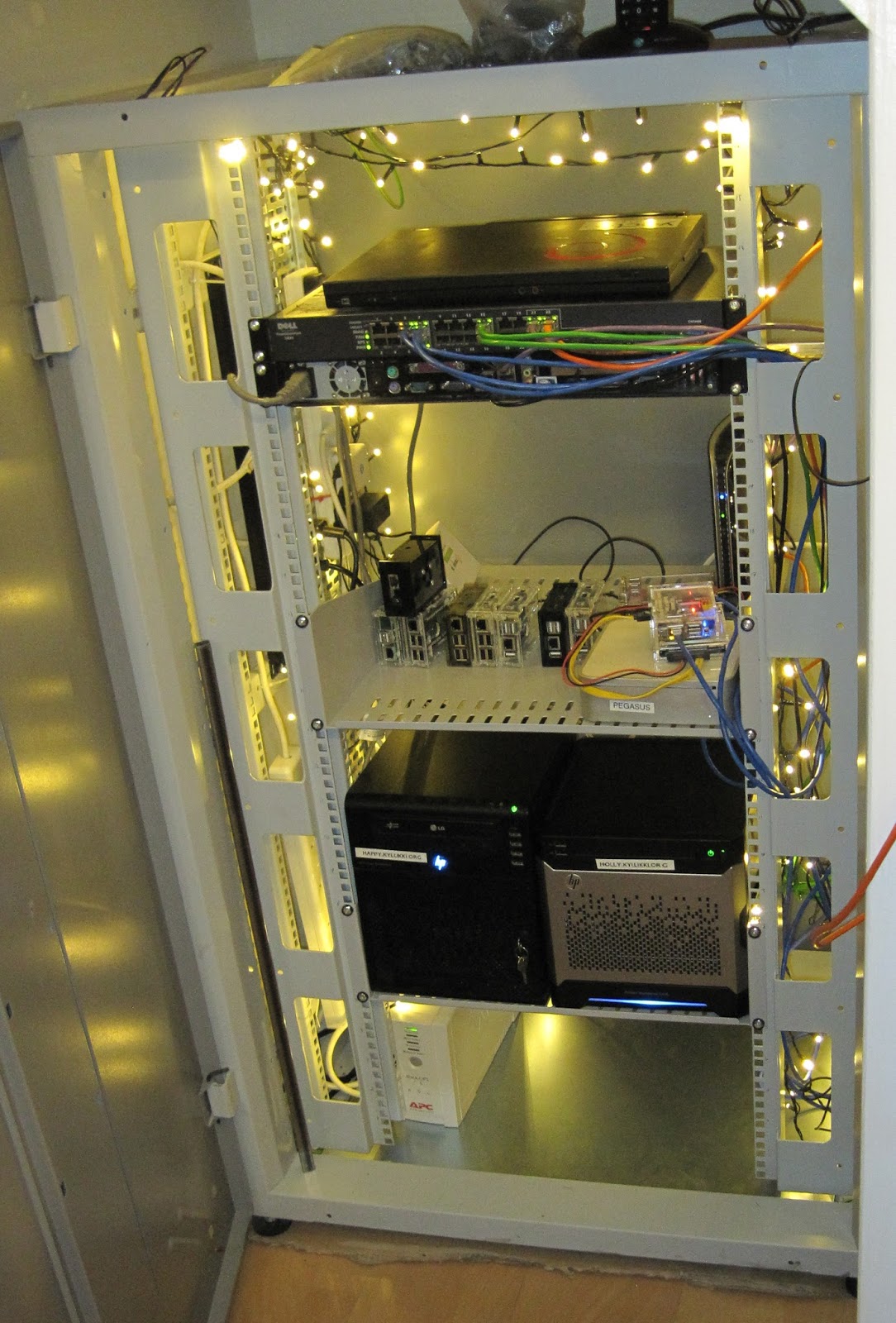
I have recently acquired a 27U high 19 inch rack in which I hope to consolidate all the computing systems in my home that do not interact well with humans.

My main issue is that modern systems are just plain noisy, often with multiple small fans whining away. I have worked to reduce this noise by using quieter components as replacements but in the end it is simply better to be able to put these systems in a box out of the way.

The rack was generously given to me by Andy Simpkins and aside from being a little dirty having been stored for some time was in excellent condition. While the proverbs "never look a gift horse in the mouth" and "beggars cannot be choosers" are very firmly at the front of my mind there were a few minor obstacles to overcome to make it fit in its new role with a very small budget.

The new home for the rack was to be a space under the stairs where, after careful measurement, I determined it would just fit. After an hour or two attempting to manoeuvre a very heavy chunk of steel into place I determined it was simply not possible while it was assembled. So I ended up disassembling and rebuilding the whole rack in a confined space.

The rack is 800mm wide IMRAK 1400 rather than the more common 600mm width which means it employs "cable reducing channels" to allow the mounting of standard width rack units. Most racks these days come with four posts in the corners to allow for longer kit to be supported front and back. This particular rack was not fitted with the rear posts and a brief call to the supplier indicated that any spares from them would be eyewateringly expensive (almost twice the cost of purchasing a new rack from a different supplier) so I had to get creative.

Shelves that did not require the rear rails were relatively straightforward and I bought two 500mm deep cantilever type from Orion (I have no affiliation with them beyond being a satisfied customer).

I took a trip to the local hardware store and purchased some angle brackets and 16mm steel square tube. From this I made support rails which means the racked kit has support to its rear rather than relying solely on being supported by its rack ears.

The next problem was the huge hole in the bottom of the rack where I was hoping to put the UPS and power switching. This hole is intended for use with raised flooring where cables enter from below, when not required it is filled in with a "bottom gland plate". Once again the correct spares for the unit were not within my budget.

Around a year ago I built several systems for open source projects from parts generously donated by Mythic Beasts (yes I did recycle servers used to build a fort). I still had some leftover casework from one of those servers so ten minutes with an angle grinder and a drill and I made myself a suitable plate.

The final problem I faced is that it is pretty dark under the stairs and while putting kit in the rack I could not see what I was doing. After some brief Googling I decided that all real rack lighting solutions were pretty expensive and not terribly effective.

At this point I was interrupted by my youngest son trying to assemble the Christmas tree and the traditional "none of the lights work" so we went off to the local supermarket to buy some bulbs. Instead we bought a 240 LED string for 10 (15usd) in the vague hope that next year they will not be broken.

I immediately had a light bulb moment and thought how a large number of efficient LED bulbs at a low price would be ideal for lighting a rack. So my rack is indeed both wired like and as a Christmas tree!

Now I just have to finish putting all the systems in there and I will be able to call the project a success.

Dirk Eddelbuettel: Rblpapi 0.3.2

The second update to the Rblpapi package (since the initial CRAN upload in August) is now available. Rblpapi connects R to the Bloomberg system, giving access to a truly vast array of time series data and custom calculations. This release brings a new subscribe() function for real-time data, written by Whit. Don't get too excited because R's single-threadedness places some limits of the usefulness of this--but it is still tremendously valuable for checking other data sources etc pp. Also included in this release are a ton of bug fixes, many contributed by Rademeyer -- see below for more details.
Changes in Rblpapi version 0.3.2 (2015-12-07)
  • A new subscribe() function supports live data subscription for a set of tickers and fields (#88).
  • In the beqs() example the correct date format is used (PR #85 by Rademeyer).
  • Both getTicks() and getBars() now check the start and end times for proper Datetime class.
  • The getBars() function now also return the value traded (request of #89).
  • An error in the documentation for bdh was corrected (PR #93 by Rademeyer closing #85).
  • The beqs() function is now more robust with respect to empty return columns (PR #100 by Rademeyer fixing ticket #99).
  • The getBars() function now uses a single (named) vector options to pass optional values to the underlying function (PR #105 updating PR #48 and fixing #47).
  • When R is built with libcurl support, it used to download the build-time library and headers; otherwise curl is used. This avoids an issue on OS X where curl is insufficient.
Courtesy of CRANberries, there is also a diffstat report for the this release. As always, more detailed information is on the Rblpapi page. Questions, comments etc should go to the issue tickets system at the GitHub repo.

This post by Dirk Eddelbuettel originated on his Thinking inside the box blog. Please report excessive re-aggregation in third-party for-profit settings.

7 December 2015

Francois Marier: Tweaking Cookies For Privacy in Firefox

Cookies are an important part of the Web since they are the primary mechanism that websites use to maintain user sessions. Unfortunately, they are also abused by surveillance marketing companies to follow you around the Web. Here are a few things you can do in Firefox to protect your privacy.

Cookie Expiry Cookies are sent from the website to your browser via a Set-Cookie HTTP header on the response. It looks like this:
HTTP/1.1 200 OK
Date: Mon, 07 Dec 2015 16:55:43 GMT
Server: Apache
Set-Cookie: SESSIONID=65576c6c64206e6f2c657920756f632061726b636465742065686320646f2165
Content-Length: 2036
Content-Type: text/html;charset=UTF-8
When your browser sees this, it saves that cookie for the given hostname and keeps it until you close the browser. Should a site want to persist their cookie for longer, they can add an Expires attribute:
Set-Cookie: SESSIONID=65576c...; expires=Tue, 06-Dec-2016 22:38:26 GMT
in which case the browser will retain the cookie until the server-provided expiry date (which could be in a few years). Of course, that's if you don't instruct your browser to do things differently.

Third-Party Cookies So far, we've only looked at first-party cookies: the ones set by the website you visit and which are typically used to synchronize your login state with the server. There is however another kind: third-party cookies. These ones are set by the third-party resources that a page loads. For example, if a page loads JavaScript from a third-party ad network, you can be pretty confident that they will set their own cookie in order to build a profile on you and serve you "better and more relevant ads".

Controlling Third-Party Cookies If you'd like to opt out of these, you have a couple of options. The first one is to turn off third-party cookies entirely by going back into the Privacy preferences and selecting "Never" next to the "Accept third-party cookies" setting (network.cookie.cookieBehavior = 1). Unfortunately, turning off third-party cookies entirely tends to break a number of sites which rely on this functionality (for example as part of their for login process). A more forgiving option is to accept third-party cookies only for sites which you have actually visited directly. For example, if you visit Facebook and login, you will get a cookie from them. Then when you visit other sites which include Facebook widgets they will not recognize you unless you allow cookies to be sent in a third-party context. To do that, choose the "From visited" option (network.cookie.cookieBehavior = 3). In addition to this setting, you can also choose to make all third-party cookies automatically expire when you close Firefox by setting the network.cookie.thirdparty.sessionOnly option to true in about:config.

Other Ways to Limit Third-Party Cookies Another way to limit undesirable third-party cookies is to tell the browser to avoid connecting to trackers in the first place. This functionality is now built into Private Browsing mode and enabled by default. To enable it outside of Private Browsing too, simply go into about:config and set privacy.trackingprotection.enabled to true. You could also install the EFF's Privacy Badger add-on which uses heuristics to detect and block trackers, unlike Firefox tracking protection which uses a blocklist of known trackers.

My Recommended Settings On my work computer I currently use the following:
network.cookie.cookieBehavior = 3
network.cookie.lifetimePolicy = 3
network.cookie.lifetime.days = 5
network.cookie.thirdparty.sessionOnly = true
privacy.trackingprotection.enabled = true
which allows me to stay logged into most sites for the whole week (no matter now often I restart Firefox Nightly) while limiting tracking and other undesirable cookies as much as possible.

5 December 2015

Gunnar Wolf: Scientific resarch and a moral stand should go hand in hand

During the last few days, I found several references to a beautiful just-published paper, which I hope everybody reads: The Moral Character of Cryptographic Work, by Phillip Rogaway; Cryptology ePrint Report 2015/1162, published on December 1st this year. It is more an academic essay than most crypto-related papers, and a long one at that (46 pages, packed with references and anecdotal notes). But it is surprisingly easy to read. I am sitting in front of my computer while my students work on their final exam, and I have got over half way through the text; earlier today I looked at the quick presentation (as this work was presented by Rogaway at the Asiacrypt 2015 as an invited talk), and just loved it. Now, I know most of the people reading my blog have a moral stand on their work (after all, I expect most of you to be committed to Free Software just as I am, and that is a tremendous political statement). We are also more a practice community than an academic/scientific one. But many of us dwell on several projects and hold more than one hats in life through which we are defined. This paper/essay is really clicking with me, and it deeply resonates with the justification I presented when I joined the Masters on Security Engineering and Information Technologies program which I'm halfway through. Computer security does not exist in a void, and does not exist just for itself. As professionals, we have a mission to fulfill in society, and that will then shape how society evolves. So, I invite everybody to at least take a casual look at this paper. I hope you enjoy it as much as I did, and I hope it changes people's hearts and career decisions.

4 December 2015

Joachim Breitner: Reproducible Builds World Summit

This week, I was attending the first Reproducible Builds World Summit in Athens. A while ago, I have fixed some reproducibility bugs in the Haskell compiler GHC (parts of #4012), and that got me a ticket to this fully sponsored and nicely organised event. This was the first event I attended that had a dedicated and professional moderator, Gunner from Aspiration, who came up with a suitable on-the-fly-schedule, ensured the time was structured by shorter plenary rounds with all ~40 attendees as well as longer working sessions in groups of usually at most 10 people, motivated people to run ( facilitate ) these working groups as well as ensured that any results were noted and collected. This definitely makes a difference to the otherwise unstructured let s all sit in a big circle and endlessly discuss things or let s all just hack on what we want to hack on right now structure of less professionally organised meetings. But after 1 days of talking, a certain desire to hack and get work done could be felt throughout the group, so most of us were happy to be allowed to make use of the laptop on Wednesday afternoon. At least as far as possible the wireless was not expecting this crowd, it seems. Besides the few patches above, my involvement in the project is rather rudimentary, so I tried to contribute as far as possible during the event itself. This was not always easy, as many of the working sessions were either self-reflecting or forward-facing: What problems do we see? What should we get done next? How do we talk to users/upstream/press/doners? Where possible, I tried to at least be helpful in the discussion. During the hacking sessions, I found it most useful to contribute to diffoscope, a program to recursively and deeply show the difference between files of any format, so there are now patches to implement a multi-file HTML output, to more efficiently include large diffs, and more importantly I assisted Lunar in making diffoscope multi-threaded. In Python this is not a very great experience; I guess I am spoiled by Haskell (as it is often the case). I enjoyed the group; a bit like DebConf but with many new faced from similarly-minded, but different projects. It was, however, again a Free Software event with an embarrassing low number of female participants. I liked discussing a proof of G del s first incompleteness theorem during a skill exchange session. Unfortunately, I had to leave very timely after the event on Thursday evening, in order to attend the Haskell in Leipzig workshop.

Lunar: Why is Jack so angry?

Last summer, Innuendo Studios made a series of 6 short videos trying to understand why would anyone get involved in a coordinated harrasment campaign. The recent articles making straw man arguments and gross mischaracterization of the actions of people trying to grow the pool of free software contributors reminded me of these videos, especially the fifth episode which describes why some people get so angry when others point out that maybe the general homogeneity of backgrounds is also related to how we treat people. Guess we can transpose one of the explanation in the video to free software communities:
Bad People do bad things; a sexist is a wife-beater or sexual assailant; I am neither; therefore I am a Good Person and the things I do are good; I work on free software where people report sexist biases; therefore they say I am a wife-beater or sexual assailant; this is a false and ridiculous claim; therefore they are bad.
This slightly helps to better understand why some people would attack efforts that don't concern them so strongly. Sadly, it doesn't help much with what we could do about it. Perhaps we can help them understand that they might be just as biased as everyone else living in an institutionally sexist and racist society. This does not make them bad people. It's just something we all need to keep in mind to improve the situation. (Also, be sure to read the follow-up post if you watch the series until the last episode.) Thanks to Nicolas Dandrimont for his comments and suggestions.

Dirk Eddelbuettel: RcppArmadillo 0.6.200.3.0

armadillo image The regular monthly upstream Armadillo update gave us the second update in the 6.* series: version 6.300.2. This was rolled into RcppArmadillo 0.6.300.2 which was once again tested against all reverse-dependencies before being sent to CRAN and Debian where the new packages arrived yesterday. Besides the changes by Conrad, this version of RcppArmadillo also contains a really nice pull request by Nathan Russell which adds input conversion support for Armadillo Cube types, templated to all common inputs, and along with proper unit tests. Thanks! Armadillo is a powerful and expressive C++ template library for linear algebra aiming towards a good balance between speed and ease of use with a syntax deliberately close to a Matlab. This release brings the following changes:
Changes in RcppArmadillo version 0.6.300.2.0 (2015-12-03)
  • Upgraded to Armadillo 6.300.2 ("Flying Spaghetti Monster")
    • expanded solve() to find approximate solutions for rank-deficient systems
    • faster handling of non-contiguous submatrix views in compound expressions
    • added .for_each() to Mat, Row, Col, Cube and field classes
    • added rcond() for estimating the reciprocal condition number
    • fixes for spsolve(), eigs_sym(), eigs_gen(), svds()
  • Added support for Cube types via as<> converters (PR #64 by Nathan Russell, fixing #63 and #42)
Courtesy of CRANberries, there is also a diffstat report for the most recent CRAN release. As always, more detailed information is on the RcppArmadillo page. Questions, comments etc should go to the rcpp-devel mailing list off the R-Forge page.

This post by Dirk Eddelbuettel originated on his Thinking inside the box blog. Please report excessive re-aggregation in third-party for-profit settings.

Dirk Eddelbuettel: RQuantLib 0.4.2: Now with intra-day times

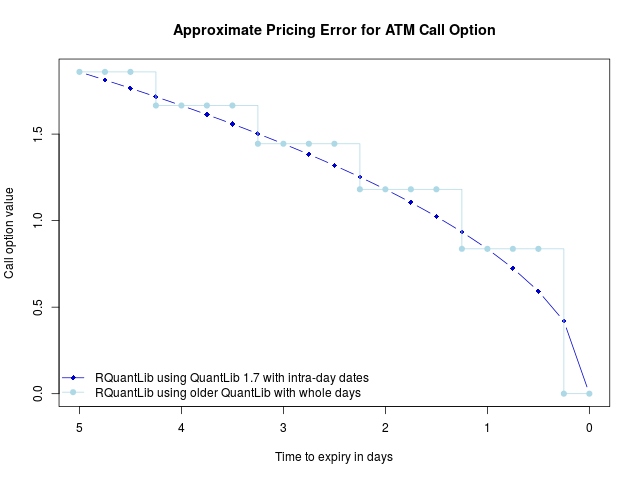
A new minor release of RQuantLib was released onto CRAN and into Debian. It takes advantages of some changes from last week's QuantLib release 1.7. 500 Rcpp packages Particularly noteworthy is the addition of support for intra-daily times in QuantLib based on work by Klaus Spanderen. If QuantLib was configured with the -enable-intraday option, we use the higher granularity of the time representation in all option pricers and implied volatility calculations. The impact of this feature is illustrated in the graph below. The graph shows the valuation of a Call option, European expiry, struck at the money with sensible short rate, dividend yield and volatility. We vary the time to expiry from five days to zero in steps of a quarter day. In darker blue is the correct valuation declining in parabolic shape. In lighter blue is what we get with QuantLib up to release 1.6, or newer releases configured without intra-day time support: an ugly step function that is off, and increasingly so we approach the expiration. Which leads to an appeal: a volunteer is needed to update the QuantLib 1.7 build for Windows. Jeroen tried, but ran into a snag and out of time. If you can help, please get in touch to Jeroen and myself. We suspect that the largest part of RQuantLib users relies on the prebuilt binaries from CRAN, and it would nice to have these updated to the current version of QuantLib. The full changes are detailed below.
Changes in RQuantLib version 0.4.2 (2015-12-03)
  • Changes in RQuantLib code:
    • Intra-day times are now available if QuantLib 1.7 or later is used, and has been configured with --enable-intraday
    • New helper functions getQuantLibVersion() and getQuantLibCapabilties()
    • New package startup code detects and warns about outdated QuantLib versions, or missing intra-day capability, unless not interactive.
    • The missing Monthly parameter has been added to matchFrequency (fixing issue ticket #19)
Courtesy of CRANberries, there is also a diffstat report for the this release. As always, more detailed information is on the RQuantLib page. Questions, comments etc should go to the rquantlib-devel mailing list off the R-Forge page. Issue tickets can be filed at the GitHub repo.

This post by Dirk Eddelbuettel originated on his Thinking inside the box blog. Please report excessive re-aggregation in third-party for-profit settings.

3 December 2015

Arturo Borrero Gonz lez: current status of HA stack on Debian


Let's analyse the current status of the HA (high availability) stack on Debian.

For me, the two most important packages are corosync and pacemaker.
It is widely known that Debian jessie was released without these two packages in shape.

But, why?
Problem 1One of the main problems was with the relationship between pacemaker and libqb.
In short, a libqb issue prevented pacemaker to be built for Debian jessie. And that wasn't fixed in time for the Debian jessie stable release.
You can read the Debian bug #768618 [pacemaker: FTBFS in jessie: build-dependency not installable: libqb-dev (>= 0.16.0.real)] to know a bit more about the issue.
Problem 2
While at it, the corosync package was in very bad shape.
To get an idea of what I mean for bad shape, just look at the size of the changelog of the first try to fix the package, almost 90 lines long.
Problem 3
Perhaps the most important problem: the Debian team behind the HA stack seems inactive.

This was sent by one of the members, 19 Jan 2015:
[...]
I wonder if there are any active members of the Debian linux-ha team.
[...]

So, there is clearly lack of manpower, lack of interest in maintaining the stack.
I'm sure the first 2 problems could have been resolved in time if the Debian team were active.
It's Debian! How is this possible!?I have asked that myself several times. Debian is a community and collaborative project. This means that the quality of the product (the OS itself) is directly related to the amount of effort spent on it (by people that in most cases aren't being paid for the task).
I believe that in such specific pieces of software, we require a bit more push from companies which are using it for their own benefit as well.

Also, perhaps the Debian QA team may step in and do something about the situation, let's say simply distributing a big REQUEST FOR HELP alert in all official Debian channels.
So, what if I need to run now corosync+pacemaker in Debian?
I'm sorry, you should stick to Debian wheezy :-(

Fortunately, the versions shipped in Debian wheezy are fine. Unfortunately, Debian wheezy contains lots of old software (such as the kernel).
What should I expect for Debian stretch?
Well, some good news: corosync and libqb have been already fixed and they look good.
The pacemaker package is still lacking the needed updates, but there are some people [slowly] working on it.
I myself have contributed a bit: tested some related packages, opened some bugs, and so on. See #801853 and #801870 for instance.

Note that the development status is not easy to follow. Among other things, the 'official' git packaging repos aren't being used.

From the user/sysadmin point of view, any important news will be reflected in the Debian package trackers. Here are links to both:
(BTW the new Debian tracker: what a nice tool)
I want to contribute!By now, I recommend you to head to the Debian IRC channel #debian-ha

Dirk Eddelbuettel: RcppCCTZ 0.0.2 -- now with Solaris support

Following on yesterday's announcement of RcppCCTZ, what is the only thing better than another date, time, or timezones library package? One that works on Solaris too :) Bradley White from CCTZ upstream spotted the failed compilation on the machine in Oxford and suggested a quick fix. Jeroen quickly tested what I had put into a branch, and there we have it: version 0.0.2 which now builds everywhere. Changes (for both releases) are summarized here:
Changes in version 0.0.2 (2015-12-02)
  • Additional #ifdef statements suggested by Bradley White in CCTZ ticket #5 permitting compilation on Solaris with thanks to Jeroen for testing our branch.
Changes in version 0.0.1 (2015-12-01)
  • Initial CRAN upload.
  • Package is functional and provides examples.
We now also have a diff to the previous version thanks to CRANberries. More details, issue tickets etc at the GitHub repository.

This post by Dirk Eddelbuettel originated on his Thinking inside the box blog. Please report excessive re-aggregation in third-party for-profit settings.

2 December 2015

Colin Watson: SSH SHA-2 support in Twisted

Launchpad operates a few SSH endpoints: bazaar.launchpad.net and git.launchpad.net for code hosting, and upload.ubuntu.com and ppa.launchpad.net for uploading packages. None of these are straightforward OpenSSH servers, because they don t give ordinary shell access and they authenticate against users SSH keys recorded in Launchpad; both of these are much easier to do with SSH server code that we can use in library form as part of another service. We use Twisted for several other tasks where we need event-based networking code, and its conch package is a good fit for this. Of course, this means that it s important that conch keeps up to date with the cryptographic state of the art in other SSH implementations, and this hasn t always been the case. OpenSSH 7.0 dropped support for some old algorithms, including disabling the 1024-bit diffie-hellman-group1-sha1 key exchange method at run-time. Unfortunately, this also happened to be the only key exchange method that Launchpad s SSH endpoints supported (conch supported the slightly better diffie-hellman-group-exchange-sha1 method as well, but that was disabled in Launchpad due to a missing piece of configuration). SHA-2 support was clearly called for, and the fact that we had to get this sorted out in conch first meant that everything took a bit longer than we d hoped. In Twisted 15.5, we contributed support for several conch improvements: Between them and with some adjustments to the lazr.sshserver package we use to glue all this together to add support for DH group exchange, these are enough to allow us not to rely on SHA-1 at all, and these improvements have now been rolled out to all four endpoints listed above. I ve thus also uploaded OpenSSH 7.1 packages to Debian unstable. If you also run a Twisted-based SSH server, upgrade it now! Otherwise it will be harder for users of recent OpenSSH client versions to use your server, and for good reason.

Andrea Veri: Three years and counting

It s been a while since my last what s been happening behind the scenes e-mail so I m here to report on what has been happening within the GNOME Infrastructure, its future plans and my personal sensations about a challenge that started around three (3) years ago when Sriram Ramkrishna and Jeff Schroeder proposed my name as a possible candidate for coordinating the team that runs the systems behind the GNOME Project. All this followed by the official hiring achieved by Karen Sandler back in February 2013. The GNOME Infrastructure has finally reached stability both in terms of reliability and uptime, we didn t have any service disruption this and the past year and services have been running smoothly as they were expected to in a project like the one we are managing. As many of you know service disruptions and a total lack of maintenance were very common before I joined back in 2013, I m so glad the situation has dramatically changed and developers, users, passionates are now able to reach our websites, code repositories, build machines without experiencing slowness, downtimes or
unreachability. Additionally all these groups of people now have a reference point they can contact in case they need help when coping with the infrastructure they daily use. The ticketing system allows users to get in touch with the members of the Sysadmin Team and receive support right away within a very short period of time (Also thanks to Pagerduty, service the Foundation is kindly sponsoring) Before moving ahead to the future plans I d like to provide you a summary of what has been done during these roughly three years so you can get an idea of why I define the changes that happened to the infrastructure a complete revamp:
  1. Recycled several ancient machines migrating services off of them while consolidating them by placing all their configuration on our central configuration management platform ran by Puppet. This includes a grand total of 7 machines that were replaced by new hardware and extended warranties the Foundation kindly sponsored.
  2. We strenghten our websites security by introducing SSL certificates everywhere and recently replacing them with SHA2 certificates.
  3. We introduced several services such as Owncloud, the Commits Bot, the Pastebin, the Etherpad, Jabber, the GNOME Github mirror.
  4. We restructured the way we backup our machines also thanks to the Fedora Project sponsoring the disk space on their backup facility. The way we were used to handle backups drastically changed from early years where a magnetic tape facility was in charge of all the burden of archiving our data to today where a NetApp is used together with rdiff-backup.
  5. We upgraded Bugzilla to the latest release, a huge thanks goes to Krzesimir Nowak who kindly helped us building the migration tools.
  6. We introduced the GNOME Apprentice program open-sourcing our internal Puppet repository and cleansing it (shallow clones FTW!) from any sensitive information which now lives on a different repository with restricted access.
  7. We retired Mango and our OpenLDAP instance in favor of FreeIPA which allows users to modify their account information on their own without waiting for the Accounts Team to process the change.
  8. We documented how our internal tools are customized to play together making it easy for future Sysadmin Team members to learn how the infrastructure works and supersede existing members in case they aren t able to keep up their position anymore.
  9. We started providing hosting to the GIMP and GTK projects which now completely rely on the GNOME Infrastructure. (DNS, email, websites and other services infrastructure hosting)
  10. We started providing hosting not only to the GIMP and GTK projects but to localized communities as well such as GNOME Hispano and GNOME Greece
  11. We configured proper monitoring for all the hosted services thanks to Nagios and Check-MK
  12. We migrated the IRC network to a newer ircd with proper IRC services (Nickserv, Chanserv) in place.
  13. We made sure each machine had a configured management (mgmt) and KVM interface for direct remote access to the bare metal machine itself, its hardware status and all the operations related to it. (hard reset, reboot, shutdown etc.)
  14. We upgraded MoinMoin to the latest release and made a substantial cleanup of old accounts, pages marked as spam and trashed pages.
  15. We deployed DNSSEC for several domains we manage including gnome.org, guadec.es, gnomehispano.es, guadec.org, gtk.org and gimp.org
  16. We introduced an account de-activation policy which comes into play when a contributor not committing to any of the hosted repositories at git.gnome.org since two years is caught by the script. The account in question is marked as inactive and the gnomecvs (from the old cvs days) and ftpadmin groups are removed.
  17. We planned mass reboots of all the machines roughly every month for properly applying security and kernel updates.
  18. We introduced Mirrorbrain (MB), the mirroring service serving GNOME and related modules tarballs and software all over the world. Before introducing MB GNOME had several mirrors located in all the main continents and at the same time a very low amount of users making good use of them. Many organizations and companies behind these mirrors decided to not host GNOME sources anymore as the statistics of usage were very poor and preferred providing the same service to projects that really had a demand for these resources. MB solved all this allowing a proper redirect to the closest mirror (through mod_geoip) and making sure the sources checksum matched across all the mirrors and against the original tarball uploaded by a GNOME maintainer and hosted at master.gnome.org.
I can keep the list going for dozens of other accomplished tasks but I m sure many of you are now more interested in what the future plans actually are in terms of where the GNOME Infrastructure should be in the next couple of years. One of the main topics we ve been discussing will be migrating our Git infrastructure away from cgit (which is mainly serving as a code browsing tool) to a more complete platform that is surely going to include a code review tool of some sort. (Gerrit, Gitlab, Phabricator) Another topic would be migrating our mailing lists to Mailman 3 / Hyperkitty. This also means we definitely need a staging infrastructure in place for testing these kind of transitions ideally bound to a separate Puppet / Ansible repository or branch. Having a different repository for testing purposes will also mean helping apprentices to test their changes directly on a live system and not on their personal computer which might be running a different OS / set of tools than the ones we run on the GNOME Infrastructure. What I also aim would be seeing GNOME Accounts being the only authentication resource in use within the whole GNOME Infrastructure. That means one should be able to login to a specific service with the same username / password in use on the other hosted services. That s been on my todo list for a while already and it s probably time to push it forward together with Patrick Uiterwijk, responsible of Ipsilon s development at Red Hat and GNOME Sysadmin. While these are the top priority items we are soon receiving new hardware (plus extended warranty renewals for two out of the three machines that had their warranty renewed a while back) and migrating some of the VMs off from the current set of machines to the new boxes is definitely another task I d be willing to look at in the next couple of months (one machine (ns-master.gnome.org) is being decommissioned giving me a chance to migrate away from BIND into NSD). The GNOME Infrastructure is evolving and it s crucial to have someone maintaining it. On this side I m bringing to your attention the fact the assigned Sysadmin funds are running out as reported on the Board minutes from the 27th of October. On this side Jeff Fortin started looking for possible sponsors and came up with the idea of making a brochure with a set of accomplished tasks that couldn t have been possible without the Sysadmin fundraising campaign launched by Stormy Peters back in June 2010 being a success. The Board is well aware of the importance of having someone looking at the infrastructure that runs the GNOME Project and is making sure the brochure will be properly reviewed and published. And now some stats taken from the Puppet Git Repository:
$ cd /git/GNOME/puppet && git shortlog -ns
3520 Andrea Veri
506 Olav Vitters
338 Owen W. Taylor
239 Patrick Uiterwijk
112 Jeff Schroeder
71 Christer Edwards
4 Daniel Mustieles
4 Matanya Moses
3 Tobias Mueller
2 John Carr
2 Ray Wang
1 Daniel Mustieles Garc a
1 Peter Baumgarten
and from the Request Tracker database (52388 being my assigned ID):
mysql> select count(*) from Tickets where LastUpdatedBy = '52388';
+----------+
  count(*)  
+----------+
  3613  
+----------+
1 row in set (0.01 sec)
mysql> select count(*) from Tickets where LastUpdatedBy = '52388' and Status = 'Resolved';
+----------+
  count(*)  
+----------+
  1596  
+----------+
1 row in set (0.03 sec)
It s been a long run which made me proud, for the things I learnt, for the tasks I ve been able to accomplish, for the great support the GNOME community gave me all the time and most of all for the same fact of being part of the team responsible of the systems hosting the GNOME Project. Thank you GNOME community for your continued and never ending backing, we daily work to improve how the services we host are delivered to you and the support we receive back is fundamental for our passion and enthusiasm to remain high!

Next.

Previous.