Search Results: "bod"

29 December 2012

Russ Allbery: Review: Dragonhaven

Review: Dragonhaven, by Robin McKinley
Publisher: Ace
Copyright: September 2007
Printing: October 2008
ISBN: 0-441-01643-X
Format: Mass market
Pages: 338
With a title like Dragonhaven from a well-established fantasy author like Robin McKinley, one's first expectations are probably some variety of medieval fantasy, perhaps with a boy or girl who encounters a rare dragon and befriends them. To some extent, those expectations are right: there is a boy, a rare dragon, and a friendship. But they're mostly wrong. Dragonhaven could easily pass for science fiction if one allowed a bit of handwaving, and the setting is contemporary. Jake is the first-person narrator and the center of this story. He lives with his father and a small group of park rangers and other scientists at Smokehill National Park, one of the few remaining reserves for dragons in the world. McKinley's world is much like ours, with the same politics and governments, except that dragons exist: huge, flying dragons that breathe fire. But they've been hunted to near-extinction, including via an actual war in Australia, and are now dwindling in a small handful of isolated reserves. No one is entirely sure how many are left since, for huge creatures, they're remarkably hard to find and document. The Smokehill staff mostly estimate them from prey kills and other indirect signs. This book is Jake's telling of his story, and McKinley goes to quite a bit of effort to find the right tone for a teenage boy. It's more verbal than written in style, with lots of capital letters, italics, tangents, digressions, and short sentences. He's also trying to tell the story in order without skipping ahead but sometimes failing, which turns into a mechanism to do foreshadowing as he slips in comments or mentions things he wasn't aware of at the time. The voice McKinley constructs is very strong and makes this book read unlike any other books of hers I've read. How much you enjoy the book will probably depend heavily on your opinion of Jake's storytelling style. The story proper starts when Jake, on his first overnight trip in the park, encounters a dying dragon and a dead poacher. This is a catastrophe for the park: the dead poacher will provide ammunition for everyone who thinks dragons are too dangerous and should be wiped out. But for Jake, it's a more immediately life-changing event. The dragon was a mother with newborn infants, one of whom has survived and who promptly bonds with Jake. This may sound like it's moving back into traditional fantasy territory, but it's not. Jake's relationship with Lois (the name he gives the baby dragon) is very unlike fantasy bonds with baby hatchlings and quite a bit like taking care of an actual infant. Except the infant is hot enough to burn the skin. And wants to be in a pouch (McKinley's dragons are marsupial, sort of) and therefore needs to crawl inside Jake's clothing and press against skin. And that's not mentioning the smell. Or the excretions. The vast majority of the book is concerned with Jake raising Lois, so you'd better be prepared for lots of description of this. Thankfully, Jake is not the sort to describe in gruesome detail (at least most of the time), and some of the description is quite funny. I was particularly fond of his account of the Smell being so intense and overwhelming that it became a third person in the room. But still, it is a lot of pages of, essentially, child-rearing, and I got tired of it before it was over. Also frustrating is that Jake obviously has never read any science fiction or fantasy. He doesn't even guess at certain aspects of the situation that are immediately obvious to any experienced SFF reader early on. One of those reveals is dragged out until nearly the end of the book. (I'll refrain from spoiling it, but I'll be very surprised if any regular reader of my reviews takes long to pick up on it.) McKinley does a good job with that part of the plot when Jake finally figures out what's going on, but it was still exasperating to have it take so long. Dragonhaven is already somewhat slow-paced due its detailed descriptions of Lois's rearing, and adding an obvious plot element that the protagonist is too dense to figure out makes the pace feel even slower. About a third of the way into this book, I didn't care for it. It was sort of gross, Lois wasn't very interesting, Jake was more frustrating than entertaining, and nothing was happening. But then it started to win me over, and the last part of the book wasn't bad at all. McKinley's best talent is her ability to mix the fantastic with the quotidian and give them equal weight and importance, to embed the reader so thoroughly with the character that one thinks about all the day-to-day impact of fantastic events that is normally skimmed over in books of this type. If you get engrossed in that angle of Jake and Lois's story, Dragonhaven can be quite enjoyable. When you're waiting for the plot to advance, it's a bit painful. Probably the best thing to do with this book, if you can, is read the first chapter or so and see what you think of Jake's voice. If you enjoy reading it, that's probably a good sign for the rest of the book. I do like McKinley's dragons: she avoids the traps of both making them too human and making them too much like animals, and manages to give Lois (once she's a bit older) a sort of intelligence that's inhuman but still canny and clearly sharper than a dog's. You'll likely get tired, as I did, of Jake's omnipresent headache and Lois's endless upbringing, but there is a payoff in the end. Rating: 7 out of 10

28 December 2012

Richard Hartmann: Release Critical Bug report for Week 52

The UDD bugs interface currently knows about the following release critical bugs: How do we compare to the squeeze cycle ?
Week Squeeze Wheezy Diff
43 284 (213+71) 468 (332+136) +184 (+119/+65)
44 261 (201+60) 408 (265+143) +147 (+64/+83)
45 261 (205+56) 425 (291+134) +164 (+86/+78)
46 271 (200+71) 401 (258+143) +130 (+58/+72)
47 283 (209+74) 366 (221+145) +83 (+12/+71)
48 256 (177+79) 378 (230+148) +122 (+53/+69)
49 256 (180+76) 360 (216+155) +104 (+36/+79)
50 204 (148+56) 339 (195+144) +135 (+47/+90)
51 178 (124+54) 323 (190+133) +145 (+66/+79)
52 115 (78+37) 289 (190+99) +174 (+112/+62)
1 93 (60+33)
2 82 (46+36)
3 25 (15+10)
4 14 (8+6)
5 2 (0+2)
6 release!
Graphical overview of bug stats thanks to azhag:

Russ Allbery: Review: Perl Best Practices

Review: Perl Best Practices, by Damian Conway
Publisher: O'Reilly
Copyright: July 2005
Printing: April 2011
ISBN: 0-596-00173-8
Format: Trade paperback
Pages: 492
I had a rather bad first reaction to this book or, rather, the existence of this book. Some time ago, I started hearing about a new program named perlcritic that served as a lint program for Perl and decided to give it a try. I was taken aback by the flood of diagnostics, but even more taken aback by the fact that most of them were apparently explained only by a reference to a book that I didn't own. It struck me wrong in an open source project and gave me a negative reaction towards the book, which lingered for years. That was exacerbated by discovering that it recommended using use English in some circumstances, something that I consider to be a horrible idea. So, when a coworker recommended it and suggested I really should read it, I was dubious. I'm glad I gave it a chance, since it turns out that nearly all of my objections were based on misunderstandings or false information. (Well, except for the use English part, but more on that in a moment.) Perl Best Practices does provide a lot of advice, explaining that flood of diagnostics, but perlcritic also warns about the same thing repeatedly, inflating a handful of issues into a lot of messages. Most of the recommendations in Perl Best Practices were things I was doing already; most of the rest are entirely sensible. Also, perlcritic does come with complete explanations of its diagnostics once you know where they're hidden (the perldoc of Perl::Critic::Policy modules whose names you can get at by insisting perlcritic divulge them). And, even more delightfully, once I got past my objections, I discovered that Perl Best Practices is one of the best books on coding style that I've read. Coding style is a notoriously difficult subject, since nearly everyone is convinced their personal style is the best (or at least that they don't want to change). Conway acknowledges that up-front, and acknowledges that some things are just arbitrary and consistency with any rule set is better than following some specific rule set. He then spends surprisingly little time on the sorts of things that dominate most coding style discussions (indentation, spacing, commenting, etc.). Instead, this is primarily a book about how to write efficient and transparent Perl code, one that focuses much more on the content and structure of that code than on how it is indented. The best part is that there are no undefended rules here. Perl Best Practices contains 256 separate guidelines, some quite general ("Provide an optimal interface, rather than a minimal one") and some quite specific ("Pass constructor arguments as labeled values, using a hash reference"), but every one of them has a supporting argument and specific reasons behind it. Conway backs up every recommendation with code samples and practical scenarios showing the pluses and minuses of different approaches. This is a book unconcerned with being an authority; rather, it reads like optional advice from a good mentor, complete with insightful discussions on each point raised. You may come away from it disagreeing with Conway's specific recommendation (and I did, in several places), but you'll almost certainly be better-informed about the problem for having read it. Plus, this book is just fun to read. Admittedly, I love this sort of thing; I spend lots of time thinking about coding style in any language, and a lot more time refactoring coding style when working on my own projects to try to achieve clarity and simplicity. But even without sharing my love of the material, I think this book will be a delight for any practicing Perl programmer who hasn't yet read it. Conway clearly has a wealth of experience and years in the trenches of working with other people's Perl code. The examples he draws on are brief, comprehensible, and illuminating. He also gave me a tour of a variety of helper modules and libraries that I didn't know existed. List::Util is the most prominant example; this incredibly helpful supply of list manipulation functions that I've always half-known I wanted but never bothered to write is now part of Perl core (as of 5.7.3), so there's no reason to avoid it. You too can stop using grep when you actually mean first, or rewriting max in ad hoc ways. That does raise two of the rare flaws in this book, though. One is that I disagree (partially) with Conway's willingness to recommend non-core modules. He is a particular champion of the Readonly module over either normal file global variables or use constant, for very good reasons. But making Readonly a prerequisite for all other Perl code that one releases seems a bit annoying (speaking as someone who used to maintain local Perl installations). Maybe this isn't as big of a deal in these days of ubiquitous Linux distributions and willingness to use the CPAN shell, but I still dislike releasing code that depends on a half-dozen (or more) other CPAN modules for reasons of coding convenience and minor readability rather than core functionality. (His advocacy of Sub::Install raised similar objections.) The second flaw is not something Conway could have done anything about: this book is from 2005, and it's now 2012. Now, the Perl ecosystem is now quite mature, so that hampers the book much less than it would a corresponding book about Ruby or even Python. I also aim for compatibility with the oldest thing out there I know someone is still running, so I'm still hesitant to require anything newer than Perl 5.8. But still, this book was written seven years ago, and Perl is now at 5.14. In the meantime, we've seen core language features like given/when added, the addition of state variables, the need for substantial reworking of how Unicode I/O is handled, the addition of the new // operator, and the new package syntax, among many other things. The Perl taught here is a bit dated, and I would love to hear Conway's opinion about when (or if) to use say. Maybe someday we'll get a second edition. There are two other points that I do have to argue with. One is that Conway does advocate, in a limited way, use English. I could almost go along with his recommendation to use it only for those variables that one has to look up, except that in nearly every case there are other options and one can take the much better approach of simply not using those variables at all. But he then writes the remaining examples in the book using $EVAL_ERROR rather than $@, and I'm sorry, but no. One could not construct a more frustrating annoyance for an experienced Perl programmer than sending them on a futile hunt for where the global variable $EVAL_ERROR is defined. One can debate the merits of Larry Wall's original decision to use variables like $_, @_, $?, $!, and $?, but for better or ill this is Perl, and marginal readability gains for inexperienced programmers do not warrant confusing experienced programmers. This is particularly true when the use English variables are completely indistinguishable from normal global variables, and not infrequently look like a global variable that a programmer might choose. The second is more of an amusement that a real disagreement. Conway rightfully points out that Perl OO, and particularly the way that Perl stores object instance data, is awkward, and none of the commonly-used techniques are particularly satisfying. He then introduces a completely new way of doing instance data that, while having some advantages, has a very strange syntax and is utterly unlike how any OO code one finds in the wild is written. While the discussion of the problem that he's trying to solve is still interesting, I think the solutions he proposes will be more of a curiosity than a style that most programmers will adopt. But, those disagreements aside, I thoroughly enjoyed this book. I found it so engrossing that I kept reading it straight through a long train ride rather than switching to fiction halfway, like I do with most programming books. I've since recommended it to several other coworkers, and we're in the process of revising our internal Perl coding style based heavily on it. It's the sort of book that I expect to re-read several times to refresh my memory of Conway's analysis. If you've been avoiding this one due to misconceptions like I had, or because you think it might be too dry, or even just because you're afraid it's outdated, I strongly recommend it. If you're worried about the price of a printed (or electronic) book on this topic and you do Perl programming as part of your job, see if your employer will buy you a copy as training. It's worth it. I've been writing Perl professionally for more than fifteen years, and I learned a ton from this book. (And if it inspires you to change your coding style, take a look at perlcritic. It requires some configuration, and getting started is quite frustrating, but it reliably detects a surprisingly high percentage of the issues discussed here and can help a great deal in making the coding style shift stick until you can build new habits.) Rating: 9 out of 10

27 December 2012

Tanguy Ortolo: Tiling window managers

Floating and tiling window managers In the X Window System, the window manager is that piece of software that places your windows and allows you to move them, resize them, hide them, etc. If your windows have titles on top of them, with buttons to close them or reduce them, it is thanks to the window manager. There are two major types of window managers:
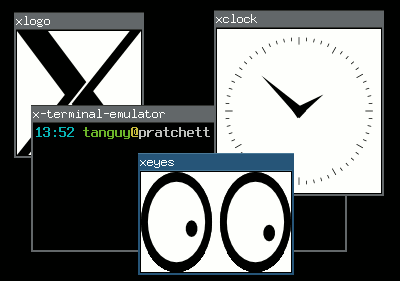
Floating window managers
They are the most usual window managers, that allow you to place an size your windows freely on the screen, in a way where they are independent of each other, possibly overlapping, just as you would be able to place sheets of paper on your desk.
Tiling window managers
They are a more elitist type of window manager, that adjust the size and position of the windows so there is no overlapping and no space lost between windows, thus tiling the screen.
Four computer windows managed in floating mode

Floating window management

Four computer windows managed in tiling mode

Tiling window management

The frontier between these two types is not very tight, because some floating window managers have limited tiling features, and almost all the tiling window manager have floating modes for programs that are not adapted to tiling. For what it is worth, here is a report on my experience with three tiling window managers. Perhaps it may help people that are still hesitating to switch to tiling window management?Using tiling window managers Five years ago I switched to tiling window management, feeling that managing windows was the window manager's job (a quote from larswm). At that time, I started using wmii, then switched to awesome, and now I am trying i3.
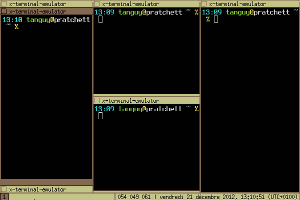
Screenshot of the wmii window manager

wmii: three columns, first one stacked ()

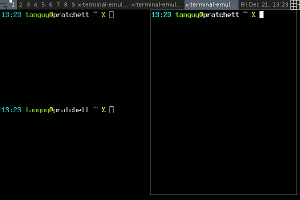
Screenshot of the awesome window manager

awesome: fair layout

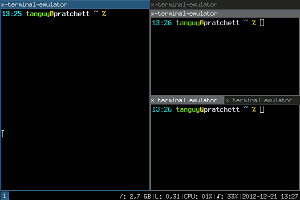
screenshot of the i3 window manager

i3: three containers, second one stacked, third one tabbed

For people in a hurry, here is a comparative table:
wmii awesome i3
Configuration Shell script Lua script config file
Scriptability any language, 9P-based Lua, API-based any language, socket-based
Layout simple, column-based automatic layout-based flexible, manual tiling-based
Multi-monitor sucks OK OK
Modern stuff XCB, Xft, notification area, dock windows XCB, Xft, notification area
Special features
  • tag-based workspace system
  • XDG convention to locate the config file
  • real framework for customization
  • powerful status bar
wmii wmii is a rather minimalist window manager which used to be part of the suckless project, but is now hosted at Google Code and seems to have lost all its documentation during the move (why is it that all the software I have seen hosted at Google Code or worst, at Launchpad, have almost not documentation, and never, ever a single screenshot?). It uses a column-based layout: you place windows in a number of columns, and for each column you can choose either vertical split, stacking or full column mode. This system is very simple to control flexible enough for most situations, but it does not allow for arbitrary tiling. It is fully scriptable in any language, in an interesting way: it exposes all its functions on a 9P virtual filesystem. In fact, wmii itself only implements window management functions, and all the user interaction logic takes place in a distinct script which calls that functions using that 9P filesystem. wmii comes with a default script, written in shell, which makes it a bit hard to extend, and slow if you start calling external programs such as grep, sed and co. You can script it in any language you like however, and there are some already made implementations in Ruby and Python IIRC. A special feature of wmii is that its workspaces are in fact tags, and that you can tag a window so that it will appear in several ones. While this is interesting, in practice I did not find much use for that feature. It is explicitly minimalist, and the developers used to impose themselves a limit on its numbers of lines of codes (not sure if this is still true with the switch to Google Code). While I was using it, it had no notification area, no support for Xft fonts and it sucked with multiple monitors, which is the reason I switched to awesome. awesome awesome is a very flexible window manager that provides advanced automatic layouts. It has become quite popular, and it has a very well documented wiki. It is not officially a tiling window manager but a framework window manager, and to emphasize on that it start in floating mode by default. I think most people use it in tiling mode however. It uses automatic layouts, that place your windows according to rules, for instance the fair layout, which tiles in columns and rows so that each window occupies a similar space. Thanks to that automation, this system is very easy to control and to get used to, and although it certainly does not allow arbitrary tiling, you can cycle between several available layouts which are suitable for most situations (most of them are entirely automatic, but some have parameters you can modify, such as the number and width of columns), and if you miss one, I think you can even code your own. It is fully scriptable using the Lua language. In fact, just as wmii, the user interaction logic is defined in the configuration file, which allows efficient customization. The Lua API is fully documented, and there is a series of useful libraries to extend the basic configuration in any way you like, which is why awesome calls itself a framework window manager . It is not designed to be minimalist, and it implements some modern stuff, such as using XCB rather than Xlib, a notification area, and specific support for dock or utility-type windows such as GIMP's tools. i3 i3 is a window manager inspired by wmii, although they do not have much in common in my opinion. for what I have seen, I think it would be closer the defunct Ion. It uses a layout based on manual splitting: as you open windows you can choose to split an existing window either vertically or horizontally, leading to arbitrarily complex layouts. In addition to that you can tab or stack windows in containers instead of splitting them. This system is very flexible but it requires more user intervention. In its standard mode of operation, i3 is simply configured in a regular way, which allows to customize the user interaction but not to script it in an arbitrary way. It offers an IPC system that can be used for that however, by the mean of a Unix socket, so it can actually be scripted in any language too if needed, although this possibility is probably not as popular and easy as with wmii and awesome. It implements modern features such as XCB, a notification area and a powerful status bar that uses the standard output of a dedicated program that is easy to replace by your own if you need.

Russ Allbery: Review: Science Fiction: The 101 Best Novels: 1985 2010

Review: Science Fiction: The 101 Best Novels: 1985 2010, by Damien Broderick & Paul Di Filippo
Publisher: Nonstop
Copyright: 2012
ISBN: 1-933065-39-7
Format: Trade paperback
Pages: 288
I like book reviews and lists of best novels, as a follower of my reviews probably noticed, so I couldn't resist when this collection made my radar. A follow-up to the earlier Science Fiction: The 101 Best Novels: 1949 1985 by David Pringle (which I have not read), it is a collection of short (two to three pages, generally) reviews of 101 recent SF novels. The date spread is fairly balanced: at least two novels from each year under consideration are featured, and no year gets more than seven or eight. The authors also clearly tried to cover the range of what falls under the science fiction genre, from alternate history through space opera and including novels normally marketed as mainstream, so the result should contain something to everyone's taste. With those characteristics, you may suspect that the "best" part of the title is a bit questionable, and you would be right. "101 of the better novels" would be a more accurate description. While most Hugo and Nebula winners are included here, the section is at times eclectic. But it's eclectic in the spirit of broad inclusiveness: Jumper, Temeraire, or The Hunger Games would normally not be included on this sort of list because they're too popular or "light," but they're here alongside more obscure books (at least for SF readers) like Galatea 2.2, Distance Haze, or My Dirty Little Book of Stolen Time. I doubt anyone will seriously argue that this selection should have replaced the Hugo or Nebula short lists, but one doesn't read review collections like this only to hear about books one already knows about. Those books one has either already read or already chosen not to read. The wide-ranging selection makes it likely that something here will be new to most readers. The authors, Damien Broderick and Paul Di Filippo, are known reviewers in the SF world, and I've read reviews from both of them before. I bought this book largely on the strength of Broderick's name, since I've usually enjoyed his contributions to The New York Review of Science Fiction. Paul Di Filippo was more of a gamble; he's one of the regular reviewers for Asimov's Science Fiction and not one of my favorites. But what I usually disliked about his columns was their focus on obscure small-press titles, graphic novels, and slipstream, so I was hoping that an SF review collection aiming towards the genre mainstream would be more to my taste. The result is mixed. There are things about this selection, and about the reviews, that I enjoyed, and there are other things I found quite annoying. First, the selection. I could (and will in a moment) talk about good and bad selections, but I also have a good statistical metric for at least the alignment of the authors' taste with mine. Of the 107 novels reviewed here (in several case, duologies and trilogies are given single entries), I've read 39, or a little over a third. (Note that I've read every Nebula or Hugo winner in that time period and most of the Hugo nominees, so that will give you a good feel for how broad-ranging this selection is, and how far afield of the normal award slates it goes.) My average rating for those 39 books was 7.49 (including four perfect 10s). By comparison, my average rating for Hugo winners is 6.68 and for Nebula winners is 7.10. There was one 4 (The White Queen) and one 5 (Red Mars), and in both cases I can see why they're here. Of the rest of the books I read I rated them all at least at 6 out of 10. At least among the books I've read, this seems to be a solid selection. Sometimes the details of those selections are odd, though. For example, the authors make an effort to limit the number of selections for each author, a wise choice since they're clearly going by diversity. But if one is operating within that limitation, choosing Ammonite over Slow River for Nicola Griffith, or particularly Ventus over Lady of Mazes or even Permanence for Karl Schroeder, is baffling. There were several similar places where I thought the selection for an author was obscure, minor, or just missed obvious alternatives. Perhaps this was to fill in one of the other breadth criteria, such as balancing number of novels per year or attempting to cover each subgenre. Also, if one is going to divide science fiction and fantasy and try to cover only the science fiction (a division that I think is quite difficult, which is why I don't do it, but it does have the merit of narrowing the field), including The Falling Woman is quite strange. It's a solid book, to be sure, and a Nebula winner. It is also quite straightforward contemporary fantasy involving ghosts and Mayan mythology, without a hint of science-fictional content. Making the protagonists archeologists and scientists doesn't make the book science fiction. The authors try to defend this (unpersuasively to me), but it wasn't the only instance here where I thought their line between science fiction and fantasy was a bit off. That said, there are a lot of great selections here, including books that I love but that aren't frequently picked for this sort of list (The Fortunate Fall, The Time Traveler's Wife, or China Mountain Zhang, for example). It's great to see underappreciated authors like Linda Nagata, Joan Slonczewski, and Karl Schroeder featured. But, of course, one doesn't buy this sort of book just for the list, if for no other reason than that lists aren't copyrightable and one can easily find the complete list of reviewed novels on the Internet (just one example that turned up in a search). Rather, one reads this sort of book for the reviews. And that's where this book moves onto more questionable ground. First, while I realize that everyone has different thresholds for what they consider spoilers and most professional reviewers are more cavalier about them than I am, Broderick and Di Filippo cross any line that I consider reasonable. Most of the reviews are okay, if skirting the limits, but in several places they give away key reveals of books or discuss plot twists right up to, or even including, the ending. The combined review of The Sparrow and Children of God is particularly egregious, containing unambiguous, book-destroying spoilers for The Sparrow. Giving away the ending of Ammonite is only slightly less bad. And those are just two examples I remember. This is not okay. The whole point of this sort of collection is to expose the reader to books they've not yet read but may want to. Proceeding to spoil the book for them in the course of the review is perverse. This alone would make me hesitant to recommend this collection. Second, quite a few of the reviews in this book are, for lack of a better term, emotionally overreaching. Here's an excerpt of a review picked at random (As She Climbed Across the Table by Jonathan Lethem) that will hopefully illustrate:
Lethem's beautifully balanced, metaphorically rich prose propels this blackly jolly fable to a surprising yet satisfying conclusion. By book's end, a sense that the author had accomplished his takeoff taxiing and was now fully in flight for more cosmopolitan cities pervades the pages.
What's "beautifully balanced prose"? Could you recognize it? Does that phrase communicate anything to you other than that the authors liked the book? The whole review collection is written with adjectives and metaphors like this, and after a while it all seems a bit much. It felt like the authors were straining for ways to describe how important or significant the books are and, in the process, lost sight of the basic goal of conveying information about the book. It feels overwrought rather than informative. Even if one is reviewing the books that one considers the pinnacle of achievement in science fiction, a conversational tone with concrete examples and specifics communicates more than impressive but slippery terms like "metaphorically rich." Lest I sound entirely negative, one thing that I did appreciate is that the reviews go to some effort (particularly for their short length) to put the work in the broader context of the field and within the author's oeuvre. Often there's some discussion of previous and subsequent work or related books, and the reviews that feature books from larger series provide good explanations for why those particular books were singled out. Sometimes the number of dangling references was frustrating; authors of these sorts of collections need to remember that most readers will not be as widely read, and reviewing books largely by comparison to other books runs the risk of missing the reader's knowledge entirely. But the reviews convey a real sense of SF as a broad conversation and provide a sense of the breadth and variety of themes and subgenres available. This is one of the fun explorations that this sort of catalog lets the authors and reader do together. Another, more minor, touch that I appreciated was the cover art. Each review leads with an image of the reviewed book's cover (alas, only in black and white for obvious printing reasons). But rather than taking the obvious approach of using the covers of the first releases, or the covers from a particular country, they're chosen from all of the world-wide editions in all their delightful variety. Typical artistic styles for book covers vary drastically between countries, and getting to see a sample of artwork from different markets is a treat. I want to recommend this book. It casts a much broader net than most collections of its kind and provides some needed attention to smaller corners of the genre. I was impressed by the book list before I bought it, and (with the inevitable quibbles) am even more impressed now that I've read it. Broderick and Di Filippo go out of their way to broaden the reader's horizon and open up new avenues for reading, which is one of the best things a review collection can do. But when reviewers don't avoid spoilers, I just can't recommend their work. For me, this is a cardinal sin. Combine that with a writing style that was occasionally overblown and overwritten and the merits don't quite overcome the flaws. I'm glad I read it; it got me excited about reading many books I've already purchased but not gotten to, and I got from it another slew of books to add to my to-purchase list. But I had to read it uncomfortably and lightly, constantly prepared to jump past a review that was too revealing. Rating: 6 out of 10

26 December 2012

Russ Allbery: Review: Code Name Verity

Review: Code Name Verity, by Elizabeth Wein
Publisher: Hyperion
Copyright: 2012
ISBN: 1-4231-5219-0
Format: Hardcover
Pages: 339
I don't read very much historical fiction, and I mostly avoid historical fiction from the 20th century. I'm particularly uninterested in reading about Nazis after the saturation programming in places like the History Channel and the number of alternative histories that involve them. I've read enough about World War II to last me a lifetime, and I also avoid books about people being tortured. When Code Name Verity showed up in reviews I read, I was therefore rather dubious: a book set during World War II featuring someone being tortured by Nazis seemed unlikely to appeal to me. But after two steller reviews from reviewers who don't give out top marks easily, I bought a copy with some trepidation. That was one of the best decisions that I've ever made. This is the sort of book that is severely hurt by spoilers. In a moment, I'm going to attempt the impossible dance of giving you a feeling for the book and why I love it so much without spoiling anything. But if you trust my taste in books, let me give you a short warning, and then I suggest you stop reading this review and just go read the book. I avoided as much information about it as possible before reading it and never regretted it. The short warning: This is a book that hurts. lightreads describes it as searing. I think that's a very good term. It's not that it's gruesome; there is torture, but most of it happens off-camera and the focus is on emotional reactions rather than physical description. But the story sneaks up on you with sudden flashes of insight, and parts of it are a gut punch. It's the kind of book that had me in tears for a quarter of the book. It's the kind of book that nearly has me in tears remembering it to write this review. So, you may want to save this one until you are in the mood for that kind of book. But, that warning aside, Code Name Verity is unspeakably brilliant. This is one of the best books I have ever read in my life. I will try to explain more, but if your tastes mostly align with mine, just stop here and go read it.
I AM A COWARD.
That's how Code Name Verity starts: the words of a captured female British agent in Nazi-occupied France. The book opens near the end of her interrogation (and torture). The important information has already been discussed, and now she's likely destined to be executed. For the last set of wireless codes, she's bought herself paper and two weeks to write, and is expected to record everything that she remembers about the British war effort. The pages of this book are that writing (quite literally in the frontpiece and part of the cover, which are beautifully designed). The way she chooses to approach that task is to tell a story about the person whose ID she had when she was captured, a story that becomes the recounting of how she ended up where she is. That story is the heart and soul of this book. It's about the war, yes, and about British operations during the war. But it's a story about airplanes, too, and about the Air Transport Auxiliary, and about women finding a place in the war (with just a bit of a fictional push, detailed by the author in an afterword, although not quite as much of one as you might expect). And it's a story of a friendship, an amazing friendship of two women who would have never met each other if it weren't for the war and its leveling and transcending of normal social separations. It's a story about a friendship of opposites, about two people who find ways to support each other, about two people who see the best in each other. This is quite possibly the best novel about a friendship that I've ever read. This story, by itself, is wonderful. The tone starts light and irreverant, with an undertone of complex despair and defiance that's hard to analyze. One wonders where it's going and whether any of this is relevant, and then it slowly draws in the reader and becomes utterly compelling. But that's only the start of what this book has in store. Wein does some amazing structural things here that turn and broaden and transform, things that absolutely should not be spoiled because experiencing them without advance knowledge is a breathtaking reading experience. And all the parts play off against each other with a confidence that lets Wein understate and even hint at deeper emotions and be completely confident that the reader is right where she wants them to be. It's not a one-trick book, nor is it one that's going to lose you in the structure, but it's a book that opens up layers as you read it and tempts you re-read it immediately with new eyes once you finish it. Except it hurts so much that re-reading it immediately might be more than your heart can take. Perhaps the most astonishing part of this book is the way it hits its emotional notes. It is a masterpiece of showing rather than telling. Wein undersells the emotions in exactly the right way to make them stronger and more effective, avoiding, in the process, multiple traps that I've rarely seen avoided. The ending is absolutely note-perfect to everything that's happened before in a way that I thought, five pages from the end, was going to be impossible to pull off, and gets even better the more that one thinks about it. And the whole book is like that. It's been a month and a half since I read this book, in part because I wasn't sure how to write this review, and I did not, in fact, manage to finish writing it without crying. If I didn't have to be on a train in eight hours from when I'm writing this (a few days before I post it), I'd start reading it again right now. I can't talk about most of the things that make it amazing with anyone who hasn't read it, but it really is that good. Rating: 10 out of 10

25 December 2012

Russ Allbery: Review: A Paradise Built in Hell

Review: A Paradise Built in Hell, by Rebecca Solnit
Publisher: Penguin
Copyright: 2009
Printing: 2010
ISBN: 0-14-311807-2
Format: Trade paperback
Pages: 319
A Paradise Built in Hell is a book with an agenda. Solnit's goal is to convince the reader that nearly everything we're shown in movies and popular culture about human behavior during disasters is wrong. Not only is destructive mass panic unusual verging on nonexistent, spontaneous cooperation and acts of startling courage and resourcefulness are commonplace. The heroes that we hear about afterwards are more the norm than the exception. Disasters are far more likely to bring out the best in people than the worst. They break down barriers and form spontaneous human communities that survivors remember for a lifetime. Rather than natural disasters leading inevitably to an exacerbating human crisis in the absence of strong authority, Solnit argues that they are an amazing human opportunity, and that the most negative and destructive human behavior during crises is not from untrained victims but from the panic of the elites who are supposedly responsible for protecting the public. I think her analysis and presentation is both deeply appealing and deeply flawed. The flaws involve extrapolation and generalization beyond the applicability of her research, and I'll say more about that in a moment. But the appeal is still surprising and satisfying, and I think there's a lot of truth in this book despite its one-sided presentation. I like to tell people, half-jokingly, that I'm an anarchosyndicalist. It's my political alliegance of the heart: the political structure that I know would never work, but that matches the world I want to live in. (I suspect much of the belief in libertarianism is of this form.) Now I have a book to point people at when they ask what the appeal of anarchosyndicalism is. The sense of spontaneous community, of bonding, of reaching out to other people to do something necessary, together, that Solnit describes here in the aftermath of a disaster matches that vision of a world without imposed economic authority, where people spontaneously collaborate to solve problems. A Paradise Built in Hell is structured by disaster, providing a tour of major disasters and their aftermath interspersed with extended musings on what the human reactions mean and how disaster communities functioned. The major disasters discussed are the 1906 San Francisco earthquake, the Halifax explosion, the 1985 Mexico City earthquake, 9/11, and Hurricane Katrina. Solnit moves through them in chronological order, closing the book with Katrina, which had (at least for me) the most infuriating and uplifting mixes of community bonding and elite panic. But both of those factors are present from the beginning in the 1906 earthquake: spontaneous human organization that (from multiple first-hand accounts) transformed people's lives mixed with a military reaction and elite panic that possibly did more damage to the city than the earthquake did. Elite panic is the dark side of Solnit's celebration of human altruism and spontaneous community organization. The primary picture she paints is of ordinary people responding with great courage and creativity and finding, in their reaction, a transformative experience and a sense of purpose that often becomes the most powerful and positive experience of their life. But this is at odds with a deeply-entrenched elite belief in mass panic, in the necessity of keeping information from the public to suppress their reaction, and in the need to re-establish "order." And with that, Solnit is absolutely scathing, and with some justification. Along with detailed accounts of these major disasters, Solnit also gives the reader a tour of the research literature on disasters, research that has shown that the panic and chaos that is at the center of practically every disaster movie ever made is essentially a myth. Mass panic in disasters is not only rare, it's close to non-existent. As you might expect, the handling of Katrina by both the government and by neighboring white communities is the subject of the harshest attacks. The material on Katrina presented here is enough to make anyone want to throw out the current playbook on how we react to disasters (and lest one think Solnit is unfair, her research matches very closely with other research and journalism on Katrina that I've seen from a wide variety of sources). But Solnit shows that this is a pattern: the combination of our media-driven belief in how people will react to disasters combined with the elite need to re-establish control plays out in many major disasters, and almost always negatively. Even in 9/11, the official response in some cases hampered and undermined an already-effective unofficial response. This is very interesting and has concrete implications for public policy around disasters. But where Solnit moves onto thinner anarchosyndicalist ice is the story that she tells about disasters as dramatic upheavals of the established social order that could point to a revolution in how we interact with each other. Solnit is deeply inspired by human altruism during disasters, and her enthusiasm is somewhat contageous, but it was useful to read this book shortly after Bruce Schneier's Liars and Outliers. I think Solnit, in her understandable eagerness to find a way to extend disaster behavior to general life, does not understand the relationships between what Schneier terms moral, reputational, and institutional pressures. And that's the core of why we need to both enable spontaneous human response in disasters and have organized first responders and supporting infrastructure, and why disaster communities will break down when extended beyond the disaster. When I first mentioned A Paradise Built in Hell to my mother, her first reaction was dubiousness due to her memory of the 1977 New York City blackout. There was a disaster that resulted in widespread looting and destruction, rather than the positive reaction Solnit describes. Solnit does have a cogent argument for why looting is poorly analyzed (we don't, for example, distinguish between breaking into stores to get desperately needed supplies and doing so for personal gain) and should not be a priority in a life-threatening disaster. But it's not completely convincing; in some disasters, particularly ones like the 1977 power outage that were not particularly life-threatening, the looting has been the most destructive part of the disaster. Schneier provides what I think is the missing piece, both to this and to why the wonderful behavior during disasters doesn't last into everyday life. During a life-threatening disaster, moral pressures are massively increased. Nearly all of us have self-images and moral beliefs that provide very strong incentives to help others and collaborate in the face of life-threatening emergencies, incentives that override other motives and lead to the sort of behavior that Solnit celebrates. But moral pressures have inherent limitations. That moral reaction applies most strongly to small groups (such as bands of survivors), and will start to break down as larger society re-establishes itself. And disasters, like a power outage, that are not immediately life-threatening will not provoke the same intensification of moral pressures: we don't have strong moral beliefs and internal stories about staying quietly at home during power outages the way that we do for saving people from burning buildings or pulling them out of rubble. Once larger communities have reformed and that short-term emergency reaction has dissipated, the need for institutional pressures (police, law, and formal authority structures) will return. I wish Solnit had been able to read Schneier's book before writing hers. I think his analysis structure provides a healthy dose of realism and perspective to her desire for a self-organizing communal world, and might have blunted her enthusiastic but somewhat unrealistic hopes for finding some key to a revolution in human organization in the heart of disasters. But if A Paradise Built in Hell is unlikely to lead to a radical change in how we organize societies, it should at least provoke a radical rethinking of some of our unnecessary pessimism about our fellow humans. The evidence is substantial and compelling: crisis brings out the best in people, not the worst, and the ordinary people who happen to be around are capable of becoming some of the most amazing disaster response teams that we can imagine. This has numerous mundane implications for social policy. We should consider simple training for the general public, for example, to strengthen that reaction, should allow for it in legal structures and training of first responders (around looting, for instance), and should do everything we can to kill the destructive myth that people cannot be trusted in disasters or that mass panic will be as much of a threat as the disaster. But the best part of this book is that it provides a concrete, well-documented, and well-defended reason to let go of some of our cynicism and to extend a bit of trust to our fellow humans. There sadly aren't earth-shaking implications for everyday society, but there is a wealth of evidence that shows that we're better people in the crunch than we believe we are, or that we expect of others. And the more that we can embrace the dissolution of boundaries and social hierarchies in the middle of disasters, the more we are likely to be surprised by deep human connection and a sense of shared, focused purpose. Solnit is a bit long-winded with her agenda, but that bright hope has stuck with me. Recommended. Rating: 8 out of 10

Ingo Juergensmann: Resurrecting m68k - We're on track again!

Mid of November I already wrote about "Resurrecting m68k" - and went on holidays right after that writing. So, nothing really happened until December. But then things happened rather quickly one after one. First, I got Elgar up and running. Then I upgraded Arrakis and Vivaldi again. And then it was a lucky coincedence that my parents made a short trip to Nuremberg. Back then there were another buildd located in that city: Akire, which was operated by Matthias "smurf" Urlichs. So I mailed him and asked, if Akire still do exists and he answered surprising quickly that it is - but he wanted to take it to the garbage soon. I asked Smurf if my parents could pick it up and we managed to exchange contact addresses/phone numbers. To all of our surprise the Hotel, where my parents were staying, was just 180m away from Smurfs home! So it was really easy for my parents to pick up the machine, until they continued their trip to visit me in Rostock. That way I had just another machine to upgrade! Whoohoo! I used most of the time in December to upgrade the machines, migrating to larger disks, setting up everything as someone on debian-68k list popped up to offer a hosting facility in Berlin. That was really perfect timing! I took Elgar from NMMN in Hamburg, where it was hosted until August, and had now a second machine, Akire, where I didn't know where to host. So the offer made it easy to decide: Elgar & Akire will go to Berlin whereas Kullervo & Crest will move back to NMMN, when those two boxes got upgraded. That way we have some kind of redundancy. Perfect! Except that we would still need a running Buildd on those machines. During the last few years, I think 4-5 years, the sbuild/buildd suite did change in a great way. Nothing worked any longer as it did. So I concentrated on getting sbuild ready to pick a source and build it. But I got faced with some segfaults of various stuff. After all, it happened to be a somewhat broken kernel that caused all the problems. After upgrading the kernel, schroot suddenly did work and I could continue in setting up sbuild. After some days things got clearer and finally it worked: 6tunnel was the first newly build package by sbuild on m68k on 20. December 2012! During the next days I tried to get a larger disk (18G) for Spice, another machine, working, so I could use the big disk (36G) for Akire, instead of the old 2 & 4G disks and tried to deploy the sbuild config to Arrakis and Vivaldi. That was about two days ago. The missing part was an updated buildd config. This was addressed by Wouter today (well, actually yesterday in the meantime) and now we have a working buildd again since years! Hooray! :-)) Now we are back on track with the m68k port and will add more buildds, as well native as emulated ones, to come down from that "Needs-Build : 5261" number. So, very big thanks to all that made this possible:
  • Wouter for configuring the buildd setup on Arrakis
  • Aurelien for adding the m68k buildd back to debian-ports.org.
  • John Paul Adrian Glaubitz for offering the hosting
  • Matthias "smurf" Urlichs for keeping care of Akire all of these years
  • NMMN in Hamburg for willing to continue the hosting for Kullervo & Crest
  • adb@#debian-68k for donating 4x 32MB PS/2 RAM
and finally, last but not least, a very, very BIG THANKS to Thorsten Glaser who acted all these years as a human buildd and for solving the TLS problem on m68k and keeping the port alive in some kind of one-man-show!
Kategorie:

24 December 2012

Wouter Verhelst: m68k: back from the dead

It's been a few years coming, but the day has finally arrived. Contrary to some rumours which I've had to debunk over the years, the m68k port did not go into limbo because it was kicked out of the archive; instead, it did because recent versions of glibc require support for thread-local storage, a feature that wasn't available on m68k, and nobody with the required time, willingness, and skill set could be found to implement it. This changed a few years back, when some people wrote the required support, because they were paid to do so in order to make recent Linux run on ColdFire processors again. Since ColdFire and m68k processors are sufficiently similar, that meant the technical problem was solved. However, by that time we'd fallen so far behind that essentially, we needed to rebootstrap the port all over again. Doing that is nontrivial, and most of the m68k porters team just didn't have the time or willingness anymore to work on this; and for a while, it seemed like the m68k port was well and truly dead. But then, two things happened. The first thing that happened was called "ARAnyM", short for "Atari Running on Any Machine". An atari emulator, it started supporting running Linux at some point, allowing us to work on the port while on the road, using a laptop something not possible beforehand. While there were some bugs in the emulation of early versions of aranym, these were all fairly quickly fixed, and before long we could run Debian/m68k in the emulator. However, that was still the etch-m68k port on debian-ports.org, some time after Debian etch wasn't even supported anymore; this still required work. The second "thing" that happened was called "Thorsten Glaser". A fresh DD and maintainer of the "mksh" shell, he wanted to make sure his shell would work on all Debian architectures, including the ones on debian-ports.org. When he found out that the m68k port was in a pretty bad shape, he did not, like many before him, shrug and move on; instead, he took it upon himself to start compiling things, just so he could compile his shell. How's that for dedication. Anyway, fast-forward two years, and we're now, finally, at a point where I spent most of today getting buildd up and running on arrakis, one of our oldest buildd hosts. There were some issues while trying that, but it looks like everything is in working order now; and the first package to start building on the first functioning buildd host since a long time (the build of which is still ongoing at the time of this writing) is "babl". Of course, with only one buildd, we'll have no hope whatsoever of ever catching up. But that can be remedied easily by using more than one buildd host... Update: It built! Party!

Russ Allbery: Review: Cry Wolf

Review: Cry Wolf, by Patricia Briggs
Series: Alpha and Omega #2
Publisher: Ace
Copyright: August 2008
ISBN: 0-441-01615-4
Format: Mass market
Pages: 310
Cry Wolf is a sequel to the novella Alpha and Omega. This was originally included in the anthology On the Prowl, which I had no particular interest in, but it's now available as a standalone novella if you have an ebook reader. I recommend reading it first if you have any interest in this series; it's not particularly expensive, and piecing together what happened in it while reading the beginning of Cry Wolf is not particularly enjoyable. There are some mild spoilers for Alpha and Omega here, so if you're planning on reading the novella first, you may want to do that before reading on. Anna is an Omega, an extremely rare form of werewolf who does not fall into the normal pack hierarchy. With normal werewolves, either the wolf is dominant or is submissive, and the most dominant wolf leads the pack and can force their will on the other pack members. Omegas are strange. Normal pack dominance doesn't really work on them, but neither are they dominant themselves. At the start of Cry Wolf, Anna has very little idea what any of this means. She's been rescued from a horribly abusive situation and is being brought to Montana by Charles, the enforcer and son of the leader of all North American werewolves. And, apparently, her mate, according to both of their wolf natures, but she's not entirely sure what that means either. She doesn't have a lot of time to find out, since the local pack is immediately threatened by a rogue werewolf and she's pulled into both pack politics and that hunt. Cry Wolf, despite being the first full book of the Alpha and Omega series, is set in the same world as Briggs's Mercy Thompson series. (At a guess, somewhere around Iron Kissed.) This is not just a vague link within the universe, unfortunately. The characters here refer frequently to Mercy and previous events in her series in that way that implies the reader should have read them, without explaining fully what happened. If, like me, you're more interested in this series than the Mercy Thompson series (I preferred it because there are no vampires and I'm sick of vampires), be aware that starting here will feel like starting in the middle of a series. This will be even worse if you don't read Alpha and Omega first, making the first section of the book feel like constant namedropping when you don't know any of the references. The story, otherwise, is basically hurt/comfort with a side of coming of age. Whether you will enjoy this will depend on whether you're in the mood for a fairly predictable story that hits those buttons. Anna is a mess, thrown into survival mode after years of abuse and hating what she's become. (She is, actually, somewhat less of a mess than I think she should be given what happened to her, although Briggs has both her Omega nature and her wolf as outs there.) Charles wants to comfort her and isn't sure how. She misreads things, he misreads things, there's lots of missed communication... you've probably read this story before and have a pretty good idea how it will go. They are somewhat less stupid about their communication problems than the typical novel of this type, but they still don't use words very well. The rest of the plot felt like mostly an excuse to throw Anna and Charles together doing something external to their relationship and to give Anna a chance to use her unique talents. It takes a bit to get going, since most of the early book is introductions and setting up all the connections to the Mercy Thompson stories, but there is some meat to it, including fleshing out the mythology of werewolves in Briggs's world. (And some passable descriptions of Montana wilds.) I'm not a big fan of how power struggles and combat seem binary and very hierarchical, but that seems to be the way that Briggs differentiates her werewolves, and it does form a sharp contrast with Anna's ability. I think Omegas could have been even more subtle than they are here, but the interplay between the conflict-driven approach of everyone else and Anna's inherent calm can be fun. The biggest problem I had with Cry Wolf, apart from the general predictability of the story and relationships, is that the hurt/comfort angle never felt adequately resolved. Hurting a character very badly and then having others offer comfort is a very common story technique that brings with it some reader expectations in terms of emotional payoff. The point at which the comfort finally works can be very empowering and very affecting. I don't think Briggs hit the payoff as well as she could have. Anna recovers, but she does so rather more easily than felt correct, and without the emotional punch that I was waiting for. It seems odd to complain about this sort of urban fantasy novel having too little angst, and maybe I was just hoping for a story other than the one I was reading, but I wanted a story that dug a bit deeper into Anna's psyche. I think the best word for Cry Wolf is okay. If this is the story you're in the mood for, it delivers that story. Briggs's werewolves are mildly interesting, and the Omega concept is a good one, although not as thoroughly or convincingly explored as I would have liked. I would have preferred more intensity in the hurt/comfort plot and a more difficult healing, but I still enjoyed the book. Followed by Hunting Ground. Rating: 6 out of 10

23 December 2012

Russ Allbery: Review: Alpha and Omega

Review: Alpha and Omega, by Patricia Briggs
Series: Alpha and Omega #1
Publisher: Berkley
Copyright: 2007
ISBN: 1-101-41379-4
Format: Kindle
Pages: 112
Alpha and Omega is a novella set in Briggs's Mercy Thompson universe, an urban fantasy world that started with Moon Called. There's a limited edition hardcover version which is, at this point, ridiculously expensive, but it's available relatively inexpensively on the Kindle. (The page count in the sidebar may be high, since that's from the hardcover version; the Kindle version doesn't have page numbers.) It's the prequel novella to the novel Cry Wolf. You don't have to have read any of the Mercy Thompson novels to follow the story; it stands alone fairly well. I actually read Cry Wolf first, but (as I was warned) that proved to be a mistake, so I'm publishing my reviews in the "correct" reading order. Unusually for a niche novella leading into a regular series, Cry Wolf leans heavily on Alpha and Omega and works best if you've read it first. Anna is a werewolf, but not a very happy one. She's been a werewolf for three years, cutting herself off from everything before at the insistance of her pack, and she's at the bottom of the pecking order: abused, mistreated, and ordered about (although some of the abuse has gotten mildly better). That makes it startling that, when she sees a photograph in the paper of a missing teenager that she recognizes, she's willing to call the Marrok, the ruler of all wolves in North America, to report her pack's possible involvement. The Marrok sends his enforcer, Charles, to investigate. As soon as he arrives, he can tell that far more is wrong than anyone had realized. Anna's pack is completely dysfunctional, and Anna herself... well, that's the point of the story. Alpha and Omega has one of the more appealing qualities of novellas: a clear narrative drive that goes from point A to point B without many sidetracks or digressions. It's told in alternating tight third person perspectives, a traditional choice for this sort of story. Very little here will surprise an urban fantasy reader. It's the hurt/comfort story that one expects from the early going, but it's one that moves right along and hits most of the right notes. The biggest drawback for me was that I'm not horribly fond of Briggs's werewolf mythology. There are some parts that I like, such as Anna herself and the role that she discovers, but there's rather a lot of characters wrestling with their instinctive reactions or finding pack hierarchy enforced via means that appear to be magic. Given that the sort of absolute dominance hierarchy portrayed here is now considered dubious or refuted even in wild wolves, and given that I have a knee-jerk dislike of simplified, absolute structures, that part of Briggs's world-building makes my teeth itch. But, if you can get past that, and if you're not looking for any complex plotting (it is just a novella, after all), this isn't a bad way to spend an afternoon. It's comfort reading: things go roughly as you would expect them to go, and you can have the emotional satisfaction of seeing Anna's growth with very little risk. Followed by Cry Wolf. Rating: 7 out of 10

John Goerzen: Glockenklang, Forever

Jacob (and Oliver too, somewhat) has taken quite the interest in Christmas music this year. Perhaps it s singing in the choir at school, or perhaps it s just him getting older, but in any case, Christmas music fascinates him. And no song more than Jingle Bells. I have recordings of it by several artists in different styles, and he has his favorites and often wants to hear them again and again. The other night at supper, he said, Dad, can you sing Jingle Bells in German? Kind of a random question. I normally try to keep books and devices of all sorts away from the table, but my son had just asked me to sing. In German. I don t believe that had ever happened before, so I wasn t going to say no! I got my tablet, pulled up Google, and found some German lyrics. Not exactly a translation, but it fit the tune, so that s what counts. So I started singing, and when I got to the chorus, and sang Oh, Glockenklang, Glockenklang both boys bust up laughing. They thought Glockenklang was a hilarious word, and loved to hear it. Oliver requests I sing Glockenklang every so often now. He has this eager anticipation when he does it, as if he knows I m going to be hilarious so much so that he almost starts laughing before I even say a word. Then yesterday at breakfast, Jacob requested more German songs. I finally got a couple of hymn books (one of which, Gesangbuch mit Noten, really is a German songbook). I sang some songs in German for the boys, while they enjoyed their blueberry crepes. Sadly Stille Nacht and O du fr hliche did not prove as hilarious as Glockenklang, but they got impatient as I looked through the idnex between each song, saying Dad, just sing more German! Don t look at those pages! So I guess it was a hit. I m not sure where this sudden fascination with German music came from, but it appears to be leaving me hungry. While driving around, Oliver requested I sing Glockenklang in the car. I said yes, despite not remembering even one German word to that song except for, well, Glockenklang. So I just filled in with some random German words I do know. Fortunately, they didn t seem to have memorized the rest of it either. The other day, we went to the annual Christmas concert at the local high school. It was perfect for the boys various styles of music, an interesting old auditorium, nobody was going to care if they weren t perfectly quiet, and the price was right, too. The band played first, and both boys sat there, paying great attention, soaking it all in. They loved the cymbal crashes and Jacob seemed to dream of playing the chimes and bells. At one point, I whispered to Jacob that I could feel the timpani on the wood floor in the auditorium, and he tried it, and made his Hmm, I just learned something interesting! reaction. As is tradition, the concert concluded with singing the Hallelujah Chorus and anyone in the audience that wants to sing is invited on stage to join the choir. I remember being in high school for that concert, and after practicing it in school, the great fun of being joined by many powerful voices from the community all around me on the risers. So this time, while my parents stayed with the boys, I was one of the many that went up to join the choir. It was no less thrilling all these years later. Ending with Forever and ever, Hallelujah, Hallelujah. Hallelujah! , and feeling it, right then, put a huge smile on my face.

22 December 2012

John Goerzen: Faces

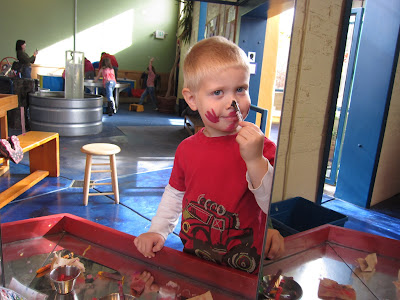
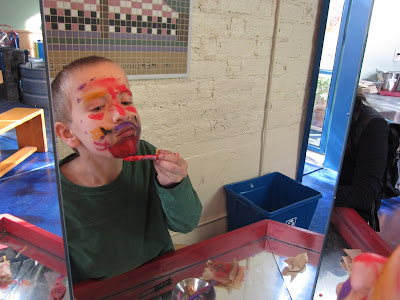
A couple of weeks ago, I walked in to a nice, sit-down restaurant, with a smile on my face. It s the kind of restaurant with folded cloth napkins on the tables. Table for three, please as Jacob and Oliver were with me. This much isn t unusual. I have periodically taken them out to eat for quite some time, and they enjoy it. But there were a few unusual things about this particular day. I suppose the main one is that they had just been doing this. Yes, painting your own face can be a lot of fun. And also serious business. The boys and I were in Santa Fe, NM on a train trip. It had been a year since their last train trip, and that s longer than they are typically used to. I d taken Jacob on a train trip with just the two of us before, but this was the first trip with just the two boys and me. And one of the places we visited was the excellent Santa Fe Children s Museum. It may be the best children s museum I ve ever seen. Not the largest, or the flashiest, but that s part of the reason I say best . They had chimes (and many other percussive instruments to produce different pitches, including mounted hubcaps and varying length wooden planks). They had a great magnets table with washers and nuts, so children can build their own bridges, stairs, etc. using magnetism. A giant bubble table, tunnels to crawl in outside, etc. A great place. And, apparently, the thing they were really known for I did not know this in advance is the paint your own face station. Jacob and Oliver really got into it. Oliver informed me he was a lion and I heard ROAR! ROAR! periodically all afternoon. Jacob asked me to help paint a J, and the spirals, on his cheeks. After some careful thought, he informed me that he was spiral man . Next to the paint your own face area was a clean your own face area. Most kids were being helped to clean their own face by their parents on their way out. Jacob and Oliver protested that plan, so I figured, if they want to enjoy painted faces all day, why not? And this, of course, led into lunch with self-painted faces. Nobody at the restaurant commented, but the owner had a huge grin when he saw them. (It was a Mediterranean place, and I m sure the owner would have commented had there not been a language barrier.) Incidentally, the boys became quite the fans of souvlaki. Later, as we walked around Santa Fe Plaza and another museum, they drew smiles all over the place. Several kind people asked them, Did you enjoy the children s museum? Yes, everyone in Santa Fe seemed to know precisely where kids with painted faces had been that day. Santa Fe is an amazing and beautiful city. It was warm and friendly, and the architecture and layout was fun to see and pedestrian-friendly. We walked past the Cathedral Basilica of St. Francis of Assisi several times, and went in once. For some reason I could never fully explain, I could often smell their incense even a block or two away. It added to the crisp wintry feel of the plaza. The point of the trip wasn t Santa Fe, though. It was Jacob and Oliver on Amtrak, which is the thing they were really most excited about of course. They were excited as usual, and despite the fact that the train comes through this area only at around 3AM, were plenty excited to be on the train. And, in fact, didn t fall asleep again until about 5 due to the excitement (though they did an excellent job of being quiet). Of course, 6AM was morning so they were wide awake by then. Jacob had been planning what he d eat on the train for days already, and had announced he would be having French toast for breakfast and pizza at lunch. He was a bit disappointed to see that French toast wasn t on the menu this time, but pancakes saved the day. While waiting for the dining car to open at 6:30, we went to the lounge car for awhile. I had brought along various things for them to do on the train, of course, and among them was a notebook and some markers. Jacob loved drawing suns and stars, and sometimes writing short notes. He gave notes to several friendly people that happened to be visiting with us on the train. Oliver enjoyed it too, but he was more intrigued by the cheap set of multi-colored post-it notes. There were two happy, and somewhat tired, boys getting off that train in the middle of the night when we returned.

Russ Allbery: Review: Regenesis

Review: Regenesis, by C.J. Cherryh
Series: Cyteen #2
Publisher: DAW
Copyright: January 2009
ISBN: 0-7564-0592-0
Format: Mass market
Pages: 682
Regenesis is a direct sequel to Cyteen, picking up very shortly after the end of that book and featuring all of the same characters. It would be absolutely pointless to read this book without first reading Cyteen; all of the emotional resonance and world-building that make Regensis work are done there, and you will almost certainly know whether you want to read it after reading the first book. Besides, Cyteen is one of the best SF novels ever written and not the novel to skip. Because this is such a direct sequel, it's impossible to provide a good description of Regenesis without spoiling at least characters and general plot developments from Cyteen. So stop reading here if you've not yet read the previous book. I've had this book for a while, and re-read Cyteen in anticipation of reading it, but I've been nervous about it. One of the best parts of Cyteen is that Cherryh didn't belabor the ending, and I wasn't sure what part of the plot could be reasonably extended. Making me more nervous was the back-cover text that framed the novel as an investigation of who actually killed the first Ari, a question that was fairly firmly in the past by the end of Cyteen and that neither I nor the characters had much interest in answering. Cyteen was also a magical blend of sympathetic characters, taut tension, complex plotting, and wonderful catharsis, the sort of lightning in a bottle that can rarely be caught twice. I need not have worried. If someone had told me that Regenesis was another 700 pages of my favorite section of Cyteen, I would have been dubious. But that's exactly what it is. And the characters only care about Ari's murderer because it comes up, fairly late in the novel, as a clue in another problem. Ari, and Justin, are back in the safe laboratory environment of Reseune, safe now that politics are not trying to kill or control them. Yanni has taken over administration. There is a general truce, and even some deeper agreement. Everyone can take a breath and relax, albeit with the presence of Justin's father Jordan as an ongoing irritant and hostile factor. But broader Union politics are not as stable: there is an election in progress for the Defense councilor that may break the tenuous majority in favor of Reseune and the Science Directorate, Yanni is working out a compromise to gain more support by turning a terraforming project loose on a remote world, and Ari isn't sure she likes that Eversnow idea at all. Then, just as things seem to be turning Reseune's way, politics and interpersonal relationships abruptly deteriorate, tensions with Jordan sharply worsen, and there may be moles in Reseune's iron-clad security. Navigating the crisis while keeping her chosen family safe will once again tax all of Ari's abilities. The third section of Cyteen, where Ari finally has the tools to take fate into her own hands and starts playing everyone off against each other, is one of my favorite sections of any book. If it was yours as well, Regenesis is another 700 pages of exactly that. As an extension and revisiting, it does lose a bit of immediacy and surprise from the original, and Regenesis is much less concerned with the larger questions of azi society, the nature of thought and personality, loyalty and authority, and the best model for the development of human civilization. It's somewhat less far-thinking and more of a political thriller. But it's a political thriller that recaptures much of the drama and tension of Cyteen and is full of exceptionally smart and paranoid people thinking through all angles of a problem, working fast on their feet, and successfully navigating tricky and treacherous political landscapes. And, like Cyteen but unlike others of Cherryh's novels I've read, it's a novel about empowerment, about seizing control of one's surroundings and effectively using all of the capability and leverage at one's fingertips. That gives it a thrilling catharsis that's almost as good as Cyteen. It's also, like its predecessor, a surprisingly authoritarian novel. I think it's in that, more than anything else in these books, that one sees the impact of the azi. Regenesis makes it clear that the story is set, not in a typical society, but inside a sort of corporation, with an essentially hierarchical governance structure. There are other SF novels set within corporations (Solitaire comes to mind), but normally they follow peons or at best mid-level personnel or field agents, or otherwise take the viewpoint of the employees or the exploited. When they follow the corporate leaders, the focus usually isn't down inside the organization, but out into the world, with the corporation as silent resources on which the protagonist can draw. Regenesis is much more of a balance. It's about decisions of the future of humanity that characters feel they can make undemocratically (in part because they or their predecessors have effectively engineered the opinions of the democratic population), but it's also about how one manages a top-down organization. And, most vitally, how one secures it. Reseune is, as in the previous novel, a paranoid's suspicions come true; everyone is out to get everyone else, or at least might be, and the level of omnipresent security and threat forces a close parsing of alliances and motivations that elevates loyalty to the greatest virtue. In Cyteen, we had long enough with Ari to see the basic shape of her personality and her slight divergences from her predecessor, but her actions are mostly driven by necessity. Regenesis gives us more of a picture of what she's like when her actions aren't forced, and here I think Cherryh manages a masterpiece of subtle characterization. Ari has diverged substantially from her predecessor without necessarily realizing it, but in ways that are firmly grounded in the differences she found or created between her life and the first Ari's. Specifically, she has friends, confidents, and a community, which combined with past trauma has made her fiercely, powerfully protective, and it's that protective instinct that weaves the plot together. It's probably the most significant way in which so much of the events of Cyteen and Regenesis are driven by people's varying reactions to trauma. If you, like me, loved the last third of Cyteen, read this, because Regenesis is more of exactly that. Cherryh finds new politics, new challenges, and a new and original plot within the same world and with the same characters, but it has the same feel of maneuvering, analysis, and decisive action. You will, as with Cyteen have to be comfortable with pages of internal monologue from really smart people thinking through all sides of a problem. If you didn't like that in the previous book, avoid this one; if you loved it, here's the sequel you didn't know you were waiting for. Rating: 9 out of 10

21 December 2012

Richard Hartmann: Release Critical Bug report for Week 51

The gaffe Please note that the historic data had a bug which is fixed and the correct value highlighted below. On the plus side, this means that the delta is not as large as I feared. On the negative side, the gap between the Squeeze and Wheezy release cycles keeps widening slowly but steadily. The gist The UDD bugs interface currently knows about the following release critical bugs: How do we compare to the squeeze cycle ?
Week Squeeze Wheezy Diff
43 284 (213+71) 468 (332+136) +184 (+119/+65)
44 261 (201+60) 408 (265+143) +147 (+64/+83)
45 261 (205+56) 425 (291+134) +164 (+86/+78)
46 271 (200+71) 401 (258+143) +130 (+58/+72)
47 283 (209+74) 366 (221+145) +83 (+12/+71)
48 256 (177+79) 378 (230+148) +122 (+53/+69)
49 256 (180+76) 360 (216+155) +104 (+36/+79)
50 204 (148+56) 339 (195+144) +135 (+47/+90)
51 178 (124+54) 323 (190+133) +145 (+66/+79)
52 115 (78+37)
1 93 (60+33)
2 82 (46+36)
3 25 (15+10)
4 14 (8+6)
5 2 (0+2)
6 release!
Graphical overview of bug stats thanks to azhag:

19 December 2012

Clint Adams: Then nobody played Bingo

No, Simon, not yet. [Things on paper]

18 December 2012

Russ Allbery: Review: Liars and Outliers

Review: Liars and Outliers, by Bruce Schneier
Publisher: John Wiley
Copyright: 2012
ISBN: 1-118-14330-2
Format: Hardcover
Pages: 285
One of the perils of buying a book written by a blogger one reads regularly is that the book may be little more than a rehashing of their blog, with insufficient original material to warrant the time investment. Sometimes it's still nice to support them financially, but it may not make sense to read the book. I've been following Schneier's blog for years (as should anyone with an interest in security), including through the entire process of writing Liars and Outliers, and was a bit worried that might be the case here. Thankfully, I can reassure any other worried potential readers that is not the case. This is substantial new material establishing a firm framework for thinking about incentives and controls in any society or organization. Liars and Outliers talks about security mechanisms, but it's not, at its core, a book about security. Rather, it's a book about incentives, order, and how order is established. It's a comprehensive reductionist analysis of how societies create predictability and compliance to allow us to trust other people who we have never met before and will never meet again. It's a unique (at least in my experience) combination of anthropology, sociology, security analysis, and political science. Schneier cuts across fields in an idiosyncratic but illuminating way that reminded me of (on an entirely separate topic) Jane Jacobs. This is not a prescriptive book, nor is a collection of answers, solutions, or even deep analysis of particular problems. Rather, it's an attempt to construct a general framework for analyzing societal dilemmas: conflicts between individual desires and social good, how those conflicts are resolved, and how societies can weigh the scales and influence the statistical outcomes. The closest Schneier comes to telling the reader how to solve problems is a checklist, at the end of the book, for designing effective societal pressures. Its primary contribution is vocabulary and structure. It also passes one of my litmus tests for any book about human behavior: Schneier complicates, broadens, deepens, and expands understanding, and points out complex interactions and complex feedback in effects we're inclined to consider simple, rather than simplifying or eliminating human complexity. One point I found refreshing about this book is that Schneier is scrupulous in refusing to define either society or individuals as good or bad, to the point of carefully defining terminology used in all of the social dilemmas. Following societal rules is called compliance; not following those rules is called defection. In some cases, defection is morally correct (Schneier's most frequent example is in the civil rights struggles of the 1960s in the United States). In all cases, social pressures are tools, which can be used to encourage compliance with moral or immoral systems, and which are deployed by totalitarian dictatorships and utopian communes alike. Schneier explicitly puts out of scope for this book the questions of how societal goals should be determined, how they change, and whether any given societal rule or interest is moral or immoral. He focuses, rather, only on the mechanisms, with a primary goal of informing and deepening debates over how best to encourage behavior that societies want to encourage and discourage behavior societies want to discourage. He also emphasizes discourage, as opposed to eliminate. Early on, Schneier shows some of the results of game theory, as well as basic common sense, that indicate that no healthy society can totally eliminate defection. Not only would that stifle valuable and important reform, such as changes in civil rights, but the degree of pressure required is immense. Defectors are natural and will always exist, and are sometimes valuable and necessary. Rather, the goal of a society is to reduce defectors to a level where most people can ignore their existence most of the time, a state that leads to the level of risk and trust required to have a functioning and healthy society. The word society, similarly, is intentionally broad, and can refer to just about any collection of people, from a circle of friends to a corporation, institution, or country. However, as Schneier points out early in the book, small societies rarely need much in the way of formal pressure and appear almost magically self-governing. That's the first property that he disassembles, resulting in a general classification of societal pressures into four categories: moral, reputational, institutional, and security systems. The last is an odd category that's partly orthagonal to the other three. Moral pressure is internalized conscience: the normal tendency of nearly everyone to follow their own moral code, a code that's at least partly constructed and certainly heavily influenced by the surrounding society. Reputational pressure is, in a sense, externalized morality: it's the informal reactions of others around one to one's past actions. Included in reputational pressure is shunning of every kind, from cutting off a friendship to boycotts against corporations, but it also includes confrontation from another member of one's society, the more subtle effects of our individual desires to be liked and respected, and all the various aspects of "face", honor, and respect within a community. Small communities are frequently self-governing, in Schneier's model, because they're small enough that moral and reputational pressures are sufficient and no other pressures are required. We're so used to applying moral and reputational pressure to other humans almost unconsciously that we sometimes don't even notice its existence, leading to that "magical" self-governing property. But Schneier puts pressures in a sequence: pressures that work extremely well with small groups often don't scale. Moral pressure works best with small groups and reputational pressure with somewhat larger groups, but when societies scale beyond the limits of reputational pressure when, for example, one frequently interacts with people whose reputations are unknown to you and whose subsequent opinion of you will not be relevant institutional pressure is required to force compliance. Institutional pressure is the sort of pressure that we all tend to think of first when we look for ways to enforce rules: laws, policies, contracts, and other codes of behavior that carry with them formal punishments and some enforcement mechanism. But even in societies so large that institutional pressures are frequently required, such as whole countries, moral and reputational pressures still exist and are extremely important. One of Schneier's most interesting points is his analysis of how institutional pressures can paradoxically undermine reputational and moral pressures, resulting in more defection than if the institutional pressure hadn't existed. This is just the basic framework of Schneier's analysis, hopefully giving you a feel for the structure of the book. He goes much deeper into the complicated interactions between the various levels of pressure, and then dives into an extensive look at competing societal dilemmas: cases where there is more than one society in play simultaneously, possibly demanding contradictory actions. Liars and Outliers also includes a wonderful analysis of organizational entities within the same framework, including their much-different reactions to moral, reputational, and institutional pressures. One of the most cogent analyses of the difficulties of regulating both corporations and governmental institutions falls out of that analysis, once one looks at them in light of Schneier's basic framework. Pressures quickly become complex and multi-layered, and human reactions to pressures are frequently counter-intuitive. Schneier draws extensively on game theory to show that some counter-intuitive responses are actually emergent properties of logical analysis of the situation, but that others are more uniquely human and have little or nothing to do with a mathematical cost-benefit analysis. I haven't even mentioned his discussion of security systems, and how they can extend moral, reputational, and institutional pressures, as well as add a new type of pressure (making a defecting action impossible) that scales even better than institutional pressures. Liars and Outliers has all of the supporting infrastructure you would expect in a scholarly book: notes, extensive references, and a good index. I suspect it will end up being used as at least additional reading in college classes. The notes are, unfortunately, end notes, making the full context of the book much harder to read than was necessary, but at least Schneier does separate the notes from the references so that one doesn't chase notes for further explanation and find a simple citation. As with any book like this, one always wishes it could end in a simple prescription to fix everything, but of course it doesn't. But that's also a measure of a good scholarly work. Human and organizational motivations are complex and tricky, and any framework for analyzing them needs to be able to represent that complexity. Schneier here has constructed a very powerful one, one that I started using in discussions before I'd even finished the book. Perhaps the most valuable contribution of Liars and Outliers to public discussion is clear terminology and categories, which can be of great help in finding the core components of a problem. Liars and Outliers can be slow going, particularly early on when Schneier is still defining terms and setting up the background of his analysis. One can get a bit tired of the analysis matrices of societal dilemmas. But stick with it through the groundwork, since the analyses of competing societal dilemmas and of the impact of societal pressures on organizations are exceptional. Highly recommended, particularly for anyone who is designing or implementing societal pressures: managers, political activists, or anyone in a security-related field. Rating: 8 out of 10

17 December 2012

Dominique Dumont: Be wary of optimised for devices

Hello This story began with linphone having a weird behavior: every now and then, the mouse pointer would become stuck: the pointer moves, but clikcking on it always activate the same widget. Since this always happened in the middle of phone conference done for work, this was infuriating. Long story short, I finally found that my plantronics USB headset was responsible for this weird behavior. This headset is connected to the USB bus and is seen by the computer as a USB sound card. The bug was triggered by pressing the mute button provided by the headset. Suspicious of this usb device, I used lsusb to find the features provided by the heaset: $ lsusb -v -s 1:3 2>&1 grep InterfaceClass
bInterfaceClass 1 Audio
bInterfaceClass 3 Human Interface Device
Audio devices were expected, but why a HID device ? This device is a headset, not a keyboard or a mouse Testing further, I also saw some number poping up on my screen whenever I pressed the the mute button. The only way to get the mouse back was to unplug the headset. A quick google search gave a solution to setup X11 to ignore the headset. Problem solved. But this did not answer the question regarding the HID device. Then I got a hint in the form of a sticker glued on the headset USB plug: Optimized for Microsoft Lync . This page gave the answer: an optimised for Lync device provides mute/unmute across PC and device . I can only guess that when the mute button is pressed, some data is sent from the HID interface. Unfortunately, the window manager does not like to be on the receiving end of this data. The moral of this story is: optimized for something actually means not standard .
ok. There s a bug somewhere. The comments of this blog have convinced me that I went too far with the moral of this story. It s now overstriked instead of plainly remvoed so the comments still make sense. Thanks everybody for the constructive comments.
All the best
Tagged: wtf

16 December 2012

John Goerzen: The world is still a good place

At times like these, it is easy to think of the world as a cold, evil place. Perhaps in some ways, it is. I saw this quote from Fred Rogers floating around today:
When I was a boy and I would see scary things in the news, my mother would say to me, Look for the helpers. You will always find people who are helping. To this day, especially in times of disaster, I remember my mother s words, and I am always comforted by realizing that there are still so many helpers so many caring people in this world.
Sometimes I think that Fred Rogers wisdom is so often under-appreciated. What he says is true, very true. I know what it s like to fear for my child s life. And sometimes the shoe has been on the other foot, when I have been one of the helpers. Many of you know these last few months have been the most difficult in my life. And despite having gone through the deaths of three relatives, nothing has quite compared to this. I can not even begin to express my gratitude for all the care, compassion, and love that has come my way and towards the boys. People I barely knew before are now close friends. Random strangers have offered kindness and support. I have never before needed to be cared for like that, and in some ways perhaps it was hard to let myself be cared for. But I did, and all that caring and generosity has made an incredible difference in my life. Most of us don t see our pain on CNN or BBC, but that doesn t mean it s less real. And it doesn t mean there s nobody that cares. Open up to others, let them care for you. Things can and do get better. The people in Newtown did nothing to deserve this. No matter what evidence is found, they will never get an adequate answer to why? Children have been frightened, families torn apart, lives ended, for no reason at all. But they will survive the terrible pain. In time, they will find happiness again. And they will feel love and compassion from people around the world something to sustain them in their grief. I am certain of this. I recently read this quote, part of a story about a dying cancer patient: Don t forget that it doesn t take much to make someone s day. Yes, the world is still a good place.

14 December 2012

Richard Hartmann: Release Critical Bug report for Week 50

The UDD bugs interface currently knows about the following release critical bugs: How do we compare to the squeeze cycle ?
Week Squeeze Wheezy Diff
43 284 (213+71) 468 (332+136) +184 (+119/+65)
44 261 (201+60) 408 (265+143) +147 (+64/+83)
45 261 (205+56) 425 (291+134) +164 (+86/+78)
46 271 (200+71) 401 (258+143) +130 (+58/+72)
47 283 (209+74) 366 (221+145) +83 (+12/+71)
48 256 (177+79) 378 (230+148) +122 (+53/+69)
49 256 (180+76) 360 (216+155) +104 (+36/+79)
50 204 (148+56) 339 (195+144) +135 (+47/+90)
51 124 (124+54)
52 115 (78+37)
1 93 (60+33)
2 82 (46+36)
3 25 (15+10)
4 14 (8+6)
5 2 (0+2)
6 release!
Graphical overview of bug stats thanks to azhag:

Next.

Previous.