Search Results: "agi"

23 October 2014

Gunnar Wolf: Listadmin *YES*

Petter posted yesterday about Listadmin, the quick way to moderate mailman lists. Petter: THANKS. I am a fan of automatization. But, yes, I had never thouguht of doing this. Why? Don't know. But this is way easier than using the Web interface for Mailman:
$ listadmin 
fetching data for conoc_des@my.example.org ... nothing in queue
fetching data for des_polit_pub@my.example.org ... nothing in queue
fetching data for econ_apl@my.example.org ... nothing in queue
fetching data for educ_ciencia_tec@my.example.org ... nothing in queue
fetching data for est_hacend_sec_pub@my.example.org ... 
[1/1] ============== est_hacend_sec_pub@my.example.org ======
From:     sender@example.org                                            
Subject:  Invitaci n al Taller Insumo Producto                          
Reason:   El cuerpo del mensaje es demasiado grande: 777499    Spam? 0  
Approve/Reject/Discard/Skip/view Body/Full/jump #/Undo/Help/Quit ? a
Submit changes? [yes] 
fetching data for fiscal_fin@my.example.org ... nothing in queue
fetching data for historia@my.example.org ... nothing in queue
fetching data for industrial@my.example.org ... nothing in queue
fetching data for medio_amb@my.example.org ... nothing in queue
fetching data for mundial@my.example.org ... nothing in queue
fetching data for pol_des@my.example.org ... nothing in queue
fetching data for sec_ener@my.example.org ... nothing in queue
fetching data for sec_prim@my.example.org ... nothing in queue
fetching data for trab_tec@my.example.org ... nothing in queue
fetching data for urb_reg@my.example.org ... nothing in queue
fetching data for global@my.example.org ... nothing in queue
I don't know how in many years of managing several mailing lists I never thought about this! I'm echoing this, as I know several of my readers run mailman as well, and might not be following Planet Debian.

Alessio Treglia: Bits from the Debian Multimedia Maintainers

This brief announcement was released yesterday to the debian-devel-announce mailing list. Ciao! The Debian Multimedia Maintainers have been quite active since the Wheezy release, and have some interesting news to share for the Jessie release. Here we give you a brief update on what work has been done and work that is still ongoing. Let s see what s cooking for Jessie then. Frameworks and libraries Support for many new media formats and codecs. The codec library libavcodec, which is used by popular media playback applications including vlc, mpv, totem (using gstreamer1.0-libav), xine, and many more, has been updated to the latest upstream release version 11 provided by Libav. This provides Debian users with HEVC playback, a native Opus decoder, Matroska 3D support, Apple ProRes, and much more. Please see libav s changelog for a full list of functionality additions and updates. libebur128 libebur128 is a free implementation of the European Broadcasting Union Loudness Recommendation (EBU R128), which is essentially an alternative to ReplayGain. The library can be used to analyze audio perceived loudness and subsequentially normalize the volume during playback. libltc libltc provides functionalities to encode and decode Linear (or Longitudinal) Timecode (LTC) from/to SMPTE data timecode. libva libva and the driver for Intel GPUs has been updated to the 1.4.0 release. Support for new GPUs has been added. libva now also supports Wayland. Pure Data A number of new additional libraries (externals) will appear in Jessie, including (among others) Eric Lyon s fftease and lyonpotpourrie, Thomas Musil s iemlib, the pdstring library for string manipulation and pd-lua that allows to write Pd-objects in the popular lua scripting language. JACK and LADI LASH Audio Session Handler was abandoned upstream a long time ago in favor of the new session management system, called ladish (LADI Session Handler). ladish allows users to run many JACK applications at once and save/restore their configuration with few mouse clicks. The current status of the integration between the session handler and JACK may be summarized as follows: Note that ladish uses the D-Bus interface to the jack daemon, therefore only Jessie s jackd2 provides support for and also cooperates fine with it. Plugins: LV2 and LADSPA Debian Jessie will bring the newest 1.10.0 version of the LV2 technology. Most changes affect the packaging of new plugins and extensions, a brief list of packaging guidelines is now available.
A number of new plugins and development tools too have been made available during the Jessie development cycle: LV2 Toolkit LVTK provides libraries that wrap the LV2 C API and extensions into easy to use C++ classes. The original work for this was mostly done by Lars Luthman in lv2-c++-tools. Vee One Suite The whole suite by Rui Nuno Capela is now available in Jessie, and consists of three components: All three are provided in both forms of LV2 plugins and stand-alone JACK client. JACK session, JACK MIDI, and ALSA MIDI are supported too. x42-plugins and zam-plugins LV2 bundles containing many audio plugins for high quality processing. Fomp Fomp is an LV2 port of the MCP, VCO, FIL, and WAH plugins by Fons Adriaensen. Some other components have been upgraded to more recent upstream versions: We ve packaged ste-plugins, Fons Adriaensen s new stereo LADSPA plugins bundle. A major upgrade of frei0r, namely the standard collection for the minimalistic plugin API for video effects, will be available in Jessie. New multimedia applications Advene Advene (Annotate Digital Video, Exchange on the NEt) is a flexible video
annotation application. Ardour3 The new generation of the popular digital audio workstation will make its very first appearance in Debian Jessie. Cantata Qt4 front-end for the MPD daemon. Csound Csound for jessie will feature the new major series 6, with the improved IDE CsoundQT. This new csound supports improved array data type handling, multi-core rendering and debugging features. din DIN Is Noise is a musical instrument and audio synthesizer that supports JACK audio output, MIDI, OSC, and IRC bot as input sources. It could be extended and customized with Tcl scripts too. dvd-slideshow dvd-slideshow consists of a suite of command line tools which come in handy to make slideshows from collections of pictures. Documentation is provided and available in /usr/share/doc/dvd-slideshow/ . dvdwizard DVDwizard can fully automate the creation of DVD-Video filesystem. It supports graphical menus, chapters, multiple titlesets and multi-language streams. It supports both PAL and NTSC video modes too. flowblade Flowblade is a video editor like the popular KDenlive based on the MLT engine, but more lightweight and with some difference in editing concepts. forked-daapd Forked-daapd switched to a new, active upstream again dropping Grand Central Dispatch in favor of libevent. The switch fixed several bugs and made forked-daapd available on all release architectures instead of shipping only on amd64 and i386. Now nothing prevents you from setting up a music streaming (DAAP/DACP) server on your favorite home server no matter if it is based on mips, arm or x86! harvid HTTP Ardour Video Daemon decodes still images from movie files and serves them via HTTP. It provides frame-accurate decoding and is main use-case is to act as backend and second level cache for rendering the
videotimeline in Ardour. Groove Basin Groove Basin is a music player server with a web-based user interface inspired by Amarok 1.4. It runs on a server optionally connected to speakers. Guests can control the music player by connecting with a laptop, tablet, or smart phone. Further, users can stream their music libraries remotely.
It comes with a fast, responsive web interface that supports keyboard shortcuts and drag drop. It also provides the ability to upload songs, download songs, and import songs by URL, including YouTube URLs. Groove Basin supports Dynamic Mode which automatically queues random songs, favoring songs that have not been queued recently.
It automatically performs ReplayGain scanning on every song using the EBU R128 loudness standard, and automatically switches between track and album mode. Groove Basin supports the MPD protocol, which means it is compatible with MPD clients. There is also a more powerful Groove Basin protocol which you can use if the MPD protocol does not meet your needs. HandBrake HandBrake, a versatile video transcoder, is now available for Jessie. It could convert video from nearly any format to a wide range of commonly supported codecs. jack-midi-clock New jackd midiclock utility made by Robin Gareus. laborejo Laborejo, Esperanto for Workshop , is used to craft music through notation. It is a LilyPond GUI frontend, a MIDI creator and a tool collection to inspire and help music composers. mpv mpv is a movie player based on MPlayer and mplayer2. It supports a wide variety of video file formats, audio and video codecs, and subtitle types. The project focuses mainly on modern systems and encourages developer activity. As such, large portions of outdated code originating from MPlayer have been removed, and many new features and improvements have been added. Note that, although there are still some similarities to its predecessors, mpv should be considered a completely different program (e.g. lacking compatibility with both mplayer and mplayer2 in terms of command-line arguments and configuration). smtube SMTube is a stand-alone graphical video browser and player, which makes YouTube s videos browsing, playing, and download such a piece of cake.
It has so many features that, we are sure, will make YouTube lovers very, very happy. sonic-visualiser Sonic Visualiser Application for viewing and analysing the contents of music audio files. SoundScapeRenderer SoundScapeRenderer (aka SSR) is a (rather) easy to use render engine for spatial audio, that provides a number of different rendering algorithms, ranging from binaural (headphone) playback via wave field synthesis to higher-order ambisonics. Videotrans videotrans is a set of scripts that allow its user to reformat existing movies into the VOB format that is used on DVDs. XBMC XBMC has been partially rebranded as XBMC from Debian to make it clear that it is changed to conform to Debian s Policy. The latest stable release, 13.2 Gotham will be part of Jessie making Debian a good choice for HTPC-s. zita-bls1 Binaural stereo signals converter made by Fons Adriaensen zita-mu1 Stereo monitoring organiser for jackd made by Fons Adriaensen zita-njbridge Jack clients to transmit multichannel audio over a local IP network made by Fons Adriaensen radium-compressor Radium Compressor is the system compressor of the Radium suite. It is provided in the form of stand-alone JACK application. Multimedia Tasks With Jessie we are shipping a set of multimedia related tasks.
They include package lists for doing several multimedia related tasks. If you are interested in defining new tasks, or tweaking the current, existing ones, we are very much interested in hearing from you. Upgraded applications and libraries What s not going to be in Jessie With the aim to improve the overall quality of the multimedia software available in Debian, we have dropped a number of packages which were abandoned upstream: We ve also dropped mplayer, presently nobody seems interested in maintaining it.
The suggested replacements for users are mplayer2 or mpv. Whilst the former is mostly compatible with mplayer in terms of command-line arguments and configuration (and adds a few new features too), the latter adds a lot of new features and improvements, and it is actively maintained upstream. Please note that although the mencoder package is no longer available anymore, avconv and mpv do provide encoding functionality. For more information see avconv s manual page and documentation, and mpv s encoding documentation. Broken functionalities rtkit under systemd is broken at the moment. Activity statistics More information about team s activity are available. Where to reach us The Debian Multimedia Maintainers can be reached at pkg-multimedia-maintainers AT lists.alioth.debian.org for packaging related topics, or at debian-multimedia AT lists.debian.org for user and more general discussion.
We would like to invite everyone interested in multimedia to join us there. Some of the team members are also in the #debian-multimedia channel on OFTC. Cheers! Alessio Treglia
on behalf of the Debian Multimedia Maintainers

22 October 2014

Steve Kemp: On writing test-cases and testsuites.

Last night I mostly patched my local copy of less to build and link against the PCRE regular expression library. I've wanted to do that for a while, and reading Raymond Chen's blog post last night made me try it out. The patch was small and pretty neat, and I'm familiar with GNU less having patched it in the past. But it doesn't contain tests. Test cases are hard. Many programs, such as less, are used interactively which makes writing a scaffold hard. Other programs suffer from a similar fate - I'm not sure how you'd even test a web browser such as Firefox these days - mangleme would catch some things, eventually, but the interactive stuff? No clue. In the past MySQL had a free set of test cases, but my memory is that Oracle locked them up. SQLite is famous for its decent test coverage. But off the top of my head I can't think of other things. As a topical example there don't seem to be decent test-cases for either bash or openssl. If it compiles it works, more or less. I did start writing some HTTP-server test cases a while back, but that was just to automate security attacks. e.g. Firing requests like:
GET /../../../etc/passwd HTTP/1.0
GET //....//....//....//etc/passwd HTTP/1.0
etc
(It's amazing how many toy HTTP server components included in projects and products don't have decent HTTP-servers.) I could imagine that being vaguely useful, especially because it is testing the protocol-handling rather than a project-specific codebase. Anyway, I'm thinking writing test cases for things is good, but struggling to think of a decent place to start. The project has to be: Comments welcome; but better yet why not think about the test-coverage of any of your own packages and projects...?

12 October 2014

Iustin Pop: Day trip on the Olympic Peninsula

Day trip on the Olympic Peninsula TL;DR: drove many kilometres on very nice roads, took lots of pictures, saw sunshine and fog and clouds, an angry ocean and a calm one, a quiet lake and lots and lots of trees: a very well spent day. Pictures at http://photos.k1024.org/Daytrips/Olympic-Peninsula-2014/. Sometimes I travel to the US on business, and as such I've been a few times in the Seattle area. Until this summer, when I had my last trip there, I was content to spend any extra days (weekend or such) just visiting Seattle itself, or shopping (I can spend hours in the REI store!), or working on my laptop in the hotel. This summer though, I thought - I should do something a bit different. Not too much, but still - no sense in wasting both days of the weekend. So I thought maybe driving to Mount Rainier, or something like that. On the Wednesday of my first week in Kirkland, as I was preparing my drive to the mountain, I made the mistake of scrolling the map westwards, and I saw for the first time the Olympic Peninsula; furthermore, I was zoomed in enough that I saw there was a small road right up to the north-west corner. Intrigued, I zoomed further and learned about Cape Flattery ( the northwestern-most point of the contiguous United States! ), so after spending a bit time reading about it, I was determined to go there. Easier said than done - from Kirkland, it's a 4h 40m drive (according to Google Maps), so it would be a full day on the road. I was thinking of maybe spending the night somewhere on the peninsula then, in order to actually explore the area a bit, but from Wednesday to Saturday it was a too short notice - all hotels that seemed OK-ish were fully booked. I spent some time trying to find something, even not directly on my way, but I failed to find any room. What I did manage to do though, is to learn a bit about the area, and to realise that there's a nice loop around the whole peninsula - the 104 from Kirkland up to where it meets the 101N on the eastern side, then take the 101 all the way to Port Angeles, Lake Crescent, near Lake Pleasant, then south toward Forks, crossing the Hoh river, down to Ruby Beach, down along the coast, crossing the Queets River, east toward Lake Quinault, south toward Aberdeen, then east towards Olympia and back out of the wilderness, into the highway network and back to Kirkland. This looked like an awesome road trip, but it is as long as it sounds - around 8 hours (continuous) drive, though skipping Cape Flattery. Well, I said to myself, something to keep in mind for a future trip to this area, with a night in between. I was still planning to go just to Cape Flattery and back, without realising at that point that this trip was actually longer (as you drive on smaller, lower-speed roads). Preparing my route, I read about the queues at the Edmonds-Kingston ferry, so I was planning to wake up early on the weekend, go to Cape Flattery, and go right back (maybe stop by Lake Crescent). Saturday comes, I - of course - sleep longer than my trip schedule said, and start the day in a somewhat cloudy weather, driving north from my hotel on Simonds Road, which was quite nicer than the usual East-West or North-South roads in this area. The weather was becoming nicer, however as I was nearing the ferry terminal and the traffic was getting denser, I started suspecting that I'll spend a quite a bit of time waiting to board the ferry. And unfortunately so it was (photo altered to hide some personal information): Waiting for the ferry. The weather at least was nice, so I tried to enjoy it and simply observe the crowd - people were looking forward to a weekend relaxing, so nobody seemed annoyed by the wait. After almost half an hour, time to get on the ferry - my first time on a ferry in US, yay! But it was quite the same as in Europe, just that the ship was much larger. Once I secured the car, I went up deck, and was very surprised to be treated with some excellent views: Harbour view Looking towards the sun   and away from it The crossing was not very short, but it seemed so, because of the view, the sun, the water and the wind. Soon we were nearing the other shore; also, see how well panorama software deals with waves :P! Near the other shore And I was finally on the "real" part of the trip. The road was quite interesting. Taking the 104 North, crossing the "Hood Canal Floating Bridge" (my, what a boring name), then finally joining the 101 North. The environment was quite varied, from bare plains and hills, to wooded areas, to quite dense forests, then into inhabited areas - quite a long stretch of human presence, from the Sequim Bay to Port Angeles. Port Angeles surprised me: it had nice views of the ocean, and an interesting port (a few big ships), but it was much smaller than I expected. The 101 crosses it, and in less than 10 minutes or so it was already over. I expected something nicer, based on the name, but Anyway, onwards! Soon I was at a crossroads and had to decide: I could either follow the 101, crossing the Elwha River and then to Lake Crescent, then go north on the 113/112, or go right off 101 onto 112, and follow it until close to my goal. I took the 112, because on the map it looked "nicer", and closer to the shore. Well, the road itself was nice, but quite narrow and twisty here and there, and there was some annoying traffic, so I didn't enjoy this segment very much. At least it had the very interesting property (to me) that whenever I got closer to the ocean, the sun suddenly disappeared, and I was finding myself in the fog: Foggy road So my plan to drive nicely along the coast failed. At one point, there was even heavy smoke (not fog!), and I wondered for a moment how safe was to drive out there in the wilderness (there were other cars though, so I was not alone). Only quite a bit later, close to Neah Bay, did I finally see the ocean: I saw a small parking spot, stopped, and crossing a small line of trees I found myself in a small cove? bay? In any case, I had the impression I stepped out of the daily life in the city and out into the far far wilderness: Dead trees on the beach Trees growing on a rock Small panorama of the cove There was a couple, sitting on chairs, just enjoying the view. I felt very much intruding, behaving like I did as a tourist: running in, taking pictures, etc., so I tried at least to be quiet . I then quickly moved on, since I still had some road ahead of me. Soon I entered Neah Bay, and was surprised to see once more blue, and even more blue. I'm a sucker for blue, whether sky blue or sea blue , so I took a few more pictures (watch out for the evil fog in the second one): View towards Neah Bay port Sea view from Neah Bay Well, the town had some event, and there were lots of people, so I just drove on, now on the last stretch towards the cape. The road here was also very interesting, yet another environment - I was driving on Cape Flattery Road, which cuts across the tip of the peninsula (quite narrow here) along the Waatch River and through its flooding plains (at least this is how it looked to me). Then it finally starts going up through the dense forest, until it reaches the parking lot, and from there, one goes on foot towards the cape. It's a very easy and nice walk (not a hike), and the sun was shining very nicely through the trees: Sunny forest Sun shinning down Wooden path But as I reached the peak of the walk, and started descending towards the coast, I was surprised, yet again, by fog: Ugly fog again! I realised that probably this means the cape is fully in fog, so I won't have any chance to enjoy the view. Boy, was I wrong! There are three viewpoints on the cape, and at each one I was just "wow" and "aah" at the view. Even thought it was not a sunny summer view, and there was no blue in sight, the combination between the fog (which was hiding the horizon and even the closer islands), the angry ocean which was throwing wave after wave at the shore, making a loud noise, and the fact that even this seemingly inhospitable area was just teeming with life, was both unexpected and awesome. I took here waay to many pictures, here are just a couple inlined: First view at the cape Birds 'enjoying' the weather Foggy shore I spent around half an hour here, just enjoying the rawness of nature. It was so amazing to see life encroaching on each bit of land, even though it was not what I would consider a nice place. Ah, how we see everything through our own eyes! The walk back was through fog again, and at one point it switched over back to sunny. Driving back on the same road was quite different, knowing what lies at its end. On this side, the road had some parking spots, so I managed to stop and take a picture - even though this area was much less wild, it still has that outdoors flavour, at least for me: Waatch River Back in Neah Bay, I stopped to eat. I had a place in mind from TripAdvisor, and indeed - I was able to get a custom order pizza at "Linda's Woodfired Kitchen". Quite good, and I ate without hurry, looking at the people walking outside, as they were coming back from the fair or event that was taking place. While eating, a somewhat disturbing thought was going through my mind. It was still early, around two to half past two, so if I went straight back to Kirkland I would be early at the hotel. But it was also early enough that I could - in theory at least - still do the "big round-trip". I was still rummaging the thought as I left On the drive back I passed once more near Sekiu, Washington, which is a very small place but the map tells me it even has an airport! Fun, and the view was quite nice (a bit of blue before the sea is swallowed by the fog): Sekiu view After passing Sekiu and Clallam Bay, the 112 curves inland and goes on a bit until you are at the crossroads: to the left the 112 continues, back the same way I came; to the right, it's the 113, going south until it meets the 101. I looked left - remembering the not-so-nice road back, I looked south - where a very appealing, early afternoon sun was beckoning - so I said, let's take the long way home! It's just a short stretch on the 113, and then you're on the 101. The 101 is a very nice road, wide enough, and it goes through very very nice areas. Here, west to south-west of the Olympic Mountains, it's a very different atmosphere from the 112/101 that I drove on in the morning; much warmer colours, a bit different tree types (I think), and more flat. I soon passed through Forks, which is one of the places I looked at when searching for hotels. I did so without any knowledge of the town itself (its wikipedia page is quite drab), so imagine my surprise when a month later I learned from a colleague that this is actually a very important place for vampire-book fans. Oh my, and I didn't even stop! This town also had some event, so I just drove on, enjoying the (mostly empty) road. My next planned waypoint was Ruby Beach, and I was looking forward to relaxing a bit under the warm sun - the drive was excellent, weather perfect, so I was watching the distance countdown on my Garmin. At two miles out, the "Near waypoint Ruby Beach" message appeared, and two seconds later the sun went out. What the I was hoping this is something temporary, but as I slowly drove the remaining mile I couldn't believe my eyes that I was, yet again, finding myself in the fog I park the car, thinking that asking for a refund would at least allow me to feel better - but it was I who planned the trip! So I resigned myself, thinking that possibly this beach is another special location that is always in the fog. However, getting near the beach it was clear that it was not so - some people were still in their bathing suits, just getting dressed, so it seems I was just unlucky with regards to timing. However, I the beach itself was nice, even in the fog (I later saw online sunny pictures, and it is quite beautiful), the the lush trees reach almost to the shore, and the way the rocks are sitting on the beach: A lonely dinghy Driftwood  and human construction People on the beach Since the weather was not that nice, I took a few more pictures, then headed back and started driving again. I was soo happy that the weather didn't clear at the 2 mile mark (it was not just Ruby Beach!), but alas - it cleared as soon as the 101 turns left and leaves the shore, as it crosses the Queets river. Driving towards my next planned stop was again a nice drive in the afternoon sun, so I think it simply was not a sunny day on the Pacific shore. Maybe seas and oceans have something to do with fog and clouds ! In Switzerland, I'm very happy when I see fog, since it's a somewhat rare event (and seeing mountains disappearing in the fog is nice, since it gives the impression of a wider space). After this day, I was a bit fed up with fog for a while Along the 101 one reaches Lake Quinault, which seemed pretty nice on the map, and driving a bit along the lake - a local symbol, the "World's largest spruce tree". I don't know what a spruce tree is, but I like trees, so I was planning to go there, weather allowing. And the weather did cooperate, except that the tree was not so imposing as I thought! In any case, I was glad to stretch my legs a bit: Path to largest spruce tree Largest spruce tree, far view Largest spruce tree, closer view Very short path back to the road However, the most interesting thing here in Quinault was not this tree, but rather - the quiet little town and the view on the lake, in the late afternoon sun: Quinault Quinault Lake view The entire town was very very quiet, and the sun shining down on the lake gave an even stronger sense of tranquillity. No wind, not many noises that tell of human presence, just a few, and an overall sense of peace. It was quite the opposite of the Cape Flattery and a very nice way to end the trip. Well, almost end - I still had a bit of driving ahead. Starting from Quinault, driving back and entering the 101, driving down to Aberdeen: Afternoon ride then turning east towards Olympia, and back onto the highways. As to Aberdeen and Olympia, I just drove through, so I couldn't make any impression of them. The old harbour and the rusted things in Aberdeen were a bit interesting, but the day was late so I didn't stop. And since the day shouldn't end without any surprises, during the last profile change between walking and driving in Quinault, my GPS decided to reset its active maps list and I ended up with all maps activated. This usually is not a problem, at least if you follow a pre-calculated route, but I did trigger recalculation as I restarted my driving, so the Montana was trying to decide on which map to route me - between the Garmin North America map and the Open StreeMap one, the result was that it never understood which road I was on. It always said "Drive to I5", even though I was on I5. Anyway, thanks to road signs, and no thanks to "just this evening ramp closures", I was able to arrive safely at my hotel. Overall, a very successful, if long trip: around 725 kilometres, 10h:30m moving, 13h:30m total: Track picture There were many individual good parts, but the overall think about this road trip was that I was able to experience lots of different environments of the peninsula on the same day, and that overall it's a very very nice area. The downside was that I was in a rush, without being able to actually stop and enjoy the locations I visited. And there's still so much to see! A two nights trip sound just about right, with some long hikes in the rain forest, and afternoons spent on a lake somewhere. Another not so optimal part was that I only had my "travel" camera (a Nikon 1 series camera, with a small sensor), which was a bit overwhelmed here and there by the situation. It was fortunate that the light was more or less good, but looking back at the pictures, how I wish that I had my "serious" DSLR So, that means I have two reasons to go back! Not too soon though, since Mount Rainier is also a good location to visit . If the pictures didn't bore you yet, the entire gallery is on my smugmug site. In any case, thanks for reading!

John Goerzen: First impressions of systemd, and they re not good

Well, I finally bit the bullet. My laptop, which runs jessie, got dist-upgraded for the first time in a few months. My brightness keys stopped working, and it no longer would suspend to RAM when the lid was closed, and upon chasing things down from XFCE to policykit, eventually it appears that suddenly major parts of the desktop breaks without systemd in jessie. Sigh. So apt-get install systemd-sysv (and watch sysvinit-core get uninstalled) and reboot. Only, my system doesn t come back up. In fact, over several hours of trying to make it boot with systemd, it failed in numerous spectacular and hilarious (or, would be hilarious if my laptop would boot) ways. I had text obliterating the cryptsetup password prompt almost every time. Sometimes there were two processes trying to read a cryptsetup password at once. Sometimes a process was trying to read that while another one was trying to read an emergency shell password. Many times it tried to write to /var and /tmp before they were mounted, meaning they *wouldn t* mount because there was stuff there. I noticed it not doing much with ZFS, complaining of a dependency loop between zfs-mount and $local-fs. I fixed that, but it still wouldn t boot. In fact, it simply hung after writing something about wall passwords. I ve dug into systemd, finding a unit generator for fstab (whatever the hack that is, it s not at all made clear by systemd-fstab-generator(8)). In some cases, there s info in journalctl, but if I can t even get to an emergency mode prompt, the practice of hiding all stdout and stderr output is not all that pleasant. I remember thinking what s all the flaming about? systemd wasn t my first choice (I always thought if it ain t broke, don t fix it about sysvinit), but basically ignored the thousands of messages, thinking whatever happens, jessie will still boot. Now I m not so sure. Even if the thing boots out of the box, it seems like the boot process with systemd is colossally fragile. For now, at least zfs rollback can undo upgrades to 800 packages in about 2 seconds. But I can t stay at some early jessie checkpoint forever. Have we made a vast mistake that can t be undone? (If things like even *brightness keys* now require systemd )

9 October 2014

Jan Wagner: Updated Monitoring Plugins Version is coming soon

Three months ago version 2.0 of Monitoring Plugins was released. Since then many changes were integrated. You can find a quick overview in the upstream NEWS. Now it's time to move forward and a new release is expected soon. It would be very welcome if you could give the latest source snapshot a try. You also can give the Debian packages a go and grab them from my 'unstable' and 'wheezy-backports' repositories at http://ftp.cyconet.org/. Right after the stable release, the new packages will be uploaded into Debian unstable. The whole packaging changes can be observed in the changelog. Feedback is very appreciated via Issue tracker or the Monitoring Plugins Development Mailinglist. Update: The official call for testing is available.

8 October 2014

Jan Wagner: Updated Monitoring Plugins Version is coming soon

Three months ago version 2.0 of Monitoring Plugins was released. Since then many changes were integrated. You can find a quick overview in the upstream NEWS. Now it's time to move forward and a new release is expected soon. It would be very welcome if you could give the latest source snapshot a try. You also can give the Debian packages a go and grab them from my 'unstable' and 'wheezy-backports' repositories at http://ftp.cyconet.org/. Right after the stable release, the new packages will be uploaded into Debian unstable. The whole packaging changes can be observed in the changelog. Feedback is very appreciated via Issue tracker or the Monitoring Plugins Development Mailinglist.

5 October 2014

Thomas Goirand: OpenStack packaging activity: September 2014

I decided I d post this monthly. It may be a bit boring, sorry, but I think it s a nice thing to have this public. The log starts on the 6th, because on the 4th I was back from Debconf (after a day in San Francisco, plus 20 hours of traveling and 15 hours of time gap). It is to be noted that every time something is uploaded in Debian for Icehouse (in Sid), or for Juno (in Experimental), there s also a corresponding backport produced for Wheezy. Saturday 6th & Sunday 7th:
packaged libjs-twitter-bootstrap-wizard (in new queue)
Uploaded python-pint after reviewing the debian/copyright
Worked on updating python-eventlet in Experimental, and adding Python3 support. It seems Python3 support isn t ready yet, so I will probably remove that feature from the package update.
Tried to apply the Django 1.7 patches for python-django-bootstrap-form. They didn t work, but Raphael came back on Monday morning with new versions
of the patches, which should be good this time.
Helped the DSA (Debian System Administrators) with the Debian OpenStack cloud. It s looking good and working now (note: I helped them during Debconf 14).
Started a page about adding more tasksel tasks: https://wiki.debian.org/tasksel/MoreTasks. It s looking like Joey Hess is adding new tasks by default in Tasksel, with OpenStack compute node and OpenStack proxy node . It will be nice to have them in the default Debian installer! :)
Packaged and uploaded python-dib-utils, now in NEW queue. Monday 8th:
Uploaded fixed python-django-bootstrap-form with patch for Django 1.7.
Packaged and uploaded python-pysaml2.
Finilized and uploaded python-jingo which is needed for python-django-compressor unit tests
Finalized and uploaded python-coffin which is needed for python-django-compressor unit tests
Worked on running the unit tests for python-django-compressor, as I needed to know if it could work with Django 1.7. It was hard to find the correct way to run the unit tests, but finally, they all passed. I will add the unit tests once coffin and jingo will be accepted in Sid.
Applied patches in the Debian BTS for python-django-openstack-auth and Django 1.7. Uploaded the fixed package.
Fixed python-django-pyscss compat with Django 1.7, uploaded the result.
Updated keystone to Juno b3.
Built Wheezy backports of some JS libs needed for Horizon in Juno, which I already uploaded to Sid last summer:
o libjs-twitter-bootstrap-datepicker
o libjs-jquery.quicksearch
o libjs-spin.js
Upstreamed the Django 1.7 patch for python-django-openstack-auth: https://review.openstack.org/119972 Tuesday 9:
Updated and uploaded Swift 2.1.0. Added swift-object-expirer package to it, together with init script. Wednesday 10:
Basically, cleaned the Debian BTS of almost all issues today :P
Added it.po update to nova (Closes: #758305).
Backported libvirt 1.2.7 to Wheezy, to be able to close this bug: https://bugs.debian.org/757548 (eg: changed dependency from libvirt-bin to libvirt-daemon-system)
Uploaded the fixed nova package using libvirt-daemon-system
Upgraded python-trollius to 1.0.1
Fixed tuskar-ui to work with Django 1.7. Disabled pep8 tests during build. Added build-conflicts: python-unittest2.
Fixed python-django-compressor for Django 1.7, and now running unit tests with it, after python-coffin and python-jingo got approved in Sid by FTP masters.
Fixed python-xstatic wrong upstream URLs.
Added it.po debconf translation to Designate.
Added de.po debconf translation to Tuskar.
Fixed copyright holders in python-xstatic-rickshaw
Added python-passlib as dependency for python-cinder. Remaining 3 issues in the BTS: ceilometer FTBFS, Horizon unit test with Django 1.7, Designate fail to install. All of the 3 are harder to fix, and I may try to do so later this week. Thursday 11:
Fixed python-xstatic-angular and python-xstatic-angular-mock to deal with the new libjs-angularjs version (closes 2 Debian RC bugs: uninstallable).
Fixed ceilometer FTBFS (Closes rc bug) Friday 12:
Fixed wrong copyright file for libjs-twitter-bootstrap-wizard after the FTP masters told me, and reuploaded to Sid.
Reuploaded wrong upload of ceilometer (wrong hash for orig.tar.xz)
Packaged and uploaded python-xstatic-bootstrap-scss
Packaged and uploaded python-xstatic-font-awesome
Packaged and uploaded ntpstat Monday 15:
packaged and uploaded python-xstatic-jquery.bootstrap.wizard
Fixed python-xstatic-angular-cookies to use new libjs-angularjs version (fixed version dependencies)
Fixed Ceilometer FTBFS (Closes: #759967)
Backported all python-xtatic packages to Wheezy, including all dependencies. This includes backporting of a bunch of packages from nodejs which were needed as build-dependencies (around 70 packages ). Filed about 5 or 6 release critical bugs as some nodejs packages were not buildable as-is.
Fixed some too restrictive python-xstatic-angular* dependencies on the libjs-angularjs (the libjs-angularjs increased version). Tuesday 16:
Uploaded updates to Experimental:
o python-eventlet 0.15.2 (this one took a long time as it needed maintenance)
o oslo-config
o python-oslo.i18n
Uploaded to Sid:
o python-diskimage-builder 0.1.30-1
o python-django-pyscss 1.0.2-1
Fixed horizon libapache-mode-wsgi to be a dependency of openstack-dashboard-apache and not just openstack-dashboard (in both Icehouse & Juno).
Removed the last failing Django 1.7 unit test from Horizon. It doesn t seem relevant anyway.
Backported python-netaddr 0.7.12 to Wheezy (needed by oslo-config).
Started working on oslo.rootwrap, though it failed to build in Wheezy with a unit test failure. Wednesday 17:
To experimental:
o Uploaded oslo.rootwrap 1.3.0.0~a1. It needed a build-depends on iproute2 because of a new test.
o Uploaded python-oslo.utils 0.3.0
o Uploaded python-oslo.vmware 0.6.0, fixed sphinx-build conf.py and filed a bug about it: https://bugs.launchpad.net/oslo.vmware/+bug/1370370 plus emailed the commiter of the issue (which appeared 2 weeks ago).
o Uploaded python-pycadf 0.6.0
o Uploaded python-pyghmi 0.6.17
o Uploaded python-oslotest 1.1.0.0~a2, including patch for Wheezy, which I also submited upstream: https://review.openstack.org/122171/
o Uploaded glanceclient 0.14.0, added a patch to not use the embedded version of urllib3 in requests: https://review.openstack.org/122184
To Sid:
o Uploaded python-zake_0.1.6-1 Thesday 18:
Backported zeromq3-4.0.4+dfs, pyzmq-14.3.1, pyasn1-0.1.7, python-pyasn1-modules-0.0.5
Uploaded keystoneclient 0.10.1, fixed the saml2 unit tests which were broken using testtools >= 0.9.39. Filed bug, and warned code author: https://bugs.launchpad.net/python-keystoneclient/+bug/1371085
Uploade swiftclient 2.3.0 to experimental.
Uploaded ironicclient 0.2.1 to experimental.
Uploaded saharaclient, filed bug with saharaclient expecting an up and running keystone server: https://bugs.launchpad.net/python-saharaclient/+bug/1371177 Friday 19:
Uploaded keystone Juno b3, filed but about unit tests downloading with git, while no network access should be performed during package build (forbidden by
Debian policy)
Uploaded python-oslo.db 1.0.0 which I forgot in the dependency list, and which was needed for Neutron.
Uploaded nova 2014.2~b3-1 (added a new nova-serialproxy service daemon to the nova-consoleproxy) Saturday 20:
Uploaded Neutron Juno b3.
Uploaded python-retrying 1.2.3 (was missing from depends upload)
Uploaded Glance Juno b3.
Uploaded Cinder Juno b3.
Fixed python-xstatic-angular-mock which had a .pth packaged, as well as the data folder (uploaded debian release -3).
Fixed missing depends and build-conflicts in python-xstatic-jquery. Sunday 21:
Dropped python-pil & python-django-discover-runner from runtime Depends: of python-django-pyscss, as it s only needed for tests. It also created a conflicts, because python-django-discover-runner depends on python-unittest2 and horizon build-conflicts with it.
Forward-ported the Django 1.7 patches for Horizon. Opened new patch: https://review.openstack.org/122992 (since the old fix has gone away after a refactor of the unit test).
Uploaded Horizon Juno b3.
Applied https://review.openstack.org/#/c/122768/ to the keystone package, so that it doesn t do git clone of the keystoneclient during build.
Uploaded oslo.messaging 1.4.0.0 (which really is 1.4.0) to experimental
Uploaded oslo.messaging 1.4.0.0+really+1.3.1-1 to fix the issue in Sid/Jessie after the wrong upload (due to Zul wrong tagging of Keystone in the 2014.1.2 point release). Monday 22:
Uploaded ironic 2014.2~b3-1 to experimental
Uploaded heat 2014.2~b3-1 (with some fixes for sphinx doc build)
Uploaded ceilometer 2014.2~b3-1 to experimental
Uploaded openstack-doc-tools 0.19-1 to experimental
Uploaded openstack-trove 2014.2~b3-1 to experimental Tuesday 23:
Uploaded python-neutronclient with fixed version number for cliff and six. This missing requirement for cliff version produced an error in Trove, which I don t want to happen again.
Added fix for unit tests in Trove: https://review.openstack.org/#/c/123450/1,publish
Uploaded oslo.messaging 1.4.1 in Experimental, fixing the version conflicts with the one in Sid/Jessie. Thanks to Doug Hellman for doing the tagging. I will need to upload new versions of the following packages with the >= 1.4.1 depends:
> ceilometer
> ironic
> keystone
> neutron
> nova
> oslo-config
> oslo.rootwrap
> oslo.i18n
> python-pycadf
See http://lists.openstack.org/pipermail/openstack-dev/2014-September/046795.html for more explanation about the mess I m repairing
Uploaded designate Juno b3. Wednesday 24:
Uploaded oslosphinx 2.2.0.0
Uploaded update to django-openstack-auth (new last minute requirement for Horizon).
Uploaded final oslo-config package version 1.4.0.0 (really is 1.4.0)
Packaged and uploaded Sahara. This needs some tests by someone else as I don t even know how it works. Thuesday 25:
Uploaded python-keystonemiddleware 1.0.0-3, fixing CVE-2014-7144] TLS cert verification option not honoured in paste configs. https://bugs.debian.org/762748
Packaged and uploaded python-yaql, sent pull request for fixing print statements into Python3 compatible print function calls: https://github.com/ativelkov/yaql/pull/15
Packaged and uploaded python-muranoclient.
Started the packaging of Murano (not finished yet).
Uploaded python-keystoneclient 0.10.1-2 with the CVE-2014-7144 fix to Sid, with urgency=high. Uploaded 0.11.1-1 to Experimental.
Uploaded python-keystonemiddleware fix for CVE-2014-7144.
Uploaded openstack-trove 2014.2~b3-3 with last unit test fix from https://review.openstack.org/#/c/123450/ Friday 26:
Uploaded a fix for murano-agent, which makes it run as root.
Finished the packaging of Murano
Started packaging murano-dashboard, sent this patch to fix the wrong usage of the /usr/bin/coverage command: https://review.openstack.org/124444
Fixed wrong BASE_DIR in python-xstatic-angular and python-xstatic-angular-mock Saturday 27:
uploaded python-xstatic-boostrap-scss which I forgot to upload :(
uploaded python-pyscss 1.2.1 Sunday 28:
After a long investigation, I found out that the issue when installing the openstack-dasboard package was due to a wrong patch I did for Python 3.2 in Wheezy in python-pyscss. Corrected the patch from version 1.2.1-1, and uploaded version 1.2.1-2, the dashboard now installs correctly. \o/
Did a new version of an Horizon patch at https://review.openstack.org/122992/ to address Django 1.7 compat. Monday 29:
Uploaded new version of python-pyscss fixing the last issue with Python 3 (there was a release critical bug on it).
Uploaded fixup for python-django-openstack-auth fail to build in the Sid version, which was broken since the last upload of keystoneclient (which makes some of its API now as private).
Uploaded python-glance-store 0.1.8, including Ubuntu patch to fix unit tests.
Reviewed the packaging of python-strict-rfc3339 (see https://bugs.debian.org761152).
Uploaded Sheepdog with fix in the init script to start after corosync (Closes: #759216).
Uploaded pt_BR.po Brazilian Portuguese debconf templates translation for nova Icehouse in Sid (only commited it in Git for Juno).
Same for Glance. Tuesday 30:
Added Python3 support in python-django-appconf, uploaded to Sid
Upgraded to python-django-pyscss 1.0.3, and fixed broken unit tests with this new release under Django 1.7. Created pull request: https://github.com/fusionbox/django-pyscss/pull/22
Fixed designate requirements.txt in Sid (Icehouse) to allow SQLA 0.9.x. Uploaded resulting package to Sid.
Uploaded new Debian fix for python-tooz: kills memcached only if the package scripts started it (plus cleans .testrepository on clean).
Uploaded initial release of murano
Uploaded python-retrying with patch from Ubuntu to remove embedded copy of six.py code.
Uploaded python-oslo.i18n 1.0.0 to experimental (same as before, just bump of version #)
Uploaded python-oslo.utils 1.0.0 to experimental (same as before, just bump of version #)
Uploaded Keystone Juno RC1
Uploaded Glance Juno RC1

2 October 2014

Raphaël Hertzog: My Free Software Activities in September 2014

This is my monthly summary of my free software related activities. If you re among the people who made a donation to support my work (26.6 , thanks everybody!), then you can learn how I spent your money. Otherwise it s just an interesting status update on my various projects. Django 1.7 Since Django 1.7 got released early September, I updated the package in experimental and continued to push for its inclusion in unstable. I sent a few more patches to multiple reverse build dependencies who had asked for help (python-django-bootstrap-form, horizon, lava-server) and then sent the package to unstable. At that time, I bumped the severity of all bug filed against packages that were no longer building with Django 1.7. Later in the month, I made sure that the package migrated to testing, it only required a temporary removal of mumble-django (see #763087). Quite a few packages got updated since then (remaining bugs here). Debian Long Term Support I have worked towards keeping Debian Squeeze secure, see the dedicated article: My Debian LTS report for September 2014. Distro Tracker The pace of development on tracker.debian.org slowed down a bit this month, with only 30 new commits in the repository, closing 6 bugs. Some of the changes are noteworthy though: the news now contain true links on bugs, CVE and plain URLs (example here). I have also fixed a serious issue with the way users were identified when they used their Alioth account credentials to login via sso.debian.org. On the development side, we re now able to generate the test suite code coverage which is quite helpful to identify parts of the code that are clearly missing some tests (see bin/gen-coverage.sh in the repository). Misc packaging Publican. I have been behind packaging new upstream versions of Publican and with the freeze approaching, I decided to take care of it. Unfortunately, it wasn t as easy as I had hoped and found numerous issues that I have filed upstream (invalid public identifier, PDF build fails with noNumberLines function available, build of the manual requires the network). Most of those have been fixed upstream in the mean time but the last issue seems to be a problem in the way we manage our Docbook XML catalogs in Debian. I have thus filed #763598 (docbook-xml: xmllint fails to identify local copy of docbook entities file) which is still waiting an answer from the maintainer. Package sponsorship. I have sponsored new uploads of dolibarr (RC bug fix), tcpdf (RC bug fix), tryton-server (security update) and django-ratelimit. GNOME 3.14. With the arrival of GNOME 3.14 in unstable, I took care of updating gnome-shell-timer and also filed some tickets for extensions that I use: https://github.com/projecthamster/shell-extension/issues/79 and https://github.com/olebowle/gnome-shell-timer/issues/25 git-buildpackage. I filed multiple bugs on git-buildpackage for little issues that have been irking me since I started using this tool: #761160 (gbp pq export/switch should be smarter), #761161 (gbp pq import+export should preserve patch filenames), #761641 (gbp import-orig should be less fragile and more idempotent). Thanks See you next month for a new summary of my activities.

No comment Liked this article? Click here. My blog is Flattr-enabled.

1 October 2014

Matt Zimmerman: Join me in supporting The Ada Initiative

When I first read that Linux kernel developer Valerie Aurora would be changing careers to work full-time on behalf of women in open source communities, I never imagined it would lead so far so fast. Today, The Ada Initiative is a non-profit organization with global reach, whose programs have helped create positive change for women in a wide range of communities beyond open source. Building on this foundation, imagine how much more they can do in the next four years! That s why I m pledging my continuing support, and asking you to join me. For the next 7 days, I will personally match your donations up to $4,096. My employer, Heroku (Salesforce.com), will match my donations too, so every dollar you contribute will be tripled! My goal is that together we will raise over $12,000 toward The Ada Initiative s 2014 fundraising drive. Donate now Since about 1999, I had been working in open source communities like Debian and Ubuntu, where women are vastly underrepresented even compared to the professional software industry. Like other men in these communities, I had struggled to learn what I could do to change this. Such a severe imbalance can only be addressed by systemic change, and I hardly knew where to begin. I worked to raise awareness by writing and speaking, and joined groups like Debian Women, Ubuntu Women and Geek Feminism. I worked on my own bias and behavior to avoid being part of the problem myself. But it never felt like enough, and sometimes felt completely hopeless. Perhaps worst of all, I saw too many women burning out from trying to change the system. It was often taxing just to participate as a woman in a male-dominated community, and the extra burden of activism seemed overwhelming. They were all volunteers, doing this work in evenings and weekends around work or study, and it took a lot of time, energy and emotional reserve to deal with the backlash they faced for speaking out about sexism. Valerie Aurora and Mary Gardiner helped me to see that an activist organization with full-time staff could be part of the solution. I joined the Ada Initiative advisory board in February 2011, and the board of directors in April. founders_laughing Today, The Ada Initiative is making a difference not only in my community, but in my workplace as well. When I joined Heroku in 2012, none of the engineers were women, and we clearly had a lot of work to do to change that. In 2013, I attended AdaCamp SF along with my colleague Peter van Hardenberg, joining the first allies track , open to participants of any gender, for people who wanted to learn the skills to support the women around them. We ve gone on to host two ally skills workshops of our own for Heroku employees, one taught by Ada Initiative staff and another by a member of our team, security engineer Leigh Honeywell. These workshops taught interested employees simple, everyday ways to take positive action to challenge sexism and create a better workplace for women. The Ada Initiative also helped us establish a policy for conference sponsorship which supports our gender diversity efforts. Today, Heroku engineering includes about 10% women and growing. The Ada Initiative s programs are helping us to become the kind of company we want to be.leigh-eeoc-ally-skills-workshop
I attended the workshop with a group of Heroku colleagues, and it was a powerful experience to see my co-workers learning tactics to support women and intervene in sexist situations. Hearing them discuss power and privilege in the workplace, and the various a-ha! moments people had, were very encouraging and made me feel heard and supported.
Leigh Honeywell
If you want to see more of these programs from The Ada Initiative, please contribute now:
Donate now

Keith Packard: chromium-dri3

Chromium (the browser) and DRI3 I got a note on IRC a week ago that Chromium was crashing with DRI3. The Google team working on Chromium eventually sent me a link to the bug report. That's secret Google stuff, so you won't be able to follow the link, even though it's a bug in a free software application when running on free software drivers. There's a bug report in the freedesktop bugzilla which looks the same to me. In both cases, the recommended fix was to switch from DRI3 back to DRI2. That's not exactly a great plan, given that DRI3 offers better security between GPU-using applications, which seems like a pretty nice thing to have when you're running random GL applications from the web. Chromium Sandboxing I'm not entirely sure how it works, but Chromium creates a process separate from the main browser engine to talk to the GPU. That process has very limited access to the operating system via some fancy library adventures. Presumably, the hope is that security bugs in the GL driver would be harder to leverage into a remote system exploit. Debugging in this environment is a bit tricky as you can't simply run chromium under gdb and expect to be able to set breakpoints in the GL driver. Instead, you have to run chromium with a magic flag which causes the GPU process to pause before loading the driver so you can connect to it with gdb and debug from there, along with a flag that lets you see crashes within the gpu process and the usual flag that causes chromium to ignore the GPU black list which seems to always include the Intel driver for one reason or another:
$ chromium --gpu-startup-dialog --disable-gpu-watchdog --ignore-gpu-blacklist
Once Chromium starts up, it will print out a message telling you to attach gdb to the GPU process and send that process a SIGUSR1 to continue it. Now you can happily debug and get a stack trace when the crash occurs. Locating the Bug The bug manifested with a segfault at the first access to a DRI3-allocated buffer within the application. We've seen this problem in the past; whenever buffer allocation fails for some reason, the driver ignores the problem and attempts to de-reference through the (NULL) buffer pointer, causing a segfault. In this case, Chromium called glClear, which tried (and failed) to allocate a back buffer causing the i965 driver to subsequently segfault. We should probably go fix the i965 driver to not segfault when buffer allocation fails, but that wouldn't provide a lot of additional information. What I have done is add some error messages in the DRI3 buffer allocation path which at least tell you why the buffer allocation failed. That patch has been merged to Mesa master, and should also get merged to the Mesa stable branch for the next stable release. Once I had added the error messages, it was pretty easy to see what happened:
$ chromium --ignore-gpu-blacklist
[10618:10643:0930/200525:ERROR:nss_util.cc(856)] After loading Root Certs, loaded==false: NSS error code: -8018
libGL: pci id for fd 12: 8086:0a16, driver i965
libGL: OpenDriver: trying /local-miki/src/mesa/mesa/lib/i965_dri.so
libGL: Can't open configuration file /home/keithp/.drirc: Operation not permitted.
libGL error: DRI3 Fence object allocation failure Operation not permitted
The first two errors were just the sandbox preventing Mesa from using my GL configuration file. I'm not sure how that's a security problem, but it shouldn't harm the driver much. The last error is where the problem lies. In Mesa, the DRI3 implementation uses a chunk of shared memory to hold a fence object that lets Mesa know when buffers are idle without using the X connection. That shared memory segment is allocated by creating a temporary file using the O_TMPFILE flag:
fd = open("/dev/shm", O_TMPFILE O_RDWR O_CLOEXEC O_EXCL, 0666);
This call cannot fail as /dev/shm is used by glibc for shared memory objects, and must therefore be world writable on any glibc system. However, with the Chromium sandbox enabled, it returns EPERM. Running Without a Sandbox Now that the bug appears to be in the sandboxing code, we can re-test with the GPU sandbox disabled:
$ chromium --ignore-gpu-blacklist --disable-gpu-sandbox
And, indeed, without the sandbox getting in the way of allocating a shared memory segment, Chromium appears happy to use the Intel driver with DRI3. Final Thoughts I looked briefly at the Chromium sandbox code. It looks like it needs to know intimate details of the OpenGL implementation for every possible driver it runs on; it seems to contain a fixed list of all possible files and modes that the driver will pass to open(2). That seems incredibly fragile to me, especially when used in a general Linux desktop environment. Minor changes in how the GL driver operates can easily cause the browser to stop working.

Vincent Sanders: It is a bad plan that admits of no modification

I find it somewhat interesting that thousands of years later that our society still uses Publilius Syrus sententiae though I imagine the tendency to leave well enough alone means such phrases stay in usage.

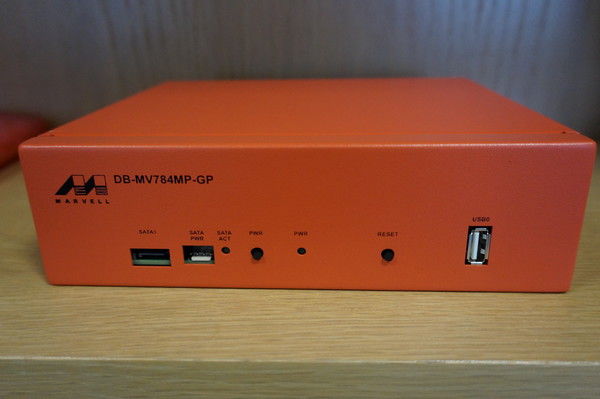
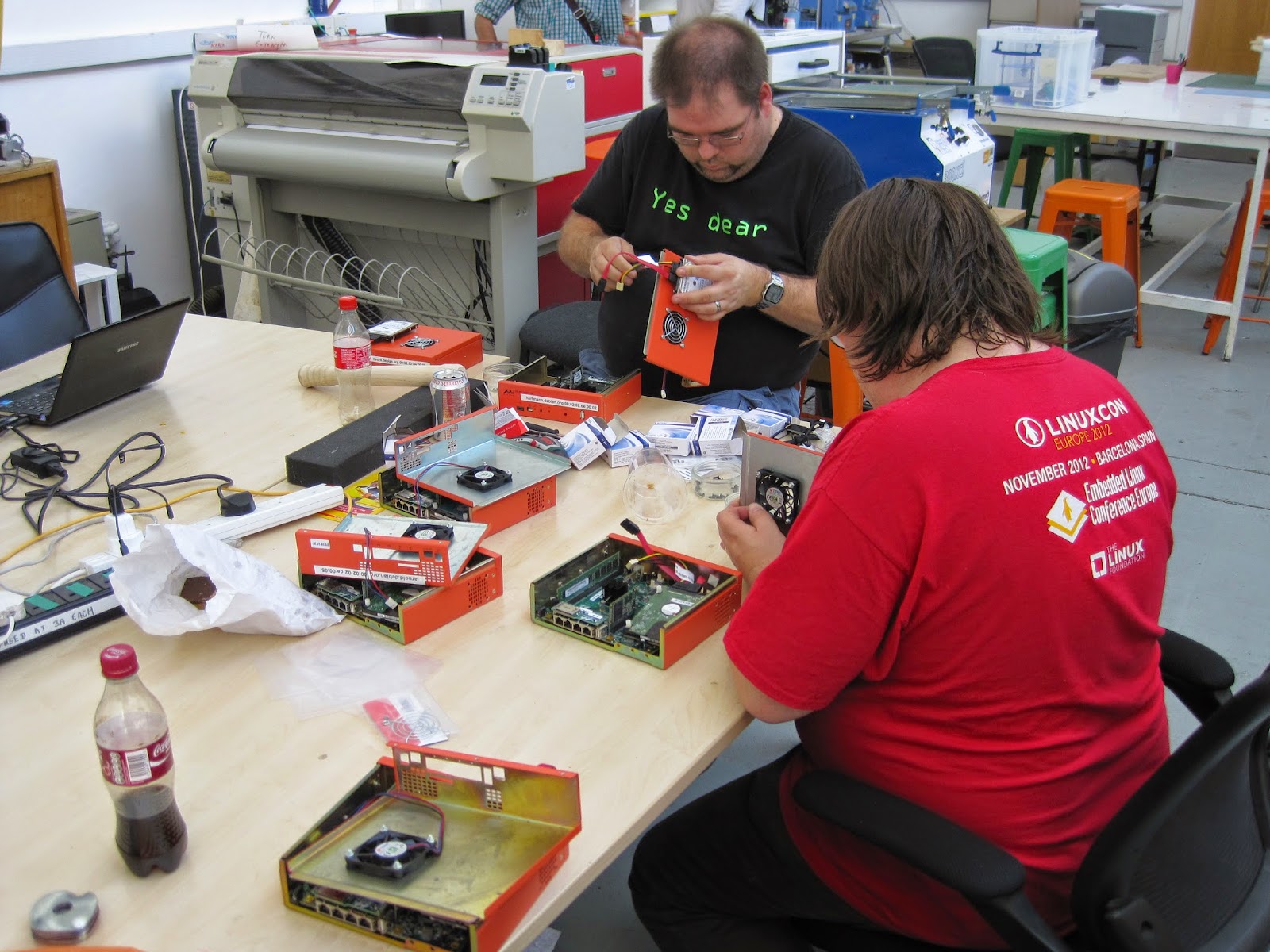
Marvell ARM system - Photo from Steve McIntyre
One weekend Steve McIntyre asked me if I could find a source of some of some 40mm fans for some systems with some pretty strict requirements. They needed to be long life and shift a lot of air to combat a persistent overheating issue.

I sat with him and went through the Farnell utterly hateful parametric web interface and eventually came up with a couple of options which were very expensive. Only then did I stop and ask what the actual problem was.

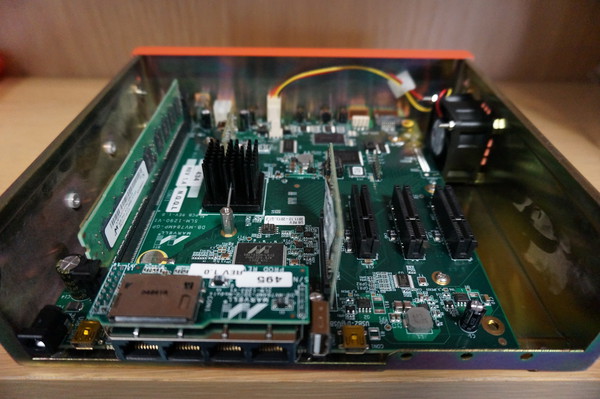
Marvell ARM system Original internal cooling arrangement - Photo from Steve McIntyre
Steve showed me one of the Debian ARM buildd boxes which are Marvell development machines. These systems are powerful quad core machines housed in compact steel enclosures.

There is a single 40mm fan trying to provide cooling for the entire enclosure. When the units are placed horizontally and used intermittently this proves adequate. Unfortunately when the system are arranged vertically in a rack and run at full load continuously they often overheat and have to be restarted. In addition the small high speed fans need replacing frequently as their bearings wore out quickly.

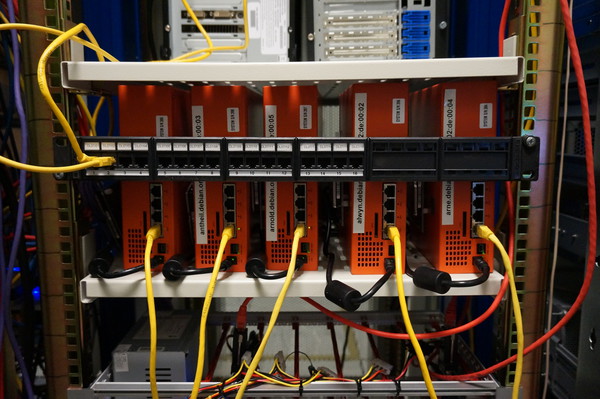
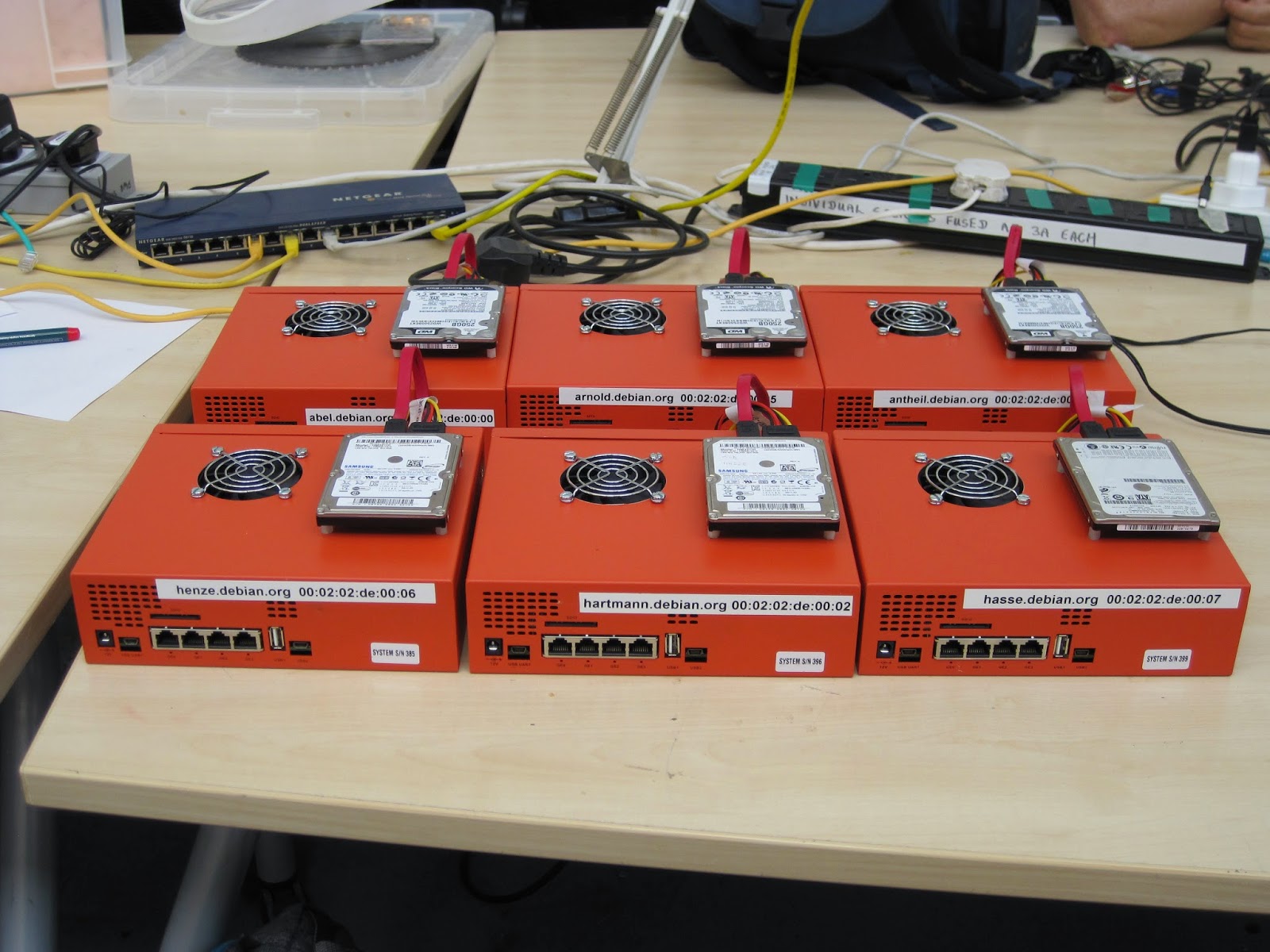
Debian ARM buildd systems - Photo from Steve McIntyreThis was obviously causing some issues for the ARM Debian ports which Steve wanted to rectify. After talking the problem through for a while we came to the conclusion we could use much larger 60mm fans to blow air directly through the top of the case onto the cpu heatsink.

Larger fans can be run much more slowly to move a similar volume of air to the smaller 40mm fans which gives a much longer service life.

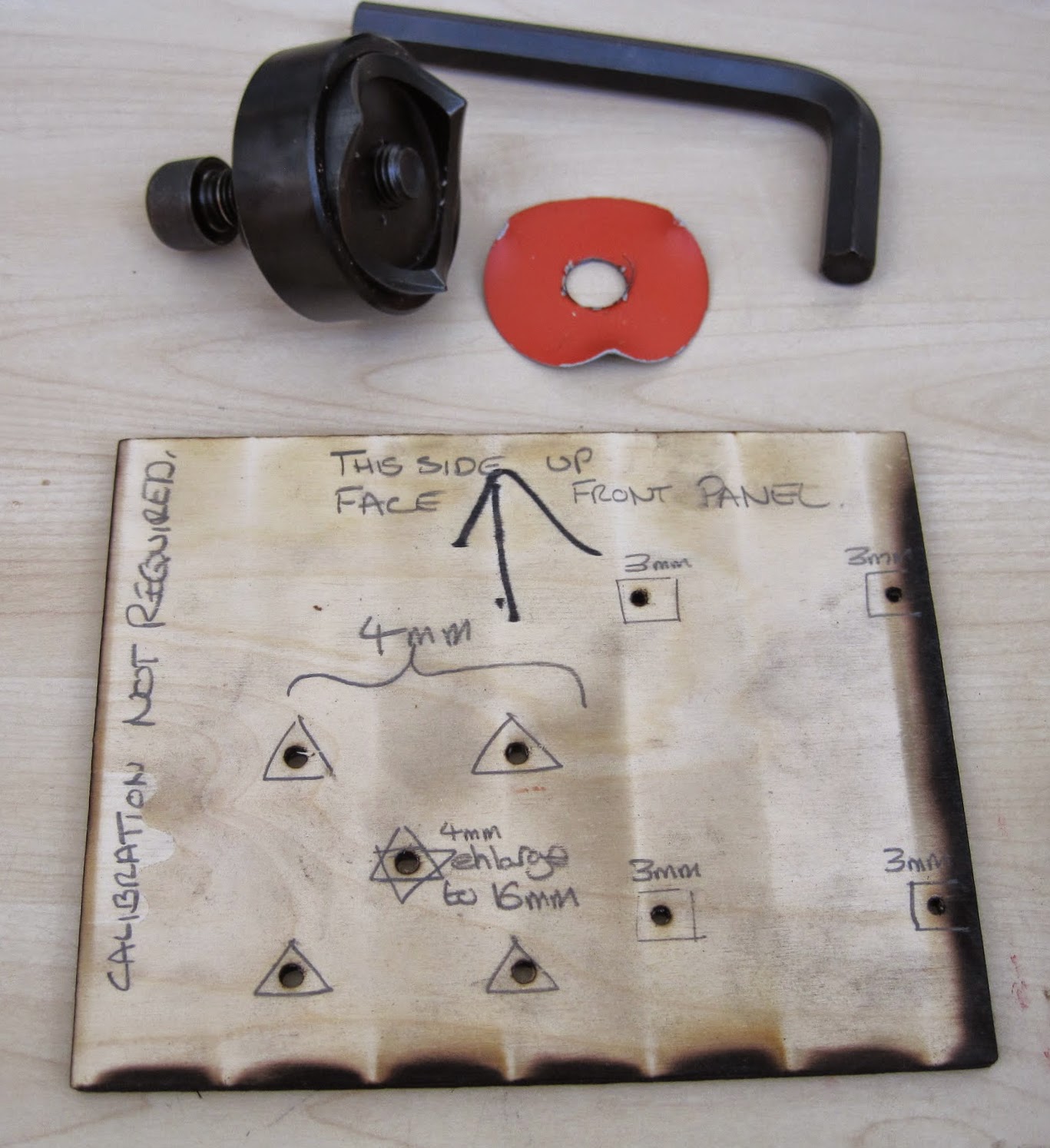
Hole punch and Drilling template
Steve proceeded to order enough parts to allow us to modify all the Debian systems, this worked out cheaper than a single "special" 40mm high volume fan.

I acquired a rather large steel hole punch, I chose this tool because it produces a much superior finish to a hole cutter and this project demanded a high level of finish (not to mention I loved having a valid excuse to own and use a huge allen key!)

If we had simply been modifying a single case I would have measured and marked up by hand. With the prospect of altering at least eight I laser cut a template from plywood which Andy Simpkins took great glee in excessively annotating.

We also used the opportunity to add bolt holes to securely attach the 2.5 inch SATA drives instead of using sticky pads.

Steve and I modified a single system to begin with both to check our alignment and the efficacy of the change. We were pleasantly surprised to discover that hoiby could now repeatedly do kernel compiles with all four cores flat out which was not possible before. The measured CPU temperature, which had previously been around 90 C, did not rise above 40 C

Steve and Andy on the assembly line
Steve, Andy and I then arranged a day where we took all the remaining units out of the rack at ARM, modified and returned them. We used the facilities at the Cambridge Makespace where I am a member to do the modifications.

I broke two 3mm drill bits and dulled a 4mm bit drilling all the holes, Roger Smith was good enough to loan us the use of his "Christmas tree bit" to ream the fan hole out to 16mm so we could thread the hole punch and cut the 60mm fan aperture out.

six modified systems ready to be re-racked.
We managed to get quite an assembly line going and, in my opinion, the results look pretty professional.

It has been several months since we did this work and these systems continue to run without issue. To complete the story we can see some graphs courtesy of the DSA munin instance.

CPU load on arnold.debian.org
You can clearly see the huge drop in temperature at the end of Week 25 despite the continuously high CPU load. Also there is only a single gap in the data after the changes (these indicate crashes where data was not recorded) where before there were frequent and extensive times where the systems were simply unusable.

CPU Temperature of arnold.debian.org
One reason I continue to enjoy Debian so much is the wide variety of ways in which I can contribute not only by maintaining my packages. Sometimes this kind of work does not receive the credit it deserves and hopefully highlights a small part of the frantic paddling that goes on under the serene surface of the Debian project to keep things "just working".

30 September 2014

Raphaël Hertzog: My Debian LTS report for September

Thanks to the sponsorship of multiple companies, I have been paid to work 11 hours on Debian LTS this month. CVE triagingI started by doing lots of triage in the security tracker (if you want to help, instructions are here) because I noticed that the dla-needed.txt list (which contains the list of packages that must be taken care of via an LTS security update) was missing quite a few packages that had open vulnerabilities in oldstable. In the end, I pushed 23 commits to the security tracker. I won t list the details each time but for once, it s interesting to let you know the kind of things that this work entailed: And when I say I reviewed it s a simplification for this kind of process: CVE triaging is often almost half the work in the general process: once you know that you are affected and that you have a patch, the process to release an update is relatively straightforward (sometimes there s still work to do to backport the patch). Once I was over that first pass of triaging, I had already spent more than the 11 hours paid but I still took care of preparing the security update for python-django. Thorsten Alteholz had started the work but got stuck in the process of backporting the patches. Since I m co-maintainer of the package, I took over and finished the work to release it as DLA-65-1.

No comment Liked this article? Click here. My blog is Flattr-enabled.

28 September 2014

Ean Schuessler: RoboJuggy at JavaOne

A few months ago I was showing my friend Bruno Souza the work I had been doing with my childhood friend and robotics genius, David Hanson. I had been watching what David was going through in his process of creating life-like robots with the limited industrial software available for motor control. I had suggested to David that binding motors to Blender control structures was a genuinely viable possibility. David talked with his forward looking CEO, Jong Lee, and they were gracious enough to invite me to Hong Kong to make this exciting idea a reality. Working closely the HRI team (Vytas, Gabrielos, Fabien and Davide) with David s friend and collaborators at OpenCog (Ben Goertzel, Mandeep, David, Jamie, Alex and Samuel) a month long creative hack-fest yielded pretty amazing results. Bruno is an avid puppeteer, a global organizer of java user groups and creator of Juggy the Java Finch, mascot of Java users and user groups everywhere. We started talking about how cool it would be to have a robot version of Juggy. When I was in China I had spent a little time playing with Mark Tilden s RSMedia and various versions of David s hobby servo based emotive heads. Bruno and I did a little research into the ROS Java bindings for the Robot Operating System and decided that if we could make that part of the picture we had a great and fun idea for a JavaOne talk. Hunting and gathering I tracked down a fairly priced RSMedia in Alaska, Bruno put a pair of rubber Juggy puppet heads in the mail and we were on our way.
We had decided that we wanted RoboJuggy to be able to run about untethered and the new RaspberryPi B+ seemed like the perfect low power brain to make that happen. I like the Debian based Raspbian distributions but had lately started using the netinst Pi images. These get your Pi up and running in about 15 minutes with a nicely minimalistic install instead of a pile of dependencies you probably don t need. I d recommend anyone interested I m duplicating our work to stay their journey there: Raspbian UA Net Installer Robots seem like an embedded application but ROS only ships packages for Ubuntu. I was pleasantly surprised that there are very good instructions for building ROS from source on the Pi. I ended up following these instructions: Setting up ROS Hydro on the Raspberry Pi Building from source means that all your install ends up being isolated (in ROS speak) and your file locations and build instructions end up being subtly current. As explained in the linked article, this process is also very time consuming. One thing I would recommend once you get past this step is to use the UNIX dd command to back up your entire SD card to a desktop. This way if you make a mess of things in later steps you can restore your install to a pristine Raspbian+ROS install. If your SD drive was on /dev/sdb you might use something like this to do the job:
sudo dd bs=4M if=/dev/sdb   gzip > /home/your_username/image date +%d%m%y .gz
Getting Java in the mix Once you have your Pi all set up with minimal Raspbian and ROS you are going to want a Java VM. The Pi runs the ARM CPU so you need the corresponding version of Java. I tried getting things going initially with OpenJDK and I had some issues with that. I will work on resolving that in the future because I would like to have a 100% Free Software kit for this but since this was for JavaOne I also wanted JDK8, which isn t available in Debian yet. So, I downloaded the Oracle JDK8 package for ARM. Java 8 JDK for ARM At this point you are ready to start installing the ROS Java packages. I m pretty sure the way I did this initially is wrong but I was trying to reconcile the two install procedures for ROS Java and ROS Hydro for Raspberry Pi. I started by following these directions for ROS Java but with a few exceptions (you have to click the install from source link in the page to see the right stuff: Installing ROS Java on Hydro Now these instructions are good but this is a Pi running Debian and not an Ubuntu install. You won t run the apt-get package commands because those tools were already installed in your earlier steps. Also, this creates its own workspace and we really want these packages all in one workspace. You can apparently chain workspaces in ROS but I didn t understand this well enough to get it working so what I did was this:
> mkdir -p ~/rosjava 
> wstool init -j4 ~/rosjava/src https://raw.github.com/rosjava/rosjava/hydro/rosjava.rosinstall
> source ~/ros_catkin_ws/install_isolated/setup.bash > cd ~/rosjava # Make sure we've got all rosdeps and msg packages.
> rosdep update 
> rosdep install --from-paths src -i -y
and then copied the sources installed into ~/rosjava/src into my main ~/ros_catkin_ws/src. Once those were copied over I was able to run a standard build.
> catkin_make_isolated --install
Like the main ROS install this process will take a little while. The Java gradle builds take an especially long time. One thing I would recommend to speed up your workflow is to have an x86 Debian install (native desktop, QEMU instance, docker, whatever) and do these same build from source installs there. This will let you try your steps out on a much faster system before you try them out in the Pi. That can be a big time saver. Putting together the pieces Around this time my RSMedia had finally showed up from Alaska. At first I thought I had a broken unit because it would power up, complain about not passing system tests and then shut back down. It turns out that if you just put the D batteries in and miss the four AAs that it will kind of pretend to be working so watch for that mistake. Here is a picture of the RSMedia when it first came out of the box: wpid-20140911_142904.jpg Other parts were starting to roll in as well. The rubber puppet heads had made their way through Brazilian customs and my Pololu Mini Maestro 24 had also shown up as well as the my servo motors and pan and tilt camera rig. I had previously bought a set of 10 motors for goofing around so I bought the pan and tilt rig by itself for about $5(!) but you can buy a complete set for around $25 from a number of EBay stores. Complete pan and tilt rig with motors for $25 A bit more about the Pololu. This astonishing little motor controller costs about $25 and gives you control of 24 motors with an easy to use and high level serial API. It is probably also possible to control these servos directly from the Pi and eliminate this board but that will be genuinely difficult because of the real-time timing issues. For $25 this thing is a real gem and you won t regret buying it. Now it was time to start dissecting the RSMedia and getting control of its brain. Unfortunately a lot of great information about the RSMedia has floated away since it was in its heyday 5 years ago but there is still some solid information out there that we need to round up and preserve. A great resource is the SourceForge based website here at http://rsmediadevkit.sourceforge.net. That site has links to a number of useful sites. You will definitely want to check out their wiki. To disassemble the RSMedia I followed their instructions. I will say, it would be smart to take more pictures as you are going because they don t take as many as they should. I took pictures of each board and its associated connections as dismantled the unit and that helped me get things back together later. Another important note is that if all you want to do is solder onto the control board and not replace the head then its feasible to solder the board in place without completely disassembling the unit. Here are some photos of the dis-assembly: wpid-20140921_114742.jpg wpid-20140921_113054.jpg wpid-20140921_112619.jpg Now I also had to start adjusting the puppet head, building an armature for the motors to control it and hooking it into the robot. I need to take some more photos of the actual armature. I like to use cardboard for this kind of stuff because it is so fast to work with and relatively strong. One trick I have also learned about cardboard is that if you get something going with it and you need it to be a little more production strength you can paint it down with fiberglass resin from your local auto store. Once it dries it becomes incredibly tough because it soaks through the fibers of the cardboard and hardens around them. You will want to do this in a well ventilated area but its a great way to build super tough prototypes. Another prototyping trick I can suggest is using a combination of Velcro and zipties to hook things together. The result is surprisingly strong and still easy to take apart if things aren t working out. Velcro self-adhesive pads stick to rubber like magic and that is actually how I hooked the jaw servo onto the mask. You can see me torturing its first initial connection here: Since the puppet head had come all the way from Brazil I decided to cook some chicken hearts in the churrascaria style while I worked on them in the garage. This may sound gross but I m telling you, you need to try it! I soaked mine in soy sauce, Sriracha and chinese cooking wine. Delicious but I digress. wpid-20140920_191551.jpg As I was eating my chicken hearts I was also connecting the pan and tilt armature onto the puppet s jaw and eye assembly. It took me most of the evening to get all this going but by about one in the morning things were starting to look good! I only had a few days left to hack things together before JavaOne and things were starting to get tight. I had so much to do and had also started to run into some nasty surprises with the ROS Java control software. It turns out that ROS Java is less than friendly with ROS message structures that are not built in . I had tried to follow the provided instructions but was not (and still have not) been able to get that working. Using unofficial messages with ROS Java I still needed to get control of the RSMedia. Doing that required the delicate operation of soldering to its control board. On the board there are a set of pins that provide a serial interface to the ARM based embedded Linux computer that controls the robot. To do that I followed these excellent instructions: Connecting to the RSMedia Linux Console Port After some sweaty time bent over a magnifying glass I had success: wpid-20140921_143327.jpg I had previously purchased the USB-TTL232 accessory described in the article from Dallas awesome Tanner Electronics store in Dallas. If you are a geek I would recommend that you go there and say hi to its proprietor (and walking encyclopedia of electronics knowledge) Jim Tanner. It was very gratifying when I started a copy of minicom, set it to 115200, N, 8, 1, plugged in the serial widget to the RSMedia and booted it up. I was greeted with a clearly recognizable Linux startup and console prompt. At first I thought I had done something wrong because I couldn t get it to respond to commands but I quickly realized I had flow control turned on. Once turned off I was able to navigate around the file system, execute commands and have some fun. A little research and I found this useful resource which let me get all kinds of body movements going: A collection of useful commands for the RSMedia At this point, I had a usable set of controls for the body as well as the neck armature. I had a controller running the industry s latest and greatest robotics framework that could run on the RSMedia without being tethered to power and I had most of a connection to Java going. Now I just had to get all those pieces working together. The only problem is that time was running out and I only had a couple of days until my talk and still had to pack and square things away at work. The last day was spent doing things that I wouldn t be able to do on the road. My brother Erik (and fantastic artist) came over to help paint up the juggy head and fix the eyeball armature. He used a mix of oil paint, rubber cement which stuck to the mask beautifully. I bought battery packs for the USB Pi power and the 6v motor control and integrated them into a box that could sit below the neck armature. I fixed up a cloth neck sleeve that could cover everything. Luckily during all this my beautiful and ever so supportive girlfriend Becca had helped me get packed or I probably wouldn t have made it out the door. Welcome to San Francisco THIS ARTICLE IS STILL BEING WRITTEN

Jonathan Dowland: Puppet and filesystem mounts

Well, not long after writing my last post I've found some time to write up some of my puppet adventures, sooner than I imagined... Outside work, I sys-admin a VPS instance that is shared by a few friends. We recently embarked in a project to migrate to a different VPS instance and I took the opportunity to revisit how we managed home directories. I've got all the disk space allocated to the VM set up as LVM physical volumes. This has proven very useful for later expansion: we can do it all live. Each user on the VM may have one or more UNIX accounts that they use. Therefore, in the old scheme, for the jon user, we mounted an allocation of disk space at /home/jons, put the account home directories under it at e.g. /home/jons/jon, symlinked /home/jon -> /home/jons/jon for brevity, and set that as the home field in the passwd entry. This worked surprisingly well, but I was always uncomfortable with having a symlink in the home path (and some software was, too.) For the new machine, I decided to try bind mounts. Short story: they just work. However, the mtab (and df output) can look a little cluttered, and mount order becomes quite important. To manage the set-up, I wrote a few puppet snippets. First, a convenience definition to make the actual bind-mounts a little less verbose.
define bindmount($device)  
  mount   $name:
    device  => $device,
    ensure  => mounted,
    fstype  => 'none',
    options => 'bind',
    dump    => 0,
    pass    => 2,
    require => File[$device],
   
 
Once that was in place, we then needed to ensure that the directories to which the LV were to be mounted, and to where the user's home would be bind-mounted, actually exist; we also need to mount the underlying LV and set up the bind mount. The dependency chain is actually a graph, but with the majority of dependencies quite linear:
define bindmounthome()  
  file   ["/home/$ name s", "/home/$ name "]:
    ensure  => directory,
    -> # depended upon by
  mount   "/home/$ name s":
    device  => "LABEL=$ name ",
    ensure  => mounted,
    fstype  => 'ext4',
    options => 'defaults',
    dump    => 0,
    pass    => 2,
    -> # depended upon by
  bindmount   "/home/$ name ":
    device  => "/home/$ name s/$ name ",
   
  file   "/home/$ name s/$ name ":
    ensure  => directory,
    owner   => $name,
    group   => $name,
    mode    => 0701, # 0701/drwx-----x
    require => [User[$name], Group[$name], Mount["/home/$ name s"]],
   
 
That covers the underlying mounts and the "primary" accounts. However, the point of this exercise was to support the secondary accounts for each user. There's a bit of repetition here, and with some refactoring both this and the preceding bindmounthome definition could be a bit shorter, but I'm not sure whether that would be at the expense of legibility:
define seconduser($parent)  
  file   "/home/$ name ":
    ensure => directory,
    -> # depended upon by
  bindmount   "/home/$ name ":
    device => "/home/$ parent s/$ name ",
   
  file   "/home/$ parent s/$ name ":
    ensure  => directory,
    owner   => $name,
    group   => $name,
    mode    => 0701, # 0701/drwx-----x
    require => [User[$name], Group[$name], Mount["/home/$ parent s"]],
   
 
I had to re-read the above a couple of times just now to convince myself that I hadn't missed the dependencies between the mount invocations towards the bottom, but they're there: so, puppet will always run the mount for /home/jons before /home/jons/jon. Since puppet is writing to the fstab, this means that the ordering is correct and a sequential start-up will work. If you want anything cleverer than serialised, one-at-a-time mounting at boot, I think one would have to use something other than trusty-old fstab for the job. I'm planning to look at Systemd's mount unit type, but there's no rush as this particular host is still running sysvinit for the time being.

25 September 2014

Aigars Mahinovs: Distributing third party applications via Docker?

Recently the discussions around how to distribute third party applications for "Linux" has become a new topic of the hour and for a good reason - Linux is becoming mainstream outside of free software world. While having each distribution have a perfectly packaged, version-controlled and natively compiled version of each application installable from a per-distribution repository in a simple and fully secured manner is a great solution for popular free software applications, this model is slightly less ideal for less popular apps and for non-free software applications. In these scenarios the developers of the software would want to do the packaging into some form, distribute that to end-users (either directly or trough some other channels, such as app stores) and have just one version that would work on any Linux distribution and keep working for a long while. For me the topic really hit at Debconf 14 where Linus voiced his frustrations with app distribution problems and also some of that was touched by Valve. Looking back we can see passionate discussions and interesting ideas on the subject from systemd developers (another) and Gnome developers (part2 and part3). After reading/watching all that I came away with the impression that I love many of the ideas expressed, but I am not as thrilled about the proposed solutions. The systemd managed zoo of btrfs volumes is something that I actually had a nightmare about. There are far simpler solutions with existing code that you can start working on right now. I would prefer basing Linux applications on Docker. Docker is a convenience layer on top of Linux cgroups and namespaces. Docker stores its images in a datastore that can be based on AUFS or btrfs or devicemapper or even plain files. It already has a semantic for defining images, creating them, running them, explicitly linking resources and controlling processes. Lets play a simple scenario on how third party applications should work on Linux. Third party application developer writes a new game for Linux. As his target he chooses one of the "application runtime" Docker images on Docker Hub. Let's say he chooses the latest Debian stable release. In that case he writes a simple Dockerfile that installs his build-dependencies and compiles his game in "debian-app-dev:wheezy" container. The output of that is a new folder containing all the compiled game resources and another Dockerfile - this one describes the runtime dependencies of the game. Now when a docker image is built from this compiled folder, it is based on "debian-app:wheezy" container that no longer has any development tools and is optimized for speed and size. After this build is complete the developer exports the Docker image into a file. This file can contain either the full system needed to run the new game or (after #8214 is implemented) just the filesystem layers with the actual game files and enough meta-data to reconstruct the full environment from public Docker repos. The developer can then distribute this file to the end user in the way that is comfortable for them. The end user would download the game file (either trough an app store app, app store website or in any other way) and import it into local Docker instance. For user convenience we would need to come with an file extension and create some GUIs to launch for double click, similar to GDebi. Here the user would be able to review what permissions the app needs to run (like GL access, PulseAudio, webcam, storage for save files, ...). Enough metainfo and cooperation would have to exist to allow desktop menu to detect installed "apps" in Docker and show shortcuts to launch them. When the user does so, a new Docker container is launched running the command provided by the developer inside the container. Other metadata would determine other docker run options, such as whether to link over a socket for talking to PulseAudio or whether to mount in a folder into the container to where the game would be able to save its save files. Or even if the application would be able to access X (or Wayland) at all. Behind the scenes the application is running from the contained and stable libraries, but talking to a limited and restricted set of system level services. Those would need to be kept backwards compatible once we start this process. On the sandboxing part, not only our third party application is running in a very limited environment, but also we can enhance our system services to recognize requests from such applications via cgroups. This can, for example, allow a window manager to mark all windows spawned by an application even if the are from a bunch of different processes. Also the window manager can now track all processes of a logical application from any of its windows. For updates the developer can simply create a new image and distribute the same size file as before, or, if the purchase is going via some kind of app-store application, the layers that actually changed can be rsynced over individually thus creating a much faster update experience. Images with the same base can share data, this would encourage creation of higher level base images, such as "debian-app-gamegl:wheezy" that all GL game developers could use thus getting a smaller installation package. After a while the question of updating abandonware will come up. Say there is is this cool game built on top of "debian-app-gamegl:wheezy", but now there was a security bug or some other issue that requires the base image to be updated, but that would not require a recompile or a change to the game itself. If this Docker proposal is realized, then either the end user or a redistributor can easily re-base the old Docker image of the game on a new base. Using this mechanism it would also be possible to handle incompatible changes to system services - ten years down the line AwesomeAudio replaces PulseAudio, so we create a new "debian-app-gamegl:wheezy.14" version that contains a replacement libpulse that actually talks to AwesomeAudio system service instead. There is no need to re-invent everything or push everything and now package management too into systemd or push non-distribution application management into distribution tools. Separating things into logical blocks does not hurt their interoperability, but it allows to recombine them in a different way for a different purpose or to replace some part to create a system with a radically different functionality. Or am I crazy and we should just go and sacrifice Docker, apt, dpkg, FHS and non-btrfs filesystems on the altar of systemd? P.S. You might get the impression that I dislike systemd. I love it! Like an init system. And I love the ideas and talent of the systemd developers. But I think that systemd should have nothing to do with application distribution or processes started by users. I am sometimes getting an uncomfortable feeling that systemd is morphing towards replacing the whole of System V jumping all the way to System D and rewriting, obsoleting or absorbing everything between the kernel and Gnome. In my opinion it would be far healthier for the community if all of these projects would developed and be usable separately from systemd, so that other solutions can compete on a level playing field. Or, maybe, we could just confess that what systemd is doing is creating a new Linux meta-distribution.

Gunnar Wolf: #bananapi On how compressed files should be used

I am among the lucky people who got back home from DebConf with a brand new computer: a Banana Pi. Despite the name similarity, it is not affiliated with the very well known Raspberry Pi, although it is a very comparable (although much better) machine: A dual-core ARM A7 system with 1GB RAM, several more on-board connectors, and same form-factor. I have not yet been able to get it to boot, even from the images distributed on their site (although I cannot complain, I have not devoted more than a hour or so to the process!), but I do have a gripe on how the images are distributed. I downloaded some images to play with: Bananian, Raspbian, a Scratch distribution, and Lubuntu. I know I have a long way to learn in order to contribute to Debian's ARM port, but if I can learn by doing... So, what is my gripe? That the three images are downloaded as archive files:
  1. 0 gwolf@mosca 9 ~/Download/banana$ ls -hl bananian-latest.zip \
  2. > Lubuntu_For_BananaPi_v3.1.1.tgz Raspbian_For_BananaPi_v3.1.tgz \
  3. > Scratch_For_BananaPi_v1.0.tgz
  4. -rw-r--r-- 1 gwolf gwolf 222M Sep 25 09:52 bananian-latest.zip
  5. -rw-r--r-- 1 gwolf gwolf 823M Sep 25 10:02 Lubuntu_For_BananaPi_v3.1.1.tgz
  6. -rw-r--r-- 1 gwolf gwolf 1.3G Sep 25 10:01 Raspbian_For_BananaPi_v3.1.tgz
  7. -rw-r--r-- 1 gwolf gwolf 1.2G Sep 25 10:05 Scratch_For_BananaPi_v1.0.tgz
Now... that is quite an odd way to distribute image files! Specially when looking at their contents:
  1. 0 gwolf@mosca 14 ~/Download/banana$ unzip -l bananian-latest.zip
  2. Archive: bananian-latest.zip
  3. Length Date Time Name
  4. --------- ---------- ----- ----
  5. 2032664576 2014-09-17 15:29 bananian-1409.img
  6. --------- -------
  7. 2032664576 1 file
  8. 0 gwolf@mosca 15 ~/Download/banana$ for i in Lubuntu_For_BananaPi_v3.1.1.tgz \
  9. > Raspbian_For_BananaPi_v3.1.tgz Scratch_For_BananaPi_v1.0.tgz
  10. > do tar tzvf $i; done
  11. -rw-rw-r-- bananapi/bananapi 3670016000 2014-08-06 03:45 Lubuntu_1404_For_BananaPi_v3_1_1.img
  12. -rwxrwxr-x bananapi/bananapi 3670016000 2014-08-08 04:30 Raspbian_For_BananaPi_v3_1.img
  13. -rw------- bananapi/bananapi 3980394496 2014-05-27 01:54 Scratch_For_BananaPi_v1_0.img
And what is bad about them? That they force me to either have heaps of disk space available (2GB or 4GB for each image) or to spend valuable time extracting before recording the image each time. Why not just compressing the image file without archiving it? That is,
  1. 0 gwolf@mosca 7 ~/Download/banana$ tar xzf Lubuntu_For_BananaPi_v3.1.1.tgz
  2. 0 gwolf@mosca 8 ~/Download/banana$ xz Lubuntu_1404_For_BananaPi_v3_1_1.img
  3. 0 gwolf@mosca 9 ~/Download/banana$ ls -hl Lubun*
  4. -rw-r--r-- 1 gwolf gwolf 606M Aug 6 03:45 Lubuntu_1404_For_BananaPi_v3_1_1.img.xz
  5. -rw-r--r-- 1 gwolf gwolf 823M Sep 25 10:02 Lubuntu_For_BananaPi_v3.1.1.tgz
Now, wouldn't we need to decompress said files as well? Yes, but thanks to the magic of shell redirections, we can just do it on the fly. That is, instead of having 3 4GB+1 2GB files sitting on my hard drive, I just need to have several files ranging between 145M and I guess ~1GB. Then, it's as easy as doing:
  1. 0 gwolf@mosca 8 ~/Download/banana$ dd if=<(xzcat bananian-1409.img.xz) of=/dev/sdd
And the result should be the same: A fresh new card with Bananian ready to fly. Right, right, people using these files need to have xz installed on their systems, but... As it stands now, I can suppose current prospective users of a Banana Pi won't fret about facing a standard Unix tool! (Yes, I'll forward this rant to the Banana people, it's not just bashing on my blog :-P ) [update] Several people (thanks!) have contacted me stating that I use a bashism: The <( ) construct is specific to Bash. If you want to do this with any other shell, it can be done with a simple pipe:
  1. $ xzcat bananian-1409.img.xz dd of=/dev/sdd
That allows for less piping to be done on the kernel, and is portable between different shells. Also, a possibility would be:
  1. $ xzcat bananian-1409.img.xz > /dev/sdd
Although that might not be desirable, as it avoids the block-by-block nature of dd. I'm not sure if it makes a realdifference, but it's worth saying :) And yes, some alternatives for not unarchiving the file Here in the blog, an anon commenter suggests (respectively, for zip and .tar.gz files):
  1. $ dd if=<(unzip -p bananian-latest.zip) of=/dev/sdd
  2. $ dd if=<(tar -xOf Lubuntu_For_BananaPi_v3.1.1.tgz) of=/dev/sdd
And a commenter by IRC suggests:
  1. $ paxtar -xOaf Raspbian_For_BananaPi_v3.1.tgz Raspbian_For_BananaPi_v3_1.img sudo dd bs=262144 of=/dev/
Thanks!

Russ Allbery: Review: Turn the Ship Around!

Review: Turn the Ship Around!, by L. David Marquet
Publisher: Portfolio
Copyright: 2012
ISBN: 1-101-62369-1
Format: Kindle
Pages: 272
Turn the Ship Around! (yes, complete with the irritating exclamation point in the title) is marketed to the business and management non-fiction market, which is clogged with books claiming to provide simple techniques to be a great manager or fix an organization. If you're like me, this is a huge turn-off. The presentation of the books is usually just shy of the click-bait pablum of self-help books. Many of the books are written by famous managers best known for doing horrible things to their staff (*cough* Jack Welch). It's hard to get away from the feeling that this entire class of books is an ocean of bromides covering a small core of outright evil. This book is not like that, and Marquet is not one of those managers. It can seem that way at times: it is presented in the format that caters to short attention span, with summaries of primary points at the end of every short chapter and occasionally annoying questions sprinkled throughout. I'm capable of generalizing information to my own life without being prompted by study questions, thanks. But that's just form. The core of this book is a surprisingly compelling story of Marquet's attempt to introduce a novel management approach into one of the most conservative and top-down of organizations: a US Navy nuclear submarine. I read this book as an individual employee, and someone who has no desire to ever be a manager. But I recently changed jobs and significantly disrupted my life because of a sequence of really horrible management decisions, so I have strong opinions about, at least, the type of management that's bad for employees. A colleague at my former employer recommended this book to me while talking about the management errors that were going on around us. It did such a good job of reinforcing my personal biases that I feel like I should mention that as a disclaimer. When one agrees with a book this thoroughly, one may not have sufficient distance from it to see the places where its arguments are flawed. At the start of the book, Marquet is assigned to take over as captain of a nuclear submarine that's struggling. It had a below-par performance rating, poor morale, and the worst re-enlistment rate in the fleet, and was not advancing officers and crew to higher ranks at anywhere near the level of other submarines. Marquet brought to this assignment some long-standing discomfort with the normal top-down decision-making processes in the Navy, and decided to try something entirely different: a program of radical empowerment, bottom-up decision-making, and pushing responsibility as far down the chain of command as possible. The result (as you might expect given that you can read a book about it) was one of the best-performing submarines in the fleet, with retention and promotion rates well above average. There's a lot in here about delegated decision-making and individual empowerment, but Turn the Ship Around! isn't only about that. Those are old (if often ignored) rules of thumb about how to manage properly. I think the most valuable part of this book is where Marquet talks frankly about his own thought patterns, his own mistakes, and the places where he had to change his behavior and attitude in order to make his strategy successful. It's one thing to say that individuals should be empowered; it's quite another to stop empowering them (which is still a top-down strategy) and start allowing them to be responsible. To extend trust and relinquish control, even though you're the one who will ultimately be held responsible for the performance of the people reporting to you. One of the problems with books like this is that they focus on how easy the techniques presented in the book are. Marquet does a more honest job in showing how difficult they are. His approach was not complex, but it was emotionally quite difficult, even though he was already biased in favor of it. The control, hierarchy, and authority parts of the book are the most memorable, but Marquet also talks about, and shows through specific examples from his command, some accompanying principles that are equally important. If everyone in an organization can make decisions, everyone has to understand the basis for making those decisions and understand the shared goals, which requires considerable communication and open discussion (particularly compared to a Navy ideal of an expert and taciturn captain). It requires giving people the space to be wrong, and requires empowering people to correct each other without blame. (There's a nice bit in here about the power of deliberate action, and while Marquet's presentation is more directly applicable to the sorts of physical actions taken in a submarine, I was immediately reminded of code review.) Marquet also has some interesting things to say about the power of, for lack of a better term, esprit de corps, how to create it, and the surprising power of acting like you have it until you actually develop it. As mentioned, this book is very closely in alignment with my own biases, so I'm not exactly an impartial reviewer. But I found it fascinating the degree to which the management situation I left was the exact opposite of the techniques presented in this book in nearly every respect. I found it quite inspiring during my transition period, and there are bits of it that I want to read again to keep some of the techniques and approaches fresh in my mind. There is a fair bit of self-help-style packaging and layout here, some of which I found irritating. If, like me, you don't like that style of book, you'll have to wade through a bit of it. I would have much preferred a more traditional narrative story from which I could draw my own conclusions. But it's more of a narrative than most books of this sort, and Marquet is humble enough to show his own thought processes, tensions, and mistakes, which adds a great deal to the presentation. I'm not sure how directly helpful this would be for a manager, since I've never been in that role, but it gave me a lot to think about when analyzing successful and unsuccessful work environments. Rating: 8 out of 10

24 September 2014

Robert Collins: what-poles-for-the-tent

So Monty and Sean have recently blogged about about the structures (1, 2) they think may work better for OpenStack. I like the thrust of their thinking but had some mumblings of my own to add. Firstly, I very much like the focus on social structure and needs what our users and deployers need from us. That seems entirely right. And I very much like the getting away from TC picking winners and losers. That was never an enjoyable thing when I was on the TC, and I don t think it has made OpenStack better. However, the thing that picking winners and losers did was that it allowed users to pick an API and depend on it. Because it was the X API for OpenStack . If we don t pick winners, then there is no way to say that something is the X API for OpenStack , and that means that there is no forcing function for consistency between different deployer clouds. And so this appears to be why Ring 0 is needed: we think our users want consistency in being able to deploy their application to Rackspace or HP Helion. They want vendor neutrality, and by giving up winners-and-losers we give up vendor neutrality for our users. Thats the only explanation I can come up with for needing a Ring 0 because its still winners and losers (e.g. picking an arbitrary project) keystone, grandfathering it in, if you will. If we really want to get out of the role of selecting projects, I think we need to avoid this. And we need to avoid it without losing vendor neutrality (or we need to give up the idea of vendor neutrality). One might say that we must pick winners for the very core just by its, but I don t think thats true. If the core is small, many people will still want vendor neutrality higher up the stack. If the core is large, then we ll have a larger % of APIs covered and stable granting vendor neutrality. So a core with fixed APIs will be under constant pressure to expand: not just from developers of projects, but from users that want API X to be fixed and guaranteed available and working a particular way at [most] OpenStack clouds. Ring 0 also fulfils a quality aspect we can check that it all works together well in a realistic timeframe with our existing tooling. We are essentially proposing to pick functionality that we guarantee to users; and an API for that which they have everywhere, and the matching implementation we ve tested. To pull from Monty s post: What does a basic end user need to get a compute resource that works and seems like a computer? (end user facet) What does Nova need to count on existing so that it can provide that. He then goes on to list a bunch of things, but most of them are not needed for that: We need Nova (its the only compute API in the project today). We don t need keystone (Nova can run in noauth mode and deployers could just have e.g. Apache auth on top). We don t need Neutron (Nova can do that itself). We don t need cinder (use local volumes). We need Glance. We don t need Designate. We don t need a tonne of stuff that Nova has in it (e.g. quotas) end users kicking off a simple machine have -very- basic needs. Consider the things that used to be in Nova: Deploying containers. Neutron. Cinder. Glance. Ironic. We ve been slowly decomposing Nova (yay!!!) and if we keep doing so we can imagine getting to a point where there truly is a tightly focused code base that just does one thing well. I worry that we won t get there unless we can ensure there is no pressure to be inside Nova to win . So there s a choice between a relatively large set of APIs that make the guaranteed available APIs be comprehensive, or a small set that that will give users what they need just at the beginning but might not be broadly available and we ll be depending on some unspecified process for the deployers to agree and consolidate around what ones they make available consistently. In sort one of the big reasons we were picking winners and losers in the TC was to consolidate effort around a single API not implementation (keystone is already on its second implementation). All the angst about defcore and compatibility testing is going to be multiplied when there is lots of ecosystem choice around APIs above Ring 0, and the only reason that won t be a problem for Ring 0 is that we ll still be picking winners. How might we do this? One way would be to keep picking winners at the API definition level but not the implementation level, and make the competition be able to replace something entirely if they implement the existing API [and win hearts and minds of deployers]. That would open the door to everything being flexible and its happened before with Keystone. Another way would be to not even have a Ring 0. Instead have a project/program that is aimed at delivering the reference API feature-set built out of a single, flat Big Tent and allow that project/program to make localised decisions about what components to use (or not). Testing that all those things work together is not much different than the current approach, but we d have separated out as a single cohesive entity the building of a product (Ring 0 is clearly a product) from the projects that might go into it. Projects that have unstable APIs would clearly be rejected by this team; projects with stable APIs would be considered etc. This team wouldn t be the TC : they too would be subject to the TC s rulings. We could even run multiple such teams as hinted at by Dean Troyer one of the email thread posts. Running with that I d then be suggesting So OpenStack/NaaS would have an API or set of APIs, and they d be responsible for considering maturity, feature set, and so on, but wouldn t own Neutron, or Neutron incubator or any other component they would be a *cross project* team, focused at the product layer, rather than the component layer, which nearly all of our folk end up locked into today. Lastly Sean has also pointed out that we have large N N^2 communication issues I think I m proposing to drive the scope of any one project down to a minimum, which gives us more N, but shrinks the size within any project, so folk don t burn out as easily, *and* so that it is easier to predict the impact of changes clear contracts and APIs help a huge amount there.

Russ Allbery: Review: 2014 Hugos: Short Story Nominees

Review: 2014 Hugos: Short Story Nominees, edited by Loncon 3
Publisher: Loncon 3
Copyright: 2014
Format: Kindle
This is a bit of a weird "book review," since this is not a book. Rather, it's the collection of Hugo-nominated short stories for the 2014 Hugos (given for works published in 2013) at Loncon 3, the 2014 Worldcon. As such, the "editor" is the pool of attendees and supporting members who chose to nominate works, all of which had been previously edited by other editors in their original publication. This is also not something that someone else can acquire; if you were not a supporting or attending member, you didn't get the voting packet. But I believe all of the stories here are available on-line for free in some form, a short search away. "If You Were a Dinosaur, My Love" by Rachel Swirsky: The most common complaint about this story is that it's not really a story, and I have to agree. It's a word image of an alternate world in which the narrator's love is a human-sized dinosaur, starting with some surreal humor and then slowly shifting tone as it reveals the horrible event that's happened to the narrator's actual love, and that's sparked the wish for her love to have claws and teeth. It's reasonably good at what it's trying to do, but I wanted more of a story. The narrator's imagination didn't do much for me. (5) "The Ink Readers of Doi Saket" by Thomas Olde Heuvelt: At least for me, this story suffered from being put in the context of a Hugo nominee. It's an okay enough story about a Thai village downstream from a ritual that involves floating wishes down the river, often with offerings in the improvised small boats. The background of the story is somewhat cynical: the villagers make some of the wishes come true, sort of, while happily collecting the offerings and trying to spread the idea that the wishes with better offerings are more likely to come true. The protagonist follows a familiar twist: he actually can make wishes come true, maybe, but is very innocent about his role in the world. This is not a bad story, although stories written by people with western-sounding names about non-western customs worry me, and there were a few descriptions and approaches here (such as the nickname translations in footnotes and the villager archetypes) that made my teeth itch. But it is not a story that belongs on the Hugo nomination slate, at least in my opinion. It's either cute or mildly irritating, depending on one's mood when one meets it, not horribly original, and very forgettable. (5) "Selkie Stories Are for Losers" by Sofia Samatar: I really liked this story for much of its length. It features a couple of young, blunt, and bitter women, and focuses on the players in the typical selkie story that don't get much attention. The selkie's story is one of captivity or freedom; her lover's story is the inverse, the captor or the lover. But I don't recall a story about the children before, and I think Samatar got the tone right. It has the bitterness of divorce and abandonment mixed with the disillusionment of fantasy turned into pain. My problem with this story is the ending, or rather, the conclusion, since the story doesn't so much end as stop. There's a closing paragraph that gives some hint of the shape to come, but it gave me almost no closure, and it didn't answer any of the emotional questions that the rest of the story raised for me. I wanted something more, some sort of epiphany or clearer determination. (7) "The Water That Falls on You from Nowhere" by John Chu: This was by far my favorite of the nominees, which is convenient since it won. I thought it was the only nominee that felt in the class of stories I would expect to win a Hugo. I think this story needs one important caveat up front. The key conceit of the story is that, in this world, water falls on you out of nowhere if you tell any sort of lie. It does not explore the practical impact on that concept for the broader world. That didn't bother me; for some reason, I wasn't really expecting it to do so. But it did bother several other people I've seen comment on this story. They were quite frustrated that the idea was used primarily to shape a personal and family emotional dilemma, not to explore the impact on the world. So, go into this with the right expectations: if you want world-building or deep exploration of a change in physical laws, you will want a different story. This story, instead, is a beautiful gem about honesty in relationships, about communication about very hard things and very emotional things, about coming out, about trusting people, and about understanding people. I thought it was beautiful. If you read Captain Awkward, or other discussion of how to deal with difficult families and the damage they cause to relationships, seek this one out. It surprised me, and delighted me, and made me cry in places, and I loved the ending. It's more fantasy than science fiction, and it uses the conceit as a trigger for a story about people instead of a story about worlds and technology, but I'm still very happy to see it win. (9) Rating: 7 out of 10

Next.

Previous.