Search Results: "ag"

18 April 2008

Julien Blache: zomgwtfbbq!!11!!1111!!1! New DDs !!

New developer accounts have been created moments ago, “finally”. Congratulations to all new DDs, with a special note for Aur lien G R ME (ag) and Cyril BRULEBOIS (KiBi). All of this made possible by Sam, our best DPL to date. Also, don’t listen to the fucktards going around telling “OMG DEBIAN IS DYING!!11!1!”. They’re just that, fucktards.

Kartik Mistry: Congratulations Kumar!


* My (and from entire Debian-IN team too) heartily congratulations Kumar (kmap) on being NEW shiny DD.

17 April 2008

Mike O'Connor: im in ur keyring, uploading ur packages

YAY! I'm now a Debian Developer. I started celebrating by uploading an NMU for the oldest patch of a RC bug I had sitting in the BTS. Thanks to Ari for advocating my membership, to Ari, Clint, Free, Piotr for sponsoring my uploads, and TomV. for managing my application. Also a special thanks to sam for making the last minute DAM appointments, which probably sped up my account creation, thus, finally 'making debian sexier' :).

Pablo Lorenzzoni: Wow! Fisl exploded!

I have never seem so many people at fisl. Seriously! All the rooms were crowded, all the time same as the expo and the user-group area. Our official counter were stopped at 6667 participants, but that is just because we ve taken the registration database off-line in order to process new registrations on-site. By the end of fisl all the numbers will be summed up, but I heard rumors of 7 thousand people! Awesome! I spent this first day mostly in the TVSL room. We ve had problems with the network all day long. PUCRS technicians and our link providers personnel were trying to figure out where the problem seems to be. Being stuck with a non-functioning stuff, to me this day was mostly a sequence of frustrating attempts to get over the blockage. By the end of the day I was told that they were close to a solution It reminded me of our second year trying to stream fisl, as was best told by Fluendo s Thomas ... This just leads me to an unavoidable conclusion: our network sucks! I had to hear from a Brazilian friend who lives in Europe how wonderful her Gigabit network is grrrrrrr Bored as I was, I went walking around. That, surely, were the best part of fisl so far: meeting old friends. I had the most pleasant chat (yet quick) with Otavio Salvador and Felipe van de Wiel, both friends of long time. I took some pictures of the crowd: And, since I was not available in the morning, when the huge crowd was arriving, I took a picture of a picture taken by Marlon of this initial moments: (It is not really clear in this picture, but beyond the red gates there were as many people as inside)

Dirk Eddelbuettel: Updated marathon pace geekery

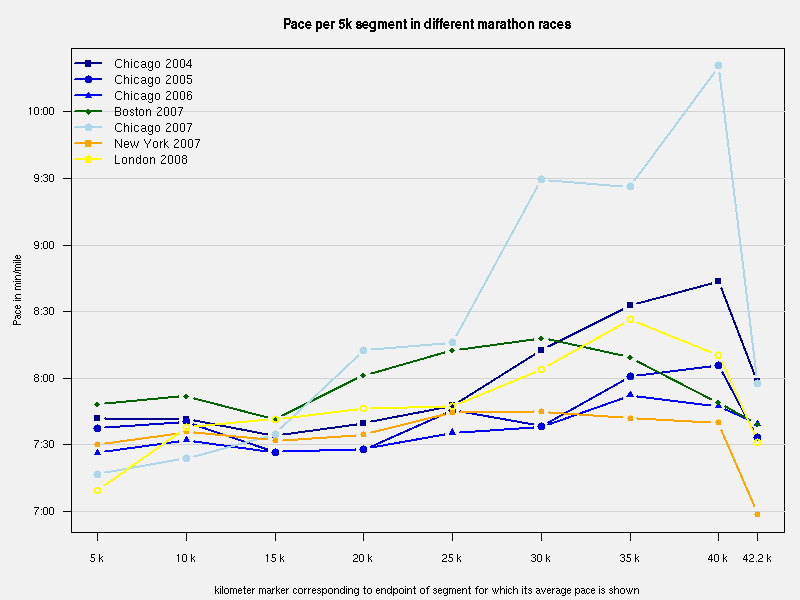
A few months ago, I had shown a chart with per-5k-segment paces of my prior marathons runs (or at least those for which organisers had 5k splits). Since then, I ran two more: New York in November and London last Sunday. I have updated the charts to show both of these: (updated pace comparison chart) A few things stand out: In case anybody is interested (C'est bien toi, Christian, non?), the R script is available and I will be taking questions by email as R may not be obvious at first if you haven't used it.

Jaldhar Vyas: Bitter New Maintainers Cling to Guns and Religion

For the second year in a row, I didn't vote in the DPL election. Not because I have lost interest in Debian affairs but because nothing is really going on that demands my attention. All three of the candidates who ran this year were eminently capable of representing of Debian and its ideals, all three had more or less the same vision for the role of DPL (IMO. See here for platforms,) and all three are, as far as I know, nice people. Organizational and social problems that previously existed have been fixed. The only problem I have with Debian these days is a lack of time but I can hardly expect the DPL to do anything about that. However, a recent post from Lucas reminded me that there is one group for which all is not fine and dandy. Given that this is the same complaint that has been made for atleast five years nows, one has to wonder why it remains singularly unfixable? Well I don't know but this delegation makes me confident that we will finally see the end of this last bottleneck too. Joerg is the one who sped up NEW package processing and I am sure he will have account creation humming along in no time. I sympathize with the frustration people stuck in NM feel, but I would like to remind them that Debian acts the way Winston Churchill observed the United States does:
"Americans can always be depended upon to do the right thing—after they've tried everything else."

Russell Coker: Solar Powered PC

I’ve just read an interesting post on TomsHardware.com about a solar powered PC [1]. It describes all the steps involved in creating a modern high-performance low-power computer. They have a lot of interesting information. One surprising fact (from page 3) is that the PSUs tested (both for AC and DC input) were more efficient when idle (I expected the greatest efficiency to be when under load). An AMD processor was chosen due in large part to the fact that chipsets in suitable motherboards used less power. For the CPU itself Intel had a competitive offering but no matching motherboard was power efficient enough (from page 7). Page 8 documents how using a cooling fan (instead of passive cooling) reduced the power requirements of the CPU to such a degree that it always saved power use overall. Why do CPUs take less power when they are cooler? Page 9 mentions that a small passively cooled video card can draw 88.5W when idle! That sucks pretty badly, it seems that having a video controller integrated with the motherboard is the way to go if you want to save power. It’s interesting to note how much energy can be used by RAM. Page 13 shows that the difference between 2*1G and 2*512M can be as much as 3.4W and that the difference between different brands of RAM for the 2*1G can make as much as 1.2W difference. Their final system drew 61W when idle, my latest 64bit system takes 52W when idle [2] (which compares to the 38W of their system without a monitor), so we are talking about 9% of system power being saved by using less RAM or 3% being saved by using a different brand of RAM. The summary of hard drive power use on page 14 is interesting, the fact that 2.5 inch laptop disks use less power than 3.5 inch desktop disks is hardly surprising, but the difference when idle is very surprising (apparently one of the 3.5 inch disks spends 8W on turbulence and friction in the bearings). It’s unfortunate that they didn’t compare any of the server-class 2.5 inch disks, it was about 6 months before the article was written that HP announced that in future they would cease shipping 3.5 inch disks and only use 2.5 inch disks (I wonder if this is related to all HP’s recent work on server cooling). Rumor has it that many server class 3.5 inch disks have platters that would fit into a 2.5 inch case because at high rotational speeds a larger diameter platter would not be strong enough. The information on DVD power use on page 15 is quite shocking. From now on when I install machines as servers which don’t have a need for for a CD-ROM drive I’ll remove the drive prior to deployment. Even if it saves only 0.47W then it’s still worth doing on a machine which uses less than 40W! An additional benefit of this is that it might speed up the boot process as the system won’t need to check for a bootable CD. It’s unfortunate that most computer parts don’t have published documentation on how much power they draw. Even if you don’t want to run on solar power there are still significant benefits to saving electricity (including reducing the noise from cooling fans and heat problems in summer). If technical data was published then people could make informed decisions about which parts to buy. Update: Changed the percentage savings for different types of RAM to be based on the system power use without the monitor. I’m most interested in saving power for servers and for idle desktops (running a desktop machine 24*7 is pretty common) so most of the time the monitor will be turned off. It’s interesting to note that they power their system uses is about the same as a P3 system and could be less if they used a different hard drive.

Neil Williams: Data Centric programming - a new start at Alioth.

It's time for me to stop complaining about the commercialisation of SourceForge and vote with my code. I'm leaving for brighter, bluer pastures at Alioth.

Query Object Framework is first (libqof1). The others will follow. I'm leaving because of unusable mailing list archives, impossibly slow web pages and wiki and the general amount of work involved in the SF interface. I'm gaining sane mailing lists, a friendly and usable ikiwiki and a simpler (although very similar) interface.

I'm also migrating most of those packages to subversion. With so many other changes, it's not exactly a problem to add cvs2svn into the mix.

Now, of course, this does not mean that these upstream packages suddenly become Debian-only or Debian-native. It does mean that I have a chance of encouraging new developers to join the team by providing the kinds of services and support that people need when starting off with a new project. (I suppose the one thing I don't yet have is an IRC channel. Not sure if it is worthwhile but I'll see what happens.)

QOF will form the basis of the support available for each of the other projects - all will share the same low-volume QOF-devel mailing list and QOF Wiki as provided by Alioth. I'll also migrate QuickList because I'm looking at restarting development on a stalled project allied to QOF and which could provide missing functionality in QuickList. I did look at Gaby in this mix but a botched Gtk1->Gtk2 transition that ended up with two incompatible forks running different parts of the original codebase put me off completely (and neither of the forks actually worked). (Some packages deserve to be dead upstream.)

I'm looking for new blood, fresh faces and a new desire to take these projects forwards. The driving force is data freedom - creating data-driven applications that are completely agnostic to where and how the data happens to be stored. It is user data, it should be as free as the source code that wrote it. Who cares what format it is in? Let's get it into a format that some other program can use and make use of the existing data instead of duplicating it all the time. (The observant will note that my old haunt of GnuCash is stubbornly ignorant of the merits of a decent import/export implementation that actually covers more than 50% of the data in the application. No wonder I took the chance to sponsor homebank.)

DWI Data With Interaction (aka DUI -- Data Under the Interface) is what can provide the missing interfaces. It'll take a while to get it back up to date and available in Debian but it can provide the link between data and interfaces. GNU/Linux users should be able to design an interface purely on the basis of the data that it needs to handle and not care one jot about how that data comes from one free software app and goes on to the next free software app. QOF is gaining a connection to libgda which means that data can go to and fro between a whole range of databases and file formats. Homebank and pilot-qof can gain new data inputs (and possibly outputs) by utilising the existing import/export support in new ways via DWI/QOF (as libqof2). That can give a complete interface for all PIM and financial data for a typical SOHO user and all based on SQL-type queries so that every stage of the process can be tweaked and optimised according to user requirements at runtime.

(Where does Emdebian come into this? Well, many people like me need to record and process PIM/financial data on the move so Emdebian means that those users can have the same data processing on their handhelds as on the desktop. Smaller apps to capture the data quickly and efficiently whilst on the move; larger apps to refine, optimise and filter the data on the desktop entirely under user control but with a simple, scriptable, interface based on runtime queries so that the user can do exactly the same conversions tomorrow with new data but none of the configuration. Easy!)

Is this groupware ? No - it is personal, ultimately flexible and entirely customised for particular users by the users themselves. It's about small niche markets, about independent business people with bespoke and highly specialised requirements. No one is going to spend time writing their reports in Scheme or Haskell, because they are the only people who need that particular report. Instead, that individual user needs to be empowered through a simple and intuitive interface to take a piece of data from one source, correlate it with a static piece of data from individual configuration sources, calculate a result according to a third piece of data from a completely separate source and combine them all into a new set of objects that can be used in other queries. It's about preparing invoices from Palm data, it's about handling customer accounts for a one-man company or handling a stocks and shares portfolio for a partnership. Ultimately customised, ultimately flexible and completely format-agnostic.

These are the kind of applications that hold people back from GNU/Linux migrations - bespoke applications that are developed for just a few small companies or just a few situations. Free software finds it hard to provide those apps because free software depends (currently) on someone else being motivated to write a bespoke program and that person rarely understands the niche. This is a chance to put the development into the hands of those with the motivation to do the work, by making the development process more WYSIWYG.

The question is: Can we come up with a better name for DWI, dear lazyweb?

"DWI is a fairly simple environment for quickly creating data-driven applications, that is, graphical applications that manipulate and show info from a database. This environment differs from others in that it is focused on native GTK/Gnome support through the Glade GUI designer, and thus allows you to build user interfaces as elegant as you can make them in Glade."
http://dwi.sourceforge.net/

The big appeal is that DWI is database-agnostic - it only cares about the data structure, not the file format. Ally that with QOF which provides data-centric SQL-based queries and conversions between objects (including combining elements from one object into one or more other objects without having to hardcode the connection between the objects at compile time) and we have an interesting and powerful combination of engines, frontends and backends that are all data-centric.

Please, if this sparks your interest, join the QOF-devel mailing list, have a play with the ikiwiki at http://qof.alioth.debian.org/ and have a go with the code. This whole area is begging for development but it is just so far from being usable by the target audience at this stage. There is a lot of programming to be done by current developers before the principles can be let loose on the masses.
:-)

This is about working between existing projects and between distributions - no longer dedicated to a single application, platform or file format, no more tunnel vision. Work on the edges of existing applications (and indeed projects), remove the sharp edges of applications that should work together but can't. The majority of the code in these libraries and applications is already stable and mature. Like so many parts of free software, it is time, IMHO, to put aside our egotistical devotion to the one-true-executable and come up with an actual solution.

Bah! I'm beginning to sound like a PR exec instead of a dedicated geek. What does it take to motivate people and get things done around here?
:-)

Matthew Garrett

This week I'm in Mountain View for the X Developers' Conference, where I gave a presentation on things graphics drivers have to care about in order to make suspend/resume work reliably. Various people suggested that I write up an explanation of the current situation, along with some best practices for manufacturers.

One of the major differences between the ACPI specification and the older APM specification is that saving and restoring hardware state is generally left up to the operating system, with the firmware playing a much more passive role. Linux is now able to handle this state restoration for the majority of hardware, but we still have issues with graphics. Modern graphics hardware can be hugely complicated, which to a large extent we've been able to ignore because the platform will initialise it on boot. Many X drivers know how to switch a card from text mode to graphics mode (and vice-versa), but that's not adequate.

What can make this situation even more awkward is that the ACPI specification makes no guarantees about what state the hardware comes up in. It may still be in PCI D3. It may be powered up, but the registers may all be zeroed. It's even valid for the hardware to come up in text mode. A driver has to be able to deal with all of these situations.

So far, we've mostly tried to deal with this situation by running chunks of the video BIOS with applications like vbetool. This is hacky and often works badly - in some cases, it won't work at all (nvidia rewrite the entry point to their video BIOS after boot, in order to prevent situations where someone attempts to POST the card and it tries to jump to bits of the system BIOS that no longer exist). The only long-term option is for the kernel to handle the graphics suspend/resume. There's several levels at which this can be supported:
Since 2.6.25, i915 and later Intel hardware can manage basic mode reprogramming without requiring any external assistance. The radeon kernel modesetting code is also heading in this direction, and we ought to be able to manage something there before too long. The nouveau developers are heading towards the stage of being able to do native mode programming, so there's some hope of progress there as well.

It's not all plain sailing, though. Vendors can wire up hardware in different ways. AMD and Nvidia hardware provides scripts in the ROM that, in theory, abstract this away. The downside to this is that we'll have to put the interpreters for these scripts in kernel space, though this is probably needed for kernel modesetting work anyway. Even then, it's possible that we'll need workarounds for specific pieces of hardware that don't quite behave as we expect them to.

As far as making graphics work over suspend/resume, we have a pretty good idea where we are now (failing on anything other than modern Intel hardware), where we need to be in the future (triumph, huge success, cake) and how to get there (?). However, hardware manufacturers can still help.
Chipset vendors:Tell us how to reinitialise your hardware. If that involves parsing BIOS tables, then please let us know how to do that. Expecting us to jump into your ROM and execute x86 code is ok if that's genuinely the only way to do it, but for any modern hardware that's clearly not the case.
System vendors:Try not to alter your system behaviour too wildly. Requiring magic register writes in order to light up the VGA output does not classify as value add. Please don't have your firmware program text mode directly - we're trying to get away from that. And do not attempt to detect that you're running on Linux and alter your system behaviour. If it's possible for you to tell that you're not running on Windows, that's a bug in Linux. If you rely on that bug, you will break. I'm not joking here in the slightest. The closest thing to a "standard" interface between an OS and the hardware is whatever Windows does, and we're basically aiming for bug-for-bug compatibility there.

Julian Andres Klode: python-libisofs 0.0.1 available


A first preview of the python-libisofs bindings is available now. It’s currently located in a git branch at git.debian.org, but this may change at a later point. The bindings support the creation of ISO Images and (almost) all options libisofs supports, like Rockridge, Joliet, and much more. Reading and Modifying existing images is not supported yet. The code is written in Cython and you need cython installed for building from the git branch. It can be installed just like any other Python module/extension/package, using a setup.py. Browse: http://git.debian.org/?p=users/jak-guest/python-libisofs.git
Get: git clone git://git.debian.org/git/users/jak-guest/python-libisofs.git I’ll package it for Debian within the next weeks after some further tests.

MJ Ray: 21 today! MJR around the web...

Not done one of these round-ups for a while and I'm really pushed for time today, so here are some sites that I've written on:
  1. Property of a Lady Wicca on House
  2. Ross Burton: The End Of Homeopathy?
  3. Enough with the dried yoghurt covered raisins Korerorero: Just random ranting and raving
  4. How to host a free software advocacy event Free Software Magazine
  5. Raw Output: AGPL
  6. One for the Morning Glory: Facebook comments
  7. Sam Liddicott GPL3 Questions and Implications
  8. Drugs and an Election etbe
  9. New Tropicana images
  10. robmyers - Support BY-SA/SFDL Compatibility, Not BY-SA/FDL Compatibility
  11. Internet Psychology: Teenagers do not need our help online - we need them to help us oldies by Graham Jones, Internet Psychologist
  12. Wanting Your Opinions about Blog Comments and City Attorneys : David Lee King
  13. Zookoda - I Don't Recommend them Anymore
  14. Solar Water Heating :: ShowBlog
  15. Internet Psychology: Forget email - it's old hat by Graham Jones, Internet Psychologist
  16. Drake.org.uk: That's a wrap! Time to roll the end credits..
  17. Internet Psychology: Internet criminals are going to have a field day by Graham Jones, Internet Psychologist
  18. A Cambridge Co-operator: Rebranded Stores
  19. robmyers - Two Common Errors
  20. Lucas Nussbaum's Blog Blog Archive Where is the NM bottleneck?
  21. NM: FD is fixed - MadBlog

Gunnar Wolf: Dear lazyweb: Large volumes strategy?

Wouter, you seem to enjoy using huge filesystem volumes. So, dear lazyweb...
I have a 500GB disk for my users' home partitions - they mainly use it to back up their desktop data, but I do expect them to give it more usage. Anyway - I am currently using around 350GB of it, leaving the rest still unpartitioned. I have switched over to ReiserFS, as online resizing it is way faster than online resizing ext3 - it's basically instantaneous.
It seems I do belong to the old sysadmin school, and I value highly the reliability that comes from not having filesystems too large for their own good - After all, recovering from failure in 10GB is way more probable than doing the same in 100 or 1000, isn't it? But then again, it's just impractical to create /home/samba/ 1,2,3,4,5,6,7,8,9 / and randomly split users' directories inside them. Most users won't use more than a couple MB, but some users (legitimately!) back up tens of GB... It's hard for me to anticipate their needs.
Does any of you have scary stories regarding huge volumes? Or any data supporting the idea that I'm just too old fashioned and that half a TB is a good partition size?
Note that I _am_ holding full backups :)
[update]: So I'm undoubtley an old fart? Everybody seems to have partitions larger than me. Ok, I will stop crying...

Biella Coleman: Chiki-Chiki Precario,Euromayday 08

It is not the case that “copyleft” is paired with issues such as sexual freedom and immigrant rights all that often. But there are times when they are bundled together as in this video, which is advertising a Pan-Europe set of May 1st events. And even if you don’t know Spanish, you will get something out of the video given its zany aesthetics (and note that “El Copyleft” is number 1 on their list :-) )

David Pashley: Boilerplate code for a perl class

Because I always forget when I need to create a new class in perl:
package Foo::Bar;
use strict;
use warnings;
sub new  
   my $this = shift;
   my $class = ref($this)   $this;
   my $self =  ;
   bless $self, $class;
   $self->initialize(@_);
   return $self;
 
sub initialize  
   my $self = shift;
 
1;
If you have any useful additions I'd love to know.
Read Comments (4)

Russell Coker: Making Linux DVDs

Anthony Towns writes about using an improved version of jigdo to download CD/DVD images [1]. His improvement is basically to pipeline operation for better performance. Jigdo (the Jigsaw download) is a tool to download a set of files and then use them to create a CD or DVD image [2]. The idea is that most web sites that have CD or DVD images also have a collection of files which comprise the DVD image available. This removes the need to store the data twice (wasting disk space on mirrors and in some situations breaking web caching). I have never used jigdo, and for all Debian installations in recent times (the last few years at least) I download a small net-inst CD image and then have it download the other files from the net. I have Squid set up to cache large objects so this doesn’t waste too much of my precious network bandwidth (which is limited and expensive in Australia). Now I’m thinking about what the optimum method for doing installs might be. One thing that would be good would be to support multiple repositories, the packages have unique file names and checksums so it should be possible to check one repository and then check another if it’s not working. I don’t mean multiple “deb” lines in the APT configuration. What I would like to do is to have an NFS file server or web server with an archive of downloaded packages and have APT check there first before downloading a file. So APT could get a list of packages from the net and then get the actual files locally if they are available. The next thing that would be good is the ability to create a CD or DVD image dynamically and to store all temporary files. So I could download files from the repository and create a DVD image with just the packages that I need. Every time I create a DVD image my sub-set of the Debian archives would increase and the number of files actually downloaded in the creation process would be reduced. The effect would be to incrementally create a local mirror of the Debian repository. Then I would like to see a two-stage DVD install process. I would like to boot from a CD or DVD and start the install and then have it give a list of files needed (which could be stored on a USB device or floppy) to create further CDs or DVDs for installation. One situation where this could have been beneficial was when I was doing an emergency install of CentOS. I did the first part of the install (selecting packages etc) to determine which CDs were needed. It turned out that almost all CDs were needed even though some of the CDs had only a few files that I was installing. If the installer could have written a list of packages to a USB device then I could have downloaded just those packages and got the install working a lot sooner. It seems to me that it’s fairly common to do one test install and then do some dozens of other installs with the same settings. So the ability to create a DVD of exactly the needed files for the other dozens of installs would be a great benefit. Now this is just random commentary, unfortunately don’t have time to do any coding on this. But it seems obvious that something has to be done to improve the situation for developers and IT staff who need some degree of mirroring of the Debian package pool but who can’t do a full mirror. Back in 1996 I was able to mirror Debian over a 28K8 modem link and fit it on what was a reasonable hard drive by the standards of the day (incredibly tiny by today’s standards). Now I can’t practically mirror Debian over an Australian cable broadband connection and even by the standards of about 4 years ago (the age of most of my hard disks) the space requirements are significant. I hope this post helps inspire some interest in developing these features. As delays in joining Debian [3] is the topic of the day it should be noted that work on preparing DVD images can easily be done by people who are not DDs. Such software should work from Debian archives without requiring any changes to them, and thus nothing special is needed from the Debian project to start work.

Kyle McMartin: debugging strace

A bug was reported on linux-parisc@ last week, that “ls -l” was whinging about “Operation not supported” once per file. Easy, I thought, I’ll just break out strace, figure out which syscall it is, and Bob’s your uncle, we’ll have it fixed. Not so, unfortunately, as strace was bloody broken. upeek: ptrace(PTRACE_PEEKUSER,2606,4294967292,0): Input/output error Again, no big deal, some kernel change must have broken ptrace(2) on me. git logs didn’t shed any light on it, so I pulled an old strace binary out of an etch chroot and tried that, which failed as well. Wonderful. But… curious… it still works inside the chroot. At this point I was a little bit beyond annoyed, but the fact that it worked in the chroot was a big clue. Anyway, long story short, strace decides to assume that you can have up to 32 possible syscall arguments (wtf?#1) which is all well and good and generally harmless. However, it also decides to yank MAX_ARGS of them out with ptrace(PEEK_USER, …) if strace is unaware of the syscall prototype. Again, this would be mostly harmless, on every other architecture. On parisc though, argument registers count down from %r26 through %r20, which is the syscall number. Instrumenting the PEEK_USER path through sys_ptrace in the kernel made it pretty obvious when a consecutive request was suddenly 0xfffffffc (which is 0-4, especially suspicious given the previous values of 4, 8, 16…) that I needed to find a loop in ptrace. Searching through all the HPPA specific syscall code found it quickly,
for (i = 0; i < tcp->u_nargs; i++)
    if (upeek(pid, PT_GR26-4*i, &tcp->u_arg[i]) < 0)
        return -1;

where “i” is 0 .. u_nargs, which is set to either the known number of syscall args, or MAX_ARGS (which, remember, was 32.) There, the culprit found, and with a simple one line fix, strace works again. In case you’re curious, the reason things worked inside the chroot, is because the syscall being strace’d was dependant on libselinux being loaded.
syscall_298(0x400e0fbc, 0x58, 0xfb444310, 0, 0x409878ac, 0x409878ac) = -1 (errno 2)
Which is statfs64. The moral of the story here? strace is out of date and doesn’t yet support recently added syscalls. Also, the code quality is pretty atrocious. Oh, and the problems with ls? getxattr was returning -EOPNOTSUP because the filesystem doesn’t support
xattrs. Or, more correctly, because that config option was disabled. This seems to be causing laughs on the buildds too. Doesn’t anyone check errno anymore? Now back to our regularly scheduled hacking. –
wtf?#1: Generally speaking, more than 5 uint32_t syscall args is frowned upon, since that makes the poor register-starved i386 pass args on the stack.

16 April 2008

Kartik Mistry: Tips and Tricks: How to deal with auto rickshaw in BLR


* Bubulle and Sam has already seen it. But, if you ever likely to coming down to BLR this tips and tricks can be useful. So, print it out! - Do not catch rickshaw on one-way. Even if your offer 1000 INR, they will not come to place where traffic is terrible. - Do not ask them where cop/policeman is not near. - Do not catch auto near biggie place like MG Road. They are smart and they will tell you tripple amount of fare because they know that people near these places are rich and can pay whatever they tell. - Keep your half of your budget for traveling inside BLR, half for rest of the things (like airfare, shoppings etc). - Learn Kanndda properly, if not, do not speak in Hindi. - Keep asking to auto drivers, probably after 45 or 50 tries you will get auto which will come with proper meter based fare. - The last advice: Hire a bicycle. Good for health, Good for brain. PS: This post is due to our (/me and Kushal’s) frustration of tomorrow’s attempt to get auto from Residency road to Ulsoor. kthnx.

Matthew Palmer: When you think you're good...

It's stories like the following that make you realise just how puny your talents are... (Reposted from a place not to be named, by the legendary Al Viro)
Give them what I got yesterday. As in, box that got
        a) Linux kernel running.
        b) init and bash running.
        c) serial and floppy - built as modules. And not loaded.
        d) no sash.
        e) no ethernet.
        f) bloody large number-crunching that Should Not Be Aborted(tm).
        g) libc and ld-linux.so - unlinked (self-LART by owner).
Now, I could tell the guy to piss off, but... WTF? He had decent beer and
was properly scared. Oh, well... So we have no exec() for anything
dynamically
linked. And we have no chance to access any external stuff - insmod is
linked
dynamically, so no insmod floppy for you. Shutting the system down was not
an
option due to (f) (aside of dealing with fsck later - umount(8) is
dynamically
linked too). Now, I knew that both /lib/libc.so-2.1.2 and
/lib/ld-linux.so-2.1.2 were still alive - mmaped by init, for one. And
/proc/1/maps would even contain their inumbers. So the plan of attack was
to create a file in root and then cannibalize the entry (change inumber in
the directory). Alas - not enough. In-core inode got zero i_nlink and
if I would just create a link by hands it would not become positive. I.e.
still remove-upon-close. But. But if we will manage to call link() on the
hand-made link we will get i_nlink raised to 1 - iget() will find the same
in-core inode, so we are OK. We'll have to revert the phony link to avoid
PO'd fsck, but that's not a problem...
        So there we go: assuming that we got static ln
echo >foo
ln foo bar
flip inumber in foo entry to point to libc
ln foo /lib/libc.so-2.1.2
flip inumber.......................... bar
repeat for ld-linux.so
rm foo bar
begin recovering other damage (self-LART was a bit larger).
        But... we don't have this flip stuff and we don't have (aaarrgh)
static
ln. Oh, shit... OK, but all we really need is a couple of syscalls, right?
There we go:
        eax=__NR_link;
        ebx=s1;
        ecx=s2;
        int 0x80;
        eax=__NR_exit;
        ebx=0;
        int 0x80;
s1:     "foo"
s2:     "bar"
The next step was getting the syscall numbers. grep? We don't need no
stinkin'
grep.
# while read i; do case $i in *__NR_link*) echo $i;; esac;
done </usr/include/asm/unistd.h
#define __NR_link 9
# while read i; do case $i in *__NR_exit*) echo $i;; esac;
done </usr/include/asm/unistd.h
#define __NR_exit 1
#define __NR__exit __NR_exit
Now, scratching the head and recalling intel code...
start:  b8 09 00 00 00
        bb (address of s1)
        b9 (address of s2)
        cd 80
        b8 01 00 00 00
        bb 00 00 00 00
        cd 80
s1:     66 6f 6f 00
s2:     62 61 72 00
Fine, but... a.out support is compiled... you guessed it, as module and not
currently loaded. So we are in for crufting up an ELF binary. OK, we don't
actually need 100%-correct ELF, just something that will pass for the
exec(). Now, we don't have shell scripts, but . will work. So the next
step was rolling more(1) in shell and reading through the relevant code
(surprisingly small - binfmt_elf.c and two headers). After much swearing
the following abortion was created:
7f 45 4c 46 00 00 00 00 00 00 00 00 00 00 00 00
02 00 03 00 01 00 00 00 start______ 34 00 00 00
00 00 00 00 00 00 00 00 34 00 20 00 01 00 28 00
00 00 00 00 01 00 00 00 00 00 00 00 base_______
base_______ size_______ size_______ 05 00 00 00
00 10 00 00
start:
b8 09 00 00 00 bb start+1d___ b9 start+21___ cd
80 b8 01 00 00 00 bb 00 00 00 00 cd 80 66 6f 6f
00 62 61 72 00
OK, set base to something page-aligned, start=base+54, size=79. There we go:
7f 45 4c 46 00 00 00 00 00 00 00 00 00 00 00 00
02 00 03 00 01 00 00 00 54 00 00 80 34 00 00 00
00 00 00 00 00 00 00 00 34 00 20 00 01 00 28 00
00 00 00 00 01 00 00 00 00 00 00 00 00 00 00 80
00 00 00 80 79 00 00 00 79 00 00 00 05 00 00 00
00 10 00 00 b8 09 00 00 00 bb 71 00 00 80 b9 75
00 00 80 cd 80 b8 01 00 00 00 bb 00 00 00 00 cd
80 66 6f 6f 00 62 61 72 00
well, while read l; do for i in  echo $l ; do echo -ne "\\$i"; done; done
made for oct2bin, overwriting /usr/bin/emacs with the output of that gave
us static equivalent of ln foo bar. And it worked. The rest was essentially
the same - the only tricky part was to find the location of directory entry.
Which was done with (lseek, read byte, exit(said_byte)) and shell wrapper
around that. So we had a way to read a block and dump it on the console.
The rest was obvious - start from relevant block in inode table and walk
through the references... Once we got that, it was an easy ride - trick
with inumber flipping brought libc and dynamic linker back and after that
we had 99% of system back into the working state. Amazing how little you
actually need to bring the system back to life...
Hot damn that's some deep hackery...

Jeff Bailey: Physio, T-shirts, and the end of the contest!

Updates of the moment:

* I can put a t-shirt on now! About 3 days ago, I got brave and decided to give it a try. So, yay, no more zip up sweaters!

* Had my 6-week checkup yesterday, and everything is looking good. The incision is still a bit red and since my skin is so sensitive, the surgeon doesn't want me in the hottub for another 2 weeks. *pout*

* I started physiotherapy today. I can only give it a mixed review. The therapist was absolutely wonderful, it turns out that I got the clinic director. However, she doesn't actually have time to see me 3 days a week. Her schedule is so booked up that I'd be lucky to see her once a week. On top of that, the receptionists and assistants were not terribly professional (tending not to articulate, getting flustered, sort of tossing sheets of paper at me expecting me to know what to do with them), and the place was not clean. It was also in one big room, so the therapy is done in front of everyone else. Blech. So I have an appointment with a different clinic on Friday. Hopefully this one will go better.

* I don't think I've mentioned Leif recently. He's walking, can open the doors in the house now, and can clearly say "All Done". He also climbed onto my lap the other day and cuddled with me. So cute!

* Lastly, this is the end of the contest of "Guess the cost!" And the final total for the bill was.... $199,849.24. Our running total is of all things combined at UCSF is now somewhere around $280k, so I'm guessing the final total for everything will be around $300k when we're all said and done. Crazy. The closest guess was by [info]runasand at $192,000, whoever you are. Linked-in says the winner is in Norway. So finding that vegan restaurant might be interesting. I still remember Debconf 3 in Norway when the caterer told me "In Norway, we have a special way of preparing vegetables... We feed them to the animals." And the meat-eaters begging the vegetarians who were going elsewhere for food for their meals so that they had something other than slabs of meat to eat.

I think because of this, I'm going to have to award the prize to [info]mmmmtino in the meantime, who came in second place at $185k. That way I can pay it out hopefully within the next year. I'll still keep the other as a raincheque in case I happen to wind up in Norway sometime again. =)

Further on the OMG-This-medical-system-is-barbaric, It looks like the insurance company negotiates the hospital down in price, because they're in network. I've only seen the payout information for that one day overnight stay, but the insurance company will only be paying 10% of the cost. So if I didn't have insurance, I'd have to pay $67k. But the insurance company gets to pay around $7k. Do they charge so much because they don't make enough money when someone is insured? How does that all work?

Wouter Verhelst: Playing with git

A few years, ago, I decided that there were way too many SCM systems out there, and that I'd give the war of the SCMs some time before deciding on which one I'd use. Mean time, I did spend some time with subversion, since, well, CVS sucks my pants off, subversion is quite a bit better, and easy enough to understand for those of us who are already familiar with CVS. But it still sucks. I often find myself on the train, wanting to do an svn commit, and not being able to. svk helps, but not by much. I didn't spend much time during the past years in trying to wrap my head around one of the distributed SCMs; partially because I was somewhat coping, and partially because the above-linked blog post was written in response to me running away scared aftery trying to understand arch. I should have shoved arch up Tom Lord's <censored> years ago. So, anyway, I don't think "The World" has made a choice yet, and I don't think it ever will. However, it seems clear that git is a pretty popular choice these days; and, well, if a project the size of the Linux kernel is using it, then it must be good, right? Right. So I gave it a shot. After reading the tutorial, I can already honestly say I like it. The tutorial links to a number of different pages, most of which give a set of standard workflows for different ways of interacting with git. Exactly what I needed! I should've done this years ago. Anyway. I'm now considering switching the NBD repository over from svn to git, which should help ensure that patches which are important for several branches are applied to all of them (this requires much more manual work in subversion). Before taking that step, however, I'll have to make sure I fully understand the thing; after digging through docs for "only" an hour or so, I can't say I do.

Next.

Previous.