Search Results: "tb"

3 November 2013

Gunnar Wolf: Another guest in the classroom! Sandino Araico ( @KBrown ): Memory management and security

This last Thursday I was able again to lure a good friend of mine into presenting an interesting topic to my students at my Operating Systems class: Sandino Araico, a very well known and very well regarded local security guru, presented several issues regarding memory management. I asked him to present the issues on buffer overflows, as well as possible mitigaion strategies, but of course, to present that topic, he had to walk all over the map of memory management. A good and interesting class. I was able to film it again, and here it is Sadly, as I explain to some students who suggested me to put the computer in a different place, the angle and the audio quality are not as good as they could If I were to move the computer to have a better angle of Sandino, I would lose audio quality. Being it the eve of D a de Muertos, and having a beutiful mega-altars festival just outside the faculty, the outside noise level was quite high, and... Well, I know Sandino rarely raises his voice, so it was better to locate the computer close to him. Of course, add to it that my hardware is by a long shot far from professional-grade. I just used a very cheapish laptop. I was a bit skeptical to begin with I have to recognize I have given this topic quite hastily, as we are getting near the end of semester and there's still a lot of topics to cover. But the students seemed interested in Sandino's presentation, and once again I am fully satisfied with my guest's performance. As always. All of my six guests' presentations (over two semesters) have been great. If I were able to get a guest for each of my classes... I'd even save a lot of class-preparation time! :- Oh, but you came here looking for the video, right? Here it is: Memory management and security, by Sandino Araico. October 31, 2013.
AttachmentSize
Sandino Araico: Administraci n de memoria y seguridad344.44 MB

Niels Thykier: Breaking the 700 RC bug threshold for Jessie

It looks like we have dropped (or will drop) below 700 RC bugs affecting Jessie today[1]. :) On a related note, I got my eye on libfso-glib + fso-gsmd, samba + -samba4, mono and haskell. By my count, each of the four groups will (once they migrate) bring at least 4 RC bug fixes with them to testing. Besides that, we still have ~97 RC bugs in the autoremoval queue[2], so we could be looking at 600 RC bugs in a week or two. Please keep up the steady flow of RC bug fixes; but also, please make sure your packages will actually migrate. If you need help interpreting the excuses page, do not hesistate to ask I will not bite. If you want to help, please consider having a look at the cleaner or the Release Team -view on the UDD bug tracker. Sadly not everything there contains actionable problems[3]. [1] http://bugs.debian.org/release-critical/ says 700 while the IRC bot in #debian-devel-changes says we are at 692. [2] http://udd.debian.org/bugs.cgi?release=jessie_and_sid&merged=ign&autoremovals=only&fnewerval=7&flastmodval=7&rc=1&sortby=id&sorto=asc dd-list-like: http://udd.debian.org/cgi-bin/autoremovals.cgi [3] E.g. the kfreebsd-8 bugs appear because kfreebsd-8 is listed in Built-Using for d-i, but the package has already been removed from testing. So there is nothing to do with that (except possibly waiting for a new version of d-i).

Russ Allbery: Review: The Walls of Westernfort

Review: The Walls of Westernfort, by Jane Fletcher
Series: Celaeno #2
Publisher: Bold Strokes
Copyright: 2004
Printing: March 2005
ISBN: 1-60282-349-9
Format: Kindle
Pages: 320
While this is the first book of the Celaeno series that I've read, it turns out to be the second book in the series. This is somewhat difficult to determine from sources on-line since the first three books in the series were published in the same year, but it's fairly obvious from reading synopses after having finished one of the books. I don't think it does any great damage to the story to read it out of order (indeed, it preserves the suspense around some plot elements), but you may want to seek out The Temple at Landfall first. Natasha Ionadis is a member of the Guard. The military services are divided into three parts in her world: the Rangers, who defend cities against bandits and others in the countryside; the Militia, who maintain law and order in the cities; and the Guard, who are responsible for guarding the temples and protecting the rituals and teachings of the state religion. She is a devout worshiper of Celaeno and delighted to be part of the Guard. But, as this book opens, she gets a very unexpected mission for a young private: a suicide mission into the heart of a heretic group in the wilds, heretics who have successfully defied the official religion and are in danger of setting up a self-sustaining community. The Walls of Westernfort has the surface trappings of a fantasy and does include some magic, but it slowly develops into more of a character story with a medieval (or, more accurately, medieval-inspired) backdrop. At the start, it appears that this mission will be an opportunity for Natasha to find the mentors and companions that she's never had before, but then her encounter with the heretics turns her world upside down. They're not the monsters that she had imagined, although their beliefs are still outrageous to her. One heretic in particular affects her deeply and introduces a strong lesbian romance element to the plot that dominates the rest of the book. I enjoyed the slow emergence of one aspect of the setting (that I'm about to spoil, so skip to the next paragraph if you don't want to hear it, although it would already be spoiled by reading the predecessor book or most of the blurbs). This is a world devoid of men; all the characters are women. This isn't part of the plot; it's just the unremarked normal. Fletcher tosses in a hand-waving explanation about halfway through, but it's only discussed in passing and never mentioned again. I really enjoy this technique, and enjoyed watching how long it took in the book before I noticed. There are so many books out there where men are the unremarked normal that it's a refreshing change to read the opposite (and notice how little it really matters), although it does require throwing in implausible magic to solve the problem of procreation. (That's apparently more the topic of The Temple at Landfall.) Plot-wise, The Walls of Westernfort is not complicated. The shape of the plot after Natasha's first encounter with the heretics is not likely to surprise any reader. But it's a simple plot well-executed, with distinct and fleshed-out characters and steady helpings of people being thoughtful and reasonable. The basic story carries plenty of natural conflict; Fletcher doesn't need to add much additional tension and wisely chooses not to, keeping the focus tightly on Natasha and her conflict between duty and conscience. I liked both of the people involved in the romance and could believe they'd fall in love, and I also liked that the romance was significant but not decisive. It's part of what helps Natasha expand her view of the world, but one could see how she would have made the right decision in the end even if the romance had not been present. The story does force some significant secret-keeping, but it doesn't draw cheap tension from mundane failure to communicate. All of the communication gaps here are believable and honest, driven by the characters' backgrounds, and absolutely necessary. I'm hypersensitive to romance plots based on communication failure, and I wasn't even grumbling. The series this book reminds me the most of is another lesbian romance in a fantasy-style setting: Catherine M. Wilson's When Women Were Warriors. The Walls of Westernfort is not as deep or philosophical, it's a bit more black and white in its morality, and I don't think it's quite as good of a book, but for me it had a similar tone of good people trying to do the right thing and finding one's way through ethical mazes. It's a bit slow to get started, but by the time Natasha's critical decision point arrived, I was fully invested in the story and had a hard time putting it down. Recommended if you're in the mood for a relatively light faux-medieval fantasy romance. I'm not rushing out to grab the other books in the series, but they went on my want list and I'll probably get them at some point. Followed by Rangers at Roadsend in the publication order sense, but apparently it's a prequel. Rating: 7 out of 10

2 November 2013

Petter Reinholdtsen: Debian init.d boot script example for rsyslog

If one of the points of switching to a new init system in Debian is to get rid of huge init.d scripts, I doubt we need to switch away from sysvinit and init.d scripts at all. Here is an example init.d script, ie a rewrite of /etc/init.d/rsyslog:
#!/lib/init/init-d-script
### BEGIN INIT INFO
# Provides:          rsyslog
# Required-Start:    $remote_fs $time
# Required-Stop:     umountnfs $time
# X-Stop-After:      sendsigs
# Default-Start:     2 3 4 5
# Default-Stop:      0 1 6
# Short-Description: enhanced syslogd
# Description:       Rsyslog is an enhanced multi-threaded syslogd.
#                    It is quite compatible to stock sysklogd and can be 
#                    used as a drop-in replacement.
### END INIT INFO
DESC="enhanced syslogd"
DAEMON=/usr/sbin/rsyslogd
Pretty minimalistic to me... For the record, the original sysv-rc script was 137 lines, and the above is just 15 lines, most of it meta info/comments. How to do this, you ask? Well, one create a new script /lib/init/init-d-script looking something like this:
#!/bin/sh
# Define LSB log_* functions.
# Depend on lsb-base (>= 3.2-14) to ensure that this file is present
# and status_of_proc is working.
. /lib/lsb/init-functions
#
# Function that starts the daemon/service
#
do_start()
 
	# Return
	#   0 if daemon has been started
	#   1 if daemon was already running
	#   2 if daemon could not be started
	start-stop-daemon --start --quiet --pidfile $PIDFILE --exec $DAEMON --test > /dev/null \
		  return 1
	start-stop-daemon --start --quiet --pidfile $PIDFILE --exec $DAEMON -- \
		$DAEMON_ARGS \
		  return 2
	# Add code here, if necessary, that waits for the process to be ready
	# to handle requests from services started subsequently which depend
	# on this one.  As a last resort, sleep for some time.
 
#
# Function that stops the daemon/service
#
do_stop()
 
	# Return
	#   0 if daemon has been stopped
	#   1 if daemon was already stopped
	#   2 if daemon could not be stopped
	#   other if a failure occurred
	start-stop-daemon --stop --quiet --retry=TERM/30/KILL/5 --pidfile $PIDFILE --name $NAME
	RETVAL="$?"
	[ "$RETVAL" = 2 ] && return 2
	# Wait for children to finish too if this is a daemon that forks
	# and if the daemon is only ever run from this initscript.
	# If the above conditions are not satisfied then add some other code
	# that waits for the process to drop all resources that could be
	# needed by services started subsequently.  A last resort is to
	# sleep for some time.
	start-stop-daemon --stop --quiet --oknodo --retry=0/30/KILL/5 --exec $DAEMON
	[ "$?" = 2 ] && return 2
	# Many daemons don't delete their pidfiles when they exit.
	rm -f $PIDFILE
	return "$RETVAL"
 
#
# Function that sends a SIGHUP to the daemon/service
#
do_reload()  
	#
	# If the daemon can reload its configuration without
	# restarting (for example, when it is sent a SIGHUP),
	# then implement that here.
	#
	start-stop-daemon --stop --signal 1 --quiet --pidfile $PIDFILE --name $NAME
	return 0
 
SCRIPTNAME=$1
scriptbasename="$(basename $1)"
echo "SN: $scriptbasename"
if [ "$scriptbasename" != "init-d-library" ] ; then
    script="$1"
    shift
    . $script
else
    exit 0
fi
NAME=$(basename $DAEMON)
PIDFILE=/var/run/$NAME.pid
# Exit if the package is not installed
#[ -x "$DAEMON" ]   exit 0
# Read configuration variable file if it is present
[ -r /etc/default/$NAME ] && . /etc/default/$NAME
# Load the VERBOSE setting and other rcS variables
. /lib/init/vars.sh
case "$1" in
  start)
	[ "$VERBOSE" != no ] && log_daemon_msg "Starting $DESC" "$NAME"
	do_start
	case "$?" in
		0 1) [ "$VERBOSE" != no ] && log_end_msg 0 ;;
		2) [ "$VERBOSE" != no ] && log_end_msg 1 ;;
	esac
	;;
  stop)
	[ "$VERBOSE" != no ] && log_daemon_msg "Stopping $DESC" "$NAME"
	do_stop
	case "$?" in
		0 1) [ "$VERBOSE" != no ] && log_end_msg 0 ;;
		2) [ "$VERBOSE" != no ] && log_end_msg 1 ;;
	esac
	;;
  status)
	status_of_proc "$DAEMON" "$NAME" && exit 0   exit $?
	;;
  #reload force-reload)
	#
	# If do_reload() is not implemented then leave this commented out
	# and leave 'force-reload' as an alias for 'restart'.
	#
	#log_daemon_msg "Reloading $DESC" "$NAME"
	#do_reload
	#log_end_msg $?
	#;;
  restart force-reload)
	#
	# If the "reload" option is implemented then remove the
	# 'force-reload' alias
	#
	log_daemon_msg "Restarting $DESC" "$NAME"
	do_stop
	case "$?" in
	  0 1)
		do_start
		case "$?" in
			0) log_end_msg 0 ;;
			1) log_end_msg 1 ;; # Old process is still running
			*) log_end_msg 1 ;; # Failed to start
		esac
		;;
	  *)
		# Failed to stop
		log_end_msg 1
		;;
	esac
	;;
  *)
	echo "Usage: $SCRIPTNAME  start stop status restart force-reload " >&2
	exit 3
	;;
esac
:
It is based on /etc/init.d/skeleton, and could be improved quite a lot. I did not really polish the approach, so it might not always work out of the box, but you get the idea. I did not try very hard to optimize it nor make it more robust either. A better argument for switching init system in Debian than reducing the size of init scripts (which is a good thing to do anyway), is to get boot system that is able to handle the kernel events sensibly and robustly, and do not depend on the boot to run sequentially. The boot and the kernel have not behaved sequentially in years.

Russ Allbery: Review: Fantasy & Science Fiction, May/June 2011

Review: Fantasy & Science Fiction, May/June 2011
Editor: Gordon van Gelder
Issue: Volume 120, No. 5 & 6
ISSN: 1095-8258
Pages: 258
The editorial in this issue is about the investigation into the troubling death of long-time contributor F. Gwynplain MacIntyre (which was not his real name). It's disturbing, but to me it underscores one of the things that I love about the Internet: people for whom life isn't working very well can still find an outlet, make friendships, and control how they choose to present themselves to the world on-line. That's something quite valuable, and part of why the pushes for "real names" always gives me pause. Somewhat thematically related, this issue also features a non-fiction essay by Maria E. Alonzo about her investigation of Jesse Francis McComas, her great-uncle but better known to the SF community as one of the founding editors of F&SF and co-editor of the famous classic anthology Adventures in Time and Space. This is mostly a curiosity, but it's fun to read about the sense of triumph in tracking down lost family history. This issue also features a Chris Moriarty book review column, always a plus, as well as a few positive reviews of obscure superhero movies by Kathi Maio (plus the required grumbling about a more mainstream film). "The Final Verse" by Chet Williamson: This is more of a horror story than I would normally like, but I got pulled into the investigation of an old bluegrass song and the guesswork and footwork required to track down where it came from. Williamson does a good job with the tone and first-person narration, and the degree to which the protagonist cares about the song to the exclusion of the horrific happenings of the story blunts the horror. Not quite my thing, but I thought it was well-done and played well with the possible meanings of song lyrics. (6) "Stock Photos" by Robert Reed: This is well-written, like nearly all Reed stories, but it lacked enough clues for the reader for me. It's a very short story about a man who's out mowing his lawn when approached by two strangers who apparently want to take photographs of him for stock image collections. Then things get rather weird, but without any explanation, and the ending lost me completely. Frustrating. (It is partially explained by the later "The Road Ahead" story in this same issue.) (4) "The Black Mountain" by Albert E. Cowdrey: From one of F&SF's most reliable story-tellers to another, and this is a more typical story. Cowdrey offers an abandoned and very strange cathedral for an obscure religion, a conflict over a development project, and some rather creepy results, all told in Cowdrey's entertaining fashion. Some places you just don't mess with. (6) "Agent of Change" by Steven Popkes: Told Dos-Passos-style with news excerpts, web sites, and the transcript of an emergency committee, this story shows the discovery of Godzilla, or something akin to Godzilla, in the Pacific, where it's destroying whaling vessels. I do like this style of storytelling, and here it mixes well with humor and a bit of parody as Popkes shows how each different news outlet puts its own recognizable spin on the story. The story isn't particularly memorable, and it doesn't end so much as just stop, but it was fun. (7) "Fine Green Dust" by Don Webb: This story is dedicated to Neal Barrett, which will give SFF short story readers a warning of weirdness to come. In a near future where global warming as continued to make summers even more miserable, the protagonist happens across a naked woman painted green. The green turns out to be a sun block that claims to assist humans in metamorphosis into animals. Most of the story is the protagonist trying to decide what to think of that, interspersed with staring at his neighbor's naked daughter. It's mildly amusing if you don't think about it too much and don't mind the rather prominent male gaze. (5) "Rampion" by Alexandra Duncan: The novella of the story, this is set in Muslim Spain some time during the long fights between Muslims and Christians in the north. It's told as two parallel stories: one telling the protagonist's first meeting with his love, and the second following him as a blind man, some time later, deciding whether, and how, to re-engage with the world. The style feels like fantasy, but there's very little overt fantasy here, and the story could be read as historical adventure. It's good adventure, though; conventional in construction, but with some romance and some drama and a good ending. (7) "Signs of Life" by Carter Scholz: This is to science fiction what "Rampion" is to fantasy: not really SF in the classic sense, but fiction about the process of science. The protagonist works on gene sequencing and is mildly obsessed with a visualization of junk DNA in an attempt to find patterns in it. Like a lot of fiction about science, it's primarily concerned with office politics, grant funding, and an awful boss. There is a faint touch of the supernatural, but that strand of the story doesn't amount to much. There's a happy ending of sorts, but the story left me with a bad taste in my mouth, and I'd completely forgotten it by the time I sat down to write this review. (4) "Starship Dazzle" by Scott Bradfield: I've never seen much in Bradfield's ongoing series of stories about Dazzle, the talking dog. In this one, he's sent via rocket on a one-way trip into outer space and ends up making a bizarre sort of first contact. Like the other Dazzle stories, it's full of attempts at humor that don't really work for me, even though you'd think I'd be sympathetic to the mocking of our commercialization of everything. The ending is just silly, and not in a good way. (3) "The Old Terrologist's Tale" by S.L. Gilbow: I love the setup for this story. It's set in some sort of far future in which terraforming has become routine, and a group of people are telling each other stories over drinks. The first-person protagonist is a terrologist, someone who designs planets (and the technology is available to do this almost from scratch). The conversation is taking a turn towards the humiliating, with a politician belittling the work of terrologists, when an old terrologist who has been listening quietly starts telling a story about designing worlds, both mundane and dangerously beautiful. Gilbow does a great job here capturing blithe self-importance, the habit of belittling other people's technical work, and revenge via storytelling with a nasty barb. This was my favorite story of the issue. (7) "Altogether Elsewhere, Vast Herds of Reindeer" by Ken Liu: This is a rather odd but quite touching story about mothers, daughters, nature, connection, and uploading. It's set after a singularity, in a time when all humans are uploaded into computers and exploring higher dimensions, digital natives in a much deeper sense than is meant today. But Rene 's mother is an Ancient, from before the singularity and still three-dimensional, and she wants to spend some time with her daughter. That leads to a memorable moment of connection, without pulling Rene entirely out of her father's world. Well done. (7) "The Road Ahead" by Robert Reed: Two Reed stories in one issue! And this one is a sequel to "Stock Photos" from earlier, since apparently I wasn't the only one who found it hopelessly confusing. It provides some backstory and makes a bit more sense of the first story, and that also makes it a more interesting story in its own right. The stock photo concept wasn't entirely a lie, as I had thought it was after the first story. There is analysis, anticipation, and trends behind who the pair take pictures of. But this story explores some internal tension, some conflict between them and some knowledge that the woman has that the man doesn't. And in the process it makes everything creepier, but also more interesting, and provides a hint at a really dark way of viewing the news media. I would say that this salvages "Stock Photos," except that I don't think "Stock Photos" is necessary now that one can read this story. (7) "Music Makers" by Kate Wilhelm: This is another story about investigation of the history of music, mingled with the supernatural, but unlike the story that opened this issue, it's not horror. Rather, it's a gentle and sweet fantasy about the power of music and benevolent ghosts and a community coming together. It's a positive and happy note on which to end the issue. (6) Rating: 6 out of 10

31 October 2013

Russell Coker: Links October 2013

Wired has an interesting article by David Samuels about the Skybox, a small satellite (about the size of a bar fridge) that is being developed to provide cheap photographs of the Earth from low orbit [1]. Governments of major countries will probably try to limit what they do, but if they can prove that it s viable then someone else from a different jurisdiction will build similar satellites. Alice Dreger gave an interesting TED talk about the various ways that people can fall outside the expected genetic sex binary [2]. The short film Love is All You Need has an interesting way of showing the way that non-straight kids are treated [3]. The Guardian has an interesting article by Ranjana Srivastava about doctors and depression [4]. Don Marti wrote an interesting post about believing bullshit as a way of demonstrating group loyalty [5]. Zacqart Adam Green wrote an interesting article for the Falkvinge blog about the way that the Ouya gaming console can teach children about free software and political freedom [6]. Read more at www.ouya.tv [7]. It s a pity that the Ouya is not conveniently sold outside the US and the UK, with shipping it would probably cost a lot more than $99 in Australia. Tim Chevalier wrote an interesting post for Geek Feminism about the unintended consequences of some codes of conduct [8]. Tim Chevalier wrote an interesting Geek Feminism post about Wikipedia describing how the Neutral Point Of View is a way of representing the views of people in power [9]. Ramin Shokrizade wrote an interesting article for Gamasutra about the Free 2 Play (F2P) techniques [10]. The concept of F2P games is that the game can be installed for free but requires regular small payments to make the game easier, apparently some people pay $3000 per year or more. The TED blog has an interesting interview with Jack Andraka, a teenager who invented a new test for pancreatic cancer (and also ovarian and lung cancer) that is cheaper, faster, and less invasive than other tests [11]. The blog post also has a link to Jack s TED talk.

29 October 2013

Eddy Petrișor: The stupidest trend in laptop design is...

... numpads on laptop keyboards.

Just because a very, very, very restricted segment of the population is into accounting or other jobs needing frequent numeric input, almost all laptop manufacturers feel the stupid urge to place a numpad on laptops with screens over 14''.

Reasons why a numpad on a laptop is a bad idea:
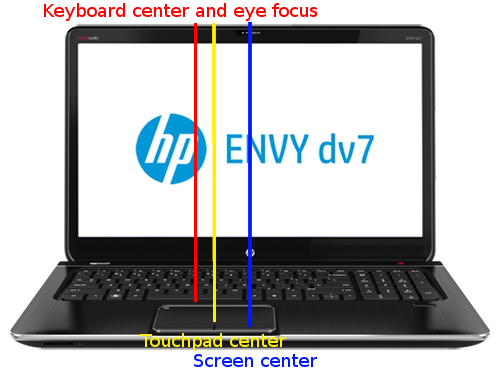
The numpad forces eye focus and users' hands to be way off center.
The touchpad looks as if it was thrown to the side by accident
Note how the designer tried to offset the misalignment forced
by the numpad by "positioning" the touchpad closer to center,
but not in line with the space bar (and the keyboard)

Without numpad the position is almost perfect!
The symmetry of the laptop improves on the design.
Notice how the touchpad is also centered.


What's worse is that most resellers do not have filters for this particular mis-feature, so you can't easily exclude laptops corrupted by this horrendous idea.

So, if you're a laptop designer, please stop putting numpads on laptops.

It will make for better looking laptops and you'll have the opportunity to be the one stating the obvious: numpads are generally useless! Even on desktop keyboards!

28 October 2013

Matthias Klumpp: Tanglu update & release plans

Long time with no article about Tanglu! This was mainly because we were busy with the project itself, improving various aspects of the distribution. So, here is a new summary on what has been done and what you can expect from the first release ;-) Tanglu QA We further improved the automatic archive QA. There is now qa.tanglu.org, which constantly monitors the number of uninstallable or unbuildable packages in the Tanglu suites. It also provides tanglu-platform-smallstatus information on the metapackage generator, which helps us in finding out which packages are available on the live-cds. Furthermore, information about the staging->devel migration process is provided, to answer the question why a package does not migrate (this still needs some improvements, but it is being worked on). We also use some code from Ubuntu to monitor package versions in Debian and upstream, which helps to see if others have released newer versions of software shipped with Tanglu. This already resulted in many improvements: The Tanglu Aequorea suite does not contain unbuildable packages (at least not due to build-dependency changed), and all live-cds are working well. We will soon migrate the archive to a new server, which frees some server capacities we can use for automated QA and things like automatic live-CD building. Live-CDs, Installer, Alpha-Releases We currently don t do Alpha-Releases of Tanglu, but we create Live-CD snapshots of Tanglu, which are available at releases.tanglu.org (or mirror1, mirror2). These snapshots still have issues and are just early previews. They also ship without and installer, we are still working on that part. Please note that CD more or less means DVD or USB-Stick right now (and this won t change the expected image size will be around 800MB). Release Planning I am happy to announce that we will do a release this year, most likely in December. But what can you expect from the release? KDE 4.11kde-konqui We will ship with KDE 4.11, which will be the only desktop we officially support so far. The reason is simply lack of manpower we could promise to support more, but that would just be not realistic for the small team. So we focus on KDE (Plasma Shells) right now, and try to make it awesome. Also, the team consists mostly of KDE people right now, which contributed to that decision ;-) . If you want to try Tanglu, right now the KDE live-images are the best to try it out. GNOME 3.8 gnome-logoWe will also provide images with GNOME. The problem with GNOME is, that the GNOME team does not have enough manpower to maintain the whole desktop or to upgrade it to the latest version (it is essentially just me looking at it from time to time). So GNOME will be available in a preview state. We invite everyone with GNOME knowledge to join the project and help improving Tanglu-GNOME GNOMErs, we want you! systemd >= 204 We ship with systemd by default, which works nicely so far, although more testing needs to be done. The logind service will be used to replace ConsoleKit, if we manage to get everything in place and working in time (if there are issues, we might switch back to CK for one release). There are some plans to use a higher systemd version, due to some improvements made there, but if this will be done is still unclear (Debian will most likely stick to 204 for some time, because with systemd > 205, running it as pid 1 will be mandatory to use logind (and Debian is just in the process to decide which init-system we will use there)). Systemd will run in SysVInit compatibility mode for most of the available services. This will improve in later Tanglu releases. Of course, systemd is usable, even if not every init-script has been converted to a service file. It just has an impact on startup times, so Tanglu will not be the distributions with the fastest startup times (yet ;-) ). Debian Package Mixdebian_logo1 Tanglu consists mostly of packages from Debian Testing (Jessie), but we take full advantage of the Debian archive, so you will also find package versions from Unstable or even Experimental (where it made sense). A very small portion of packages has also been merged with Ubuntu. Although stuff has been changed, the incompatibilities with Debian are almost zero, so if you are installing Tanglu, it will currently feel like an more up-to-date Debian Testing with some extras. Still, the differences are large enough that upgrading a Debian system to Tanglu might result in some issues. Installer Right now, the installer is a major field of work. Tanglu will most likely ship with the Debian-Installer, because it is the easiest thing to do right now. For later releases, it is planned to also offer the Ubiquity installer (the thing Ubuntu uses), or a new installer with a similar UI and concept. Other Cool Things266px-Wayland_Logo Tanglu will ship with a fully working Qt5 (which is currently being tested and updated) and the latest version of Wayland/Weston as a preview for developers to play around with. We also ship with Perl 5.18 and Haskell GHC 7.6, as well as with GCC 4.8 as default compiler (although the whole distribution does not yet compile with GCC 4.8). We might ship with Linux 3.12, but this also depends on other things. The Linux kernel build will be the same as in Debian. There might be more things to come :-) Please do always keep in mind that Tanglu is a new project, so the first release might still have some teething problems but we re working on it. The Aequorea release will be supported one to two more months after the next release is out. Tanglu Policy I started to draft a Tanglu policy, which defines stuff like the procedures to become a Tanglu project member and/or developer, some basic values of the distribution, decision making processes etc. This work is at a very early stage right now, and will need lots of feedback later. But as soon as it is done, joining the project will be easier and what Tanglu is will be well-defined. The policy will also include a Code-of-Conduct as an additional document from the start. We need help! ;-) First of all, thanks to everyone working on Tanglu! You are amazing! Also, many thanks to every Debian developer or contributor who helped a lot in setting the project up and contributed knowledge. And of course, thanks to everyone else who contributed by creating awesome artwork, helped with code, TangluTanglu Logo (big) archive mirrors, buildd-servers or by testing the distribution and providing feedback! (given the state the aequorea suite was in at the beginning, testing was a really frustrating activity but people still did it!) So, if you would like to help, just find us on #tanglu-devel on Freenode or join the tg-devel mailinglist. We also really need some people taking care of the Tanglu website and updating it with some recent information from time to time, so people can see what is going on. Before we have the Tanglu policy finished and the Tanglu members and developers directory in place (a software which allows us to track all registered developers and gives them an @tanglu.org mailalias), the start might be a bit confusing, but we do our best to make it easy for new people to join. The best way is asking people. Tanglu is still created by an incredibly small team, which has a large task to accomplish. Help is welcome :-)

27 October 2013

Gregor Herrmann: RC bugs 2013/41-43

after a bit of a break I try to get back into regular RC bug fixing. here's what I've done recently:

Petter Reinholdtsen: Teaching vmdebootstrap to create Raspberry Pi SD card images

The vmdebootstrap program is a a very nice system to create virtual machine images. It create a image file, add a partition table, mount it and run debootstrap in the mounted directory to create a Debian system on a stick. Yesterday, I decided to try to teach it how to make images for Raspberry Pi, as part of a plan to simplify the build system for the FreedomBox project. The FreedomBox project already uses vmdebootstrap for the virtualbox images, but its current build system made multistrap based system for Dreamplug images, and it is lacking support for Raspberry Pi. Armed with the knowledge on how to build "foreign" (aka non-native architecture) chroots for Raspberry Pi, I dived into the vmdebootstrap code and adjusted it to be able to build armel images on my amd64 Debian laptop. I ended up giving vmdebootstrap five new options, allowing me to replicate the image creation process I use to make Debian Jessie based mesh node images for the Raspberry Pi. First, the --foreign /path/to/binfm_handler option tell vmdebootstrap to call debootstrap with --foreign and to copy the handler into the generated chroot before running the second stage. This allow vmdebootstrap to create armel images on an amd64 host. Next I added two new options --bootsize size and --boottype fstype to teach it to create a separate /boot/ partition with the given file system type, allowing me to create an image with a vfat partition for the /boot/ stuff. I also added a --variant variant option to allow me to create smaller images without the Debian base system packages installed. Finally, I added an option --no-extlinux to tell vmdebootstrap to not install extlinux as a boot loader. It is not needed on the Raspberry Pi and probably most other non-x86 architectures. The changes were accepted by the upstream author of vmdebootstrap yesterday and today, and is now available from the upstream project page. To use it to build a Raspberry Pi image using Debian Jessie, first create a small script (the customize script) to add the non-free binary blob needed to boot the Raspberry Pi and the APT source list:
#!/bin/sh
set -e # Exit on first error
rootdir="$1"
cd "$rootdir"
cat <<EOF > etc/apt/sources.list
deb http://http.debian.net/debian/ jessie main contrib non-free
EOF
# Install non-free binary blob needed to boot Raspberry Pi.  This
# install a kernel somewhere too.
wget https://raw.github.com/Hexxeh/rpi-update/master/rpi-update \
    -O $rootdir/usr/bin/rpi-update
chmod a+x $rootdir/usr/bin/rpi-update
mkdir -p $rootdir/lib/modules
touch $rootdir/boot/start.elf
chroot $rootdir rpi-update
Next, fetch the latest vmdebootstrap script and call it like this to build the image:
sudo ./vmdebootstrap \
    --variant minbase \
    --arch armel \
    --distribution jessie \
    --mirror http://http.debian.net/debian \
    --image test.img \
    --size 600M \
    --bootsize 64M \
    --boottype vfat \
    --log-level debug \
    --verbose \
    --no-kernel \
    --no-extlinux \
    --root-password raspberry \
    --hostname raspberrypi \
    --foreign /usr/bin/qemu-arm-static \
    --customize  pwd /customize \
    --package netbase \
    --package git-core \
    --package binutils \
    --package ca-certificates \
    --package wget \
    --package kmod
The list of packages being installed are the ones needed by rpi-update to make the image bootable on the Raspberry Pi, with the exception of netbase, which is needed by debootstrap to find /etc/hosts with the minbase variant. I really wish there was a way to set up an Raspberry Pi using only packages in the Debian archive, but that is not possible as far as I know, because it boots from the GPU using a non-free binary blob. The build host need debootstrap, kpartx and qemu-user-static and probably a few others installed. I have not checked the complete build dependency list. The resulting image will not use the hardware floating point unit on the Raspberry PI, because the armel architecture in Debian is not optimized for that use. So the images created will be a bit slower than Raspbian based images.

26 October 2013

Russ Allbery: Review: Why We Fail

Review: Why We Fail, by Victor Lombardi
Publisher: Rosenfeld Media
Copyright: 2013
ISBN: 1-933820-17-9
Format: Kindle
Pages: 248
Subtitled Learning from Experience Design Failures, Why We Fail is a case study book. It defines experience design, discusses the usefulness of analyzing failure, and then walks through ten marketplace failures attributed to failures of user experience (as opposed to engineering or user interface) and tries to draw some conclusions about those failures and how they could have been prevented. Lombardi then presents a more general (if fairly simple) framework for iterative experience design, along with some discussion of how that approach could have helped in these cases. Hardware and software designs can work properly but still fail with users and customers because the overall experience isn't right. Sometimes this is because something else got there first with more market share and people got used to it, sometimes it's because a system is too complicated, sometimes it's too simple, sometimes it's just uninspiring. Most of the news media coverage and many of the blog posts on this topic look to inspirational examples of successes. Lombardi points out here that successes can be accidental and failures are often more informative, a concept already common in many more mature areas of engineering. His hope, with Why We Fail, is to push a broader industry practice of taking apart and analyzing the failures. User experience design is still in its infancy, since many of the complex interactions now possible in modern hardware and software have just recently crossed into levels of complexity that qualify as experiences rather than interactions, and could benefit from more rigor. The concept sounds great. The approach in Why We Fail is at least interesting; Lombardi tells good stories, and I think they do tell some useful lessons. Drawing general principles is harder, which is always the weakness of case-study books. Lombardi's own attempt doesn't go far beyond a familiar mantra of the scientific method, small and responsive teams, cross-functional teams with flexibility to address a whole range of technical and business issues, and honest and forthright analysis of and iteration after failure. All of this is doubtless good advice; none of it should surprise anyone with even a smattering of engineering background or familiarity with current software design philosophy. The heart of the book is in the stories, and I did like that Lombardi captured a wide range of different designs. Included are embedded systems (BMW's iDrive), traditional software packages, web services of various types, and even a protocol (OAuth). Some were vaguely familiar and some were not familiar at all, although I don't follow UI and UX discussions to any large extent. In each case, Lombardi gives a short but effective introduction to the problem space and the product, walks through the design choices, and then talks about the failure. Usefully, he doesn't stop with the failure but continues the story through the reaction of the company to the failure and any subsequent actions they took, which in some cases contain their own useful lessons. All of this, I should note, is a bit far afield of my own area of expertise (architectural building blocks and sub-surface components without as much direct interaction with the user), so I'm not the best person to judge the quality and originality of the analysis. But I liked Lombardi's approach and his analysis of multiple possible failure causes, and all of his conclusions seemed quite plausible and sensible given the case studies as described. I'm best-qualified to judge the chapter on OAuth, since I've worked extensively on web authentication systems, and his analysis of the challenges and user experiences in that case closely match my own. I didn't notice any significant errors, which is hopefully a good sign for the rest of the book. As one might expect from a short book about a complex field aimed mostly at starting a conversation, there isn't much here that's earth-shattering, nor are there simple extractable principles that will make your experience designs better. As always, the takeaway boils down to "invest time and resources into this and try to think about it systematically," which of course is true of every possible axis of improvement for any product. (The challenge is usually where to spend those limited resources.) I will also note in passing that Lombardi assumes an entirely market-driven metric for success, and all of the case studies are exclusively commercial not unexpected, since that's where most of the money and a lot of the resources are, but not that helpful for bespoke work where the nature of the problem is subtlely different. But, despite the expected shortcomings and the inherent weakness of the case study approach to analysis, which tries to pluralize anecdote to get data I enjoyed this book. I also got at least one useful trick out of it: the premortem, to look for potential failure points in the experience before rolling out, or even designing, the product. It's a fairly light-weight book, but I think it's moderately inspirational, and I wholeheartedly concur with Lombardi on the merits of failure analysis as an engineering approach. Rating: 7 out of 10

24 October 2013

Russ Allbery: Review: Applied Cryptography

Review: Applied Cryptography, by Bruce Schneier
Publisher: John Wiley & Sons
Copyright: 1996
ISBN: 0-471-11709-9
Format: Trade paperback
Pages: 621
This is the next entry in the series of Russ reading books that he bought years ago and never got around to reading. Thankfully, this time, the book has aged somewhat better. This review is for the second edition of Applied Cryptography, published in 1996. Given how important computer security has become, and how central cryptography is to computer security, one might think that the passage of 17 years would make a book effectively obsolete. This turns out not to be the case. Yes, Rijndael (the current AES standard and the most widely-used block cipher), Camellia (the up-and-comer in the block cipher world), and the SHA-2 hash postdate this book and aren't discussed. Yes, there have been some further developments in elliptic-curve public-key cryptography. And yes, much of the political information in this book, as well as the patent situation for public-key cryptosystems, is now mostly of historical interest. But a surprising amount of this book still applies directly. Partly that's because much of Applied Cryptography is focused on general principles, classes of algorithms, and cryptographic protocols, and those do not change quickly. A rather amazing number of techniques and protocols still in widespread use today originated in the 1970s. Block ciphers, stream ciphers, cipher modes, public-key systems, signature systems, hash functions, key exchange, secret splitting, key management, and other, similar topics have not changed substantially. And even in the area of specific algorithms, DES is still in use (unfortunately) and its analysis is valuable for understanding any block cipher. RC4, Triple DES, CAST, RSA, MD4, MD5, and SHA-1 are still part of the cryptography landscape, and Schneier was already warning against using MD5 in 1996. The source code included in this book has, thankfully, been made obsolete by widely-available, high-quality free implementations of all common ciphers, available for any modern operating system. But the math, the explanations, and much of the cryptanalysis is still quite relevant. While it contains a comprehensive introduction to cryptographic concepts, Applied Cryptography is structured more like a reference manual than a tutorial. The first two chapters provide some foundations. Then, a wide variety of protocols, from the common to the completely esoteric, are discussed across the subsequent four chapters. There are four chapters on the basics of ciphers, another chapter on the mathematics, and then the longest part of the book: twelve chapters that provide a tour of all major and several interesting minor protocols that existed in 1996. These are organized into block ciphers, stream ciphers (and pseudo-random number generators), hash functions, and public-key systems. An entire chapter is devoted to the history and analysis of DES, and I think that was my favorite chapter of the book. Not only is it worth understanding how DES works, but it also provides a comprehensive introduction to the complexities of block cipher design, the politics of interactions with the NSA, and a fascinating history of early computer cryptosystems. Finally, Applied Cryptography closes with chapters on real-world systems and on politics. The politics section is mostly a historical curiosity, as is much of the chapter on real-world systems. Schneier discusses some of the PKCS and X.509 protocols here but doesn't use SSL as one of his examples despite its specification predating this book (perhaps the most glaring omission of the book). But he does discuss Kerberos (which is of personal interest to me), and it was useful to see it analyzed in the broader context of this sort of book. Those who read Schneier's blog regularly, or who have read any of his other books, will know that he's concise, incisive, and very readable, even with difficult material. I think he does err on the side of compactness this is not a book that handholds the reader or explains something more than once but there's a lot of ground to cover, so I can't really blame him. Expect to have to read the more difficult parts several times, and (at least on a first read) expect to just skip past some of the most complex sections as probably not worth the effort. But I think Schneier does a great job structuring the book so that one comes away with a high-level impression and overview sufficient to make informed guesses about capabilities and relative difficulty even if one doesn't have the patience to work through the details. I suspect most readers will want to skim at least part of this book. Unless you're willing to do a lot of background reading to understand the math, or a lot of careful study to follow the detailed descriptions and flaws in often-obscure algorithms, the algorithm discussions start to blend together. I found myself skipping a lot of the math and focusing on the basic descriptions and the cryptanalysis, particularly for the obscure ciphers. Many of the algorithms are also highly opaque and of obscure benefit; I doubt I will ever care about blind signatures or oblivious transfer, and I struggled to wrap my mind around the details of bit commitment (although it's apparently important in zero knowledge proofs, which in turn are relevant to authentication). But this is not the sort of book where you have to read every word. It's very well-structured, provides clear resynchronization points for readers who have had enough of a particular topic, and marks the topics that are more obscure or of dubious general usefulness. The most useful parts of this book, in my opinion, are the basic conceptual introductions to each class of cryptographic algorithm or protocol, and those chapters are excellent. I've been working in applied computer security, at the application and deployment level, for years, and this is the first time that I've felt like I really understood the difference between a block cipher and a stream cipher, or the implications of block cipher mode selection. Applied Cryptography is also a fascinating exercise in adjusting one's intuition for where the complexity lies. It's a memorable experience to move from the chapters on block ciphers, full of S-boxes and complex mixing and magic numbers, into the far more straightforward mathematical analysis of stream ciphers. Or the mathematical simplicity of RSA (although quite a bit of complexity is lurking on the cryptanalysis side, much of which is only touched on here). Of more historical interest, but still quite impressive, is that Applied Cryptography doubles as a comprehensive literature review. Not only does it cover nearly every algorithm in use at the time, it discusses the cryptography literature on nearly every topic with brief summaries of results and lines of investigation. The references section is a stunning 66 pages of small print featuring 1,653 references, and those are mentioned and put in context throughout the book. I'm not personally interested in chasing those lines of research further, and of course 17 years means there are many new papers that are as important to read today, but it's obvious that this book would have been an amazing and invaluable map to the research territory when it was first published. There are now newer books on this topic that you should consider if you're purchasing a book today. Cryptography Engineering in particular is in my to-read pile, and I'm interested to see how much of this book it could replace, although I believe it's lighter on the mathematical analysis and details. But I think Applied Cryptography still has a place on the bookshelf of any computer security professional. Schneier is succinct, detailed, straightforward, and comprehensive, at least for 1996, and I know I'll be reaching for this book the next time I forget the details of CFB mode and then get hopelessly confused by the Wikipedia article on the topic. Rating: 8 out of 10

23 October 2013

Rog rio Brito: Assorted random notes

This post is just a bunch of random notes, but I think that things are going well, this time.

Btrfs Just started playing with btrfs after converting a 2TB disk with about 1.3TB of data from ext4 to btrfs. This particular filesystem contains my backup data and I hope that btrfs is able to live up to high standards. I will probably write a detailed review with my impressions, but suffice to say that it is working fine and I hope that I will be happy for a long time to come. My other filesystems, for the moment, will be ext4.

Coursera Downloader Thanks to John Lehmann's generosity, now coursera-dl has a new home: a github organization of its own!

youtube-dl Some people may have noticed, others may not, but when downloading videos from Youtube, they apparently are getting more aggressive with the use of Dynamic Adaptive Streaming over HTTP (also called DASH) and, as a result, some (perhaps going to be all in the near future?) of the videos may not be available in the resolution/formats that you used to like (like me, with format number 35). By the way, one thing that is interesting with youtube videos provided via DASH is that they are available in different streams: one for the video and another for the audio. What does this mean in practical terms for users of youtube-dl? Well, if you wanted to download videos in resolutions like the 480p (format 35) that I mentioned, then you will probably have to change your way of doing things, until a more automated solution is in place. You will have to download both the audio and the video and, then, "combine" them (that is, multiplex them) to create one "normal" video file with both the audio and the video. I usually do this via: ffmpeg -i audio.m4a -i video.mp4 -vcodec copy -acodec copy combined.mp4 If you prefer having a Matroska container instead of an mp4 container (which, BTW, results in smaller muxing overhead), then you can use the command line: mkvmerge -o combined.mkv audio.m4a video.mp4 Oh, those m4a and mp4 extensions are a new addition that I just sent upstream (in the past, both would have been named with an extension of mp4). As, an aside, I like formats 135 for video and 140 for audio, for the reasons that I mentioned in a comments to issue 1612:
Otherwise, to download 480p videos (which I do for lectures and so on with other projects of mine, like edx-dl) I have to call youtube-dl twice: once for format 135 and another for format 140, since the old (?) format 35 files are much smaller than the lower resolution 360p files (due to the former being encoded in High profile vs. the latter being encoded in Constrained Baseline profile).

While this is unfortunate for some, this is a good thing for others: I once had a blind user of youtube-dl asking me if he could avoid downloading the whole video just to extract the audio, so that he save on bandwidth. Well, now this is possible. Expect a new version of youtube-dl to be uploaded soon to Debian unstable.

Music It is so nice to see the music that I like getting better. It was particularly pleasant to see Tarja Turunen being joined on stage by Floor Jansen. In fact, it is my impression that the once female-fronted bands are getting more and more into collaborations and side-projects and they are, in many ways, getting more refined. Examples of this includes Floor, Tarja, Anneke van Giersbergen, Sharon den Adel, Kari Ruesl tten and many others that I can't remember right now. Of course, some thanks to people that take the time to film, and upload/share the videos so that other people not at these events can watch them is highly appreciated and they usually are treated as anonymous, but, of course, this should be fixed.

Russell Coker: Thinkpad T420

I ve owned a Thinkpad T61 since February 2010 [1]. In most ways it s a great system and it still does most things that I require, even though it inspired my post about how modern laptops suck [2]. Problems with my T61 The biggest ongoing problem with my T61 was the heat production, I m not sure how much of it was due to the CPU producing heat and how much was due to the cooling system not removing it fast enough. But any serious computation for even a relatively small amount of time caused it to get close to thermal shutdown. But as I mostly use my laptop for reading email, a SSH client, and coding (for which the big compiles are done on servers) that didn t force me to replace it. The next problem was the battery life, it s expected that laptop batteries degrade over time so it wasn t a surprise that after 3 years my T61 battery only lasted for about 15 minutes. A final problem is the screen which didn t seem to be as bright as it used to be, it s annoying but doesn t compel me to buy a replacement. T61 Failure But in July my T61 stopped working, it appeared to be either the power supply or something internal related to power, it had been running but was suddenly powered down after being left alone so for some reason power wasn t getting from the wall to the laptop. I initially thought that it was the power supply at fault and investigated the price of a new PSU and a new battery as well. The Lenovo online store [3] charges $71.90 for a new PSU and $113 for a regular capacity battery or $156 for an extended capacity battery (50% more power). So based on the assumption that the PSU was faulty that meant a cost of $185 or $228 (maybe more if postage is included) to get the old Thinkpad going again. I could probably get the parts cheaper from somewhere else, but I m hesitant to buy batteries from sources that aren t reliable in case I get one that s been used. Buying at Auction I ended up buying a refurbished Thinkpad T420 (product ID 4236-J73) from Grays Online [4]. It was refurbished and cost me $306.35 including delivery. $306.35 for a new laptop including PSU was a much better deal than buying a new PSU and battery for $185 or more. It turned out that the PSU wasn t broken (a different PSU also didn t work with it) but then my Thinkpad T61 just started working again, presumably it has some intermittent fault related to power and needed to be replaced anyway (I use my laptop for work and can t have it fail randomly). One significant problem when buying a Thinkpad is that the model numbers aren t specific to the hardware specs. According to ThinkWiki the T420 model ranges from a 2.1GHz i3 to a 2.8GHz I7 CPU, from 160G to 500G hard drive, and has either a 1366*768 or a 1600*900 display [5]. Auction sites almost always specify the size of a hard drive and usually the exact CPU speed doesn t matter much for an auction purchase (2.1GHz is fast enough for most things). But the display resolution is a big deal, in this case Grays had multiple Thinkpads on offer with the same description and the same price so bidding on one with high resolution was quite important. Lenovo has a web site for discovering Thinkpad specs, this is the current link for it (it changes periodically) [6]. At that page you can specify the TYPE AKA PRODUCT ID that is printed on the back of a Thinkpad (and usually included in an auction listing) in the search field that s currently described as QUICK PATH and get all the specifications. Lenovo really do a great job of providing all the details for their products (including ones that were obsolete years ago). But it s unfortunate that their web site sucks, there should be a single URL for such things that s easy to find and they shouldn t use cookies to track which model you are looking at because it makes it really difficult to research two different models. Comparing T61 and T420 I upgraded my new Thinkpad to 8G of RAM because RAM is really cheap. I bought it with 4G of RAM which didn t seem to be quite enough as the hard drive is slow for paging (my desktop with 3G of RAM and a SSD performed well for similar tasks). Now it s running really well, my new Thinkpad is a lot cooler than the old one (not being broken is a good thing). My T420 has a screen resolution of 1600*900 which was a little disappointing initially when going from 1680*1050 (18% fewer pixels and 2% fewer than the T41p I used previously). But having a smaller screen means that the Thinkpad is a lot smaller and lighter. My T61 didn t fit in most backpacks and laptop bags and was unreasonably heavy, it s the type of laptop that looks good on a spec sheet but doesn t seem so good when you carry it around for a few hours. Not only is the T420 a lot smaller and lighter than the T61 but the power supply that shipped with it is a lot smaller and lighter too. I might have spent $72 a few years ago to buy a lighter PSU if I knew that was an option. Cost of Ownership Thinkpads are getting so cheap at auction that I m tempted to buy myself an X series as well. When a $300 item can last several years (my T41p was from some time before 2006, my T61 was from 2010, and my latest is from 2013) that brings the cost of ownership down to something like $0.25 per day. If I bought myself a Thinkpad X series (ultra light) as well at auction then I would be looking at maybe $0.50 per day for my laptop use which would give me the option of taking a light laptop to a conference and a bigger laptop for spending a day at a client site.

Russell Coker: LUV Hardware Library after 20 Months

20 months ago I started the LUV Hardware Library [1]. The aim of the project is to provide a repository of free spare parts for computers for the use of club members. People who have parts that are good but which they can t use can donate them and others who need such parts can take them. Some people have criticised my choice of the name Hardware Library because the word is associated with borrowing while with my Hardware Library it is expected that noone will return the item that they take. The Wikipedia page about libraries is worth reading, my interpretation of that is that the essential aspect of a library is that it is a public collection of items that are useful for study and that borrowing is just one thing that can be done. A book library could consist of a service of printing free books on demand (anyone could do this with access to The Gutenberg Project [2] and a printer) or of just making them available to download. Many libraries don t allow books to be borrowed, they just allow them to be studied and copied in the library. Also every general public library has reference items that can t be borrowed, it s typical for a library to have a full encyclopedia which is not available to be borrowed. Also with the Hardware Library people feel obliged to give something if they take something (as happens with a geocache), so there is an issue of returning something. My main aims with the Hardware Library were to save people money on parts and to help the environment by reducing the need to buy new computers when old ones can be upgraded and remain in service. My next aim was to help people learn about hardware by providing free parts, when a mistake has no financial cost people are more willing to experiment and will learn more. I believe that those aims have been achieved. More Successful Than Expected One thing that surprised me is the social aspect that developed. I had expected that most people would just find some parts that they need and not look at it again for some months. I had also anticipated that some people would poll the Hardware Library every month in the hope that a part they needed might appear. I didn t expect that people would look through it every month because they just like looking at old hardware. I also didn t expect groups of people to hang out by the Hardware Library to discuss various issues related to PC hardware and Linux. During the breaks in the main meeting the location of the Hardware Library often becomes a focus for discussions of various issues related to Linux and hardware. I think that this is really advancing the aims of LUV [3] and I think that members of other LUGs should experiment with similar projects. Starting this didn t require any special skill or authority. I just started bringing a briefcase full of parts to meetings and offering them to whoever was interested. Any member of any LUG can do the same. To start something like this you wouldn t even need a collection of parts, you could just bring a box and ask for donations.

Russ Allbery: Review: Lean In

Review: Lean In, by Sheryl Sandberg & Nell Scovell
Publisher: Alfred A. Knopf
Copyright: March 2013
ISBN: 0-385-34994-7
Format: Hardcover
Pages: 217
Lean In is normally listed as written only by Sheryl Sandberg, which is also what's on the dust jacket, but the inside cover says "with Nell Scovell." Given what that normally means for celebrity books, supported by comments in the acknowledgments, I'm listing it as co-written by Scovell. However, much of the book is written in the first person and is clearly meant to be Sandberg's voice, so I will mostly refer to Sandberg as the author for the rest of the review. I was unfair to this book. Lean In made quite a splash when it first came out, since the named author is the Chief Operating Officer of Facebook, a former vice president of Google, and one of the most prominent female executives in the business world. The subtitle is Women, Work, and the Will to Lead, and the normal Internet summary was that it focused on how women could change their behavior to be more effective and successful in the business world. Throw in some ridiculous review hyperbole (one New York Times writer compared it to The Feminine Mystique, which is a bit like the comparison of every extruded fantasy product with The Lord of the Rings) and I was ready to hate this book. It's work advice from someone in a very privileged position, and it seemed to have a distinct whiff of victim-blaming. It's obvious, however, from the first few pages that Sandberg was very aware of this trap and had no intent of falling into it. This is hard: giving practical advice to women on how to navigate a sexist culture runs a severe risk of victim-blaming even with the best of intentions, particularly since part of the sexism of the culture is a pervasive impression that women aren't doing enough. But I think Lean In handles that about as well as one could while still writing a book focused on practical advice rather than revolutionary change. Sandberg is clear that many things women can do to help their careers shouldn't be necessary, and she takes some time, in each section, to talk about the shape of any structural unfairness that she's seen. What advice she offers here is clearly in the spirit of how to navigate a system that is unfair and unequal, but which can be navigated and can be made more fair by more women participating. This is a very practical book, with more in common with business self-help books than with feminist critiques. It's also a narrowly targeted book, not that you'd guess this from the number of copies it's sold and the sort of publicity it got. Lean In is advice to female executives about how to navigate the top levels of US business culture, with a strong eye for issues of feminism, gender-based double standards, and potential traps of self-sabotage. It offers a blend of encouragement, practical tips, and some forthright analysis that tries to bring to the surface internalized sexism and perceived barriers and limitations for female executives so that they can be addressed and hopefully overcome. It's not in any way a revolutionary book, either with respect to business culture or with respect to gender roles; rather, it's an open acknowledgment of a whole bunch of problems combined with practical advice for how to work around those problems until they can be solved. For the most part, it doesn't attempt to address how to solve the problems. There is nothing wrong with that as a focus for a book. Lean In has attracted a fair bit of criticism in some circles, but, after reading the book, I think a lot of that criticism is predicated on assuming different goals than this book actually has. Contrary to various glowing reviews, Lean In is not a book that's going to change the world; rather, it's a book that might help a narrow band of the population in a specific job and career path navigate problems of sexism and gender expectations and be more effective. Read in that light, it struck me as honest, open, considered, and well aware of its own limitations. Sandberg says repeatedly that many of the options she discusses simply aren't available to most women, and that women may not be in a position to be able to make the decisions she made. She's quite forthright about the limitations of her own experience and the limitations of the advice that she offers, and I think deserves full points for honesty. Similarly, when it comes to business culture, Lean In is not about changing that culture for the better. It's about navigating that culture as it exists. Here, I think Sandberg is less aware of the limitations of this perspective; there is far less acknowledgment in Lean In that executive culture may be inherently toxic as there is of the limitations that women face in business. But while Sandberg has an obvious blind spot, this is not a paean to overwork. It has some excellent advice about work-life balance, including the need to put strict limits on the amount of time one spends in the office and the necessity for someone to pick up substantial burdens in the home if one of the members of a household is going to pursue a business executive job. I was worried, going in, that Lean In would excuse, justify, or idealize the culture of exploitation so common with salaried jobs in the United States, but it really doesn't. As with feminism, it doesn't pick any deep fights, and those with a "kill it with fire" gut reaction towards US executive culture (such as myself) will find the bland acceptance of it irritating, but this is more of an issue with reader expectations than with the book. One should not expect a highway map to point out that trains are more efficient. So, I'm willing to stand up for Lean In to a degree. This is not a bad book. It's very readable, parts are quite interesting, and some of Sandberg's observations about the intersection of gender expectations and executive culture were worth hearing. I learned some things from it. But I think one should read it in full awareness of its limitations. This is a book of practical advice that will only be of direct use to 10% of the population, and which could be generalized with some effort to maybe 25%. It has little to say to women who are not in white-collar, professional jobs, and its applicability to women who aren't aiming for executive careers is a bit hazy. It's the kind of book that's full of anecdotes about how Sandberg got parking spots reserved for pregnant women at Google by talking to the founders about it, or about how to negotiate salary when offered an executive position, which are vaguely interesting but of dubious practical benefit to people who aren't offered jobs where salary and benefit negotiation is available. This isn't the fault of the book, but at times it is rather stunning how different (and how much more tractable) the world looks to someone with the wealth and personal connections that Sandberg has. (To her credit, Sandberg does seem to be aware of this and does acknowledge it.) If you are a female executive, or a male executive interested in developing your empathy and understanding of how institutional sexism affects your colleagues, I suspect Lean In would be quite helpful. If you're not, I think it's mostly a curiosity. But it's also well-written, well-organized, probably available in most libraries in the United States, and provides anecdotal data to help build a more complete picture of the concerns and experiences of female executives. Unless you're in the specific target audience, I'm not sure I'd recommend going out of your way to find it, but it's probably worth reading if it falls into your lap. Rating: 7 out of 10

21 October 2013

Petter Reinholdtsen: A Raspberry Pi based batman-adv Mesh network node

The last few days I have been experimenting with the batman-adv mesh technology. I want to gain some experience to see if it will fit the Freedombox project, and together with my neighbors try to build a mesh network around the park where I live. Batman-adv is a layer 2 mesh system ("ethernet" in other words), where the mesh network appear as if all the mesh clients are connected to the same switch. My hardware of choice was the Linksys WRT54GL routers I had lying around, but I've been unable to get them working with batman-adv. So instead, I started playing with a Raspberry Pi, and tried to get it working as a mesh node. My idea is to use it to create a mesh node which function as a switch port, where everything connected to the Raspberry Pi ethernet plug is connected (bridged) to the mesh network. This allow me to hook a wifi base station like the Linksys WRT54GL to the mesh by plugging it into a Raspberry Pi, and allow non-mesh clients to hook up to the mesh. This in turn is useful for Android phones using the Serval Project voip client, allowing every one around the playground to phone and message each other for free. The reason is that Android phones do not see ad-hoc wifi networks (they are filtered away from the GUI view), and can not join the mesh without being rooted. But if they are connected using a normal wifi base station, they can talk to every client on the local network. To get this working, I've created a debian package meshfx-node and a script build-rpi-mesh-node to create the Raspberry Pi boot image. I'm using Debian Jessie (and not Raspbian), to get more control over the packages available. Unfortunately a huge binary blob need to be inserted into the boot image to get it booting, but I'll ignore that for now. Also, as Debian lack support for the CPU features available in the Raspberry Pi, the system do not use the hardware floating point unit. I hope the routing performance isn't affected by the lack of hardware FPU support. To create an image, run the following with a sudo enabled user after inserting the target SD card into the build machine:
% wget -O build-rpi-mesh-node \
    https://raw.github.com/petterreinholdtsen/meshfx-node/master/build-rpi-mesh-node
% sudo bash -x ./build-rpi-mesh-node > build.log 2>&1
% dd if=/root/rpi/rpi_basic_jessie_$(date +%Y%m%d).img of=/dev/mmcblk0 bs=1M
%
Booting with the resulting SD card on a Raspberry PI with a USB wifi card inserted should give you a mesh node. At least it does for me with a the wifi card I am using. The default mesh settings are the ones used by the Oslo mesh project at Hackeriet, as I mentioned in an earlier blog post about this mesh testing. The mesh node was not horribly expensive either. I bought everything over the counter in shops nearby. If I had ordered online from the lowest bidder, the price should be significantly lower:
SupplierModelNOK
TeknikkmagasinetRaspberry Pi model B349.90
TeknikkmagasinetRaspberry Pi type B case99.90
LefdalJensen Air:Link 25150295.-
Clas OhlsonKingston 16 GB SD card199.-
Total cost943.80
Now my mesh network at home consist of one laptop in the basement connected to my production network, one Raspberry Pi node on the 1th floor that can be seen by my neighbor across the park, and one play-node I use to develop the image building script. And some times I hook up my work horse laptop to the mesh to test it. I look forward to figuring out what kind of latency the batman-adv setup will give, and how much packet loss we will experience around the park. :)

Aigars Mahinovs: Moved to Mezzanine

After my server that has hosted my blog for some years had given out its last breath (second motherboard failure), I decited it was time for a change. And not just server change, but also change in the blog engine itself. As I now focus on Python and Django almost exclusively at work, it felt logical to use some kind of Django-based blog or CMS. I tried django-cms and mezzanine and ... Mezzanine is so fast and simple, that I simply stopped looking. After simply following the tutorial and creating a skeleton project, I had a ready-to go site with all the CMS features, incuding a blog. I just had to change a few settings to have the blog module be the home page of the site, change site settings for the title and Google Analytics settings and such and tweak the theme a bit to my liking. This was my first real exposure to a Bootstrap design. I must say - it is very simple to understand and modify if your needs fit within its limits. For example, I wanted to remove the left sidebar and expand the main content block to fill that. All I had to do was to remove the div element with class "left-sidebar span-2" and change the class of the main content part from "span-7" to "span-9". To do that I simply copied the templates/base.html file from mezzanine default templates and modified it. The information from django-debug-toolbar showed me what files were used in rendering the page. But the feature that really got me hooked was the Wordpress import. Using a simple management command I was able to feed into Mezzanine instance the XML export file from Wordpress. It created blog posts, categories, comments, static pages and even redirects from Wordpress permalinks to Mezzanine permalinks. It was not flawless - there were a few issues: After that was done it was a relatively straightforward process of picking up the code and data and deploying it to a Django-friendly hosting service. There is a plenty of good competition out there, most now offer a simple one-click Django installation, so I just created a simple Django skeleton via their web interface and then replace what they generated with my app while keeping their settings as local_settings.py . I should probably write a bit more details about the process. After I create a custom fabric file for this. It is quite a strange feeling to have a Mezzanine blog that responds faster from a shared server half a continent away, compared to a Wordpress on dedicated server in the same room There are a few features that I am still missing - most notably draft post autosave. That has bitten me hard while writing this post :P Also a Twitter digest post feature. But on the bright side - that is a great motivation to write such features, preferably in a portable way that other people can use too :)
Daniel Pocock: Debian team at GSoC summit 2013

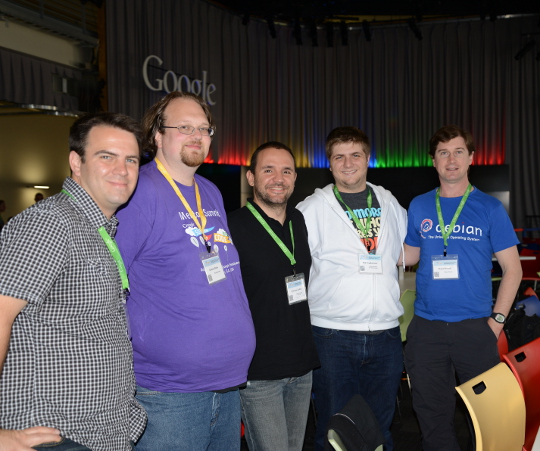
One of the most exciting things about the GSoC mentor summit 2013 has been the large number of participants who are Debian Developers, Debian Maintainers or other members of the wider Debian family Debian team members at GSoC mentor summit 2013
AttachmentSize
debian-gsoc-summit-group.jpg175.13 KB

Next.

Previous.