Search Results: "rul"

17 March 2008

Pierre Habouzit: [RC-Bug-A-Day] Day 3

Since there aren't only serious grave and critical bugs we have to fix for the release, the RM Team spontaneously decided to make a front attack to the g++-4.3 FTBFSes. All in all we did probably more than 110 to 120 NMU to fix g++-4.3 FTBFS bugs. Our champion is definitely Marc Brockschmidt who uploaded 50 packages. I NMUed 22, and also did one QA upload. Add to that 5 sponsored NMUs for Cyril Brulebois, and one for Arthur Loiret who happens to be my NM, and fixed one of those bugs for his T&S. There are still twice as many to fix, those are really easy bugs to deal with, just give it a try ! I'd like to thank Cyril Brulebois for his awesome work on the g++-4.3 release goal. A shame that he's still elmo-ed, as he wrote more than 150 patches, and could have uploaded them himself if not still waiting for his account. Shame on us.

MJ Ray: User-Generated Content Rebellion: First, the Librarians and Scientists?

I've been critical of the almost abusive terms in the user agreements of most user-harvesting-based services (sometimes called Web 2.0) for a while now. There are quite a few services that I simply won't use because their owners want me, all my web "content" (whether explicitly posted to their site or not), my first born child, or similar. There are even more sites where I'm careful not to put much beyond the bare minimum and try to make sure that I keep backups of nearly all of it. Usually that means keeping a copy of the input, as getting my data back out of most sites is a pig. So far, when I've criticised aggressive user agreements, I've felt like a lone voice in the wilderness. It's been heartening to spot two user-harvesting services geting some abuse over the last week or two. First, the Swift online community platform for conferences has been attacked by both David Lee King and librarian.net for its over-zealous user agreement demands. Particularly "nice" is the feature where one rule of Swift club is that you don't talk about Swift club (see last paragraph of David Lee King's post). Swift's owners have responded. I'll watch and see whether it improves enough to get a follow-up post from either blog. Secondly, the Phorm advertising system has faced hard questions from both Open Rights Group and Sir Tim Berners-Lee over its mysterious user tracking. Phorm hasn't yet replied properly about their potential to harvest user-generated content (web histories and so on) without consent, as far as I can see. If you know anyone on Talk Talk, BT or Virgin, tell them to start planning the exit route. If you'd like to refer them to our agency for The Phone Coop that would be great. I suspect the owners of The Phone Coop would get quite vocal if it ever tried to track users like this and a comment on the ORG post suggests someone else has asked Are we seeing the start of a user-harvesting backlash?

16 March 2008

Cyril Brulebois: Getting things done

emacs-goodies-el pkg-games pkg-phototools Misc. Of course, that's just an excerpt of the actual todo-list

Adrian von Bidder: Attack of the Lesbian Communists

Somebody called Pigeon has posted a truly outstanding contribution to the debate on what kind of content is adequate for packaging as a Debian package to the debian-curiosa mailing list (this time the debate apparently is if Dopewars is ok, in other instances, the debate was about other games or the text of the Bible.)

15 March 2008

Isaac Clerencia: Please, Dems, don t mess up this one: vote for Obama

I am a huge political junkie and I have been closely following Europe and US politics for more than 5 years. After this time and several disappointments, I have to admit that Obama is the first truly inspirational politician I have seen (listen to the Yes We Can song based on his New Hampshire speech). Some of his detractors dismiss his speeches as lousy, empty or vague, but you just have to listen to a couple of them to see that he is genuinely smart (such as the one about faith and atheism or the interview at Google). He doesn’t only take the right stance on most issues that I care about (Iraq, foreign policy, ethics, net neutrality, …), but he does it in a sincere way. Obama just gets it. I have got this impression from watching several of his speeches and interviews, but Marc Andreessen had the chance to spend an hour and a half with him a year ago and got the very same feeling. The main argument against Barack Obama nowadays is his alleged lack of experience. “Watch how I run my campaign”, Barack said to Marc when inquired about that. It’s obvious that running a primary campaign isn’t the same as being POTUS, but being the president’s wife isn’t exactly the same either. So if we compare the Obama and Hillary campaigns we can easily see Hillary’s experience as an “old school” politician. She overstates, lies, accepts loads of money from lobbies (because “they represent people too”, haha), resorts to fear-mongering (”Obama is not a muslim, …, as far as I know”, 3 a.m. ad), sides with McCain if needed to get some extra votes, surrounds herself with nitwits, … . To summarize, she uses every dirty trick she has learned in these years in Washington, and that’s exactly what I am so sick of right now. On the other hand, Obama’s campaign hasn’t just been one of the best organized and executed campaigns I have ever seen, but also the cleanest one. He has managed to overcome double-digit Hillary leads in most states without having to resort to any of these experienced politician’s dirty tricks. If I have to trust one of both to run a country, the decision is obvious. If I didn’t manage to convince you, I hope Lawrence Lessig and xkcd’s Randall Munroe do. Obama is leading and almost there, he just needs the final push. Please, do the right thing.

12 March 2008

Sylvain Le Gall: Linux 2.6.24 and Debian Etch on a Thinkpad x60s

I just installed a new kernel on my thinkpad. The migration was done from a 2.6.23 kernel and brings a new 80211g driver: iwl3945. This new driver is fully included in the kernel and only need an additional firmware, which can be found in firmware-iwlwifi Debian package. It works pretty well, seems to connect faster, but the blinking WIFI antenna on my laptop doesn't work anymore. It replaces ipw3945 with a daemon in user space. The installation was not straightforward, since ipw3945 and udev persistent net rules prevent it. The solution is to remove lines concerning the net interface using ipw3945 (the line "# PCI device 0x8086:0x4227 (ipw3945)" and the line after) in the file /etc/udev/rules.d/z25_persistent-net.rules. After this, you must do:
modprobe -r iwl3945
modprobe iwl3945
The file /etc/udev/rules.d/z25_persistent-net.rules now contains a line for the iwl3945 driver. Installing the driver for etch requires to update the package wireless-tools using its backport to etch and downloading/installing the package firmware-iwlwifi from unstable.

11 March 2008

Jeff Bailey

It's funny sitting down to finally write something on LJ and not being sure what to write. I can tell stories of Angie's mom coming to support her and giving me time with my wife. I could rant about students putting in some of their first IVs (or not, actually since after the third try I got bitchy and she ran away. Literally. Oops.) I could talk about recovery, the joy that is delaudid, the devil that Valium turned out to be, or wonderful nurses who were so helpful and encouraging (and the ones who bent the rules and let me see Leif on his first year birthday) or the ones who lied, failed to check in on me and left me in distress for several hours.

On the whole, the people and experience were very good. From almost immediately after I woke up, things have been better. I hadn't realized there was pain associated with all this until it was gone post-surgery. The numbness is still there, but better that it was before by a long shot.

I do want to make sure I say thanks for all the energy, thoughts, and prayers. I felt good on Monday going in with the power and energy of literally hundreds behind me. Religiously, I have a complex relationship with this stuff, but I believe that at moments where a yes or a no gets to be decided by luck or external unknown forces, this can really help the answer be a yes. And I think we'd be surprised at how much of life fits into that category.

There are lots of emails and posts I haven't replied to yet. My lifting restrictions are such that I can't pick up my laptop. So if you see emails or LJ posts from me, its been typed on the iPhone or the Blackberry. Same with the instant messenger. I have my status set to "do not disturb" when I'm around so that I don't exceed my ability to type by getting into talking to too many people at once. My lifting restrictions continue for the next 6 weeks.

That said, I do enjoy chatting and writing. It just takes a while and is quite tiring.

I haven't figured out how to upload pictures to flickr such that the pictures are public, but that are not forced onto people who just wanted to see pictures of Leif. :)

Tired now. If there is any particular part of the surgery/recovery you want details on, let me know and i'll write about it.

*hugs and love*
Jeff

10 March 2008

Dirk Eddelbuettel: PGApack 1.1: Almost as good as new

PGAPack is rather nice and fairly small library for 'parallel' optimisation via generic algorithms using the MPI message passing protocol. PGAPack 1.0 was written by David Levine while doing graduate work during the mid-1990s at Argonne Labs / University of Chicago. PGAPack has also been in or around Debian for a rather long time, but it suffered from benign neglect in the last few years. Some of this came to the fore in this bugreport which lead to my offer to the then-maintainer Andreas to help on the relicencing request. After all, Argonne Labs is just a few miles from where I live, and I had already spent a little bit of time polishing and upgrading the package for my own exploratory use. So I called Rusty Lust, head of the Mathematics and Computer Science section at Argonne to try to sort this out. He was sympathetic and put me in email contact with David Levine. As we are all somewhat busy, this dragged on for a little longer than we thought --- but as of today, about and a half years later, we have a new and shiny PGAPack 1.1 release, or around twelve years after the initial 1.0 version came out. I have done a fair amount of polishing: there are now two library packages for serial use (i.e. for debugging) as well as parallel use via MPI. We use Open MPI where available and LAM where not. All open Debian bugs have been addressed. One minor issue in the postscript documentation remains as David can no longer locate his LaTeX sources; I may just have to extract the text and re-latex this from scratch to update it. One day. Anyway, for full reference, the changelog entry is below. The package is currently in the NEW queue (as the new sub-package require manual inspection and approval) but should hit mirrors in a couple of days. My thanks to the two previous Debian maintainers; to Rusty Lusk for helping with the from the end MSC department at Argonne Labs and for suggesting the rather liberal and easy MPICH2 license (and he happens to be one of the MPICH2 authors); and of course to David Levine for writing PGAPack in the first place, for agreeing to relicense it and giving valuable feedback on my repackaging of what is now version 1.1 on the MCS ftp server at Argonne --- this library has held up really well over the years; let's hope it will find more good use going forward.
pgapack (1.1-1) unstable; urgency=low
  * Really good news:  The MCS divsion of Argonne National Laboratories has
    agreed to relicense pgapack using the MPICH2 license. So pgapack
    is now Free Software and can move into Debian's main archive!
  
    Our thanks go to David Levine and Rusty Lusk to make this possible.
  
  * New maintainer, following Andreas' offer dated 2006-10-04 in #379388
  * debian/control: Change section to math		(Closes: #379388)
  
  * Added new brinary packages libpgapack-mpi1 and libpgapack-serial1
  * The MPI package is configured using Open MPI where available and LAM
    where not. 
  * debian/control: Changed Build-Depends: to use OpenMPI where available, 
    and LAM otherwise.
 
  * Finally acknowledges old NMUs 		(Closes: #379168,#359549)
  * source/integer.c: Apply patch for one-off error 	(Closes: #333381)
  * source/report.c:  Do not unconditionally print at generation 1
  
  * debian/rules: Remove a bashism 			(Closes: #379168)
  * debian/rules: Install examples directly 		(Closes: #134331)
  * debian/control: libpgapack-lam1 Depends on lam4 	(Closes: #60376)
  * debian/rules: Rewritten using debhelper
  * debian/control: Added Build-Depends: section for debhelper
  * No longer install mpi.h in /usr/include		(Closes: #404027)
    
  * debian/control: Updated Standards-Version: to current version
  * man/man1/PGAGetCharacterAllele.1: fix whatis entry 		(lintian)
  
 -- Dirk Eddelbuettel   Mon, 10 Mar 2008 18:03:34 -0500

Martin-Éric Racine: Estonian ICT conference, March 18th 2008, TOBB Plaza, Istanbul, T rkiye

I previously wrote about my visits to Turkey to develop our export market in the Middle-East and how I ended up representing the whole Estonian business world in bilateral negotiations with Turkey. I'm going there again for two weeks, this time accompanied by a whole business delegation headed by Estonian prime minister Andrus Ansip. Asides from various official events organized by our Turkish hosts to present Turkey to their Estonian guests, the crux of the visit is a conference hosted by DEIK and the Estonian embassy, on Tuesday, March 18th. The goal of this conference is to present Estonia's extremely advanced use of ICT technology in E-Business and E-Governance. Speakers from several private and public sector organizations will explain how they benefited from Estonia's hyper-connected lifestyle and, most of all, how this has made every Estonian's life more pleasant, because it offers a convenient way of performing a broad range of online transactions not just with businesses, but also with governmental organizations. Yours truly will speak about the advantages Estonia offers to investors and technology freaks alike, from the perspective of an industry insider who, given the opportunity of choosing his first pick for a liberal high-tech nation, dropped the Nokiaesque lands of Suomi to go Eesti. The morning of conference will end with a business lunch where interested Turks can network with their Estonian counterparts and create lucrative bilateral opportunities. Space in the TOBB Plaza auditorium is limited so those interested in attending should promptly contact DEIK to get their name added to the guest list. Turks interested in learning more about Estonia in their own language should visit estonya.net.

9 March 2008

Cyril Brulebois: Funny build systems

While rebuilding packages FTBFS'ing with gcc-4.3, I stumbled upon various quality/sanity levels for code & build systems: from very clean to not-so-nice, dirty, and even scary. Fortunately, upstreams are sometimes funny and want to make us smile. This one succeeded. clanlib.png That one is clanlib, bug #454818. Like pusling already pointed out, there's still a lot to do with RC/RG bugs (although some of them are just prospective/incomplete patches, ls -1 *_gcc-4.3.diff wc -l reports 133 right now). Introductory reading for GCC 4.3: Porting to the New Tools. Please fix your bugs, prepare NMUs and so on, instead of just trolling like/with a bird.

Steve Kemp: Some people get by with a little understanding

Since my last example of fixing a bug received some interesting feedback (although I notice no upload of the package in question ..) we'll have another go. Looking over my ~/.bash_history file one command I use multiple times a day is make. Happily GNU make has at least one interesting bug open: I verified this bug by saving the Makefile in the report and running make:
skx@gold:~$ make
make: file.c:84: lookup_file: Assertion  *name != '\0'' failed.
Aborted
(OK so this isn't a segfault; but an assertion failure is just as bad. Honest!) So I downloaded the source to make, and rebuilt it. This left me with a binary with debugging symbols. The execution was much more interesting this time round:
skx@gold:~$ ./make
*** glibc detected ***
  /home/skx/./make: double free or corruption (fasttop): 0x00000000006327b0 ***
======= Backtrace: =========
/lib/libc.so.6[0x2b273dbdd8a8]
/lib/libc.so.6(cfree+0x76)[0x2b273dbdf9b6]
/home/skx/./make[0x4120a5]
/home/skx/./make[0x4068ee]
/home/skx/./make[0x406fb2]
...
[snip mucho texto]
And once I'd allowed core-file creation ("ulimit -c 9999999") I found I had a core file to help debugging. Running the unstripped version under gdb showed this:
(gdb) up
#5  0x00000000004120a5 in multi_glob (chain=0x1c, size=40) at read.c:3106
3106			    free (memname);
So it seems likely that this free is causing the abort. There are two simple things to do here: To get started I did the first of these: Commenting out the free() call did indeed fix the problem, or at least mask it (at the cost of a memory leak):
skx@gold:~$ ./make
make: *** No rule to make target  Erreur_Lexicale.o', needed by  compilateur'.  Stop.
So, now we need to go back to read.c and see why that free was causing problems. The function containing the free() is "multi_glob". It has scary pointer magic in it, and it took me a lot of tracing to determine the source of the bug. In short we need to change this:
free (memname);
To this:
free (memname);
memname = 0;
Otherwise the memory is freed multiple times, (once each time through the loop in that function. See the source for details). Patch mailed.

8 March 2008

Neil Williams: self-delusion and Debian

Daniel notes that self-delusion is a necessary component of all voluntary work.
Any human activity can be over-analysed into oblivion, especially if the terms of reference for "meaning" are impacted by a view of the real world that is overly abstract. Even paid work needs some self-delusion because no matter how much money you earn, the old maxims bite back - "you can't take it with you" and "no point earning it unless you can enjoy it".
Before I started with voluntary software work, I was heavily involved in voluntary charity work and the motivation is much the same. "The grand scheme of things" will never be sufficiently affected by any activity such as to provide the sole justification for that activity. The vast majority of people and the vast majority of actions simply are not and cannot become that important. (This is where religion is important for some people, the hope that despite all evidence to the contrary, acts of random kindness have some meaning to the person doing the act instead of just to the recipient.)
Voluntary work is generally for the benefit of others. In free software it is about writing code to solve our own issues in a way that others can use without facing the problems that we had to solve. Writing new code to solve a problem or fixing bugs in existing code to solve a new problem can only help others if the solution is shared. So the validation of that work is in helping someone else accomplish a task without having to spend the time fixing that issue, leaving them time to fix the next one.
Working on free software of all kinds is worthwhile simply because it is a way of helping others.
"When all things are considered", most people working on Debian are the lucky ones. Born into an environment where good education is available and where parents/relatives were able to indulge our fascination with electronic and computerised widgets that had no direct bearing on whether our basic human needs were met with regard to food, warmth and health. Trained at great expense and able to use that training not only to meet our personal financial needs but also to make time available for other unpaid tasks that benefit others who do not have those things. Living in a time of peace and stability, where the more esoteric and "frivolous" tasks can be undertaken without causing hardship or neglect of others. (My nephew frequently sums up this whole idea as like having won the lottery just by existing.)
There is an element of justification that can be derived from such a view - an element of responsibility and duty. After experiencing all those good things and after realising that we have such an opportunity, it can engender a feeling of obligation to do something that justifies what we have already received to balance out those who have the skills to do what we do but, for reasons of birth alone, do not have that opportunity or the means.
That is a form of secular humanism - validation of our own situation in the use of our skills and time to make things easier for those who are less fortunate.
OK, Debian isn't about providing clean water for all, or the redistribution of food and medicines to those without but the organisations that do that work can be assisted indirectly by making the systems used by such organisations work more efficiently, with greater stability and with more flexibility.
Not everyone can (or should) be on the front line of whatever acts of kindness will solve the problem of inequality but there is an obligation on those of us who have received the benefits of inequality to do what we can to make it easier to redraw the balance.
Debian is one such way and it is a truly international way of benefiting others too. It is more beneficial than the charity work that I did previously - chiefly because that was a very local service that was very labour-intensive and so could only benefit small numbers of people.
Improving Debian won't make us more important to the universe, life and everything (the answer to that is 42 as we all know), but it will help others do what they do, it will improve their lives and their ability to spend their time on what they want to do instead of having to fix problems that we have already solved.
Debian, to me, is about sharing solutions. Helping someone else do something that Debian could not do before, without requiring them to fix all the problems that I had to solve to devise the solution in the first place. Sharing not just the solution but the method of the solution and the means to extend the solution to new problems.
We, as Debian developers, have been granted the access and tools to solve these problems for the benefit of those who do not have upload privileges. Those rights come with responsibilities (as always) to use our skills and time to find the solution and without making things more difficult in the process.
In the grand scheme of what I can actually do as opposed to what might be possible if X, Y and Z were different, what I do in Debian and Emdebian is worthwhile. In fact, it is just as worthwhile as my paid non-IT employment in healthcare provision because, within healthcare, I can only help the single person in front of me. In Debian, I can help all those people who I will probably never meet but who want Debian to do something that I am able to achieve.
What is particularly nice about Emdebian is that there are people who tell us that our work is worthwhile by putting up the hard cash to fund work sessions and conferences that bring the various developers into one place. The international aspects of Debian can be a barrier in some ways and things always happen more quickly when the various members of the team can be brought from the four corners of the planet into one place for a week or so. It is these gatherings that boost the motivation and the enjoyment of making progress towards a common goal. Debian can be a solitary world where communication is limited to plain text. Probably the best way to "oil the wheels" in Debian is to get a group of Debian people together and just let them hack.
Voluntary work of all kinds requires personal motivation and working alone with only limited means of communication with others can be quite demotivating. Getting people together is a very useful antidote.

6 March 2008

Filip Van Raemdonck: Bye bike...

Or, as it's said, history repeats itself. Today I sold my motorcycle (wait for the “blade” photograph).
Again it wasn't really old, just 4 years; but it too had over 54000 kilometres; time again to release it.

I didn't quite get the money of it that I wished for, but then again, for a bike with that mileage you can't really be picky about what people pay for it. And in hindsight the fireblade seems to have been a bad choice; there's a lot of them on sale at least over here right now.
Note to self: try to get a less popular bike next time, it pays off when trying to sell it.

Actually I've already made the choice for a new bike (though I do not know if my choice follows the rule I just laid out). But it's been a hard choice; which is a story in itself. And that story is for another time.

Again, I must say it feels strange. While this wasn't the first bike I sold off, I feel a little melancholious about it. I guess that's just part of selling any bike. Assuming you've build a bond with the machine. But then again, any real motor rider would build such bond. IMHO.

Anthony Towns: The second half...

Continuing from where we left off… The lower bound for me becoming a DD was 8th Feb ‘98 when I applied; for comparison, the upper bound as best I can make out was 23rd Feb, when I would have received this mail through the debian-private list:
Resent-Date: 23 Feb 1998 18:18:57 -0000
From: Martin Schulze 
To: Debian Private 
Subject: New accepted maintainers
Hi folks,
I wish you a pleasant beginning of the week.  Here are the first good
news of the week (probably).
This is the weekly progress report about new-maintainers.  These people
have been accepted as new maintainer for Debian GNU/Linux within the
last week.
[...]
Anthony Towns <ajt@debian.org>
    Anthony is going to package the personal proxy from
    distributed.net - we don't have the source... He may adopt the
    transproxy package, too.
Regards,
        Joey
I never did adopt transproxy – apparently Adam Heath started fixing bugs in it a few days later anyway, and it was later taken over by Bernd Eckenfels (ifconfig upstream!) who’s maintained it ever since. Obviously I did do other things instead, which brings us back to where we left off…
Geez, this was meant to be briefer...

Ond&#345;ej &#268;ert&iacute;k: Sage Days 8

Between February 29 and March 4, 2008 I attended the Sage Days 8, hosted at the Enthought headquarters in Austin, Texas. This was my 5th time in the USA and it was a marvelous experience, as with all my visits in the states.

As usual, I had some adventures in Atlanta, that interested readers can find at the end of this post. Anyway, on the Austin's airport I met Peter and his wife Crystal, Fernando, Benjamin, Jarrod, Eric and Clement. We went to have a dinner and then me and Clement were staying at Peter's house:
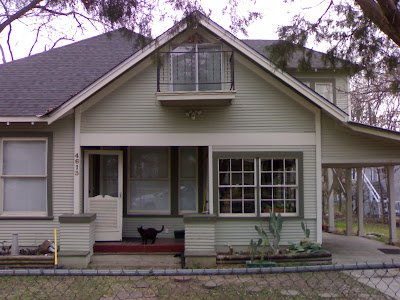


You can see the neighbor's cat and Peter's dog Trinity behind the window. The next day we went to Enthought, that was providing us with a breakfast and a lunch each day - and it was delicious. After the breakfast, we gathered in the room and introduced ourselves. Enthought rents 3/4 of the 21th floor in the Bank of America building, so when I looked left I saw:
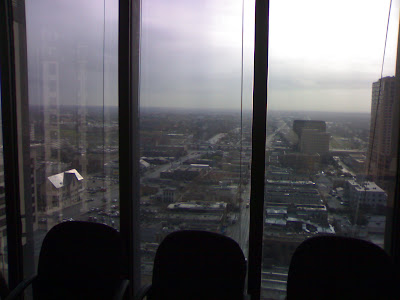


When I looked behind I saw:
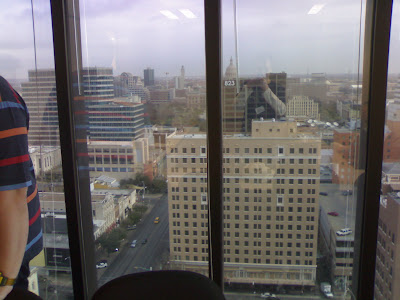


and in front of me, I saw all the participants (I took photos of all participants together with names). As you can see, there were really good people in there, like Travis (creator of NumPy), William (main author of Sage), Eric (CEO of Enthought), Fernando (author of IPython), Jarrod (the release manager of SciPy), Michael (the release manager of Sage) etc. See also the Fernando's welcome speech and the video of each of us introducting himself.

The views from the windows are terrific. I enjoyed working on each of the 4 sides of the skyscraper with completely different scenery, or when the sun is going down, that's also very cool.

We spent the whole Friday doing presentations, some of which you can find here. Then we went to Eric's house to have a big dinner together.

On Saturday, Sunday and Monday we were all hacking on many different things. I joined Fernando, Benjamin, Brian and Stefan on ipython1, Travis was implementing a new type (gmp integer) in NumPy, William wrote a manipulate command in Sage, Eric did the same in Traits, Gary and Michael implemented parallel testing of Sage, ...

On Tuesday we had final status reports and people left in the afternoon. In the evening we went with Clement to have a dinner and then we visited some bars on the 6th street, having a beer in each.

On Wednesday I visited John and Roy from the Computational Fluid Dynamics Lab at the University of Texas, Austin, who wrote the libMesh library, that I extensively used and also created a Debian package of. It was very influential to see the libMesh "from behind", also John and Roy are cool people (not mentioning the Debian tradition of having good relations with upstream:). Then I visited some professors at the same campus, after which I went into the Capitol and then I took the bus to the Barton Creek Square Mall to buy some ipods and jeans, so that I can say I have jeans from Texas. BTW, the ipod works excellent in Debian - I plugged it in and it just shows on my Gnome desktop. It's true that naively dragging mp3 files on it didn't make it play, but these instructions made it work.

On Thursday I fixed the remaining release blockers in SymPy and made a new release. In the evening, I am going to meet Aswin, he also uses SciPy and also is a friend of Kumar, who is now maintaining python-numpy and python-scipy Debian packages with me (Kumar also knows Prabhu, the author of Mayavi2 hosted at Enthought, so it's all connected).

Anyway, the whole workshop was an excellent experience for me. I learned a lot of new things and being able to speak with people who wrote tools that I use almost everyday is important. We also extensively discussed the future of all the projects (Sage, SciPy, NumPy, IPython, Cython, SymPy). See my summarizing email to the SymPy mailinglist.

Another thing, that I find very interesting is that Microsoft is financing the windows port of Sage, that will make basically anything that uses Python/Cython/C/Fortran very easy to install on windows (just a spkg package in sage). I find it really cool that MS is not only supporting but even financing a truly opensource project.

Finally the promised adventure in Atlanta: we took off the Prague airport on February 28th with a 2 hours delay (due to some paperwork as we were told by the captain). As I had 3 hours in Atlanta for the connection to Austin and I had to go through immigration, it was clear that I'll miss it. But I was not surprised, last time I was flying through Atlanta, they canceled my flight to LA completely. We arrived in Atlanta an hour and a half before my departure, then I was waiting for about an hour at immigration, it was incredibly slow. When I had around 20 min to departure, I had to ask people standing in front of me if they let me in, they were very nice and did. I was leaving immigration 10 min to my departure, then I was running to get my luggage and myself through customs and screening, it was 5 min to my departure when I ran down to the display with departure times. Then I was sprinting like hell to the terminal D to only see the clerk doing some final paperwork with all the people already boarded and the jetway door shut. After a little persuading he let me in too, fortunately there was still one seat left, so I made it. You can imagine my pleasant surprise in Austin when I discovered, that my luggage made it too, considering that I handed it to the Atlanta's airport personnel exactly 10 min prior the departure.

3 March 2008

Neil Williams: Reflections on autotools and make distcheck

I like autotools, I use them widely and I'm happy that I understand autotools sufficiently that I can be confident in using them and helping others with theirs. All my own upstream C projects rely on autotools and I have a personal rule that I always preserve make distcheck compatibility during CVS/SVN changes and without fail prior to ALL releases.
Lenny will be the second Debian release with which I've been involved and as I prepare to round on the RC bugs once again, I'm noticing a pattern in autotools bugs from other upstream teams.
  1. If more upstream projects enforced rigorous testing with make distcheck, a lot of bone-headed numbskull errors would be prevented in the upstream codebase. Fixing make distcheck isn't that hard because it is a test of the build system files, not necessarily the source code. Once an upstream build is fixed, subsequent make distcheck failures are both rare and serious. Other failures in the test suite should be easier to spot too. The important point is that make check only tests the current build on the upstream system. make distcheck goes a long way to ensuring that the package will build in the same way on lots of systems, including cross builds.

  2. autotools expects such fixes to be made upstream and fixing things after the release can be a serious PITA, so fix it before release.

  3. The single greatest weakness of make distcheck and autotools in general is bit rot. It is so important for upstream to refresh the autogenerated files on an intermittent basis. With a big development team, this can be easy - especially if new people are regularly joining and building the source for the first time from CVS/SVN. Once that rotation stops, the difficulties of trying to fix the upstream code get more and more noticeable. Maybe one day autotools will fix this and become more resistant to bit rot but, for now, it is a significant problem.

  4. As a consequence of file rotation, it is seldom a good idea to keep any autotools generated files in any form of RCS, even distributed ones. This is where I fall foul of many who want to package directly from SVN CVS foo. The mantra of lots of RCS helpers is "everything must be in the RCS" which is just plain wrong IMNSHO. The only things that must be in any RCS are the bits that upstream needs to write. So Makefile.am is, Makefile.in is not. configure.ac is, configure is not. Same for libtool, ltmain.sh, config.* and a host of other autotools generated files. If autogen.sh can generate or symlink them, don't have them in RCS. If, as upstream, you have not had to edit the file or copy it into place using a patch supplied by someone else, it should not be in the RCS. This discipline ensures that when someone starts from a fresh checkout, the build system is refreshed (and is why many autotools upstreams add a "make rcsclean" rule that goes one stage beyond make distclean by going back to raw RCS). If you maintain a helper that is meant to build packages like this, ensure that the helper has support for getting from raw RCS to make distcheck and ensure that the helper uses the tarball created by make dist not one of it's own.

Yes, bit rot is the curse of all software but when combined with the lack of usage of make distcheck prior to upstream falling quiet, I sometimes wonder about the merits of trying to fix bugs in the build system of packages with a most recent upstream release that precedes Etch. I get a real chill thinking about upstream packages with a most recent release that precedes Sarge.
So, if you're working on an upstream project using autotools, just do everyone a favour:
 svn cvs  ci -m "make sure things work"
make uninstall
make distclean
./autogen.sh
./configure --prefix=...
make
make check
make install
make distcheck

Repeat the last stage until it completes without errors, commit the changes and retest from the beginning.
I'm not proposing something I do not do myself - as above, I do these tests on my own (released) upstreams on a regular basis. I just wish more upstreams would do so too. If every upstream did this prior to that final release, it would be so much easier to do all kinds of cool things with your code, long after you lose interest in it yourself.

Gunnar Wolf: Keep the simplest things DRY and rolling

What's the best way to join a community, any community? Little by little.
I have been working with Ruby on Rails for well over a year already, even given a talk (at Encuentro Nacional Linux y Software Libre ENLi) inviting other people to use this very nice and well thought out environment. But, so far, I've been only a end-user, not really giving anything back besides minor bug reports.
Well, it's not as much as to say that I'm now a contributor - this is just a first statement of intent. I have worked a bit on several bits of code I keep repeating and hand-copying over my different Rails projects. Of course, that's completely not DRY - And completely not nice. So I decided to stop advancing on several projects, and learn my way on stting those bits of code as Rails plugins.
So far, it's been quite simple - and a good excercise on proper separation. I started, of course, with the easiest bit of code I could think of as useful in a general sense, and packaged it up as acts_as_catalog (of course, proper SVN tree and very basic, introductory README. And, of course, as I keep progressing with this work, I'll keep adding some plugins to my currently quite empty RubyForge page.
Anyway... Little by little, time will come where we have to think more seriously on how to properly bring together the Ruby on Rails style to work more tightly with Debian. Currently, the two have such different points of view on how to manage and ship components that I am not sure we will be able to truly bridge them together... But it is definitively worth trying. Hmh, looks like a task for Debconf! ;-)

MJ Ray: Constitutional Review Roadshow

[Photo of Explore] On Saturday 1 March, I attended the Constitutional Review Roadshow at Explore@Bristol (pictured). The review is trying to develop the rules for the Cooperative Group after its merger with United. The event wasn't at all what I expected or hoped for. There were relatively few individual members there. I don't know the split, but most of the 60 or so attendees seemed to be elected members of some sort and this was the first chance they'd had to comment since the open consultation ended last year. Some of the elected members had travelled from the Eastern and South East regions. The initial slide "Purpose of Today" stated three aims:
  1. bring members up to date;
  2. give members the opportunity to ask questions;
  3. and aid members in preparing their formal feedback.
I don't feel the event really brought us up to date or aided in preparing formal feedback, because the roadshow appeared to summarise a report which hasn't been published. Some of the elected members had seen it the day before, but no copies were available to use at the event, so we were pretty much in the dark for some aspects. The event didn't give us much opporunity to ask questions either, despite its length. I was expecting more of a consultation event, which was reinforced when I entered the room and saw seats gathered around tables. I did not expect an hour-long lecture followed by three hours or so of whole-group question-and-answer, broken by lunch. Even with the competent chairing (AFAICT), that was an amazingly inefficient way of working, with some people being cut short, but still leaving some people not being heard. It can be summed up by the chairman commenting
"I do not want this to turn into a discussion"
while the big screen next to him said "questions and discussion"! Headlines from the review: similar elected structures to current Group structure, but regional board nominated by individual members; merge regions to produce six new regions (West Midlands and North West, Wales and South West, London and South East, Eastern England and East and South Midlands, Yorkshire and Humber and North East, Scotland and Northern Ireland); add management and non-executive directors to national board; no clue how to fix diversity problems; no view on fees or job spec until structures are defined. I'll go through the slides in detail and post the questions and answers if anyone leaves a comment asking for them. Otherwise, I think I've lost enough time to this for now.

2 March 2008

Christoph Berg: New toy

Soon after Bernd Zeimetz joined our company, he infected me with the geocaching virus. In the meantime, I bought a GPS receiver, and am now endeavoring around the town and the nearby woods, searching for caches. There's not that much free GPS and/or geocaching software around. gpsd works quite well, but I don't take my computer to the woods ;) Viking is very nice for visualizing waypoints and sorting them in categories, but is still somewhere between alpha and beta state. gpsbabel reads and writes a zillion different file format and talks to a vast array of receivers, but often needs several attempts to upload data to mine. Things are moving fast though and the GPS community looks active. Last week I started looking into OpenStreetMap and already added a few roads in my neighborhood. Compared to commercial maps, there's still much to do, especially for smaller tracks and features like foot bridges or woods outside bigger cities. I'll keep collecting GPS data :) For the free software side, neither OSM's online editor worked here (flash), nor the recommended tool for local use (java), so I tried merkaartor (qt4) which works nicely. It also has some bugs, but feels very usable (though sometimes slow). Starting from upstream's debian/ dir, building packages was straightforward, and after some more editing, packages are now in unstable. (The svn repository is in collab-maint, contributors welcome.)

27 February 2008

Wouter Verhelst: Beid screencast

My FOSDEM talk didn't go entirely as planned. I tried to run a demo of the beid packages, but unfortunately they decided to play up again. This isn't the first time; they sometimes have this. It has something to do with OpenSC or OpenCT, I believe, but it's hard to figure out what, exactly. When I got back at the office with the machine that failed to work properly, and tried again, it did work. Heisenbugs suck. Pun intended. Anyway, since things work now, I prepared a screencast showing off what I wanted to show during the talk; it takes about 8 minutes. I was going to edit the talk to hide the spammer who was DoS'ing my mailserver just as I was trying to send an email out, and perhaps to hide away the long waits at times; but I didn't find an easy way to do so, and I got tired looking. If you're interested, have a look. Also, the screencast doesn't include any sound. This is because I couldn't find any piece of equipment on which istanbul would produce correct imagery (it appears to be buggy on powerpc), where the hardware was fast enough to capture and encode both a video at 1024x768 resolution and sound from the sound card (ruling out "anything", the machine on which I tried to do the presentation at FOSDEM), and on which the microphone would actually work (ruling out the amd64 box that was standing nearby). Since I could at least create a correct movie on the last machine, I just forgot about the sound. Instead, I tried to make the screencast show what was going on, by pointing at important tidbits with my mouse pointer. Which kindof worked, but was not ideal. Oh well.

Next.

Previous.
