Search Results: "ron"

16 September 2017

Dirk Eddelbuettel: pinp 0.0.1: pinp is not PNAS

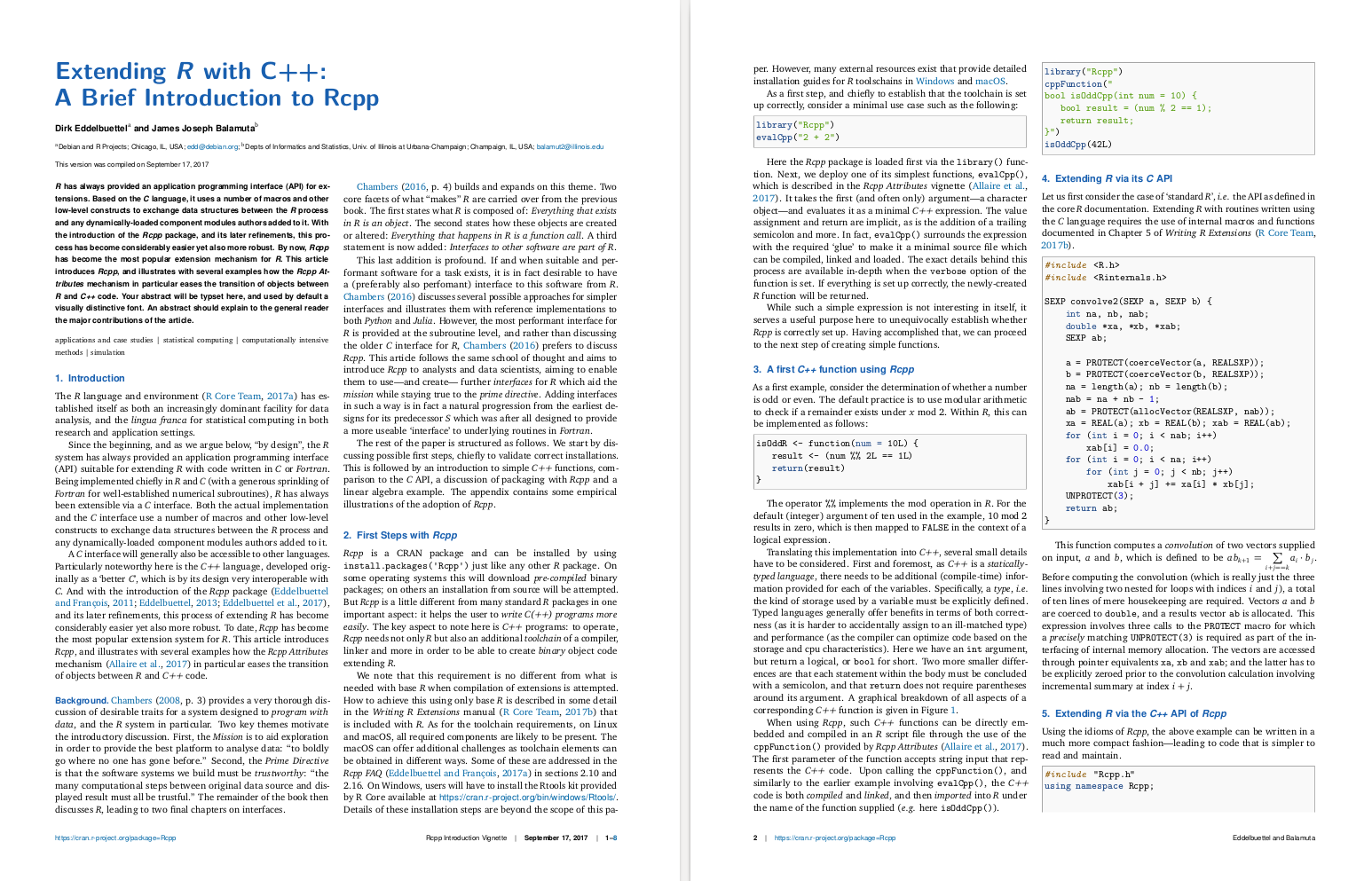
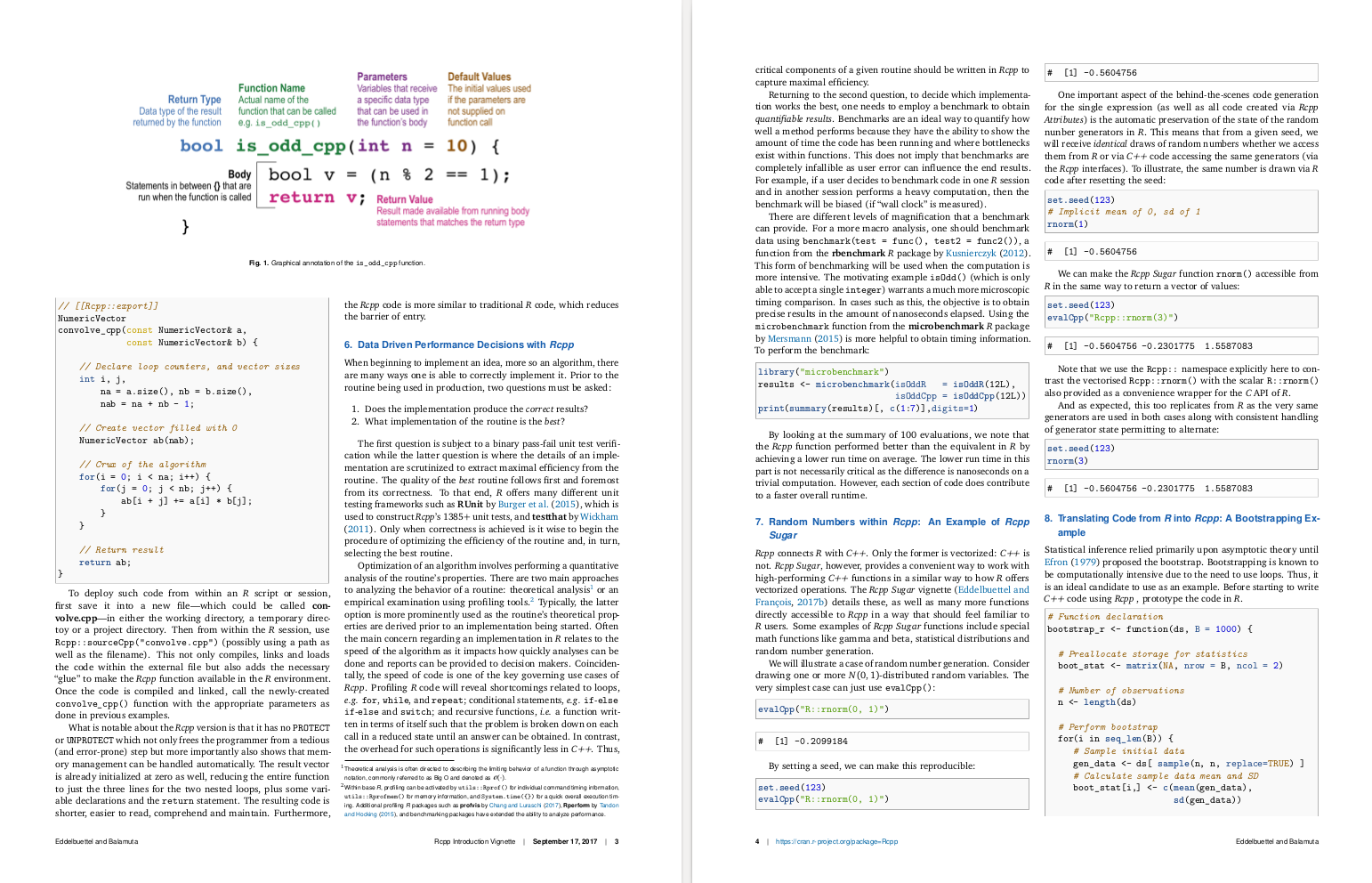
A brandnew and very exciting (to us, at least) package called pinp just arrived on CRAN, following a somewhat unnecessarily long passage out of incoming. It is based on the PNAS LaTeX Style offered by the Proceeding of the National Academy of Sciences of the United States of America, or PNAS for short. And there is already a Markdown version in the wonderful rticles packages. But James Balamuta and I thought we could do one better when we were looking to typeset our recent PeerJ Prepint as an attractive looking vignette for use within the Rcpp package. And so we did by changing a few things (font, color, use of natbib and Chicago.bst for references, removal of a bunch of extra PNAS-specific formalities from the frontpage) and customized a number of other things for easier use by vignettes directly from the YAML header (draft mode watermark, doi or url for packages, easier author naming in footer, bibtex file and more). We are quite pleased with the result which seems ready for the next Rcpp release---see e.g., these two teasers:
and
and the pinp package page or the GitHub repo have the full (four double-)pages of what turned a more dull looking 27 page manuscript into eight crisp two-column pages. We have few more things planned (i.e., switching to single column mode, turning on linenumbers at least in one-column mode). For questions or comments use the issue tracker off the GitHub repo.

This post by Dirk Eddelbuettel originated on his Thinking inside the box blog. Please report excessive re-aggregation in third-party for-profit settings.

14 September 2017

James McCoy: devscripts needs YOU!

Over the past 10 years, I've been a member of a dwindling team of people maintaining the devscripts package in Debian. Nearly two years ago, I sent out a "Request For Help" since it was clear I didn't have adequate time to keep driving the maintenance. In the mean time, Jonas split licensecheck out into its own project and took over development. Osamu has taken on much of the maintenance for uscan, uupdate, and mk-origtargz. Although that has helped spread the maintenance costs, there's still a lot that I haven't had time to address. Since Debian is still fairly early in the development cycle for Buster, I've decided this is as good a time as any for me to officially step down from active involvement in devscripts. I'm willing to keep moderating the mailing list and other related administrivia (which is fairly minimal given the repo is part of collab-maint), but I'll be unsubscribing from all other notifications. I think devscripts serves as a good funnel for useful scripts to get in front of Debian (and its derivatives) developers, but Jonas may also be onto something by pulling scripts out to stand on their own. One of the troubles with "bucket" packages like devscripts is the lack of visibility into when to retire scripts. Breaking scripts out on their own, and possibly creating multiple binary packages, certainly helps with that. Maybe uscan and friends would be a good next candidate. At the end of the day, I've certainly enjoyed being able to play my role in helping simplify the life of all the people contributing to Debian. I may come back to it some day, but for now it's time to let someone else pick up the reins. If you're interested in helping out, you can join #devscripts on OFTC and/or send a mail to <devscripts-devel@lists.alioth.debian.org>.

13 September 2017

Shirish Agarwal: Android, Android marketplace and gaming addiction.

This would be a longish piece so please bear and play with tea, coffee, beer or anything stronger that you desire while reading below  I had bought an Android phone, a Samsung J5 just before going to debconf 2016. It was more for being in-trend rather than really using it. The one which I shared is the upgraded version (recentish) the one I have is 2 GB for which I had paid around double of what the list price was. The only reason I bought the model is that it had removable battery at the price point I was willing to pay. I did see that Samsung has the same ham-handed issues with audio as previous Nokia devices use to, the speakers and microphone probably the cheapest you can get on the market. Nokia was same too, at least on the lower-end of the market, while Oppo has loud ringtones and loud music, perfect for those who are a bit hard of hearing (as yours truly is). I had been pleasantly surprised by the quality of photos Samsung J5 was churning even though I m less than average shooter, never been really into it so was a sort of wake-up call for where camera sensor technology is advancing. And of course with newer phones the kind of detail it can capture is mesmerizing to say the least, although wide-angle shots still would take some time to get right I guess. If memory serves me right, sometime back Laura Arjona Reina (who handles part of debian-publicity and part of debian-women among other responsibilities) shared a blog post on p.d.o. where she had shared the troubles she had while exporting data from the phone. While she shared that and I lack the time or the energy to try and find it ( the entry is really bookmarkable, at least that specific blog post). What was interesting though that I had gone few years ago to Bangalore, there is an organization which I like and admire CIS great for researchers. Anyways they had done a project getting between 10-20 phones from the market made of Chinese origin (almost all mobiles sold in India, the fabrication of CPU and APU etc. are done in China/Taiwan and then assembled here). Here what is done at the most is assembly which for all political purposes is called manufacturing . All the mobiles kept quite a bit of info. on the device even after you wiped them clean/put some other ROM on them. The CIS site is more than a bit cluttered otherwise would have shared the direct link. I do hope to send an e-mail to CIS and hopefully they will respond with the report and will share that here as and when. It would be interesting to know if after people flash a custom rom if the status quo is the same as it was before. I do suspect it would be the former as flashing ROMs on phones is still a bit of specialized subject at least here in India with even an average phone costing a month or two s salary or more and the idea of bricking the phone scares most people (including yours truly). Anyways, for a long time I was on bed and had the phone. I used 2 games from the android marketplace which both mum and I enjoy and enjoyed. Those are Real jigsaw and Jigsaw puzzle HD . The permissions dialog which Real jigsaw among other games has is horrible and part of me freaks that all such apps. have unrestricted access to my storage area. Ideally, what Android should have done is either partition or give functionality to the user to have private space for their photos and whatever media they have and the rest of the area is like a public park. If anybody has any thoughts on partitioning on Android phone would like to hear that. One game though which really hooked mumma and me is The Island Experiment . It reminded me of my younger days when gaming addiction was not treated as a disease but thankfully now is . I would call myself somewhat of a functional addict as in do my every day things, work etc. but do dream about the game as to what it will show me next. A part of it is the game is web-based (which means it needs constant internet connection) and web access is somewhat pricey, although with Reliance Jio an upcoming data network operator having bundles of money and promising the moon, network issues at least on low-bandwidth game which I and mum are playing hopefully will not have any issues. I haven t used tshark or any such tool to analyze the traffic but I guess it probably just sends short messages of number of clicks in a time period and things like that, all the rest (I guess) is happening on the mobile itself. I know at sometime I probably will try to put a custom rom on it but which one is the question as there are so many and also which is most compatible with my device. It seems I would have to do lot of homework before I can make any choices. Couple of months back, a friend of mine Akshat who has been using Android for few years enabled Developer Options which I didn t know about till he shared that info. with me. I do hope people do check Akshat s repo. as he has made/has quite a few useful scripts, especially if you are into digital photography. I have shared with him gimp scripting few days back so along with imagemagick you might see him doing some rough scripts in it. Of course, if people use it and give feedback he might clean the scripts a bit so it gives useful error messages and gives statement like gimp is not installed on your system, please install it or ask for specific version but as it works in free software it is somewhat directly proportional to the number of users, bugs and users behind it. A good example of what I mean is youtube-dl . I filed 873853 where I shared the upstream ticket. Apparently YouTube again changed few days back and while upstream has fixed it, the youtube-dl maintainer probably needs to find time and get the new version up. Apparently the issues lies in [$] dpkg -L youtube-dl grep youtube.py
/usr/lib/python3/dist-packages/youtube_dl/extractor/youtube.py
Hopefully somebody does the needful. Btw, I find f-droid extremely useful and especially osmand but sadly both of them are not shared or talked about by people  The reason I shared about Developer Options in Android is that few days back I noticed that the phone wonks off and has unpredictable behaviour such as not letting me browse the web, do additions or deletions using the google play store and alike . Things came to a head when few days back I saw a fibre-optic splicing operation being carried by some workers near my home by the state operator which elated me and wanted to shoot the video for it but the battery died/there was no power even though I hadn t used it much. I have deliberately shared the hindi version which tells how that knowledge is now coming to the masses. I had seen fibre-optic splicing more than a decade and a half back at some net conference where it was going to be in your neighbourhood soonish, hopefully it will happen soon  I had my suspicions for quite sometime all the issues with the phone were not due to proper charging. During course of my investigation, found out that in Developer Options there is an option called USB Configuration and changing that from the default MTP (Media Transfer Protocol) (which is basically used to put or take movies, music or any file from the phone to the computer or vice-versa improved much better behaviour on my android phone. But this caused an unexpected side-effect, I got pretty aggressive polling of the phone by the computer even after saying I do not want to share the phone details with the computer. This I filed as 874216 . The phone and I am guessing most Samsung phones today come with an adaptor with a USB male socket which goes in to the phone s usb port. There is the classical port for electricity but like most people heavily rely on usb charging even for deep fully powered down phone for full charging. One interesting project which I saw which came in Debian some days back is dummydroid. I did file a bug about it . I do hope that either the maintainer gives some more documentation. I am sure many people might use and add to the resource if the documentation was/is there. I did take a look at the package and the profile seems to be like an xml pair kind of database. Having more profiles shouldn t be hard if we knew what info. needs to be added and how do we find that info. Lastly, I am slowly transferring all the above knowledge to my mum as well, although in small doses. She, just like me has and had problems coming from resistive touchscreen to capacitive touchscreen. You can call me wrong but resistive touchscreen seemed to be superior and not as error-prone or liable to commit mistakes as is possible in capacitive touchscreens. There may be a setting to higher/lower the threshold for touching which I have not been able to find as of yet. Hope somebody finds something useful in there. I do hope that Debian does become a replacement to be used on such mobiles but then they would have to duplicate/also have some sort of mainstream content with editors to help people find stuff, something that Debian is not so good at currently. Also I m not sure Synaptic is good fit as a mobile store.
Filed under: Miscellenous Tagged: #Android, #capacitive touchscreen, #custom ROMs, #digital photography, #dummydroid, #f-droid, #fabrication, #flashing, #game addiction, #Google Play Store, #Mainstreaming Debian, #mobile connectivity, #Oppo, #osmand, #planet-debian, #resistive touchscreen, #Samsung Galaxy J5, #scripting, #USB charging, #USB configuration, #youtube-dl, gaming

Vincent Bernat: Route-based IPsec VPN on Linux with strongSwan

A common way to establish an IPsec tunnel on Linux is to use an IKE daemon, like the one from the strongSwan project, with a minimal configuration1:
conn V2-1
  left        = 2001:db8:1::1
  leftsubnet  = 2001:db8:a1::/64
  right       = 2001:db8:2::1
  rightsubnet = 2001:db8:a2::/64
  authby      = psk
  auto        = route
The same configuration can be used on both sides. Each side will figure out if it is left or right . The IPsec site-to-site tunnel endpoints are 2001:db8: 1::1 and 2001:db8: 2::1. The protected subnets are 2001:db8: a1::/64 and 2001:db8: a2::/64. As a result, strongSwan configures the following policies in the kernel:
$ ip xfrm policy
src 2001:db8:a1::/64 dst 2001:db8:a2::/64
        dir out priority 399999 ptype main
        tmpl src 2001:db8:1::1 dst 2001:db8:2::1
                proto esp reqid 4 mode tunnel
src 2001:db8:a2::/64 dst 2001:db8:a1::/64
        dir fwd priority 399999 ptype main
        tmpl src 2001:db8:2::1 dst 2001:db8:1::1
                proto esp reqid 4 mode tunnel
src 2001:db8:a2::/64 dst 2001:db8:a1::/64
        dir in priority 399999 ptype main
        tmpl src 2001:db8:2::1 dst 2001:db8:1::1
                proto esp reqid 4 mode tunnel
[ ]
This kind of IPsec tunnel is a policy-based VPN: encapsulation and decapsulation are governed by these policies. Each of them contains the following elements: When a matching policy is found, the kernel will look for a corresponding security association (using reqid and the endpoint source and destination addresses):
$ ip xfrm state
src 2001:db8:1::1 dst 2001:db8:2::1
        proto esp spi 0xc1890b6e reqid 4 mode tunnel
        replay-window 0 flag af-unspec
        auth-trunc hmac(sha256) 0x5b68[ ]8ba2904 128
        enc cbc(aes) 0x8e0e377ad8fd91e8553648340ff0fa06
        anti-replay context: seq 0x0, oseq 0x0, bitmap 0x00000000
[ ]
If no security association is found, the packet is put on hold and the IKE daemon is asked to negotiate an appropriate one. Otherwise, the packet is encapsulated. The receiving end identifies the appropriate security association using the SPI in the header. Two security associations are needed to establish a bidirectionnal tunnel:
$ tcpdump -pni eth0 -c2 -s0 esp
13:07:30.871150 IP6 2001:db8:1::1 > 2001:db8:2::1: ESP(spi=0xc1890b6e,seq=0x222)
13:07:30.872297 IP6 2001:db8:2::1 > 2001:db8:1::1: ESP(spi=0xcf2426b6,seq=0x204)
All IPsec implementations are compatible with policy-based VPNs. However, some configurations are difficult to implement. For example, consider the following proposition for redundant site-to-site VPNs: Redundant VPNs between 3 sites A possible configuration between V1-1 and V2-1 could be:
conn V1-1-to-V2-1
  left        = 2001:db8:1::1
  leftsubnet  = 2001:db8:a1::/64,2001:db8:a6::cc:1/128,2001:db8:a6::cc:5/128
  right       = 2001:db8:2::1
  rightsubnet = 2001:db8:a2::/64,2001:db8:a6::/64,2001:db8:a8::/64
  authby      = psk
  keyexchange = ikev2
  auto        = route
Each time a subnet is modified on one site, the configurations need to be updated on all sites. Moreover, overlapping subnets (2001:db8: a6::/64 on one side and 2001:db8: a6::cc:1/128 at the other) can also be problematic. The alternative is to use route-based VPNs: any packet traversing a pseudo-interface will be encapsulated using a security policy bound to the interface. This brings two features:
  1. Routing daemons can be used to distribute routes to be protected by the VPN. This decreases the administrative burden when many subnets are present on each side.
  2. Encapsulation and decapsulation can be executed in a different routing instance or namespace. This enables a clean separation between a private routing instance (where VPN users are) and a public routing instance (where VPN endpoints are).

Route-based VPN on Juniper Before looking at how to achieve that on Linux, let s have a look at the way it works with a JunOS-based platform (like a Juniper vSRX). This platform as long-standing history of supporting route-based VPNs (a feature already present in the Netscreen ISG platform). Let s assume we want to configure the IPsec VPN from V3-2 to V1-1. First, we need to configure the tunnel interface and bind it to the private routing instance containing only internal routes (with IPv4, they would have been RFC 1918 routes):
interfaces  
    st0  
        unit 1  
            family inet6  
                address 2001:db8:ff::7/127;


routing-instances  
    private  
        instance-type virtual-router;
        interface st0.1;
     
 
The second step is to configure the VPN:
security  
    /* Phase 1 configuration */
    ike  
        proposal IKE-P1  
            authentication-method pre-shared-keys;
            dh-group group20;
            encryption-algorithm aes-256-gcm;
         
        policy IKE-V1-1  
            mode main;
            proposals IKE-P1;
            pre-shared-key ascii-text "d8bdRxaY22oH1j89Z2nATeYyrXfP9ga6xC5mi0RG1uc";
         
        gateway GW-V1-1  
            ike-policy IKE-V1-1;
            address 2001:db8:1::1;
            external-interface lo0.1;
            general-ikeid;
            version v2-only;
         
     
    /* Phase 2 configuration */
    ipsec  
        proposal ESP-P2  
            protocol esp;
            encryption-algorithm aes-256-gcm;
         
        policy IPSEC-V1-1  
            perfect-forward-secrecy keys group20;
            proposals ESP-P2;
         
        vpn VPN-V1-1  
            bind-interface st0.1;
            df-bit copy;
            ike  
                gateway GW-V1-1;
                ipsec-policy IPSEC-V1-1;
             
            establish-tunnels on-traffic;


We get a route-based VPN because we bind the st0.1 interface to the VPN-V1-1 VPN. Once the VPN is up, any packet entering st0.1 will be encapsulated and sent to the 2001:db8: 1::1 endpoint. The last step is to configure BGP in the private routing instance to exchange routes with the remote site:
routing-instances  
    private  
        routing-options  
            router-id 1.0.3.2;
            maximum-paths 16;
         
        protocols  
            bgp  
                preference 140;
                log-updown;
                group v4-VPN  
                    type external;
                    local-as 65003;
                    hold-time 6;
                    neighbor 2001:db8:ff::6 peer-as 65001;
                    multipath;
                    export [ NEXT-HOP-SELF OUR-ROUTES NOTHING ];


The export filter OUR-ROUTES needs to select the routes to be advertised to the other peers. For example:
policy-options  
    policy-statement OUR-ROUTES  
        term 10  
            from  
                protocol ospf3;
                route-type internal;
             
            then  
                metric 0;
                accept;


The configuration needs to be repeated for the other peers. The complete version is available on GitHub. Once the BGP sessions are up, we start learning routes from the other sites. For example, here is the route for 2001:db8: a1::/64:
> show route 2001:db8:a1::/64 protocol bgp table private.inet6.0 best-path
private.inet6.0: 15 destinations, 19 routes (15 active, 0 holddown, 0 hidden)
+ = Active Route, - = Last Active, * = Both
2001:db8:a1::/64   *[BGP/140] 01:12:32, localpref 100, from 2001:db8:ff::6
                      AS path: 65001 I, validation-state: unverified
                      to 2001:db8:ff::6 via st0.1
                    > to 2001:db8:ff::14 via st0.2
It was learnt both from V1-1 (through st0.1) and V1-2 (through st0.2). The route is part of the private routing instance but encapsulated packets are sent/received in the public routing instance. No route-leaking is needed for this configuration. The VPN cannot be used as a gateway from internal hosts to external hosts (or vice-versa). This could also have been done with JunOS security policies (stateful firewall rules) but doing the separation with routing instances also ensure routes from different domains are not mixed and a simple policy misconfiguration won t lead to a disaster.

Route-based VPN on Linux Starting from Linux 3.15, a similar configuration is possible with the help of a virtual tunnel interface3. First, we create the private namespace:
# ip netns add private
# ip netns exec private sysctl -qw net.ipv6.conf.all.forwarding=1
Any private interface needs to be moved to this namespace (no IP is configured as we can use IPv6 link-local addresses):
# ip link set netns private dev eth1
# ip link set netns private dev eth2
# ip netns exec private ip link set up dev eth1
# ip netns exec private ip link set up dev eth2
Then, we create vti6, a tunnel interface (similar to st0.1 in the JunOS example):
# ip tunnel add vti6 \
   mode vti6 \
   local 2001:db8:1::1 \
   remote 2001:db8:3::2 \
   key 6
# ip link set netns private dev vti6
# ip netns exec private ip addr add 2001:db8:ff::6/127 dev vti6
# ip netns exec private sysctl -qw net.ipv4.conf.vti6.disable_policy=1
# ip netns exec private sysctl -qw net.ipv4.conf.vti6.disable_xfrm=1
# ip netns exec private ip link set vti6 mtu 1500
# ip netns exec private ip link set vti6 up
The tunnel interface is created in the initial namespace and moved to the private one. It will remember its original namespace where it will process encapsulated packets. Any packet entering the interface will temporarily get a firewall mark of 6 that will be used only to match the appropriate IPsec policy4 below. The kernel sets a low MTU on the interface to handle any possible combination of ciphers and protocols. We set it to 1500 and let PMTUD do its work. We can then configure strongSwan5:
conn V3-2
  left        = 2001:db8:1::1
  leftsubnet  = ::/0
  right       = 2001:db8:3::2
  rightsubnet = ::/0
  authby      = psk
  mark        = 6
  auto        = route
  keyexchange = ikev2
  keyingtries = %forever
  ike         = aes256gcm16-prfsha384-ecp384!
  esp         = aes256gcm16-prfsha384-ecp384!
  mobike      = no
The IKE daemon configures the following policies in the kernel:
$ ip xfrm policy
src ::/0 dst ::/0
        dir out priority 399999 ptype main
        mark 0x6/0xffffffff
        tmpl src 2001:db8:1::1 dst 2001:db8:3::2
                proto esp reqid 1 mode tunnel
src ::/0 dst ::/0
        dir fwd priority 399999 ptype main
        mark 0x6/0xffffffff
        tmpl src 2001:db8:3::2 dst 2001:db8:1::1
                proto esp reqid 1 mode tunnel
src ::/0 dst ::/0
        dir in priority 399999 ptype main
        mark 0x6/0xffffffff
        tmpl src 2001:db8:3::2 dst 2001:db8:1::1
                proto esp reqid 1 mode tunnel
[ ]
Those policies are used for any source or destination as long as the firewall mark is equal to 6, which matches the mark configured for the tunnel interface. The last step is to configure BGP to exchange routes. We can use BIRD for this:
router id 1.0.1.1;
protocol device  
   scan time 10;
 
protocol kernel  
   persist;
   learn;
   import all;
   export all;
   merge paths yes;
 
protocol bgp IBGP_V3_2  
   local 2001:db8:ff::6 as 65001;
   neighbor 2001:db8:ff::7 as 65003;
   import all;
   export where ifname ~ "eth*";
   preference 160;
   hold time 6;
 
Once BIRD is started in the private namespace, we can check routes are learned correctly:
$ ip netns exec private ip -6 route show 2001:db8:a3::/64
2001:db8:a3::/64 proto bird metric 1024
        nexthop via 2001:db8:ff::5  dev vti5 weight 1
        nexthop via 2001:db8:ff::7  dev vti6 weight 1
The above route was learnt from both V3-1 (through vti5) and V3-2 (through vti6). Like for the JunOS version, there is no route-leaking between the private namespace and the initial one. The VPN cannot be used as a gateway between the two namespaces, only for encapsulation. This also prevent a misconfiguration (for example, IKE daemon not running) from allowing packets to leave the private network. As a bonus, unencrypted traffic can be observed with tcpdump on the tunnel interface:
$ ip netns exec private tcpdump -pni vti6 icmp6
tcpdump: verbose output suppressed, use -v or -vv for full protocol decode
listening on vti6, link-type LINUX_SLL (Linux cooked), capture size 262144 bytes
20:51:15.258708 IP6 2001:db8:a1::1 > 2001:db8:a3::1: ICMP6, echo request, seq 69
20:51:15.260874 IP6 2001:db8:a3::1 > 2001:db8:a1::1: ICMP6, echo reply, seq 69
You can find all the configuration files for this example on GitHub. The documentation of strongSwan also features a page about route-based VPNs.

  1. Everything in this post should work with Libreswan.
  2. fwd is for incoming packets on non-local addresses. It only makes sense in transport mode and is a Linux-only particularity.
  3. Virtual tunnel interfaces (VTI) were introduced in Linux 3.6 (for IPv4) and Linux 3.12 (for IPv6). Appropriate namespace support was added in 3.15. KLIPS, an alternative out-of-tree stack available since Linux 2.2, also features tunnel interfaces.
  4. The mark is set right before doing a policy lookup and restored after that. Consequently, it doesn t affect other possible uses (filtering, routing). However, as Netfilter can also set a mark, one should be careful for conflicts.
  5. The ciphers used here are the strongest ones currently possible while keeping compatibility with JunOS. The documentation for strongSwan contains a complete list of supported algorithms as well as security recommendations to choose them.

12 September 2017

Markus Koschany: My Free Software Activities in August 2017

Welcome to gambaru.de. Here is my monthly report that covers what I have been doing for Debian. If you re interested in Java, Games and LTS topics, this might be interesting for you. DebConf 17 in Montreal I traveled to DebConf 17 in Montreal/Canada. I arrived on 04. August and met a lot of different people which I only knew by name so far. I think this is definitely one of the best aspects of real life meetings, putting names to faces and getting to know someone better. I totally enjoyed my stay and I would like to thank all the people who were involved in organizing this event. You rock! I also gave a talk about the The past, present and future of Debian Games , listened to numerous other talks and got a nice sunburn which luckily turned into a more brownish color when I returned home on 12. August. The only negative experience I made was with my airline which was supposed to fly me home to Frankfurt again. They decided to cancel the flight one hour before check-in for unknown reasons and just gave me a telephone number to sort things out. No support whatsoever. Fortunately (probably not for him) another DebConf attendee suffered the same fate and together we could find another flight with Royal Air Maroc the same day. And so we made a short trip to Casablanca/Morocco and eventually arrived at our final destination in Frankfurt a few hours later. So which airline should you avoid at all costs (they still haven t responded to my refund claims) ? It s WoW-Air from Iceland. (just wow) Debian Games Debian Java Debian LTS This was my eighteenth month as a paid contributor and I have been paid to work 20,25 hours on Debian LTS, a project started by Rapha l Hertzog. In that time I did the following: Non-maintainer upload Thanks for reading and see you next time.

10 September 2017

intrigeri: Can you reproduce this Tails ISO image?

Thanks to a Mozilla Open Source Software award, we have been working on making the Tails ISO images build reproducibly. We have made huge progress: since a few months, ISO images built by Tails core developers and our CI system have always been identical. But we're not done yet and we need your help! Our first call for testing build reproducibility in August uncovered a number of remaining issues. We think that we have fixed them all since, and we now want to find out what other problems may prevent you from building our ISO image reproducibly. Please try to build an ISO image today, and tell us whether it matches ours! Build an ISO These instructions have been tested on Debian Stretch and testing/sid. If you're using another distribution, you may need to adjust them. If you get stuck at some point in the process, see our more detailed build documentation and don't hesitate to contact us: Setup the build environment You need a system that supports KVM, 1 GiB of free memory, and about 20 GiB of disk space.
  1. Install the build dependencies:
    sudo apt install \
        git \
        rake \
        libvirt-daemon-system \
        dnsmasq-base \
        ebtables \
        qemu-system-x86 \
        qemu-utils \
        vagrant \
        vagrant-libvirt \
        vmdebootstrap && \
    sudo systemctl restart libvirtd
    
  2. Ensure your user is in the relevant groups:
    for group in kvm libvirt libvirt-qemu ; do
       sudo adduser "$(whoami)" "$group"
    done
    
  3. Logout and log back in to apply the new group memberships.
Build Tails 3.2~alpha2 This should produce a Tails ISO image:
git clone https://git-tails.immerda.ch/tails && \
cd tails && \
git checkout 3.2-alpha2 && \
git submodule update --init && \
rake build
Send us feedback! No matter how your build attempt turned out we are interested in your feedback. Gather system information To gather the information we need about your system, run the following commands in the terminal where you've run rake build:
sudo apt install apt-show-versions && \
(
  for f in /etc/issue /proc/cpuinfo
  do
    echo "--- File: $ f  ---"
    cat "$ f "
    echo
  done
  for c in free locale env 'uname -a' '/usr/sbin/libvirtd --version' \
            'qemu-system-x86_64 --version' 'vagrant --version'
  do
    echo "--- Command: $ c  ---"
    eval "$ c "
    echo
  done
  echo '--- APT package versions ---'
  apt-show-versions qemu:amd64 linux-image-amd64:amd64 vagrant \
                    libvirt0:amd64
)   bzip2 > system-info.txt.bz2
Then check that the generated file doesn't contain any sensitive information you do not want to leak:
bzless system-info.txt.bz2
Next, please follow the instructions below that match your situation! If the build failed Sorry about that. Please help us fix it by opening a ticket: If the build succeeded Compute the SHA-512 checksum of the resulting ISO image:
sha512sum tails-amd64-3.2~alpha2.iso
Compare your checksum with ours:
9b4e9e7ee7b2ab6a3fb959d4e4a2db346ae322f9db5409be4d5460156fa1101c23d834a1886c0ce6bef2ed6fe378a7e76f03394c7f651cc4c9a44ba608dda0bc
If the checksums match: success, congrats for reproducing Tails 3.2~alpha2! Please send an email to tails-dev@boum.org (public) or tails@boum.org (private) with the subject "Reproduction of Tails 3.2~alpha2 successful" and system-info.txt.bz2 attached. Thanks in advance! Then you can stop reading here. Else, if the checksums differ: too bad, but really it's good news as the whole point of the exercise is precisely to identify such problems :) Now you are in a great position to help improve the reproducibility of Tails ISO images by following these instructions:
  1. Install diffoscope version 83 or higher and all the packages it recommends. For example, if you're using Debian Stretch:
    sudo apt remove diffoscope && \
    echo 'deb http://ftp.debian.org/debian stretch-backports main' \
        sudo tee /etc/apt/sources.list.d/stretch-backports.list && \
    sudo apt update && \
    sudo apt -o APT::Install-Recommends="true" \
             install diffoscope/stretch-backports
    
  2. Download the official Tails 3.2~alpha2 ISO image.
  3. Compare the official Tails 3.2~alpha2 ISO image with yours:
    diffoscope \
           --text diffoscope.txt \
           --html diffoscope.html \
           --max-report-size 262144000 \
           --max-diff-block-lines 10000 \
           --max-diff-input-lines 10000000 \
           path/to/official/tails-amd64-3.2~alpha2.iso \
           path/to/your/own/tails-amd64-3.2~alpha2.iso
    bzip2 diffoscope. txt,html 
    
  4. Send an email to tails-dev@boum.org (public) or tails@boum.org (private) with the subject "Reproduction of Tails 3.2~alpha2 failed", attaching:
    • system-info.txt.bz2;
    • the smallest file among diffoscope.txt.bz2 and diffoscope.html.bz2, except if they are larger than 100 KiB, in which case better upload the file somewhere (e.g. share.riseup.net and share the link in your email.
Thanks a lot! Credits Thanks to Ulrike & anonym who authored a draft on which this blog post is based.

Sylvain Beucler: dot-zed archive file format

TL,DR: I reverse-engineered the .zed encrypted archive format.
Following a clean-room design, I'm providing a description that can be implemented by a third-party.
Interested? :) (reference version at: https://www.beuc.net/zed/) .zed archive file format Introduction Archives with the .zed extension are conceptually similar to an encrypted .zip file. In addition to a specific format, .zed files support multiple users: files are encrypted using the archive master key, which itself is encrypted for each user and/or authentication method (password, RSA key through certificate or PKCS#11 token). Metadata such as filenames is partially encrypted. .zed archives are used as stand-alone or attached to e-mails with the help of a MS Outlook plugin. A variant, which is not covered here, can encrypt/decrypt MS Windows folders on the fly like ecryptfs. In the spirit of academic and independent research this document provides a description of the file format and encryption algorithms for this encrypted file archive. See the conventions section for conventions and acronyms used in this document. Structure overview The .zed file format is composed of several layers. Or as a diagram:
+----------------------------------------------------------------------------------------------------+
  .zed archive (MS-CBF)                                                                               
                                                                                                      
   stream #1                         stream #2                       stream #3...                     
  +------------------------------+  +---------------------------+  +---------------------------+      
    metadata (MS-OLEPS)               encryption (AES)               encryption (AES)                 
                                      512-bytes chunks               512-bytes chunks                 
    +--------------------------+                                                                      
      obfuscation (static key)        +-----------------------+      +-----------------------+        
      +----------------------+       -  compression (zlib)     -    -  compression (zlib)     -       
       _ctlfile (TLV)                                                                            ...  
      +----------------------+          +---------------+              +---------------+               
    +--------------------------+          file contents                  file contents                
                                                                                                      
    +--------------------------+     -  +---------------+      -    -  +---------------+      -       
      _catalog (TLV)                                                                                  
    +--------------------------+      +-----------------------+      +-----------------------+        
  +------------------------------+  +---------------------------+  +---------------------------+      
+----------------------------------------------------------------------------------------------------+
Encryption schemes Several AES key sizes are supported, such as 128 and 256 bits. The Cipher Block Chaining (CBC) block cipher mode of operation is used to decrypt multiple AES 16-byte blocks, which means an initialisation vector (IV) is stored in clear along with the ciphertext. All filenames and file contents are encrypted using the same encryption mode, key and IV (e.g. if you remove and re-add a file in the archive, the resulting stream will be identical). No cleartext padding is used during encryption; instead, several end-of-stream handlers are available, so the ciphertext has exactly the size of the cleartext (e.g. the size of the compressed file). The following variants were identified in the 'encryption_mode' field. STREAM This is the end-of-stream handler for: This end-of-stream handler is apparently specific to the .zed format, and applied when the cleartext's does not end on a 16-byte boundary ; in this case special processing is performed on the last partial 16-byte block. The encryption and decryption phases are identical: let's assume the last partial block of cleartext (for encryption) or ciphertext (for decryption) was appended after all the complete 16-byte blocks of ciphertext: In either case, if the full ciphertext is less then one AES block (< 16 bytes), then the IV is used instead of the second-to-last block. CTS CTS or CipherText Stealing is the end-of-stream handler for: It matches the CBC-CS3 variant as described in Recommendation for Block Cipher Modes of Operation: Three Variants of Ciphertext Stealing for CBC Mode. Empty cleartext Since empty filenames or metadata are invalid, and since all files are compressed (resulting in a minimum 8-byte zlib cleartext), no empty cleartext was encrypted in the archive. metadata stream It is named 05356861616161716149656b7a6565636e576a33317a7868304e63 (hexadecimal), i.e. the character with code 5 followed by '5haaaaqaIekzeecnWj31zxh0Nc' (ASCII). The format used is OLE Property Set (MS-OLEPS). It introduces 2 property names "_ctlfile" (index 3) and "_catalog" (index 4), and 2 instances of said properties each containing an application-specific VT_BLOB (type 0x0041). _ctlfile: obfuscated global properties and access list This subpart is stored under index 3 ("_ctlfile") of the MS-OLEPS metadata. It consists of: The ciphertext is encrypted with AES-CBC "STREAM" mode using 128-bit static key 37F13CF81C780AF26B6A52654F794AEF (hexadecimal) and the prepended IV so as to obfuscate the access list. The ciphertext is continuous and not split in chunks (unlike files), even when it is larger than 512 bytes. The decrypted text contain properties in a TLV format as described in _ctlfile TLV: Archives may include "mandatory" users that cannot be removed. They are typically used to add an enterprise wide recovery RSA key to all archives. Extreme care must be taken to protect these key, as it can decrypt all past archives generated from within that company. _catalog: file list This subpart is stored under index 4 ("_catalog") of the MS-OLEPS metadata. It contains a series of 'fileprops' TLV structures, one for each file or directory. The file hierarchy can be reconstructed by checking the 'parent_id' field of each file entry. If 'parent_id' is 0 then the file is located at the top-level of the hierarchy, otherwise it's located under the directory with the matching 'file_id'. TLV format This format is a series of fields : Value semantics depend on its Type. It may contain an uint32be integer, a UTF-16LE string, a character sequence, or an inner TLV structure. Unless otherwise noted, TLV structures appear once. Some fields are optional and may not be present at all (e.g. 'archive_createdwith'). Some fields are unique within a structure (e.g. 'files_iv'), other may be repeated within a structure to form a list (e.g. 'fileprops' and 'passworduser'). The following top-level types that have been identified, and detailed in the next sections: Some additional unidentified types may be present. _ctlfile TLV _catalog TLV Decrypting the archive AES key rsauser The user accessing the archive will be authenticated by comparing his/her X509 certificate with the one stored in the 'certificate' field using DER format. The 'files_key_ciphertext' field is then decrypted using the PKCS#1 v1.5 encryption mechanism, with the private key that matches the user certificate. passworduser An intermediary user key, a user IV and an integrity checksum will be derived from the user password, using the deprecated PKCS#12 method as described at rfc7292 appendix B. Note: this is not PKCS#5 (nor PBKDF1/PBKDF2), this is an incompatible method from PKCS#12 that notably does not use HMAC. The 'pkcs12_hashfunc' field defines the underlying hash function. The following values have been identified: PBA - Password-based authentication The user accessing the archive will be authenticated by deriving an 8-byte sequence from his/her password. The parameters for the derivation function are: The derivation is checked against 'pba_checksum'. PBE - Password-based encryption Once the user is identified, 2 new values are derived from the password with different parameters to produce the IV and the key decryption key, with the same hash function: The parameters specific to user key are: The user key needs to be truncated to a length of 'encryption_strength', as specified in bytes in the archive properties. The parameters specific to user IV are: Once the key decryption key and the IV are derived, 'files_key_ciphertext' is decrypted using AES CBC, with PKCS#7 padding. Identifying file streams The name of the MS-CFB stream is derived by shuffling the bytes from the 'file_id' field and then encoding the result as hexadecimal. The reordering is:
Initial  offset: 0 1 2 3 4 5 6 7 8 9 10 11 12 13 14 15
Shuffled offset: 3 2 1 0 5 4 7 6 8 9 10 11 12 13 14 15
The 16th byte is usually a NUL byte, hence the stream identifier is a 30-character-long string. Decrypting files The compressed stream is split in chunks of 512 bytes, each of them encrypted separately using AES CBS and the global archive encryption scheme. Decryption uses the global AES key (retrieved using the user credentials), and the global IV (retrieved from the deobfuscated archive metadata). The IV for each chunk is computed by: Each chunk is an independent stream and the decryption process involves end-of-stream handling even if this is not the end of the actual file. This is particularly important for the CTS handler. Note: this is not to be confused with CTR block cipher mode of operation with operates differently and requires a nonce. Decompressing files Compressed streams are zlib stream with default compression options and can be decompressed following the zlib format. Test cases Excluded for brevity, cf. https://www.beuc.net/zed/#test-cases. Conventions and references Feedback Feel free to send comments at beuc@beuc.net. If you have .zed files that you think are not covered by this document, please send them as well (replace sensitive files with other ones). The author's GPG key can be found at 8FF1CB6E8D89059F. Copyright (C) 2017 Sylvain Beucler Copying and distribution of this file, with or without modification, are permitted in any medium without royalty provided the copyright notice and this notice are preserved. This file is offered as-is, without any warranty.

Joachim Breitner: Less parentheses

Yesterday, at the Haskell Implementers Workshop 2017 in Oxford, I gave a lightning talk titled syntactic musings , where I presented three possibly useful syntactic features that one might want to add to a language like Haskell. The talked caused quite some heated discussions, and since the Internet likes heated discussion, I will happily share these ideas with you

Context aka. Sections This is probably the most relevant of the three proposals. Consider a bunch of related functions, say analyseExpr and analyseAlt, like these:
analyseExpr :: Expr -> Expr
analyseExpr (Var v) = change v
analyseExpr (App e1 e2) =
  App (analyseExpr e1) (analyseExpr e2)
analyseExpr (Lam v e) = Lam v (analyseExpr flag e)
analyseExpr (Case scrut alts) =
  Case (analyseExpr scrut) (analyseAlt <$> alts)
analyseAlt :: Alt -> Alt
analyseAlt (dc, pats, e) = (dc, pats, analyseExpr e)
You have written them, but now you notice that you need to make them configurable, e.g. to do different things in the Var case. You thus add a parameter to all these functions, and hence an argument to every call:
type Flag = Bool
analyseExpr :: Flag -> Expr -> Expr
analyseExpr flag (Var v) = if flag then change1 v else change2 v
analyseExpr flag (App e1 e2) =
  App (analyseExpr flag e1) (analyseExpr flag e2)
analyseExpr flag (Lam v e) = Lam v (analyseExpr (not flag) e)
analyseExpr flag (Case scrut alts) =
  Case (analyseExpr flag scrut) (analyseAlt flag <$> alts)
analyseAlt :: Flag -> Alt -> Alt
analyseAlt flag (dc, pats, e) = (dc, pats, analyseExpr flag e)
I find this code problematic. The intention was: flag is a parameter that an external caller can use to change the behaviour of this code, but when reading and reasoning about this code, flag should be considered constant. But this intention is neither easily visible nor enforced. And in fact, in the above code, flag does change , as analyseExpr passes something else in the Lam case. The idiom is indistinguishable from the environment idiom, where a locally changing environment (such as variables in scope ) is passed around. So we are facing exactly the same problem as when reasoning about a loop in an imperative program with mutable variables. And we (pure functional programmers) should know better: We cherish immutability! We want to bind our variables once and have them scope over everything we need to scope over! The solution I d like to see in Haskell is common in other languages (Gallina, Idris, Agda, Isar), and this is what it would look like here:
type Flag = Bool
section (flag :: Flag) where
  analyseExpr :: Expr -> Expr
  analyseExpr (Var v) = if flag then change1 v else change2v 
  analyseExpr (App e1 e2) =
    App (analyseExpr e1) (analyseExpr e2)
  analyseExpr (Lam v e) = Lam v (analyseExpr e)
  analyseExpr (Case scrut alts) =
    Case (analyseExpr scrut) (analyseAlt <$> alts)
  analyseAlt :: Alt -> Alt
  analyseAlt (dc, pats, e) = (dc, pats, analyseExpr e)
Now the intention is clear: Within a clearly marked block, flag is fixed and when reasoning about this code I do not have to worry that it might change. Either all variables will be passed to change1, or all to change2. An important distinction! Therefore, inside the section, the type of analyseExpr does not mention Flag, whereas outside its type is Flag -> Expr -> Expr. This is a bit unusual, but not completely: You see precisely the same effect in a class declaration, where the type signature of the methods do not mention the class constraint, but outside the declaration they do. Note that idioms like implicit parameters or the Reader monad do not give the guarantee that the parameter is (locally) constant. More details can be found in the GHC proposal that I prepared, and I invite you to raise concern or voice support there. Curiously, this problem must have bothered me for longer than I remember: I discovered that seven years ago, I wrote a Template Haskell based implementation of this idea in the seal-module package!

Less parentheses 1: Bulleted argument lists The next two proposals are all about removing parentheses. I believe that Haskell s tendency to express complex code with no or few parentheses is one of its big strengths, as it makes it easier to visualy parse programs. A common idiom is to use the $ operator to separate a function from a complex argument without parentheses, but it does not help when there are multiple complex arguments. For that case I propose to steal an idea from the surprisingly successful markup language markdown, and use bulleted lists to indicate multiple arguments:
foo :: Baz
foo = bracket
          some complicated code
          that is evaluated first
          other complicated code for later
          even more complicated code
I find this very easy to visually parse and navigate. It is actually possible to do this now, if one defines ( ) = id with infixl 0 . A dedicated syntax extension (-XArgumentBullets) is preferable:
  • It only really adds readability if the bullets are nicely vertically aligned, which the compiler should enforce.
  • I would like to use $ inside these complex arguments, and multiple operators of precedence 0 do not mix. (infixl -1 would help).
  • It should be possible to nest these, and distinguish different nesting levers based on their indentation.

Less parentheses 1: Whitespace precedence The final proposal is the most daring. I am convinced that it improves readability and should be considered when creating a new language. As for Haskell, I am at the moment not proposing this as a language extension (but could be convinced to do so if there is enough positive feedback). Consider this definition of append:
(++) :: [a] -> [a] -> [a]
[]     ++ ys = ys
(x:xs) ++ ys = x : (xs++ys)
Imagine you were explaining the last line to someone orally. How would you speak it? One common way to do so is to not read the parentheses out aloud, but rather speak parenthesised expression more quickly and add pauses otherwise. We can do the same in syntax!
(++) :: [a] -> [a] -> [a]
[]   ++ ys = ys
x:xs ++ ys = x : xs++ys
The rule is simple: A sequence of tokens without any space is implicitly parenthesised. The reaction I got in Oxford was horror and disgust. And that is understandable we are very used to ignore spacing when parsing expressions (unless it is indentation, of course. Then we are no longer horrified, as our non-Haskell colleagues are when they see our code). But I am convinced that once you let the rule sink in, you will have no problem parsing such code with ease, and soon even with greater ease than the parenthesised version. It is a very natural thing to look at the general structure, identify compact chunks of characters , mentally group them, and then go and separately parse the internals of the chunks and how the chunks relate to each other. More natural than first scanning everything for ( and ), matching them up, building a mental tree, and then digging deeper. Incidentally, there was a non-programmer present during my presentation, and while she did not openly contradict the dismissive groan of the audience, I later learned that she found this variant quite obvious to understand and more easily to read than the parenthesised code. Some FAQs about this:
  • What about an operator with space on one side but not on the other? I d simply forbid that, and hence enforce readable code.
  • Do operator sections still require parenthesis? Yes, I d say so.
  • Does this overrule operator precedence? Yes! a * b+c == a * (b+c).
  • What is a token? Good question, and I am not not decided. In particular: Is a parenthesised expression a single token? If so, then (Succ a)+b * c parses as ((Succ a)+b) * c, otherwise it should probably simply be illegal.
  • Can we extend this so that one space binds tighter than two spaces, and so on? Yes we can, but really, we should not.
  • This is incompatible with Agda s syntax! Indeed it is, and I really like Agda s mixfix syntax. Can t have everything.
  • Has this been done before? I have not seen it in any language, but Lewis Wall has blogged this idea before.
Well, let me know what you think!

9 September 2017

Fran ois Marier: TLS Authentication on Freenode and OFTC

In order to easily authenticate with IRC networks such as OFTC and Freenode, it is possible to use client TLS certificates (also known as SSL certificates). In fact, it turns out that it's very easy to setup both on irssi and on znc.

Generate your TLS certificate On a machine with good entropy, run the following command to create a keypair that will last for 10 years:
openssl req -nodes -newkey rsa:2048 -keyout user.pem -x509 -days 3650 -out user.pem -subj "/CN=<your nick>"
Then extract your key fingerprint using this command:
openssl x509 -sha1 -noout -fingerprint -in user.pem   sed -e 's/^.*=//;s/://g'

Share your fingerprints with NickServ On each IRC network, do this:
/msg NickServ IDENTIFY Password1!
/msg NickServ CERT ADD <your fingerprint>
in order to add your fingerprint to the access control list.

Configure ZNC To configure znc, start by putting the key in the right place:
cp user.pem ~/.znc/users/<your nick>/networks/oftc/moddata/cert/
and then enable the built-in cert plugin for each network in ~/.znc/configs/znc.conf:
<Network oftc>
    ...
            LoadModule = cert
    ...
</Network>
    <Network freenode>
    ...
            LoadModule = cert
    ...
</Network>

Configure irssi For irssi, do the same thing but put the cert in ~/.irssi/user.pem and then change the OFTC entry in ~/.irssi/config to look like this:
 
  address = "irc.oftc.net";
  chatnet = "OFTC";
  port = "6697";
  use_tls = "yes";
  tls_cert = "~/.irssi/user.pem";
  tls_verify = "yes";
  autoconnect = "yes";
 
and the Freenode one to look like this:
 
  address = "chat.freenode.net";
  chatnet = "Freenode";
  port = "7000";
  use_tls = "yes";
  tls_cert = "~/.irssi/user.pem";
  tls_verify = "yes";
  autoconnect = "yes";
 
That's it. That's all you need to replace password authentication with a much stronger alternative.

7 September 2017

Thomas Lange: My recent FAI activities

During DebConf 17 in Montr al I had a FAI demo session (video), where I showed how to create a customized installation CD and how to create a diskimage using the same configuration. This diskimage is ready for use with a VM software or can be booted inside a cloud environment. During the last weeks I was working on FAI 5.4 which will be released in a few weeks. I you want to test it use
deb https://fai-project.org/download beta-testing koeln
in your sources.list file. The most important new feature will be the cross architecture support. I managed to create an ARM64 diskimage on a x86 host and boot this inside Qemu. Currently I learn how to flash images onto my new Hikey960 board for booting my own Debian images on real hardware. The embedded world is still new for me and very different in respect to the boot process. At DebConf, I also worked on debootstrap. I produced a set of patches which can speedup debootstrap by a factor of 2. See #871835 for details. FAI debootstrap ARM

John Goerzen: Switching to xmonad + Gnome and ditching a Mac

I have been using XFCE with xmonad for years now. I m not sure exactly how many, but at least 6 years, if not closer to 10. Today I threw in the towel and switched to Gnome. More recently, at a new job, I was given a Macbook Pro. I wasn t entirely sure what to think of this, but I thought I d give it a try. I found MacOS to be extremely frustrating and confining. It had no real support for a tiling window manager, and although projects like amethyst tried to approximate what xmonad can do on Linux, they were just too limited by the platform and were clunky. Moreover, the entire UI was surprisingly sluggish; maybe that was an induced effect from animations, but I don t think that explains it. A Debisn stretch install, even on inferior hardware, was snappy in a way that MacOS never was. So I have requested to swap for a laptop that will run Debian. The strange use of Command instead of Control for things, combined with the overall lack of configurability of keybindings, meant that I was going to always be fighting muscle memory moving from one platform to another. Not only that, but being back in the world of a Free Software OS means a lot. Now then, back to xmonad and XFCE situation. XFCE once worked very well with xmonad. Over the years, this got more challenging. Around the jessie (XFCE 4.10) time, I had to be very careful about when I would let it save my session, because it would easily break. With stretch, I had to write custom scripts because the panel wouldn t show up properly, and even some application icons would be invisible, if things were started in a certain order. This took much trial and error and was still cumbersome. Gnome 3, with its tightly-coupled Gnome Shell, has never been compatible with other window managers at least not directly. A person could have always used MATE with xmonad but a lot of people that run XFCE tend to have some Gnome 3 apps (for instance, evince) anyhow. Cinnamon also wouldn t work with xmonad, because it is simply another tightly-coupled shell instead of Gnome Shell. And then today I discovered gnome-flashback. gnome-flashback is a Gnome 3 environment that uses the traditional X approach with a separate window manager (metacity of yore by default). Sweet. It turns out that Debian s xmonad has built-in support for it. If you know the secret: apt-get install gnome-session-flashback (OK, it s not so secret; it s even in xmonad s README.Debian these days) Install that, plus gnome and gdm3 and things are nice. Configure xmonad with GNOME support and poof goodness right out of the box, selectable from the gdm sessions list. I still have some gripes about Gnome s configurability (or lack thereof). But I ve got to say: This environment is the first one I ve ever used that got external display switching very nearly right without any configuration, and I include MacOS in that. Plug in an external display, and poof it s configured and set up. You can hit a toggle key (Windows+P by default) to change the configurations, or use the Display section in gnome-control-center. Unplug it, and it instantly reconfigures itself to put everything back on the laptop screen. Yessss! I used to have scripts to do this in the wheezy/jessie days. XFCE in stretch had numerous annoying failures in this area which rendered the internal display completely dark until the next reboot very frustrating. With Gnome, it just works. And, even if you have suspend on lid closed turned on, if the system is powered up and hooked up to an external display, it will keep running even if the lid is closed, figuring you must be using it on the external screen. Another thing the Mac wouldn t do well. All in all, some pretty good stuff here. I continue to be impressed by stretch. It is darn impressive to put this OS on generic hardware and have it outshine the closed-ecosystem Mac!

6 September 2017

Mike Gabriel: MATE 1.18 landed in Debian testing

This is to announce that finally all MATE Desktop 1.18 components have landed in Debian testing (aka buster). Credits Again a big thanks to the packaging team (esp. Vangelis Mouhtsis and Martin Wimpress, but also to Jeremy Bicha for constant advice and Aron Xu for joining the Debian+Ubuntu MATE Packaging Team and merging all the Ubuntu zesty and artful branches back to master). Fully Available on all Debian-supported Architectures The very special thing about this MATE 1.18 release for Debian is that MATE is now available on all Debian hardware architectures. See "Buildd" column on our DDPO overview page [1]. Thanks to all the people from the Debian porters realm for providing feedback to my porting questions. References

3 September 2017

Lior Kaplan: FOSScamp Syros 2017 day 1

During Debconf17 I was asked by Daniel Pocock if I can attend FOSScamp Syros to help with Debian s l10n in the Balkans. I said I would be happy to, although my visit would be short (2.5 days) due to previous plans. The main idea of camp is to have FOSS people meet for about 1 week near a beach. So it s sun, water and free software. This year it takes place in Syros, Greece. After take the morning ferry, I met with the guys at noon. I didn t know how would it be, as it s my first time with this group/meeting, but they were very nice and welcoming. 10 minutes after my arrival I found myself setting with two of the female attendees starting to work on Albanian (sq) translation of Debian Installer. It took my a few minutes to find my where to check out the current level1 files, as I thought they aren t in SVN anymore, but ended up learning the PO files is the only part of the installer still on SVN. As the girls were quick with the assinged levle1 sublevels, I started to look for the level2 and level3 files, and it was annoying to have the POT files very accessible, but no links to the relevant git repositories. I do want to have all the relevant links in one central place, so people who want to help with translation could do that. While some of the team member just used a text editor to edit the files, I suggested to them using either poedit or granslator, both I used a few years ago. Yaron Shahrabani also recommended virtaal to me, but after trying it for a while I didn t like it (expect it s great feature showing the diff with fuzzy messages). For the few people who also have Windows on their machine, both poedit and Virtaal have windows binaries for download. So you don t have to have Linux in order to help with translations. In parallel, I used the free time to work on the Hebrew translation for level1, as it s been a while since either me or Omer Zak worked on it. Quite soon the guys started to send me the files for review, and I did find some errors using diff. Especially when not everyone use a PO editor. I also missed a few strings during the review, which got fixed later on by Christian Perrier. Team work indeed (: I found it interesting to see the reactions and problems for the team to work with the PO files, and most projects now use some system (e.g. Pootle) for online web translation. Which saves some of the head ace, but also prevents from making some review and quality check before submitting the files. It s a good idea to explore this option for Debian as well. A tip for those who do want to work with PO files, either use git s diff features or use colordiff to check your changes (notice less will require -R parameter to keep the color). Although I met the guys only at noon, the day was very fruitful for Debian Installer l10n: Some files are still work in progress and will be completed tomorrow. My goal is to have Albanian at 100% during the camp and ready for the next d-i alpha. I must admit that I remember d-i to have many more strings as part of the 3 levels, especially levels 2+3 which were huge (e.g. the iso codes). Except all the work and FOSS related conversations, I found a great group who welcomed me quickly, made me feel comfortable and taught me a thing or two about Greece and the Syros specifically. TIP: try the dark chocolate with red hot chili pepper in the icecream shop.
Filed under: Debian GNU/Linux, i18n & l10n

Thorsten Alteholz: My Debian Activities in August 2017

FTP assistant This month I accepted 217 packages and rejected 16 uploads. Though this might seem to be a low number this month, I am very pleased about the total number of packages that have been accepted: 558. Debian LTS This was my thirty-eight month that I did some work for the Debian LTS initiative, started by Raphael Hertzog at Freexian. This month my all in all workload has been 20.25h. During that time I did LTS uploads of: I also did the upload and sent the DLA for [DLA 1061-1] newsbeuter security update Last but not least I also spent some time for frontdesk duties. Other stuff As announced last month I finished uploading all dependencies of glewlwyd and now we have an oauth2 server available in Debian. This month I am trying to really use it and will tell you about my experiences. As the severity of the gcc-7 bugs have been raised, I took care of: #853501, #853304, #853305, #853306, #853307, #853308 and #871088 I also uploaded a new version of duktape and now try to also provide a library that can be used in other packages. Last but not least my DOPOM of this month has been oysttyer. Actually it is a new package, but as ttytter has been abandonded upstream, this is the replacement. It is a fork so you should only get a new authorization key and simply use it as ttytter before.

2 September 2017

Antoine Beaupr : My free software activities, August 2017

Debian Long Term Support (LTS) This is my monthly Debian LTS report. This month I worked on a few major packages that took a long time instead of multiple smaller issues. Affected packages were Mercurial, libdbd-mysql-perl and Ruby.

Mercurial updates Mercurial was vulnerable to two CVEs: CVE-2017-1000116 (command injection on clients through malicious ssh URLs) and CVE-2017-1000115 (path traversal via symlink). The former is an issue that actually affects many other similar software like Git (CVE-2017-1000117), Subversion (CVE-2017-9800) and even CVS (CVE-2017-12836). The latter symlink issue is a distinct issue that came up during an internal audit. The fix, shipped as DLA-1072-1, involved a rather difficult backport, especially because the Mercurial test suite takes a long time to complete. This reminded me of the virtues of DEB_BUILD_OPTIONS=parallel=4, which sped up the builds considerably. I also discovered that the Wheezy build chain doesn't support sbuild's --source-only-changes flag which I had hardcoded in my sbuild.conf file. This seems to be simply because sbuild passes --build=source to dpkg-buildpackage, an option that is supported only in jessie or later.

libdbd-mysql-perl I have worked on fixing two issues with the libdbd-mysql-perl package, CVE-2017-10788 and CVE-2017-10789, which resulted in the DLA-1079-1 upload. Behind this mysteriously named package sits a critical piece of infrastructure, namely the mysql commandline client which is probably used and abused by hundreds if not thousands of home-made scripts, but also all of Perl's MySQL support, which is probably used by even a larger base of software. Through the Debian bug reports (Debian bug #866818 and Debian bug #866821), I have learned that the patches existed in the upstream tracker but were either ignored or even reverted in the latest 4.043 upstream release. It turns out that there are talks of forking that library because of maintainership issue. It blows my mind that such an important part of MySQL is basically unmaintained. I ended up backporting the upstream patches, which was also somewhat difficult because of the long-standing issues with SSL support in MySQL. The backport there was particularly hard to test, as you need to run that test suite by hand, twice: once with a server configured with a (valid!) SSL certificate and one without (!). I'm wondering how much time it is really worth spending on trying to fix SSL in MySQL, however. It has been badly broken forever, and while the patch is an improvement, I would actually still never trust SSL transports in MySQL over an untrusted network. The few people that I know use such transports wrap their connections around a simpler stunnel instead. The other issue was easier to fix so I submitted a pull request upstream to make sure that work isn't lost, although it is not clear what the future of that patch (or project!) will be at this point.

Rubygems I also worked on the rubygems issues, which, thanks to the "vendoring" practice of the Ruby community, also affects the ruby1.9 package. 4 distinct CVEs were triaged here (CVE-2017-0899, CVE-2017-0900, CVE-2017-0901 and CVE-2017-0902) and I determined the latter issue didn't affect wheezy as rubygems doesn't do its own DNS resolution there (later versions lookup SRV records). This is another package where the test suite takes a long time to run. Worse, the packages in Wheezy actually fails to build from source: the test suites just fail in various steps, particularly because of dh key too small errors for Rubygems, but also other errors for Ruby. I also had trouble backporting one test which I had to simply skip for Rubygems. I uploaded and announced test packages and hopefully I'll be able to complete this work soon, although I would certainly appreciate any help on this...

Triage I took a look at the sox, libvorbis and exiv2 issues. None had fixes available. sox and exiv2 were basically a list of fuzzing issues, which are often minor or at least of unknown severity. Those would have required a significant amount of work and I figured I would prioritize other work first. I also triaged CVE-2017-7506, which doesn't seem to affect the spice package in wheezy, after doing a fairly thorough audit of the code. The vulnerability is specifically bound to the reds_on_main_agent_monitors_config function, which is simply not present in our older version. A hostile message would fall through the code and not provoke memory allocation or out of bounds access, so I simply marked the wheezy version as not-affected, something which usually happens during the original triage but can also happen during the actual patching work, as in this case.

Other free software work This describes the volunteer work I do on various free software projects. This month, again, my internal reports show that I spent about the same time on volunteer and paid time, but this is probably a wrong estimate because I spent a lot of time at Debconf which I didn't clock in...

Debconf So I participated in the 17th Debian Conference in Montreal. It was great to see (and make!) so many friends from all over the world in person again, and I was happy to work on specific issues together with other Debian developers. I am especially thankful to David Bremner for fixing the syncing of the flagged tag when added to new messages (patch series). This allows me to easily sync the one tag (inbox) that is not statically assigned during notmuch new, by using flagged as a synchronization tool. This allows me to use notmuch more easily across multiple machines without having to sync all tags with dump/restore or using muchsync which wasn't working for me (although a new release came out which may fix my issues). The magic incantation looks something like this:
notmuch tag -inbox tag:inbox and not tag:flagged
notmuch tag +inbox not tag:inbox and tag:flagged
However, most of my time in the first week (Debcamp) was spent trying to complete the networking setup: configure switches, setup wiring and so on. I also configured an apt-cacher-ng proxy to serve packages to attendees during the conference. I configured it with Avahi to configure clients automatically, which led me to discover (and fix) issue Debian bug #870321) although there are more issues with the autodiscovery mechanism... I spent extra time to document the (somewhat simple) configuration of such a server in the Debian wiki because it was not the first time I had research that procedure... I somehow thought this was a great time to upgrade my laptop to stretch. Normally, I keep that device running stable because I don't use it often and I don't want to have major traumatizing upgrades every time I leave with it on a trip. But this time was special: there were literally hundreds of Debian developers to help me out if there was trouble. And there was, of course, trouble as it turns out! I had problems with the fonts on my display, because, well, I had suspended (twice) my laptop during the install. The fix was simply to flush the fontconfig cache, and I tried to document this in the fonts wiki page and my upgrades page. I also gave a short training called Debian packaging 101 which was pretty successful. Like the short presentation I made at the last Montreal BSP, the workshop was based on my quick debian development guide. I'm thinking of expanding this to a larger audience with a "102" course that would discuss more complex packaging problems. But my secret plan (well, secret until now I guess) is to make packaging procedures more uniform in Debian by training new Debian packagers using that same training for the next 2 decades. But I will probably start by just trying to do this again at the next Debconf, if I can attend.

Debian uploads I also sponsored two packages during Debconf: one was a "scratch an itch" upload (elpa-ivy) which I requested (Debian bug #863216) as part of a larger effort to ship the Emacs elisp packages as Debian packages. The other was an upload of diceware to build the documentation in a separate package and fix other issues I have found in the package during a review. I also uploaded a bunch of other fixes to the Debian archive:

Signing keys rotation I also started the process of moving my main OpenPGP certification key by adding a signing subkey. The subkey is stored in a cryptographic token so I can sign things on more than one machine without storing that critical key on all those devices physically. Unfortunately, this meant that I need to do some shenanigans when I want to sign content in my Debian work, because the new subkey takes time to propagate to the Debian archive. For example, I have to specify the primary key with a "bang" when signing packages (debsign -k '792152527B75921E!' ...) or use inline signatures in email sent for security announcement (since that trick doesn't work in Mutt or Notmuch). I tried to figure out how to better coordinate this next time by reading up documentation on keyring.debian.org, but there is no fixed date for key changes on the rsync interface. There are "monthly changes" so one's best bet is to look for the last change in their git repository.

GitLab.com and LFS migration I finally turned off my src.anarc.at git repository service by moving the remaining repos to GitLab. Unfortunately, GitLab removed support for git-annex recently, so I had to migrate my repositories to Git-LFS, which was an interesting experience. LFS is pretty easy to use, definitely simpler than git-annex. It also seems to be a good match for the use-case at hand, which is to store large files (videos, namely) as part of slides for presentations. It turns out that their migration guide could have been made much simpler. I tried to submit those changes to the documentation but couldn't fork the GitLab EE project to make a patch, so I just documented the issue in the original MR for now. While I was there I filed a feature request to add a new reference shortcut (GL-NNN) after noticing a similar token used on GitHub. This would be a useful addition because I often have numbering conflicts between Debian BTS bug numbers and GitLab issues in packages I maintain there. In particular, I have problems using GitLab issue numbers in Monkeysign, because commit logs end up in Debian changelogs and will be detected by the Debian infrastructure even though those are GitLab bug numbers. Using such a shortcut would avoid detection and such a conflict.

Numpy-stats I wrote a small tool to extract numeric statistics from a given file. I often do ad-hoc benchmarks where I store a bunch of numbers in a file and then try to make averages and so on. As an exercise in learning NumPy, I figured I would write such a simple tool, called numpy-stats, which probably sounds naive to seasoned Python scientists. My incentive was that I was trying to figure out what was the distribution of password length in a given password generator scheme. So I wrote this simple script:
for i in seq 10000 ; do
    shuf -n4 /usr/share/dict/words   tr -d '\n'
done > length
And then feed that data in the tool:
$ numpy-stats lengths 
 
  "max": 60, 
  "mean": 33.883293722913464, 
  "median": 34.0, 
  "min": 14, 
  "size": 143060, 
  "std": 5.101490225062775
 
I am surprised that there isn't such a tool already: hopefully I am wrong and will just be pointed towards the better alternative in the comments here!

Safe Eyes I added screensaver support to the new SafeEyes project, which I am considering as a replacement to the workrave project I have been using for years. I really like how the interruptions basically block the whole screen: way more effective than only blocking the keyboard, because all potential distractions go away. One feature that is missing is keystrokes and mouse movement counting and of course an official Debian package, although the latter would be easy to fix because upstream already has an unofficial build. I am thinking of writing my own little tool to count keystrokes, since the overlap between SafeEyes and such a counter isn't absolutely necessary. This is something that workrave does, but there are "idle time" extensions in Xorg that do not need to count keystrokes. There are already certain tools to count input events, but none seem to do what I want (most of them are basically keyloggers). It would be an interesting test to see if it's possible to write something that would work both for Xorg and Wayland at the same time. Unfortunately, preliminary research show that:
  1. in Xorg, the only way to implement this is to sniff all events, ie. to implement a keylogger
  2. in Wayland, this is completely unsupported. it seems some compositors could implement such a counter, but then it means that this is compositor specific, or, in other words, unportable
So there is little hope here, which brings to my mind "painmeter" as an appropriate name for this future programming nightmare.

Ansible I sent my first contribution to the ansible project with a small documentation fix. I had an eye opener recently when I discovered a GitLab ansible prototype that would manipulate GitLab settings. When I first discovered Ansible, I was frustrated by the YAML/Jinja DSL: it felt silly to write all this code in YAML when you are a Python developer. It was great to see reasonably well-written Python code that would do things and delegate the metadata storage (and only that!) to YAML, as opposed to using YAML as a DSL. So I figured I would look at the Ansible documentation on how this works, but unfortunately, the Ansible documentation is severly lacking in this area. There are broken links (I only fixed one page) and missing pieces. For example, the developing plugins page doesn't explain how to program a plugin at all. I was told on IRC that: "documentation around developing plugins is sparse in general. the code is the best documentation that exists (right now)". I didn't get a reply when asking which code in particular could provide good examples either. In comparison, Puppet has excellent documentation on how to create custom types, functions and facts. That is definitely a turn-off for a new contributor, but at least my pull request was merged in and I can only hope that seasoned Ansible contributors expand on this critical piece of documentation eventually.

Misc As you can see, I'm all over the place, as usual. GitHub tells me I "Opened 13 other pull requests in 11 repositories" (emphasis mine), which I guess means on top of the "9 commits in 5 repositories" mentioned earlier. My profile probably tells a more detailed story that what would be useful to mention here. I should also mention how difficult it is to write those reports: I basically do a combination of looking into my GitHub and GitLab profiles, the last 30 days of emails (!) and filesystem changes (!!). En vrac, a list of changes which may be of interest:
  • font-large (and its alias, font-small): shortcut to send the right escape sequence to rxvt so it changes its font
  • fix-acer: short script to hardcode the modeline (you remember those?!) for my screen which has a broken EDID pin (so autodetection fails, yay Xorg log files...)
  • ikiwiki-pandoc-quickie: fake ikiwiki renderer that (ab)uses pandoc to generate a HTML file with the right stylesheet to preview Markdown as it may look in this blog (the basic template is missing still)
  • git-annex-transfer: a command I've often been missing in git-annex, which is a way to transfer files between remotes without having to copy them locally (upstream feature request)
  • I linked the graphics of the Debian archive software architecture in the Debian wiki in the hope more people notice it.
  • I did some tweaks on my Taffybar to introduce a battery meter and hoping to have temperature sensors, which mostly failed. there's a pending pull request that may bring some sense into this, hopefully.
  • I made two small patches in Monkeysign to fix gpg.conf handling and multiple email output, a dumb bug I cannot believe anyone noticed or reported just yet. Thanks Valerie for the bug report! The upload of this in Debian is pending a review from the release team.

Wouter Verhelst: Playing with Moose and FFmpeg

As I've blogged before, I've been on and off working on SReview, a video review system. Development over the past year has been mostly driven by the need to have something up and running for first FOSDEM 2017, and then DebConf17, and so I've cut corners left and right which made the system, while functional, not quite entirely perfect everywhere. For instance, the backend scripts were done in ad-hoc perl, each reinventing their own wheel. Doing so made it easier for me to experiment with things and figure out where I want them to go, without immediately creating a lot of baggage that is not necessarily something I want to be stuck to. This flexibility has already paid off, in that I've redone the state machine between FOSDEM and DebConf17 and all it needed was to update a few SQL statements here and there. Well, and add a few of them, too. It was always the intent to replace most of the ad-hoc perl with something better, however, once the time was ripe. One place where historical baggage is not so much of a problem, and where in fact abstracting away the complexity would now be an asset, is in the area of FFmpeg command lines. Currently, these are built by simple string expansion. For example, we do something like this (shortened for brevity):
system("ffmpeg -y -i $outputdir/$slug.ts -pass 1 -passlogfile ...");
inside an environment where the $outputdir and $slug variables are set in a perl environment. That works, but it has some downsides; e.g., adding or removing options based on which codecs we're using is not so easy. It would be much more flexible if the command lines were generated dynamically based on requested output bandwidth and codecs, rather than that they be hardcoded in the file. Case in point: currently there are multiple versions of some of the backend scripts, that only differ in details mostly the chosen codec on the ffmpeg command line. Obviously this is suboptimal. Instead, we want a way where video file formats can be autodetected, so that I can just say "create a file that uses encoder etc settings of this other file here". In addition, we also want a way where we can say "create a file that uses encoder etc settings of this other file here, except for these one or two options that I want to fine-tune manually". When I first thought about doing that about a year ago, that seemed complicated and not worth it or at least not to that extent. Enter Moose. The Moose OO system for Perl 5 is an interesting way to do object orientation in Perl. I knew Perl supports OO, and I had heard about Moose, but never had looked into it, mostly because the standard perl OO features were "good enough". Until now. Moose has a concept of adding 'attributes' to objects. Attributes can be set at object construction time, or can be accessed later on by way of getter/setter functions, or even simply functions named after the attribute itself (the default). For more complicated attributes, where the value may not be known until some time after the object has been created, Moose borrows the concept of "lazy" variables from Perl 6:
package Object;
use Moose;
has 'time' => (
    is => 'rw',
    builder => 'read_time',
    lazy => 1,
);
sub read_time  
    return localtime();
 
The above object has an attribute 'time', which will not have a value initially. However, upon first read, the 'localtime()' function will be called, the result is cached, and then (and on all further calls of the same function), the cached result will be returned. In addition, since the attribute is read/write, the time can also be written to. In that case, any cached value that may exist will be overwritten, and if no cached value exists yet, the read_time function will never be called. (it is also possible to clear values if needs be, so that the function would be called again). We use this with the following pattern:
package SReview::Video;
use Moose;
has 'url' => (
    is => 'rw',
)
has 'video_codec' => (
    is => 'rw',
    builder => '_probe_videocodec',
    lazy => 1,
);
has 'videodata' => (
    is => 'bare',
    reader => '_get_videodata',
    builder => '_probe_videodata',
    lazy => 1,
);
has 'probedata' => (
    is => 'bare',
    reader => '_get_probedata',
    builder => '_probe',
    lazy => 1,
);
sub _probe_videocodec  
    my $self = shift;
    return $self->_get_videodata-> codec_name ;
 
sub _probe_videodata  
    my $self = shift;
    if(!exists($self->_get_probedata-> streams ))  
        return  ;
     
    foreach my $stream(@ $self->_get_probedata-> streams )  
        if($stream-> codec_type  eq "video")  
            return $stream;
         
     
    return  ;
 
sub _probe  
    my $self = shift;
    open JSON, "ffprobe -print_format json -show_format -show_streams " . $self->url . " "
    my $json = "";
    while(<JSON>)  
        $json .= $_;
     
    close JSON;
    return decode_json($json);
 
The videodata and probedata attributes are internal-use only attributes, and are therefore of the 'bare' type that is, they cannot be read nor written to. However, we do add 'reader' functions that can be used from inside the object, so that the object itself can access them. These reader functions are generated, so they're not part of the object source. The probedata attribute's builder simply calls ffprobe with the right command-line arguments to retrieve data in JSON format, and then decodes that JSON file. Since the passed JSON file contains an array with (at least) two streams one for video and one for audio and since the ordering of those streams depends on the file and is therefore not guaranteed, we have to loop over them. Since doing so in each and every attribute of the file we might be interested in would be tedious, we add a videodata attribute that just returns the data for the first found video stream (the actual source also contains a similar one for audio streams). So, if you create an SReview::Video object and you pass it a filename in the url attribute, and then immediately run print $object->video_codec, then the object will However, if the caller first calls $object->video_codec('h264'), then the ffprobe and most of the caching will be skipped, and instead the h265 data will be returned as video codec name. Okay, so with a reasonably small amount of code, we now have a bunch of attributes that have defaults based on actual files but can be overwritten when necessary. Useful, right? Well, you might also want to care about the fact that sometimes you want to generate a video file that uses the same codec settings of this other file here. That's easy. First, we add another attribute:
has 'reference' => (
    is => 'ro',
    isa => 'SReview::Video',
    predicate => 'has_reference'
);
which we then use in the _probe method like so:
sub _probe  
    my $self = shift;
    if($self->has_reference)  
        return $self->reference->_get_probedata;
     
    # original code remains here
 
With that, we can create an object like so:
my $video = SReview::Video->new(url => 'file.ts');
my $generated = SReview::Video->new(url => 'file2.ts', reference => $video);
now if we ask the $generated object what the value of its video_codec setting is without telling it ourselves first, it will use the $video object for its probed data, and use that. That only misses generating the ffmpeg command line, but that's all fairly straightforward and therefore left as an exercise to the reader. Or you can cheat, and look it up.

Daniel Silverstone: F/LOSS activity, August 2017

Shockingly enough, my focus started out on Gitano once more. We managed a 1.1 release of Gitano during the Debian conference's "camp" which occurs in the week before the conference. This was a joint effort of myself, Richard Maw, and Richard Ipsum. I have to take my hat off to Richard Maw, because without his dedication to features, 1.1 would lack some stuff which Richard Ipsum proposed around ruleset support for basic readers/writers and frankly 1.1 would be a weaker release without it. Because of the debconf situation, we didn't have a Gitano developer day which, while sad, didn't slow us down much...

Not Gitano Of course, not everything I did in August was Gitano related. In fact once I had completed the 1.1 release and uploaded everything to Debian I decided that I was going to take a break from Gitano until the next developer day. (In fact there's even some patch series still unread on the mailing list which I will get to when I start the developer day.) I have long been interested in STM32 microcontrollers, using them in a variety of projects including the Entropy Key which some of you may remember. Jorge Aparicio was working on Cortex-M3 support (among other microcontrollers) in Rust and he then extended that to include a realtime framework called RTFM and from there I got interested in what I might be able to do with Rust on STM32. I noticed that there weren't any pure Rust implementations of the USB device stack which would be necessary in order to make a device, programmed in Rust, appear on a USB port for a computer to control/use. This tweaked my interest. As many of my readers are aware, I am very bad at doing things without some external motivation. As such, I then immediately offered to give a talk at a conference which should be happening in November, just so that I'd be forced to get on with learning and implementing the stack. I have been chronicling my work in this blog, and you're encouraged to go back and read them if you have similar interests. I'm sure that as my work progresses, I'll be doing more and more of that and less of Gitano, for at least the next two months. To bring that into context as F/LOSS work, I did end up submitting some patches to Jorge's STM32F103xx repository to support a couple more clock configuration entries so that USB and ADCs can be set up cleanly. So at least there's that.

Clint Adams: Litigants

Bronwyn s mom got hit by a semi. She was on the passenger side of the car, the side of impact, and she did not rebound with extreme resilience. The family sued the trucking company and came away with a settlement of roughly $10 million. The lawyers took $6.5 million of that: quite a deal. Bronwyn learned two things from this, and neither one was about Christopher Lloyd.
Posted on 2017-09-02
Tags: mintings

1 September 2017

Rapha&#235;l Hertzog: My Free Software Activities in August 2017

My monthly report covers a large part of what I have been doing in the free software world. I write it for my donors (thanks to them!) but also for the wider Debian community because it can give ideas to newcomers and it s one of the best ways to find volunteers to work with me on projects that matter to me. Debian LTS This month I was allocated 12h and during this time I did 4 days of front desk handling CVE triage (28 commits to the security tracker). I had a bit of time left and I opted to work on a package that had been lingering for a while: exiv2. It turns out the security researchers who requested the CVE did not even contact the upstream author so I opened 12 tickets on GitHub. The upstream author was unaware of those issues and is relatively unfamiliar with the general process of handling security updates. I started the work of reproducing each issue and so far they only affect the version 0.26 in experimental. Misc Debian/Kali work live-build and live-config. I pushed a few updates: dropping the useless xorriso hardlinks option (as discussed in https://bugs.kali.org/view.php?id=4109), adding a .disk/mkisofs file on request of Thomas Schmitt, fixing a severe issue with the handling of locales configuration that broke wayland sessions entirely. open-vm-tools and vmwgfx. The switch of GNOME to Wayland by default resulted in multiple regressions reported by Kali users, in particular for VMWare users where desktop resizing was no longer working. There was a patch available but it did not work for me, so I worked with Thomas Hellstrom (of VMWare) to identify the problems and he provided me an updated patch. I submitted this patch to Debian too (bug report, pull request). Linux 4.12 also showed another regression for VMWare users where the screen would not be refreshed/updated when you are using Wayland/KMS. I did multiple tests for Thomas and provided the requested data so that they could create a fix (which I incorporated into Kali and should come to Debian through the upstream stable tree). Packaging. I uploaded zim 0.67 to unstable. I fixed an RC bug on shiboken to get pyside and ubertooth back into testing. I had to hack the package to use gcc-6 on mips64el because that architecture is suffering from a severe gcc bug which probably broke a large part of the code compiled since the switch to gcc-7 (and which triggered a test failure in shiboken, fortunately) I wonder if anybody will make sure to recompile all packages that might have been misbuilt. Infrastructure. In a discussion on debian-devel, the topic of using tracker.debian.org to store who is maintaining what came up again. I responded to let know that this is something that I d like to see done and that I have already taken measures to go into this direction. I wanted to make an experiment with my zim package but quickly came on a problem with ftpmaster s lintian auto-rejects (which I submitted in #871575). The BTS is now linking to tracker.debian.org on its web interface. To continue and give a push to this move, I scanned all the files in the qa SVN repository and updated many occurrences of packages.qa.debian.org with tracker.debian.org. I also spotted a small problem in the way we handle autoremovals mails in tracker.debian.org, we often get them twice: I filed #871683 to get this fixed on release.debian.org. Bug reports. vmdebootstrap creates unbootable qemu image (#872999). bugs in udebs are not shown on view by source package (#872784). New upstream release of ethtool (#873692). Upstream bugreport on systemd: support a systemd.swap=no boot command-line option. I also shared some of my ideas/dreams in #859867 speaking of a helper tool to setup and maintain up-to-date build chroots and autopkgtest qemu images. More bug fixes and pull requests. I created a patch to fix a build failure of systemd when /tmp is an overlayfs (#854400, the pull request has been discarded). I fixed the RC bug #853570 on ncrack and forwarded my changes upstream (here and here). Thanks See you next month for a new summary of my activities.

No comment Liked this article? Click here. My blog is Flattr-enabled.

Next.

Previous.