There is a bit of context that needs to be shared before I get to this and would be a long one. For reasons known and unknown, I have a lot of sudden electricity outages. Not just me, all those who are on my line. A discussion with a lineman revealed that around 200+ families and businesses are on the same line and when for whatever reason the electricity goes for all. Even some of the traffic lights don t work. This affects software more than hardware or in some cases, both. And more specifically HDD s are vulnerable. I had bought an APC unit several years for precisely this, but over period of time it just couldn t function and trips also when the electricity goes out. It s been 6-7 years so can t even ask customer service to fix the issue and from whatever discussions I have had with APC personnel, the only meaningful difference is to buy a new unit but even then not sure this is an issue that can be resolved, even with that.
That comes to the issue that happens once in a while where the system fsck is unable to repair /home and you need to use an external pen drive for the same. This is my how my hdd stacks up / is on dev/sda7 /boot is on /dev/sda6, /boot/efi is on /dev/sda2 and /home is on /dev/sda8 so theoretically, if /home for some reason doesn t work I should be able drop down on /dev/sda7, unmount /dev/sda8, run fsck and carry on with my work. I tried it number of times but it didn t work. I was dropping down on tty1 and attempting the same, no dice as root/superuser getting the barest x-term. So first I tried asking couple of friends who live nearby me. Unfortunately, both are MS-Windows users and both use what are called as company-owned laptops . Surfing on those systems were a nightmare. Especially the number of pop-ups of ads that the web has become. And to think about how much harassment ublock origin has saved me over the years. One of the more interesting bits from both their devices were showing all and any downloads from fosshub was showing up as malware. I dunno how much of that is true or not as haven t had to use it as most software we get through debian archives or if needed, download from github or wherever and run/install it and you are in business. Some of them even get compiled into a good .deb package but that s outside the conversation atm. My only experience with fosshub was few years before the pandemic and that was good. I dunno if fosshub really has malware or malwarebytes was giving false positives. It also isn t easy to upload a 600 MB+ ISO file somewhere to see whether it really has malware or not. I used to know of a site or two where you could upload a suspicious file and almost 20-30 famous and known antivirus and anti-malware engines would check it and tell you the result. Unfortunately, I have forgotten the URL and seeing things from MS-Windows perspective, things have gotten way worse than before.
So left with no choice, I turned to the local LUG for help. Fortunately, my mobile does have e-mail and I could use gmail to solicit help. While there could have been any number of live CD s that could have helped but one of my first experiences with GNU/Linux was that of Knoppix that I had got from Linux For You (now known as OSFY) sometime in 2003. IIRC, had read an interview of Mr. Klaus Knopper as well and was impressed by it. In those days, Debian wasn t accessible to non-technical users then and Knoppix was a good tool to see it. In fact, think he was the first to come up with the idea of a Live CD and run with it while Canonical/Ubuntu took another 2 years to do it. I think both the CD and the interview by distrowatch was shared by LFY in those early days. Of course, later the story changes after he got married, but I think that is more about Adriane rather than Knoppix. So Vishal Rao helped me out. I got an HP USB 3.2 32GB Type C OTG Flash Drive x5600c (Grey & Black) from a local hardware dealer around similar price point. The dealer is a big one and has almost 200+ people scattered around the city doing channel sales who in turn sell to end users. Asking one of the representatives about their opinion on stopping electronic imports (apparently more things were added later to the list including all sorts of sundry items from digital cameras to shavers and whatnot.) The gentleman replied that he hopes that it would not happen otherwise more than 90% would have to leave their jobs. They already have started into lighting fixtures (LED bulbs, tubelights etc.) but even those would come in the same ban
The main argument as have shared before is that Indian Govt. thinks we need our home grown CPU and while I have no issues with that, as shared before except for RISC-V there is no other space where India could look into doing that. Especially after the Chip Act, Biden has made that any new fabs or any new thing in chip fabrication will only be shared with Five Eyes only. Also, while India is looking to generate about 2000 GW by 2030 by solar, China has an ambitious 20,000 GW generation capacity by the end of this year and the Chinese are the ones who are actually driving down the module prices. The Chinese are also automating their factories as if there s no tomorrow. The end result of both is that China will continue to be the world s factory floor for the foreseeable future and whoever may try whatever policies, it probably is gonna be difficult to compete with them on prices of electronic products. That s the reason the U.S. has been trying so that China doesn t get the latest technology but that perhaps is a story for another day.
HP USB 3.2 Type C OTG Flash Drive x5600c
For people who have had read this blog they know that most of the flash drives today are MLC Drives and do not have the longevity of the SLC Drives. For those who maybe are new, this short brochure/explainer from Kingston should enhance your understanding. SLC Drives are rare and expensive. There are also a huge number of counterfeit flash drives available in the market and almost all the companies efforts whether it s Kingston, HP or any other manufacturer, they have been like a drop in the bucket. Coming back to the topic at hand. While there are some tools that can help you to figure out whether a pen drive is genuine or not. While there are products that can tell you whether they are genuine or not (basically by probing the memory controller and the info. you get from that.) that probably is a discussion left for another day. It took me couple of days and finally I was able to find time to go Vishal s place. The journey of back and forth lasted almost 6 hours, with crazy traffic jams. Tells you why Pune or specifically the Swargate, Hadapsar patch really needs a Metro. While an in-principle nod has been given, it probably is more than 5-7 years or more before we actually have a functioning metro. Even the current route the Metro has was supposed to be done almost 5 years to the date and even the modified plan was of 3 years ago. And even now, most of the Stations still need a lot of work to be done. PMC, Deccan as examples etc. still have loads to be done. Even PMT (Pune Muncipal Transport) that that is supposed to do the last mile connections via its buses has been putting half-hearted attempts
Vishal Rao
While Vishal had apparently seen me and perhaps we had also interacted, this was my first memory of him although we have been on a few boards now and then including stackexchange. He was genuine and warm and shared 4-5 distros with me, including Knoppix and System Rescue as shared by Arun Khan. While this is and was the first time I had heard about Ventoy apparently Vishal has been using it for couple of years now. It s a simple shell script that you need to download and run on your pen drive and then just dump all the .iso images. The easiest way to explain ventoy is that it looks and feels like Grub. Which also reminds me an interaction I had with Vishal on mobile. While troubleshooting the issue, I was unsure whether it was filesystem that was the issue or also systemd was corrupted. Vishal reminded me of putting fastboot to the kernel parameters to see if I m able to boot without fscking and get into userspace i.e. /home. Although journalctl and systemctl were responding even on tty1 still was a bit apprehensive. Using fastboot was able to mount the whole thing and get into userspace and that told me that it s only some of the inodes that need clearing and there probably are some orphaned inodes. While Vishal had got a mini-pc he uses that a server, downloads stuff to it and then downloads stuff from it. From both privacy, backup etc. it is a better way to do things but then you need to laptop to access it. I am sure he probably uses it for virtualization and other ways as well but we just didn t have time for that discussion. Also a mini-pc can set you back anywhere from 25 to 40k depending on the mini-pc and the RAM and the SSD. And you need either a lappy or an Raspberry Pi with some kinda visual display to interact with the mini-pc. While he did share some of the things, there probably could have been a far longer interaction just on that but probably best left for another day.
Now at my end, the system I had bought is about 5-6 years old. At that time it only had 6 USB 2.0 drives and 2 USB 3.0 (A) drives.
The above image does tell of the various form factors. One of the other things is that I found the pendrive and its connectors to be extremely fiddly. It took me number of times fiddling around with it when I was finally able to put in and able to access the pen drive partitions. Unfortunately, was unable to see/use systemrescue but Knoppix booted up fine. I mounted the partitions briefly to see where is what and sure enough /dev/sda8 showed my /home files and folders. Unmounted it, then used $fsck -y /dev/sda8 and back in business.
This concludes what happened.
Updates Quite a bit was left out on the original post, part of which I didn t know and partly stuff which is interesting and perhaps need a blog post of their own. It s sad I won t be part of debconf otherwise who knows what else I would have come to know.
One of the interesting bits that I came to know about last week is the Alibaba T-Head T-Head TH1520 RISC-V CPU and saw it first being demoed on a laptop and then a standalone tablet. The laptop is an interesting proposition considering Alibaba opened up it s chip thing only couple of years ago. To have an SOC within 18 months and then under production for lappies and tablets is practically unheard of especially of a newbie/startup. Even AMD took 3-4 years for its first chip.It seems they (Alibaba) would be parceling them out by quarter end 2023 and another 1000 pieces/Units first quarter next year, while the scale is nothing compared to the behemoths, I think this would be more as a matter of getting feedback on both the hardware and software. The value proposition is much better than what most of us get, at least in India. For example, they are doing a warranty for 5 years and also giving spare parts. RISC-V has been having a lot of resurgence in China in part as its an open standard and partly development will be far cheaper and faster than trying x86 or x86-64. If you look into both the manufacturers, due to monopoly, both of them now give 5-8% increment per year, and if you look back in history, you would find that when more chips were in competition, they used to give 15-20% performance increment per year.
2. While Vishal did share with me what he used and the various ways he uses the mini-pc, I did have a fun speculating on what he could use it. As shared by Romane as his case has shared, the first thing to my mind was backups. Filesystems are notorious in the sense they can be corrupted or can be prone to be corrupted very easily as can be seen above . Backups certainly make a lot of sense, especially rsync.
The other thing that came to my mind was having some sort of A.I. and chat server. IIRC, somebody has put quite a bit of open source public domain data in debian servers that could be used to run either a chatbot or an A.I. or both and use that similar to how chatGPT but with much limited scope than what chatgpt uses. I was also thinking a media server which Vishal did share he does. I may probably visit him sometime to see what choices he did and what he learned in the process, if anything.
Another thing that could be done is just take a dump of any of commodity markets or any markets and have some sort of predictive A.I. or whatever. A whole bunch of people have scammed thousands of Indian users on this, but if you do it on your own and for your own purposes to aid you buy and sell stocks or whatever commodity you may fancy. After all, nowadays markets themselves are virtual.
While Vishal s mini-pc doesn t have any graphics, if it was an AMD APU mini-pc, something like this he could have hosted games in the way of thick server, thin client where all graphics processing happens on the server rather than the client. With virtual reality I think the case for the same case could be made or much more. The only problem with VR/AR is that we don t really have mass-market googles, eye pieces or headset. The only notable project that Google has/had in that place is the Google VR Cardboard headset and the experience is not that great or at least was not that great few years back when I could hear and experience the same. Most of the VR headsets say for example the Meta Quest 2 is for around INR 44k/- while Quest 3 is INR 50k+ and officially not available. As have shared before, the holy grail of VR would be when it falls below INR 10k/- so it becomes just another accessory, not something you really have to save for. There also isn t much content on that but then that is also the whole chicken or egg situation. This again is a non-stop discussion as so much has been happening in that space it needs its own blog post/article whatever.
Till later.
It's August Bank Holiday Weekend, we're in Cambridge. It must be
the Debian
UK OMGWTFBBQ!.
We're about halfway through, and we've already polished off lots
and lots of good food and beer. Lars is making pancakes as I write
this, :-) We had an awesome game of Mao last night. People are having
fun!
Many thanks to a number of awesome friendly people for again
sponsoring the important refreshments for the weekend. It's
hungry/thirsty work celebrating like this!
Back in June 2018, Michael Stapelberg put the Raspberry Pi image building up
for
adoption. He
created the first set of unofficial, experimental Raspberry Pi images for
Debian. I promptly answered to him, and while it took me some time to actually
warp my head around Michael s work, managed to eventually do so. By December, I
started pushing some
updates.
Not only that: I didn t think much about it in the beginning, as the needed
non-free pacakge was called raspi3-firmware, but By early 2019, I had it
running for all of the then-available Raspberry families (so the package was
naturally renamed to
raspi-firmware). I got my
Raspberry Pi 4 at DebConf19 (thanks to Andy, who brought it from Cambridge), and
it soon joined the happy Debian family. The images are built daily, and are
available in https://raspi.debian.net.
In the process, I also adopted Lars great vmdb2 image building
tool, and have kept it decently up to
date (yes, I m currently lagging behind, but I ll get to it soonish ).
Anyway This year, I have been seriously neglecting the Raspberry builds. I
have simply not had time to regularly test built images, nor to debug why the
builder has not picked up building for trixie (testing). And my time
availability is not going to improve any time soon.
We are close to one month away from moving for six months to Paran
(Argentina),
where I ll be focusing on my PhD. And while I do contemplate taking my
Raspberries along, I do not forsee being able to put much energy to them.
So This is basically a call for adoption for the Raspberry Debian images
building service. I do intend to stick around and try to help. It s not only me
(although I m responsible for the build itself) we have a nice and healthy
group of Debian people hanging out in the #debian-raspberrypi channel in OFTC
IRC.
Don t be afraid, and come ask. I hope giving this project in adoption will
breathe new life into it!
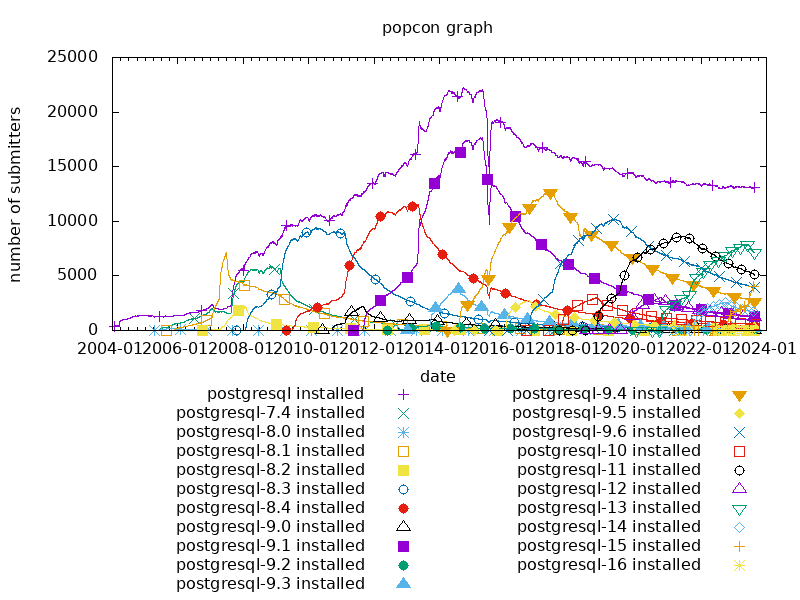
Back in 2015, when PostgreSQL 9.5 alpha 1 was released, I had posted the
PostgreSQL data from Debian's popularity contest.
8 years and 8 PostgreSQL releases later, the graph now looks like this:
Currently, the most popular PostgreSQL on Debian systems is still PostgreSQL 13 (shipped in Bullseye), followed by PostgreSQL 11 (Buster). At the time of writing,
PostgreSQL 9.6 (Stretch) and PostgreSQL 15 (Bookworm) share the third place, with 15 rising quickly.
Now that all the planets are fixed, please see what you missed here!
/https://www.scarlettgatelymoore.dev/kde-a-day-in-the-life-the-kde-snapcrafter-part-2/
EXTREMELY IMPORTANT: I am still looking for a super awesome team lead for a super amazing project involving KDE and Snaps. Time is running out and well the KDE world will be a better a better place if this project goes through! I would like to clarify, this is a paid position! A current KDE developer would be ideal as it is a small team so your time will be split managing and coding alike. If you or anyone you know might be interested please contact me ASAP!
Lots of news on the snap front 23.04.3 is now complete with new snaps! I know, just in time for 23.08.0. I have fixed some major issues in this release, 23.08 should go much quicker. Even quicker if my per repo snapcraft files gets approved!
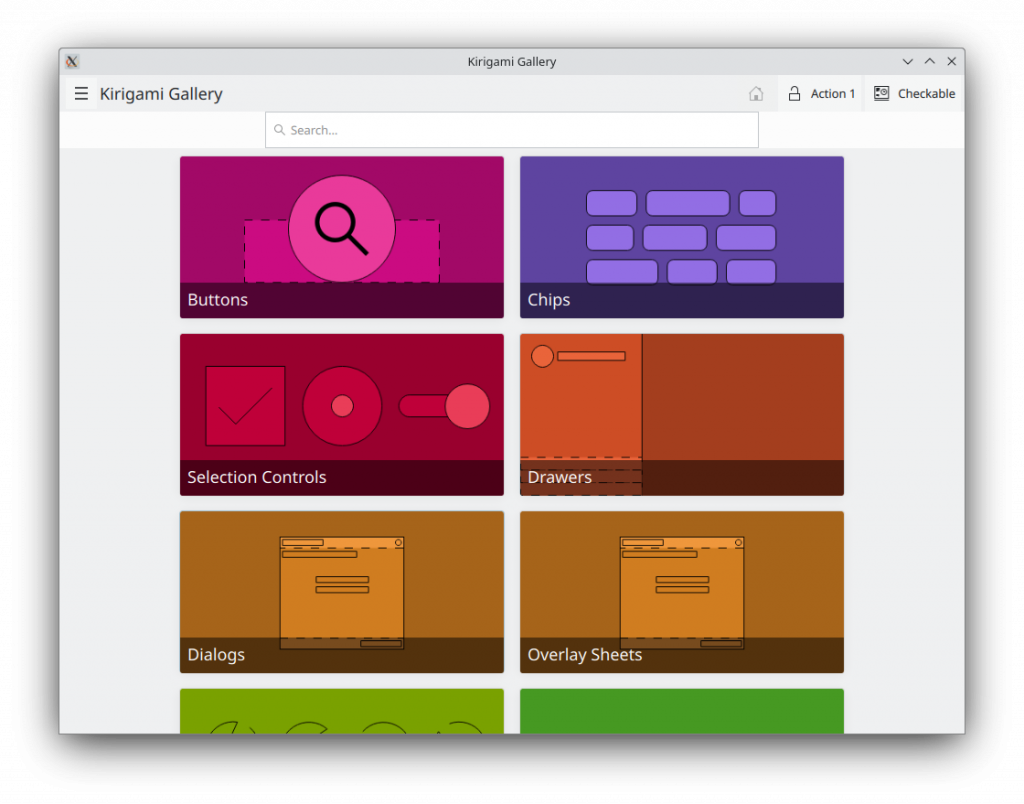
kirigami-gallery
Itinerary
We have more PIM snaps, however I am waiting for reserved name approvals from the snap store.
I was approached to decouple qt and frameworks sdk snaps and I have agreed for the fact that security updates are near impossible when new versions are released. Conversation here:
https://forum.snapcraft.io/t/proposal-for-changes-to-kde-content-snap-and-extension
I have started qt5 here https://github.com/ScarlettGatelyMoore/qt-5-15-10-snap
And some exciting news I have started the KF6 content pack! I am doing like above and I am using the qt6 content pack Jarred Wilson has made. This is a requirement to start the plasma snap. Progress can be tracked here: https://github.com/ScarlettGatelyMoore/kf6-snap
I am still have on on going request for snapcraft files in their respective repositories. While defending my request I have tested some options. Snapcraft files in the repository does allow for proper snap recipes in launchpad by mirroring the repo in launchpad -> create snap recipe. I created a recipe based on stable branch and it created and published the snap as expected.
After being pointed to the flatpak workflow I discovered snaps has a similiar store feature with github, however I will need to create a github repo for each snap, which is tempting. I want to avoid duplication of snapcraft files, but I guess this is what they do for flatpak? I never received an answer.
Snapcraft: Some more tidying of the qmake plugin and resolved some review conversations.
Debian!
I am back to getting things in Debian proper, starting with the golang packages I was working on for bubble-gum a cool console beautification application. As each one passes through NEW I will keep uploading. I will be checking in with the qt-kde team to see what needs doing. I am looking into seeing if openvoices is still a viable replacement for mycroft, hopefully all that work isn t wasted time.
And finally, I do hate having to ask, but as we quickly approach September, I have not come close to enough to pay my pesky bills, required to have a place to live and eat! I am seeking employment as a backup if my amazing project falls through. I tried to enable ads, but that broke my planet feeds, I can t have that! So without further ado Anything helps! Also please share! Thanks for your consideration.
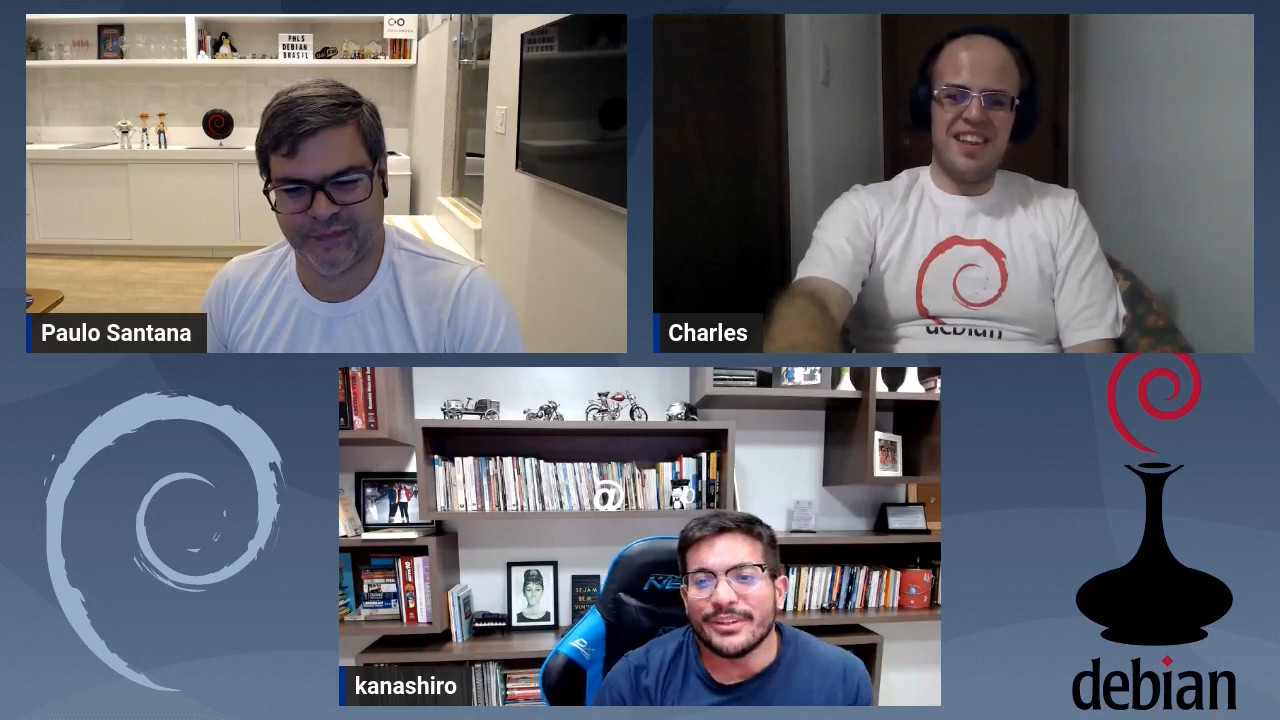
Em 2023 o tradicional Debian Day est
sendo celebrado de forma especial, afinal no dia 16 de agostoo Debian completou
30 anos!
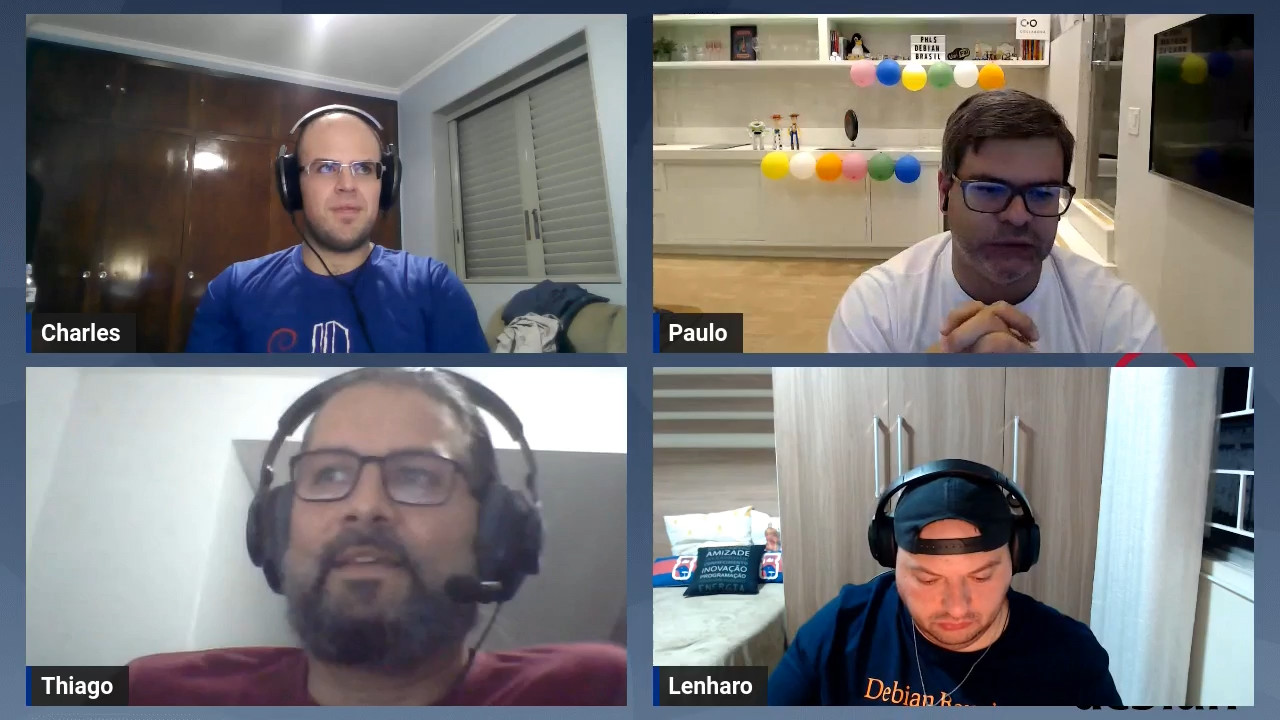
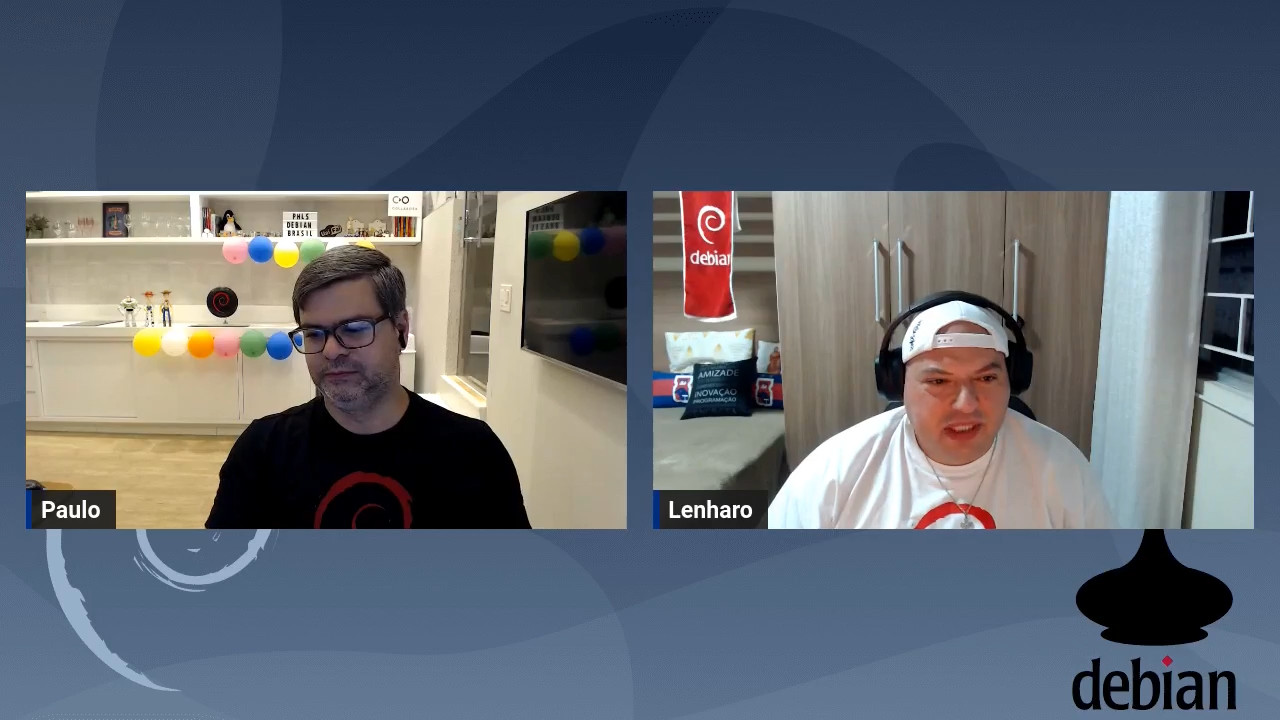
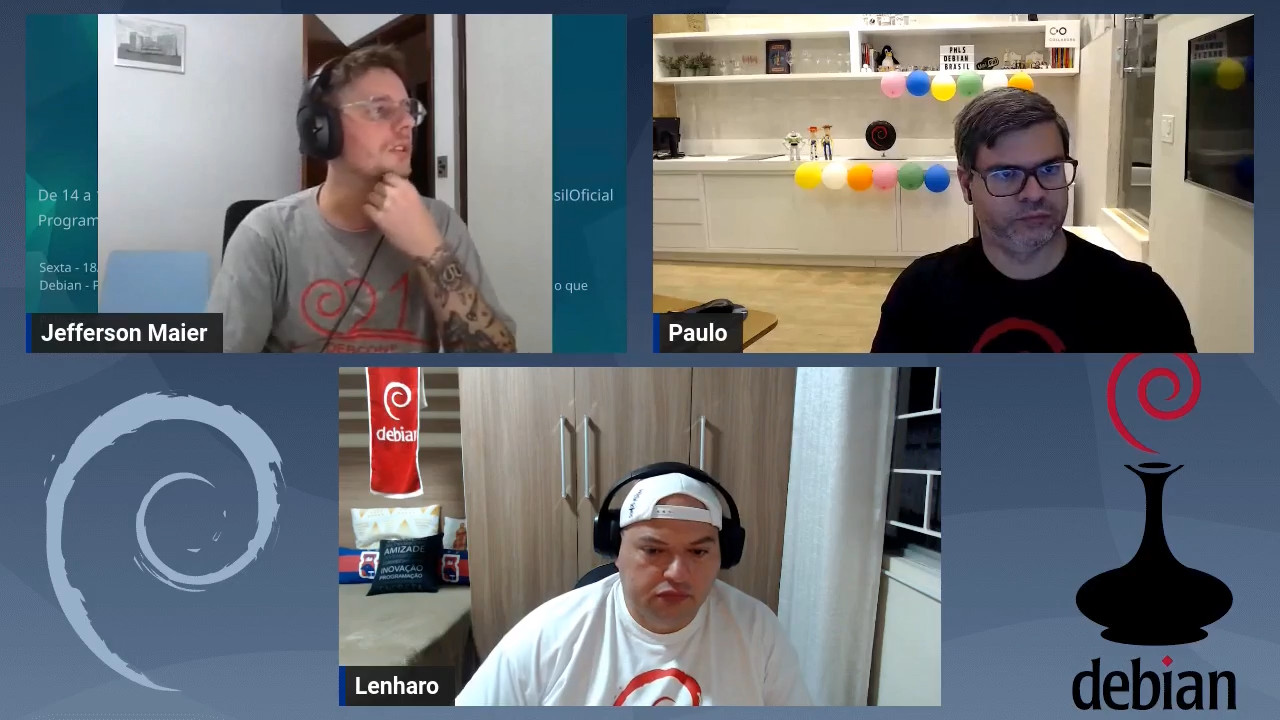
Para comemorar este marco especial na vida do Debian, a
comunidade Debian Brasil organizou uma semana
de palestras online de 14 a 18 de agosto. O evento foi chamado de
Debian 30 anos.
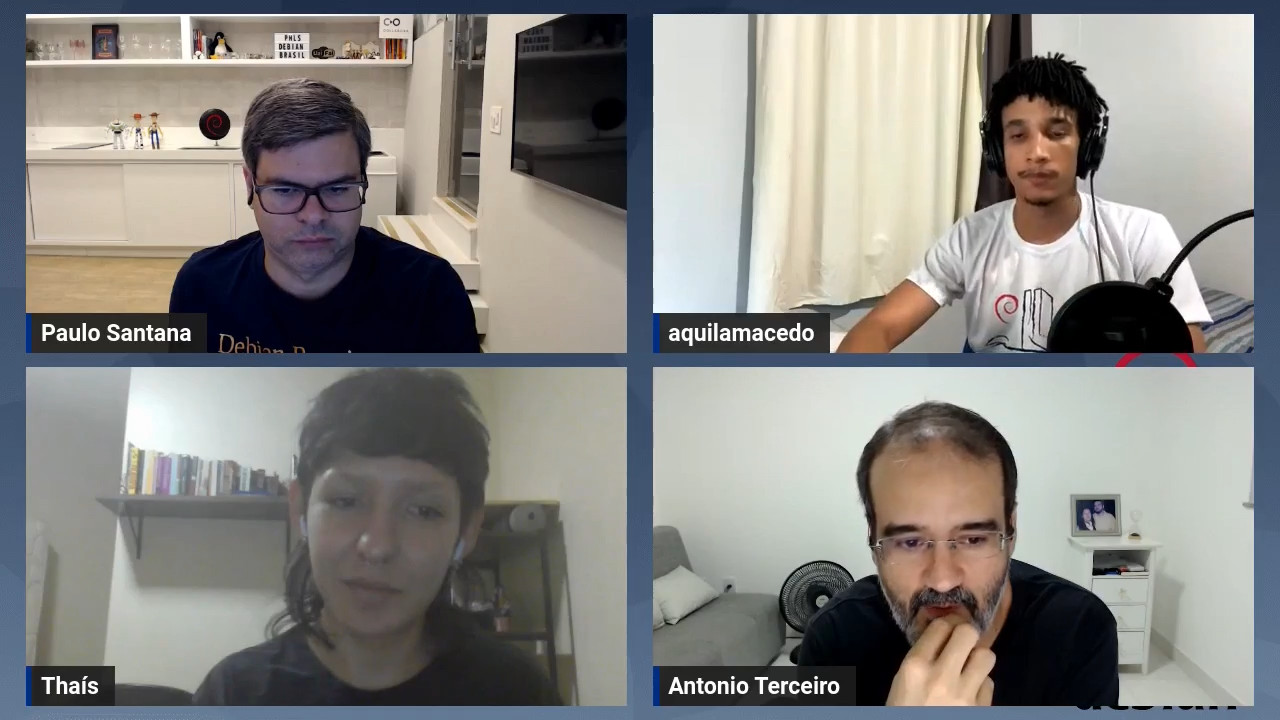
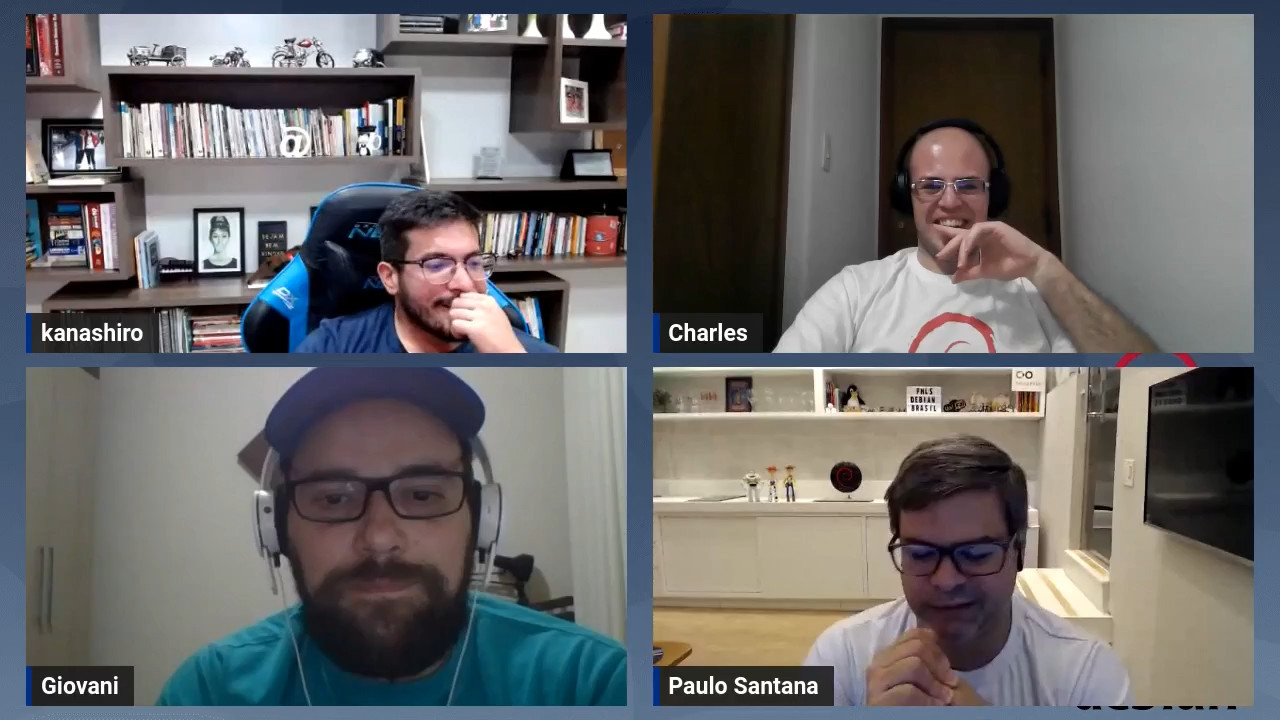
Foram realizadas 2 palestras por noite, das 19h s 22h, transmitidas pelo canal
Debian Brasil no YouTube
totalizando 10 palestras. As grava es j est o dispon veis tamb m no canal
Debian Brasil no Peertube.
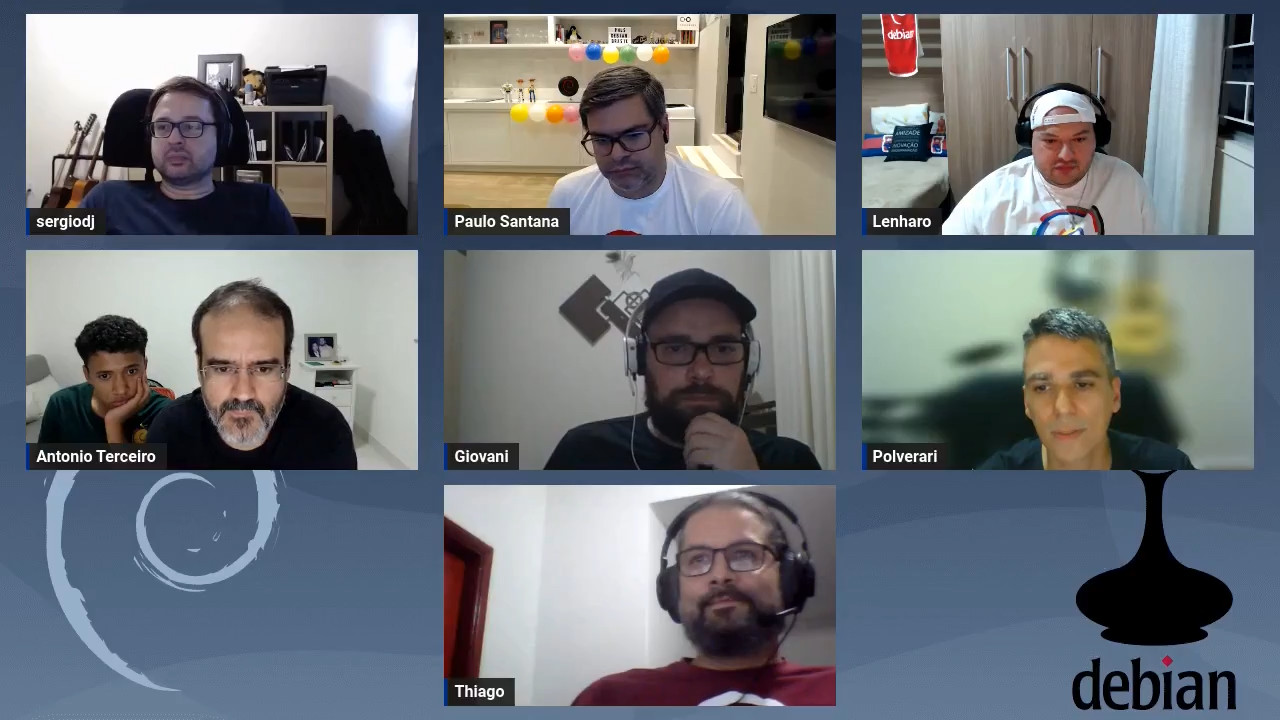
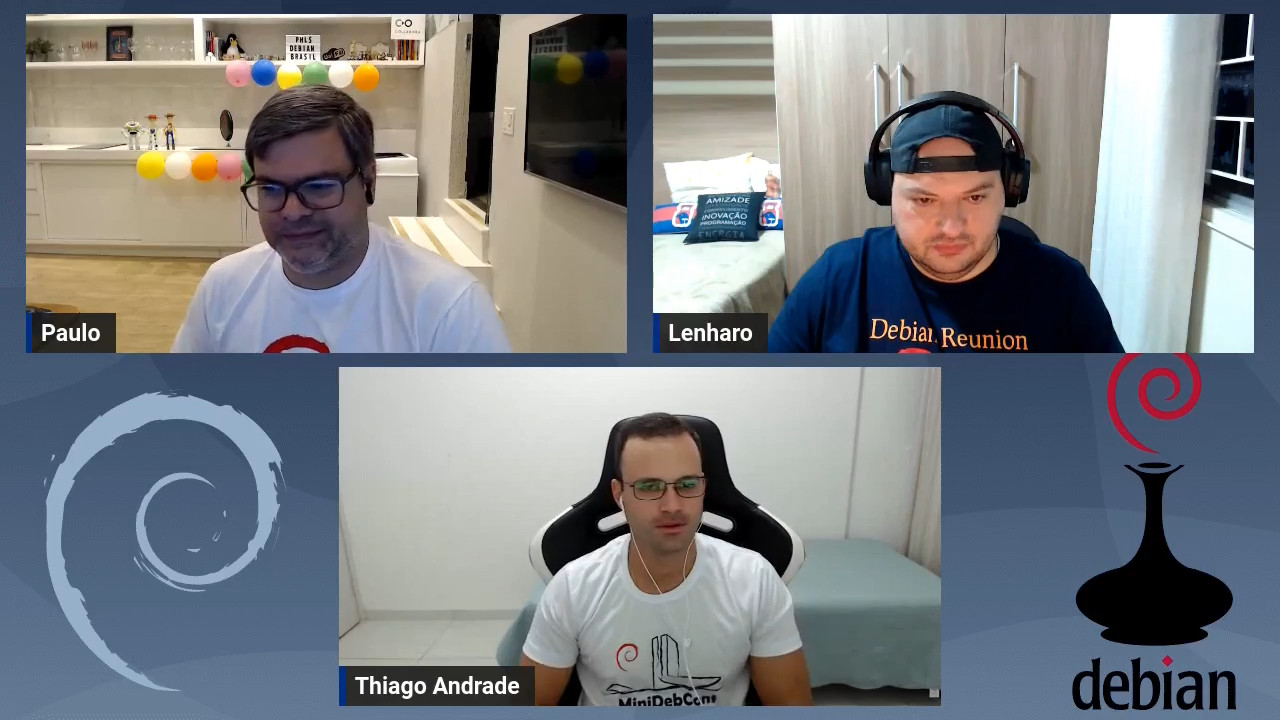
Nas 10 atividades tivemos as participa es de 9 DDs, 1 DM, 3 contribuidores(as).
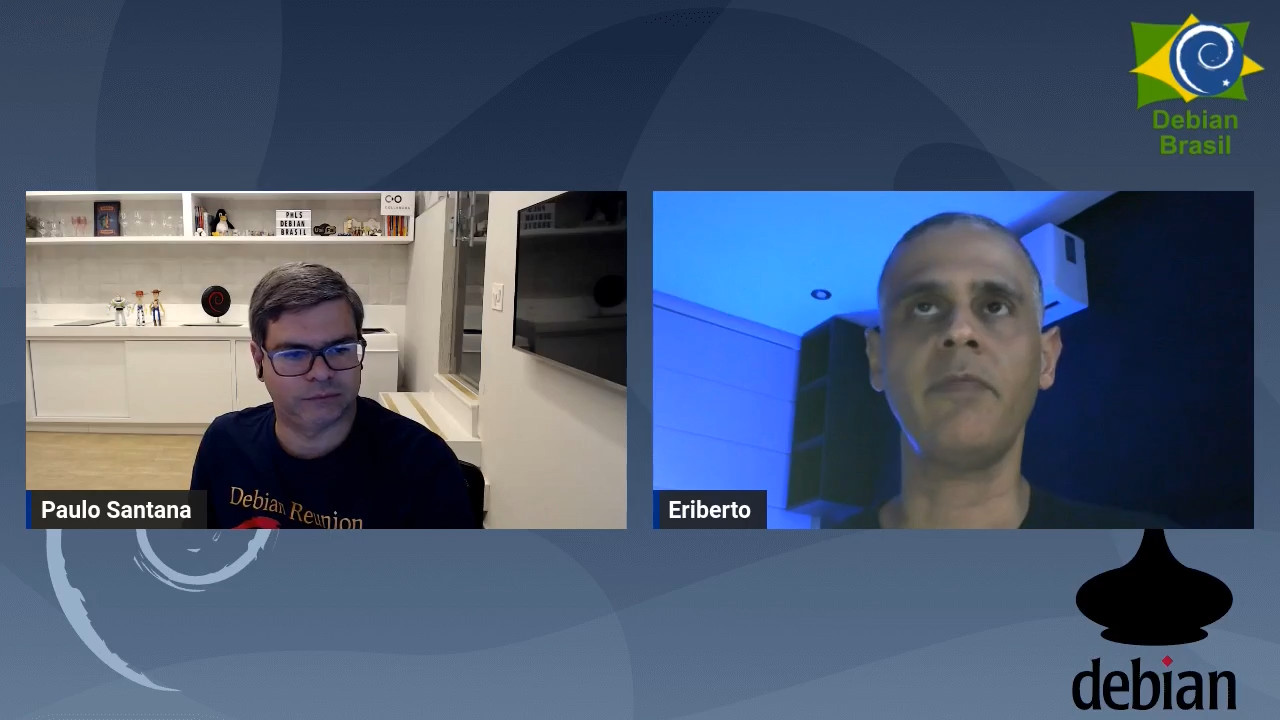
A audi ncia ao vivo variou bastante, e o pico foi na palestra sobre preseed com
o Eriberto Mota quando tivemos 47 pessoas assistindo.
Obrigado a todos(as) participantes pela contribui o que voc s deram para o
sucesso do nosso evento.
Antonio Terceiro
Aquila Macedo
Charles Melara
Daniel Lenharo de Souza
David Polverari
Eriberto Mota
Giovani Ferreira
Jefferson Maier
Lucas Kanashiro
Paulo Henrique de Lima Santana
Sergio Durigan Junior
Thais Araujo
Thiago Andrade
Veja abaixo as fotos de cada atividade:
Nova gera o: uma entrevista com iniciantes no projeto Debian
Instala o personalizada e automatizada do Debian com preseed
Manipulando patches com git-buildpackage
debian.social: Socializando Debian do jeito Debian
Proxy reverso com WireGuard
Celebra o dos 30 anos do Debian!
Instalando o Debian em disco criptografado com LUKS
O que a equipe de localiza o j conquistou nesses 30 anos
Debian - Projeto e Comunidade!
Design Gr fico e Software livre, o que fazer e por onde come ar
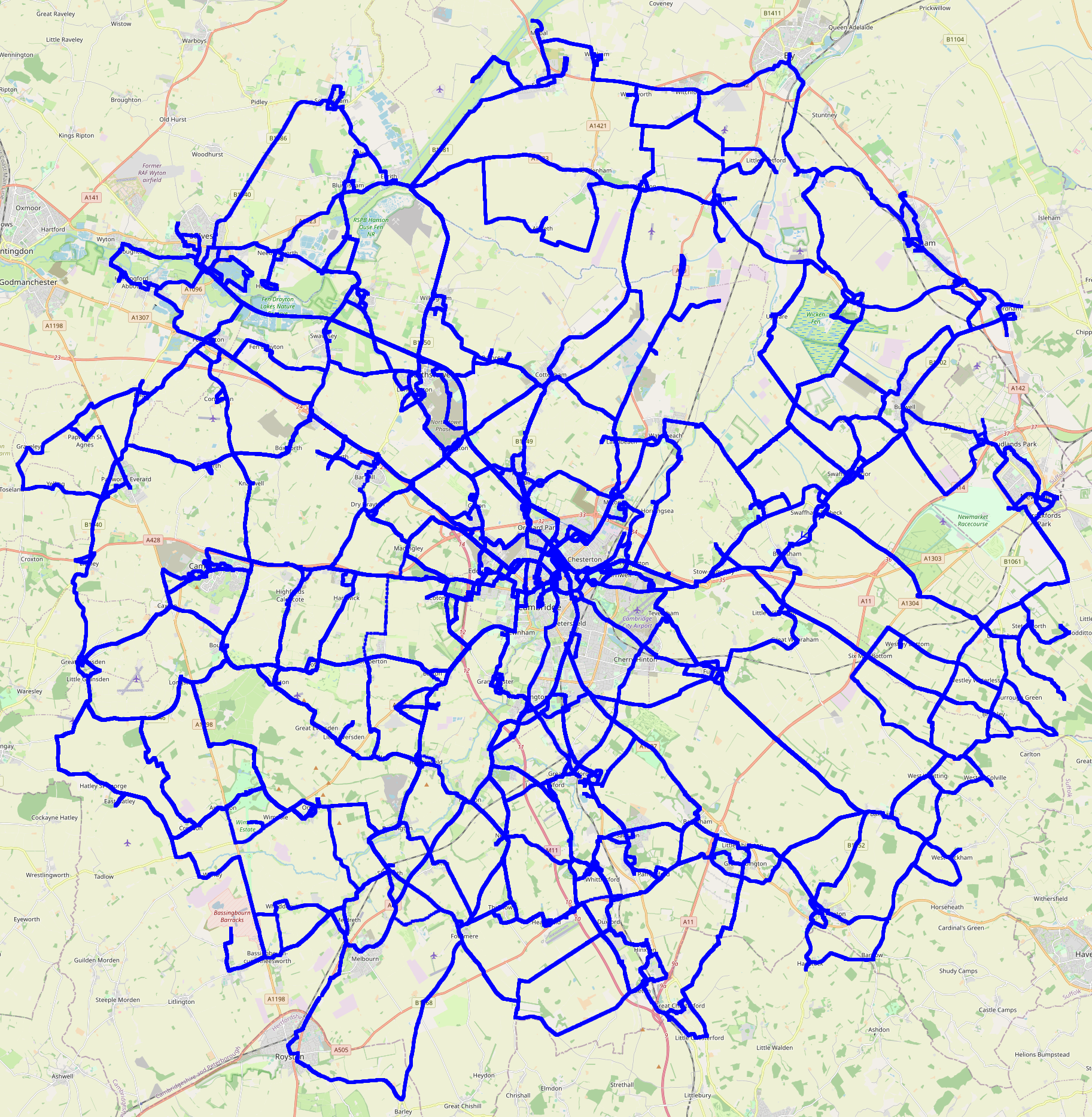
This last weekend I completed a bike rides project I started during the first Covid lockdown in 2020:
I ve cycled to every settlement (and radio observatory) within 20km of my house, in alphabetical order.
Stir crazy
In early 2020, during the first lockdown, I was going a bit stir crazy. Clare said you re going very strange, you have to go out and get some exercise . After a bit of discussion, we came up with this plan: I d visit all the local villages, in alphabetical order.
Choosing the radius
I decided that I would pick a round number of kilometers, as the crow flies, from my house. 20km seemed about right. 25km would have included Ely, which would have been nice, but it would have added a great many places, all of them quite distant.
Software
I wrote a short Rust program to process OSM data into a list of places to visit, and their distances and bearings.
You can download a tarball of the alphabetical villages scanner. (I haven t published the git history because it has my house s GPS coordinates in it, and because I committed the output files from which that location can be derived.)
The Rides
I set off on my first ride, to Aldreth, on Sunday the 31st of May 2020. The final ride collected Yelling, on Saturday the 19th of August 2023.
I did quite a few rides in June and July 2020 - more than one a week. (I d read the lockdown rules, and although some of the government messaging said you should stay near your house, that wasn t in the legislation. Of course I didn t go into any buildings or anything.)
I m not much of a morning person, so I often set off after lunch. For the longer rides I would usually pack a picnic. Almost all of the rides I did just by myself. There were a handful where I had friends along:
Dry Drayton, which I collected with Clare, at night. I held my bike up so the light shone at the village sign, so we could take a photo of it.
Madingley, Melbourn and Meldreth, which was quite an expedition with my friend Ben. We went out as far as Royston and nearby Barley (both outside my radius and not on my list) mostly just so that my project would have visited Hertfordshire.
The Hemingfords, where I had my friend Matthew along, and we had a very nice pub lunch.
Girton and Wilburton, where I visited friends. Indeed, I stopped off in Wilburton on one or two other occasions.
And, of course, Yelling, for which there were four of us, again with a nice lunch (in Eltisley).
I had relatively little mechanical trouble. My worst ride for this was Exning: I got three punctures that day. Luckily the last one was close to home.
I often would stop to take lots of photos en-route. My mum in particular appreciated all the pretty pictures.
Rules
I decided on these rules:
I would cycle to each destination, in order, and it would count as collected if I rode both there and back. I allowed collecting multiple villages in the same outing, provided I did them in the right order. (And obviously I was allowed to pass through places out of order, without counting them.)
I tried to get a picture of the village sign, where there was one. Failing that, I got a picture of something in the village with the village s name on it. I think the only one I didn t manage this for was Westley Bottom; I had to make do with the word Westley on some railway level crossing equipment. In Barway I had to make do with a planning application, stuck to a pole.
I tried not to enter and leave a village by the same road, if possible.
Edge cases
I had to make some decisions:
I decided that I would consider the project complete if I visited everywhere whose centre was within my radius. But the centre of a settlement is rather hard to define. I needed a hard criterion for my OpenStreetMap data mining: a place counted if there was any node, way or relation, with the relevant place tag, any part of which was within my ambit. That included some places that probably oughtn t to have counted, but, fine.
I also decided that I wouldn t visit suburbs of Cambridge, separately from Cambridge itself. I don t consider them separate settlements, at least, not if they re conurbated with Cambridge. So that excluded Trumpington, for example. But I decided that Girton and Fen Ditton were (just) separable. Although the place where I consider Girton and Cambridge to nearly touch, is administratively well inside Girton, I chose to look at land use (on the ground, and in OSM data), rather than administrative boundaries.
But I did visit both Histon and Impington, and all each of the Shelfords and Stapleford, as separate entries in my list. Mostly because otherwise I d have to decide whether to skip (say) Impington, or Histon. Whereas skipping suburbs of Cambridge in favour of Cambridge itself was an easy decision, and it also got rid of a bunch of what would have been quite short, boring, urban expeditions.
I sorted all the Greats and Littles under G and L, rather than (say) Shelford, Great , which seemed like it would be cheating because then I would be able to do Shelford, Great and Shelford, Little in one go.
Northstowe turned from mostly a building site into something that was arguably a settlement, during my project. It wasn t included in the output of my original data mining. Of course it s conurbated with Oakington - but happily, Northstowe inserts right before Oakington in the alphabetical list, so I decided to add it, visiting both the old and new in the same day.
There are a bunch of other minor edge cases. Some villages have an outlying hamlet. Mostly I included these. There are some individual farms, which I generally didn t count.
Some stats
I visited 150 villages plus the Lords Bridge radio observatory. The project took 3 years and 3 months to complete.
There were 96 rides, totalling about 4900km. So my mean distance was around 51km. The median distance per ride was a little higher, at around 52 km, and the median duration (including stoppages) was about 2h40. The total duration, if you add them all up, including stoppages, was about 275h, giving a mean speed including photo stops, lunches and all, of 18kph.
The longest ride was 89.8km, collecting Scotland Farm, Shepreth, and Six Mile Bottom, so riding across the Cam valley. The shortest ride was 7.9km, collecting Cambridge (obviously); and I think that s the only one I did on my Brompton. The rest were all on my trusty Thorn Audax.
My fastest ride (ranking by distance divided by time spent in motion) was to collect Haddenham, where I covered 46.3km in 1h39, giving an average speed in motion of 28.0kph.
The most I collected in one day was 5 places: West Wickham, West Wratting, Westley Bottom, Westley Waterless, and Weston Colville. That was the day of the Wests. (There s only one East: East Hatley.)
Map
Here is a pretty picture of all of my tracklogs:
Edited 2023-08-25 01:32 BST to correct a slip.
For the first time, the city of Belo Horizonte held a
Debian Day to celebrate the
anniversary of the Debian Project.
The communities Debian Minas Gerais
and Free Software Belo Horizonte and Region
felt motivated to celebrate this special date due the 30 years of the Debian
Project in 2023 and they organized a meeting on August 12nd in
UFMG Knowledge Space.
The Debian Day organization in Belo Horizonte received the important support
from UFMG Computer Science Department to book the
room used by the event.
It was scheduled three activities:
Talk: The Debian project wants you! Paulo Henrique de Lima Santana
Talk: Customizing Debian for use in PBH schools: the history of Libertas - Fred Guimar es
Discussion: about the next steps to increase a Free Software community in BH - Bruno Braga Fonseca
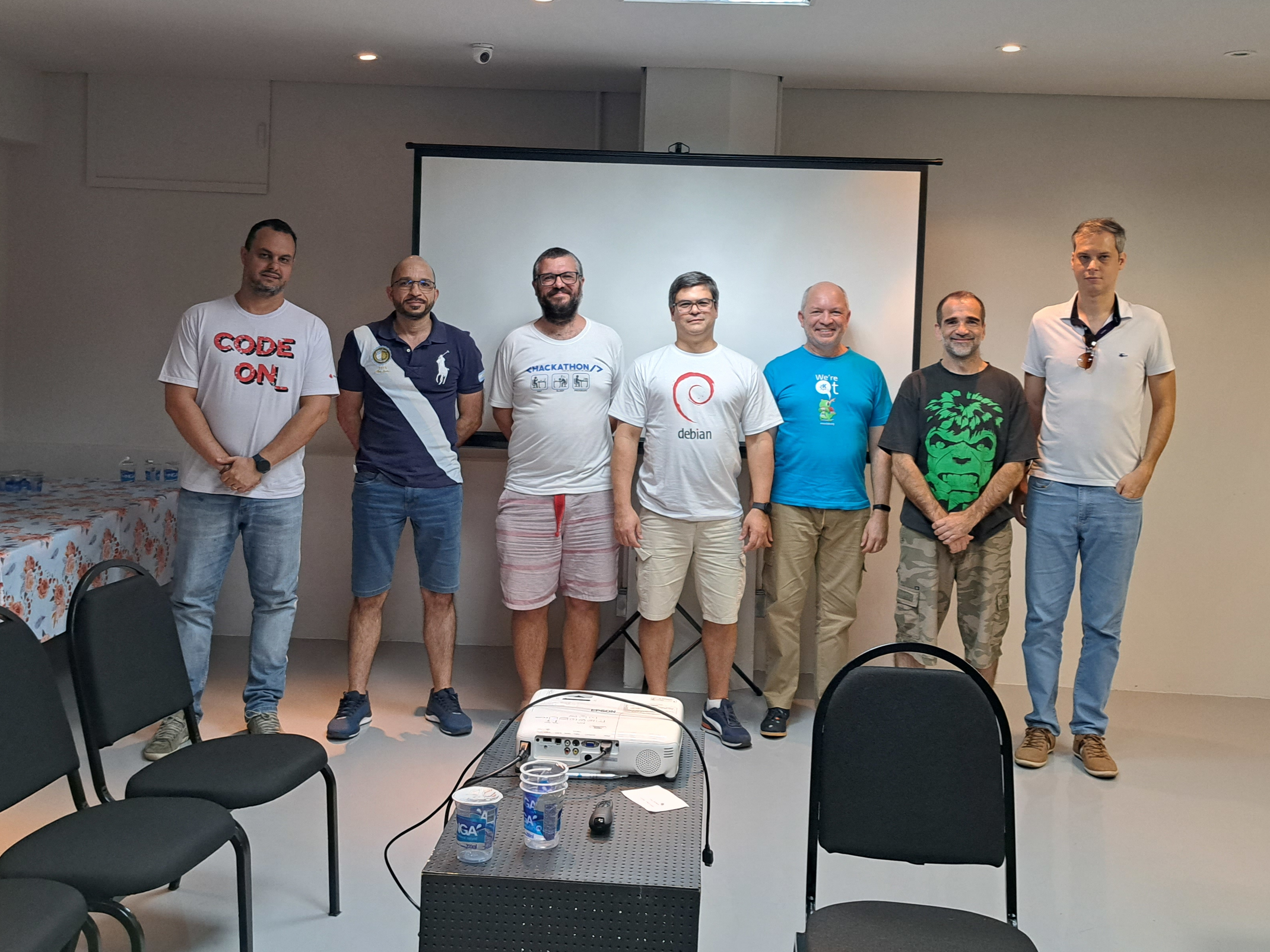
In total, 11 people were present and we took a photo with those who stayed
until the end.
I m happy to announce that Netplan version 0.107 is now available on GitHub and is soon to be deployed into a Linux installation near you! Six months and more than 200 commits after the previous version (including a .1 stable release), this release is brought to you by 8 free software contributors from around the globe.
Highlights
Highlights of this release include the new configuration types for veth and dummy interfaces:
Furthermore, we implemented CFFI based Python bindings on top of libnetplan s API, that can easily be consumed by 3rd party applications (see full cffi-bindings.py example):
from netplan import Parser, State, NetDefinition
from netplan import NetplanException, NetplanParserException

parser = Parser()
# Parse the full, existing YAML config hierarchy
parser.load_yaml_hierarchy(rootdir='/')
# Validate the final parser state
state = State()
try:
    # validation of current state + new settings
    state.import_parser_results(parser)
except NetplanParserException as e:
    print('Error in', e.filename, 'Row/Col', e.line, e.column, '->', e.message)
except NetplanException as e:
    print('Error:', e.message)
# Walk through ethernet NetdefIDs in the state and print their backend
# renderer, to demonstrate working with NetDefinitionIterator &
# NetDefinition
for netdef in state.ethernets.values():
    print('Netdef', netdef.id, 'is managed by:', netdef.backend)
    print('Is it configured to use DHCP?', netdef.dhcp4 or netdef.dhcp6)
by Thiago Pezzo,
Debian contributor, pt_BR localization team
This year's Debian Day was a pretty special one, we are celebrating 30 years!
Giving the importance of this event, the Brazilian community planned a very
special week. Instead of only local gatherings, we had a week of online talks
streamed via Debian Brazil's youtube channel
(soon the recordings will be uploaded to our team's
peertube instance).
Nonetheless the local celebrations happened around the country and one was
organized in Pouso Alegre, MG, Brazil,
at the Instituto Federal de Educa o, Ci ncia e Tecnologia do Sul de Minas Gerais
(IFSULDEMINAS - Federal Institute of Education, Science and Technology of the
South of Minas Gerais). The Institute, as many of its counterparts in Brazil,
specializes in professional and technological curricula to high school and
undergraduate levels. All public, free and quality education!
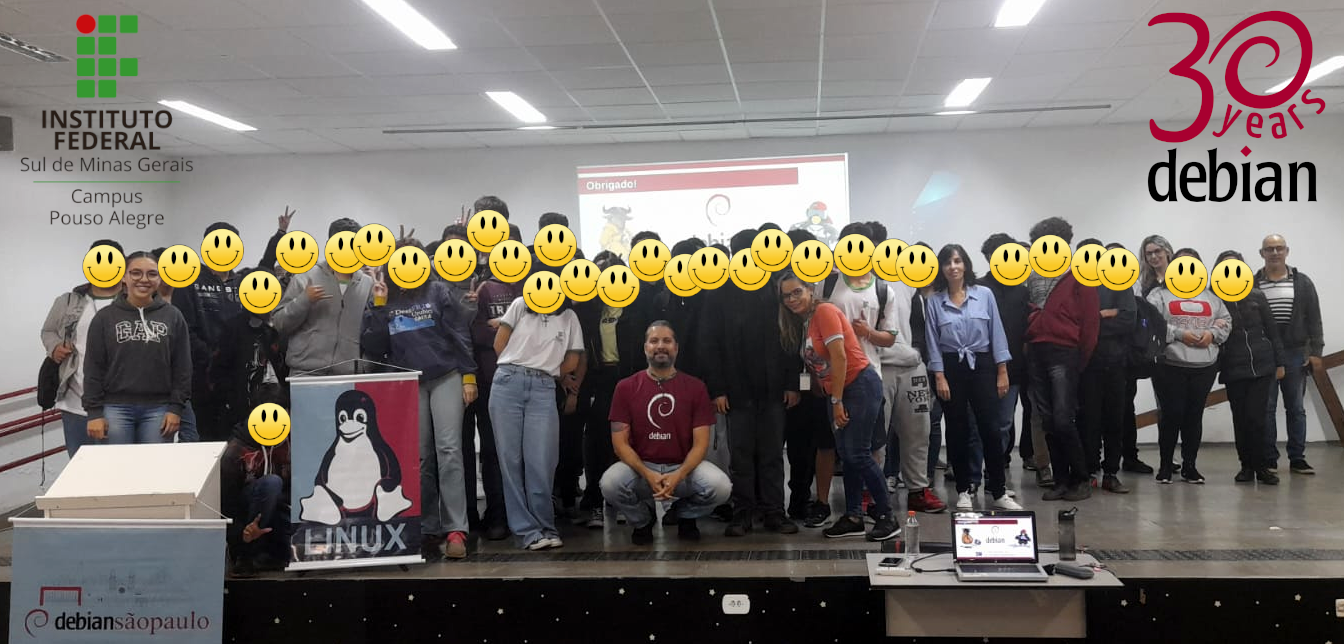
The event happened on the afternoon of August 16th at the Pouso Alegre campus.
Some 30 students from the High School Computer Technician class attended the
presentation about the Debian Project and the Free
Software movement in general. Everyone had a great time! And afterwards we
had some spare time to chat.
I would like to thank all people who helped us:
Professors Michelle Nery and Ismael David Muro (IFSULDEMINAS Pouso Alegre)
Virginia Cardoso and Melissa de Abreu (IFSULDEMINAS Rector's Office)
Apparently it s nearly four years since I last posted to my blog. Which is, to a degree, the point here. My time, and priorities, have changed over the years. And this lead me to the decision that my available time and priorities in 2023 aren t compatible with being a Debian or Ubuntu developer, and realistically, haven t been for years. As of earlier this month, I quit as a Debian Developer and Ubuntu MOTU.
I think a lot of my blogging energy got absorbed by social media over the last decade, but with the collapse of Twitter and Reddit due to mismanagement, I m trying to allocate more time for blog-based things instead. I may write up some of the things I ve achieved at work (.NET 8 is now snapped for release Soon). I might even blog about work-adjacent controversial topics, like my changed feelings about the entire concept of distribution packages. But there s time for that later. Maybe.
I ll keep tagging vaguely FOSS related topics with the Debian and Ubuntu tags, which cause them to be aggregated in the Planet Debian/Ubuntu feeds (RSS, remember that from the before times?!) until an admin on those sites gets annoyed at the off-topic posting of an emeritus dev and deletes them.
But that s where we are. Rather than ignore my distro obligations, I ve admitted that I just don t have the energy any more. Let someone less perpetually exhausted than me take over. And if they don t, maybe that s OK too.
Much to my dismay, I figured out that my blog has been disabled on the Ubuntu planet since May. If you are curious about what I have been up to, please go to the handy links -> and read up! This post is a continuation of last weeks https://www.scarlettgatelymoore.dev/kde-a-day-in-the-life-of-the-kde-snapcrafter/
IMPORTANT: I am still looking for a super awesome team lead for a super amazing project involving KDE and Snaps. Time is running out and well the KDE world will be a better a better place if this project goes through! I would like to clarify, this is a paid position! A current KDE developer would be ideal as it is a small team so your time will be split managing and coding alike. If you or anyone you know might be interested please contact me ASAP!
Snaps: I am wrapping up the 23.04.3 KDE applications release! Head on over to https://snapcraft.io/search?q=KDE and enjoy! We are now up to 180 snaps! PIM snaps will be slowly rolling in as they go through manual reviews for D-Bus.
Snapcraft: minor fix in qmake plugin found by ruff.
Launchpad: I almost have approval for per application repository snapcraft files, but I have to prove it will work to our benefit and not cause loads of polling etc. So I have been testing various methods of achieving such a task, and so far I have come up with launchpads ability to watch and download release tarballs into a project. I will then need to script getting the tarball and pushing it to a bzr branch from which I can create a proper snap recipe. Unfortunately, my proper snap recipe fails! Hopefully a very helpful cjwatson will chime in, or if anyone wants to take a gander please chime in here: https://bugs.launchpad.net/launchpad/+bug/2031307
As reality sets in that my project may not happen if I don t find anyone, I need help surviving until I find work or funding to continue my snap work ( still much to do! ) If you or anyone else you know enjoys our snaps please consider a donation, anything helps! Please share! Thank you for your consideration!
TL;DR:
Color is a visual perception. Human eyes can detect a broader range of colors
than any devices in the graphics chain. Since each device can generate, capture
or reproduce a specific subset of colors and tones, color management controls
color conversion and calibration across devices to ensure a more accurate and
consistent color representation. We can expose a GPU-accelerated display color
management pipeline to support this process and enhance results, and this is
what we are doing on Linux to improve color management on
Gamescope/SteamDeck. Even with the challenges of being external developers,
we have been working on mapping AMD GPU color capabilities to the Linux
kernel color management interface, which is a combination of DRM and AMD
driver-specific color properties. This more extensive color management pipeline
includes pre-defined Transfer Functions, 1-Dimensional LookUp Tables (1D
LUTs), and 3D LUTs before and after the plane composition/blending.
The study of color is well-established and has been explored for many years.
Color science and research findings have also guided technology innovations. As
a result, color in Computer Graphics is a very complex topic that I m putting a
lot of effort into becoming familiar with. I always find myself rereading all
the materials I have collected about color space and operations since I started
this journey (about one year ago). I also understand how hard it is to find
consensus on some color subjects, as exemplified by all explanations around the
2015 online viral phenomenon of The Black and Blue
Dress. Have you heard about it?
What is the color of the dress for you?
So, taking into account my skills with colors and building consensus, this blog
post only focuses on GPU hardware capabilities to support color management :-D
If you want to learn more about color concepts and color on Linux, you can find
useful links at the end of this blog post.
Linux Kernel, show me the colors ;D
DRM color management interface only exposes a small set of post-blending color
properties. Proposals to enhance the DRM color API from different vendors have
landed the subsystem mailing list over the last few years. On one hand, we got
some suggestions to extend DRM post-blending/CRTC color API: DRM CRTC 3D LUT
for R-Car (2020
version);
DRM CRTC 3D LUT for Intel (draft -
2020);
DRM CRTC 3D LUT for AMD by Igalia (v2 -
2023);
DRM CRTC 3D LUT for R-Car (v2 -
2023).
On the other hand, some proposals to extend DRM pre-blending/plane API: DRM
plane colors for Intel (v2 -
2021);
DRM plane API for AMD (v3 -
2021);
DRM plane 3D LUT for AMD -
2021.
Finally, Simon Ser sent the latest proposal in May 2023: Plane color pipeline KMS
uAPI,
from discussions in the 2023 Display/HDR
Hackfest,
and it is still under evaluation by the Linux Graphics community.
All previous proposals seek a generic solution for expanding the API, but many
seem to have stalled due to the uncertainty of matching well the hardware
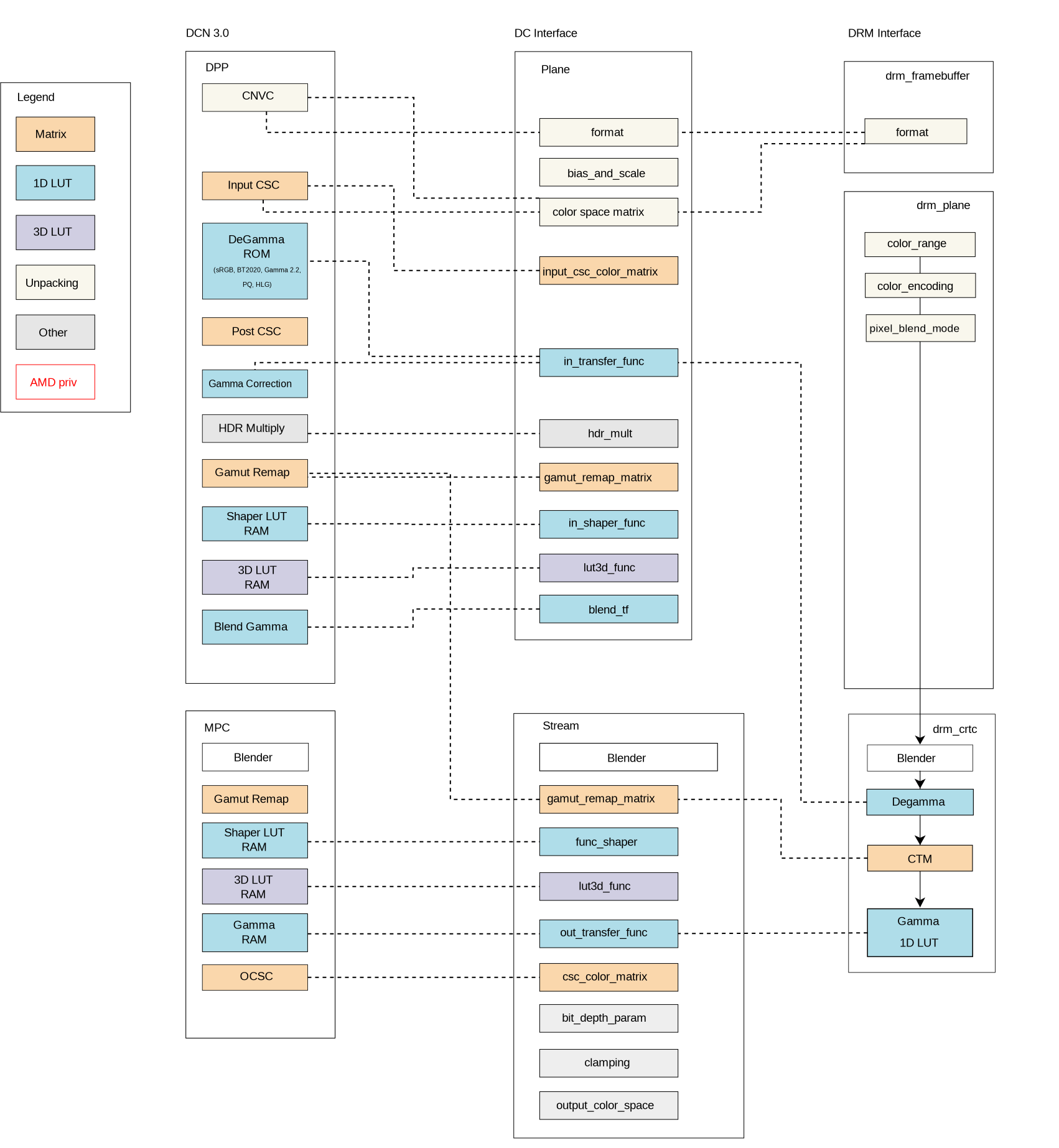
capabilities of all vendors. Meanwhile, the use of AMD color capabilities on
Linux remained limited by the DRM interface, as the DCN 3.0 family color caps
and mapping diagram below shows the Linux/DRM color interface without
driver-specific color properties [*]:
Bearing in mind that we need to know the variety of color pipelines in the
subsystem to be clear about a generic solution, we decided to approach the
issue from a different perspective and worked on enabling a set of
Driver-Specific Color Properties for AMD Display Drivers. As a result, I
recently sent another round of the AMD driver-specific color mgmt
API.
For those who have been following the AMD driver-specific proposal since the
beginning (see
[RFC][V1]),
the main new features of the latest version
[v2]
are the addition of pre-blending Color Transformation Matrix (plane CTM) and
the differentiation of Pre-defined Transfer Functions (TF) supported by color
blocks. For those who just got here, I will recap this work in two blog posts.
This one describes the current status of the AMD display driver in the Linux
kernel/DRM subsystem and what changes with the driver-specific properties. In
the next post, we go deeper to describe the features of each color block and
provide a better picture of what is available in terms of color management for
Linux.
The Linux kernel color management API and AMD hardware color capabilities
Before discussing colors in the Linux kernel with AMD hardware, consider
accessing the Linux kernel documentation (version 6.5.0-rc5). In the AMD
Display documentation, you will find my previous work documenting AMD hardware
color capabilities and the Color Management
Properties.
It describes how AMD Display Manager (DM) intermediates requests between the
AMD Display Core component (DC) and the Linux/DRM kernel interface for
color management features. It also describes the relevant function to call the
AMD color module in building curves for content space transformations.
A subsection also describes hardware color capabilities and how they evolve
between versions. This subsection, DC Color Capabilities between DCN
generations,
is a good starting point to understand what we have been doing on the kernel
side to provide a broader color management API with AMD driver-specific
properties.
Why do we need more kernel color properties on Linux?
Blending is the process of combining multiple planes (framebuffers abstraction)
according to their mode settings. Before blending, we can manage the colors of
various planes separately; after blending, we have combined those planes in
only one output per CRTC. Color conversions after blending would be enough in a
single-plane scenario or when dealing with planes in the same color space on
the kernel side. Still, it cannot help to handle the blending of multiple
planes with different color spaces and luminance levels. With plane color
management properties, userspace can get a more accurate representation of
colors to deal with the diversity of color profiles of devices in the graphics
chain, bring a wide color gamut (WCG), convert High-Dynamic-Range (HDR)
content to Standard-Dynamic-Range (SDR) content (and vice-versa). With a
GPU-accelerated display color management pipeline, we can use hardware blocks
for color conversions and color mapping and support advanced color management.
The current DRM color management API enables us to perform some color
conversions after blending, but there is no interface to calibrate input space
by planes. Note that here I m not considering some workarounds in the AMD
display manager mapping of DRM CRTC de-gamma and DRM CRTC CTM property to
pre-blending DC de-gamma and gamut remap block, respectively. So, in more
detail, it only exposes three post-blending features:
DRM CRTC de-gamma: used to convert the framebuffer s colors to linear gamma;
DRM CRTC CTM: used for color space conversion;
DRM CRTC gamma: used to convert colors to the gamma space of the connected screen.
AMD driver-specific color management interface
We can compare the Linux color management API with and without the
driver-specific color properties. From now, we denote driver-specific
properties with the AMD prefix and generic properties with the DRM prefix. For
visual comparison, I bring the DCN 3.0 family color caps and mapping diagram
closer and present it here again:
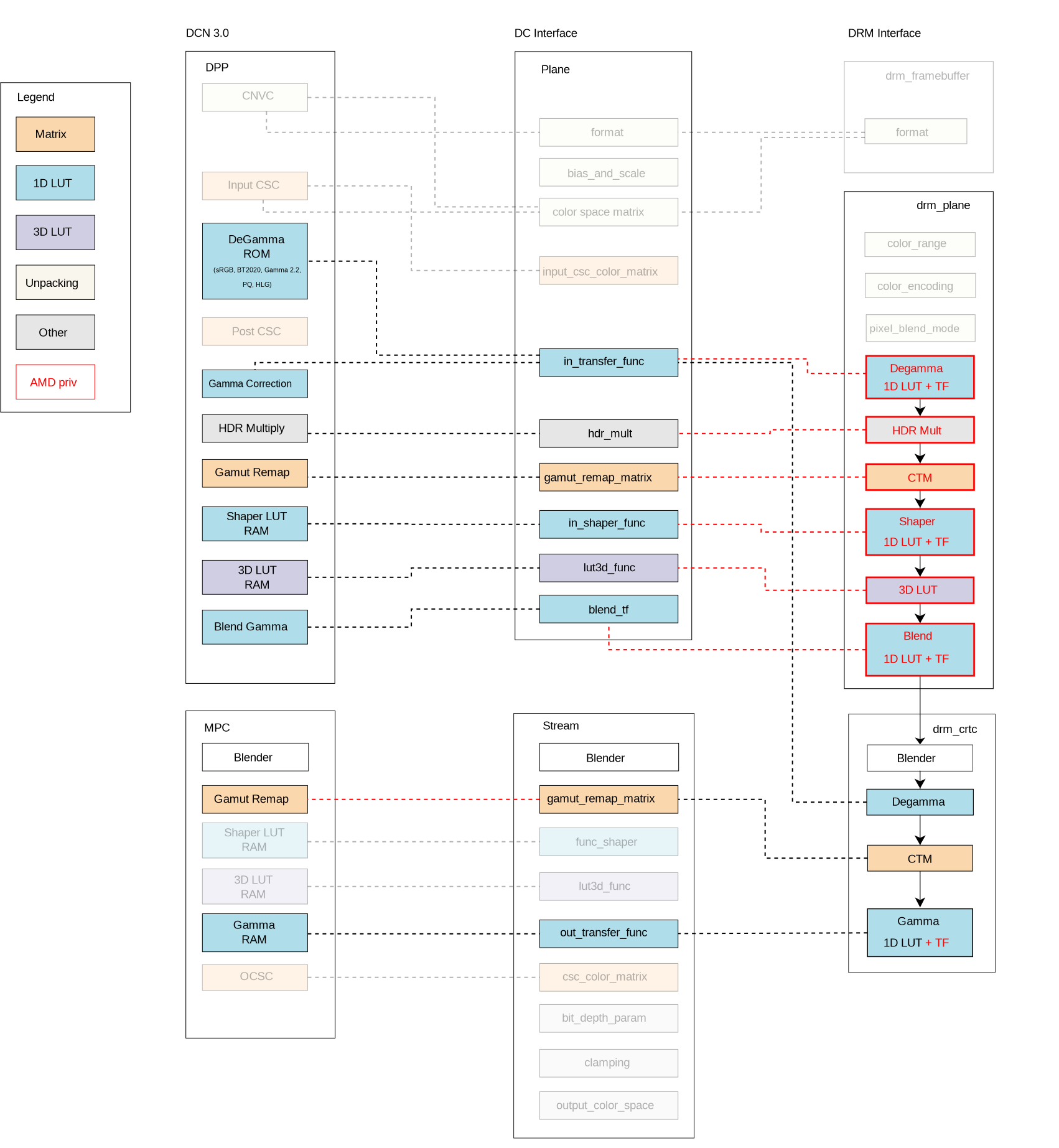
Mixing AMD driver-specific color properties with DRM generic color properties,
we have a broader Linux color management system with the following features
exposed by properties in the plane and CRTC interface, as summarized by this
updated diagram:
The blocks highlighted by red lines are the new properties in the
driver-specific interface developed by me (Igalia) and Joshua (Valve). The red
dashed lines are new links between API and AMD driver components implemented by
us to connect the Linux/DRM interface to AMD hardware blocks, mapping
components accordingly. In short, we have the following color management
properties exposed by the DRM/AMD display driver:
Pre-blending - AMD Display Pipe and Plane (DPP):
AMD plane de-gamma: 1D LUT and pre-defined transfer functions; used to linearize the input space of a plane;
AMD plane CTM: 3x4 matrix; used to convert plane color space;
AMD plane shaper: 1D LUT and pre-defined transfer functions; used to delinearize and/or normalize colors before applying 3D LUT;
AMD plane 3D LUT: 17x17x17 size with 12 bit-depth; three dimensional lookup table used for advanced color mapping;
AMD plane blend/out gamma: 1D LUT and pre-defined transfer functions; used to linearize back the color space after 3D LUT for blending.
How did we get a large set of color features from AMD display hardware?
So, looking at AMD hardware color capabilities in the first diagram, we can see
no post-blending (MPC) de-gamma block in any hardware families. We can also see
that the AMD display driver maps CRTC/post-blending CTM to pre-blending (DPP)
gamut_remap, but there is post-blending (MPC) gamut_remap (DRM CTM) from newer
hardware versions that include SteamDeck hardware. You can find more details
about hardware versions in the Linux kernel documentation/AMDGPU Product
Information.
I needed to rework these two mappings mentioned above to provide
pre-blending/plane de-gamma and CTM for SteamDeck. I changed the DC mapping to
detach stream gamut remap matrixes from the DPP gamut remap block. That
means mapping AMD plane CTM directly to DPP/pre-blending gamut remap block and
DRM CRTC CTM to MPC/post-blending gamut remap block. In this sense, I also
limited plane CTM properties to those hardware versions with MPC/post-blending
gamut_remap capabilities since older versions cannot support this feature
without clashes with DRM CRTC CTM.
Unfortunately, I couldn t prevent conflict between AMD plane de-gamma and DRM
plane de-gamma since post-blending de-gamma isn t available in any AMD hardware
versions until now. The fact is that a post-blending de-gamma makes little
sense in the AMD color pipeline, where plane blending works better in a linear
space, and there are enough color blocks to linearize content before blending.
To deal with this conflict, the driver now rejects atomic commits if users try
to set both AMD plane de-gamma and DRM CRTC de-gamma simultaneously.
Finally, we had no other clashes when enabling other AMD driver-specific color
properties for our use case, Gamescope/SteamDeck. Our main work for the
remaining properties was understanding the data flow of each property, the
hardware capabilities and limitations, and how to shape the data for
programming the registers - AMD color block capabilities (and limitations) are
the topics of the next blog post. Besides that, we fixed some driver bugs along
the way since it was the first Linux use case for most of the new color
properties, and some behaviors are only exposed when exercising the engine.
Take a look at the Gamescope/Steam Deck Color
Pipeline[**],
and see how Gamescope uses the new API to manage color space conversions
and calibration (please click on the image for a better view):
In the next blog post, I ll describe the implementation and technical details
of each pre- and post-blending color block/property on the AMD display driver.
* Thank Harry Wentland for helping with diagrams, color concepts and AMD capabilities.
** Thank Joshua Ashton for providing and explaining Gamescope/Steam Deck color pipeline.
*** Thanks to the Linux Graphics community - explicitly Harry, Joshua,
Pekka, Simon, Sebastian, Siqueira, Alex H. and Ville - to all the learning
during this Linux DRM/AMD color journey. Also, Carlos and Tomas for organizing
the 2023 Display/HDR Hackfest where we have a great and immersive opportunity
to discuss Color & HDR on Linux.
Now that it's more convenient for me to run containers at
home, I thought I'd write a bit about web apps I am enjoying.
First up, FreshRSS, a web feed aggregator. I used to
make heavy use of Google Reader until Google killed
it, and although a bunch of self-hosted cloned sprung up very quickly
afterwards, I didn't transition to any of them.
Then followed a number of years within which, in retrospect, I basically didn't
do a great job of organising reading the web. This lasted until a couple of
years ago when, on a whim, I tried out NetNewsWire
for iOS. NetNewsWire is a well-established and much-loved feed reader for Mac
which I've never used. I used the iOS version in isolation for a long time:
only dipping into web feeds on my phone and never on another device.
I'd like to see the old web
back, and do my part to
make that happen. I've continually published
rss and atom
feeds for my own blog. I'm also trying to
blog more: this might be easier now that Twitter (which, IMHO, took a lot of
the energy for quick writing out of blogging) is mortally wounded.
So, I'm giving FreshRSS a go. Early signs are good: it's fast, lightweight,
easy to use, vaguely resembles how I remember Google Reader, and has a native
dark-mode. It's still early days building up a new list of feeds to follow.
I'll be sure to share interesting ones as I discover them!
Some Desperate Glory is a far-future space... opera? That's
probably the right genre classification given the setting, but this book
is much more intense and character-focused than most space opera. It is
Emily Tesh's first novel, although she has two previous novellas that were
published as books.
The alien majo and their nearly all-powerful Wisdom have won the war by
destroying Earth with an antimatter bomb. The remnants of humanity were
absorbed into the sprawling majo civilization. Gaea Station is the lone
exception: a marginally viable station deep in space, formed from a
lifeless rocky planetoid and the coupled hulks of the last four human
dreadnoughts. Gaea Station survives on military discipline, ruthless use
of every available resource, and constant training, raising new
generations of soldiers for the war that it refuses to let end.
While Earth's children live, the enemy shall fear us.
Kyr is a warbreed, one of a genetically engineered line of soldiers that,
following an accident, Gaea Station has lost the ability to make except
the old-fashioned way. Among the Sparrows, her mess group, she is the
best at the simulated combat exercises they use for training. She may be
the best of her age cohort except her twin Magnus. As this novel opens,
she and the rest of the Sparrows are about to get their adult assignments.
Kyr is absolutely focused on living up to her potential and the attention
of her uncle Jole, the leader of the station.
Kyr's future will look nothing like what she expects.
This book was so good, and I despair of explaining why it was so
good without unforgivable spoilers. I can tell you a few things about it,
but be warned that I'll be reduced to helpless gestures and telling you to
just go read it. It's been a very long time since I was this surprised by
a novel, possibly since I read Code Name:
Verity for the first time.
Some Desperate Glory follows Kyr in close third-person throughout
the book, which makes the start of this book daring. If you're getting a
fascist vibe from the setup, you're not wrong, and this is intentional on
Tesh's part. But Kyr is a true believer at the start of the book, so the
first quarter has a protagonist who is sometimes nasty and cruel and who
makes some frustratingly bad decisions. Stay with it, though; Tesh knows
exactly what she's doing.
This is a coming of age story, in a way. Kyr has a lot to learn and a lot
to process, and Some Desperate Glory is about that process. But by
the middle of part three, halfway through the book, I had absolutely no
idea where Tesh was going with the story. She then pulled the rug out
from under me, in the best way, at least twice more. Part five of this
book is an absolute triumph, the payoff for everything that's happened
over the course of the novel, and there is no way I could have predicted
it in advance. It was deeply satisfying in that way where I felt like I
learned some things along with the characters, and where the characters
find a better ending than I could possibly have worked out myself.
Tesh does use some world-building trickery, which is at its most
complicated in part four. That was the one place where I can point to a
few chapters where I thought the world-building got a bit too convenient
in order to enable the plot. But it also allows for some truly incredible
character work. I can't describe that in detail because it would be a
major spoiler, but it's one of my favorite tropes in fiction and Tesh
pulls it off beautifully. The character growth and interaction in this
book is just so good: deep and complicated and nuanced and thoughtful in a
way that revises reader impressions of earlier chapters.
The other great thing about this book is that for a 400+ page novel, it
moves right along. Both plot and character development is beautifully
paced with only a few lulls. Tesh also doesn't belabor conversations.
This is a book that provides just the right amount of context for the
reader to fully understand what's going on, and then trusts the reader to
be following along and moves straight to the next twist. That makes it
propulsively readable. I had so much trouble putting this book down at
any time during the second half.
I can't give any specifics, again because of spoilers, but this is not
just a character story. Some Desperate Glory has strong opinions
on how to ethically approach the world, and those ethics are at the center
of the plot. Unlike a lot of books with a moral stance, though, this
novel shows the difficulty of the work of deriving that moral stance. I
have rarely read a book that more perfectly captures the interior
experience of changing one's mind with all of its emotional difficulty and
internal resistance. Tesh provides all the payoff I was looking for as a
reader, but she never makes it easy or gratuitous (with the arguable
exception of one moment at the very end of the book that I think some
people will dislike but that I personally needed).
This is truly great stuff, probably the best science fiction novel that
I've read in several years. Since I read it (I'm late on reviews again),
I've pushed it on several other people, and I've not had a miss yet. The
subject matter is pretty heavy, and this book also uses several tropes
that I personally adore and am therefore incapable of being objective
about, but with those caveats, this gets my highest possible
recommendation.
Some Desperate Glory is a complete story in one novel with a
definite end, although I love these characters so much that I'd happily
read their further adventures, even if those are thematically unnecessary.
Content warnings: Uh, a lot. Genocide, suicide, sexual assault, racism,
sexism, homophobia, misgendering, and torture, and I'm probably forgetting
a few things. Tesh doesn't linger on these long, but most of them are
on-screen. You may have to brace yourself for this one.
Rating: 10 out of 10
Another minor release, now at 0.2.4, of our RcppRedis
package arrived on CRAN
yesterday. RcppRedis
is one of several packages connecting R to the fabulous Redis in-memory datastructure store (and
much more). RcppRedis
does not pretend to be feature complete, but it may do some things
faster than the other interfaces, and also offers an optional coupling
with MessagePack binary
(de)serialization via RcppMsgPack. The
package has carried production loads on a trading floor for several
years. It also supports pub/sub dissemination of streaming market data
as per this
earlier example.
This update is (just like the previous one) fairly mechanical. CRAN noticed a shortcoming of the
default per-package help page in a number of packages, in our case it
was matter of adding one line for a missing alias to the Rd file. We
also demoted the mention of the suggested (but retired) rredis package to a mere
mention in the DESCRIPTION file as a formal Suggests: entry, even with
an added Additional_repositories, create a NOTE. Life is simpler without
those,
The detailed changes list follows.
Changes in version 0.2.4
(2023-08-19)
Add missing alias for RcppRedis-package to
rhiredis.Rd.
Remove Suggests: rredis which triggers a
NOTE nag as it is only on an Additional_repositories .
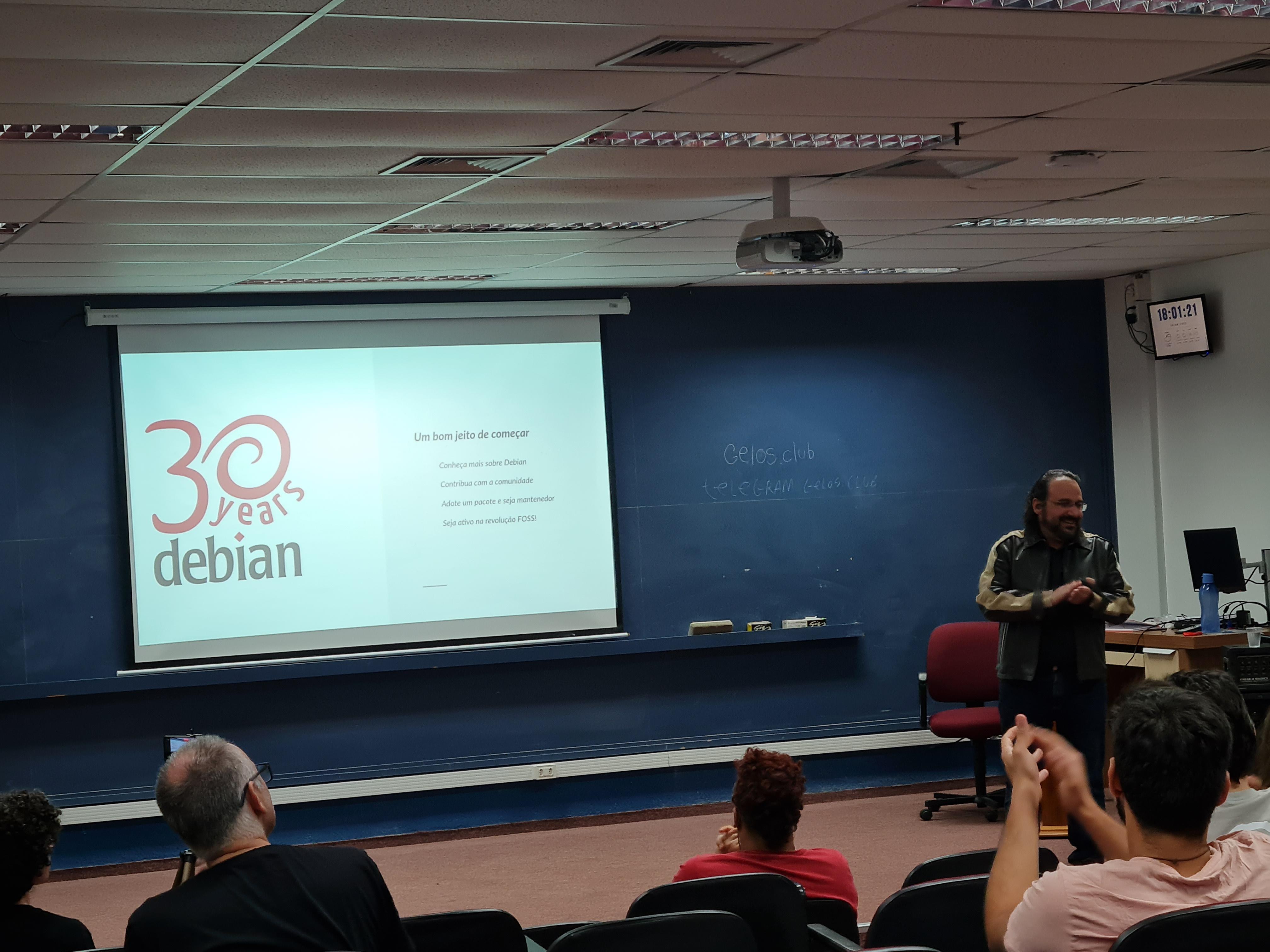
This year's Debian day was a pretty special one, we are celebrating 30 years!
Giving the importance of this event, the Brazilian community planned a very
special week. Instead of only local gatherings, we had a week of online talks
streamed via Debian Brazil's youtube channel (soon the recordings will be
uploaded to Debian's peertube instance). Nonetheless the local celebrations
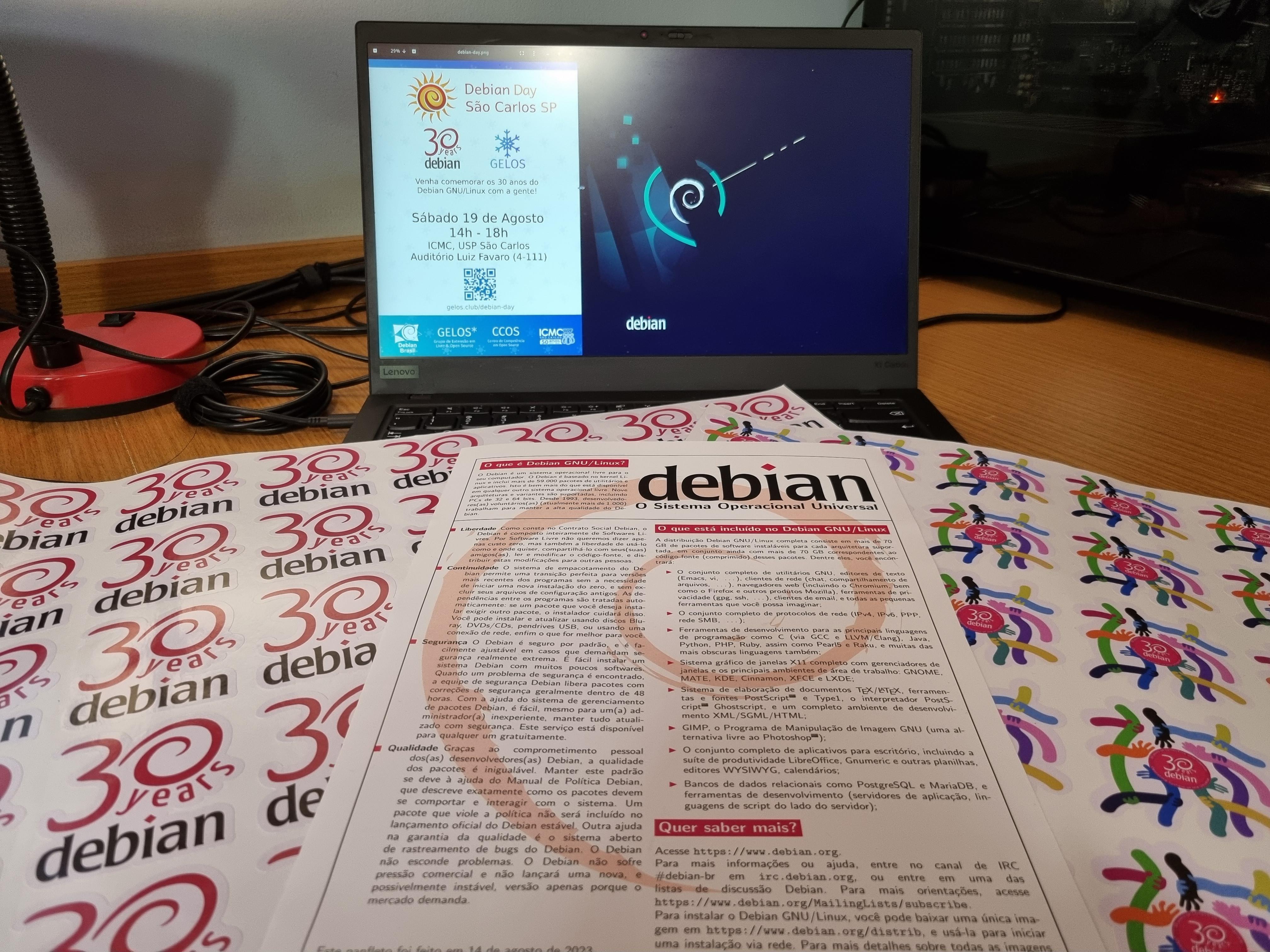
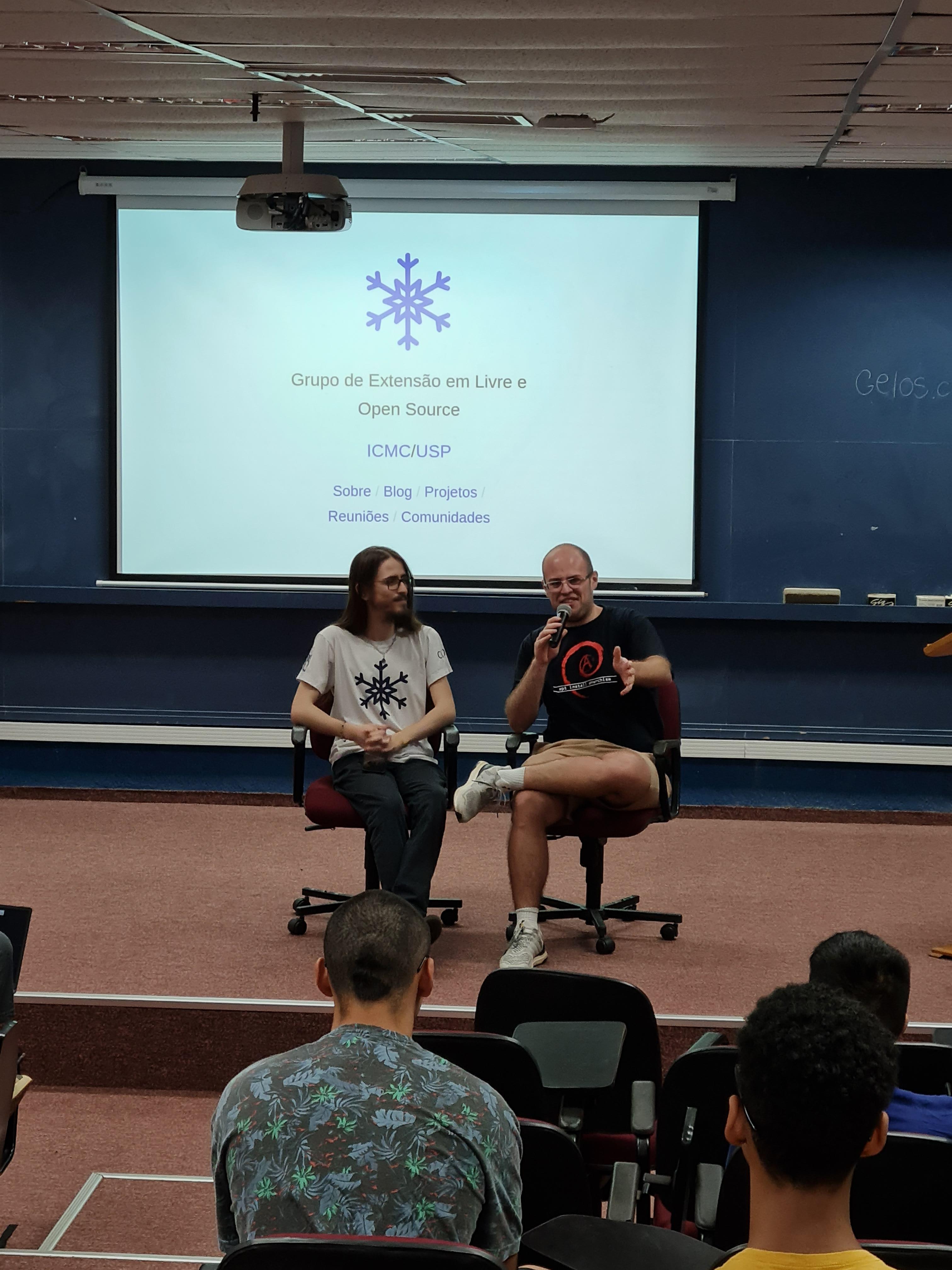
happened around the country and I've organized one in S o Carlos with the help
of GELOS, the FLOSS group at University of S o Paulo.
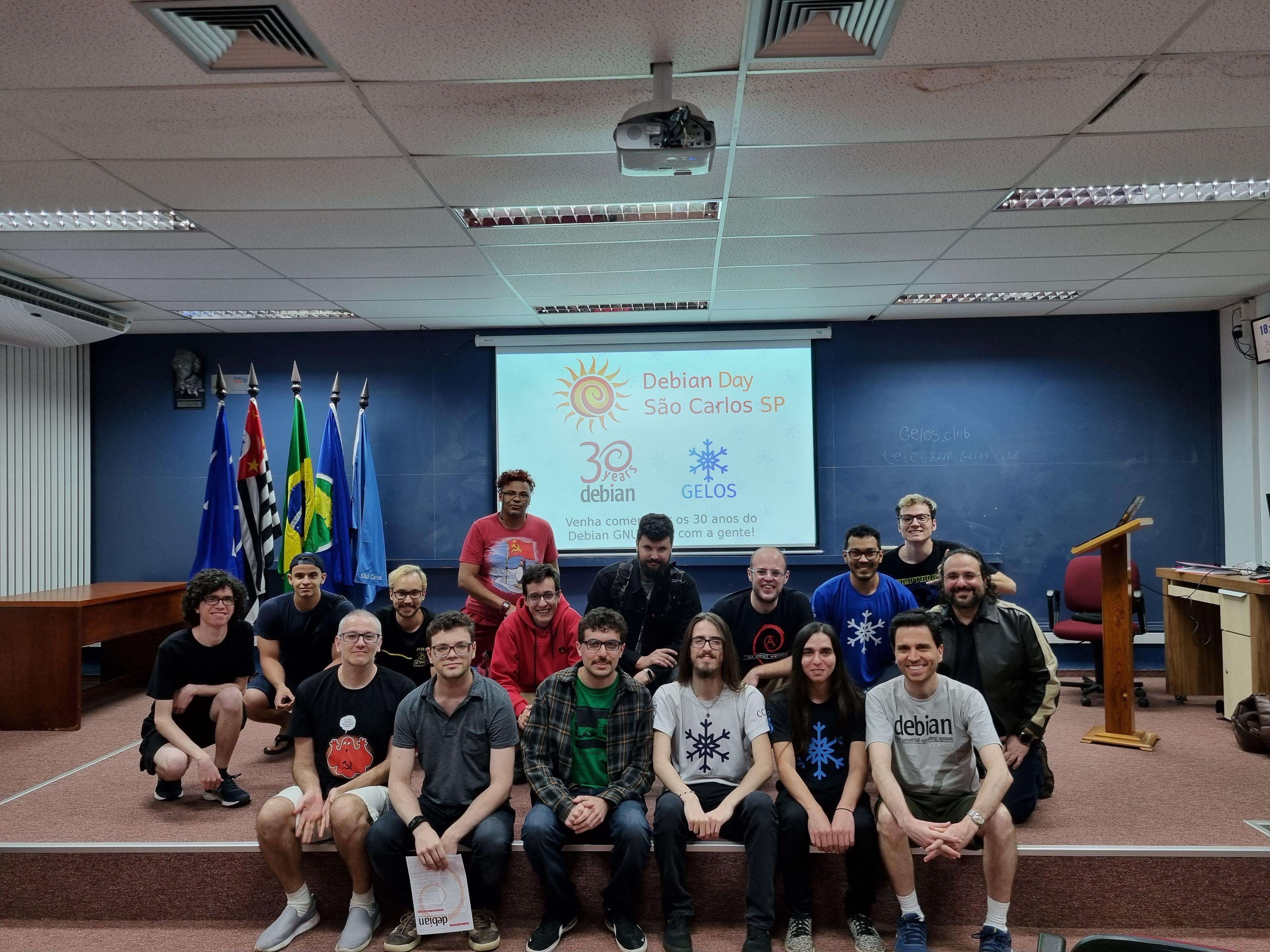
The event happened on August 19th and went on the whole afternoon. We had some
talks about Debian and free software (see table below), a coffee break where we
had the chance to talk, and finished with a group photo (check this one and
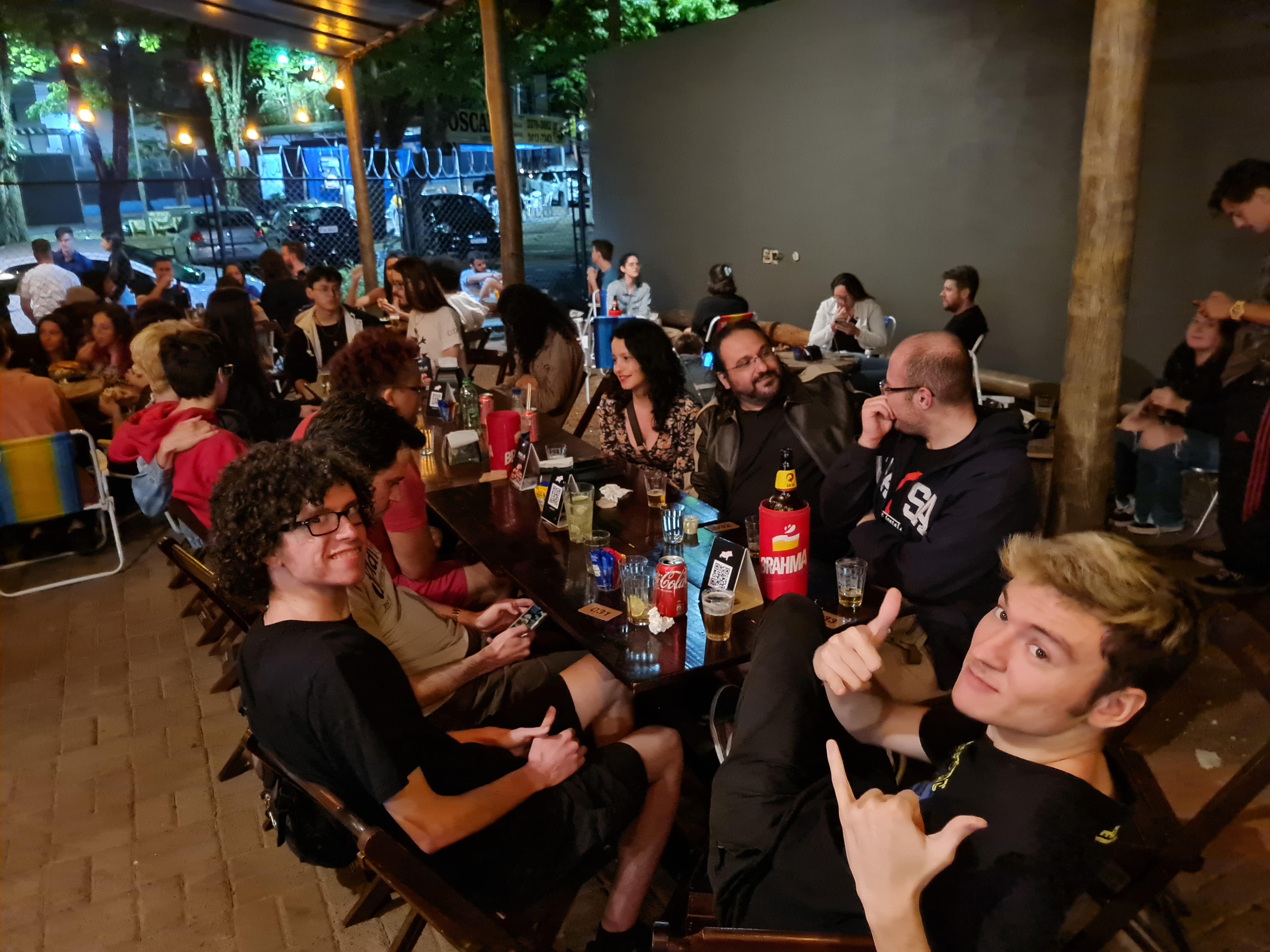
many others below). Actually, it wasn't the end, we carried on the conversation
about Debian and free software in a local bar :-)
We had around 30 people in the event and reached a greater audience via the
announcements across the university's press releases and emails sent to our
Brazilian mailing lists. You can check some of them below.
Here are some photos taken during the event!
Getting things ready for the event.
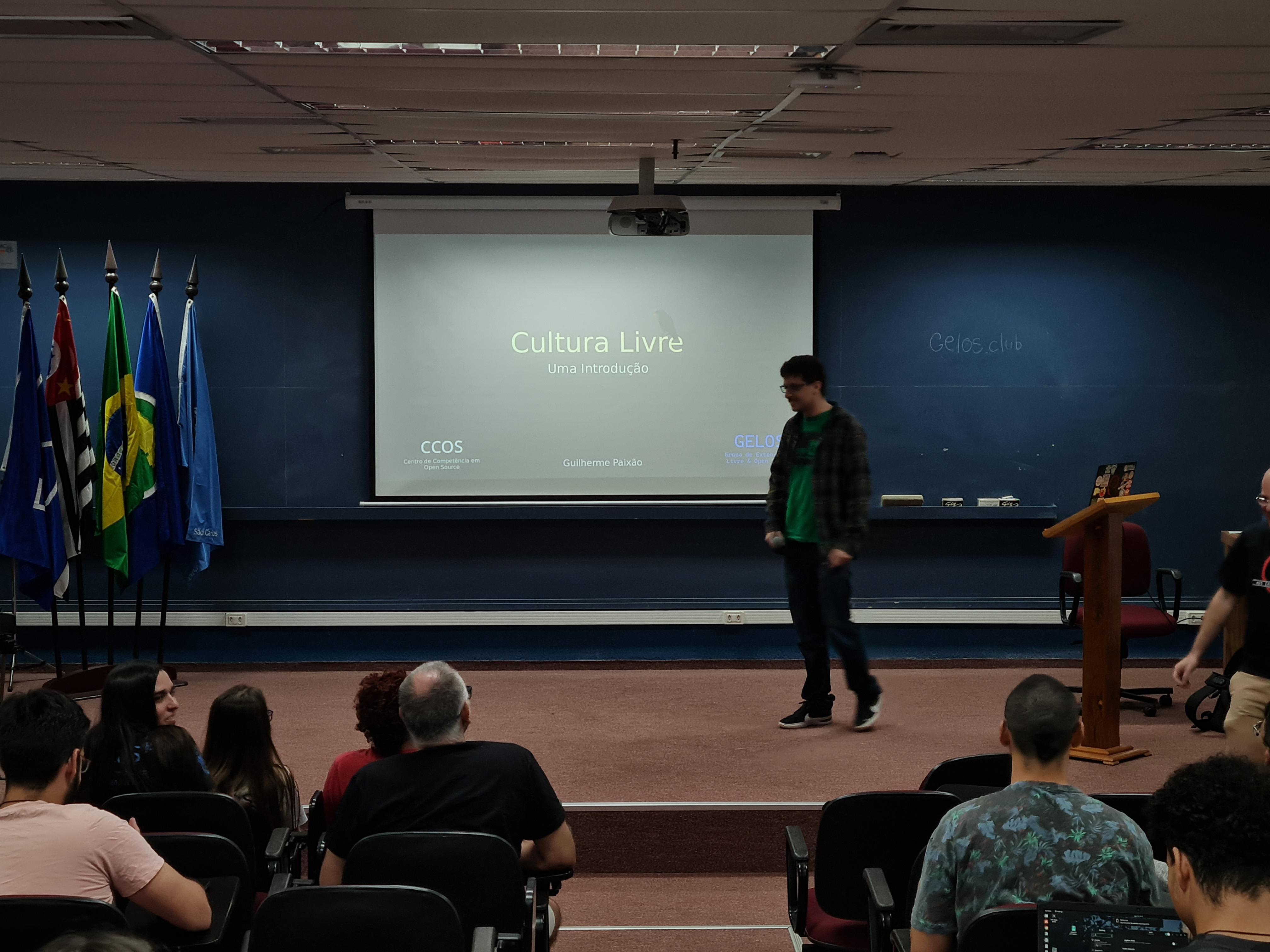
Intro to GELOS talk.
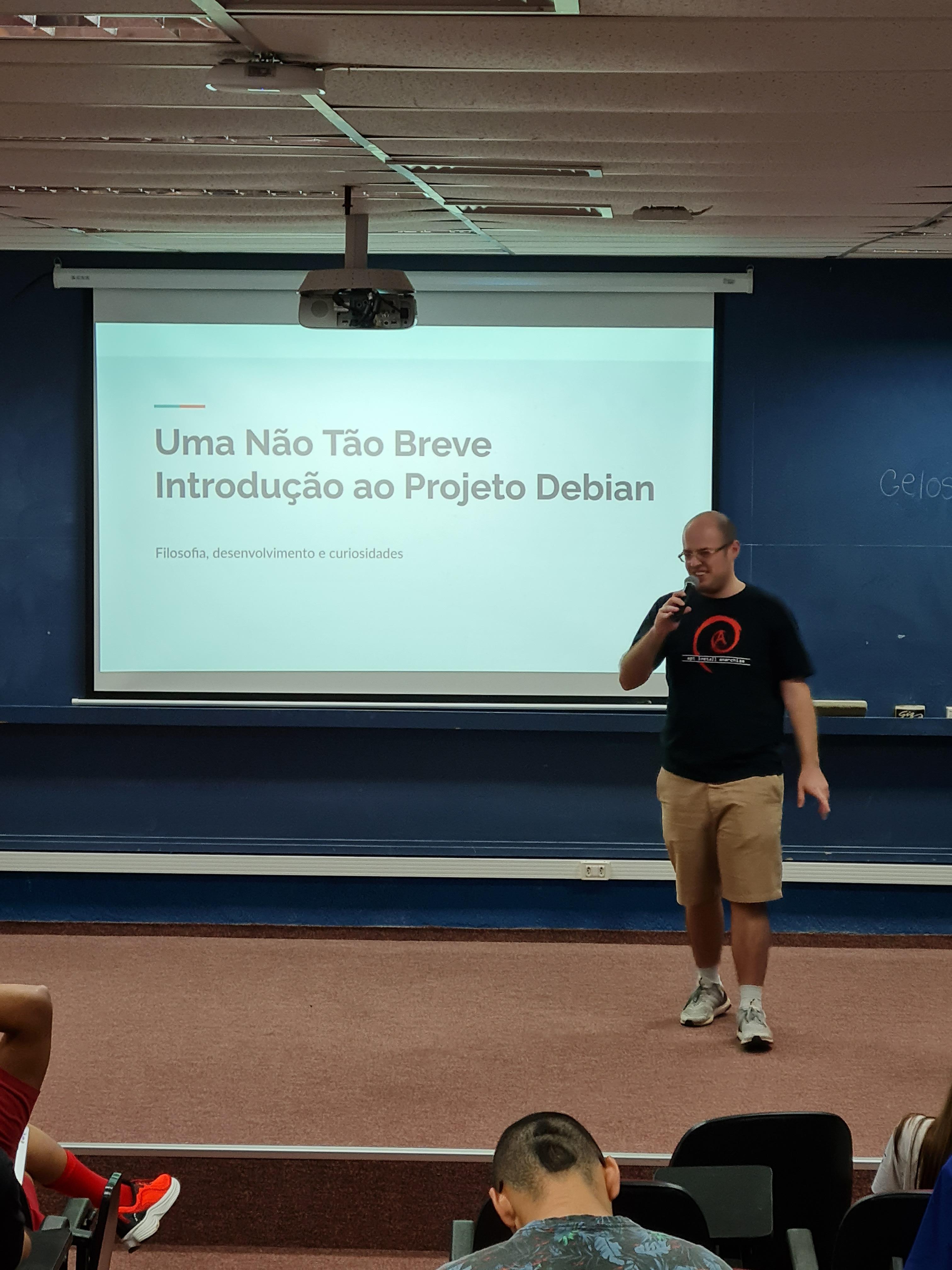
A not so Brief Introdution to the Debian Project talk.
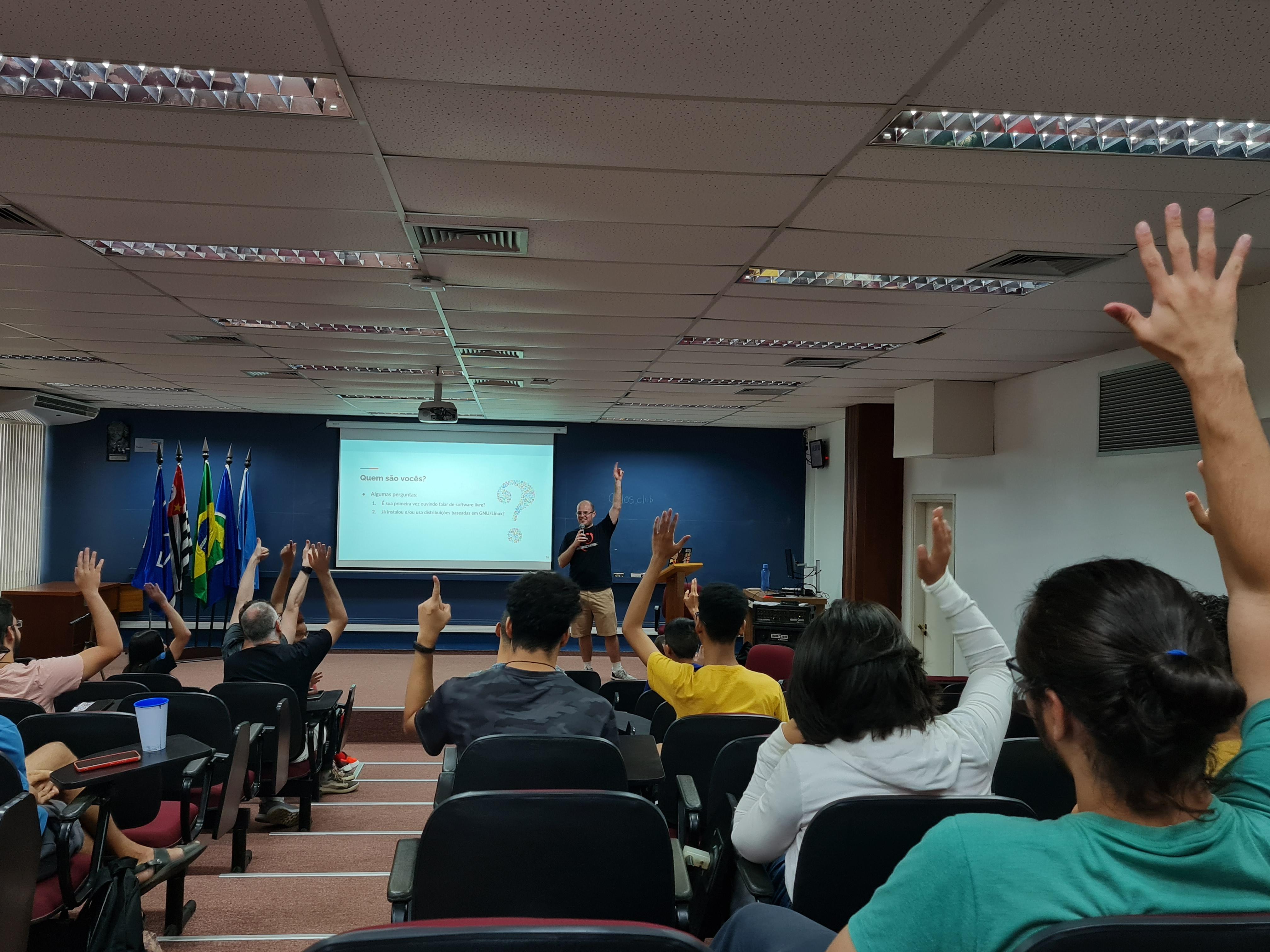
Everyone already knew Debian!
Debian and the Free Culture talk
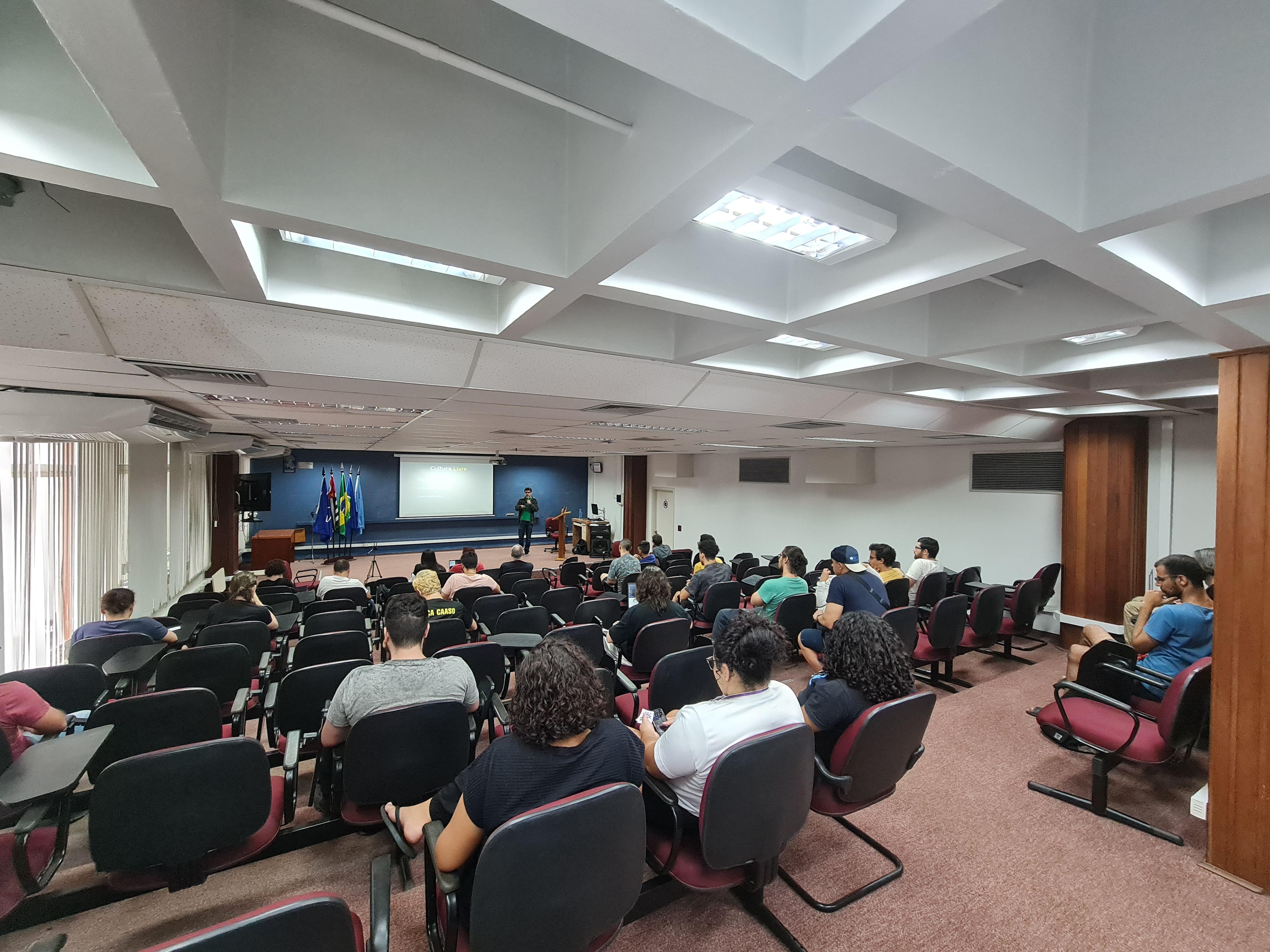
People in the auditorium space.
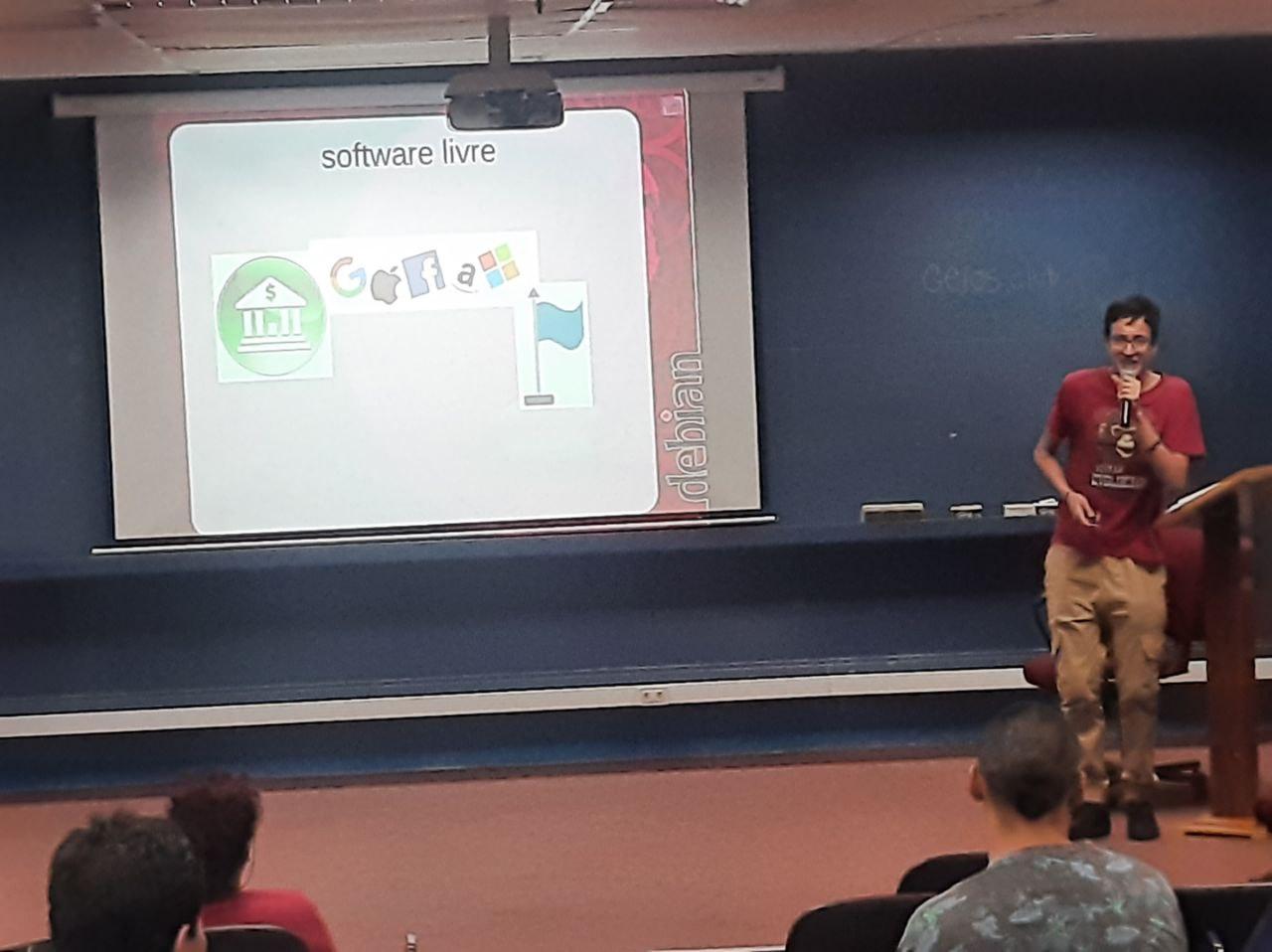
Free Software: the paths to a free life talk
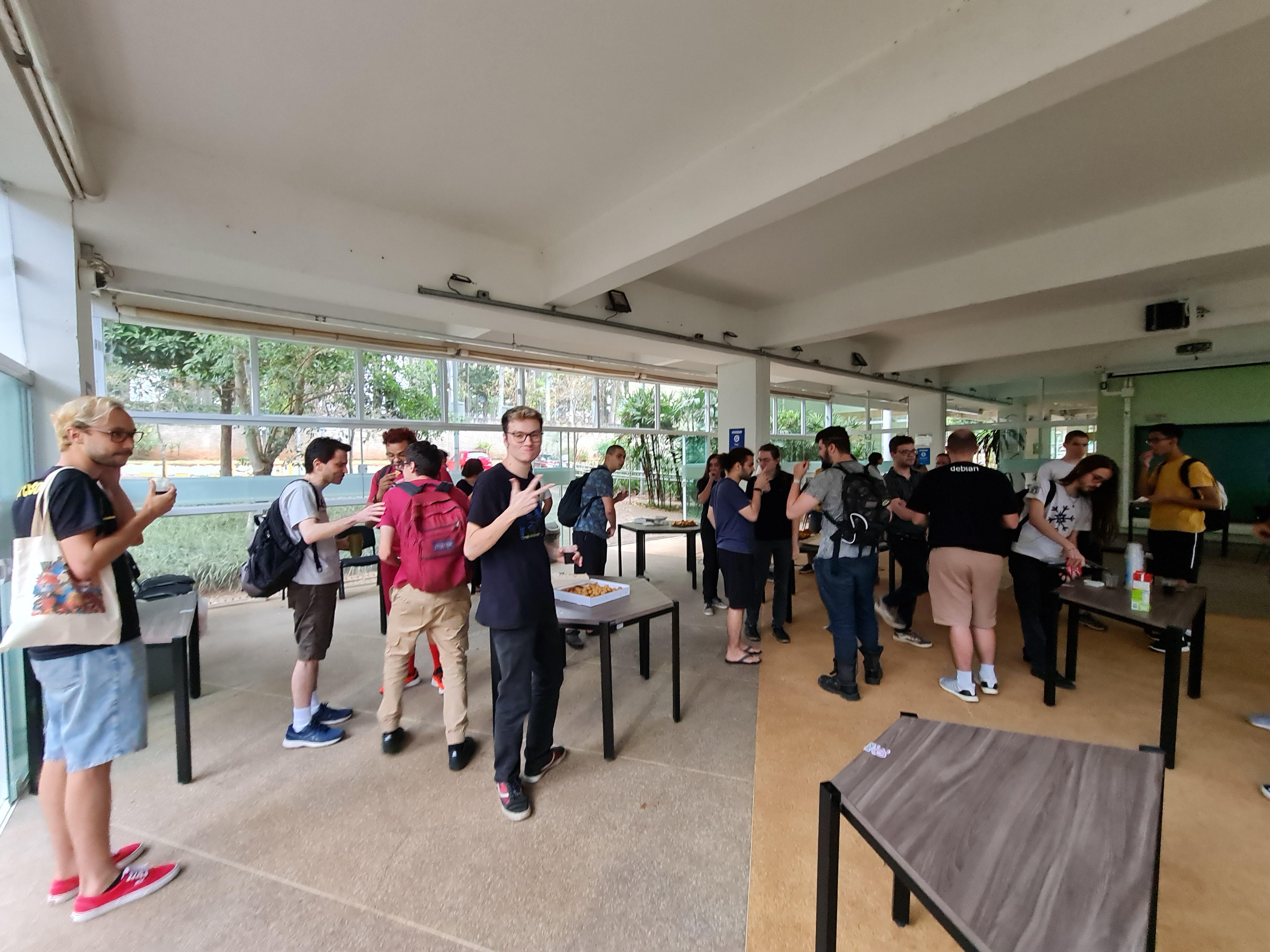
Coffee Break.
The FOSS Ecosystem and You talk.
Group photo.
Celebration goes on in the bar.
Sam Hartman wrote an interesting blog post about his work as a sex and intimacy educator and how GPT systems could impact that [1].
I ve read some positive reviews of Replika a commercial system that is somewhat promoted as a counsellor [2], so I decided to try it out. In my brief trial it seemed to be using all the methods that Android pay to play games are known for. Having multiple types of in-game currency, pay to buy new clothes etc for your friend, etc. Basically it seems pretty horrible. I didn t pay for it and the erotic and romantic features all require payment so I didn t test that.
When thinking about this logically, having a system designed to deal with people when they are vulnerable (either being in a romantic relationship or getting counselling) that uses manipulative techniques to get money from them can t have a good result. So a free software system seems the best option.
When I first learned of virtual girlfriends I never thought I would feel compelled to advocate for a free software virtual dating program, but that s where the world has got to.
Virtual girlfriends have been around for years now. Several years ago I watched a documentary about their use in Japan. It seemed a bit strange when a group of men who had virtual girlfriends had a dinner party with their tablets and phones propped up so their girlfriends could join in as they all appeared to be dating the same girl. The documentary didn t go in to enough detail to cover whether the girlfriend app could learn or be customised enough that they would seem to have different personalities.
Virtual boyfriends have also been around for a while apparently without most people noticing. I just Googled it and found a review of a virtual boyfriend app published in 2016!
One thing that will probably concern people is the possibility for virtual dating systems to be used for inappropriate things. That is a reasonable thing to be concerned about but I don t think it s possible to prevent technology that has already been released from doing such things. As a general rule technology can always be used for good and bad things so we need to just make it easy to do good things and let the legal system develop ways of dealing with the bad things.
 There is a bit of context that needs to be shared before I get to this and would be a long one. For reasons known and unknown, I have a lot of sudden electricity outages. Not just me, all those who are on my line. A discussion with a lineman revealed that around 200+ families and businesses are on the same line and when for whatever reason the electricity goes for all. Even some of the traffic lights don t work. This affects software more than hardware or in some cases, both. And more specifically HDD s are vulnerable. I had bought an APC unit several years for precisely this, but over period of time it just couldn t function and trips also when the electricity goes out. It s been 6-7 years so can t even ask customer service to fix the issue and from whatever discussions I have had with APC personnel, the only meaningful difference is to buy a new unit but even then not sure this is an issue that can be resolved, even with that.
That comes to the issue that happens once in a while where the system fsck is unable to repair /home and you need to use an external pen drive for the same. This is my how my hdd stacks up
 The main argument as have shared before is that Indian Govt. thinks we need our home grown CPU and while I have no issues with that, as shared before except for RISC-V there is no other space where India could look into doing that. Especially after the Chip Act, Biden has made that any new fabs or any new thing in chip fabrication will only be shared with Five Eyes only. Also, while India is looking to generate about 2000 GW by 2030 by solar, China has an ambitious 20,000 GW generation capacity by the end of this year and the Chinese are the ones who are actually driving down the module prices. The Chinese are also automating their factories as if there s no tomorrow. The end result of both is that China will continue to be the world s factory floor for the foreseeable future and whoever may try whatever policies, it probably is gonna be difficult to compete with them on prices of electronic products. That s the reason the U.S. has been trying so that China doesn t get the latest technology but that perhaps is a story for another day.

 . Backups certainly make a lot of sense, especially rsync.
The other thing that came to my mind was having some sort of A.I. and chat server. IIRC, somebody has put quite a bit of open source public domain data in debian servers that could be used to run either a chatbot or an A.I. or both and use that similar to how chatGPT but with much limited scope than what chatgpt uses. I was also thinking a media server which Vishal did share he does. I may probably visit him sometime to see what choices he did and what he learned in the process, if anything.
Another thing that could be done is just take a dump of any of commodity markets or any markets and have some sort of predictive A.I. or whatever. A whole bunch of people have scammed thousands of Indian users on this, but if you do it on your own and for your own purposes to aid you buy and sell stocks or whatever commodity you may fancy. After all, nowadays markets themselves are virtual.
While Vishal s mini-pc doesn t have any graphics, if it was an AMD APU mini-pc, something like this he could have hosted games in the way of thick server, thin client where all graphics processing happens on the server rather than the client. With virtual reality I think the case for the same case could be made or much more. The only problem with VR/AR is that we don t really have mass-market googles, eye pieces or headset. The only notable project that Google has/had in that place is the Google VR Cardboard headset and the experience is not that great or at least was not that great few years back when I could hear and experience the same. Most of the VR headsets say for example the Meta Quest 2 is for around INR 44k/- while Quest 3 is INR 50k+ and officially not available. As have shared before, the holy grail of VR would be when it falls below INR 10k/- so it becomes just another accessory, not something you really have to save for. There also isn t much content on that but then that is also the whole chicken or egg situation. This again is a non-stop discussion as so much has been happening in that space it needs its own blog post/article whatever.
Till later.
 It's August Bank Holiday Weekend, we're in Cambridge. It must be
the Debian
UK
 Back in June 2018,
 So This is basically a call for adoption for the Raspberry Debian images
building service. I do intend to stick around and try to help. It s not only me
(although I m responsible for the build itself) we have a nice and healthy
group of Debian people hanging out in the
 Back in 2015, when PostgreSQL 9.5 alpha 1 was released, I had posted the
 Em 2023 o tradicional

 Edited 2023-08-25 01:32 BST to correct a slip.
 Apparently it s nearly four years since I last posted to my blog. Which is, to a degree, the point here. My time, and priorities, have changed over the years. And this lead me to the decision that my available time and priorities in 2023 aren t compatible with being a Debian or Ubuntu developer, and realistically, haven t been for years. As of earlier this month, I quit as a Debian Developer and Ubuntu MOTU.
I think a lot of my blogging energy got absorbed by social media over the last decade, but with the collapse of Twitter and Reddit due to mismanagement, I m trying to allocate more time for blog-based things instead. I may write up some of the things I ve achieved at work (.NET 8 is now snapped for release Soon
 ). I might even blog about work-adjacent controversial topics, like my changed feelings about the entire concept of distribution packages. But there s time for that later. Maybe.
I ll keep tagging vaguely FOSS related topics with the Debian and Ubuntu tags, which cause them to be aggregated in the Planet Debian/Ubuntu feeds (RSS, remember that from the before times?!) until an admin on those sites gets annoyed at the off-topic posting of an emeritus dev and deletes them.
But that s where we are. Rather than ignore my distro obligations, I ve admitted that I just don t have the energy any more. Let someone less perpetually exhausted than me take over. And if they don t, maybe that s OK too.
 KDE Mascot

 Now that
 Another minor release, now at 0.2.4, of our