Search Results: "nate"

4 January 2016

Bernd Zeimetz: open-vm-tools updated

In January 2014 the open-vm-tools package was orphaned and I took the chance to take over the maintenance. Unfortunately the package is still not 100% in the shape I d like to see it, but I m getting closer. I have to say Thank You for a lot of good bug reports, especially for those use cases which are hard to test/reproduce for me (running Debian in a Windows-based VMware Workstation Player for example .). At conova communications GmbH, the company I work for, we are using the package on all of our Debian VMs, both for customer and internal use. It is essential for us to have properly working open-vm-tools - not only to be able to shutdown the VM from VMware vCenter, but also because tools like vSphere Data Protection and Veeam depend on it. Good thing is that I can work on and test the package at work and breakages are detected early and fast normally. Getting a good contact to the VMware upstream was easy and the developers there are helpful and reply pretty fast to their emails. Also as it seems there are finally real commits showing up in the open-vm-tools github repository again, not only huge single commits with a full release. It is not only nice to see that they are moving into the right direction again, but also this is really helpful in fixing (urgent) bugs before the next release of open-vm-tools - or to backport a fix to the versoin in stable/oldstable. Since a few days we have open-vm-tools 10.0.5-3227872 in If you are using VMware ESX 5.5 or newer, you should upgrade to the backports versions. Same if you use a recent VMware player version. Please note that since 10.0.0 the open-vm-dkms package is only necessary if you need the legacy vmxnet module. This is only the case if you are using very old VM hardware versions. vmxnet3 is shipped in the Debian kernel, so you don t need to compile extra modules to use it. The vmhgfs module was replaced by a fuse-based implementation. If you d like to help maintaining the package, please send bugs/patches via the Debian BTS or even better - send pull requests for pkg-open-vm-tools. The repository is mirrored to git.bzed.at in case you want to avoid github.

3 January 2016

Iustin Pop: Orcas Island day trip, June 2015

I just finished going through my last set of pending-review pictures from 2015, so I'm starting 2016 with a post about the past. In June 2015 I travelled to Seattle/Kirkland area for work purposes, and took advantage of a weekend to plan some more outdoors stuff. After looking around on maps, I settled on the San Juan islands, so I started looking at hiking possibilities, and in the end Orcas island looked the best choice - all the others had much lower elevations. So, early in the morning, I started driving from Kirkland to Anacortes ferry terminal. The drive itself is quite nice: after getting past the more populated areas, passing Everett, the the view are very nice, especially in the early morning hours and with very few traffic. At Anacortes, there was already a small queue, fortunately I had a pre-ordered ticket, and there was not much to do until the ferry arrived except to look forward at the day, and hope that the weather will stay nice. On the ferry then, crossing the straits and enjoying the very nice views: Perfect blue Catching the morning wind The ferry stops at Orcas (is it a town or just the terminal), and the next stop is Eastsound town. I pre-planned here a stop to get a second mini-breakfast: however, I misjudged what the portion sizes are and got myself a maxi-cinnamon roll at Caffe Olga: Second breakfast :) At least I knew I wasn't going to be hungry for a while :) Driving on, briefly stopping at Cascade Lake (I also stopped on the way back, the view is nice), then reaching the parking at the Twin Lakes trail on the shore of Mountain Lake. Good think I arrived somewhat early the parking was quite full already. I also got a bit confused on which way the hike starts, since it's not well marked, but after that I started the hike. It's also possible to drive up to Mount Constitution, but that's just lame; hiking from the base it's quite easy, if you find how to start the hike. Anyway: Starting to climb Finished the steepest part At one point, one meets this particular sign: Which way now? Beware the Little Summit is not to be missed! After ~40 minutes of hiking, with some parts a tiny bit strenuous, the view is really breathtaking. It's definitely worth stopping by, as the view is (IMHO) nicer than the view from the top of Mt. Constitution: Wow! The reason I say this is better is because you look towards ocean, whereas later the view is back towards the continent. And looking towards the big ocean is just perfect! Plus, the many small island, fully covered with forest are also nice. Onwards then towards the peak of Mount Constitution. You cross the "ridge" of the island, and your view shifts to the other side. Which means you see back to the Mountain Lake where the hike starts: Loocking back towards the start Here the path is more exposed, not through tall forest like at the beginning: Watching the horizon Right before reaching the peak, you pass through an interesting forest: A different kind of forest And then you're finally reaching the peak. Compared to Switzerland, it's very much not impressive (730m), but nevertheless, being so close to the ocean results in some very nice views: Couldn't have asked for better weather You can go into the small tower, and read through the history of the location, including the personal life of Robert Moran (shipbuilder), who retired in 1905 to Orcas island to live what (his doctors said to be) his last months, and who instead ended living until 1943. Not bad! To be filled under "too much stress is bad, nature is good" heading, I think. After eating a small packed lunch, I started back. At the beginning the forest is similar to the one back at the beginning of the hike, but then, as you reach the level of lakes, it is slightly different. More tall (old?) trees, more moss and ferns: Afternoon sun in the forest I passed briefly by the Twin Lakes, which were interesting (lots of submerged trunks), and then finally on the Twin Lakes trail back to the start. The views of Mountain Lake from here are also nice, especially in the less harsh afternoon sun: Reached Mountain Lake How did those trees get there? And then the hike was over. I still had some time to spend before the ferry I had a ticket on was scheduled, so I drove down to Olga town, as I was curious what was at the end of "Olga Road". Not much, but again nice views, and this very picturesque pier: Nice pier in Olga And then it was back to the ferry, waiting in line, getting on the ferry, and crossing back: Goodbye Orcas! Overall, it was a day well spent, part different, part similar to last year's mostly road trip. Definitely recommended if you're in the area, and there are a couple of other hikes on Orcas Island, plus all the other islands which make up the San Juans. However, traffic on the way back was not that awesome :/ Small price though!

2 January 2016

Daniel Pocock: The great life of Ian Murdock and police brutality in context

Tributes: (You can Follow or Tweet about this blog on Twitter) Over the last week, people have been saying a lot about the wonderful life of Ian Murdock and his contributions to Debian and the world of free software. According to one news site, a San Francisco police officer, Grace Gatpandan, has been doing the opposite, starting a PR spin operation, leaking snippets of information about what may have happened during Ian's final 24 hours. Sadly, these things are now starting to be regurgitated without proper scrutiny by the mainstream press (note the erroneous reference to SFGate with link to SFBay.ca, this is British tabloid media at its best). The report talks about somebody (no suggestion that it was even Ian) "trying to break into a residence". Let's translate that from the spin-doctor-speak back to English: it is the silly season, when many people have a couple of extra drinks and do silly things like losing their keys. "a residence", or just their own home perhaps? Maybe some AirBNB guest arriving late to the irritation of annoyed neighbours? Doesn't the choice of words make the motive sound so much more sinister? Nobody knows the full story and nobody knows if this was Ian, so snippets of information like this are inappropriate, especially when somebody is deceased. Did they really mean to leave people with the impression that one of the greatest visionaries of the Linux world was also a cat burglar? That somebody who spent his life giving selflessly and generously for the benefit of the whole world (his legacy is far greater than Steve Jobs, as Debian comes with no strings attached) spends the Christmas weekend taking things from other people's houses in the dark of the night? The report doesn't mention any evidence of a break-in or any charges for breaking-in. If having a few drinks and losing your keys in December is such a sorry state to be in, many of us could potentially be framed in the same terms at some point in our lives. That is one of the reasons I feel so compelled to write this: somebody else could be going through exactly the same experience at the moment you are reading this. Any of us could end up facing an assault as unpleasant as the tweets imply at some point in the future. At least I can console myself that as a privileged white male, the risk to myself is much lower than for those with mental illness, the homeless, transgender, Muslim or black people but as the tweets suggest, it could be any of us. The story reports that officers didn't actually come across Ian breaking in to anything, they encountered him at a nearby street corner. If he had weapons or drugs or he was known to police that would have almost certainly been emphasized. Is it right to rush in and deprive somebody of their liberties without first giving them an opportunity to identify themselves and possibly confirm if they had a reason to be there? The report goes on, "he was belligerent", "he became violent", "banging his head" all by himself. How often do you see intelligent and successful people like Ian Murdock spontaneously harming themselves in that way? Can you find anything like that in any of the 4,390 Ian Murdock videos on YouTube? How much more frequently do you see reports that somebody "banged their head", all by themselves of course, during some encounter with law enforcement? Do police never make mistakes like other human beings? If any person was genuinely trying to spontaneously inflict a head injury on himself, as the police have suggested, why wouldn't the police leave them in the hospital or other suitable care? Do they really think that when people are displaying signs of self-harm, rounding them up and taking them to jail will be in their best interests? Now, I'm not suggesting this started out with some sort of conspiracy. Police may have been at the end of a long shift (and it is a disgrace that many US police are not paid for their overtime) or just had a rough experience with somebody far more sinister. On the other hand, there may have been a mistake, gaps in police training or an inappropriate use of a procedure that is not always justified, like a strip search, that causes profound suffering for many victims. A select number of US police forces have been shamed around the world for a series of incidents of extreme violence in recent times, including the death of Michael Brown in Ferguson, shooting Walter Scott in the back, death of Freddie Gray in Baltimore and the attempts of Chicago's police to run an on-shore version of Guantanamo Bay. Beyond those highly violent incidents, the world has also seen the abuse of Ahmed Mohamed, the Muslim schoolboy arrested for his interest in electronics and in 2013, the suicide of Aaron Swartz which appears to be a direct consequence of the "Justice" department's obsession with him. What have the police learned from all this bad publicity? Are they changing their methods, or just hiring more spin doctors? If that is their response, then doesn't it leave them with a cruel advantage over those people who were deceased? Isn't it standard practice for some police to simply round up anybody who is a bit lost and write up a charge sheet for resisting arrest or assaulting an officer as insurance against questions about their own excessive use of force? When British police executed Jean Charles de Menezes on a crowded tube train and realized they had just done something incredibly outrageous, their PR office went to great lengths to try and protect their image, even photoshopping images of Menezes to make him look more like some other suspect in a wanted poster. To this day, they continue to refer to Menezes as a victim of the terrorists, could they be any more arrogant? While nobody believes the police woke up that morning thinking "let's kill some random guy on the tube", it is clear they made a mistake and like many people (not just police), they immediately prioritized protecting their reputation over protecting the truth. Nobody else knows exactly what Ian was doing and exactly what the police did to him. We may never know. However, any disparaging or irrelevant comments from the police should be viewed with some caution. The horrors of incarceration It would be hard for any of us to understand everything that an innocent person goes through when detained by the police. The recently released movie about The Stanford Prison Experiment may be an interesting place to start, a German version produced in 2001, Das Experiment, is also very highly respected. The United States has the largest prison population in the world and the second-highest per-capita incarceration rate. Many, including some on death row, are actually innocent, in the wrong place at the wrong time, without the funds to hire an attorney. The system, and the police and prison officers who operate it, treat these people as packages on a conveyor belt, without even the most basic human dignity. Whether their encounter lasts for just a few hours or decades, is it any surprise that something dies inside them when they discover this cruel side of American society? Worldwide, there is an increasing trend to make incarceration as degrading as possible. People may be innocent until proven guilty, but this hasn't stopped police in the UK from locking up and strip-searching over 4,500 children in a five year period, would these children go away feeling any different than if they had an encounter with Jimmy Saville or Rolf Harris? One can only wonder what they do to adults. What all this boils down to is that people shouldn't really be incarcerated unless it is clear the danger they pose to society is greater than the danger they may face in a prison. What can people do for Ian and for justice? Now that these unfortunate smears have appeared, it would be great to try and fill the Internet with stories of the great things Ian has done for the world. Write whatever you feel about Ian's work and your own experience of Debian. While the circumstances of the final tweets from his Twitter account are confusing, the tweets appear to be consistent with many other complaints about US law enforcement. Are there positive things that people can do in their community to help reduce the harm? Sending books to prisoners (the UK tried to ban this) can make a difference. Treat them like humans, even if the system doesn't. Recording incidents of police activities can also make a huge difference, such as the video of the shooting of Walter Scott or the UK police making a brutal unprovoked attack on a newspaper vendor. Don't just walk past a situation and assume everything is under control. People making recordings may find themselves in danger, it is recommended to use software that automatically duplicates each recording, preferably to the cloud, so that if the police ask you to delete such evidence, you can let them watch you delete it and still have a copy. Can anybody think of awards that Ian Murdock should be nominated for, either in free software, computing or engineering in general? Some, like the prestigious Queen Elizabeth Prize for Engineering can't be awarded posthumously but others may be within reach. Come and share your ideas on the debian-project mailing list, there are already some here. Best of all, Ian didn't just build software, he built an organization, Debian. Debian's principles have helped to unite many people from otherwise different backgrounds and carry on those principles even when Ian is no longer among us. Find out more, install it on your computer or even look for ways to participate in the project.

1 January 2016

Thorsten Alteholz: My Debian Activities in December 2015

FTP assistant Due to Christmas, I only marked 254 packages for accept and rejected 17 of them. I had to send 14 emails to maintainers. Squeeze LTS This was my eighteenth month that I did some work for the Squeeze LTS initiative, started by Raphael Hertzog at Freexian. As other members of the LTS team had to give back some hours of their workload, this month my initial workload of 18.25h had been increased to 21.25h. Altogether I uploaded those DLAs: I also started to work on CVEs for packages t-coffee and pitivi, only to recognize that the versions in Squeeze are not affected. Further I prepared patches for passenger and srtp but I could not test them yet, so an upload will be in January. This month I also experienced something strange. Due to the upload of the new version of mysql, I had to process a package for squeeze-lts in NEW. I seldom see a package, that creates so much red output from lintian. I assume this always happens when an old package will be checked by the latest lintian and is a good sign for all the development within Debian. I also tested Raphaels patch for #796784 and could confirm that everything works as expected. Unfortunately the php5 upload must be delayed until Januar. This month I also had another week of frontdesk duties. Other stuff The Advent season is over and the Debian Med Advent Calendar is full to bursting. The incredible number of 150 bugs have been closed this year! Due to the GSL transition a new upload of all meep packages had to be done and all in all I could close #748822, #807210, #807212, #807213, #807214, #807215 and #807747.

Niels Thykier: Debian, please plan for Stretch

In the 4th quarter of 2016, we will freeze Debian Stretch. If you are hoping to do any larger changes for Stretch, please consider starting on them now. This also includes features that need to be in APT/dpkg (etc.) in Stretch, so we can start using them for Buster. Even something as trivial as the automatic dbgsym packages took over 8 months to complete (from the prototype was announced in April). I call it trivial because: NB: There were certainly other parties involved. But these were the most important ones. Mind you, the dbgsym saga is not complete yet. We are still lacking support for migrating dbgsym packages to testing (and, by extension, the next stable release as well). Meanwhile, you can pull the dbgsym packages from snapshot.debian.org. In summary: If you want a larger change to land in Debian Stretch, please start already now. :)
Filed under: Debian, Release-Team

31 December 2015

Raphaël Hertzog: My Free Software Activities in December 2015

My monthly report covers a large part of what I have been doing in the free software world. I write it for my donators (thanks to them!) but also for the wider Debian community because it can give ideas to newcomers and it s one of the best ways to find volunteers to work with me on projects that matter to me. Debian LTS This month I have been paid to work 21.25 hours on Debian LTS. During this time I worked on the following things: Distro Tracker I put a big focus on tracker.debian.org work this month. I completed the switch of the mail interface from packages.qa.debian.org to tracker.debian.org and I announced the change on debian-devel-announce. The changes resulted in a few problems that I quickly fixed (like #807073) and some other failures seen only by me and that were generated by weird spam messages (did you know that a subject can t have a newline character but that it can be encoded and folded over multiple lines?). Related to that I fixed some services so that they send their mails to tracker.debian.org directly instead of relying on the old emails (they get forwarded for now but it would be nice to be able to get rid of that forward). I updated (with the help of Lucas Nussbaum) the service that forwards the Launchpad bugs to the tracker, I sent a patch to update the @packages.debian.org aliases (not yet applied), I updated the configuration of all git commit notice scripts in the Alioth collab-maint and python-modules project (many remain to be done). I asked Ubuntu s Merge-O-Matic to use the new emails as well (see LP 1525497). DAK and the Debian BTS still have to be updated, as of yet nobody reacted to my announce last but not least I updated many wiki pages which duplicated the instructions to setup the commit notice sent to the PTS. While on a good track I opted to tackle the long-standing RC bug that was plaguing tracker.debian.org (#789183), so I updated the codebase to rely on Twitter s bootstrap v4 instead of v2. I had to switch to something else for the icons since glyphicons is no longer provided as part of bootstrap and the actual license for the standalone version was not suitable for use. I opted for Github s Octicons. I made numerous little improvements while doing that (closing some bugs in the process) and I believe that the result is more pleasant to use. I also did a lot of bug triage and fixed a few small issues like the incomplete architecture list (#793547), or fixing a page used only by people with javascript disabled that was not working. Or the invalid links for packages still using CVS (ugh, see #561228). Misc packaging Django. After having added DEP-8 tests (as part of my LTS work, see above), I discovered that the current version in unstable did not pass its test suite so I filed the issue upstream (ticket 26016) and added the corresponding patch. And I encouraged others to update python-bcrypt in Debian to a newer version that would have worked with Django 1.9 (see #803096). I also fixed another small issue in Django (see ticket 26017 with my pull request that got accepted). I asked the release managers to consider accepting the latest 1.7.x version in jessie (see #807654) but I have gotten zero answer so far. And I m not the only one waiting an answer. It s a bit of a sad situation we still have a few weeks until the next point release but for once I do it in advance and I would love to have timely feedback. Last but not least, I started the maintaining the current LTS release (1.8.x) in jessie-backports. Tryton. I upgraded to Tryton 3.8 and discovered an issue that I filed in #806781. I sponsored 5 new tryton modules for Matthias Behrle (who is DM) as well as one security upload (for CVE-2015-0861). Debian Handbook. I uploaded a new version to Debian Unstable and requested (to the release managers) the permission to upload a backport of it to jessie so that jessie has a version of the package that documents jessie and not wheezy contrary to my other Django request, this one should be non-controversial but I also have had zero answer so far, see #807515. Misc. I filed #808583 when sbuild stopped working with Perl 5.22. I handled #807860 on publican, I found the corresponding upstream ticket and discovered a work around with the help of upstream (see here). Kali related work I reported a bug to #debian-apt about apt miscalculating download size (ending up with 18 EB!) which resulted in a fix here in version 1.1.4. Installing a meta-package that needed more than 2GB was no longer possible without this fix and we have a kali-linux-all metapackage in that situation that gets regularly installed in a Jenkins test. I added captcha support to Distro Tracker and enabled this feature on pkg.kali.org. I filed #808863 against uhd-host because it was not possible to install the package in a systemd-nspawn s managed chroot where /proc is read-only. And we started using this to test dist-upgrade from one version of Kali to the next Thanks See you next month for a new summary of my activities.

No comment Liked this article? Click here. My blog is Flattr-enabled.

30 December 2015

Julian Andres Klode: APT 1.1.8 to 1.1.10 going faster

Not only do I keep incrementing version numbers faster than ever before, APT also keeps getting faster. But not only that, it also has some bugs fixed and the cache is now checked with a hash when opening. Important fix for 1.1.6 regression Since APT 1.1.6, APT uses the configured xz compression level. Unfortunately, the default was set to 9, which requires 674 MiB of RAM, compared to the 94 MiB required at level 6. This caused the test suite to fail on the Ubuntu autopkgtest servers, but I thought it was just some temporary hickup on their part, and so did not look into it for the 1.1.7, 1.1.8, and 1.1.9 releases. When the Ubuntu servers finally failed with 1.1.9 again (they only started building again on Monday it seems), I noticed something was wrong. Enter git bisect. I created a script that compiles the APT source code and runs a test with ulimit for virtual and resident memory set to 512 (that worked in 1.1.5), and let it ran, and thus found out the reason mentioned above. The solution: APT now defaults to level 6. New Features APT 1.1.8 introduces /usr/lib/apt/apt-helper cat-file which can be used to read files compressed by any compressor understood by APT. It is used in the recent apt-file experimental release, and serves to prepare us for a future in which files on the disk might be compressed with a different compressor (such as LZ4 for Contents files, this will improve rred speed on them by factor 7). David added a feature that enables servers to advertise that they do not want APT to download and use some Architecture: all contents when they include all in their list of architectures. This is to allow archives to drop Architecture: all packages from the architecture-specific content files, to avoid redundant data and (thus) improve the performance of apt-file. Buffered writes APT 1.1.9 introduces buffered writing for rred, reducing the runtime by about 50% on a slowish SSD, and maybe more on HDDs. The 1.1.9 release is a bit buggy and might mess up things when a write syscall is interrupted, this is fixed in 1.1.10. Cache generation improvements APT 1.1.9 and APT 1.1.10 improve the cache generation algorithms in several ways: Switching a lookup table from std::map to std::unordered_map, providing an inline isspace_ascii() function, and inlining the tolower_ascii() function which are tiny functions that are called a lot. APT 1.1.10 also switches the cache s hash function to the DJB hash function and increases the default hash table sizes to the smallest prime larger than 15000, namely 15013. This reduces the average bucket size from 6.5 to 4.5. We might increase this further in the future. Checksum for the cache, but no more syncs Prior to APT 1.1.10 writing the cache was a multi-part process:
  1. Write the the cache to a temporary file with the dirty bit set to true
  2. Call fsync() to sync the cache
  3. Write a new header with the dirty bit set to false
  4. Call fsync() to sync the new header
  5. (Rename the temporary file to the target name)
The last step was obviously not needed, as we could easily live with an intact cache that has its dirty field set to false, as we can just rebuild it. But what matters more is step 2. Synchronizing the entire 40 or 50 MB takes some time. On my HDD system, it consumed 56% of the entire cache generation time, and on my SSD system, it consumed 25% of the time. APT 1.1.10 does not sync the cache at all. It now embeds a hashsum (adler32 for performance reasons) in the cache. This helps ensure that no matter what parts of the cache are written in case of some failure somewhere, we can still detect a failure with reasonable confidence (and even more errors than before). This means that cache generation is now much faster for a lot of people. On the bad side, commands like apt-cache show that previously took maybe 10 ms to execute can now take about 80 ms. Please report back on your performance experience with 1.1.10 release, I m very interested to see if that works reasonably for other people. And if you have any other idea how to solve the issue, I d be interested to hear them (all data needs to be written before the header with dirty=0 is written, but we don t want to sync the data). Future work We seem to have a lot of temporary (?) std::string objects during the cache generation, accounting for about 10% of the run time. I m thinking of introducing a string_view class similar to the one proposed for C++17 and make use of that. I also thought about calling posix_fadvise() before starting to parse files, but the cache generation process does not seem to spend a lot of its time in system calls (even with all caches dropped before the run), so I don t think this will improve things. If anyone has some other suggestions or patches for performance stuff, let me know.
Filed under: Debian, Ubuntu

29 December 2015

Ben Hutchings: Comparing dracut and initramfs-tools

initramfs-tools version 0.121~rc2 and dracut version 044+3-2 have moved most of what was in their main binary packages into a 'core' package (dracut-core, initramfs-tools-core), leaving only automation hooks in the main package. The core packages can be coinstalled without conflicts and without creating any initramfs images at installation time. If you're been wondering how they compare but were afraid to break your system by overwriting your current working initramfs, now is the time to try the other option. Testing dracut, for initramfs-tools users
  1. Install dracut-core from unstable.
  2. Make an alternate initramfs image by running:
    dracut /boot/initrd.img-$(uname -r).dracut
  3. Add an entry to the boot loader configuration that uses your current kernel and the alternate initramfs image. (In GRUB, you can do this interactively at boot time.)
  4. Reboot through the new boot entry.
  5. In case of problems, check the dracut(8) and dracut.conf(5) manual pages.
By default, dracut creates an initramfs suitable for the current hardware, which will not boot if you move the disk to a system that requires different drivers. This is controlled by the hostonly configuration variable or --hostonly command-line option. Testing initramfs-tools, for dracut users
  1. Install initramfs-tools-core from experimental.
  2. Make an alternate initramfs image by running:
    mkinitramfs -o /boot/initrd.img-$(uname -r).i-t
  3. Add an entry to the boot loader configuration that uses your current kernel and the alternate initramfs image. (In GRUB, you can do this interactively at boot time.)
  4. Reboot through the new boot entry.
  5. In case of problems, check the mkinitramfs(8) and initramfs.conf(5) manual pages.
By default, initramfs-tools creates an initramfs suitable for most hardware, which will still boot if you move the disk to a system that requires different drivers. This is controlled by the MODULES configuration variable.

28 December 2015

Dirk Eddelbuettel: BH 1.60.0-1

A new release of BH is now on CRAN. BH provides a large part of the Boost C++ libraries as a set of template headers for use by R, possibly with Rcpp as well as other packages. This release both upgrades the version of Boost to the recently-released upstream version Boost 1.60.0 and also adds Boost Phoenix. A brief summary of changes from the NEWS file is below.
Changes in version 1.60.0-1 (2015-12-24)
  • Upgraded to Boost 1.60 installed directly from upstream source
  • Added Boost phoenix as discussed in GH ticket #19
Courtesy of CRANberries, there is also a diffstat report for the most recent release. Comments and suggestions are welcome via the mailing list or the issue tracker at the GitHubGitHub repo.

Edited on 2015-12-30: Typo in titled corrected, it is BH 1.60.0-1

This post by Dirk Eddelbuettel originated on his Thinking inside the box blog. Please report excessive re-aggregation in third-party for-profit settings.

27 December 2015

Vincent Sanders: The only pleasure I get from moving house is stumbling across books I had forgotton I owned

I have to agree with John Burnside on that statement, after having recently moved house again rediscovering our book collection has been a salve for an otherwise exhausting undertaking. I returned to Cambridge four years ago, initially on my own and then subsequently the family moved down to be with me.

We rented a house but, with two growing teenagers, the accommodation was becoming a little crowded. Melodie and I decided the relocation was permanent and started looking for our own property, eventually finding something to our liking in Cottenham village.

Melodie took the opportunity to have the house cleaned and decorated while empty because of overlapping time with our rental property. This meant we had to be a little careful while moving in as there was still wet paint in places.

Some of our books
Moving weekend was made bearable by Steve, Jonathan and Jo lending a hand especially on the trips to Yorkshire to retrieve, amongst other things, the aforementioned book collection. We were also fortunate to have Andy and Jane doing many other important jobs around the place while the rest of us were messing about in vans.

The desk in the study
The seemingly obligatory trip to IKEA to acquire furniture was made much more fun by trying to park a luton van which was only possible because Steve and Jonathan helped me. Though it turns out IKEA ship mattresses rolled up so tight they can be moved in an estate car so taking the van was unnecessary.

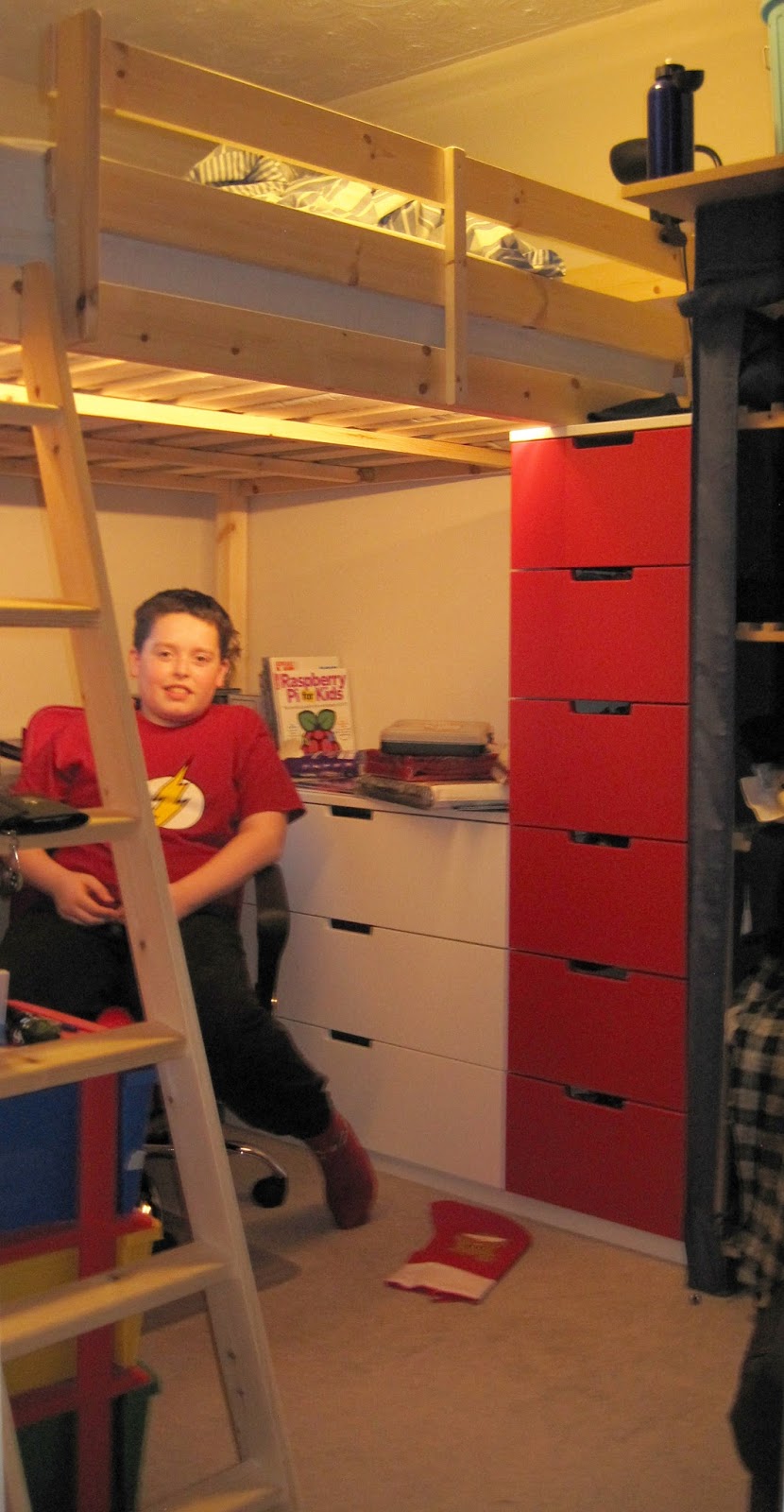
Alex under his loft bed
Having moved in it seems like every weekend is filled with a never ending "todo" list of jobs. From clearing gutters to building a desk in the study. Eight weeks on and the list seems to be slowly shrinking meaning I can even do some lower priority things like the server rack which was actually a fun project.


Joshua in his completed roomThe holidays this year afforded me some time to finish the boys bedrooms. They both got loft beds with a substantial area underneath. This allows them both to have double beds along with a desk and plenty of storage. Completing the rooms required the construction of some flat pack furniture which rather than simply do myself I supervised the boys doing it themselves.

Alexander building flat pack furniture
Teaching them by letting them get on with it was a surprisingly effective and both of them got the hang of the construction method pretty quickly. There was only a couple of errors from which they learned immediately and did not repeat (draw bottoms having a finished side and front becomes back when you are constructing upside down)

Joshua assembling flat pack furniture
The house is starting to feel like home and soon all the problems will fade from memory while the good will remain. Certainly our first holiday season has been comfortable here and I look forward to many more re-reading our books.

Russ Allbery: Review: The Outskirter's Secret

Review: The Outskirter's Secret, by Rosemary Kirstein
Series: Steerswomen #2
Publisher: Del Rey
Copyright: 1992, 2001
Printing: 2001
ISBN: 0-345-46105-3
Format: Trade paperback
Pages: 389
This is a direct sequel to The Steerswoman, and I don't recommend starting here. I read this novel as part of The Steerswoman's Road omnibus, which is the edition reflected in the metadata (except for the page count, which is just this novel). There are a few plot constructs that occur depressingly often in SFF and almost always annoy me. One is books where nearly all of the book is just a journey from one place to another, without much interesting landscape along the way. Subtract additional points if the land is hostile and there are constant worries about food. Another is illness, or being unable to trust one's senses, or, worse, both. Somehow, this book manages to do both of those things and was still thoroughly enjoyable. This is exceptionally rare. After the conclusions reached in the previous book, Rowan and Bel are even more determined to reach the origin of the jewels on Bel's belt and gather more information. This means travel into the Outskirts, where Rowan has never been (and where people from the Inner Land almost never go). It also means close contact with Bel's people, who have an entirely different set of social rituals and who are notoriously prickly. Nearly all of The Outskirter's Secret is travel through the Outskirts while navigating Outskirter society, politics, and customs. It's anthropological fiction of a sort, particularly given the inquisitive and analytical mindset that Rowan brings to anything new. Anthropological SFF is another one of those things that normally leaves me cold, but which totally worked for me in this book. I rarely remember being this engaged in, or caring this much about, the customs and traditions of an invented and relatively primitive culture. Partly this is because Rowan's mindset continues to be fascinating and contagious. I kind of want to compare this series to Neal Stephenson's Anathem, but where Stephenson's novel was about the practice of organized science, the Steerswomen series is about the individual scholar and scientist. This could go badly in the hands of a lesser author, but Kirstein brilliantly balances analysis and theories with Rowan's child-like wonder in learning, peculiar and determined ethics, and emotional growth. She isn't a disinterested observer or an engineer with a wrench. She lets the world change her, works hard at finding her place and her own strength, and engages with it emotionally as much as she does intellectually. She's a wonderfully compelling character. Another significant factor to this book's success is the slow and deliberate way Kirstein mixes world-building revelations with the day-to-day struggles of the characters. There's much more to that than just the target of Rowan's investigations, and far more complexity and significance to the Outskirters than showed in first appearances. The world is also set up in a way that lets the readers guess various details before the characters, with their more limited knowledge, can work out: another tricky technique that Kirstein gets almost perfect. I never wanted to shake the characters for being dumb; usually, both Rowan and Bel leap to correct conclusions just shortly after the reader, and long before the reader is tired of following their thought processes. There was only one bit of world-building that took Rowan most of the book to figure out despite being obvious to me early in this novel, and I think that one was fair. She didn't have anywhere near enough information to work it out. Bel continues to be wonderful in numerous ways. But even better, Kirstein introduces us to Bel's people and highlights both similarities and differences. It's an excellent job of building a complex culture that feels human: varied, tradition-laden, practical, but also well-adapted to their environment and situation, and far more sophisticated than they might appear. I'm normally a hard sell for this sort of thing, but Kirstein got me thoroughly invested. One scene late in this novel where a tribe welcomes a newcomer is masterful and probably my favorite single moment of the series so far. Once again, unfortunately, the conclusion is a bit less than satisfying. The characters come away knowing more, planning more, but still with numerous unanswered questions. This is not a series that's in a hurry to get to major plot payoffs. Instead, it's a series that takes a close look at the cultures, relationships, emotions, and lives that it touches, and describes them in deft and engaging ways. The Outskirter's Secret is even better than The Steerswoman. Recommended. I bought the third and fourth books while only a little ways into this one and am eager to read them. Followed by The Lost Steersman. Rating: 9 out of 10

26 December 2015

Russ Allbery: Review: The Steerswoman

Review: The Steerswoman, by Rosemary Kirstein
Series: Steerswomen #1
Publisher: Del Rey
Copyright: 1989, 2003
Printing: 2003
ISBN: 0-345-46105-3
Format: Trade paperback
Pages: 264
I read this novel as part of The Steerswoman's Road omnibus, which is the edition reflected in the metadata (except for the page count, which is just this novel). Rowan is a steerswoman, a member of an order of traveling scholars in a world of generally medieval customs. This is a world of small villages and town blacksmiths, of swords, sailing ships, and lots of walking. Steerswomen (the order does include some men, but only rarely; the gender balance is left delightfully unexplained and unremarked) mostly travel routes through the Inner Lands until they decide to retire and do research and study. Sometimes, though, they get on the trail of something unexplained, and are driven to explain it. That's the case for Rowan at the start of this book: she's run across several peculiar flat jewels. No one seems to know what they are, their pattern of distribution is odd, and they're discovered in some decidedly strange places, such as embedded deep in a tree. It's a puzzle, and Rowan is determined to understand it. The Steerswoman opens with Rowan investigating a jewel owned by an innkeeper, and a chance meeting in his inn with an Outskirter who wears a whole belt of the same jewels. The Outskirters are nomadic tribes from the far west known for their prickly attitude, their ability in warfare, and their occasional raids. Those who live in the Inner Lands consider them barbarians. But Bel is curious, thoughtful, and happy to tell Rowan of the origin of her belt: her father found a huge number of the jewels embedded in the side of a cliff, far into the Outskirts. Rowan is immediately tempted to go there, but she has to report to the Archives first. Much to her surprise, Bel asks to accompany her. And then wizards start trying to kill them. The steerswomen are Kirstein's best bit of world-building and the anchor around which the rest of the story is told. Steerswomen have to answer all questions they're asked, truthfully. In return, they can ask a question of anyone and have to be answered truthfully. If anyone refuses to answer, or tells a deliberate lie, they're placed under the steerswomen's ban, and no steerswoman will answer their questions. This is woven deep into the culture of the Inner Lands... except for the wizards, who refuse to explain what they're doing or how to anyone, are under the ban, and don't care. They protect cities from dragons, build magical lighting, and occasionally start wars with other wizards in which numerous people die. They're effectively the rulers of this world insofar as it has rulers, and they're apparently quite interested in Rowan's search for these unexplained jewels. Rowan is a wonderful character. At the start of the book, she's the only steerswoman that the reader knows, so much of her early behavior is also world-building, showing us steerswomen. But as the story develops, we meet other steerswomen and Rowan develops into her own character: innocent in a way, but determined, ethical, and with a very deep store of self-knowledge and inner contemplation. I found the middle part of the book somewhat frustrating for the same reasons Rowan did. The ending lets her shine, in her own way, and it's deeply satisfying. The Steerswoman does pick up a third character along the way, a young boy named Will who hopes to become a wizard's apprentice, and to whom I never warmed. Part of the problem was structural: he's very suspicious of characters that the reader knows are entirely honorable. This is a difficult tone to pull off without irritating me, and Kirstein doesn't quite manage. She also shifts the story to the Will's perspective from time to time, and I never found his viewpoint very interesting. I warmed to him a bit by the climax, but I still don't think he added much to the story. Bel, though... Bel competes with Rowan as best character of this book. The other characters all have roles to play: Rowan is the steerswoman, integral to the world-building, and Will exemplifies another corner of the analytical process so central to this book and represents the appeal of the wizards. But Bel is just herself: irreverent, curious, loyal, dangerous, decisive, and adventurous. Rowan is the heart of the book and the primary protagonist, but I think Bel is its soul. I haven't said too much about the themes of this book, intentionally. Kirstein is doing something very interesting and subtle with the reader's expectations of a medieval world with wizards, and I think it's better experienced without spoilers. But it's also a character-driven story, a story of unlikely friendship between two very different women, and a story about the value of being true to yourself even when it's exceptionally dangerous. Rowan delighted me immediately, Bel grew on me over the course of the story, and the rough patches in the middle of the book faded in comparison to an excellent ending. Unfortunately, this is only part of a story. There is a climax, and we do know what the jewels are by the end of the book. But the journey has raised many more questions, most of which are not solved. The world has become far more complicated. Rowan has a lot left to learn and investigate. I recommend the omnibus, or getting the ebooks from Amazon where you can quickly get more, because you'll probably want to immediately start the second book. Followed by The Outskirter's Secret. Rating: 8 out of 10

Russ Allbery: kstart 4.2

kstart is a collection of two utilities for managing Kerberos tickets, particularly focused on the needs of long-running commands or daemons. This release has taken embarassingly long to release, given that the last release was in January of 2012. Sorry about that, particularly those who were stuck on various bugs! This code base, particularly the test suite, is in dire need of significant refactoring, which reduces my desire to work on it, and then I ran very, very short on free software time. This release is important because I think I've finally worked through all the various tricky complexity of startup when running a command under k5start. The core problem: the original k5start exited when authentication failed. However, it's very nice to start daemons that need a Kerberos ticket by running them via k5start. But if this is done during system startup, the network may not be up yet, and one may not be able to contact the KDC. It's very difficult to get the timing right just by adjusting init scripts. The core fix in this release is that k5start run as a daemon or with a command, and krenew run with the -i option, now keeps retrying the authentication or renewal until it succeeds. It's retried immediately and then with exponential backoff, starting with a delay of a second, until intervals of one minute, and then retried at a delay of one minute until it succeeds. Any command isn't run until the authentication works, so (unlike previous versions) k5start won't start the command without a Kerberos ticket. That should fix various problems people are having. There are also some new options to tweak the renewal behavior. -H can now be used in combination with -K to specify how long of a minimum ticket lifetime k5start or krenew should try to maintain. Alternately, there's now a -a flag that tells both to attempt an authentication or renewal every time they wake up (at the interval specified with -K). This probably should have been the default for -K originally, but I didn't change the original behavior for backwards compatibility. There are also a couple of bug fixes: the temporary ticket cache created by k5start is cleaned up properly, and the programs no longer incorrectly reject the combination of -b and -K or a command. You can get the latest version from the kstart distribution page.

25 December 2015

Norbert Preining: Plex Home Theater becomes OpenPHT release 1.5.0 for Debian sid and jessie

The nice guys from RasPlex have forked the abandoned Plex Home Theater into OpenPHT (github, Plex forum) and updated it with several improvements. Plex itself is now developing a new player called Plex Media Player, which unfortunately uses closed source components. I tried to build also the Plex Media Player for Debian, but a hitherto unreleased Qt versions is necessary, so I gave up for now. So here is a new built of OpenPHT for Debian/sid and jessie, amd64 and i386. This new package conflicts with the old plexhometheater. plex-debian-new Note also that the lines for sources.list have changed again. I will also remove the builds of plexhometheater from my server soon. sid and testing For sid use the following lines:
deb http://www.preining.info/debian/ openpht-sid main
deb-src http://www.preining.info/debian/ openpht-sid main
You can also grab the binary for amd64 directly here for amd64 and i386, you can get the source package with
dget http://www.preining.info/debian/pool/main/o/openpht/openpht_1.5.0.502-1.dsc
jessie For the stable release jessie, use the following lines:
deb http://www.preining.info/debian/ openpht-jessie main
deb-src http://www.preining.info/debian/ openpht-jessie main
You can also grab the binary for amd64 directly here for amd64 and i386, you can get the source package with
dget http://www.preining.info/debian/pool/main/o/openpht/openpht_1.5.0.502-1~bpo8+1.dsc
The release file and changes file are signed with my official Debian key 0x860CDC13. Now be ready for enjoying the next movie!

21 December 2015

David Bremner: Bootable Debian USB

Umm. Somehow I thought this would be easier than learning about live-build. Probably I was wrong. There are probably many better tutorials on the web. Two useful observations: zeroing the key can eliminate mysterious grub errors, and systemd-nspawn is pretty handy. One thing that should have been obvious, but wasn't to me is that it's easier to install grub onto a device outside of any container. Find device
 $ dmesg
Count sectors
 # fdisk -l /dev/sdx
Assume that every command after here is dangerous. Zero it out. This is overkill for a fresh key, but fixed a problem with reusing a stick that had a previous live distro installed on it.
 # dd if=/dev/zero of=/dev/sdx bs=1048576 count=$sectors
Make file system. There are lots of options. I eventually used parted
 # parted
 (parted) mklabel msdos
 (parted) mkpart primary ext2 1 -1
 (parted) set 1 boot on
 (parted) quit
Make a file system
 # mkfs.ext2 /dev/sdx1
 # mount /dev/sdx1 /mnt
Install the base system
 # debootstrap --variant=minbase jessie /mnt http://httpredir.debian.org/debian/
Install grub (no chroot needed)
 # grub-install --boot-directory /mnt/boot /dev/sdx1
Set a root password
 # chroot /mnt
 # passwd root
 # exit
create up fstab
# blkid -p /dev/sdc1   cut -f2 -d' ' > /mnt/etc/fstab
Now edit to fix syntax, tell ext2, etc... Now switch to system-nspawn, to avoid boring bind mounting, etc..
# systemd-nspawn -b -D /mnt
login to the container, install linux-base, linux-image-amd64, grub-pc EDIT: fixed block size of dd, based on suggestion of tg.

20 December 2015

Iain R. Learmonth: A Week of Debian

For the last week I have been stuck in England. For the vast majority of that time, I've had nothing to do except work on Debian and this blog post documents some of the things I worked on. Obviously spending a whole week on Debian, there's going to be some packaging involved. The following packages got new versions in unstable this last week: Packaging updates were one of the simpler tasks tackled this week though. I spent a lot of time this week on Debian Live along with others in the #debian-live IRC channel. Over the last week we achieved a number of things, possibly the most important being that all the generic live support packages (i.e. live-boot, live-config and live-tools) have now been converted into native packages, have their VCS repositories hosted on Alioth and have seen a good number of patches merged from the BTS and from the old patch system. All future patches will be managed via the BTS for Debian Live, as with other Debian projects. We've also put effort into getting documentation online again now that the live.debian.net server has been turned off and we now have the live-build documentation and the live-wrapper documentation hosted on the project's Alioth webspace. The live-wrapper user documentation was mostly written this week so may not be amazing. On the smaller task list for Debian Live, the KGB bots are now present in the channel and reporting on git commits, a number of the more popular URLs from live.debian.net are now being redirected to their new locations (although we've had to recover these URLs from web.archive.org, the list of redirections is certainly not complete) and we've made updates to the wiki pages about how to contribute to the project. Unfortunately, no one has stepped forwards as a new lead for live-build and so this package has been orphaned. This does not necessarily mean that the package will be removed from Debian any time soon, just that it does not currently have a maintainer. If you're interested in taking over maintainence of live-build, see #808048. For testing the core live support packages, new live images for stretch have been built using live-wrapper and are available here. There are known issues with the syslinux configuration and these are not isohybrid images. My other major project this week has been my efforts to form a Debian Metadata team. The Debian Metadata team would produce the frameworks and run the services that make data about Debian available in a number of formats to make the data as accessible as possible and to encourage its use both within Debian and in external projects. Currently this includes two experimental services: rdf.debian.net and map.debian.net. We're don't plan to duplicate any of the work done by UDD, but make the data aggregated in UDD more accessible to users and developers. This means publishing that data in JSON/JSONP, KML, RDF, iCalendar and any other format that makes sense. There may be instances where it makes sense to augment the published data with live data, for example mirror availability should probably be live and not just a recent snapshot. If you're interested in participating in the Debian Metadata team, you can register your interested on bug #808049. This is not a complete summary of all my activities over the last week, but for those interested, it should give you an idea of what I've been up to. Finally, for those of you that have been waiting for my write-up on the airgapped GnuPG master key, I decided in the end that my blog was not the right place for this. You can find the guide in two parts: key generation and key export to the YubiKey. I've tried to keep these guides as generic as possible while still being as useful as possible. While writing these up on the wiki, I've also created pages for OpenPGP and GnuPG and I've almost entirely rewritten the DebianKeyring wiki page. I discovered this awesome guide to OpenPGP concepts which I would recommend to anyone that is new to OpenPGP.

Lars Wirzenius: Software Freedom Conservancy donation

I just donated to Software Freedom Conservancy as a supporter. They do great, important work in GPL enforcement, and they need some money to continue it. You can help, too: https://sfconservancy.org/supporter/. See also, https://bits.debian.org/2015/12/conservancy-fundraising-campaign.html.
Lars Wirzenius: FUUG grant for Obnam development: what happened then

In September, The FUUG Foundation gave me a grant to buy some hardware for Obnam development. I used this money to buy a new desktop-ish machine, see below for details. It's sat in a corner, and I use it as a server: it's not normally connected to a monitor or keyboard. It runs Obnam benchmarks. Before this, I ran Obnam benchmarks and experiments on my laptop, or on BigV virtual servers donated by Bytemark. The hardware The parts: Not to brag, but it's a nice machine. Much more power than my 2012 era laptop. The SSD is the system drive, the HDDs are for running Obnam benchmarks on. The HDDs are not RAIDed. Each drive is a PV for LVM2. All the data on those drives is scratch data: it's not valuable, and I do not care if it is lost. In fact, most of the data gets created and deleted during a benchmark run, and usually the disks are empty. The SSD contains the host operating system, and the virtual disks for all the virtual machines. I assembled the machine myself, with the help of a friend, and installed Debian jessie on it. The Debian installation is pretty bare bones, just enough to run and manage a bunch of virtual machines using libvirt and ansible. All the actual work, including benchmarks, are run in virtual machines. The benchmarks The benchmarks are run by a kludge, called obbench, and the results are published at http://benchmark.obnam.org/. Here's a snapshot of the results so far:
date many files one big file
2015-09-28 2165.0 1381.9
2015-12-06 1461.6 384.0
In a bit over two months, I've made some significant progress, I think. The two benchmarks that I currently run are: These are two extreme cases of what a backup needs to deal with: either the file metadata, or its content. They incur different costs for a backup program. Thus, two benchmarks. In both cases, the benchmark consists of an initial backup, a restore, and a second backup, without changes to the live data. The second backup is an extreme case of what backups usually do: most data usually doesn't change, so keeping that in mind for optimisation is important. The above benchmarks are synthetic: they use data that's generated by a program (genbackupdata), so that they can be reproduced. Synthetic benchmarks are useful, especially for looking at particular aspects of a program's operation for optimisation. However, they do not necessarily reflect how a program behaves in actual use. I also run, by hand, experiments with real data. I have a snapshot of our home file server and my laptop on the benchmark machine. The snapshots are static, and do not get updated. I experiment by running Obnam backups manually, the initial full backup and a no-change incremental one. In early October, I couldn't finish the initial full backups. They took too long, more than a week. Now I can finish them in about a day. This remarkable change is not evident from the synthetic benchmarks. In numbers: 572986 files in the live data, containing 4.5 TiB. Initial backup, about 18.5 hours. Incremental backup, 4m13s. This is from a local disk to a local disk. In addition to these, I've run numerous experiments on the new machine. These would have been much less easy to run on my laptop, and so I probably wouldn't have. Running benchmarks was always painful on my laptop, since it does not have the necessary disk space, and I'd really rather like to use it for other things. The results Thanks to the benchmarks and experiments I've been able to take the in-development version of Obnam from being quite impractical for real use to being in experimental use for real data. I now use the new version as my primary backup of my laptop, with two secondary backups (with the old Obnam version, and rsync) in parallel. This would not have happened this year without the extra hardware. In addition to the Obnam work, I've used the new machine to develop a test suite for vmdebootstrap. My actual development still happens on my laptop, except for things that are heavy enough to be slow on the laptop. I've made sure I can do most development purely on my laptop, while offline, including running a CI system, and testing things on two architecture and three releases of Debian. I do not want my development to be dependent on incidental things such as network access, unless I'm doing things that by their nature depend on the network, such as publishing changes or releases.

Petter Reinholdtsen: Using appstream with isenkram to install hardware related packages in Debian

Around three years ago, I created the isenkram system to get a more practical solution in Debian for handing hardware related packages. A GUI system in the isenkram package will present a pop-up dialog when some hardware dongle supported by relevant packages in Debian is inserted into the machine. The same lookup mechanism to detect packages is available as command line tools in the isenkram-cli package. In addition to mapping hardware, it will also map kernel firmware files to packages and make it easy to install needed firmware packages automatically. The key for this system to work is a good way to map hardware to packages, in other words, allow packages to announce what hardware they will work with. I started by providing data files in the isenkram source, and adding code to download the latest version of these data files at run time, to ensure every user had the most up to date mapping available. I also added support for storing the mapping in the Packages file in the apt repositories, but did not push this approach because while I was trying to figure out how to best store hardware/package mappings, the appstream system was announced. I got in touch and suggested to add the hardware mapping into that data set to be able to use appstream as a data source, and this was accepted at least for the Debian version of appstream. A few days ago using appstream in Debian for this became possible, and today I uploaded a new version 0.20 of isenkram adding support for appstream as a data source for mapping hardware to packages. The only package so far using appstream to announce its hardware support is my pymissile package. I got help from Matthias Klumpp with figuring out how do add the required metadata in pymissile. I added a file debian/pymissile.metainfo.xml with this content:
<?xml version="1.0" encoding="UTF-8"?>
<component>
  <id>pymissile</id>
  <metadata_license>MIT</metadata_license>
  <name>pymissile</name>
  <summary>Control original Striker USB Missile Launcher</summary>
  <description>
    <p>
      Pymissile provides a curses interface to control an original
      Marks and Spencer / Striker USB Missile Launcher, as well as a
      motion control script to allow a webcamera to control the
      launcher.
    </p>
  </description>
  <provides>
    <modalias>usb:v1130p0202d*</modalias>
  </provides>
</component>
The key for isenkram is the component/provides/modalias value, which is a glob style match rule for hardware specific strings (modalias strings) provided by the Linux kernel. In this case, it will map to all USB devices with vendor code 1130 and product code 0202. Note, it is important that the license of all the metadata files are compatible to have permissions to aggregate them into archive wide appstream files. Matthias suggested to use MIT or BSD licenses for these files. A challenge is figuring out a good id for the data, as it is supposed to be globally unique and shared across distributions (in other words, best to coordinate with upstream what to use). But it can be changed later or, so we went with the package name as upstream for this project is dormant. To get the metadata file installed in the correct location for the mirror update scripts to pick it up and include its content the appstream data source, the file must be installed in the binary package under /usr/share/appdata/. I did this by adding the following line to debian/pymissile.install:
debian/pymissile.metainfo.xml usr/share/appdata
With that in place, the command line tool isenkram-lookup will list all packages useful on the current computer automatically, and the GUI pop-up handler will propose to install the package not already installed if a hardware dongle is inserted into the machine in question. Details of the modalias field in appstream is available from the DEP-11 proposal. To locate the modalias values of all hardware present in a machine, try running this command on the command line:
cat $(find /sys/devices/ grep modalias)
To learn more about the isenkram system, please check out my blog posts tagged isenkram.

19 December 2015

Dirk Eddelbuettel: RcppTOML 0.0.5

After a short hiatus, a new version of the (wonderfully useful, if I dare say so ;-) RcppTOML package is now on CRAN. RcppTOML lets R read the (absolutely awesome) TOML configuration file format--which is simply fabulous as it emphasizes strong readability for humans while at the same time supporting strong typing as well as immediate and clear error reports. At work, we're all fans now. The new version on CRAN mostly updates to an updated version of the underlying cpptoml library by Chase. Nothing much changed on the R side. Courtesy of CRANberries, there is a diffstat report for this release More information and examples are on the RcppTOML page.

This post by Dirk Eddelbuettel originated on his Thinking inside the box blog. Please report excessive re-aggregation in third-party for-profit settings.

Next.

Previous.