Search Results: "ean"

13 April 2017

Antoine Beaupr : New approaches to network fast paths

With the speed of network hardware now reaching 100 Gbps and distributed denial-of-service (DDoS) attacks going in the Tbps range, Linux kernel developers are scrambling to optimize key network paths in the kernel to keep up. Many efforts are actually geared toward getting traffic out of the costly Linux TCP stack. We have already covered the XDP (eXpress Data Path) patch set, but two new ideas surfaced during the Netconf and Netdev conferences held in Toronto and Montreal in early April 2017. One is a patch set called af_packet, which aims at extracting raw packets from the kernel as fast as possible; the other is the idea of implementing in-kernel layer-7 proxying. There are also user-space network stacks like Netmap, DPDK, or Snabb (which we previously covered). This article aims at clarifying what all those components do and to provide a short status update for the tools we have already covered. We will focus on in-kernel solutions for now. Indeed, user-space tools have a fundamental limitation: if they need to re-inject packets onto the network, they must again pay the expensive cost of crossing the kernel barrier. User-space performance is effectively bounded by that fundamental design. So we'll focus on kernel solutions here. We will start from the lowest part of the stack, the af_packet patch set, and work our way up the stack all the way up to layer-7 and in-kernel proxying.

af_packet v4 John Fastabend presented a new version of a patch set that was first published in January regarding the af_packet protocol family, which is currently used by tcpdump to extract packets from network interfaces. The goal of this change is to allow zero-copy transfers between user-space applications and the NIC (network interface card) transmit and receive ring buffers. Such optimizations are useful for telecommunications companies, which may use it for deep packet inspection or running exotic protocols in user space. Another use case is running a high-performance intrusion detection system that needs to watch large traffic streams in realtime to catch certain types of attacks. Fastabend presented his work during the Netdev network-performance workshop, but also brought the patch set up for discussion during Netconf. There, he said he could achieve line-rate extraction (and injection) of packets, with packet rates as high as 30Mpps. This performance gain is possible because user-space pages are directly DMA-mapped to the NIC, which is also a security concern. The other downside of this approach is that a complete pair of ring buffers needs to be dedicated for this purpose; whereas before packets were copied to user space, now they are memory-mapped, so the user-space side needs to process those packets quickly otherwise they are simply dropped. Furthermore, it's an "all or nothing" approach; while NIC-level classifiers could be used to steer part of the traffic to a specific queue, once traffic hits that queue, it is only accessible through the af_packet interface and not the rest of the regular stack. If done correctly, however, this could actually improve the way user-space stacks access those packets, providing projects like DPDK a safer way to share pages with the NIC, because it is well defined and kernel-controlled. According to Jesper Dangaard Brouer (during review of this article):
This proposal will be a safer way to share raw packet data between user space and kernel space than what DPDK is doing, [by providing] a cleaner separation as we keep driver code in the kernel where it belongs.
During the Netdev network-performance workshop, Fastabend asked if there was a better data structure to use for such a purpose. The goal here is to provide a consistent interface to user space regardless of the driver or hardware used to extract packets from the wire. af_packet currently defines its own packet format that abstracts away the NIC-specific details, but there are other possible formats. For example, someone in the audience proposed the virtio packet format. Alexei Starovoitov rejected this idea because af_packet is a kernel-specific facility while virtio has its own separate specification with its own requirements. The next step for af_packet is the posting of the new "v4" patch set, although Miller warned that this wouldn't get merged until proper XDP support lands in the Intel drivers. The concern, of course, is that the kernel would have multiple incomplete bypass solutions available at once. Hopefully, Fastabend will present the (by then) merged patch set at the next Netdev conference in November.

XDP updates Higher up in the networking stack sits XDP. The af_packet feature differs from XDP in that it does not perform any sort of analysis or mangling of packets; its objective is purely to get the data into and out of the kernel as fast as possible, completely bypassing the regular kernel networking stack. XDP also sits before the networking stack except that, according to Brouer, it is "focused on cooperating with the existing network stack infrastructure, and on use-cases where the packet doesn't necessarily need to leave kernel space (like routing and bridging, or skipping complex code-paths)." XDP has evolved quite a bit since we last covered it in LWN. It seems that most of the controversy surrounding the introduction of XDP in the Linux kernel has died down in public discussions, under the leadership of David Miller, who heralded XDP as the right solution for a long-term architecture in the kernel. He presented XDP as a fast, flexible, and safe solution. Indeed, one of the controversies surrounding XDP was the question of the inherent security challenges with introducing user-provided programs directly into the Linux kernel to mangle packets at such a low level. Miller argued that whatever protections are expected for user-space programs also apply to XDP programs, comparing the virtual memory protections to the eBPF (extended BPF) verifier applied to XDP programs. Those programs are actually eBPF that have an interesting set of restrictions:
  • they have a limited size
  • they cannot jump backward (and thus cannot loop), so they execute in predictable time
  • they do only static allocation, so they are also limited in memory
XDP is not a one-size-fits-all solution: netfilter, the TC traffic shaper, and other normal Linux utilities still have their place. There is, however, a clear use case for a solution like XDP in the kernel. For example, Facebook and Cloudflare have both started testing XDP and, in Facebook's case, deploying XDP in production. Martin Kafai Lau, from Facebook, presented the tool set the company is using to construct a DDoS-resilience solution and a level-4 load balancer (L4LB), which got a ten-times performance improvement over the previous IPVS-based solution. Facebook rolled out its own user-space solution called "Droplet" to detect hostile traffic and deploy blocking rules in the form of eBPF programs loaded in XDP. Lau demonstrated the way Facebook deploys a three-part chained eBPF program: the first part allows debugging and dumping of packets, the second is Droplet itself, which drops undesirable traffic, and the last segment is the load balancer, which mangles the packets to tweak their destination according to internal rules. Droplet can drop DDoS attacks at line rate while keeping the architecture flexible, which were two key design requirements. Gilberto Bertin, from Cloudflare, presented a similar approach: Cloudflare has a tool that processes sFlow data generated from iptables in order to generate cBPF (classic BPF) mitigation rules that are then deployed on edge routers. Those rules are created with a tool called bpfgen, part of Cloudflare's BSD-licensed bpftools suite. For example, it could create a cBPF bytecode blob that would match DNS queries to any example.com domain with something like:
    bpfgen dns *.example.com
Originally, Cloudflare would deploy those rules to plain iptables firewalls with the xt_bpf module, but this led to performance issues. It then deployed a proprietary user-space solution based on Solarflare hardware, but this has the performance limitations of user-space applications getting packets back onto the wire involves the cost of re-injecting packets back into the kernel. This is why Cloudflare is experimenting with XDP, which was partly developed in response to the company's problems, to deploy those BPF programs. A concern that Bertin identified was the lack of visibility into dropped packets. Cloudflare currently samples some of the dropped traffic to analyze attacks; this is not currently possible with XDP unless you pass the packets down the stack, which is expensive. Miller agreed that the lack of monitoring for XDP programs is a large issue that needs to be resolved, and suggested creating a way to mark packets for extraction to allow analysis. Cloudflare is currently in a testing phase with XDP and it is unclear if its whole XDP tool chain will be publicly available. While those two companies are starting to use XDP as-is, there is more work needed to complete the XDP project. As mentioned above and in our previous coverage, massive statistics extraction is still limited in the Linux kernel and introspection is difficult. Furthermore, while the existing actions (XDP_DROP and XDP_TX, see the documentation for more information) are well implemented and used, another action may be introduced, called XDP_REDIRECT, which would allow redirecting packets to different network interfaces. Such an action could also be used to accelerate bridges as packets could be "switched" based on the MAC address table. XDP also requires network driver support, which is currently limited. For example, the Intel drivers still do not support XDP, although that should come pretty soon. Miller, in his Netdev keynote, focused on XDP and presented it as the standard solution that is safe, fast, and usable. He identified the next steps of XDP development to be the addition of debugging mechanisms, better sampling tools for statistics and analysis, and user-space consistency. Miller foresees a future for XDP similar to the popularization of the Arduino chips: a simple set of tools that anyone, not just developers, can use. He gave the example of an Arduino tutorial that he followed where he could just look up a part number and get easy-to-use instructions on how to program it. Similar components should be available for XDP. For this purpose, the conference saw the creation of a new mailing list called xdp-newbies where people can learn how to create XDP build environments and how to write XDP programs.

In-kernel layer-7 proxying The third approach that struck me as innovative is the idea of doing layer-7 (application) proxying directly in the kernel. This comes from the idea that, traditionally, we build firewalls to segregate traffic and apply controls, but as most services move to HTTP, those policies become ineffective. Thomas Graf, presented this idea during Netconf using a Star Wars allegory: what if the Death Star were a server with an API? You would have endpoints like /dock or /comms that would allow you to dock a ship or communicate with the Death Star. Those API endpoints should obviously be public, but then there is this /exhaust-port endpoint that should never be publicly available. In order for a firewall to protect such a system, it must be able to inspect traffic at a higher level than the traditional address-port pairs. Graf presented a design where the kernel would create an in-kernel socket that would negotiate TCP connections on behalf of user space and then be able to apply arbitrary eBPF rules in the kernel. Graf's design of in-kernel proxying In this scenario, instead of doing the traditional transfer from Netfilter's TPROXY to user space, the kernel directly decapsulates the HTTP traffic and passes it to BPF rules that can make decisions without doing expensive context switches or memory copies in the case of simply wanting to refuse traffic (e.g. issue an HTTP 403 error). This, of course, requires the inclusion of kTLS to process HTTPS connections. HTTP2 support may also prove problematic, as it multiplexes connections and is harder to decapsulate. This design was described as a "pure pre-accept() hook". Starovoitov also compared the design to the kernel connection multiplexer (KCM). Tom Herbert, KCM's author, agreed that it could be extended to support this, but would require some extensions in user space to provide an interface between regular socket-based applications and the KCM layer. In any case, if the application does TLS (and lots of them do), kTLS gets tricky because it breaks the end-to-end nature of TLS, in effect becoming a man in the middle between the client and the application. Eric Dumazet argued that HA-Proxy already does things like this: it uses splice() to avoid copying too much data around, but it still does a context switch to hand over processing to user space, something that could be fixed in the general case. Another similar project that was presented at Netdev is the Tempesta firewall and reverse-proxy. The speaker, Alex Krizhanovsky, explained the Tempesta developers have taken one person month to port the mbed TLS stack to the Linux kernel to allow an in-kernel TLS handshake. Tempesta also implements rate limiting, cookies, and JavaScript challenges to mitigate DDoS attacks. The argument behind the project is that "it's easier to move TLS to the kernel than it is to move the TCP/IP stack to user space". Graf explained that he is familiar with Krizhanovsky's work and he is hoping to collaborate. In effect, the design Graf is working on would serve as a foundation for Krizhanovsky's in-kernel HTTP server (kHTTP). In a private email, Graf explained that:
The main differences in the implementation are currently that we foresee to use BPF for protocol parsing to avoid having to implement every single application protocol natively in the kernel. Tempesta likely sees this less of an issue as they are probably only targeting HTTP/1.1 and HTTP/2 and to some [extent] JavaScript.
Neither project is really ready for production yet. There didn't seem to be any significant pushback from key network developers against the idea, which surprised some people, so it is likely we will see more and more layer-7 intelligence move into the kernel sooner rather than later.

Conclusion All of this work aims at replacing a rag-tag bunch of proprietary solutions that recently came up to bypass the Linux kernel TCP/IP stack and improve performance for firewalls, proxies, and other key edge network elements. The idea is that, unless the kernel improves its performance, or at least provides a way to bypass its more complex code paths, people will work around it. With this set of solutions in place, engineers will now be able to use standard APIs to hook high-performance systems into the Linux kernel.
The author would like to thank the Netdev and Netconf organizers for travel assistance, Thomas Graf for a review of the in-kernel proxying section of this article, and Jesper Dangaard Brouer for review of the af_packet and XDP sections. Note: this article first appeared in the Linux Weekly News.


Raphaël Hertzog: Freexian s report about Debian Long Term Support, March 2017

A Debian LTS logoLike each month, here comes a report about the work of paid contributors to Debian LTS. Individual reports In March, about 190 work hours have been dispatched among 14 paid contributors. Their reports are available: Evolution of the situation The number of sponsored hours has been unchanged but will likely decrease slightly next month as one sponsor will not renew his support (because they have switched to CentOS). The security tracker currently lists 52 packages with a known CVE and the dla-needed.txt file 40. The number of open issues continued its slight increase not worrisome yet but we need to keep an eye on this situation. Thanks to our sponsors New sponsors are in bold.

No comment Liked this article? Click here. My blog is Flattr-enabled.

11 April 2017

Matthew Garrett: Disabling SSL validation in binary apps

Reverse engineering protocols is a great deal easier when they're not encrypted. Thankfully most apps I've dealt with have been doing something convenient like using AES with a key embedded in the app, but others use remote protocols over HTTPS and that makes things much less straightforward. MITMProxy will solve this, as long as you're able to get the app to trust its certificate, but if there's a built-in pinned certificate that's going to be a pain. So, given an app written in C running on an embedded device, and without an easy way to inject new certificates into that device, what do you do?

First: The app is probably using libcurl, because it's free, works and is under a license that allows you to link it into proprietary apps. This is also bad news, because libcurl defaults to having sensible security settings. In the worst case we've got a statically linked binary with all the symbols stripped out, so we're left with the problem of (a) finding the relevant code and (b) replacing it with modified code. Fortuntely, this is much less difficult than you might imagine.

First, let's find where curl sets up its defaults. Curl_init_userdefined() in curl/lib/url.c has the following code:
set->ssl.primary.verifypeer = TRUE;
set->ssl.primary.verifyhost = TRUE;
#ifdef USE_TLS_SRP
set->ssl.authtype = CURL_TLSAUTH_NONE;
#endif
set->ssh_auth_types = CURLSSH_AUTH_DEFAULT; /* defaults to any auth
type */
set->general_ssl.sessionid = TRUE; /* session ID caching enabled by
default */
set->proxy_ssl = set->ssl;

set->new_file_perms = 0644; /* Default permissions */
set->new_directory_perms = 0755; /* Default permissions */

TRUE is defined as 1, so we want to change the code that currently sets verifypeer and verifyhost to 1 to instead set them to 0. How to find it? Look further down - new_file_perms is set to 0644 and new_directory_perms is set to 0755. The leading 0 indicates octal, so these correspond to decimal 420 and 493. Passing the file to objdump -d (assuming a build of objdump that supports this architecture) will give us a disassembled version of the code, so time to fix our problems with grep:
objdump -d target grep --after=20 ,420 grep ,493

This gives us the disassembly of target, searches for any occurrence of ",420" (indicating that 420 is being used as an argument in an instruction), prints the following 20 lines and then searches for a reference to 493. It spits out a single hit:
43e864: 240301ed li v1,493
Which is promising. Looking at the surrounding code gives:
43e820: 24030001 li v1,1
43e824: a0430138 sb v1,312(v0)
43e828: 8fc20018 lw v0,24(s8)
43e82c: 24030001 li v1,1
43e830: a0430139 sb v1,313(v0)
43e834: 8fc20018 lw v0,24(s8)
43e838: ac400170 sw zero,368(v0)
43e83c: 8fc20018 lw v0,24(s8)
43e840: 2403ffff li v1,-1
43e844: ac4301dc sw v1,476(v0)
43e848: 8fc20018 lw v0,24(s8)
43e84c: 24030001 li v1,1
43e850: a0430164 sb v1,356(v0)
43e854: 8fc20018 lw v0,24(s8)
43e858: 240301a4 li v1,420
43e85c: ac4301e4 sw v1,484(v0)
43e860: 8fc20018 lw v0,24(s8)
43e864: 240301ed li v1,493
43e868: ac4301e8 sw v1,488(v0)

Towards the end we can see 493 being loaded into v1, and v1 then being copied into an offset from v0. This looks like a structure member being set to 493, which is what we expected. Above that we see the same thing being done to 420. Further up we have some more stuff being set, including a -1 - that corresponds to CURLSSH_AUTH_DEFAULT, so we seem to be in the right place. There's a zero above that, which corresponds to CURL_TLSAUTH_NONE. That means that the two 1 operations above the -1 are the code we want, and simply changing 43e820 and 43e82c to 24030000 instead of 24030001 means that our targets will be set to 0 (ie, FALSE) rather than 1 (ie, TRUE). Copy the modified binary back to the device, run it and now it happily talks to MITMProxy. Huge success.

(If the app calls Curl_setopt() to reconfigure the state of these values, you'll need to stub those out as well - thankfully, recent versions of curl include a convenient string "CURLOPT_SSL_VERIFYHOST no longer supports 1 as value!" in this function, so if the code in question is using semi-recent curl it's easy to find. Then it's just a matter of looking for the constants that CURLOPT_SSL_VERIFYHOST and CURLOPT_SSL_VERIFYPEER are set to, following the jumps and hacking the code to always set them to 0 regardless of the argument)

comment count unavailable comments

Sean Whitton: coffeereddit

Most people I know can handle a single coffee per day, sometimes even forgetting to drink it. I never could understand how they did it. Talking about this with a therapist I realised that the problem isn t necessary the caffeine, it s my low tolerance of less than razor sharp focus. Most people accept they have slumps in their focus and just work through them. binarybear on reddit

Riku Voipio: Deploying OBS

Open Build Service from SuSE is web service building deb/rpm packages. It has recently been added to Debian, so finally there is relatively easy way to set up PPA style repositories in Debian. Relative as in "there is a learning curve, but nowhere near the complexity of replicating Debian's internal infrastructure". OBS will give you both repositories and build infrastructure with a clickety web UI and command line client (osc) to manage. See Hectors blog for quickstart instructions. Things to learned while setting up OBSMe coming from Debian background, and OBS coming from SuSE/RPM world, there are some quirks that can take by surprise. Well done packagingUsually web services are a tough fit for Distros. The cascade of weird dependencies and build systems where the only practical way to build an "open source" web service is by replicating the upstream CI scripts. Not in case of OBS. Being done by distro people shows. OBS does automatic rebuilds of reverse dependenciesAka automatic binNMUs when you update a library. This however means you need lots of build power around. OBS has it's own dependency resolver on the server that recalculate what packages need rebuilding when - workers just get a list of packages to install for build-depends. This a major divergence from Debian, where sbuild handles dependencies client side. The OBS dependency handler doesn't handle virtual packages* / alternative build-deps like Debian - you may have to add a specific "Prefer: foo-dev" into the OBS project config to solve alternative choices. OBS server and worker do http requests in both directionsOn startup workers connect to OBS server, open a TCP port and wait requests coming OBS. Having connections both directions is a bit of hassle firewall-wise. On the bright side, no need to setup uploads via FTP here.. Signing repositories is complicatedWith Debian 9.0 making signed repositories pretty much mandatory, OBS makes signing rather complicated. obs-signd isn't included in Debian, since it depends on gnupg patch that hasn't been upstreamed. Fortunately I found a workaround. OBS signs release files with /usr/bin/sign -d /path/to/release. Where replacing the obs-signd provided sign command your own script is easy ;) Git integration is rather bolted-on than integratedOBS provides a method to integrate with git using services. - There is no clickety UI to link to git repo, instead you make an xml file called _service with osc. There is no way to have debian/ tree in git. The upstream community is friendlyIncluding the happiest thanks from an upstream I've seen recently. SummaryAll in all rather satisfied with OBS. If you have a home-grown jenkins etc based solution for building DEB/RPM packages, you should definitely consider OBS. For simpler uses, no need to install OBS yourself, openSUSE public OBS will happily build Debian packages for you. *How useful are virtual packages anymore? "foo-defaults" packages seem to be the go-to solution for most real usecases anyways.

Antoine Beaupr : A report from Netconf: Day 1

As is becoming traditional, two times a year the kernel networking community meets in a two-stage conference: an invite-only, informal, two-day plenary session called Netconf, held in Toronto this year, and a more conventional one-track conference open to the public called Netdev. I was invited to cover both conferences this year, given that Netdev was in Montreal (my hometown), and was happy to meet the crew of developers that maintain the network stack of the Linux kernel. This article covers the first day of the conference which consisted of around 25 Linux developers meeting under the direction of David Miller, the kernel's networking subsystem maintainer. Netconf has no formal sessions; although some people presented slides, interruptions are frequent (indeed, encouraged) and the focus is on hashing out issues that are blocked on the mailing list and getting suggestions, ideas, solutions, and feedback from their peers.

Removing ndo_select_queue() One of the first discussions that elicited a significant debate was the ndo_select_queue() function, a key component of the Linux polling system that determines when and how to send packets on a network interface (see netdev_pick_tx and friends). The general question was whether the use of ndo_select_queue() in drivers is a good idea. Alexander Duyck explained that Intel people were considering using ndo_select_queue() for receive/transmit queue matching. Intel drivers do not currently use the hook provided by the Linux kernel and it turns out no one is happy with ndo_select_queue(): the heuristics it uses don't really please anyone. The consensus (including from Duyck himself) seemed to be that it should just not be used anymore, or at least not used for that specific purpose. The discussion turned toward the wireless network stack, which uses it extensively, but for other purposes. Johannes Berg explained that the wireless stack uses ndo_select_queue() for traffic classification, for example to get voice traffic through even if the best-effort queue is backed up. The wireless stack could stop using it by doing flow control completely inside the wireless stack, which already uses the fq_codel flow-control mechanism for other purposes, so porting away from ndo_select_queue() seems possible there. The problem then becomes how to update all the drivers to change that behavior, which would be a lot of work. Still, it seems people are moving away from a generic ndo_select_queue() interface to stack-specific or even driver-specific (in the case of Intel) queue management interfaces.

refcount_t followup There was a followup discussion on the integration of the refcount_t type into the network stack, which we covered recently. This type is meant to be an in-kernel defense against exploits based on overflowing or underflowing an object's reference count. The consensus seems to be that having refcount_t used for debugging is acceptable, but it cannot be enabled by default. An issue that was identified is that the networking developers are fairly sure that introducing refcount_t would have a severe impact on performance, but they do not have benchmarks to prove it, something Miller identified as a problem that needs to be worked on. Miller then expressed some openness to the idea of having it as a kernel configuration option. A similar discussion happened, on the second day, regarding the KASan memory error detector which was covered when it was introduced in 2014. Eric Dumazet warned that there could be a lot of issues that cannot be detected by KASan because of the way the network stack often bypasses regular memory-allocation routines for performance reasons. He also noted that this can sometimes mean the stack may go over the regular 10% memory limit (the tcp_mem parameter, described in the tcp(7) man page) for certain operations, especially when rebuilding out of order packets with lots of parallel TCP connections. Therefore it was proposed that these special memory recycling tricks could be optionally disabled, at run or compile-time, to instrument proper memory tracking. Dumazet argued this was a situation similar to refcount_t in that we need a way to disable high performance to make the network stack easier to debug with KAsan. The problem with optional parameters is that they are often disabled in production or even by default, which, in turn, means that critical bugs cannot actually be found because the code paths are not tested. When I asked Dumazet about this, he explained that Google performs integration testing of new kernels before putting them in production, and those toggles could be enabled there to find and fix those bugs. But he agreed that certain code paths are then not tested until the code gets deployed in production. So it seems the status quo remains: security folks wants to improve the reliability of the kernel, but the network folks can't afford the performance cost. Yet it was clear in the discussions that the team cares about security issues and wants those issues to be fixed; the impact of some of the solutions is just too big.

Lightweight wireless management packet access Berg explained that some users need to have high-performance access to certain management frames in the wireless stack and wondered how to best expose those to user space. The wireless stack already allows users to clone a network interface in "monitor" mode, but this has a big performance cost, as the radiotap header needs to be constructed from scratch and the packet header needs to be copied. As wireless improves and the bandwidth rises to gigabit levels, this can become significant bottleneck for packet sniffers or reporting software that need to know precisely what's going on over the air outside of the regular access point client operation. It seems the proper way to do this is with an eBPF program. As Miller summarized, just add another API call that allows loading a BPF program into the kernel and then those users can use a BPF filtering point to get the statistics they need. This will require an extra hook in the wireless stack, but it seems like this is the way that will be taken to implement this feature.

VLAN 0 inconsistencies Hannes Frederic Sowa brought up the seemingly innocuous question of "how do we handle VLAN 0?" In theory, VLAN 0 means "no VLAN". But the Linux kernel currently handles this differently depending on whether the VLAN module is loaded and whether a VLAN 0 interface was created. Sometimes the VLAN tag is stripped, sometimes not. It turns out the semantics of this were accidentally changed last time there was a change here and this was originally working but is now broken. Sowa therefore got the go-ahead to fix this to make the behavior consistent again.

Loopy fun Then it came the turn of Jamal Hadi Salim, the maintainer of the kernel's traffic-control (tc) subsystem. The first issue he brought up is a problem in the tc REDIRECT action that can create infinite loops within the kernel. The problem can be easily alleviated when loops are created on the same interface: checks can be added that just drop packets coming from the same device and rate-limit logging to avoid a denial-of-service (DoS) condition. The more serious problem occurs when a packet is forwarded from (say) interface eth0 to eth1 which then promptly redirects it from eth1 back to eth0. Obviously, this kind of problem can only be created by a user with root access so, at first glance, those issues don't seem that serious: admins can shoot themselves in the foot, so what? But things become a little more serious when you consider the container case, where an untrusted user has root access inside a container and should have constrained resource limitations. Such a loop could allow this user to deploy an effective DoS attack against a whole group of containers running on the same machine. Even worse, this endless loop could possibly turn into a deadlock in certain scenarios, as the kernel could try to transmit the packet on the same device it originated from and block, progressively filling the queues and eventually completely breaking network access. Florian Westphal argued that a container can already create DoS conditions, for example by doing a ping flood. According to Salim, this whole problem was created when two bits used for tracking such packets were reclaimed from the skb structure used to represent packets in the kernel. Those bits were a simple TTL (time to live) field that was incremented on each loop and dropped after a pre-determined limit was reached, breaking infinite loops. Salim asked everyone if this should be fixed or if we should just forget about this issue and move on. Miller proposed to keep a one-behind state for the packet, fixing the simplest case (two interfaces). The general case, however, would requite a bitmap of all the interfaces to be scanned, which would impose a large overhead. Miller said an attempt to fix this should somehow be made. The root of the problem is that the network maintainers are trying to reduce the size of the skb structure, because it's used in many critical paths of the network stack. Salim's position is that, without the TTL fields, there is no way to fix the general case here, and this constitutes a security issue. So either the bits need to be brought back, or we need to live with the inherent DoS threat.

Dumping large statistics sets Another issue Salim brought up was the question of how to export large statistics sets from the kernel. It turns out that some use cases may end up dumping a lot of data. Salim mentioned a real-world tc use case that calls for reading six-million entries. The current netlink-based API provides a way to get only 20 entries at a time, which means it takes forever to dump the state of all those policy actions. Salim has a patch that changes the dump size be eight times the NLMSG_GOOD_SIZE, which improves performance by an order of magnitude already, although there are issues with checking the user-space buffer size there. But a more complete solution is needed. What Salim proposed was a way to ask only for the states that changed since the last dump was requested. He has a patch to add a last_access field to the netlink_callback structure used by netlink_dump() to output data; that raised the question of how to actually use that field. Since Salim fetches that data every five seconds, he figured he could just tell the kernel to return all the nodes that changed in that period. But then if the dump takes more than five seconds to complete, the next dump may be missing states that changed during the extra delay. An alternative mechanism would be for the user-space utility to keep the time stamp it requested and use that as a delta for the next dump. It turns out this is a larger problem than just tc. Dumazet mentioned this was an issue with fq_codel classes: he would even like to be able to dump those statistics faster than every five seconds. Roopa Prabhu mentioned that Cumulus also has similar problems dumping stats from bridges, so clearly a more generic solution is needed here. There is, however, a fundamental problem with dumping large statistics sets from the kernel: those statistics are constantly changing while the dump is created and unless versioning or locking mechanisms are used which would slow things down the data returned is bound to be only an approximation of reality. Salim promised to send a set of RFC patches to further discussions regarding this issue, but during the following Netdev conference, Berg published a patch to fix this ten-year-old issue, which brought cheers from the audience.
The author would like to thank the Netconf and Netdev organizers for travel to, and hosting assistance in, Toronto. Many thanks to Berg, Dumazet, Salim, and Sowa for their time taken for a technical review of this article. Note: this article first appeared in the Linux Weekly News.

Antoine Beaupr : A report from Netconf: Day 2

This article covers the second day of the informal Netconf discussions, held on on April 4, 2017. Topics discussed this day included the binding of sockets in VRF, identification of eBPF programs, inconsistencies between IPv4 and IPv6, changes to data-center hardware, and more. (See this article for coverage from the first day of discussions).

How to bind to specific sockets in VRF One of the first presentations was from David Ahern of Cumulus, who presented a few interesting questions for the audience. His first was the problem of binding sockets to a given interface. Right now, there are four different ways this can be done:
  • the old SO_BINDTODEVICE generic socket option (see socket(7))
  • the IP_PKTINFO, IP-specific socket option (see ip(7)), introduced in Linux 2.2
  • the IP_UNICAST_IF flag, introduced in Linux 3.3 for WINE
  • the IPv6 scope ID suffix, part of the IPv6 addressing standard
So there's a problem of having too many ways of doing the same thing, something that cannot really be fixed without breaking ABI compatibility. But even worse, conflicts between those options are not reported by the kernel so it's possible for a user to set up socket flags in a way that certain flags override others and there are no checks made or errors reported. It was agreed that the user should get some notification of conflicting changes here, at least. Furthermore, binding sockets to a specific VRF (Virtual Routing and Forwarding) device is not currently possible, so Ahern asked what the best way to do this would be, considering the many options available. A use case example is a UDP multicast socket that could be bound to a specific interface within a VRF. This is an old problem: Tom Herbert explained that there were previous discussions about making the bind() system call more programmable so that, for example, you could bind() a UDP socket to a discrete list of IP addresses or a subnet. So he identified this issue as a broader problem that should be addressed by making the interfaces more generic. Ahern explained that it is currently possible to bind sockets to the slave device of a VRF even though that should not be allowed. He also raised the question of how the kernel should tell which socket should be selected for incoming packets. Right now, there is a scoring mechanism for UDP sockets, but that cannot be used directly in this more general case. David Miller said that there are already different ways of specifying scope: there is the VRF layer and the namespace ("netns") layer. A long time ago, Miller reluctantly accepted the addition of netns keys everywhere, swallowing the performance cost to gain flexibility. He argued that a new key should not be added and instead existing infrastructure should be reused. Herbert argued this was exactly the reason why this should be simplified: "if we don't answer the question, people will keep on trying this". For example, one can use a VRF to limit listening addresses, but it gets complicated if we need a device for every address. It seems the consensus evolved towards using, IP_UNICAST_IF, added back in 2012, which is accessible for non-root users. It is currently limited to UDP and RAW sockets, but it could be extended for TCP.

XDP and eBPF program identification Ahern then turned to the problem of extracting BPF programs from the kernel. He gave the example of a simple cBPF (classic BPF) filter that checks for ARP packets. If the filter is read back from the kernel, the user gets a blob of binary data, which is hard to interpret. There is an kernel verifier that can show C-like output, but that is also difficult to interpret. Ahern then added annotations to his slide that showed what the original program actually does, which was a good demonstration of why such a feature is needed. Ahern explained that, at least for cBPF, it should be possible to recover the original plaintext, or at least something close to the original program. A first step would be to replace known constants (like 0x806 for ARP). Even with eBPF, it should be possible to improve the output. Alexei Starovoitov, the BPF maintainer, explained that it might make sense to start by returning information about the maps used by an eBPF program. Then more complex data structures could be inspected once we know their type. The first priority is to get simple debugging tools working but, in the long term, the goal is a full decompiler that can reconstruct instructions into a human-readable program. The question that remains is how to return this data. Ahern explained that right now the bpf() system call copies the data to a different file descriptor, but it could just fill in a buffer. Starovoitov argued for a file descriptor; that would allow the kernel to stream everything through the same descriptor instead of having many attach points. Netlink cannot be used for this because of its asynchronous nature. A similar issue regarding the way we identify express data path (XDP) programs (which are also written in BPF) was raised by Daniel Borkmann from Covalent. Miller explained that users will want ways to figure out which XDP program was installed, so XDP needs an introspection mechanism. We currently have SHA-1 identifiers that can be internally used to tell which binary is currently loaded but those are not exposed to user space. Starovoitov mentioned it is now just a boolean that shows if a program is loaded or not. A use case for this, on top of just trying to figure out which BPF program is loaded, is to actually fetch the source code of a BPF program that was deployed in the field for which the source was lost. It is still uncertain that it will be possible to extract an exact copy that could then be recompiled into the same program. Starovoitov added that he needed this in production to do proper reporting.

IPv4/IPv6 equivalency The last issue or set of issues that Ahern brought up was the question of inconsistencies between IPv4 and IPv6. It turns out that, because both protocols were (naturally) implemented separately, there are inconsistencies in how they are handled in the Linux kernel, which affect, among other things, the VRF framework. The first example he gave was the fact that IPv6 addresses added on the loopback interface generate unreachable routes in the main routing table, yet this doesn't happen with IPv4 addresses. Hannes Frederic Sowa explained this was part of the IPv6 specification: there are stronger restrictions on loopback interfaces in IPv6 than IPv4. Ahern explained that VRF loopback interfaces do not implement these restrictions and wanted to know if this was a problem. Another issue is that anycast routes are added to the wrong interface. This is apparently not specific to VRF: this was done "just because Java", and has been there from day one. It seems that the Java Virtual Machine builds its own routing table and assumes this behavior, so changing this would break every JVM out there, which is obviously not acceptable. Finally, Martin Kafai Lau asked if work should be done to merge the IPv4 and IPv6 FIB (forwarding information base) trees. The FIB tree is the data structure that represents routing tables in the Linux kernel. Miller explained that the two trees are not semantically equivalent: while IPv6 does source-address lookup and routing, IPv4 does not. We can't remove the source lookups from IPv6, because "people probably use that". According to Alexander Duyck, adding source tables to IPv4 would degrade performance to the level of IPv6 performance, which was jokingly referred to as an incentive to switch to IPv6. More seriously, Sowa argued that using the same compressed tree IPv4 uses in IPv6 could make sense. People may want to have source routing in IPv4 as well. Miller argued that the kernel is optimized for 32-bit addresses in IPv4, and conceded that it could be scaled to 64-bit subnets, but 128-bit addresses would be much harder. Sowa suggested that they could be limited to 64 bits, as global routes that are announced over BGP usually have such a limit, and more specific routes are usually at discrete prefixes like /65, /127 (for interconnect links) or /128 for (for point-to-point links). He expressed concerns over the reliability of such an implementation so, at this point, it is unlikely that the data structures could be merged. What is more likely is that the code path could be merged and simplified, while keeping the data structures separate.

Modules options substitutions The next issue that was raised was from Ji P rko, who asked how to pass configuration options to a driver before the driver is initialized. Some chips require that some settings be sent before the firmware is loaded, which leads to a weird situation where there is a need to address a device before it's actually recognized by the kernel. The question then can be summarized as to how to pass information to a device that doesn't exist yet. The answer seems to be that devlink could do this, as it has access to the full device tree and, therefore, to devices that can be addressed by (say) PCI identifiers. Then a possible devlink command could look something like:
    devlink dev pci/0000:03:00.0 option set foo bar
This idea raised a bunch of extra questions: some devices don't have a one-to-one mapping with the PCI bridge identifiers, for example, meaning that those identifiers cannot be used to access such devices. Another issue is that you may want to send multiple settings in a single transaction, which doesn't fit well in the devlink model. Miller then proposed to let the driver initialize itself to some state and wait for configuration to be sent when necessary. Another way would be to unregister the driver and re-register with the given configuration. Shrijeet Mukherjee explained that right now, Cumulus is doing this using horrible startup script magic by retrying and re-registering, but it would be nice to have a more standard way to do this.

Control over UAPI patches Another issue that came up was the problem of changes in the user-space API (UAPI) which break backward compatibility. P rko said that "we have to be more careful about those changes". The problem is that reviewers are not always available to make detailed reviews of such changes and may not notice API-breaking changes. P rko proposed creating a bot to check if a given patch introduces UAPI changes, changes in structs, or in netlink enums. Miller said he could block merges until discussions happen and that patchwork, which Miller uses to process patches from the mailing list, does some of this. He also pointed out there aren't enough test cases in the first place. Starovoitov argued UAPI isn't special, there are other ways of breaking backward compatibility. He expressed concerns that such a bot could create a false sense that everything is fine while a patch could break compatibility and not be detected. Miller countered that UAPI is special in that "we're stuck with it forever". He then went on to propose that, since there's a maintainer (or more) for each module, he can make sure that each maintainer explicitly approves changes to those modules.

Data-center hardware changes Starovoitov brought up the issue of a new type of hardware that is currently being deployed in data centers called a "multi-host NIC" (network interface card). It's a single NIC that is connected to multiple servers. Facebook, for example, uses this in its Yosemite platform that shoves twelve servers into a 2U rack mount, in three modules. Each module is made of four servers connected to the traditional switch fabric with a single NIC through PCI-Express. Mellanox and and Broadcom also have similar devices. One question is how to manage those devices. Since they are connected through a PCI-Express bus, Linux will see them as a NIC, yet they are also a little like switches, in that they interconnect multiple servers. Furthermore, the kernel security model assumes that a NIC is trusted, and gladly opens its own memory to NICs through DMA; this can become a huge security issue when the NIC is under the control of another server. This can especially become problematic if we consider that there could be TLS hardware offloading in the future with the introduction of in-kernel TLS stacks. The other problem is the question of reliability: since those devices are currently "dumb", they need to be managed just like a regular NIC. If the host managing the card crashes, it could disable a whole set of servers that rely on the same NIC. There could be an election process among the servers, but that complicates significantly what used to be a simple PCI connection. Mukherjee pointed out that the model Cisco uses for this is that the "smart NIC" is a "slave" of the main switch fabric. It's a daughter card, which makes it easier to manage from a network perspective. It is clear that Linux will need a way to represent those devices, probably through the newly introduced switchdev or DSA (distributed switch architecture), but it will be something to keep an eye on as density increases in the data center. There were many more discussions during Netconf, too many to cover here, but in the end, Miller thanked everyone for all the interesting topics as the participants dispersed for a day off to travel to Montreal to attend the following Netdev conference.
The author would like to thank the Netconf and Netdev organizers for travel to, and hosting assistance in, Toronto. Many thanks to Alexei Starovoitov for his time taken for a technical review of this article. Note: this article first appeared in the Linux Weekly News.

10 April 2017

Daniel Pocock: If Alan Turing was born today, would he be a Muslim?

Alan Turing's name and his work are well known to anybody with a theoretical grounding in computer science. Turing developed his theories well before anybody invented file sharing, overclocking or mass surveillance. In fact, Turing was largely working in the absence of any computers at all: the transistor was only invented in 1947 and the microchip, the critical innovation that has made computing both affordable and portable, only came in 1960, four years after Turing's death. To this day, the Turing Test remains a well known challenge in the field of Artificial Intelligence. The most prestigious prize in computing, the A.M. Turing Award from the ACM, equivalent to the Nobel Prize in other fields of endeavour, is named in Turing's honour. (This year's award is another British scientist, Sir Tim Berners-Lee, inventor of the World Wide Web).
Potentially far more people know of Alan Turing for his groundbreaking work at Bletchley Park and the impact it had on cracking the Nazi's Enigma machines during World War 2, giving the allies an advantage against Hitler. While in his lifetime, Turing exposed the secret communications of the Nazis, in his death, he exposed something manifestly repugnant about his own society. Turing's challenges with his sexuality (or Britain's challenge with it) are just as well documented as his greatest scientific achievements. The 2014 movie The Imitation Game tells Turing's story, bringing together the themes from his professional and personal life. Had Turing chosen to flee British persecution by going abroad, he would be a refugee in the same sense as any person who crossed the seas to reach Europe today to avoid persecution elsewhere. Please prove me wrong In March, I blogged about the problem of racism that plagues Britain today. While some may have felt the tone of the blog was quite strong, I was in no way pleased to find my position affirmed by the events that occurred in the two days after the blog appeared. Two days and two more human beings (both immigrants and both refugees) subjected to abhorrent and unnecessary acts of abuse in Great Britain. Both cases appear to be fuelled directly by the evil that has been oozing out of number 10 Downing Street since they decided to have a referendum on "Brexit". What stands out about these latest crimes is not that they occurred (this type of thing has been going on for months now) but certain contrasts between their circumstances and to a lesser extent, the fact they occurred immediately after Theresa May formalized Britain's departure from the EU. One of the victims was almost beaten to death by a street gang, while the other was abused by men wearing uniforms. One was only a child, while the other is a mature adult who has been in the UK almost three decades, completely assimilated into British life, working and paying taxes. Both were doing nothing out of the ordinary at the time the abuse occurred: one had engaged in a conversation at a bus stop, the other was on a routine visit to a Government office. There is no evidence that either of them had done anything to provoke or invite the abhorrent treatment meted out to them by the followers of Theresa May and Nigel Farage. The first victim, on 30 March, was Stojan Jankovic, a refugee from Yugoslavia who has been in the UK for 26 years. He had a routine meeting at an immigration department office where he was ambushed, thrown in the back of a van and sent to rot in a prison cell by Theresa May's gestapo. On Friday, 31 March, it was Reker Ahmed, a 17 year old Kurdish-Iranian beaten to the brink of death by a crowd in south London. One of the more remarkable facts to emerge about these two cases is that while Stojan Jankovic was basically locked up for no reason at all, the street thugs who the police apprehended for the assault on Ahmed were kept in a cell for less than 48 hours and released again on bail. While the harmless and innocent Jankovic was eventually released after a massive public outcry, he spent more time locked up than that gang of violent criminals who beat Reker Ahmed. In other words, Theresa May and Nigel Farage's Britain has more concern for the liberty of violent criminals than somebody like Jankovic who has been working and paying taxes in the UK since before any of those street thugs were born. A deeper insight into Turing's fate With gay marriage having been legal in the UK for a number of years now, the rainbow flag flying at the Tate and Sir Elton John achieving a knighthood, it becomes difficult for people to relate to the world in which Turing and many other victims were collectively classified by their sexuality, systematically persecuted by the state and ultimately died far sooner than they should have. (Turing was only 41 when he died). In fact, the cruel and brutal forces that ripped Turing apart (and countless other victims too) haven't dissipated at all, they have simply shifted their target. The slanderous comments insinuating that immigrants "steal" jobs or that Islam is about terrorism are eerily reminiscent of suggestions that gay men abduct young boys or work as Soviet spies. None of these lies has any basis in fact, but repeat them often enough in certain types of newspaper and these ideas spread like weeds. In an ironic twist, Turing's groundbreaking work at Bletchley Park was founded on the contributions of Polish mathematicians, their own country having been the first casualty to Hitler, they were also both immigrants and refugees in Britain. Today, under the Theresa May/Nigel Farage leadership, Polish citizens have been subjected to regular vilification by the media and some have even been killed in the street. It is said that a picture is worth a thousand words. When you compare these two pieces of propaganda: a 1963 article in the Sunday Mirror advising people "How to spot a possible homo" and a UK Government billboard encouraging people to be on the lookout for people who look different, could you imagine the same type of small-minded and power-hungry tyrants crafting them, singling out a minority so as to keep the public's attention in the wrong place?
Many people have noticed that these latest UK Government posters portray foreigners, Muslims and basically anybody who is not white using a range of characteristics found in anti-semetic propaganda from the Third Reich: Do the people who create such propaganda appear to have any concern whatsoever for the people they hurt? How would Alan Turing have felt when he encountered propaganda like that from the Sunday Mirror? Do posters like these encourage us to judge people by their gifts in science, the arts or sporting prowess or do they encourage us to lump them all together based on their physical appearance? It is a basic expectation of scientific methodology that when you repeat the same experiment, you should get the same result. What type of experiment are Theresa May and Nigel Farage conducting and what type of result would you expect? Playing ping-pong with children If anybody has any doubt that this evil comes from the top, take a moment to contemplate the 3,000 children who were baited with the promise of resettlement from the Calais "jungle" camp into the UK under the Dubs amendment. When French authorities closed the "jungle" in 2016, the children were lured out of the camp and left with nowhere to go as Theresa May and French authorities played ping-pong with them. Given that the UK parliament had already agreed they should be accepted, was there any reason for Theresa May to dig her heels in and make these children suffer? Or was she just trying to prove her credentials as somebody who can bastardize migrants just the way Nigel Farage would do it? How do British politicians really view migrants? Parliamentarian Keith Vaz, former chair of the Home Affairs Select Committee (responsible for security, crime, prostitution and similar things) was exposed with young men from eastern Europe, encouraging them to take drugs before he ordered them "Take your shirt off. I'm going to attack you.". How many British MP's see foreigners this way? Next time you are groped at an airport security checkpoint, remember it was people like Keith Vaz and his committee who oversee those abuses, writing among other things that "The wider introduction of full-body scanners is a welcome development". No need to "take your shirt off" when these machines can look through it as easily as they can look through your children's underwear. According to the World Health Organization, HIV/AIDS kills as many people as the September 11 attacks every single day. Keith Vaz apparently had no concern for the possibility he might spread this disease any further: the media reported he doesn't use any protection in his extra-marital relationships. While Britain's new management continue to round up foreigners like Stojan Jankovic who have done nothing wrong, they chose not to prosecute Keith Vaz for his antics with drugs and prostitution. Who is Britain's next Alan Turing? Britain's next Alan Turing may not be a homosexual. He or she may have been a child turned away by Theresa May's spat with the French at Calais, a migrant bundled into a deportation van by the gestapo (who are just following orders) or perhaps somebody of Muslim appearance who is set upon by thugs in the street who have been energized by Nigel Farage. If you still have any uncertainty about what Brexit really means, this is it. A country that denies itself the opportunity to be great by subjecting itself to be ruled under the "divide and conquer" mantra of the colonial era. Throughout the centuries, Britain has produced some of the most brilliant scientists of their time. Newton, Darwin and Hawking are just some of those who are even more prominent than Turing, household names around the world. One can only wonder what the history books will have to say about Theresa May and Nigel Farage however. Next time you see a British policeman accosting a Muslim, whether it is at an airport, in a shopping centre, keeping Manchester United souvenirs or simply taking a photograph, spare a thought for Alan Turing and the era when homosexuals were their target of choice.

9 April 2017

Michael Stapelberg: manpages.debian.org: what s new since the launch?

On 2017-01-18, I announced that https://manpages.debian.org had been modernized. Let me catch you up on a few things which happened in the meantime: The list above is not complete, but rather a selection of things I found worth pointing out to the larger public. There are still a few things I plan to work on soon, so stay tuned :).

Matthew Garrett: A quick look at the Ikea Tr dfri lighting platform

Ikea recently launched their Tr dfri smart lighting platform in the US. The idea of Ikea plus internet security together at last seems like a pretty terrible one, but having taken a look it's surprisingly competent. Hardware-wise, the device is pretty minimal - it seems to be based on the Cypress[1] WICED IoT platform, with 100MBit ethernet and a Silicon Labs Zigbee chipset. It's running the Express Logic ThreadX RTOS, has no running services on any TCP ports and appears to listen on two single UDP ports. As IoT devices go, it's pleasingly minimal.

That single port seems to be a COAP server running with DTLS and a pre-shared key that's printed on the bottom of the device. When you start the app for the first time it prompts you to scan a QR code that's just a machine-readable version of that key. The Android app has code for using the insecure COAP port rather than the encrypted one, but the device doesn't respond to queries there so it's presumably disabled in release builds. It's also local only, with no cloud support. You can program timers, but they run on the device. The only other service it seems to run is an mdns responder, which responds to the _coap._udp.local query to allow for discovery.

From a security perspective, this is pretty close to ideal. Having no remote APIs means that security is limited to what's exposed locally. The local traffic is all encrypted. You can only authenticate with the device if you have physical access to read the (decently long) key off the bottom. I haven't checked whether the DTLS server is actually well-implemented, but it doesn't seem to respond unless you authenticate first which probably covers off a lot of potential risks. The SoC has wireless support, but it seems to be disabled - there's no antenna on board and no mechanism for configuring it.

However, there's one minor issue. On boot the device grabs the current time from pool.ntp.org (fine) but also hits http://fw.ota.homesmart.ikea.net/feed/version_info.json . That file contains a bunch of links to firmware updates, all of which are also downloaded over http (and not https). The firmware images themselves appear to be signed, but downloading untrusted objects and then parsing them isn't ideal. Realistically, this is only a problem if someone already has enough control over your network to mess with your DNS, and being wired-only makes this pretty unlikely. I'd be surprised if it's ever used as a real avenue of attack.

Overall: as far as design goes, this is one of the most secure IoT-style devices I've looked at. I haven't examined the COAP stack in detail to figure out whether it has any exploitable bugs, but the attack surface is pretty much as minimal as it could be while still retaining any functionality at all. I'm impressed.

[1] Formerly Broadcom

comment count unavailable comments

8 April 2017

Dirk Eddelbuettel: #4: Simpler shoulders()

Welcome to the fourth post in the repulsively random R ramblings series, or R4 for short. My twitter feed was buzzing about a nice (and as yet unpublished, ie not-on-CRAN) package thankr by Dirk Schumacher which compiles a list of packages (ordered by maintainer count) for your current session (or installation or ...) with a view towards saying thank you to those whose packages we rely upon. Very nice indeed. I had a quick look and run it twice ... and had a reaction of ewwww, really? as running it twice gave different results as on the second instance a boatload of tibblyverse packages appeared. Because apparently kids these day can only slice data that has been tidied or something. So I had another quick look ... and put together an alternative version using just base R (as there was only one subfunction that needed reworking):
source(file="https://raw.githubusercontent.com/dirkschumacher/thankr/master/R/shoulders.R")
format_pkg_df <- function(df)   # non-tibblyverse variant
    tb <- table(df[,2])
    od <- order(tb, decreasing=TRUE)
    ndf <- data.frame(maint=names(tb)[od], npkgs=as.integer(tb[od]))
    colpkgs <- function(m, df)   paste(df[ df$maintainer == m, "pkg_name"], collapse=",")  
    ndf[, "pkg"] <- sapply(ndf$maint, colpkgs, df)
    ndf
 
A nice side benefit is that the function is now free of external dependencies (besides, of course, base R). Running this in the ESS session I had open gives:
R> shoulders()  ## by Dirk Schumacher, with small modifications
                               maint npkgs                                                                 pkg
1 R Core Team <R-core@r-project.org>     9 compiler,graphics,tools,utils,grDevices,stats,datasets,methods,base
2 Dirk Eddelbuettel <edd@debian.org>     4                                  RcppTOML,Rcpp,RApiDatetime,anytime
3  Matt Dowle <mattjdowle@gmail.com>     1                                                          data.table
R> 
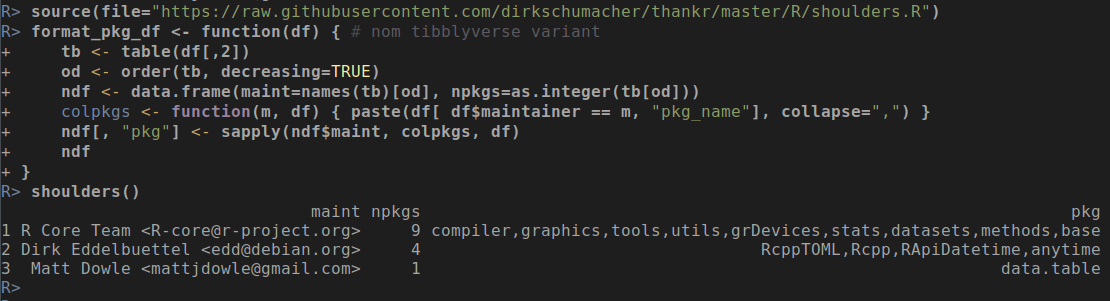
and for good measure a screenshot is below:
I think we need a catchy moniker for R work using good old base R. SoberVerse? GrumbyOldFolksR? PlainOldR? Better suggestions welcome. Edit on 2017-04-09: And by now Dirk Schumacher fixed that little bug in thankr which was at the start of this. His shoulders() function is now free of side effects, and thankr is now a clean micropackage free of external depends from any verse, be it tiddly or grumpy. I look forward to seeing it on CRAN soon!

This post by Dirk Eddelbuettel originated on his Thinking inside the box blog. Please report excessive re-aggregation in third-party for-profit settings.

7 April 2017

Arturo Borrero Gonz lez: openvpn deployment with Debian Stretch

Debian Openvpn Debian Stretch feels like an excellent release by the Debian project. The final stable release is about to happen in the short term. Among the great things you can do with Debian, you could set up a VPN using the openvpn software. In this blog post I will describe how I ve deployed myself an openvpn server using Debian Stretch, my network environment and my configurations & workflow. Before all, I would like to reference my requisites and the characteristics of what I needed: I agree this is a rather complex scenario and not all the people will face these requirements. The service diagram has this shape: VPN diagram (DIA source file) So, it works like this:
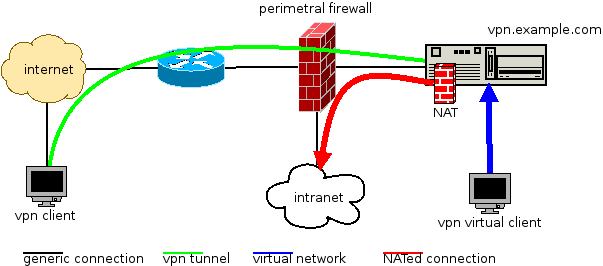
  1. clients connect via internet to our openvpn server, vpn.example.com
  2. the openvpn server validates the connection and the tunnel is established (green)
  3. now the client is virtually inside our network (blue)
  4. the client wants to access some intranet resource, the tunnel traffic is NATed (red)
Our datacenter intranet is using public IPv4 addressing, but the VPN tunnels use private IPv4 addresses. To don t mix public and private address NAT is used. Obviously we don t want to invest public IPv4 addresses in our internal tunnels. We don t have this limitations in IPv6, we could use public IPv6 addresses within the tunnels. But we prefer sticking to a hard dual stack IPv4/IPv6 approach and also use private IPv6 addresses inside the tunnels and also NAT the IPv6 from private to public. This way, there are no differences in how IPv4 and IPv6 network are managed. We follow this approach for the addressing: The NAT runs in the VPN server, since this is kind of a router. We use nftables for this task. As the final win, I will describe how we manage all this configuration using the git version control system. Using git we can track which admin made which change. A git hook will deploy the files from the git repo itself to /etc/ so the services can read them. The VPN server networking configuration is as follows (/etc/network/interfaces file, adjust to your network environments):
auto lo
iface lo inet loopback
# main public IPv4 address of vpn.example.com
allow-hotplug eth0
iface eth0 inet static
        address x.x.x.4
        netmask 255.255.255.0
        gateway x.x.x.1
# main public IPv6 address of vpn.example.com
iface eth0 inet6 static
        address x:x:x:x::4
        netmask 64
        gateway x:x:x:x::1
# NAT Public IPv4 addresses (used to NAT tunnel of client 1)
auto eth0:11
iface eth0:11 inet static
        address x.x.x.11
        netmask 255.255.255.0
# NAT Public IPv6 addresses (used to NAT tunnel of client 1)
iface eth0:11 inet6 static
        address x:x:x:x::11
        netmask 64
# NAT Public IPv4 addresses (used to NAT tunnel of client 2)
auto eth0:12
iface eth0:12 inet static
        address x.x.x.12
        netmask 255.255.255.0
# NAT Public IPv6 addresses (used to NAT tunnel of client 2)
iface eth0:12 inet6 static
        address x:x:x:x::12
        netmask 64
Thanks to the amazing and tireless work of the Alberto Gonzalez Iniesta (DD), the openvpn package in debian is in very good shape, ready to use. In vpn.example.com, install the required packages:
% sudo aptitude install openvpn openvpn-auth-ldap nftables git sudo
Two git repositories will be used, one for the openvpn configuration and another for nftables (the nftables config is described later):
% sudo mkdir -p /srv/git/vpn.example.com-nft.git
% sudo git init --bare /srv/git/vpn.example.com-nft.git
% sudo mkdir -p /srv/git/vpn.example.com-openvpn.git
% sudo git init --bare /srv/git/vpn.example.com-openvpn.git
% sudo chown -R :git /srv/git/*
% sudo chmod -R g+rw /srv/git/*
The repositories belong to the git group, a system group we create to let systems admins operate the server using git:
% sudo addgroup --system git
% sudo adduser admin1 git
% sudo adduser admin2 git
For the openvpn git repository, we need at least this git hook (file /srv/git/vpn.example.com-openvpn.git/hooks/post-receive with execution permission):
#!/bin/bash
NAME="hooks/post-receive"
OPENVPN_ROOT="/etc/openvpn"
export GIT_WORK_TREE="$OPENVPN_ROOT"
UNAME=$(uname -n)
info()
 
        echo "$ UNAME  $ NAME  $1 ..."
 
info "checkout latest data to $GIT_WORK_TREE"
sudo git checkout -f
info "cleaning untracked files and dirs at $GIT_WORK_TREE"
sudo git clean -f -d
For this hook to work, sudo permissions are required (file /etc/sudoers.d/openvpn-git):
User_Alias      OPERATORS = admin1, admin2
Defaults        env_keep += "GIT_WORK_TREE"
 
OPERATORS       ALL=(ALL) NOPASSWD:/usr/bin/git checkout -f
OPERATORS       ALL=(ALL) NOPASSWD:/usr/bin/git clean -f -d
Please review this sudoers file to match your environment and security requirements. The openvpn package deploys several systemd services:
% dpkg -L openvpn   grep service
/lib/systemd/system/openvpn-client@.service
/lib/systemd/system/openvpn-server@.service
/lib/systemd/system/openvpn.service
/lib/systemd/system/openvpn@.service
We don t need all of them, we can use the simple openvpn.service:
% sudo systemctl edit --full openvpn.service
And put a content like this:
% systemctl cat openvpn.service
# /etc/systemd/system/openvpn.service
[Unit]
Description=OpenVPN server
Documentation=man:openvpn(8)
Documentation=https://community.openvpn.net/openvpn/wiki/Openvpn23ManPage
Documentation=https://community.openvpn.net/openvpn/wiki/HOWTO
 
[Service]
PrivateTmp=true
KillMode=mixed
Type=forking
ExecStart=/usr/sbin/openvpn --daemon ovpn --status /run/openvpn/%i.status 10 --cd /etc/openvpn --config /etc/openvpn/server.conf --writepid /run/openvpn/server.pid
PIDFile=/run/openvpn/server.pid
ExecReload=/bin/kill -HUP $MAINPID
WorkingDirectory=/etc/openvpn
ProtectSystem=yes
CapabilityBoundingSet=CAP_IPC_LOCK CAP_NET_ADMIN CAP_NET_BIND_SERVICE CAP_NET_RAW CAP_SETGID CAP_SETUID CAP_SYS_CHROOT CAP_DAC_READ_SEARCH CAP_AUDIT_WRITE
LimitNPROC=10
DeviceAllow=/dev/null rw
DeviceAllow=/dev/net/tun rw
 
[Install]
WantedBy=multi-user.target
We can move on now to configure nftables to perform the NATs. First, it s good to load the NAT configuration at boot time, so you need a service file like this (/etc/systemd/system/nftables.service):
[Unit]
Description=nftables
Documentation=man:nft(8) http://wiki.nftables.org
 
[Service]
Type=oneshot
RemainAfterExit=yes
StandardInput=null
ProtectSystem=full
ProtectHome=true
WorkingDirectory=/etc/nftables.d
ExecStart=/usr/sbin/nft -f ruleset.nft
ExecReload=/usr/sbin/nft -f ruleset.nft
ExecStop=/usr/sbin/nft flush ruleset
 
[Install]
WantedBy=multi-user.target
The nftables git hooks are implemented as described in nftables managed with git. We are interested in the git hooks: (file /srv/git/vpn.example.com-nft.git/hooks/post-receive):
#!/bin/bash
NAME="hooks/post-receive"
NFT_ROOT="/etc/nftables.d"
RULESET="$ NFT_ROOT /ruleset.nft"
export GIT_WORK_TREE="$NFT_ROOT"
UNAME=$(uname -n)
info()
 
        echo "$ UNAME  $ NAME  $1 ..."
 
info "checkout latest data to $GIT_WORK_TREE"
sudo git checkout -f
info "cleaning untracked files and dirs at $GIT_WORK_TREE"
sudo git clean -f -d
info "deploying new ruleset"
set -e
cd $NFT_ROOT && sudo nft -f $RULESET
info "new ruleset deployment was OK"
This hook moves our nftables configuration to /etc/nftables.d and then applies it to the kernel. So a single commit changes the runtime configuration of the server. You could implement some QA using the git hook update, check this file! Remember, git hooks requires exec permissions to work. Of course, you will need again a sudo policy for these nft hooks. Finally, we can start configuring both openvpn and nftables using git. For the VPN you will require the configure the PKI side: server certificates, and the CA signing your client s certificates. You can check openvpn s own documentation about this. Your first commit for openvpn could be the server.conf file:
plugin		/usr/lib/openvpn/openvpn-plugin-auth-pam.so common-auth
mode		server
user		nobody
group		nogroup
port		1194
proto		udp6
daemon
comp-lzo
persist-key
persist-tun
tls-server
cert		/etc/ssl/private/vpn.example.com_pub.crt
key		/etc/ssl/private/vpn.example.com_priv.pem
ca		/etc/ssl/cacert/clients_ca.pem
dh		/etc/ssl/certs/dh2048.pem
cipher		AES-128-CBC
dev		tun
topology	subnet
server		192.168.100.0 255.255.255.0
server-ipv6	fd00:0:1:35::/64
ccd-exclusive
client-config-dir ccd
max-clients	100
inactive	43200
keepalive	10 360
log-append	/var/log/openvpn.log
status		/var/log/openvpn-status.log
status-version	1
verb		4
mute		20
Don t forget the ccd/ directory. This directory contains a file per user using the VPN service. Each file is named after the CN of the client certificate:
# private addresses for client 1
ifconfig-push		192.168.100.11 255.255.255.0
ifconfig-ipv6-push	fd00:0:1::11/64
# routes to the intranet network
push "route-ipv6 x:x:x:x::/64"
push "route x.x.3.128 255.255.255.240"
# private addresses for client 2
ifconfig-push		192.168.100.12 255.255.255.0
ifconfig-ipv6-push	fd00:0:1::12/64
# routes to the intranet network
push "route-ipv6 x:x:x:x::/64"
push "route x.x.3.128 255.255.255.240"
You end with at leats these files in the openvpn git tree:
server.conf
ccd/CN=CLIENT_1
ccd/CN=CLIENT_2
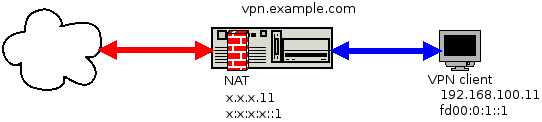
Please note that if you commit a change to ccd/, the changes are read at runtime by openvpn. In the other hand, changes to server.conf require you to restart the openvpn service by hand. Remember, the addressing is like this: Addressing (DIA source file) In the nftables git tree, you should put a ruleset like this (a single file named ruleset.nft is valid):
flush ruleset
table ip nat  
	map mapping_ipv4_snat  
		type ipv4_addr : ipv4_addr
		elements =  	192.168.100.11 : x.x.x.11,
				192.168.100.12 : x.x.x.12  
	 
	map mapping_ipv4_dnat  
		type ipv4_addr : ipv4_addr
		elements =  	x.x.x.11 : 192.168.100.11,
				x.x.x.12 : 192.168.100.12  
	 
	chain prerouting  
		type nat hook prerouting priority -100; policy accept;
		dnat to ip daddr map @mapping_ipv4_dnat
	 
	chain postrouting  
		type nat hook postrouting priority 100; policy accept;
		oifname "eth0" snat to ip saddr map @mapping_ipv4_snat
	 
 
table ip6 nat  
	map mapping_ipv6_snat  
		type ipv6_addr : ipv6_addr
		elements =  	fd00:0:1::11 : x:x:x::11,
				fd00:0:1::12 : x:x:x::12  
	 
	map mapping_ipv6_dnat  
		type ipv6_addr : ipv6_addr
		elements =  	x:x:x::11 : fd00:0:1::11,
				x:x:x::12 : fd00:0:1::12  
	 
	chain prerouting  
		type nat hook prerouting priority -100; policy accept;
		dnat to ip6 daddr map @mapping_ipv6_dnat
	 
	chain postrouting  
		type nat hook postrouting priority 100; policy accept;
		oifname "eth0" snat to ip6 saddr map @mapping_ipv6_snat
	 
 
table inet filter  
	chain forward  
		type filter hook forward priority 0; policy accept;
		# some forwarding filtering policy, if required, for both IPv4 and IPv6
	 
 
Since the server is in fact routing packets between the tunnel and the public network, we require forwarding enabled in sysctl:
net.ipv4.conf.all.forwarding = 1
net.ipv6.conf.all.forwarding = 1
Of course, the VPN clients will require a client.conf file which looks like this:
client
remote vpn.example.com 1194
dev tun
proto udp
resolv-retry infinite
comp-lzo
verb 5
nobind
persist-key
persist-tun
user nobody
group nogroup
 
tls-client
ca      /etc/ssl/cacert/server_ca.crt
pkcs12  /home/user/mycertificate.p12
verify-x509-name vpn.example.com name
cipher AES-128-CBC
auth-user-pass
auth-nocache
Workflow for the system admins:
  1. git clone the openvpn repo
  2. modify ccd/ and server.conf
  3. git commit the changes, push to the server
  4. if server.conf was modified, restart openvpn
  5. git clone the nftables repo
  6. modify ruleset
  7. git commit the changes, push to the server
Comments via email welcome!

6 April 2017

Reproducible builds folks: Reproducible Builds: week 101 in Stretch cycle

Here's what happened in the Reproducible Builds effort between Sunday March 26 and Saturday April 1 2017: Media coverage Sylvain Beucler wrote a follow-up post Practical basics of reproducible builds 2, which like last weeks article is about his experiences making software build reproducibly. Reproducible work in other projects Colin Watson started writing a patch to make launchpad store .buildinfo files. (It's not yet deployed.) Toolchain development and fixes Ximin Luo continued to work on BUILD_PATH_PREFIX_MAP patches for GCC 6 and dpkg. Packages reviewed and fixed, and bugs filed Chris Lamb: Mattia Rizzolo: Reviews of unreproducible packages 49 package reviews have been added, 25 have been updated and 42 have been removed in this week, adding to our knowledge about identified issues. 1 issue type has been updated: Weekly QA work During our reproducibility testing, FTBFS bugs have been detected and reported by: diffoscope development diffoscope 81 was uploaded to experimental by Chris Lamb. It included contributions from: reprotest development reprotest development continued in git, including contributions from: buildinfo.debian.net development buildinfo.debian.net development continued in git, including contributions from: reproducible-website development Holger switched reproducible-builds.org and www.reproducible-builds.org to letsencrypt certificates. Misc. This week's edition was written by Ximin Luo and Holger Levsen & reviewed by a bunch of Reproducible Builds folks on IRC & the mailing lists.

5 April 2017

Jonathan Carter: GNOME Shell Extensions in Debian 9.0

About GNOME 3 introduced an extensions framework that allows its users to extend the desktop shell by writing extensions using JavaScript and CSS. It works quite well and dozens of extensions have already been uploaded to the extensions site. Some of these solve some annoyances that users typically share with GNOME, while others add useful functionality. During DebCamp last year, I started packaging some of these for Debian. That s been going really well. Now that Ubuntu is finally dropping Unity in favour of GNOME, it helps to serve as a nudge to get this blog post out that s been stuck in drafts. These extensions also make their way into Ubuntu and other Debian/Ubuntu derivatives. Here are some extensions I ve been packaging that s already in the archive: gnome-shell-extension-dashtodock Provides a multitude of options for the shell dock. Not only really useful but also well maintained by upstream, see their website for more info. This is a great extension if you support previous Unity users, since you can set your panel to look and behave very similarly to Unity. I think the app launcher is slightly better in Gnome because apps are easier to discover. gnome-shell-extension-hide-activities Simple extension that hides the Activities button from the top left corner. gnome-shell-extension-impatience Speeds up shell animations. Animations can make the system more usable, but it can also be either distracting or cause some slight delays while waiting for the animation to complete. This gives you a sliding scale that lets you choose how much you d like to speed it up. gnome-shell-extension-move-clock Simple extension that moves the clock from the center of the panel to the right. gnome-shell-extension-refreshwifi In gnome-shell, network manager doesn t automatically refresh the list of available network, which can be quite annoying. Currently a user has to turn wifi off and back on in order to see a refreshed list. This has been fixed upstream and will be in the next version of GNOME. In the meantime, this extension fixes that. Update: Refreshing wifi in the background has been fixed in Gnome 3.22.2, which is now in stretch. This extension will be removed from the archives. gnome-shell-extension-remove-dropdown-arrows Items in the top panel contain dropdown arrows, which are useful for new users who might not be aware that they expand into more entries. For more experience users, the arrows tend to result in extra clutter in the panel, this extension hides those arrows. gnome-shell-extension-better-volume This allows you to hover over the volume control indicator and scroll up and down to increase/decrease the volume. Probably another extension that should really just be integrated into gnome-shell by default. gnome-shell-extension-hard-disk-led Many new laptops either don t have a hard disk L.E.D. anymore, or they hide it so that it s not really all that visible. This extension shows you hard disk activity in your panel. There s also work being done to make it report reads and writes separately. I ll be looking at backporting that when it s available. gnome-shell-extension-disconnect-wifi Allows you to disconnect from the current network without having to turn off wi-fi entirely. gnome-shell-extension-pixelsaver Title bars can be incredibly pixel-hungry, which isn t great on small displays. This extension hides the title bar when a window is maximised, and adds control buttons for that window to the top panel. gnome-shell-extension-system-monitor gnome-shell-extension-trash Displays a trash icon to the top panel when there are items in trash. From there you can view or delete the trash contents. gnome-shell-extension-multi-monitors This extension adds some tweaks for users of multiple monitors. It s most useful feature is that you can have desktop overviews on both displays and easily move apps between them. More extensions Here are some more extensions packaged in Debian that others have packaged: Didn t make it this time Both Debian and Ubuntu are in feature freeze right now, and the following didn t make it in the archives in time, but should be in the following releases (they re still installable via the extensions site in the meantime): Next steps Consider auto-enable Currently, when you install these debian packages, (most of) the extensions won t be enabled by default. Users have to use the gnome-tweak-tool to enable them after installation. The rationale behind this is that a system administrator of a network of computers might only want to enable certain extensions for certain users. After some more consideration, I think such administrators will probably already have a system (like a configuration management system) in place to manage this. So, to make it easier for the typical user, I think it s worth considering enabling these by default with installation. Feedback welcome :) Debian team The list of packaged extensions are growing fast, and it would be nice to have these team-maintained. It might be a good idea to start a team for this or use an existing team under the Debian gnome team namespace. Packaging guide I ve packaged enough Gnome extensions to be aware of the typical gotchas and things that need fixing. They re overall easy to package and a good place to start for someone who wants to get into packaging. I want to put together a good short guide on how to properly package gnome-shell extensions. Anything else? Any other extensions you d like to see packaged? Let me know. Even better, package it yourself and help test my extension package guide (once it exists) so that we can improve that too.

Norbert Preining: Gaming: Quern Undying Thoughts

I have been an addict of Myst like games since the very beginning. Solving mind boggling riddles by logical means (instead of weapons) was always my preferred gaming. And it seems 2016 had a great share of games fitting to my taste: Obduction, The Eyes of Ara, The Witness, and last but not least Quern Undying Thoughts. Due to work, research, online courses, diapers, and some real life (these are also the excuses for my long silence on this blog) it took me ages to complete this games, but with a bit of help I finally manged it. Those who have ever played any game from the Myst series (Myst, Riven etc) know what you get: Several worlds/areas to explore, finding clues, solving riddles, lots of reading, leading to a finish where you have to decide between two fates. The game leads you through a variety of surrounding, from open air with gorgeous views and lovely crafted details, caves with dark corners and hidden chambers, even diving excursions are included, till you reach the final showdown at a huge underground facility. The graphics of the game are extremely beautifully crafted which makes you want to book a trip to this island. Click to view slideshow. I have to admit that due to the long time over which I had to play the game, as well as my missing Sherlock Holmes traits, some of the riddles were really hard for me. Sometimes the clues are so insidiously hidden or inconspicuously placed that one just easily misses them. But that makes the game a real challenge. For me Quern manages a great balance between a riddle game and an exploration game. I don t like games where you just have to go around and click each and every nook to make sure you find all pieces (typical example, the room series), but on the other hand games that only consists of solving riddles without searching for them are half the fun. Myst, Riven, and Quern, too, all of them strike a delicate balance between these two poles and deliver an absolute astonishing experience. Fully recommended, 100/100 for me!

4 April 2017

Ritesh Raj Sarraf: Fixing Hardware Bugs

Bugs can be annoying. Especially the ones that crash or hang and do not have a root cause. A good example of such annoyance can be kernel bugs, where a faulty hardware/device driver hinders the kernel's suspend/resume process. Because, as a user, while in the middle of your work, you suspend your machine hoping to resume your work, back when at your destination. But, during suspend, or during resume, randomly the bug triggers leaving you with no choice but a hardware reset. Ultimately, resulting in you losing the entire work state you were in. Such is a situation I encountered with my 2 year old, Lenovo Yoga 2 13. For 2 years, I had been living with this bug with all the side-effects mentioned.
Mar 01 18:43:28 learner kernel: usb 2-4: new high-speed USB device number 38 using xhci_hcd
Mar 01 18:43:54 learner kernel: usb 2-4: new high-speed USB device number 123 using xhci_hcd
Mar 01 18:44:00 learner kernel: usb 2-4: new high-speed USB device number 125 using xhci_hcd
Mar 01 18:44:11 learner kernel: usb 2-4: new high-speed USB device number 25 using xhci_hcd
Mar 01 18:44:16 learner kernel: usb 2-4: new high-speed USB device number 26 using xhci_hcd
Mar 01 18:44:22 learner kernel: usb 2-4: new high-speed USB device number 27 using xhci_hcd
Mar 01 18:44:22 learner kernel: usb 2-4: device descriptor read/64, error -71
Mar 01 18:44:22 learner kernel: usb 2-4: new high-speed USB device number 28 using xhci_hcd
Mar 01 18:44:23 learner kernel: usb 2-4: device descriptor read/64, error -71
Mar 01 18:44:23 learner kernel: usb 2-4: new high-speed USB device number 29 using xhci_hcd
Mar 01 18:44:23 learner kernel: usb 2-4: Device not responding to setup address.
Mar 01 18:44:23 learner kernel: usb 2-4: device not accepting address 29, error -71
Mar 01 18:44:24 learner kernel: usb 2-4: new high-speed USB device number 30 using xhci_hcd
Mar 01 18:44:24 learner kernel: usb 2-4: Device not responding to setup address.
Mar 01 18:44:24 learner kernel: usb 2-4: device not accepting address 30, error -71
Mar 01 18:44:24 learner kernel: usb usb2-port4: unable to enumerate USB device
Mar 01 18:44:24 learner kernel: usb 2-4: new high-speed USB device number 31 using xhci_hcd
Mar 01 18:44:24 learner kernel: usb 2-4: device descriptor read/64, error -71
Mar 01 18:44:25 learner kernel: usb 2-4: new high-speed USB device number 32 using xhci_hcd
Mar 01 18:44:30 learner kernel: usb 2-4: new high-speed USB device number 33 using xhci_hcd
Mar 01 18:44:30 learner kernel: usb 2-4: device descriptor read/64, error -71
Mar 01 18:44:31 learner kernel: usb 2-4: device descriptor read/64, error -71
Mar 01 18:44:31 learner kernel: usb 2-4: new high-speed USB device number 34 using xhci_hcd
Mar 01 18:44:36 learner kernel: usb 2-4: new high-speed USB device number 35 using xhci_hcd
Mar 01 18:44:36 learner kernel: usb 2-4: device descriptor read/64, error -71
Mar 01 18:44:37 learner kernel: usb 2-4: new high-speed USB device number 36 using xhci_hcd
Mar 01 18:44:37 learner kernel: usb 2-4: device descriptor read/64, error -71
Mar 01 18:44:37 learner kernel: usb 2-4: new high-speed USB device number 37 using xhci_hcd
Mar 01 18:44:37 learner kernel: usb 2-4: Device not responding to setup address.
Mar 01 18:44:38 learner kernel: usb 2-4: device not accepting address 37, error -71
Mar 01 18:44:38 learner kernel: usb 2-4: new high-speed USB device number 38 using xhci_hcd
Mar 01 18:44:38 learner kernel: usb 2-4: Device not responding to setup address.
Mar 02 13:34:05 learner kernel: usb 2-4: new high-speed USB device number 45 using xhci_hcd
Mar 02 13:34:05 learner kernel: usb 2-4: new high-speed USB device number 46 using xhci_hcd
Mar 02 13:34:05 learner kernel: usb 2-4: New USB device found, idVendor=0bda, idProduct=0129
Mar 02 13:34:05 learner kernel: usb 2-4: New USB device strings: Mfr=1, Product=2, SerialNumber=3
Mar 02 13:34:05 learner kernel: usb 2-4: Product: USB2.0-CRW
Mar 02 13:34:05 learner kernel: usb 2-4: Manufacturer: Generic
Mar 02 13:34:05 learner kernel: usb 2-4: SerialNumber: 20100201396000000
Mar 02 13:34:06 learner kernel: usb 2-4: USB disconnect, device number 46
Mar 02 13:34:16 learner kernel: usb 2-4: new high-speed USB device number 47 using xhci_hcd
Mar 02 13:34:21 learner kernel: usb 2-4: new high-speed USB device number 48 using xhci_hcd
Mar 02 13:34:26 learner kernel: usb 2-4: new high-speed USB device number 49 using xhci_hcd
Mar 02 13:34:32 learner kernel: usb 2-4: new high-speed USB device number 51 using xhci_hcd
Mar 02 13:34:37 learner kernel: usb 2-4: new high-speed USB device number 52 using xhci_hcd
Mar 02 13:34:43 learner kernel: usb 2-4: new high-speed USB device number 54 using xhci_hcd
Mar 02 13:34:43 learner kernel: usb 2-4: new high-speed USB device number 55 using xhci_hcd
Mar 02 13:34:49 learner kernel: usb 2-4: new high-speed USB device number 57 using xhci_hcd
Mar 02 13:34:55 learner kernel: usb 2-4: new high-speed USB device number 58 using xhci_hcd
Mar 02 13:35:00 learner kernel: usb 2-4: new high-speed USB device number 60 using xhci_hcd
Mar 02 13:35:06 learner kernel: usb 2-4: new high-speed USB device number 61 using xhci_hcd
Mar 02 13:35:11 learner kernel: usb 2-4: new high-speed USB device number 63 using xhci_hcd
Mar 02 13:35:17 learner kernel: usb 2-4: new high-speed USB device number 64 using xhci_hcd
Mar 02 13:35:22 learner kernel: usb 2-4: new high-speed USB device number 65 using xhci_hcd
Mar 02 13:35:28 learner kernel: usb 2-4: new high-speed USB device number 66 using xhci_hcd
Mar 02 13:35:33 learner kernel: usb 2-4: new high-speed USB device number 68 using xhci_hcd
Mar 02 13:35:39 learner kernel: usb 2-4: new high-speed USB device number 69 using xhci_hcd
Mar 02 13:35:44 learner kernel: usb 2-4: new high-speed USB device number 70 using xhci_hcd
Mar 02 13:35:50 learner kernel: usb 2-4: new high-speed USB device number 71 using xhci_hcd
Mar 02 13:35:50 learner kernel: usb 2-4: Device not responding to setup address.
Mar 02 13:35:50 learner kernel: usb 2-4: device not accepting address 71, error -71
Mar 02 13:35:50 learner kernel: usb 2-4: new high-speed USB device number 73 using xhci_hcd
Mar 02 13:35:51 learner kernel: usb 2-4: new high-speed USB device number 74 using xhci_hcd
Mar 02 13:35:56 learner kernel: usb 2-4: new high-speed USB device number 75 using xhci_hcd
Mar 02 13:35:57 learner kernel: usb 2-4: new high-speed USB device number 77 using xhci_hcd
Mar 02 13:36:03 learner kernel: usb 2-4: new high-speed USB device number 78 using xhci_hcd
Mar 02 13:36:08 learner kernel: usb 2-4: new high-speed USB device number 79 using xhci_hcd
Mar 02 13:36:14 learner kernel: usb 2-4: new high-speed USB device number 80 using xhci_hcd
Mar 02 13:36:20 learner kernel: usb 2-4: new high-speed USB device number 83 using xhci_hcd
Mar 02 13:36:26 learner kernel: usb 2-4: new high-speed USB device number 86 using xhci_hcd
Thanks to the Linux USB maintainers, we tried investigating the issue, which resulted in uncovering other bugs. Unfortunately, this bug was concluded as a possible hardware bug. The only odd bit is that this machine has a Windows 8.1 copy still lying on the spare partition, where the issue was not seen at all. It could very well be that it was not a hardware bug at all, or a hardware bug which had a workaround in the Windows driver. But, the results of the exercise weren't much useful to me because I use the machine under the Linux kernel most of the time. So, this March 2017, with 2 years completion on me purchasing the device, I was annoyed enough by the bugs. That led me trying out finding other ways to taming this issue. Lenovo has some variations of this device. I know that it comes with multiple options for the storgae and the wifi component. I'm not sure if there are more differences. The majority of the devices are connected over the xHCI bus on this machine. If a single device is faulty, or has faulty hardware; it could screw up the entire user experience for that machine. Such is my case. Hardware manufacturers could do a better job if they could provide a means to disable hardware, for example in the BIOS. HP shipped machines have such an option in the BIOS where you can disable devices that do not have an important use case for the user. Good example of such devices are Fingerprint Readers, SD Card Readers, LOMs and mabye Bluetooth too. At least the latter should apply for Linux users, as majority of us have an unpleasant time getting Bluetooth to work out of the box. But on my Lenovo Yoga, it came with a ridiculous BIOS/UEFI, with very very limited options for change. Thankfully, they did have an option to set the booting mode for the device, giving the choices of Legacy Boot and UEFI. Back to the topic, with 2 years of living with the bug, and no clarity on if and whether it was a hardware bug or a driver bug, it left me with no choice but to open up the machine. Next to the mSATA HDD sits the additional board, which houses the Power, USB, Audio In, and the SD Card reader. Opening that up, I got the small board. I barely use the SD Card reader, and given the annoyances I had to suffer because of it, there was no more mercy in killing that device. So, next was to unsolder the SD Card reader completely. Once done, and fitted back into the machine, everything has been working awesomely great in the last 2 weeks. This entire fix costed me 0. So sometimes, fixing a bug is all that matters. In the Hindi language, a nice phrase for such a scenario remnids me of the great Chanakya, " , , ".

Categories:

Keywords:

Like:

Matthias Klumpp: On Tanglu

It s time for a long-overdue blogpost about the status of Tanglu. Tanglu is a Debian derivative, started in early 2013 when the systemd debate at Debian was still hot. It was formed by a few people wanting to create a Debian derivative for workstations with a time-based release schedule using and showcasing new technologies (which include systemd, but also bundling systems and other things) and built in the open with a community using the similar infrastructure to Debian. Tanglu is designed explicitly to complement Debian and not to compete with it on all devices. Tanglu has achieved a lot of great things. We were the first Debian derivative to adopt systemd and with the help of our contributors we could kill a few nasty issues affecting it and Debian before it ended up becoming default in Debian Jessie. We also started to use the Calamares installer relatively early, bringing a modern installation experience additionally to the traditional debian-installer. We performed the usrmerge early, uncovering a few more issues which were fed back into Debian to be resolved (while workarounds were added to Tanglu). We also briefly explored switching from initramfs-tools to Dracut, but this release goal was dropped due to issues (but might be revived later). A lot of other less-impactful changes happened as well, borrowing a lot of useful ideas and code from Ubuntu (kudos to them!). On the infrastructure side, we set up the Debian Archive Kit (dak), managing to find a couple of issues (mostly hardcoded assumptions about Debian) and reporting them back to make using dak for distributions which aren t Debian easier. We explored using fedmsg for our infrastructure, went through a long and painful iteration of build systems (buildbot -> Jenkins -> Debile) before finally ending up with Debile, and added a set of own custom tools to collect archive QA information and present it to our developers in an easy to digest way. Except for wanna-build, Tanglu is hosting an almost-complete clone of basic Debian archive management tools. During the past year however, the project s progress slowed down significantly. For this, mostly I am to blame. One of the biggest challenges for a young project is to attract new developers and members and keep them engaged. A lot of the people coming to Tanglu and being interested in contributing were unfortunately no packagers and sometimes no developers, and we didn t have the manpower to individually mentor these people and teach them the necessary skills. People asking for tasks were usually asked where their interests were and what they would like to do to give them a useful task. This sounds great in principle, but in practice it is actually not very helpful. A curated list of junior jobs is a much better starting point. We also invested almost zero time in making our project known and create the necessary buzz and excitement that s actually needed to sustain a project like this. Doing more in the advertisement domain and help newcomers area is a high priority issue in the Tanglu bugtracker, which to the day is still open. Doing good alone isn t enough, talking about it is of crucial importance and that is something I knew about, but didn t realize the impact of for quite a while. As strange as it sounds, investing in the tech only isn t enough, community building is of equal importance. Regardless of that, Tanglu has members working on the project, but way too few to manage a project of this magnitude (getting package transitions migrated alone is a large task requiring quite some time while at the same time being incredibly boring :P). A lot of our current developers can only invest small amounts of time into the project because they have a lot of other projects as well. The other issue why Tanglu has problems is too much stuff being centralized on myself. That is a problem I wanted to rectify for a long time, but as soon as a task wasn t done in Tanglu because no people were available to do it, I completed it. This essentially increased the project s dependency on me as single person, giving it a really low bus factor. It not only centralizes power in one person (which actually isn t a problem as long as that person is available enough to perform tasks if asked for), it also centralizes knowledge on how to run services and how to do things. And if you want to give up power, people will need the knowledge on how to perform the specific task first (which they will never gain if there s always that one guy doing it). I still haven t found a great way to solve this it s a problem that essentially kills itself as soon as the project is big enough, but until then the only way to counter it slightly is to write lots of documentation. Last year I had way less time to work on Tanglu than the project deserves. I also started to work for Purism on their PureOS Debian derivative (which is heavily influenced by some of the choices we made for Tanglu, but with different focus that s probably something for another blogpost). A lot of the stuff I do for Purism duplicates the work I do on Tanglu, and also takes away time I have for the project. Additionally I need to invest a lot more time into other projects such as AppStream and a lot of random other stuff that just needs continuous maintenance and discussion (especially AppStream eats up a lot of time since it became really popular in a lot of places). There is also my MSc thesis in neuroscience that requires attention (and is actually in focus most of the time). All in all, I can t split myself and KDE s cloning machine remains broken, so I can t even use that ;-). In terms of projects there is also a personal hard limit of how much stuff I can handle, and exceeding it long-term is not very healthy, as in these cases I try to satisfy all projects and in the end do not focus enough on any of them, which makes me end up with a lot of half-baked stuff (which helps nobody, and most importantly makes me loose the fun, energy and interest to work on it). Good news everyone! (sort of) So, this sounded overly negative, so where does this leave Tanglu? Fact is, I can not commit the crazy amounts of time for it as I did in 2013. But, I love the project and I actually do have some time I can put into it. My work on Purism has an overlap with Tanglu, so Tanglu can actually benefit from the software I develop for them, maybe creating a synergy effect between PureOS and Tanglu. Tanglu is also important to me as a testing environment for future ideas (be it in infrastructure or in the make bundling nice! department). So, what actually is the way forward? First, maybe I have the chance to find a few people willing to work on tasks in Tanglu. It s a fun project, and I learned a lot while working on it. Tanglu also possesses some unique properties few other Debian derivatives have, like being built from source completely (allowing us things like swapping core components or compiling with more hardening flags, switching to newer KDE Plasma and GNOME faster, etc.). Second, if we do not have enough manpower, I think converting Tanglu into a rolling-release distribution might be the only viable way to keep the project running. A rolling release scheme creates much less effort for us than making releases (especially time-based ones!). That way, users will have a constantly updated and secure Tanglu system with machines doing most of the background work. If it turns out that absolutely nothing works and we can t attract new people to help with Tanglu, it would mean that there generally isn t much interest from the developer or user side in a project like this, so shutting it down or scaling it down dramatically would be the only option. But I do not think that this is the case, and I believe that having Tanglu around is important. I also have some interesting plans for it which will be fun to implement for testing  The only thing that had to stop is leaving our users in the dark on what is happening. Sorry for the long post, but there are some subjects which are worth writing more than 140 characters about  If you are interested in contributing to Tanglu, get in touch with us! We have an IRC channel #tanglu-devel on Freenode (go there for quicker responses!), forums and mailinglists, It looks like I will be at Debconf this year as well, so you can also catch me there! I might even talk about PureOS/Tanglu infrastructure at the conference.

3 April 2017

Markus Koschany: My Free Software Activities in March 2017

Welcome to gambaru.de. Here is my monthly report that covers what I have been doing for Debian. If you re interested in Android, Java, Games and LTS topics, this might be interesting for you. Debian Android Debian Games Debian Java Debian LTS This was my thirteenth month as a paid contributor and I have been paid to work 14,75 hours on Debian LTS, a project started by Rapha l Hertzog. In that time I did the following: Misc Thanks for reading and see you next time.

Sean Whitton: A different reason there are so few tenure-track jobs in philosophy

Recently I heard a different reason suggested as to why there are fewer and fewer tenure-track jobs in philosophy. University administrators are taking control of the tenure review process; previously departments made decisions and the administrators rubber-stamped them. The result of this is that it is easier to get tenure. This is because university administrators grant tenure based on quantitively-measurable achievements, rather than a qualitative assessment of the candidate qua philosopher. If a department thought that someone shouldn t get tenure, the administration might turn around and say that they are going to grant it because the candidate has fulfilled such-and-such requirements. Since it is easier to get tenure, hiring someone at the assistant professor level is much riskier for a philosophy department: they have to assume the candidate will get tenure. So the pre-tenure phase is no longer a probationary period. That is being pushed onto post-docs and graduate students. This results in the intellectual maturity of published work going down. There are various assumptions in the above that could be questioned, but what s interesting is that it takes a lot of the blame for the current situation off the shoulders of faculty members (there have been accusations that they are not doing enough). If tenure-track hires are a bigger risk for the quality of the academic philosophers who end up with permanent jobs, it is good that they are averse to that risk.

1 April 2017

Mike Hommey: git-cinnabar experimental features

Since version 0.4.0, git-cinnabar has a few hidden experimental features. Two of them are available in 0.4.0, and a third was recently added on the master branch. The basic mechanism to enable experimental features is to set a preference in the git configuration with a comma-separated list of features to enable, or all, for all of them. That preference is cinnabar.experiments. Any means to set a git configuration can be used. You can: But what features are there? wire In order to talk to Mercurial repositories, git-cinnabar normally uses mercurial python modules. This experimental feature allows to access Mercurial repositories without using the mercurial python modules. It then relies on git-cinnabar-helper to connect to the repository through the mercurial wire protocol. As of version 0.4.0, the feature is automatically enabled when Mercurial is not installed. merge Git-cinnabar currently doesn t allow to push merge commits. The main reason for this is that generating the correct mercurial data for those merges is tricky, and needs to be gotten right. In version 0.4.0, enabling this feature allows to push merge commits as long as the parent commits are available on the mercurial repository. If they aren t, you need to first push them independently, and then push the merge. On current master, that limitation doesn t exist anymore ; you can just push everything in one go. The main caveat with this experimental support for pushing merges is that it currently doesn t handle the case where a file was moved on one of the branches the same way mercurial would (i.e. the information would be lost to mercurial users). clonebundles As of mercurial 3.6, Mercurial servers can opt-in to providing pre-generated bundles, which, when clients support it, takes CPU load off the server when a clone is performed. Good for servers, and usually good for clients too when they have a fast network connection, because downloading a pre-generated bundle is usually faster than waiting for the server to generate one. As of a few days ago, the master branch of git-cinnabar supports cloning using those pre-generated bundles, provided the server advertizes them (mozilla-central does).

Next.

Previous.