Search Results: "bod"

16 January 2013

Michal Čihař: Weblate has per project ACL

I've got yet another question whether Weblate has any sort for ACL to limit access to project. As usual, my answer was no, but I started to think how I would implement such feature. After a little bit of thinking and playing with code, I've realized, that this is not that hard as I thought and implemented it in few minutes. So there is another ofter requested feature which will come in Weblate 1.4 - ACL. It provides simple way to limit access to some projects to some users. The default behavior is still that anybody logged in can do anything, but this can be changed per project by enabling ACL for it. More details are available in our documentation.

Filed under: English Weblate 0 comments Flattr this!

Francois Marier: Moving from Blogger to Ikiwiki and Branchable

In order to move my blog to a free-as-in-freedom platform and support the great work that Joey (of git-annex fame) and Lars (of GTD for hackers fame) have put into their service, I decided to convert my Blogger blog to Ikiwiki and host it on Branchable. While the Ikiwiki tips page points to some old instructions, they weren't particularly useful to me. Here are the steps I followed.

Exporting posts and comments from Blogger Thanks to Google letting people export their own data from their services, I was able to get a full dump (posts, comments and metadata) of my blog in Atom format. To do this, go into "Settings Other" then look under "Blog tools" for the "Export blog" link.

Converting HTML posts to Markdown Converting posts from HTML to Markdown involved a few steps:
  1. Converting the post content using a small conversion library to which I added a few hacks.
  2. Creating the file hierarchy that ikiwiki requires.
  3. Downloading images from Blogger and fixing their paths in the article text.
  4. Extracting comments and linking them to the right posts.
The Python script I wrote to do all of the above will hopefully be a good starting point for anybody wanting to migrate to Ikiwiki.

Maintaining old URLs In order to make sure I wouldn't break any existing links pointing to my blog on Blogger, I got the above Python script to output a list of Apache redirect rules and then found out that I could simply email these rules to Joey and Lars to get them added to my blog. My rules look like this:
# Tagged feeds
Redirect permanent /feeds/posts/default/-/debian http://feeding.cloud.geek.nz/tags/debian/index.rss
Redirect permanent /search/label/debian http://feeding.cloud.geek.nz/tags/debian
# Main feed (needs to come after the tagged feeds)
Redirect permanent /feeds/posts/default http://feeding.cloud.geek.nz/index.rss
# Articles
Redirect permanent /2012/12/keeping-gmail-in-separate-browser.html http://feeding.cloud.geek.nz/posts/keeping-gmail-in-separate-browser/
Redirect permanent /2012/11/prefetching-resources-to-prime-browser.html http://feeding.cloud.geek.nz/posts/prefetching-resources-to-prime-browser/

Collecting analytics Since I am no longer using Google Analytics on my blog, I decided to take advantage of the access log download feature that Joey recently added to Branchable. Every night, I download my blog's access log and then process it using awstats. Here is the cron job I use:
#!/bin/bash
BASEDIR=/home/francois/documents/branchable-logs
LOGDIR=/var/log/feedingthecloud
# Download the current access log
LANG=C LC_PAPER= ssh -oIdentityFile=$BASEDIR/branchable-logbot b-feedingthecloud@feedingthecloud.branchable.com logdump > $LOGDIR/access.log
It uses a separate SSH key I added through the Branchable control panel and outputs to a file that gets overwritten every day. Next, I installed the awstats Debian package, and configured it like this:
$ cat /etc/awstats/awstats.conf.local
SiteDomain=feedingthecloud.branchable.com
LogType=W
LogFormat=1
LogFile="/var/log/feedingthecloud/access.log"
Even if you're not interested in analytics, I recommend you keep an eye on the 404 errors for a little while after the move. This has helped me catch a critical redirection I had forgotten.

Limiting Planet feeds One of the most common things that happen right after someone migrates to a new blogging platform is the flooding of any aggregator that subscribes to their blog. The usual cause being the change in post identifiers. Unsurprisingly, Ikiwiki already had a few ways to avoid this problem. I chose to simply modify each tagged feed and limit them to the posts added after the move to Branchable.

Switching DNS Having always hosted my blog on a domain I own, all I needed to do to move over to the new platform without an outage was to change my CNAME to point to feedingthecloud.branchable.com. I've kept the Blogger blog alive and listening on feeding.cloud.geek.nz to ensure that clients using a broken DNS resolver (which caches records for longer than requested via the record's TTL) continue to see the old posts.

12 January 2013

Russ Allbery: Review: Asimov's, April/May 2011

Review: Asimov's Science Fiction, April/May 2011
Editor: Sheila Williams
Issue: Volume 35, No. 4 & 5
ISSN: 1065-2698
Pages: 192
Williams's editorial this issue is about the tendency of SF to take a rose-colored view of the world, which on the surface seems odd given the tendency of recent SF towards dystopia. But she makes a good point that the portrayal of the past is rose-colored, linking that into the current steampunk trend. She doesn't take the argument quite as far as I'd like, but I'm glad to see editorials raising points like this. I'm inclined to think that a lot of the rose-colored frame of the past is because few of us want to read about real historic conditions at any length, even for edification, because the stench and discomfort isn't fun to read about. Silverberg's column is another discussion of programmatic plot generators, which mostly makes the point that plot ideas are the easy part of writing. James Gunn contributes an extended biography of Isaac Asimov that probably won't be new to long-time genre readers but may fill in some details (although it politely sticks to mostly flattering material). Spinrad's book review column is one of his better ones; it looks at two novels by China Mi ville and two by Ian McDonald and explores differences in world-building. Spinrad predictably makes the case in favor of science fiction with rules and against the New Weird, but the discussion along the way was worth reading. "The Day the Wires Came Down" by Alexander Jablokov: Speaking of steampunk, here's an example. There is even an airship, although the primary technological focus is suspended street cars. Jablokov postulates a city-wide transportation network of suspended carriages called telpher cars, along with a city built around the telpher cables: stores on roofs, windows displaying merchandise to passing cars, and even a history of heated competition and dirty tricks between competing telpher networks. The story is set, as the title would indicate, on the last day of the network. It's being shut down for cost, with some hints that progress is destroying something precious. There is a plot here, revolving around some mysteries of the history of the telpher network and the roles of several people in that history. But the story is primarily a celebration of old technology. It's a rail fan's story recast with a steampunk technology, featuring the same mix of fascination with mechanics and a sense that the intricate details are falling out of common knowledge (and perhaps usefulness). As a story, it's a bit slow-moving, but I enjoyed the elegiac tone. (7) "An Empty House with Many Doors" by Michael Swanwick: This is a very short story, more of an emotional profile, involving a man's reaction to the death of his wife. Oh, and parallel universes. It's sort of the inverse of Niven's classic "All the Myriad Ways." Similar to Niven's story, I found the idea vaguely interesting but the conclusion and emotional reaction unbelievable and alien. (5) "The Homecoming" by Mike Resnick: Resnick tends to yank on the heart-strings rather sharply in his stories, so I knew roughly what to expect when a father comes home to find his son is visiting. A son who, rather against his father's wishes, has been significantly altered to be able to live with aliens. Throw in a mother with serious dementia, and you can probably predict what Resnick does with this. Still, most of the story is a two-sided conversation, and I thought he succeeded in doing justice to both sides, even though one of them was destined to lose. (6) "North Shore Friday" by Nick Mamatas: Illegal Greek immigrants, a family-run system for getting them married off before the INS catch them, government psi probes and eavesdropping on thoughts, joint projects between computer and religion departments, secret government experiments, and even ghosts... this story is a complex mess, with numerous thoughts stuck into small boxes and scattered through the surface story. It's one of those stories where figuring out what's going on, and even how to read the story in a sensible way, is much of the fun. If you find that fun, that is; if not, it will probably be frustrating. I wished there was a bit more plot, but there's something delightful about how much stuff Mamatas packs into it. (6) "Clockworks" by William Preston: This is a prequel to Preston's earlier "Helping Them Take the Old Man Down". Like that story, it's primarily a pulp adventure, but layered with another level of analysis and thoughtfulness that tries to embed the pulp adventure in our understanding of human behavior and the nature of the world, although this one stays a bit more pulp than its predecessor. As with Preston's other story, we don't get directly in the head of the Old Man (here, just called the man, but identifiable from clues in both stories as Doc Savage); instead, the protagonist is a former villain named Simon Lukic who the man hopes to have fixed by operating on his brain. The undercurrent that lies beneath a more typical pulp adventure is the question of whether Lukic is actually healed. I think there was a bit too much daring-do and human perfection, but it's a perfectly servicable pulp story with some depth. (6) "The Fnoor Hen" by Rudy Rucker: If you've read any of Rucker's work before, you probably know what to expect: a mind-boggling blizzard of mathematically-inspired technobabble that turns into vaguely coherent surrealism. (You can probably tell that I'm not much of a fan, although the clear good humor in these stories makes it hard to dislike them too much.) There's a mutated chicken and some sort of alternate mathematical space and then something that seems like magic... I'd be lying if I said that I followed this story. If you like Rucker, this seems like the sort of thing that you'd like. (4) "Smoke City" by Christopher Barzak: At the start of this story, I thought it was going to be an emotional parable about immigration. The progatonist lives two lives: one in our world, and one in the Smoke City of industry, a world of hard labor, pollution, and little reward, with families in both. But nearly all of the story is set within Smoke City, and the parable turns out to be a caustic indictment of industry and its exploitation of labor. I kind of wish Barzak hadn't used rape as a metaphor, but when the captains of industry show up, I can't argue with how deeply and accurately the story shoves in the knife. There isn't much subtlety here, but it's still one of the better stories in this issue. (7) "A Response from EST17" by Tom Purdom: I'm very happy to see Purdom's writing appearing regularly. His stories are always quiet and matter-of-fact, and at first seem to miss emotional zest, but they almost always grow on me. He lets the reader fill in their own emotional reactions to events, and there's always a lot going on. This story is a first-contact story, except that the "humans" here are not human at all. They're automated probes sent by two separate human civilizations, with different programming and different governance algorithms, and they quickly start competing negotiations. The aliens they've discovered similarly have factions, who start talking to the different probes in an elaborate dance of gathering information without giving too much away. The twist is that this pattern has replayed itself many times in the past, and information itself can be a weapon. I enjoyed this one from start to finish. (7) "The One That Got Away" by Esther M. Friesner: Friesner is best known, at least to me, for humorous fantasy, and this story is advertised as such from early on. The first-person protagonist is a prostitute in a seaside town. She's bemused to finally be invited over by a sailor who's been eyeing her all evening, but that sailor has something else in mind than normal business. For much of this story, the fantasy element is unclear; when it finally comes, it was an amusing twist. (7) "The Flow and Dream" by Jack Skillingstead: This is a mildly interesting variation on the old SF story of hibernating humans (on a generation ship or elsewhere) waking up to a transformed world. Here, it's not a ship, it's a planet, and the hiberation was to wait for terraforming rather than for transit. The twist comes from an excessively literal computer and the fun of putting together the pieces. Sadly, the story trails off at the end without much new to say. (5) "Becalmed" by Kristine Kathryn Rusch: "Becalmed" takes place immediately before "Becoming One with the Ghosts" and explains the incident that created the situation explored in that story. The first-person protagonist of "Becalmed" is a linguist, an expert in learning alien languages so that the Fleet can understand the civilizations that it runs across. But something went horribly wrong at their last stop, something that she's largely suppressed, and now she's confined to quarters and possibly in deep trouble. As is the ship; they're in foldspace, and they have been for days. "Becalmed" is structed like a mystery, centered around recovering the protagonist's memories. It's also a bit of a legal procedural; the ship is trying to determine what to do with her and to what degree she's responsible. But the heart of the story is a linguistic and cultural puzzle. This is another great SF story from Rusch, whose name on a cover will make me eager to start reading a new magazine. I love both angles on the universe she's built, but I think I like the Fleet even better than the divers. The Fleet captures some of the magic of the original Star Trek, but with much more mature characters, more believable situations, and a more sensible and nuanced version of the Prime Directive. Rusch writes substantial, interesting plots that hold my interest. I'd love to see more like this. (8) Rating: 7 out of 10

11 January 2013

Richard Hartmann: Release Critical Bug report for Week 02

The UDD bugs interface currently knows about the following release critical bugs: How do we compare to the Squeeze release cycle?
Week Squeeze Wheezy Diff
43 284 (213+71) 468 (332+136) +184 (+119/+65)
44 261 (201+60) 408 (265+143) +147 (+64/+83)
45 261 (205+56) 425 (291+134) +164 (+86/+78)
46 271 (200+71) 401 (258+143) +130 (+58/+72)
47 283 (209+74) 366 (221+145) +83 (+12/+71)
48 256 (177+79) 378 (230+148) +122 (+53/+69)
49 256 (180+76) 360 (216+155) +104 (+36/+79)
50 204 (148+56) 339 (195+144) +135 (+47/+90)
51 178 (124+54) 323 (190+133) +145 (+66/+79)
52 115 (78+37) 289 (190+99) +174 (+112/+62)
1 93 (60+33) 287 (171+116) +194 (+111/+83)
2 82 (46+36) 271 (162+109) +189 (+116/+73)
3 25 (15+10)
4 14 (8+6)
5 2 (0+2)
6 release!
Graphical overview of bug stats thanks to azhag:

10 January 2013

Michal Čihař: Improvements in Weblate master

As there is still some development ongoing in Weblate, it's time to share information about some of the features you can expect in upcoming release. Recently, Weblate gained ability to display changes which caused string to be fuzzy. This currently only works with Gettext PO files as no other format provides this information. If this is available Weblate shows differences between current and previous string, what allows translator to easily spot what has been changed. Example can be seen on Uzbek translation of phpMyAdmin (until somebody translates that). While working on this feature, I've realized, that Django does not include this information in PO files. Fortunately it was pretty easy to fix and I've created a pull request to implement this. Looking at this file made me fix another thing which annoyed me since I've used translations in Django for first time - it generates POT file for every language, making the updates really slow. Fortunately it was also easy to fix and pull request is here. So if you feel makemessages is too slow, this is patch for you. But back to Weblate as there are more changes. For example automatic locking now works more fine grained and uses AJAX to update lock period. This means translation will be unlocked much faster if you close browser with Weblate. Also searching for messages has been updated to include substring search as well as it is sometimes more useful than fulltext search.

Filed under: Django English Weblate 0 comments Flattr this!

Raphael Geissert: Email security vs. MUAs

So much for security, when using a "smart" MUA

Also note that the https URL is now http due to the email security best practice.

9 January 2013

Dirk Eddelbuettel: Annoucing the Rcpp Gallery

Earlier this morning, JJ announced what we had been working on for the last few weeks: the Rcpp Gallery. Now, as our luck will have it, the Rcpp-devel list received his message but did not transmit it for an apparent mail system outage at WU Vienna: no sign at the Gmane archive of rcpp-devel or in the personal mailboxen of myself or anybody I spoke to. Hence, so far, and preceding this blog announcement, the only way word got out was via this earlier tweet of mine from about 12 hours ago. The Rcpp Gallery is really the brainchild of JJ. It builds on what he contributed over the last few months in not one but two implementations: Rcpp Attributes. These are described in a vignette of their own. They provide very powerful new functions like sourceCpp which allow the easiest-yet way to get compiled code into R---see for example these posts from my blog about simulating pi in essentially five lines of R or five lines of C++, or this post about using the GSL with ease from R. The Rcpp Gallery also builds on Yihui's excellent knitr package which gained the ability to process C++ code just like R code, as well as some Ruby / Jekyll magic to build a website on the github infrastructure. I helped a little on the side by (at long last) learning how to do prettier websites thanks to Boostrap and its theming extensions. So what does it do, and what is it for? Have a look around the Rcpp Gallery site. Each post is based on a single C++ (or Markdown) file which gets digested by knitr and Rcpp, with the actual output shown alongside the marked up code and explanatory text. Raw sources are available, just pass them into the sourceCpp() function from a current Rcpp release and you should have the same output. Our idea is to have this as a repository for useful code: from simple and introductory to fancy and featureful. We already seeded it with several dozen posts covered anything from lesser known but powerful STL idioms, to Rcpp sugar, to tieing in Armadillo or GSL, random number generation and of course benchmarking---as we do love performance. The entire content is in this github repository, and our page on how to contribute details how you can get involved. We are looking forward to what is to come. In many ways, we are only just getting started.

8 January 2013

Russell Coker: The Death of the Netbook

The Age has an interesting article about how Apple supposedly killed the Netbook [1]. It s one of many articles with a similar spin on the news that the last two companies making Netbooks are going to cease production. The main point of these articles is that Apple decided that Netbooks were crap and killed the market for them by producing tablets and light laptops that squeeze them out of the market. Is the Macbook Air a Netbook? According to the Wikipedia page the Macbook Air [2] weighs 1080g for the 11 version and 1340g for the 13 version. According to Wikipedia the EeePC 701 (the first EeePC) weighs 922g and the last EeePC weighs 1460g [3]. The last EeePC produced is heavier than ANY Macbook Air while the first (and lightest) EeePC is only 158g lighter than the 11 Macbook Air. The 11 Macbook Air is 300*192*17mm (979cm^3) in size while the EeePC 701 is 225*165*35mm (1299cm^3) and the biggest EeePC was 266*191*38mm (1931cm^3). So the 11 Macbook Air is 13% wider than the widest EeePC but takes less volume than any EeePC. The 13 Macbook Air is 325*227*17mm (1254cm^3) which is still less volume than any EeePC. The Wikipedia page about Netbooks defines them as being small, lightweight, legacy-free (in terms of hardware not software) and cheap [4]. The Macbook Air clearly meets all the criteria apart from price. The Apple US web site offers the version of the 11 Macbook Air with 64G of storage for $999 with free shipping, for comparison the EeePC 701 was on sale in stores for $500 in 2008. The CPI adjusted price for the EeePC 701 would be at least $550 in today s money. The Macbook is a bit less than twice as expensive as the EeePC was, but that s more of an issue of Apple being expensive a few years ago companies like HP were also selling Netbooks that were more expensive than the EeePC. Unless having an awful keyboard is a criteria for being a Netbook I think that the Macbook Air meets the criteria. As an aside, a relative recently asked me for advice on a device that is like a Macbook Air but cheaper. Does anyone know of a good option? Is Netbook Production Ceasing? Officeworks currently sells an ASUS Notebook that has a 11.6 display and weighs 1.3kg for $398, it s got a metal body that looks a bit like a Macbook Air (which is the latest fashion and is good for heat dissipation). That s not advertised as a Netbook or a Eee product but it s cheap, lighter than the heaviest EeePC, and not much bigger than an EeePC. It seems that the general prices of laptops other than Apple products (which have always had higher prices) have been dropping a lot recently. There are lots of good options if you want a laptop that costs $500 or less. Even Thinkpads (one of the most expensive and best designed ranges of laptops) are well below $1000. Do the Articles about Netbooks Make Sense? The claims being made are that Apple skipped Netbooks because they couldn t make a good profit. This disregards the fact that the iPhone and iPad (which are very profitable) are in the high end of the price range that was occupied by Netbooks. While Apple does make a good deal of money from the iPhone App Market it would be possible to make a Netbook with a lower production price than an iPhone because making things smaller requires more engineering work and often more expensive parts. This also disregards the fact that there are a range devices which work as an iPad case with keyboard, an iPad with such a keyboard meets most criteria for being a Netbook, so Apple is one iPad keyboard device away from selling Netbooks. It s interesting to note that I haven t yet seen an article about the profits from Netbooks which didn t make an issue of the MS-Windows license fees. The first Netbooks only ran Linux but later on they switched to Windows, that had to make a big impact on profits. An article about Netbooks which just assumes that everyone has to pay a MS license fee is missing too much of the Netbook history to be useful. I wonder if anyone could make products that are as profitable as the iPhone and Macbook Air if they had to pay for MS license fees and design their hardware to work with MS software (as opposed to Apple who can change their software to allow a cheaper hardware design). The articles also claim that Netbooks give a bad user experience. When I bought my EeePC 701 it was the fastest system I owned for loading OpenOffice, SSD random read speeds were really good (writes sucked but that didn t matter so much). The keyboard on an EeePC 701 is not nearly as good as a full size laptop but it is also a lot better than using a tablet, I ve used both a 10 Android tablet and an EeePC as a ssh client and there is no comparison. When I m going somewhere that requires random sysadmin work (or other serious typing) and I can t carry much weight then I still take my EeePC 701 and I don t consider taking a tablet. The low resolution of the screen is a major issue, but it s about the same as a Macbook Air so that s not an advantage for Apple. I knew some people who used an EeePC 701 for the majority of their work, I couldn t do that but obviously some people have different requirements. I now use my phone for many tasks that I used to do on my EeePC (even light sysadmin work) so my EeePC sometimes goes unused for months. But it s still an important part of my collection of computers. It works well for what it does and I don t feel any need to buy a replacement. When it wears out I ll probably buy something similar to an 11 Macbook Air to replace it unless there s a good option of a tablet with a detachable keyboard. My plans for computer ownership for the near future are based on a reasonably large Android phone (currently a Samsung Galaxy S3 but maybe a Galaxy Note 2 or similar next year), a small laptop or large tablet with hardware keyboard (currently an EeePC 701), a large laptop (currently a Thinkpad T61), and a workstation (currently a NEC system with an Intel E4600 CPU and a Dell U2711 27 monitor). A reasonably small and light system with a hardware keyboard and solid state storage is an important part of my computer needs. If tablet computers with hardware keyboards replace traditional Netbooks that s not really killing Netbooks but introducing a new version of the same thing. But a good way of getting web hits on an article is to claim that a once popular product is dead.

7 January 2013

Raphaël Hertzog: My Free Software Activities in December 2012

This is my monthly summary of my free software related activities. If you re among the people who made a donation to support my work (836.78 , thanks everybody!), then you can learn how I spent your money. Otherwise it s just an interesting status update on my various projects. Debian Packaging I uploaded Zim 0.58, WordPress 3.5 (and I had to file a ticket about the availability of sources of minified javascript files again) and another security update for python-django (696535). Speaking of python-django, I forwarded one bug report of Anders Kaseorg concerning Django s bash completion (#695811). I also sponsored the upload of ledgersmb 1.3.25-1. Other Debian work I contributed some patches to improve debian-installer support in live-build. I also added a work-around for bug #652946 in live-installer and committed a fix for this same bug in a jessie branch of partman-target. I also prepared a bugfix for a counter-productive behavior of choose-mirror (#695261, it was not possible to override the codename of the release to install via preseed if you install from a CD with a full base system). I discovered an oddity in the Packages.diff/Index file for the architectures armhf and s390x, I reported it to ftpmasters in #696792. (All those issues were discovered while working for a customer) Debian France I spent quite some time on Debian France this month again. I started by setting up an internal gitolite to manage our accounting/administrative documents. Then I updated galette, the web application that we are using to manage our database of members. In the process, I filed two bugs that we discovered. I immediately tested Galette by registering 4 members that joined during the former mini-Debconf in Paris. We have plans to automate the membership renewal process so we have opened a Paypal account. This month we also cleared the last steps so that I and Sylvestre Ledru have full control on the Debian France bank account. I also registered the new officers at the Tribunal d instance de Sarreguemines . Salt bug reports During the last mini-debconf, I discovered Salt (thanks to Julien Cristau!) and since I had to switch some servers of mine, I took this opportunity to upgrade to wheezy and try out salt at the same time. It took much more time than expected but the result is pleasant. The configuration of all my servers is now well documented/specified in a central Git repository, and moving services is much easier than before. In the process, I filed quite some bugs (#2865, #2851, #2866 and #2875), most of them have been fixed in the 0.11.1 release that just happened. Thanks I wish you a happy new year and all the best for 2013! See you next month for a new summary of my activities.

4 comments Liked this article? Click here. My blog is Flattr-enabled.

4 January 2013

Richard Hartmann: Release Critical Bug report for Week 01

Another gaffe Sorry for pushing this on Saturday, couldn't manage to do it earlier. I'm just glad that other than running my script, updating UDD source (the stats below) and then copying that one line over to here, there's no coherent thought required to publish this. Another gist The UDD bugs interface currently knows about the following release critical bugs: How do we compare to the Squeeze release cycle?
Week Squeeze Wheezy Diff
43 284 (213+71) 468 (332+136) +184 (+119/+65)
44 261 (201+60) 408 (265+143) +147 (+64/+83)
45 261 (205+56) 425 (291+134) +164 (+86/+78)
46 271 (200+71) 401 (258+143) +130 (+58/+72)
47 283 (209+74) 366 (221+145) +83 (+12/+71)
48 256 (177+79) 378 (230+148) +122 (+53/+69)
49 256 (180+76) 360 (216+155) +104 (+36/+79)
50 204 (148+56) 339 (195+144) +135 (+47/+90)
51 178 (124+54) 323 (190+133) +145 (+66/+79)
52 115 (78+37) 289 (190+99) +174 (+112/+62)
1 93 (60+33) 287 (171+116) +194 (111/+83)
2 82 (46+36)
3 25 (15+10)
4 14 (8+6)
5 2 (0+2)
6 release!
Graphical overview of bug stats thanks to azhag:

Russell Coker: Links January 2013

AreWomenHuman has an interesting article about ViolentAcrez and the wide support for trolling (including by media corporations) [1]. Chrys Stevenson wrote an important article for the ABC about the fundamentalist Christians who are trying to take over the Australian education system [2]. Tavi Gevinson gave an interesting TED talk titled A teen just trying to figure it out about her work starting Rookie magazine and her ideas about feminism [3]. Burt Rutan gave an interesting and inspiring TED talk about the future of space expploration [4]. One of his interesting points is that fun really is defendable in regard to tourism paying for the development of other space industries. Stephen Petranek gave an interesting TED talk about how to prepare for some disasters that could kill a significant portion of the world s population [5]. Some of these are risks of human extinction, we really need to spend some money on it. John Wilbanks gave an intresting TED talk about the way that current informed consent laws prevent large-scale medical research [6]. He says I live in a web world where when you share things beautiful stuff happens, not bad stuff . Joey Hess was interviewed for The Setup and the interview sparked a very interesting Hacker News discussion about workflow for software development [7]. Like most developers I prefer large screens with high resolution, I have an EeePC 701 which works reasonably well for an ultra-portable system but I largely don t use it now I have an Android phone (extremely portable and totally awful input usually beats moderately portable and mostly awful input for me). But Joey s methods are interesting and it seems that for some people different systems give the best result. Jeff Masters gave an insightful TED talk about the weather disasters that may seriously impact the US in the next 30 years [8]. Governments really need to start preparing for such things, some of them are really cheap to mitigate if work is started early. Bryan Stevenson gave an inspiring TED talk about the lack of justice in the US justice system [9]. Wouter Verhelst wrote an insightful article about some of the criticisms of Linux from Windows users [10]. He references a slightly satirical post he previously wrote about why Windows isn t ready for desktop use. Paul Carr wrote an interesting article comparing disruptive business practices of dot-com companies to the more extreme aspects of Ayn Rand s doctrine [11]. In reading some of the links from that article I discovered that Ayn Rand was even more of a sociopath than I had previously realised. Lindy West gave an amazing Back Fence PDX talk about dealing with nasty blog comments from the PUA/MRA communities [12]. After investigating them she just feels sorry for the trolls who s lives suck. Hang from the Vlogbrothers explains gender, sex, sexual orientation, etc [13]. Rick Falkvinge wrote an interesting article about recent political news from Brazil, they had a proposed law that was very positive for liberty on the Internet but it was sabotaged by the media and telcos [14]. We should try to avoid paying any money to the media industry so that they can go away sooner. Amy Cuddy gave an interesting TED talk about body language, power, and the imposter syndrome [15]. Caleb Chung gave an interesting TED talk about toy design which focussed on Pleo a robotic dinosaur with a SD card and USB socket to allow easy reprogramming by the user [16].

3 January 2013

Michal Čihař: Free software plans for 2013

Year 2013 has just started and it's time to think how to spend my free time during this year. Weblate Weblate was my toy project number one in last year and I expect it to stay for next year as well. I have several ideas for new features, but all that depends on free time. I will most likely spend my hackweek on that as well. phpMyAdmin I think my involvement will stay at about same level at phpMyAdmin - doing few random bugfixes, mostly security ones, taking care of infrastructure for translations and wiki and mentoring few GSoC students. Gammu and Wammu Gammu and Wammu has not seen much activity from me in past year and it will probably not change. I don't use the program anymore and this pretty much limits my interest in adding new features. In case somebody active will pop up on mailing list, I'd be happy to transfer the project ownership. Mobile apps I'd like to make some progress here, I was also thinking about making some of them working on Android as well, but this involves lot of learning and time is always an issue here. Anyway this might be good challenge for hackweek as well. Debian No changes expected here :-). Others I consider pretty much anything else from my software projects abandoned or finished.

Filed under: Debian English Gammu Phpmyadmin Suse Weblate 0 comments Flattr this!

2 January 2013

Niels Thykier: Getting space for more packages

In 2011, I wrote about how small files could consume a lot of space. I meant to do a follow-up on the savings but I forgot about it until now. In 2.5.7, we started compressing some of the collected data files. Some of these are ridiculously compressable (#664794). Even better, compressing them is sometimes faster than writing them directly to the disk, so in some cases it is a pure win/win. For lintian.d.o, we also see a vast size reduction in overall size of the laboratory. I have taken a few samples occasionally. The samples were done with du(1):
$ du -csh [--apparent-size] laboratory/*
Version/date du -csh apparent-size
N/A around 20 Mar 2012 (#664794) 16G 13G
2.5.6 (Fri Apr 27 2012) 14GB N/A
2.5.6 (Mon Jun 04 2012)) N/A 12G
2.5.10.2 (Fri Sep 21 2012) 12G 8.3G
2.5.11 (Wed Jan 2 2013) 10G 6.1G
And the most awesome part of this? The comparison is quite biased against the 2.5.11 entry, which is the only entry to also process experimental (approx. 10% extra packages). Some of the early entries (2.5.6 and older ) might also have suffered from the too many links issue[1]. I only wish I had been better at collecting data points, so I could have made a proper graph of it. :) It sounds almost too good to be true, but if you look at the size of one of the linux-image packages[1], the space usage dropped from 27M to 15M between 2.5.5 to 2.5.9. Currently it is squeezed down to 14M (tested with head of the git master branch). [1] I believe is about 5-10% less binary packages processed for those runs. [2] linux-image-3.2.0-2-amd64_3.2.20-1_amd64.deb

1 January 2013

Vincent Sanders: I don't drink coffee I take tea my dear, I like my toast done on one side...

Choices, options, selections if you rather. These are what set us all apart from our fellow man, perhaps it is only the appearance of free will and individuality but our world is full of choice.

In software it might be argued programming is nothing more than making thousands perhaps millions of choices which result in a list of instructions for a machine incapable of making decisions of its own.

On a more mundane level sometimes a programmer cannot make a choice suitable for all expected use cases and a user option is created. These options have become something of a cause for arguments within certain sections of the open source software community especially amongst the groups that influence the graphical user experience.

The discussion should be nuanced and varied (perhaps that is my age, or maybe I am more diplomatic than I thought?) but there seems to be little compromise on this discussion which (from an outsiders point of view) splits into two viewpoints:


The reductionist group is currently winning the argument in the popular graphical environments and seem to be removing functionality which requires user choice wherever they can find it. This results in the absurd "joke" that the UI will become a single button, which they are trying to remove.

Personally my view is that an option should be present only when an option cannot be satisfactorily selected by the computer and even then a default suitable for as many users as possible should be picked.

You may ask why I have raised this topic at all? well over the last few days I have been trying to fix the preferences selection for the GTK port of NetSurf. The NetSurf project follows my view on this subject pretty closely but being a browser its very difficult to do the right thing for everyone

NetSurf has numerous frontends for the core browser, I use the term frontend because in some places the toolkit and OS are conflated (windows, cocoa) and not in others (gtk). For each frontend NetSurf is a native application, this is an important distinction, the windows and widgets a user interfaces with are produced by that platforms toolkit.
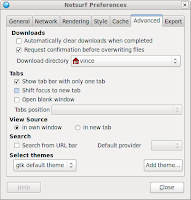
Old NetSurf Preferences Dialog
This is a deliberate choice unlike other browsers which render their UI themselves as web content, this is a beguiling solution when the authors wish there to be a single browsing "experience" with a common look and feel. However NetSurf looks and feels like a native browser for each frontend, which is what the project decided it wanted to achieve.

Given this the gtk frontend (is it a Gnome application? not sure of the distinction TBH) has had no dedicated maintainer for some time it has suffered from a bad case of bitrot from both GTK library changes and general neglect.

I have slowly been improving this situation, the browser can now be compiled with GTK version 2 (2.12 onwards) or 3, the menus and other UI elements have been translated for the supported languages and now the turn has come for the options dialog.

Oh, right, its "Preferences" not options, fair enough a common semantic throughout all applications does give a degree of homogeneousness but the word choice does seem to indicate the users control has been reduced. At this point I gained an education in just how unfriendly GTK and its tools have become towards the casual programmer.

The dialog I wanted to construct was a pretty standard tabbed layout which reflected the current options and allowed the user to change them in an obvious way. Given that I have constructed and equivalent interface in idiomatic manner for cocoa and windows I thought this would be straightforward, I was very wrong.

The interface construction tool is called glade which used to be the name of the UI "resource" file and interfaces. However the tool is still called glade but the interface is now GtkBuilder which has a different (but similar) XML based file format. Then we discover that despite it being an extensible file format the UI files are specifically versioned against the GTK library. Also why on earth can these resources not be compiled into my program? OK make them over-ridable perhaps. Generally it is yet another file to distribute and update in step with the executable.
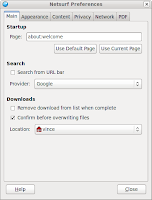
New NetSurf Properties Dialog open on Main tab
New NetSurf Preferences
So because I want to support back to version 2.12 of GTK I do not get to use any of the features from 2.16 in my UI unless I load a different UI builder file...oh and GTK3? requires a completely different version of glade and the UI files which are incompatible with gtk 2. Once this was worked round with having multiple UI files I then moved on to the next issue.

The GTK model uses function callbacks on events, these are known as signals. Perfectly reasonable but because the ui files are loaded at runtime and not compiled in there must be a way for the GTKBuilder to map the textural signal names to function pointers.

The way the GTK developers have chosen to do this is to search the global function table which means any signal handler function symbol has also to be global which means unnecessary overhead for the ELF loader increasing load times.

This lookup should have been confined to a single object or even placed in an alternative section to avoid these issues, this would not have seemed especially challenging to implement as all callback handlers have to use a preprocessor to define already (G_MODULE_EXPORT).

Another thing that makes developing GTK applications worse is the documentation, this seems to be a continuous complaint about may open source projects, which is taciturn or simply missing in many cases. GTK seems to suffer dreadfully from having multiple API versions all subtly different resulting in a lot of work on the developers part to simply find what they want.

A specific example of this is the signals and under what circumstance they occur I wanted to update all the widgets with the current configuration state whenever the options window is shown (using gtk_widget_show()) so I figured that would be the "show" signal...right? nope, never did find the right one to use, ended up with "realize" which occurs once when the dialog is created, not what I wanted, but is at least consistent and works.
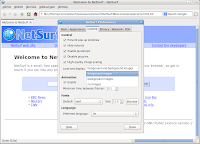
NetSurf with is Properties dialog open on the content tab
NetSurf with Preferences Dialog
Overall my impression of developing just one small dialog (60 widgets total exclusing labels and containers) for a GTK program is that the toolkit and its tooling is missing the facilities to make developers life easier when doing the drudge work that a good proportion of graphical program development.

It is not the case that one cannot do things, just that everything has to be done manually instead of having the tools do the work, and because of the documentation that tedium is magnified.

I did eventually reach the stage that the thought of writing the boilerplate to add another check button to enable "do not track" had me thinking "do they really need this or can I avoid the work?" perhaps that is why they are all reductionist?


Russ Allbery: Review: City of Diamond

Review: City of Diamond, by Jane Emerson
Publisher: DAW
Copyright: March 1996
ISBN: 0-88677-704-6
Format: Mass market
Pages: 624
The setting is deep into the star-faring future of humanity. Humans have settled many other worlds, thanks largely to technology from a race named the Curosa. There is a thriving network of settlement based around a sort of warp conduit network. But, standing apart from most human settlements, are three huge ships: the City of Opal, the City of Pearl, and the City of Diamond. Their inhabitants are devout members of the Redemptionist faith, a merging of Christian (primarily Catholic) belief and Curosa religion. Their ships are gifts from the now-departed Curosa, featuring drives unknown to the rest of humanity that allows them to ignore the normal transport network. They are meant to witness and spread their religion, but now, six centuries later, they primarily trade. Much of this is not apparent at the start. City of Diamond opens with Adrian Mercati, chosen heir of the current dying Protector, dodging people in what seems to be an oddly-organized city. Impudent, occasionally flippant, utterly charming, and in love with danger, he inherits the position of Protector shortly after we meet him. Emerson slowly reveals more of the nature of the ship while Adrian is shocking (and charming) the nobility and the church, and consorting with demons. Or, at least, one demon: Tal, an entirely human-appearing creature except for his eyes, who the Redemptionists claim is born without a soul. Slowly, it becomes clear that he's actually the offspring of an alien and a human, a mating of species whose children cannot socialize as human and behave in ways that seem like human sociopaths. Tal is no exception, but his interests align with Adrian's for the time. To those two viewpoint characters, Emerson adds four more: a low-rank administrator named Spider who works for Tal after Tal saved him from death by recycling, Adrian's politically-arranged bride-to-be from the rival (and even more religious) ship City of Opal, a guard from a French-descended slum on City of Opal, and a dangerously honorable and literal mercenary from an off-shoot culture of humanity that's now only a legend. This is a book that tends to sprawl. There's quite a lot going on, starting with the negotiations between City of Diamond and City of Opal to put to rest the remnants of a civil war and leading to the search for a legendary Curosa artifact on the planet they're both visiting. All of the characters have their own agendas, their own history, and their own goals, and are pursuing them in parallel and occasionally in opposition. Emerson takes the time to let all of this build. Despite that, there is very little in this book that drags or bores, and that's due primarily to the strength of the characters. Every one of the viewpoint characters is unique, bringing a different perspective to the story, and every one of them changes and grow over the course of the story. They also play off of each other in delightful ways. This is a book that makes full use of the fact that three characters make seven character interactions. For example, Tal by himself is logical but just slightly askew, Tal seen by Spider is uncomfortable and worrisome, Tal and Adrian is a dance of mutual amusement and respect, and Tal and Keylinn finding points of commonality is just delightful. I did wish that there was a bit more Keylinn and Tal and a bit less of Spider, but once Emerson built her world, introduced her characters, and got the story moving, there aren't many weak pieces. Part of the fun is figuring out the world background. There are almost no infodumps here; Emerson just starts telling stories of characters in the surroundings in which they find themselves, and the reader is left to piece things together from background description, the occasional explanation from one character to another, and parallels with long-standing SF tropes. It's not a puzzle book, but it is a book of where the reader is dropped as an alien into a fully-developed culture. In both that way and in the use of nobility, religion, and formal hierarchy against a starfaring backdrop, City of Diamond reminds me of the sort of classic space opera that led up to Star Wars but isn't seen as much these days. It's also funny. I was unsurprised to discover that Emerson is a pseudonym for Doris Egan, who (in addition to writing some other SF) is an occasional writer and producer for House. The humor isn't entirely obvious at the start, although Adrian frequently provokes a grin from the start of the book, but Tal's perceptive but obliviously blunt comments become more and more fun as the book progresses, and both Iolanthe (Adrian's bride) and Keylinn (the mercenary, sort of) are a delight. I want to see more of both of them, but sadly the book ends just as they (particularly Iolanthe) are hitting their strides. And that's the biggest problem with City of Diamond: it's a failed (or at least postponed) trilogy. As with Walter Jon Williams's Metropolitan and City on Fire, there were supposed to be more books, but apparently either the publisher lost interest or other projects took precedence. The story does come to something of a conclusion, but most of the major story arcs aren't resolved. Emerson is still bringing more guns onto the set late in the book. None of the villains truly get their just desserts, nor do most of the character arcs fully resolve, although friendships and more have formed satisfyingly by the end of the book. There is obviously far more to both these characters and this universe, including an entire ship that was never visited and an alien whose presence should prove startling. This is a great book: warm, funny, full of interesting characters, and with a nicely complex background universe. If it were complete in itself, or if the sequels had materialized, I would recommend it unreservedly. As is, you will have to weigh your dislike of unfinished stories against its stand-alone merits. But I enjoyed it a great deal. Rating: 7 out of 10

31 December 2012

Benjamin Mako Hill: Freedom for Users, Not for Software

I finally published a short essay I wrote about a year ago: Freedom for Users, Not for Software. Anybody who has hung around the free software community for a while will be familiar with the confusion created by the ambiguity between "free as in price" versus "free as freedom." In the essay I argue that there is a less appreciated semantic ambiguity that arises when we begin to think that what matters is that software is free. Software doesn't need freedom, of course; Users of software need freedom. My essay looks at how the focus on free software, as opposed to on free users, has created challenges and divisions in the free software movement. The essay was recently published in Wealth of the Commons: A World Beyond Market and State, a book edited by David Bollier and Silke Helfrich and published by Levellers Press. The book includes essays by 73 authors that include some other folks from the free software and free culture communities along with a ton of people working on very different types of commons. My essay is short and has two parts: The first is basically a short introduction to free software movement. The second lays out what I see as major challenges for free software. I will point out that these are some of the areas that I am working most closely with the FSF who are having their annual fundraiser at the moment to support and build advocacy programs around.

Ritesh Raj Sarraf: apt-offline - 1.3

It is still 2012 in this part of the world and the world is still intact. Since nothing major happened, I thought of spending the new gifted time to add a long pending item to apt-offline. As shown in the screen shots, apt-offline's GUI now has support to detect and display the downloaded offline bug reports.


This is part of the just released, version 1.3.

Russ Allbery: Review: Wasted Heart

Review: Wasted Heart, by Lynn Galli
Publisher: Penikila
Copyright: 2010
ISBN: 1-935611-32-1
Format: Kindle
Pages: 252
Austy is a lawyer working for the US District Attorney's office in Seattle. Six months ago, she moved there from Virginia, in large part because she fell in love with her best friend. Her married best friend. Now, she's trying (mostly unsuccessfully) to deal with the Seattle lesbian scene while becoming (successfully) the go-to lawyer for prosecuting cases with a substantial technology component. Two things are about to complicate that life: meeting and working with FBI special agent Elise Bridie, and working on a case that involves her best friend's company. Yes, that best friend. This is, as you might have guessed, a lesbian romance novel, so with that should come my "reading out of genre disclaimer": it's rather easy, when reading a genre one normally doesn't read, to find books fresh and interesting when they're unoriginal to regular genre readers, or to miss genre conventions or reactions because one has not read the previous work. You should therefore take my opinions with a grain of salt, particularly if you read more romance novels than I do (which wouldn't be hard). I grabbed this book for a few reasons: I felt like reading a warm-hearted story focused on human relationships, I wanted a reasonably fast read (since I'm obsessed with meaningless numeric milestones, like how many books I read in a year), and I wanted something with an upbeat ending. Romance generally delivers on those fronts. Lesbian romance has the added bonus of avoiding a whole bunch of gender essentialism and heterosexual romance tropes that tend to give me hives. Landing was excellent, so I thought I'd see if I could find more of that. Wasted Heart does indeed deliver, although it's not quite as good as Landing. There's a bit too much physical attraction and love based on appearance for my taste, but Galli leavens that with quite a lot of interesting psychology. Both Austy and Elise are private and cautious people, and for me that makes the romance feel more realistic. It also draws out the initial phase of getting to know the other person, which is the part of the romance that I often find the most interesting. Elise in particular is a great character maybe a little too ideal in a few places, but smart and observant in a way that's very fun to read about. Like a lot of romances, there is some annoying miscommunication and misunderstanding (predictably right around the height of the tension), but it's not quite as stupid as those problems usually are, and Galli doesn't drag it out until one starts wanting to hit the characters with blunt objects. As good or better is the community that surrounds the main characters. Galli has a full cast of believable and interesting characters, most notably including Austy's old gang from Virginia. The tensions between having a group of friends one cares about deeply, wanting to build a new life after making a major break and major decision but having difficulty sustaining that under the onslaught of those friends, and being easily tossed about by expressive and outgoing people when one is private and a bit quiet all play out here. And, refreshingly, without a lot of angst, and with quite a bit of intelligent introspection. Both Austy and her friends are smarter and more considerate than most of the characters I've seen in this sort of situation. Another good bit is the little pieces of legal drama. Galli doesn't neglect Austy's work life, and while this is certainly not a legal thriller or procedural, we do get some nice scenes of Austy doing her job. I love courtroom scenes, particularly ones (like these) that are more on the realistic side, so that was a nice bonus. Austy and Elise's jobs also lead to a somewhat predictable bit of drama, and I was a bit less enamored of that; the more I thought about it, the less well it hung together for me. But I did like that it stayed firmly on the realistic side, including a look at psychological aftereffects for real people rather than thriller protagonists. This is not the sort of book that I would tell someone to rush out and buy, but it met my criteria nicely and delivered just the sort of entertainment I was looking for. (And it's not particularly expensive on Kindle, at least in the US.) There was a bit too much focus on physical appearance and physical infatuation, and Elise might be just a little too perfect, but I enjoyed it. Note that I read the special edition, which includes a (much appreciated) epilogue that closes out the story. That seems to be the default edition for sale everywhere I look, but in case you see the older version, I recommend the special edition. Rating: 7 out of 10

30 December 2012

Russ Allbery: Review: Countdown

Review: Countdown, by Mira Grant
Publisher: Orbit
Copyright: August 2011
ISBN: 0-316-20448-X
Format: Kindle
Pages: 75
Countdown is a novella that tells the "origin story" of Grant's Newsflesh universe, the setting for Feed and sequels. It's the story of the initial creation of Kellis-Amberlee and the first zombie Rising, mixed with a small bit of backstory for the Mason family. There are two ways to read this novella that work. It's possible to read it prior to reading any of the Newsflesh books as a sort of teaser. It sets up the universe, shows the devastation of society, and raises the question of how society will respond. Alternately, and I think more effectively, it can be read as an appendix to the Newsflesh trilogy that fills in the backstory. Reading it after all three books led to some fun moments of "oh, that's how that happened." It shows the accidents and bad decisions that led to the Rising, and provides a bit of a counterbalance to some of Georgia and Shaun's snarky comments about the government, scientists, and the media. The way to read it that doesn't work is to try to read it as a stand-alone work. Countdown has very little in the way of a story. It's told in the disaster epic style of brief scenes following numerous characters, some who are only seen once. There are small plot arcs following the Kellis virus, the Amberlee virus, and the Masons, but none of them are satisfying when read as a traditional story. Some events, particularly in the Masons' thread, have no real meaning by themselves and only acquire significance as part of Georgia and Shaun's backstory. The reason to read this novella is because you're invested in the universe, either to whet your appetite for more or to fill in some of the background. With that caveat, I think Countdown is more effective as horror than the Newsflesh trilogy itself is. Feed and its sequels are more action novels that become political thrillers, and the confident first-person narration and snark undermines most of the sense of dread or horror in the world. (Please note: not being a horror fan, I consider this a feature.) Countdown doesn't have that strong narrative presence. Instead, it covers events that are both horrific and inevitable and towards which the characters are largely helpless. Some of the scenes towards the end are haunting. Grant still isn't very subtle, but I think she does a good job writing quiet desperation and leaving some of the emotions for the reader to interpolate. Countdown could be read after Feed, if you're interested enough in the world to want more, but I think it works best after Blackout (for reasons that are minor spoilers). It could be read before the whole series, but I recommend reading it as an appendix instead. Don't expect too much of it it's background filler rather than more story but I thought it was effective and enjoyed the additional filling-in of the world. Rating: 7 out of 10

29 December 2012

Russ Allbery: Review: Blackout

Review: Blackout, by Mira Grant
Series: Newsflesh #3
Publisher: Orbit
Copyright: 2012
ISBN: 0-316-20218-5
Format: Kindle
Pages: 631
Blackout is the third book in the Newsflesh series that started with Feed. As with the second book, Deadline, you do not want to read this book out of order. All the emotional heavy lifting is done in Feed, and the book won't mean as much without that. Also, as with Deadline, be very careful about any information you read bout the sequels if you've not yet read Feed, since it's very easy to spoil that book and most information about subsequent books will do so. I'm going to try to write this review without spoilers. That's going to be a bit tricky due to events in Feed, so bear with me if I'm less specific than normal. This is the grand finale of the series, and it is a firm conclusion. As you might expect, particularly from Deadline, that involves a lot more politics, a few more big revelations, some reunions, escalating scale, and a lot of fighting. Unfortunately, it also involves setup. A lot of setup. I didn't expect that, given that Deadline ended at a run, but it takes about half of Blackout and a whole lot of pages before we get to the events that logically follow from the end of Blackout. And those pages dragged for me. There are some great moments. The banter continues to be strong, there are some deeply affecting scenes with Shaun, and Maggie continues to be wonderful. Grant also introduces some new secondary characters (Monkey and the rest of his household) who are brilliant and feel like they could have come directly from Borderlands. All of Blackout has a bit more of that mad scientist feel, full of slightly deranged people who take the fight to the world in their own ways. But it still drags. One branch of the book has the protagonists going here, there, and everywhere in several roundabout attempts to advance the plot. The other branch is more psychologically tense, but it takes too long to get moving and therefore turns into a repetition of the same emotions and the same complaints. I wanted to get to the key events that happen about halfway through the book in about half as many pages as they took. Thankfully, things do pick up when the two strands of the book come together. Some of the emotional dynamics strengthen as well, which I'd been missing. Grant does a great job here tying the whole series together in a way that shows the differences between Feed and Deadline and digs into their nature a bit more. There is one big reveal that I found disappointing, both because it had been obvious since early in Deadline and yet was treated as a big reveal and because I think it put the book and series onto slightly more conventional territory in a place where it had previously been interestingly distinct. (I'm being vague because of spoilers.) But that didn't bother me too much, and the surrounding character dynamics I think made up for it. The final ending isn't exactly bad, but neither did it entirely work for me. The whole series seems a touch too naive. This worked in Feed (at least for me; some other reviewers disliked it) since the naivete felt like part of the dynamic of the story and the characters, and the stakes were mostly kept small enough that it was believable. The stakes are large enough here that I needed the world to be a touch more complicated and the villains less hissable. (If there's been one consistent flaw throughout this series, it's that Grant's villains are too purely evil.) And, in the end, I didn't quite buy the conflict at the heart of the story; after everything that had happened, I wanted something more complex and nuanced. I'm a bit unsatisfied, but, like Deadline, Blackout is still a good book. Neither of them live up to Feed, but they're both enjoyable, action-filled, and creative looks at a zombie apocalypse. I think Blackout is at its best when it's being Fallout or Borderlands and emphasizing the mad scientist angle of Grant's world, and I would have happily read several more chapters about Monkey. The mix of wacky risk-taking and serious political idealism doesn't quite gel, and the latter never worked for me in Blackout, but I still had a lot of fun with the core character interactions. If you read Deadline, you certainly want to read Blackout. If you stopped at Feed, Blackout is probably not a persuasive argument to continue. Rating: 7 out of 10

Next.

Previous.