Search Results: "bab"

13 November 2013

Julien Danjou: OpenStack Design Summit Icehouse, from a Ceilometer point of view

Last week was the OpenStack Design Summit Icehouse in Hong-Kong where we, OpenStack developers, discussed and designed the new OpenStack release (Icehouse) that is coming up. The week has been wonderful. It was my second OpenStack design summit, and I loved it. Bumping into various people I've never met so far and worked with online was a real pleasure. As it was to meet again with fellow OpenStack developers! The event organisation was great, as were the parties. :-) On the last day, I had the chance to present a talk with Eoghan Glynn and Nick Barcet how we built the auto-scaling feature in Heat, implementing the "alarming" feature needed in Ceilometer.
The slides and video of the talk is online on my talks page. Design sessions This time, Ceilometer design sessions were spread on 3 days. Everything we talked about has its Etherpad instance. The discussions were interesting, and the amount of feedback gathered is big and is going to be very useful. There's a lot of people and companies using Ceilometer now, and the project is getting more and more traction in general. There's a lot of different way to use it and to bend it to one's needs. Considering the amount of features and options that is provided, building functionality with a genericized approach it making Ceilometer useful for a lot of different and interesting use-cases. Icehouse roadmap The list of blueprints targeting Icehouse is available, but not yet complete. I expect people to start filling this list in the next days.If you want to propose blueprints, you're free to do so and inform us about it so we can validate it. The same applies if you wish to implement one of them! Thereafter, I try to guess what the roadmap will look like in the upcoming weeks for Ceilometer based on the discussion we had last week during the summit. Events management A lot of work is going to be put into event management. Ceilometer plans to store notifications sent using oslo.messaging by OpenStack projects. Some work already got merge for Havana, but the API part and future improvements and ideas will continue to flow into the Icehouse release. Agents and group management A lot has been discussed around the polling agents and around the alarm evaluator agent. The current state of the ceilometer-central-agent disallows any kind of high-availability and load-balancing, as the polling task are kept and scheduled on only one node. The high-availability part is already covered by a custom mechanism built into ceilometer-alarm-evaluator, but it came clear to us that a more generic approach is needed. A lot of other projects needs this kind of functionality, and a pattern have been pointed out. A blueprint about group membership has been discussed in an Oslo session, and will end into a new Python library written to solve this in Ceilometer and in other projects. TaskFlow will also probably be leveraged to solve the task distribution issue. Documentation Since a few weeks, Ceilometer auto-generates its API reference documentation using sphinxcontrib-docbookrestapi that parses our API code that uses WSME. We also want to start writing a user guide, and we'll do that inside our own repository. That way, I hope that we will be the first project in OpenStack to require documentation to be incorporated into every patch that's being sent to Ceilometer. This is the best way to assure that nothing can be changed nor added without being accompanied with a documentation update. Tempest testing Testing of Ceilometer already has been a subject during the previous design summit about testing. We already put a large effort on Tempest testing in this last cycle, but we encountered a lot of small issues that we had to tackle to achieve something. Some Ceilometer basic tests are already on their way into Tempest, so this is something that is going to be achieved very soon. Ultimately, I would also want Ceilometer moving towards providing its own set of Tempest tests as part of the code base. That way, it'd be as easy for core reviewers to refuse a patch if it doesn't provide functional tests as it is to refuse it if it doesn't provide unit tests. As we'll do for the documentation. API improvements Once again, a few API improvements will probably be implemented, like aggregation or the ability to specify multiple queries with OR and AND operators. Roll-up, archiving of data There seems to be interest in archiving and rolling-up the data stored by Ceilometer, so work in this area is to be expected. Supporting multiple data storage driver in parallel seems to be something that needs to be done for this and other aspects of Ceilometer feature set. Alarming The alarming feature set is already big, and the work that has been accomplished pretty amazing. A few improvements will be made, as retrieving better metrics and building better statistics (exclusion of low quality data points).

Joachim Breitner: Constructing a list in a Monad

In Haskell, lists are ubiquitous. In real-world Haskell, monads are ubiquitous. So it should be an easy task to fill a list with values obtained in a monad, i.e. a list of n random numbers (in the Rand monad), or getting some input from the user, and storing it in a list, until the user chooses to finish the input. The task For now, assume a function getInput :: IO Int; we want to run it 10000 and then have the list of the values returned. Sounds simple and straight forward, but it is actually really hard to get the run-time behaviour that we naively and optimistically expect. The expectation In an imperative setting, we would have a simple counting loop. In the loop, we run getInput, allocate a new cell for the linked list, and append it to the list. Clearly, this Can we achieve that with Haskell? Let s look at a few alternatives (complete code available)
Attempt 1: The accumulator I ll start with the probably worst attempt. Unfortunately, from what I have seen from correcting Haskell exams, this is what beginners would write, especially if they have the above imperative algorithm in mind, and know about the convert loops to recursion with accumulators approach to solving Haskell problems:
accumAppend :: Int -> IO [Int]
accumAppend n = go n []
  where
    go 0 l = return l
    go n l = do  x <- getInput; go (n-1) (l++[x]) 
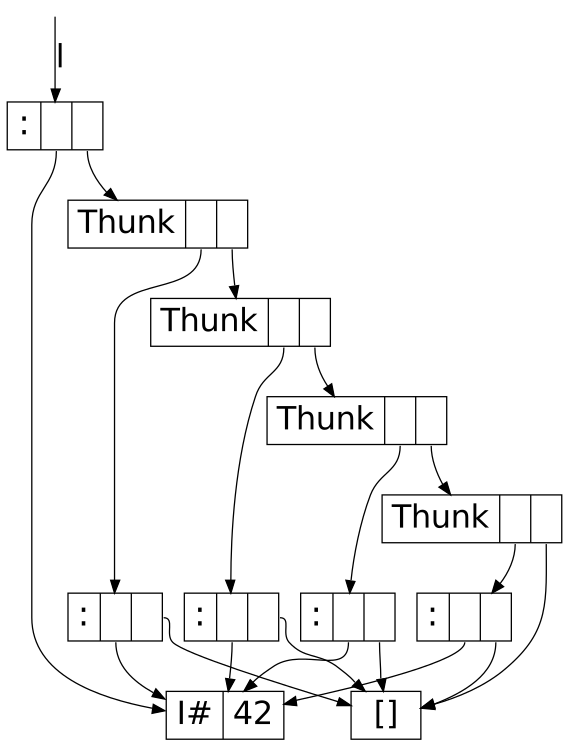
To check the space usage of this, I pass -Kn to the GHC runtime and see what limit is just enough to let this program calculate accumAppend 10000 and fully evaluate the resulting list. It turns out that we need 328336 bytes of stack space. So what about the second requirement; that the list is fully evaluated? Experienced Haskellers see it immediatelly: The accumulator is not used in the loop, so each iteration adds a thunk around the previous value, that would add the next entry to the end. Only when the list is actually used, these are run, each traversing the whole list, causing quadratic cost. We can verify this using ghc-vis:
Clearly (and not surprisingly) this is not the best solution. Attempt 2: The accumulator (forced) Lets try to fix the second issue, by making sure that the list is always fully evaluated. We import Control.DeepSeq and write
accumAppendSeq :: Int -> IO [Int]
accumAppendSeq n = go n []
  where
    go 0 l = return l
    go n l = do  x <- getInput ; go (n-1) $!! (l++[x]) 
As the accumulator gets fully evaluated before being passed to the next invocation of go, the result will not contain thunks. But note that this has also fixed the stack consumption: The code now runs the smallest setting for -K, 8 bytes. This works as both go and deepseq are tail-recursive. But this is still not the solution we are looking for, as the quadradic cost caused by using ++ is still there. Attempt 3: The accumulator (reversed) Since we know that l++[x] is expensive, but x:l is cheap, we can simply use this to update the accumulator. This has the slightly annoying consequence that the entries of the list are in the reverse order, but we can fix that in the base case:
accumReverse :: Int -> IO [Int]
accumReverse n = go n []
  where
    go 0 l = return (reverse l)
    go n l = do  x <- getInput ; go (n-1) (x:l) 
And indeed, we get noticably faster code that still runs in 8 bytes of stack. Unfortunately, we still don t construct the final list directly. Attempt 4: Naive recursion Maybe we can do without an accumulator. The most naive such code would be
listRecurse :: Int -> IO [Int]
listRecurse n = go n
  where
    go 0 = return []
    go n = do  x <- getInput; r <- go (n-1); return (x:r) 
and I d expect that most experienced Haskellers would write that code (if they are asked not to use a library function). And indeed, this code does create the final list directly. But it requires a large stack or 164616 bytes. The reason is that this is no longer tail recursive: After calling go again we need to take the result and prepend x Attempt 5: library functions Maybe we should simply not worry about the implementation, and use library functions? Clearly, the authors of such libraries have found the best solution. So how does
listReplicateM :: Int -> IO [Int]
listReplicateM n = Control.Monad.replicateM n getInput
fare? Unfortunately, not better than the naive recursion. In fact, the stack space requirement is the same 164616 bytes. The same holds when using special libraries for generating and consuming list, e.g. the Streams module from the vector package:
listStreams :: Int -> IO [Int]
listStreams n = MStream.toList $ MStream.replicateM n getInput
Attempt 6: Difference lists It is time to dig deeper into our box of tricks. What if we have lists with constant time Snoc (a.k.a. appending a new element)? Then Attempt 3 would not require reversing the list. Such lists are provided by difference lists; there are libraries for that, but we can simply implement them using lambdas:
accumDList :: Int -> IO [Int]
accumDList n = go n id
  where
    go 0 l = return (l [])
    go n l = do  x <- getInput; go (n-1) (l . (x:)) 
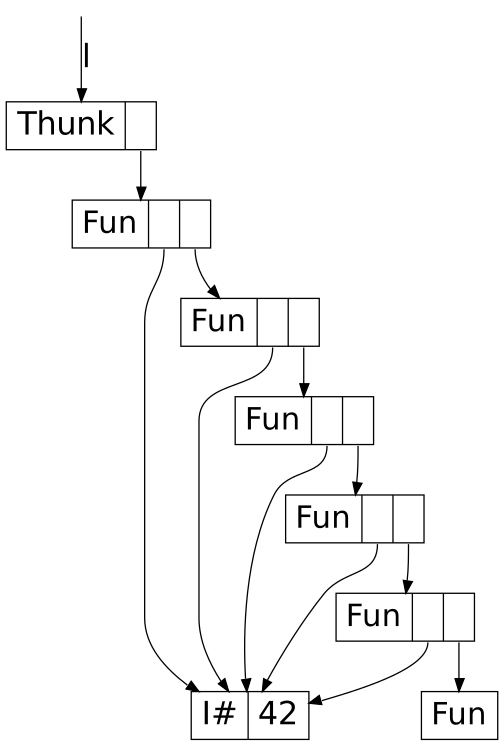
Indeed, no stack is required (8 bytes are enough). But we are cheating here: We are still not constructing the final list, but rather we combine functions that append elements to lists. So when accumDList returns, what we have in memory, is a thunk and sequence of partial function applications in the wrong order, and evaluating the thunk does basically the same thing as reverse in Attempt 3. It might be a bit faster, is still not satisfying enough:
Attempt 7: Unsafe functions Even deepter in the box of tricks, somewhere in the grit and dust where one usually should not reach, there is a function that can help us out here: unsafeInterleaveIO. This allow us to modify the naive recursion in a way that first creates the Cons-cell, and then continues the loop:
listUnsafeInterleave :: Int -> IO [Int]
listUnsafeInterleave n = do  l <- go n; return $!! l 
  where
    go 0 = return []
    go n = do x <- getInput
              r <- unsafeInterleaveIO (go (n-1))
              return (x:r)
The stack consumption is 8 bytes. It is worth noting that the all to deepseq (in $!!) will actually drive the evaluation of go. Also, it guarantees that the unsafe effects of unsafeInterleaveIO are confined to the execution of listUnsafeInterleave, i.e. are actually safe. Run time statistics I ran criterion over the functions (generating lists of length 1000), and found these results: Conclusion There are many ways to write a list-constructing list in Haskell, none are perfect they either fill the heap, or do not construct the list directly (usually requiring a second pass through it), or rely on IO-specific unsafe functions. The naive recursion performs the best, but may cause a stack overflow (note, though that from GHC 7.8, the stack will be unlimited). The next best option seems to be the difference lists
I m still wondering: What would be required from Haskell, GHC or the monads in question to have a fully satisfactory solution here, i.e. one that is as fast as the naive recursion, as stack efficient as the difference list solution, and allocates no thunks, only list cells?

12 November 2013

Russell Coker: Bad Advertising of Protoplast

Carpal Tunnel Syndrome In early 2010 I wrote about Carpal Tunnel Syndrome, I gave a picture of the wrist brace and a description of the process of creating it [1]. A few months later I wrote a follow-up about how the wrist brace had helped me, at the time I was anticipating wearing it at night for the rest of my life [2]. But my wrist has continued to improve. Nowadays I never wear the wrist brace and hardly even think of it. I am a little more careful about posture than I was before, but mostly it has no impact on my life. I think this counts as a full recovery. At the time I was mildly interested in buying some thermo-plastic of that type to make things, but the only source I found was Jaycar which sold 100 grams for $14.95, Jaycar prices have now dropped to $11.50 for 100 grams or $89.50 for a kilo but it s still expensive [3]. Protoplast When looking at the sites that link to my blog I saw a site advertising Protoplast which is a type of thermo-plastic that can be used for making things [4]. Protoplast have more reasonable prices, E30 ($AU42.75) for a kilo and their web site offers better prices for anyone who purchases 10kg or more (good for hackerspaces etc). As they post no further than Belgium they aren t an option for me but they do seem to make a good offer, better than Jaycar offers in Australia. Protoplast is probably a good product, but I think that their advert is misleading. While it is probably possible to make a wrist-brace similar to mine with Protoplast it s a fact that my wrist brace was not made with it. My wrist brace started out as a flat sheet of plastic which could be formed to the final product without being melted. Converting a packet of plastic granules (as sold by Protoplast or Jaycar) to a sheet to even start work on such a wrist brace would take some work. To make a sheet of plastic out of beads sold by Jaycar or Protoplast you would ideally completely melt the plastic, if you just softened the plastic then it wouldn t be as strong as using a pre-made sheet. During the time that I wore the wrist brace I probably repaired it more than 30 times, this wasn t particularly difficult to do, I poured boiling water over it to soften the part that cracked until it became tacky and then pushed it together again. But the result was significantly weaker than the original due to the difficulty in welding the broken sections together. I ended up cutting some strips from less important parts of the wrist brace (the part nearest to my elbow) to reinforce the weakest part which was between my thumb and fore-finger. That section ended up being about three times thicker than it was originally while also not being as strong as it was originally. I also had difficulty in making it flat so it wasn t nearly as comfortable as the original version. It seems rather misleading to include the picture of my wrist brace on a site advertising plastic which wasn t used to make it and which probably couldn t be used to make something that looks as good with the same ratio of strength to mass. But with a suitable disclaimer indicating that the user probably can t get the same result it would be OK to give it as an example of what could be done. I can imagine someone using a product like Protoplast to make a wrist brace that can hold a mobile phone, that can be worn with a watch, or has other features that aren t offered by medical staff. License Issues The license for my blog doesn t permit people to just copy pictures, it s a Creative Commons Attribution-Noncommercial-Share Alike based license [5]. I am interested in supporting companies that make interesting products and anything that can help people with medical issues is also of interest. So I wouldn t rule out the possibility of a free license for a picture from my blog to be used in the way that they used it (with a link back to the original blog post). But I would want a description that informs readers that it s not an item made with their product, merely something similar that can be used for inspiration.

11 November 2013

Simon Josefsson: Using Replicant on Samsung Galaxy S III

For the last half-year I have used CyanogenMod on an Nexus 4 as my main phone. Recently the touch functionality stopped working on parts of the display, and the glass on the back has started to crack. It seems modern phones are not built to last. For comparison, before the N4 I used a Nokia N900 for around 3 years without any hardware damages (in my drawer now, still working). A few weeks ago I started looking for a replacement. My experience with CyanogenMod had been good, but the number of proprietary blobs on the N4 concerned me. Finding something better wasn t easy though, so I m documenting my experience here. My requirements were, briefly, that I wanted a phone that I could buy locally that had a free software community around it that produced a stable environment. I have modest requirements for things I wouldn t give up on: telephony, data connection (3G), email (IMAP+SMTP), chat (XMPP), and a web browser. I like the philosophy and openness around the Firefox OS but the more I have read about it, it seems unlikely that it would deliver what I need today. In particular none of the devices capable of running Firefox OS appealed to me, and the state of email reading seemed unclear. I m sure I ll revisit Firefox OS as an alternative for me in the future.

As I had been happy with CyanogenMod, but concerned about its freeness, it felt natural to move on and test the more free software friendly project Replicant. Replicant only supports a small number of devices. After talking with people in the #replicant IRC channel, it seemed the Samsung S3 would be a decent choice for me. The Samsung S2 would have worked as well, but it cost almost as much as the S3 where I looked. Despite the large number of Samsung S3 devices out there, it seems the prices even for used devices are high (around 2500 SEK in Sweden, ~380 USD). I ended up buying a brand new one for 3200 SEK (~500 USD) which felt expensive, especially after recalling the recent $199 sale for Nexus 4. Noticing that brand new Nexus 4 devices are still over 3000 SEK in Sweden comforted me a bit. I would have preferred a more robust phone, like the CAT B15, but the state of free software OSes on them seem unclear and I wanted something stable. So, enough about the background, let s get started. Building and installing Replicant on the device was straight forward. I followed the Replicant Samsung S3 Build instructions to build my own images. The only issue I had was that I had not set JAVA_HOME and the defaults were bad; make sure to set JAVA_HOME before building. I built everything on my Lenovo X201 running Debian Wheezy, with OpenJDK 6 as the Java implementation. Installing the newly built firmware was easy, I just followed the installation process documentation. I made sure to take a clockworkmod backup to an external SD card before wiping the old system. To get a really clean new device, I also re-formated /sdcard inside clockworkmod; I noticed there were some traces left of the old system there. I spent about one week testing various configurations before settling on something I could use daily. A fair amount of time was spent looking into backup and restore options for Android devices. My idea was that I would take a backup of the apps I ran on the N4 and transfer them to the S3. The Android Debug Bridge (adb) has a backup/restore command, however it (intentionally) ignores apps marked as allowBackup=false which a number of apps has. It doesn t seem possible to override that settings so much for the freedom to backup your own device. I then discovered oandbackup. It can backup your entire system, saving each app (together with associated data) into a separate directory, for simple review and inspection before restore. You can do batch backups and batch restore. I couldn t get it to automatically restore things, though, which would be neat for really automated re-installations (there is an open issue about this feature). After noticing that some apps did not like being moved from the N4 (running Android 4.2) to the S3 (running 4.0), I ended up installing most apps from scratch on a freshly installed Replicant. I use oandbackup to the external SD card so that I can quickly restore my phone. For backup/restore of SMS/MMS and Call Log, I use SMS Backup+ against my own IMAP server. Camera pictures are synced manually using adb when I am connected to my laptop. There is a number of apps that deserve to be mentioned because they are what I use on a daily basis. All of them come via the free software market F-Droid. For email (IMAP/SMTP), I use K-9 Mail which is feature rich but still easy to use. For chat, I use Xabber. I use NewsBlur s free software app to read RSS flows. For two-factor authentication, I use Google Authenticator. I haven t evaluated different PDF viewers, but the first one I tried (APV PDF Viewer) has worked fine so far. Handling a a synchronized address book and calendar deserve its own blog post because it is a challenging topic, but briefly, I m currently using a combination of aCal and DAVdroid. Finally, since Replicant is still work in progress, some words about stability and notes on what doesn t work. This is probably the most interesting part if you are considering running Replicant on an S3 yourself. Overall system stability is flawless, I hadn t had any crash or problem with the fundamental functionality (telephony, 3G, Camera). People have said graphics feels a bit laggy, but I cannot compare with the stock ROM and it doesn t get in the way of daily use. First some notes about non-free aspects: Some other observations: I am quite happy with the setup so far, and I will continue to use it as my primary phone. flattr this!

10 November 2013

Steve Kemp: So I have a new project

Recently I decided to set myself a big photography challenge. The three options which I discussed with a couple of people were: Ultimately I decided pubs would be most fun. Not least because you could do it every year or two, to see what changes occurred. To make it more useful I decided to not only take the pictures, but to collect, and share, the meta-data too: Today I spent an hour walking up Easter road, and down Leith Walk. I shot the outside of about 20 pubs, and then fiddled with the layout and organization of the images. I'm reasonably happy with the result, but it remains obvious that I'm not a designer. The data-set use to generate the site - which is perhaps the most interesting/useful part of the whole exercise to other people - is available online too: All the data, even the images, is stored on github for collaboration purposes. I'm not sure if folk will join in, but I can probably manage a few of the major thoroughfares every weekend indefinitely it will only take a couple of days to get "city-wide coverage", then the rest is gravy.

Jelmer Vernooij: Quantified Self

Dear lazyweb, I've been reading about what the rest of the world seems to be calling "quantified self". In essence, it is tracking of personal data like activity, usually with the goal of data-driven decision making. Or to take a less abstract common example: counting the number of steps you take each day to motivate yourself to take more. I wish it'd been given a less annoying woolly name but this one seems to have stuck. There are a couple of interesting devices available that track sleep, activity and overall health. Probably best known are the FitBit and the jazzed-up armband pedometers like the Jawbone UP and the Nike Fuelband. Unfortunately all existing devices seem to integrate with cloud services somehow, rather than giving the user direct access to their data. Apart from the usual privacy concerns, this means that it is hard to do your own data crunching or create a dashboard that contains data from multiple sources. Has anybody found any devices that don't integrate with the cloud and just provide raw data access?

Russell Coker: Aldi Changes, Cheap Telcos, and Estimating Costs

I ve been using Aldi as my mobile phone provider for two months now since Kogan was shut down [1]. Now Aldi have cut the transfer quota on their Unlimited plan from 5G per month to 2.5G per month. The most charitable interpretation of this would be that Aldi got a lot of former Kogan customers who needed the 6G per month that Kogan offered and that forced them to make changes to remain profitable. But the most likely possibility is that with less competition Aldi can just offer less for the same price. This isn t a huge problem for me, in two months on Aldi my biggest month involved almost exactly 2.5G of data transfer. But it s annoying to lose something and it s enough to make me consider other options. Also some of my relatives are looking for new plans so now is a good time to research the options. Other Pre-paid Options Lebara offers Unlimited plans that start at $30 per month and offer 1.5G of data [2], this compares well to the Unlimited plan of $35 per month from Aldi which has 2.5G of data (depending on whether 1.5G is enough). Amaysim has an Unlimited plan that includes 4G of data for $40 per month [3]. If you make lots of phone calls and transfer more than 2.5G of data per month then that would be a really good deal. Lebara uses the Vodafone network and Amaysim uses Optus. Neither of them compare to the Telstra 3G network if you want access outside major urban areas. I had Virgin (Optus network) work well for me for years and Three (their own network now part of Vodafone) work well for many years before that. But data transfer is becoming more important to me and the Telstra network is a major feature of Aldi. Lebara has one of the wost web sites I ve ever seen and Amaysim isn t much better. Aldi is great, they just provide all the key data in one page. Aldi and Amaysim have Android apps that can be used for recharging and viewing the balance, Aldi s app works well but I haven t been able to test the Amaysim app. Lebara doesn t even have an app. Generally Lebara doesn t seem to have anything going for it unless you want to make lots of calls to other Lebara customers, you want to make calls to certain other countries where Lebara has very low international rates, or unless you need a plan with unlimited calls but don t need more than 1.5G of data. The following table summarises the costs of the three pre-paid telcos.
Telco Flagfall Cost/min (Australia calls) SMS Data Cost/Meg Data Increment Credit Expiry and Minimum 30day Data Packs
Aldi 0 $0.12 $0.12 $0.05 1M 1 year $15 2G=$15
Lebara $0.29 $0.15 $0.15 $0.05 1K 90 days $10
Amaysim 0 $0.12 $0.12 $0.05 1M 90 days $5 1G=$10 2G=$20 4G=$30
Post-paid Options Virgin s cheapest offer is $20 per month for $200 of calls (at $0.98/min + $0.40 flagfall) and 200M of data [4], they currently have a special offer of an extra 1G if you sign up before the 18th of November. Virgin have a long history of periodically offering special deals so if you want to sign up with them some time in the next few months it s best to poll their web site and wait for a deal. The TeleChoice Global Liberty plan is a slightly better deal of $20 per month for $500 of calls (at $0.97/min + $0.40 flagfall) and 1G of data which also has free SMS [5]. TeleChoice Global Rebel Texter is a plan for $15 per month that includes $200 of calls and 200M of data and free SMS [6]. They also have a $10 per month plan which charges $0.22 per SMS, which would be bad value for anyone who sends 1 SMS per day. At Aldi rates if you spend $15 per month on 2G of data and $5 on calls then you will get 41 * one minute calls as opposed to $200/($0.98+$0.40)==145 * one minute calls with the cheapest Virgin plan. It seems to me that there is little possibility for those two $20 post-paid plans (which seem to be two of the best value plans currently available) to compete well with the pre-paid options from Aldi and Lebara. Even if you have the same usage pattern every month there are only particular patterns which make the Virgin or TeleChoice deals most appealing options, for example if you need to make more than 40 minutes of calls but less than 145 minutes of calls then Virgin will look good. TeleChoice Global Liberty looks good if you make between 40 and $500/($0.97+$0.40)==365 * one minute calls. If you only need a small amount of data transfer (less than 200M billed in 10K increments) then the TeleChoice Rebel Texter plan would look good as the Aldi 1M increments matter for small amounts of data transfer. But I don t think that many people are in that situation, even my mother in law can t easily stick within 200M of data transfer. Measuring Phone Use The first program I used for measuring phone calls is the Call & SMS Stats app from the Android Market [7]. I wouldn t recommend this to technical users as it demands a lot of access to the phone (including reading SMS, accessing the phone storage, and sending data to the Internet), but it s good for less technical users. For my use I prefer Call Meter 3G from the F-Droid repository [8]. I trust the Call Meter 3G program more because it s source is available under the GPL and it also has the convenient feature of adding up the costs of the calls, SMS, and data used. According to Call Meter 3G I m using less than $20 of calls and SMS per month, so if I continue my current use with a 2G data pack every month from Aldi instead of buying a $35 Unlimited pack and don t use more than 2G of data then I ll save at least a few dollars every month. My wife makes fewer calls so I ve already moved her phone away from the Unlimited plan and I ll move my phone later if it looks like it will save money she will now use my phone for making calls when we are together so the Unlimited plan may become good value when we share it. The Case for Aldi Aldi offers competitive options for phones for most levels of usage. While there are some post-paid plans which are better in some areas such as the ones from TeleChoice Aldi has the benefit of flexibility. A phone with Aldi can have it s plan scaled up or down easily with no penalty fees. For a phone to be usable for an entire year the cheapest option at the moment is Aldi which has a $15 recharge that lasts for a year. The next best option seems to be Amaysim with a $5 recharge that lasts for 90 days. Saving Money In the past I ve been used to SMS being significantly cheaper than phone calls. When I was on Virgin and calls just over $1 per minute ($0.98 per minute plus the flag-fall) and SMS were $0.28 which made a simple question and answer cheaper by SMS than calling. But with Aldi charging the same for a 1 minute call and sending an SMS a simple question and answer will cost half as much if it s done with a call so SMS isn t a good deal. Also I ve started using Google Hangouts to communicate with my wife instead of SMS as extra use of Hangouts is essentially free (we both have it running all the time for Ingress related communication anyway). The financial incentive now is to use Google Hangouts to replace some calls. One down-side to saving money in such ways is that it restricts usage of the phone. While moving from SMS to Google Hangouts (or any other instant-messaging system) isn t any great cost having to reduce the number of calls does. The ability to talk for as long as you want without bothering about cost is something that s worth paying for. I Hate Telcos For most things that I spend money on I wouldn t invest much effort to try and save $10 or $15 per month. Even when doing research that will help my friends and relatives and random people on the Internet I probably wouldn t take so much time for a small saving. But the Telcos seems to avoid competing as much as possible which is obvious from the way that they increase prices and decrease services at the same time. Also most Telcos seem to have a business model that is based around exploiting customers, they have confusing terms in the contracts that make it very likely for customers to go over the included usage and hit penalty rates and charge unreasonable prices for the phones that are bundled with a telephony contract. I want to reduce the amount of money I pay to Telcos as a matter of principle. Aldi is better than most Telcos, they have clear terms that are explained on a single web page [9], and they have an Android app to show the remaining credit that can reduce the risk of excessive fees if a 2G data block is used. Aldi sells phones in their stores at low prices, the phones that they sell aren t the highest quality but the customer gets what they pay for and the warranty return policy is good. But we still need to find the best options so that market forces will encourage Telcos to make more reasonable offers.

7 November 2013

Matt Zimmerman: Management: a rant

You keep using that word. I do not think it means what you think it means. -Inigo Montoya
Having worked in full-time management positions for some years now, I am increasingly convinced that management is widely misunderstood as a role, as a discipline and as a field, and that this makes a lot of lives more difficult and stressful than necessary. It is the subject of much speculation and misbelief, and I ve chosen a few of my favorite examples to deconstruct here. Misbelief #1: management is what managers do I ve noticed a trend among a certain class of companies, whose employees will tell anyone who will listen that there is no management in their organization, they never plan to have any, and neither should you. I think these statements are respectively a lie, a na ve belief, and a piece of bad advice. Usually, these companies are just a few years old and relatively small, most of the people in the company have been there for less than a year, and the speaker is trying to persuade us what a unique and innovative company they work for because nobody there is a manager . They invariably have not read The Tyranny of Structurelessness. Management is the practice of enabling people to effectively cooperate. A manager is someone whose job is to do that. It s that simple. It usually involves tasks such as sharing information, agreeing on a course of action, dividing up work, and figuring out what to do when there s a problem. They re things that every team needs to do, whether anyone is designated a manager or not. Teams can function without managers, but they can t function properly without management. Someone (or everyone) has to do the work to make cooperation possible. Modern management is a specialized discipline, which draws on a broad range of skills in communication, psychology, empathy, problem-solving, leadership, and more. These skills aren t unique to managers, but it often makes sense to designate certain people to do more of the management work, on behalf of the team. By devoting more of their time and attention to it, they free other members of the team to focus on other tasks. They can act as a coordinator to help the team stay in sync, and by focusing on this job, they may be able to do a better job of it, and acquire a higher level of skill through practice and study. But it remains an inherently collaborative practice. Misbelief #2: management is about telling people what to do There are many different varieties of management, each of which is oriented toward a particular type of team or organization. Factories are managed differently from design studios, large companies are managed differently from small companies, and every team has its own distinct management style which arises from the unique group of people involved. Some managers are specialists in a particular type of management, while others are more generalists. The telling people what to do style of management is called command and control . It s characterized by authority, hierarchy, and strict adherence to protocol. It s widely employed by military organizations, and by the managers we see in television and film. It has some advantages and disadvantages, which I won t discuss here. My point is that it is just one example, but this example is used to represent the general concept of management. Self-organization, where no one in particular is responsible for group decisions, is another, quite different, style of management. Small, self-organizing teams are capable of amazing feats of productivity. They re less difficult to manage because they re comparatively simple, and so simple tools and techniques work well. Everyone can be fully aware of what everyone else is doing, and new information propagates quickly throughout the team. But as the team or organization grows, it will often outgrow this way of working, and needs to adapt. There is no single management approach which works universally well. Misbelief #3: management is a promotion You know the story. When an employee is successful within their area of expertise, someone will eventually offer them a management role as a reward for their good work. This is utter nonsense. Management is not a promotion: it s a career change. It means starting over as a beginner in a new discipline and learning from the ground up. Domain expertise is important, as a manager needs to understand the work of the other people on their team, but it is no longer paramount. The team, the human system, becomes their focus. When organizations fail to provide career advancement within a discipline, people may turn to management as the only way to get promoted , only to discover that they are completely unprepared for this new field, and often their new job when they realize what they ve gotten into. If someone were promoted from a position as a financial analyst to a new job as a biochemist with no training or expertise, we would probably find this bizarre. But this is analogous to what happens to new managers all the time, and has become almost standard practice in many organizations and industries. So what? Management is misunderstood. So are science, engineering, and many other fields. What does it matter?
People leave managers not companies in the end, turnover is mostly a manager issue, - Marcus Buckingham & Curt Coffman, First, Break All the Rules
This mythology leads to massive organizational dysfunction, making it harder for everyone to do their jobs. It virtually guarantees incompetent management, which is a scourge on anyone who is exposed to it. It ruins days, weeks, jobs and careers. It leads talented people to leave companies, and it drives them out of their chosen professions. I recommend that we stop denigrating and ignoring management, and start doing a better job of it.

Russ Allbery: Review: Muse of Fire

Review: Muse of Fire, by John Scalzi
Publisher: Subterranean
Copyright: 2012
Printing: 2013
ISBN: 1-59606-639-3
Format: Kindle
Pages: 28
This is another separately-published short work by Scalzi probably a novelette, although I didn't do a word count. Since it's separately published and has its own ISBN, it gets its own separate review page. At present, it's $1 on the Kindle (and probably elsewhere). I've read a variety of these now, and while the quality of Scalzi's short works varies (as with everyone), I've generally enjoyed them. This is the first one I've read that I really didn't like. The premise is promising enough. Ben Patton is a scientist or engineer of some sort (I don't recall if the story is specific) working on plasma physics for a corporation. He has a nervous tic involving playing with a lighter and an obsession with fire, which his co-workers tolerate (and his boss does not tolerate). The reason for that tic is something he keeps secret: he sees a beautiful woman named Hestia in any flames that he's looking at. For him, she's his muse, and his untouchable obsession. He's mangled one hand trying to touch her. But she appears in fire because she's trapped in hell. There are all sorts of great places Scalzi could have gone with this. Musae and inspiration by themselves are fodder for many stories. The woman's name is Hestia, which is immediately recognizable as the Greek goddess of the hearth and who is extremely important to Greek religious life (although she's definitely not a muse, but I'd even let that pass). That raises more story possibilities around the transition of religion and the effect on worshiped gods, including the way Christian missionaries called "pagan" gods and goddesses devils and indeed did claim they were from hell. There are interesting science and magic crossover possibilities between plasma physics and a muse of fire. And there is, of course, the whole rescue from hell angle, which has generated many a story going back to ancient Greek drama. As you might have guessed from this catalog and my disappointment, Scalzi didn't go any of those directions. He provides some good characterization of the passions and discomfort of Ben's life, shows us the practicalities of his relationship with Hestia, and sets up dramatic tension, all well and good. And then takes the most obvious, least interesting, and least satisfying twist possible. I was getting nervous as I got closer and closer to the end of the story and Scalzi had yet to develop any of the interesting possible directions, but even then I didn't expect the train wreck ending. Even a simplistic "happily ever after" ending would have been preferable. He did catch me by surprise, but only because I wouldn't have expected any author to take that easy of a way out of the story. I can't build up a proper rant while avoiding spoilers, but I will say that Scalzi even manages to walk straight into a rather nasty stereotype in the process. I'm not sure what happened here, but it didn't work, and it's far below the normal standards of Scalzi's work. Such a shame, too, since the setting had so much potential. Avoid. Rating: 4 out of 10

5 November 2013

Johannes Schauer: announcing bootstrap.debian.net

The following post is a verbatim copy of my message to the debian-devel list. While botch produces loads of valuable data to help maintainers modifying the right source packages with build profiles and thus make Debian bootstrappable, it has so far failed at producing this data in a format which is: While human readability is probably still lacking (it's hard to write in a manner understandable by everybody about a complicated topic you are very familiar with), the bootstrapping results are now generated automatically (on a daily basis) and published in a per-source-package-basis as well. Thus let me introduce to you: bootstrap.debian.net Paul Wise encouraged me to set this up and also donated the debian.net CNAME to my server. Thanks a lot! The data is generated daily from the midnight packages/sources records of snapshot.debian.org (I hope it's okay to grab the data from there on a daily basis). The resulting data can be viewed in HTML format (with some javascript for to allow table sorting and paging in case you use javascript) per architecture (here for amd64). In addition it also produces HTML pages per source package for all source packages which are involved in a dependency cycle in any architecture (for example src:avahi or src:python2.7). Currently there are 518 source packages involved in a dependency cycle. While this number seems high, remember that estimations by calculating a feedback arc set suggest that only 50-60 of these source packages have to be modified with build profiles to make the whole graph acyclic. For now it is funny to see that the main architectures do not bootstrap (since July, for different reasons) while less popular ones like ia64 and s390x bootstrap right now without problems (at least in theory). According to the logs (also accessible at above link, here for amd64) this is because gcc-4.6 currently fails compiling due to a build-conflict (this has been reported in bug#724865). Once this bug is fixed, all arches should be bootstrappable again. Let me remind you here that the whole analysis is done on the dependency relationships only (not a single source package is actually compiled at any point) and compilation might fail for many other reasons in practice. It has been the idea of Paul Wise to integrate this data into the pts so that maintainers of affected source packages can react to the heuristics suggested by botch. For this purpose, the website also publishes the raw JSON data from which the HTML pages are generated (here for amd64). The bugreport against the bts can be found in bug#728298. I'm sure that a couple of things regarding understandability of the results are not yet sufficiently explained or outright missing. If you see any such instance, please drop me a mail, suggesting what to change in the textual description or presentation of the results. I also created the following two wiki pages to give an overview of the utilized terminology: Feel also free to tell me if anything in these pages is unclear. Direct patches against the python code producing the HTML from the raw JSON data are also always welcome.

3 November 2013

Russ Allbery: Review: The Walls of Westernfort

Review: The Walls of Westernfort, by Jane Fletcher
Series: Celaeno #2
Publisher: Bold Strokes
Copyright: 2004
Printing: March 2005
ISBN: 1-60282-349-9
Format: Kindle
Pages: 320
While this is the first book of the Celaeno series that I've read, it turns out to be the second book in the series. This is somewhat difficult to determine from sources on-line since the first three books in the series were published in the same year, but it's fairly obvious from reading synopses after having finished one of the books. I don't think it does any great damage to the story to read it out of order (indeed, it preserves the suspense around some plot elements), but you may want to seek out The Temple at Landfall first. Natasha Ionadis is a member of the Guard. The military services are divided into three parts in her world: the Rangers, who defend cities against bandits and others in the countryside; the Militia, who maintain law and order in the cities; and the Guard, who are responsible for guarding the temples and protecting the rituals and teachings of the state religion. She is a devout worshiper of Celaeno and delighted to be part of the Guard. But, as this book opens, she gets a very unexpected mission for a young private: a suicide mission into the heart of a heretic group in the wilds, heretics who have successfully defied the official religion and are in danger of setting up a self-sustaining community. The Walls of Westernfort has the surface trappings of a fantasy and does include some magic, but it slowly develops into more of a character story with a medieval (or, more accurately, medieval-inspired) backdrop. At the start, it appears that this mission will be an opportunity for Natasha to find the mentors and companions that she's never had before, but then her encounter with the heretics turns her world upside down. They're not the monsters that she had imagined, although their beliefs are still outrageous to her. One heretic in particular affects her deeply and introduces a strong lesbian romance element to the plot that dominates the rest of the book. I enjoyed the slow emergence of one aspect of the setting (that I'm about to spoil, so skip to the next paragraph if you don't want to hear it, although it would already be spoiled by reading the predecessor book or most of the blurbs). This is a world devoid of men; all the characters are women. This isn't part of the plot; it's just the unremarked normal. Fletcher tosses in a hand-waving explanation about halfway through, but it's only discussed in passing and never mentioned again. I really enjoy this technique, and enjoyed watching how long it took in the book before I noticed. There are so many books out there where men are the unremarked normal that it's a refreshing change to read the opposite (and notice how little it really matters), although it does require throwing in implausible magic to solve the problem of procreation. (That's apparently more the topic of The Temple at Landfall.) Plot-wise, The Walls of Westernfort is not complicated. The shape of the plot after Natasha's first encounter with the heretics is not likely to surprise any reader. But it's a simple plot well-executed, with distinct and fleshed-out characters and steady helpings of people being thoughtful and reasonable. The basic story carries plenty of natural conflict; Fletcher doesn't need to add much additional tension and wisely chooses not to, keeping the focus tightly on Natasha and her conflict between duty and conscience. I liked both of the people involved in the romance and could believe they'd fall in love, and I also liked that the romance was significant but not decisive. It's part of what helps Natasha expand her view of the world, but one could see how she would have made the right decision in the end even if the romance had not been present. The story does force some significant secret-keeping, but it doesn't draw cheap tension from mundane failure to communicate. All of the communication gaps here are believable and honest, driven by the characters' backgrounds, and absolutely necessary. I'm hypersensitive to romance plots based on communication failure, and I wasn't even grumbling. The series this book reminds me the most of is another lesbian romance in a fantasy-style setting: Catherine M. Wilson's When Women Were Warriors. The Walls of Westernfort is not as deep or philosophical, it's a bit more black and white in its morality, and I don't think it's quite as good of a book, but for me it had a similar tone of good people trying to do the right thing and finding one's way through ethical mazes. It's a bit slow to get started, but by the time Natasha's critical decision point arrived, I was fully invested in the story and had a hard time putting it down. Recommended if you're in the mood for a relatively light faux-medieval fantasy romance. I'm not rushing out to grab the other books in the series, but they went on my want list and I'll probably get them at some point. Followed by Rangers at Roadsend in the publication order sense, but apparently it's a prequel. Rating: 7 out of 10

2 November 2013

Erich Schubert: Numerical precision and "Big Data"

Everybody is trying (or pretending) to be "big data" these days. Yet, I have the impression that there are very few true success stories. People fight with the technology to scale, and have not even arrived at the point of doing detailed analysis - or even meta-analysis, i.e. whether the new solutions actuall perform better than the old "small data" approaches.
In fact, a lot of the "big data" approaches just reason "you can't do it with the existing solutions, so we cannot compare". Which is not exactly true.

In my experiments with large data (not big; it still fits into main memory) is that you have to be quite careful with your methods. Just scaling up existing methods does not always yield the expected results. The larger your data set, the more tiny problem surface that can ruin your computations.
"Big data" is often based on the assumption that just by throwing more data at your problem, your results will automatically become more precise. This is not true. On contrary: the larger your data, the more likely you have some contamination that can ruin everything.
We tend to assume that numerics and such issues have long been resolved. But while there are some solutions, it should be noted that they come at a price: they are slower, have some limitations, and are harder to implement.
Unforunately, they are just about everywhere in data analysis. I'll demonstrate it with a very basic example. Assume we want to compute the mean of the following series: [1e20, 3, -1e20]. Computing the mean, everybody should be able to do this, right? Well, let's agree that the true solution is 1, as the first and last term cancel out. Now let's try some variants:
  • Python, naive: sum([1e10, 3, -1e20])/3 yields 0.0
  • Python, NumPy sum: numpy.sum([1e10, 3, -1e20])/3 yields 0.0
  • Python, NumPy mean: numpy.mean([1e10, 3, -1e20]) yields 0.0
  • Python, less-known function: numpy.fsum([1e10, 3, -1e20])/3 yields 1.0
  • Java, naive: System.out.println( (1e20+3-1e20)/3 ); yields 0.0
  • R, mean: mean( c(1e20,3,-1e20) ) yields 0
  • R, sum: sum( c(1e20,3,-1e20) )/3 yields 0
  • Octave, mean: mean([1e20,3,-1e20]) yields 0
  • Octave, sum: sum([1e20,3,-1e20])/3 yields 0
So what is happening here? All of these functions (except pythons less known math.fsum) use double precision. With double precision, 1e20 + 3 = 1e20, as double can only retain 15-16 digits of precision. To actually get the correct result, you need to keep track of your error using additional doubles.
Now you may argue, this would only happen when having large differences in magnitude. Unfortunately, this is not true. It also surfaces when you have a large number of observations! Again, I'm using python to exemplify (because math.fsum is accurate).
> a = array(range(-1000000,1000001)) * 0.000001
> min(a), max(a), numpy.sum(a), math.fsum(a)
(-1.0, 1.0, -2.3807511517759394e-11, 0.0)
As it can be seen from the math.fsum function, solutions exist. For example Shewchuk's algorithm (which is probably what powers math.fsum). For many cases, Kahan summation will also be sufficient, which essentially gives you twice the precision of doubles.
Note that these issues become even worse once you use subtraction, such as when computing variance. never use the famous E[X^2]-E[X]^2 formula. It's mathematically correct, but when your data is not central (i.e. E[X] is not close to 0, and much smaller than your standard deviation) then you will see all kinds of odd errors, including negative variance; which may then yield NaN standard deviation:
> b = a + 1e15
> numpy.var(a), numpy.var(b)
(0.33333366666666647, 0.33594164452917774)
> mean(a**2)-mean(a)**2, mean(b**2)-mean(b)**2
(0.33333366666666647, -21532835718365184.0)
(as you can see, numpy.var does not use the naive single-pass formula; probably they use the classic straight forward two-pass approach)
So why do we not always use the accurate computations? Well, we use floating point with fixed precision because it is fast. And most of the time, when dealing with well conditioned numbers, it is easily accurate enough. To show the performance difference:
> import timeit
> for f in ["sum(a)", "math.fsum(a)"]:
>     print timeit.timeit(f, setup="import math; a=range(0,1000)")
30.6121790409
202.994441986
So unless we need that extra precision (e.g. because we have messy data with outliers of large magnitude) we might prefer the simpler approach which is roughly 3-6x faster (at least as long as pure CPU performance is concerned. Once I/O gets into play, the difference might just disappear altogether). Which is probably why all but the fsum function show the same inaccuracy: performance. In particular, as in 99% of situations the problems won't arise.

Long story. Short takeaway: When dealing with large data, pay extra attention to the quality of your results. In fact, even do so when handling small data that is dirty and contains outliers and different magnitudes. Don't assume that computer math is exact, floating point arithmetic is not.
Don't just blindly scale up approaches that seemed to work on small data. Analyze them carefully. And last but not least, consider if adding more data will actually give you extra precision.

Dominique Dumont: About LWP::UserAgent, https and proxy setup

Hello The last few weeks, I ve been banging my head to use uscan, Pithub and JIRA::Client::Automated behind a corporate firewall. They are all written in Perl and use LWP::UserAgent to fetch information from Internet. At $work, using a proxy is mandatory to connect to Internet. But LWP::UserAgent https connection does not work through a proxy. This bug was reported 10 years ago but is still not fixed. Here s my plan to fix (or work-around) this issue, at least for Debian. Before going further, let s step back to explain briefly what is https and how proxies work. https is not a protocol by itself. https is plain http over a socket encrypted with SSL (aka TLS). To create a https connection, the agent must first setup the SSL socket with the server. Then the agent uses http protocol to communicate with the server. All the traffic is encrypted on agent side and decrypted on server side by the SSL layer. When creating a connection through a proxy, things get a little more complicated. Plain http requests (like GET, POST and so on ) are sent to the proxy as if the proxy was the http server. Then, the proxy forwards the request to the actual server. From what I ve read, most proxy servers refuse to plainly forward encrypted data to a web server. First a negotiation to create a tunnel towards the web server must be done by sending a http CONNECT request to the proxy server. The encrypted socket is then set up between the user and the web server through the proxy. Once this encrypted tunnel is set up, the usual http communication can be done. Let s go back to LWP::UserAgent. To create a connection over SSL, LWP::UserAgent will use a SSL library to setup the socket. This SSL library can be IO::Socket::SSL or Net::SSL. Direct https connection with LWP::UserAgent works fine with either library. When trying to setup a https connection through a proxy, LWP::UserAgent will try to use the proxy like a regular http proxy without going through the CONNECT phase. This does not work. Net::SSL is able to setup correctly an SSL socket through a proxy provided the proxy server is specified in an https_proxy environment variable. But LWP::UserAgent will also try to (badly) setup the proxy when this variable is set. One can find various work-around to play with %ENV to bypass LWP::UserAgent. So I ve proposed a patch to make LWP::UserAgent skip the https_proxy variable. Then Net::SSL can handle the connection to the proxy. I hope this blog will push upstream to either apply this path or tell me why it s a bad idea (which is possible, I ve some trouble to believe that a 10 years old bug can be fixed by such a simple patch) [ Edited ] I was right to worry. Turns out that relying on Net::SSL is a bad idea: SSL certificates are not checked correctly with this library. For more details, see https://github.com/libwww-perl/libwww-perl/pull/51 and https://bugzilla.redhat.com/show_bug.cgi?id=705044 . I m going to push JGMYERS set of patches on libwww-perl repositories Anyway, this patch works provided: Even though this patch is probably not ideal, it does fix issues with uscan so I ll push it to Debian. On the other hand, the patch does not work if https_proxy is specified by calling:
$ua->proxy( https => ...);
JGMYERS has proposed a set of patches to fix this problem. But these patches are more invasive and I do not dare to push them to Debian. Last but not least, this blog avoids the issue of host name verification or peer authentication. Net::SSL and Crypt::SSLeay are able to perform such a verification, but I did not verify this point. Next step is to provide simple patches to let uscan, Pithub and JIRA::Client::Automated correctly connect through proxies without jumping through hoops. All the best
Tagged: debian, https_proxy, Perl

Robert Collins: Learning is hard

I feel like I m taking a big personal risk writing this, even though I know the internet is large and probably no-one will read this :-) . So, dear reader, please be gentle. As we grow as people, as developers, as professionals some lessons are are hard to learn (e.g. you have to keep trying and trying to learn the task), and some are hard to experience (they might still be hard to learn, but just being there is hard itself ) I want to talk about a particular lesson I started learning in late 2008/early 2009 while I was at Canonical sadly one of those that was hard to experience. At the time I was one of the core developers on Bazaar, and I was feeling pretty happy about our progress, how bzr was developing, features, community etc. There was a bunch of pressure on to succeed in the marketplace, but that was ok, challenges bring out the stubborn in me :) . There was one glitch though we d been having a bunch of contentious code reviews, and my manager (Martin Pool) was chatting to me about them. I was as far as I could tell doing precisely the right thing from a peer review perspective: I was safeguarding the project, preventing changes that didn t fit properly, or that reduced key aspects- performance, usability from landing until they were fixed. However, the folk on the other side of the review were feeling frustrated, that nothing they could do would fix it, and generally very unhappy. Reviews and design discussions would grind to a halt, and they felt I was the cause. [They were right]. And here was the thing I simply couldn t understand the issue. I was doing my job; I wasn t angry at the people submitting code; I wasn t hostile; I wasn t attacking them (but I was being shall we say frank about the work being submitted). I remember saying to Martin one day look, I just don t get it can you show me what I said wrong? and he couldn t. Canonical has a 360 review system every 6 months / year (it changed over time) you review your peers, subordinate(s) and manager(s), and they review you. Imagine my surprise I was used to getting very positive reports with some constructive suggestions when I scored low on a bunch of the inter-personal metrics in the review. Martin explained that it was the reviews thing folk were genuinely unhappy, even as they commended me on my technical merits. Further to that, he said that I really needed to stop worrying about technical improvement and focus on this inter-personal stuff. Two really important things happened around this time. Firstly, Steve Alexander, who was one of my managers-once-removed at the time, reached out to me and suggested I read a book Getting out of the box and that we might have a chat about the issue after I had read it. I did so, and we chatted. That book gave me a language and viewpoint for thinking about the problem. It didn t solve it, but it meant that I got it , which I hadn t before. So then the second thing happened we had a company all hands and I got to chat with Claire Davis (head of HR at Canonical at the time) about what was going on. To this day the sheer embarrassment I felt when she told me that the broad perception of me amongst other teams managers was and I paraphrase a longer, more nuance conversation here technically fantastic but very scary to have on the team will disrupt and cause trouble . So, at this point about 6 months had passed, I knew what I wanted I wanted folk to want to work with me, to find my presence beneficial and positive on both technical and team aspects. I already knew then that what I seek is technical challenges: I crave novelty, new challenges, new problems. Once things become easy, it call all too easily slip into tedium. So at that time my reasoning was somewhat selfish: how was I to get challenges if no-one wanted to work with me except in extremis? I spent the next year working on myself as much as specific projects: learning more and more about how to play well with others. In June 2010 I got a performance review I could be proud of again I was in no way perfect, but I d made massive strides. This journey had also made huge improvements to my personal life a lot of stress between Lynne and I had gone away. Shortly after that I was invited to apply for a new role within Canonical as Technical Architect for Launchpad and Francis Lacoste told me that it was only due to my improved ability to play well with others that I was even considered. I literally could not have done the job 18 months before. I got the job, and I think I did pretty well in fact I was awarded an internal Spotlight on Success award for what we (it was a whole Launchpad team team effort) achieved while I was in that role. So, what did I change/learn? There s just a couple of key changes I needed to make in myself, but a) they aren t sticky: if I get overly tired, ye old terrible Robert can leak out, and b) there s actually a /lot/ of learnable skills in this area, much of which is derived lots of practice and critical self review is a good thing. The main thing I learnt was that I was Selfish. Yes capital S. For instance, in a discussion about adding working tree filter to bzr, I would focus on the impact/risk on me-and-things-I-directly-care-about: would it make my life harder, would it make bzr slower, was there anything that could go wrong. And I would spend only a little time thinking about what the proposer needed: they needed support and assistance making their idea reach the standards the bzr community had agreed on. The net effect of my behaviours was that I was a class A asshole when it came to getting proposals into a code base. The key things I had to change were:
  1. I need to think about the needs of the person I m speaking to *and not my own*. [Thats not to say you should ignore your needs, but you shouldn't dwell on them: if they are critical, your brain will prompt you].
  2. There s always a reason people do things: if it doesn t make sense, ask them! [The crucial conversations books have some useful modelling here on how and why people do things, and on how-and-why conversations and confrontations go bad and how to fix them.]
Ok so this is all interesting and so forth, but why the blog post? Firstly, I want to thank four folk who were particularly instrumental in helping me learn this lesson: Martin, Steve, Claire and of course my wife Lynne I owe you all an unmeasurable debt for your support and assistance. Secondly, I realised today that while I ve apologised one on one to particular folk who I knew I d made life hard for, I d never really made a widespread apology. So here it is: I spent many years as an ass, and while I didn t mean to be one, intent doesn t actually count here actions do. I m sorry for making your life hell in the past, and I hope I m doing better now. Lastly, if I m an ass to you now, I m sorry, I m probably regressing to old habits because I m too tired something I try to avoid, but it s not always possible. Please tell me, and I will go get some sleep then come and apologise to you, and try to do better in future. Less-assily-yrs,
Rob

31 October 2013

Russell Coker: Links October 2013

Wired has an interesting article by David Samuels about the Skybox, a small satellite (about the size of a bar fridge) that is being developed to provide cheap photographs of the Earth from low orbit [1]. Governments of major countries will probably try to limit what they do, but if they can prove that it s viable then someone else from a different jurisdiction will build similar satellites. Alice Dreger gave an interesting TED talk about the various ways that people can fall outside the expected genetic sex binary [2]. The short film Love is All You Need has an interesting way of showing the way that non-straight kids are treated [3]. The Guardian has an interesting article by Ranjana Srivastava about doctors and depression [4]. Don Marti wrote an interesting post about believing bullshit as a way of demonstrating group loyalty [5]. Zacqart Adam Green wrote an interesting article for the Falkvinge blog about the way that the Ouya gaming console can teach children about free software and political freedom [6]. Read more at www.ouya.tv [7]. It s a pity that the Ouya is not conveniently sold outside the US and the UK, with shipping it would probably cost a lot more than $99 in Australia. Tim Chevalier wrote an interesting post for Geek Feminism about the unintended consequences of some codes of conduct [8]. Tim Chevalier wrote an interesting Geek Feminism post about Wikipedia describing how the Neutral Point Of View is a way of representing the views of people in power [9]. Ramin Shokrizade wrote an interesting article for Gamasutra about the Free 2 Play (F2P) techniques [10]. The concept of F2P games is that the game can be installed for free but requires regular small payments to make the game easier, apparently some people pay $3000 per year or more. The TED blog has an interesting interview with Jack Andraka, a teenager who invented a new test for pancreatic cancer (and also ovarian and lung cancer) that is cheaper, faster, and less invasive than other tests [11]. The blog post also has a link to Jack s TED talk.

29 October 2013

Soeren Sonnenburg: Shogun Toolbox Version 3.0 released!

Dear all, we are proud to announce the 3.0 release of the Shogun Machine-Learning Toolbox. This release features the incredible projects of our 8 hard-working Google Summer of Code students. In addition, you get other cool new features as well as lots of internal improvements, bugfixes, and documentation improvements. To speak in numbers, we got more than 2000 commits changing almost 400000 lines in more than 7000 files and increased the number of unit tests from 50 to 600. This is the largest release that Shogun ever had! Please visit http://shogun-toolbox.org/ to obtain Shogun. News Here is a brief description of what is new, starting with the GSoC projects, which deserve most fame: Screenshots Everyone likes screenshots. Well, we have got something better! All of the above projects (and more) are now documented in the form of IPython notebooks, combining machine learning fundamentals, code, and plots. Those are a great looking way that we chose to document our framework from now on. Have a look at them and feel free to submit your use case as a notebook! FGM.html GMM.html HashedDocDotFeatures.html LMNN.html SupportVectorMachines.html Tapkee.html bss_audio.html bss_image.html ecg_sep.html gaussian_processes.html logdet.html mmd_two_sample_testing.html The web-demo framework has been integrated into our website, go check them out. Other changes We finally moved to the Shogun build process to CMake. Through GSoC, added a general clone and equals methods to all Shogun objects, and added automagic unit-testing for serialisation and clone/equals for all classes. Other new features include multiclass LDA, and probability outputs for multiclass SVMs. For the full list, see the NEWS. Workshop Videos and slides In case you missed the first Shogun workshop that we organised in Berlin last July, all of the talks have been put online. Shogun in the Cloud As setting up the right environment for shogun and installing it was always one of the biggest problems for the users (hence the switching to CMake), we have created a sandbox where you can try out shogun on your own without installing shogun on your system! Basically it's a web-service which give you access to your own ipython notebook server with all the shogun notebooks. Of course you are more than welcome to create and share your own notebooks using this service! *NOTE*: This is a courtesy service created by Shogun Toolbox developers, hence if you like it please consider some form of donation to the project so that we can keep up this service running for you. Try shogun in the cloud. Thanks The release has been made possible by the hard work of all of our GSoC students, see list above. Thanks also to Thoralf Klein and Bj rn Esser for the load of great contributions. Last but not least, thanks to all the people who use Shogun and provide feedback. S ren Sonnenburg on behalf of the Shogun team (+ Viktor Gal, Sergey Lisitsyn, Heiko Strathmann and Fernando Iglesias)

Matthew Palmer: Why Your Puppet Module Sucks

I use Puppet a lot at work, and I use a lot of modules written by other people, as well as writing quite a number of my own. Here s a brief list of reasons why I might say that your module sucks.

1. You use global variables This would have to be both the most common idiom that just makes my teeth grind. Defined types exist for a bloody reason. Global variables make it incredibly difficult to reason about what is going to happen when I use a particular global variable (see also You don t write documentation ), and I get no feedback if I typo a global variable name. Add in a healthy heaping of lack of namespacing , and you ve basically guaranteed that your module will be loudly cursed.

2. You use parameterised classes I ve never managed to work out why parameterised classes even exist. They ve got all the problems of regular classes, as well as all the problems of types. There was a fantastic opportunity with parameterised classes to fix some of the really annoying things about regular resources, such as doing conflict checking on parameters and only barfing if there was a conflict but no, if you define the same class twice, even with identical parameters, Puppet will smack you on the hand and take away your biscuit. FFFFFFUUUUUUUUUUUU-

3. You fail at using fail() Modules are supposed to be reusable. That s their whole reason for existence. One of the benefits of Puppet is that you can provide an OS-independent interface for configuring something. However, unless you re some absolute God of cross-platform compatibility, you will only be writing your module to support those OSes or distros that you, personally, care about. That s cool if you don t know anything about OS X, you probably shouldn t be guessing at how to support something on that platform anyway. However, when you do have some sort of platform-specific code, for the love of pete, have a default or else clause that calls fail() with a useful and descriptive error message, to indicate clearly that you haven t included support for whatever environment the module s being used in. Failing to do this can cause some really spectacular explosions, because the rest of your module assumes that certain things have been done in the platform-specific code, and when it hasn t hoo boy.

4. You don t write documentation Yes, it isn t easy to write good documentation. I know that. But without documentation, your module is going to be practically unuseable. So if you don t have docs, your module is basically useless. Well done, you.

5. You have undeclared dependencies This also includes declaring your dependencies in a non-machine-parseable manner; I m not going to grovel through your README for the list of other modules I might need; I have machines to do that kind of thing for me. If I try to use your module, and it craps out on trying to reference some sort of type or class that doesn t appear at all related to your module, I will call into question your ancestry, and die a little more inside.

6. You use common packages without even trying to avoid the pitfalls OK, to be fair this is, ultimately, Puppet s grand fuckup, not yours, but you at least need to pretend to care There is no sane, standardised way in Puppet for multiple modules to install the same package. Let s say that a module I write needs to have a compiler. So I package "gcc": . Then someone else s module also wants a compiler, so it also package "gcc": . FWAKOOM! says Puppet. What the fuck? says the poor sysadmin, who just wanted both a virtualenv and an RVM environment on the one machine. Basically, using packages is going to make your module suck. Does that mean that this makes wide distribution of a large repository of modules written by different people nigh-on impossible? Yes. Fantastic.

27 October 2013

Petter Reinholdtsen: Teaching vmdebootstrap to create Raspberry Pi SD card images

The vmdebootstrap program is a a very nice system to create virtual machine images. It create a image file, add a partition table, mount it and run debootstrap in the mounted directory to create a Debian system on a stick. Yesterday, I decided to try to teach it how to make images for Raspberry Pi, as part of a plan to simplify the build system for the FreedomBox project. The FreedomBox project already uses vmdebootstrap for the virtualbox images, but its current build system made multistrap based system for Dreamplug images, and it is lacking support for Raspberry Pi. Armed with the knowledge on how to build "foreign" (aka non-native architecture) chroots for Raspberry Pi, I dived into the vmdebootstrap code and adjusted it to be able to build armel images on my amd64 Debian laptop. I ended up giving vmdebootstrap five new options, allowing me to replicate the image creation process I use to make Debian Jessie based mesh node images for the Raspberry Pi. First, the --foreign /path/to/binfm_handler option tell vmdebootstrap to call debootstrap with --foreign and to copy the handler into the generated chroot before running the second stage. This allow vmdebootstrap to create armel images on an amd64 host. Next I added two new options --bootsize size and --boottype fstype to teach it to create a separate /boot/ partition with the given file system type, allowing me to create an image with a vfat partition for the /boot/ stuff. I also added a --variant variant option to allow me to create smaller images without the Debian base system packages installed. Finally, I added an option --no-extlinux to tell vmdebootstrap to not install extlinux as a boot loader. It is not needed on the Raspberry Pi and probably most other non-x86 architectures. The changes were accepted by the upstream author of vmdebootstrap yesterday and today, and is now available from the upstream project page. To use it to build a Raspberry Pi image using Debian Jessie, first create a small script (the customize script) to add the non-free binary blob needed to boot the Raspberry Pi and the APT source list:
#!/bin/sh
set -e # Exit on first error
rootdir="$1"
cd "$rootdir"
cat <<EOF > etc/apt/sources.list
deb http://http.debian.net/debian/ jessie main contrib non-free
EOF
# Install non-free binary blob needed to boot Raspberry Pi.  This
# install a kernel somewhere too.
wget https://raw.github.com/Hexxeh/rpi-update/master/rpi-update \
    -O $rootdir/usr/bin/rpi-update
chmod a+x $rootdir/usr/bin/rpi-update
mkdir -p $rootdir/lib/modules
touch $rootdir/boot/start.elf
chroot $rootdir rpi-update
Next, fetch the latest vmdebootstrap script and call it like this to build the image:
sudo ./vmdebootstrap \
    --variant minbase \
    --arch armel \
    --distribution jessie \
    --mirror http://http.debian.net/debian \
    --image test.img \
    --size 600M \
    --bootsize 64M \
    --boottype vfat \
    --log-level debug \
    --verbose \
    --no-kernel \
    --no-extlinux \
    --root-password raspberry \
    --hostname raspberrypi \
    --foreign /usr/bin/qemu-arm-static \
    --customize  pwd /customize \
    --package netbase \
    --package git-core \
    --package binutils \
    --package ca-certificates \
    --package wget \
    --package kmod
The list of packages being installed are the ones needed by rpi-update to make the image bootable on the Raspberry Pi, with the exception of netbase, which is needed by debootstrap to find /etc/hosts with the minbase variant. I really wish there was a way to set up an Raspberry Pi using only packages in the Debian archive, but that is not possible as far as I know, because it boots from the GPU using a non-free binary blob. The build host need debootstrap, kpartx and qemu-user-static and probably a few others installed. I have not checked the complete build dependency list. The resulting image will not use the hardware floating point unit on the Raspberry PI, because the armel architecture in Debian is not optimized for that use. So the images created will be a bit slower than Raspbian based images.

24 October 2013

Russ Allbery: Review: Applied Cryptography

Review: Applied Cryptography, by Bruce Schneier
Publisher: John Wiley & Sons
Copyright: 1996
ISBN: 0-471-11709-9
Format: Trade paperback
Pages: 621
This is the next entry in the series of Russ reading books that he bought years ago and never got around to reading. Thankfully, this time, the book has aged somewhat better. This review is for the second edition of Applied Cryptography, published in 1996. Given how important computer security has become, and how central cryptography is to computer security, one might think that the passage of 17 years would make a book effectively obsolete. This turns out not to be the case. Yes, Rijndael (the current AES standard and the most widely-used block cipher), Camellia (the up-and-comer in the block cipher world), and the SHA-2 hash postdate this book and aren't discussed. Yes, there have been some further developments in elliptic-curve public-key cryptography. And yes, much of the political information in this book, as well as the patent situation for public-key cryptosystems, is now mostly of historical interest. But a surprising amount of this book still applies directly. Partly that's because much of Applied Cryptography is focused on general principles, classes of algorithms, and cryptographic protocols, and those do not change quickly. A rather amazing number of techniques and protocols still in widespread use today originated in the 1970s. Block ciphers, stream ciphers, cipher modes, public-key systems, signature systems, hash functions, key exchange, secret splitting, key management, and other, similar topics have not changed substantially. And even in the area of specific algorithms, DES is still in use (unfortunately) and its analysis is valuable for understanding any block cipher. RC4, Triple DES, CAST, RSA, MD4, MD5, and SHA-1 are still part of the cryptography landscape, and Schneier was already warning against using MD5 in 1996. The source code included in this book has, thankfully, been made obsolete by widely-available, high-quality free implementations of all common ciphers, available for any modern operating system. But the math, the explanations, and much of the cryptanalysis is still quite relevant. While it contains a comprehensive introduction to cryptographic concepts, Applied Cryptography is structured more like a reference manual than a tutorial. The first two chapters provide some foundations. Then, a wide variety of protocols, from the common to the completely esoteric, are discussed across the subsequent four chapters. There are four chapters on the basics of ciphers, another chapter on the mathematics, and then the longest part of the book: twelve chapters that provide a tour of all major and several interesting minor protocols that existed in 1996. These are organized into block ciphers, stream ciphers (and pseudo-random number generators), hash functions, and public-key systems. An entire chapter is devoted to the history and analysis of DES, and I think that was my favorite chapter of the book. Not only is it worth understanding how DES works, but it also provides a comprehensive introduction to the complexities of block cipher design, the politics of interactions with the NSA, and a fascinating history of early computer cryptosystems. Finally, Applied Cryptography closes with chapters on real-world systems and on politics. The politics section is mostly a historical curiosity, as is much of the chapter on real-world systems. Schneier discusses some of the PKCS and X.509 protocols here but doesn't use SSL as one of his examples despite its specification predating this book (perhaps the most glaring omission of the book). But he does discuss Kerberos (which is of personal interest to me), and it was useful to see it analyzed in the broader context of this sort of book. Those who read Schneier's blog regularly, or who have read any of his other books, will know that he's concise, incisive, and very readable, even with difficult material. I think he does err on the side of compactness this is not a book that handholds the reader or explains something more than once but there's a lot of ground to cover, so I can't really blame him. Expect to have to read the more difficult parts several times, and (at least on a first read) expect to just skip past some of the most complex sections as probably not worth the effort. But I think Schneier does a great job structuring the book so that one comes away with a high-level impression and overview sufficient to make informed guesses about capabilities and relative difficulty even if one doesn't have the patience to work through the details. I suspect most readers will want to skim at least part of this book. Unless you're willing to do a lot of background reading to understand the math, or a lot of careful study to follow the detailed descriptions and flaws in often-obscure algorithms, the algorithm discussions start to blend together. I found myself skipping a lot of the math and focusing on the basic descriptions and the cryptanalysis, particularly for the obscure ciphers. Many of the algorithms are also highly opaque and of obscure benefit; I doubt I will ever care about blind signatures or oblivious transfer, and I struggled to wrap my mind around the details of bit commitment (although it's apparently important in zero knowledge proofs, which in turn are relevant to authentication). But this is not the sort of book where you have to read every word. It's very well-structured, provides clear resynchronization points for readers who have had enough of a particular topic, and marks the topics that are more obscure or of dubious general usefulness. The most useful parts of this book, in my opinion, are the basic conceptual introductions to each class of cryptographic algorithm or protocol, and those chapters are excellent. I've been working in applied computer security, at the application and deployment level, for years, and this is the first time that I've felt like I really understood the difference between a block cipher and a stream cipher, or the implications of block cipher mode selection. Applied Cryptography is also a fascinating exercise in adjusting one's intuition for where the complexity lies. It's a memorable experience to move from the chapters on block ciphers, full of S-boxes and complex mixing and magic numbers, into the far more straightforward mathematical analysis of stream ciphers. Or the mathematical simplicity of RSA (although quite a bit of complexity is lurking on the cryptanalysis side, much of which is only touched on here). Of more historical interest, but still quite impressive, is that Applied Cryptography doubles as a comprehensive literature review. Not only does it cover nearly every algorithm in use at the time, it discusses the cryptography literature on nearly every topic with brief summaries of results and lines of investigation. The references section is a stunning 66 pages of small print featuring 1,653 references, and those are mentioned and put in context throughout the book. I'm not personally interested in chasing those lines of research further, and of course 17 years means there are many new papers that are as important to read today, but it's obvious that this book would have been an amazing and invaluable map to the research territory when it was first published. There are now newer books on this topic that you should consider if you're purchasing a book today. Cryptography Engineering in particular is in my to-read pile, and I'm interested to see how much of this book it could replace, although I believe it's lighter on the mathematical analysis and details. But I think Applied Cryptography still has a place on the bookshelf of any computer security professional. Schneier is succinct, detailed, straightforward, and comprehensive, at least for 1996, and I know I'll be reaching for this book the next time I forget the details of CFB mode and then get hopelessly confused by the Wikipedia article on the topic. Rating: 8 out of 10

Next.

Previous.