Search Results: "ag"

17 July 2023

Ben Hutchings: FOSS activity in June 2023

Shirish Agarwal: WordPress Cookies, Debdelta, RISC, Manipur, Libraries in Kerala.

WordPress Cookies, Debdelta One of the most irritating things about WordPress is whenever I start a firefox session, WordPress aks for cookie selection. I make my choices but it s not persistent. The next session the same thing happens again. It does keep my identity but for some unknown reason doesn t respect the Cookie selection. I usually use Firefox ESR (102.13.0esr-1) on Testing. Also, for more than a week I have found debdelta not working as it should. To give a brief history, the idea of debdelta is to save bandwidth, whether it 100 kbps or 1 mbit or whatever, the moment you give debdelta-upgrade it will try to see if there is a delta of the debs that you want to upgrade. The sequence is as follows or at least that is what I do
  1. $sudo apt update (updates the index files of apt and tells you how many packages are upgradable). IIRC, every 4-5 hours there is an index runs that basically catches any new debian packages. You can see the index generated dynamically each time you run the above command in /var/lib/apt/lists
2. $ sudo debdelta-upgrade Now the debdelta algorithim goes to work. Debdelta has its own mirror. I think sometime after the indexes are updated, debdelta does it own run, probably an hour or two later. The algorithim sees how big the diff between the two packages and generates a delta. If the generated delta (diff.) between the old and the new is less than 70% then the generated delta is kept or otherwise thrown. The delta is kept in debdelta mirror. You can from 1 day history how big it is. And AFAIK, it is across all the hardware and platforms that Debian supports. My issue has been simply that debdelta just doesn t work and even after debdelta-upgrade I am forced to get all the files from the server. Have shared more details here. 3. The last step is $ sudo aptitude upgrade or $ sudo aptitude install and give package names if you know some packages are broken or non-resolvable or have some bugs.

RISC I had shared about RISC chips couple of weeks back. One of the things that I had forgotten to share that Android is also supporting RISC-V few months back. How I forgot that crucial bit of info. is beyond me. There are number of RISC-V coming out in the next few months to early 2024. One of the more interesting boards that came up in 2021/2022 was HiFive Unmatched. The problem is that the board although interesting on specs is out of reach of most Indians. I am sure most people would be aware of the chicken and egg problem and that is where it is. Pricing will be key component. If they get the pricing right and are able to produce in good numbers, we might see more of these boards soon. At least with Android that issue gets somewhat resolved. There is possibility that we may see more Android set-top boxes and whatnot paired with RISC paving more money for RISC development and a sort of virtuous cycle. While I m in two minds, I decide not to share what chips are coming unless and until we know what the pricing is, otherwise they just become part of a hype cycle. But it s definitely something to watch out for. One of the more interesting articles that I read last week also tells how Linux has crossed 3% desktop space and his views on the same. I do very much agree with his last paragraph but at the same time biased as am an old time desktop user. I just don t find myself happy on small factor keyboards. I will leave the rest for some other time depending how things happen.

Manipur Before I start sharing about Manipur, I should thank Praveen A. few years back, Praveen wanted to see the 7 sisters and in fact had even proposed to partially sponsor me so that we could together visit the 7 states of North-East. For reasons I don t remember, I just wasn t able to go. Probably some work and responsibilities at home. For almost 2.5 months now, Manipur, one of the States in the 7 states has been burning. There have been talks and sharing of genocidial murder of Christians in Manipur. This is not just me or some random person talking about, even BJP (the ruling party in the Center), their functionaries both in Manipur and its neighboring state Mizoram have been sharing. Mizoram s State BJP President in fact resigned just few days back saying it s state sponsored activity. Couple of days back, European Parliament held a session about Manipur and even passed a resolution. The BJP tried to hit back saying Colonial Mindset but when asked if it s the same when India invited European Parliamentarians to visit Kashmir in 2019, the silence is deafening. The Wire has interviewed all the prominent leaders and sort of players in Manipur politics but apart from calling Kukis foreigners they have no proof. In one of the interviews one of the Meitei leaders calls Kuki s foreigners but doesn t have any Government data to support his belief. The census of India was last held in 2011. People from the civil society have time and again asked the Government to do the census but GOI has been giving one excuse after another. They in fact, wanted to do a caste census but that too they themselves took on back foot probably as they believe that both census may give results not to their liking. In fact, this Government is also known as No Data Government as almost in everything, it denies data. I am not going to go to that otherwise would not be able to complete blog post till couple of days. I will just share this bit of info. that this Govt. hasn t given Household Consumption Survey data for last four years. Going back to the topic though, neither the Prime Minister, the Home Minister, the Defence Minister nobody has been able to utter the word Manipur till date. I have no idea when they will wake up. People from all ethnicities have tried to make representations to GOI but no one has been able to meet them, neither the Kukis, nor the Nagas, nor the Meiteis even though it is a sensitive border area.

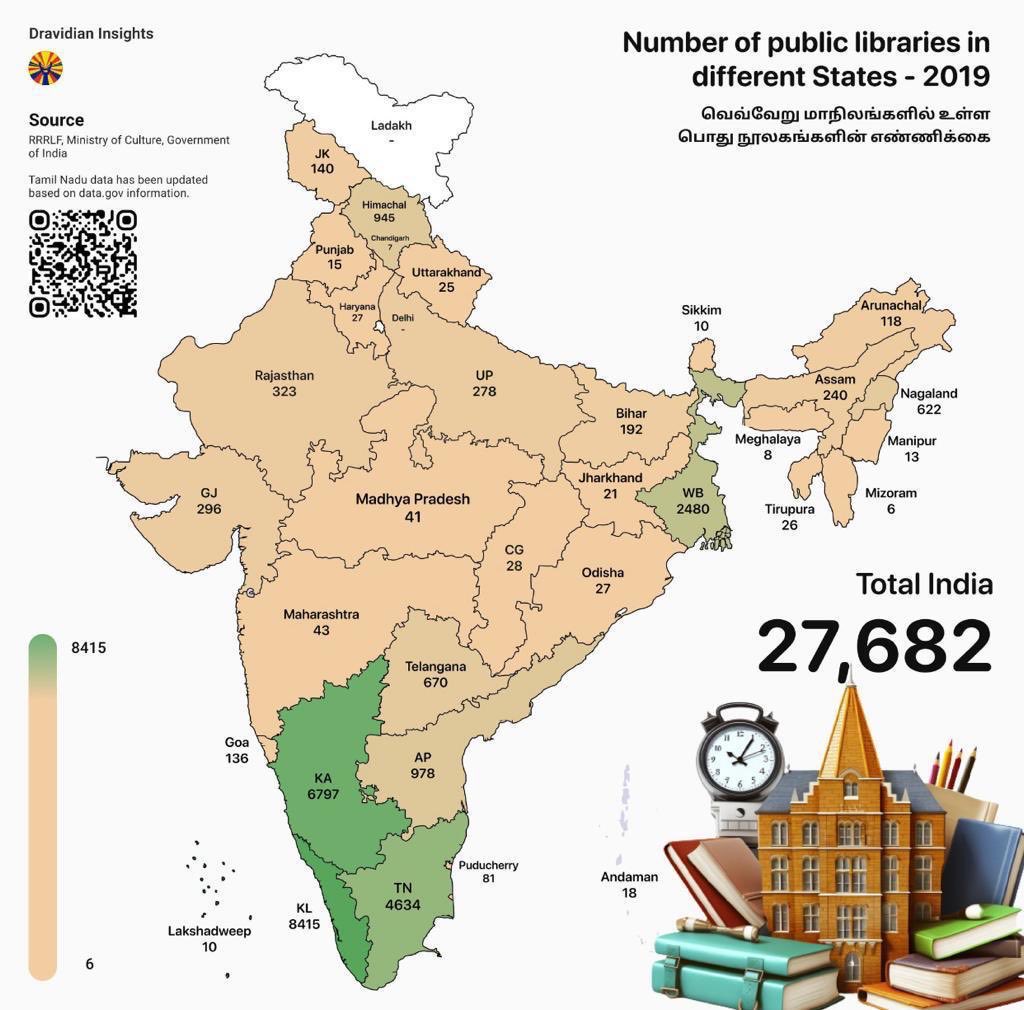
Libraries in Kerala I wanted to end on a somewhat positive note. So just a few days back, the Miinistry of Culture shared the number of Libraries per state. As can be seen from the infographic, Kerala is a giant in that. If I do find a table, would share that as well, so those who can t see can hear the data. Till later.

Russ Allbery: Review: The Unkindest Tide

Review: The Unkindest Tide, by Seanan McGuire
Series: October Daye #13
Publisher: DAW
Copyright: 2019
ISBN: 0-7564-1255-2
Format: Kindle
Pages: 355
This is the 13th book in the long-running October Daye urban fantasy series. There is a strong series arc and a plot that builds on previous books, so this is a series with both significant spoilers and significant confusion if read out of order. The Unkindest Tide in particular is closely tied to the previous book, Night and Silence, and should not be read before it. For once, this story does not start with someone Toby loves being attacked or going missing, or with someone trying to attack her. It instead starts with the Luidaeg. For several books now, she's been dropping hints about the debts that Toby owes to her and the favors she will someday call in. That time is now; she's going to address a problem that she has been putting off for years, and Toby is going to help her. This was a Luidaeg book, so I knew going in that I was going to enjoy it, and indeed I did. That said, I thought it was a bit awkward. This is a moment that McGuire has been building up to for quite some time (series readers may have a few guesses at what the Luidaeg is up to) and she wanted it to land with a lot of force while adding some last-minute complications and letting Toby take her typical role as the stubborn hero. But the primary complication she adds felt unrelated at first, and while the story does tie everything together in the end, it left the story feeling disjointed. The novel needed some fight scenes and some opportunities for people to worry about Toby, so those were provided, but I'm not sure they flowed naturally out of the story. There are some truly great moments here between Toby and the Luidaeg, and between Toby and a few of the other people involved in the story (naming them would be spoilers). Some of the banter is really fun. But I thought the best emotional moment of the book was a underplayed and could have used some more focus, build-up, and time to breathe, rather than shifting the Luidaeg off-stage for a big chunk of the story. McGuire has a bit of a power level problem here and finds some deft ways to avoid it, but I think that hurt the emotional arc. We're also told a lot about the emotional impacts of the plot, but I wish it had been shown more. The one character touchpoint the reader has is mostly uninvolved, and her involvement is a bit disappointing when it does happen. The biggest flaw in this book is the biggest flaw in the series: McGuire has a formula, and while it's more varied from book to book than a lot of long-running series, it's still predictable. Toby and Tybalt say the same things, Toby gets into the same kind of trouble, she worries about the same things, the banter goes in predictable ways, and the fights go very similarly to the fights in previous series entries. A lot of the novel won't be very surprising. There are always a few moments in each book that stir strong emotions, and personally I love the world-building and am eager to read more of it, but there are also sections of these books that I read very fast without feeling like I'm missing much. I've said this about this series before, which is another angle at the same problem. I think the world-building is getting more interesting as the series goes along, but the writing is not; if anything, it's getting a bit worse. It's far from bad enough to stop me from reading, and this was one of the better series entries overall, but it does keep the series firmly in the "reliable fun" category rather than the "excellent and worthy of savoring" category. It's still reliable fun, though. If you're this far along, you'll want to keep reading. The Unkindest Tide felt a bit like the end of an arc, so I'm curious to see where the story goes next. Followed by A Killing Frost. As is typical of the last few books, there is a novella included at the end. "Hope Is Swift": The novella at the end of Night and Silence was the best part of that book and focused on exactly the character I was hoping it would focus on. At the end of this book, I really wanted another novella about Gillian and directly related to the main novel. Unfortunately, what we get instead is a story about Raj that is entirely unrelated to the rest of the book. Raj is fine as a supporting character, I suppose, but he's not one of the series characters I care very much about, and sadly this novella did nothing to change my mind. It's a story of teenagers and of the perils of fae/human interactions that I found rather predictable, a bit anxiety-inducing (constant discussion of medical procedures), and entirely forgettable apart from the bits I didn't like. The takeaway lessons felt so obvious that they could have been the moral at the end of a Saturday morning cartoon from my youth. Maybe if you're a cat person you'd get a bit more out of it? I kind of regretted reading it, sadly. (4) Rating: 7 out of 10

15 July 2023

Freexian Collaborators: Monthly report about Debian Long Term Support, June 2023 (by Roberto C. S nchez)

Like each month, have a look at the work funded by Freexian s Debian LTS offering.

Debian LTS contributors In June, 17 contributors have been paid to work on Debian LTS, their reports are available:
  • Abhijith PA did 12.0h (out of 6.0h assigned and 8.0h from previous period), thus carrying over 2.0h to the next month.
  • Adrian Bunk did 28.0h (out of 0h assigned and 34.5h from previous period), thus carrying over 6.5h to the next month.
  • Anton Gladky did 5.0h (out of 6.0h assigned and 9.0h from previous period), thus carrying over 10.0h to the next month.
  • Bastien Roucari s did 17.0h (out of 17.0h assigned and 3.0h from previous period), thus carrying over 3.0h to the next month.
  • Ben Hutchings did 24.0h (out of 16.5h assigned and 7.0h from previous period).
  • Chris Lamb did 18.0h (out of 18.0h assigned).
  • Emilio Pozuelo Monfort did 24.0h (out of 21.0h assigned and 2.5h from previous period).
  • Guilhem Moulin did 20.0h (out of 20.0h assigned).
  • Lee Garrett did 25.0h (out of 0h assigned and 40.5h from previous period), thus carrying over 15.5h to the next month.
  • Markus Koschany did 23.5h (out of 23.5h assigned).
  • Ola Lundqvist did 13.0h (out of 0h assigned and 24.0h from previous period), thus carrying over 11.0h to the next month.
  • Roberto C. S nchez did 13.5h (out of 9.75h assigned and 13.75h from previous period), thus carrying over 10.0h to the next month.
  • Santiago Ruano Rinc n did 8.25h (out of 23.5h assigned), thus carrying over 15.25h to the next month.
  • Sylvain Beucler did 20.0h (out of 23.5h assigned), thus carrying over 3.5h to the next month.
  • Thorsten Alteholz did 14.0h (out of 14.0h assigned).
  • Tobias Frost did 16.0h (out of 16.0h assigned).
  • Utkarsh Gupta did 0.0h (out of 0h assigned and 25.5h from previous period), thus carrying over 25.5h to the next month.

Evolution of the situation In June, we have released 40 DLAs. Notable security updates in June included mariadb-10.3, openssl, and golang-go.crypto. The mariadb-10.3 package was synchronized with the latest upstream maintenance release, version 10.3.39. The openssl package was patched to correct several flaws with certificate validation and with object identifier parsing. Finally, the golang-go.crypto package was updated to address several vulnerabilities, and several associated Go packages were rebuilt in order to properly incorporate the update. LTS contributor Sylvain has been hard at work with some behind-the-scenes improvements to internal tooling and documentation. His efforts are helping to improve the efficiency of all LTS contributors and also helping to improve the quality of their work, making our LTS updates more timely and of higher quality. LTS contributor Lee Garrett began working on a testing framework specifically for Samba. Given the critical role which Samba plays in many deployments, the tremendous impact which regressions can have in those cases, and the unique testing requirements of Samba, this work will certainly result in increased confidence around our Samba updates for LTS. LTS contributor Emilio Pozuelo Monfort has begun preparatory work for the upcoming Firefox ESR version 115 release. Firefox ESR (and the related Thunderbird ESR) requires special work to maintain up to date in LTS. Mozilla do not release individual patches for CVEs, and our policy is to incorporate new ESR releases from Mozilla into LTS. Most updates are minor updates, but once a year Mozilla will release a major update as they move to a new major version for ESR. The update to a new major ESR version entails many related updates to toolchain and other packages. The preparations that Emilio has begun will ensure that once the 115 ESR release is made, updated packages will be available in LTS with minimal delay. Another highlight of behind-the-scenes work is our Front Desk personnel. While we often focus on the work which results in published package updates, much work is also involved in reviewing new vulnerabilities and triaging them (i.e., determining if they affect one or more packages in LTS and then determining the severity of those which are applicable). These intrepid contributors (Emilio Pozuelo Monfort, Markus Koschany, Ola Lundqvist, Sylvain Beucler, and Thorsten Alteholz for the month of June) reviewed dozens of vulnerabilities and made decisions about how those vulnerabilities should be dealt with.

Thanks to our sponsors

14 July 2023

Aurelien Jarno: Goodbye Debian GNU/kFreeBSD

Over the years, the Debian GNU/kFreeBSD port has gone through various phases. After many years of development, it was released as technology preview with the release of Squeeze and eventually became an official architecture with the release of Wheezy. However it ceased being an official architecture a couple of years later with the release of Jessie, although a jessie-kfreebsd suite was available in the official archive. Some years later, it was moved to the debian-ports archive, where it slowly regressed over the years. The development totally has now been stopped for over a year, and the port has been removed from the debian-ports archive. It's time to say it goodbye! I feel a touch of nostalgia as I was deeply involved in the Debian GNU/kFreeBSD port for nearly a decade, starting in 2006. There are many different reasons to like GNU/kFreeBSD ranging from political to technical considerations. Personally, I liked the technical aspect, as the FreeBSD kernel, at that time, was ahead of the Linux kernel in term of features: jails, ZFS, IPv6 stateful firewalling, and at a later point superpages. That said it was way behind for hardware support and to the best of my knowledge this remains unchanged. Meanwhile, the Linux kernel development accelerated in the latter stages of the 2.6.x series, and eventually closed the feature gap. At some point, I began to lose interest, and also to lack time, and slowly stepped away from its development.

Reproducible Builds (diffoscope): diffoscope 244 released

The diffoscope maintainers are pleased to announce the release of diffoscope version 244. This version includes the following changes:
[ Chris Lamb ]
* Address compatibility with python-libarchive-c version 5.
  (Closes: reproducible-builds/diffoscope#344)
* Testsuite changes:
  - Mark that test_dex::test_javap_14_differences requires procyon.
  - Fix "test skipped" textual reason generation in the case of a required
    version being outside of the required range.
  - Temporarily mark some Android-related as XFAIL due to Debian bugs
    #1040941 and #1040916.
You find out more by visiting the project homepage.

13 July 2023

Emmanuel Kasper: Debian 11 to Debian 12 (Bookworm) Upgrade Report

Laptop + Workstation My workstation was initially installed with Debian 8 back in the day, so I might have carried a lot of configuration cruft.
Indeed. I followed the recommended upgrades documentation (apt upgrade --without-new-pkgs followed by apt full-upgrade). And when executing apt full-upgrade I had the following error:
Preparing to unpack .../71-python3-numpy_1%3a1.24.2-1_amd64.deb ...
Unpacking python3-numpy (1:1.24.2-1) over (1:1.19.5-1) ...
dpkg: error processing archive /tmp/apt-dpkg-install-ibI85v/71-python3-numpy_1%3a1.24.2-1_amd64.deb (--unpack):
 trying to overwrite '/usr/bin/f2py', which is also in package python-numpy 1:1.16.5-5
Deleting the python-numpy package and resuming the upgrade with apt --fix-broken install followed by apt full-upgrade allowed the upgrade to complete successfully. This was already metioned in a Debian bug report and would have been avoided if I had purged the locally obsolete packages after upgrading to Debian 11. On laptop and workstation, after the upgrade, for unclear reasons, the gnome3 user extensions were disabled. I reenabled the extensions manually with
gsettings set org.gnome.shell disable-user-extensions false
Finally podman, had a major upgrade from 3 to 4, and a backward-incompatible configuration change. If a custom configuration file was in place in /etc/containers/storage.conf to override the default storage options, you need now to add the following stanza
[storage]
runroot="/run/containers/storage"
graphRoot="/var/lib/containers/storage"
in that file.
Otherwise you ll get the error Failed to obtain podman configuration: runroot must be set when running any podman command. This was discussed upstream. Cloud server (VM) Everything worked flawlessly, nothing to report. Conclusion Again a great Debian release, very happy that I could update three systems with ten thousands of packages with so little fuss. For my small home server running RHEL 8 (with the no cost sub) I will do a reinstall on newer hardware.

Junichi Uekawa: Spent 2 hours migrating my chrome extension to manifest v3.

Spent 2 hours migrating my chrome extension to manifest v3. Two parts that didn't make sense at first, browser_action to action migration, and executeScript. First, browser_action to action manifest change was straightforward. However it didn't occur to me that I had to rewrite chrome.browserAction.onClicked.addListener to chrome.action.onClicked.addListener. It doesn't say anything on the web page, well maybe the less than equal to MV2. If you deprecate something please say what you replace it with. Second, chrome.tabs.executeScript API was updated to chrome.scripting.executeScript. Apart from the promisified interface that I liked, there was the more important difference that it no longer takes a string to inject as script, it takes a function. So I rewrote my script with $ stuff and as part of that unintentional bugs were fixed and introduced. Trying to figure out where my string became a float unintentionally took a good part of the hour. All in all I have spent 2 hours on migrating my script, this is my second migration. I am not very happy with this transition as it doesn't add any value to my script.

12 July 2023

Reproducible Builds: Reproducible Builds in June 2023

Welcome to the June 2023 report from the Reproducible Builds project In our reports, we outline the most important things that we have been up to over the past month. As always, if you are interested in contributing to the project, please visit our Contribute page on our website.


We are very happy to announce the upcoming Reproducible Builds Summit which set to take place from October 31st November 2nd 2023, in the vibrant city of Hamburg, Germany. Our summits are a unique gathering that brings together attendees from diverse projects, united by a shared vision of advancing the Reproducible Builds effort. During this enriching event, participants will have the opportunity to engage in discussions, establish connections and exchange ideas to drive progress in this vital field. Our aim is to create an inclusive space that fosters collaboration, innovation and problem-solving. We are thrilled to host the seventh edition of this exciting event, following the success of previous summits in various iconic locations around the world, including Venice, Marrakesh, Paris, Berlin and Athens. If you re interesting in joining us this year, please make sure to read the event page] which has more details about the event and location. (You may also be interested in attending PackagingCon 2023 held a few days before in Berlin.)
This month, Vagrant Cascadian will present at FOSSY 2023 on the topic of Breaking the Chains of Trusting Trust:
Corrupted build environments can deliver compromised cryptographically signed binaries. Several exploits in critical supply chains have been demonstrated in recent years, proving that this is not just theoretical. The most well secured build environments are still single points of failure when they fail. [ ] This talk will focus on the state of the art from several angles in related Free and Open Source Software projects, what works, current challenges and future plans for building trustworthy toolchains you do not need to trust.
Hosted by the Software Freedom Conservancy and taking place in Portland, Oregon, FOSSY aims to be a community-focused event: Whether you are a long time contributing member of a free software project, a recent graduate of a coding bootcamp or university, or just have an interest in the possibilities that free and open source software bring, FOSSY will have something for you . More information on the event is available on the FOSSY 2023 website, including the full programme schedule.
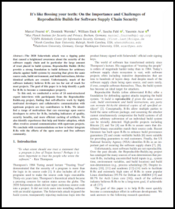
Marcel Fourn , Dominik Wermke, William Enck, Sascha Fahl and Yasemin Acar recently published an academic paper in the 44th IEEE Symposium on Security and Privacy titled It s like flossing your teeth: On the Importance and Challenges of Reproducible Builds for Software Supply Chain Security . The abstract reads as follows:
The 2020 Solarwinds attack was a tipping point that caused a heightened awareness about the security of the software supply chain and in particular the large amount of trust placed in build systems. Reproducible Builds (R-Bs) provide a strong foundation to build defenses for arbitrary attacks against build systems by ensuring that given the same source code, build environment, and build instructions, bitwise-identical artifacts are created.
However, in contrast to other papers that touch on some theoretical aspect of reproducible builds, the authors paper takes a different approach. Starting with the observation that much of the software industry believes R-Bs are too far out of reach for most projects and conjoining that with a goal of to help identify a path for R-Bs to become a commonplace property , the paper has a different methodology:
We conducted a series of 24 semi-structured expert interviews with participants from the Reproducible-Builds.org project, and iterated on our questions with the reproducible builds community. We identified a range of motivations that can encourage open source developers to strive for R-Bs, including indicators of quality, security benefits, and more efficient caching of artifacts. We identify experiences that help and hinder adoption, which heavily include communication with upstream projects. We conclude with recommendations on how to better integrate R-Bs with the efforts of the open source and free software community.
A PDF of the paper is now available, as is an entry on the CISPA Helmholtz Center for Information Security website and an entry under the TeamUSEC Human-Centered Security research group.
On our mailing list this month:
The antagonist is David Schwartz, who correctly says There are dozens of complex reasons why what seems to be the same sequence of operations might produce different end results, but goes on to say I totally disagree with your general viewpoint that compilers must provide for reproducability [sic]. Dwight Tovey and I (Larry Doolittle) argue for reproducible builds. I assert Any program especially a mission-critical program like a compiler that cannot reproduce a result at will is broken. Also it s commonplace to take a binary from the net, and check to see if it was trojaned by attempting to recreate it from source.

Lastly, there were a few changes to our website this month too, including Bernhard M. Wiedemann adding a simplified Rust example to our documentation about the SOURCE_DATE_EPOCH environment variable [ ], Chris Lamb made it easier to parse our summit announcement at a glance [ ], Mattia Rizzolo added the summit announcement at a glance [ ] itself [ ][ ][ ] and Rahul Bajaj added a taxonomy of variations in build environments [ ].

Distribution work 27 reviews of Debian packages were added, 40 were updated and 8 were removed this month adding to our knowledge about identified issues. A new randomness_in_documentation_generated_by_mkdocs toolchain issue was added by Chris Lamb [ ], and the deterministic flag on the paths_vary_due_to_usrmerge issue as we are not currently testing usrmerge issues [ ] issues.
Roland Clobus posted his 18th update of the status of reproducible Debian ISO images on our mailing list. Roland reported that all major desktops build reproducibly with bullseye, bookworm, trixie and sid , but he also mentioned amongst many changes that not only are the non-free images being built (and are reproducible) but that the live images are generated officially by Debian itself. [ ]
Jan-Benedict Glaw noticed a problem when building NetBSD for the VAX architecture. Noting that Reproducible builds [are] probably not as reproducible as we thought , Jan-Benedict goes on to describe that when two builds from different source directories won t produce the same result and adds various notes about sub-optimal handling of the CFLAGS environment variable. [ ]
F-Droid added 21 new reproducible apps in June, resulting in a new record of 145 reproducible apps in total. [ ]. (This page now sports missing data for March May 2023.) F-Droid contributors also reported an issue with broken resources in APKs making some builds unreproducible. [ ]
Bernhard M. Wiedemann published another monthly report about reproducibility within openSUSE

Upstream patches

Testing framework The Reproducible Builds project operates a comprehensive testing framework (available at tests.reproducible-builds.org) in order to check packages and other artifacts for reproducibility. In June, a number of changes were made by Holger Levsen, including:
  • Additions to a (relatively) new Documented Jenkins Maintenance (djm) script to automatically shrink a cache & save a backup of old data [ ], automatically split out previous months data from logfiles into specially-named files [ ], prevent concurrent remote logfile fetches by using a lock file [ ] and to add/remove various debugging statements [ ].
  • Updates to the automated system health checks to, for example, to correctly detect new kernel warnings due to a wording change [ ] and to explicitly observe which old/unused kernels should be removed [ ]. This was related to an improvement so that various kernel issues on Ubuntu-based nodes are automatically fixed. [ ]
Holger and Vagrant Cascadian updated all thirty-five hosts running Debian on the amd64, armhf, and i386 architectures to Debian bookworm, with the exception of the Jenkins host itself which will be upgraded after the release of Debian 12.1. In addition, Mattia Rizzolo updated the email configuration for the @reproducible-builds.org domain to correctly accept incoming mails from jenkins.debian.net [ ] as well as to set up DomainKeys Identified Mail (DKIM) signing [ ]. And working together with Holger, Mattia also updated the Jenkins configuration to start testing Debian trixie which resulted in stopped testing Debian buster. And, finally, Jan-Benedict Glaw contributed patches for improved NetBSD testing.

If you are interested in contributing to the Reproducible Builds project, please visit our Contribute page on our website. However, you can get in touch with us via:

Matt Brown: 2023 Mid Year Review

I m six months into my journey of building a business which means its time to reflect and review the goals I set for the year.

No further investment in co2mon.nz In March I made the decision to focus on completing the market research for co2mon.nz. The results of that research led to two key conclusions:
  1. Indoor air quality/ventilation is not a problem many people are actively thinking about or looking to spend money to improve.
  2. Even when introduced to the problem and educated about the need, most people are looking for a one-off expense or solution (e.g. the physical monitor) and are much less interested in a monitoring software service.
Based on that, it was clear that this is not an opportunity that I should continue pursuing and I ve put co2mon.nz into maintenance mode. I ve committed to maintaining the infrastructure to support existing customers, but I won t be investing time or energy in developing it further.

Discipline in selecting product opportunities The decision to stop investing more time into co2mon.nz was straightforward given the results of the research, but it was also painful given the time I ve already sunk into it. I hindsight it s clear that my enthusiasm to solve a problem with technology I enjoyed was my driving force rather than a deep understanding of the wants and needs of potential customers. I don t entirely regret trying my luck once - but it s not time efficient and I know that following that pattern again is not a sustainable or viable path to building a successful business. I ve decided to use the following list of questions to bring more discipline to how I evaluate product opportunities in future:
  1. Problem: Is this something that a sizeable number of people are struggling with AND are willing to spend money solving?
  2. Capability: Can I deliver a solution that solves the problem in a reliable and cost-effective way?
  3. Excitement: Am I excited and motivated to invest time in building the solution to this problem?
  4. Trust: Do I have the expertise and experience to be trusted to solve the problem by potential customers?
  5. Execution: Can I package, market and sell that solution in a profitable manner?
My plan is to answer these questions and then make an evaluation of the potential before I commit time to building any part of a product. As an example of how I think that will help, here s what I think the answer to those questions for ventilation monitoring would have been:
  1. Problem: No - as the market research eventually showed.
  2. Capability: Low - The part of the solution which customers primarily value (the hardware) is complex and outside of my core experience. The software I can easily deliver is not where the value is seen.
  3. Excitement: Yes - this was the primary driver of starting the project.
  4. Trust: Low - I m trusted to build software, but cannot claim any specific expertise in air quality and ventilation.
  5. Execution: Low confidence - These skills are not ones I ve exercised a lot in my career to date.
What these answers point to is that identifying the problem alone is not enough. I don t expect every question to have a perfect answer, but I want to hold myself to only pursuing opportunities where there s only one major area of doubt. In this case, even had the market research demonstrated a problem that many customers would pay to solve, there were still some big answers missing to the trust, capability and execution questions. Overall my conclusion is that co2mon.nz was not the ideal business to start my journey with given the number of open questions in the plan. I like to think that conclusion would also have been clear to me six months ago had I taken the time to go through this process then!

Prioritising areas of growth Applying those questions to my other product ideas results in a lot of I don t know yet answers to the problem and capability questions, further reinforcing the lesson that I need to spend more understanding if there is a problem with a viable business model attached in those areas before progressing any of those ideas. Beyond that lesson, a more interesting observation comes from the last question regarding execution. My answers to the first four questions vary between ideas, but my answers to this last question are always the same - I don t have a lot of confidence in my sales and marketing skills to sell a product. That s not a surprise. My career to date has been focused on software development and leadership, I don t have a lot of experience with sales and marketing. The opportunity to grow and develop those skills is actually a large part of my motivation for choosing the path of building my own business. But seeing that this is a common factor that will need significant investment regardless of which opportunity I pursue sends me a strong signal that I should focus on growth in this area as a priority. Following that logic through to the next step of what creating that focus would look like reveals a conflict: The nature of the mission I ve set for myself draws me to products in areas that are new to me, which means there s also a need to invest in building expertise in those areas. Again not a surprise, but the time and focus required to develop that expertise competes with time spent growing my sales and marketing skills. So I have a prioritisation problem. Solving it is going to require changing the type of product I m trying to build in the short term: I need to build a product that uses my existing expertise and strengths as much as possible, so that I can put the majority of my energy into growing the core business skills where my confidence is currently lacking. Trying to deliver meaningful improvements to a big problem in an area I don t have past experience in while also learning how to sell and market a product is biting off more than I chew right away.

Changing the goal posts With those lessons in hand I m making three changes to my 2023 Goals:
  1. Reducing the product development goal from several ideas to two. The first was co2mon.nz. The second will be drawn from my existing expertise - not one of the previously stated ideas that require me to develop expertise in a new area.
  2. Moving the consulting and product development goals to be alternatives - I expect I can achieve at most one of them this year.
  3. Reducing the publishing target for this site from at least once a week to once a month . I thought I d have more to say this year, but the words are coming very slowly to me.
Reducing scope and ambition is humbling, but that s reality. I hope it turns out to be a case of slow down and lay the foundations in order to then move faster. The good news is that I don t feel the need to make any changes to the vision, mission and strategy I m following - I think they re still the right destination and overall path for me even though the first six months has proven bumpy. I just need to be a bit more realistic on the short-term goals that will feed into them.

The next few months I m choosing to prioritise the product development goal. I m aiming to complete the market research/problem definition phase for a product opportunity I ve identified in the SRE/DevOps space (where my previous experience is) and make a decision on whether to start development by mid August. In making that decision I plan to gather the answers to my questions, and then diligently evaluate whether the opportunity is worth committing to or not. I will write more about this process in coming weeks. If I decide to proceed that gives me 2-3 months to get an MVP in the hands of customers and get concrete validation of whether the product has revenue and growth potential before the end of the year. Tight, but if things go well, and I don t take any further consulting work, there s a reasonable chance I can complete the revised goal successfully. In the event that I decide the product opportunity I m currently researching is not the right one to commit to, I will likely revert to focusing on my consulting goal in the remaining 2-3 months of the year rather than attempt a third product development iteration. Thanks for reading this far! As always, I d love your thoughts and feedback.

Appendix: Revised 2023 Goals Putting all that together, the ultimate outcome of this review (including updated progress scoring) looks like:
  1. Execute a series of successful consulting engagements, building a reputation for myself and leaving happy customers willing to provide testimonials that support a pipeline of future opportunities. Score: 3/10 - I focused entirely on co2mon.nz during April, May and June to the detriment of my pipeline of consulting work. This score is unlikely to improve given the above plan unless I decide not to commit to developing the idea I m currently investigating.
  2. Grow my product development skill set by taking two ideas (co2mon.nz, an SRE/DevOps focused product) to MVP stage with customer feedback received, and generate revenue and has growth potential from one of them. Score: 4/10 - I launched co2mon.nz and got feedback, I discovered it didn t solve a problem relevant to customers and therefore did not generate substantial revenue or growth potential. Idea number two is in still in progress.
  3. Develop and maintain a broad professional network.
    1. To build a professional relationship with at least 30 new people this year. Score: 6/10 - This is going well. On track for a 10/10 score.
    2. To publish a piece of writing on this site once a month and for many of those to generate interesting conversations and feedback. Score: 6/10 - 4 out of 6 months have featured a post meeting this goal so far.
    3. To support the growth of my local technical community by volunteering my experience and knowledge with others. Score: 5/10 - I ve given one talk and helped with SREcon23 APAC, but not as much other work in this area as I d like.

Jonathan Carter: Debian 12

Last month, the Debian project released Debian 12, with the usual low-key fanfare that Debian usually announces a release with. Even though we shipped with some bugs we d rather not have (which are at least fixable over the next point releases), the feedback for Debian 12 has been nothing short of overwhelmingly good. From users to the independent Linux blogs to the YouTubers to the tech news sites, the vast majority of feedback so far is that it s not just one of Debian s most important releases, but also an incredibly timely one, considering other distributions with stable releases- most of which who come from commercial companies who do not necessarily have their user s best interest at heart. I deleted my original draft for this blog post, it was getting incredibly long, and I ll split it up over a few upcoming posts instead. The most important message I want to convey here is a HUGE THANK YOU to everyone who has contributed to Debian 12 in any form. Your work is incredibly important, and the result of that work over this release was nothing short of spectacular. Consider yourself a hero!

John Goerzen: Backing Up and Archiving to Removable Media: dar vs. git-annex

This is the fourth in a series about archiving to removable media (optical discs such as BD-Rs and DVD+Rs or portable hard drives). Here are the first three parts: I want to state at the outset that this is not a general review of dar or git-annex. This is an analysis of how those tools stack up to a particular use case. Neither tool focuses on this use case, and I note it is particularly far from the more common uses of git-annex. For instance, both tools offer support for cloud storage providers and special support for ssh targets, but neither of those are in-scope for this post. Comparison Matrix As part of this project, I made a comparison matrix which includes not just dar and git-annex, but also backuppc, bacula/bareos, and borg. This may give you some good context, and also some reference for other projects in this general space. Reviewing the Goals I identified some goals in part 1. They are all valid. As I have thought through the project more, I feel like I should condense them into a simpler ordered list, with the first being the most important. I omit some things here that both dar and git-annex can do (updates/incrementals, for instance; see the expanded goals list in part 1). Here they are:
  1. The tool must not modify the source data in any way.
  2. It must be simple to create or update an archive. Processes that require a lot of manual work, are flaky, or are difficult to do correctly, are unlikely to be done correctly and often. If it s easy to do right, I m more likely to do it. Put another way: an archive never created can never be restored.
  3. The chances of a successful restore by someone that is not me, that doesn t know Linux, and is at least 10 years in the future, should be maximized. This implies a simple toolset, solid support for dealing with media errors or missing media, etc.
  4. Both a partial point-in-time restore and a full restore should be possible. The full restore must, at minimum, provide a consistent directory tree; that is, deletions, additions, and moves over time must be accurately reflected. Preserving modification times is a near-requirement, and preserving hard links, symbolic links, and other POSIX metadata is a significant nice-to-have.
  5. There must be a strategy to provide redundancy; for instance, a way for one set of archive discs to be offsite, another onsite, and the two to be periodically swapped.
  6. Use storage space efficiently.
Let s take a look at how the two stack up against these goals. Goal 1: Not modifying source data With dar, this is accomplished. dar --create does not modify source data (and even has a mode to avoid updating atime) so that s done. git-annex normally does modify source data, in that it typically replaces files with symlinks into its hash-indexed storage directory. It can instead use hardlinks. In either case, you will wind up with files that have identical content (but may have originally been separate, non-linked files) linked together with git-annex. This would cause me trouble, as well as run the risk of modifying timestamps. So instead of just storing my data under a git-annex repo as is its most common case, I use the directory special remote with importtree=yes to sort of import the data in. This, plus my desire to have the repos sensible and usable on non-POSIX operating systems, accounts for a chunk of the git-annex complexity you see here. You wouldn t normally see as much complexity with git-annex (though, as you will see, even without the directory special remote, dar still has less complexity). Winner: dar, though I demonstrated a working approach with git-annex as well. Goal 2: Simplicity of creating or updating an archive Let us simply start by recognizing this: Both tools have a lot of power, but I must say, it is easier to wrap my head around what dar is doing than what git-annex is doing. Everything dar does is with files: here are the files to archive, here is an archive file, here is a detached (isolated) catalog. It is very straightforward. It took me far less time to develop my dar page than my git-annex page, despite having existing familiarity with both tools. As I pointed out in part 2, I still don t fully understand how git-annex syncs metadata. Unsolved mysteries from that post include why the two git-annex drives had no idea what was on the other drives, and why the export operation silenty did nothing. Additionally, for the optical disc case, I had to create a restricted-size filesystem/dataset for git-annex to write into in order to get the desired size limit. Looking at the optical disc case, dar has a lot of nice infrastructure built in. With pause and execute, it can very easily be combined with disc burning operations. slice will automatically limit the size of a given slice, regardless of how much disk space is free, meaning that the git-annex tricks of creating smaller filesystems/datasets are unnecessary with dar. To create an initial full backup with dar, you just give it the size of the device, and it will automatically split up the archive, with hooks to integrate for burning or changing drives. About as easy as you could get. With git-annex, you would run the commands to have it fill up the initial filesystem, then burn the disc (or remove the drive), then run the commands to create another repo on the second filesystem, and so forth. With hard drives, with git-annex you would do something similar; let it fill up a repo on a drive, and if it exits with a space error, swap in the next. With dar, you would slice as with an optical disk. Dar s slicing is less convenient in this case, though, as it assumes every drive is the same size and yours may not be. You could work around that by using a slice size no bigger than the smallest drive, and putting multiple slices on larger drives if need be. If a single drive is large enough to hold your entire data set, though, you need not worry about this with either tool. Here s a warning about git-annex: it won t store anything beneath directories named .git. My use case doesn t have many of those. If your use case does, you re going to have to figure out what to do about it. Maybe rename them to something else while the backup runs? In any case, it is simply a fact that git-annex cannot back up git repositories, and this cuts against being able to back up things correctly. Another point is that git-annex has scalability concerns. If your archive set gets into the hundreds of thousands of files, you may need to split it into multiple distinct git-annex repositories. If this occurs and it will in my case it may serve to dull the shine of some of git-annex s features such as location tracking. A detour down the update strategies path Update strategies get a little more complicated with both. First, let s consider: what exactly should our update strategy be? For optical discs, I might consider doing a monthly update. I could burn a disc (or more than one, if needed) regardless of how much data is going to go onto it, because I want no more than a month s data lost in any case. An alternative might be to spool up data until I have a disc s worth, and then write that, but that could possibly mean months between actually burning a disc. Probably not good. For removable drives, we re unlikely to use a new drive each month. So there it makes sense to continue writing to the drive until it s full. Now we have a choice: do we write and preserve each month s updates, or do we eliminate intermediate changes and just keep the most recent data? With both tools, the monthly burn of an optical disc turns out to be very similar to the initial full backup to optical disc. The considerations for spanning multiple discs are the same. With both tools, we would presumably want to keep some metadata on the host so that we don t have to refer to a previous disc to know what was burned. In the dar case, that would be an isolated catalog. For git-annex, it would be a metadata-only repo. I illustrated both of these in parts 2 and 3. Now, for hard drives. Assuming we want to continue preserving each month s updates, with dar, we could just write an incremental to the drive each month. Assuming that the size of the incremental is likely far smaller than the size of the drive, you could easily enough do this. More fancily, you could look at the free space on the drive and tell dar to use that as the size of the first slice. For git-annex, you simply avoid calling drop/dropunused. This will cause the old versions of files to accumulate in .git/annex. You can get at them with git annex commands. This may imply some degree of elevated risk, as you are modifying metadata in the repo each month, which with dar you could chmod a-w or even chattr +i the archive files once written. Hopefully this elevated risk is low. If you don t want to preserve each month s updates, with dar, you could just write an incremental each month that is based on the previous drive s last backup, overwriting the previous. That implies some risk of drive failure during the time the overwrite is happening. Alternatively, you could write an incremental and then use dar to merge it into the previous incremental, creating a new one. This implies some degree of extra space needed (maybe on a different filesystem) while doing this. With git-annex, you would use drop/dropunused as I demonstrated in part 2. The winner for goal 2 is dar. The gap is biggest with optical discs and more narrow with hard drives, thanks to git-annex s different options for updates. Still, I would be more confident I got it right with dar. Goal 3: Greatest chance of successful restore in the distant future If you use git-annex like I suggested in part 2, you will have a set of discs or drives that contain a folder structure with plain files in them. These files can be opened without any additional tools at all. For sheer ability to get at raw data, git-annex has the edge. When you talk about getting a consistent full restore without multiple copies of renamed files or deleted files coming back then you are going to need to use git-annex to do that. Both git-annex and dar provide binaries. Dar provides a win64 version on its Sourceforge page. On the author s releases site, you can find the win64 version in addition to a statically-linked x86_64 version for Linux. The git-annex install page mostly directs you to package managers for your distribution, but the downloads page also lists builds for Linux, Windows, and Mac OS X. The Linux version is dynamic, but ships most of its .so files alongside. The Windows version requires cygwin.dll, and all versions require you to also install git itself. Both tools are in package managers for Mac OS X, Debian, FreeBSD, and so forth. Let s just say that you are likely to be able to run either one on a future Windows or Linux system. There are also GUI frontends for dar, such as DARGUI and gdar. This can increase the chances of a future person being able to use the software easily. git-annex has the assistant, which is based on a different use case and probably not directly helpful here. When it comes to doing the actual restore process using software, dar provides the easier process here. For dealing with media errors and the like, dar can integrate with par2. While technically you could use par2 against the files git-annex writes, that s more cumbersome to manage to the point that it is likely not to be done. Both tools can deal reasonably with missing media entirely. I m going to give the edge on this one to git-annex; while dar does provide the easier restore and superior tools for recovering from media errors, the ability to access raw data as plain files without any tools at all is quite compelling. I believe it is the most critical advantage git-annex has, and it s a big one. Goal 4: Support high-fidelity partial and full restores Both tools make it possible to do a full restore reflecting deletions, additions, and so forth. Dar, as noted, is easier for this, but it is possible with git-annex. So, both can achieve a consistent restore. Part of this goal deals with fidelity of the restore: preserving timestamps, hard and symbolic links, ownership, permissions, etc. Of these, timestamps are the most important for me. git-annex can t do any of that. dar does all of it. Some of this can be worked around using mtree as I documented in part 2. However, that implies a need to also provide mtree on the discs for future users, and I m not sure mtree really exists for Windows. It also cuts against the argument that git-annex discs can be used without any tools. It is true, they can, but all you will get is filename and content; no accurate date. Timestamps are often highly relevant for everything from photos to finding an elusive document or record. Winner: dar. Goal 5: Supporting backup strategies with redundancy My main goal here is to have two separate backup sets: one that is offsite, and one that is onsite. Depending on the strategy and media, they might just always stay that way, or periodically rotate. For instance, with optical discs, you might just burn two copies of every disc and store one at each place. For hard drives, since you will be updating the content of them, you might swap them periodically. This is possible with both tools. With both tools, if using the optical disc scheme I laid out, you can just burn two identical copies of each disc. With the hard drive case, with dar, you can keep two directories of isolated catalogs, one for each drive set. A little identifier file on each drive will let you know which set to use. git-annex can track locations itself. As I demonstrated in part 2, you can make each drive its own repo, add all drives from a given drive set to a git-annex group. When initializing a drive, you tell git-annex what group it s a prt of. From then on, git-annex knows what content is in each group and will add whatever a given drive s group needs to that drive. It s possible to do this with both, but the winner here is git-annex. Goal 6: Efficient use of storage Here are situations in which one or the other will be more efficient: The winner depends on your particular situation. Other notes While not part of the goals above, dar is capable of using tapes directly. While not as common, they are often used in communities of people that archive lots of data. Conclusions Overall, dar is the winner for me. It is simpler in most areas, easier to get correct, and scales very well. git-annex does, however, have some quite compelling points. Being able to access files as plain files is huge, and its location tracking is nicer than dar s, even when using dar_manager. Both tools are excellent and I recommend them both and for more than the particular scenario shown here. Both have fantastic and responsive authors.

Freexian Collaborators: Debian Contributions: /usr-merge updates, DebConf Bursary prep, and more! (by Utkarsh Gupta)

Contributing to Debian is part of Freexian s mission. This article covers the latest achievements of Freexian and their collaborators. All of this is made possible by organizations subscribing to our Long Term Support contracts and consulting services.

/usr-merge, by Helmut Grohne, et al The work on /usr-merge continues from May. The lengthy discussion was condensed into a still lengthy rewrite of DEP17 listing all known problems and proposed mitigations. An initial consensus call did not resolve all questions, but we now have rough consensus on finalizing the transition without relying on major changes to dpkg. Other questions still have diverging opinions and some matters such as how to not break backports are still missing satisfying answers.

DebConf Bursary prep, by Utkarsh Gupta DebCamp and DebConf is happening from 03rd September to 17th September in Kochi, India, and the DebConf Bursary team is gearing up for that. After extending the bursary deadline (catering to the requests coming in from various people), we ve finally managed to clock over 260 bursary requests. The team is set up and we re starting to review the applications. The team intends to roll out the result as soon as possible.

debci, by Helmut Grohne As Freexian is working on deploying autopkgtests for the LTS and ELTS services, debci and autopkgtests were improved in Debian to better deal with derivatives (e.g. by better supporting external package signing keyrings). Other aspects that are not deployed on ci.debian.net such as the qemu backend were also improved. We express thanks to the relevant maintainers Antonio Terceiro, Paul Gevers and Simon McVittie for their timely reviews and merges of our changes.

Miscellaneous contributions
  • Following the release of Debian 12, Rapha l Hertzog updated tracker.debian.org to be aware of trixie. He also pushed some fixes to distro-tracker (the software powering tracker.debian.org) and released version 1.2.0 (since the former release was lacking fixes to run on Debian 12 bookworm).
  • Following the release of Debian 12, Helmut Grohne updated crossqa.debian.net systems. He also sent 7 patches for cross build failures and continued adapting rebootstrap to changes in unstable.
  • Santiago Ruano Rinc n started to work on how to improve the robustness of Salsa CI s pipeline for some jobs failing frequently.
  • Thorsten Alteholz did security updates of cpdb-libs in Unstable and Bookworm.
  • Stefano Rivera upgraded pixelfed.debian.social to bookworm.
  • Stefano started an re2 library transition, and started preparation for the next transition.
  • Helmut Grohne updated debvm in unstable releasing changes that accumulated during the freeze.
  • Stefano did some work on the website and infrastructure for DebConf 23.
  • Utkarsh Gupta helped review and fix open redmine bugs and fix them all in unstable.

11 July 2023

Simon Josefsson: Coping with non-free software in Debian

A personal reflection on how I moved from my Debian home to find two new homes with Trisquel and Guix for my own ethical computing, and while doing so settled my dilemma about further Debian contributions. Debian s contributions to the free software community has been tremendous. Debian was one of the early distributions in the 1990 s that combined the GNU tools (compiler, linker, shell, editor, and a set of Unix tools) with the Linux kernel and published a free software operating system. Back then there were little guidance on how to publish free software binaries, let alone entire operating systems. There was a lack of established community processes and conflict resolution mechanisms, and lack of guiding principles to motivate the work. The community building efforts that came about in parallel with the technical work has resulted in a steady flow of releases over the years. From the work of Richard Stallman and the Free Software Foundation (FSF) during the 1980 s and early 1990 s, there was at the time already an established definition of free software. Inspired by free software definition, and a belief that a social contract helps to build a community and resolve conflicts, Debian s social contract (DSC) with the free software community was published in 1997. The DSC included the Debian Free Software Guidelines (DFSG), which directly led to the Open Source Definition.

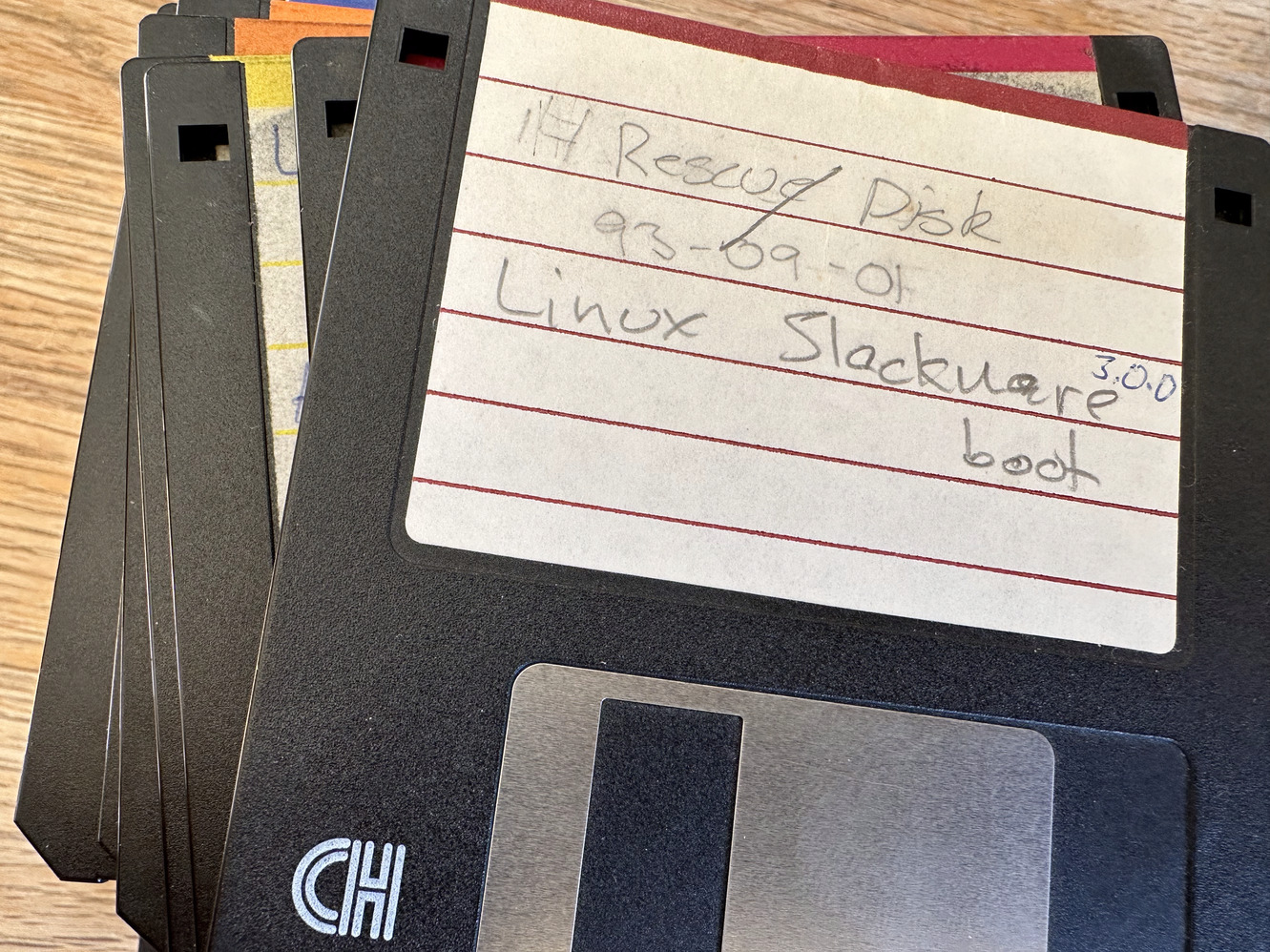
Slackware 3.5" disksOne of my earlier Slackware install disk sets, kept for nostalgic reasons.

I was introduced to GNU/Linux through Slackware in the early 1990 s (oh boy those nights calculating XFree86 modeline s and debugging sendmail.cf) and primarily used RedHat Linux during ca 1995-2003. I switched to Debian during the Woody release cycles, when the original RedHat Linux was abandoned and Fedora launched. It was Debian s explicit community processes and infrastructure that attracted me. The slow nature of community processes also kept me using RedHat for so long: centralized and dogmatic decision processes often produce quick and effective outcomes, and in my opinion RedHat Linux was technically better than Debian ca 1995-2003. However the RedHat model was not sustainable, and resulted in the RedHat vs Fedora split. Debian catched up, and reached technical stability once its community processes had been grounded. I started participating in the Debian community around late 2006. My interpretation of Debian s social contract is that Debian should be a distribution of works licensed 100% under a free license. The Debian community has always been inclusive towards non-free software, creating the contrib/non-free section and permitting use of the bug tracker to help resolve issues with non-free works. This is all explained in the social contract. There has always been a clear boundary between free and non-free work, and there has been a commitment that the Debian system itself would be 100% free. The concern that RedHat Linux was not 100% free software was not critical to me at the time: I primarily (and happily) ran GNU tools on Solaris, IRIX, AIX, OS/2, Windows etc. Running GNU tools on RedHat Linux was an improvement, and I hadn t realized it was possible to get rid of all non-free software on my own primary machine. Debian realized that goal for me. I ve been a believer in that model ever since. I can use Solaris, macOS, Android etc knowing that I have the option of using a 100% free Debian. While the inclusive approach towards non-free software invite and deserve criticism (some argue that being inclusive to non-inclusive behavior is a bad idea), I believe that Debian s approach was a successful survival technique: by being inclusive to and a compromise between free and non-free communities, Debian has been able to stay relevant and contribute to both environments. If Debian had not served and contributed to the free community, I believe free software people would have stopped contributing. If Debian had rejected non-free works completely, I don t think the successful Ubuntu distribution would have been based on Debian. I wrote the majority of the text above back in September 2022, intending to post it as a way to argue for my proposal to maintain the status quo within Debian. I didn t post it because I felt I was saying the obvious, and that the obvious do not need to be repeated, and the rest of the post was just me going down memory lane. The Debian project has been a sustainable producer of a 100% free OS up until Debian 11 bullseye. In the resolution on non-free firmware the community decided to leave the model that had resulted in a 100% free Debian for so long. The goal of Debian is no longer to publish a 100% free operating system, instead this was added: The Debian official media may include firmware . Indeed the Debian 12 bookworm release has confirmed that this would not only be an optional possibility. The Debian community could have published a 100% free Debian, in parallel with the non-free Debian, and still be consistent with their newly adopted policy, but chose not to. The result is that Debian s policies are not consistent with their actions. It doesn t make sense to claim that Debian is 100% free when the Debian installer contains non-free software. Actions speaks louder than words, so I m left reading the policies as well-intended prose that is no longer used for guidance, but for the peace of mind for people living in ivory towers. And to attract funding, I suppose. So how to deal with this, on a personal level? I did not have an answer to that back in October 2022 after the vote. It wasn t clear to me that I would ever want to contribute to Debian under the new social contract that promoted non-free software. I went on vacation from any Debian work. Meanwhile Debian 12 bookworm was released, confirming my fears. I kept coming back to this text, and my only take-away was that it would be unethical for me to use Debian on my machines. Letting actions speak for themselves, I switched to PureOS on my main laptop during October, barely noticing any difference since it is based on Debian 11 bullseye. Back in December, I bought a new laptop and tried Trisquel and Guix on it, as they promise a migration path towards ppc64el that PureOS do not. While I pondered how to approach my modest Debian contributions, I set out to learn Trisquel and gained trust in it. I migrated one Debian machine after another to Trisquel, and started to use Guix on others. Migration was easy because Trisquel is based on Ubuntu which is based on Debian. Using Guix has its challenges, but I enjoy its coherant documented environment. All of my essential self-hosted servers (VM hosts, DNS, e-mail, WWW, Nextcloud, CI/CD builders, backup etc) uses Trisquel or Guix now. I ve migrated many GitLab CI/CD rules to use Trisquel instead of Debian, to have a more ethical computing base for software development and deployment. I wish there were official Guix docker images around. Time has passed, and when I now think about any Debian contributions, I m a little less muddled by my disappointment of the exclusion of a 100% free Debian. I realize that today I can use Debian in the same way that I use macOS, Android, RHEL or Ubuntu. And what prevents me from contributing to free software on those platforms? So I will make the occasional Debian contribution again, knowing that it will also indirectly improve Trisquel. To avoid having to install Debian, I need a development environment in Trisquel that allows me to build Debian packages. I have found a recipe for doing this: # System commands:
sudo apt-get install debhelper git-buildpackage debian-archive-keyring
sudo wget -O /usr/share/debootstrap/scripts/debian-common https://sources.debian.org/data/main/d/debootstrap/1.0.128%2Bnmu2/scripts/debian-common
sudo wget -O /usr/share/debootstrap/scripts/sid https://sources.debian.org/data/main/d/debootstrap/1.0.128%2Bnmu2/scripts/sid
# Run once to create build image:
DIST=sid git-pbuilder create --mirror http://deb.debian.org/debian/ --debootstrapopts "--exclude=usr-is-merged" --basepath /var/cache/pbuilder/base-sid.cow
# Run in a directory with debian/ to build a package:
gbp buildpackage --git-pbuilder --git-dist=sid
How to sustainably deliver a 100% free software binary distributions seems like an open question, and the challenges are not all that different compared to the 1990 s or early 2000 s. I m hoping Debian will come back to provide a 100% free platform, but my fear is that Debian will compromise even further on the free software ideals rather than the opposite. With similar arguments that were used to add the non-free firmware, Debian could compromise the free software spirit of the Linux boot process (e.g., non-free boot images signed by Debian) and media handling (e.g., web browsers and DRM), as Debian have already done with appstore-like functionality for non-free software (Python pip). To learn about other freedom issues in Debian packaging, browsing Trisquel s helper scripts may enlight you. Debian s setback and the recent setback for RHEL-derived distributions are sad, and it will be a challenge for these communities to find internally consistent coherency going forward. I wish them the best of luck, as Debian and RHEL are important for the wider free software eco-system. Let s see how the community around Trisquel, Guix and the other FSDG-distributions evolve in the future. The situation for free software today appears better than it was years ago regardless of Debian and RHEL s setbacks though, which is important to remember! I don t recall being able install a 100% free OS on a modern laptop and modern server as easily as I am able to do today. Happy Hacking! Addendum 22 July 2023: The original title of this post was Coping with non-free Debian, and there was a thread about it that included feedback on the title. I do agree that my initial title was confrontational, and I ve changed it to the more specific Coping with non-free software in Debian. I do appreciate all the fine free software that goes into Debian, and hope that this will continue and improve, although I have doubts given the opinions expressed by the majority of developers. For the philosophically inclined, it is interesting to think about what it means to say that a compilation of software is freely licensed. At what point does a compilation of software deserve the labels free vs non-free? Windows probably contains some software that is published as free software, let s say Windows is 1% free. Apple authors a lot of free software (as a tangent, Apple probably produce more free software than what Debian as an organization produces), and let s say macOS contains 20% free software. Solaris (or some still maintained derivative like OpenIndiana) is mostly freely licensed these days, isn t it? Let s say it is 80% free. Ubuntu and RHEL pushes that closer to let s say 95% free software. Debian used to be 100% but is now slightly less at maybe 99%. Trisquel and Guix are at 100%. At what point is it reasonable to call a compilation free? Does Debian deserve to be called freely licensed? Does macOS? Is it even possible to use these labels for compilations in any meaningful way? All numbers just taken from thin air. It isn t even clear how this can be measured (binary bytes? lines of code? CPU cycles? etc). The caveat about license review mistakes applies. I ignore Debian s own claims that Debian is 100% free software, which I believe is inconsistent and no longer true under any reasonable objective analysis. It was not true before the firmware vote since Debian ships with non-free blobs in the Linux kernel for example.

Matthew Garrett: Roots of Trust are difficult

The phrase "Root of Trust" turns up at various points in discussions about verified boot and measured boot, and to a first approximation nobody is able to give you a coherent explanation of what it means[1]. The Trusted Computing Group has a fairly wordy definition, but (a) it's a lot of words and (b) I don't like it, so instead I'm going to start by defining a root of trust as "A thing that has to be trustworthy for anything else on your computer to be trustworthy".

(An aside: when I say "trustworthy", it is very easy to interpret this in a cynical manner and assume that "trust" means "trusted by someone I do not necessarily trust to act in my best interest". I want to be absolutely clear that when I say "trustworthy" I mean "trusted by the owner of the computer", and that as far as I'm concerned selling devices that do not allow the owner to define what's trusted is an extremely bad thing in the general case)

Let's take an example. In verified boot, a cryptographic signature of a component is verified before it's allowed to boot. A straightforward implementation of a verified boot implementation has the firmware verify the signature on the bootloader or kernel before executing it. In this scenario, the firmware is the root of trust - it's the first thing that makes a determination about whether something should be allowed to run or not[2]. As long as the firmware behaves correctly, and as long as there aren't any vulnerabilities in our boot chain, we know that we booted an OS that was signed with a key we trust.

But what guarantees that the firmware behaves correctly? What if someone replaces our firmware with firmware that trusts different keys, or hot-patches the OS as it's booting it? We can't just ask the firmware whether it's trustworthy - trustworthy firmware will say yes, but the thing about malicious firmware is that it can just lie to us (either directly, or by modifying the OS components it boots to lie instead). This is probably not sufficiently trustworthy!

Ok, so let's have the firmware be verified before it's executed. On Intel this is "Boot Guard", on AMD this is "Platform Secure Boot", everywhere else it's just "Secure Boot". Code on the CPU (either in ROM or signed with a key controlled by the CPU vendor) verifies the firmware[3] before executing it. Now the CPU itself is the root of trust, and, well, that seems reasonable - we have to place trust in the CPU, otherwise we can't actually do computing. We can now say with a reasonable degree of confidence (again, in the absence of vulnerabilities) that we booted an OS that we trusted. Hurrah!

Except. How do we know that the CPU actually did that verification? CPUs are generally manufactured without verification being enabled - different system vendors use different signing keys, so those keys can't be installed in the CPU at CPU manufacture time, and vendors need to do code development without signing everything so you can't require that keys be installed before a CPU will work. So, out of the box, a new CPU will boot anything without doing verification[4], and development units will frequently have no verification.

As a device owner, how do you tell whether or not your CPU has this verification enabled? Well, you could ask the CPU, but if you're doing that on a device that booted a compromised OS then maybe it's just hotpatching your OS so when you do that you just get RET_TRUST_ME_BRO even if the CPU is desperately waving its arms around trying to warn you it's a trap. This is, unfortunately, a problem that's basically impossible to solve using verified boot alone - if any component in the chain fails to enforce verification, the trust you're placing in the chain is misplaced and you are going to have a bad day.

So how do we solve it? The answer is that we can't simply ask the OS, we need a mechanism to query the root of trust itself. There's a few ways to do that, but fundamentally they depend on the ability of the root of trust to provide proof of what happened. This requires that the root of trust be able to sign (or cause to be signed) an "attestation" of the system state, a cryptographically verifiable representation of the security-critical configuration and code. The most common form of this is called "measured boot" or "trusted boot", and involves generating a "measurement" of each boot component or configuration (generally a cryptographic hash of it), and storing that measurement somewhere. The important thing is that it must not be possible for the running OS (or any pre-OS component) to arbitrarily modify these measurements, since otherwise a compromised environment could simply go back and rewrite history. One frequently used solution to this is to segregate the storage of the measurements (and the attestation of them) into a separate hardware component that can't be directly manipulated by the OS, such as a Trusted Platform Module. Each part of the boot chain measures relevant security configuration and the next component before executing it and sends that measurement to the TPM, and later the TPM can provide a signed attestation of the measurements it was given. So, an SoC that implements verified boot should create a measurement telling us whether verification is enabled - and, critically, should also create a measurement if it isn't. This is important because failing to measure the disabled state leaves us with the same problem as before; someone can replace the mutable firmware code with code that creates a fake measurement asserting that verified boot was enabled, and if we trust that we're going to have a bad time.

(Of course, simply measuring the fact that verified boot was enabled isn't enough - what if someone replaces the CPU with one that has verified boot enabled, but trusts keys under their control? We also need to measure the keys that were used in order to ensure that the device trusted only the keys we expected, otherwise again we're going to have a bad time)

So, an effective root of trust needs to:

1) Create a measurement of its verified boot policy before running any mutable code
2) Include the trusted signing key in that measurement
3) Actually perform that verification before executing any mutable code

and from then on we're in the hands of the verified code actually being trustworthy, and it's probably written in C so that's almost certainly false, but let's not try to solve every problem today.

Does anything do this today? As far as I can tell, Intel's Boot Guard implementation does. Based on publicly available documentation I can't find any evidence that AMD's Platform Secure Boot does (it does the verification, but it doesn't measure the policy beforehand, so it seems spoofable), but I could be wrong there. I haven't found any general purpose non-x86 parts that do, but this is in the realm of things that SoC vendors seem to believe is some sort of value-add that can only be documented under NDAs, so please do prove me wrong. And then there are add-on solutions like Titan, where we delegate the initial measurement and validation to a separate piece of hardware that measures the firmware as the CPU reads it, rather than requiring that the CPU do it.

But, overall, the situation isn't great. On many platforms there's simply no way to prove that you booted the code you expected to boot. People have designed elaborate security implementations that can be bypassed in a number of ways.

[1] In this respect it is extremely similar to "Zero Trust"
[2] This is a bit of an oversimplification - once we get into dynamic roots of trust like Intel's TXT this story gets more complicated, but let's stick to the simple case today
[3] I'm kind of using "firmware" in an x86ish manner here, so for embedded devices just think of "firmware" as "the first code executed out of flash and signed by someone other than the SoC vendor"
[4] In the Intel case this isn't strictly true, since the keys are stored in the motherboard chipset rather than the CPU, and so taking a board with Boot Guard enabled and swapping out the CPU won't disable Boot Guard because the CPU reads the configuration from the chipset. But many mobile Intel parts have the chipset in the same package as the CPU, so in theory swapping out that entire package would disable Boot Guard. I am not good enough at soldering to demonstrate that.

comment count unavailable comments

Dirk Eddelbuettel: RcppSpdlog 0.0.14 on CRAN: Upstream Update

Version 0.0.14 of RcppSpdlog is now on CRAN and has just been uploaded to Debian. RcppSpdlog bundles spdlog, a wonderful header-only C++ logging library with all the bells and whistles you would want that was written by Gabi Melman, and also includes fmt by Victor Zverovich. You can learn more at the nice package documention site. This release simply brings an update to the just release spdlog 1.12.0 from a few days ago. The NEWS entry for this release follows.

Changes in RcppSpdlog version 0.0.14 (2023-07-09)
  • Added new badge to README.md
  • Upgraded to upstream releases spdlog 1.12.0

Courtesy of my CRANberries, there is also a diffstat report. More detailed information is on the RcppSpdlog page, or the package documention site. If you like this or other open-source work I do, you can sponsor me at GitHub.

This post by Dirk Eddelbuettel originated on his Thinking inside the box blog. Please report excessive re-aggregation in third-party for-profit settings.

10 July 2023

Shirish Agarwal: PLIO, Mum, Debconf, Pressure Cooker, RISC-V,

PLIO I have been looking for an image viewer that can view images via modification date by default. The newer, the better. Alas, most of the image viewers do not do that. Even feh somehow fails. What I need is default listing of images as thumbnails by modification date. I put it up on Unix Stackexchange couple of years ago. Somebody shared ristretto but that just gives listing and doesn t give the way I want it. To be more illustrative, maybe this may serve as a guide to what I mean.
There is an RFP for it. While playing with it, I also discovered another benefit of the viewer, a sort of side-benefit, it tells you if any images have gone corrupt or whatever and you get that info. on the CLI so you can try viewing that image with the path using another viewer or viewers before deleting them. One of the issues is there doesn t seem to be a magnify option by default. While the documentation says use the ^ key to maximize it, it doesn t maximize. Took me a while to find it as that isn t a key that I use most of the time. Ironically, that is the key used on the mobile quite a bit. Anyways, so that needs to be fixed. Sadly, it doesn t have creation date or modification date sort, although the documentation does say it does (at least the modification date) but it doesn t show at my end. I also got Warning: UNKNOWN command detected! but that doesn t tell me enough as to what the issue is. Hopefully the developer will fix the issues and it will become part of Debian as many such projects are. Compiling was dead easy even with gcc-12 once I got freeimage-dev.

Mum s first death anniversary I do not know where the year went by or how. The day went in a sort of suspended animation. The only thing I did was eat and sleep that day, didn t feel like doing anything. Old memories, even dreams of fighting with her only to realize in the dream itself it s fake, she isn t there anymore  Something that can never be fixed

Debconf Kochi I should have shared it few days ago but somehow slipped my mind. While it s too late for most people to ask for bursary for Debconf Kochi, if you are anywhere near Kochi in the month of September between the dates. September 3 to September 17 nearby Infopark, Kochi you could walk in and talk to people. This would be for people who either have an interest in free software, FOSS or Debian specific. For those who may not know, while Debian is a Linux Distribution having ports to other kernels as well as well as hardware. While I may not be able to provide the list of all the various flavors as well as hardware, can say it is quite a bit. For e.g. there is a port to RISC-V that was done few years back (2018). Why that is needed will be shared below. There is always something new to look forward in a Debconf.

Pressure Cooker and Potatoes This was asked to me in the last Debconf (2016) by few people. So as people are coming to India, it probably is a good time to sort of reignite the topic :). So a Pressure Cooker boils your veggies and whatnot while still preserving the nutrients. While there are quite a number of brands I would suggest either Prestige or Hawkins, I have had good experience with both. There are also some new pressure cookers that have come that are somewhat in the design of the Thai Wok. So if that is something that you are either comfortable with or looking for, you could look at that. One of the things that you have to be sort of aware of and be most particular is the pressure safety valve. Just putting up pressure cooker safety valve in your favorite search-engine should show you different makes and whatnot. While they are relatively cheap, you need to see it is not cracked, used or whatever. The other thing is the Pressure Cooker whistle as well. The easiest thing to cook are mashed potatoes in a pressure cooker. A pressure Cooker comes in Litres, from 1 Ltr. to 20 Ltr. The larger ones are obviously for hotels or whatnot. General rule of using Pressure cooker is have water 1/4th, whatever vegetable or non-veg you want to boil 1/2 and let the remaining part for the steam. Now the easiest thing to do is have wash the potatoes and put 1/4th water of the pressure cooker. Then put 1/2 or less or little bit more of the veggies, in this instance just Potatoes. You can put salt to or that can be done later. The taste will be different. Also, there are various salts so won t really go into it as spices is a rabbit hole. Anyways, after making sure that there is enough space for the steam to be built, Put the handle on the cooker and basically wait for 5-10 minutes for the pressure to be built. You will hear a whistling sound, wait for around 5 minutes or a bit more (depends on many factors, kind of potatoes, weather etc.) and then just let it cool off naturally. After 5-10 minutes or a bit more, the pressure will be off. Your mashed potatoes are ready for either consumption or for further processing. I am assuming gas, induction cooking will have its own temperature, have no idea about it, hence not sharing that. Pressure Cooker, first put on the heaviest settings, once it starts to whistle, put it on medium for 5-10 minutes and then let it cool off. The first time I had tried that, I burned the cooker. You understand things via trial and error.

Poha recipe This is a nice low-cost healthy and fulfilling breakfast called Poha that can be made anytime and requires at the most 10-15 minutes to prepare with minimal fuss. The main ingredient is Poha or flattened rice. So how is it prepared. I won t go into the details of quantity as that is upto how hungry people are. There are various kinds of flattened rice available in the market, what you are looking for is called thick Poha or zhad Poha (in Marathi). The first step is the trickiest. What do you want to do is put water on Poha but not to let it be soggy. There is an accessory similar to tea filter but forgot the name, it basically drains all the extra moisture and you want Poha to be a bit fluffy and not soggy. The Poha should breathe for about 5 minutes before being cooked. To cook, use a heavy bottomed skillet, put some oil in it, depends on what oil you like, again lot of variations, you can use ground nut or whatever oil you prefer. Then use single mustard seeds to check temperature of the oil. Once the mustard seeds starts to pop, it means it s ready for things. So put mustard seeds in, finely chopped onion, finely chopped coriander leaves, a little bit of lemon juice, if you want potatoes, then potatoes too. Be aware that Potatoes will soak oil like anything, so if you are going to have potatoes than the oil should be a bit more. Some people love curry leaves, others don t. I like them quite a bit, it gives a slightly different taste. So the order is
  1. Oil
  2. Mustard seeds (1-2 teaspoon)
  3. Curry leaves 5-10
  4. Onion (2-3 medium onions finely chopped, onion can also be used as garnish.)
  5. Potatoes (2-3 medium ones, mashed)
  6. Small green chillies or 1-2 Red chillies (if you want)
  7. Coriander Leaves (one bunch finely chopped)
  8. Peanuts (half a glass)
Make sure that you are stirring them quite a bit. On a good warm skillet, this should hardly take 5 minutes. Once the onions are slighly brown, you are ready to put Poha in. So put the poha, add turmeric, salt, and sugar. Again depends on number of people. If I made for myself and mum, usually did 1 teaspoon of salt, not even one fourth of turmeric, just a hint, it is for the color, 1 to 2 teapoons of sugar and mix them all well at medium flame. Poha used to be two or three glasses. If you don t want potato, you can fry them a bit separately and garnish with it, along with coriander, coconut and whatnot. In Kerala, there is possibility that people might have it one day or all days. It serves as a snack at anytime, breakfast, lunch, tea time or even dinner if people don t want to be heavy. The first few times I did, I did manage to do everything wrong. So, if things go wrong, let it be. After a while, you will find your own place. And again, this is just one way, I m sure this can be made as elaborate a meal as you want. This is just something you can do if you don t want noodles or are bored with it. The timing is similar. While I don t claim to be an expert in cooking in anyway or form, if people have questions feel free to ask. If you are single or two people, 2 Ltr. Pressure cooker is enough for most Indians, Westerners may take a slightly bit larger Pressure Cooker, maybe a 3 Ltr. one may be good for you. Happy Cooking and Experimenting  I have had the pleasure to have Poha in many ways. One of my favorite ones is when people have actually put tadka on top of Poha. You do everything else but in a slight reverse order. The tadka has all the spices mixed and is concentrated and is put on top of Poha and then mixed. Done right, it tastes out of this world. For those who might not have had the Indian culinary experience, most of which is actually borrowed from the Mughals, you are in for a treat. One of the other things I would suggest to people is to ask people where there can get five types of rice. This is a specialty of South India and a sort of street food. I know where you can get it Hyderabad, Bangalore, Chennai but not in Kerala, although am dead sure there is, just somehow have missed it. If asked, am sure the Kerala team should be able to guide. That s all for now, feeling hungry, having dinner as have been sharing about cooking.

RISC-V There has been lot of conversations about how India could be in the microprocesor spacee. The x86 and x86-64 is all tied up in Intel and AMD so that s a no go area. Let me elaborate a bit why I say that. While most of the people know that IBM was the first producers of transistors as well as microprocessors. Coincidentally, AMD and Intel story are similar in some aspects but not in others. For a long time Intel was a market leader and by hook or crook it remained a market leader. One of the more interesting companies in the 1980s was Cyrix which sold lot of low-end microprocessors. A lot of that technology also went into Via which became a sort of spiritual successor of Cyrix. It is because of Cyrix and Via that Intel was forced to launch the Celeron model of microprocessors.

Lawsuits, European Regulation For those who have been there in the 1990s may have heard the term Wintel that basically meant Microsoft Windows and Intel and they had a sort of monopoly power. While the Americans were sorta ok with it, the Europeans were not and time and time again they forced both Microsoft as well as Intel to provide alternatives. The pushback from the regulators was so great that Intel funded AMD to remain solvent for few years. The successes that we see today from AMD is Lisa Su s but there is a whole lot of history as well as bad blood between the two companies. Lot of lawsuits and whatnot. Lot of cross-licensing agreements between them as well. So for any new country it would need lot of cash just for licensing all the patents there are and it s just not feasible for any newcomer to come in this market as they would have to fork the cash for the design apart from manufacturing fab.

ARM Most of the mobiles today sport an ARM processor. At one time it meant Advanced RISC Machines but now goes by Arm Ltd. Arm itself licenses its designs and while there are lot of customers, you are depending on ARM and they can change any of the conditions anytime they want. You are also hoping that ARM does not steal your design or do anything else with it. And while people trust ARM, it is still a risk if you are a company.

RISC and Shakti There is not much to say about RISC other than this article at Register. While India does have large ambitions, executing it is far trickier than most people believe as well as complex and highly capital intensive. The RISC way could be a game-changer provided India moves deftly ahead. FWIW, Debian did a RISC port in 2018. From what I can tell, you can install it on a VM/QEMU and do stuff. And while RISC has its own niches, you never know what happens next.One can speculate a lot and there is certainly a lot of momentum behind RISC. From what little experience I have had, where India has failed time and time again, whether in software or hardware is support. Support is the key, unless that is not fixed, it will remain a dream  On a slightly sad note, Foxconn is withdrawing from the joint venture it had with Vedanta.

Lukas M rdian: Netplan and systemd-networkd on Debian Bookworm

Debian s cloud-images are using systemd-networkd as their default network stack in Bookworm. A slim and feature rich networking daemon that comes included with Systemd itself. Debian s cloud-images are deploying Netplan on top of this as an easy-to-use, declarative control layer. If you want to experiment with systemd-networkd and Netplan on Debian, this can be done easily in QEMU using the official images. To start, you need to download the relevant .qcow2 Debian cloud-image from: https://cloud.debian.org/images/cloud/bookworm/latest/
$ wget https://cloud.debian.org/images/cloud/bookworm/latest/debian-12-generic-amd64.qcow2

Prepare a cloud image Next, you need to prepare some configuration files for cloud-init and Netplan, to prepare a data-source (seed.img) for your local cloud-image.
$ cat > meta.yaml <<EOF
instance-id: debian01
local-hostname: cloudimg
EOF
$ cat > user.yaml <<EOF
#cloud-config
ssh_pwauth: true
password: test
chpasswd:
  expire: false
EOF
$ cat > netplan.yaml <<EOF
network:
  version: 2
  ethernets:
    id0:
      match:
        macaddress: "ca:fe:ca:fe:00:aa"
      dhcp4: true
      dhcp6: true
      set-name: lan0
EOF
Once all configuration is prepared, you can create the local data-source image, using the cloud-localds tool from the cloud-image-utils package:
$ cloud-localds --network-config=netplan.yaml seed.img user.yaml meta.yaml

Launch the local VM Now, everything is prepared to launch a QEMU VM with two NICs and do some experimentation! The following command will launch an ephemeral environment for you, keeping the original Debian cloud-image untouched. If you want to preserve any changes on disk, you can remove the trailing -snapshot parameter.
$ qemu-system-x86_64 \
  -machine accel=kvm,type=q35 \
  -cpu host \
  -m 2G \
  -device virtio-net-pci,netdev=net0,mac=ca:fe:ca:fe:00:aa \
  -netdev user,id=net0,hostfwd=tcp::2222-:22 \
  -nic user,model=virtio-net-pci,mac=f0:0d:ca:fe:00:bb \
  -drive if=virtio,format=qcow2,file=debian-12-generic-amd64.qcow2 \
  -drive if=virtio,format=raw,file=seed.img -snapshot
We set up the default debian user account through cloud-init s user-data configuration above, so you can now login to the system, using that user with the (very unsafe!) password test .
$ ssh -o "StrictHostKeyChecking=no" -o "UserKnownHostsFile=/dev/null" -p 2222 debian@localhost # password: test

Experience Netplan and systemd-networkd Once logged in successfully, you can execute the netplan status command to check the system s network configuration, as configured through cloud-init s netplan.yaml passthrough. So you ve already used Netplan at this point implicitly and it did all the configuration of systemd-networkd for you in the background!
debian@cloudimg:~$ sudo netplan status -a
     Online state: online
    DNS Addresses: 10.0.2.3 (compat)
       DNS Search: .
   1: lo ethernet UNKNOWN/UP (unmanaged)
      MAC Address: 00:00:00:00:00:00
        Addresses: 127.0.0.1/8
                   ::1/128
           Routes: ::1 metric 256
   2: enp0s2 ethernet DOWN (unmanaged)
      MAC Address: f0:0d:ca:fe:00:bb (Red Hat, Inc.)
   3: lan0 ethernet UP (networkd: id0)
      MAC Address: ca:fe:ca:fe:00:aa (Red Hat, Inc.)
        Addresses: 10.0.2.15/24 (dhcp)
                   fec0::c8fe:caff:fefe:aa/64
                   fe80::c8fe:caff:fefe:aa/64 (link)
    DNS Addresses: 10.0.2.3
           Routes: default via 10.0.2.2 from 10.0.2.15 metric 100 (dhcp)
                   10.0.2.0/24 from 10.0.2.15 metric 100 (link)
                   10.0.2.2 from 10.0.2.15 metric 100 (dhcp, link)
                   10.0.2.3 from 10.0.2.15 metric 100 (dhcp, link)
                   fe80::/64 metric 256
                   fec0::/64 metric 100 (ra)
                   default via fe80::2 metric 100 (ra)
As you can see from this output, the lan0 interface is configured via the id0 Netplan ID to be managed by systemd-networkd. Compare this data to the netplan.yaml file above, the networkctl output, the local Netplan configuration in /etc/netplan/ and the auto-generated systemd-networkd configuration.
debian@cloudimg:~$ networkctl 
IDX LINK   TYPE     OPERATIONAL SETUP     
  1 lo     loopback carrier     unmanaged
  2 enp0s2 ether    off         unmanaged
  3 lan0   ether    routable    configured
3 links listed.
debian@cloudimg:~$ cat /etc/netplan/50-cloud-init.yaml 
# [...]
network:
    ethernets:
        id0:
            dhcp4: true
            dhcp6: true
            match:
                macaddress: ca:fe:ca:fe:00:aa
            set-name: lan0
    version: 2

debian@cloudimg:~$ ls -l /run/systemd/network/
total 8
-rw-r--r-- 1 root root  78 Jul  5 15:23 10-netplan-id0.link
-rw-r--r-- 1 root root 137 Jul  5 15:23 10-netplan-id0.network
Now you can go ahead and try something more advanced, like link aggregation, using the second NIC that you configured for this QEMU VM and explore all the possibilities of Netplan on Debian, by checking the Netplan YAML documentation.

Michael Ablassmeier: Java timezone sheanigans

While running CI tests for a application that is implemented in C and Java, some configuration scripts set the current timezone. The C implemented parts catch the change just nicely, but the java related parts still report the default image timezone. A simple example:
import java.util.*;
import java.text.*;
class simpleTest
 
        public static void main(String args[])
         
           Calendar cal = Calendar.getInstance();
           System.out.println("TIME ZONE :"+ cal.getTimeZone().getDisplayName());
         
 
Result:
vagrant@vm:~$ sudo timedatectl set-timezone America/Aruba 
vagrant@vm:~$ timedatectl 
[..]
                Time zone: America/Aruba (AST, -0400)
[..]
vagrant@vm:~$ java test.java
TIME ZONE :Central European Standard Time
vagrant@vm:~$ ls -alh /etc/localtime 
lrwxrwxrwx 1 root root 35 Jul 10 14:41 /etc/localtime -> ../usr/share/zoneinfo/America/Aruba
It appears the Java implementation uses /etc/timezone as source, not /etc/localtime.
vagrant@vm:~$ echo America/Aruba   sudo tee /etc/timezone 
America/Aruba
vagrant@vm:~$ java test.java
TIME ZONE :Atlantic Standard Time
dpkg-reconfigure tzdata updates this file as well, so using timedatectl only won t be enough (at least not on Debian based systems which run java based applications.)

9 July 2023

Kentaro Hayashi: Upgraded fabre.debian.net to Debian 12 (bookworm)

fabre.debian.net - an experiment service that tries to improve user experience with finding Debian related bugs was now upgraded to Debian 12 (bookworm) Not only migrating to Debian 12, but the backend E-mail subscription and importing bug report mechanism is also a bit modified. This was some portion of the side effect of recent Gandi.net announcements. FAQ - New Mailbox service and management of your current mailboxes - Gandi News fabre.debian.net rely on the old Mailbox service of Gandi.net and that service will be discontinued, so it was replaced by the other service now. Thank you for all this, Gandi.net which provided a very stable mailbox service.

Next.

Previous.