Search Results: "ag"

11 May 2008

Aigars Mahinovs: Azureus killing a small router?

I am having a problem of my tiny Fonera router restart on me endlessly whenever I have two laptops with Azureus running connect to the network, so I started to investigate. I could not get any meaningful error messages from the router before it reboots and the only weird thing I could find in the statistics was the huge number of active connections. When I have one laptop with Skype running, Firefox browsing a few pages and Internet radio playing the number of active connections was around 200. Starting Liferea for RSS bumps that to 300. Nothing serious. However, as soon as I start Azureus (with no active downloads!) the number of active connections jumps by 400-500, starting one download adds another 300 connections. That is despite setting a maximum global limit of active connections to 100 in Azureus preferences. After 5-10 minutes the number of connections goes down to 500 (with one download active), but with two laptops with Azureus in the same wireless network the initial spike is high enough to kill the router in 2-3 minutes, force it to reboot and then do it all over again, and again, and again … No I am thinking whether to spend around 50 for another router or try to work with Azureus folks to try to fix this. :(

Kartik Mistry: oops. forgot it!


* Ooops. I forgot to thank my dear AM, adn, in public. My AM Report is out! Thanks a lot! It was really wonderful experience of NM Process with you enjoying ups and downs like real life from my side and learning something new from each mail from you :)

10 May 2008

Dirk Eddelbuettel: Quarryman Challenge 2008

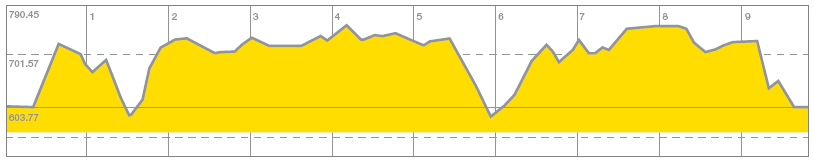
This morning was the 2008 edition of Quarryman Challenge, a 5km and 10mile race in Lemont, which is southwest of Chicago along the Illinois-Michigan Canal. Three of us ran the 10 mile race, which was nicely organised. But is it ever friggin' hilly there: the race course takes three turns from the lower levels near the canal up towards those hills. As the elevation chart (that I cut out of this pdf file with the course map) shows, it is not so much the total elevation but rather how steep the incline is. Quarryman Challenge elevation profile That said, I did okay: even though the legs were really tired throughout from those inclines, I finished in 1:12:08 for a pace of 7:13. And given the reasonably small field, that yielded 34th place overall and third in my age group.

Uwe Hermann: Nine Inch Nails album "The Slip" released under Creative Commons license

NiN You might have already heard of it — the new Nine Inch Nails album "The Slip" has been released by them under the Creative Commons BY-NC-SA 3.0 US license. Yep, that's right, it's totally legal to download it from the web — and use it for any non-commercial purposes! It's a bit annoying that they want your email address, though. Nothing that bugmenot.com (or similar) cannot fix, but still. Luckily, the files are now also available from archive.org! This, and the fact that the music is CC-licensed allowed me to "play" one of the songs in my Creative Commons music podcast (RSS), and more will likely follow.

Michal Čihař: Gammu stable version 1.20.0

Good news everyone, new stable Gammu release is out. Since 1.19.91 it brings only few small fixes in OBEX and EMS, but there is quite big list of changes compared to 1.19.0: You can download from usual place: http://cihar.com/gammu/.

Joerg Jaspert: The annoyance continues: Ftpmaster, yet again

Lalala, it’s me again. Don’t shout, it’s not a long post! :) What did we do since I last dared to post with my Ftpmaster head on? (Yes, I should put a summary of all my blog posts into a Bits from mail sometime.) Comments: 2

Cameron Dale: apt-p2p 0.1.3: now faster

I have updated apt-p2p to version 0.1.3, which is available now in unstable and my repository (see my previous post introducing apt-p2p). This update brings mostly speed improvements to finding peers to download from, and performing the download. Nodes in the DHT are now checked for responsiveness more thoroughly before adding them to the routing table, and rechecked more frequently afterwards. This should prevent bad nodes from propagating through the system, and departing nodes remaining in the system long after they have left. Downloading from peers is also quicker, as bad peers are dropped with a quicker timeout value and after a small number of errors. There was also a bug revealed by about 10% of the mirrors that caused downloads to fail, and was fixed in version 0.1.2. This update is STRONGLY recommended, as keeping unresponsive nodes out of the DHT will make everyone's experience better. If you tried apt-p2p and had some problems, I hope you'll consider trying again now. Unfortunately, these are enhancements I could not predict needing before releasing to the public, as the problems they solve are all caused by having a larger number of users, some of which are unresponsive. There are still a large number of peers (maybe 50% of them) that are unreachable, and so can not share any files with other peers. I don't have a good way to check yet, but you can go to sites such as this one to probe your client for you. Just enter the remote IP address and port (available on the status page) of your client in the form http://ipaddress:port/ (e.g. http://1.2.3.4:9977/). If the check returns any HTTP headers (even a 404 Not Found response) then you're fine, but if it doesn't return anything then your peer is firewalled or NATted and should probably be fixed. Here are the changelog entries for 0.1.2 and 0.1.3:

Julien Danjou: You fragged...

This made my day.

Martin F. Krafft: America does not exist, they never found it

From Berne, the Swiss capital, hails a band I really like by the name of Z ri West. The name itself is a pun: the folks from Berne love their city (rightfully so!) and join the rest of Switzerland in looking down a bit upon Zurich, which is metropolitan and hip and has often been considered the real capital of Switzerland. Located west of Zurich, Berne is thus Z ri West , and by using this name, the Bernese band ridicules the Zurich folks a bit. Well, that s my interpretation anyway and I make no claim over its correctness, and I surely don t want to get mixed up in local politics! Where was I? Oh yeah: Z ri West (Flash-using homepage] make rock music, and they re good with their instruments. The result are groovy and melodic sounds, which everyone in Switzerland knows. What I find particularly amazing about this band are their lyrics. Kuno, the singer, sings almost all songs in the Bernese dialect, which I ve learnt to the point of understanding it, though I can t speak it yet. It s a beautiful dialect, and Kuno displays magnificent control over it. When I say beautiful, I do not only mean its sound, but also the way it allows one to express thoughts, situations, feelings, etc.. It s very lyrical, often poetic, but always very much to the point. It sounds natural, yet not at all blunt. In addition, Z ri West s songs display no haste. Again, this is a bit ironic since the Bernese are said to be slow, but what I mean is that the band is unafraid to take their time to recount what they have to say. Forget 4/4 beats and verse-chorus-bridge-verse-chorus, it s a lot more as if the band shaped the music around the story they re telling. (Of course I have no reason to claim that the Bernese are actually slow. According to my dear (Bernese) friend Isabel, they are just considerate to give the rest of the world enough time to parse and understand their sophisticated verbal and non-verbal output). I won t be able to convey all of the lyrical beauties of their music to you, but what I want to do is translate my favourite of their songs, which is based on a story by Peter Bichsel and it s called America does not exist . Keep in mind that their version rhymes, which I won t be able to achieve in the translation. I ll try to keep the flow though. Imagine a jazzy, slightly Latin groove to it. And it s sung, not spoken.
This is the story of Colombo
not the one from the TV show
but of a guy who once lived in Spain
and who was a bit of a freak
capable of nothing
and always telling weird stuff
without giving it much thought
until one day someone told him: you ve got to learn a trade
you have to live your life
nobody takes you for real like this
and most just laugh about you
what are the options
he asked - what do you do
I m an explorer - the other guy said
I sail my ship out to the sea
through the various parts of the globe
that sounds very interesting - I d like that too
and so Colombo said - I ll become a famous explorer And he told it to everyone
and everyone just started laughing
and he said: just wait and see
and the people didn t believe him
and he got sulky
and the people almost died laughing
and he left the town
and hid somewhere in the forest
where he remained for 13 weeks - 13 weeks in the shrubs
and the people searched and felt ashamed
and noone knew where he might be
and noone laughed anymore when suddenly on a wonderful morning he was back
then everyone rejoiced
and when he said: i told you so
I discovered a new land
it s out there somewhere in the sea
then everyone listened
and was kind to him
and tried hard to make some dreadfully serious faces The explorer from the first verse
Amerigo Vespucci is his name
just happened to be in town
and said: good for you, but I won t believe you until I see it myself
and went off to set sail immediately
and after exactly 13 weeks and a day and a night he was finally back
and the people all went down to the port
and Colombo was nervous, almost ill because he had lied
and he was horribly frightened
and pale
and looked noone in the eyes But Vespucci smiled and stood in front of the people
and blinked at Colombo and told that he had found it
and Colombo was so glad that he didn t tell on him
and called out Amerigo Amerigo and the people joined in And Colombo became famous and until the end of his days
he was never actually sure and never dared to ask
whether America really existed
over time, more people went there and when they came back
they told stories and they tell the same stories until today
and noone knows anything more than he knew before
and everyone saw exactly the same
and that sounds very dodgy
and tastes a bit like screenplay and Hollywood America doesn t exist
they never found it
America doesn t exist
it s all just a tale
America doesn t exist
it s all lies and made up
America doesn t exist
America is just a rumour
NP: Z ri West: Z ri West

Russell Coker: Miro AKA DemocracyPlayer

www.ted.com is a premier partner for the Miro player [1]. This is a free player for free online content, the site www.getmiro.com has the player for download, it has binaries for Mac OS/X, Windows, and Ubuntu as well as the source (GPL licensed), it is in Debian/Unstable. It supports downloading in a number of ways (including bittorrent) and can keep the files online indefinitely. A Debian machine connected to the net could be a cheap implementation of my watching while waiting idea for showing interesting and educational TV in waiting areas for hospitals etc [2]. When I first checked out the getmiro.com site it only seemed to have binaries for Mac OS/X and Windows. But now I realise that it’s been in Debian since 11 Sep 2007 under the name Miro and since 12 Jun 2006 under the name Democracyplayer. I have only briefly played with Miro (just checked the channel list) and it seems quite neat so far. I wish I had tried this years ago. Good work Uwe Hermann! I hope that the Miro player will allow me to more easily search the TED archives. Currently I find the TED site painful to use, a large part of this is slow Javascript which makes each page take an unreasonable delay before it allows me to do anything. I am not planning to upgrade my laptop to a dual-core 64bit machine just to allow Firefox to render badly written web pages. Biella recently wrote about the Miro player and gave a link to a documentary about Monsanto [3]. One thing I really like about this trend towards publishing documentaries on the net is that they can be cited as references in blog posts. I’ve seen many blog posts that reference documentaries that I can’t reasonably watch (they were shown on TV stations in other countries and even starting to try tracking them down was more trouble than it was worth). Also when writing my own posts I try and restrict myself to using primary sources that are easy to verify, this means only the most popular documentaries.

9 May 2008

Daniel Burrows: Breaking radio silence

We've spent the last week and a half moving out of the bizarre twilight zone known as Redmond into the city of Seattle proper. This cuts down on my commute tremendously (although poor Kate has to do the opposite of what I used to do each day), and it's great to be able to walk to the grocery store whenever I want. It may also mean that I'll cut back a bit on my Debian work in favor of actually having a life. Half my stuff is still in boxes, so I'll be busy with this move for a while longer, but at least I have Internet and email access again now.

Zak B. Elep: Apache2 Worker MPM on Low Memory Servers

If you're running Apache2 on a memory-constrained system (like in a virtual machine,) you may want to choose the prefork MPM to save memory at the cost of more process forks. However, if you have more than one CPU on that same machine, you may also want to consider using the threaded worker MPM and tweak its MaxClients and ThreadsPerChild settings from the default configuration. On a typical apache2 installation on a Debian system, the worker MPM configuration looks like this:
<IfModule mpm_worker_module>
    MaxClients          150
    MinSpareThreads      25
    MaxSpareThreads      75
    ThreadsPerChild      25
    MaxRequestsPerChild   0
</IfModule>
Using these default settings on a resource-constrained system (say a server with 128MB of RAM but with no swap) would be overkill, and the web server processes will definitely eat up all of that memory, leaving little or no room for even simple CGI scripts. In my setup, I experimented with tweaking the values above to get apache2 to serve without eating up too much precious memory. I found that the important values to consider here are MaxClients, which dictate how many clients can connect simultaneously to my server, and ThreadsPerChild, which specifies how many threads of execution can run in a child/worker process. My resulting config becomes:
<IfModule mpm_worker_module>
    MaxClients           15
    MinSpareThreads       3
    MaxSpareThreads       7
    ThreadsPerChild       3
    MaxRequestsPerChild 200
</IfModule>
With this setup, I free up a significant amount of RAM from apache2's hold whle maximizing my thread usage in each worker process; at the same time, I avoid keeping each child process for too long by setting a maximum number of requests each worker can serve, preventing the workers to bloat too much when handling CGI. I also tweaked the KeepAliveTimeout setting to just 2 seconds (instead of the default 15) so that each worker process can go to the next request quickly and preventing them from being tied up to a connection for too long. I also set the Timeout to 30 seconds.

Adeodato Sim : Some soap for some mouths

One of the people who most fiercely fought software patents here in Spain and Europe jokingly (?!) uses the word “fag” to insult random people he dislikes. (But so do tons of other people I don’t interact with, of course.) I used not to be annoyed by this at all, but tonight I felt differently, and it really bothered me (possibly because it was somebody from my community who did it). Life is easier when you don’t care, I guess, but I think it’s a good thing that I care now, since without such caring things can’t and won’t change.

Dirk Eddelbuettel: On modes of transportation

Something I never really mentioned was the purchase of the foldable bike: a Dahon with a reasonably lightweight aluminum frame, a seven-speed hub and high-pressure tires. It's great fun in the city for the rides to and from the commuter train, or across downtown for occasional errrands after work. I have had this foldable bike for nearly two years, and used it almost (work-)daily, even in the Chicago winters. 'Almost' because I did suffer from broken parts on a few occassions: a pedal broke (easy replacement), the axis in the front wheel broke (a good week for a new and inexpensive wheel) but the bummer was that a part of the frame-folding mechanism broke last fall. Given that the bike, which I bought used via craigslist, is a few years old, the part was no longer standard and so we waited for it to be shipped from the manufacturer. And waited and waited some more until Dan's decided to give me a matching part from a bike in their inventory. But apart from that episode, and the occassional problem with conductors on the Metra commuter trains, it has been a smooth ride. Highly recommended, and I do see a few more foldable bikes downtown. Trek and Dahon bikes But what is new now is that I finally gave in and bought a road bike, once again off craigslist. My daily commute is about ten miles one-way, which works out to about 35 to 40 minutes of cycling, plus a few minutes of locking/un-locking, changing, etc. I had used my trusted (yet heavier) touring bike with its steel frame a number of times, but felt that a road bike may make for a faster ride. While it saves a few minutes, it is not really a time saver as the bike-train-bike commute also takes around 40 to 50 minutes. That said, riding is simply a nice way to clear the head before or after work. I am back on the schedule I tried for a few weeks last summer / fall: running on Tuesday and Thursday leaves Monday, Wednesday and Friday for the bike commute. So far, I am 8 for 9 over the last three weeks. On the downside: one rather wet ride home, and already to minor flats that (luckily) still allowed riding home. The hardest part is meeting up with some other riders at 6:00am meaning that I am now getting up at 5:00am whether I am running or not. But all told a nice way to get some exercise in outside of running.

Daniel Kahn Gillmor: GNOME and libpam-mount

So i've been struggling with an Ubuntu 8.04 networked workstation. It uses libpam-mount to mount the user's homedir (actually, the mountpoint is one level up from the homedir) automatically at login over CIFS. One of the problems i ran into with this arrangement happened because i was following the pam_mount configuration instructions too literally. In particular, README.Debian.gz says:
For every application used for logging in, there is a file of the form /etc/pam.d/xyz, add the following line at the end of the file:
@include common-pammount
In particular, ubuntu's /etc/pam.d/gdm defaults to:
#%PAM-1.0                                                                                                                                                               
auth    requisite       pam_nologin.so
auth    required        pam_env.so readenv=1
auth    required        pam_env.so readenv=1 envfile=/etc/default/locale
@include common-auth
auth    optional        pam_gnome_keyring.so
@include common-account
session required        pam_limits.so
@include common-session
session optional        pam_gnome_keyring.so auto_start
@include common-password
When i added the @include common-pammount directive to the bottom of this file when using pam_mount, new GNOME sessions failed badly: the gnome-panel didn't appear (which means that the user couldn't log out conveniently), and two error messages popped up at each login with nasty details like:
No database available to save your configuration: Unable to store a value at [...], as the configuration server has no writable databases.
The problem seems to be that libpam-gnome-keyring actually kicks off gconfd-2 during its PAM session invocation. If that comes before libpam-mount's PAM session invocation, then the home directory isn't mounted for the keyring, and gconfd-2 decides that it is unable to save any settings. Since gconfd then persists for the rest of the session, further GNOME session components try to talk to it and it refuses, even though the gconf db is now available (via the mounted homedir). Since the order of the lines in a /etc/pam.d/* are semantically relevant, i'm usually very reluctant to tamper with the defaults. However, i think the correct /etc/pam.d/gdm for this scenario (or any pam-mount scenario using GNOME where the homedir might not be present at all before the session) is actually:
#%PAM-1.0                                                                                                                                                               
auth    requisite       pam_nologin.so
auth    required        pam_env.so readenv=1
auth    required        pam_env.so readenv=1 envfile=/etc/default/locale
@include common-auth
@include common-account
session required        pam_limits.so
@include common-session
@include common-password
@include common-pammount
auth    optional        pam_gnome_keyring.so
session optional        pam_gnome_keyring.so auto_start
With this configuration in place, i can successfully log in with a test user, anyway (and move on to the next problem, which appears to be SQLite over CIFS, ugh). These sorts of problems are tough to nail down: Or maybe it's just a configuration detail that i should have known about and expected to deal with in the first place. Ah, well.

Adeodato Sim : Soooo, I won

As I mentioned, this week I’ve been in Sevilla as a finalist for the 2nd edition of a Free Software contest. Each participant at this stage made a presentation of their project, and this afternoon the winners were disclosed. I’m happy to share that Minirok won the 1st prize in its category, yay! Also, Dudesconf was simply terrific — I’m so happy I could attend this year. And, as for every conference, eternal gratitude to the organizers: people from GPUL, you simply rock!!

David Welton: LangPop.com - programming language popularity - update

These few days when Ilenia and Helen are still in the hospital are the eye of the storm for me. It's quiet at home and I actually have a few free hours when I'm not allowed to be in the hospital, or when they need to get some rest. One of the things I managed to do recently was some Javascript hacking in order to create a timeline for LangPop.com: http://www.langpop.com/timeline.html. It was fun, because most of the "heavy lifting" is done by Timeplot, and I just had to push the data into place. Of course, there isn't much interesting there because the site is relatively new, but it should be interesting to see how languages fare over time. I did some hacking on Timeplot to make it easier to host it on my own server, and to load a bit faster by stuffing it into one big ugly blob of Javascript. When I get a bit of time, I'll make my changes public, as I think they're fairly useful for anyone who wants to fiddle around with Timeplot some, and thus host it themselves. The other thing I did with the site was switch the X and Y axis of the charts, because that works out better in terms of screen space for the labels, with so many languages to keep track of.

Kapil Paranjape: Comparison of the HCL MiLeap X with the eeePC

I bought an HCL MiLeap X for Shruti (who is in the tenth standard) and the IMSc purchased an eeePC for "general use". Now that I have both machines in front of me, it seems like a good time to review them.

SimilaritiesLet's be clear that we are not comparing "jamun" to "aam" (or apples to oranges, if you prefer); these machines have quite a few similarities. Both are aimed at young students who are starting to use the computer for "real work" for the first time. Both the machines run GNU/Linux, and have similar dimensions and features --- even the prices are close. However, we are here to "raise the differences and not bury them"!

Physical appearanceThe eeePC is marginally lighter and more compact. The MiLeap appears to be more rugged though I didn't dare drop either machine to check!The eeePC has a rectangular touchpad which appears to have only one button but in fact this button has a left and right! The MiLeap has two regular buttons and a circular(!) touchpad.The MiLeap is bulkier but has a nice handle to lift it by. The eeePC can be carried like a book and has a matt finish.Both were proclaimed "cute" by Shruti and Sudeshna; I depend on their opinions in such matters!

Hardware featuresThe eeePC scores over the MiLeap X in terms of hardware features. The former has a web camera, a VGA out and one additional USB port. At the same time, the remaining features of both devices are likely to be adequate for most users --- 900 MHz low power processor, graphics adapter, wireless, ethernet, smart card reader. The eeePC has 4GB storage to the 2GB on the MiLeap, but the larger base software install on the eeePC means that the user has about the same amount of working area on both machines.The extra hardware features on the eeePC do give value for the 10% extra that one pays for the eeePC; the latter costs Rs. 17K to the MiLeap's Rs. 15.5K.

SoftwareThis is where the difference between the two is most striking. The MiLeap comes with a pre-installed "classmate" version of EduBuntu. The net result is that this looks and feels like a regular GNU/Linux system configured with software appropriate for educational use.The eeePC on the other hand has a completely icon-driven interface where even getting a terminal is not easy (Ctrl+Alt+T). However, this is just the icing on top of a regular icewm cake. The applications that actually run are just the regular ones --- not customised to fit in with the point-and-click interface.The eeePC terminal has really small fonts and is a regular xterm so that fonts are not as easy to fix as they are for the Gnome terminal used by EduBuntu on the MiLeap. Overall, EduBuntu applications which are based on Gnome are more consistent with the interface than the mix and match between KDE, Gnome and icewm that has been attempted by Xandros; the latter has a lot of promise but needs more work!It was easier to install software on the MiLeap since the EduBuntu repository is significantly larger than Xandros' repository as used by eeePC. In particular, on the MiLeap we installed nethack-qt since that is Shruti's favourite game and openvpn which is needed for us to connect to IMSc from outside the LAN.The installation of the MiLeap is that of Intel's ClassmatePC on which it is based. The entire installation is on a squashfs filesystem image. The base system is used via unionfs at run time on both machines. This makes for easy "reset to default".Suspend-to-ram does not work on the MiLeap; it should be fixed by installing the Linux 2.6.25 kernel.

PhilosophyI have long believed that un-prejudiced minds (like children) will take more readily to GNU/Linux than the hordes of "experienced" (mostly adult) computer users who have well-formed opinions about "user-friendly" software and how particular applications should behave.The "standard" GNU/Linux interface actually encourages exploration and the "tune-it", "tinker" and "fix-it" approach to learning about computing. It is not a sealed box with a "do-not-tamper" sticker. (This tinkering attitude is further enhanced by the approach taken by the designers of the Sugar interface for the XO Laptop.)Since both the systems are based on GNU/Linux (and Debian derivatives no less!), I am nothing short of thrilled at how far things have come. However, will the interface of the eeePC actually encourage exploration? Perhaps the EduBuntu interface of the MiLeap will prove too daunting for a novice. (Shruti does not classify as one since she used GNU/Linux "forever".) Only time will tell ...As Larry Wall has famously said: "There's more than one way to do it!" These devices certainly prove the truth of that assertion within the GNU/Linux world.Devices like these could push GNU/Linux into mainstream usage much more effectively than the "battle for the desktop". Hence, it is perhaps not surprising the both MicroSoft and Apple are trying hard to get into the game. However, it is only GNU/Linux that can comfortably provide a plethora of applications in less than 2GB! Until small solid state disks become significantly cheaper, those guys will have to wait.

Alexis Sukrieh: TinyMCE 3.0.8 entering Debian

I’ve uploaded a new major release of TinyMCE into sid, the package jumps from the 2.x branch to the new 3.x one. For the record, packages that use TinyMCE should rather depend on that packge instead of shipping the sources itself.

8 May 2008

Matthew Garrett

Modern CPUs are great. They have all sorts of advanced power saving features, which is one of those nice cases where everyone can save money, gain performance and claim environmental credentials at the same time. Everyone's a winner.

Well. Everyone's a winner as long as your software doesn't suck.

I've talked about the benefits of the tickless kernels and reducing wakeups and spending longer in deep C states before, so if you don't know about them then go and read that first. This time I'm going to focus on a different level of hardware, and a different level of suck.

For a long time, laptops supported changing the speed of processors when switching between AC and battery. CPU power consumption is proportional to frequency, so dropping the frequency meant a longer battery life. Of course, it also meant that it took longer to get anything done - the reason this was still a win was because CPUs in those days consumed just as much power when idle as when running. Transmeta introduced a technology called Longrun with their Crusoe processors, bringing the ability to drop both the frequency and the voltage of the CPU simultaneously. With power consumption being proportional to the square of the voltage, even a small drop resulted in worthwhile power savings. As the only really worthwhile thing Transmeta brought to the x86 world[1], this was unsurprisingly ripped off by everyone else. Intel introduced their Enhanced Speedstep, AMD gave people PowerNow and VIA have Longhaul.

Obviously, reducing the frequency of the CPU increased battery life. Everyone's happy?

No[2].

The problem is that nowadays, processors don't consume as much energy when they're idle as when they're running. The aforementioned C states mean that an idle processor consumes a tiny percentage of a loaded one - an ultra-low voltage Intel part will draw on the order of a watt. Executing code, even at the lowest voltage and frequency, will draw far more power. Obviously, we want to keep the processor idle for as long as possible. The easiest way to do this would be to never run anything, but that's not a real option. The alternative is to run when we have to, but make sure that we get it over with as quickly as possible so we can return to the idle state. Counterintuitively, that means switching to the highest voltage and frequency, executing the code and then dropping back into the idle state. By going faster, we save power[3].

In summary, the only sensible way to use a CPU is to run it as fast as possible in order to let it idle as much as possible, and drop the frequency and voltage when it's not doing anything. The. Only. Sensible. Way.

Some people write software that lets you choose different power profiles depending on whether you're on AC or battery. Typically, one of the choices lets you reduce the speed of your processor when you're on battery. This is bad. It is wrong. The people who implement these programs are dangerous. Do not listen to them. Do not endorse their product and/or newsletter. Do not allow your eldest child to engage in conjugal acts with them. Doing this will reduce your battery life. It will heat up your home. It will kill baby seals. The sea will rise and your car will float away. If you are already running it, make sure that it always sets your cpufreq governor to ondemand and does not limit the frequencies in use. Failure to do so will result in me setting you on fire[4].

The only legitimate reasons for limiting the speed of your CPU are to avoid overheating (which should be fixed in the kernel, really - having userspace in charge of ensuring the continued functioning of the machine is madness) or to make the machine quieter. And if you want your machine to be quieter, there should be a tickbox marked "Reduce performance in order to reduce noise" or something, which would take into account all the sources of heat in your machine rather than just your CPU. Encouraging the managing of acoustic levels by asking users to restrict the functionality of their CPU is just another way of saying "Look! We suck!". Letting the user choose a specific CPU governor or a specific frequency is not a useful thing to do. Don't do it unless you want to see dead kittens. Delivered by UPS.

[1] And, presumably, whatever else Intel and everyone else ended up licensing off them which resulted in their reinvention as an IP company rather than a CPU one, but that's just not interesting to me.

[2] Even ignoring the people that are unhappy for entirely unrelated reasons, such as injured toenails or the brutal murder of their family

[3] There's a corner case here, which is a system that is always entirely CPU bound. Say we halve the CPU's speed. Along with the voltage drop, that gets us down to about 20% of the original power consumption. Of course, it now takes twice as long to do anything and your screen, RAM, hard drive, chipset and so on are still drawing power, so will end up costing you twice as much power as they would have done if you'd run at full speed. If you do the maths, it works out that you save power if your processor's full-speed power consumption is more than 1.7 times that of the rest of the platform. In the real world, things are made more complicated by the rest of your platform consuming more power if you're working over a longer period of time - your hard drive is going to end up spending more time spun up, your memory bus is going to be active for longer and so on. You're basically not going to hit this case.

[4] While the burning of your body will result in carbon emissions, the reduction in power usage should offset this in the long run

Next.

Previous.