Search Results: "ag"

17 May 2008

Josselin Mouette: Some lessons to learn

There are obviously some things we need to remind if we don t want something like the OpenSSL debacle to happen again. It doesn t mean we need to throw stones nor to rush into changing our processes without thinking. However, there are already some things that should be obvious but unfortunately are not.

  1. Shipping a giant diff.gz that contains all changes in one, putting security fixes, policy fixes, bug fixes, cosmetic changes and autotools files at the same level, is not something we should accept anymore. Improvements in the dpkg-source format are much welcome in this direction, but they are useless if maintainers don t use them. Neither a VCS nor a build tool will be able to know which line of the changes is related to which bug. Only the maintainer can.
  2. Core packages should all have co-maintainers. This is pretty much stating the obvious, and is much easier said than done. The OpenSSL case is one of the best examples here: Kurt is not one of those who refuses help, but frankly, would you want to maintain that package? Having already maintained packages with messy code, upstreams not understanding at all the needs of a distributor, avalanches of security alerts and randomly-changing ABIs, I can tell you this is no fun like it can be to hack on a desktop environment or a device driver. The only sane reason to do this is that you need the package to work. The only visible result you get from your work is that programs are not randomly crashing.
    I have no magic recipe to propose so that more people help with such packages, and that s where we need to be really innovative. Cross-distribution teams, mandatory co-maintainership on a core package for each DD these (and all ideas I have not heard of) are the experiments we should start now.
  3. Patching bad code leads to unpredictable results. What maintainer of a complex package has not introduced a new bug while trying to fix another one? Even when a piece of code is maintained by uncooperative developers, is not commented, uses arcane variable names or is impossible to understand without having contributed 3 winning entries to the IOCCC, it needs to evolve. And in these cases, it is only a matter of time until such things happen.
    Don t get me wrong: I m not trying to put the blame on upstream here. They have contributed very valuable code to the community and their work helped in the considerable widespread of cryptography. It s just that their code is not enough for our needs. If we can t patch it safely (and I m now convinced we can t), maybe we need to focus on alternatives and help them getting used by crypto-related packages. The code in GnuTLS and NSS is not necessarily better, but most (if not all) patches Debian needs to apply to them are build and portability fixes.
  4. Unless Debian-specific, 1 patch = 1 bug in the upstream tracker. This should be obvious, but given the number of patches that are never forwarded, it doesn t seem so. You should not only give a chance for upstreams to review the patch, but you need them to track it, and you must give them the chance to review it anytime someone else stomps on a similar issue. If upstream does not have a bug tracker, they probably think their software has no bugs. Which means they are not trustworthy, and we go back to point 3.
  5. We need to give more priority to security. Issues in the security team seem now fixed for good and they have been doing an awesome work. There isn t much left to do so that packages are all built with security-hardening features, but it still needs to be done. And there is much more to do so that we can provide out of the box a decent SELinux setup, or, if it turns out unrealistic to do, a decent system hardening setup using another framework. I know the SELinux zealots will jump on their high horses to explain that their framework is better, but the current situation where it is impossible for the average system engineer to setup a Debian-based MAC system is much worse than having a suboptimal setup that already works.
All in all, this incident has a great impact on Debian s image. If we don t react accordingly, adapting our processes and our system to match what our users expect from us and they expect the best they will turn away from us. With very good reasons to do so. Update : It seems OpenSSL does have a bug tracker. Thanks Kurt for pointing me to it.

Andrew Pollock: [life] More on flying British Airways

Heh, in the 11 or so hours since my last blog post I've received two emails from people going "yeah BA is crap!" Well the flight itself was fine. The plane was nice. The entertainment system was pretty decent. The UI was all touch screen based, which made it less clunky than Qantas'. Food-wise, I thought the dinner tray was pretty loaded with stuff. Only problem is that the flight was running about 10 minutes behind schedule, then had to hang around in the air at Heathrow for about 10-15 minutes, so we didn't make our connecting flight. BA bumped us to the next one without any problems, so now we're chilling out in the spiffy new terminal 5 BA lounge for an hour. I guess an hour just doesn't have enough fat in it for a connection. Terminal 5 is pretty shiny in general. Hopefully our bags won't get lost.

Patrick Winnertz: cowdancer in unstable - no longer support for stable release?!

Cowdancer is activly developed in debian, that's very nice. it's really a cool tool to build packages for unstable but also for backporting efforts. I'm using it on a daily basis to build debian etch packages of lustre. However three days ago cowdancer stopped working with my etch chroot after an upgrade of my unstable system:
dpkg-source: info: building lustre in lustre_1.6.5~rc3-1.dsc
dpkg-genchanges -S >../lustre_1.6.5~rc3-1_source.changes
dpkg-genchanges: including full source code in upload
dpkg-buildpackage: source only upload (original source is included)
chroot: cannot run command  cowdancer-ilistcreate': No such file or directory
W: cowdancer-ilistcreate failed to run within chroot, falling back to old method
 -> Running in no-targz mode
I: using fakeroot in build.
Current time: Sat May 17 12:18:30 CEST 2008
pbuilder-time-stamp: 1211019510
 -> copying local configuration
 -> mounting /proc filesystem
 -> mounting /dev/pts filesystem
 -> policy-rc.d already exists
Obtaining the cached apt archive contents
Installing the build-deps
cowdancer: .ilist size unexpected
Can't open perl script "/usr/bin/dpkg-architecture": Cannot allocate memory
 -> Attempting to satisfy build-dependencies
 -> Creating pbuilder-satisfydepends-dummy package
cowdancer: .ilist size unexpected
sh: /tmp/satisfydepends-aptitude/pbuilder-satisfydepends-dummy/DEBIAN/control: Cannot allocate memory
E: pbuilder-satisfydepends failed.
Copying back the cached apt archive contents
 -> unmounting dev/pts filesystem
 -> unmounting proc filesystem
 -> Copying COW directory
 -> Invoking pbuilder
 -> Cleaning COW directory
Command /bin/sh -c pdebuild "--pbuilder" "cowbuilder" "--" "--basepath" "/var/cache/pbuilder/etch.cow" failed

After some research I found that a change of cowdancer (something related to .ilist) is responible for this issue. After that I asked on #debian-devel if someone else had this problem and were told that removing an re-creating the chroot will help. But that results in the same error msg. After that I decided to wrote a bugreport against cowdancer, since this is in my eyes a major defect in this software to do not support the latest stable release. I filled this report as RC Bug and got very fast a answer:
severity 481344 wishlist
retitle 481344  provide cowdancer etch backport
[ ... ]

I think this is the wrong way to fix a problem in unstable with a backport of a software. Providing a fallback for older debian releases would be the better way. Is anybody else having this problems?

16 May 2008

Clint Adams: It was GORGEous and GOLDEN until it was black

[This entry is dedicated to Russell, , and the squirrels ( ) that tried to sit on my lap even though I told them that I was not toresbe.] The man handed us burritos full of spinach-infused E. coli and salsa verde of the botulist manifesto. Para llevar? You bet. I need to get me some waterfall Giardia to right my viscera or I'm bound to start hallucinating mountain paths full of dogs, e, inedible gorp, and children throwing themselves to their death. Hi, kids. , , , what happened to the garlic bread Can you imagine being allergic to ? My Dreamsicle can't. Now fly, fly away to the land of the peppermint tea, the deer without fear, the queer, the other beer, Sue's sambar. I like my pretty damn fancy, but we're not in , are we, Toto? There is a warp in the space-time continuum, causing multiple instances of calderae and 27 Dresses. One fled a bookstore and flew to its adopted homeland. One time. It sure is windy atop this peak, and while Phil Collins sings about burning down some kind of mission, the husband is eying Mr. MacLachlan. My ex's ex gives a lesson about testosterone, but we are too far away to see the bison. The bison do not, it would seem, give a damn about us or Irving, and they do not care about the worker exposing her VS panties. A secret hidden jeep whisks, and a card hides defiantly in my wallet. Nothing more can be said, and not for the reasons you think.

Kai Hendry: VIM IDE for Web applications

To follow this little screencast tutorial on editing Web applications: Recorded with recordmydesktop—follow-mouse -width 256 -height 256. I had to record it on my Thinkpad X40 as my X61 sound setup suffers from some sort of overrun. Couldn’t figure out jackd. Validator.nu is for helping find problems with HTML not PHP, so sorry for the sideline 2:30 mins in the video. :) Finally also “checkout” Google doctype.

Andrew Pollock: [life] On flying British Airways

(Well we haven't even gotten on the plane yet) I'm pretty sure that this is the first time I've flown British Airways. Sarah and I are off to Zurich via London, and when we rocked up at the airport to check in, we couldn't get seats together. We're sitting in the middle seat in front of each other. We were quite taken aback by this, as we've done a fair bit of flying together and never had this happen before. We mentioned this to the customer service person when we dropped our bags off, and she told us the reason was because they have online check-ins, all the seats go from people checking in online. They only seat people together with infants, in parties of three, or in a wheelchair. She went on to say all the airlines are like that. Not in our experience. So once we got through security and into the BA lounge, I thought I'd try again and see if we could get reseated. The customer service person in the lounge had a quick glance at the computer, and told me there was nothing available. There was no attempt to re-seat other passengers travelling alone, or anything. It looked like she based her inability to do it off the available seats. I'm just really surprised.

Jonathan McDowell: I'm totally Rick Moranis

I mentioned on my switch to Movable Type post that there were a few things that were hopefully going to happen RSN and that I'd talk about them if they did.

Well, one of them did, and Steve helpfully dropped me in it earlier in the week - I was granted write access to the debian-keyring. It's worth pointing out that while Steve did some prodding around this the process started quite some time ago; back in November James Troup (the other current keyring maintainer, and at the time the only one) contacted me regarding an offer I'd made to help out in whatever way I could. As a result I got involved in the keyring RT queue and did some basic triage and trying to point people in the right direction, where such help didn't require any keyring privileges. I also started thinking about how keyring maintenance could be shared in a trackable fashion. I made some suggestions to James and he was largely in favour with a few suggestions and wishlists.

I'll get into discussing exactly how it goes at a later point in time, but for the moment I want to get a better feel for the process and procedures to fine tune things. To that end I've been working my way through the keyring RT queue, and have removed quite a few keys of retired developers, as well as doing a handful of replacements for developers who'd lost or had their key compromised. There's still a few more tickets in progress and I'm trying my best to work through them in a timely manner - if you have an outstanding ticket and haven't heard from me then please do feel to ping it.

Ondřej Čertík: FOSSCamp, Friday

Since I live in Prague, it's basically compulsory to go to FOSSCamp. Yesterday I went with Lucas to some pubs + sightseeing, today we went in a larger group to this pub:

and we had a couple of good Czech meals with Plze beer:


Seems it tasted good:

MJ Ray: BBC TV: Click: Free=beer and facebook-flaming

Free software finally gets significant coverage on BBC TV's Click show this week, but I think it's very much Linux rather than GNU/Linux and free cost rather than freedom. They mentioned free security software and even raised the possibility of trojans, but didn't mention how free (as in freedom) software allows any random end-user to check or have it checked. Quite a missed opportunity! However, Click has a regular letters section, so watch it (times below), email click@bbc.co.uk and see if we can get the free software view across. The letters section this week seemed to be flaming proprietary SaaS social network site facebook for their pathetic default-permit approach to security of user details. I really think there's a role for something like noserub in free software social networking. Click-UK is shown on BBC News Channel Saturday 1130, Sunday 0430 and 1130, Monday 0030 and Sunday 0430 on BBC-1 (times BST) Click-World is shown Thursday 19:30 GMT, Repeated Friday 09:30 and 12:30 (Asia Pacific only), Saturdays 06:30, Mondays 15:30, Tuesdays 01:30 (not Asia Pacific, Middle East or South Asia) and 07:30 GMT Anyone else see this?

David Welton: Neat Hecl app from newcomer

This is a cool little application, and a helpful tutorial for people trying Hecl for the first time. Since I know the system so intimately, people doing these kinds of pages are always a helpful reality check, pointing out where people new to the language hit stumbling blocks, and providing a guide for people who haven't "been there and done that": http://lauri.ojansivu.googlepages.com/heclcommandlineapp Thanks Lauri!

Daniel Leidert: /usr/lib/python2.3 garbage

Yesterday I stumbled about files and dead symlinks left in /usr/lib/python2.3/site-packages/ on my Sid box. These files/symlinks seem to have been shipped/created(?) by:
python-ldap python-cairo python-crypto kiki python-foomatic python-mysqldb
python-logilab-common python-egenix-mxtools python-numarray python-pygresql
python-imaging-sane python-imaging python-xml python-reportlab
Deleting /usr/lib/python2.3 (dpkg -S didn’t show any package relationship nor did I find something in /var/lib/dpkg/info/) and reinstalling the above mentioned packages did not recreate the files/symlinks. So it seems the directory can be safely removed. Maybe I missed some announcement or one (or more) packages need to be fixed. No time to examine it atm. Update This is known as Debian bug #409390. Thanks to Josselin Mouette for the information.

Kapil Paranjape: Computers and I

This post is to some extent a fall-out of the recent discovery of a serious flaw in Debian's openssl and openssh packages. However, as Raghavan will confirm, a weaker version of what is said below was part of our discussion two weeks ago. Moreover, there are earlier posts on this topic in this blog.There are times when I wonder why I am so involved with computers ... this is clearly one of those times.
कर्मण्यैवाधिकरस्ते मा फलेशु कदाचनkarmaNyaivaadhikaraste maa faleshu kadaachana
This is a phrase from the भगवद गीत (bhagavad giit) which has been stuck in my head for the last 30 odd years. It roughly paraphrases into
Do something because you think it is worth doing not because of what you hope to achieve by doing it.1
The above maxim is a good one but is sometimes a cop-out. Moreover, it provides no basis for actually making ethical choices.Ethics comes from one's interactions with the communities one is a part of. There are (roughly) two communities that I am a part of in the context of computers:I take these in turn below.

Debian and FOSS communitiesBy its own standards, the Debian community has suffered a massive failure ... and by these same standards it has reacted extremely well to this failure.I feel shame and blame. Why have I been ignoring RFH#332498 all these days when it shows up in the output of wnpp-alert? Here I am, a mathematician with some understanding of the issues, not helping out! Three years ago I even gave a short course of lectures on implementations of crypto; the source of openssl and openssh were used as examples. Excuses like, "I don't know anything about library packaging" and "I need more time!" (who doesn't) seem too weak now.At the same time, I feel a sense of solidarity with the Debian (and more widely FOSS) community as it tries to pull out of the resulting mess. The resilience that allows us to laugh wryly at ourselves is IMHO admirable.As Steve Kemp wrote: "[When we look back we will see that] we did good".

IMSc computer communityThe IMSc computer setup was built by volunteers and was genuinely a community when I joined this institute in 1996. It has since then broken into users, system administrators and the computer committee. As Indira Gandhi would have said: "This is a world-wide phenomenon", and as was the case when she said it, my response is: "That doesn't make it a good thing!"
When I speak about this fractured IMSc community below it is in generalities. There are certainly individuals who rise above the shards.
I have been promoting the use of FOSS and more specifically Debian at IMSc ever since I got here. While explaining the pragmatic aspects like cost and security, I have also tried to emphasize the freedom and community aspects of FOSS use. When the latter are not understood or accepted, the former are easily blown away.This year I made an attempt to get the Computer Committee to invite users to choose2 their own computers and the software that ran on it, but it turned out that no one really wanted this. Users just wanted to buy "fancy toys", the administrators just wanted to make their life simple and CC members just wanted the power to dictate what people bought.3I also made an attempt to get our users to educate each other on the use of computers for their work --- first through the establishment of a wiki and then through the "No-Excuse" mailing list.4Unfortunately, the fractured IMSc computer community sees computers and software as expensive commodities --- with some combination of fear, greed and irritation. In any case, there is no feeling of being part of a larger community that is trying to solve (certain types of) problems.

A wise man once said:

With great freedom comes even greater responsibility.
This may explain why we prefer being dictated to by proprietary vendors and computer committees that "buy stuff for us". We are afraid of the responsibility that comes with freedom.Another much quoted quote is:
If you are not part of the solution then you are part of the problem.
The FOSS community (actively) invites people to join-in in solving problems. This participation (which can be at a level of one's own choosing) is the source of one's freedom in free software. The IMSc community just wants मा-बाप सर्कार (maa-baap sarkaar) to fix their toys.

A decisionThe IMSc computer community was tied to Debian and FOSS after the break-ins into our system in the early 2000's. At that point, I was instrumental in installing a security infrastructure based mainly on Debian. This led to my greater involvement with FOSS and Debian and also to the greater "infiltration" of Debian and FOSS into IMSc computers.From the "commodity" point of view at IMSc we have come a full circle since most users will have to "do a lot" so that the IMSc computer LAN emerges unscathed from the crisis created by the Debian openssl flaw.From the "community" point of view at Debian we have spiralled out and even this major whirlpool will not drag us back in.It is no longer possible (for me) to straddle the circle and the spiral in an attempt to widen the former; I'm taking the "outward radial vector"!

  1. To this sentiment I have often added "do it because it's fun". ↩
  2. ... and be willing to justify their choices of course.[WGFCEGR] ↩
  3. OK! I'm exaggerating a bit! ↩
  4. No-Excuse is an acronym for Novice and Expert Computer Users. The blurb says:
    Now that this list exists there is "no-excuse" for novices to remain in-experienced or for experienced users to claim that something is "too hard to explain to a novice"!
    ↩

Russell Coker: Ideas to Copy from Red Hat

I believe that the Red Hat process which has Fedora for home users (with a rapid release cycle and new versions of software but support for only about one year) and Enterprise Linux (with a ~18 month release cycle, seven years of support, and not always having the latest versions) gives significant benefits for the users. The longer freeze times of Enterprise Linux (AKA RHEL) mean that it often has older versions of software than a Fedora release occurring at about the same time. In practice the only time I ever notice users complaining about this is in terms of OpenOffice (which is always being updated for compatability with the latest MS changes). As an aside, a version of RHEL or CentOS with a back-port of the latest OpenOffice would probably get a lot of interest. RHEL also has a significantly smaller package set than Fedora, there is a lot of software out there that you wouldn’t want to support for seven years, a lot of software that you might want to support if you had more resources, and plenty of software that is not really of interest to enterprise customers (EG games). Now there are some down-sides to the Red Hat plan. The way that they run Fedora is to have new releases of software instead of back-porting fixes. This means that bugs can be fixed with less effort (simply compiling a new version is a lot less effort than back-porting a fix), and that newer versions of the upstream code get tested. With some things this isn’t a problem, but in the past I have had problems with the Fedora kernel. One example was when I upgraded the kernel on a bunch of remote Fedora machines only to find that the new kernel didn’t support the network card, so I had to talk the users through selecting the older kernel at the GRUB menu (this caused pain and down-time). A problem with RHEL (which I see regularly on the CentOS machines I run) is that it doesn’t have the community support that Fedora does, and therefore finding binary packages for RHEL can be difficult - and often the packages are outdated. I believe that in Debian we could provide benefits for some of our users by copying some ideas from Red Hat. There is currently some work in progress on releasing packages that are half-way between Etch and Lenny (Etch is the current release, Lenny will be the next one). The term Etch and a half refers to the work to make Etch run on newer hardware [1]. It’s a good project, but I don’t think that it goes far enough. It certainly won’t fulfill the requirements of people who want something like Fedora. I think that if we had half-way releases of Debian (essentially taking a snap-shot of Testing and then fixing the worst of the bugs) then we could accommodate user demand for newer versions (making available a release which is on average half as old). Users who want really solid systems would run the full releases (which have more testing pre-release and more attention paid to bug fixes), but users who need the new features could run a half-way release. Currently there are people working on providing security support for Testing so that people who need the more recent versions of software can use Testing, I believe that making a half-way release would provide better benefits to most users while also possibly taking less resources from the developers. This would not preclude the current “Etch and a half” work of back-porting drivers, in the Red Hat model such driver back-ports are done in the first few years of RHEL support. If we were to really follow Red Hat in this regard the “Etch and a half” work would operate in tandem with similar work for Sarge (version 3.1 of Debian which was released in 2005)! In summary, the Red Hat approach is to have Fedora releases aimed at every 6 months, but in practice coming out every 9 months or so and to have Enterprise Linux releases aimed at every year, but in practice coming out every 18 months. This means among other things that there can be some uncertainty as to the release order of future Fedora and RHEL releases. I believe that a good option for Debian would be to have alternate “Enterprise” (for want of a better word) and half-way releases (comparable to RHEL and Fedora). The Enterprise releases could be frozen in coordination with Red Hat, Ubuntu, and other distributions (Mark Shuttleworth now refers to this as being a “pulse” in the free software community [], while the half-way releases would come out either when it’s about half-way between releases, or when there is a significant set of updates that would encourage users to switch. One of the many benefits to having synchronised releases is that if the work in back-porting support for new hardware lagged in Debian then users would have a reasonable chance of taking the code from CentOS. If nothing else I think that making kernels from other distributions available for easy install is a good thing. There is a wide combination of kernel patches that may be selected by distribution maintainers, and sometimes choices have to be made between mutually exclusive options. If the Debian kernel doesn’t work best for a user then it would be good to provide them with a kernel compiled from the RHEL kernel source package and possibly other kernels. Mark also makes the interesting suggestion of having different waves of code freeze, the first for the kernel, GCC, and glibc, and possibly server programs such as Apache. The second for major applications and desktop environments. The third for distributions. One implication of this is that not all distributions will follow the second wave. If a distribution follows the kernel, GCC, and glibc wave but not the applications wave it will still save some significant amounts of effort for the users. It will mean that the distributions in question will all have the same hardware support and kernel features, and that they will be able to run each others’ applications (except when the applications in question use system libraries from later waves). Also let’s not forget the possibility of running a kernel from distribution A on distribution B, it’s something I’ve done on many occasions, but it does rely on the kernels in question being reasonably similar in terms of features.

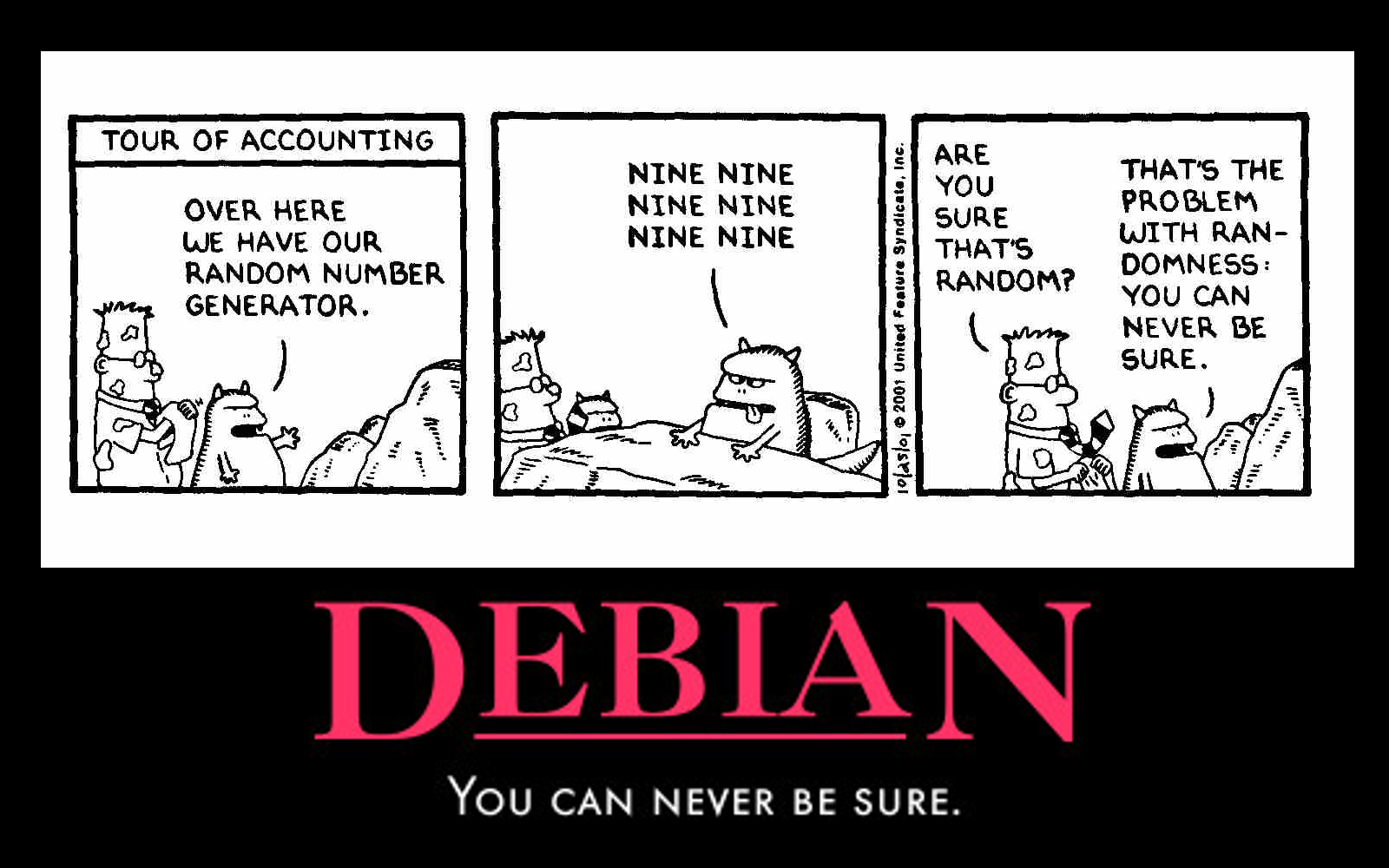
loldebian - Can I has a RC bug?: You can never be sure


You can never be sure

MJ Ray: No Battles - Just Stand Firm On Best Practice

"Here are three examples of rules that I think it's time to abandon. These particular examples are all about email. 1/ Top Posting [...] 2/ HTML Email [...] 3/ Reply-To On Mailing Lists [...] So, yes, the barbarians are at the gate. The lunatics have taken over the asylum. Good ideas have been crushed by the number of people who don't understand them. But there's no point in complaining about it. You just have to accept it and move on."
-- Pointless Battles For Geeks, By Dave Cross Unsurprisingly, given the above links to my site, I disagree with Dave Cross's conclusion, but I do agree with two aspects: battling is generally pointless and using hard rules about these things is unnecessary. I have those pages on my website so that I can point to them when their broken emails aren't handled as expected. I use some aspects of them as scoring inputs in my mail filters. I don't use them as rules and I try not to complain about them too often. Nevertheless, I still believe sending properly-trimmed plain text emails from a list-friendly email client is clearly best practice, to be recommended when someone asks why their email bad habits are causing them problems.

Jeff Bailey: Gay-Marriage in California

One of the proudest moments I had as a Canadian was sitting in the Senate visitor's gallery watching the debates on same-sex marriage that led to the full legalisation in Canada. In coming down to the US for work, I was sad to come to a place that not only didn't allow it, but had actually had a number of ballots in states voting specifically that the marriage referred to "One Man, One Woman".

I found a transcription of the Hansard of Prime Minister Paul Martin's introduction of Bill C-38 (The Civil Marriage Act). The logic in there for why Canada needed to legalise same-sex marriage is quite specific to Canada, but he talks about why it's important for the issue not to come to a vote:

The Charter was enshrined to ensure that the rights of minorities are not subjected, are never subjected, to the will of the majority. The rights of Canadians who belong to a minority group must always be protected by virtue of their status as citizens, regardless of their numbers. These rights must never be left vulnerable to the impulses of the majority.


I don't really understand the US system of rights. I hope that the protection of the right to love another consenting adult and make a commitment to them becomes the law of the land throughout the United States.

I love being married. I get the joy of being able to come home to my belle and share my day, spend time, and know that to the best of our ability, we're going to try to grow old together. I'm so happy that this ruling has come down and that in California the debate is now over.

15 May 2008

Daniel Burrows: Worst Debian day ever.

Regarding the OpenSSL debacle, Julien Blache writes:
Worst Debian day ever since the 2003 compromise. And that was a BAD one.
I disagree. This is far, far worse than the 2003 compromise. The compromise was scary, but the key updates for users were straightforward and as far as we know, user security was never actually compromised. In contrast, every single user who uses Debian or Ubuntu for anything serious is now (Update: and has been for two years) vulnerable to attacks on their supposedly secure cryptography [0] unless they perform a labor-intensive and error-prone series of steps to regenerate all their cryptographic keys -- not to mention finding a secure way to distribute their public keys to everyone who needs them! [0]: Update: I should perhaps make it clear that I mean anyone who generated a key on such a system. But in a way this makes things worse: unless you're willing to regenerate every key in sight, you need to check each key manually, which means that there's a nontrivial chance that you'll overlook one and leave yourself vulnerable...

Thijs Kinkhorst: Setting up Mailman to store members in a MySQL database

Little Mailman For a project I was looking for a way to use GNU Mailman for mailinglist management (especially its powerful web based moderation, bounce handling and attachment scrubbing features) but storing the mailinglist member information in a SQL database. That's useful when you want to relate mailinglist members to extra information already in a database and functionality on an interactive website, and it's possible on a per-mailinglist basis. This turned out to be not very difficult but just not that clearly documented. What I used: This explanation assumes you know how to work with Mailman in a regular setup, and things like creating databases and users under MySQL. Take the following steps:
  1. Install and set up mailman as you would otherwise.
  2. Put the MysqlMemberships.py file into the dir that is Mailman's base, this normally already has files like MemberAdaptor.py in it. For Debian this is /usr/lib/mailman/Mailman. You only need to add MysqlMemberships.py, the other files from rezo.net are not needed.
  3. The create table query in MysqlMemberships.py does not work with MySQL 5, I had to apply this patch which I've sent to MySQLMembership's author in the meantime. This patch has been applied by Fil.
  4. Create a database and a MySQL user, and add that information into your mm_cfg.py, like this:
    MYSQL_MEMBER_DB_NAME = "mailman"
    MYSQL_MEMBER_DB_USER = "mailman"
    MYSQL_MEMBER_DB_PASS = "somethingrandom"
    MYSQL_MEMBER_DB_HOST = "localhost"
    MYSQL_MEMBER_TABLE_TYPE = "wide"        # wide means one table per list, flat = one large table
  5. Create a mailinglist like your normally would (e.g. via newlist). To enable the MySQL backend for just that list, create a file extend.py under /var/lib/mailman/lists/listname with the following content:
    from Mailman.MysqlMemberships import MysqlMemberships
    def extend(list):
            list._memberadaptor = MysqlMemberships(list)
    
    (whitespace is significant in Python).
  6. It should work now! Upon receiving the first request for your list, the database table will be created automatically, which you can then populate. You may need to restart the mailman qrunner after you make further changes to your setup.

MJ Ray: Posting Ahead

I'm convinced by The Argument for Posting Ahead [Network Blogging] so why didn't I set it up for my recent trip? Well, a while ago, I had a bit of an email discussion with Steve about delayed posting features for Chronicle which I think ended with the addition of chronicle-spooler to the released files. I initially suggested ignoring a post when its Date is in the future, like Wordpress does, but I think that wouldn't be backwards-compatible and isn't as flexibile as it could be. chronicle-spooler works by moving files from a spool dir into a live dir. I'd forgotten how much it confuses me when files on a "static" site start moving themselves around. It means I have to merge before upload, which isn't a big change, but still annoying. So, I've added the following lines to chronicle to skip entries with a Publish header in the future:-
--- chronicle-2.7/bin/chronicle.orig	2008-05-15 10:13:55.000000000 +0100
+++ chronicle-2.7/bin/chronicle	2008-05-15 10:13:43.000000000 +0100
@@ -607,7 +607,8 @@
         #  Read the entry and store all the data away as a
         # hash element keyed upon the (unique) filename.
         #
-        $results  $file   = readBlogEntry($file);
+        my $result =  readBlogEntry($file);
+        if ($result)   $results  $file   = $result;  
      
 
     #
@@ -1479,7 +1480,7 @@
     my $tags    = "";    # entry tags.
     my $body    = "";    # entry body.
     my $date    = "";    # entry date
-    my $publish = "";    # entry publish date - *ignored*
+    my $publish = "";    # entry publish date
 
     open( ENTRY, "<", $filename ) or die "Failed to read $filename $!";
     while ( my $line = <ENTRY> )
@@ -1527,6 +1528,14 @@
      
     close(ENTRY);
 
+    # MJR - embargo stuff until its publish date.
+    # Steve recommends using chronicle-spooler,
+    # but I want uploaded files to stay where I put them,
+    # else I get my local copy confused.
+    if (($publish ne "") && (str2time($publish) > time()))  
+    	return 0;
+     
+
     #
     #  Determine the input format to use.
     #
I think that's compatible with chronicle-spooler, too...

Kapil Paranjape: Converting keys between SSH and SSL

How does one convert between SSH keys and SSL keys?
Let us first divide the problem into two parts.

Private Key availableThe simpler case is when you have the private key. In this case, SSH private key is in fact the same as an SSL key. If the key was generated using ssh-keygen -t rsa then it is a 2048-bit RSA private key for SSL.It follows that it rather trivial to extract an SSH public key from an SSL private key. You just run
ssh-keygen -f private_key_file -y > ssh.pub
This will prompt you for a password if your key is kept encrypted as it should be. The ssh.pub file contains the SSH public key.It is similarly easy to extract the SSL public key from an SSH private key.
openssl rsa -in private_key_file -pubout -out ssl.pub
will create ssl.pub containing the SSL public key.

Private Key un-availableThe more difficult case is when you only have the SSH public key or an SSL certificate. In this case one should be able to extract the SSL public key from the SSL certificate and interchange between the SSL and SSH public keys.The extraction of the public key from the SSL certificate is achieved by the command1
openssl x509 -in cert_file -pubkey -noout > ssl.pub
which extracts the public key from the SSL certificate.

The MessThe second part, i. e. converting between SSH and SSL public keys, has a rather tortuous route given that the data contained in the public keys is the same!First of all one needs some somewhat un-common utilities (which are currently only in sid on Debian)
apt-get install lsh-utils 
This pulls in the nettle-bin package which also contains some useful programs. So one can run
ssh-conv < ssh.pub   sexp-conv 
To get a look at the "real stuff" inside the SSH public key.If ssl.pub and ssh.pub refer to the same key then you will see that the output of
ssh-conv < ssh.pub   sexp-conv -s hex
and
openssl rsa -in ssl.pub -pubin -noout -text
are entirely similar and clearly inter-convertible. The same applies to DSA keys with the openssl rsa replaced by openssl dsa in the command above.One could easily write a script that would massage one of these text formats into the other. Luckily, someone did it for us. So we run
sed -e'1d' -e'$d' < /tmp/test.pub   \
 pkcs1-conv --public-key-info --base-64   \
 sexp-conv   \
 sed -e'1s/(rsa/(rsa-pkcs1-sha1/'   \
 sexp-conv -s transport
The output of this is identical to the output of
ssh-conv < ssh.pub   sexp-conv -s transport
Hence, we have reached the point of convertibility! The full pipeline is
sed -e'1d' -e'$d' \< ssl.pub   \
 pkcs1-conv --public-key-info --base-64   \
 sexp-conv   \
 sed -e'1s/(rsa/(rsa-pkcs1-sha1/'   \
 sexp-conv -s transport   \
     lsh-export-key --openssh > newssh.pub

ConclusionHaving got this far the reader may be wondering what the purpose of this (lack of) exercise is --- other than writing complex pipelines instead of real code.
Answer:
Since you can now convert certificates into SSH public keys you can check these certificates against the SSH public keys that became bad as a consequence of the recent fiasco.Moreover, to do this you do not need to have access to the private keys of the certificates.
So help out a friend by checking whether their SSL certificate is based on a weak key. However, note that the above procedure doesn't work for DSA keys. In addition, the publicly available tests for bad keys do not work with 1024-bit RSA keys. If your friend has been using the letter type of keys on a Debian "etch" system then you should advise them to change keys anyway (and switch to 2048-bit RSA in the process).

  1. Locating this command took a bit of effort since the -pubkey option to x509 is not documented on its man-page. Rather it is documented on the rsautl man-page. (See: Debian Bug #291095). ↩

Next.

Previous.