Search Results: "will"

20 January 2021

Molly de Blanc: Inauguration Pie

How can I put four years into a pie? I m thinking of Inauguration Day 2017 through to today, Inauguration Day 2021. In truth things started back in 2015, when Donald Trump announced his run for the United States presidency, and I don t know how long things will continue past the moment when President-Elect Joe Biden becomes President Joe Biden. For the United States, it s been a hell of a time. For the world, it d been even worse. Every generation thinks that they lived through more than anyone else, that they had it worse. I had a Boomer tell me that the existential stress of COVID is nothing compared to the Vietnam War. I m sure when we are living through a global water crisis, I ll tell the kids that we had it bad too. Everyday I listen to the radio and read Twitter, aware that the current state of endless wars wars against terrorism and drugs, organized crime and famine, climate change and racism is global, and not limited to just what s happening to and around me. That makes it feel worse and bigger and I wonder if earlier generations can really grasp how big that is. The last four years brought me in closer working relationships with people in India and Nigeria. I would call these people my friends in that if they were in town I would want to see them and show them around. Most of them I would offer a space in my small apartment, in case they needed somewhere to sleep and wanted to save the money. We chat, though we only have the internet as opposed to elevator rides in tall office buildings and slow walks down to the shops during lunch breaks. From these relationships I have learned very little about life in India or Nigeria, and I only visited India separately from any of my colleagues there. (I went for a wedding. My visa to Nigeria was denied on account of a medical issue.) But, I follow these people on social media and see what they share, the same political and social utterances that could be the same here or virtually any other place, as long as we replace the right keywords. Exchange the name of one leader, conservative party, or government unit for another. When I first saw the #EndSARS hashtag show up, I thought the images were from Black Lives Matter protests. Stop police brutality. And that was only in the last few months. I ve had three jobs since Trump first announced his candidacy in three very different places. In the first I felt like I wasn t able to talk about the sexism and discrimination I was dealing with in the office, and how much more so my views on an organizational partnership with a government whose policies I strongly disagreed with. In the second I was able to talk about these things, but there was nothing to do about them. I ve been in love and had my heart broken three times in three very different ways that all came down to someone valuing someone else more than they valued me. Can I bake heartbreak into a pie? Is it even fair to distract from the political world with my own loss? What about COVID-19? There s bitterness and anger and tears and pain emotional and physical. There is desperation and desolation and loneliness. Covid has colored everything during the past year. It is a burden our new political leaders will take on. Biden and Harris, all of the new people in Congress, and everyone else who has taken on an elected position now must content with Covid with new levels of responsibility. Not only do their decisions affect the people they come into contact with, they now affect everyone their policies touch and perhaps even more than that. The government hired people to build walls. Our government approved it and people willingly took on the job of building those walls. Families were separated. Children were placed in inhumane conditions; children were tortured. Remember when the guards at border detention facilities were raping children? Remember when children had guards? Women were forcefully operated upon and had their bodies permanently changed without their permission, against their desires. People were executed by the state. There were so many things I ve lost track of them all. I remember bits and pieces as I write this, coming back to me like singing a song I haven t thought about in years. With each line, I remember another one. Being worried about coming home from Cuba, when the visitation rules were changed in the middle of my trip. Climate change, again and again. Pollution and microplastics and watching the country being broken into pieces and sold off in the name of economy and progress. People losing their access to healthcare, through clinics closing down and loss of insurance. What do you bake into a pie that tastes like sedition? What are the flavors of loss and racism and hate? How to you balance the sourness with subtle hints of hope, which feels to tender and fragile? Do we pair equal parts of the palatable with the unpalatable, in the name of our neatly divided senate? I have hope, of course I have hope, and I have always had hope, but now it feels thinner than ever, like a ganache or a caramel after your hand slips and you pour too much cream in. A custard or compote or curd that that refuses to thicken no matter how long you cook it. I see that things could be better, but better does not mean good and better does not mean enough. So I will put my hope into this pie. I put my pain and anger into the dough. I will put my tears and helplessness and bitterness into the filling. I will cover it sweetness and the delicate hope I ve spun out of sugar. Soon I will bake it and share it with the three other people I see because the most important thing about surviving these past years, these past months and weeks and days, is that we did it together. We will commiserate on what we ve overcome, and we will share our hope and the sweetness of the moment, as the spun sugar dissolves on our tongues. There is so much we have left to do, so much we must do. We will be angry in the future, we may be angry later today, but until then, we have pie.


Raphaël Hertzog: Freexian s report about Debian Long Term Support, December 2020

A Debian LTS logo Like each month, have a look at the work funded by Freexian s Debian LTS offering. Debian project funding In December, we put aside 2100 EUR to fund Debian projects. The first project proposal (a tracker.debian.org improvement for the security team) was received and quickly approved by the paid contributors, then we opened a request for bids and the bid winner was announced today (it was easy, we had only one candidate). Hopefully this first project will be completed until our next report. We re looking forward to receive more projects from various Debian teams! Learn more about the rationale behind this initiative in this article. Debian LTS contributors In December, 12 contributors have been paid to work on Debian LTS, their reports are available: Evolution of the situation December was a quiet month as we didn t have a team meeting nor any other unusual activity and we released 43 DLAs. The security tracker currently lists 30 packages with a known CVE and the dla-needed.txt file has 25 packages needing an update. This month we are pleased to welcome Deveryware as new sponsor! Thanks to our sponsors Sponsors that joined recently are in bold.

19 January 2021

John Goerzen: Roundup of Secure Messengers with Off-The-Grid Capabilities (Distributed/Mesh Messengers)

Amid all the conversation about Signal, and the debate over decentralization, one thing has often not been raised: all of these things require an Internet connection. Of course, you might say. Internet is everywhere these days. Well, not so much, and it turns out there are some very good reasons that people might want messengers that work offline. Here are some examples: How do they work? These all use some form of local radio signal. Some, such as Briar, may use short-range Bluetooth and Wifi, while others use radios such as LoRa that can reach several miles with low power. I ve written quite a bit about LoRa before, and its unique low-speed but extreme-distance radio capabilities even on low power. One common thread through these is that most of them are Android-only, though many are compatible with F-Droid and privacy-enhanced Android distributions. Every item on this list uses full end-to-end encryption (E2EE). Let s dive on in. Briar Of all the options mentioned here, Briar is the one that bridges the traditional Internet-based approach with alternative options the best. It offers three ways for distributing data: As far as I can tell, there is no centralized server in Briar at all. Your account , such as it is, lives entirely within your device; if you wipe your device, you will have to make a new account and re-establish contacts. The use of Tor is also neat to see; it ensures that an adversary can t tell, just from that, that you re using Briar at all, though of course timing analysis may still be possible (and Bluetooth and Wifi uses may reval some of who is communicating). Briar features several types of messages (detailed in the manual), which really are just different spins on communication, which they liken to metaphors people are familiar with: By default, Briar raises an audible notification for incoming messages of all types. This is configurable for each type. Blogs have a way to reblog (even a built-in RSS reader to facilitate that), but framed a different way, they are broadcast messages. They could, for instance, be useful for a send help message to everyone (assuming that people haven t all shut off notifications of blogs due to others using them different ways). Briar s how it works page has an illustration specifically of how blogs are distributed. I m unclear on some of the details, and to what extent this applies to other kinds of messages, but one thing that you can notice from this is that a person A could write a broadcast message without Internet access, person B could receive it via Bluetooth or whatever, and then when person B gets Internet access again, the post could be distributed more widely. However, it doesn t appear that Briar is really a full mesh, since only known contacts in the distribution path for the message would repeat it. There are some downsides to Briar. One is that, since an account is fully localized to a device, one must have a separate account for each device. That can lead to contacts having to pick a specific device to send a message to. There is an online indicator, which may help, but it s definitely not the kind of seamless experience you get from Internet-only messengers. Also, it doesn t support migrating to a new phone, live voice/video calls, or attachments, but attachments are in the works. All in all, a solid communicator, and is the only one on this list that works 100% with the hardware everyone already has. While Bluetooth and Wifi have far more limited range than the other entries, there is undeniably convenience in not needing any additional hardware, and it may be particularly helpful when extra bags/pockets aren t available. Also, Briar is fully Open Source. Meshtastic Meshtastic is a radio-first LoRa mesh project. What do I mean by radio-first? Well, basically cell phones are how you interact with Meshtastic, but they are optional. The hardware costs about $30 and the batteries last about 8 days. Range between nodes is a few miles in typical conditions (up to 11km / 7mi in ideal conditions), but nodes act as repeaters, so it is quite conceivable to just drop a node in the middle if you and contacts will be far apart. The project estimates that around 2000 nodes are in operation, and the network is stronger the more nodes are around. The getting started site describes how to build one. Most Meshtastic device builds have a screen and some buttons. They can be used independently from the Android app to display received messages, distance and bearing to other devices (assuming both have a GPS enabled), etc. This video is an introduction showing it off, this one goes over the hardware buttons. So even if your phone is dead, you can at least know where your friends are. Incidentally, the phone links up to the radio board using Bluetooth, and can provide a location source if you didn t include one in your build. There are ideas about solar power for Meshtastic devices, too. Meshtastic doesn t, as far as I know, have an option for routing communication over the Internet, but the devices appear to be very thoughtfully-engineered and easy enough to put together. This one is definitely on my list to try. Ripple-based devices This is based on the LoRa Mesh Radio Instructables project, and is similar in concept to Meshtastic. It uses similar hardware, a similar app, but also has an option with a QWERTY hardware keyboard available, for those that want completely phone-free operation while still being able to send messages. There are a number of related projects posted at Instructables: a GPS tracker, some sensors, etc. These are variations on the same basic concept. These use the Ripple firmware, which is not open source, so I haven t pursued it further. GoTenna For people that want less of a DIY model, and don t mind proprietary solutions, there are two I ll mention. The first is GoTenna Mesh, which is LoRa-based and sells units for $90 each. However, there are significant community concerns about the longevity of the project, as GoTenna has re-focused on government and corporate work. The Android app hasn t been updated in 6 monnths despite a number of reviews citing issues, and the iOS app is also crusty. Beartooth Even more expensive at $125 each is the Beartooth. Also a proprietary option, I haven t looked into it more, but they are specifically targetting backwoods types of markets. Do not use: Bridgefy Bridgefy was briefly prominent since it was used during the Hong Kong protests. However, numerous vulnerabilities have been demonstrated, and the developers have said they are re-working the app to address them. I wouldn t recommend it for now. Alternatives: GMRS handhelds In the USA, GMRS voice handhelds are widely available. Although a license is required, it is simple (no exam) and cheap ($35) and extends to a whole family. GMRS radios also interoperate with FRS radios, which require no license and share some frequencies, but are limited to lower power (though are often sufficient). Handheld GMRS radios that use up to 5W of power are readily available. A voice signal is a lot harder to carry for a long distance than a very low-bandwidth digital one, so even with much more power you will probably not get the same kind of range you will with something like Meshtastic, and they don t come with any kind of security or encryption at all. However, for basic communication, they are often a useful tool.

Russ Allbery: Review: The Secret Barrister

Review: The Secret Barrister, by The Secret Barrister
Publisher: Picador
Copyright: 2018
Printing: 2019
ISBN: 1-5098-4115-6
Format: Kindle
Pages: 344
The Secret Barrister is a survey and critique of the criminal legal system of England and Wales. The author is an anonymous barrister who writes a legal blog of the same name (which I have not read). A brief and simplified primer for those who, like me, are familiar with the US legal system but not the English one: A barrister is a lawyer who argues cases in court, as distinct from a solicitor who does all the other legal work (and may make limited court appearances). If you need criminal legal help in England and Wales, you hire a solicitor, and they are your primary source of legal advise. If your case goes to court, your solicitor will generally (not always) refer the work of arguing your case before a judge and jury to a barrister and "instruct" them in the details of your argument. The job of the barrister is then to handle the courtroom trial, offer trial-specific legal advice, and translate your defense (or the crown's prosecution) into persuasive courtroom arguments. Unlike the United States, with its extremely sharp distinction between prosecutors and criminal defense attorneys, criminal barristers in England and Wales argue both prosecutions and defenses depending on who hires them. (That said, the impression I got from this book is that the creation of the Crown Prosecution Service is moving England closer to the US model and more prosecutions are now handled by barristers employed directly by the CPS, whom I assume do not take defense cases.) Barristers follow the cab-rank rule, which means that, like a taxicab, they are professionally obligated to represent people on a first-come, first-serve basis and are not allowed to pick and choose clients. (Throughout, I'm referencing the legal system of England and Wales because the author restricts his comments to it. Presumably this is because the Scottish and Northern Irish? legal systems are different yet again in ways I do not know.) If details like this sound surprising, you can see the appeal of this book to me. It's easy, in the US, to have a vast ignorance about the legal systems of other countries or even the possibility of different systems, which makes it hard to see how our system could be improved. I had a superficial assumption that since US law started as English common law, the US and English legal systems would be substantially similar. And they are to an extent; they're both adversarial rather than inquisitorial, for example (more on that in a moment). But the current system of criminal prosecution evolved long after US independence and thus evolved differently despite similar legal foundations. Those differences are helpful for this American to ponder the road not taken and the impact of our respective choices. That said, explaining the criminal legal system to Americans isn't the author's purpose. The first fifty pages are that beginner's overview, since apparently even folks who live in England are confused by the ubiquity of US legal dramas (not that those are very accurate representations of the US legal system either). The rest of the book, and its primary purpose, is an examination of the system's failings, starting with the magistrates' courts (which often use lay judges and try what in the US would be called misdemeanors, although as discussed in this book their scope is expanding). Other topics include problems with bail, how prosecution is structured, how victims and witnesses are handled, legal aid, sentencing, and the absurd inadequacy of compensation for erroneous convictions. The most useful part of this book for me, apart from the legal system introduction, was the two chapters the author spends arguing first for and then against replacing an adversarial system with an inquisitorial system (the French criminal justice system, for example). When one is as depressed about the state of one's justice system as both I and the author are, something radically different sounds appealing. The author first makes a solid case for the inquisitorial system and then tries to demolish it, still favoring the adversarial system, and I liked that argument construction. The argument in favor of an adversarial system is solid and convincing, but it's also depressing. It's the argument of someone who has seen the corruption, sloppiness, and political motivations in an adversarial system and fears what would happen if they were able to run rampant under a fig leaf of disinterested objectivity. I can't disagree, particularly when starting from an adversarial system, but this argument feels profoundly cynical. It reminds me of the libertarian argument for capitalism: humans are irredeemably awful, greed and self-interest are the only reliable or universal human motives, and therefore the only economic system that can work is one based on and built to harness greed, because expecting any positive characteristics from humans collectively is hopelessly naive. The author of this book is not quite that negative in their argument for an adversarial system, but it's essentially the same reasoning: the only way a system can be vaguely honest is if it's constantly questioned and attacked. It can never be trusted to be objective on its own terms. I wish the author had spent more time on the obvious counter-argument: when the system is designed for adversarial combat, it normalizes and even valorizes every dirty tactic that might result in a victory. The system reinforces our worst impulses, not to mention grinding up and destroying people who cannot afford their own dirty tricks. The author proposes several explanations for the problems they see in the criminal legal system, including "tough on crime" nonsense from politicians that sounds familiar to this American reader. Most problems, though, they trace back to lack of funding: of the police, of the courts, of the prosecutors, and of legal aid. I don't know enough about English politics to have an independent opinion on this argument, but the stories of outsourcing to the lowest bidder, overworked civil servants, ridiculously low compensation rates, flawed metrics like conviction rates, and headline-driven political posturing that doesn't extend to investing in necessary infrastructure like better case-tracking systems sounds depressingly familiar. This is one of those books where I appreciated the content but not the writing. It's not horrible, but the sentences are ponderous and strained and the author is a bit too fond of two-dollar words. They also have a dramatic and self-deprecating way of describing their own work that I suspect they thought was funny but that I found grating. By the end of this book, I was irritated enough that I can't recommend it. But the content was interesting, even the critique of a political system that isn't mine, and it prompted some new thoughts on the difficulties of creating a fair justice system. If you can deal with the author's writing style, you may also enjoy it. Rating: 6 out of 10

18 January 2021

Evgeni Golov: building a simple KVM switch for 30

Prompted by tweets from Lesley and Dave, I thought about KVM switches again and came up with a rather cheap solution to my individual situation (YMMY, as usual). As I've written last year, my desk has one monitor, keyboard and mouse and two computers. Since writing that post I got a new (bigger) monitor, but also an USB switch again (a DIGITUS USB 3.0 Sharing Switch) - this time one that doesn't freak out my dock \o/ However, having to switch the used computer in two places (USB and monitor) is rather inconvenient, but also getting an KVM switch that can do 4K@60Hz was out of question. Luckily, hackers gonna hack, everything, and not only receipt printers ( ). There is a tool called ddcutil that can talk to your monitor and change various settings. And udev can execute commands when (USB) devices connect You see where this is going? After installing the package (available both in Debian and Fedora), we can inspect our system with ddcutil detect. You might have to load the i2c_dev module (thanks Philip!) before this works -- it seems to be loaded automatically on my Fedora, but you never know .
$ sudo ddcutil detect
Invalid display
   I2C bus:             /dev/i2c-4
   EDID synopsis:
      Mfg id:           BOE
      Model:
      Serial number:
      Manufacture year: 2017
      EDID version:     1.4
   DDC communication failed
   This is an eDP laptop display. Laptop displays do not support DDC/CI.
Invalid display
   I2C bus:             /dev/i2c-5
   EDID synopsis:
      Mfg id:           AOC
      Model:            U2790B
      Serial number:
      Manufacture year: 2020
      EDID version:     1.4
   DDC communication failed
Display 1
   I2C bus:             /dev/i2c-7
   EDID synopsis:
      Mfg id:           AOC
      Model:            U2790B
      Serial number:
      Manufacture year: 2020
      EDID version:     1.4
   VCP version:         2.2
The first detected display is the built-in one in my laptop, and those don't support DDC anyways. The second one is a ghost (see ddcutil#160) which we can ignore. But the third one is the one we can (and will control). As this is the only valid display ddcutil found, we don't need to specify which display to talk to in the following commands. Otherwise we'd have to add something like --display 1 to them. A ddcutil capabilities will show us what the monitor is capable of (or what it thinks, I've heard some give rather buggy output here) -- we're mostly interested in the "Input Source" feature (Virtual Control Panel (VCP) code 0x60):
$ sudo ddcutil capabilities
 
   Feature: 60 (Input Source)
      Values:
         0f: DisplayPort-1
         11: HDMI-1
         12: HDMI-2
 
Seems mine supports it, and I should be able to switch the inputs by jumping between 0x0f, 0x11 and 0x12. You can see other values defined by the spec in ddcutil vcpinfo 60 --verbose, some monitors are using wrong values for their inputs . Let's see if ddcutil getvcp agrees that I'm using DisplayPort now:
$ sudo ddcutil getvcp 0x60
VCP code 0x60 (Input Source                  ): DisplayPort-1 (sl=0x0f)
And try switching to HDMI-1 using ddcutil setvcp:
$ sudo ddcutil setvcp 0x60 0x11
Cool, cool. So now we just need a way to trigger input source switching based on some event There are three devices connected to my USB switch: my keyboard, my mouse and my Yubikey. I do use the mouse and the Yubikey while the laptop is not docked too, so these are not good indicators that the switch has been turned to the laptop. But the keyboard is! Let's see what vendor and product IDs it has, so we can write an udev rule for it:
$ lsusb
 
Bus 005 Device 006: ID 17ef:6047 Lenovo ThinkPad Compact Keyboard with TrackPoint
 
Okay, so let's call ddcutil setvcp 0x60 0x0f when the USB device 0x17ef:0x6047 is added to the system:
ACTION=="add", SUBSYSTEM=="usb", ATTR idVendor =="17ef", ATTR idProduct =="6047", RUN+="/usr/bin/ddcutil setvcp 0x60 0x0f"
$ sudo vim /etc/udev/rules.d/99-ddcutil.rules
$ sudo udevadm control --reload
And done! Whenever I connect my keyboard now, it will force my screen to use DisplayPort-1. On my workstation, I deployed the same rule, but with ddcutil setvcp 0x60 0x11 to switch to HDMI-1 and my cheap not-really-KVM-but-in-the-end-KVM-USB-switch is done, for the price of one USB switch (~30 ). Note: if you want to use ddcutil with a Lenovo Thunderbolt 3 Dock (or any other dock using Displayport Multi-Stream Transport (MST)), you'll need kernel 5.10 or newer, which fixes a bug that prevents ddcutil from talking to the monitor using I C.

Craig Small: Percent CPU for processes

The ps program gives a snapshot of the processes running on your Unix-like system. On most Linux installations, this will be the ps program from the procps project. While you can get a lot of information from the tool, a lot of the fields need further explanation or can give wrong or confusing information; or putting it another way, they provide the right information that looks wrong. One of these confusing fields is the %CPU or pcpu field. You can see this as the third field with the ps aux command. You only really need the u option to see it, but ps aux is a pretty common invokation. More than 100%? This post was inspired by procps issue 186 where the submitter said that the sum of the processes cannot be more than the number of CPUs times 100%. If you have 1 CPU then the sum of %CPU for all processes should be 100% or less, have 16 CPUs then 1600% is your maximum number. Some people reason for the oddity of over 100% CPU as some rounding thing gone wrong and at first I did think that; except I know we get a lot of reports about comparing the top header CPU load vs process load not lining up and its because they re different . The trick here, is ps is reporting a percentage of what? Or, perhaps to give a better clue, a percentage of when? PCPU Calculations So to get to the bottom of this, let s look at the relevant code. In ps/output.c we have a function pr_pcpu that prints the percent CPU. The relevant lines are:
  total_time = pp->utime + pp->stime;
  if(include_dead_children) total_time += (pp->cutime + pp->cstime);
  seconds = cook_etime(pp);
  if(seconds) pcpu = (total_time * 1000ULL / Hertz) / seconds;
OK, ignoring the include _dead_time line (you get this from the S option and means you include the time this process waited for its children processes) and the scaling (process times are in Jiffies, we have the CPU as 0 to 999 for reasons) you can reduce this down to. %CPU = ( Tutime + Tstime ) / Tetime
So we find the amount of time the CPU(s) have been busy either in userland or the system, add them together, then divide the sum by the total time. The utime and stime increment like a car s odometer. So if a process uses one Jiffy of CPU time in userland, that counter goes to 1. If it does it again a few seconds later, then that counter goes to 2. To give an example, if a process has run for ten seconds and within those ten seconds the CPU has been busy in userland for that process, then we get 10/10 = 100% which makes sense. Not all Start times are the same Let s take another example, a process still consumes ten seconds CPU time but been running for twenty seconds, the answer is 10/20 or 50%. With our single CPU example system both of these cannot be running at the same time otherwise we have 150% CPU utilisation which is not possible. However, let s adjust this slightly. We have assumed uniform utilisation. But take the following scenario: The output for ps -o times,etimes,pcpu,comm would look something like:
    TIME ELAPSED %CPU COMMAND
      10      20   50 P1
      10      10  100 P2
What we will see is P1 has 10/20 or 50% CPU and P2 has 10/10 or 100% CPU. Add those up, and you have 150% CPU, magic! The key here is the ELAPSED column. P1 has given you the CPU utilisation across 20 seconds of system time and P2 the CPU utilisation across only 10 seconds. You directly add them together you get the wrong answer. What s the point of %CPU? Probably the %CPU column gives results that a lot of people are not expecting, so what s the point of it? Don t use it to see why the CPU is running hot; you can see above those two processes were working the CPU hard at different times. What it is useful for is to see how busy a process is, but be warned its an average. It s helpful for something that starts busy but if the process idles or hardly uses CPU for a week then goes bananas you won t see it. The top program, because a lot of its statistics are deltas from the last refresh, is a much better program for this sort of information about what is happening right now.

17 January 2021

Wouter Verhelst: SReview 0.6

... isn't ready yet, but it's getting there. I had planned to release a new version of SReview, my online video review and transcoding system that I wrote originally for FOSDEM but is being used for DebConf, too, after it was set up and running properly for FOSDEM 2020. However, things got a bit busy (both in my personal life and in the world at large), so it fell a bit by the wayside. I've now also been working on things a bit more, in preparation for an improved administrator's interface, and have started implementing a REST API to deal with talks etc through HTTP calls. This seems to be coming along nicely, thanks to OpenAPI and the Mojolicious plugin for parsing that. I can now design the API nicely, and autogenerate client side libraries to call them. While at it, because libmojolicious-plugin-openapi-perl isn't available in Debian 10 "buster", I moved the docker containers over from stable to testing. This revealed that both bs1770gain and inkscape changed their command line incompatibly, resulting in me having to work around those incompatibilities. The good news is that I managed to do so in a way that keeps running SReview on Debian 10 viable, provided one installs Mojolicious::Plugin::OpenAPI from CPAN rather than from a Debian package. Or installs a backport of that package, of course. Or, heck, uses the Docker containers in a kubernetes environment or some such -- I'd love to see someone use that in production. Anyway, I'm still finishing the API, and the implementation of that API and the test suite that ensures the API works correctly, but progress is happening; and as soon as things seem to be working properly, I'll do a release of SReview 0.6, and will upload that to Debian. Hopefully that'll be soon.
Wouter Verhelst: Dear Google

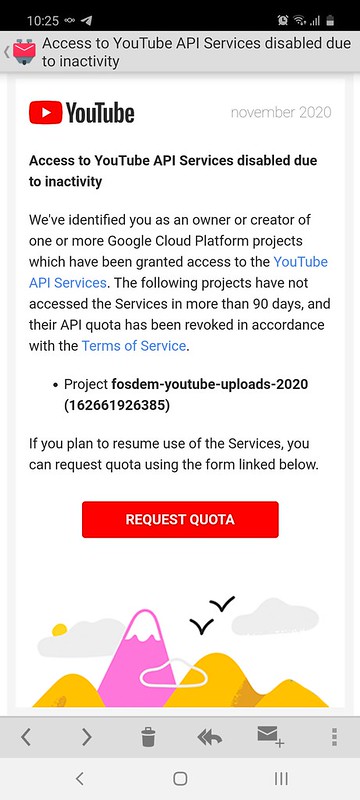
... Why do you have to be so effing difficult about a YouTube API project that is used for a single event per year? FOSDEM creates 600+ videos on a yearly basis. There is no way I am going to manually upload 600+ videos through your webinterface, so we use the API you provide, using a script written by Stefano Rivera. This script grabs video filenames and metadata from a YAML file, and then uses your APIs to upload said videos with said metadata. It works quite well. I run it from cron, and it uploads files until the quota is exhausted, then waits until the next time the cron job runs. It runs so well, that the first time we used it, we could upload 50+ videos on a daily basis, and so the uploads were done as soon as all the videos were created, which was a few months after the event. Cool! The second time we used the script, it did not work at all. We asked one of our key note speakers who happened to be some hotshot at your company, to help us out. He contacted the YouTube people, and whatever had been broken was quickly fixed, so yay, uploads worked again. I found out later that this is actually a normal thing if you don't use your API quota for 90 days or more. Because it's happened to us every bloody year. For the 2020 event, rather than going through back channels (which happened to be unavailable this edition), I tried to use your normal ways of unblocking the API project. This involves creating a screencast of a bloody command line script and describing various things that don't apply to FOSDEM and ghaah shoot me now so meh, I created a new API project instead, and had the uploads go through that. Doing so gives me a limited quota that only allows about 5 or 6 videos per day, but that's fine, it gives people subscribed to our channel the time to actually watch all the videos while they're being uploaded, rather than being presented with a boatload of videos that they can never watch in a day. Also it doesn't overload subscribers, so yay. About three months ago, I started uploading videos. Since then, every day, the "fosdemtalks" channel on YouTube has published five or six videos. Given that, imagine my surprise when I found this in my mailbox this morning... Google lies, claiming that my YouTube API project isn't being used for 90 days and informing me that it will be disabled This is an outright lie, Google. The project has been created 90 days ago, yes, that's correct. It has been used every day since then to upload videos. I guess that means I'll have to deal with your broken automatic content filters to try and get stuff unblocked... ... or I could just give up and not do this anymore. After all, all the FOSDEM content is available on our public video host, too.

Wouter Verhelst: On Statements, Facts, Hypotheses, Science, Religion, and Opinions

The other day, we went to a designer's fashion shop whose owner was rather adamant that he was never ever going to wear a face mask, and that he didn't believe the COVID-19 thing was real. When I argued for the opposing position, he pretty much dismissed what I said out of hand, claiming that "the hospitals are empty dude" and "it's all a lie". When I told him that this really isn't true, he went like "well, that's just your opinion". Well, no -- certain things are facts, not opinions. Even if you don't believe that this disease kills people, the idea that this is a matter of opinion is missing the ball by so much that I was pretty much stunned by the level of ignorance. His whole demeanor pissed me off rather quickly. While I disagree with the position that it should be your decision whether or not to wear a mask, it's certainly possible to have that opinion. However, whether or not people need to go to hospitals is not an opinion -- it's something else entirely. After calming down, the encounter got me thinking, and made me focus on something I'd been thinking about before but hadn't fully forumlated: the fact that some people in this world seem to misunderstand the nature of what it is to do science, and end up, under the claim of being "sceptical", with various nonsense things -- see scientology, flat earth societies, conspiracy theories, and whathaveyou. So, here's something that might (but probably won't) help some people figuring out stuff. Even if it doesn't, it's been bothering me and I want to write it down so it won't bother me again. If you know all this stuff, it might be boring and you might want to skip this post. Otherwise, take a deep breath and read on... Statements are things people say. They can be true or false; "the sun is blue" is an example of a statement that is trivially false. "The sun produces light" is another one that is trivially true. "The sun produces light through a process that includes hydrogen fusion" is another statement, one that is a bit more difficult to prove true or false. Another example is "Wouter Verhelst does not have a favourite color". That happens to be a true statement, but it's fairly difficult for anyone that isn't me (or any one of the other Wouters Verhelst out there) to validate as true. While statements can be true or false, combining statements without more context is not always possible. As an example, the statement "Wouter Verhelst is a Debian Developer" is a true statement, as is the statement "Wouter Verhelst is a professional Volleybal player"; but the statement "Wouter Verhelst is a professional Volleybal player and a Debian Developer" is not, because while I am a Debian Developer, I am not a professional Volleybal player -- I just happen to share a name with someone who is. A statement is never a fact, but it can describe a fact. When a statement is a true statement, either because we trivially know what it states to be true or because we have performed an experiment that proved beyond any possible doubt that the statement is true, then what the statement describes is a fact. For example, "Red is a color" is a statement that describes a fact (because, yes, red is definitely a color, that is a fact). Such statements are called statements of fact. There are other possible statements. "Grass is purple" is a statement, but it is not a statement of fact; because as everyone knows, grass is (usually) green. A statement can also describe an opinion. "The Porsche 911 is a nice car" is a statement of opinion. It is one I happen to agree with, but it is certainly valid for someone else to make a statement that conflicts with this position, and there is nothing wrong with that. As the saying goes, "opinions are like assholes: everyone has one". Statements describing opinions are known as statements of opinion. The differentiating factor between facts and opinions is that facts are universally true, whereas opinions only hold for the people who state the opinion and anyone who agrees with them. Sometimes it's difficult or even impossible to determine whether a statement is true or not. The statement "The numbers that win the South African Powerball lottery on the 31st of July 2020 are 2, 3, 5, 19, 35, and powerball 14" is not a statement of fact, because at the time of writing, the 31st of July 2020 is in the future, which at this point gives it a 1 in 24,435,180 chance to be true). However, that does not make it a statement of opinion; it is not my opinion that the above numbers will win the South African powerball; instead, it is my guess that those numbers will be correct. Another word for "guess" is hypothesis: a hypothesis is a statement that may be universally true or universally false, but for which the truth -- or its lack thereof -- cannot currently be proven beyond doubt. On Saturday, August 1st, 2020 the above statement about the South African Powerball may become a statement of fact; most likely however, it will instead become a false statement. An unproven hypothesis may be expressed as a matter of belief. The statement "There is a God who rules the heavens and the Earth" cannot currently (or ever) be proven beyond doubt to be either true or false, which by definition makes it a hypothesis; however, for matters of religion this is entirely unimportant, as for believers the belief that the statement is correct is all that matters, whereas for nonbelievers the truth of that statement is not at all relevant. A belief is not an opinion; an opinion is not a belief. Scientists do not deal with unproven hypotheses, except insofar that they attempt to prove, through direct observation of nature (either out in the field or in a controlled laboratory setting) that the hypothesis is, in fact, a statement of fact. This makes unprovable hypotheses unscientific -- but that does not mean that they are false, or even that they are uninteresting statements. Unscientific statements are merely statements that science cannot either prove or disprove, and that therefore lie outside of the realm of what science deals with. Given that background, I have always found the so-called "conflict" between science and religion to be a non-sequitur. Religion deals in one type of statements; science deals in another. The do not overlap, since a statement can either be proven or it cannot, and religious statements by their very nature focus on unprovable belief rather than universal truth. Sure, the range of things that science has figured out the facts about has grown over time, which implies that religious statements have sometimes been proven false; but is it heresy to say that "animals exist that can run 120 kph" if that is the truth, even if such animals don't exist in, say, Rome? Something very similar can be said about conspiracy theories. Yes, it is possible to hypothesize that NASA did not send men to the moon, and that all the proof contrary to that statement was somehow fabricated. However, by its very nature such a hypothesis cannot be proven or disproven (because the statement states that all proof was fabricated), which therefore implies that it is an unscientific statement. It is good to be sceptical about what is being said to you. People can have various ideas about how the world works, but only one of those ideas -- one of the possible hypotheses -- can be true. As long as a hypothesis remains unproven, scientists love to be sceptical themselves. In fact, if you can somehow prove beyond doubt that a scientific hypothesis is false, scientists will love you -- it means they now know something more about the world and that they'll have to come up with something else, which is a lot of fun. When a scientific experiment or observation proves that a certain hypothesis is true, then this probably turns the hypothesis into a statement of fact. That is, it is of course possible that there's a flaw in the proof, or that the experiment failed (but that the failure was somehow missed), or that no observance of a particular event happened when a scientist tried to observe something, but that this was only because the scientist missed it. If you can show that any of those possibilities hold for a scientific proof, then you'll have turned a statement of fact back into a hypothesis, or even (depending on the exact nature of the flaw) into a false statement. There's more. It's human nature to want to be rich and famous, sometimes no matter what the cost. As such, there have been scientists who have falsified experimental results, or who have claimed to have observed something when this was not the case. For that reason, a scientific paper that gets written after an experiment turned a hypothesis into fact describes not only the results of the experiment and the observed behavior, but also the methodology: the way in which the experiment was run, with enough details so that anyone can retry the experiment. Sometimes that may mean spending a large amount of money just to be able to run the experiment (most people don't have an LHC in their backyard, say), and in some cases some of the required materials won't be available (the latter is expecially true for, e.g., certain chemical experiments that involve highly explosive things); but the information is always there, and if you spend enough time and money reading through the available papers, you will be able to independently prove the hypothesis yourself. Scientists tend to do just that; when the results of a new experiment are published, they will try to rerun the experiment, partially because they want to see things with their own eyes; but partially also because if they can find fault in the experiment or the observed behavior, they'll have reason to write a paper of their own, which will make them a bit more rich and famous. I guess you could say that there's three types of people who deal with statements: scientists, who deal with provable hypotheses and statements of fact (but who have no use for unprovable hypotheses and statements of opinion); religious people and conspiracy theorists, who deal with unprovable hypotheses (where the religious people deal with these to serve a large cause, while conspiracy theorists only care about the unprovable hypotheses); and politicians, who should care about proven statements of fact and produce statements of opinion, but who usually attempt the reverse of those two these days :-/ Anyway... [[!img Error: Image::Magick is not installed]]

16 January 2021

Abhijith PA: Transition from Thunderbird to Mutt

I was going OK with Thunderbird and enigmail(though it have many problems). Normally I go through changelogs before updating packages and rarely do a complete upgrage of my machine. Couple of days ago I did a complete upgrade of system which updated my Thunderbird to latest version and throwing of enigmail plugin for using their native openPGP support. There is a blog from Mozilla which I should ve read earlier. Thunderbird s builtin openPGP functionality is still in experimental, atleast not ready for my workflow. I could ve downgrade to version 68. But I chose to move to my secondary MUA, mutt. I was using mutt for emails and newsletters that I check twice in a year a so. So I started configuring mutt to handle my big mailboxes. It took three evenings to configure mutt to my workflow. Though the basic setup can be done in less than an hour it is the small nitpicks consumed much of my time. Currently I have isync to pull and keep mails offline. Mutt to read, msmtp to send, abook as the email address book and urlview to see the links in mail. I am still learning notmuch and virtual mailbox ways to filter. Mutt There are ton of articles out there to configure mutt and all related things to it. But I find certain configs very hard to get. So I will write down those. So far, everything going okay.

Cons
  • some times mbsync throws EOF and secret key not found error.
  • searching is still a pain in mutt
  • nano s spell checker also check things which I am replying to.

More to come Well for now I moved mail from part of the Thunderbird. But Thunderbird was more than a MUA to me. It was my RSS reader, calendar and to-do list manager. I will write more about those once I make a complete transition.

15 January 2021

Dirk Eddelbuettel: Rcpp 1.0.6: Some Updates

rcpp logo The Rcpp team is proud to announce release 1.0.6 of Rcpp which arrived at CRAN earlier today, and has been uploaded to Debian too. Windows and macOS builds should appear at CRAN in the next few days. This marks the first release on the new six-months cycle announced with release 1.0.5 in July. As reminder, interim dev or rc releases will often be available in the Rcpp drat repo; this cycle there were four. Rcpp has become the most popular way of enhancing R with C or C++ code. As of today, 2174 packages on CRAN depend on Rcpp for making analytical code go faster and further (which is an 8.5% increase just since the last release), along with 207 in BioConductor. This release features six different pull requests from five different contributors, mostly fixing fairly small corner cases, plus some minor polish on documentation and continuous integration. Before releasing we once again made numerous reverse dependency checks none of which revealed any issues. So the passage at CRAN was pretty quick despite the large dependency footprint, and we are once again grateful for all the work the CRAN maintainers do.

Changes in Rcpp patch release version 1.0.6 (2021-01-14)
  • Changes in Rcpp API:
    • Replace remaining few uses of EXTPTR_PTR with R_ExternalPtrAddr (Kevin in #1098 fixing #1097).
    • Add push_back and push_front for DataFrame (Walter Somerville in #1099 fixing #1094).
    • Remove a misleading-to-wrong comment (Mattias Ellert in #1109 cleaning up after #1049).
    • Address a sanitizer report by initializing two private bool variables (Benjamin Christoffersen in #1113).
    • External pointer finalizer toggle default values were corrected to true (Dirk in #1115).
  • Changes in Rcpp Documentation:
    • Several URLs were updated to https and/or new addresses (Dirk).
  • Changes in Rcpp Deployment:
    • Added GitHub Actions CI using the same container-based setup used previously, and also carried code coverage over (Dirk in #1128).
  • Changes in Rcpp support functions:
    • Rcpp.package.skeleton() avoids warning from R. (Dirk)

Thanks to my CRANberries, you can also look at a diff to the previous release. Questions, comments etc should go to the rcpp-devel mailing list off the R-Forge page. Bugs reports are welcome at the GitHub issue tracker as well (where one can also search among open or closed issues); questions are also welcome under rcpp tag at StackOverflow which also allows searching among the (currently) 2616 previous questions. If you like this or other open-source work I do, you can sponsor me at GitHub. My sincere thanks to my current sponsors for me keeping me caffeinated.

This post by Dirk Eddelbuettel originated on his Thinking inside the box blog. Please report excessive re-aggregation in third-party for-profit settings.

13 January 2021

Antoine Beaupr : New phone: Pixel 4a

I'm sorry to announce that I gave up on the Fairphone series and switched to a Google Phone (Pixel 4a) running CalyxOS.

Problems in fairy land My fairphone2, even if it is less than two years old, is having major problems:
  • from time to time, the screen flickers and loses "touch" until I squeeze it back together
  • the camera similarly disconnects regularly
  • even when it works, the camera is... pretty bad: low light is basically unusable, it's slow and grainy
  • the battery can barely keep up for one day
  • the cellular coverage is very poor, in Canada: I lose signal at the grocery store and in the middle of my house...
Some of those problems are known: the Fairphone 2 is old now. It was probably old even when I got it. But I can't help but feel a little sad to let it go: the entire point of that device was to make it easy to fix. But alas, because it's sold only in Europe, local stores don't carry replacement parts. To be fair, Fairphone did offer to fix the device, but with a 2 weeks turnaround, I had to get another phone anyways. I did actually try to buy a fairphone3, from Clove. But they did some crazy validation routine. By email, they asked me to provide a photo copy of a driver's license and the credit card, arguing they need to do this to combat fraud. I found that totally unacceptable and asked them to cancel my order. And because I'm not sure the FP3 will fix the coverage issues, I decided to just give up on Fairphone until they officially ship to the Americas.

Do no evil, do not pass go, do not collect 200$ So I got a Google phone, specifically a Pixel 4a. It's a nice device, all small and shiny, but it's "plasticky" - I would have prefered metal, but it seems you need to pay much, much more to get that (in the Pixel 5). In any case, it's certainly a better form factor than the Fairphone 2: even though the screen is bigger, the device itself is actually smaller and thinner, which feels great. The OLED screen is beautiful, awesome contrast and everything, and preliminary tests show that the camera is much better than the one on the Fairphone 2. (The be fair, again, that is another thing the FP3 improved significantly. And that is with the stock Camera app from CalyxOS/AOSP, so not as good as the Google Camera app, which does AI stuff.)

CalyxOS: success The Pixel 4a not not supported by LineageOS: it seems every time I pick a device in that list, I manage to miss the right device by one (I bought a Samsung S9 before, which is also unsupported, even though the S8 is). But thankfully, it is supported by CalyxOS. That install was a breeze: I was hesitant in playing again with installing a custom Android firmware on a phone after fighting with this quite a bit in the past (e.g. htc-one-s, lg-g3-d852). But it turns out their install instructions, mostly using a AOSP alliance device-flasher works absolutely great. It assumes you know about the commandline, and it does require to basically curl sudo (because you need to download their binary and run it as root), but it Just. Works. It reminded me of how great it was to get the Fairphone with TWRP preinstalled... Oh, and kudos to the people in #calyxos on Freenode: awesome tech support, super nice folks. An amazing improvement over the ambiance in #lineageos! :)

Migrating data Unfortunately, migrating the data was the usual pain in the back. This should improve the next time I do this: CalyxOS ships with seedvault, a secure backup system for Android 10 (or 9?) and later which backs up everything (including settings!) with encryption. Apparently it works great, and CalyxOS is also working on a migration system to switch phones. But, obviously, I couldn't use that on the Fairphone 2 running Android 7... So I had to, again, improvised. The first step was to install Syncthing, to have an easy way to copy data around. That's easily done through F-Droid, already bundled with CalyxOS (including the privileged extension!). Pair the devices and boom, a magic portal to copy stuff over. The other early step I took was to copy apps over using the F-Droid "find nearby" functionality. It's a bit quirky, but really helps in copying a bunch of APKs over. Then I setup a temporary keepassxc password vault on the Syncthing share so that I could easily copy-paste passwords into apps. I used to do this in a text file in Syncthing, but copy-pasting in the text file is much harder than in KeePassDX. (I just picked one, maybe KeePassDroid is better? I don't know.) Do keep a copy of the URL of the service to reduce typing as well. Then the following apps required special tweaks:
  • AntennaPod has an import/export feature: export on one end, into the Syncthing share, then import on the other. then go to the queue and select all episodes and download
  • the Signal "chat backup" does copy the secret key around, so you don't get the "security number change" warning (even if it prompts you to re-register) - external devices need to be relinked though
  • AnkiDroid, DSub, Nextcloud, and Wallabag required copy-pasting passwords
I tried to sync contacts with DAVx5 but that didn't work so well: the account was setup correctly, but contacts didn't show up. There's probably just this one thing I need to do to fix this, but since I don't really need sync'd contact, it was easier to export a VCF file to Syncthing and import again.

Known problems One problem with CalyxOS I found is that the fragile little microg tweaks didn't seem to work well enough for Signal. That was unexpected so they encouraged me to file that as a bug. The other "issue" is that the bootloader is locked, which makes it impossible to have "root" on the device. That's rather unfortunate: I often need root to debug things on Android. In particular, it made it difficult to restore data from OSMand (see below). But I guess that most things just work out of the box now, so I don't really need it and appreciate the extra security. Locking the bootloader means full cryptographic verification of the phone, so that's a good feature to have! OSMand still doesn't have a good import/export story. I ended up sharing the Android/data/net.osmand.plus/files directory and importing waypoints, favorites and tracks by hand. Even though maps are actually in there, it's not possible for Syncthing to write directly to the same directory on the new phone, "thanks" to the new permission system in Android which forbids this kind of inter-app messing around. Tracks are particularly a problem: my older OSMand setup had all those folders neatly sorting those tracks by month. This makes it really annoying to track every file manually and copy it over. I have mostly given up on that for now, unfortunately. And I'll still need to reconfigure profiles and maps and everything by hand. Sigh. I guess that's a good clearinghouse for my old tracks I never use... Update: turns out setting storage to "shared" fixed the issue, see comments below!

Conclusion Overall, CalyxOS seems like a good Android firmware. The install is smooth and the resulting install seems solid. The above problems are mostly annoyances and I'm very happy with the experience so far, although I've only been using it for a few hours so this is very preliminary.

Vincent Fourmond: Taking advantage of Ruby in QSoas

First of all, let me all wish you a happy new year, with all my wishes of health and succes. I sincerely hope this year will be simpler for most people as last year ! For the first post of the year, I wanted to show you how to take advantage of Ruby, the programming language embedded in QSoas, to make various things, like:

Summing the values in a column When using commands that take formulas (Ruby code), like apply-formula, the code is run for every single point, for which all the values are updated. In particulier, the state of the previous point is not known. However, it is possible to store values in what is called global variables, whose name start with an $ sign. Using this, we can keep track of the previous values. For instance, to create a new column with the sum of the y values, one can use the following approach:
QSoas> eval $sum=0
QSoas> apply-formula /extra-columns=1 $sum+=y;y2=$sum
The first line initializes the variable to 0, before we start summing, and the code in the second line is run for each dataset row, in order. For the first row, for instance, $sum is initially 0 (from the eval line); after the execution of the code, it is now the first value of y. After the second row, the second value of y is added, and so on. The image below shows the resulting y2 when used on:
QSoas> generate-dataset -1 1 x


Extending values in a column Another use of the global variables is to add "missing" data. For instance, let's imagine that a files given the variation of current over time as the potential is changed, but the potential is only changed stepwise and only indicated when it changes:
## time	current	potential
0	0.1	0.5
1	0.2
2	0.3
3	0.2
4	1.2	0.6
5	1.3
...
If you need to have the values everywhere, for instance if you need to split on their values, you could also use a global variable, taking advantage of the fact that missing values are represented by QSoas using "Not A Number" values, which can be detected using the Ruby function nan?:
QSoas> apply-formula "if y2.nan?; then y2=$value; else $value=y2;end"
Note the need of quotes because there are spaces in the ruby code. If the value of y2 is NaN, that is it is missing, then it is taken from the global variable $value else $value is set the current value of y2. Hence, the values are propagated down:
## time	current	potential
0	0.1	0.5
1	0.2	0.5
2	0.3	0.5
3	0.2	0.5
4	1.2	0.6
5	1.3	0.6
...
Of course, this doesn't work if the first value of y2 is missing.

Renaming using a pattern The command save-datasets can be used to save a whole series of datasets to the disk. It can also rename them on the fly, and, using the /mode=rename option, does only the renaming part, without saving. You can make full use of meta-data (see also a first post here)for renaming. The full power is unlocked using the /expression= option. For instance, for renaming the last 5 datasets (so numbers 0 to 4) using a scheme based on the value of their pH meta-data, you can use the following code:
QSoas> save-datasets /mode=rename /expression='"dataset-# $meta.pH "' 0..4
The double quotes are cumbersome but necessary, since the outer quotes (') prevent the inner ones (") to be removed and the inner quotes are here to indicate to Ruby that we are dealing with text. The bit inside # ... is interpreted by Ruby as Ruby code; here it is $meta.pH, the value of the "pH" meta-data. Finally the 0..4 specifies the datasets to work with. So theses datasets will change name to become dataset-7 for pH 7, etc...

About QSoas QSoas is a powerful open source data analysis program that focuses on flexibility and powerful fitting capacities. It is released under the GNU General Public License. It is described in Fourmond, Anal. Chem., 2016, 88 (10), pp 5050 5052. Current version is 3.0. You can download its source code there (or clone from the GitHub repository) and compile it yourself, or buy precompiled versions for MacOS and Windows there.

12 January 2021

John Goerzen: Remote Directory Tree Comparison, Optionally Asynchronous and Airgapped

Note: this is another article in my series on asynchronous communication in Linux with UUCP and NNCP. In the previous installment on store-and-forward backups, I mentioned how easy it is to do with ZFS, and some of the tools that can be used to do it without ZFS. A lot of those tools are a bit less robust, so we need some sort of store-and-forward mechanism to verify backups. To be sure, verifying backups is good with ANY scheme, and this could be used with ZFS backups also. So let s say you have a shiny new backup scheme in place, and you d like to verify that it s working correctly. To do that, you need to compare the source directory tree on machine A with the backed-up directory tree on machine B. Assuming a conventional setup, here are some ways you might consider to do that: The first two options are not particularly practical for large datasets, though I note that the second is compatible with airgapping. Using rsync requires both systems to be online at the same time to perform the comparison. What would be really nice here is a tool that would write out lots of information about the files on a system: their names, sizes, last modified dates, maybe even sha256sum and other data. This file would be far smaller than the directory tree itself, would compress nicely, and could be easily shipped to an airgapped system via NNCP, UUCP, a USB drive, or something similar. Tool choices It turns out there are already quite a few tools in Debian (and other Free operating systems) to do this, and half of them are named mtree (though, of course, not all mtrees are compatible with each other.) We ll look at some of the options here. I ve made a simple test directory for illustration purposes with these commands:
mkdir test
cd test
echo hi > hi
ln -s hi there
ln hi foo
touch empty
mkdir emptydir
mkdir somethingdir
cd somethingdir
ln -s ../there
I then also used touch to set all files to a consistent timestamp for illustration purposes. Tool option: getfacl (Debian package: acl) This comes with the acl package, but can be used with other than ACL purposes. Unfortunately, it doesn t come with a tool to directly compare its output with a filesystem (setfacl, for instance, can apply the permissions listed but won t compare.) It ignores symlinks and doesn t show sizes or dates, so is ineffective for our purposes. Example output:
$ getfacl --numeric -R test
...
# file: test/hi
# owner: 1000
# group: 1000
user::rw-
group::r--
other::r--
...
Tool option: fmtree, the FreeBSD mtree (Debian package: freebsd-buildutils) fmtree can prepare a specification based on a directory tree, and compare a directory tree to that specification. The comparison also is aware of files that exist in a directory tree but not in the specification. The specification format is a bit on the odd side, but works well enough with fmtree. Here s a sample output with defaults:
$ fmtree -c -p test
...
# .
/set type=file uid=1000 gid=1000 mode=0644 nlink=1
.               type=dir mode=0755 nlink=4 time=1610421833.000000000
    empty       size=0 time=1610421833.000000000
    foo         nlink=2 size=3 time=1610421833.000000000
    hi          nlink=2 size=3 time=1610421833.000000000
    there       type=link mode=0777 time=1610421833.000000000 link=hi
... skipping ...
# ./somethingdir
/set type=file uid=1000 gid=1000 mode=0777 nlink=1
somethingdir    type=dir mode=0755 nlink=2 time=1610421833.000000000
    there       type=link time=1610421833.000000000 link=../there
# ./somethingdir
..
..
You might be wondering here what it does about special characters, and the answer is that it has octal escapes, so it is 8-bit clean. To compare, you can save the output of fmtree to a file, then run like this:
cd test
fmtree < ../test.fmtree
If there is no output, then the trees are identical. Change something and you get a line of of output explaining each difference. You can also use fmtree -U to change things like modification dates to match the specification. fmtree also supports quite a few optional keywords you can add with -K. They include things like file flags, user/group names, various tipes of hashes, and so forth. I'll note that none of the options can let you determine which files are hardlinked together. Here's an excerpt with -K sha256digest added:
    empty       size=0 time=1610421833.000000000 \
                sha256digest=e3b0c44298fc1c149afbf4c8996fb92427ae41e4649b934ca495991b7852b855
    foo         nlink=2 size=3 time=1610421833.000000000 \
                sha256digest=98ea6e4f216f2fb4b69fff9b3a44842c38686ca685f3f55dc48c5d3fb1107be4
If you include a sha256digest in the spec, then when you verify it with fmtree, the verification will also include the sha256digest. Obviously fmtree -U can't correct a mismatch there, but of course it will detect and report it. Tool option: mtree, the NetBSD mtree (Debian package: mtree-netbsd) mtree produces (by default) output very similar to fmtree. With minor differences (such as the name of the sha256digest in the output), the discussion above about fmtree also applies to mtree. There are some differences, and the most notable is that mtree adds a -C option which reads a spec and converts it to a "format that's easier to parse with various tools." Here's an example:
$ mtree -c -K sha256digest -p test   mtree -C
. type=dir uid=1000 gid=1000 mode=0755 nlink=4 time=1610421833.0 flags=none 
./empty type=file uid=1000 gid=1000 mode=0644 nlink=1 size=0 time=1610421833.0 flags=none 
./foo type=file uid=1000 gid=1000 mode=0644 nlink=2 size=3 time=1610421833.0 flags=none 
./hi type=file uid=1000 gid=1000 mode=0644 nlink=2 size=3 time=1610421833.0 flags=none 
./there type=link uid=1000 gid=1000 mode=0777 nlink=1 link=hi time=1610421833.0 flags=none 
./emptydir type=dir uid=1000 gid=1000 mode=0755 nlink=2 time=1610421833.0 flags=none 
./somethingdir type=dir uid=1000 gid=1000 mode=0755 nlink=2 time=1610421833.0 flags=none 
./somethingdir/there type=link uid=1000 gid=1000 mode=0777 nlink=1 link=../there time=1610421833.0 flags=none 
Most definitely an improvement in both space and convenience, while still retaining the relevant information. Note that if you want the sha256digest in the formatted output, you need to pass the -K to both mtree invocations. I could have done that here, but it is easier to read without it. mtree can verify a specification in either format. Given what I'm about to show you about bsdtar, this should illustrate why I bothered to package mtree-netbsd for Debian. Unlike fmtree, the mtree -U command will not adjust modification times based on the spec, but it will report on differences. Tool option: bsdtar (Debian package: libarchive-tools) bsdtar is a fascinating program that can work with many formats other than just tar files. Among the formats it supports is is the NetBSD mtree "pleasant" format (mtree -C compatible). bsdtar can also convert between the formats it supports. So, put this together: bsdtar can convert a tar file to an mtree specification without extracting the tar file. bsdtar can also use an mtree specification to override the permissions on files going into tar -c, so it is a way to prepare a tar file with things owned by root without resorting to tools like fakeroot. Let's look at how this can work:
$ cd test
$ bsdtar --numeric -cf - --format=mtree .

. time=1610472086.318593729 mode=755 gid=1000 uid=1000 type=dir
./empty time=1610421833.0 mode=644 gid=1000 uid=1000 type=file size=0
./foo nlink=2 time=1610421833.0 mode=644 gid=1000 uid=1000 type=file size=3
./hi nlink=2 time=1610421833.0 mode=644 gid=1000 uid=1000 type=file size=3
./ormat\075mtree time=1610472086.318593729 mode=644 gid=1000 uid=1000 type=file size=5632
./there time=1610421833.0 mode=777 gid=1000 uid=1000 type=link link=hi
./emptydir time=1610421833.0 mode=755 gid=1000 uid=1000 type=dir
./somethingdir time=1610421833.0 mode=755 gid=1000 uid=1000 type=dir
./somethingdir/there time=1610421833.0 mode=777 gid=1000 uid=1000 type=link link=../there
You can use mtree -U to verify that as before. With the --options mtree: set, you can also add hashes and similar to the bsdtar output. Since bsdtar can use input from tar, pax, cpio, zip, iso9660, 7z, etc., this capability can be used to create verification of the files inside quite a few different formats. You can convert with bsdtar -cf output.mtree --format=mtree @input.tar. There are some foibles with directly using these converted files with mtree -U, but usually minor changes will get it there. Side mention: stat(1) (Debian package: coreutils) This tool isn't included because it won't operate recursively, but is a tool in the similar toolbox. Putting It Together I will still be developing a complete non-ZFS backup system for NNCP (or UUCP) in a future post. But in the meantime, here are some ideas you can reflect on: I will further develop at least one of these ideas in a future post. Bonus: cross-tool comparisons In my mtree-netbsd packaging, I added tests like this to compare between tools:
fmtree -c -K $(MTREE_KEYWORDS)   mtree
mtree -c -K $(MTREE_KEYWORDS)   sed -e 's/\(md5\ sha1\ sha256\ sha384\ sha512\)=/\1digest=/' -e 's/rmd160=/ripemd160digest=/'   fmtree
bsdtar -cf - --options 'mtree:uname,gname,md5,sha1,sha256,sha384,sha512,device,flags,gid,link,mode,nlink,size,time,uid,type,uname' --format mtree .   mtree

Molly de Blanc: 1028 Words on Free Software

The promise of free software is a near-future utopia, built on democratized technology. This future is just and it is beautiful, full of opportunity and fulfillment for everyone everywhere. We can create the things we dream about when we let our minds wander into the places they want to. We can be with the people we want and need to be, when we want and need to. This is currently possible with the technology we have today, but it s availability is limited by the reality of the world we live in the injustice, the inequity, the inequality. Technology runs the world, but it does not serve the interests of most of us. In order to create a better world, our technology must be transparent, accountable, trustworthy. It must be just. It must be free. The job of the free software movement is to demonstrate that this world is possible by living its values now: justice, equity, equality. We build them into our technology, and we build technology that make it possible for these values to exist in the world. At the Free Software Foundation, we liked to say that we used all free software because it was important to show that we could. You can do anything with free software, so we did everything with it. We demonstrated the importance of unions for tech workers and non-profit workers by having one. We organized collectively and protected our rights for the sake of ourselves and one another. We had non-negotiable salaries, based on responsibility level and position. That didn t mean we worked in an office free from the systemic problems that plague workplaces everywhere, but we were able to think about them differently. Things were this way because of Richard Stallman but I view his influence on these things as negative rather than positive. He was a cause that forced these outcomes, rather than being supportive of the desires and needs of others. Rather than indulge in gossip or stories, I would like to jump to the idea that he was supposed to have been deplatformed in October 2019. In resigning from his position as president of the FSF, he certainly lost some of his ability to reach audiences. However, Richard still gives talks. The FSF continues to use his image and rhetoric in their own messaging and materials. They gave him time to speak at their annual conference in 2020. He maintains leadership in the GNU project and otherwise within the FSF sphere. The people who empowered him for so many years are still in charge. Richard, and the continued respect and space he is given, is not the only problem. It represents a bigger problem. Sexism and racism (among others) run rampant in the community. This happens because of bad actors and, more significantly, by the complacency of organizations, projects, and individuals afraid of losing contributors, respect, or funding. In a sector that has so much money and so many resources, women are still being paid less than men; we deny people opportunities to learn and grow in the name of immediate results; people who aren t men, who aren t white, are abused and harassed; people are mentally and emotionally taken advantage of, and we are coerced into burn out and giving up our lives for these companies and projects and we are paid for tolerating all of this by being told we re doing a good job or making a difference. But we re not making a difference. We re perpetuating the worst of the status quo that we should be fighting against. We must not continue. We cannot. We need to live our ideals as they are, and take the natural next steps in their evolution. We cannot have a world of just technology when we live in a world of exclusion; we cannot have free software if we continue to allow, tolerate, and laud the worst of us. I ve been in and around free software for seventeen years. Nearly every part of it I ve participated in has members and leadership that benefit from allowing and encouraging the continuation of maleficence and systemic oppression. We must purge ourselves of these things of sexism, racism, injustice, and the people who continue and enable it. There is no space to argue over whether a comment was transphobic if it hurt a trans person then it is transphobic and it is unacceptable. Racism is a global problem and we must be anti-racist or we are complicit. Sexism is present and all men benefit from it, even if they don t want to. These are free software issues. These are things that plague software, and these are things software reinforces within our societies. If a technology is exclusionary, it does not work. If a community is exclusionary, it must be fixed or thrown away. There is no middle ground here. There is no compromise. Without doing this, without taking the hard, painful steps to actually live the promise of user freedom and everything it requires and entails, our work is pointless and free software will fail. I don t think it s too late for there to be a radical change the radical change that allows us to create the utopia we want to see in the world. We must do that by acknowledging that just technology leads to a just society, and that a just society allows us to make just technology. We must do that by living within the principles that guide this future now. I don t know what will happen if things don t change soon. I recently saw someone comment that change doesn t happens unless one person is willing to sacrifice everything to make that change, to lead and inspire others to play small parts. This is unreasonable to ask of or expect from someone. I ve been burning myself out to meet other people s expectations for seventeen years, and I can t keep doing it. Of course I am not alone, and I am not the only one working on and occupied by these problems. More people must step up, not just for my sake, but for the sake of all of us, the work free software needs to do, and the future I dream about.

Petter Reinholdtsen: Latest Jami back in Debian Testing, and scriptable using dbus

After a lot of hard work by its maintainer Alexandre Viau and others, the decentralized communication platform Jami (earlier known as Ring), managed to get its latest version into Debian Testing. Several of its dependencies has caused build and propagation problems, which all seem to be solved now. In addition to the fact that Jami is decentralized, similar to how bittorrent is decentralized, I first of all like how it is not connected to external IDs like phone numbers. This allow me to set up computers to send me notifications using Jami without having to find get a phone number for each computer. Automatic notification via Jami is also made trivial thanks to the provided client side API (as a DBus service). Here is my bourne shell script demonstrating how to let any system send a message to any Jami address. It will create a new identity before sending the message, if no Jami identity exist already:
#!/bin/sh
#
# Usage: $0  
#
# Send  to , create local jami account if
# missing.
#
# License: GPL v2 or later at your choice
# Author: Petter Reinholdtsen
if [ -z "$HOME" ] ; then
    echo "error: missing \$HOME, required for dbus to work"
    exit 1
fi
# First, get dbus running if not already running
DBUSLAUNCH=/usr/bin/dbus-launch
PIDFILE=/run/asterisk/dbus-session.pid
if [ -e $PIDFILE ] ; then
    . $PIDFILE
    if ! kill -0 $DBUS_SESSION_BUS_PID 2>/dev/null ; then
        unset DBUS_SESSION_BUS_ADDRESS
    fi
fi
if [ -z "$DBUS_SESSION_BUS_ADDRESS" ] && [ -x "$DBUSLAUNCH" ]; then
    DBUS_SESSION_BUS_ADDRESS="unix:path=$HOME/.dbus"
    dbus-daemon --session --address="$DBUS_SESSION_BUS_ADDRESS" --nofork --nopidfile --syslog-only < /dev/null > /dev/null 2>&1 3>&1 &
    DBUS_SESSION_BUS_PID=$!
    (
        echo DBUS_SESSION_BUS_PID=$DBUS_SESSION_BUS_PID
        echo DBUS_SESSION_BUS_ADDRESS=\""$DBUS_SESSION_BUS_ADDRESS"\"
        echo export DBUS_SESSION_BUS_ADDRESS
    ) > $PIDFILE
    . $PIDFILE
fi &
dringop()  
    part="$1"; shift
    op="$1"; shift
    dbus-send --session \
        --dest="cx.ring.Ring" /cx/ring/Ring/$part cx.ring.Ring.$part.$op $*
 
dringopreply()  
    part="$1"; shift
    op="$1"; shift
    dbus-send --session --print-reply \
        --dest="cx.ring.Ring" /cx/ring/Ring/$part cx.ring.Ring.$part.$op $*
 
firstaccount()  
    dringopreply ConfigurationManager getAccountList   \
      grep string   awk -F'"' ' print $2 '   head -n 1
 
account=$(firstaccount)
if [ -z "$account" ] ; then
    echo "Missing local account, trying to create it"
    dringop ConfigurationManager addAccount \
      dict:string:string:"Account.type","RING","Account.videoEnabled","false"
    account=$(firstaccount)
    if [ -z "$account" ] ; then
        echo "unable to create local account"
        exit 1
    fi
fi
# Not using dringopreply to ensure $2 can contain spaces
dbus-send --print-reply --session \
  --dest=cx.ring.Ring \
  /cx/ring/Ring/ConfigurationManager \
  cx.ring.Ring.ConfigurationManager.sendTextMessage \
  string:"$account" string:"$1" \
  dict:string:string:"text/plain","$2" 
If you want to check it out yourself, visit the the Jami system project page to learn more, and install the latest Jami client from Debian Unstable or Testing. As usual, if you use Bitcoin and want to show your support of my activities, please send Bitcoin donations to my address 15oWEoG9dUPovwmUL9KWAnYRtNJEkP1u1b.

Russell Coker: PSI and Cgroup2

In the comments on my post about Load Average Monitoring [1] an anonymous person recommended that I investigate PSI. As an aside, why do I get so many great comments anonymously? Don t people want to get credit for having good ideas and learning about new technology before others? PSI is the Pressure Stall Information subsystem for Linux that is included in kernels 4.20 and above, if you want to use it in Debian then you need a kernel from Testing or Unstable (Bullseye has kernel 4.19). The place to start reading about PSI is the main Facebook page about it, it was originally developed at Facebook [2]. I am a little confused by the actual numbers I get out of PSI, while for the load average I can often see where they come from (EG have 2 processes each taking 100% of a core and the load average will be about 2) it s difficult to work out where the PSI numbers come from. For my own use I decided to treat them as unscaled numbers that just indicate problems, higher number is worse and not worry too much about what the number really means. With the cgroup2 interface which is supported by the version of systemd in Testing (and which has been included in Debian backports for Buster) you get PSI files for each cgroup. I ve just uploaded version 1.3.5-2 of etbemon (package mon) to Debian/Unstable which displays the cgroups with PSI numbers greater than 0.5% when the load average test fails.
System CPU Pressure: avg10=0.87 avg60=0.99 avg300=1.00 total=20556310510
/system.slice avg10=0.86 avg60=0.92 avg300=0.97 total=18238772699
/system.slice/system-tor.slice avg10=0.85 avg60=0.69 avg300=0.60 total=11996599996
/system.slice/system-tor.slice/tor@default.service avg10=0.83 avg60=0.69 avg300=0.59 total=5358485146
System IO Pressure: avg10=18.30 avg60=35.85 avg300=42.85 total=310383148314
 full avg10=13.95 avg60=27.72 avg300=33.60 total=216001337513
/system.slice avg10=2.78 avg60=3.86 avg300=5.74 total=51574347007
/system.slice full avg10=1.87 avg60=2.87 avg300=4.36 total=35513103577
/system.slice/mariadb.service avg10=1.33 avg60=3.07 avg300=3.68 total=2559016514
/system.slice/mariadb.service full avg10=1.29 avg60=3.01 avg300=3.61 total=2508485595
/system.slice/matrix-synapse.service avg10=2.74 avg60=3.92 avg300=4.95 total=20466738903
/system.slice/matrix-synapse.service full avg10=2.74 avg60=3.92 avg300=4.95 total=20435187166
Above is an extract from the output of the loadaverage check. It shows that tor is a major user of CPU time (the VM runs a ToR relay node and has close to 100% of one core devoted to that task). It also shows that Mariadb and Matrix are the main users of disk IO. When I installed Matrix the Debian package told me that using SQLite would give lower performance than MySQL, but that didn t seem like a big deal as the server only has a few users. Maybe I should move Matrix to the Mariadb instance. to improve overall system performance. So far I have not written any code to display the memory PSI files. I don t have a lack of RAM on systems I run at the moment and don t have a good test case for this. I welcome patches from people who have the ability to test this and get some benefit from it. We are probably about 6 months away from a new release of Debian and this is probably the last thing I need to do to make etbemon ready for that.

Russell Coker: RISC-V and Qemu

RISC-V is the latest RISC architecture that s become popular. It is the 5th RISC architecture from the University of California Berkeley. It seems to be a competitor to ARM due to not having license fees or restrictions on alterations to the architecture (something you have to pay extra for when using ARM). RISC-V seems the most popular architecture to implement in FPGA. When I first tried to run RISC-V under QEMU it didn t work, which was probably due to running Debian/Unstable on my QEMU/KVM system and there being QEMU bugs in Unstable at the time. I have just tried it again and got it working. The Debian Wiki page about RISC-V is pretty good [1]. The instructions there got it going for me. One thing I wasted some time on before reading that page was trying to get a netinst CD image, which is what I usually do for setting up a VM. Apparently there isn t RISC-V hardware that boots from a CD/DVD so there isn t a Debian netinst CD image. But debootstrap can install directly from the Debian web server (something I ve never wanted to do in the past) and that gave me a successful installation. Here are the commands I used to setup the base image:
apt-get install debootstrap qemu-user-static binfmt-support debian-ports-archive-keyring
debootstrap --arch=riscv64 --keyring /usr/share/keyrings/debian-ports-archive-keyring.gpg --include=debian-ports-archive-keyring unstable /mnt/tmp http://deb.debian.org/debian-ports
I first tried running RISC-V Qemu on Buster, but even ls didn t work properly and the installation failed.
chroot /mnt/tmp bin/bash
# ls -ld .
/usr/bin/ls: cannot access '.': Function not implemented
When I ran it on Unstable ls works but strace doesn t work in a chroot, this gave enough functionality to complete the installation.
chroot /mnt/tmp bin/bash
# strace ls -l
/usr/bin/strace: test_ptrace_get_syscall_info: PTRACE_TRACEME: Function not implemented
/usr/bin/strace: ptrace(PTRACE_TRACEME, ...): Function not implemented
/usr/bin/strace: PTRACE_SETOPTIONS: Function not implemented
/usr/bin/strace: detach: waitpid(1602629): No child processes
/usr/bin/strace: Process 1602629 detached
When running the VM the operation was noticably slower than the emulation of PPC64 and S/390x which both ran at an apparently normal speed. When running on a server with equivalent speed CPU a ssh login was obviously slower due to the CPU time taken for encryption, a ssh connection from a system on the same LAN took 6 seconds to connect. I presume that because RISC-V is a newer architecture there hasn t been as much effort made on optimising the Qemu emulation and that a future version of Qemu will be faster. But I don t think that Debian/Bullseye will give good Qemu performance for RISC-V, probably more changes are needed than can happen before the freeze. Maybe a version of Qemu with better RISC-V performance can be uploaded to backports some time after Bullseye is released. Here s the Qemu command I use to run RISC-V emulation:
qemu-system-riscv64 -machine virt -device virtio-blk-device,drive=hd0 -drive file=/vmstore/riscv,format=raw,id=hd0 -device virtio-blk-device,drive=hd1 -drive file=/vmswap/riscv,format=raw,id=hd1 -m 1024 -kernel /boot/riscv/vmlinux-5.10.0-1-riscv64 -initrd /boot/riscv/initrd.img-5.10.0-1-riscv64 -nographic -append net.ifnames=0 noresume security=selinux root=/dev/vda ro -object rng-random,filename=/dev/urandom,id=rng0 -device virtio-rng-device,rng=rng0 -device virtio-net-device,netdev=net0,mac=02:02:00:00:01:03 -netdev tap,id=net0,helper=/usr/lib/qemu/qemu-bridge-helper
Currently the program /usr/sbin/sefcontext_compile from the selinux-utils package needs execmem access on RISC-V while it doesn t on any other architecture I have tested. I don t know why and support for debugging such things seems to be in early stages of development, for example the execstack program doesn t work on RISC-V now. RISC-V emulation in Unstable seems adequate for people who are serious about RISC-V development. But if you want to just try a different architecture then PPC64 and S/390 will work better.

John Goerzen: The Good, Bad, and Scary of the Banning of Donald Trump, and How Decentralization Makes It All Better

It is undeniable that banning Donald Trump from Facebook, Twitter, and similar sites is a benefit for the moment. It may well save lives, perhaps lots of lives. But it raises quite a few troubling issues. First, as EFF points out, these platforms have privileged speakers with power, especially politicians, over regular users. For years now, it has been obvious to everyone that Donald Trump has been violating policies on both platforms, and yet they did little or nothing about it. The result we saw last week was entirely forseeable and indeed, WAS forseen, including by elements in those companies themselves. (ACLU also raises some good points) Contrast that with how others get treated. Facebook, two days after the coup attempt, banned Benjamin Wittes, apparently because he mentioned an Atlantic article opposed to nutcase conspiracy theories. The EFF has also documented many more egregious examples: taking down documentation of war crimes, childbirth images, black activists showing the racist messages they received, women discussing online harassment, etc. The list goes on; YouTube, for instance, has often been promoting far-right violent videos while removing peaceful LGBTQ ones. In short, have we simply achieved legal censorship by outsourcing it to dominant corporations? It is worth pausing at this point to recognize two important princples: First, that we do not see it as right to compel speech. Secondly, that there exist communications channels and other services that nobody is calling on to suspend Donald Trump. Let s dive into those a little bit. There have been no prominent calls for AT&T, Verizon, Gmail, or whomever provides Trump and his campaign with cell phones or email to suspend their service to him. Moreover, the gas stations that fuel his vehicles and the airports that service his plane continue to provide those services, and nobody has seriously questioned that, either. Even his Apple phone that he uses to post to Twitter remains, as far as I know, fully active. Secondly, imagine you were starting up a small web forum focused on raising tomato plants. It is, and should be, well within your rights to keep tomato-haters out, as well as people that have no interest in tomatoes but would rather talk about rutabagas, politics, or Mars. If you are going to host a forum about tomatoes, you have the right to keep it a forum about tomatoes; you cannot be forced to distribute someone else s speech. Likewise in traditional media, a newspaper cannot be forced to print every letter to the editor in full. In law, there is a notion of a common carrier, that provides services to the general public without discrimination. Phone companies and ISPs fall under this. Facebook, Twitter, and tomato sites don t. But consider what happens if Facebook bans you. You might be using Facebook-owned Whatsapp to communicate with family and friends, and suddenly find yourself unable to ask someone to pick you up. Or your treasured family photos might be in Facebook-owned Instagram, lost forever. It s not just Facebook; similar things happen with Google, locking people out of their phones and laptops, their emails, even their photos. Is it right that Facebook and Google aren t regulated as common carriers? Perhaps, or perhaps we need some line of demarcation between their speech-to-the-public services (Facebook timeline posts, YouTube) and private communication (Whatsapp, Gmail). It s a thorny issue; should government be regulating speech instead? That s also fraught. So is corporate control. Decentralization Helps Dramatically With email, you get to pick your email provider (yes, there are two or three big ones, but still plenty of others). Each email provider will have its own set of things it considers acceptable, and its own set of other servers and accounts it s willing to exchange mail with. (It is extremely common for mail providers to choose not to accept mail from various other mail servers based on ISP, IP address, reputation, and so forth.) What if we could do something like that for Twitter and Facebook? Let you join whatever instance you like. Maybe one instance is all about art and they don t talk about politics. Or another is all about Free Software and they don t have advertising. And then there are plenty of open instances that accept anything that s respectful. And, like email, people of one server can interact with those using another just as easily as if they were using the same one. Well, this isn t hypothetical; it already exists in the Fediverse. The most common option is Mastodon, and it so happens that a month ago I wrote about its benefits for other reasons, and included some links on getting started. There is no reason that we must all let our online speech be controlled by companies with a profit motive to keep hate speech on their platforms. There is no reason that we must all have a single set of rules, or accept strong corporate or government control, either. The quality of conversation on Mastodon is far higher than either Twitter or Facebook; decentralization works and it s here today.

11 January 2021

Bastian Venthur: Dear Apple,

In the light of WhatsApp s recent move to enforce new Privacy Agreements onto its users, alternative messenger services like Signal are currently gaining some more momentum. While this sounds good, it is hard to believe that this will be more than a dent in WhatsApp s user base. WhatsApp is way too ubiquitous, and the whole point of using such a service for most users is to use the one that everyone is using. Unfortunately. Convincing WhatsApp users to additionally install Signal is hard: they already have SMS for the few people that are not using WhatsApp, now expecting them to install a third app for the same purpose seems ridiculous. Android mitigates this problem a lot by allowing to make other apps like Signal the default SMS/MMS app on the phone. Suddenly people are able to use Signal for SMS/MMS and Signal messages transparently. Signal is smart enough to figure out if the conversation partner is using Signal and enables encryption, video calls and other features. If not, it just falls back to plain old SMS. All in the same app, very convenient for the user! I don t really get why the same thing is not possible on iOS? Apple is well known for taking things like privacy and security for its users seriously, and this seems like a low-hanging fruit. So dear Apple, wouldn t now be a good time to team up with WhatsApp-alternatives like Signal to help the users to make the right choice?

Next.

Previous.