Search Results: "rra"

17 December 2007

Daniel Jacobowitz: Debian package for uni8 16 font

An anonymous reader asked for a Debian package of the font I recently posted about. One is now available here should you want it. I’m not planning to upload this to the archive, although if anyone wants to add it to an existing fonts package you are more than welcome to. I am considering merging this with GNU Unifont, so that the many missing characters show up looking out-of-place and non-matching instead of completely blank. Also, see xterm bug 456236, which should be fixed in unstable soon. Or mostly fixed, anyway; it still seems to glitch once in a while but it’s harder to reproduce now.

16 December 2007

Erich Schubert: Keeping the website up in rankings

My personal web site - which actually is not particularly interesting, IMHO - used to get in a lot of traffic via Google. It was highly ranked on several quite interesting search terms. For example, it's still number 1 on the search term "Halbleiterlaser" (semiconductor laser), which is the topic of my secondary school thesis. So I still win against Wikipedia on this one. For "flowers" I sometimes and up at #1 in Google image search (causing lots of people to hot-link certain images from my site... might be with some geo targeting though?) But I've lost other battles to Wikipedia by now, such as the search term "Liebeskummer" ("lovesickness"; I have some old old poetry online that people dig a lot; this still makes up the biggest share of my visitors)My rankings have dropped quite a lot the last year, down about 50% within a year. I don't know if this is because I'm blogging a lot less, because I'm not updating it often enough or because Google doesn't like the redesign as much as it did like the old one. (The redesign was 2 years ago, followed by a drop in visitor numbers but a recovery to like 70% within a month)Algorithmic changes of Googles ranking are just another possible reason; I always felt as if my placement was highly overrated anyway.I added at a Google sitemap some months ago and other things that people expect to help with their site being well included, but it didn't stop the numbers from going further down. For obvious reasons I didn't buy any links or anything; I'm not making my living with that page or anything, it's just a pet project thingy. (So obviously, don't make me any SEO offers for my page!)Still it's a pity: I used to have a couple of really major placements on Google - so much that I've had some inquires if I'd like to sell my personal homepage (nah, I don't want to have to get a new email address!), offers by reputable and huge dating sites to put up ads on my page and surprisingly high offers for including my web page in link farms - but I'd have issues with that (I'd like to keep control of what my page contains; including content that might get Google to ban my page is scary), and it would have required me to run my page on PHP (ugh).I wish there was an easy way to just keep the rankings I mysteriously had acquired the last years. :-) For some time it looked like I had some magic SEO capabilities, and friends suggested I should consider actually going into the SEO business. My page is still overrated by Google, but it seems like it has lost much of it's magic.P.S. A fun story followup: I've just noticed that someone in a french cooking forum hotlinks to a photo of mine, claiming that he had cooked the food I did. Isn't that hilarious? Should I substitute that image with a g*atsee?

15 December 2007

Zak B. Elep: To Australia and Back: OSDC Brisbane 2007

Its been a couple of weeks since the Open Source Developers’ Conference in Brisbane, but it was only now that I’ve got the time to blog about it. :) This is due to some work that got piled in my backlog (I haven’t been lazy enough to have this work all automated yet :(). First off, my trip to Brisbane was a long one, due to the UNDP travel agency giving me a route taking me to Bangkok first, because of my exchange grant’s papers made in short notice. No matter: this being my first ever international trip, this meant that I would be visiting two different countries in just one shot. Bangkok was just an overnight stay though, so I didn’t see much, but their new airport was nevertheless impressive. Arriving there at almost midnight, the only bright places I saw were the big Suvarnabhumi airport and the Novotel where I had my layover. After some sleep, I had a pleasant morning, but only a short one at Bangkok, as my flight to Brisbane followed after: DSC06879.JPG The Brisbane flight was long, and I arrived just an hour before midnight. Now, my next problem was getting a place to stay. I took an airport shuttle to the Royal on the Park, where the conference will be held, first to see if there are any free rooms, or barring that, some recommendation on nearby places to stay, even if only for the night. I was quite anxious because I wasn’t able to arrange for accommodation prior to this trip (short notice, remember?), so I decided to go directly to the venue to be the best way of trying my luck. And try my luck it was! First, I was greeted by a front desk manager who turned out to be a fellow Filipino, and he helped me get a room in the hotel. At the time though, he could not guarantee that I can stay there for the duration of the trip (only for the night) but he would help me to find alternate accommodation instead on the next day. I thought that was good enough, since it was already midnight by the time I reached the hotel, and just a bed to sleep on for the night would do great for me to worry about moving elsewhere later. And the next day: Day 1 of OSDC: DSC06880.JPG I was up rather too early that day; the worrying about moving elsewhere settled in too early as well, and had made me check out very early so I can hopefully look for that alternate accommodation by lunchtime. One by one, the attendees came, and soon enough more than a couple of hundred people were filling the main conference room, waiting for OSDC to begin. And we began with a keynote from Rusty Russell on C, the humbling language and Ian Clatworthy’s talk on distributed version control systems. After the keynote, I was notified by the hotel management that instead of moving elsewhere, I can just remain there for the duration of the conference. I was quite relieved! For the remainder of the day, I listened in on the Perl stream of talks from Kirrily Robert, Josh Heumann, and Jacinta Richardson, on packaging Perl modules, Perl 6, and Perl code optimizations, respectively. Kirrily’s talk was timely since I am writing a couple of Perl modules to be released on the CPAN (one, Tie::Amazon::S3, is now up ;) On the morning Day 2, I listened in on Mark Rees’ talk on testing web applications using twill and a scripting language, like Python. I then followed Adam Kennedy’s talk on the CPAN 1.5, learning about CPAN::Mini, the CPANPLUS (which IIRC will be standard in Perl 5.10) and the Tiny modules in the process. More on the Perl stream continued with another talk from Josh Heumann on intermediate Perl testing, providing a humorous yet informative strategies not really just for testing Perl scripts or modules but for software testing in general: DSC06888.JPG Later in the afternoon was Paul King’s talk on agile developer practices for dynamic languages, covering Groovy and Ruby. That was later followed by Leslie Hawthorn’s talk about the Google Summer of Code and the announcement of the Highly Open Participation contest for the young geeks who are not yet in college or university but would like to work on open source projects just like the SoC-ers. After the day’s schedule of talks, there was a break before the conference dinner, allowing also for a short keysigning session and CACert identity check. Then, we had the conference dinner, sponsored by Google. There was also a game held: every table makes up a team who, given some Play-dohs and imagination, are to make up a bug’; the best bug’ wins a free book. Unfortunately, my table/team didn’t win any books, but that was beside the point anyway, as the bugs that were made up were quite something: DSC06898.JPG DSC06895.JPG On the last day, the morning talks I attended were all about Ruby and Rails. Nic Williams gave an introductory talk on Rails, then Paul King gave another talk, this time on Grails (the Java version of Rails,) and closing the morning session was Keith Pitty’s talk on Ruby for Java shops. For the afternoon, I followed Adam Kennedy’s talk on optimizing projects for wetware. DSC06936.JPG For the closing keynote, Nat Torkington talked about the future of software: DSC06945.JPG And with a day left before returning home, I went to sightseeing mode, bought a couple of books, and the mandatory pasalubong for the relatives. At midnight, my flight took me back to Bangkok, another long trip that touched down at the crack of dawn: DSC07034.JPG After a few hours’ wait, I took the plane back to Manila, returning home just after lunchtime. This being my first international trip, making it alone seemed to be quite an adventure. But I wasn’t really alone in this endeavor: kudos goes to the UNDP International Open Source Network for their exchange grant program, to my relatives for their support, to Free and Open Source Software for really making things rock (and free ;), and to $DEITY for being there. Until the next trip!

Joerg Jaspert: Using a SSH jumphost

As Tolimar was asking about it and I am using the setup at some places to get past idiotic^Wbroken firewalls, where you always want to kill the clueless people that did set them up - lets write a bit how to ease ssh usage at such locations. Imagine a place where you can’t ssh elsewhere directly, you have to go through at least one, in some cases two or three hosts, to get anywhere sane.[1] So the topic is SSH jumphost. Thats basically what you do manually if you
  ssh some.host
  ssh next.host
where some.host is your jumphost. Add as many some.host as you want into this chain. We are all lazy and don’t want to type that by hand, one ssh is enough for everybody. Hurray, ssh already provides what we need, namely the ProxyCommand directive, it’s just not known as much as it should be. For this example imagine I have to ssh via the following host chain to get out: kosh -> vir -> babylon5 -> sheridan and also want to have my local port 2525 forwarded to sheridans port 25. The following config snippet (.ssh/config) is doing that[2]
 Host yay
 ProxyCommand ssh -q -A -X vir ssh -q -A -X babylon5 'nc -w1 sheridan 22'
 LocalForward 2525 localhost:25
   
 Host vir
 ProxyCommand ssh -q -A -X kosh 'nc -w1 %h %p'
The effect of this is: and I end up having a shell on host sheridan. The LocalForward line also tells ssh to tunnel my port forwarding over that multi-hop session, voila, done. Of course there is a little caveat with this - all hosts do have to know the next one (ie. .ssh/known_hosts should have the right data). You should also think about using ssh keys (maybe including Agent forwarding). You really dont want to see 5 Password: prompts right behind each other for a 5-hop setup - with no clue if its for the next host or for a typo… Update: If you are a Debian Developer and do not have a host “outside” that listens to something else than Port 22 but are behind a firewall that only allows Port 80 and 443 - you are lucky. As long as you aren’t hit by [1] you put the following into your .ssh/config file and have fun:
Host foo.gl bar.gl
ProxyCommand ssh -q -a -p 443 -x gluck.debian.org 'nc -w1 $(basename %h .gl) 22'
Add as many other config options as you want. The effect is: and as such you can get out via gluck. We are using the .gl as an extension here to remember that we go via gluck. Idea stolen from someone on IRC, just can’t remember who atm. [1] For added fun, which I have at one place, add things like a proxy with user authentication done in a way that tools like tor or openvpn can’t get through it and you always wish those admins use Windows, just so they suffer. Anyway, I talk about the first part only, using jumphost, other ways getting around crap admins needs, in my case, an own script to do it, not part of this topic… [2] Yes, one can do it in lots of ways and those here might not be the most optimized/nice/whatever ones. But they work and are just examples here, select your own parameters if you dont like mine!

14 December 2007

Joerg Jaspert: Using a SSH jumphost

As Tolimar was asking about it and I am using the setup at some places to get past idiotic^Wbroken firewalls, where you always want to kill the clueless people that did set them up - lets write a bit how to ease ssh usage at such locations. Imagine a place where you can’t ssh elsewhere directly, you have to go through at least one, in some cases two or three hosts, to get anywhere sane.[1] So the topic is SSH jumphost. Thats basically what you do manually if you
  ssh some.host
  ssh next.host
where some.host is your jumphost. Add as many some.host as you want into this chain. We are all lazy and don’t want to type that by hand, one ssh is enough for everybody. Hurray, ssh already provides what we need, namely the ProxyCommand directive, it’s just not known as much as it should be. For this example imagine I have to ssh via the following host chain to get out: kosh -> vir -> babylon5 -> sheridan and also want to have my local port 2525 forwarded to sheridans port 25. The following config snippet (.ssh/config) is doing that[2]
 Host yay
 ProxyCommand ssh -q -A -X vir ssh -q -A -X babylon5 'nc -w1 sheridan 22'
 LocalForward 2525 localhost:25
   
 Host vir
 ProxyCommand ssh -q -A -X kosh 'nc -w1 %h %p'
The effect of this is: and I end up having a shell on host sheridan. The LocalForward line also tells ssh to tunnel my port forwarding over that multi-hop session, voila, done. Of course there is a little caveat with this - all hosts do have to know the next one (ie. .ssh/known_hosts should have the right data). You should also think about using ssh keys (maybe including Agent forwarding). You really dont want to see 5 Password: prompts right behind each other for a 5-hop setup - with no clue if its for the next host or for a typo… [1] For added fun, which I have at one place, add things like a proxy with user authentication done in a way that tools like tor or openvpn can’t get through it and you always wish those admins use Windows, just so they suffer. Anyway, I talk about the first part only, using jumphost, other ways getting around crap admins needs, in my case, an own script to do it, not part of this topic… [2] Yes, one can do it in lots of ways and those here might not be the most optimized/nice/whatever ones. But they work and are just examples here, select your own parameters if you dont like mine!

13 December 2007

Joey Hess: if all you have is a hammer

David's post about programming languages and hand tools reminded me about the old saw about the hammer and the nail. The funny thing about that saying is that the hammer is actually one of the more versatile tools there is. A few things I've done or seen done with hammers: So don't knock the hammer. Indeed it doesn't have the complexity of a programming language, but the variety of ways it can be used, number of varients that can be chosen for different purposes, and beauty of a well-designed one makes it at least comprable to a hash table, regexp engine, or the like.

11 December 2007

Jordi Mallach: Black screens in Alacant

Six months ago, a political group in Spain made a big fuss and noise when the Government of Venezuela closed down the anti-chavist RCTV TV station, and waved the flag of freedom of speech, called the democratically elected government a regime , and called their president a dictator . On Sunday night, these very same people, following orders from the leaders of the Valencian government or should I say regime , drove up to the top of the Carrasqueta peak in Xixona, in the South of the Valencian Country, and protected by the winter's darkness, proceeded to force open two locks, broke into ACPV's property and unplugged and precincted the equipment which had been broadcasting the signal of TV3 and the rest of the public Catalan TV channels to the South of our land, for the last 21 years. Although this wasn't unexpected it is probably one of the biggest attacks to freedom of speech, choice and plurality since democracy was restored in the state. The political benefit PP is planning to obtain from this attack is clear: pleasing the regional right-wing cavemen who think we have nothing to do with the Catalan culture just 2 months away from some very decisive elections will probably give them a handful of extra votes. There are also economical interests involved, like having right-wing media groups control even more digital TV channels that they already do, but that's really anecdotic now. Two nights ago, it was the South. In a matter of days, the antennas in the Bartolo, in the North of the Valencian territory, will also be unplugged, blackening the screens of thousands of Valencians who think they have the right to watch decent quality TV in their mother tongue. Thank you, fascists.

9 December 2007

Jordi Mallach: Marrakech

With four plane tickets already in our hands, it's official. Clara, Sabri, Joni and I will be flying to Marrakech as 2007 languishes, spending the first hours of 2008 in the city, and then start our way to the South during the following week. We still haven't settled on a planned route, but travelling with these friends is mostly a synonym of adventure and fun. The desert, the snow, the villages, the mosques, the souks, the spices, the hammams... I can't wait!

8 December 2007

Andrew Pollock: [life] Australia bound

We're heading back for the annual trip home. This time it's not really a holiday, it's just three weeks of running around like a headless chicken, catching up with friends and family. We're killing time at SFO at the moment waiting for our flight to board. There's much to be said for arriving at the airport ludicrously early. We had the shortest check in line I've ever seen for an international flight. Security was also ridiculously quick. It all adds up to a stress-free travelling experience. I'm working from the Sydney office for a week, and then taking two week's vacation. Sarah's sorting out her E-3D renewal while we're in Sydney, as she was unable to travel when I renewed mine in Dublin earlier in the year. After that I'm taking all of January off as unpaid time off, so I can look after Sarah after her heart surgery in January and just generally decompress. We got a good deal with Qantas. The package gives us three domestic flights within Australia, which works out perfectly to allow us to visit Canberra and Brisbane. I'm looking forward to seeing my family, as I haven't seen them since we lost Joshua, and I'm sure it's been as hard from them as it has been for me being so far apart from each other. It'll be good to have a cry together.

7 December 2007

Erich Schubert: Updating Dell BIOS on Linux

... was a lot easier than expected. Just not very well documented.First of all, you need the appropriate utilities. Debian users can aptitude install libsmbios-bin Next identify your system. It will look something like this
$ sudo modprobe dcdbas
$ sudo getSystemId
Libsmbios:    0.13.10
System ID:    0x01D8
Service Tag:  ...REMOVED...
Express Service Code: ...although my warrany is over...
Product Name: MXC061
BIOS Version: A10
Vendor:       Dell Inc.
Is Dell:      1
The information you need is the "System ID".Now you need to get the so-called HDR file for your bios. This can either be extracted from their EXE file using wine (with -dump-hdr or so), or you can find it on the linux.dell.com server. This page contains a huge list, and there are tons of dirs like system_bios_ven_0x1028_dev_0x01d8_version_a10. 0x1028 apparently is "Dell". The second hex number is your System ID. The last number (A10 here) is the BIOS revision. Pick the appropriate directory. There should be a bios.hdr file in there.You can verify if the file is appropriate for your system:
$ sudo dellBiosUpdate -f bios.hdr -t
And do the update by calling
$ sudo modprobe dell_rbu
$ sudo dellBiosUpdate -f bios.hdr -u
When rebooting the next time, your screen might be garbled for a few seconds. At least it was for me. I was scared I might have trashed my system, but then it rebooted and had the new BIOS. So just give it some time (Fortunately I've done enough BIOS updates to know to just wait. I've even done a 'blind' video BIOS update on a Nvidia TNT. The first update had trashed the card, but I was able to redo the flash process without seeing anything on the screen, and guess what, the card worked again!)In case you're wondering how this works: as I understand it, the dell_rbu driver will reserve memory for the BIOS update. Being a kernel module, it can just lock the memory in place until the next reboot. It will store that address in CMOS for the Bios and set the update flag. On reboot, the current Bios will check if that the stored image is still intact (I bet they do some checksumming here!) and then load that into the BIOS flash. That way, you don't need to boot into a low-level system such as Dos or Dos-Mode anymore to do an update.

6 December 2007

Eddy Petrișor: I am laptop-less, but disk-ful

Today I went for the second time[1] to emag's service[2] to have my laptop's[*] battery replaced since it was powering the laptop only for 15 (yes, fifteen) minutes. This after only 11 months since I bought the laptop[**].

I didn't observed this drastic reduction until recently (last time I remember was about 1 hour and 50 minutes, back in August), because I wasn't so mobile since August.

To make the long story short, I had to: wait, wait, argue, wait, argue, talk normally to the manager, wait, wait, argue, argue, observe sheer contempt from the personal when I asked again for the manager, talked normally to the manager, left after 4-5 hours wasted (+2 yesterday).

All this just to be able to keep my data safe by holding on to my hard disk, since they insisted they wanted the whole laptop[3], and making them write on the warranty receipt they were the ones who pulled out the HDD (I might be over-cautious/paranoid, but I wouldn't trust emag with the garbage bin).


Now I am on a forced vacation away from Debian for an undefined time, although I might be able to send mails and do make small patches from work.


Hey, emag:


[*] Dell Inspiron 6400 / E1505
[**] when I think the long battery time was one of the most important points, it looks ridiculous now to have such a bad degradation in such a short time

[1] first was yesterday, but due to some support person's incompetence I had to postpone - I asked two questions, they gave me two wrong answers
[2] after all this I wouldn't recommend emag to anyone
[3] You might ask why would they need the whole laptop for a clear 'battery is broken' complaint? Apparently "the service can't test the batteries without the laptop". They probably have neither any spare laptops nor dedicated equipment to measure batteries.

Erich Schubert: Fight against surveillance

The german government (that is the CDU CSU and SPD partys) passed a law that would require communication providers to keep connection data for half a year. This data retention includes phone calls, emails and internet connection data such as IP addresses.This law was passed as a "preventive" step against terrorism, mostly. Which is such an hilariously bad argumentation, actually.This is a serious step towards total surveillance, and is considered to be unconstitutional by many. Amongst others, it seriously undermines Confidentiality protection for e.g. priests, lawyers, doctors and journalists. Apart from opening the doors for total surveillance, of course and not having any desireable effect when it comes to preventing crimes, especially terrorism. Over 20.000 people already have already signed a complaint of unconstitutionality to be handed in at the Federal Constitutional Court in germany. This would then be the biggest complaint of unconstitutionality in the (short) history of the Federal republic of Germany. (1300 people complained 1983 against the census, which led to privacy protection becoming considered a key role of the german constitution)Right now, the law is waiting to be signed by the German state president (and we hope that he might refuse to sign it). Once it has take effect, the complaint can be handed in.Web page with further information.If you are a German resident, please join the 20.000+ others who have already signed a mandate for the complaint of unconstitutionality. Deadline is December 24th.It's our freedom we're fighting for!

4 December 2007

Evan Prodromou: 13 Frimaire CCXVI

I'm organizing a micro-coworking session here in Montreal for 6 December (15 Frimaire). "Micro-coworking session" is just a fancy way of saying "hanging out together and working at a caf ". Folks will be meeting in the back of Caff ArtJava from about 9AM to about 5PM. More info on the subStation Coworking event page on Upcoming. The event is for people interested/involved in (or supportive of) Station-C, the incipient Montreal coworking facility scheduled to open in February 2008. But everyone's welcome to come by -- heck, we'd have a hard time keeping you away. tag:

Private and public life in the age of Facebook One of the things I find interesting about life on the Internet is the distinction between public and private life. So much of our lives are on-line today; for many of us, the Web is where we make our living, make our friends, enjoy our social life, and plan our off-line activities. But what about those personal activities that don't jibe with our intended professional image? If we have out-of-the-mainstream political or religious views, or unorthodox social activities, how do we keep them to ourselves? How do you talk about things on-line with friends that maybe you don't want your parents or other family to know about -- or vice versa? How do we preserve our reputation in more than one sphere, in situations where those spheres are very different? I think there are a number of strategies for doing this.
  1. Be discreet. In other words, just don't put personal stuff on the Web. Keep up your professional image at all times, and don't use Web sites or tools to make connections in more private ways. This is probably the safest strategy, and the one that most privacy groups and media recommend. But there are some downsides, too. You miss out on the Web's power to enhance your life as a well-rounded human being -- your personal life languishes for the benefit of your professional one. You give up on some important opportunities to connect with other human beings in a deep and meaningful way. Especially if your interests are shared by only a small percent of the human population, it's unlikely you'll run into other people who share them off-line. I also think there's something unhealthy about stifling your personal side for your professional life's benefit.
  2. Use pseudonyms. Another way of being "discrete" -- here, I mean separated into different parts. I think this is one of the most common ways to deal with the problem. Use your "real name" for activities, groups, and opinions that you feel safe presenting to the world at large, and use made-up names or handles for activities you might not feel like discussing at a job interview. This can be very successful, but also nerve-wracking. What parts of life require a "secret identity", and what parts don't? What if one part of your life leaks into another? It can also be tedious to set up, say, two or three different Flickr accounts, two or three Facebook accounts, umpteen blogs, etc. Or, you keep a LinkedIn account for work and a MySpace one for your partying set, and hope that Google doesn't make a link between the two. But you can get sick of managing them, and other people don't know which name or pseudonym to use and when to "out" you to their other friends.
  3. Integrate. By this I mean: let your personal and professional life grow together. Decide what parts of your personal life you're willing to make public, and bring them into your public persona. Parts of your life that you don't feel you can integrate, consider letting go of. I think this can be risky and difficult, but ultimately I think it's the most healthy psychologically for people who spend a lot of time on the Web. Most often, these people either work for themselves and don't have to answer to others, or they work in industries where offbeat or out-of-the-mainstream lifestyles are tolerated or encouraged (or the need for highly-skilled people makes those "quirks" easier to ignore). Or they just gamble that nobody at their work or in their family is really checking (quite often the case).
  4. Wait for better software. I think the main reason that this is a problem is that social software developers aren't very good sociologists. Or, rather, we focus on the software rather than on the social. It would be nice to see the next generation of Web services support the multiple facets of a person's life. I'm an Open Source fanatic, a Web developer, a wikitista, an entrepreneur, a father, a Burner, a Montrealer, a man, a prankster, a partier and a cook -- among many other things. How can social software, or a federation of services, let me reflect these different aspects of my personality to my friends, coworkers, colleagues, relatives and strangers? Could I define finer-grained relationships with others than just "friend", and choose what parts of my life to feature or downplay with each? It's a fascinating design and implementation question, and my hope is that someone will take on the challenge in the future.
I think this is a situation where our society and our software both need to evolve and change. It would be nice -- very nice -- if edgy politics or weirdo culture didn't hurt your chances of advancing in your chosen field. And if friends, family and colleagues could accept us all for who we are, in all our parts. But it will also be nice if software and software usage patterns on the Web let us find a way to adapt to that, too. People have lots of different parts and lots of different personae that they inhabit at different times and in different contexts -- it would be great to match our social software more to that reality. tags:

One-liners Some other things to note:
  • Montr al has had an insane amount of snow in the last few days. I dug out our car for about 90 minutes this morning, and drove for hours in snow-blind traffic. Not an easy time, but boy the city is lovely like this.
  • I'm doing a talk on extending MediaWiki at the PHP Qu bec meeting this Thursday, Dec 6. Meeting info is here.
  • Pictures from Montreal Santarchy are available on Grimmwire's Santarchy Montreal 2007 set. Great group, fun crowd, loooooong night. Oh boy.
  • Speaking of SantaCon, Santarchy in Second Life sounds totally nutso.
  • My server overload problems seem to be getting better. I moved Vinismo to its own server on Amazon Elastic Compute Cloud. I also moved SonaUiki and the Br leurs site to GoDaddy, where I have a ridiculous number of free Web hosting credits. It worked surprisingly well, and GoDaddy supports PmWiki out-of-the-box. Nice! Update: Apparently GoDaddy adds a whole bunch of ads in on their free Web hosting. I didn't notice; I have Adblock Plus installed. Gar. I'll have to move these sites back pronto.
  • My light and convenient Toshiba Port g R200 has been throwing I/O errors. So I gotta get a new hard drive. Good news: the thing's still under warranty (yay!). Bad news: I gotta drive through this miserable weather to a place in St. L onard to get the HD replaced. Boo!
tags:

3 December 2007

Edd Dumbill: Smartcard authentication on Linux and Mac

For various reasons, I need to secure access to some resources using two-factor authentication, and thus have been looking at smartcards. These little devices store digital keys and certificates, protected by a passphrase, and calculate digital signatures on-device. Hence the two factors: possession of the card, and knowledge of the password.This sort of scheme is widely used by government agencies and large corporations (and largely reliant on Windows, too), but I wanted to find the low cost way in for the small operator using open source.
OpenSC on Linux
The best starting point for Linux is the OpenSC project. It supports a reasonably broad array of devices, and is well supported by Linux distributions. Using command line tools you can create keys and certificates, as you would in OpenSSL for web servers and so on, and then upload them to the smartcard.Although OpenSSH source code has support for OpenSC, it is not compiled in by default in Debian and derived distributions. Unfortunately this means a bit of recompilation to get SSH supporting OpenSC. When that's done, you have an SSH implementation that can use an RSA key from your smartcard, and best of all, you can add this key to the ssh-agent like you would with regular keys. The hardwareI ordered two devices, which seemed to have the best support from OpenSC, the Axalto Cryptoflex E-Gate, and an Aladdin eToken. I got these from UsaSmartCard, who have a special section in their catalogue for Open Source compatible products. Both these cards have a USB interface built-in, I didn't want to be toting around an extra card reader in addition to the tokens themselves.
On the MacWhile both the devices worked as advertised under Linux, the experience has been a lot less fruitful under Mac OS 10.5 Leopard. There is a port of the OpenSC project for Mac OS, called SCA. The promise of the integration is great: you can use the on-device keys with apps like Safari and Mail, but there is a change in the way that the daemon responsible for talking to the smartcards (pcscd) works on Leopard, which means OpenSC won't recognise the cards.
With some fiddling, I have managed to force the Cryptoflex device to work with Mac. Unfortunately the Leopard/Darwin source for OpenSSH has diverged significantly enough from the upstream OpenSSH, that I couldn't apply the OpenSC patches. Not having ssh-agent work with the smartcard is a significant nuisance for me, as it's the easiest way to patch in the extra security to deployment processes.The Aladdin eToken just plain didn't work on Leopard. There is a report that Aladdin are working on Leopard drivers, however.I think a small number of mainly US federal smart cards will work out of the box on Leopard, though I've seen a few complaints about these on the Apple forums. It loooks unfortunately like smartcard support slipped through the net a bit. ConclusionSmartcard support is relatively straightforward on Linux. On Mac OS 10.5, it looks like some waiting is in order before things will work properly.

1 December 2007

Joey Hess: lego vs programming

I spent about four hours this evening building something out of lego, something I'd not done seriously in a good many years. I was suprised how much it felt like starting writing a program from scratch, and how many parallels I kept finding between snapping the bricks together and writing code. Here are just a few of them.

30 November 2007

Russell Coker: Vista ReadyBoostReady - Good for Linux?

At the moment it seems that about half the USB flash devices on sale are listed as “Vista ReadyBoost Ready“. I recently bought an 8G USB device that I returned because it could only sustain 4MB/s writes (not much fun for backing up 4G+ of data). So I’ve been wondering whether I should get a ReadyBoostReady device. ReadyBoostReady only means that it is faster than other devices in some ways, it has no inherent feature difference. After some searching I found a FAQ about ReadyBoost [1] which explains what it requires. It seems that ReadyBoost needs “2.5MB/sec throughput for 4K random reads and 1.75MB/sec throughput for 512K random writes“, which isn’t really a lot. About 5-6 years ago I was running some machines with 4 disk RAID-5 arrays that could sustain 3MB/s writes for significantly smaller block sizes (maybe 12K), given that random access is something that disks are really bad at (physical movement of the heads is required) and something that flash is good at) it gives an indication of how low the performance bar is for ReadyBoost. I’m sure that a device which meets the minimum specs would do some good if you have a single disk that’s not overly fast. But if you have a decent RAID array for swap then I doubt that the minimum requirements for ReadyBoost would give a benefit. As for doing bulk transfers, it seems that while ReadyBoost Ready devices will have consistent good performance across all their storage (apparently some devices perform better for the first blocks so that people who use FAT based filesystems can get good performance from their FAT) they won’t necessarily have particularly good performance for bulk IO (1.75MB/s is pitiful when you want to copy DVD images). There are some USB flash devices that are marketted as having high performance and which are supposed to sustain >20MB/s, but I’m unlikely to find them going cheap at my local electronics store. I had hoped that ReadyBoost would be demanding enough that the ReadyBoostReady devices (which aren’t the cheapest flash devices on sale but often aren’t too expensive) would satisfy my requirements.

28 November 2007

Lucas Nussbaum: Re: Two years of Python

Andrew writes about Python, Perl and Ruby:
Ruby has some nice things (like Perlish regular expression handling), but it brings back all that punctuation noise again.
He gives an example of punctuation noise in Perl:
I go back to Perl and my eyes bleed after trying to dereference a reference to a scalar, or something like that. It’s just ugly in Perl.
I don’t think that’s fair to compare Perl’s ponctuation noise with Ruby. Ruby has a feature that could qualify as punctuation noise, but it’s really a feature: variables are prefixed with their scope. For example, class variables start with @@ (@@var), instance variables start with @ (@var), global variables start with $ ($var), and constants are in CAPS. I don’t know if Ruby “invented” that, or if it comes from another language (it’s probably the case: Ruby takes a lot of good ideas everywhere). Also, Andrew, joining elements of an array in ruby is written myarray.join(” “), and Ruby has =~. So you should definitely give Ruby a try ;) No, seriously, Ruby is a really interesting language. It’s really a shame that it’s still so japanese-centric (most development decisions are taken on a japanese mailing list !!), since it’s not really help a wide adoption.

24 November 2007

Joerg Jaspert: Removals stuff

Seems like my latest script was something people wanted to have, lots of people do seem to like it. At least I guess that from the reactions I got. Today I’ve done a few modifications to it, making the information displayed more accurate. It was initially written to run on a host which doesn’t have a projectb (the postgresql database that has all knowledge about the Debian archive, iow. the source of archive-related information), and as such the script had to get its data from elsewhere. I had another little ruby script using the GzipReader going over Sources.gz and all Packages.gz, building up a datastructure consisting of some very nested Hashes and Array. Which takes (on ries, a pretty big machine) about 23 minutes to run, using 100% of one CPU. Which I did not like, especially as I would have to run this 80 line monster two times a day. But hey, we have projectb there. So I decided to rewrite my html generation script using postgres directly instead of loading 844605 lines of (YAML-format) data dump (dump of experimental, stable, testing and unstable, with the data needed for the removals.html). The old version, using the data dumps, did use some 10 seconds at full CPU load to generate the html page, the new version using postgres now uses 2 seconds with some 33% CPU load. Nice improvement. (Both times subtracting the time the SOAP interface for bugs.debian.org takes to reply to my query, which varies between 3 and 15 seconds when I ask it for all open bugs against ftp.debian.org). Added benefit: The data about the packages shown is “live” data, not one thats outdated for up to 12 hours. :)

23 November 2007

Joerg Jaspert: Todays work

Work. No, not at my workplace, for Debian. I decided to modify the ftp-master webpage a little bit, just adding some css magic (and the ability to conform with that xhtml1.0 strict thing out there). (And to be honest - about 95% of the “work” needed for this was done by Mark Hymers…) But that only happened after something else, which took away most of my time today (and yesterday and the day before). Namely - a nice overview of pending removals. The main purpose of that overview is of course “ftpteam members doing removals can take it for their work”, but i think it may also be nice for users to look there, instead of wading through all the bugreports against ftp.debian.org, which include bugs about totally different topics than removals. (And then I am lazy and want a commandline to paste… :) ) The design for that page was done by Martin Ferrari AKA Tincho, you don’t want to see how my design did look like… :), the idea for it is from Jeroen van Wolffelaar who wrote the first version of it in Perl (it is now implemented in Ruby). The removals html page is regenerated every hour, using the SOAP interface to the BTS, so at least the bugs information should be recent. The other information might have errors in them, don’t trust them too far. It should be right, but then - its only informational.. :) And now: Lets do some of those removals!

20 November 2007

Russell Coker: RAID and Bus Bandwidth

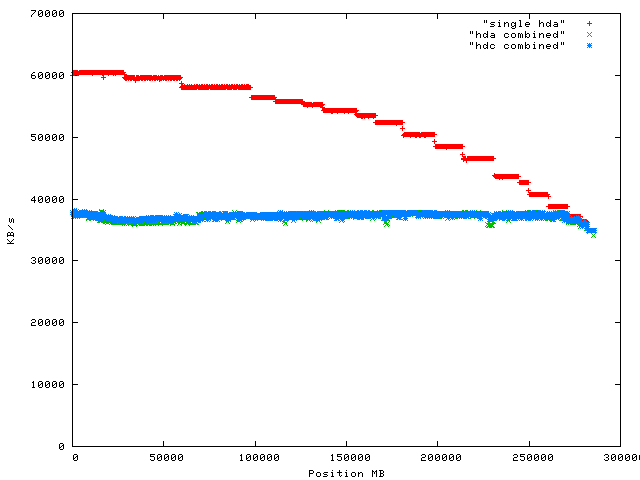
As correctly pointed out by cmot [1] my previous post about software RAID [2] made no mention of bus bandwidth. I have measured the bus bottlenecks of a couple of desktop machines running IDE disks with my ZCAV [3] benchmark (part of the Bonnie++ suite). The results show that two typical desktop machines had significant bottlenecks when running two disks for contiguous read operations [4]. Here is one of the graphs which shows that when two disks were active (on different IDE cables) the aggregate throughput was just under 80MB/s on a P4 1.5GHz while the disks were capable of delivering up to 120MB/s:
On a system such as the above P4 using software RAID will give a performance hit when compared to a hardware RAID device which is capable of driving both disks at full speed. I did not benchmark the relative speeds of read and write operations (writing is often slightly slower), but if for the sake of discussion we assume that read and write give the same performance then software RAID would only give 2/3 the performance of a theoretical perfect hardware RAID-1 implementation for large contiguous writes. On a RAID-5 array the bandwidth for large contiguous writes is the data size multiplied by N/(N-1) (where N is the number of disks), and on a RAID-6 array it is N/(N-2). For the case of a four disk RAID-6 array that would give the same overhead as writing to a RAID-1 and for the case of a minimal RAID-5 array it would be 50% more writes. So from the perspective of “I need X bandwidth, can my hardware deliver it” if I needed 40MB/s of bandwidth for contiguous writes then a 3 disk RAID-5 might work but a RAID-1 definitely would hit a bottleneck. Given that large contiguous writes to a RAID-1 is a corner case and that minimal sized RAID-5 and RAID-6 arrays are rare in most cases there should not be a significant overhead. As the number of seeks increases the actual amount of data transferred gets quite small. A few years ago I was running some mail servers which had a very intense IO load, four U320 SCSI disks in a hardware RAID-5 array was a system bottleneck - yet the IO was only 600KB/s of reads and 3MB/s of writes. In that case seeks were the bottleneck and write-back caching (which is another problem area for Linux software RAID) was necessary for good performance. For the example of my P4 system, it is quite obvious that with a four disk software RAID array consisting of disks that are reasonably new (anything slightly newer than the machine) there would be some bottlenecks. Another problem with Linux software RAID is that traditionally it has had to check the consistency of the entire RAID array in the case of an unexpected power failure. Such checks are the best way to get all disks in a RAID array fully utilised (Linux software RAID does not support reading from all disks in a mirror and checking that they are consistent for regular reads), so of course the issue of a bus bottleneck becomes an issue. Of course the solution to these problems is to use a server for server tasks and then you will not run out of bus bandwidth so easily. In the days before PCI-X and PCIe there were people running Linux software RAID-0 across multiple 3ware hardware controllers to get better bandwidth. A good server will have multiple PCI buses so getting an aggregate throughput greater than PCI bus bandwidth is possible. Reports of 400MB/s transfer rates using two 64bit PCI buses (each limited to ~266MB/s) were not uncommon. Of course then you run into the same problem, but instead of being limited to the performance of IDE controllers on the motherboard in a desktop system (as in my test machine) you would be limited to the number of PCI buses and the speed of each bus. If you were to install enough disks to even come close to the performance limits of PCIe then I expect that you would find that the CPU utilisation for the XOR operations is something that you want to off-load. But then on such a system you would probably want the other benefits of hardware RAID (dynamic growth, having one RAID that has a number of LUNs exported to different machines, redundant RAID controllers in the same RAID box, etc). I think that probably 12 disks is about the practical limit of Linux software RAID due to these issues and the RAID check speed. But it should be noted that the vast majority of RAID installations have significantly less than 12 disks. One thing that cmot mentioned was a RAID controller that runs on the system bus and takes data from other devices on that bus. Does anyone know of such a device?

Next.

Previous.