Search Results: "edd"

3 October 2010

Matt Zimmerman: Tips for frequent international travel

I travel pretty regularly, about 35% so far in 2010. When it goes wrong, travel can be exhausting, frustrating, complicated, stressful and even debilitating. I m always looking for ways to make my trips run more smoothly. On a recent flight to Taipei, I wrote down a few of the techniques which I ve successfully put into practice and found helpful. This is not an exhaustive list; I ve omitted a lot of the common and obvious tips I ve seen elsewhere.
  1. Make a packing list. This one may be obvious, but a lot of people neglect it. Perhaps they think making lists is boring and fussy, but really, it isn t. Without a packing list, it s easy to forget to do the things which will make your trip better. Use it every time, and bring a copy with you (or store it online) so you can add the things you wish you had brought or done. A simple, ever-improving packing list is the most effective technique I have found for making travel less stressful and more enjoyable.
  2. Carry a water bottle with a tight-fitting lid. I use a 32oz Nalgene bottle, which fits nicely into the seat next to me or under an armrest, and gives me enough water for even the longest flights. I fill it up after passing through security, at a cafe, bar or lounge, and generally decline the beverages offered by the cabin crew. Staying hydrated helps me feel better during the flight, and leaves me with less malaise when I arrive. I don t need to manage a tray table or armrest full of cups and other debris, so I can sit more comfortably, with the tray table folded away.
  3. Consolidate essential items using multipurpose equipment. For example, invest in a power adapter which has USB sockets onboard, and carry USB cables instead of wall chargers. Versatile items like this save on space and weight. I can charge two devices this way, but the equipment is smaller and lighter than even a single wall charger.
  4. Learn how to sleep on an airplane. Getting some sleep on a long flight really helps to offset the effects of traveling. There are several resources out there with practical advice on how to do it. One thing which really helped me was to buy a high quality eye mask which blocks out all of the light in the cabin. The one I use looks a little funny and is not cheap, but is very comfortable and effective. It s made of memory foam with a soft, washable cover and works much better than the ones the airlines give away for free. I no longer bother with a neck pillow, and use the flaps built into the seat to lean my head against. I m surprised at how many people don t know about this common aricraft feature: virtually every long-haul seat has something like this, even in economy, though it may not be obvious how to use it.
  5. Buy duplicates of things like toiletries, and keep them in your travel kit so you don t need to pack your everyday items (and risk forgetting them) each time. The less packing you need to do, the less time it will take, and the less opportunity there is for mistakes. This also saves time unpacking when you get home, and lets you buy a smaller size of the item where available.
  6. Optimize border crossings Carry the forms you ll need for customs, immigration, etc. in your carry-on. They don t always provide them at the counter or on board the plane, and it s a hassle to rush to fill in the form at the last minute. If you have a few of them with you, you can fill them out early (perhaps even before you fly) and then hustle to the front of the queue. For countries you enter frequently (especially your home country), programs like Global Entry (US) and IRIS (UK) will save you a lot of time by allowing you to use an automated kiosk to cross the border.

Matt Zimmerman: The paradox of Steve Jobs

Steve Jobs is a name that comes up a lot when talking to businesspeople, especially in the technology industry. His ideas, his background, his companies, their products, and his personal style are intertwined in the folklore of tech. I have no idea whether most of it is fiction or not, and I write this with apologies to Mr. Jobs for using him as shorthand. I have never met him, and my point here has nothing to do with him personally. What I want to discuss is the behavior of people who invoke the myth of Steve Jobs. In my (entirely subjective) experience, it seems to me that there is a pattern which comes up again and again: People seem to want to discuss and emulate the worst of his alleged qualities. Jobs has been characterized as abusive to his employees, dismissive of his business partners, harshly critical of mistakes, punishingly secretive, and otherwise extremely difficult to work with. Somehow, it is these qualities which are put forward as worthy of discussion, inspiration and emulation. Is this a simple case of confusing correlation with causation? Do people believe that Steve Jobs is successful because of these traits? Perhaps it is a way of coping with one s own character flaws: if Jobs can get away with such misbehavior, then perhaps we can be excused from trying to improve ourselves. Or is there something more subtle going on here? Maybe this observation is an effect of my own cognitive biases, as it is only anecdotal. As with any successful person, Jobs surely has qualities and techniques which are worthy of study, and perhaps even emulation. Although direct comparison can be problematic, luminaries like Jobs can provide valuable inspiration. I d just like to hear more about what they re doing right. Perhaps this is an argument for drawing inspiration from people you know personally, rather than from second-hand or fictitious accounts of someone else s life. I ve been fortunate to be able to work with many different people, each with their own strengths, weaknesses and style. I ve seen those characteristics first-hand, so I also have the context to understand why they were successful in particular situations. If there s one thing I ve learned about leadership, it s that it s highly context-sensitive: what worked well in one situation can be disastrous in another. Is your company really that much like Apple? Probably not.

29 September 2010

Lucas Nussbaum: How to demotivate people (Re: Making Debian Responsible For Its Actions)

In my Ruby packaging in Debian and Ubuntu: Mythbusting and FAQ, I wrote The Ruby developers (or expert users) community is generally very hostile towards Debian. Many harsh words and insults are used in discussions mentioning Debian in the ruby-core@ mailing list, and there are frequent recommendations to avoid the Debian packages and install from sources, which is quite demotivating (Actually, what prompted that blog post is someone calling Debian-specific changes unforgivable). Zed A. Shaw just provided a very good example of that. Quoting the most juicy parts:
It s simply a tactic to make sure that you are stuck on Debian.
If we look at this problem from an open source perspective, Debian is at a minimum being a horrible citizen.
What is happening is control is not aligned with responsibility. Debian has taken control of the software package and recrafted it for their very narrow set of system administrator users. However, they refuse to take responsibility for the defect and quality problems they create. Instead I end up being responsible for their mistakes, which is wrong.
If Debian is in control, then Debian should be made responsible. That s the only way to get them to change it. If they don t want to be responsible, then they should let me be in control.
I m imagining a mass petition, maybe some funny ad campaigns, in-person confrontations meant to embarrass package maintainers, SEO tricks to get people off Debian, promotion of any alternative to Debian, anything to make them pay, apologize, and listen.
If you write software and you re sick of Debian screwing up your gear, then shoot me ideas for how we can make this happen. I think that if enough of us band together to make Debian responsible for its actions we can actually get them to start asking us before they package our software to find out how we think it should be packaged.
On the technical part of the post: The problem that Zed is experiencing is unknown to me, and also to the Debian and Ubuntu bug trackers. To my knowledge, rubygems doesn t not require openssl or net/scp to work, and a simple grep through the sources kind-of confirms that. But of course, that blog post was written as a rant, not as a proper bug report. My best guess is that the gem that Zed is installing requires openssl and net/scp. But of course, rubygems can t just depend on all the libraries that applications or libraries installed via rubygems could possibly require. Regarding openssl, we had a problem in Ruby because of the licensing situation of Ruby (dual licensed GPLv2+ and Ruby license, linked with openssl, which might raise some eyebrows), so it was split off the main standard library package until recently (and, apparently, in the version Zed is using). For net/scp, it is not part of the standard library, and not a dependency of rubygems, so I don t see why Zed expects it to be installed. On the rest of the post: Following my last post, several people volunteered to help with Ruby on Debian (and Ubuntu). In particular, Laurent Arnoud has been doing some fantastic work fixing the pkg-ruby-extras team s RC bugs. Also, all the messages of support both in the comments of my last post were very much appreciated. But I m really wondering why the Ruby community generates so many poisonous people. All my work on Debian is done on a volunteer basis, and it s really hard to get so much shit from it.

28 September 2010

Lior Kaplan: LibreOffice first steps

It has been 12 hours since the LibreOffice announcement, and the projects starts to do its first steps.
  1. Neil Brown had submitted the first patch to LibreOffice, after waiting for 3 years (!) while the patch was available at the openoffice.org issues system (#80637).
  2. Michael Meeks had published Minutes of first LibreOffice technical group call . The general plan is to accept patches ( no large / risky / de-stabilising (new) feature work ) from the community and also merge the changes already done to openoffice.org (existing CWS).
  3. The public is welcome to help cleaning the existing code, Gil Forcada already started. see the EasyHacks list for the tasks to be done.
  4. LibreOffice mirrors now also contain the source code for the beta release done in the morning.
  5. Patches are welcome at libreoffice@lists.freedesktop.org or using the Bugzilla. See Get Involved Developing LibreOffice for more info.
You re welcome to join us
Filed under: LibreOffice, Openoffice.org Tagged: LibreOffice

Kartik Mistry: apt-get install moksha!

* No, we don t have moksha packaged yet. Sometime ago, Nirav forwarded me query regarding Utkarsh (my project where our goal was to provide complete Gujarati interface in OS) who got CD long time back but facing some issue. Last week, I decided to help and finish this pending task and went to place we decided. It was small laptop (ie EEE PC) for guru of group called, OM Parivar. I installed Ubuntu and customized it for Gujarati interface and required software. Second time, I went to Guruji s place for small training and I was wondering how fast man of 82 years can learn! He was very happy to see me helping and so I m converting more person to Linux. I also explained why I m using Linux and we even discussed about some Free Software philosophy. Next time: Keep Debian Installer with USB boot handy ;)

Lior Kaplan: Welcome The Document Foundation and LibreOffice

For those who haven t heard: OpenOffice.org Community announces The Document Foundation
The community of volunteers developing and promoting OpenOffice.org sets up an independent Foundation to drive the further growth of the project The Internet, September 28, 2010 The community of volunteers who develop and promote OpenOffice.org, the leading free office software, announce a major change in the project s structure. After ten years successful growth with Sun Microsystems as founding and principle sponsor, the project launches an independent foundation called The Document Foundation , to fulfil the promise of independence written in the original charter. The Foundation will be the cornerstone of a new ecosystem where individuals and organisations can contribute to and benefit from the availability of a truly free office suite. It will generate increased competition and choice for the benefit of customers and drive innovation in the office suite market. From now on, the OpenOffice.org community will be known as The Document Foundation . Oracle, who acquired OpenOffice.org assets as a result of its acquisition of Sun Microsystems, has been invited to become a member of the new Foundation, and donate the brand the community has grown during the past ten years. Pending this decision, the brand LibreOffice has been chosen for the software going forward. The Document Foundation is the result of a collective effort by leading independent members of the OpenOffice.org community, including several project leads and key members of the Community Council. It will be led initially by a Steering Committee of developers and national language projects managers. The Foundation aims to lower the barrier of adoption for both users and developers, to make LibreOffice the most accessible office suite ever. The Foundation will coordinate and oversee the development of LibreOffice, which is available in beta version at the placeholder site: http://www.libreoffice.org. Developers are invited to join the project and contribute to the code in the new friendly and open environment, to shape the future of office productivity suites alongside contributors who translate, test, document, support, and promote the software. Speaking for the group of volunteers, Sophie Gautier a veteran of the community and the former maintainer of the French speaking language project has declared: We believe that the Foundation is a key step for the evolution of the free office suite, as it liberates the development of the code and the evolution of the project from the constraints represented by the commercial interests of a single company. Free software advocates around the world have the extraordinary opportunity of joining the group of founding members today, to write a completely new chapter in the history of FLOSS . [...]
So welcome The Document Foundation and LibreOffice. I already can see how does the community benefits from this due to the merge with go-oo:
Q: What does this announcement mean to other derivatives of OpenOffice.org?
A: We want The Document Foundation to be open to code contributions from as many people as possible. We are delighted to announce that the enhancements produced by the Go-OOo team will be merged into LibreOffice, effective immediately. We hope that others will follow suit.
(from http://www.documentfoundation.org/faq/) So, will Oracle contribute the OpenOffice.org trademark to the community ? Time will tell
Filed under: LibreOffice, Openoffice.org, Proud to use free software

27 September 2010

Steve McIntyre: Armel buildds and porter box hosted at ARM

One of the nice things that I've been involved with since starting to work at ARM in Cambridge is setting up newer, faster machines to help with the armel port. We have six machines hosted in the machine room here now: arne All of these machines are Marvell DB-78x00-BP development boards, each configured with a 1GHz Feroceon processor (ARM v5t), 1.5GB of RAM and a 250GB drive attached via SATA. They're nice machines, reasonably powerful yet (as with many ARM-based machines) they draw very very little electrical power even when working hard. These very boards were used for a while by the folks at Canonical to help build the Ubuntu armel port, but now we've got them. In terms of configuration, these machines are not quite fully supported in Debian yet, though. The kernels we're using are locally-built, based on the Debian linux-source-2.6.32 package but with a .config (marvell.config) that's tweaked slightly to add the support for these boards. There aren't any source changes needed, so I'm hoping to get support added directly in Debian, either as a new kernel flavour or (preferred) as a patch to an existing flavour. I've had conflicting advice about whether the latter is possible, so I'm going to have to experiment and find out for myself. UPDATE 2010-09-28: I've tested, and it seems that the boards will need a new flavour after all, as the config is incompatible with the closest other config (kirkwood). Ah well... I had no end of trouble trying to get make-kpkg do the right thing, so on advice from Ben I built the kernel using "make deb-pkg", a standard target in the Linux kernel's build system: fakeroot make -j2 deb-pkg DEBEMAIL=93sam@debian.org DEBFULLNAME="Steve McIntyre" KDEB_PKGVERSION=buildd23 Annoyingly, that wouldn't work when cross-compiling either so I had to build the kernel natively. To make the resulting kernel image package install properly (and, just as importantly, allow for future easy upgrades for the DSA folks), I also needed the following tweaks to the Debian system: Finally, I've tweaked the uboot config on the machines to use the uImage and uInitrd files that are generated:
Marvell>> setenv IDE ide reset
Marvell>> setenv loadkernel ext2load ide 0:1 0x2000000 /uImage
Marvell>> setenv loadinitramfs ext2load ide 0:1 0x3000000 /uInitrd
Marvell>> setenv bootboth bootm 0x2000000 0x3000000
Marvell>> setenv bootcmd setenv bootargs \$\(bootargs\)\;$(IDE)\;$(loadkernel)\;$(loadinitramfs)\;$(bootboth)
Marvell>> saveenv
And that's it, as far as I can see. I'll now wait for people to tell me what I've got wrong above... :-)

26 September 2010

Dirk Eddelbuettel: RcppArmadillo 0.2.7

Version 0.2.7 of RcppArmadillo is now on CRAN. This updates the includes Armadillo template library to version 0.9.80 which Conrad released a few days ago. RcppArmadillo makes it easy to write highly efficient and highly readable C++ code for linear algebra (based on Armadillo) in R extensions (using Rcpp for the interface). The short NEWS file extract follows, also containing Conrad's entry for 0.9.80::
0.2.7   2010-09-25
    o   Upgraded to Armadillo 0.9.80 "Chihuahua Muncher":
         * Added join_slices(), insert_slices(), shed_slices()
         * Added in-place operations on diagonals
         * Various speedups due to internal architecture improvements
More information is on the RcppArmadillo page. Questions, comments etc should go to the rcpp-devel mailing list off the R-Forge page.

24 September 2010

Dirk Eddelbuettel: R / Finance 2011 Call for Papers

Brian announced it on r-help and r-sig-finance and I have since updated the R/Finance website and Call for Papers page. And as David Smith already outblogged me about it, without further ado our Call for Paper for next spring's R/Finance conference:
Call for Papers: R/Finance 2011: Applied Finance with R
April 29 and 30, 2011
Chicago, IL, USA
The third annual R/Finance conference for applied finance using R will be held this spring in Chicago, IL, USA on April 29 and 30, 2011. The two-day conference will cover topics including portfolio management, time series analysis, advanced risk tools, high-performance computing, market microstructure and econometrics. All will be discussed within the context of using R as a primary tool for financial risk management, portfolio construction, and trading. One-page abstracts or complete papers (in txt or pdf format) are invited to be submitted for consideration. Academic and practitioner proposals related to R are encouraged. We welcome submissions for full talks, abbreviated "lightning talks", and for a limited number of pre-conference (longer) seminar sessions. Presenters are strongly encouraged to provide working R code to accompany the presentation/paper. Data sets should also be made public for the purposes of reproducibility (though we realize this may be limited due to contracts with data vendors). Preference may be given to presenters who have released R packages. Please send submissions to: committee at RinFinance.com. The submission deadline is February 15th, 2011. Early submissions may receive early acceptance and scheduling. Submissions will be evaluated and submitters notified via email on a rolling basis. Determination of whether a presentation will be a long presentation or a lightning talk will be made once the full list of presenters is known. R/Finance 2009 and 2010 included attendees from around the world and featured keynote presentations from prominent academics and practitioners. 2009-2010 presenters names and presentations are online at the conference website. We anticipate another exciting line-up for 2011 including keynote presentations from John Bollinger, Mebane Faber, Stefano Iacus, and Louis Kates. Additional details will be announced via the conference website as they become available. For the program committee:
Gib Bassett, Peter Carl, Dirk Eddelbuettel, Brian Peterson,
Dale Rosenthal, Jeffrey Ryan, Joshua Ulrich
So see you in Chicago in April!

23 September 2010

Dirk Eddelbuettel: R Project and Google Summer of Code: Wrapping up

As this year's admin, I wrote up the following summary which has now been posted at the R site in the appropriate slot. My thanks to this year's students, fellow mentors and everybody else who helped to make it happen. GSoC 2010 logo

Projects 2010 As in 2008 and 2009, the R Project has again participated in the Google Summer of Code during 2010. Based on ideas collected and disussed on the R Wiki, the projects and students listed below (and sorted alphabetically by student) were selected for participation and have been sponsored by Google during the summer 2010. The finished projects are available via the R / GSoC 2010 repository at Google Code, and in several cases also via their individual repos (see below). Informal updates and final summaries on the work was also provided via the GSoC 2010 R group blog.

rdx - Automatic Differentiation in R Chidambaram Annamalai, mentored by John Nash. Proposal: radx is a package to compute derivatives (of any order) of native R code for multivariate functions with vector outputs, f:R^m -> R^n, through Automatic Differentiation (AD). Numerical evaluation of derivatives has widespread uses in many fields. rdx will implement two modes for the computation of derivatives, the Forward and Reverse modes of AD, combining which we can efficiently compute Jacobians and Hessians. Higher order derivatives will be evaluated through Univariate Taylor Propagation. Delivered: Two packages radx: forward automatic differentiation in R and tada: templated automatic differentiation in C++ were created; see this blog post for details.

A GUI for Graphics using ggplot and Deducer by Ian Fellows, mentored by Hadley Wickham. Proposal: R puts the latest statistical techniques at one's fingertips through thousands of add-on packages available on the CRAN download servers. The price for all of this power is complexity. Deducer is a cross-platform cross-console graphical user interface built on top of R designed to reduce this complexity. This project proposes to extend the scope of Deducer by creating an innovative yet intuitive system for generating statistical graphics based on the ggplot2 package. Delivered: All of the major features have been implemented, and are outlined in the video links in this blog post.

rgeos - an R wrapper for GEOS by Colin Rundel, mentored by Roger Bivand. Proposal: At present there does not exist a robust geometry engine available to R, the tools that are available tend to be limited in scope and do not easily integrate with existing spatial analysis tools. GEOS is a powerful open source geometry engine written in C++ that implements spatial functions and operators from the OpenGIS Simple Features for SQL specification. rgeos will make these tools available within R and will integrate with existing spatial data tools through the sp package. Delivered: The rgeos project on R-Forge; see the final update blog post.

Social Relations Analyses in R by Felix Schoenbrodt, mentored by Stefan Schmukle. Proposal: Social Relations Analyses (SRAs; Kenny, 1994) are a hot topic both in personality and in social psychology. While more and more research groups adopt the methodology, software solutions are lacking far behind - the main software for calculating SRAs are two DOS programs from 1995, which have a lot of restrictions. My GSOC project will extend the functionality of these existing programs and bring the power of SRAs into the R Environment for Statistical Computing as a state-of-the-art package. Delivered: The TripleR package is now on CRAN and hosted on RForge.Net; see this blog post for updates.

NoSQL Interface for R by Yasuhisa Yoshida, mentored by Dirk Eddelbuettel. Proposal: So-called NoSQL databases are becoming increasingly popular. They generally provide very efficient lookup of key/value pairs. I'll provide several implementation of NoSQL interface for R. Beyond a sample interface package, I'll try to support generic interface similar to what the DBI package does for SQL backends Status: An initial prototype is available via RTokyoCabinet on Github. No updates were made since June; no communication occurred with anybody related to the GSoC project since June and the project earned a fail.

Last modified: Wed Sep 22 19:39:43 CDT 2010

22 September 2010

Luca Bruno: Report from the Debian/Ubuntu Community Conference, ITA 2010

From the 17th to the 19th of September in Perugia, Italy, it took place the 5th edition of the Italian Debian Community Conference, which has been attended by many contributors and users. For the first time, the event has been organized in collaboration with the Italian Ubuntu community, as to create a new joint conference in order to foster shared contributions and emphasizing the large common ground of our projects. This new experimental kind of mini-conference was then labeled DUCC-IT, to reflect both the local profile and the mutual collaboration. After the initial social night, spent discussing of several ongoing free software efforts and having dinner all together, the conference official opening started on Saturday, temporarily housed at University of Perugia, with a series of talks and hands-on session aimed at recruiting new contributors to work on development, translations, documentation writing and marketing. It has been a good opportunity to celebrate the Software Freedom Day too, in collaboration with FSUG Italia and the participation of some local schools.

DUCC-IT '10 Group Photo The event been also attended by some members of the Debian Women and Ubuntu Women teams (whose goal is to promote women participation in both projects), who organized a round-table debate taking the Italian panorama as a study case. The discussion embraced different topics, ranging from the wide difference in numbers, to the deep causes of this phenomenon and how to improve the situation. With the help of the hacklab staff (hosting the debate), an audio/video streaming has been made available in real-time, and many remote participants joined us with comments and questions. This new kind of collaboration between our communities was found to be really positive and more events has already been drafted for the next year, including a translation sprint and a contributors meeting. We encourage worldwide local communities to try and engage in a similar experiment: organizing and joining a DUCC event will be pure fun. A detailed report of the conference will be soon available, completed by photos, participants comments, video records and slides for the talks.
We d really like to thank the Math Department of University of Perugia, the Projectz On Island hacklab, FSUG Italia, the Ubuntu-it community and everyone who contribute to this event.

21 September 2010

Joey Hess: solar charge controller adventure

Xantrex controller, temporarily badly installed
As planned I have installed the Xantrex C-35 charge controller in the offgrid house. This was a bit of an adventure.. First I had to wait around in town all day for the UPS man to deliver the thing. Of course he didn't until 4, so by the time I got over to the house it was almost dusk. Further delayed by necessary visiting with the nearest neighbor (a country thing), who claims there are "panthers" up this holler.. So by the time I was ready to work, it was nearly too dark. First I checked the battery bank which I had left charging for a week without a controller or backflow diode. It had gained only half a volt (to 10.5v), so now I knew I really did need the controller in order for the sun to work for me while I am away. Then, barely able to see, I swapped that bank to provide house power. By 10 pm, using just my laptop, I'd drained 1.5 volts from it and it was as low as it should go. I had 4 hours of laptop battery. This was a bit of a problem since I tend to stay up until 3 am on it. Instead, I spent 2 hours, by kerosine lantern light, exposing, tracing, and testing wiring. I was able to find 2 wires that were clearly going to the battery bank and had current, and 2 others that were labeled as going to the panels, and, in the dead of night, had no current. Great, I thought, that's the wires I need, let's hook up the controller.. And I did, although only to the battery, since after all I couldn't be certain the other two wires were for the panels, without seeing voltage on them in the daytime. (This turned out to be probably wise, because in the morning, when I tried it, the controller reported no PV voltage. They turned out to be mislabled, and actually connected the battery to the breaker box.)
The problem with doing all that stuff at midnight is it took me quite a long time to wind down. I normally start winding down at 10 am and get to sleep at 3. Last night I got to sleep at 5. My four hours of battery for my laptop were nursed all hours through the night. Mostly thanks to powertop and the improved power saving of the kernel these days. And to not having wifi or anything enabled. I do wonder if my recent use of redshift to redden the screen causes the it to use less power at night, as I have never gotten five hours out of this laptop before.
Anyway, to get the controller hooked up to the PV array and actually charging the batteries, I ended up having to rip lots of wiring out of the wall, until I simplified the mess to something I could understand. And at the moment I've bypassed the PV array's breaker, which is certainly a safety hazard. So more wiring to do, but I did get it working. Finally, I hooked the house wiring up to the same battery bank that is being charged from the panel. This house had been using a 2 battery bank setup, because without a charge controller to moderate the PV voltage (17-25 volts), you can't also connect a load that expects 12 volts. The charge controller fixes that problem. The other battery bank is sitting unused for now. Later, I will equalize and connect the two, in order to get one large(ish) battery bank. Now, during the sunny fall daytime, I can use all the power I want; it's free from the sun. Battery bank shouldn't drain at all when I use power during the day, and the controller should charge them up and keep them topped off, so they'll be there for me at night. Now to verify that it's working like it's supposed to!
(I posted some documents and more thoughts from this here).

20 September 2010

Joey Hess: MovieOS credit

In one scene of The Girl with the Dragon Tattoo, her laptop has been broken. These are the files that she needs to recover from it. Yep, debconf templates files, debhelper md5sums, and generally /var/lib/dpkg/info/ -- in a film full of data, these are the first data that the plot turns on. (PS, Even super-anti-heroes should probably make their backups before battle.)

18 September 2010

Robert Collins: Maintainable pyunit test suites fixtures

So a while back I blogged about maintainable test suites. One of the things I ve been doing since is fiddling with the heart of the fixtures concept. To refresh your memory, I m defining fixture as some basic state you want to reach as part of doing a test. For instance, when you ve mocked out 2 system calls in preparation for some test code that represent a state you want to reach. When you ve loaded sample data into a database before running the actual code you want to make assertions about that also represents a state you want to reach. So does simply combining three or four objects so you can run some code. Now, there are existing frameworks in python for this sort of thing. testresources and testscenarios both go some way towards this (and I and to blame for them :) ), so does the zope testrunner with layers, and the testfixtures project has some lovely stuff as well. And this is without even mentioning py.test! There are a few things that you need from the point of view of running a test and establishing this state: Large test suites or test suites dealing with various sorts of external facilities will also often want to optimise this process and put the same state into place for many tests. The (and I m not exaggerating) terrible setUpClass and setUpModule and other similar helpers are often abused for this. Why are they terrible? They are terrible because they are fragile; there is no (defined in the contract) way to check that the state is valid for the next test, and its common to see false passes and false failures in tests using setUpClass and similar. So we also need some way to reuse such expensive things while still having a way to check that test isolation hasn t been compromised. Having looked around, I ve come to the conclusion we ll all benefit if there is a single core protocol for doing these things, something that can be used and built on in many different ways for many different purposes. There was nothing (that I found) that actually met all these requires and was also tasteful enough that folk might really like using it. I give you fixtures . Or on Launchpad. This small API is intended to be a common contract that all sorts of different higher level test libraries can build on. As such it has little to no policy or syntatic sugar. It does have a nice core, integration with pyunit.TestCase, and I m going to add a library of useful generic fixtures (like temporary directories, environment isolators and so on) to it. I d be delighted to add more committers to the project, and intend to have it be both Python 2.x and 3.x compatible (if its not already my CI machine isn t back online after the move yet, I m short of round tuits). Now, if you re writing some code like:
class MyTest(TestCase):
    def setUp(self):
        foo = Foo()
        bar = Bar()
        self.quux = Quux(Foo(), Bar())
        self.addCleanup(self.quux.done)
You can make it reusable across your code base simply by moving it into a fixture like this:
class QuuxFixture(fixtures.Fixture):
    def setUp(self):
        foo = Foo()
        bar = Bar()
        self.quux = Quux(Foo(), Bar())
        self.addCleanup(self.quux.done)
class MyTest(TestCase, fixtures.TestWithFixtures):
    def setUp(self):
        self.useFixture(QuuxFixture)
I do hope that the major frameworks (nose, py.test, unittest2, twisted) will include the useFixture glue themselves shortly; I will offer it as a patch to the code after giving it some time to settle. Further possibilities include declared fixtures for tests, and we should be able to make setUpClass better by letting fixtures installed during it get reset between tests.

17 September 2010

Jo Shields: Mono mythbusting, September 2010 edition

There are corners of the Internest where foolish people congregate, and invent stories. These foolish stories are then read as gospel by trusting people, and reposted, until the original made-up source is concealed from view. As an attempt to stem this flow of disinformation, here are some commonly held but incorrect beliefs about the Mono framework, and an explanation of the reality of the situation, as far as I understand it. The next Mono version is co-developed with Microsoft There is a grain of truth behind this one, but it s a gross mischaracterisation. Mono 2.8, when it ships, will bundle, for convenience, a number of Free Software libraries, which are released by Microsoft under a license considered Free Software by the Free Software Foundation, the Ms-PL. These are: So, to summarise, there are five Free Software libraries written by Microsoft under the Ms-PL included in Mono 2.8 but only two of those five are new, and none of them were co-developed in any meaningful sense. Mono development is dead There have been reports that Mono development has ended, on the basis that no commits have been made to Novell s Subversion server for a few weeks. However, these reports miss one minor detail Mono has moved to Github.com. There were 35 commits from 9 different people to the main mono.git repository (of dozens of repositories under the main Mono project) in the last 2 days, at time of writing far from dead. Mono lacks features found in Microsoft.NET Mono lacks libraries found in Microsoft.NET, such as the Windows Presentation Framework GUI toolkit. In terms of features, i.e. things implemented at a compiler or runtime level, Mono is typically more advanced. This is helped in no small part by Mono s Free Software development model, allowing experimentation and what if changes to the core runtime which a sluggish corporate behemoth like Microsoft cannot accommodate. To give three real-world examples, Mono allows embedding of its compiler as a service, and provides a REPL shell this is a planned feature for .NET 5.0, but has been available for years in Mono; Mono.Simd provides a number of data structures which will run on any version of Mono or Microsoft.NET, but will use optimized CPU extensions like SSE when run on a sufficiently new version of Mono, on an appropriate architecture as far as I m aware, there is nothing like this available or planned for Microsoft.NET. Mono is able to produce fully compiled, static executables which do not need to JIT anything at runtime this is used for iPhone compilation, for example, where JITters are not permitted. There is no comparable feature in Microsoft.NET. Clearly, Microsoft.NET can only be thought of as more featureful if one defines features in terms of does it have lots of libraries? in terms of functionality, Mono is ahead. Mono can sneak onto your system without your knowledge If you don t have the mono-runtime package installed, you can t run Mono apps. It is possible to install some Mono apps alongside the awful-yet-popular mononono equivs package, since the popular equivs script fails to place Conflicts on the correct packages (F-Spot will be blocked, Tomboy will not). No package in Debian or Ubuntu embeds its own copy of the Mono runtime, and we have no plans to make any changes to packaging which would allow execution of any C# application without mono-runtime installed. If one is using a different OS, then things may be different e.g. The Sims 3 for Mac & PC uses embedded Mono, which you wouldn t know about without looking. Canonical are pursuing a pro-Mono agenda, and are responsible for it being pushed in Debian Mono development has been happening in Debian for longer than Canonical has existed the first upload was made in April 2002. Ubuntu is made primarily from software already available in Debian deemed of sufficient quality, and when F-Spot and Tomboy became parts of the default Ubuntu desktop system in 2006, both pieces of software were already available in Debian and deemed of sufficient quality. Nobody working on Mono in Debian is paid by Canonical actually, that s not entirely true, three packages related to accessibility are officially maintained by someone who was hired by Canonical after doing the initial packaging work when he worked for Novell. But the Mono runtime itself, Canonical have no influence over its direction in Debian. As for a pro-Mono agenda , they ve always taken an extremely pragmatic approach to language choice, never showing any real preference for one language or another when it comes to app selection. They don t exhibit any overt anti-Mono policies, which is not the same thing. The names of people contributing to Mono in Debian are not secret check the pkg-mono team page on Alioth. The System.Windows.Forms namespace is protected by Microsoft patents The truth is, nobody knows for sure if SWF, or any other part of Mono, or any other framework such as Vala or Python, is covered by Microsoft patents. The way the US patent system is contrived, it is actively dangerous to check whether something contains any patents when you write it, as you are liable for triple damages should it later emerge that there WAS a patent, even if your searching missed the fact. You cannot patent an API or namespace only a specific implementation of a software concept, in those countries where software patents are permitted. There has never been any evidence shown that Mono s implementation of SWF, or indeed any part of Mono, infringes any Microsoft-held patents, because if that were the case, then the code would be rewritten to avoid the issue much like the approach taken by Linux kernel developers when a patent becomes apparent. The belief within the Mono community is that the core parts of Mono as defined in ECMA334/335 are safe (they are covered by the Microsoft Community Promise patent grant); any of the Ms-PL libraries mentioned above is definitely safe (Ms-PL includes an explicit patent grant); and the rest of the package is likely safe too (on the basis that it is a named component of the Open Innovation Network s list of protected software and on the basis that there s unlikely to be anything patentable in one of many implementations of basic ideas like database connectors). Nobody knows for sure, because that s how the system works. But, again, nobody knows for sure that Microsoft patents don t apply to other frameworks such as Python there is simply a belief and an assumption that they do not. MonoDevelop contributors removed GPL code from MonoDevelop, in an attack on the GPL This is somewhat disingenuous, given MonoDevelop is LGPL. The MonoDevelop team excised the remaining GPL code (and there wasn t much of it) in order to grant greater Freedom to developers. Previously, the entire MonoDevelop IDE was a GPL combination, meaning any add-ins for the IDE also needed to be GPL, regardless of developer choice. Now, any developer can write an add-in for MonoDevelop, using the license of their choice, whether another Free license like the Mozilla Public License, or a proprietary closed-source add-in. They are still welcome to produce GPL add-ins, if they want to, as well. Mono won t run random Microsoft.NET apps anyway, so isn t really cross-platform Actually, this one is often true. When developers write apps for Windows primarily, they rarely take the time to think is this the correct way to do it? and will often plough on with an assumption about the Windows way of doing things. It might be simple things like filesystem assumptions (assuming a case-insensitive filesystem, or assuming a backslash is used to separate directories, not a forward slash). It might be more involved, such as using P/Invokes into Windows-specific C libraries, when a more cross-platform alternative is possible. So, often, random applications for Microsoft.NET won t run on Mono. The reverse is also true F-Spot or GNOME Do are fairly heavily tied to Linux (or to UNIX-like OSes with X11, at any rate), through the libraries they invoke being fairly platform-specific. You can write platform-specific Java, with one quick piece of JNI, too. It should be noted, however, that Mono makes the chance of .NET applications being ported to Linux (and/or Mac) much more likely, since even in the worst case scenario, a company only needs to fix a portion of their source to make it cross-platform. The Mono team have a tool called MoMA, which will scan an application and its libraries, and give you detailed reports on the app s portability. This info is used at both ends by app vendors who want to become more portable, and by the Mono team who want to fill in the most frequently encountered blanks. And, it should be stressed, writing cross-platform apps is entirely possible if one desires it e.g. the IRC client Smuxi is pure cross-platform C#, and the executables compiled on Mono on Linux will run fine on Microsoft.NET on Windows. Portability in this direction is important too consider how many people have been introduced to Free Software thanks to availability of Free apps on Windows like OpenOffice.org, Firefox, Pidgin or GIMP. You can download Tomboy for Windows, and work is ongoing on fixing Banshee portability issues (which are mostly caused by gStreamer). Mono on Android is a terrible idea which will be super slow There are two efforts to enable developers to write Android applications with Mono a paid proprietary product from Novell called MonoDroid, and an untitled porting effort by big-name Android hacker Koushik Dutta. I have no insight into MonoDroid since it hasn t been released yet, but Koush did some benchmarks of his work which exhibited some remarkable figures compared to Dalvik (and even compared to Sun Java for ARM). Those numbers haven t been updated to reflect the Froyo Dalvik JITter, but Mono on Android is still very exciting from a performance perspective. Mono isn t really Free Software The source code is all available under Free Software licenses. So, um, yes it is. We don t need Mono because we have $LANG By the same logic, we don t need $LANG because we have Mono. By all means, use the language of your choice other developers will use the language of their choice too. If you want to use Vala or Python or Java, then by all means, go ahead. It doesn t mean there s no room for more languages, better suited to other usage patterns. Haskell is great for some types of development, so is Fortran, and so is C#. You might not need Mono because of $LANG, but there are others in the world with different needs. Mono apps are all slow, and crash your computer, and stuff No userland app can crash your Linux system, unless there s a bug in the kernel, or you have some severe problems with your hardware. If you ve ever observed a crash as a result of running a Mono app, then it s really coincidence that Mono is tickling whichever part of your system is busted. As for slow startup time may well be slower than for apps written in C or Vala. There s a delay due to the JITter needing to compile all the libraries used by the application (we may AOT the most common libraries in a future Mono package version, at upstream s recommendation). Once an app is running, it should be fast compared to a Python app, and memory-light compared to a Java app. The new garbage collector in Mono 2.8 should also offer significant improvements to performance, especially under heavy workloads. Ubuntu s default GTK+ themes require Mono This is my favourite recent nonsense to emerge from the Internest. There are reports mostly restricted to IRC and blog comments, that (paraphrasing here) removing Mono removes the Ubuntu themes . Here s the reality: in Ubuntu 10.04, a new visual style was implemented throughout the distro. As part of this, small icons (e.g. notification area icons) were set to be black-and-white by default, and colourised when attention is needed (e.g. the power-off icon turns red when a reboot is needed, the messaging indicator turns green when there s a new message). All of these new monochrome icons are in a package named ubuntu-mono . Removing the ubuntu-mono icon package will also remove the new Ubuntu GTK+ themes, in the light-themes package. So there s your explanation: the themes have a dependence on some monochrome icons, not on the Mono framework.

Raphaël Hertzog: How to create Debian packages with alternative compression methods

While gzip is the standard Unix tool when it comes to compression, there are other tools available and some of them are performing better than gzip in terms of compression ratio. This article will explain where you can make use of them in your Debian packaging work. In the source package A source package is composed of multiple files. The .dsc file is always uncompressed and it s fine since it s a small textual file. The upstream tarballs can be compressed with gzip (orig.tar.gz), bzip2 (orig.tar.bz2), lzma (orig.tar.lzma) or xz (orig.tar.xz), so choose the one that you want if upstream provides the tarball compressed with multiple tools. Put it at the right place and dpkg-source will automatically use it. Note however that packages using source format 1.0 are restricted to gzip, and the main Debian archive currently only allows gzip and bzip2 (xz might be allowed later) even if the source format 3.0 (quilt) supports all of them. The debian packaging files are provided either in a .diff.gz file for source format 1.0 (again only gzip is supported) or in a .debian.tar file for source format 3.0 (quilt) . The latter tarball can be compressed with the tool of your choice, you just have to tell dpkg-source which one to use (see below, note that gzip is the default). In a native package, dpkg-source must generate the main tarball and you can instruct it to use another tool than gzip with the --compression option. That option is usually put in debian/source/options:
# Use bzip2 instead of gzip
compression = "bzip2"
compression-level = 9
For 3.0 (quilt) source packages, this option is not very useful as the debian tarball that gets compressed is usually not very large. But some maintainers like to use the same compression tool for the upstream tarball and the debian tarball, so you can use this option to harmonize both. In native packages, it s much more interesting: for instance the size of dpkg s source package has been reduced of 30% by switching to bzip2, saving 2Mb of disk. In the binary packages .deb files also contain compressed tar archives and by default they use gzip as well:
$ ar t dpkg_1.15.9_i386.deb
debian-binary
control.tar.gz
data.tar.gz
data.tar.gz is the archive that contains all the files to be installed and it s the one that you can compress with another tool if you want. Again this is mostly interesting for (very) large packages where the size difference clearly justifies deviating from the default compression tool. Try it out and see how many megabytes you can shove. Another aspect that you must keep in mind is that those alternative tools might use important amount of memory to do their job, both for compression and decompression. So if your package is meant to be installed on embedded platforms, or if you want to build your package on low-end hardware with few memory, you might want to stick with gzip. Now how do you change the compression tool? Easy, dpkg-deb supports a -Z option, so you just have to pass -Zbzip2 for example. You can also pass -z6 for example to change the compression level to 6 (it s interesting because a lower compression level might require less memory depending on the tool used). The dpkg-deb invocation is typically hidden behind the call to dh_builddeb in your debian/rules so you have to replace that invocation with dh_builddeb -- -Zbzip2 . If you are using a debhelper 7 tiny rules files, you have to add an override like in this example:
%:
	dh $@
override_dh_builddeb:
	dh_builddeb -- -Zbzip2
If you are using CDBS, you have to set the variable DEB_DH_BUILDDEB_ARGS:
include /usr/share/cdbs/1/rules/debhelper.mk
[...]
DEB_DH_BUILDDEB_ARGS = -- -Zbzip2
I hope you found this article helpful. Follow me on identi.ca or on twitter.
Flattr this Share/Bookmark One comment Support my work

16 September 2010

Lior Kaplan: 64-bit Flash Player

I read today that Adobe re-released its 64-bit Flash player (although a preview version) after a 3 months without supporting Linux 64-bit. Although these are good news, I think I ll thank Adobe for forcing me into using the free software replacements and stick to them. They might not be perfect, but they are free (as in speech).

I m using Swfdec on Ubuntu 10.04 & Gnash 0.8.8 on Debian unstable, and I m quite happy with both. Gnash 0.8.8 and the fix for YouTube was a big issue which had caused me to not selecting it as a flash player in the past, and Swfdec is dead for two years, but still does most of the work (although it works better on Ubuntu than on Debian, no idea why).
Filed under: Debian GNU/Linux, Ubuntu

Dirk Eddelbuettel: BLAS, BLASter, BLAStest: Some benchmark results, and a benchmarking framework

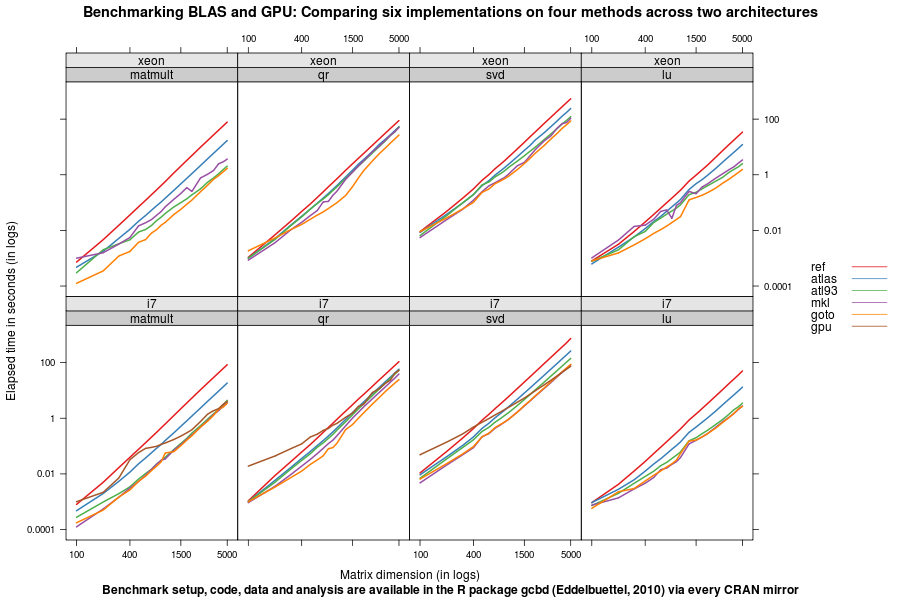
Usage of accelerated BLAS libraries seems to shrouded in some mystery, judging from somewhat regularly recurring requests for help on lists such as r-sig-hpc (gmane version), the R list dedicated to High-Performance Computing. Yet it doesn't have to be; installation can be really simple (on appropriate systems). Another issue that I felt needed addressing was a comparison between the different alternatives available, quite possibly including GPU computing. So a few weeks ago I sat down and wrote a small package to run, collect, analyse and visualize some benchmarks. That package, called gcbd (more about the name below) is now on CRAN as of this morning. The package both facilitates the data collection for the paper it also contains (in the vignette form common among R packages) and provides code to analyse the data---which is also included as a SQLite database. All this is done in the Debian and Ubuntu context by transparently installing and removing suitable packages providing BLAS implementations: that we can fully automate data collection over several competing implementations via a single script (which is also included). Contributions of benchmark results is encouraged---that is the idea of the package. The paper itself describes the background and technical details before presenting the results. The benchmark compares the basic reference BLAS, Atlas (both single- and multithreaded), Goto, Intel MKL and a GPU-based approach. This blog post is not the place to recap all results, so please do see the paper for more details. But one summary chart regrouping the main results fits well here: GPU/CPU Benchmark Results This chart, in a log/log form, shows how reference BLAS lags everything, how multithreaded newer Atlas improves over the standard Atlas package currently still the default in both distros, how the Intel MKL (available via Ubuntu) is fairly good but how Goto wins almost everything. GPU computing is compelling for really large sizes (at double precision) and too costly at small ones. It also illustrates variability and different computational cost across the methods tested: svd is more expensive than level-3 matrix multiplication, and the different implementations are less spread apart. More details are in the paper; code, data etc are in the package gcbd. The larger context is to do something like this benchmarking exercise, but across distributions, operating systems and possibly also GPU cards. Mark and I started to talk about this during and after R/Finance earlier this year and have some ideas. Time permitting, that work should be happening in the GPU/CPU Benchmarks (gdb) project, and that's why this got called gcbd as a simpler GPU/CPU Benchmarks on Debian Systems study.

14 September 2010

Luca Falavigna: Invitation

lolcat Jokes off now, time to take it seriously ;)

Kartik Mistry: More uninteresting updates!

* Gwibber in experimental. Expect: 2.31.93-1 by tonight. + It is still slow. In short, it sucks at moment. Report bugs to upstream. Any improvement for Debian packaging (I moved it to pysupport (Thanks to Filip Chabik) * Life sucks. Why? + Festival time. I ve developed allergy to noise.
+ 31++ today. Still not much sign of getting wiser. And, no gift to me from myself.
+ Laptop is becoming pain now. 4GB is not enough!

Next.

Previous.